What’s next for our privacy?

MIT Technology Review’s What’s Next series looks across industries, trends, and technologies to give you a first look at the future. You can read the rest of them here.

Every day, we are tracked hundreds or even thousands of times across the digital world. Cookies and web trackers capture every website link that we click, while code installed in mobile apps tracks every physical location that our devices—and, by extension, we—have visited. All of this is collected, packaged together with other details (compiled from public records, supermarket member programs, utility companies, and more), and used to create highly personalized profiles that are then shared or sold, often without our explicit knowledge or consent. 

A consensus is growing that Americans need better privacy protections—and that the best way to deliver them would be for Congress to pass comprehensive federal privacy legislation. While the latest iteration of such a bill, the American Privacy Rights Act of 2024, gained more momentum than previously proposed laws, it became so watered down that it lost support from both Republicans and Democrats before it even came to a vote. 

There have been some privacy wins in the form of limits on what data brokers—third-party companies that buy and sell consumers’ personal information for targeted advertisements, messaging, and other purposes—can do with geolocation data. 

These are still small steps, though—and they are happening as increasingly pervasive and powerful technologies collect more data than ever. And at the same time, Washington is preparing for a new presidential administration that has attacked the press and other critics, promised to target immigrants for mass deportation, threatened to seek retribution against perceived enemies, and supported restrictive state abortion laws. This is not even to mention the increased collection of our biometric data, especially for facial recognition, and the normalization of its use in all kinds of ways. In this light, it’s no stretch to say our personal data has arguably never been more vulnerable, and the imperative for privacy has never felt more urgent. 

So what can Americans expect for their personal data in 2025? We spoke to privacy experts and advocates about (some of) what’s on their mind regarding how our digital data might be traded or protected moving forward. 

Reining in a problematic industry

In early December, the Federal Trade Commission announced separate settlement agreements with the data brokers Mobilewalla and Gravy Analytics (and its subsidiary Venntel). Finding that the companies had tracked and sold geolocation data from users at sensitive locations like churches, hospitals, and military installations without explicit consent, the FTC banned the companies from selling such data except in specific circumstances. This follows something of a busy year in regulation of data brokers, including multiple FTC enforcement actions against other companies for similar use and sale of geolocation data, as well as a proposed rule from the Justice Department that would prohibit the sale of bulk data to foreign entities. 

And on the same day that the FTC announced these settlements in December, the Consumer Financial Protection Bureau proposed a new rule that would designate data brokers as consumer reporting agencies, which would trigger stringent reporting requirements and consumer privacy protections. The rule would prohibit the collection and sharing of people’s sensitive information, such as their salaries and Social Security numbers, without “legitimate purposes.” While the rule will still need to undergo a 90-day public comment period, and it’s unclear whether it will move forward under the Trump administration, if it’s finalized it has the power to fundamentally limit how data brokers do business.

Right now, there just aren’t many limits on how these companies operate—nor, for that matter, clear information on how many data brokerages even exist. Industry watchers estimate there may be 4,000 to 5,000 data brokers around the world, many of which we’ve never heard of—and whose names constantly shift. In California alone, the state’s 2024 Data Broker Registry lists 527 such businesses that have voluntarily registered there, nearly 90 of which also self-reported that they collect geolocation data. 

All this data is widely available for purchase by anyone who will pay. Marketers buy data to create highly targeted advertisements, and banks and insurance companies do the same to verify identity, prevent fraud, and conduct risk assessments. Law enforcement buys geolocation data to track people’s whereabouts without getting traditional search warrants. Foreign entities can also currently buy sensitive information on members of the military and other government officials. And on people-finder websites, basically anyone can pay for anyone else’s contact details and personal history.  

Data brokers and their clients defend these transactions by saying that most of this data is anonymized—though it’s questionable whether that can truly be done in the case of geolocation data. Besides, anonymous data can be easily reidentified, especially when it’s combined with other personal information. 

Digital-rights advocates have spent years sounding the alarm on this secretive industry, especially the ways in which it can harm already marginalized communities, though various types of data collection have sparked consternation across the political spectrum. Representative Cathy McMorris Rodgers, the Republican chair of the House Energy and Commerce Committee, for example, was concerned about how the Centers for Disease Control and Prevention bought location data to evaluate the effectiveness of pandemic lockdowns. Then a study from last year showed how easy (and cheap) it was to buy sensitive data about members of the US military; Senator Elizabeth Warren, a Democrat, called out the national security risks of data brokers in a statement to MIT Technology Review, and Senator John Cornyn, a Republican, later said he was “shocked” when he read about the practice in our story. 

But it was the 2022 Supreme Court decision ending the constitutional guarantee of legal abortion that spurred much of the federal action last year. Shortly after the Dobbs ruling, President Biden issued an executive order to protect access to reproductive health care; it included instructions for the FTC to take steps preventing information about visits to doctor’s offices or abortion clinics from being sold to law enforcement agencies or state prosecutors.

The new enforcers

With Donald Trump taking office in January, and Republicans taking control of both houses of Congress, the fate of the CFPB’s proposed rule—and the CFPB itself—is uncertain. Republicans, the people behind Project 2025, and Elon Musk (who will lead the newly created advisory group known as the Department of Government Efficiency) have long been interested in seeing the bureau “deleted,” as Musk put it on X. That would take an act of Congress, making it unlikely, but there are other ways that the administration could severely curtail its powers. Trump is likely to fire the current director and install a Republican who could rescind existing CFPB rules and stop any proposed rules from moving forward. 

Meanwhile, the FTC’s enforcement actions are only as good as the enforcers. FTC decisions do not set legal precedent in quite the same way that court cases do, says Ben Winters, a former Department of Justice official and the director of AI and privacy at the Consumer Federation of America, a network of organizations and agencies focused on consumer protection. Instead, they “require consistent [and] additional enforcement to make the whole industry scared of not having an FTC enforcement action against them.” (It’s also worth noting that these FTC settlements are specifically focused on geolocation data, which is just one of the many types of sensitive data that we regularly give up in order to participate in the digital world.)

Looking ahead, Tiffany Li, a professor at the University of San Francisco School of Law who focuses on AI and privacy law, is worried about “a defanged FTC” that she says would be “less aggressive in taking action against companies.” 

Lina Khan, the current FTC chair, has been the leader of privacy protection action in the US, notes Li, and she’ll soon be leaving. Andrew Ferguson, Trump’s recently named pick to be the next FTC chair, has come out in strong opposition to data brokers: “This type of data—records of a person’s precise physical locations—is inherently intrusive and revealing of people’s most private affairs,” he wrote in a statement on the Mobilewalla decision, indicating that he is likely to continue action against them. (Ferguson has been serving as a commissioner on the FTC since April 20214.) On the other hand, he has spoken out against using FTC actions as an alternative to privacy legislation passed by Congress. And, of course, this brings us right back around to that other major roadblock: Congress has so far failed to pass such laws—and it’s unclear if the next Congress will either. 

Movement in the states

Without federal legislative action, many US states are taking privacy matters into their own hands. 

In 2025, eight new state privacy laws will take effect, making a total of 25 around the country. A number of other states—like Vermont and Massachusetts—are considering passing their own privacy bills next year, and such laws could, in theory, force national legislation, says Woodrow Hartzog, a technology law scholar at Boston University School of Law. “Right now, the statutes are all similar enough that the compliance cost is perhaps expensive but manageable,” he explains. But if one state passed a law that was different enough from the others, a national law could be the only way to resolve the conflict. Additionally, four states—California, Texas, Vermont, and Oregon—already have specific laws regulating data brokers, including the requirement that they register with the state. 

Along with new laws, says Justin Brookman, the director of technology policy at Consumer Reports, comes the possibility that “we can put some more teeth on these laws.” 

Brookman points to Texas, where some of the most aggressive enforcement action at the state level has taken place under its Republican attorney general, Ken Paxton. Even before the state’s new consumer privacy bill went into effect in July, Paxton announced the creation of a special task force focused on enforcing the state’s privacy laws. He has since targeted a number of data brokers—including National Public Data, which exposed millions of sensitive customer records in a data breach in August, as well as companies that sell to them, like Sirius XM. 

At the same time, though, Paxton has moved to enforce the state’s strict abortion laws in ways that threaten individual privacy. In December, he sued a New York doctor for sending abortion pills to a Texas woman through the mail. While the doctor is theoretically protected by New York’s shield laws, which provide a safeguard from out-of-state prosecution, Paxton’s aggressive action makes it even more crucial that states enshrine data privacy protections into their laws, says Albert Fox Cahn, the executive director of the Surveillance Technology Oversight Project, an advocacy group. “There is an urgent need for states,” he says, “to lock down our resident’s’ data, barring companies from collecting and sharing information in ways that can be weaponized against them by out-of-state prosecutors.” 

Data collection in the name of “security”

While privacy has become a bipartisan issue, Republicans, in particular, are interested in “addressing data brokers in the context of national security,” such as protecting the data of military members or other government officials, says Winters. But in his view, it’s the effects on reproductive rights and immigrants that are potentially the “most dangerous” threats to privacy. 

Indeed, data brokers (including Venntel, the Gravy Analytics subsidiary named in the recent FTC settlement) have sold cell-phone data to Immigration and Customs Enforcement, as well as to Customs and Border Protection. That data has then been used to track individuals for deportation proceedings—allowing the agencies to bypass local and state sanctuary laws that ban local law enforcement from sharing information for immigration enforcement. 

“The more data that corporations collect, the more data that’s available to governments for surveillance,” warns Ashley Gorski, a senior attorney who works on national security and privacy at the American Civil Liberties Union.

The ACLU is among a number of organizations that have been pushing for the passage of another federal law related to privacy: the Fourth Amendment Is Not For Sale Act. It would close the so-called “data-broker loophole” that allows law enforcement and intelligence agencies to buy personal information from data brokers without a search warrant. The bill would “dramatically limit the ability of the government to buy Americans’ private data,” Gorski says. It was first introduced in 2021 and passed the House in April 2024, with the support of 123 Republicans and 93 Democrats, before stalling in the Senate. 

While Gorski is hopeful that the bill will move forward in the next Congress, others are less sanguine about these prospects—and alarmed about other ways that the incoming administration might “co-opt private systems for surveillance purposes,” as Hartzog puts it. So much of our personal information that is “collected for one purpose,” he says, could “easily be used by the government … to track us.” 

This is especially concerning, adds Winters, given that the next administration has been “very explicit” about wanting to use every tool at its disposal to carry out policies like mass deportations and to exact revenge on perceived enemies. And one possible change, he says, is as simple as loosening the government’s procurement processes to make them more open to emerging technologies, which may have fewer privacy protections. “Right now, it’s annoying to procure anything as a federal agency,” he says, but he expects a more “fast and loose use of commercial tools.” 

“That’s something we’ve [already] seen a lot,” he adds, pointing to “federal, state, and local agencies using the Clearviews of the world”—a reference to the controversial facial recognition company. 

The AI wild card

Underlying all of these debates on potential legislation is the fact that technology companies—especially AI companies—continue to require reams and reams of data, including personal data, to train their machine-learning models. And they’re quickly running out of it. 

This is something of a wild card in any predictions about personal data. Ideally, says Jennifer King, a privacy and data policy fellow at the Stanford Institute for Human-Centered Artificial Intelligence, the shortage would lead to ways for consumers to directly benefit, perhaps financially, from the value of their own data. But it’s more likely that “there will be more industry resistance against some of the proposed comprehensive federal privacy legislation bills,” she says. “Companies benefit from the status quo.” 

The hunt for more and more data may also push companies to change their own privacy policies, says Whitney Merrill, a former FTC official who works on data privacy at Asana. Speaking in a personal capacity, she says that companies “have felt the squeeze in the tech recession that we’re in, with the high interest rates,” and that under those circumstances, “we’ve seen people turn around, change their policies, and try to monetize their data in an AI world”—even if it’s at the expense of user privacy. She points to the $60-million-per-year deal that Reddit struck last year to license its content to Google to help train the company’s AI. 

Earlier this year, the FTC warned companies that it would be “unfair and deceptive” to “surreptitiously” change their privacy policies to allow for the use of user data to train AI. But again, whether or not officials follow up on this depends on those in charge. 

So what will privacy look like in 2025? 

While the recent FTC settlements and the CFPB’s proposed rule represent important steps forward in privacy protection—at least when it comes to geolocation data—Americans’ personal information still remains widely available and vulnerable. 

Rebecca Williams, a senior strategist at the ACLU for privacy and data governance, argues that all of us, as individuals and communities, should take it upon ourselves to do more to protect ourselves and “resist … by opting out” of as much data collection as possible. That means checking privacy settings on accounts and apps, and using encrypted messaging services. 

Cahn, meanwhile, says he’ll “be striving to protect [his] local community, working to enact safeguards to ensure that we live up to our principles and stated commitments.” One example of such safeguards is a proposed New York City ordinance that would ban the sharing of any location data originating from within the city limits. Hartzog says that kind of local activism has already been effective in pushing for city bans on facial recognition. 

“Privacy rights are at risk, but they’re not gone, and it’s not helpful to take an overly pessimistic look right now,” says Li, the USF law professor. “We definitely still have privacy rights, and the more that we continue to fight for these rights, the more we’re going to be able to protect our rights.”

Science and technology stories in the age of Trump

Rather than analyzing the news this week, I thought I’d lift the hood a bit on how we make it. 

I’ve spent most of this year being pretty convinced that Donald Trump would be the 47th president of the United States. Even so, like most people, I was completely surprised by the scope of his victory. By taking the lion’s share not just in the Electoral College but also the popular vote, coupled with the wins in the Senate (and, as I write this, seemingly the House) and ongoing control of the courts, Trump has done far more than simply eke out a win. This level of victory will certainly provide the political capital to usher in a broad sweep of policy changes.

Some of these changes will be well outside our lane as a publication. But very many of President-elect Trump’s stated policy goals will have direct impacts on science and technology. Some of the proposed changes would have profound effects on the industries and innovations we’ve covered regularly, and for years. When he talks about his intention to end EV subsidies, hit the brakes on FTC enforcement actions on Big Tech, ease the rules on crypto, or impose a 60 percent tariff on goods from China, these are squarely in our strike zone and we would be remiss not to explore the policies and their impact in detail. 

And so I thought I would share some of my remarks from our edit meeting on Wednesday morning, when we woke up to find out that the world had indeed changed. I think it’s helpful for our audience if we are transparent and upfront about how we intend to operate, especially over the next several months that will likely be, well, chaotic. 

This is a moment when our jobs are more important than ever. There will be so much noise and heat out there in the coming weeks and months, and maybe even years. The next six months in particular will be a confusing time for a lot of people. We should strive to be the signal in that noise. 

We have extremely important stories to write about the role of science and technology in the new administration. There are obvious stories for us to take on in regards to climate, energy, vaccines, women’s health, IVF, food safety, chips, China, and I’m sure a lot more, that people are going to have all sorts of questions about. Let’s start by making a list of questions we have ourselves. Some of the people and technologies we cover will be ascendant in all sorts of ways. We should interrogate that power.  It’s important that we take care in those stories not to be speculative or presumptive. To always have the facts buttoned up. To speak the truth and be unassailable in doing so.

Do we drop everything and only cover this? No. But it will certainly be a massive story that affects nearly all others.

This election will be a transformative moment for society and the world. Trump didn’t just win, he won a mandate. And he’s going to change the country and the global order as a result.  The next few weeks will see so much speculation as to what it all means. So much fear, uncertainty, and doubt. There is an enormous amount of bullshit headed down the line. People will be hungry for sources they can trust. We should be there for that. Let’s leverage our credibility, not squander it. 

We are not the resistance. We just want to tell the truth. So let’s take a breath, and then go out there and do our jobs.

I like to tell our reporters and editors that our coverage should be free from either hype or cynicism. I think that’s especially true now. 

I’m also very interested to hear from our readers: What questions do you have? What are the policy changes or staffing decisions you are curious about? Please drop me a line at mat.honan@technologyreview.com I’m eager to hear from you. 

If someone forwarded you this edition of The Debrief, you can subscribe here.


Now read the rest of The Debrief

The News

Palmer Luckey, who was ousted from Facebook over his support for the last Trump administration and went into defense contracting, is poised to grow in influence under a second administration. He recently talked to MIT Technology Review about how the Pentagon is using mixed reality.

• What does Donald Trump’s relationship with Elon Musk mean for the global EV industry?

• The Biden administration was perceived as hostile to crypto. The industry can likely expect friendlier waters under Trump

• Some counter-programming: Life seeking robots could punch through Europa’s icy surface

• And for one more big take that’s not related to the election: AI vs quantum. AI could solve some of the most interesting scientific problems before big quantum computers become a reality


The Chat

Every week I’ll talk to one of MIT Technology Review’s reporters or editors to find out more about what they’ve been working on. This week, I chatted with Melissa Heikkilä about her story on how ChatGPT search paves the way for AI agents.

Mat: Melissa, OpenAI rolled out web search for ChatGPT last week. It seems pretty cool. But you got at a really interesting bigger picture point about it paving the way for agents. What does that mean?

Melissa: Microsoft tried to chip away at Google’s search monopoly with Bing, and that didn’t really work. It’s unlikely OpenAI will be able to make much difference either. Their best bet is try to get users used to a new way of finding information and browsing the web through virtual assistants that can do complex tasks. Tech companies call these agents. ChatGPT’s usefulness is limited by the fact that it can’t access the internet and doesn’t have the most up to date information. By integrating a really powerful search engine into the chatbot, suddenly you have a tool that can help you plan things and find information in a far more comprehensive and immersive way than traditional search, and this is a key feature of the next generation of AI assistants.

Mat: What will agents be able to do?

Melissa: AI agents can complete complex tasks autonomously and the vision is that they will work as a human assistant would — book your flights, reschedule your meetings, help with research, you name it. But I wouldn’t get too excited yet. The cutting-edge of AI tech can retrieve information and generate stuff, but it still lacks the reasoning and long-term planning skills to be really useful. AI tools like ChatGPT and Claude also can’t interact with computer interfaces, like clicking at stuff, very well. They also need to become a lot more reliable and stop making stuff up, which is still a massive problem with AI. So we’re still a long way away from the vision becoming reality! I wrote an explainer on agents a little while ago with more details.

Mat: Is search as we know it going away? Are we just moving to a world of agents that not only answer questions but also accomplish tasks?

Melissa: It’s really hard to say. We are so used to using online search, and it’s surprisingly hard to change people’s behaviors. Unless agents become super reliable and powerful, I don’t think search is going to go away.

Mat: By the way, I know you are in the UK. Did you hear we had an election over here in the US?

Melissa: LOL


The Recommendation

I’m just back from a family vacation in New York City, where I was in town to run the marathon. (I get to point this out for like one or two more weeks before the bragging gets tedious, I think.) While there, we went to see The Outsiders. Chat, it was incredible. (Which maybe should go without saying given that it won the Tony for best musical.) But wow. I loved the book and the movie as a kid. But this hit me on an entirely other level. I’m not really a cries-at-movies (or especially at musicals) kind of person but I was wiping my eyes for much of the second act. So were very many people sitting around me. Anyway. If you’re in New York, or if it comes to your city, go see it. And until then, the soundtrack is pretty amazing on its own. (Here’s a great example.)

There are more than 120 AI bills in Congress right now

More than 120 bills related to regulating artificial intelligence are currently floating around the US Congress.

They’re pretty varied. One aims to improve knowledge of AI in public schools, while another is pushing for model developers to disclose what copyrighted material they use in their training.  Three deal with mitigating AI robocalls, while two address biological risks from AI. There’s even a bill that prohibits AI from launching a nuke on its own.

The flood of bills is indicative of the desperation Congress feels to keep up with the rapid pace of technological improvements. “There is a sense of urgency. There’s a commitment to addressing this issue, because it is developing so quickly and because it is so crucial to our economy,” says Heather Vaughan, director of communications for the US House of Representatives Committee on Science, Space, and Technology.

Because of the way Congress works, the majority of these bills will never make it into law. But simply taking a look at all the different bills that are in motion can give us insight into policymakers’ current preoccupations: where they think the dangers are, what each party is focusing on, and more broadly, what vision the US is pursuing when it comes to AI and how it should be regulated.

That’s why, with help from the Brennan Center for Justice, which created a tracker with all the AI bills circulating in various committees in Congress right now, MIT Technology Review has taken a closer look to see if there’s anything we can learn from this legislative smorgasbord. 

As you can see, it can seem as if Congress is trying to do everything at once when it comes to AI. To get a better sense of what may actually pass, it’s useful to look at what bills are moving along to potentially become law. 

A bill typically needs to pass a committee, or a smaller body of Congress, before it is voted on by the whole Congress. Many will fall short at this stage, while others will simply be introduced and then never spoken of again. This happens because there are so many bills presented in each session, and not all of them are given equal consideration. If the leaders of a party don’t feel a bill from one of its members can pass, they may not even try to push it forward. And then, depending on the makeup of Congress, a bill’s sponsor usually needs to get some members of the opposite party to support it for it to pass. In the current polarized US political climate, that task can be herculean. 

Congress has passed legislation on artificial intelligence before. Back in 2020, the National AI Initiative Act was part of the Defense Authorization Act, which invested resources in AI research and provided support for public education and workforce training on AI.

And some of the current bills are making their way through the system. The Senate Commerce Committee pushed through five AI-related bills at the end of July. The bills focused on authorizing the newly formed US AI Safety Institute (AISI) to create test beds and voluntary guidelines for AI models. The other bills focused on expanding education on AI, establishing public computing resources for AI research, and criminalizing the publication of deepfake pornography. The next step would be to put the bills on the congressional calendar to be voted on, debated, or amended.

“The US AI Safety Institute, as a place to have consortium building and easy collaboration between corporate and civil society actors, is amazing. It’s exactly what we need,” says Yacine Jernite, an AI researcher at Hugging Face.

The progress of these bills is a positive development, says Varun Krovi, executive director of the Center for AI Safety Action Fund. “We need to codify the US AI Safety Institute into law if you want to maintain our leadership on the global stage when it comes to standards development,” he says. “And we need to make sure that we pass a bill that provides computing capacity required for startups, small businesses, and academia to pursue AI.”

Following the Senate’s lead, the House Committee on Science, Space, and Technology just passed nine more bills regarding AI on September 11. Those bills focused on improving education on AI in schools, directing the National Institute of Standards and Technology (NIST) to establish guidelines for artificial-intelligence systems, and expanding the workforce of AI experts. These bills were chosen because they have a narrower focus and thus might not get bogged down in big ideological battles on AI, says Vaughan.

“It was a day that culminated from a lot of work. We’ve had a lot of time to hear from members and stakeholders. We’ve had years of hearings and fact-finding briefings on artificial intelligence,” says Representative Haley Stevens, one of the Democratic members of the House committee.

Many of the bills specify that any guidance they propose for the industry is nonbinding and that the goal is to work with companies to ensure safe development rather than curtail innovation. 

For example, one of the bills from the House, the AI Development Practices Act, directs NIST to establish “voluntary guidance for practices and guidelines relating to the development … of AI systems” and a “voluntary risk management framework.” Another bill, the AI Advancement and Reliability Act, has similar language. It supports “the development of voluntary best practices and technical standards” for evaluating AI systems. 

“Each bill contributes to advancing AI in a safe, reliable, and trustworthy manner while fostering the technology’s growth and progress through innovation and vital R&D,” committee chairman Frank Lucas, an Oklahoma Republican, said in a press release on the bills coming out of the House.

“It’s emblematic of the approach that the US has taken when it comes to tech policy. We hope that we would move on from voluntary agreements to mandating them,” says Krovi.

Avoiding mandates is a practical matter for the House committee. “Republicans don’t go in for mandates for the most part. They generally aren’t going to go for that. So we would have a hard time getting support,” says Vaughan. “We’ve heard concerns about stifling innovation, and that’s not the approach that we want to take.” When MIT Technology Review asked about the origin of these concerns, they were attributed to unidentified “third parties.” 

And fears of slowing innovation don’t just come from the Republican side. “What’s most important to me is that the United States of America is establishing aggressive rules of the road on the international stage,” says Stevens. “It’s concerning to me that actors within the Chinese Communist Party could outpace us on these technological advancements.”

But these bills come at a time when big tech companies have ramped up lobbying efforts on AI. “Industry lobbyists are in an interesting predicament—their CEOs have said that they want more AI regulation, so it’s hard for them to visibly push to kill all AI regulation,” says David Evan Harris, who teaches courses on AI ethics at the University of California, Berkeley. “On the bills that they don’t blatantly try to kill, they instead try to make them meaningless by pushing to transform the language in the bills to make compliance optional and enforcement impossible.”

“A [voluntary commitment] is something that is also only accessible to the largest companies,” says Jernite at Hugging Face, claiming that sometimes the ambiguous nature of voluntary commitments allows big companies to set definitions for themselves. “If you have a voluntary commitment—that is, ‘We’re going to develop state-of-the-art watermarking technology’—you don’t know what state-of-the-art means. It doesn’t come with any of the concrete things that make regulation work.”

“We are in a very aggressive policy conversation about how to do this right, and how this carrot and stick is actually going to work,” says Stevens, indicating that Congress may ultimately draw red lines that AI companies must not cross.

There are other interesting insights to be gleaned from looking at the bills all together. Two-thirds of the AI bills are sponsored by Democrats. This isn’t too surprising, since some House Republicans have claimed to want no AI regulations, believing that guardrails will slow down progress.

The topics of the bills (as specified by Congress) are dominated by science, tech, and communications (28%), commerce (22%), updating government operations (18%), and national security (9%). Topics that don’t receive much attention include labor and employment (2%), environmental protection (1%), and civil rights, civil liberties, and minority issues (1%).

The lack of a focus on equity and minority issues came into view during the Senate markup session at the end of July. Senator Ted Cruz, a Republican, added an amendment that explicitly prohibits any action “to ensure inclusivity and equity in the creation, design, or development of the technology.” Cruz said regulatory action might slow US progress in AI, allowing the country to fall behind China.

On the House side, there was also a hesitation to work on bills dealing with biases in AI models. “None of our bills are addressing that. That’s one of the more ideological issues that we’re not moving forward on,” says Vaughan.

The lead Democrat on the House committee, Representative Zoe Lofgren, told MIT Technology Review, “It is surprising and disappointing if any of my Republican colleagues have made that comment about bias in AI systems. We shouldn’t tolerate discrimination that’s overt and intentional any more than we should tolerate discrimination that occurs because of bias in AI systems. I’m not really sure how anyone can argue against that.”

After publication, Vaughan clarified that “[Bias] is one of the bigger, more cross-cutting issues, unlike the narrow, practical bills we considered that week. But we do care about bias as an issue,” and she expects it to be addressed within an upcoming House Task Force report.

One issue that may rise above the partisan divide is deepfakes. The Defiance Act, one of several bills addressing them, is cosponsored by a Democratic senator, Amy Klobuchar, and a Republican senator, Josh Hawley. Deepfakes have already been abused in elections; for example, someone faked Joe Biden’s voice for a robocall to tell citizens not to vote. And the technology has been weaponized to victimize people by incorporating their images into pornography without their consent. 

“I certainly think that there is more bipartisan support for action on these issues than on many others,” says Daniel Weiner, director of the Brennan Center’s Elections & Government Program. “But it remains to be seen whether that’s going to win out against some of the more traditional ideological divisions that tend to arise around these issues.” 

Although none of the current slate of bills have resulted in laws yet, the task of regulating any new technology, and specifically advanced AI systems that no one entirely understands, is difficult. The fact that Congress is making any progress at all may be surprising in itself. 

“Congress is not sleeping on this by any stretch of the means,” says Stevens. “We are evaluating and asking the right questions and also working alongside our partners in the Biden-Harris administration to get us to the best place for the harnessing of artificial intelligence.”

Update: We added further comments from the Republican spokesperson.

Why a ruling against the Internet Archive threatens the future of America’s libraries

I was raised in the 1980s and ’90s, and for my generation and generations before us, the public library was an equalizing force in every town, helping anyone move toward the American dream. In Chantilly, Virginia, where I grew up, it didn’t matter if you didn’t have a computer or your parents lacked infinite money for tutors—you could get a lifetime’s education for free at the public library. A ruling from the US Second Circuit against the Internet Archive and in favor of publisher Hachette has just thrown that promise of equality into doubt by limiting libraries’ access to digital lending.

To understand why this is so important to the future of libraries, you first have to understand the dire state of library e-book lending. 

Libraries have traditionally operated on a basic premise: Once they purchase a book, they can lend it out to patrons as much (or as little) as they like. Library copies often come from publishers, but they can also come from donations, used book sales, or other libraries. However the library obtains the book, once the library legally owns it, it is theirs to lend as they see fit. 

Not so for digital books. To make licensed e-books available to patrons, libraries have to pay publishers multiple times over. First, they must subscribe (for a fee) to aggregator platforms such as Overdrive. Aggregators, like streaming services such as HBO’s Max, have total control over adding or removing content from their catalogue. Content can be removed at any time, for any reason, without input from your local library. The decision happens not at the community level but at the corporate one, thousands of miles from the patrons affected. 

Then libraries must purchase each individual copy of each individual title that they want to offer as an e-book. These e-book copies are not only priced at a steep markup—up to 300% over consumer retail—but are also time- and loan-limited, meaning the files self-destruct after a certain number of loans. The library then needs to repurchase the same book, at a new price, in order to keep it in stock. 

This upending of the traditional order puts massive financial strain on libraries and the taxpayers that fund them. It also opens up a world of privacy concerns; while libraries are restricted in the reader data they can collect and share, private companies are under no such obligation.

Some libraries have turned to another solution: controlled digital lending, or CDL, a process by which a library scans the physical books it already has in its collection, makes secure digital copies, and lends those out on a one-to-one “owned to loaned” ratio.  The Internet Archive was an early pioneer of this technique.

When the digital copy is loaned, the physical copy is sequestered from borrowing; when the physical copy is checked out, the digital copy becomes unavailable. The benefits to libraries are obvious; delicate books can be circulated without fear of damage, volumes can be moved off-site for facilities work without interrupting patron access, and older and endangered works become searchable and can get a second chance at life. Library patrons, who fund their local library’s purchases with their tax dollars, also benefit from the ability to freely access the books.

Publishers are, unfortunately, not a fan of this model, and in 2020 four of them sued the Internet Archive over its CDL program. The suit ultimately focused on the Internet Archive’s lending of 127 books that were already commercially available through licensed aggregators. The publisher plaintiffs accused the Internet Archive of mass copyright infringement, while the Internet Archive argued that its digitization and lending program was a fair use. The trial court sided with the publishers, and on September 4, the Court of Appeals for the Second Circuit reaffirmed that decision with some alterations to the underlying reasoning. 

This decision harms libraries. It locks them into an e-book ecosystem designed to extract as much money as possible while harvesting (and reselling) reader data en masse. It leaves local communities’ reading habits at the mercy of curatorial decisions made by four dominant publishing companies thousands of miles away. It steers Americans away from one of the few remaining bastions of privacy protection and funnels them into a surveillance ecosystem that, like Big Tech, becomes more dangerous with each passing data breach. And by increasing the price for access to knowledge, it puts up even more barriers between underserved communities and the American dream.

It doesn’t stop there. This decision also renders the fair use doctrine—legally crucial in everything from parody to education to news reporting—almost unusable. And while there were occasional moments of sanity (such as recognizing that a “Donate here” button does not magically turn a nonprofit into a commercial enterprise), this decision fractured, rather than clarified, the law. 

If the courts won’t recognize CDL-based library lending as fair use, then the next step falls to Congress. Libraries are in crisis, caught between shrinking budgets and growing demand for services. Congress must act now to ensure that a pillar of equality in our communities isn’t sacrificed on the altar of profit. 

Chris Lewis is president and CEO of Public Knowledge, a consumer advocacy group that works to shape technology policy in the public interest. Public Knowledge promotes freedom of expression, an open internet, and access to affordable communications tools and creative works.

What Japan’s “megaquake” warning really tells us

MIT Technology Review Explains: Let our writers untangle the complex, messy world of technology to help you understand what’s coming next. You can read more from the series here.

On August 8, at 16:42 local time, a magnitude-7.1 earthquake shook southern Japan. The temblor, originating off the shores of mainland island of Kyūshū, was felt by nearly a million people across the region, and initially, the threat of a tsunami emerged. But only a diminutive wave swept ashore, buildings remained upright, and nobody died. The crisis was over as quickly as it began.

But then, something new happened. The Japan Meteorological Agency, a government organization, issued a ‘megaquake advisory’ for the first time. This pair of words may appear disquieting—and to some extent, they are. There is a ticking bomb below Japanese waters, a giant crevasse where one tectonic plate dives below another. Stress has been accumulating across this boundary for quite some time, and inevitably, it will do what it has repeatedly done in the past: part of it will violently rupture, generating a devastating earthquake and a potentially huge tsunami.

The advisory was in part issued because it is possible that the magnitude-7.1 quake is a foreshock – a precursory quake – to a far larger one, a tsunami-making monster that could kill a quarter of a million people.

The good news, for now, is that scientists think it is very unlikely that that magnitude-7.1 quake is a prelude to a cataclysm. Nothing is certain, but “the chances that this actually is a foreshock are really quite low,” says Harold Tobin, the director of the Pacific Northwest Seismic Network.

The advisory, ultimately, isn’t prophetic. Its primary purpose is to let the public know that scientists are aware of what’s going on, that they are cognizant of the worst-case scenario—and that everyone else should be mindful of that grim possibility too. Evacuation routes should be memorized, and emergency supplies should be obtained, just in case.

“Even if the probability is low, the consequences are so high,” says Judith Hubbard, an earthquake scientist at Cornell University. “It makes sense to worry about some of these low probabilities.”

Japan, which sits atop a tectonic jigsaw, is no stranger to large earthquakes. Just this past New Year’s Day, a magnitude-7.6 temblor convulsed the Noto Peninsula, killing 230 people. But special attention is paid to certain quakes even when they cause no direct harm.

The August 8 event took place on the Nankai subduction zone: here, the Philippine Sea plate creeps below Japan, which is attached to the Eurasian plate. This type of plate boundary is the sort capable of producing ‘megaquakes’, those of a magnitude-8.0 and higher. (The numerical difference may seem small, but the scale is logarithmic: a magnitude-8.0 quake unleashes 32 times more energy than a magnitude-7.0 quake.)

Consequently, the Nankai subduction zone (or Nankai Trough) has created several historical tragedies. A magnitude-7.9 quake in 1944 was followed by a magnitude-8.0 quake in 1946; both events were caused by part of the submarine trench jolting. The magnitude-8.6 quake of 1707, however, involved the rupture of the entire Nankai Trough. Thousands died on each occasion.

Predicting disaster

Predicting when and where the next major quake will happen anywhere on Earth is currently impossible. Nankai is no different: as recently noted by Hubbard on her blog Earthquake Insights – co-authored with geoscientist Kyle Bradley – there isn’t a set time between Nankai’s major quakes, which range from days to several centuries.

But as stress is continually accumulating on that plate boundary, it’s certain that, one day, the Nankai Trough will let loose another great quake, one which could push a vast volume of seawater toward a large swath of western and central Japan, making a tsunami 100 feet tall. The darkest scenario suggests that 230,000 could perish, two million buildings would be damaged or destroyed, and the country would be left with a $1.4 trillion bill.

Naturally, a magnitude-7.1 quake on that Trough worries scientists. Aftershocks (a series of smaller magnitude quakes) are a guaranteed feature of potent quakes. But there is a small chance that a large quake will be followed by an even larger quake, retrospectively making the first a foreshock.

“The earthquake changes the stress in the surrounding crust a little bit,” says Hubbard. Using the energy released during the August 8 rupture, and decoding the seismic waves created during the quake, scientists can estimate how much stress gets shifted to surrounding faults.

The worry is that some of the stress released by one quake gets transferred to a big fault that hasn’t ruptured in a very long time but is ready to fold like an explosive house of cards. “You never know which increment of stress is gonna be the one that pushes it over the edge.”

Scientists cannot tell whether a large quake is a foreshock until a larger quake occurs. But the possibility remains that the August 8 temblor is a foreshock to something considerably worse. Statistically, it’s unlikely. But there is additional context to why that megaquake advisory was issued: the specter of 2011’s magnitude-9.1 Tōhoku earthquake and tsunami, which killed 18,000 people, still haunts the Japanese government and the nation’s geoscientists. 

Hubbard explains that, two days before that quake struck off Japan’s eastern seaboard, there was a magnitude-7.2 event in the same area—now known to be a foreshock to the catastrophe. Reportedly, authorities in Japan regretted not highlighting that possibility in advance, which may have meant people on the eastern seaboard would have been more prepared, and more capable, of escaping their fate.

A sign to get prepared

In response, Japan’s government created new protocols for signaling that foreshock possibility. Most magnitude-7.0-or-so quakes would not be followed by a ‘megaquake advisory’. Only those happening in tectonic settings able to trigger truly gigantic quakes will—and that includes the Nankai Trough.

Crucially, this advisory is not a warning that a megaquake is imminent. It means: “be ready for when the big earthquake comes,” says Hubbard. Nobody is mandated to evacuate, but they are asked to know their escape routes. Meanwhile, local news reports that nursing homes and hospitals in the region are tallying emergency supplies while moving immobile patients to higher floors or other locations. The high-speed Shinkansen railway trains are running at a reduced maximum speed, and certain flights are carrying more fuel than usual in case they need to divert.

Earthquake advisories aren’t new. “California has something similar, and has issued advisories before,” says Wendy Bohon, an independent earthquake geologist. In September 2016, for example, a swarm of hundreds of modest quakes caused the U.S. Geological Survey to publicly advise that, for a week, there was a 0.03 to 1% chance of a magnitude-7.0-or-greater quake rocking the Southern San Andreas Fault—an outcome that fortunately didn’t come to pass.

But this megaquake advisory is Japan’s first, and it will have both pros and cons. “There are economic and social consequences to this,” says Bohon. Some confusion about how to respond has been reported, and widespread cancellations of travel to the region will come with a price tag. 

But calm reactions to the advisory seem to be the norm, and (ideally) this advisory will result in an increased understanding of the threat of the Nankai Trough. “It really is about raising awareness,” says Adam Pascale, chief scientist at the Seismology Research Centre in Melbourne, Australia. “It’s got everyone talking. And that’s the point.”

Geoscientists are also increasingly optimistic that the August 8 quake isn’t a harbinger of a seismic pandemonium. “This thing is way off to the extreme margin of the actual Nankai rupture zone,” says Tobin—meaning it may not even count as being in the zone of tectonic concern. 

A blog post co-authored by Shinji Toda, a seismologist at Tōhoku University in Sendai, Japan, also estimates that any stress transferal to the dangerous parts of the Trough is negligible. There is no clear evidence that the plate boundary is acting weirdly. And with each day that goes by, the odds of the August 8 quake being a foreshock drop even further.

Tech defenses

But if a megaquake did suddenly emerge, Japan has a technological shield that may mitigate a decent portion of the disaster. 

Buildings are commonly fitted with dampeners that allow them to withstand dramatic quake-triggered shaking. And like America’s West Coast, the entire archipelago has a sophisticated earthquake early-warning system: seismometers close to the quake’s origins listen to its seismic screams, and software makes a quick estimate of the magnitude and shaking intensity of the rupture, before beaming it to people’s various devices, giving them invaluable seconds to get to cover. Automatic countermeasures also slow trains down, control machinery in factories, hospitals, and office buildings, to minimize damage from the incoming shaking.

A tsunami early-warning system also kicks into gear if activated, beaming evacuation notices to phones, televisions, radios, sirens, and myriad specialized receivers in buildings in the afflicted region—giving people several minutes to flee. A megaquake advisory may be new, but for a population highly knowledgeable about earthquake and tsunami defense, it’s just another layer of protection.

The advisory has had other effects too: it’s caused those in another imperiled part of the world to take notice. The Cascadia Subduction Zone offshore from the US Pacific Northwest is also capable of producing both titanic quakes and prodigious tsunamis. Its last grand performance, in 1700, created a tsunami that not only inundated large sections of the North American coast, but it also swamped parts of Japan, all the way across the ocean.

Japan’s megaquake advisory has got Tobin thinking: “What would we do if our subduction zone starts acting weird?” he says—which includes a magnitude-7.0 quake in the Cascadian depths. “There is not a protocol in place the way there is in Japan.” Tobin speculates that a panel of experts would quickly assemble, and a statement – perhaps one not too dissimilar to Japan’s own advisory – would emerge from the U.S. Geological Survey. Like Japan, “we would have to be very forthright about the uncertainty,” he says.

Whether it’s Japan or the US or anywhere else, such advisories aren’t meant to engender panic. “You don’t want people to live their lives in fear,” says Hubbard. But it’s no bad thing to draw attention to the fact that Earth can sometimes be an unforgiving place to live.

Robin George Andrews is an award-winning science journalist and doctor of volcanoes based in London. He regularly writes about the Earth, space, and planetary sciences, and is the author of two critically acclaimed books: Super Volcanoes (2021) and How To Kill An Asteroid (October 2024).

How the US and its allies can rebuild economic security

A country’s economic security—its ability to generate both national security and economic prosperity—is grounded in it having significant technological capabilities that outpace those of its adversaries and complement those of its allies. Though this is a principle well known throughout history, the move over the last few decades toward globalization and offshoring of technologically advanced industrial capacity has made ensuring a nation state’s security and economic prosperity increasingly problematic. A broad span of technologies ranging from automation and secure communications to energy storage and vaccine design are the basis for wider economic prosperity—and high priorities for governments seeking to maintain national security. However, the necessary capabilities do not spring up overnight. They rely upon long decades of development, years of accumulated knowledge, and robust supply chains.

For the US and, especially, its allies in NATO, a particular problem has emerged: a “missing middle” in technology investment. Insufficient capital is allocated toward the maturation of breakthroughs in critical technologies to ensure that they can be deployed at scale. Investment is allocated either toward the rapid deployment of existing technologies or to scientific ideas that are decades away from delivering practical capability or significant economic impact (for example, quantum computers). But investment in scaling manufacturing technologies, learning while doing, and maturing of emerging technologies to contribute to a next-generation industrial base, is too often absent. Without this middle-ground commitment, the United States and its partners lack the production know-how that will be crucial for tomorrow’s batteries, the next generation of advanced computing, alternative solar photovoltaic cells, and active pharmaceutical ingredients.

While this once mattered only for economic prosperity, it is now a concern for national security too—especially given that China has built strong supply chains and other domestic capabilities that confer both economic security and significant geopolitical leverage.

Consider drone technology. Military doctrine has shifted toward battlefield technology that relies upon armies of small, relatively cheap products enabled by sophisticated software—from drones above the battlefield to autonomous boats to CubeSats in space.

Drones have played a central role in the war in Ukraine. First-person viewer (FPV) drones—those controlled by a pilot on the ground via a video stream—are often strapped with explosives to act as precision kamikaze munitions and have been essential to Ukraine’s frontline defenses. While many foundational technologies for FPV drones were pioneered in the West, China now dominates the manufacturing of drone components and systems, which ultimately enables the country to have a significant influence on the outcome of the war.

When the history of the war in Ukraine is written, it will be taught as the first true “drone war.” But it should also be understood as an industrial wake-up call: a time when the role of a drone’s component parts was laid bare and the supply chains that support this technology—the knowledge, production operations, and manufacturing processes—were found wanting. Heroic stories will be told of Ukrainian ingenuity in building drones with Chinese parts in basements and on kitchen tables, and we will hear of the country’s attempt to rebuild supply chains dominated by China while in the midst of an existential fight for survival. But in the background, we will also need to understand the ways in which other nations, especially China, controlled the war through long-term economic policies focused on capturing industrial capacity that the US and its allies failed to support through to maturity.

Disassemble one of the FPV drones found across the battlefields of Ukraine and you will find about seven critical subsystems: power, propulsion, flight control, navigation and sensors (which gather location data and other information to support flight), compute (the processing and memory capacity needed to analyze the vast array of information and then support operations), communications (to connect the drone to the ground), and—supporting it all—the airframe.

We have created a bill of materials listing the components necessary to build an FPV drone and the common suppliers for those parts.

China’s manufacturing dominance has resulted in a domestic workforce with the experience to achieve process innovations and product improvements that have no equal in the West.  And it has come with the sophisticated supply chains that support a wide range of today’s technological capabilities and serve as the foundations for the next generation. None of that was inevitable. For example, most drone electronics are integrated on printed circuit boards (PCBs), a technology that was developed in the UK and US. However, first-mover advantage was not converted into long-term economic or national security outcomes, and both countries have lost the PCB supply chain to China.

Propulsion is another case in point. The brushless DC motors used to convert electrical energy from batteries into mechanical energy to rotate drone propellers were invented in the US and Germany. The sintered permanent neodymium (NdFeB) magnets used in these motors were invented in Japan and the US. Today, to our knowledge, all brushless DC motors for drones are made in China. Similarly, China dominates all steps in the processing and manufacture of NdFeB magnets, accounting for 92% of global NdFeB magnet and magnet alloy markets.

The missing middle of technology investment—insufficient funding for commercial production—is evident in each and every one of these failures, but the loss of expertise is an added dimension. For example, lithium polymer (LiPo) batteries are at the heart of every FPV drone. LiPo uses a solid or gel polymer electrolyte and achieves higher specific energy (energy per unit of weight)—a feature that is crucial for lightweight drones. Today, you would be hard-pressed to find a LiPo battery that was not manufactured in China. The experienced workforce behind these companies has contributed to learning curves that have led to a 97% drop in the cost of lithium-ion batteries and a simultaneous 300%-plus increase in battery energy density over the past three decades.

China’s dominance in LiPo batteries for drones reflects its overall dominance in Li-ion manufacturing. China controls approximately 75% of global lithium-ion capacity—the anode, cathode, electrolyte, and separator subcomponents as well as the assembly into a single unit. It dominates the manufacture of each of these subcomponents, producing over 85% of anodes and over 70% of cathodes, electrolytes, and separators. China also controls the extraction and refinement of minerals needed to make these subcomponents.

Again, this dominance was not inevitable. Most of the critical breakthroughs needed to invent and commercialize Li-ion batteries were made by scientists in North America and Japan. But in comparison to the US and Europe (at least until very recently), China has taken a proactive stance to coordinate, support, and co-invest with strategic industries to commercialize emerging technologies. China’s Ministry of Industry and Information Technology has been at pains to support these domestic industries.

The case of Li-ion batteries is not an isolated one. The shift to Chinese dominance in the underlying electronics for FPV drones coincides with the period beginning in 2000, when Shenzhen started to emerge as a global hub for low-cost electronics. This trend was amplified by US corporations from Apple, for which low-cost production in China has been essential, to General Electric, which also sought low-cost approaches to maintain the competitive edge of its products. The global nature of supply chains was seen as a strength for US companies, whose comparative advantage lay in the design and integration of consumer products (such as smartphones) with little or no relevance for national security. Only a small handful of “exquisite systems” essential for military purposes were carefully developed within the US. And even those have relied upon global supply chains.

While the absence of the high-tech industrial capacity needed for economic security is easy to label, it is not simple to address. Doing so requires several interrelated elements, among them designing and incentivizing appropriate capital investments, creating and matching demand for a talented technology workforce, building robust industrial infrastructure, ensuring visibility into supply chains, and providing favorable financial and regulatory environments for on- and friend-shoring of production. This is a project that cannot be done by the public or the private sector alone. Nor is the US likely to accomplish it absent carefully crafted shared partnerships with allies and partners across both the Atlantic and the Pacific.

The opportunity to support today’s drones may have passed, but we do have the chance to build a strong industrial base to support tomorrow’s most critical technologies—not simply the eye-catching finished assemblies of autonomous vehicles, satellites, or robots but also their essential components. This will require attention to our manufacturing capabilities, our supply chains, and the materials that are the essential inputs. Alongside a shift in emphasis to our own domestic industrial base must come a willingness to plan and partner more effectively with allies and partners.

If we do so, we will transform decades of US and allied support for foundational science and technology into tomorrow’s industrial base vital for economic prosperity and national security. But to truly take advantage of this opportunity, we need to value and support our shared, long-term economic security. And this means rewarding patient investment in projects that take a decade or more, incentivizing high-capital industrial activity, and maintaining a determined focus on education and workforce development—all within a flexible regulatory framework.

Edlyn V. Levine is CEO and co-founder of a stealth-mode technology start up and an affiliate at MIT Sloan School of Management and the Department of Physics at Harvard University. Levine was co-founder and CSO of America’s Frontier Fund, and formerly Chief Technologist for the MITRE Corporation.

Fiona Murray is the William Porter (1967) Professor of Entrepreneurship at the MIT School of Management where she works at the intersection of critical technologies, entrepreneurship, and geopolitics. She is the Vice Chair of the NATO Innovation Fund—a multi-sovereign venture fund for defense, security and resilience, and served for a decade on the UK Prime Minister’s Council on Science and Technology.

Inside the US government’s brilliantly boring websites

The United States has an official web design system and a custom typeface. This public design system aims to make government websites not only good-looking but accessible and functional for all.

Before the internet, Americans may have interacted with the federal government by stepping into grand buildings adorned with impressive stone columns and gleaming marble floors. Today, the neoclassical architecture of those physical spaces has been (at least partially) replaced by the digital architecture of website design—HTML code, tables, forms, and buttons. 

While people visiting a government website to apply for student loans, research veterans’ benefits, or enroll in Medicare might not notice these digital elements, they play a crucial role. If a website is buggy or doesn’t work on a phone, taxpayers may not be able to access the services they have paid for—which can create a negative impression of the government itself.  

There are about 26,000 federal websites in the US. Early on, each site had its own designs, fonts, and log-in systems, creating frustration for the public and wasting government resources. The troubled launch of Healthcare.gov in 2013 highlighted the need for a better way to build government digital services. In 2014, President Obama created two new teams to help improve government tech.

Within the General Services Administration (GSA), a new team called 18F (named for its office at 1800 F Street in Washington, DC) was created to “collaborate with other agencies to fix technical problems, build products, and improve public service through technology.” The team was built to move at the speed of tech startups rather than lumbering bureaucratic agencies. 

The US Digital Service (USDS) was set up “to deliver better government services to the American people through technology and design.” In 2015, the two teams collaborated to build the US Web Design System (USWDS), a style guide and collection of user interface components and design patterns intended to ensure accessibility and a consistent user experience across government websites. “Inconsistency is felt, even if not always precisely articulated in usability research findings,” Dan Williams, the USWDS program lead, said in an email. 

Today, the system defines 47 user interface components such as buttons, alerts, search boxes, and forms, each with design examples, sample code, and guidelines such as “Be polite” and “Don’t overdo it.” Now in its third iteration, it is used in 160 government websites. “As of September 2023, 94 agencies use USWDS code, and it powers about 1.1 billion page views on federal websites,” says Williams.

To ensure clear and consistent typography, the free and open-source typeface Public Sans was created for the US government in 2019. “It started as a design experiment,” says Williams, who designed the typeface. “We were interested in trying to establish an open-source solution space for a typeface, just like we had for the other design elements in the design system.”

The teams behind Public Sans and the USWDS embrace transparency and collaboration with government agencies and the public.

And to ensure that the hard-learned lessons aren’t forgotten, the projects embrace continuous improvement. One of the design principles behind Public Sans offers key guidance in this area: “Strive to be better, not necessarily perfect.”

Jon Keegan writes Beautiful Public Data, a newsletter that curates visually interesting data sets collected by local, state, and federal government agencies
(beautifulpublicdata.com).

Learning from catastrophe

The philosopher Karl Popper once argued that there are two kinds of problems in the world: clock problems and cloud problems. As the metaphor suggests, clock problems obey a certain logic. They are orderly and can be broken down and analyzed piece by piece. When a clock stops working, you’re able to take it apart, look for what’s wrong, and fix it. The fix may not be easy, but it’s achievable. Crucially, you know when you’ve solved the issue because the clock starts telling the time again. 

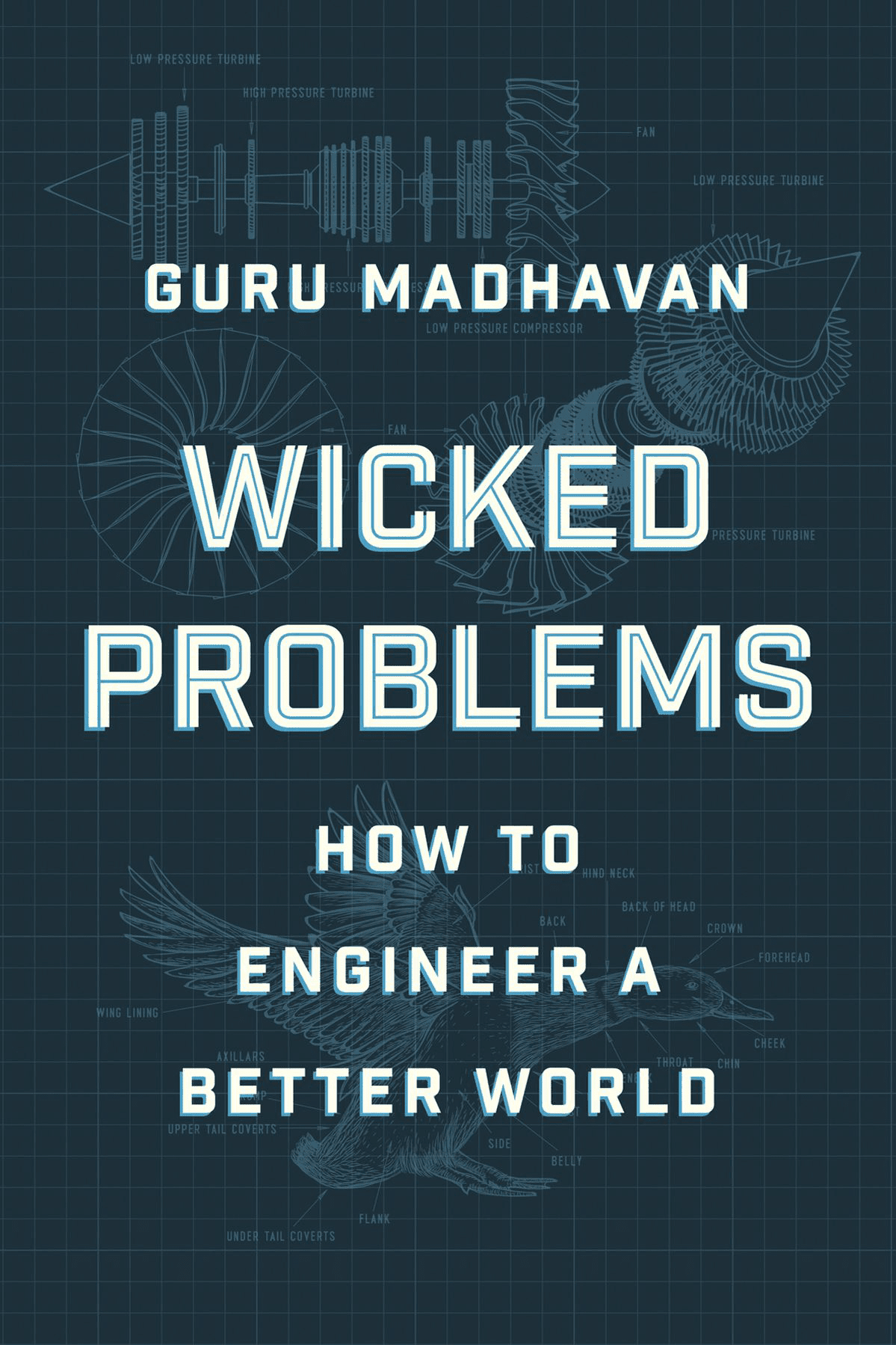
Wicked Problems: How to Engineer a Better World
Guru Madhavan
W.W. NORTON, 2024

Cloud problems offer no such assurances. They are inherently complex and unpredictable, and they usually have social, psychological, or political dimensions. Because of their dynamic, shape-shifting nature, trying to “fix” a cloud problem often ends up creating several new problems. For this reason, they don’t have a definitive “solved” state—only good and bad (or better and worse) outcomes. Trying to repair a broken-down car is a clock problem. Trying to solve traffic is a cloud problem.  

Engineers are renowned clock-problem solvers. They’re also notorious for treating every problem like a clock. Increasing specialization and cultural expectations play a role in this tendency. But so do engineers themselves, who are typically the ones who get to frame the problems they’re trying to solve in the first place. 

In his latest book, Wicked Problems, Guru Madhavan argues that the growing number of cloudy problems in our world demands a broader, more civic-minded approach to engineering. “Wickedness” is Madhavan’s way of characterizing what he calls “the cloudiest of problems.” It’s a nod to a now-famous coinage by Horst Rittel and Melvin Webber, professors at the University of California, Berkeley, who used the term “wicked” to describe complex social problems that resisted the rote scientific and engineering-based (i.e., clock-like) approaches that were invading their fields of design and urban planning back in the 1970s. 

Madhavan, who’s the senior director of programs at the National Academy of Engineering, is no stranger to wicked problems himself. He’s tackled such daunting examples as trying to make prescription drugs more affordable in the US and prioritizing development of new vaccines. But the book isn’t about his own work. Instead, Wicked Problems weaves together the story of a largely forgotten aviation engineer and inventor, Edwin A. Link, with case studies of man-made and natural disasters that Madhavan uses to explain how wicked problems take shape in society and how they might be tamed.

Link’s story, for those who don’t know it, is fascinating—he was responsible for building the first mechanical flight trainer, using parts from his family’s organ factory—and Madhavan gives a rich and detailed accounting. The challenges this inventor faced in the 1920s and ’30s—which included figuring out how tens of thousands of pilots could quickly and effectively be trained to fly without putting all of them up in the air (and in danger), as well as how to instill trust in “instrument flying” when pilots’ instincts frequently told them their instruments were wrong—were among the quintessential wicked problems of his time. 

To address a world full of wicked problems, we’re going to need a more expansive and inclusive idea of what engineering is and who gets to participate in it.

Unfortunately, while Link’s biography and many of the interstitial chapters on disasters, like Boston’s Great Molasses Flood of 1919, are interesting and deeply researched, Wicked Problems suffers from some wicked structural choices. 

The book’s elaborate conceptual framework and hodgepodge of narratives feel both fussy and unnecessary, making a complex and nuanced topic even more difficult to grasp at times. In the prologue alone, readers must bounce from the concept of cloud problems to that of wicked problems, which get broken down into hard, soft, and messy problems, which are then reconstituted in different ways and linked to six attributes—efficiency, vagueness, vulnerability, safety, maintenance, and resilience—that, together, form what Madhavan calls a “concept of operations,” which is the primary organizational tool he uses to examine wicked problems.

It’s a lot—or at least enough to make you wonder whether a “systems engineering” approach was the correct lens through which to examine wickedness. It’s also unfortunate because Madhavan’s ultimate argument is an important one, particularly in an age of rampant solutionism and “one neat trick” approaches to complex problems. To effectively address a world full of wicked problems, he says, we’re going to need a more expansive and inclusive idea of what engineering is and who gets to participate in it.  

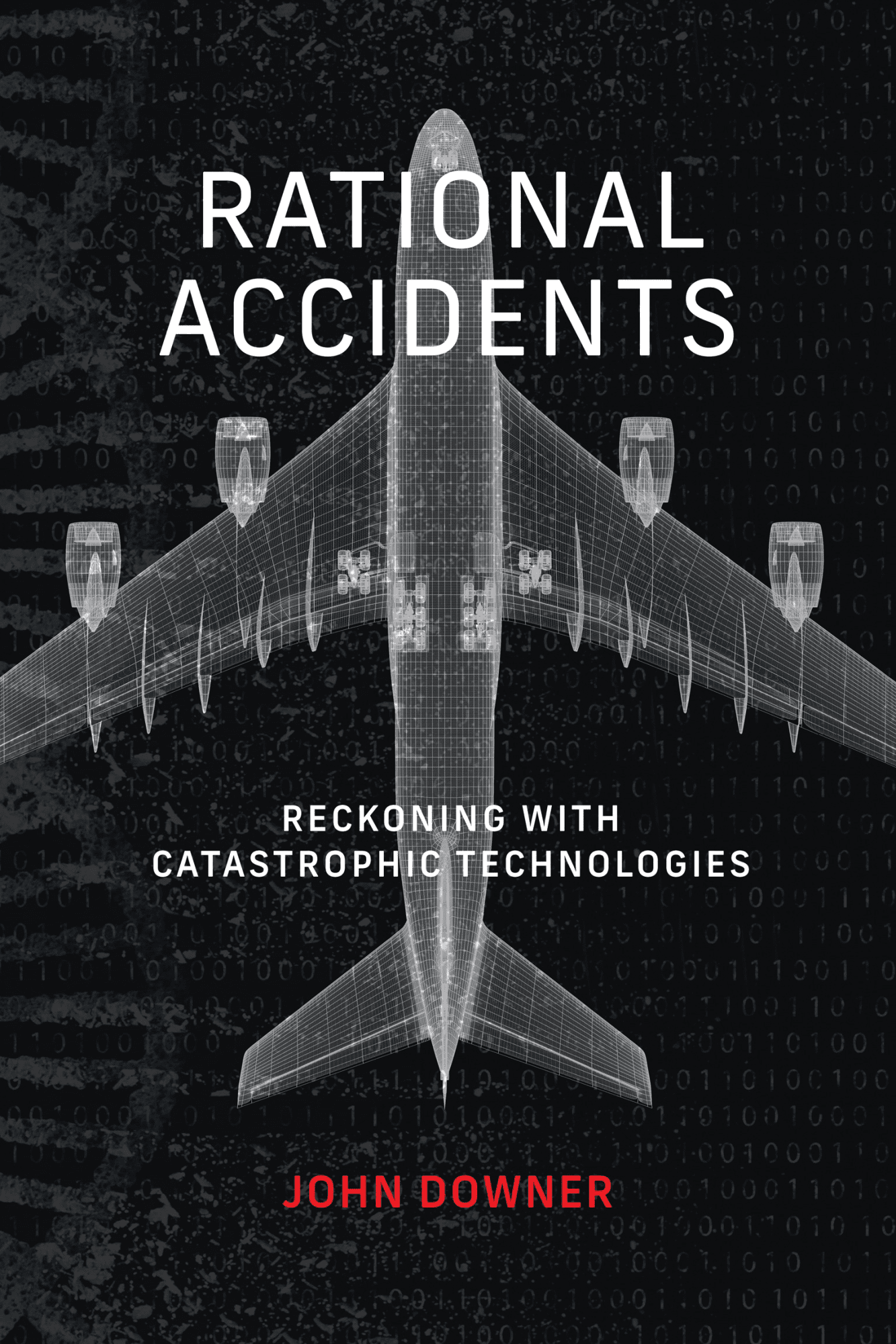
Rational Accidents: Reckoning with Catastrophic Technologies
John Downer
MIT PRESS, 2024

While John Downer would likely agree with that sentiment, his new book, Rational Accidents, makes a strong argument that there are hard limits to even the best and broadest engineering approaches. Similarly set in the world of aviation, Downer’s book explores a fundamental paradox at the heart of today’s civil aviation industry: the fact that flying is safer and more reliable than should technically be possible.

Jetliners are an example of what Downer calls a “catastrophic technology.” These are “complex technological systems that require extraordinary, and historically unprecedented, failure rates—of the order of hundreds of millions, or even billions, of operational hours between catastrophic failures.”

Take the average modern jetliner, with its 7 million components and 170 miles’ worth of wiring—an immensely complex system in and of itself. There were over 25,000 jetliners in regular service in 2014, according to Downer. Together, they averaged 100,000 flights every single day. Now consider that in 2017, no passenger-carrying commercial jetliner was involved in a fatal accident. Zero. That year, passenger totals reached 4 billion on close to 37 million flights. Yes, it was a record-setting year for the airline industry, safety-wise, but flying remains an almost unfathomably safe and reliable mode of transportation—even with Boeing’s deadly 737 Max crashes in 2018 and 2019 and the company’s ongoing troubles

Downer, a professor of science and technology studies at the University of Bristol, does an excellent job in the first half of the book dismantling the idea that we can objectively recognize, understand, and therefore control all risk involved in such complex technologies. Using examples from well-known jetliner crashes, as well as from the Fukushima nuclear plant meltdown, he shows why there are simply too many scenarios and permutations of failure for us to assess or foresee such risks, even with today’s sophisticated modeling techniques and algorithmic assistance.

So how does the airline industry achieve its seemingly unachievable record of safety and reliability? It’s not regulation, Downer says. Instead, he points to three unique factors. First is the massive service experience the industry has amassed. Over the course of 70 years, manufacturers have built tens of thousands of jetliners, which have failed (and continue to fail) in all sorts of unpredictable ways. 

This deep and constantly growing data set, combined with the industry’s commitment to thoroughly investigating each and every failure, lets it generalize the lessons learned across the entire industry—the second key to understanding jetliner reliability. 

Finally is what might be the most interesting and counterintuitive factor: Downer argues that the lack of innovation in jetliner design is an essential but overlooked part of the reliability record. The fact that the industry has been building what are essentially iterations of the same jetliner for 70 years ensures that lessons learned from failures are perpetually relevant as well as generalizable, he says. 

That extremely cautious relationship to change flies in the face of the innovate-or-die ethos that drives most technology companies today. And yet it allows the airline industry to learn from decades of failures and continue to chip away at the future “failure performance” of jetliners.

The bad news is that the lessons in jetliner reliability aren’t transferable to other catastrophic technologies. “It is an irony of modernity that the only catastrophic technology with which we have real experience, the jetliner, is highly unrepresentative, and yet it reifies a misleading perception of mastery over catastrophic technologies in general,” writes Downer.

For instance, to make nuclear reactors as reliable as jetliners, that industry would need to commit to one common reactor design, build tens of thousands of reactors, operate them for decades, suffer through thousands of catastrophes, slowly accumulate lessons and insights from those catastrophes, and then use them to refine that common reactor design.  

This obviously won’t happen. And yet “because we remain entranced by the promise of implausible reliability, and implausible certainty about that reliability, our appetite for innovation has outpaced our insight and humility,” writes Downer. With the age of catastrophic technologies still in its infancy, our continued survival may very well hinge not on innovating our way out of cloudy or wicked problems, but rather on recognizing, and respecting, what we don’t know and can probably never understand.  

If Wicked Problems and Rational Accidents are about the challenges and limits of trying to understand complex systems using objective science- and engineering-based methods, Georgina Voss’s new book, Systems Ultra, provides a refreshing alternative. Rather than dispassionately trying to map out or make sense of complex systems from the outside, Voss—a writer, artist, and researcher—uses her book to grapple with what they feel like, and ultimately what they mean, from the inside.

Systems Ultra: Making Sense of Technology in a Complex World
Georgina Voss
VERSO, 2024

“There is something rather wonderful about simply feeling our way through these enormous structures,” she writes before taking readers on a whirlwind tour of systems visible and unseen, corrupt and benign, ancient and new. Stops include the halls of hype at Las Vegas’s annual Consumer Electronics Show (“a hot mess of a Friday casual hellscape”), the “memetic gold mine” that was the container ship Ever Given and the global supply chain it broke when it got stuck in the Suez Canal, and the payment systems that undergird the porn industry. 

For Voss, systems are both structure and behavior. They are relational technologies that are “defined by their ability to scale and, perhaps more importantly, their peculiar relationship to scale.” She’s also keenly aware of the pitfalls of using an “experiential” approach to make sense of these large-scale systems. “Verbal attempts to neatly encapsulate what a system is can feel like a stoner monologue with pointed hand gestures (‘Have you ever thought about how electricity is, like, really big?’),” she writes. 

Nevertheless, her written attempts are a delight to read. Voss manages to skillfully unpack the power structures that make up, and reinforce, the large-scale systems we live in. Along the way, she also dispels many of the stories we’re told about their inscrutability and inevitability. That she does all this with humor, intelligence, and a boundless sense of curiosity makes Systems Ultra both a shining example of the “civic engagement as engineering” approach that Madhavan argues for in Wicked Problems, and proof that his argument is spot on. 

Bryan Gardiner is a writer based in Oakland, California.

Why China’s dominance in commercial drones has become a global security matter

This story first appeared in China Report, MIT Technology Review’s newsletter about technology in China. Sign up to receive it in your inbox every Tuesday.

Whether you’ve flown a drone before or not, you’ve probably heard of DJI, or at least seen its logo. With more than a 90% share of the global consumer market, this Shenzhen-based company’s drones are used by hobbyists and businesses alike for photography and surveillance, as well as for spraying pesticides, moving parcels, and many other purposes around the world.  

But on June 14, the US House of Representatives passed a bill that would completely ban DJI’s drones from being sold in the US. The bill is now being discussed in the Senate as part of the annual defense budget negotiations. 

The reason? While its market dominance has attracted scrutiny for years, it’s increasingly clear that DJI’s commercial products are so good and affordable they are also being used on active battlefields to scout out the enemy or carry bombs. As the US worries about the potential for conflict between China and Taiwan, the military implications of DJI’s commercial drones are becoming a top policy concern.

DJI has managed to set the gold standard for commercial drones because it is built on decades of electronic manufacturing prowess and policy support in Shenzhen. It is an example of how China’s manufacturing advantage can turn into a technological one.

“I’ve been to the DJI factory many times … and mainly, China’s industrial base is so deep that every component ends up being a fraction of the cost,” Sam Schmitz, the mechanical engineering lead at Neuralink, wrote on X. Shenzhen and surrounding towns have had a robust factory scene for decades, providing an indispensable supply chain for a hardware industry like drones. “This factory made almost everything, and it’s surrounded by thousands of factories that make everything else … nowhere else in the world can you run out of some weird screw and just walk down the street until you find someone selling thousands of them,” he wrote.

But Shenzhen’s municipal government has also significantly contributed to the industry. For example, it has granted companies more permission for potentially risky experiments and set up subsidies and policy support. Last year, I visited Shenzhen to experience how it’s already incorporating drones in everyday food delivery, but the city is also working with companies to use drones for bigger and bigger jobs—carrying everything from packages to passengers. All of these go into a plan to build up the “low-altitude economy” in Shenzhen that keeps the city on the leading edge of drone technology.

As a result, the supply chain in Shenzhen has become so competitive that the world can’t really use drones without it. Chinese drones are simply the most accessible and affordable out there. 

Most recently, DJI’s drones have been used by both sides in the Ukraine-Russia conflict for reconnaissance and bombing. Some American companies tried to replace DJI’s role, but their drones were more expensive and their performance unsatisfactory. And even as DJI publicly suspended its businesses in Russia and Ukraine and said it would terminate any reseller relationship if its products were found to be used for military purposes, the Ukrainian army is still assembling its own drones with parts sourced from China.

This reliance on one Chinese company and the supply chain behind it is what worries US politicians, but the danger would be more pronounced in any conflict between China and Taiwan, a prospect that is a huge security concern in the US and globally.

Last week, my colleague James O’Donnell wrote about a report by the think tank Center for a New American Security (CNAS) that analyzed the role of drones in a potential war in the Taiwan Strait. Right now, both Ukraine and Russia are still finding ways to source drones or drone parts from Chinese companies, but it’d be much harder for Taiwan to do so, since it would be in China’s interest to block its opponent’s supply. “So Taiwan is effectively cut off from the world’s foremost commercial drone supplier and must either make its own drones or find alternative manufacturers, likely in the US,” James wrote.

If the ban on DJI sales in the US is eventually passed, it will hit the company hard for sure, as the US drone market is currently worth an estimated $6 billion, the majority of which is going to DJI. But undercutting DJI’s advantage won’t magically grow an alternative drone industry outside China. 

“The actions taken against DJI suggest protectionism and undermine the principles of fair competition and an open market. The Countering CCP Drones Act risks setting a dangerous precedent, where unfounded allegations dictate public policy, potentially jeopardizing the economic well-being of the US,” DJI told MIT Technology Review in an emailed statement.

The Taiwanese government is aware of the risks of relying too much on China’s drone industry, and it’s looking to change. In March, Taiwan’s newly elected president, Lai Ching-te, said that Taiwan wants to become the “Asian center for the democratic drone supply chain.” 

Already the hub of global semiconductor production, Taiwan seems well positioned to grow another hardware industry like drones, but it will probably still take years or even decades to build the economies of scale seen in Shenzhen. With support from the US, can Taiwanese companies really grow fast enough to meaningfully sway China’s control of the industry? That’s a very open question.

A housekeeping note: I’m currently visiting London, and the newsletter will take a break next week. If you are based in the UK and would like to meet up, let me know by writing to zeyi@technologyreview.com.


Now read the rest of China Report

Catch up with China

1. ByteDance is working with the US chip design company Broadcom to develop a five-nanometer AI chip. This US-China collaboration, which should be compliant with US export restrictions, is rare these days given the political climate. (Reuters $)

2. After both the European Union and China announced new tariffs against each other, the two sides agreed to chat about how to resolve the dispute. (New York Times $)

  • Canada is preparing to announce its own tariffs on Chinese-made electric vehicles. (Bloomberg $)

3. A NASA leader says the US is “on schedule” to send astronauts to the moon within a few years. There’s currently a heated race between the US and China on moon exploration. (Washington Post $)

4. A new cybersecurity report says RedJuliett, a China-backed hacker group, has intensified attacks on Taiwanese organizations this year. (Al Jazeera $)

5. The Canadian government is blocking a rare earth mine from being sold to a Chinese company. Instead, the government will buy the stockpiled rare earth materials for $2.2 million. (Bloomberg $)

6. Economic hardship at home has pushed some Chinese small investors to enter the US marijuana industry. They have been buying lands in the States, setting up marijuana farms, and hiring other new Chinese immigrants. (NPR)

Lost in translation

In the past week, the most talked-about person in China has been a 17-year-old girl named Jiang Ping, according to the Chinese publication Southern Metropolis Daily. Every year since 2018, the Chinese company Alibaba has been hosting a global mathematics contest that attracts students from prestigious universities around the world to compete for a generous prize. But to everyone’s surprise, Jiang, who’s studying fashion design at a vocational high school in a poor town in eastern China, ended up ranking 12th in the qualifying round this year, beating scores of college undergraduate or even master’s students. Other than reading college mathematics textbooks under her math teacher’s guidance, Jiang has received no professional training, as many of her competitors have.

Jiang’s story, highlighted by Alibaba following the announcement of the first-round results, immediately went viral in China. While some saw it as a tale of buried talents and how personal endeavor can overcome unfavorable circumstances, others questioned the legitimacy of her results. She became so famous that people, including social media influencers, kept visiting her home, turning her hometown into an unlikely tourist destination. The town had to hide Jiang from public attention while she prepared for the final round of the competition.

One more thing

After I wrote about the new Chinese generative video model Kling last week, the AI tool added a new feature that can turn a static photo into a short video clip. Well, what better way to test its performance than feeding it the iconic “distracted boyfriend” meme and watching what the model predicts will happen after that moment?

Update: The story has been updated to include a statement from DJI.

Hong Kong is targeting Western Big Tech companies in its new ban of a popular protest song

It wasn’t exactly surprising when, on Wednesday May 8, a Hong Kong appeals court sided with the city government to take down “Glory to Hong Kong” from the internet. The trial, in which no one represented the defense, was the culmination of a years-long battle over the song that has become the unofficial anthem for protesters fighting China’s tightening control and police brutality in the city. But it remains an open question how exactly Western Big Tech companies will respond. Even as the injunction is narrowly designed to make it easier for them to comply, the companies may still be seen as aiding authoritarian control and obstructing internet freedom if they do so.  

Google, Apple, Meta, Spotify, and more have spent the last several years largely refusing to cooperate with previous efforts by the Hong Kong government to prevent the spread of the song, which the government has claimed is a threat to national security. But the government has also hesitated to leverage criminal law to force them to comply with requests for removal of content, which could risk international uproar and have a negative effect on the city’s economy. 

Now, the new ruling seemingly finds a third option: By providing the platforms with a civil injunction that doesn’t invoke criminal prosecution—which is similar to how copyright violations are enforced—the platforms can theoretically face less reputational blowback when they comply with the court order.

“If you look closely at the judgment, it’s basically tailor-made for the tech companies at stake,” says Chung Ching Kwong, a senior analyst at the Inter-Parliamentary Alliance on China, an advocacy organization that connects legislators from over 30 countries to try to hold China accountable. She believes the language in the judgment suggests the tech companies will now be ready to comply with the government’s request.

A Google spokesperson says the company is reviewing the court’s judgment and didn’t respond to specific questions sent by MIT Technology Review. A Meta spokesperson pointed to a statement from Jeff Paine, the managing director of the Asia Internet Coalition, a trade group representing many tech companies in the Asia-Pacific region: The AIC “is assessing the implications of the decision made today, including how the injunction will be implemented, to determine its impact on businesses. We believe that a free and open internet is fundamental to the city’s ambitions to become an international technology and innovation hub.” The AIC did not immediately reply to questions sent via email. Apple and Spotify didn’t immediately respond to requests for comment.

But no matter what these companies do next, the ruling is already having an effect: Just over 24 hours after the court order, some of the 32 YouTube videos that are explicitly named in the injunction as requiring removal were inaccessible for users worldwide, not just in Hong Kong. 

While it’s unclear whether the videos were removed by the platform or by their creators, experts say the court decision will almost certainly set a precedent for more content to be censored from Hong Kong’s internet in the future.

“Censorship of the song would be a clear violation of internet freedom and freedom of expression,” says Yaqiu Wang, the research director for China, Hong Kong, and Taiwan at Freedom House, a human rights advocacy group. “Google and other internet companies should use all available channels to challenge the decision.” 

Erasing a song from the internet

Since “Glory to Hong Kong” was first uploaded to YouTube in August 2019 by an anonymous group called Dgx Music, it’s been adored by protesters and applauded as their anthem. Its popularity only grew after China passed the harsh Hong Kong national security law in 2020

It also unsurprisingly became a major flashpoint. With lyrics like, “Liberate Hong Kong, revolution of our times,” the city and national Chinese governments were wary of its spread. 

Their fears escalated when the song was repeatedly mistaken for China’s national anthem at international events, and was broadcast in sporting events after Hong Kong athletes won. By mid 2023, the mistake, intentional or not, had happened 887 times, according to the Hong Kong government’s request for the content’s removal; the request to the court credits YouTube videos and Google search results referring to the song as the “Hong Kong National Anthem” as the reason. 

The government has been arresting people for performing the song on the ground in Hong Kong, but it has been harder to prosecute the online activity since most of the videos and music were uploaded anonymously, and Hong Kong, unlike mainland China, has historically had a free internet. This meant officials needed to explore new approaches to content removal. 

To comply or not to comply

Using the controversial 2020 national security law as legal justification to make requests for removal of certain content deemed threatening, the Hong Kong government has been able to exert pressure on local companies, like internet service providers (ISPs). “In Hong Kong, all the major internet service providers are locally owned or Chinese-owned. For business reasons, probably within the last 20 years, most of the foreign investors like Verizon left on their own,” says Charles Mok, a researcher at Stanford University’s Cyber Policy Center and a former legislator in Hong Kong. “So right now, the government is focusing on telling the customer-facing internet service providers to do the blocking.” And it seems to have been somewhat effective, with a few websites for human rights activist organizations becoming inaccessible locally.

But the city government can’t get its way as easily when the content is on foreign-owned platforms like YouTube or Facebook. Back in 2020, most major Western companies declared they would pause processing data requests from the Hong Kong government while they assessed the law. Over time, some of them have started answering government requests again. But they’ve largely remained firm: Over the first six months of 2023, for example, Meta received 41 requests from the Hong Kong government to obtain user data and answered 0; during the same period, Google received requests for removing 164 items from Google services and ended up removing 82 of them, according to both companies’ transparency reports. Google specifically mentioned that it chose to not remove two YouTube videos and one Google Drive file related to “Glory to Hong Kong.”

Both sides are in tight spots. Tech companies don’t want to lose the Hong Kong market or endanger their local staff, but they are also worried about being seen as complying with authoritarian government actions. And the Hong Kong government doesn’t want to be seen as openly fighting Western platforms while trust in the region’s financial markets is already in decline. In particular, officials fear international headlines if the government invokes criminal law to force tech companies to remove certain content. 

“I think both sides are navigating this balancing act. So the government finally figured out a way that they thought might be able to solve the impasse: by going to the court and narrowly seeking an injunction,” Mok says.

That happened in June 2023, when Hong Kong’s government requested a court injunction to ban the distribution of the song online with the purpose of “inciting others to commit secession.” It named 32 YouTube videos explicitly, including the original version and live performances, translations in other languages, instrumental and opera versions, and an interview of the original creators. But the order would also cover “any adaptation of the song, the melody and/or lyrics of which are substantially the same as the song,” according to court documents. 

The injunction went through a year of back-and-forth hearings, including a lower court ruling that briefly swatted down the ban. But now, the Court of Appeal has granted the government approval. The case can theoretically be appealed one last time, but with no defendants present, that’s unlikely to happen.

The key difference between this action and previous attempts to remove content is that this is a civil injunction, unlike a criminal prosecution—meaning it is, at least legally speaking, closer to a copyright takedown request. In turn, a platform could arguably be less likely to take a reputational hit as long as it removes the content upon request. 

Kwong believes this will indeed make platforms more likely to cooperate and there have already been pretty clear signs to that effect. In one hearing in December, the government was asked by the court to consult online platforms for the feasibility of the injunction. The final judgment this week says that while the platforms “have not taken part in these proceedings, they have indicated that they are ready to accede to the Government’s request if there is a court order.”

“The actual targets in this case, mainly the tech giants, may have less hesitation to comply with a civil court order than a national security order because if it’s the latter, they may also face backfire from the US,” says Eric Yan-Ho Lai, a research fellow at Georgetown Center for Asian Law. 

Lai also says now that the injunction is granted, it will be easier to prosecute an individual based on violating a civil injunction rather than prosecuting someone based on criminal offenses, since the government won’t need to prove criminal intent.

The chilling effect

Immediately after the injunction, human rights advocates called on tech companies to remain committed to their values. “Companies like Google and Apple have repeatedly claimed that they stand by the universal right to freedom of expression. They should put their ideals into practice,” says Freedom House’s Wang. “Google and other tech companies should thoroughly document government demands, and publish detailed transparency reports on content takedowns, both for those initiated by the authorities and those done by the companies themselves.”

Without making their plans clear, it’s too early to know just how tech companies will react. But right after the injunction was granted, the song largely remained available on most platforms, including YouTube, iTunes, and Spotify, for Hong Kong users, according to the South China Morning Post. On iTunes, the song even returned to the top of the download rankings a few hours after the injunction.

One key factor that may still determine corporate cooperation is how far the content removal requests go. There will surely be more videos of the song that are uploaded to YouTube, not to mention independent websites hosting the videos and music for more people to access. Will the government go after each of them too?

The Hong Kong government has previously said in court hearings that it only seeks a local restriction of the online content, meaning content will only be inaccessible to users physically in the city, which large platforms like YouTube can do so without difficulty. 

Theoretically, this allows local residents to still circumvent the ban by using VPN software, but not everyone would be technologically savvy enough to do so. And that wouldn’t do much to minimize the larger chilling effect on free speech, says Kwong from the Inter-Parliamentary Alliance on China. 

“As a Hong Konger living abroad, I do rely on Hong Kong services or international services based in Hong Kong to get a hold of what’s happening in the city. I do use YouTube Hong Kong to see certain things, and I do use Spotify Hong Kong or Apple Music because I want access to Cantopop,” she says. “At the same time, you worry about what you can share with friends in Hong Kong and whatnot. We don’t want to put them into trouble by sharing things that they are not supposed to see, which they should be able to see.”

The court made at least two explicit exemptions to the song’s ban, for “lawful activities conducted in connection with the song, such as those for the purpose of academic activity and news activity.” But even the implementation of these could be incredibly complex and confusing in practice. “In the current political context in Hong Kong, I don’t see anyone willing to take the risk,” Kwong says. 

The government has already arrested prominent journalists in the name of endangering national security, and a new law passed in 2024 has expanded the crimes that can be prosecuted on national security grounds. As with all efforts to suppress free speech, the impact of vague boundaries that encourage self-censorship on potentially sensitive topics is often sprawling and hard to measure. 

“Nobody knows where the actual red line is,” Kwong says.