Google’s Push For Data Strength Is Really A Push For Better Bidding via @sejournal, @brookeosmundson

Google keeps coming back to the same message this year: your AI is only as good as the data feeding it.

That message has shown up across the Ads Decoded podcast, Data Manager updates, tagging guidance, partner integrations, and now even developer-focused content like the Ads DevCast podcast. It seems to reflect a broader shift in how Google expects campaigns to be built and optimized.

The issue is not that advertisers lack data. Most accounts have plenty of it. The problem is how that data has been structured, selected, and fed into bidding systems over time.

As Google leans further into AI-driven optimization, that gap becomes more visible for advertisers who don’t have a sound conversion setup. Campaign performance is increasingly tied to how clearly the system understands what success looks like.

Why Google Is Pushing Advertisers To Rethink Conversion Strategy

For years, many advertisers treated conversion tracking as something to expand, not refine over and over again.

If a platform made it easy to track an action, it got added. If a CRM could send something back, it got imported. If a new conversion type became available, it often made its way into the account without much resistance.

On paper, that sounds like a more complete dataset. The more data, the better – right?

In reality, it’s created a lot of noise for machines to learn what truly matters.

Campaigns are often optimized toward a mix of actions that did not share the same level of intent, value, or timing.

Some signals are high quality but might have low volume due to a delay in sales cycle activity. Others may be immediate but loosely tied to actual business outcomes. Many accounts end up blending all of them together under a single bidding strategy for the sake of measuring everything.

That worked well enough when automation was less dependent on precise inputs.

It becomes a bigger problem when bidding systems are expected to make decisions based on patterns in that data.

Where Most Conversion Setups Break Down

In one of the recent Ads Decoded podcast episodes, Google’s recent guidance around lead generation makes it clear what they are trying to correct. The focus is on mapping the full customer journey and identifying the conversion point that provides a usable signal for bidding.

That means looking at three things at the same time:

  1. How predictive the action is of real business value
  2. How frequently it occurs
  3. How quickly it happens after the initial interaction

Many advertisers still default to the deepest possible conversion, assuming that optimizing toward the final sale will produce the best outcome across every campaign.

The issue isn’t that particular goal itself, but more how usable that signal is for the system in a higher-funnel campaign. And this is where many conversion strategies start to fall apart.

If that action happens infrequently or takes weeks to materialize, it limits how much the bidding system can learn from it. The result is often slower optimization, higher volatility, and less efficient scaling.

On the other end, optimizing toward early-stage actions without considering quality can inflate volume without improving actual outcomes.

Selecting the right signal requires matching the conversion to the role the campaign plays and ensuring that signal is both meaningful and usable for bidding.

That shift requires more intentional decision-making than many accounts have historically applied to conversion setup. It also introduces a level of discipline that many advertisers have not needed when automation was less dependent on signal quality.

Why Is Google Putting So Much Weight On Data Strength?

Google is not being subtle about the Data Strength push. It’s showing up in product updates, integrations, tagging changes, and even in the way Google is speaking to both advertisers and developers.

Part of the reason is practical. Advertisers have lost visibility into many of the signals they used to rely on. Privacy changes, browser restrictions, and platform limitations have made measurement less complete than it used to be.

At the same time, Google’s bidding systems are being asked to do more with less. That puts more pressure on the signals that are still available.

This is where Data Strength comes in. Google is trying to make those signals more reliable, easier to connect, and more useful for optimization. Data Manager, tag gateway, and partner integrations all support that goal.

The expansion of integrations with platforms like HubSpot, Zapier, and Cloudflare also supports this effort. Instead of relying on custom implementations, advertisers can connect the systems where their data already exists with less effort.

This improves consistency in how data flows into bidding systems.

It also reinforces Google’s broader goal of making its automation more effective in a lower-signal environment.

Does This Point To A Broader Role For Google?

I also think there is a bigger shift underneath this push.

Google is moving closer to the systems where business outcomes actually happen, not just where ads are served. Connecting CRM data, offline conversions, and audience signals allows Google’s platforms to better understand what a “good” customer looks like beyond the initial click or form fill.

That can absolutely help advertisers improve performance.

At the same time, it positions Google as more than just an ads platform. It becomes more integrated into how businesses measure performance, define value, and connect marketing efforts back to real outcomes

Where Does Server-Side Tagging Fit In With This?

There has been a lot of confusion around server-side tagging and how it relates to what Google is promoting today.

They are related, but they aren’t the same thing.

Google tag gateway focuses on how the Google tag is delivered and how requests are routed through first-party infrastructure. It is a way to make existing tagging setups more resilient and aligned with privacy expectations.

Server-side tagging is a broader architectural approach. It shifts data processing from the browser to a server environment that the advertiser controls. This can improve site performance, provide more control over data handling, and support more advanced use cases across multiple platforms.

In practical terms, tag gateway is often a more accessible first step for advertisers looking to improve data reliability without a full infrastructure overhaul.

Server-side tagging is a larger investment and tends to be more relevant for organizations with more complex data requirements or stricter governance needs.

The two approaches can work together, and Google documentation often recommends combining them for a more durable setup.

A Thoughtful Approach To Data Strength

The increased focus on Data Strength is directionally positive, but it does not remove the need for careful decision-making.

Simplifying setup does not automatically lead to better outcomes. If conversion actions are poorly defined or not aligned with campaign intent, connecting them more efficiently will not improve performance.

If you’re a marketer who isn’t directly involved with setting up conversions, it may be worthwhile to meet with your Analytics teams. Create a list of must-have conversion events or actions you need to track for campaigns (online and/or offline), and cross-check that list with what’s currently set up.

There is also a governance component to consider. As tagging becomes more automated and data collection expands, teams need to understand what is being captured, how it is being used, and how it aligns with internal policies.

Google has noted that expanded automatic event collection may result in additional data being sent to its systems, which should be reviewed as part of implementation.

Another consideration is how platform-specific improvements fit into a broader measurement strategy.

Google’s push around Data Strength is primarily focused on improving performance within its own arena. That is valuable, but it should be complemented by broader measurement approaches when making budget and channel decisions.

This is where initiatives like Meridian come into play. Google has positioned Meridian as an open-source marketing mix modeling solution to help advertisers evaluate performance across channels and connect those insights to budget planning.

How Google Is Reinforcing Data Strength Across The Industry

One of the more interesting aspects of this push is how consistently it’s showing up across different mediums.

Product updates are only one piece of it.

Google is also investing in education and communication around Data Strength, using formats that reach both marketers and developers. Ads Decoded continues to focus on practical campaign strategies, including how to map the customer journey and select the right conversion signals.

At the same time, newer initiatives like Ads DevCast are aimed at a more technical audience, with episodes focused on topics like the Data Manager API and data integration workflows. The goal seems to be to meet teams where they are, whether they are responsible for campaign strategy or the underlying implementation.

The Data Manager API itself reinforces this direction. Google is shifting workflows like Customer Match into a system designed specifically for data connectivity, privacy controls, and more consistent ingestion of first-party data.

That combination of product changes, partnerships, and education signals a coordinated effort to strengthen how data is collected, connected, and used across the entire advertising atmosphere.

What Advertisers Are Saying About The Data Strength Conversation

The discussion around Data Strength and lead quality have sparked a lot of needed conversations between Google and advertisers.

In reaction to the Ads Decoded episode “Beyond the Form Fill“, many advertisers are happy that B2B businesses are getting the attention they’ve been asking for. Melissa Mackey praised the episode, stating that “All lead gen advertisers should go listen.” A few marketers noted the need to improve or purge the amount of bot leads they see in their B2B campaigns, including Robert Peck.

Google also did a series of posts and interviews with experts on the importance of data strength. All seemed to have similar sentiment and this is where I started seeing more and more advertisers connect the dots.

Adrija Bose commented on a discussion with Kamal Janardhan, Senior PM Director at Google, and Jeff Sauer, CEO of MeasureU:

What strikes me most is the framing of AI as the engine, not the strategy. Too many leaders conflate the two, expecting AI to compensate for weak signals. This post nails why high-quality data is non-negotiable for meaningful outcomes.

Jonathan Reed also showed his support on the renewed focus of data strength, stating that while it’s a full-time job for his team, they’ve seen “seeing dramatic increases in conversions, and dramatic decreases in cost!”

What Does This Mean For Your Campaigns?

This shift will show up pretty quickly once you look at how your campaigns are actually set up.

A lot of accounts still treat conversion tracking as something to build once and leave alone. But if the signals feeding your campaigns don’t match the intent behind the queries you’re targeting, it becomes harder for bidding to do its job well.

That usually shows up in ways you’ve probably already seen, where performance feels inconsistent and scaling becomes more difficult. Even small changes can create overly volatile swings.

None of that is coming from one setting or one campaign. It is usually a reflection of how the system is learning from the data it is given.

That is why this push toward Data Strength matters so much.

It forces a closer look at which signals are actually being used for optimization, how reliable they are, and whether they reflect real business outcomes.

In some cases, that means connecting better data from your CRM. In others, it is fixing how your tags are set up or how conversions are being defined in the first place.

As Google continues to lean into this direction, the gap will likely grow between accounts that are intentional about their data and those that aren’t.

More Resources:


Featured Image: Garun.Prdt/Shutterstock

Google Adds Scenario Planner, Performance Max Updates, And Veo – PPC Pulse via @sejournal, @brookeosmundson

Welcome to this week’s PPC Pulse.

This week’s updates focus on Performance Max visibility improvements, new budget planning tools in Google Analytics, and generative video now built directly into Google Ads.

Here’s what was announced this week and why they matter for your campaigns.

Google Adds More Visibility and Control To Performance Max

Google rolled out several updates to Performance Max aimed at two ongoing gaps: control and reporting.

Advertisers can now exclude first-party customer lists. This gives teams running acquisition-focused campaigns a cleaner way to avoid spending on existing users.

On the reporting side, Google added:

  • Budget report
  • Expanded audience insights, including demographic breakdowns
  • Placement reporting segmented by network

Why This Matters For Advertisers

Audience exclusions help reduce overlap between prospecting and retention, assuming your customer lists are accurate. The reporting updates are more practical. Advertisers get better visibility into spend pacing, who campaigns are reaching, and where ads are showing.

For teams already using Performance Max, this improves day-to-day oversight. It does not turn it into a fully controllable campaign type.

What PPC Professionals Are Saying

Anthony Simonetti is “very excited for more insight” for PMax campaigns, while the company Optifeed shared its support for the update by saying “Love seeing PMax get more transparent!”

Google Analytics Introduces Scenario Planner and Projections

Google Analytics launched two new tools as part of its cross-channel budgeting feature:

  • Scenario Planner for building forward-looking budget models
  • Projections for tracking whether live campaigns are pacing toward goals

Both tools use historical data to estimate conversions, revenue, and spend across channels, including non-Google platforms if cost data is imported.

Right now access is limited due to it being a beta feature. Advertisers need at least one year of data across multiple channels, as well as a few other eligibility requirements.

Why This Matters For Advertisers

Planning and performance have traditionally lived in separate places. These tools bring them closer together, especially to those marketers who manage more than just Google Ads.

Advertisers can now model budgets and monitor pacing in the same platform used for reporting. That can help teams managing multiple channels make faster adjustments during a campaign.

The tradeoff is reliability. Outputs depend entirely on data quality and historical consistency. For many accounts, that will limit how actionable these projections actually are.

Veo Brings AI Video Creation Into Google Ads

Google introduced Veo, its generative video model, inside Asset Studio in Google Ads.

Advertisers can start by uploading just three static images and generate short-form videos, then package them into ads for formats like Demand Gen.

Each uploaded image can generate a video by Veo that’s up to 10 seconds long.

Google is positioning this around speed and creative variation, and can be used in conjunction with the rollout of Nano Banana Pro. The goal is to make it easier to produce multiple video assets without traditional production.

Why This Matters For Advertisers

Creative production has been a bottleneck for many teams, especially for video.

Veo lowers that barrier immensely for brands. Advertisers can generate variations faster and test more creative without additional resources.

The bigger shift is volume. Google continues to push toward having multiple creative variations in-market at all times. This gives advertisers another way to keep up with that expectation, even if the output still needs review and refinement.

What PPC Professionals Are Saying

This got a lot of traction from advertisers, including 70 comments and over 340 reposts from its LinkedIn announcement.

André Felizol shared:

The key here will be the brands that could create something different. With AI facilitating the creation of videos based on images, everything will be similar. So, the companies that will invest more in creativity with different and creative approaches to show their products will win in the long run.

Brooke Hess is “looking forward to testing” for her agency’s clients while Thomas Eccel has already dug in and created a live demo test of Veo 3.

Personally, I’m excited to test it out after being introduced to the first version of Veo at the 2025 Google Marketing Live event last year:

Theme of the Week: More Ways To Plan, Steer, And Build

This week’s updates all support a more hands-on role for advertisers.

Google added more steering and reporting inside Performance Max, more planning functionality inside Analytics, and more creative production tools inside Google Ads.

Advertisers are getting more ways to shape performance instead of just reacting to it after the fact.

More Resources:


Featured Image: Djile/Shutterstock; Paulo Bobita/Search Engine Journal

Google Ads Creative Tools Expand, Microsoft Simplifies Bidding – PPC Pulse via @sejournal, @brookeosmundson

Welcome to this week’s PPC Pulse. Updates focus on expanding creative tools in Google Ads and updates to bidding strategies in Microsoft Ads.

The newest version of Nano Banana Pro is now available to advertisers in Google Ads. In a separate creative update, marketers spotted an expansion to Google’s Creative Toolkit in the platform. Lastly, Microsoft Ads made changes to some of their automated bid strategies to streamline setup.

Here’s what happened this week and why it matters for advertisers.

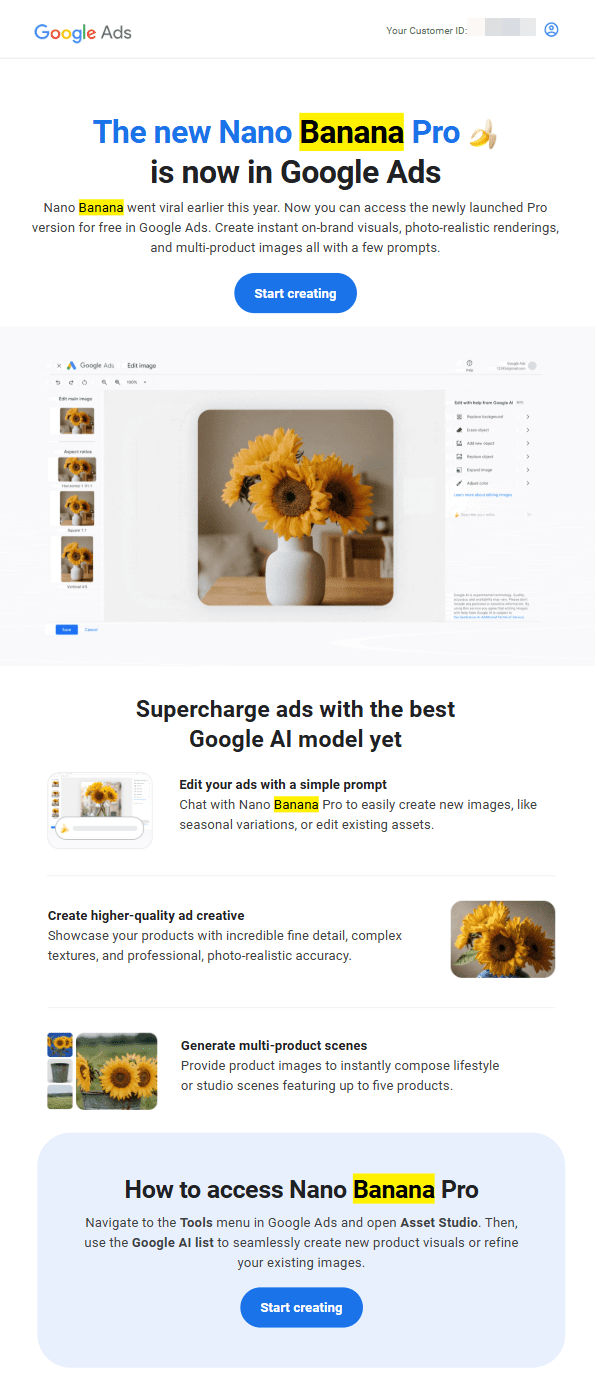
Nano Banana Pro Version Now Available in Google Ads

While Nano Banana Pro was originally introduced back in November 2025, advertisers were alerted via email this week that its newest version is now available for free in Google Ads.

Screenshot from author, March 2026

Now that it’s in Google Ads, advertisers can do all of these things in one platform:

  • Generate new visuals using prompts
  • Edit existing assets conversationally
  • Create multi-product scenes
  • Produce more detailed, photo-realistic imagery

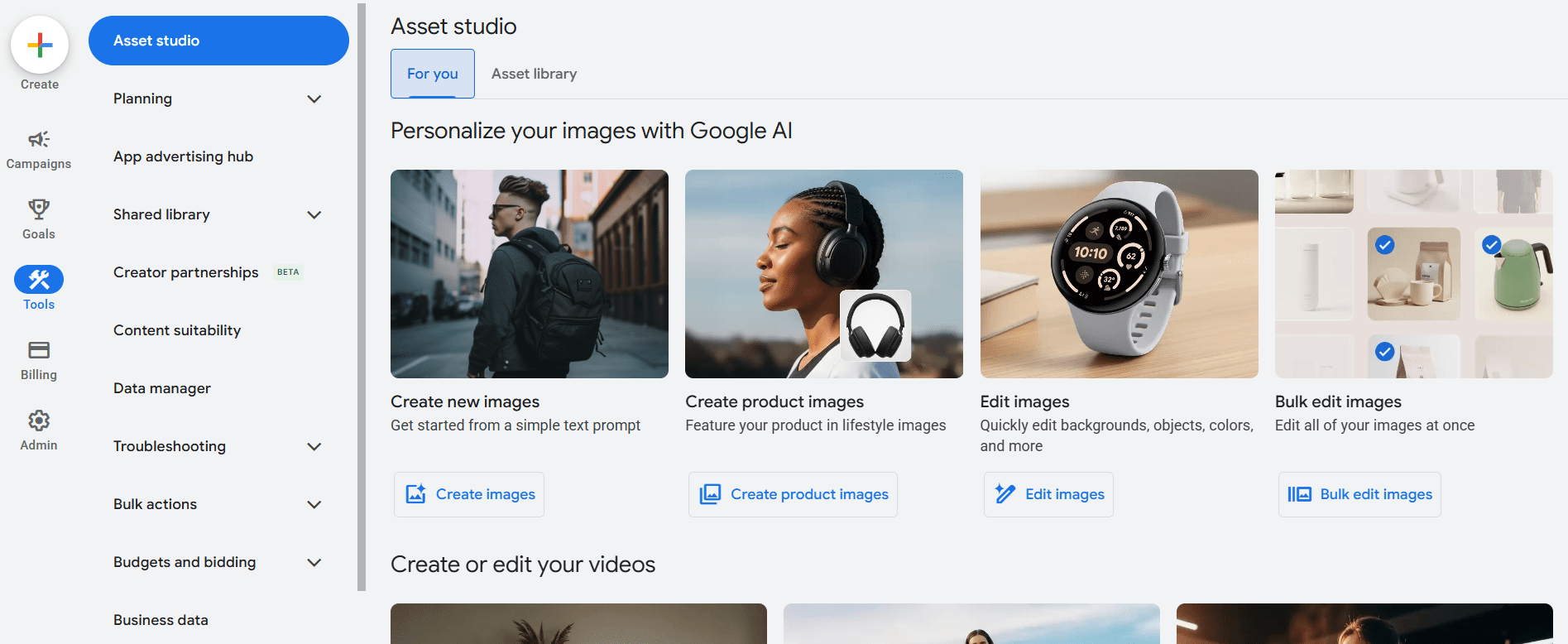
Here’s a peek at what it looks like once you navigate to Asset Studio in Google Ads.

Screenshot taken by author, March 2026

Why This Matters For Advertisers

Embedding Nano Banana Pro directly into Google Ads removes a lot of potential friction between create generation and campaign execution.

This means that for advertisers who have more creative control, creative becomes part of the optimization loop, not a completely separate workflow. Instead of planning creative updates in batches like a traditional process, advertisers can generate and test assets in response to performance changes.

Additionally, cost is not a barrier to entry. Making this available for free inside Google Ads lowers the threshold for advertisers who may not have been able to invest in external creative tools or AI platforms.

Lastly, creative volume can quickly scale. This is something that I’ve experienced personally working with my Google rep this quarter. They seem to be pushing creative volume across the board.

When the tool becomes easier to generate assets, most accounts will naturally start testing more variations.

However, brands still need to check the outputs of these AI-generated assets to make sure they adhere to any brand guidelines, product accuracy, and compliance requirements.

Google Expands Creative Toolkit Inside Google Ads

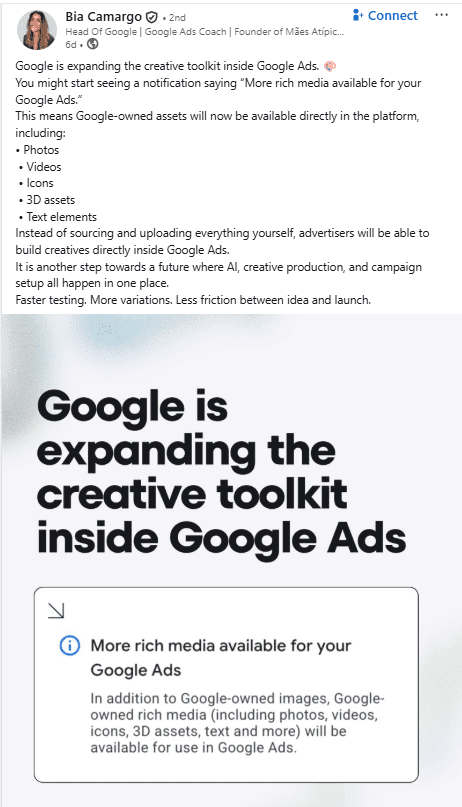
In another possible related creative update, Bia Camargo took to LinkedIn to share an update she got in Google Ads about creative assets.

In her post, the Google notification says: “More rich media available for your Google Ads. In addition to Google-owned images, Google-owned rich media (including photos, videos, icons, 3D assets, text and more) will be available for use in Google Ads.”

It looks like the goal is to allow advertisers to build and assemble more creative directly inside the platform rather than relying entirely on external tools. Whether this is completely tied to the launch of Nano Banana Pro in Google Ads is unclear.

Why This Matters For Advertisers

This update continues Google’s push to bring more of the campaign workflow into Google Ads.

For advertisers, this can reduce the time between identifying a creative gap and launching new variations.

It can also help smaller teams or advertisers without dedicated design resources produce a broader set of assets.

What PPC Professionals Are Saying

Most comments were in favor of this move. Brian Lasonde called this a “genuine win” while Virgil Brewster commented “How cool is that? Bring on the toolbox.”

Bryan Shue had an interesting take around the influence of creative production in the platform:

This feels like a bigger shift than just creative convenience. Once production moves inside the ad platform, the system gains more influence over the signals entering the campaign from the start. Faster testing is the obvious upside, but it also means the line between creative development and platform optimization keeps getting thinner.

Microsoft Ads Simplifies Automated Bidding Setup

This week, Microsoft Advertising introduced an update to how automated bidding is structured for new campaigns.

Target CPA (tCPA) and Target ROAS (tROAS) are now available as optional target settings within conversion-focused bid strategies:

  • Choose Maximize Conversions and optionally set a tCPA
  • Choose Conversion Value and optionally set a tROAS

Microsoft confirmed that existing campaigns using tCPA or tROAS remain unchanged, and portfolio bid strategies are unaffected.

Microsoft has positioned this as a simplification of bidding setup rather than a change to how the strategies perform.

It was originally announced last year, but this week’s rollout makes it global to all advertisers.

Why This Matters For Advertisers

This change does not alter how campaigns optimize, but it does change how decisions are made during setup.

The choice of bid strategy is now more implied. Instead of selecting between multiple strategies, advertisers are guided into a smaller set of options with targets layered in.

That shifts the focus toward how targets are set and adjusted over time.

For advertisers managing performance closely, this reinforces the importance of:

  • Setting realistic CPA or ROAS targets based on actual performance
  • Allowing enough time for campaigns to stabilize before adjusting targets
  • Avoiding overly aggressive constraints early in the campaign lifecycle

Theme Of The Week: Less Friction In Setup, More Responsibility In Execution

This week’s updates focus on two different parts of campaign setup, but both change how much effort is required to move from idea to launch.

Google expanded what advertisers can do inside the platform by adding more built-in creative assets and making Nano Banana Pro accessible directly in Google Ads.

Microsoft simplified how bidding is applied in new campaigns by restructuring how targets are set.

Both are meant to reduce friction, but from an execution standpoint, it requires more upfront thought and attention from advertisers.

More Resources:


Featured Image: Gorodenkoff/Shutterstock; Paulo Bobita/Search Engine Journal

New Meridian Tool, Performance Max Learning Path – PPC Pulse via @sejournal, @brookeosmundson

Welcome to this week’s PPC Pulse, where this week’s focus is on scenario-based planning in both Google and Microsoft platforms.

Google introduced a new Scenario Planner within Meridian, giving marketers the ability to model budget allocation shifts before committing spend. Microsoft launched a scenario-based Performance Max learning path designed to walk advertisers through practical campaign situations.

Both updates point to a growing emphasis on improving decisions before campaigns go live.

Here’s what happened this week and why it matters for advertisers.

Google Introduces Scenario Planner For Meridian

Google announced a new Scenario Planner within Meridian, its Marketing Mix Modeling platform. The tool allows marketers to test budget allocation scenarios and forecast potential outcomes using Meridian’s modeled insights.

Instead of waiting for quarterly MMM reports or static insights, advertisers can now simulate how shifting spend across channels might impact performance metrics like revenue, conversions, or return on investment.

According to Google, the goal is to make MMM insights more accessible and actionable for marketers who need to defend budgets and make planning decisions in real time. It also reiterated that coding isn’t required to use this tool.

It looks to be a promising planning tool built for higher-level strategy conversations between advertisers and key decision-makers.

Why This Matters For Advertisers

Marketing Mix Modeling has traditionally been handled at a higher level of the organization. It tends to show up in quarterly reviews, annual planning decks, or conversations led by finance and analytics teams. Most PPC managers are not sitting inside MMM tools on a weekly basis.

What makes this update notable is that Google is moving those insights closer to the teams actually managing budgets day to day.

PPC marketers are being asked more frequently to justify budget increases or reallocations with something stronger than last-click performance.

A tool like this could influence how those conversations happen. Instead of pointing only to recent return on ad spend (ROAS) trends, teams may start leaning more on modeled projections and incremental impact estimates when proposing changes.

What PPC Professionals Are Saying

Ginny Marvin, Ads Liaison for Google, shared the announcement on LinkedIn. Here’s what she emphasized about the Scenario Planner:

“No technical MMM experience needed to go from ‘what happened?’ to ‘what’s next?’”

Advertisers like Ivan Walker are “very excited!” about the update, while others like Ashley V. are curious about hearing feedback from others who have started using it.

Microsoft Launches Scenario-Based Performance Max Learning Path

Along the same lines of planning, Microsoft Advertising announced a new Performance Max learning path within its Learning Lab.

Unlike standard certification modules, this path walks advertisers through real-world scenarios designed to build hands-on expertise. The training focuses on practical decision-making across campaign setup, optimization, and troubleshooting.

I appreciate how Microsoft is positioning – that Performance Max success requires understanding, context, and strategy instead of focusing solely on what settings to toggle.

The learning path is designed to help advertisers think through situations they are likely to encounter in live accounts. For example, how to approach budget allocation, how to evaluate asset performance, and how to troubleshoot underperformance.

Why This Matters For Advertisers

Performance Max is not new at this point. Most advertisers have at least tested it, and many are running it at scale. What has changed is the level of thinking required to run it well.

There is still a misconception that PMax runs on its own once you flip it on. In reality, outcomes are heavily influenced by how campaigns are structured, what signals are being fed into the system, and how clearly conversion goals are defined.

Microsoft is leaning into the idea that automation does not remove the need for strategy. It shifts where strategy shows up. Instead of spending time adjusting bids manually, advertisers are spending time making decisions around inputs, segmentation, creative quality, and measurement alignment.

For agencies and in-house teams, scenario-based training could be useful for onboarding or leveling up junior team members. It provides context around the types of situations teams actually encounter, rather than just explaining what each setting does.

Theme Of The Week: Planning Before Spending

Both updates this week center around the same idea, which is trying to improve the quality of decisions before money is spent.

Google is giving marketers a way to test budget allocation scenarios before shifting spend to other platforms. Microsoft is walking advertisers through realistic campaign situations before they are live in their accounts.

While many industry updates focus on optimizations after campaigns are running, these ones focus on the earlier stage. How confident are you in the structure? How confident are you in the allocation? How confident are you in the assumptions behind the strategy?

Especially with budgets under tighter scrutiny than ever, and automation handling much more of campaign execution, the planning phase definitely carries more weight than it used to.

More Resources:


Featured Image: Kansuda2 Kaewwannarat/Shutterstock; Paulo Bobita/Search Engine Journal

Shopping Ads Testing In AI Mode, Microsoft’s AI Search Guide & Keyword Strategy Shift – PPC Pulse via @sejournal, @brookeosmundson

Welcome to this week’s PPC Pulse: updates all revolve around how AI is being woven directly into search monetization and campaign structure.

Google is testing Shopping ads inside AI Mode conversations. Microsoft published a practical guide on how AI search surfaces brands. The Google Ads Decoded podcast made it clear that keywords are no longer the strategic starting point for campaign structure.

Here’s what happened this week and why it matters for advertisers.

Google Testing Shopping Ads Inside AI Mode

In a blog post from Google this week, Vidhya Srinivasan, vice president/general manager of Ads & Commerce at Google, confirmed they’re testing a new ad format in AI Mode.

Specifically, it’s a Shopping ad format that recommends products based on a user’s query within AI Mode.

In addition to this announcement, Google also said it’s testing similar formats in other verticals beyond retail, such as the travel category.

What may be the most interesting part of the announcement was the framing of ads. Srinivasan stated:

“We aren’t just bringing ads to AI experiences in Search; we are reinventing what an ad is.”

This could signal a shift in the existing ad formats in Google Ads or the possibility of adding in new formats down the road.

Why This Matters For Advertisers

This feels less like a “new placement” and more about how Search monetization is changing.

In AI Mode, the user journey is compressed. People are not scanning a page of results in the same way. They’re asking, refining, comparing, and making decisions inside a conversation.

That matters because it changes what “being present” looks like. It’s not only about ranking, or even being the first paid result. It’s about being one of the options the AI experience is willing to put in front of someone while they’re comparing.

For Shopping advertisers, this puts more pressure on feed strength. If AI Mode is assembling recommendations based on product attributes, availability, pricing, and retailer options, your data has to be clean enough to compete in that environment.

It also raises a practical question that I think a lot of teams are going to feel quickly. If AI Mode surfaces fewer visible commercial options than a traditional results page, those slots get more competitive. Winning may depend more on eligibility and relevance than on brute force bidding.

What PPC Professionals Are Saying

The initial reaction across PPC LinkedIn has mostly been “this was inevitable,” with people focusing on how this might work operationally.

Thomas Eccel, founder/managing director at AdSea Innovations, shared the announcement and called out that this format will be eligible through existing Shopping and Performance Max setups, which is the part advertisers will care about first. Are you going to need a net-new campaign type, or is this a distribution expansion of what already exists?

In a post shared by Andrew Lolk, founder of SavvyRevenue, comments around how Google is going about monetizing AI Mode vs. other players like ChatGPT and Claude were discussed.

Martin GroBe, head of SEA and Programmatic Display at Suchmeisterei GmbH, stated:

“Google has the advantage of having established AI Mode as a version of Gemini that users perceive as an evolution of Google Search and therefore accept advertising quite naturally. This allows Google to conduct monetization tests in AI Mode without negatively impacting the user experience of ‘Pure Gemini.’ Regarding Pure Gemini, Google can sit back and watch how successful Claude/ChatGPT are with their ad strategies – and then start monetization with the winning strategy.”

A lot of the chatter is less “cool new thing” and more “OK, what’s the eligibility, and what data do we need to tighten up now.” Others were questioning what attribution will look like if these ads are being shown in a discovery-first phase.

Microsoft Releases AI Search Playbook For Marketers

Microsoft Advertising published an updated edition of its AI search playbook, positioned as a practical guide for how AI-powered search and assistants are reshaping discovery.

Microsoft’s angle in this focuses more on being understood, trusted, and surfaced inside of AI-generated answers and less on simply ranking links.

It also directly addresses the overlap and difference between SEO and what it calls generative engine optimization, along with guidance on creating clearer, more structured content that AI systems can interpret confidently.

Why This Matters For Advertisers

On the surface, this looks like an SEO conversation. But paid teams should care for two reasons.

First, Microsoft is putting a flag in the ground that AI-driven discovery is not theoretical. It is treating it as the current operating environment, and it wants marketers to adjust how they show up.

Second, the “structure” theme is the part that connects directly to paid performance. In AI experiences, brands do not get pulled into answers because the copy is clever. They get pulled in because information is clear, consistent, and easy for machines to interpret.

Even if you live in Microsoft Ads or Google Ads all day, this should sound familiar. The industry keeps moving toward fewer manual levers, and more dependence on clean inputs. Content quality, feed quality, and landing page clarity are part of those inputs.

This guide is basically Microsoft saying: if you want visibility in AI discovery, you need to treat your information architecture like performance infrastructure.

What Professionals Are Saying

The response to Microsoft’s playbook has been positive, mostly because it aims to explain the mechanics without turning it into hype.

International SEO Consultant Aleyda Solis, who contributed to the guide (along with other professionals), praised Microsoft for “leading the way” and sharing practical resources for search marketers they can actually use.

Navah Hopkins, Microsoft Ads liaison, also shared the update with her take on why it’s useful for paid media folks, including topics like budget focus, landing page insights, and communication styles.

That theme of “finally, someone wrote this down in plain language” shows up in a lot of the reactions.

“Keywords Are A Means To An End” In Ads Decoded Podcast

In the latest Ads Decoded episode focusing on Search campaign structure, Google made a direct point that will land differently depending on how long you’ve been in this industry.

This week’s guest was Brandon Ervin, director of Product Management for Search Ads at Google. He and the host, Ginny Marvin (Google Ads liaison), discussed multiple topics, including account structure and the role of keywords now.

Ervin stated that the role of keywords in 2026 was that “keywords are a means to an end” and not the end itself, and that advertisers should start with the business goal and go-to-market approach first. Keywords become a thematic layer that supports that strategy.

They also discussed the ongoing shift toward semantic matching, why exact match still has a role for tighter control, and how query matching continues to evolve with frequent backend improvements.

Ginny Marvin also shared the episode on LinkedIn, framing it around modern Search structures and the role of the keyword in today’s environment.

Why This Matters For Advertisers

This topic matters because it is essentially Google validating what many advertisers have had to learn the hard way.
For years, the gold standard was granularity. Tight ad groups. Tight keyword lists. Maximum control.

And to be fair, that approach worked for a long time. I was firmly in that camp. SKAG structures made sense in the era they were built for. Broad match felt like an unnecessary gamble. Campaign consolidation felt like you were asking for wasted spend.

But the reality is the system changed. User behavior changed. And the way Google interprets intent changed.

So when Google says “keywords are a means to an end,” the real message is: stop treating keyword architecture as the strategy. Treat it as one layer of a strategy that starts with business outcomes, messaging, and intent.

It also reframes how people should think about search terms that “don’t look right” at first glance. Sometimes, those queries are noise. Sometimes, they are a discovery behavior that your account can either learn from, or completely miss because you filtered too aggressively.

I don’t think this means everyone should throw structure out the window. But it does mean segmentation should have a job. If two ad groups have the same intent, same landing page, and same creative approach, splitting them may just be creating artificial walls that the system has to work around.

What PPC Professionals Are Saying

The PPC conversation around this topic tends to split into two camps.

One group hears “keywords are a means to an end” and translates it as “Google wants us to have less control.” The other group hears it and says, “finally, this is how the system has been behaving anyway.”

The comments on Ginny Marvin’s post about the episode reflect that interest, especially around modern structure decisions and what still deserves separation in 2026.

Brad Geddes, co-founder of Adalysis, thanked Ervin and Marvin for their candidness, stating:

“I suspected that Google was using conversion data from across the account for bidding and other optimization, but I could never get anyone to confirm this. You finally confirmed it, so now I can confidently say this is true 🙂 TY.”

Alexandr Stambari, performance marketing specialist, showed support for the message overall, but expressed a concern about segmentation. He stated:

“However, there’s one point that concerns me slightly: moving too far away from segmentation can reduce control. In highly competitive niches (e-commerce, B2B lead generation), segmentation by intent, margin, and query type still plays an important role. Full consolidation without deep analytics can average out performance and hide growth opportunities.”

Marvin responded to his comment and reiterated that Ervin makes it clear that “advertisers should use segmentation where it makes sense and ground their analysis and their structure in their business goals.”

It’s also notable that Google is choosing to have this conversation in public, in a format designed for marketers, not engineers. That tells you it expects more advertisers to be wrestling with restructuring decisions this year.

Theme Of The Week: Tightening AI Search Infrastructure

This week’s updates all reinforce the same underlying shift. AI is not adding a new layer to Search. It is exposing whether your existing structure holds up.

Google is testing Shopping ads inside AI Mode, which means product visibility depends on how well your data can compete inside a summarized answer. Microsoft is explaining how brands are surfaced in AI responses, and structured, trustworthy inputs are central to that process. Google is also reminding advertisers that keywords are simply one input. The real foundation is business intent.

When discovery happens inside generated answers and fewer placements carry more weight, structure stops being a preference. It becomes performance leverage.

If your feeds are clean, your content is clear, and your campaigns are aligned to real intent, that leverage works in your favor. If not, AI environments tend to surface the gaps quickly.

More Resources:


Featured Image: beast01/Shutterstock

Microsoft’s Publisher Marketplace, Google Tag Update & Multi-Party Approvals – PPC Pulse via @sejournal, @brookeosmundson

Welcome to PPC Pulse. This week’s PPC updates come from both Microsoft and Google, all dedicated to more “behind the scenes” work.

Microsoft announced a new Content Publisher Marketplace, where it is starting to rethink how content is compensated amid the increased use of AI.

On the Google front, Google now says the standard tag is no longer the recommended setup. And in a rare security upgrade, Google Ads rolled out multi-party approvals to protect accounts from unauthorized activity.

Here’s what matters for advertisers and why.

Microsoft Ads Announces Publisher Content Marketplace

On February 3, Microsoft Ads and Microsoft AI introduced the Publisher Content Marketplace. The platform is designed to keep high-quality content publishers at the forefront of AI-driven experiences. The marketplace creates a new, transparent licensing system between content publishers and AI builders.

In the blog announcement, Tim Frank, corporate vice president of Microsoft AI Monetization, explained the need for this:

“The open web was built on an implicit value exchange where publishers made content accessible, and distribution channels – like search – helped people find it. That model does not translate cleanly to an AI-first world, where answers are increasingly delivered in a conversation. At the same time, much of the authoritative content lives behind paywalls or within specialized archives. As the AI web grows, publishers need sustainable, transparent ways to govern how their premium content is used and to license it when it makes the most sense.”

The platform allows publishers to define their own licensing terms and get paid based on how their content is used in AI responses. AI builders, in turn, get scalable access to licensed content without needing individual agreements with every publisher.

According to the announcement, Microsoft’s testing with Copilot showed that premium content “meaningfully improves response quality.” The marketplace includes usage-based reporting so publishers can see where their content is being used and how it’s valued.

Why This Matters For Advertisers

The launch of Publisher Content Marketplace matters less for what it does right now and more for what it signals about where AI advertising might be headed.

If premium content becomes a differentiator for AI platforms, the quality of the information feeding those systems could directly impact things like ad relevance and targeting.

For advertisers, that means the platforms with better content licensing deals may end up with better-performing ad products. It also suggests that Microsoft is betting on a future where AI answers aren’t just pulling from the open web but from curated, licensed content sources that have economic incentives to keep their information accurate and current.

Additionally, if Microsoft can differentiate Copilot’s ad inventory based on content quality while Google is still negotiating those types of relationships, it creates an opportunity for Microsoft to position itself as the premium option for certain verticals.

What PPC Professionals Are Saying

Navah Hopkins, Microsoft Ads liaison, also shared the announcement on LinkedIn and highlighted how “content ownership and respect for human autonomy are foundational to getting the AI web right.” Her perspective emphasized content quality over volume, which aligns with Microsoft’s positioning against competitors who may prioritize reach over accuracy.

Christoph Waldstein, senior client director Strategic Sales at Microsoft, also showed his support for the marketplace, stating, “Great to see so many premium partners join us to keep content quality high in an Agentic world!”

The marketplace is voluntary to join, so it will be interesting to see how many publishers opt in and whether the content licensing creates improvements in customer quality for advertisers running on Microsoft.

Google Says Standard Tag Is No Longer The Recommended Setup

Google communicated through various channels, including YouTube Shorts and LinkedIn, that the standard tag setup is no longer the recommended configuration for advertisers.

From the sounds of it, it appears that standard client-side tagging is being phased out in favor of Google Tag Gateway or full server-side tagging setups.

Tag Gateway works by serving Google tags from your own domain instead of from Google’s servers. This approach improves data accuracy by reducing the impact of browser privacy features and ad blockers, extends cookie lifespans in restrictive browsers like Safari, and positions the tracking infrastructure as first-party rather than third-party.

The platform is also promoting Tag Gateway through partnerships and integrations like Webflow, which automate much of the configuration that previously required technical expertise.

With Google Ads for Webflow, marketers can now  connect campaign performance to first-party data, as well as launch and optimize campaigns inside the Webflow dashboard.

Google stated that they’re bringing in more integrations to other platforms soon.

Why This Matters For Advertisers

The practical implication is that advertisers who haven’t upgraded their tagging infrastructure are likely seeing degraded data quality without realizing it. As browsers continue tightening privacy restrictions, that gap is likely going to widen.

Looking at Google’s choice of communication channels for this update, it feels like right now this is more of a technical “recommendation” to get more advertisers on board. My assumption is that it will become mandatory in the future.

To me, it signals that accounts that choose to run on outdated tag configurations won’t have the best data signal strength to compete in automated bidding environments where data quality has a huge impact on performance. That was also echoed in the first episode of Ads Decoded last week, where they talked a lot about data strength.

Google also touts that the upgrade to Tag Gateway is “effortless,” where advertisers can set this up with the CDN or CMS of their choice directly in Google Ads, Google Analytics, or Google Tag Manager. They’re removing a barrier for many small businesses, hoping to get more advertisers on board quicker.

What PPC Professionals Are Saying

Most comments on Google’s LinkedIn post are in agreement with the move to Google Tag Gateway.

Alexandr Stambari, performance marketing specialist at ASBC Moldova, gave good feedback, but also provided some critical potential gaps in transparency that I’m sure many advertisers would also ask:

“The move toward first-party tagging and Google tag gateway makes sense in today’s environment, especially with increasing cookie restrictions and a stronger focus on AI-driven optimization.

At the same time, it would be great to see more transparency on where the actual uplift comes from — the technology itself versus overall improvements in models and media mix. For many advertisers, the entry barrier (infrastructure, resources, and implementation clarity) is still not entirely clear.”

However, some PPCers are against using Google Tag Gateway and have been talking about it before Google posted their videos about it.

In a post last week, Luc Nugteren, tracking specialist, said he’s not using Google Tag Gateway because “server-side tagging offers more benefits” and because SST “isn’t restricted to Google and enables you to use a custom loader, it will help you measure more.”

Google Ads Introduces Multi-Party Approval For Account Changes

Google Ads rolled out multi-party approval (MPA), a security feature that requires a second administrator to verify high-risk account changes before they take effect. The feature was first spotted by Hana Kobzova, founder of PPCNewsFeed.com, who shared the update on LinkedIn.

Multi-party approval applies to actions like adding new users, removing existing users, or changing user roles within an account. When someone initiates one of these changes, all eligible administrators receive an in-product notification to approve or deny the request. There are no email notifications currently, which means administrators need to check the platform directly to see pending approvals.

Requests expire after 20 days if no action is taken. The system automatically blocks expired requests, and the person who initiated the change needs to restart the process if the action is still necessary. Read-only roles are exempt from the approval process.

Why This Matters For Advertisers

This seems like the right move from Google after multiple reports of account owners or agency owners have had their Google Ads accounts hacked.

While it may add some extra friction in operations, it’s more of a justified annoyance in the name of security.

For agencies managing multiple client accounts, the operational impact could be significant. If every user addition or role change requires coordination between two administrators, that adds time to onboarding processes and makes emergency access requests more complicated.

The lack of email notifications is a notable gap. Administrators who don’t log into Google Ads regularly may not see pending approval requests until they’ve already expired, which could create delays for legitimate account changes. Google will likely add email support based on user feedback, but for now, it’s a manual check-in process.

The other consideration is what happens when the only other administrator is unavailable. Google’s support documentation makes it clear that support teams can’t approve or deny requests on behalf of account owners, which means if your backup admin is on vacation or no longer with the company, you’re stuck until they respond or the request expires.

What PPC Professionals Are Saying

Many advertisers seem to be in favor of this move by Google.

Dan Kabakov, founder of Online Labs, stated:

“About time Google addressed this. The account hijacking attacks over the past few months have been brutal for agencies.”

Ana Kostic, co-founder of Bigmomo, said that “it’s a bit annoying but it’s much better than the alternative,” while in the comments Fintan Riordan, founder of VouchFlow.ai said he is “glad to see Google taking this seriously.”

Theme Of The Week: Infrastructure Upgrades May Become Requirements

This week’s updates share a common thread: What used to be optional infrastructure improvements are likely becoming baseline requirements for running competitive advertising campaigns.

Microsoft’s Publisher Content Marketplace is building the foundation for how content gets licensed in an AI-first ecosystem. Google’s push away from standard tags toward Tag Gateway is (not quite) forcing advertisers to upgrade their measurement infrastructure. And multi-party approval is adding procedural safeguards that change how account administration works.

In each case, the platforms are signaling that the old way of doing things is no longer sustainable.

More Resources:


Featured Image: beast01/Shutterstock

PPC Pulse: ChatGPT Ads CPMs, Ads Decoded Talks Analytics via @sejournal, @brookeosmundson

Welcome to this week’s PPC Pulse. This week’s news is a continuation of last week’s announcements about ChatGPT ads and the Google Ads Decoded podcast.

ChatGPT announced premium-priced ads with limited data. The first episode of the Ads Decoded podcast, hosted by Ginny Marvin, Google’s Ads product liaison, featured Group Product Manager Eleanor Stribling to discuss Google Analytics.

Here’s what matters for advertisers and why.

ChatGPT Ads Reported To Start With $60 CPM Basis

While not directly reported from OpenAI, according to reporting from The Information, ChatGPT ads are slated to start around $60 per 1,000 impressions (CPM). This is roughly 3x higher than your typical Meta CPMs.

Despite the premium pricing from the start, advertisers won’t get the measurement tools they’re used to.

Reporting will be limited to high-level metrics like total impressions and clicks, with no visibility into conversion actions. OpenAI has indicated it may expand measurement capabilities later, but nothing is confirmed.

On the heels of last week’s announcement, ads will roll out in the coming weeks to users on ChatGPT’s Free and Go tiers. They’ll appear at the bottom of responses, only when OpenAI determines there’s a relevant product or service tied to the conversation.

Additionally, it’s been reported that initial buy-in for brands is $1 million ad spend.

Why This Matters For Advertisers

While CPM advertising is nothing new to advertisers, the lack of reporting that comes with a new platform is concerning. Especially when marketing budgets continue to get squeezed, and you’re on the hook for justifying every dollar spent.

While intent signal could prove strong with ChatGPT ads, the lack of measurement means advertisers have no way to prove that value or optimize toward it.

The high CPMs paired with minimal data categorize ChatGPT ads as more of a brand awareness play instead of a performance channel, at least initially.

Brands should be prepared to treat it like early-stage display or OTT advertising. You’re paying for attention and reach, not being able to prove ROI.

Another interesting snippet to ponder about the whole ChatGPT ads test is how they’re framing ad visibility. OpenAI already said that ads won’t influence answers. If it actually sticks to that, the only way to get placement is through genuine relevance to what someone is already trying to accomplish.

That framework is very different from how search and social ads work, and it could mean this platform stays small and selective with its advertisers, rather than becoming broadly accessible.

What PPC Professionals Are Saying

The reactions to the staggering $60 CPM starting point seem to be mixed.

Some marketers like Andrew Lolk, founder of SavvyRevenue, and Collin Slatterly, founder of Taikun Digital, aren’t necessarily phased by that number.

Slatterly stated:

“$60 CPMs for ads in ChatGPT are probably a good deal. These ads are intent based which more akin to Google search and shopping ads than Meta or TV. Someone is asking chatGPT ‘What’s the best supplement for sleep?’ which is exactly how ads on Google are.”

Lolk, in a similar sentiment, provided his initial thoughts on the cost:

“Unpopular opinion: I don’t care what CPM ChatGPT set their ads to. I care about the return on those ads. The CPM is irrelevant. Obviously, the lower CPM, the better it is for advertisers. But before we know what the return is on a $60 CPM, then I will not say it’s good or bad.”

The conversation in the comments of Lolk’s post sparked a good debate, including an opposing viewpoint from Melissa Mackey, head of paid search at Compound Growth Marketing. Mackey mentioned that because ChatGPT ads aren’t set up as a performance channel, she’s “not paying $60 CPM for something with limited data and no conversion tracking.”

On top of the discussion around cost, it appears some marketers like Harrison Jack Hepp, owner of Industrious Marketing LLC, are already being pitched from agencies that have already run ChatGPT ads, which can’t be correct since they haven’t launched yet.

Screenshot from LinkedIn by author, January 2026

First Ads Decoded Episode Focuses On Google Analytics

The first episode of Ads Decoded launched on Jan. 28, 2026, featuring Eleanor Stribling, Group Product Manager at Google Analytics. The conversation laid a few basic foundations on data strength, as well as a candid look into where GA4 is headed in the next few years.
If you’ve been frustrated with GA4 since it replaced Universal Analytics, this episode is worth your time.

Stribling didn’t dance around GA4’s rocky reputation. Instead, she acknowledged the transition challenges and spent the episode explaining where Google is taking the platform and why. The conversation covered two separate roadmaps: what’s changing in the next 12-24 months, and what Google is building toward over the next three-plus years.

Data strength came up repeatedly throughout the conversation, which makes sense given how central it is to everything Google is building. Stribling explained why it matters for AI performance and how it creates a competitive advantage for brands that get it right.

The episode also included practical guidance on setting up measurement correctly so the data you’re feeding into these systems is actually useful.

Why This Matters For Advertisers

The timing of this episode is smart. GA4 has been live for a while now, but a lot of advertisers still treat it like a downgrade from Universal Analytics. Marvin said as much during the episode that the platform felt built for developers, not marketers.

What makes this podcast episode useful isn’t just hearing Google’s vision for GA4. It’s hearing a product manager explain why certain decisions were made and what problems they’re actually trying to solve. That context helps when you’re trying to decide whether to invest time learning features that feel half-baked or waiting for something better.

The most actionable takeaway from the episode is to prioritize data strength. If your setup is messy now, the gap between what GA4 can do for you and what it could do for you is only going to widen.

What PPC Professionals Are Saying

The feedback from advertisers on LinkedIn has been overwhelmingly positive. It’s an early indicator of how much this type of communication has been asked for, and Google is providing it.

Susan Wenograd, Mixtape Digital’s senior director, paid media, commented, “Love that you’re doing this!”

John Sargent, Think VEN’s founder & managing director, showed his support, as well as asked a question about AI market share:

Congratulations Ginny! Keen to hear more in the future about AI advertising as well…Gemini going from 5% to >20% market share must be encouraging, but still early days with OpenAI sat at 60%+? How do you foresee this shifting over the next 12 months?

Alexandru Stambari, performance marketing specialist, acknowledged the good Google is doing with this information, while offering his critique on execution:

It’s good to see Google openly acknowledging that data strength is now a hard requirement for AI performance, not a “nice to have.” The focus on Analytics Advisor and transparency around Ads vs Analytics discrepancies is especially valuable for teams trying to scale automation responsibly.

That said, most of these ideas aren’t new for practitioners the real gap is still execution. Without clear implementation standards, CRM alignment, and ownership over data quality, even the best product updates risk staying at the storytelling level rather than driving measurable impact.

Theme Of The Week: Betting On What Advertisers Will Pay For

This week’s announcements are about two very different bets on what advertisers actually value.

ChatGPT is betting that access to high-intent conversations is worth $60 CPMs, even without the performance data advertisers have come to expect. They’re testing whether context and attention alone justify premium pricing when attribution and optimization are off the table.

Google is betting that transparency matters enough to build an entire podcast around it. Instead of launching another ad product or feature, they’re investing in helping advertisers understand what’s already there and what’s coming. It’s a bet that better communication and clearer explanations have value in themselves.

Both are asking advertisers to care about something that isn’t purely performance-driven. ChatGPT wants you to pay more for placement without proof. Google wants you to invest time learning about platform changes instead of just running campaigns.

More Resources:


Featured Image: beast01/Shutterstock

PPC Pulse: Google’s Podcast Launch, Demand Gen, ChatGPT Ads via @sejournal, @brookeosmundson

Welcome to this week’s PPC Pulse. The big news this week centers on platform evolution: how advertisers get information, where ads show up, and what formats are gaining traction.

OpenAI announced it’s testing ads inside ChatGPT for the first time. Google launched a new podcast to help advertisers navigate platform changes. And Demand Gen added features designed to make video campaigns more actionable for commerce and travel advertisers.

Here’s what matters for advertisers and why.

Google Ads Launches “Ads Decoded” Podcast

Google is officially launching an ad-focused podcast, “Ads Decoded.” It’s aimed at helping advertisers better understand platform updates and AI-powered features.

Announced on LinkedIn, Ginny Marvin, Google Ads Liaison, will be officially hosting the podcast. The first episode launches on Monday, Jan. 26, 2026.

In the announcement, Marvin stated:

“The response to our pilot episodes proved that there is a hunger for a different kind of conversation – one that moves past the headlines and announcements and into the mechanics and nuances of how things actually work.”

Throughout the podcast series, Marvin will bring in Google product managers and platform experts to discuss new features, answer community questions, and provide their unique insights on how updates work in practice.

The original pilot episode featured product managers discussing AI Max for Search campaigns and Performance Max (PMax) channel performance reporting.

Why This Matters For Advertisers

Google Ads has no shortage of releasing product updates, but this podcast signals a shift in how those updates are being communicated.

Instead of relying solely on blog posts, help center articles, and occasional webinars, Google is creating a recurring channel specifically designed with PPC marketers in mind. It’s to better explain these features and why they matter.

For advertisers trying to keep up with the velocity of platform updates, this should be extremely useful. Product managers have the chance to explain more technical details that don’t always make it into official announcements from Google.

Hearing context directly from the team building these features adds clarity that marketers need.

The podcast also gives Google a way to address confusion or pushback on updates in real time, rather than waiting for feedback to bubble up through support channels or community forums.

For advertisers who prefer audio formats or need to stay current on platform updates without constantly checking multiple sources, “Ads Decoded” offers a centralized option worth adding to your lineup.

What PPC Professionals Are Saying

The feedback from advertisers on LinkedIn is all positive. Handfuls of marketers offered their enthusiasm and encouragement to Marvin.

Jonathan Milanes, founder of Proverve, said this is “long awaited,” and many others, including Tony Adam, founder and CEO of Visible Factors, can’t wait to tune in.”

Ben Luong, director at Copperchunk Ltd, asked:

“Is there a way to ask questions or where do you get the questions from to answer?”

Marvin replied that marketers can drop their questions along the way, and will also try to “surface questions and answers that may be buried.”

Further reading: 25 Years Of Google Ads: Was It Better Then Or Now?

Demand Gen Adds New Features

Also this week, Google announced several new features for Demand Gen campaigns that are now live. These were previously previewed capabilities announced at Google Marketing Live’s 2025 event back in May.

The updates include Shoppable CTV, attributed brand searches, and travel feeds. The features are designed to help advertisers reach new customers while being able to measure their impact more effectively.

  • Shoppable CTV: Users can now browse and purchase products directly while watching YouTube ads on connected TV screens. According to Google’s data, Demand Gen campaigns that include TV screens drive an average of 7% additional conversions at the same ROI.
  • Attributed Branded Searches: This feature is now available for Demand Gen. It’s meant to show the volume of your campaign’s branded searches on Google and/or YouTube to help quantify the impact of upper-funnel campaigns.
  • Travel Feeds: Advertisers can now connect their Hotel Center feed in Demand Gen campaigns to build dynamic video ads. The videos can feature hotel pricing, ratings, and availability.

Google cited LG Electronics as an example of Demand Gen’s effectiveness, noting that the company achieved a 24% higher conversion rate than its paid social campaigns, while reaching high-value customers at a 91% lower CPA.

Why This Matters For Advertisers

The long-awaited Demand Gen updates make this campaign type more actionable for commerce and travel advertisers, especially those who have been testing this campaign type but are wanting more control over creative and measurement.

Shoppable CTV can help address one of the biggest challenges with connected TV advertising: measuring direct response. If viewers can browse and purchase without leaving the screen, that removes a layer of friction and makes TV inventory more accountable.

Attributed brand searches can help advertisers justify upper-funnel spend by showing how campaigns influenced search behavior, not just immediate last-click conversions. This is especially important for teams that need to prove incremental impact to stakeholders who are more accustomed to last-click attribution.

Travel feeds bring dynamic creative to video advertising in a way that mirrors how Shopping campaigns work for retail. Instead of generic hotel ads that can get lost in the noise, advertisers can now surface pricing and availability based on what users are actually searching for.

What PPC Professionals Are Saying

While advertisers are excited about these updates, there was some justified constructive feedback as well.

Jyll Saskin Gales, Google Ads Coach at Inside Google Ads, responded to Google:

“Please make Attributed Branded Searches more widely available! It’s by request via Google rep only right now, and it will be such a helpful metric to justify increased YouTube & Demand Gen investment.”

Alexandru Stambari, performance marketing specialist at ASBC Moldova, agreed that this is the right direction for Demand Gen, but “the real impact of Demand Gen still heavily depends on data quality, attribution, and feed setup.”

Further reading: Demand Gen Vs. Lead Gen: What Every CMO Needs To Know

ChatGPT To Begin Testing Ads In The US

Officially announced last Friday, OpenAI confirmed it will begin testing ads in ChatGPT for Free and Go tier users in the coming weeks. This marks the first time ads will appear inside the ChatGPT experience.

Ads will appear at the bottom of responses, only when there’s a relevant sponsored product or service tied to the active conversation. They’ll be clearly labeled, visually separated from organic answers, and dismissible. Users can see why a particular ad is shown and turn off ad personalization entirely.

OpenAI was also explicit about where ads won’t appear:

  • No ads for users under 18.
  • No ads near sensitive or regulated topics (like health, mental health, or politics).

According to the release, conversations won’t be shared with advertisers, and user data won’t be sold. OpenAI also emphasized that advertising won’t influence ChatGPT’s responses.

Read our full coverage: ChatGPT To Begin Testing Ads In The United States

Why This Matters For Advertisers

For the first time in a while, we’re watching the birth of a completely new ad environment.

The context of these ads is completely different in ChatGPT versus someone searching on Google or Bing.

For example, when someone asks ChatGPT for dinner recipes or travel recommendations, they’re likely in decision mode versus a simple research mode. The query itself is further down the funnel than most search queries. Typically, they’re looking for a solution they can act on.

If ads show up in that moment with strict relevance guardrails and zero ability to influence the answer itself, this resembles something more like a recommendation engine than a traditional search ad. The intent signal is there, but the buying mechanism doesn’t exist yet.

While this is something advertisers can’t plan for yet, what they should actually pay attention to is the framework OpenAI is setting.

They’re not opening this up to everyone. They’re not letting advertisers target by conversation history. They’re explicitly saying ads won’t change answers. If they stick to that, it means the only way in is through genuine relevance to what someone is already trying to do.

What PPC Professionals Are Saying

There’s been no shortage of comments and opinions from PPC marketers surrounding this topic.

A mix of excitement and scrutiny seemed to be the theme of users’ comments.

In a highly active LinkedIn post from Adriaan Dekker, co-founder of The PPC Talent Network, including 798 likes, 78 reposts, and 51 comments, a recap of reactions is summarized below.

Ofer Miller, performance marketing team lead at TestGorilla, stated:

“This is interesting, but I’m more interested in seeing their targeting methods and audience building tools: keywords? Topics? Demographics? Also I’d argue that it’ll start more as a B2C tool as the majority of companies and professionals who use GPT (if they’re using it, many are in Claude/Perplexity) will have a paid account, so no B2B relevancy.”

Some practitioners, like Joseph Williams, performance lead at ZIGGY, called this “exciting times for paid advertising,” and Alex R., platform & services director at Vibetrace, seemed excited for “new opportunities to make money.”

Aaron Levy, evangelist at Optmyzr, shared his unique perspective while analyzing the fact Google hasn’t announced ads into Gemini yet. His opinion is that the tech “just isn’t there yet and ads will feel intrusive.” He continued by saying:

“It would be foolish of us to dismiss Google for not being a first mover, while we as advertisers often lament them releasing products too early.”

Theme Of The Week: Platforms Are Adapting To New Behaviors

This week’s updates show platforms responding to shifts in how people discover products and consume information – both for marketers and consumers.

Google’s new ad-focused podcast will help advertisers keep up with platform changes in a unique way with more in-depth information. Demand Gen now has available features that make video campaigns more measurable, but adapts to how consumers are researching and buying. Lastly, ChatGPT is testing whether ads can exist inside a conversational interface without breaking trust.

In each case, the platforms are adapting to behaviors that are already happening. People are using AI for product research. Advertisers are struggling to stay current on platform updates. Video is becoming more shoppable.

More Resources:


Featured Image: beast01/Shutterstock

PPC Pulse: Total Budgets Expand, Direct Offers, & Shopping Promotions via @sejournal, @brookeosmundson

Welcome to this week’s PPC Pulse. This week’s news centers around quite a few Google updates.

Google rolled out campaign total budgets in open beta, introduced a new Direct Offers pilot inside AI Mode, and confirmed several Shopping promotion policy updates taking effect in early 2026.

The updates affect how advertisers manage fixed promotional spend, how offers surface closer to purchase decisions, and which promotion types are eligible across Shopping campaigns. None of these changes fundamentally alter PPC strategy, but they do change how much manual effort is required to execute it.

Here’s what matters for advertisers and how these updates may show up in your accounts.

Google Ads Campaign Total Budgets Enter Open Beta

Google announced that campaign total budgets are now available in open beta for Search, Performance Max, and Shopping campaigns.

Instead of managing spend through daily budgets, advertisers can now set a fixed total budget for a campaign running between three and 90 days. Google will automatically pace spend to utilize the full budget by the end date, adjusting delivery based on demand rather than forcing spend at the beginning or end of the campaign.

This option is designed for short-term initiatives like promotions, seasonal pushes, and limited-time tests. Campaign total budgets are selected during campaign creation under the Budget settings.

Why This Matters For Advertisers

For advertisers running time-bound campaigns, this removes one of the most common operational pain points.

Promotional campaigns often require frequent budget adjustments to stay on pace. Teams check spend daily, increase budgets when delivery lags, and pull back when performance spikes unexpectedly. That process is time-consuming and introduces risk.

Total budgets move that work upstream. Advertisers commit to a spend ceiling upfront and allow the system to manage pacing across the campaign window.

This is especially relevant for:

  • Retail promotions tied to approved media budgets.
  • Short-term tests where overspend is not an option.
  • Teams managing multiple campaigns with limited hands-on time.

That said, total budgets do not guarantee delivery. If demand is limited due to targeting, bids, or inventory, spend may still fall short. Advertisers should monitor early performance signals and be ready to adjust inputs if pacing lags.

What PPC Professionals Are Saying

Early reactions have been largely positive. Jyll Saskin Gales, Google Ads Coach, is “excited to see this launch,” while Sarah Stemen, president at Paid Search Association, emphasized her support if she were still working at a large agency, stating “her media planners would’ve loved this.”

Slight critiques came from Alexandru Stambari, performance marketing specialist at ASBC Moldova, stating:

Yes, this is certainly interesting. However, it would be much more valuable to have the ability in PMax to allocate budget across the placements that are most relevant to us, rather than being limited to YouTube and Search only.

Google Tests Direct Offers Inside AI Mode

Google announced a new pilot called Direct Offers, allowing advertisers to surface exclusive discounts directly within AI Mode experiences.

As more users turn to AI-powered search for product discovery, Google is testing ways to introduce offers at the moment when purchase intent is present but not fully committed.

Advertisers participating in the pilot can set up discounts within their campaign settings. Google’s AI determines when an offer is relevant enough to display based on the query and shopping context. The initial rollout focuses on discounts, with plans to support other value-based incentives such as bundles or free shipping.

Early partners include brands like Petco, e.l.f. Cosmetics, Samsonite, Rugs USA, and Shopify merchants.

Why This Matters For Advertisers

Direct Offers push promotions closer to the point of decision.

In traditional search flows, users often click through to evaluate price, shipping, and discounts on the site itself. Direct Offers reduce that friction by bringing the incentive into the discovery experience.

This pilot also ties into Google’s broader push toward streamlined commerce infrastructure, including its recent announcements around Universal Commerce Protocol (UCP). UCP is designed to standardize how product data, pricing, and checkout signals work across Google surfaces.

Direct Offers appear to be one of the visible layers built on top of that foundation. If Google can reliably combine intent, availability, and incentives within AI-driven results, promotions become part of the buying signal rather than a post-click persuader.

For advertisers, this raises new questions:

  • How often do offers influence visibility, and not just conversions?
  • Will discounts become more tightly linked to eligibility?
  • How can retailers balance promotional pressure with margin control?

This is not an indication that every brand needs to discount. But it does suggest that offer strategy is becoming more intertwined with how AI surfaces commerce results.

What PPC Professionals Are Saying

Early commentary among PPC professionals reflects both interest and practical questions about Direct Offers and how it will work in real accounts.

In her LinkedIn announcement, Ginny Marvin, Ads Product liaison at Google, described Direct Offers as a way for advertisers to present exclusive deals “less like a standard ad and more like a salesperson negotiating a deal on your behalf,” emphasizing that the system uses intent and context signals to decide when to surface offers.

A lot of questions came in around reporting, measurement, and control. Mark Preston, performance director at Herd, asked how much control advertisers will have over the discount, as well as if “context around variables like margin or inventory be layered in i.e. via feeds?” Heidi Sturrock, lead Google strategist at OMG Commerce, asked if advertisers could “see a glimpse of what types of reporting there will be.”

These early reactions suggest that while there is interest in what Direct Offers might enable, PPC professionals are already thinking about the practical mechanics of measuring impact, retaining control, and understanding the conditions under which offers appear.

Google Updates Shopping Promotions Policy

Google confirmed several updates to its Shopping promotions policy, effective January 2026.

Key changes include:

  • Support for promotion of subscription fees.
  • Allowing common promotional abbreviations such as BOGO, B1G1, MSRP, and MRP.
  • Support for payment method-based promotions in Brazil.

Subscription-based businesses can now promote discounted plans or free trials by selecting “Subscribe and save” as the eligibility requirement in Merchant Center.

Examples include:

  • First-month free subscription trials.
  • Percentage discounts on multi-month subscription plans.

The abbreviation update allows advertisers to use commonly recognized promotional language without triggering policy issues. The payment method promotion update applies only to Brazil and includes incentives like cashback to digital wallets.

Why This Matters For Advertisers

These changes reflect a more practical approach to promotions.

Subscription businesses have historically faced limitations when promoting trials or discounted plans through Shopping. This update brings Shopping policies closer to how modern commerce operates.

The abbreviation support is also meaningful from an execution standpoint. Many advertisers already use these terms across paid social, email, and onsite messaging. Aligning Shopping policies reduces setup friction and approval delays.

For advertisers operating in Brazil, payment method promotions introduce a localized incentive lever worth testing.

None of these changes overhaul Shopping strategy, but they do make promotions easier to implement without workarounds.

Theme Of The Week: Spend Control Moves Upstream

This week’s updates show Google continuing to shift how and when advertisers control spend, particularly for promotions and short-term campaigns.

Total budgets ask advertisers to commit spend upfront while relying on automated pacing. Direct Offers test whether promotions can be injected closer to purchase without manual rules. Promotion policy updates remove friction around how offers are expressed and approved.

In each case, the mechanics are being smoothed out, but the strategic inputs still matter. Budget allocation, offer design, and eligibility choices continue to shape outcomes, even as the platforms handle more of the execution.

More Resources:


Featured Image: beast01/Shutterstock