An In-Depth Look At Google Spam Policies Updates And What Changed via @sejournal, @AlliBerry3

By now, you’ve likely seen the announcements about the March 2024 Core Update. This major update will roll out over the entire month and aims to reduce “unhelpful” content by 40%.

Interestingly, Google also updated its spam policies to call out some new types of spam it targets.

Let’s delve into what exactly changed in Google’s spam policies and what these changes mean for the future of SEO.

What’s Changed In The Spam Policies?

Google has introduced two new sections to its spam policies: “expired domain abuse” and “site reputation abuse.”

It also overhauled an existing section previously called “spammy auto-generated content,” now called “scaled content abuse.”

What I appreciate about these updates is that they all come with real-world examples within the spam policies, and it’s not difficult to figure out what situations these changes are stemming from.

All these three topics are pretty juicy, so let’s jump into each in more detail.

Expired Domain Abuse

Google has added “expired domain abuse” as a new type of spam it targets. Some people may know this tactic as domain squatting.

Google defines it as:

Where an expired domain name is purchased and repurposed primarily to manipulate search rankings by hosting content that provides little to no value to users.

Google previously denied that buying expired domains has any advantage. But that is not the case, or the search engine wouldn’t be taking more steps to combat it.

So, how did people manipulate search results by buying expired domains?

One method involves purchasing an expired domain in a related niche with valuable backlinks to speed up the process of building authority. People who do this will redirect pages from the expired domain to the relevant pages on the site for which they are trying to build authority.

Some will buy an expired domain and continue building the site, capitalizing on the authority others have built for it. There isn’t anything inherently wrong with this.

Google seems concerned with penalizing sites that use spammy tactics to build authority, such as generating AI content at scale or selling links or guest posts.

A quick search on Google for [buy expired domains] on Reddit reveals that this is a more common practice than people realize.
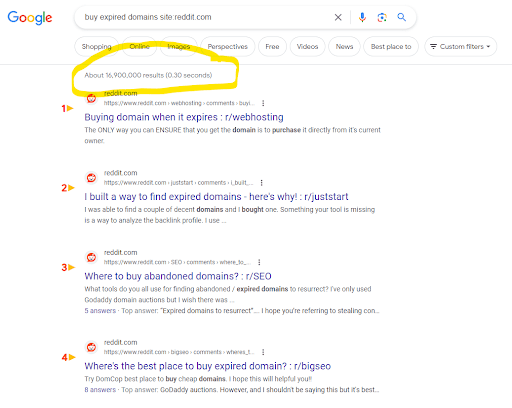
Screenshot from Google, March 2024Screenshot from search for [buy expired domains site:reddit.com], Google, March 2024

Google provides a few examples of expired domain abuse:

  • Affiliate content on a site previously used by a government agency.
  • Commercial medical products being sold on a site previously used by a non-profit medical charity.
  • Casino-related content on a former elementary school site.

These are egregious examples, and I couldn’t find the real-world scenario for any of them. If you know of any, feel free to leave them in the comments.

An issue I can recall is The Hairpin case, which had a viral moment earlier this year thanks to Wired’s Confessions of an AI Clickbait Kingpin.

The Hairpin was a once-beloved, women-run indie website. It ceased publication in 2018, and the domain expired in 2023.

It was promptly purchased by a Serbian DJ named Nebojsa Vujinovic, who then transformed the site into an AI-generated content farm.

Some original content remains with new formatting, but the author names were replaced with male names without any online presence.

It’s a pretty obvious example of expired domain abuse, and Vujinovic even admitted to Wired that he bought the domain for its authority and reputation.

Thankfully, The Hairpin website was recently de-indexed; may its original content RIP.

Screenshot from Google for [site:thehairpin.com], March 2024Screenshot from search for [site:thehairpin.com], Google, March 2024

Site Reputation Abuse

The other type of spam added to Google’s spam policies is site reputation abuse, also sometimes called Parasite SEO or pSEO.

Google defines it as:

When third-party pages are published with little or no first-party oversight or involvement, where the purpose is to manipulate search rankings by taking advantage of the first-party site’s ranking signals.

Of particular interest, it specifies that this includes:

Sponsored, advertising, partner, or third-party pages that are typically independent of a host site’s main purpose or produced without close oversight or involvement of the host site, and provide little to no value to users.

Google goes on to provide some examples. My personal favorite:

A sports site hosting a page written by a third-party about “workout supplements reviews,” where the sports site’s editorial staff had little to no involvement in the content and the main purpose of hosting the page is to manipulate search rankings.

This is likely in response to Sports Illustrated’s AI scandal that went viral in November 2023. Futurism discovered that there were AI-generated product reviews written in Sports Illustrated with fake authors.

It blew the whistle on these nonsensical reviews that said things like, “Volleyball can be a little tricky to get into, especially without an actual ball to practice with.”

The Arena Group (the company that owned the publishing rights to Sports Illustrated at the time) issued a statement that the articles were created by a partner called AdVon, which runs ecommerce product reviews across a number of its web properties, and that it was unaware that AdVon was using AI-generated content.

Google’s spam policy update essentially flags this as a site reputation abuse. The Arena Group and other large publishers who engage in such practice need to end these partnerships or de-index these pages, or they’ll be penalized.

Plus, the lack of oversight or involvement in the partner content strategy is irrelevant if it’s on your domain.

Another example Google gave that sparked discussion in the SEO community is:

A news site hosting coupons provided by a third-party with little to no oversight or involvement from the hosting site, and where the main purpose is to manipulate search rankings.

Gannett’s USA Today has a surprisingly robust coupon network hosted on a subdomain. I suspect it isn’t the only one, but it may be the biggest.

It’ll be interesting to see what it does in response to being called out. Clearly, Google is trying to get news publishers to stay in their lane because it’s hard to argue that coupons provide no value to users.
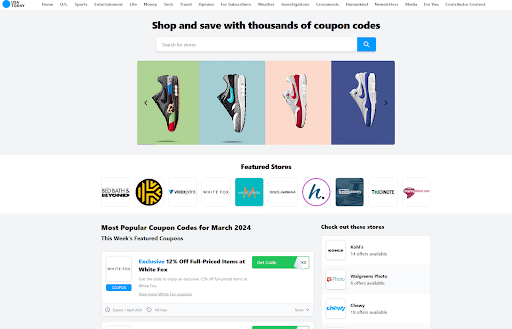
Screenshot of USA Today coupons subdomain, March 2024Screenshot of USA Today, March 2024

Google’s site reputation abuse penalties aren’t going into effect until May 2024, so publishers have time to get their ducks in a row and adjust their strategies. They have to decide whether to de-index pages that could violate this policy, end partnerships, or (I suppose) take their chances and forge ahead.

In the spam policies, Google links to a page explaining how to de-index content.

Scaled Content Abuse

The last area of change in Google’s spam policies is rebranding “spammy automatically generated content” as “scaled content abuse” and broadening its definition with examples.

In a previous version of the spam policies in January 2024, Google defines “spammy automatically generated content” as:

Content that’s been generated programmatically without producing anything original or adding sufficient value; instead it’s been generated for the purpose of manipulating search rankings and not helping users.

Today, Google has rebranded this to “scaled content abuse” and defines it as:

When many pages are generated for the primary purpose of manipulating search rankings and not helping users. This abusive practice is typically focused on creating large amounts of unoriginal content that provides little to no value to users, no matter how it’s created.

The past definition specifically targets programmatic content, whereas this new definition says it doesn’t matter how the content is generated.

What matters is that the content is unoriginal and does not add value, regardless of how it’s created – programmatically, AI-generated, or low-quality human-created.

The old version also contains six examples, all of which start with “text,” indicating that they are targeting words on the page. In this new version, formats are not mentioned at all.

The implication is that scaled content abuse could also involve a broader array of formats like images or videos.

In the scaled content abuse definition, Google provides these five examples:

  • Using generative AI tools or other similar tools to generate many pages without adding value for users.
  • Scraping feeds, search results, or other content to generate many pages (including through automated transformations like synonymizing, translating, or other obfuscation techniques), where little value is provided to users.
  • Stitching or combining content from different webpages without adding value.
  • Creating multiple sites with the intent of hiding the scaled nature of the content.
  • Creating many pages where the content makes little or no sense to a reader but contains search keywords.

An example: In August 2023, Time exposed an urgent care clinic called Nao Medical, which was found flooding the internet with nonsensical AI-generated posts about topics like what happens when unicorns consume ketamine or a medical condition called “Derek Jeter Herpes Tree.”

These pages are no longer live and have seemingly been removed from the Internet Archive.

Conclusion

Of everything that’s in this March 2024 core update, I am most curious about what falls under scaled content abuse.

Plenty of large brands are utilizing programmatic templates to build out content on their higher-value transactional pages. Take any ticketing marketplace website, for example.

The below page for Colorado Rapids tickets has all of the appropriate content for purchasing tickets.

But further down the page, there is lower-quality programmatic content, presumably to try to rank for more related keywords.

So, would a page like this get dinged even though it’s a transactional page, and this programmatic content isn’t the focus?

Screenshot from Stubhub, March 2024Screenshot from Stubhub, March 2024

Obviously, several content publishers have scaled their content strategy utilizing a large staff of freelance writers who crank out daily articles to rank in Google News and Top Stories.

The quality of this content varies considerably, but most of it gets pretty repetitive. Will that get penalized? It seems unlikely.

Time will tell what happens, but I am definitely ready to see some shake-ups.

More resources: 


Featured Image: YoloStock/Shutterstock

27-Year Search Expert Shares 5 Steps To Boost Your SEO via @sejournal, @martinibuster

In a recent Yext Summit, 27-year search marketing expert Duane Forrester shared advice on how to become a better SEO and develop the skills to better anticipate where search marketing is headed.

Who Is Duane Forrester And Why His Advice Matters

Duane Forrester is one of the rare search marketers who has experience on both sides of the search box. He has 27 years of experience in the search industry with almost ten of those years spent as a Product Manager at Microsoft. He helped build and launch Bing Webmaster Tools, wrote the original Bing Webmaster Guidelines and worked with the Core Search and Spam Teams, as well as the teams who built and maintained Schema.org, Robotstxt.org and Sitemaps.org.

Five Steps To Become A Better SEO & Predict Future Trends

Duane said that in 2022 nobody was talking about AI. Now it’s been just over a year and it’s all that everyone is talking about. He said that’s an example of how SEO is one of the fastest changing industries and said that this has always been the normal pace.

What’s going on in AI is just another change in a history of changes, not all of it visible to the search community.  Machine learning, neural networks, and AI have been a part of Search behind the scenes for many years, largely unseen and not always well understood, which underlines the importance of learning.

Duane said:

“…this industry requires a dedication to continual learning. All the time, there’s always something new. …Big steps, small steps, but it is constant.”

He suggested the following activities for attaining a strong SEO footing and maintaining it.

  1. Research 60 minutes per day
  2. Follow known experts
  3. Use official sources for SEO guidance
  4. The value of developer resources
  5. Anticipate consumer trends

1. Research 60 Minutes Per Day

Duane recommended setting aside time for research.

He explained:

“…dedicate at least 60 minutes a day, an hour, to reading new sources and the official blogs, heck even the unofficial blogs, get in and read those things.”

For some it might sound like a lot of time to dedicate to researching something that they already know, SEO. But Duane is right and I’ll tell you why.

In 2005 I was caught by surprise when a Google engineer revealed that Google was using statistical analysis to identify unnatural links. It was a mind blowing moment that made it clear I had to start reading research papers to stay on top of the search engines were doing.

I contacted Duane about it and he said that now more than ever it’s important to research everything because SEO is changing so fast that at some point it might be inadequate to call it SEO anymore.

This is what he told me:

“Man, if things keep going the way they are, we will ALL need to learn a new profession. It simply won’t be called SEO if it’s on the front edge of what’s coming.

Bottom line, if you’re not investing in the work now, there is not going to be a tomorrow. Sorry, this train is stopping. A new train will be departing the station shortly – I suggest you get on it.”

2. Follow Known Experts

Duane asserts that it’s important to keep an open mind and absorb what others have to say. It’s consider that this is a person with 27 years experience who is saying how important it is for him to read what others are saying. So if it’s important for him it should be important for everyone else.

Duane recommends:

“Follow known experts on Twitter and LinkedIn threads, Bluesky, TikTok, wherever they have an account, go find it. If it’s on medium, sign up. If it’s on Substack sign up.

Make sure you’re getting direct access. You don’t want to rely on what someone said they read. Go read these things yourself. It makes a big difference in your understanding. Listen to the podcasts, watch the webinars, follow their YouTube channels and acknowledge you will be drinking from a fire hose.”

3. Use Official Sources For SEO Guidance

Duane emphasized the importance of getting as much information direct from the search engines. For the normal sources of official information (Search Central, Developer blog, Webmaster Tools) he said to keep those bookmarked and ready to be checked every day. But he also advised to expand your sources of information to sources most people don’t go to.

This is what he said about alternative sources:

“So for SEOs, you wanna be looking for Microsoft, Google, DuckDuckGo, Yahoo, Baidu, and Naver. And before you say, but why Yahoo? It’s because they’re doing a lot over the last year with search and they are poised to do even more in the next 18 months. So pay attention to what they’re doing. They’re not investing in this because they don’t think there’s a reason to do so. They very much believe there is room for them in this market, and I bet consumers will agree with them.”

4. The Value Of Developer Resources

This part of his keynote is interesting because it’s about looking at where the industry is going to be 18 months in the future. Part of engaging with developer resources is understanding the technology but he also sees it as an opportunity to get ahead of everyone else by seeing where the consumers are going (because the money will follow them).

Duane recommended developer-focused resources at Meta, Amazon, Apple, TikTok, OpenAI because those are the companies that are developing the customer experiences that impact consumer behavior. He has a point. Shein revolutionized how clothing is marketed by sidestepping search altogether by targeting consumers on social media in ways that appealed to them.

Duane said:

“I also urge you take a look at what’s going on for developers, and there’s a very important reason for this. META, Amazon, Apple, TikTok, OpenAI, they all have dedicated locations for developers to come in and engage with our latest products and services…

The reason it’s important to pay attention to this is because these are the companies that are developing the customer experiences and understand how those customer experiences impact customer action and behavior. These are the official sources where those experiences are rolled out, talked about, and developers can engage with them.”

5. Anticipate Consumer Trends

One of the things that I found interesting was how he kept returning to how technology affects the customer experience and their behavior. When he talks about Apple or Meta it’s in the context of how they’re influencing customer behavior he also ties that to how money follows the consumers.

For example, in our conversation he mentioned the prospect of an ad-free AI search and said that we have to think about where that advertising money is going to go.

“This is leaning towards “staying on top of your game” and we have to talk about how “search” is being expanded across new platforms (ChatGPT, Perplexity, etc.).

So knowing how they’re thinking about business models and such becomes a very important part of the game. If ChatGPT launches an ad-free search experience, and their current consumers adopt it (100 million active monthly users), how does this affect current search models built on top of advertising? How does this affect how teams are tasked with work inside of brands, which skills are in demand, where does ad money move to?”

Do you see what he’s doing there? He’s looking at technological trends today and then thinking where it is headed and how that affects which jobs will be in demand and where advertising and consumer spending is headed.

I’ve known Duane for almost twenty years and he’s always doing that kind of thing where he puts context on what’s happening now and what it means for the future. Those questions he asks show how to anticipate where the industry is headed .

His Yext keynote ended with a hockey analogy:

“You do not want to skate to where the puck is. You want to skate to where the puck is going to be. The greatest hockey players who have ever played the sport knew that and acted on it every time they took to the ice.

Skating to where the puck is is a sure way to miss the point and fall behind. Skating to where it will be is how you stay in front and on top of things. And you can get there by being curious, learning continuously and building a robust network.”

Watch Duane Forresters’s keynote:

How to Keep Up with SEO Best Practices

Featured Image by Shutterstock/Artem Samokhvalov

BGR Media Founder on AI Upheaval

BGR is a media site covering consumer technology such as games and devices. Jonathan Geller launched the company in 2006 and sold it to Penske Media in 2010. He remains its president and general manager.

The site has long relied on organic search traffic, which it monetizes with advertising and affiliate commissions. But the tsunami of low-grade AI content has upended search rankings and thus BGR’s business.

He and I recently spoke. We addressed the future of search engines, the importance of branding, and more. The entire audio of our conversation is embedded below. The transcript is edited for clarity and length.

Eric Bandholz: Give us a rundown of who you are.

Jonathan Geller: I founded a site in 2006 called Boy Genius Report. We’re a tech-focused media company covering consumer gadgets, games, and entertainment.  Penske Media acquired us in 2010, and we’re now known as BGR. I’ve been running it since then as president and general manager.

Penske is a collection of media brands and businesses that include Variety, Rolling Stone, Robb Report, South by Southwest, Golden Globes, New Year’s Eve Dick Clark Productions, Billboard, and more.

Working with Penske has been amazing. Selling was a huge decision, although for me it wasn’t an exit. Penske told me, “Sell your business, come on board, and let’s run this together — build it and grow it.”

My journey with Penske in the ever-changing media landscape has been incredible. I’m having fun.

Bandholz: Ecommerce is hard, but it seems media is getting slaughtered.

Geller: Everyone’s feeling it. It’s challenging for many digital publishers. BGR is digital — a website monetized through ads and affiliate revenue. Other businesses in the Penske portfolio have revenue alternatives such as events and subscriptions. Some still do print and licensing.

The last year or two has produced 10 times the change as the decade before. We’re in the age of AI and spammy, low-quality content, and it’s insanely challenging. No one has any idea what the future looks like. Google’s CEO has no idea what this will look like in two years, and neither do the CEOs of Microsoft and OpenAI. Everyone can guess, but no one knows with certainty. We’re in the interim, trying to make the best assumptions and forecasts.

Bandholz: AI content has swamped Google and other search engines.

Geller: It’s a crazy turbulent period. AI went from 0 to 100 overnight. But that’s starting to simmer down. I think search engines will normalize. We’ve all regarded Google as a preeminent technology company. The last 18 months have seen a tsunami of AI-generated content and a ton of black hat SEO. Folks are trying to take advantage of the algorithm, throwing up content. And it’s working. They’re ranking, getting traffic, and monetizing it.

Google launched its latest core algorithm update a few weeks ago. Its primary goal is “tackling spammy, low-quality content.” Hopefully it resets organic rankings in a good way.

But over the next couple of years, having a strong branded search presence will be essential for sites dependent on organic traffic. Customers and prospects want to shop or access your site directly, which also signals to Google that people are searching for your brand. It has authority and satisfies search intent.

Bandholz: Google is lost. Organic search rarely produces meaningful results.

Geller: Media sites see the same thing. Search results are advertising-focused. The optimist in me says that this will reset. Google is making changes. There’s a new head of search — the previous person came from the ad side. Hopefully, it means the results are more organic-centric. But, to be sure, the broad direction is pay-to-play.

Google has long been a huge traffic driver, but so have Facebook, Pinterest, Flipboard, NewsBreak, and SmartNews. You might not have heard of some of those platforms, but they offer scale and traffic. At some point, there will probably be a traffic alternative to Google. Until then, capturing visitors from organic search will be very challenging.

So from a direct-to-consumer merchant perspective, publishing content to rank organically is increasingly difficult. But authentic content that speaks to your audience remains worthwhile. It’s another reason for folks to visit your site. But, again, optimizing keywords via, say, Semrush or Ahrefs is a much harder strategy.

I see Google’s ad products growing significantly with broad keyword match, Performance Max campaigns, and getting rid of cookies. Unfortunately, we’re in a black box organically.

Bandholz: Where can folks find you?

Geller: Our site is Bgr.com. I’m @boygenius on X and @jonathangeller on LinkedIn.

Google Explains How CWV Is A Ranking Factor But Doesn’t Improve Rankings via @sejournal, @martinibuster

Google’s Search Off the Record podcast covered the topic of Core Web Vitals (CWV), noting that while it’s a ranking factor it’s not so important that improving it will improve search visibility. The podcast explains how to reconcile how CWV can be a ranking factor while at the same not something that will noticeably help rankings.

Actual User Experience Of Website Is More Important Than CWV

Rick Viscomi (engineer and Web Performance Lead at Google) and Lizzi Sassman (Senior Technical Writer at Google) downplayed getting poor Core Web Vitals scores, emphasizing what really matters is how the actual users are experiencing the website.

Lizzi Sassman said that she tested the Core Web Vitals scores for Google’s Page Experience documentation and got different scores. She shared that Google’s own documentation on Page Experience only scored 45 (on a scale of 1 – 100).

Rick Viscomi answered that actual user experience of browsing the website matters more than the scores.

He explained:

“… I think this is such a common cause of confusion because developers see one single number and it’s red.

It’s scary. Do I need to panic?

I get this question all the time and I say ‘What really matters is what your real users are experiencing.’”

Most in the search community have gotten the memo about not worrying about CWV scores. They’re great for benchmarking performance in terms of optimizing for sales, ad clicks and conversions, which is where a good user experience literally pays off.

CWV Improvements Not Visible In Search

This next part sounds contradictory but it makes more sense when it’s read in context. John Mueller asserts that CWV is used in the ranking systems. But in the next breath he says that incremental improvements CWV scores will not be noticeable in search results.

The context is that Mueller’s team spoke to the search team and discovered that CWV is used in the “ranking systems or in search systems” and that’s why it’s reflected in Google’s documentation.

“…we do say we do use this in our ranking systems or in Search systems.”

Then Mueller added that achieving perfect CWV scores won’t make a difference in the search results. He explained that what’s missing in that statement is that CWV as a ranking factor is one part of a bigger ranking engine and how it’s applied is not something that Google talks about.

He explained:

“I think a big issue is also that site owners sometimes over-fixate on the metrics themselves… And then they spend months of time kind of working on this. And they see this as they’re doing something for their Search rankings. And probably a lot of those incremental changes are not really visible in Search.”

And this is the part where says that the details of how CWV is used as a ranking factor is the part that’s withheld from SEOs and publishers.

“The details we tend not to go into. We don’t go into thresholds or anything like that. Similar to how we don’t talk about how many words on a page you have to have or all of those details, which, from my point of view, are almost secondary.”

So the takeaway is not that CWV is a ranking factor. The takeaway is that it’s good to improve CWV but a perfect CWV won’t be rewarded with better rankings.

Conceptualizing Core Web Vitals

This next part is interesting because they again emphasize the importance of speed in the wider and more general sense (the forest) and then zoom in to the more narrow sense of ranking where they talk about factors that actually make a difference.

  • Performance is good in the general sense.
  • Other factors are good in the more narrow sense of ranking.

Rick Viscomi explains how web performance is important in the broader overall sense:

“It’s really good for everybody and the rising tide lifts all boats. Check your website. Make it faster. Eat your vegetables.”

Then Lizzi Harvey advises that a better use of time is to focus on content quality, which is the narrow focus on improving rankings.

She commented:

“Yeah focusing on that and then still having like a terrible article like the words on the page are not good or the design is not good and you made it really fast. Okay. Is that really going to make an improvement for your users or for search?”

Two Ways Of Looking At Core Web Vitals

I don’t think that Search Off the Record had planned to talk about CWV as a broader general concern and content as a more specific ranking-focused factor. But that’s how the podcast naturally turned out and it makes sense to conceptualize Core Web Vitals as a general big picture factor because it helps reconcile how something can be a ranking factor that on its own doesn’t really make a difference in the search results.

Listen to the podcast from the 19 minute mark:

Featured Image by Shutterstock/Asier Romero

Google: Incremental Improvements May Not Impact Rankings via @sejournal, @MattGSouthern

In a recent episode of Google’s Search Off the Record podcast, John Mueller, a Search Advocate at Google, cautioned site owners against overly fixating on incremental improvements to their Core Web Vitals scores.

Mueller suggested that these minor optimizations may yield few visible search ranking changes.

Core Web Vitals, a set of user-centric metrics measuring website performance, have been a focal point for many since Google announced they’re used in ranking systems.

The metrics, which include Largest Contentful Paint (LCP), Cumulative Layout Shift (CLS), and the recently introduced Interaction to Next Paint (INP), have driven site owners to optimize their pages for better scores.

However, Mueller’s comments highlight the potential pitfalls of over-optimizing for these metrics:

“I think a big issue is also that site owners sometimes over-fixate on the metrics themselves. They see some number, and it’s like, ‘Oh my gosh, I have to get this to like some other number, some higher state.’ And then they spend months of time working on this. And they see this as they’re doing something for their Search rankings. And probably a lot of those incremental changes are not really visible in Search.”

Mueller acknowledged the temptation to focus on metrics, given the scarcity of concrete SEO measurements:

“There are very few metrics with regards to SEO that you can look at explicitly and say, ‘Oh, it’s like 17, and I can make it 15. So it’s, I don’t know, like human nature to almost focus on them. But, at the same time, you have to be careful that you don’t over-fixate on them and spend an inappropriate amount of time.”

While Mueller didn’t entirely dismiss the importance of Core Web Vitals, his comments suggest being strategic in your optimization efforts, focusing on meaningful improvements rather than chasing incremental gains.

You can hear the full discussion in the episode linked below, starting at the 24:04 mark:

Why SEJ Cares

Mueller’s comments provide insight into Google’s perspective on Core Web Vitals and SEO.

While these metrics are important, it’s crucial to maintain sight of the bigger picture. Overinvesting time and resources into chasing minor improvements may not yield the desired results in search rankings.

How This Could Help You

Here are a few key takeaways from Mueller’s advice:

  1. Prioritize impactful optimizations over incremental gains
  2. Use tools to identify areas for improvement, but don’t get caught up in chasing perfect scores
  3. Balance Core Web Vitals with other crucial SEO elements, such as content quality, relevance, and user engagement
  4. Remember that not all optimizations will directly influence search rankings, but they can still contribute to a better user experience.

By considering these points, you can develop a well-rounded strategy that balances Core Web Vitals with other factors, driving better results for your website.

How To Adapt SEO Strategies To Better Appear In Google SGE via @sejournal, @adrianakstein

Google Search Generative Experience (SGE) has caused anxiety amongst the SEO world, but it’s not time to run for the hills yet.

Before you claim that “SGE has killed SEO,” remember that it’s still very much a work in progress, and we don’t know what impact it will have or how its functionality will change.

If organic traffic decreases as a consequence of SGE, that doesn’t necessarily mean SEO has become a less viable channel – because all marketing channels have become more expensive and less impactful over time as they become more saturated.

So, what should you change now that SGE is here?

Well, just like withstanding any algorithm update, it’s important to continue focusing on core E-E-A-T and quality content factors, as that is the best way to withstand traffic losses.

As a marketer, this means you need to redefine how SEO performance is benchmarked so it’s not perceived as a disappointment. It’s time to throw out the technique of using SEO as a siloed channel and pave the way for multi-channel marketing, as it’s the way of the future.

To help maintain SEO’s overall performance amidst these changes, there are a few strategies you can adopt to prepare for Google SGE and create a successful multi-channel marketing strategy.

What Is Google SGE?

Google Search Generative Experience (SGE) is an AI-powered program that aims to create a more “natural” way to conduct research or dig deeper on a topic.

It provides in-depth overviews of topics directly in the SERPs, reducing the need to click through several different web pages to find an answer.

Unlike the Featured Snippets already in place on Google, SGE provides a wider range of information, including links, images, and intuitive ways to deepen user experience.

Essentially, it’s a “natural” way to simplify research and streamline Google searches.

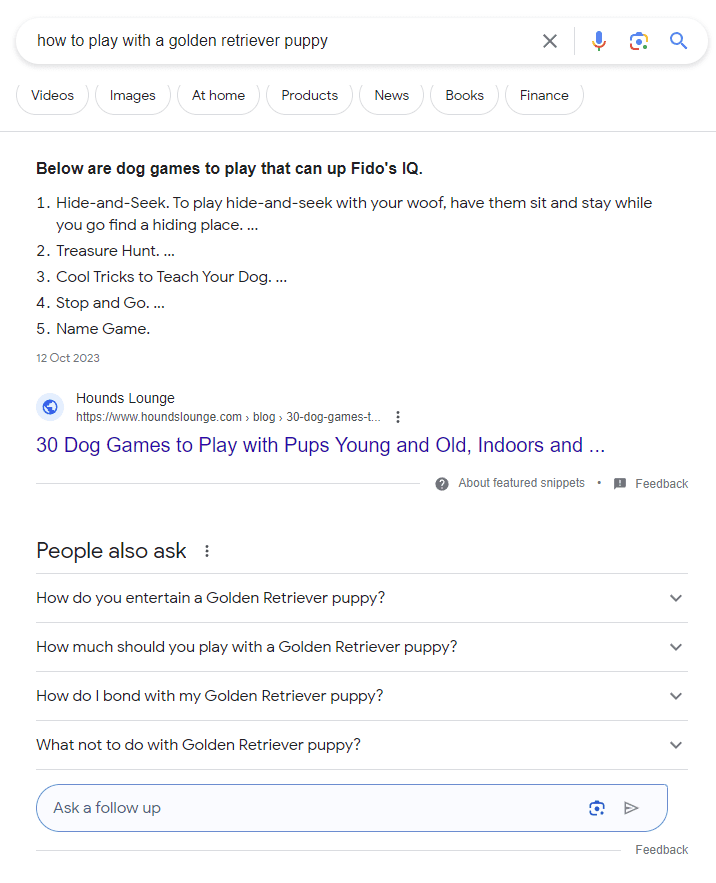
For example, SGE allows you to ask follow-up questions right on the SERPs rather than starting a new query.

Google earch for [how to play with a golden retriever puppy]Screenshot from search for [how to play with a golden retriever puppy], Google, February 2024

SGE is not technically a certified feature and is only offered through Google Labs. As of today, it’s available in the US and is functioning in 120 countries worldwide. It’s offered in five languages: English, Spanish, Portuguese, Korean, and Indonesian.

This currently excludes the EU due to strict data privacy laws, and it’s hard to say whether it’ll ever reach these markets because of this.

It’ll be interesting to see how things change over time, but we can only wait and see.

Google Hesitates To Do A Full Launch Due To A Lack Of Monetization

Although there are some innovative aspects to SGE in theory, it’s still considered more of a concept rather than a full-blown product launch. Google still hasn’t really figured out what to do with it, and the entire program remains under a lot of speculation.

Since its origination, SGE has been a bit of an experiment that keeps being extended. But this isn’t exactly new behavior for Google. In reality, it seems like we may have been introduced to SGE because Microsoft integrated ChatGPT into Bing.

Google likes keeping AI in the background, as it has been doing with its programming since RankBrain came out in 2015.

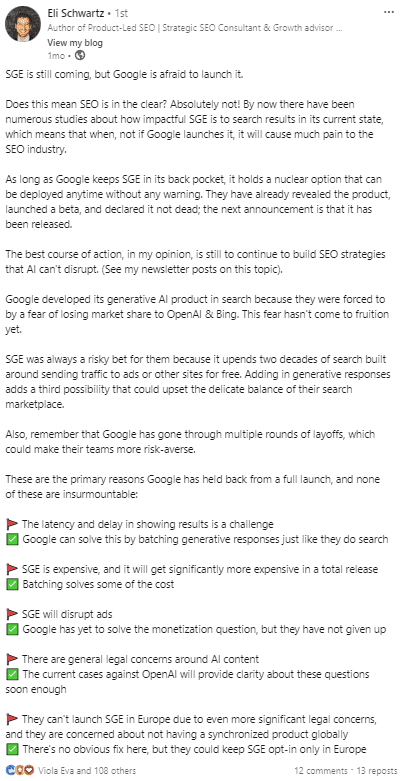
With SGE, AI becomes the forerunner of SERPs, which results in some new obstacles, as described by Eli Schwartz, Strategic SEO & Growth Advisor:

Eli Schwartz on SGEScreenshot from LinkedIn, February 2024

Despite all the “red flags,” that doesn’t mean SGE is going away. And, in the marketing world, the functionality fluctuations within SGE will continue to bring about changes for day-to-day SEO operations.

What Impact Is SGE Predicted To Have On SEO Performance?

Every marketer is wondering how SGE will affect SEO performance. Since it’s forecasted to push organic traffic down due to fewer links in the SERPs, what can we expect?

Well, let’s take a look at three studies:

The first study, conducted by the Wall Street Journal, found that the same media sites are estimated to lose 20-40% of SEO traffic from Google SGE.

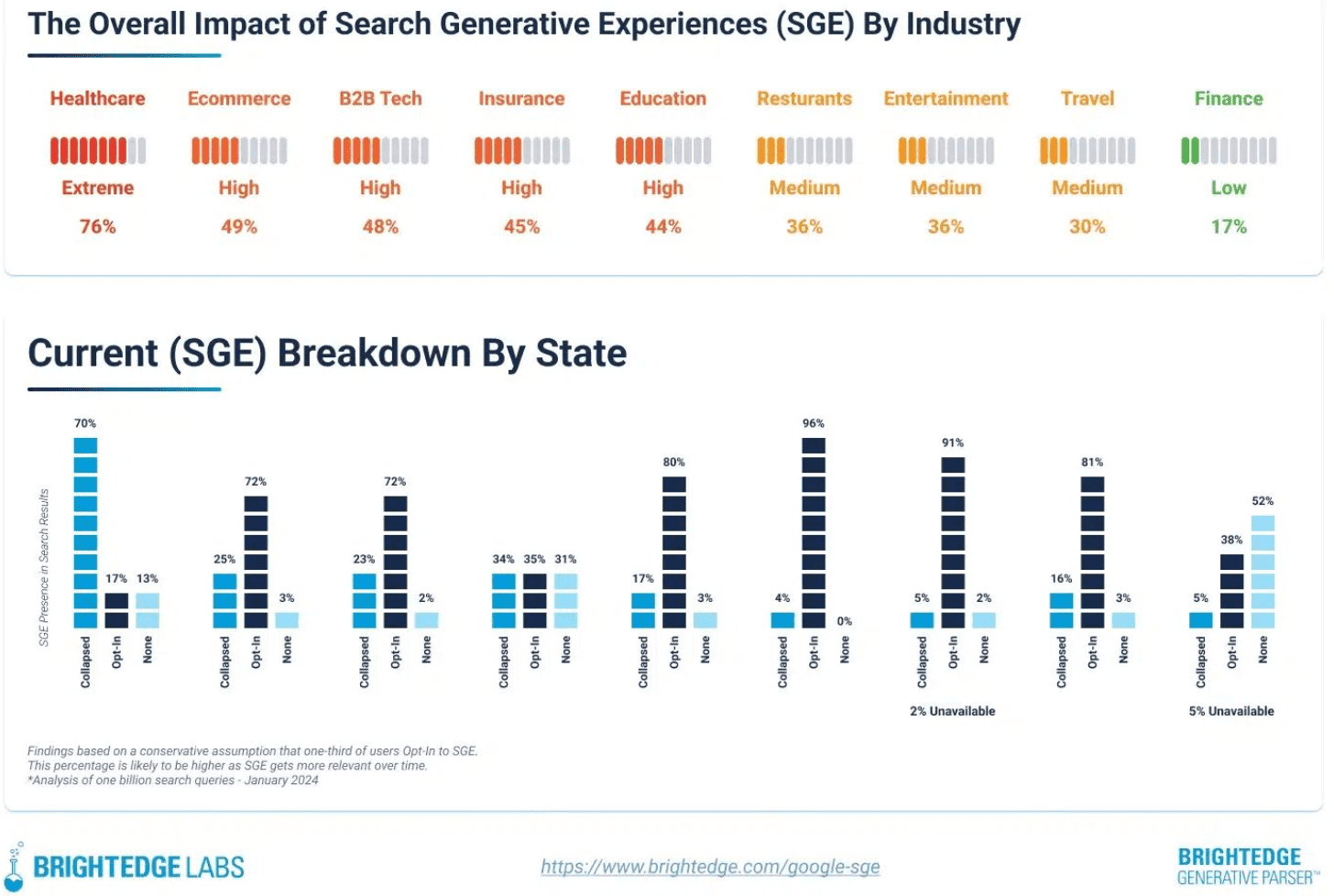
A second study conducted by BrightEdge analyzed over 1 billion queries across 9 different industries. You can see the impact of SGE by industry in the chart below:

SGE impact on industryImage from BrightEdge, February 2024

What does this mean, exactly? As with many things in SEO, “it depends,” but largely because of the differences in industry impact.

Although SGE is bound to change things, is it possible to forecast how much traffic you’d lose? And if you know what to expect, could you adapt your strategy to benefit from Google SGE rather than focus on a loss?

The key is trying to estimate how much your traffic will be affected by Google SGE and then taking a proactive approach to amending your content.

Once you do this, it is possible to optimize pages so that you have the chance to appear in SGE snapshot carousels.

5 Tips For Optimizing SEO Strategies For Organic Traffic Changes Related To SGE

Even though it’s hard to say today how SGE will impact SEO, it’s important to focus less on the doom of traffic loss and look toward the opportunity to appear in SGE snapshots.

Here are a few strategies you can use to do precisely that.

1) Assess The Current Risk Of SGE On Organic Traffic

The first thing you’ll need to do is see how SGE could impact your current traffic.

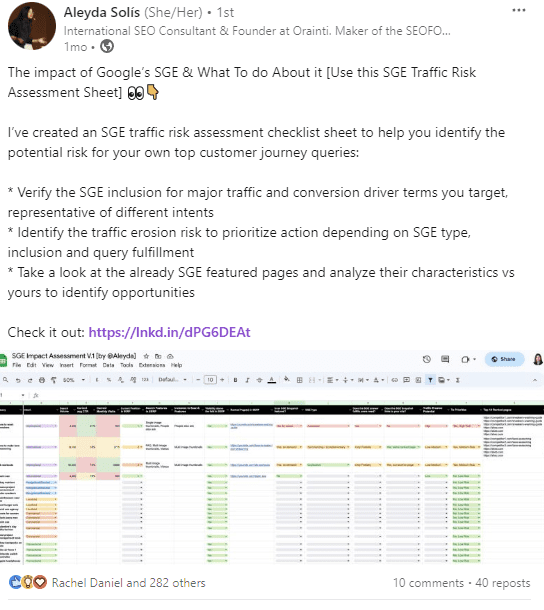
Aleyda Solís, International SEO Consultant & Founder at Orainti, put together a helpful risk assessment sheet that makes it easy to identify potential risks for various queries.

It takes into account three different types of SGE snapshots: duplicative, summarizing or complementary, and accelerator, in addition to the level of user satisfaction and fulfillment in their journey.

SGE assessment trackerScreenshot from LinkedIn, February 2024

After assessing the risk of SGE on your organic traffic, you’ll get a better idea of where to focus your SEO efforts.

Additionally, marketers will need to redefine how SEO performance is benchmarked so it’s not perceived as a disappointment. Then, you can calculate organic traffic losses and update KPIs to reflect this.

2) Transition SEO Focus From #1 Keyword Rankings To Holistic Organic SERP Visibility

Another way to adapt and overcome is to stop focusing on #1 keyword rankings as the benchmark of successful SEO efforts. Holistic, organic SERP visibility is far more beneficial and will help you succeed in conjunction with Google SGE.

Even if you’re ranking as one of the top results for specific keywords now, a study on SGE from Authoritas found that nearly 94% of the links in Google SGE don’t match the top 10 organic search results.

This is great news if you’re struggling to rank for a certain keyword, but can still manage to appear in SGE snapshots.

Overall, try to focus less on the link positioning and more on overall brand appearance and content. Google SGE has incorporated some links to make it easier for users to visit pages that are backing up what’s being presented in the summary.

Google mentions how this reduces the issues of potential misinformation while adding a complementary feature to traditional search rather than a replacement (and here of course is where all SEO pros breathe a sigh of relief).

3) Hone In On E-E-A-T

More than anything, it’s necessary to use your Experience, Expertise, Authoritativeness, and Trustworthiness (E-E-A-T) to showcase your content.

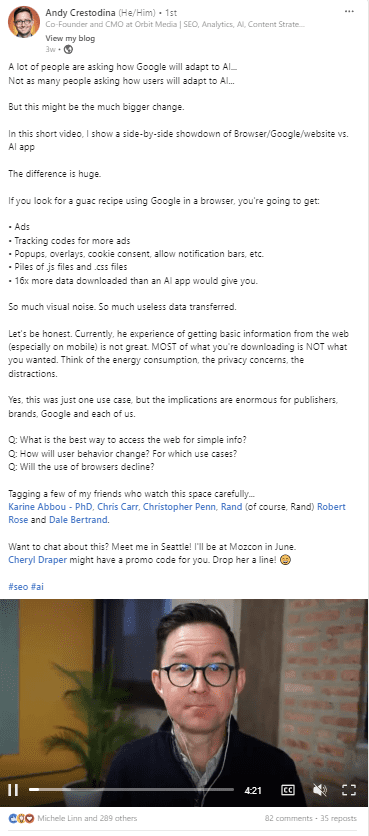
This allows you to adapt to AI rather than waiting for Google to adapt to it and then adjusting accordingly. As Andy Crestodina, Co-Founder and CMO at Orbit Media, says in his video, “It’s time to focus more on the user and less on Google.”

LinkedIn post about how SEO will adapt to AIScreenshot from LinkedIn, February 2024

Google’s SERPs are being skewed by SGE, AI updates, and even things as simple as affiliate marketing.

In a recent study that looked at 7,392 product-review search terms across Google, Bing, and DuckDuckGo, the highest-ranked pages were more optimized and had more affiliate links, but their text and quality were lower.

This could be one of the reasons the links in Google SGE don’t match the top 10 SERP results, and focusing on quality content can help keep you relevant despite ongoing changes.

With the quality of Google search results on the decline and AI content prosecution fully in play, the best way marketers can react is to include as much brand-specific and SME content as possible to meet E-E-A-T criteria.

4) Keep Note Of Algorithmic Changes In Market-specific SGE Features

As SGE continues to roll out, it’s important to keep an eye on how things are changing. It seems like the features are extremely dynamic, with major differences in identical search queries from one user to another.

A recent example test from Aleyda Solis shows how Google SGE features are, in a way, mimicking big retailers, but it’s not necessarily what we should expect.

In reality, there are tons of changes happening all the time, so it’s imperative that you track changes related to your industry.

And get used to change – it seems like SERP volatility is the new way of SEO life.

5) Don’t Silo SEO And Shift Focus To Multi-channel Marketing

In the dynamic landscape of Google SGE development and AI-powered advancements, thriving in the SERPs requires a strategic shift from relying on SEO as a solo channel to drive business growth.

Embracing multi-channel marketing is the best way to ensure your strategy aligns with the evolving demands of the industry – it’s the way of the future.

To achieve this, there are three important things you need to do:

  • Assess the customer journey holistically: This means considering the entire customer journey and its multiple touchpoints. Keep in mind that customer interactions occur across different platforms and channels, and they all need to be considered.
  • Deploy synergistic collaboration across different channels: In marketing, each channel plays a part in driving conversions, and they’re all interconnected. You can utilize GA4 conversion tracking for a deeper understanding of your customer touchpoints.
  • Diversify your strategy to help mitigate risks: When you rely solely on SEO or any single marketing channel, you’re setting yourself up for failure. Exclusively relying on one channel is not going to meet the diverse needs of today’s customers – it’s far too limited.

Navigating The Future Of SEO Amongst The Uncertainty Of Google SGE

As uncertainty about SGE looms, it’s crucial for marketers to stay calm and use the tools they have to strategically adapt.

Although SGE poses some potential challenges, especially regarding organic traffic, the program is still in the experimental phases, and its full impact remains uncertain.

While Google SGE may introduce a new dimension to how people make search queries online, it also presents an opportunity.

Now, marketers have the chance to redefine their strategies and embrace the future of multi-channel marketing before being buried by organic traffic losses and AI-powered replacements.

More resources: 


Featured Image: /Shutterstock

Google SGE: Study Reveals Potential Disruption For Brands & SEO via @sejournal, @MattGSouthern

A new study by Authoritas suggests that Google’s AI-powered Search Generative Experience (SGE), currently being tested with a limited group of users, could adversely impact brand visibility and organic search traffic.

These findings include:

  • When an SGE box is expanded, the top organic result drops by over 1,200 pixels on average, significantly reducing visibility.
  • 62% of SGE links come from domains outside the top 10 organic results.
  • Ecommerce, electronics, and fashion-related searches saw the greatest disruption, though all verticals were somewhat impacted.

Adapting to generative search may require a shift in SEO strategies, focusing more on long-form content, expert insights, and multimedia formats.

As Google continues to invest in AI-powered search, the Authoritas study provides an early look at the potential challenges and opportunities ahead.

High Penetration Rate & Industry-Wide Effects

The study analyzed 2,900 brand and product-related keywords across 15 industry verticals and found that Google displays SGE results for 91.4% of all search queries.

The prevalence of SGE results indicates they impact a majority of websites across various industries.

The research analyzed the typical composition of SGE results. On average, each SGE element contained between 10-11 links sourced from an average of four different domains.

This indicates brands may need to earn multiple links and listings within these AI-curated results to maintain visibility and traffic.

The research also suggests that larger, well-established websites like Quora and Reddit will likely perform better in SGE results than smaller websites and lesser-known brands.

Shifting Dynamics In Organic Search Results

With SGE results occupying the entire first page, websites that currently hold the top positions may experience a significant decrease in traffic and click-through rates.

When a user clicks to expand the SGE element, the study found that, on average, the #1 ranked organic result drops a sizeable 1,255 pixels down the page.

Even if a website ranks number one in organic search, it may effectively be pushed down to the second page due to the prominence of SGE results.

New Competition From Unexpected Sources

The study revealed that SGE frequently surfaces links and content from websites that didn’t appear in the top organic rankings.

On average, only 20.1% of SGE links exactly matched a URL from the first page of Google search results.

An additional 17.9% of SGE links were from the same domains as page one results but linked to different pages. The remaining 62% of SGE links came from sources outside the top organic results.

Challenges For Brand Term Optimization & Local Search

The study reveals that SGE results for branded terms may include competitors’ websites alongside the brand’s own site, potentially leading to increased competition for brand visibility.

Laurence O’Toole, CEO and founder of Authoritas, states:

“Brands are not immune. These new types of generative results introduce more opportunities for third-party sites and even competitors to rank for your brand terms and related brand and product terms that you care about.”

Additionally, local businesses may face similar challenges, as SGE results could feature competing local brands even when users search for a specific brand in a regional context.

Methodology & Limitations

To arrive at these insights, Authoritas analyzed a robust dataset of 2,900 search keywords across a spectrum of query types, including specific brand names, brand + generic terms, brand + product names, generic terms, and specific product names. The keywords were distributed across 15 industry verticals.

The study utilized a consistent desktop browser viewport to quantify pixel-based changes in the search results. Authoritas also developed proprietary “alignment scores” to measure the degree of overlap between traditional organic search results and the new SGE links.

While acknowledging some limitations, such as the keyword set needing to be fully representative of each vertical and the still-evolving nature of SGE, Authoritas maintains that the insights hold value in preparing brands for the new realities of an AI-powered search ecosystem.

Why We Care

The findings of the Authoritas study have implications for businesses, marketers, and SEO professionals. As Google’s SGE becomes more prevalent, it could disrupt traditional organic search rankings and traffic patterns.

Brands that have invested heavily in SEO and have achieved top rankings for key terms may find their visibility and click-through rates diminished by the prominence of SGE results.

SGE introduces new competition from unexpected sources, as most SGE links come from domains outside the top 10 organic results. This means businesses may need to compete not only with their traditional rivals but also with a broader range of websites that gain visibility through SGE.

As Google is a primary source of traffic and leads for many businesses, any changes to its search results can impact visibility, brand awareness, and revenue.

How This Could Help You

While the rise of SGE presents challenges, it also offers opportunities.

Taking into account what we’ve learned from the Authoritas study, here are some actionable takeaways:

  • As SGE favors in-depth, informative content, businesses may benefit from investing in comprehensive, well-researched articles and guides that provide value to users.
  • Incorporating expert quotes, interviews, and authoritative sources within your content could increase the likelihood of being featured in SGE results.
  • Enriching your content with images, videos, and other multimedia elements may help capture the attention of both users and the SGE algorithm.
  • Building a strong brand presence across multiple channels, including social media, industry forums, and relevant websites, can increase your chances of appearing in SGE.
  • Creating a trustworthy brand and managing your online reputation will be crucial, as SGE may feature competitors alongside your website.

Looking Ahead

While the long-term impact of SGE will depend on user adoption and the perceived usefulness of results, this study’s findings serve as a valuable starting point for businesses and SEO professionals.

By proactively addressing the challenges and opportunities SGE presents, you can increase your chances of success in the new search environment.


Featured Image: BestForBest/Shutterstock

Google Explains Why Images Are Gone From Some SERPs via @sejournal, @martinibuster

Google’s John Mueller offered a suggestion about a long-standing problem with missing images in search results for recipe sites but recipe bloggers don’t seem convinced or satisfied.

Missing Images In The Search Results

Several recipe bloggers have for the past few months brought up the issue of image thumbnails that stopped appearing in the search engine results pages (SERPs) for their websites. They previously enjoyed thumbnail images displayed but at some point it appears Google stopped showing them.

The recipe bloggers feel this is a problem that needs fixing and brought it to the attention of SearchLiaison and John Mueller but the problem keeps happening.

One of the first posts in the discussion that Mueller answered dates back to January 29th when a recipe blogger noticed that a thumbnail image stopped showing for their sites when ranked in the search results.

They tweeted:

“@searchliaison

Hi. I saw today that Google is not showing any of my featured images, not one. From the most popular recipes to any other random one I checked.

Even if the picture appears in the Carousel (below the first one), it doesn’t appear in the list (second link). Help!”

Google SearchLiaison responded that they had passed it on.

Casey Markee, founder of Media Wyse, offered some background information about the problem, explaining that the problem may be widespread.

He tweeted:

“FYI Danny, this is not a unique issue. We are seeing it on dozens of recipe sites.

Also, second issue, sites are reporting they can’t get any new recipes into the carousel in over a month!

I am going to have the sites tag you with specific examples where possible.”

Google SearchLiaison responded that he’s passed the report on to the search team and reassured that he would also discuss Casey’s feedback internally as well.

Missing Images Not An Isolated Issue

The tweets about missing images continued into February and into March when someone from the home improvement space tweeted that the missing images in the SERPs issue was affecting them as well.

@Sleblanc921 tweeted:

“It’s not just food bloggers, I’m in home improvement/ DIY and mine are gone too.”

The reports of missing images in the search results even affected travel bloggers.

The Answer That Probably Nobody Wanted

Mueller responded to the latest tweet by assuring everyone that he too had passed the feedback onto the search team.

He tweeted:

“We did pass these on, and folks have been looking into the report…”

But his tweet also contained a caveat about the image thumbnails, saying that the images don’t show for all sites.

His tweet continued:

“…but in general, we don’t guarantee that images are shown with search results, so sometimes things are just shown without them.”

The travel blogger, @flyingwithbaby, tweeted:

“Hi @JohnMu it seems to be affecting my site ( family travel) for every post- everyone else’s has an image next to theirs but mine have gone. Content is super helpful according to readers , own photos etc. and it’s harming what little has been left :-(“

In response to the travel blogger, John Mueller reiterated his previous response with a possible explanation of why the images are no longer appearing.

He tweeted:

“Like I mentioned, it’s not expected that every post / search result has an image next to it. I imagine things would look pretty cluttered if that were the case.”

@flyingwithbaby responded:

“I get that- but from my experience, it was all showing before and I’m unsure why my entire site is being singled out. Seems that others are having the exact same issue. It always showed before. …I’m not sure how more helpful this can be with personal experience, unique photos and content ( which others have copycatted) and then now even the image wiped off next to the search results.

It’s crippling John & so frustrating “

Indirect Statements Perpetuate Confusion

John Mueller’s answer implies that Google’s search results are working the way they’re supposed to work.

But the problem with implying is that it doesn’t explicitly say that there is no bug, it doesn’t explicitly say that there is no outage.

It might not be Mueller’s fault that his language is not more explicit, there may be a prohibition on mentioning specifics. Or it could be that he doesn’t even realize that a more explicit statement that there is no outage is what users might need to hear.

Regardless, Mueller’s statement does imply that there is no outage and that the decrease in image thumbnails is the new normal.

Recipe bloggers raised concerns to Google SearchLiaison and John Mueller about the image thumbnails that used to appear alongside their search results, advising that their images completely stopped showing and that it was affecting their visibility. Images in rich results draw attention to a search result and helps them attract clicks.

Food and recipe sites invest time and money into equipment for photographing food to accompany their articles as well as in researching and testing recipes. That explains how disheartening it must feel to see those image thumbnails disappear.

The issue with the missing image thumbnails in Google search results extends beyond recipe blogs and also impacts home improvement and travel sites as well, which may indicate that the problem is widespread.

Featured Image by Shutterstock/Roman Samborskyi

Here’s What SEO Experts Have To Say About Leveraging SGE In 2024 via @sejournal, @fiverr

Google Search Generative Experience (SGE) has come a long way since its experimental launch in May 2023.

Starting out by simply generating paraphrased snippets for search engine queries, SGE now offers more comprehensive summaries and source links.

Essentially, Google’s SGE is an interactive generative AI-powered feature that uses existing results to answer search queries.

Think of it as a chatbot — but Google’s organic search results power it.

Every indexed webpage that crosses a search engine results page (SERP) helps teach SGE what it knows.

As exciting (and partly terrifying) as the feature is, you may be trying to understand its true potential to leverage it for your businesses.

How Does Google SGE Work?

SGE offers comprehensive answers to search queries, just like Open AI’s ChatGPT, but SGE cites sources.

To see SGE in action:

  1. Navigate to Google to begin a search.
  2. Enter a search query or question into the search bar.
  3. Watch as multiple search results are written as a conversational response to your question.

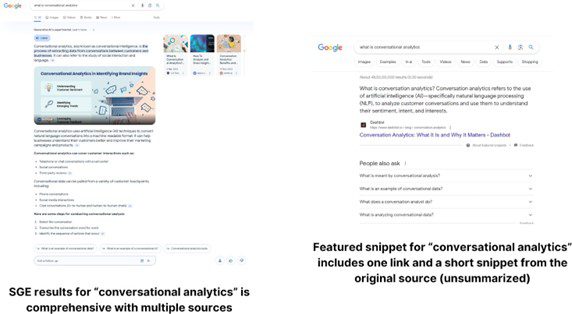
Context and more information are added to your result through SGE, especially when compared to the old featured snippets, which only displayed a snippet or sentence without its full context.

Screenshot from Google for [conversational analytics] using normal search and SGE, February 2024

As you can see, pre-SGE days allowed you to sift through multiple websites, giving each result traffic to their respective webpages.

Now, SGE takes up the space where direct webpage results used to display, meaning that many websites may no longer get the traffic they used to get.

How Will SGE Change How Google Search Works?

As you can imagine, many SEO experts believe SGE will eat into organic traffic from top-of-funnel queries.

There are three key reasons for a potential drop in organic traffic from SERPs:

  • Featured snippets only offer one clickable source, while SGE offers many. If you owned the top position, you may now be sharing clicks with multiple sources.
  • SGE takes up too much space on the SERPs, pushing the traditional SERP below the fold, resulting in fewer clicks.
  • You can ask follow-up questions right, which keeps searchers on the SERP instead of traveling to a site for more information.

That said, there is still potential for pages to get traffic as long as the content answers the query.

SGE Sites Pages That Are Not In The Top 10

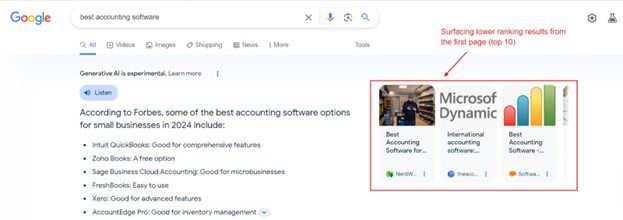
There have been many instances where SGE cites pages that don’t rank in the top 10 results — indicating that the data is pooled from a larger sample.

However, you should adapt your strategy as SGE emerges from its experimental phase.

A recent study found that 49% of consumers are interested in AI-powered searches, indicating that AI-generated SERPs are perceived positively.

If Google wants to stay competitive, especially with Bing Search’s hard comeback last year, SGE will eventually be a permanent part of the SERPs.

What SEO Experts Have To Say About SGE’s Impact On Digital Marketing

Many businesses, like yours, rely on Google for their revenue. Whether that’s in the form of ads or organic results, SGE is set to disrupt both of these formats.

How SGE Impacts Organic Traffic

On the organic side, achieving the top 3 positions could lead to lackluster results.

How SGE Impacts PPC

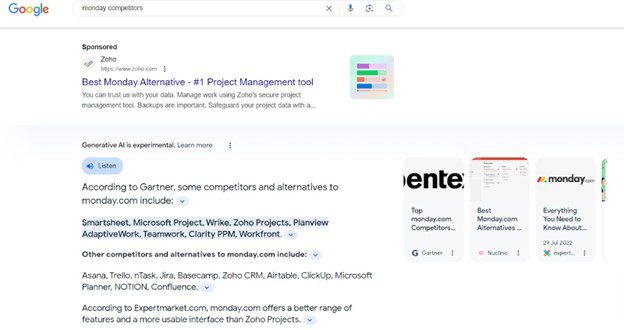
On the advertising end, you might be safe, as Sponsored results appear above SGE.

However, that only pushes organic results even further down.

Screenshot from Google for [monday competitors], February 2024

Some experts believe SGE to be like Featured Snippets but on steroids. Ihor Rudnyk, CEO of Collaborator, explains:

We saw sites that gave simple and fast answers lost some of their traffic. That’s because users receive these answers directly in the SERPs. For example, weather prediction, currency rates, short facts, etc.

Businesses focused on short, easy answers and fast information are in the worst position. I don’t see how you can change it without creating additional value for users. However, it’s easy to predict that the importance of brand awareness and direct traffic will continue to grow.

Additionally, there will be a larger focus on creating pages with depth. It could be in the form of original data, a differentiated view or commentary on trends.

SEO professionals will start to become more quality-focused, and quality will be defined as bringing something new, original or interesting to the debate in contrast to what it is defined as now — being ‘comprehensive’ (code for boringly covering the same stuff the next guy does).

— Patrick Herbert, Director at Singularity Digital

What Can You Do To Leverage SGE For Your Business?

So, how can you prepare to stay relevant on the SERPs as SGE will soon dominate?

Here are a few tips to get you started:

1. Move From Informational To Transactional Content

SGE is the biggest threat to informational content — especially concise content.

Businesses that create thin content optimized for search will suffer. Creating more transactional pages could help you avoid this issue.

Transactional content is more nuanced and requires extensive research, so users will be more likely to dig deeper into product/service websites.

Not only that, but it also allows you to appear in SGE for high-intent search terms, which is the goal for businesses.

Screenshot from Google for [best accounting software], February 2024

2. Monitor Changes In Search Intent Over A Period

Many marketers will soon shift their reliance on traditional keyword metrics like keyword density (KD) and search volume to search intent.

Even with high KD and search volume, ranking for these keywords can be difficult. So, with SGE, it doesn’t make sense to go after such queries unless you’re prepared to write ultimate in-depth guides.

This is why you need to look at search intent first.

Ask yourself:

  • Does the topic make sense?
  • Can I realistically rank for this topic or at least get credited by SGE?
Let’s Be Real: Reddit In The SERPs Lacks Credibility via @sejournal, @martinibuster

Google dramatically increased the amount of Reddit answers in the search results in order to surface actual user opinions but it’s becoming increasingly apparent that it’s having a negative effect on the quality of search results. Everyone seems to know it but Google.

Lack of Expertise But Makes Sense

User generated content that is typically found in product reviews, travel reviews, Reddit and in web forums are opinions formed by anonymous people of unknown experience and expertise. It is based on personal opinions and biases that are limited to each person’s experience and unfortunately, a lack of experience has never stopped anyone from expressing their opinion.

The frightening quality of user generated content typically found on Reddit is when an opinion “makes sense” (regardless of factual accuracy) it is practically guaranteed that it will get upvoted by all the other similarly experienced users who lack the expertise to tell the difference between inaccurate opinions that “makes sense” versus factually accurate opinions.

All you have to do is look at the SEO community running from one trend to another because the ideas make sense and are inevitably discarded.

Ideas that make sense are similar to AI hallucinations. AI hallucinations “sound right” but sounding right is not the same as factually accurate. The legacy of things that make sense is the idea that the sun revolves around the earth, which “made sense” for millenniums.

Common sense is a big problem at Reddit because it allows those who lack experience and expertise to share plausible yet factually inaccurate opinions.

I asked Chef Allen (Facebook Profile) about the expertise of the food and recipe discussions on Reddit.

She shared  her expert opinion:

“Reddit is not a reliable place to get recipes. From untested recipes to improper measurements and lack of instructions, finding a trustworthy recipe on Reddit is nearly impossible. People mean well, but most responses to recipe requests are met with what is sure to be disappointing results if one were actually to attempt to make the suggested recipe.

Reddit just isn’t designed for sharing tried-and-tested recipes from experienced recipe developers.”

Example Of Facts Versus Reddit Opinions

There are many examples of how a lack of expertise by Redditors leads to opinions and biases that override facts and negatively impacts the quality of the content.

This is one example that is related to SEO.

Two facts about links:

  • Googler Gary Illyes explained at Pubcon Austin that links aren’t in the top 3 of ranking factors anymore.
  •  Then consider that in March 2024 Google’s spam policy page deemphasized links by stating they’re a ranking factor but no longer saying they’re an important ranking factor.

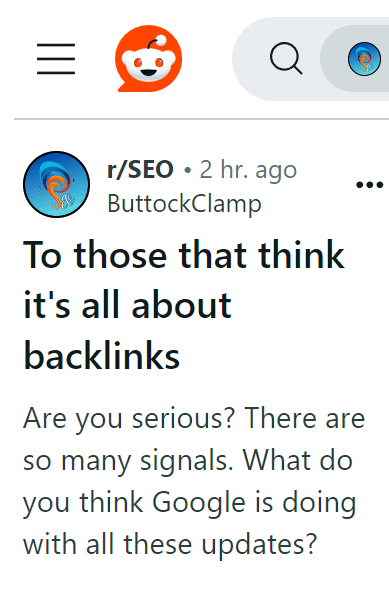
On Reddit today someone observes that links aren’t playing as strong a role as in the past.

Screenshot Of A Reddit Post About Links

Screenshot of a Reddit post asserting that links play a less important role in rankings than it has in the past.

And several Redditors argue against it, including sine who joined Reddit within the past few years and may have entirely missed the heyday of when links were the undisputable #1 ranking factor.

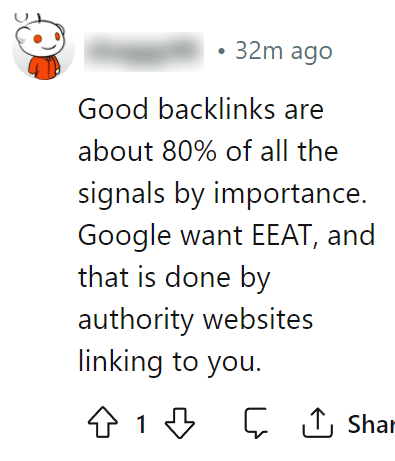
Here’s one person’s response:

Typical response that is arguing that there is no change in how Google uses links for ranking purposes.

Here’s another example. A top ranking Reddit thread for how to make birria de res, which is a Mexican braised meat recipe for cooking goat meat that originated in the Mexican state of Jalisco.

The first person to answer is someone who is guessing what type of meat is good for a birria.

Redditor Guessing An Answer

Screenshot of a Redditor answering a post with a guess

That person posting a guess is typical of the responses given in not just that Reddit thread but in any number of discussions. That’s not to say there aren’t experts on Reddit but for those of you with years of experience in SEO, when was the last time you turned to Reddit for SEO advice?

Lack Of EEAT In User Generated Content

The idea of ranking the views of real people makes sense, perhaps more in some contexts than others. For example, when it comes to saltwater fishing I would 100% take the opinion of someone posting on a dedicated east coast fishing forum like Stripers Online or from one of the writers at Surfcaster’s Journal who all have decades of hands-on fishing experience. I value the expertise of of Surfcaster’s Journal so much that I pay for access to their content. It’s that good.

But what about Reddit? I have expertise in saltwater and freshwater fishing and truthfully, Reddit is the last place I would ever turn to for fishing advice.

For example, it’s well-known that the best time for catching striped bass on the east coast is at night when striped bass sneak around in the dark to ambush prey. They can be caught during the day but the night time is without question the best time for catching the larger keeper size fish.

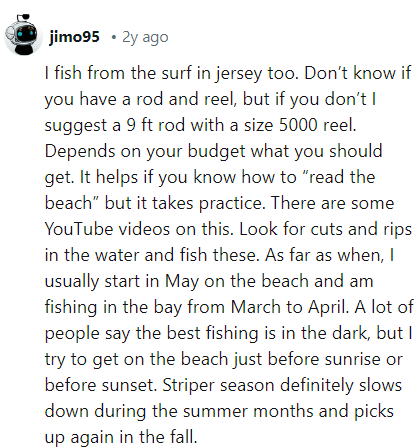
Yet many top ranked discussions on Reddit focus on daytime fishing.

Example Of Personal Bias In A Reddit Answer

Screenshot of a poor answer about saltwater fishing on Reddit

Contrast that with the logo of Surfcaster’s Journal where it’s clear that fishing at night is the heart of the sport of striped bass fishing.

Surfcaster's Journal emphasizes striped bass fishing at night

Recipe Sites Versus Reddit

Casey Markee (@MediaWyse), a well-regarded search marketing consultant specializing in optimizing recipe and food blogs agrees that Reddit threads in the search results are a poor experience for users.

He explained:

“Although Google has argued that the proliferation of Reddit results is to provide more first-hand experience to guide users, rarely does this result in superior results in the recipe niche.  Especially for more complicated recipes, the detailed step by step instructions and expert tips that come with those recipes, fare outshine what you’ll find in a ranking Reddit thread.

For example, a complicated recipe like “Beef Wellington” has a lot that can go wrong, especially with regard to the phyllo dough and getting clean cuts when it’s done. You need only look at the Reddit result returned for this query, and compare it to the many better written and more detailed recipes, to see how large the gap is between presented expertise.

You absolutely wouldn’t want to rely on a Reddit thread alone to make even the average complicated recipe. The results will not be satisfying. Most Reddit threads are “too general” and really don’t provide the needed level of expertise to ensure a recipe is done ‘perfectly’ the first time.”

Top Reasons Why Reddit Should Not Be Highly Ranked

  1. Lack of Expertise
    This is self-evident by now.
  2. Anonymity
    The anonymous nature of Reddit among the millions of users makes it easy for anyone to post anything without experiencing the self-moderating effects of a forum community where expert members are always near to pick apart poor advice.
  3. Bias
    Reddit answers tend to reflect the biases of the users, some of which arise from a lack of experience
  4. Subjectivity
    Reddit posts tend to be based on the preconceptions or tastes that may have more to do with their geographic and cultural background than facts, experience and knowledge.
  5. Echo Chambers
    This is a well-known effect where likeminded people will coalesce and reinforce each other’s preconceptions and biases.
  6. Cognitive Biases
    A common trait in social media and user generated content is that cognitive biases like the Dunning-Kruger effect are amplified. The Dunning-Kruger effect is when someone who lacks expertise overestimate their subject matter knowledge and contributes to the overall decline of understanding.
  7. Oversimplification
    This relates to what Casey mentioned about Reddit threads being “too general” and one of the reasons for this is that the people who are answering the questions lack the contextual understanding and all of the nuance that goes with that which leads to oversimplification of any given topic.

Google Is Using Content Of Dubious Expertise

The definition of dubious is something that cannot be trusted or and is doubtful. Opinions shared on Reddit by people who lack expertise and are sharing opinions in anonymity qualify as dubious. Yet Google is not only favoring Reddit in the search results, it is also paying millions of dollars for access to content that is lacking in expertise, experience, authoritativeness and trustworthiness.

Google has stated that it is prioritizing content from actual people with experience, which makes sense in certain contexts such as their experiences with products. But does prioritizing Reddit content stray too far from surfacing content with actual expertise?

Featured Image by Shutterstock/Roman Samborskyi