Google Causes Global SEO Tool Outages via @sejournal, @martinibuster

Google cracked own on web scrapers that harvest search results data, triggering global outages at many popular rank tracking tools like SEMRush that depend on providing fresh data from search results pages.

What happens if Google’s SERPs are completely blocked? A certain amount of data provided by tracking services have long been extrapolated by algorithms from a variety of data sources. It’s possible that one way around the current block is to extrapolate the data from other sources.

SERP Scraping Prohibited By Google

Google’s guidelines have long prohibited automated rank checking in the search results but apparently Google has also allowed many companies to scrape their search results and charge for accessing ranking data for the purposes of tracking keywords and rankings.

According to Google’s guidelines:

“Machine-generated traffic (also called automated traffic) refers to the practice of sending automated queries to Google. This includes scraping results for rank-checking purposes or other types of automated access to Google Search conducted without express permission. Machine-generated traffic consumes resources and interferes with our ability to best serve users. Such activities violate our spam policies and the Google Terms of Service.”

Blocking Scrapers Is Complex

It’s highly resource intensive to block scrapers, especially because they can respond to blocks by doing things like changing their IP address and user agent to get by any blocks. Another way to block scrapers is through targeting specific behaviors like how many pages are requested by a user. Excessive amounts of page requests can trigger a block. The problem to that approach is that it can become resource intensive keeping track of all the blocked IP addresses which can quickly number in the millions.

Reports On Social Media

A post in the private SEO Signals Lab Facebook Group announced that Google was striking hard against web scrapers, with one member commenting that the Scrape Owl tool wasn’t working for them while others cited that SEMRush’s data has not updated.

Another post, this time on LinkedIn, noted multiple tools that weren’t refreshing their content but it also noted that the blocking hasn’t affected all data providers, noting that Sistrix and MonitorRank were still working. Someone from a company called HaloScan reported that they made adjustments to resume scraping data from Google and have recovered and someone else reported that another tool called MyRankingMetrics is still reporting data.

So whatever Google is doing it’s not currently affecting all scrapers. It may be that Google is targeting certain scraping behavior, learning from the respones and improving their blocking ability. The coming weeks may reveal that Google is improving its ability to block scrapers or it’s only targeting the biggest ones.

Another post on LinkedIn speculated that blocking may result in higher resources and fees charged to end users of SaaS SEO tools. They posted:

“This move from Google is making data extraction more challenging and costly. As a result, users may face higher subscription fees. “

Ryan Jones tweeted:

“Google seems to have made an update last night that blocks most scrapers and many APIs.

Google, just give us a paid API for search results. we’ll pay you instead.”

No Announcement By Google

So far there has not been any announcement by Google but it may be that the chatter online may force someone at Google to consider making a statement.

Featured Image by Shutterstock/Krakenimages.com

Evidence That Google Detects AI-Generated Content via @sejournal, @martinibuster

A sharp-eyed Australian SEO spotted indirect confirmation about Google’s use of AI detection as part of search rankings that was hiding in plain sight for years. Although Google is fairly transparent about content policies, the new data from a Googler’s LinkedIn profile adds a little more detail.

Gagan Ghotra tweeted:

“Important FYI Googler Chris Nelson from Search Quality team his LinkedIn says He manages global team that build ranking solutions as part of Google Search ‘detection and treatment of AI generated content’.”

Googler And AI Content Policy

The Googler, Chris Nelson, works at Google in the Search Ranking department and is listed as co-author of Google’s guidance on AI-generated content, which makes knowing a little bit about him

The relevant work experience at Google is listed as:

“I manage a large, global team that builds ranking solutions as part of Google Search and direct the following areas:

-Prevent manipulation of ranking signals (e.g., anti-abuse, spam, harm)
-Provide qualitative and quantitative understanding of quality issues (e.g., user interactions, insights)
-Address novel content issues (e.g., detection and treatment of AI-generated content)
-Reward satisfying, helpful content”

There are no search ranking related research papers or patents listed under his name but that’s probably because his educational background is in business administration and economics.

What may be of special interest to publishers and digital marketers are the following two sections:

1. He lists addressing “detection and treatment of AI-generated content”

2. He provides “qualitative and quantitative understanding of quality issues (e.g., user interactions, insights)”

While the user interaction and insights part might seem unrelated to the detection and treatment of AI-generated content, the user interactions and insights part is in the service of understanding search quality issues, which is related.

His role is defined as evaluation and analysis of quality issues in Google’s Search Ranking department. “Quantitative understanding” refers to analyzing data and “qualitative understanding” is a more subjective part of his job that may be about insights, understanding the “why” and “how” of observed data.

Co-Author Of Google’s AI-Generated Content Policy

Chris Nelson is listed as a co-author of Google’s guidance on AI-generated content. The guidance doesn’t prohibit the use of AI for published content, suggesting that it shouldn’t be used to create content that violates Google’s spam guidelines. That may sound contradictory because AI is virtually synonymous with scaled automated content which has historically been considered spam by Google.

The answers are in the nuance of Google’s policy, which encourages content publishers to prioritize user-first content instead of a search-engine first approach. In my opinion, putting a strong focus on writing about the most popular search queries in a topic, instead of writing about the topic, can lead to search engine-first content as that’s a common approach of sites I’ve audited that contained relatively high quality content but lost rankings in the 2024 Google updates.

Google (and presumably Chris Nelson’s advice) for those considering AI-generated content is:

“…however content is produced, those seeking success in Google Search should be looking to produce original, high-quality, people-first content demonstrating qualities E-E-A-T.”

Why Doesn’t Google Ban AI-Generated Content Outright?

Google’s documentation that Chris Nelson co-authored states that automation has always been a part of publishing, such as dynamically inserting sports scores, weather forecasts, scaled meta descriptions and date-dependent content and products related to entertainment.

The documentation states:

“…For example, about 10 years ago, there were understandable concerns about a rise in mass-produced yet human-generated content. No one would have thought it reasonable for us to declare a ban on all human-generated content in response. Instead, it made more sense to improve our systems to reward quality content, as we did.

…Automation has long been used to generate helpful content, such as sports scores, weather forecasts, and transcripts. …Automation has long been used in publishing to create useful content. AI can assist with and generate useful content in exciting new ways.”

Why Does Googler Detect AI-Generated Content?

The documentation that Nelson co-authored doesn’t explicitly states that Google doesn’t differentiate between how low quality content is generated, which seemingly contradicts his LinkedIn profile that states “detection and treatment of AI-generated content” is a part of his job.

The AI-generated content guidance states:

“Poor quality content isn’t a new challenge for Google Search to deal with. We’ve been tackling poor quality content created both by humans and automation for years. We have existing systems to determine the helpfulness of content. …Our systems continue to be regularly improved.”

How do we reconcile that part of his job is detecting AI-generated content and Google’s policy states that it doesn’t matter how low quality content is generated?

Context is everything, that’s the answer. Here’s the context of his work profile:

Address novel content issues (e.g., detection and treatment of AI-generated content)”

The phrase “novel content issues” means content quality issues that haven’t previously been encountered by Google. This refers to new types of AI-generated content, presumably spam, and how to detect it and “treat” it. Given that the context is “detection and treatment” it could very well be that the context is “low quality content” but it wasn’t expressly stated because he probably didn’t think his LinkedIn profile would be parsed by SEOs for a better understanding of how Google detects and treats AI-generated content (meta!).

Guidance Authored By Chris Nelson Of Google

A list of articles published by Chris Nelson show that he may have played a role in many of the most important updates from the past five years, from the Helpful Content update, site reputation abuse to detecting search-engine first AI-generated content.

List of Articles Authored By Chris Nelson (LinkedIn Profile)

Updating our site reputation abuse policy

What web creators should know about our March 2024 core update and new spam policies

Google Search’s guidance about AI-generated content

What creators should know about Google’s August 2022 helpful content update

Featured Image by Shutterstock/3rdtimeluckystudio

Programmatic SEO: An Introduction To Pages At Scale via @sejournal, @TaylorDanRW

Programmatic SEO is an approach to SEO and content creation that leverages automation and technology to efficiently create, optimize, and manage a large volume of webpages.

It’s particularly useful for websites that require thousands, or even millions, of pages to rank for diverse search queries.

Ecommerce giants like Amazon or travel websites like Expedia rely on programmatic SEO to dynamically generate pages for every product, location, or service they offer.

The power of programmatic SEO lies in its ability to handle such scale while maintaining a focus on relevant keywords, content structure, and user intent.

Defining Your Objectives

Before starting with programmatic SEO, define your goals.

Do you want to boost organic traffic, rank for more keywords, or improve user experience?

Clear goals guide your strategy and measure success.

  1. Set KPIs: Use metrics like traffic growth, conversions, and rankings to track progress.
  2. Find Opportunities: Research your industry and competitors to uncover untapped keywords or markets.
  3. Prioritize User Intent: Create content that answers questions and solves user problems.

Programmatic Keyword Research

In traditional keyword research, the goal is often to identify high-search volume keywords that can drive significant traffic to a website.

However, these keywords usually come with high competition, making it challenging for newer or smaller sites to rank well in search engine results.

Programmatic SEO takes a different approach by targeting low-search volume and low-competition, long-tail keywords.

This strategy focuses on creating a large number of pages optimized for specific queries, allowing you to rank higher more easily and attract a highly targeted audience.

Keywords in programmatic SEO consist of two main components:

Head Terms

Head terms are broad keywords that describe a general topic or category. Head terms often have the following characteristics:

  • High average monthly search volumes.
  • Tend to be “short tail.”
  • Have multiple common interpretations.
  • Tend to be more stable SERPs with a lot of competition targeting the query.

Examples include keywords such as “onboarding software,” “winter sun vacations,” or “crm software.”

Modifiers

Modifiers are words or phrases that add specificity to head terms, and will vary greatly between sectors.

Modifiers are easily identifiable as they follow patterns, which again vary between different sectors.

Common modifier patterns include:

  • “for SaaS.”
  • “for staffing agencies.”
  • “for accountants.”
  • “best practices.”
  • “2025.”

In contrast to head terms, aside from occasional spikes in traffic, average monthly search volumes tend to be lower, but when combined with head terms, they create more targeted queries with more focused intent. It helps capture visibility with niche audiences and consumers who may be showing intent.

Combined with head terms, we tend to call these “long-tail” keywords.

Reliable Datasets

To scale programmatic SEO effectively, you need a reliable dataset that can generate unique, valuable, and relevant pages.

Depending on the types of pages you’re creating, you need to understand and anticipate the change frequency of the data, and how your infrastructure will handle the changes.

Many platforms provide APIs that you can use to fetch structured data.

These include:

  • Yelp API: For local business details.
  • OpenWeather API: For weather-related data.
  • Google Maps API: For location-based information.

Your own proprietary data can also be a valuable source for programmatic pages. These can be:

  • Product catalogs from an ecommerce store.
  • CRM data with user or location-specific insights.
  • Inventory databases, such as hotel room availability or real estate listings.

Programmatic Keyword Clustering

Organizing your keywords into logical clusters is a powerful way to streamline your content creation process.

You can develop scalable, template-based pages that enhance relevance for users and search engines by leveraging these clusters.

This approach allows for efficiency and customization while aligning with search intent.

Clustering also allows for more seamless automation and reduces the potential to create large swathes of pages with near-duplicate intents and purposes.

1. Categorize By Intent

Start by grouping keywords according to their search intent. This ensures your content addresses specific user needs, such as:

  • Informational: Answering questions or providing knowledge. Example: What are the best coffee shops in Boston?
  • Transactional: Enabling actions like purchases or bookings. Example: Order coffee beans online in Boston.
  • Navigational: Helping users locate specific places or brands. Example: Starbucks locations in Boston.

2. Define Pages Based On Patterns

Once you’ve categorized keywords, identify common patterns to create flexible templates. This strategy helps structure content consistently across multiple pages.

  • Location-Specific Templates:
    • Format: [Category] in [Location].
    • Example: Hotels in Paris.
  • Feature-Specific Templates:
    • Format: [Product] with [Feature].
    • Example: Smartphones with best cameras.
  • Use Case-Specific Templates:
    • Format: [Service] for [Audience/Use Case].
    • Example: CRMs for hospitality industry.

3. Expand With Modifiers

Enhance clusters by incorporating commonly searched modifiers to make the content more comprehensive:

  • Price-Related Modifiers: Add terms like cheap, affordable, or luxury.
  • Time-Related Modifiers: Include phrases such as “near me now” or “open late.”
  • Specific Features: Highlight characteristics like “with a pool,” “pet-friendly,” or “free delivery.”

4. Combine Variations

Use combinations of templates, categories, and modifiers to address long-tail keywords and niche queries. Examples include:

  • Pet-friendly hotels in Chicago with free breakfast.
  • Best Italian restaurants in New York open late.

Programmatic SEO relies on automated systems to generate content at scale, reducing the manual workload involved in traditional SEO efforts.

Automation allows businesses to rapidly create pages that address various user needs, ensuring coverage of broad and highly specific search terms.

Programmatic SEO Challenges

Programmatic SEO can offer tremendous scalability and efficiency, but it’s not always the right approach for every website.

A manual SEO strategy may be a better fit for small sites or those requiring significant customization.

However, when using programmatic SEO, it’s important to address potential challenges to ensure success.

Over-Prioritizing Keywords

Automation should never compromise the quality of the user experience. Pages must provide meaningful, accurate, and engaging content that answers user queries effectively.

Overemphasizing keywords can result in content that feels unnatural or overly optimized. This can harm user experience and reduce click-through rates.

Avoid stuffing keywords and instead prioritize readability and relevance. Ensure your content provides value by answering user queries comprehensively.

Crawlability And Indexing Issues

Large websites with programmatically generated pages can face challenges with crawlability and indexing. If pages lack structure or unique value, Google may struggle to index them properly.

To alleviate these issues, aside from improving the overall page quality to show unique value and beneficial purpose, you can optimize:

  • Internal Linking: Implement a robust internal linking strategy to help search engines discover and prioritize pages.
  • Backlinks: Acquire backlinks to improve visibility and encourage indexing.
  • Sitemaps: Use an XML sitemap and adhere to Google’s limit of 50,000 URLs per sitemap. Organize your sitemap logically by grouping pages into categories or themes.

These steps will enhance crawlability, and potentially move the pages above Google’s indexing threshold. If the issues persist, the focus should be on content pruning and improving quality.

Thin Content

Thin content lacks value for users and doesn’t satisfy Google’s quality standards. Pages with minimal or irrelevant information are unlikely to rank well.

Thin content can be addressed in several ways:

  1. Remove Low-Value Content: Eliminate outdated or irrelevant pages that offer little benefit to users or your SEO strategy.
  2. Improve Content Quality: Add meaningful text, descriptive captions, and relevant multimedia like images or videos.
  3. Consolidate Pages: Merge thin content pages into a single, comprehensive piece to increase relevance and depth.

Final Thoughts

When implemented effectively, programmatic SEO can drive significant organic traffic, expand market reach, and establish a competitive edge.

However, achieving success requires a thoughtful balance of strategic planning, technical optimization, and a commitment to delivering value to users.

More Resources:


Featured Image: Gorodenkoff/Shutterstock

How To Leverage Your Content Knowledge Graph To Support Your Marketing Strategy via @sejournal, @marthavanberkel

Knowledge graphs have existed for a long time and have proven valuable across social media sites, cultural heritage institutions, and other enterprises.

A knowledge graph is a collection of relationships between entities defined using a standardized vocabulary.

It structures data in a meaningful way, enabling greater efficiencies and accuracies in retrieving information.

LinkedIn, for example, uses a knowledge graph to structure and interconnect data about its members, jobs, titles, and other entities. It uses its knowledge graph to enhance its recommendation systems, search features, and other products.

Google’s knowledge graph is another well-known knowledge graph that powers knowledge panels and our modern-day search experience.

In recent years, content knowledge graphs, in particular, have become increasingly popular within the marketing industry due to the rise of semantic SEO and AI-driven search experiences.

What Is A Content Knowledge Graph?

A content knowledge graph is a specialized type of knowledge graph.

It is a structured, reusable data layer of the entities on your website, their attributes, and their relationship with other entities on your website and beyond.

In a content knowledge graph, the entities on your website and their relationships can be defined using a standardized vocabulary like Schema.org and expressed as Resource Description Framework (RDF) triples.

RDF triples are represented as “subject-predicate-object” statements, and they illustrate how an entity (subject) is related to another entity or a simple value (object) through a specific property (predicate).

For example, I, Martha van Berkel, work for Schema App. This is stated in plain text on our website, and we can use Schema.org to express this in JSON-LD, which allows machines to understand RDF statements about entities.

Image showing how content gets translated into Schema.org using JSON-LD, which forms a connected graph of RDF triplesImage showing how content gets translated into Schema.org using JSON-LD, which forms a connected graph of RDF triples (Image from author, November 2024)

Your website content is filled with entities that are related to each other.

When you use Schema Markup to describe the entities on your site and their relationships to other entities, you essentially express them as RDF triples that form your content knowledge graph.

Sure, we might be simplifying the process a little, as there are a few more steps to creating a content knowledge graph.

But before you start building a content knowledge graph, you should understand why you’re building one and how your team can benefit from it.

Content Knowledge Graphs Drive Semantic Understanding For Search Engines

Over the past few years, search engines have shifted from lexical to semantic search. This means less matching of keywords and more matching of relevant entities.

This semantic understanding is even more beneficial in the age of AI-driven search engines like Gemini, SearchGPT, and others.

Your content knowledge graph showcases all the relationships between the entities on your website and across the web, which provides search engines with greater context and understanding of topics and entities mentioned on your website.

You can also connect the entities within your content knowledge graph with known entities found in external authoritative knowledge bases like Wikipedia, Wikidata, and Google’s Knowledge Graph.

This is known as entity linking, and it can add even more context to the entities mentioned on your site, further disambiguating them.

Example of Entity Linking – Disambiguating the place Quebec by linking it to the corresponding entity found on wikipedia, wikidata and google's knowledge graphExample of linking an entity to external authoritative knowledge bases using Schema Markup (Image from author, November 2024)

Your content knowledge graph ultimately enables search engines to explicitly understand the relevance of your content to a user’s search query, leading to more precise and useful search results for users and qualified traffic for your organization.

Content Knowledge Graphs Can Reduce AI Hallucinations

Beyond SEO, content knowledge graphs are also crucial for improving AI performance. As businesses adopt more AI technologies like AI chatbots, combatting AI hallucination is now a key factor to success.

While large language models (LLMs) can use patterns and probabilities to generate answers, they lack the ability to fact-check, resulting in erroneous or speculative answers.

Content knowledge graphs, on the other hand, are built from reliable data sources like your website, ensuring the credibility and accuracy of the information.

This means that the content knowledge graph you’ve built to drive SEO can also be reused to ground LLMs in structured, verified, domain-specific knowledge, reducing the risk of hallucinations.

A recent research done by data.world has shown that using a knowledge graph of the enterprise SQL database increases accuracy to 54% (from 16%).

Content knowledge graphs are rooted in factual information about entities related to your organization, making them a great data source for content insights.

Content Knowledge Graphs Can Drive Content Strategies

High-quality content is one of the cornerstones of great SEO. However, content marketers are often challenged with figuring out where the gaps are in their existing content about the entities and topics they want to drive traffic for.

Content knowledge graphs have the ability to provide content teams with a holistic view of their entities to get useful insights to inform their content strategy. Let’s dive deeper.

Get A Holistic View Of Entities Across Your Content

Traditionally, content marketing teams would manually audit or use a spreadsheet or relational database (tables, rows, and columns) to manage their content. The issue with a relational database is its lack of semantic meaning.

For example, a table could capture the title, URL, author, meta description, word count, and topic of an article. However, it cannot capture entities mentioned in a plain-text article.

If you want to know which pages on your website currently mention an old product you no longer provide, identifying these pages is hard and very manual.

Content knowledge graphs, on the other hand, provide a multi-dimensional categorization system for your content.

When built using the Schema.org vocabulary, the detailed types and properties enable you to capture the connections between different content pieces based on entities and taxonomy.

For example, a blog post on your website would likely show up on your content knowledge graph as a BlogPosting with properties like author, publisher, mentions, datePublished, dateModified, audience, citations, and more.

These properties connect your blog article (an entity) to other entities you’ve defined on your site. The author of a specific article is a Person who you might have defined on an Author page.

Your article might mention a product or service that you’ve defined on other pages on your site.

Example of a content knowledge graph that shows how a blog post is connected to other entities through the Schema.org propertiesExample of a content knowledge graph that shows how a blog post is connected to other entities through the Schema.org properties (Image from author, November 2024)

For marketing teams that have to manage large volumes of content, structuring your content into a content knowledge graph can give you a more holistic view of your content and entities.

You can easily perform a content audit to find out what exists on your website without manually auditing the site or updating a spreadsheet.

This, in return, enables you to perform content analysis with ease and get deeper insights into your content.

Get Deeper Insight Into Your Content

With a holistic view provided by your content knowledge graph, you can easily audit your content and entities to identify gaps and opportunities to improve your content strategy.

Example 1: You want to strengthen your E-E-A-T for specific authors on your site. Your content knowledge graph will showcase:

  • All the content this author has created, edited, or contributed to.
  • How the author is related to your organization and other acclaimed entities.
  • The author’s role, job title, awards, credentials, and certifications.

This unified view can provide your team with a broad overview of this author and identify content opportunities to improve the author’s topical authority on your site.

Example 2: Your organization wants to remove all mentions of COVID-19 protocols from your website.

You can query your content knowledge graph to identify past content that mentions the topic “COVID-19” and assess the relevance and necessity of each mention before removing it from your content.

This targeted approach can enable your team to refine their content without investing too much time in manual reviews.

Since content knowledge graphs built using Schema.org are expressed as RDF triples, you can use the query language SPARQL to find out which pages a specific entity is mentioned in or how much content you have on a specific entity or topic.

This will help your team answer strategic questions such as:

  • Which entities are unrepresented in your website content?
  • Where can additional content be created to improve entity coverage?
  • What existing content should be improved?

Beyond its SEO and AI benefits, content knowledge graphs have the potential to help content marketing teams perform content analysis with greater efficiency and accuracy.

It’s Time To Start Investing In Content Knowledge Graphs

Today, content knowledge graphs represent a shift from thinking of creating content as a content manager’s job to the opportunity for SEO professionals to create an interconnected content data source that answers questions and identifies opportunities for the content team.

It is a crucial technology for organizations looking to differentiate themselves in an increasingly complex digital landscape.

Investing in content knowledge graphs now positions your organization at the forefront of SEO and content optimization, giving you the tools to navigate tomorrow’s challenges.

And it all starts with implementing semantic schema markup on your site.

More resources:


Featured Image: optimarc/Shutterstock

.AI Domain Migrated To A More Secure Platform via @sejournal, @martinibuster

The Dot AI domain has migrated to a new domain name registry, giving all registrants of .AI domains stronger security and more stability, with greater protection against outages.

Dot AI Domain

.AI is a country-code top-level domain (ccTLD), which is distinct from a gTLD. A CCTLD is a two letter domain that is reserved for a specific country, like .US is reserved for the United States of America. .AI is reserved for the British Overseas Territory in the Caribbean, Anguilla.

.AI Is Now Handled By Identity Digital

The .AI domain was previously handled by a local small business named DataHaven.net but has now fully migrated to the Identity Digital platform, giving the .AI domain availability from over 90% of all registrars worldwide and a 100% availability guarantee. The migration also provides fast distribution of the .AI domain in milliseconds and greater resistance to denial of service attacks.

According to the announcement:

“Beginning today, .AI is exclusively being served on the Identity Digital platform, and we couldn’t be more thrilled for what this means for Anguilla.

The quick migration brings important enhancements to the .AI TLD like 24/7 global support, and a growing list of features that will benefit registrars, businesses and entrepreneurs today and in the years to come.”

Read the full announcement:

.ai Completes a Historic Migration to the Identity Digital Platform

Featured Image by Shutterstock/garagestock

Why I Recommend My Clients To Expand From SEO To YouTube via @sejournal, @Kevin_Indig

YouTube can be an effective source of B2C or B2C customers, but most companies look at it through the wrong lens: a performance channel.

The desire for companies to immediately squeeze customers out of YouTube content is holding them back.

After helping dozens of companies expand from SEO to YouTube, I’ve discovered that YouTube is the ideal expansion channel after SEO has matured. But to do it successfully, companies face three critical challenges: attribution, metrics, and conversion.

Overcoming those three challenges means you could unlock a new customer acquisition channel. Failing means a competitor could get an advantage by moving to YouTube first, and you might miss out on a way to repurpose your SEO content.

Together, YouTube and SEO make a perfect pairing, but only after you hit liftoff velocity in SEO. First, you want to cover your SEO bases: Rank for critical brand and non-branded keywords and drive steady growth in organic traffic and customers.

Expanding to YouTube too early means:

  1. You’re spreading yourself too thin.
  2. Viewers might search but not find you on Google.
  3. You might not have enough data about which topics drive business impact.

Once you have traction or maturity in SEO, there are five strong reasons to invest in YouTube:

  1. YouTube is the second largest search engine and No. 1 podcast platform, and it gets watched by 75 billion people every month.1
  2. YouTube is a critical source of citations in Google AI Overviews and answers in LLM chatbots.
  3. YouTube shows up prominently in the search results as part of Google’s video carousel SERP feature.
  4. YouTube can also send important traffic diversification signals to Google. For example, affiliate site GarageGymReviews is winning against its much bigger competitor, Barbend, by employing a multi-channel strategy.
  5. B2B buyers are watching YouTube, not just B2C customers (keep in mind 50% of B2B researchers are millennials):

Seventy percent of B2B buyers and researchers are watching videos throughout their path to purchase. That’s a 52% jump in only two years. And it’s not just light viewing.

According to U.S. YouTube data, over 895K hours of some of the top B2B videos from brands were watched in 2014. Nearly half of these researchers are viewing 30 minutes or more of B2B-related videos during their research process, and almost one in five watch over an hour of content. What’s got their attention?

Videos about product features top the list, followed by how-tos and professional reviews.2

Bottom line: Chances are high that your audience is on YouTube, and being visible positively impacts your sales funnel. The part that’s often forgotten is how YouTube content can also grow your presence in LLMs and solidify your position on Google.

So, how do you solve the attribution, metrics, and conversion problem?

The solution is to approach YouTube with a brand-building instead of a performance mindset:

  • Understand the inherent attribution problem
  • Focus on the right growth metrics
  • Test different conversion tactics (examples included)

The Attribution Problem

Image Credit: Kevin Indig

Most companies want to measure the direct impact of YouTube, similarly as they do for SEO or advertising, to determine the impact of an action. It makes sense because you want to prioritize your resources effectively.

However, YouTube wants to keep users on the platform, which means referral traffic from YouTube is extremely low.

I looked into two websites, one in B2C and one in B2B, and found that YouTube referral traffic makes up only 0.2% of total traffic for both of them, even though they get vastly different amounts of total traffic.

The fact that two very different sites get the same relative amount of YouTube referral traffic says something.

The typical user journey is that customers watch a bunch of videos and then often come to the site directly after a while. Our telemetry cannot pick that up. In short, YouTube attribution isn’t linear. It’s messy.

Image Credit: Kevin Indig

The solution is a mix of post-purchase surveys and UTM parameters. Post-purchase surveys (PPS) ask customers after their purchase how they found the company. You can find tons of software on the web that can do this for you.

UTM parameters allow you to trace clicks back to specific videos, but they demand a structured approach: keep a record of all the UTM parameters you use to tag CTAs for each video.

Don’t forget, though, that CTA clicks on YouTube videos are much lower compared to other channels, as YouTube wants to keep users on the platform.

The Right Growth Metrics

Image Credit: Kevin Indig

Because YouTube is not a performance channel, it’s very hard to get internal buy-in without the right metrics.

As a leader, you want to make sure performance is measured the right way so you can judge whether your team is on track to make an impact or not.

But what are the right metrics if you cannot measure linear attribution?

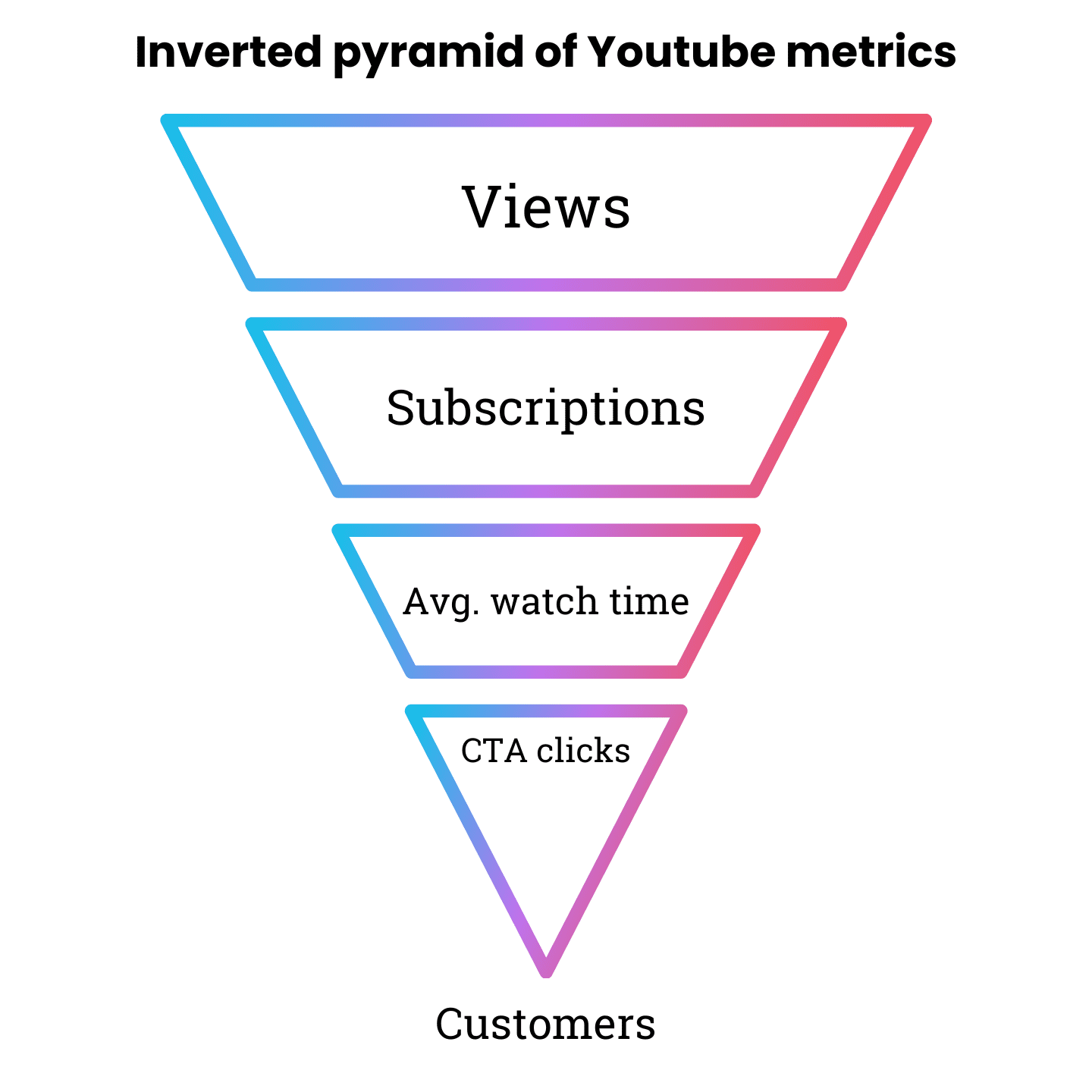
The answer is a set of cascading metrics that ladder up to customers. You might know this example from SEO, where you have leading indicators like impressions, ranks, and clicks and lagging indicators like conversions or revenue. The same is true for YouTube.

I call it the inverted pyramid of YouTube metrics. The leading indicators I recommend are views, subscriptions, average view duration, and CTA clicks.

Lagging indicators can be new customers or revenue from YouTube – again – measured through self-attribution.

The ladder works because leaders can trace the impact more easily over time. When views grow, so should subscriptions and average watch time, but with a time delay.

The Right Conversion Tactics

IMage Credit: Kevin Indig

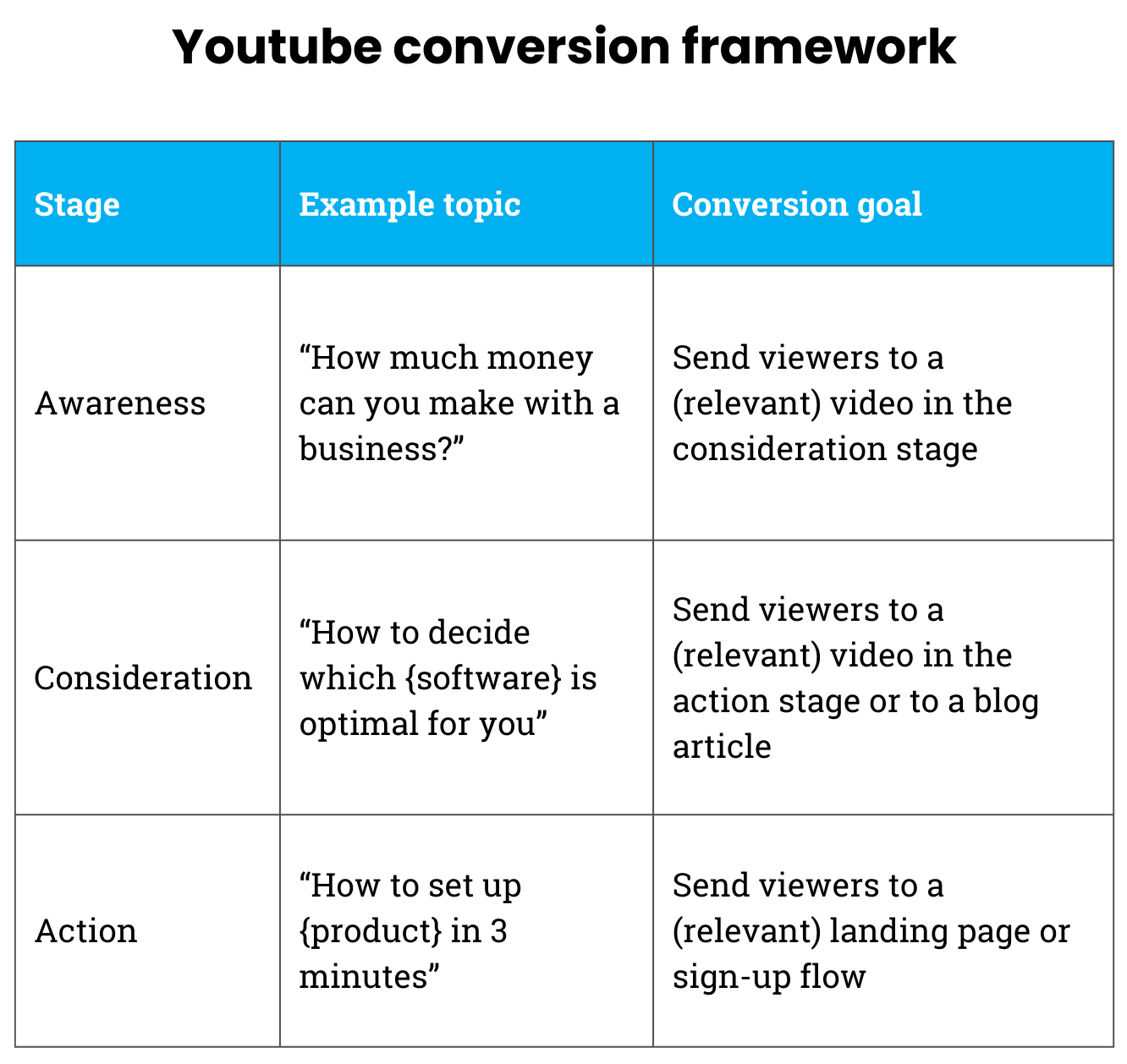
There aren’t many known benchmarks for what you can expect from YouTube as a channel. One reference I found is that Ahrefs and Surfer convert about 12% of leads and 10% of sales from YouTube, measured by post-purchase attribution.3

YouTube is not a direct or linear conversion channel, but you can still maximize your chances of driving linear conversions.

The problem is that too many companies are very uncreative when it comes to converting viewers to customers on YouTube.

Here are some ideas:

  1. Try to get viewers to watch your other videos instead of getting them to click on your site for videos that don’t reflect a strong purchase intent.
  2. There are auditory and textual CTAs. The auditory ones are spoken or shown in the videos, as opposed to an overlay or text in the video description. Experiment with both.
  3. Incentive users to click a CTA with a lead magnet, like a pdf template or a calculator they can download or use on your site.

The Big Picture: The Big Swing Era

Image Credit: Lyna ™

The challenge with expanding from SEO to YouTube fits into a bigger picture: linear cross-channel attribution is eroding, so marketers need to take bigger swings based on judgment, logic, and qualitative signals.

I’m seeing the same trend across many organic channels: Reddit, podcasting, social media, and also YouTube. We all know there’s a lot of attention paid to them, but the impact is hard to measure unless you advertise.

Why is that?

  1. Privacy regulations like GDPR or CCPA and ad blockers limit tracking.
  2. Platforms like Google, YouTube, or Meta share less data with marketers and use more black box algorithms.
  3. Users use many devices to consume content.
  4. More content sharing happens in closed messaging apps like WhatsApp or email.
  5. Organic channels take a long time to show effect (often six months and longer) compared to advertising channels.

One thing companies can try to test the waters is to advertise on the platforms first, and then make a decision to create content for it. But apart from advertising, we’re back in the era when marketers need to take big swings to win.

But the biggest takeaway is that we have to take more big swings based on conviction, logic and qualitative data. Welcome to the big swing era.


1 49 YouTube stats 2024: Engagement, views, revenue (and more)

2 The Changing Face of B2B Marketing

3 Source


Featured Image: Paulo Bobita/Search Engine Journal

The One Thing SEO Agencies Need To Know About Winning Enterprise Clients via @sejournal, @danielkcheung

One of the first questions my boss would ask when I was agency-side was “What’s your budget?”

It’s an innocent enough question and one worth asking, but for enterprise clients, it’s putting the cart before the horse.

As an agency, managing cash flow is one of the most challenging aspects of the job.

Asking every lead for their budget is a practical way to plan for scalability. It allows you to compare your revenue runway against capacity and forecast when to scale headcount.

But here’s the thing: This approach doesn’t work for enterprise clients.

Here’s why:

  • You don’t understand how we budget internally (and when those conversations take place).
  • You don’t know how we orchestrate quarterly plans.
  • In some cases, we don’t know what we should do apart from knowing “SEO is important.”
  • And because of the above, the dependencies are unknown.

We’d often get feedback from unsuccessful pitches along the lines of:

  • “You were one of the most technical-oriented pitches; it was clear you know your stuff.”
  • “Your analysis went far deeper than anyone else’s.”
  • “We decided to go with someone else who’s done it before.”

We’d collectively put in 40-80 hours into a pitch and still lose out.

So, what went wrong?

  • Was it our positioning?
  • Were we just included in the Request for Proposal (RFP) to make the procurement process seem less biased?
  • Or was it something else?

The transition from agency-side to client-side opened my eyes to what I didn’t know. Unless you’ve worked in a large organization, you don’t know what you don’t know.

00Winning an enterprise SEO account is attractive for many reasons:

  • Great for cash flow: Enterprises tend to pay the entire quarter or year’s retainer in full and in advance.
  • Authority: An enterprise client strengthens your agency’s reputation.
  • Broader experience: Working with enterprises exposes your team to large-scale operations.
  • Future opportunities: Having an enterprise client attracts more mid-market and enterprise clients.

But winning the contract goes beyond a jazzy pitch deck, a well-practiced presentation, and impressive case studies.

Agencies that win and retain enterprise work have a competitive edge: They understand how enterprise planning and budget cycles work.

In other words, they have empathy.

And this is what we’ll cover today so you can waste less time and win more by speaking the language of enterprise SEO.

We’ll unpack why agencies miss the mark on enterprise RFPs, how enterprise budgets are finalized, and my 3A framework (Audit, Align, Advance) to position yourself as the right partner at the right time.

Why Agencies Lose Enterprise RFPs

You’ve poured 40-80 hours into crafting the perfect pitch. Your analysis was deeper than anyone else’s. Your technical expertise shone through.

The feedback? “You were one of the most knowledgeable agencies we saw.”

And yet, you didn’t win the deal.

It’s frustrating, but it often boils down to this: You were the right partner – but you missed the mark on timing or positioning.

Timing: It’s More Than Just Budget Cycles

Enterprise budgets are locked in during annual planning cycles, typically in Q3 or Q4 of the prior year.

If your pitch lands outside of these cycles, there’s no wiggle room for additional funding, no matter how compelling your proposal is.

However, timing isn’t just about budget. Quarterly planning sessions often dictate tactical shifts based on performance or changing priorities.

Agencies that fail to align with these rhythms miss the opportunity to position themselves as timely, relevant partners.

Positioning: Expertise Without Overwhelming

Winning an enterprise RFP isn’t just about showcasing your technical ability.

The people evaluating your pitch might include marketers, department heads, procurement specialists, and executives – each with different priorities and levels of SEO knowledge.

Agencies often stumble when they assume their technical brilliance will speak for itself. Overloading pitches with jargon or overly complex solutions can alienate decision-makers.

The key to positioning yourself as the right partner is to:

  • Simplify the message: Translate SEO strategies into business outcomes that resonate with different stakeholders.
  • Show empathy: Address challenges in their language, whether that’s return on investment (ROI) for executives or workload reduction for department heads.
  • Build trust: Demonstrate that you’re not just an SEO expert – you’re a partner who understands how to drive their broader goals.

By understanding these dynamics, you’ll not only craft pitches that resonate – you’ll avoid the frustration of hearing, “We went with someone else who’s done it before.”

Budget Conversations Happen The Year Prior

By the time you receive an RFP or Request for Quote (RFQ) from an enterprise, the budget is already set. Enterprises plan meticulously, typically finalizing budgets during Q3 or Q4 for the following fiscal year.

Every dollar is earmarked, and leadership has already approved how resources will be distributed.

The Anatomy Of Enterprise Budgeting

Enterprise SEO budgets don’t exist in a vacuum. They’re part of a broader conversation that aligns product, marketing, and sales goals with tactical activities.

For example:

  • Product teams: Prioritize new features or site enhancements.
  • Marketing teams: Focus on campaigns and content creation.
  • Sales teams: Push for lead generation and conversion support.

In-house SEO professionals must advocate for their initiatives by tying SEO outcomes to these larger objectives.

For agencies, this means stepping into a game that’s already in motion. If your pitch doesn’t align with these pre-established goals and budgets, it’s unlikely to succeed.

What This Means For You

Most agencies approach enterprise clients reactively, responding to RFPs after budgets are finalized. This is a missed opportunity.

To win enterprise clients, you need to:

  • Understand their planning cycles: Engage in Q2 or early Q3 to influence the next budget cycle.
  • Speak to strategic objectives: Show how SEO supports broader product, marketing, and sales goals.
  • Build relationships before the RFP: Regularly connect with key stakeholders to position yourself as a partner – not just a vendor.

How Quarterly Planning Fits In

While annual budgets set the high-level framework, enterprises adjust tactics during quarterly planning.

If your pitch aligns with a new quarterly priority – like shifting focus from content to technical SEO – you can insert yourself into the conversation even mid-year.

For example, an in-house SEO might discover a drop in organic visibility during Q1 and advocate for technical improvements in Q2. If you’ve positioned yourself as a trusted advisor, you’ll be their first call when an additional budget is freed up.

How To Win Enterprise Clients: My ‘3A’ Framework

Audit: Start With A Test Budget To Uncover Hidden Opportunities

Sometimes, enterprises come to you with a vague sense of urgency: “We know SEO is important, but we’re not sure where to start.” This isn’t a red flag – it’s an opportunity.

Instead of diving straight into a full proposal, suggest starting with an audit. A test budget for an SEO audit allows you to:

  1. Identify the pain points they haven’t articulated yet.
  2. Highlight quick wins to build immediate trust.
  3. Map the unknown dependencies that could derail a larger project later.

An audit positions you as a strategic advisor, not just a vendor. It shows that you understand the complexities of their business and want to align your recommendations with their priorities.

Plus, by starting small, you lower the perceived risk for stakeholders who may be hesitant to commit significant resources right away.

Here’s how you might pitch it:

“Before we make any big decisions, let’s start with an audit. This will give us a clear roadmap of what’s working, what’s not, and where the biggest opportunities lie. It’ll also help us figure out how to align with your broader business goals.”

Plus, you get paid.

Align: Build Trust And Solve Dependencies Before You Pitch

Enterprise RFPs often feel like a rush to the finish line: Deliver the pitch, seal the deal, and move on to execution. But rushing the pitch is one of the fastest ways to lose the deal.

Before you pitch, take the time to:

  • Build trust with key stakeholders. Spend time understanding their challenges, their team dynamics, and their priorities. This is especially important when stakeholders aren’t sure what they need.
  • Solve unknown dependencies. Use conversations, discovery calls, or smaller projects (like the audit) to uncover potential roadblocks, such as IT constraints, compliance requirements, or overlapping vendor responsibilities.
  • Align on the scope of work. Make sure everyone understands what success looks like. If different departments have conflicting expectations, address them now – not after the project has started.

Delaying the pitch isn’t about dragging your feet. It’s about doing the groundwork to ensure your proposal resonates.

When you take the time to do this, your pitch becomes less about selling your services and more about demonstrating how you’ll solve their problems.

Advance: Pitch With Confidence After Achieving Buy-In

The biggest mistake agencies make is pitching too soon. A great pitch delivered at the wrong time is still a losing pitch.

To win an enterprise client, wait until you’ve:

  • Mapped dependencies: Understand the internal and external factors that could impact your success, from IT limitations to stakeholder buy-in.
  • Understood the stakeholders: Know who needs to sign off on the project and what their priorities are. Tailor your pitch to address their specific concerns.
  • Aligned with the budget cycle: If you’ve done your homework, you’ll know whether the client has budget allocated – or if you need to position your work as a priority for the next cycle.

When you pitch, focus on delivering a solution – not just a service. Show them how your expertise fits into their broader goals, aligns with their budget, and resolves the challenges they’ve been grappling with.

Your pitch should feel like the natural conclusion of all the conversations you’ve had with them so far. It’s not about convincing them. It’s about confirming that you’re the right partner to help them achieve their goals.

In Closing

Winning enterprise SEO clients isn’t just about being the most technical or having the best case studies – it’s about timing, trust, and alignment.

Start small, align early, and always put yourself in their shoes. Empathy wins enterprise SEO.

More resources:


Featured Image: PeopleImages.com – Yuri A./Shutterstock

Studies Suggest How To Rank On Google’s AI Overviews via @sejournal, @AdamHeitzman

Google’s AI Overviews (AIOs) are AI-generated responses that appear at the top of the search engine results page (SERP).

Unlike traditional search results, AIOs summarize information from multiple sources to provide direct answers to user queries while offering relevant links.

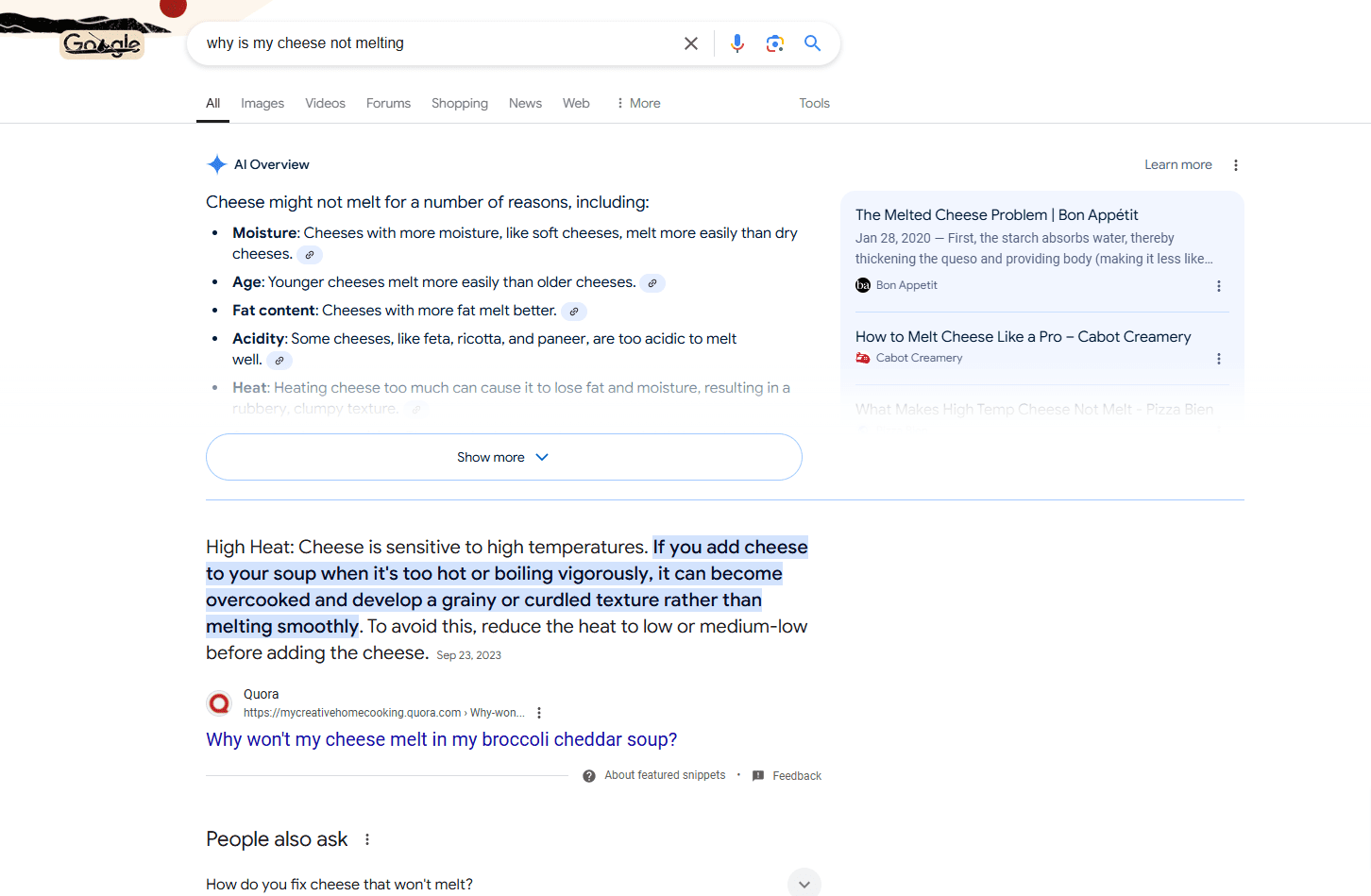
These overviews are displayed prominently: the AI Overview appears on the left, with relevant links to sources on the right.

Screenshot for search for [why is my cheese not melting], Google, November 2024

Google determines which sources to include based on their credibility and relevance to the user’s search intent. This is where SEO plays a critical role.

Why Are AI Overviews Important For SEO?

Being cited in an AI Overview boosts visibility since it’s the first result users see after their query. This positioning can significantly increase click-through rates (CTR), even for pages that aren’t ranked in the top 10 of the SERP.

Studies indicate that 52% of sources mentioned in AI Overviews rank in the top 10 results, meaning nearly half are pulled from beyond the first page.

This means that even if you don’t rank on the first page, you can still be featured on AI Overviews.

In addition to my own research with our clients, I studied different reports to better understand how you can rank on AI Overviews. Some of these reports include:

How To Rank In AI Overviews: 11 Tips For Organic Visibility

While you can’t directly control whether your pages are cited in an AI Overview, you can improve your chances by following these tips.

1. Add More Context To Your Articles

AI Overviews are designed to answer user queries directly. This means Google rewards content that is well-contextualized and written in a simple, easy-to-read format.

One thing to remember is that AIOs are triggered by informational search intent keywords 99.2% of the time, according to Ahrefs. If you’re writing an article on an informational keyword, focus on writing in a simple, easy-to-read format and add enough context to answer the query fully.

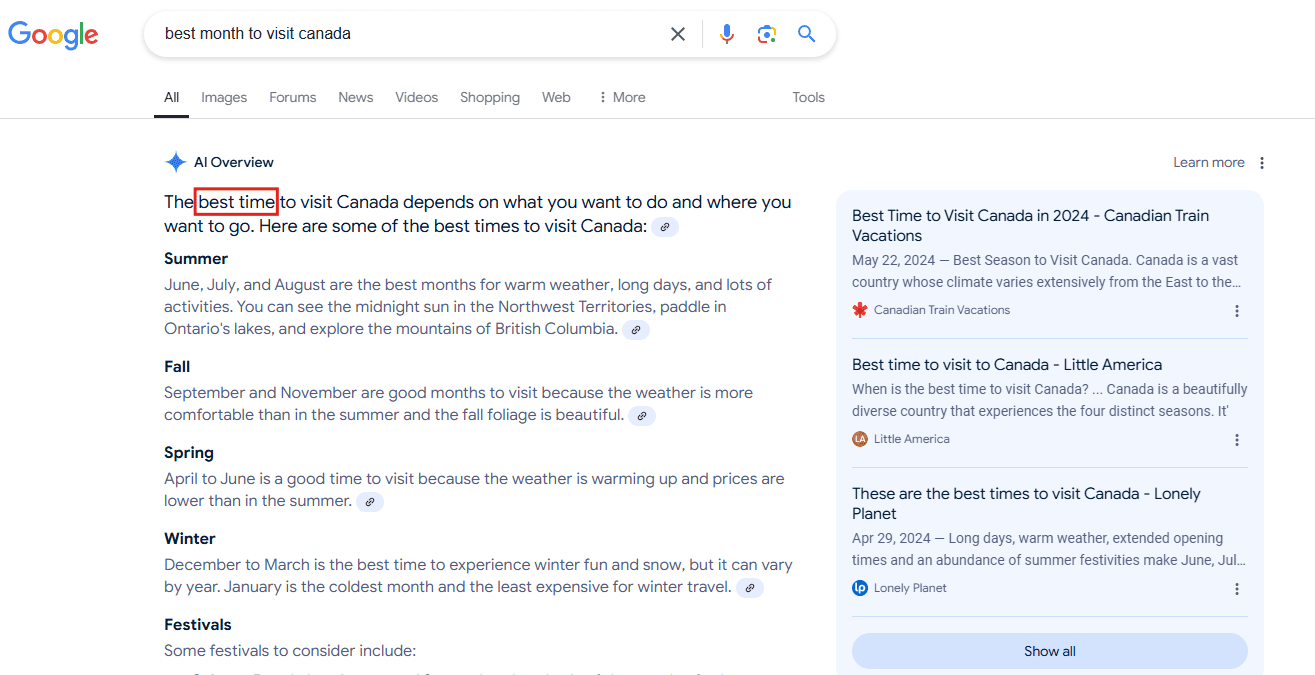
The Surfer SEO study shows that Google focuses on context over keywords. When AIOs show results to a user’s query, they mention exact keyword phrases only 5.4% of the time. Which means keywords are less important in AIOs.

In the example below, the query is [best month to visit Canada], but the AIO doesn’t emphasize the best month in its response. It’s the best time.

Screenshot from search for [best month to visit canada], Google, November 2024

Tips:

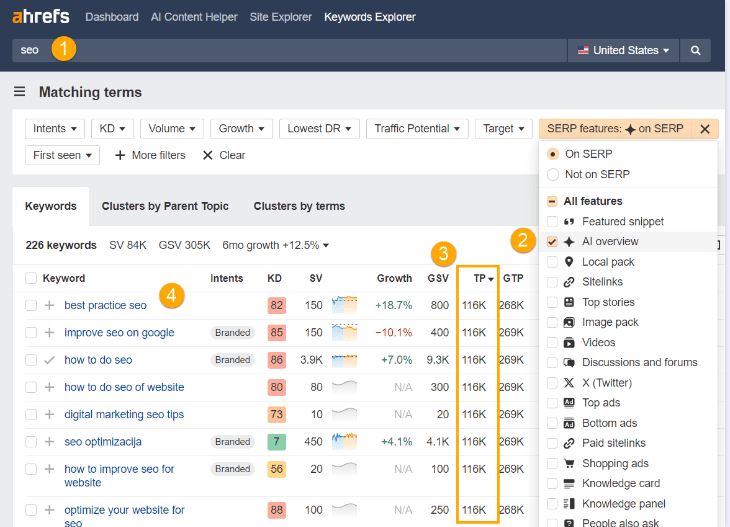
  • Use tools like Ahrefs to find AIO-triggering keywords with high-traffic potential. (Use the Ahrefs AI Overview SERP feature, and navigate to the intent filter to choose Informational as the search intent. It finds long-tail keywords for you, and you can write specific answers to these search queries.)
Screenshot from Ahrefs, November 2024
  • Structure your content to answer questions fully, incorporating related topics naturally.
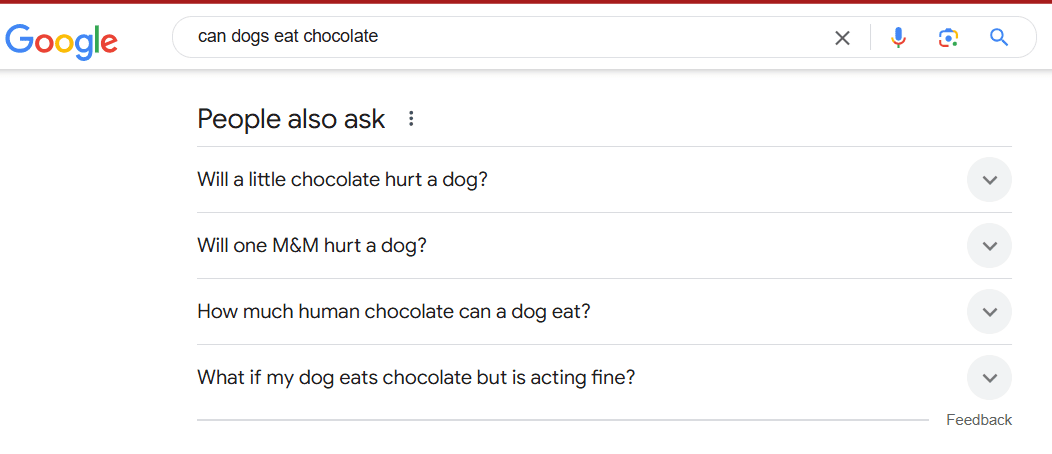
  • Use tools like Google Autocomplete or People Also Ask to identify common questions users have about your topic. (See example below.)
Screenshot from search for [can dogs eat chocolate], Google, November 2024

2. Use Long-Tail Keywords

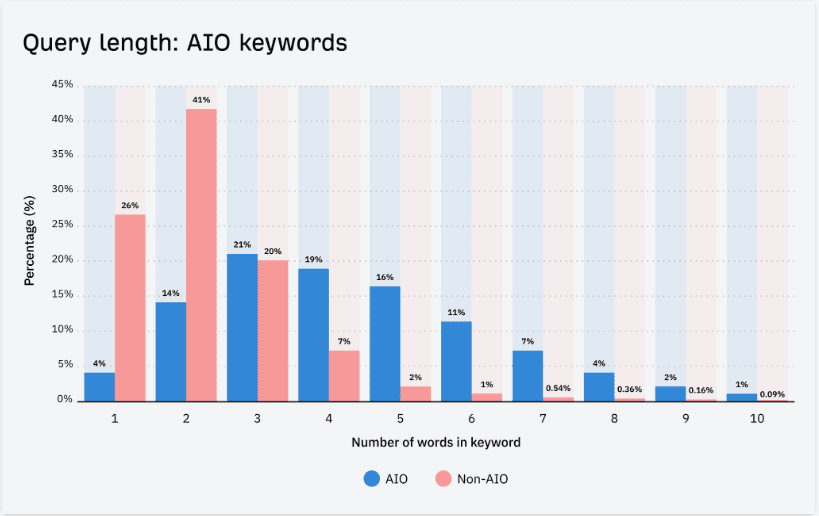
AI Overviews are more likely to be triggered by specific, long-tail keywords than by generic, short-tail ones.

According to Ahrefs, they’re triggered more for queries with three to four words than for queries with one- to three-word queries.

Screenshot from Ahrefs, November 2024

These keywords often align closely with user intent.

How To Find Them:

  • Use the “Questions” section in keyword tools like AnswerThePublic.
  • Leverage Google Autocomplete to identify conversational search terms.

3. Leverage Structured Markup

Implementing structured data, such as Schema.org markup, helps search engines understand the context and structure of your content. This makes your page more likely to be included in AI Overviews.

Key Markup Types To Use:

  • FAQ schema for question-based content.
  • Article schema for blog posts and informational pieces.
  • Breadcrumb schema to improve navigation signals.

4. Optimize On-Page SEO

On-page SEO remains foundational for ranking in both traditional SERPs and AI Overviews. 52% of AI Overviews sources come from the top 10 search results. This means you have a better chance of getting cited if your page ranks for that keyword.

Best Practices:

  • Use primary and secondary keywords in titles, headings, and subheadings.
  • Write compelling meta descriptions to boost CTR.
  • Ensure your content meets E-E-A-T (expertise, experience, authoritativeness, trustworthiness) guidelines.

5. Target Keywords With Low Difficulty

Focus on keywords with low competition (Keyword Difficulty < 20).

These are often high-intent, long-tail phrases that are easier to rank for and align well with informational search queries.

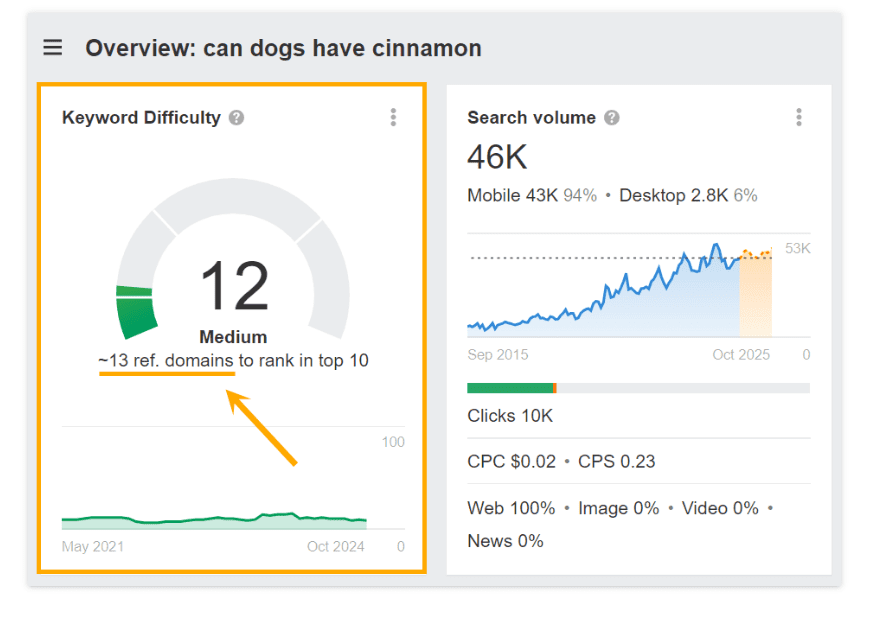
According to Ahrefs, AIO keywords have an average difficulty of 12. An example is the keyword phrase “Can dogs have cinnamon?” which has a KD of 12.

Screenshot from Ahrefs, November 2024

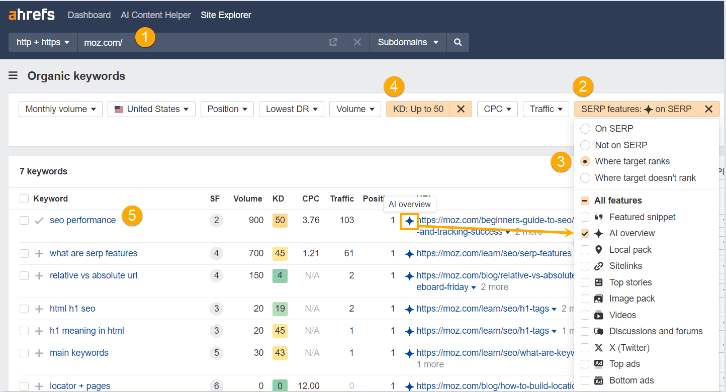
If you’re using Ahrefs, use the AI Overview SERP feature filter. Filter out keywords above 50 and go through keywords relevant to your topic.

Screenshot from Ahrefs, November 2024

6. Build Brand Credibility

From our experience optimizing content for AI Overviews, we’ve observed that sources frequently mentioned in authoritative publications or regularly cited by others are more likely to be included. While this aligns with Google’s emphasis on E-E-A-T, our firsthand results reinforce this approach.

Having a consistent presence in credible and trusted outlets has, in our experience, improved the likelihood of being featured in AI Overviews. Building this presence strengthens your site’s perceived authority.

Action Steps:

  • Engage in digital PR campaigns to secure mention in reputable publications.
  • Monitor mentions of your brand on platforms like Quora and Reddit to ensure positive associations.

7. Optimize For Mobile SEO

With mobile-first indexing, Google evaluates your site’s mobile performance when determining rankings.

According to Ahrefs study, mobile traffic accounts for 81% of AI Overview citations.

Tips:

  • Use responsive design to ensure your site displays well on all devices.
  • Improve page load speed for mobile users using tools like Google PageSpeed Insights.

8. Format Content For Easy Scanning

From firsthand analysis of sites that frequently rank in AI Overviews, we’ve found that well-structured content – using bullet points, lists, and clear sections – is often favored.

Formatting plays a critical role in helping AI parse information quickly.

Best Practices:

  • Use bullet points, numbered lists, and short paragraphs.
  • Structure content with clear headings and subheadings.
  • Break up long blocks of text with visual elements like charts or images.

9. Focus On Simplicity

Content written in plain, accessible language tends to perform better in AI Overviews. This is something we’ve consistently seen when optimizing content for diverse audiences and industries.

Tools:

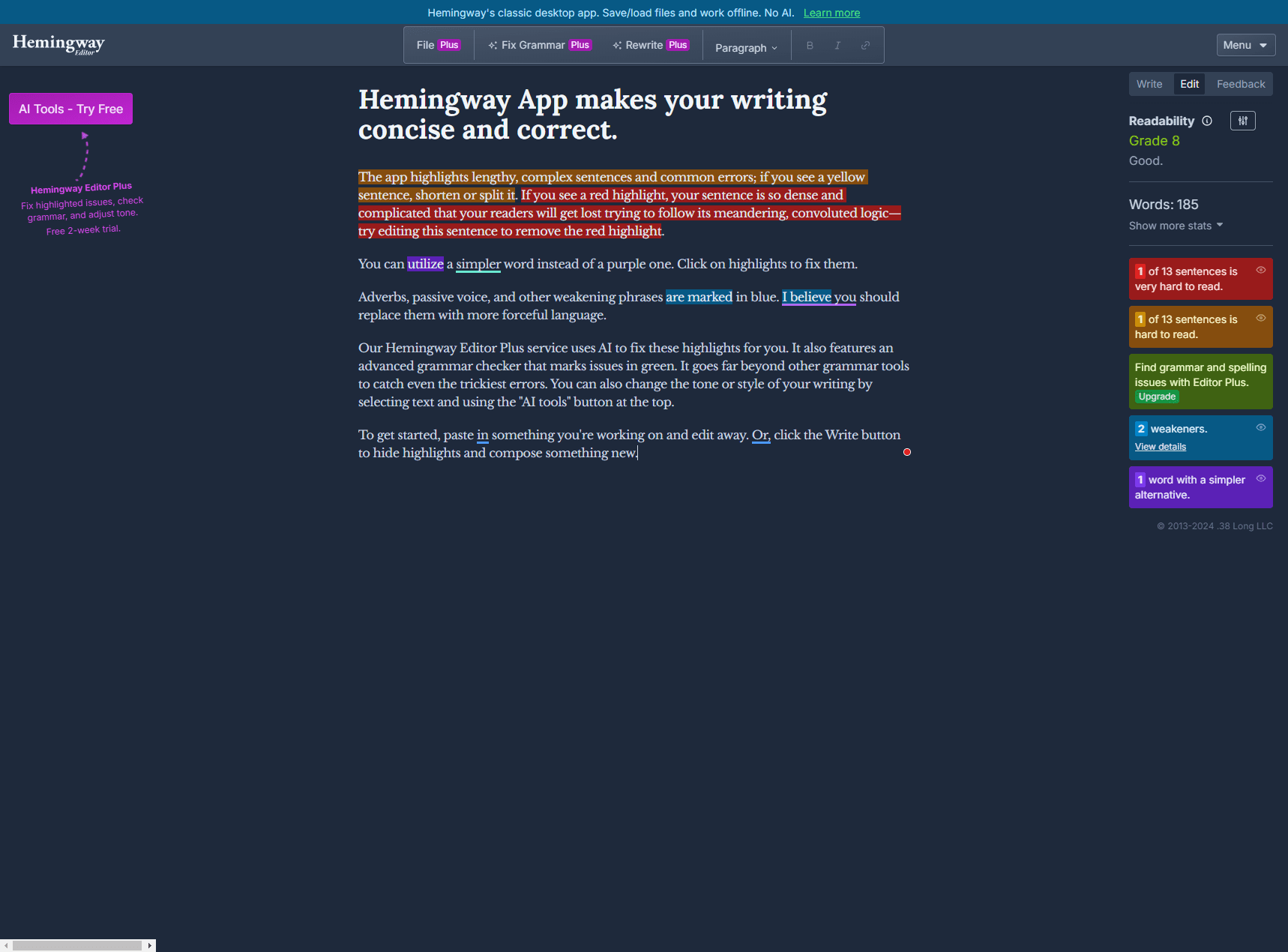
  • Use Hemingway Editor or Grammarly to ensure your content is readable and concise.
Screenshot from Hemingway, November 2024

10. Acquire High-Quality Backlinks

While strong backlinks are widely recognized as important for SEO, our experience suggests they are equally critical for increasing the likelihood of being cited in AI Overviews.

Prioritizing quality over quantity in link building is key. Use strategic link building campaigns to improve your domain authority and visibility in AI Overviews.

11. Publish Timely, Relevant Content

AI Overviews often favor fresh, up-to-date information. Regularly update your articles and blog posts to ensure they remain current.

Do AI Overviews Affect SEO?

Yes, AI Overviews impact SEO strategies by shifting the focus from traditional rankings to citation opportunities.

While they can increase visibility and CTR for cited sources, they may also reduce traffic for pages that are not directly cited, even if they rank well organically.

FAQs About AI Overviews:

Are AI Overviews Accurate?

AI Overviews are generally reliable but not 100% accurate. These AI-generated summaries pull information from multiple web sources, which means their accuracy depends on the quality and timeliness of the source content.

Google has conducted extensive tests, though. It discovered that the accuracy rates of AI Overviews “is on par” with those of Featured Snippets, which is a trustworthy feature for quick information.

Where Do AI Overviews Get Their Information?

AI Overviews gather information from multiple credible sources across Google’s search results pages. It uses:

  • Top-ranking websites.
  • Authority websites.
  • Content relevance through sources that directly answer the user’s query, even if they don’t rank on the first page.
  • Recent content.

Key Takeaway For Ranking In Google’s AI Overviews

Ranking in Google’s AI Overviews requires a multi-faceted approach: creating well-structured, mobile-friendly content, targeting specific long-tail keywords, and building brand credibility.

Leveraging tools like structured markup and keeping your content updated can further boost your chances.

More Resources:


Featured Image: Roman Samborskyi/Shutterstock

11 SEO Tips To Boost Your Restaurant Visibility In Search via @sejournal, @coreydmorris

Being successful with restaurant SEO can be a challenge.

Whether it is finding the time, wearing a lot of hats, or not having the same type of budget and return on investment (ROI) measurement as other industries, you might be in a tough spot trying to figure out how to get it done.

No matter what your situation is or your starting point, there are specific strategic and tactical things you can do that will help move your brand forward and increase your online visibility and engagement through SEO.

There are 11 specific things that are important for restaurant SEO that I’ll unpack in this article to help you focus your time on what matters.

1. Define Your SEO & Content Strategies

Before jumping into a myriad of tools, platforms, and engagement channels, define your SEO strategy. This will help to greatly narrow your competition and give you a quicker path to driving quality traffic to your website.

Start by defining the geographic area you want to own (where most of your customers will come from because they either live or work nearby, or are visiting).

Next, research what keyword terms and phrases your audience uses through a trusted keyword research tool like Ahrefs, Moz Pro, Semrush, or others.

To learn more on how to do keyword research, read this keyword research guide.

There are a few distinct groupings of terms that you want to group and classify properly, and they all have different levels of competition.

High-Level Restaurant Terms

Terms like “restaurants” and “Kansas City restaurants” are some of the most generic variations a searcher might use.

In the keyword research tools (each tool will vary on locality options), you can set your geographic focus to the area you identified and use both the generic term by itself (“restaurants”) and geographic modifier (“Kansas City restaurants”), as well as other general variations related to what your restaurant is about.

Also, don’t forget about voice search terms and variations of things like “restaurants near me” that will rely on location settings and the context of the search engine to return results for the searcher that you likely want to be included.

Niche-Specific Terms

The next level relates to the specific categories your restaurant would fall into.

Examples include “Mexican restaurants,” “pizza,” “romantic restaurants,” and other unique features and types of cuisine.

If you’re struggling with what specific categories or wording you should use, take a look at Google Maps (the Google Business Profile listings), Yelp, and TripAdvisor.

Use their filtering criteria in your area to see the general categories they utilize.

Brand Terms

Don’t take it for granted that you’ll automatically rise to the top of brand searches. Know how many people are searching for your restaurant by name and compare that to the high-level and niche-specific search volume.

Ensure your site outranks the directory, reservation (if applicable), and social sites in your space for your restaurant, as the value of people coming to your site is higher and trackable.

Once you’re armed with search terms and volume data, you can narrow your focus to the specific terms that fit your restaurant at high, category-specific, and brand levels.

Covering this spectrum helps you focus on what to measure and define your content.

2. Dominate In Local Search

To dive into local search, start by claiming, standardizing data, and optimizing listings for your restaurant across all of the major and relevant local search properties.

This includes a mix of search engine directories, social media sites, and industry-specific directory sites.

Moz Local and Yext are two popular tools (there are many available, though) that can help you understand what directories and external data sources are out there, and then you can ensure they are updated.

Accurate NAP (name, address, phone) information that is consistent across all data sources is a critical foundational element of local SEO.

Beyond that, you can then work on optimizing the fields of information, like the business description and business categories, to align with your focus terms identified in your keyword research.

Put your focus on the directories that matter.

Start with Google Business Profile, then branch out to Yelp, TripAdvisor, and other restaurant-specific directories and data sources. Some of them could be obscure, niche-specific, or not seem very significant, but they add up.

Set reminders or tasks to come back to your Google Business Profile on a regular basis to update content, including photos, specials, and offers, and to monitor engagement and review activity (more on both of those topics below).

All of this will work together to grow your online visibility.

3. Engage With Customers On Social Media

Even though social media’s direct impact on SEO has long been debated, we know that social media engagement can drive users to your site.

Social media can be a powerful touchpoint of the customer journey, showcasing what customers can expect to experience at your restaurant.

A strong social presence often correlates with a strong organic search presence as content, engagement, and popularity align with the important SEO pillars of relevance and authority.

Develop a social media strategy and follow through with implementation.

Make sure to engage with followers and reply to inquiries promptly. How you communicate online sets a perception of your overall customer service and approach.

Find your audience, engage them, and get them to influence others on your behalf.

Ultimately, through engagement with fans and promoting content on social media that funnels visitors to your main website, you will see an increase in visits from social networks.

This will then correlate with the benefits from the rest of your SEO efforts.

4. Encourage Reviews & Testimonials

It’s nearly impossible to do a search for a restaurant and not see review and rating scores in the search results. That’s because people click on higher star ratings.

Reviews are often considered part of a social media strategy and are an engagement tactic, but have a broader impact on traffic to your site through search results pages as well.

Through the use of structured data markup, you can have your star ratings appear in search results and provide another compelling reason for a user to click on your site versus your competitor’s.

If you have online ratings that don’t reflect the quality of your restaurant, come up with a review strategy now to get as many reviews as possible to help bring up your score prior to implementing the code that will pull the ratings into the SERPs.

A higher star rating likely means a higher click-through rate to your site – and more foot traffic.

5. Create Unique Content

If you have a single location, your job is a lot easier than the multi-location local or national chain.

However, you have to stand out from the competition by ensuring you have enough unique content on your website.

Having a wealth of engaging and helpful content on your site will serve you well if it is valuable to your prospects and customers. Building a strong brand will translate to better rankings, higher brand recall, and greater brand affinity.

Keep in mind that content doesn’t all have to be written copy; you can present your menus, in-house promotions, and more through video, photography, and graphics.

The search engines are focused on context and not just the keywords on your site.

By identifying and regularly generating new content, you also can keep the pipeline full of engaging material that helps you stand out from your competition.

For example, if you have a niche restaurant, embrace that and set yourself apart from the generic chain down the street (no offense if you own, operate, or do marketing for a chain – you have a different challenge of scaling your efforts).

Share information about the founders, the culture, and most importantly – the product.

Give details about your menu, including sourcing of ingredients, how you developed recipes, and the compelling reason your chicken marsala is the best in town.

6. Consider Content Localization

Again, single-location restaurants have an easier road here. Based on decisions you’ve made about your market area, make sure you provide enough cues and context to users and the search engines as to where your restaurant is and what area it serves.

Sometimes, the search engines and out-of-town visitors don’t fully understand the unofficial names of neighborhoods and areas.

By providing content that is tied into the community and doesn’t simply assume that everyone knows where you’re located, you can help everyone out.

One example of this is a 100-location chain that started small with a single paragraph for each location written in a way tailored to the store, local history, neighborhood, and community engagement.

From there, we were able to find other areas to scale, and it worked well to differentiate stores from each other.

When it comes to nuanced and potentially confusing location names and context, addresses can be misleading. Think about how Google will handle those.

These are important factors to consider so you aren’t trying to have a location compete with too broad of a geographic area for search rankings.

7. Apply Basic On-Page SEO Best Practices

Without going into the details of all on-page and indexing optimization techniques, I want to encourage you not to skip or ignore the best practices of on-page SEO.

You need your page to be indexed to ensure you have the potential for visibility and on-page SEO to ensure the proper classification of your content.

You can spend a lot of time on a full SEO strategy, but if you’re just getting started, I recommend putting the rest aside and starting with these two areas.

To ensure your site is crawled and indexed properly now and in the future, check your robots.txt and XML sitemap. Set up Google Search Console to look for errors.

When it comes to on-page, ensure that you have unique and keyword-specific page URLs, title tags, meta description tags, headings, page copy, and image alt attributes.

This sounds like a lot, but start with your most important pages, like your home, menu, about, and contact pages, and go from there as time permits.

8. Think Mobile First

Mobile accounts for a high percentage of visits to restaurant websites. Google now crawls the mobile version of a website to understand its content.

Hopefully, you have a responsive website or one that passes the necessary mobile-friendly tests.

But that’s just the beginning when it comes to mobile.

It’s also critical to think about page load speed and providing a great mobile user experience.

9. Implement Schema “Restaurants” Markup

Another area where we can build context for the search engines and gain exposure to more users in the search results is by using structured data.

In the restaurant industry, implementing the Schema.org library for restaurants is a must.

This task requires a developer, website platform, or content management system with the right plugins or built-in options.

10. Measure Your Efforts

This could have been tip No. 1, but I’m including it here, as it is important throughout the process. With the previous nine tips, there’s something to do and implement.

But before you embark on any aspect of optimization, make sure those efforts are measurable.

When investing in your strategy, you want to know what aspects are working, which ones aren’t, and where your efforts were (and are) best producing a return on investment.

Track visibility, engagement, and conversion metrics as deep as you can connect them to your business.

Beyond that, you’ll need to identify the right progress metrics tied to goals to know you’re moving in the right direction.

11. Don’t Ignore AI

This is less of a specific recommendation or tactic and more of a wide-reaching one. AI provides a lot of opportunities to scale content, create efficiencies, and do more with less.

Whether you’re leveraging AI tools natively, using SaaS products to help you research, optimize, and measure efforts, or relying on things like AI Overviews in Google to engage with users in search, it is hard to ignore.

Know that while AI is helpful to further scale efforts and be where searchers are finding content, you don’t want to abandon your brand or generate content that is clearly generic and not human-generated.

Don’t ignore AI, but use it with care to avoid losing out on the unique value important for search and searchers for your restaurant.

Restaurant SEO Matters For Visibility And Traffic

There are unique challenges for restaurant SEO. However, if you can dedicate the time and effort to a strategy and follow through on tactics and measurement, it can be highly rewarding and profitable as well.

While you might not be able to directly attribute SEO performance to ROI for restaurant SEO, you can find correlations between a stronger brand presence and visibility and volume in your location(s).

I encourage you to nail down your strategy and dedicate focus to the tactics to see it through.

More Resources:


Featured Image: PeopleImages.com – Yuri A

SEO Keyword Research: 18 Of The Biggest Mistakes You Must Avoid via @sejournal, @sejournal

You can’t talk about SEO without mentioning keyword research.

Most SEO marketing campaigns start with keyword research. (Or at least they should).

If you haven’t upped your keyword research game, you could be holding your campaigns back and costing you (and your clients) cash.

Let’s look at 18 keyword research mistakes you might be making – and what to do instead.

1. Ignoring Search Intent

Too many people focus on search volume and forget about the why.

Why are people using a specific keyword?

What does that term tell you about what that person is looking for?

Most importantly, what is the point of ranking No. 1 for a term that doesn’t actually lead to any sales?

Rather than focusing on how many people use a search query, focus on search intent or the reason why someone is searching.

User intent breaks down into two things:

  • Figuring out what users who come to your pages want to consume.
  • Making your content the best option for those users.

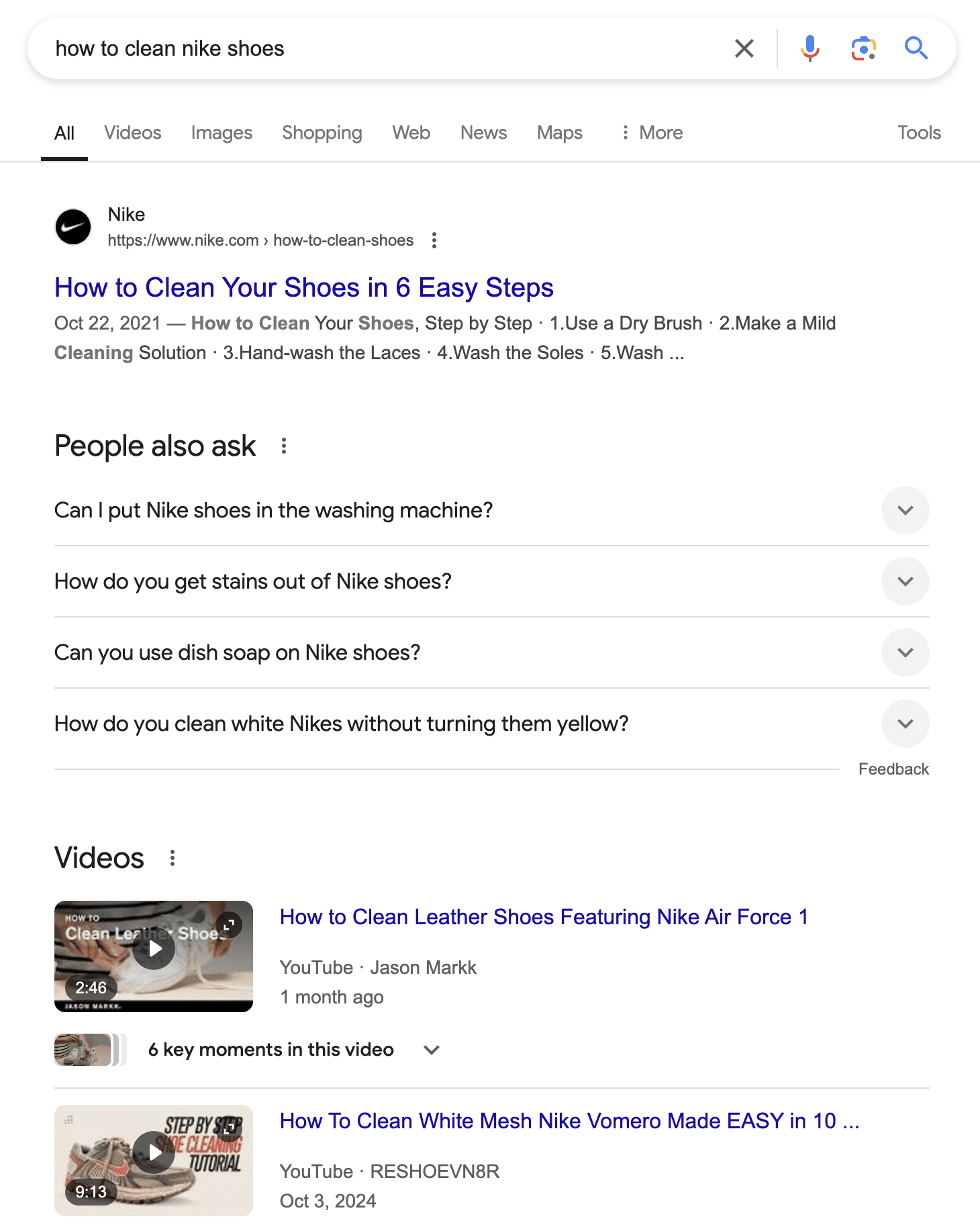
So, let’s say you sell new Nike shoes.

There’s not much point in targeting [how to clean Nike shoes] because those people likely aren’t ready to buy; they are looking to take care of the shoes they already have.

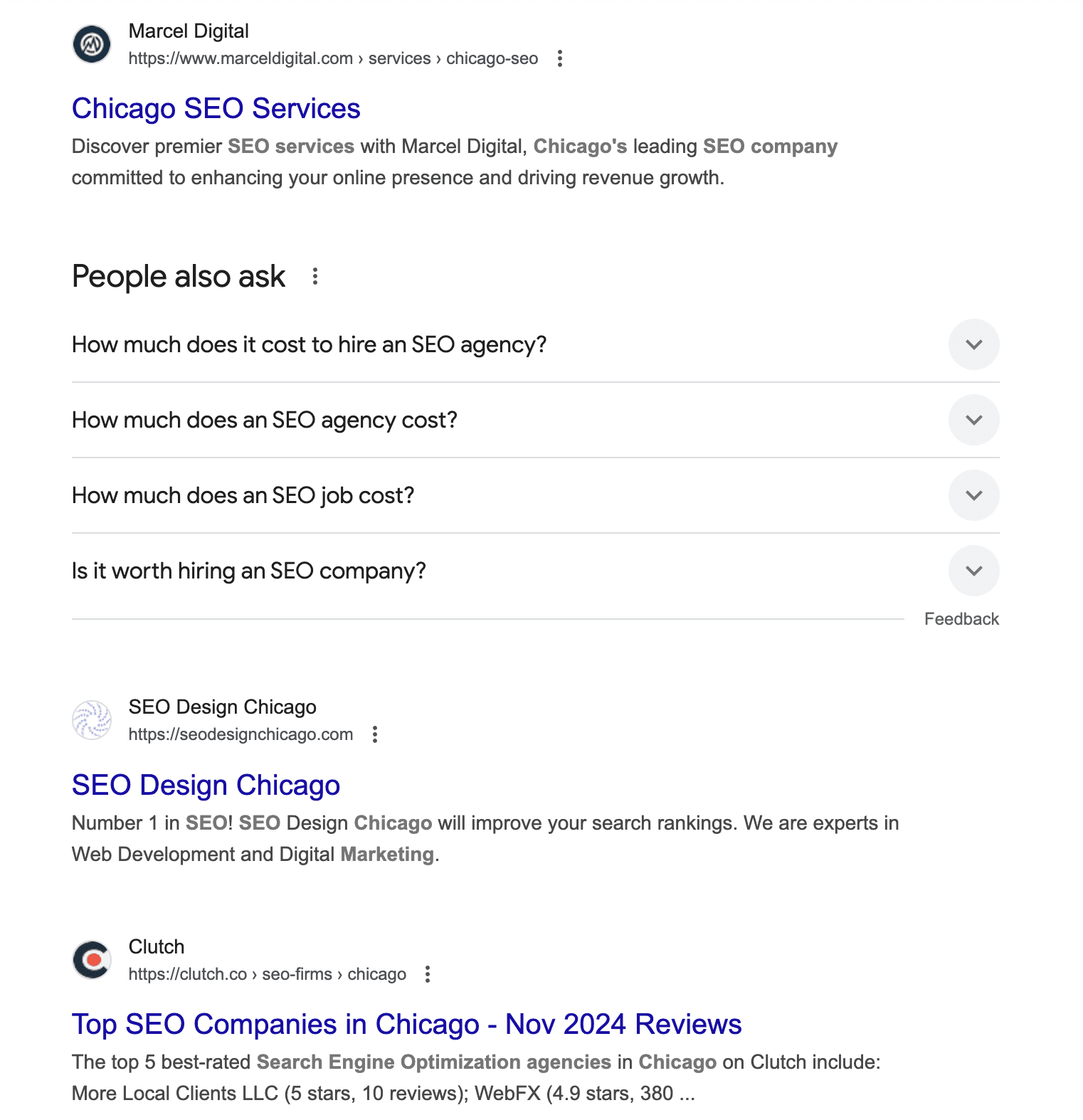
Screenshot from search for [how to clean Nike shoes], Google, December 2024.

Rather, you’d want to focus on [buy Nike shoes near me] because that searcher is clearly ready to buy.

Granted, you could use [how to clean Nike shoes] to build trust and catch those buyers later, but that needs to be done intentionally.

2. Allowing Clients To Choose Keywords

One of the biggest keyword research mistakes of all is failing to do keyword research at all.

We’ve all had that client who wants to “help” by telling you what keywords they want to target. Unfortunately, those terms are often too broad, don’t match search intent, or are too competitive to even bother with.

That client list should be a starting point, not an endpoint.

A lot of business owners (and even SEO marketers) think they know what searchers are looking for, but keywords should be based on data, not vanity or gut instinct.

3. Forgetting To Look At The SERPs

There are plenty of powerful keyword research tools that make keyword research so much easier.

You can dig deep into data, look at historical trends, even see what your competition is ranking for.

It’s solid, useful data.

However, there can be too much of a good thing.

Many marketers spend so much time diving deep into research tools that they forget to look at the one place that really matters – the SERPs.

Don’t let tools take over the entire keyword research process. Take the time to see what type of content is ranking for your top terms and use that to inspire your campaigns.

4. Aiming For One Keyword Per Piece Of Content

Some SEO marketers only target one keyword per piece of content.

Google is getting better at understanding context, which means optimizing for just one keyword per post is a thing of the past.

Rather than targeting a single keyword, look for related terms that support the main term.

For example, a post about keyword research should also target related terms like keyword research tools.

Just keep in mind this shouldn’t be forced – only use related terms that make sense for your content.

5. Targeting High-Volume Keywords Only

What metrics do you look at when considering what keywords to target?

If high-volume keywords are your go-to for finding the right keywords, you could be missing out on better options.

Why?

Because high volume often ignores user intent, which we’ve already talked about.

Plus, high-volume terms are highly competitive. It’s hard to stand out when you go after the same key terms as everyone else.

This is widely recognized as a way not to do SEO:

Don’t forget to look for mid-volume keywords that match search intent – they are easier to rank for and cheaper to bid on.

6. Avoiding Long-Tail Keywords

Long-tail keywords often have a lower search volume, which turns some marketers away. That’s a mistake you can’t afford to make.

Sometimes, low search volume is a good thing. Lower volume key terms are often further in the sales funnel, meaning the user is much closer to making a purchase.

Using various contextual keywords can also ensure you cover a topic more broadly and are more likely to provide visitors with the content they need to convert.

7. Not Talking To Your Customers

Sometimes, the terms we use to talk about our product or service aren’t the same terms our customers use to talk about our product or the problems they face.

In addition to using keyword research tools, it’s critical to talk (and listen) to what your customers say.

Pay attention to how they describe their challenges, the solutions they find, or what types of products they want.

Look at reviews and social media posts, and listen to customer service calls to find the words and phrases customers use to talk about the challenges they face and the solutions they’ve tried.

For example, you might call your tool a “website visitor tracking tool,” but if your customers don’t know what that means, you won’t gain any traction.

8. Going Back To Insert Keywords

Some SEO marketers seem to think creating content for users means ignoring SEO until the end.

After all, can’t you just go back and add the keywords Google wants once the content is done?

Don’t try to go back and “SEO” a post after the writing is complete.

Instead, keyword research should be done before a topic is even picked, and terms should be added naturally where they make sense.

9. Not Knowing What Channels Your Customers Are Searching

When we talk about SEO, most of the time, we’re talking about Google – and that’s a problem.

Google isn’t the only search engine out there.

I’m not talking about Bing and Yandex – I’m talking about other channels that people use as search engines, like YouTube, Facebook, X (Twitter), and even TikTok.

Each platform has a different algorithm and different preferences that you need to be paying attention to.

Just because a word ranks well on Google doesn’t mean it will do well on YouTube or X (Twitter).

Pay attention to which channel your users are searching, not just what words they use.

10. Pushing Exact Match Keywords

Stop trying to cram awkward phrases into your content and ads.

Google is way less picky about using exact match keywords.

They understand your terms just fine with an “in” or even several words in between parts of a keyword.

With the addition of natural language processing, Google is getting better and better at understanding context.

Take a look at this search for [SEO agency chicago]. You can see Google returns results with related keywords, not just those that match exactly.

Screenshot from search for [SEO agency chicago], Google, December 2o24.

11. Not Paying Attention To Keyword Localization

Keyword localization, or the differences in terms based on location, can tank your SEO efforts.

Don’t assume that people in different countries (or even different parts of the same country) use the exact same terms when searching for a product.

For example, soda and pop refer to carbonated beverages but are used in different parts of the country.

This is another reason why paying attention to the actual SERPs is so important.

12. Skipping Topical Research

Earlier, I mentioned you shouldn’t focus on just one main key term.

Rather, you need to include a range of related key terms related to the core topic.

The reason this works is that it establishes topical authority, or authority over a broad idea, rather than a single term.

Topical research is the act of finding what related topics the main keyword targets.

For example, if you wanted to rank for SEO, you wouldn’t write a 4,000-word post about just SEO – you’d want to find out what other related topics people are searching such as SEO tools, SEO mistakes, and SEO strategies.

Taking the time to do topical research will help you find related keywords that will help you rank higher in the end.

13. Shunning Your SERP Competitors

Hopefully, you know who your market competitors are – but do you know who your SERP competitors are?

The brands ranking above you for content might not be the same competitors you vie with for actual customers.

For example, if you sell a specific air conditioner part, you might be competing with other manufacturers and stores for customers – but a handyman blog for core key terms.

Competitive research can also highlight other keywords you haven’t considered, so it’s important to make sure you check in regularly on all your competitors.

14. Passing Over Keyword Difficulty

Most keyword research tools provide info on keyword difficulty or how competitive a certain term is in the SERPs. I see a lot of marketers ignore this stat to focus on search volume.

After all, if 50,000 people are searching for a term, a few will end up on our site, right?

Not if you can’t snag one of the top three spots in SERPs because the keyword is too difficult to rank for.

Sometimes, a lower volume and lower difficulty term will be easier to rank for – and more lucrative in the end.

But keyword difficulty doesn’t consider a lot of factors.

A highly competitive keyword might not be hard for you to rank for if you have high traffic and rank well for similar terms.

15. Neglecting Conversions

Let’s say you are optimizing an ecommerce shoe site. What term is going to drive the most traffic – tennis shoes or boots?

That’s a trick question because the answer might very well be neither.

Too many clients (and some marketers) aim for broad key terms that are important in their industry but fail to realize that they’d actually make more sales targeting key terms that are more likely to convert.

For example, an ecommerce store might get tons of traffic targeting a key term like [boots], but maybe half a percent will convert.

On the other hand, [waterproof women’s snow boots] might not draw in a ton of traffic – but 3% to 5% might convert.

16. Overlooking Voice Search Optimization

Voice search isn’t just a trend – it’s changing how people search and the keywords they use. Many marketers make the mistake of sticking to traditional keyword formats while ignoring conversational queries.

Think about it: Nobody says “best restaurants Chicago” to Siri or Alexa. Instead, they ask, “What are the best restaurants near me in Chicago?”

Voice searches tend to be:

  • Longer and more conversational.
  • Question-based (who, what, where, why, how).
  • Location-specific.
  • More natural in language.

Voice search optimization isn’t about completely changing your SEO strategy – it’s about expanding it to include how people actually talk.

17. Not Adapting To Evolving Search Algorithms

Google’s AI systems understand context and user intent better than ever. This means:

  • Keywords need to be more contextual and topic-based.
  • Content should answer related questions users might have.
  • SERP features like Featured Snippets, People Also Ask, and Knowledge Panels need to be considered in your strategy.

For example, if you’re targeting “how to make coffee,” look at how Google displays recipe cards, video carousels, and related questions.

Your keyword strategy needs to account for these SERP features to maximize visibility.

18. Ignoring Video Content Keywords

With YouTube being the second-largest search engine globally, overlooking video-specific keyword research is a massive missed opportunity.

Video keyword research is different because:

  • People search differently for video content.
  • Competition metrics vary from traditional search.
  • Intent can be dramatically different.

For instance, “iPhone unboxing” might be a moderate-value keyword for a blog post but could be golden for video content.

Sometimes, a three-minute video will do what a 2,000-word article can’t.

Connecting The Dots: Keywords In The AI Era

With Google’s AI advancements, keyword research now needs to consider:

  • Topic Clusters: Instead of individual keywords, focus on comprehensive topic coverage.
  • SERP Features: Different query types trigger different SERP features (local packs, knowledge panels, video carousels).
  • User Journey Mapping: Understanding how keywords fit into different stages of the user journey.
  • AI-Generated Suggestions: Leveraging tools that use AI to identify semantic relationships between topics.

Thinking beyond traditional keyword metrics, the key is to consider how your content can best serve user needs across all search contexts and formats.

Remember: Modern keyword research isn’t just about finding words to target – it’s about understanding the entire search ecosystem and how your content can provide the best possible answer in whatever format users prefer.

Are you adapting your keyword research strategy to keep up with these changes? If not, you might be leaving opportunities on the table for your competitors to grab.

The key is to understand your audience and set up a strategy that works for your business.


More resources:


Featured Image: N Universe/Shutterstock