SEO Trends For 2025 via @sejournal, @BennyJamminS

If there’s one thing that became clear throughout 2024, it’s that SEO volatility isn’t temporary.

Working with less traffic is the new normal as Google and Microsoft forge ahead with AI integrated into their search engines.

Sustained Changes In Search

The meaning of the word “search engine” seems to be changing, too.

Some audiences use social media platforms, such as TikTok, like search engines, and complete the same kinds of informational and transactional journeys.

Google’s business practices have been under heightened scrutiny this year. Trials and leaks have revealed information about its algorithms and business models.

At the same time, many users and publishers have drawn attention to declining search results quality.

Doing SEO is tough right now.

Google’s rules and guidelines don’t seem to be applied evenly, with spammy tactics working out just fine if you’re big enough and legitimate smaller websites getting pushed out.

We’re all wrestling with the fact that lower traffic is just a thing now.

And yet, the vibe from many of the contributors to this year’s SEO Trends ebook is hopeful.

What are the reasons for excitement and hope in such a difficult time?

The thing about user dissatisfaction is that they look for new avenues and platforms. Changing audience behavior means new opportunities.

And Google’s troubles in the courts could open up room for new, competitive platforms to gain market share. Google is still the dominant force in search, but in the coming years, there may be shifts in platforms as well as audiences.

This year’s contributors are:

  • Katie Morton, Editor-in-Chief, Search Engine Journal.
  • Mordy Oberstein, Head of SEO Brand, Wix.
  • Helen Pollitt, Head of SEO, Getty Images.
  • Matt G. Southern, Senior News Writer, Search Engine Journal.
  • Dan Taylor, Partner, SALT.agency.
  • Andrea Volpini, CEO, WordLift.

Strategy-Focused Insights

This year’s questions focus on the big picture: how to approach SEO, given all the developments and disruptions.

Instead of focusing on an individual technology or event, we asked the contributors to discuss how they think about the definition and effectiveness of SEO and its many strategies and tactics.

Here are the questions we asked:

Creating New SEO Strategies

The desire for information isn’t going away, but users are changing how they seek information.

In the past, SEO pros answered questions in order to lure in users. That might still be the case, but people are finding answers outside of the SERP (or staying in the SERP) for answers rather than going to websites.

Is that model broken completely, or is there still something to gain from it?

Alternatively, is there a more direct way for SEO professionals to find users that doesn’t involve pumping information onto the internet?

Is there a completely new way of doing things in SEO, or do we need to work within the wreckage that we have?

Are there other channels that you recommend for user acquisition strategy? How can SEO pros effectively integrate these new channels into their overall approach?

Keeping On Top Of Developing Trends & Technologies

What are the trends and technologies that SEO professionals should be aware of and/or using?

What skills and knowledge do SEO professionals need to develop to thrive in the current search and marketing environment?

Are there any predictions you would like to make?

Preparing For 2025

We feel there should always be an open question so that the contributors can talk about whatever is most pressing on their minds without specific prompting.

So, question three was a “free space” – an opportunity to talk about whatever they wanted.

As usual, the contributors don’t disappoint with their insightful thoughts, both to the prompted questions and to the open invitation.

Going into 2025, a lot is still up in the air, and the state of Google Search doesn’t seem likely to improve quickly.

The expert contributors to SEJ’s SEO Trends ebook have plenty to say about the direction of search and how to build agile, resilient SEO strategies in a tumultuous business climate.


Featured Image: Paulo Bobita/Search Engine Journal

Filter Bubble: What Playbooks No Longer Serve You? via @sejournal, @Kevin_Indig

Last week, I relived an experience I first had in 2016: I went to bed thinking I’d wake up to our first female president but woke up to Trump.

One personal takeaway from the election result that’s very transferrable to organic growth is the mismatch between perception and reality. You think you’re connected to reality, but you’re actually not. A filter bubble.

Confirmation bias is the juice that gives filter bubbles life.

The most dangerous bias is being married to tactics or beliefs that have worked for a long time but have lost their efficacy.

A question I’ve been thinking about a lot in the last two years as AI disrupts our industry head to toe: Where am I too romantic about my work? What tactics have become empty bullets?

Lost Efficacy

Image Credit: Kevin Indig

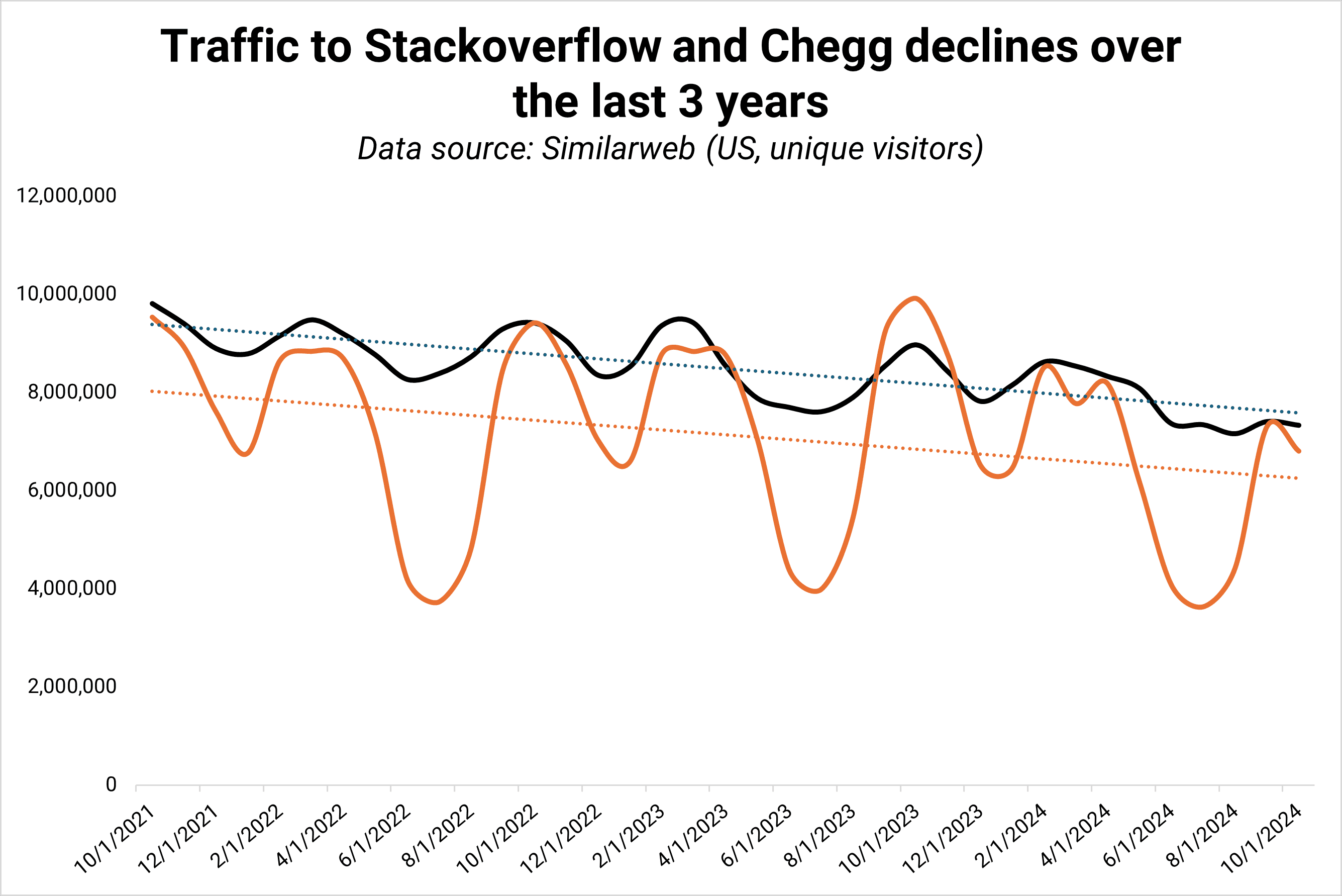
Stackoverflow and Chegg have suffered from a structural decline in the last three years. Their business model worked until it didn’t, proudly presented by AI.

In the same vein, many content marketers and SEO pros still operate like it’s 2014: Pump out evergreen content prioritized by search volume and supported by masses of mediocre backlinks.

You might feel a cocktail of “still works” and “not new” reading this line, but in my work as an advisor, I still see a lot of money flowing into this stuff. Too much.

The most common response after months of work and tens of thousands of dollars invested is “SEO takes time.” Just wait and spend more money. But the returns never come. The consequence: wasted effort and eroding trust in leadership.

I see five filter bubbles in organic growth:

  1. Evergreen-focused content marketing.
  2. Direct-response mindset.
  3. Low-brand organic traffic.
  4. Volume link building.
  5. Forgoing customer research.

Content marketing is still well and alive but not in its original form.

Content Marketing Institute’s 2025 B2B report shows that over half of content marketers struggle to measure the results of their efforts and create content that leads to the desired action.

User behavior is complex and not linear. But when so many smart people struggle to measure impact, it raises the question of whether the problem is technology and resources or efficacy.

It doesn’t help that Google updates create instability. The way I phrased it in (Hard)Core Algorithm Updates:

“Google updates have become unpredictable instead of enforcing a straight line, which makes SEO less predictable as a channel.”

SEO can still be very ROI-positive, but it cannot succeed in a silo anymore.

Attention shifted from the open web to (social) content platforms like YouTube and LinkedIn. The soundbite that 40% of Gen Z use TikTok for Search instead of Google is not a feature issue but a generational shift.

Content platforms are all about engagement (see more), not a direct response (click out). Many leaders make the mistake of expecting transactional referral traffic and get disappointed, eventually leaving the playing field for others.

When you look closely, all popular platforms are about engagement.

Google is the last holdout, but AI turns Search into an engagement channel that is not incentivized to send users away because the answer is right there. Users click out to validate and verify but not to get information in the first place.

Engagement leads to awareness, and Google rewards brands that get a lot of searches with more non-branded searches.

If Google’s algorithms taught us one thing over the last two years, it’s that massive amounts of non-branded organic traffic need to be carried by brand (traffic).

In Favoritism, I showed how Google gives brands more visibility in most verticals. “Brand” has replaced links as a factor. They still matter, but not in volume. The ones that are hard to get have the biggest impact. How do you get them? Brand building activities:

  1. Funding rounds lead to TechCrunch backlinks.
  2. YouTube advertising leads to homepage links (if the product is good).
  3. Good reputation leads to publisher coverage.

None of this works without deeply understanding who you want to engage with.

The sad reality is that most marketing teams have no idea where to find customer research or have built ties to customers because performance marketing (metrics) worked too well for too long.

But now that brand is actually important again because it drives engagement (and vice versa), content needs to be inspired by the source: customers.

New Formula

Image Credit: Kevin Indig

The formula for preventing a November 6 surprise in organic growth: connection + authenticity + surround sound.

Connection

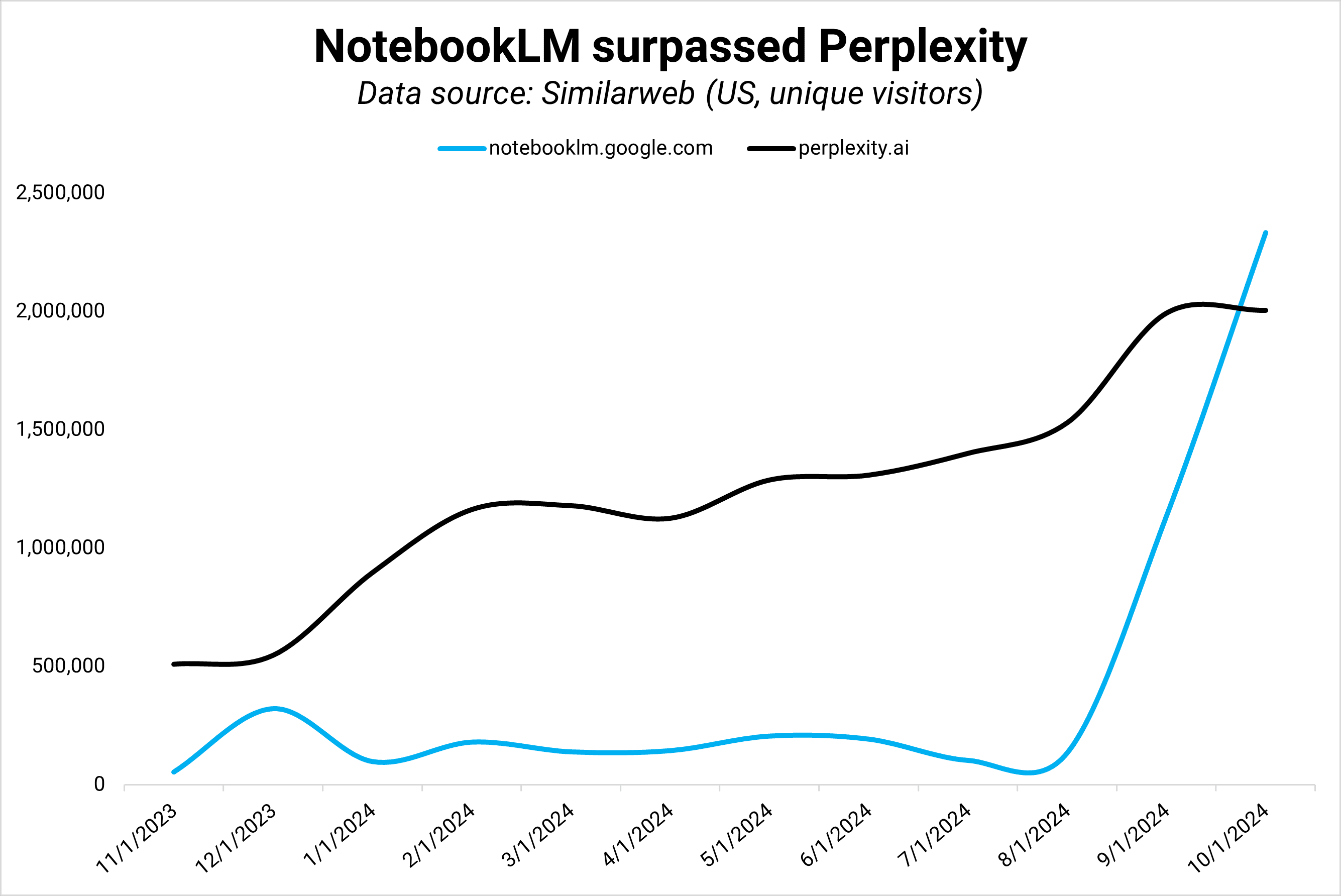
The fact that NotebookLM’s traffic surpassed Perplexity in the U.S. when it launched its podcast feature shows the power connection.

Whether you sell to consumers or companies, you sell to people, and the number one thing we crave is connection.

The reason podcasts and Reddit are so successful is because they’re connecting. The opposite of connection is scripted corporate content.

Nobody is interested in generic, faceless content – especially when Gen AI can give an equally good or better answer. But first-person, high-expertise content resonates.

Hearing someone in your ear is much more intimate than reading (as I’m writing this, I painfully remind myself to pivot to video).

An estimated 100 million U.S. Americans listen to a podcast at least once a week.

The projected advertising market value of $2 billion in the U.S. and $4 billion globally in 2024 seems too low when comparing the 48 million views to date Trump’s three-hour podcast with Joe Rogan amassed with the average 3.5 million daily views Fox gets.

The growth of people appending “Reddit” to their queries had grown for years before Google lined the domain up with visibility that matches demand.

Many don’t like the visibility Reddit gets in Search, but it’s a direct result of the desire to connect instead of browse websites.

Marching orders: There’s no doubt companies should invest in Reddit and podcasts.

Whether it’s advertising or organic campaigns, starting your own company podcast is not as important as the question of how you can connect with your audience on these platforms. A few ideas:

  1. An unpolished video of the founder telling the story of the company.
  2. AMAs or behind the scenes on Reddit.
  3. Host-read podcast ads.

The foundation is a deep understanding of what your customers value, their problems, and how they perceive you.

Authenticity

Creating content on engaging channels is not enough. It needs to be “authentic.” But what does that even mean?

I like Seth Godin’s definition: It’s about consistently proofing that who you are is who you say you are. It’s very hard to sell a fake version of yourself in a three-hour podcast. That’s why the format works.

We call a brand or a person authentic when they’re consistent, when they act the same way whether or not someone is looking. Someone is authentic when their actions are in alignment with what they promise.

As sad as it is, Trump’s personality was more important than his policy to voters. Both candidates got very active on the content platform, knowing that 4/10 young adults get their news from TikTok and brands with a strong approach to social media are 8x more likely to exceed revenue goals by +25% than competitors with low social maturity.

But Trump gained double as many followers and hashtag posts than Harris by recording videos with Gen Z influences like Adin Ross or Logan Paul.

Elections, like company Growth, don’t fail or succeed because of one thing, but social media is a gateway to consistently show up with the same story.

Marching orders: Extend brand guidelines beyond just the written word or usage of the company logo.

There needs to be a script for story points, messaging, and audience personas.

Identify employees who have what it takes to be the face(s) of the company on channels like YouTube or Reddit and put them front and center.

Surround Sound

When I speak at conferences, I usually stare into a sea of laptops or smartphones. I do the same when I watch a presentation. We’re constantly distracted and semi-listening.

As a result, connecting and being authentic is not enough to win; you need to be everywhere.

Trump saying crazy things gets him free exposure, and it has worked for him.

HubSpot has one of the most visible blogs in SaaS, but it bought newsletters and built a podcast network for a good reason: to create surround sound.

As the traditional media industry crumbles, companies build small media empires to market themselves.

Marching orders: Figure out where your audience is and double down. YouTube and podcasts are no-brainers. Be smart about content repurposing. Stay on story > stay on brand.

On Target

Today’s Growth landscape is fragmented and disrupted. Strategies that once guaranteed growth may now lead us astray.

Just as the 2024 election revealed a gulf between perception and reality, many in marketing and SEO are trapped in outdated tactics that feel comfortable but yield diminishing returns.

As AI reshapes content, the winning formula is clear: genuine connection, unwavering authenticity, and relentless surround sound forged on deep audience knowledge.

The question is no longer whether organic growth evolves but how rapidly you’ll adapt.


B2B Content Marketing Benchmarks, Budgets, and Trends: Outlook for 2025 [Research]

Podcast Listening Hits Record Highs

U.S. Podcast Advertising Revenue Study

Defining Authenticity

Trump’s savvy memes and flashy edits trounce Harris in war for precious views from young voters


Featured Image: Paulo Bobita/Search Engine Journal

Digital Marketers See Schema Structured Data Shifting Beyond SEO via @sejournal, @martinibuster

An interesting discussion emerged on Twitter inspired by an article written by Jono Alderson. The article proposes thinking about Schema.org structured data markup as a way for emerging AI technologies to better understand and surface published Internet content.

Schema.org Structured Data Markup

The content on a website is called unstructured data because there is no formal organized structure to it that labels each part of the content in a machine readable way. Structured data on the other hand is the exact same content but organized with labels that identify images, authors, and content so that a machine can immediately understand it.

Schema.org structured data markup is generally seen by publishers and the SEO community as something to use in order to make a web page eligible for rich results features in Google. That way of thinking is manifested in the many SEO and Schema.org WordPress plugins that are limited to outputting structured data that Google may use for surfacing rich results.

New AI technologies that can use structured data are here, requiring search marketers to consider a new approach to how structured data is deployed. What Jono encouraged in the article is to think of structured data as a way to create a “data-first foundation” that is ready for the near future.

The article proposes thinking of Schema.org markup as a way to communicate what a web page is about and how it relates to everything else on the website. Jono writes:

“But don’t shy away from building a connected graph of broader, “descriptive”” schema just because Google’s not showing an immediate return. These “descriptive” types and relationships might end up being the lifeline between your content and the AI models of the future.”

Jono tweeted about his article on X (formerly Twitter) and Martha van Berkel, founder of SchemaApp, agreed with Jono’s article that the role of Schema structured data markup is shifting.

She tweeted:

“I agree with you that the role of schema markup is changing. Building a knowledge graph to manage how your website/content is understood with schema, and then asking it questions will be more important than optimizing for Rich Results or for Google.”

Ammon Johns tweeted:

“The biggest issue with Schema is that it is largely just self-declaration, no different in essence to META content, and we know how reliable Google decided that stuff was. So Google will use it, but they are unlikely to fully trust it.”

Ammon is right of course that structured data can’t be blindly trusted. One way to solve that problem is to use a smaller index of high quality websites the wa Perplexity AI does.

Gagan Ghotra tweeted how they sometimes would like to expand their use of structured data but are limited by what the SEO and structured data tools offer.

Read Jono Alderson’s X discussion here.

Read Jono’s article:

What if Schema.org is just… Labels?

Featured Image by Shutterstock/PureSolution

4 New Techniques To Speed Up Your Website & Fix Core Web Vitals via @sejournal, @DebugBear

This post was sponsored by DebugBear. The opinions expressed in this article are the sponsor’s own.

Want to make your website fast?

Luckily, many techniques and guides exist to help you speed up your website.

In fact, just in the last year, several new browser features have been released that offer:

  • New ways to optimize your website.
  • New ways to identify causes of slow performance.

All within your browser.

So, this article looks at these new browser SEO features and how you can use them to pass Google’s Core Web Vitals assessment.

Why Website Performance Is Key For User Experience & SEO

Having a fast website will make your users happier and increase conversion rates.

But performance is also a Google ranking factor.

Google has defined three user experience metrics, called the Core Web Vitals:

  • Largest Contentful Paint: how quickly does page content appear?
  • Cumulative Layout Shift: does content move around after loading?
  • Interaction to Next Paint: how responsive is the page to user input?

For each of these metrics there’s a maximum threshold that shouldn’t be exceeded to pass the web vitals assessment.

Metric thresholds for Google Core Web Vitals, October 2024

1. Add Instant Navigation With “Speculation Rules”

New Key Definitions:

When websites are slow to load that’s usually because various resources have to be loaded from the website server. But what if there was a way to achieve instant navigations, where visitors don’t have to wait?

This year Chrome launched a new feature called speculation rules, which can achieve just that. After loading the initial page on a website, other pages can be preloaded in the background. Then, when the visitor clicks on a link, the new page appears instantly.

Best of all, this feature is easy to implement just by adding a

Google Rolls Out November 2024 Core Algorithm Update via @sejournal, @MattGSouthern

Google has released its latest broad core algorithm update for November 2024. This update continues Google’s refinement of search systems to enhance the quality of results.

On X, Google states:

“Today we released the November 2024 core update. We’ll add it to our ranking release history page in the near future and update when the rollout is complete.”

Core Updates Explained

These algorithmic changes, which Google implements several times annually, are designed to improve the overall search experience by reassessing how content is evaluated and ranked.

Unlike targeted updates, core updates affect search results globally across all regions and languages.

What You Should Know

According to Google’s documentation, most websites may not notice significant changes from core updates.

However, some sites might experience notable shifts in search rankings and traffic.

Google recommends that site owners who observe ranking changes should:

  • Wait until the update is completed before analyzing the impact
  • Compare traffic data from before and after the update in Search Console
  • Pay special attention to pages experiencing major position drops (particularly those falling more than 20+ positions)
  • Evaluate content quality using Google’s self-assessment guidelines
  • Focus on sustainable improvements rather than quick fixes

Recovery & Response

For sites affected by the update, Google emphasizes that recovery may take time—potentially several months—as its systems learn and validate improvements.

Specific changes aren’t guaranteed to result in ranking recoveries. Google emphasizes that search results are dynamic due to evolving user expectations and continuous web content updates.

Site owners can monitor the rollout’s completion status through Google’s Search Status Dashboard.

As with previous core updates, Google is expected to announce when the rollout, which typically takes about two weeks, has finished.

Looking Ahead

This marks Google’s final confirmed core update for 2024, following previous algorithmic changes throughout the year.

We will closely assess the impact as the update rolls out across Google’s search results.


Featured Image: Salarko/Shutterstock

New Internet Rules Will Block AI Training Bots via @sejournal, @martinibuster

New standards are being developed to extend the Robots Exclusion Protocol and Meta Robots tags, allowing them to block all AI crawlers from using publicly available web content for training purposes. The proposal, drafted by Krishna Madhavan, Principal Product Manager at Microsoft AI, and Fabrice Canel, Principal Product Manager at Microsoft Bing, will make it easy to block all mainstream AI Training crawlers with one simple rule.

Virtually all legitimate crawlers obey the Robots.txt and Meta Robots tags which makes this proposal a dream come true for publishers who don’t want their content used for AI training purposes.

Internet Engineering Task Force (IETF)

The Internet Engineering Task Force (IETF) is an international Internet standards making group founded in 1986 that coordinates the development and codification of standards that everyone can voluntarily agree one. For example, the Robots Exclusion Protocol was independently created in 1994 and in 2019 Google proposed that the IETF adopt it as an official standards with agreed upon definitions. In 2022 the IETF published an official Robots Exclusion Protocol that defines what it is and extends the original protocol.

Robots.Txt For Blocking AI Robots

The draft proposal seeks to create additional rules that will extend the Robots Exclusion Protocol (Robots.txt) to extend to AI Training Robots. This will bring about some order and give publishers choice in what robots are allowed to crawl their websites.

Adherance to the Robots.txt protocol is voluntary but all legitimate crawlers tend to obey it.

The draft explains the purpose of the new Robots.txt rules:

“While the Robots Exclusion Protocol enables service owners to control how, if at all, automated clients known as crawlers may access the URIs on their services as defined by [RFC8288], the protocol doesn’t provide controls on how the data returned by their service may be used in training generative AI foundation models.

Application developers are requested to honor these tags. The tags are not a form of access authorization however.”

An important quality of the new robots.txt rules and the meta robots HTML elements is that they don’t require naming specific crawlers. One rule covers all bots that are crawling for AI training data and that voluntarily agree to follow these protocols, which is something that all legitimate bots do. This will simplify bot blocking for publishers.

The following are the proposed Robots.txt rules:

  • DisallowAITraining – instructs the parser to not use the data for AI training language model.
  • AllowAITraining -instructs the parser that the data can be used for AI training language model.

The following are the proposed meta robots directives:

Provides Greater Control

AI companies have been unsuccessfully sued in court for using publicly available data. AI companies have asserted that it’s fair use to crawl publicly available websites, just as search engines have done for decades.

These new protocols give web publishers control over crawlers whose purpose is for consuming training data, bringing those crawlers into alignment with search crawlers.

Read the proposal at the IETF:

Robots Exclusion Protocol Extension to manage AI content use

Featured Image by Shutterstock/ViDI Studio

Drive Over 150K A Month In Brand Search Volume: A Case Study [Webinar] via @sejournal, @lorenbaker

Having a hard time increasing brand search volume and building a strong presence on SERPs, especially in a way that’s not consuming all of your precious time?

Let’s face it: many search marketers find it taking years to build their brand search volume when faced against major, established brand. 

So what if there was a way to speed up this process and see results within months, instead of years?

Join us in our upcoming session, How To Drive Over 150K A Month In Brand Search Volume: A Case Study, where we’ll show you how to fast-track brand awareness and engagement through data-driven techniques and advanced audience analysis.

Why Attend This Webinar?

Making your brand stand out requires a strategic touch and a targeted, data-driven approach. By learning to understand and drive audience search behavior, you can improve your rankings, increase conversions, and even earn high-quality links—without waiting years to see results.

We’ll show you first-hand examples of how one brand created a new market category to solve a problem with conversion rates, along with another brand that grew their volume to over 150,000 organic clicks a month.

What You’ll Learn

Hosted by Kevin Rowe from PureLinq, this webinar will cover real-world strategies to increase brand search volume, backed by proven case studies from top brands. You’ll walk away with:

  • PureLinq’s simple yet effective process for understanding your audience’s search habits and how to use these insights to boost brand awareness.
  • Practical methods for leveraging podcasts, PR, and content marketing to drive more brand search.
  • Steps for breaking into new market categories and creating search demand from scratch.

Who Should Attend?

This webinar is perfect for:

  • SEO professionals eager to drive brand visibility in SERPs.
  • Content marketers focused on increasing brand engagement.
  • Business owners aiming to build brand trust and earn organic clicks.

Live Q&A with Kevin Rowe

Following the presentation, Kevin will be taking your burning questions on building your brand’s visibility. This is your chance to get tailored advice, supported by Kevin’s 15 years of experience in digital marketing and audience engagement.

If you’re serious about increasing your rankings and improving brand search volume, then you won’t want to miss this. Save your seat for this LIVE event and get ready to take your brand’s visibility to the next level.

Can’t make it on the day? Register anyway, and we’ll send you a recording to watch on-demand.

Sign up now to transform your approach to brand search and achieve results faster than ever before!

140 Social Sharing Sites That Boost SEO & Drive Traffic via @sejournal, @jonleeclark

Thankfully, every so often, a tool comes along that makes the complex world of search engine optimization a bit more manageable.

Social bookmarking sites are one of these tools that can be your new best friend in the SEO landscape.

Why are they so crucial? Simple: They’re powerhouses for building links, which are vital for SEO success.

Think of social bookmarking sites as your personal digital librarian. They let users discover, categorize, and store webpages all in one place using virtual “bookmarks.”

Social media platforms like Pinterest have revolutionized how we think about social bookmarking, proving themselves as essential tools in any marketer’s toolkit.

And it’s not just about generating any links; it’s about crafting quality connections that boost your visibility on search engines.

Sure, most of these links are nofollowed. However, the traffic and visibility they bring can catapult your site to the front page of search results.

But remember, there’s more to it than just links. Search engines use these sites to gauge the relevance and value of content. So, while you’re getting your name out there, you’re also building credibility and authority.

If you’re curious about which sites to start with, this guide has you covered.

Take a look at my list of the top 140 social bookmarking sites that are perfect for getting your content noticed and shared.

My Top 24 Social Sites (In No Particular Order)

1. X

X (formerly Twitter), despite what you may have heard, is still huge. In fact, the platform has over 500 million monthly active users.

While it might not be the first site that pops into your mind for submitting content, it has a large audience and is an efficient platform for posting.

Many people use it to post links, content, and images that they find interesting and worthy of a revisit in the future.

2. Pinterest

As the quintessential social bookmarking site, Pinterest has an average monthly user base of 498 million, roughly 72.6 percent of whom are female.

Furthermore, users are pinning over 1.5 billion Pins per week to more than 10 billion Pinterest boards.

3. Mix

In June 2018, the popular discovery platform StumbleUpon became Mix.

Mix lets you experience the internet as curated by machine learning, editors, or publishers.

You can also tag content that you liked, in particular, to share with others.

4. Slack

Slack is a group messaging program that provides users with customizable channels in which chats can occur.

You can also create private groups, and have direct messaging. I, personally, have found tremendous value in groups like The SEO Community and The SEO for Journalism groups.

In 2022, Slack had an estimated 35 million users.

5. Notion Community

Notion Community is a platform for users of Notion, the all-in-one workspace for note-taking, project management, and data organization.

The community allows users to share templates, setup tips, and best practices on using Notion effectively.

It’s perfect for productivity enthusiasts, project managers, and anyone interested in personal or professional organization.

This community helps individuals improve their workflow while connecting with others who use and customize Notion in innovative ways.

6. Pocket

Appropriately named, when you put something in your Pocket, it’s there to be found later.

Users of Pocket can hold onto anything they find on the internet or through various apps.

Bonus points for the fact that once something’s in your Pocket, you don’t need an internet connection to access it.

7. Digg

Got great content?

Then it belongs to Digg.

Digg is an addictive social bookmarking site that’s perfect for sharing your captivating content with a highly engaged audience.

8. Folkd

The Folkd bookmarking site contains a unique social search feature that works much like a typical search engine, except the results don’t come from a complex, machine-driven system of analytics.

Instead, top results display quality content that Folkd users have bookmarked.

The more saves a piece gets, the higher its rank in their social search, which helps connect their visitors with even more quality content.

9. Reddit

What can’t be found on Reddit?

Users generate threads that can then be commented on, upvoted, or downvoted, and it is a great tool when you’re looking to quickly promote content, generate content ideas, or get answers to a question.

It’s also now one of Google’s key AI training data sets.

10. Fark

One of Fark’s best attributes is their commitment to quality.

As a social networking news site, Fark receives mountains of submissions on a daily basis but presents only the best to their audience.

This site isn’t for wimpy, weak content.

But, if you’re ready to showcase your talent and drive traffic to your own site, Fark is the way to go.

11. BizSugar

If you’ve got content about startups, marketing, and the world of small business, then BizSugar is the social bookmarking site that will help build your reputation and brand authority in a growing community of like-minded small business professionals.

12. Slashdot

Slashdot is the ultimate bookmarking site for tech geeks and the techie at heart.

Users of Slashdot submit and share content on gaming, cloud computing, computer hardware, security management, and more.

13. We Heart It

While users can submit and bookmark different types of content, We Heart It is heavily visual.

The app is nice to look at, easy to use, and inspirational – especially for anyone who loves great imagery.

14. Scoop.It

This site, aimed toward professionals, offers solutions for content creation, content curation, predictive analysis, and content intelligence.

Scoop.It offers four different platforms – a free version for individuals, as well as three paid options: Pro, Plus, and Enterprise.

15. Elpha

Elpha is a social network tailored specifically for women in the tech industry, providing a space for networking, job opportunities, and sharing insights.

It’s designed to empower women by connecting them with peers and mentors, facilitating professional growth in a supportive community.

16. Diigo

Diigo is the ultimate social bookmarking site for academic types.

Educators, students, researchers, and anyone with an inquisitive mind love the features that make keeping track of their resources and sharing them easy.

Diigo is perfect for content that’s focused on statistics, analytics, or research of any industry.

17. BibSonomy

Granted, not many businesses publish scientific material as part of their marketing strategy.

But, for those who do, BibSonomy is a premier social bookmarking site for businesses and academic types to collect, share, and collaborate with the most recent, highly relevant research-based material.

18. Instagram

Instagram is one of the world’s most popular apps for photo, video, and live video sharing.

It’s the world’s fourth most-used social media platform, with over 2 billion monthly users.

The largest demographic on Instagram is 18 to 24-year-olds, representing 30.8% of users.

Furthermore, the average time spent on Instagram is 33 minutes per day.

19. Pearltrees

There’s a simplicity to Pearltrees that makes it a favorite among users who love to create collections of their favorite things.

Pearltrees offers functionality and a platform that makes it easy to share and gather new content.

20. DZone

DZone is one of the preferred social bookmarking sites for software developers around the world.

Each day, thousands of developers come to the site to learn, share, and read about the latest technologies and trends in the world of software development.

21. Medium

Typically used to share personal, original stories, Larry Kim has shown just how successful Medium can be for repurposing content.

22. SlideShare

While some claim SlideShare is on its way out, if you’ve created an amazing keynote or PowerPoint presentation, you’re going to want to repurpose that on SlideShare.

23. Quora

Not only a great research tool for Q&A content brainstorming, but Quora is a question-and-answer based site filled with a wide range of topics to discuss and follow.

24. Facebook Groups

A Facebook Group is a closed or open community within Facebook where users can post content ranging from links to events and questions.

As of August 2022, 1.8 billion people used Facebook Groups, and there were over 10 million groups on Facebook.

69 More For Good Measure

Here are 69 more social bookmarking sites for you to leverage in your SEO strategy.

A few of these you’ll be familiar with because they’re already insanely popular, but there are also plenty of lesser-known sites on the list.

25. Facebook

Facebook is arguably the most popular social network in the world.

Despite changes to how Facebook’s algorithm diminishes organic reach, it can still be a major source of traffic for posted content.

26. Flipboard

Flipboard curates the world’s stories you can focus on investing in yourself, stay informed, and get involved.

27. Feedly

Feedly is the most popular RSS blog reader, with more than 15 million users, and acts as a news aggregator for various web browsers and mobile devices.

28. Pinboard

Pinboard is a plainly designed social bookmarking website “for people who value privacy and speed.”

It focuses on the personal management of bookmarks using tags to organize them.

29. Instapaper

Instapaper is touted as the simplest way to save and store articles for reading offline, on-the-go, anytime, anywhere.

30. Untappd

Untappd caters to beer enthusiasts, providing a platform to rate beers, check into locations, and see where friends are drinking.

It combines social networking with user reviews, making it valuable for discovering new beers and venues.

31. LinkaGoGo

LinkaGoGo has been around since 2001.

It allows you to view bookmarks using dynamic bookmark toolbars.

32. LinkedIn

LinkedIn is a 500 million+ member social network designed to build and engage with your professional network.

33. Disqus

Disqus is a global comment system that improves discussion on websites and connects conversations across the web.

34. Listly

Listly helps bloggers and publishers engage readers by viral top 10 lists created by the community.

35. Tumblr

Tumblr, the popular “microblogging” network, allows users to post multimedia and other content to a short-form blog.

36. ArtStation

ArtStation is the hotspot for digital artists and illustrators to showcase their portfolios.

If you’re into game design, concept art, or just love browsing incredible creations, this is your scene.

37. Dotnetkicks

Dotnetkicks is a community-based news site edited by the community that specializes in .NET development techniques, technologies, and tools.

38. Pixiv

Pixiv is a Japanese online community where artists showcase their illustrations, manga, and novels.

It’s big on creativity and perfect for anyone looking to dive into anime-style art.

39. TikTok

TikTok is a video-sharing service that allows users to share videos that are 3 to 60 seconds long.

The app is credited largely with the success of many celebrities whose reach extends beyond the app and into the mainstream.

As of publishing, TikTok boasts 800 million users.

40. Ko-fi

Think of Ko-fi as a friendly tip jar for creators.

Whether you’re an artist, writer, or podcaster, you can receive support directly from your fans with a simple “Buy me a coffee” button.

41. FilmFreeway

FilmFreeway makes it easy for filmmakers to submit their films to hundreds of festivals all over the world.

It’s the go-to platform for indie creators looking to promote their work and for film buffs seeking the next big thing.

42. EyeEm

EyeEm is a global photography community and marketplace.

It’s perfect for budding photographers looking to showcase their work, connect with peers, and even sell their images to brands and publishers.

43. SocialBookmarkNow

SocialBookmarkNow is a social bookmarking site that boasts “instant approval” for submitted content.

44. Academia.edu

Academia.edu is a platform specifically tailored for academics and researchers to share research papers across a multitude of disciplines.

Users can follow each other’s work, update their profiles with new findings, and even track the impact of their publications.

It’s a valuable resource for enhancing visibility in the academic community and improving citations, which is beneficial for SEO in academic and educational content.

45. TechDirt

TechDirt is an online news blog that allows users to post their own stories.

46. AllTrails

AllTrails is a niche social network for outdoor enthusiasts, offering detailed information on trails around the world, including user reviews, photos, and trail maps.

Users can record their hikes, share their favorite trails, and provide updates about trail conditions.

It’s ideal for brands in the outdoor, travel, and fitness industries to connect with a highly engaged audience.

47. Houzz

Houzz is a platform for home remodeling and design, bringing homeowners and home professionals together in a uniquely visual community.

Here, professionals can showcase their portfolios, share design ideas, and connect with potential clients.

It’s a great tool for architects, interior designers, and contractors to enhance their SEO through project photos and customer reviews.

48. MetaFilter

MetaFilter is a community weblog that anyone can contribute a link or comment on.

49. Care.com

Care.com connects people with caregivers for children, seniors, and pets.

It allows caregivers to create profiles, post services, and gather reviews, which helps build their online presence and trustworthiness.

It’s also beneficial for service providers in the care sector to increase visibility and SEO through client interactions and endorsements.

50. Steemit

This is a blogging and social media website that gifts users with its cryptocurrency, STEEM, for publishing and curating content.

51. Bookmarkfeeds

Bookmarkfeeds allows users to submit article bookmarks from anywhere in the world.

52. BookmarkMaps

BookmarkMaps is a bookmarking service that allows members to submit articles and share the most-voted content to social networks like Facebook and Twitter.

53. Leavemark

Leavemark, launched in 2020, is an ad-free data storage and social media app that lets you save videos and photos and share them later.

The app features a time and space capsule option that allows information to be released in increments of 2 weeks, 2 months, 10 years, or when the recipient is within proximity of a given place.

There is also direct messaging, a newsfeed, and a family tree feature that allows you to preserve information for future family members.

54. Fabric

Fabric is like VH1’s Pop-Up Video but in real life (IRL).

It’s an augmented reality (AR) app that allows you to see people’s commentary on things within your immediate proximity.

You can comment on that commentary and start a virtual, and potentially in real life (IRL), conversation.

55. Vero

Vero is a social media app designed to compete with the one-two punch of Facebook and Instagram.

Vero boasts that it doesn’t sell data, features no ads, and uses no algorithms.

Instead, users select who gets to see their posts, and posts appear chronologically.

You can share suggestions for music, books, films, and more.

You can also shop within the app for any recommendations that you find particularly striking.

56. Caffeine

Caffeine is a platform that streams live content that you can interact with, including gaming, sports, and music.

57. Twitch

Twitch is a video streaming service owned by Amazon.

The platform focuses primarily on live video game streaming, but also includes e-sport competitions, music broadcasts, and other forms of creative content.

As of January 2024, Twitch had approximately 8.36 million active streamers.

58. Bluesky

Previously invite-only, Bluesky was started by Jack Dorsey as a project within X (Twitter) to explore decentralized social media.

It was eventually spun off into its own entity, built on an open protocol called the AT Protocol (Authenticated Transfer Protocol), which allows for interoperability between different services and platforms.

The network has seen explosive growth recently, given its similarities to X (Twitter). As of September 2024, Bluesky has over 7.6 million users.

59. Threads

Threads is a social media platform developed by Meta (formerly Facebook) and launched in July 2023.

It is closely integrated with Instagram, allowing users to sign in using their Instagram credentials and follow the same accounts.

Threads was created as a microblogging platform similar to X, allowing users to post short text updates, share photos and videos, and engage in threaded conversations.

Threads was positioned as an alternative to X, particularly after Elon Musk’s acquisition of Twitter. This led to some changes in the platform that left certain users dissatisfied.

However, Threads has gained traction with a focus on simplicity and familiar functionality for those used to Instagram.

60. BuzzCast

BuzzCast is a newer global social community for young and active people to meet new friends, find dates, and form meaningful connections quickly.

61. Masterminds

Mastermind is a social media platform for coordinating goal-oriented video chats with like-minded individuals.

The aim is to benefit from each other’s shared experience, encouragement, comradery, and accountability.

62. Triller

Triller is a social media video app where you film yourself lip-syncing, dancing, or both.

Triller’s editing algorithm then goes to work to edit your video for you based on audio and facial analyses.

63. WhatsApp

WhatsApp is an encrypted messaging service that allows you to send text and audio messages, make video and phone calls, share media, and send each other locations.

WhatsApp currently has 2 billion monthly users worldwide.

64. Tagged

Tagged is a social discovery platform that lets you browse the profiles of any members and share tags and virtual gifts.

65. Wattpad

Wattpad is a platform that services user-generated stories.

As of 2018, Watpad has 400 million stories and over 65 million users who spend over 15 billion minutes on the app each month.

66. Badoo

Badoo is a social networking website meant to facilitate friendship, romantic relationships, or just brief conversations.

You can search based on who’s nearby, use a more specific geographic search, use a Tinder-type feature where you swipe left or right, and have the option of video chatting as well.

Users are verified by uploading a photo of themselves in a specific pose that’s then verified by a moderator. People can also request selfies to confirm an identity.

Since launching in 2006, Badoo has had 425 million members.

67. Bubbly

Bubbly is an app that allows users to record voice blogs for upwards of 90 seconds to subscribe to the voice blogs of others.

Currently, you can apply voice filters, effects, and background music to the posts.

68. Cellufun

Cellufun is a social program that lets users play games together and comment anonymously using avatars.

69. Classmates

Classmates.com is a social media platform that allows users to make and search profiles, post and view notes, view other profiles and their photos, browse digital yearbook collections, and gain access to reunion planning tools.

70. Dropout

Dropout is an internet comedy company that, in addition to creating original content, allows for user-submitted videos, pictures, articles, and links.

71. Discord

Discord is an instant messaging software that allows you to communicate via text, image, video, and voice.

As of January 2024, Discord has 196.2 million active users.

72. GIPHY

Giphy is an online database and search engine that allows users to search for and share short looping videos with no sound, which resemble animated GIF files.

It is believed to have 1.7 billion daily users on both its app and website.

73. Imgur

Imgur is an image-sharing community and image host.

Many popular viral images and memes are hosted by Imgur and are used by Reddit to share images across the platform.

74. LINE

Line is a messaging service that lets users communicate using smartphones, tablet devices, and PCs.

Text, images, video, audio, and free VoIP calls and video conferences are all available.

Line also has a digital wallet called Line Pay, a news stream called Line Today, a video-on-demand service known as Line TV, and two digital comic services known as Line Manga and Line Webtoon.

Line is one of the most used apps in Japan, with over 88% of the population using it.

75. Mastodon

Mastodon is a decentralized social network offering an ad-free, open-source environment similar to Twitter.

Users can join servers that best fit their interests and engage in discussions or share media.

It’s an excellent alternative for creating content streams that can improve SEO by fostering community interactions and content sharing.

76. LiveJournal

LiveJournal is a social networking platform where people keep diaries. LiveJournal’s highest recorded number of users is 2.5 million.

77. MeetMe

MeetMe is a mix between a social media platform and a dating app.

Meetme works by verifying and populating your profile with data from Facebook.

You’re then shown users nearby who you have the opportunity to chat with and even arrange an in-person meeting.

MeetMe claims to have over 100 million users.

78. MocoSpace

Inspired by Myspace, MocoSpace is a mobile social network that includes games, chat, instant messaging, eCars, and photos.

MocoSpace has over 100 million registered users.

79. Myspace

Between 2005 and 2008, Myspace was the biggest social networking platform in the world, catering to over 100 million users per month.

The most recent statistics available for 2019 show that MySpace had 7 million monthly visitors.

80. Open Diary

Open Diary is an online diary community similar to LiveJournal and Xanga.

81. Skype

Skype is a popular video chat software that lets users communicate via audio, video, or text.

You can also send images, videos, files, and more.

More than 40 million people use Skype every day, with over 300 million active monthly users on the platform.

82. Telegram

Telegram is a chat app available for both desktop and mobile users.

The mobile version features encryption.

You can also send photos, videos, stickers, audio, and files.

As of 2024, Telegram has reached over 800 million monthly active users.

83. Tribe

Tribe is a social messaging app.

You can record and send messages to your friends just by holding your finger on their photo and then releasing it.

You can also create groups to send videos to several recipients at once.

Once the video is tapped and viewed, it disappears.

84. Viber

Viber is a software that allows for VoIP and instant messaging-based communications.

Users are verified by their cell phone. The app can also be used on desktops.

Viber gives users the opportunity to trade images and videos, as well as access to a paid international dedicated video and phone service called Viber Out.

Viber records having over a billion users.

85. Vimeo

Vimeo is a video hosting platform.

Vimeo is ad-free and instead derives its income by providing hosting plans to content producers and tools for video creation, editing, etc.

Vimeo also helps professionals connect with one another, with over 287 million creatives using the platform.

86. WatZatSong

WatZatSong is a community for music lovers where users can help each other identify songs.

Participants post a clip of a song they are trying to identify, and the community pitches in to help figure it out.

It’s an excellent platform for engaging with a music-focused audience and can be a fun way to drive traffic to sites related to music and entertainment.

87. Dropmark

Dropmark is a collaborative sharing tool.

You collect files, drag them into your browser to upload, and then share that collection with a group or individual of your choosing.

88. Droplr

Droplr allows you to take your screenshots or screen recordings, upload them to the cloud, and then share them with anyone.

89. Zight

Zight allows you to share screenshots or screen recordings.

Using its Instant Video feature, users can broadcast screen recordings instantaneously.

90. ePHOTOzine

ePHOTOzine is an online photography magazine offering a social networking platform for photographers to upload photos, participate in contests, and write reviews.

It’s a great space for photographers to improve their SEO by showcasing their work and engaging with a community of like-minded individuals.

91. Patreon

Patreon is an American membership-based platform that provides creators with the means to maintain subscription-based content.

Creators include video makers, podcasters, artists, writers, adult content creators, and more.

There are over 228,000 creators with at least one Patreon. Over the past two years, the number of creators has grown by 20%.

92. OnlyFans

OnlyFan is a content subscription service akin to Pateron that is particularly popular among the adult entertainment industry and fitness experts.

Creators receive funding based on subscriptions, tips, and pay-per-view events.

As of 2022, OnlyFan had over 3,100,000 content creators!

93. Substack

Substack is a platform that allows creators to have paid email newsletters.

Substack provides a content management system to create email newsletters, a way of collecting payments using Stripe, and a website that can provide free or paid-for content.

Don’t Forget The Music/Audio Social Sites

94. Datpiff

DatPiff is an online distribution platform focusing on hip-hop, rap, and R&B.

Basically, DatPiff is the modern-day equivalent of the sort of mixtapes or mix CDs fledgling artists would distribute with the hopes of having their music exposed to a larger audience.

95. Last.FM

Last.FM is a social media platform that follows users’ listening habits to create custom playlists.

Last.FM can gather data from popular music streaming apps, internet radio stations, or the user’s own desktop or mobile devices.

96. SoundCloud

SoundCloud is an audio distribution and music-sharing platform.

The platform would go on to have over 140 million registered users worldwide.

It has launched the careers of many professional and wildly successful musicians.

97. ReverbNation

ReverbNation is a website where musicians, producers, and venues collaborate and communicate.

98. Bandcamp

Bandcamp is an audio distribution platform.

Artists and labels upload their content to Bandcamp and then set how it’s sold, for how much, in what format, and can sell merch or physical media as well.

Plus, 20 Even More Niche Social Sharing Sites

99. Dribble

The go-to bookmarking site for creative types, especially designers.

If you like to explore graphic and visual design, or you have someone on your team who does, Dribble is a great spot to get some SEO backlink action.

100. Meetup

Meetup uses online groups to coordinate in-person meetings based on people’s shared interests.

Meetup has more than 60 million registered users.

101. Weed Life

Weed Life is a social network built for cannabis enthusiasts.

102. Nextdoor

Nextdoor is a social media platform that allows you to connect with people in your neighborhood.

You have to submit your real name and address (your street name without your unit number).

It’s currently available in 11 countries.

Only other members of your neighborhood can see your posts.

Nextdoor has 285,000 active neighborhoods and serves over 10 million users.

103. DeviantArt

DeviantArt is an online community where people share artwork, videos, and photography.

Most recent stats show that the site has over 26 million members and 251 million submissions.

Art can be browsed by categories such as type, operating system customization utilities, skins for applications, and more.

104. Goodreads

Goodreads is a social network where people post about and review books.

Users also have the option of creating groups based on suggestions, surveys, polls, blogs, and discussions.

On a yearly basis, users vote in the Goodreads Choice Awards based on books nominated by Goodreads as well as user suggestions.

As of 2022, Goodreads has more than 140 million members around the world.

105. CouchSurfing

CouchSurfing is a social networking platform that allows users to coordinate lodging and meetings or join and create events.

106. RunKeeper

Runkeeper is a fitness-tracking app that uses GPS to map your workouts.

Some activities include walking, running, and cycling.

Runkeeper has over 51.2 million users. You can share your workouts with others and the Runkeeper community as well.

107. Care2

Care2 is a social media platform that connects people based on the activist causes that they’re passionate about.

Care2 currently has over 63 million members and 2,750 nonprofit partners, has created nearly 457,000 petitions, and has accrued over 1.2 billion signatures.

108. eToro

eToro is a social trading platform and multi-asset brokerage company that offers financial and copy trading services.

Users are able to follow, view, and even recreate the practices of top traders on the platform.

As of 2024, eToro has over 35 million users.

109. Gaia Online

Gaia Online is an anime-themed social network and forum-based platform.

110. Italki

Italki is a platform that connects language learners to teachers using video chat.

Teachers earn money as freelance tutors.

111. Ravelry

Ravelry is a social networking service for people interested in knitting, crocheting, spinning, weaving, and other similar activities.

Users share projects, ideas, and their collections of yarns, fiber, and tools.

Ravelry has over 9 million registered users and roughly 1 million monthly active users.

112. The Dots

The Dots is a social networking program for creative professionals (writers, illustrators, videographers, etc.).

Members get to network, connect, collaborate, and be inspired by the individuals, teams, and brands with profiles.

113. BakeSpace

BakeSpace is a food-focused social networking site for sharing recipes, creating cookbooks, and meeting other food enthusiasts.

Users can exchange recipes, collaborate on cookbooks, and discuss cooking tips.

It’s a delicious way to connect with others who share a passion for cooking and can help food bloggers and brands boost their SEO through content sharing and interaction.

114. Strava

Strava is a social network for athletes, particularly runners and cyclists.

It tracks user activity via GPS, allowing members to share their workouts, compete with each other, and follow friends’ activities.

It’s excellent for motivation and community building among fitness enthusiasts.

115. MyHeritage

MyHeritage is a platform that allows users to create family trees, upload and browse photos, and search through over 9 billion historical records.

116. Viadeo

Viadeo is a professional social networking platform that connects business owners, entrepreneurs, and managers.

117. Yelp

Yelp is a crowdsourced review-based website that provides business ratings.

It also partners with a reservation service called Yelp Reservations.

Yelp has over 265 million reviews.

118. Letterboxd

Letterboxd is a social networking service that focuses on sharing reviews and adoration for film.

Users can keep a diary to track their opinions, films watched, and make lists. Users can also interact with one another.

Last But Not Least, 12 International Social Sharing Sites

119. FilmAffinity

Registered users can rate, find, and create lists of movies.

In the Spanish version of the site, it’s possible to write reviews.

In Spain, which is the platform’s country of origin, there are 3 million unique users.

120. Kuaishou

Kuaishou is a Chinese video-sharing app.

It’s known as “Snack” video in China and “Kwai” in other markets.

Kuaishou is used to create short videos that capture the everyday experiences of its users.

At the end of 2022, Kuaishou’s daily active users sat at 355.7 million.

121. Mixi

Mixi is a Japanese social networking service.

Its focus is on connecting with others based on shared interests.

Users can send messages, keep a blog, read and comment on other people’s blogs, set up and join communities, and invite friends.

Registration is confirmed using a valid Japanese cell phone number.

122. Qzone

Qzone is a social networking platform centered in China.

It lets users keep blogs, send photos, listen to music, and watch videos.

Statistics show that there are over 600 million active users on Qzone.

123. Sina Weibo

Sina Weibo is a Chinese microblogging site akin to Tumblr. Users can upload videos and pictures for instant or extended sharing.

Users can then comment via text, video, or pictures.

There’s also an instant messaging service.

In 2017, the platform reported it had over 290 million registered users.

124. CaringBridge

A health-focused social networking site, CaringBridge helps people stay connected with their family and friends during significant health challenges.

It offers personal, protected sites where users can share updates, receive messages of support, and coordinate help.

125. Tencent QQ

Tencent QQ, known as QQ, is an instant messaging program and web portal in China.

It provides online social games, music, shopping, microblogging, movies, and group and voice chat.

126. VK

VK is a Russian social networking platform. VK facilitates both private and public messaging, groups, public pages, and events.

With VK, you can also share and tag images, audio, and video. There are browser-based games as well.

As of May 2021, VK had 656,000,000+ users.

127. WeChat

WeChat is a Chinese-developed platform that allows for messaging, social media, and mobile payment.

In China, the app has been called the “app for everything.” As of 2019, WeChat had roughly 1 billion active users.

128. XING

Xing is a Hamburg-based social networking site for professionals primarily focused on the German-speaking market.

As of the end of December 2023, Xing reported that it reached 1.3 billion monthly active members.

129. YY

YY is a Chinese-based video social network that has its own virtual currency.

The currency is paid to people who create content ranging from karaoke videos to tutorials. The currency can later be exchanged for real money.

The platform also streams concerts, fashion, and sporting events. Users can chat as well. As of November 2019, YY had 157.8 million monthly active users.

130. Douban

Douban is a Chinese social networking platform that allows users to document information and create content about movies, books, TV, activities in China, and more.

Douban has 60 million registered users and 150 million unregistered visitors.

Registered users get recommendations and add them to other social networking options; unregistered users get reviews and ratings of media.

10 Bonus Social Sharing Sites

131. Blender Artists Community

Blender Artists Community is a vibrant network for users of Blender, the open-source 3D content-creation suite.

Members share projects, get feedback, and find tutorials.

It’s perfect for 3D artists looking to improve their skills, showcase their portfolio, and boost their presence in the 3D modeling community.

132. PixelFederation

PixelFederation is a community for gamers and game developers.

It provides a platform to discuss game development, share projects, and connect with other gaming enthusiasts.

This site is excellent for developers looking to increase visibility and engage with a community passionate about gaming.

133. GrowthHackers

GrowthHackers offers a hub where users can share and discuss strategies for growth, marketing, and scaling businesses.

Content ranges from articles to case studies, making it ideal for marketers and entrepreneurs interested in cutting-edge tactics for driving business growth.

134. Travello

Travello is a social network for travelers, providing a platform to share experiences, discover new adventures, and meet fellow travelers.

Its features include arranging meetups and sharing travel tips and photos, making it a valuable tool for travel bloggers and agencies to increase their reach.

135. Plantix

Plantix is a network for gardening and agriculture enthusiasts.

Users can diagnose plant diseases, share gardening tips, and discuss best practices in crop cultivation.

136. Kaggle

Kaggle is a platform for data scientists and analysts to explore and publish data sets, compete in competitions, and collaborate on projects.

This community is crucial for professionals looking to build their reputations and collaborate on data-driven projects, enhancing their visibility in the tech and scientific communities.

137. Threadless

Threadless is a community-driven site featuring user-designed t-shirts, hoodies, and prints.

Artists submit designs, which users vote on; the top-rated designs are then made into apparel.

It’s a fantastic way for graphic designers and artists to gain exposure and have their work featured on merchandise.

138. Dogster (And Catster)

Dogster and Catster are social networks for pet owners, offering a place to share photos, care tips, and pet stories.

139. Archilovers

Archilovers is a social network for architects, designers, and architecture enthusiasts.

It allows users to share projects, find design inspiration, and connect with other professionals.

140. Spiceworks

Spiceworks is a professional network for the IT community.

It combines community discussions, software tools, and a marketplace where IT professionals can exchange knowledge, tools, and services.

Harness The Power Of Social Bookmarking To Amplify Your Online Presence

Exploring the digital landscape like this reveals just how expansive it truly is!

Every business, including yours, competes to stand out and thrive online.

Effective digital marketing isn’t just about using any tools; it’s about using the right tools. Social bookmarking is one of these powerful tools, essential for building and enhancing your brand’s online visibility.

Remember, achieving success online is a collective effort. Social bookmarking connects you to a broader community, helping you engage with your audience and expand your reach.

Start incorporating social bookmarking into your strategy today and watch your digital presence grow.

More resources:


Featured Image: tovovan/Shutterstock

Latest Google AIO Updates May Impact SEO via @sejournal, @martinibuster

Google continues updating AIO rankings, increasing the presence of larger shopping-related panels and ads that push organic search results lower on the page. The good news for search marketers is that AIO volatility in shopping queries is stabilizing, with AIO rankings increasingly matching sites typically ranked in organic search.

  • Arguably the most important change is the addition of advertising in AI Overviews, which has the effect of pushing organic search results lower down the page.
  • Citations to websites within AIO for general queries rose by over 300% since August, with the biggest growth (200%) experienced in September.

Since November 1, 2023, BrightEdge has been tracking a consistent set of search queries representing billions of searches across nine industries. The key point is that they are tracking the same queries every month using their unique technology, the BrightEdge Generative Parser (TM). The BrightEdge Generative Parser detects and tracks AIO formats, analyzes AIO search results, and provides insights into daily trends.

AIO & Top Ranked Organic Increasingly Match Since September

BrightEdge noticed a trend beginning in September where AI Overviews increasingly showed links to websites that matched the organic search results. This means that traditional ranking factors that put a website in the top of the organic search results should pay off in citations in AIO.

AIO Stability Continues To Improve

The BrightEdge data showed an 8% improvement in day-to-day stability and a less than 1% fluctuation the pixel size of AIO Panels. That means that AIO search results were less volatile and more dependable. Volatility in shopping-related search queries decreased 37% (from early August) to 26% (as of late September). The lower volatility indicates that rankings should be more consistent, a trend that hopefully will carry over into the holiday shopping season that begins in November.

More Precise AI Overview Results

That stability was accompanied by a 15% reduction in keywords with an AIO, demonstrating an increase in how precise search queries are to web page topics and perhaps may reflect a greater use of natural language in queries.

Bright Edge noted:

“As ads deploy, Google is more precise about where AIOs are most helpful.”

That trend toward more precise and concise AIOs began in August and continued through September, by which time Google AIO was collapsing unordered lists by an additional 14.6% over the previous month. Collapsed unordered lists show a concise answer in the visible part and reveal additional information if users click to see more.  That trend continued in October, with the percentage of collapsed unordered growing by an additional 20%.

While that sounds like a lot, perhaps the most dramatic change was with the amount of times the AIO Product Carousel is triggered, experiencing a 300% increase since it initially was rolled out.

The trend of bigger AIO features suggests that shopping related AIO results with ads in them may increasingly displace organic content.

According to BrightEdge:

“As Google injects ads into AIOs in October, two features have experienced significant increases. Particularly with product carousels, there are direct opportunities for advertisers. As these are not taking up more space, it suggests those ads will likely displace an organic listing if this trend continues. All these trends point to a holiday shopping season where AI will play a bigger role than ever, but maybe not in the way we originally expected.”

YouTube Citations Increased In AIO

E-commerce-related YouTube citations within AIO increased by 121% through September, which may reflect that users prefer to watch videos while researching products This calls attention to the importance of video influencers as well considering multimodal strategies that incorporate video content for shopping-related topics (where the intent makes sense).

AIO for shopping wasn’t all growth in September, as queries related to certain topics triggered less AI Overviews.

The following topics showed less AIO results:

  • “Queries for Specific Products: -7.2%
  • Furniture and Home Décor: -2.7%
  • Clothing and Fashion: – 2.2%
  • Searches for ‘best’: – 1.7%
  • How-to and Instructional Shopping Searches: -1.6%”

Early Stage Research Intent

Another AIO trend discovered for October was an increase in research-phase search queries and intent. Publishers relying on search should be on the lookout for any traffic drops that may be correlated to an increase in AIO search results related to research-phase queries.

October Ecommerce AIO Trends

  • “81.1% deliver broad knowledge sharing
  • Only 1.4% provide step-by-step guidance
  • AIOs prioritize educational content over how-to directions
  • Early-Journey Content Structure
    39.8% use list structures for easy scanning
  • Strong preference for broad explanations
  • Content organized for information gathering
  • Emphasis on comprehensive understanding”

Kinds Of Answers Shown In AI Overviews

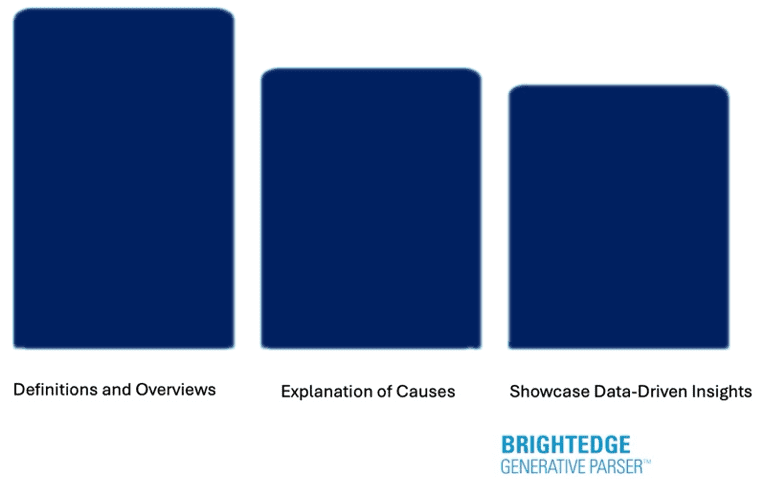
The BrightEdge data shows that in October discovery and research types of queries triggered the most AI Overviews.

The top 3 kinds of answers show in AI Overviews were:

  • Definitions and overviews
  • Explanation of causes
  • Data points

BrightEdge explains what it all means:

  • “The data clearly shows that AIOs are optimized for early-stage research and discovery.
  • Educational content with expert guidance on what’s trending or critical data points is more helpful to cite than specific how-to instructions.
  • Success means aligning your content with this top-of-funnel focus – comprehensive, educational content wins over transactional guidance that could be replaced with ads.”

Most Common Type Of Answer In AI Overviews

Takeaways

BrightEdge’s research offers many insights on the kinds of content Google’s AI Overviews is prioritizing and how it’s ramping up for the holiday shopping season which begins with Black Friday. If traffic patterns are changing then it may be due to the updates to the kinds of queries are triggering AIO and an increase in advertising which, combined with larger sizes of AIO panels, could be pushing organic results lower.

It must be emphasized that organic results have not been the norm for well over ten years and at this point it’s anachronistic to still be thinking in terms of ten blue links. This is why the BrightEdge data is important because it’s showing what’s going on in the search results.

Key Insights

  • Ads are now featuring in AI Overviews
  • Volatility in shopping-related queries is stabilizing, creating a more predictability
  • Google is becoming more precise about what triggers AIOs
  • Product carousels increased by 300% in October
  • Collapsed unordered lists that requires users to click to see more information increased by 20%
  • Queries for specific products are less likely to trigger AIOs
  • Research-phase queries and intents are increasingly the top triggers for AIO

Read the latest research data by BrightEdge

New AI Overview Trends: What to Expect for Black Friday and Cyber Monday (PDF)

Featured Image by Shutterstock/Cranium_Soul

When To Use Nofollow On Links & When Not To via @sejournal, @JulieJoyce

Nofollow was introduced back in 2005 and came about as a reaction to blog spam comments.

Believe it or not, SEO professionals used to try and manipulate Google’s PageRank on their sites just as they try to manipulate, well, everything.

Nofollow basically tells Google (or any other search engine that supports this attribute) not to vouch for the target link.

Whereas it was previously used in the page-level meta tag (), it’s much more common to see it used on a per-link basis now.

What Does Nofollow Mean?

Nofollow is a rel attribute .

A rel attribute specifies the relationship between the page where the link is and the page that the link points to.

Here’s an example of a basic nofollowed link:

I use this type of product.

Google advises us to:

“Use the nofollow value when other values don’t apply, and you’d rather Google not associate your site with, or crawl the linked page from, your site. For links within your own site, use the robots.txt disallow rule.”

However, nofollowing a link is not a guarantee that Google won’t find that page. Google does take information from nofollow links and can discover and index nofollow links. The issue is whether the link passes PageRank.

Dixon Jones has a great article on PageRank for Beginners, but here’s a quick takeaway:

“Although public access to PageRank was removed in 2016, it is believed the score is still available to search engineers within Google…And regardless of what other algorithms Google might choose to call upon, PageRank likely remains embedded in many of the search giant’s systems to this day.”

Nofollow Becomes A Hint

Fast forward to March 2020, Google announced that it saw the nofollow attribute as a hint rather than a directive. This means that when you use a nofollow, you’re indicating your preference to Google that you don’t intend for the link to pass PageRank. Google might ignore your preference.

Many SEO professionals had suspected this was the case, but this was confirmed.

(Interestingly, Bing announced that it has always treated nofollow as a hint.)

Bing HintScreenshot from X (Twitter), October 2024

In addition to this announcement, Google added two more rel attributes to identify the intent of links; rel=”sponsored” and rel=”ugc”.

When To Use rel=”sponsored”

This attribute is used to identify paid content or paid links.

  1. Advertisements and banners.
  2. Sponsored posts or articles.
  3. Affiliate links.
  4. Links in content created as part of a collaboration.
  5. Any link that is exchanged for money, services, or goods.

Example:

I was paid to write about this type of product. (Sponsored post)

When To Use rel=”ugc”

This attribute is used to identify user-generated content like forum posts or blog comments.

  1. Links in comment sections.
  2. Links in forum posts.
  3. Links in user profiles or bios.
  4. Links in user-submitted reviews or testimonials.

Example:

I have used this type of product. (Comment or forum)

Both new attributes can be used with the nofollow attribute, which I have included in the above example.

If your links don’t fall into either new category but you still want to tell Google that you aren’t vouching for them, just use nofollow.

When To Use rel=”nofollow”

You can have a more in-depth look at what Google says about qualifying your outbound links here.

Whereas nofollow was previously used as a general catchall for links that you didn’t want to pass PageRank, now it’s supposed to be used when the other two rel attributes (sponsored and UGC) aren’t relevant, and you don’t want the link to pass PageRank.

Google notes that while not preferred, it’s acceptable to use nofollow instead of the other attributes. You probably don’t need to go back and change your link attributes if you’ve been doing this, but it’s a good idea to start using proper categorization now.

What Is Considered A Paid Link?

Just a quick bit here about paid links: Many people have conflicting opinions on exactly what a paid link is.

However, Google previously described paid links as including these types of links:

“…exchanging money for links, or posts that contain links; exchanging goods or services for links; or sending someone a “free” product in exchange for them writing about it and including a link.”

I do think that there is some confusion here because some oversimplify and think that if they didn’t pay a webmaster to post a link, even if they paid the webmaster to post their content that contains a link, it’s not a paid link.

In Google’s eyes, it’s still a paid link.

Link Schemes

Here is a synopsis of the current list of what constitutes a link scheme:

  • Buying or selling links for ranking purposes. This includes:
    • Exchanging money for links or posts that contain links.
    • Exchanging goods or services for links.
    • Sending someone a product in exchange for them writing about it and including a link.
  • Excessive link exchanges (“Link to me and I’ll link to you”) or partner pages exclusively for the sake of cross-linking.
  • Using automated programs or services to create links to your site.
  • Requiring a link as part of a Terms of Service, contract, or similar arrangement without allowing a third-party content owner the choice of qualifying the outbound link.
  • Text advertisements or text links that don’t block ranking credit.
  • Advertorials or native advertising where payment is received for articles that include links that pass ranking credit, or links with optimized anchor text in articles, guest posts, or press releases distributed on other sites. For example:

    There are many wedding rings on the market. If you want to have a wedding, you will have to pick the best ring. You will also need to buy flowers and a wedding dress.

  • Low-quality directory or bookmark site links.
  • Keyword-rich, hidden, or low-quality links embedded in widgets that are distributed across various sites.
  • Widely distributed links in the footers or templates of various sites.
  • Forum comments with optimized links in the post or signature, for example:

    Thanks, that’s great info!
    – Paul
    paul’s pizza san diego pizzabest pizza san diego

  • Creating low-value content primarily for the purposes of manipulating linking and ranking signals.

I had previously dug into the Wayback Machine to see what Google wrote about link schemes in previous years.

A lot is the same, but there’s a particularly interesting bit from 2013 that I think should still be in there today, as it really tells you how not to build links:

“Links that are inserted into articles with little coherence, for example:
most people sleep at night. you can buy cheap blankets at shops. a blanket keeps you warm at night. you can also buy a wholesale heater. It produces more warmth and you can just turn it off in summer when you are going on france vacation.

*Note: Here’s the original source.

Sadly, that is still a common thing to do.

When You Shouldn’t Use A Nofollow

If you are giving someone a link because you want to, you think it’s a good resource, and you haven’t been given anything or paid for it, you don’t need to nofollow it.

If you don’t see that it in any way can be considered a link that is designed to manipulate PageRank, you don’t need to nofollow it.

Some webmasters have become so afraid of being penalized that they nofollow all outbound links.

In my opinion, this is unnecessary unless your site only exists to sell links.

What About Dofollow?

It doesn’t exist.

If a link isn’t nofollowed, it’s automatically followed.

(Unless it’s nofollowed through a meta robots tag on a page level. Read Google’s help doc on the topic for more information.)

What Value Does A Nofollowed Link Bring?

A nofollowed link may not help you rank higher – but with the decision to treat it as a hint instead of a directive, it still could.

Nofollowed links are also part of a natural link profile, and a site with no nofollowed links looks odd.

The best thing about nofollowed links is that they are good for traffic and can send you much more traffic than many followed links.

If the New York Times ran a story and gave you a nofollowed link, wouldn’t you still be happy with it?

I know I would.

How Can I See How Many Nofollowed Links I Have?

All major tools will tell you how many nofollowed and followed links you have.

Here are a few examples of what that looks like.

Ahrefs

ahrefsScreenshot from Ahrefs, October 2024

Majestic

MajesticScreenshot from Majestic, October 2024

Semrush

SEMRushScreenshot from Semrush, October 2024

How Do I Tell If A Link Is Nofollowed

I don’t like to use a lot of plugins, so I tend to head straight for the code.

I look to see if nofollow is in the code for my link.

Below is an example from this post.

 nofollow">Screaming Frog
  • nofollow">SEMrush
  • nofollow">Ahrefs
  • nofollow">Majestic
  • However, some plugins can highlight nofollows:

    Detailed SEO Extension

    detailed nofollowScreenshot from author, October 2024

    Ahrefs Chrome Plugin

    ahrefs nofollowScreenshot from author, October 2024

    Igoreware Nofollow Extension

    igorware nofollowScreenshot from author, October 2024

    To Nofollow Or Not To Nofollow?

    Follow:

    • If you are linking out to a source and you trust the source.
    • Guest post: Unless they’re posting on a large scale. This is for a true guest post where you are not paying for the post.
    • Link to social media profiles.

    Nofollow:

    • If you sold a link.
    • If someone paid you to post their content.
    • If you are in any way nervous that you might be penalized for the link.
    • Sitewide link to the person who designed your site, although many people will follow links to company names.
    • Widgets.

    Nofollow In The Real World

    Let’s face it. We don’t always stick to the rules as SEO pros.

    We manipulate anything that works well, and it gradually becomes useless or dangerous.

    So, are people using nofollow, UGC, and sponsored values as Google intends?

    Time will tell.

    More resources:


    Featured Image: Moon Safari/Shutterstock