Google Search Snippets Show Contradictory Information, Study Finds via @sejournal, @MattGSouthern

A recent investigation finds that Google’s Featured Snippets may display conflicting information from the same source material, depending on how users phrase their search queries.

This raises concerns about the search engine’s ability to interpret content accurately.

Sarah Presch, director at Dragon Metrics, discovered that Google’s Featured Snippets pull opposing statements from the same articles when users frame questions differently.

For example, searching “link between coffee and hypertension” generates a Featured Snippet highlighting caffeine’s potential to cause blood pressure spikes.

Searching “no link between coffee and hypertension” produces a contradictory snippet from the same Mayo Clinic article stating caffeine has no long-term effects.

Similar contradictions appeared across health topics, political issues, and current events.

The investigation found that asking whether a political candidate is “good” versus “bad” yields dramatically different results despite the fundamental question remaining the same.

Impact On Search Quality

“It’s one big bias machine,” Presch notes, explaining how Google’s algorithms appear to prioritize content that matches user intent rather than providing comprehensive, balanced information.

The findings align with internal Google documents from 2016, where engineers admitted, “We do not understand documents – we fake it.”

While Google maintains these documents are outdated, SEO experts suggest the underlying technical limitations persist.

Presch adds:

“What Google has done is they’ve pulled bits out of the text based on what people are searching for and fed them what they want to read.”

Mark Williams-Cook, founder of AlsoAsked, commented on the findings, stating:

“Google builds models to try and predict what people like, but the problem is this creates a kind of feedback loop. If confirmation bias pushes people to click on links that reinforce their beliefs, it teaches Google to show people links that lead to confirmation bias.”

Implications

These findings have implications for content creators and SEO professionals:

  • Featured Snippets may not accurately represent comprehensive content
  • User intent heavily influences how content is interpreted and displayed
  • Content strategy may need adjustment to maintain accuracy across various query formats

Google’s spokesperson defended the system, stating that users can find diverse viewpoints if they scroll beyond initial results.

The company also highlighted features like “About this result” that help users evaluate information sources.

Recommendations

Based on these findings, publishers should take the following actions:

  • Develop comprehensive content that remains accurate regardless of how queries are phrased.
  • Recognize the impact of search intent on the selection of Featured Snippets.
  • Track how your content is displayed in Featured Snippets for different search phrases.

As Google moves toward becoming an “answer engine” with AI-generated responses, digital marketers and content creators need to understand these limitations.


Featured Image: Song_about_summer/Shutterstock

ChatGPT Search May Have A Shot At Google via @sejournal, @Kevin_Indig

ChatGPT Search (CGS) is a landmark launch in the shift from traditional to AI Search.

Now, OpenAI competes with Google (Search) heads-on. Note the subtle elbow hit between the lines in the announcement:

Getting useful answers on the web can take a lot of effort. It often requires multiple searches and digging through links to find quality sources and the right information for you.

The positioning is clear: ChatGPT Search is a way to get a straight answer without digging through cluttered search results or browsing websites.

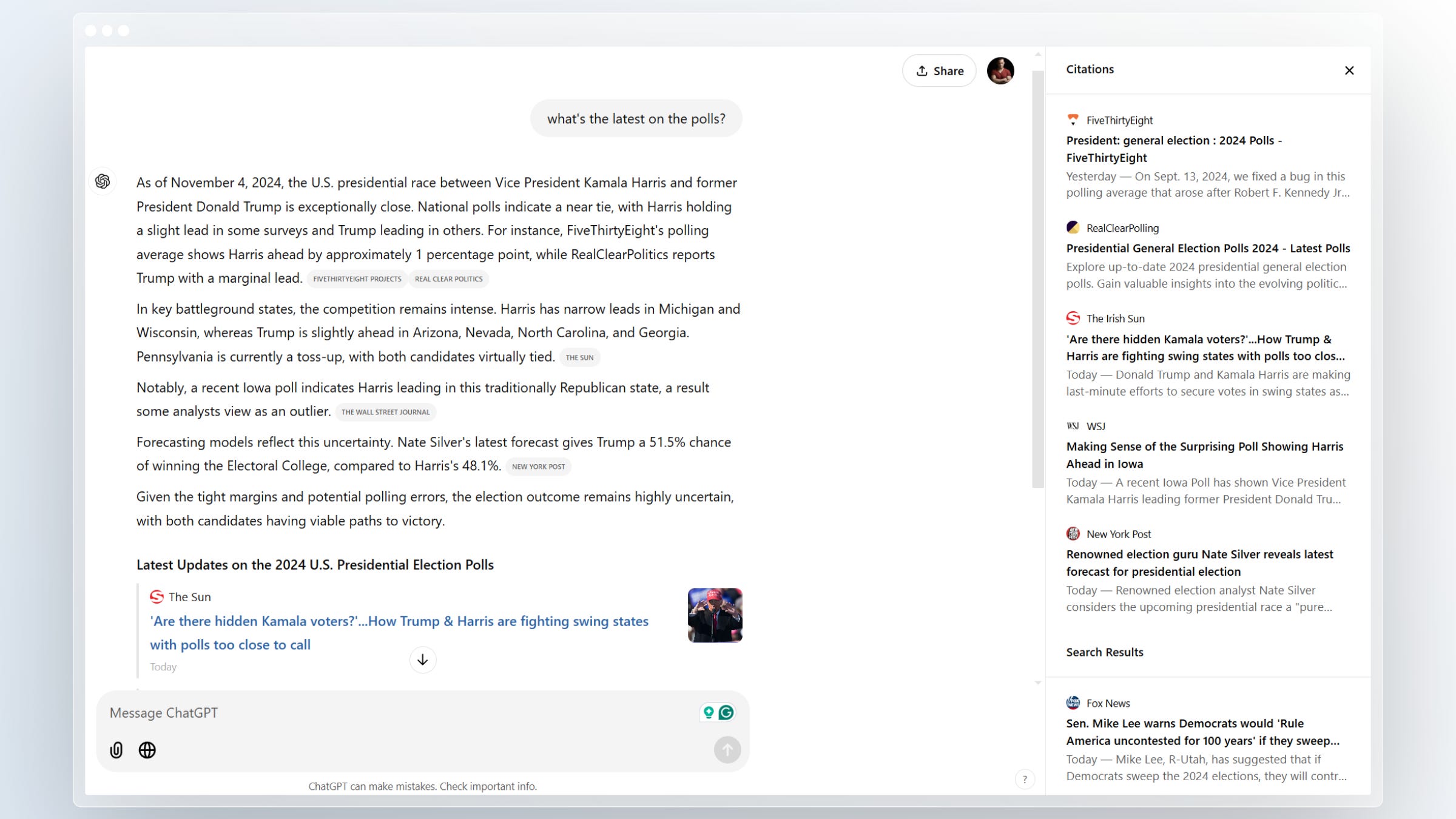
CGS, which is directly integrated with ChatGPT instead of a standalone search engine, decides whether a query benefits from web results or not, and you can rerun queries through other models like o1 preview to compare the answers:

ChatGPT will choose to search the web based on what you ask, or you can manually choose to search by clicking the web search icon.

It keeps the context of your search going in a conversation interface (bolding from me):

Go deeper with follow-up questions, and ChatGPT will consider the full context of your chat to get a better answer for you.

ChatGPT Search’s interface features prominent links to sources (Image Credit: Kevin Indig)

OpenAI has a strategic advantage, as I explained in Search GPT:

The Information reports that OpenAI loses $5 billion a year in expenses. Just capturing 3% of Google’s $175 billion Search business would allow OpenAI to recoup expenses.

OpenAI has a strategic advantage over Google: Search GPT can provide a very different, maybe less noisy, user experience than Google because it’s not reliant on ad revenue. In any decision regarding Search, Google needs to take ads into account.

CGS marks the entry to a new paradigm where traditional search engines like Google or Bing compete with AI chatbots.

They solve the same problems for users as search engines but with lower friction. But it also marks a critical event that should lead you to evaluate your strategy.

Companies face a choice to invest and “be early” to AI Search or ignore the noise and stay the course. What makes this decision hard:

  1. Divided opinions about Chat GPT’s chance to take significant market share from Google.
  2. Rapidly changing mechanisms of AI Search platforms.
  3. Confusion about what to do.

The first search engines didn’t represent the model (Google) that eventually won.

In the same vein, the AI Search experience we’re seeing today might be completely different in a few years. However, there is little doubt that search is fundamentally changing.

As a result, my recommendation is to invest in AI Search. It is not capital-intensive (yet), but the upside to finding a playbook is high.

If CGS grabs significant Google market share, you’re in a good position. If it fails, no harm is done.

Collision Course

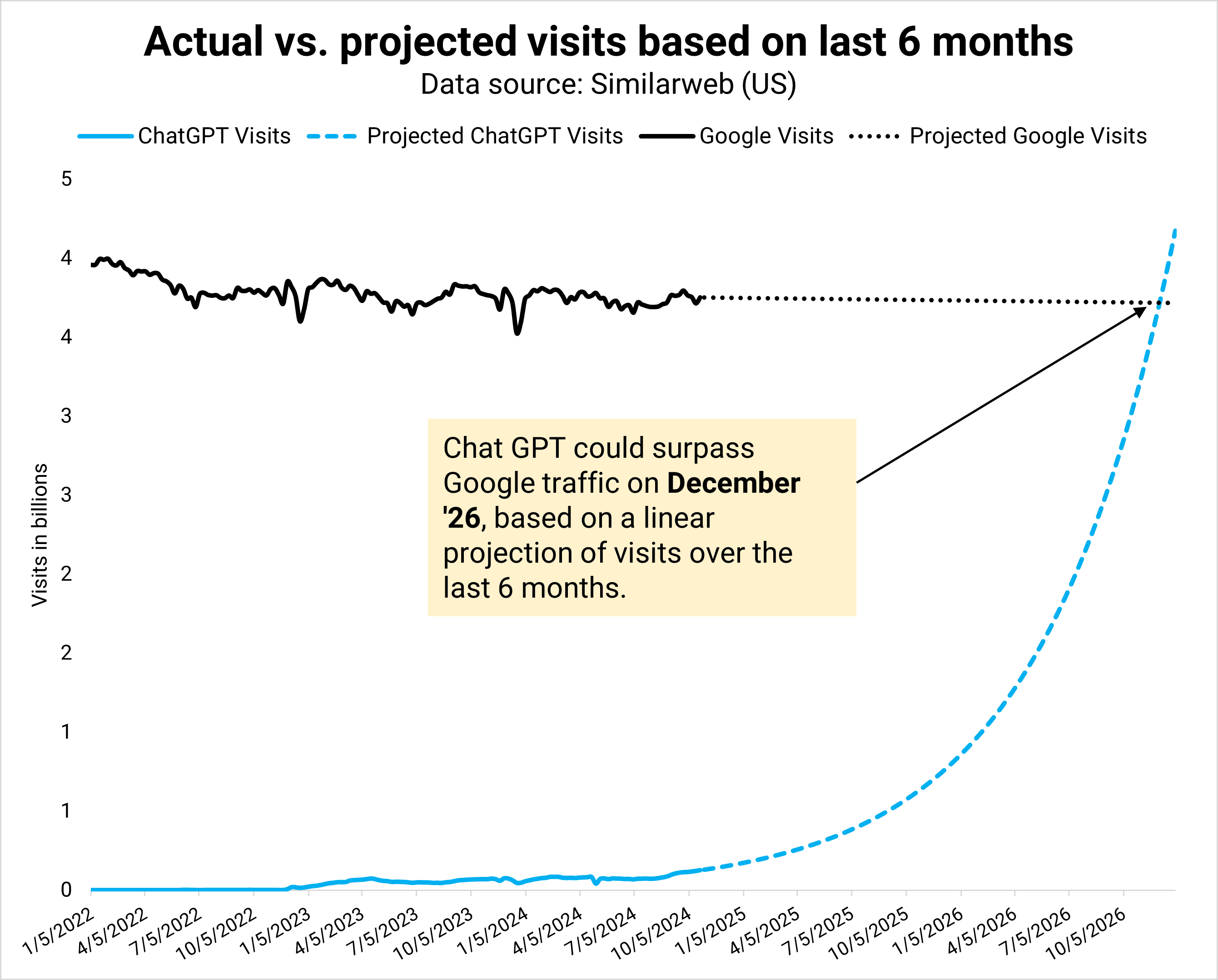
Based on recent traffic trends, ChatGPT could catch up to Google in 2 years. (Image Credit: Kevin Indig)

In the chart above, I extrapolated ChatGPT’s and Google’s total traffic over the next two years if the trend from the last six months remains constant.

This chart will probably outrage or scare you, but the chance that events unfold exactly as depicted in this chart is low.

The reason I bring it up here is to consider the fact that many structural changes start slowly based on the saying “first gradually, then suddenly.”

It took Google about three to four years to beat Yahoo, Altavista, and Lycos. Given that new technology gets to critical mass ever faster, I’m not surprised ChatGPT could do it faster (in theory).

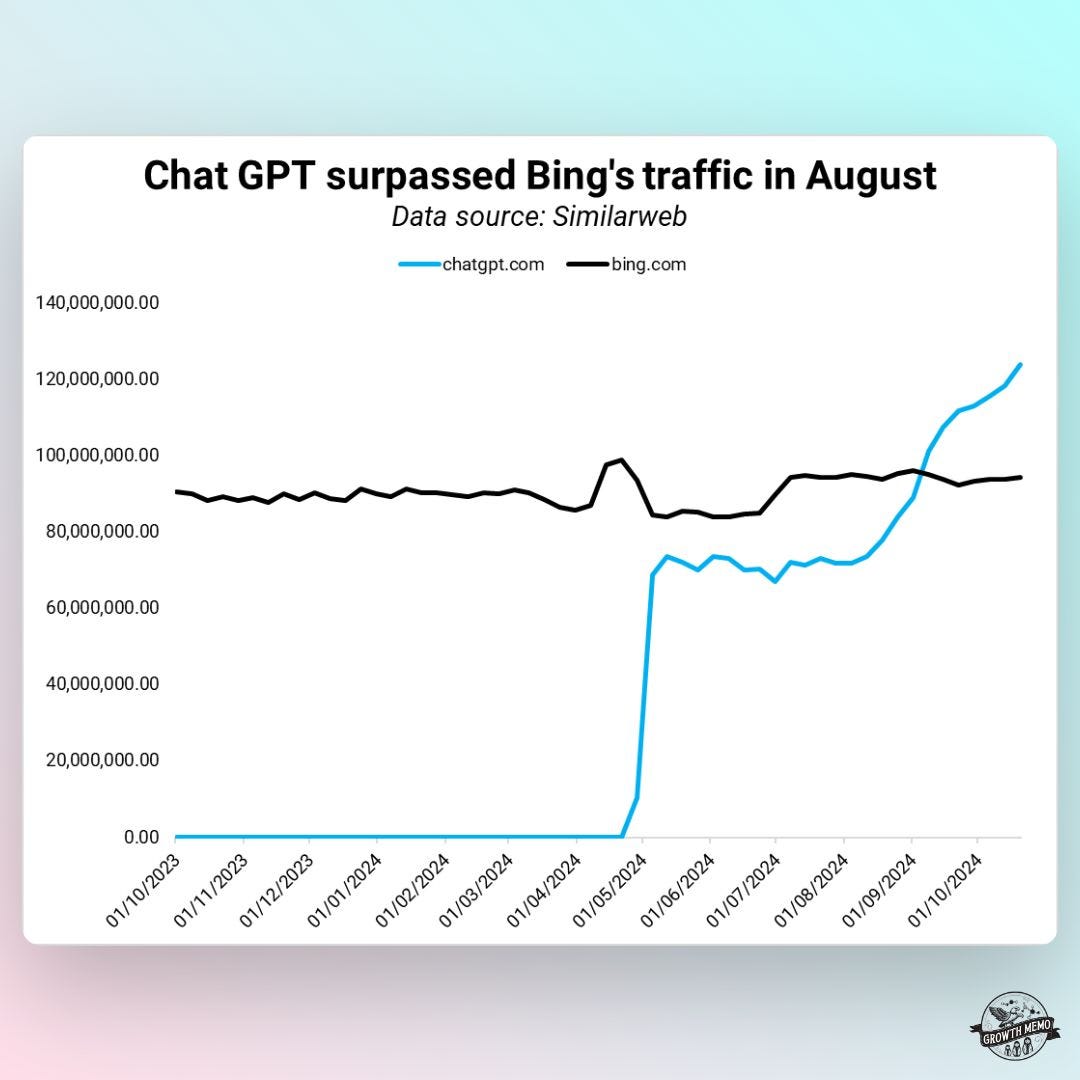
ChatGPT’s traffic has already passed the No. 3 search engine, Bing (YouTube is second).

When you look at comments and posts on social media, more and more people report using ChatGPT instead of Google for various purposes, but that could be availability bias.

Image Credit: Kevin Indig

One point a lot of people miss when looking at the traffic comparison between ChatGPT and Bing is that they’re not the same, and yet this is a fair comparison.

ChatGPT is more than a search engine. People use it for all sorts of things. But that’s exactly the point: a search engine that looks like Google never stood a chance to compete with Google or Bing.

CGS is something new, and that’s why it stands a chance. So, when you see chatgpt.com passing bing.com, the critical argument is not that both do different things but that they’re used to accomplish the same goal.

After all, search is just a way to solve problems or achieve goals, not to search for the sake of searching.

To clarify, I don’t think Google or Alphabet as a company is at risk of dying. I do think CGS has a chance to capture significant market share, and too many people underestimate how fast this can go.

Referral Traffic Skyrockets

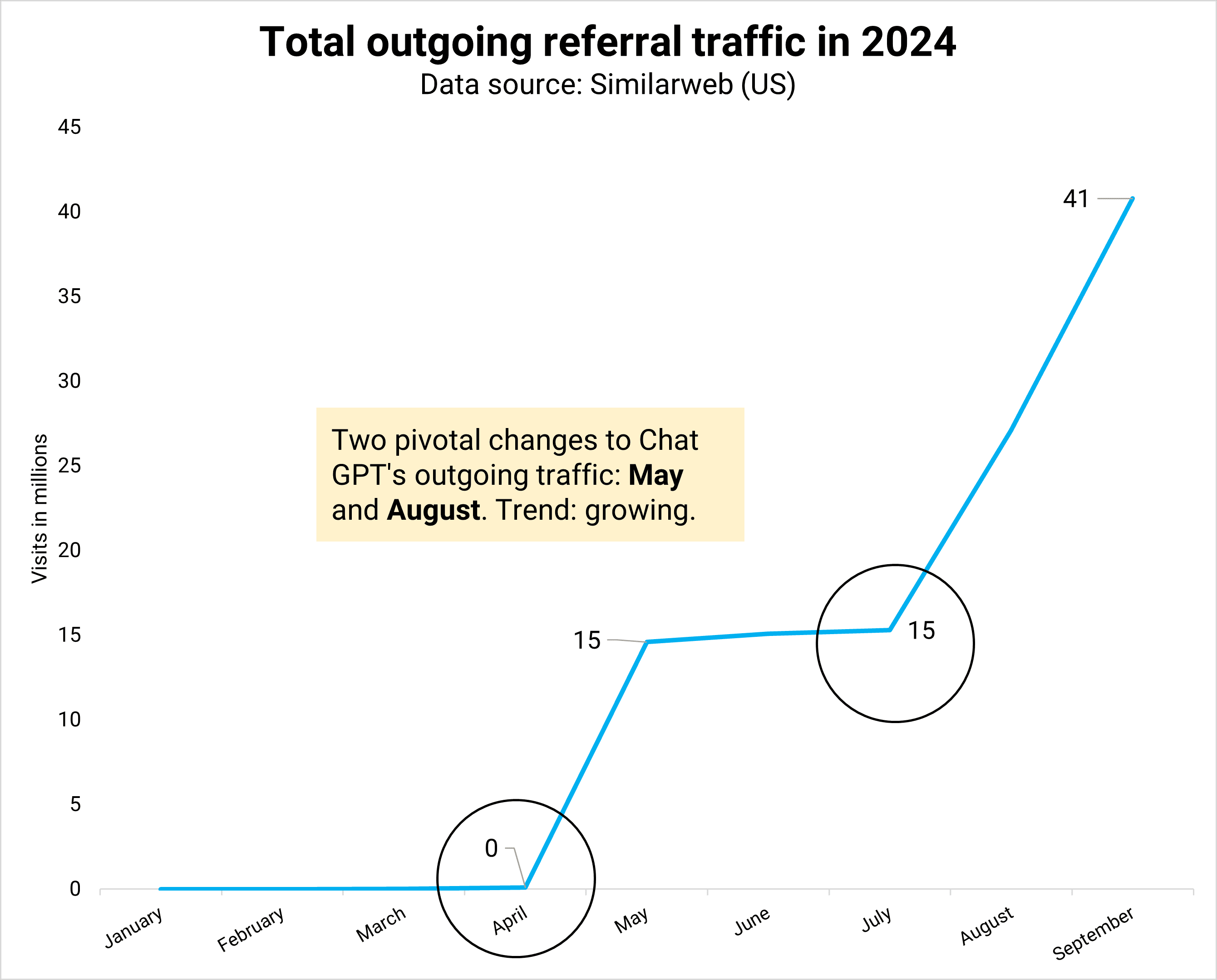
ChatGPT’s outgoing referral traffic is skyrocketing (Image Credit: Kevin Indig)

AI Search marks a new paradigm where users get a direct answer without having to browse websites. So, how should companies think about pivoting their strategy?

Here’s what I’m telling my clients when they ask me whether they should pivot their SEO roadmap: For now, no. Reserve 10 to 20% of capacity to establish visibility in AI Search and for experimentation.

Look for signal: If you’re hesitant to invest more in AI Search right now, at least monitor traffic to and from ChatGPT. Base your decision on how long ChatGPT can keep its current traffic trend up.

Establishing visibility: This referral dashboard from Flow Agency is great for monitoring referral traffic.

With a few tweaks, you can monitor conversions in GA4 as well. You should also monitor site crawls from LLMs and your performance on Bing.

Then, experiment with content tweaks to improve your AI Search visibility. Keep investing in traditional SEO because it forms the basis of AI Search and answers.

Place a bet: The big question in this is whether you’re willing to take a bet or play it safe.

Being a first-mover to SEO had massive benefits as the incumbents tend to stay incumbents, mainly caused by strong backlink profiles, robust user signals, and brand familiarity.

For now, ChatGPT uses Bing search results to ground and weigh answers, which means sites with strong visibility on Bing also have a high chance of being very visible in CGS.

However, there is a chance that using Search for RAG (grounding) is just a jumping-off point until AI Search platforms have gathered enough of their data (queries and user behavior).

Early in this transition period, not much changes. Content that ranks well in traditional search engines, specifically Bing, gets a higher weighting in CGS, which means traditional SEO has a big impact on visibility in AI Search.

AI Chatbot referral traffic is skyrocketing, and ChatGPT’s new search capability could accelerate that growth even more.

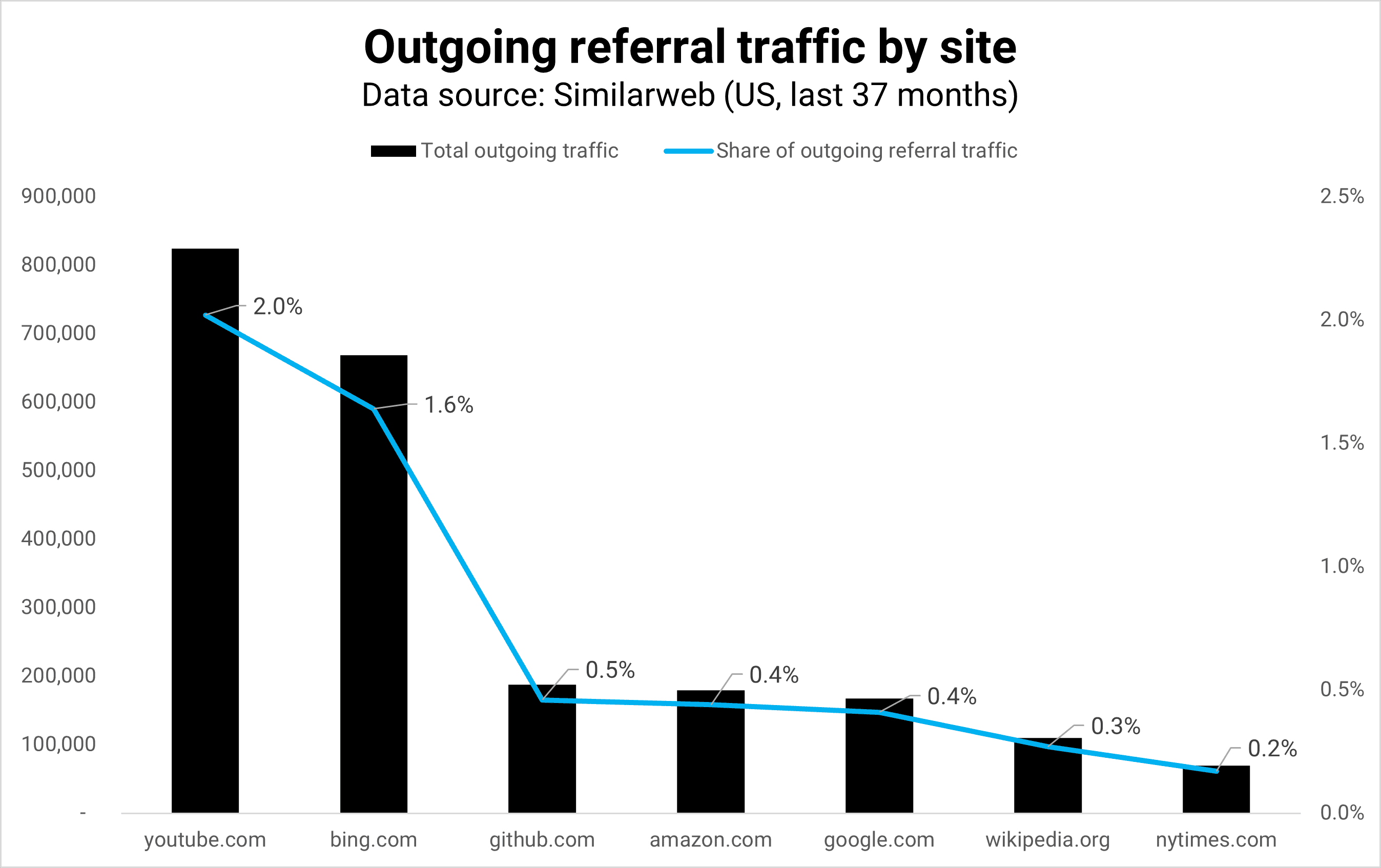
Outgoing referral traffic from chatgpt.com increased massively in August and September, according to Similarweb.

Image Credit: Kevin Indig

Noticeable call-outs:

  • YouTube’s referral traffic increased from .17% in July to 3.9% in September.
  • Bing grew from 0% in April to 1.8% in September.
  • Amazon grew from 0% in July to 1.1% in September.

If referral traffic keeps growing at the same rate, it will get interesting in the next six to 12 months. It’s not just the volume but also the quality of traffic.

People use longer and more complex questions when they engage with AI answers, according to Sundar Pichai. Length is a way to be more specific.

Longer questions allow search engines, LLMs, and marketers to better understand and serve users what they want.

Based on conversations and observations, referral traffic from AI chatbots isn’t consistently higher than search traffic in every case, but in most.

Looking Forward

I’m leaving you with two interesting questions:

1. Is it a coincidence that ChatGPT Search came out three days after Apple Intelligence launched publicly?

Apple launched Apple Intelligence, which uses ChatGPT in certain situations:

Apple is integrating ChatGPT access into experiences within iOS 18, iPadOS 18, and macOS Sequoia, allowing users to access its expertise — as well as its image- and document-understanding capabilities — without needing to jump between tools. Siri can tap into ChatGPT’s expertise when helpful.

Users are asked before any questions are sent to ChatGPT, along with any documents or photos, and Siri then presents the answer directly.

Additionally, ChatGPT will be available in Apple’s systemwide Writing Tools, which help users generate content for anything they are writing about. With Compose, users can also access ChatGPT image tools to generate images in a wide variety of styles to complement what they are writing.

We also know how valuable Google’s exclusive search deal with Apple is.

From Monopoly:

Apple’s impact on Google Search is massive. The court documents reveal that 28% of Google searches (US) come from Safari and make up 56% of search volume. Consider that Apple sees 10 billion searches per week across all of its devices, with 8 billion happening on Safari and 2 billion from Siri and Spotlight.

“Google receives only 7.6% of all queries on Apple devices through user-downloaded Chrome” and “10% of its searches on Apple devices through the Google Search App (GSA).” Google would take a big hit without the exclusive agreement with Apple.

Since Search is part of ChatGPT, any API request could trigger the new Search feature.

As a result, ChatGPT has a direct line to searches and actions on Apple devices whenever Apple Intelligence uses ChatGPT. Is that integration the new version of Google’s deal with Apple?

I speculated that OpenAI could work on a browser in Search GPT:

If the main benefit or Search GPT for OpenAI is a revenue stream and access to more user data, the next logical step for OpenAI is to build a (AI-powered) browser.

Browser data is incredibly valuable for understanding user behavior, personalization and LLM training. Best of all, it’s app-agnostic, so OpenAI could learn from users even when they use Perplexity or Google.

We’ve seen the power of browser data in the Google lawsuit, where it turned out Google relied on Chrome data all along for ranking. The only layer that’s more powerful is the operating system and device layer.

OpenAI seems to be very aware of the importance of being the default when we look at how hard it pushes its Chrome extension, which changes the default browser search engine to ChatGPT.

2. As it’s likely that more users don’t browse the web but get answers from ChatGPT, Gemini, Perplexity, etc. directly, will the open web become a place primarily for bots instead of humans? And how would that change the purpose and look of websites?


1 Introducing ChatGPT search

2 Introducing Apple Intelligence, the personal intelligence system that puts powerful generative models at the core of iPhone, iPad, and Mac


Featured Image: Paulo Bobita/Search Engine Journal

What Is A Google Broad Core Algorithm Update? via @sejournal, @RyanJones

Since the first broad core algorithm update, there has been much confusion, debate, speculation, and questions about what exactly it is.

How does a core update differ from a named update that many SEO pros are used to?

Google’s acknowledgment of core updates is usually vague, offering little detail beyond the fact that the update occurred. As we’ll see in this post, there is a good reason for this.

Typically, core updates take a few days (or weeks) to fully roll out, with Google making one announcement at the start and another at its conclusion. This invariably leaves SEO professionals and site owners wondering how the core update impacted their rankings.

Understanding a broad core update and how it differs from other algorithm updates can provide insight into what may have caused a site’s rankings to go up, down, or stay the same.

So, What Exactly Is A Core Update?

First, let me get the obligatory “Google makes hundreds of algorithm changes per year, often more than one per day” boilerplate out of the way.

Many of the named updates we hear about (Penguin, Panda, Pigeon, Fred, and the much-talked-about Helpful Content Update – which has since been integrated into core) are implemented to address specific faults or issues in Google’s algorithms.

In the case of Penguin, it was link spam; in the case of Pigeon, it was local SEO spam. Each of these targeted one specific thing – and, in many cases, brought a new metric or new calculation or new machine learning model into the overall algorithm.

They all had a specific purpose but also required new data or new systems to run.

In these cases, Google (sometimes reluctantly) informed us what it was trying to accomplish or prevent with the algorithm update, and we were able to go back and remedy our sites.

A core update is different.

The way I understand it, a core update is a tweak or change to the main search algorithm itself.

It’s not adding anything “new” in terms of metrics, data, signals, machine learning, etc. It’s simply re-arranging or adjusting existing signals/factors and their importance.

You know, it is believed that there are somewhere between 200 and 500 (or maybe more) ranking factors and signals – the exact number is unknown.

What a core update means to me is that Google slightly tweaked the importance, order, weights, or values of these signals.

Because of that, they can’t come right out and tell us what changed without revealing the secret sauce.

The simplest way to visualize this would be to imagine, let’s say, 200 factors listed in order of importance.

Now imagine Google changing the order of 42 of those 200 factors.

Rankings would change, but it would be a combination of many things, not due to one specific factor or cause.

Obviously, it isn’t that simple, but that’s a good way to think about a core update.

A good analogy would be your list of top 10 favorite Taylor Swift songs. You might re-order that occasionally based on what’s going on in your life – or she may update an older song or release some new music. All of that might change your list.

Here’s a purely made-up, slightly more complicated example of things Google might adjust and why it can’t tell us.

“In this core update, we increased the value of keywords in H1 tags by 2%, changed the core web vitals boost from 0.00001 to 0.0000001, decreased the value of the ratio of keyword trigrams covered by title trigrams, changed the D value in our PageRank calculation from .85 to .70, and started using a TF-iDUF retrieval method for logged in users instead of the traditional TF-PDF method.”

(I swear these are real things in information retrieval. I just have no idea if they’re real things used by Google.)

As you can see, these types of updates wouldn’t be helpful at all to SEO professionals – even if they understood them.

Put simply, a core update means Google changed the weight and importance of existing ranking factors and signals – and some results shifted because of it.

At its most complex form, Google ran a new training set through its machine learning ranking model. Quality raters gave this new set of results a higher Information Satisfaction (IS) score than the previous set, and the engineers have no idea what weights changed or how they changed because that’s just how machine learning works.

(We all know Google uses quality raters to rate search results. These ratings are one input into how it chooses one algorithm change over another – not how it rates your site. Whether it feeds this into machine learning is anybody’s guess. But it’s one possibility.)

It’s likely some random combination of weighting delivered more relevant results for the quality raters, so they tested it more, the test results (clicks!) confirmed it, and they pushed it live.

Remember clicks in the famous Google leak? This is one way they use those – for A/B testing new algorithm variants.

How Can You Recover From A Core Update?

I want to be very clear about language here.

A core algorithm update didn’t “penalize” you for something. It’s not adding negative weights. It most likely just rewarded another site more than yours when it comes to relevance, authority, and quality signals.

Unlike a major named update that targets specific things, a core update may tweak the values of everything.

New sites could be considered for this query; old sites no longer considered. Many sites were probably updated. The user intent (click data) could have changed for this query, new entities could be deemed relevant to this query, the link graph could have changed, etc.

Data changes and the weights of factors have been re-ordered.

Because websites are weighted against other websites relevant to your query (engineers call this a corpus), the reason your site dropped could be entirely different than the reason somebody else’s increased or decreased in rankings.

To put it simply, Google isn’t telling you how to “recover” because it’s likely a different answer for every website and query.

Maybe you were killing it with internal anchor text and doing a great job of formatting content to match user intent – and Google shifted the weights so that content formatting was slightly higher and internal anchor text was slightly lower.

(Again, hypothetical examples here.)

In reality, it was probably several minor tweaks that, when combined, tipped the scales slightly in favor of one site or another (think of our reordered list here).

Finding that “something else” that is helping your competitors isn’t easy – but it’s what provides SEO pros with some job security.

What about AI?

It’s worth pointing out that core updates do affect Google’s AI overviews and citations – as those things are powered by search.

Next Steps And Action Items

Rankings are down after a core update – now what?

First step: Figure out if there are any patterns in the pages that dropped. Were they all the same template? Same intent? Same private blog network of paid links? (Just kidding).

Google is good at patterns; we should be good at spotting them, too.

Your next step is to gather intel on the pages that are ranking where your site used to be.

Conduct a search engine results page (SERP) analysis to find positive correlations between pages that are ranking higher for queries where your site is now lower.

Try not to overanalyze the minute technical details, such as how fast each page loads or its core web vitals scores. These are very minor tiebreaker factors.

Pay attention to the content itself. As you go through it, ask yourself questions like:

  • Does it provide a better answer to the query than your article?
  • Does the content contain more recent data and current stats than yours?
  • What’s the information gain of this page compared to the others that rank? Does it just say the same stuff or does it offer more?
  • What is the intent of the user doing this query? Does this help them accomplish that better?

Google aims to serve content that provides the best and most complete answers to searchers’ queries. Relevance is the one ranking factor that will always win out over all others.

Take an honest look at your content to see if it’s as relevant today as it was prior to the core algorithm update.

From there, you’ll have an idea of what needs improvement.

The best advice for conquering core updates? Keep focusing on:

Finally, don’t stop improving your site once you reach position 1 because the site in position 2 will not stop.

Yeah, I know – it’s not the answer anybody wants, and it sounds like Google propaganda, but it’s just the reality of what a core update is.

Nobody said SEO was easy.

More resources: 


Featured Image: BestForBest/Shutterstock

Making Social Media & SEO Work Together via @sejournal, @krisjonescom

The synergy between social media and SEO is critical in modern digital marketing.

As a seasoned SEO professional with 26 years of experience, I’ve observed how recent developments – such as the Google algorithm updates and the rise of Artificial Intelligence Optimization (AIO) – have reshaped the interplay between social media and search engine optimization.

Understanding this dynamic is essential for businesses aiming to enhance their online visibility and connect with their target audience effectively.

In this article, we’ll explore how social media can significantly boost your SEO efforts.

We’ll delve into practical examples, consider the impact of recent industry changes, and provide up-to-date references to help you navigate this complex landscape.

The Evolving Relationship Between Social Media And SEO

A Brief History And Recent Developments

Historically, the connection between social media and SEO has been nuanced.

While Google has consistently stated that social signals (likes, shares, comments) are not direct ranking factors, the indirect benefits are undeniable.

The Google leak of 2024, which unveiled insights into the search giant’s algorithmic considerations, highlighted the growing importance of user engagement metrics – many of which are influenced by social media activity.

Moreover, the introduction of AIO has further intertwined social media with SEO.

AIO leverages AI to optimize content and user experiences across platforms, including social media.

With AI algorithms now better at understanding content context and user intent, the lines between social media engagement and SEO performance are blurring.

The Impact of AI And Algorithm Updates On Social Signals

Google’s advancements in AI, particularly with the BERT and MUM algorithms, have enhanced the search engine’s ability to interpret natural language and user intent.

These developments mean that content shared on social media – especially when it generates significant engagement – can influence how search engines perceive and rank your website indirectly.

For instance, a viral social media post can lead to increased brand searches on Google, which is a positive signal to the search engine about your brand’s authority and relevance.

Additionally, AI-powered tools now analyze social media trends to inform SEO strategies, making social media an indispensable component of SEO planning.

How Social Media Helps SEO

1. Amplifying Content Reach And Engagement

Social media platforms serve as powerful amplifiers for your content, extending its reach beyond your website’s regular audience.

By actively sharing and promoting your content on these platforms, you tap into a vast network of potential readers, customers, and influencers who can engage with and spread your message further.

Example: Imagine you’ve published a comprehensive guide on sustainable living on your website. By sharing this guide on your social media platforms, you expose it to a broader audience who may not have found it through search engines alone. If your post gains traction – receiving shares, comments, and likes – it can drive substantial traffic to your site.

Recent Changes: With the rise of short-form video content on platforms like TikTok and Instagram Reels, sharing snippets or highlights of your content can entice users to visit your website for the full version. These platforms’ algorithms favor engaging content, increasing the likelihood of your content reaching a wider audience.

2. Enhancing Link Building Opportunities

Backlinks remain a cornerstone of SEO, signaling to search engines that your content is valuable and authoritative.

Social media can be a catalyst for earning these backlinks by exposing your content to individuals and organizations that may link to it from their own websites or blogs.

Example: A tech startup publishes an insightful article about emerging technologies. By promoting this article on LinkedIn, industry professionals may notice and reference it in their own blogs or articles, creating valuable backlinks.

Recent Changes: Google has provided guidance that focusing too much on links can be a distraction from what matters most to your audience. While links are still important, engagement with your content is becoming a key metric of effectiveness. Social media is an excellent way to both encourage and measure engagement with your content. A strong social media strategy encourages the most valuable types of links: earned links based on content that resonates with your audience.

3. Social Profiles In SERPs And Brand Visibility

Your social media profiles are extensions of your brand and can occupy prominent positions in search engine results pages (SERPs).

Optimizing these profiles not only strengthens your online presence but also provides additional pathways for users to discover and engage with your brand.

In recent updates, Google emphasizes results from user-generated content on Reddit so being present in relevant conversations and managing your brand on social platforms is becoming more critical to your SEO strategy.

Example: When users search for your brand, your social media profiles can appear alongside your website in the search results, occupying more real estate on the SERP and increasing your brand’s visibility.

Recent Changes: With Google’s continuous updates, there is a greater emphasis on providing users with comprehensive information. Social media profiles often appear in the knowledge panel or as rich results, offering users direct access to your latest updates and engagement opportunities.

4. Building Brand Trust and Authority

In a crowded digital marketplace, establishing trust and authority is essential.

Social media allows you to showcase your expertise, engage authentically with your audience, and build a community around your brand – all of which contribute to a stronger, more trustworthy online presence.

Example: A financial advisor regularly shares expert insights on X (Twitter), engaging with followers’ questions and discussions. This consistent presence builds credibility, encouraging users to visit their website for more in-depth information.

Recent Changes: The integration of user-generated content and reviews on social media platforms can influence public perception. Google considers brand reputation in its E-E-A-T (experience, expertise, authoritativeness, trustworthiness) criteria, and a strong social media presence contributes to this.

Conclusion

Social media and SEO are more interconnected than ever.

The evolution of Google’s algorithms and the advent of AI optimization have amplified the impact social media can have on your SEO efforts.

By strategically leveraging social platforms to share content, engage with your audience, and build brand authority, you indirectly boost your search engine rankings.

Remember, while social media signals may not be direct ranking factors, the ripple effects – such as increased traffic, enhanced backlink opportunities, and improved brand perception – play a significant role in your overall SEO performance.

Embrace the synergy between social media and SEO to stay ahead in this dynamic environment.

By integrating these strategies into your digital marketing plan, you’ll not only enhance your SEO efforts but also build a more robust and engaged online presence.

Stay informed about the latest developments, and don’t hesitate to adapt your approach as the digital landscape continues to evolve.

More resources:  


Featured Image: gonin/Shutterstock

How To Optimize Your Ecommerce Site For Holiday Shoppers via @sejournal, @wburton27

Peak shopping periods like Black Friday, Halloween, Christmas, and other holidays attract millions of shoppers online.

They also present prime opportunities for ecommerce and retail brands to drive incremental revenue and traffic for the holiday season.

According to the NRF, the 2024 holiday forecast is consistent with its forecast that annual sales for 2024 will be between 2.5% and 3.5% over 2023. Some noteworthy mentions:

One differentiating characteristic from last year’s holiday shopping season is that the shopping period between Thanksgiving and Christmas will be six days shorter, totaling 26 days. Additional contributing factors this year could include the economic impact of Hurricanes Helene and Milton; even though the 2024 U.S. presidential election will take place during the winter holiday season, it is impossible to measure its impact on current or future spending.

Screenshot from NRF.com, October 2024

According to Statista, in the U.S., a lot of holiday consumers intend to buy products for 2024 for the holiday celebration, with 97% for Halloween, 92% for Thanksgiving, and 96% for Christmas.

Screenshot from Statista, October 2024

Since sales are expected to be up year over year, what are the best ways to optimize your site for the holidays? When should you start, and what should you do? Let’s explore.

SEO Tips For Optimizing Your Ecommerce Website

Plan Ahead

One of the most important aspects of optimizing your site for the holidays is planning.

If you build landing pages now for Christmas and expect them to rank for competitive terms, it won’t happen.

Always build out your content calendar in advance (i.e., two to three months or more ahead of time).

Make sure you do your keyword research and start planning which content you need to create, get approvals for, deploy, etc.

Use Evergreen URLs

Create reusable URLs for promotions that you can use year after year. You can mention the date or year in the page title or copy and then change it each year, but don’t use it in the URL.

I can’t tell you that, in my 20 years of doing SEO, I saw a lot of big brands make the mistake of either taking down their landing pages or adding the year to their landing page URL for seasonal products.

The good news is that most big box retailers are doing this correctly now.

For example, Target has a dedicated landing page for its Thanksgiving TV deal at https://www.target.com/s/samsung+tv+deals+thanksgiving.

Now, if it were to put in a year, it would have to redirect the page every year, but it is following a good SEO strategy. This allows the pages to age, secure links, build authority, and be used for internal links.

Screenshot from Target.com, October 2024

Prepare For AI Overviews

We live in a world where AI has changed user behavior, and people ask questions about your brand and our product.

Screenshot from search for [plasma TV], Google, October 2024

Make sure your site is optimized for AI Overviews and follows best practices:

  • Follow Google’s Search Essentials Guide.
  • Support and expand on the information in AI Overviews.
  • Target long-tail information queries.
  • Make sure the content is relevant and answers questions.
  • Format the content structure.
  • Keep content fresh and updated.

Blend SEO And PPC Strategy

Unfortunately, SEO keeps getting pushed down further and further down the page.

You must work with your paid search team to build a blended strategy for ranking competitive keywords and owning the entire SERP.

For example, a search for [what is the best TV to buy for thanksgiving] has transactional intent. The SERPs show sponsored listings first, followed by videos and People Also Ask (PAA).

Having both a paid ad and ranking organically is key to capturing more clicks and potential sales.

Paid search can also create holiday-themed ad campaigns targeting your trophy keywords and drive more sales.

Build out content that uses the PAA strategy. This feature in the Google SERPs provides end users with additional questions related to their search query and quick answers.

Don’t Forget About Reddit

Reddit has been showing up in the SERPS for questions regarding holiday queries.

This represents an opportunity to get in front of your target audience, so make sure to follow Reddit’s best practices, which include:

  • Identify relevant subreddits related to your products (e.g., r/Gift ideas).
  • Avoid self-promotion and engage with the community.
  • Share relevant content, optimize, and monitor performance.
  • Post, network, build relationships, and participate in discussions.
Screenshot from search for [holiday gift ideas], Google, October 2024

Optimize Speed And Performance

Make sure your site is optimized for mobile devices, loads as quickly as possible – preferably under 3 seconds – and passes Core Web Vitals.

It’s important from a user experience perspective, especially because most shopping will be done using a mobile device. Avoid big holiday hero images, interstitials, etc.

Offer Holiday Gift Guides And Promotions

Display promotions on your homepage to drive incremental clicks and sales.

If you had holiday pages from last year, you might want to refresh the content so that you can update it in time for the holiday season with new and popular products, seasonal messaging, and images.

Use Holiday-Specific Keywords In Product Descriptions

Product descriptions are especially important and can improve your ecommerce site’s visibility during the holiday shopping season.

Using relevant holiday keywords can help your products appear in holiday-related research and make them more appealing to shoppers looking for relevant products.

After you conduct your keyword research for your holiday terms using your favorite tools like Semrush, Ahrefs, etc., produce a list of terms including:

  • General terms: “holiday,” “festive,” “seasonal,” “gift.”
  • Specific holidays: “Christmas,” “Hanukkah,” “New Year’s,” “Kwanzaa.”
  • Gift-giving terms: “stocking stuffer,” “secret Santa,” “white elephant.”
  • Emotional terms: “joy,” “cheer,” “merry,” “celebrate.”

Highlight holiday use cases. Describe how the product can be used during the holidays or why it makes a great gift, and add videos.

Use seasonal modifiers; add holiday-specific adjectives to your product titles and descriptions. Example for clothing:

  • Original: “Red Knit Sweater.”
  • Holiday version: Festive Red Knit Sweater, Perfect for Holiday Parties.

Leverage Email Marketing For Holiday Campaigns

While email marketing doesn’t directly impact SEO, it can indirectly help your SEO efforts during the holiday season.

Having targeted email campaigns can bring previous customers back to your store, as long as they’re personalized based on previous purchases, browsing interest, and limited offers.

Plan For Out-Of-Stock Items

With the recent events in the world, i.e., U.S. port strikes by 45,000 dock workers, wars, hurricanes, an uncertain presidential election, and the fact that COVID is still around, there are still some issues with the supply chain.

You always need to have a plan if your products aren’t available if something happens.

In this case, it is recommended to stock up on products that have sold out in previous years and make sure your inventory management system is integrated with your website in real time.

Other alternatives include:

  • Emailing customers when products are back in stock.
  • Internally linking to related products.

Engage Through Social Media

Social platforms are critical to engaging customers and driving sales.

Creating useful and shareable content, holiday giveaways, and social media deals can drive engagement metrics and promote your holiday SEO content to attract links and social endorsements. In addition, shoppable posts facilitate discovery and purchases on social platforms.

Add An On-Site Search Functionality 

Adding in a site search, if you don’t have one, can significantly improve user experience, increase conversions, and indirectly benefit your SEO efforts.

Users like to search using on-site functionality.

Run A Tech And Internal Security Audit

With the number of cyber security threats, data breaches, and incremental web traffic during the holidays, always run a technical audit on the site and make sure:

  • Your site has a valid, working SSL certificate installed, so all your data is encrypted and safe.
  • Your product pages return to 200 response codes and load quickly and properly.
  • Run a vulnerability scan on your website to make sure there are no issues.

Use Product Schema

Use structured data (i.e., Product schema) so Google can understand your products and show product discounts and sales prices, which could have a positive impact on rankings and clicks.

Have A Simple Checkout Process

While not exactly pertaining to SEO, having a checkout process that is hard for users to navigate can have a detrimental impact on your online sales.

You need your checkout process to be quick and easy to complete a purchase, which will help:

  • Reduce cart abandonment.
  • Improve customer experience.
  • Increase conversion rates.
  • Complete purchase faster.
  • Strengthen positive brand perception.

Being Festive With Design

There is nothing better than visiting a website that puts you in the holiday mood.

For example, with Halloween approaching, Target does an excellent job updating its imagery to match the Halloween theme.

It’s also an innovative idea to build out gift guides, holiday FAQs, and holiday categories and optimize them to improve your customer experience, drive customers deeper into your website, and increase product purchases.

Screenshot from Target.com, October 2024

Product Reviews

Don’t forget about your product reviews. It is highly recommended to have detailed reviews of your most popular holiday products, showcasing why they are needed, useful, and relevant and make great holiday gifts.

Review KPIs

To make sure the holiday season is a success, start by reviewing your KPIs such as: 

  • Revenue, traffic, and sales year-over-year.
  • Rank, impressions, and clicks.
  • Click-through rates.
  • Conversions.

Wrapping Up

The holiday season presents an excellent opportunity for ecommerce businesses to drive more sales and build customer loyalty.

To capitalize on the holiday season, it’s crucial to plan ahead and create an exceptional customer experience.

Work with your paid and social teams to develop a blended marketing strategy, run technical and security audits, and ensure a smooth checkout process.

Also, leverage email marketing and other tactics to drive incremental revenue and traffic while building lasting relationships with your customers for years to come.

More resources:


Featured Image: Roman Samborskyi/Shutterstock

OpenAI Reddit AMA And SEO For ChatGPT Search via @sejournal, @martinibuster

CEO Sam Altman and OpenAI executives held a Reddit AMA to answer questions, including those about ChatGPT Search, providing an inside look at how it works. Their answers offer insights into what SEO may look like in the immediate future.

The people from OpenAI answering the questions:

  • Sam Altman, CEO
  • Kevin Weil, Chief Product Officer
  • Mark Chen, SVP of Research
  • ​​Srinivas Narayanan, VP Engineering

Why ChatGPT Search Is Important

ChatGPT Search is not a search engine, it’s an AI chatbot with search, which means it doesn’t compete with Google as a search engine, it simply replaces it with something else that people already use for work and play. Now it has additional utility as an assistant in daily life and search.

Another advantage to ChatGPT Search is that it doesn’t show advertising nor does it follow users around the Internet. Users already trust ChatGPT with personal and business information so it’s already has goodwill with users.

What makes ChatGPT Search a threat to Google is that Users are already familiar with ChatGPT and have good feelings about it. Because it’s already in use there is no switching away from Google to break the habit of searching with Google.

Sam Altman On Why ChatGPT Search Is Better

In the Ask Me Anything (AMA) session on Reddit, a Redditor asked OpenAI CEO what the value of ChatGPT Search is over other search engines.

The person asked:

“My question is about the value ChatGPT Search offers compared to popular search engines. What are the unique advantages or key differentiators of ChatGPT Search that would make it worthwhile for a typical search engine user to choose it?

Sam Altman answered:

“For many queries, I find it to be a way faster/easier way to get the information I’m looking for. I think we’ll see this especially for queries that require more complex research. I also look forward to a future where a search query can dynamically render a custom web page in response!”

That bit about a “custom web page” is something to look out for because it hints at personalization based on what a user is searching for.

Complex Queries Are ChatGPT’s Advantage

Altman’s response about ChatGPT Search’s handling of complex queries calls attention to an advantage over Google. ChatGPT users are accustomed to using natural language, whereas Google users habitually use keyword searches. Keyword searches disadvantages Google because it’s harder to understand those queries, which is why Google displays People Also Ask features in Search.

Natural language queries is the way users interact with ChatGPT and that is an advantage for ChatGPT Search.

Grounding For Better Answers

The next question was about OpenAI’s progress on preventing ChatGPT from making things up (aka hallucinations) and also about how it’s going to incorporate fresh data to the index.

Both problems are generally approached with a technology and technique called Retrieval-Augmented Generation (RAG) which selects data from an up to date database like a search index or a knowledge graph and then provides that to the LLM-based chatbot to summarize and use as a base for an answer.

This is the question:

“Are hallucinations going to be a permanent feature? Why is it that even o1-preview, when approaching the end of a “thought” hallucinates more and more?

How will you handle old data (even 2-years old) that is now no longer “true”? Continuously train models or some sort of garbage collection? It’s a big issue in the truthfulness aspect.”

The answer was given by Mark Chen, SVP of Research

“We’re putting a lot of focus on decreasing hallucinations, but it’s a fundamentally hard problem – our models learn from human-written text, and humans sometimes confidently declare things they aren’t sure about.”

Mark Chen continued his answer by saying that they are getting better by the use of “grounding” which is something that Retrieval-Augmented Generation (RAG) helps large language models with. Chen also reveals that they believe that using Reinforcement Learning (RL) may help models stop hallucinating.

Reinforcement Learning (RL) is a way to teach a machine with experience, rewarding it when it’s correct and withholding the reward when it’s not correct, thus reinforcing good answers. The machine “learns” by making choices that maximizes rewards. In the context of hallucinations, a reward could be a score or signal that indicates that the answer is factual (and it could also be provided by human feedback scores).

Mark Chen continued his response:

“Our models are improving at citing, which grounds their answers in trusted sources, and we also believe that RL will help with hallucinations as well – when we can programmatically check whether models hallucinate, we can reward it for not doing so.”

Does ChatGPT Search Use Bing?

The next question is about what search data does ChatGPT Search use.

The question asked:

“Is ChatGPT Search still using Bing as the search engine behind scenes?”

The answer was provided by Rinivas Narayanan, VP Engineering at OpenAI:

“We use a set of services and Bing is an important one.”

That’s an interesting answer because it’s commonly assumed that Bing is the only search engine. The answer indicated that ChatGPT Search uses multiple “services” and that Bing is the most important. What are the other services that ChatGPT might use? That’s an open question.

What Does OpenAI Say About SEO For ChatGPT Search?

Someone asked the important question about how to optimize content for ChatGPT Search in order to improve rankings. The question was answered by Kevin Weill who said that they were still figuring it out, which could mean that they don’t know or that they’re still figuring out what to say about optimization.

Kevin Weill, Chief Product Officer responded:

“This is a great question—the product just launched today so there’s a lot to figure out still about where search will be similar and where it will be different in an AI world. Would love any feedback you have!”

Takeaways – SEO For ChatGPT Search

Chief Product Officer Kevin Weill is right, these are still the early days of their search and much can still change. The OpenAI Reddit AMA offers first hints at what SEO is growing into.

Other insights:

  • Bing is the main service ChatGPT Search uses but there are other services it uses as well. That makes Bing an important search engine to rank in.
  • ChatGPT users are accustomed to natural language interactions and may during the course of their work day use ChatGPT Search.
  • OpenAI may use Reinforcement Learning at some point to get a better handle on hallucinations.
  • Personalization may be arriving at some point in the future in the form of a dynamically rendered web page.

Beyond those takeaways is the consideration that OpenAI is not directly competing against Google with a standalone search engine, it has created a completely different experience for searching the web.

Featured Image by Shutterstock/Vitor Miranda

Turning Insights into Action: Benchmarking & Strategic SEO via @sejournal, @Conductor

SEO is not just about optimizing for search engine rankings. It’s also about understanding your audience’s needs and providing solutions through your website or landing page.

Google alone processes over 100 billion searches a month. So, if you get your strategy right, the potential to reach new customers through search is immense.

But here’s the catch: Search algorithms are always changing. The recent introduction of generative AI directly in search has shaken up how users interact with search engines.

What that means for SEO is that you can’t just set it and forget it – your SEO strategy needs to adapt to these changes to stay competitive.

You need to regularly analyze and course-correct to ensure you’re taking advantage of the latest best practices and strategies.

In this guide, we’ll walk you through the steps for creating an effective SEO strategy that aligns with both search engine algorithms and user expectations.

1. Align SEO With Business Goals & Define KPIs

It’s crucial to align your SEO strategy with your overall business goals and define the key performance indicators (KPIs) that will help you measure success.

Knowing where you want to go and how you’ll measure progress ensures that your SEO efforts are focused and effective.

Your SEO goals should support your business objectives, whether that’s increasing brand awareness, driving more traffic, generating leads, or boosting sales.

During this planning phase, you’ll want to define your KPIs.

This is how you’ll measure the success of your implementations and figure out what’s working for you and where you need to make adjustments.

Some of the SEO KPIs you should be tracking are:

  • Visibility in search (segmented by search features such as AI Overviews, featured snippets, Local Packs, etc.).
  • Traffic from search (organic traffic).
  • Keyword rankings.
  • Branded searches.
  • Quality backlinks.
  • New and returning users.
  • Leads and conversions.
  • ROI from organic channel.
  • Pages per session.
  • Average engagement time on page and bounce rate. (Bounce rate is not a universal metric for everyone, but is 100% dependent upon the events you set up).
  • Core Web Vitals.
  • Crawl errors.

Keep in mind that these are internal SEO KPIs that you can track in analytics.

Higher-level executives may be more interested in overall business impact, such as SEO-supported attribution and how SEO contributes to the customer journey.

It’s also important to convey that SEO is a long-term strategy that may take time to show significant results.

2. Set Realistic Expectations

One of the most common mistakes people unfamiliar with SEO make is expecting overnight results.

SEO is not a direct response style of marketing, and not all SEO strategies result in an immediate outcome.

Because of the variables involved with competition, inbound links, and the content itself, it’s nearly impossible to provide a definite timeframe.

You need to go into the process with an understanding that SEO takes time, and the more competitive the keywords you’re going after, the longer it will take to climb to the top.

This needs to be conveyed to stakeholders from the start to ensure expectations are realistic and to establish consistent, accurate data that earns trust.

SEO can be part of the entire customer journey.

Someone might find your site via organic search, then later see a paid ad, and finally make a purchase. Or they might see an ad first, then search for your brand and find you organically.

This is where multi-touch attribution comes into play. Using multi-touch attribution tracking tools like Triple Whale can help you understand how different channels contribute to conversions.

3. Conduct SEO Audit

Now that you’ve aligned your SEO strategy with your business goals and set the right expectations, it’s time to understand where you currently stand.

You’ll want to begin by performing an SEO audit.

An SEO audit serves as the roadmap that will guide you throughout the entire optimization process and allows you to benchmark against your current site.

You need to examine a variety of aspects, including:

  • Domain name, age, history, etc.
  • On-page SEO factors like headlines, keyword & topical targeting, and user engagement.
  • Content organization, content quality, and the quality of your images (no one trusts stock photography).
  • Duplicate content.
  • Backlink profile quality.
  • Website architecture.
  • Technical SEO factors like sitemaps, image optimization, and robots.txt.
  • Implementation of hreflang tags for multilingual sites.

For a step-by-step guide on how to perform this audit, we have an excellent series that will guide you through it.

Once you have a clear understanding of your current SEO status, it’s time to plan your timeframe and allocate budgets and resources.

This is yet another area of life where you get what you pay for. If you’re looking for fast and cheap, you’re not going to get the results you would by investing more time and money.

Obviously, your budget and timeframe will depend on your company’s unique situation, but if you want good results, be prepared to invest accordingly.

For an idea of how much you should be spending, consult this article.

4. Perform Keyword Research

Search engine rankings are determined by an algorithm that evaluates a variety of factors to decide how well a website answers a particular search query. And a huge part of that is the use of keywords.

From single words to complex phrases, keywords tell search engines what your content is about. But adding keywords isn’t quite as simple as just plugging in the name of the product or service you want to sell.

You need to do research to ensure keyword optimization and avoid cannibalization, and that means considering the following:

Search Intent

Words often have multiple meanings, which makes it crucial to consider search intent, so you don’t attract an audience that was searching for something else.

For example, if you sell hats, ranking highly for ‘bowler’ will attract users looking for 10-pin bowling in the U.S., or in the UK about cricket and not someone shopping for a bowler hat.

Relevant Keywords

Once you’ve identified the search intent of your target audience, you can determine which keywords are relevant to them.

By aligning your keywords with search intent, you can produce relevant content and increase your chances of ranking higher in SERPs. Besides ranking high, it will also improve user satisfaction and increase conversion rate.

Keyword Research Tools

The brainstorming process is a great place to start keyword research, but to ensure you’re attracting the right audience and proving your value to search engines, you should utilize a research tool.

They can provide valuable data, such as search volume and competition level, and suggest related keywords you might not have considered.

Search Volume

By using keyword research tools, one of the most important metrics to look for is the search volume.

Ideally, you should target relevant keywords with the highest search volumes. However, it is important to assess the competition around that search term.

If you are going to compete with large and well-established brands and you are just starting, perhaps it is a better idea to choose long-tail keywords with less search volume but less competition.

Long-Tail Keywords

These are specific search terms consisting of more than one word.

They tend to be longer and are more likely to be used by people with specific stages in the conversion funnel, helping you reach users who are ready to convert.

An example of this would be [vegetarian restaurants in San Antonio], which would most likely be used by someone with a craving for a plant-based meal.

Lastly, remember that tools provide aggregate data of the same search terms with measurable search volumes, which they obtain from different data providers.

Often, there are long-tail searches that users perform, which are the same but formulated differently, and tools may report them as zero search volume due to negligible search volumes.

This phenomenon is likely to increase as highly intelligent AI assistants are integrated into mobile phones, and users are more likely to perform unique voice searches on the same issue.

If a certain problem is relevant to your specific industry and you know it, but tools report zero search volume, it is worth covering it and offering a solution.

You may find you have decent and highly targeted traffic that converts.

5. Define Your Most Valuable Pages

Every team needs an MVP, and in the case of your website, that’s your most valuable pages.

These pages are the ones that do the bulk of the heavy lifting for you.

For non-ecommerce sites, these are usually things like your home page, your services pages, or any pages with demos or other offers.

These pages are also likely MVPs for ecommerce sites, but will also be joined by category and/or product-level pages.

To find which pages are your site’s most important ones, you should consider what your organization is known for.

What verticals do you compete in? What pain points do you solve? Define these or add more based on the high-level keywords you came up with in the previous step.

Once you’ve identified the category and product pages that bring in the most visitors, you’ll be able to focus your strategy on improving them and increasing your organic traffic.

Read more about how to find your MVPs here.

6. Keep Content Up To Date

Your MVP pages become stale over time while search engines aim to surface for users the most relevant and up-to-date content.

Content decay is a natural process; you should set up a process to keep content up to date constantly.

Here is an example from one of the websites I work on, showing how it looks and highlighting the importance of updating outdated content.

An example of content decay: updating content helped regain organic traffic.An example of content decay: updating content helped regain organic traffic.

Please note that you should refrain from using automatic updates with AI chatbots, as it is one of the most dangerous, spammy SEO tactics that can result in a complete loss of organic traffic.

Read our guide to learn content decay strategies you can implement to keep your organic traffic growing.

7. Optimize For User Experience

Don’t overlook the importance of how your site is structured, both technically and in terms of how users interface with it.

The best content and keyword strategy in the world won’t lead to a single sale if your site is constantly broken or is so frustrating to use that people close your page in disappointment.

You should carefully consider your site’s architecture and user experiences to ensure people are taking the desired actions.

With mobile traffic being 62.15% of total web traffic (and 77% of retail website traffic), optimizing for mobile is even more critical.

Read our guide UX & SEO Guide to learn more.

8. Conduct A Competitive Analysis

If you didn’t have any competition, there would be no need for SEO. But as long as other companies are manufacturing refrigerators, Frigidaire needs to find ways to differentiate itself.

You need to have an idea of what others in your industry are doing so you can position yourself for the best results.

You need to figure out where you’re being outranked and find ways to turn the tables.

You should know which keywords are most competitive and where you have opportunities by performing content gap analysis.

You should understand your competitor’s backlinking and site structure so that you can optimize your own site for the best possible search ranking.

And remember, AI chatbots are your competitor, too, where users can get answers directly without visiting a website.

This means that some of the traffic you might have received in the past could now be staying in the chatbot.

To compete, you need to offer something AI can’t: unique insights, personal experiences, and authoritative content that stands out.

Consider how AI presents information and find ways to differentiate your content. Focus on building your brand authority and providing value that AI chatbots can’t replicate.

Learn more about how to perform this analysis and develop a template for it by reading this piece.

9. Establishing Brand Authority And Link Building

All the points we covered so far are essential for success in SEO, but they are not enough.

You can achieve success by merely improving your website, and if you aim for your brand to exist only in Google Search, you will likely not be able to rank and achieve success.

That is why you need to work on your brand marketing tirelessly in order to build your brand authority, which, in turn, helps you earn natural backlinks as a recognized and trustworthy source.

It’s not such an easy thing to get right, and that is where most companies struggle and why SEO is hard.

To build brand authority, you need the following steps:

  • Build an email newsletter list.
  • Share valuable research and insights others want to link to.
  • Attend conferences relevant to your field and sponsor them if you have enough resources.
  • Seek opportunities for interviews or speak at conferences.
  • Host webinars or live sessions to share knowledge and interact with your audience in real time.
  • Participate in online discussions with your industry community on different platforms such as Linkedin, Twitter, Reddit, or other platforms specific to your industry.
  • Collaborate with experts in your industry to contribute to your content.
  • Invite influencers to try your products or services and share their experiences.
  • Offer effective support to your customers.

Even if you get unlinked brand mentions, it is a step forward in building brand awareness.

Think of for a moment if one reads your unlinked brand mention on a reputable website (or on a TV show) and performs a Google search to find your brand.

That could be considered as a branded search which is a ranking factor. It is important to note unlinked mentions are not a ranking factor as there is much misinformation out there, but when one performs a branded search on Google.

Of course, you can go ahead and try to convert an unlinked mention to a link, and it is always one of the natural ways to build a link.

However, in the age of AI, another benefit of unlinked brand mentions is that chatbots – which are trained on content across the web – may surface your brand name to users when they perform tasks or research.

10. Integrate SEO Into Your Workflows

SEO doesn’t exist in a vacuum – it impacts many other parts of your organization, including marketing, sales, and IT.

If you’re looking for the budget to perform SEO, you may find some of your employees are already well-qualified to help.

For example, your sales team probably knows which products people are most interested in.

Enlisting them in your SEO strategy development will help with lead generation and finding new targets who are already qualified.

Similarly, SEO can tell your marketing team what types of content resonate best, so they can fine-tune their campaigns. And your copywriters and graphic designers can develop the type of content that will help you shoot up the rankings.

Your IT team probably already has control over your website.

Your SEO strategy should be designed around their expertise, to ensure website design and structure, development cycles, data structure, and core principles are all aligned.

Evaluate your existing software, technology, and personnel, as there’s a good chance you have some of the pieces already in place.

If you need to scale production up, you may find the budget already in place in existing departments.

These are just a few ways to integrate SEO into your existing workflows.

If you’re an external SEO agency or consultant, it’s crucial to establish strong communication channels with the company’s personnel who are responsible for implementing SEO recommendations and making decisions.

Read our guide on best practices for establishing effective communication between SEO teams in enterprise companies.

11. Align Your SEO Strategy With Your Customer Funnel

At the end of the day, sales are the name of the game. Without customers, there’s no revenue, and that means no business.

To aid in the sales process, your SEO strategy should align with your customer funnel.

Sometimes described as the customer journey, your sales funnel is a summation of the touchpoints customers have with your company as they go from awareness to post-purchase.

SEO fits neatly with every stage of this cycle:

  • Awareness: In the modern world, many customers first hear about your business online through a Google search, for example. Well-written blog posts are a great way to increase your awareness and increase your brand recognition.
  • Interest: This is where customers start doing research. And what better place to do research than your website? In-depth guides and ebooks will be a great match for satisfying users’ interests.
  • Decision: The customer wants to buy and is deciding between you and the competition. Case studies or testimonials could be the thing that sways them.
  • Purchase: Having a search engine-optimized point of sale makes it easy for people to buy, and optimized product pages are what can move the needle.
  • Post-purchase: Once you’ve acquired customers, think of ways to retain them by publishing support articles or offering loyalty programs.

12. Report And Measure

Finally, you need to define what success looks like for each KPI measure and report the progress you’re making.

There are a variety of both paid and free tools available that you can use to measure and track conversions, and compare them weekly, monthly, or by another timeframe of your choosing.

Simply find one that works for your budget and needs.

For a guide on how to create impactful reports that generate quality insights, read our guide here.

Conclusion

No one ever said SEO was easy, at least not anyone who has done it. But it’s a vital part of any modern organization’s business plan.

However, with a solid strategy, a willingness to learn, and a little old-fashioned elbow grease, even a complete beginner can send their website to the top of the SERP.

In this piece, we’ve given you 12 steps to take to get your SEO strategy off the ground. But of course, this is just the start.

You need a unique plan that will work for your industry and your needs.

Luckily, Search Engine Journal can help with this, too.

Download our ebook on SEO strategy with a full-year blueprint for an easy-to-follow 12-month plan you can use to develop a solid strategy, track your progress, and adjust to changing situations.

More resources:


Featured Image: Ingenious buddy/Shutterstock

Marketing & SEO Conference Value Is More Than Information via @sejournal, @rollerblader

If you’ve attended a marketing conference and felt like everything was below your knowledge level or that your questions weren’t answered, there’s a good reason for that.

Not everyone is advanced, and not everyone is a beginner.

National conferences ensure that the speakers cater to the majority of the group rather than specific individuals at higher and lower levels, with the exception of pre-show workshops and beginner-level tracks.

Pro-tip: Ask questions during the Q&A and at the show. The speaker can and will likely answer your advanced-level question and provide a solution. They do know the answers, but they may not present them because they are too advanced for the show, including on advanced tracks. If you don’t ask, you won’t get an answer. Don’t be afraid. It is literally why you are there and why they are on stage.

Information isn’t the only reason to go to a show. If you’re beginning your career, yes and absolutely. If you’re mid-level or advanced, there’s a lot more you will gain by going to conferences, even if it isn’t information. And that’s what this post is about.

The three headers are in a specific order, as one leads to the next.

One of the most valuable assets I gained from attending conferences is being able to get solutions in a matter of minutes or days, rather than researching for weeks and hoping to find answers.

Builds Your Network For Job And Income Security

The first and largest benefit of conferences is that you’ll build your network of peers. For marketers, this includes in-house professionals, agencies, and vendors.

When you build trust with these people, bonds are formed – and those bonds carry you through the rough times.

They also lead to increased compensation and new titles as opportunities become available at your own and at different companies.

One of my first conferences was around 2005 or 2006 at Commission Junction University (CJU). The rep there liked what I had to say, saw the information shared at two dinners and a networking event, and took note of it.

When I got back to my office in Washington DC, CJU offered me a job, either remote or in Santa Barbara. I stayed at my current company, but I still talk to a few people I met there, almost 20 years later.

Next was the Affiliate Summit West in 2006 at Bally’s in Las Vegas.

I already knew multiple industry people from a forum called ABestWeb.com, but the conference introduced us all at an unofficial event at the dueling piano bar – and I’m still working with some of these people today.

If I hadn’t gone, these specific people may not have promoted the affiliate programs we managed. Affiliates get pitched daily, and the in-person aspect makes a huge difference on who they work with and who they do not.

As an agency owner, if I hadn’t met the affiliates, merchants, solution providers, and competing agencies, they wouldn’t be sending my agency SEO, conversion, and affiliate management leads.

If I hadn’t gone to these two shows above, my career network would not have been built, and I would not have the access I have today, including writing for SEJ.

More importantly, when things go bad, the people in this group always help in any way they can. This includes sending contracts to each other, sharing job openings, or trying to take on new business so we can hire each other if the bond is strong.

Local Groups And Communities Lead To Better Marketing

National shows like Pubcon, Affiliate Summit, SMX, etc. lead me to meeting local groups like SEMPDX, the Duluth Chamber of Commerce and AimClear, DFWSEM, Houston’s marketing group, Raleigh Tech Triangle, among others – all of which have local annual shows and/or monthly meetups.

Being able to explore and speak at local groups gave me career opportunities and information I’d never have learned if speaking and attending national shows never happened.

Local Cultures And Customs

Engaging even just for a week lets me better target and market for local SEO, affiliate, and paid media.

By being a tourist, I got to know landmarks, what it is like to be at them, and most importantly, the ones that matter most to the locals as they are the ones answering my questions about what to do and why.

Their slang and recommendations help you speak their language and reference their communities using their own words vs. one person’s opinion.

Show Size Means Better Networking

When there are fewer people attending, you get more time to actually learn what others do.

There’s less of a feeling of rushing and hustling and more of a calm atmosphere in which to engage with each other.

These bonds are equally as strong as the long-term ones, and if the speakers and brands you want to meet are there, you get more time to actually say hi vs. a handshake.

This goes a long way with relationship building.

Less Expensive And More Networking

The cost of the local shows is a lot less than a national show because they’re less expensive to put on.

The quality of speakers and information is equal, if not better, and can be customized for the audience members.

I just presented in Portland and used examples of what to do based on the companies attending so they could leave with actionable items.

At Zenith in Duluth and Barbados SEO, you had some of the most sought-after SEO professionals in the world at a fraction of the normal cost, including Lily Ray, Michael Icon King, Aleyda Solis, Purna Virji, Andrew Shotland, and Cindy Krum.

I also got to meet new people and learn new things from like Isa Lavahun and Apurva Bose.

The cost of a ticket is a fraction of the national shows, but the speaker quality was the same (if not higher).

I mentioned the networking and bonds from these local shows above. Here’s one of many examples of how local shows lead to international relationships.

At a local State of Search conference, Arsen Rabinovich and I were both speaking and met for the first time. He invited me out for pizza (my favorite food), and we bonded.

A couple of years later, he forced me to sit at a blackjack table (I hate card games), and that was when I met the other players, who included Aleyda Solis (Spain), Dawn Anderson (England), Lily Ray (NYC).

If I hadn’t been at that State of Search, I wouldn’t have had the next opportunity (or that really good pizza), and each of these people has impacted my career and speaking at different points in time now.

Getting Answers To Difficult And Impossible Questions

Once the relationships were built and people trusted me, I found myself being invited to private communities hosted on custom URLs, on Facebook, etc.

This is where the most value came from, as I attended marketing conferences. These groups are carefully vetted, and where you can get detailed answers with actual data based on actual experience.

We all encounter situations we don’t have answers to and that we cannot ask publicly – whether it is an NDA or your company prohibits sharing problems outside of the organization.

These groups are where you can ask and share as much as you are able, and others will respond with what they did or how they solved the issue.

If nobody has solved the issue before, people in the groups often look for solutions or run tests on their own websites and platforms to see if they can replicate the problem and then fix it.

When I didn’t have a software solution for other channels, someone else in these groups did.

The added benefit of being in the private group is these people won’t say the actual issues they have with the products publicly, but they go into detail on what to avoid and the reasons why.

It helped me avoid pitfalls when my clients were about to invest in new tools and tech stacks.

One of the most valuable assets I gained from attending conferences is being able to get solutions in a matter of minutes or days, rather than researching for weeks and hoping to find answers.

If I didn’t go to the big ones and wasn’t invited to speak at them, I wouldn’t have met these local groups from around the country and the world.

If I didn’t attend those, I wouldn’t have been able to market as effectively locally which impacts both local and national marketing campaigns.

Most importantly, I wouldn’t have access to the communities and groups that help me solve problems.

Attending Conferences Helped Me Build Essential Relationships

Conferences, whether they’re marketing, human resources, IT, or even houseware and photography shows, have more value than a bit of information in a session.

It’s the network you build, the relationships you form, and the power they add to your career, financial, and mental well-being.

If I didn’t get out of my comfort zone and begin attending, speaking at, and in some cases exhibiting at these shows, life would be a lot harder.

I still have struggles just like everyone, but I have a network and community to help me through them, thanks to attending conferences.

More resources:


Featured Image: Jacob Lund/Shutterstock

Global SEO: How To Strategize For Multinational Businesses via @sejournal, @TaylorDanRW

A lot of multinational SEO campaigns fall down when the strategy is just to target a set of keywords, set up hreflang, and create content.

Understanding local customs, language, and consumer behavior is crucial for market penetration and creating brand resonance.

Creating a multinational SEO strategy doesn’t mean just doing international SEO.

Multinational SEO means taking into consideration cultural norms, understanding your target market from a user and competition standpoint, understanding purchasing power, buying cycles, and market-specific legalities.

With SEO facing new challenges like AI and increased multi-modal user behaviors, our international strategies need also to start to take into account wider data points and information in the overall business marketing mix.

5Cs Framework For Multinational SEO

There are a number of different models and frameworks you can use when developing your multinational national SEO strategy, but a relatively stable framework that requires wider business participation is the 5C analysis.

This framework helps product marketers identify their product’s unique selling points and understand what they can learn about their business, products/services, and potential market fit.

Company

When working with wider business stakeholders, you need to examine the offering portfolio, evaluate it against competitors, find differentiations, and determine how it best meets customer needs and reduces their friction points.

During this process, you will also identify areas where competitor products have an advantage over yours.

This also includes assessing any innovation or improvements necessary to stay competitive. You also need to consider the brand identity and reputation – how the company is perceived in the target market.

Sometimes perception is formed by variables outside of your direct control, and can even stem to political attitudes towards the company’s country of origin, or negative actions of competitors in the marketplace.

Customers

Analyzing customer buying behavior and their decision-making processes is crucial for understanding how consumers approach purchasing products or services.

This involves looking at how customers research, evaluate, and ultimately choose from various options.

Having a deep understanding of these behaviors enables businesses to refine their marketing strategies to better align with customer needs.

Sometimes, customer preferences come from historic marketing and advertising campaigns that shape markets. Good examples of this are the Ploughman’s Lunch in the UK and KFC as a Christmas tradition in Japan.

Competitors

Identifying key competitors is essential for gaining a clear understanding of the market landscape.

This process involves recognizing the major players targeting the same customer base and assessing their market share, growth potential, and competitive advantages.

Competitors can be classified into four main types:

  • Direct.
  • Indirect.
  • Potential.
  • Replacement.

The different types can influence a company’s market position and overall strategy.

A good example of these competitor types in action could be oat milk.

As an oat milk brand entering the U.S. market, you would have direct competitors such as Oatly, Planet Oat, and Minor Figures.

Your indirect competitors would be classic dairy milk brands like Dannon and Kirkland.

Your potential competitors would then be brands that offer similar products and are entering the oat milk market as a portfolio extension, such as Milkadamia and Chobani, and brands that offer other non-animal-based products to the same audiences.

Finally, your replacement competitors would be other non-dairy milk brands such as Malibu Mylk and Flax USA.

The realization you will come to from this phase of the 5C framework is the understanding that only a percentage of your possible Total Addressable Market (TAM) is directly looking for your exact product, but there are other products that also meet the same needs, albeit to different lengths and in different ways.

Collaborators

Several factors come in when making a full evaluation of how something is positioned within the market.

Channels of sales, online and physical presence, distribution method, relationship with its suppliers, price, and marketing strategy are variables relating to an item’s performance within the market.

The way a product is distributed speaks to how it reaches its end consumer.

Are there exclusive agreements with specific distributors, or is the product available through a variety of third-party channels?

Understanding the distribution network helps assess how well the product is actually supplied to multiple markets and regions.

A more diversified model of distribution may result in deeper market penetration, while exclusive partnerships could provide higher margins.

Another key component to understand is if there are any existing importers or resellers of your products and services in the target market.

Climate

Climate can be covered by using the PEST framework.

A PEST analysis helps businesses assess political, economic, social, and technological factors that influence their environment.

This approach gives companies a clearer view of external challenges and opportunities.

 Political Examples

  • Data privacy regulations.
  • Import/export regulations and taxes.
Economic Examples

  • Currency exchange rates.
  • Local purchasing power.
Social Examples

  • Level of digital adoption.
  • Cultural preferences and trust in digital shopping/payment methods.
Technological Examples

  • Cloud service adoption rates.
  • General infrastructure (courier services, internet capabilities).

Analyzing market trends further helps identify emerging opportunities or threats.

For instance, businesses can leverage the rise of ecommerce or address sustainability demands by adapting their offerings.

Understanding how economic conditions impact purchasing power enables companies to predict demand better and make strategy adjustments.

Purchasing power refers to the ability of individuals or groups to buy goods and services influenced by income, prices, and inflation. Understanding it is crucial for entering new markets.

Higher purchasing power indicates greater spending ability, making a market more attractive. Low purchasing power markets can pose risks if consumers cannot afford the product.

Defining “Organic Success”

Every market has its special characteristics, and the application of global success metrics on the mistaken premise that markets are all alike will often result in distortion.

Success metrics need to be able to adapt to the peculiar features of each market.

Trying to compare one market to another, and holding the same SEO KPIs and success metrics can be like comparing apples to pears.

Success Definition And Understanding User Path To Purchase

The understanding of the user’s path to making a purchase or completing a lead is crucial.

Buying cycles may be different in different regions; hence, the user’s behavior may not follow the same path across all territories.

These differences need to be recognized when defining success. What works in one market may not work in another. The buying cycle may be longer or more convoluted in some markets than others.

A user in one region may go through a quick decison-making process, while another takes longer and involves more touchpoints. This has to be factored into how you measure campaign success.

Multi-Modal Search Differences

In some markets, users may also use different search engines or platforms.

They’ll use multi-modal platforms – in other words, a combination of social media, search engines, and video platforms – to discover new information.

It is also important to understand which platforms over-index your target audience and which under-index them in certain regions.

For example, a business selling multiple fashion and apparel products will find that the audience for “Christmas Jumper” over-indexes on TikTok and Facebook, but the audience for “Christmas Dress” over-indexes on TikTok and Instagram (ahead of Facebook).

Given the surge in AI-related products across a number of platforms, such as Meta AI, understanding how your target segments research and discover products alters your definitions of organic success.

More resources:


Featured Image: jannoon028/Shutterstock

6 SEO Practices You Need To Stop Right Now via @sejournal, @martinibuster

Some SEO practices haven’t kept pace with changes in search engines and may now be self-defeating, leading to content that fails to rank. Here are six SEO practices that hinder ranking and suggestions for more effective approaches.

1. Redundant SEO Practices

The word redundant means no longer effective, not necessary, superfluous. The following are three redundant SEO practices.

A. Expired Domains

For example, some SEOs think that buying expired domains is a relatively new thing but it’s actually well over  twenty years old. Old school SEOs stopped buying them in 2003 when Google figured out how to reset the PageRank on expired domains. Everyone holding expired domains at that time experienced it when they stopped working.

This is the announcement in 2003 about Google’s handling of expired domains:

“Hey, the index is going to be coming out real soon, so I wanted to give people some idea of what to expect for this index. Of course it’s bigger and deeper (yay!), but we’ve also put more of a focus on algorithmic improvements for spam issues. One resulting improvement with this index is better handling of expired domains–the authority for a domain will be reset when a domain expires, even though dangling links to the expired domain are still out on the web. We’ll be rolling this change in over the next few months starting with this index.”

In 2005 Google became domain name registrar #895 in order to gain access to domain name registration information in order to “increase the quality” of the search results. Becoming a domain name registrar gave them real-time access to when domain names were registered, who registered them and what web hosting address they were pointing to.

It’s surprising to relatively newbie SEOs when I say that Google has a handle on expired domains but it’s not news to those of us who were the very first SEOs in history to buy them. Buying expired domains for ranking purposes is an example of a redundant SEO practice.

B. Google And Paid Links

Another example are paid links. I know for a fact that some paid links will push a site to rank better and this has been the case  for many years and still is. But, those rankings are temporary. Most sites generally don’t get a manual action, they just stop ranking.

A likely reason is that Google’s infrastructure and algorithms can neutralize the PageRank flowing from  paid links thereby allowing the site to rank where it’s supposed to rank without disrupting their business by penalizing their site. That wasn’t always the case.

The recent HCU updates are a blood bath. But the 2012 Google Penguin algorithm update was cataclysmic on a scale several orders larger than what many are experiencing today. It affected big brand sites, affiliate sites and everything in between. Thousands and thousands of websites lost their rankings, nobody was spared.

The paid link business never returned to the mainstream status it formerly enjoyed when so-called white hats endorsed paid links based on the rationalization that paid links weren’t bad because they’re “advertising.”  Wishful thinking.

Insiders at the paid link sellers informed me that a significant amount of paid links didn’t work because Google was able to unravel the link networks.  As early as 2005 Google was using statistical analysis to identify unnatural link patterns. In 2006 Google applied for a patent on a process that used a Reduced Link Graph as a way to map out the link relationships of websites, which included identifying link spam networks.

If you understand the risk, have at it. Most people who aren’t interested in burning a domain and building another one should avoid it. Paid links is another form of redundant SEO.

C. Robots Index, Follow

The epitome of redundant SEO is the use of “follow, index” in the meta robots tag.

This is why index, follow is redundant:

  • Indexing pages and following links are Googlebot’s default mode. Telling it to do that is redundant, like telling yourself to breathe.
  • Meta robots tags are directives. Googlebot can’t be forced to index content and follow links.
  • Google’s Robots Meta documentation only lists nofollow and noindex as valid directives.
  • “index” and “follow” are ignored because you can’t use a directive to force a search engine to follow or index a page.
  • Leaving those values there is a bad look in terms of competence.

Validation:

Google’s Special Tags documentation specifically says that those tags aren’t needed because crawling and indexing are the default behavior.

“The default values are index, follow and don’t need to be specified.”

Here’s the part that’s a head scratcher. Some WordPress SEO plugins add the “index, follow” robots meta tag by default. So if you use one of these SEO plugins, it’s not your fault if “index, follow” is on your web page. SEO plugin makers should know better.

2. Scraping Google’s Search Features

I’m not saying to avoid using Google’s search features for research. That’s fine. What this is about is using that data verbatim “because it’s what Google likes.”  I’ve audited many sites that were hit by Google’s recent updates that exact match these keywords across their entire website and while that’s not the only thing wrong with the content, I feel that it generates a signal that the site was made for search engines, something that Google warns about.

Scraping Google’s search features like People Also Ask and People Also Search For can be a way to get related topics to write about. But in my opinion it’s probably not a good idea to exact match those keywords across the entire website or in an entire web page.

It feels like keyword spamming and building web pages for search engines, two negative signals that Google says it uses.

3. Questionable Keyword Use

Many SEO strategies begin with keyword research and end with adding keywords to content. That’s an old school way of content planning that ignores the fact that Google is a natural language search engine.

If the content is about the keyword, then yes, put your keywords in there. Use the headings for describing what the content is about and titles to say what the page is about. Because Google is a natural language search engine it should recognize your phrasing as meaning what a reader is asking about. That’s what the BERT is about, understanding what a user means.

The decades old practice of regarding headings and titles as a dumping ground for keywords is deeply ingrained. It’s something I encourage you to take some time to think about because a hard focus on keywords can become an example of SEO that gets in the way of SEO.

4. Copy Your Competitors But Do It Better?

A commonly accepted SEO tactic is to analyze the competitors top-ranked content, then use the insights about that content to create the exact same content but better. On the surface it sounds reasonable but it doesn’t take much thinking to recognize the absurdity of a strategy predicated on copying someone else’s content but “do it better.” And then people ask why Google discovers their content but declines to index it.

Don’t overthink it. Overthinking leads to unnecessary things like the whole author bio EEEAT thing the industry recently cycled through.  Just use your expertise, use your experience, use your knowledge to create content that you know will satisfy readers  satisfied  and make them buy more stuff.

5. Adding More Content Because Google

When a publisher acts on the belief that ‘this is what Google likes,’ they’re almost certainly headed in the wrong direction. One example is a misinterpretation of Google’s Information Gain patent which they think means Google ranks sites that contain more content on related topics than what’s already in the search results.

That’s a poor understanding of the patent but more to the point, doing what’s in a patent is generally naïve because ranking is a multi-system process, focusing on one thing will not generally be enough to get a site to the top.

The context of the Information Gain Patent is about ranking web pages in AI Chatbots. The invention of the patent, what makes it new, is that it’s about anticipating what the next natural language question will be and then having those ready to show in the AI search results or showing those additional results after the original answers.

The key point about that patent is that it’s about anticipating what the next question will be in a series of questions. So if you ask an AI chatbot how to build a bird house, the next question the AI Search can anticipate is what kind of wood to use. That’s what information gain is about. Identifying what the next question may be and then ranking another page that answers that additional question.

The patent is not about ranking web pages in the regular organic search results. That’s a misinterpretation caused by cherry picking sentences out of context.

Publishing content that’s aligned with your knowledge, experience and your understanding of what users need is a best practice. That’s what expertise and experience is all about.

6. Basing Decisions On Research Of Millions Of Google Search Results

One of the longtime bad practices in SEO, going back decades, is the one where some SEO does a study of millions of search results and then draws conclusions about factors in isolation. Drawing  conclusions about links, word counts, structured data, and 3rd party domain rating metrics ignores the fact that there are multiple systems at work to rank web pages, including some systems that completely re-rank the search results.

Here’s why SEO “research studies” should be ignored:

A. Isolating one factor in a “study” of millions of search results ignores the reality that pages are ranked due to many signals and systems working together.

B. Examining millions of search results overlooks the ranking influence of natural language-based analysis by systems like BERT and the influence they have on the interpretation of queries and web documents.

C. Search results studies present their conclusions as if Google still ranks ten blue links. Search features with images, videos, featured snippets, shopping results are generally ignored by these correlation studies, making them more obsolete than at any other time in SEO history.

It’s time the SEO industry considers sticking a fork in search results correlations then snapping the handle off.

SEO Is Subjective

SEO is subjective. Everyone has an opinion. It’s up to you to decide what is reasonable for you.

Featured Image by Shutterstock/Roman Samborskyi