Mastering SERP Analysis: A Step-By-Step Guide To Understanding Search Engine Results Pages via @sejournal, @AdamHeitzman

Understanding search engine results pages (SERPs) is critical for anyone serious about increasing their website’s visibility.

Search engines use SERPs to display results for user queries, and the primary goal for SERP analysis is understanding why certain pages earn top rankings and what elements contribute to their success.

Analyzing these pages can unlock valuable insights into ranking factors, search intent, and what content types perform best.

Conducting SERP analysis helps you develop content strategies that align with search engine preferences and user expectations.

In this comprehensive guide, we’ll explain the fundamentals of SERP analysis, why it matters, and how you can master it to improve your SEO strategy.

Understanding SERP Features

Today’s search results pages are more complex, featuring many elements beyond the traditional organic blue links. Here are the key SERP features you need to know:

Featured Snippets

Position zero results that provide immediate answers to queries, typically in the form of paragraphs, lists, or tables.

These snippets are extracted directly from top-ranking pages and appear above organic results.

Screenshot from search for [How does photosynthesis work in desert plants], Google, January 2025Screenshot from search for [How does photosynthesis work in desert plants], Google, January 2025

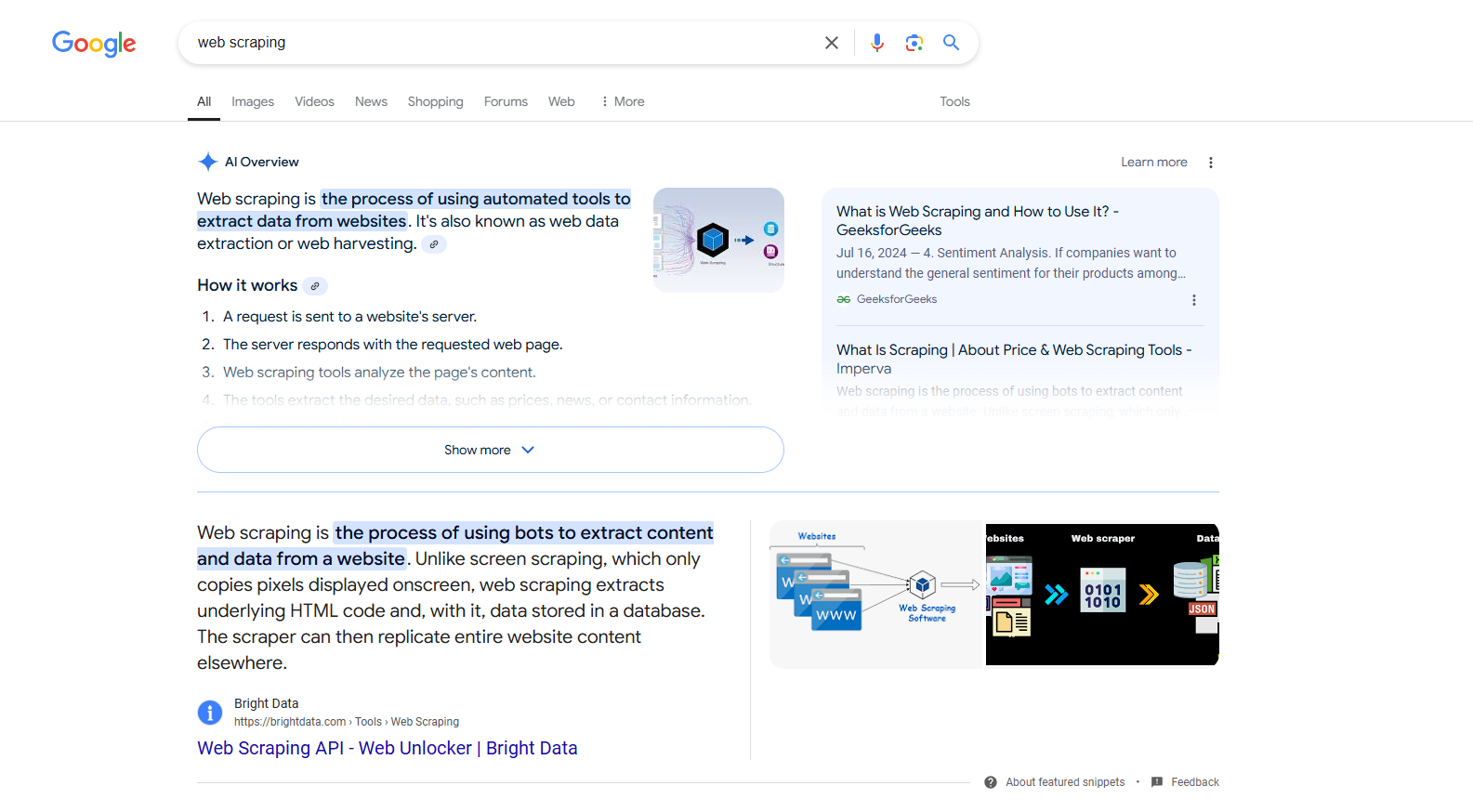
AI Overview/Search Generative Experience (SGE)

Google’s AI-generated summaries synthesize information from multiple sources to provide comprehensive answers.

These appear at the top of results and often include citation links to source material.

Screenshot from search for [ai overviews], Google, January 2025Screenshot from search for [ai overviews], Google, January 2025

Rich Snippets

Enhanced search listings that display additional information through structured data, such as:

  • Star ratings.
  • Product prices.
  • Recipe details.
  • Event information.
  • Review counts.
  • Author information.
Screenshot from search for [chocolate chip cookie recipe], Google, January 2025Screenshot from search for [chocolate chip cookie recipe], Google, January 2025

Knowledge Panels

These are information boxes appearing on the right side of desktop searches, displaying key facts about entities like:

  • Businesses.
  • People.
  • Places.
  • Organizations.
  • Products.
Screenshot from search for [HigherVisibility], Google, January 2025Screenshot from search for [HigherVisibility], Google, January 2025

People Also Ask (PAA) Boxes

Expandable sections showing related questions and answers, helping users explore topics in greater depth.
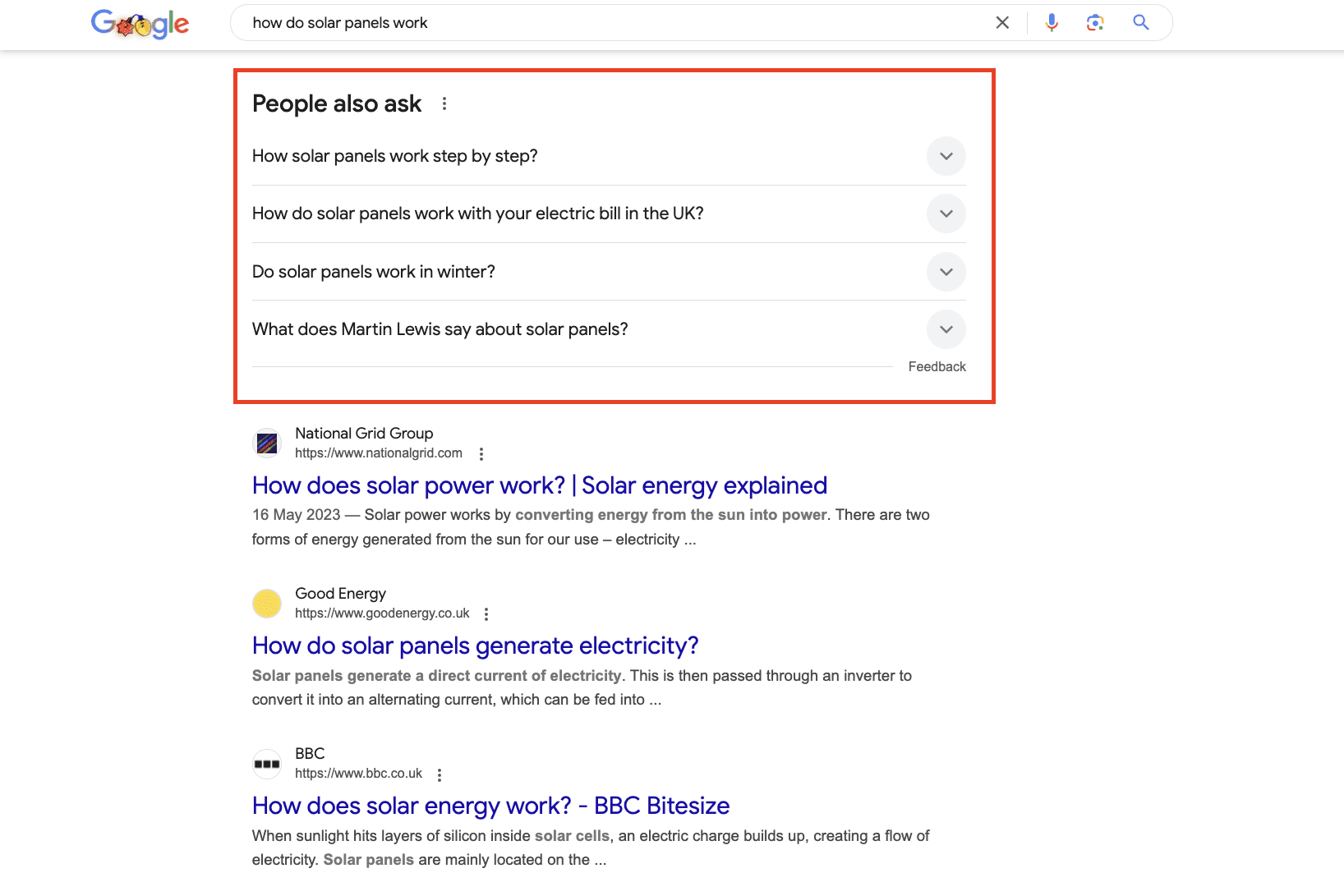
Screenshot from search for [how do solar panels work], Google, January 2025

Local Packs

Groups of three local business listings with maps, particularly prominent for location-based queries.

Screenshot from search for [pizza near me], Google, January 2025Screenshot from search for [pizza near me], Google, January 2025

Shopping/Product Features

  • Product Carousels: Horizontal scrolling product listings with images and prices.
  • Shopping Knowledge Panels: Detailed product information with purchasing options.
  • Merchant Listings: Comparison shopping results from multiple retailers.
Screenshot from search for [wireless headphones], Google, January 2025Screenshot from search for [wireless headphones], Google, January 2025

Visual Features

  • Image Packs: Grid layouts of relevant images.
  • Video Carousels: Scrollable video results, often from YouTube.
  • Visual Stories: Web stories in a mobile-friendly format.

News And Editorial Features

  • Top Stories Boxes: Recent news articles.
  • Publisher Carousel: News from specific publications.
  • Perspectives Carousel: Opinion pieces and editorials.
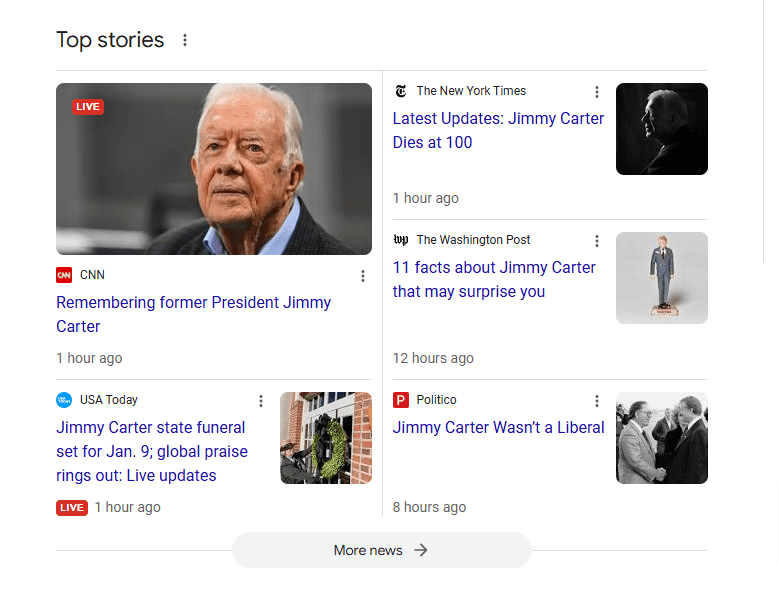
Screenshot from Google News, January 2025

Why Does SERP Analysis Matter?

SERP analysis is a cornerstone of any SEO strategy because it provides actionable insights about your competition, audience preferences, and search engine ranking factors.

Here’s why it’s so important:

1. Understanding Search Intent

Search intent is the motivation behind a user’s query.

For example, a user might want to learn how to complete a specific task, compare different products or services, or make a purchase.

Analyzing the top-ranking pages for a keyword is the best way to infer the search intent behind that term. This is because search engine algorithms are fine-tuned to surface content that best matches what users expect to see.

So, if most of the results for a given keyword are tutorial-based articles, it’s safe to assume that users searching for that keyword are looking for step-by-step instructions or educational content.

Meanwhile, if the results consist primarily of product pages or reviews, the intent is likely transactional, with users looking to make a purchase or compare options before buying.

Further reading: How People Search: Understanding User Intent

2. Uncovering Competitor Strategies

Studying top results helps you identify what your competitors are doing right.

This includes the depth and structure of their content, their use of multimedia formats like videos or infographics, keyword optimization tactics, and the strength of their backlink profiles.

By closely examining these factors, you can uncover patterns in the strategies across competitors that drive their success.

What’s more, SERP analysis helps you pinpoint gaps in your competitors’ strategies – such as overlooked topics, under-optimized keywords, or weak content in high-ranking positions – giving you opportunities to create more comprehensive, engaging, and authoritative content that outperforms them.

Further reading: SEO Competitive Analysis: The Definitive Guide

3. Identifying Keyword Opportunities

Not all keywords are equally competitive.

SERP analysis can help you find low-hanging fruit – keywords with manageable competition that still attract significant search volume.

By identifying these overlooked or underserved keywords, you can create targeted content to capture untapped traffic and build authority.

These opportunities are especially valuable for smaller websites or those just beginning to build domain authority.

They allow you to focus your efforts on achievable wins while steadily growing your traffic and credibility.

Further reading: Keyword Research: An In-Depth Beginner’s Guide

4. Optimizing For SERP Features

Appearing in SERP features (as we discussed earlier) can significantly increase your visibility and click-through rates.

Because even if you don’t achieve the highest rankings, your site can still claim some valuable SERP real estate and capture user attention.

SERP analysis helps you identify which features appear for your target keywords and what type of content Google pulls into them.

For example, featured snippets often prioritize concise, well-structured answers, while PAA boxes highlight responses to commonly searched follow-up questions.

By tailoring your content to match the requirements of these features – whether it’s using clear formatting, answering common questions, or implementing structured data – you can boost your chances of appearing in these prominent positions, ultimately driving more traffic to your site.

How To Conduct SERP Analysis In 4 Steps

1. Identify Your Target Keywords

Start by choosing the keywords you want to target.

The goal here isn’t just to pick any search terms that are relevant to your business.

Remember, not all keywords offer the same value – some are highly competitive, while others may not attract enough search traffic to be worthwhile.

Instead, focus on keywords that are:

Aligned With Your Audience’s Interests

Look for terms that reflect the type of content your target audience will likely find valuable, whether it’s solutions to their problems, product recommendations, or in-depth information on a particular topic.

Promote Your Business Goals

Focus on terms that match your immediate business objectives, such as building brand awareness, generating leads, or directing traffic to specific product pages.

Not Too Competitive

Avoid going after highly competitive keywords dominated by well-established brands unless you have the resources to compete.

Instead, look for long-tail keywords or niche terms that give you a better chance at standing out.

Attract Search Volume

As a rule, keywords with high search volumes tend to be the hardest to rank for.

That said, you don’t need to aim for the highest-volume keywords to see results.

Instead, focus on keywords with moderate search volume that are still relevant to your audience and achievable for your domain authority.

2. Analyze The SERP Landscape

When examining search results, consider:

Desktop Vs. Mobile Differences:

  • Feature placement variations.
  • Mobile-specific elements like scrolling carousels.
  • Different click behaviors and user patterns.

Location And Personalization Impact:

  • How results vary by geographic location.
  • Personalized elements based on search history.
  • Language and regional preferences.

SERP Feature Opportunities:

  • Which features appear for your target keywords.
  • Requirements for earning specific SERP features.
  • Competition level for each feature type.

3. Evaluate Top-Ranking Pages

Next, you’ll need to examine the top-performing content in a little more depth.

The goal is to figure out what makes these pages rank so highly so you can reverse-engineer their success and apply similar strategies to your own content.

Here are some things to consider:

  • Content Quality: Evaluate the depth, relevance, and clarity of the content. Is it comprehensive, engaging, and well-structured? Does it fully address user intent, or are there areas where it falls short?
  • SEO Best Practices: Check title tags, meta descriptions, and header structures. Pay attention to how keywords are incorporated naturally throughout the page.
  • Multimedia Usage: Notice if the pages include videos, images, charts, or infographics. These elements enhance the user experience and often signal higher-quality content to search engines.

So, if you find that the top pages for your keyword average 2,000+ words, cover multiple subtopics, and include custom visuals and quotes from industry experts, creating a 500-word blog post probably won’t cut it.

To compete, you’ll need to create a more detailed, engaging resource that provides value users can’t get elsewhere.

This leads us to the final step.

4. Look For Content Gaps And Opportunities

Here, the goal is to find opportunities to differentiate yourself by looking at where existing top-ranking content falls short.

Ask yourself:

  • Are there questions users might have that the current results don’t fully answer?
  • Could you provide more up-to-date statistics, original research, or unique case studies?
  • Are there related keywords or subtopics that competitors overlook?

For example, if top-ranking pages lack practical examples, recent data, exclusive quotes from industry leaders, or high-quality visuals, incorporating these elements will help give you an edge over your competitors.

This step is all about going above and beyond the quality of existing content. By filling these gaps, you’ll provide a more valuable reading experience for users.

Final Thoughts

SERP analysis has evolved beyond simply studying organic rankings. Success requires understanding the full spectrum of SERP features and how they interact with user intent and behavior patterns.

By implementing the strategies outlined in this guide and staying current with new SERP features as they emerge, you’ll be better positioned to capture valuable SERP real estate and drive meaningful traffic to your site.

Remember to regularly review and update your SERP analysis approach as search engines continue to evolve and introduce new features that can impact your visibility and performance.

More Resources:


Featured Image: Gorodenkoff/Shutterstock
Google’s Q4 Earnings Point To An AI-Focused Future via @sejournal, @MattGSouthern

Alphabet Inc., Google’s parent company, reported strong fourth-quarter results for fiscal 2024, primarily driven by its commitment to AI.

Alphabet announced revenues of $96.5 billion for Q4 2024, up 12% from last year.

Google Services, including Search and YouTube ads, grew by 10% to $84.1 billion.

Google Cloud increased revenues by 30% to $12.0 billion as more businesses adopted its AI services.

Operating income rose by 31%, and net income increased by 28% to $26.5 billion.

AI-Driven Growth

CEO Sundar Pichai highlighted the company’s AI achievements and recent launches during the earnings call.

Pichai said:

“Q4 was a strong quarter driven by our leadership in AI and momentum across the business. We’re making dramatic progress across compute, model capabilities, and in driving efficiencies. We’re rapidly shipping product improvements, and seeing terrific momentum with consumer and developer usage.”

Infrastructure Investments

Alphabet is investing heavily in its infrastructure, launching new data centers and subsea cable projects to improve global connectivity.

Pichai stated:

“We broke ground on 11 new Cloud regions and data center campuses in places like South Carolina, Indiana, Missouri, and around the world. We also announced plans for seven new subsea cable projects, strengthening global connectivity.”

These efforts will support the growth of AI services, as data centers now provide nearly four times more computing power for the same energy.

Implications for Search and Marketing

Google reported that its AI-powered search features are gaining traction. AI Overviews are now available in more than 100 countries.

Circle to Search, available on over 200 million Android devices, is popular among younger users, who now use it for more than 10% of their searches.

SEO professionals and digital marketers should brace for further changes, as Pichai declared that “2025 is going to be one of the biggest years for Search innovation yet.”

The company’s $75 billion capital expenditure plan for 2025 suggests significant investments in search technology and AI capabilities.

Looking Ahead

Google’s Q4 results highlight its focus on AI. Overall revenue increased 12%, and the cloud business grew 30%. Profits increased as well, with operating income rising 31%.

The company’s investments in data centers and undersea cables will support global AI growth.

New AI features, such as Search Overviews and Circle to Search, are changing user behavior, so SEO teams should prepare for more changes in 2025.

Keep an eye on Google’s $75 billion spending plan to expand AI technology.


Featured Image: Dennis Diatel/Shutterstock

Death Of The Keyword: Why Aggregate Organic Traffic Is A Better Metric via @sejournal, @Kevin_Indig

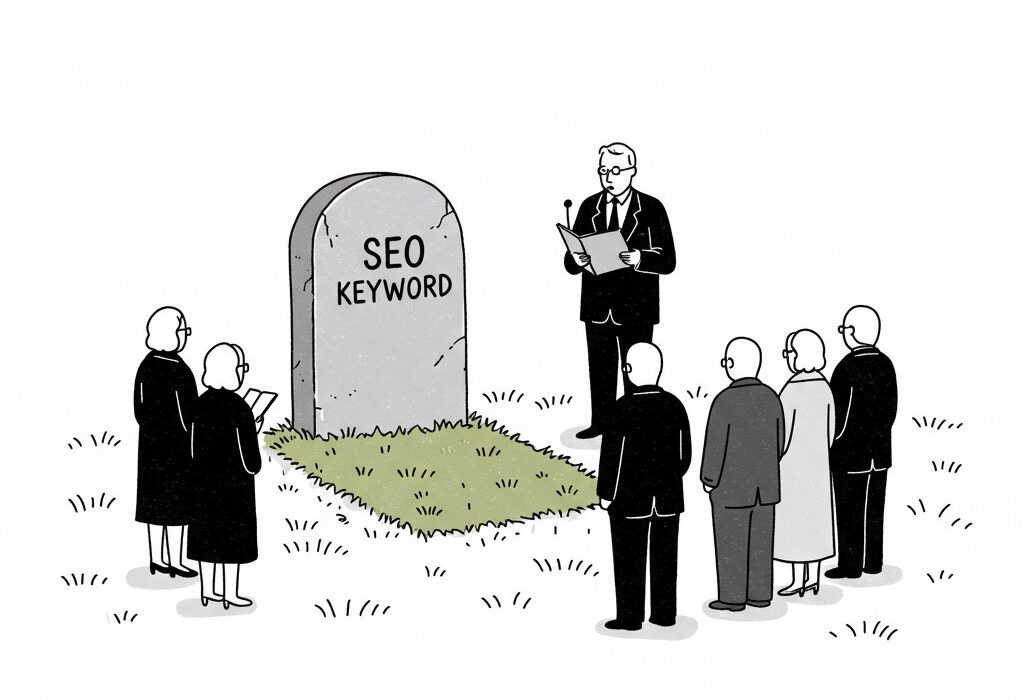
This is my official eulogy for the SEO keyword, which died many years ago, but no one has noticed.

As a result, many marketing teams make sub-par decisions, and decision-makers lose trust in SEO as a channel. Just look at the recent “SEO is dead” reactions to HubSpot’s traffic decline.

Google Enforces JavaScript For Crawling

Since January 20, Google has required JavaScript for Search, which makes rank tracking more expensive.

This is the latest move in a long-standing battle between SEO pros and Google.

Rank trackers (Semrush, Ahrefs, SEOmonitor, etc.) have been operating in a gray zone. Google tolerates them but officially doesn’t allow it.

Now, with JavaScript as a hard requirement, rank tracking needs more RAM, which increases the cost of every data point.

The result is that the cost of doing SEO is rising. But rank tracking lost its value long before Google switched to JavaScript crawling.

Focusing On Single Keywords Hasn’t Made Sense In A While

Image Credit: Kevin Indig

With all the elements in the SERPs and the unrepresentative data we get, it’s hard to project impact and measure success purely based on keyword ranks.

  • In 2013, Google stopped sharing keyword referrers. The only way to understand what users searched to get to your site was and still is Google Search Console.
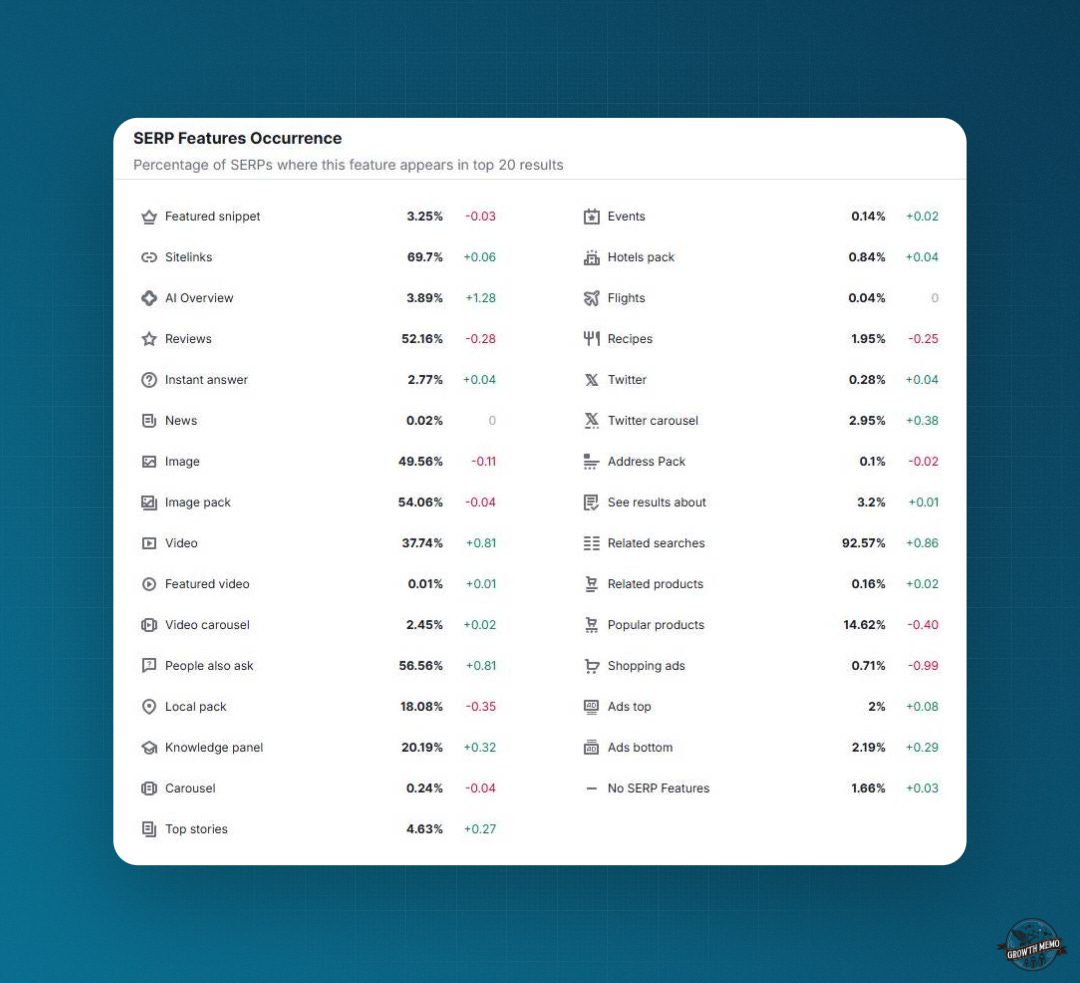
  • In 2014, Google started showing Featured Snippets, direct answers at the top of the search results, which created more winner-takes-it-all situations. Subsequent SERP features like People Also Asked or video carousels followed and climbed up the ranks. Today, over 30 known SERP Features compete for attention with classic search results. It’s very hard to predict how many clicks you might get because there are so many combinations of SERP Features.1
  • Since last year, Google has shown ads for organic results and has broken the traditional separation between organic and paid results.
  • And, of course, last year, Google launched AI Overviews. The AI answers are now available in over 100 countries and provide in-depth answers. Clicking through to search results is now redundant in some cases.
  • The data Google shares around these trends range from non-existent to bare. AI Overviews or SERP Features are not included in Search Console Data. Not even speaking of the fact that Google filters out 50% of query data for “privacy reasons”: Ahrefs looked at 150,000 websites and found that about 50% of keywords and clicks are hidden.2

On one hand, a single webpage can rank for thousands of keywords as long as those keywords express the same intent and the page gives a good answer to all implied questions. This has been the case for many years now.

On the other hand, more and more keywords don’t deliver traffic because all clicks go to a SERP Feature that keeps people in the search results, or a click isn’t necessary – searchers get the answer in the search results.

Sparktoro found that +37% of searches end without a click, and +21% result in another search.3

Image Credit: Kevin Indig

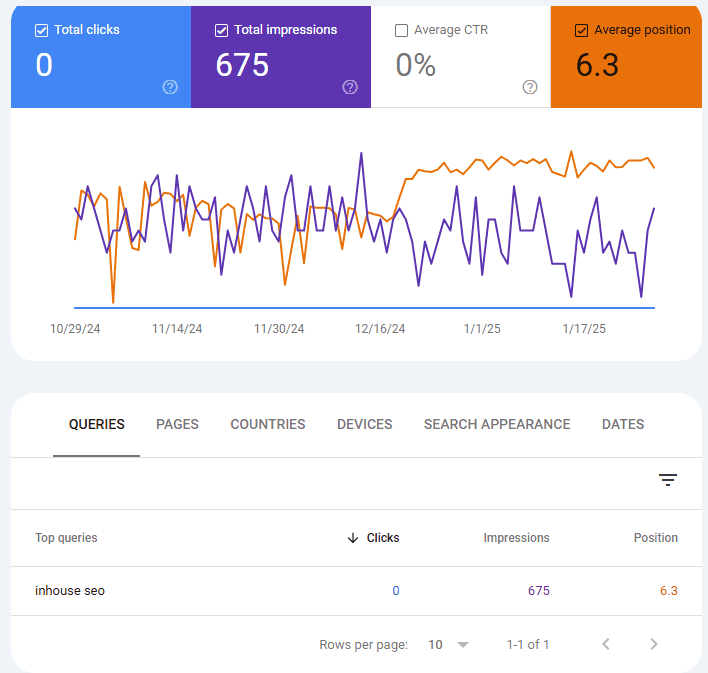
A couple of months ago, I rewrote my guide to in-house SEO and started ranking in position one. But the joke was on me. I didn’t get a single dirty click for that keyword.

Over 200 people search for [inhouse seo], but not a single person clicks on a search result.

By the way, Google Analytics only shows 10 clicks from organic search over the last three months.

So, what’s going on? The 10 clicks I actually got are not reported in GSC (privacy… I guess?), but the majority of searchers likely click on one of the People Also Asked features that show up right below my search result.

The bigger picture is that the value of keywords and ranks has tanked.

Our response can be two-fold:

  • First, while the overarching goal should still be to rank at the top, we need to target the element that’s most likely to get all the attention in the SERPs, like video carousels or AI answers. In some cases, that means expanding “SEO” to other platforms like YouTube.
  • Second, we need to look at aggregate data.

Aggregate Traffic > Keywords

We’re still operating with the old model of SEO, which is where we track a list of keywords to measure success and set targets.

But how much sense does that make given pages rank for many keywords? How much sense does it make a given search to move from a list of results to LLM answers?

The keyword doesn’t have a future in search. What does is intent, and LLMs are much better at understanding it.

So, here is my suggestion: Instead of focusing on keywords, we should focus on organic traffic aggregated on the page or domain level.

Some traps to watch out for:

  • We still need keywords to model brand vs. non-brand traffic by page (still works because you should have enough keywords).
  • Beware of seasonality.
  • Split organic traffic out by new vs. existing pages.

To track how well a domain or page is doing, we can still look at keywords; the direction of organic traffic is more indicative of whether it does well or not.

One big issue I have with keywords is that search volume has many flaws and is so unrepresentative of what’s actually going on.

The term “in-house seo” has a reported search volume of 90-200 in the biggest rank trackers but doesn’t actually deliver any clicks.

To know what pages to create without keyword research, talk to customers and analyze what topics and questions they care about.

Analyze platforms like Reddit and YouTube for engagement and reverse engineer what topics work.

And, we can – and probably will have to – use paid search data to inform SEO because it’s more reflective of topics with the way that Google shows (Performance Max) ads to users in Search, which are similar to user intent.

To project traffic, look at domains or pages that are already visible for topics we care about, just not on the keyword level.

Clickstream data that reflects how users browse the web is much better because it doesn’t project potential traffic based on a keyword position.

Where keywords still make (some sense) is for analyzing historical search volume to project whether a topic is growing or shrinking, but I suggest using only large amounts of keywords.

A huge benefit of the aggregate traffic approach is that it transfers well to LLM because they don’t give us queries either, but we can track referral traffic on the domain and page level.

ChatGPT even adds a URL parameter to outgoing clicks that makes tracking easier.

LLM Defense: Activated

Image Credit: Kevin Indig

The real reason Google enforces JavaScript crawling is not to hurt SEO professionals but GenAI competitors.

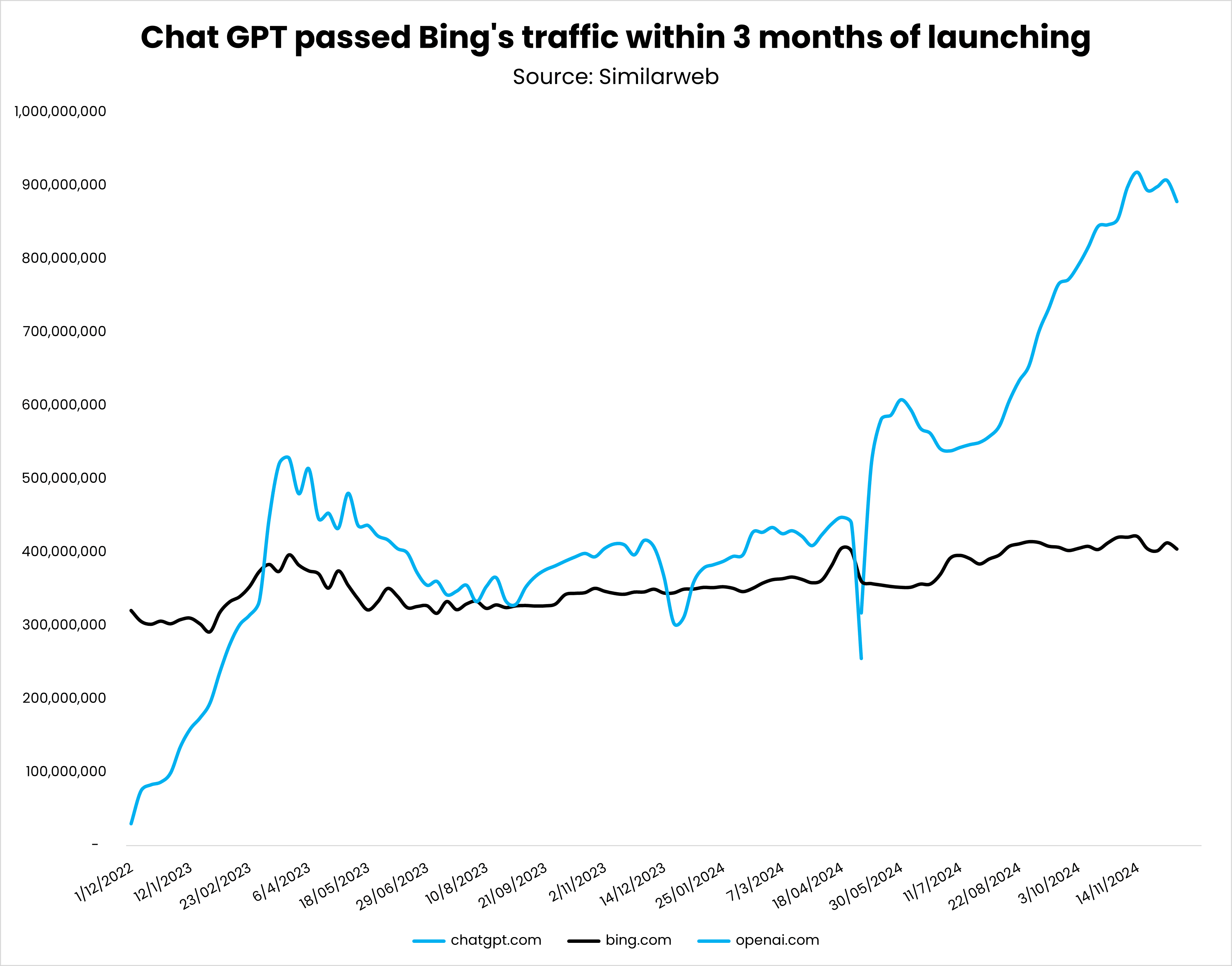
ChatGPT and Perplexity are gaining significant ground. ChatGPT has already surpassed the traffic of Bing and Google’s Gemini. Perplexity is on the way there.

However, LLM crawlers can’t execute JavaScript, which means they can now no longer crawl Google’s search results to ground their answers.

(By the way, you need to make sure your content is accessible without JavaScript. Otherwise, LLMs can’t crawl it, and you can’t appear in their answers.)

The quality of some LLMs might decrease due to Google enforcing JavaScript, but only temporarily. LLMs can still get SERP data in other ways.

But one potential consequence of Google’s decision is that LLM developers build their own models or web indices to weigh answers and become independent of search engines.

The second-order effect of that would be that it’s no longer enough to do good SEO to appear in LLMs. We would have to reverse engineer LLM results like we did with Google.

If SEO is a game, winning in SEO now requires adjusting based on the flow (intent) of the game instead of counting cards (keywords).

The future of search is not keywords but intentions.

Let this be my official eulogy.

Image Credit: Kevin Indig

1 Semrush Sensor

2 Almost Half of GSC Clicks Go to Hidden Terms – A Study by Ahrefs

3 2024 Zero-Click Search Study


Featured Image: Paulo Bobita/Search Engine Journal

5 New SEO Ranking Challenges You’re Facing Right Now [& A Fix] via @sejournal, @bright_data

This post was sponsored by Bright Data. The opinions expressed in this article are the sponsor’s own.

Struggling to adapt your SEO strategy to ever-changing AI-driven SERPs?

Have the most recent Google updates left your rank-tracking methods outdated?

What happens when you can no longer deliver key information on traffic sources?

Generative AI (GenAI) technologies like Google Gemini and Bard are reshaping search results.

This is creating unprecedented challenges, especially when it comes to the elephant in the room: “The New Position 0.”

In this article, we’ll help tackle the key ways to:

The Latest Google Updates & What They Mean For You

Just this week, Google rolled out unexpected changes to SERP structures, causing widespread disruptions for many SEO strategies that rely on SERP rankings.

These updates led to outages and inaccurate data across the industry, forcing many businesses to quickly adapt to avoid prolonged disruptions.

“The disruptions caused by Google’s latest SERP changes left many platforms unable to deliver accurate data to their users. Our clients, however, were unaffected thanks to our immediate response and robust infrastructure. If not for the media and search community, they wouldn’t have known there were any changes.” – Ariel Shulman, VP Product at Bright Data

Generative AI has fundamentally altered how search engines deliver results.

Classic SERP features have become central to understanding user intent and the user journey.

Until now.

The SERP layout we know and love has changed.

These overall changes present challenges for rank-tracking platforms tasked with capturing and analyzing SERPs:

  • Dynamic Content: AI-generated answers often feature multimedia, conversational snippets, or interactive elements, making parsing and analyzing data increasingly complex.
  • Personalization: Search results now adjust based on user history, geography, and device type, requiring platforms to capture nuanced, context-specific data.
  • Position-Zero Dominance: The growing prominence of position zero highlights the need for precise tracking and optimization insights tailored to this feature.

The challenge for rank-tracking platforms is clear: adapt to these AI-driven shifts or risk leaving users without the insights they need to thrive.

What Is Position 0 On Google?

Position 0 on Google refers to any of the featured snippets that appear at the very top of the search engine results page (SERP), above all organic search results.

It’s a special box that highlights concise information in response to a query, often in the form of a paragraph, list, or table.

For example, if you search for “How to tie a tie,” the featured snippet might display step-by-step instructions directly at the top. Being in Position 0 can boost your SEO strategy significantly since it’s considered premium real estate in search rankings.

The featured snippet is designed to provide users with quick answers to their questions without requiring them to click on a website. It’s highly coveted by website owners because it significantly increases visibility and click-through rates.

However, it’s becoming more difficult to track what is ranking in position 0 due to 5 different issues that baffle the current MarTech stack.

So, let’s dive deeper: What did Google change that you’ll need to change?

1. New Changes To SERP Layout Makes Ranking & Organic Clicks More Difficult

As we’re seeing in real-time, AI technologies like Google Gemini (previously Bard) and Microsoft’s Bing AI are reshaping SERP layouts.

So far, SERP structures are evolving rapidly with AI updates.

Elements like conversational answers or rich media snippets appear inconsistently, requiring you to constantly adapt your SEO strategy and data collection methods.

SERP - web scraping with AIO

The New Order Of Search Results

Instead of seeing Google Ads placements, featured snippets, positions 1-3, and People Also Ask, we’ll now be seeing:

  1. Google Ads take up more space, with up to 4 results that could also contain additional expanded site links.
  2. Google AI Overviews (AIO) now dominate the SERP above the fold, pushing positions 1-10 below interactive snippets.
  3. Featured Snippets take the space where positions 1-3 used to live, pushing position 1 down further.
  4. People Also Ask also comes before position 1.
  5. Position 1 starts here.

However, this is not its final state. The new layout of SERPs is dynamic; it will continue to change, and you have to be ready.

Position 1 No Longer Dominates

With position 1 pushed down at least 3 scroll lengths, this is no longer the top clicked result.

Additionally, the layout of a searcher’s query will also vary based on new advances in SERP personalization.

Now, clicks are possible in many new locations on the SERP, such as in a cited link for Google’s AI Overview (AIO).

These are not as easily trackable nor attributable.

SEO analysts and SEO strategists will see a massive impact on their traffic data and how they optimize their content to display above the fold.

Google’s AI Overview (AIO) Steals Top Clicks

Finally, position 1 on Google SERPs has seen its decline from providing at least 33% of organic search clicks to just 11% as of January 2025 depending on the search term.

Organic CTR declined ~70% when an AIO was present on the SERP.

AIO not only makes it difficult to obtain clicks, but one final change has made it nearly impossible to attribute clicks to positions.

In short:

  • You will lose traffic.
  • You will lose visibility into where your traffic is coming from.
  • You will lose the ability to strategize your content for visibility on SERPs.

What does this mean?

Google AIO and other dynamic SERP features are the new Position Zero.

2. Dynamic & Lazy-Loading SERP Content Hides Key SEO Data

Many SERP elements, especially those influenced by AI, load dynamically based on user interaction.

As we know from past SEO knowledge, dynamic and lazy-loading content cannot be seen by bots and scrapers until something triggers the content to load.

Therefore, to retrieve all the necessary data, you’ll need to simulate interactions like clicks and scrolls, which adds complexity and latency.

3. Google’s Anti-Bot Measures Removes Your Visibility To Rankings

As you can see so far, dynamic and personalized search results are more prominent.

Your favorite SEO keyword research and rank-tracking tools rely on bots to crawl the web for key data to help you build your SEO strategy.

However, Google has removed a large piece that makes that data scraping possible: bots.

Google’s evolving anti-bot measures further complicate real-time data collection, pushing platforms to the brink of what their systems can handle.

Sophisticated anti-bot defenses, such as CAPTCHA challenges, IP-based blocking, and JavaScript obfuscation, make real-time data collection a significant hurdle. Many traditional scraping tools cannot meet these challenges.

4. Personalized & Regionalized SERPs Removes Control Data

Control data is something that remains the same from one experiment to another. It enables you to have direct comparisons to build conclusions from when you’re building your SEO strategy.

The old SERP’s control data was the standardized layout. SERP layouts and results were similar enough for the same search query, meaning you could compare multiple searches for the same query to create conclusions that drove your strategy.

Now, user-specific factors like location, language, and device type create unique SERP views with vastly different orders of results.

It’s no longer simple to look at SERP data for [What is a 5-star hotel?] and know which link was clicked from which position:

  • User 1 could have been served your link in an AIO, which would not show up in classic SEO tools.
  • User 2 could have clicked on your link in position 1, which would show up in classic SEO tools.

Capturing this variability at scale while maintaining accuracy is critical yet immensely difficult.

5. Evolving Answer Content & Embracing Answer Engine Optimization (AEO)

AI-generated responses are constantly updated, with position-zero content shifting based on new data and context.

These AI-generated responses are part of an evolution of Search Engine Optimization (SEO) called Answer Engine Optimization (AEO).

You’ll need tools that have been updated to extract data from Answer Engines in real-time.

How To Gain Traffic From Position 0 & Regain Organic Traffic from SERPs

To regain your lost traffic, you’ll need to refer to more sophisticated tools to gain access to new SERP data streams to inform your organic traffic strategy.

Tools that previously helped you understand your position on SERPs are now outdated.

Rank-tracking platforms that have upgraded should be ready and able to collect data using more modern sources that align with the roadblocks above.

These tools don’t just need to collect data, they need to deliver actionable insights to help their users optimize for “The New Position 0” based on the data and AIO’s best practices. By extracting the right data and presenting it clearly, platforms empower users to improve their strategies effectively.

Here’s how platforms are leveraging Data from GenAI results:

1. Emphasizing Content Designed for AEO

Platforms will need insights into which content types (e.g., FAQs, schema markup, and structured data) are prioritized by AI-driven search engines. This will help their users create concise, authoritative content that aligns with SERP preferences, improving visibility and relevance in position zero.

2. Focusing on Position Zero Metrics

They will need metrics such as click-through rates (CTR), impressions, and engagement specific to position zero. These metrics will help their users monitor performance and refine their strategies to maintain or improve their rankings.

3. Supporting Regional and Device-Specific Insights

Platforms will need geo-targeted and device-specific data to provide segmented insights. This will help their users tailor their optimization efforts to specific regions, languages, or devices, ensuring their strategies are more precise and effective.

4. Adjusting to Conversational Queries

They will need data on conversational and intent-driven search queries. This will help their users align their content with how large language models prioritize conversational patterns, resulting in higher engagement and relevance.

SEO tools using Bright Data’s toolkit have access to all this data in real-time and at scale. That’s why the leading SEO tools choose Bright Data as their go-to data provider. Platforms leveraging these insights position themselves as indispensable tools for helping their users dominate “The New Position 0.”

Conclusion

As “The New Position 0” continues to redefine search, rank-tracking platforms face mounting challenges in delivering accurate, actionable data. Choosing the right data collection partner is no longer optional, it’s the key to staying ahead. Platforms leveraging Bright Data’s SERP API are equipped to meet these challenges, empowering their users to succeed in an AI-driven search landscape.

Bright Data’s proactive approach meant their clients experienced uninterrupted services during the disruptions that affected many in the industry. SEO tools leveraging Bright Data’s SERP API maintained seamless operations, continuing to deliver accurate, real-time insights to their users without issue.

Integrating your platform with Bright Data’s SERP API is quick and straightforward. Want to see what it’s all about? Check out the documentation here or test it out in the SERP API playground to see if it’s the perfect match for your SEO tool. When data matters, companies choose Bright Data.

This article has been sponsored by Bright Data, and the views presented herein represent the sponsor’s perspective.


Image Credits

Featured Image: Image by Bright Data. Used with permission.

2025 Marketing Trends: The End Of SEO? [Webinar] via @sejournal, @hethr_campbell

Finding it tough to keep up with AI’s impact on location marketing?

You’re not alone.

AI is reshaping location marketing, and now there’s a new buzzword in town: GEO (Generative Engine Optimization).

As search evolves, it’s crucial to stay ahead of the trends and ensure your strategy aligns with how AI and search engines process location-based content.

Join us for our upcoming webinar on February 13, 2025, 2025 Marketing Trends: The End Of SEO? where we’ll demystify the latest trends and give you actionable insights to drive results in 2025.

Why This Webinar Is A Must-Attend Event

We’ll cover everything you need to elevate your location marketing strategy.

In this webinar, you’ll get:

  • The latest AI-powered tools and tech shaping the industry
  • 5 reasons why GEO should be your new go-to SEO tactic
  • How to balance authenticity with AI-driven marketing
  • Emerging trends and their impact on Location Performance Optimization (LPO) and your Location Performance Score (LPS)

Why This Webinar Is A Must-Attend Event

This session is packed with real-world tips to help you craft high-impact, ROI-driven strategies for 2025—because even superheroes need the right tools to navigate the future.

Live Q&A: Get Your Questions Answered

Stick around for an interactive Q&A, where we’ll answer your biggest questions about AI, GEO, and the future of location marketing.

Secure Your Spot Today!

Can’t make it live? No worries—register anyway, and we’ll send you the recording.

Get ready to supercharge your location marketing strategy. See you there!

AI Overviews Data Shows Massive Changes In Search Results via @sejournal, @martinibuster

Enterprise SEO platform BrightEdge published results on current AI Search trends, showing that Google AI Overviews (AIO) has expanded its presence by up to 100% in increasingly complex search queries. The changes suggest growing confidence in AI for search, with indications that Google is relying on authoritativeness and greater precision in context awareness for matching queries to answers, particularly in relation to content modality.

The data shows that AI Overviews (AIO) has evolved from showing featured snippet style answers to being capable of handling multi-turn, complex search queries. The takeaway is that Google is increasingly comfortable with AI’s ability to surface precise answers for longer queries and this is a trend that may continue to rise.

Google AIO Presence Is Growing

Google continues to show confidence in their AI Overviews (AIO) search feature as BrightEdge has discovered that more keyword phrases are triggering AI answers now than at any point since the feature was rolled out last year.

25% of search queries using 8 words or more are displaying AI Overviews (AIO), which is a clear upward trend indicating that Google continues to refine the accuracy of AIO and is better able to handle increasingly complex search queries.

A graph shows how the keywords with 8, 9, and 10 words continued to increasingly show AI Overviews

Graph Representation Of AI Overviews Growth

Keyword phrases with less than four words continue to show an increasing amount of AIO but the growth in longer more precise keywords is growing significantly faster.

Screenshot Showing Percentage Of Keywords With Google AI Overviews

Change In AIO Patterns: Gains For Authoritative Brands

BrightEdge provided additional data that looks at specific topic categories, showing how queries for some topics consolidating to answers from big brand sites.

For example, in the healthcare category where accuracy and trustworthiness are paramount Google is increasingly showing search results from just a handful of websites. Content from authoritative medical research centers account for 72% of AI Overview answers, which is an increase from 54% of all queries at the start of January.

15-22% of B2B technology search queries are derived from the top five technology companies such as Amazon, IBM, and Microsoft.

Qualities Of AIO Answers

BrightEdge data reveals that AIO answers follow certain patterns that reveal qualities that Google feels make content more relevant.

  • Excels at step by step and how to answers (structured hierarchical information)
  • Shows precise real-time relevance
  • Answers lean toward general guidance

Educational Search Queries

For educational queries AIO shows a preference toward concise answers with a clean visual presentation. In the below example Google is hiding content that has additional information that answers additional questions beyond the main query. This may relate to Google’s information gain patent which is about anticipating additional information that a user will be interested in after receiving the answer to their original search query.

AIO Showing Information Gain Ranked Content

Change In YouTube Citations

An interesting pattern picked up by BrightEdge is that YouTube technical tutorials have increased by 40% in AIO while health related queries that show YouTube videos are trending downward by 31%.

Of particular interest is that the high volume search queries (100k+ search volume) that trigger YouTube content have decreased by 18.7%. This may reflect a change in user needs and Google’s ability to identify that context and understand that it’s not served well by video content.

What all of this means is that it’s increasingly important to think about context awareness, the appropriateness of the content to the query. The question to ask is what kind of content best serves the context and to expand that answer across modalities like images, sound, video, and text, then within those formats think in terms of how-to, data dump, informative, etc.

BrightEdge observes:

“Most Interesting Pattern:
AI Overviews are developing sophisticated, context-aware citation models. While YouTube citations are declining for health queries (e.g., “symptoms,” “diet”), they’re increasing for technical how-to content, jumping from 2.0% to 2.8% of citations in this category.

Pay Attention:

1. Context is King – Focus video content where it’s gaining traction (technical tutorials, DIY) and pivot to text for topics where traditional authority is preferred (health, finance)
2. Match Your Industry’s Pattern – In sectors with distributed authority (like B2B tech at 15-22% per source), focus on direct citations; in consolidated spaces (like healthcare at 72% institutional),

partner with established authorities

3. Monitor Actively – With citation patterns shifting dramatically in just one month, weekly monitoring of your space is crucial to spot new opportunities before competitors”

Takeaway

A way to make sense of the data is that it Google AI Overviews appear to be increasingly relying on the authoritativeness of the content as the stakes go higher with more complex search queries.

Authoritativeness isn’t just about being a big brand but it may have to do with simply being meaningful to the Internet audience as a go-to source for a particular topic. Trustworthiness and other related factors are important and this has nothing to do with superficial SEO activities like author bios and so on.

Read the data:
How AI Giants Are Carving Distinct Territory in the Search Landscape

Google AI Overviews Found In 74% Of Problem-Solving Queries via @sejournal, @MattGSouthern

Write a summary for this article using no more than 20 words that would be suitable for a news publication

A new report shows that AI Overviews (AIOs) in Google’s search results are uncommon but significantly affect visibility and user engagement.

Authoritas’s study examines how generative AI Overviews impact organic search performance. In December, the team analyzed search data for 10,000 keywords across seven U.S. industries.

The report highlights the growing impact of AI Overviews and explains trends, user intent, and the search volume levels that trigger AI-driven results.

Key Findings

1. AI Overviews Appear In Less Than One-Third of Searches

AI Overviews appeared for 29.9% of the 10,000 keywords studied but made up only 11.5% of the total search volume.

High-volume keywords are less likely to have an AI Overview than mid-range search terms, with monthly search volumes between 501 and 2,400. About 42% of keywords in this mid-range featured an AI Overview.

Takeaway: While AI Overviews are limited in overall presence on search engine results pages (SERPs), they are more common for mid-volume queries. This indicates that there are opportunities in areas with lower competition.

2. Industry and User Intent Are Major Influencers

Telecommunications had the highest percentage of keywords linked to AI Overviews at 56%, while Beauty and Cosmetics had the lowest at 14%.

Queries aimed at solving problems or asking specific questions most often triggered AI Overviews at rates of 74% and 69%, respectively.

Conversely, navigational queries, like searching for a specific website, rarely resulted in AI Overviews. This shows that AI Overviews focus on general information rather than direct navigation.

Takeaway: Content that answers questions or solves problems is more likely to appear in AI Overviews. Brands in more straightforward industries should explore topics where complexity or perceived risk drives research.

3. Non-Brand Terms More Likely to Produce AI Overviews

About 33.3% of non-brand searches show an AI Overview, while only 19.6% of brand searches do.

Brand searches usually happen closer to purchasing, but AI Overviews for informational brand queries can still help shape how people view a brand.

Takeaway: AI Overviews might slow potential customers’ buying process, but they can help influence how users see a brand in the early and mid-decision-making stages.

4. Impact on Traditional Organic Results

When you expand the AI Overview on desktop by clicking “Show more,” the page moves down by about 220 pixels. This shift often lowers organic search results on the screen.

On mobile devices, only one or two organic listings are visible without scrolling, making it harder for SEO professionals.

Takeaway: Since AI Overviews occupy significant space at the top of the search results page, brands must find ways to stay visible. They should focus on appearing in the AI Overview’s answer links and the regular organic results below.

5. Overlap with Traditional Rankings

High-ranking URLs are likelier to appear in AI Overviews, but this isn’t always true.

About half of the top-ranking pages are included in AI Overviews, and some pages outside the top ten may appear too.

Featured Snippets often coexist with AI Overviews. If you have a Featured Snippet, there’s a better than 60% chance you’ll also be mentioned in the AI Overview.

Takeaway: A high rank or Featured Snippet doesn’t guarantee an AI Overview link, but optimizing for these can improve your chances. To remain competitive, keep producing clear and authoritative content.

6. Trust & YMYL (Your Money or Your Life) Topics

Websites known for their expertise, especially in finance and healthcare, are commonly included in AI Overviews.

In contrast, despite having strong rankings in search results, sites like Reddit and Quora are mentioned less often in AIOs.

Takeaway: Websites with reliable voices, verified information, and trustworthy content will likely be cited in AI Overviews.

Conclusion

AI Overviews are still relatively new, but their impact is significant, especially for common or problem-solving questions.

If your website is in an industry requiring detailed research or high stakes, you may see more AI Overviews and tougher competition for top citations.

Even if you don’t see many AI Overviews in your area now, this could change as Google improves its language models and collects more user information.

For SEOs and advertisers, there are two main concerns:

  1. Determine which terms or user intents attract AI Overviews and adjust your content or advertising strategies accordingly.
  2. Keep focusing on essential practices, like optimizing for Featured Snippets and E-E-A-T signals. This will increase your chances of being cited in the context of AI Overview.

The complete study and accompanying whitepaper offer more granular insights into the appearance of AI Overviews.

Google Confirms Alt Text Is Not Primarily An SEO Decision via @sejournal, @martinibuster

Google’s John Mueller shared Jeffrey Zeldman’s Bluesky post reminding publishers and SEOs of proper alt text usage, including a link to the W3C decision tree for guidance. The most important takeaway is that the decision process for alt text is not primarily an SEO decision.

The W3C (World Wide Web Consortium) is an international standards making body for the Internet. A lot of the guidance that Google provides about how Googlebot crawls HTML and treats server response codes are based on the web standards developed by the W3C, so it’s always a good idea to go straight to the source to understand exactly how to deploy HTML (like alt text) because doing it the right way will very likely align with the same standards that Google is using.

A decision tree is basically a decision making tool or diagram that asks a yes or no question. If the answer is “no” then the tree leads to another branch. Answering “yes” leads to a node that advises on what to do. The purpose of the W3C Alt Text decision tree is to guide publishers and SEOs on the proper use of alt text, which is for accessibility.

The decision tree that Zeldman linked to has five questions:

  1. Does the image contain text?
  2. Is the image used in a link or a button, and would it be hard or impossible to understand what the link or the button does, if the image wasn’t there?
  3. Does the image contribute meaning to the current page or context?
  4. Is the image purely decorative or not intended for users?
  5. Is the image’s use not listed above or it’s unclear what alt text to provide?

Google’s John Mueller Affirms Proper Use Of Alt Text

John Mueller did a repost on Bluesky with the additional insight that the decision making process for alt text is not “primarily” an SEO decision, meaning that accessibility should be the first consideration when deciding how to use alt text.

This is what John Mueller said about alt text:

“The choice of ALT text is not primarily an SEO decision.

If you like working with structured processes, check out, bookmark, share, and use this decision tree of when & what to use as ALT text, when it comes to accessibility.”

Zeldman’s post praised the simplicity of the decision tree:

“So straightforward, so good. An ALT text decision tree. “

Someone else posted a link to an interactive version of the decision tree called the “Alt text decide-o-matic” which is a different way to interact with the decision tree.

Check out the W3C Alt text decision tree here or try the decide-o-matic to become better acquainted with alt text best practices and become a better SEO and publisher in the process.

Featured Image by Shutterstock/Master1305

Google Shares Insight On SEO For AI Overviews via @sejournal, @martinibuster

Google’s John Mueller shared his insights on how to approach SEO for AI Search in an interview published on YouTube. The discussion also touched on what SEOs should do in 2025 given the realities of what users want.

The video discussion was hosted by Mike Grehan on his new marketing podcast titled, Inside Marketing With Mike Grehan. Mike is a search marketer who was a co-founder of a search marketing organization and was famous for publishing interviews with Google search engineers.

John Mueller Affirms The Necessity Of SEO

Mike got straight to the point in the discussion by asking what the search community should be focusing on in 2025, jokingly asking if SEO is finally dead. While Mueller obviously didn’t say that search was dead, he and a couple of the other participants in the discussion did acknowledge that SEO is undergoing profound changes.

John Mueller said that he thinks that many in the general public may wish that SEO was dead but that they don’t realize that search optimization has a positive effect, implying that it helps Google surface the websites the public wants to see.

He answered:

“SEO is Dead… I don’t think SEO is dead. I think one of the challenges is lots of people online wish SEO were dead, but they don’t realize that it’s… it’s almost like driving so many of the things that they’re doing online. Where they they notice when something is weird in search or when something is weird on the Internet and they’re like, oh, this is pesky SEO. And they don’t realize all of the things that actually work well because of some of the work that SEO’s do.”

Technical SEO Is Still Important

Mueller suggested that technical SEO will continue to be important for search engines and for AI search. He also mentioned that SEO will be helpful for giving access to large language models that depend on Internet content.

He continued:

“So I think from my side, what people should be doing this year, is kind of hard to say exactly. But I think a lot of the technical SEO stuff definitely continues to make sense. I think a lot of that continues to make sense also with regards to all of the AI things that are happening, all of the different kind of large language models that are trying to train off of the Internet like they need that foundation of technical SEO.”

How SEO Needs To Evolve

Mueller next explained what search marketers need to do in order to evolve with the reality of where we’re at today because of artificial intelligence.

He offered the following insights:

“I think what is also important is to try to figure out like what is the value that you want to get out of the Internet. And …the easy aspect that SEOs have been focusing on in the past is like I want clicks, I just want like lots of clicks. And clicks alone is not really what is driving value for a lot of websites.

So that’s almost like a subtle mindset change of going from clicks to trying to figure out what is the value that I want to get out of it.”

What Mueller was talking about is the narrow perspective that SEO has traditionally ignored anything that didn’t measurably drive traffic or involve a link. Part of the reason for that is client expectations from SEO but it’s also reinforced on the SEO side where they talk about KPIs, Key Performance Indicators. KPIs for SEO are organic traffic, rankings, clicks from the search results.

So what happens is that, at best, SEOs are in their silo doing half the work that needs to be done to drive traffic to a site and at worst they’re doing nothing to promote a site and make it successful. Getting SEO to embrace the promotional part and thinking about what the site actually brings to users.

Mike Grehan remarked:

“Wouldn’t it be nice if people stopped thinking about SEO as just a traffic driver, just throwing numbers and actually thought about it more with a marketing and a more scientific mind?”

Time To Become Real Marketers

Something that Mueller has advised in the past for those who wanted to grow traffic to new websites is to get out there and promote it. Promotion is more than just SEO.

Ryan Jones of Razorfish and founder of the SERPRecon SEO tool (LinkedIn profile) agreed with Mueller that SEOs need to get out of the traffic and clicks bubble, encouraging listeners to add more marketing to their mix.

Ryan  said:

“I think it’s time we become real marketers. We’ve been spoiled for so long where we focus on lower funnel and attribution. And you know, no one ever asked TV how many clicks or visits they got when they run a Super Bowl ad, you know? And even paid search too, in effect, gets away with it.

In SEO if we say, hey, if we’re not there, our competitor might be there. Like OK. Great. How many clicks is it gonna get? But on on paid media, we can say, well, if we’re not there, our competitor will get there and they’ll say here’s $1,000,000. Go, go be there, right?

And so I think it’s time we evolve SEO to be full funnel. We gotta start thinking about user intent, what users want, do real marketing. It’s not enough to focus on clicks, and we’ve been spoiled. We’ve we focused so much on tactics, right?

To go back to ‘is SEO dead,’ if all you thought about is tactics to get clicks and links and rankings, then yeah, it’s dead. But if you thought about giving users what they want, then no, it’s not dead. It’s evolving.

So …that stuff is important, but I think, to bring it home…  We have to do real marketing. It’s not enough to just do last click attribution like we have been in the past, we got to be real marketers and that excites me because I think you know at a large agency or with all of our backgrounds, I think we’re all well positioned to be real marketers because we’ve been doing that.”

Face The SEO Reality

Ryan Jones went on to say that it’s time to get real about the fact that people increasingly don’t want to visit a website, that they want information. He suggested that the role of websites no longer fits with what people want, so SEOs need to be realistic about that. The irony of what he’s suggesting is that SEOs love to talk about user intent but they have failed to keep up with the reality of what users want.

He said:

“When I search “when is the Super Bowl” I want to know it’s February 9th. That’s it. End of task. I’m done. …What I don’t want, and go click the first, second, third or 4th result for this, I promise you’ll get it, what I do not want is a website with an overlay ad, a cookie consent notice, and opt in to click in your alerts, an e-mail signup form, and seven paragraphs of unrelated text before it tells me it’s February 9.

…Nowadays… people just want the …answer, they don’t actually want the website. And a lot of SEOs haven’t kept up with that shift or paradigm. …we lost track of what the user actually wants.”

John Mueller Discusses SEO For AI Overviews

Mike Grehan next asked the question that everyone wants answered, which is how to optimize for AI Overviews.

John Mueller recommended thinking about it the same way that SEOs optimize for featured snippets.

Mueller said:

“I just want to say that all of these discussions we had, I don’t know what was it like 5 or 10 years ago? Featured snippets. It’s basically the same thing, right?

It’s like this is very visible on top and it’s like, ‘I hate it.’ And then a year later, everyone’s like, oh, how do I get in and how do I optimize for it? How do I appear more visibly?

And my feeling is… without kind of any big crystal ball, is that this is something that is going to evolve in a similar direction and I think user expectations definitely change. I think AI type answers make sense for a lot of queries and that’s going to be frustrating for some sites that focus on those queries, kind of like with featured snippets as well. And that also provides a lot of opportunities.

And I also think that’s something where kind of like the different levels of SEO that you’re working at they continue to make sense. Like at a low level you work on a lot of technical issues which remain the same and then you move up to more strategic approaches where you try to figure out like what direction you should go.”

Watch also: Mastering AI Overviews For Greater Search Visibility

Inside Marketing With Mike Grehan

There are many more ideas discussed on Mike’s video podcast, it may be useful to find the time to go watch the video.

Brand Performance Unlocked: Advanced Strategies for SEO and Marketing Synergy via @sejournal, @sejournal

Balancing brand and performance marketing has nothing to do with giving each side its amount of time in the limelight.

There’s no magic harmony you’re going to create that delivers some sort of marketing tactic equilibrium and equality.

This is the most controversial article I have ever written. A lot of people reading this will not be happy about what I have to say. For the record, there’s a bit of irony in this, considering I have said way more controversial things about marketing and SEO in the past.

Yet, here we are as I am about to tell you that the only way to balance brand and performance marketing is to give brand supremacy.

Let the fireworks begin.

Balance Brand & Performance Marketing? Why Is There Even A Problem?

In keeping with espousing heresy I will not start this post with “What is brand marketing?” and/or “What is performance marketing?” nor will I dive right into how to balance the two.

Instead, I’m going to challenge the very premise of the article so that you can better understand why this question is even worth your time.

While I see the problem as basically being self-evident, let’s flush it out a bit. The way I see it, there are two fundamental issues at play here (there are more, but this post is going to be long enough as it is):

1. Mindset

The mindset required for good brand marketing is, at times, lightyears away from the performance mindset.

I’m not saying that they intrinsically have to be this way. As I’ll get into later, I think the two ways of thinking complement each other.

However, at the risk of generalizing, there does tend to be a strong divergence between how the two types of marketers think. At least, this has been my experience over the past decade or so as someone who straddles both marketing disciplines.

I often find performance marketers very focused on the immediate. What’s bringing traffic right now, and how do we get more of it?

For the record, that’s not necessarily a bad thing. Nor is it unreasonable (I mean, it is, but it’s not).

This hyperfocus on immediate performance metrics is quite logical since performance marketers are graded on immediate ROI. Is it thus any surprise they focus on the immediate? (So, performance marketers, it’s not you…it’s the system.)

Brand has an entirely different goal. With brand building, the focus is on exactly that: building. Building an identity, associations and sentiment, messaging, positioning, etc.

All of that takes time. You don’t immediately leave an imprint on someone. If you want to create an impression with an audience, it’s pretty obvious it’s going to take time.

This process is also far more compounded and less linear than performance marketing is often perceived. It’s not like getting a page to rank well and driving in traffic who will convert.

You’re creating a reputation for yourself that involves micro-moments and micro-activities compounding over an extended period (like how any association is formed).

(For what it’s worth, I would argue that performance-based activities, such as SEO, also compound over time. You’re not going to rank for that meaty keyword on day one).

Brand marketing naturally lends itself to a bit more of a holistic long-term mindset whereas performance-based marketing lends itself to focusing more on the immediate impact of a given activity.

These divergent mindsets make it entirely difficult to properly balance brand and performance. They’re almost at war with each other.

To sum it all up: Performance marketing (to its detriment) looks at the end result and often doesn’t care about context, environment, and ecosystems. Brand, on the other hand, is all about contextualization and understanding the environment and ecosystem the brand is operating within.

Now, you might be thinking, well a lot of brand marketers also seem to care less about context, environment, and ecosystems and generally operate in the here and now much like a performance marketer might.

Which brings me to my next point.

2. Misunderstanding What Brand Is

Part of what makes balancing brand and performance marketing almost an inherent difficulty is the lack of understanding of what “brand” actually is.

Too often, what we call “brand marketing” is really performance or product marketing disguised as brand marketing.

What happens is that a company will put emphasis on brand when in reality it’s just another form of performance marketing. The net result is a lack of balance but without even realizing it.

Imagine a TV commercial that doesn’t have a message or any positioning but rather simply tells you what the product is and what it does. Is this brand marketing? I say no. This is just product marketing. It’s pure product awareness.

The web is filled with the equivalent of this.

You talking about your product or service across the internet is not brand marketing; it’s product marketing.

Brand marketing is entirely about who you are in the context of who your audience is and how you want to then be perceived. It is fundamentally associative. If it’s not associative, it’s probably not genuine brand marketing. That is a hot take right there.

Branding is about putting yourself in a position to grow; it is not growth per se. If brand marketing were farming, it wouldn’t even be planting the seeds; it would be sowing the soil so that you could eventually plant the seeds.

Brand is concerned with perception and momentum, not adoption. I know that sounds crazy, and half of y’all out there on both the brand and performance side of marketing are shaking your heads, if not your fists, right now.

But it is the truth. Real brand marketing, the kind you see the Cokes and Lexuses of the world doing, is about perception that leads to momentum. It’s about putting you in a position to grow and to have opportunities that you can capitalize on.

How Do You Then Balance Brand And Performance?

Brand is the setup for performance. Brand creates the opportunity, and performance captures it.

It’s all one dance.

Allow me to explain.

Brand Is Primary, And Here’s Why

Balancing performance and brand marketing isn’t about some sort of give-and-take between the two approaches. If you’re thinking about balance in terms of scales, that’s not how this is going to work.

It’s about knowing where each discipline sits in the “marketing hierarchy” and how the two interact.

This is why I am telling you brand is primary – and it’s not even close.

There are two fundamental ways brand is primary to performance marketing (I was going to insert another, but I think for now these two are the most important):

The Ultimate Goal Is To Have People Come To You

Brand is primary in the very goal it sets out to achieve – to bring audiences to you (as opposed to you chasing your audience across social and search screaming “Pick me! Pick me!”).

It’s like the old line from the Cheers theme song, “You wanna go where everybody knows your name.” No one wrote a line in a sitcom theme song that said, “You wanna go chasing everyone around the block screaming like a mad person so that they will know your name.”

Consumers knowing who you are and seeking you out is self-evidently more advantageous than trying to chase after your consumer base and hoping to heaven you found them at the right moment in the buyer journey.

In case it’s not entirely self-evident (because I have heard performance marketers say the complete opposite), people coming to you creates more momentum and opens up new revenue possibilities than the inverse ever could.

Buzz is contagious. I’m not saying you need to go viral or anything like that, but creating momentum naturally leads to more momentum. The momentum your brand creates for itself leads to all sorts of new possibilities.

Being sought after on whatever level builds upon itself. If done with care and patience it can create real stable opportunity growth for you. This is really what any serious company wants: long-term stable growth. Nothing is more long-term and more stable than being sought after and enticing.

Serious connections with your audience are hard to create but they are hard to really break as well.

Unless you become a known quantity in your niche, no amount of performance marketing is going to help you achieve what you really want: self-sustained staying power.

Brand helps fulfill the ultimate goal any company has: to be a market leader.

Brand Is What Allows Performance To Perform

Can pure performance marketing perform (for lack of a better word)? Yes, obviously.

Can it reach its true potential without brand? No.

Brand marketing is what creates the willingness to invest and interact with your performance marketing.

Imagine you’re on a train, and some random goofball starts waving at you. Are you gonna wave back? And even if you do, are you really interested in interacting with this person?

Now imagine instead that some random whacko your friend sees you on the train and waves. Would you wave back? Wave? You might go on mosy over and have an actual conversation.

Performance without brand is randomly waving at people and hoping that they converse with you. Sometimes they might, but you’re fighting an uphill battle.

Creating a connection with your audience that exists beyond utility is what enables your performance marketing to perform the way you want it to.

To use an SEO analogy, trying to get your product or service to perform without brand is like trying to get a single page on a new website to rank for a highly competitive keyword without any other content history to support it.

Effectively establishing your brand is what enables you to make the pitch that can covert at the appropriate time.

That’s why I would say 99% of brand marketing is not about trying to build revenue. It’s about building the possibility of building revenue. It’s about building cadence and momentum so that the part of your marketing that asks folks to open their wallets works.

Brand puts you on the doorstep of performance. In effect, brand creates the lead, and performance signs the deal.

Like I said earlier, if marketing were a farm, then branding wouldn’t even be planting the seeds. It would be sowing the ground so that you could plant them. And like a field, if you don’t sow it first, you will not have a crop.

If you want revenue without fighting an uphill battle, you have to realize that brand is primary. It is what allows your other marketing activity to perform as you really want it to.

This goes back to what I was saying earlier about people not understanding what brand is.

As far-out as it sounds, brand is not about revenue, it’s about building the opportunities that will eventually lead to revenue. Understanding this one point puts you so far ahead of everyone else.

The Problems In Giving Performance Primacy In A Balanced Approach

Let’s take this from the other side of the coin. What would happen if you gave performance primacy, not brand?

If performance is the building block of the marketing strategy you’re setting yourself up for significant problems down the road.

There are more than a few reasons why this is true, here are some of the more notable ones:

Performance First Means Working With Your Hands Tied Behind Your Back

I don’t even know where to start with this one because a performance-first mindset limits you in so many ways.

Broadly speaking, performance being primary, as I mentioned earlier, means fighting an uphill battle. You’re constantly trying to find the right audience at the right time and then convincing them to funnel through.

Yes, you can get to a good place that way but it’s never really working on its own for you. You never really become a “thing” this way and can’t naturally build momentum upon your activities the same way.

Again, a) I spoke about this at length above b) I am sure you will find me a case where I am wrong – that’s not my point.

On top of that, performance generally tends to be siloed – an obvious inefficiency. Link builders do link building, PPC does paid, etc. – there’s a general lack of broader strategy and comms when performance takes the lead.

Each team has its own KPIs and does whatever it takes to meet them, resulting in obvious inefficiency.

Performance Will Pigeon-hole You Every Time

Because performance marketing is very here-and-now, it generally lacks the flexibility to build for the future.

Doing what’s best for the KPIs is too often doing what’s best in the immediate only.

That means a lack of flexibility in both structure and activity.

I’ll give you a great example of what I mean when I say performance limits a business structurally.

While this case may sound “far-fetched” today, SEOs who have been around a while will search their feelings for they know what I am about to say to be true.

Back in the day, if I had a site that sold DVDs, “the SEO play” would be to name the site “buydvds.com,” or whatever.

It’s generally not a good idea to name your brand after a specific tech asset as, well, tech assets change. In this case, DVDs are basically defunct.

Now the business here may have pivoted to streaming media but now has to deal with a whole rebrand (including a site migration) and all of the immense headaches that come with it. What they should have done at the onset was name the site something like “entertainmentmedia.com” or whatever.

Why didn’t they? Because the performance play became primary, and the brand play was discarded.

Performance, by its very nature, lacks breadth and as a result, will often limit the scope of how the business is able to function or structure itself.

The other way performance limits a business relates directly to the marketing activities performance signs off on and doesn’t sign off on.

Now, if you think I’ve been a bit salty thus far…hold my beer.

What performance-based marketing does to overall marketing activities is the equivalent of a marathon runner deciding to amputate their foot mid-race while maintaining the expectation to break a world record.

To see this in action, look no further than what happens when performance owns a content strategy.

What is the value of content in the context of performance? Impressions, clicks, traffic, conversions, etc.

You see this all the time in the SEO space. You can’t go a week without seeing someone somewhere ask, “If a keyword has 0 search volume should I bother writing content for it?”

Every time I see this question, a piece of me dies.

Not because it might not be true. There might not be a ton of search volume but because that’s a not reason not to write a piece of content.

Leave aside the fact that your current users may expect that content to be there on your site, it could signal the same expectation to new consumers hitting the site for the first time. Also, content is a corpus. You have to build it up to the point where you can write that post for that money keyword.

Performance marketing never asks, “What does writing this content allow me to do next?”

Instead, it’s always, “Why does this content do for me right now?”

Pigeon-holed.

Folks Might Use You, But They Also Might Hate You (And Is That What You Really Aim To Do?)

My sister recently told me how she’s so reliant on Amazon but hates using them at the same time due to how they allegedly treat their workers.

It’s entirely possible that folks may consume your offering but will not be fond of you when doing so. It’s also almost certain that your brand can’t get away with it the way Amazon can.

If all you’re thinking about is traffic KPIs and conversions, etc., you’re missing the most fundamental aspect of success – likability.

It doesn’t even have to be so extreme. Look at the oversaturation of content between Marvel and Star Wars (and even my personal favorite, HBO’s Hard Knocks NFL documentary series).

Sure, they get viewers, but it all comes with negative sentiment. While the end product of Hard Knock’s new preseason series was actually not bad, New York sports radio (the series featured a New York team) trounced HBO before its release.

For a week, every sports host was basically shaking their heads at the idea of having to watch a whole series about phone calls between General Managers making trades, etc. So HBO got the numbers but accumulated a lot of brand baggage to do it.

How smart is that as a long-term strategy?

That’s, fundamentally, a testimony to the fact that brand can assess a move qualitatively while performance just can’t.

That’s not to say performance’s quantitative measurement isn’t vital. It’s a very important part of this brand balancing act.

If Brand Builds, Then Performance Course Corrects

I don’t want you to walk away thinking that performance marketing doesn’t hold value. This article isn’t about brand being better. It’s about the balance.

Brand needs performance to leverage its full power, just like performance needs brand. Again, brand can set you up, but performance closes the deal. Brand, for example, can set up a business to have the authority it needs to pull in organic traffic.

But you need a genuine SEO strategy that includes things like keyword targeting, etc. In this specific case, a performance-based mindset is what will take the brand from potentiality to actuality.

Very often, brand course corrections should be based on the data performance marketing provides.

If there’s a drop in whatever KPI whether it be sign-ups or traffic or whatever, it’s often a change in brand and business strategy that’s needed. That change can’t occur unless you have the data insights performance marketing provides.

Take Starbucks. At the time of this writing, they’ve seen a decline in business, and there are multiple reasons for it. What I found interesting was the user sentiment towards Starbucks’ “corporate identity.”

In an interview with CBS, one customer said, “Starbucks started really feeling like corporate America in a way it hadn’t before.”

If I were Starbucks, I would at least explore the idea of creating a sub brand that is more niche and local. Much the way the beer companies did when they saw craft beer sales surge (hence Coors created Blue Moon).

That sort of shift in brand strategy can’t possibly occur without the insights offered by performance marketing. You have to have sound performance marketing processes in place to effectively run your brand marketing.

So when I say brand is “primary,” I mean that in the sense of the stages of marketing thought and activity.

Not necessarily importance (I do think brand is fundamentally more important, but that’s, again, not what this post is about). You literally have to balance (maybe integrate is a better word) performance into your brand marketing in order to be effective.

Can’t Performance Build Up The Brand?

Doing this is like trying to pull a whale through a needle hole.

Yeah, I guess it might be technically possible, and someone out there did it – but it is not the norm. Upon considering this, I am sure no one has pulled a whale through a needle hole, but I think you get my point.

You are trying to build up a tidal wave one raindrop at a time. Yes, it is possible, but it goes against the very foundation of what you’re trying to actually do – gain momentum.

I’ve heard the argument that by ranking for this and that query and everything in between, you will become an established presence – a brand.

That can be possible. And yes, your content strategy (SEO and beyond) is a big part of your brand strategy. But thinking about something like Google Search as being the method to establish a brand reputation is a chaotic way to go about building a brand.

To start, Search isn’t a medium where your audience may even be interested in “hearing from you.” They may have a specific need at a specific moment that brings them to search. Once that need is met does the user really care to explore more about your product or service? It’s a toss-up at best.

It’s like trying to have a conversation with someone in the middle of a lecture – it’s just not conducive.

You want to have a conversation and make a connection in a place and time that is meant to have a conversation and connection (social media, YouTube, live events, etc.).

Using something like Search to establish a distinctly recognizable brand is just not what Search is.

SEO and search engines are a great way to supplement and reinforce the messaging and positioning you establish on more suitable platforms.

If a consumer sees you on social and interacts with you over time and then goes to search and keeps seeing your results pop up it can reinforce your positioning. It may even make it likely to get a conversation out of it.

What makes performance hard in terms of it being the method to establish a brand is that the assets usually associated with it (PPC, SEO, etc.) are secondary branding assets in the context of how users discover them.

They can supplement, accent, and reinforce, but they are not designed to be primarily effective at establishing a brand identity and audience connection.

Think of it like the difference between someone specifically coming to your blog after interacting with your brand for years on social versus someone who finds a single post on Google.

Yes, they both might read the same content but in the latter case, there is no identity contextualization. They don’t know who you are and how that post fits in with your overall identity and positioning. They get the information in the post but in terms of getting “you,” it’s not very direct.

The way the audience interacts with your brand via performance marketing activity is far too limited and narrow in scope for identity contextualization to easily take place.

So it can happen, and it does happen a bit each time that person interacts with your content (say via search), but it’s piecemeal and disjointed.

Better Balance Means Better Marketing

Balancing brand and performance means knowing the role and place of each marketing discipline. It means allowing the two areas to interact and influence each other at the right time and in the right way.

While it all starts with branding at the onset, the relationship between the two areas of marketing should grow to be reciprocal. Brand should open the doors for performance and performance should help the brand evolve.

For too long, the digital marketing space has siloed these two areas, with inefficiency (and more) being the net result.

The future of marketing is being able to unite these two concepts effectively. I think there is a lack of attention given to how brand impacts performance efficacy (and vice versa).

Uniting the two areas of marketing will better align with where the web and its user base are headed.

More resources: 


Featured Image: Jack_the_sparow/Shutterstock