Google Updates Their Spam Policy Documentation via @sejournal, @martinibuster
Google updated their spam documentation, adding a new definition of site reputation abuse as the largest single change, followed by additional information about manual action consequences. The remaining updates are a content refresh aimed at making the documentation easier to understand and more concise. Understanding these changes can provide ideas for how to update your own content effectively.

What Changed

There are about eight kinds of changes made to the documentation that improves the content. That’s seven ways that older content can be made fresher.

These are the types of changes made:

  • More Information About Site Reputation Abuse
  • New Details About Manual Action Consequences
  • Changed Concept Of Thin Affiliate To Thin Affiliation
  • More Appropriate Introductory Sentence
  • Consolidation Of Words: Practices & Spam Practices
  • Added The Concept Of Spam Abuse
  • Improved Conciseness In General
  • Improved Topic: Machine-Generated Traffic

More Information About Site Reputation Abuse

The previous documentation advises that site reputation abuse is when a third party publishes content on an authoritative site with “with little or no first-party oversight” but it didn’t explain what “first-party oversight” is so the new version of the spam documentation adds a new definition.

“Close oversight or involvement is when the first-party hosting site is directly producing or generating unique content (for example, via staff directly employed by the first-party, or freelancers working for staff of the first-party site). It is not working with third-party services (such as “white-label” or “turnkey”) that focus on redistributing content with the primary purpose of manipulating search rankings.”

New Details About Manual Action Consequences

Google added a new sentence explaining that one of the consequences of continuing to violate Google’s spam guidelines is that they can escalate the consequences by removing more sections of a site from the search results. This isn’t a new consequence but it is new information.

This is the new detail in the context of a site that continues to spam:

“…and taking broader action in Google Search (for example, removing more sections of a site from Search results).”

This is an example of refreshing content by adding additional information that was left out of the original version.

Changed Concept Of Thin Affiliate To Thin Affiliation

Google changed the section about “Thin affiliate pages” so that it is now about “Thin affiliation” and added a definition of what they mean.

The original version about thin affiliate pages started like this:

“Thin affiliate pages are pages with product affiliate links…”

The new version starts like this:

“Thin affiliation is the practice of publishing content with product affiliate links…”

More Appropriate Introductory Sentence

Google’s documentation improved the introductory sentence by making it more appropriate for the context of the topic. It now defines what spam is. The new sentence doesn’t replace the the old introductory sentence, the old one simply becomes the second sentence.

Original introductory sentence:

“Our spam policies help protect users and improve the quality of search results.”

New introductory sentence:

“In the context of Google Search, spam is web content that’s designed to deceive users or manipulate our Search systems in order to rank highly. Our spam policies help protect users and improve the quality of search results.”

The new version starts with a definition of spam, which makes sense for documentation about spam.

Consolidation Of Words: Practices & Spam Practices

The following examples show how Google consolidated euphemisms for the same thing (spam) into a single phrase that emphasizes the phrase Spam Practices.

This change combines phrases like ‘content and behaviors’ and ‘forms of spam’ into the simpler phrases ‘practices” and ‘spam practices.’ I’m not sure why Google made this change, but using consistent terminology makes content easier to understand.

Here are some examples of the phrase “practices” and “spam practices” being emphasized:

1. The second paragraph is changed to make it more concise.

This:

“We detect policy-violating content and behaviors both through automated systems….”

Is now this:

“We detect policy-violating practices…”

The sentence becomes easier to understand. <— This is important.

2. Around the fourth paragraph:

This:

“Our policies cover common forms of spam, but Google may act against any type of spam we detect.”

Becomes this:

“Our policies cover common spam practices, but Google may act against any type of spam practices we detect.”

The new sentence above is kind of redundant, but it shows a conscious effort to consolidate similar activities into a single category of activity.

Concept Of Spam Abuse

The next change is to increase the use of the word “abuse” in the new version of the spam policies. Abuse is a word that describes a harmful activity. In the case of SEO, Google may be using that word because it describes an activity that intentionally deceives users and search engines.

The old version used the word 11 times and the new version uses that word 17 times. It’s a relatively minor change but it significantly heightens the concept of spam being a form of abuse.

Here are two examples of how Google added the concept of abuse:

  1. The word “doorways”  is now “doorway abuse”
  2. The phrase “Hidden text and links” is now Hidden text and links abuse”

There are other changes to the documentation where they add the word “abuse” and what’s interesting about that is this is a change to how a concept (abuse) is introduced to make a series of seemingly different things related. This helps reader comprehension because “hidden text” and “doorways” are now connected to each other in the concept of “abuse” in the sense of spam.

Improved Conciseness

Another change which should always be considered in a content refresh is to make phrases more concise.

Google changed the following text:

“Google uses links as a factor in determining the relevancy of web pages. Any links that are intended to manipulate rankings in Google Search results may be considered link spam. This includes any behavior that manipulates links to your site or outgoing links from your site.”

It’s now significantly shorter:

“Link spam is the practice of creating links to or from a site primarily for the purpose of manipulating search rankings.”

Big difference, right? I really like that change because someone probably looked at that original three sentences and considered what the core message was that was trying to get through that thicket of three sentences.

If you read the original three sentences it’s kind of a lot of information that doesn’t really stick in the mind. Considering whether a series of sentences communicate effectively is a good way to approach a content rewrite. Just read it and ask, “what does this mean?” and if the answer is shorter then consider writing that in place of the sentences.

Improved Topic Communication: Machine-Generated Traffic

This next change dramatically improves the machine-generated traffic section because it removes a part that makes it about Google and makes it more about a definition of machine generated traffic.

These sentences:

“Machine-generated traffic consumes resources and interferes with our ability to best serve users. Examples of automated traffic include:”

Are now this:

“Machine-generated traffic (also called automated traffic) refers to the practice of sending automated queries to Google. This includes scraping…”

The part about consuming resources is still there but it’s now moved toward the end of that section.

There are other instances in the documentation were two sentences were shortened into one that gets to the point more directly, concise.

For example, the section about Misleading Functionality replaces two sentences with one sentence that defines what misleading functionality is:

“Misleading functionality refers to the practice of…”

The section about Scraped Content replaced three long sentences with a sentence that defines what scraped content is:

“Scraping refers to the practice of taking content from other sites…”

Content Refresh Versus A Rewrite

The updated spam documentation is not a rewrite but an incremental refresh with some new information. It suggests ways to update your own content by adding new details and making existing information clearer and more concise.

Read the updated documentation:

Spam policies for Google web search

Featured Image by Shutterstock/Shutterstock AI Generator
Four Reasons You Can’t Ignore Branded SEO in 2025

This post was sponsored by Similarweb. The opinions expressed in this article are the sponsor’s own.

According to Rand Fishkin:

‘For most small and medium businesses and newer creators/publishers, SEO is likely to show poor results until you’ve established credibility, navigational demand, and a strong reputation among a sizable audience.’

In other words, if you want to build organic traffic, build your brand.

The question is how do search engines measure brand, and what does that mean to your SEO?

In this post, I’ll dig into what influence SEOs have over brand-building, and show you:

  • Why branded SEO is an untapped opportunity you should grab with both hands.
  • How brand in SEO differs from traditional brand strategy.
  • Ways you can educate Google about your brand.

Branded SEO, An Untapped Opportunity

Branded SEO remains a largely untapped SEO opportunity. It’s untapped because, as SEOs, we’re trained to ignore branded traffic. However, by ignoring branded search, you are potentially missing some big opportunities to move your business forward.

The reason is that users don’t just use search engines to discover information and products. They also use search engines to discover brands. By focusing on how your brand shows up, you have an opportunity to influence how middle-of-the-funnel users perceive your brand. If you get it right, that could turn into a long-term relationship with your brand. Get it wrong, and I’m sure you have a number of competitors that would love to have the business.

This leads us to a crucial question…

Is There An SEO Angle To Brand?

As SEOs, we influence how content appears on search engines. The function of a search engine is to match end users with content. This means as SEOs, we are not just dealing with how users perceive your brand. We are dealing with how search engines understand how users perceive your brand.

The difference is not subtle.

Search engine algorithms measure how strong a brand is and incorporate those signals into the search results. They primarily seem to use three methods:

  • Measuring branded search queries
  • Measuring brand engagement metrics
  • Understanding your brand entity

So, if the search engine incorporates brand signals into how it generates search results, then as SEOs we should be looking for a strategic way to influence these signals.

1. Branded Search Queries

Google’s leaked documents reveal a crucial aspect of branded SEO: the strength of a brand significantly influences its search rankings. This is measured through what we can call the BrandQueryFactor. This metric assesses how frequently users search for a brand by name. The more brand-specific queries a company receives, the higher its likelihood of ranking well in search results.

We understand that branded searches affect your rankings, the question now is, in what way do they affect your rankings?

Perhaps the answer can be found in a Google patent called Ranking Search Results. This patent describes how Google uses branded search queries as a quality factor similar to links. In fact, it describes branded and navigational queries as implied links that demonstrate user trust and intent.

These ‘implied links’ have a slightly different role in establishing a site’s authority than actual links:

  • Links act as a vote of confidence from other websites, often indicating external recognition or authority
  • Branded queries reflect real-world user interest, signaling how often users search for and interact with a resource through queries

Putting that together with the Google leak metrics above, we see that brand signals include user engagement and branded query analysis. Google uses these signals to see how users engage with your brand.

Increasing brand signals with branded queries and direct traffic

As an SEO can you increase branded traffic? The sad truth is, not directly. When your SEO starts to bring in traffic you will see an increase in branded searches. But this is an indirect benefit rather than a branded search strategy.

Does this mean branded search is out of your hands?

To answer this, it’s important to first understand how to increase brand signals.

A few years ago, when I worked as an SEO manager, I noticed something. Whenever we ran PPC campaigns, we would see increasing amounts of branded search terms in our Search Console accounts.

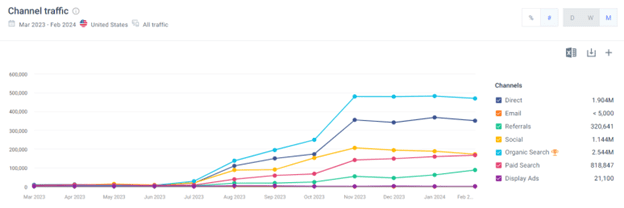
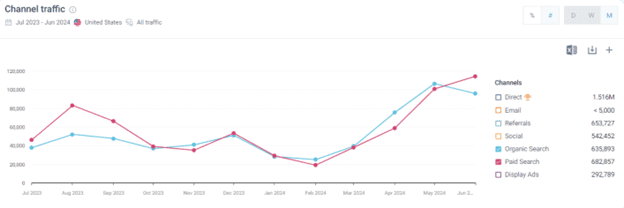
The reason is pretty simple. People saw our ads and Googled the brand name. Take a look at the Similarweb Channels report below. What do you see? (Hint, the blue line represents organic traffic.)

Screenshot from Similarweb, September 2024

Channel data for greenies.com

 As we see above, organic traffic seems to correlate directly with paid search.

Screenshot from Similarweb, September 2024

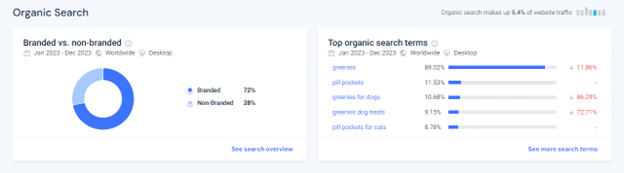
Looking at the organic search breakdown for the brand in 2023, we see that 72% of the site’s keywords were branded.

Screenshot from Similarweb, September 2024


Channel data for elorea.com

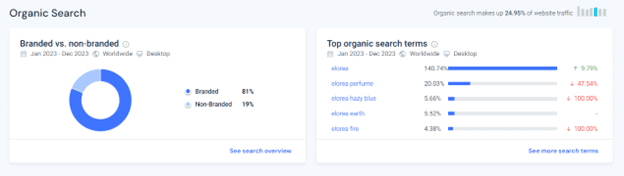
 What we see above is organic traffic directly correlates with other channels.

Screenshot from Similarweb, September 2024

Looking at the organic search breakdown for the brand in 2023, we see that 81% of the site’s keywords were branded.

The reason for this pattern is that the more your audience sees your brand, the more likely they are to Google your brand.

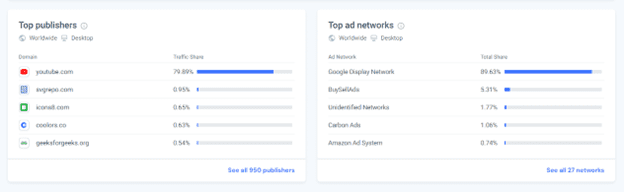
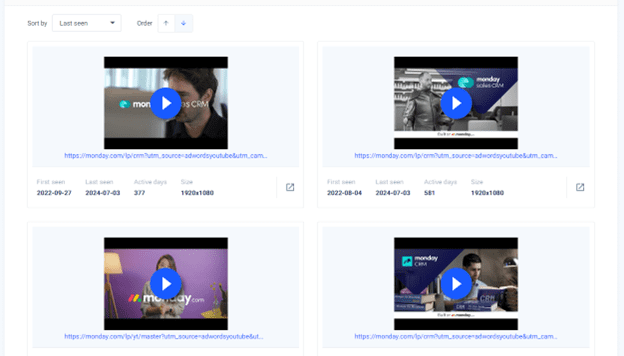
Another great example of this is monday.com. The brand has doubled down on its brand strategy, focusing primarily on YouTube ads.

Screenshot from Similarweb, September 2024

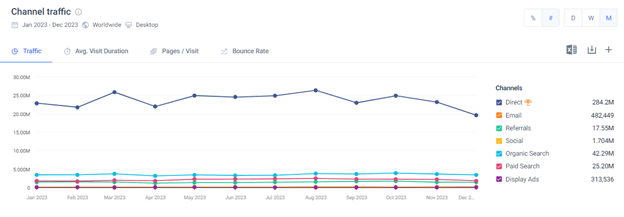
Its YouTube ads together with its memorable domain name has led to unprecedented levels of direct traffic.

Screenshot from Similarweb, September 2024

Although I haven’t yet seen evidence that Google uses direct traffic as a ranking signal, it stands to reason that it does. What’s more, you can see that Google has taken notice of the brand.

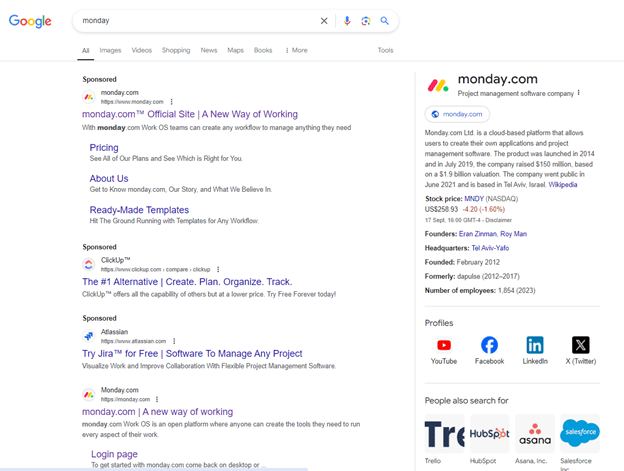
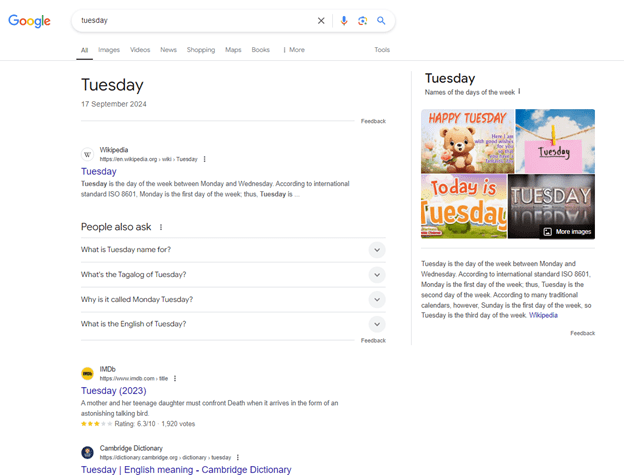
Try Googling the word Monday and then Google the word Tuesday and compare the results. To Google the word Monday refers to a brand.

Screenshot from search for Monday, Google, September 2024

Tuesday, on the other hand, is a day of the week.

Screenshot from search for Tuesday, Google, September 2024

The takeaway: You can increase brand signals like branded keywords and direct traffic by focusing on other channels.

So where does this leave you as an SEO?

You have the data to assess branded keywords and direct traffic, putting you in a unique position to partner with marketing leaders to work on big-picture marketing strategies designed to increase branded keywords.

2. Brand Engagement Metrics

Looking at the Google leak we can also see that Google measures user engagement as a signal of brand strength.

Brand Engagement Metrics includes user engagement factors such as click-through rates (CTR) and user interactions with the brand’s content. Higher engagement can positively influence rankings.

This means focusing on improving user engagement is a crucial aspect of brand SEO.

The best way to evaluate user engagement on your site is to compare your engagement metrics with that of your competitors.

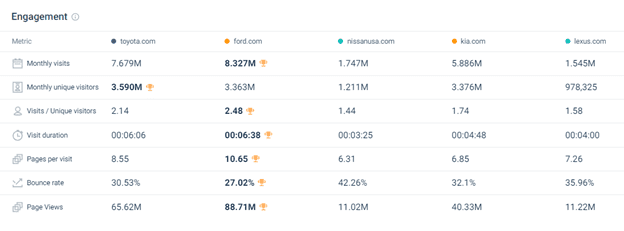
For instance I’m analyzing toyota.com and four of its competitors with the Similarweb Website Performance report. Looking at the Engagement metrics we see that ford.com is getting more engagement in almost all metrics.

Screenshot from Similarweb, September 2024

One of the best ways to improve user engagement is to focus on site navigation. This means figuring out the flow of information on your site and including it in your:

  • URL structure
  • Bread crumbs
  • Top level menu

Also make sure that the top of the fold section of every piece of content directly answers the user intent directly.

3. Creating content For [Brand] + Modifier Keywords

You have direct influence over how your brand appears when users search for it on Google. While you might assume all your branded traffic goes to your homepage, there are actually other ways to capture this traffic.

What’s more, your branded traffic can help you discover customer sticking points or even areas where you are potentially losing customers to your competitors.

Want to see how? Try digging through your branded keywords. You are looking for keyword modifiers that either represent issues to resolve or opportunities to be won.

Keyword modifiers might be:

  • [brand] pricing
  • [brand] reviews
  • [brand] alternative
  • Where is [brand] located
  • [brand] alternative

By looking through your branded keywords, you can quickly see how users are interacting with your brand by seeing the questions they are asking. Make sure you have content that answers all of these questions. If you find long-tail queries it might be a good idea to create an FAQ on your site.

If you don’t do this you might see your branded traffic go to sites like YouTube or worse, your competitors.

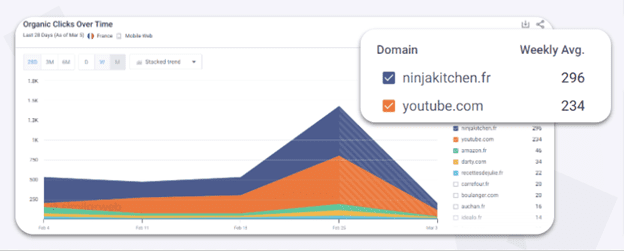
For instance using the Similarweb SERP Players report below, we see a large portion of branded clicks for Ninja Creamy going to YouTube.

Screenshot from Similarweb, September 2024

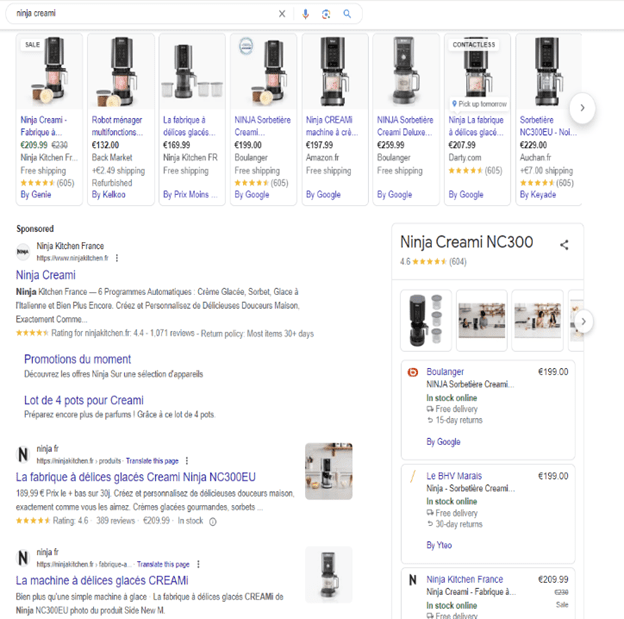
What’s fascinating about this is that YouTube is not above the fold. This means that users often have more than one search intent and are willing to scroll to find what they are looking for. Can you afford to lose traffic for YouTube?

Screenshot from search for Ninja Creami, Google, September 2024

In a case like this depending on which videos users are clicking on, it might make sense for the brand to create video content designed to feature on the SERP.

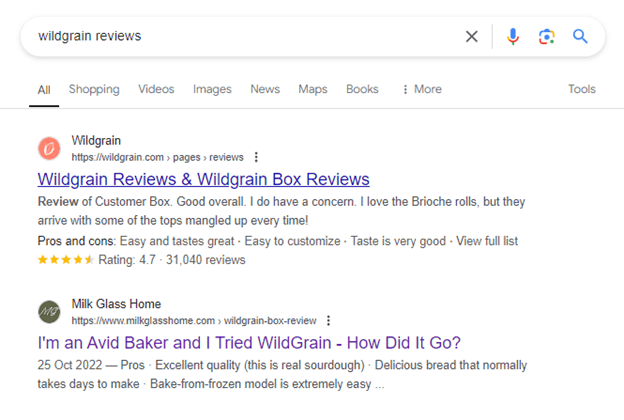
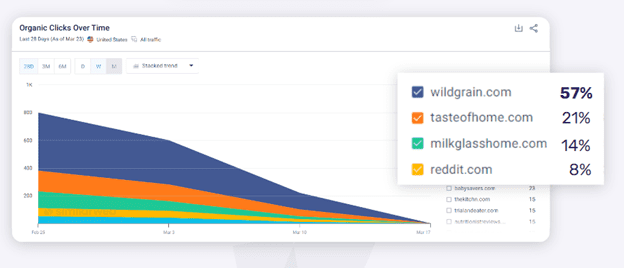
A great example of a brand that got this right is wildgrain.com. In 2023, the keyword ‘wildgrain reviews’ was trending. Fortunately for the brand they already included a page on their site featuring reviews.

Googling the keyword, users were faced with Wildgrain’s own reviews page ranking in position #1. What’s more the rich result included a review rating of 4.7 out of five. It also listed the amount of reviews (which currently stands at 31040.)

Screenshot from search for Wildgrain reviews, Google, September 2024

Our data shows that 72% of searches were zero-click. That means the vast majority of users were satisfied with what they saw in the search results.

What’s interesting is of the remaining 28% of users, 57% clicked on the Wildgrain’s own result.

Screenshot from Similarweb, September 2024

The takeaway is with the right content, you can directly influence how users interact with your brand, even on things like reviews.

4. Educating Search Engines About Your Brand Entity

Another aspect of how Google evaluates your brand is through your brand entity. Google’s machine learning allows the search engine to understand real-world entities. It does this by gathering information about entities mentioned around the web and arranging that information in a similar way to how a human brain arranges information.

The purpose of this is to understand the relationships between people, places, and things so that Google can deliver more relevant and contextual information in the SERPs.

Google’s knowledge is constantly expanding and updating as new information becomes available.

How does Google understand your brand?

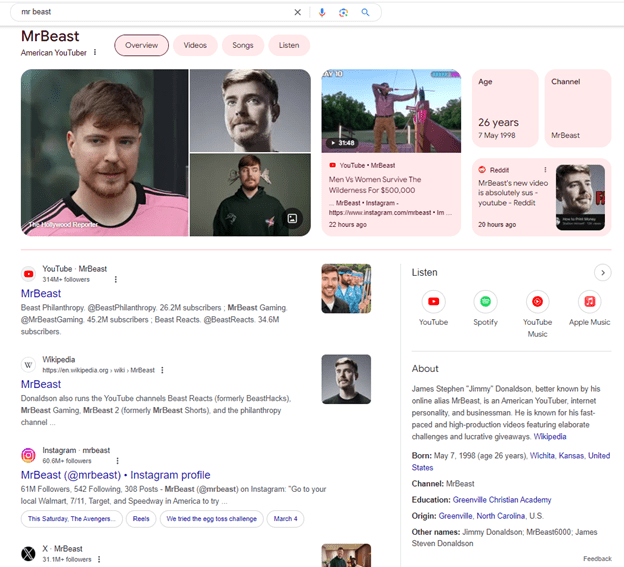
To find out, just Google it. If there are strong signals around the web, Google will present you with things like a Knowledge Panel, Twitter (X) boxes, image boxes and more.

Screenshot from search for Mr Beast, Google, September 2024

If you don’t see anything, you have work to do, as I mentioned above, a large portion of users hear about your brand and then Google you. What they see when they arrive on your brand SERP is up to you.

The great news is you can educate Google about your brand entity. When you do that, you’ll not only improve your brand SERP, but you might see your brand popping up in other strategic places.

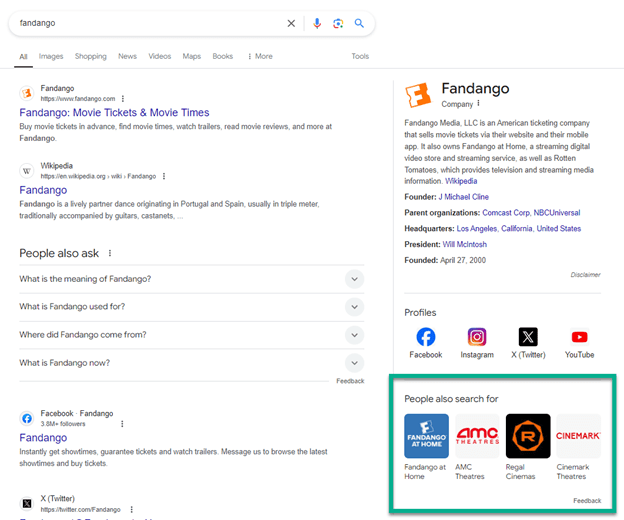
For instance, below, I’ve searched for Fandango, a company that sells movie tickets. If you look at the bottom of the Knowledge Panel on the right, you’ll see Fandango’s direct competitors including:

  • AMC Theatres
  • Regal Cinemas
  • Cinemark Theatres
Screenshot from search for Fandango, Google, September 2024

How did a site’s competitors make it into the site’s Knowledge Panel? Google doesn’t only rank content for keywords any more. It understands what the brand entity is and what it relates to. The result is you might find your brand mentioned appearing on your competitor’s brand SERP or in other relevant places on the web.

How do you educate Google about your brand entity?

There is a clear method to educate Google about your brand entity.

  1. Establish an entity home page: Create a dedicated page that describes your entity. This page should clearly outline what your business does and who it serves. Although this can be any page on the web, the best place to do this is on your ‘About Us’ page.
  1. Build entity citations: Mentions of your brand across the web will reinforce the information provided on your brand homepage. It’s important to keep your brand description consistent around the web so that Google can match each citation with your entity’s home page. Citations can appear on pages you control, such as social media profiles but citations on pages you don’t control often carry more weight and provide the most benefit.
  1. Link from your entity homepage to your entity citations: This could mean including links to your social media profiles as well as any guest posts, videos, or podcasts your brand is featured on.

Far From The Final Word On Brand SEO

As an SEO, if you prioritize branded SEO, you are not just a technical specialist. You have access to data to shape the business’s digital identity, which can drive tangible and sometimes immediate results. This paradigm shift allows you to directly impact revenue streams, aligning SEO efforts more closely with overarching business objectives.

If branded SEO is a paradigm shift for you, consider this.

Branded SEO is only one ranking factor in Google’s complex maze of ranking systems. You can read more about it in our latest ebook: Google’s Ranking Anatomy: Dissecting 90+ Ranking Signals.


Image Credits

Featured Image: Image by Similarweb. Used with permission.

In-Post Image: Images by Similarweb. Used with permission.

Ask an Expert: Does Google Index AI Content?

“Ask an Expert” is an occasional feature where we pose questions to seasoned ecommerce practitioners. For this installment, we’ve turned to Ann Smarty, the founder of Smarty Marketing, a search engine optimization firm, and a longtime Practical Ecommerce contributor.

She addresses Google’s policy on content produced by artificial intelligence tools.

Practical Ecommerce: Does Google index and rank AI-generated content?

Ann Smarty: Google published “guidance about AI-generated content” in its Search Central blog in February 2023. The guidelines are vague but worth reading nonetheless.

Ann Smarty

Ann Smarty

To summarize:

    • Google allows “helpful and original” AI-generated content. The post doesn’t offer examples of such content, but it presumably means using AI to repurpose, clarify, or shorten your original article.
    • Google does not allow the use of AI to mass-produce content intended solely to rank for multiple queries. This is against Google’s spam policies.

Google states in the post that it has dealt with automated content for years, such that the AI issue is not new. Google says it can detect content created with automation or AI, and its focus remains on E-E-A-T: expertise, experience, authoritativeness, and trustworthiness.

Per Google, “Our focus on the quality of content, rather than how content is produced, is a useful guide that has helped us deliver reliable, high-quality results to users for years.”

Google Removes Cache: Search Operator Documentation via @sejournal, @martinibuster

Google removed their documentation for the cache: search operator because it no longer works. The Internet Archive’s Wayback Machine shows the documentation was live as of September 17, 2024. The URL now redirects to a changelog notice announcing its removal.

It was announced on March 2024 by Google SearchLiaison via X (formerly Twitter) that the cache: search operator was removed.

He posted about the removal of the cache: search operator:

“Hey, catching up. Yes, it’s been removed. I know, it’s sad. I’m sad too. It’s one of our oldest features. But it was meant for helping people access pages when way back, you often couldn’t depend on a page loading. These days, things have greatly improved. So, it was decided to retire it.

Personally, I hope that maybe we’ll add links to @internetarchive from where we had the cache link before, within About This Result. It’s such an amazing resource. For the information literacy goal of About The Result, I think it would also be a nice fit — allowing people to easily see how a page changed over time. No promises. We have to talk to them, see how it all might go — involves people well beyond me. But I think it would be nice all around.”

Adding links to Internet Archive is exactly what’s happened, it was announced on September 11, 2024 that links to Internet Archive are added to Google search.

A Google spokesperson was quoted at the time:

“We know that many people, including those in the research community, value being able to see previous versions of webpages when available. That’s why we’ve added links to the Internet Archive’s Wayback Machine to our ‘About this page’ feature.”

Google’s documentation changelog noted:

“Removing the cache: search operator documentation
What: Removed the cache: search operator documentation.

Why: The cache: search operator no longer works in Google Search.”

The disappearance of the documentation is a reminder that Google Search is continually changing which means that anyone involved with publishing and search should keep that expectation in mind, particularly for SEO.

Featured Image by Shutterstock/stockfour

SEO Content Strategy: Discovering What Your Audience Wants via @sejournal, @CallRail

In the rapidly evolving world of SEO, staying ahead of the curve is critical.

Traditional SEO focuses on optimizing for keywords and topics directly related to your business.

However, as markets become increasingly saturated, new strategies are needed to stand out and reach a broader audience. That’s where tangential SEO comes in.

Tangential SEO involves creating and optimizing content for topics that are tangentially related to your core business. This allows you to engage with audiences who may not be actively looking for your products or services but who could still find them relevant or useful.

It is a strategy designed to build brand visibility, establish authority, attract a wider audience, and ultimately drive more traffic to your site.

Whether you’re a content marketer seeking to diversify your strategy, a business owner aiming to extend your online reach, or a newcomer to the field eager to learn, this guide is for you.

Not only will I explain what tangential content is at a broader level, but I’ll also show you how we find alternative keywords using untraditional methods.

You’ll have a methodology for finding keywords none of your competitors have even thought about.

Excited?

Let’s begin.

What Is “Tangential Content”?

Quite simply, tangential content is content that is not directly related to your product or service offering.

For example, instead of only focusing on sportswear, Nike might generate content around topics like music playlists for different moods or workout routines, exploring various global music trends.

It could even discuss urban design and its impact on outdoor physical activities. These are topics not directly related to Nike’s products but themes that would likely resonate with its audience.

Let’s give some more examples for context:

  • Starbucks: Beyond coffee, Starbucks could create content discussing books and literature, considering that many people enjoy reading while sipping its coffee. The brand could start a book club, share reviews, and host author interviews.
  • Apple: Apple might deviate from its technology-centered content to explore topics like interior design, highlighting aesthetic and minimalistic arrangements that complement its devices or discussing how different spaces foster productivity and creativity.
  • IKEA: While primarily focused on furniture, IKEA could develop content around topics like urban gardening, offering tips for creating green spaces in small city apartments, or sharing recipes to create using limited kitchen tools.

Why Create Tangential Content?

Creating tangential content can have numerous benefits, particularly when it comes to reaching a wider audience, building brand authority, and improving SEO performance.

As a food lover, I wanted to try and squeeze a food analogy in, so I’m going to do it here. Let’s consider the benefits of creating tangential content as a master chef in the culinary world.

  • Broader audience reach: Just like a versatile chef caters to various palates, tangential content allows your brand to cater to a wider audience – which is especially important for weirder or more abstract niches.
  • Increased engagement: Changing up the menu keeps diners interested, just like a variety of content can keep your audience engaged. By showing that your brand can whip up more than just the standard fare, you’re demonstrating a deeper understanding of your audience’s diverse tastes.
  • Building brand authority: When you create a variety of dishes, you prove your culinary skills beyond your signature dish. Similarly, creating content on a range of topics positions your brand as an authority in your field, enhancing your reputation and influence.
  • Creating more emotional content and aligning with customer lifestyle: Tangential content is akin to designing a themed dining experience that aligns with your customer’s lifestyles and preferences. For instance, if you know your customers are environmentally conscious, you might focus on farm-to-table ingredients or share stories of local farmers. This not only provides content that resonates emotionally but also aligns your brand more closely with your customer’s values and lifestyles.
  • Link building: Just as a unique fusion dish might get rave reviews and recommendations, tangential content often has a higher potential to be shared, earning you backlinks from various domains. These backlinks boost your site’s authority, much like word-of-mouth boosts a restaurant’s reputation.
  • SEO performance: By offering a variety of dishes, you’re catering to more tastes and attracting more diners. Similarly, by covering a range of topics, you’re likely to rank for more keywords, attracting more organic traffic to your website.

While the benefits of publishing tangential content are clear, don’t overlook the value in the research process itself.

The analogy continues like so: consider researching tangential content ideas similar to the time a chef spends experimenting in the kitchen and interacting with their customers.

It’s during this phase that the chef discovers which dishes their customers can’t get enough of, which ones they’re not too fond of, and what cuisine they’re yearning to try next.

In the same way, when you research diverse topics for your tangential content, you’re not only gathering material for your next post – you’re also gaining a broader understanding of your customers’ unmet needs or interests.

This insight is just as valuable, if not more so, as it can guide the development of new products, services, or post-purchase support articles.

So, even before you’ve served up your tangential content to your audience, the research phase itself can help you refine your ‘menu,’ making your brand more attuned to your customers’ tastes and more valuable in their eyes.

Hopefully, the hokey simile made sense, hasn’t made you hungry, and you’re sold on the concept of tangential content.

I’ll now show you how we generate tangential content ideas.

How To Generate Tangential Content Ideas?

To walk through the following process, I’m going to use an example as if I was doing this research for a fictional hair removal company.

Step 1: Establish Buyer Personas

Buyer personas are essentially fictional representations of your ideal customers, often based on real data and market research about your existing customers. They help us understand our customers (and potential customers) better and make it easier for us to “get into their minds.”

These personas can include information such as demographics, behavior patterns, motivations, goals, challenges, values, and fears.

Sometimes your marketing department will already have one of these, but if they don’t, you could ask our new friend, ChatGPT, to produce one.

Step 2: Create A Mind Map

A mind map typically starts with a central idea, placed in the middle of your page. From this central idea, you’ll draw lines that branch out into main topics.

It’s like a tree sprouting branches.

These main branches can further sprout smaller branches, each representing related subtopics or ideas.

In our scenario, we’ll plant the name of the buyer persona as the seed of our mind map. From there, we’ll let branches grow out, each representing key values, aspirations, preferences, and hobbies that we’ve identified for this persona.

Remember, this isn’t the stage for keyword research; there’s no need to think about keyword volume data. This is more about emptying out your mind and exploring potential questions this persona might have.

This process is about trying to see the world through their eyes.

If you find that you’re not the best match for this persona – for example, if the persona is a 28-year-old woman and you’re not a 28-year-old woman (as I am not) – then it could be beneficial to bring in someone who aligns more closely with the persona.

This way, you can ensure you’re covering all bases and not missing any important insights.

In any case, here’s one I started doing for a persona I called “Sarah Thompson.”

Sarah Mind map Keyword insights

Also, it’s wise to create several mind maps to cater to different segments of your target audience.

For instance, when I analyzed a renowned hair removal company’s website data using Similarweb, I discovered a substantial interest from males in hair removal.

As a bald male, I had to confront my own biases that initially made me overlook a significant demographic. To make the most of this exercise, it’s crucial that you don’t let your personal biases cloud your judgment.

In light of my realization, I did create a mind map for the male audience, following the same steps. However, to avoid repetition, I won’t detail that process again.

Always remember: diversity in perspectives can enrich your content strategy!

Step 3: Find The Data To Support Ideas

This is where the fun begins! I simply take all the questions I’ve brainstormed in my mind map and pop them into Google to see what surfaces.

If you take a look at the screenshot below, you’ll see that my initial search query doesn’t have any search volume (highlighted in the red box).

Despite this, Google still fetches a bunch of relevant results. Interestingly, each of these results does rank for a certain number of keywords, as indicated by the green boxes.

So, even without search volume for the initial query, there’s still relevant content out there capturing people’s interest.

Screenshot for search on Google for wax strips queryScreenshot for search for [are wax strips vegan], Google, May 2023

You’re going to want to gather all these keywords. Honestly, this is where I find the Ahrefs toolbar to be a gem.

It allows me to click on each search result and conveniently export the keywords associated with each one. This makes the whole process much more streamlined and efficient.

Of course, you don’t need Ahrefs for this; there are other great tools to get the keywords for each URL. I just find the toolbar incredibly useful here.

Step 4: Rinse And Repeat With Each Of Your Content Ideas

You’ll want to enter each of your ideas into Google and get all the keywords for the articles that rank – even if your original query had no search volume.

keyword insights question image

Step 5: Find Additional Keywords None Of Your Competitors Will Have

At this point, you should have a list of keywords that are tangentially related to your target brand.

These keywords correspond to the questions and pain points of your buyer persona, providing a strong foundation for content that’s relevant and engaging for your target audience.

But because you’ve downloaded these keywords from an SEO tools database, your competitors have them, too.

They may not be your direct competitors, but someone has them (otherwise, we wouldn’t have been able to get them from the SEO tool).

So how do we get the keywords no one has? We need to seek additional sources of inspiration.

I generally turn to forums or late UGC sites. Why? Dynamic forums like Reddit and Quora have a huge user base, all of whom are asking questions that many of them can’t find the answers to elsewhere online.

On forums like Reddit, we can zero in on specific topics and subreddits to surface popular questions that get a lot of engagement.

Reddit home pageScreenshot from Reddit, May 2023

Keep in mind that many individuals resort to forums to seek answers to questions that the internet doesn’t readily provide.

On user-generated content (UGC) sites, the same question can be phrased in countless ways, which means conventional keyword tools might not capture this diversity.

Now, if you find a slew of keywords phrased differently but asking the same question, all registering as “zero volume” yet showing substantial engagement (in the form of likes, upvotes, shares, etc.), can we truly label them as zero volume?

I’d argue most certainly not. There’s clearly an active interest and engagement there, and that’s what truly matters.

Back to our hair removal example. There were also thousands of unanswered questions and ideas on Quora.

Screenshot from Reddit May 2023

Anyway, we want all these “keywords” too.

The easiest and quickest way is to make a little scraper that searches for keywords and pulls all these. There are plenty of Python libraries for the more “well-known” forums, like this one for Quora and this guide for Reddit.

If you’re not inclined towards coding, don’t have the skills, or perhaps the niche you’re exploring doesn’t readily present good ideas on major forums, there’s a solution for you.

Chrome extensions like Scraper are excellent tools for this. You can simply right-click and use it to scrape all the relevant questions.

Screenshot from Quora May 2023

Step 6 (Optional): Use AI To Make The Questions Less “Chatty”

Of course, when people ask questions on forums, they word them in weird, colloquial ways with misspellings and local abbreviations. We can use ChatGPT here again to make all of our scraped questions “less chatty.”

Use the following prompt to make them more readable:

“Reword the following Reddit questions and reword them into a simple question. Please present the results in a table”

ChatGPT table of simplified questionsScreenshot from ChatGPT, May 2023

This particular example isn’t the most exciting I’ve ever encountered, as all the questions sort of made sense in their original state without the AI.

Reflecting back again on the time we did this exercise for the condom brand, the quirks were countless. We had a plethora of strange abbreviations and peculiar phrasings, and the AI’s knack for “translating” these into coherent questions was incredibly beneficial.

Step 7 (Optional): Get All The Related Questions, Too

Once I’ve got all my forum questions, normalized or not (this step still works without using AI to make the questions more “sensical”), I like to get all the related questions too.

Screenshot from People Also Asked May 2023

There are plenty of tools and ways to scrape these for every keyword in your dataset. I personally like to use People Also Asked, as you can bulk upload to it.

Step 8: Get The Search Volumes For All Your New Queries

The keyword data you’ve downloaded from your go-to SEO tools like Ahrefs and Semrush will already include search volumes, so there’s no need to fuss over those.

However, all the fresh queries that you’ve discovered should also be plugged into an SEO tool to check if they hold any search volume.

This batch includes any of the keywords you extracted (and potentially standardized using AI), as well as any related People Also Ask questions that surfaced during your research.

Don’t worry if many of the queries show no volume; in fact, that’s to be expected. As we’ve already touched on, you’ll notice the same question is frequently asked, just worded in a variety of different ways.

Pair that with the fact that many of these questions tend to gather significant engagement on social platforms, and you’ll realize these so-called “zero volume” keywords aren’t truly “zero volume.”

To spot these repeating questions, we need a quick way to group similar queries together.

Step 9: Cluster Your Keywords

Grouping keywords together, or clustering, helps us organize our data. It turns a potentially overwhelming list of keywords into smaller, more manageable groups.

By clustering keywords, we can better understand which pages to create and pinpoint recurring questions within those elusive “zero volume” keywords.

There are many keyword clustering tools out there, but ensure you use one which clusters keywords by the search engine results and not natural language processing.

The former ensures you’re grouping keywords based on how a search engine understands them, not a language model.

Most clustering tools require you to upload a single CSV, meaning you may have to go through and combine all your reports at this stage. If all the columns match up, you could use an online CSV merging tool like this.

Remember to de-duplicate the keywords, too, so that you don’t have double data in there.

If you opt for Keyword Insights as your clustering tool, it offers you the freedom to upload any number of CSVs, regardless of whether the columns align.

The tool will guide you in mapping out the columns. Additionally, it conveniently de-duplicates the keywords for you.

(Disclosure: I am one of the co-founders of Keyword Insights, but there are many other great clustering tools out there).

Keyword ClusteringScreenshot from Keyword Insights, May 2023

Once you have your clustering report ready, you’ll start noticing the trends I mentioned earlier. For instance, observe the number of queries around variations of “Can you recycle razor blades?”

Traditional keyword research might overlook this term because other SEO tools reported it as having only “60 monthly searches.” However, the total sum of all similar questions asked is likely much higher.

Also, keep in mind these “zero volume” queries were selected based on the engagement they garnered (likes, shares, comments, etc.). So, they’re undoubtedly relevant topics to address.

Keyword insights clustering reportScreenshot from Keyword Insights, May 2023

Example Insights

After following the above steps for a hypothetical hair removal company, I found myself with a pool of 12,590 keywords, which could be organized into 975 clusters.

Below are some insights we could potentially highlight, confident in the knowledge that it’s likely our competitors haven’t addressed some, if not most, of these topics.

Pre-Purchase

There were many obvious clusters of questions that hadn’t been answered about what potential users were asking before they waxed or around alternative methods of waxing. For example:

Screenshot from Keywords Insights May 2023

Here’s another example:

what to do before waxing: keyword clusterScreenshot from Keyword Insights, May 2023

Look at how diverse the wording of the same question is. There’s likely a lot more search volume to the query “what to do before waxing” than SEO tools are reporting.

Post-Purchase

It’s quite uncommon to see brands excel in creating “post-purchase” content. “Post-purchase content” refers to valuable materials designed to assist their customers after they’ve already utilized their products (or similar ones).

Creating high-quality post-purchase content is a valuable strategy for any business. It demonstrates a sustained commitment to your customers beyond the point of purchase.

By providing this kind of support, you’re nurturing a relationship that extends beyond the transaction, reinforcing that your brand truly cares about their experience.

Moreover, this approach can potentially decrease the volume of customer service queries as you’re proactively addressing common questions and concerns. This not only streamlines your operations but also enhances the customer’s experience with your brand.

One such large cluster I came across that a hair removal company might wish to cover is this one:

ingrown hair brazilian wax before and after: keyword clusterScreenshot from Keyword Insights, May 2023

Investigating the issue of “ingrown hair after waxing” can bring significant advantages for a hair removal brand.

Let’s explore why.

Firstly, individuals are continuously in search of solutions. The aftermath of waxing isn’t always smooth; dealing with ingrown hairs can be challenging. If your brand can offer relevant and effective advice, it positions you as a trusted expert in the field.

Moreover, consider those online users who are seeking advice for their ingrown hairs. While they may not be actively searching for hair removal products at the moment, if they come across an informative article from your brand, they’ve just made a connection with you.

Essentially, you’ve expanded your reach to prospective customers who were previously unknown.

For your existing customers, providing such value-added content strengthens your relationship. You’re not just a vendor selling them products, but a trusted adviser, enhancing their loyalty to your brand.

From a technical standpoint, producing consistent, quality content increases your visibility to search engines, potentially improving your search rankings. Furthermore, you may gain additional backlinks and social shares, furthering your reach and visibility.

Lastly, offering knowledgeable advice on a topic that is indirectly related to your product underscores your understanding and expertise in the broader field.

You’re not just a product seller; you’re an active participant in the ongoing dialogue, which can enhance your brand’s credibility and influence.

Lifestyle And Advice

The research found a ton of ideas that would resonate with our target audience’s lifestyle needs.

Remember, we’re selling products to real people with real problems. If there’s any content that can help them, even if it’s only “tangentially related” to what we sell, it’s in our best interest to produce it.

Here are some examples:

Screenshot from Keyword Insights, May 2023

Promoting body positivity can offer a strategic advantage for a hair removal brand. From a psychological perspective, it fosters self-acceptance and challenges negative beauty norms, reducing body-related anxiety among consumers. This approach can encourage healthier behaviors, reduce harmful social comparisons, and cultivate resilience against societal pressures, all while promoting inclusivity and a sense of value regardless of physical appearance. The indirect influence on sales could be substantial: by aligning the brand with a cause that resonates with many consumers, it may enhance brand perception and customer loyalty. Consequently, customers may prefer to buy from a brand that genuinely aligns with their values, leading to increased sales and stronger brand loyalty. Nevertheless, the brand’s values must be communicated authentically for the impact to be truly meaningful.

Similar ideas include:

why am i so insecure about my looks: keyword clusterScreenshot from Keyword Insights, May 2023

And:

what to say to a guy who is insecure about his body: keyword clusterScreenshot from Keyword Insights, May 2023

Along with:

Screenshot from Keyword Insights, May 2023

By engaging in this broader conversation about attractiveness, the brand can connect more deeply with its audience and demonstrate an understanding of their concerns, thus building trust and strengthening customer relationships.

New Product Ideas

As I mentioned at the beginning, when you explore various topics for your tangential content, it’s more than just collecting ideas for upcoming posts.

You’re actually delving deeper into your customers’ needs and interests that haven’t been addressed yet. This valuable insight can potentially steer the direction for the creation of new products.

We’ve already seen numerous examples of questions people were asking about societal expectations and beauty standards surrounding body hair. It’s natural, therefore, for men to seek out suitable products for addressing these concerns:

new product idea: manscaping kitScreenshot from Keyword Insights, May 2023

Including:

trimmer for private male areaScreenshot from Keyword Insights, May 2023

Cast your mind back to the buyer persona we created. One of the key values our person has is being “environmentally friendly.”

It’s great, therefore, that our research has surfaced many potential new product ideas that align with this:

eco friendly waxing keyword clusterScreenshot from Keyword Insights, May 2023

Of course, these are just a few samples of what I found. Across the 975 clusters in my research, there were loads of new content and product ideas.

Conclusion

It’s crucial for brands to incorporate tangential keyword research into their strategies in order to stay relevant and connect with a wider audience.

By exploring related topics and keywords, brands can uncover new opportunities, engage diverse audiences, and establish themselves as industry leaders.

Tangential keyword research enables brands to identify emerging trends, understand unique customer needs, and develop innovative content and products that resonate with their target market.

Embracing tangents allows brands to outshine competitors, foster customer loyalty, and achieve long-term success in today’s fast-paced digital landscape.

To discover tangential ideas, follow these steps:

  • Understand your target consumer: Put yourself in their shoes and identify the type of content and questions they may have that are tangentially relevant to your business.
  • Explore existing content: Check if any content already addresses these concerns. Use your preferred SEO tool to extract ranking keywords by entering relevant URLs.
  • Enrich your tangential content ideas: Uncover unique keywords that your competitors may not have discovered. Seek inspiration beyond traditional sources of keyword research on forums or social media platforms where people ask questions that aren’t adequately answered elsewhere online.
  • Cluster your keywords: So that you more easily spot patterns and add “volume” to these technically “zero volume” keywords, the keywords need to be grouped together.
  • Analyze clusters for trends: Categorize your insights into main categories, such as pre-purchase, post-purchase, new product ideas, lifestyle, and advice. This will help you identify interesting trends and capitalize on them effectively.

In the practical example, we gathered a significant portion of our keyword ideas by scraping Reddit and Quora.

It’s important to note that not all niches can benefit from these channels (for instance, a website selling broadband cables is unlikely to find much insight there).

However, rest assured that there is always a forum or social channel available for every niche; the key lies in discovering it.

Happy keyword hunting.

More resources:


Featured Image: REDPIXEL.PL/Shutterstock

AI On Innovation [Part 2]: More Insights From +546,000 AI Overviews via @sejournal, @Kevin_Indig

Following up on my first analysis of +546,000 AI Overviews, I dug deeper into three questions:

  1. How are common crawl data and AI Overviews related?
  2. How does user intent change AI Overviews?
  3. How do the top 20 positions break down for domains that rank in organic search and get cited in AIOs?

How Are Common Crawl Data And AI Overviews Related?

Common crawl inclusion doesn’t affect AIO visibility as much as sheer organic traffic.

Common Crawl, a non-profit that crawls the web and provides the data for free, is the largest data source of generative AI training.

Some sites, like Blogspot, contribute a lot more pages than others, raising the question of whether that gives them an edge in LLM answers.

Result: I wondered whether sites that provide more pages than others would also see more visibility in AI Overviews. That turned out not to be true.

I compared the top 500 domains by page contribution in Common Crawl to the top 30,000 domains in my dataset and found a weak correlation of 0.179.

The reason is that Google probably doesn’t rely on Common Crawl to train and inform AI Overviews but its own index.

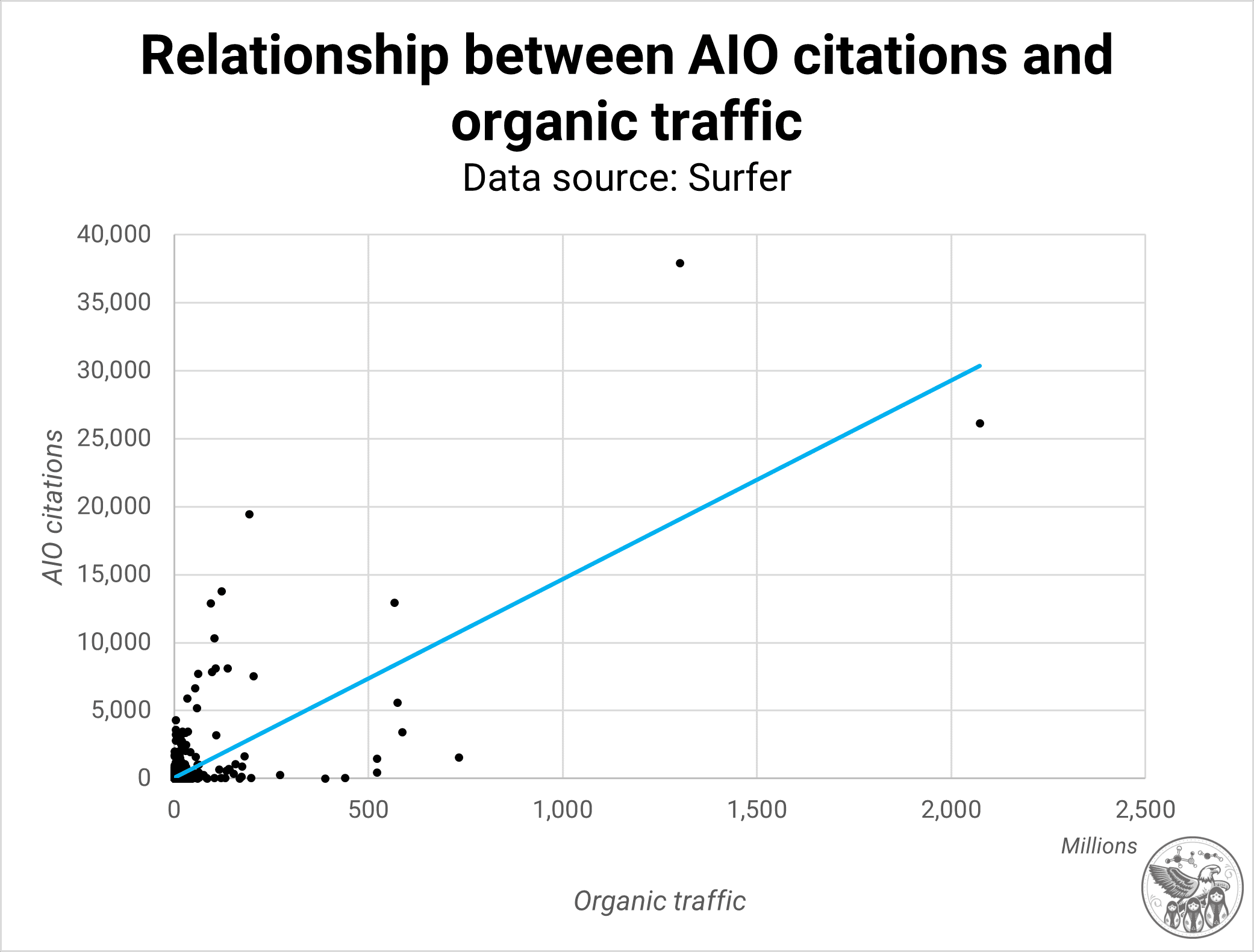
Relationship between AIO citations and organic trafficImage Credit: Kevin Indig

I then analyzed the relationship between the 3,000 top domains by organic traffic from Semrush and the top 30,000 domains in my dataset and found a strong relationship of 0.714.

In other words, domains that get a lot of organic traffic have a high likelihood of being very visible in AI Overviews.

AIO seems to increasingly reward what works in organic search, but some criteria are still very separate.

It’s important to call out that a few sites distort the relationship.

When filtering out Wikipedia and YouTube, the relationship goes down to a correlation of 0.485 – still strong but lower than with the two behemoths.

The correlation doesn’t change when taking out bigger sites, solidifying the point that doing things that work in organic search has a big impact on AI Overviews.

As I wrote in my previous post:

Ranking higher in the search results certainly increases the chances of being visible in AIOs, but it’s by far not the only factor.

As a result, companies can exclude Common Crawl’s bot in robots.txt if they don’t want to appear in public datasets (and gen AI like Chat GPT) and still be very visible in Google’s AI Overviews.

How Does User Intent Change AI Overviews?

User intent shapes the form and content of AIOs.
In my previous analysis, I came to the conclusion that the exact query match barely matters:

The data shows that only 6% of AIOs contain the search query.

That number is slightly higher in SGE, at 7%, and lower in live AIOs, at 5.1%. As a result, meeting user intent in the content is much more important than we might have assumed. This should not come as a surprise since user intent has been a key ranking requirement in SEO for many years, but seeing the data is shocking.

Calculating exact (dominant) user intent for all 546,000 queries would be extremely compute-intense, so I looked at the common abstractions informational, local, and transactional.

Abstractions are less helpful when optimizing content, but they’re fine when looking at aggregate data.

I clustered:

  • Informational queries around question words like “what,” “why,” “when,” etc.
  • Transactional queries around terms like “buy,” “download,” “order,” etc.
  • Local queries around “nearby,” “close,” or “near me.”
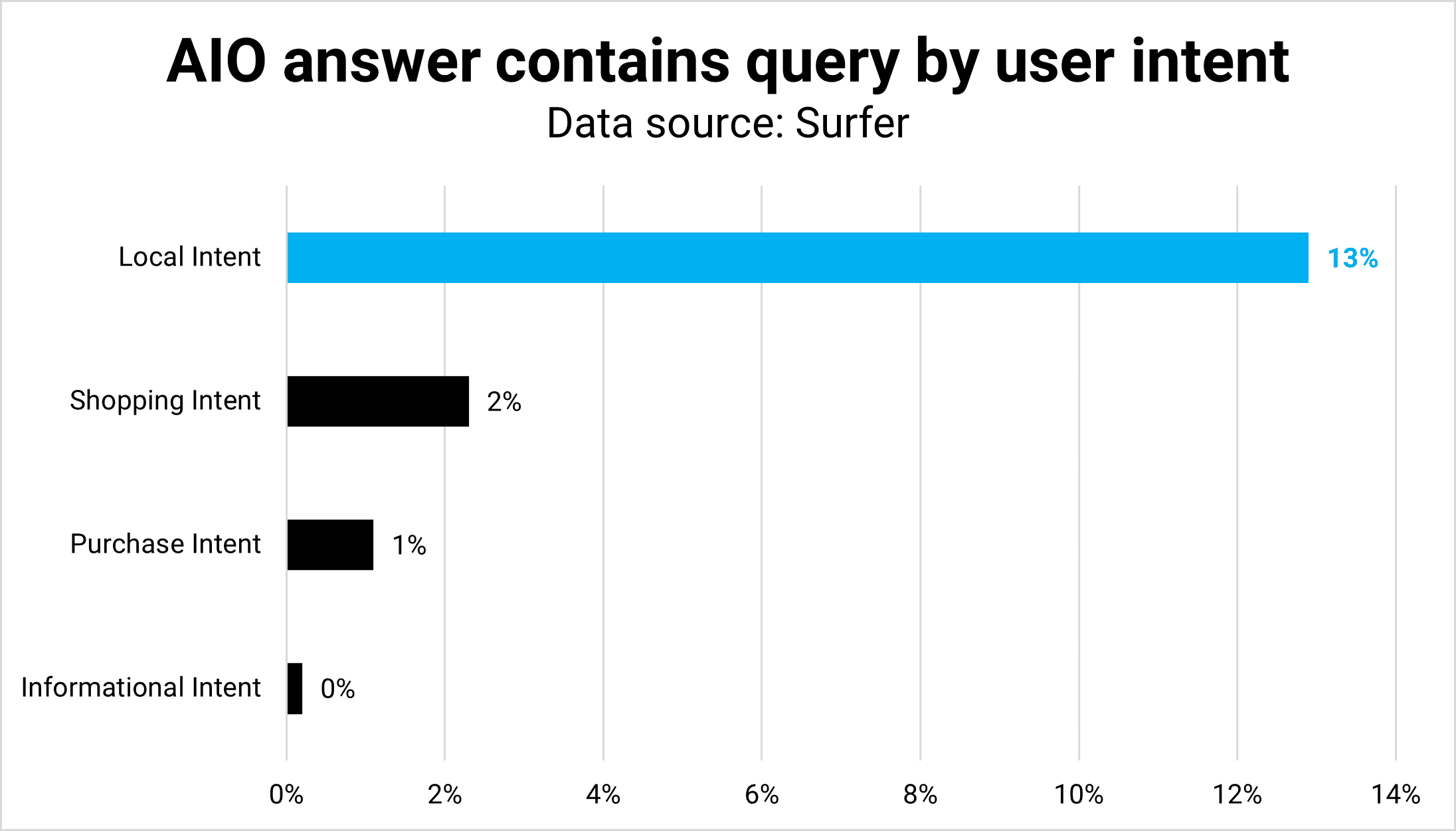
AIO answer contains query by user intentImage Credit: Kevin Indig

Result: User intent differences reflect in form and function. The average length (word count) is almost equal across all intents except for local, which makes sense because users want a list of locations instead of text.

Similarly, shopping AIOs are often lists of products with a bit of context unless they’re shopping-related questions.

Local queries have the highest amount of exact match overlap between query and answer; informational queries have the lowest.

Understanding and satisfying user intent for questions is harder but also more important to be visible in AIOs than, for example, Featured Snippets.

How Do The Top 20 Organic Positions Break Down?

In my last analysis, I found that almost 60% of URLs that appear in AIOs and organic search results rank outside the top 20 positions.

For this Memo, I broke the top 20 further down to understand if AIOs are more likely to cite URLs in higher positions or not.

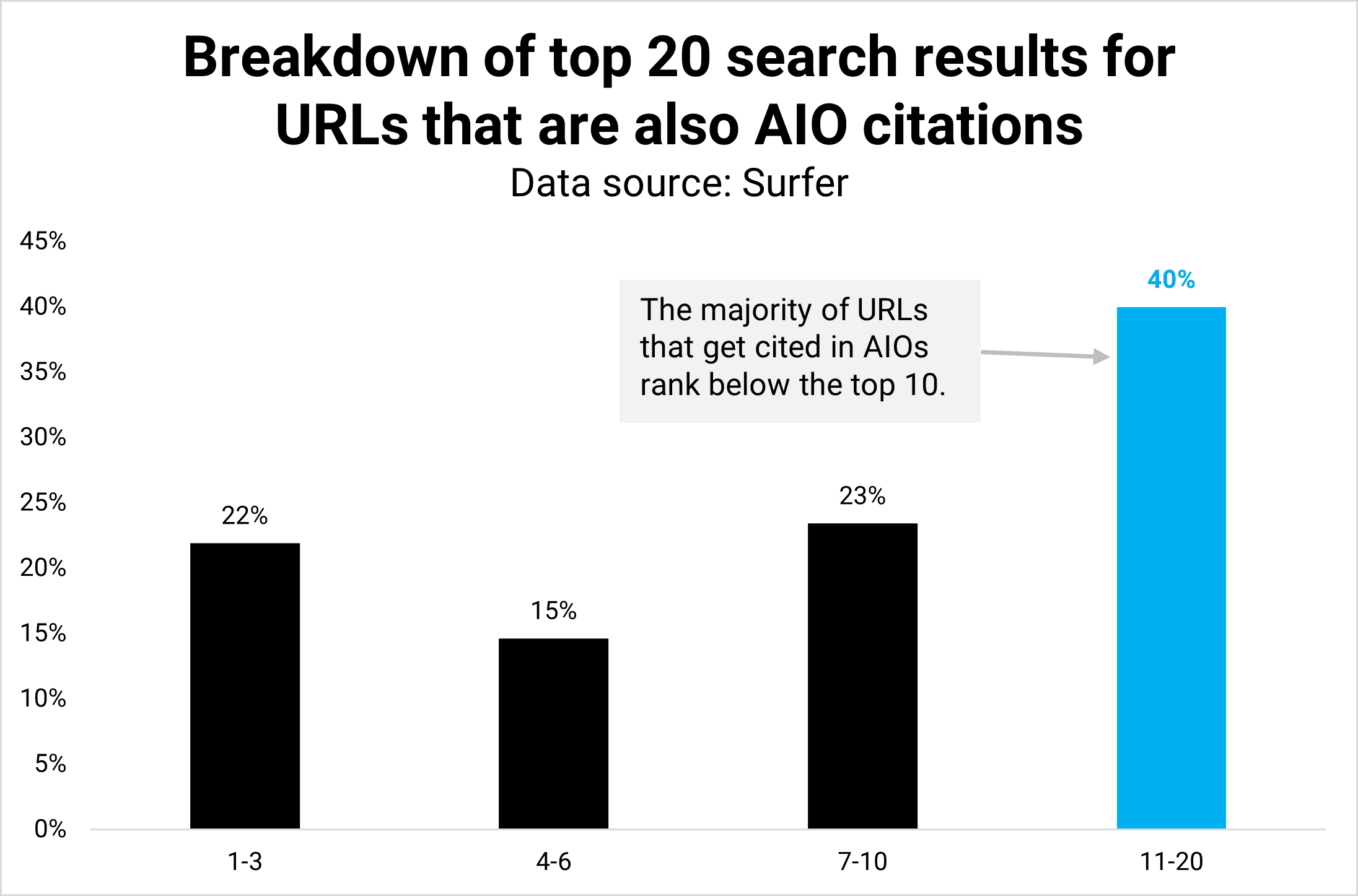
Breakdown of top 20 search results for URLs that are also AIO citationsImage Credit: Kevin Indig

Result: It turns out 40% of URLs in AIOs rank in positions 11-20, and only half (21.9%) rank in the top 3.

The majority, 60% of URLs cited in AIOs, still rank on the first page of organic results, reinforcing the point that a higher organic rank tends to lead to a higher chance of being cited in AIOs.

However, the data also shows that it’s very much impossible to be present in AIOs with a lower organic rank.

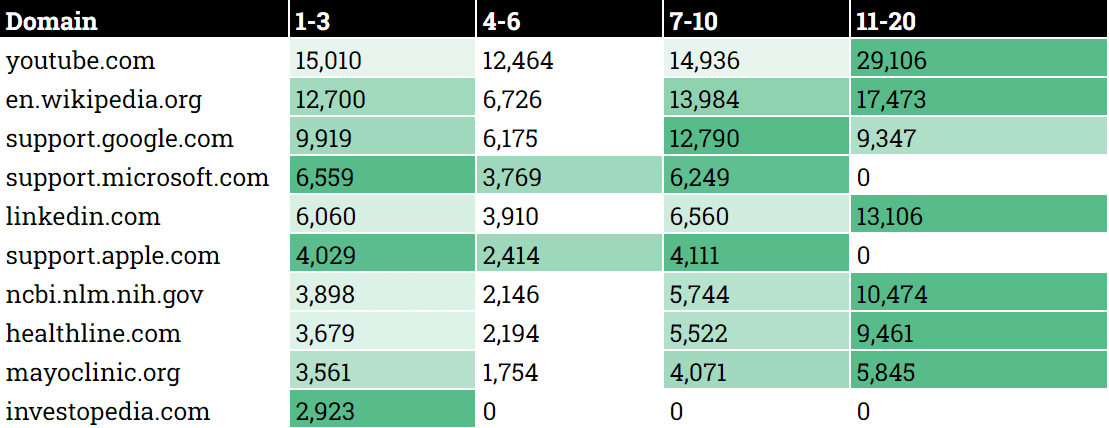
Where the top 20 domains that are visible in AIOs and search results rankWhere the top 20 domains that are visible in AIOs and search results rank (Image Credit: Kevin Indig)

Scenarios

I will work with my clients to match the AIO’s user intent, provide unique insights, and tailor the format. I see options for the progress of AI Overview that I will track and validate with data in the next months and years.

Option 1: AIOs rely more on top-ranking organic results and satisfy more informational intent before users need to click through to websites. The majority of clicks landing on sites would be from users considering or intending to buy.

Option 2: AIOs continue to provide answers from diversified results and leave a small chance that users still click through to top-ranking results, albeit in much smaller amounts.

Which scenario are you betting on?


Featured Image: Paulo Bobita/Search Engine Journal

Improve Your Brand’s Influence and Boost Your SEO With These Tips via @sejournal, @lorenbaker

For better or worse, brands have come to dominate Google search results, shaping the way users interact with the internet. As AI continues to evolve and search engines become more adept at understanding both the offline and online world, the influence of major brands is only going to grow. 

The rise of AI-generated content and machine learning models means that big brands are poised to become even more powerful, occupying the top spots in search results with increasing frequency.

Join us on October 2nd for our exclusive webinar with our friends at Moz: “Brands Rule Google: Why Building a Brand is Key to SEO”.

We’ll dive into why big brands dominate the search results and share actionable strategies for improving your own brand’s visibility.

Why This Webinar Is A Must-Attend Event

Ranking isn’t just about keywords anymore—brands play a huge role in SEO, and it’s crucial to capitalize on this shift to stay competitive.

In this webinar, we’ll cover:

  • Why brands dominate Google search results and how this trend will only grow as AI advances.
  • How to measure your brand’s impact in search, using key metrics to understand where you stand against larger competitors.
  • How to weave your brand into your SEO strategy to improve your content’s visibility and ranking potential.

Expert Insights From Dr. Pete Meyers

This session will be led by Dr. Pete Meyers from Moz, who will break down why brand marketing is essential for SEO and how you can incorporate your brand’s identity into your everyday SEO and content efforts.

Who Should Attend?

This webinar is ideal for:

  • SEO professionals looking to boost their brand’s presence on the SERPs.
  • Content strategists aiming to strengthen their brand’s identity with new formats.
  • Marketing professionals seeking to integrate SEO with brand marketing for a unified digital experience.

Live Q&A: Get Your Questions Answered

After the presentation, Dr. Pete will host a live Q&A session, giving you the opportunity to ask questions about brand strategy, SEO, and how to have your brand competing with the big names in the industry.

You’ll also get the chance to attend a live-only breakout session, exclusive to that day’s presentation, so be sure to attend live!

If you’re serious about boosting your presence on the SERPs and competing with brand giants, this is a must-attend event.

Reserve your spot today and start honing your brand strategy to compete with the big names in the industry.

Can’t attend live? Sign up anyway for the recording. See you there!

Google Shows How To Use Alt Text For SEO via @sejournal, @martinibuster

Google’s John Mueller answered a question on Reddit about image alt text and SEO, offering a comprehensive explanation of why alt text is important and why using AI for automatically creating alt text may be inadequate.

Alt Text

The person asking the question wanted to know whether alt text was still relevant for search optimization. In order to understand the role of alt text for SEO it’s useful to learn the technical reason for why alt text exists.

HTML elements can be described as the major building blocks of a web page. Elements can be extended with additional information by the use of attributes. For example, “” is an anchor element that becomes a link with the “href” attribute. Another attribute of the anchor element is the nofollow attribute.

Alt is short for alternate or alternative content. Alt, in the context of the question, is an HTML attribute of the image element. The purpose of “alt” is to provide alternate information about an image that can help a site visitor who might not be able to see the image and if the information is useful to them within the context of the web page.

Web page content is commonly considered to be text but images are also content when they have an “informative value” that helps a site visitor understand the web page topic.

The World Wide Web Consortium (W3C, the HTML standards making body) offers a great explanation:

“Choosing appropriate text alternatives:
Imagine that you’re reading the web page aloud over the phone to someone who needs to understand the page. This should help you decide what (if any) information or function the images have. If they appear to have no informative value and aren’t links or buttons, it’s probably safe to treat them as decorative.”

Complex images like graphs and illustrations may require a two-part alternate text, with the alt text providing a concise description of what the image is about and the surrounding text offering a longer more comprehensive description of the content of the image (another way is to link to the longer description).

Question About Alt Text And SEO

The person asking the question understands that Google is using complex algorithms to “view” the image and understand them and basically wants to know if the use of alt text is therefore redundant (repetitive) and superfluous (extra information that’s not necessary).

This is the question asked:

“Image alt text in the era of computer vision

Are images alt texts still relevant for SEO with all the computer vision and images recognition advancement? Is there any info of Google or other search engines using machine learning models to crawl images rather than relying on the user provided alt texts?”

Context Is Key In SEO

The assumption made by the person asking the question is reasonable and the question is valid. The information they may be missing is the context in which Google uses AI to “view” images and read the text that’s inside of them. Google’s documentation shows that the context for that kind of AI vision is in Google Lens, Google Translate, and other search surfaces but Google’s documentation doesn’t specifically mention the use of AI vision capabilities in the regular Google search results ((hat tip to @schachin for pointing me to that documentation!).

John Mueller’s answer adds the context that’s missing. He explains that the text content that’s around the image helps to give context to the image and what it means. Simply using AI vision to understand the image doesn’t provide insight into what that image means in the context of the web page.

Here’s Mueller’s answer:

“For image search, there’s the context that comes from the page + image combination that matters.

A photo of a beach might be a relaxing poster, it might be the beach from a hotel, it could be the site of a chemical spill. Just knowing that the image is of a beach doesn’t really give sufficient background information to be able to show it in image search appropriately. A lot of it does come from the page, and the alt-text is unique in that it’s what directly connects the image to the page with context.

Unless your site is a photo agency, traffic for “photo of a beach” isn’t going to be that useful – but for a hotel, having “hotel with beach in X” can be relevant. Again, a lot of that can come from the rest of the page, but the alt attribute value is a unique opportunity to give context. (And with that … if you use AI to create alt texts based on the image file, and get “photo of a beach” as the alt text for that image, you’re not getting the most out of the alt text, both for users & search engines.)”

That’s a great description of why alt text is important for SEO. Alt text shows how the image is directly related to the content of the web page.

Why AI Fails For Alt Text

Mueller also points up a shortcoming in the use of AI for scaling alt text in that in general an AI describes the image but fails to label it within the context of the content. Using alt text to communicate an informative description in the context of the text context is the right way to do it as described by the W3C and for SEO in general and for accessibility reasons.

Read Mueller’s response on Reddit:

Image alt text in the era of computer vision

Featured Image by Shutterstock/Master1305

SEO For Paws Free Live Stream Conference To Support Pet Shelters via @sejournal, @theshelleywalsh

SEO for Paws launched earlier this year, with the previous first event attracting 300 attendees to watch five hours of non-stop live streaming.

To continue the good work it does, the next event will be held on Sept. 25, 2024.

The charity event is a live-streamed fundraiser and features a stellar speaker list that includes some of the industry’s best SEO professionals and personalities, including Aleyda Solis and John Mueller.

SEO for Paws is the passion of Anton Shulke, an expert at organizing live stream events, to help a charity close to his heart.

When the war broke out in Ukraine, Anton was living in Kyiv. Even though Anton managed to escape the city, he has tirelessly continued his support for his favorite charity, which aids the many pets that were left behind in Kyiv after the war broke out.

At the previous event, Anton raised an impressive $6,000 that has gone directly to support four shelters and over 300 cats and dogs.

The network of tiny animal shelters operates entirely on donations as they do not receive government funding or support from large charities.

Shulke shares:

“Before the war, I tried to help those small cats and dogs shelters, but just a bit.

We are talking about super small shelters, 30-100 animals, they are in private flats. Sometimes in tiny flats, like one-bedroom or even studio flats. And the owner lives there; often, it is family.”

The war made their situation even more dire, with increased animal abandonment and limited resources.

Though facing personal hardships, Shulke has remained dedicated to Ukraine’s small, donation-dependent pet shelters and vulnerable animals.

Anton is well-known for his love of cats. Dynia, who traveled across Europe with Anton’s family after escaping Kyiv, is a regular feature on his social media channels.

a photo of Dynia the catImage from Anton Shulke, September 2024

King Arthur Survived, Thanks To SEO For Paws

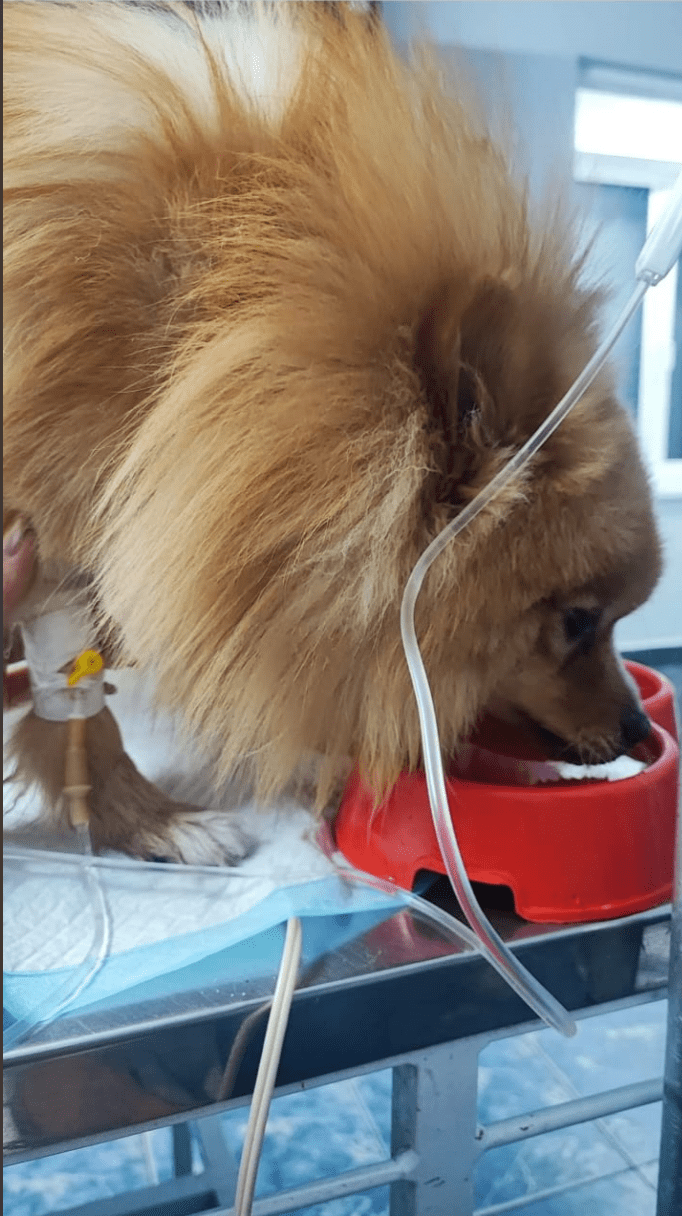
One of the animals that has benefited from the generous support of the SEO community is a small Pomeranian dog who was found frozen to the ground and covered in snow.

A kind passer-by spotted what looked like a fur hat between parked cars and took him to a clinic.

photo of King Arthur receiving treatmentImage from Anton Shulke, September 2024

The little dog was seriously ill and, even with treatment, had only 30% of survival. Just to cover his first night, the treatment costs were $800. After posting on Facebook asking for help, funds were raised.

The lady who found the dog took him home. Even though he had escaped near death in a war zone, he had to spend the night hiding in the shower to avoid the annoyance of her resident cats!

After surviving the first night, the woman’s children named the dog King Arthur, deciding that such a beautiful and proud name would surely give him the strength to recover fully.

King Arthur continued his treatment for a month, with regular tests and follow-up care. And each time the funds fell short, the woman’s neighbors and Anton stepped in to help.

Without the generous support of Anton’s Buy Me a Coffee and SEO for Paws fundraising, King Arthur might not have survived.

King Arthur thriving in a green cartImage from Anton Shulke, September 2024

SEO For Paws – Cat Lovers, Dog Lovers, And SEO

The upcoming “SEO for Paws” livestream aims to continue fundraising efforts. The event, which runs from 11:45 a.m. to 3:00 p.m. ET, will offer actionable SEO and digital marketing advice from experts while raising money for the animal shelters.

Headline speakers who have donated their time to support his cause include Aleyda Solis, John Mueller, Sarah Presch, Gianluca Fiorelli, Gerry White, Bibi Raven, and Garrett French, among others.

Attendance is free, but participants are encouraged to donate.

Event Highlights

  • Date and Time: Sept. 25, 2024, from 11:45 a.m. to 3:00 p.m. ET (3:45 p.m. to 7:00 p.m. GMT).
  • Access: Free registration with the option to join live, participate in Q&A sessions, and a recording will be made available on YouTube.
  • Speakers: The live stream will feature 13 SEO and digital marketing experts, who will share actionable insights and a headline from Googler John Mueller, who will tell stories and anecdotes about the sometimes wonderfully weird world of search, SEO, and the web.

The event page states:

“Get ready to relive the magic of the SEO for Paws 2024 charity live stream, a truly pawsitive event that brought the SEO community together to support Ukrainian animal shelters in need. Join us on September 25, 2024, for a day filled with inspiring talks, valuable networking opportunities, and a chance to make a real difference!”

How To Make A Difference

The “SEO for Paws” live stream is an opportunity to make a meaningful difference while listening to excellent speakers.

All money raised is donated to help cats and dogs in Ukraine.

You can register for the event here.

And you can help support the charity by buying coffee.

Search Engine Journal is proud to be sponsoring the event.

More resources:


Featured Image from Anton Shulke

How To Get Quality Backlinks: 11 Ways That Really Work via @sejournal, @rio_seo

If your business isn’t building quality backlinks, you’re not increasing prominence. If you’re not increasing prominence, you’re missing one of the fundamental criteria to rank higher in the search engine results pages (SERPs).

As Google shares, prominence is based on “information that Google has about a business, from across the web, like links, articles, and directories.”

The bottom line is that every business needs quality, white hat backlinks.

White hat backlinks essentially serve as a vote of confidence from a website and tell Google your web page is a trusted resource. The more votes of confidence your web page has, the more prominent it will be seen to be.

White hat backlinks are acquired through ethical means rather than leveraging spam tactics. Yet, obtaining quality backlinks is easier said than done.

If you’re looking to build your white hat backlink strategy, you’re in the right place. This post will share 11 proven strategies that work to get backlinks and boost your SEO strategy.

Let’s dive in and discover the techniques to get quality backlinks for your website.

1. Mine For Broken Links

Broken links negatively impact a user’s experience with a site.

Consider when a user eagerly searching for information clicks a broken link to a site. This likely causes frustration and potentially a lost customer.

Google also continues to prioritize the overall user experience with recent updates.

Broken link building entails finding links to pages that no longer exist and politely reaching out to the website with the broken outbound link to notify them and suggest replacing it with a link to your relevant, high-quality content.

It’s important to understand the difference between dofollow and nofollow links.

Dofollow links are the most valuable for SEO, as they pass link juice from the referring site to your website. These links are seen as endorsements by search engines, indicating that your content is trustworthy and relevant.

Nofollow links have a rel=”nofollow” attribute, which tells search engines not to follow the link or pass any authority. While nofollow links don’t directly impact your SEO, they can still drive traffic to your site and increase your online visibility.

It’s essential to have a healthy mix of both types of backlinks to create a well-rounded backlink profile.

Utilize backlink analysis tools like Ahrefs, Moz, and Semrush to discover broken inbound links to your closest competitors or broken outbound links from prominent industry publications and blogs.

Start with the dofollow links from sites with strong domain authority.

Broken link building takes time and effort, but it can be an easy way to build your backlink profile for sites that prioritize their users’ experiences.

2. Leverage Existing Relationships

Tap into your existing network of partners, suppliers, or satisfied customers.

Reach out to them and propose collaborative projects, testimonials, or case studies that showcase your products or services, providing opportunities for mutual backlinking.

Since you already provide a valuable service to a business, they’ll be more inclined to link back to you, as you’ve already developed a business relationship with them.

Additionally, many businesses already have a partner page to showcase who they do business with.

If they’re not linking to your site already, this should be an easy ask and a quick way to get a credible white hat backlink to your site.

3. Monitor Brand Mentions And Unlinked References

Sometimes, your business may be mentioned, but you aren’t receiving proper credit.

For example, a customer may write a glowing testimonial on a successful blog, or they reference a finding published by your business, but they aren’t linking to your site.

Ask for credit where credit is due. In both instances, you’ve provided a noteworthy service. Ask customers who reference your brand or websites that mention you in any capacity on their sites to provide a backlink.

Also, look for content published on sites that may list your competitors as resources but should have mentioned your relevant brand.

Utilize tools like Google Alerts or Mention to monitor mentions of your brand or your competitors. You’ll receive an email notification whenever a website mentions a designated brand name.

When you come across unlinked references to your website or content, reach out to the site owners and kindly request them to add a backlink for proper attribution or a pertinent inclusion that would benefit their audience.

4. Publish Original Research

Creating high-quality, valuable content is essential for attracting backlinks from authoritative websites. You can become a trusted content-sharing source by leveraging your expertise and original research.

When considering why and when people share content, you must consider the psychology of content sharing.

A recent study found that 94% of respondents said they carefully consider how the information they share will be useful to the recipient.

In the same study, nearly half of the respondents reported sharing content because it allows them to inform others of products they care about and potentially change opinions or encourage actions.

Develop comprehensive guides, research studies, infographics, or industry reports that serve as go-to resources within your niche.

These authoritative assets naturally attract backlinks from websites seeking to provide valuable information to their audience.

Every time a consumer, blog, or business mentions your research, you’ll receive a white hat backlink. The more informative your content is, the more likely it will be shared.

5. Create Engaging Visual Content

Visual content such as infographics, charts, or slideshows attracts attention and shares on social media platforms.

Why is visual content a top priority for marketers? Because it is easily digestible and shareable.

Nearly 41% of marketers said original graphics (e.g., infographics, illustrations) help them reach their marketing goals. And more than 50% of marketers said visual content is very important in their marketing strategy.

Whether you’re creating an infographic or any other type of visual, it’s an easy way to increase the likelihood of your content being shared.

When possible, embed your website’s link within visually appealing content to increase the likelihood of earning backlinks as it gets shared across the web.

6. Publish Ultimate And Step-by-Step Guides

As the name suggests, ultimate guides are the “ultimate” resource on a designated topic.

The word ultimate suggests you have the best, most in-depth current knowledge on the subject, drawing consumers to want to learn more.

A step-by-step guide, in theory, provides an easy way to learn how to do something. Consumers favor ease and simplicity, which a step-by-step guide aims to accomplish.

Both these types of guides can help a business build its backlink profile. For example, if you’ve written an ultimate guide to digital marketing, a writer may reference one of your points in a blog post about affiliate marketing.

Crafting content that offers unique insights, solves problems, or entertains your audience is essential for attracting natural backlinks.

7. Offer Free Valuable Tools Or Resources

Are you a technology company?

Building a free tool or a light version of your solution is an effective way to build quality white hat backlinks, and it can also drive potential leads.

For example, Adobe offers free or “lighter” versions of several of its tools, such as Adobe Acrobat Reader and Adobe Photoshop Express. These allow users to preview the tool’s capabilities and may encourage them to convert to paid users in the future to maximize its software.

Develop free tools, calculators, or templates that provide practical value to your target audience.

Websites and blogs within your industry may naturally link to these resources as references, establishing your website as a go-to destination and earning valuable backlinks in the process.

8. Use Data Aggregators For Citations

A data aggregator, as the name suggests, compiles information from multiple sources, including phone and utility bills, business registration records on government websites, chamber of commerce membership rosters, and other citations for the sole purpose of providing it to search engines.

Local citations help publish your business’s information across the vast search ecosystem.

While the greater majority of searches take place on Google and other popular search engines, these directories also receive traffic – and are another way for consumers to discover your business.

To start, ensure your business is listed on Google Business Profile (formerly Google My Business), Yelp, Facebook, and Apple Maps.

Then, branch out to other general or industry-specific directories. Every directory you’re listed on provides you with a backlink to help you build your backlink profile.

Business owners can provide this information directly to the data aggregators so that they can submit it to other sources on their behalf. In turn, this helps businesses appear in online citations.

Citations may not be as prominent of a search ranking factor as they were in the past; however, their benefits are not completely obsolete, as they can provide hundreds of relevant backlinks to local landing pages.

9. Leverage Public Relations

A public relations plan is a great way to build prominence and authority in your industry. It’s also a surefire way to help build your backlink profile.

Consider content syndication for your press releases and editorial content, which is the process of republishing or distributing content from your website to multiple other news platforms or industry-related websites.

Content syndication often involves partnering with reputable vendors specializing in distributing content across various platforms, websites, and publishers. These vendors have established relationships with news publications and can help amplify your content’s reach.

Each press release or article is an opportunity to add at least one backlink to your content when publishers allow it.

It also establishes your brand as an expert in your industry. The more often you have useful and relevant information to share in your industry, the more you’ll establish yourself as a voice of authority.

Public relations extends to social media, too, where you can share links to content. If users find your content beneficial, they may reshare it, helping you build additional backlinks.

10. Create A Roundup Or “Ask The Experts” Blog Post

Organize expert roundups or interviews featuring prominent figures within your industry.

Ask potential contributors for a short contribution – maybe two to three sentences – to encourage participation.

The less burdensome the ask, the more likely they will want to participate. Asking others for insights around a certain topic can help strengthen your content and add valuable information you may not otherwise have had.

Creating a roundup or an ask-the-experts-style post increases your chances for shareability, too.

When these experts contribute their insights or opinions, they are more than likely to share the content piece with their networks, which will cause the content to reach a wider audience, generating valuable backlinks and exposure for your website.

11. Build Relationships With Influencers And Thought Leaders

Engage with influencers and thought leaders within your industry through social media, forums, or industry events.

Remember to choose influencers whose audience aligns with your target audience. Once you find the right blog niche or influencer to support your brand, send them your product or provide the service free of charge in exchange for a review.

Collaborating with influencers not only helps to generate backlinks but also exposes your brand to a wider audience. When an influencer promotes your content or mentions your brand, their followers are more likely to trust and engage with your website.

Or, if you have a larger budget, you can also pay macro-level influencers to give their honest feedback. Then, have the blog or influencer link back to your product or service.

Additionally, you may provide a blog or influencer with an affiliate link. Whenever a potential customer clicks their affiliate link, they’ll receive a commission.

The commission may come from simply clicking the affiliate link or if the consumer makes a purchase. This link-building endeavor requires more effort on your behalf; however, it also sends higher-quality traffic, which leads to higher conversion rates.

Concluding Thoughts

Cracking Google’s evolving search engine algorithm can be time-consuming and full of trials, tribulations, and errors.

Focusing on backlinks plays a significant role in improving the prominence and relevance of your website in the eyes of search engines.

Acquiring quality backlinks without resorting to paid placement methods is a long-term investment that requires dedication, creativity, and a commitment to providing value to your audience and industry.

By implementing the 12 actionable tactics outlined in this guide, marketing professionals can enhance their website’s authority, brand visibility, and organic search rankings, driving sustainable growth and success in the competitive digital landscape.

More resources: 


Featured Image: one photo/Shutterstock