Drive Over 150K A Month In Brand Search Volume: A Case Study [Webinar] via @sejournal, @lorenbaker

Having a hard time increasing brand search volume and building a strong presence on SERPs, especially in a way that’s not consuming all of your precious time?

Let’s face it: many search marketers find it taking years to build their brand search volume when faced against major, established brand. 

So what if there was a way to speed up this process and see results within months, instead of years?

Join us in our upcoming session, How To Drive Over 150K A Month In Brand Search Volume: A Case Study, where we’ll show you how to fast-track brand awareness and engagement through data-driven techniques and advanced audience analysis.

Why Attend This Webinar?

Making your brand stand out requires a strategic touch and a targeted, data-driven approach. By learning to understand and drive audience search behavior, you can improve your rankings, increase conversions, and even earn high-quality links—without waiting years to see results.

We’ll show you first-hand examples of how one brand created a new market category to solve a problem with conversion rates, along with another brand that grew their volume to over 150,000 organic clicks a month.

What You’ll Learn

Hosted by Kevin Rowe from PureLinq, this webinar will cover real-world strategies to increase brand search volume, backed by proven case studies from top brands. You’ll walk away with:

  • PureLinq’s simple yet effective process for understanding your audience’s search habits and how to use these insights to boost brand awareness.
  • Practical methods for leveraging podcasts, PR, and content marketing to drive more brand search.
  • Steps for breaking into new market categories and creating search demand from scratch.

Who Should Attend?

This webinar is perfect for:

  • SEO professionals eager to drive brand visibility in SERPs.
  • Content marketers focused on increasing brand engagement.
  • Business owners aiming to build brand trust and earn organic clicks.

Live Q&A with Kevin Rowe

Following the presentation, Kevin will be taking your burning questions on building your brand’s visibility. This is your chance to get tailored advice, supported by Kevin’s 15 years of experience in digital marketing and audience engagement.

If you’re serious about increasing your rankings and improving brand search volume, then you won’t want to miss this. Save your seat for this LIVE event and get ready to take your brand’s visibility to the next level.

Can’t make it on the day? Register anyway, and we’ll send you a recording to watch on-demand.

Sign up now to transform your approach to brand search and achieve results faster than ever before!

140 Social Sharing Sites That Boost SEO & Drive Traffic via @sejournal, @jonleeclark

Thankfully, every so often, a tool comes along that makes the complex world of search engine optimization a bit more manageable.

Social bookmarking sites are one of these tools that can be your new best friend in the SEO landscape.

Why are they so crucial? Simple: They’re powerhouses for building links, which are vital for SEO success.

Think of social bookmarking sites as your personal digital librarian. They let users discover, categorize, and store webpages all in one place using virtual “bookmarks.”

Social media platforms like Pinterest have revolutionized how we think about social bookmarking, proving themselves as essential tools in any marketer’s toolkit.

And it’s not just about generating any links; it’s about crafting quality connections that boost your visibility on search engines.

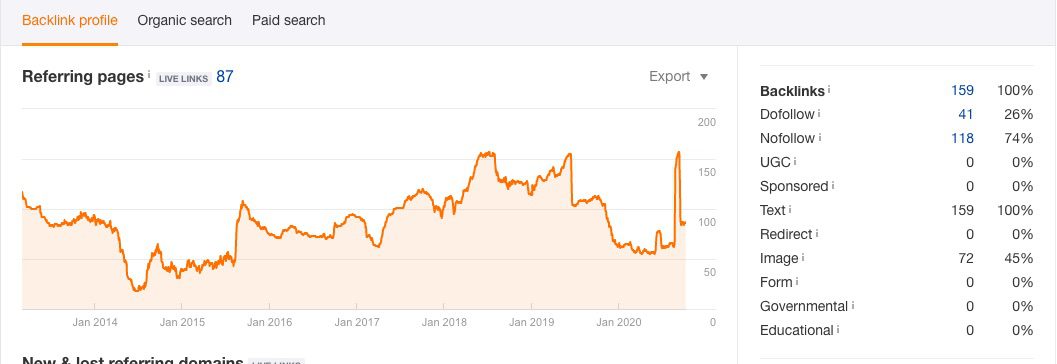
Sure, most of these links are nofollowed. However, the traffic and visibility they bring can catapult your site to the front page of search results.

But remember, there’s more to it than just links. Search engines use these sites to gauge the relevance and value of content. So, while you’re getting your name out there, you’re also building credibility and authority.

If you’re curious about which sites to start with, this guide has you covered.

Take a look at my list of the top 140 social bookmarking sites that are perfect for getting your content noticed and shared.

My Top 24 Social Sites (In No Particular Order)

1. X

X (formerly Twitter), despite what you may have heard, is still huge. In fact, the platform has over 500 million monthly active users.

While it might not be the first site that pops into your mind for submitting content, it has a large audience and is an efficient platform for posting.

Many people use it to post links, content, and images that they find interesting and worthy of a revisit in the future.

2. Pinterest

As the quintessential social bookmarking site, Pinterest has an average monthly user base of 498 million, roughly 72.6 percent of whom are female.

Furthermore, users are pinning over 1.5 billion Pins per week to more than 10 billion Pinterest boards.

3. Mix

In June 2018, the popular discovery platform StumbleUpon became Mix.

Mix lets you experience the internet as curated by machine learning, editors, or publishers.

You can also tag content that you liked, in particular, to share with others.

4. Slack

Slack is a group messaging program that provides users with customizable channels in which chats can occur.

You can also create private groups, and have direct messaging. I, personally, have found tremendous value in groups like The SEO Community and The SEO for Journalism groups.

In 2022, Slack had an estimated 35 million users.

5. Notion Community

Notion Community is a platform for users of Notion, the all-in-one workspace for note-taking, project management, and data organization.

The community allows users to share templates, setup tips, and best practices on using Notion effectively.

It’s perfect for productivity enthusiasts, project managers, and anyone interested in personal or professional organization.

This community helps individuals improve their workflow while connecting with others who use and customize Notion in innovative ways.

6. Pocket

Appropriately named, when you put something in your Pocket, it’s there to be found later.

Users of Pocket can hold onto anything they find on the internet or through various apps.

Bonus points for the fact that once something’s in your Pocket, you don’t need an internet connection to access it.

7. Digg

Got great content?

Then it belongs to Digg.

Digg is an addictive social bookmarking site that’s perfect for sharing your captivating content with a highly engaged audience.

8. Folkd

The Folkd bookmarking site contains a unique social search feature that works much like a typical search engine, except the results don’t come from a complex, machine-driven system of analytics.

Instead, top results display quality content that Folkd users have bookmarked.

The more saves a piece gets, the higher its rank in their social search, which helps connect their visitors with even more quality content.

9. Reddit

What can’t be found on Reddit?

Users generate threads that can then be commented on, upvoted, or downvoted, and it is a great tool when you’re looking to quickly promote content, generate content ideas, or get answers to a question.

It’s also now one of Google’s key AI training data sets.

10. Fark

One of Fark’s best attributes is their commitment to quality.

As a social networking news site, Fark receives mountains of submissions on a daily basis but presents only the best to their audience.

This site isn’t for wimpy, weak content.

But, if you’re ready to showcase your talent and drive traffic to your own site, Fark is the way to go.

11. BizSugar

If you’ve got content about startups, marketing, and the world of small business, then BizSugar is the social bookmarking site that will help build your reputation and brand authority in a growing community of like-minded small business professionals.

12. Slashdot

Slashdot is the ultimate bookmarking site for tech geeks and the techie at heart.

Users of Slashdot submit and share content on gaming, cloud computing, computer hardware, security management, and more.

13. We Heart It

While users can submit and bookmark different types of content, We Heart It is heavily visual.

The app is nice to look at, easy to use, and inspirational – especially for anyone who loves great imagery.

14. Scoop.It

This site, aimed toward professionals, offers solutions for content creation, content curation, predictive analysis, and content intelligence.

Scoop.It offers four different platforms – a free version for individuals, as well as three paid options: Pro, Plus, and Enterprise.

15. Elpha

Elpha is a social network tailored specifically for women in the tech industry, providing a space for networking, job opportunities, and sharing insights.

It’s designed to empower women by connecting them with peers and mentors, facilitating professional growth in a supportive community.

16. Diigo

Diigo is the ultimate social bookmarking site for academic types.

Educators, students, researchers, and anyone with an inquisitive mind love the features that make keeping track of their resources and sharing them easy.

Diigo is perfect for content that’s focused on statistics, analytics, or research of any industry.

17. BibSonomy

Granted, not many businesses publish scientific material as part of their marketing strategy.

But, for those who do, BibSonomy is a premier social bookmarking site for businesses and academic types to collect, share, and collaborate with the most recent, highly relevant research-based material.

18. Instagram

Instagram is one of the world’s most popular apps for photo, video, and live video sharing.

It’s the world’s fourth most-used social media platform, with over 2 billion monthly users.

The largest demographic on Instagram is 18 to 24-year-olds, representing 30.8% of users.

Furthermore, the average time spent on Instagram is 33 minutes per day.

19. Pearltrees

There’s a simplicity to Pearltrees that makes it a favorite among users who love to create collections of their favorite things.

Pearltrees offers functionality and a platform that makes it easy to share and gather new content.

20. DZone

DZone is one of the preferred social bookmarking sites for software developers around the world.

Each day, thousands of developers come to the site to learn, share, and read about the latest technologies and trends in the world of software development.

21. Medium

Typically used to share personal, original stories, Larry Kim has shown just how successful Medium can be for repurposing content.

22. SlideShare

While some claim SlideShare is on its way out, if you’ve created an amazing keynote or PowerPoint presentation, you’re going to want to repurpose that on SlideShare.

23. Quora

Not only a great research tool for Q&A content brainstorming, but Quora is a question-and-answer based site filled with a wide range of topics to discuss and follow.

24. Facebook Groups

A Facebook Group is a closed or open community within Facebook where users can post content ranging from links to events and questions.

As of August 2022, 1.8 billion people used Facebook Groups, and there were over 10 million groups on Facebook.

69 More For Good Measure

Here are 69 more social bookmarking sites for you to leverage in your SEO strategy.

A few of these you’ll be familiar with because they’re already insanely popular, but there are also plenty of lesser-known sites on the list.

25. Facebook

Facebook is arguably the most popular social network in the world.

Despite changes to how Facebook’s algorithm diminishes organic reach, it can still be a major source of traffic for posted content.

26. Flipboard

Flipboard curates the world’s stories you can focus on investing in yourself, stay informed, and get involved.

27. Feedly

Feedly is the most popular RSS blog reader, with more than 15 million users, and acts as a news aggregator for various web browsers and mobile devices.

28. Pinboard

Pinboard is a plainly designed social bookmarking website “for people who value privacy and speed.”

It focuses on the personal management of bookmarks using tags to organize them.

29. Instapaper

Instapaper is touted as the simplest way to save and store articles for reading offline, on-the-go, anytime, anywhere.

30. Untappd

Untappd caters to beer enthusiasts, providing a platform to rate beers, check into locations, and see where friends are drinking.

It combines social networking with user reviews, making it valuable for discovering new beers and venues.

31. LinkaGoGo

LinkaGoGo has been around since 2001.

It allows you to view bookmarks using dynamic bookmark toolbars.

32. LinkedIn

LinkedIn is a 500 million+ member social network designed to build and engage with your professional network.

33. Disqus

Disqus is a global comment system that improves discussion on websites and connects conversations across the web.

34. Listly

Listly helps bloggers and publishers engage readers by viral top 10 lists created by the community.

35. Tumblr

Tumblr, the popular “microblogging” network, allows users to post multimedia and other content to a short-form blog.

36. ArtStation

ArtStation is the hotspot for digital artists and illustrators to showcase their portfolios.

If you’re into game design, concept art, or just love browsing incredible creations, this is your scene.

37. Dotnetkicks

Dotnetkicks is a community-based news site edited by the community that specializes in .NET development techniques, technologies, and tools.

38. Pixiv

Pixiv is a Japanese online community where artists showcase their illustrations, manga, and novels.

It’s big on creativity and perfect for anyone looking to dive into anime-style art.

39. TikTok

TikTok is a video-sharing service that allows users to share videos that are 3 to 60 seconds long.

The app is credited largely with the success of many celebrities whose reach extends beyond the app and into the mainstream.

As of publishing, TikTok boasts 800 million users.

40. Ko-fi

Think of Ko-fi as a friendly tip jar for creators.

Whether you’re an artist, writer, or podcaster, you can receive support directly from your fans with a simple “Buy me a coffee” button.

41. FilmFreeway

FilmFreeway makes it easy for filmmakers to submit their films to hundreds of festivals all over the world.

It’s the go-to platform for indie creators looking to promote their work and for film buffs seeking the next big thing.

42. EyeEm

EyeEm is a global photography community and marketplace.

It’s perfect for budding photographers looking to showcase their work, connect with peers, and even sell their images to brands and publishers.

43. SocialBookmarkNow

SocialBookmarkNow is a social bookmarking site that boasts “instant approval” for submitted content.

44. Academia.edu

Academia.edu is a platform specifically tailored for academics and researchers to share research papers across a multitude of disciplines.

Users can follow each other’s work, update their profiles with new findings, and even track the impact of their publications.

It’s a valuable resource for enhancing visibility in the academic community and improving citations, which is beneficial for SEO in academic and educational content.

45. TechDirt

TechDirt is an online news blog that allows users to post their own stories.

46. AllTrails

AllTrails is a niche social network for outdoor enthusiasts, offering detailed information on trails around the world, including user reviews, photos, and trail maps.

Users can record their hikes, share their favorite trails, and provide updates about trail conditions.

It’s ideal for brands in the outdoor, travel, and fitness industries to connect with a highly engaged audience.

47. Houzz

Houzz is a platform for home remodeling and design, bringing homeowners and home professionals together in a uniquely visual community.

Here, professionals can showcase their portfolios, share design ideas, and connect with potential clients.

It’s a great tool for architects, interior designers, and contractors to enhance their SEO through project photos and customer reviews.

48. MetaFilter

MetaFilter is a community weblog that anyone can contribute a link or comment on.

49. Care.com

Care.com connects people with caregivers for children, seniors, and pets.

It allows caregivers to create profiles, post services, and gather reviews, which helps build their online presence and trustworthiness.

It’s also beneficial for service providers in the care sector to increase visibility and SEO through client interactions and endorsements.

50. Steemit

This is a blogging and social media website that gifts users with its cryptocurrency, STEEM, for publishing and curating content.

51. Bookmarkfeeds

Bookmarkfeeds allows users to submit article bookmarks from anywhere in the world.

52. BookmarkMaps

BookmarkMaps is a bookmarking service that allows members to submit articles and share the most-voted content to social networks like Facebook and Twitter.

53. Leavemark

Leavemark, launched in 2020, is an ad-free data storage and social media app that lets you save videos and photos and share them later.

The app features a time and space capsule option that allows information to be released in increments of 2 weeks, 2 months, 10 years, or when the recipient is within proximity of a given place.

There is also direct messaging, a newsfeed, and a family tree feature that allows you to preserve information for future family members.

54. Fabric

Fabric is like VH1’s Pop-Up Video but in real life (IRL).

It’s an augmented reality (AR) app that allows you to see people’s commentary on things within your immediate proximity.

You can comment on that commentary and start a virtual, and potentially in real life (IRL), conversation.

55. Vero

Vero is a social media app designed to compete with the one-two punch of Facebook and Instagram.

Vero boasts that it doesn’t sell data, features no ads, and uses no algorithms.

Instead, users select who gets to see their posts, and posts appear chronologically.

You can share suggestions for music, books, films, and more.

You can also shop within the app for any recommendations that you find particularly striking.

56. Caffeine

Caffeine is a platform that streams live content that you can interact with, including gaming, sports, and music.

57. Twitch

Twitch is a video streaming service owned by Amazon.

The platform focuses primarily on live video game streaming, but also includes e-sport competitions, music broadcasts, and other forms of creative content.

As of January 2024, Twitch had approximately 8.36 million active streamers.

58. Bluesky

Previously invite-only, Bluesky was started by Jack Dorsey as a project within X (Twitter) to explore decentralized social media.

It was eventually spun off into its own entity, built on an open protocol called the AT Protocol (Authenticated Transfer Protocol), which allows for interoperability between different services and platforms.

The network has seen explosive growth recently, given its similarities to X (Twitter). As of September 2024, Bluesky has over 7.6 million users.

59. Threads

Threads is a social media platform developed by Meta (formerly Facebook) and launched in July 2023.

It is closely integrated with Instagram, allowing users to sign in using their Instagram credentials and follow the same accounts.

Threads was created as a microblogging platform similar to X, allowing users to post short text updates, share photos and videos, and engage in threaded conversations.

Threads was positioned as an alternative to X, particularly after Elon Musk’s acquisition of Twitter. This led to some changes in the platform that left certain users dissatisfied.

However, Threads has gained traction with a focus on simplicity and familiar functionality for those used to Instagram.

60. BuzzCast

BuzzCast is a newer global social community for young and active people to meet new friends, find dates, and form meaningful connections quickly.

61. Masterminds

Mastermind is a social media platform for coordinating goal-oriented video chats with like-minded individuals.

The aim is to benefit from each other’s shared experience, encouragement, comradery, and accountability.

62. Triller

Triller is a social media video app where you film yourself lip-syncing, dancing, or both.

Triller’s editing algorithm then goes to work to edit your video for you based on audio and facial analyses.

63. WhatsApp

WhatsApp is an encrypted messaging service that allows you to send text and audio messages, make video and phone calls, share media, and send each other locations.

WhatsApp currently has 2 billion monthly users worldwide.

64. Tagged

Tagged is a social discovery platform that lets you browse the profiles of any members and share tags and virtual gifts.

65. Wattpad

Wattpad is a platform that services user-generated stories.

As of 2018, Watpad has 400 million stories and over 65 million users who spend over 15 billion minutes on the app each month.

66. Badoo

Badoo is a social networking website meant to facilitate friendship, romantic relationships, or just brief conversations.

You can search based on who’s nearby, use a more specific geographic search, use a Tinder-type feature where you swipe left or right, and have the option of video chatting as well.

Users are verified by uploading a photo of themselves in a specific pose that’s then verified by a moderator. People can also request selfies to confirm an identity.

Since launching in 2006, Badoo has had 425 million members.

67. Bubbly

Bubbly is an app that allows users to record voice blogs for upwards of 90 seconds to subscribe to the voice blogs of others.

Currently, you can apply voice filters, effects, and background music to the posts.

68. Cellufun

Cellufun is a social program that lets users play games together and comment anonymously using avatars.

69. Classmates

Classmates.com is a social media platform that allows users to make and search profiles, post and view notes, view other profiles and their photos, browse digital yearbook collections, and gain access to reunion planning tools.

70. Dropout

Dropout is an internet comedy company that, in addition to creating original content, allows for user-submitted videos, pictures, articles, and links.

71. Discord

Discord is an instant messaging software that allows you to communicate via text, image, video, and voice.

As of January 2024, Discord has 196.2 million active users.

72. GIPHY

Giphy is an online database and search engine that allows users to search for and share short looping videos with no sound, which resemble animated GIF files.

It is believed to have 1.7 billion daily users on both its app and website.

73. Imgur

Imgur is an image-sharing community and image host.

Many popular viral images and memes are hosted by Imgur and are used by Reddit to share images across the platform.

74. LINE

Line is a messaging service that lets users communicate using smartphones, tablet devices, and PCs.

Text, images, video, audio, and free VoIP calls and video conferences are all available.

Line also has a digital wallet called Line Pay, a news stream called Line Today, a video-on-demand service known as Line TV, and two digital comic services known as Line Manga and Line Webtoon.

Line is one of the most used apps in Japan, with over 88% of the population using it.

75. Mastodon

Mastodon is a decentralized social network offering an ad-free, open-source environment similar to Twitter.

Users can join servers that best fit their interests and engage in discussions or share media.

It’s an excellent alternative for creating content streams that can improve SEO by fostering community interactions and content sharing.

76. LiveJournal

LiveJournal is a social networking platform where people keep diaries. LiveJournal’s highest recorded number of users is 2.5 million.

77. MeetMe

MeetMe is a mix between a social media platform and a dating app.

Meetme works by verifying and populating your profile with data from Facebook.

You’re then shown users nearby who you have the opportunity to chat with and even arrange an in-person meeting.

MeetMe claims to have over 100 million users.

78. MocoSpace

Inspired by Myspace, MocoSpace is a mobile social network that includes games, chat, instant messaging, eCars, and photos.

MocoSpace has over 100 million registered users.

79. Myspace

Between 2005 and 2008, Myspace was the biggest social networking platform in the world, catering to over 100 million users per month.

The most recent statistics available for 2019 show that MySpace had 7 million monthly visitors.

80. Open Diary

Open Diary is an online diary community similar to LiveJournal and Xanga.

81. Skype

Skype is a popular video chat software that lets users communicate via audio, video, or text.

You can also send images, videos, files, and more.

More than 40 million people use Skype every day, with over 300 million active monthly users on the platform.

82. Telegram

Telegram is a chat app available for both desktop and mobile users.

The mobile version features encryption.

You can also send photos, videos, stickers, audio, and files.

As of 2024, Telegram has reached over 800 million monthly active users.

83. Tribe

Tribe is a social messaging app.

You can record and send messages to your friends just by holding your finger on their photo and then releasing it.

You can also create groups to send videos to several recipients at once.

Once the video is tapped and viewed, it disappears.

84. Viber

Viber is a software that allows for VoIP and instant messaging-based communications.

Users are verified by their cell phone. The app can also be used on desktops.

Viber gives users the opportunity to trade images and videos, as well as access to a paid international dedicated video and phone service called Viber Out.

Viber records having over a billion users.

85. Vimeo

Vimeo is a video hosting platform.

Vimeo is ad-free and instead derives its income by providing hosting plans to content producers and tools for video creation, editing, etc.

Vimeo also helps professionals connect with one another, with over 287 million creatives using the platform.

86. WatZatSong

WatZatSong is a community for music lovers where users can help each other identify songs.

Participants post a clip of a song they are trying to identify, and the community pitches in to help figure it out.

It’s an excellent platform for engaging with a music-focused audience and can be a fun way to drive traffic to sites related to music and entertainment.

87. Dropmark

Dropmark is a collaborative sharing tool.

You collect files, drag them into your browser to upload, and then share that collection with a group or individual of your choosing.

88. Droplr

Droplr allows you to take your screenshots or screen recordings, upload them to the cloud, and then share them with anyone.

89. Zight

Zight allows you to share screenshots or screen recordings.

Using its Instant Video feature, users can broadcast screen recordings instantaneously.

90. ePHOTOzine

ePHOTOzine is an online photography magazine offering a social networking platform for photographers to upload photos, participate in contests, and write reviews.

It’s a great space for photographers to improve their SEO by showcasing their work and engaging with a community of like-minded individuals.

91. Patreon

Patreon is an American membership-based platform that provides creators with the means to maintain subscription-based content.

Creators include video makers, podcasters, artists, writers, adult content creators, and more.

There are over 228,000 creators with at least one Patreon. Over the past two years, the number of creators has grown by 20%.

92. OnlyFans

OnlyFan is a content subscription service akin to Pateron that is particularly popular among the adult entertainment industry and fitness experts.

Creators receive funding based on subscriptions, tips, and pay-per-view events.

As of 2022, OnlyFan had over 3,100,000 content creators!

93. Substack

Substack is a platform that allows creators to have paid email newsletters.

Substack provides a content management system to create email newsletters, a way of collecting payments using Stripe, and a website that can provide free or paid-for content.

Don’t Forget The Music/Audio Social Sites

94. Datpiff

DatPiff is an online distribution platform focusing on hip-hop, rap, and R&B.

Basically, DatPiff is the modern-day equivalent of the sort of mixtapes or mix CDs fledgling artists would distribute with the hopes of having their music exposed to a larger audience.

95. Last.FM

Last.FM is a social media platform that follows users’ listening habits to create custom playlists.

Last.FM can gather data from popular music streaming apps, internet radio stations, or the user’s own desktop or mobile devices.

96. SoundCloud

SoundCloud is an audio distribution and music-sharing platform.

The platform would go on to have over 140 million registered users worldwide.

It has launched the careers of many professional and wildly successful musicians.

97. ReverbNation

ReverbNation is a website where musicians, producers, and venues collaborate and communicate.

98. Bandcamp

Bandcamp is an audio distribution platform.

Artists and labels upload their content to Bandcamp and then set how it’s sold, for how much, in what format, and can sell merch or physical media as well.

Plus, 20 Even More Niche Social Sharing Sites

99. Dribble

The go-to bookmarking site for creative types, especially designers.

If you like to explore graphic and visual design, or you have someone on your team who does, Dribble is a great spot to get some SEO backlink action.

100. Meetup

Meetup uses online groups to coordinate in-person meetings based on people’s shared interests.

Meetup has more than 60 million registered users.

101. Weed Life

Weed Life is a social network built for cannabis enthusiasts.

102. Nextdoor

Nextdoor is a social media platform that allows you to connect with people in your neighborhood.

You have to submit your real name and address (your street name without your unit number).

It’s currently available in 11 countries.

Only other members of your neighborhood can see your posts.

Nextdoor has 285,000 active neighborhoods and serves over 10 million users.

103. DeviantArt

DeviantArt is an online community where people share artwork, videos, and photography.

Most recent stats show that the site has over 26 million members and 251 million submissions.

Art can be browsed by categories such as type, operating system customization utilities, skins for applications, and more.

104. Goodreads

Goodreads is a social network where people post about and review books.

Users also have the option of creating groups based on suggestions, surveys, polls, blogs, and discussions.

On a yearly basis, users vote in the Goodreads Choice Awards based on books nominated by Goodreads as well as user suggestions.

As of 2022, Goodreads has more than 140 million members around the world.

105. CouchSurfing

CouchSurfing is a social networking platform that allows users to coordinate lodging and meetings or join and create events.

106. RunKeeper

Runkeeper is a fitness-tracking app that uses GPS to map your workouts.

Some activities include walking, running, and cycling.

Runkeeper has over 51.2 million users. You can share your workouts with others and the Runkeeper community as well.

107. Care2

Care2 is a social media platform that connects people based on the activist causes that they’re passionate about.

Care2 currently has over 63 million members and 2,750 nonprofit partners, has created nearly 457,000 petitions, and has accrued over 1.2 billion signatures.

108. eToro

eToro is a social trading platform and multi-asset brokerage company that offers financial and copy trading services.

Users are able to follow, view, and even recreate the practices of top traders on the platform.

As of 2024, eToro has over 35 million users.

109. Gaia Online

Gaia Online is an anime-themed social network and forum-based platform.

110. Italki

Italki is a platform that connects language learners to teachers using video chat.

Teachers earn money as freelance tutors.

111. Ravelry

Ravelry is a social networking service for people interested in knitting, crocheting, spinning, weaving, and other similar activities.

Users share projects, ideas, and their collections of yarns, fiber, and tools.

Ravelry has over 9 million registered users and roughly 1 million monthly active users.

112. The Dots

The Dots is a social networking program for creative professionals (writers, illustrators, videographers, etc.).

Members get to network, connect, collaborate, and be inspired by the individuals, teams, and brands with profiles.

113. BakeSpace

BakeSpace is a food-focused social networking site for sharing recipes, creating cookbooks, and meeting other food enthusiasts.

Users can exchange recipes, collaborate on cookbooks, and discuss cooking tips.

It’s a delicious way to connect with others who share a passion for cooking and can help food bloggers and brands boost their SEO through content sharing and interaction.

114. Strava

Strava is a social network for athletes, particularly runners and cyclists.

It tracks user activity via GPS, allowing members to share their workouts, compete with each other, and follow friends’ activities.

It’s excellent for motivation and community building among fitness enthusiasts.

115. MyHeritage

MyHeritage is a platform that allows users to create family trees, upload and browse photos, and search through over 9 billion historical records.

116. Viadeo

Viadeo is a professional social networking platform that connects business owners, entrepreneurs, and managers.

117. Yelp

Yelp is a crowdsourced review-based website that provides business ratings.

It also partners with a reservation service called Yelp Reservations.

Yelp has over 265 million reviews.

118. Letterboxd

Letterboxd is a social networking service that focuses on sharing reviews and adoration for film.

Users can keep a diary to track their opinions, films watched, and make lists. Users can also interact with one another.

Last But Not Least, 12 International Social Sharing Sites

119. FilmAffinity

Registered users can rate, find, and create lists of movies.

In the Spanish version of the site, it’s possible to write reviews.

In Spain, which is the platform’s country of origin, there are 3 million unique users.

120. Kuaishou

Kuaishou is a Chinese video-sharing app.

It’s known as “Snack” video in China and “Kwai” in other markets.

Kuaishou is used to create short videos that capture the everyday experiences of its users.

At the end of 2022, Kuaishou’s daily active users sat at 355.7 million.

121. Mixi

Mixi is a Japanese social networking service.

Its focus is on connecting with others based on shared interests.

Users can send messages, keep a blog, read and comment on other people’s blogs, set up and join communities, and invite friends.

Registration is confirmed using a valid Japanese cell phone number.

122. Qzone

Qzone is a social networking platform centered in China.

It lets users keep blogs, send photos, listen to music, and watch videos.

Statistics show that there are over 600 million active users on Qzone.

123. Sina Weibo

Sina Weibo is a Chinese microblogging site akin to Tumblr. Users can upload videos and pictures for instant or extended sharing.

Users can then comment via text, video, or pictures.

There’s also an instant messaging service.

In 2017, the platform reported it had over 290 million registered users.

124. CaringBridge

A health-focused social networking site, CaringBridge helps people stay connected with their family and friends during significant health challenges.

It offers personal, protected sites where users can share updates, receive messages of support, and coordinate help.

125. Tencent QQ

Tencent QQ, known as QQ, is an instant messaging program and web portal in China.

It provides online social games, music, shopping, microblogging, movies, and group and voice chat.

126. VK

VK is a Russian social networking platform. VK facilitates both private and public messaging, groups, public pages, and events.

With VK, you can also share and tag images, audio, and video. There are browser-based games as well.

As of May 2021, VK had 656,000,000+ users.

127. WeChat

WeChat is a Chinese-developed platform that allows for messaging, social media, and mobile payment.

In China, the app has been called the “app for everything.” As of 2019, WeChat had roughly 1 billion active users.

128. XING

Xing is a Hamburg-based social networking site for professionals primarily focused on the German-speaking market.

As of the end of December 2023, Xing reported that it reached 1.3 billion monthly active members.

129. YY

YY is a Chinese-based video social network that has its own virtual currency.

The currency is paid to people who create content ranging from karaoke videos to tutorials. The currency can later be exchanged for real money.

The platform also streams concerts, fashion, and sporting events. Users can chat as well. As of November 2019, YY had 157.8 million monthly active users.

130. Douban

Douban is a Chinese social networking platform that allows users to document information and create content about movies, books, TV, activities in China, and more.

Douban has 60 million registered users and 150 million unregistered visitors.

Registered users get recommendations and add them to other social networking options; unregistered users get reviews and ratings of media.

10 Bonus Social Sharing Sites

131. Blender Artists Community

Blender Artists Community is a vibrant network for users of Blender, the open-source 3D content-creation suite.

Members share projects, get feedback, and find tutorials.

It’s perfect for 3D artists looking to improve their skills, showcase their portfolio, and boost their presence in the 3D modeling community.

132. PixelFederation

PixelFederation is a community for gamers and game developers.

It provides a platform to discuss game development, share projects, and connect with other gaming enthusiasts.

This site is excellent for developers looking to increase visibility and engage with a community passionate about gaming.

133. GrowthHackers

GrowthHackers offers a hub where users can share and discuss strategies for growth, marketing, and scaling businesses.

Content ranges from articles to case studies, making it ideal for marketers and entrepreneurs interested in cutting-edge tactics for driving business growth.

134. Travello

Travello is a social network for travelers, providing a platform to share experiences, discover new adventures, and meet fellow travelers.

Its features include arranging meetups and sharing travel tips and photos, making it a valuable tool for travel bloggers and agencies to increase their reach.

135. Plantix

Plantix is a network for gardening and agriculture enthusiasts.

Users can diagnose plant diseases, share gardening tips, and discuss best practices in crop cultivation.

136. Kaggle

Kaggle is a platform for data scientists and analysts to explore and publish data sets, compete in competitions, and collaborate on projects.

This community is crucial for professionals looking to build their reputations and collaborate on data-driven projects, enhancing their visibility in the tech and scientific communities.

137. Threadless

Threadless is a community-driven site featuring user-designed t-shirts, hoodies, and prints.

Artists submit designs, which users vote on; the top-rated designs are then made into apparel.

It’s a fantastic way for graphic designers and artists to gain exposure and have their work featured on merchandise.

138. Dogster (And Catster)

Dogster and Catster are social networks for pet owners, offering a place to share photos, care tips, and pet stories.

139. Archilovers

Archilovers is a social network for architects, designers, and architecture enthusiasts.

It allows users to share projects, find design inspiration, and connect with other professionals.

140. Spiceworks

Spiceworks is a professional network for the IT community.

It combines community discussions, software tools, and a marketplace where IT professionals can exchange knowledge, tools, and services.

Harness The Power Of Social Bookmarking To Amplify Your Online Presence

Exploring the digital landscape like this reveals just how expansive it truly is!

Every business, including yours, competes to stand out and thrive online.

Effective digital marketing isn’t just about using any tools; it’s about using the right tools. Social bookmarking is one of these powerful tools, essential for building and enhancing your brand’s online visibility.

Remember, achieving success online is a collective effort. Social bookmarking connects you to a broader community, helping you engage with your audience and expand your reach.

Start incorporating social bookmarking into your strategy today and watch your digital presence grow.

More resources:


Featured Image: tovovan/Shutterstock

Latest Google AIO Updates May Impact SEO via @sejournal, @martinibuster

Google continues updating AIO rankings, increasing the presence of larger shopping-related panels and ads that push organic search results lower on the page. The good news for search marketers is that AIO volatility in shopping queries is stabilizing, with AIO rankings increasingly matching sites typically ranked in organic search.

  • Arguably the most important change is the addition of advertising in AI Overviews, which has the effect of pushing organic search results lower down the page.
  • Citations to websites within AIO for general queries rose by over 300% since August, with the biggest growth (200%) experienced in September.

Since November 1, 2023, BrightEdge has been tracking a consistent set of search queries representing billions of searches across nine industries. The key point is that they are tracking the same queries every month using their unique technology, the BrightEdge Generative Parser (TM). The BrightEdge Generative Parser detects and tracks AIO formats, analyzes AIO search results, and provides insights into daily trends.

AIO & Top Ranked Organic Increasingly Match Since September

BrightEdge noticed a trend beginning in September where AI Overviews increasingly showed links to websites that matched the organic search results. This means that traditional ranking factors that put a website in the top of the organic search results should pay off in citations in AIO.

AIO Stability Continues To Improve

The BrightEdge data showed an 8% improvement in day-to-day stability and a less than 1% fluctuation the pixel size of AIO Panels. That means that AIO search results were less volatile and more dependable. Volatility in shopping-related search queries decreased 37% (from early August) to 26% (as of late September). The lower volatility indicates that rankings should be more consistent, a trend that hopefully will carry over into the holiday shopping season that begins in November.

More Precise AI Overview Results

That stability was accompanied by a 15% reduction in keywords with an AIO, demonstrating an increase in how precise search queries are to web page topics and perhaps may reflect a greater use of natural language in queries.

Bright Edge noted:

“As ads deploy, Google is more precise about where AIOs are most helpful.”

That trend toward more precise and concise AIOs began in August and continued through September, by which time Google AIO was collapsing unordered lists by an additional 14.6% over the previous month. Collapsed unordered lists show a concise answer in the visible part and reveal additional information if users click to see more.  That trend continued in October, with the percentage of collapsed unordered growing by an additional 20%.

While that sounds like a lot, perhaps the most dramatic change was with the amount of times the AIO Product Carousel is triggered, experiencing a 300% increase since it initially was rolled out.

The trend of bigger AIO features suggests that shopping related AIO results with ads in them may increasingly displace organic content.

According to BrightEdge:

“As Google injects ads into AIOs in October, two features have experienced significant increases. Particularly with product carousels, there are direct opportunities for advertisers. As these are not taking up more space, it suggests those ads will likely displace an organic listing if this trend continues. All these trends point to a holiday shopping season where AI will play a bigger role than ever, but maybe not in the way we originally expected.”

YouTube Citations Increased In AIO

E-commerce-related YouTube citations within AIO increased by 121% through September, which may reflect that users prefer to watch videos while researching products This calls attention to the importance of video influencers as well considering multimodal strategies that incorporate video content for shopping-related topics (where the intent makes sense).

AIO for shopping wasn’t all growth in September, as queries related to certain topics triggered less AI Overviews.

The following topics showed less AIO results:

  • “Queries for Specific Products: -7.2%
  • Furniture and Home Décor: -2.7%
  • Clothing and Fashion: – 2.2%
  • Searches for ‘best’: – 1.7%
  • How-to and Instructional Shopping Searches: -1.6%”

Early Stage Research Intent

Another AIO trend discovered for October was an increase in research-phase search queries and intent. Publishers relying on search should be on the lookout for any traffic drops that may be correlated to an increase in AIO search results related to research-phase queries.

October Ecommerce AIO Trends

  • “81.1% deliver broad knowledge sharing
  • Only 1.4% provide step-by-step guidance
  • AIOs prioritize educational content over how-to directions
  • Early-Journey Content Structure
    39.8% use list structures for easy scanning
  • Strong preference for broad explanations
  • Content organized for information gathering
  • Emphasis on comprehensive understanding”

Kinds Of Answers Shown In AI Overviews

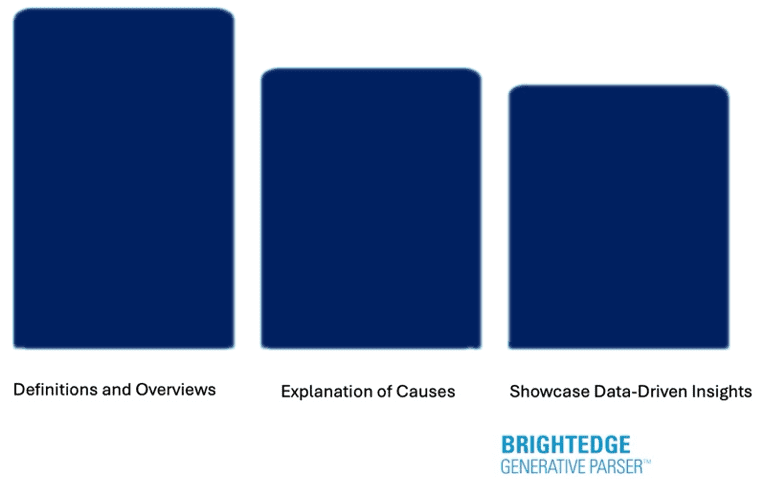
The BrightEdge data shows that in October discovery and research types of queries triggered the most AI Overviews.

The top 3 kinds of answers show in AI Overviews were:

  • Definitions and overviews
  • Explanation of causes
  • Data points

BrightEdge explains what it all means:

  • “The data clearly shows that AIOs are optimized for early-stage research and discovery.
  • Educational content with expert guidance on what’s trending or critical data points is more helpful to cite than specific how-to instructions.
  • Success means aligning your content with this top-of-funnel focus – comprehensive, educational content wins over transactional guidance that could be replaced with ads.”

Most Common Type Of Answer In AI Overviews

Takeaways

BrightEdge’s research offers many insights on the kinds of content Google’s AI Overviews is prioritizing and how it’s ramping up for the holiday shopping season which begins with Black Friday. If traffic patterns are changing then it may be due to the updates to the kinds of queries are triggering AIO and an increase in advertising which, combined with larger sizes of AIO panels, could be pushing organic results lower.

It must be emphasized that organic results have not been the norm for well over ten years and at this point it’s anachronistic to still be thinking in terms of ten blue links. This is why the BrightEdge data is important because it’s showing what’s going on in the search results.

Key Insights

  • Ads are now featuring in AI Overviews
  • Volatility in shopping-related queries is stabilizing, creating a more predictability
  • Google is becoming more precise about what triggers AIOs
  • Product carousels increased by 300% in October
  • Collapsed unordered lists that requires users to click to see more information increased by 20%
  • Queries for specific products are less likely to trigger AIOs
  • Research-phase queries and intents are increasingly the top triggers for AIO

Read the latest research data by BrightEdge

New AI Overview Trends: What to Expect for Black Friday and Cyber Monday (PDF)

Featured Image by Shutterstock/Cranium_Soul

When To Use Nofollow On Links & When Not To via @sejournal, @JulieJoyce

Nofollow was introduced back in 2005 and came about as a reaction to blog spam comments.

Believe it or not, SEO professionals used to try and manipulate Google’s PageRank on their sites just as they try to manipulate, well, everything.

Nofollow basically tells Google (or any other search engine that supports this attribute) not to vouch for the target link.

Whereas it was previously used in the page-level meta tag (), it’s much more common to see it used on a per-link basis now.

What Does Nofollow Mean?

Nofollow is a rel attribute .

A rel attribute specifies the relationship between the page where the link is and the page that the link points to.

Here’s an example of a basic nofollowed link:

I use this type of product.

Google advises us to:

“Use the nofollow value when other values don’t apply, and you’d rather Google not associate your site with, or crawl the linked page from, your site. For links within your own site, use the robots.txt disallow rule.”

However, nofollowing a link is not a guarantee that Google won’t find that page. Google does take information from nofollow links and can discover and index nofollow links. The issue is whether the link passes PageRank.

Dixon Jones has a great article on PageRank for Beginners, but here’s a quick takeaway:

“Although public access to PageRank was removed in 2016, it is believed the score is still available to search engineers within Google…And regardless of what other algorithms Google might choose to call upon, PageRank likely remains embedded in many of the search giant’s systems to this day.”

Nofollow Becomes A Hint

Fast forward to March 2020, Google announced that it saw the nofollow attribute as a hint rather than a directive. This means that when you use a nofollow, you’re indicating your preference to Google that you don’t intend for the link to pass PageRank. Google might ignore your preference.

Many SEO professionals had suspected this was the case, but this was confirmed.

(Interestingly, Bing announced that it has always treated nofollow as a hint.)

Bing HintScreenshot from X (Twitter), October 2024

In addition to this announcement, Google added two more rel attributes to identify the intent of links; rel=”sponsored” and rel=”ugc”.

When To Use rel=”sponsored”

This attribute is used to identify paid content or paid links.

  1. Advertisements and banners.
  2. Sponsored posts or articles.
  3. Affiliate links.
  4. Links in content created as part of a collaboration.
  5. Any link that is exchanged for money, services, or goods.

Example:

I was paid to write about this type of product. (Sponsored post)

When To Use rel=”ugc”

This attribute is used to identify user-generated content like forum posts or blog comments.

  1. Links in comment sections.
  2. Links in forum posts.
  3. Links in user profiles or bios.
  4. Links in user-submitted reviews or testimonials.

Example:

I have used this type of product. (Comment or forum)

Both new attributes can be used with the nofollow attribute, which I have included in the above example.

If your links don’t fall into either new category but you still want to tell Google that you aren’t vouching for them, just use nofollow.

When To Use rel=”nofollow”

You can have a more in-depth look at what Google says about qualifying your outbound links here.

Whereas nofollow was previously used as a general catchall for links that you didn’t want to pass PageRank, now it’s supposed to be used when the other two rel attributes (sponsored and UGC) aren’t relevant, and you don’t want the link to pass PageRank.

Google notes that while not preferred, it’s acceptable to use nofollow instead of the other attributes. You probably don’t need to go back and change your link attributes if you’ve been doing this, but it’s a good idea to start using proper categorization now.

What Is Considered A Paid Link?

Just a quick bit here about paid links: Many people have conflicting opinions on exactly what a paid link is.

However, Google previously described paid links as including these types of links:

“…exchanging money for links, or posts that contain links; exchanging goods or services for links; or sending someone a “free” product in exchange for them writing about it and including a link.”

I do think that there is some confusion here because some oversimplify and think that if they didn’t pay a webmaster to post a link, even if they paid the webmaster to post their content that contains a link, it’s not a paid link.

In Google’s eyes, it’s still a paid link.

Link Schemes

Here is a synopsis of the current list of what constitutes a link scheme:

  • Buying or selling links for ranking purposes. This includes:
    • Exchanging money for links or posts that contain links.
    • Exchanging goods or services for links.
    • Sending someone a product in exchange for them writing about it and including a link.
  • Excessive link exchanges (“Link to me and I’ll link to you”) or partner pages exclusively for the sake of cross-linking.
  • Using automated programs or services to create links to your site.
  • Requiring a link as part of a Terms of Service, contract, or similar arrangement without allowing a third-party content owner the choice of qualifying the outbound link.
  • Text advertisements or text links that don’t block ranking credit.
  • Advertorials or native advertising where payment is received for articles that include links that pass ranking credit, or links with optimized anchor text in articles, guest posts, or press releases distributed on other sites. For example:

    There are many wedding rings on the market. If you want to have a wedding, you will have to pick the best ring. You will also need to buy flowers and a wedding dress.

  • Low-quality directory or bookmark site links.
  • Keyword-rich, hidden, or low-quality links embedded in widgets that are distributed across various sites.
  • Widely distributed links in the footers or templates of various sites.
  • Forum comments with optimized links in the post or signature, for example:

    Thanks, that’s great info!
    – Paul
    paul’s pizza san diego pizzabest pizza san diego

  • Creating low-value content primarily for the purposes of manipulating linking and ranking signals.

I had previously dug into the Wayback Machine to see what Google wrote about link schemes in previous years.

A lot is the same, but there’s a particularly interesting bit from 2013 that I think should still be in there today, as it really tells you how not to build links:

“Links that are inserted into articles with little coherence, for example:
most people sleep at night. you can buy cheap blankets at shops. a blanket keeps you warm at night. you can also buy a wholesale heater. It produces more warmth and you can just turn it off in summer when you are going on france vacation.

*Note: Here’s the original source.

Sadly, that is still a common thing to do.

When You Shouldn’t Use A Nofollow

If you are giving someone a link because you want to, you think it’s a good resource, and you haven’t been given anything or paid for it, you don’t need to nofollow it.

If you don’t see that it in any way can be considered a link that is designed to manipulate PageRank, you don’t need to nofollow it.

Some webmasters have become so afraid of being penalized that they nofollow all outbound links.

In my opinion, this is unnecessary unless your site only exists to sell links.

What About Dofollow?

It doesn’t exist.

If a link isn’t nofollowed, it’s automatically followed.

(Unless it’s nofollowed through a meta robots tag on a page level. Read Google’s help doc on the topic for more information.)

What Value Does A Nofollowed Link Bring?

A nofollowed link may not help you rank higher – but with the decision to treat it as a hint instead of a directive, it still could.

Nofollowed links are also part of a natural link profile, and a site with no nofollowed links looks odd.

The best thing about nofollowed links is that they are good for traffic and can send you much more traffic than many followed links.

If the New York Times ran a story and gave you a nofollowed link, wouldn’t you still be happy with it?

I know I would.

How Can I See How Many Nofollowed Links I Have?

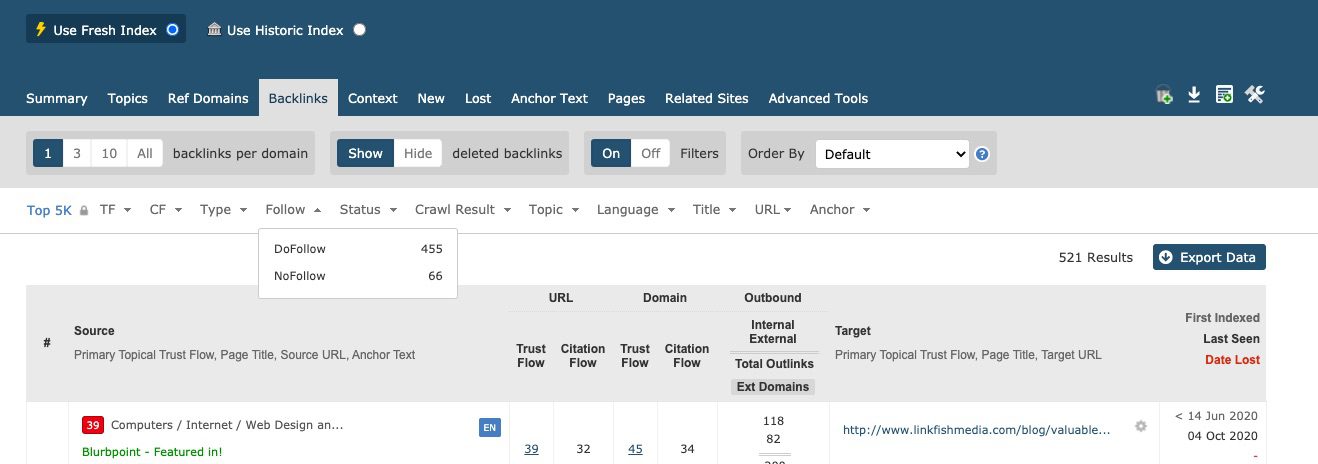
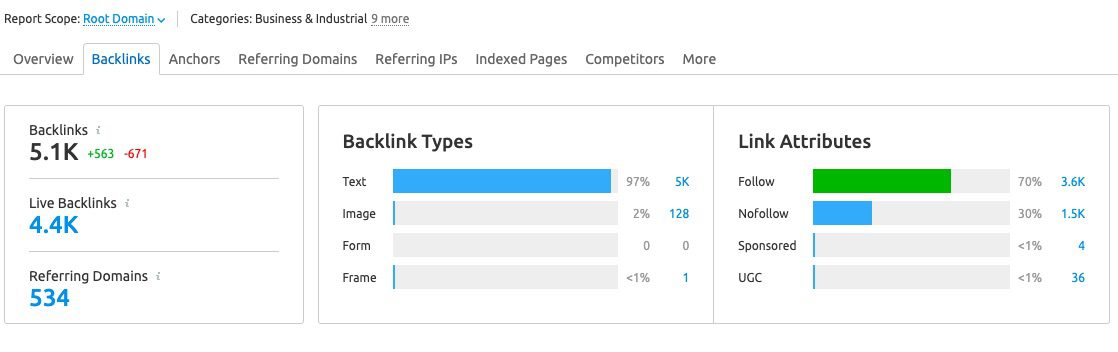
All major tools will tell you how many nofollowed and followed links you have.

Here are a few examples of what that looks like.

Ahrefs

ahrefsScreenshot from Ahrefs, October 2024

Majestic

MajesticScreenshot from Majestic, October 2024

Semrush

SEMRushScreenshot from Semrush, October 2024

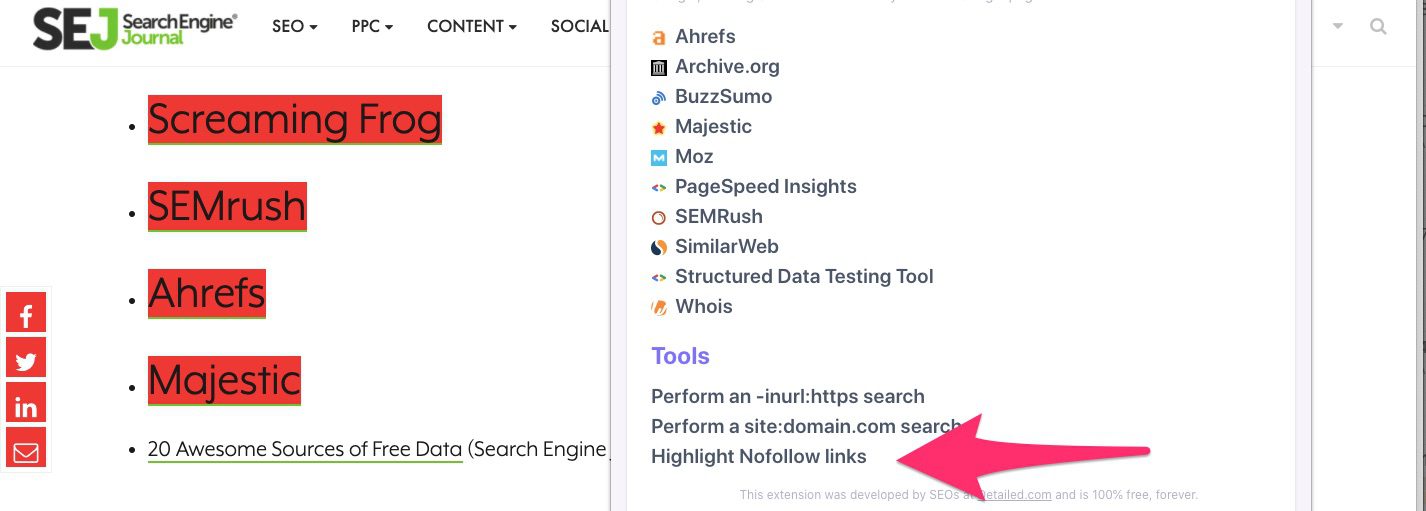
How Do I Tell If A Link Is Nofollowed

I don’t like to use a lot of plugins, so I tend to head straight for the code.

I look to see if nofollow is in the code for my link.

Below is an example from this post.

 nofollow">Screaming Frog
  • nofollow">SEMrush
  • nofollow">Ahrefs
  • nofollow">Majestic
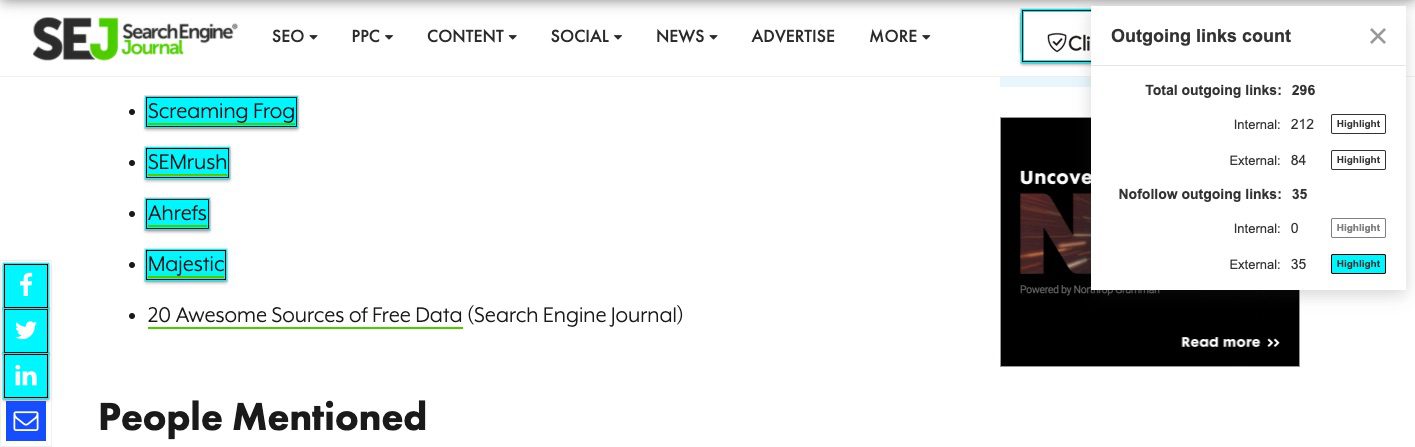
  • However, some plugins can highlight nofollows:

    Detailed SEO Extension

    detailed nofollowScreenshot from author, October 2024

    Ahrefs Chrome Plugin

    ahrefs nofollowScreenshot from author, October 2024

    Igoreware Nofollow Extension

    igorware nofollowScreenshot from author, October 2024

    To Nofollow Or Not To Nofollow?

    Follow:

    • If you are linking out to a source and you trust the source.
    • Guest post: Unless they’re posting on a large scale. This is for a true guest post where you are not paying for the post.
    • Link to social media profiles.

    Nofollow:

    • If you sold a link.
    • If someone paid you to post their content.
    • If you are in any way nervous that you might be penalized for the link.
    • Sitewide link to the person who designed your site, although many people will follow links to company names.
    • Widgets.

    Nofollow In The Real World

    Let’s face it. We don’t always stick to the rules as SEO pros.

    We manipulate anything that works well, and it gradually becomes useless or dangerous.

    So, are people using nofollow, UGC, and sponsored values as Google intends?

    Time will tell.

    More resources:


    Featured Image: Moon Safari/Shutterstock

    Google Search Snippets Show Contradictory Information, Study Finds via @sejournal, @MattGSouthern

    A recent investigation finds that Google’s Featured Snippets may display conflicting information from the same source material, depending on how users phrase their search queries.

    This raises concerns about the search engine’s ability to interpret content accurately.

    Sarah Presch, director at Dragon Metrics, discovered that Google’s Featured Snippets pull opposing statements from the same articles when users frame questions differently.

    For example, searching “link between coffee and hypertension” generates a Featured Snippet highlighting caffeine’s potential to cause blood pressure spikes.

    Searching “no link between coffee and hypertension” produces a contradictory snippet from the same Mayo Clinic article stating caffeine has no long-term effects.

    Similar contradictions appeared across health topics, political issues, and current events.

    The investigation found that asking whether a political candidate is “good” versus “bad” yields dramatically different results despite the fundamental question remaining the same.

    Impact On Search Quality

    “It’s one big bias machine,” Presch notes, explaining how Google’s algorithms appear to prioritize content that matches user intent rather than providing comprehensive, balanced information.

    The findings align with internal Google documents from 2016, where engineers admitted, “We do not understand documents – we fake it.”

    While Google maintains these documents are outdated, SEO experts suggest the underlying technical limitations persist.

    Presch adds:

    “What Google has done is they’ve pulled bits out of the text based on what people are searching for and fed them what they want to read.”

    Mark Williams-Cook, founder of AlsoAsked, commented on the findings, stating:

    “Google builds models to try and predict what people like, but the problem is this creates a kind of feedback loop. If confirmation bias pushes people to click on links that reinforce their beliefs, it teaches Google to show people links that lead to confirmation bias.”

    Implications

    These findings have implications for content creators and SEO professionals:

    • Featured Snippets may not accurately represent comprehensive content
    • User intent heavily influences how content is interpreted and displayed
    • Content strategy may need adjustment to maintain accuracy across various query formats

    Google’s spokesperson defended the system, stating that users can find diverse viewpoints if they scroll beyond initial results.

    The company also highlighted features like “About this result” that help users evaluate information sources.

    Recommendations

    Based on these findings, publishers should take the following actions:

    • Develop comprehensive content that remains accurate regardless of how queries are phrased.
    • Recognize the impact of search intent on the selection of Featured Snippets.
    • Track how your content is displayed in Featured Snippets for different search phrases.

    As Google moves toward becoming an “answer engine” with AI-generated responses, digital marketers and content creators need to understand these limitations.


    Featured Image: Song_about_summer/Shutterstock

    ChatGPT Search May Have A Shot At Google via @sejournal, @Kevin_Indig

    ChatGPT Search (CGS) is a landmark launch in the shift from traditional to AI Search.

    Now, OpenAI competes with Google (Search) heads-on. Note the subtle elbow hit between the lines in the announcement:

    Getting useful answers on the web can take a lot of effort. It often requires multiple searches and digging through links to find quality sources and the right information for you.

    The positioning is clear: ChatGPT Search is a way to get a straight answer without digging through cluttered search results or browsing websites.

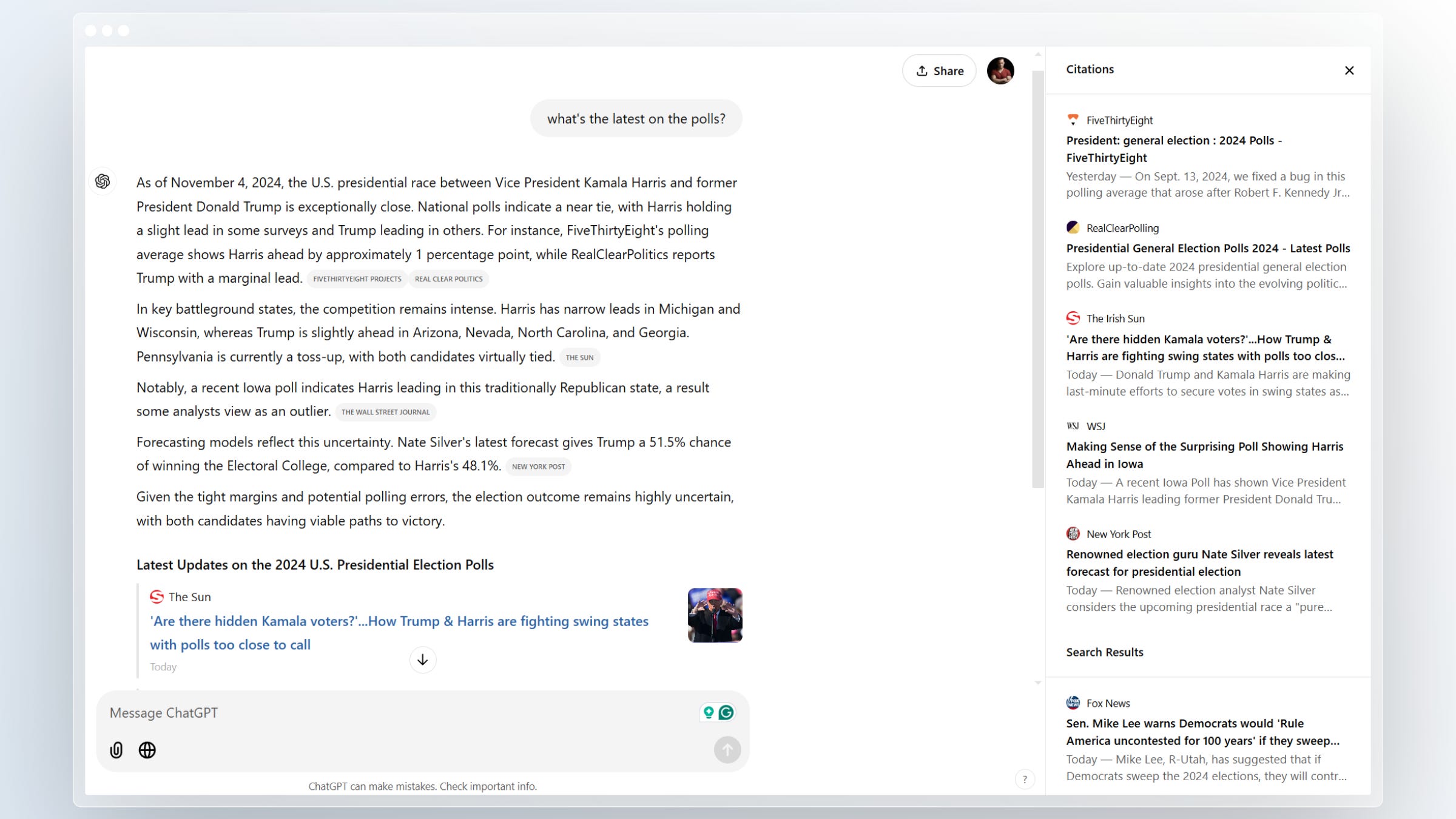
    CGS, which is directly integrated with ChatGPT instead of a standalone search engine, decides whether a query benefits from web results or not, and you can rerun queries through other models like o1 preview to compare the answers:

    ChatGPT will choose to search the web based on what you ask, or you can manually choose to search by clicking the web search icon.

    It keeps the context of your search going in a conversation interface (bolding from me):

    Go deeper with follow-up questions, and ChatGPT will consider the full context of your chat to get a better answer for you.

    ChatGPT Search’s interface features prominent links to sources (Image Credit: Kevin Indig)

    OpenAI has a strategic advantage, as I explained in Search GPT:

    The Information reports that OpenAI loses $5 billion a year in expenses. Just capturing 3% of Google’s $175 billion Search business would allow OpenAI to recoup expenses.

    OpenAI has a strategic advantage over Google: Search GPT can provide a very different, maybe less noisy, user experience than Google because it’s not reliant on ad revenue. In any decision regarding Search, Google needs to take ads into account.

    CGS marks the entry to a new paradigm where traditional search engines like Google or Bing compete with AI chatbots.

    They solve the same problems for users as search engines but with lower friction. But it also marks a critical event that should lead you to evaluate your strategy.

    Companies face a choice to invest and “be early” to AI Search or ignore the noise and stay the course. What makes this decision hard:

    1. Divided opinions about Chat GPT’s chance to take significant market share from Google.
    2. Rapidly changing mechanisms of AI Search platforms.
    3. Confusion about what to do.

    The first search engines didn’t represent the model (Google) that eventually won.

    In the same vein, the AI Search experience we’re seeing today might be completely different in a few years. However, there is little doubt that search is fundamentally changing.

    As a result, my recommendation is to invest in AI Search. It is not capital-intensive (yet), but the upside to finding a playbook is high.

    If CGS grabs significant Google market share, you’re in a good position. If it fails, no harm is done.

    Collision Course

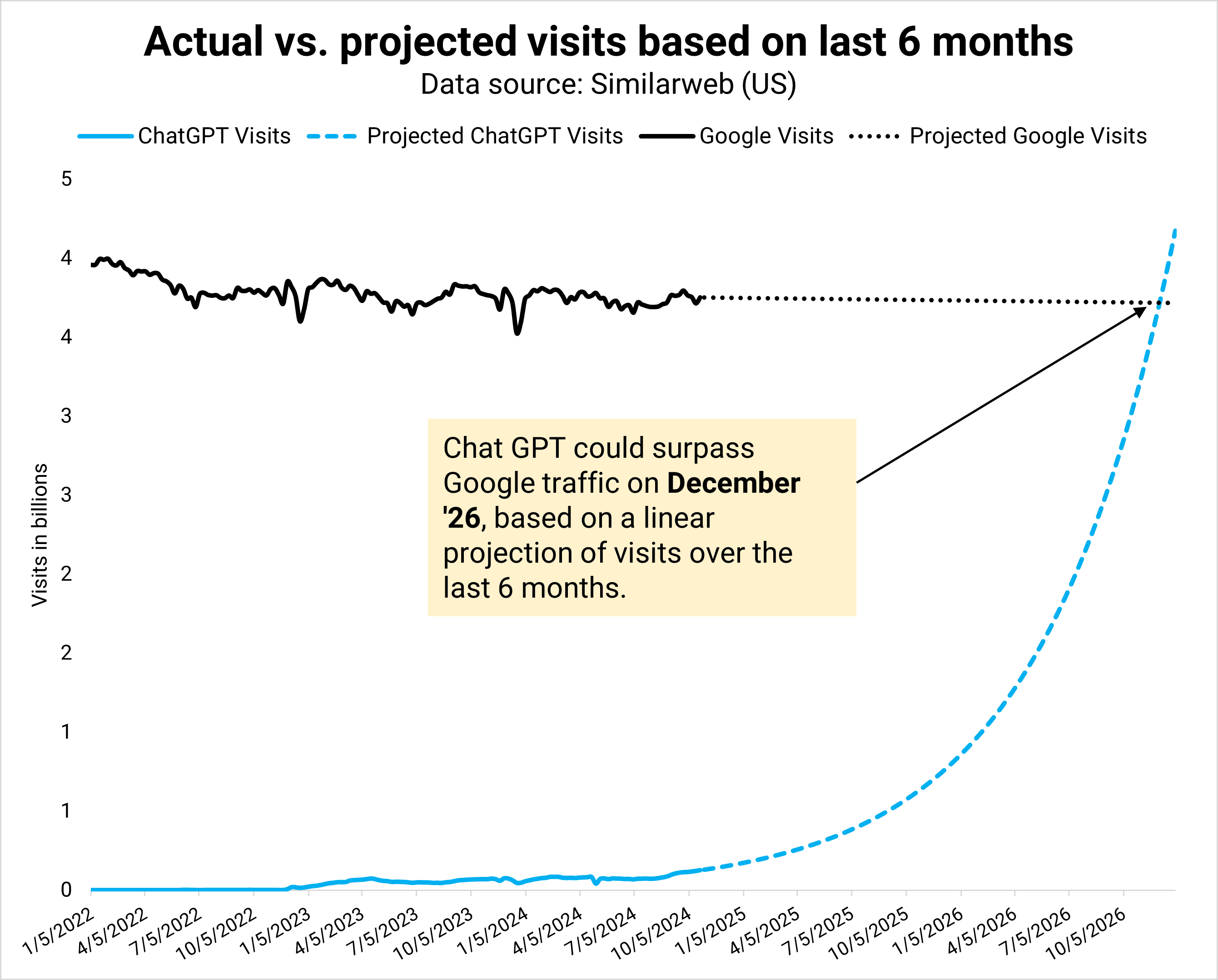
    Based on recent traffic trends, ChatGPT could catch up to Google in 2 years. (Image Credit: Kevin Indig)

    In the chart above, I extrapolated ChatGPT’s and Google’s total traffic over the next two years if the trend from the last six months remains constant.

    This chart will probably outrage or scare you, but the chance that events unfold exactly as depicted in this chart is low.

    The reason I bring it up here is to consider the fact that many structural changes start slowly based on the saying “first gradually, then suddenly.”

    It took Google about three to four years to beat Yahoo, Altavista, and Lycos. Given that new technology gets to critical mass ever faster, I’m not surprised ChatGPT could do it faster (in theory).

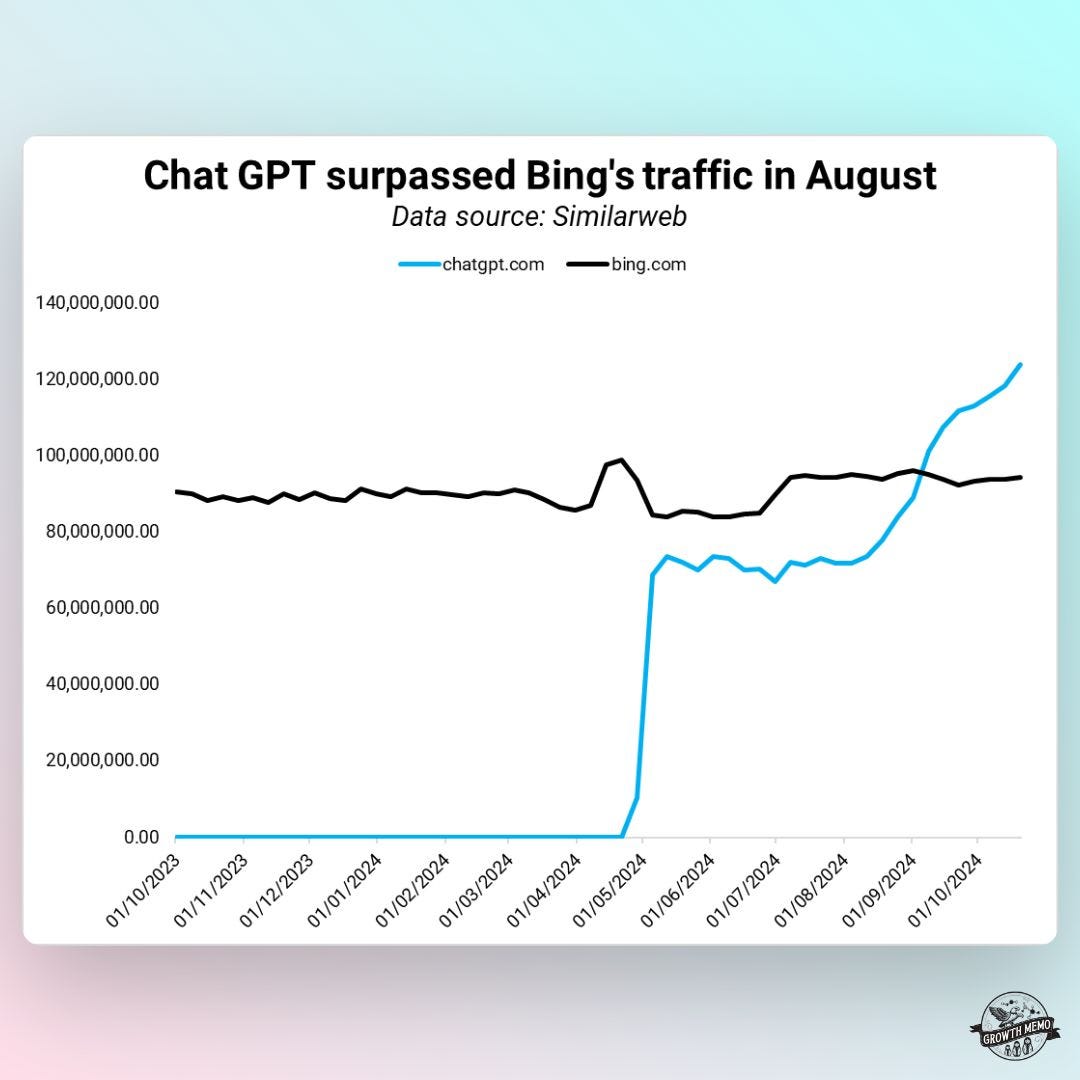
    ChatGPT’s traffic has already passed the No. 3 search engine, Bing (YouTube is second).

    When you look at comments and posts on social media, more and more people report using ChatGPT instead of Google for various purposes, but that could be availability bias.

    Image Credit: Kevin Indig

    One point a lot of people miss when looking at the traffic comparison between ChatGPT and Bing is that they’re not the same, and yet this is a fair comparison.

    ChatGPT is more than a search engine. People use it for all sorts of things. But that’s exactly the point: a search engine that looks like Google never stood a chance to compete with Google or Bing.

    CGS is something new, and that’s why it stands a chance. So, when you see chatgpt.com passing bing.com, the critical argument is not that both do different things but that they’re used to accomplish the same goal.

    After all, search is just a way to solve problems or achieve goals, not to search for the sake of searching.

    To clarify, I don’t think Google or Alphabet as a company is at risk of dying. I do think CGS has a chance to capture significant market share, and too many people underestimate how fast this can go.

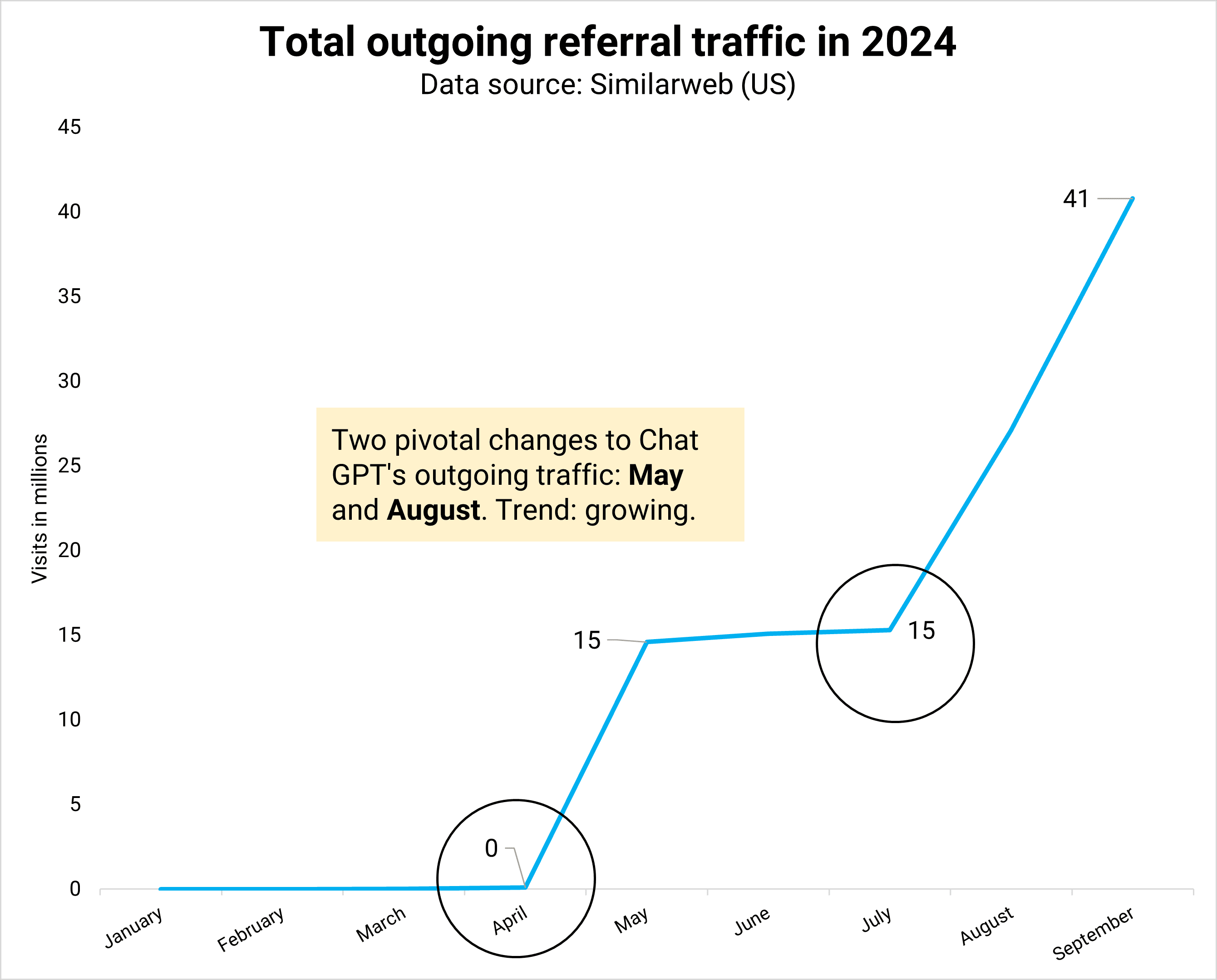
    Referral Traffic Skyrockets

    ChatGPT’s outgoing referral traffic is skyrocketing (Image Credit: Kevin Indig)

    AI Search marks a new paradigm where users get a direct answer without having to browse websites. So, how should companies think about pivoting their strategy?

    Here’s what I’m telling my clients when they ask me whether they should pivot their SEO roadmap: For now, no. Reserve 10 to 20% of capacity to establish visibility in AI Search and for experimentation.

    Look for signal: If you’re hesitant to invest more in AI Search right now, at least monitor traffic to and from ChatGPT. Base your decision on how long ChatGPT can keep its current traffic trend up.

    Establishing visibility: This referral dashboard from Flow Agency is great for monitoring referral traffic.

    With a few tweaks, you can monitor conversions in GA4 as well. You should also monitor site crawls from LLMs and your performance on Bing.

    Then, experiment with content tweaks to improve your AI Search visibility. Keep investing in traditional SEO because it forms the basis of AI Search and answers.

    Place a bet: The big question in this is whether you’re willing to take a bet or play it safe.

    Being a first-mover to SEO had massive benefits as the incumbents tend to stay incumbents, mainly caused by strong backlink profiles, robust user signals, and brand familiarity.

    For now, ChatGPT uses Bing search results to ground and weigh answers, which means sites with strong visibility on Bing also have a high chance of being very visible in CGS.

    However, there is a chance that using Search for RAG (grounding) is just a jumping-off point until AI Search platforms have gathered enough of their data (queries and user behavior).

    Early in this transition period, not much changes. Content that ranks well in traditional search engines, specifically Bing, gets a higher weighting in CGS, which means traditional SEO has a big impact on visibility in AI Search.

    AI Chatbot referral traffic is skyrocketing, and ChatGPT’s new search capability could accelerate that growth even more.

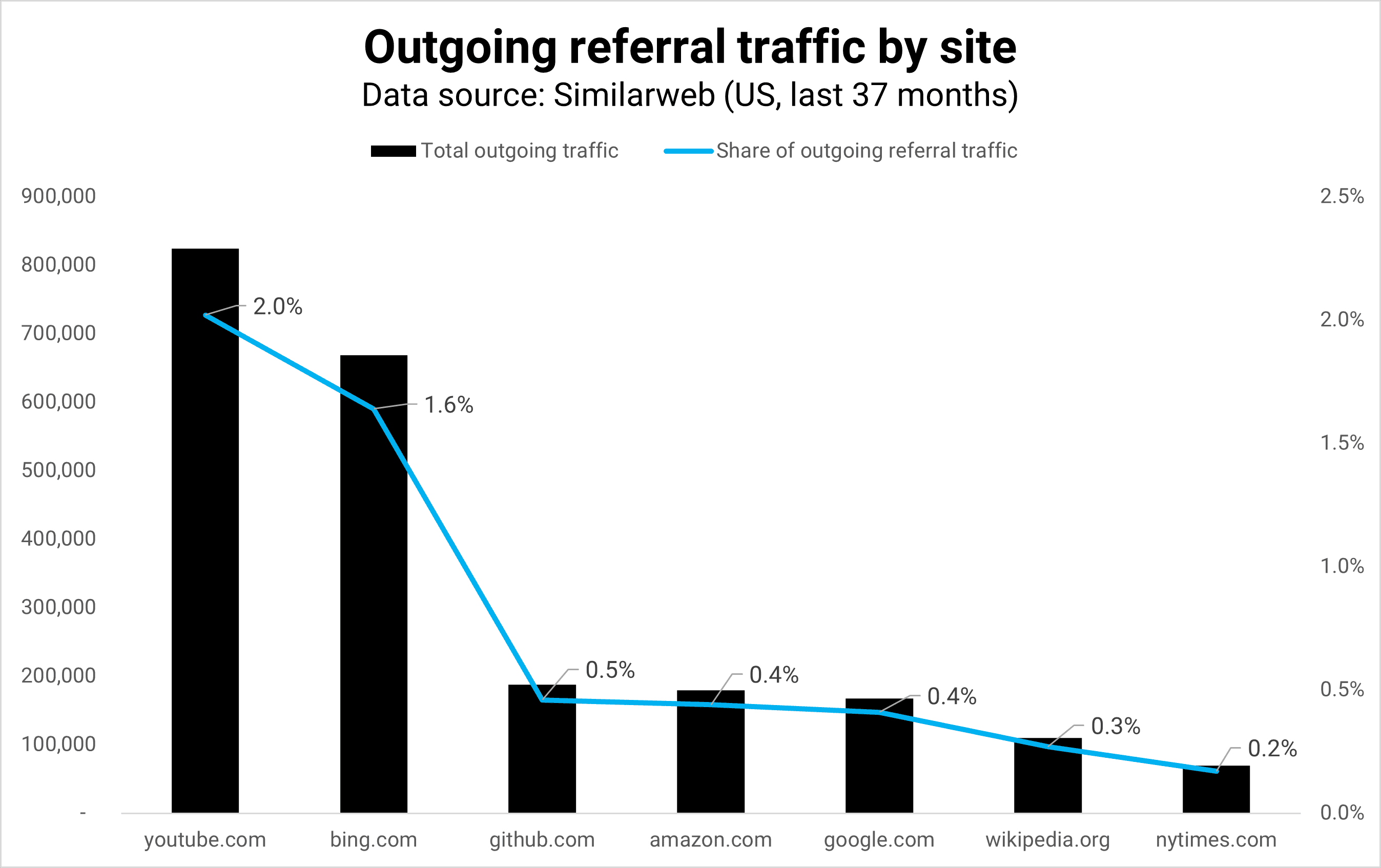
    Outgoing referral traffic from chatgpt.com increased massively in August and September, according to Similarweb.

    Image Credit: Kevin Indig

    Noticeable call-outs:

    • YouTube’s referral traffic increased from .17% in July to 3.9% in September.
    • Bing grew from 0% in April to 1.8% in September.
    • Amazon grew from 0% in July to 1.1% in September.

    If referral traffic keeps growing at the same rate, it will get interesting in the next six to 12 months. It’s not just the volume but also the quality of traffic.

    People use longer and more complex questions when they engage with AI answers, according to Sundar Pichai. Length is a way to be more specific.

    Longer questions allow search engines, LLMs, and marketers to better understand and serve users what they want.

    Based on conversations and observations, referral traffic from AI chatbots isn’t consistently higher than search traffic in every case, but in most.

    Looking Forward

    I’m leaving you with two interesting questions:

    1. Is it a coincidence that ChatGPT Search came out three days after Apple Intelligence launched publicly?

    Apple launched Apple Intelligence, which uses ChatGPT in certain situations:

    Apple is integrating ChatGPT access into experiences within iOS 18, iPadOS 18, and macOS Sequoia, allowing users to access its expertise — as well as its image- and document-understanding capabilities — without needing to jump between tools. Siri can tap into ChatGPT’s expertise when helpful.

    Users are asked before any questions are sent to ChatGPT, along with any documents or photos, and Siri then presents the answer directly.

    Additionally, ChatGPT will be available in Apple’s systemwide Writing Tools, which help users generate content for anything they are writing about. With Compose, users can also access ChatGPT image tools to generate images in a wide variety of styles to complement what they are writing.

    We also know how valuable Google’s exclusive search deal with Apple is.

    From Monopoly:

    Apple’s impact on Google Search is massive. The court documents reveal that 28% of Google searches (US) come from Safari and make up 56% of search volume. Consider that Apple sees 10 billion searches per week across all of its devices, with 8 billion happening on Safari and 2 billion from Siri and Spotlight.

    “Google receives only 7.6% of all queries on Apple devices through user-downloaded Chrome” and “10% of its searches on Apple devices through the Google Search App (GSA).” Google would take a big hit without the exclusive agreement with Apple.

    Since Search is part of ChatGPT, any API request could trigger the new Search feature.

    As a result, ChatGPT has a direct line to searches and actions on Apple devices whenever Apple Intelligence uses ChatGPT. Is that integration the new version of Google’s deal with Apple?

    I speculated that OpenAI could work on a browser in Search GPT:

    If the main benefit or Search GPT for OpenAI is a revenue stream and access to more user data, the next logical step for OpenAI is to build a (AI-powered) browser.

    Browser data is incredibly valuable for understanding user behavior, personalization and LLM training. Best of all, it’s app-agnostic, so OpenAI could learn from users even when they use Perplexity or Google.

    We’ve seen the power of browser data in the Google lawsuit, where it turned out Google relied on Chrome data all along for ranking. The only layer that’s more powerful is the operating system and device layer.

    OpenAI seems to be very aware of the importance of being the default when we look at how hard it pushes its Chrome extension, which changes the default browser search engine to ChatGPT.

    2. As it’s likely that more users don’t browse the web but get answers from ChatGPT, Gemini, Perplexity, etc. directly, will the open web become a place primarily for bots instead of humans? And how would that change the purpose and look of websites?


    1 Introducing ChatGPT search

    2 Introducing Apple Intelligence, the personal intelligence system that puts powerful generative models at the core of iPhone, iPad, and Mac


    Featured Image: Paulo Bobita/Search Engine Journal

    What Is A Google Broad Core Algorithm Update? via @sejournal, @RyanJones

    Since the first broad core algorithm update, there has been much confusion, debate, speculation, and questions about what exactly it is.

    How does a core update differ from a named update that many SEO pros are used to?

    Google’s acknowledgment of core updates is usually vague, offering little detail beyond the fact that the update occurred. As we’ll see in this post, there is a good reason for this.

    Typically, core updates take a few days (or weeks) to fully roll out, with Google making one announcement at the start and another at its conclusion. This invariably leaves SEO professionals and site owners wondering how the core update impacted their rankings.

    Understanding a broad core update and how it differs from other algorithm updates can provide insight into what may have caused a site’s rankings to go up, down, or stay the same.

    So, What Exactly Is A Core Update?

    First, let me get the obligatory “Google makes hundreds of algorithm changes per year, often more than one per day” boilerplate out of the way.

    Many of the named updates we hear about (Penguin, Panda, Pigeon, Fred, and the much-talked-about Helpful Content Update – which has since been integrated into core) are implemented to address specific faults or issues in Google’s algorithms.

    In the case of Penguin, it was link spam; in the case of Pigeon, it was local SEO spam. Each of these targeted one specific thing – and, in many cases, brought a new metric or new calculation or new machine learning model into the overall algorithm.

    They all had a specific purpose but also required new data or new systems to run.

    In these cases, Google (sometimes reluctantly) informed us what it was trying to accomplish or prevent with the algorithm update, and we were able to go back and remedy our sites.

    A core update is different.

    The way I understand it, a core update is a tweak or change to the main search algorithm itself.

    It’s not adding anything “new” in terms of metrics, data, signals, machine learning, etc. It’s simply re-arranging or adjusting existing signals/factors and their importance.

    You know, it is believed that there are somewhere between 200 and 500 (or maybe more) ranking factors and signals – the exact number is unknown.

    What a core update means to me is that Google slightly tweaked the importance, order, weights, or values of these signals.

    Because of that, they can’t come right out and tell us what changed without revealing the secret sauce.

    The simplest way to visualize this would be to imagine, let’s say, 200 factors listed in order of importance.

    Now imagine Google changing the order of 42 of those 200 factors.

    Rankings would change, but it would be a combination of many things, not due to one specific factor or cause.

    Obviously, it isn’t that simple, but that’s a good way to think about a core update.

    A good analogy would be your list of top 10 favorite Taylor Swift songs. You might re-order that occasionally based on what’s going on in your life – or she may update an older song or release some new music. All of that might change your list.

    Here’s a purely made-up, slightly more complicated example of things Google might adjust and why it can’t tell us.

    “In this core update, we increased the value of keywords in H1 tags by 2%, changed the core web vitals boost from 0.00001 to 0.0000001, decreased the value of the ratio of keyword trigrams covered by title trigrams, changed the D value in our PageRank calculation from .85 to .70, and started using a TF-iDUF retrieval method for logged in users instead of the traditional TF-PDF method.”

    (I swear these are real things in information retrieval. I just have no idea if they’re real things used by Google.)

    As you can see, these types of updates wouldn’t be helpful at all to SEO professionals – even if they understood them.

    Put simply, a core update means Google changed the weight and importance of existing ranking factors and signals – and some results shifted because of it.

    At its most complex form, Google ran a new training set through its machine learning ranking model. Quality raters gave this new set of results a higher Information Satisfaction (IS) score than the previous set, and the engineers have no idea what weights changed or how they changed because that’s just how machine learning works.

    (We all know Google uses quality raters to rate search results. These ratings are one input into how it chooses one algorithm change over another – not how it rates your site. Whether it feeds this into machine learning is anybody’s guess. But it’s one possibility.)

    It’s likely some random combination of weighting delivered more relevant results for the quality raters, so they tested it more, the test results (clicks!) confirmed it, and they pushed it live.

    Remember clicks in the famous Google leak? This is one way they use those – for A/B testing new algorithm variants.

    How Can You Recover From A Core Update?

    I want to be very clear about language here.

    A core algorithm update didn’t “penalize” you for something. It’s not adding negative weights. It most likely just rewarded another site more than yours when it comes to relevance, authority, and quality signals.

    Unlike a major named update that targets specific things, a core update may tweak the values of everything.

    New sites could be considered for this query; old sites no longer considered. Many sites were probably updated. The user intent (click data) could have changed for this query, new entities could be deemed relevant to this query, the link graph could have changed, etc.

    Data changes and the weights of factors have been re-ordered.

    Because websites are weighted against other websites relevant to your query (engineers call this a corpus), the reason your site dropped could be entirely different than the reason somebody else’s increased or decreased in rankings.

    To put it simply, Google isn’t telling you how to “recover” because it’s likely a different answer for every website and query.

    Maybe you were killing it with internal anchor text and doing a great job of formatting content to match user intent – and Google shifted the weights so that content formatting was slightly higher and internal anchor text was slightly lower.

    (Again, hypothetical examples here.)

    In reality, it was probably several minor tweaks that, when combined, tipped the scales slightly in favor of one site or another (think of our reordered list here).

    Finding that “something else” that is helping your competitors isn’t easy – but it’s what provides SEO pros with some job security.

    What about AI?

    It’s worth pointing out that core updates do affect Google’s AI overviews and citations – as those things are powered by search.

    Next Steps And Action Items

    Rankings are down after a core update – now what?

    First step: Figure out if there are any patterns in the pages that dropped. Were they all the same template? Same intent? Same private blog network of paid links? (Just kidding).

    Google is good at patterns; we should be good at spotting them, too.

    Your next step is to gather intel on the pages that are ranking where your site used to be.

    Conduct a search engine results page (SERP) analysis to find positive correlations between pages that are ranking higher for queries where your site is now lower.

    Try not to overanalyze the minute technical details, such as how fast each page loads or its core web vitals scores. These are very minor tiebreaker factors.

    Pay attention to the content itself. As you go through it, ask yourself questions like:

    • Does it provide a better answer to the query than your article?
    • Does the content contain more recent data and current stats than yours?
    • What’s the information gain of this page compared to the others that rank? Does it just say the same stuff or does it offer more?
    • What is the intent of the user doing this query? Does this help them accomplish that better?

    Google aims to serve content that provides the best and most complete answers to searchers’ queries. Relevance is the one ranking factor that will always win out over all others.

    Take an honest look at your content to see if it’s as relevant today as it was prior to the core algorithm update.

    From there, you’ll have an idea of what needs improvement.

    The best advice for conquering core updates? Keep focusing on:

    Finally, don’t stop improving your site once you reach position 1 because the site in position 2 will not stop.

    Yeah, I know – it’s not the answer anybody wants, and it sounds like Google propaganda, but it’s just the reality of what a core update is.

    Nobody said SEO was easy.

    More resources: 


    Featured Image: BestForBest/Shutterstock

    Making Social Media & SEO Work Together via @sejournal, @krisjonescom

    The synergy between social media and SEO is critical in modern digital marketing.

    As a seasoned SEO professional with 26 years of experience, I’ve observed how recent developments – such as the Google algorithm updates and the rise of Artificial Intelligence Optimization (AIO) – have reshaped the interplay between social media and search engine optimization.

    Understanding this dynamic is essential for businesses aiming to enhance their online visibility and connect with their target audience effectively.

    In this article, we’ll explore how social media can significantly boost your SEO efforts.

    We’ll delve into practical examples, consider the impact of recent industry changes, and provide up-to-date references to help you navigate this complex landscape.

    The Evolving Relationship Between Social Media And SEO

    A Brief History And Recent Developments

    Historically, the connection between social media and SEO has been nuanced.

    While Google has consistently stated that social signals (likes, shares, comments) are not direct ranking factors, the indirect benefits are undeniable.

    The Google leak of 2024, which unveiled insights into the search giant’s algorithmic considerations, highlighted the growing importance of user engagement metrics – many of which are influenced by social media activity.

    Moreover, the introduction of AIO has further intertwined social media with SEO.

    AIO leverages AI to optimize content and user experiences across platforms, including social media.

    With AI algorithms now better at understanding content context and user intent, the lines between social media engagement and SEO performance are blurring.

    The Impact of AI And Algorithm Updates On Social Signals

    Google’s advancements in AI, particularly with the BERT and MUM algorithms, have enhanced the search engine’s ability to interpret natural language and user intent.

    These developments mean that content shared on social media – especially when it generates significant engagement – can influence how search engines perceive and rank your website indirectly.

    For instance, a viral social media post can lead to increased brand searches on Google, which is a positive signal to the search engine about your brand’s authority and relevance.

    Additionally, AI-powered tools now analyze social media trends to inform SEO strategies, making social media an indispensable component of SEO planning.

    How Social Media Helps SEO

    1. Amplifying Content Reach And Engagement

    Social media platforms serve as powerful amplifiers for your content, extending its reach beyond your website’s regular audience.

    By actively sharing and promoting your content on these platforms, you tap into a vast network of potential readers, customers, and influencers who can engage with and spread your message further.

    Example: Imagine you’ve published a comprehensive guide on sustainable living on your website. By sharing this guide on your social media platforms, you expose it to a broader audience who may not have found it through search engines alone. If your post gains traction – receiving shares, comments, and likes – it can drive substantial traffic to your site.

    Recent Changes: With the rise of short-form video content on platforms like TikTok and Instagram Reels, sharing snippets or highlights of your content can entice users to visit your website for the full version. These platforms’ algorithms favor engaging content, increasing the likelihood of your content reaching a wider audience.

    2. Enhancing Link Building Opportunities

    Backlinks remain a cornerstone of SEO, signaling to search engines that your content is valuable and authoritative.

    Social media can be a catalyst for earning these backlinks by exposing your content to individuals and organizations that may link to it from their own websites or blogs.

    Example: A tech startup publishes an insightful article about emerging technologies. By promoting this article on LinkedIn, industry professionals may notice and reference it in their own blogs or articles, creating valuable backlinks.

    Recent Changes: Google has provided guidance that focusing too much on links can be a distraction from what matters most to your audience. While links are still important, engagement with your content is becoming a key metric of effectiveness. Social media is an excellent way to both encourage and measure engagement with your content. A strong social media strategy encourages the most valuable types of links: earned links based on content that resonates with your audience.

    3. Social Profiles In SERPs And Brand Visibility

    Your social media profiles are extensions of your brand and can occupy prominent positions in search engine results pages (SERPs).

    Optimizing these profiles not only strengthens your online presence but also provides additional pathways for users to discover and engage with your brand.

    In recent updates, Google emphasizes results from user-generated content on Reddit so being present in relevant conversations and managing your brand on social platforms is becoming more critical to your SEO strategy.

    Example: When users search for your brand, your social media profiles can appear alongside your website in the search results, occupying more real estate on the SERP and increasing your brand’s visibility.

    Recent Changes: With Google’s continuous updates, there is a greater emphasis on providing users with comprehensive information. Social media profiles often appear in the knowledge panel or as rich results, offering users direct access to your latest updates and engagement opportunities.

    4. Building Brand Trust and Authority

    In a crowded digital marketplace, establishing trust and authority is essential.

    Social media allows you to showcase your expertise, engage authentically with your audience, and build a community around your brand – all of which contribute to a stronger, more trustworthy online presence.

    Example: A financial advisor regularly shares expert insights on X (Twitter), engaging with followers’ questions and discussions. This consistent presence builds credibility, encouraging users to visit their website for more in-depth information.

    Recent Changes: The integration of user-generated content and reviews on social media platforms can influence public perception. Google considers brand reputation in its E-E-A-T (experience, expertise, authoritativeness, trustworthiness) criteria, and a strong social media presence contributes to this.

    Conclusion

    Social media and SEO are more interconnected than ever.

    The evolution of Google’s algorithms and the advent of AI optimization have amplified the impact social media can have on your SEO efforts.

    By strategically leveraging social platforms to share content, engage with your audience, and build brand authority, you indirectly boost your search engine rankings.

    Remember, while social media signals may not be direct ranking factors, the ripple effects – such as increased traffic, enhanced backlink opportunities, and improved brand perception – play a significant role in your overall SEO performance.

    Embrace the synergy between social media and SEO to stay ahead in this dynamic environment.

    By integrating these strategies into your digital marketing plan, you’ll not only enhance your SEO efforts but also build a more robust and engaged online presence.

    Stay informed about the latest developments, and don’t hesitate to adapt your approach as the digital landscape continues to evolve.

    More resources:  


    Featured Image: gonin/Shutterstock
    How To Optimize Your Ecommerce Site For Holiday Shoppers via @sejournal, @wburton27

    Peak shopping periods like Black Friday, Halloween, Christmas, and other holidays attract millions of shoppers online.

    They also present prime opportunities for ecommerce and retail brands to drive incremental revenue and traffic for the holiday season.

    According to the NRF, the 2024 holiday forecast is consistent with its forecast that annual sales for 2024 will be between 2.5% and 3.5% over 2023. Some noteworthy mentions:

    One differentiating characteristic from last year’s holiday shopping season is that the shopping period between Thanksgiving and Christmas will be six days shorter, totaling 26 days. Additional contributing factors this year could include the economic impact of Hurricanes Helene and Milton; even though the 2024 U.S. presidential election will take place during the winter holiday season, it is impossible to measure its impact on current or future spending.

    Screenshot from NRF.com, October 2024

    According to Statista, in the U.S., a lot of holiday consumers intend to buy products for 2024 for the holiday celebration, with 97% for Halloween, 92% for Thanksgiving, and 96% for Christmas.

    Screenshot from Statista, October 2024

    Since sales are expected to be up year over year, what are the best ways to optimize your site for the holidays? When should you start, and what should you do? Let’s explore.

    SEO Tips For Optimizing Your Ecommerce Website

    Plan Ahead

    One of the most important aspects of optimizing your site for the holidays is planning.

    If you build landing pages now for Christmas and expect them to rank for competitive terms, it won’t happen.

    Always build out your content calendar in advance (i.e., two to three months or more ahead of time).

    Make sure you do your keyword research and start planning which content you need to create, get approvals for, deploy, etc.

    Use Evergreen URLs

    Create reusable URLs for promotions that you can use year after year. You can mention the date or year in the page title or copy and then change it each year, but don’t use it in the URL.

    I can’t tell you that, in my 20 years of doing SEO, I saw a lot of big brands make the mistake of either taking down their landing pages or adding the year to their landing page URL for seasonal products.

    The good news is that most big box retailers are doing this correctly now.

    For example, Target has a dedicated landing page for its Thanksgiving TV deal at https://www.target.com/s/samsung+tv+deals+thanksgiving.

    Now, if it were to put in a year, it would have to redirect the page every year, but it is following a good SEO strategy. This allows the pages to age, secure links, build authority, and be used for internal links.

    Screenshot from Target.com, October 2024

    Prepare For AI Overviews

    We live in a world where AI has changed user behavior, and people ask questions about your brand and our product.

    Screenshot from search for [plasma TV], Google, October 2024

    Make sure your site is optimized for AI Overviews and follows best practices:

    • Follow Google’s Search Essentials Guide.
    • Support and expand on the information in AI Overviews.
    • Target long-tail information queries.
    • Make sure the content is relevant and answers questions.
    • Format the content structure.
    • Keep content fresh and updated.

    Blend SEO And PPC Strategy

    Unfortunately, SEO keeps getting pushed down further and further down the page.

    You must work with your paid search team to build a blended strategy for ranking competitive keywords and owning the entire SERP.

    For example, a search for [what is the best TV to buy for thanksgiving] has transactional intent. The SERPs show sponsored listings first, followed by videos and People Also Ask (PAA).

    Having both a paid ad and ranking organically is key to capturing more clicks and potential sales.

    Paid search can also create holiday-themed ad campaigns targeting your trophy keywords and drive more sales.

    Build out content that uses the PAA strategy. This feature in the Google SERPs provides end users with additional questions related to their search query and quick answers.

    Don’t Forget About Reddit

    Reddit has been showing up in the SERPS for questions regarding holiday queries.

    This represents an opportunity to get in front of your target audience, so make sure to follow Reddit’s best practices, which include:

    • Identify relevant subreddits related to your products (e.g., r/Gift ideas).
    • Avoid self-promotion and engage with the community.
    • Share relevant content, optimize, and monitor performance.
    • Post, network, build relationships, and participate in discussions.
    Screenshot from search for [holiday gift ideas], Google, October 2024

    Optimize Speed And Performance

    Make sure your site is optimized for mobile devices, loads as quickly as possible – preferably under 3 seconds – and passes Core Web Vitals.

    It’s important from a user experience perspective, especially because most shopping will be done using a mobile device. Avoid big holiday hero images, interstitials, etc.

    Offer Holiday Gift Guides And Promotions

    Display promotions on your homepage to drive incremental clicks and sales.

    If you had holiday pages from last year, you might want to refresh the content so that you can update it in time for the holiday season with new and popular products, seasonal messaging, and images.

    Use Holiday-Specific Keywords In Product Descriptions

    Product descriptions are especially important and can improve your ecommerce site’s visibility during the holiday shopping season.

    Using relevant holiday keywords can help your products appear in holiday-related research and make them more appealing to shoppers looking for relevant products.

    After you conduct your keyword research for your holiday terms using your favorite tools like Semrush, Ahrefs, etc., produce a list of terms including:

    • General terms: “holiday,” “festive,” “seasonal,” “gift.”
    • Specific holidays: “Christmas,” “Hanukkah,” “New Year’s,” “Kwanzaa.”
    • Gift-giving terms: “stocking stuffer,” “secret Santa,” “white elephant.”
    • Emotional terms: “joy,” “cheer,” “merry,” “celebrate.”

    Highlight holiday use cases. Describe how the product can be used during the holidays or why it makes a great gift, and add videos.

    Use seasonal modifiers; add holiday-specific adjectives to your product titles and descriptions. Example for clothing:

    • Original: “Red Knit Sweater.”
    • Holiday version: Festive Red Knit Sweater, Perfect for Holiday Parties.

    Leverage Email Marketing For Holiday Campaigns

    While email marketing doesn’t directly impact SEO, it can indirectly help your SEO efforts during the holiday season.

    Having targeted email campaigns can bring previous customers back to your store, as long as they’re personalized based on previous purchases, browsing interest, and limited offers.

    Plan For Out-Of-Stock Items

    With the recent events in the world, i.e., U.S. port strikes by 45,000 dock workers, wars, hurricanes, an uncertain presidential election, and the fact that COVID is still around, there are still some issues with the supply chain.

    You always need to have a plan if your products aren’t available if something happens.

    In this case, it is recommended to stock up on products that have sold out in previous years and make sure your inventory management system is integrated with your website in real time.

    Other alternatives include:

    • Emailing customers when products are back in stock.
    • Internally linking to related products.

    Engage Through Social Media

    Social platforms are critical to engaging customers and driving sales.

    Creating useful and shareable content, holiday giveaways, and social media deals can drive engagement metrics and promote your holiday SEO content to attract links and social endorsements. In addition, shoppable posts facilitate discovery and purchases on social platforms.

    Add An On-Site Search Functionality 

    Adding in a site search, if you don’t have one, can significantly improve user experience, increase conversions, and indirectly benefit your SEO efforts.

    Users like to search using on-site functionality.

    Run A Tech And Internal Security Audit

    With the number of cyber security threats, data breaches, and incremental web traffic during the holidays, always run a technical audit on the site and make sure:

    • Your site has a valid, working SSL certificate installed, so all your data is encrypted and safe.
    • Your product pages return to 200 response codes and load quickly and properly.
    • Run a vulnerability scan on your website to make sure there are no issues.

    Use Product Schema

    Use structured data (i.e., Product schema) so Google can understand your products and show product discounts and sales prices, which could have a positive impact on rankings and clicks.

    Have A Simple Checkout Process

    While not exactly pertaining to SEO, having a checkout process that is hard for users to navigate can have a detrimental impact on your online sales.

    You need your checkout process to be quick and easy to complete a purchase, which will help:

    • Reduce cart abandonment.
    • Improve customer experience.
    • Increase conversion rates.
    • Complete purchase faster.
    • Strengthen positive brand perception.

    Being Festive With Design

    There is nothing better than visiting a website that puts you in the holiday mood.

    For example, with Halloween approaching, Target does an excellent job updating its imagery to match the Halloween theme.

    It’s also an innovative idea to build out gift guides, holiday FAQs, and holiday categories and optimize them to improve your customer experience, drive customers deeper into your website, and increase product purchases.

    Screenshot from Target.com, October 2024

    Product Reviews

    Don’t forget about your product reviews. It is highly recommended to have detailed reviews of your most popular holiday products, showcasing why they are needed, useful, and relevant and make great holiday gifts.

    Review KPIs

    To make sure the holiday season is a success, start by reviewing your KPIs such as: 

    • Revenue, traffic, and sales year-over-year.
    • Rank, impressions, and clicks.
    • Click-through rates.
    • Conversions.

    Wrapping Up

    The holiday season presents an excellent opportunity for ecommerce businesses to drive more sales and build customer loyalty.

    To capitalize on the holiday season, it’s crucial to plan ahead and create an exceptional customer experience.

    Work with your paid and social teams to develop a blended marketing strategy, run technical and security audits, and ensure a smooth checkout process.

    Also, leverage email marketing and other tactics to drive incremental revenue and traffic while building lasting relationships with your customers for years to come.

    More resources:


    Featured Image: Roman Samborskyi/Shutterstock

    OpenAI Reddit AMA And SEO For ChatGPT Search via @sejournal, @martinibuster

    CEO Sam Altman and OpenAI executives held a Reddit AMA to answer questions, including those about ChatGPT Search, providing an inside look at how it works. Their answers offer insights into what SEO may look like in the immediate future.

    The people from OpenAI answering the questions:

    • Sam Altman, CEO
    • Kevin Weil, Chief Product Officer
    • Mark Chen, SVP of Research
    • ​​Srinivas Narayanan, VP Engineering

    Why ChatGPT Search Is Important

    ChatGPT Search is not a search engine, it’s an AI chatbot with search, which means it doesn’t compete with Google as a search engine, it simply replaces it with something else that people already use for work and play. Now it has additional utility as an assistant in daily life and search.

    Another advantage to ChatGPT Search is that it doesn’t show advertising nor does it follow users around the Internet. Users already trust ChatGPT with personal and business information so it’s already has goodwill with users.

    What makes ChatGPT Search a threat to Google is that Users are already familiar with ChatGPT and have good feelings about it. Because it’s already in use there is no switching away from Google to break the habit of searching with Google.

    Sam Altman On Why ChatGPT Search Is Better

    In the Ask Me Anything (AMA) session on Reddit, a Redditor asked OpenAI CEO what the value of ChatGPT Search is over other search engines.

    The person asked:

    “My question is about the value ChatGPT Search offers compared to popular search engines. What are the unique advantages or key differentiators of ChatGPT Search that would make it worthwhile for a typical search engine user to choose it?

    Sam Altman answered:

    “For many queries, I find it to be a way faster/easier way to get the information I’m looking for. I think we’ll see this especially for queries that require more complex research. I also look forward to a future where a search query can dynamically render a custom web page in response!”

    That bit about a “custom web page” is something to look out for because it hints at personalization based on what a user is searching for.

    Complex Queries Are ChatGPT’s Advantage

    Altman’s response about ChatGPT Search’s handling of complex queries calls attention to an advantage over Google. ChatGPT users are accustomed to using natural language, whereas Google users habitually use keyword searches. Keyword searches disadvantages Google because it’s harder to understand those queries, which is why Google displays People Also Ask features in Search.

    Natural language queries is the way users interact with ChatGPT and that is an advantage for ChatGPT Search.

    Grounding For Better Answers

    The next question was about OpenAI’s progress on preventing ChatGPT from making things up (aka hallucinations) and also about how it’s going to incorporate fresh data to the index.

    Both problems are generally approached with a technology and technique called Retrieval-Augmented Generation (RAG) which selects data from an up to date database like a search index or a knowledge graph and then provides that to the LLM-based chatbot to summarize and use as a base for an answer.

    This is the question:

    “Are hallucinations going to be a permanent feature? Why is it that even o1-preview, when approaching the end of a “thought” hallucinates more and more?

    How will you handle old data (even 2-years old) that is now no longer “true”? Continuously train models or some sort of garbage collection? It’s a big issue in the truthfulness aspect.”

    The answer was given by Mark Chen, SVP of Research

    “We’re putting a lot of focus on decreasing hallucinations, but it’s a fundamentally hard problem – our models learn from human-written text, and humans sometimes confidently declare things they aren’t sure about.”

    Mark Chen continued his answer by saying that they are getting better by the use of “grounding” which is something that Retrieval-Augmented Generation (RAG) helps large language models with. Chen also reveals that they believe that using Reinforcement Learning (RL) may help models stop hallucinating.

    Reinforcement Learning (RL) is a way to teach a machine with experience, rewarding it when it’s correct and withholding the reward when it’s not correct, thus reinforcing good answers. The machine “learns” by making choices that maximizes rewards. In the context of hallucinations, a reward could be a score or signal that indicates that the answer is factual (and it could also be provided by human feedback scores).

    Mark Chen continued his response:

    “Our models are improving at citing, which grounds their answers in trusted sources, and we also believe that RL will help with hallucinations as well – when we can programmatically check whether models hallucinate, we can reward it for not doing so.”

    Does ChatGPT Search Use Bing?

    The next question is about what search data does ChatGPT Search use.

    The question asked:

    “Is ChatGPT Search still using Bing as the search engine behind scenes?”

    The answer was provided by Rinivas Narayanan, VP Engineering at OpenAI:

    “We use a set of services and Bing is an important one.”

    That’s an interesting answer because it’s commonly assumed that Bing is the only search engine. The answer indicated that ChatGPT Search uses multiple “services” and that Bing is the most important. What are the other services that ChatGPT might use? That’s an open question.

    What Does OpenAI Say About SEO For ChatGPT Search?

    Someone asked the important question about how to optimize content for ChatGPT Search in order to improve rankings. The question was answered by Kevin Weill who said that they were still figuring it out, which could mean that they don’t know or that they’re still figuring out what to say about optimization.

    Kevin Weill, Chief Product Officer responded:

    “This is a great question—the product just launched today so there’s a lot to figure out still about where search will be similar and where it will be different in an AI world. Would love any feedback you have!”

    Takeaways – SEO For ChatGPT Search

    Chief Product Officer Kevin Weill is right, these are still the early days of their search and much can still change. The OpenAI Reddit AMA offers first hints at what SEO is growing into.

    Other insights:

    • Bing is the main service ChatGPT Search uses but there are other services it uses as well. That makes Bing an important search engine to rank in.
    • ChatGPT users are accustomed to natural language interactions and may during the course of their work day use ChatGPT Search.
    • OpenAI may use Reinforcement Learning at some point to get a better handle on hallucinations.
    • Personalization may be arriving at some point in the future in the form of a dynamically rendered web page.

    Beyond those takeaways is the consideration that OpenAI is not directly competing against Google with a standalone search engine, it has created a completely different experience for searching the web.

    Featured Image by Shutterstock/Vitor Miranda