Version 4.6 of Yoast Duplicate Post is here, and it’s all about making your editing experience feel more natural in WordPress’s Block Editor, and making sure “Rewrite & Republish” works reliably every time you need it.
A more modern editing experience
Everything where you’d expect it. The Duplicate Post controls now sit in the Block Editor’s sidebar, right alongside WordPress’s own settings, no more hunting around. If you’re still on the Classic Editor, nothing changes for you.
Buttons that look the part. The “Copy to a new draft” and “Rewrite & Republish” actions are now proper bordered buttons, consistent with the rest of the WordPress interface. Cleaner, clearer, and easier to use.
Built for the future. Under the hood improvements ensure Duplicate Post stays stable and compatible as WordPress continues to evolve, so you don’t have to think about it.
Yoast Duplicate Post has always been about reliability. While the plugin has served millions of you faithfully since our last release, we’re excited to bring you version 4.6. This update is packed with long-awaited fixes and thoughtful interface refinements that ensure the plugin stays modern, stable, and ready for the future of WordPress.
Enrico Battocchi – Plugin team lead and creator of Duplicate Post
More reliable “Rewrite & Republish” workflows
Your posts won’t get stuck. If something goes wrong mid-process, like a redirect being interrupted, the plugin now handles it gracefully and cleans up automatically. Your content will never be left in a stuck state.
Attachments copied completely. All attachment metadata, including captions and descriptions, is fully preserved when you duplicate a post. Nothing gets left behind.
International & security improvements
The right words, in your language. Buttons and notices in the Block Editor are now correctly translated across all languages, with none of the behind-the-scenes errors that some locales were seeing.
Consistent styling, always. Buttons display correctly regardless of your admin configuration, including when the WordPress admin bar is turned off.
Version 4.6 is available now. As always, we recommend testing in a staging environment before updating your live site.
Beth is Product Marketing Manager at Yoast. Before joining the company, she honed her digital marketing and project management skills in various in-house and agency environments.
In November 2025, Yoast announced a collaboration with NLWeb, an open web protocol developed by Microsoft designed to simplify building conversational interfaces for the web.
Today, we are proud to introduce the first major result of that work: Yoast SEO Schema Aggregation. This is an opt in feature that brings your website’s structured data together in a clearer and more consistent way. By choosing to enable it, you can help search engines and intelligent agents better understand and use your content.
If you want to see which schema types are available for your WordPress setup, our schema overview explains what is included across different product plans.
Bridging the gap: from discovery to conversation
Yoast has a history of helping WordPress websites be represented fairly and responsibly in the open web.
Today: we are taking the next step. As the agentic web becomes more important, we are helping your WordPress site move from being discovered to being understood and engaged with through conversation.
Starting today, the new Schema Aggregation feature in Yoast SEO is here. It establishes a standardized connection between your website’s structured data and the systems that power AI-driven discovery and interaction. These include large language models, agents, and conversational assistants such as Copilot. It helps ensure your published content can be understood correctly by AI. This matters as AI becomes part of how people find and use information online.
The NLWeb + Yoast integration is built in collaboration with the NLWeb team, including R.V. Guha, co-founder of Schema.org. Together, we are extending the open web standards you already rely on, so your WordPress website can participate confidently in the emerging agentic web in a responsible and future ready way.
Benefits of the Schema Aggregation feature
Questions about AI often come down to one thing: who can access your data. This feature is built with a privacy first approach from the start.
Complete: All indexable content included
Clean: No duplicate entities, no navigation clutter
Connected: Relationships between entities preserved (author → articles)
Compliant: Respects exisiting privacy settings
Fast: Sub-100ms cached responses, pagination for large sites
For developers and technical users who want more control, we have developer documentation on schema markup. It explains how to inspect and extend your schema graph. This gives you maximum personalization, while retaining standardization at scale.
“You can’t stop the AI wave, but you can direct it. Our integration with NLWeb puts you back in charge. It allows you to manage server load efficiently and ensures that when AIs do access your content, they get the rich, semantic understanding necessary to represent you correctly.” Alain Schlesser – Principal Architect, Yoast.
What’s new
The next time you log in and open Yoast SEO (updated to 27.1), you’ll see a short guided walkthrough. It introduces the new Schema Aggregation feature. It also shows how to enable it using a simple toggle.
We have added a new endpoint to Yoast SEO (free), making the Schema Aggregation feature available to all customers who choose to enable it. The endpoint exposes your site’s full structured data graph in a proposed new standard called a schemamap.
That means, instead of an AI system crawling hundreds of pages individually (or however many pages you have on your website), it can now retrieve your site’s schema, including articles, authors, products, and organizational data, in one optimized request.
Before and after: from pages to a connected site
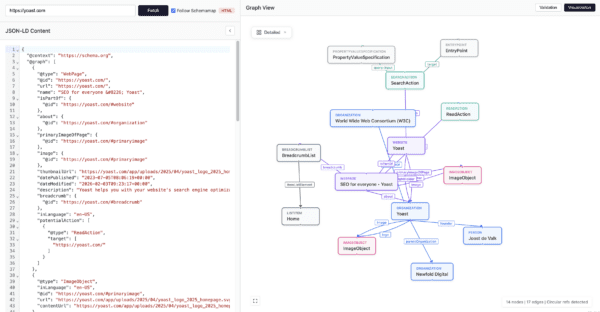
Below is an example of the structured data Yoast already outputs on an individual page. This page level schema helps search engines understand what that specific page is about, including its content type, author, and relationships.
An example of Yoast schema markup at the individual page level, the example shown is yoast.com
With Schema Aggregation enabled, Yoast provides a site-level view. Instead of looking at pages in isolation, your entire website’s structured data is connected. It consolidates into a single output called a schemamap. This can appear quite overwhelming to look at. It makes it easier for AI systems to understand your content. They can see how your articles, authors, products, and organisation relate to each other across the site.
How it works: Standardized, connected, and deduplicated
The Schema Aggregation feature doesn’t just share data; it organizes it for AI consumption:
Eliminates data mess: It merges duplicate mentions of authors, products, or articles into one scalable, connected record.
Integrates automatically: If you use one of our Schema API partners like The Events Calendar or WP Recipe Maker, those schema types are included in the graph automatically.
Developers can also explore our Schema Integrations page to see how Schema API partners connect to and extend the Yoast SEO Schema Framework (the graph).
Collaborative innovation
When working at scale across tens of millions of websites, careful testing is essential to ensure a safe and reliable launch. This feature was developed with agencies and advanced users in mind, and tested in controlled environments.
We collaborated closely with Syde, our Innovation Partner, to test the new feature across a diverse range of real-world client scenarios. The approach for this release was tested in controlled environments to confirm scalability and consistent output quality before deployment.
Syde’s feedback has been instrumental in refining the schema aggregation logic. We look forward to continuing this partnership, working together to help clients remain visible and accurately represented as AI driven systems evolve.
Be visible, understood, and represented
The rules of discovery are shifting, but your site doesn’t have to be left behind. With NLWeb and Yoast, your website stays at the center of the conversation.
Beth is Product Marketing Manager at Yoast. Before joining the company, she honed her digital marketing and project management skills in various in-house and agency environments.
We are excited to announce an update to our Offer schema within Yoast SEO for Shopify. This update introduces a more robust way to communicate pricing to search engines, specifically introducing sale price strikethroughs.
What’s new?
Previously, communicating a “sale” was often limited to showing a single price. With this update, we’ve refined how our schema handles the Offer object. You can now clearly define:
The original price: The “base” price before any discounts.
The sale price: The current active price the customer pays.
Why this matters
When search engines understand the relationship between your original and sale prices, they can better represent your deals in search results. This update is designed to help trigger those eye-catching strikethrough price treatments in Google Shopping and organic snippets, improving your click-through rate by visually highlighting the value you’re offering.
How to use it
The schema automatically bridges the gap between your product data and the structured data output. Simply ensure your product’s “Regular Price” and “Sale Price” are populated, and our updated schema handles the rest. For more information about the structured data included with all our products, check out our structured data feature page.
Get started
If you are a Yoast SEO for Shopify customer, you can access your product schema by opening a product in the Yoast product editor in your Shopify store. If you are not a customer and want to learn more, you can start a 14 day free trial of Yoast SEO for Shopify from the Shopify App Store.
Beth is Product Marketing Manager at Yoast. Before joining the company, she honed her digital marketing and project management skills in various in-house and agency environments.
Yoast AI Brand Insights now lets you track how your brand appears in Google’s Gemini. You can see your Gemini data alongside ChatGPT and Perplexity, all in one dashboard.
With a single analysis, you can see how different AI platforms describe your brand with the Yoast SEO AI+ plan. You’ll see which sources they use and how sentiment compares across the tools your customers use most.
Why this matters
AI platforms use different methods to answer questions about your brand, often leading to different results. Seeing these results side-by-side helps you spot gaps or missed opportunities in your brand’s AI presence.
ChatGPT is designed as a conversational assistant, focusing on natural dialogue and using multi-step reasoning to explain complex topics.
Perplexity positions itself as an “answer engine”, emphasizing transparency by grounding every response in cited web sources.
Gemini presents itself as a search-driven LLM, leveraging Google’s vast index to show how your brand appears in real-time search contexts.
As these tools frame your brand differently, from conversational reasoning to source-heavy citations, you need a single dashboard which covers all to see which sources they rely on and how their sentiment compares.
What’s new
You can now:
Run brand visibility analyses in Gemini, in addition to ChatGPT and Perplexity.
Compare results across all three platforms with the added benefit of a built-in historical view.
Track brand mentions, sentiment, and citations in one place.
Monitor changes over time in your AI Visibility Index.
How to get started
If you’re already using Yoast SEO AI+, nothing changes in how you work. Log in and at your next analysis, Gemini data is now included automatically at no extra cost. You can select the AI platform from the dropdown, and your dashboard will show a broader view of how your brand appears across AI search and chat.
To upgrade
If you don’t yet have Yoast SEO AI+, you’ll need to upgrade to access the Yoast AI Brand Insights tool. The AI+ plan brings brand visibility tracking together with on-page SEO tools, content optimization, and AI-powered insights in one package, so you can analyze how your brand is mentioned and act from the same workflow.
Upgrade to Yoast SEO AI+ to start scanning your brand across Gemini, ChatGPT, and Perplexity.
Beth is Product Marketing Manager at Yoast. Before joining the company, she honed her digital marketing and project management skills in various in-house and agency environments.
This first release of 2026 brings Site Kit by Google insights into your Yoast SEO Dashboard. After introducing the integration in phases throughout 2025, we are pleased to share that the rollout is now complete and available to all Yoast customers using WordPress.
What you can see in your Yoast SEO Dashboard
You can now view key performance data from Google Search Console and Google Analytics via Site Kit in your Yoast SEO Dashboard, without changing tools or tabs. These insights include search impressions, clicks, average click through rate, average position, and organic sessions, which are combined with your Yoast SEO and readability scores so you can better understand how content quality relates to real search performance.
Find opportunities faster
The integration also surfaces your top performing content and search queries, helping you quickly spot which pages and topics are driving results and where improvements may have the most impact. Connecting Site Kit by Google is straightforward. Once connected, insights become available immediately, giving you faster access to the data you need to guide your SEO work.
If you are interested in the technical background of this integration and our collaboration with Google, we share the full story on our developer blog.
Get started
Update to Yoast SEO 26.7 to start using Site Kit by Google insights in your Dashboard and streamline your workflow with key performance data in one place. For step by step guidance on enabling the integration, see our help center guide.
Beth is Product Marketing Manager at Yoast. Before joining the company, she honed her digital marketing and project management skills in various in-house and agency environments.