Scaling the agentic web with NLWeb

Imagine a web ecosystem where not just humans but AI agents communicate with websites, going beyond traditional browsing. Unlike conventional web experiences, where people click, scroll, and search, AI agents can navigate, interpret, and even perform tasks autonomously on your site. This is not a futuristic concept. It is already unfolding. This is the emergence of the agentic web.

Table of contents

Key takeaways

  • The agentic web enables AI agents to autonomously navigate and interact with websites, shifting user responsibilities from manual navigation to decision-making
  • Protocols are crucial for communication among AI agents; they must rely on structured, machine-readable data for effective coordination
  • SEO professionals must adapt to the agentic web by optimizing websites as endpoints for AI queries, ensuring structured data and clarity
  • NLWeb facilitates interaction between agents and websites by exposing structured data and allowing for natural language queries without traditional interface limitations
  • Yoast’s collaboration with NLWeb helps WordPress users prepare for the agentic web by organizing content and making it easier to integrate structured data

The big shift: From web for users to a web for users and agents

For years, the web followed a simple pattern. Humans searched, clicked, compared, and completed tasks manually. Even as search engines evolved, the interaction model stayed the same: search and click.

That model is changing.

The agentic web represents a shift from a web designed only for human users to one designed for both people and AI assistants. Instead of manually researching products, comparing services, filling out forms, and completing transactions, users will increasingly delegate those tasks to intelligent assistants that can search, interpret information, and act on their behalf. The user’s role shifts from active navigator to decision-maker.

From searching to delegating.

This is not about smarter chat interfaces. It is about autonomous agents that can interpret the search intent, compare options, and execute actions on behalf of users. Websites are no longer just pages to be visited. They are endpoints to be queried.

For that to work at scale, intelligence cannot reside in a single assistant or on a closed platform. It has to be distributed. Systems must be able to communicate with other systems without friction. That requires a web that is machine-readable, interoperable, and built for agent-to-agent interaction.

The agentic web is not a prediction. It is an architectural shift already underway!

Protocol thinking and the infrastructure of agentic web communication

If the agentic web is about intelligent systems interacting with websites, then the real question becomes simple: how do these systems understand each other?

The answer is not design. It is infrastructure.

The web has always depended on shared communication rules. HTTP allows browsers to request pages. RSS distributes updates. Structured data helps search engines interpret meaning. These are not features. They are protocols. They are agreements that enable large-scale coordination.

Now the same logic applies to AI agents.

In the agentic web, agents will not click buttons or visually scan pages. They will send requests, interpret structured responses, compare options, and complete tasks. For that to work across millions of websites, communication cannot be improvised. It must be standardized.

This is where protocol thinking becomes essential.

Protocol thinking means designing websites so they are predictable for machines. Instead of building custom integrations for every assistant or platform, websites expose a consistent interaction layer. Agents do not need to learn every interface. They rely on shared rules.

As emphasized in discussions of distributed intelligence, the goal is not to let a single chatbot control everything. The intelligence must be distributed. Systems need a simplified way to communicate without having to understand the technical details of every tool they connect to.

That only works when there is common ground.

In practical terms, this means:

  • Websites must expose structured, machine-readable data
  • Agents must know what they can ask
  • Responses must follow predictable formats
  • Communication must scale beyond one platform

Protocols create that shared language.

What does this mean for SEO professionals?

As the web evolves to support AI agents, SEO professionals are starting to ask a new question: how do you stay visible when answers are generated instead of ranked?

A clear example of this surfaced during Microsoft’s Ignite event. In a Q&A session, a consultant described a client who sells products like mayonnaise and wanted their brand to appear when someone asks an AI assistant about mayonnaise. The question was simple, but it revealed something deeper. If AI systems generate answers instead of listing search results, what does optimization look like?

This is where the shift becomes real.

The agentic web does not replace the open web. It adds another layer on top of it. Search engines still index pages. Rankings still matter. But intelligent systems can now query websites directly, compare information across sources, and generate synthesized responses.

For SEOs, this changes the website’s role.

It is no longer enough to think in terms of pages to be visited. Websites must be treated as endpoints to be queried.

This means structured data, clean information architecture, and machine-readable content are not just enhancements for rich results. They are the foundation that allows AI systems to interpret and select your content in the first place.

Watch the full event here!

Key takeaway for SEOs

The agentic web is an additional layer on the open web, not a replacement for it. To stay visible, SEO professionals must ensure their websites are structured, accessible, and ready to be queried by intelligent systems.

Visibility in this new layer depends on clarity, interoperability, and infrastructure.

Must read: Why does having insights across multiple LLMs matter for brand visibility?

Introducing NLWeb

NLWeb was first introduced by Microsoft in May 2025 as an open project designed to make it simple for websites to offer rich natural language interfaces using their own data and model of choice. Later, in November at Microsoft Ignite, Microsoft presented NLWeb again alongside its first enterprise offering through Microsoft Foundry.

At its core, NLWeb aims to make it easy for a website to function like an AI app. Instead of navigating pages manually, users and agents can query a site’s content directly using natural language.

But NLWeb is more than just a conversational layer.

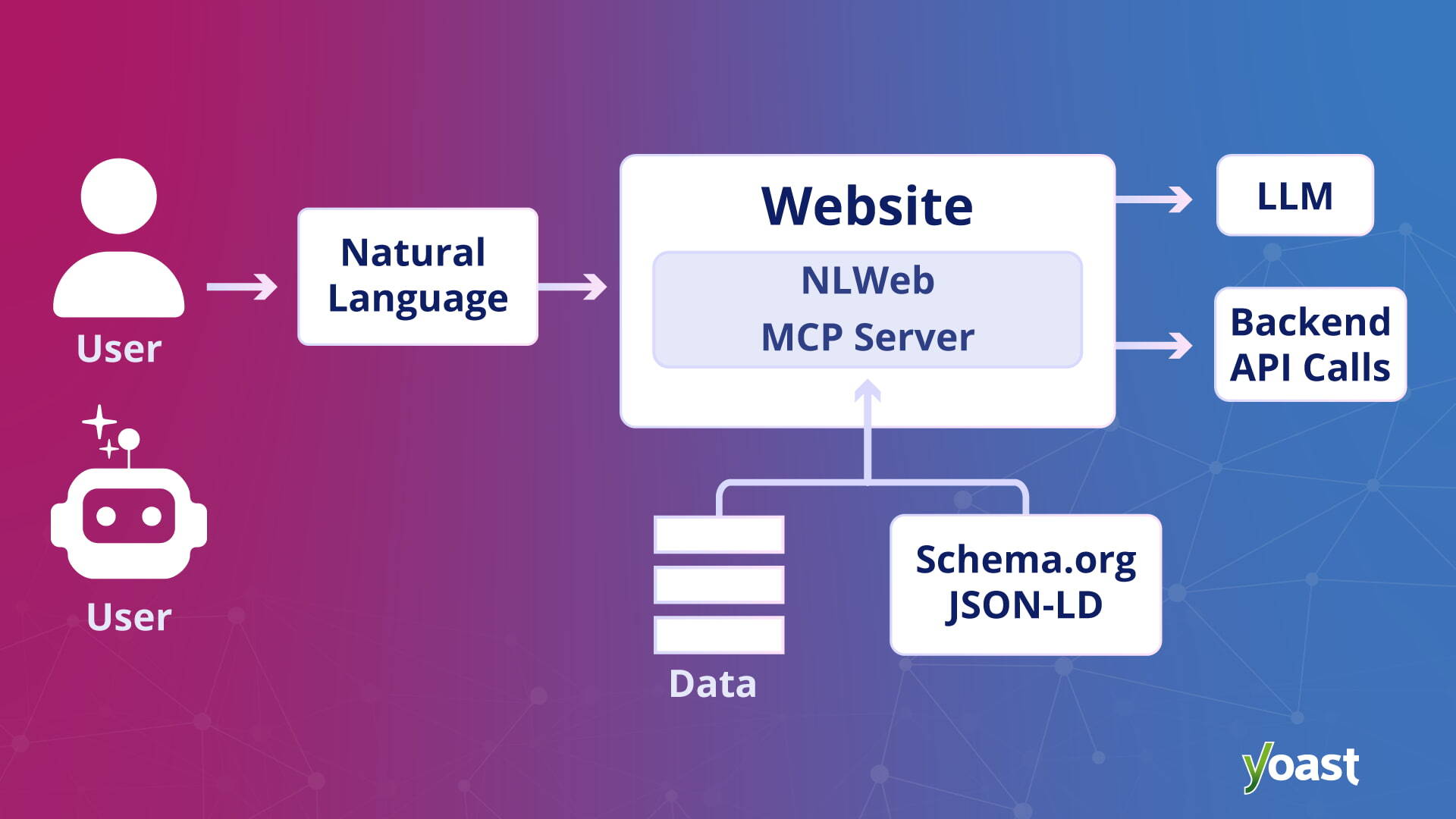
Every NLWeb instance is also a Model Context Protocol, or MCP, server. This means that when a website enables NLWeb, it becomes inherently discoverable and accessible to agents operating within the MCP ecosystem. In simple terms, agents do not need custom integrations for every site. If a website supports NLWeb, agents can recognize it and interact with it in a standardized way.

NLWeb is a conversational layer that interacts with a website and retrieves information

NLWeb builds on formats that websites already use, such as Schema.org and RSS. It combines that structured data with large language models to generate natural language responses. This allows websites to expose their content in a way that both humans and AI agents can understand.

Importantly, NLWeb is technology agnostic. Site owners can choose their preferred infrastructure, models, and databases. The goal is interoperability, not platform lock-in.

In many ways, NLWeb is positioned to play a role in the agentic web similar to what HTML did for the early web. It provides a shared communication layer that allows agents to query websites directly, without relying only on traditional crawling or visual interfaces.

How is NLWeb different from standard LLM citations?

With standard LLM citations, the model generates an answer first, then adds sources. The response is still probabilistic, which can introduce inaccuracies or hallucinations.

NLWeb works differently.

It treats the language model as a smart retrieval layer. Instead of inventing answers, it pulls verified objects directly from the website’s structured data and presents them in natural language.

That distinction matters. It means responses are grounded in the publisher’s own data from the start, reducing the risk of hallucination and giving site owners greater control over how their content is represented.

What NLWeb means for the agentic web

The agentic web depends on systems being able to communicate at scale. Agents cannot manually interpret every interface or navigate every page visually. They need structured, machine-readable access.

NLWeb helps enable that.

Instead of requiring custom integrations for every assistant or platform, a website can expose an NLWeb-enabled endpoint. Agents only need to know that a site supports NLWeb. The protocol handles how requests are made and how responses are structured.

This supports a more distributed ecosystem. The goal is not to let one chatbot control everything. Intelligence must be distributed across the web.

Generative interfaces do not replace content. They depend on well-structured, accessible content. When an AI system summarizes results or compares options, it is still drawing from the information that websites provide. NLWeb simply creates a clearer path for that interaction.

Yoast’s collaboration with NLweb and what it means for WordPress users

As part of the NLWeb announcement, Microsoft highlighted Yoast as a partner helping bring agentic search capabilities to WordPress. You can read more about this collaboration in our official press announcement on Yoast and Microsoft’s NLWeb integration.

For many WordPress site owners, concepts like infrastructure, endpoints, and protocols can feel abstract. That is exactly where preparation matters.

While Yoast does not automatically deploy NLWeb for users, the schema aggregation feature in Yoast SEO, Yoast SEO Premium, Yoast WooCommerce SEO, and Yoast SEO AI+ organizes and structures content, making it significantly easier to build NLWeb. When site owners enable the relevant Yoast feature, nothing changes visually on the front end. What changes is the underlying structure.

In short, we map and organize structured data to reduce the technical effort required to build NLWeb on top of it. In other words, we help publishers complete much of the groundwork.

The agentic web is not about chasing a trend. It is about ensuring your content remains discoverable, understandable, and usable in a world where intelligent systems increasingly act on behalf of users.

New: Futureproof your website for the agentic web with Yoast SEO Schema Aggregation 

In November 2025, Yoast announced a collaboration with NLWeb, an open web protocol developed by Microsoft designed to simplify building conversational interfaces for the web.

Today, we are proud to introduce the first major result of that work: Yoast SEO Schema Aggregation. This is an opt in feature that brings your website’s structured data together in a clearer and more consistent way. By choosing to enable it, you can help search engines and intelligent agents better understand and use your content.

If you want to see which schema types are available for your WordPress setup, our schema overview explains what is included across different product plans.

Bridging the gap: from discovery to conversation

Yoast has a history of helping WordPress websites be represented fairly and responsibly in the open web.

2019: Yoast introduced the first of its kind schema graph and API, helping search engines better understand your content as they moved beyond keywords and evolved into discovery engines.

Today: we are taking the next step. As the agentic web becomes more important, we are helping your WordPress site move from being discovered to being understood and engaged with through conversation.

Starting today, the new Schema Aggregation feature in Yoast SEO is here. It establishes a standardized connection between your website’s structured data and the systems that power AI-driven discovery and interaction. These include large language models, agents, and conversational assistants such as Copilot. It helps ensure your published content can be understood correctly by AI. This matters as AI becomes part of how people find and use information online.

The NLWeb + Yoast integration is built in collaboration with the NLWeb team, including R.V. Guha, co-founder of Schema.org. Together, we are extending the open web standards you already rely on, so your WordPress website can participate confidently in the emerging agentic web in a responsible and future ready way.

Benefits of the Schema Aggregation feature

Questions about AI often come down to one thing: who can access your data. This feature is built with a privacy first approach from the start.

  • Complete: All indexable content included
  • Clean: No duplicate entities, no navigation clutter
  • Connected: Relationships between entities preserved (author → articles)
  • Compliant: Respects exisiting privacy settings
  • Fast: Sub-100ms cached responses, pagination for large sites

For developers and technical users who want more control, we have developer documentation on schema markup. It explains how to inspect and extend your schema graph. This gives you maximum personalization, while retaining standardization at scale.

“You can’t stop the AI wave, but you can direct it. Our integration with NLWeb puts you back in charge. It allows you to manage server load efficiently and ensures that when AIs do access your content, they get the rich, semantic understanding necessary to represent you correctly.” Alain Schlesser – Principal Architect, Yoast.

What’s new

The next time you log in and open Yoast SEO (updated to 27.1), you’ll see a short guided walkthrough. It introduces the new Schema Aggregation feature. It also shows how to enable it using a simple toggle.

We have added a new endpoint to Yoast SEO (free), making the Schema Aggregation feature available to all customers who choose to enable it. The endpoint exposes your site’s full structured data graph in a proposed new standard called a schemamap.

That means, instead of an AI system crawling hundreds of pages individually (or however many pages you have on your website), it can now retrieve your site’s schema, including articles, authors, products, and organizational data, in one optimized request.

Before and after: from pages to a connected site

Below is an example of the structured data Yoast already outputs on an individual page. This page level schema helps search engines understand what that specific page is about, including its content type, author, and relationships.

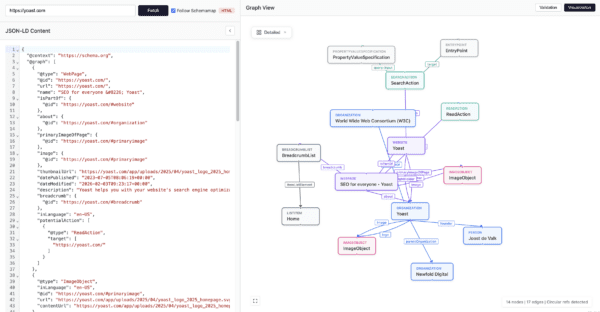
An example of Yoast schema markup at the individual page level, the example shown is yoast.com

With Schema Aggregation enabled, Yoast provides a site-level view. Instead of looking at pages in isolation, your entire website’s structured data is connected. It consolidates into a single output called a schemamap. This can appear quite overwhelming to look at. It makes it easier for AI systems to understand your content. They can see how your articles, authors, products, and organisation relate to each other across the site.

Nothing about your existing schema changes. The same data is reused, simply organized in a way that reflects how your website works as a whole. Here is a schema map example from Yoast.com, displayed with the Yoast SEO Schema Visualizer.

How it works: Standardized, connected, and deduplicated

The Schema Aggregation feature doesn’t just share data; it organizes it for AI consumption:

  • Eliminates data mess: It merges duplicate mentions of authors, products, or articles into one scalable, connected record.
  • Integrates automatically: If you use one of our Schema API partners like The Events Calendar or WP Recipe Maker, those schema types are included in the graph automatically.

Developers can also explore our Schema Integrations page to see how Schema API partners connect to and extend the Yoast SEO Schema Framework (the graph).

Collaborative innovation

When working at scale across tens of millions of websites, careful testing is essential to ensure a safe and reliable launch. This feature was developed with agencies and advanced users in mind, and tested in controlled environments.

We collaborated closely with Syde, our Innovation Partner, to test the new feature across a diverse range of real-world client scenarios. The approach for this release was tested in controlled environments to confirm scalability and consistent output quality before deployment.

Syde’s feedback has been instrumental in refining the schema aggregation logic. We look forward to continuing this partnership, working together to help clients remain visible and accurately represented as AI driven systems evolve.

Be visible, understood, and represented

The rules of discovery are shifting, but your site doesn’t have to be left behind. With NLWeb and Yoast, your website stays at the center of the conversation.

Ready to see it in action? Update to the latest version of Yoast SEO and enable the NLWeb integration in your Yoast SEO settings today. For more information about how to enable Schema Aggregation, visit this help article.

Why does having insights across multiple LLMs matter for brand visibility?

Search today looks very different from what it did even a few years ago. Users are no longer browsing through SERPs to make up their own minds; instead, they are asking AI tools for conclusions, summaries, and recommendations. This shift changes how visibility is earned, how trust is formed, and how brands are evaluated during discovery. In AI-driven search, large language models interpret information, decide what matters, and present a narrative on behalf of the user.

Table of contents

Key takeaways

  • Search has evolved; users now rely on AI for conclusions instead of traditional SERPs
  • Conversational AI serves as a new discovery layer, users expect quick answers and insights
  • Brands must navigate varied interpretations of their presence across different LLMs
  • Yoast AI Brand Insights helps track brand mentions and identify gaps in AI visibility across models
  • Understanding LLM brand visibility is crucial for modern brand strategy and perception

The rise of conversational AI as a discovery layer

“Assistant engines and wider LLMs are the new gatekeepers between our content and the person discovering that content – our potential new audience.” — Alex Moss

Search is no longer confined to typing queries into a search engine and scanning a list of links. Today’s discovery journey frequently begins with a conversation, whether that’s a typed question in a chatbot, a voice prompt to an AI assistant, or an embedded AI feature inside a platform people use every day.

This shift has made conversational AI a new layer of discovery, where users expect direct answers, recommendations, and curated insights that help them make decisions and build brand perception more quickly and confidently.

Discovery is happening everywhere

Users are now encountering AI-powered discovery across a range of interfaces:

AI chat interfaces

Tools like ChatGPT allow users to ask open-ended questions and follow up in a conversational manner. These interfaces interpret intent and tailor responses in a way that feels natural, making them a go-to for exploratory search.

Also read: What is search intent and why is it important for SEO?

Answer engines

Platforms such as Perplexity synthesize information from multiple sources and often cite them. They act as research helpers, offering concise summaries or explanations to complex queries.

Embedded AI experiences

AI is increasingly built directly into search and discovery environments that people already use. Examples include AI-assisted summaries within search results, such as Google’s AI Overviews, as well as AI features embedded in browsers, operating systems, and apps. In these moments, users may not even think of themselves as “using AI,” yet AI is already influencing what information is surfaced first and how it is interpreted.

This broad distribution of AI discovery surfaces means users now expect accessibility of information regardless of where they are, whether in a chat, an app, or embedded in the places they work, shop, and explore online.

How people are using AI in their day-to-day discovery

Users interact with conversational AI for a wide range of purposes beyond traditional search. These models increasingly guide decisions, comparisons, and exploration, often earlier in the journey than classic search engines.

Here are some prominent ways people use LLMs today:

Product comparisons

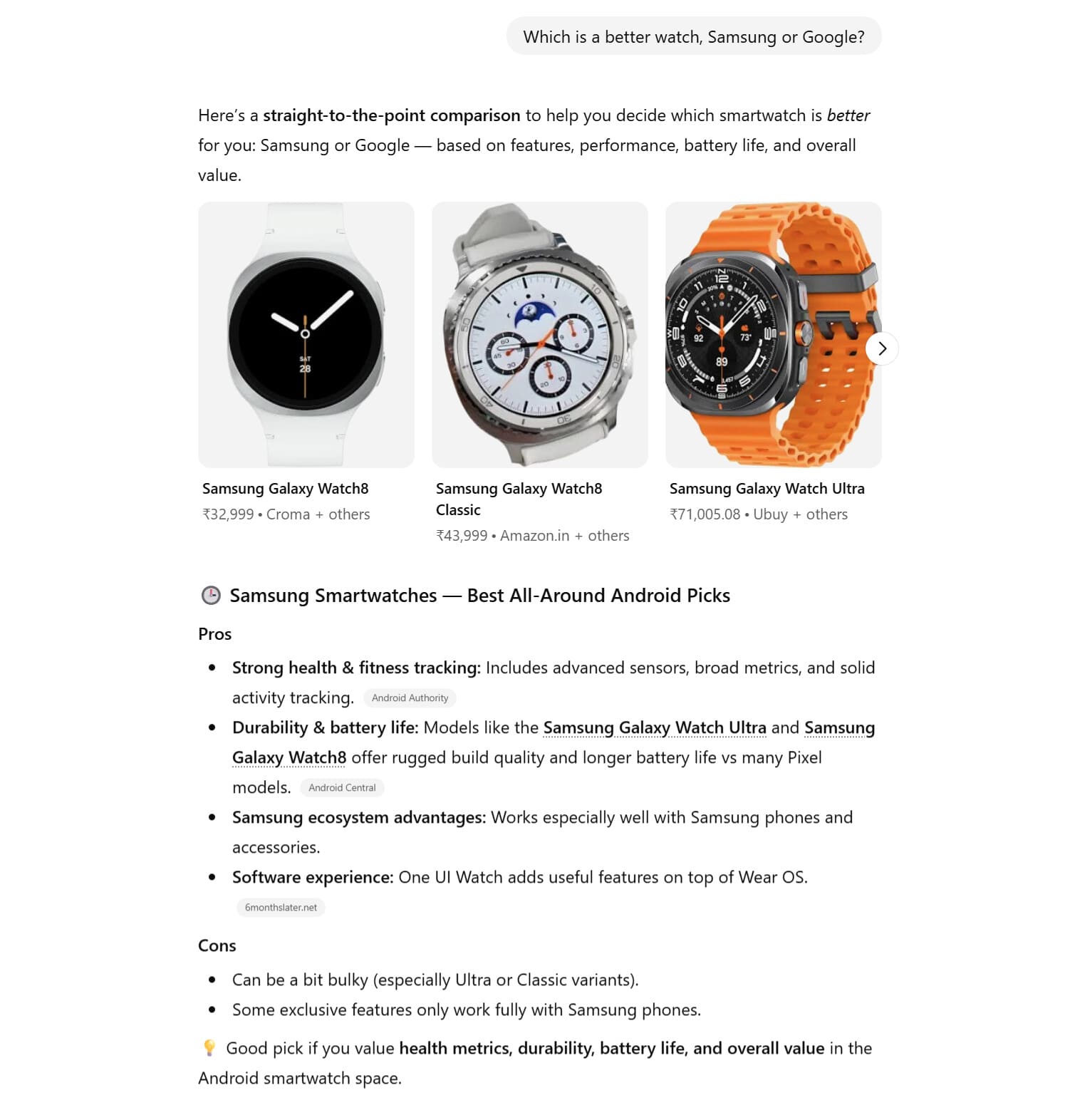
ChatGPT gives a detailed brand comparison

Rather than visiting multiple sites and aggregating reviews, there are 54% users who ask AI to compare products or services directly, for example, “How does Brand A compare to Brand B?” and “What are the pros and cons of X vs Y?” AI synthesizes information into a concise summary that often feels more efficient than browsing search results.

“Best tools for…” queries

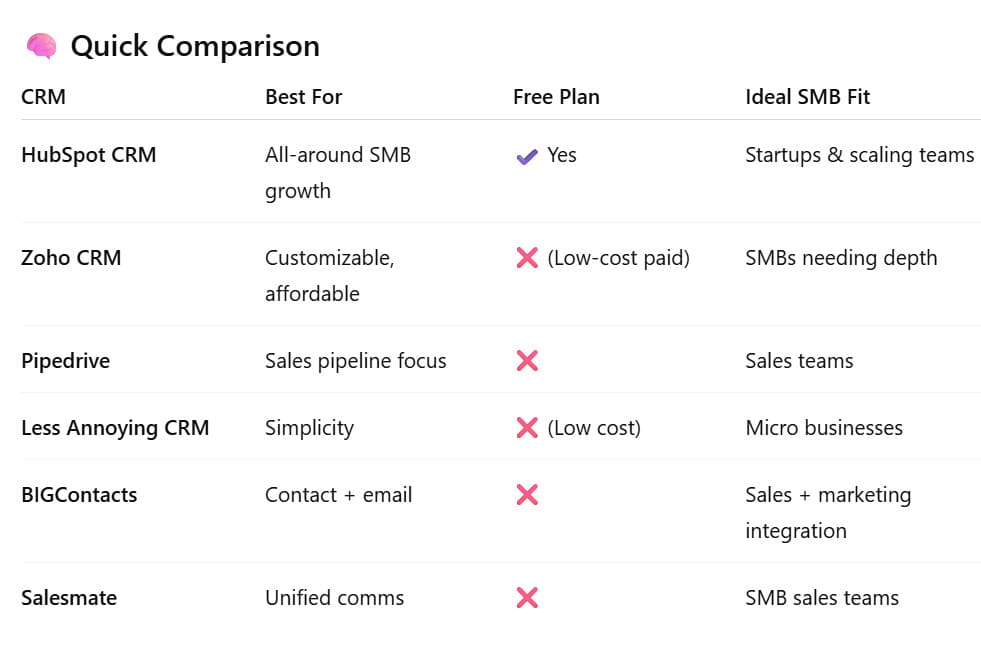
Result by ChatGPT for “best crm software for smbs.”

Did you know 47% of consumers have used AI to help make a purchase decision?

AI users frequently ask for ranked suggestions or curated lists such as “best SEO tools for small businesses” or “top content optimization software.” These queries serve as discovery moments, where brands can be suggested alongside context and reasoning.

Trust and validation checks

Many users prompt AI models to validate decisions or confirm perceptions, for example, “Is Brand X reputable?” or “What do people say about Service Y?” AI responses blend sentiment, context, and summarization into one narrative, affecting how trust is formed.

Also read: Why is summarizing essential for modern content?

Idea generation and research exploration

In a study by Yext, it was found that 42% users employ AI for early-stage exploration, such as brainstorming topics, gathering potential search intents, or understanding broad categories before narrowing down specifics. AI user archetypes range from creators who use AI for ideation to explorers seeking deeper discovery.

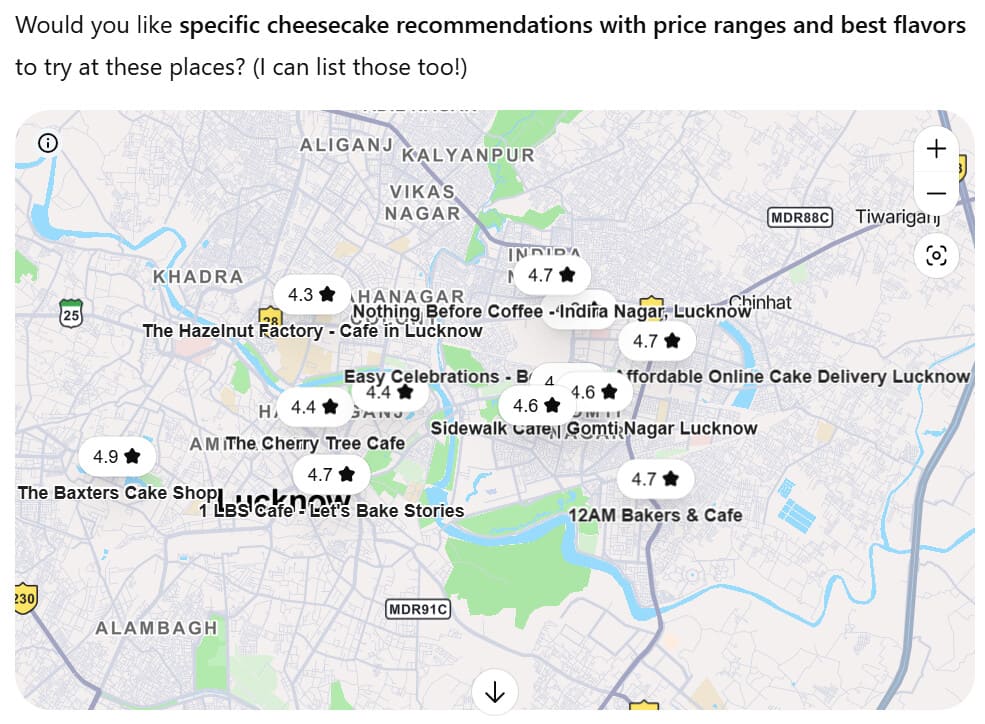
local search results on chatgpt
ChatGPT recommendations for “best cheesecake places in Lucknow, India.”

AI is also used for local searches. For example, many users turn to AI tools to research local products or services, such as finding nearby businesses, comparing local options, or understanding community reputations. In a recent AI usage study by Yext, 68% of consumers reported using tools like ChatGPT to research local products or services, even as trust in AI for local information remains lower than traditional search.

In each of these moments, conversational AI doesn’t just surface brands; it frames them by summarizing strengths, weaknesses, use cases, and comparisons in a single response. These narratives become part of how users interpret relevance, trust, and fit far earlier in the decision-making process than in traditional search.

Not all LLMs interpret brands the same way

As conversational AI becomes a discovery layer, one assumption often sneaks in quietly: if your brand shows up well in one AI model, it must be showing up everywhere. In reality, that’s rarely the case. Large language models interpret, retrieve, and present brand information differently, which means relying on a single AI platform can give a very incomplete picture of your brand’s visibility.

To understand why, it helps to look at how some of the most widely used models approach answers and brand mentions.

How ChatGPT interprets brands

ChatGPT is often used as a general-purpose assistant. People turn to it for explanations, comparisons, brainstorming, and decision support. When it mentions brands, it tends to focus on contextual understanding rather than explicit sourcing. Brand mentions are frequently woven into explanations, recommendations, or summaries, sometimes without clear attribution.

From a visibility perspective, this means brands may appear:

  • As examples in broader explanations
  • As recommendations in “best tools” or comparison-style prompts
  • As part of a narrative rather than a cited source

The challenge is that brand mentions can feel correct and authoritative, while still being outdated, incomplete, or inconsistent, depending on how the prompt is phrased.

How Gemini interprets brands

Gemini is deeply connected to Google’s ecosystem, which influences how it understands and surfaces brand information. It leans more heavily on entities, structured data, and authoritative sources, and its outputs often reflect signals familiar to traditional SEO teams.

For brands, this means:

  • Visibility is closely tied to how well the brand is understood as an entity
  • Clear, consistent information across the web plays a bigger role
  • Mentions often align more closely with established sources

Gemini can feel more predictable in some cases, but that predictability depends on strong foundational signals and accurate brand representation across trusted platforms.

How Perplexity interprets brands

Perplexity positions itself as an answer engine rather than a general assistant. It emphasizes citations and source-backed responses, which makes it popular for research and comparison queries. When brands appear in Perplexity answers, they are often tied directly to cited articles, reviews, or documentation.

This creates a different visibility dynamic:

  • Brands may be surfaced only if they are referenced in cited sources
  • Freshness and topical relevance matter more
  • Competitors with stronger editorial or PR coverage may appear more often

Here, brand presence is tightly coupled with external content and how frequently that content is used as a reference.

How these models differ at a glance

AI Model How brands are surfaced What influences the visibility
ChatGPT Contextual mentions within explanations and recommendations Prompt phrasing, training data, general relevance
Gemini Entity-driven, aligned with authoritative sources Structured data, brand consistency, trusted signals
Perplexity Citation-based mentions tied to sources Content coverage, freshness, external references

Why brands need insights across multiple LLMs?

Once you see how differently large language models interpret brands, one thing becomes clear: looking at just one AI model gives you an incomplete picture. AI-driven discovery does not produce a single, consistent version of your brand. It produces multiple interpretations, shaped by the model, its data sources, and users’ interactions with it.

Must read: When AI gets your brand wrong: Real examples and how to fix it

Therefore, tracking across your brand across multiple brands is essential because:

Brand visibility is fragmented by default

Across different LLMs, the same brand can show up in very different ways:

  • Correctly represented in one model, where information is accurate and well-contextualized
  • Completely missing in another, even for relevant queries
  • Partially outdated or misrepresented in a third, depending on the sources being used

This fragmentation happens because each model processes and prioritizes information differently. Without visibility across models, it’s easy to assume your brand is ‘covered’ when, in reality, it may only be visible in one corner of the AI ecosystem.

Different audiences use different AI tools

AI usage is not concentrated in a single platform. People choose tools based on intent:

  • Some use conversational assistants for exploration and ideation
  • Others rely on citation-led answer engines for research
  • Many encounter AI passively through search or embedded experiences

If your brand appears in only one environment, you are effectively visible only to a subset of your audience. This mirrors challenges SEO teams already recognize from traditional search, where performance varies by device, location, and search feature. The difference is that with AI, these variations are less obvious and more challenging to track without dedicated insights.

Blind spots create real business risks

Limited visibility across LLMs doesn’t just affect awareness; it also impairs learning. Over time, it can lead to:

  • Inconsistent brand narratives, where AI tools describe your brand differently depending on where users ask
  • Missed demand, especially for comparison or “best tools for” queries
  • Competitors are being recommended instead, simply because they are more visible or better understood by a specific model

These outcomes are rarely intentional, but they can quietly influence brand perception and decision-making long before users reach your website.

So all these points point to one thing: a broader, multi-model view helps build a more complete understanding of brand visibility.

The challenge: LLM visibility is hard to measure

As brands start paying attention to how they appear in AI-generated content, a new problem becomes obvious: LLM visibility doesn’t behave like traditional search visibility. The signals are fragmented, opaque, and constantly changing, which makes tracking and understanding brand presence across AI models far more complex than tracking rankings or traffic.

Below are some key challenges brand marketers might face when trying to understand how their brand appears to large language models.

1. Lack of visibility across AI platforms

Different LLMs, such as ChatGPT, Gemini, and Perplexity, rely on various data sources, retrieval methods, and citation logic. As a result, the same brand may be mentioned prominently in one model, inconsistently in another, or not at all elsewhere.

Without a unified view, it’s difficult to answer basic questions like where your brand shows up, which AI tools mention it, and where the gaps are. This fragmentation makes it easy to overestimate visibility based on a single platform.

2. No clear insight into how AI describes your brand

AI models often mention brands as part of explanations, comparisons, or recommendations, but traditional analytics tools don’t capture how those brands are described. Teams lack visibility into tone, context, sentiment, or whether mentions are positive, neutral, or misleading.

This makes it hard to understand whether AI is reinforcing your intended brand positioning or subtly reshaping it in ways you can’t see.

3. No structured way to measure change over time

AI-generated answers are inherently dynamic. Small changes in prompts, updates to models, or shifts in underlying data can all influence how brands appear. Without consistent, longitudinal tracking, it’s nearly impossible to tell whether visibility is improving, declining, or simply fluctuating.

One-off checks may offer snapshots, but they don’t reveal trends or patterns that matter for long-term strategy.

4. Limited ability to benchmark against competitors

Seeing your brand mentioned in AI answers is a start, but it doesn’t tell you the whole story. The real question is what’s happening around it: which competitors appear more often, how they’re described, and who AI recommends when users are ready to decide.

Without comparative insights, teams struggle to understand whether AI visibility represents a competitive advantage or a missed opportunity.

5. Missing attribution and source clarity

Some AI models summarize or paraphrase information without clearly attributing sources. When brands are mentioned, it’s not always obvious which pages, articles, or properties influenced the response.

This lack of source visibility makes it difficult to connect AI mentions back to specific content efforts, PR coverage, or SEO work, leaving teams guessing what is actually driving brand representation.

6. Existing tools weren’t built for AI visibility

Traditional SEO and analytics platforms are designed around clicks, impressions, and rankings. They don’t capture AI-powered mentions, sentiment, or visibility trends because AI platforms don’t expose those signals in a structured way.

As a result, teams are left without reliable reporting for one of the fastest-growing discovery channels.

Together, these challenges point to a clear gap: brands need a new way to understand visibility that reflects how AI models surface and interpret information. This is where tools explicitly designed for AI-driven discovery, such as Yoast AI Brand Insights, come into play.

How does Yoast AI Brand Insights help?

It won’t be wrong to say that the AI-driven brand discovery can be fragmented and opaque; therefore, leading us to our next practical question: how do brand marketing teams actually make sense of it?

Traditional SEO tools weren’t built to answer that, which is where Yoast AI Brand Insights comes in. It’s designed to help users understand how brands appear in AI-generated answers and is available as part of Yoast SEO AI+.

Rather than focusing on rankings or clicks, Yoast AI Brand Insights focuses on visibility and interpretation across large language models.

Track brand mentions across multiple AI models

One of the biggest gaps in AI visibility is fragmentation. Brands may appear in one AI model but not in another, without any obvious signal to explain why. Yoast AI Brand Insights addresses this by tracking brand mentions across multiple AI platforms, including ChatGPT, Gemini, and Perplexity.

This gives teams a clearer view of where their brand appears, rather than relying on isolated checks or assumptions based on a single model.

Identify gaps, inconsistencies, and opportunities

AI-generated answers don’t just mention brands; they frame them. Yoast AI Brand Insights helps surface patterns in how a brand is described, making it easier to spot:

  • Where mentions are missing altogether
  • Where descriptions feel outdated or incomplete
  • Where competitors appear more frequently or more favorably

These insights turn AI visibility into something teams can actually act on, rather than a black box.

Shared insights for SEO, PR, and content teams

AI-driven discovery sits at the intersection of SEO, content, and brand communication. One of the strengths of Yoast AI Brand Insights is that it provides a shared view of AI visibility that multiple teams can use. SEO teams can connect AI mentions back to site signals, content teams can understand how messaging is interpreted, and PR or brand teams can see how external coverage influences AI narratives.

Instead of working in silos, teams get a common reference point for how the brand appears across AI-driven search experiences.

A natural extension of Yoast’s SEO philosophy

Yoast AI Brand Insights builds on principles Yoast has long emphasized: clarity, consistency, and understanding how search systems interpret content. As AI becomes part of how people discover brands, those same principles now apply beyond traditional search results and into AI-generated answers.

In that sense, Yoast AI Brand Insights isn’t about chasing AI trends. It’s about giving teams a more straightforward way to understand how their brand is represented, where discovery is increasingly happening.

AI-driven discovery is no longer an edge case. It’s becoming a regular part of how people explore options, validate decisions, and form opinions about brands. As large language models continue to evolve, the question for brands is not whether they appear in AI-generated answers, but whether they understand how they appear, where they appear, and what story is being told on their behalf. Gaining visibility into that layer is quickly becoming a foundational part of modern brand and search strategy.

New: Track brand visibility in Gemini with Yoast AI Brand Insights

Yoast AI Brand Insights now lets you track how your brand appears in Google’s Gemini. You can see your Gemini data alongside ChatGPT and Perplexity, all in one dashboard. 

With a single analysis, you can see how different AI platforms describe your brand with the Yoast SEO AI+ plan. You’ll see which sources they use and how sentiment compares across the tools your customers use most. 

Why this matters 

AI platforms use different methods to answer questions about your brand, often leading to different results. Seeing these results side-by-side helps you spot gaps or missed opportunities in your brand’s AI presence. 

  • ChatGPT is designed as a conversational assistant, focusing on natural dialogue and using multi-step reasoning to explain complex topics. 
  • Perplexity positions itself as an “answer engine”, emphasizing transparency by grounding every response in cited web sources. 
  • Gemini presents itself as a search-driven LLM, leveraging Google’s vast index to show how your brand appears in real-time search contexts.

As these tools frame your brand differently, from conversational reasoning to source-heavy citations, you need a single dashboard which covers all to see which sources they rely on and how their sentiment compares. 

What’s new 

You can now: 

  • Run brand visibility analyses in Gemini, in addition to ChatGPT and Perplexity. 
  • Compare results across all three platforms with the added benefit of a built-in historical view. 
  • Track brand mentions, sentiment, and citations in one place. 
  • Monitor changes over time in your AI Visibility Index. 

How to get started 

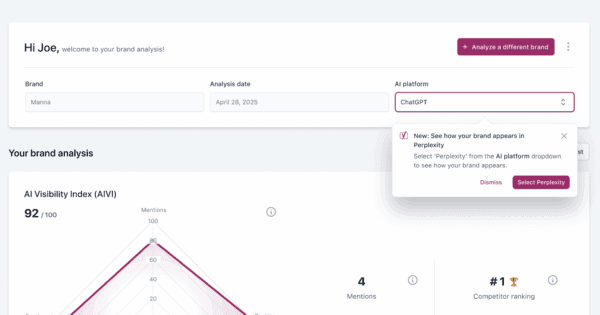
If you’re already using Yoast SEO AI+, nothing changes in how you work. Log in and at your next analysis, Gemini data is now included automatically at no extra cost. You can select the AI platform from the dropdown, and your dashboard will show a broader view of how your brand appears across AI search and chat. 

To upgrade

If you don’t yet have Yoast SEO AI+, you’ll need to upgrade to access the Yoast AI Brand Insights tool. The AI+ plan brings brand visibility tracking together with on-page SEO tools, content optimization, and AI-powered insights in one package, so you can analyze how your brand is mentioned and act from the same workflow. 

Upgrade to Yoast SEO AI+ to start scanning your brand across Gemini, ChatGPT, and Perplexity. 

New to AI Brand Insights: Scan your brand visibility in Perplexity

Today, we’re rolling out an improvement to Yoast AI Brand Insights, part of the Yoast SEO AI+ package. You can now scan how your brand appears in answers generated by Perplexity, in addition to ChatGPT at no extra cost. This builds on our mission to help marketers, bloggers, and business owners understand how their brand is represented across major AI platforms.  

AI powered answers are fast becoming a new gateway for discovery. People increasingly turn to AI tools to research, compare, and choose products or services. Those answers often mention brands as recommendations or sources. When someone asks a question in your niche, you should be able to see if your brand is part of the conversation. 

This update makes that possible across more platforms. 

AI Brand Insights now lets you see when and how your brand appears in AI generated answers for relevant search style queries. You can track sentiment, and compare your visibility to competitors. By adding support for Perplexity, you get a broader view of how AI systems describe your brand and which sources they rely on, helping you stay visible and confidently represented in AI driven discovery  

What’s new 

You can now:

  • Run brand visibility scans in Perplexity
  • Compare how ChatGPT and Perplexity talk about your brand
  • Track mentions, sentiment, and citations across both platforms
  • Monitor changes over time in your AI Visibility Index 

Nothing else changes in your workflow. The next time you log in, you’ll see a visual notification guiding you to run your first Perplexity scan. 

Why this matters 

Understanding how AI answers present your brand helps you move beyond guesswork and see the tone, accuracy, and sources AI chooses when mentioning you. With more customers relying on AI powered explanations than ever, visibility in these answers is now an important part of brand discovery and trust building. 

How to try it 

Log in through MyYoast, open AI Brand Insights, and run your next scan. Your dashboard now includes results from Perplexity alongside ChatGPT. This gives you a fuller, more accurate view of your brand’s presence in AI generated answers. 

If you’re already using Yoast SEO AI+, this enhancement is available to you immediately. If you’re not, upgrading gives you access to this feature along with a complete set of tools for brand visibility, AI insights, and on page SEO.