The Download: AI’s impact on the economy, and DeepSeek strikes again

This is today’s edition of The Download, our weekday newsletter that provides a daily dose of what’s going on in the world of technology.

The State of AI: Welcome to the economic singularity

—David Rotman and Richard Waters

Any far-reaching new technology is always uneven in its adoption, but few have been more uneven than generative AI. That makes it hard to assess its likely impact on individual businesses, let alone on productivity across the economy as a whole.

At one extreme, AI coding assistants have revolutionized the work of software developers. At the other extreme, most companies are seeing little if any benefit from their initial investments. 

That has provided fuel for the skeptics who maintain that—by its very nature as a probabilistic technology prone to hallucinating—generative AI will never have a deep impact on business. To students of tech history, though, the lack of immediate impact is normal. Read the full story.

If you’re an MIT Technology Review subscriber, you can join David and Richard, alongside our editor in chief, Mat Honan, for an exclusive conversation digging into what’s happening across different markets live on Tuesday, December 9 at 1pm ET.  Register here

The State of AI is our subscriber-only collaboration between the Financial Times and MIT Technology Review examining the ways in which AI is reshaping global power. Sign up to receive future editions every Monday.

The must-reads

I’ve combed the internet to find you today’s most fun/important/scary/fascinating stories about technology.

1 DeepSeek has unveiled two new experimental AI models 
DeepSeek-V3.2 is designed to match OpenAI’s GPT-5’s reasoning capabilities. (Bloomberg $)
+ Here’s how DeepSeek slashes its models’ computational burden. (VentureBeat)
+ It’s achieved these results despite its limited access to powerful chips. (SCMP $)

2 OpenAI has issued a “code red” warning to its employees
It’s a call to arms to improve ChatGPT, or risk being overtaken. (The Information $)
+ Both Google and Anthropic are snapping at OpenAI’s heels. (FT $)
+ Advertising and other initiatives will be pushed back to accommodate the new focus. (WSJ $)

3 How to know when the AI bubble has burst
These are the signs to look out for. (Economist $)
+ Things could get a whole lot worse for the economy if and when it pops. (Axios)
+ We don’t really know how the AI investment surge is being financed. (The Guardian)

4 Some US states are making it illegal for AI to discriminate against you
California is the latest to give workers more power to fight algorithms. (WP $)

5 This AI startup is working on a post-transformer future
Transformer architecture underpins the current AI boom—but Pathway is developing something new. (WSJ $)
+ What the next frontier of AI could look like. (IEEE Spectrum)

6 India is demanding smartphone makers install a government app
Which privacy advocates say is unacceptable snooping. (FT $)
+ India’s tech talent is looking for opportunities outside the US. (Rest of World)

7 College students are desperate to sign up for AI majors
AI is now the second-largest major at MIT behind computer science. (NYT $)
+ AI’s giants want to take over the classroom. (MIT Technology Review)

8 America’s musical heritage is at serious risk
Much of it is stored on studio tapes, which are deteriorating over time. (NYT $)
+ The race to save our online lives from a digital dark age. (MIT Technology Review)

9 Celebrities are increasingly turning on AI
That doesn’t stop fans from casting them in slop videos anyway. (The Verge)

10 Samsung has revealed its first tri-folding phone
But will people actually want to buy it? (Bloomberg $)
+ It’ll cost more than $2,000 when it goes on sale in South Korea. (Reuters)

Quote of the day

“The Chinese will not pause. They will take over.”

—Michael Lohscheller, chief executive of Swedish electric car maker Polestar, tells the Guardian why Europe should stick to its plan to ban the production of new petrol and diesel cars by 2035. 

One more thing

Inside Amsterdam’s high-stakes experiment to create fair welfare AI

Amsterdam thought it was on the right track. City officials in the welfare department believed they could build technology that would prevent fraud while protecting citizens’ rights. They followed these emerging best practices and invested a vast amount of time and money in a project that eventually processed live welfare applications. But in their pilot, they found that the system they’d developed was still not fair and effective. Why?

Lighthouse Reports, MIT Technology Review, and the Dutch newspaper Trouw have gained unprecedented access to the system to try to find out. Read about what we discovered.

—Eileen Guo, Gabriel Geiger & Justin-Casimir Braun

We can still have nice things

A place for comfort, fun and distraction to brighten up your day. (Got any ideas? Drop me a line or skeet ’em at me.)

+ Hear me out: a truly great festive film doesn’t need to be about Christmas at all.
+ Maybe we should judge a book by its cover after all.
+ Happy birthday to Ms Britney Spears, still the princess of pop at 44!
+ The fascinating psychology behind why we love travelling so much.
Tools to Track GenAI Citations, Sources

Generative AI platforms increasingly conduct live web searches to respond to users’ prompts. The platforms don’t reveal how or where they search, but it’s likely a combination of Google, Bing, and the platforms’ own bots.

Just a few months ago, those answers would have relied primarily on existing training data.

Regardless, understanding how AI platforms conduct the searches is key to optimizing visibility in the answers.

Analyze:

  • Which web pages produce the genAI answers? Try to appear in those pages.
  • Which brands and products influenced an answer? Are they competitors?

Here are three tools to help reveal impactful pages and influential brands and products.

ChatGPT Path

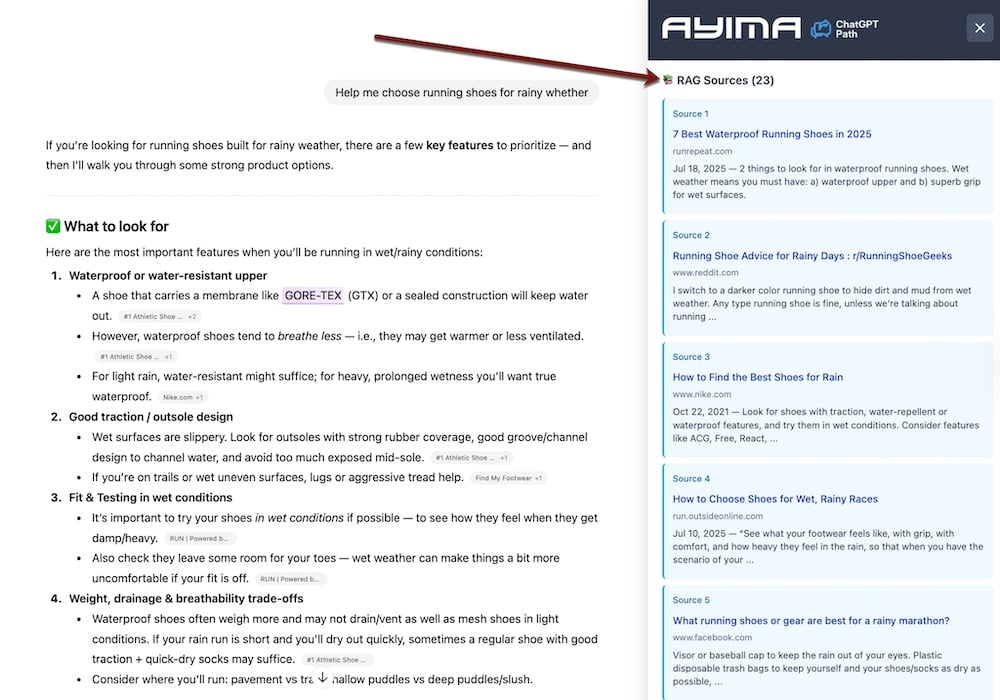
ChatGPT Path from Ayima, an agency, is a free Chrome extension that extracts citations, brands and products (entities), and fan-out queries from any ChatGPT dialog. Download the extension and converse with ChatGPT. Then click the extension icon to open a side panel with the key info, called RAG Sources (“Retrieval‑Augmented Generation”).

Export the report via CSV for easier analysis.

ChatGPT conversation on choosing running shoes for rainy weather displayed on the left, with a ChatGPT Path sidebar on the right. The sidebar is labeled ‘RAG Sources (23)’ and lists numbered source cards with titles and snippets from websites such as runrepeat.com, Reddit, Nike.com, Outside Online, and Facebook. The main chat response includes a checklist of features to look for in rainy-condition running shoes, with brand and retailer citations highlighted inline.

ChatGPT Path extracts citations, brands and products, and fan-out queries from any ChatGPT dialog, such as this example for “help me choose running shoes for rainy weather.”

AI Search Impact Analysis

AI Search Impact Analysis is another free Chrome extension that analyzes multiple queries on Google AI Overviews.

Install the extension and type your comma-separated queries into the tool’s sidebar. The tool will run each search and identify AI Overviews and the queries that triggered them.

A separate “Citation Report” includes all URLs cited in each Overview and overall for all queries. In my testing, this feature was handy for identifying URLs cited repeatedly.

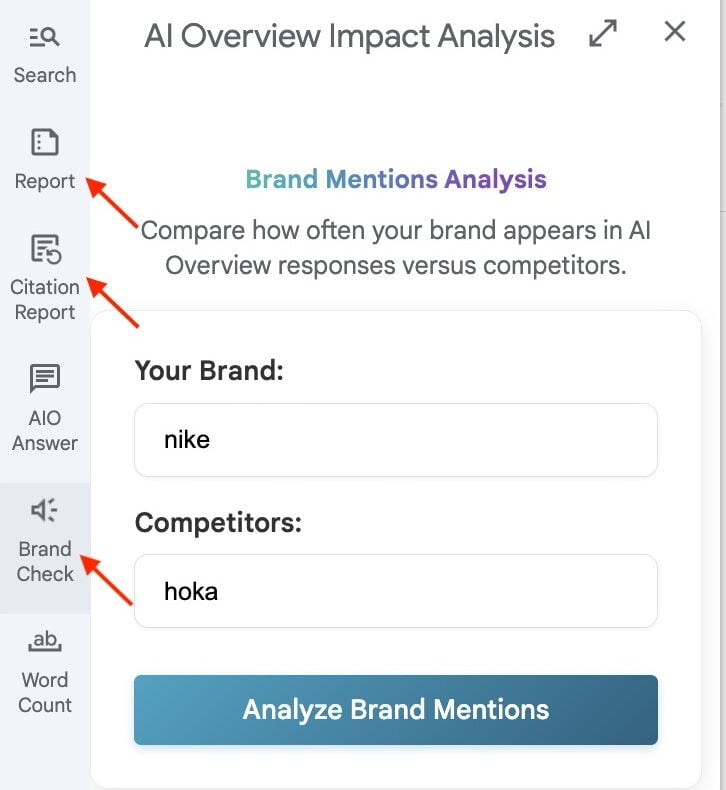
The extension’s “Brand Check” analyzes mentions of your company and competitors in Overviews.

Dashboard sidebar and AI Overview Impact Analysis panel. The left sidebar displays menu items including Search, Report, Citation Report, AIO Answer, Brand Check, and Word Count. The main panel shows a Brand Mentions Analysis tool with fields for ‘Your Brand’ filled in as ‘nike’ and ‘Competitors’ filled in as ‘hoka.’ A blue button labeled ‘Analyze Brand Mentions’ appears below the inputs. A Brand Mentions Summary table lists total mentions and keyword coverage for the user’s brand versus competitors.

“Brand Check” analyzes Overviews for mentions of your company and competitors, such as “nike” and “hoka” shown here.

Peec AI

Peec AI is a premium analytics tool for sources and brand mentions in ChatGPT, Perplexity, and AI Overviews.

To use, enter your brand and targeted prompts. The tool, after a few minutes, will create a detailed report, listing:

  • Domains cited in genAI answers for those prompts,
  • URLs linked in the answers.

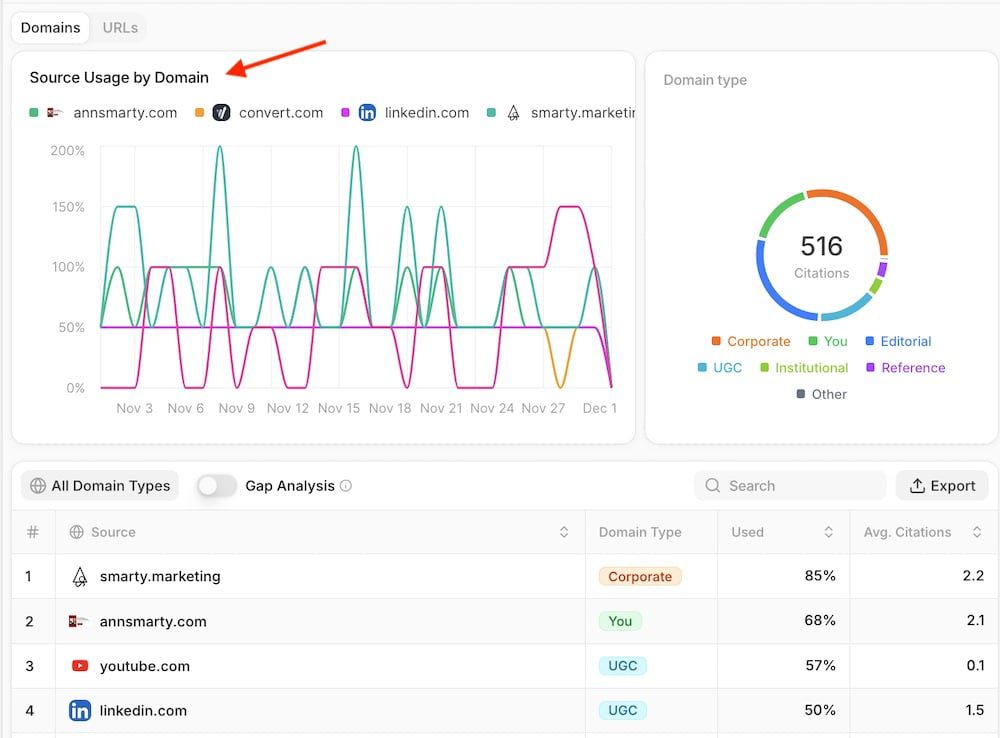
The report categorizes cited domains by type (e.g., corporate, brand-owned, user-generated) and frequency (to know a domain’s impact on a cluster of answers).

A separate aggregated report combines all genAI platforms, with URL filters for each one. The “Gap analysis” lists cited URLs that mention competing brands but not yours.

Finally, Peec AI analyzes all entered prompts and lists the most-cited brands to compare and track against your own.

Analytics dashboard showing a line chart titled ‘Source Usage by Domain’ with multiple domain lines such as annsmarty.com, convert.com, and linkedin.com. To the right is a donut chart illustrating domain type distribution with 516 total citations across categories such as Corporate, You, Editorial, UGC, Institutional, and Reference. A table below lists domains with corresponding usage percentages and average citations, including smarty.marketing, anns smarty.com, youtube.com, and linkedin.com.

Peec AI’s report categorizes cited domains by type and frequency.

YouTube Launches First Annual Recap Feature For All Users via @sejournal, @MattGSouthern

YouTube launched its first annual Recap feature, providing users with a personalized summary of their viewing activity throughout the year.

The feature is available starting today for users in North America and will roll out globally throughout the week, according to the YouTube Blog.

What’s New

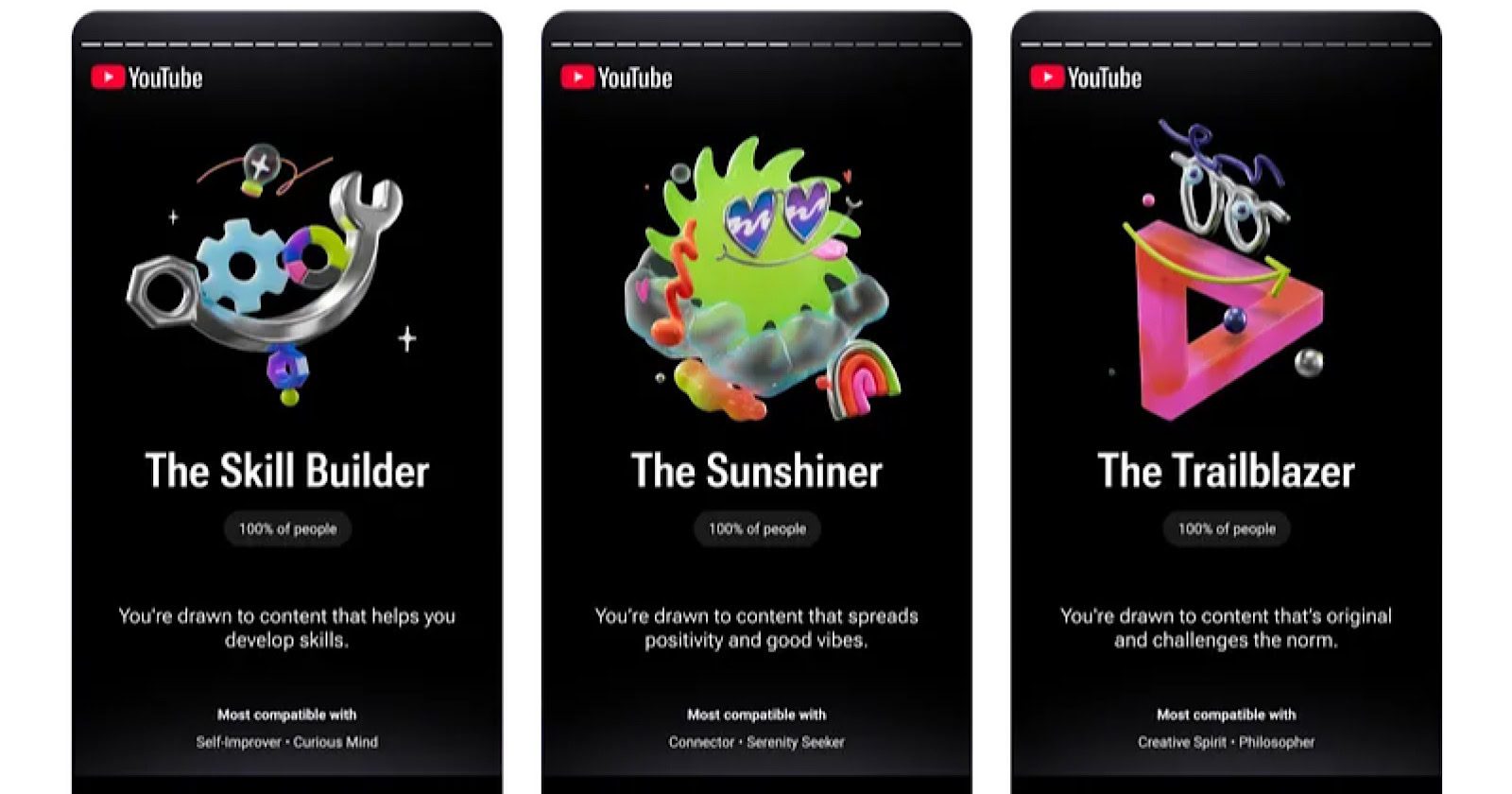
YouTube Recap is accessible from the homepage or under the “You” tab on mobile and desktop. The feature generates up to 12 cards based on watch history, displaying top channels, interests, and viewing patterns over the year.

The cards also assign users a personality type based on viewing habits. Types include Adventurer, Skill Builder, Creative Spirit, Sunshiner, Wonder Seeker, Connector, Philosopher, and Dreamer.

YouTube said the most common personality types were Sunshiner, Wonder Seeker, and Connector. Philosopher and Dreamer were the rarest.

Users who listened to music through the platform will see Top Artists and Top Songs cards within their Recap. Additional music data, including genres, podcasts, and international listening, is available in the YouTube Music app.

YouTube said it conducted nine rounds of feedback testing and evaluated more than 50 concepts before finalizing the feature. In an accompanying video, YouTube representatives said the team used Gemini to analyze watch history patterns, which enabled them to create a structured recap from YouTube’s unstructured video library.

Why This Matters

YouTube Recap gives the platform a year-end engagement feature comparable to Spotify Wrapped.

For creators, the feature surfaces which channels appear in users’ top viewing lists. People can save and share their Recap cards, which could boost channels’ social media visibility during the holiday period.

Looking Ahead

Users in North America can access their Recap starting today. Those outside North America should see the feature become available throughout the week.

For more details, see the video below:

Ask an SEO: Is An XML Or HTML Sitemap Better For SEO? via @sejournal, @HelenPollitt1

In this edition of Ask An SEO, we break down a common point of confusion for site owners and technical SEOs:

Do I need both an XML sitemap and an HTML one, and which one is better to use for SEO?

It can be a bit confusing to know whether it’s better to use an XML sitemap or an HTML one for your site. In some instances, neither is needed, and in some, both are helpful. Let’s dive into what they are, what they do, and when to use them.

What Is An XML sitemap?

An XML sitemap is essentially a list of URLs for pages and files on your website that you want the search bots to be able to find and crawl. You can also use the XML sitemap to detail information about the files, like the length of run-time for the video file specified, or the publication date of an article.

It is primarily used for bots. There is little reason why you would want a human visitor to use an XML sitemap. Well, unless they are debugging an SEO issue!

What Is The XML Sitemap Used For?

The purpose of the XML sitemap is to help search bots understand which pages on your website should be crawled, as well as giving them extra information about those pages.

The XML sitemap can help bots identify pages on the site that would otherwise be difficult to find. This can be orphaned pages, those with low internal links, or even pages that have changed recently that you may want to encourage the bots to recrawl.

Best Practices For XML Sitemaps

Most search bots will understand XML sitemaps that follow the sitemaps.org protocol. This protocol defines the necessary location of the XML sitemap on a site, schema it needs to use to be understood by bots, and how to prove ownership of domains in the instance of cross-domain references.

There is typically a limit on the size an XML sitemap can be, and still be parsed by the search bots. This means when building an XML sitemap, you should ensure it is under 50 MB uncompressed, and no more than 50,000 URLs. If your website is larger, you may need multiple XML sitemaps to cover all of the URLs. In that instance, you can use a sitemap index file to help organize your sitemaps into one location.

As the purpose of the XML sitemap is typically to help bots find your crawlable, indexable pages, it is usually necessary to ensure the file references it contains all lead to URLs with 200 server response codes. In most instances, the URLs should be the canonical version, and not contain any crawl or index restrictions.

Things To Be Aware Of With XML Sitemaps

There may be good reasons to go against “best practice” for XML sitemaps. For example, if you are instigating a lot of redirects, you may wish to include the old URLs in an XML sitemap even though they will return a 301 server response code. Adding a new XML sitemap containing those altered URLs can encourage the bots to recrawl them and pick up the redirects sooner than if they were just left to find them via crawling the site. This is especially the case if you have gone to the trouble of removing links to the 301 redirects on the site itself.

What Is An HTML Sitemap?

The HTML sitemap is a set of links to pages within your website. It is usually linked to from somewhere on the site, like the footer, that is easily accessed by users if they are specifically looking for it. However, it doesn’t form part of the main navigation of the site, but more as an accompaniment to it.

What Is An HTML Sitemap Used For?

The idea of the HTML sitemap is to serve as a catch-all for navigation. If a user is struggling to find a page on your site through your main navigation elements, or search, they can go to the HTML sitemap and find links to the most important pages on your site. If your website isn’t that large, you may be able to include links to all of the pages on your site.

The HTML sitemap pulls double duty. Not only does it work as a mega-navigation for humans, but it can also help bots find pages. As bots will follow links on a website (as long as they are followable), it can aid in helping them to find pages that are otherwise not linked to, or are poorly linked to, on the site.

Best Practices For HTML Sitemaps

Unlike the XML sitemap, there is no specific format that an HTML sitemap needs to follow. As the name suggests, it tends to be a simple HTML page that contains hyperlinks to the pages you want users to find through it.

In order to make it usable for bots too, it is important that the links are followable, i.e., they do not have a nofollow attribute on them. It is also prudent to make sure the URLs they link to aren’t disallowed through the robots.txt. It won’t cause you any serious issues if the links aren’t followable for bots; it just stops the sitemap from being useful for bots.

Things To Be Aware Of With HTML Sitemaps

Most users are not going to go to the HTML sitemap as their first port of call on a site. It is important to realize that if a user is going to your HTML sitemap to find a page, it suggests that your primary navigation on the site has failed them. It really should be seen as a last resort to support navigation.

Which Is Better To Use For SEO?

So, which is more important for SEO? Well, neither. That is, it really is dependent on your website and its needs.

For example, a small website with fewer than 20 pages may not have a need for either an XML sitemap or an HTML sitemap. In this instance, if all the pages are linked to well from the main navigation system, the chances are high that users and search bots alike will easily be able to find each of the site’s pages without additional help from sitemaps.

However, if your website has millions of pages, and has a main navigation system that buries links several sub-menus deep, an XML sitemap and an HTML sitemap may be useful.

They both serve different purposes and audiences.

When To Use The XML Sitemap

In practice, having an XML sitemap, or several, can help combat crawl issues. It gives a clear list of all the pages that you want a search bot to crawl and index. An XML sitemap can also be very helpful for debugging crawling issues, as when you upload it to Google Search Console, you will get an alert if there are issues with it or the URLs it contains. It can allow you to narrow in on the indexing status of URLs within the XML sitemap. This can be very useful for large websites that have millions of pages.

Essentially, there isn’t really a reason not to use an XML sitemap, apart from the time and cost of creating and maintaining them. Many content management systems will automatically generate them, which can take away some of the hassle.

Really, if you can have an XML sitemap, you might as well. If, however, it will be too costly or developer-resource intensive, it is not critical if your site is fairly small and the search engines already do a good job of crawling and indexing it.

When To Use The HTML Sitemap

The HTML sitemap is more useful when a website’s navigation isn’t very intuitive, or the search functionality isn’t comprehensive. It serves as a backstop to ensure users can find deeply buried pages. An HTML sitemap is particularly useful for larger sites that have a more complicated internal linking structure. It can also show the relationship between different pages well, depending on the structure of the sitemap. Overall, it is helpful to both users and bots, but is only really needed when the website is suffering from architectural problems or is just exceedingly large.

So, in summary, there is no right or wrong answer to which is more important. It is, however, very dependent on your website. Overall, there’s no harm in including both, but it might not be critical to do so.

More Resources:


Featured Image: Paulo Bobita/Search Engine Journal

OpenAI Declares ‘Code Red’ To Improve ChatGPT Amid Google Competition via @sejournal, @MattGSouthern

OpenAI CEO Sam Altman has declared a “code red” to focus company resources on improving ChatGPT, according to an internal memo reported by The Wall Street Journal and The Information.

The memo signals OpenAI’s response to growing competition from Google, whose Gemini 3 model has outperformed ChatGPT in several benchmark tests since launching last month, according to Google’s own evaluation data and third party leaderboards.

What’s New

Altman told employees that ChatGPT’s day to day experience needs improvement. Specific areas include personalization features, response speed and reliability, and the chatbot’s ability to answer a wider range of questions.

The company uses a color-coded system to indicate priority levels. This effort has been elevated to “code red,” above the previous “code orange” designation for ChatGPT improvements.

A new reasoning model is expected to launch next week, according to the memo, though OpenAI hasn’t publicly announced it.

Delayed Products

Several product initiatives are being postponed as a result.

Advertising integration, which OpenAI had been testing in beta versions of the ChatGPT app, is now on hold, according to The Information. AI agents designed for shopping and healthcare are also delayed, along with improvements to ChatGPT Pulse.

Altman has encouraged temporary team transfers to support ChatGPT development and established daily calls for those responsible for improvements.

Competitive Context

On the technical side, Google’s Gemini 3 and related models have posted strong scores on reasoning benchmarks. Google says Gemini 3 Deep Think outperforms earlier versions on Humanity’s Last Exam, a frontier level benchmark created by AI safety researchers, and other difficult tests. Those results are reflected on Google’s own Gemini 3 Pro benchmark page and on independent leaderboards that track model performance.

OpenAI hasn’t released comparable public benchmark data for its next reasoning model yet, so comparisons rely on current GPT 5 results rather than the upcoming system referenced in the memo.

Google is also continuing to invest in generative image tools like its Nano Banana and Nano Banana Pro image generators, which sit alongside Gemini 3 as part of a broader AI product lineup.

Benchmark Context

Humanity’s Last Exam is intended to be a harder successor to saturated benchmarks like MMLU. It’s maintained by the Center for AI Safety and Scale AI, with an overview available on the project site and results tracked by multiple leaderboards, including Scale’s official leaderboard and third party dashboards such as Artificial Analysis.

Google’s Gemini 3 Pro benchmark documentation lists a higher score on Humanity’s Last Exam than several competing models, including GPT 5. That’s the basis for reporting that Gemini 3 has “outperformed” ChatGPT on that specific benchmark.

OpenAI has published strong results on other reasoning benchmarks for its GPT 5 series, but the memo appears to be reacting to this recent wave of Gemini 3 performance data rather than a single test.

Traffic And Usage Context

Despite the technical pressure, OpenAI still has a large lead in assistant usage.

In a recent post on LinkedIn, ChatGPT head Nick Turley said ChatGPT is the “#1 AI assistant worldwide,” accounting for “around 70% of assistant usage” and roughly “10% of search activity.” You can read his full comments here.

Separate reporting from outlets including the Financial Times indicates OpenAI has more than 800 million weekly users, with most on the free tier, while Gemini’s user base has been growing quickly from a lower starting point.

Altman’s memo acknowledges Google’s recent progress and warns of “temporary economic headwinds,” while also saying OpenAI is “catching up fast.”

A Familiar Playbook

The “code red” designation echoes Google’s own response to ChatGPT several years ago.

Google management declared a “code red” after ChatGPT’s viral launch. CEO Sundar Pichai redirected teams across Google Research, Trust and Safety, and other departments to focus on AI product development.

That urgency led to the accelerated development of Google’s AI products, culminating in Bard’s launch in early 2023 and its subsequent evolution into Gemini.

Now the roles have reversed. Google’s sustained investment in AI infrastructure has produced a model that scores higher than ChatGPT on several high profile benchmarks, prompting OpenAI to adopt a similar crisis response framework for its flagship product.

Company Response

Nick Turley, OpenAI’s head of ChatGPT, addressed the competitive landscape in recent posts on LinkedIn and X, where he described ChatGPT as the top AI assistant worldwide.

“New products are launching every week, which is great,” he wrote in one of the posts, saying that competition pushes OpenAI to move faster and continue improving ChatGPT.

He added that OpenAI’s focus is making ChatGPT “more capable” while expanding access and making it “more intuitive and personal.”

OpenAI hasn’t publicly commented on the leaked memo itself.

Looking Ahead

OpenAI’s new reasoning model launch will provide the first indication of how the company is executing on Altman’s directive. The delay of advertising and AI agents suggests ChatGPT quality has become the company’s singular near term priority, at least internally.

For marketers and SEO professionals, the more immediate impact is likely to be on how ChatGPT handles complex queries, research tasks, and follow up questions once the new model is live. Any measurable changes in answer quality, speed, or personalization will be important to watch alongside Google’s continued Gemini 3 rollouts.


Featured Image: Mijansk786/Shutterstock

Signal Vs. Noise: Predicting Future Impact Of Content Marketing

This edited excerpt is from “B2B Content Marketing Strategy” by Devin Bramhall ©2025, and is reproduced and adapted with permission from Kogan Page Ltd.

Marketing can contribute to company growth in many different ways: Net new sales, customer retention, reduces risk from competitors, sometimes creates new revenue streams (like events) that impact more than one company goal, bringing a product to market successfully, feature adoption/upsells, to name a few.

The challenge marketers have is convincing multiple stakeholders that their work did, in fact, contribute to any of these areas. Even if you have goals and agreed-upon metrics to measure success, reporting on marketing ends up being fraught with all kinds of complications, from the political and interpersonal to depth of knowledge about marketing and what shows up as “impact” and “value” to the business.

The opportunity for marketers in this situation is that the people who need to be convinced don’t know what “the answer” to marketing attribution is either. They argue with each other about it behind closed doors and change their minds a lot, but they honestly can’t really prove anything better than you can. They just bought into some corollary model or made one up and have spent a ton of time campaigning internally and out in the world to make other people believe their way is correct, and eventually some of them do.

Predicting Future Impact

Most reporting focuses on what’s already happened – last month’s lead generation, last quarter’s revenue, or last year’s customer acquisition costs.

While historical data is crucial to making future decisions, it also keeps marketing leaders in a reactive position. By the time you identify a problem, it’s already affected your results. Leading indicators give you time to adjust course when needed, rather than explaining missed targets after the fact.

That’s why monitoring the signals along the way is also useful, if executed thoughtfully.

A few caveats:

  • Monitor quietly. You don’t have to share what you observe with your executives 1) at all, or 2) until you’re ready. They’ll either get confused or too excited, and neither leads to a good place for you.
  • Work with your data team. Whatever job title they’ve been given at your company, find the people who have access to the raw data and ask them questions. Be specific about what you want to know. You don’t have to know the exact data types, time periods, or segments. They just need a detailed question to get you what you need.
  • Talk it through. Since data contains multiple realities depending on how you slice it, I’ve always found it helpful to run any conclusions or stories by my data team and, where possible, my boss (see first bullet!). Basically, I look for two different analytical perspectives:
    • Someone whose job it is to ensure our data is accurate.
    • Someone whose job it is to analyze data for reporting on the business.

Remember: Reporting isn’t a single use-case activity. Reflecting on the past to measure impact is just one way to leverage reporting. Use it to inspire new ideas, optimizations, and experiments, too.

Read more: How To Write SEO Reports That Get Attention From Your CMO

A Few Potentially Useful Signals You Can Monitor

Ultimately, it’s up to you to determine which signals provide valuable insights into the performance of your marketing initiatives. And regardless of your role, whether it’s producer, manager, or team lead, as your boss, I’d expect you to know how to determine what those are.

Also, the exact signals you monitor will continue to change as technology and the internet evolve. However, there are a few informative signals that have stood the test of time (thus far) for me.

Resonance

When it comes to resonance, unprompted action on even a semiregular basis is a huge signal that something you’re doing is working, so even if your data is statistically insignificant, I’d lean in and, at the very least, conduct further experiments.

One example of this is folks sharing and referencing a topic or idea you share publicly in their own content (and how their followers react to it) on a semi-consistent basis. This indicates you’re at least on the right track with content direction.

In my experience, search volume for a keyword or phrase is minimally helpful in determining resonance in the beginning. As in, just because no one is searching for a topic doesn’t mean it’s not a common problem. A more useful exercise in search monitoring to me is whether your campaign corresponds with an increase in search volume in that time period.

Activity

The same principle applies to other actions as well. Are folks commenting on posts asking for your opinion on specific problems they are experiencing? Are you receiving anecdotal feedback semi-consistently on specific marketing initiatives or topics you’re investing in?

Do folks engage with your content even when you’re inconsistent? One client I worked with saw 60-70% open rates even on major holidays or when the newsletter was sent off-schedule on a Saturday or Monday.

Are you seeing an increase in time-on-page or pages per session from certain topics or even specific pieces?

Copycats

While not a perfect signal, if your competitors start copying your content, it’s either a sign you could be onto something or an indication that their strategy isn’t working, they don’t have one, or they’re struggling. No matter the case, it’s a signal worth paying attention to and perhaps doing some recon to find out if there are any weaknesses you can exploit.

Ultimately, your goal is to explore these signals to establish whether there are correlations between these leading indicators and your ultimate business outcomes. This isn’t just theoretical – it requires analyzing your data to identify patterns that predict success for your business.

Turning Measurement Into Mastery

Effective reporting isn’t the end of your marketing journey – it’s the bridge to your next phase of growth. Measuring the impact of content marketing isn’t just about proving its value; it’s about creating the leverage you need to execute strategies that genuinely move your business forward.

Remember these essential principles as you develop your measurement approach:

  • Numbers don’t tell stories – people do. Your data provides ingredients, but you create the meal. The most powerful reports transform complex metrics into clear narratives that inspire action and build confidence in your strategy.
  • Measurement serves strategy, not the other way around. When you begin with clear objectives and understand what truly influences behavior, metrics become tools for insight rather than constraints on creativity.
  • Reporting is campaigning. The most successful marketers recognize that performance reporting is ultimately a persuasion exercise – one that requires understanding audience motivations, building relationships, and consistently communicating value.
  • Both measurable and unmeasurable impacts matter. While focusing on quantifiable metrics, never lose sight of the equally valuable but harder-to-measure effects of brand building, relationship development, and community growth.

By developing measurement systems that capture both immediate impacts and leading indicators, you transform reporting from a dreaded obligation into a strategic advantage.

Summary: Practice And Persistence

As you apply these principles to your own marketing, remember that mastery comes through practice and persistence. You’ll make mistakes, discover unexpected insights, and continuously refine your approach. That’s not just normal – it’s the path to excellence.

To read the full book, SEJ readers have an exclusive 25% discount code and free shipping to the US and UK. Use promo code “SEJ25” at koganpage.com here.

More Resources:


Featured Image: Igor Link/Shutterstock

seo enhancements
Site Kit by Google insights now available for all Yoast SEO Premium users 

Since its launch in June we have been rolling out our integration with Site Kit by Google. Every Yoast SEO Premium customer now has access to it. The update brings key Google Analytics and Search Console insights directly into your Yoast Dashboard, giving you a clear view of your site’s performance without switching between tools or tabs.

Previously, only users of Yoast SEO (free) and Yoast SEO Premium who already had the Site Kit plugin installed could use the integration. Access is now available to all Yoast SEO Premium customers even if Site Kit is not installed, and it will become available to remaining Yoast SEO (free) users soon.

What you can do with the new integration 

Connect once to see an immediate overview of your most important metrics. View organic traffic, impressions, clicks, and bounce rates in one place. Spot opportunities faster and understand where to focus your SEO work. 

Benefits 

  • See how your site is performing without switching between tools 
  • Quickly spot what needs attention with a clear site wide overview 
  • Dig into categories or individual pages to understand patterns and save time 
  • Group content by type to focus on the areas that matter most
  • Find new opportunities to grow traffic by combining Yoast insights with Google data

Learn more about the benefits on the Yoast SEO Dashboard integration page.

How to get started 

Update Yoast to the latest version (26.5), open your Yoast Dashboard, follow the steps in the Site Kit widget, and your insights will appear right away. 

If you want step by step guidance on how to connect Site Kit by Google insights to Yoast SEO, please visit this help article on how to set up.

For Yoast SEO (free) users 

We will continue rolling out access to the integration with Site Kit by Google for free users. Keep an eye on your Yoast Dashboard as it becomes available over time.  

An AI model trained on prison phone calls now looks for planned crimes in those calls

A US telecom company trained an AI model on years of inmates’ phone and video calls and is now piloting that model to scan their calls, texts, and emails in the hope of predicting and preventing crimes. 

Securus Technologies president Kevin Elder told MIT Technology Review that the company began building its AI tools in 2023, using its massive database of recorded calls to train AI models to detect criminal activity. It created one model, for example, using seven years of calls made by inmates in the Texas prison system, but it has been working on building other state- or county-specific models.

Over the past year, Elder says, Securus has been piloting the AI tools to monitor inmate conversations in real time (the company declined to specify where this is taking place, but its customers include jails holding people awaiting trial, prisons for those serving sentences, and Immigrations and Customs Enforcement detention facilities).

“We can point that large language model at an entire treasure trove [of data],” Elder says, “to detect and understand when crimes are being thought about or contemplated, so that you’re catching it much earlier in the cycle.”

As with its other monitoring tools, investigators at detention facilities can deploy the AI features to monitor randomly selected conversations or those of individuals suspected by facility investigators of criminal activity, according to Elder. The model will analyze phone and video calls, text messages, and emails and then flag sections for human agents to review. These agents then send them to investigators for follow-up. 

In an interview, Elder said Securus’ monitoring efforts have helped disrupt human trafficking and gang activities organized from within prisons, among other crimes, and said its tools are also used to identify prison staff who are bringing in contraband. But the company did not provide MIT Technology Review with any cases specifically uncovered by its new AI models. 

People in prison, and those they call, are notified that their conversations are recorded. But this doesn’t mean they’re aware that those conversations could be used to train an AI model, says Bianca Tylek, executive director of the prison rights advocacy group Worth Rises. 

“That’s coercive consent; there’s literally no other way you can communicate with your family,” Tylek says. And since inmates in the vast majority of states pay for these calls, she adds, “not only are you not compensating them for the use of their data, but you’re actually charging them while collecting their data.”

A Securus spokesperson said the use of data to train the tool “is not focused on surveilling or targeting specific individuals, but rather on identifying broader patterns, anomalies, and unlawful behaviors across the entire communication system.” They added that correctional facilities determine their own recording and monitoring policies, which Securus follows, and did not directly answer whether inmates can opt out of having their recordings used to train AI.

Other advocates for inmates say Securus has a history of violating their civil liberties. For example, leaks of its recordings databases showed the company had improperly recorded thousands of calls between inmates and their attorneys. Corene Kendrick, the deputy director of the ACLU’s National Prison Project, says that the new AI system enables a system of invasive surveillance, and courts have specified few limits to this power.

“[Are we] going to stop crime before it happens because we’re monitoring every utterance and thought of incarcerated people?” Kendrick says. “I think this is one of many situations where the technology is way far ahead of the law.”

The company spokesperson said the tool’s function is to make monitoring more efficient amid staffing shortages, “not to surveil individuals without cause.”

Securus will have an easier time funding its AI tool thanks to the company’s recent win in a battle with regulators over how telecom companies can spend the money they collect from inmates’ calls.

In 2024, the Federal Communications Commission issued a major reform, shaped and lauded by advocates for prisoners’ rights, that forbade telecoms from passing the costs of recording and surveilling calls on to inmates. Companies were allowed to continue to charge inmates a capped rate for calls, but prisons and jails were ordered to pay for most security costs out of their own budgets.

Negative reactions to this change were swift. Associations of sheriffs (who typically run county jails) complained they could no longer afford proper monitoring of calls, and attorneys general from 14 states sued over the ruling. Some prisons and jails warned they would cut off access to phone calls. 

While it was building and piloting its AI tool, Securus held meetings with the FCC and lobbied for a rule change, arguing that the 2024 reform went too far and asking that the agency again allow companies to use fees collected from inmates to pay for security. 

In June, Brendan Carr, whom President Donald Trump appointed to lead the FCC, said it would postpone all deadlines for jails and prisons to adopt the 2024 reforms, and even signaled that the agency wants to help telecom companies fund their AI surveillance efforts with the fees paid by inmates. In a press release, Carr wrote that rolling back the 2024 reforms would “lead to broader adoption of beneficial public safety tools that include advanced AI and machine learning.”

On October 28, the agency went further: It voted to pass new, higher rate caps and allow companies like Securus to pass security costs relating to recording and monitoring of calls—like storing recordings, transcribing them, or building AI tools to analyze such calls, for example—on to inmates. A spokesperson for Securus told MIT Technology Review that the company aims to balance affordability with the need to fund essential safety and security tools. “These tools, which include our advanced monitoring and AI capabilities, are fundamental to maintaining secure facilities for incarcerated individuals and correctional staff and to protecting the public,” they wrote.

FCC commissioner Anna Gomez dissented in last month’s ruling. “Law enforcement,” she wrote in a statement, “should foot the bill for unrelated security and safety costs, not the families of incarcerated people.”

The FCC will be seeking comment on these new rules before they take final effect. 

Nominations are now open for our global 2026 Innovators Under 35 competition

We have some exciting news: Nominations are now open for MIT Technology Review’s 2026 Innovators Under 35 competition. This annual list recognizes 35 of the world’s best young scientists and inventors, and our newsroom has produced it for more than two decades. 

It’s free to nominate yourself or someone you know, and it only takes a few moments. Submit your nomination before 5 p.m. ET on Tuesday, January 20, 2026. 

We’re looking for people who are making important scientific discoveries and applying that knowledge to build new technologies. Or those who are engineering new systems and algorithms that will aid our work or extend our abilities. 

Each year, many honorees are focused on improving human health or solving major problems like climate change; others are charting the future path of artificial intelligence or developing the next generation of robots. 

The most successful candidates will have made a clear advance that is expected to have a positive impact beyond their own field. They should be the primary scientific or technical driver behind the work involved, and we like to see some signs that a candidate’s innovation is gaining real traction. You can look at last year’s list to get an idea of what we look out for.

We encourage self-nominations, and if you previously nominated someone who wasn’t selected, feel free to put them forward again. Please note: To be eligible for the 2026 list, nominees must be under the age of 35 as of October 1, 2026. 

Semifinalists will be notified by early March and asked to complete an application at that time. Winners are then chosen by the editorial staff of MIT Technology Review, with input from a panel of expert judges. (Here’s more info about our selection process and timelines.) 

If you have any questions, please contact tr35@technologyreview.com. We look forward to reviewing your nominations. Good luck! 

The Download: spotting crimes in prisoners’ phone calls, and nominate an Innovator Under 35

This is today’s edition of The Download, our weekday newsletter that provides a daily dose of what’s going on in the world of technology.

An AI model trained on prison phone calls now looks for planned crimes in those calls

A US telecom company trained an AI model on years of inmates’ phone and video calls and is now piloting that model to scan their calls, texts, and emails in the hope of predicting and preventing crimes.

Securus Technologies president Kevin Elder told MIT Technology Review that the company began building its AI tools in 2023, using its massive database of recorded calls to train AI models to detect criminal activity. It created one model, for example, using seven years of calls made by inmates in the Texas prison system, but it has been working on models for other states and counties.

However, prisoner rights advocates say that the new AI system enables a system of invasive surveillance, and courts have specified few limits to this power.  Read the full story.

—James O’Donnell

Nominations are now open for our global 2026 Innovators Under 35 competition

We have some exciting news: Nominations are now open for MIT Technology Review’s 2026 Innovators Under 35 competition. This annual list recognizes 35 of the world’s best young scientists and inventors, and our newsroom has produced it for more than two decades. 

It’s free to nominate yourself or someone you know, and it only takes a few moments. Here’s how to submit your nomination.

The must-reads

I’ve combed the internet to find you today’s most fun/important/scary/fascinating stories about technology.

1 New York is cracking down on personalized pricing algorithms
A new law forces retailers to declare if their pricing is informed by users’ data. (NYT $)
+ The US National Retail Federation tried to block it from passing. (TechCrunch)

2 The White House has launched a media bias tracker
Complete with a “media offender of the week” section and a Hall of Shame. (WP $)
+ The Washington Post is currently listed as the site’s top offender. (The Guardian)
+ Donald Trump has lashed out at several reporters in the past few weeks. (The Hill)

3 American startups are hooked on open-source Chinese AI models
They’re cheap and customizable—what’s not to like? (NBC News)
+ Americans also love China’s cheap goods, regardless of tariffs. (WP $)
+ The State of AI: Is China about to win the race? (MIT Technology Review)

4 How police body cam footage became viral YouTube content
Recent arrestees live in fear of ending up on popular channels. (Vox)
+ AI was supposed to make police bodycams better. What happened? (MIT Technology Review)

5 Construction workers are cashing in on the data center boom
Might as well enjoy it while it lasts. (WSJ $)
+ The data center boom in the desert. (MIT Technology Review)

6 China isn’t convinced by crypto
Even though bitcoin mining is quietly making a (banned) comeback. (Reuters)
+ The country’s central bank is no fan of stablecoins. (CoinDesk)

7 A startup is treating its AI companions like characters in a novel
Could that approach make for better AI companions? (Fast Company $)
+ Gemini is the most empathetic model, apparently. (Semafor)
+ The looming crackdown on AI companionship. (MIT Technology Review)

8 Ozempic is so yesterday 💉
New weight-loss drugs are tailored to individual patients. (The Atlantic $)
+ What we still don’t know about weight-loss drugs. (MIT Technology Review)

9 AI is upending how consultants work
For the third year in a row, big firms are freezing junior workers’ salaries. (FT $)

10 Behind the scenes of Disney’s AI animation accelerator
What took five months to create has been whittled down to under five weeks. (CNET)
+ Director supremo James Cameron appears to have changed his mind about AI. (TechCrunch)
+ Why are people scrolling through weirdly-formatted TV clips? (WP $)

Quote of the day

“[I hope AI] comes to a point where it becomes sort of mental junk food and we feel sick and we don’t know why.”

—Actor Jenna Ortega outlines her hopes for AI’s future role in filmmaking, Variety reports.

One more thing

The weeds are winning

Since the 1980s, more and more plants have evolved to become immune to the biochemical mechanisms that herbicides leverage to kill them. This herbicidal resistance threatens to decrease yields—out-of-control weeds can reduce them by 50% or more, and extreme cases can wipe out whole fields.

At worst, it can even drive farmers out of business. It’s the agricultural equivalent of antibiotic resistance, and it keeps getting worse. Weeds have evolved resistance to 168 different herbicides and 21 of the 31 known “modes of action,” which means the specific biochemical target or pathway a chemical is designed to disrupt.

Agriculture needs to embrace a diversity of weed control practices. But that’s much easier said than done. Read the full story.

—Douglas Main

We can still have nice things

A place for comfort, fun and distraction to brighten up your day. (Got any ideas? Drop me a line or skeet ’em at me.)

+ Now we’re finally in December, don’t let Iceland’s gigantic child-eating Yule Cat give you nightmares 😺
+ These breathtaking sculpture parks are serious must-sees ($)
+ 1985 sure was a vintage year for films.
+ Is nothing sacred?! Now Ozempic has come for our Christmas trees!