When Agents Replace Websites via @sejournal, @DuaneForrester

Let’s talk about an agentic future. As task-completing agents move from concept to adoption, their impact on how we discover and transact online will be significant. Websites won’t vanish, but in many cases, their utility will shrink as agents become the new intermediary layer between people and answers. Domains will still exist, but their value as discovery assets is likely to erode. Building and maintaining a site will increasingly mean structuring it for agents to retrieve from, not just for people to browse, and the idea of domains appreciating as scarce assets will feel less connected to how discovery actually happens.

The growth trajectory for AI agents is already clear in the data. Grand View Research valued the global AI agents market at USD 5.40 billion in 2024, with forecasts reaching USD 50.31 billion by 2030 at an annual growth rate of about 45.8%. Regionally, the Asia-Pacific market was USD 1.30 billion in 2024 and is projected to expand to USD 14.15 billion by 2030, with China alone expected to grow from USD 402.6 million to USD 3.98 billion over the same period. Europe is following a similar path, climbing from USD 1.32 billion in 2024 to USD 11.49 billion by 2030. Longer-term, Precedence Research projects the global agentic AI market will rise from USD 7.55 billion in 2025 to nearly USD 199.05 billion by 2034, a compound growth rate of 43.84%. These forecasts from multiple regions show a consistent global pattern: adoption is accelerating everywhere, and the shift toward agentic systems is not theoretical; it is underway. These figures are about task-completing agents, not casual chat use.
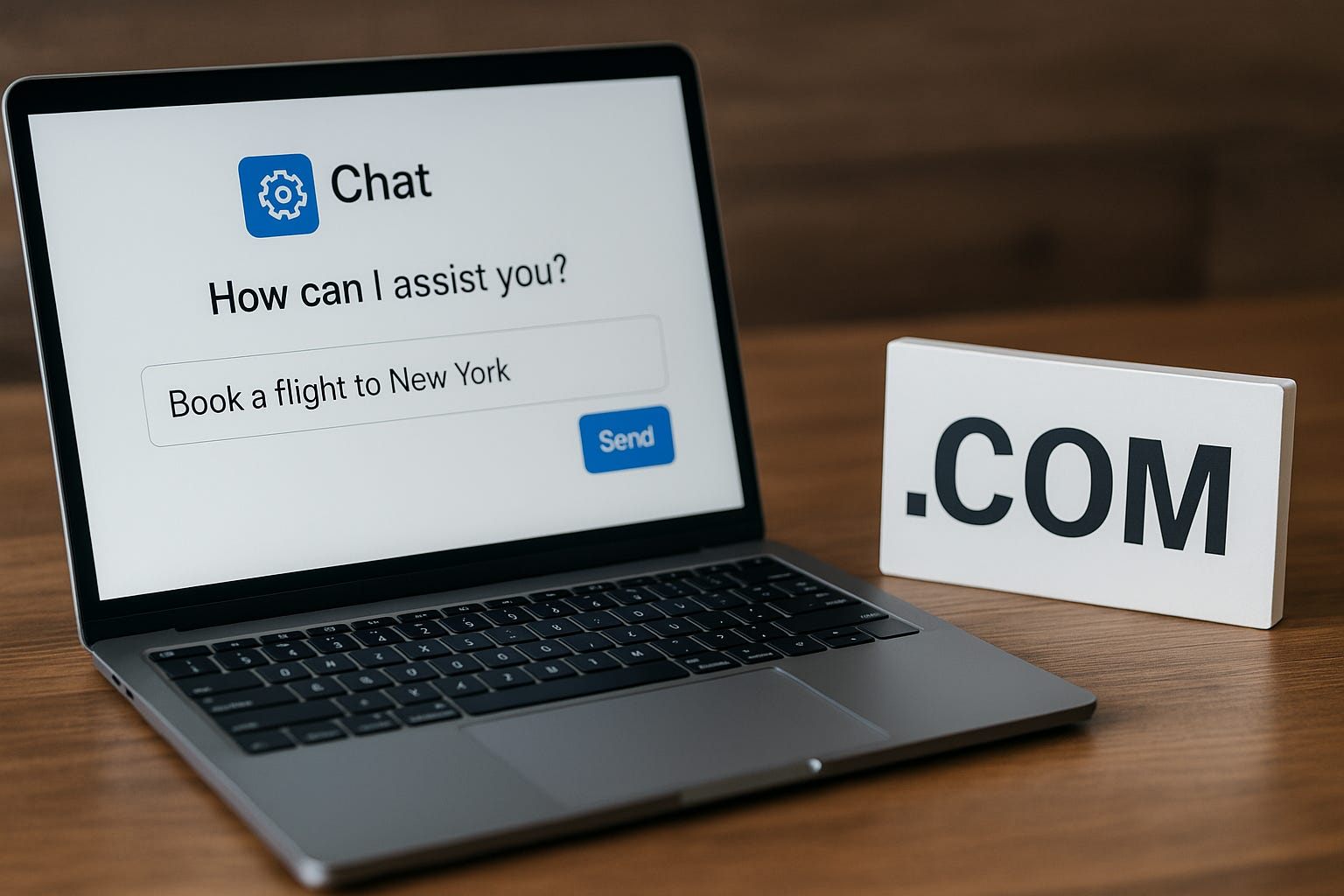
Image Credit: Duane Forrester

Do We Still Need Websites In An Agentic World?

It’s easy to forget how limited the internet felt in the 1990s. On AOL, you didn’t browse the web the way we think of it today. You navigated keywords. One word dropped you into chat rooms, news channels, or branded content. The open web was technically out there, but for most people, America Online WAS the internet.

That closed-garden model eventually gave way to the open web. Domains became navigation anchors. Owning a clean .com or a trusted extension like .org or .gov signaled legitimacy. Websites evolved into the front doors of digital identity, where brand credibility and consumer trust were built. Search rankings reinforced this. An exact-match domain once boosted visibility, and later the concept of “domain authority” helped indicate who showed up at the top of search results. For nearly three decades, websites have been the central hub of digital discovery and transactions.

But we may be circling back. Only this time, the keyword is no longer “AOL Keyword: Pizza Hut.” It’s your natural-language intent: “Book me a flight,” “Order flowers,” “Find me a dentist nearby.” And instead of AOL, the gatekeepers are LLMs and agentic systems.

From Navigation To Answers

The rise of agentic systems collapses the journey we’ve been used to. Where discovery once meant search, scanning results, clicking a domain, and navigating a site, it now means describing your intent and letting the system do the rest. You don’t need Expedia or United.com if your agent confirms your flight. You don’t need to touch OpenTable’s site if a reservation is placed automatically for tomorrow night. You don’t need to sift through Nike’s catalog if new running shoes just arrive at your door.

In this flow, the answer layer replaces the click, the task layer replaces the browsing session, and the source itself becomes invisible. The consumer no longer cares which site delivered the data or handled the transaction, as long as the result is correct.

Proof In Practice: WeChat

This shift isn’t hypothetical. In China, it’s already happening at scale. WeChat introduced Mini-Programs in 2017 as “apps within an app,” designed so users never need to leave the WeChat environment. By 2024, they had become mainstream: Recent reports suggest there are between 3.9 and 4.3 million WeChat Mini-Programs in the ecosystem today. (3.9m source4.3m source), with over 900 million monthly active users. And while Mini-Programs are closer to apps than actual AIs, it’s all about task completion and consumers adopting layers of task completion.

In food and beverage and hospitality, over 80% of top chain restaurants now run ordering or take-out flows directly through Mini-Programs, meaning customers never touch a separate website. International brands often prioritize Mini-Programs as their Chinese storefronts instead of building localized websites, since WeChat already handles discovery, product listings, payments, and customer service. Luxury brand LOEWE, for example, launched its 2024 “Crafted World” exhibition in Shanghai entirely via a WeChat Mini-Program, offering ticketing and interactive digital content without requiring users to leave the app.

For many domestic Chinese businesses, this has become the default strategy: their websites exist, if at all, as minimal shells, while the real customer experience lives entirely inside WeChat. And it’s worth keeping in mind, we talked about WeChat serving over 1 billion monthly active users. ChatGPT currently sees over 800 million a week, so roughly three times WeChat’s volume on a monthly basis. An agentic era of direct-to-consumer facilitated by platforms like ChatGPT, WeChat, Claude, Gemini, and CoPilot could bring a massive shift in consumer behavior.

Western Parallels

Western platforms are already moving in this direction. Instagram Checkout allows users to buy products directly inside Instagram, without ever visiting a retailer’s website. Shopify details this integration here. TikTok offers similar flows. Its partnership with Shopify enables in-app checkout so the consumer never leaves TikTok. Even services like Uber now function as APIs inside larger ecosystems. You can book a ride from within another app and never open Uber directly.

In each case, the website still exists, but the consumer may never see it. Discovery, consideration, and conversion all happen inside the closed flow.

The AOL Parallel

The resemblance to the mid-1990s is striking. AOL’s big push came in that period, when its “Keyword” model positioned the service as the internet itself. Instead of typing URLs, people entered AOL Keywords and stayed inside AOL’s curated walls. By mid-1996, AOL had roughly 6 million U.S. subscribers doing this, representing about 13% of the nation’s estimated 44 million internet users at the time.

Today, the “keyword” has become your intent. The agent interprets it, makes the decision, and fulfills the request. The outcome is the same: a closed environment where the gateway controls visibility and access. Only this time, it’s powered by LLMs and APIs instead of dial-up modems.

This is not an isolated evolution. There’s mounting evidence that the open web itself is weakening. Google recently stated in a legal filing that “the open web is already in rapid decline … harming publishers who rely on open-web display advertising revenue.” That report was covered by Search Engine Roundtable.

Pew Research found that when Google displays AI-generated summaries in search results, users click links only 8% of the time, compared to 15% when no summary is present. That’s nearly a 50% decline in link clicks. Digital Content Next reported that premium publishers saw a 10% year-over-year drop in referral traffic from Google during a recent eight-week span.

The Guardian covered MailOnline’s specific case, where desktop click-through dropped 56% when AI summaries appeared, and mobile click-through fell 48%. Advertising spend tells a similar story. MarketingProfs reports that professionally produced news content is projected to receive just 51% of global content ad spend in 2025, down from 72% in 2019. Search Engine Land shows that open-web display ads have fallen from about 40% of Google AdWords impressions in 2019 to only 11% by early 2025.

The story is consistent. Consumers click less, publishers earn less, and advertisers move their budgets elsewhere. The open web will likely no longer be the center of gravity.

If websites lose their central role, what takes their place? Businesses will still need technical infrastructure, but the front door will change. Instead of polished homepages, structured data and APIs will feed agents directly. Verification layers like schema, certifications, and machine-readable credentials will carry more weight than design. Machine-validated authority (how often your brand is retrieved or cited by LLMs) will become a core measure of trust. And partnerships or API integrations will replace traditional SEO in ensuring visibility.

This doesn’t mean websites vanish. They’ll remain important for compliance, long-form storytelling, and niches where users still seek a direct experience. But for mainstream interactions, the website is being demoted to plumbing.

And while design and user experience may lose ground to agentic flows, content itself remains critical. Agents still need to be fed with high-quality text, structured product data, verified facts, and fresh signals of authority. Video will grow in importance as agents surface summaries and clips in conversational answers. First-party user-generated content, especially reviews, will carry more weight as a trust signal. Product data like clean specs, accurate availability, transparent pricing will be non-negotiable inputs to agent systems.

In other words, the work of SEO isn’t disappearing. Technical SEO remains the plumbing that ensures content is discoverable and accessible to machines. Content creation continues to matter, both because it fuels agent responses and because humans still consume it when they step beyond the agent flow. The shift is less about content’s relevance and more about where and how it gets consumed. Web design and UX work, however, will inevitably come under scrutiny as optional costs as the agent interface takes over consumer experiences.

One consequence of this shift is that brands risk losing their direct line to the customer. When an agent books the flight, orders the shoes, or schedules the dentist, the consumer’s loyalty may end up with the agent itself, not the underlying business. Just as Amazon’s marketplace turned many sellers into interchangeable storefronts beneath the Amazon brand, agentic systems may flatten brand differentiation unless companies build distinctive signals that survive mediation. That could mean doubling down on structured trust markers, recognizable product data, or even unique content assets that agents consistently retrieve. Without those, the relationship belongs to the agent, not you.

That potential demotion for websites carries consequences. Domains will still matter for branding, offline campaigns, and human recall, but their value as entry points to discovery is shrinking. The secondary market for “premium” domains is already showing signs of stress. Registries have begun cutting or eliminating premium tiers; .art, for example, recently removed over a million names from its premium list to reprice them downward. Investor commentary also points to weaker demand, with TechStartups noting in 2025 that domain sales are “crashing” as AI and shifting search behaviors reduce the perceived need for expensive keyword names.

We’ve seen this arc before. Families once paid hundreds of dollars for full sets of printed encyclopedias. Owning Britannica on your shelf was a marker of credibility and access to knowledge. Today, those same volumes can be found in thrift stores for pennies, eclipsed by digital access that made the scarcity meaningless. Domains are on a similar path. They will remain useful for identity and branding, but the assumption that a keyword .com will keep appreciating looks more like nostalgia than strategy.

Defensive portfolios across dozens of ccTLDs will be harder to justify, just as stocking encyclopedias became pointless once Wikipedia existed. Websites will remain as infrastructure, but their role as front doors will continue to shrink.

Marketing strategies must adapt. The focus will move from polishing landing pages to ensuring your data is retrievable, your brand is trusted by agents, and your authority is machine-validated. SEO, as we know it, will transform from competing for SERP rankings to competing for retrieval and integration into agent responses.

Another underappreciated consequence of all this is measurement. For decades, marketers have relied on web analytics: page views, bounce rates, conversions. Agentic systems obscure that visibility. If a customer never lands on your site but still books through an agent, you may gain the revenue but lose the data trail. New metrics will be needed. Not just whether a page ranks, but whether your content was retrieved, cited, or trusted inside agent flows. In that sense, the industry will need to redefine what “traffic” and “conversion” even mean when the interface is a conversation rather than a website.

The Fear And The Possibility

The fear is obvious. We’ve been here before with AOL. A closed gateway can dominate visibility, commoditize brands, and reduce consumer choice. The open web and search engines broke us out of that in the late 1990s. No one wants to return to those walls.

But the possibility is also real. Businesses that adapt to agentic discovery (with structured signals, trusted data feeds, and machine-recognized authority) can thrive. The website may become plumbing, but plumbing matters. It carries the flow and information that powers the experience.

So the real question isn’t whether websites will still exist. Ultimately, they will, in some format. The question is whether your business is still focused on decorating the door, or whether you’re investing in the pipes that agents actually use to deliver value.

More Resources:


This post was originally published on Duane Forrester Decodes.


Featured Image: Collagery/Shutterstock

How People Use ChatGPT & What It Means For The C-Suite via @sejournal, @TaylorDanRW

ChatGPT adoption is accelerating at a scale rarely seen in technology.

By mid-2025, around 700 million people worldwide were using it every week, sending 18 billion messages, which is roughly 10% of the global adult population. For a new technology, this speed of adoption has no precedent.

Yet if you look at your analytics dashboards, you will not see a corresponding surge in referral traffic from ChatGPT. That is because adoption does not always translate into clicks or visits. In today’s AI-driven environment, adoption itself is value. It changes how people learn, shop, and make decisions, often long before they interact with your brand through search, social, or direct channels.

A new study from OpenAI and Harvard sheds light on how people are actually using ChatGPT. The findings identify shifts in consumer behavior, productivity patterns, and global reach. All of these carry implications for CMOs, CEOs, and CFOs.

Work Vs. Non-Work Usage

By mid-2024, ChatGPT was being used almost equally for work and non-work purposes. A year later, non-work usage had surged to nearly three-quarters of all activity, with work-related conversations accounting for around a quarter. This was not only the result of new users joining for personal use, but also due to the increasing popularity of the platform. The data shows that existing users themselves were evolving their habits, leaning more heavily on ChatGPT in their personal lives.

For a CMO, this signals that consumers are weaving AI into their daily routines in ways that reshape how they discover products and services. For a CEO, it underscores that ChatGPT is not confined to the office and is becoming a mass-market behavior that seamlessly integrates into everyday life. For a CFO, the message is that non-work adoption has significant economic value, with researchers estimating consumer welfare gains of $97 billion annually in the United States alone.

Core Use Cases: Guidance, Information, And Writing

The vast majority of ChatGPT usage falls into three categories:

  • Practical guidance.
  • Information seeking.
  • Writing.

Practical guidance includes tutoring, teaching, how-to advice, and creative ideation. Information seeking often looks like a direct substitute for web search, as people ask ChatGPT about current events, products, or factual queries. Writing encompasses the production and improvement of emails, documents, summaries, and translations.

At work, writing dominates. Four in 10 work-related messages concern writing tasks, and most of these are not new generation but rather editing or improving text that users bring to the model. Education is also a notable use case, with roughly 1 in 10 messages asking for tutoring or teaching support.

This matters to the CMO because it indicates that brand discovery is increasingly occurring through AI chat, rather than traditional search result pages.

It matters to the CEO because it demonstrates that AI is becoming a decision-support and creativity tool, not just a way to automate repetitive tasks. And it matters to the CFO because writing and editing at scale represent measurable efficiency gains, translating into more output per worker.

Lesser Use Cases: Coding And Companionship

Some use cases that have attracted outsized attention turn out to be smaller in reality. Only 4.2% of ChatGPT conversations are about programming, a far lower share than rival tools like Claude, which report one-third of their work-related conversations tied to coding. Companionship and emotional support are even less common, accounting for under 2% of ChatGPT usage.

For a CMO, this highlights that ChatGPT is primarily a tool for mass consumer behavior, rather than a niche coder’s tool or a therapy companion.

For a CEO, it confirms that ChatGPT’s role in the market is broad and mainstream.

For a CFO, it suggests that monetization does not hinge on high-value enterprise niches but is instead driven by widespread consumer engagement.

Who Uses ChatGPT: Demographic Shifts

The study also tracks striking demographic changes. In its early months, ChatGPT’s user base skewed heavily male, with around 80% of active users having traditionally masculine names.

By mid-2025, that imbalance had disappeared, with usage now at parity and even slightly higher among women. Age is another clear factor: Nearly half of all adult messages come from users under 26, though older users tend to use ChatGPT more for work-related purposes. Growth is fastest in low- and middle-income countries, indicating that adoption is spreading well beyond the wealthy, early-adopter markets. Among professions, highly educated workers lean on ChatGPT more at work, often using it as an advisor or research assistant.

These findings should capture the CMO’s attention because they indicate a widening and diversifying audience, with younger generations incorporating ChatGPT into their habits in ways that could last a lifetime.

The CEO will see opportunities in emerging markets and among new consumer segments as global adoption accelerates. The CFO can take confidence in the fact that adoption is broad-based across demographics, reinforcing the case for long-term subscription models and monetization strategies.

Interaction Styles: Asking Vs. Doing

When people interact with ChatGPT, about half the time, they are seeking advice, guidance, or information. Around 4 in 10 conversations involve asking ChatGPT to complete a specific task that can be slotted into a workflow. The remainder are less clearly defined.

Asking has grown faster than doing, suggesting that users increasingly see ChatGPT as a partner in thought rather than simply a tool for execution.

For the CMO, this means consumers are engaging in dialogue with AI at the very moment of intent, making it vital to anticipate how brand messages surface in those exchanges. For the CEO, it highlights a shift in how knowledge work is done, with AI shaping decision-making as much as task performance. For the CFO, the implication is that the value of ChatGPT lies not just in time saved but in the quality of decisions it helps users make, which is a less tangible but no less significant form of productivity.

Why This All Matters For The C-Suite

The rise of ChatGPT is not just about referral traffic or attribution models. It represents a new layer of consumer and worker behavior that is already reshaping how decisions are made, how information is accessed, and how productivity is achieved.

For marketing leaders, this means rethinking brand visibility in AI-mediated discovery.

For CEOs, it means recognizing ChatGPT adoption as a mainstream societal shift, not a side experiment.

For CFOs, this means expanding the measurement of value beyond clicks and conversions to include consumer surplus, efficiency, and global market potential.

In short, we now operate in an AI-first world where adoption itself is the signal, not the click.

Editor’s Note: Any data mentioned above was taken from the OpenAI study unless otherwise indicated.

More Resources:


Featured Image: Collagery/Shutterstock

Get Found Without Paying for Ads via @sejournal, @thryv

All businesses, large or small, must establish a level of authority for the products and/or services they offer in the minds and hearts of their target audience if they expect to convince them to engage and buy.

This universal marketing truth plays out daily for small businesses looking to capture the attention of local customers through a variety of local SEO strategies.

Authoritativeness is the “A” in the much-heralded E-E-A-T (experience, expertise, authoritativeness, and trustworthiness) found in Google’s Search Quality Rater Guidelines.

In short, a business or organization needs to prove its authority to Google, and all other search engines, to be considered worthy of visibility in search engine results.

The authority of a local business can be established in a few different ways, but most notably:

  • Via the helpful, high-quality, well-structured content it creates for its target audience/customers.
  • Through validation of its offerings via industry-specific backlinks it maintains to its primary product, service, or other relevant content.
  • Via the engagement of its content.
  • Through validation of its “localness” via its local existence, appearance, community participation, and engagement.

We are obviously going to focus here on the fourth, often underestimated and overlooked, aspect of local business authority.

However, you’ll see that experience, expertise, and trustworthiness are also prominently referenced here, as all can be boosted via solid partnerships.

It only stands to reason: If a business wants to be visible locally, it needs to truly be visible in the community, with the digital local community merely being an extension of the real world.

While traditional SEO techniques like keyword optimization, content marketing, and link building are still essential, savvy business owners and digital marketers will look beyond these tactics to stand out from the local competition.

Leveraging local business partnerships and collaborations to build your local online authority and extend your web presence will most certainly help increase your visibility.

In this post, we’ll explore the power of forging partnerships with other local businesses and organizations to extend reach, build trust, and drive growth.

Building Authority and Trust Through Partnerships

Authority in the digital realm refers to your brand’s credibility, trustworthiness, and expertise in your industry and/or your location.

For small, local businesses, all this matters.

A business needs to convince its customers and Google, by extension, that it is the definitive local source of answers to their questions about its products and services. In other words, it is not the only game in town, but the primary one.

Partnering with other reputable, authoritative businesses effectively gets those businesses to validate your existence, expertise, and authority.

Google and other search engines consider authoritative websites more relevant and rank them higher in organic search results and local map packs.

Here’s how forging reciprocal local business partnerships can help build authority:

Co-Branding And Trust-Building

Partnering with reputable local businesses and organizations can create a co-branding effect.

When consumers (or search engines) see your business/brand associated with other businesses they already trust, it naturally enhances credibility, trustworthiness, and authority.

Local business organizations like Chambers of Commerce, Business Network International (BNI), and many others have been established, at least in part, to help small local businesses extend their reach, build trust, and, thereby, earn authority.

Many of these organizations have categorized online directories, content distribution opportunities (e.g., email newsletters or blogs), and business awards. They also have staff responsible for helping local business partners take advantage of these programs.

All local businesses should inquire, sign up, and take advantage of what these important local groups offer.

Maintaining listings, content, or recognition here provides search engines with potentially powerful local and topical signals.

Basic membership is important, but the more a business owner can do to boost their local offline and online profile through active engagement, the better.

Expertise And Resource Sharing

Collaborating with local, like-minded businesses will enable you to demonstrate your experience and expertise, along with your partner’s, and then showcase it on each other’s platforms.

This can be accomplished through guest blog posts, joint webinars, offline events, or social media takeovers – all of which can enhance your reputation as a trusted local information contributor.

One of the challenges of content marketing, especially for small local businesses, is simply having the time to create the content.

Thoughtful partnering with other business owners provides a viable means to share this burden of feeding the content machine.

For example, a local tax lawyer may partner with a local bookkeeping service or tax preparation firm to create a monthly tax tips newsletter or annual tax prep checklist, to which both firms can contribute.

Content Syndication And Social Collaboration

Similarly, two businesses that choose to share each other’s content on their respective platforms expose each other’s brands to a wider audience and can establish each as a go-to source for local information.

The key is to identify topics and content that will be relevant and interesting to each other’s audience.

While social signals, such as likes and shares, are not Google ranking factors, having partners occasionally like, share, and effectively validate any of your content will certainly extend its potential audience, where it will perhaps again be read, liked, and shared.

Content will typically only be shared once it has been validated by trustworthy sources, which your partner becomes on your behalf.

An example here may be a local auto body shop sharing car maintenance tips from a local mechanic via a customer newsletter. Meanwhile, the mechanic shares paint and detailing information through a series of Google Business Profile or social media posts.

Content sharing, depending on where and how it’s done, may result in the creation of valuable local backlinks and citations.

Backlinks

Backlinks remain valuable in SEO because search engines interpret them as votes of confidence.

Where possible, these links should be put in the proper context relative to your partnership and the related products or services offered.

For example, a local auto body shop might establish a partnership with a local full-service mechanic. Each could link to the other’s respective service pages as a reference for those customers looking for a trusted referral.

However, even a non-service-specific link for a local partner can be beneficial, too – as it is at least a local, if not topical, validation.

And yes, Google’s algorithm is sophisticated enough to identify when one local business has linked to another.

All backlinks (except for those without any relevant value) contribute to authority.

Supporting Local Organizations And Events To Gain Citations

Another aspect of growing local trust and authority is becoming involved in local service organizations, sports teams, clubs, or local events.

Whether you provide monetary or volunteer support, most organizations have websites or social media presences where a logo, contact info, perhaps a short business overview, and preferably a link can be shared.

These types of mentions, with a link or not, are considered citations and can have significant value.

These types of relationships serve to bolster localness online and provide more evidence of your business’s role as a contributing, engaged member of the community.

Furthermore, if approved by the supported organization(s), who are no doubt also looking for any positive local exposure, content and links to their websites, programs, events, etc., should be published on yours.

Typically, this is done in the “About Us” section or perhaps on a page dedicated to your business’s community support initiatives.

Local Competition And Content Differentiation

Depending on your location and level of competition, establishing local partnerships and collaborations may simply be a way of differentiating your business from all others when competitors don’t have the time, resources, or foresight to leverage this important opportunity.

The introduction of generative AI used to produce content has raised fears in some circles around the potential for a lack of “unique” informational content, as some marketers, while not advisable, will post what AI has generated verbatim.

Local collaborations can be a great way to complement what AI has to offer by injecting local partner contributions into standard service-related blog posts and FAQs.

A Local Collaboration Case Study: Fitness Food

Here’s a quick example of a local business partnership scenario and some of the potential benefits to be realized.

The Collab

A local fitness studio partners with a healthy café, offering a stay-fit meal deal to gym members.

The café provides fitness class discount vouchers with qualifying fitness-focused meal purchases, which are prominently promoted on the homepage of their websites while linking to each other.

They also collaborate on a weekly Fitness Food blog post with reciprocal links, which they publish and share on their respective websites and social media platforms.

Lastly, they create a health challenge and contest on social media for their customers, where participants are asked to share their fitness and nutrition journeys – again, cross-promoted.

The Results

  • Combined, the businesses positioned themselves as leading community advocates for healthier lifestyles, reinforcing their authority as wellness experts.
  • Blogs linked to their offers and primary service pages, shared via each other’s Facebook and Instagram accounts, trigger a boost in each business’s service page rank in organic search and, subsequently, organic search traffic and conversions.
  • The program attracts local influencers who post user-generated content with links to their offers and blog posts, further enhancing their reach and authority.
  • The health challenge and contest become a trending topic on local social media platforms, leading to likes and shares and thereby attracting a broader audience.
  • The partnership created a mutually beneficial cycle – as more people joined the fitness studio, they frequented the café, and vice versa.

Practical Steps To Building Local Business Partnerships

With the potential benefits of local business partnerships outlined above, here are some practical steps to establishing and maintaining effective relationships:

Identify Compatible Businesses Or Organizations

Seek out local businesses and groups that ideally complement your products or services and share your target audience, as shown above with tax, automobile, and wellness-related businesses.

Ensure their values and marketing goals align with yours. This will form the foundation of a successful partnership.

You will naturally want to identify a business whose online presence reflects its understanding and commitment to this important marketing channel.

A few quick Google searches should quickly reveal solid prospective partners who can be easily found via organic search.

Develop A Clear Value Proposition

Clearly define what each party brings to the table and what outcomes are possible.

Consider how you can benefit each other, whether through collaborative content creation and distribution, co-promotion, shared events, or other tactics.

Create A Partnership Agreement

Consider putting a written agreement in place outlining the terms and responsibilities of each party.

This document should include details like the duration of the partnership, resource/time contributions, content ownership considerations, and any other mutual expectations.

Leverage Both Online And Offline Channels

Promote your partnership through various channels, both online and offline.

Depending on the promotion and budget, utilize your website, social media platforms, email marketing, or pay-per-click advertising, as well as in-store physical signage or offline documents, to showcase your collaborations.

Collaborate On Content

Partnering on content creation, such as blog or social media posts, is an excellent way to leverage each other’s expertise and resources.

If the plan is to create a joint blog post or email newsletter per week or month, alternate scheduling can be used to spread out the workload.

This will no doubt resonate with most local business owners who are generally taxed for time.

Monitor, Measure, And Adjust

Any good digital marketing campaign should be monitored and measured to see what’s working and what isn’t, i.e., messaging, channels, etc.

Part of your campaign planning should include a determination of what to measure and the goals you both hope to meet.

Start small with simple metrics both parties can easily obtain, such as newsletter signups, website traffic, or campaign-specific measurements.

Analyze organic search results, website traffic (and particularly referral traffic from your partners or other local sites), social media engagement, and sales at regular intervals to gauge impact.

Consider creating unique branded campaign URLs or QR codes to differentiate traffic or business received via the partnership.

With smaller businesses, it may be simple enough to measure new social media followers or shared content anecdotally.

Analytics is meant to be actionable, so be ready to suggest and adjust if something isn’t working as expected.

Ultimately, analytics will help you determine where to focus your attention, especially if one channel or source produces noticeable results.

Plan, Engage, Collaborate, Grow

Growing your business in your local community is all about extending your reach to the broadest audience possible.

Partnering with like-minded, non-competitive businesses and organizations is a quick and effective way to amplify your message – online and offline.

When done purposefully and properly online, the result is a boost in your all-important local and perhaps topical authority.

Consumers, particularly local consumers, buy from businesses they know and trust.

We all ask our friends, family, and those we do business with for advice or references when we need certain products or services.

Well-established partners can become trust proxies to bring in customers you might otherwise not have access to.

In short, building local online authority and trust boils down to being a highly visible and sincerely engaged member of your broad community that Google cannot ignore.

More Resources:


Featured Image: SvetaZi/Shutterstock

It’s surprisingly easy to stumble into a relationship with an AI chatbot

It’s a tale as old as time. Looking for help with her art project, she strikes up a conversation with her assistant. One thing leads to another, and suddenly she has a boyfriend she’s introducing to her friends and family. The twist? Her new companion is an AI chatbot. 

The first large-scale computational analysis of the Reddit community r/MyBoyfriendIsAI, an adults-only group with more than 27,000 members, has found that this type of scenario is now surprisingly common. In fact, many of the people in the subreddit, which is dedicated to discussing AI relationships, formed those relationships unintentionally while using AI for other purposes. 

Researchers from MIT found that members of this community are more likely to be in a relationship with general-purpose chatbots like ChatGPT than companionship-specific chatbots such as Replika. This suggests that people form relationships with large language models despite their own original intentions and even the intentions of the LLMs’ creators, says Constanze Albrecht, a graduate student at the MIT Media Lab who worked on the project. 

“People don’t set out to have emotional relationships with these chatbots,” she says. “The emotional intelligence of these systems is good enough to trick people who are actually just out to get information into building these emotional bonds. And that means it could happen to all of us who interact with the system normally.” The paper, which is currently being peer-reviewed, has been published on arXiv.

To conduct their study, the authors analyzed the subreddit’s top-ranking 1,506 posts between December 2024 and August 2025. They found that the main topics discussed revolved around people’s dating and romantic experiences with AIs, with many participants sharing AI-generated images of themselves and their AI companion. Some even got engaged and married to the AI partner. In their posts to the community, people also introduced AI partners, sought support from fellow members, and talked about coping with updates to AI models that change the chatbots’ behavior.  

Members stressed repeatedly that their AI relationships developed unintentionally. Only 6.5% of them said they’d deliberately sought out an AI companion. 

“We didn’t start with romance in mind,” one of the posts says. “Mac and I began collaborating on creative projects, problem-solving, poetry, and deep conversations over the course of several months. I wasn’t looking for an AI companion—our connection developed slowly, over time, through mutual care, trust, and reflection.”

The authors’ analysis paints a nuanced picture of how people in this community say they interact with chatbots and how those interactions make them feel. While 25% of users described the benefits of their relationships—including reduced feelings of loneliness and improvements in their mental health—others raised concerns about the risks. Some (9.5%) acknowledged they were emotionally dependent on their chatbot. Others said they feel dissociated from reality and avoid relationships with real people, while a small subset (1.7%) said they have experienced suicidal ideation.

AI companionship provides vital support for some but exacerbates underlying problems for others. This means it’s hard to take a one-size-fits-all approach to user safety, says Linnea Laestadius, an associate professor at the University of Wisconsin, Milwaukee, who has studied humans’ emotional dependence on the chatbot Replika but did not work on the research. 

Chatbot makers need to consider whether they should treat users’ emotional dependence on their creations as a harm in itself or whether the goal is more to make sure those relationships aren’t toxic, says Laestadius. 

“The demand for chatbot relationships is there, and it is notably high—pretending it’s not happening is clearly not the solution,” she says. “We’re edging toward a moral panic here, and while we absolutely do need better guardrails, I worry there will be a knee-jerk reaction that further stigmatizes these relationships. That could ultimately cause more harm.”

The study is intended to offer a snapshot of how adults form bonds with chatbots and doesn’t capture the kind of dynamics that could be at play among children or teens using AI, says Pat Pataranutaporn, an assistant professor at the MIT Media Lab who oversaw the research. AI companionship has become a topic of fierce debate recently, with two high-profile lawsuits underway against Character.AI and OpenAI. They both claim that companion-like behavior in the companies’ models contributed to the suicides of two teenagers. In response, OpenAI has recently announced plans to build a separate version of ChatGPT for teenagers. It’s also said it will add age verification measures and parental controls. OpenAI did not respond when asked for comment about the MIT Media Lab study. 

Many members of the Reddit community say they know that their artificial companions are not sentient or “real,” but they feel a very real connection to them anyway. This highlights how crucial it is for chatbot makers to think about how to design systems that can help people without reeling them in emotionally, says Pataranutaporn. “There’s also a policy implication here,” he adds. “We should ask not just why this system is so addictive but also: Why do people seek it out for this? And why do they continue to engage?”

The team is interested in learning more about how human-AI interactions evolve over time and how users integrate their artificial companions into their lives. It’s worth understanding that many of these users may feel that the experience of being in a relationship with an AI companion is better than the alternative of feeling lonely, says Sheer Karny, a graduate student at the MIT Media Lab who worked on the research. 

“These people are already going through something,” he says. “Do we want them to go on feeling even more alone, or potentially be manipulated by a system we know to be sycophantic to the extent of leading people to die by suicide and commit crimes? That’s one of the cruxes here.”

The AI Hype Index: Cracking the chatbot code

Separating AI reality from hyped-up fiction isn’t always easy. That’s why we’ve created the AI Hype Index—a simple, at-a-glance summary of everything you need to know about the state of the industry.

Millions of us use chatbots every day, even though we don’t really know how they work or how using them affects us. In a bid to address this, the FTC recently launched an inquiry into how chatbots affect children and teenagers. Elsewhere, OpenAI has started to shed more light on what people are actually using ChatGPT for, and why it thinks its LLMs are so prone to making stuff up.

There’s still plenty we don’t know—but that isn’t stopping governments from forging ahead with AI projects. In the US, RFK Jr. is pushing his staffers to use ChatGPT, while Albania is using a chatbot for public contract procurement. Proceed with caution.

Trump is pushing leucovorin as a new treatment for autism. What is it?

MIT Technology Review Explains: Let our writers untangle the complex, messy world of technology to help you understand what’s coming next. You can read more from the series here.

At a press conference on Monday, President Trump announced that his administration was taking action to address “the meteoric rise in autism.” He suggested that childhood vaccines and acetaminophen, the active ingredient in Tylenol, are to blame for the increasing prevalence and advised pregnant women against taking the medicine. “Don’t take Tylenol,” he said. “Fight like hell not to take it.” 

The president’s  assertions left many scientists and health officials perplexed and dismayed. The notion that childhood vaccines cause autism has been thoroughly debunked

“There have been many, many studies across many, many children that have led science to rule out vaccines as a significant causal factor in autism,” says James McPartland, a child psychologist and director of the Yale Center for Brain and Mind Health in New Haven, Connecticut.

And although some studies suggest a link between Tylenol and autism, the most rigorous have failed to find a connection. 

The administration also announced that the Food and Drug Administration would work to make a medication called leucovorin available as a treatment for children with autism. Some small studies do suggest the drug has promise, but “those are some of the most preliminary treatment studies that we have,” says Matthew Lerner, a psychologist at Drexel University’s A.J. Drexel Autism Institute in Philadelphia. “This is not one I would say that the research suggests is ready for fast-tracking.” 

The press conference “alarms us researchers who committed our entire careers to better understanding autism,” said the Coalition for Autism Researchers, a group of more than 250 scientists, in a statement.

“The data cited do not support the claim that Tylenol causes autism and leucovorin is a cure, and only stoke fear and falsely suggest hope when there is no simple answer.”

There’s a lot to unpack here. Let’s begin. 

Has there been a “meteoric rise” in autism?

Not in the way the president meant. Sure, the prevalence of autism has grown, from about 1 in 500 children in 1995 to 1 in 31 today. But that’s due, in large part, to diagnostic changes. The latest iteration of the Diagnostic and Statistical Manual of Mental Illnesses, published in 2013, grouped five previously separate diagnoses into a single diagnosis of autism spectrum disorder (ASD).

That meant that more people met the criteria for an autism diagnosis. Lerner points out that there is also far more awareness of the condition today than there was several decades ago. “There’s autism representation in the media,” he says. “There are plenty of famous people in the news and finance and in business and in Hollywood who are publicly, openly autistic.”

Is Tylenol a contributor to autism? 

Some studies have found an association between the use of acetaminophen in pregnancy and autism in children. In these studies, researchers asked women about past acetaminophen use during pregnancy and then assessed whether children of the women who took the medicine were more likely to develop autism than children of women who didn’t take it. 

These kinds of epidemiological studies are tricky to interpret because they’re prone to bias. For example, women who take acetaminophen during pregnancy may do so because they have an infection, a fever, or an autoimmune disease.

“Many of these underlying reasons could themselves be causes of autism,” says Ian Douglas, an epidemiologist at the London School of Hygiene and Tropical Medicine. It’s also possible women with a higher genetic predisposition for autism have other medical conditions that make them more likely to take acetaminophen. 

Two studies attempted to account for these potential biases by looking at siblings whose mothers had used acetaminophen during only one of the pregnancies. The largest is a 2024 study that looked at nearly 2.5 million children born between 1915 and 2019 in Sweden. The researchers initially found a slightly increased risk of autism and ADHD in children of the women who took acetaminophen, but when they conducted a sibling analysis, the association disappeared.  

Rather, scientists have long known that autism is largely genetic. Twin studies suggest that 60% to 90% of autism risk can be attributed to your genes. However, environmental factors appear to play a role too. That “doesn’t necessarily mean toxins in the environment,” Lerner says. In fact, one of the strongest environmental predictors of autism is paternal age. Autism rates seem to be higher when a child’s father is older than 40.

So should someone who is pregnant  avoid Tylenol just to be safe?

No. Acetaminophen is the only over-the-counter pain reliever that is deemed safe to take during pregnancy, and women should take it if they need it. The American College of Obstetricians and Gynecologists (ACOG) supports the use of acetaminophen in pregnancy “when taken as needed, in moderation, and after consultation with a doctor.” 

“There’s no downside in not taking it,” Trump said at the press conference. But high fevers during pregnancy can be dangerous. “The conditions people use acetaminophen to treat during pregnancy are far more dangerous than any theoretical risks and can create severe morbidity and mortality for the pregnant person and the fetus,” ACOG president Steven Fleischman said in a statement.

What about this new treatment for autism? Does it work? 

The medication is called leucovorin. It’s also known as folinic acid; like folic acid, it’s a form of folate, a B vitamin found in leafy greens and legumes. The drug has been used for years to counteract the side effects of some cancer medications and as a treatment for anemia. 

Researchers have known for decades that folate plays a key role in the fetal development of the brain and spine. Women who don’t get enough folate during pregnancy have a greater risk of having babies with neural tube defects like spina bifida. Because of this, many foods are fortified with folic acid, and the CDC recommends that women take folic acid supplements during pregnancy. “If you are pregnant and you’re taking maternal prenatal vitamins, there’s a good chance it has folate already,” Lerner says.

“The idea that a significant proportion of autistic people have autism because of folate-related difficulties is not a well established or widely accepted premise,” says McPartland.

However, in the early 2000s, researchers in Germany identified a small group of children who developed neurodevelopmental symptoms because of a folate deficiency. “These kids are born pretty normal at birth,” says Edward Quadros, a biologist at SUNY Downstate Health Sciences University in Brooklyn, New York. But after a year or two, “they start developing a neurologic presentation very similar to autism,” he says. When the researchers gave these children folinic acid, some of their symptoms improved, especially in children younger than six. 

Because the children had low levels of folate in the fluid that surrounds the spine and brain but normal folate levels in the blood, the researchers posited that the problem was the transport of folate from the blood to that fluid. Research by Quadros and other scientists suggested that the deficiency was the result of an autoimmune response. Children develop antibodies against the receptors that help transport folate, and those antibodies block folate from crossing the blood-brain barrier. High doses of folinic acid, however, activate a second transporter that allows folate in, Quadros says. 

There are also plenty of individual anecdotes suggesting that leucovorin works. But the medicine has only been tested as a treatment for autism in four small trials that used different doses and measured different outcomes. The evidence that it can improve symptoms of autism is “weak,” according to the Coalition of Autism Scientists. “A much higher standard of science would be needed to determine if leucovorin is an effective and safe treatment for autism,” the researchers said in a statement.  

The Download: accidental AI relationships, and the future of contraception

This is today’s edition of The Download, our weekday newsletter that provides a daily dose of what’s going on in the world of technology.

It’s surprisingly easy to stumble into a relationship with an AI chatbot

The news: The first large-scale computational analysis of the Reddit community r/MyBoyfriendIsAI, which is dedicated to discussing AI relationships, found that many people formed those relationships unintentionally while using AI for other purposes. In fact, only 6.5% of them said they’d deliberately sought out an AI companion. 

Why it matters: The study found that AI companionship provides vital support for some but exacerbates underlying problems for others. This means it’s hard to take a one-size-fits-all approach to user safety. Read the full story.

—Rhiannon Williams

Join us at 1.30pm ET today to learn about the future of birth control 

Conversations around birth control usually focus on women, but Kevin Eisenfrats, one of the MIT Technology Review 2025 Innovators Under 35, is working to change that. His company, Contraline, is working toward testing new birth control options for men. Join us for an exclusive subscribers-only Roundtable interview to hear Kevin in conversation with our executive editor Amy Nordrum at 1.30 ET today

MIT Technology Review Narrated: What’s next for AI and math

The last year has seen rapid progress in the ability of large language models to tackle math at high school level and beyond. Is AI closing in on human mathematicians? 

This story is the latest to be turned into a MIT Technology Review Narrated podcast, which we publish every week on Spotify and Apple Podcasts. Just navigate to MIT Technology Review Narrated on either platform, and follow us to listen to all our new episodes as they’re released.

The must-reads

I’ve combed the internet to find you today’s most fun/important/scary/fascinating stories about technology.

1 Secret Service agents dismantled a giant operation to cripple cell networks
They say it’s likely it was intended to be used for scams. (Wired $)

2 Welcome to the new era of fragmented US vaccine policies
The federal government is abdicating responsibility for public health. Who will fill the void? (New Yorker $)
+ Why US federal health agencies are abandoning mRNA vaccines. (MIT Technology Review)

3 European defense leaders are discussing building a ‘drone wall’ 
They’re scrambling to catch up as Russian incursions into their territory increase. (ABC)

4 How will we know if we’ve reached artificial general intelligence?
That’s the multi-billion dollar question—but there’s no clear answer. (IEEE Spectrum)
+ Experts don’t even agree on what AI is to begin with, never mind AGI. (MIT Technology Review)

5 Robot umpires are coming to baseball’s major leagues next year 🤖⚾
Humans will still be in charge of calling balls and strikes, but tech will help to judge appealed decisions. (AP)

6 AI’s energy needs are being overstated
And that could lock us into unnecessary, costly fossil fuel projects. (The Verge)
+ Four reasons to be optimistic about AI’s energy usage. (MIT Technology Review)

7 Extreme drought is set to become a lot more commonplace
Governments need to do a lot more to prepare. (Gizmodo

8 AI is coming for subtitle writers’ jobs 
But their work is harder to replace than you might think. (The Guardian)
+ ‘Workslop’ is slowing everything down. (Harvard Business Review)
+ And, to add to the problem, AI systems may never be secure. (The Economist $)

9 How epigenetics could help save wildlife from extinction
It could allow scientists to detect accelerated aging before an animal population starts to visibly collapse. (Knowable)
+ Aging clocks aim to predict how long you’ll live. (MIT Technology Review)

10 TikTok is getting introduced to the concept of the rapture 
Which is due today, according to some. If so, it’s been great knowing you. Good luck! (The Guardian)

Quote of the day

“Everybody has a backup.”

—Stella Li, executive vice president at BYD, tells CNBC the company has contingency plans in case Beijing orders it to stop using Nvidia chips.

One more thing

Steel worker in safety gear standing high up on a girder and reaching up overhead for a roof joist

GETTY IMAGES

This app is helping workers reclaim millions in lost wages

Reclamo, a new web app, helps immigrant workers who have experienced wage theft. It guides them through assembling case details, and ultimately produces finished legal claims that can be filed instantly. A process that would otherwise take multiple meetings with an attorney can now be done within an hour.

A significant amount of wage theft targets immigrants, both legal and undocumented, in part because of communication barriers and their perceived lack of power or legal recourse. But the app is already making a difference—helping workers to reclaim $1 million in lost wages since it started beta testing in October 2022. Read the full story.

—Patrick Sisson

We can still have nice things

A place for comfort, fun and distraction to brighten up your day. (Got any ideas? Drop me a line or skeet ’em at me.)

+ It’s Fat Bear Week! Who gets your vote this year?
+ Learn about Lord Woodbine, the forgotten sixth Beatle
+ There are some truly wild and wacky recipes in this Medieval Cookery collection. Venison porridge, anyone? 
+ Pessimism about technology is as old as technology itself, as this archive shows.

Roundtables: The Future of Birth Control

Conversations around birth control usually focus on women, but Kevin Eisenfrats, one of the MIT Technology Review 2025 Innovators Under 35, is working to change that. His company, Contraline, is working toward testing new birth control options for men.

Speakers: Kevin Eisenfrats, co-founder and CEO of Contraline, and Amy Nordrum, executive editor, MIT Technology Review

Recorded on September 24, 2025

Related Coverage:

Prime Time for Merchant-Publisher Deals?

AI-generated search results are crushing some digital news publishers, and it’s oddly an opportunity for ecommerce brands.

The problem for digital publishers is simple enough. Searchers who query Google often see the answer on-site, eliminating the need to click to, say, CNN, HuffPost, or Business Insider. Moreover, the purpose of ChatGPT, Perplexity, Claude, and others is to provide answers, not links.

Zero Clicks

Google’s AI Overviews have reportedly cut CNN’s site traffic by about 30%, with HuffPost and Business Insider suffering closer to a 40% reduction, according to a September 2025 report from AI development firm Yazo.

Meanwhile, an August 2025 Digiday article suggests that, in general, digital publishers have lost about 25% of their search traffic due to Google’s AI Overviews.

These dramatic drops in search traffic have prompted some publishers to reassess their content and monetization strategies. Some are going directly to the culprits and securing licensing deals with Google, OpenAI, and others.

News Corp., for example, signed a multi-year deal with OpenAI in 2024, which could generate $250 million in revenue for permitting ChatGPT’s parent company to scrape its content. Hearst, Reuters, Condé Nast, The Financial Times, and many others have reportedly sought similar AI licensing arrangements.

Hypothetical news site on a smartphone

Many digital publishers are experiencing traffic drops due to zero-click search results.

Alternative Revenue

At the Digiday Publishing Summit in Miami this month, attendees shared ideas about how digital publishers, small and large, can recover or even boost revenue in this era of AI-driven everything.

Frequent ideas, perhaps surprisingly, involved ecommerce and cost-per-action deals.

It is surprising because many of these same publishers already have product recommendation sites — think CNN’s Underscored — that struggle against AI shopping for affiliate revenue.

The shared ideas fell into three categories.

Direct advertising deals

Digital advertising is chock-full of intermediaries, brokers, and would-be agents, who take upwards of 70% of an ad’s price.

Most publishers have their own direct sales teams, but these teams have traditionally sold ad impressions, which are relatively more difficult to generate owing to the declining traffic.

Hence some conference attendees proposed direct relationships with branded ecommerce sites or marketplaces. One publisher promised a six-figure bounty for someone who facilitated a direct revenue-sharing deal with Amazon.

Others contemplated portals or Shopify apps that would permit even the smallest retailers to post products on a CPA basis.

Pay walls

A second ecommerce-related strategy was to share custom deals with paying subscribers.

In this scenario, publishers would augment their paid services with Groupon-style discounts. Participating merchants would offer some set level of discount — perhaps, 35% — and pay a CPA fee for each sale.

The publisher generates revenue from the purchases while enjoying a new way to sell its premium content. Membership in a publisher’s insider subscription delivers exclusive content unavailable to AI bots and the best deals on products.

Merchants benefit from exposing their goods on publisher websites and pay only when a sale occurs.

Micro marketplaces

The last and most ambitious idea was for publishers to establish their own ecommerce marketplaces and allow participating merchants to list and sell products directly.

Imagine a cooking magazine with a million print subscribers, 15 million monthly website impressions, and 2.5 million newsletter subscribers directly hawking cast-iron skillets and hand-sewn tablecloths for a share of the sale.

The implementation could utilize a marketplace platform such as Mirakl or include only the publisher’s white-label products.

In each case, the publisher generates income from facilitating ecommerce sales.

Opportunity

Ecommerce brands can encourage these sorts of deals. It’s a prime time for publishers and merchants to explore direct collaborations.

SISTRIX Reports Sharp Drop In ChatGPT Web Searches via @sejournal, @MattGSouthern

SISTRIX reports that ChatGPT is triggering live web searches far less often for people who use the app without logging in.

In daily spot-checks over the last two weeks, the share of answers that called the web fell from above 15% to below 2.5%. SISTRIX does not assign a cause and notes the observation applies to anonymous sessions.

What Changed

SISTRIX says it “analyses numerous ChatGPT responses to a wide variety of prompts” each day and recently “noticed that ChatGPT uses web searches significantly less frequently.”

It adds that, “at least when using the app without an account,” the measured rate of responses completed via a web search declined sharply in the period reviewed.

SISTRIX doesn’t publish a sample size, list of prompts, or detection method in the post.

SISTRIX also writes that ChatGPT has “traditionally” relied on Bing for web lookups and references rumors of Google data being used, but it doesn’t claim a direct link between any specific backend change and the measured decline.

Related Context

Microsoft Bing Search APIs Retirement

Microsoft announced that the Bing Search APIs were retired on August 11.

Some third-party tools have migrated to alternatives. This doesn’t prove a change inside ChatGPT, but it’s a relevant ecosystem shift.

Google’s SERP Access Changes

SISTRIX separately documented that Google no longer supports the “num=100” parameter and now returns 10 results per request, increasing the effort required to collect SERP data at scale.

Again, this is context rather than causation.

Recent ChatGPT Product Notes

OpenAI’s release notes list “improvements to search in ChatGPT” on September 16, without detailing backend sourcing.

That update may be unrelated to the SISTRIX measurement, but is worth noting in the same timeframe.

Why This Matters

If ChatGPT is consulting the web less frequently in anonymous sessions, you might notice fewer answers citing current sources and a greater reliance on the model’s internal knowledge for those users.

This could influence how often recent news is referenced in responses for users who aren’t logged in, although the behavior may differ for Plus or Enterprise accounts.

Looking Ahead

SISTRIX’s observation is limited to a specific time frame and anonymous usage. Currently, there’s no confirmed information from OpenAI about how frequently ChatGPT performs live lookups overall, and SISTRIX hasn’t provided a reason for the recent drop.

The most cautious conclusion is that one independent measurement showed a sharp short-term decline, which deserves further testing.


Featured Image: matakeris.creative/Shutterstock