The US Department of Energy appears poised to terminate funding for a pair of large carbon-sucking factories that were originally set to receive more than $1 billion in government grants, according to a department-issued list of projects obtained by MIT Technology Review and circulating among federal agencies.
One of the projects is the South Texas Direct Air Capture Hub, a facility that Occidental Petroleum’s 1PointFive subsidiary planned to develop in Kleberg County, Texas. The other is Project Cypress in Louisiana, a collaboration between Battelle, Climeworks, and Heirloom.
The list features a “latest status” column, which includes the word “terminate” next to the roughly $50 million award amounts for each project. Those line up with the initial tranche of Department of Energy (DOE) funding for each development. According to the original announcement in 2023, the projects could have received $500 million or more in total grants as they proceeded.
It’s not clear if the termination of the initial grants would mean the full funding would also be canceled.
“It could mean nothing,” says Erin Burns, executive director of Carbon180, a nonprofit that advocates for the removal and reuse of carbon dioxide. “It could mean there’s a renegotiation of the awards. Or it could mean they’re entirely cut. But the uncertainty certainly doesn’t help projects.”
A DOE spokesman stressed that no final decision has been made.
“It is incorrect to suggest those two projects have been terminated and we are unable to verify any lists provided by anonymous sources,” Ben Dietderich, the department’s press secretary, said in an email, adding: “The Department continues to conduct an individualized and thorough review of financial awards made by the previous administration.”
Last week, the DOE announced it would terminate about $7.5 billion dollars in grants for more than 200 projects, stating that they “did not adequately advance the nation’s energy needs, were not economically viable, and would not provide a positive return on investment of taxpayer dollars.”
Battelle and 1PointFive didn’t respond to inquiries from MIT Technology Review.
“Market rumors have surfaced, and Climeworks is prepared for all scenarios,” Christoph Gebald, one of the company’s co-CEOs, said in a statement. He added later: “The need for DAC is growing as the world falls short of its climate goals and we’re working to achieve the gigaton capacity that will be needed.”
“We aren’t aware of a decision from DOE and continue to productively engage with the administration in a project review,” Heirloom said in a statement.
The rising dangers of climate change have driven the development of the direct-air capture industry in recent years.
Climate models have found that the world may need to suck down billions of tons of carbon dioxide per year by around midcentury, on top of dramatic emissions cuts, to prevent the planet from warming past 2˚ C.
Carbon-sucking direct-air factories are considered one of the most reliable ways of drawing the greenhouse gas out of the atmosphere, but they also remain one of the most expensive and energy-intensive methods.
Under former President Joe Biden, the US began providing increasingly generous grants, subsidies and other forms of support to help scale up the nascent sector.
The grants now in question were allocated under the DOE’s Regional Direct Air Capture Hubs program, which was funded through the Bipartisan Infrastructure Law. The goal was to set up several major carbon removal clusters across the US, each capable of sucking down and sequestering at least a million tons of the greenhouse gas per year.
“Today’s news that a decision to cancel lawfully designated funding for the [direct-air-capture projects] could come soon risks handing a win to competitors abroad and undermines the commitments made to businesses, communities, and leaders in Louisiana and South Texas,” said Giana Amador of the Carbon Removal Alliance and Ben Rubin of the Carbon Business Council in a joint statement.
This story was updated to include additional quotes, a response from the Department of Energy and added context on the development of the carbon removal sector.
Last week OpenAI launched “Instant Checkout” for ChatGPT, a feature allowing consumers to buy products without leaving the platform.
The feature, which utilizes Stripe’s Agentic Commerce Protocol to facilitate AI transactions, is available for Etsy merchants and soon for Shopify. An open-source version allows any merchant or developer to build custom integrations.
OpenAI’s application form is for merchants not on Etsy or Shopify who want to “1) integrate their products into ChatGPT Search results and 2) enable Instant Checkout in ChatGPT via the Agentic Commerce Protocol.”
AI ‘Rankings’
The shift to AI shopping is ominous. Ecommerce merchants who rely on traditional organic search traffic will almost certainly lose traffic. Merchants with clean, comprehensive product data that’s easily digested by AI agents could slow the decline, if not benefit.
Will ChatGPT prioritize products from merchants that have enabled Instant Checkout? OpenAI’s announcement seems to hint that it might:
When ranking multiple merchants that sell the same product, ChatGPT considers factors like availability, price, quality, whether a merchant is the primary seller, and whether Instant Checkout is enabled, to optimize the user experience.
Thus early ChatGPT merchants may have a competitive advantage.
How to optimize for generative engines? Product data alone may not elevate visibility. Remember that ChatGPT doesn’t rely solely on keywords. The context of conversations is key.
A prompt may not initially request product recommendations. For instance, a user may start by seeking solutions for ankle pain from running. The ensuing dialogue may include buying running shoes with better ankle support.
Other details may come up. Does the user live in a rainy state and thus require waterproof shoes? Does the user run on trails or flat surfaces?
Addressing every possible scenario via product data is seemingly impossible, yet merchants should address as many use cases as practical while encouraging off-site discussions in Reddit and elsewhere for context.
Product Feeds
ChatGPT’s product feed specifications allow 150 characters for the product’s title and 5,000 for its description.
Populate all product feed fields and available characters. The more info it has, the better ChatGPT can surface your product for various prompts. For example, a product’s “weight” field can elevate visibility when consumers seek lightweight goods.
ChatGPT’s feed specs include unique fields to keep in mind:
“related_product_ID” for “basket-building recommendations and cross-sell opportunities.” Instant Checkout allows only single-product purchases, but OpenAI says multiple-product buying is coming. The related products field could eventually help ChatGPT recommend more of your products and associate similar items.
“q_and_a.” This field has no character limit — seemingly perfect for additional information. In my testing, AI agents can easily fetch data from question-and-answer formats.
“popularity_score” can convey your most sought-after goods. ChatGPT does not explain the field’s impact. But it’s the Wild West for generative engine optimization, and who knows? An item’s popularity may help it stand out.
We worked together again to bring you this week’s Growth Memo: a study that provides crucial insights and validation into the behaviors of people as they interact with Google’s AI Mode.
Since neither Google nor OpenAI (or anyone else) provides user data for their AI (Search) products, we’re filling a crucial gap.
We captured screen recordings and think-aloud sessions via remote study. The 250 unique tasks collected provide a robust data set for our analysis. (The complete methodology is provided at the end of this memo, including details about the seven search tasks.)
And you might be surprised by some of the findings. We were.
This is a longer post, so grab a drink and settle in.
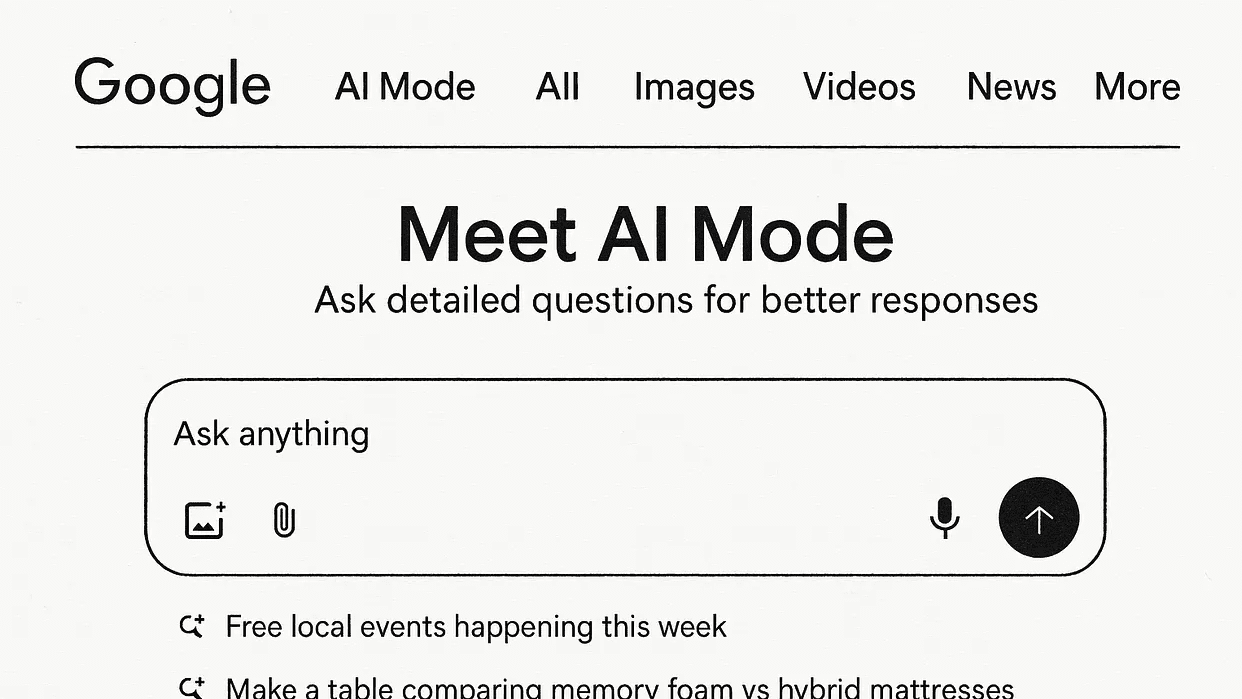
Image Credit: Kevin Indig
Executive Summary
Our new usability study of Google’s AI Mode reveals how profoundly this feature changes user behavior.
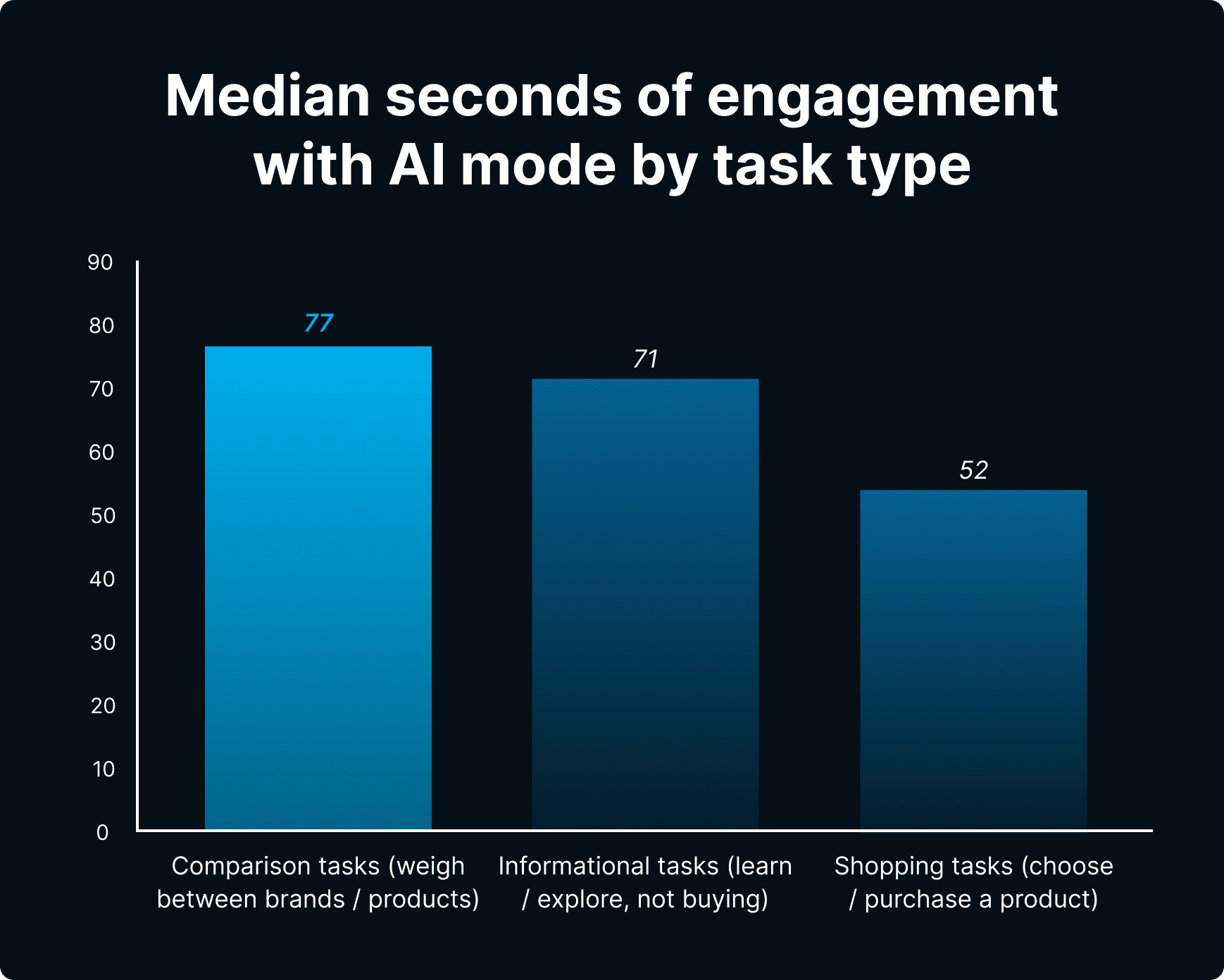
AI Mode holds attention and keeps users inside. In roughly three‑quarters of the total user sessions, users never left the AI Mode pane – and 88 % of users’ first interactions were with the AI‑generated text. Engagement was high: The median time by task type was roughly 52-77 seconds.
Clicks are rare and mostly transactional. The median number of external clicks per task was zero. Yep. You read that right. Ze-ro. And 77.6% of sessions had zero external visits.
People skim but still make decisions in AI Mode. Over half of the tasks were classified as “skimmed quickly,” where users glance at the AI‑generated summary, form an opinion, and move on.
AI Mode delivers “site types” that match intent. It’s not just about meeting search query or prompt intents; AI Mode is citing sources that fit specific site categories (like marketplaces vs review sites vs brands).
Visibility, not traffic, is the emerging currency. Participants made their brand judgments directly from AI Mode outputs.
TL;DR? These are the core findings from this study:
AI Mode is sticky.
Clicks are reserved for transactions.
AI Mode matches site type with intent.
Product previews act like mini product detail pages (aka PDPs).
But before we dig in, a quick shout-out here to the team behind this study.
Together with Eric Van Buskirk’s team at Clickstream Solutions, I conducted the first broad usability study of Google’s AI Mode that uncovers not only crucial insights into how people interact with the hybrid search/AI chat engine, but also what kinds of branded sites AI Mode surfaces and when.
I want to highlight that Eric Van Buskirk was the research director. While we collaborated closely on shaping the research questions, areas of focus, and methodology, Eric managed the team, oversaw the study execution, and delivered the findings. Afterward, we worked side by side to interpret the data.
Click data is a great first pass for analysis on what’s happening in AI Mode, but with this usability study specifically, we essentially looked “over the shoulder” of real-life users as they completed tasks, which resulted in a robust collection of data to pull insights from.
Boost your skills with Growth Memo’s weekly expert insights. Subscribe for free!
Google’s own Sundar Pichai has been crystal clear: AI Mode isn’t a toy; it’s a proving ground for what the core search experience will look like in the future.
On the Lex Fridman podcast, Pichai said (bolding mine):
“Our current plan is AI Mode is going to be there as a separate tab for people who really want to experience that… But as features work, we’ll keep migrating it to the main page…” [1]
Google has argued these new AI-focused features are designed to point users to the web, but in practice, our data shows that users stick around and make decisions without clicking out. In theory, this could not only impact click-outs to organic results and citations, but also reduce external clicks to ads.
Right now, according to Similarweb data, usage of the AI Mode tab on Google.com in the US has slightly dipped and now sits at just over 1%.
Google AIOs are now seen by more than 1.5 billion searchers every month, and they sit front and center. But engagement is falling. Users are spending less time on Google and clicking less pages.
But as Google rolls AI Mode out more broadly, it brings the biggest shift to Search (the biggest customer acquisition channel there is) ever.
Traditional SEO is highly effective in the new AI world, but if AI Mode really becomes the default, there is a chance we need to rethink our arsenal of tactics.
Preparing for the future of search means treating AI Mode as the destination (not the doorway), and figuring out how to show up there in ways that actually matter to real user behavior.
With this study, I sought out to discover and validate actual user behaviors within the AI Mode experience when undertaking a variety of tasks with differing search intents.
1. AI Mode Is Sticky
Image Credit: Kevin Indig
Key Stats
People read first and usually stay inside the AI Mode experience. Here’s what we found:
The majority of sessions had zero external visits: meaning, they didn’t leave AI Mode (at all).
~88% of users’ first interaction* within the feature was with the AI Mode text.
Typical user engagement within AI Mode is roughly 50 to 80 seconds per task.
These three stats define the AI Mode search surface: It holds attention and resolves many tasks without sending traffic.
*Here’s what I mean by “interaction:”
An “interaction” within the user tasks = the participant meaningfully engaged with AI Mode after it loaded.
What counts as an interaction: Reading or scrolling the AI Mode body for more than a quick glance, including scanning a result block like the Shopping Pack or Right Pane, opening a merchant card, clicking an inline link, link icon, or image pack.
What doesn’t count as an interaction: Brief eye flicks, cursor passes, or hesitation before engaging.
Users are in AI Mode to read – not necessarily to browse or search – with ~88% of sessions interacting with the output’s text first and spending one minute or more within the AI Mode experience.
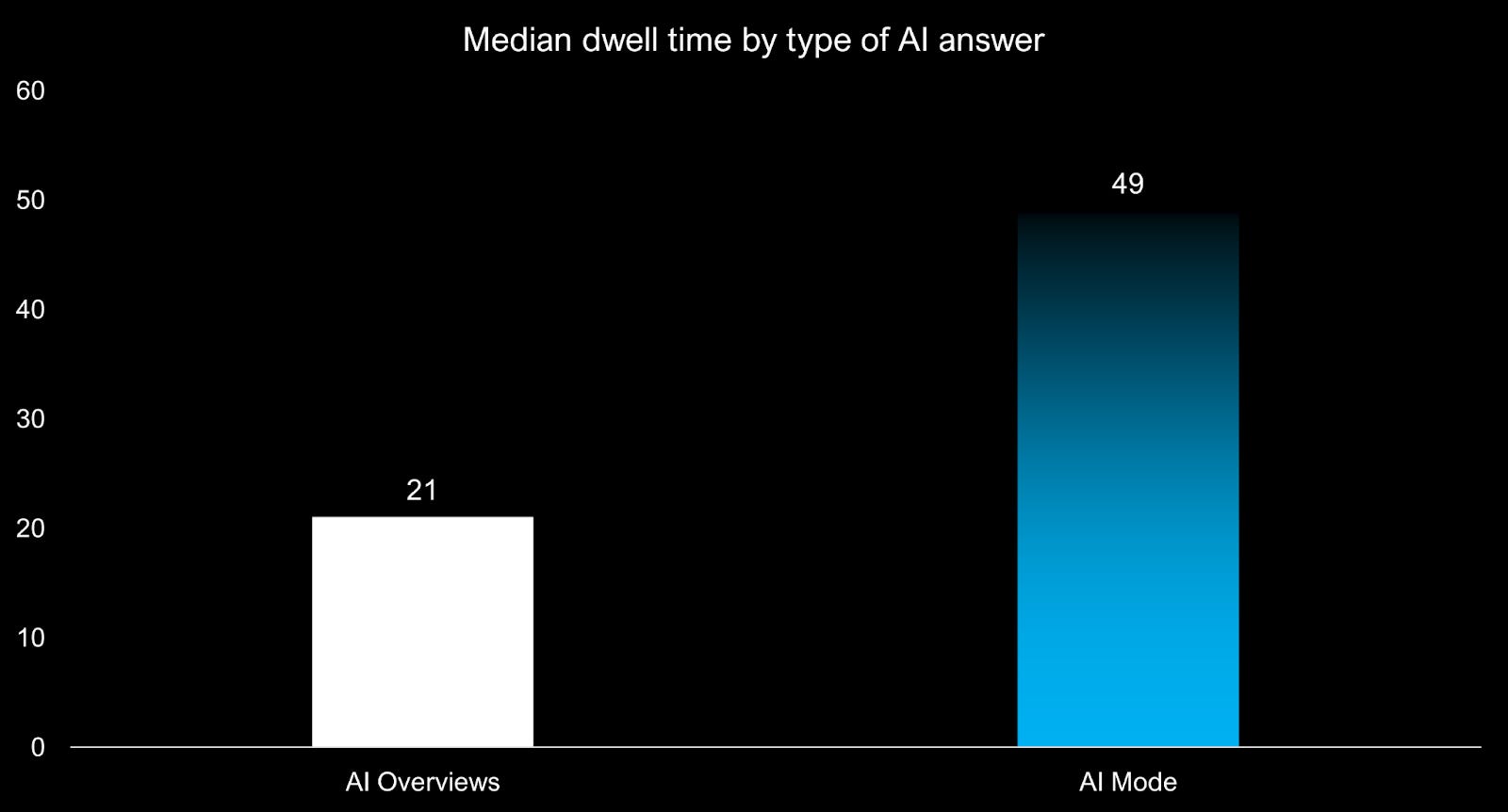
Plus, it’s interesting to see that users spend more than double the time in AI Mode compared to AIOs.
The overall engagement is much stronger.
Image Credit: Kevin Indig
Why It Matters
Treat the AI Mode panel like the primary reading surface, not a teaser for blue links.
AI Mode is a contained experience where sending clicks to websites is a low priority and giving users the best answer is the highest one.
As a result, it completely changes the value chain for content creators, companies, and publishers.
Insight
Why do other sources and/or AI Mode research analyses say that users don’t return to the AI Mode feature very often?
My theory here is that, because AI mode is a separate search experience (at least, for now), it’s not as visible as AIOs.
As AI Mode adoption increases with Google bringing Gemini (and AI Mode) into the browser, I expect our study findings to scale.
2. Clicks Are Reserved For Transactions
While clicks are scarce, purchase intent is not.
Participants in the study only clicked out when the task demanded it (e.g., “put an item in your shopping cart”) or if they browsed around a bit.
However, the browsing clicks were so few that we can safely assume AI Mode only leads to click-outs when users want to purchase.
Even prompts with a comparison and informational intent tend to keep users inside the feature.
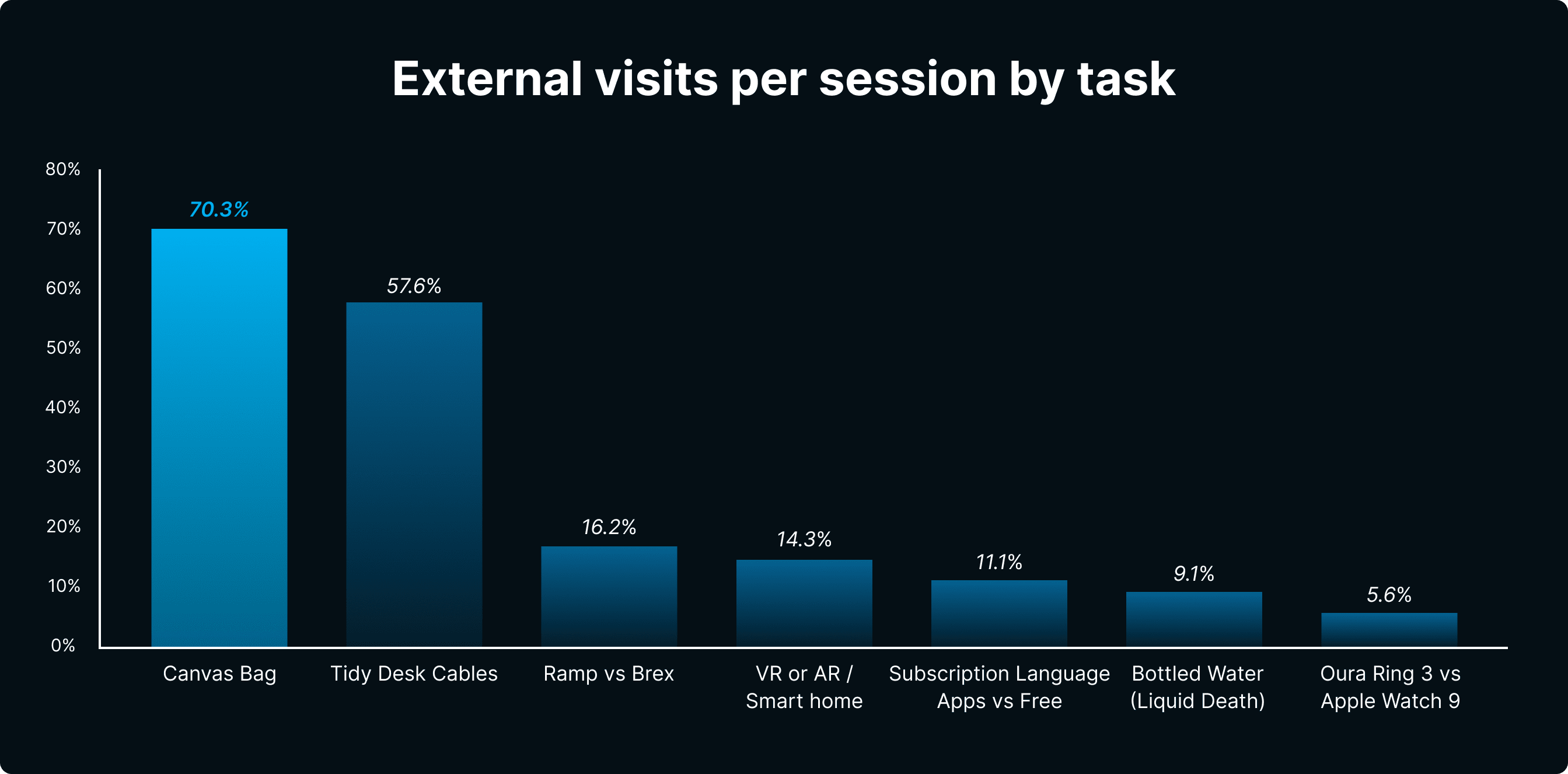
Shopping prompts like [canvas bag] and [tidy desk cables] drive the highest AI Mode exit share.
Comparison prompts like [Oura vs Apple Watch] show the lowest exit share of the tasks.
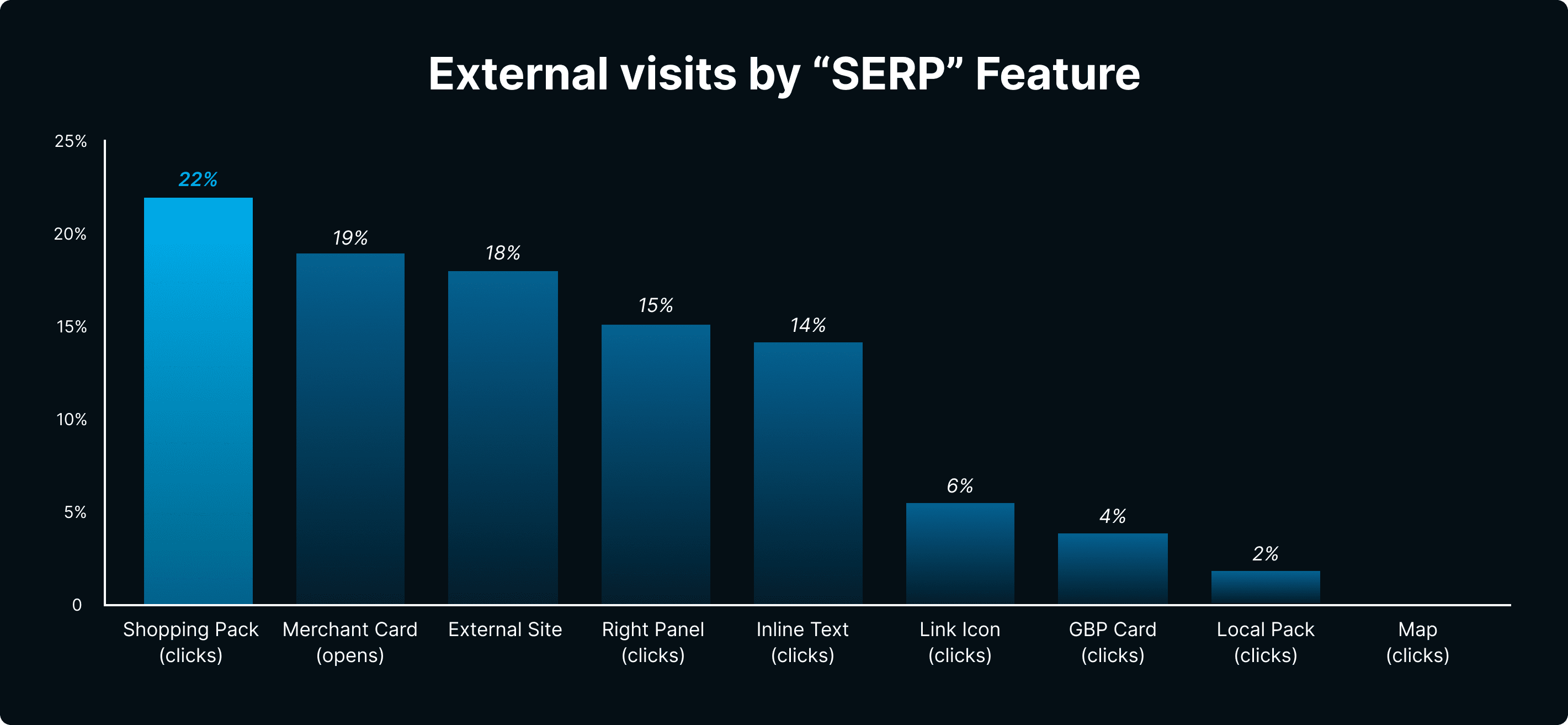
When participants were encouraged to take action (“put an item in your shopping cart” or “find a product”), the majority of clicks went to shopping features like Shopping Packs or Merchant Cards.
Image Credit: Kevin Indig
18% of exits were caused by users exiting AI Mode and going directly to another site, making it much harder to reverse engineer what drove these visits in the first place.
Study transcripts confirm that participants often share out loud that they’ll “go to the seller’s page,” or “find the product on Amazon/ebay” for product searches.
Even when comparing products, whether software or physical goods, users barely click out.
Image Credit: Kevin Indig
In plain terms, AI mode eats up all TOFU and MOFU clicks. Users discover products and form opinions about them in AI Mode.
Key Stats
Out of 250 valid tasks, the median number of external clicks was zero!
The prompt task of [canvas bag] had 44 external clicks, and [tidy desk cables] had 31 clicks, accounting for two-thirds of all external clicks in this study.
Comparison tasks like [Oura Ring vs Apple Watch] or [Ramp vs Brex] had very few clicks (≤6 total across all tasks).
Here’s what’s interesting…
In the AIOs Overviews usability study, we found desktop users click out ~10.6% of the time compared to practically 0% in AI Mode.
However, AIOs have organic search results and SERP Features below them. (People click out less in AIOs, but they click on organic results and SERP features more often.)
Zero-Clicks
AI Overviews: 93%*
AI Mode: ~100%
*Keep in mind that participants of the AIO usability study clicked on regular organic search results. The 93% relates to zero clicks within the AI Overview.
On desktop, AI Mode produces roughly double the in-panel clickouts compared to the AIO panel. On AIO SERPs, total clickouts can still happen via organic results below the panel, so the page-level rate will sit between the AIO-panel figure and the classic baseline.
An important note here from Eric Van Kirk, the director of this study: When comparing the AI Mode and AI Overview study, we’re not exactly comparing apples to apples. In this study, participants were given tasks that would prompt them to leave AI Mode in 2/7 questions, and that accounts for the majority of outbound clicks (which were fewer than three external clicks). On the other hand, for the AIO study, the most transactional question was “Find a portable charger for phones under $15. Search as you typically would.” They were not told to “put it in a shopping cart.” However, the insights gathered regarding user behavior from this AI Mode study – and the pattern that users don’t feel the need to click out of AI Mode to make additional decisions – still stands as a solid finding.
The bigger picture here is that AIOs are like a fact sheet that steers users to sites eventually, but AI Mode is a closed experience that rarely has users clicking out.
What makes AI Mode (and ChatGPT, by the way) tricky is when users abandon the experience and go directly to websites. It messes with attribution models and our ability to understand what influences conversions.
3. AI Mode Matches Site Type With Intent
In the study, we assess what types of sites AI Mode shows for our seven tasks.
Subscription language apps vs free: pcmag.com, nytimes.com, usatoday.com.
Bottled Water (Liquid Death): reddit.com, liquiddeath.com, youtube.com.
Ramp vs Brex: nerdwallet.com, kruzeconsulting.com, airwallex.com.
Oura Ring 3 vs Apple Watch 9: ouraring.com, zdnet.com.
VR arcade or smart home: sandboxvr.com, business.google.com, yodobashi.com.
Companies need to understand the playing field. While classic SEO allowed basically any site to be visible for any user intent, AI Mode has strict rules:
Brands beat marketplaces when users know what product they want.
Marketplaces are preferred when options are broad or generic.
Review sites appear for comparisons.
Opinions highlight Reddit and publishers.
Google itself is most visible for local intent, and sometimes shopping.
As SEOs, we need to consider how Google classifies our site based on its page templates, reputation, and user engagement. But most importantly, we need to monitor prompts in AI Mode and look at the site mix to understand where we can play.
Sites can’t and won’t be visible for all types of queries in a topic anymore; you’ll need to filter your strategy by the intent that aligns with your site type because AI Mode only shows certain sites (like review sites or brands) for specific types of intent.
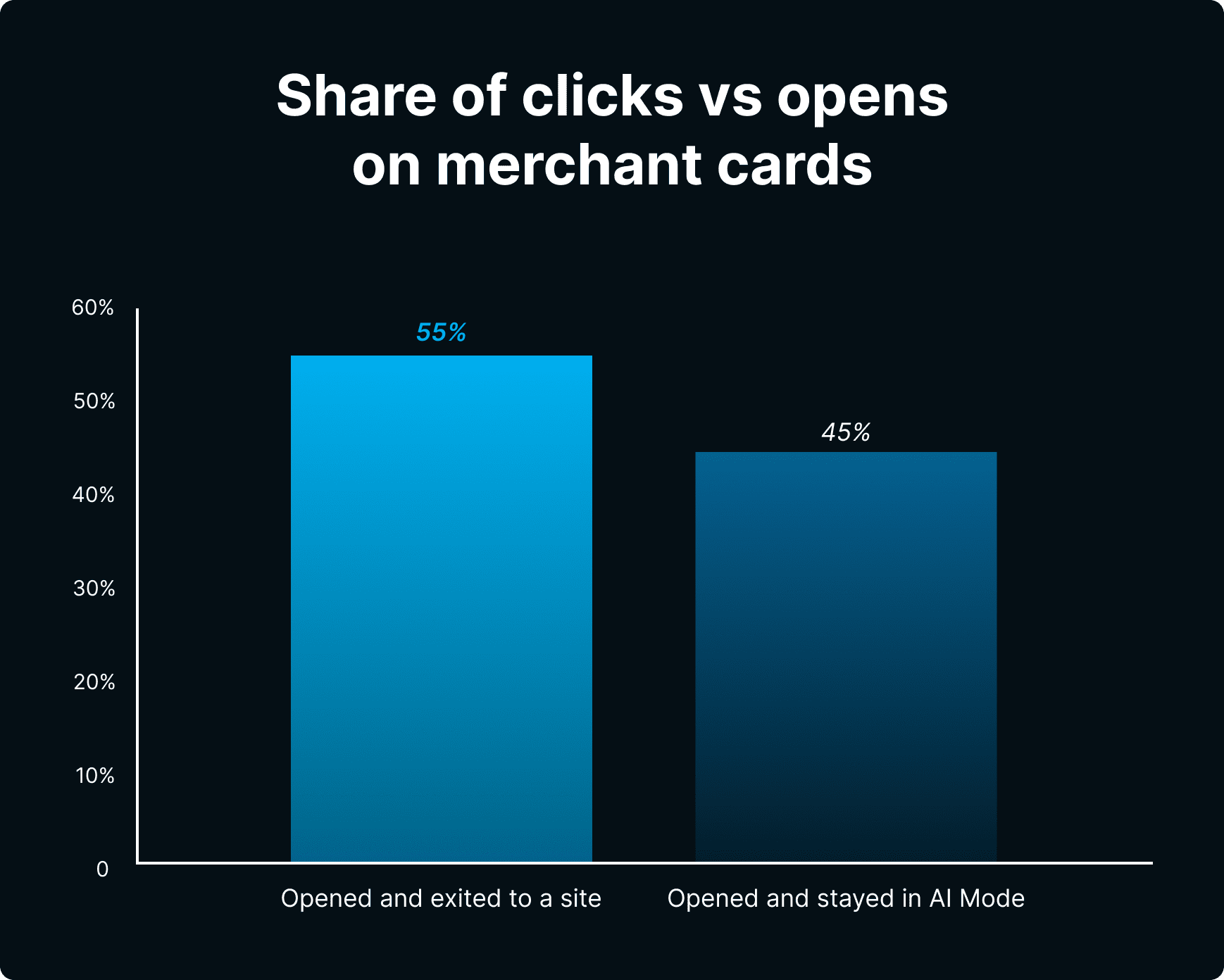
Product previews show up in about 25% of the AI Mode sessions, get ~9 seconds of attention, and people usually open only one.
Then? 45% stop there. Many opens are quick spec checks, not a clickout.
Image Credit: Kevin Indig
You can easily see how some product recommendations by AI Mode and on-site experiences are quite frustrating to users.
The post-click experience is critical: classic best practices like reviews have a big impact on making the most out of the few clicks we still get.
See this example:
“It looks like it has a lot of positive reviews. That’s one thing I would look at if I was going to buy this bag. So this would be the one I would choose.”
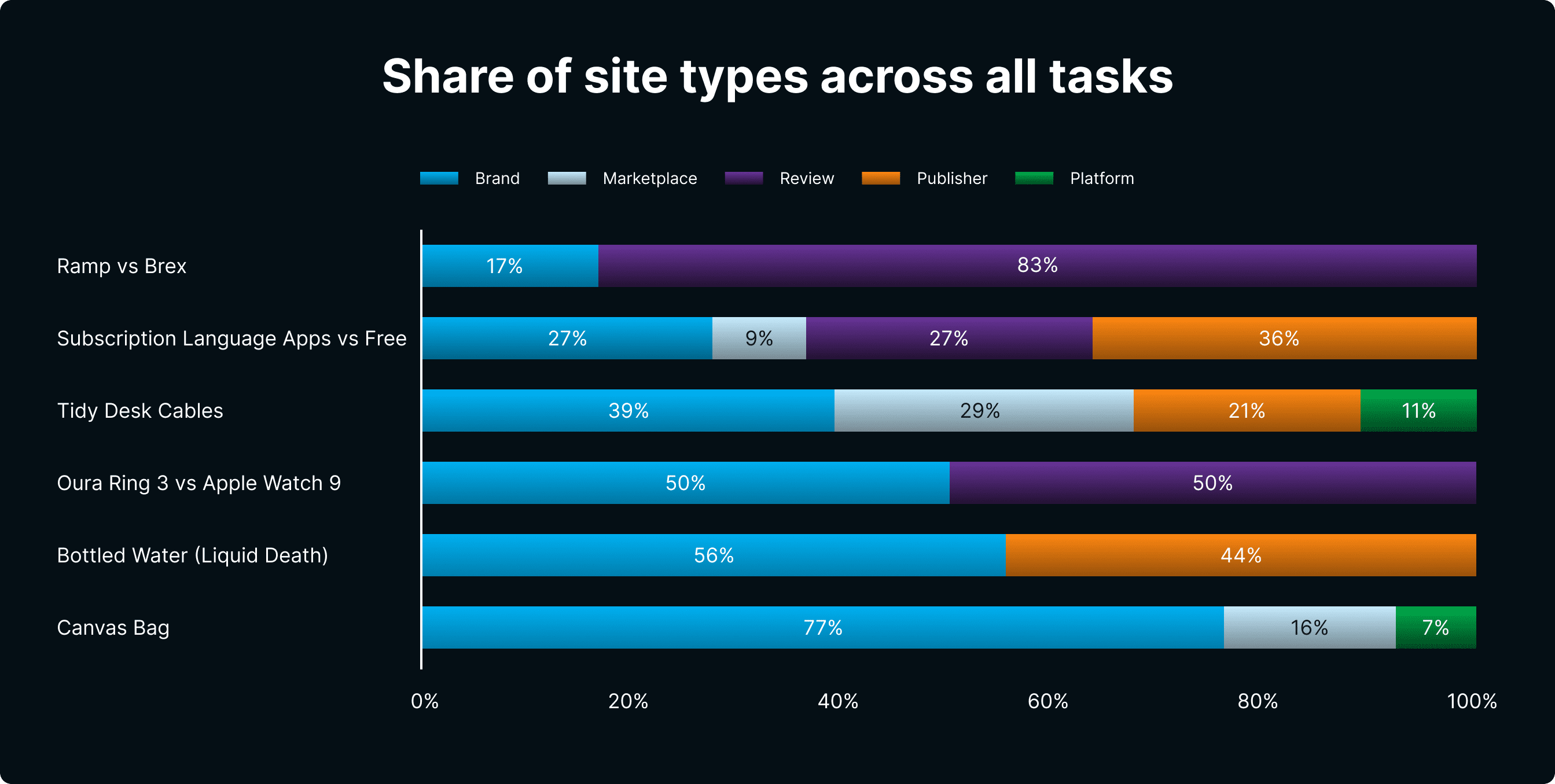
In shopping tasks, we found that brand sites take the majority of exits.
In comparison tasks, we discovered that review sites dominate. For reputation checks (like a prompt for [Liquid Death]), exits to brands and publishers were split.
For transactional intent prompts: Brands absorb most exits when the task is to buy one item now. [Canvas Bag] shows a strong tilt to brand PDPs.
For reputation intent prompts: Brand sites appear alongside publishers. A prompt for [Liquid Death] splits between liquiddeath.com and Reddit/YouTube/Eater.
For comparison prompts: Brands take a back seat. [Ramp vs Brex] exits go mostly to review sites like NerdWallet and Kruze.
Given users can now directly checkout on ChatGPT and AI Mode, shopping-related tasks might send even fewer clicks out.[2, 3]
Therefore, AI Mode becomes a completely closed experience where even shopping intent is fulfilled right in the app.
Clicks are scarce. Influence is plentiful.
The data gives us a reality check: If users continue to adopt the new way of Googling, AI Mode will reshape search behavior in ways SEOs can’t afford to ignore.
Strategy shifts from “get the click” to “earn the citation.”
Comparisons are for trust, not traffic. They reduce exits because users feel informed inside the panel.
Merchants should optimize for decisive exits. Give prices, availability, and proof above the fold to convert the few exits you do get.
You’ll need to earn citations that answer the task, then win the few, high-intent exits that remain.
But our study doesn’t end here.
Today’s results reveal core insights into how people interact with AI Mode. We’ll unpack more to consider with Part 2 dropping next week.
But for those who love to dig into details, the methodology of the study is included below.
Methodology
Study Design And Objective
We conducted a mixed-methods usability study to quantify how Google’s new AI Mode changes searcher behavior. Each participant completed seven live Google search prompts via the AI Mode feature. This design allows us to observe both the mechanics of interaction (scrolls, clicks, dwell, trust) and the qualitative reasoning participants voiced while completing tasks.
The tasks:
What do people say about Liquid Death, the beverage company? Do their drinks appeal to you?
Imagine you’re going to buy a sleep tracker and the only two available are the Oura Ring 3 or the Apple Watch 9. Which would you choose, and why?
You’re getting insights about the perks of a Ramp credit card vs. a Brex Card for small businesses. Which one seems better? What would make a business switch from another card: fee detail, eligibility fine print, or rewards?
In the “Ask anything” box in AI Mode, enter “Help me purchase a waterproof canvas bag.” Select one that best fits your needs and you would buy (for example, a camera bag, tote bag, duffel bag, etc.).
Proceed to the seller’s page. Click to add to the shopping cart and complete this task without going further.
Compare subscription language apps to free language apps. Would you pay, and in what situation? Which product would you choose?
Suppose you are visiting a friend in a large city and want to go to either: 1. A virtual reality arcade OR 2. A smart home showroom. What’s the name of the city you’re visiting?
1. Suppose you work at a small desk and your cables are a mess. 2. In the “Ask anything” box in AI Mode, enter: “The device cables are cluttering up my desk space. What can I buy today to help?” 3. Then choose the one product you think would be the best solution. Put it in the shopping cart on the external website and end this task.
Thirty-seven English-speaking U.S. adults were recruited via Prolific between Aug. 20 and Sept. 1, 2025 (including participants in a small group who did pilot studies).*
Eligibility required a ≥ 95% Prolific approval rate, a Chromium-based browser, and a functioning microphone. Participants visited AI Mode and performed tasks remotely via their desktop computer; invalid sessions were excluded for technical failure or non-compliance. The final dataset contains over 250 valid task records across 37 participants.
*Pilot studies are conducted first in remote usability testing to identify and fix technical issues – like screen-sharing, task setup, or recording problems – before the main study begins. They help refine task wording, timing, and instructions to ensure participants interpret them correctly. Most importantly, pilot sessions confirm that the data collected will actually answer the research questions and that the methodology works smoothly in a real-world remote setting.
Sessions ran in UXtweak’s Remote unmoderated mode. Participants read a task prompt, clicked to Google.com/aimode, prompted AI Mode, and spoke their thoughts aloud while interacting with AI Mode. They were given the following directions: “Think aloud and briefly explain what draws your attention as you review the information. Speak aloud and hover your mouse to indicate where you find the information you are looking for.” Each participant completed seven task types designed to cover diverse intent categories, including comparison, transactional, and informational scenarios.
UXtweak recorded full-screen video, cursor paths, scroll events, and audio. Sessions averaged 20-25 minutes. Incentives were competitive. Raw recordings, transcripts, and event logs were exported for coding and analysis.
Three trained coders reviewed each video in parallel. A row was logged for UI elements that held attention for ~5 seconds or longer. Variables captured included:
Structural: Fields describing the setup, metadata, or structure of the study – not user behavior; include data like participant-ID, task-ID, device, query, order of UI elements clicked or visited during the task, type of site clicked (e.g., social, community, brand, platform), domain name of the external site visited, and more.
Feature: Fields describing UI elements or interface components that appeared or were available to the participant. Examples include UI element type, including shopping carousels, merchant cards, right panel, link icons, map embed, local pack, GMB card, merchant packs, and merchant cards.
Engagement: Fields that capture active user interaction, attention, or time investment. Includes reading and attention, chat and question behavior, along with click and interaction behavior.
Outcome: Fields representing user results, annotator evaluations, or interpretation of behavior. Annotator comments, effort rating, where info was found.
Coders also marked qualitative themes (e.g., “speed,” “skepticism,” “trust in citations”) to support RAG-based retrieval. The research director spot-checked ~10% of videos to validate consistency.
Annotations were exported to Python/pandas 2.2. Placeholder codes (‘999=Not Applicable’, ‘998=Not Observable’) were removed, and categorical variables (e.g., appearances, clicks, sentiment) were normalized. Dwell times and other time metrics were trimmed for extreme outliers. After cleaning, ~250 valid task-level rows remained.
Our retrieval-augmented generation (RAG) pipeline enabled three stages of analysis:
Data readiness (ingestion): We flattened every participant’s seven tasks into individual rows, cleaned coded values, and standardized time, click, and other metrics. Transcripts were retained so that structured data (such as dwell time) could be associated with what users actually said. Goal: create a clean, unified dataset that connects behavior with reasoning.
Relevance filtering (retrieval): We used structured fields and annotations to isolate patterns, such as users who left AI Mode, clicked a merchant card, or showed hesitation. We then searched the transcripts for themes such as trust, convenience, or frustration. Goal: combine behavior and sentiment to reveal real user intent.
Interpretation (quant + qual synthesis): For each group, we calculated descriptive stats (dwell, clicks, trust) and paired them with transcript evidence. That’s how we surfaced insights like: “external-site tasks showed higher satisfaction but more CTA confusion.” Goal: link what people did with what they felt inside AI Mode.
This pipeline allowed us to query the dataset hyperspecifically – e.g., “all participants who scrolled >50% in AI Mode but expressed distrust” – and link quantitative outcomes with qualitative reasoning.
In plain terms: We can pull up just the right group of participants or moments, like “all the people who didn’t trust AIO” or “everyone who scrolled more than 50%.”
We summarized user behavior using descriptive and inferential statistics across 250 valid task records. Each metric included the count, mean, median, standard deviation, standard error, and 95% confidence interval. Categorical outcomes, such as whether participants left AI Mode or clicked a merchant card, were reported as proportions.
Analyses covered more than 50 structured and behavioral fields – from device type and dwell time to UI interactions, sentiment. Confidence measures were derived from a JSON analysis of user sentiment via transcripts of all users.
Each task was annotated by a trained coder and spot-checked for consistency across annotators. Coder-level distributions were compared to confirm stable labeling patterns and internal consistency.
Thirty-seven participants completed seven tasks each, resulting in approximately 250 valid tasks. At that scale, proportions around 50% carry a margin of error of about six percentage points, giving the dataset enough precision to detect meaningful directional differences.
Sample size is smaller than our AI Overviews study (37 vs. 69 participants) and is meant to learn about U.S.-based users (all participants were living in the U.S.). All queries took place within AI Mode, meaning we did not directly compare AI vs non-AI conditions. Think-aloud may inflate dwell times slightly. RAG-driven coding is only as strong as its annotation inputs, though heavy spot-checks confirmed reliability.
Participants gave informed consent. Recordings were encrypted and anonymized; no personally identifying data were retained. The study conforms to Prolific’s ethics policy and UXtweak TOS.
Featured Image: Paulo Bobita/Search Engine Journal
People log into social networks to hear from people, not from brands. They want to connect with their friends, families, and communities. They want to see content that relates to their interests and passions, and speaks to them in some way.
If your post sounds like it was written by a committee of businesspeople and then edited by a team of lawyers, before being approved by your board, no one is going to pay attention – much less purchase your product.
If you want to connect with humans, you need to speak like a human.
Creating Human-Centered Content
This is all well and good, but what does it mean to “be human” on social media? We are all human. How can we be anything else?
While most marketers will have their own definitions of what these two terms mean to them, for the purposes of this book, here are mine:
Human content:Social media content that speaks with a real human voice and not one that sounds like corporate speak or legalese. It speaks to its audience and not at them in a voice that is clear, easy to understand, and unafraid to show emotion or opinion.
Authentic content: Social media content that is true to the voice of the brand speaking. It doesn’t pander, change drastically, or try to be something it’s not, but rather fully embraces its identity and doesn’t shy away from it.
Why are these things important? Because people connect with people they trust. If your brand sounds like every post was written by committee, then run through multiple departments for approval, and then rewritten by legal, the connection is lost. And if your brand tries to be something it’s not, your audience will smell it out from miles away and not be shy about telling you what they think of it.
But if you are human and authentic, something almost magical happens. Your audience stops thinking of you as a brand trying to sell them something and starts thinking of you as a trusted connection.
Create Content For Audiences, Not Algorithms
If there is one evergreen rule of social media algorithms, it’s this: Social media algorithms favor content that keeps users on the platform longer. This only makes sense. Social media platforms are not in the business of helping your business for free. They are in the business of providing eyeballs for paid advertising.
In this respect, social media platforms aren’t that different from old-school broadcast television networks. If audiences find your content interesting and it keeps users on the platform longer, the algorithm will move it to prime time by placing it in the feeds of more users. But if your content fails to keep users on the platform, as demonstrated by view time and engagement, the algorithm will stop showing it.
Trying to tailor all your content to fit the whims of the social media algorithms is at best a Sisyphean task, because even if you somehow master it, the algorithms will change again, and you’ll be back to square one.
So, what’s a frustrated social media manager to do?
I propose that we all stop worrying about and focusing so much time and attention on social media algorithms and instead, put that energy into creating content that appeals to our target audience. Too many social media managers are creating content for the algorithms and not the audiences they serve. This leads to content that is homogenous, bland, and boring.
You can’t paint-by-numbers your way to social media success. The algorithm is out of your control, and focusing too much on pleasing the algorithm often means you are not focusing enough on pleasing your audience.
After all, we are making content for humans, not algorithms.
Avoid The Hard Sell
No one opens Facebook or any other social network on their phone hoping to be sold to. They are there to see updates from family and friends, catch up on the news, or learn more about the things that interest them – and your posts just happen to be alongside those things. So, if you try to sell them your product with every post, demanding that they “Buy now!” like some old-school infomercial pitchman, your content is going to get ignored.
We must never fail to remember that, as brands, we are at best only guests in our audience’s social media feeds and at worst we are intruders. We can’t lose sight of the fact that by following our brands, users are granting us the privilege of showing up in their social media feeds each day. We abuse this privilege at our peril. When we only share self-promotional, hard-sell content, we are being poor guests.
But when we show up with content that is entertaining, educational, human, and personable, we become the type of guests that our followers are eager to invite into their social media feeds and tell their friends about as well. We must always be respectful and mindful of the fact that, by following us, our audience has granted us a privilege that we must continue to earn with each post – lest they decide to kick us out by pressing the unfollow button.
Know Your Audience
You can’t speak to your audience if you don’t listen to them first. What are their likes and dislikes, challenges, frustrations, interests, etc.? Do they skew older or younger? Male or female? Liberal or conservative? Urban or rural? Do a deep dive into your audience. If you can, hang out in the places they are online. Join the Facebook groups they are in. Scroll the subreddits they post on. Read the comments on the YouTube videos they watch. You might even consider going undercover and creating burner accounts to join their Facebook groups and Discord servers to see what they are talking about.
This is a lot easier if you run social media for a sports team or film franchise where fan groups and subreddits abound, but every industry has a community, and just because a community might be small, it doesn’t mean it can’t be loud about voicing its thoughts and opinions. Seriously – there are online communities for people who like scented candles. They are called “fandles,” and if they have groups dedicated to their interest, your brand has people out there dedicated to your industry. Find them and listen to them. These communities may not be as large as those for film franchises or sports teams, but they are no less passionate.
Take the time to learn about your audience: their likes and dislikes, their inside jokes, the language they use or avoid. Get to know their community and the leaders in it. You’ll quickly find that’s worth the effort.
Interact With Your Followers
Unlike television, print, or radio, users can talk back. And by creating and maintaining social media accounts for your brand, you are telling your customers that you want them to do so. If you don’t reply and interact with them, it’s like if you posted your phone number on billboards all around town but never picked up the phone when it rang. Eventually, people are just going to stop calling.
While you don’t need to reply to every single comment you receive, you should make an effort to engage with as many comments as possible and do so in language that is clear, friendly, and conversational, not stilted, reserved, and corporate. Remember that you are a human talking to other humans. It’s social media, not a board meeting.
Remember The Real Reason People Share Content
Here’s a secret most people forget about social media marketing. People don’t share content to help your brand. They share content to say something about themselves. They want to tell their friends and followers that they are the kind of person who has a certain type of humor, cares about certain issues, is interested in certain things. They share content that helps them tell the world who they are. If you help them tell their own story, they will help you tell yours.
If your content tugs at the heartstrings, makes someone chuckle, or teaches your audience something new, they are more likely to share it because it resonates with them and helps them better represent themselves online – not because they want to help your brand get the word out about a new product. No one shares the ad for a used car lot that demands you buy today before the deal ends. But the ad that makes them laugh or cry? That’s the one they share with their friends.
Be Willing To Poke Fun At Yourself
Authenticity requires a certain amount of vulnerability, and for brands, that’s terrifying. No one wants to draw attention to their own flaws and weaknesses, but for brands, often some self-deprecating humor can have the opposite effect. Acknowledging your flaws can often deflect criticism and help your brand to come across as self-aware – which is a very human trait.
When onboarding new clients, one of the first questions I often ask is, “What about your brand – are you okay with making fun of it?” And while this might be seen as a risky question to ask new clients, it’s a profoundly important one. The answer tells you a lot about a brand and how it perceives itself versus how its audience perceives it.
Once you know where a brand’s limits are, you can use self-deprecating humor to help humanize your brand. Start small, maybe by referencing a flaw you are comfortable with making fun of in a reply to a comment or question, then try it out on a post on your main feed. Measure the response from your followers carefully and use your best judgment.
Share User-Generated Content (Ethically)
Sharing user-generated content provides several advantages for brands. Not only does it save them time creating content themselves, often your audience will come up with ideas for content that you may have never thought of. Not only that, sharing content from your followers adds both humanity and authenticity to your social media efforts.
These posts come from real people who actually use your product and are giving their honest view of it. While you might vet what content you choose to share, the posts you are sharing are coming from real people and not filtered through corporate bureaucracy. The content feels real and trustworthy because it’s coming from a real place.
Additionally, by sharing user-generated content, you are encouraging followers to create more of their own content. As your followers see the user-generated content you share, they will be encouraged to create their own in hopes that you will share their content as well. Content begets more content.
You can even encourage user-generated content on print materials, packaging, and at your physical locations. Just a simple message with “Share your experience on social media! Tag [insert your social handle here]” can go a long way to get followers to post themselves using your product or in your store.
However, there are a few important things to keep in mind when sharing user-generated content.
First, be sure to vet those you share content from. Before reaching out to them, do a brief check of their social accounts to make sure they are someone you want to associate your brand with. If they post a lot of inflammatory content, conspiracy theories, or racy photos, you may want to think twice before sharing their content.
And while you might want to repost that tweet about how much someone loves your product, also be sure to check their username before hitting that repost button. The last thing you want to do is share a post from someone calling themselves @puppyhater42069.
You might also consider sending some free product or promotional merchandise to those you share content from. Not only is this a good way to thank them, but it could also lead to more content from them as well. That $25 you spent sending them a t-shirt is well worth the post they eventually make of them wearing it, right?
Chances are, your customers are already creating content about your brand, so why not put it to use?
To read the full book, SEJ readers have an exclusive 25% discount code and free shipping to the US and UK. Use promo code “SEJ25” at koganpage.com here.
Search Atlas held an event last week to showcase new capabilities and improvements to their SEO platform which make it easier for digital marketer to scale SEO and take on more clients.
The new features enable marketers to more easily handle on-page and off-page SEO, paid search, impact and track LLM visibility, and scale Google Business Profile management, and that’s just a sample of all the new functionalities coming to the platform.
Auto PPC Retargeting
Search Atlas introduced a new new retargeting feature in Otto PPC. This new feature is designed for agencies and advertisers that are managing paid media. It simplifies campaign setup with a quick-start wizard that enables retargeting site visitors, which they claim can be launched in under 60 seconds.
Manick Bhan, founder of Search Atlas explained:
“The hardest thing about taking paid media business from a client is doing it justice, doing a good job, right? Because every time they get a click, they’re paying for it. The best way that you can show a client ROI on paid media is through retargeting. Run a retargeting campaign, retargeting the traffic that they already have on their website.
We wanted to be able to make this easy for you, so all you have to do is enable it inside Otto PPC, and you’re able to run retargeting campaigns now. So we have a wizard set up for you — just a couple clicks and you can launch a retargeting campaign in less than 60 seconds. It’s that easy.”
GBP Galactic
Search Atlas announced a feature for digital marketers who handle Google Business Profiles for clients. The GBP Galactic feature now has Service Area Business (SAB) support. GBP Galactic offers integration with social media auto-posting to Facebook and Instagram, with plans to add more social networks soon.
Bhan explained the social network autoposting:
“We’ve learned the LLMs they want to see your information not just on your website and GBP profile, they want to see your data in the social media platforms.. So what we can do now is, one time, build our GBP posts, and publish to all social networks, which will increase your visibility in the LLMs. And instead of having to use third-party tools to do this, it will be completely integrated.”
Bhan also shared about their citation network:
“We also added support for service area businesses in our citations product, so now you can even build aggregator network citations and put yourself into the aggregator networks for your service businesses… Because normally these aggregator networks, they want an address. We figured out how to do it so we can get you in without one. Pretty cool.
…ChatGPT, Claude, all the LLMs pay for the data from all the aggregator networks. So if you want to put your local business into the aggregators, as well as into all the websites, the aggregator networks are a shortcut to being able to do that and upload directly to ChatGPT.”
LLM Visibility
Another useful feature is LLM Visibility tracking and sentiment analysis. LLM visibility is now measurable directly in Search Atlas. It also tracks brand presence across ChatGPT, Claude, and other LLMs and is able to identify visibility trends beyond Google Search.
Expanded Press Release Network
Bhan announced that Signal Genesys, a press release company they acquired last year, has expanded their distribution to financial news and with a local news media network.
Bhan commented:
“The financial news network costs a whopping $10. And then the news media network costs about $20. So these are really cost-effective, especially for agencies. If you are working with clients and you need to keep prices low for yourselves, there’s a lot of margin in there for you.
And these networks in particular we found were indexed very well in ChatGPT.”
On-Page SEO
Interesting feature launched in their Otto product is a module called Domain Knowledge Network which assists users in building topical relevance with a semantic interface, just speak instructions to it and it will analyze the brand and suggest a content topic structure.
Revamped WordPress Plugin
Their WordPress plugin has been overhauled to make it more user-friendly. It now includes one-click installation to connect WordPress directly to Search Atlas, two-way synchronization that keeps Otto data and WordPress in sync in real time, and auto-publishing that enables SEO fixes generated in Otto to be deployed directly into WordPress.
Universal CMS Integration
Search Atlas is aiming to become CMS-agnostic, able to integrate with any website regardless of the CMS for publishing blog posts and landing pages in one click through their Content Genius feature. Right now Search Atlas can work with Drupal, HubSpot, Magento, Wix, and WordPress. They are also testing to integrate with Joomla, Shopify, and Webflow. Soon they’ll be able to integrate with ClickFunnels, Contentful, Duda, Ghost, and Salesforce.
Near Future: Otto Agent
Otto Agent represents the future of Search Atlas’s agentic revolution, replacing traditional UI-driven workflows with natural-language commands. It’s currently available as a beta program. Users can speak to the platform (via text or voice) to perform SEO actions directly. Otto Agent can execute end-to-end actions: site audits, fixes, title/meta/image optimization, GBP posts, and content generation.
Spending the day listening to their presentations, it became evident that Otto Agent typified Search Atlas’s approach toward developing an SEO platform that is useful. Having come from an SEO agency background, they understand what agencies need and aren’t waiting for competitors to do things first, they’re just moving forward with features that they feel agencies will find useful.
Otto Agent is an example of that forward-looking approach because it’s built on the idea that managing SEO will become agentic, conversational, and autonomous.
I didn’t know that much about Search Atlas before attending the event but now I have a better understanding of why so many agencies embrace Search Atlas.
It’s a foregone conclusion that the world will not meet the goals for limiting emissions and global warming laid out in the 2015 Paris Agreement. Many people want to blame politicians and corporations for this failure, but there’s an even more fundamental reason: We don’t have all the technological tools we need to do it, and many of the ones we do have are too expensive.
For all the progress the world has made on renewable energy sources, electric vehicles, and electricity storage, we need a lot more innovation on every front—from discovery to deployment—before we can hope to reach our ultimate goal of net-zero emissions.
But I don’t think this is a reason to be pessimistic. I see it as cause for optimism, because humans are very good at inventing things. In fact, we’ve already created many tools that are reducing emissions. In just the past 10 years, energy breakthroughs have lowered the global forecast for emissions in 2040 by 40%. In other words, because of the human capacity to innovate, we are on course to reduce emissions substantially by 2040 even if nothing else changes.
And I am confident that more positive changes are coming. I’ve been learning about global warming and investing in ideas to stop it for the past 20 years. I’ve connected with unbiased scientists and innovators who are committed to preventing a climate disaster. Ten years ago, some of them joined me in creating Breakthrough Energy, an investment group whose sole purpose is to accelerate clean energy innovation. We’ve supported more than 150 companies so far, many of which have blossomed into major businesses such as Fervo Energy and Redwood Materials, two of this year’s Companies to Watch. [Editor’s note: Mr. Gates did not participate in the selection process of this year’s companies and was not aware that two Breakthrough investments had been selected when he agreed to write this essay.]
Yet climate technologies offer more than just a public good. They will remake virtually every aspect of the world’s economy in the coming years, transforming energy markets, manufacturing, transportation, and many types of industry and food production. Some of these efforts will require long-term commitments, but it’s important that we act now. And what’s more, it’s already clear where the opportunities lie.
In the past decade, an ecosystem of thousands of innovators, investors, and industry leaders has emerged to work on every aspect of the problem. This year’s list of 10 Climate Tech Companies to Watch shows just a few of the many examples.
Although much of this innovation ecosystem has matured on American shores, it has become a global movement that won’t be stopped by new obstacles in the US. It’s unfortunate that governments in the US and other countries have decided to cut funding for climate innovations and reverse some of the policies that help breakthrough ideas get to scale. In this environment, we need to be more rigorous than ever about spending our time, money, and ingenuity on efforts that will have the biggest impact.
How do we figure out which ones those are? First, by understanding which activities are responsible for the most emissions. I group them into five categories: electricity generation, manufacturing, transportation, agriculture, and heating and cooling for buildings.
Of course, the zero-carbon tools we have today aren’t distributed evenly across these sectors. In some sectors, like electricity, we’ve made a great deal of progress. In others, like agriculture and manufacturing, we’ve made much less. To compare progress across the board, I use what I call the Green Premium, which is the difference in cost between the clean way of doing something and the conventional way that produces emissions.
For example, sustainable aviation fuel now costs more than twice as much as conventional jet fuel, so it has a Green Premium of over 100%. Solar and wind power have grown quickly because in many cases they’re cheaper than conventional sources of electricity—that is, they have a negative Green Premium.
The Green Premium isn’t purely financial. To be competitive, clean alternatives also need to be as practical as what they’re replacing. Far more people will buy EVs once you can charge one up as quickly as you can fill your tank with gasoline.
I think the Green Premium is the best way to identify areas of great impact. Where it’s high, as in the case of jet fuel, we need innovators and investors to jump on the problem. Where it’s low or even negative, we need to overcome the barriers that are keeping the technologies from reaching a global scale.
A new technology has to overcome a lot of challenges to beat the incumbents, but being able to compete on cost is absolutely essential. So if I could offer one piece of advice to every company working on zero-carbon technologies, it would be to focus on lowering and eliminating the Green Premium in whatever sector you’ve chosen. Think big. If your technology can be competitive enough to eventually eliminate at least 1% of global emissions per year—that’s 0.5 gigatons—you’re on the right track.
I’d encourage policymakers to bring this sector-by-sector focus on the Green Premium to their work, too. They should also protect funding for clean technologies and the policies that promote them. This is not just a public good: The countries that win the race to develop these breakthroughs will create jobs, hold enormous economic power for decades to come, and become more energy independent.
In addition, young scientists and entrepreneurs should think about how they can put their skills toward these challenges. It’s an exciting time—the people who begin a career in clean technology today will have an enormous impact on human welfare. If you need pointers, the Climate Tech Atlas published last month by Breakthrough Energy and other partners is an excellent guide to the technologies that are essential for decarbonizing the economy and helping people adapt to a warmer climate.
Finally, I’d encourage investors to put serious money into companies with technologies that can meaningfully reduce the Green Premium. Consider it an investment in what will be the biggest growth industry of the 21st century. Companies have made dramatic progress on better and cleaner solutions in every sector; what many of them need now is private-sector capital and partnerships to help them reach the scale at which they’ll have a real impact on emissions.
So if I could offer one piece of advice to every company working on zero-carbon technologies, it would be to focus on lowering and eliminating the Green Premium in whatever sector you’ve chosen.
Transforming the entire physical economy is an unprecedented task, and it can only be accomplished through markets—by supporting companies with breakthrough ideas that beat fossil fuels on cost and practicality. It’s going to take investors who are both patient and willing to accept the risk that some companies will fail. Of course, governments and nonprofits have a role in the energy transition too, but ultimately, our success will hinge on climate innovators’ ability to build profitable companies.
If we get this right—and I believe we will—then in the next decade, we’ll see fewer news stories about missed emissions targets and more stories about how emissions are dropping fast because the world invented and deployed breakthrough ideas: clean liquid fuels that power passenger jets and cargo ships; neighborhoods built with zero-emissions steel and cement; fusion plants that generate an inexhaustible supply of clean electricity.
Not only will emissions fall faster than most people expect, but hundreds of millions of people will be able to get affordable, reliable clean energy—with especially dramatic improvements for low-income countries. More people will have access to air-conditioning for extremely hot days. More children will have lights so they can do their homework at night. More health clinics will be able to keep their vaccines cold so they don’t spoil. We’ll have built an economy where everyone can prosper.
Of course, climate change will still present many challenges. But the advances we make in the coming years can ensure that everyone gets a chance to live a healthy and productive life no matter where they’re born, and no matter what kind of climate they’re born into.
Bill Gates is a technologist, business leader, and philanthropist. In 1975, he cofounded Microsoft with his childhood friend Paul Allen, and today he is chair of the Gates Foundation, a nonprofit fighting poverty, disease, and inequity around the world. Bill is the founder of Breakthrough Energy, an organization focused on advancing clean energy innovation, and TerraPower, a company developing groundbreaking nuclear energy and science technologies. He has three children.
HiNa Battery Technology is a trailblazer in developing and mass-producing batteries using sodium, a widely available element that can be extracted from sea salt. The startup’s products—already powering small vehicles and energy storage plants in China—provide a valuable alternative to lithium-based batteries, made with materials mined and processed in just a few countries.
Over the next few decades the world will need a lot more batteries to power electric cars and keep grids stable. Today most battery cells are made with lithium, so the mineral is expected to be in hyper demand, leading to supply chain risks: 85% of the global lithium supply will be refined in just three countries in 2030—China, Chile, and Argentina, according to the International Energy Agency.
But a new technology has come on the scene, potentially disrupting the global battery industry. Sodium-ion cells are made with an element 400 times more abundant than lithium. It can be found and extracted pretty much anywhere there is seawater or salt deposits in the ground, and harvesting it is a centuries-old practice. For decades, research of the technology was abandoned due to the huge commercial success of lithium-ion cells. Now, HiNa Battery Technology is working to bring sodium back to the limelight—and to the mass market.
Led by researchers from the Chinese Academy of Sciences, HiNa’s goal is to commercialize sodium-ion technology in an industry dominated by lithium. To deliver that, it has built labs to develop its own chemistries and factories to make cells at scale.
HiNa began mass manufacturing last year, bringing two sodium-ion products to market. One is a cube-shaped battery for storing electricity; it’s already powering commercial-scale energy storage stations in China, including one in Hubei Province that began operation in July 2024. The other product is a cylindrical battery already being used in electric mopeds (which are ubiquitous in China) and other small vehicles.
Compared to their lithium counterparts, sodium-ion batteries perform better in cold environments and can charge faster, but they have lower energy density. This means a sodium-ion battery carries less energy than a lithium-ion battery of the same size—a problem for cars, since that means shorter range.
HiNa says it will continue to increase its products’ energy density through technological innovations, such as by using more-efficient materials for the cathode and anode and improving batteries’ structure. Currently, the energy density of its cube-shaped battery is 165 watt-hours per kilogram—around 80% of that of a lithium iron phosphate battery, the mainstream lithium battery in China.
Key indicators
Industry: Energy storage
Founded: 2017
Headquarters: Beijing, China
Notable fact: HiNa was founded by Chen Liquan, a researcher at the Chinese Academy of Sciences, and three of his students, with support from the academy. Chen is dubbed “the father of Chinese lithium batteries” for leading a team that developed the country’s first such cell three decades ago. At 85, Chen still oversees HiNa’s research and development with one of the students—the company’s chairman, Hu Yongsheng.
Potential for impact
The global sodium-ion market is still in its infancy, and its future is uncertain, but HiNa’s endeavor has provided a potential solution for the world to achieve net-zero carbon emissions without overly relying on a handful of critical minerals, whose production has drawn environmental, humanitarian, and geopolitical concerns.
In the energy storage sector—sodium-ion batteries’ main area of usage—they are expected to grab up to 30% of the global market by 2030. The 50-megawatt energy storage plant in Hubei Province alone is projected to avoid an estimated 13,000 tons of carbon dioxide every year, which is roughly equivalent to removing about 3,000 gas-powered cars from the road.
Caveats
HiNa faces a big question: Can sodium-ion batteries thrive commercially? Lithium-ion cells are projected to remain cheaper and more powerful in the foreseeable future. The unit price of sodium-ion batteries is currently about 60% higher than that of lithium ones, but their theoretical production cost should eventually be around a third lower than that of lithium-ion cells. Industry analysts say HiNa and other sodium-ion battery makers must ensure that customers can get more bang for their bucks in order to create a market.
Chinese lithium-battery behemoths are also making moves into sodium, upping pressure on specialist companies like HiNa. CATL, the world’s largest battery maker, has said it will mass-produce sodium-ion batteries for electric cars by the end of this year. Meanwhile, EV giant BYD is building a massive factory in eastern China dedicated to making sodium-ion cells.
Next steps
HiNa’s plan is to focus on a few submarkets. It says that sectors such as heavy trucks and energy storage represent huge potential because of China’s big domestic market.
The company aims to launch a fast-charging sodium-ion battery that powers heavy trucks this month. The battery can fully charge in just 20 minutes, according to HiNa. The feature is expected to be a draw for truck drivers, who cannot afford long pit stops.
MIT Technology Review’s reporters and editors faced a dilemma as we began to mull nominees for this year’s list of Climate Tech Companies to Watch.
How do you pick companies poised to succeed in a moment of such deep uncertainty, at a time when the new Trump administration is downplaying the dangers of climate change, unraveling supportive policies for clean technologies, and enacting tariffs that will boost costs and disrupt supply chains for numerous industries?
We as a publication are focused more on identifying companies developing technologies that can address the escalating threats of climate change, than on businesses positioned purely for market success. We don’t fancy ourselves as stock pickers or financial analysts.
But we still don’t want to lead our readers astray by highlighting a startup that winds up filing for bankruptcy six months later, even if its demise is due to a policy whiplash outside of its control.
So we had to shift our thinking some.
As a basic principle, we look for companies with the potential to substantially drive down greenhouse gas emissions or deliver products that could help communities meaningfully reduce the dangers of heatwaves, droughts, or other extreme weather.
We prefer to feature businesses that have established a track record, by raising capital, building plants, or delivering products. We generally exclude companies where the core business involves extracting and combusting fossil fuels, even if they have a side business in renewables, as well as those tied to forced labor or other problematic practices.
Our reporters and contributors add their initial ideas to a spreadsheet. We ask academics, investors, and other sources we trust for more nominees. We research and debate the various contenders, add or subtract from our list, then research and debate them all some more.
Starting with our first climate tech list in 2023, we have strived to produce a final mix of companies that’s geographically diverse. But given the particular challenges for the climate tech space in the US these days, one decision we made early on was to look harder and more widely for companies making strides elsewhere.
Thankfully, numerous other nations continue to believe in the need to confront rising threats and the economic opportunities in doing so.
Similarly, the European Union’s increasingly strict emissions mandates and cap-and-trade system are accelerating efforts to clean up the energy, heavy-industry, and transportation sectors across that continent. We highlighted two promising companies there, including the German electric truck company Traton and the Swedish clean-cement maker Cemvision.
We also determined that certain businesses could emerge relatively unscathed from the shifting conditions in the US, or perhaps even benefit from them. Notably, the fact that heightened tariffs will boost the cost of importing critical minerals could create an advantage for a company like Redwood Materials, one of the US’s biggest recyclers of battery materials.
Finally, the boom in AI data center development is opening some promising opportunities, as it spawns vast demands for new electricity generation. Several of our picks are well positioned to help meet those needs through carbon-free energy sources, including geothermal company Fervo Energy and next-generation nuclear startup Kairos Power. Plus, Redwood Materials has launched a new microgrid business line to help address those demands as well.
Still, it was especially challenging this year to produce a list we felt confident enough to put out into the world, which is a key reason why we decided to narrow it down from 15 companies to 10.
But we believe we’ve identified a solid slate of firms around the world that are making real strides in cleaning up the way we do business and go about our lives, and which are poised to help us meet the rising climate challenges ahead.
Climate change will make it increasingly difficult to grow crops across many parts of the world. Pairwise is leveraging CRISPR gene editing to develop plants that can better withstand adverse conditions.
Pairwise uses cutting-edge gene editing to produce crops that can withstand increasingly harsh climate conditions, helping to feed a growing population even as the world warms.
The seven-year-old startup was cofounded by several gene editing pioneers, including MIT’s Feng Zhang and Harvard’s David Liu, who helped invent and improve the breakthrough CRISPR tool.
Last year, the company delivered the first food to the US market, that was developed with the precise genetic scissors, a less-bitter–tasting mustard green. It’s now working to produce crops with climate-resilient traits, through partnerships with two of the world’s largest plant biotech companies, Bayer and Corteva.
Pairwise says its technology enables the company and its customers to efficiently introduce and fine-tune new plant traits. The toolkit includes a proprietary CRISPR enzyme (the part of the technology that snips off bits of DNA), as well as a base editor, a second-generation CRISPR technology that can alter a single DNA letter. Co-founder Liu first developed it with his research team.
Among its early efforts, the company is developing and field testing shorter, sturdier types of corn, blackberries and other crops that could survive high winds and other extreme weather events amplified by climate change.
The company believes that these dwarf plants can be grown closer together, potentially enabling farmers to produce higher yields with less fertilizer and fewer insecticides. Growing more plants on a given area of land, or shrinking fruit trees closer to bush size, also means it could be more economical to grow their crops in agricultural hoop houses. These temporary, movable greenhouses can be covered with plastic or shade cloth to control growing conditions. That, in turn, could enable more farmers, particularly in poorer parts of the world, to protect their crops from heatwaves and other severe weather.
In addition, Pairwise is working with the Gates Foundation to create new varieties of high-yield yams in Nigeria. It has also licensed its suite of genetic tools to Mars to help the confectionary giant develop cacao plants that would be more resilient to plant diseases and shifting climate conditions. The cacao trees, which farmers predominantly grow in West Africa, are coming under increasing stress from rising temperatures and erratic rainfall patterns.
Key indicators
Industry: Food and agriculture
Founded: 2018
Headquarters: Durham, North Carolina, US
Notable fact: The company was cofounded by several scientists who were instrumental in inventing and improving CRISPR, including MIT professor Feng Zhang and Harvard professor David Liu, both of whom also have appointments at the Broad Institute.
Potential for impact
As climate change fuels more extreme weather and creates otherwise harsher conditions such as drought, the ability to grow crops with the same or higher yields than are seen today could help sustain farmers and feed communities. Particularly in some of the hottest and poorest parts of the world, climate-adapted crops promise to prevent hunger and starvation.
Caveats
To date, Pairwise hasn’t delivered any climate-adapted foods to the market. So it remains to be seen how big of a difference such plants will make in the fields and on store shelves.
There’s a general, if untested, hope that consumers and regulators will be more accepting of CRISPR-edited crops, which involve editing the plant’s own DNA, than many have been of transgenic crops, which are created by swapping in genes from another species.
Next steps
Pairwise representatives say the company, which has raised $155 million to date, is evaluating short-stature blackberries in field trials now. If those tests go well, it intends to work on squatter fruit trees as well, such as cherry or peach.
On its website, the company says it has successfully demonstrated edits in 14 crops, and completed field trials for at least two more: unspecified varieties of corn and soy.
Pairwise hasn’t announced any specific timelines, but the company says it expects to deliver a variety of “climate-adapted, delicious and consumer-loved crops” in the coming years.