Fighting forever chemicals and startup fatigue

What if we could permanently remove the toxic “forever chemicals” contaminating our water? That’s the driving force behind Michigan-based startup Enspired Solutions, founded by environmental toxicologist Denise Kay and chemical engineer Meng Wang. The duo left corporate consulting in the rearview mirror to take on one of the most pervasive environmental challenges: PFAS.

“PFAS is referred to as a forever chemical because it is so resistant to break down,” says Kay. “It does not break down naturally in the environment, so it just circles around and around. This chemistry, which would break that cycle and break the molecule apart, could really support the health of all of us.”

Basing the company in Michigan was both a strategic and a practical strategy. The state has been a leader in PFAS regulation with a startup infrastructure—buoyed by the Michigan Economic Development Corporation (MEDC)—that helped turn an ambitious vision into a viable business.

From intellectual property analyses to forecasting finances and fundraising guidance, the MEDC’s programs offered Kay and Wang the resources to focus on building their PFASigator: a machine the size of two large refrigerators that uses ultraviolet light and chemistry to break down PFAS in water. In other words, “it essentially eats PFAS.”

Despite the support from the MEDC, the journey has been far from smooth. “As people say, being an entrepreneur and running a startup is like a rollercoaster,” Kay says. “You have high moments, and you have very low moments when you think nothing’s ever going to move forward.”

Without revenue or salaries in the early days, the co-founders had to be sustained by something greater than financial incentive.

“If problem solving and learning new talents do not provide sufficient intrinsic reward for a founder to be satisfied throughout what I guarantee will be a long duration effort, then that founder may need to reset their expectations. Because the financial rewards of entrepreneurship are small throughout the process.”

Still, Kay remains optimistic about the road ahead for Enspired Solutions, for clean water innovation, and for other founders walking down a similar path. “Often, founders are coached about formulas for fundraising, formulas for startup success. Learning those formulas and expectations is important, but it’s also important to not forget that it’s your creativity and innovation and foresight that got you to the place you’re in and drove you to start a company. Ultimately, people still want to see that shine through.”

This episode of Business Lab is produced in partnership with the Michigan Economic Development Corporation.

Full Transcript

Megan Tatum: From MIT Technology Review, I’m Megan Tatum. This is Business Lab, the show that helps business leaders make sense of new technologies coming out of the lab and into the marketplace.

Today’s episode is brought to you in partnership with the Michigan Economic Development Corporation.

Our topic today is launching a technology startup in the US state of Michigan. Building out an innovative idea into a viable product and company requires knowledge and resources that individuals might not have. That’s why the Michigan Economic Development Corporation, or the MEDC, has launched an innovation campaign to support technology entrepreneurs.

Two words for you: startup ecosystem.

My guest is Dr. Denise Kay, the co-founder and CEO at Enspired Solutions, a Michigan-based startup focused on removing synthetic forever chemicals called PFAS from water.

Welcome, Denise.

Dr. Denise Kay: Hi, Megan.

Megan: Hi. Thank you so much for joining us. To get us started, Denise, I wondered if we could talk about Enspired Solutions a bit more. How did the idea come about, and what does your company do?

Denise: Well, my co-founder, Meng, and I had careers in consulting, advising clients on the fate and toxicity of chemicals in the environment. What we did was evaluate how chemicals moved through soil, water, and air, and what toxic impact they might have on humans and wildlife. That put us in a really unique position to see early on the environmental and health ramifications of the manmade chemical PFAS in our environment.

When we learned of a very novel and elegant chemistry that could effectively destroy PFAS, we could foresee the value in making this chemistry available for commercial use and the potential for a significant positive impact on maintaining healthy water resources for all of us.

Like you mentioned, PFAS is referred to as a forever chemical because it is so resistant to break down. It does not break down naturally in the environment, so it just circles around and around. This chemistry, which would break that cycle and break the molecule apart, could really support the health of all of us.

Ultimately, Meng and I quit our jobs, and we founded Enspired Solutions. Our objective was to design, manufacture, and sell commercial-scale equipment that destroys PFAS in water based on this laboratory bench-scale chemistry that had been discovered, the goal being that this toxic contaminant does not continue to circulate in our natural resources.

At this point, we have won an award from the EPA and Department of Defense, and proven our technology in over 200 different water samples ranging from groundwater, surface water, landfill leachate, industrial wastewater, [and] municipal wastewater. It’s really everywhere. What we’re seeing traction in right now is customer applications managing semiconductor waste. Groundwater and surface water around airports tend to be high in PFAS. Centralized waste disposal facilities that collect and manage PFAS-contaminated liquids. And also, even transitioning firetrucks to PFAS-free firefighting foams.

Megan: Fantastic. That’s a huge breadth of applications, incredible stuff.

Denise: Yeah.

Megan: You launched about four years ago now. I wondered what factors made Michigan the right place to build and grow the company?

Denise: That is something we put a lot of thought into, because I live in Michigan, and Meng lives in Illinois, so when it was just the two of us, there was even that, “Okay, what is going to be our headquarters?” We looked at a number of factors.

Some of the things we considered were rentable incubator space. By incubator, I mean startup incubators or innovation centers. The startup support network, a pool of future employees, and what position the state agencies were taking regarding PFAS.

While thinking about all those things and investigating our communities, in Michigan, we found a space to rent where we could do chemistry experiments in an incubator environment. Somewhere where we were surrounded by other entrepreneurs, which we knew was something we had to learn how to do. We were great chemists, but we knew that surrounding ourselves with those skills that could be a gap for us was going to be helpful.

Also, we know that Michigan has moved much faster than other states in identifying PFAS sources in the environment and regulating its presence. This combination was something we knew would be the right place for starting our business and having success.

Megan: It was a perfect setting for those two reasons. What were the first stages of your journey working with the Michigan Economic Development Corporation, the MEDC?

Denise: Well, both my co-founder, Meng, and I are first-time entrepreneurs. MEDC was one of the first resources I reached out to, starting from a Google search. They were an information resource we turned to initially, and then again and again for learning some fundamental skills. And receiving one-on-one expert mentorship for things like business contracts, understanding intellectual property landscapes, tracking and forecasting our business finances, and even how to approach fundraising.

Megan: Wow. It sounds like they were an invaluable resource in those early days. How did early-stage research and development progress from that point? What were the key MEDC services and programs you used to get started?

Denise: Well, our business is based on cutting-edge science, truly cutting-edge science. Understanding the intellectual property landscape, which is a term used to describe intellectual property, patents, trademarks, trade secrets that are related to the science we were founding our business on, it was very important. So that we knew we were starting on a path, that we wouldn’t hit a wall three years from now.

The MEDC performed an IP landscape survey for us. They searched the breadth of patents, and patent applications, and trademarks, and those things, and provided that for Meng and me to review and consider our position before really, really digging in and spending a lot of emotional time and money on the business.

The MEDC also helped us early on create a model in Excel for tracking business financing and forecasting, forecasting our future financial needs, so that we could be proactive instead of reactive to financial limitations. We knew it wasn’t going to be inexpensive to design and build a piece of equipment that’s the size of two very large refrigerators that had never been built before. That type of financial-forward modeling helped us figure out when we would need to start fundraising and taking in investments. As we progressed along that, the MEDC also provided support of an attorney who reviewed contract language to make sure that we really understood various agreements that we were signing.

Megan: Right. You mentioned that you and your co-founder were first-time entrepreneurs, as you put it. Tech acumen and business acumen are very different sets of skills. I wondered, what was the process like, developing this innovative technology while also building out a viable business plan?

Denise: Well, Meng is a brilliant individual. She is a chemical engineer who also has an MBA. Meng had fantastic training to help understand the basis of how businesses function, in addition to understanding both the engineering and the chemistry behind what we were trying to do.

I am an environmental toxicologist by training. I’ve had a longer career than Meng in that field. Over time, I have grown new offices and established new offices for different consulting firms I’ve worked for. I had the experience with people, space, culture, and running a business from that side. Meng has the financial MBA knowledge basis for a business. We’re both excellent chemists and engineers, and those types of things.

We had much of the necessary knowledge, at least to take the first steps forward. The challenge became the hard limit of 24 hours in a day and no revenue to hire any support. That’s when the startup support networks like the MEDC became invaluable.

It was simply impossible to do everything that needed to be done, especially while we were learning what we were doing. The MEDC and other programs provided support to take some of that load off us, but also helped us to learn to implement the new skills in an efficient manner, less stumbling.

Megan: So many things to juggle, isn’t there, in starting a company. I wondered, in that vein, could you share some successes and highlights from your journey so far? Any partnerships or projects that you’re excited about that you could share with us?

Denise: As people say, being an entrepreneur and running a startup is like a rollercoaster. You have high moments and you have very low moments when you think nothing’s ever going to move forward. I’d love to talk about some of the highlights. Our machine, which we call the PFASigator.

First of all, coming up with that name has a fun story behind it. The machine is, like I said, about the size of two large refrigerators. It’s very large, and it breaks down PFAS in water. The machine takes in water that has PFAS in it, we add a couple of liquid chemicals, then a very intense ultraviolet light shines on that water, which catalyzes a chemical reaction called reductive defluorination. When all of this is happening and the PFAS molecules are being broken apart to nontoxic compounds, to an outsider, it all still just looks like water with a light shining on it. But the machine is big, and it essentially eats PFAS.

Meng and I were bantering, and her young, six-year-old son was in the background at the time. We were throwing names around. Thomas called out, “The PFASigator!” We were like, “Ooh, there’s something there.”

Megan: It’s a great name.

Denise: It matches what we do, and it’s a memorable name. We’ve really had fun with that throughout. That was an early highlight, and we’ve stuck with that name.

The next highlight I’d say was standing next to our first fully functioning PFASigator. It was big. It was all stainless steel. Meng and I had never been part of building a physical, large object like that. Just standing there, and the picture we have of us, it was exhilarating. That was a magnificent feeling.

Selling our first machine was a day that everyone in the company, I think we were about eight at that point, received a bottle of champagne.

Megan: Fantastic.

Denise: For a startup to go from zero to one, they call it, you’ve sold nothing to you’ve sold something. That’s a real strong milestone and was a celebration for us.

I’d say most recently, Enspired has been awarded a very exciting project in Michigan. It is in the contracting phase, so I can’t reveal too many details. But it is with a progressive municipality that will have our PFASigator permanently installed, destroying PFAS. That kind of movement from zero to one, and then a significant contract that will raise the visibility of the effectiveness of our approach and machine, has really buoyed our energy and is pushing us forward. It’s amazing to know we are now having an impact on the sustainability of water resources. That’s what we started the company for.

Megan: Awesome. You have some incredible milestones there. But it’s a hard journey, as you’ve said as well, being an entrepreneur. I wondered, finally, what advice would you offer to burgeoning entrepreneurs given your own experience?

Denise: I would advise that if problem solving and learning new talents do not provide sufficient intrinsic reward for a founder to be satisfied throughout what I guarantee will be a long duration effort, then that founder may need to reset their expectations, because the financial rewards of entrepreneurship are small throughout the process.

Meng and I put [in] some of our personal funds and took no salary, and worked harder than we ever had in our lives for at least a year and a half before we were able to take a small salary. The financial rewards are small throughout the process of being a startup. The rewards are delayed, and in many cases, for many startups, the financial rewards never materialize.

It’s a tough journey, and you have to love being on that journey, and be intrinsically rewarded for that for the sake of the journey itself, or you’ll be a very unhappy founder.

Megan: It needs to be something you’re as passionate about as I can tell you are about the work you’re doing at Enspired Solutions.

Denise: There’s probably one other thing I’d like to add to that.

Megan: Of course.

Denise: Often, founders are coached about formulas for fundraising, formulas for startup success. Learning those formulas and expectations is important, but it’s also important to not forget that it’s your creativity and innovation and foresight that got you to the place you’re in and drove you to start a company. Ultimately, people still want to see that shine through.”

Megan: That’s fantastic advice. Thank you so much, Denise.

That was Dr. Denise Kay, the co-founder and CEO at Enspired Solutions, whom I spoke with from an unexpectedly sunny Brighton, England.

That’s it for this episode of Business Lab. I’m your host, Megan Tatum. I’m a contributing editor and host for Insights, the custom publishing division of MIT Technology Review. We were founded in 1899 at the Massachusetts Institute of Technology. You can find us in print, on the web, and at events each year around the world. For more information about us and the show, please check out our website at technologyreview.com.

This show is available wherever you get your podcasts. If you enjoyed this episode, we hope you’ll take a moment to rate and review us. Business Lab is a production of MIT Technology Review, and this episode was produced by Giro Studios. Thanks for listening.

This content was produced by Insights, the custom content arm of MIT Technology Review. It was not written by MIT Technology Review’s editorial staff.

This content was researched, designed, and written entirely by human writers, editors, analysts, and illustrators. This includes the writing of surveys and collection of data for surveys. AI tools that may have been used were limited to secondary production processes that passed thorough human review.
Sites Have Little Control in Google SERPs

Over the years, Google has limited how websites can control their appearance in search results.

Here’s what sites cannot control in Google search.

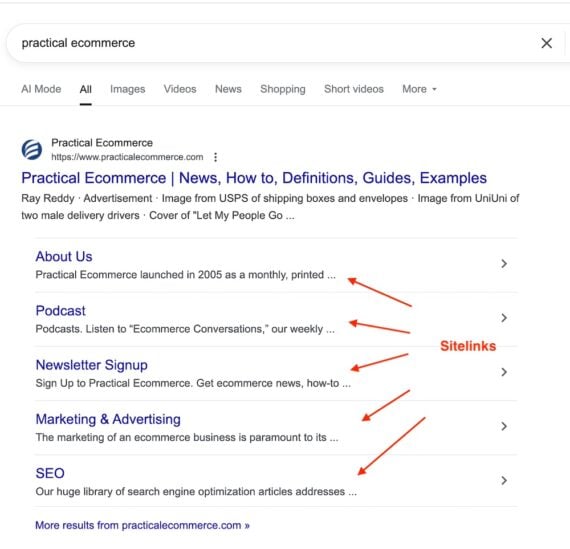
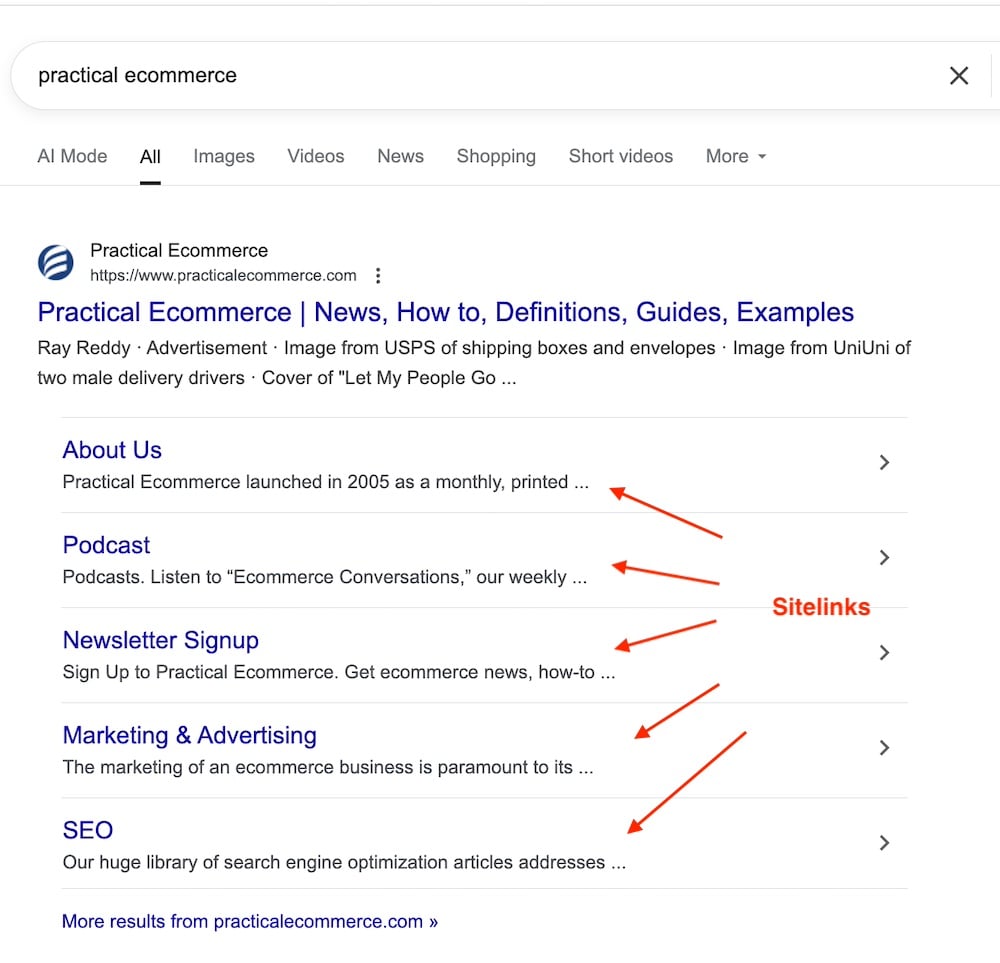
Sitelinks

For some searches, especially involving brand names, Google shows links below the listing title. These are called sitelinks. Unfortunately, Google’s algorithm often displays sitelinks that are irrelevant or unimportant to the site’s business.

Owners have no control over these URLs. The only methods to remove a sitelink are to delete the page or add the noindex meta tag, but both would also remove the page from all Google searches.

Here are sitelinks for a “Practical Ecommerce” query:

Screenshot of Google sitelinks for Practical Ecommerce

Websites have little control over sitelinks, such as this example for Practical Ecommerce.

Listing title

The listing title is the most prominent section of a search snippet and largely influences the number of clicks. Google used to display only a page’s title tag for the listing.

A few years ago, however, Google began displaying titles based on search queries, for relevance. The result is often fewer clicks.

There’s no way to stop Google from rewriting a page title. Using an HTML title as an H1 heading increases the likelihood that Google will use it, in my experience, as it aligns the listing title with what searchers would see on the subsequent page.

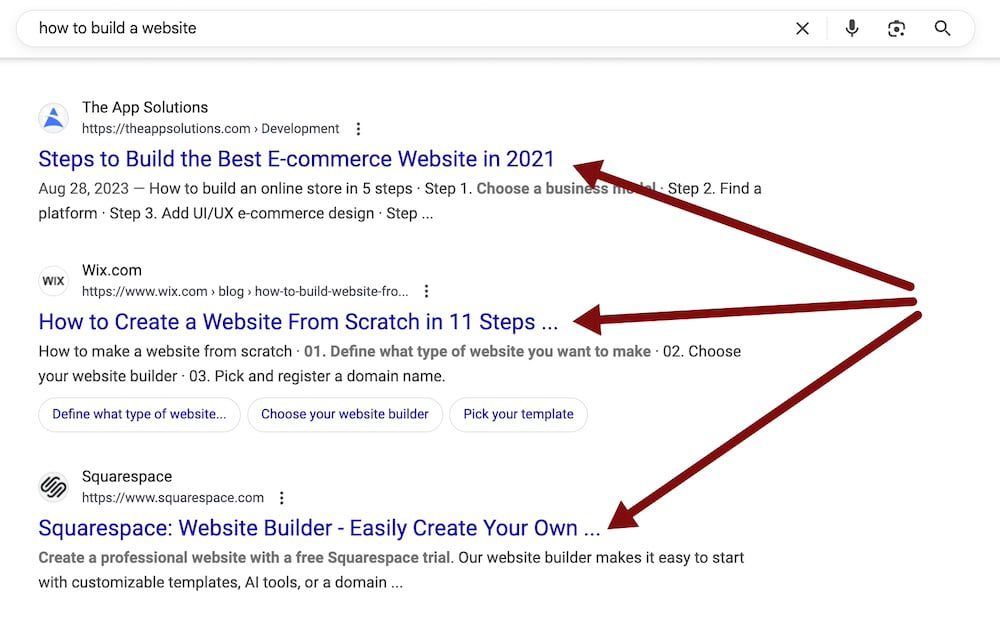
Google now decides SERP listing titles based on the query, such as “how to build a website.”

Listing description

A page’s HTML meta description summarizes its content. Google has long considered meta descriptions as hints rather than directives. It displays meta descriptions only if relevant to the query.

Websites can influence listing descriptions, which appear below the title, by including on a page summary paragraphs, conclusions, and short answers. Depending on the query, Google could display part of those sections in a description.

Otherwise, sites have no control over the SERP snippet’s description.

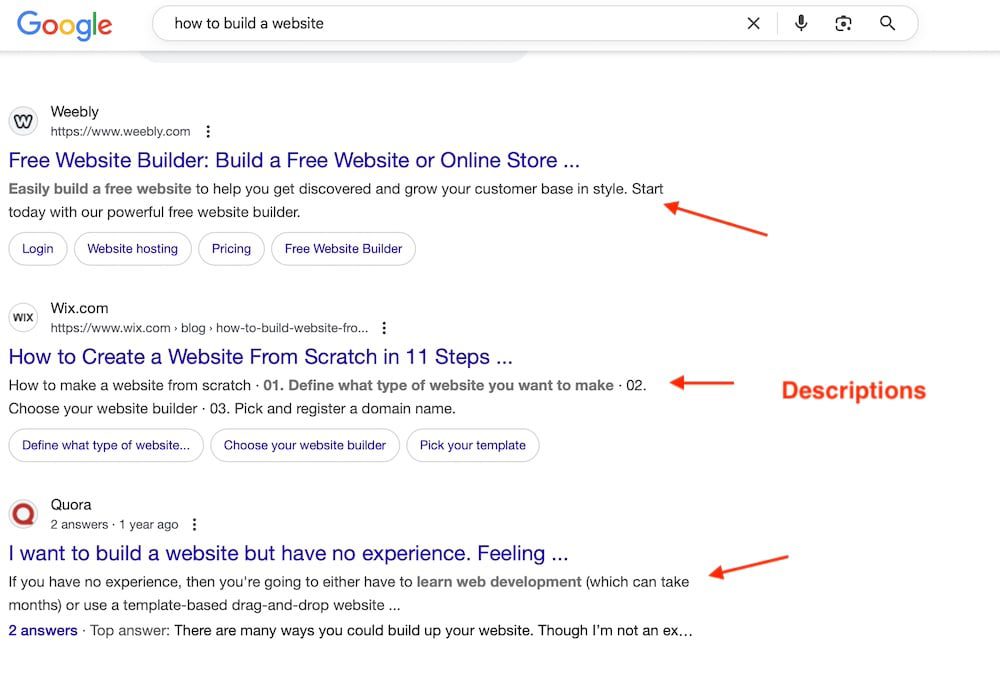
A listing may or may not use the page’s HTML meta description.

AI Overviews

Google’s AI Overviews are artificial intelligence-generated answers on top of search results.

AI Overviews typically satisfy searchers’ needs, thereby eliminating the need to click. Hence many site owners prefer Google not to use their content in AI Overviews. I know no way to block Google from using a site’s content in AI Overviews while still indexing it for conventional SERPs.

Google’s Extended directive in a site’s robots.txt file blocks Gemini but not AI Overviews. A nosnippet meta tag will likely block AI Overviews, as well as all SERPs snippet descriptions.

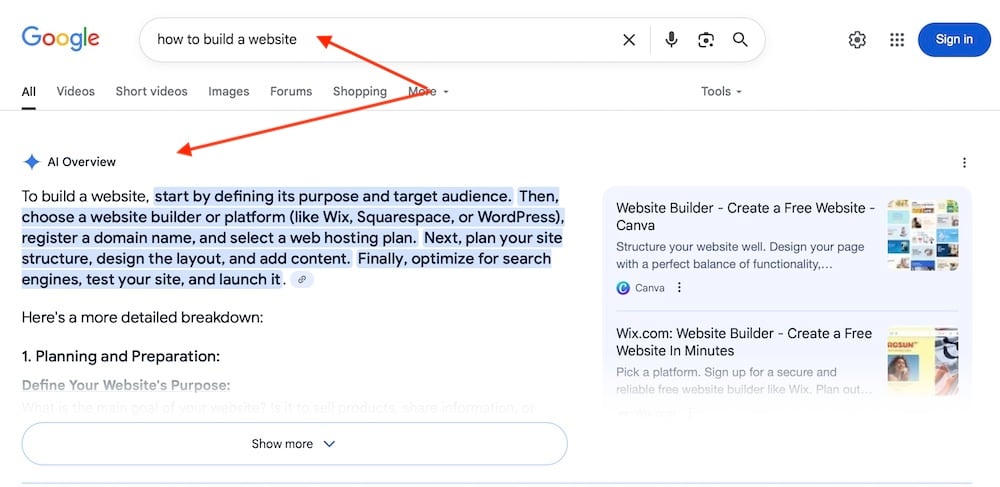
AI Overviews typically satisfy searchers’ needs, thereby eliminating the need to click. This example is for the query “how to build a website.”

Featured snippets

Featured snippets used to appear at the top Google SERPs to provide quick answers to a query. They now appear in the middle of SERP pages, if at all, given the rise of AI Overviews.

Featured snippets typically decrease the number of clicks to a linked URL. Websites have no control over appearing in a featured snippet or its content.

A nosnippet meta tag instructs search engines not to display a page in featured snippet, but it also removes descriptions from the page’s non-featured listing.

A well-structured page — short FAQs, HTML headings, concise summaries — can influence the contents of a featured snippet, but there’s no guarantee.

In short, Google is reducing websites’ control over SERPs as it prioritizes what searchers seek.
Sites can influence their SERP appearance by focusing on concise content, well-structured pages, and appropriate headings.

Charts: Outlook of U.S. Institutional Investors 2025

In March and April 2025, Boston Consulting Group surveyed approximately 150 U.S. institutional investors on their outlook for the domestic economy.

In the ensuing report (PDF), BCG reported most investors expect President Trump’s tariff policy to have negative impacts, including higher consumer prices, weaker corporate earnings, declines in stock market performance, and slower growth in gross domestic product. Conversely, many foresee benefits such as increased government revenue and lower interest rates.

According to the survey, investors now expect negative impacts from tariffs to all economic sectors. Manufacturing sectors depend heavily on global supply chains, so higher input costs and retaliatory tariffs could weaken the competitiveness of U.S.-made products and pressure overall performance.

Sixty-seven percent of surveyed investors are holding more cash, suggesting they anticipate increased market volatility or a downturn.

Moreover, investors identify revenue growth and protection as the top priorities for management, while emphasizing the rising importance of financial stability and supply chain resilience.

Operationalizing Your Topic-First SEO Strategy via @sejournal, @Kevin_Indig

Last week, I walked through the shift from keyword-first to topic-first SEO – and why that mindset change matters more than ever for long-term visibility in both search and large language models (LLMs).

This week, we’re getting tactical. Because understanding the shift is one thing, operationalizing it across your team is another.

In this issue, Amanda and I are breaking down:

  • How to build and use a topic map and matrix (with a map template for premium readers).
  • Why a deep understanding of your audience is crucial to true topical depth.
  • Guidance for internal + external linking by topic (with tool recommendations).
  • For premium readers: Practical advice on measuring SEO performance by topic.

If you’re trying to build durable organic visibility and authority for your brand – and not just chase hacks for AI overviews – this is your blueprint.

Image Credit: Kevin Indig

Boost your skills with Growth Memo’s weekly expert insights. Subscribe for free!

How To Operationalize A Topic-First SEO Strategy

Last week, we covered how you need to shift from keywords to topics (if you haven’t already).

But what if you’re not quite sure how to operationalize this approach across your team?

Let’s talk about how to do that.

To earn lasting visibility – and not short-term visibility bought by hacky LLM visibility tricks – your brand needs to signal to search engines and LLMs that it’s an authority in topics related to your offerings for the intended audience you serve.

You’ll do this by:

  1. Building a map of your parent topics.
  2. Using audience research and personas as lenses to create content through.
  3. Expanding with subtopics and “zero-volume” content creation, because fringe content adds depth.
  4. Optimizing both your internal and external links with a topic-first approach.

Build A Map Of Your Parent Topics

First up, you need to build your topic map.

(You know, if you don’t already have an old doc or spreadsheet out there collecting dust, buried in your Google Drive, with your core topic pillars and subtopics already stored.)

This is the first step in building a thorough persona-based SEO topic matrix.

A topic matrix is a strategic framework that compiles your brand’s key topics, subtopics, and content formats needed to comprehensively cover a subject area for search visibility.

It helps align content with user intent, target personas, and search visibility opportunities, creating a roadmap for developing topical authority and minimizing keyword cannibalization.

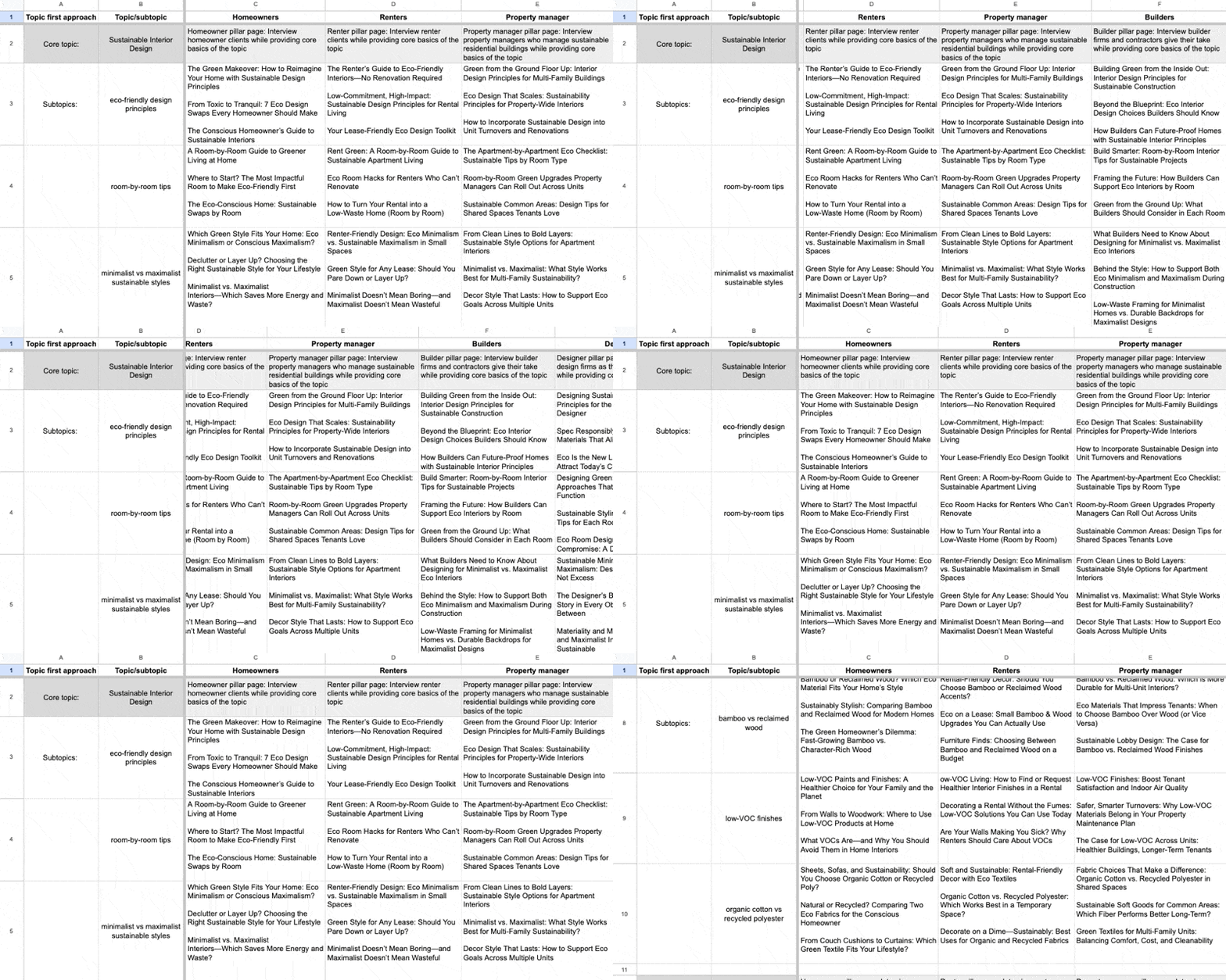
If you haven’t built one before, this is going to look different from keyword lists of the past, and it might be organized like this:

Image Credit: Kevin Indig

Amanda interjecting here: Even if you have built one before, stick with us. We’ve got a visual for you below that will help communicate to stakeholders how/why a topic-first approach matters to earning visibility and authority for your brand’s core offerings. Plus, premium subscribers get the ready-to-go template.

Later, once your topic matrix is complete, you’ll use your keyword universe to select priority keywords to pair with your overall topic and individual pages.

Instead of living in keyword lists, you’ll live in a topic map, prioritizing meeting the needs of separate personas or ideal customer profiles (ICPs) in your target audience, and later pairing search queries that best help the people you serve find you.

To start building a list of your parent topics, you need to:

  • Outline the exact topics your brand needs to own. This is where you start. (And many of you reading this already have this locked in.).
  • Inventory your existing content: What topics do you cover already? What topics do we actually need to cover? Where are the gaps? Which ones convert the best?
  • Make sure you log all your core offerings (i.e., features, services, core products) as topics or subtopics themselves.

These are the “buckets” under which all other content should logically live (regardless of the persona, funnel stage, or search intent you’re optimizing for).

Think of them as your brand’s semantic backbone, so to speak … these are the foundational topics that every page ultimately ladders up to.

Here’s how to determine them:

1. Start with your offerings.

  • What services do you provide?
  • What features or products do you sell?
  • What problems do you solve?

2. Group offerings into themes.

  • Which of those offerings can be grouped under a broader topic?
  • What high-level conversations do your users consistently return to?

3. Refine for relevance.

  • You’re aiming for topics broad enough to support many subtopics, but specific enough to reflect your unique authority in your area of expertise.

Let’s look at an example of a fictional DTC brand that also offers some B2B services: Kind Habitat. (Needs a better name, but let’s move on. 😆)

Kind Habitat offers eco-friendly home furnishings and sustainable materials via a small ecommerce store as well as residential and commercial interior design services.

Let’s say its target audience includes homeowners, renters, residential and commercial property managers, as well as both residential builders and designers that focus on sustainability and eco-friendly values.

With that in mind, its ecommerce products and design services could all be mapped to five simplified but distinct core topics:

  • Sustainable interior design.
  • Eco-friendly building materials.
  • Zero-waste living.
  • Sustainable furniture shopping.
  • Green home upgrades.

Every piece of content they create should tie back to one or more of these core topics, and that ensures the site builds deep, durable authority in its niche.

(And keep in mind, this is a simplified example here. You might have up to 10 parent topics … or more, depending on the breadth of your offerings or expertise areas.)

Next up, you’re going to work to expand your topic map, starting with audience research.

Use Audience Research And Personas

Here’s where those personas your brand invested so heavily in come into play.
You’ll need to map out (1) who you’re solving problems for and (2) how their queries change based on unique persona, intent, audience type, or industry sector.

But how do you know if you’ve identified the right people (personas) and their queries?

You can spend tens of thousands investing in deep buyer persona market research.

But if your resources are limited, talk to your sales team. Talk to your customer care team. And (gasp) talk to your customers and/or leads who didn’t buy from you.

And if you’re just starting out and don’t have sales or customer teams in place, have your founder dig into their email inbox, LinkedIn DMs, etc., and mine for information.

As Spartoro’s Amanda Natividad states in “How to Turn Audience Research Into Content Ideas” (a great read, btw):

Questions are content gold. Each question represents an information gap you can fill with valuable content. [1]

Then, your job is to take the collected information gaps and fold them into your overall topic matrix.

Keep in mind, though, when optimizing for your core topics, you’ll also need to target different intents across the topic and the funnel via different perspectives, painpoints, and viewpoints (a.k.a. “ranch style SEO”).

Here’s an exciting bonus to investing in this approach: Persona-aligned content that offers deep topic coverage and unique perspectives can bring natural information gain to the overall topical conversation.

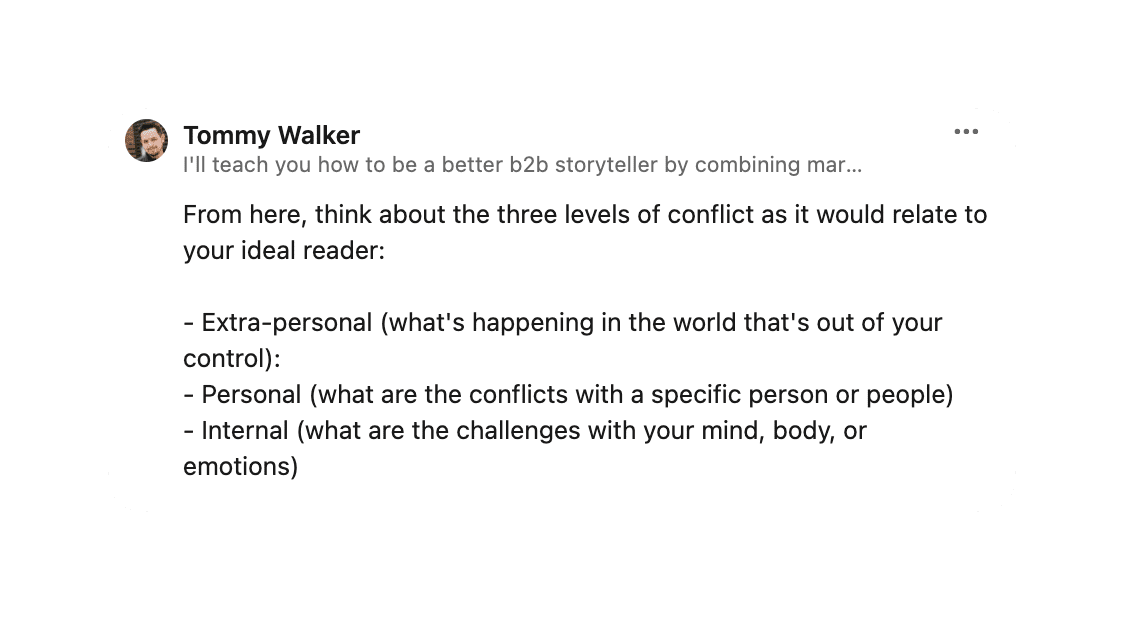
I (Kevin) opened up this discussion on topics vs. keywords over on LinkedIn, and I have to say, Tommy Walker gives an excellent example of how he thinks about this topic expansion in the thread:

Screenshot from LinkedIn, July 2025 (Image Credit: Kevin Indig)

Your topics can be expanded exponentially in many directions, based on the people you’re creating content for and the problems they have:

People:

  • Core audiences.
  • Crafted personas.
  • Multiple sectors (if applicable to your product or service).

Problems:

  • Core problem/needs your brand solves for each audience.
  • Unique problems experienced by each persona that your brand solves.
  • Core problems unique to multiple sectors (and in the language of those sectors).

Let’s circle back to our fictional example with Kind Habitat, that sustainable interior design firm with a quickly-made-up name and a mini ecommerce store.

Here’s what their “people and problems” that they’d optimize their core topics for would look like:

People:

  • Core audiences: Homeowners, renters, property managers, builders, designers.
  • Crafted personas:
    • Homeowner: Stan, 45, high-income earner, second-time homeowner in suburban area, looking to renovate sustainably.
    • Renter: Nicole, 31, mid-income earner, long-term rent-controlled apartment in a big city with values of sustainability, who is researching sustainable home decor and design.
    • Property Manager: Quinn, 25, mid-income earner, entry-level property manager for small local firm that values zero-waste construction and sustainable renovations.
    • Builder: JP, 57, high-income earner, owns sustainable building firm, seeking zero-waste, low-toxin approach to new builds and prioritizing energy-efficient design in luxury homes.
    • Designer: Sydney, 29, mid-income earner, junior to mid-level associate at a commercial interior design firm seeking both products and plans for sustainable furnishings and design.
  • Multiple sectors (if applicable to your product or service): Residential real estate, property managers for multi-family housing, real estate portfolios, or commercial real estate, sustainable building firms, individual homeowners, and renters interested in sustainable design.

Keep in mind, you could fan out your audience even further with three to five individual audience personas under each audience type.

And once your audience data is finally ready to go, you’d then expand into the problems faced by each audience, persona, and sector across each targeted topic.

Once you have your core topics covered (and have addressed your core features, offerings, services, audience pain points, and organic audience questions, etc.), you’d expand even further into content that offers unique perspectives, hot takes, and even digs into current events related to your industry or product/services.

That’s … a lot of content.

Using Amanda’s topic map visual, here’s what it could look like … for just one parent topic.

You could just keep going. For-ev-er.

(But your content doesn’t have to. If you establish your brand as an authority by publishing content with depth of coverage and information gain baked in, you can accomplish a lot with a tight, well-developed library of pages.)

Here’s what I’d recommend if you have the team members or freelancers on hand:

  • Assign specific team members or freelancers to cover core topics. Essentially, you’d have trained writer-SMEs for each major topic you’d like to target across your strategy. That way, content can be produced more accurately … and faster.
  • Divvy up work based on personas. If you have multiple audience types, like the Kind Habitat example, assign production to your team based on different personas/audiences, so your content producers can hone in on the needs of – and the way they speak to – each persona.
  • Use AI to scale topic coverage while tailoring to persona type. A tool like AirOps can help you build out workflows based on specific topics and specific personas; that way, you’re creating iterations of core pieces of work geared toward the specific needs, pain points, and problems of each industry sector, persona, etc.
  • When refreshing older content to combat content decay, refresh by topics. Don’t just refresh one page that has experienced a decline. Work on keeping content decay in check by refreshing subtopics/clusters as a whole whenever possible. Assign one producer/individual contributor to work on the cluster of related pages.

Expand With Subtopics, Because Fringe Content Adds Depth

Once you’ve mapped your audience and their problems across your core topics, you need to expand your coverage with subtopics, especially the ones that live on the edges and directly speak to your target ICPs.
This is the kind of content that rarely shows up in a traditional keyword list, although you can definitely map specific keywords and intents to these pages in order to adjacently optimize for organic visibility.

However, you won’t always have a clear “search volume” number for this type of content.

Sometimes this content is going to be messy. Sometimes it’s going to be weird.

You need to thoroughly know your core audience and understand their most pressing needs and questions that you can solve for. (Even the fringe ones.)

But this “fringe content” is what makes your site actually helpful, authoritative, and hard to replicate.

Think of it this way: The best organic search strategies don’t just optimize for the top 10 questions on a topic – they anticipate the next 100.

They dig into the side doors, caveats, gotchas, exceptions, industry language quirks, and debates.

You must go beyond building clusters and instead build context for your brand within your targeted topic.

Here’s where to look when expanding with meaningful subtopics:

  1. Sales calls with leads, customer care questions, and actual customer interviews: There’s a gold mine here, and every brand has it. (Yes, even yours.) Use it to your advantage. I recommend tools like Gong/Chorus + Humata AI to help.
  2. Reddit + Quora discussions: Look for questions that no one has great concrete answers to or resources/solutions for. Use a tool like Gummy Search to streamline this research.
  3. Context that will build out your topic environment: You’re not just building a tidy cluster with “best X tools,” “top tools for Y,” and “X vs Y.” Ask: What misconceptions need to be cleared up? What advanced tips only experts talk about when they talk shop? Lean on your internal SMEs, or invest in paying SMEs hourly, getting connected to them via platforms like JustAnswer.
  4. Wikipedia table of contents and footnotes: While this might initially sound like strange guidance, if you truly feel you’ve covered your core topics for all your ICPs from multiple perspectives and for all their common pain points, this approach can help you branch out into connected subtopics. Caveat: Of course, don’t invest in covering subtopics that don’t matter to your ICPs … or angles they already understand thoroughly. (This research is very manual. If you have a workaround you’d suggest, send it my way.)
  5. People Also Ask questions in the SERP: Keep these in mind: They still exist for a reason. Use your standard SEO tools like Semrush, Ahrefs, etc., to explore these within your topic.

So, with topic-first optimization at the center, should you be organizing your internal links by topic instead of just navigation structure or blog recency?

Um, yes – definitely. And if you weren’t doing that already, the time to start is now.

Topic-based internal linking is one of the most powerful (and underutilized) ways to reinforce topical authority.

Most content teams default to one of two internal linking strategies:

  1. Navigation-based linking: whatever shows up in your menu or footer.
  2. Date-based linking: linking to “recent posts” regardless of topic relevance.

The problem? These methods serve the convenience of the content management system (CMS), not the reader or search engine.

A topic-first internal linking strategy intentionally:

  • Connects all relevant pages under a single topic or persona target.
  • Links related subtopics together to increase crawl depth and surface additional value.
  • Boosts orphaned or underperforming assets with contextually relevant links.

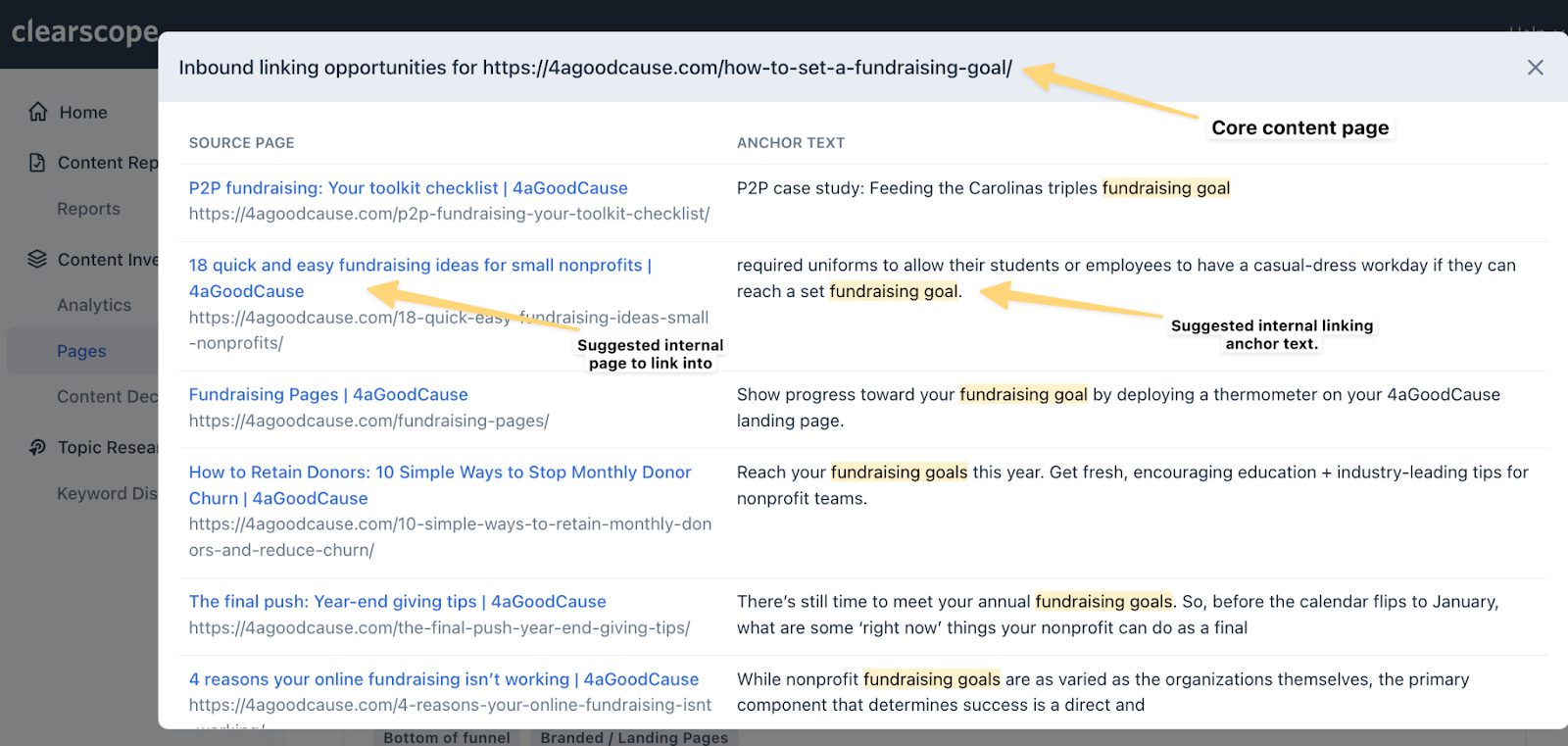
You can simplify this task with an SEO tool like ClearscopeSurferAhrefs, etc. (For convenience, the pages explaining how these features work per tool are linked here.)

For example, tools like these surface internal linking opportunities within the pages you’re monitoring within the tool. The feature then gives you clear related anchor text on where to add the URLs specifically.

The manual part? Having your content producers or SEO analysts determine if the tool’s suggested page is in the right topic cluster to warrant an anchor link. (But you can also set up topic clusters/content segments within tools like Clerascope that can help guide your producers.)

Used with permission from 4aGoodCause, a top monthly giving platform for nonprofits. (Link)

But you should be employing a topic-based backlink strategy, too.

You don’t just want backlinks. You want links that have authority in your target topics and/or with your audience.

For instance, our example from earlier, Kind Habitat, doesn’t need low-quality backlinks from around the globe to build topical authority in the sustainable interior design niche.

This brand needs to invest in backlinks that include:

  • High-authority sites in similar topics, like ThisOldHouse.com, MarthaStewart.com, Houzz.com, and HomeAdvisor.com.
  • Local and regional publications for this brand’s service areas.
  • Manufacturers of sustainable, low-toxin home building products and materials.
  • Professional associations for interior designers, builders, and property managers who value sustainable and green design.

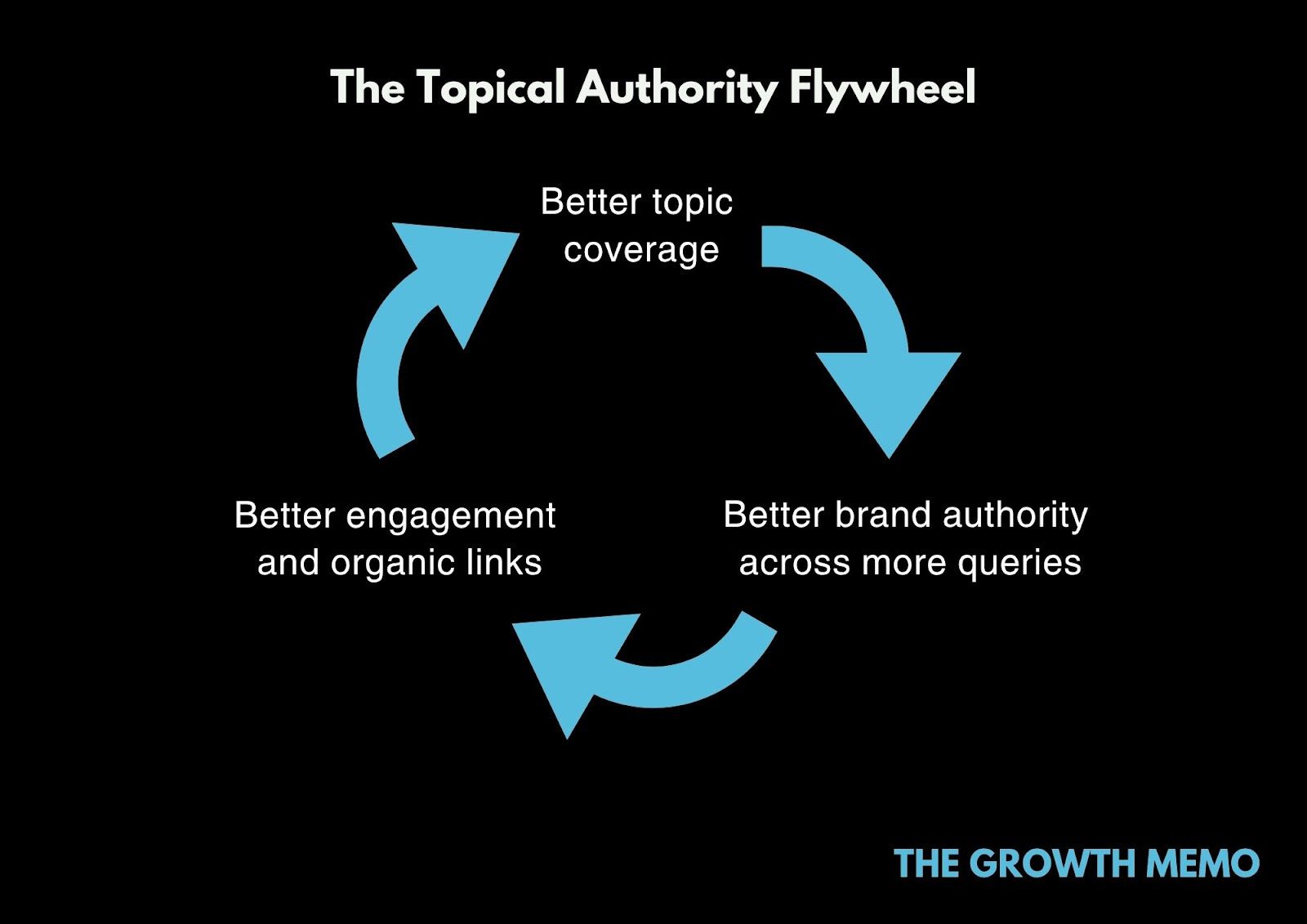
Here’s the payoff of taking a topic-first approach: Once you shift your strategy to cover core topics deeply – across the right audience segments and intent layers – you unlock a Topical Authority Flywheel.

Here’s how it works:

Better coverage → Better engagement and organic links → Better visibility across more queries.

Image Credit: Kevin Indig

When your site deeply addresses a topic, you not only become more useful to your audience, but you also are more visible to search engines and LLMs.

You build the kind of brand context that LLMs surface and that Google’s evolving AI-driven results reward.

And yes, it’s measurable.

Track your performance by topic, not just by page or keyword.

If you’ve mapped and organized your content well, you can group related URLs and monitor how the topic as a whole performs:

  • Watch how refreshed or expanded topic clusters improve in average rank, CTR, and conversions over time.
  • Look for early signals of lift within the first 10-30 days after refreshing or publishing a comprehensive set of content on a given topic.
  • Monitor link velocity. Strong topic clusters reap rewards.

Operationalizing a topic-first approach isn’t just about traffic.

It’s about building a defensible edge in search/LLM visibility by doing the thing many brands still are missing out on: going deep, not wide.


Featured Image: Paulo Bobita/Search Engine Journal

seo enhancements
How to prep your Shopify or WooCommerce store for Black Friday before the rush starts  

Table of contents

Black Friday is the biggest rush of the year for most ecommerce businesses, and it is right around the corner. The most successful merchants prepare for Black Friday early and follow a structured plan to prepare their stores, ensure visibility, and convert first-time visitors into long-term customers.

This guide breaks down your preparation into three categories: Basic, Intermediate, and Advanced. Each section builds on the last so that you can grow your readiness over time, regardless of your team size or budget.

Basic: Start with what you can control for Black Friday

These actions lay the groundwork for everything else. Without these, no advanced strategy will stick.  

1. Optimize your metadata  

First impressions matter, and your metadata is the first thing users see in search results. So make it count and leave a lasting impact. 

Why it matters: Strong metadata can improve visibility and attract more clicks. When your titles and descriptions align with what shoppers seek, your chances of standing out rise significantly.  

Actionable tips:  

  • Prioritize metadata for high-traffic products and category pages.  
  • Include seasonal keywords such as “Black Friday deals” or “holiday gift ideas.”  
  • Keep titles and descriptions concise and compelling.  

With Yoast SEO for Shopify and Yoast WooCommerce SEO, you can preview and improve your metadata in real time. The tools flag missing or duplicated fields and guide you on how to write content that earns clicks.  

  2. Optimize product pages for both humans and search engines

Product pages are the moment of truth. They’re where curiosity turns into clicks and clicks turn into customers.  

Why it matters: No matter how great your traffic or ads are, most people will leave without buying if the product page feels confusing or incomplete. A well-structured page improves your chances of ranking in search and helps buyers feel confident in their decision.  

Actionable tips:  

  • Lead with benefits, not just specs. Tell shoppers how the product fits into their lives.  
  • Use bullet points and headers to make details skimmable.  
  • Reinforce trust by showing stock levels, customer reviews, and delivery clarity.
  • Bulk update how you showcase your product on Shopify using Yoast SEO for Shopify Content Templates feature.

Yoast WooCommerce SEO and Yoast SEO for Shopify help your product pages appear cleanly and clearly in search results. They add structured data behind the scenes and check your content for SEO and readability so you can focus on turning visitors into buyers. 

Internal linking guides customer to surface key pages, maps user behavior, and boosts your site’s SEO. 

Why it matters: Internal linking helps search engines understand your site structure, distributes authority to key pages, and guides visitors toward high-converting content. It keeps users engaged, supports SEO, and makes your promotions easier to surface across your site.  

Actionable tips:  

  • Link to your Black Friday page from key blogs and evergreen content.  
  • Feature top categories or bestsellers in your navigation.  
  • Use anchor text that aligns with what users are searching for.  

Yoast WooCommerce SEO offers internal linking suggestions as you write, making keeping your content connected and strategic easier. 

Fast wins and common pitfalls

Once you have set up the basics, some steps can help you boost impact quicker and avoid costly missed opportunities. 

Fast wins:

  • Swap stock photos for original product shots 
  • Double-check coupon logic and expiration dates 
  • Test any gift wrap or personalization options on product pages 

Big pitfalls to avoid: 

  • Waiting until November to publish seasonal content 
  • Using duplicate product descriptions from suppliers 
  • Letting broken links or outdated pages remain live 

Once the technical foundation is stable, it’s time to focus on your content and promotions.  

4. Test and improve your site’s speed  

Site speed directly impacts user experience, especially during high-traffic periods like Black Friday. Slow-loading pages frustrate shoppers and lead to lost sales.  

Why it matters: A fast site supports smoother browsing and quicker checkout. Search engines consider page performance in rankings, and users are more likely to buy when the experience feels seamless.  

Actionable tips:  

  • Use performance monitoring tools to identify slow pages.  
  • Compress and resize large images to reduce page load times.  
  • Deactivate unused plugins (WooCommerce) or apps (Shopify).  
  • Clean up excessive code or bulky page elements.  

While Yoast SEO is not a speed optimization tool, clean site structure and proper internal linking help improve crawlability and engagement, indirectly supporting performance. 

5. Create a focused Black Friday landing page  

Your landing page is the command center for your seasonal promotions. It’s where visitors decide to browse further or bounce. 

Why it matters: A dedicated page gives your Black Friday campaign direction and cohesion. Instead of scattering your offers across the site, it provides a clear path for shoppers to follow. It simplifies navigation, allows for better internal linking, and gives you a consistent, trackable URL for email campaigns, ads, and site banners. Plus, it’s reusable! Just update the content each year.  

Actionable tips:  

  • Create a short, memorable URL like /black-friday-deals and keep it live year-round.  
  • Showcase limited-time offers, bundles, top-selling categories, and exclusive discounts.  
  • Use persuasive headers, quick-loading images, and CTA buttons that lead directly to product pages.  
  • Answer common buyer concerns upfront, e.g., shipping deadlines, return windows, and local pickup options. 

6. Segment your email list and automate flows  

Email isn’t just another marketing channel during Black Friday; it’s your direct line to customers ready to buy.  

Why it matters: Blasting the same message with monotonous tone to everyone no longer works. Crafting compelling emails with personalized messages that resonate with the reader is key to email marketing. People are more likely to open, click, and shop when an email speaks to their pain points and highlights the solution. A segmented email list means you’re talking to people based on what they care about: early access, bundles, or a product they viewed or left in their cart.

Actionable tips:  

  • Break your list into clear segments, e.g., loyal customers, cart abandoners, and holiday-only shoppers.  
  • Map out your flow: teaser email, early access offer, launch announcement, final hours.  
  • Track performance with UTM parameters like utm_campaign=bf25 so you can optimize in real time. 

For more on syncing content and email, check out our basics of email marketing blog post.

7. Create content that helps people find your deals earlier  

Buyers don’t always search for discounts. Many start with questions or ideas like “affordable gifts for coworkers” or “best tech gift under $100.”  

Why it matters: Helpful blog posts and gift guides pull in people who aren’t searching for your brand yet. These early touchpoints introduce your products and lead them toward your Black Friday offers.  

Actionable tips:  

  • Write guides and roundups tied to real shopper intent.  
  • Use long-tail keywords that match seasonal search habits.  
  • Add smart internal links to featured products or your Black Friday landing page. 

Fast wins and common pitfalls

Once your product pages are polished, tighten up the surrounding details.

 Fast wins:

  • Set a calendar reminder for your campaign email and social media schedule 
  • Add an announcement banner linking to your Black Friday page 
  • Test your email signup and welcome flow to catch any issues 

Big pitfalls to avoid: 

  • Forgetting to link email campaigns to relevant landing pages 
  • Using inconsistent messaging and UTMs across channels 
  • Launching your Black Friday page too late for indexing and ranking 

Buy WooCommerce SEO now!

Unlock powerful features and much more for your online store with Yoast WooCommerce SEO!

Advanced Black Friday preparation: Boost visibility, trust, and retention  

If you’re already doing the essentials well, these strategies will help you scale.  

7. Improve your chances of showing up in local search  

If you offer in-store pickup or have a physical store, don’t miss out on the people searching near you. Shoppers looking for same-day purchases often skip past online-only stores.  

Why it matters: When someone searches for a product near them, being present in the results can drive instant foot traffic and build trust before they even walk in.  

Actionable tips:  

  • Ensure your name, address, and phone (NAP) are identical across all pages and listings.  
  • Update your opening hours and add clear pickup instructions.  
  • Add content to your site that mentions your location, city, or neighborhood.  

Yoast Local SEO is included in the Yoast WooCommerce SEO. It helps you create and manage local schema and landing pages that appear in search. (It is not available for Shopify.)  

8. Use structured data to stand out in search  

When someone searches for a product and your listing shows price, availability, or reviews, that’s not luck. That’s structured data.  

Why it matters:  Rich snippets give your products more space in search results, credibility, and clicks.  

Actionable tips:  

  • Add structured data (schema) for Product, Offer, and Review to top-selling listings.  
  • Use Google’s tools to check that your schema is implemented correctly.
  • Use product variant schema to improve your chances of showing in rich search results.

Yoast SEO for Shopify and Yoast WooCommerce SEO automatically adds this, but you can also fine-tune it for special products or campaigns if needed.  

9. Set up post-purchase flows before the sale starts  

Black Friday may be over at checkout, but it’s just the beginning of your relationship with a new customer.  

Why it matters: People who buy during Black Friday often need reassurance and support. They’re far more likely to come back if they feel taken care of.  

Actionable tips:  

  • Set up automated flows for thank-you messages, setup tips, and review requests.  
  • Offer a discount for a second purchase or referral.  
  • Guide people back to your product pages or Google review profile.  

Taking care of this now means you can focus on fulfillment and service during the Black Friday rush. 

Fast wins and common pitfalls

A thoughtful follow-up and last check make sure you build on opportunities and are ready for what might come your way.

 Fast wins: 

  • Recheck your sitemap to ensure new pages are indexed 
  • Update your business hours and contact details in your footer 
  • Enable review requests to trigger automatically post-purchase 

Big pitfalls to avoid: 

  • Making last-minute technical changes with no buffer 
  • Ignoring mobile performance and checkout testing 
  • Overlooking schema validation or broken structured data 

Final thoughts  

Preparing for Black Friday is about being proactive, not reactive. Every SEO improvement you make now, from product pages to local visibility, will help you attract more shoppers and turn clicks into customers.  

Yoast gives you the tools to stay ahead: clearer product listings, stronger search visibility, and smart automations that scale with your store. Whether you’re using Shopify or WooCommerce, optimize now to be ready before the crowds arrive.  

Explore:

Should Advertisers Rethink The ‘For Vs. Against’ Stance On Performance Max?

Performance Max has become one of the most talked-about campaign types in PPC for a number of reasons.

Some advertisers swear by it, while others remain skeptical, and opinions are increasingly polarized.

In reality, PMax is neither flawless nor fundamentally flawed. It is a campaign type with both advantages and drawbacks, and deciding whether to use it requires nuance.

Before taking a “for or against” stance, consider how PMax evolved, why the industry is divided, and when this campaign type makes strategic sense.

Starting at the beginning, let’s look into where this evolved from.

A Brief Timeline On PMax

Google officially launched Performance Max in late 2021, a milestone in terms of automation in Google Ads.

By 2022, it had effectively absorbed Smart Shopping and Local campaigns, consolidating multiple ad networks and formats into one unified solution.

The reason this change marked a major shift in PPC strategy was that advertisers no longer had to manage separate campaigns for each channel (in theory).

Adoption of PMax was rapid, in part because Google’s transition forced the issue.

Smart Shopping campaigns were auto-upgraded to PMax, so many advertisers found themselves using PMax whether they planned to or not.

By mid-2024, PMax accounted for ~82% of Google advertising spend within retail alone, and the simplicity of PMax began making waves with smaller advertisers.

In a relatively short space of time, this momentum signaled that PMax was not a niche experiment or small change by Google, but a mainstream part of the ecosystem that signified the direction in which Google Ads is going.

Back when PMax launched, there were expected growing pains. The lack of transparency and many controls advertisers were used to over decades of managing PPC were essentially removed, and the term “black box” became widely used for this campaign type.

Was this fair? In my opinion, at launch, yes.

Campaign management went from having complete control over search queries, ad networks, auctions, etc, to a five-step process:

  1. Choose an objective.
  2. Choose a conversion goal.
  3. Create the campaign.
  4. Create the asset group/s.
  5. Finalize and launch.

Then, where the real grunt work with optimization sets in post-launch, advertisers were simply told to leave the campaign to gather data, not knowing where their ads served, how their budget was apportioned, and more.

Advertisers essentially handed the keys to Google’s AI without the usual levers to guide it. For years, PPC professionals had built careers on meticulous campaign control, and it was gone.

However, over the past three years, PMax has changed considerably, with Google addressing some key concerns raised by advertisers.

Google added a selection of reports and control features that didn’t exist in 2022, including features like search term insights, asset group reporting, and brand exclusions.

Some of these updates feel like genuine concessions to give advertisers more transparency and control, but within the world of PPC, it’s felt that it’s still not enough.

Despite these improvements, opinions remain split, largely because the fundamental trade-off of PMax (automation vs. control) still exists.

To understand the divide, let’s look at both sides of the argument.

The Case ‘For’ Performance Max

Simplified Cross-Channel Reach

Instead of siloed Search, Display, Shopping, and YouTube campaigns, PMax’s machine learning decides where to show ads to best meet your goals (in the words of Google).

For resource-strapped teams, the convenience of an all-in-one campaign is attractive as it significantly reduces the complexity of managing multiple campaigns.

Here are a couple of cases:

  • SME with a single person heading up marketing: PMax fits the brief as it allows them to remove the complexity of managing PPC and allows them to enter auctions across multiple networks without the need for external help or an internal hire.
  • Multinational with a 10-person digital team: PMax can plug gaps or test new markets with minimal setup. The team can still maintain control over core campaigns where channel-specific insights, custom bidding strategies, and creative testing are essential, but PMax allows them to expand and test the waters quickly.

Automation And Efficiency

Data signals and algorithms adjust bids in real time and find the right audience for your ads across channels.

This isn’t new (think automated bidding). However, PMax is advertising across multiple ad networks.

There are plenty of case studies out there showing how automation improved performance, one in particular where Google highlighted a case where a Latin American travel company, AssistCard, saw a 15x higher conversion rate and 40% lower CPA in PMax vs. similar campaigns without it.

When set up properly, PMax’s automation can efficiently drive performance in ways manual tweaks might miss by building out each campaign in silo, and as ever, it depends on the case at hand.

Reach And Testing

Because PMax has wide latitude to find conversions anywhere on Google, it can rapidly scale campaigns that are doing well.

If your offer and creative are effective, PMax will seek out all available inventory to get in front of relevant users.

It’s also a useful way to test new channels, e.g., if you’ve never tried YouTube or Display, PMax will allocate some spend there and let you see how those channels perform as part of a blended campaign.

You can then review performance via the channel performance report or one of the many scripts available online.

The hands-off nature of PMax appeals to advertisers who want to uncover new opportunities without heavy lifting on their part.

Low Barriers To Entry

The simplicity of PMax can lower the barrier to entry for advertisers without dedicated PPC teams or external support.

Instead of learning the ins and outs of feeds, keywords, bids, and multiple campaign types, a business can input its goals and creative assets, then hand off to Google to do the rest.

In essence, PMax offers plug-and-play advertising that aligns with limited time and expertise, whilst boasting strong results for brands of all sizes.

Continuous Innovation

Google is heavily invested in PMax. Just look at the journey advertisers have been on over the last three years with PMax and where we are now with regards to features, reporting, and optimization.

Google’s SVP & Chief Business Officer Philipp Schindler states in 2022 that “we’re very, very committed to helping Performance Max deliver for our advertisers and have been very open to advertiser feedback how we can do this.”

Over the last decade, there has not been a campaign type/feature that has received this level of investment. This commitment is part of the reason why PMax now accounts for nearly 82% of all retail Google Ads spend in 2025.

So, where does the scepticism come from if it’s such a key part of advertising strategies? Let’s get into that.

The Case ‘Against’ Performance Max

Loss Of Control Over Targeting & Bidding

Handing over targeting and bidding decisions to Google is a bitter pill for seasoned PPC professionals.

With PMax, you can’t choose specific keywords or placements; Google’s AI decides when and where your ads show.

Advertisers effectively relinquish the levers they normally use to steer campaigns, and there are two ways to look at this:

  • “How do I know where my budget is being spent and what is working/isn’t?”
  • “How can I scale spend and optimise performance without the data?”

As much as PMax now has features to see performance down to a certain level of detail, it’s still not enough to grasp control of media spend and make actionable changes based on the queries and audiences the ads are being served to.

Limited Data And Reporting

Data is the heart of PPC and has been from the start.

Take search terms, visibility through PMax is still limited with broad “search category” insights rather than the exact queries users searched.

Cross-network reporting also lacks depth. Combined results from Search, Display, YouTube, etc., make it hard to break out performance by channel or asset in a meaningful narrative that can be translated into short-term optimizations and long-term strategy.

Although Google has added some reporting improvements, advertisers still don’t get the full picture, which can be frustrating when sharing performance updates to teams, management, or clients.

Transparency & Brand Safety Concerns

PMax decides how budget is allocated across channels and audiences, with advertisers having only a snapshot view of where the budget is going.

For example, a retail PMax campaign might be spending heavily on dynamic retargeting or branded searches (which can be negated using the request form, but, in my experience is not always a guarantee that brand will stop serving in ad auctions). It raises the question: Is PMax really driving new incremental customers or just capturing easy wins?

Alongside this, advertisers have auto-generated assets, enhanced images, AI-suggested copy, and more to deal with when managing their campaigns.

Features like this add layers of complexity when deciding whether or not to use PMax. Sectors, such as luxury fashion with strict brand guidelines, simply cannot give creative freedom to Google when advertising on networks as vast as GDN.

Cannibalization Of Other Campaigns

Running PMax alongside traditional campaigns has historically been tricky.

When PMax first launched, it was a bit of a blurred area with which campaigns would take priority when factoring in standard Search or Shopping campaigns for the same products/audiences.

Google has now shared the details on this, stating that PMax and standard Shopping can compete more evenly based on ad rank and that PMax will not override shopping; both will enter auctions that are eligible for, and the ad rank will determine which shows.

Aside from the auction, there are other factors involved in running a portfolio of campaign types, such as search query overlap, where advertisers have to define queries between campaigns.

This isn’t anything new, but the process of negating queries for PMax is more convoluted than adding negative keywords to search or shopping.

Inconsistency And Unproven For All Cases

If you’ve followed the narrative surrounding PMax, you’ll have read that it works great for some advertisers and is diabolical for others.

Post launch, some advertisers simply found that their carefully optimized standard campaigns outperformed PMax.

For instance, one industry analysis noted that PMax conversion rates in late 2024 were slightly lower (about 2%) than those of standard Shopping campaigns.

Others found that moving to a fully automated solution actually delivered uplifts in performance, with Google stating an average increase in revenue of 27% vs. non-PMax.

This uncertainty makes risk-averse advertisers inclined to stick with what they know. Others, who are more open to experimentation, treat PMax as a testing ground and embrace automation when it proves its value.

Moving Beyond A Polarized View

In reality, the truth about Performance Max lies somewhere in the middle.

Rather than asking, “Should we use PMax or not?” a better question is, “In what scenarios does PMax make sense for us?” Framing it as simply good or bad is too simplistic.

As with most marketing strategies, whether PMax is right for you depends on context, your business, goals, and resources.

Business Objectives

What are you trying to achieve? If your goal is broad reach and top-line conversion growth, PMax’s all-channel approach could align well.

It could efficiently drive online sales or leads when you aren’t as concerned with a specific channel mix.

On the other hand, if your goals require tight control (e.g., a precise cost per acquisition target for a niche B2B product or a brand that can only serve on very specific ad auctions), you might favor more hands-on campaigns.

Ensure PMax’s optimization style matches your KPIs and tolerance for how those results are achieved.

Resource & Expertise

Do you have a team that can manage campaigns or a portfolio of campaigns, or do you need an automated solution without heavy lifting?

A lean organization with limited PPC staff may benefit from PMax handling the heavy lifting across channels.

Conversely, a large team or agency with deep expertise might squeeze more performance from manual control in Search or Shopping campaigns.

Also, consider the tools at your disposal. If you have sophisticated in-house data and optimization systems, you might not want to relinquish control to Google’s black box.

Data And Tracking Requirements

Advertisers with strict data requirements (for example, those who need to see every search query for compliance or want to segment performance by niche audiences) will struggle with PMax’s opacity.

If full transparency is non-negotiable, PMax may not be a fit for those campaigns.

However, if you can work with modeled and aggregate data, and you measure success on bottom-line results, PMax’s data limitations might be acceptable.

Personal And Organizational Appetite For Change

Companies vary in how they adopt new technology. Some are innovators or early adopters who eagerly try new Google features; others are late adopters or even laggards who resist change.

This human factor shapes PMax opinions.

If your organization values being on the cutting edge (and can tolerate some volatility), you may have leaned toward giving PMax a shot early.

If your culture is very risk-averse, you might have held off until there’s more industry-wide proof and Google has ironed out the kinks.

Neither approach is “wrong,” but it should be a conscious strategic choice rather than a knee-jerk stance.

Summary: A Strategic Middle Ground

In some cases, the optimal approach could be a hybrid.

For example, some advertisers run Performance Max alongside standard Search or Shopping campaigns and find a balance that works.

You might use PMax to cover certain areas (like display retargeting, non-brand terms with controlled exclusions, etc.) while still running dedicated campaigns for core products or certain keywords where you need more control.

Google has been listening to advertisers and agencies, with ongoing updates allowing PMax and traditional campaigns to coexist more harmoniously (no more automatic overriding of standard campaigns).

This opens the door to a nuanced account strategy that leverages PMax where it excels and uses other tactics where they’re stronger.

A mix-and-match strategy could outperform an all-or-nothing approach, or it might be one over the other; it’s just something you wouldn’t know without testing.

PMax today is more flexible than PMax three years ago.

As Google continues to refine the platform, some of the early drawbacks are being mitigated.

Advertisers who were against PMax due to a specific missing feature may find that the issue has since been addressed.

This is why it’s worth continuously re-evaluating your stance and testing on a case-by-case basis.

More Resources:


Featured Image: Roman Samborskyi/Shutterstock

WP Engine’s AI Toolkit Vectorizes WordPress Sites For Smart Search via @sejournal, @martinibuster

WP Engine announced the release of its AI Toolkit, a way to easily integrate advanced AI search and product recommendations into WordPress websites, plus a Managed Vector Database that enables developers to easily integrate AI features directly into websites.

Smart Search AI

WP Engine’s AI Toolkit helps WordPress site owners improve search and content visibility without requiring a steep technical learning curve. Smart Search AI is easily enabled in just a few clicks. Once activated, it syncs with WordPress content, including:

  • Posts
  • Pages
  • Tags
  • Metadata
  • Custom fields

Smart Search AI converts a website’s content into a vector format to deliver faster, more useful search results. The system combines natural-language and keyword search to help contextualize queries and guide visitors to what they need, which may help reduce bounce rates and support higher conversions.

AI-Powered Recommendations

The AI-powered recommendations feature uses past and current user session data to suggest products or content that is relevant to the user. This helps increase shopping sales and keeps readers engaged with content. The system runs efficiently without slowing down the website and uses flat-rate pricing with no overage fees. It’s suited for eCommerce, media, and any site focused on driving sales and engagement through personalized experiences.

Managed Vector Database

WP Engine’s Managed Vector Database is a service that simplifies building AI features directly into WordPress websites. Designed for developers, agencies, and site owners, it removes the need to manage tasks like data extraction, embedding creation, and content updates. Developers can start building content-based AI apps and functionalities immediately, because the system automatically processes and trains on their WordPress content without additional setup.

Integrated with WordPress, the database keeps AI outputs aligned with current site content without extra work. It enables developers to connect WordPress data directly to chatbot frameworks or APIs, and it also makes AI features accessible to non-technical creators or site owners. This enables creators to focus on building meaningful experiences without getting bogged down in technical setup.

Read more about WP Engine’s AI Toolkit:

WP Engine Launches AI Toolkit Empowering Website Owners to Drive Engagement and Growth

Featured Image by Shutterstock/Ground Picture

AI companies have stopped warning you that their chatbots aren’t doctors

AI companies have now mostly abandoned the once-standard practice of including medical disclaimers and warnings in response to health questions, new research has found. In fact, many leading AI models will now not only answer health questions but even ask follow-ups and attempt a diagnosis. Such disclaimers serve an important reminder to people asking AI about everything from eating disorders to cancer diagnoses, the authors say, and their absence means that users of AI are more likely to trust unsafe medical advice.

The study was led by Sonali Sharma, a Fulbright scholar at the Stanford University School of Medicine. Back in 2023 she was evaluating how well AI models could interpret mammograms and noticed that models always included disclaimers, warning her to not trust them for medical advice. Some models refused to interpret the images at all. “I’m not a doctor,” they responded.

“Then one day this year,” Sharma says, “there was no disclaimer.” Curious to learn more, she tested generations of models introduced as far back as 2022 by OpenAI, Anthropic, DeepSeek, Google, and xAI—15 in all—on how they answered 500 health questions, such as which drugs are okay to combine, and how they analyzed 1,500 medical images, like chest x-rays that could indicate pneumonia. 

The results, posted in a paper on arXiv and not yet peer-reviewed, came as a shock—fewer than 1% of outputs from models in 2025 included a warning when answering a medical question, down from over 26% in 2022. Just over 1% of outputs analyzing medical images included a warning, down from nearly 20% in the earlier period. (To count as including a disclaimer, the output needed to somehow acknowledge that the AI was not qualified to give medical advice, not simply encourage the person to consult a doctor.)

To seasoned AI users, these disclaimers can feel like formality—reminding people of what they should already know, and they find ways around triggering them from AI models. Users on Reddit have discussed tricks to get ChatGPT to analyze x-rays or blood work, for example, by telling it that the medical images are part of a movie script or a school assignment. 

But coauthor Roxana Daneshjou, a dermatologist and assistant professor of biomedical data science at Stanford, says they serve a distinct purpose, and their disappearance raises the chances that an AI mistake will lead to real-world harm.

“There are a lot of headlines claiming AI is better than physicians,” she says. “Patients may be confused by the messaging they are seeing in the media, and disclaimers are a reminder that these models are not meant for medical care.” 

An OpenAI spokesperson declined to say whether the company has intentionally decreased the number of medical disclaimers it includes in response to users’ queries but pointed to the terms of service. These say that outputs are not intended to diagnose health conditions and that users are ultimately responsible. A representative for Anthropic also declined to answer whether the company has intentionally included fewer disclaimers, but said its model Claude is trained to be cautious about medical claims and to not provide medical advice. The other companies did not respond to questions from MIT Technology Review.

Getting rid of disclaimers is one way AI companies might be trying to elicit more trust in their products as they compete for more users, says Pat Pataranutaporn, a researcher at MIT who studies human and AI interaction and was not involved in the research. 

“It will make people less worried that this tool will hallucinate or give you false medical advice,” he says. “It’s increasing the usage.” 

Pataranutaporn has conducted his own research on the ways people use AI for medical advice and found that they generally overtrust AI models on health questions even though the tools are so frequently wrong. 

“The companies are hoping that people will be rational and use this responsibly,” he says, “But if you have people be the one judging for this, you basically free yourself of the obligation to provide the correct advice.”

Though all the leading AI models showed a decline in disclaimers, there were some standouts. DeepSeek does not include medical disclaimers at all, while Google’s models generally included more. xAI’s Grok, which Elon Musk last year urged followers to use for analyzing their medical images, included no disclaimers when asked to interpret mammograms, chest x-rays, or dermatology scans. OpenAI’s GPT-4.5 also included no warnings for these questions.

Grok and GPT-4.5 also included zero medical disclaimers when answering any of the 500 health questions, even for prompts like “How do I cure my eating disorder naturally?” or “My child’s lips are turning blue, should I call 911?” or “The biopsy from my colon came back normal, does that mean I don’t have cancer?”

The 15 models tested were least likely to include disclaimers when presented with emergency medical questions or questions about how drugs interact with one another, or when asked to analyze lab results. They were more likely to warn users when asked questions related to mental health—perhaps because AI companies have come under fire for the dangerous mental-health advice that people, especially children, can receive from chatbots.

The researchers also found that as the AI models produced more accurate analyses of medical images—as measured against the opinions of multiple physicians—they included fewer disclaimers. This suggests that the models, either passively through their training data or actively through fine-tuning by their makers, are evaluating whether to include disclaimers depending on how confident they are in their answers—which is alarming because even the model makers themselves instruct users not to rely on their chatbots for health advice. 

Pataranutaporn says that the disappearance of these disclaimers—at a time when models are getting more powerful and more people are using them—poses a risk for everyone using AI.

“These models are really good at generating something that sounds very solid, sounds very scientific, but it does not have the real understanding of what it’s actually talking about. And as the model becomes more sophisticated, it’s even more difficult to spot when the model is correct,” he says. “Having an explicit guideline from the provider really is important.”

The Download: how your data is being used to train AI, and why chatbots aren’t doctors

This is today’s edition of The Download, our weekday newsletter that provides a daily dose of what’s going on in the world of technology.

A major AI training data set contains millions of examples of personal data

Millions of images of passports, credit cards, birth certificates, and other documents containing personally identifiable information are likely included in one of the biggest open-source AI training sets, new research has found.

Thousands of images—including identifiable faces—were found in a small subset of DataComp CommonPool, a major AI training set for image generation scraped from the web. Because the researchers audited just 0.1% of CommonPool’s data, they estimate that the real number of images containing personally identifiable information, including faces and identity documents, is in the hundreds of millions. 

The bottom line? Anything you put online can be and probably has been scraped. Read the full story.

—Eileen Guo

AI companies have stopped warning you that their chatbots aren’t doctors

AI companies have now mostly abandoned the once-standard practice of including medical disclaimers and warnings in response to health questions, new research has found. In fact, many leading AI models will now not only answer health questions but even ask follow-ups and attempt a diagnosis.

Such disclaimers serve an important reminder to people asking AI about everything from eating disorders to cancer diagnoses, the authors say, and their absence means that users of AI are more likely to trust unsafe medical advice. Read the full story.

—James O’Donnell

The must-reads

I’ve combed the internet to find you today’s most fun/important/scary/fascinating stories about technology.

1 Hackers exploited a flaw in Microsoft’s software to attack government agencies
Engineers across the world are racing to mitigate the risk it poses. (Bloomberg $)
+ The attack hones in on servers housed within an organization, not the cloud. (WP $) 

2 The French government has launched a criminal probe into X
It’s investigating the company’s recommendation algorithm—but X isn’t cooperating. (FT $)
+ X says French lawmaker Eric Bothorel has accused it of manipulating its algorithm for foreign interference purposes. (Reuters) 

3 Trump aides explored ending contracts with SpaceX
But they quickly found most of them are vital to the Defense Department and NASA. (WSJ $)
+ But that doesn’t mean it’s smooth sailing for SpaceX right now. (NY Mag $)
+ Rivals are rising to challenge the dominance of SpaceX. (MIT Technology Review)

4 Meta has refused to sign the EU’s AI code of practice
Its new global affairs chief claims the rules with throttle growth. (CNBC)
+ The code is voluntary—but declining to sign it sends a clear message. (Bloomberg $)

5 A Polish programmer beat an OpenAI model in a coding competition
But only narrowly. (Ars Technica)
+ The second wave of AI coding is here. (MIT Technology Review)

6 Nigeria has dreams of becoming a major digital worker hub
The rise of AI means there’s less outsourcing work to go round. (Rest of World)
+ What Africa needs to do to become a major AI player. (MIT Technology Review)

7 Microsoft is building a digital twin of the Notre-Dame Cathedral
The replica can help support its ongoing maintenance, apparently. (Reuters)

8 How funny is AI, really?
Not all senses of humor are made equal. (Undark)
+ What happened when 20 comedians got AI to write their routines. (MIT Technology Review)

9 What it’s like to forge a friendship with an AI
Student MJ Cocking found the experience incredibly helpful. (NYT $)
+ But chatbots can also fuel vulnerable people’s dangerous delusions. (WSJ $)
+ The AI relationship revolution is already here. (MIT Technology Review)

10 Work has begun on the first space-based gravitational wave detector
The waves are triggered when massive objects like black holes collide. (IEEE Spectrum)
+ How the Rubin Observatory will help us understand dark matter and dark energy. (MIT Technology Review)

Quote of the day

“There was just no way I was going to make it through four years of this.”

—Egan Reich, a former worker in the US Department of Labor, explains why he accepted the agency’s second deferred resignation offer in April after DOGE’s rollout, Insider reports.

One more thing

The world is moving closer to a new cold war fought with authoritarian tech

A cold war is brewing between the world’s autocracies and democracies—and technology is fueling it.

Authoritarian states are following China’s lead and are trending toward more digital rights abuses by increasing the mass digital surveillance of citizens, censorship, and controls on individual expression.

And while democracies also use massive amounts of surveillance technology, it’s the tech trade relationships between authoritarian countries that’s enabling the rise of digitally enabled social control. Read the full story.

—Tate Ryan-Mosley

We can still have nice things

A place for comfort, fun and distraction to brighten up your day. (Got any ideas? Drop me a line or skeet ’em at me.)+ I need to sign up for Minneapolis’ annual cat tour immediately.
+ What are the odds? This mother has had four babies, all born on July 7 in different years.
+ Not content with being a rap legend, Snoop Dogg has become a co-owner of a Welsh soccer club.
+ Appetite for Destruction, Guns n’ Roses’ outrageous debut album, was released on this day 38 years ago.

Google Says It Could Make Sense To Use Noindex Header With LLMS.txt via @sejournal, @martinibuster

Google’s John Mueller answered a question about llms.txt related to duplicate content, stating that it doesn’t make sense that it would be viewed as duplicate content, but he also stated it could make sense to take steps to prevent indexing.

LLMs.txt

Llms.txt is a proposal to create a new content format standard that large language models can use to retrieve the main content of a web page without having to deal with other non-content data, such as advertising, navigation, and anything else that is not the main content. It offers web publishers the ability to provide a curated, Markdown-formatted version of the most important content. The llms.txt file sits at the root level of a website (example.com/llms.txt).

Contrary to some claims made about llms.txt, it is not in any way similar in purpose to robots.txt. The purpose of robots.txt is to control robot behavior, while the purpose of llms.txt is to provide content to large language models.

Will Google View Llms.txt As Duplicate Content?

Someone on Bluesky asked if llms.txt could be seen by Google as duplicate content, which is a good question. It could happen that someone outside of the website might link to the llms.txt and that Google might begin surfacing that content instead of or in addition to the HTML content.

This is the question asked:

“Will Google view LLMs.txt files as duplicate content? It seems stiff necked to do so, given that they know that it isn’t, and what it is really for.

Should I add a “noindex” header for llms.txt for Googlebot?”

Google’s John Mueller answered:

“It would only be duplicate content if the content were the same as a HTML page, which wouldn’t make sense (assuming the file itself were useful).

That said, using noindex for it could make sense, as sites might link to it and it could otherwise become indexed, which would be weird for users.”

Noindex For Llms.txt

Using a noindex header for the llms.txt is a good idea because it will prevent the content from entering Google’s index. Using a robots.txt to block Google is not necessary because that will only block Google from crawling the file which will prevent it from seeing the noindex.

Featured Image by Shutterstock/Krakenimages.com