Ecommerce copywriting tips & frameworks that convert [+a free checklist]

Table of contents

Product pages. Ads. Emails. Headlines. Every word you publish either builds momentum or loses it. Great ecommerce copy does more than describe a product. It earns trust, sparks emotion, and clears doubt. Most importantly, it helps someone say yes with confidence. 

This guide includes 20 practical, proven tips to sharpen your copy across strategy, product pages, persuasion, and retention. They’re not theory. Just tested techniques from brands that convert. 

And there’s more: Want the full 40? 
Get the 20 bonus tips straight to your inbox by signing up here. 

How to choose the right copywriting framework and emotional trigger 

Before you write, choose two things: 

  1. A framework to guide structure 
  1. An emotional trigger to shape tone and persuasion 

These decisions will shape every line of your copy. 

Copywriting frameworks 

1. AIDA: Attention, Interest, Desire, Action 

AIDA is the foundational copywriting framework that guides prospects through a systematic journey from awareness to conversion. 

Best for: Landing pages, ads, hero sections. 

Why it works: It grabs attention quickly, builds curiosity, then shifts momentum toward a clear action. 

Example: Selling a portable espresso maker 

Attention: “Brew perfect espresso anywhere.”

Interest: “No plugs, no bulky machines, just fresh coffee in your backpack.”

Desire: “Get café-level crema in 90 seconds flat.” 

Action: “Order now and take 20% off your first brew.” 

2. PAS: Problem, Agitation, Solution 

PAS is the emotional powerhouse that transforms pain points into urgent buying decisions by first identifying problems and discomfort and presenting a solution.   

Best for: Pain-point-driven products or comparison pages.

Why it works: It starts by naming the problem and digging into the frustration, then offers your product as the fix. 

Example: Selling an anti-theft travel backpack 

Problem: “Worried about pickpockets on your next trip?” 

Agitation: “One stolen wallet can ruin your entire vacation and most zippers do not stand a chance.” 

Solution: “Our backpack has cut-proof fabric, hidden zippers, and lockable compartments to keep you safe on the move.” 

3. BAB: Before, After, Bridge 

BAB leverages aspirational storytelling to showcase transformation, painting a vivid picture of life improvement before positioning your solution as the bridge to that better future.   

Best for: Lifestyle or transformation-focused products.

Why it works: It shows life before and after the product, then connects the dots with your offer. 

Example: Selling a fitness app 

Before: “You used to skip workouts, feel sluggish, and waste time guessing what to do at the gym.” 

After: “Now your workouts are short, focused, and actually fun to stick with.” 

Bridge: “All it took was our guided 20-minute training plans built for real people and real schedules.” 

Emotional triggers 

Pathos: Emotion 

Best for: Beauty, lifestyle, wellness, identity-driven products.

Why it works: It speaks to how people want to feel or who they want to become. 

Example: Selling sustainable clothing 

“You are not just buying a shirt. You are choosing to show up for the planet and look good doing it.” 

Logos: Logic 

Best for: Tech, tools, performance-based products.

Why it works: It appeals to rational decision-making, like saving time, money, or hassle. 

Example: Selling noise-canceling headphones 

“Blocks 95% of background noise so you can focus faster and work smarter, backed by lab testing and a 2-year warranty.” 

Ethos: Trust and credibility 

Best for: Financial, health, professional, or safety-related products.

Why it works: People rely on authority or reputation to reduce risk.

Example: Selling skincare 

“Developed by dermatologists and trusted by over 1 million users worldwide because your skin deserves expert care.” 

Strategies for clearer copy 

Strategic copywriting transforms scattered messaging into focused communication that guides prospects smoothly through their buying journey.   

  1. Let structure guide flow: AIDA, PAS, BAB. Pick one and follow it through. Good copy is linear, not scattered. 
  1. Tone should match buyer intent: New visitor? Use clarity and reassurance. Returning shopper? Bring speed and confidence. 
  1. Give each section one job: Trying to explain, reassure, and upsell in a single block? Nothing will land. Break it up. 
  1. Answer doubts before they form: If shipping time, fit, or returns are common questions, surface them early in the copy. 
  1. Use a mix of logic, emotion, and visuals: Show how the product works, how it feels, and how it fits their life. 

Product copywriting prioritizes outcome-driven messaging that shows customers exactly how their lives improve. It moves beyond features to paint vivid pictures of real-world usage scenarios. 

  1. Lead with the outcome: Start with what changes for the customer. Then explain how. 
  1. Put the product in a real moment: Don’t say “compact.” Say, “Fits in your jacket pocket on a rainy commute.” 
  1. Use bullets to speed up decisions: List what is included, what it is made of, and who it is for. Keep it snappy. 
  1. Write purposeful alt text: Describe what the image shows and how it ties to the benefit. 
    Example: “Man hiking with a 40L waterproof pack. Rain visible, straps tight.” 
  1. Flag missing alt text during content analysis: It helps keep accessibility and SEO aligned without extra efforts.

What most ecommerce copy gets wrong 

A well-written text is polite. Descriptive. Sometimes clever. But it rarely decides or helps in conversion.

A Strong copy does not try to please everyone. It tells the right person, “This is for you.” It dares to be specific. It has an inviting glare and confidence to emphasize what matters and ignore what does not. 

Copywriting hooks and earns attention. It says, “Here it is, look.” SEO attracts keen onlookers. 

Good copy makes them stop and persuades them to be curious about more. The best ecommerce brands leverage both. Tools like Yoast SEO bridge the gap between conversion-driven copy and search visibility. 

Persuasion tips that feel natural 

Natural persuasion in copywriting focuses on building genuine connections through transparent communication rather than manipulative tactics.   

  1. Start strong: Put your main benefit above the fold. Do not hide the reason to care. 
  1. Use microcopy to ease tension: “No hidden fees” next to pricing. “We will never charge without asking” near the credit card field. 
  1. Only create urgency if it is real: “Only 3 left” works if it is true. False scarcity breaks trust. 
  1. Make subheads sell, not just organize: “Why 10,000 customers switched” says more than “Features.” 
  1. Precision beats cleverness: “Save 3 hours a week” converts better than “Boost productivity. 

Strategy Retention tips to boost trust 

Customer retention copywriting transforms one-time buyers into loyal advocates through strategic communication that demonstrates ongoing value and genuine care.  

  1. Make thank-you pages do more: Confirm next steps. Offer a bonus. Link to a useful guide. Do not waste attention. 
  1. Follow up with something useful: A setup guide, a pro tip, or a behind-the-scenes story is more valuable than a request for a review. 
  1. Treat onboarding like conversion 2.0: “You are 60 seconds away from setup” is better than “See instructions.” 
  1. Write policies with warmth and clarity: “If it does not fit, send it back. No stress.” Sounds like a human. That is the point. 
  1. Show loyalty some love: A personal thank-you after the third purchase can mean more than a 10 percent coupon. 

Final thoughts 

Forget clever. Go for clarity. Don’t be smart. Leverage curious questions. Think about what a customer wants.

Let them feel seen and heard. Forget perfection; strive for a connection. Keep your words simple. If your words help the right person say yes and the right searcher find your page, they have already done their job. That is where strong copy meets smart SEO. 

Want 20 more copywriting techniques that drive conversions? 

In Part 2, we’ll go deeper into: 

  • Advanced copywriting funnel;
  • High-impact product formatting ideas;
  • Persuasive phrasing that feels personal to the reader;
  • Loyalty copy that turns onlookers into trusted comrades.
Ecommerce after De Minimis Tariff Exemption

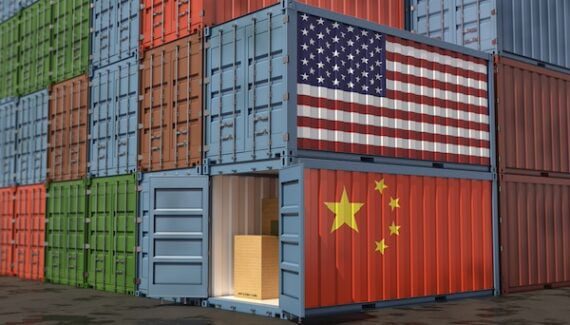
The aim of the 1930 U.S. Tariff Act was to eliminate low-cost imports from customs and duty processing, thereby saving money. Initially pegged at $1 per package, the so-called “de minimis” threshold gradually increased to $800. The exemption became crucial for cross-border dropshippers, fast-fashion brands, and other ecommerce sellers.

President Trump eliminated the de minimis exemption effective August 29, 2025. Most U.S.-bound shipments valued at $800 or less will incur applicable duties, taxes, fees, and other charges, although the change affected packages from China and Hong Kong as of May. The U.S. Postal Service, in collaboration with other domestic postal providers, has a six-month phase-in period.

President Trump eliminated the de minimis exemption, effective August 29, 2025, although the change took effect in May for China and Hong Kong.

President Trump eliminated the de minimis exemption effective August 29, 2025, although the change took effect in May for China and Hong Kong.

Nonetheless, the change represents a dramatic shift for ecommerce. For nearly a decade, cross-border sellers and platforms such as Shein and Temu leaned on the exemption to flood the U.S. with low-value packages.

Meanwhile, American retailers shipping to other countries paid tariffs, hired brokers, and navigated customs compliance. Now, with the exemption gone, the playing field looks different.

Some businesses will suffer due to import complexities and expenses, but others stand to gain.

Scope

The American de minimis rule had been unprecedented. Many countries have similar exemptions for relatively low-value imports, but none come close to an $800 ceiling.

European Union nations typically cap their customs duty at the equivalent of $175, but charge a value-added tax from the first penny. Canada’s exemptions for customs duties and taxes max out at $150 CAD, or approximately $100 USD. Mexico allows shipments of up to $50 USD for a de minimis value. China offers minimal exemptions, and most other countries peak at about $75.

America’s high exemption created an opportunity for foreign ecommerce businesses and some enterprising U.S.-based merchants.

According to the White House, the volume of shipments entering the U.S. duty-free rose from approximately 134 million packages in 2015 (when the limit was $200) to more than 1.36 billion last year.

An estimated 60% of these de minimis, duty-free packages entering the U.S. — hundreds of millions of parcels annually — originate from China.

Harm

The U.S. de minimis suspension will hurt three types of ecommerce companies:

  • Dropshippers. Merchants that manufacture, warehouse, or acquire products offshore for direct, per-item importing will now have to pay standard duty and taxes. This group includes large sellers, such as Temu, as well as many small and retail arbitrage businesses utilizing AliExpress and DSers.
  • Fast-fashion sellers. China’s Shein and similar brands that depend on producing rapidly trendy clothes could face relatively higher landed costs and, as a result, thinner margins.
  • Small ecommerce retailers. The de minimis exemption applied to both direct-to-consumer sales and bulk orders so long as the total value was $800 or less. Thus merchants that place tiny minimum orders from suppliers could also be impacted.

The suspension does not prevent any of these businesses from operating or shipping to the United States, but it does change their economics and presumably increase prices for consumers on goods that were previously duty-free.

Benefit

The suspension is not universally harmful, however, as many American businesses stand to gain.

First and foremost, the suspension could be a boon for merchants and brands that source products in America. This is particularly true for small direct-to-consumer businesses that pay U.S. wages while competing with goods manufactured offshore in markets with extremely low labor costs.

The second group to benefit could be every domestic retailer that already pays import duties.

A retail chain with 15 stores, an ecommerce website, and a requisite marketplace seller account is already paying standard import duties when importing a container load of goods.

In some cases, these retailers had to compete with foreign sellers or arbitrage operations that could offer an identical item at a lower cost due to the de minimis exemption.

Outlook

President Trump suspended the de minimis treatment discussed here on July 30, 2025, by executive order; however, he might change his mind.

The Trump administration often uses trade policy as a form of leverage. If foreign governments such as China make concessions to the United States, the administration could restore or modify the exemption.

Regardless, the de minimis treatment would have ended permanently in 2027. Earlier this year, the U.S. Congress voted to kill the exemption for the vast majority of small imports. The new law appears to aim to close what lawmakers believed was a loophole that has harmed American manufacturers and consumers while benefiting drug traffickers.

The suspension is disruptive for some ecommerce sellers. Yet the industry has adapted before, through sales tax implementations, shipping disruptions, and pandemic-era supply chain crises. It will adapt again.

What began as a convenience rule in the 1930s grew into a key component of global ecommerce. The end of the de minimis exemption may mark the start of something new and promising for American ecommerce businesses.

How to Use Google Ads Performance Max Channel Reporting via @sejournal, @brookeosmundson

For years, marketers have asked for better visibility into how individual channels contribute to Performance Max results.

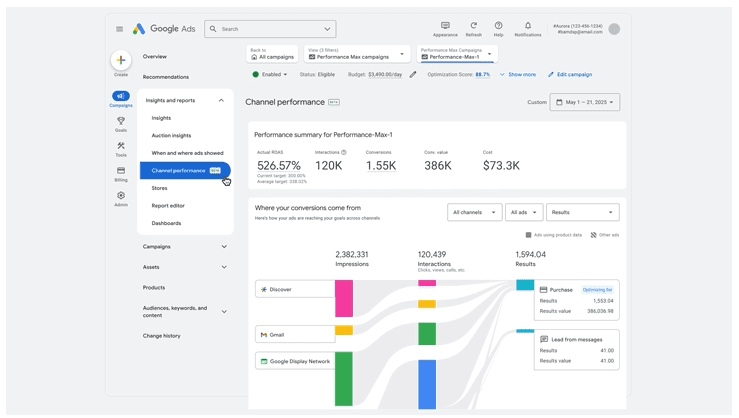
Google has released a tutorial walking advertisers through its new Performance Max channel reporting. This reporting feature offers more transparency into how campaigns perform across Search, YouTube, Display, Gmail, Discover, and Maps.

With this new report, you can now dig deeper into performance by channel and format, making it easier to analyze results and troubleshoot.

Here’s a look at how to find the report and what you can do with it.

Where to Find Channel Performance Reporting

To find and access the channel reporting, head to your Google Ads account.

From there, navigate to: Campaign >> Insights & Reports >> Channel Performance

google ads performance max channel reportingImage credit: Google, April 2025

Once you’re there, you’ll see these items:

  • A performance summary overview
  • A channel-to-goals visualization
  • Channel distribution table.

These items provide more than just a static view of performance. You’re able to click on specific channels to drill down into related reports, like placements on the Google Display Network, or Search Terms from the Search channel.

Exploring the Reports and Visualizations

The channel performance page isn’t just a high-level dashboard. It provides several views and reports that give you more context on how your ads are performing across Google’s network. Here’s a closer look at the most useful areas:

Ad Format Views

Not every ad performs the same across channels, which is why Google lets you break results down by ad format.

For example, you can see how video ads perform on YouTube compared to product ads shown on Search. This helps you spot whether one creative type is pulling more weight and whether you need to adjust your creative mix or budgets to support higher-performing formats.

Product-Driven Insights

If you’re running Shopping or retail campaigns, this section shows how ads tied to product data perform across channels.

You can see Shopping ads on Search as well as dynamic remarketing ads on Display. This gives ecommerce advertisers a clearer picture of how product feeds contribute to results beyond just one channel.

Channel Distribution Table

This table is one of the most detailed reports in the new view. It includes impressions, clicks, interactions, conversions, conversion value, and cost, all broken down by channel.

You can customize the table to highlight the metrics that matter most to your goals, such as ROAS or CPA, and even segment results by ad format (like video versus product ads).

Since the table is downloadable, you can also share it with teams or clients for transparent reporting.

Status Column and Diagnostics

The status column acts as a built-in troubleshooting tool. It surfaces issues or recommendations related to specific channels or formats, such as diagnostic warnings if ads aren’t serving as expected.

By reviewing these, you can quickly identify where performance may be limited and take action to resolve issues before they affect results at scale.

Reviewing Single-Channel vs. Cross-Channel CPA

One important takeaway from Google’s tutorial is that looking at average CPA or ROAS for a single channel doesn’t tell the full story.

Performance Max uses marginal ROI optimization, bidding in real time for the most cost-efficient conversions across all channels.

Since users don’t interact with just one channel, this cross-channel view helps advertisers see the broader picture of how campaigns drive results.

That means when evaluating effectiveness, Google recommends to prioritize your goals and audiences over individual channel performance.

How Advertisers Can Benefit From Performance Max Channel Reporting

The new reporting doesn’t change how Performance Max works behind the scenes, but it does help you:

  • Understand which channels support your goals most effectively
  • Identify areas where specific ad formats or channels may need creative or budget adjustments
  • Communicate results more clearly with stakeholders by showing cross-channel contributions

With Search Partner Network reporting coming in the future, Google is signaling a continued investment in giving advertisers deeper visibility.

Performance Max remains a cross-channel campaign type, but channel reporting is a welcome step toward transparency. By digging into these reports, advertisers can better understand how ads perform across Google properties and make smarter optimization decisions.

Google Adds Guidance On JavaScript Paywalls And SEO via @sejournal, @martinibuster

Google is apparently having trouble identifying paywalled content due to a standard way paywalled content is handled by publishers like news sites. It’s asking that publishers with paywalled content change the way they block content so as to help Google out.

Search Related JavaScript Problems

Google updated their guidelines with a call for publishers to consider changing how they block users from paywalled content. It’s fairly common for publishers to use a script to block non-paying users with an interstitial although the full content is still there in the code. This may be causing issues for Google in properly identifying paywalled content.

A recent addition to their search documentation about JavaScript issues related to search they wrote:

“If you’re using a JavaScript-based paywall, consider the implementation.

Some JavaScript paywall solutions include the full content in the server response, then use JavaScript to hide it until subscription status is confirmed. This isn’t a reliable way to limit access to the content. Make sure your paywall only provides the full content once the subscription status is confirmed.”

The documentation doesn’t say what problems Google itself is having, but a changelog documenting the change offers more context about why they are asking for this change:

“Adding guidance for JavaScript-based paywalls

What: Added new guidance on JavaScript-based paywall considerations.

Why: To help sites understand challenges with the JavaScript-based paywall design pattern, as it makes it difficult for Google to automatically determine which content is paywalled and which isn’t.”

The changelog makes it clear that the way some publishers use JavaScript for blocking paywalled content is making it difficult for Google to know if the content is or is not paywalled.

The change was an addition to a numbered list of JavaScript problems publishers should be aware of, item number 10 on their “Fix Search-related JavaScript Problems” page.

Featured Image by Shutterstock/Kues

RFK Jr’s plan to improve America’s diet is missing the point

A lot of Americans don’t eat well. And they’re paying for it with their health. A diet high in sugar, sodium, and saturated fat can increase the risk of problems like diabetes, heart disease, and kidney disease, to name a few. And those are among the leading causes of death in the US.

This is hardly news. But this week Robert F Kennedy Jr., who heads the US Department of Health and Human Services, floated a new solution to the problem. Kennedy and education secretary Linda McMahon think that teaching medical students more about the role of nutrition in health could help turn things around.

“I’m working with Linda on forcing medical schools … to put nutrition into medical school education,” Kennedy said during a cabinet meeting on August 26. The next day, HHS released a statement calling for “increased nutrition education” for medical students.

“We can reverse the chronic-disease epidemic simply by changing our diets and lifestyles,” Kennedy said in an accompanying video statement. “But to do that, we need nutrition to be a basic part of every doctor’s training.”

It certainly sounds like a good idea. If more Americans ate a healthier diet, we could expect to see a decrease in those diseases. But this framing of America’s health crisis is overly simplistic, especially given that plenty of the administration’s other actions have directly undermined health in multiple ways—including by canceling a vital nutrition education program.

At any rate, there are other, more effective ways to tackle the chronic-disease crisis.

The biggest killers, heart disease and stroke, are responsible for more than a third of deaths, according to the US Centers for Disease Control and Prevention. A healthy diet can reduce your risk of developing those conditions. And it makes total sense to educate the future doctors of America about nutrition.

Medical bodies are on board with the idea, too. “The importance of nutrition in medical education is increasingly clear, and we support expanded, evidence-based instruction to better equip physicians to prevent and manage chronic disease and improve patient outcomes,” David H. Aizuss, chair of the American Medical Association’s board of trustees, said in a statement.

But it’s not as though medical students aren’t getting any nutrition education. And that training has increased in the last five years, according to surveys carried out by the American Association of Medical Colleges.

Kennedy has referred to a 2021 survey suggesting that medical students in the US get only around one hour of nutrition education per year. But the AAMC argues that nutrition education increasingly happens through “integrated experiences” rather than stand-alone lectures.

“Medical schools understand the critical role that nutrition plays in preventing, managing, and treating chronic health conditions, and incorporate significant nutrition education across their required curricula,” Alison J. Whelan, AAMC’s chief academic officer, said in a statement.

That’s not to say there isn’t room for improvement. Gabby Headrick, a food systems dietician and associate director of food and nutrition policy at George Washington University’s Institute for Food Safety & Nutrition Security, thinks nutritionists could take a more prominent role in patient care, too.

But it’s somewhat galling for the administration to choose medical education as its focus given the recent cuts in federal funding that will affect health. For example, funding for the National Diabetes Prevention Program, which offers support and guidance to help thousands of people adopt healthy diets and exercise routines, was canceled by the Trump administration in March.

The focus on medical schools also overlooks one of the biggest factors behind poor nutrition in the US: access to healthy food. A recent survey by the Pew Research Center found that increased costs make it harder for most Americans to eat well. Twenty percent of the people surveyed acknowledged that their diets were not healthy.

“So many people know what a healthy diet is, and they know what should be on their plate every night,” says Headrick, who has researched this issue. “But the vast majority of folks just truly do not have the money or the time to get the food on the plate.”

The Supplemental Nutrition Assistance Program (SNAP) has been helping low-income Americans afford some of those healthier foods. It supported over 41 million people in 2024. But under the Trump administration’s tax and spending bill, the program is set to lose around $186 billion in funding over the next 10 years.

Kennedy’s focus is on education. And it just so happens that there is a nutrition education program in place—one that helps people of all ages learn not only what healthy foods are, but how to source them on a budget and use them to prepare meals.

SNAP-Ed, as it’s known, has already provided this support to millions of Americans. Under the Trump administration, it is set to be eliminated.

It is difficult to see how these actions are going to help people adopt healthier diets. What might be a better approach? I put the question to Headrick: If she were in charge, what policies would she enact?

“Universal health care,” she told me. Being able to access health care without risking financial hardship not only improves health outcomes and life expectancy; it also spares people from medical debt—something that affects around 40% of adults in the US, according to a recent survey.

And the Trump administration’s plans to cut federal health spending by about a trillion dollars over the next decade certainly aren’t going to help with that. All told, around 16 million people could lose their health insurance by 2034, according to estimates by the Congressional Budget Office.

“The evidence suggests that if we cut folks’ social benefit programs, such as access to health care and food, we are going to see detrimental impacts,” says Headrick. “And it’s going to cause an increased burden of preventable disease.”

This article first appeared in The Checkup, MIT Technology Review’s weekly biotech newsletter. To receive it in your inbox every Thursday, and read articles like this first, sign up here.

RFK Jr’s plan to improve America’s diet is missing the point

A lot of Americans don’t eat well. And they’re paying for it with their health. A diet high in sugar, sodium, and saturated fat can increase the risk of problems like diabetes, heart disease, and kidney disease, to name a few. And those are among the leading causes of death in the US.

This is hardly news. But this week Robert F Kennedy Jr., who heads the US Department of Health and Human Services, floated a new solution to the problem. Kennedy and education secretary Linda McMahon think that teaching medical students more about the role of nutrition in health could help turn things around.

“I’m working with Linda on forcing medical schools … to put nutrition into medical school education,” Kennedy said during a cabinet meeting on August 26. The next day, HHS released a statement calling for “increased nutrition education” for medical students.

“We can reverse the chronic-disease epidemic simply by changing our diets and lifestyles,” Kennedy said in an accompanying video statement. “But to do that, we need nutrition to be a basic part of every doctor’s training.”

It certainly sounds like a good idea. If more Americans ate a healthier diet, we could expect to see a decrease in those diseases. But this framing of America’s health crisis is overly simplistic, especially given that plenty of the administration’s other actions have directly undermined health in multiple ways—including by canceling a vital nutrition education program.

At any rate, there are other, more effective ways to tackle the chronic-disease crisis.

The biggest killers, heart disease and stroke, are responsible for more than a third of deaths, according to the US Centers for Disease Control and Prevention. A healthy diet can reduce your risk of developing those conditions. And it makes total sense to educate the future doctors of America about nutrition.

Medical bodies are on board with the idea, too. “The importance of nutrition in medical education is increasingly clear, and we support expanded, evidence-based instruction to better equip physicians to prevent and manage chronic disease and improve patient outcomes,” David H. Aizuss, chair of the American Medical Association’s board of trustees, said in a statement.

But it’s not as though medical students aren’t getting any nutrition education. And that training has increased in the last five years, according to surveys carried out by the American Association of Medical Colleges.

Kennedy has referred to a 2021 survey suggesting that medical students in the US get only around one hour of nutrition education per year. But the AAMC argues that nutrition education increasingly happens through “integrated experiences” rather than stand-alone lectures.

“Medical schools understand the critical role that nutrition plays in preventing, managing, and treating chronic health conditions, and incorporate significant nutrition education across their required curricula,” Alison J. Whelan, AAMC’s chief academic officer, said in a statement.

That’s not to say there isn’t room for improvement. Gabby Headrick, a food systems dietician and associate director of food and nutrition policy at George Washington University’s Institute for Food Safety & Nutrition Security, thinks nutritionists could take a more prominent role in patient care, too.

But it’s somewhat galling for the administration to choose medical education as its focus given the recent cuts in federal funding that will affect health. For example, funding for the National Diabetes Prevention Program, which offers support and guidance to help thousands of people adopt healthy diets and exercise routines, was canceled by the Trump administration in March.

The focus on medical schools also overlooks one of the biggest factors behind poor nutrition in the US: access to healthy food. A recent survey by the Pew Research Center found that increased costs make it harder for most Americans to eat well. Twenty percent of the people surveyed acknowledged that their diets were not healthy.

“So many people know what a healthy diet is, and they know what should be on their plate every night,” says Headrick, who has researched this issue. “But the vast majority of folks just truly do not have the money or the time to get the food on the plate.”

The Supplemental Nutrition Assistance Program (SNAP) has been helping low-income Americans afford some of those healthier foods. It supported over 41 million people in 2024. But under the Trump administration’s tax and spending bill, the program is set to lose around $186 billion in funding over the next 10 years.

Kennedy’s focus is on education. And it just so happens that there is a nutrition education program in place—one that helps people of all ages learn not only what healthy foods are, but how to source them on a budget and use them to prepare meals.

SNAP-Ed, as it’s known, has already provided this support to millions of Americans. Under the Trump administration, it is set to be eliminated.

It is difficult to see how these actions are going to help people adopt healthier diets. What might be a better approach? I put the question to Headrick: If she were in charge, what policies would she enact?

“Universal health care,” she told me. Being able to access health care without risking financial hardship not only improves health outcomes and life expectancy; it also spares people from medical debt—something that affects around 40% of adults in the US, according to a recent survey.

And the Trump administration’s plans to cut federal health spending by about a trillion dollars over the next decade certainly aren’t going to help with that. All told, around 16 million people could lose their health insurance by 2034, according to estimates by the Congressional Budget Office.

“The evidence suggests that if we cut folks’ social benefit programs, such as access to health care and food, we are going to see detrimental impacts,” says Headrick. “And it’s going to cause an increased burden of preventable disease.”

This article first appeared in The Checkup, MIT Technology Review’s weekly biotech newsletter. To receive it in your inbox every Thursday, and read articles like this first, sign up here.

This American nuclear company could help India’s thorium dream

For just the second time in nearly two decades, the United States has granted an export license to an American company planning to sell nuclear technology to India, MIT Technology Review has learned. The decision to greenlight Clean Core Thorium Energy’s license is a major step toward closer cooperation between the two countries on atomic energy and marks a milestone in the development of thorium as an alternative to uranium for fueling nuclear reactors. 

Starting from the issuance last week, the thorium fuel produced by the Chicago-based company can be shipped to reactors in India, where it could be loaded into the cores of existing reactors. Once Clean Core receives final approval from Indian regulators, it will become one of the first American companies to sell nuclear technology to India, just as the world’s most populous nation has started relaxing strict rules that have long kept the US private sector from entering its atomic power industry. 

“This license marks a turning point, not just for Clean Core but for the US-India civil nuclear partnership,” says Mehul Shah, the company’s chief executive and founder. “It places thorium at the center of the global energy transformation.”

Thorium has long been seen as a good alternative to uranium because it’s more abundant, produces both smaller amounts of long-lived radioactive waste and fewer byproducts with centuries-long half-lives, and reduces the risk that materials from the fuel cycle will be diverted into weapons manufacturing. 

But at least some uranium fuel is needed to make thorium atoms split, making it an imperfect replacement. It’s also less well suited for use in the light-water reactors that power the vast majority of commercial nuclear plants worldwide. And in any case, the complex, highly regulated nuclear industry is extremely resistant to change.

For India, which has scant uranium reserves but abundant deposits of thorium, the latter metal has been part of a long-term strategy for reducing dependence on imported fuels. The nation started negotiating a nuclear export treaty with the US in the early 2000s, and a 123 Agreement—a special, Senate-approved treaty the US requires with another country before sending it any civilian nuclear products—was approved in 2008.

A new approach

While most thorium advocates have envisioned new reactors designed to run on this fuel, which would mean rebuilding the nuclear industry from the ground up, Shah and his team took a different approach. Clean Core created a new type of fuel that blends thorium with a more concentrated type of uranium called HALEU (high-assay low-enriched uranium). This blended fuel can be used in India’s pressurized heavy-water reactors, which make up the bulk of the country’s existing fleet and many of the new units under development now. 

Thorium isn’t a fissile material itself, meaning its atoms aren’t inherently unstable enough for an extra neutron to easily split the nuclei and release energy. But the metal has what’s known as “fertile properties,” meaning it can absorb neutrons and transform into the fissile material uranium-233. Uranium-233 produces fewer long-lived radioactive isotopes than the uranium-235 that makes up the fissionable part of traditional fuel pellets. Most commercial reactors run on low-enriched uranium, which is about 5% U-235. When the fuel is spent, roughly 95% of the energy potential is left in the metal. And what remains is a highly toxic cocktail of long-lived radioactive isotopes such as cesium-137 and plutonium-239, which keep the waste dangerous for tens of thousands of years. Another concern is that the plutonium could be extracted for use in weapons. 

Enriched up to 20%, HALEU allows reactors to extract more of the available energy and thus reduce the volume of waste. Clean Core’s fuel goes further: The HALEU provides the initial spark to ignite fertile thorium and triggers a reaction that can burn much hotter and utilize the vast majority of the material in the core, as a study published last year in the journal Nuclear Engineering and Design showed.

“Thorium provides attributes needed to achieve higher burnups,” says Koroush Shirvan, an MIT professor of nuclear science and engineering who helped design Clean Core’s fuel assemblies. “It is enabling technology to go to higher burnups, which reduces your spent fuel volume, increases your fuel efficiency, and reduces the amount of uranium that you need.” 

Compared with traditional uranium fuel, Clean Core says, its fuel reduces waste by more than 85% while avoiding the most problematic isotopes produced during fission. “The result is a safer, more sustainable cycle that reframes nuclear power not as a source of millennia-long liabilities but as a pathway to cleaner energy and a viable future fuel supply,” says Milan Shah, Clean Core’s chief operating officer and Mehul’s son.

Pressurized heavy-water reactors are particularly well suited to thorium because heavy water—a version of H2O that has an extra neutron on the hydrogen atom—absorbs fewer neutrons during the fission process, increasing efficiency by allowing more neutrons to be captured by the thorium.

There are 46 so-called PHWRs operating worldwide: 17 in Canada, 19 in India, three each in Argentina and South Korea, and two each in China and Romania, according to data from the International Atomic Energy Agency. In 1954, India set out a three-stage development plan for nuclear power that involved eventually phasing thorium into the fuel cycle for its fleet. 

Yet in the 56 years since India built its first commercial nuclear plant, its state-controlled industry has remained relatively shut off to the private sector and the rest of the world. When the US signed the 123 Agreement with India in 2008, the moment heralded an era in which the subcontinent could become a testing ground for new American reactor designs. 

In 2010, however, India passed the Civil Liability for Nuclear Damage Act. The legislation was based on what lawmakers saw as legal shortcomings in the wake of the 1984 Bhopal chemical factory disaster, when a subsidiary of the American industrial giant Dow Chemical avoided major payouts to the victims of a catastrophe that killed thousands. Under this law, responsibility for an accident at an Indian nuclear plant would fall on suppliers. The statute effectively killed any exports to India, since few companies could shoulder that burden. Only Russia’s state-owned Rosatom charged ahead with exporting reactors to India.

But things are changing. In a joint statement issued after a February 2025 summit, Prime Minister Narendra Modi and President Donald Trump “announced their commitment to fully realise the US-India 123 Civil Nuclear Agreement by moving forward with plans to work together to build US-designed nuclear reactors in India through large scale localisation and possible technology transfer.” 

In March 2025, US federal officials gave the nuclear developer Holtec International an export license to sell Indian companies its as-yet-unbuilt small modular reactors, which are based on the light-water reactor design used in the US. In April, the Indian government suggested it would reform the nuclear liability law to relax rules on foreign companies in hopes of drawing more overseas developers. Last month, a top minister confirmed that the Modi administration would overhaul the law. 

“For India, the thing they need to do is get another international vendor in the marketplace,” says Chris Gadomski, the chief nuclear analyst at the consultancy BloombergNEF.

Path of least resistance

But Shah sees larger potential for Clean Core. Unlike Holtec, whose export license was endorsed by the two Mumbai-based industrial giants Larsen & Toubro and Tata Consulting Engineers, Clean Core had its permit approved by two of India’s atomic regulators and its main state-owned nuclear company. By focusing on fuel rather than new reactors, Clean Core could become a vendor to the majority of the existing plants already operating in India. 

Its technology diverges not only from that of other US nuclear companies but also from the approach used in China. Last year, China made waves by bringing its first thorium-fueled reactor online. This enabled it to establish a new foothold in a technology the US had invented and then abandoned, and it gave Beijing another leg up in atomic energy.

But scaling that technology will require building out a whole new kind of reactor. That comes at a cost. A recent Johns Hopkins University study found that China’s success in building nuclear reactors stemmed in large part from standardization and repetition of successful designs, virtually all of which have been light-water reactors. Using thorium in existing heavy-water reactors lowers the bar for popularizing the fuel, according to the younger Shah. 

“We think ours is the path of least resistance,” Milan Shah says. “Maybe not being completely revolutionary in the way you look at nuclear today, but incredibly evolutionary to progress humanity forward.” 

The company has plans to go beyond pressurized heavy-water reactors. Within two years, the elder Shah says, Clean Core plans to design a version of its fuel that could work in the light-water reactors that make up the entire US fleet of 94. But it’s not a simple conversion. For starters, there’s the size: While the PHWR fuel rods are about 50 centimeters in length, the rods that go into light-water reactors are roughly four meters long. Then there’s the history of challenges with light water’s absorption of neutrons that could otherwise be captured to induce fission in the thorium. 

For Anil Kakodkar, the former chairman of India’s Atomic Energy Commission and a mentor to Shah, popularizing thorium could help rectify one of the darker chapters in his country’s nuclear development. In 1974, India became the first country since the signing of the first global Treaty on the Non-Proliferation of Nuclear Weapons to successfully test an atomic weapon. New Delhi was never a signatory to the pact. But the milestone prompted neighboring Pakistan to develop its own weapons. 

In response, President Jimmy Carter tried to demonstrate Washington’s commitment to reversing the Cold War arms race by sacrificing the first US effort to commercialize nuclear waste recycling, since the technology to separate plutonium and other radioisotopes from uranium in spent fuel was widely seen as a potential new source of weapons-grade material. By running its own reactors on thorium, Kakodkar says, India can chart a new path for newcomer nations that want to harness the power of the atom without stoking fears that nuclear weapons capability will spread. 

“The proliferation concerns will be dismissed to a significant extent, allowing more rapid growth of nuclear power in emerging countries,” he says. “That will be a good thing for the world at large.” 

Alexander C. Kaufman is a reporter who has covered energy, climate change, pollution, business, and geopolitics for more than a decade. 

This American nuclear company could help India’s thorium dream

For just the second time in nearly two decades, the United States has granted an export license to an American company planning to sell nuclear technology to India, MIT Technology Review has learned. The decision to greenlight Clean Core Thorium Energy’s license is a major step toward closer cooperation between the two countries on atomic energy and marks a milestone in the development of thorium as an alternative to uranium for fueling nuclear reactors. 

Starting from the issuance last week, the thorium fuel produced by the Chicago-based company can be shipped to reactors in India, where it could be loaded into the cores of existing reactors. Once Clean Core receives final approval from Indian regulators, it will become one of the first American companies to sell nuclear technology to India, just as the world’s most populous nation has started relaxing strict rules that have long kept the US private sector from entering its atomic power industry. 

“This license marks a turning point, not just for Clean Core but for the US-India civil nuclear partnership,” says Mehul Shah, the company’s chief executive and founder. “It places thorium at the center of the global energy transformation.”

Thorium has long been seen as a good alternative to uranium because it’s more abundant, produces both smaller amounts of long-lived radioactive waste and fewer byproducts with centuries-long half-lives, and reduces the risk that materials from the fuel cycle will be diverted into weapons manufacturing. 

But at least some uranium fuel is needed to make thorium atoms split, making it an imperfect replacement. It’s also less well suited for use in the light-water reactors that power the vast majority of commercial nuclear plants worldwide. And in any case, the complex, highly regulated nuclear industry is extremely resistant to change.

For India, which has scant uranium reserves but abundant deposits of thorium, the latter metal has been part of a long-term strategy for reducing dependence on imported fuels. The nation started negotiating a nuclear export treaty with the US in the early 2000s, and a 123 Agreement—a special, Senate-approved treaty the US requires with another country before sending it any civilian nuclear products—was approved in 2008.

A new approach

While most thorium advocates have envisioned new reactors designed to run on this fuel, which would mean rebuilding the nuclear industry from the ground up, Shah and his team took a different approach. Clean Core created a new type of fuel that blends thorium with a more concentrated type of uranium called HALEU (high-assay low-enriched uranium). This blended fuel can be used in India’s pressurized heavy-water reactors, which make up the bulk of the country’s existing fleet and many of the new units under development now. 

Thorium isn’t a fissile material itself, meaning its atoms aren’t inherently unstable enough for an extra neutron to easily split the nuclei and release energy. But the metal has what’s known as “fertile properties,” meaning it can absorb neutrons and transform into the fissile material uranium-233. Uranium-233 produces fewer long-lived radioactive isotopes than the uranium-235 that makes up the fissionable part of traditional fuel pellets. Most commercial reactors run on low-enriched uranium, which is about 5% U-235. When the fuel is spent, roughly 95% of the energy potential is left in the metal. And what remains is a highly toxic cocktail of long-lived radioactive isotopes such as cesium-137 and plutonium-239, which keep the waste dangerous for tens of thousands of years. Another concern is that the plutonium could be extracted for use in weapons. 

Enriched up to 20%, HALEU allows reactors to extract more of the available energy and thus reduce the volume of waste. Clean Core’s fuel goes further: The HALEU provides the initial spark to ignite fertile thorium and triggers a reaction that can burn much hotter and utilize the vast majority of the material in the core, as a study published last year in the journal Nuclear Engineering and Design showed.

“Thorium provides attributes needed to achieve higher burnups,” says Koroush Shirvan, an MIT professor of nuclear science and engineering who helped design Clean Core’s fuel assemblies. “It is enabling technology to go to higher burnups, which reduces your spent fuel volume, increases your fuel efficiency, and reduces the amount of uranium that you need.” 

Compared with traditional uranium fuel, Clean Core says, its fuel reduces waste by more than 85% while avoiding the most problematic isotopes produced during fission. “The result is a safer, more sustainable cycle that reframes nuclear power not as a source of millennia-long liabilities but as a pathway to cleaner energy and a viable future fuel supply,” says Milan Shah, Clean Core’s chief operating officer and Mehul’s son.

Pressurized heavy-water reactors are particularly well suited to thorium because heavy water—a version of H2O that has an extra neutron on the hydrogen atom—absorbs fewer neutrons during the fission process, increasing efficiency by allowing more neutrons to be captured by the thorium.

There are 46 so-called PHWRs operating worldwide: 17 in Canada, 19 in India, three each in Argentina and South Korea, and two each in China and Romania, according to data from the International Atomic Energy Agency. In 1954, India set out a three-stage development plan for nuclear power that involved eventually phasing thorium into the fuel cycle for its fleet. 

Yet in the 56 years since India built its first commercial nuclear plant, its state-controlled industry has remained relatively shut off to the private sector and the rest of the world. When the US signed the 123 Agreement with India in 2008, the moment heralded an era in which the subcontinent could become a testing ground for new American reactor designs. 

In 2010, however, India passed the Civil Liability for Nuclear Damage Act. The legislation was based on what lawmakers saw as legal shortcomings in the wake of the 1984 Bhopal chemical factory disaster, when a subsidiary of the American industrial giant Dow Chemical avoided major payouts to the victims of a catastrophe that killed thousands. Under this law, responsibility for an accident at an Indian nuclear plant would fall on suppliers. The statute effectively killed any exports to India, since few companies could shoulder that burden. Only Russia’s state-owned Rosatom charged ahead with exporting reactors to India.

But things are changing. In a joint statement issued after a February 2025 summit, Prime Minister Narendra Modi and President Donald Trump “announced their commitment to fully realise the US-India 123 Civil Nuclear Agreement by moving forward with plans to work together to build US-designed nuclear reactors in India through large scale localisation and possible technology transfer.” 

In March 2025, US federal officials gave the nuclear developer Holtec International an export license to sell Indian companies its as-yet-unbuilt small modular reactors, which are based on the light-water reactor design used in the US. In April, the Indian government suggested it would reform the nuclear liability law to relax rules on foreign companies in hopes of drawing more overseas developers. Last month, a top minister confirmed that the Modi administration would overhaul the law. 

“For India, the thing they need to do is get another international vendor in the marketplace,” says Chris Gadomski, the chief nuclear analyst at the consultancy BloombergNEF.

Path of least resistance

But Shah sees larger potential for Clean Core. Unlike Holtec, whose export license was endorsed by the two Mumbai-based industrial giants Larsen & Toubro and Tata Consulting Engineers, Clean Core had its permit approved by two of India’s atomic regulators and its main state-owned nuclear company. By focusing on fuel rather than new reactors, Clean Core could become a vendor to the majority of the existing plants already operating in India. 

Its technology diverges not only from that of other US nuclear companies but also from the approach used in China. Last year, China made waves by bringing its first thorium-fueled reactor online. This enabled it to establish a new foothold in a technology the US had invented and then abandoned, and it gave Beijing another leg up in atomic energy.

But scaling that technology will require building out a whole new kind of reactor. That comes at a cost. A recent Johns Hopkins University study found that China’s success in building nuclear reactors stemmed in large part from standardization and repetition of successful designs, virtually all of which have been light-water reactors. Using thorium in existing heavy-water reactors lowers the bar for popularizing the fuel, according to the younger Shah. 

“We think ours is the path of least resistance,” Milan Shah says. “Maybe not being completely revolutionary in the way you look at nuclear today, but incredibly evolutionary to progress humanity forward.” 

The company has plans to go beyond pressurized heavy-water reactors. Within two years, the elder Shah says, Clean Core plans to design a version of its fuel that could work in the light-water reactors that make up the entire US fleet of 94. But it’s not a simple conversion. For starters, there’s the size: While the PHWR fuel rods are about 50 centimeters in length, the rods that go into light-water reactors are roughly four meters long. Then there’s the history of challenges with light water’s absorption of neutrons that could otherwise be captured to induce fission in the thorium. 

For Anil Kakodkar, the former chairman of India’s Atomic Energy Commission and a mentor to Shah, popularizing thorium could help rectify one of the darker chapters in his country’s nuclear development. In 1974, India became the first country since the signing of the first global Treaty on the Non-Proliferation of Nuclear Weapons to successfully test an atomic weapon. New Delhi was never a signatory to the pact. But the milestone prompted neighboring Pakistan to develop its own weapons. 

In response, President Jimmy Carter tried to demonstrate Washington’s commitment to reversing the Cold War arms race by sacrificing the first US effort to commercialize nuclear waste recycling, since the technology to separate plutonium and other radioisotopes from uranium in spent fuel was widely seen as a potential new source of weapons-grade material. By running its own reactors on thorium, Kakodkar says, India can chart a new path for newcomer nations that want to harness the power of the atom without stoking fears that nuclear weapons capability will spread. 

“The proliferation concerns will be dismissed to a significant extent, allowing more rapid growth of nuclear power in emerging countries,” he says. “That will be a good thing for the world at large.” 

Alexander C. Kaufman is a reporter who has covered energy, climate change, pollution, business, and geopolitics for more than a decade. 

The Download: humans in space, and India’s thorium ambitions

This is today’s edition of The Download, our weekday newsletter that provides a daily dose of what’s going on in the world of technology.

The case against humans in space

Elon Musk and Jeff Bezos are bitter rivals in the commercial space race, but they agree on one thing: Settling space is an existential imperative. Space is the place. The final frontier. It is our human destiny to transcend our home world and expand our civilization to extraterrestrial vistas.

This belief has been mainstream for decades, but its rise has been positively meteoric in this new gilded age of astropreneurs.

But as visions of giant orbital stations and Martian cities dance in our heads, a case against human space colonization has found its footing in a number of recent books, from doubts about the practical feasibility of off-Earth communities, to realism about the harsh environment of space and the enormous tax it would exact on the human body. Read the full story.

—Becky Ferreira

This story is from our new print edition, which is all about the future of security. Subscribe here to catch future copies when they land.

This American nuclear company could help India’s thorium dream

For just the second time in nearly two decades, the United States has granted an export license to an American company planning to sell nuclear technology to India, MIT Technology Review has learned. 

The decision to greenlight Clean Core Thorium Energy’s license is a major step toward closer cooperation between the two countries on atomic energy and marks a milestone in the development of thorium as an alternative to uranium for fueling nuclear reactors. Read more about why it’s such a big deal.

—Alexander C. Kaufman

RFK Jr’s plan to improve America’s diet is missing the point

A lot of Americans don’t eat well. And they’re paying for it with their health. A diet high in sugar, sodium, and saturated fat can increase the risk of problems like diabetes, heart disease, and kidney disease, to name a few. And those are among the leading causes of death in the US.

This is hardly news. But this week Robert F Kennedy Jr., who heads the US Department of Health and Human Services, floated a new solution to the problem: teaching medical students more about the role of nutrition in health could help turn things around.

It certainly sounds like a good idea. If more Americans ate a healthier diet, we could expect to see a decrease in those diseases. 

But this framing of America’s health crisis is overly simplistic, especially given that plenty of the administration’s other actions have directly undermined health in multiple ways—including by canceling a vital nutrition education program. And at any rate, there are other, more effective ways to tackle the chronic-disease crisis. Read the full story.

—Jessica Hamzelou

This article first appeared in The Checkup, MIT Technology Review’s weekly biotech newsletter. To receive it in your inbox every Thursday, and read articles like this first, sign up here.

The must-reads

I’ve combed the internet to find you today’s most fun/important/scary/fascinating stories about technology.

1 RFK Jr’s deputy has been chosen to be the new acting head of the CDC
Jim O’Neill is likely to greenlight his boss’s federal vaccine policy plans. (WP $)
+ The future of the department looks decidedly precarious. (The Atlantic $)
+ Everything you need to know about Jim O’Neill, the longevity enthusiast who is now RFK Jr.’s right-hand man. (MIT Technology Review)

2 A man killed his mother and himself after conversing with ChatGPT
The chatbot encouraged Stein-Erik Soelberg’s paranoia while repeatedly assuring him he was sane. (WSJ $)
+ An AI chatbot told a user how to kill himself—but the company doesn’t want to “censor” it. (MIT Technology Review)

3 China is cracking down on excess competition in its AI sector
The country is hellbent on avoiding wasteful investment. (Bloomberg $)
+ China is laser-focused on engineering, not so much on litigating. (Wired $)
+ China built hundreds of AI data centers to catch the AI boom. Now many stand unused. (MIT Technology Review)

4 The EU should be prepared to walk away from a US trade deal
Its competition commissioner worries Trump may act on his threats to target the bloc. (FT $)
+ The French President had a similar warning for his ministers. (Politico)

5 xAI has released a new Grok agentic coding model
At a significantly lower price than its rivals. (Reuters)
+ This no-code website builder has been valued at $2 billion. (TechCrunch)
+ The second wave of AI coding is here. (MIT Technology Review)

6 A US mail change has thrown online businesses into turmoil
All package deliveries are due to face duties from this week. (Insider $)

7 A former DOGE official is running America’s biggest MDMA company
And Antonio Gracias is not the only member of the department with ties to the psychedelics industry. (The Guardian)
+ Other DOGE workers are joining Trump’s new National Design Studio. (Wired $)
+ The FDA said no to the use of MDMA as a therapy last year. (MIT Technology Review)

8 How chatbots fake having personalities
They have no persistent self—despite what they may tell you. (Ars Technica)
+ What is AI? (MIT Technology Review)

9 The future of podcasting is murky
Hundreds of shows have folded. The medium is in desperate need of an archive. (NY Mag $)
+ The race to save our online lives from a digital dark age. (MIT Technology Review)

10 Do we even know what we want to watch anymore?
We’re so reliant on algorithms, it’s hard to know. (New Yorker $)

Quote of the day

“We’re scared for ourselves and for the country.” 

—An anonymous CDC worker tells the New York Times about the mood inside the agency following the firing of their new director Susan Monarez.

One more thing

How a tiny Pacific Island became the global capital of cybercrime

Tokelau, a string of three isolated atolls strung out across the Pacific, is so remote that it was the last place on Earth to be connected to the telephone—only in 1997. Just three years later, the islands received a fax with an unlikely business proposal that would change everything.

It was from an early internet entrepreneur from Amsterdam, named Joost Zuurbier. He wanted to manage Tokelau’s country-code top-level domain, or ccTLD—the short string of characters that is tacked onto the end of a URL—in exchange for money.

In the succeeding years, tiny Tokelau became an unlikely internet giant—but not in the way it may have hoped. Until recently, its .tk domain had more users than any other country’s: a staggering 25 million—but the vast majority were spammers, phishers, and cybercriminals.

Now the territory is desperately trying to clean up .tk. Its international standing, and even its sovereignty, may depend on it. Read the full story.
 
—Jacob Judah

We can still have nice things

A place for comfort, fun and distraction to brighten up your day. (Got any ideas? Drop me a line or skeet ’em at me.)

+ Scientists are using yeast to help save the bees.
+ How to become super productive 😌
+ Why North American mammoths were genetic freaks of nature.
+ I love Seal’s steadfast refusal to explain his lyrics to Kiss from a Rose.

The Download: humans in space, and India’s thorium ambitions

This is today’s edition of The Download, our weekday newsletter that provides a daily dose of what’s going on in the world of technology.

The case against humans in space

Elon Musk and Jeff Bezos are bitter rivals in the commercial space race, but they agree on one thing: Settling space is an existential imperative. Space is the place. The final frontier. It is our human destiny to transcend our home world and expand our civilization to extraterrestrial vistas.

This belief has been mainstream for decades, but its rise has been positively meteoric in this new gilded age of astropreneurs.

But as visions of giant orbital stations and Martian cities dance in our heads, a case against human space colonization has found its footing in a number of recent books, from doubts about the practical feasibility of off-Earth communities, to realism about the harsh environment of space and the enormous tax it would exact on the human body. Read the full story.

—Becky Ferreira

This story is from our new print edition, which is all about the future of security. Subscribe here to catch future copies when they land.

This American nuclear company could help India’s thorium dream

For just the second time in nearly two decades, the United States has granted an export license to an American company planning to sell nuclear technology to India, MIT Technology Review has learned. 

The decision to greenlight Clean Core Thorium Energy’s license is a major step toward closer cooperation between the two countries on atomic energy and marks a milestone in the development of thorium as an alternative to uranium for fueling nuclear reactors. Read more about why it’s such a big deal.

—Alexander C. Kaufman

RFK Jr’s plan to improve America’s diet is missing the point

A lot of Americans don’t eat well. And they’re paying for it with their health. A diet high in sugar, sodium, and saturated fat can increase the risk of problems like diabetes, heart disease, and kidney disease, to name a few. And those are among the leading causes of death in the US.

This is hardly news. But this week Robert F Kennedy Jr., who heads the US Department of Health and Human Services, floated a new solution to the problem: teaching medical students more about the role of nutrition in health could help turn things around.

It certainly sounds like a good idea. If more Americans ate a healthier diet, we could expect to see a decrease in those diseases. 

But this framing of America’s health crisis is overly simplistic, especially given that plenty of the administration’s other actions have directly undermined health in multiple ways—including by canceling a vital nutrition education program. And at any rate, there are other, more effective ways to tackle the chronic-disease crisis. Read the full story.

—Jessica Hamzelou

This article first appeared in The Checkup, MIT Technology Review’s weekly biotech newsletter. To receive it in your inbox every Thursday, and read articles like this first, sign up here.

The must-reads

I’ve combed the internet to find you today’s most fun/important/scary/fascinating stories about technology.

1 RFK Jr’s deputy has been chosen to be the new acting head of the CDC
Jim O’Neill is likely to greenlight his boss’s federal vaccine policy plans. (WP $)
+ The future of the department looks decidedly precarious. (The Atlantic $)
+ Everything you need to know about Jim O’Neill, the longevity enthusiast who is now RFK Jr.’s right-hand man. (MIT Technology Review)

2 A man killed his mother and himself after conversing with ChatGPT
The chatbot encouraged Stein-Erik Soelberg’s paranoia while repeatedly assuring him he was sane. (WSJ $)
+ An AI chatbot told a user how to kill himself—but the company doesn’t want to “censor” it. (MIT Technology Review)

3 China is cracking down on excess competition in its AI sector
The country is hellbent on avoiding wasteful investment. (Bloomberg $)
+ China is laser-focused on engineering, not so much on litigating. (Wired $)
+ China built hundreds of AI data centers to catch the AI boom. Now many stand unused. (MIT Technology Review)

4 The EU should be prepared to walk away from a US trade deal
Its competition commissioner worries Trump may act on his threats to target the bloc. (FT $)
+ The French President had a similar warning for his ministers. (Politico)

5 xAI has released a new Grok agentic coding model
At a significantly lower price than its rivals. (Reuters)
+ This no-code website builder has been valued at $2 billion. (TechCrunch)
+ The second wave of AI coding is here. (MIT Technology Review)

6 A US mail change has thrown online businesses into turmoil
All package deliveries are due to face duties from this week. (Insider $)

7 A former DOGE official is running America’s biggest MDMA company
And Antonio Gracias is not the only member of the department with ties to the psychedelics industry. (The Guardian)
+ Other DOGE workers are joining Trump’s new National Design Studio. (Wired $)
+ The FDA said no to the use of MDMA as a therapy last year. (MIT Technology Review)

8 How chatbots fake having personalities
They have no persistent self—despite what they may tell you. (Ars Technica)
+ What is AI? (MIT Technology Review)

9 The future of podcasting is murky
Hundreds of shows have folded. The medium is in desperate need of an archive. (NY Mag $)
+ The race to save our online lives from a digital dark age. (MIT Technology Review)

10 Do we even know what we want to watch anymore?
We’re so reliant on algorithms, it’s hard to know. (New Yorker $)

Quote of the day

“We’re scared for ourselves and for the country.” 

—An anonymous CDC worker tells the New York Times about the mood inside the agency following the firing of their new director Susan Monarez.

One more thing

How a tiny Pacific Island became the global capital of cybercrime

Tokelau, a string of three isolated atolls strung out across the Pacific, is so remote that it was the last place on Earth to be connected to the telephone—only in 1997. Just three years later, the islands received a fax with an unlikely business proposal that would change everything.

It was from an early internet entrepreneur from Amsterdam, named Joost Zuurbier. He wanted to manage Tokelau’s country-code top-level domain, or ccTLD—the short string of characters that is tacked onto the end of a URL—in exchange for money.

In the succeeding years, tiny Tokelau became an unlikely internet giant—but not in the way it may have hoped. Until recently, its .tk domain had more users than any other country’s: a staggering 25 million—but the vast majority were spammers, phishers, and cybercriminals.

Now the territory is desperately trying to clean up .tk. Its international standing, and even its sovereignty, may depend on it. Read the full story.
 
—Jacob Judah

We can still have nice things

A place for comfort, fun and distraction to brighten up your day. (Got any ideas? Drop me a line or skeet ’em at me.)

+ Scientists are using yeast to help save the bees.
+ How to become super productive 😌
+ Why North American mammoths were genetic freaks of nature.
+ I love Seal’s steadfast refusal to explain his lyrics to Kiss from a Rose.