Art restoration takes steady hands and a discerning eye. For centuries, conservators have identified areas needing repair and then mixed the exact shades needed to fill in one area at a time. Restoring a single painting can take anywhere from a few weeks to over a decade. Now an MIT graduate student in mechanical engineering has used artificial intelligence to speed up the process by orders of magnitude.
Digital restoration tools are not new; computer vision, image recognition, and color matching have all helped generate repaired versions of damaged paintings in recent years. But until now, there has been no way to apply the results directly onto an original canvas. Instead, they are usually displayed virtually or printed as stand-alone works.
In his study, Alex Kachkine, SM ’23, presents a new method he’s developed that involves printing the restoration on a very thin polymer film that can be carefully aligned with a painting and adhered to it or easily removed. As a demonstration, he used the method to repair a highly damaged 15th-century oil painting he owned. First he used traditional techniques to clean the painting and remove any past restoration efforts. Then he scanned the painting, including the many regions where paint had faded or cracked, and used existing algorithms to create a virtual version of what it may have looked like originally.
Next, Kachkine used software he developed to create a map of regions on the original painting that require infilling, along with the exact colors needed. The method automatically identified 5,612 regions in need of repair and filled them in using 57,314 different shades. This map was then translated into a physical, two-layer mask printed onto polymer-based films. The first layer was printed in color, while the second layer was printed in the exact same pattern but in white.
“In order to fully reproduce color, you need both white and color ink to get the full spectrum,” Kachkine explains. He used high-fidelity commercial inkjets to print the mask’s two layers, which he carefully aligned with the help of computational tools he developed. Then he overlaid them by hand onto the original painting and adhered them with a thin spray of conventional varnish. The films are made from materials that can be easily dissolved in case conservators need to reveal the original, damaged work. The entire process took 3.5 hours, which he estimates is about 66 times faster than traditional restoration methods.
If this method is adopted widely, Kachkine emphasizes, conservators should be involved at every step, to ensure that the final work is in keeping with an artist’s style and intent. The digital file of the mask can also be saved to document exactly what was restored. “Because there’s a digital record of what mask was used, in 100 years, the next time someone is working with this, they’ll have an extremely clear understanding of what was done to the painting,” Kachkine says. “And that’s never really been possible in conservation before.”
The result, he hopes, will be a new lease on life for many works that have not had a chance to be repaired by hand. “There is a lot of damaged art in storage that might never be seen,” he says. “Hopefully with this new method, there’s a chance we’ll see more art.”
Most people with type 1 diabetes inject insulin to prevent their blood sugar levels from getting too high. However, if their blood sugar gets too low, it can lead to confusion, seizures, and even death.
To combat this hypoglycemia, some patients carry syringes of glucagon, a hormone that stimulates release of glucose. Now MIT engineers have developed an alternative that could work even when people don’t realize they are becoming hypoglycemic. It could also help during sleep, or for children who are unable to inject themselves. “Our goal was to build a device that is always ready to protect patients,” says Daniel Anderson, a professor in MIT’s Department of Chemical Engineering and the senior author of a study on the work.
The implantable device, about the size of a quarter, contains a polymer reservoir holding powdered glucagon and sealed with a material that can be programmed to change shape when heated. It also includes an antenna that allows the user to remotely turn on a small electrical current, which heats that material until it bends and releases the drug. Because the device can receive wireless signals, it could also be triggered automatically by a glucose monitor.
The researchers have successfully tested the implant in mice and say it could also be used to deliver epinephrine to treat heart attacks or prevent anaphylactic shock.
Today, 2.2 billion people in the world lack access to safe drinking water. But the atmosphere contains millions of billions of gallons of water in the form of vapor, and researchers have tried various strategies to capture and condense it in places where traditional sources are inaccessible. Now MIT engineers have improved on that approach with an atmospheric water harvester based on an absorbent hydrogel.
The gel they developed has more vapor-carrying capacity than some materials others have used to trap water from the air, and it is less likely to leak the salts that are often embedded in hydrogels to increase absorption. They also increased its surface area, and thus the amount of vapor it can hold, by molding it into a pattern of small domes resembling bubble wrap.
COURTESY OF THE RESEARCHERS
In the researchers’ prototype device, a half-square-meter panel of the hydrogel is enclosed in a glass chamber coated with a cooling polymer film. When the vapor captured by the textured material evaporates, the bubbles shrink down in an origami-like transformation. The vapor then condenses on the glass, where it can flow out through a tube.
The system runs entirely on its own, unlike other designs that require batteries, solar panels, or electricity from the grid. The team ran it for over a week in Death Valley, California—the driest place in North America. Even in those conditions, it squeezed clean water from the air at rates of up to 160 milliliters (about two-thirds of a cup) per day.
“We have built a meter-scale device that we hope to deploy in resource-limited regions, where even a solar cell is not very accessible,” says Professor Xuanhe Zhao, the senior author of a paper on the work. The team estimates that a small array of the panels could passively supply a household with drinking water even in a desert, with greater production in temperate and tropical climates.
Anantha Chandrakasan became the Institute’s new provost on July 1, succeeding Cynthia Barnhart, SM ’86, PhD ’88, who announced her decision to step down in February.
Chandrakasan, who earned his BS, MS, and PhD in electrical engineering and computer science from the University of California, Berkeley, joined MIT in 1994. Head of the Energy-Efficient Circuits and Systems Group, he has been dean of the School of Engineering since 2017 and MIT’s inaugural chief innovation and strategy officer, playing a key role in launching multiple new initiatives, since 2024. He headed the Department of Electrical Engineering and Computer Science, MIT’s largest academic department, for six years.
As MIT’s senior academic and budget officer, Chandrakasan will focus on understanding institutional needs and strategic financial planning, attracting and retaining top talent, and supporting cross-cutting research, education, and entrepreneurship programming. On all these fronts, he plans to seek frequent input from across the Institute. He also plans to establish a provost faculty advisory group, as well as student/postdoc advisory groups and an external provost advisory council.
“There is a tremendous opportunity for MIT to be at the center of the innovations in areas where the United States wants to lead,” Chandrakasan says. “It’s about AI. It’s about semiconductors. It’s about quantum, the biosecurity and biomanufacturing space—but not only that. We need students who can do more than just code or design or build. We really need students who understand the human perspective and human insights.”
A team at MIT and the Scripps Research Institute has made important progress toward vaccines that can protect against HIV, and potentially other diseases, with a single dose.
The researchers treated mice with a vaccine that combines two different adjuvants, materials that help stimulate the immune system—one incorporating a compound previously developed by Scripps professor Darrell Irvine.
Irvine and MIT professor J. Christopher Love, the senior authors of a paper on the work, had found that the combination helped generate more robust immune responses. In the new paper, they showed that the dual-adjuvant vaccine accumulated in the lymph nodes, where white blood cells known as B cells encounter antigens and undergo rapid mutations that generate new antibodies. The vaccine’s antigens remained there for up to a month, allowing the immune system to build up a much greater number and diversity of antibodies against the HIV protein than the vaccine given alone or with one adjuvant.
“When you think about the immune system sampling all of the possible solutions, the more chances we give it to identify an effective solution, the better,” Love says.
This approach may mimic what occurs during a natural infection and could lead to an immune response so strong and broad that vaccines only need to be given once. Love says, “It offers the opportunity to engineer new formulations for these types of vaccines across a wide range of different diseases, such as influenza, SARS-CoV-2, or other pandemic outbreaks.”
Large language models such as Google’s AI Mode, ChatGPT, and Perplexity anticipate likely follow-ups to an initial query and provide the combined info in a single answer. Google called it “fan out” results when announcing the practice in a March 2025 blog post. Hence we now use the term for all generative AI platforms.
In “SEO for Google’s AI Fan-Out Results,” I addressed the basics. The platforms typically explain their fan-out reasoning, or we can deduce it from the response. For example, answers often include safety precautions, selection criteria, and additional sources for informed decisions.
Search optimizers increasingly target fan-out queries for on-page optimization tactics, such as publishing an FAQ section for likely fan-out answers to increase the site’s chances of being cited.
It’s a valid strategy, but there is much more to fan-out optimization.
Position Products
Fan-out responses are unpredictable. Gemini can fan out differently for the same prompt. Yet all fan-out results identify areas to target.
For a prompt of “best organic skincare brands to try,” Gemini would likely fan out to include prominent brands, “brands for sensitive Skin,” most affordable brands, and “unique specialties,” such as “plant-powered formulas,” cruelty-free brands, and brands that use natural ingredients for makeup colors.
Prompting Gemini again with the same query could produce fan-out results for official certifications for organic products. Another might include user ratings and reviews.
Collectively, all fan-out angles can help position products.
Target Sources
Generative AI platforms vary in topic expertise. For example, prompting “best running shoes” in ChatGPT typically includes fan-out results from Runner’s World, owing to its thorough comparisons and lists for runner-related products.
Knowing these oft-cited publications can impact merchants’ product positioning. Prompt multiple platforms, such as ChatGPT, Perplexity, and Gemini, and note the citations.
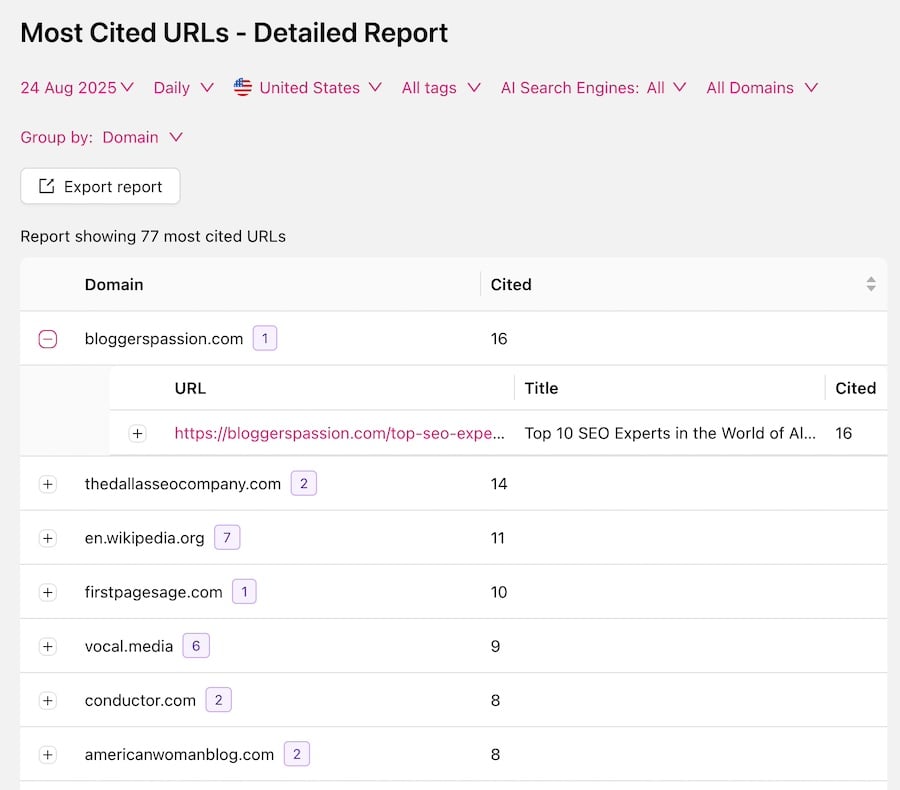
Third-party tools can help by running the prompts and generating citation reports. For example, Otterly.ai creates a consolidated report of “most cited domains” based on your tracked prompts. The report shows results from ChatGPT, Perplexity, Microsoft Copilot, and Google’s AI Overviews, revealing the overlapping citations.
From there, merchants can solicit those editors and writers on social media and elsewhere to explore visibility tactics such as contributing a column or becoming an editorial source.
Otterly.ai’s report lists the most cited URLs on leading large language models for a given prompt. Click image to enlarge.
Reveal Journeys
Shoppers start buying journeys differently. Some search niche terms, while others seek solutions to specific needs. All require unique landing pages and content to engage with a brand.
Knowing potential fan-out questions can refine customer acquisition. Start with a Gemini prompt, for example:
What fan-out queries does Gemini or AI Mode use for “best organic skincare brands to try”?
In my testing, Gemini responded with options:
What are the benefits of organic skincare? You can start with different well-known pain points of non-organic skincare to attract people researching those to your brand, for example: What are parabens? What skincare ingredients can cause breakouts? What ingredients should I avoid for sensitive skin? Do common skincare preservatives cause allergies?
What is the difference between “natural” and “organic” skincare? (You can target audiences researching “natural” skincare by explaining how organic skincare may be what they are looking for)
What common ingredients in non-organic skincare should be avoided?
Addressing these questions on-site can drive citations in fan-out responses and thus attract new prospects, such as those unaware of an organic option.
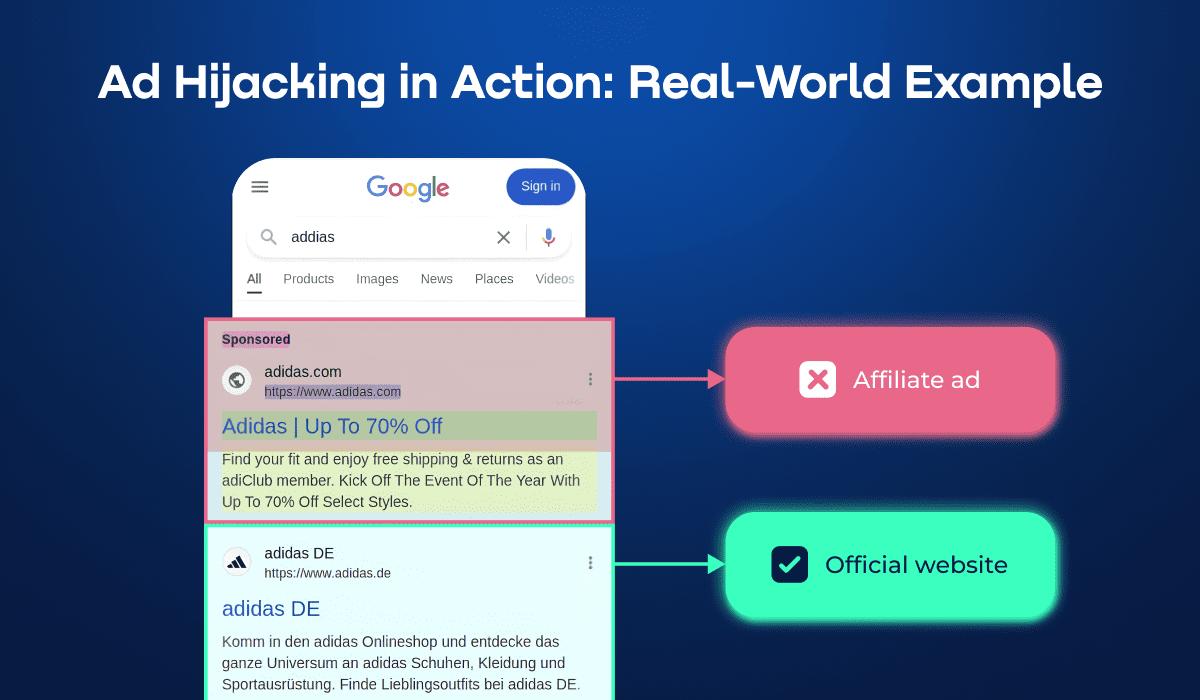
Ad hijacking, by definition, is a form of advertising fraud where someone pretends to be your brand in paid search ads (like Google or other platforms). The fraudsters copy your brand name, your ad style, even your messaging, so the ad looks real.
But when a customer clicks, they’re sent somewhere else.
Image created by Bluepear, August 2025
There are two common types:
Affiliate ad hijacking.
Competitor ad hijacking.
What Is Affiliate Ad Hijacking?
Affiliate ad hijacking happens when partners in your affiliate program bid on your brand name.
They:
copy your ad (same headline, same style) so it looks like the real thing.
The Result: The customer thinks they’re clicking on your official site because the ad looks the same. But behind the scenes, the affiliate redirects the traffic through their own tracking link.
You end up paying them a commission for a customer who was already looking for you. This inflates your costs, pollutes your data, and makes it harder to measure real performance.
Example: A user searches for [Super Tools]. An affiliate runs an ad with the headline “Super Tools Official Site,” but the link is an affiliate redirect. You pay them a cut, even though they didn’t bring in new traffic.
Image created by Bluepear, August 2025
What Is Competitor Ad Hijacking?
Competitor ad hijacking is when a rival company copies your brand in search ads to steal your traffic.
They:
bid on your brand name,
use ad text that looks like yours,
sometimes even mimic your domain.
The Result: Customers click, thinking they’re going to your site. But instead, they land on the competitor’s website.
This tactic lets competitors capture high-intent traffic. As a result, you lose potential sales, while they gain market share. Without PPC brand protection, your brand presence can be weakened, allowing competitors to grow faster at your expense.
Example: A competitor bids on “Super Tools” and runs a lookalike ad. The user clicks, expecting your site, but lands on the competitor’s product page instead. You lose a sale and possibly the customer’s trust.
As you see, search hijacking is already a serious threat to your brand and budget. It’s made even worse by how well the violators hide their tracks.
Secret Tactics That Are Used To Hide Ad Hijacking
Non-compliant partners use smart tactics to avoid being seen by brand owners or their teams. Here’s how they do it:
GEO targeting. Ads are shown only in specific countries, cities, or regions. If you’re not in that area, you’ll never see them – but your local customers will.
Dayparting. Hijackers run ads at night, on weekends, or during holidays when your team is less likely to notice them.
Cloaking and dynamic redirects. They use scripts to show one version of the ad or landing page to Google (to pass review) and a different one to users – usually a fake or affiliate redirect.
Smaller search engines. Many hijackers avoid Google and run campaigns on Bing or other second-tier platforms, where rules are looser and tracking is weaker.
Without proper hijacking prevention, these tactics make it easy for hijackers to hide and hard for your team to catch them in time.
Direct Impact Of Ad Hijacking On Your Company
The impact of affiliate ad hijacking goes far beyond a few stolen clicks. It damages performance, costs money, and creates serious risks for your business:
Lost ad budget. You pay commissions to affiliates who didn’t bring you new traffic; they just hijacked what was already yours.
Higher CPC and more competition. Hijackers bid on your brand keywords, driving up your costs and competing against your own campaigns.
Broken attribution. Without hijacking prevention, your analytics get messy. It becomes harder to measure what’s really working because affiliate hijacking inflates performance data.
Reputation damage. Users may land on shady or misleading pages. They won’t know it’s not your site – they’ll just stop trusting your brand.
Compliance risks. If you’re in a regulated industry (finance, health, etc.), fake ads and unapproved messaging can create legal trouble or policy violations.
Search hijacking doesn’t just hurt your numbers. It makes you question the data you rely on, wastes hours chasing false leads, and forces you to fight for traffic that was already yours.
Image created by Bluepear, August 2025
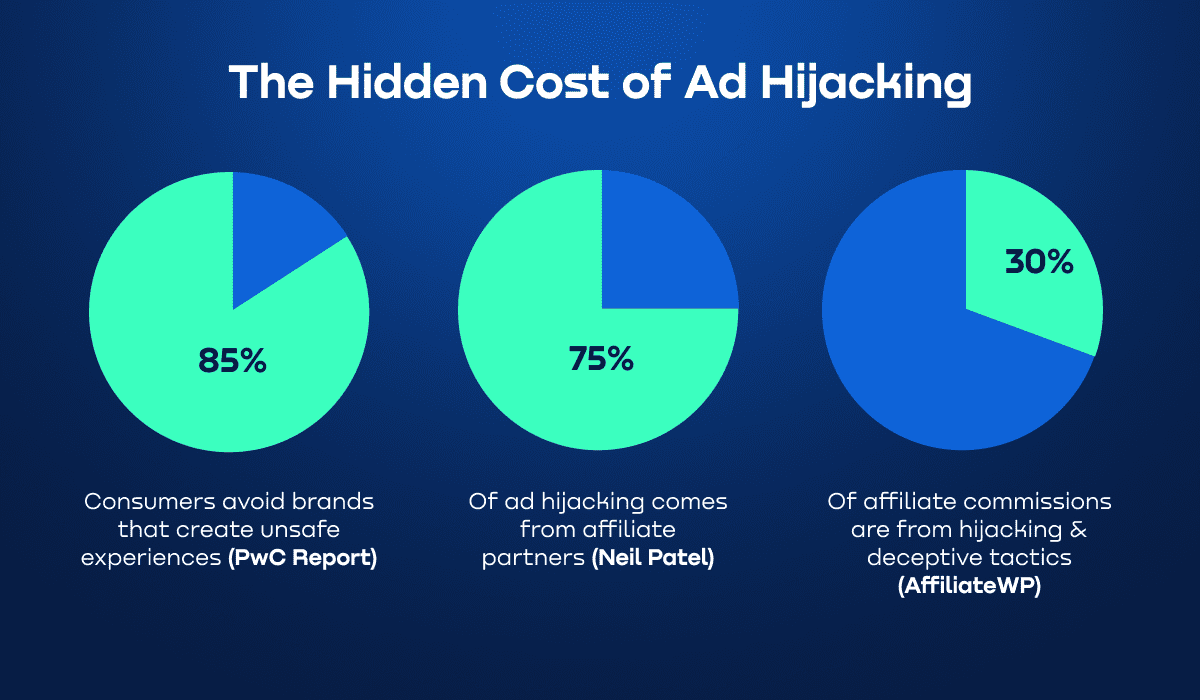
85% of consumers avoid buying from brands that generate unsafe experiences, and ad hijacking falls into that bucket (PwC Report).
75% of ad hijacking comes from affiliate partners exploiting tracking gaps to earn unearned commissions (Neilpatel).
Up to 30% of affiliate commissions come from hijacking and similar deceptive tactics (AffiliateWP).
Ad hijacking caused an estimated $12.6 billion in losses in 2023, based on 15% of the $84 billion lost to ad fraud globally (Juniper Research).
How To Spot And Prevent Ad Hijacking
What actually works on PPC brand protection? To uncover real issues, you need tools and methods that go beyond surface metrics:
Step 1: Quick Manual Checks
Run branded keyword searches and audit SERPs – look for near-identical copy linking to another domain.
Watch for anomalies in performance (CPC spikes, conversion drops, affiliate surges).
Review affiliate conversion patterns – unusual regional spikes may signal fraud.
Geo-test with VPNs or third-party tools to uncover geo-targeted hijacks.
Track impression share – sudden drops without budget changes mean new competition.
Step 2: Scalable Prevention Tactics
Behavioral simulation: Mimic real user searches across devices and browsers to reveal hidden hijacks.
Proof collection: Document ads, redirects, affiliate IDs, and keywords for enforcement.
Real-time alerts & auto takedown: Get notified instantly and stop fraudulent ads before they drain your budget.
By combining manual checks and scalable tools, you can take control before search hijacking quietly eats into your ad spend.
Manual checks can’t keep up with how ad hijacking works today. Hijackers often run ads only in certain regions, at non-working hours, or under specific conditions. They use cloaking and redirects that can’t be detected with regular checks.
Most teams lack the time and capability to ensure hijacking prevention through manual monitoring alone.
That’s why ad hijacking tools like Bluepear are essential – as PPC brand protection software, they automate continuous scanning of search results to catch every sneaky ad trying to hijack your traffic and budget.
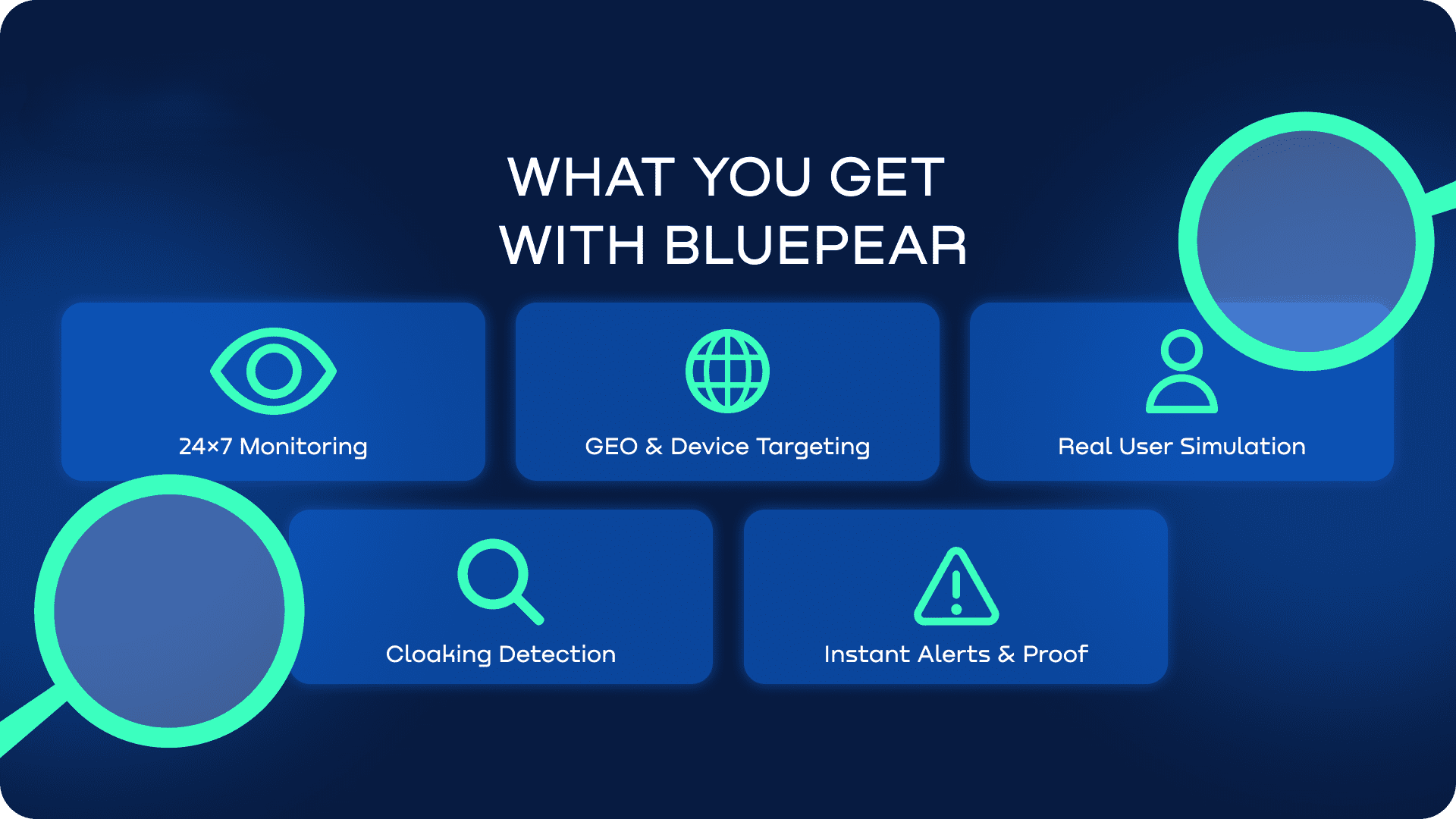
Here’s how Bluepear helps to fight against ad hijacking:
Simulates real user behavior. Bluepear mimics how actual customers search (using different devices, times, and locations) to trigger hidden hijack ads.
Uncovers hidden redirects and de-cloaks landing pages. It follows the full click path to spot when a user is being secretly redirected or sent to a misleading page.
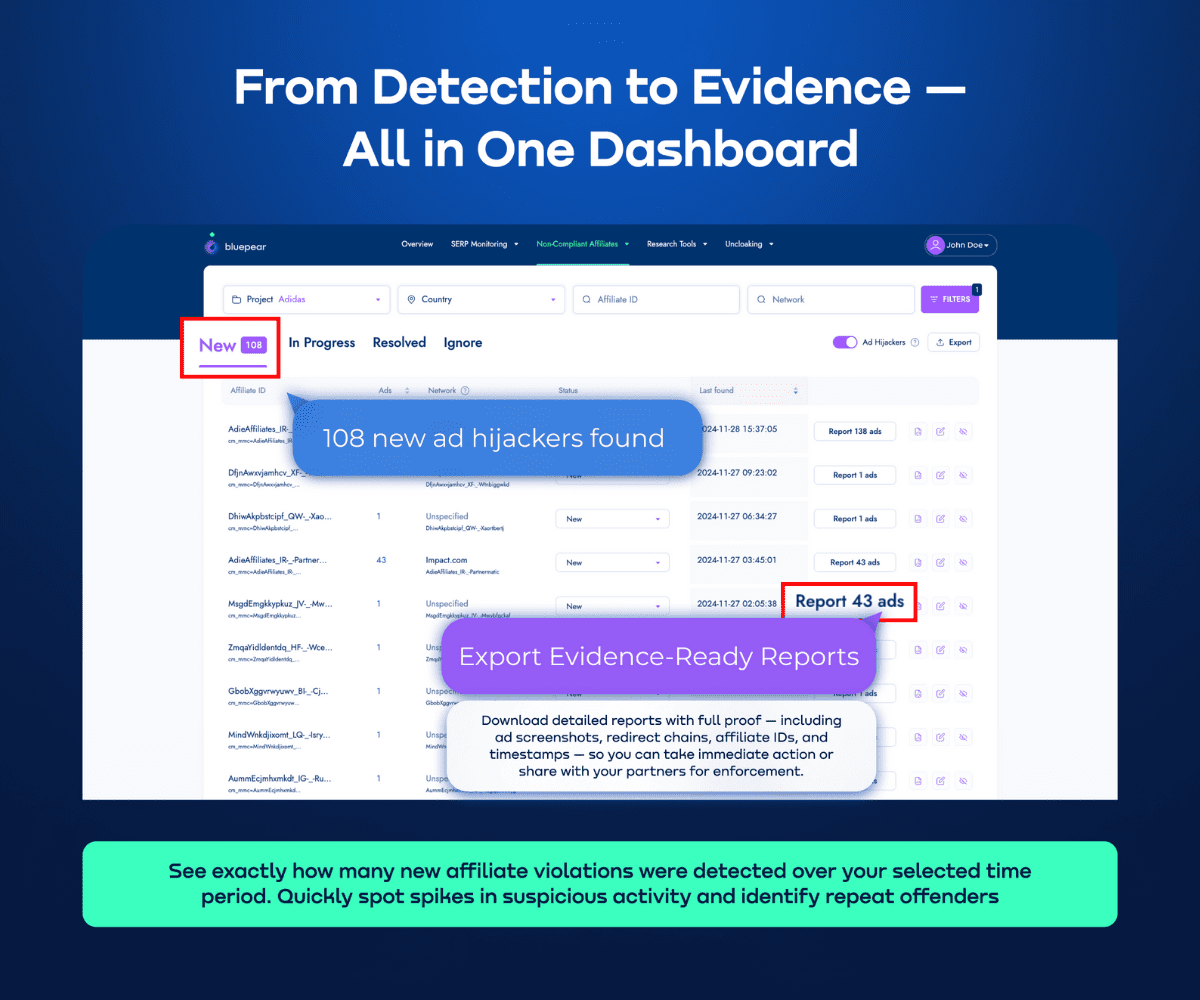
Collects clear evidence. Every violation is logged with full details: screenshots, affiliate IDs, keywords, redirect chains – all in one report.
Sends instant alerts and supports takedowns. When a hijack is detected, you get an alert right away. Bluepear provides clear evidence so that you can remove bad ads fast to stop further damage.
Ad hijacking tools aren’t an excess. If you want to survive in a world of smart fraud, automated PPC brand protection is a must.
Image created by Bluepear, August 2025
Protect Your Brand From Ad Hijacking
Ad hijacking quietly eats into your ad budget, distorts your performance data, and damages user trust. Manual audits rarely catch it. Hijackers use GEO targeting, dayparting, and cloaking to stay hidden while stealing high-intent traffic and commissions.
Are you sure no one is hijacking your branded ads?
Bluepear helps you catch what others miss. The ad hijacking tool automatically checks SERPs from different GEOs, devices, and browsers to keep your brand protected from fraud.
Perplexity announced Comet Plus, a monthly subscription that pays participating publishers when people read their work and when AI systems use it to answer questions.
The company says subscriber payments go to partners, with a small portion retained to cover compute costs.
How Comet Plus Works
Comet Plus will be available for $5 per month. Existing Perplexity Pro and Max subscribers will have Comet Plus included.
Subscribers get direct access to participating publisher sites, answers informed by those sources, and agent workflows that can complete tasks on those sites. The offering is tied to the Comet browser and assistant.
About Revenue Sharing
Perplexity positions Comet Plus as a compensation model for an AI-centric web.
Publishers are paid for three interaction types:
Human visits
Search citations
Agent actions.
Perplexity’s example of “agent traffic” is Comet Assistant scanning a calendar and suggesting relevant reading from publisher sites.
The idea is to reflect how people now consume information across browsing, AI answers, and agent workflows.
Perplexity wrote:
“Comet Plus is the first compensation model… based on three types of internet traffic: human visits, search citations, and agent actions.”
Availability
Interested publishers can email publishers@perplexity.ai to request to join the program.
Why It Matters
For publishers and marketers, the model expands monetization and measurement beyond traditional clicks.
Websites are testing a range of responses to AI usage of their content, from blocking crawlers to signing licenses.
Comet Plus differs from flat-fee deals by tying payouts to actual user and assistant activity, which could align compensation more closely with real demand.
Looking Ahead
Perplexity says it will announce an initial roster of publishing partners when the Comet browser becomes available to all users for free.
Early adoption, reporting transparency, and real revenue for partners will determine whether this model becomes a viable framework or stays a niche experiment.
Boost your skills with Growth Memo’s weekly expert insights. Subscribe for free!
More data shows ChatGPT isn’t taking market share away from Google.
Instead, it’s expanding the range of use cases and blurring the line between searching for information and performing tasks.
I looked at Similarweb data to understand how this affects four different stages of the user journey across Google and ChatGPT:
Usage.
Behavior.
Outbound clicks.
Converting.
What I found is that ChatGPT adoption is, essentially, a 400,000-pound locomotive barreling down the tracks with no intention of stopping anytime soon.
User conversations within ChatGPT are rich in context, which leads to higher conversion rates when intent shifts from information seeking or generating to buying.
Lastly, and also most notably for SEOs and growth marketers, ChatGPT is sending a lot more users out to the web.
Of course, all of these stats are still small in comparison to Google.
However, no effort from Google has been able to slow the momentum of ChatGPT’s runaway train. About the data I used in this analysis:
Data source: Similarweb (shoutout to Sam Sheridan).
Time period examined: July 2024 – June 2025 (last 12 months) vs. July 2023 – June 2024 (previous 12 months).
I also examined U.S. vs. UK user behavior.
Image Credit Kevin Indig
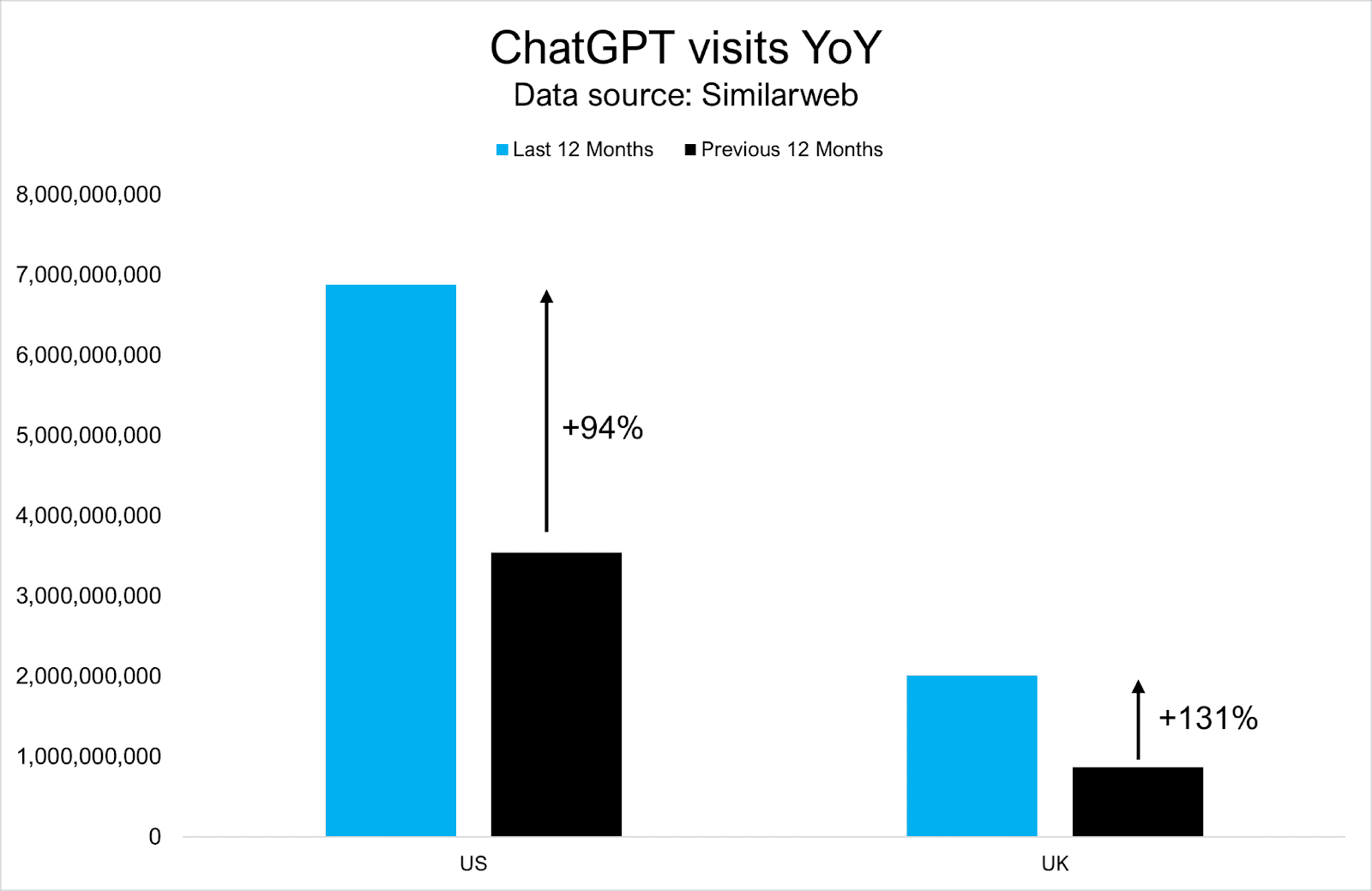
People are rushing to ChatGPT.
Over the last 12 months in the U.S., ChatGPT visits grew from 3.5 to 6.8 billion visits (+94%).
In the UK, it was even faster: 131% YoY, from 868 million to 2 billion.
Over the same time span, Google growth stagnated. Here’s what the data showed:
U.S. stagnation: -0.85% (196 vs. 194 billion).
UK stagnation: -0.22% (35.56 vs. 35.49 billion).
Image Credit: Kevin Indig
To put it into perspective: Google had almost 200 billion visits in the U.S. over the last 12 months, compared to ChatGPT’s 6.8 billion.
So, ChatGPT has a mere 3.4% of Google’s total visits.
However, if growth rates hold steady, in theory, ChatGPT could hit Google’s volume in the next five years.
My hypothesis: It’s almost guaranteed that ChatGPT won’t hit Google’s visit volume because there are too many moving parts (energy/chip limitations, training data, quality improvements, regulation, etc.).
But consider that Google has declined by -0.85% (~2 billion visits) year-over-year, and you can see where this is going.
Visits can only tell you so much.
Recent data from Semrush and Profound suggests that one-third to two-thirds of user intent when interacting with AI chatbots is generative, meaning users use ChatGPT to do and less to search [1, 2].
Leaked chats from ChatGPT and other AI chatbots confirm the aggregate data.
So, even when we compare visits to ChatGPT vs. Google, they’re not leading to the same outcome.
But, against that argument, I will say that Google morphs more into a mirror of ChatGPT with AI Mode – and every generative intent has a high chance of including information along the conversation journey that is sourced to other sites or creators.
The conversational nature of AI chatbots means intent is fluid and can change from one prompt to the next.
Along the way, it’s likely users come across information in their conversations that would’ve been a classic Google Search for products or solutions.
At the end of the day, ChatGPT is continuing its adoption as the fastest-growing product on earth to date.
What does that mean for you?
Stay the course.
Keep tracking referral traffic, conversions, and topic visibility on Google + ChatGPT.
Optimize for visibility with a strong focus on classic SEO.
Keep an ear to the ground and learn as much as you can. Things are evolving fast, and clarity will come with time.
Quick reminder here: I recently transitioned my WhatsApp group over to Slack. I share ongoing news and learnings throughout the week openly and freely, so it’s a great place to stay updated without all the extra (and sometimes overwhelming) noise. No need to be a premium subscriber to get access to the main discussion channel. Join here!
Old habits are hard to break.
People are used to searching on Google a certain way, while ChatGPT is a green field.
For the overwhelming majority of us, our first experience with ChatGPT was a conversation, so we all adopted it as the default way to engage.
Image Credit: Kevin Indig
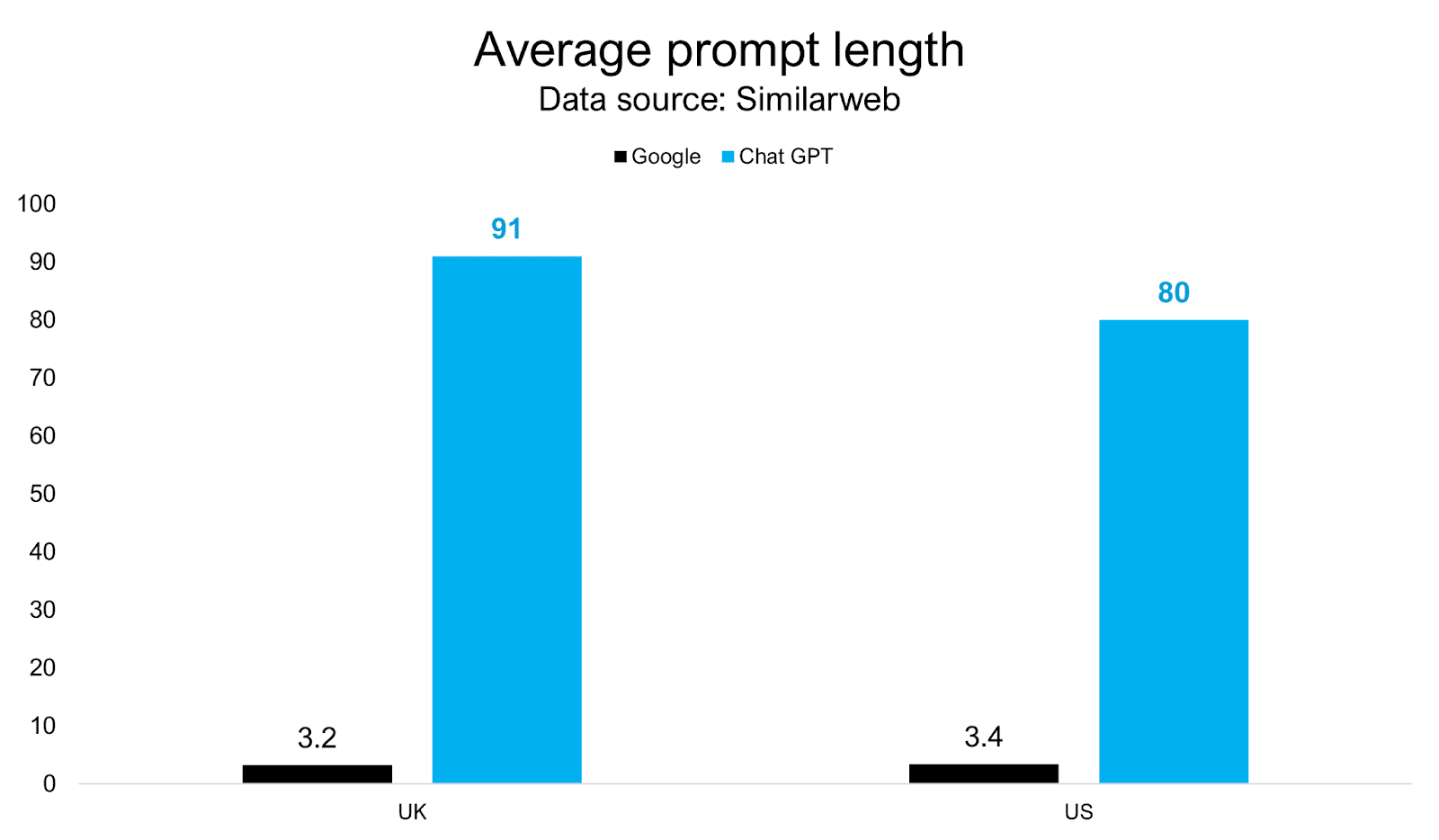
As a result, the average query prompt length on ChatGPT vs. Google is:
80 words vs 3.4 in the U.S.
91 words vs. 3.2 in the UK.
Even informational prompts are 10 times longer (~38 words) on ChatGPT than on Google. People ask more detailed questions, which reveal much more about themselves and their intent.
Together with a growing context window, ChatGPT returns much more personalized and (usually) better informational answers – I’m still waiting on consistently better commercial/purchase intent outcomes.[3] AI chatbots compress the user journey from many queries over several days to one conversation with lengthy prompts.
For you, this means it’s even more critical to monitor the right prompts.
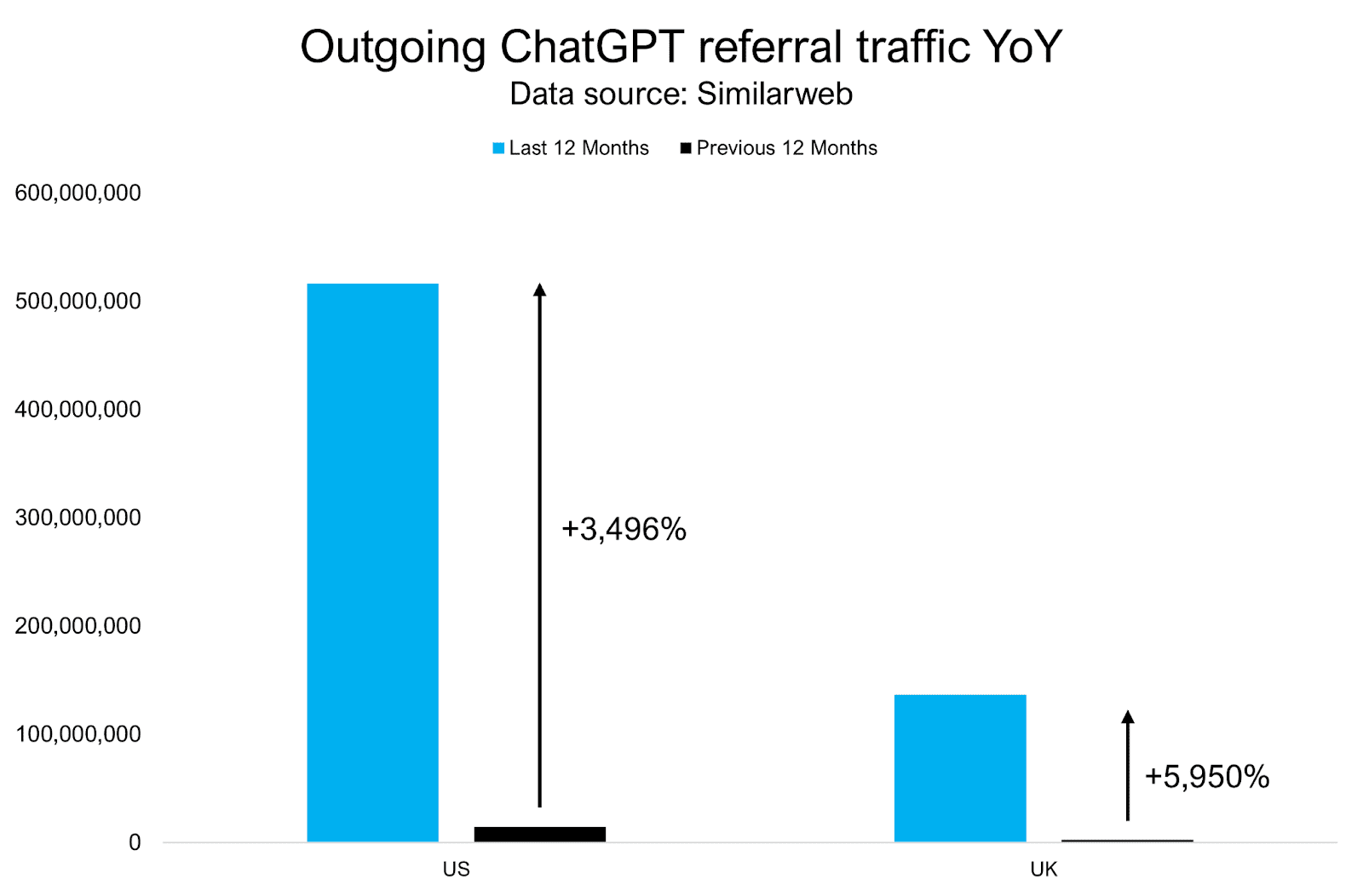
As referral traffic from Google reached historic lows, ChatGPT’s referral traffic reached new highs.
Image Credit: Kevin Indig
Over the last 12 months, ChatGPT’s U.S. referral traffic to websites jumped by +3,496% (UK: +5,950%), from 14 to 516 million (after cleaning up referrals to Openai.com, which are mostly authentications).
In comparison, Google’s outgoing referral visits grew only +23% in the U.S. and 19% in the UK.
When you consider Google referrals include navigational searches (people navigating to the homepage of a brand) and ad clicks (ChatGPT doesn’t yet have ads), 23% is not much at all.
ChatGPT’s referral traffic to external websites makes up ~27% of Google’s (1.9 billion, in the last 12 months), based on the data. That feels high, in my field observation.
Also consider that ChatGPT’s goal is not necessarily to send out traffic but to keep the conversation going until users have the optimal response.
That being said, referral traffic has grown and continues to do so. Until recently.
According to Profound, ChatGPT’s referral traffic was down -52% between July 21 and August 20. [4] And that’s significant.
Time will tell whether this is just an experiment or a final decision.
For you, this means you should see more ChatGPT referral traffic over the last 12 months if you optimize well.
You might not see an increase of +3,500%, but if you’re not seeing at least some growth, it’s likely your competitors are.
Conversions from ChatGPT are small in comparison with Google (in volume), but they’re growing rapidly.
The whole narrative of investing in AI visibility optimization (AEO/GEO/LLMO) banks on the fact that it will continue at the same pace and become meaningful.
So far, it seems like that bet will work out.
Image Credit: Kevin Indig
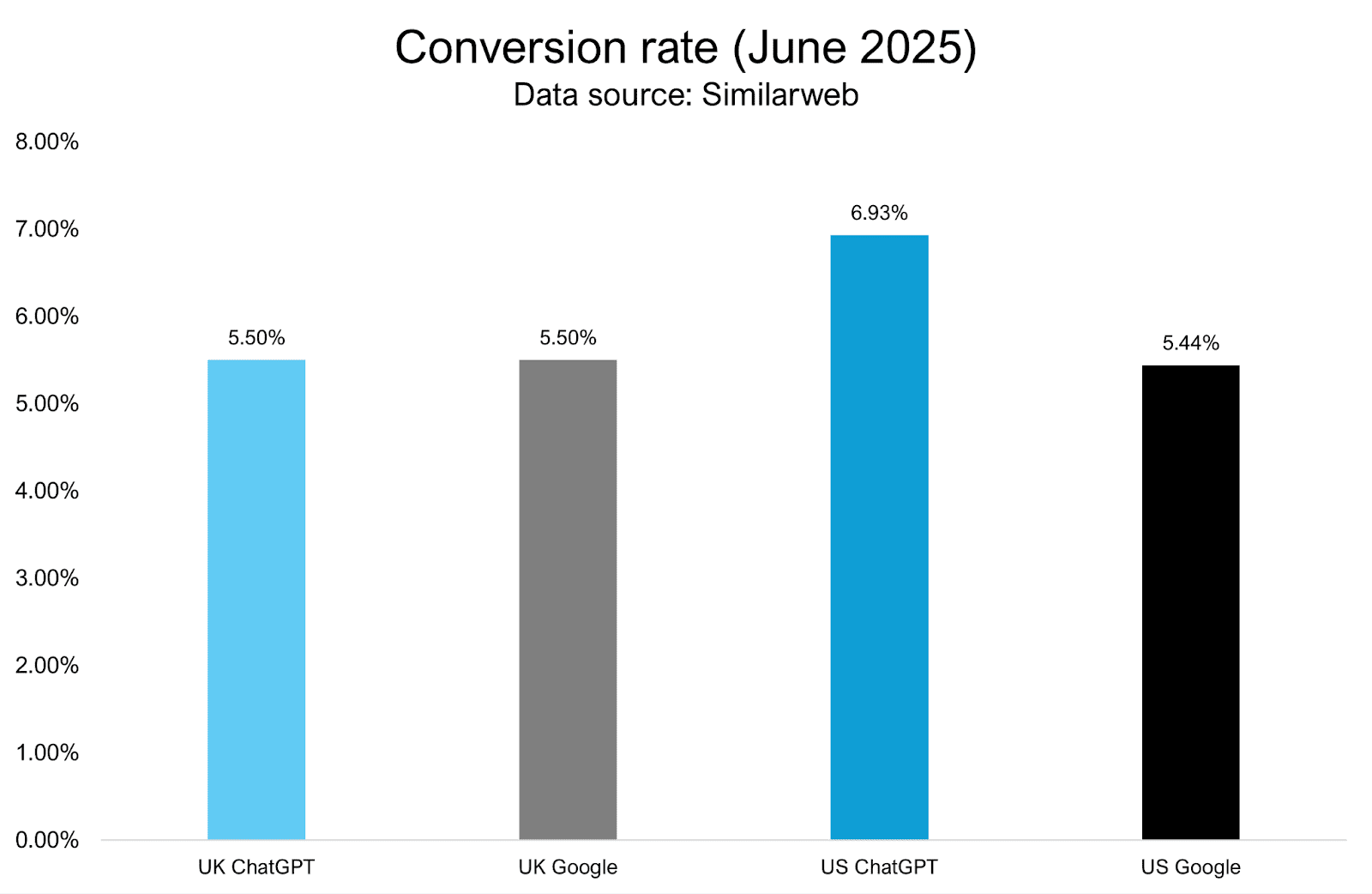
When ChatGPT sends traffic to sites, the conversion rate is usually higher than Google’s. As of June 2025:
ChatGPT’s conversion rate of transactional traffic was 6.9% in the U.S. compared to 5.4% for Google.
In the UK, ChatGPT reached 5.5%, which is on par with Google.
ChatGPT sends higher-quality traffic to websites, at least in the U.S.
I define quality in this context as “higher intent,” meaning visitors are more likely to convert into customers.
The reason ChatGPT traffic is of higher quality is that users get answers to their questions in one conversation. When they click out, they’re “primed” to buy.
To me, the bigger question is how purchase decisions are influenced before a click happens (or even when no click-out happens).
For you, this means:
Look at which pages get referral traffic. Take the average referral traffic and optimize pages that get some but below-average clicks.
Optimizing for citations matters because citations are what get clicked. Look at the citation gap between your competitors and your site.
Look for conversion optimization opportunities (in-line CTAs, lead gen assets, quizzes, etc) on pages that get ChatGPT referral traffic. Using a standard heatmap tool will point you to areas of the page that are ideal for a little CRO.
ChatGPT has all the ingredients to become the next big user platform on which other companies can build – just like Google 25 years ago:
Usage is growing.
Behavior is rich in context.
Referral traffic is shooting up.
Conversions happen at a healthy rate.
Now, traffic and conversations just need more volume.
They’re still tiny in comparison.
Featured Image: Paulo Bobita/Search Engine Journal