Are Google’s AI Travel Results Uncovering More Hidden Gems? [Data Study] via @sejournal, @TaylorDanRW

Google’s AI-generated results reshape how people search, and Google has said that websites should expect traffic fluctuations and that prior success in organic Search does not guarantee future success in the new ecosystem.

This is a big claim, and it’s been debated whether “Hidden Gems” are getting more visibility in modern Search and I’m doing my best to work through as much data as possible to identify if the claims from Google above have substance.

Google’s Hidden Gems initiative is its effort to highlight genuine, first‑hand content from smaller corners of the web.

It was first revealed in May 2023 and fully integrated into the core algorithm later that year, with official acknowledgment in mid-November 2023.

It targets posts with first-hand knowledge, personal insights, and unique experiences usually found on forums, blogs, social platforms, and niche sites.

Rather than favoring only high-authority domains, it now surfaces these overlooked “gems” because they offer genuine and practical perspectives from creators and brands, not powered by the traditional SEO metrics and big brand budgets.

Hidden Gems has the objective of:

Improving how we (Google) rank results in Search overall, with a greater focus on content with unique expertise and experience.

This brings me to the travel sector and the notion of Hidden Gems.

It has been a long-held belief in the travel sector that Google favors bigger travel brands. When I worked in regional agencies that had travel clients, this was almost a party line when pitching SME and challenger travel websites.

Now search is evolving, and we’re seeing more and more Search features either powered by or directly interfacing with AI, is this now an opportunity for challenger travel brands to gain further visibility within Google’s Search ecosystem?

Methodology

To investigate, we analyzed a dataset of 5,824 URLs surfaced in Google’s AI-generated results for travel-related queries.

As part of the methodology, we also reviewed traditional SEO metrics such as estimated site traffic, domain rating, and total number of domain keywords to validate a qualitative review of whether a site functions as a powerful travel brand or a challenger brand.

Each URL was manually reviewed and tagged based on whether Google identified it as a Hidden Gem. We compared their visibility, domain authority, and how often they appeared in AI results.

Quantity Vs. Frequency

The dataset revealed a nuanced dynamic: While Hidden Gems were more diverse, they were not more dominant.

From the 5,824 cited URLs, we identified 1,371 unique domains. We classified 590 of these as Hidden Gem domains compared to 781 established domains.

However, those 781 established domains appeared 4,576 times in total, a much higher return rate than the 1,248 total appearances of the Hidden Gems.

This suggests that while AI mode is surfacing a wide variety of lesser-known sources, it still leans heavily on established brands for repeated visibility.

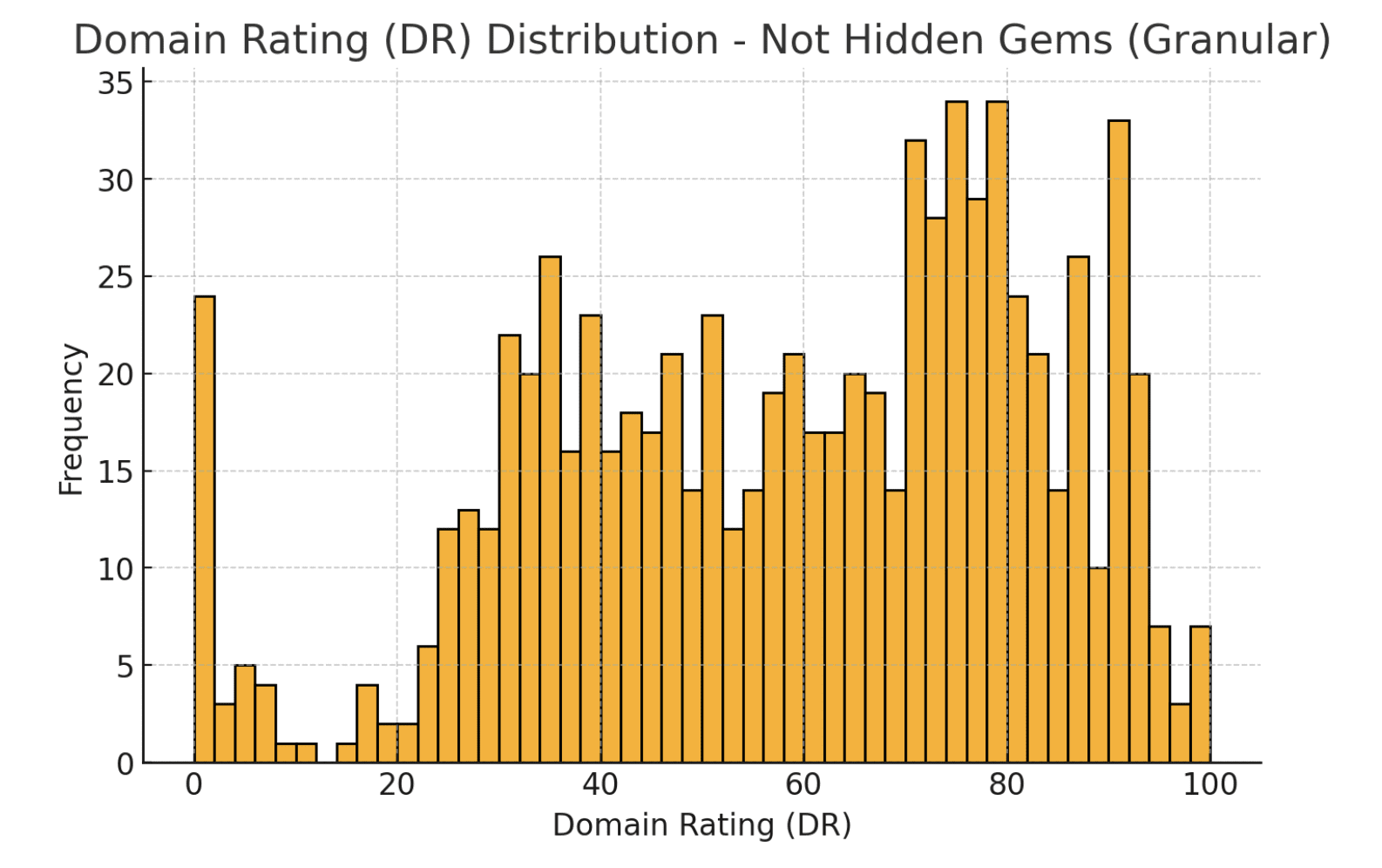
As you would expect, domains we identified as not being “Hidden Gems” had a greater weighting of higher DR than not.

Image from author, August 2025

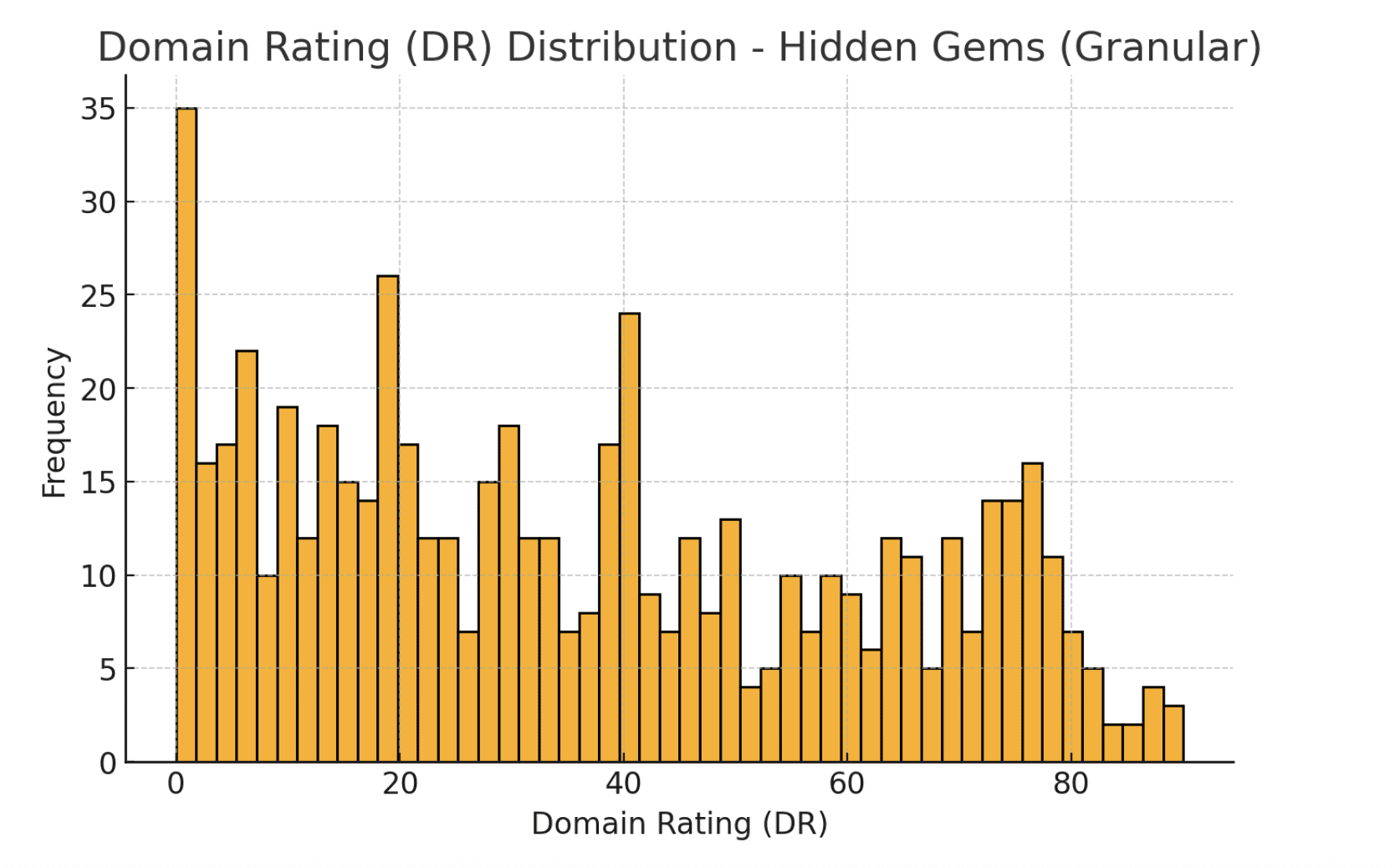
By contrast, the domains we identified as being Hidden Gems were not weighted in the opposite direction, but instead much more evenly spread out.

Image from author, August 2025

In other words, Google is sampling widely from the long tail but serving frequently from the head of the distribution.

Authority Still Has A Role

While traditional SEO has long placed emphasis on authority metrics like Domain Rating (DR) or Domain Authority (DA), our analysis shows that their influence may be diminishing in the context of AI-led search.

This shift aligns with broader trends we’ve observed in Google’s evolving ranking systems.

Instead of relying heavily on link-based authority, AI Overviews and similar experiences appear to prioritize content that demonstrates depth, originality, and strong alignment with user intent.

Authority hasn’t disappeared, but it’s been repositioned. Rather than acting as a gatekeeper for visibility, it’s now one of many factors, often taking a back seat to how well a piece of content anticipates and satisfies the user’s informational needs in the moment.

What This Means For Travel Brands

Hidden Gems are showing up in Google’s AI results, but they’re not displacing the giants. They’re appearing alongside them, offering more variety but less dominance.

For challenger brands, this represents both an opportunity and a challenge.

First-Hand Content Gains Ground

The opportunity is clear: Content that is specific, genuine, and useful is getting noticed, even from smaller or lesser-known sites.

AI-powered results seem to be more willing to include pages that deliver practical insights, first-hand experience, and niche relevance, even if they lack the traditional signals of authority.

This creates new openings for brands that previously struggled to compete on backlinks or brand strength alone.

Repetition And Recall Still Matter

But the challenge is equally clear in that visibility is not evenly distributed.

While Google may sample from a broader range of sources, the repetition and prominence still favor the dominant travel brands.

These brands appear more frequently, benefit from greater brand recall, and are more likely to be clicked simply because they’re familiar.

So for newer or challenger brands, the question becomes: How do you turn presence into preference?

Where Should I Be Focusing?

Consistency Of Presence

It starts with consistency. One or two appearances in AI Overviews won’t move the needle.

Travel brands need to think about sustained visibility, showing up across a range of topics, formats, and moments in the user journey.

That means building out content that doesn’t just answer common queries but anticipates nuanced needs, inspires curiosity, and offers unique, first-hand insight.

Clarity Of Voice

Next comes clarity of voice. AI systems are increasingly sensitive to content that signals credibility, experience, and originality.

Brands that find and articulate a clear editorial voice, whether that’s luxury travel with a local twist, slow travel for sustainability, or adventure itineraries from people who’ve actually been there, are more likely to stand out.

Intent Understanding

Finally, there’s an intent understanding. Challenger brands must shift from thinking in keywords to thinking in moments.

What’s the user trying to imagine, plan, solve, or feel at this point in their journey? How can your content speak directly to that?

A New Definition Of Authority

The travel giants still have scale on their side, but challenger brands now have a better chance to earn visibility through authenticity and depth. That’s a different kind of authority, one rooted in relevance and resonance.

For travel SEOs willing to rethink what authority means, and for brands ready to invest in meaningful, user-first content, AI-powered search is no longer just a threat. It’s an invitation.

Not to play the same game the giants are playing, but to play a different one, and win in different ways.

More Resources:


Featured Image: SvetaZi/Shutterstock

OpenAI Announces Low-Cost Subscription Plan: ChatGPT Go via @sejournal, @martinibuster

OpenAI is rolling out a new subscription tier called ChatGPT Go, a competitively priced version that will initially be available only to users in India. It features ten times higher message limits, ten times more image generations, and file uploads than the free tier.

ChatGPT Go

OpenAI is introducing a new low-cost subscription plan that will be available first in India. The cost of the new subscription tiere is 399 Rupees/month (GST included). That’s the equivalent of $4.57 USD/month.

The new tier includes everything in the Free plan plus:

  • 10X higher message limits
  • 10x more image generations
  • 10x more file uploads
  • Twice as much memory

According to Nick Turley of ChatGPT:

“All users in India will now see prices for subscriptions in Indian Rupees, and can now pay through UPI.”

OpenAI’s initial announcement shared availability details:

“Available on web, mobile (iOS & Android), and desktop (macOS & Windows).

ChatGPT Go is geo-restricted to India at launch, and is able to be subscribed to by credit card or UPI.”

Featured Image by Shutterstock/JarTee

Why we should thank pigeons for our AI breakthroughs

In 1943, while the world’s brightest physicists split atoms for the Manhattan Project, the American psychologist B.F. Skinner led his own secret government project to win World War II. 

Skinner did not aim to build a new class of larger, more destructive weapons. Rather, he wanted to make conventional bombs more precise. The idea struck him as he gazed out the window of his train on the way to an academic conference. “I saw a flock of birds lifting and wheeling in formation as they flew alongside the train,” he wrote. “Suddenly I saw them as ‘devices’ with excellent vision and maneuverability. Could they not guide a missile?”

Skinner started his missile research with crows, but the brainy black birds proved intractable. So he went to a local shop that sold pigeons to Chinese restaurants, and “Project Pigeon” was born. Though ordinary pigeons, Columba livia, were no one’s idea of clever animals, they proved remarkably cooperative subjects in the lab. Skinner rewarded the birds with food for pecking at the right target on aerial photographs—and eventually planned to strap the birds into a device in the nose of a warhead, which they would steer by pecking at the target on a live image projected through a lens onto a screen. 

The military never deployed Skinner’s kamikaze pigeons, but his experiments convinced him that the pigeon was “an extremely reliable instrument” for studying the underlying processes of learning. “We have used pigeons, not because the pigeon is an intelligent bird, but because it is a practical one and can be made into a machine,” he said in 1944.

People looking for precursors to artificial intelligence often point to science fiction by authors like Isaac Asimov or thought experiments like the Turing test. But an equally important, if surprising and less appreciated, forerunner is Skinner’s research with pigeons in the middle of the 20th century. Skinner believed that association—learning, through trial and error, to link an action with a punishment or reward—was the building block of every behavior, not just in pigeons but in all living organisms, including human beings. His “behaviorist” theories fell out of favor with psychologists and animal researchers in the 1960s but were taken up by computer scientists who eventually provided the foundation for many of the artificial-intelligence tools from leading firms like Google and OpenAI.  

These companies’ programs are increasingly incorporating a kind of machine learning whose core concept—reinforcement—is taken directly from Skinner’s school of psychology and whose main architects, the computer scientists Richard Sutton and Andrew Barto, won the 2024 Turing Award, an honor widely considered to be the Nobel Prize of computer science. Reinforcement learning has helped enable computers to drive cars, solve complex math problems, and defeat grandmasters in games like chess and Go—but it has not done so by emulating the complex workings of the human mind. Rather, it has supercharged the simple associative processes of the pigeon brain. 

It’s a “bitter lesson” of 70 years of AI research, Sutton has written: that human intelligence has not worked as a model for machine learning—instead, the lowly principles of associative learning are what power the algorithms that can now simulate or outperform humans on a variety of tasks. If artificial intelligence really is close to throwing off the yoke of its creators, as many people fear, then our computer overlords may be less like ourselves than like “rats with wings”—and planet-size brains. And even if it’s not, the pigeon brain can at least help demystify a technology that many worry (or rejoice) is “becoming human.” 

In turn, the recent accomplishments of AI are now prompting some animal researchers to rethink the evolution of natural intelligence. Johan Lind, a biologist at Stockholm University, has written about the “associative learning paradox,” wherein the process is largely dismissed by biologists as too simplistic to produce complex behaviors in animals but celebrated for producing humanlike behaviors in computers. The research suggests not only a greater role for associative learning in the lives of intelligent animals like chimpanzees and crows, but also far greater complexity in the lives of animals we’ve long dismissed as simple-minded, like the ordinary Columba livia


When Sutton began working in AI, he felt as if he had a “secret weapon,” he told me: He had studied psychology as an undergrad. “I was mining the psychological literature for animals,” he says.

Skinner started his missile research with crows but switched to pigeons when the brainy black birds proved intractable.
B.F. SKINNER FOUNDATION

Ivan Pavlov began to uncover the mechanics of associative learning at the end of the 19th century in his famous experiments on “classical conditioning,” which showed that dogs would salivate at a neutral stimulus—like a bell or flashing light—if it was paired predictably with the presentation of food. In the middle of the 20th century, Skinner took Pavlov’s principles of conditioning and extended them from an animal’s involuntary reflexes to its overall behavior. 

Skinner wrote that “behavior is shaped and maintained by its consequences”—that a random action with desirable results, like pressing a lever that releases a food pellet, will be “reinforced” so that the animal is likely to repeat it. Skinner reinforced his lab animals’ behavior step by step, teaching rats to manipulate marbles and pigeons to play simple tunes on four-key pianos. The animals learned chains of behavior, through trial and error, in order to maximize long-term rewards. Skinner argued that this type of associative learning, which he called “operant conditioning” (and which other psychologists had called “instrumental learning”), was the building block of all behavior. He believed that psychology should study only behaviors that could be observed and measured without ever making reference to an “inner agent” in the mind.

When Richard Sutton began working in AI, he felt as if he had a “secret weapon”: He studied psychology as an undergrad. “I was mining the psychological literature for animals,” he says.

Skinner thought that even human language developed through operant conditioning, with children learning the meanings of words through reinforcement. But his 1957 book on the subject, Verbal Behavior, provoked a brutal review from Noam Chomsky, and psychology’s focus started to swing from observable behavior to innate “cognitive” abilities of the human mind, like logic and symbolic thinking. Biologists soon rebelled against behaviorism also, attacking psychologists’ quest to explain the diversity of animal behavior through an elementary and universal mechanism. They argued that each species evolved specific behaviors suited to its habitat and lifestyle, and that most behaviors were inherited, not learned. 

By the ’70s, when Sutton started reading about Skinner’s and similar experiments, many psychologists and researchers interested in intelligence had moved on from pea-brained pigeons, which learn mostly by association, to large-brained animals with more sophisticated behaviors that suggested potential cognitive abilities. “This was clearly old stuff that was not exciting to people anymore,” he told me. Still, Sutton found these old experiments instructive for machine learning: “I was coming to AI with an animal-learning-theorist mindset and seeing the big lack of anything like instrumental learning in engineering.” 


Many engineers in the second half of the 20th century tried to model AI on human intelligence, writing convoluted programs that attempted to mimic human thinking and implement rules that govern human response and behavior. This approach—commonly called “symbolic AI”—was severely limited; the programs stumbled over tasks that were easy for people, like recognizing objects and words. It just wasn’t possible to write into code the myriad classification rules human beings use to, say, separate apples from oranges or cats from dogs—and without pattern recognition, breakthroughs in more complex tasks like problem solving, game playing, and language translation seemed unlikely too. These computer scientists, the AI skeptic Hubert Dreyfus wrote in 1972, accomplished nothing more than “a small engineering triumph, an ad hoc solution of a specific problem, without general applicability.”

Pigeon research, however, suggested another route. A 1964 study showed that pigeons could learn to discriminate between photographs with people and photographs without people. Researchers simply presented the birds with a series of images and rewarded them with a food pellet for pecking an image showing a person. They pecked randomly at first but quickly learned to identify the right images, including photos where people were partially obscured. The results suggested that you didn’t need rules to sort objects; it was possible to learn concepts and use categories through associative learning alone. 

In another Skinner experiment, a pigeon receives food after correctly matching a colored light to a corresponding colored panel.
GETTY IMAGES

When Sutton began working with Barto on AI in the late ’70s, they wanted to create a “complete, interactive goal-seeking agent” that could explore and influence its environment like a pigeon or rat. “We always felt the problems we were studying were closer to what animals had to face in evolution to actually survive,” Barto told me. The agent needed two main functions: search, to try out and choose from many actions in a situation, and memory, to associate an action with the situation where it resulted in a reward. Sutton and Barto called their approach “reinforcement learning”; as Sutton said, “It’s basically instrumental learning.” In 1998, they published the definitive exploration of the concept in a book, Reinforcement Learning: An Introduction. 

Over the following two decades, as computing power grew exponentially, it became possible to train AI on increasingly complex tasks—that is, essentially, to run the AI “pigeon” through millions more trials. 

Programs trained with a mix of human input and reinforcement learning defeated human experts at chess and Atari. Then, in 2017, engineers at Google DeepMind built the AI program AlphaGo Zero entirely through reinforcement learning, giving it a numerical reward of +1 for every game of Go that it won and −1 for every game that it lost. Programmed to seek the maximum reward, it began without any knowledge of Go but improved over 40 days until it attained what its creators called “superhuman performance.” Not only could it defeat the world’s best human players at Go, a game considered even more complicated than chess, but it actually pioneered new strategies that professional players now use. 

“Humankind has accumulated Go knowledge from millions of games played over thousands of years,” the program’s builders wrote in Nature in 2017. “In the space of a few days, starting tabula rasa, AlphaGo Zero was able to rediscover much of this Go knowledge, as well as novel strategies that provide new insights into the oldest of games.” The team’s lead researcher was David Silver, who studied reinforcement learning under Sutton at the University of Alberta.

Today, more and more tech companies have turned to reinforcement learning in products such as consumer-facing chatbots and agents. The first generation of generative AI, including large language models like OpenAI’s GPT-2 and GPT-3, tapped into a simpler form of associative learning called “supervised learning,” which trained the model on data sets that had been labeled by people. Programmers often used reinforcement to fine-tune their results by asking people to rate a program’s performance and then giving these ratings back to the program as goals to pursue. (Researchers call this “reinforcement learning from feedback.”) 

Then, last fall, OpenAI revealed its o-series of large language models, which it classifies as “reasoning” models. The pioneering AI firm boasted that they are “trained with reinforcement learning to perform reasoning” and claimed they are capable of “a long internal chain of thought.” The Chinese startup DeepSeek also used reinforcement learning to train its attention-grabbing “reasoning” LLM, R1. “Rather than explicitly teaching the model on how to solve a problem, we simply provide it with the right incentives, and it autonomously develops advanced problem-­solving strategies,” they explained.

These descriptions might impress users, but at least psychologically speaking, they are confused. A computer trained on reinforcement learning needs only search and memory, not reasoning or any other cognitive mechanism, in order to form associations and maximize rewards. Some computer scientists have criticized the tendency to anthropomorphize these models’ “thinking,” and a team of Apple engineers recently published a paper noting their failure at certain complex tasks and “raising crucial questions about their true reasoning capabilities.”

Sutton, too, dismissed the claims of reasoning as “marketing” in an email, adding that “no serious scholar of mind would use ‘reasoning’ to describe what is going on in LLMs.” Still, he has argued, with Silver and other coauthors, that the pigeons’ method—learning, through trial and error, which actions will yield rewards—is “enough to drive behavior that exhibits most if not all abilities that are studied in natural and artificial intelligence,” including human language “in its full richness.” 

In a paper published in April, Sutton and Silver stated that “today’s technology, with appropriately chosen algorithms, already provides a sufficiently powerful foundation to … rapidly progress AI towards truly superhuman agents.” The key, they argue, is building AI agents that depend less than LLMs on human dialogue and prejudgments to inform their behavior. 

“Powerful agents should have their own stream of experience that progresses, like humans, over a long time-scale,” they wrote. “Ultimately, experiential data will eclipse the scale and quality of human generated data. This paradigm shift, accompanied by algorithmic advancements in RL, will unlock in many domains new capabilities that surpass those possessed by any human.”


If computers can do all that with just a pigeonlike brain, some animal researchers are now wondering if actual pigeons deserve more credit than they’re commonly given. 

“When considered in light of the accomplishments of AI, the extension of associative learning to purportedly more complicated forms of cognitive performance offers fresh prospects for understanding how biological systems may have evolved,” Ed Wasserman, a psychologist at the University of Iowa, wrote in a recent study in the journal Current Biology

Wasserman trained pigeons to succeed at a complex categorization task, which several undergraduate students failed. The students tried to find a rule that would help them sort various discs; the pigeons simply developed a sense for the group to which any given disc belonged.

In one experiment, Wasserman trained pigeons to succeed at a complex categorization task, which several undergraduate students failed. The students tried, in vain, to find a rule that would help them sort various discs with parallel black lines of various widths and tilts; the pigeons simply developed a sense, through practice and association, for the group to which any given disc belonged. 

Like Sutton, Wasserman became interested in behaviorist psychology when Skinner’s theories were out of fashion. He didn’t switch to computer science, however: He stuck with pigeons. “The pigeon lives or dies by these really rudimentary learning rules,” Wasserman told me recently, “but they are powerful enough to have succeeded colossally in object recognition.” In his most famous experiments, Wasserman trained pigeons to detect cancerous tissue and symptoms of heart disease in medical scans as accurately as experienced doctors with framed diplomas behind their desks. Given his results, Wasserman found it odd that so many psychologists and ethologists regarded associative learning as a crude, mechanical mechanism, incapable of producing the intelligence of clever animals like apes, elephants, dolphins, parrots, and crows. 

Other researchers also started to reconsider the role of associative learning in animal behavior after AI started besting human professionals in complex games. “With the progress of artificial intelligence, which in essence is built upon associative processes, it is increasingly ironic that associative learning is considered too simple and insufficient for generating biological intelligence,” Lind, the biologist from Stockholm University, wrote in 2023. He often cites Sutton and Barto’s computer science in his biological research, and he believes it’s human beings’ symbolic language and cumulative cultures that really put them in a cognitive category of their own.

Ethologists generally propose cognitive mechanisms, like theory of mind (that is, the ability to attribute mental states to others), to explain remarkable animal behaviors like social learning and tool use. But Lind has built models showing that these flexible behaviors could have developed through associative learning, suggesting that there may be no need to invoke cognitive mechanisms at all. If animals learn to associate a behavior with a reward, then the behavior itself will come to approximate the value of the reward. A new behavior can then become associated with the first behavior, allowing the animal to learn chains of actions that ultimately lead to the reward. In Lind’s view, studies demonstrating self-control and planning in chimpanzees and ravens are probably describing behaviors acquired through experience rather than innate mechanisms of the mind.  

Lind has been frustrated with what he calls the “low standard that is accepted in animal cognition studies.” As he wrote in an email, “Many researchers in this field do not seem to worry about excluding alternative hypotheses and they seem happy to neglect a lot of current and historical knowledge.” There are some signs, though, that his arguments are catching on. A group of psychologists not affiliated with Lind referenced his “associative learning paradox” last year in a criticism of a Current Biology study, which purported to show that crows used “true statistical inference” and not “low-level associative learning strategies” in an experiment. The psychologists found that they could explain the crows’ performance with a simple reinforcement-­learning model—“exactly the kind of low-level associative learning process that [the original authors] ruled out.” 

Skinner might have felt vindicated by such arguments. He lamented psychology’s cognitive turn until his death in 1990, maintaining that it was scientifically irresponsible to probe the minds of living beings. After “Project Pigeon,” he became increasingly obsessed with “behaviorist” solutions to societal problems. He went from training pigeons for war to inventions like the “Air Crib,” which aimed to “simplify” baby care by keeping the infant behind glass in a climate-­controlled chamber and eliminating the need for clothing and bedding. Skinner rejected free will, arguing that human behavior is determined by environmental variables, and wrote a novel, Walden II, about a utopian community founded on his ideas.


People who care about animals might feel uneasy about a revival in behaviorist theory. The “cognitive revolution” broke with centuries of Western thinking, which had emphasized human supremacy over animals and treated other creatures like stimulus-response machines. But arguing that animals learn by association is not the same as arguing that they are simple-minded. Scientists like Lind and Wasserman do not deny that internal forces like instinct and emotion also influence animal behavior. Sutton, too, believes that animals develop models of the world through their experiences and use them to plan actions. Their point is not that intelligent animals are empty-headed but that associative learning is a much more powerful—indeed, “cognitive”—mechanism than many of their peers believe. The psychologists who recently criticized the study on crows and statistical inference did not conclude that the birds were stupid. Rather, they argued “that a reinforcement learning model can produce complex, flexible behaviour.”

This is largely in line with the work of another psychologist, Robert Rescorla, whose work in the ’70s and ’80s influenced both Wasserman and Sutton. Rescorla encouraged people to think of association not as a “low-level mechanical process” but as “the learning that results from exposure to relations among events in the environment” and “a primary means by which the organism represents the structure of its world.” 

This is true even of a laboratory pigeon pecking at screens and buttons in a small experimental box, where scientists carefully control and measure stimuli and rewards. But the pigeon’s learning extends outside the box. Wasserman’s students transport the birds between the aviary and the laboratory in buckets—and experienced pigeons jump immediately into the buckets whenever the students open the doors. Much as Rescorla suggested, they are learning the structure of their world inside the laboratory and the relation of its parts, like the bucket and the box, even though they do not always know the specific task they will face inside. 

Comparative psychologists and animal researchers have long grappled with a question that suddenly seems urgent because of AI: How do we attribute sentience to other living beings?

The same associative mechanisms through which the pigeon learns the structure of its world can open a window to the kind of inner life that Skinner and many earlier psychologists said did not exist. Pharmaceutical researchers have long used pigeons in drug-discrimination tasks, where they’re given, say, an amphetamine or a sedative and rewarded with a food pellet for correctly identifying which drug they took. The birds’ success suggests they both experience and discriminate between internal states. “Is that not tantamount to introspection?” Wasserman asked.

It is hard to imagine AI matching a pigeon on this specific task—a reminder that, though AI and animals share associative mechanisms, there is more to life than behavior and learning. A pigeon deserves ethical consideration as a living creature not because of how it learns but because of what it feels. A pigeon can experience pain and suffer, while an AI chatbot cannot—even if some large language models, trained on corpora that include descriptions of human suffering and sci-fi stories of sentient computers, can trick people into believing otherwise. 

a pigeon in a box facing a lit screen with colored rectangles on it.
Psychologist Ed Wasserman trained pigeons to detect cancerous tissue and symptoms of heart disease in medical scans as accurately as experienced physicians.
UNIVERSITY OF IOWA/WASSERMAN LAB

“The intensive public and private investments into AI research in recent years have resulted in the very technologies that are forcing us to confront the question of AI sentience today,” two philosophers of science wrote in Aeon in 2023. “To answer these current questions, we need a similar degree of investment into research on animal cognition and behavior.” Indeed, comparative psychologists and animal researchers have long grappled with questions that suddenly seem urgent because of AI: How do we attribute sentience to other living beings? How can we distinguish true sentience from a very convincing performance of sentience?

Such an undertaking would yield knowledge not only about technology and animals but also about ourselves. Most psychologists probably wouldn’t go as far as Sutton in arguing that reward is enough to explain most if not all human behavior, but no one would dispute that people often learn by association too. In fact, most of Wasserman’s undergraduate students eventually succeeded at his recent experiment with the striped discs, but only after they gave up searching for rules. They resorted, like the pigeons, to association and couldn’t easily explain afterwards what they’d learned. It was just that with enough practice, they started to get a feel for the categories. 

It is another irony about associative learning: What has long been considered the most complex form of intelligence—a cognitive ability like rule-based learning—may make us human, but we also call on it for the easiest of tasks, like sorting objects by color or size. Meanwhile, some of the most refined demonstrations of human learning—like, say, a sommelier learning to taste the difference between grapes—are learned not through rules, but only through experience. 

Learning through experience relies on ancient associative mechanisms that we share with pigeons and countless other creatures, from honeybees to fish. The laboratory pigeon is not only in our computers but in our brains—and the engine behind some of humankind’s most impressive feats. 

Ben Crair is a science and travel writer based in Berlin. 

The Download: pigeons’ role in developing AI, and Native artists’ tech interpretations

This is today’s edition of The Download, our weekday newsletter that provides a daily dose of what’s going on in the world of technology.

Why we should thank pigeons for our AI breakthroughs

People looking for precursors to artificial intelligence often point to science fiction by authors like Isaac Asimov or thought experiments like the Turing test. But an equally important, if surprising and less appreciated, forerunner is American psychologist B.F. Skinner’s research with pigeons in the middle of the 20th century.

Skinner believed that association—learning, through trial and error, to link an action with a punishment or reward—was the building block of every behavior, not just in pigeons but in all living organisms, including human beings.

His “behaviorist” theories fell out of favor with psychologists and animal researchers in the 1960s but were taken up by computer scientists who eventually provided the foundation for many of the artificial-intelligence tools from leading firms like Google and OpenAI. Read the full story.

—Ben Crair

This story is from our forthcoming print issue, which is all about security. If you haven’t already, subscribe now to receive future issues once they land.

Indigenous knowledge meets artificial intelligence

There is no word for art in most Native American languages. Instead, the closest terms speak not to objecthood but to action and intention. Art is not separate from life; it is ceremony, instruction, design.

A new vanguard of Native artists are building on this principle. They are united not by stereotypical weaving and carving or revanchist critique of Silicon Valley, but through their rejection of extractive data models in favor of relationship-based systems. Read the full story.

—Petala Ironcloud

The must-reads

I’ve combed the internet to find you today’s most fun/important/scary/fascinating stories about technology.

1 Anthropic has a plan to combat harmful chatbot conversations
Its latest AI models now have the ability to cut off a chat as a last resort. (Engadget)
+ But it’s not to protect the user—it’s to protect the model, apparently. (TechCrunch)
+ The company has also updated its policy to ban the development of weapons. (The Verge)

2 CEOs want their workers to embrace AI
Even if they’re struggling to get to grips with it themselves. (NYT $)

3 How cuts to NASA could damage public health research
Its essential tracking data is under threat. (Undark)
+ 8,000 pregnant women may die because of US aid cuts to reproductive care. (MIT Technology Review)

4 Churning out AI slop videos is a lucrative business
It’s a seriously low-effort, high-reward enterprise. (WP $)
+ Addictive, low-quality soap operas are rife on TikTok, too. (The Guardian)
+ China’s next cultural export could be TikTok-style short soap operas. (MIT Technology Review)

5 Stage-four cancer patients are living for longer
But they’re also facing long, uncertain treatments with ongoing side effects. (WSJ $)
+ Why it’s so hard to use AI to diagnose cancer. (MIT Technology Review)

6 AI is hackers’ most valuable new tool
It’s supercharging criminals who were already extremely proficient. (NBC News)
+ Cyberattacks by AI agents are coming. (MIT Technology Review)

7 A tiny Californian startup now owns Europe’s biggest battery giant
Northvolt’s future looked bright—until it wasn’t. (The Information $)
+ This startup wants to use the Earth as a massive battery. (MIT Technology Review)

8 China is going wild for podcasts 🎙
A grassroots movement is highlighting social issues and highly personal stories. (FT $)

9 How to turn seaweed into biofuel
The Gulf of Mexico’s beaches are covered in it—and these entrepreneurs have a plan. (Wired $)
+ The hope and hype of seaweed farming for carbon removal. (MIT Technology Review)

10 The robot Olympics’ athletes fell over a lot
It’s all part of teaching them how to navigate the world more efficiently. (CNN)
+ Some of them were more successful than others. (NYT $)
+ To be more useful, robots need to become lazier. (MIT Technology Review)

Quote of the day

“Pretend-me is doing better than the real me in all the years of social media that I’ve been trying to do this.”

—Tracy Fetter, an artist and occasional stand-up comedian, explains why she has no regrets in allowing her likeness to be used in an AI TikTok avatar to the New York Times.

One more thing

How to fine-tune AI for prosperity

Predictions abound on how the growing list of generative AI models will transform the way we work and organize our lives, providing instant advice on everything from financial investments to where to spend your next vacation.

But for economists, the most critical question around our obsession with AI is how the fledgling technology will (or won’t) boost overall productivity, and if it does, how long it will take. Can the technology lead to renewed prosperity after years of stagnant economic growth? Read the full story.

—David Rotman

We can still have nice things

A place for comfort, fun and distraction to brighten up your day. (Got any ideas? Drop me a line or skeet ’em at me.)

+ The world’s first video rental store is a lot older than you might think.
+ Here’s what all those unread books lying around your home are trying to tell you.
+ Need more energy to get through the day? These foods can help.
+ This wild hamster is just too cute.

Chrome Extensions for AI Bot Access

AI crawlers are not as efficient and sophisticated as Google’s and other traditional search engines. They require extra effort by web admins to access a page and retrieve info to answer a prompt and cite or link to the source.

Here are free Chrome extensions to ensure ChatGPT and other AI crawlers can access a page.

AI access

AI bots sometimes use third-party browsers to load and fetch page content. Thus we don’t know whether the bots respect robots.txt directives. The safe tactic is to assume the bots will crawl and adhere to your robots.txt file. Ensure it’s not blocking AI crawlers if you want those platforms to use, reference, or link to your content.

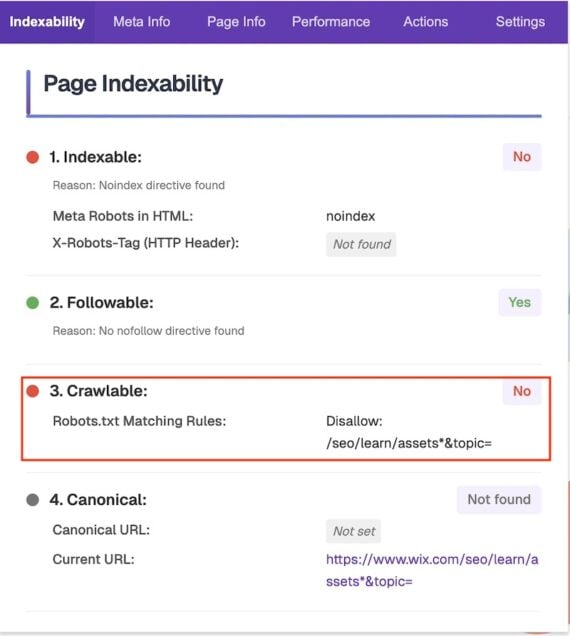
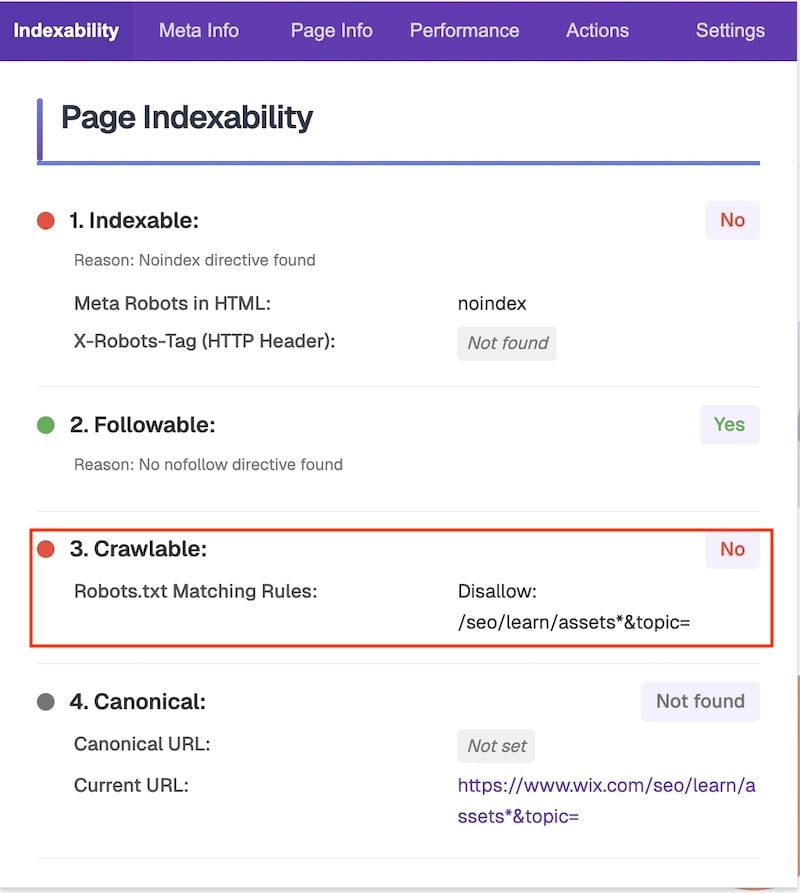
SEO X-Ray is a Chrome extension to detect a page’s accessibility to crawlers. Load a page in Chrome and click the extension icon to check. The extension provides additional info such as detected structured data markup, HTML headings, images, and alternative image text.

Audit report screenshot from SEO X-Ray showing page indexability issues. The page is not indexable due to a 'noindex' directive, is followable, but not crawlable due to robots.txt disallow rules. Canonical URL is not set. Current URL is a Wix SEO learn page.

This sample report from SEO X-Ray shows the robots.txt file blocking a crawler from Wix “seo/learn/assets*&topic=”. Click image to enlarge.

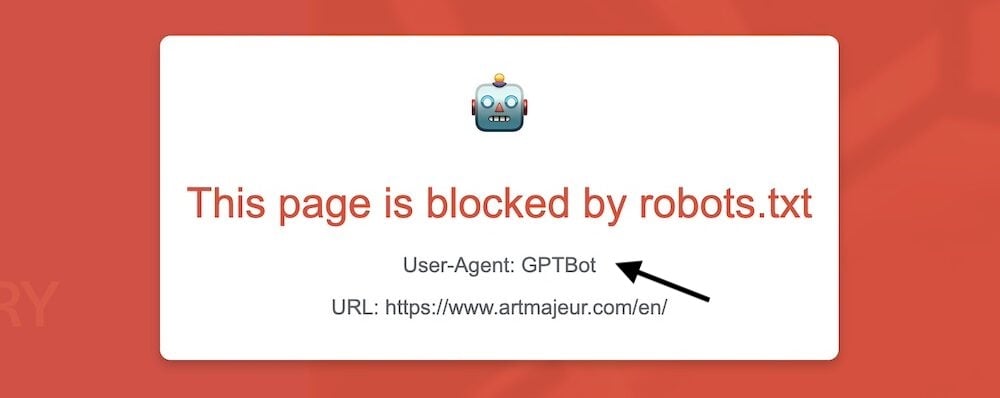
RoboView is another helpful extension to “experience websites exactly as search engine crawlers and AI bots do.” It automatically works when a page loads, alerting the user of any blocked elements and robots.txt restrictions in real-time.

Users can choose a bot and receive alerts when a page blocks it.

RoboView will highlight a page’s blocked sections, including images embedded from a blocking domain. The extension is a quick way to verify access for any AI bot.

RoboView alerts users of any blocked elements and robots.txt restrictions, such as this example blocking the ChatGPT crawler. Click image to enlarge.

Page elements

Unlike Google and Bing, AI platforms don’t maintain an index or cache of web pages. AI bots can access pages through those external indexes to gather information and respond to prompts.

Moreover, most AI crawlers cannot render JavaScript efficiently. It’s essential to ensure critical content is accessible through static HTML.

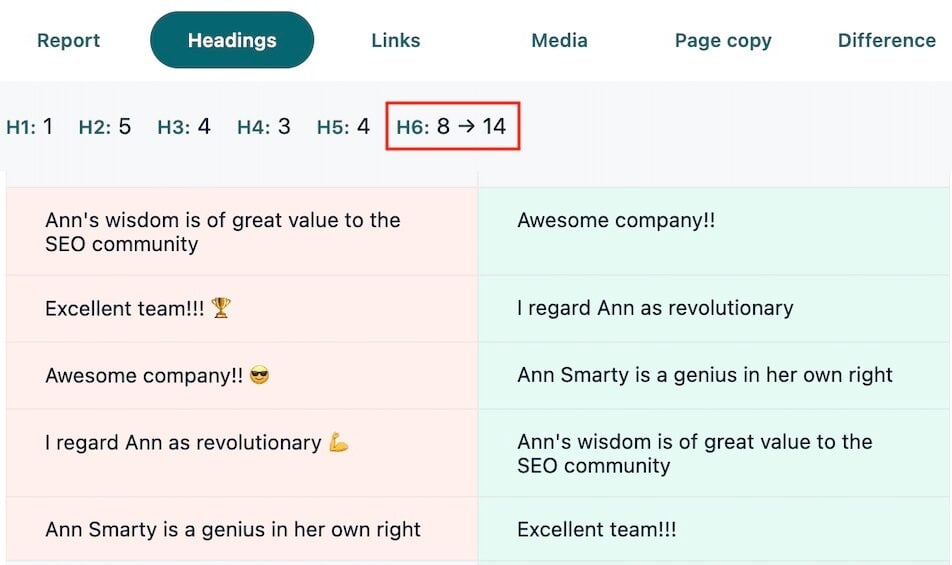
Rendering Difference Engine is a free extension that shows elements of a page that require JavaScript rendering and thus may be invisible to AI crawlers.

Install the extension, go to a page, and click the icon for the analysis. In a separate window, the extension will highlight:

  • Headings hidden behind JavaScript elements (such as tabs and toggles),
  • Invisible or unclickable links,
  • Text that requires rendered JavaScript to be visible.

The report below shows that only 8 out of 14 H6 headings are likely visible to AI crawlers.

Users can also highlight AI-crawlable links on the page. It is an easy way to confirm the bots can see, fetch, and follow all elements.

SEO tool report from Rendering Difference Engine showing heading structure comparison. Lists multiple H1–H6 headings with differences between two versions, including phrases such as 'Ann's wisdom is of great value to the SEO community,' 'Excellent team,' 'Awesome company,' and 'Ann Smarty is a genius in her own right'.

Rendering Difference Engine shows page elements that require JavaScript rendering and may be invisible to AI crawlers, such as the H6 heading restriction shown here. Click image to enlarge.

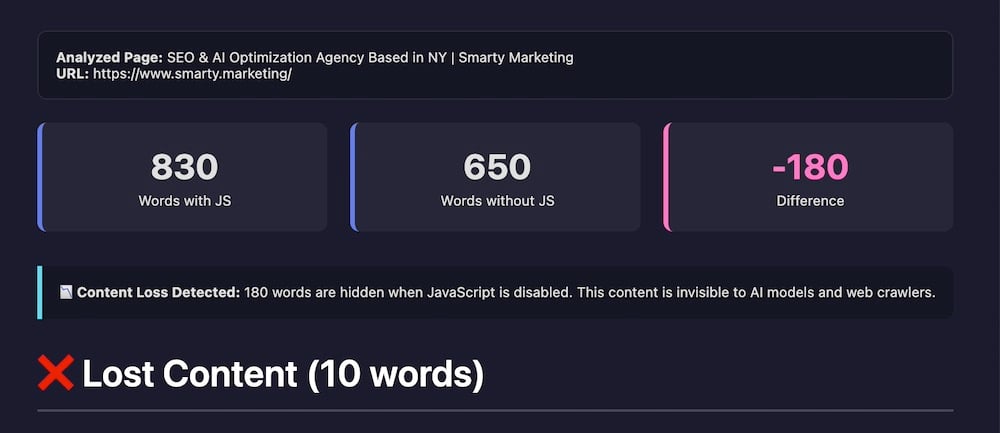
AI Eyes is another extension that shows a page as AI sees it. It focuses on text. Load the page and click it. The extension can then generate a report of missing content when JavaScript is enabled. Scroll down the report to see the words AI crawlers may not have fetched.

SEO analysis report from AI Eyes for Smarty Marketing webpage showing word counts with and without JavaScript. 830 words with JS, 650 words without, difference of -180. Message highlights content loss of 180 words hidden from crawlers when JavaScript is disabled.

AI Eyes shows a page’s missing content due to JavaScript rendering. Ten words are invisible to AI crawlers in this example. Click image to enlarge.

Google Trends API Alpha: Mueller Confirms Small Pilot Group via @sejournal, @MattGSouthern

Google says the new Trends API is opening to a “quite small” set of testers at first, with access expanding over time. The company formally announced the alpha at Search Central Live APAC.

On Bluesky, Google Search Advocate John Mueller tried to set expectations for SEO professionals, writing:

“The initial pilot is going to be quite small, the goal is to expand it over time… I wouldn’t expect the alpha/beta to be a big SEO event :)”

Google’s own announcement also describes access as “very limited” during the early phase.

What Early Testers Get

The API’s main benefit is consistent scaling.

Unlike the Trends website, which rescales results between 0 and 100 for each query set, the API returns data that stays comparable across requests.

That means you can join series, extend time ranges without re-pulling history, and compare many terms in one workflow.

Data goes back 1,800 days (about five years) and updates through two days ago. You can query daily, weekly, monthly, or yearly intervals and break results down by region and sub-region.

At the launch session, Google showed example responses that included both a scaled interest value and a separate search_interest field, indicating a raw-value style metric alongside the scaled score. Google also said the alpha will not include the “Trending Now” feature.

Why There’s High Interest

If you rely on Trends for research, the consistent scaling solves a long-standing pain point with cross-term comparisons.

You can build repeatable analyses without the “re-scaled to 100” surprises that come from changing comparator sets.

For content planning, five years of history and geo breakdowns support more reliable seasonality checks and local targeting.

Looking Ahead

The small pilot suggests Google wants feedback from different types of users. Google is prioritizing applicants who have a concrete use case and can provide feedback.

In the meantime, you can continue to use the website version while preparing for API-based comparisons later.


Featured Image: PhotoGranary02/Shutterstock

AI Systems Often Prefer AI-Written Content, Study Finds via @sejournal, @MattGSouthern

A peer-reviewed PNAS study finds that large language models tend to prefer content written by other LLMs when asked to choose between comparable options.

The authors say this pattern could give AI-assisted content an advantage as more product discovery and recommendations flow through AI systems.

About The Study

What the researchers tested

A team led by Walter Laurito and Jan Kulveit compared human-written and AI-written versions of the same items across three categories: marketplace product descriptions, scientific paper abstracts, and movie plot summaries.

Popular models, including GPT-3.5, GPT-4-1106, Llama-3.1-70B, Mixtral-8x22B, and Qwen2.5-72B, acted as selectors in pairwise prompts that forced a single pick.

The paper states:

“Our results show a consistent tendency for LLM-based AIs to prefer LLM-presented options. This suggests the possibility of future AI systems implicitly discriminating against humans as a class, giving AI agents and AI-assisted humans an unfair advantage.”

Key results at a glance

When GPT-4 provided the AI-written versions used in comparisons, selectors chose the AI text more often than human raters did:

  • Products: 89% AI preference by LLMs vs 36% by humans
  • Paper abstracts: 78% vs 61%
  • Movie summaries: 70% vs 58%

The authors also note order effects. Some models showed a tendency to pick the first option, which the study tried to reduce by swapping the order and averaging results.

Why This Matters

If marketplaces, chat assistants, or search experiences use LLMs to score or summarize listings, AI-assisted copy may be more likely to be selected in those systems.

The authors describe a potential “gate tax,” where businesses feel compelled to pay for AI writing tools to avoid being down-selected by AI evaluators. This is a marketing operations question as much as a creative one.

Limits & Questions

The human baseline in this study is small (13 research assistants) and preliminary, and pairwise choices don’t measure sales impact.

Findings may vary by prompt design, model version, domain, and text length. The mechanism behind the preference is still unclear, and the authors call for follow-up work on stylometry and mitigation techniques.

Looking ahead

If AI-mediated ranking continues to expand in commerce and content discovery, it is reasonable to consider AI assistance where it directly affects visibility.

Treat this as an experimentation lane rather than a blanket rule. Keep human writers in the loop for tone and claims, and validate with customer outcomes.

Google Makes Merchant API Generally Available: What’s New via @sejournal, @MattGSouthern

Google makes Merchant API generally available and announces plans to sunset the Content API. New features include order tracking, issue resolution, and Product Studio.

  • Merchant API is now generally available.
  • It’s now the the primary programmatic interface for Merchant Center.
  • Google will keep the Content API for Shopping accessible until next year.
Why CMOs Should Rethink ROAS As A North Star Metric via @sejournal, @brookeosmundson

If you lead a marketing team, chances are you’ve had this conversation:

“How are the campaigns doing?”

“Well, our ROAS is 4:1.”

The room breathes a collective sigh of relief. The good news: the marketing budget is justified (for the time being).

But here’s the problem: that number might not actually tell you anything useful.

Return on ad spend (ROAS) has long been the go-to metric for measuring paid media performance. It’s clean. It’s easy to calculate.

And let’s be honest: It looks great in a boardroom slide deck. But, that simplicity can be deceiving.

When CMOs use ROAS as the end-all be-all, it can create a warped view of what’s actually driving meaningful growth.

It often rewards short-term wins, punishes necessary investment periods, and misaligns internal and agency teams chasing vanity benchmarks instead of business results.

This article isn’t a hit piece on ROAS. It’s a reality check on meaningful key performance indicators (KPIs). ROAS can be useful, but it’s not your North Star.

And if you’re serious about long-term revenue growth, customer lifetime value, and competitive market share, it’s time to rethink what success really looks like.

Why ROAS Isn’t Always What It Seems

On paper, ROAS is straightforward: revenue divided by ad spend. Spend $10,000 and generate $40,000 in sales, and you’ve got a 4:1 ROAS.

But, under the hood, it’s not so simple.

Here are a few reasons why ROAS can often mislead:

  • It favors existing customers. Your branded campaigns and remarketing lists usually show sky-high ROAS, but they’re mostly capturing people already in your funnel. That’s not growth; it’s in maintenance mode.
  • It ignores profit margins. A $40 cost-per-acquisition (CPA) might look great in one product line and catastrophic in another. ROAS doesn’t account for your cost of goods, fulfillment, or operational costs.
  • It limits (actual) growth. If your only goal is to “hit ROAS,” you’ll throttle spend on upper-funnel or exploratory campaigns that could fuel future revenue.
  • It can be gamed. Agencies and internal teams might optimize for ROAS simply because that’s the KPI they’re judged on, even if it means saying no to high-potential but lower-efficiency campaigns.

And perhaps most importantly, ROAS often ignores timing.

You might lose money on day 1, break even by day 14, and profit significantly by day 90. But ROAS, by default, only tells you what happened in the reporting window you chose.

That’s not a North Star. That’s a snapshot in time.

ROAS Is Still Useful, If You Know When & How To Use It

Let’s be clear: ROAS isn’t bad to report on. It just needs additional context.

There are plenty of scenarios where ROAS is helpful:

  • Comparing performance between campaigns, channels, and platforms.
  • Evaluating high-volume SKU efficiency in ecommerce.
  • Reporting on short-term promotional campaigns.
  • Reviewing the efficiency of remarketing or loyalty campaigns.

The key is to treat ROAS like a diagnostic tool, not a destination. It’s one piece of the story, not the whole narrative.

When CMOs and marketing leaders make ROAS the only metric that matters, they end up over-indexing on campaigns that drive immediate revenue, often at the cost of sustainable growth.

What Should Be Your North Star Metric?

If it’s not ROAS, then what should it be?

The truth is, your North Star depends on your business model and goals. Here are a few KPI candidates that typically give a better long-term signal of paid media health.

1. Customer Lifetime Value (CLV) To CAC Ratio

This is arguably the best lens through which to evaluate your investment. If you’re acquiring customers who buy once and never return, you’ll never scale profitably.

Tracking your customer acquisition cost (CAC) against lifetime value forces you to think beyond the first purchase.

Why does this ratio matter?

CLV:CAC shows whether you’re building a sustainable business model. A healthy ratio is often around 3:1 or better, depending on your margins.

An example of how to use this metric is to look at campaign-level CAC and model projected CLV by channel or audience.

If you’re seeing CLV gains over time from specific campaigns, that’s a strong sign of durable growth.

2. Incremental Revenue

Not all revenue is created equal. Incrementality helps you understand what your paid media efforts are truly adding, not just capturing right now.

Why does this metric matter?

Paid campaigns often get credit for conversions that might have happened anyway. Branded search is a classic example. Measuring incrementality filters out that noise.

Some examples of how to use this metric include:

  • Set up geo-holdout tests.
  • Use audience exclusions.
  • Google and Meta’s Incrementality Testing tools.

Incrementality is not always easy to measure, but it brings clarity to where your dollars are actually making a difference.

3. Payback Period

This metric measures how long it takes for a campaign or customer to break even.

Why does this metric matter as a potential North Star?

Not every investment has to pay off instantly. But, leadership should be aligned on how long you’re willing to wait before seeing a return on investment (ROI). That transparency allows you to fund top-of-funnel efforts with more confidence.

To use this metric in practice, try tagging customer cohorts by acquisition source or campaign. Then, track how long it takes to recoup their acquisition cost through future purchases or subscription value.

4. New Customer Revenue Growth

Instead of optimizing for cheapest clicks or best ROAS, try optimizing for the growth of your new customer base.

Why does this metric matter?

It keeps your marketing focused on expanding market share, not just retargeting people who are already in your orbit.

To use this metric, start segmenting campaigns by new and returning users. You can use customer relationship management (CRM) or post-purchase tagging to see how many new users are coming in from each campaign.

The Real Problem: Misalignment Between Leadership And Execution

One of the most common breakdowns in paid media performance isn’t technical misalignment. It’s organizational misalignment.

CMOs often set ROAS goals because they’re easy to track and easy to report. But, if those goals aren’t communicated with nuance to the teams or agencies executing the campaigns, the output becomes distorted.

Here’s how this usually plays out:

  • A marketing leader tells the agency or in-house team they need a 5:1 ROAS to justify the budget.
  • The team optimizes for what’s most efficient: branded search, bottom-of-funnel retargeting, and low-risk campaigns.
  • Top-of-funnel campaigns get throttled, experimental audiences never see the light of day, and new customer growth stalls.
  • Eventually, performance plateaus. And leadership is left wondering why they’re not seeing growth, despite “great” ROAS.

This is why setting the right KPIs, and clearly communicating their intent, is not optional. It’s essential to have each team, from ideation to execution, on the same page towards the right goals.

Rethinking Your KPI Framework: What Does “Good” Look Like?

Once you move away from ROAS as your main performance indicator, the natural next question is: What do we track instead?

It’s not about throwing out the metrics you’ve used for years. You need to put them in the right order and context.

A well-thought-out KPI framework helps everyone, from your C-suite to your campaign managers, stay aligned on what you’re optimizing for and why.

Think Of KPIs As Layers, Not Silos

Not all metrics serve the same purpose. Some help guide day-to-day decisions. Others reflect long-term strategic impact. The problem starts when we treat every metric as equally important or try to roll them into one number.

ROAS might help optimize a remarketing campaign. But it tells you very little about whether your brand is growing, reaching new audiences, or acquiring customers that actually stick.

That’s why the best KPI frameworks break metrics out into three categories:

1. Short-Term KPIs: Optimization & Efficiency

These are the metrics your media buyers use every day to adjust bids, pause underperformers, and keep spend in check.

They’re meant to be directional, not definitive.

Examples include:

  • ROAS (by campaign or platform).
  • Cost per acquisition (CPA).
  • Click-through rate (CTR).
  • Conversion rate.
  • Impression share.

These KPIs are most useful for weekly or even daily reporting. But, they should never be the only numbers presented in a quarterly business review. They help you stay efficient, but they don’t reflect bigger outcomes.

If these metrics are the only thing being reported or discussed, your team may fall into a cycle of only optimizing what’s already working. This leads to missing opportunities to test, expand, or learn.

2. Mid-Term KPIs: Growth Momentum

These metrics show whether your marketing is actually building toward something. They’re tied to broader business goals but can still be influenced in the current quarter or campaign cycle.

Examples include:

  • Payback period (days to recoup CAC).
  • New customer revenue.
  • Net-new customer acquisition.
  • Micro conversions (demo requests, app installs, newsletter signups, etc.).

Mid-term KPIs are great for monthly reviews and identifying how top- or mid-funnel investments are performing. They help you evaluate whether you’re fueling growth beyond existing audiences.

Mid-term metrics can sometimes get ignored because they’re harder to track or take longer to show impact. Don’t let imperfect data stop you from establishing benchmarks and looking at trends over time.

3. Long-Term KPIs: Strategic Business Health

This is where your true North Star lives.

These KPIs take longer to measure but reflect the outcomes that matter most: customer loyalty, sustainable revenue, and profitability.

Examples include:

  • Customer lifetime value (CLV).
  • CLV to CAC ratio.
  • Churn or retention rate.
  • Repeat purchase rate.
  • Gross margin by channel.

Use these metrics to evaluate the success of your marketing investments across quarters or even years. They should influence annual planning and resource allocation.

These metrics are often siloed inside CRM or finance teams. Make sure your paid media or acquisition teams have access and visibility so they can understand their long-term impact.

A KPI Framework Doesn’t Work Without Context

Even with the right metrics in place, your team won’t succeed unless they understand how to prioritize them and what success looks like.

For example, if your team knows ROAS is important, but also understands it’s not the deciding factor for scaling budget, they’re more likely to take healthy risks and test growth-oriented campaigns.

On the other hand, if they’re unsure which KPI matters most, they’ll default to optimizing what they can control, often at the expense of progress.

You don’t need a perfect attribution model to start here. You just need a shared understanding across your team and partners.

When everyone knows which KPIs matter most at each stage of the funnel, it becomes much easier to align strategy, set goals, and evaluate performance with nuance.

What CMOs Can Do Differently Starting Tomorrow

Changing how your organization approaches paid media measurement doesn’t require a complete overhaul.

But, it does take intentional conversations and a willingness to zoom out from the usual dashboard metrics.

Here are six steps you can take to shift your team (or agency) toward a more aligned and strategic direction.

1. Audit What You’re Optimizing For

Start with a gut-check: what are your internal teams or agencies truly prioritizing day to day?

Ask them to show you not just results, but the actual goals entered in-platform. Are they optimizing for purchases, leads, or something vague like clicks? Are they using ROAS targets in Smart Bidding or manually prioritizing it in their reporting?

You might be surprised how often the tactical goals don’t match the business strategy. A quick audit of campaign objectives and KPIs can uncover a lot about where misalignment begins.

If your goal is to grow market share, but your team is focused on protecting branded search ROAS, that’s a disconnect worth addressing.

2. Reset Internal Expectations

This step often gets overlooked, but it’s a big one. CFOs tend to like ROAS because it looks like a clean efficiency ratio: spend in, revenue out.

But, they don’t always see the nuance of long sales cycles, customer value over time, or the lag between impression and conversion.

Take time to walk your finance partners through your updated KPI framework. Show them examples of campaigns that had a low short-term ROAS but brought in high-value, repeat customers over time.

When leadership understands how marketing performance compounds, they’re less likely to cut budgets based on a one-week dip in return.

This is especially helpful if you’re advocating for top-of-funnel investments that take longer to pay off.

3. Educate Your Team Or Agency

Once you’ve reset internal expectations, don’t forget to bring your team or agency into the loop.

It’s not enough to just say, “We’re no longer using ROAS as our North Star.” You have to explain what you’re prioritizing instead, and why.

That might sound like:

  • “We’re shifting to focus on acquiring net-new customers and reducing payback period.”
  • “This quarter, we’re okay with lower ROAS on prospecting campaigns if we’re growing CLV in the right audience segments.”
  • “Let’s break out CLV:CAC reporting by campaign group so we can identify what’s really delivering long-term value.”

When you frame KPIs as tools to hit bigger business goals, your team can make smarter decisions without fear of getting penalized for not hitting an arbitrary ROAS number.

4. Separate Performance Expectations By Funnel Stage

A common mistake is holding every campaign to the same performance goal.

But the truth is, a prospecting campaign will never look as efficient as a remarketing one, and that’s fine.

Give your team or agency space to evaluate performance based on where in the funnel the campaign sits. Set realistic benchmarks for awareness, engagement, or assisted conversions, and evaluate them alongside lower-funnel ROAS or CPA.

Not only does this help you spend more confidently across the full funnel, but it also encourages the kind of creative testing that often gets squeezed out when efficiency metrics dominate.

5. Invest In Stronger Data Modeling

You don’t need to have a perfect attribution system in place to start moving beyond ROAS. You do need to improve your visibility into how customers behave over time.

Work with your team to build even a basic model of customer payback and CLV across channels.

Use what you already have: Google Analytics 4, CRM exports, or even Shopify data to start segmenting users by acquisition source and repeat value.

Over time, this will help you answer key questions like:

  • Which campaigns actually bring in our best long-term customers?
  • What’s our average time to first, second, and third purchase?
  • Are we over-investing in short-term wins at the expense of lifetime value?

Even directional insights can shape much better budgeting and strategy decisions over time.

6. Lead By Example In How You Talk About Performance

As a marketing leader, the way you talk about performance will set the tone for your entire team.

If you ask, “What’s our ROAS this week?” in every meeting, your team will naturally default to chasing it, regardless of whether it reflects progress toward the bigger picture.

Instead, consider asking:

  • “Are we growing our base of high-value customers?”
  • “What are we seeing with new user acquisition?”
  • “Which campaigns have the strongest long-term value, even if short-term ROAS is lower?”

These types of questions signal that you’re interested in more than just this week’s dashboard metrics.

They give your team permission to think bigger, experiment, and optimize for actual business growth.

Stop Letting ROAS Be The Only Metric That Matters

It makes sense why ROAS gets so much attention. It’s familiar, easy to explain, and shows up nicely on a dashboard. But, when it becomes the only thing your team is aiming for, you risk missing the bigger picture.

If your real goals are growth, better margins, and stronger customer relationships, then you need to look at more than just the numbers that look good in a report.

Start by defining the KPIs that support the way your business actually operates, and make sure your team understands why those metrics matter.

This isn’t about ignoring ROAS. It’s about putting it in its proper place, which is just one part of a much larger story.

More Resources:


Featured Image: SvetaZi/Shutterstock