For years, Industry 4.0 transformation has centered on the convergence of intelligent technologies like AI, cloud, the internet of things, robotics, and digital twins. Industry 5.0 marks a pivotal shift from integrating emerging technologies to orchestrating them at scale. With Industry 5.0, the purpose of this interconnected web of technologies is more nuanced: to augment human potential, not just automate work, and enhance environmental sustainability.
Industry 5.0 has ushered in a radically new level of collaboration between humans and machines, one that removes data silos and optimizes infrastructure, operations, and resource use to disrupt business models and create new forms of enterprise value. But without discipline in tracking value creation, investments risk being wasted on incremental efficiency gains rather than strategic growth.
“To realize the promise of Industry 5.0, companies must move beyond cost and efficiency to focus on growth, resilience, and human-centric outcomes,” says Sachin Lulla, EY Americas industrials and energy transformation leader. “This requires not just new technologies, but new ways of working—where people and machines collaborate, and where value is measured not just in dollars saved, but in new opportunities created.”
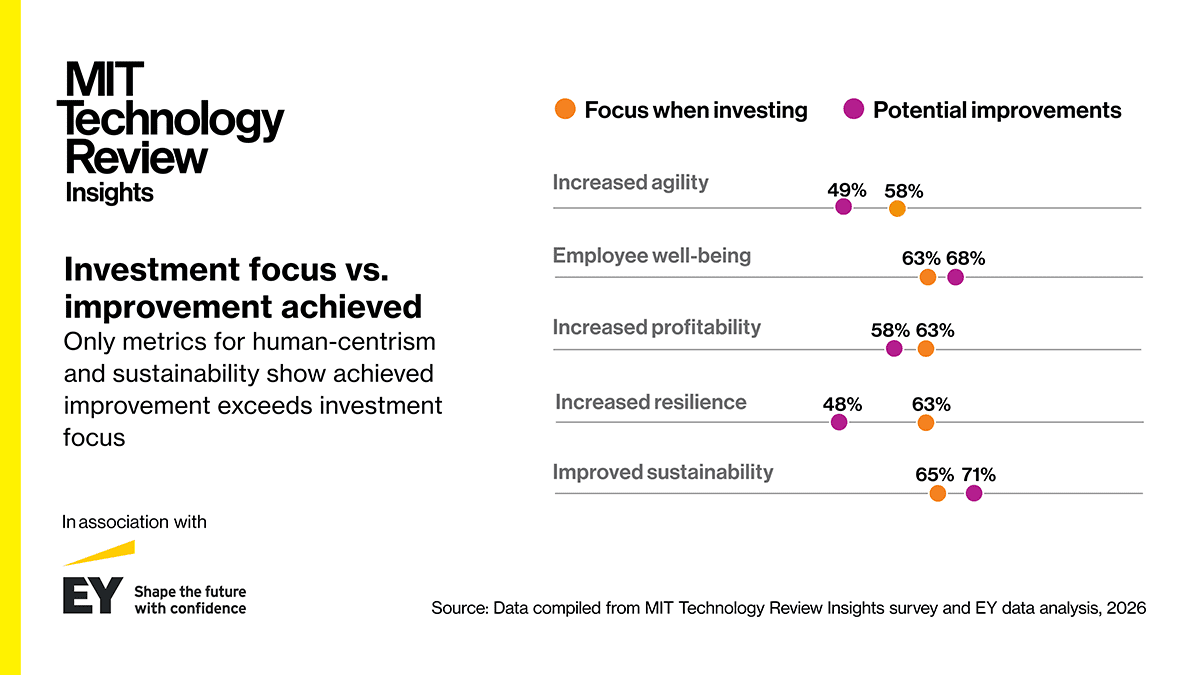
An MIT Technology Review Insights survey of 250 industry leaders from around the world reveals most industrial investments still target efficiency. And while the data shows human-centric and sustainable use cases deliver higher value, they are underfunded. The research shows most organizations are not realizing the full value potential of Industry 5.0 due to a combination of:
• Culture, skills, and collaboration barriers. • Tactical and misaligned technology investments. • Use-case prioritization focused on efficiency over growth, sustainability, and well-being.
The barrier to achieving Industry 5.0 transformation is not only about fixing the technology, according to research from EY and Saïd Business School at the University of Oxford, it is also about bolstering human-centric elements like strategy, culture, and leadership. Companies are investing heavily in digital transformation, but not always in ways that unlock the full human potential of Industry 5.0.
“We’re not just doing digital work for work’s sake, what I call ‘chasing the digital fairies,’” says Chris Ware, general manager, iron ore digital, Rio Tinto. “We have to be very clear on what pieces of work we go after and why. Every domain has a unique roadmap about how to deliver the best value.”
This content was produced by Insights, the custom content arm of MIT Technology Review. It was not written by MIT Technology Review’s editorial staff. It was researched, designed, and written by human writers, editors, analysts, and illustrators. This includes the writing of surveys and collection of data for surveys. AI tools that may have been used were limited to secondary production processes that passed thorough human review.
Many ecommerce businesses are adopting an AI and automation culture that encourages experimentation and problem-solving.
The effect is a renaissance of do-it-yourself projects reminiscent of the ecommerce industry’s early innovations. It is a test-and-see attitude.
AI Trend
LinkedIn’s 2025 “Work Change Report” foretells a more innovative, AI-driven workplace.
Myriad surveys and reports point to the emerging DIY shift.
A 2025 LinkedIn study found that 80% of C-suite executives believe AI adoption is important and will foster a more innovative workplace culture. Gartner reported in December 2025 that 65% of employees said they are excited to use AI at work.
The trend suggests a convergence of three priorities.
Management fears their companies will fall behind if they don’t adopt AI and automation.
Employees use AI because it makes their jobs easier, and the knowledge gained is an important career skill.
The cost of off-the-shelf software and development makes AI an attractive alternative.
Old Is New Again
Here is an example. I interacted with a business in the northwest U.S. that gave nearly every employee access to premium accounts with OpenAI, Gemini, and the workflow automation platform n8n.
Management encouraged employees to tackle problems with AI. I reviewed examples and found the staff had built a simple n8n-driven tool to monitor competitors’ prices.
It was relatively basic. It gathered prices, used an AI agent to compare them against its own data, and added them to a Google Sheet each week. That weekly update fed a pivot table that the marketer used to identify changes.
It was similar to my 2015 article, “Monitor Competitor Prices with Python and Scrapy,” which described a simplified price-checker from a regional retailer that was less expensive and less functional, yet still a functional problem-solver.
DIY
A boiled-down version of the n8n price checker does not even require AI, and might have just four steps.
The n8n workflow fetches prices weekly and appends the results to a Google Sheet.
Here is how it would work.
Use an n8n cron node ( a scheduler) to run the automation once per week.
An HTTP Get request node fetches competitors’ products and prices. In some cases, collecting the data could be as simple as adding /products.json to a shop’s URL.
A code step uses JavaScript to find the lowest price in a set of product variants.
A Google Sheets integration captures the data.
Merchants may not even need to assemble the workflow manually. Generative AI tools can produce n8n-importable JSON files from simple prompts.
Culture
The importance of the price-monitoring example lies not in the workflow but in the attitude it fosters. A member of the marketing team with almost no programming background built a problem-solving automation.
Ultimately, a developer might improve the workflow or clean up the code. Nonetheless, the shift toward building something reduces the friction between operational problems and solutions.
The DIY attitude that drove ecommerce entrepreneurs years ago is reborn with this new set of tools.
With an AI and automation-first culture, a team could build custom workflows, such as:
Inventory monitoring. An AI agent watches stock levels and sales velocity. The tool warns when inventory is low and suggests promotions when it is high.
Review sentiment extraction. AI analyzes each new product review, deducing its sentiment and theme. Insights feed support prioritization or marketing content without manual sorting.
FAQ chatbot. Using n8n, a frequently-asked-questions database, and ChatGPT, a merchant builds a custom chatbot to answer shoppers’ questions.
Customer-service email filter. Connected to Gmail, Slack, and a customer-service ticketing system, an AI agent monitors the customer-service inbox, sorting messages into tickets or sending Slack messages in an emergency.
3D video generation. This workflow uses Google Drive, Remove.bg, and Fal.ai to convert product videos for a Shopify store.
Opportunity
The DIY trend is an opportunity wherein AI and workflow needs converge. Executives seek competitive protection, employees pursue efficiency and skills, and budget constraints limit software and development.
The boom of a calving glacier. The crackling rumble of a wildfire. The roar of a surging storm front. They’re the noises of the living Earth, music of this one particular sphere and clues to the true nature of these dramatic events. But as loud as all these things are, they emit even more acoustic energy below the threshold of human hearing, at frequencies of 20 hertz or lower. These “infrasounds” have such long wavelengths that they can travel around the globe as churning emanations of distant events. But humans have never been able to hear them.
Until now, that is. Everyday Infrasound in an Uncertain World, a new album by the musician and artist Brian House, condenses 24 hours of these rumbles into 24 minutes of the most basic of bass lines, putting a new spin on the idea of ambient music. Sound, even infrasound, is really just variations in air pressure. So House built a set of three “macrophones,” tubes that funnel air into a barometer capable of taking readings 100 times a second. From the quiet woods of western Massachusetts, House can pick up what the planet is laying down. Then he speeds the recording up by a factor of 60 so that it’s audible to the wee ears of humans. “I am really interested in the layers of perception that we can’t access,” he says. “It’s not only low sound, but it’s also distant sound. That kind of blew my mind.”
House’s album is art, but scientists made it possible. Barometers picked up the 1883 eruption of the South Pacific volcano Krakatoa as far away as London. And today, a global network of infrasound sensors helps enforce the nuclear test ban treaty. A few infrasound experts—like Leif Karlstrom, a volcanologist at the University of Oregon who uses infrasound to study Mount Kilauea in Hawaii—helped House set up his music-gathering array and better understand what he was hearing. “He’s highlighting interesting phenomena,” Karlstrom says, even though it’s impossible to tell exactly what is making each specific sound.
So how’s the actual music? It’s 24 minutes of an otherworldly chorus, alternating between low grumbling vibrations and soft ghostlike whispers. A high-pitched whistle? Could be a train, House says. An intense low-octave rattle? Maybe a distant thunderstorm or a shifting ocean current. “For me, it’s about the mystery of it,” he says. “I hope that’s a little bit unsettling.” But it also might connect someone listening to a wider—and deeper—world.
Monique Brouillette is a freelance writer based in Cambridge, Massachusetts.
The Real Housewives of Salt Lake City is one of the best shows on television right now. Not one of the best reality TV shows, but one of the best TV shows, period. Chronicling a shifting group of wealthy women in and around Salt Lake, the show has featured a convicted felon whom federal agents came looking for while cameras were rolling, a church leader married to her step-grandfather, and a single mom in an exhausting on-again, off-again relationship with an Osmond. In one season, there was an ongoing argument between two cast members after one told the other that she “smelled like hospital.” Later, one woman was secretly running an anonymous gossip Instagram about her fellow housewives. We can debate the “reality” of reality television, and it’s certainly true that these characters and scenarios are far-fetched. But every single person is dealing with something relatable—difficult marriages, failing businesses, strained relationships with children, addiction. It’s entertainment, and high camp, but I find that I still have a lot of empathy for these people.
The last good place(s) on Facebook
Facebook sucks. That’s not controversial to say, right? But there is one reason I still have a Facebook account: my neighborhood Buy Nothing group. The spirit of community and camaraderie is alive and well there—and probably in yours, too. A non-exhaustive list of things I have given away: empty candle jars, a bookcase, used lightbulbs, unopened toiletries, bubble wrap. I’ve scored a few good things as well: a gorgeous antique dresser that I refinished, some over-the-door hooks, and brand-new jeans. It makes me happy to know that stuff that would’ve otherwise ended up in a landfill is bringing one of my neighbors joy.
Going analog
I used to wear an Apple Watch a lot. I’m a pretty active person, and I liked tracking my workouts and my steps. But after I’d had it for a while, my watch started dying in the middle of a 30-minute run; it became useless to me, and I gave it up completely. Guess what? I’m happier. I feel more present when I’m not checking how much time is left in a yoga class or reading texts during a long run. The amount of data it gathered about me was also stressing me out, and it wasn’t useful. And I don’t need a wearable to tell me how poorly I slept! Trust me, I already know.
Eons ago, in 2012, I had a weird experience. My iPhone suddenly shut down. When I restarted it, I found it was totally reset—clean, like a new device. This was the early days of iOS, so I wasn’t too concerned until I went to connect it to my computer to restore it from a backup. But when I flipped open the lid of my laptop, it too was mid-restart. And then, suddenly, the screen went gray. It was being remotely wiped. I turned on my iPad. It, too, had been wiped. I was being hacked.
Frantically, I shut down all my devices, unplugged everything connected to the internet in my house, turned off my router, and went next door to use my neighbors’ computer and find out what was going on. Deepening my panic, I realized hackers had also gained control of, and nuked, my Google account. Worse, they were in control of my Twitter, which they were gleefully using to spew all sorts of vile comments. It was nasty.
You have to remember, this was before all of us lived with a constant rain of text messages and emails designed to elicit the information necessary to pull something like this off. These crooks hadn’t brute-forced their way in, or used any sort of sophisticated techniques to gain access to my accounts. Instead, they had relied on publicly available information, and a fake credit card number, to socially engineer their way into my Amazon account, where they looked up the last four digits of my real credit card number. Then they used that information to get into Apple. And because that account was linked to my Gmail, and that to my Twitter, it gave them the keys to everything.
But what really troubled me was what I learned as I followed up on my hack over the ensuing weeks and months: This kind of thing was, while still novel, becoming more common. Some version of what happened to me had happened to lots of other people. The kids who were responsible—it was a couple of kids—weren’t criminal masterminds. They had just found a gap, a place where a technology was now commonplace but its risks and exploitable surface areas weren’t yet fully understood. I just happened to have all my stuff in the gap. Today that gap might feature a crypto wallet or a deepfake of a loved one’s voice. (Or both.)
Crime changes.
The goals stay the same—pursuit of value, pursuit of power—but new technologies create new vulnerabilities, new tactics, and new ways for perpetrators to evade discovery or capture. And the law necessarily lags behind. Relying not on innovation but on precedent, it is intentionally backward-looking and slow. That plodding consideration used to be how we protected our shared democratic society, how we protected each other from each other.
But those same new technologies that have allowed crime to outpace law have also reenergized law enforcement and government—offering new ways to root out crime, to gather evidence, to surveil people. Think, for example, of how cold-case investigators tracked down the Golden State Killer years after his murders, using DNA samples and genealogy databases—launching a new era of DNA-powered investigations.
Technology has long made crime and its prosecution a game of cat and mouse. It sometimes calls into question the nature of crime itself. Unregulated behaviors, facilitated by technology, can exist in murky zones of dubious legality. (Until TikTok announced its new ownership structure, Apple and Google were both technically breaking the law by allowing the app to stay on their platforms, under the provisions of the Protecting Americans from Foreign Adversary Controlled Applications Act. Ah! Well. Nevertheless.)
That tension is the key to our March/April issue. Thanks to technologies like cryptocurrency and off-the-shelf autonomous autopilots, there’s never been a better time to do crime. Thanks to pervasive surveillance and digital infrastructure, there’s never been a better time to fight it—sometimes at the expense of what we used to think of as fundamental civil rights.
I never pressed charges against the kids who hacked me. The biggest consequence of the hack was that Apple set up two-factor authentication in the following months, which felt like a win. Now I’m not sure anyone expects their personal data to be secure in any meaningful way. I’m certain, though, that somewhere on the net, a new generation of kids is coming up with another novel crime.
This is today’s edition of The Download, our weekday newsletter that provides a daily dose of what’s going on in the world of technology.
Introducing: the Crime issue
Technology has long made crime and its prosecution a game of cat and mouse. But those same new technologies that have allowed crime to outpace law have also reenergized law enforcement and government—offering new ways to root out crime, to gather evidence, to surveil people.
That tension is the key to our new March/April issue. Thanks to technologies like cryptocurrency and off-the-shelf autonomous autopilots, there’s never been a better time to do crime. And thanks to pervasive surveillance and digital infrastructure, there’s never been a better time to fight it—sometimes at the expense of what we used to think of as fundamental civil rights.
Here’s a sneak peek at what you can expect:
+ The fascinating story of what happened when cyber security researcher Allison Nixon decided to track down the mysterious online figures threatening to kill her. Read the full story.
+ AI is already making online crimes easier, but those reports of AI-powered superhacks are seriously overblown. Here’s why.
+ Chicago is home to a vast monitoring system to track its residents, including tens of thousands of surveillance cameras. But while law enforcement claims it’s necessary to protect public safety, privacy activists have likened it to a surveillance panopticon. Read the full story.
+ Modern thieves are stealing luxury cars right from under their manufacturers’ and owners’ noses. But how are they doing it?
+ How innovative conservationists are using tech to fight back against wildlife traffickers—including by turning rhinos radioactive.
Why 2026 is the year for sodium-ion batteries
Sodium-based batteries could be a cheaper, safer alternative to lithium-ion, and the technology is finally making its way into cars—and energy storage arrays on the grid.
They’re also one of MIT Technology Review‘s 10 Breakthrough Technologies of 2026, and we’re holding a subscriber-only Roundtables discussion to explain why. Join our science editor Mary Beth Griggs, senior climate reporter Casey Crownhart and China reporter Caiwei Chen to explore the present moment for sodium-ion batteries—and what’s coming next.
We’ll be going live at 1pm ET this afternoon—register now!
The must-reads
I’ve combed the internet to find you today’s most fun/important/scary/fascinating stories about technology.
1 The Pentagon has given Anthropic an ultimatum Either provide the US military with full access to Claude, or face the consequences. (Axios) + Defense Secretary Pete Hegseth has threatened to cut ties. (WSJ $) + In turn, Anthropic has allegedly refused to ease military restrictions. (Reuters)
2 Meta has signed a major chip deal with AMD Just days after it committed to using millions of Nvidia chips to power its AI ambitions. (CNBC)
3 How Jeffrey Epstein infiltrated Microsoft’s upper ranks He was privy to confidential insider discussions about internal politics and gave advice on the line of CEO succession. (NYT $) + A smash-hit podcast about the Epstein files is entirely AI-generated. (Fast Company $)
4 Chatbot-assisted cheating is just a part of student life Teenagers are regularly asking for—and may grow dependent on—AI’s assistance. (WP $) + You need to talk to your kid about AI. Here are 6 things you should say. (MIT Technology Review)
5 How Ukraine built an entire drone industry from scratch And hopes to sell its expertise to Western allies once the war is over. (New Scientist $) + Europe’s drone-filled vision for the future of war. (MIT Technology Review)
6 The FDA has removed a warning against ineffective autism treatments The page urged Americans not to fall for alternative remedies including chlorine dioxide. (Undark)
7 Solar power is going from strength to strength in the US Usage was up 35% last year in comparison to the previous year. (Ars Technica)
8 How big is infinity? Maybe one size doesn’t fit all. (Quanta Magazine)
9 Warning: someone near you is wearing smartglasses That’s the premise behind new app Nearby Glasses, which detects the devices’ Bluetooth signals. (404 Media)
10 Uber employees run ideas past an AI version of their CEO Very good, very normal. (Insider $) + Synthesia’s AI clones are more expressive than ever. Soon they’ll be able to talk back. (MIT Technology Review)
Quote of the day
“This has nothing to do with mass surveillance and autonomous weapons being used.”
—A senior defense official tells the Washington Post that the Pentagon hasn’t proposed using any of Anthropic’s AI tools in ways that aren’t lawful, after the department threatened to force the company to share its technology.
One more thing
These scientists are working to extend the life span of pet dogs—and their owners
Matt Kaeberlein is what you might call a dog person. He has grown up with dogs and describes his German shepherd, Dobby, as “really special.” But Dobby is 14 years old—around 98 in dog years.
Kaeberlein is co-director of the Dog Aging Project, an ambitious research effort to track the aging process of tens of thousands of companion dogs across the US. He is one of a handful of scientists on a mission to improve, delay, and possibly reverse that process to help them live longer, healthier lives.
And dogs are just the beginning. One day, this research could help to prolong the lives of humans. Read the full story.
—Jessica Hamzelou
We can still have nice things
A place for comfort, fun and distraction to brighten up your day. (Got any ideas? Drop me a line or skeet ’em at me.)
+ As if dinosaur eggs weren’t cool enough, it turns out they’re also a pretty handy aging indicator for other fossils. + This week would have marked Steve Jobs’ 71st birthday. His Stanford Commencement Address is still one of the best. + I need to play Capybara Simulator immediately: a game in which you can become a capybara. + Good news everyone—it looks like we’ve avoided a bananapocalypse
Sodium-based batteries could be a cheaper, safer alternative to lithium-ion, and the technology is finally making its way into cars—and energy storage arrays on the grid. Sodium-ion batteries are one of MIT Technology Review’s 10 Breakthrough Technologies of 2026 list, and this subscriber-only discussion explains why.
Watch a discussion exploring the present moment for sodium-ion batteries—and what’s coming next.
Speakers:Mary Beth Griggs, Science Editor; Casey Crownhart, Senior Climate Reporter; and Caiwei Chen, China Reporter
This week’s rundown of new services for ecommerce merchants includes rollouts for third-party fulfillment, AI assistants, agentic commerce, omnichannel retail, social commerce, Shopify vendors, live-streaming, and AI fraud prevention.
Got an ecommerce product release? Email updates@practicalecommerce.com.
New Tools for Merchants
Worldline launches One Commerce for omnichannel retail.Worldline, a Europe-based provider of payment services, has launched One Commerce to position merchants to integrate new payment methods, value-added services, and shopping models. Worldline will also launch its à-la-carte acquiring model in Europe, allowing merchants to choose their preferred multi-payments setup.
Worldline One Commerce
eBay to acquire Depop from Etsy.eBay has announced its acquisition of Depop, an Etsy-owned recommerce fashion marketplace, for approximately $1.2 billion in cash. The addition of Depop will accelerate eBay’s consumer-to-consumer strategy, deepening its reach with younger buyers. Depop will benefit from eBay’s global scale and capabilities. eBay will also expand Depop’s inventory visibility, including cross-listing opportunities.
Paysafe partners with open payments platform Spreedly. Payment platforms Paysafe and Spreedly have partnered. Spreedly’s global payments orchestration platform has integrated Paysafe as an acquirer to process credit and debit card payments for online merchants operating worldwide. Spreedly’s open payments platform, connecting 140 payment gateways and 40 unique payment methods, now includes the Paysafe gateway.
Akeneo partners with Stripe to help businesses sell on AI agents.Akeneo, a provider of product information management tools, has partnered with Stripe and its Agentic Commerce Suite. Through this partnership, Akeneo focuses on the product experience layer, enabling businesses to enrich, validate, and activate their product data for AI-driven channels. Stripe remains responsible for checkout, payments, fraud protection, and merchant-of-record capabilities, allowing businesses to retain control of their customer relationships, refunds, and disputes.
Akeneo
Badge raises $17.1 million for Apple and Google wallets.Badge, an operating platform for Apple and Google wallets, has raised $17.1 million to provide the infrastructure businesses need to add the payment method at scale. The funding includes a $13.8 million round led by TTV Capital with participation from Stripe, Synchrony Ventures, and Infinity Ventures. Badge will use the capital to accelerate go-to-market efforts, expand product capabilities, and deepen partnerships to help enterprise brands and platforms adopt Apple and Google wallets as a core customer interface.
Reddit tests a shopping product experience in search.Reddit is testing an AI-powered search feature that turns community recommendations into action using the product catalogs from select shopping and Dynamic Product Ads partners. Users may see search results that include interactive product carousels with pricing, images, and where-to-buy links. The carousel highlights products mentioned in real conversations on related posts and comments, and it includes details such as pricing and images.
TikTok Shop releases new tools, including expanded chatbot access.TikTok has released new features for TikTok Shop sellers. The features include (i) the availability of the Seller Assistant tool in the Seller Center, (ii) a new auto-approval workflow for product samples, (iii) highlights on creator profiles for recommended brand collaborations, and (iv) for live-streams, the automated posting of clips auto-generated from user broadcasts.
TikTok Shop
WordPress.com releases AI assistant. The WordPress AI Assistant is now available on WordPress.com. Within the WordPress editor, site personnel can (i) get help with structure, design, content editing, and refinement, (ii) create and edit images in the media library, and (iii) ask questions of the AI assistant in block notes and get answers.
True Fit launches agentic AI shopping powered by 20 years of data.True Fit, a provider of fit and fashion intelligence, has launched a shopping agent for retail. According to True Fit, the agent is powered by shopper profiles and 20 years of purchase and returns data. The technology identifies ‘Will this fit?’ moments in real time, guiding shoppers to appropriate sizes and styles. True Fit’s shopping agent is available beginning March 2026 for select retailers and brands, with a broader release in April 2026.
Metapack launches AI-powered tools for control over delivery data.Metapack, a shipping platform, has announced AI-powered capabilities to predict and prevent delivery problems before they affect customers. “Ask Metapack” provides a fast way to understand delivery performance by asking questions and receiving instant answers. “Predict with AI” identifies deliveries that are likely to miss expected arrival times. “Build with AI” creates reports and visualisations on demand using prompts. “Intelligent Checkout” is an embeddable component that presents validated delivery options.
Metapack
Rakuten Ichiba partners with Google on shopping via YouTube.Rakuten Ichiba, a Japan-based online marketplace, has partnered with Google in Japan to enable users to purchase products through YouTube videos and affiliates. YouTube viewers can explore Rakuten Ichiba products featured by creators by tapping the View Products button during a video. Product names and prices are displayed, and users can then navigate directly to the product page on Rakuten Ichiba to view details or continue watching the video.
Avenue Z acquires Shopify design and development partner Varfaj.Avenue Z, a marketing agency, has acquired Varfaj, a Shopify development and optimization partner. Avenue Z says the acquisition positions it for the next evolution in commerce: AI-powered, agent-led buying experiences. Varfaj will rebrand under the Avenue Z name. The acquisition also brings Varfaj’s proprietary development framework and conversion rate optimization technologies into Avenue Z’s performance marketing infrastructure.
Radial launches Commerce Solutions with AI-driven fraud prevention.Radial, a third-party logistics company, has launched Commerce Solutions, enabling payment orchestration and AI-driven fraud prevention at scale. Per Radial, the key functions of Commerce Solutions include provider-agnostic payment orchestration, centralized tokenization, fraud decisioning that eliminates manual review, and chargeback protection and resolution covering fraud and non-fraud disputes.
More U.S. consumers in an Adobe Express survey said they’ve used TikTok for search than in the company’s 2024 survey. But the platform’s position as a Google challenger may be weaker than the headline numbers suggest.
An updated report from Adobe Express, published February 17, surveyed 807 consumers and 200 small business owners in the US about their search habits across platforms. Adobe says the data was collected in January 2026, and that the SurveyMonkey survey was conducted in February 2026.
Forty-nine percent of consumers surveyed said they have used TikTok as a search engine, up 8 percentage points from 41% in Adobe’s 2024 report.
Gen Z Is Pulling Back
Among Gen Z respondents, the share who said they are more likely to rely on TikTok than Google fell from 8% in 2024 to 4% in 2026.
Sixty-five percent of Gen Z still said they’ve used TikTok as a search engine, and 25% found it effective for finding information. But that usage isn’t translating into preference over Google the way it did two years ago.
That tracks with separate reporting from Axios in 2024. The Axios data showed Google still held the top spot as Gen Z’s preferred search starting point, with 46% of users aged 18-24 beginning their queries there.
ChatGPT Pulls Ahead As A Google Alternative
14% of consumers said they are more likely to rely on ChatGPT than on Google as a search engine. That’s double the 7% who said the same about TikTok.
The ChatGPT figure was consistent across age groups, with 12% of Gen Z, 15% of millennials, 15% of Gen X, and 14% of baby boomers. TikTok-over-Google numbers were low across every group and lowest among baby boomers (2%), with millennials (8%) actually higher than Gen Z (4%).
When asked which platforms they found most helpful for search, consumers ranked Google first at 85%, followed by Reddit (29%), ChatGPT (26%), YouTube (24%), and TikTok (16%).
Business Investment Is Cooling
Among the 200 business owners surveyed, 58% had used TikTok for promotions. They allocated an average of 16% of their marketing budget to TikTok content creation and 15% of their SEO budget to TikTok search optimization.
Only 38% said they plan to increase investment in TikTok affiliate marketing, down from 53% who said the same in 2024.
The top challenge business owners reported was converting TikTok engagement into sales (38%), followed by growing follower counts and engagement rates (36%).
Influencer marketing use grew, with 38% of small business owners using TikTok influencers for product sales or promotions, up from 25% in 2024.
Why This Matters
The “TikTok is replacing Google” narrative has been a recurring theme since at least 2022. This data complicates that story. Optimizing for TikTok search still makes sense if your audience skews younger, but the data suggests Gen Z may be settling into a multi-platform pattern rather than abandoning Google.
The ChatGPT numbers are worth watching more closely. If 14% of consumers across all age groups say they’re more likely to rely on ChatGPT than Google, that’s a broader competitive signal than TikTok’s Gen Z niche.
Looking Ahead
Adobe’s report is vendor-funded and conducted via SurveyMonkey with 1,007 respondents (807 consumers and 200 business owners). Adobe says data was collected in January 2026. The sample skews millennial-heavy (53%), with Gen Z making up only 15% of consumers surveyed. No margin of error was disclosed.
The year-over-year comparisons are based on Adobe’s own prior data, not an independently replicated sample. The generational trends are directional rather than definitive.
Still, the direction in the data aligns with broader industry observations. Consumers are using more platforms for search-like behavior, but Google remains dominant. The real competition for Google’s search role, based on this survey at least, may be coming from AI chatbots rather than social video.
Anthropic updated its crawler documentation this week with a formal breakdown of its three web crawlers and their individual purposes.
The page now lists ClaudeBot (training data collection), Claude-User (fetching pages when Claude users ask questions), and Claude-SearchBot (indexing content for search results) as separate bots, each with its own robots.txt user-agent string.
Each bot gets a “What happens when you disable it” explanation. For Claude-SearchBot, Anthropic wrote that blocking it “prevents our system from indexing your content for search optimization, which may reduce your site’s visibility and accuracy in user search results.”
For Claude-User, the language is similar. Blocking it “prevents our system from retrieving your content in response to a user query, which may reduce your site’s visibility for user-directed web search.”
The update formalizes a pattern that’s becoming more common among AI search products. OpenAI runs the same three-tier structure with GPTBot, OAI-SearchBot, and ChatGPT-User. Perplexity operates a two-tier version with PerplexityBot for indexing and Perplexity-User for retrieval.
Anthropic says all three of its bots honor robots.txt, including Claude-User. OpenAI and Perplexity draw a sharper line for user-initiated fetchers, warning that robots.txt rules may not apply to ChatGPT-User and generally don’t apply to Perplexity-User. For Anthropic and OpenAI, blocking the training bot does not block the search bot or the user-requested fetcher.
What Changed From The Old Page
The previous version of Anthropic’s crawler page referenced only ClaudeBot and used broader language about data collection for model development. Before ClaudeBot, Anthropic operated under the Claude-Web and Anthropic-AI user agents, both now deprecated.
The move from one listed crawler to three mirrors what OpenAI did in late 2024 when it separated GPTBot from OAI-SearchBot and ChatGPT-User. OpenAI updated that documentation again in December, adding a note that GPTBot and OAI-SearchBot share information to avoid duplicate crawling when both are allowed.
OpenAI also noted in that December update that ChatGPT-User, which handles user-initiated browsing, may not be governed by robots.txt in the same way as its automated crawlers. Anthropic’s documentation does not make a similar distinction for Claude-User.
Why This Matters
The blanket “block AI crawlers” strategy that many sites adopted in 2024 no longer works the way it did. Blocking ClaudeBot stops training data collection but does nothing about Claude-SearchBot or Claude-User. The same is true on OpenAI’s side.
A BuzzStream study we covered in January found that 79% of top news sites block at least one AI training bot. But 71% also block at least one retrieval or search bot, potentially removing themselves from AI-powered search citations in the process.
That matters more now than it did a year ago. Hostinger’s analysis of 66.7 billion bot requests showed OpenAI’s search crawler coverage growing from 4.7% to over 55% of sites in their sample, even as its training crawler coverage dropped from 84% to 12%. Websites are allowing search bots while blocking training bots, and the gap is widening.
The visibility warnings differ by company. Anthropic says blocking Claude-SearchBot “may reduce” visibility. OpenAI is more direct, telling publishers that sites opted out of OAI-SearchBot won’t appear in ChatGPT search answers, though navigational links may still show up. Both are positioning their search crawlers alongside Googlebot and Bingbot, not alongside their own training crawlers.
What This Means
When managing robots.txt files, the old copy-paste block list needs an audit. SEJ’s complete AI crawler list includes verified user-agent strings across every company.
A strategic robots.txt now requires separate entries for training and search bots at minimum, with the understanding that user-initiated fetchers may not follow the same rules.
Looking Ahead
The three-tier split creates a new category of publisher decision that parallels what Google did years ago with Google-Extended. That user-agent lets sites opt out of Gemini training while staying in Google Search results. Now Anthropic and OpenAI offer the same separation for their platforms.
As AI-powered search grows its share of referral traffic, the cost of blocking search crawlers increases. The Cloudflare Year in Review data we reported in December showed AI crawlers already account for a measurable share of web traffic, and the gap between crawling volume and referral traffic remains wide. How publishers navigate these three-way decisions will shape how much of the web AI search tools can actually surface.