Everything you need to know about estimating AI’s energy and emissions burden

When we set out to write a story on the best available estimates for AI’s energy and emissions burden, we knew there would be caveats and uncertainties to these numbers. But, we quickly discovered, the caveats are the story too. 


This story is a part of MIT Technology Review’s series “Power Hungry: AI and our energy future,” on the energy demands and carbon costs of the artificial-intelligence revolution.


Measuring the energy used by an AI model is not like evaluating a car’s fuel economy or an appliance’s energy rating. There’s no agreed-upon method or public database of values. There are no regulators who enforce standards, and consumers don’t get the chance to evaluate one model against another. 

Despite the fact that billions of dollars are being poured into reshaping energy infrastructure around the needs of AI, no one has settled on a way to quantify AI’s energy usage. Worse, companies are generally unwilling to disclose their own piece of the puzzle. There are also limitations to estimating the emissions associated with that energy demand, because the grid hosts a complicated, ever-changing mix of energy sources. 

It’s a big mess, basically. So, that said, here are the many variables, assumptions, and caveats that we used to calculate the consequences of an AI query. (You can see the full results of our investigation here.)

Measuring the energy a model uses

Companies like OpenAI, dealing in “closed-source” models, generally offer access to their  systems through an interface where you input a question and receive an answer. What happens in between—which data center in the world processes your request, the energy it takes to do so, and the carbon intensity of the energy sources used—remains a secret, knowable only to the companies. There are few incentives for them to release this information, and so far, most have not.

That’s why, for our analysis, we looked at open-source models. They serve as a very imperfect proxy but the best one we have. (OpenAI, Microsoft, and Google declined to share specifics on how much energy their closed-source models use.) 

The best resources for measuring the energy consumption of open-source AI models are AI Energy Score, ML.Energy, and MLPerf Power. The team behind ML.Energy assisted us with our text and image model calculations, and the team behind AI Energy Score helped with our video model calculations.

Text models

AI models use up energy in two phases: when they initially learn from vast amounts of data, called training, and when they respond to queries, called inference. When ChatGPT was launched a few years ago, training was the focus, as tech companies raced to keep up and build ever-bigger models. But now, inference is where the most energy is used.

The most accurate way to understand how much energy an AI model uses in the inference stage is to directly measure the amount of electricity used by the server handling the request. Servers contain all sorts of components—powerful chips called GPUs that do the bulk of the computing, other chips called CPUs, fans to keep everything cool, and more. Researchers typically measure the amount of power the GPU draws and estimate the rest (more on this shortly). 

To do this, we turned to PhD candidate Jae-Won Chung and associate professor Mosharaf Chowdhury at the University of Michigan, who lead the ML.Energy project. Once we collected figures for different models’ GPU energy use from their team, we had to estimate how much energy is used for other processes, like cooling. We examined research literature, including a 2024 paper from Microsoft, to understand how much of a server’s total energy demand GPUs are responsible for. It turns out to be about half. So we took the team’s GPU energy estimate and doubled it to get a sense of total energy demands. 

The ML.Energy team uses a batch of 500 prompts from a larger dataset to test models. The hardware is kept the same throughout; the GPU is a popular Nvidia chip called the H100. We decided to focus on models of three sizes from the Meta Llama family: small (8 billion parameters), medium (70 billion), and large (405 billion). We also identified a selection of prompts to test. We compared these with the averages for the entire batch of 500 prompts. 

Image models

Stable Diffusion 3 from Stability AI is one of the most commonly used open-source image-generating models, so we made it our focus. Though we tested multiple sizes of the text-based Meta Llama model, we focused on one of the most popular sizes of Stable Diffusion 3, with 2 billion parameters. 

The team uses a dataset of example prompts to test a model’s energy requirements. Though the energy used by large language models is determined partially by the prompt, this isn’t true for diffusion models. Diffusion models can be programmed to go through a prescribed number of “denoising steps” when they generate an image or video, with each step being an iteration of the algorithm that adds more detail to the image. For a given step count and model, all images generated have the same energy footprint.

The more steps, the higher quality the end result—but the more energy used. Numbers of steps vary by model and application, but 25 is pretty common, and that’s what we used for our standard quality. For higher quality, we used 50 steps. 

We mentioned that GPUs are usually responsible for about half of the energy demands of large language model requests. There is not sufficient research to know how this changes for diffusion models that generate images and videos. In the absence of a better estimate, and after consulting with researchers, we opted to stick with this 50% rule of thumb for images and videos too.

Video models

Chung and Chowdhury do test video models, but only ones that generate short, low-quality GIFs. We don’t think the videos these models produce mirror the fidelity of the AI-generated video that many people are used to seeing. 

Instead, we turned to Sasha Luccioni, the AI and climate lead at Hugging Face, who directs the AI Energy Score project. She measures the energy used by the GPU during AI requests. We chose two versions of the CogVideoX model to test: an older, lower-quality version and a newer, higher-quality one. 

We asked Luccioni to use her tool, called Code Carbon, to test both and measure the results of a batch of video prompts we selected, using the same hardware as our text and image tests to keep as many variables as possible the same. She reported the GPU energy demands, which we again doubled to estimate total energy demands. 

Tracing where that energy comes from

After we understand how much energy it takes to respond to a query, we can translate that into the total emissions impact. Doing so requires looking at the power grid from which data centers draw their electricity. 

Nailing down the climate impact of the grid can be complicated, because it’s both interconnected and incredibly local. Imagine the grid as a system of connected canals and pools of water. Power plants add water to the canals, and electricity users, or loads, siphon it out. In the US, grid interconnections stretch all the way across the country. So, in a way, we’re all connected, but we can also break the grid up into its component pieces to get a sense for how energy sources vary across the country. 

Understanding carbon intensity

The key metric to understand here is called carbon intensity, which is basically a measure of how many grams of carbon dioxide pollution are released for every kilowatt-hour of electricity that’s produced. 

To get carbon intensity figures, we reached out to Electricity Maps, a Danish startup company that gathers data on grids around the world. The team collects information from sources including governments and utilities and uses them to publish historical and real-time estimates of the carbon intensity of the grid. You can find more about their methodology here

The company shared with us historical data from 2024, both for the entire US and for a few key balancing authorities (more on this in a moment). After discussions with Electricity Maps founder Olivier Corradi and other experts, we made a few decisions about which figures we would use in our calculations. 

One way to measure carbon intensity is to simply look at all the power plants that are operating on the grid, add up the pollution they’re producing at the moment, and divide that total by the electricity they’re producing. But that doesn’t account for the emissions that are associated with building and tearing down power plants, which can be significant. So we chose to use carbon intensity figures that account for the whole life cycle of a power plant. 

We also chose to use the consumption-based carbon intensity of energy rather than production-based. This figure accounts for imports and exports moving between different parts of the grid and best represents the electricity that’s being used, in real time, within a given region. 

For most of the calculations you see in the story, we used the average carbon intensity for the US for 2024, according to Electricity Maps, which is 402.49 grams of carbon dioxide equivalent per kilowatt-hour. 

Understanding balancing authorities

While understanding the picture across the entire US can be helpful, the grid can look incredibly different in different locations. 

One way we can break things up is by looking at balancing authorities. These are independent bodies responsible for grid balancing in a specific region. They operate mostly independently, though there’s a constant movement of electricity between them as well. There are 66 balancing authorities in the US, and we can calculate a carbon intensity for the part of the grid encompassed by a specific balancing authority.

Electricity Maps provided carbon intensity figures for a few key balancing authorities, and we focused on several that play the largest roles in data center operations. ERCOT (which covers most of Texas) and PJM (a cluster of states on the East Coast, including Virginia, Pennsylvania, and New Jersey) are two of the regions with the largest burden of data centers, according to research from the Harvard School of Public Health

We added CAISO (in California) because it covers the most populated state in the US. CAISO also manages a grid with a significant number of renewable energy sources, making it a good example of how carbon intensity can change drastically depending on the time of day. (In the middle of the day, solar tends to dominate, while natural gas plays a larger role overnight, for example.)

One key caveat here is that we’re not entirely sure where companies tend to send individual AI inference requests. There are clusters of data centers in the regions we chose as examples, but when you use a tech giant’s AI model, your request could be handled by any number of data centers owned or contracted by the company. One reasonable approximation is location: It’s likely that the data center servicing a request is close to where it’s being made, so a request on the West Coast might be most likely to be routed to a data center on that side of the country. 

Explaining what we found

To better contextualize our calculations, we introduced a few comparisons people might be more familiar with than kilowatt-hours and grams of carbon dioxide. In a few places, we took the amount of electricity estimated to be used by a model and calculated how long that electricity would be able to power a standard microwave, as well as how far it might take someone on an e-bike. 

In the case of the e-bike, we assumed an efficiency of 25 watt-hours per mile, which falls in the range of frequently cited efficiencies for a pedal-assisted bike. For the microwave, we assumed an 800-watt model, which falls within the average range in the US. 

We also introduced a comparison to contextualize greenhouse gas emissions: miles driven in a gas-powered car. For this, we used data from the US Environmental Protection Agency, which puts the weighted average fuel economy of vehicles in the US in 2022 at 393 grams of carbon dioxide equivalent per mile. 

Predicting how much energy AI will use in the future

After measuring the energy demand of an individual query and the emissions it generated, it was time to estimate how all of this added up to national demand. 

There are two ways to do this. In a bottom-up analysis, you estimate how many individual queries there are, calculate the energy demands of each, and add them up to determine the total. For a top-down look, you estimate how much energy all data centers are using by looking at larger trends. 

Bottom-up is particularly difficult, because, once again, closed-source companies do not share such information and declined to talk specifics with us. While we can make some educated guesses to give us a picture of what might be happening right now, looking into the future is perhaps better served by taking a top-down approach.

This data is scarce as well. The most important report was published in December by the Lawrence Berkeley National Laboratory, which is funded by the Department of Energy, and the report authors noted that it’s only the third such report released in the last 20 years. Academic climate and energy researchers we spoke with said it’s a major problem that AI is not considered its own economic sector for emissions measurements, and there aren’t rigorous reporting requirements. As a result, it’s difficult to track AI’s climate toll. 

Still, we examined the report’s results, compared them with other findings and estimates, and consulted independent experts about the data. While much of the report was about data centers more broadly, we drew out data points that were specific to the future of AI. 

Company goals

We wanted to contrast these figures with the amounts of energy that AI companies themselves say they need. To do so, we collected reports by leading tech and AI companies about their plans for energy and data center expansions, as well as the dollar amounts they promised to invest. Where possible, we fact-checked the promises made in these claims. (Meta and Microsoft’s pledges to use more nuclear power, for example, would indeed reduce the carbon emissions of the companies, but it will take years, if not decades, for these additional nuclear plants to come online.) 

Requests to companies

We submitted requests to Microsoft, Google, and OpenAI to have data-driven conversations about their models’ energy demands for AI inference. None of the companies made executives or leadership available for on-the-record interviews about their energy usage.

This story was supported by a grant from the Tarbell Center for AI Journalism.

Four reasons to be optimistic about AI’s energy usage

The day after his inauguration in January, President Donald Trump announced Stargate, a $500 billion initiative to build out AI infrastructure, backed by some of the biggest companies in tech. Stargate aims to accelerate the construction of massive data centers and electricity networks across the US to ensure it keeps its edge over China.


This story is a part of MIT Technology Review’s series “Power Hungry: AI and our energy future,” on the energy demands and carbon costs of the artificial-intelligence revolution.


The whatever-it-takes approach to the race for worldwide AI dominance was the talk of Davos, says Raquel Urtasun, founder and CEO of the Canadian robotruck startup Waabi, referring to the World Economic Forum’s annual January meeting in Switzerland, which was held the same week as Trump’s announcement. “I’m pretty worried about where the industry is going,” Urtasun says. 

She’s not alone. “Dollars are being invested, GPUs are being burned, water is being evaporated—it’s just absolutely the wrong direction,” says Ali Farhadi, CEO of the Seattle-based nonprofit Allen Institute for AI.

But sift through the talk of rocketing costs—and climate impact—and you’ll find reasons to be hopeful. There are innovations underway that could improve the efficiency of the software behind AI models, the computer chips those models run on, and the data centers where those chips hum around the clock.

Here’s what you need to know about how energy use, and therefore carbon emissions, could be cut across all three of those domains, plus an added argument for cautious optimism: There are reasons to believe that the underlying business realities will ultimately bend toward more energy-efficient AI.

1/ More efficient models

The most obvious place to start is with the models themselves—the way they’re created and the way they’re run.

AI models are built by training neural networks on lots and lots of data. Large language models are trained on vast amounts of text, self-driving models are trained on vast amounts of driving data, and so on.

But the way such data is collected is often indiscriminate. Large language models are trained on data sets that include text scraped from most of the internet and huge libraries of scanned books. The practice has been to grab everything that’s not nailed down, throw it into the mix, and see what comes out. This approach has certainly worked, but training a model on a massive data set over and over so it can extract relevant patterns by itself is a waste of time and energy.

There might be a more efficient way. Children aren’t expected to learn just by reading everything that’s ever been written; they are given a focused curriculum. Urtasun thinks we should do something similar with AI, training models with more curated data tailored to specific tasks. (Waabi trains its robotrucks inside a superrealistic simulation that allows fine-grained control of the virtual data its models are presented with.)

It’s not just Waabi. Writer, an AI startup that builds large language models for enterprise customers, claims that its models are cheaper to train and run in part because it trains them using synthetic data. Feeding its models bespoke data sets rather than larger but less curated ones makes the training process quicker (and therefore less expensive). For example, instead of simply downloading Wikipedia, the team at Writer takes individual Wikipedia pages and rewrites their contents in different formats—as a Q&A instead of a block of text, and so on—so that its models can learn more from less.

Training is just the start of a model’s life cycle. As models have become bigger, they have become more expensive to run. So-called reasoning models that work through a query step by step before producing a response are especially power-hungry because they compute a series of intermediate subresponses for each response. The price tag of these new capabilities is eye-watering: OpenAI’s o3 reasoning model has been estimated to cost up to $30,000 per task to run.  

But this technology is only a few months old and still experimental. Farhadi expects that these costs will soon come down. For example, engineers will figure out how to stop reasoning models from going too far down a dead-end path before they determine it’s not viable. “The first time you do something it’s way more expensive, and then you figure out how to make it smaller and more efficient,” says Farhadi. “It’s a fairly consistent trend in technology.”

One way to get performance gains without big jumps in energy consumption is to run inference steps (the computations a model makes to come up with its response) in parallel, he says. Parallel computing underpins much of today’s software, especially large language models (GPUs are parallel by design). Even so, the basic technique could be applied to a wider range of problems. By splitting up a task and running different parts of it at the same time, parallel computing can generate results more quickly. It can also save energy by making more efficient use of available hardware. But it requires clever new algorithms to coordinate the multiple subtasks and pull them together into a single result at the end. 

The largest, most powerful models won’t be used all the time, either. There is a lot of talk about small models, versions of large language models that have been distilled into pocket-size packages. In many cases, these more efficient models perform as well as larger ones, especially for specific use cases.

As businesses figure out how large language models fit their needs (or not), this trend toward more efficient bespoke models is taking off. You don’t need an all-purpose LLM to manage inventory or to respond to niche customer queries. “There’s going to be a really, really large number of specialized models, not one God-given model that solves everything,” says Farhadi.

Christina Shim, chief sustainability officer at IBM, is seeing this trend play out in the way her clients adopt the technology. She works with businesses to make sure they choose the smallest and least power-hungry models possible. “It’s not just the biggest model that will give you a big bang for your buck,” she says. A smaller model that does exactly what you need is a better investment than a larger one that does the same thing: “Let’s not use a sledgehammer to hit a nail.”

2/ More efficient computer chips

As the software becomes more streamlined, the hardware it runs on will become more efficient too. There’s a tension at play here: In the short term, chipmakers like Nvidia are racing to develop increasingly powerful chips to meet demand from companies wanting to run increasingly powerful models. But in the long term, this race isn’t sustainable.

“The models have gotten so big, even running the inference step now starts to become a big challenge,” says Naveen Verma, cofounder and CEO of the upstart microchip maker EnCharge AI.

Companies like Microsoft and OpenAI are losing money running their models inside data centers to meet the demand from millions of people. Smaller models will help. Another option is to move the computing out of the data centers and into people’s own machines.

That’s something that Microsoft tried with its Copilot+ PC initiative, in which it marketed a supercharged PC that would let you run an AI model (and cover the energy bills) yourself. It hasn’t taken off, but Verma thinks the push will continue because companies will want to offload as much of the costs of running a model as they can.

But getting AI models (even small ones) to run reliably on people’s personal devices will require a step change in the chips that typically power those devices. These chips need to be made even more energy efficient because they need to be able to work with just a battery, says Verma.

That’s where EnCharge comes in. Its solution is a new kind of chip that ditches digital computation in favor of something called analog in-memory computing. Instead of representing information with binary 0s and 1s, like the electronics inside conventional, digital computer chips, the electronics inside analog chips can represent information along a range of values in between 0 and 1. In theory, this lets you do more with the same amount of power. 

SHIWEN SVEN WANG

EnCharge was spun out from Verma’s research lab at Princeton in 2022. “We’ve known for decades that analog compute can be much more efficient—orders of magnitude more efficient—than digital,” says Verma. But analog computers never worked well in practice because they made lots of errors. Verma and his colleagues have discovered a way to do analog computing that’s precise.

EnCharge is focusing just on the core computation required by AI today. With support from semiconductor giants like TSMC, the startup is developing hardware that performs high-dimensional matrix multiplication (the basic math behind all deep-learning models) in an analog chip and then passes the result back out to the surrounding digital computer.

EnCharge’s hardware is just one of a number of experimental new chip designs on the horizon. IBM and others have been exploring something called neuromorphic computing for years. The idea is to design computers that mimic the brain’s super-efficient processing powers. Another path involves optical chips, which swap out the electrons in a traditional chip for light, again cutting the energy required for computation. None of these designs yet come close to competing with the electronic digital chips made by the likes of Nvidia. But as the demand for efficiency grows, such alternatives will be waiting in the wings. 

It is also not just chips that can be made more efficient. A lot of the energy inside computers is spent passing data back and forth. IBM says that it has developed a new kind of optical switch, a device that controls digital traffic, that is 80% more efficient than previous switches.   

3/ More efficient cooling in data centers

Another huge source of energy demand is the need to manage the waste heat produced by the high-end hardware on which AI models run. Tom Earp, engineering director at the design firm Page, has been building data centers since 2006, including a six-year stint doing so for Meta. Earp looks for efficiencies in everything from the structure of the building to the electrical supply, the cooling systems, and the way data is transferred in and out.

For a decade or more, as Moore’s Law tailed off, data-center designs were pretty stable, says Earp. And then everything changed. With the shift to processors like GPUs, and with even newer chip designs on the horizon, it is hard to predict what kind of hardware a new data center will need to house—and thus what energy demands it will have to support—in a few years’ time. But in the short term the safe bet is that chips will continue getting faster and hotter: “What I see is that the people who have to make these choices are planning for a lot of upside in how much power we’re going to need,” says Earp.

One thing is clear: The chips that run AI models, such as GPUs, require more power per unit of space than previous types of computer chips. And that has big knock-on implications for the cooling infrastructure inside a data center. “When power goes up, heat goes up,” says Earp.

With so many high-powered chips squashed together, air cooling (big fans, in other words) is no longer sufficient. Water has become the go-to coolant because it is better than air at whisking heat away. That’s not great news for local water sources around data centers. But there are ways to make water cooling more efficient.

One option is to use water to send the waste heat from a data center to places where it can be used. In Denmark water from data centers has been used to heat homes. In Paris, during the Olympics, it was used to heat swimming pools.  

Water can also serve as a type of battery. Energy generated from renewable sources, such as wind turbines or solar panels, can be used to chill water that is stored until it is needed to cool computers later, which reduces the power usage at peak times.

But as data centers get hotter, water cooling alone doesn’t cut it, says Tony Atti, CEO of Phononic, a startup that supplies specialist cooling chips. Chipmakers are creating chips that move data around faster and faster. He points to Nvidia, which is about to release a chip that processes 1.6 terabytes a second: “At that data rate, all hell breaks loose and the demand for cooling goes up exponentially,” he says.

According to Atti, the chips inside servers suck up around 45% of the power in a data center. But cooling those chips now takes almost as much power, around 40%. “For the first time, thermal management is becoming the gate to the expansion of this AI infrastructure,” he says.

Phononic’s cooling chips are small thermoelectric devices that can be placed on or near the hardware that needs cooling. Power an LED chip and it emits photons; power a thermoelectric chip and it emits phonons (which are to vibrational energy—a.k.a. temperature—as photons are to light). In short, phononic chips push heat from one surface to another.

Squeezed into tight spaces inside and around servers, such chips can detect minute increases in heat and switch on and off to maintain a stable temperature. When they’re on, they push excess heat into a water pipe to be whisked away. Atti says they can also be used to increase the efficiency of existing cooling systems. The faster you can cool water in a data center, the less of it you need.

4/ Cutting costs goes hand in hand with cutting energy use

Despite the explosion in AI’s energy use, there’s reason to be optimistic. Sustainability is often an afterthought or a nice-to-have. But with AI, the best way to reduce overall costs is to cut your energy bill. That’s good news, as it should incentivize companies to increase efficiency. “I think we’ve got an alignment between climate sustainability and cost sustainability,” says Verma. ”I think ultimately that will become the big driver that will push the industry to be more energy efficient.”

Shim agrees: “It’s just good business, you know?”

Companies will be forced to think hard about how and when they use AI, choosing smaller, bespoke options whenever they can, she says: “Just look at the world right now. Spending on technology, like everything else, is going to be even more critical going forward.”

Shim thinks the concerns around AI’s energy use are valid. But she points to the rise of the internet and the personal computer boom 25 years ago. As the technology behind those revolutions improved, the energy costs stayed more or less stable even though the number of users skyrocketed, she says.

It’s a general rule Shim thinks will apply this time around as well: When tech matures, it gets more efficient. “I think that’s where we are right now with AI,” she says.

AI is fast becoming a commodity, which means that market competition will drive prices down. To stay in the game, companies will be looking to cut energy use for the sake of their bottom line if nothing else. 

In the end, capitalism may save us after all. 

Can nuclear power really fuel the rise of AI?

In the AI arms race, all the major players say they want to go nuclear.  

Over the past year, the likes of Meta, Amazon, Microsoft, and Google have sent out a flurry of announcements related to nuclear energy. Some are about agreements to purchase power from existing plants, while others are about investments looking to boost unproven advanced technologies.


This story is a part of MIT Technology Review’s series “Power Hungry: AI and our energy future,” on the energy demands and carbon costs of the artificial-intelligence revolution.


These somewhat unlikely partnerships could be a win for both the nuclear power industry and large tech companies. Tech giants need guaranteed sources of energy, and many are looking for low-emissions ones to hit their climate goals. For nuclear plant operators and nuclear technology developers, the financial support of massive established customers could help keep old nuclear power plants open and push new technologies forward.

“There [are] a lot of advantages to nuclear,” says Michael Terrell, senior director of clean energy and carbon reduction at Google. Among them, he says, are that it’s “clean, firm, carbon-free, and can be sited just about anywhere.” (Firm energy sources are those that provide constant power.) 

But there’s one glaring potential roadblock: timing. “There are needs on different time scales,” says Patrick White, former research director at the Nuclear Innovation Alliance. Many of these tech companies will require large amounts of power in the next three to five years, White says, but building new nuclear plants can take close to a decade. 

Some next-generation nuclear technologies, especially small modular reactors, could take less time to build, but the companies promising speed have yet to build their first reactors—and in some cases they are still years away from even modestly sized demonstrations. 

This timing mismatch means that even as tech companies tout plans for nuclear power, they’ll actually be relying largely on fossil fuels, keeping coal plants open, and even building new natural gas plants that could stay open for decades. AI and nuclear could genuinely help each other grow, but the reality is that the growth could be much slower than headlines suggest. 

AI’s need for speed

The US alone has roughly 3,000 data centers, and current projections say the AI boom could add thousands more by the end of the decade. The rush could increase global data center power demand by as much as 165% by 2030, according to one recent analysis from Goldman Sachs. In the US, estimates from industry and academia suggest energy demand for data centers could be as high as 400 terawatt-hours by 2030—up from fewer than 100 terawatt-hours in 2020 and higher than the total electricity demand from the entire country of Mexico.

There are indications that the data center boom might be decelerating, with some companies slowing or pausing some projects in recent weeks. But even the most measured projections, in analyses like one recent report from the International Energy Agency, predict that energy demand will increase. The only question is by how much.  

Many of the same tech giants currently scrambling to build data centers have also set climate goals, vowing to reach net-zero emissions or carbon-free energy within the next couple of decades. So they have a vested interest in where that electricity comes from. 

Nuclear power has emerged as a strong candidate for companies looking to power data centers while cutting emissions. Unlike wind turbines and solar arrays that generate electricity intermittently, nuclear power plants typically put out a constant supply of energy to the grid, which aligns well with what data centers need. “Data center companies pretty much want to run full out, 24/7,” says Rob Gramlich, president of Grid Strategies, a consultancy focused on electricity and transmission.

It also doesn’t hurt that, while renewables are increasingly politicized and under attack by the current administration in the US, nuclear has broad support on both sides of the aisle. 

The problem is how to build up nuclear capacity—existing facilities are limited, and new technologies will take time to build. In 2022, all the nuclear reactors in the US together provided around 800 terawatt-hours of electricity to the power grid, a number that’s been basically steady for the past two decades. To meet electricity demand from data centers expected in 2030 with nuclear power, we’d need to expand the fleet of reactors in the country by half.

New nuclear news 

Some of the most exciting headlines regarding the burgeoning relationship between AI and nuclear technology involve large, established companies jumping in to support innovations that could bring nuclear power into the 21st century. 

In October 2024, Google signed a deal with Kairos Power, a next-generation nuclear company that recently received construction approval for two demonstration reactors from the US Nuclear Regulatory Commission (NRC). The company is working to build small, molten-salt-cooled reactors, which it says will be safer and more efficient than conventional technology. The Google deal is a long-term power-purchase agreement: The tech giant will buy up to 500 megawatts of electricity by 2035 from whatever plants Kairos manages to build, with the first one scheduled to come online by 2030. 

Amazon is also getting involved with next-generation nuclear technology with a direct investment in Maryland-based X-energy. The startup is among those working to create smaller, more-standardized reactors that can be built more quickly and with less expense.

In October, Amazon signed a deal with Energy Northwest, a utility in Washington state, that will see Amazon fund the initial phase of a planned X-energy small modular reactor project in the state. The tech giant will have a right to buy electricity from one of the modules in the first project, which could generate 320 megawatts of electricity and be expanded to generate as much as 960 megawatts. Many new AI-focused data centers under construction will require 500 megawatts of power or more, so this project might be just large enough to power a single site. 

The project will help meet energy needs “beginning in the early 2030s,” according to Amazon’s website. X-energy is currently in the pre-application process with the NRC, which must grant approval before the Washington project can move forward.

Solid, long-term plans could be a major help in getting next-generation technologies off the ground. “It’s going to be important in the next couple [of] years to see more firm commitments and actual money going out for these projects,” says Jessica Lovering, who cofounded the Good Energy Collective, a policy research organization that advocates for the use of nuclear energy. 

However, these early projects won’t be enough to make a dent in demand. The next-generation reactors Amazon and Google are supporting are modestly sized demonstrations—the first commercial installations of new technologies. They won’t be close to the scale needed to meet the energy demand expected from new data centers by 2030. 

To provide a significant fraction of the terawatt-hours of electricity large tech companies use each year, nuclear companies will likely need to build dozens of new plants, not just a couple of reactors. 

Purchasing power 

One approach to get around this mismatch is to target existing reactors. 

Microsoft made headlines in this area last year when it signed a long-term power purchase agreement with Constellation, the owner of the Three Mile Island Unit 1 nuclear plant in Pennsylvania. Constellation plans to reopen one of the reactors at that site and rename it the Crane Clean Energy Center. The deal with Microsoft ensures that there will be a customer for the electricity from the plant, if it successfully comes back online. (It’s currently on track to do so in 2028.)

“If you don’t want to wait a decade for new technology, one of the biggest tools that we have in our tool kit today is to support relicensing of operating power plants,” says Urvi Parekh, head of global energy for Meta. Older facilities can apply for 20-year extensions from the NRC, a process that customers buying the energy can help support as it tends to be expensive and lengthy, Parekh says. 

While these existing reactors provide some opportunity for Big Tech to snap up nuclear energy now, a limited number are in good enough shape to extend or reopen. 

In the US, 24 reactors have licenses that will be up for renewal before 2035, roughly a quarter of those in operation today. A handful of plants could potentially be reopened in addition to Three Mile Island, White says. Palisades Nuclear Plant in Michigan has received a $1.52 billion loan guarantee from the US Department of Energy to reopen, and the owner of the Duane Arnold Energy Center in Iowa has filed a request with regulators that could begin the reopening process.

Some sites have reactors that could be upgraded to produce more power without building new infrastructure, adding a total of between two and eight gigawatts, according to a recent report from the Department of Energy. That could power a handful of moderately sized data centers, but power demand is growing for individual projects—OpenAI has suggested the need for data centers that would require at least five gigawatts of power. 

Ultimately, new reactors will be needed to expand capacity significantly, whether they use established technology or next-generation designs. Experts tend to agree that neither would be able to happen at scale until at least the early 2030s. 

In the meantime, decisions made today in response to this energy demand boom will have ripple effects for years. Most power plants can last for several decades or more, so what gets built today will likely stay on the grid through 2040 and beyond. Whether the AI boom will entrench nuclear energy, fossil fuels, or other sources of electricity on the grid will depend on what is introduced to meet demand now. 

No individual technology, including nuclear power, is likely to be the one true solution. As Google’s Terrell puts it, everything from wind and solar, energy storage, geothermal, and yes, nuclear, will be needed to meet both energy demand and climate goals. “I think nuclear gets a lot of love,” he says. “But all of this is equally as important.”

How AI is introducing errors into courtrooms

It’s been quite a couple weeks for stories about AI in the courtroom. You might have heard about the deceased victim of a road rage incident whose family created an AI avatar of him to show as an impact statement (possibly the first time this has been done in the US). But there’s a bigger, far more consequential controversy brewing, legal experts say. AI hallucinations are cropping up more and more in legal filings. And it’s starting to infuriate judges. Just consider these three cases, each of which gives a glimpse into what we can expect to see more of as lawyers embrace AI.

A few weeks ago, a California judge, Michael Wilner, became intrigued by a set of arguments some lawyers made in a filing. He went to learn more about those arguments by following the articles they cited. But the articles didn’t exist. He asked the lawyers’ firm for more details, and they responded with a new brief that contained even more mistakes than the first. Wilner ordered the attorneys to give sworn testimonies explaining the mistakes, in which he learned that one of them, from the elite firm Ellis George, used Google Gemini as well as law-specific AI models to help write the document, which generated false information. As detailed in a filing on May 6, the judge fined the firm $31,000. 

Last week, another California-based judge caught another hallucination in a court filing, this time submitted by the AI company Anthropic in the lawsuit that record labels have brought against it over copyright issues. One of Anthropic’s lawyers had asked the company’s AI model Claude to create a citation for a legal article, but Claude included the wrong title and author. Anthropic’s attorney admitted that the mistake was not caught by anyone reviewing the document. 

Lastly, and perhaps most concerning, is a case unfolding in Israel. After police arrested an individual on charges of money laundering, Israeli prosecutors submitted a request asking a judge for permission to keep the individual’s phone as evidence. But they cited laws that don’t exist, prompting the defendant’s attorney to accuse them of including AI hallucinations in their request. The prosecutors, according to Israeli news outlets, admitted that this was the case, receiving a scolding from the judge. 

Taken together, these cases point to a serious problem. Courts rely on documents that are accurate and backed up with citations—two traits that AI models, despite being adopted by lawyers eager to save time, often fail miserably to deliver. 

Those mistakes are getting caught (for now), but it’s not a stretch to imagine that at some point soon, a judge’s decision will be influenced by something that’s totally made up by AI, and no one will catch it. 

I spoke with Maura Grossman, who teaches at the School of Computer Science at the University of Waterloo as well as Osgoode Hall Law School, and has been a vocal early critic of the problems that generative AI poses for courts. She wrote about the problem back in 2023, when the first cases of hallucinations started appearing. She said she thought courts’ existing rules requiring lawyers to vet what they submit to the courts, combined with the bad publicity those cases attracted, would put a stop to the problem. That hasn’t panned out.

Hallucinations “don’t seem to have slowed down,” she says. “If anything, they’ve sped up.” And these aren’t one-off cases with obscure local firms, she says. These are big-time lawyers making significant, embarrassing mistakes with AI. She worries that such mistakes are also cropping up more in documents not written by lawyers themselves, like expert reports (in December, a Stanford professor and expert on AI admitted to including AI-generated mistakes in his testimony).  

I told Grossman that I find all this a little surprising. Attorneys, more than most, are obsessed with diction. They choose their words with precision. Why are so many getting caught making these mistakes?

“Lawyers fall in two camps,” she says. “The first are scared to death and don’t want to use it at all.” But then there are the early adopters. These are lawyers tight on time or without a cadre of other lawyers to help with a brief. They’re eager for technology that can help them write documents under tight deadlines. And their checks on the AI’s work aren’t always thorough. 

The fact that high-powered lawyers, whose very profession it is to scrutinize language, keep getting caught making mistakes introduced by AI says something about how most of us treat the technology right now. We’re told repeatedly that AI makes mistakes, but language models also feel a bit like magic. We put in a complicated question and receive what sounds like a thoughtful, intelligent reply. Over time, AI models develop a veneer of authority. We trust them.

“We assume that because these large language models are so fluent, it also means that they’re accurate,” Grossman says. “We all sort of slip into that trusting mode because it sounds authoritative.” Attorneys are used to checking the work of junior attorneys and interns but for some reason, Grossman says, don’t apply this skepticism to AI.

We’ve known about this problem ever since ChatGPT launched nearly three years ago, but the recommended solution has not evolved much since then: Don’t trust everything you read, and vet what an AI model tells you. As AI models get thrust into so many different tools we use, I increasingly find this to be an unsatisfying counter to one of AI’s most foundational flaws.

Hallucinations are inherent to the way that large language models work. Despite that, companies are selling generative AI tools made for lawyers that claim to be reliably accurate. “Feel confident your research is accurate and complete,” reads the website for Westlaw Precision, and the website for CoCounsel promises its AI is “backed by authoritative content.” That didn’t stop their client, Ellis George, from being fined $31,000.

Increasingly, I have sympathy for people who trust AI more than they should. We are, after all, living in a time when the people building this technology are telling us that AI is so powerful it should be treated like nuclear weapons. Models have learned from nearly every word humanity has ever written down and are infiltrating our online life. If people shouldn’t trust everything AI models say, they probably deserve to be reminded of that a little more often by the companies building them. 

This story originally appeared in The Algorithm, our weekly newsletter on AI. To get stories like this in your inbox first, sign up here.

The Download: introducing the AI energy package

This is today’s edition of The Download, our weekday newsletter that provides a daily dose of what’s going on in the world of technology.

We did the math on AI’s energy footprint. Here’s the story you haven’t heard.

It’s well documented that AI is a power-hungry technology. But there has been far less reporting on the extent of that hunger, how much its appetite is set to grow in the coming years, where that power will come from, and who will pay for it. 

For the past six months, MIT Technology Review’s team of reporters and editors have worked to answer those questions. The result is an unprecedented look at the state of AI’s energy and resource usage, where it is now, where it is headed in the years to come, and why we have to get it right. 

At the centerpiece of this package is an entirely novel line of reporting into the demands of inference—the way human beings interact with AI when we make text queries or ask AI to come up with new images or create videos. Experts say inference is set to eclipse the already massive amount of energy required to train new AI models. Here’s everything we found out.

Here’s what you can expect from the rest of the package, including:

+ We were so startled by what we learned reporting this story that we also put together a brief on everything you need to know about estimating AI’s energy and emissions burden. 

+ We went out into the world to see the effects of this energy hunger—from the deserts of Nevada, where data centers in an industrial park the size of Detroit demand ever more water to keep their processors cool and running. 

+ In Louisiana, where Meta plans its largest-ever data center, we expose the dirty secret that will fuel its AI ambitions—along with those of many others. 

+ Why the clean energy promise of powering AI data centers with nuclear energy will long remain elusive. 

+ But it’s not all doom and gloom. Check out the reasons to be optimistic, and examine why future AI systems could be far less energy intensive than today’s.

AI can do a better job of persuading people than we do

The news: Millions of people argue with each other online every day, but remarkably few of them change someone’s mind. New research suggests that large language models (LLMs) might do a better job, especially when they’re given the ability to adapt their arguments using personal information about individuals. The finding suggests that AI could become a powerful tool for persuading people, for better or worse.

The big picture: The findings are the latest in a growing body of research demonstrating LLMs’ powers of persuasion. The authors warn they show how AI tools can craft sophisticated, persuasive arguments if they have even minimal information about the humans they’re interacting with. Read the full story.

—Rhiannon Williams

How AI is introducing errors into courtrooms

It’s been quite a couple weeks for stories about AI in the courtroom. You might have heard about the deceased victim of a road rage incident whose family created an AI avatar of him to show as an impact statement (possibly the first time this has been done in the US).

But there’s a bigger, far more consequential controversy brewing, legal experts say. AI hallucinations are cropping up more and more in legal filings. And it’s starting to infuriate judges. Just consider these three cases, each of which gives a glimpse into what we can expect to see more of as lawyers embrace AI. Read the full story.

—James O’Donnell

This story originally appeared in The Algorithm, our weekly newsletter on AI. To get stories like this in your inbox first, sign up here.

The must-reads

I’ve combed the internet to find you today’s most fun/important/scary/fascinating stories about technology.

1 Donald Trump has signed the Take It Down Act into US law
It criminalizes the distribution of non-consensual intimate images, including deepfakes. (The Verge)
+ Tech platforms will be forced to remove such material within 48 hours of being notified. (CNN)
+ It’s only the sixth bill he’s signed into law during his second term. (NBC News)

2 There’s now a buyer for 23andMe 
Pharma firm Regeneron has swooped in and offered to help it keep operating. (WSJ $)
+ The worth of your genetic data? $17. (404 Media)
+ Regeneron promised to prioritize security and ethical use of that data. (TechCrunch)

3 Microsoft is adding Elon Musk’s AI models to its cloud platform
Err, is that a good idea? (Bloomberg $)
+ Musk wants to sell Grok to other businesses. (The Information $)

4 Autonomous cars trained to react like humans cause fewer road injuries
A study found they were more cautious around cyclists, pedestrians and motorcyclists. (FT $)
+ Waymo is expanding its robotaxi operations out of San Francisco. (Reuters)
+ How Wayve’s driverless cars will meet one of their biggest challenges yet. (MIT Technology Review)

5 Hurricane season is on its way
DOGE cuts means we’re less prepared. (The Atlantic $)
+ COP30 may be in crisis before it’s even begun. (New Scientist $)

6 Telegram handed over data from more than 20,000 users 
In the first three months of 2025 alone. (404 Media)

7 GM has stopped exporting cars to China
Trump’s tariffs have put an end to its export plans. (NYT $)

8 Blended meats are on the rise
Plants account for up to 70% of these new meats—and consumers love them. (WP $)
+ Alternative meat could help the climate. Will anyone eat it? (MIT Technology Review)

9 SAG-AFTRA isn’t happy about Fornite’s AI-voiced Darth Vader
It’s slapped Fortnite’s creators with an unfair labor practice charge. (Ars Technica)
+ How Meta and AI companies recruited striking actors to train AI. (MIT Technology Review)

10 This AI model can swiftly build Lego structures
Thanks to nothing more than a prompt. (Fast Company $)

Quote of the day

“Platforms have no incentive or requirement to make sure what comes through the system is non-consensual intimate imagery.”

—Becca Branum, deputy director of the Center for Democracy and Technology, says the new Take It Down Act could fuel censorship, Wired reports.

One more thing

Are friends electric?

Thankfully, the difference between humans and machines in the real world is easy to discern, at least for now. While machines tend to excel at things adults find difficult—playing world-champion-level chess, say, or multiplying really big numbers—they find it hard to accomplish stuff a five-year-old can do with ease, such as catching a ball or walking around a room without bumping into things.

This fundamental tension—what is hard for humans is easy for machines, and what’s hard for machines is easy for humans—is at the heart of three new books delving into our complex and often fraught relationship with robots, AI, and automation. They force us to reimagine the nature of everything from friendship and love to work, health care, and home life. Read the full story.

—Bryan Gardiner

We can still have nice things

A place for comfort, fun and distraction to brighten up your day. (Got any ideas? Drop me a line or skeet ’em at me.)

+ Congratulations to William Goodge, who ran across Australia in just 35 days!
+ A British horticulturist has created a garden at this year’s Chelsea Flower Show just for dogs.
+ The Netherlands just loves a sidewalk garden.
+ Did you know the T Rex is a north American hero? Me neither 🦖

How Search Console Reveals AI Overviews

Google’s AI Overviews answers queries directly on search result pages. The feature often eliminates the need to visit external sites, although it includes links to some for deeper research.

Google provides no comprehensive reports of links in Overviews, leaving little official insight for publishers. Third-party tools offer that data, but at prices many merchants cannot afford.

We’re left with Search Console to reveal links to a site in Overviews indirectly. Here’s how.

Search Console ‘Positions’

Search Console’s “Performance” tab lists a site’s URLs in organic search results. Every section (“element”) of search results (e.g., “People also ask,” image packs, AI Overviews) counts as one single position.

Per Google:

A Google Search results page is composed of many search result elements. The “position” metric is an attempt to show approximately where on the page a given link was seen, relative to other results on the page…

Each element in Search results occupies a single position, whether it contains a single link or many different links or child elements.

For example, a URL in an image block at the top of results will show in position 1 in the Performance section for that query. A competitor’s URL in that same image section for the same query would also show as position 1.

Search Console shows the topmost position of a URL in search results. A URL simultaneously in a top image pack and the fourth organic search listing would show as position 1.

AI Overviews are one of those elements. Thus all links in a single AI Overview for a given query will show in Search Console as position 1. Google’s John Mueller confirmed this with the caveat, “I don’t know if AIO is always shown first.”

Hence identifying your URLs in AI Overviews starts with those in the top position.

Step 1: Create a filter

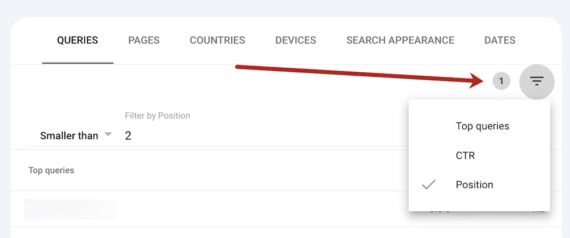
In Search Console’s “Performance” tab, scroll down to “Queries” and create a filter to see where your site ranks number 1:

  • Click the “filter” icon to the top-right of your query list.
  • Select “Position.”
  • In the filter settings, select “Smaller than” and type “2.”
  • Click “Done.”

Your report is now filtered for search queries where your site ranks below 2. This will include average positions — e.g., if your site appears in AI Overviews on mobile but not desktop, the average position is slightly higher than 1.

In Search Console, filter “Queries” by “Smaller than 2.” Click image to enlarge.

Step 2: Sort results by clicks

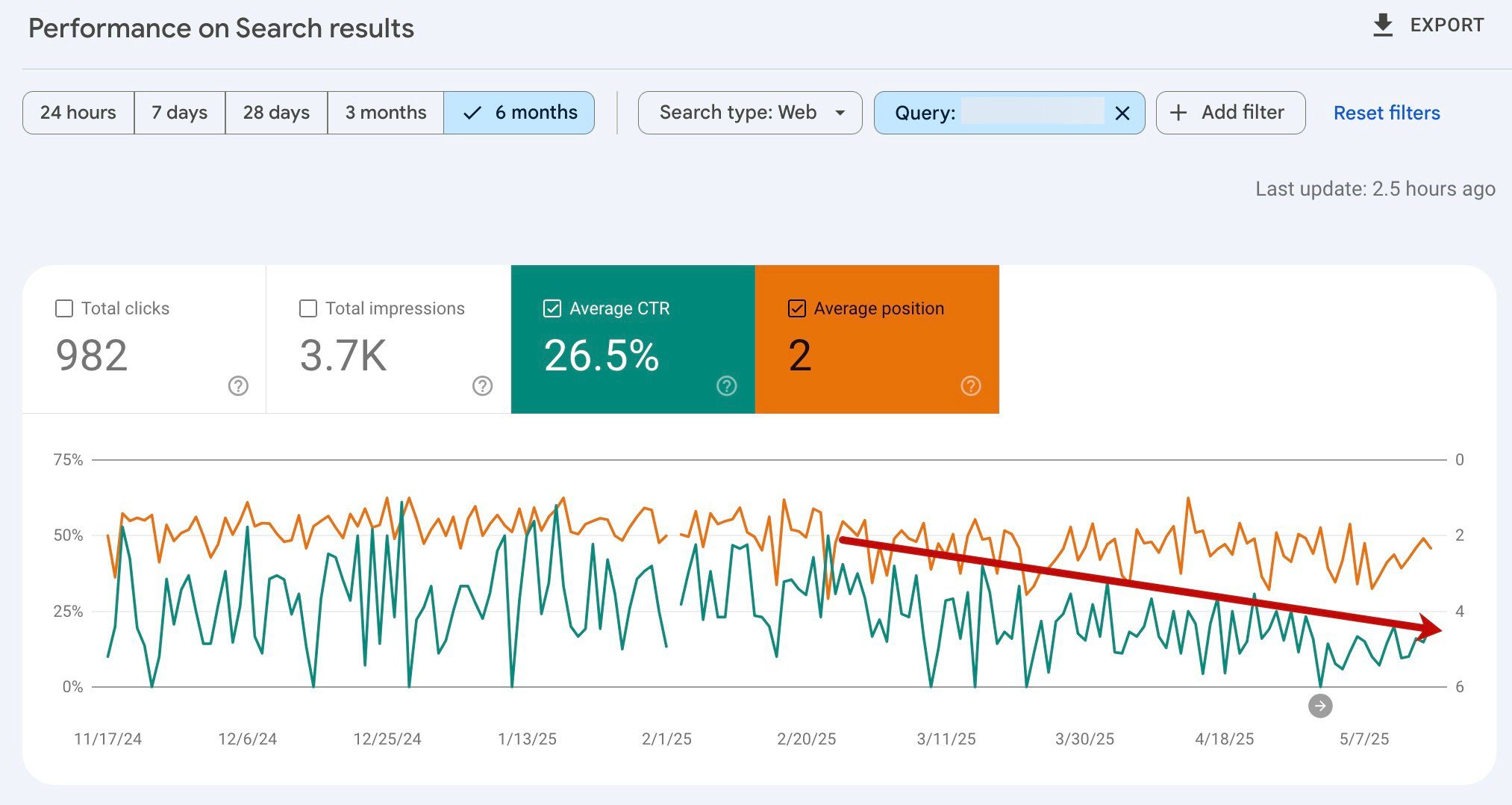
Click-throughs in AI Overviews are much lower than traditional organic listings. Sorting the above report by “CTR” will isolate queries with low clicks, making them good candidates for AI Overviews.

To sort the report, click the “CTR” header twice.

Clicking any query in this list will also show when an AI Overview likely began citing your URL: when the average position increased, and the CTR dropped.

Screenshot of the Search Console report sorted by position and CTR.

Sort the report by click-through rate to see when the average position increased and the CTR dropped. Click image to enlarge.

This exercise does not provide total site performance in AI Overviews, but it’s the only free method I know. It helps evaluate the impact of AI Overviews on your site’s visibility in search results and identify URLs better optimized for AI-driven answers.

Google Gemini Upgrades: New AI Capabilities Announced At I/O via @sejournal, @MattGSouthern

Google has announced updates to its Gemini AI platform at Google I/O, introducing features that could transform how search and marketing professionals analyze data and interact with digital tools.

The new capabilities focus on enhanced reasoning, improved interface interactions, and more efficient workflows.

Gemini 2.5 Models Get Performance Upgrades

Google highlights that Gemini 2.5 Pro leads the WebDev Arena leaderboard with an ELO score of 1420. It ranks first in all categories on the LMArena leaderboard, which measures human preferences for AI models.

The model features a one-million-token context window for processing large content inputs, effectively supporting both long text analysis and video understanding.

Meanwhile, Gemini 2.5 Flash has been updated to enhance performance in reasoning, multimodality, code, and long context processing.

Google reports it now utilizes 20-30% fewer tokens than previous versions. The updated Flash model is currently available in the Gemini app and will be generally available for production in Google AI Studio and Vertex AI in early June.

Gemini Live: New Camera and Screen Sharing Capabilities

The expanded Gemini Live feature is a significant addition to the Gemini ecosystem, now available on Android and iOS devices.

Google reports that Gemini Live conversations are, on average, five times longer than text-based interactions.

The updated version includes:

  • Camera and screen sharing capabilities, allowing users to point their phones at objects for real-time visual help.
  • Integration with Google Maps, Calendar, Tasks, and Keep (coming in the next few weeks).
  • The ability to create calendar events directly from conversations.

These features enable marketers to demonstrate products, troubleshoot issues, and plan campaigns through natural conversations with AI assistance.

Deep Think: Enhanced Reasoning for Complex Problems

The experimental “Deep Think” mode for Gemini 2.5 Pro uses research techniques that enable the model to consider multiple solutions before responding.

Google is making Deep Think available to trusted testers through the Gemini API to gather feedback prior to a wider release.

New Developer Tools for Marketing Applications

Several enhancements to the developer experience include:

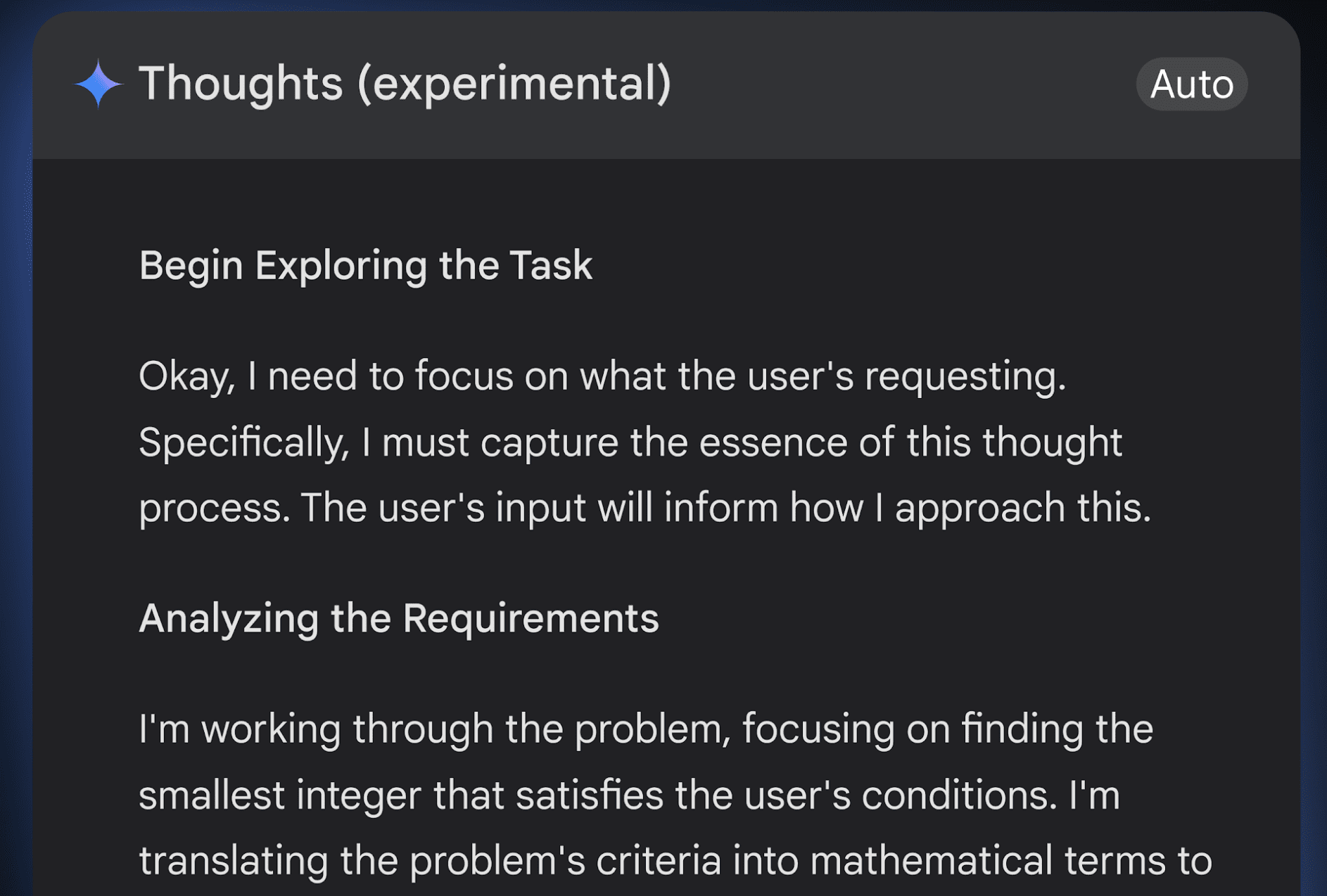
  • Thought Summaries: Both 2.5 Pro and Flash will now provide structured summaries of their reasoning process in the Gemini API and Vertex AI.
  • Thinking Budgets: This feature is expanding to 2.5 Pro, enabling developers to manage token usage for thinking prior to responses, which impacts costs and performance.
  • MCP Support: The introduction of native support for the Model Context Protocol in the Gemini API allows for integration with open-source tools.

Here are examples of what thought summaries and thinking budgets look like in the Gemini interface:

Image Credit: Google

Gemini in Chrome & New Subscription Plans

Gemini is being integrated into Chrome, rolling out to Google AI subscribers in the U.S. This feature allows users to ask questions about content while browsing websites.

You can see an example of this capability in the image below:

Image Credit: Google

Google also announced two subscription plans: Google AI Pro and Google AI Ultra.

The Ultra plan costs $249.99/month (with 50% off the first three months for new users) and provides access to Google’s advanced models with higher usage limits and early access to experimental AI features.

Looking Ahead

These updates to Gemini signify notable advancements in AI that marketers can integrate into their analytical workflows.

As these features roll out in the coming months, SEO and marketing teams can assess how these tools fit with their current strategies and technical requirements.

The incorporation of AI into Chrome and the upgraded conversational abilities indicate ongoing evolution in how consumers engage with digital content, a trend that search and marketing professionals must monitor closely.

Google Expands AI Features in Search: What You Need to Know via @sejournal, @MattGSouthern

At its annual I/O developer conference, Google announced upgrades to its AI-powered Search tools, making features like AI Mode and AI Overviews available to more people.

These updates, which Search Engine Journal received an advanced look at during a preview event, show Google’s commitment to creating interactive search experiences.

Here’s what’s changing and what it means for digital marketers.

AI Overviews: Improved Accuracy, Global Reach

AI Overviews, launched last year, are now available in over 200 countries and more than 40 languages.

Google reports that this feature is transforming how people utilize Search, with a 10% increase in search activity for queries displaying AI Overviews in major markets like the U.S. and India.

At the news preview, Liz Reid, Google’s VP and Head of Search, addressed concerns regarding AI accuracy.

She acknowledged that there have been “edge cases” where AI Overviews provided incorrect or even harmful information. Reid explained that these issues were taken seriously, corrections were made, and continuous AI training has led to improved results over time.

Expect Google to continue enhancing how AI ensures accuracy and reliability.

AI Mode: Now Available to More Users

AI Mode is now rolling out to all users in the U.S. without the need to sign up for Search Labs.

Previously, only testers could try AI Mode. Now, anyone in the U.S. will see a new tab for AI Mode in Search and in the Google app search bar.

How AI Mode Works

AI Mode uses a “query fan-out” system that breaks big questions into smaller parts and runs many searches at once.

Users can also ask follow-up questions and get links to helpful sites within the search results.

Google is using AI Mode and AI Overviews as testing grounds for new features, like the improved Gemini 2.5 AI model. User feedback will help shape what becomes part of the main Search experience.

New Tools: Deep Search, Live Visual Search, and AI-Powered Agents

Deep Search: Research Made Easy

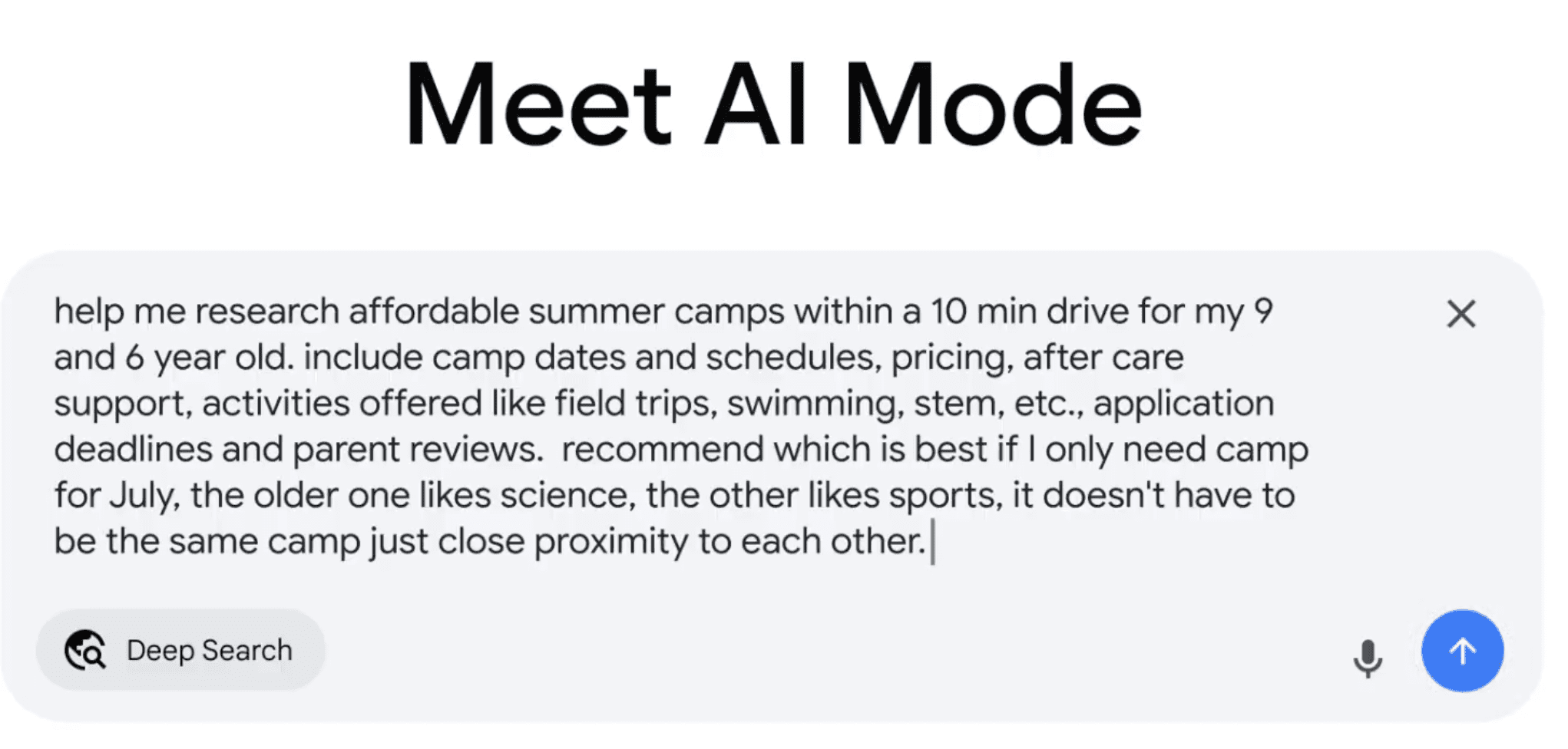
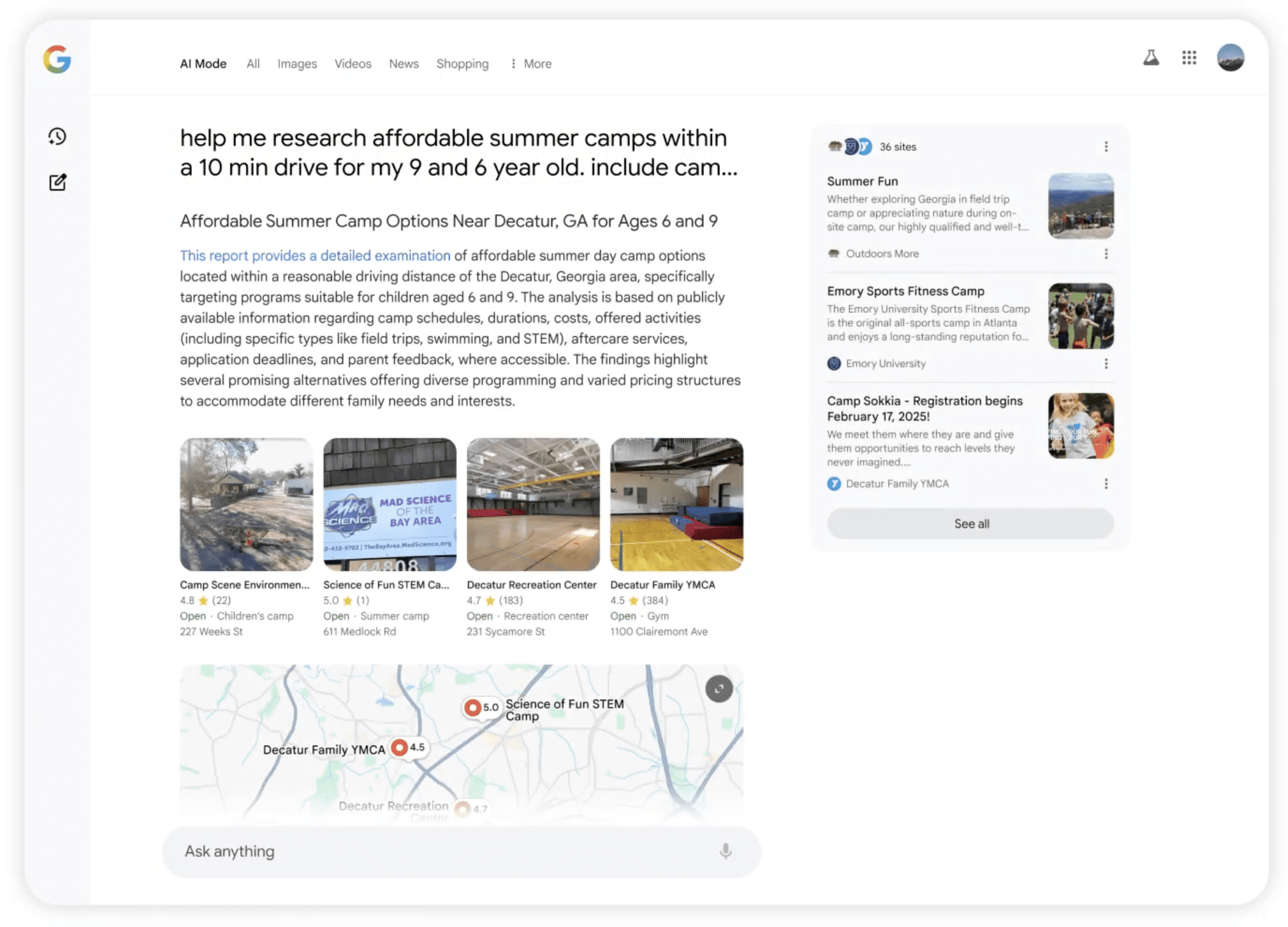
Deep Search in AI Mode helps users dig deeper. It can run hundreds of searches at once and build expert-level, fully-cited reports in minutes.

Image Credit: Google

Live Visual Search With Project Astra

Google is updating how users can search visually. With Search Live, you can use your phone’s camera to talk with Search about what you see.

For example, point your camera at something, ask a question, and get quick answers and links. This feature can boost local searches, visual shopping, and on-the-go learning.

Image Credit: Google

AI Agents: Getting Tasks Done for You

Google is adding agentic features, which are AI tools capable of managing multi-step tasks.

Initially, AI Mode will assist users in purchasing event tickets, reserving restaurant tables, and scheduling appointments. The AI evaluates hundreds of options and completes forms, but users always finalize the purchase.

Partners such as Ticketmaster, StubHub, Resy, and Vagaro are already onboard.

Image Credit: Google

Smarter Shopping: Try On Clothes and Buy With Confidence

AI Mode is enhancing the shopping experience. The new tools use Gemini and Google’s Shopping Graph and include:

  • Personalized Visuals: Product panels show items based on your style and needs.
  • Virtual Try-On: Upload a photo to see how clothing looks on you, powered by Google’s fashion AI.
  • Agentic Checkout: Track prices, get sale alerts, and let Google’s AI buy for you via Google Pay when the price drops.
  • Custom Charts: For sports and finance, AI Mode can build charts and graphs using live data.
Image Credit: Google

Personalization and Privacy Controls

Soon, AI Mode will offer more personalized results by using your past searches and, if you opt in, data from other Google apps like Gmail.

For example, if you’re planning a trip, AI Mode can suggest restaurants or events based on your bookings and interests. Google says you’ll always know when your personal info is used and can manage your privacy settings anytime.

Google’s View: Search Use Cases Are Growing

CEO Sundar Pichai addressed how AI is reshaping search during the preview event.

He described the current transformation as “far from a zero sum moment,” noting that the use cases for Search are “dramatically expanding.”

Pichai highlighted increasing user excitement and conveyed optimism, stating that “all of this will keep getting better” as AI capabilities mature.

Looking Ahead

Google’s latest announcements signal a continued push toward AI as the core of the search experience.

With AI Mode rolling out in the U.S. and global expansion of AI Overviews, marketers should proactively adapt their strategies to meet the evolving expectations of both users and Google’s algorithms.

Ask An SEO: Why Didn’t My Keywords Come Back After I Changed My Page Content? via @sejournal, @rollerblader

This week’s ask an SEO question comes from Jubi in Kerala:

“We changed our on-page content recently as keyword positions were nil. After updating the content, the keywords started appearing, but after four weeks the keywords went back to nil. Why is this so, any suggestions? [Page provided]”

Great to meet you, Jubi, and thank you for the question.

I reviewed your page, and although it is written for the user and in a conversational tone with keywords incorporated throughout, the site, overall, is likely the problem.

SEO is more than words on a page. It is also:

    • How your brand is represented by third parties.
    • The code of the site.
    • User and spider experience defined both topically and structurally.
    • The overall quality of the experience for the user, the spiders, and the algorithms.
    • Consumers not needing to do more searches as the solutions are provided by your website, or you give them the resources to implement with trusted third parties (backlinks) when you do not offer the product, service, or solution.

Changing the wording on a page can and does help, but it relies on the rest of the website, too.

I looked at your website for about five minutes, and multiple things popped out. After plugging it into an SEO tool that shows the history of the site, I have some starting points for you to help your site rank, and hopefully, this can help with your client work, too.

Focus On Your Target Audience And Region

First and foremost, your website is in U.S. English, and the language declarations are also in U.S. English. Your target audience is Kerala, India, and you offer digital marketing services in Kerala for local companies.

With a Google Search, I went to see if American English is the common language. Instead, it is Malayalam.

If both English and Malayalam are used, create both versions on your website. More importantly, see how people search in your area.

This is important for both you as a vendor and your local SEO and marketing clients.

I’ve done this in Scandinavia, where TV commercials in Sweden are in English (or were back then), so product searches and types were done in English more than in Swedish.

By having both languages available in content and PPC campaigns, conversions and revenue both scaled vs. only having the Swedish versions when I started working with this brand.

If they are not searching in English as a primary language, use the language they search in as the primary and make English the backup.

Next, look at your schema. You have a local business, which is great, but there are other ways you can define the area you serve and what you do.

Service schema can show you have a service, and you can nest an area served in because you’re a local business with a specific region you service.

Clean Up Hacked Code

Your website was hacked, and the hackers filled it with tons and tons of low-value content to try and rank for brands and brand products.

These pages are all 404, which is great, but they’re still being found. 410 them and make sure you block the parameter in robots.txt correctly. It looks like you’re missing an “*” on it.

You may also want to format a full robots.txt vs. using your software’s default with the one disallow line.

Undo The Over-Optimization

The website follows almost every bad practice with over-optimization, including things that are more for an end user rather than ranking a page.

Your meta descriptions on multiple pages are just keywords with commas in between vs. a sentence or two that tells the person what they’ll find if they click through.

I wasn’t sure if I was seeing it correctly, so I did a site:yourdomain search on Google and saw the descriptions were, in fact, just keywords with commas.

Optimize meta descriptions to let the person know why they should click through to the page. I created a guide to writing local SEO titles and meta descriptions here.

There are a couple of hundred backlinks, but they’re all directories and spammy websites. Think about your local media and trade organizations in India. How can you get featured there instead?

Is there a local chamber of commerce, small business, or local business group you can work with?

What can you share about market trends that will get you on the local news or news and business sites to link to your resources?  These are the backlinks that will help you.

Redo Your Blog

The blog has some topically relevant content, but the content is thin, and your guides that are supposed to answer questions start with sales pitches instead.

Sales pitches do not belong in the first paragraph or even the first five paragraphs of a blog post or guide ever.

People are there to learn. If they like what they learned, you have earned their trust. If the topic is relevant to a product or service you offer, that is when you do the sales pitch.

I clicked on two posts, and after the sales pitch, you share concepts, which is good, but there are no examples that the user can use.

The pages are missing supporting graphics and images to demonstrate concepts, information about the person who created the content, and ways to implement the solution.

One of the posts talks about slow webpage speed. Instead of giving a way to fix it or a starting point, the content just defines what it is. The person has to do another search, which means it is a bad experience.

Add in a couple of starting points like removing excess files (give a couple of types), using server-side rendering with how this helps and an example, plugins or tools for compressing images that don’t need to be in high-resolution, etc.

Now the person has action items, and you have an opportunity to link to detailed guides off of keywords (internal links) naturally to your pages that teach this.

This adds a ton of value to the user and gives them a reason to come back to you or even hire you to do the work for them.

On multiple posts, the writer stuffs internal links off of keyword phrases that are not naturally occurring. These are in the sales pitches, the opening, and the closing of each post.

In theory, this may not be bad for SEO, but it is not helpful for the user and may send low-quality page experience signals to Google if users are bouncing.

From my experience, your content is less likely to get sourced or linked to if it is a sales pitch vs. sharing a solution, but that is just what I’ve experienced.

Instead of starting with a sales pitch or having sales pitches in every post, build an email or SMS list and use remarketing to bring them back.

If you start with a sales pitch and no actual solution, they’ll likely bounce as the page is low-quality.

Final Thoughts

Your service pages overall are not bad. It is the rest of the website.

It needs to be recoded and focused on your target audience, the over-optimizations should be undone, and your agency needs to become the go-to digital marketing agency in your region. Most importantly, the code and content need to be cleaned up.

You offer these services, but prospective clients seeing these bad practices may be turned off and cost you business.

Also, don’t forget to create a Google Business Profile; you don’t currently have one even though you have a physical location, have active clients, and offer services.

I hope this helps, and thank you for asking a really good question.

More Resources:


Featured Image: Paulo Bobita/Search Engine Journal

Use IndexNow For AI Search And Shopping SEO via @sejournal, @martinibuster

Microsoft Bing published an announcement stating that the IndexNow search crawling technology is a powerful way for ecommerce companies to surface the latest and most accurate shopping-related information in AI Search and search engine shopping features.

Generative Search Requires Timely Shopping Information

Ecommerce sites typically depend on merchant feeds, search engine crawling and updates to Schema.org structured data to communicate what’s for sale, new products, retired products, changes to prices, availability and other important features. Each of those methods can be a point of failure due to slow crawling by search engines and inconsistent updating which can delay the correct information from surfacing in AI search and shopping features.

IndexNow solves that problem. Content platforms like Wix, Duda, Shopify and WooCommerce support IndexNow, a Microsoft technology that enables speeding indexing of new or updated content. Pairing IndexNow with Schema.org assures fast indexing so that the correct information surfaces in AI Search and shopping features.

IndexNow recommends the following Schema.org Product Type properties:

  • “title (name in JSON-LD)
  • description
  • price (list/retail price)
  • link (product landing page URL)
  • image link (image in JSON-LD)
  • shipping (especially important for Germany and Austria)
  • id (a unique identifier for the product)
  • brand
  • gtin
  • mpn
  • datePublished
  • dateModified
  • Optional fields to further enhance context and classification:
  • category (helps group products for search and shopping platforms)
  • seller (recommended for marketplaces or resellers)
  • itemCondition (e.g., NewCondition, UsedCondition)”

Read more at Microsoft Bing’s Blog:

IndexNow Enables Faster and More Reliable Updates for Shopping and Ads

Featured Image by Shutterstock/Paper piper