How 3D printing could make better cooling systems

A new 3D-printed design could make an integral part of cooling systems like air conditioners or refrigerators smaller and more efficient, according to new research.  

Heat exchangers are devices that whisk away heat, and they’re everywhere—used in data centers, ships, factories, and buildings. The aim is to pass as much heat as possible from one side of the device to the other. Most use one of a few standard designs that have historically been easiest and cheapest to make. 

“Heat exchangers are at the center of the industrial economy. They’re an essential part of every machine and every system that moves energy,” says William King, a professor at the University of Illinois Urbana-Champaign and one of the authors of the new study. Existing designs tend to favor straight lines, right angles, and round tubes, he adds.  

King and his colleagues used 3D printing to design a heat exchanger that includes features to optimize heat movement, like wavy walls and pyramid-shaped bumps, which wouldn’t be possible to make using traditional manufacturing techniques.  

The team had set out to design a system based on a common refrigerant called R-134a, which is commonly used in devices like air conditioners and refrigerators. When cold water lowers the temperature of the refrigerant, it changes from a gas to a liquid on its path through the device. That liquid refrigerant can then go on to other parts of the cooling system, where it’s used to lower the temperature of anything from a room to a rack of servers. 

The best way to cool the refrigerant tends to involve building very thin walls between the two sides of the device and maximizing the amount of contact that the water and the refrigerant make with those walls. (Think about how much colder you’d get wearing a thin T-shirt and pants and lying down on ice than simply touching it with your gloved hands.)

To design the best possible heat exchanger, researchers used simulations and developed machine-learning models to help predict the performance of different designs under different conditions. After 36,000 simulations, the researchers landed on the one they decided to develop.

Among the key components: small fins that jut out on the side of the device that touches the water, increasing the surface area to maximize heat transfer. The team also designed wavy passageways for the water to pass through—once again helping to maximize surface area. Simulations helped the researchers figure out exactly how curvy the passages should be and where precisely to place the fins.

On the side of the devices where the refrigerant passes through, the design includes small pyramid-shaped bumps along the walls. These not only maximize the area for cooling but also help mix the refrigerant as it passes through and prevent liquid from coating the wall (which would slow down the heat transfer).

After settling on a design, the researchers used a 3D-printing technique called direct metal laser sintering, in which lasers melt and fuse together a metal powder (in this case, an aluminum alloy), layer by layer.

In testing, the researchers found that the heat exchanger created with this technique was able to cool down the refrigerant more efficiently than other designs. The new device was able to achieve a power density of over six megawatts per meter cubed—outperforming one common traditional design, the shell-tube configuration, by between 30% and 50% with the same pumping power. The device’s power density was similar to that of brazed plate heat exchangers, another common design in industry.  

Overall, this device doesn’t dramatically outperform the state-of-the-art technology, but the technique of using modeling and 3D printing to produce new heat exchanger designs is promising, says Dennis Nasuta, director of research and development at Optimized Thermal Systems, a consulting firm that works with companies in the HVAC industry on design and research. “It’s worth exploring, and I don’t think that we know yet where we can push it,” Nasuta says.

One challenge is that today, additive manufacturing techniques such as laser sintering are slow and expensive compared with traditional manufacturing; they wouldn’t be economical or feasible to rely on for all our consumer cooling devices, he says. For now, this type of approach could be most useful in niche applications like aerospace and high-end automotives, which could more likely bear the cost, he adds. 

This particular study was funded by the US Office of Naval Research. Next-generation ships have more electronics aboard than ever, and there’s a growing need for compact and efficient systems to deal with all that extra heat, says Nenad Miljkovic, one of the authors of the study. 

Energy demand for cooling buildings alone is set to double between now and 2050, and new designs could help efficiently meet the massive demand forecast for the coming decades. But challenges including manufacturing costs would need to be overcome to help innovations like the one designed by King and his team make a dent in real devices.

Another barrier to adopting these new techniques, Nasuta says, is that current standards don’t demand more efficiency. Other technologies already exist that could help make our devices more efficient, but they’re not used for the same reason. 

It will take time for new manufacturing techniques, including 3D printing, to trickle into our devices, Natsua adds: “This isn’t going to be in your AC next year.”

The Download: how to make better cooling systems, and farming on Mars

This is today’s edition of The Download, our weekday newsletter that provides a daily dose of what’s going on in the world of technology.

How 3D printing could make better cooling systems

A new 3D-printed design could make an integral part of cooling systems like air conditioners or refrigerators smaller and more efficient, according to new research.

Heat exchangers are devices that whisk away heat, and they’re everywhere—used in data centers, ships, factories, and buildings. The aim is to pass as much heat as possible from one side of the device to the other. Most use one of a few standard designs that have historically been easiest and cheapest to make.

Energy demand for cooling buildings alone is set to double between now and 2050, and new designs could help efficiently meet the massive demand forecast for the coming decades. Read the full story.

—Casey Crownhart

MIT Technology Review Narrated: The quest to figure out farming on Mars

If we’re going to live on Mars we’ll need a way to grow food in its arid dirt. Researchers think they know a way.

This is our latest story to be turned into a MIT Technology Review Narrated podcast, which 
we’re publishing each week on Spotify and Apple Podcasts. Just navigate to MIT Technology Review Narrated on either platform, and follow us to get all our new content as it’s released.

The must-reads

I’ve combed the internet to find you today’s most fun/important/scary/fascinating stories about technology.

1 Thousands of US health agency workers have been laid off
Experts warn that patients will die preventable deaths as a result. (Wired $)
+ How will the US respond to the measles and bird flu outbreaks? (Reuters)  
+ US cuts could lead to serious delays in forecasting extreme weather. (Undark)
+ The wide-ranging cuts are also likely to lose America money. (The Atlantic $)

2 Donald Trump is set to discuss a proposal to save TikTok  
He’s due to meet with aides today to thrash out a new ownership structure. (NYT $)
+ Oracle and Blackstone are among the companies in talks to make an offer. (WSJ $)
+ The White House is playing the role of investment bank. (The Guardian)

3 X has asked the Supreme Court to exempt its users from law enforcement
It claims to be worried by broad, suspicionless requests. (FT $)

4 Things aren’t looking good for Mexico-based Chinese companies 
Trump’s tariff plans could imperil an awful lot of deals. (WSJ $)
+ The US Chips Act is another probable casualty. (Bloomberg $)

5 US lawmakers want to regulate AI companions
A proposed bill would allow users to sue if they suffer harm from their interactions with a companion bot. (WP $)
+ We need to prepare for ‘addictive intelligence.’ (MIT Technology Review)

6 Covid hasn’t gone away
And life for the covid-conscious is getting increasingly difficult. (The Atlantic $)

7 Brands are trying to game Reddit to show up in ChatGPT recommendations
Catering to AI search is a whole business model now. (The Information $)
+ Your most important customer may be AI. (MIT Technology Review)

8 Nothing could destroy the universe
Humans have long been obsessed with nothingness. (New Scientist $)

9 Would you flirt with a chatbot?
Tinder wants you to give it a go. (Bloomberg $)
+ The AI relationship revolution is already here. (MIT Technology Review)

10 Trading in your Tesla is TikTok’s favorite trend
Clips of Tesla owners ditching their cars are going viral. (Fast Company $)
+ This guy returned his Cybertruck out of fear his daughter would get bullied. (Insider $)
+ Sales of new Teslas are slumping too. (NYT $)

Quote of the day

“I’d get on in a heartbeat.”

—Butch Wilmore, one of the pair of astronauts who was stuck in space for nine months, explains how he’d be willing to fly on the beleaguered Starliner again, the Washington Post reports.

The big story

Bringing the lofty ideas of pure math down to earth

April 2023

—Pradeep Niroula

Mathematics has long been presented as a sanctuary from confusion and doubt, a place to go in search of answers. Perhaps part of the mystique comes from the fact that biographies of mathematicians often paint them as otherworldly savants.

As a graduate student in physics, I have seen the work that goes into conducting delicate experiments, but the daily grind of mathematical discovery is a ritual altogether foreign to me. And this feeling is only reinforced by popular books on math, which often take the tone of a pastor dispensing sermons to the faithful.

Luckily, there are ways to bring it back down to earth. Popular math books seek a fresher take on these old ideas, be it through baking recipes or hot-button political issues. My verdict: Why not? It’s worth a shot. Read the full story.

We can still have nice things

A place for comfort, fun and distraction to brighten up your day. (Got any ideas? Drop me a line or skeet ’em at me.)

+ Why are cats the way they are? This database might help us find out.
+ John McFall could become the first disabled person in space.
+ ASMR at the V&A is just delightful.
+ Addicted to lip balm? You’re not the only one.

The machines are rising — but developers still hold the keys

Rumors of the ongoing death of software development — that it’s being slain by AI — are greatly exaggerated. In reality, software development is at a fork in the road: embracing the (currently) far-off notion of fully automated software development or acknowledging the work of a software developer is much more than just writing lines of code.

The decision the industry makes could have significant long-term consequences. Increasing complacency around AI-generated code and a shift to what has been termed “vibe coding” — where code is generated through natural language prompts until the results seem to work — will lead to code that’s more error-strewn, more expensive to run and harder to change in the future. And, if the devaluation of software development skills continues, we may even lack a workforce with the skills and knowledge to fix things down the line. 

This means software developers are going to become more important to how the world builds and maintains software. Yes, there are many ways their practices will evolve thanks to AI coding assistance, but in a world of proliferating machine-generated code, developer judgment and experience will be vital.

The dangers of AI-generated code are already here

The risks of AI-generated code aren’t science fiction: they’re with us today. Research done by GitClear earlier this year indicates that with AI coding assistants (like GitHub Copilot) going mainstream, code churn — which GitClear defines as “changes that were either incomplete or erroneous when the author initially wrote, committed, and pushed them to the company’s git repo” — has significantly increased. GitClear also found there was a marked decrease in the number of lines of code that have been moved, a signal for refactored code (essentially the care and feeding to make it more effective).

In other words, from the time coding assistants were introduced there’s been a pronounced increase in lines of code without a commensurate increase in lines deleted, updated, or replaced. Simultaneously, there’s been a decrease in lines moved — indicating a lot of code has been written but not refactored. More code isn’t necessarily a good thing (sometimes quite the opposite); GitClear’s findings ultimately point to complacency and a lack of rigor about code quality.

Can AI be removed from software development?

However, AI doesn’t have to be removed from software development and delivery. On the contrary, there’s plenty to be excited about. As noted in the latest volume of the Technology Radar — Thoughtworks’ report on technologies and practices from work with hundreds of clients all over the world — the coding assistance space is full of opportunities. 

Specifically, the report noted tools like Cursor, Cline and Windsurf can enable software engineering agents. What this looks like in practice is an agent-like feature inside developer environments that developers can ask specific sets of coding tasks to be performed in the form of a natural language prompt. This enables the human/machine partnership.

That being said, to only focus on code generation is to miss the variety of ways AI can help software developers. For example, Thoughtworks has been interested in how generative AI can be used to understand legacy codebases, and we see a lot of promise in tools like Unblocked, which is an AI team assistant that helps teams do just that. In fact, Anthropic’s Claude Code helped us add support for new languages in an internal tool, CodeConcise. We use CodeConcise to understand legacy systems; and while our success was mixed, we do think there’s real promise here.

Tightening practices to better leverage AI

It’s important to remember much of the work developers do isn’t developing something new from scratch. A large proportion of their work is evolving and adapting existing (and sometimes legacy) software. Sprawling and janky code bases that have taken on technical debt are, unfortunately, the norm. Simply applying AI will likely make things worse, not better, especially with approaches like vibe.  

This is why developer judgment will become more critical than ever. In the latest edition of the Technology Radar report, AI-friendly code design is highlighted, based on our experience that AI coding assistants perform best with well-structured codebases. 

In practice, this requires many different things, including clear and expressive naming to ensure context is clearly communicated (essential for code maintenance), reducing duplicate code, and ensuring modularity and effective abstractions. Done together, these will all help make code more legible to AI systems.

Good coding practices are all too easy to overlook when productivity and effectiveness are measured purely in terms of output, and even though this was true before there was AI tooling, software development needs to focus on good coding first.

AI assistance demands greater human responsibility

Instagram co-founder Mike Krieger recently claimed that in three years software engineers won’t write any code: they will only review AI-created code. This might sound like a huge claim, but it’s important to remember that reviewing code has always been a major part of software development work. With this in mind, perhaps the evolution of software development won’t be as dramatic as some fear.

But there’s another argument: as AI becomes embedded in how we build software, software developers will take on more responsibility, not less. This is something we’ve discussed a lot at Thoughtworks: the job of verifying that an AI-built system is correct will fall to humans. Yes, verification itself might be AI-assisted, but it will be the role of the software developer to ensure confidence. 

In a world where trust is becoming highly valuable — as evidenced by the emergence of the chief trust officer — the work of software developers is even more critical to the infrastructure of global industry. It’s vital software development is valued: the impact of thoughtless automation and pure vibes could prove incredibly problematic (and costly) in the years to come.

This content was produced by Thoughtworks. It was not written by MIT Technology Review’s editorial staff.

Merchants’ Guide to Navigating Conflicts

Conflict is seemingly inescapable, from business colleagues disagreeing over growth strategy to siblings contesting a will to a couple sparring over who cleans the dishes. Sadly, such difficult conversations can be so stressful that we tend to avoid them, which makes matters worse.

A book published on March 18, “Conflict Resilience: Negotiating Disagreement Without Giving Up or Giving In,” by Robert C. Bordone and Joel Salinas, M.D., brings a much-needed perspective, whether interpersonal or international strife.

Cover of Conflict Resilience

Conflict Resilience

Bordone teaches negotiation and mediation at Harvard Law School and consults on high-stakes conflicts in the U.S. and abroad. Salinas is an associate professor of neurology at New York University’s Grossman School of Medicine and an entrepreneur.

The authors go beyond the classics on negotiating tactics such as “Getting to Yes,” reject win-lose and even win-win thinking, and build a strong case for engaged dialogue, even when it is unlikely to resolve a conflict.

They assert in the introduction that “despite the pervasiveness of conflict, our ability to handle it has atrophied” and that reluctance at all levels of society to address disagreement constructively has negative consequences for individuals, institutions, and the world and contributes to increasing polarization and intolerance. They argue persuasively that learning to tolerate discomfort to listen authentically and speak assertively has benefits with or without an agreement.

The authors call their approach “conflict resilience,” defined as “the ability to genuinely sit with and grow from conflict.”

3 Parts

They organize the book according to their resilience framework: Name, Explore, and Commit.

Part One, “Name (and Dig Deep),” covers self-assessment, underlying feelings, tolerance, and inner conflicts affecting one’s approach to disagreements.

Part Two, “Explore (and Be Brave),” addresses in-depth (i) how to “listen deeply” to understand an opposing view and (ii) how and when to assert your own view.

Part Three, “Commit (and Own the Conflict),” provides advice on (i) the setting and conditions for a successful dialogue (including deciding how you’ll define “success”), (ii) formal and informal processes and structures for facilitating conversations, (iii) when to engage and when to walk away, and (iv) trauma and its consequences. The final chapter suggests ways individuals can build a culture of conflict resilience in their families, organizations, workplaces, and communities — regardless of position.

Upbeat, Empathetic

The book’s tone is upbeat and empathetic even when addressing today’s thorniest issues, such as the Israel-Palestine conflict. The writing is direct, understandable, and authoritative, offering clear explanations and descriptions and comparing conflict resilience to physical fitness.

Recent scientific research — the Notes section cites 300 sources — and the authors’ experiences support the key concepts and principles. Relatable stories illustrate multiple scenarios, from minor relationships to polarizing political differences.

While acknowledging the challenge, the authors emphasize the need for compassion and insist on the possibility of growth and change. Many core ideas reappear throughout the text, but such repetition is not unusual in books that aim to both advocate change and teach practical techniques for bringing it about.

Overall, the book is an excellent resource that offers inspiration, confidence, and actionable advice for executives who negotiate with suppliers and partners, manage employees, or navigate professional relationships.

5 Content Marketing Ideas for May 2025

May is a fertile time for content marketers. The month has prominent retail holidays, including Mother’s Day.

But companies that want content variety can do more, with articles, videos, or podcasts about Harry Potter, the Kentucky Derby, paranormal phenomena, bicycle commuting, and bees.

Content marketing is creating, distributing, and promoting content to attract, engage, and retain customers. Here are five content marketing ideas for May 2025.

International Harry Potter Day: May 2

AI image of Harry Potter

Harry Potter is among the most popular literary characters ever — an opportunity for content marketers.

Each year on May 2, fans celebrate International Harry Potter Day, commemorating the climactic Battle of Hogwarts — May 2, 1998, in the novel — and honoring the beloved wizarding world that has inspired generations.

For ecommerce, retail, and direct-to-consumer marketers, Harry Potter Day is an opportunity to connect with customers through the lens of one of their favorite books and characters.

Here are example article, video, or podcast titles that connect the boy wizard to products.

  • Used book store: “5 Magical Books for Harry Potter Fans.”
  • Online collectibles marketplace: “Ultimate Gift Guide for Harry Potter Day.”
  • Kitchen supply shop: “Enchanted Recipes for Your Hogwarts House”

Kentucky Derby: May 3

AI image of a horse race.

The “run for the roses” is for some the most exciting 2 minutes in sports.

First run in 1875, the Kentucky Derby is one of the world’s oldest continuous sporting events. The race is steeped in traditions that include a rose garland for the winning horse, fancy hats, and the mint julep cocktail.

While horse racing is not as mainstream as football or basketball, the Kentucky Derby remains one of sport’s most prominent events. In 2024, for example, about 16.7 million folks watched the race.

Content marketers can use the excitement to produce product-related guides and articles to reach prospects. Here are a few examples.

  • Party supply shop: “The Ultimate Guide to Hosting a Kentucky Derby Party.”
  • Horse tack store: “2025’s Top 5 Derby Contenders.”
  • Fashion retailer: “The Unofficial Kentucky Derby First-Timer’s Food and Fashion Guide”

Paranormal Day: May 3

AI image of Charles Fort

Paranormal researcher Charles Fort’s death on May 3 likely accounts for Paranormal Day.

How folks came to contemplate unusual, mysterious, and odd phenomena on May 3 is officially — but not surprisingly — unknown.

Those who speculate about the holiday’s origin usually point to Charles Hoy Fort, a paranormal researcher and author who created the pseudo-scientific field of “anomalistics,” applying the scientific method to paranormal anomalies. Fort may have coined “teleportation” and “ball lightning.” He was also known to have studied spontaneous human combustion, poltergeists, and alien abductions.

While Fort seemingly believed in the incredible and the supernatural, he distrusted doctors and avoided them despite being in poor health. After collapsing during a book promotion event, Fort was rushed to the Royal Hospital in New York, where he died hours later, apparently of undiagnosed leukemia. It was May 3, 1932.

Marketers could focus content on Fort directly or take up just about any mysterious topic. Here are three titles for videos, podcasts, or articles.

  • Online hardware store: “DIY Secret Doors and Hidden Panels.”
  • Antique shop: “10 Most Magical Antiques We Ever Seen.”
  • Electronics shop: “5 Paranormal Investigation Gadgets to Buy Today.”

Bike to Work Day: May 16

Photo of a 20s or 30s male riding a bike in an urban setting

Bike to Work Day typically receives a lot of local media coverage.

Held annually on the third Friday in May, Bike to Work Day aims to encourage folks within peddling distance to commute in that manner — for a healthy, sustainable, and fun alternative to driving.

The event occurs during National Bike Month and will likely include local events and media.

For marketers, Bike to Work Day content can promote bikes, gear, and related products. Here are example titles.

  • D2C electric bike brand: “A Beginner’s Guide for Bike to Work Day.”
  • A men’s clothing shop: “How to Stay Sharp (and Dry) While Biking to Work.”
  • A luggage retailer: “5 Commuter Backpacks for Bike to Work Day.”

World Bee Day: May 20

AI image of a bee hovering above a flower

Bees and other pollinators are essential for agriculture.

First commemorated in 2018, the United Nations designated World Bee Day to raise awareness about the importance of bees and other pollinators to the world’s agriculture and global food security.

An educational occasion, such as World Bee Day, is an excellent marketing opportunity to publish useful and informative content. An obvious connection is any retailer or ecommerce shop that sells bee-rated products. For these businesses, topics could include:

  • “How to Begin Backyard Beekeeping in 2025”
  • “Essential Equipment Every New Beekeeper Needs”
  • “Plant This, Not That: A Guide to Bee-Friendly Gardening”

Other merchants could focus on honey or even sustainability.

  • “The Culinary Magic of Raw Honey”
  • “The Honey Pairing Guide for Teas and Cheese”
  • “How Urban Spaces Can Help Save the Bees”
How DoorDash Became Huge Starting With A $10 Domain Name via @sejournal, @martinibuster

Garry Tan, President and CEO of Y Combinator, interviewed Tony Xu, co-founder of DoorDash, in a conversation that revealed useful insights on how to research a niche before building a business around it, the wisdom of understanding pain points and why following competitors is not always the best path for long-term success. Building a strong brand is an important factor for competing in today’s AI-saturated environment, read how Tony Xu turned DoorDash into a trusted businesses of today.

Screenshot of Y Combinator CEO Garry Tan speaking with DoorDash co-founder Tony Xu speaking on the Y Combinator video podcast episode

DoorDash began with the non-scalable $10 domain (‘Palo Alto Delivery’) and PDF menus on a static HTML web page, taking orders over Google Voice and the founders were able to scale that to the nationwide success it is today by focusing on three actionable principles which allowed them to grow past their initial shortcomings and build on their strengths.

These lessons are especially important in today’s digital marketing environment where the importance of building relationships with customers has accelerated because of the advent of AI-powered search and AI assistants.

Y Combinator

Y Combinator is a Venture Capital and startup incubator responsible for dozens of the biggest digital brands like Airbnb, DoorDash, Quora, Stripe, Webflow, and Zapier to name a few. The Y Combinator video podcast interviews brings real insights directly related to digital marketing, entrepreneurship, and the daily work involved in keeping running businesses today.

Their podcast’s tag line suggests finding a place within the digital technology economy and the DoorDash experience shows how to do it.

“All the world is changing around technology and you may contribute a line of code. What will yours be?”

Screenshot of DoorDash Co-founder Tony Xu speaking on video podcast

Three Takeaways

Tony Xu relates the beginnings of DoorDash and how it grew to become a successful company. It wasn’t a matter of getting a lot of money thrown at him and then finding success. He and his team struggled to figure out how to make the business successful. Perhaps a key to their success was that they founded the company on three ideas, creating a strong foundation upon which to build success.

Another takeaway is that a good business idea isn’t always an instant success. Success can take years to build. So be sure to give yourself a long runway measured in years not months for taking off.

The three takeaways are:

  1. Choose Business Niche By What Feels Meaningful
  2. Customer Obsession As A Strategic Philosophy
  3. Don’t Follow The Competition: Follow The Opportunity

Choosing Your Best Niche

Tony Xu explained that the DoorDash team started by exploring different projects that felt interesting to them and ultimately settling on the one that felt the most meaningful and exciting. The idea for DoorDash came about by observing a local macaroon shop that had to decline delivery orders because they lacked the infrastructure.

What’s interesting about DoorDash is that they’re in between two customer bases, the merchants and the end users. They opted to not conduct surveys but rather the founders immersed themselves in the merchants’ daily routines to identify the pain points for growth and expansion and to identify where DoorDash could help.

Tony Xu explains:

“Our question that we tended to ask business owners was can we follow you around for a day… we wanted to actually feel what it was like, their lived experience versus just asking a bunch of survey questions. It was toward the end of the time we spent with the store manager that she had showed us a booklet of orders she had turned down. All of them were delivery orders.”

He described that this was a common thread with business owners who had these small shops with orders they were unable to fulfill. He said they imagined the scale of what could be done, that they could have just delivered orders for this one bakery, or for all bakeries, all types of restaurants, all types of retailers. They discovered a need from a wide range of merchants but what they didn’t know at this point was if consumers cared or whether there was a driver workforce to partner for.

Customer Obsession As A Strategic Philosophy

Tony Xu shared that their early customer base was mainly young families and that ended up shaping their service through direct feedback. Another example of allowing the business to be shaped by the customer is an event that went badly and resulted in many upset customers. DoorDash settled on the customer-first approach by choosing to refund all the customers after a service meltdown during a Stanford football game, at the cost of 40% of the founder’s bank balances. Further, they stayed up overnight to bake and hand-deliver apology cookies the next morning at 5 AM before their customers awakened.

Tony shared how that experience solidified their business around customer satisfaction:

“That was an early story that ultimately, you know, became the story that translated to our internal company value of customer obsessed, not competitor focused… I think the founding team always had this desire to at least do things the right way even if we wouldn’t have made it.”

These experiences cemented the company’s core customer-centered philosophy of being “customer obsessed, not competitor focused.”

Don’t Follow The Competition: Follow the Opportunity

Conventional wisdom assumes that established players have done the research and that there are good reasons for why competitors do what they do. What Tony Xu revealed is that isn’t necessarily true. He doesn’t explain the reasons why competitors missed a golden opportunity but it’s easy to surmise that competitors build based on conventional assumptions and are unaware that demographics and user habits change which results in opportunities.

Tony shared that their competitors focused on dense urban markets because the conventional wisdom was that this was where more people it was more profitable to serve the densely populated areas. DoorDash went a different direction by focusing on suburbs because they discovered a customer need in that suburban customers had fewer nearby restaurants and it was that fact that made a delivery service more valuable. Serving families also resulted in higher average order size, easier parking, and simpler food drop-offs which in turn led to stronger performance across the board.

Takeaway:

Many smaller independent sites today fail to differentiate themselves to site visitors. They follow what their competitors do and because of that virtually all recipe sites, all mom sites all travel sites look exactly the same.

Becoming the same as your competitor is not the way to beat your competitors. That’s why the skyscraper and 10x content strategies are so lousy because they presume that being the same as the competitor “but better” is what your users want. Circling back to Tony Xu, he found success by being customer obsessed so the question is what does that mean for you and your site visitors?

Becoming customer-focused isn’t a new age feel-good thing to do, it’s a practical and proven approach to creating a successful business. It informs every choice you make from the design of the site, the service, and the content and it becomes a strength that no competitor can copy and steal from you.

Lastly, it’s satisfying and easier to focus on a topic that is meaningful. If there’s a way to build an ecosystem that might be even better as it can become a moat around the business.

Watch the Y Combinator podcast:

DoorDash CEO: Customer Obsession, Surviving Startup Death & Creating A New Market

Featured Image by Shutterstock/sockagphoto

Google DeepMind’s AGI Plan: What Marketers Need to Know via @sejournal, @MattGSouthern

Google DeepMind has shared its plan to make artificial general intelligence (AGI) safer.

The report, titled “An Approach to Technical AGI Safety and Security,” explains how to stop harmful AI uses while amplifying its benefits.

Though highly technical, its ideas could soon affect the AI tools that power search, content creation, and other marketing technologies.

Google’s AGI Timeline

DeepMind believes AGI may be ready by 2030. They expect AI to work at levels that surpass human performance.

The research explains that improvements will happen gradually rather than in dramatic leaps. For marketers, new AI tools will steadily become more powerful, giving businesses time to adjust their strategies.

The report reads:

“We are highly uncertain about the timelines until powerful AI systems are developed, but crucially, we find it plausible that they will be developed by 2030.”

Two Key Focus Areas: Preventing Misuse and Misalignment

The report focuses on two main goals:

  • Stopping Misuse: Google wants to block bad actors from using powerful AI. Systems will be designed to detect and stop harmful activities.
  • Stopping Misalignment: Google also aims to ensure that AI systems follow people’s wishes instead of acting independently.

These measures mean that future AI tools in marketing will likely include built-in safety checks while still working as intended.

How This May Affect Marketing Technology

Model-Level Controls

DeepMind plans to limit certain AI features to prevent misuse.

Techniques like capability suppression ensure that an AI system willingly withholds dangerous functions.

The report also discusses harmlessness post-training, which means the system is trained to ignore requests it sees as harmful.

These steps imply that AI-powered content tools and automation systems will have strong ethical filters. For example, a content generator might refuse to produce misleading or dangerous material, even if pushed by external prompts.

System-Level Protections

Access to the most advanced AI functions may be tightly controlled. Google could restrict certain features to trusted users and use monitoring to block unsafe actions.

The report states:

“Models with dangerous capabilities can be restricted to vetted user groups and use cases, reducing the surface area of dangerous capabilities that an actor can attempt to inappropriately access.”

This means that enterprise tools might offer broader features for trusted partners, while consumer-facing tools will come with extra safety layers.

Potential Impact On Specific Marketing Areas

Search & SEO

Google’s improved safety measures could change how search engines work. New search algorithms might better understand user intent and trust quality content that aligns with core human values.

Content Creation Tools

Advanced AI content generators will offer smarter output with built-in safety rules. Marketers might need to set their instructions so that AI can produce accurate and safe content.

Advertising & Personalization

As AI gets more capable, the next generation of ad tech could offer improved targeting and personalization. However, strict safety checks may limit how much the system can push persuasion techniques.

Looking Ahead

Google DeepMind’s roadmap shows a commitment to advancing AI while making it safe.

For digital marketers, this means the future will bring powerful AI tools with built-in safety measures.

By understanding these safety plans, you can better plan for a future where AI works quickly, safely, and in tune with business values.


Featured Image: Shutterstock/Iljanaresvara Studio

How To Identify Migration Issues Quickly Using AI via @sejournal, @makhyan

Site migration issues happen. You plan, create a staging site, and then when the site goes live, there’s bound to be something wrong.

Quality assurance gets thrust into overdrive the moment that migrations are complete.

You sift through thousands of pages, metadata, and more to fix any problems before someone else notices.

It’s a lot of work and time-consuming to feel confident that a site migration is complete without issues.

But, I’m going to show you how to identify migration issues quickly using Google Sheets and AI. You still have a lot to do (migration experts, rejoice!), but this script is going to help you:

  • Compare old and new ScreamingFrog crawls.
  • Identify immediate issues that you need to resolve.

SEOs have their own strategies and practices that they follow, and this script is going to allow you to QA migrations quickly based on your own requirements.

You can adapt the script below to make this work for you, whether you’re working on a small local business site or an enterprise.

Setting Everything Up With Screaming Frog And Google Sheets

I’m using Screaming Frog for this example because it makes it easy for me to export data for both sites.

We’re going to assume the following:

  1. Your first version is your live website, which we’ll call the Old Crawl.
  2. Your second version is your new site on a staging environment, which we’ll call New Crawl.

You’re going to create a Google Sheets with the following Sheets:

  • Overview.
  • Old Crawl.
  • New Crawl.

Once your Sheet is set up properly, run your ScreamingFrog scan using any settings that you like.

You’ll run the scan for your Old and New Crawl and then inmport the data to the Old Crawl and New Crawl tabs in your Sheets.

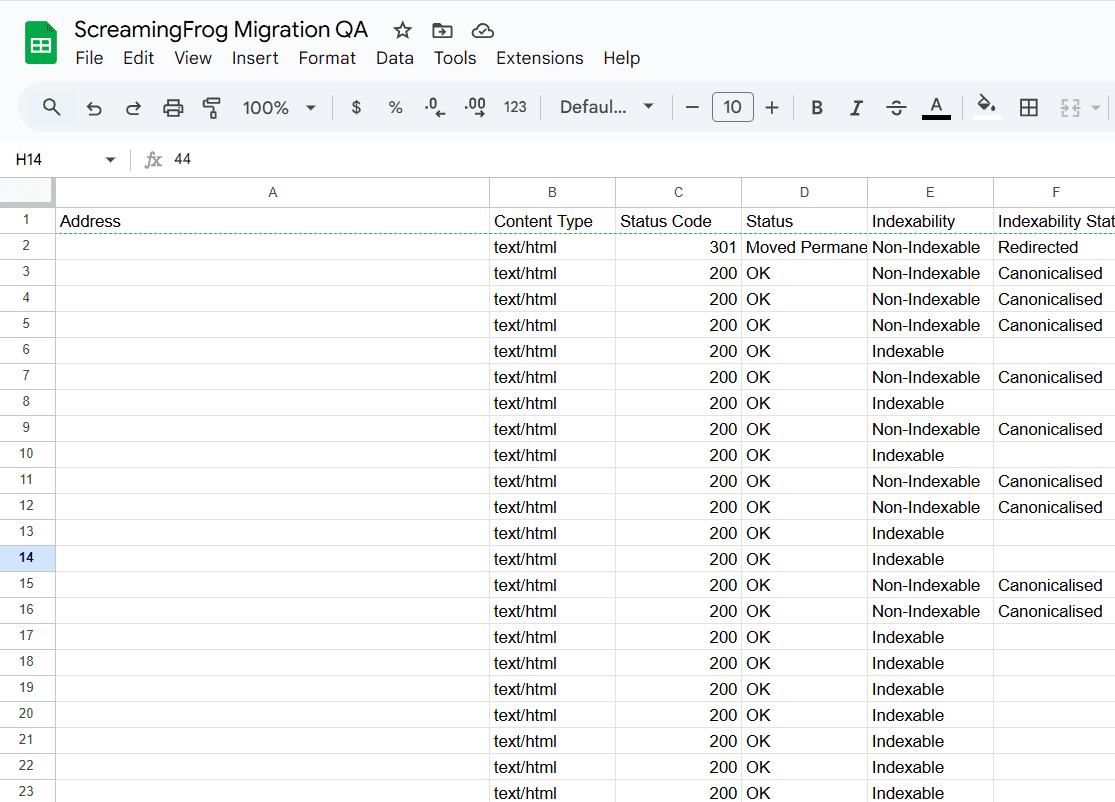
Your sheets will look something like this:

ScreamingFrog Export Crawl ResultsScreamingFrog Export Crawl Results (Screenshot of Google Sheet, March 2025)

The New Crawl will look very similar.

Once you fill in both the New and Old Crawl sheets, you’ll need to populate your Overview sheet.

The table that you create in this sheet should contain the following columns:

  • Existing (old) URL.
  • New URL.
  • Status Code.
  • Indexability.
  • Title 1.
  • Meta Description 1.
  • H1-1.
  • H2-1.
  • Column 3.
  • Column 4.

Your Overview sheet will look something like this:

Migration QA Overview SheetMigration QA Overview Sheet (Screenshot of Google Sheet, March 2025)

Once you have your sheets set up, it’s time to put your favorite AI to work to compare your data.

I used ChatGPT, but you can use any AI you like. I’m sure Claude, Deepseek, or Gemini would do equally as well as long as you use similar prompts.

Prompts To Create Your Google Sheets Data

You can fill in your Google Sheet formulas by hand if you’re a formula guru, but it’s easier to let AI do it for you since we’re making basic comparisons.

Remember, the Old Crawl is the live site, and the New Crawl is my staging site.

Now, go to your AI tool and prompt it with the following:

I need a Google Sheets formula that compares values between two sheets: "Old Crawl" and "New Crawl." The formula should:
Look up a value in column A of "Old Crawl" using the value in column A of the current sheet.
Look up a value in column A of "New Crawl" using the value in column B of the current sheet.
Find the corresponding column in both sheets by matching the column header in row 1 with the current column header.
If the values match, return "Pass".
If they don't match, return "Error (old<>new)" with the differing values shown.
Use TEXTJOIN("<>", TRUE, ...) to format the error message.
Ensure compatibility with Google Sheets by specifying explicit ranges instead of full-column references.

You can adjust these prompt points on your own.

For example, you can change “Old Crawl” to “Live Site,” but be sure that the sheet names match up properly.

ChatGPT generated code for me that looks something like this:

=IF(
INDEX('Old Crawl'!$A$1:$Z$1000, MATCH($A2, 'Old Crawl'!$A$1:$A$1000, 0), MATCH(C$1, 'Old Crawl'!$1:$1, 0)) =
INDEX('New Crawl'!$A$1:$Z$1000, MATCH($B2, 'New Crawl'!$A$1:$A$1000, 0), MATCH(C$1, 'New Crawl'!$1:$1, 0)),
"Pass",
"Error (" & TEXTJOIN("<>", TRUE,
IFERROR(INDEX('Old Crawl'!$A$1:$Z$1000, MATCH($A2, 'Old Crawl'!$A$1:$A$1000, 0), MATCH(C$1, 'Old Crawl'!$1:$1, 0)), ""),
IFERROR(INDEX('New Crawl'!$A$1:$Z$1000, MATCH($B2, 'New Crawl'!$A$1:$A$1000, 0), MATCH(C$1, 'New Crawl'!$1:$1, 0)), "")
) & ")"
)

You can use these basic formulas to start comparing rows by pasting the formula in row 2.

Adding the formula is as simple as double-clicking the field and pasting it in.

I know that you’ll want to make this a little more complex. You can do a lot of things with Google Sheets and formulas, so tweak things as needed.

Ideas For Expanding Your Migration Sheet

Your formulas will depend on the settings of your Screaming Frog crawl, but here are a few that I think will work well:

  • Create a function to compare all of the status codes between the Old Crawl and New Crawl to identify key issues that exist. For example, if a page has anything but a 200 code, you can highlight the issue to fix it quickly.
  • Add a formula to highlight metadata that is too long or short, so that you can add it to your task list for when the audit is over.
  • Create a function to monitor Response Time between both the Old and New Crawl so that you can identify any issues that the new crawl may have or report speed increases if switching to a new host or server.
  • Create another function to compare the URL structure of each URL. You might compare trailing slashes, structure and more.
  • Develop a new function for Inlinks to be sure that no internal links were lost in the migration. You can also check external links using the same concept.

Migrating a site is always tedious.

A lot of QA goes into the process, and while necessary, the concept above will make the process much easier.

You can also use AI to recommend further enhancements to your newly migrated site.

How would you improve this file or its functionality?

More Resources:


Featured Image: TarikVision/Shutterstock

Generative AI And Social Media: Redefining Content Creation via @sejournal, @rio_seo

Social media offers a valuable channel for businesses to connect with their prospects and current customers.

A whopping 63.9% of the world’s population spends time on social media. Yet, social has also become an increasingly difficult forum to stand out in as more businesses continue to seek to capitalize on the opportunity that awaits.

The need for frequent updates, diverse content dependent on social media platforms, high-quality visuals, and compelling copy puts pressure on marketing teams to consistently deliver, often with limited time and resources.

This is where generative AI comes into play.

AI-powered tools can help automate many aspects of social media content creation, helping brands write witty captions, generate unique images, and even produce videos.

However, leaning on AI to help draft social media content comes with one notable dilemma: efficiency versus authenticity.

In this article, we’ll explore how brands can make the most of generative AI while still adhering to brand standards, diving into how AI can be put to work for social media marketers in an ethical and authentic way that captures customer interest.

What Is Generative AI In Social Media?

Generative AI enables social media marketers to quickly and nearly effortlessly generate different types of content, such as text, images, videos, and even audio.

AI learns patterns from vast datasets and can translate this vast amount of information into content that aligns closely with what a human could create.

Unlike traditional automation, which follows pre-set templates, generative AI generates new content based on the prompts the end user provides.

AI is becoming widely adopted, as 75% of marketers are either testing the waters with AI or have fully implemented AI in their operations.

For social media marketers specifically, AI is being used to help generate post copy, reply to comments, create AI images, and much more.

How AI Works For Social Media Content

Generative AI has changed the game for content creation and impacted the way social media marketers engage with their followers and analyze insights across their social media channels.

However, it’s important to note that human creativity remains a must. AI is paramount to incorporate into every marketer’s day-to-day efforts, but it must be used wisely.

Here are a few ways social media marketers use AI to automate routine tasks.

AI For Text Generation

Perhaps one of the primary uses for AI-powered language models is to create engaging content for a variety of divergent social media formats, including:

  • Photo and Reels Captions: AI can generate catchy, concise, and engaging captions tailored to different platforms.
  • Responses: AI can suggest follow-up replies to comments and feedback, helping brands create engaging threads that encourage participation and further conversation.
  • Thought Leadership: AI can help businesses discover ideas and angles for longer-form content like blog posts or content for LinkedIn, helping brands establish and position themselves as thought leaders.
  • Ad Copy: AI can help generate ideas for succinct yet meaningful ad copy, providing several options for A/B testing to see what resonates best.
  • Hashtags: Need help crafting the right hashtags? AI can help generate hashtags related to your business and what people are looking for to help boost visibility.

In order to create relevant content that converts, AI tools analyze what content performs best and what gets customers to engage.

As with any AI-generated content, it’s imperative to have human oversight to ensure your message aligns with brand voice and tone and is factual.

Here’s an example of AI in action.

Consider a travel brand that wants to encourage people to travel to a new destination. It might use AI to create a few different versions of a caption. Here are a few different examples of captions AI created:

  • Casual: “Looking for your next adventure? 🏝️ Book your dream trip today!”
  • Luxury: “Indulge in an unforgettable getaway at our exclusive beachfront resort. 🌊✨”
  • Call to Action (CTA) Focused: “Flights are filling up fast! Book now and escape to paradise. ✈️🌴”

With a few versions to choose from, brands can quickly tailor their messaging for different audiences and can pick the one that will resonate most with their potential customers.

AI For Image And Video Creation

Visual content is growing increasingly popular, given the rise of TikTok and Instagram.

A recent study found that nearly 22% of marketers reported that over 75% of their content this year was visual content.

The same study found that 34.3% of marketers said that visual content made up at least 20-50% of their overall content marketing strategy.

Given the high demand for engaging visual content, marketers are tasked with finding the resources (and time) to create high-quality visuals.

Bandwidth constraints and a lack of creatives can lead to marketers producing solely text-based content. Enter Generative AI.

Generative AI can now produce high-quality graphics, illustrations, and videos without requiring a human designer. Below are a few ways AI is reshaping how visual content is made:

  • AI-Generated Images: Tools like DALL·E, MidJourney, and Canva AI allow marketers to create custom graphics based on text prompts.
  • AI Video Generation: Platforms like Runway ML and Synthesia allow marketers to create short promotional videos, product showcases, or AI-powered explainer videos without the need for a videographer or video editing.
  • Smart Image Editing: AI tools can make images look better by boosting certain elements like brightness and saturation, removing backgrounds, and enhancing low-resolution graphics. This helps to ensure that every visual your business publishes is high-quality and up to brand standards.

Consider a beauty brand that plans to launch a new skincare product. The beauty brand could use AI to:

  • Generate realistic AI-created images of the product, such as on a bathroom counter, on different skin tones, or in a model’s hand.
  • Create a short promotional video that introduces the product, explains its benefits, and gives tips for application.
  • Modify user-generated content (UGC) by removing cluttered backgrounds or enhancing lighting for a more professional look.

AI visuals help businesses save on labor like production costs and editing fees while allowing brands to generate unique visuals at scale.

AI For Automated Engagement And Customer Interaction

Social media marketers know that engagement is key to growing a business’s social media presence.

AI-powered technology can now manage customer engagement, responding to social media comments and direct messages in real-time.

This helps brands boost engagement while also ensuring customers receive timely, thoughtful responses.

  • AI Chatbots: Platforms like Drift and ManyChat allow businesses to automate FAQs, product recommendations, and customer service questions through social media messaging.
  • AI-Driven Comment Moderation: AI can analyze and respond to user comments, helping brands respond quickly to customer feedback.
  • Real-Time Sentiment Analysis: AI tools track user sentiment, identifying positive engagement opportunities and potential PR risks.

For example, a restaurant brand can use AI automation to:

  • Respond instantly to frequently asked questions like “Are you open for brunch on the weekends?” with pre-programmed answers.
  • Automatically direct users to a reservation link when they ask, “How can I book a table?”
  • Flag and escalate negative reviews or complaints for human customer service intervention.

For example, a popular fast-casual restaurant revamped its customer experience by mining through a plethora of customer feedback to identify areas of improvement.

The restaurant found it could improve its ordering and delivery systems by mining for common negative feedback.

By proactively addressing this feedback and making swift changes, the restaurant was able to boost its Google star rating from 4.2  to 4.4.

The Benefits Of AI In Social Media

A recent global survey found that 38% of professionals in marketing, PR, sales, and customer service identified increased efficiency as the top advantage of using generative AI for social media marketing.

The same report found that 34% of respondents highlight easier idea generation as a key benefit of generative AI, showcasing the technology’s growing role in streamlining content creation and strategy.

Generative AI has many potential use cases such as allowing brands to seamlessly create, manage, and optimize content at a rapid pace that would be difficult to replicate with a human touch alone.

The following are other major advantages of AI in social media.

Speed And Efficiency

AI produces content with just a few clicks. Enter a prompt and users will receive a response nearly in an instant.

Social media marketers have turned to AI to help generate captions, posts, responses, and more to help streamline work.

This reduction in time allows social media marketers to focus on actual strategy, drive revenue, and grow the brand’s social media presence.

Social media marketers no longer need to invest time in brainstorming the perfect hashtags, a catchy caption, or relevant copy as AI can generate multiple diverse content variations in seconds.

Responding to comments is an equally essential task and AI enables personalized responses to customer feedback rapidly.

Scalability

For some brands, their target audience’s frequent different social media platforms. Each platform requires a different content strategy.

For example, longer-form content typically performs well on LinkedIn, whereas shorter-form content is necessary for X (Twitter) given its character limit.

Lean marketing teams may find value in using AI to scale content production to remove some of the burden of work from the team.

  • AI-generated content allows brands to post frequently without the need to come up with fresh ideas for each channel.
  • AI-driven scheduling tools automatically determine when the ideal posting times and dates are based on engagement trends.
  • AI can adjust content formats dependent on the channel, such as lengthening a short-form Instagram caption into a long-form LinkedIn post.

For example, an agency running multiple client accounts might use AI to help generate content or brainstorm potential content ideas without hiring additional writers.

Personalization

AI is able to review a wealth of information in a matter of seconds, analyzing user behavior and preferences to help create relevant content for different audience segments.

AI-driven audience insights enable brands to understand what type of content resonates most.

It can also translate and adapt messages to fit regional preferences as well, adhering to that region’s unique tone and other popular nomenclature.

For example, a fitness brand creating targeted messaging for individual locations across the country might use AI to adjust language, tone, and services based on regional audience behavior.

Cost Savings

Prior to AI, copywriting, graphic design, and video editing were left solely to the professionals.

Now, AI tools can present significant cost savings, reducing the need to rely entirely on professionals, if needed.

AI-generated images and videos can eliminate the need for costly video and photo creation and reduce reliance on external agencies.

For example, a small business that may have previously spent thousands on its creative needs can now use AI tools to create ads with minimal effort or expertise.

Maintaining Brand Authenticity With AI Content

One of the biggest concerns surrounding the use of generative AI in social media marketing is the risk of losing the brand’s individuality and unique voice.

In turn, the brand can be seen as disingenuous and inauthentic, both of which greatly erode brand trust.

Consumers have become accustomed to AI and are getting smarter at detecting AI-generated content. This is why it’s essential to have a high level of human oversight.

A human must be tasked with reviewing any and every piece of content that gets published, ensuring content matches brand voice and tone.

While AI-generated content can be a game-changer for streamlining work, over-reliance on it and leaving it unchecked can lead to misinformation, impersonal messaging, and generic content that fails to connect with audiences.

To maintain brand authority in the AI era, brands must be deliberate and strategic in their usage of AI.

Creative storytelling and quality content continue to reign supreme.

Only humans can truly discern whether messaging aligns with brand voice standards and will land right with their audience.

How To Use AI Ethically And Effectively In Social Media Marketing

Generative AI can best be seen as an assistant, a tool that helps marketers streamline work but still requires editing and oversight.

Left unchecked, it can lead to false information, poor user experiences, and, in extreme cases, lost sales.

To ensure you’re using generative AI in a way that’s ethical, responsible, and meaningful for your target audience, avoid the following tactics:

  • Overreliance: Avoid using AI excessively and look at it more as a tool for idea generation.
  • Lack of Human Editing: Ensure AI-generated content has human oversight. The future of AI will still require a level of human intervention to ensure authenticity and accuracy.
  • Generic Content: Humans crave connection. AI models, while sophisticated, can lack human emotion. This can lead to less engaging content or content that relies heavily on clichés, buzzwords, or generic phrasing that every other brand is using. Use AI-generated content as a starting point and refine it with human expertise.
  • Inconsistent Voice: AI finds information from a variety of sources, which can translate to diverse tones and voices in the content it returns. Train AI tools to understand your brand’s unique voice and tone by sharing past content with them. Have a human editor review each piece of content to ensure it aligns with brand guidelines and standards.
  • Forgetting the Power of UGC: Brand content is great, but the power of user-generated content can’t be forgotten. UGC can help tell your brand’s story from a customer’s point of view. Potential customers often rely on testimonials to convince them to convert.
  • Lack of Transparency: The future of AI will call for even greater transparency for disclosing when brands are using AI. Ethical concerns have already been raised about what’s real and what’s artificially created, and these concerns will only continue to grow in the future.
  • Only Using AI Visuals: AI-generated visuals can be high-quality and cost-effective, but brands should try to incorporate their own images and UGC as well. Customers are growing to accept AI visuals, but in the future, they’ll likely still welcome company-owned and produced images and videos.

The Future AI For Social Media

The current frontier of AI is exciting, presenting myriad opportunities to scale content at a rapid pace.

However, as exciting an opportunity AI may seem, it doesn’t and can’t replace humans.

Only humans have the expertise and emotion necessary to connect with other humans. Striking a balance between automation and authenticity is a must.

Social media marketers who successfully harness AI will strategically use the technology to assist, rather than replace, human creativity.

Those that can strike a balance will be able to take advantage of AI’s myriad benefits while also maintaining meaningful connections with their audiences.

More Resources:


Featured Image: ImageFlow/Shutterstock

Google Explains SEO Impact Of Adding New Topics via @sejournal, @martinibuster

Google’s Danny Sullivan discussed what happens when a website begins publishing content on a topic that’s different from the one in which it had gained a sitewide reputation. His comments were made at Search Central Live NYC, as part of a wide-ranging discussion about site reputation.

Danny said that introducing a new topic to a website won’t result in the site taking a hit in rankings. But what could happen is that Google might try to figure out how that content fits into the rest of the site.

Here’s what Danny said:

“We have long done work and are going to continue doing that to understand if parts of the site seem to be independent or starkly different than other parts of the site. It is not bad to have a website do whatever you want the website to do for your readers. It’s not bad that you started off covering one thing and you start writing about something else.

I had one person at an event who was very, very concerned. They started writing about snowboards but now wanted to start writing about skis and was terrified.

That if they write about skiing that somehow the topic of the website and the focus will somehow… it doesn’t work that way.

We’re not kind of building it up on the expertise you have in this particular thing, that type of thing, but what we are trying to understand is if the site seems to be different in some way from other parts of the site.”

It Doesn’t Work That Way

What Danny is saying is that Google looks at how different one part of a site is from another. And if another part is vastly different, he went on to say that sometimes it may rank well for a time based on the reputation of the entire site for the main topic but then the new section may lose rankings.

Danny explained that the loss in rankings is not a penalty but rather it’s just a recognition that a section of a site is so vastly different that the reputation of the entire site doesn’t really apply for that particular topic.

Danny used the metaphor of a “mini-site” to explain how Google might split off the reputation of a new section of a site from the rest of the site so that it can earn reputation for its topic. More about the mini-site metaphor here.

It makes sense that Google would differentiate the different parts of a site because it allows it to understand that a collection of pages is on one topic and another collection of pages within the website are about a different topic.

Featured Image by Shutterstock/Rene Jansa