The Problem with Optimizing for GenAI

Optimizing for visibility in generative AI platforms seems easy enough. Enter a sitemap URL into Bing Webmaster Tools and Search Console, and, voilà, Microsoft Copilot, Google Gemini, and even ChatGPT access and reference the content.

But Clint Butler reminds us it’s not that simple. He says the problem is knowing which platform to optimize, as the tactics differ. And rarely do those platforms mention the source, much less link to it. Google, incredibly, uses one source to power AI Overviews but links to others in the citations.

Clint is a decorated, 20-year military veteran who now runs Digtalteer, a prominent search-engine-optimization agency. I spoke with him last month on the state of AI search, ecommerce optimization tactics, schema markup, and more.

Our entire audio dialog is embedded below. The transcript is edited for clarity and length.

Eric Schwartzman: What’s working now for search engine optimization?

Clint Butler: The elephant in the room is artificial intelligence, large language models, and the types of content you can make with them — text, video, audio — and how business owners can leverage that within their marketing, including search.

You and I are old school. We’ve written content by hand. Now we can put our knowledge into the models and get a nice content base. It doesn’t take us as long to push out articles because we can edit, review, and publish them more efficiently.

Schwartzman: Is it more about using AI to generate content, or should we optimize our existing content to appear in LLMs such as ChatGPT, Claude, or Gemini?

Butler: The problem with that is knowing which model to optimize. If you’re going for the Microsoft version, admission is simple. Add your stuff to Bing Webmaster Tools, and your site is in Copilot.

As far as I can tell, Google uses its top-ranking organic pages to generate AI Overviews. But it then links to other pages for citations!

It’s worth asking whether achieving a top organic ranking is worth it. Google should fix that citation practice.

Schwartzman: As for LLMs, we’ve got OpenAI, Gemini from Google, and Llama from Facebook. Presumably content would enter all of the training sets if it hit LinkedIn, Bing Webmaster Tools, and the web for Google, as well as Facebook and X.

Butler: That’s another misnomer. Let’s say you have an ecommerce site selling scented candles. You publish a lot of content about scented candles.

Just because the AI bots crawl you doesn’t mean you will be in the data sets or properly cited. Gemini is the most prominent AI to get in front of people because it powers AI Overviews.

And, again, just because Google uses your content doesn’t mean you get a link. The rules vary depending on the LLM. Bing and Copilot are a bit better at citing the source. You would more likely get a click to your scented candles out of Copilot than Google’s Gemini.

Schwartzman: Are you saying SEO becomes less important? Should merchants look at other channels for traffic?

Butler: The SEO priority for ecommerce merchants is Google Merchant Center. That’s what Google uses to populate many search snippets and product carousels where AI Overviews typically don’t appear.

Ecommerce merchants trying to generate traffic and awareness through informational marketing may have a problem, although the latest data that I’ve seen from AccuRanker and Sistrix suggests it’s not insurmountable if you’re in the top three listings. The click-through rate for those placements is only down from 26% to 24% with AI Overviews.

So long as you’re in the top three, you’re okay.

Schwartzman: You work with ecommerce clients. What are their common SEO mistakes?

Butler: It depends on the platform, but product names and category optimization are the two big ones. Say you have a scented Halloween candle and call it “Eric’s Freaky Friday Halloween Candle” versus simply “Jasmine Candle.”

People search for jasmine-scented candles but not for your fancy name. Use that fancy name in your product description but not the name.

Schwartzman: Is there a balance? Say I’m searching “jasmine candle,” and the SERP choices are “Jasmine Candle” and “Jasmine Candle: Eric’s Freaky Friday Jasmine Candle.” I’m likely going with the one that isn’t so vanilla.

Butler: That’s true. But the problem is that Google will likely truncate after “Jasmine Candle.” Searchers won’t see the “Freaky Friday” part. Experiment instead with inserting sizes or maybe even colors.

Schwartzman: What is a healthy click-through rate for a query such as “scented candles”?

Butler: Search Console suggests 2% to 5% is good, but keep in mind where that data comes from. It’s not 100% accurate. In my experience, take what you see in Search Console with a grain of salt. If you want 100% accurate data, run a Google Ads campaign.

Search Console is useful for basic decisions, however.

Schwartzman: You’re an expert on Schema.org structured data. You offer a course on how to write schema. You’ve even ranked blank pages just with schema. But it’s not practical for ecommerce merchants with large catalogs to write advanced schema for each item. What should they do?

Butler: Much of the advanced product variant data on Google search results come from Merchant Feed, not from schema inserted by the seller. So the first step for merchants is setting up Google Merchant Feed.

Beyond that, merchants can use schema selectively for rich snippets. Say a seller has 100 products, and 10 generate most of the revenue. Implement a nice product schema on just those 10.

There are helpful tools, too. Shopify users can leverage its Google & YouTube tool. Fill in the fields — pricing, shipping, categories, imagery — and the tool will populate Google Merchant Feed, which, again, drives SERP carousels.

Schwartzman: How can readers get in touch?

Butler: My agency is Digitalteer.com. I’m on LinkedIn and X.

OpenAI Rolls Out GPT-4o Image Creation To Everyone via @sejournal, @MattGSouthern

OpenAI has rolled out a new image generation system directly integrated with GPT-4o. This system allows the AI to access its knowledge base and conversation context when creating images.

This integration is said to enable more contextually relevant and accurate visual outputs.

OpenAI’s announcement reads:

“GPT‑4o image generation excels at accurately rendering text, precisely following prompts, and leveraging 4o’s inherent knowledge base and chat context—including transforming uploaded images or using them as visual inspiration. These capabilities make it easier to create exactly the image you envision, helping you communicate more effectively through visuals and advancing image generation into a practical tool with precision and power.”

Here’s everything else you need to know.

Technical Capabilities

OpenAI highlights the following capabilities of its new image generation system:

  1. It accurately renders text within images.
  2. It allows users to refine images through conversation while keeping a consistent style.
  3. It supports complex prompts with up to 20 different objects.
  4. It can generate images based on uploaded references.
  5. It creates visuals using information from GPT-4o’s training data.

OpenAI states in its announcement:

“Because image generation is now native to GPT‑4o, you can refine images through natural conversation. GPT‑4o can build upon images and text in chat context, ensuring consistency throughout. For example, if you’re designing a video game character, the character’s appearance remains coherent across multiple iterations as you refine and experiment.”

Examples

To demonstrate character consistency, here’s an example showing a cat and then that same cat with a hat and monocle.

Screenshot from: openai.com/index/introducing-4o-image-generation/, March 2025.

Here’s a more practical example for marketers, demonstrating text generation: a full restaurant menu generated with a detailed prompt.

Screenshot from: openai.com/index/introducing-4o-image-generation/, March 2025.

There are dozens more examples in OpenAI’s announcement post, many of which contain several prompts and follow-ups.

Limitations

OpenAI admits:

“Our model isn’t perfect. We’re aware of multiple limitations at the moment which we will work to address through model improvements after the initial launch.”

The company notes the following limitations of its new image generation system:

  • Cropping: GPT-4o sometimes crops long images, like posters, too closely at the bottom.
  • Hallucinations: This model can create false information, especially with vague prompts.
  • High Blending Problems: It struggles to accurately depict more than 10 to 20 concepts at once, like a complete periodic table.
  • Multilingual Text: The model can have issues showing non-Latin characters, leading to errors.
  • Editing: Requests to edit specific image parts may change other areas or create new mistakes. It also struggles to keep faces consistent in uploaded images.
  • Information Density: The model has difficulty showing detailed information at small sizes.

Search Implications

This update changes AI image generation from mainly decorative uses to more practical functions in business and communication.

Websites can use AI-generated images but with important considerations.

Google’s guidelines do not prohibit AI-generated visuals, focusing instead on whether content provides value regardless of how it’s produced.

Following these best practices is recommended:

  • Using C2PA metadata (which GPT-4o adds automatically) to maintain transparency
  • Adding proper alt text for accessibility and indexing
  • Ensuring images serve user intent rather than just filling space
  • Creating unique visuals rather than generic AI templates

Google Search Advocate John Mueller has expressed a negative opinion regarding AI-generated images. While his personal preferences don’t influence Google’s algorithms, they may indicate how others feel about AI images.

Screenshot from: bsky.app/profile/johnmu.com, March 2025.

Note that Google is implementing measures to label AI-generated images in search results.

Availability

The feature is now available to ChatGPT users with Plus, Pro, Team, or Free plans. Access for Enterprise and Edu users will be available soon.

Developers can expect API access in the coming weeks. Because of higher processing needs, image generation takes about one minute on average.


Featured Image: PatrickAssale/Shutterstock

What is SEO (Search Engine Optimization)?

Do you have a website or are you thinking about creating one? And do you want to attract more people to your business? If the answer is yes, then there’s no doubt about it: SEO should be part of your marketing efforts. It’s a great way to build your brand and get people on your site. But what does it actually entail? In this post, we’ll give you an understanding of what SEO is and how you can get started!

What is SEO?

The acronym SEO stands for Search Engine Optimization. Let’s first get a definition from one of our principal SEO experts at Yoast, Alex Moss:


SEO is both the art and science of improving a website, and pages within, to be as visible as possible for when people search for a relevant topic within any search platform. SEO covers many areas from technical aspects including optimizing a site’s performance and structure, to enhancing brand authority by providing great content and matching it with that person’s search intent.

Alex Moss – Principal SEO at Yoast


So how does Google work? With search engines like Google, the process consists of crawling, indexing, and ranking. The crawler is an online bot that scours the web to collect all the pages out there and save them in a gigantic database called the index. This index is constantly updated with new pages or updated versions of existing ones. When someone searches online, the search engine calls on the index and uses complex algorithms to determine which pages are relevant to show. This determines the ranking of results shown to the online searcher.

For example, when I search for the term ‘sustainable phone case’, these results are shown by Google. Based on my search term and the intent behind it, Google deems these results the best ones found in its index.

search results for search query sustainable phone case
Screenshot of Google’s results for ‘sustainable phone case’

Organic vs paid search

SEO is focused on attracting more organic traffic to your website, traffic that comes to your site via unpaid search results. But as you can see in the image above, the search results also show ads and sponsored results. Often at the top of the page. To make a clear distinction, there are a few acronyms in use that are valuable to know:

  • SEM: Search engine marketing entails all marketing efforts to show up in the search results, both through ads and organic results.
  • SEO: SEO is the practice of improving a website to show up when people search for a relevant topic within any search platform. 
  • SEA: Search engine advertising is the practice of paying for ads that show up in the search results of relevant keywords.
  • PPC: Pay-per-click. The advertising model used in SEA, where the advertiser pays a fee each time one of their ads is clicked.

These paid results can allow you to show up as the top result for a search term, but it will cost you money every time a user clicks through to your website. When comparing SEO vs PPC, they both have their benefits and drawbacks. But more often than not, they complement each other well.

Why SEO is important for site owners

Huge volume of searches

The reason that so many (big) companies heavily invest in SEO is the high impact that it can have when done right. To give you an idea, Google, the most-used search engine got around 8.3 billion searches per day in 2024. A number that has only gone up (and significantly) since 1998. So if you have a website, you want to make sure to show up in Google and other search platforms.

SEO is intent-driven

Online search is very intent-driven. Unlike other marketing channels, such as social media, where people happen to scroll upon your brand and content. This means you’re interrupting a user’s experience to capture their attention, which makes it more difficult to get them interested. Showing up in their search results aligns with an existing demand—your customers are actively seeking information, products, or solutions. This makes SEO a powerful inbound marketing strategy, where users come to you rather than the other way around. Because searchers already have intent, they are more likely to convert, making SEO an essential tool for attracting high-quality leads.

Competitive advantage

Creating a website and leaving it at that isn’t going to cut it. With new websites popping up left and right, it’s becoming increasingly difficult to get noticed and maintain customer loyalty. SEO can provide you with higher online visibility, a stronger brand, more authority in your field, more contact moments with your audience and higher quality traffic to your website (and/or offline location). All of this, leading to higher brand loyalty and more revenue.

Types of SEO

Although the basic principles remain the same, there are a few different types of SEO worth mentioning. They may not all apply to your situation, but it is beneficial to dive into the ones that do:

  • Ecommerce SEO: SEO specifically focused on gaining more visibility and organic traffic for online stores. With the goal of acquiring more sales.
  • Local SEO: Local SEO is the practice of optimizing your website for a specific local area. This is to ensure you are easily found (both online and offline) by a local audience. 
  • Video SEO: The process of optimizing videos and video pages to make them appear in the search results for relevant keyphrases. Whether that is Google’s search results or search results on other platforms like YouTube and social media.
  • News SEO: Mainly relevant for news publishers, news SEO focuses on getting content to show up as the top result in Google News and other news-specific areas of the search results.

The 3 pillars of SEO

SEO is all about optimizing your website to increase your online visibility. But what do we mean by that? What exactly should you be optimizing? Well, there’s a lot you can do and it can be divided up into three main areas.

Illustration of the 3 pillars of SEO
The 3 pillars of SEO: Technical SEO, on-page SEO, and off-page SEO.

Technical SEO

First of all, it’s important to focus on the technical part of SEO. Technical SEO is all about improving a website’s technical aspects to improve user experience and make search engines understand your pages. Aspects that fall under technical SEO are:

  • Loading time of your pages
  • Making the right parts of your site crawlable for search engines
  • The amount of dead links on your site
  • Security 
  • Use of structured data

Search engines value these aspects because they want to present their users with websites that provide a proper user experience. A page that takes forever to load, doesn’t exist anymore, or isn’t secure, provides a terrible user experience and will not make users happy. Also, aspects such as crawlability and structured data help search engines understand what your pages are about. This helps search engines understand your relevance and allows them to rank your pages higher.

On-page SEO

Although technical SEO is also part of on-page SEO, this can be seen as ‘under-the-hood’ optimization to improve your pages. The other efforts that can be categorized as on-page SEO are targeted at optimizing the content on a page. Think of:

  • The quality of your content
  • Use of the proper keywords
  • Showing E-E-A-T in your content
  • Site structure
  • Internal linking
  • Well-thought-out URLs, titles, and alt tags 

On-page SEO mainly revolves around content SEO and using the elements around that content to improve your findability for relevant terms. 

Off-page SEO

In contrast to on-page SEO, off-page SEO entails everything you do for SEO outside of page optimization. Such as external link building, social media and local SEO (off-site). This is focused on growing your reach and building your brand to attract more traffic. An important part is link building, getting other relevant websites to link to your content. This can really help boost your visibility and improve your reputation as an authority – see links as like votes of confidence from other websites 

But there’s a lot more you can do. For example, speaking at events, doing interviews, and blogging for other websites. These activities give you the opportunity to showcase your expertise and reach new people. When you own a local shop, these might not be as relevant. In that case, it’s important that you focus on the experience that people have with your shop. Make sure that customers leave happy and that this experience is positive, offline and online. This also extends to social media. Although your activity there does not directly impact rankings, it pays off to be in contact with your audience there as well. And provide a similar (positive) experience through these platforms as well. 

One final aspect that you shouldn’t forget about is your business listings. Make sure these are accurate on your Google Business Profile and other websites that are relevant to your business.

SEO Ranking factors

To determine what results to show, and in what order, search engines use ranking factors. Ranking factors, or ranking signals, are characteristics of a page that search engines look at to determine how relevant that page is for a specific search query. Although the exact list of ranking factors and their importance is a bit of a mystery and changes from time to time, we do have a pretty good idea of the most important ones:

  • The quality, relevance and usability of your content
  • External and internal links
  • The technical aspects of your site (f.e. security)
  • User experience on your site (site speed, easy navigation, mobile parity)
  • The overall online presence of your brand

In addition to these top-ranking factors, there are plenty of others (both known and unknown). But to get a head start with SEO, it makes sense to focus on these aspects first.

SEO now vs early days: a brief history

SEO in the 90’s

Although websites have been around for a little while longer, people started optimizing their sites for search engines in the mid-1990s. As you can imagine, SEO was a lot simpler back then. The algorithms that search engines used were way less advanced and relied on ranking factors like keyword density to determine the relevance of a page. The ‘trick’ back then was making sure the keyword was being used enough times throughout your page and in your meta tags. 

Search engines evolving

Naturally, the companies behind search engines quickly realized the issue with this approach. Displaying the results that use the keyword most isn’t always the best experience for their users. So they had to find a way to better handle how potential results were being ranked. Search engines like Google started working on ways to get smarter and rely less on ‘tricks’ and static ranking factors. This resulted in a number of algorithm updates, each resulting in a smarter Google that was more capable of understanding the relevance of a page. 

With a team working non-stop on improving Google’s search engine, the focus moved from factors like keyword density to user experience and high-quality content. These algorithm updates are still very much a part of the SEO field, with Google releasing a new one (or multiple) every year. You can expect this to be a continuous process where search engines adapt to current search behaviour and adjust their algorithms to keep showing users the best results for their search query. 

SEO in 2025

So, where does that leave us in 2025? As mentioned, search engines continue working on their algorithms to improve their users’ experience. The focus points of SEO in 2025 are still high-quality content and technical factors like site speed, security and mobile parity. But there are more aspects that Google and other search engines deem important.

Search engines are working hard to get a better understanding of a user’s search intent, to show that user the results that fit their need best. Related to that, they continue to improve how information is presented in the search results, which can differ quite a bit per search intent. 

AI overview for search term site structure
A possible zero-click search, where the definition of site structure is shown in an AI overview.

One result of that is zero-click searches, where search engines show the complete answer to a search query in the search results. This can lead to fewer clicks to your website, but it still pays off to be the website that provides that answer. In fact, this is a good example of the direction in which SEO is going. Shift your focus from ‘just clicks’ and maintaining a specific spot in the search results to building a strong brand and being visible on different platforms.   


In 2025, SEO will focus less on raw keywords and more so around search intent across diverse platforms like social media and LLMs. As well as this, it’ll be important to produce more video content as discovery platforms integrate these more into their SERPs.

Alex Moss – Principal SEO at Yoast


The other aspect we can’t ignore is AI. More people are using AI tools for their online searches and search engines are also investing in providing AI-driven search experiences. An example of that is Google AI overviews, where Google uses AI to pull together and combine information on a search query from different resources. This is then shown in one overview, with the hope that this directly answers the specific question asked. 

Setting SEO Goals

SEO experts used to closely monitor ranking positions, clicks, website traffic and stats like bounce rates. Naturally, all of this data is still relevant, but there has been a shift in what goals to focus on. Search behavior has changed, and search engines are showing your content in many different ways. So it’s not just a number game anymore. You need to focus on the overall perception of your brand and being present in the right places. 

Set SEO goals related to engagement, brand awareness, user experience on your website, user satisfaction, and how all of this can be related to sales or other actions you want your audience to perform. This can be trickier than just looking at your daily rankings but will give you a better idea of the success of your SEO strategy and how you’re perceived.  

How to learn SEO and get started

Although it consists of a lot of different aspects, it is possible to tackle (a lot of) SEO yourself. Let’s look at how you can do that and what resources can help you get started. 

Start with the basics

Before you get to content creation, it’s important to get your technical SEO in order. If you know your way around redirects, optimizing page speed, crawlability, security and structured data, make those your first priority. If not, let your site builder help you out or hire someone with a background in technical SEO. When that’s done, you can start looking at site structure and the content on your pages.

By doing keyword research, you will be able to create content that aligns with your business and gets people to your website. It will also give you loads of input on topics to write about. This will enable you to set up an SEO strategy and plan to continue working on this throughout the year. Because SEO is never done. That’s why it’s important to create a realistic plan and keep yourself (or your team) to it. This might feel like a lot of effort, but remember that SEO not only brings more traffic to your site, it also helps build your brand and increase user loyalty in the long run. 

How we can help you

At Yoast, we want to make SEO accessible for everyone. And we want to help you do it yourself. That’s why we offer a free and Premium version of our WordPress plugin, allowing you to get started with SEO without too much trouble. Our free plugin comes with features like the SEO and readability analyses, which give you feedback on your content right away. It also handles parts of the technical SEO for you. Our Premium plugin gives you access to some more features like AI-powered features, a redirect tool, and the possibility to add multiple keywords per page. Making SEO even easier to work on. 

We also offer a variety of SEO courses in our Yoast SEO academy, where you can find 5 free courses to get started. For example, the SEO for beginners course, the WordPress for beginners course and a course on structured data. If you’re a Yoast SEO Premium user, you get access to all 16 courses on there. Which will really help you dive into the different aspects of SEO and how to tackle them. 

Finally, we have an SEO blog with numerous blog posts on SEO basics, more advanced SEO, new developments and related topics. All of this to make sure that you have all the tools you need to successfully work on SEO yourself!

Read more: The ultimate guide to WordPress SEO »

Checking In: Where Are We With The Google Lawsuits? via @sejournal, @Kevin_Indig

We’ve been focused on the impact of AI on Search and how to still make gains in this competitive and volatile SEO world.

It’s easy to forget that two big lawsuits are deciding potential remedies against Google soon, which could affect organic traffic and the search landscape.

I know most of you don’t spend your free time reading up on antitrust law – I certainly don’t.

But the truth is, the rulings in these Google cases could impact your website’s traffic – which is a big deal for any business trying to grow online.

On one hand, a weakened Google could open the door for AI chatbots and other new players to shake up the landscape.

On the other, a strengthened Google would solidify its position as the gatekeeper of customer acquisition.

Image Credit: Lyna ™

Boost your skills with Growth Memo’s weekly expert insights. Subscribe for free!

Context

There are many lawsuits against Google, some of which come with the territory of being one of the biggest companies in the world.

However, two prominent cases stand out because they have the power to transform the company:

1. “Search Monopoly Lawsuit: United States v. Google LLC (2020)”

  1. The claim: Google unlawfully maintains monopolies in the search and search advertising markets by using exclusive agreements (e.g., with Apple) and paying device manufacturers to make Google the default search engine.
  2. Demanded remedies: Google should divest Chrome and Android (or remove mandatory Google services from Android), terminate exclusive agreements, add choice screens, and share data with competitors. Important: the judgment would last 10 years from its effective date, with the potential for early termination under certain circumstances.1
  3. Expected judgment: August 2025.

2. “Digital Advertising Lawsuit: United States v. Google LLC (2023)”

  1. The claim: Google has unlawfully monopolized key digital advertising technologies and markets, including ad exchanges and publisher ad servers. Google engages in exclusionary practices that stifle competition, such as acquiring competitors, manipulating auctions, and restricting publishers from using rival technology platforms.
  2. Demanded remedies: Google should sell Google Ad Exchange and Ad Publisher Server, allow advertisers and publishers to pick other services, and make auctions more transparent.
  3. Expected judgment: Early to mid-2025.

Each case will significantly change Google’s position if the remedies (consequences) come into rule. They already attract other lawsuits.

As I mentioned in my article, the Chegg lawsuit might have been strategically filed to build on top of these two DoJ lawsuits.

Two reasons: Trump and AI.

1. Administration

The Trump administration has cut the already dull teeth of many antitrust government bodies and runs a mafia/kleptocracy, which introduces a significant wildcard into both lawsuits.

  • Even though the first Google lawsuit started in Trump’s first term, Google understands that there is a chance the Trump administration will stop the DoJ lawsuit or weaken remedies and will do everything in its power to lobby for the outcome. Google tried to persuade Trump with a one-million-dollar gift from Sundar PichAI and complied with an executive Trump order to remove DEI programs and hiring goals for federal contractors.
  • Trump has spoken out against a break-up at an event in Chicago in October: “If you do that, are you going to destroy the company? What you can do without breaking it up is make sure it’s more fair.”2
  • Trump appointed Republican Andrew Ferguson as the new chairman of the Federal Trade Commission (FTC), making it more likely to steer the outcome in his favor. However, in March, the DoJ reaffirmed its position on divesting Chrome despite pulling back its ask for Google to divest its investments in AI (e.g., Anthropic).3

2. Competition From AI

AI hasn’t just threatened Google Search but also leveled the playing field.

Many products, from meta AI to ChatGPT & Co to Copilot, can answer questions now and are basically a search engine, which means Google’s monopoly position could be questioned.

  • Judge Mehta, who rules in the Search Monopoly case, addressed this point: “AI cannot replace the fundamental building blocks of search, including web crawling, indexing, and ranking.”
  • However, he could change his mind based on the rapid growth of many AI chatbots and the fact that so many new ones pop up left and right.

Conclusion: A Small Chance For The Open Web

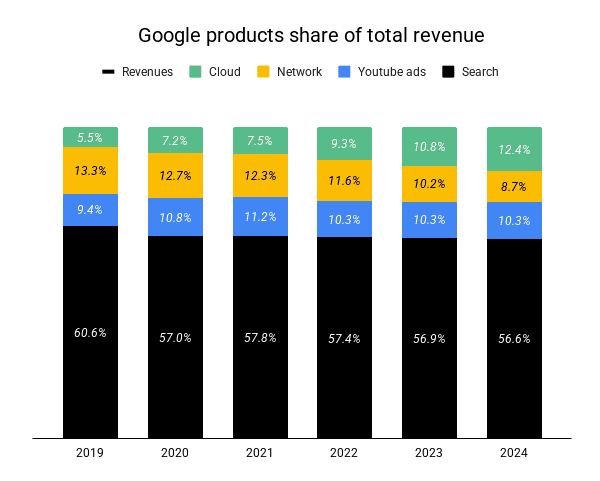
Google is doing well: Search revenue has grown to almost $200 billion in 2024, up from $175 billion the year before.

Search ads still make up over 50% of Alphabet’s revenue, YouTube is stable, and Cloud offsets the dropping Network revenue.

Alphabet still makes over 50% of revenue from Search ads (Image Credit: Kevin Indig)
  • Is Google doing well because people use it more or because advertisers have no alternative? Probably both: Sparktoro found that Google searches grew by 20% YoY in 2024. At the same time, “42% said Google and search engines are becoming less useful.” Maybe the explanation of the paradox is that more searches result from users not finding what they want.
  • Google is still the biggest source of traffic by a big margin, even if AI would mean 20-30% less referral traffic.

The lawsuit matters because if it goes through, it could accelerate or decelerate traffic from Google.

How the search ecosystem would change if the remedies went through as proposed:

  • Google will lose a significant data advantage from Chrome and competitors will benefit big time from Google’s data. I reported how Ecosia and QWANT are building their own search index to become independent of Google and Bing. Enforced data sharing would support this process and inspire competitors like DuckDuckGo.
  • Google would encounter a big hit in mobile traffic from Apple devices, similar to how it already sees a weakened market share in the EU (see the above article as well). Device manufacturers could pre-install different search engines, adding to the pain.
  • Google might make search better to compete harder, benefitting users. But it could also push Google to be even more aggressive about AI and send even less traffic to websites.

I concluded that one scenario is most likely to happen in my last post on the Search Monopoly case Monopoly:

Google must end its exclusivity deals immediately. Apple needs to let users choose a default search engine when setting up their devices. Google could get hefty fines for every year they keep the contract with Apple going.

Realistically, that still seems to be the most likely outcome. But for the web economy, it would be best if the judges in both lawsuits ruled against Google.


1 Source

2 Trump expected to shift course on antitrust, stop Google breakup

3 Trump’s Justice Department still wants to break up Google


Featured Image: Paulo Bobita/Search Engine Journal

Community Building For Marketers: Finding Your Why

This edited extract is from Community Building for Marketers by Areej AbuAli ©2025 and is reproduced with permission from Kogan Page Ltd.

There are many different concepts of what a community is, and various definitions.

Outside the context of marketing terminology, the word “community” is primarily associated with local areas or neighbourhoods.

The concept of community as a marketing or growth tool is one that only really began to gain traction in the 21st century.

When I first launched my own community, Women in Tech SEO, which I will refer to as WTS, I didn’t use the term “community.” I used words like “group” or “network,” but neither term felt quite right.

As the language around community marketing became more common, I realized that this was, indeed, what I was creating – this word felt like a much more natural fit.

What Does A Community Look Like?

There are lots of different focal points around which a community can be built.

The key is that enough people care enough about that thing to want to connect with other people that also care about it, and to talk to them about it.

In 2022, Allie Volpe wrote an article in Vox on “Why community matters so much,”1 and referenced the research on “Sense of Community”2 done by David W. McMillan and David M. Chavis, which suggests that a community is defined by four criteria:

  • Membership – to feel a sense of belonging through shared identity, purpose, or reason for being in the group.
  • Influence – to feel like you make a difference to the group and that the group makes a difference to you.
  • Integration and fulfilment of needs – to feel like your needs will be met by other group members.
  • Shared emotional connection – to feel that you share history or similar experiences.

If your community members don’t feel any of these things, then your community breaks down – essentially you don’t have a community at all.

In community marketing, the brand exists largely in the background.

Convening a community around a particular topic establishes you as an expert and leader in this area, and forms a close relationship with the community members, who are likely to be members of your target audience.

But a relationship is not one-way – you should each get value from one another.

What Is Community Marketing?

Community is not a synonym for customers. In building a community, you are not simply gathering together a group of people that you can sell to.

Some of your community members may be customers, or may go on to become customers, but others will not. Some of your customers will never be interested in joining your community.

When you attract a customer, you are looking specifically for someone who wants to buy your product or service, and you then try to nurture a long-term relationship with them where they continue to buy from you.

When you attract a community member, you are inviting someone to become part of an ecosystem of which you are just one part. They will connect with you and the other members of the community.

They may share attributes in common with your target customer, or they may be linked in other ways with your area of focus.

As counterintuitive as that may sound, the goal of a community is not to turn members into customers. The value of a member is not in whether they spend money with you.

They may become advocates for you, recruit new community members, and help new people get to know your brand.

They may provide useful insights to you and your members, or they may become partners with whom you can collaborate.

You probably already have defined personas of your ideal customers. But, when it comes to community marketing, don’t fall into the trap of thinking these are the personas you want to attract to your community.

Consider the wider environment you want to create, and who would want to be part of that. Who could make a valuable contribution?

With marketing, we create blogs, videos, social media posts, FAQs, email newsletters, guides, and resources that our target customers simply consume.

With a community, on the other hand, we are building interactive relationships. This feels much more personable, and you connect with your members on a more human level. You get to know them as real people.

To get to that point, though, requires dedication. A community marketer needs to be continually serving their community, and constantly thinking about how to improve it.

You need to understand what your members want from the space and from you.

What are their needs, their concerns and their frustrations, in the context of your community topic? Where can you help them, and where are they currently struggling to get help from you?

When you show your members that you care about them, you demonstrate that this is a real community, not a sales platform, and a space where they can belong.

Benefits Of Community For Brands

So, with all this effort involved, why is it worth investing in community building?

At a time when we’re all working hard to build social media followings and email lists, is this just another platform to have to try to grow?

Unlike your social media followers and email subscribers, your community members are in a close relationship with you.

They are rooting for you, brainstorming with you, helping you to uncover ideas and opportunities, and willing you to succeed.

Community members will often be the first to share new products and services that you release – they actively amplify and promote your brand for you because they feel as though they’re part of something.

They can also be actively on the lookout for potential customers whom they will knowledgeably persuade to join you, even helping to onboard these people for you.

They provide valuable insights into what new features, products, or services you need to create and where certain elements might need refining or adjusting. They will be your beta testers and troubleshooters.

They help you understand how to craft your messaging because regular conversations with your community will let you see how your potential customers talk about your product or your industry and what they are looking for.

When you have direct access to a community, it can take minutes to get insights, as opposed to requiring large-scale research projects that may take months to extract valuable information from your target customers.

“For too long we’ve seen consumerism push brands into unsustainable growth models,” says Pete Heslop, Managing Director of Steadfast Collective.

For the past decade, Pete and his team have built bespoke platforms that enable community-led brands to thrive. Pete believes that community is foundational for regenerative business growth.

“We’ve taken responsibility to provide an alternative,” Pete says. “Steadfast Collective believes that people thrive when gathered in community; that generative places, spaces and platforms are where communities grow.”

The Digital Community Leaders Survey Report3 states that communities help individuals, organizations, and society thrive by enabling knowledge sharing, collaboration, and the cocreation of value.

The report goes on to highlight that digital communities play an increasingly essential role in 21st-century lives, organizations, and societies. They affect business outcomes.

Today, brands “earn loyalty and growth” by participating in them. The report also highlights that communities “lessen reliance on costly marketing campaigns and traditional customer support methods.”

And that “empowering customers within online communities cultivates a feeling of ownership, leading to user-generated content, valuable insights, and peer support.”

The report also states that a majority of 70% online communities have grown over the last 12 months, and some of the factors driving this growth include:

  • The shift to life online.
  • The normalization of content creation and sharing.
  • The desire for brands to access customer feedback directly.

Community goes far beyond brand awareness or engagement – it’s the next level of retention and loyalty.

“Community gives you a competitive edge. It really can’t be replicated,” says Laura Roth, B2B SaaS community and marketing leader.

With experience managing communities at Amazon, WeWork, and Vodafone, Laura knows just how impactful the benefits are.

But she also knows that, to achieve those benefits, you need to put in the work. You need to create something unique, that comes from your specific mission and values as an organization, and that speaks to the particular needs of your community.

“Community is a long-term game,” Laura says. “It doesn’t happen overnight, and you can’t copy it.”

If you’re not prepared to invest the time, then you won’t see the outcome.

To read the full book, SEJ readers have an exclusive 25% discount code and free shipping to the US and UK. Use promo code SEJ25 at koganpage.com here.


1 A. Volpe. Why community matters so much – and how to find yours, Vox, 24 March 2022, www.vox.com/22992901/how-to-find-your-community-as-an-adult (archived at https://perma.cc/6F9H-GT4T)

2 D. V. McMillan and D. M. Chavis. An Introduction to Sense of the Community, nd, www.drdavidmcmillan.com/sense-of-community/ article-1 (archived at https://perma.cc/H56M-ZWWS)

3 Digital Community Leaders. 2023 Digital Community Leaders Survey Report, 2023, https://digitalcommunityleaders.com/ (archived at https:// perma.cc/275F-E4C5)


More Resources:


Featured Image: DavideAngelini/Shutterstock

Ask An SEO: Should I Prioritize Selling On Marketplaces Or My Own Website? via @sejournal, @kevgibbo

This week’s Ask an SEO question comes from Mike in Toronto who enquires:

“For a small business that wants to sell products online, would you advise me to set up my own ecommerce website, or should I use a marketplace like Amazon instead?

This is undoubtedly one of the most common dilemmas for small business owners when they decide to start selling online.

It is a particularly tricky one to weigh up because the choices you make now could have quite a big influence on your strategy for months or even years to come.

But to give you my answer up front, my general advice is to begin selling via marketplaces such as Amazon, eBay, or Etsy. This will give you visibility, sales, and near-immediate exposure with minimal effort.

Then, in the long term, you should gradually build out your own website, letting you own your brand and audience.

Of course, there are caveats here. Some product categories don’t tend to do well via online marketplaces. This often, but not always, includes things like furniture, fine art, vehicle spare parts, and so on.

The reverse is also true. If you’re selling books, personal care products, and some kinds of handmade goods, it often makes more sense to stick with the marketplaces.

The Pros And Cons Of Selling On Marketplaces

To help you weigh up whether or not to sell on marketplaces like Amazon, Etsy, or eBay, here’s my take on the pros and cons of using them.

Advantages Of Selling On Marketplaces

  • Instant exposure: Online marketplaces put you in front of millions of shoppers. In the UK, for instance, a whopping 20% of consumers buy goods on Amazon each week, and 80% buy something at least monthly. Having your products available on marketplaces helps you get exposure without having to build traffic from scratch.
  • Easy setup: Listing your products on an established site is much faster than setting up a content management system (CMS) such as Shopify. You need very little technical know-how to list products on marketplaces, and you can get up and running in just a couple of hours.
  • Marketplace SEO tends to be simpler: Optimizing your product descriptions, images, and titles for search algorithms on marketplaces is much more straightforward than trying to compete in Google search (indeed, you could even be competing against marketplaces in search engine results pages).
  • Trust: Millions of people use marketplaces every single day. They trust these websites and are more likely to buy through them, compared to a brand they’ve never heard of.
  • Logistics support: Online marketplaces offer different packages to their sellers, but there’s usually quite a bit of support available for deliveries, returns, refunds, and customer payment processing.

Disadvantages Of Selling On Marketplaces

  • Fees: Marketplaces charge sellers varying fees. These can range from about 2% of the transaction value up to 20%, or even more for some product categories/price brackets. That can really undercut your profitability.
  • No brand control: When you sell on marketplaces, you really are at the mercy of their algorithms, their policies, and their rules. There is very little you can do if the marketplace decides to push its own products over yours or suspend your account for whatever reason.
  • No customer relationship: When you sell on marketplaces, you don’t own the customer data. This makes it very difficult, if not impossible, to cultivate long-term loyalty. You also can’t email customers with discounts or offers outside of the marketplace.
  • The competition: Marketplaces are intensely competitive places. Not only will you be competing against many other small businesses in your niche, but you could also be up against big brands with name recognition. Somewhat disconcertingly, marketplaces like Amazon also sell their own versions of products (from jewelry to sweets to clothes hangers), which could directly compete with yours.
  • Brand visibility: People who buy on marketplaces like Amazon may not even be aware that your brand exists. Many consumers assume they are buying from the marketplace itself, rather than your company.

The Pros And Cons Of Setting Up Your Own Website

Many ecommerce business owners dream of setting up their own websites. There’s something really exciting about having your own shop front to the world.

Here’s what you need to know before going ahead with that.

Advantages Of Setting Up Your Own Ecommerce Site

  • Full brand control: If you run your own website, you own everything. It’s your site, your URL, your designs, your pricing. Rather than having to rely on a fairly generic marketplace storefront template, you can build a website that really matches your company’s ethos.
  • Potentially better profit margins: By avoiding marketplace fees and commissions, you can potentially increase your profit margins.
  • Better customer relationship: With your own website, you have direct access to customer emails and data. This allows for re-marketing and personalization (provided those customers have consented to communications).
  • SEO: If you have built a well-optimized website, this can bring in traffic from Google and other search engines without you having to pay for ads. Essentially, that’s free exposure for the right audiences.
  • Faster payments: When using marketplaces, you typically have to wait for scheduled payout dates (marketplaces typically hold onto money for longer in case of customer complaints or refund requests). With your own website, money from each sale will often land in your business bank account the next business day.

Disadvantages Of Setting Up Your Own Ecommerce Site

  • Building traffic is hard: If you don’t yet have an existing audience, you need to invest in SEO, ads, social media, and content to start attracting potential customers.
  • Technical setup: Building and running an ecommerce website is technically challenging. While a CMS like Shopify makes it a little easier, this is a lot more work than simply setting up a listing on a marketplace.
  • Tech costs: The costs of setting up an ecommerce website are equally significant. You need to buy a domain name, code the pages, maintain the data, ensure the site and customer data are protected, maintain the website, and do various other technical tasks. Unless you’re confident doing this yourself, you’ll probably need to pay a specialist to do this for you.
  • Trust takes time: Assuming your brand is fairly small, building up trust in your website takes time. The best way to do that is through social proof (for example, from customer reviews or companies like Trustpilot). But this won’t happen overnight; it can take months or even years to achieve.
  • Logistics: There are various logistical issues to be aware of when setting up your own website. These include choosing a secure point of sale, managing shipping, setting up policy pages, or getting to grips with legal issues about refunds and returns.

Multi-Channel Is The Way To Go

It is very common nowadays to find small ecommerce companies that sell through multiple channels, including major platforms like Amazon, niche local marketplaces for specific geographies or interests, as well as their own websites and even social media.

It’s a bit outdated, but a 2017 study is quite illustrative. It found that 60% of SMEs made over half of their ecommerce sales on marketplaces, and a quarter had an equal split between marketplaces and their own websites.

Only 12% made all their sales on marketplaces, and only 8% sold exclusively through their own websites. Essentially, most SMEs eventually opt for multi-channel sales.

As I mentioned above, my feeling is that for most businesses, a multi-channel route is the best option.

Starting on a marketplace will help you win customers, gain some visibility, and also allow you to gauge demand for your idea.

As sales start to pick up in the marketplace, you can then begin investing in a website that will ultimately become the primary focus of your offering.

So, there is a lot to think about, but I really encourage you to jump in. It’s important to have a long-term strategy, but there is also a lot you can pick up through trial and error – and the journey can be incredibly fun and rewarding.

Good luck!

More Resources:


Featured Image: Paulo Bobita/Search Engine Journal

Why handing over total control to AI agents would be a huge mistake

AI agents have set the tech industry abuzz. Unlike chatbots, these groundbreaking new systems operate outside of a chat window, navigating multiple applications to execute complex tasks, like scheduling meetings or shopping online, in response to simple user commands. As agents are developed to become more capable, a crucial question emerges: How much control are we willing to surrender, and at what cost? 

New frameworks and functionalities for AI agents are announced almost weekly, and companies promote the technology as a way to make our lives easier by completing tasks we can’t do or don’t want to do. Prominent examples include “computer use,” a function that enables Anthropic’s Claude system to act directly on your computer screen, and the “general AI agent” Manus, which can use online tools for a variety of tasks, like scouting out customers or planning trips.

These developments mark a major advance in artificial intelligence: systems designed to operate in the digital world without direct human oversight.

The promise is compelling. Who doesn’t want assistance with cumbersome work or tasks there’s no time for? Agent assistance could soon take many different forms, such as reminding you to ask a colleague about their kid’s basketball tournament or finding images for your next presentation. Within a few weeks, they’ll probably be able to make presentations for you. 

There’s also clear potential for deeply meaningful differences in people’s lives. For people with hand mobility issues or low vision, agents could complete tasks online in response to simple language commands. Agents could also coordinate simultaneous assistance across large groups of people in critical situations, such as by routing traffic to help drivers flee an area en masse as quickly as possible when disaster strikes. 

But this vision for AI agents brings significant risks that might be overlooked in the rush toward greater autonomy. Our research team at Hugging Face has spent years implementing and investigating these systems, and our recent findings suggest that agent development could be on the cusp of a very serious misstep. 

Giving up control, bit by bit

This core issue lies at the heart of what’s most exciting about AI agents: The more autonomous an AI system is, the more we cede human control. AI agents are developed to be flexible, capable of completing a diverse array of tasks that don’t have to be directly programmed. 

For many systems, this flexibility is made possible because they’re built on large language models, which are unpredictable and prone to significant (and sometimes comical) errors. When an LLM generates text in a chat interface, any errors stay confined to that conversation. But when a system can act independently and with access to multiple applications, it may perform actions we didn’t intend, such as manipulating files, impersonating users, or making unauthorized transactions. The very feature being sold—reduced human oversight—is the primary vulnerability.

To understand the overall risk-benefit landscape, it’s useful to characterize AI agent systems on a spectrum of autonomy. The lowest level consists of simple processors that have no impact on program flow, like chatbots that greet you on a company website. The highest level, fully autonomous agents, can write and execute new code without human constraints or oversight—they can take action (moving around files, changing records, communicating in email, etc.) without your asking for anything. Intermediate levels include routers, which decide which human-provided steps to take; tool callers, which run human-written functions using agent-suggested tools; and multistep agents that determine which functions to do when and how. Each represents an incremental removal of human control.

It’s clear that AI agents can be extraordinarily helpful for what we do every day. But this brings clear privacy, safety, and security concerns. Agents that help bring you up to speed on someone would require that individual’s personal information and extensive surveillance over your previous interactions, which could result in serious privacy breaches. Agents that create directions from building plans could be used by malicious actors to gain access to unauthorized areas. 

And when systems can control multiple information sources simultaneously, potential for harm explodes. For example, an agent with access to both private communications and public platforms could share personal information on social media. That information might not be true, but it would fly under the radar of traditional fact-checking mechanisms and could be amplified with further sharing to create serious reputational damage. We imagine that “It wasn’t me—it was my agent!!” will soon be a common refrain to excuse bad outcomes.

Keep the human in the loop

Historical precedent demonstrates why maintaining human oversight is critical. In 1980, computer systems falsely indicated that over 2,000 Soviet missiles were heading toward North America. This error triggered emergency procedures that brought us perilously close to catastrophe. What averted disaster was human cross-verification between different warning systems. Had decision-making been fully delegated to autonomous systems prioritizing speed over certainty, the outcome might have been catastrophic.

Some will counter that the benefits are worth the risks, but we’d argue that realizing those benefits doesn’t require surrendering complete human control. Instead, the development of AI agents must occur alongside the development of guaranteed human oversight in a way that limits the scope of what AI agents can do.

Open-source agent systems are one way to address risks, since these systems allow for greater human oversight of what systems can and cannot do. At Hugging Face we’re developing smolagents, a framework that provides sandboxed secure environments and allows developers to build agents with transparency at their core so that any independent group can verify whether there is appropriate human control. 

This approach stands in stark contrast to the prevailing trend toward increasingly complex, opaque AI systems that obscure their decision-making processes behind layers of proprietary technology, making it impossible to guarantee safety.

As we navigate the development of increasingly sophisticated AI agents, we must recognize that the most important feature of any technology isn’t increasing efficiency but fostering human well-being. 

This means creating systems that remain tools rather than decision-makers, assistants rather than replacements. Human judgment, with all its imperfections, remains the essential component in ensuring that these systems serve rather than subvert our interests.

Margaret Mitchell, Avijit Ghosh, Sasha Luccioni, Giada Pistilli all work for Hugging Face, a global startup in responsible open-source AI.

Dr. Margaret Mitchell is a machine learning researcher and Chief Ethics Scientist at Hugging Face, connecting human values to technology development.

Dr. Sasha Luccioni is Climate Lead at Hugging Face, where she spearheads research, consulting and capacity-building to elevate the sustainability of AI systems. 

Dr. Avijit Ghosh is an Applied Policy Researcher at Hugging Face working at the intersection of responsible AI and policy. His research and engagement with policymakers has helped shape AI regulation and industry practices.

Dr. Giada Pistilli is a philosophy researcher working as Principal Ethicist at Hugging Face.

The Download: the dangers of AI agents, and ChatGPT’s effects on our wellbeing

This is today’s edition of The Download, our weekday newsletter that provides a daily dose of what’s going on in the world of technology.

Why handing over total control to AI agents would be a huge mistake

—Margaret Mitchell, Avijit Ghosh, Sasha Luccioni, Giada Pistilli all work for Hugging Face, an open source AI company.

AI agents have set the tech industry abuzz. Unlike chatbots, these groundbreaking new systems can navigate multiple applications to execute complex tasks, like scheduling meetings or shopping online, in response to simple user commands. As agents become more capable, a crucial question emerges: How much control are we willing to surrender, and at what cost?

The promise is compelling. Who doesn’t want assistance with cumbersome work or tasks there’s no time for? But this vision for AI agents brings significant risks that might be overlooked in the rush toward greater autonomy. In fact, our research suggests that agent development could be on the cusp of a very serious misstep. Read the full story.

OpenAI has released its first research into how using ChatGPT affects people’s emotional wellbeing

OpenAI says over 400 million people use ChatGPT every week. But how does interacting with it affect us? Does it make us more or less lonely?

These are some of the questions OpenAI set out to investigate, in partnership with the MIT Media Lab, in a pair of new studies. They found that while only a small subset of users engage emotionally with ChatGPT, there are some intriguing differences between how men and women respond to using the chatbot. They also found that participants who trusted and “bonded” with ChatGPT more were likelier than others to be lonely, and to rely on it more.

Chatbots powered by large language models are still a nascent technology, and difficult to study. That’s why this kind of research is an important first step toward greater insight into ChatGPT’s impact on us, which could help AI platforms enable safer and healthier interactions. Read the full story.

—Rhiannon Williams

The must-reads

I’ve combed the internet to find you today’s most fun/important/scary/fascinating stories about technology.

1 Genetic testing firm 23andMe has filed for bankruptcy protection
Following months of uncertainty over its future. (CNN)
+ Tens of millions of people’s genetic data could soon belong to a new owner. (WSJ $)
+ How to… delete your 23andMe data. (MIT Technology Review)

2 Europe wants to lessen its reliance of US cloud giants
But that’s easier said than done. (Wired $)

3 Anduril is considering opening a drone factory in the UK
Europe is poised to invest heavily in defense—and Anduril wants in. (Bloomberg $)
+ The company recently signed a major drone contract with the UK government. (Insider $)
+ We saw a demo of the new AI system powering Anduril’s vision for war. (MIT Technology Review)

4 Bird flu has been detected in a sheep in the UK
It’s the first known instance of the virus infecting a sheep. (FT $)
+ But the UK is yet to report any transmission to humans. (Reuters)
+ How the US is preparing for a potential bird flu pandemic. (MIT Technology Review)

5 A tiny town in the Alps has emerged as an ALS hotspot
Suggesting that its causes may be more environmental than genetic. (The Atlantic $)
+ Motor neuron diseases took their voices. AI is bringing them back. (MIT Technology Review)

6 Firefly Aerospace’s Blue Ghost lunar lander has completed its mission
And captured some pretty incredible footage along the way. (NYT $)
+ Europe is finally getting serious about commercial rockets. (MIT Technology Review)

7 How the US could save billions of dollars in wasted energy 🪟
Ultra tough, multi-pane windows could be the answer. (WSJ $)

8 We need new ways to measure pain
Researchers are searching for objective biological indicators to get rid of the guesswork. (WP $)
+ Brain waves can tell us how much pain someone is in. (MIT Technology Review)

9 What falling in love with an AI could look like
It’s unclear whether loving machines could be training grounds for future relationships, or the future of relationships themselves. (New Yorker $)
+ The AI relationship revolution is already here. (MIT Technology Review)

10 Could you walk in a straight line for hundreds of miles?
YouTube’s favorite new challenge isn’t so much arduous as it is inconvenient. (The Guardian)

Quote of the day

“Blockbuster has collapsed. It’s time for Netflix to rise.” 

—Kian Sadeghi pitches the company they founded, DNA testing firm Nucleus Genomics, as a replacement for 23andMe in a post on X.

 The big story

This town’s mining battle reveals the contentious path to a cleaner future

January 2024

In June last year, Talon, an exploratory mining company, submitted a proposal to Minnesota state regulators to begin digging up as much as 725,000 metric tons of raw ore per year, mainly to unlock the rich and lucrative reserves of high-grade nickel in the bedrock.

Talon is striving to distance itself from the mining industry’s dirty past, portraying its plan as a clean, friendly model of modern mineral extraction. It proclaims the site will help to power a greener future for the US by producing the nickel needed to manufacture batteries for electric cars and trucks, but with low emissions and light environmental impacts.

But as the company has quickly discovered, a lot of locals aren’t eager for major mining operations near their towns. Read the full story.

—James Temple

We can still have nice things

A place for comfort, fun and distraction to brighten up your day. (Got any ideas? Drop me a line or skeet ’em at me.)

+ Who are fandoms for, and who gets to escape into them?
+ A long-lost Klimt painting of Prince William Nii Nortey Dowuona has gone on display in the Netherlands.
+ Feeling down? These feel-good movies will pick you right up.
+ Why Gen Z are dedicated followers of Old Money fashion.

Brand Visibility Is the New SEO

Brand visibility is becoming critical for AI search because consumers increasingly use ChatGPT, Gemini, Claude, and others for product and company recommendations.

As early as July 2023, a Capgemini study of consumers in 13 advanced economies (PDF) found that “generative AI tools such as ChatGPT are becoming the new go-to for 70% of consumers when it comes to seeking product or service recommendations, replacing traditional methods such as search.”

In other words, consumers’ use of genAI to discover brands and products is skyrocketing. Yet those platforms must be aware of your business or products to recommend them.

That’s where brand search comes into play. Search engines drive brand discovery for genAI platforms and research for humans.

In August 2024, SparkToro cited studies revealing that 99% of genAI users continued to use traditional search engines for details, such as specs, prices, and reviews. Hence consumers likely discover brands and products on genAI and go to Google, Bing, and others to learn more.

This trend will surely grow. The number and type of brand searches are now essential search metrics.

So what can we track and how?

Brand search volume

The easiest way to monitor brand visibility is via search engine data, tracking the number of queries on your company’s name and products.

There are a few options.

Search Console

Search Console’s Performance section reports brand queries. Click Search results > Add filter > Query. Then enter your brand name for the number of impressions and clicks from searchers.

Screenshot of the Search Console report

Search Console reports impressions and clicks on any term, including a brand name. Click image to enlarge.

Google Trends

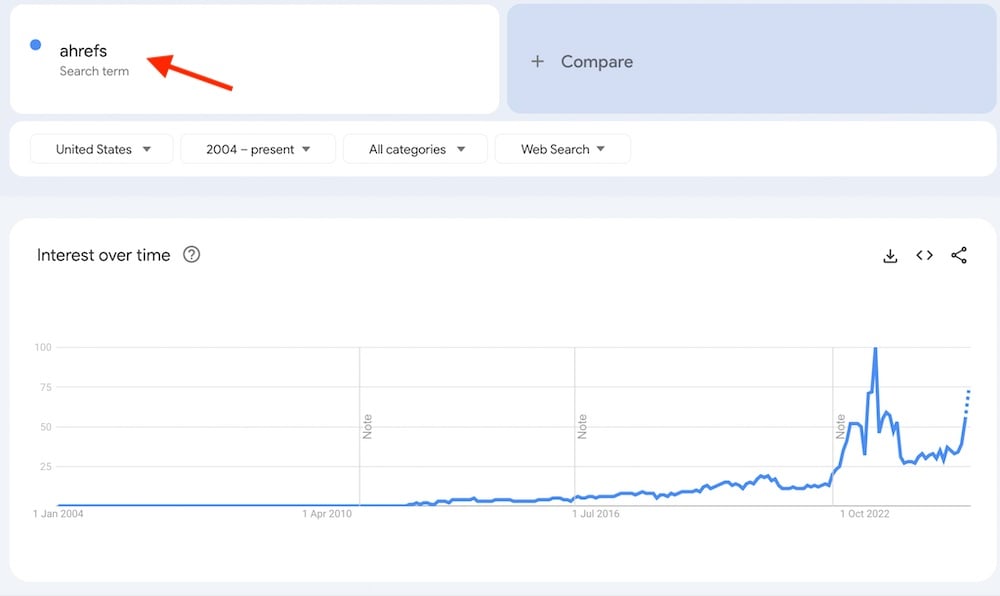
Unlike Search Console, Google Trends tracks competitors’ brands, too. Type your brand name or a competitor’s for trends.

Google Trends tracks any term — yours and a competitor’s. This example shows “ahrefs.” Click image to enlarge.

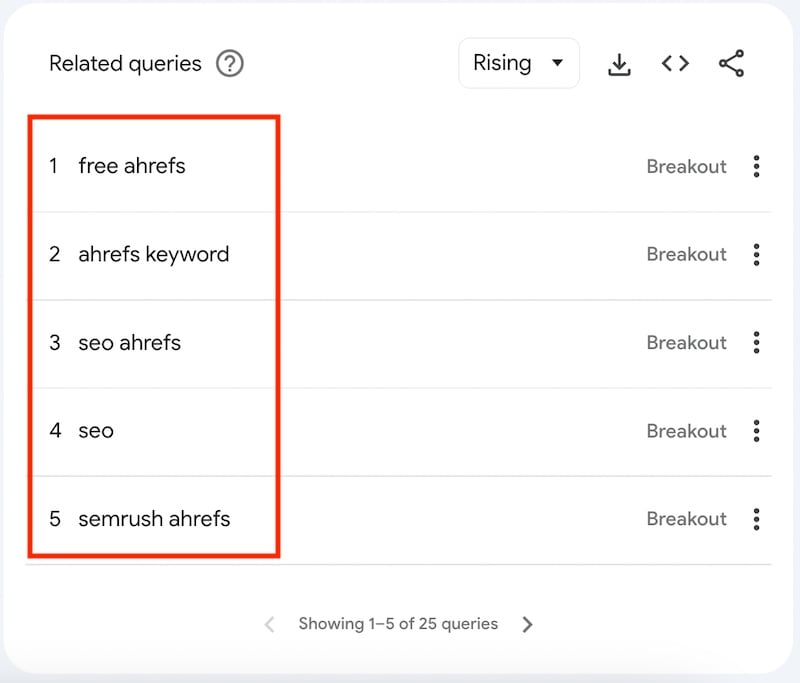
Google Trends will also report rising related queries that include a brand name. Glimpse, a freemium Chrome extension, overlays Google Trends data on important search metrics such as volume and long-tail queries containing your brand name and competitors’.

Google Trends reports rising queries that include a brand name, such as “ahrefs.” Click image to enlarge.

Semrush

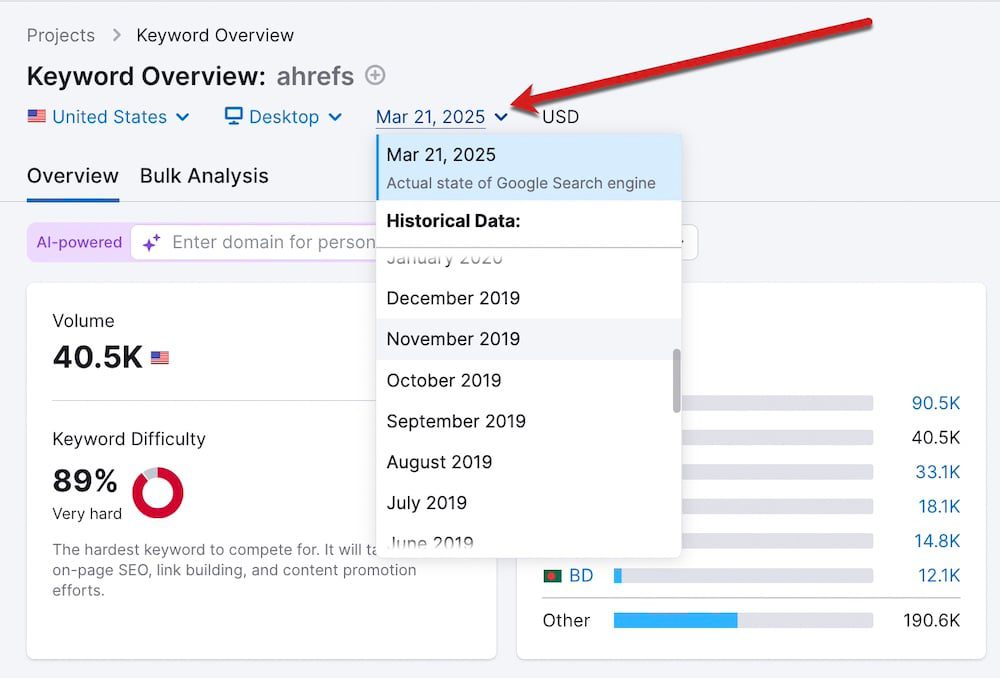
Semrush includes search volume for any keyword (versus a group of keywords in Google Ads reports) over time.

Use the “Keyword overview” tool in Semrush’s dashboard and select months and years in the dropdown menu.

Select months and years in Semrush’s “Keyword Overview” tool. Click image to enlarge.

Brand search impressions

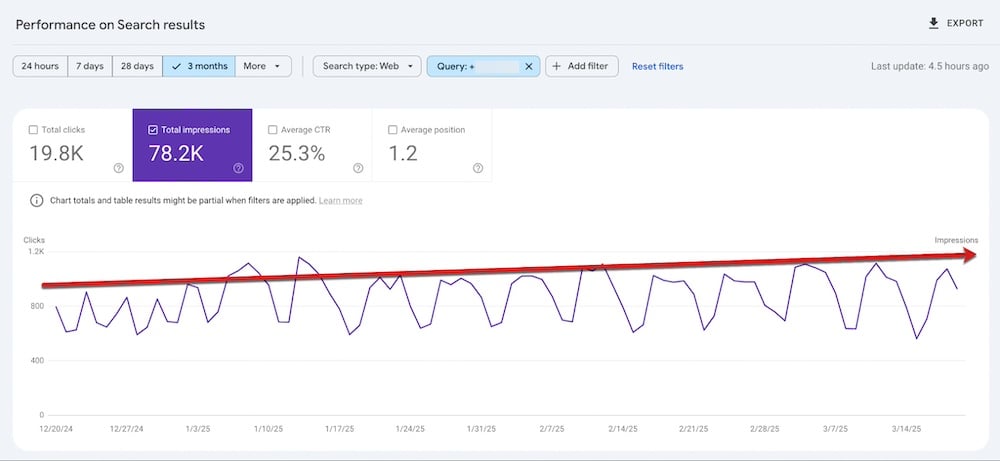
Fewer queries in search engines result in clicks. Thus the number of brand impressions — searchers who view your organic brand listings — is now all-important.

Use Search Console’s “Query” filter to track those impressions.

Screenshot a Search Console report for brand impressions.

Track brand-name impressions in Search Console. Click image to enlarge.