Chatbots are quickly changing how we connect to each other and ourselves. But are these changes for the better? How should they be monitored and regulated? Hear from MIT Technology Review editor Rachel Courtland in conversation with reporter Rhiannon Williams and senior reporter Eileen Guo as they unpack the landscape around chatbots.
Europe is on the cusp of a new dawn in commercial space technology. As global political tensions intensify and relationships with the US become increasingly strained, several European companies are now planning to conduct their own launches in an attempt to reduce the continent’s reliance on American rockets.
In the coming days, Isar Aerospace, a company based in Munich, will try to launch its Spectrum rocket from a site in the frozen reaches of Andøya island in Norway. A spaceport has been built there to support small commercial rockets, and Spectrum is the first to make an attempt.
“It’s a big milestone,” says Jonathan McDowell, an astronomer and spaceflight expert at the Harvard-Smithsonian Center for Astrophysics in Massachusetts. “It’s long past time for Europe to have a proper commercial launch industry.”
Spectrum stands 28 meters (92 feet) tall, the length of a basketball court. The rocket has two stages, or parts, the first with nine engines—powered by an unusual fuel combination of liquid oxygen and propane not seen on other rockets before, which Isar says results in higher performance—and the second with a single engine to give satellites their final kick into orbit.
The ultimate goal for Spectrum is to carry satellites weighing up to 1,000 kilograms (2,200 pounds) to low Earth orbit. On this first launch, however, there are no satellites on board, because success is anything but guaranteed. “It’s unlikely to make it to orbit,” says Malcolm Macdonald, an expert in space technology at Strathclyde University in Scotland. “The first launch of any rocket tends not to work.”
Regardless of whether it succeeds or fails, the launch attempt heralds an important moment as Europe tries to kick-start its own private rocket industry. Two other companies—Orbex of the UK and Rocket Factory Augsburg (RFA) of Germany—are expected to make launch attempts later this year. These efforts could give Europe multiple ways to reach space without having to rely on US rockets.
“Europe has to be prepared for a more uncertain future,” says Macdonald. “The uncertainty of what will happen over the next four years with the current US administration amplifies the situation for European launch companies.”
Trailing in the US’s wake
Europe has for years trailed behind the US in commercial space efforts. The successful launch of SpaceX’s first rocket, the Falcon 1, in 2008 began a period of American dominance of the global launch market. In 2024, 145 of 263 global launch attempts were made by US entities—and SpaceX accounted for 138 of those. “SpaceX is the benchmark at the moment,” says Jonas Kellner, head of marketing, communications, and political affairs at RFA. Other US companies, like Rocket Lab (which launches from both the US and New Zealand), have also become successful, while commercial rockets are ramping up in China, too.
Europe has launched its own government-funded Ariane and Vega rockets for decades from the Guiana Space Centre, a spaceport it operates in French Guiana in South America. Most recently, on March 6, the European Space Agency (ESA) launched its new heavy-lift Ariane 6 rocket from there for the first time. However, the history of rocket launches from Europe itself is much more limited. In 1997 the US defense contractor Northrop Grumman air-launched a Pegasus rocket from a plane that took off from the Canary Islands. In 2023 the US company Virgin Orbit failed to reach orbit with its LauncherOne rocket after a launch attempt from Cornwall in the UK. No vertical orbital rocket launch has ever been attempted from Western Europe.
Isar Aerospace is one of a handful of companies hoping to change that with help from agencies like ESA, which has provided funding to rocket launch companies through its Boost program since 2019. In 2024 it awarded €44.22 million ($48 million) to Isar, Orbex, RFA, and the German launch company HyImpulse. The hope is that one or more of the companies will soon begin regular launches from Europe from two potential sites: Isar’s chosen location in Andøya and the SaxaVord Spaceport on the Shetland Islands north of the UK, where RFA and Orbex plan to make their attempts.
“I expect four or five companies to get to the point of launching, and then over a period of years reliability and launch cadence [or frequency] will determine which one or two of them survives,” says McDowell.
ISAR AEROSPACE
Unique advantages
In their initial form these rockets will not rival anything on offer from SpaceX in terms of size and cadence. SpaceX sometimes launches its 70-meter (230-foot) Falcon 9 rocket multiple times per week and is developing its much larger Starship vehicle for missions to the moon and Mars. However, the smaller European rockets can allow companies in Europe to launch satellites to orbit without having to travel all the way across the Atlantic. “There is an advantage to having it closer,” says Kellner, who says it will take RFA one or two days by sea to get its rockets to SaxaVord, versus one or two weeks to travel across the Atlantic.
Launching from Europe is useful, too, for reaching specific orbits. Traditionally, a lot of satellite launches have taken place near the equator, in places such as Cape Canaveral in Florida, to get an extra boost from Earth’s rotation. Crewed spacecraft have also launched from these locations to reach space stations in equatorial orbit around Earth and the moon. From Europe, though, satellites can launch north over uninhabited stretches of water to reach polar orbit, which can allow imaging satellites to see the entirety of Earth rotate underneath them.
Increasingly, says McDowell, companies want to place satellites into sun-synchronous orbit, a type of polar orbit where a satellite orbiting Earth stays in perpetual sunlight. This is useful for solar-powered vehicles. “By far the bulk of the commercial market now is sun-synchronous polar orbit,” says McDowell. “So having a high-latitude launch site that has good transport links with customers in Europe does make a difference.”
Europe’s end goal
In the longer term, Europe’s rocket ambitions might grow to vehicles that are more of a match for the Falcon 9 through initiatives like ESA’s European Launcher Challenge, which will award contracts later this year. “We are hoping to develop [a larger vehicle] in the European Launcher Challenge,” says Kellner. Perhaps Europe might even consider launching humans into space one day on larger rockets, says Thilo Kranz, ESA’s program manager for commercial space transportation. “We are looking into this,” he says. “If a commercial operator comes forward with a smart way of approaching [crewed] access to space, that would be a favorable development for Europe.”
A separate ESA project called Themis, meanwhile, is developing technologies to reuse rockets. This was the key innovation of SpaceX’s Falcon 9, allowing the company to dramatically drive down launch costs. Some European companies, like MaiaSpace and RFA, are also investigating reusability. The latter is planning to use parachutes to bring the first stage of its rocket back to a landing in the sea, where it can be recovered.
“As soon as you get up to something like a Falcon 9 competitor, I think it’s clear now that reusability is crucial,” says McDowell. “They’re not going to be economically competitive without reusability.”
The end goal for Europe is to have a sovereign rocket industry that reduces its reliance on the US. “Where we are in the broader geopolitical situation probably makes this a bigger point than it might have been six months ago,” says Macdonald.
The continent has already shown it can diversify from the US in other ways. Europe now operates its own successful satellite-based alternative to the US Global Positioning System (GPS), called Galileo; it began launching in 2011 and is four times more accurate than its American counterpart. Isar Aerospace, and the companies that follow, might be the first sign that commercial European rockets can break from America in a similar way.
“We need to secure access to space,” says Kranz, “and the more options we have in launching into space, the higher the flexibility.”
This week’s rundown of new products for ecommerce merchants includes AI-powered agents, mobile app builders, buy-now-pay-later services, logistics, B2B payments, and email marketing.
Got an ecommerce product release? Email releases@practicalecommerce.com.
New Tools for Merchants
Adobe introduces 10 AI agents to automate marketing workflow.Adobe has unveiled a suite of AI agents for its enterprise applications. According to Adobe, the Experience Platform Agents are designed to augment the capabilities of marketing and creative teams to drive personalization at scale. The 10 agents are Account Qualification, Audience, Content Production, Data Engineering, Data Insights, Experimentation, Journey, Product Advisor, Site Optimization, and Workflow Optimization.
Adobe Experience Platform
Amazon provides sellers with personalized restock recommendations.Amazon is providing merchants with restock recommendations in Seller Central, using a demand forecasting model to help maintain healthy inventory levels for Fulfilled by Merchant listings. The model calculates suggested restock quantities and dates for products that meet specific criteria, including active sales, projected demand, and current days of supply less than 14 days. To access these insights, go to the Manage Inventory page and click Restock notification in the Inventory column.
Veho expands its parcel delivery platform in New York City.Veho, a U.S. parcel delivery provider, has expanded coverage to New York City. Veho’s platform has begun serving consumers in Queens, The Bronx, Upper Manhattan, and Staten Island — with plans to cover the entire city. Veho enables ecommerce brands such as Macy’s, Saks, and Lululemon, as well as fulfillment providers such as Flexport, ShipHero, and Stord, to provide one to three-day deliveries.
Spangle optimizes paid traffic for retailers with Agentic AI and ProductGPT.Spangle has emerged from stealth to launch an AI-powered commerce platform for retailers to maximize revenue from paid traffic. Backed by leading firms Madrona Ventures and Streamlined Ventures, Spangle delivers self-optimizing shopping journeys that are contextually relevant and adaptive based on consumer engagement in real-time. Spangle’s proprietary ProductGPT powers this experience with a large product model that decodes context, consumer interactions, and merchant data. Spangle says its AI agents autonomously tackle complex challenges at scale.
Spangle
Sezzle adds features for smarter spending.Sezzle, a buy-now, pay-later provider, has introduced new features. Sezzle’s new price comparison tool helps users quickly find the best values. A new auto couponing feature allows shoppers to access deals directly through the app, with coupons automatically applied at checkout.
Adobe announces new offerings with AWS and Amazon Ads.Adobe has announced a collaboration with Amazon Web Services, integrating Adobe’s products with AWS’s generative AI services, Amazon Connect, and Amazon Ads. These offerings will enable organizations to create more meaningful customer interactions while benefiting from AWS’s enterprise-grade security, reliability, and global infrastructure.
Persado launches AI-powered dynamic email for marketing.Persado, a provider of content optimization and personalization services for marketing, has released Dynamic Email, an AI service that manages campaign setup, content library creation, and launch. Persado Dynamic Email enables marketers to update, optimize, and personalize content without additional setup.
Persado
Visa launches B2B Integrated Payments in Australia.Visa has partnered with four of Australia’s biggest banks — ANZ, NAB, HSBC, and Westpac — to launch B2B Integrated Payments. The solution, which is embedded into the SAP Business Technology Platform, allows businesses to automate payments, removing the need for additional reconciliation. Businesses using the SAP platform can route commercial payments to all suppliers, including those that do not accept card payments.
Knowband launches mobile app builder to enhance ecommerce sales.Knowband, a provider of plugins and add-ons for online stores such as PrestaShop, OpenCart, WooCommerce, and Magento, has launched its mobile app builder. The solution includes dynamic product catalogs, multi-language and multi-currency support, a customizable tab bar layout, and a drag-and-drop editor.
eHub and Osa Commerce partner on logistics and fulfillment.eHub, a provider of ecommerce logistics and shipping services, and Osa Commerce, a unified commerce and operations software provider, have announced a collaboration to help businesses manage their supply chain and fulfillment operations. The partnership integrates eHub’s shipping API and rate optimization capabilities with Osa Commerce’s ability to unify fragmented data across ecommerce platforms, warehouses, and marketplaces. The integration enables businesses to manage their entire fulfillment process from one platform.
This week’s question about author pages comes from Joylyn:
We are working on building author pages for our content, would you mind teaching us best practices for building author archive pages with any SEO best practices.
A great question and perfect for me to answer from a branding perspective.
Author pages serve to build trust, authority, and all of that good stuff. That much should be obvious.
However, a lot of nuance goes into leveraging author pages. More than that, I would challenge the very notion of what an author page is and why we need them.
What Should Be On Your Author Pages?
The answer to that depends on what you’re trying to accomplish.
Yes, you’re to establish trust, but how you do that depends on a variety of factors.
Say, for example, your industry is constantly evolving and changing. Harping on your author’s past may not be the way to go.
Instead, trust may be better built by focusing on their recent accolades and accomplishments. It can be as simple as showing they have written extensively on the topic recently.
In other words, you need to establish what “trust” means in your scenario because it’s not universal.
Think of your author pages as “About Pages.” There’s a certain narrative to a good About Page and you can do the same with your author pages.
Don’t just say who the person is, but show how they got there.
Trust is often about contextualization. Don’t think about only presenting who the author is – rather, try to paint a picture that frames them.
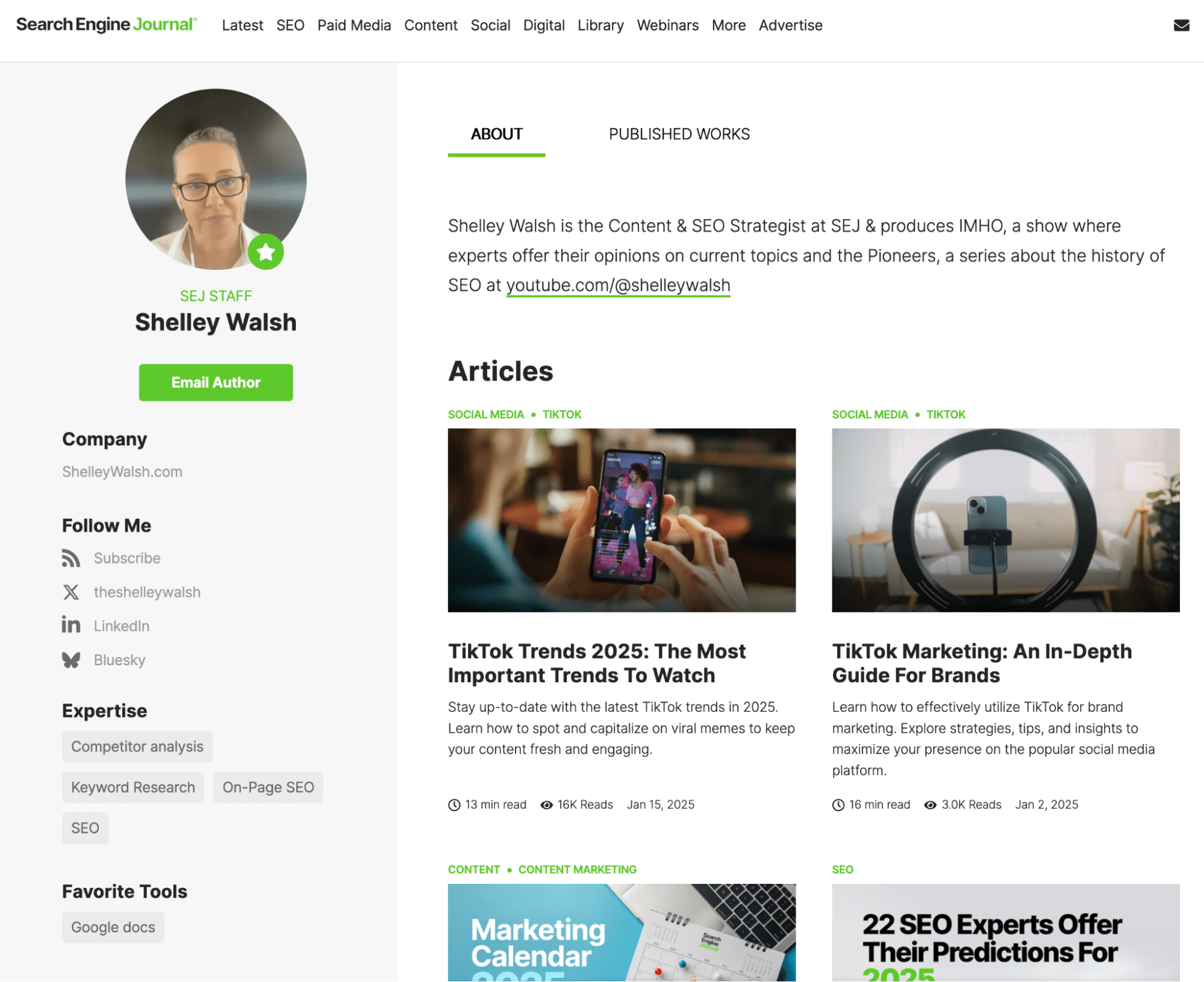
Author pages don’t just offer some background about your contributors but your site. They become a pillar of “who you are” across the web. Your authors aren’t just authors – they are representatives.
Screenshot from Google, March 2025
When someone runs across your author pages (perhaps by Googling one of your authors, as I did with Loren Baker above), they and the page connected with them substantiate who you are.
The authority of a good author page goes beyond visitors to your site.
If you’re running a marketing strategy that is heavy in employee advocacy, these pages are a major part of any outreach program.
If your goal is to get your own people out there repp’ing the brand on podcasts, webinars, conference stages, etc., the author page becomes a pillar. It becomes the “home” that represents your advocates and you at the same time.
This again speaks to the author page not merely being a list of credentials and accomplishments but as a narrative around the authors themselves.
If you’re trying to build your brand and performance by leveraging your employees, contributors, etc., you need pages that offer strong contextualization.
Even if you don’t use the bio/author page as part of the outreach per se, there’s a very good chance anyone interested will run some kind of search and find these pages on their own (again, as I did above).
Which brings us to…
Who Needs Author Pages?
Let me challenge the entire question. Why are we stopping at authors? The question should be, “Who needs people pages?” The answer is everyone whose company has any people. So, the answer is everyone.
Every business needs to contextualize itself via the people associated with it. That can be the CEO, CMO, CFO, CTO, or COO – I’m out of “Cs,” but it should not stop there.
When I see a company only list its top employees, it comes off as one giant ego stroke. So, mission accomplished: You have contextualized your business. I now know you’re a bunch of narcissists.
Even if you’re a solopreneur, there should be content that in a sense parses out who you are on the site.
I think we’ve come to look at “author pages” as being this very narrowed page type. To me, it’s the wrong way to look at them. It’s not an “SEO” play.
And when you think beyond SEO per se, is there really a difference between an author page and an employee bio page?
Yet, it’s funny because we’ll spend all day talking about how to bolster your author pages and then create one never-ending page for the employees that merely lists their names.
How exactly is that helpful beyond giving your user the ability to manually look up some of these folks on LinkedIn (which means leaving your website)?
So, who needs “author pages”? Everyone. The question is, what type of “author page” do you need? Can you combine your About Page and “author page”?
I do that on my own website since I’m a one-person show, and the format allows me that opportunity. I felt that having a separate page was a bit of overkill.
There’s a bio about who I am on my homepage and then a longer section on the About Page – do I really need to create another separate page to talk about me again? Doing so felt like it would be too much focus on myself and not my audience.
Again, it’s not a question of “if” you need some sort of author or bio page, but what kind and in what format?
Author Page Best Practices
That said, here are some quick best practices I would consider adding to your author pages (and similar “bio” pages). Some of them are obvious, like:
Social links.
Standard bio.
Image.
Recent posts.
Formal industry recogniton (such as Search Engine Journal does with its “Certification & Awards” tab).
Areas of expertise.
Some less so (and again, it all depends on your goals):
Conference talks.
Podcast, webinar appearances, and other “third-party placements” (similar to Search Engine Journal’s “Published Works” tab).
Outlets where the author is quoted.
Work experience (current and previous).
History of how the author got into the industry and why.
Personal industry philosophy (can even be a video).
The last thing I’ll say is: Watch the formatting.
99% of author pages, assuming they are substantial, feel like you’re reading a long article.
If you want to get the most out of the author page, you need to lay things out so that the audience can get a holistic sense of things at a glance.
Screenshot from Search Engine Journal, March 2025
The Search Engine Journal layout is one of the best I’ve seen online (and I’m not saying that because I’m writing this on Search Engine Journal).
I don’t feel overwhelmed by information. It’s all “chunked” in a way where I clearly notice the various areas of information without having to work hard to see it all.
That’s why it works.
More Resources:
Featured Image: Paulo Bobita/Search Engine Journal
The SaaS business model offers incredible scalability as well as profitability – but only when paired with the right marketing growth strategy.
Knowing that the cost of hosting cloud-based applications decreases as user volume increases, SaaS brands must focus on rapid subscriber growth to stay competitive and bring costs down.
Many CMOs default to paid acquisition for predictable traffic and conversions, but I have seen that this approach has a critical flaw: the moment ad spend stops, so does the traffic, causing new customer growth to tank.
Today, there are also longer sales cycles, more choices, and a high customer acquisition cost (CAC). While paid acquisition does play a critical role in pipeline development, it’s not a sustainable long-term growth engine.
To achieve sustainable, long-term growth, SaaS CMOs must look beyond the short-term wins of paid advertising.
Consider SEO as not just another marketing channel, but the foundational strategy that builds organic momentum, lowers CAC, and will compound over time.
I believe that investing in SEO ensures that brands will consistently attract high-intent users, strengthen domain authority, and increase demand generation – without relying on an ever-expanding ad budget.
For CMOs looking to build a resilient growth engine, investing in SEO means ensuring your brand is consistently visible to the right buyers and decision makers, exactly when they’re searching for solutions like yours.
The SEO strategies I list below will improve your overall marketing efforts, whether you market your company using PPC, email, or social media.
With this in mind, I’d like to discuss some of the unique challenges that SaaS CMOs face in the digital space and ways SEO can help them overcome these challenges.
Then, I’ll provide tips to help you improve your online presence and grow your business.
Unique Digital Challenges For SaaS Companies
1. Scaling Growth Efficiently In SaaS
SaaS CMOs and marketers face a tough challenge in scaling SaaS businesses fast enough and to a comfortable degree in order to offset the cost of hosting their cloud applications.
To achieve a lower cost of total ownership (TCO), SaaS companies need to build an effective network scale that:
Acquires new customers constantly.
Retains existing ones.
Entices customers to communicate with one another using the software to build a full-fledged network.
Unfortunately, paid advertising only contributes to the cost of this model and fails to bring on new customers outside of this narrow window of focus.
Not to mention that SaaS companies take different approaches to pricing and monetization, often choosing between freemium, subscription, or usage-based models to align with customer needs.
Expansion revenue plays a key role in growth. Upselling encourages customers to move to higher-tier plans, while cross-selling introduces them to other products or services.
The right combination of these strategies can drive sustainable revenue while keeping customers engaged.
What’s needed for this is an omnichannel marketing strategy that builds awareness organically and through multiple channels.
2. Balancing Customer Support & Self-Service Models
Many SaaS providers use varying business models, including self-service, managed service, and automated service models for customer support.
These models relate to the amount of support the SaaS vendor provides, greatly affecting the cost of managing and running their platforms.
SaaS companies now use AI-driven automation and personalization to enhance customer service. AI-powered chatbots handle routine inquiries, providing instant responses and freeing up support teams for more complex requests.
Personalization at scale ensures that customers receive solutions based on their history, preferences, and behavior, improving satisfaction and retention.
I have seen how SaaS companies integrate AI into customer service. By doing so, they streamline operations, improve response times, and deliver a better support experience.
AI-powered automation can also streamline repetitive tasks like email campaigns, lead scoring, and customer segmentation.
Personalization at scale can improve how your messaging resonates with users and prospects, improving engagement and conversion rates overall.
But if your SaaS platform has a notoriously high learning curve, such as Salesforce, and you use a self-service model for customer support, you may need to invest heavily in educational materials and tutorials to assist customers as they learn about your additional products and services.
3. Maximizing LTV: Acquisition Vs. Retention Focus
While we focus heavily on customer acquisition to grow the network of a SaaS provider, keeping customers on the network is equally important.
Whether you rely on a one-time purchase or a subscription model, constantly iterating with new products, releases, and continual customer support is critical for maintaining steady growth for your business and improving retention through product stickiness and value-driven marketing.
For this reason, SaaS companies need to invest in a wide-range marketing strategy that appeals to new and existing customers in different ways, reducing churn through onboarding, engagement, and proactive support.
4. Protecting & Leveraging Your Brand In Search
Most of your keywords may be branded, which can be difficult to scale if no one is aware of your software or brand.
For this reason, a mix of PPC, link building, and high-level content will be critical to growing your brand’s name and people’s affiliation with your products, along with positioning your brand as an authority in the industry.
5. Aligning SEO With Buyer Journeys & Intent Signals
Finally, when you’re dealing with branded products and multiple keywords, it can be difficult to decipher intent.
As we’ll discuss, strategically optimizing your funnel and content around intent will be important for your overall SEO strategy.
Benefits Of SEO For Sustainable SaaS Growth
Since SaaS companies rely on building economies of scale to reduce costs and increase profit, a long-term strategy like organic SEO makes the most sense for SaaS businesses.
Some of the benefits of SEO for SaaS include:
Sustainable, Scalable Growth: Building a predictable pipeline of high-intent leads without reliance on paid acquisition.
Lower Customer Acquisition Costs (CAC): Reducing dependency on expensive PPC campaigns and improving marketing efficiency.
Stronger Brand Authority & Visibility: Dominating search results, positioning your brand as the go-to solution in your industry.
Higher Customer Retention & Engagement: Using authoritative content to educate users, improve onboarding, and reduce churn.
Enhanced Omnichannel Performance: Improving conversion rates across paid, social, and email by aligning messaging with organic search insights.
I want to note that high-value content doesn’t just fuel SEO. It also enhances other channels, providing compelling material for nurturing campaigns, retargeting, and demand generation across paid media and email for both acquisition and retention.
More importantly, SEO isn’t just about ranking – it’s about owning the conversation around your software.
Strengthening brand visibility in organic search ensures that when decision-makers actively seek solutions, your SaaS brand is front and center in the search engines for long-tail searches.
So, by establishing yourself as a thought leader and building a loyal customer base using a mix of content and SEO, you can build out a wide-scale network of users that reduce hosting costs and accelerate your growth.
To get started, let’s discuss seven actionable SEO strategies for CMOs of SaaS brands.
7 Actionable Ways To Scale SaaS Businesses With SEO
1. Lay The SEO Foundation For Scalable Growth
First and foremost, you need to build a user-friendly site where people can download your products, contact customer support, and read content.
Some technical fundamentals your website needs include:
Many of these technical factors are binary in Google’s eyes – pass or fail – making them non-negotiable table stakes for achieving high-quality search visibility.
Once your SEO foundation is in place, securing top rankings for authoritative content becomes significantly easier, while also ensuring visitors stay engaged and receive value once they arrive.
2. Align SEO Strategy With Customer Insights & Intent
Next, your team should develop a list of buyer personas you will pursue using multiple conversion tools. Input for buyer personas could be based on the following sources:
Sales and marketing teams.
Existing analytics sources (e.g., Google Analytics, Google Search Console, or Paid Media Channels).
Customer service representatives.
Direct feedback from customer surveys and interviews.
Now, your buyer personas or avatars will differ whether you’re targeting a B2C or B2B space.
In a B2C space, your buyer persona will be based on several demographic and psychographic inputs, including:
Location.
Age.
Interests.
Occupation.
Education level.
For example, if you were selling photo editing software, you would likely create separate avatars for professional and freelance photographers and hobbyists.
On the other hand, your B2B persona will likely target specific people in an organization, such as managers, key decision-makers, founders, or daily users.
For example, one marketing campaign and persona may focus on a software solution for sales teams and managers.
At the same time, another campaign in the SEO space may target SEO managers looking to switch from existing products.
Once you have a list of buyer personas and avatars, you can create strategic campaigns with actionable solutions that appeal to these personas on both paid and organic channels.
3. Drive Conversions With Full-Funnel SEO
As a SaaS CMO, you will likely need to create separate content for separate buyer’s personas, but also for new and existing customers.
Create awareness that the user has a problem and that your software can solve it. Common marketing materials include:
Blog posts.
Guest posts.
Press releases.
Boosted social media posts.
Paid advertisements.
Interest
Build interest in your products and find ways to engage with users.
For example, encouraging users to sign up for your newsletter or email service can be a great way to engage with users over time.
At this stage, you could send emails to users or hit them with a pop-up advertising a free ebook, case studies, testimonials, white paper, or any other high-level content that speaks to your products while encouraging user-generated content and community engagement.
Evaluation/Decision
Engage with users further to push them closer to a conversion. Some common tactics include:
Free trials.
Limited consultations.
Free demos.
Free beta testing.
Purchase And Loyalty
Once a user has purchased one of your products, continue to engage them with special offers or educational content that improves their user experience and delivers satisfaction.
Hopefully, at this stage, you can generate strong brand loyalty, encouraging word-of-mouth advertising to grow your network.
4. Prioritize High-Impact Keywords For Business Growth
Since the acquisition cost for early-stage SaaS providers is incredibly high, it’s important to curate a strategic organic keyword strategy that brings qualified traffic to your website.
Some strategies to generate high-converting keywords and to use them appropriately include:
Target a list of your highest-converting PPC keywords.
Analyze what keywords competitors are bidding on and targeting organically.
Optimize for informational keywords (e.g., photo editing software: “How to enhance a photo”).
Leverage “integration” related terms if your software works with other products.
Focus on benefits (e.g., increase, improvement, automation, etc.).
List features (e.g., photo editing, red-eye removal, cropping, etc.).
Segment target keywords by intent across your sales funnel (e.g., informational keywords at the top-of-the-funnel and keywords about features/benefits for mid-funnel content).
Optimize for lower volume, niche keywords with less competition to carve out market share.
5. Strengthen Domain Authority With Strategic Content Clusters
Once you have a list of keywords and an actionable content strategy for your funnel put in place, it’s time to execute.
Since SaaS products are fairly sophisticated and highly competitive, it’s ideal to follow Google’s E-E-A-T guidelines (experience, expertise, authoritativeness, and trustworthiness) to craft your content.
In addition, I also recommend creating topic clusters around topics with similar content to reinforce the main topic, generate authority, and answer as many user questions as possible.
HubSpot is a good example of a blog and SaaS platform that creates highly sophisticated content clusters around its main products, including blogs and user tutorials.
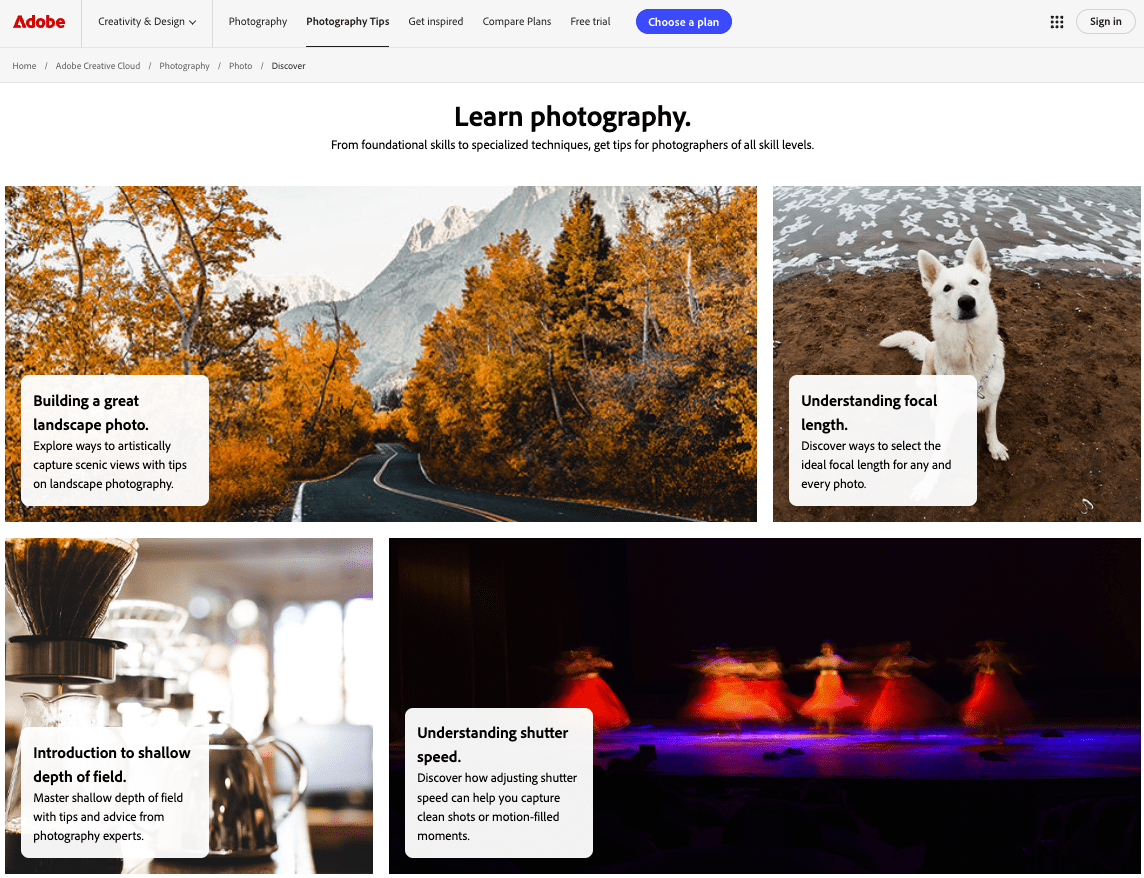
To create a topic cluster, start with a seed keyword that serves as the main topic, such as “Photography,” and create a series of related topics.
For example, Adobe provides a series of photography tips designed to educate users about and sell their products, such as Photoshop.
Screenshot from Adobe, March 2025
By creating rich resource content, you can build a community of people who come to your brand, not just for products but also for thoughtful advice.
As a bonus, leverage community forums to further engage and educate users with common troubleshooting concerns with your products.
6. Leverage Backlinks To Boost Credibility & Rankings
While backlinks are still a valuable ranking signal, I view backlinks as a more valuable promotion strategy.
If you follow my content tips above, you will create many linkable assets that naturally accrue backlinks and can be used for promotion to earn more.
For example, white papers, ebooks, surveys, studies, and tutorials are great resources for educating people and helping them cite information for their own research.
However, to gain early exposure and build links to content, follow these actionable tips below:
Guest post on popular blogs and websites to generate buzz.
Promote educational content on paid channels, such as Facebook and Google.
Email educational content to relevant people in your industry to build awareness.
Contact resource pages for links to your software.
Conduct roundup interviews with industry professionals.
Promote surveys and studies through press releases or paid channels.
7. Integrate SEO With Paid, Social & Product-Led Growth
Finally, combine all of these strategies into an omnichannel strategy.
Using a mix of PPC for brand exposure, content to build authority, and organic SEO to scale customer acquisition will provide the best strategy to scale an early-stage SaaS business.
Furthermore, promoting high-level content like a white paper over advertisements, email, social media, and all other channels is a great way to earn exposure, build links, and drive traffic to your site.
Combine your PPC and SEO keyword research to optimize your funnel and create a consistent marketing strategy that nurtures users from awareness to the decision stage.
Bottom Line
SEO and SaaS don’t just sound alike, but they truly do go together!
While paid advertising is essential for early brand visibility, a strong SEO strategy creates a sustainable path to reduce dependency on paid channels and scale your online presence organically.
Investing in SEO for enterprise SaaS brands should drive consistent, high-intent traffic while improving overall marketing efficiency and creating long-term ROI.
There has never been a more pressing time for food producers to harness technology to tackle the sector’s tough mission. To produce ever more healthy and appealing food for a growing global population in a way that is resilient and affordable, all while minimizing waste and reducing the sector’s environmental impact. From farm to factory, artificial intelligence and machine learning can support these goals by increasing efficiency, optimizing supply chains, and accelerating the research and development of new types of healthy products.
In agriculture, AI is already helping farmers to monitor crop health, tailor the delivery of inputs, and make harvesting more accurate and efficient. In labs, AI is powering experiments in gene editing to improve crop resilience and enhance the nutritional value of raw ingredients. For processed foods, AI is optimizing production economics, improving the texture and flavor of products like alternative proteins and healthier snacks, and strengthening food safety processes too.
But despite this promise, industry adoption still lags. Data-sharing remains limited and companies across the value chain have vastly different needs and capabilities. There are also few standards and data governance protocols in place, and more talent and skills are needed to keep pace with the technological wave.
All the same, progress is being made and the potential for AI in the food sector is huge. Key findings from the report are as follows:
Predictive analytics are accelerating R&D cycles in crop and food science. AI reduces the time and resources needed to experiment with new food products and turns traditional trial-and-error cycles into more efficient data-driven discoveries. Advanced models and simulations enable scientists to explore natural ingredients and processes by simulating thousands of conditions, configurations, and genetic variations until they crack the right combination.
AI is bringing data-driven insights to a fragmented supply chain. AI can revolutionize the food industry’s complex value chain by breaking operational silos and translating vast streams of data into actionable intelligence. Notably, large language models (LLMs) and chatbots can serve as digital interpreters, democratizing access to data analysis for farmers and growers, and enabling more informed, strategic decisions by food companies.
Partnerships are crucial for maximizing respective strengths. While large agricultural companies lead in AI implementation, promising breakthroughs often emerge from strategic collaborations that leverage complementary strengths with academic institutions and startups. Large companies contribute extensive datasets and industry experience, while startups bring innovation, creativity, and a clean data slate. Combining expertise in a collaborative approach can increase the uptake of AI.
This is today’s edition of The Download, our weekday newsletter that provides a daily dose of what’s going on in the world of technology.
HIV could infect 1,400 infants every day because of US aid disruptions
Around 1,400 infants are being infected by HIV every day as a result of the new US administration’s cuts to funding to AIDS organizations, new modeling suggests.
In an executive order issued January 20, President Donald Trump paused new foreign aid funding to global health programs. Four days later, US Secretary of State Marco Rubio issued a stop-work order on existing foreign aid assistance. Surveys suggest that these changes forced more than a third of global organizations that provide essential HIV services to close within days of the announcements.
Hundreds of thousands of people are losing access to HIV treatments as a result. Read the full story.
—Jessica Hamzelou
MIT Technology Review Narrated: What the future holds for those born today
Happy birthday, baby.
You have been born into an era of intelligent machines. They have watched over you almost since your conception. They let your parents listen in on your tiny heartbeat, track your gestation on an app, and post your sonogram on social media. Well before you were born, you were known to the algorithm.
How will you and the next generation of machines grow up together? We asked more than a dozen experts to imagine your joint future.
This is our latest story to be turned into a MIT Technology Review Narrated podcast, which we’re publishing each week on Spotify and Apple Podcasts. Just navigate to MIT Technology Review Narrated on either platform, and follow us to get all our new content as it’s released.
The must-reads
I’ve combed the internet to find you today’s most fun/important/scary/fascinating stories about technology.
1 A judge has ordered DOGE to cease dismantling USAID It’s been told to reinstate employees’ email access and let them return to their offices. (WP $) + The judge believes its efforts probably violated the US Constitution.(Reuters) + The department has also targeted workers that prevent tech overspending. (The Intercept) + Can AI help DOGE slash government budgets? It’s complex. (MIT Technology Review)
2Can Oracle save TikTok? A security proposal from the cloud giant could reportedly allow it to keep operating in the US. (Bloomberg $) + The deal would leave the app’s algorithm in the hands of its Chinese parent company. (Politico)
3 NASA’s astronauts have touched down on Earth They safely landed off the coast of Florida yesterday evening. (FT $) + A pod of dolphins dropped by to witness the spectacle. (The Guardian)
4 AI is turning cyber crime into a digital arms race Europol warns that more criminals than ever are exploiting AI tools for nefarious means. (FT $) + Five ways criminals are using AI. (MIT Technology Review)
5 An Italian newspaper has published an edition produced entirely by AI The technology was responsible for “the irony” too, apparently. (The Guardian)
6 Tesla’s taxi service has been greenlit in California But the road ahead is still full of obstacles. (Wired $) + Chinese EVs are snapping at Tesla’s heels across the world. (Rest of World) + It certainly seems as though Asia will birth the next EV superpower. (Economist $) + Robotaxis are one of our 10 Breakthrough Technologies of 2025. (MIT Technology Review)
7 Online platforms are fueling ‘facial dysmorphia’ Hours of staring at their own faces made these women anxious and depressed. (NY Mag $) + The fight for “Instagram face.” (MIT Technology Review)
8 Inside the hunt for water on Mars We know that the red planet was once host to it, but we don’t know why. (Knowable Magazine)
9 This robotic spider is shedding light on how real spiders hunt Namely using a form of echolocation. (Ars Technica)
10 We could be dramatically underestimating the Earth’s population New data analysis suggests it could be much higher than previously thought. (New Scientist $)
Quote of the day
“In no uncertain terms is this an audit. It’s a heist, stealing a vast amount of government data.”
—An anonymous auditor offers a scathing review of DOGE’s attempts at auditing US government departments to Wired.
The big story
The humble oyster could hold the key to restoring coastal waters. Developers hate it.
October 2023
Carol Friend has taken on a difficult job. She is one of the 10 people in Delaware currently trying to make it as a cultivated oyster farmer.
Her Salty Witch Oyster Company holds a lease to grow the mollusks as part of the state’s new program for aquaculture, launched in 2017. It has sputtered despite its obvious promise.
Five years after the first farmed oysters went into the Inland Bays, the aquaculture industry remains in a larval stage. Oysters themselves are almost mythical in their ability to clean and filter water. But human willpower, investment, and flexibility are all required to allow the oysters to simply do their thing—particularly when developers start to object. Read the full story.
—Anna Kramer
We can still have nice things
A place for comfort, fun and distraction to brighten up your day. (Got any ideas? Drop me a line or skeet ’em at me.)
+ If you’re stuck for something to do this weekend, why not host a reading hang? + Do baby owls really sleep on their stomachs? Like most things in life, the truth is somewhere in the middle. + Keep your eyes peeled the next time you’re in the British countryside, you might just spot a black leopard. + I couldn’t agree more—why When Harry Met Sally is a perfect film.
Where can you find lasers, electric guitars, and racks full of novel batteries, all in the same giant room? This week, the answer was the 2025 ARPA-E Energy Innovation Summit just outside Washington, DC.
Energy innovation can take many forms, and the variety in energy research was on display at the summit. ARPA-E, part of the US Department of Energy, provides funding for high-risk, high-reward research projects. The summit gathers projects the agency has funded, along with investors, policymakers, and journalists.
Hundreds of projects were exhibited in a massive hall during the conference, featuring demonstrations and research results. Here are four of the most interesting innovations MIT Technology Review spotted on site.
Steel made with lasers
Startup Limelight Steel has developed a process to make iron, the main component in steel, by using lasers to heat iron ore to super-high temperatures.
Steel production makes up roughly 8% of global greenhouse gas emissions today, in part because most steel is still made with blast furnaces, which rely on coal to hit the high temperatures that kick off the required chemical reactions.
Limelight instead shines lasers on iron ore, heating it to temperatures over 1,600 °C. Molten iron can then be separated from impurities, and the iron can be put through existing processes to make steel.
The company has built a small demonstration system with a laser power of about 1.5 kilowatts, which can process between 10 and 20 grams of ore. The whole system is made up of 16 laser arrays, each just a bit larger than a postage stamp.
The components in the demonstration system are commercially available; this particular type of laser is used in projectors. The startup has benefited from years of progress in the telecommunications industry that has helped bring down the cost of lasers, says Andy Zhao, the company’s cofounder and CTO.
The next step is to build a larger-scale system that will use 150 kilowatts of laser power and could make up to 100 tons of steel over the course of a year.
Rocks that can make fuel
The hunks of rock at a booth hosted by MIT might not seem all that high-tech, but someday they could help produce fuels and chemicals.
A major topic of conversation at the ARPA-E summit was geologic hydrogen—there’s a ton of excitement about efforts to find underground deposits of the gas, which can be used as a fuel across a wide range of industries, including transportation and heavy industry.
Last year, ARPA-E funded a handful of projects on the topic, including one in Iwnetim Abate’s lab at MIT. Abate is among the researchers who are aiming not just to hunt for hydrogen, but to actually use underground conditions to help produce it. Earlier this year, his team published research showing that by using catalysts and conditions common in the subsurface, scientists can produce hydrogen as well as other chemicals, like ammonia. Abate cofounded a spinout company, Addis Energy, to commercialize the research, which has since also received ARPA-E funding.
All the rocks on the table, from the chunk of dark, hard basalt to the softer talc, could be used to produce these chemicals.
An electric guitar powered by iron nitride magnets
The sound of music drifted from the Niron Magnetics booth across nearby walkways. People wandering by stopped to take turns testing out the company’s magnets, in the form of an electric guitar.
Most high-powered magnets today contain neodymium—demand for them is set to skyrocket in the coming years, especially as the world builds more electric vehicles and wind turbines. Supplies could stretch thin, and the geopolitics are complicated because most of the supply comes from China.
Niron is making new magnets that don’t contain rare earth metals. Instead, Niron’s technology is based on more abundant materials: nitrogen and iron.
The guitar is a demonstration product—today, magnets in electric guitars typically contain aluminum, nickel, and cobalt-based magnets that help translate the vibrations from steel strings into an electric signal that is broadcast through an amplifier. Niron made an instrument using its iron nitride magnets instead. (See photos of the guitar from an event last year here.)
Niron opened a pilot commercial facility in late 2024 that has the capacity to produce 10 tons of magnets annually. Since we last covered Niron, in early 2024, the company has announced plans for a full-scale plant, which will have an annual capacity of about 1,500 tons of magnets once it’s fully ramped up.
Batteries for powering high-performance data centers
The increasing power demand from AI and data centers was another hot topic at the summit, with server racks dotting the showcase floor to demonstrate technologies aimed at the sector. One stuffed with batteries caught my eye, courtesy of Natron Energy.
The company is making sodium-ion batteries to help meet power demand from data centers.
Data centers’ energy demands can be incredibly variable—and as their total power needs get bigger, those swings can start to affect the grid. Natron’s sodium-ion batteries can be installed at these facilities to help level off the biggest peaks, allowing computing equipment to run full out without overly taxing the grid, says Natron cofounder and CTO Colin Wessells.
Sodium-ion batteries are a cheaper alternative to lithium-based chemistries. They’re also made without lithium, cobalt, and nickel, materials that are constrained in production or processing. We’re seeing some varieties of sodium-ion batteries popping up in electric vehicles in China.
Ted Kubaitis once managed organic search for a retailer with 25,000 SKUs and 500 categories. He feared competing against Amazon for rankings until he realized most of its product pages had zero external links. Then an epiphany hit.
“All it took was 25 backlinks,” he told me.
Ted is now the founder of SEO Tool Lab, a prominent agency and software provider, and the host of “SEO Fight Club,” a YouTube show.
He and I spoke last month at a conference. I asked him about today’s SERPs, keyword priorities, content marketing, and, yes, competing against ecommerce giants.
The entire audio of that conversation is embedded below. The transcript is edited for length and clarity.
Eric Schwartzman: Search engine result pages have changed dramatically over the last few months.
Ted Kubaitis: Right. There are keywords now where the first organic result is below the fold — effectively page two. Those keywords aren’t worth targeting anymore.
The Google search result page is now a universal search. It’s multiple blended result sets — ads, products, “People also ask,” local packs, all kinds of things are now above organic listings.
Search engine optimizers must consider two things: Where do I rank organically, and where does the listing appear among all those options?
Schwartzman: What are the best keywords to target for an online store?
Kubaitis: It’s an important question because if the targeting is wrong, the SEO is wrong. It requires a lot of time and effort to figure out. I would start with the names of products and categories. Names are so impactful.
Look at the links in SERPs; many are the actual search terms. A merchant might have a “Gifts and Delights” category, but how many people search for “gifts and delights”? What the heck is a delight? I guarantee “gifts and delights” is a zero-volume keyword.
So even if you rank number one, you’ve won nothing. But if you change the name to “Unique Gift Ideas,” you will now have a search term worth winning. Go through all of your categories and product names. Make sure they’re all named something that has search volume.
Google Trends can help identify those high-volume names. Look at the trending cluster topics for ideas. Consider, too, adding a widget or word cloud to a product page with keyword variants and even typos.
Merchants with multiple SKUs of a single item could name each with a top keyword variant.
Schwartzman: How did you learn ecommerce SEO?
Kubaitis: I was a web developer for a large online retailer. They saw that I was good with SEO, so I took it over as a primary responsibility. I ended up doing SEO for that retailer for almost 20 years. I helped them grow from $5 million in annual revenue to $65 million with a $40 average cart size. So a lot of carts. High volume, low margin. We had 25,000 SKUs across 500 product categories.
We competed against Amazon and all the big marketplaces. A lot of sellers think they can’t compete against those sites, but Amazon’s product pages often have zero external backlinks. You can beat them with 25 backlinks. I spent years being afraid to compete with Amazon. I finally mustered up the courage; all it took was 25 backlinks.
Don’t make my mistake.
Schwartzman: Let’s switch to content marketing. Ecommerce stores often launch blogs to attract traffic for products. What are your thoughts about that?
Kubaitis: Blogs can help, but executing the strategy is often flawed and ends up causing more harm. Most online retailers have a problem with keyword cannibalization between their home page, categories, and product pages. Then they publish blog posts that overlap with the same keywords.
A better ecommerce strategy involves multiple websites. For example, a seller of high-end poker tables could launch a blog site about poker rules, professional tournaments, and related — and then advertise the tables there. The seller would have multiple marketing assets and free advertising. The seller can test keywords that the store couldn’t otherwise target. And since they’re on different domains, they’re not cannibalizing each other.
I tell retailers a blog is helpful on a different domain, but four out of five have a problem when it’s on their ecommerce sites.
Schwartzman: Tell us about your company, SEO Tool Lab.
Kubaitis: Our primary tool is called Cora. It uses statistical analysis to determine which elements on your website and your competitors’ impact rankings for a keyword. Cora reduces the possibilities from thousands to a few dozen to focus on.
Plus, we host a weekly YouTube show called SEO Fight Club. It’s an open debate and peer review of SEO tactics, tools, and trends.