How To Avoid Top Down SEO Systems Failures With The Visibility Governance Maturity Model via @sejournal, @theshelleywalsh

Most SEO failures aren’t caused by bad SEOs. They’re caused by organizations that don’t have the systems to support them.

That’s the argument Ash Nallawalla has been building across five books and over 24 years of enterprise SEO experience in Australia. As a visibility governance consultant based in Melbourne, Ash has worked in-house for some of Australia’s biggest brands, and seen firsthand what happens when no one above the SEO team understands what they do or why it matters.

On IMHO, I spoke with Ash about why he believes visibility needs to be governed at board level, how his maturity model works, and why the rise of AI-mediated discovery makes this more urgent than ever.

“Governance is not a constraint on speed. However, the absence of governance is.”

When No One Owns It, Everything Breaks

Most SEO failures are structural. Which means the team didn’t fail, but the system did. And the damage could be disproportionate to the cause. A governance gap of weeks could create months of recovery. And governance is not a constraint on speed. However, the absence of governance is.

Ash shared an example that illustrates just how catastrophic a governance gap can be.

At one organization, he discovered in Google Search Console 22 million pages as “currently not indexed.” When Australia only has 25 million residents, he knew something has seriously gone wrong.

This was down to someone internally in the past who had decided that creating a page for every combination of facet would be a good idea.

“There were 10 quintillion pages. And if you’ve not heard that number before, it is one followed by 18 zeros,” Ash explained. “We calculated that if Googlebot could read a thousand URLs a second, it would take 310 billion years to crawl all of them.”

Despite this, the site was still ranking well and receiving 5 million Googlebot visits per day. The problem was invisible to anyone above the SEO or product manager level.

“That place didn’t have governance because no one above the SEO level or the product manager level realized the problem. They just knew someone was doing SEO and yes, we’re getting lots of traffic.”

This kind of structural failure is what drove Ash to write his first book, “Accidental SEO Manager,” in 2022. As he put it, “In reality most people come into SEO with no background and that applies to the managers who are looking after enterprise SEO.”

A Maturity Model For Visibility Governance

Ash has since developed what he calls the Visibility Governance Maturity Model (VGMM), borrowing from the Carnegie Mellon capability maturity framework used in software development. It maps governance across seven domains, SEO (including local and international), content, website performance, accessibility, and AI governance, into five levels expressed as a percentage score.

“The C-suite gets to know that our visibility governance is at 80% or it’s at 20% or 30% whatever it is, and that corresponds to five levels.”

“Some of these questions are single points of failure. And if you said ‘not in place’ for any of them, it doesn’t matter what your real score is, you are capped at level two.” Ash explained.

A single point of failure (SPOF) might be something as fundamental as whether anyone is responsible for robots.txt. In some companies, Ash noted, they don’t even know what robots.txt is.

Selling Governance To Skeptics

When boards push back against the need for governance, Ash uses three arguments.

First, the system test: “If things work wonderfully this month, are we guaranteed that next month and the month after that things will work wonderfully? And if not, then there is a problem that we need to investigate.”

Second, the rework cost. Fixing a visibility failure after the fact is far more expensive than preventing it, especially when the failure involves AI systems.

“If suddenly ChatGPT stops recommending your brand, you may not realize it. Your traffic is up. Your rankings are where they were. That’s not effective, but your competitors are doing better than you.”

And third, for the skeptics who worry governance will slow things down: “You will move faster with governance than without it because you might have these big problems and it may take you an unknown amount of time to fix them.”

What To Tell A Board That’s Never Heard Of Visibility Governance

When pitching to a board for the first time, Ash recommends leading with money, then reframing SEO as infrastructure.

“Organic search visibility, which is the traditional SEO, is infrastructure. It’s not just a marketing exercise. It’s a capital asset with a yield.”

He frames AI-mediated discovery as a new category of risk, something boards are already familiar with in other contexts. Brand visibility can erode silently without any alerts firing, and traditional controls aren’t detecting it.

“If their paid costs are slowly creeping up, that’s not always because the search engine is charging more. It’s also because they’re having to advertise more. And that’s one of the early hints that there could be an external system that is brewing, and it’s taking customers away, and that’s the AI-mediated search that their potential customers are beginning to use, and they’re being led in other directions.

So the second thing that I say to them is that the risk profile of visibility has changed in the last two years, and your traditional controls are not detecting it.”

Ash shared a real example where his CIO once asked why Bing Chat was recommending competitors but not their own brand. The cause turned out to be a blocked Common Crawl bot (CCBot), which Bing Chat had relied on during its learning phase. “We unblocked CCBot, and within a few months, it started recommending our brand.”

There’s also a reputational dimension. If customers are leaving bad reviews on platforms the company doesn’t monitor, large language models are learning from that sentiment, and quietly dropping the brand from their recommendations.

“When you share responsibility without ownership, then governance will fail.”

Ash recommends boards ask four questions:

  • Who owns accountability for visibility performance at a strategic level?
  • Is that person senior enough to influence things?
  • Is visibility reporting reaching the board in a way that distinguishes between performing well today and being structurally sound tomorrow?
  • Are we treating AI-mediated visibility as a governance matter, or as a technology novelty someone in marketing is keeping an eye on?

The Leadership Test

Ash closed with what he calls the leadership test, a challenge to any organization that relies on individual heroics rather than systems.

“If your SEO depends on individuals pushing uphill against the system, then gradually their capability will vanish when they leave.”

He advocates for internal wikis, documented learnings, and hiring for capability rather than cultural fit. The goal is to reduce dependence on individuals and build structures that survive personnel changes.

“I’m saying to boards, put visibility on the agenda at every meeting, even if it’s a one sentence from the responsible person, ‘visibility is fine’ or whatever they want to report, but it reminds the board at every meeting that SEO and now external visibility are both very important infrastructure matters.”

Visibility Governance Isn’t Just For Enterprise

While governance is most obviously an enterprise concern, the principles apply broadly. Smaller companies are just as vulnerable to silent visibility erosion, perhaps more so, because they have fewer resources to detect or recover from it.

Where AI systems are reshaping how brands get discovered, the organizations that treat visibility as a governance matter rather than a marketing task are the ones most likely to survive the shift.

Watch the full interview with Ash Nallawalla here:

Thank you to Ash Nallawalla for offering his insights and being my guest on IMHO, and read more about the Visibility Governance Maturity Model in the Managing SEO series of books.

More Resources:


This post was originally published on Shelley Edits.


Featured Image: Shelley Walsh/Search Engine Journal

Are We Due Another Florida-Style Update? via @sejournal, @TaylorDanRW

Editor’s note: this article was written a few days before the core update that started to roll out on March 24.

Updates like Florida, Allegra, and Brandy were major turning points in search because they fundamentally reshaped how websites were ranked and how SEO was practiced.

These updates caused sudden and dramatic shifts where rankings dropped overnight, entire categories of websites lost visibility, and tactics that once delivered consistent performance stopped working almost immediately.

A similar question is now starting to emerge as AI-generated content increases and large volumes of low-value pages begin to fill the web. The scale and speed of content production feel familiar and echo the build-up that came before earlier algorithmic resets.

The systems that power search have evolved, yet the pressures acting on them are beginning to look very similar. A repeat in the same form is unlikely, but the conditions that created those updates are returning, and a comparable reset remains a realistic possibility if those conditions continue to worsen.

Scaled Low-Value Content Is Worse Than Ever

The underlying problem of low-value content at scale is returning, driven largely by the capabilities of AI. The cost and effort required to produce content have dropped significantly, which allows pages to be created faster and in greater volume than ever before. This has led to rapid expansion across many areas of search, particularly in informational queries where barriers to entry are relatively lower.

The more prominent issue is the level of similarity across that content.

Much of what is produced follows the same structure, covers the same points, and reaches similar conclusions. The result is content that is readable and technically correct, but lacks depth, originality, and meaningful differentiation, core elements that make content useful, valuable, and give it longevity in Google’s serving index.

There are mirrors to the content farm era that Panda addressed, where the problem was not just the number of pages but the fact that those pages were largely interchangeable. The current wave of AI content reflects the same issue at a much larger scale and with a higher baseline level of quality, which makes it both more effective and harder to filter.

The Rolling Correction With Real-Time Updates

Google is already responding to these challenges through its existing systems, which work together to continuously evaluate and adjust content visibility. The Helpful Content System assesses quality across entire sites, SpamBrain identifies patterns that indicate low-value or manipulative behavior, and core updates refine rankings across the index.

These systems create a rolling correction where change is constant rather than concentrated in a single event. The March 2024 core update demonstrates this approach because it targeted low-quality and scaled content without creating a clear break. Some sites lost visibility, some improved, and many experienced mixed results over time.

This reflects a deliberate shift in how quality is managed because the goal is to maintain balance continuously rather than reset the system in one moment. That approach depends on the system keeping pace with the scale of the problem it is trying to manage.

Continuous Systems Aren’t Always Enough

The issue is not only that more content is being produced, but that it is being produced at a speed that may outpace the system’s ability to fully evaluate it. A gap can form between content production and content assessment, which allows low-value pages to gain visibility before being properly filtered.

As that gap widens, the quality of search results can decline in subtle but noticeable ways. Users may encounter repetitive or shallow content across similar queries, which reduces trust in the results over time. This does not represent a full breakdown of the system, but it does show increasing pressure, and if users lose trust in the results, they stop coming to Google, which impacts Google’s ability to generate revenue.

The assumption that continuous evaluation can handle unlimited scale is being tested, and the limits of that system are not yet clear.

The Case For Another Florida

The possibility of another large-scale update depends on whether the current system can continue to manage this pressure effectively.

A scenario exists where Google introduces a more aggressive update that recalibrates quality thresholds across the board and reduces the visibility of low-value content more quickly and more broadly. We know that Google trains on a subset of quality that it knows is created to the highest standards (as disclosed at the Search Central Live in Bangkok in 2025). The form this would take would differ from Florida, but the impact could feel similar because large numbers of sites could lose visibility in a short period of time.

Such an update would likely follow a period where search results feel consistently weak or repetitive and where users begin to question their reliability. Evidence that existing systems cannot correct the issue quickly enough would increase the likelihood of a more aggressive intervention from Google.

Recalibrating Content As A Tactic

Content strategy has shifted from efficiency to defensibility because the ability to produce content at scale is no longer a meaningful advantage. AI has made content production widely accessible, and this has put pressure on agencies and in-house teams to be able to produce more with the same resources – but measuring this by total content output versus the overall content quality is a trade-off I feel many are sleepwalking into.

Content that performs well now tends to offer something that cannot be easily replicated.

This often includes real experience, a clear and informed perspective, or genuinely useful insight that goes beyond standardized output. Strong alignment with user intent also plays a critical role in maintaining visibility over time.

These principles are not new, but they are enforced more consistently and may be applied more aggressively if the system requires it.

This Is A System Under Pressure

The likelihood of another Florida-style update depends on how well the current system continues to perform under increasing pressure. Google’s approach has shifted toward continuous evaluation, which reduces the need for large and sudden changes under normal conditions.

The conditions that led to past updates are beginning to re-emerge in a different form, driven by the scale of AI-generated content. A more decisive intervention becomes more likely if those conditions continue to build and begin to affect user trust in search results.

The system currently operates through steady and ongoing adjustment, without a clear reset point or a single moment of change. Content is evaluated continuously based on whether it deserves to be indexed and served to users.

History shows that gradual systems can give way to more direct action when pressure builds too much, and if that point is reached again, the response is likely to be a statement move.

More Resources:


Featured Image: hmorena/Shutterstock

Google’s March Spam Update Felt Muted But May Signal Bigger Changes via @sejournal, @martinibuster

Google’s March 2026 Spam Update was welcomed by many in the SEO community who were hoping for relief from listicles, AI content rewriters, and Google’s own AI Overviews that “rehash other people’s content.” The update unexpectedly finished in less than twenty-four hours, with a collective shrug and a yawn. Yet despite the underwhelming nature of the update, it still yielded a few interesting insights and takeaways.

Hopeful SEOs

Google’s spam announcement was largely welcomed by many in the SEO community who were hoping that spammy sites positioned above them would lose their rankings but the muted response spoke to an update that didn’t seem to land where people expected it to.

EmarketerZ expressed the hope that sites struggling under the weight of spammy sites ranking above them might have their comeback moment.

They tweeted:

“Google’s latest spam update might just be the comeback moment publishers have been waiting for—finally a shot at reclaiming the traffic they lost in the last one 🤣”

Over on LinkedIn Adrian M. responded to Google’s announcement by expressing that it’s about time, calling out fake engagement tactics as an area they’d like to see cleaned out.

They wrote:

“It was only a matter of time, and it’s exactly what the industry needed. Many SEO agencies have been relying on bot networks and residential proxies to simulate organic engagement and inflate their monthly reports. I’ve recently audited e-commerce servers pushed to the brink of crashing (503 errors) just by these automated, fake “add-to-cart” scripts masquerading as real users. This update will finally clean up the vanity metrics and force the market to return to genuine content marketing and real user acquisition. Excellent move by the Search team!”

Muted Response From Digital Marketers

Many SEOs who have been vocal about spammy GEO tactics and regular old spam jamming up the search results were oddly quiet through the duration of the spam update.

Glenn Gabe had this to say:

“Wait, what? The March 2026 Spam Update has completed rolling out. Damn, that was fast. :)”

And Lily Ray tweeted:

The Google subreddit announcing Google’s spam update only had six responses, four of which were conversations asking for a link to the official announcement. It’s fair to say the response on Reddit’s Google subreddit was a shrug and yawn.

The response over on the SEO subreddit was similar, with some of the comments doubting much of anything will change.

One person expressed the hope that this time AI-generated content farms will get wiped out.

They wrote:

“I’m betting on a big hit to AI-generated content farms and those super thin affiliate sites. google’s been hinting at this for a while, feels like it’s finally coming.”

But another Redditor nicknamed mrtornado79 responded with a big nah… and a useful insight.

“It’s been “finally coming” for three years. At this point it’s basically an SEO drinking game — spam update drops, someone says “this is the one that kills AI content farms,” nothing particularly dramatic happens, repeat.

Google called this a “normal spam update.” Not a paradigm shift. Not the AI content apocalypse. Normal.”

That point about the March Spam Update not being a paradigm shift was a good observation about Google’s understated announcement and it probably explains why Google didn’t even bother to update their Spam Update information.

A couple of the SEO Facebook Groups didn’t even have a discussion about the update, which in itself is a comment about how SEOs feel about Google’s spam updates: It could be a sign of how much wind has been taken out of the sails of low-level affiliate spammers and PBN sellers.

Wait, What… That Was It?

The end of the update was generally met by silence on many of the ongoing discussions across the Internet.

WebmasterWorld member Micha expressed the general underwhelment best:

“Huh? The update is over?”

It’s quite possible that Redditor mrtornado79’s opinion that it was not going to be a paradigm shift was the best view of what just happened.

What May Happen Next

The big question now may not be what just happened but rather what is going to happen next.

I’ve always seen Google’s spam updates as a clearing of the table in preparation for the next course. If a core update follows soon, then that may be what this muted spam update was about. That can be anything from the introduction of new AI-driven features (like those title rewrites they were recently experimenting with) to something quiet that will barely be noticed, like an infrastructure change to accommodate something big and new.

What could Google implement over the coming months?

There have been two patents filed recently which I’ll be publishing information about soon.

1. User Journey Patent
The first one describes a machine learning system that determines how different types of content exposure influence a user’s likelihood of performing a specific action, such as making a purchase or signing up for a service. It’s a system to attribute portions of the final action to specific exposures to content or ads, even when multiple exposures occurred at different times.

2. Automatic Search Results Updates
This patent describes a system that improves search experiences by automatically delivering better results to a user after their original search, without requiring them to search again. This is applicable to both an organic search and an AI assisted search. This transforms search from a one-time activity to information requests that resolve over time. This is really interesting because it makes it possible to ask a question about something that’s going to happen or hasn’t been announced yet, expanding the range of queries that Google can answer.

My general impression of Spam Updates is that they are sometimes a prelude to changes elsewhere in Google’s core algorithm or related infrastructure. It may be an interesting month ahead.

Featured Image by Shutterstock/vchal

The AI Hype Index: AI goes to war

AI is at war. Anthropic and the Pentagon feuded over how to weaponize Anthropic’s AI model Claude; then OpenAI swept the Pentagon off its feet with an “opportunistic and sloppy” deal. Users quit ChatGPT in droves. People marched through London in the biggest protest against AI to date. If you’re keeping score, Anthropic—the company founded to be ethical—is now turbocharging US strikes on Iran. 

On the lighter side, AI agents are now going viral online. OpenAI hired the creator of OpenClaw, a popular AI agent. Meta snapped up Moltbook, where AI agents seem to ponder their own existence and invent new religions like Crustafarianism. And on RentAHuman, bots are hiring people to deliver CBD gummies. The future isn’t AI taking your job. It’s AI becoming your boss and finding God.

Agentic commerce runs on truth and context

Imagine telling a digital agent, “Use my points and book a family trip to Italy. Keep it within budget, pick hotels we’ve liked before, and handle the details.” Instead of returning a list of links, the agent assembles an itinerary and executes the purchase.

That shift, from assistance to execution, is what makes agentic AI different. It also changes the operating speed of commerce. Payment transactions are already clear in milliseconds. The new acceleration is everything before the payment: discovery, comparison, decisioning, authorization, and follow-through across many systems. As humans step out of routine decisions, “good enough” data stops being good enough. In an agent-driven economy, the constraint isn’t speed; it’s trust at machine speed and scale.

Automated markets already work because identity, authority, and accountability are built in. As agents transact across businesses, that same clarity is required. Master data management (MDM)—the discipline of creating a single master record—becomes the exchange layer: tracking who an agent represents, what it can do, and where responsibility sits when value moves. Markets don’t fail from automation; they fail from ambiguous ownership. MDM turns autonomous action into legitimate, scalable trust.

To make agentic commerce safe and scalable, organizations will need more than better models. They will need a modern data architecture and an authoritative system of context that can instantly recognize, resolve, and distinguish entities. It is the difference between automation that scales and automation that needs constant human correction.

The agent is a new participant

Digital commerce has long been built on two primary sides: buyers and suppliers/merchants. Agentic commerce adds a third participant that must be treated as a first-class entity: the agent acting on the buyer’s behalf.

That sounds simple until you ask the questions every enterprise will face:

  • Who is the individual, across channels and devices, with enough certainty for automation?
  • Who is the agent, and what permissions and limits define what it can do?
  • Who is the merchant or supplier, and are we sure we mean the right one?
  • Who holds liability if the agent acts with permission, but against user intent?

The practical risk is confusion. Humans, for example, can infer that “Delta” means the airline when they are booking a flight, not the faucet company. An agent needs deterministic signals. If the system guesses wrong, it either breaks trust or forces a human confirmation step that defeats the promise of speed.

Why ‘good enough’ data breaks at machine speed

Most organizations have learned to live with imperfect data. Duplicate customer records are tolerable. Incomplete product attributes are annoying. Merchant identities can be reconciled later.

Agentic workflows change that tolerance. When an agent takes action without a human checking the output, it needs data that is close to perfect, because it cannot reliably notice when data is ambiguous or wrong the way a person can.

The failure modes are predictable, and they show up in places that matter most:

  • Product truth: If the catalog is inconsistent, an agent’s choices will look arbitrary (“the wrong shirt,” “the wrong size,” “the wrong material”), and trust collapses quickly.
  • Payee truth: Agentic commerce expands beyond cards to account-to-account and open-banking-connected experiences, broadening the universe of payees and the need to recognize them accurately in real time.
  • Identity truth: People operate in multiple contexts (work versus personal). Devices shift. A system that cannot distinguish amongst these contexts will either block legitimate activity or approve risky activity, both of which damage adoption.

This is why unified enterprise data and entity resolution move from nice to have to operationally required. The more autonomy you want, the more you must invest in modern data foundations that ensure it is safe.

Context intelligence: The missing layer

When leaders talk about agentic AI, they often focus on model capability: planning, tool use, and reasoning. Those are necessary, but they are not sufficient.

Agentic commerce also requires a layer that provides authoritative context at runtime. Think of it as a real-time system of context that can answer instantly and consistently:

• Is this the right person?
• Is this the right agent, acting within the right permissions?
• Is this the right merchant or payee?
• What constraints apply right now (budget, policy, risk, loyalty rules, preferred suppliers)?

Two design principles matter.

First, entity truth must be deterministic enough for automation. Large language models are probabilistic by nature. That is helpful for creating options for writing and drawing. It is risky for deciding where money goes, especially in B2B and finance workflows, where “probably correct” is not acceptable.

Second, context must travel at the speed of interaction and remain portable across the entire connected network value chain. Mastercard’s experience optimizing payment flows is instructive: the more services you layer onto a transaction, the more you risk slowing it down. The pattern that scales pre-resolves, curates, and packages the signal so that execution is lightweight.

This is also where tokenization is heading. Initiatives like Mastercard’s Agent Pay and Verifiable Intent signal a future in which consumer credentials, agent identities, permissions, and provable user intent are encoded as cryptographically secure artifacts — enabling merchants, issuers and platforms to deterministically verify authorization and execution at machine speed.

What leaders should do in the next 12 to 24 months

Adoption will not be uniform. Early traction will often depend less on industry and more on the sophistication of an organization’s systems and data discipline.

That makes the next two years a window for practical preparation. Five moves stand out.

  1. Treat agents as governed identities, not features. Define how agents are onboarded, authenticated, permissioned, monitored, and retired.
  2. Prioritize entity resolution where the cost of being wrong is highest. Start with payees, suppliers, employee-versus-personal identity, and high-volume product categories.
  3. Build a reusable context service that every workflow and agent can call. Do not force each system to reconstruct identity and relationships from scratch.
  4. Precompute and compress signals. Resolve and curate context upstream so that runtime decisioning stays fast and predictable.
  5. Expand autonomy only as trust is earned. Build a governance framework to address disputes, keep humans in the loop for higher-risk actions, measure accuracy, and expand automation as outcomes prove reliable.

A tsunami effect across industries

Agentic AI will not be confined to shopping carts. It will touch procurement, travel, claims, customer service, and finance operations. It will compress decision cycles and remove manual steps, but only for organizations that can supply agents with clean identity, precise entity truth, and reliable context.

The winners will treat entity truth and context as core infrastructure for automation, not as a back-office cleanup project. In commerce at machine speed, trust is not a brand attribute; it is an architectural decision encoded in identity, context, and control.

This content was produced by Reltio. It was not written by MIT Technology Review’s editorial staff.

The Download: reawakening frozen brains, and the AI Hype Index returns

This is today’s edition of The Download, our weekday newsletter that provides a daily dose of what’s going on in the world of technology.

This scientist rewarmed and studied pieces of his friend’s cryopreserved brain 

L. Stephen Coles’s brain sits in a vat at a storage facility in Arizona. It has been held there at a temperature of around −146 degrees °C for over a decade, largely undisturbed. Before he died in 2014, Coles had the brain frozen with an ambitious goal in mind: reanimation. 

His friend, cryobiologist Greg Fahy, believes it could be revived one day. But other experts are less optimistic.  

Still, Fahy’s research could lead to new ways to study the brain. And using cryopreservation for organ transplantation is becoming a viable reality.  

Read the full story to find out what the future holds for the technology

—Jessica Hamzelou 

The AI Hype Index 

Separating AI reality from hyped-up fiction isn’t always easy. That’s why we’ve created the AI Hype Index—a simple, at-a-glance summary of everything you need to know about the state of the industry. Take a look at this month’s edition
 

MIT Technology Review Narrated: how Pokémon Go is giving delivery robots an inch-perfect view of the world  

Pokémon Go was the world’s first augmented-reality megahit. Released in 2016 by Niantic, the AR twist on the juggernaut Pokémon franchise fast became a global phenomenon. “500 million people installed that app in 60 days,” says Brian McClendon, CTO at Niantic Spatial, an AI company that Niantic spun out last year.  

Now Niantic Spatial is using that vast trove of crowdsourced data to build a kind of world model—a buzzy new technology that grounds the smarts of LLMs in real environments. The firm wants to use it to help robots navigate more precisely. 

—Will Douglas Heaven 

This is our latest story to be turned into an MIT Technology Review Narrated podcast, which we’re publishing each week on Spotify and Apple Podcasts. Just navigate to MIT Technology Review Narrated on either platform, and follow us to get all our new content as it’s released. 

The next era of space exploration 

Our footprint in the solar system is rapidly expanding. Programs to build permanent Moon bases and find life on Mars have transitioned from science fiction to active space agency missions. The scientists behind them will not only shed new light on the cosmos, but also reveal where humanity is headed. 

To examine what the future holds in store, MIT Technology Review features editor Amanda Silverman will sit down today with award-winning science journalist and author Robin George Andrews for an exclusive subscriber-only Roundtable conversation about “The Next Era of Space Exploration.” Register here to join the session at 16:00 GMT / 12:00 PM ET / 9:00 AM PT. 

The must-reads 

I’ve combed the internet to find you today’s most fun/important/scary/fascinating stories about technology. 

1 OpenAI is shutting down AI video generator Sora  
The app attracted at least as much controversy as acclaim. (CNBC
+ Closing it means saying goodbye to $1 billion from Disney. (BBC
+ OpenAI is cutting back on side projects ahead of an expected IPO. (WSJ $) 
+ But it’s focusing its efforts on building a fully automated researcher. (MIT Technology Review

2 A judge suspects the Pentagon is illegally punishing Anthropic 
She labelled the DoD’s ban “troubling.” (Bloomberg
+ Anthropic and the Pentagon are facing off in court. (Guardian
+ The DoD wants AI companies to train on classified data. (MIT Technology Review

3 Meta has been ordered to pay $375 million for endangering children online 
Prosecutors said the company knew it put children at risk. (Engadget
+ Meta is offering its top talent stock options as incentives for its AI push. (CNBC

4 Arm will sell its own computer chips for the first time 
It’s aimed at data centers that run AI tasks. (NYT $) 
+ Arm stock jumped 13% on the news. (CNBC

5 Manus’s founders have been barred from leaving China following Meta’s takeover 
Beijing is reviewing the $2 billion acquisition of the AI startup. (FT $) 

6 Baltimore has sued xAI over Grok’s fake nude images  
The chatbot allegedly violated consumer protections. (Guardian
+ There’s a big market for pornographic deepfakes of real women. (MIT Technology Review

7 NASA plans to send a nuclear-powered spacecraft to Mars in 2028 
It’ll take a payload of Ingenuity-class helicopters to the Red Planet. (NYT $) 
+ NASA also wants to put a $20 billion base on the Moon. (The Verge

8 A company is secretly turning Zoom meetings into AI-generated podcasts 
WebinarTV turns the calls into content without telling anyone. (404 Media

9 Iranian volunteers have built their own missile warning map 
It fills the gap left by Iran’s lack of a public emergency alert tool. (Wired $) 
+ Here’s where OpenAI’s tech could show up in Iran. (MIT Technology Review

10 A nonprofit is sending basic income payments to AI-impacted workers 
It’s starting by giving 25-50 people $1,000 per month. (Gizmodo

Quote of the day 

“I am first and foremost a scientist. My goal is to understand nature. But doing science is, sort of, like reading the mind of God.” 

—DeepMind CEO Demis Hassabis shares his approach to AI strategy with the FT

One More Thing 

many ui windows framing different views of an asteroid on the way to Earth

EVA REDAMONTI

Inside the hunt for the most dangerous asteroid ever  

As asteroid 2024 YR4 hurtled toward Earth, astronomers determined that this massive rock posed a higher risk of impact than any object of its size in recorded history. Then, just as quickly as history was made, experts declared that the danger had passed. 

This is the inside story of the network of global scientists who found, followed, planned for, and finally dismissed the most dangerous asteroid ever found—all under the tightest of timelines and with the highest of stakes. Find out how they did it

—Robin George Andrews 

We can still have nice things 

A place for comfort, fun and distraction to brighten up your day. (Got any ideas? Drop me a line.) 
 
+ Soothe subscription fatigue with this simple cancellation tool
+ Takashi Murakami’s reimagined Monets are pop-art magic. 
+ Jump into a rabbit hole with this app that visualizes links between Wikipedia pages. 
+ This playful lynx that snatched the top prize in a photo competition is a delight. 

This startup wants to change how mathematicians do math

Axiom Math, a startup based in Palo Alto, California, has released a free new AI tool for mathematicians, designed to discover mathematical patterns that could unlock solutions to long-standing problems.

The tool, called Axplorer, is a redesign of an existing one called PatternBoost that François Charton, now a research scientist at Axiom, co-developed in 2024 when he was at Meta. PatternBoost ran on a supercomputer; Axplorer runs on a Mac Pro.

The aim is to put the power of PatternBoost, which was used to crack a hard math puzzle known as the Turán four-cycles problem, in the hands of anyone who can install Axplorer on their own computer.

Last year, the US Defense Advanced Research Projects Agency set up a new initiative called expMath—short for Exponentiating Mathematics—to encourage mathematicians to develop and use AI tools. Axiom sees itself as part of that drive.

Breakthroughs in math have enormous knock-on effects across technology, says Charton. In particular, new math is crucial for advances in computer science, from building next-generation AI to improving internet security.

Most of the successes with AI tools have involved finding solutions to existing problems. But finding solutions is not all that mathematicians do, says Axiom Math founder and CEO Carina Hong. Math is exploratory and experimental, she says. 

MIT Technology Review met with Charton and Hong last week for an exclusive video chat about their new tool and how AI in general could change mathematics. 

Math by chatbot

In the last few months, a number of mathematicians have used LLMs, such as OpenAI’s GPT-5, to find solutions to unsolved problems, especially ones set by the 20th-century mathematician Paul Erdős, who left behind hundreds of puzzles when he died.

But Charton is dismissive of those successes. “There are tons of problems that are open because nobody looked at them, and it’s easy to find a few gems you can solve,” he says. He’s set his sights on tougher challenges—“the big problems that have been very, very well studied and famous people have worked on them.” Last year, Axiom Math used another of its tools, called AxiomProver, to find solutions to four such problems in mathematics.   

The Turán four-cycles problem that PatternBoost cracked is another big problem, says Charton. (The problem is an important one in graph theory, a branch of math that’s used to analyze complex networks such as social media connections, supply chains, and search engine rankings. Imagine a page covered in dots. The puzzle involves figuring out how to draw lines between as many of the dots as possible without creating loops that connect four dots in a row.)

“LLMs are extremely good if what you want to do is derivative of something that has already been done,” says Charton. “This is not surprising—LLMs are pretrained on all the data that there is. But you could say that LLMs are conservative. They try to reuse things that exist.”

However, there are lots of problems in math that require new ideas, insights that nobody has ever had. Sometimes those insights come from spotting patterns that hadn’t been spotted before. Such discoveries can open up whole new branches of mathematics.

PatternBoost was designed to help mathematicians find new patterns. Give the tool an example and it generates others like it. You select the ones that seem interesting and feed them back in. The tool then generates more like those, and so on.  

It’s a similar idea to Google DeepMind’s AlphaEvolve, a system that uses an LLM to come up with novel solutions to a problem. AlphaEvolve keeps the best suggestions and asks the LLM to improve on them.

Special access

Researchers have already used both AlphaEvolve and PatternBoost to discover new solutions to long-standing math problems. The trouble is that those tools run on large clusters of GPUs and are not available to most mathematicians.

Mathematicians are excited about AlphaEvolve, says Charton. “But it’s closed—you need to have access to it. You have to go and ask the DeepMind guy to type in your problem for you.”

And when Charton solved the Turán problem with PatternBoost, he was still at Meta. “I had literally thousands, sometimes tens of thousands, of machines I could run it on,” he says. “It ran for three weeks. It was embarrassing brute force.”

Axplorer is far faster and far more efficient, according to the team at Axiom Math. Charton says it took Axplorer just 2.5 hours to match PatternBoost’s Turán result. And it runs on a single machine.

Geordie Williamson, a mathematician at the University of Sydney, who worked on PatternBoost with Charton, has not yet tried Axplorer. But he is curious to see what mathematicians do with it. (Williamson still occasionally collaborates with Charton on academic projects but says he is not otherwise connected to Axiom Math.)

Williamson says Axiom Math has made several improvements to PatternBoost that (in theory) make Axplorer applicable to a wider range of mathematical problems. “It remains to be seen how significant these improvements are,” he says.

“We are in a strange time at the moment, where lots of companies have tools that they’d like us to use,” Williamson adds. “I would say mathematicians are somewhat overwhelmed by the possibilities. It is unclear to me what impact having another such tool will be.”

Hong admits that there are a lot of AI tools being pitched at mathematicians right now. Some also require mathematicians to train their own neural networks. That’s a turnoff, says Hong, who is a mathematician herself. Instead, Axplorer will walk you through what you want to do step by step, she says.

The code for Axplorer is open source and available via GitHub. Hong hopes that students and researchers will use the tool to generate sample solutions and counterexamples to problems they’re working on, speeding up mathematical discovery.

Williamson welcomes new tools and says he uses LLMs a lot. But he doesn’t think mathematicians should throw out the whiteboards just yet. “In my biased opinion, PatternBoost is a lovely idea, but it is certainly not a panacea,” he says. “I’d love us not to forget more down-to-earth approaches.”

Why this battery company is pivoting to AI

Qichao Hu doesn’t mince words about how he sees the state of the battery industry. “Almost every Western battery company has either died or is going to die. It’s kind of the reality,” he says.

Hu is the CEO of SES AI, a Massachusetts-based battery company. It once had aims of making huge amounts of advanced lithium metal batteries for major industries like electric vehicles—but now the company is placing its bets on AI materials discovery.

Hu sees the pivot as an essential one. “It’s just not possible for a Western company to build a sustainable business,” he says. The company is still making some batteries, but only for smaller markets like drones rather than those that would require higher volumes, like EVs. The new focus is the company’s battery materials discovery platform—which it can either license to other battery companies or use to develop materials to sell. 

Some leading US EV battery companies have folded in recent months, and others, like SES AI, are making dramatic changes in strategy. This shift in who’s building batteries and where they’re doing it could shape the future geopolitics of energy. 

The work that would eventually evolve into SES AI began at MIT, where Hu completed his graduate research. His battery work was aimed at applications in oil and gas exploration. The industry uses sensors that go deep underground, where temperatures can top 120 °C (about 250 °F). The team hoped to develop a battery that could withstand those high temperatures and last longer on a single charge. 

The chosen technology was a solid polymer lithium metal battery. These cells use lithium metal for their anode and a polymer for their electrolyte (the material that ions move through in a battery cell). Together, these components can increase the energy density of a cell significantly, relative to the lithium-ion batteries that are common in personal devices and EVs today. (Lithium-ion batteries generally use a graphite material for their anode and a liquid for the electrolyte.)

That solid-state battery technology became the foundation of Solid Energy, a startup Hu founded that spun out from MIT in 2012 and raised its first private investment in 2013.

The team eventually realized that underground oil exploration was a small market, so after several years of operation they began to focus on electric vehicles, which were starting to come into the mainstream. After the team tweaked the chemistry to work better at lower temperatures, the company built its first pilot facility in Massachusetts and eventually another facility in Shanghai.

By 2021, the battery industry was booming, Hu recalls, and EVs were the hottest industry to be in. There was a ton of interest in next-generation battery technology from major automakers at the time, and Solid Energy started developing technology with GM, Hyundai, and Honda.

Larger vehicles, like SUVs and trucks, seemed like a good fit for next-generation batteries, Hu says. Massive vehicles like the ones Americans like to drive would need lighter batteries so they could have a reasonable range without being prohibitively heavy.

The company also shifted its chemistry focus, and in 2022 it announced a battery with a silicon anode rather than a lithium metal one. That shift could help make the battery easier to manufacture.

Since then, growth in the EV market has slowed, at least in the US, partly because of major pullbacks in funding from the Trump administration. EV tax credits for drivers, a key piece of support pushing Americans toward electric options, ended in late 2025. With the market for large electric cars in trouble, Hu says, “now we have to look at every market.”  

The AI materials discovery platform on which it’s pinning many of its hopes is called Molecular Universe. The company seeks not only to provide its software to other battery companies but also to identify new battery materials and either license them or sell them to those companies.

vials of electrolytes inside a machine at the synthesis foundry

COURTESY OF SES AI

The platform has already identified six new electrolyte materials, according to the company. Hu says one is an additive that could help improve the lifetime of batteries with silicon anodes. 

One of the challenges with silicon anodes is that they tend to swell a lot during use, which can cause physical damage and prevent efficient charging and discharging. To address the problem, the industry typically uses a material called fluoroethylene carbonate (FEC), which can help form an elastic film on the anode so the battery can still charge effectively. That additive can degrade at high temperatures, though, producing gases that can harm a battery’s lifetime. The SES platform identified a compound that works like FEC but doesn’t release those gases.

The company’s long history and deep battery knowledge could help make its platform a useful tool, Hu says. He sees the actual model as less crucial than SES’s domain expertise and data from years of making and testing batteries. 

“By not actually making the physical battery, we’re actually able to scale and then generate revenue faster,” he says. 

But some experts are skeptical about the near-term prospects for AI materials discovery to revive the industry. “New materials development, as much as we thought that was what people wanted (and, frankly, it should be what the cell makers want)—I don’t know that that seems to be the real linchpin of the battery industry’s progress,” says Kara Rodby, a technical principal at Volta Energy Technologies, a venture capital firm that focuses on the energy storage industry.

Investors are pulling back, and a slowdown in public support is making things difficult for some parts of the battery industry, she adds: “I don’t know that the ability to discover any new material is going to unlock anything new for the battery industry at this point in time.”

Roundtables: The Next Era of Space Exploration

Listen to the session or watch below

Whether it’s the race to find life on Mars, the campaign to outsmart killer asteroids, or the quest to make the moon a permanent home to astronauts, scientists’ efforts in space can tell us more about where humanity is headed. This subscriber-only discussion examines the progress and possibilities ahead.

Speakers: Amanda Silverman, features & investigations editor, and Robin George Andrews, award-winning science journalist and author

Recorded on March 25, 2026

Related Stories:

New Ecommerce Tools: March 25, 2026

Our rundown this week of new services for ecommerce merchants includes updates on predictive intelligence, same-day shipping, automated marketing, agentic commerce, installment payments, product videos, and dropshipping.

Got an ecommerce product release? Email updates@practicalecommerce.com.

New Tools for Merchants

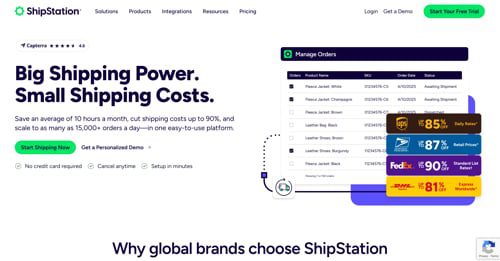
ShipStation leverages predictive intelligence on fulfillment, delivery, and returns. ShipStation, a shipping and logistics platform, has launched Intelligence, a predictive AI tool to help merchants reduce operational inefficiencies and expenses. According to ShipStation, Intelligence enables merchants to automatically select the best carrier and service level for every shipment, identify delivery risks and delays, automate fulfillment workflows, and optimize international shipping decisions, including customs and duty management.

Home page of ShipStation

ShipStation

FedEx to offer same-day delivery options. FedEx has announced the rollout of SameDay Local in collaboration with OneRail, a last-mile delivery company. SameDay Local lets shoppers choose two-hour or end-of-day delivery directly at checkout. The service will connect FedEx customers to a U.S. network of roughly 1,000 delivery providers, coordinated through intelligent orchestration that matches orders with vehicles and drivers, tracked with live updates from pickup to delivery.

Reddit introduces new tools for shopping. Reddit is launching shopping tools to enhance its Dynamic Product Ads experience. Collection Ads allow businesses to lead with a lifestyle hero image paired with shoppable product tiles in a single carousel. Community overlays indicate products that are resonating on Reddit, while Deal overlays automatically call out discounts and sale pricing. Also, Reddit says its new Shopify integration simplifies catalog and pixel setup, enabling frictionless onboarding for new advertisers.

Klaviyo expands autonomous marketing with Composer. Klaviyo, a marketing automation platform, has launched Composer, an agentic experience that generates, optimizes, and recommends marketing campaigns and flows from a single prompt. With Composer, marketers describe what they want in plain language, and Composer builds a launch-ready campaign, including audience segments and messaging optimized for each channel. Klaviyo has also released new retail tools for its Customer Agent, including order tracking, returns and exchanges, subscription editing, and loyalty lookup.

Home page of Klaviyo

Klaviyo

Alibaba launches Accio Work AI agent for global merchants. Alibaba International has unveiled Accio Work, a plug-and-play enterprise AI agent. The platform requires no setup, per Alibaba International, and deploys specialized agents to execute complex, long-horizon operations. Accio Work enables businesses (online or physical) to manage real-time VAT filings, tax refunds, and customs documentation across more than 100 markets. Businesses can issue requests for quotation and conduct multi-round negotiations with suppliers through tools such as Telegram and WhatsApp.

Algolia enhances search for Shopify merchants. Algolia, an AI search and retrieval platform, has announced enhancements to its Shopify integration. The release introduces (i) Commerce Pipeline, an indexing foundation that improves speed and reliability, and (ii) Click-to-Activate Pixel Analytics, which captures shopper behavior. Algolia has expanded customization within Shopify App Blocks, and Algolia now indexes Shopify Metaobjects and Shopify’s Standard Product Taxonomy, enabling richer search content and more precise merchandising control.

Google enhances shopping for AI agents. Google has announced updates to the Universal Commerce Protocol for AI-driven commerce. UCP now offers an option that lets agents add multiple items to a shopping cart at once from a single store. UCP adopters can access a capability that lets agents retrieve real-time product details from a retailer’s catalog. UCP also supports identity linking, allowing shoppers on UCP-integrated platforms to receive loyalty or member benefits, such as pricing or free shipping.

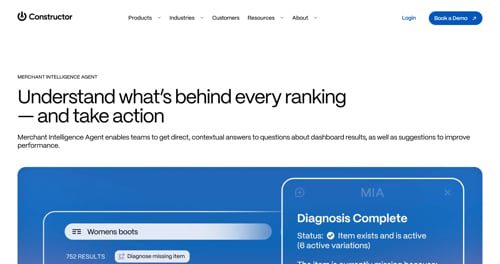
Constructor unveils AI agent for product discovery. Constructor, an AI-powered search and discovery platform for ecommerce companies, has released Merchant Intelligence Agent, which brings conversational intelligence to merchandising teams to improve how shoppers discover products. Teams can ask the new AI agent natural-language questions, investigate campaign performance, request recommendations to accomplish merchandising goals, and more.

Web page for Constructor Merchant Intelligence Agent

Constructor Merchant Intelligence Agent

Coveo launches search-native conversational AI for product discovery. Coveo, a platform for AI-powered relevance for digital experiences, has launched Conversational Product Discovery, a capability that allows shoppers to discover products through natural language conversations within the search experience. The discovery agent coordinates multiple AI functions to interpret shopper intent, retrieve relevant products from a retailer’s catalog, and assemble responses grounded in catalog data and merchandising rules. Users maintain control through defined layouts, content guardrails, and merchandising directives.

Splitit launches Go to extend installments for field sales. Splitit, an installment payments platform, has launched Go, a mobile tool that brings credit-card-linked installments into face-to-face environments. Splitit Go allows customers to use their existing credit cards, while merchants can generate installment offers from a smartphone, tablet, or laptop. Customers receive the offer via QR code, text, or email, review the terms on their own device, and complete the purchase using available credit on their card.

Claude, ChatGPT, and Cursor can now take direct action on WordPress.com. WordPress.com has launched new write capabilities for its Model Context Protocol server. The update enables AI agents, including Claude, ChatGPT, and Cursor, to create, edit, and manage content on WordPress.com sites directly through natural conversation. Users can instruct their AI agent to draft and publish blog posts and pages, edit and update existing content, and create new pages and manage site content — all through natural conversation.

WizCommerce launches AI Video Generator for brands. WizCommerce, an ecommerce platform, has launched its AI Video Generator, a module inside WizStudio that transforms a single product image into a publish-ready video in minutes. Lifestyle Product Videos places products in on-brand environments with cinematic motion, optimized for social media and storefronts. Product Closeups highlight materials, textures, and details. 360° Spin Videos allow shoppers to explore products from every angle.

Home page of WizCommerce

WizCommerce

Shoplazza adopts agentic commerce architecture. Shoplazza, a D2C commerce platform, has launched an agentic commerce architecture, with AI agents to execute ecommerce operational tasks. According to Shoplazza, merchants can describe the business outcome, and the platform coordinates actions across operations, payments, marketing, and customer-management systems. The platform can automatically execute tasks such as creating campaigns, updating storefront merchandising, and monitoring performance.

Mliveo launches AI-powered livestream cross-border ecommerce solution. Mliveo, a provider of cross-border ecommerce tools, has launched its upgraded AI Livestream Commerce Suite. The new suite integrates AI hosts, intelligent product sourcing, and a global dropshipping network to provide a unified B2B growth for cross-border sellers and brands. With Mliveo, sellers need only to upload product SKUs and define their profit margins. The platform then automates product analysis, livestream distribution, and order conversion.

Zonos launches AI products for cross-border shipments. Zonos, a cross-border technology company, has launched AI-powered products that infer and validate customs data. Classify determines the correct commodity code. Country of Origin provides a ranked list of probable locales. Customs Value returns a recommended value alongside a range of prices. Customs Description transforms product names and retail descriptions into concise customs descriptions. Vision extracts item information from a photograph. Greenlight is an API for validating export compliance.

Netguru launches design system for marketplaces and commerce products. Netguru, an ecommerce consultancy, has launched Silk, a system to help product teams design and ship marketplaces and commerce applications. Silk provides a toolkit of reusable UI components, design tokens, and documented patterns that enable teams to build digital marketplaces, ecommerce platforms, and B2B commerce products without having to produce core interface elements from scratch. Silk is available as a free design system for Figma, including component libraries, documentation, and example product screens.

Home page of Netguru

Netguru