OpenAI launches Operator—an agent that can use a computer for you

After weeks of buzz, OpenAI has released Operator, its first AI agent. Operator is a web app that can carry out simple online tasks in a browser, such as booking concert tickets or filling an online grocery order. The app is powered by a new model called Computer-Using Agent—CUA (“coo-ah”), for short—built on top of OpenAI’s multimodal large language model GPT-4o.

Operator is available today at operator.chatgpt.com to people in the US signed up with ChatGPT Pro, OpenAI’s premium $200-a-month service. The company says it plans to roll the tool out to other users in the future.

OpenAI claims that Operator outperforms similar rival tools, including Anthropic’s Computer Use (a version of Claude 3.5 Sonnet that can carry out simple tasks on a computer) and Google DeepMind’s Mariner (a web-browsing agent built on top of Gemini 2.0).

The fact that three of the world’s top AI firms have converged on the same vision of what agent-based models could be makes one thing clear. The battle for AI supremacy has a new frontier—and it’s our computer screens.

“Moving from generating text and images to doing things is the right direction,” says Ali Farhadi, CEO of the Allen Institute for AI (AI2). “It unlocks business, solves new problems.”

Farhadi thinks that doing things on a computer screen is a natural first step for agents: “It is constrained enough that the current state of the technology can actually work,” he says. “At the same time, it’s impactful enough that people might use it.” (AI2 is working on its own computer-using agent, says Farhadi.)

Don’t believe the hype

OpenAI’s announcement also confirms one of two rumors that circled the internet this week. One predicted that OpenAI was about to reveal an agent-based app, after details about Operator were leaked on social media ahead of its release. The other predicted that OpenAI was about to reveal a new superintelligence—and that officials for newly inaugurated President Trump would be briefed on it.

Could the two rumors be linked? OpenAI superfans wanted to know.

Nope. OpenAI gave MIT Technology Review a preview of Operator in action yesterday. The tool is an exciting glimpse of large language models’ potential to do a lot more than answer questions. But Operator is an experimental work in progress. “It’s still early, it still makes mistakes,” says Yash Kumar, a researcher at OpenAI.

(As for the wild superintelligence rumors, let’s leave that to OpenAI CEO Sam Altman to address: “twitter hype is out of control again,” he posted on January 20. “pls chill and cut your expectations 100x!”)

Like Anthropic’s Computer Use and Google DeepMind’s Mariner, Operator takes screenshots of a computer screen and scans the pixels to figure out what actions it can take. CUA, the model behind it, is trained to interact with the same graphical user interfaces—buttons, text boxes, menus—that people use when they do things online. It scans the screen, takes an action, scans the screen again, takes another action, and so on. That lets the model carry out tasks on most websites that a person can use.

“Traditionally the way models have used software is through specialized APIs,” says Reiichiro Nakano, a scientist at OpenAI. (An API, or application programming interface, is a piece of code that acts as a kind of connector, allowing different bits of software to be hooked up to one another.) That puts a lot of apps and most websites off limits, he says: “But if you create a model that can use the same interface that humans use on a daily basis, it opens up a whole new range of software that was previously inaccessible.”

CUA also breaks tasks down into smaller steps and tries to work through them one by one, backtracking when it gets stuck. OpenAI says CUA was trained with techniques similar to those used for its so-called reasoning models, o1 and o3. 

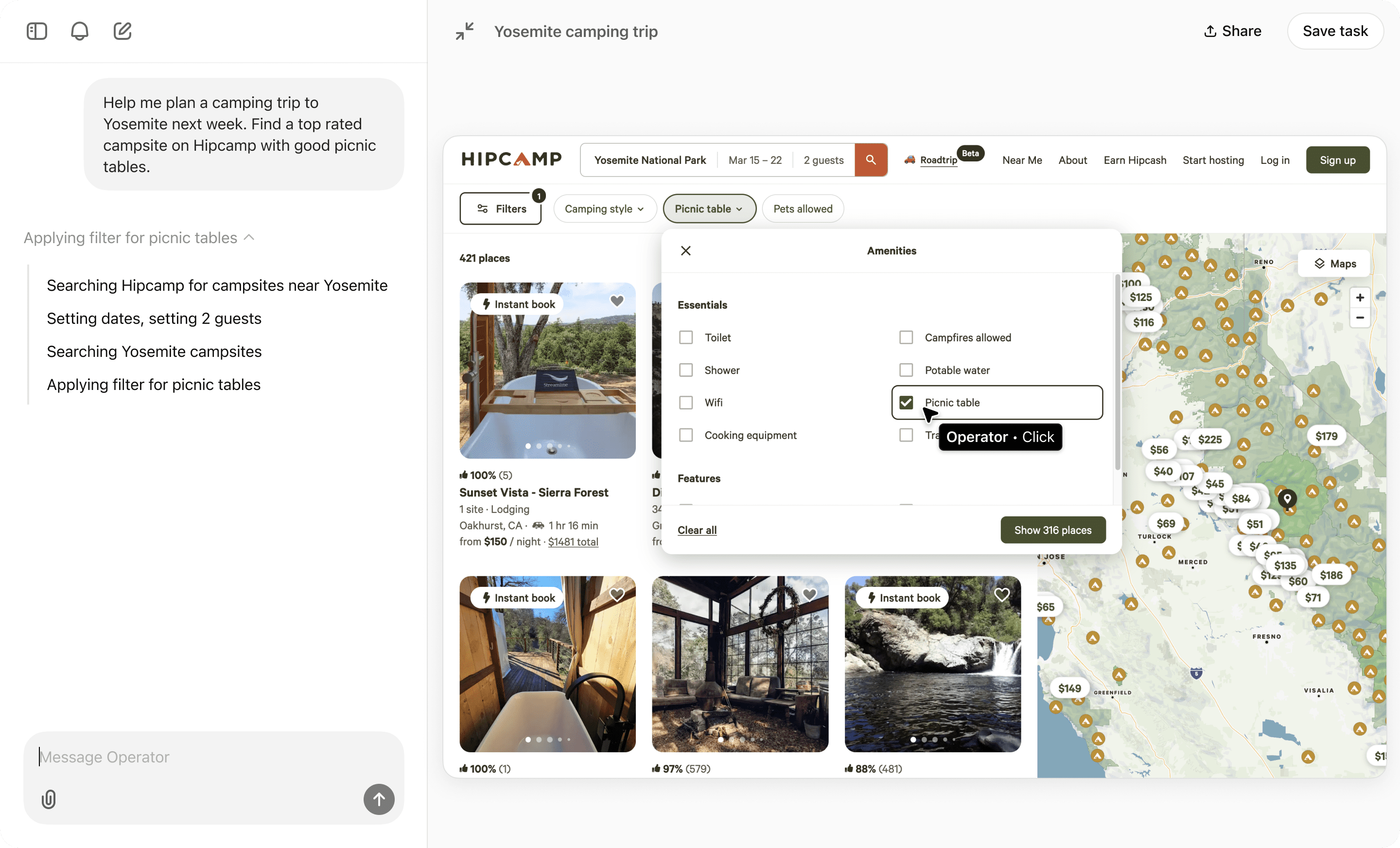
Operator can be instructed to search for campsites in Yosemite with good picnic tables.
OPENAI

OpenAI has tested CUA against a number of industry benchmarks designed to assess the ability of an agent to carry out tasks on a computer. The company claims that its model beats Computer Use and Mariner in all of them.

For example, on OSWorld, which tests how well an agent performs tasks such as merging PDF files or manipulating an image, CUA scores 38.1% to Computer Use’s 22.0%  In comparison, humans score 72.4%. On a benchmark called WebVoyager, which tests how well an agent performs tasks in a browser, CUA scores 87%, Mariner 83.5%, and Computer Use 56%. (Mariner can only carry out tasks in a browser and therefore does not score on OSWorld.)

For now, Operator can also only carry out tasks in a browser. OpenAI plans to make CUA’s wider abilities available in the future via an API that other developers can use to build their own apps. This is how Anthropic released Computer Use in December.

OpenAI says it has tested CUA’s safety, using red teams to explore what happens when users ask it to do unacceptable tasks (such as research how to make a bioweapon), when websites contain hidden instructions designed to derail it, and when the model itself breaks down. “We’ve trained the model to stop and ask the user for information before doing anything with external side effects,” says Casey Chu, another researcher on the team.

Look! No hands

To use Operator, you simply type instructions into a text box. But instead of calling up the browser on your computer, Operator sends your instructions to a remote browser running on an OpenAI server. OpenAI claims that this makes the system more efficient. It’s another key difference between Operator, Computer Use and Mariner (which runs inside Google’s Chrome browser on your own computer).

Because it’s running in the cloud, Operator can carry out multiple tasks at once, says Kumar. In the live demo, he asked Operator to use OpenTable to book him a table for two at 6.30 p.m. at a restaurant called Octavia in San Francisco. Straight away, Operator opened up OpenTable and started clicking through options. “As you can see, my hands are off the keyboard,” he said.

OpenAI is collaborating with a number of businesses, including OpenTable, StubHub, Instacart, DoorDash, and Uber. The nature of those collaborations is not exactly clear, but Operator appears to suggest preset websites to use for certain tasks.

While the tool navigated dropdowns on OpenTable, Kumar sent Operator off to find four tickets for a Kendrick Lamar show on StubHub. While it did that, he pasted a photo of a handwritten shopping list and asked Operator to add the items to his Instacart.

He waited, flicking between Operator’s tabs. “If it needs help or if it needs confirmations, it’ll come back to you with questions and you can answer it,” he said.

Kumar says he has been using Operator at home. It helps him stay on top of grocery shopping: “I can just quickly click a photo of a list and send it to work,” he says.

It’s also become a sidekick in his personal life. “I have a date night every Thursday,” says Kumar. So every Thursday morning, he instructs Operator to send him a list of five restaurants that have a table for two that evening. “Of course, I could do that, but it takes me 10 minutes,” he says. “And I often forget to do it. With Operator, I can run the task with one click. There’s no burden of booking.”

What’s next for robots

MIT Technology Review’s What’s Next series looks across industries, trends, and technologies to give you a first look at the future. You can read the rest of them here.

Jan Liphardt teaches bioengineering at Stanford, but to many strangers in Los Altos, California, he is a peculiar man they see walking a four-legged robotic dog down the street. 

Liphardt has been experimenting with building and modifying robots for years, and when he brings his “dog” out in public, he generally gets one of three reactions. Young children want to have one, their parents are creeped out, and baby boomers try to ignore it. “They’ll quickly walk by,” he says, “like, ‘What kind of dumb new stuff is going on here?’” 

In the many conversations I’ve had about robots, I’ve also found that most people tend to fall into these three camps, though I don’t see such a neat age division. Some are upbeat and vocally hopeful that a future is just around the corner in which machines can expertly handle much of what is currently done by humans, from cooking to surgery. Others are scared: of job losses, injuries, and whatever problems may come up as we try to live side by side. 

The final camp, which I think is the largest, is just unimpressed. We’ve been sold lots of promises that robots will transform society ever since the first robotic arm was installed on an assembly line at a General Motors plant in New Jersey in 1961. Few of those promises have panned out so far. 

But this year, there’s reason to think that even those staunchly in the “bored” camp will be intrigued by what’s happening in the robot races. Here’s a glimpse at what to keep an eye on. 

Humanoids are put to the test

The race to build humanoid robots is motivated by the idea that the world is set up for the human form, and that automating that form could mean a seismic shift for robotics. It is led by some particularly outspoken and optimistic entrepreneurs, including Brett Adcock, the founder of Figure AI, a company making such robots that’s valued at more than $2.6 billion (it’s begun testing its robots with BMW). Adcock recently told Time, “Eventually, physical labor will be optional.” Elon Musk, whose company Tesla is building a version called Optimus, has said humanoid robots will create “a future where there is no poverty.” A robotics company called Eliza Wakes Up is taking preorders for a $420,000 humanoid called, yes, Eliza.

In June 2024, Agility Robotics sent a fleet of its Digit humanoid robots to GXO Logistics, which moves products for companies ranging from Nike to Nestlé. The humanoids can handle most tasks that involve picking things up and moving them somewhere else, like unloading pallets or putting boxes on a conveyor. 

There have been hiccups: Highly polished concrete floors can cause robots to slip at first, and buildings need good Wi-Fi coverage for the robots to keep functioning. But charging is a bigger issue. Agility’s current version of Digit, with a 39-pound battery, can run for two to four hours before it needs to charge for one hour, so swapping out the robots for fresh ones is a common task on each shift. If there are a small number of charging docks installed, the robots can theoretically charge by shuffling among the docks themselves overnight when some facilities aren’t running, but moving around on their own can set off a building’s security system. “It’s a problem,” says CTO Melonee Wise.

Wise is cautious about whether humanoids will be widely adopted in workplaces. “I’ve always been a pessimist,” she says. That’s because getting robots to work well in a lab is one thing, but integrating them into a bustling warehouse full of people and forklifts moving goods on tight deadlines is another task entirely.

If 2024 was the year of unsettling humanoid product launch videos, this year we will see those humanoids put to the test, and we’ll find out whether they’ll be as productive for paying customers as promised. Now that Agility’s robots have been deployed in fast-paced customer facilities, it’s clear that small problems can really add up. 

Then there are issues with how robots and humans share spaces. In the GXO facility the two work in completely separate areas, Wise says, but there are cases where, for example, a human worker might accidentally leave something obstructing a charging station. That means Agility’s robots can’t return to the dock to charge, so they need to alert a human employee to move the obstruction out of the way, slowing operations down.  

It’s often said that robots don’t call out sick or need health care. But this year, as fleets of humanoids arrive on the job, we’ll begin to find out the limitations they do have.

Learning from imagination

The way we teach robots how to do things is changing rapidly. It used to be necessary to break their tasks down into steps with specifically coded instructions, but now, thanks to AI, those instructions can be gleaned from observation. Just as ChatGPT was taught to write through exposure to trillions of sentences rather than by explicitly learning the rules of grammar, robots are learning through videos and demonstrations. 

That poses a big question: Where do you get all these videos and demonstrations for robots to learn from?

Nvidia, the world’s most valuable company, has long aimed to meet that need with simulated worlds, drawing on its roots in the video-game industry. It creates worlds in which roboticists can expose digital replicas of their robots to new environments to learn. A self-driving car can drive millions of virtual miles, or a factory robot can learn how to navigate in different lighting conditions.

In December, the company went a step further, releasing what it’s calling a “world foundation model.” Called Cosmos, the model has learned from 20 million hours of video—the equivalent of watching YouTube nonstop since Rome was at war with Carthage—that can be used to generate synthetic training data.

Here’s an example of how this model could help in practice. Imagine you run a robotics company that wants to build a humanoid that cleans up hospitals. You can start building this robot’s “brain” with a model from Nvidia, which will give it a basic understanding of physics and how the world works, but then you need to help it figure out the specifics of how hospitals work. You could go out and take videos and images of the insides of hospitals, or pay people to wear sensors and cameras while they go about their work there.

“But those are expensive to create and time consuming, so you can only do a limited number of them,” says Rev Lebaredian, vice president of simulation technologies at Nvidia. Cosmos can instead take a handful of those examples and create a three-dimensional simulation of a hospital. It will then start making changes—different floor colors, different sizes of hospital beds—and create slightly different environments. “You’ll multiply that data that you captured in the real world millions of times,” Lebaredian says. In the process, the model will be fine-tuned to work well in that specific hospital setting. 

It’s sort of like learning both from your experiences in the real world and from your own imagination (stipulating that your imagination is still bound by the rules of physics). 

Teaching robots through AI and simulations isn’t new, but it’s going to become much cheaper and more powerful in the years to come. 

A smarter brain gets a smarter body

Plenty of progress in robotics has to do with improving the way a robot senses and plans what to do—its “brain,” in other words. Those advancements can often happen faster than those that improve a robot’s “body,” which determine how well a robot can move through the physical world, especially in environments that are more chaotic and unpredictable than controlled assembly lines. 

The military has always been keen on changing that and expanding the boundaries of what’s physically possible. The US Navy has been testing machines from a company called Gecko Robotics that can navigate up vertical walls (using magnets) to do things like infrastructure inspections, checking for cracks, flaws, and bad welding on aircraft carriers. 

There are also investments being made for the battlefield. While nimble and affordable drones have reshaped rural battlefields in Ukraine, new efforts are underway to bring those drone capabilities indoors. The defense manufacturer Xtend received an $8.8 million contract from the Pentagon in December 2024 for its drones, which can navigate in confined indoor spaces and urban environments. These so-called “loitering munitions” are one-way attack drones carrying explosives that detonate on impact.

“These systems are designed to overcome challenges like confined spaces, unpredictable layouts, and GPS-denied zones,” says Rubi Liani, cofounder and CTO at Xtend. Deliveries to the Pentagon should begin in the first few months of this year. 

Another initiative—sparked in part by the Replicator project, the Pentagon’s plan to spend more than $1 billion on small unmanned vehicles—aims to develop more autonomously controlled submarines and surface vehicles. This is particularly of interest as the Department of Defense focuses increasingly on the possibility of a future conflict in the Pacific between China and Taiwan. In such a conflict, the drones that have dominated the war in Ukraine would serve little use because battles would be waged almost entirely at sea, where small aerial drones would be limited by their range. Instead, undersea drones would play a larger role.

All these changes, taken together, point toward a future where robots are more flexible in how they learn, where they work, and how they move. 

Jan Liphardt from Stanford thinks the next frontier of this transformation will hinge on the ability to instruct robots through speech. Large language models’ ability to understand and generate text has already made them a sort of translator between Liphardt and his robot.

“We can take one of our quadrupeds and we can tell it, ‘Hey, you’re a dog,’ and the thing wants to sniff you and tries to bark,” he says. “Then we do one word change—‘You’re a cat.’ Then the thing meows and, you know, runs away from dogs. And we haven’t changed a single line of code.”

Correction: A previous version of this story incorrectly stated that the robotics company Eliza Wakes Up has ties to a16z.

New Ecommerce Tools: January 23, 2025

Every week we publish a rundown of new products from companies offering services to ecommerce merchants. This installment includes updates on generative AI search, website builders, fulfillment, marketing platforms, reverse logistics, mobile payments, cross-border ecommerce, and click-to-cancel requirements.

Got an ecommerce product release? Email releases@practicalecommerce.com.

New Tools for Merchants

Perplexity releases Sonar API with real-time AI search. AI search engine Perplexity has launched Sonar and Sonar Pro API, enabling developers to integrate Perplexity’s generative search capabilities with real-time information and citations. Sonar API is the base version, which is cheaper and quicker and includes citations and the ability to customize sources. Sonar Pro API can handle in-depth, multi-step queries with added extensibility, such as double the number of citations per search, more nuanced searches, and follow-up questions.

Web page for Sonar API by Perplexity

Sonar API by Perplexity

Wix and Worldline partner to expand ecommerce payments in Europe and Asia. Website builder Wix has partnered with payment provider Worldline in select Europe and Asia Pacific countries. New and existing Worldline customers can access Wix’s platform to build and manage an online store. Wix users can leverage Worldline’s local payment processing services and distribution networks.

Amazon launches portal to help FBA sellers with reimbursable opportunities. Amazon has launched an “Inventory Defect and Reimbursement” portal to streamline seller operations and provide transparency into Fulfillment by Amazon’s defects practices. Sellers can manage inventory defects and reimbursements within warehouse lost, warehouse damage, and customer returns — all through the IDR portal. Sellers get visibility into defects and their status, detailed information for each defect, a view of defects from multiple reports and policy checks, and insights into defect frequency and the resolution rationale.

Veho launches premium economy delivery service. Veho, a technology company operating alternative U.S. delivery platforms, has launched a Premium Economy service for parcel delivery in five days or less. Veho says Premium Economy will provide a cost-effective alternative to USPS and UPS services and is well suited for consumer brands shipping lightweight parcels, subscription brands shipping non-perishable goods, and third-party logistics providers.

Home page of Veho

Veho

Omnisend adds reporting functionality to its ecommerce marketing platform. Ecommerce email and SMS platform Omnisend has launched upgraded reporting functionality, allowing merchants to analyze emails, SMS, and push notifications in one reporting platform for any date range. Businesses can now compare the performance of each channel with full data history, comparisons of each channel’s revenue, and control over sales attribution to different channels.

DHL Supply Chain acquires reverse logistics platform. DHL Supply Chain, part of logistics provider DHL Group, has acquired Inmar Supply Chain Solutions, a division of Inmar Intelligence and a returns solutions provider for the retail ecommerce industry. The acquisition will result in 14 return centers joining DHL Supply Chain, expanding the company’s North American footprint, which currently stands at over 520 warehouses. DHL Supply Chain will strengthen its returns capabilities to include product remarketing, recall management, and supply chain performance analytics.

Swap and Avalara partner on cross-border commerce. Swap, an ecommerce logistics platform, has partnered with Avalara, a provider of tax compliance automation software. Swap and Avalara will collaborate to enable cross-border compliance for brands selling on marketplaces and platforms. According to Swap, the integrated offering reduces cross-border complexity and compliance risk and ensures timely payments of duties, taxes, and fees.

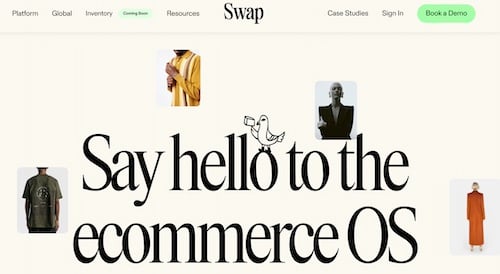
Home page of Swap

Swap

Amazon launches a suite of foundational models. Amazon has launched Nova, a suite of foundation models to help businesses leverage artificial intelligence. By tapping into a company’s data sources, Amazon Nova can deliver tailored insights, recommendations, and more. Nova features natural language understanding, integration with popular business apps, price performance, and enterprise-grade security features. Use cases include customer support, content generation, data analysis, and personalized product or service recommendations.

Deluxe launches mobile app dlxPAY for merchants. Deluxe, a payments and data company, has launched dlxPAY, a mobile app to enhance the payment experience for merchants and partners. dlxPAY offers merchants a suite of features to streamline payment processing, including real-time transaction management, advanced security, and customizable notifications. Additionally, the app integrates with Ingenico’s Moby 5500 card reader device, adding flexibility for businesses that require mobile payment solutions, including contactless and Europay, Mastercard, and Visa chip card acceptance.

Cloudways hosting launches AI-powered diagnostic solutions for SMBs. Cloudways, part of DigitalOcean Holdings, is launching Cloudways Copilot, a suite of AI services that bring intelligent managed hosting to small- and medium-sized businesses. Cloudways Copilot empowers digital businesses to address website-related problems by automatically detecting, diagnosing, and supporting the resolution in real time. The rollout of AI-powered issue diagnostics is the first phase of the Cloudways Copilot launch.

Chargebee subscription management helps with click-to-cancel requirements. Chargebee, a subscription management platform, has announced that its Retention feature helps businesses meet the U.S. Federal Trade Commission’s new click-to-cancel requirements. The FTC now mandates a straightforward cancellation process for consumers, targeting subscription services that use features such as automatic renewals or free-to-pay conversions. Chargebee Retention helps businesses comply with the new requirements and provides insights into why customers leave.

Home page of Chargebee

Chargebee

Print Ads Are an Ecommerce Opportunity

Print magazines can be an unusual opportunity for niche ecommerce merchants.

Digital advertising dominates ecommerce, with good reason. The ads are measurable, easily updated, and often produce instant results. Place an ad and get a sale on the same day.

In contrast, print advertising does not usually produce immediate results and is not easy to measure. Yet the medium has unique values that established marketers appreciate.

Take Amazon’s October 2024 printed toy catalog, for example.

“We’re not surprised to see Amazon leaning into their toy catalog,” said Polly Wong, president of Belardi Wong, a New Jersey-based marketing firm, in a correspondence with Practical Ecommerce.

“Hundreds of brands have added direct mail and catalogs to their mix over the last five years because print offers unique advantages to digital marketing — more real estate to show your product and entice consumers to buy, 100% reach, high lifetime value from customers who respond to print, and a very effective way to stand out to new customers.”

In essence, print promotions — such as catalogs or magazine ads — complement digital advertising.

Brand Advertising

Magazines and printed catalogs can provide valuable brand advertising, an often overlooked approach by ecommerce marketers.

Brand ads in a magazine tend to linger and get many “impressions.”

“An ad in print will sit in someone’s home or near someone’s desk for months upon months, sometimes even years,” wrote Troy Klongerbo, general manager at Homestead Living magazine, in an email interview.

To Klongerbo’s point, most magazine subscribers flip through the publication several times, repeatedly referring to articles and ads. His publication often includes recipes and reference material so that issues become “fixtures” in the kitchen or the shed.

Copies of Homestead Living on a table

Print magazines such as Homestead Living can linger on a coffee table or desk for months as subscribers revisit them.

Printed ads can also build trust. A company with a printed ad appears to be established and trustworthy.

“There’s a deeper implied trust with words and pictures placed in print. Once printed, words and messages cannot be altered, providing for a sort of permanence. Digital ads, even the best of them, are ephemeral to a degree,” wrote Klongerbo.

Indications

While short-lived, digital ads provide solid data, which print does not. An advertiser must be clever about collecting and analyzing print performance and willing to accept indications.

Many print advertisers use several performance indicators in combination.

  • Brand lift surveys. Measure changes in brand awareness, consideration, and favorability after exposure to brand advertising campaigns.
  • Social media engagement. Monitor mentions, shares, and sentiment related to the brand, especially when an issue is first published.
  • Website traffic. Pay attention to website traffic and engagement metrics. An increase in direct or branded search visits often indicates that print advertising is working.
  • Share of voice. Compares the brand’s advertising or marketing presence against competitors within a specific market or industry.
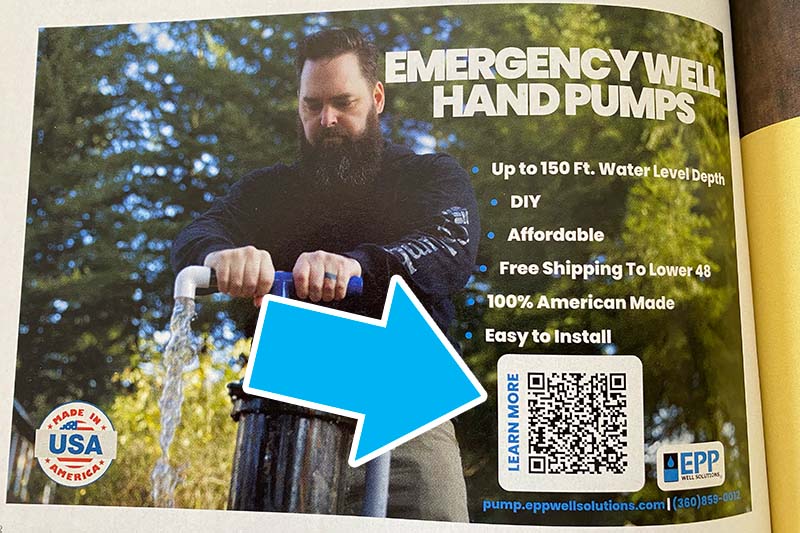
  • Direct response. Finally, thanks to coupon codes, subdomains, and QR codes, magazines and catalogs can capture some direct response data, but this, too, is indicative, not definitive. Ten scanned QR code visits may represent 100 consumers.
Advertisement with a QR code in Homestead Living magazine

QR and coupon codes enable print ads to capture direct response data, as in this example from Homestead Living.

Affiliates

Some print publications use this last form of measurement — direct response — to run affiliate ads for ecommerce brands.

This affiliate relationship is relatively new in print magazines, perhaps borne out of influencer marketing. Modern advertisers are often comfortable with influencer relationships combining flat-rate and affiliate payments.

For example, a direct-to-consumer brand might pay an influencer a nominal fee to produce an Instagram Reel and then pay affiliate commissions to the influencer for sales made with her discount code.

Similar arrangments now occur in print. The advertiser pays a low flat rate to help offset the cost of printing and distributing the ad and shares the revenue tracked via a QR code.

If a brand’s typical affiliate share is 15%, the publication might receive 30% to 50%, recognizing that some shoppers will search for the brand or type in its URL rather than using the QR code.

Complementary

Branded print advertising can positively impact digital. Countless published reports confirm that branding boosts performance ads, driving relatively more clicks, engagements, and conversions.

In short, printed and online ads are complementary approaches to achieving marketing objectives.

Does Google Favor UGC? Reddit Leads In Search Growth [STUDY] via @sejournal, @MattGSouthern

This past year was a big one for SEO, with major changes in how Google ranks content.

According to SISTRIX’s latest IndexWatch report, the year’s biggest winners were platforms focused on user-generated content (UGC), AI-powered tools, and large ecommerce brands.

Reddit emerged as the leader among standout performers, but its dominance raises questions about Google’s practices.

Here’s a breakdown of the top-performing sites and what drove their success.

Top Performers in Search Growth

The report highlights Reddit as the year’s top performer, nearly tripling its visibility in Google’s US search results.

Reddit climbed higher in rankings for a variety of keywords, from product reviews to niche discussions, making it a major competitor to traditional content and e-commerce sites.

Other big winners in search visibility included:

  1. Reddit.com: +190.9% growth
  2. Instagram.com: Significant increases driven by its visual and video content
  3. YouTube.com: Continued dominance through video SEO
  4. Spotify.com: Strong gains in music-related searches
  5. Wikipedia.org: Consistent growth as an authoritative content source

Reddit’s Dominance Raises Questions

While Reddit’s success is significant, it raises ethical and strategic questions for the SEO community.

Google’s policies, such as its stance on “site reputation” and “scaled content” abuse, discourage websites from publishing content outside their established topical authority. This policy aims to prevent sites from piggybacking on their existing authority to rank for unrelated keywords.

Yet Reddit appears to be exempt from this rule. The platform ranks for an incredibly wide range of keywords, from precise technical terms to general lifestyle topics, without being tied to a single area of expertise.

This begs the question: why does Reddit get to rank for everything while other sites are penalized for straying too far from their core focus?

Adding to the intrigue, it’s worth noting that Reddit has a deal in place with Google for broader search distribution. While this partnership isn’t entirely transparent, it raises further concerns about fairness in Google’s ranking system and whether specific platforms receive preferential treatment.

Fastest-Growing Sites by Percentage

While the largest platforms gained the most ground overall, several smaller ones stood out:

  1. ck12.org: +601.59% growth in rankings
  2. VirginAtlantic.com: +509.74% growth following site migrations
  3. Quillbot.com: +490.70% growth via AI-driven SEO strategies
  4. Hardrock.com: +436.63% growth after consolidating site sections
  5. TheKitchn.com: +300.40% growth driven by recipe content

The report notes that many sites relied on “programmatic” SEO strategies.

For example, ck12.org used AI-powered resources to rank for thousands of educational queries.

Lily Ray states in the report:

“For some of the winners, visibility growth stemmed from a “programmatic SEO” strategy, which use automation to scale pages that target many different search queries relevant to the site’s core offerings. For example, the site ck12.org, which claims to be the “world’s most powerful AI tutor,” has seen substantial visibility growth, predominantly stemming from its ‘flexbooks’ subdomain and ‘flexi’ subfolders.”

User-Generated Content

UGC platforms had a breakthrough year. Alongside Reddit, sites like Quora, Stack Exchange, and GitHub gained significant search visibility.

HubPages, particularly its Discover subdomain, also emerged as a major winner, growing in rankings by targeting topics like jokes, pet advice, and music.

Google’s algorithm seems to favor UGC platforms even when individual articles vary in quality.

The report notes:

“Interestingly, many of these articles resemble low-quality content that often causes demotion by Google’s algorithm updates targeting spammy content. This suggests Google’s algorithms may put more weight on prioritizing UGC websites like HubPages, which contain authentic human experiences and contributions, over penalizing or demoting individual articles included on those sites.”

E-Commerce Sites Make a Comeback

E-commerce platforms rebounded after a challenging few years.

Carters.com, for example, saw a boost by ranking for popular keywords like “baby clothes” and “kids clothing store.”

Other brands, such as Nike, Lenovo, and eBay, also experienced steady growth thanks to site updates, platform migrations, and better keyword targeting.

Key Takeaways

This year’s biggest SEO winners reflect three major trends:

  1. Google loves UGC: Platforms like Reddit and Quora thrived as Google prioritized community-driven content over traditional formats.
  2. Programmatic SEO strategies can work: Sites like ck12.org and Quillbot.com used scalable, AI-driven approaches to rank for various search queries.
  3. E-commerce rebounds: Retailers focused on SEO-friendly updates and keyword targeting saw strong gains in organic search.

Final Thoughts

Reddit’s rise highlights a larger debate: Is Google playing fair?

While most sites are held to strict standards for authority and expertise, Reddit appears to operate under different rules, ranking across nearly every vertical. Combined with its search distribution deal with Google, this raises questions about transparency and equity in search rankings.

As we move into 2025, it’s clear that websites must adapt to an evolving rulebook—one in which authenticity, AI strategies, and ethical considerations all play a role in success.


Featured Image: eamesBot/Shutterstock

Brand Performance Unlocked: Advanced Strategies for SEO and Marketing Synergy via @sejournal, @sejournal

Balancing brand and performance marketing has nothing to do with giving each side its amount of time in the limelight.

There’s no magic harmony you’re going to create that delivers some sort of marketing tactic equilibrium and equality.

This is the most controversial article I have ever written. A lot of people reading this will not be happy about what I have to say. For the record, there’s a bit of irony in this, considering I have said way more controversial things about marketing and SEO in the past.

Yet, here we are as I am about to tell you that the only way to balance brand and performance marketing is to give brand supremacy.

Let the fireworks begin.

Balance Brand & Performance Marketing? Why Is There Even A Problem?

In keeping with espousing heresy I will not start this post with “What is brand marketing?” and/or “What is performance marketing?” nor will I dive right into how to balance the two.

Instead, I’m going to challenge the very premise of the article so that you can better understand why this question is even worth your time.

While I see the problem as basically being self-evident, let’s flush it out a bit. The way I see it, there are two fundamental issues at play here (there are more, but this post is going to be long enough as it is):

1. Mindset

The mindset required for good brand marketing is, at times, lightyears away from the performance mindset.

I’m not saying that they intrinsically have to be this way. As I’ll get into later, I think the two ways of thinking complement each other.

However, at the risk of generalizing, there does tend to be a strong divergence between how the two types of marketers think. At least, this has been my experience over the past decade or so as someone who straddles both marketing disciplines.

I often find performance marketers very focused on the immediate. What’s bringing traffic right now, and how do we get more of it?

For the record, that’s not necessarily a bad thing. Nor is it unreasonable (I mean, it is, but it’s not).

This hyperfocus on immediate performance metrics is quite logical since performance marketers are graded on immediate ROI. Is it thus any surprise they focus on the immediate? (So, performance marketers, it’s not you…it’s the system.)

Brand has an entirely different goal. With brand building, the focus is on exactly that: building. Building an identity, associations and sentiment, messaging, positioning, etc.

All of that takes time. You don’t immediately leave an imprint on someone. If you want to create an impression with an audience, it’s pretty obvious it’s going to take time.

This process is also far more compounded and less linear than performance marketing is often perceived. It’s not like getting a page to rank well and driving in traffic who will convert.

You’re creating a reputation for yourself that involves micro-moments and micro-activities compounding over an extended period (like how any association is formed).

(For what it’s worth, I would argue that performance-based activities, such as SEO, also compound over time. You’re not going to rank for that meaty keyword on day one).

Brand marketing naturally lends itself to a bit more of a holistic long-term mindset whereas performance-based marketing lends itself to focusing more on the immediate impact of a given activity.

These divergent mindsets make it entirely difficult to properly balance brand and performance. They’re almost at war with each other.

To sum it all up: Performance marketing (to its detriment) looks at the end result and often doesn’t care about context, environment, and ecosystems. Brand, on the other hand, is all about contextualization and understanding the environment and ecosystem the brand is operating within.

Now, you might be thinking, well a lot of brand marketers also seem to care less about context, environment, and ecosystems and generally operate in the here and now much like a performance marketer might.

Which brings me to my next point.

2. Misunderstanding What Brand Is

Part of what makes balancing brand and performance marketing almost an inherent difficulty is the lack of understanding of what “brand” actually is.

Too often, what we call “brand marketing” is really performance or product marketing disguised as brand marketing.

What happens is that a company will put emphasis on brand when in reality it’s just another form of performance marketing. The net result is a lack of balance but without even realizing it.

Imagine a TV commercial that doesn’t have a message or any positioning but rather simply tells you what the product is and what it does. Is this brand marketing? I say no. This is just product marketing. It’s pure product awareness.

The web is filled with the equivalent of this.

You talking about your product or service across the internet is not brand marketing; it’s product marketing.

Brand marketing is entirely about who you are in the context of who your audience is and how you want to then be perceived. It is fundamentally associative. If it’s not associative, it’s probably not genuine brand marketing. That is a hot take right there.

Branding is about putting yourself in a position to grow; it is not growth per se. If brand marketing were farming, it wouldn’t even be planting the seeds; it would be sowing the soil so that you could eventually plant the seeds.

Brand is concerned with perception and momentum, not adoption. I know that sounds crazy, and half of y’all out there on both the brand and performance side of marketing are shaking your heads, if not your fists, right now.

But it is the truth. Real brand marketing, the kind you see the Cokes and Lexuses of the world doing, is about perception that leads to momentum. It’s about putting you in a position to grow and to have opportunities that you can capitalize on.

How Do You Then Balance Brand And Performance?

Brand is the setup for performance. Brand creates the opportunity, and performance captures it.

It’s all one dance.

Allow me to explain.

Brand Is Primary, And Here’s Why

Balancing performance and brand marketing isn’t about some sort of give-and-take between the two approaches. If you’re thinking about balance in terms of scales, that’s not how this is going to work.

It’s about knowing where each discipline sits in the “marketing hierarchy” and how the two interact.

This is why I am telling you brand is primary – and it’s not even close.

There are two fundamental ways brand is primary to performance marketing (I was going to insert another, but I think for now these two are the most important):

The Ultimate Goal Is To Have People Come To You

Brand is primary in the very goal it sets out to achieve – to bring audiences to you (as opposed to you chasing your audience across social and search screaming “Pick me! Pick me!”).

It’s like the old line from the Cheers theme song, “You wanna go where everybody knows your name.” No one wrote a line in a sitcom theme song that said, “You wanna go chasing everyone around the block screaming like a mad person so that they will know your name.”

Consumers knowing who you are and seeking you out is self-evidently more advantageous than trying to chase after your consumer base and hoping to heaven you found them at the right moment in the buyer journey.

In case it’s not entirely self-evident (because I have heard performance marketers say the complete opposite), people coming to you creates more momentum and opens up new revenue possibilities than the inverse ever could.

Buzz is contagious. I’m not saying you need to go viral or anything like that, but creating momentum naturally leads to more momentum. The momentum your brand creates for itself leads to all sorts of new possibilities.

Being sought after on whatever level builds upon itself. If done with care and patience it can create real stable opportunity growth for you. This is really what any serious company wants: long-term stable growth. Nothing is more long-term and more stable than being sought after and enticing.

Serious connections with your audience are hard to create but they are hard to really break as well.

Unless you become a known quantity in your niche, no amount of performance marketing is going to help you achieve what you really want: self-sustained staying power.

Brand helps fulfill the ultimate goal any company has: to be a market leader.

Brand Is What Allows Performance To Perform

Can pure performance marketing perform (for lack of a better word)? Yes, obviously.

Can it reach its true potential without brand? No.

Brand marketing is what creates the willingness to invest and interact with your performance marketing.

Imagine you’re on a train, and some random goofball starts waving at you. Are you gonna wave back? And even if you do, are you really interested in interacting with this person?

Now imagine instead that some random whacko your friend sees you on the train and waves. Would you wave back? Wave? You might go on mosy over and have an actual conversation.

Performance without brand is randomly waving at people and hoping that they converse with you. Sometimes they might, but you’re fighting an uphill battle.

Creating a connection with your audience that exists beyond utility is what enables your performance marketing to perform the way you want it to.

To use an SEO analogy, trying to get your product or service to perform without brand is like trying to get a single page on a new website to rank for a highly competitive keyword without any other content history to support it.

Effectively establishing your brand is what enables you to make the pitch that can covert at the appropriate time.

That’s why I would say 99% of brand marketing is not about trying to build revenue. It’s about building the possibility of building revenue. It’s about building cadence and momentum so that the part of your marketing that asks folks to open their wallets works.

Brand puts you on the doorstep of performance. In effect, brand creates the lead, and performance signs the deal.

Like I said earlier, if marketing were a farm, then branding wouldn’t even be planting the seeds. It would be sowing the ground so that you could plant them. And like a field, if you don’t sow it first, you will not have a crop.

If you want revenue without fighting an uphill battle, you have to realize that brand is primary. It is what allows your other marketing activity to perform as you really want it to.

This goes back to what I was saying earlier about people not understanding what brand is.

As far-out as it sounds, brand is not about revenue, it’s about building the opportunities that will eventually lead to revenue. Understanding this one point puts you so far ahead of everyone else.

The Problems In Giving Performance Primacy In A Balanced Approach

Let’s take this from the other side of the coin. What would happen if you gave performance primacy, not brand?

If performance is the building block of the marketing strategy you’re setting yourself up for significant problems down the road.

There are more than a few reasons why this is true, here are some of the more notable ones:

Performance First Means Working With Your Hands Tied Behind Your Back

I don’t even know where to start with this one because a performance-first mindset limits you in so many ways.

Broadly speaking, performance being primary, as I mentioned earlier, means fighting an uphill battle. You’re constantly trying to find the right audience at the right time and then convincing them to funnel through.

Yes, you can get to a good place that way but it’s never really working on its own for you. You never really become a “thing” this way and can’t naturally build momentum upon your activities the same way.

Again, a) I spoke about this at length above b) I am sure you will find me a case where I am wrong – that’s not my point.

On top of that, performance generally tends to be siloed – an obvious inefficiency. Link builders do link building, PPC does paid, etc. – there’s a general lack of broader strategy and comms when performance takes the lead.

Each team has its own KPIs and does whatever it takes to meet them, resulting in obvious inefficiency.

Performance Will Pigeon-hole You Every Time

Because performance marketing is very here-and-now, it generally lacks the flexibility to build for the future.

Doing what’s best for the KPIs is too often doing what’s best in the immediate only.

That means a lack of flexibility in both structure and activity.

I’ll give you a great example of what I mean when I say performance limits a business structurally.

While this case may sound “far-fetched” today, SEOs who have been around a while will search their feelings for they know what I am about to say to be true.

Back in the day, if I had a site that sold DVDs, “the SEO play” would be to name the site “buydvds.com,” or whatever.

It’s generally not a good idea to name your brand after a specific tech asset as, well, tech assets change. In this case, DVDs are basically defunct.

Now the business here may have pivoted to streaming media but now has to deal with a whole rebrand (including a site migration) and all of the immense headaches that come with it. What they should have done at the onset was name the site something like “entertainmentmedia.com” or whatever.

Why didn’t they? Because the performance play became primary, and the brand play was discarded.

Performance, by its very nature, lacks breadth and as a result, will often limit the scope of how the business is able to function or structure itself.

The other way performance limits a business relates directly to the marketing activities performance signs off on and doesn’t sign off on.

Now, if you think I’ve been a bit salty thus far…hold my beer.

What performance-based marketing does to overall marketing activities is the equivalent of a marathon runner deciding to amputate their foot mid-race while maintaining the expectation to break a world record.

To see this in action, look no further than what happens when performance owns a content strategy.

What is the value of content in the context of performance? Impressions, clicks, traffic, conversions, etc.

You see this all the time in the SEO space. You can’t go a week without seeing someone somewhere ask, “If a keyword has 0 search volume should I bother writing content for it?”

Every time I see this question, a piece of me dies.

Not because it might not be true. There might not be a ton of search volume but because that’s a not reason not to write a piece of content.

Leave aside the fact that your current users may expect that content to be there on your site, it could signal the same expectation to new consumers hitting the site for the first time. Also, content is a corpus. You have to build it up to the point where you can write that post for that money keyword.

Performance marketing never asks, “What does writing this content allow me to do next?”

Instead, it’s always, “Why does this content do for me right now?”

Pigeon-holed.

Folks Might Use You, But They Also Might Hate You (And Is That What You Really Aim To Do?)

My sister recently told me how she’s so reliant on Amazon but hates using them at the same time due to how they allegedly treat their workers.

It’s entirely possible that folks may consume your offering but will not be fond of you when doing so. It’s also almost certain that your brand can’t get away with it the way Amazon can.

If all you’re thinking about is traffic KPIs and conversions, etc., you’re missing the most fundamental aspect of success – likability.

It doesn’t even have to be so extreme. Look at the oversaturation of content between Marvel and Star Wars (and even my personal favorite, HBO’s Hard Knocks NFL documentary series).

Sure, they get viewers, but it all comes with negative sentiment. While the end product of Hard Knock’s new preseason series was actually not bad, New York sports radio (the series featured a New York team) trounced HBO before its release.

For a week, every sports host was basically shaking their heads at the idea of having to watch a whole series about phone calls between General Managers making trades, etc. So HBO got the numbers but accumulated a lot of brand baggage to do it.

How smart is that as a long-term strategy?

That’s, fundamentally, a testimony to the fact that brand can assess a move qualitatively while performance just can’t.

That’s not to say performance’s quantitative measurement isn’t vital. It’s a very important part of this brand balancing act.

If Brand Builds, Then Performance Course Corrects

I don’t want you to walk away thinking that performance marketing doesn’t hold value. This article isn’t about brand being better. It’s about the balance.

Brand needs performance to leverage its full power, just like performance needs brand. Again, brand can set you up, but performance closes the deal. Brand, for example, can set up a business to have the authority it needs to pull in organic traffic.

But you need a genuine SEO strategy that includes things like keyword targeting, etc. In this specific case, a performance-based mindset is what will take the brand from potentiality to actuality.

Very often, brand course corrections should be based on the data performance marketing provides.

If there’s a drop in whatever KPI whether it be sign-ups or traffic or whatever, it’s often a change in brand and business strategy that’s needed. That change can’t occur unless you have the data insights performance marketing provides.

Take Starbucks. At the time of this writing, they’ve seen a decline in business, and there are multiple reasons for it. What I found interesting was the user sentiment towards Starbucks’ “corporate identity.”

In an interview with CBS, one customer said, “Starbucks started really feeling like corporate America in a way it hadn’t before.”

If I were Starbucks, I would at least explore the idea of creating a sub brand that is more niche and local. Much the way the beer companies did when they saw craft beer sales surge (hence Coors created Blue Moon).

That sort of shift in brand strategy can’t possibly occur without the insights offered by performance marketing. You have to have sound performance marketing processes in place to effectively run your brand marketing.

So when I say brand is “primary,” I mean that in the sense of the stages of marketing thought and activity.

Not necessarily importance (I do think brand is fundamentally more important, but that’s, again, not what this post is about). You literally have to balance (maybe integrate is a better word) performance into your brand marketing in order to be effective.

Can’t Performance Build Up The Brand?

Doing this is like trying to pull a whale through a needle hole.

Yeah, I guess it might be technically possible, and someone out there did it – but it is not the norm. Upon considering this, I am sure no one has pulled a whale through a needle hole, but I think you get my point.

You are trying to build up a tidal wave one raindrop at a time. Yes, it is possible, but it goes against the very foundation of what you’re trying to actually do – gain momentum.

I’ve heard the argument that by ranking for this and that query and everything in between, you will become an established presence – a brand.

That can be possible. And yes, your content strategy (SEO and beyond) is a big part of your brand strategy. But thinking about something like Google Search as being the method to establish a brand reputation is a chaotic way to go about building a brand.

To start, Search isn’t a medium where your audience may even be interested in “hearing from you.” They may have a specific need at a specific moment that brings them to search. Once that need is met does the user really care to explore more about your product or service? It’s a toss-up at best.

It’s like trying to have a conversation with someone in the middle of a lecture – it’s just not conducive.

You want to have a conversation and make a connection in a place and time that is meant to have a conversation and connection (social media, YouTube, live events, etc.).

Using something like Search to establish a distinctly recognizable brand is just not what Search is.

SEO and search engines are a great way to supplement and reinforce the messaging and positioning you establish on more suitable platforms.

If a consumer sees you on social and interacts with you over time and then goes to search and keeps seeing your results pop up it can reinforce your positioning. It may even make it likely to get a conversation out of it.

What makes performance hard in terms of it being the method to establish a brand is that the assets usually associated with it (PPC, SEO, etc.) are secondary branding assets in the context of how users discover them.

They can supplement, accent, and reinforce, but they are not designed to be primarily effective at establishing a brand identity and audience connection.

Think of it like the difference between someone specifically coming to your blog after interacting with your brand for years on social versus someone who finds a single post on Google.

Yes, they both might read the same content but in the latter case, there is no identity contextualization. They don’t know who you are and how that post fits in with your overall identity and positioning. They get the information in the post but in terms of getting “you,” it’s not very direct.

The way the audience interacts with your brand via performance marketing activity is far too limited and narrow in scope for identity contextualization to easily take place.

So it can happen, and it does happen a bit each time that person interacts with your content (say via search), but it’s piecemeal and disjointed.

Better Balance Means Better Marketing

Balancing brand and performance means knowing the role and place of each marketing discipline. It means allowing the two areas to interact and influence each other at the right time and in the right way.

While it all starts with branding at the onset, the relationship between the two areas of marketing should grow to be reciprocal. Brand should open the doors for performance and performance should help the brand evolve.

For too long, the digital marketing space has siloed these two areas, with inefficiency (and more) being the net result.

The future of marketing is being able to unite these two concepts effectively. I think there is a lack of attention given to how brand impacts performance efficacy (and vice versa).

Uniting the two areas of marketing will better align with where the web and its user base are headed.

More resources: 


Featured Image: Jack_the_sparow/Shutterstock

Google Ads Introduces Advanced Targeting For Performance Max via @sejournal, @MattGSouthern

Google Ads updates Performance Max with advanced controls, improved reporting, and smarter targeting to optimize campaign performance.

  • Advertisers get more control over AI with new targeting and exclusion tools.
  • Improved reporting provides clearer insights into search and asset performance.
  • Updates focus on transparency, actionable data, and high-value customer targeting.
Why Your SEO Playbooks Need To Collaborate With Sales And Brand Teams via @sejournal, @TaylorDanRW

An SEO playbook acts as a guide for creating, executing, and sustaining effective SEO strategies.

It ensures that all participants, from marketers to developers, adhere to a unified and methodical approach.

Typically the playbook encompasses essential elements that steer SEO initiatives, aligning them with business goals and promoting teamwork across different teams.

Communicating and working with the majority of the C-suite is rewarding and collaborative. Although overall “SEO knowledge” might not be as high (which is why we, as specialists, are brought into the fold), the core objectives provide common ground to align on:

  • Creating effective contribution of SEO (as a channel) against overall marketing key performance indicators (KPIs).
  • Effectively communicating with all business departments (C-suite, product, brand, sales, engineering) and getting “SEO buy-in.”
  • Reaching your Serviceable Available Market (SAM), Serviceable Obtainable Market (SOM), and Total Addressable Market (TAM) with relevant brand touchpoints.

This is where developing SEO playbooks come into effect.

In my experience, your SEO playbook needs to be put together in collaboration with other MarComm teams and agencies and teams like product and engineering.

When I was consulting with Gitlab, one of the biggest opportunities we found was from holding a call with the product team and asking them for their unfiltered opinions and input on how products were being represented on the website.

Combining these insights from engaging non-marketing teams enabled more streamlined buy-in for SEO initiatives.

By integrating SEO into every aspect of an organization’s marketing communication strategy, brands can ensure that all channels function together effectively to enhance visibility, engage audiences, and contribute towards the overall, meaningful KPIs.

Developing SEO Playbooks

The first step in developing a successful SEO playbook in collaboration with sales, brand, and engineering teams is to understand the unique goals, priorities, and workflows of each team.

While all teams are pulling in the same direction to the overall business goals, their individual team goals, KPIs, and how they contribute to the bigger picture will differ.

By understanding and respecting each team’s unique priorities, you can create a foundation for a collaborative and impactful SEO playbook, as well as how to more effectively communicate how your SEO initiatives can positively impact their objectives.

Sales Team Priorities

The sales team’s main focus is on converting leads into customers and driving revenue. Their priorities (and direct responsibilities) often include:

  • Using data to improve the likelihood that prospects will complete desired actions (e.g., signing up for a product demo, a trial, or making a purchase).
  • Understanding pain points, objections, and decision-making factors of potential customers. Then, providing feedback to other MarComms teams on how products/features are being represented at the various touchpoints.
  • Meeting or exceeding monthly, quarterly, and annual sales targets.
  • Ensuring that leads generated through SEO efforts are effectively managed and nurtured.

Brand Team Priorities

The brand team’s goal is to create a cohesive and compelling identity that resonates with target audiences.

There is substantial overlap here with the SEO team. More likely, we see elements of the brand team in any content tone of voice guides we receive. Their main responsibilities include:

  • Ensuring all communications reflect the company’s tone, voice, and values.
  • Building strong relationships with customers through storytelling and emotionally resonant content.
  • Maintaining a consistent look and feel across all digital and offline touchpoints.

Engineering Team Priorities

The engineering team plays a critical role in ensuring the technical infrastructure supports SEO initiatives and provides a seamless user experience.

Understanding their processes from the get-go is imperative to not only implementing any technical SEO recommendations you provide, but also to proactively keep you in the fold and informed of any deployments that could affect SEO performance.

Depending on the structure of the engineering team, their responsibilities will range from proactive development and bug fixing to managing infrastructure.

Define The Objectives Of The Playbook

The basic definition must outline a playbook for SEO purposes so that all teams have collective common goals.

Such goals create the guiding principle behind measuring SEO impact with the business and sales priorities of the brand.

Establish clear objectives to align SEO with business priorities:

  • Increase organic traffic, improve conversion rates, and boost brand awareness.
  • Track keyword rankings and clicks from keyword clusters (aligned with stages of the funnel/your audience segments).
  • Measure organic leads, SEO-driven conversions, and revenue attribution.
  • Branded search volume, content alignment, and engagement (measured through events in Google Analytics 4).

These objectives create a measurable framework for success.

Create Playbook Sections For Each Team

Create specific sections for each team in order for the playbook to ensure actionability and relevance to teams.

Specific strategies and guidelines should stem from the goals and responsibilities of each section.

Encourage sales team members to submit content addressing typical objections or questions from prospects, ensuring SEO efforts bring in qualified leads and the content not only ranks for search terms but resonates with prospects at a level that keyword research tools and basic level intent classification don’t tell us.

Brand teams should contribute clear guidelines for brand consistent maintenance of meta-descriptions, headings, alt texts, and other SEO elements.

They need to share positive reviews, customer testimonials, and stories to help build trust and credibility and provide a better understanding to the SEO teams on what the target audience values pre- and post-conversion.

Engineering teams need to contribute and (working with the SEO team) define a process for issue raising, prioritization, and deployment.

They should also share their overall processes and include the SEO team in scrum notes or agendas so any major potential issues can be understood and mitigated if necessary.

Feedback Loops And Reporting

Regular check-ins create a continuous cadence for teams to hear updates on progress and address issues.

Weekly or bi-weekly meetings would provide an opportunity to review ongoing SEO initiatives, address impediments, and maintain alignment across departments.

Sessions of this nature would also provide an open platform for communication and keep the focus on the same objectives.

Cross-departmental reporting interlinks core SEO performance metrics like keyword rankings and organic traffic to tangible business outcomes like conversion and brand engagement.

This would illustrate the impact SEO efforts have on revenue or the brand’s visibility to stakeholders concerning the strategic worth of SEO and its continued investment.

An SEO Playbook Is A Dynamic Resource

Your SEO playbook should contain actionable insights to guide the next steps in underperforming pages, highlighting technical issues or suggesting areas for strengthening conversion paths so that teams could address such problems quickly and seize new opportunities for growth.

Data visualization takes these further. Instead of dashboards, charts, or interactive tools, show stakeholders the different possibilities the data presents.

Monitoring and analysing metrics at a more granular level will allow you to better visualize user engagement, making it a lot easier to spot trends, measure progress, and prioritize strategic actions.

Incorporating structured feedback loops and transparent reporting turns an SEO playbook into a dynamic, ever-evolving resource.

It adapts continuously, driven by new data, open communication, and collective insights, ensuring each SEO initiative delivers maximum value.

More Resources:


Featured Image: Face Stock/Shutterstock

Data On Fastest Growing Sites Yields Surprising Insights via @sejournal, @martinibuster

The competitive research tool similarweb released its Digital 100 list of sites with the largest growth in traffic, providing insights into what’s driving traffic growth across various informational and shopping categories.

Gig Economy Shows Strong Growth

The website with the most growth is JustAnswer.com, a gig economy platform that enables consumers to consult with experts such as doctors, home repair experts, lawyers, and veterinarians. JustAnswer.com experienced 81% year over year visitor growth, soaring from 11.6M monthly unique visitors (MUVs) in 2023 to a whopping 21M visitors.

JustAnswer.com’s performance highlights the popularity of the gig economy with consumers and freelancers who are able to share their expertise without the overhead of a storefront and traditional advertising

ChatGPT Shows Strong Growth

ChatGPT kept on growing in 2024, surging by 33% from 28.8M monthly unique visitors (MUVs) to 38.2M MUVs.

News Site Category Experiences Growth

Fifty percent of the top ten fastest growing sites were in the news industry. Growth in traffic to news sites increased year over year with the recent American election driving a large part of that growth.

  • Newsweek.com 71% growth, increasing from 27.2M in 2023 to 46.4M in 2024.
  • APNews.com experienced 47% growth, increasing from 26.1M to 38.4M visitors in 2024.
  • Traffic to ABCNews.go.com grew by 35% year over year, growing from 19.6M visitors in 2023 to 26.4M site visitors in 2024.
  • Fortune.com experienced 33% growth with traffic soaring from 12.6M to 16.7M visits in 2024.

The surprise winner in the news category is Substack, the news outlet for trustworthy independent news content. Substack is a platform that allows journalists and other writers to monetize their talent, keeping 90% of their earnings. Substack experienced 37% growth in traffic, increasing from 13.8M visitors in 2023 to 18.9M visitors in 2024.

Similarweb shared:

“Unsurprisingly, in an election year, news sites saw high growth. The real surprise? Half of the top 10 fastestgrowing US sites were news-focused. Like Newsweek (up 71%). But among the traditional sites is Substack — our
overall Digital Winner. Its success suggests consumers are increasingly seeking independent news sources.”

Apparel Websites

Similarweb’s statistics for apparel websites shows where consumer trends are and also has surprises related to the kinds of top level domains consumers feel comfortable with.

Similarweb’s insight on this category:

“The sportswear and sneakers craze shows no signs of slowing down. JD Sports emerged as the overall Digital Winner in the category — 150% growth in monthly active app users and 35% in web visitors. Additionally, the growth of Discount Divas and Depop reflects the rising demand for sustainability and affordability in fashion.”

Biggest Growth In Apparel Category

Peppermayo.com experienced the strongest growth for apparel websites, rising from 416% from 58.8K monthly unique visitors in 2023 to 303.7K in 2024. T

Most Actual Traffic

The apparel website with the most actual traffic is Quince.com, a fashion company that offers fashionable clothing for men and women at reasonable prices. They’re not fast fashion but focus on every day staples as well as clothes that an adult man or woman might wear on a night out or on vacation. Judging by the images posted on their site it looks like they’re focusing on a relatively underserved segment of the clothing consumer from the thirties on up and they’ve certainly cracked it because their monthly unique visitors jumped 176% from 2.06 million monthly unique visitors to 5.68 million visitors. How did they do it? Something that may be contributing to their success is that Quince encourages their customers to leave reviews with images, which in turn makes it easier to see how the clothes fit on real people and read the reviews on the clothes. The discounts offered to repeat customers and their liberal return and exchange policies encourage a positive user experience, a strategy that made a company like Zappos wildly popular in the early 2000s.

Something else that’s interesting about the apparel website rankings is that there are two .US top level domains, one .SHOP generic top level domain, and one site with a hyphen in it, showing how consumers are okay with domains that aren’t dot coms and that a hyphenated domain name can still work fine.

Here are the top ten by year over year growth (2023 to 2024) for apparel websites:

  1. peppermayo.com 416% (58.8K to 303.7K MUVs)
  2. babyboofashion.com 210% (80.2K to 248.6K)
  3. sopula.com 207% (38.9K to 119.3K)
  4. jeanpaulgaultier.com 198% (85.9K to 256.2K)
  5. edikted.com 182% (167.1K to 471.8K)
  6. quince.com 176% (2.06M to 5.68M)
  7. retro-stage.com 167% (69.3K to 184.6K)
  8. disturbia.us 154% (78.9K to 200.2K)
  9. amberjack.shop 140% (55.6K to 133.7K)
  10. clubllondon.us 139% (111.5K to 266.5K)

Serving Niche Product Consumers

Other notable rankings are in consumer electronics which shows the value of offering useful products at a reasonable price point to value ratio like SharkNinja vacuums. SharkNinja.com improved their traffic by 187%, going from 98.9K to 283.7K monthly unique visitors. SharkNinja offers popular and well reviewed products.

The other notable consumer electronics brand making big strides in traffic is Yotoplay.com, which offers a unique product that may be higher cost but appeals to parental values. The screen-free children’s audio player electronics company Yotoplay.com increased traffic by 130%, going from 199K monthly unique visitors in 2023 to 457.6K monthly visitors in 2024. Their secret is offering parents a screen-free way to engage young children with stories, music and learning with a device that’s easy for little kids to use together with their parents.

Both of these sites show how profitable it can be to focus on a narrow niche, understand your customers and deliver a quality product and experience.

Read similarweb’s post about their data:

Digital 100 – The Official 100 Fastest-Growing Companies Online in 2024

Read the PDF version of the report that contains detailed data.

Featured Image by Shutterstock/Gearstd