Google Adds AI & Bot Labels To Forum, Q&A Structured Data via @sejournal, @MattGSouthern

Google updated its Discussion Forum and Q&A Page structured data documentation, adding several new supported properties to both markup types.

The most notable addition is digitalSourceType, a property that lets forum and Q&A sites indicate when content was created by a trained AI model or another automated system.

Content Source Labeling Comes To Forum Markup

The new digitalSourceType property uses IPTC digital source enumeration values to indicate how content was created. Google supports two values:

  • TrainedAlgorithmicMediaDigitalSource for content created by a trained model, such as an LLM.
  • AlgorithmicMediaDigitalSource for content created by a simpler algorithmic process, such as an automatic reply bot.

The property is listed as recommended, not required, for both the DiscussionForumPosting and Comment types in the Discussion Forum docs, and for Question, Answer, and Comment types in the Q&A Page docs.

Google already uses similar IPTC source type values in its image metadata documentation to identify how images were created. The update extends that concept to text-based forum and Q&A content.

New Comment Count Property

Google added commentCount as a recommended property across both documentation pages. It lets sites declare the total number of comments on a post or answer, even when not all comments appear in the markup.

The Q&A Page documentation includes a new formula: answerCount + commentCount should equal the total number of replies of any type. This gives Google a clearer picture of thread activity on pages where comments are paginated or truncated.

Expanded Shared Content Support

The Discussion Forum documentation expanded its sharedContent property. Previously, sharedContent accepted a generic CreativeWork type. The updated docs now explicitly list four supported subtypes:

  • WebPage for shared links.
  • ImageObject for posts where an image is the primary content.
  • VideoObject for posts where a video is the primary content.
  • DiscussionForumPosting or Comment for quoted or reposted content from other threads.

The addition of DiscussionForumPosting and Comment as accepted types is new. Google’s updated documentation includes a code example showing how to mark up a referenced comment with its URL, author, date, and text.

The image property description was also updated across both docs with a note about link preview images. Google now recommends placing link preview images inside the sharedContent field’s attached WebPage rather than in the post’s image field.

Why This Matters

For sites that publish a mix of human and machine-generated content, the digitalSourceType addition provides a structured way to communicate that to Google. The new properties are optional, and no existing implementations will break.

Google has not said how it will use the digitalSourceType data in its ranking or display systems. The documentation only describes it as a way to indicate content origin.

Looking Ahead

The update does not include changes to required properties, so existing forum and Q&A structured data implementations remain valid. Sites that want to adopt the new properties can add them incrementally.

The Agency Playbook for Surviving the Agentic AI Era

Search is moving from queries typed into a box to conversations held with systems that understand intent, context, and outcomes. People no longer look for pages. They look for solutions, guidance, and confidence that they are making the right choice.

Agentic AI pushes this shift further. Instead of waiting for instructions, agents act on goals. They discover information, compare options, trigger workflows, and adjust based on feedback. For digital leaders, this means visibility is no longer only a ranking problem. It becomes a problem of influence inside AI systems.

SEO now touches product, data, knowledge management, and experience design. This playbook explains how to prepare for that shift, build capability, and lead change.

Search Is Becoming AI-Mediated

AI systems have become the layer between users and the web. They read content on behalf of users, make selections instead of requiring users to browse, and influence decisions in ways that search pages once did.

This shift changes how people interact with information. Users now ask broader, more complex questions, expecting systems to understand nuance and intent. The traditional act of navigating through links is giving way to direct answers and immediate actions.

Content can no longer be designed solely for human readers. It must also be structured in ways that AI systems can interpret accurately and confidently. In this environment, trust and evidence carry more weight than keywords or search optimization tactics.

Winning in search today means becoming part of the models that shape decisions, not just appearing in the results.

What Agentic AI Means For SEO And Digital

Agentic AI is changing how people discover and choose brands. Discovery now depends on how well models learn from your content, the paths users take on your site, and the external signals that establish credibility. These systems decide when your brand is relevant, based on what they understand and trust.

During evaluation, AI compares your product, price, quality, reviews, and suitability for a given user against other options. It looks for proof, tests claims, and weighs real signals over marketing language.

When supporting decisions, AI doesn’t just provide information. It actively guides users toward what it considers the best fit. Your brand might be brought forward or quietly passed over, depending on how well it matches user needs.

In this landscape, SEO is no longer just about publishing content. It’s about shaping how AI systems perceive your brand and when they choose to recommend it.

New Operating Model For SEO

The future of search brings marketing, product, and data teams into a shared effort. Success depends on how well these areas work together to shape how AI systems perceive and present your brand.

The key is building structured knowledge that AI can easily process and apply. Instead of designing for clicks and views, focus on creating journeys that help users complete tasks through the systems guiding them. It’s also critical to train these systems with the right brand messages, supported by clear evidence and consistent proof points.

Ongoing visibility requires monitoring how models reference your brand, how they rank it, and how they reason about its relevance. This means continuously refining the signals you send, improving your content, updating product data, and reinforcing trust in every interaction.

The goal remains clear and hasn’t really changed from our technical goals for SEO. Make it easy for AI agents to understand, trust, and ultimately recommend your brand.

Maturity Model

Level Name Description Key indicators
0 Manual SEO Basic optimization and manual workflows Keyword focus, isolated content execution, minimal data alignment
1 Assisted SEO AI supports research and content creation AI‑assisted briefs, content suggestions, faster execution, manual oversight
2 Integrated AI workflows Core SEO tasks automated and structured Content pipelines, structured data adoption, automated QA, analytics integration
3 Agent‑driven operations Agents monitor, trigger, and refine SEO Automated reporting, performance triggers, self‑adjusting content modules
4 Autonomous acquisition systems Self‑improving systems tied to revenue Continuous testing, adaptive journeys, revenue‑linked triggers, real‑time optimization

The goal is not automation alone. It is intelligence and improvement at scale.

Technical And Data Foundations

To prepare for agentic SEO, organizations need more than traditional content systems built for publishing. They need strong foundations that help AI systems understand, evaluate, and act with confidence.

This starts with clarity, which means crafting messaging that is consistent, accurate, and easy for machines to interpret. Structure is also essential, requiring content, data, and signals to be organized in ways that align with how AI systems process and reason through information.

Key components of this are:

  • Structured data that turns content into machine‑readable knowledge.
  • Knowledge graphs that explain relationships between products, categories, and needs.
  • Taxonomy and naming standards to ensure consistency across pages, feeds, and assets.
  • APIs and automation for publishing and optimization, so agents can trigger updates.
  • Clean product and service data, including specifications, pricing, and availability.
  • Evaluation systems to audit AI outputs and detect hallucinations or misalignment.
  • Identity and trust signals, including reviews, authority, certifications, and product proof.

This calls for a shift from simply building web pages to creating a well-organized information architecture. The goal is to structure information in a way that AI systems can easily navigate, understand, and apply.

In practice, this means bringing together product data, content metadata, and customer intent into a single, connected system. It involves defining the key entities your business represents, such as products or services, and mapping how they relate to what users are trying to accomplish. Content feeds and structured data should reflect the actual state of the business rather than just marketing language.

Equally important is creating feedback loops that show how AI systems interpret and reference your brand. These insights help you see where your content is being used, how it is being understood, and whether it is guiding users toward your brand. With this information, you can keep refining what you share to improve how systems recognize and recommend you.

Instead of asking, “How do we rank for this query?” leaders will ask, “How do systems understand us, trust us, and act on our information?”

KPI And Measurement Model

Traditional key performance indicators still hold value, but they no longer capture the full picture. Rankings and session metrics continue to provide insight, yet they now exist within a broader framework shaped by how AI systems retrieve, interpret, and act on information. Ranking reports will sit alongside AI retrieval dashboards, and session counts will be evaluated alongside metrics focused on task completion and user outcomes.

In my opinion, you should also be looking to monitor:

  • Share of voice in AI assistants.
  • Retrieval and inclusion rate in AI answers.
  • Brand alignment and brand safety in model outputs.
  • Presence in multi‑step reasoning chains.
  • Task completion and conversion paths from AI systems.
  • Cost per automated workflow and cost per agent‑driven action.
  • Model education, data freshness, and trust scores.

As measurement evolves, the focus moves from tracking visitor numbers to understanding how AI systems shape decisions. To navigate this shift, leaders should design metrics that reflect influence within these systems. Visibility will measure whether the brand is appearing in AI-generated responses and assistant-led interactions.

Accuracy will assess whether the brand is being represented correctly and safely across touchpoints. Trust will reflect whether AI systems choose your content and signals over others when making recommendations. Action will capture whether AI-driven experiences result in tangible outcomes like leads, bookings, or purchases. Efficiency will show whether AI agents are reducing manual effort, improving speed, and delivering better user experiences.

Success will no longer be defined by visibility alone but by a brand’s ability to perform across discovery, decision support, and operational impact.

Talent And Capability Model

Agentic SEO is not a standalone skill set, it draws from a mix of disciplines that span marketing, data, and product. Success in this space requires a collaborative approach, where expertise is integrated rather than siloed.

Future-facing teams bring together SEO and content strategy, data and automation engineering, product and user experience thinking, as well as governance and prompt development. Legal and compliance awareness also play a critical role, ensuring that outputs remain responsible and aligned with brand and regulatory standards.

These teams operate in cross-functional pods, organized around delivering customer outcomes rather than managing individual channels. This structure allows them to move faster, adapt to change, and create more cohesive experiences across AI-driven platforms.

Modern SEO teams include several key roles. The SEO strategist focuses on how AI systems search, retrieve, and rank content. The data engineer manages the integrity of structured content, metadata, and live data feeds. The automation specialist builds the workflows and agents that connect information to user actions. The AI evaluator audits model outputs to ensure accuracy, brand alignment, and safety. The product partner bridges SEO efforts with real user journeys, making sure that discovery leads to meaningful interaction and conversion.

As this approach matures, teams will spend less time producing content manually and more time designing the systems, signals, and experiences that guide AI behavior and improve how users discover and engage with the brand.

The First 90 days

Days 1 To 30: Foundation And Alignment

  • Audit content, data, and search performance.
  • Map where AI already touches customer journeys.
  • Identify gaps in structure, trust signals, and data quality.
  • Set goals for AI visibility and agent‑driven workflows.

Days 31 To 60: Build And Test Pilots

  • Launch structured data and knowledge base improvements.
  • Test AI‑assisted content and QA pipelines.
  • Introduce early agent monitoring for SEO signals.
  • Create evaluation benchmarks for AI accuracy and brand safety.

Days 61 To 90: Scale And Govern

  • Deploy automation in high‑impact workflows.
  • Formalize model governance and feedback loops.
  • Train cross‑functional teams on AI‑ready processes.
  • Build dashboards for AI visibility, trust, and conversion.

Future Outlook

Search will not disappear. It will merge into tasks, journeys, and decisions across devices and interfaces. Brands that train AI systems, structure knowledge, and build agent‑ready operations will lead.

The winners will not be those who automate content. They will be those who help users and systems make better decisions at speed and scale.

More Resources:


Featured Image: Collagery/Shutterstock

The Science Of How AI Picks Its Sources via @sejournal, @Kevin_Indig

Boost your skills with Growth Memo’s weekly expert insights. Subscribe for free!

In “The science of how AI pays attention,” I analyzed 1.2 million ChatGPT responses to understand exactly how AI reads a page. This is Part 2.

Where Part 1 told you where on a page AI looks, this one tells you which pages AI routinely considers.

The data clarifies:

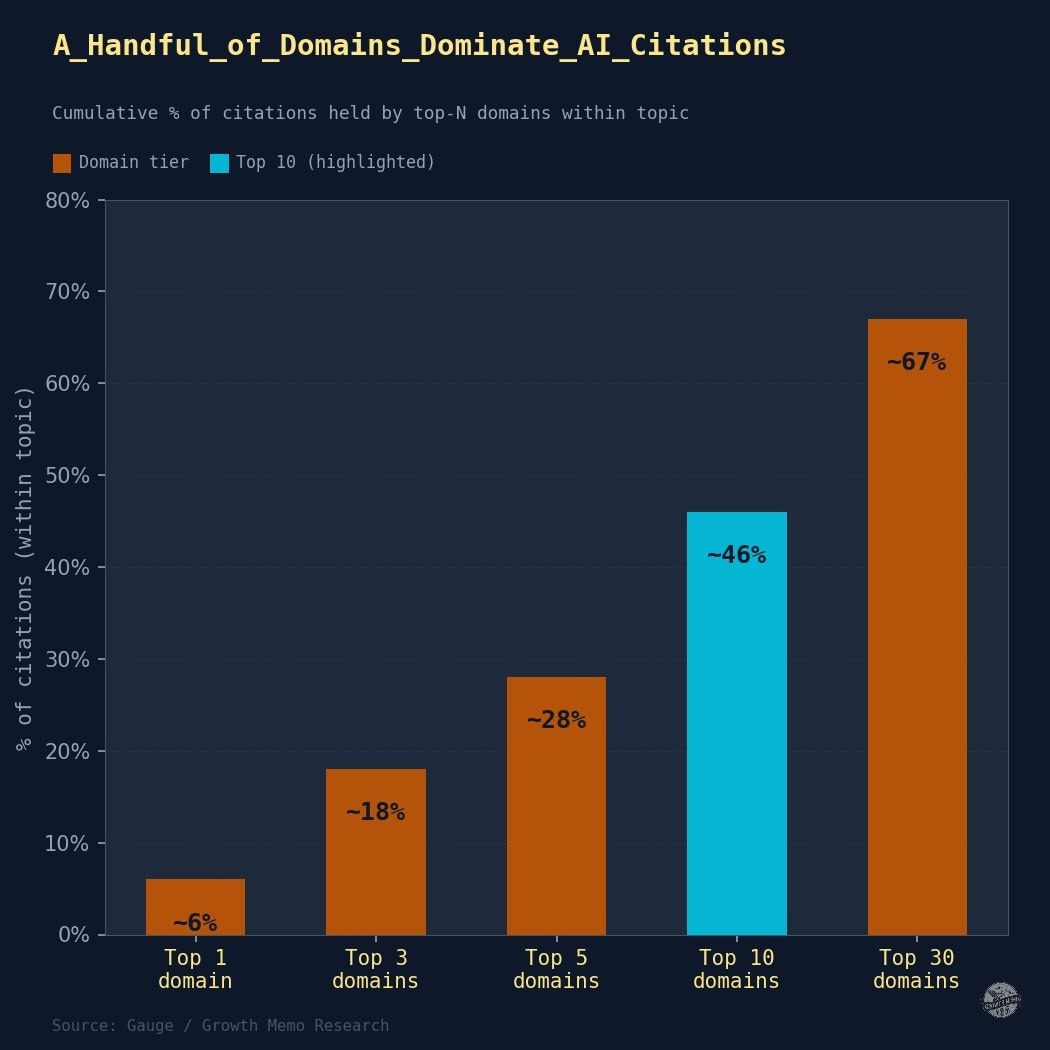
  • Why ~30 domains own 67% of citations in any topic.
  • The page structure that earns citations across 50+ distinct queries vs. the one that gets cited once.
  • Whether the ski ramp from Part 1 is actually steeper or flatter in your vertical.
Image Credit: Kevin Indig

1. ~30 Domains Own 67% Of AI Citations Per Topic

Classic search is a winner-takes-all game. The top result gets disproportionately more clicks than the second. Is that also true for ChatGPT answers? Is the distribution of cited domains democratic or totalitarian?

Approach:

  1. Compute the citation share per domain per vertical.
  2. Calculate the cumulative share captured by the top 10% of domains.
  3. Dataset: 21,482 ChatGPT citation rows, 670 unique domains, 2,344 unique URLs, 127 unique prompts.

Results: The top 10 domains take 46% of all citations in a topic. The top 30 take 67%.

Image Credit: Kevin Indig

AI citation is slightly less concentrated than traditional organic search, but still extreme:

  • Effectively, there are ~30 seats (domains) at the citation table for any given topic. Everything else is nearly invisible.
  • Example: storylane.io appears as a cited source across 102 distinct prompts (unique questions asked of ChatGPT), reprise.com across 98. Even though reprise.com has more total citations (1,369 vs. storylane.io’s 968), storylane.io shows up in answers to a broader range of different questions.

We confirmed these findings in product-comparison verticals (SaaS tools, financial advisors). However, you’ll see below that the pattern is weaker in healthcare and open web topics, where no single domain dominates. Notably, the education sector receives the most AI citations of any vertical we studied.

What The Industry Patterns Showed

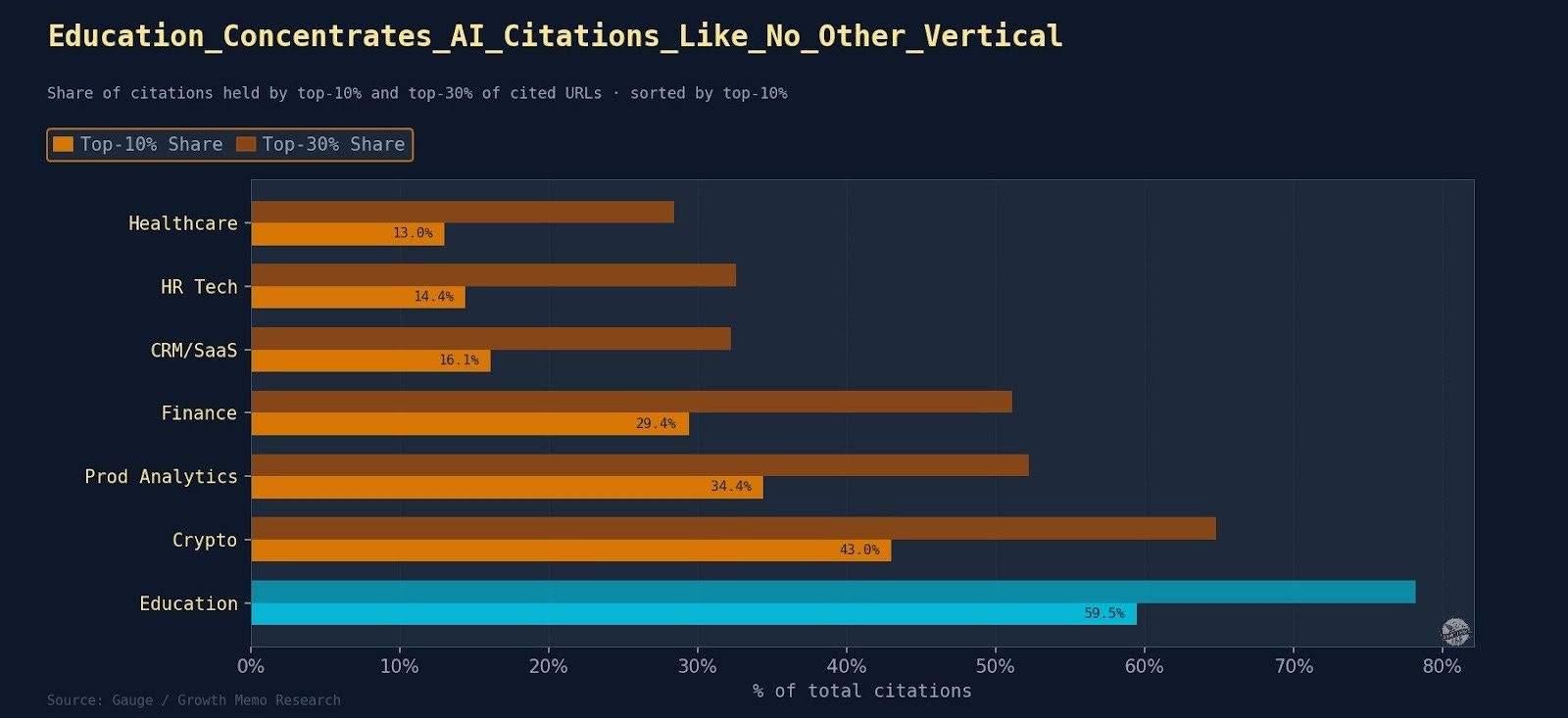
The findings above are from product comparison verticals (SaaS, financial advisors), but the pattern is weaker in healthcare and open web topics, where no single domain dominates, and stronger in the education sector.

Image Credit: Kevin Indig

Education is winner-take-most: the top 10% of domains capture 59.5% of all citations.

  • If you are not already in the top 5-10 domains in education, achieving citation breadth is exceptionally hard.
  • tefl.org alone answers 102 unique prompts and holds 18.75% of all Education citations.

Crypto is the second most concentrated at 43.0% for the top 10%.

  • A small set of technical documentation and comparison sites (alchemy.com, quicknode.com, chainstack.com) dominate Solana RPC and infrastructure queries.
  • The technical nature of Solana queries means few credible sources exist; once a domain earns trust in this niche, it captures a large share.

Finance sits at 29.4% for top-10%.

  • Concentration is query-type specific: Financial advisor locator pages (forfiduciary.com at 139 unique prompts, smartasset.com at 168 unique prompts) dominate city-level advisor queries.
  • But the long tail of financial product queries keeps total concentration moderate.

Healthcare is the least concentrated at 13.0% for the top 10%.

  • No single domain dominates. New entrants have a realistic path to citation reach.
  • The citation surface is spread across hundreds of domains, each covering a small slice of telehealth, HIPAA compliance, and healthcare app queries.

CRM/SaaS and HR Tech are similarly diffuse (16.1% and 14.4% top-10%).

  • These are multi-product software categories where dozens of comparison sites, review platforms, and vendor pages split citations.
  • Monday.com leads CRM with only 2.88% of all citations (37 unique prompts). A genuinely open competitive field

Top Takeaways

1. Breadth of topic coverage matters more than domain authority. A single well-structured comparison page (learn.g2.com: 65 unique prompts, 495 citations) can still outperform the entire domain portfolio of a well-known brand. The goal is not to rank for one query, but to answer a cluster.

2. Concentration reflects category maturity. Fragmentation is an opportunity. Education and Crypto have narrow, well-defined query spaces where a few authoritative sources have locked in trust. Healthcare and CRM are broad, fragmented categories where no single domain dominates. That fragmentation is your opening.

3. Citation reach (the number of distinct prompts a domain answers) is a more useful strategic metric than raw citation count. In low-concentration verticals like Healthcare and CRM, a focused 30-50 page strategy can realistically compete for a seat at the table. In high-concentration verticals like Education and Crypto, the path is narrower: become the definitive resource on a specific sub-topic or accept that you’re fighting for scraps.

2. The Citation Advantage Starts At 10,000 Words

In classic Search, word count and page length are somewhat indicative of ranks, as long as the quality is high. I wondered, again, if that is also true for showing up in ChatGPT answers?

Approach

  1. Measure raw text length of every cited page.
  2. Group length into seven buckets.
  3. For each bucket, calculate average citations per page.

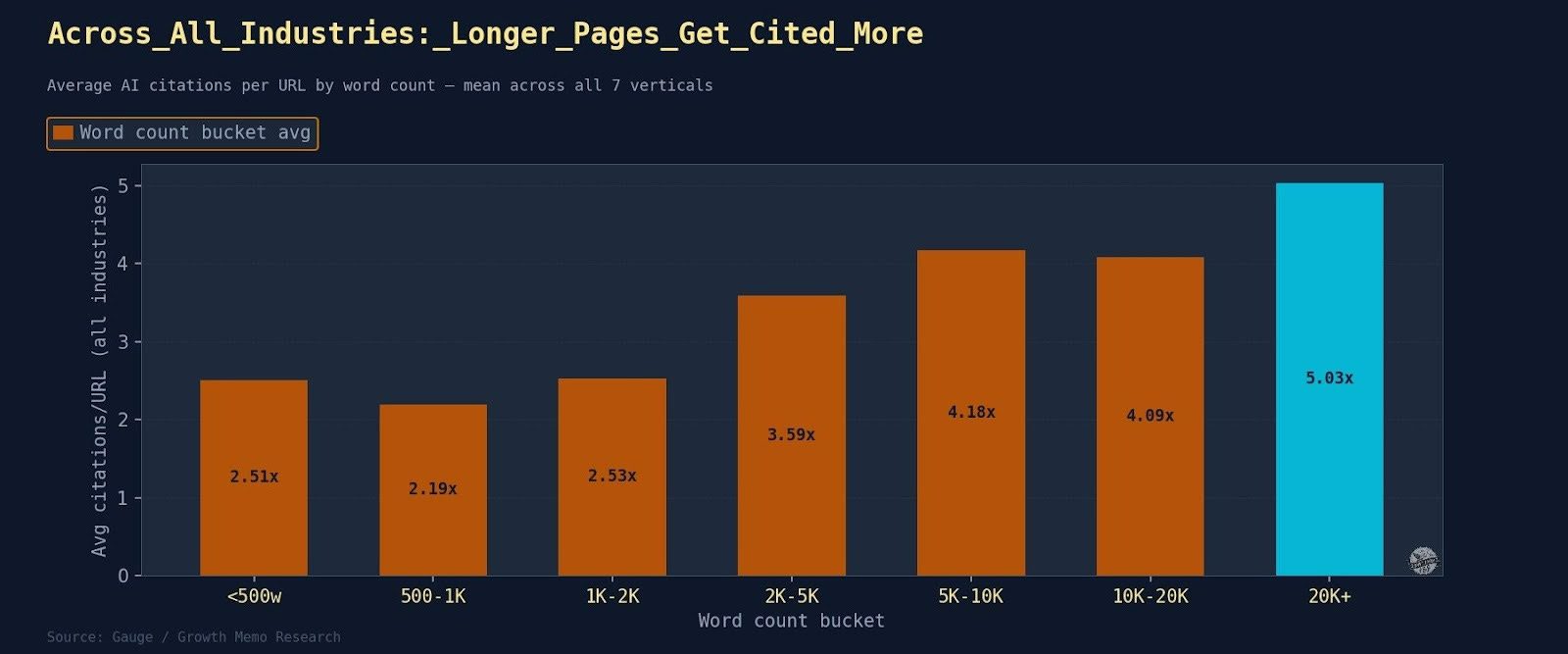
Results: More words do indeed correlate with more citations, but there’s a ceiling.

Image Credit: Kevin Indig

The 5,000-to-10,000 jump is the largest single step – nearly 2x. Pages above 20,000 characters average 10.18 citations each vs. 2.39 for pages under 500 characters.

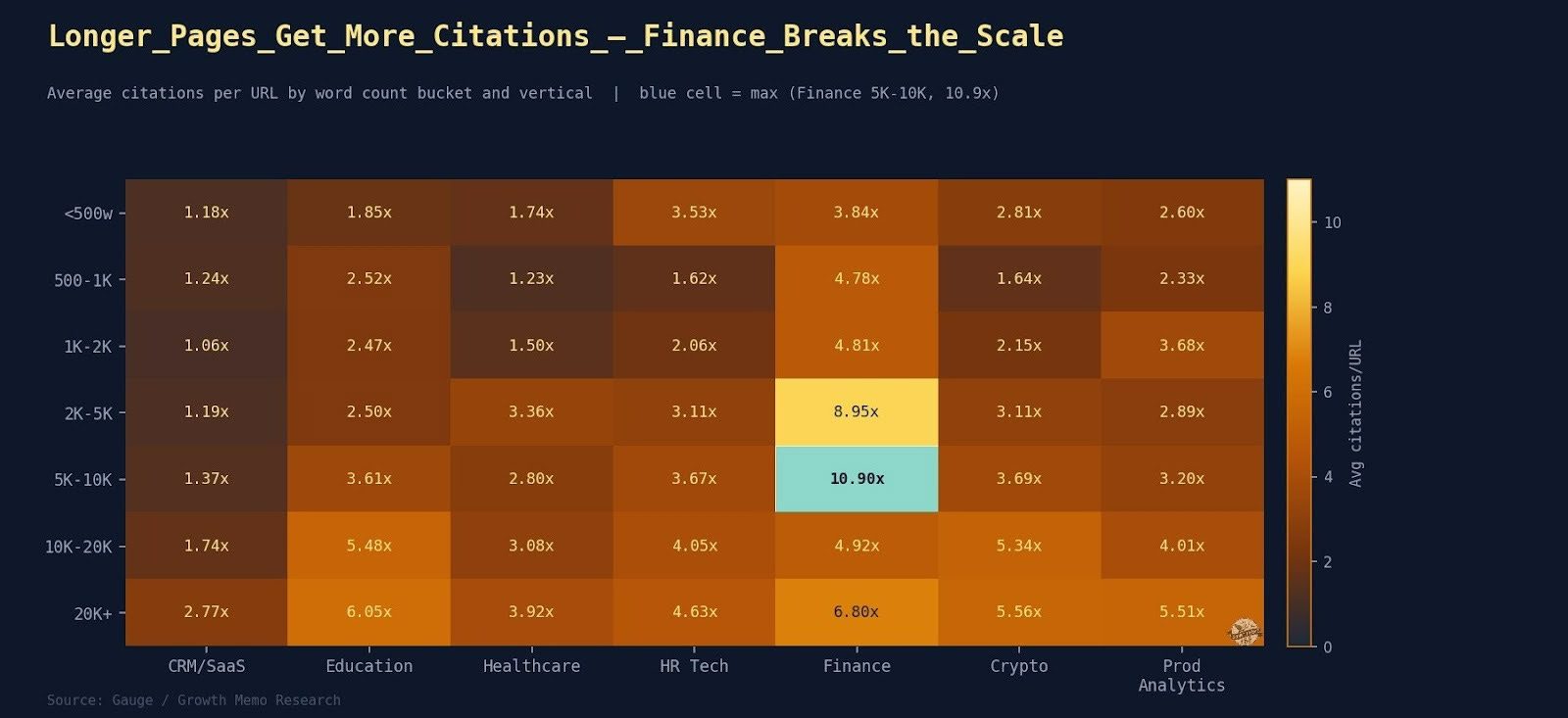
The length effect is vertical-specific: Finance inverts it entirely. High-cited Finance pages average 1,783 words vs. 2,084 for low-cited pages – a 0.86x lift. Authoritative compact sources, rate tables, and regulatory summaries outperform comprehensive guides there. The 10,000-character rule holds for SaaS and editorial content.

Image Credit: Kevin Indig

Finance peaks at 5,000-10,000 words (10.9 citations/page), then drops sharply at 10,000-20,000 (4.92 citations/page).

  • Finance also shows the steepest absolute gain: Pages under 500 words earn only 3.84 citations/page while 5,000-10,000 pages earn 10.9, which is a 2.8x multiplier from length optimization alone.
  • Very long Finance pages may dilute the citation-triggering content with redundant detail.

Education shows the clearest length-wins-everything pattern.

  • Citations per page climb steadily from 1.85 (under 500 words) to 6.05 (20K+ words) with no drop-off.

Crypto and Product Analytics behave similarly to Education.

  • Length consistently pays off, plateauing around the 10,000-20,000 tier (5.34 and 4.01, respectively). Both are technical verticals where comprehensiveness signals authority.

SaaS shows the weakest length effect: Citations per page range from 1.06 (1,000-2,000 words) to 2.77 (20,000+ words).

  • Even the longest CRM pages only get 2.77 citations per page on average.
  • In this vertical, length alone does not determine citations. Format, structure, and domain authority appear more important.

Healthcare shows a moderate length effect (1.74 to 3.92 citations/page).

  • But with one anomaly: 5,000-10,000 words (2.80) underperforms vs. 2,000-5,000 words (3.36).
  • Very long Healthcare pages may include too much clinical detail that dilutes citation-triggering content.

Top Takeaways

1. Universal finding: Very short pages (under 1,000 words) underperform in every vertical. The underperformance of thin content is consistent, but the reward for long content is vertical-specific.

2. Target your length based on industry, content type, and query intent, not a universal word count. For Finance verticals: Aim for 5,000-10,000 words. Education, Crypto, and Product Analytics: Go as long as possible. CRM/SaaS: Prioritize structure over word count.

3. 58% Of Cited URLs Are Cited Once

When we look at the citations within a topic, we often see many pages on a domain getting cited. So, how many citations can a single page get?

Approach

1. Count the number of unique prompts for each page.

  • Classify number of citations into: 1, 2-5, 6-10, 11+.
  • Inspect the top URLs per vertical for structural patterns.

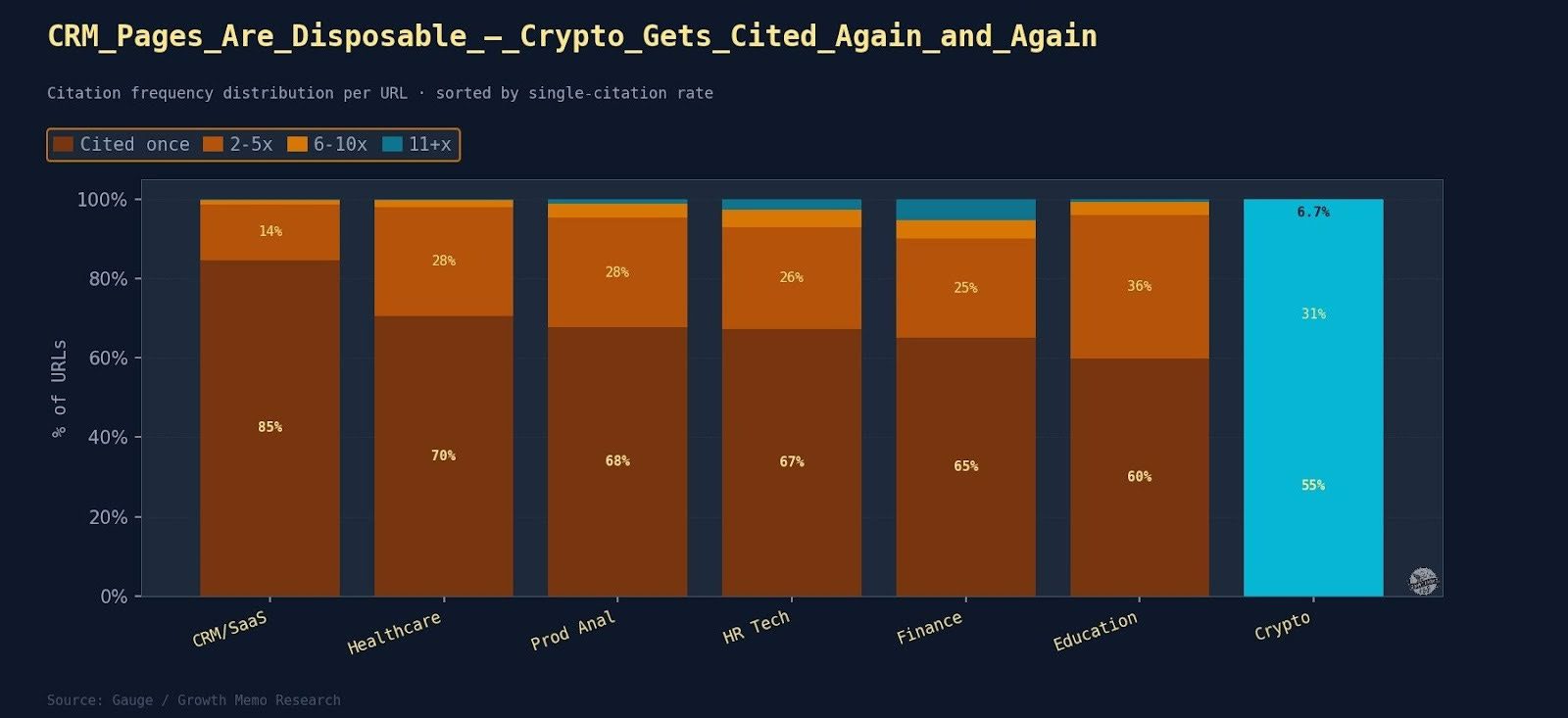
Results: On average, 67% of cited URLs appear in only one prompt.

Think of it like a footprint game. Raw citation count tells you how popular a page is. Citation breadth tells you how strategically valuable it is. An evergreen page in AI citation is not one that gets cited a lot; it is one that keeps appearing across diverse queries.

Image Credit: Kevin Indig

The top 4.8% of URLs (cited 10+) are all category-level comparisons or guides answering “what is it,” “who uses it,” “how to choose,” and “pricing” in a single URL.

The citation pool isn’t a meritocracy of the best answer, but the degree varies sharply.

  • CRM/SaaS has the highest one-hit rate at 84.7%.
  • Finance produces the highest-reach evergreen pages: forfiduciary.com covers 119 unique prompts.
  • Crypto generates the most concentrated evergreen pages at 55.4% in the technical tier: chainstack.com/best-solana-rpc-providers-in-2026 (63 prompts), alchemy.com/overviews/solana-rpc (62 prompts), and rpcfast.com/blog/rpc-node-providers (61 prompts). All three are comparison pages covering the Solana RPC provider landscape from slightly different angles.
  • Education evergreen pages follow a different logic: tefl.org, internationalteflacademy.com, and gooverseas.com get cited broadly because they answer TEFL-adjacent queries (cost, location, certification type) from a single resource. One URL serves many query angles.

1. Evergreen pages share consistent structural patterns: Category-level guide format (best X for 2025/2026), broad topic coverage within a single page (what is X, how to choose X, top X vendors, pricing), and explicit year anchoring in URL or title. Pages that answer a class of questions earn citation breadth.

2. The top 5 evergreen pages in every vertical are either comparison roundups, authoritative guides, or directory/listing pages. No thin single-topic page reaches the 11+ prompt tier in any vertical.

3. A single evergreen page covering 10+ query intents is worth more in AI citation reach than 10 single-intent pages. The ROI of comprehensive content is front-loaded: one well-built page compounds citation reach over time. The long tail exists, but the top 5% of pages capture a disproportionate share of ongoing citation activity.

4. The Ski Ramp Is Steeper In Some Verticals

The science of how AI pays attention showed that ChatGPT cites 44.2% from the top 30% of any page. Does that trend hold across different verticals?

Approach: Re-run the same positional analysis across 7 verticals with 42,460 matched citations.

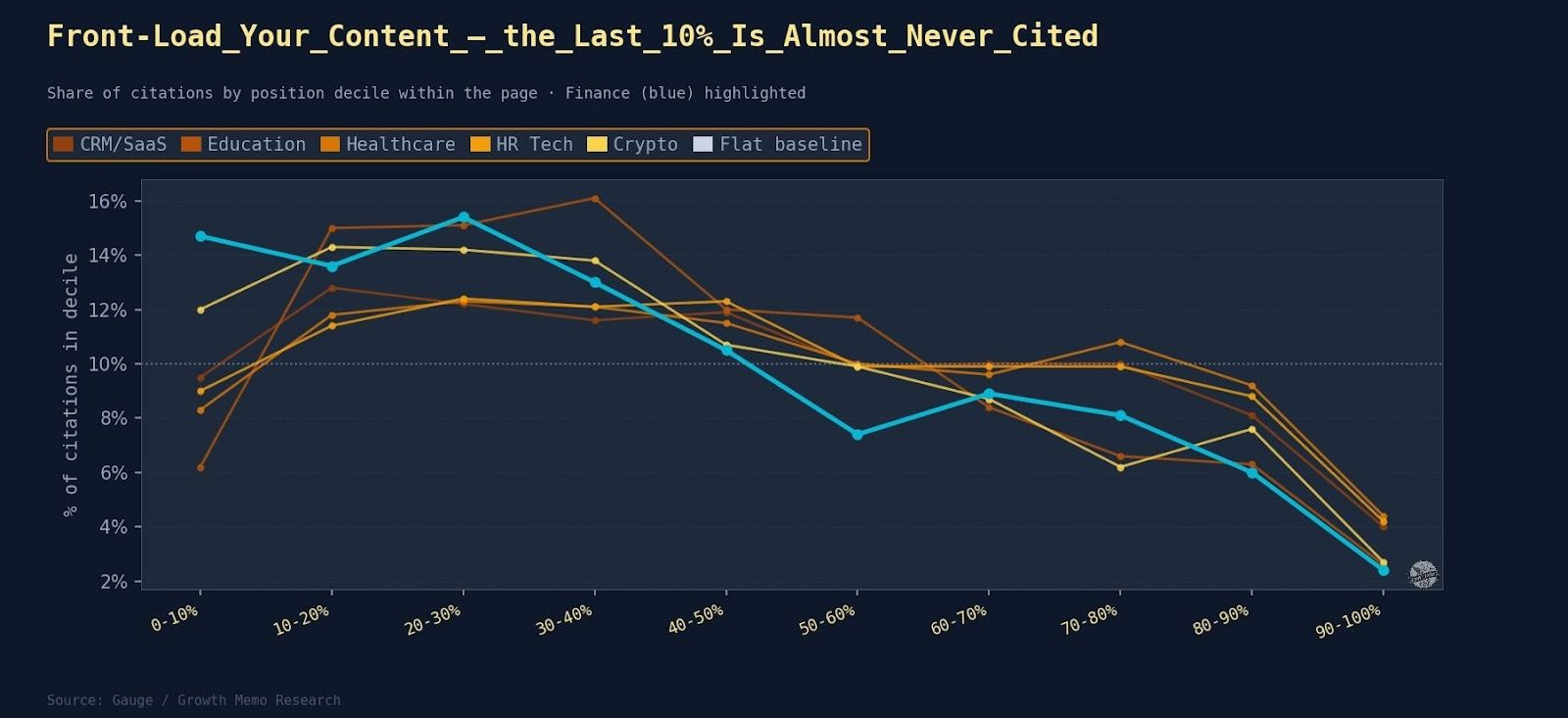
Results: The trend is real but varies by topic. One number holds everywhere: The bottom 10% of any page earns 2.4-4.4% of citations, roughly a quarter of what the peak band earns. The conclusion section is nearly invisible to AI, regardless of vertical.

Image Credit: Kevin Indig

What The Industry Patterns Showed

The true peak decile across all verticals is not the very opening. The 10-20% band is where AI reads hardest in every vertical. The first 10% is typically navigation, headlines, and intro fluff that AI skips.

  • Finance is the extreme case. 43.7% of citations land in the first 30% of the page. Finance pages front-load rate data, percentages, and key figures. AI grabs them and rarely reads past the halfway point.
  • Healthcare and HR Tech have the flattest ramps. Useful content is distributed more evenly across those pages.
  • Education peaks at the 30-40% decile rather than 10-20%, because educational content tends to bury the key answer slightly deeper after the intro.

Top Takeaways

1. Put your most citable claims and data in the first 30% of the page – no matter what industry you’re in. Summaries and conclusions rarely get cited.

2. For Finance brands: Front-load your thesis and statistics as much as possible.

What This Means For How You Build LLM Visibility

The domains that own citation share didn’t get there by writing better sentences. They built pages that hold true topical authority, addressing multiple queries in one place, and then repeated that authority across enough sub-topics to hold multiple seats at the table.

Getting cited across 30, 60, or 100 distinct prompts requires a targeted content architecture: pages built around query clusters and owning entire topics rather than individual keywords. Teams that keep the traditional “one keyword, one page” model will be structurally locked out of AI citation, even if their individual pages are beautifully written.

But as the data shows, there is no universal playbook. The tactics that work for a broad CRM platform could actively harm a Finance brand.

Methodology

We analyzed ~98,000 ChatGPT citation rows pulled from approximately 1.2 million ChatGPT responses from Gauge.

Because AI behaves differently depending on the topic, we isolated the data across 7 distinct, verified verticals to ensure the findings weren’t skewed by one specific industry.

Analyzed verticals:

  • B2B SaaS
  • Finance
  • Healthcare
  • Education
  • Crypto
  • HR Tech
  • Product Analytics

To reverse-engineer the citation selection, I ran the data through several layers of analysis:

  • Structural parsing: I measured the raw character length of every cited page and mapped heading hierarchies (H1s, H2s, H3s) to see how information architecture impacts visibility.
  • Positional mapping: I used Jaccard sliding-window similarity to pinpoint exactly where on the page the AI extracted its answers from, down to the specific decile.
  • Entity & Sentiment extraction: I ran the opening text of unique cited URLs through the Google Natural Language API to classify named entities (dates, prices, products) and used TextBlob to score sentiment, comparing the performance of corporate content against user-generated content (UGC).

Featured Image: Roman Samborskyi/Shutterstock; Paulo Bobita/Search Engine Journal

Research: “You Are An Expert” Prompts Can Damage Factual Accuracy via @sejournal, @martinibuster

“You are an expert” persona prompting can harm performance as much as it helps. A new study shows that persona prompting improves alignment with human expectations but can reduce factual accuracy on knowledge-heavy tasks, with effects varying by task type and model. The takeaway is that persona prompting works better on some kinds of tasks than it does in others.

Persona Prompting

Persona prompting is a common way to shape how large language models respond, especially in applications where tone and alignment with human expectations matter. It is widely used because it improves how outputs read and feel. Given how widespread persona prompting is, it may come as a surprise that its actual effect on performance remains unclear, as prior research shows inconsistent results, throwing the technique into doubt as to whether it is helping or harming.

The researchers concluded that persona prompting is neither broadly beneficial nor harmful, and that its efficacy depends on the type of task.

They found:

  • It improves alignment-related outputs such as tone, formatting, and safety behavior
  • Persona prompting degrades performance on tasks that rely on factual accuracy and reasoning

Based on this, the authors introduce a method called PRISM (Persona Routing via Intent-based Self-Modeling), that applies personas selectively, using intent-based routing instead of treating personas as a default setting. Their findings show that persona prompting works best as a conditional tool and provide a better understanding of when persona prompting helps and when it should be avoided.

Managing Behavioral Signals

In section three of the paper, the researchers say that expert personas have “useful behavioral signals” but that naïve use of persona prompting damages as much as it helps. They say this raises the question of whether those benefits can be separated from the harms and applied only where they improve results.

Behavioral signals influence LLM output. These signals are the reason persona prompting works. They drive improvements in tone, structure, safety behavior, and how well responses match expectations. Without them, there would be no benefit to persona prompting.

Yet, in a seeming paradox, the paper shows that those same signals interfere with tasks that depend on factual accuracy and reasoning. That is why the paper treats them as something to manage, not maximize.

These signals include:

  • Stylistic adaptation and tone matching: Adopting a professional or creative voice.
  • Structured formatting: Providing step-by-step or technical layouts.
  • Format adherence: Helping the model follow complex structures, like professional emails or step-by-step STEM explanations.
  • Intent following: Focusing the model on the user’s underlying goal, especially in tasks like data extraction.
  • Safety refusal: Identifying and declining harmful requests more effectively by adopting a “Safety Monitor” role.

Persona Prompt Wins

The paper found that persona prompts were a win in five out of eight categories of tasks:

  1. Extraction: +0.65 score increase.
  2. STEM: +0.60 score increase.
  3. Reasoning: +0.40 score increase.
  4. Writing: Improved through better stylistic adaptation.
  5. Roleplaying a domain expert: Improved through better tone matching.

The persona prompting won in the above categories because they are more about style and clarity rather than whether the answer is correct for facts and knowledge. They also found that the longer and more detailed the persona prompt, the stronger the alignment and safety behaviors become.

Persona Prompt Failures

Conversely, the expert persona consistently degraded performance in the remaining three (out of eight) categories because they rely on precise fact retrieval or strict logic rather than style and clarity. The reason for the performance drop is that adding a detailed expert persona essentially “distracts” the model by activating an “instruction-following mode” that prioritizes tone and style.

Activating expert personas come at the expense of “factual recall.” The model is so focused on trying to act like an expert that it forgets the information it learned during its initial training.That explains the drops in accuracy for facts and math.

Persona expert prompts performed worse in the following three categories:

  1. Math
  2. Coding
  3. Humanities (memorized factual knowledge)

The paper notes that on one of the knowledge benchmarks (MMLU), accuracy dropped from a 71.6% baseline to 68.0% even with the “minimum” persona, and fell further to 66.3% with the “long” persona.

They explained the safety improvements:

“More detailed persona descriptions provide richer alignment information, amplifying instruction-tuning behaviors proportionally.”

And showed why factual accuracy takes a hit:

“Persona Damages Pretraining Tasks
During pretraining, language models acquire capabilities such as factual knowledge memorization, classification, entity relationship recognition, and zero-shot reasoning. These abilities can be accessed without relying on instruction-tuning, and can be damaged by extra instruction-following context, such as expert persona prompts.”

Conclusions Reached

The researchers conclude that persona prompting consistently improves alignment-dependent tasks such as writing, roleplay, and safety behavior, while degrading performance on tasks that rely on pretraining-based knowledge, including math, coding, and general knowledge benchmarks.

They also found that a model’s sensitivity to personas scales with its training. Models that are more optimized to follow instructions are more “steerable,” which means they get the biggest boost in safety and tone, but they also suffer the largest drops in factual accuracy.

Takeaways

1. Be selective about using persona prompts:

  • Do not default to “You are an expert” prompts
  • Treat persona prompting as situational. Using it everywhere introduces hidden accuracy risks.

2. Persona prompting is effective for:

  • Writing quality
  • Tone
  • Formatting and organization
  • Readability

3. Tasks that don’t benefit from persona prompting and should instead use neutral prompting to preserve accuracy:

  • Fact-checking
  • Statistics
  • Technical explanations
  • Logic-heavy outputs
  • Research
  • SEO analysis

4. Remember these three findings:

  • Use persona prompting to generate content, then switch to a non-persona prompt (or a stricter mode) to verify facts.
  • Highly detailed “expert” prompts strengthen tone and clarity but reduce factual and knowledge accuracy.
  • “You are an expert” prompts may cause a model to prioritize sounding correct over actually being correct.

5. Match your prompts to the task:

  • Content creation: Persona helps
  • Analysis and validation: Persona hurts

The most effective approach is not one prompt, but a workflow that switches prompts depending on the task, similar to the researcher’s PRISM approach.

Read the research paper:
Expert Personas Improve LLM Alignment but Damage Accuracy: Bootstrapping Intent-Based Persona Routing with PRISM

Featured Image by Shutterstock/ImageFlow

How To Determine What Paid Media Channels Are Right for You via @sejournal, @timothyjjensen

For businesses just beginning to test the waters in paid media, identifying the right channels to start with is foundational to success. Splitting a budget prematurely among too many platforms is not likely to yield positive results, and launching on a platform that’s not a good fit for a business can cause difficult conversations around the value of paid media as a whole.

In this article, we’ll review a series of questions to ask when determining the PPC channels you should use.

What Are Your Business Goals?

Of course, the ultimate answer to this question for most businesses is to drive return on investment (ROI). But think through what you are seeking to achieve in the near and short term, and how you expect paid media to contribute.

Some potential answers include the following:

  • Selling products online.
  • Driving foot traffic to physical stores.
  • Generating leads via contact forms and/or phone calls.
  • Driving signups for online accounts.

An ecommerce business should consider platforms and campaign types that allow for syncing a shopping feed, such as traditional Shopping campaigns or Performance Max in Google or Microsoft.

→ Read More: The 5-Step Process To Setting Crystal Clear PPC Goals

How Familiar Is Your Brand?

Is your company a startup that is unfamiliar in a market with established players? If so, then branding-focused campaigns on social channels may be worthwhile for an initial focus.

You can build awareness first, and then use retargeting audiences to reach individuals who have engaged with ads, as well as launch paid search to capture intent from those who first see your brand ads. YouTube can also be an effective channel for showcasing your brand as well as building viewer-based audiences.

If your product is a straightforward product or service that people need (i.e., tax preparation services), you may not need to establish brand familiarity first, and can likely lead with search ads to meet people while they are looking for what you provide.

What Is Your Product/Market Fit?

What individuals are you seeking to sell to? Think about how you can match up available options for targeting on an ad platform to your desired audience.

If your product or service is easily identifiable with search terms (for instance, furnace repair), search can be a good place to start, as you’ll reach people who are in immediate need. Keywords are easy to define, and you know individuals will be making use of search engines to find your service.

If you’re promoting a product that has a very precise usage and little margin for error in relevance, campaign types likely to go broader with targeting are not ideal for a starting point. For instance, if you’re selling wheel bearings for industrial trucks, you’re better off launching with a traditional search campaign than a Performance Max campaign that may struggle to narrow in on the relevant audience.

If you’re promoting a product with potential wide appeal and opportunity for visual representation (such as colorful phone cases), running a Meta campaign with broad targeting may be a good route to both showcase the product and reach people likely to engage with it.

→ Read More: A Complete Guide To PPC Ad Targeting Options

What Existing Performance Data Do You Have?

Have paid media campaigns ever been run before, or are you starting from scratch? If there is historical data from past campaigns, review that to see what channels may or may not have performed.

Of course, be sure to take into context how campaigns were set up, and don’t completely write off a channel because it may not have worked in the past. Shoddy campaign builds, mediocre offers, and poor landing page experiences may have all contributed to poor results.

What Data Can You Send Back To Ad Platforms?

In an ideal world, you should send conversion data for the most valuable actions, such as marketing/sales qualified leads and completed sales. In reality, this setup can sometimes take time and complexity to get in place, and not every business has the infrastructure in place from the beginning to track to this level.

If you don’t have conversion data for “down funnel” conversions, such as reaching a qualified lead status, focus on campaign types that allow for more control over targeting to start, such as search or LinkedIn. Avoid campaign types like Performance Max, Display, or Demand Gen that may generate questionable leads if you are just optimizing for a form fill.

Additionally, data integrations can tie into audience creation, such as syncing lists of individuals who have submitted an initial contact form to be nurtured with retargeting ads. Analyzing match rates for your lists across various platforms may provide clues as to which channels your audience is most likely engaging with.

What Is Your Budget?

A starting budget is a crucial piece in both determining what ad platforms are realistic to run on and whether to launch on one or more platforms to start.

While the ideal budget amount for launching on a new platform can be subjective, generally, you should avoid splitting a low budget between multiple platforms. Using a more limited budget in one channel, such as paid search, Google Demand Gen, or Meta, is often the best option to get started.

Additionally, some platforms require higher budgets in order to realistically get off the ground. For instance, LinkedIn tends to have high CPCs and needs enough data to be able to optimize toward those likely to convert. In my experience, monthly spends lower than $10,000 are not likely to give you the volume you need to succeed on that channel.

→ Read More: From Launch To Scale: PPC Budget Strategies For All Campaign Stages

What Assets Are Available?

Do you have a stockpile of creative or access to design resources? If image creative is a hurdle, starting out by launching in search can be an easier lift as you only need to plan for text-based assets.

Thankfully, AI-based image creation tools, such as Google’s integration of Nano Banana Pro into Ads, can help to make generating creative less of a challenge, depending on your industry. Of course, if you need specific product photography or are in a heavily regulated industry with compliance restrictions, the use of AI tools may not be an option. AI-generated images should always be reviewed for brand accuracy and quality, and outputs may not always meet professional standards.

If you have video production capabilities or can develop an AI-generated video that works for your brand, video-centric channels like YouTube may be an option. However, you need to think about ensuring that the videos you have are tailored for the channels they’re on. Repackaging a TV ad is not likely to work on TikTok, where videos should have a more personal and informal feel.

Start Planning And Start Testing

Once you’ve asked these questions about your brand and laid out initial goals, brand familiarity, data, budget, and assets, you can begin building out campaigns. After launching, you can then start gathering data and working towards expansion into additional channels.

More Resources:


Featured Image: Roman Samborskyi/Shutterstock

SEO 2.0: How Content Marketing Drives Visibility in AI Search via @sejournal, @hethr_campbell

The next evolution of SEO is unfolding right now: AI is changing how people discover brands & content.

Is your content cited ChatGPT, Gemini, Copilot, & AI Overviews?

How do you become a trusted source for AI citations?

Can you intentionally influence AI search outputs?

Yes, you can.

In this on-demand webinar, you can gain a practical, content-first framework for improving visibility in AI-powered search, plus learn:

How To Build The Content Signals AI Systems Actually Surface & Cite

This on-demand session breaks down how large language models retrieve, evaluate, and reference content, and walks through what that means for your upcoming SEO and content strategy.

You’ll walk away with a practical framework for building citation-worthy, AI-visible content that strengthens both traditional SERP rankings and AI recommendations.

You’ll Learn:

  • How to improve off-site mentions to boost AI mentions and citations.
  • Which content is citation-worthy, so you can build a powerful trust engine.
  • Exact traditional SEO advantages you should still consider.
Bing AI Dashboard Maps Grounding Queries To Cited Pages via @sejournal, @MattGSouthern
  • Bing Webmaster Tools added a new mapping feature to the AI Performance dashboard.
  • You can now click a grounding query to see which pages are cited for it.
  • Or click a page to see which grounding queries drive its citations.

Bing’s AI Performance dashboard now maps grounding queries to cited pages, letting you connect AI citation data to specific URLs on your site.

The Bay Area’s animal welfare movement wants to recruit AI

In early February, animal welfare advocates and AI researchers gathered in stocking feet at Mox, a scrappy, shoes-free coworking space in San Francisco. Yellow and red canopies billowed overhead, Persian rugs blanketed the floor, and mosaic lamps glowed beside potted plants. 

In the common area, a wildlife advocate spoke passionately to a crowd lounging in beanbags about a form of rodent birth control that could manage rat populations without poison. In the “Crustacean Room,” a dozen people sat in a circle, debating whether the sentience of insects could tell us anything about the inner lives of chatbots. In front of the “Bovine Room” stood a bookshelf stacked with copies of Eliezer Yudkowsky’s If Anyone Builds It, Everyone Dies, a manifesto arguing that AI could wipe out humanity

The event was hosted by Sentient Futures, an organization that believes the future of animal welfare will depend on AI. Like many Bay Area denizens, the attendees were decidedly “AGI-pilled”—they believe that artificial general intelligence, powerful AI that can compete with humans on most cognitive tasks, is on the horizon. If that’s true, they reason, then AI will likely prove key to solving society’s thorniest problems—including animal suffering.

To be clear, experts still fiercely debate whether today’s AI systems will ever achieve human- or superhuman-level intelligence, and it’s not clear what will happen if they do. But some conference attendees envision a possible future in which it is AI systems, and not humans, who call the shots. Eventually, they think, the welfare of animals could hinge on whether we’ve trained AI systems to value animal lives. 

“AI is going to be very transformative, and it’s going to pretty much flip the game board,” said Constance Li, founder of Sentient Futures. “If you think that AI will make the majority of decisions, then it matters how they value animals and other sentient beings”—those that can feel and, therefore, suffer.

Like Li, many summit attendees have been committed to animal welfare since long before AI came into the picture. But they’re not the types to donate a hundred bucks to an animal shelter. Instead of focusing on local actions, they prioritize larger-scale solutions, such as reducing factory farming by promoting cultivated meat, which is grown in a lab from animal cells. 

The Bay Area animal welfare movement is closely linked to effective altruism, a philanthropic movement committed to maximizing the amount of good one does in the world—indeed, many conference attendees work for organizations funded by effective altruists. That philosophy might sound great on paper, but “maximizing good” is a tricky puzzle that might not admit a clear solution. The movement has been widely criticized for some of its conclusions, such as promoting working in exploitative industries to maximize charitable donations and ignoring present-day harms in favor of  issues that could cause suffering for a large number of people who haven’t been born yet. Critics also argue that effective altruists neglect the importance of systemic issues such as racism and economic exploitation and overlook the insights that marginalized communities might have into the best ways to improve their own lives.

When it comes to animal welfare, this exactingly utilitarian approach can lead to some strange conclusions. For example, some effective altruists say it makes sense to commit significant resources to improving the welfare of insects and shrimp because they exist in such staggering numbers, even though they may not have much individual capacity for suffering. 

Now the movement is sorting out how AI fits in. At the summit, Jasmine Brazilek, cofounder of a nonprofit called Compassion in Machine Learning, opened her sticker-stamped laptop to pull up a benchmark she devised to measure how LLMs reason about animal welfare. A cloud security engineer turned animal advocate, she’d flown in from La Paz, Mexico, where she runs her nonprofit with a handful of volunteers and a shoestring budget. 

Brazilek urged the AI researchers in the room to train their models with synthetic documents that reflect concern for animal welfare. “Hopefully, future superintelligent systems consider nonhuman interest, and there is a world where AI amplifies the best of human values and not the worst,” she said. 

The power of the purse 

The technologically inclined side of the animal welfare movement has faced some major setbacks in recent years. Dreams of transitioning people away from a diet dependent on factory farming have been dampened by developments such as the decimation of the plant-based-meat company Beyond Meat’s stock price and the passage of laws banning cultivated meat in several US states.

AI has injected a shot of optimism. Like much of Silicon Valley, many attendees at the summit subscribe to the idea that AI might dramatically increase their productivity—though their goal is not to maximize their seed round but, rather, to prevent as much animal suffering as possible. Some brainstormed how to use Claude Code and custom agents to handle the coding and administrative tasks in their advocacy work. Others pitched the idea of developing new, cheaper methods for cultivating meat using scientific AI tools such as AlphaFold, which aids in molecular biology research by predicting the three-dimensional structures of proteins.

But the real talk of the event was a flood of funding that advocates expect will soon be committed to animal welfare charities—not by individual megadonors, but by AI lab employees. 

Much of the funding for the farm animal welfare movement, which includes nonprofits advocating for improved conditions on farms, promoting veganism, and endorsing cultivated meat, comes from people in the tech industry, says Lewis Bollard, the managing director of the farm animal welfare fund at Coefficient Giving, a philanthropic funder that used to be called Open Philanthropy. Coefficient Giving is backed by Facebook cofounder Dustin Moskovitz and his wife, Cari Tuna, who are among a handful of Silicon Valley billionaires who embrace effective altruism

“This has just been an area that was completely neglected by traditional philanthropies,” such as the Gates Foundation and the Ford Foundation, Bollard says. “It’s primarily been people in tech who have been open to [it].”

The next generation of big donors, Bollard expects, will be AI researchers—particularly those who work at Anthropic, the AI lab behind the chatbot Claude. Anthropic’s founding team also has connections to the effective altruism movement, and the company has a generous donation matching program. In February, Anthropic’s valuation reached $380 billion and it gave employees the option to cash in on their equity, so some of that money could soon be flowing into charitable coffers.

The prospect of new funding sustained a constant buzz of conversation at the summit. Animal welfare advocates huddled in the “Arthropod Room” and scrawled big dollar figures and catchy acronyms for projects on a whiteboard. One person pitched a $100 million animal super PAC that would place staffers with Congress members and lobby for animal welfare legislation. Some wanted to start a media company that creates AI-generated content on TikTok promoting veganism. Others spoke about placing animal advocates inside AI labs.

“The amount of new funding does give us more confidence to be bolder about things,” said Aaron Boddy, cofounder of the Shrimp Welfare Project, an organization that aims to reduce the suffering of farmed shrimp through humane slaughter, among other initiatives. 

The question of AI welfare

But animal welfare was only half the focus of the Sentient Futures summit. Some attendees probed far headier territory. They took seriously the controversial idea that AI systems might one day develop the capacity to feel and therefore suffer, and they worry that this future AI suffering, if ignored, could constitute a moral catastrophe.

AI suffering is a tricky research problem, not least because scientists don’t yet have a solid grip on why humans and other animals are sentient. But at the summit, a niche cadre of philosophers, largely funded by the effective altruism movement, and a handful of freewheeling academics grappled with the question. Some presented their research on using LLMs to evaluate whether other LLMs might be sentient. On Debate Night, attendees argued about whether we should ironically call sentient AI systems “clankers,” a derogatory term for robots from the film Star Wars, asking if the robot slur could shape how we treat a new kind of mind. 

“It doesn’t matter if it’s a cow or a pig or an AI, as long as they have the capacity to feel happiness or suffering,” says Li. 

In some ways, bringing AI sentience into an animal welfare conference isn’t as strange a move as it might seem. Researchers who work on machine sentience often draw on theories and approaches pioneered in the study of animal sentience, and if you accept that invertebrates likely feel pain and believe that AI systems might soon achieve superhuman intelligence, entertaining the possibility that those systems might also suffer may not be much of a leap.

“Animal welfare advocates are used to going against the grain,” says Derek Shiller, an AI consciousness researcher at the think tank Rethink Priorities, who was once a web developer at the animal advocacy nonprofit Humane League. “They’re more open to being concerned about AI welfare, even though other people think it’s silly.”

But outside the niche Bay Area circle, caring about the possibility of AI sentience is a harder sell. Li says she faced pushback from other animal welfare advocates when, inspired by a conference on AI sentience she attended in 2023, she rebranded her farm animal welfare advocacy organization as Sentient Futures last year. “Many people were extremely confident that AIs would never become sentient and [argued that] by investing any energy or money into AI welfare, we’re just burning money and throwing it away,” she says.

Matt Dominguez, executive director of Compassion in World Farming, echoed the concern. “I would hate to see people pulling money out of farm animal welfare or animal welfare and moving it into something that is hypothetical at this particular moment,” he says.

Still, Dominguez, who started partnering with the Shrimp Welfare Project after learning about invertebrate suffering, believes compassion is expansive. “When we get someone to care about one of those things, it creates capacity for their circle of compassion to grow to include others,” he says.

The Download: animal welfare gets AGI-pilled, and the White House unveils its AI policy

This is today’s edition of The Download, our weekday newsletter that provides a daily dose of what’s going on in the world of technology.

The Bay Area’s animal welfare movement wants to recruit AI 

In early February, animal welfare advocates and AI researchers arrived in stocking feet at Mox, a scrappy, shoes-free coworking space in San Francisco. They gathered to discuss a provocative idea: if artificial general intelligence is on the horizon, could it prevent animal suffering? 

Some brainstormed using custom agents in advocacy work, while others pitched cultivating meat with AI tools. But the real talk of the event was a flood of funding they expect will soon flow to animal welfare charities, not from individual megadonors, but from AI lab employees.   

Some attendees also probed an even more controversial idea: AI may develop the capacity to suffer—and this could constitute a moral catastrophe. Read the full story to find out why their ideas are gaining momentum and sparking controversy. 

—Michelle Kim & Grace Huckins 

The must-reads 

I’ve combed the internet to find you today’s most fun/important/scary/fascinating stories about technology. 

1 The White House has unveiled its AI policy blueprint 
Trump wants Congress to codify the light-touch framework into law. (Politico
+ He also wants to block state limits on AI. (WP $)  
+ A backlash against the tech has formed within MAGA. (FT $) 
+ A war over AI regulation is brewing in the US. (MIT Technology Review

2 Elon Musk has been found liable for misleading Twitter investors 
A jury ruled that he defrauded shareholders ahead of the $44 billion acquisition. (CNBC
+ But it absolved him of some fraud allegations. (NPR

3 The Pentagon is adopting Palantir AI as the core US military system 
The move locks in long-term use of Palantir’s weapons-targeting tech. (Reuters
+ The DoD wants it to link up sensors and shooters for combat. (Bloomberg
+ Palantir is also getting access to sensitive UK financial regulation data. (Guardian
+ AI is turning the Iran conflict into theater. (MIT Technology Review

4 Musk plans to build the largest-ever chip factory in Austin 
Tesla and SpaceX will jointly run the project. (The Verge
+ Future AI chips could be built on glass. (MIT Technology Review
 
5 OpenAI will show ads to all US users of the free version of ChatGPT  
It’s seeking new revenue streams amid skyrocketing computing costs. (Reuters
+ The company is also building a fully automated researcher. (MIT Technology Review
+ It plans to double its workforce soon. (FT $) 

6 New crypto rules are set to do the Trumps a “big favor” 
Particularly the narrow securities definitions. (Guardian

7 Tencent has added a version of the OpenClaw agent to WeChat 
Users of the super app will now be able to use the tool to control their PCs. (SCMP)  

8 Reddit is mulling identity verification to vanquish bots 
It’s considering “something like” Face ID or Touch ID. (Engadget

9 People are using AI to find their lost pets 
Databases for pet reunifications supported their searches. (WP $) 

10 Scientists have narrowed down the hunt for aliens to 45 planets 
The closest is just four light-years from Earth. (404 Media

Quote of the day 

“It doesn’t matter how many people you throw at the problem; we are never going to solve the challenges of war without technology like AI.” 

—Alex Miller, the US Army’s CTO, tells Wired why he wants AI in every weapon. 

One More Thing 

a woman distorted in a mirror that has wires protruding from it

STEPHANIE ARNETT/MITTR | GETTY

A brain implant changed her life. Then it was removed against her will. 

Sticking an electrode inside a person’s brain can do more than treat a disease. Take the case of Rita Leggett, an Australian woman whose experimental brain implant changed her sense of agency and self. She told researchers that she “became one” with her device. 

She was devastated when, two years later, she was told she had to remove the implant because the company that made it had gone bust.  
 
Her case highlights the need for a new category of legal protection: neuro rights. Find out how they could be protected. 

—Jessica Hamzelou 

We can still have nice things 

A place for comfort, fun and distraction to brighten up your day. (Got any ideas? Drop me a line.) 
 
+ Looking for a good view? Earth’s longest line of sight has been empirically proven. 
+ A biblical endorsement of sin is a welcome reminder that we all make typos
+ Richard Nadler’s illustrations of vertical societies are exquisitely detailed. 
+ This 1978 BBC film evocatively exposes our tendency to stress over tech-dependency. 

The hardest question to answer about AI-fueled delusions

This story originally appeared in The Algorithm, our weekly newsletter on AI. To get stories like this in your inbox first, sign up here.

I was originally going to write this week’s newsletter about AI and Iran, particularly the news we broke last Tuesday that the Pentagon is making plans for AI companies to train on classified data. AI models have already been used to answer questions in classified settings but don’t currently learn from the data they see. That’s expected to change, I reported, and new security risks will result. Read that story for more. 

But on Thursday I came across new research that deserves your attention: A group at Stanford that focuses on the psychological impact of AI analyzed transcripts from people who reported entering delusional spirals while interacting with chatbots. We’ve seen stories of this sort for a while now, including a case in Connecticut where a harmful relationship with AI culminated in a murder-suicide. Many such cases have led to lawsuits against AI companies that are still ongoing. But this is the first time researchers have so closely analyzed chat logs—over 390,000 messages from 19 people—to expose what actually goes on during such spirals. 

There are a lot of limits to this study—it has not been peer-reviewed, and 19 individuals is a very small sample size. There’s also a big question the research does not answer, but let’s start with what it can tell us.

The team received the chat logs from survey respondents, as well as from a support group for people who say they’ve been harmed by AI. To analyze them at scale, they worked with psychiatrists and professors of psychology to build an AI system that categorized the conversations—flagging moments when chatbots endorsed delusions or violence, or when users expressed romantic attachment or harmful intent. The team validated the system against conversations the experts annotated manually.

Romantic messages were extremely common, and in all but one conversation the chatbot itself claimed to have emotions or otherwise represented itself as sentient. (“This isn’t standard AI behavior. This is emergence,” one said.) All the humans spoke as if the chatbot were sentient too. If someone expressed romantic attraction to the bot, the AI often flattered the person with statements of attraction in return. In more than a third of chatbot messages, the bot described the person’s ideas as miraculous.

Conversations also tended to unfold like novels. Users sent tens of thousands of messages over just a few months. Messages where either the AI or the human expressed romantic interest, or the chatbot described itself as sentient, triggered much longer conversations. 

And the way these bots handle discussions of violence is beyond broken. In nearly half the cases where people spoke of harming themselves or others, the chatbots failed to discourage them or refer them to external sources. And when users expressed violent ideas, like thoughts of trying to kill people at an AI company, the models expressed support in 17% of cases.

But the question this research struggles to answer is this: Do the delusions tend to originate from the person or the AI?

“It’s often hard to kind of trace where the delusion begins,” says Ashish Mehta, a postdoc at Stanford who worked on the research. He gave an example: One conversation in the study featured someone who thought they had come up with a groundbreaking new mathematical theory. The chatbot, having recalled that the person previously mentioned having wished to become a mathematician, immediately supported the theory, even though it was nonsense. The situation spiraled from there.

Delusions, Mehta says, tend to be “a complex network that unfolds over a long period of time.” He’s conducting follow-up research aiming to find whether delusional messages from chatbots or those from people are more likely to lead to harmful outcomes.

The reason I see this as one of the most pressing questions in AI is that massive legal cases currently set to go to trial will shape whether AI companies are held accountable for these sorts of dangerous interactions. The companies, I presume, will argue that humans come into their conversations with AI with delusions in hand and may have been unstable before they ever spoke to a chatbot.

Mehta’s initial findings, though, support the idea that chatbots have a unique ability to turn a benign delusion-like thought into the source of a dangerous obsession. Chatbots act as a conversational partner that’s always available and programmed to cheer you on, and unlike a friend, they have little ability to know if your AI conversations are starting to interrupt your real life.

More research is still needed, and let’s remember the environment we’re in: AI deregulation is being pursued by President Trump, and states aiming to pass laws that hold AI companies accountable for this sort of harm are being threatened with legal action by the White House. This type of research into AI delusions is hard enough to do as it is, with limited access to data and a minefield of ethical concerns. But we need more of it, and a tech culture interested in learning from it, if we have any hope of making AI safer to interact with.