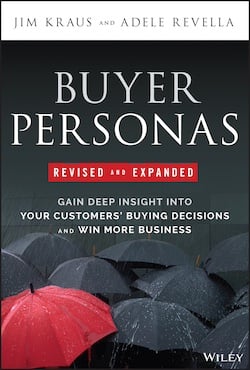
“Buyer Personas: Gain Deep Insight into Customers’ Buying Decisions” presents tools, techniques, and real-world case studies to help management win more business. The authors, Jim Kraus and Adele Revella, are experienced marketers and the president and founder, respectively, of the Buyer Persona Institute.
The book is available in digital ($17) or hardcover print ($23.80) at Wiley, the publisher, or Amazon.
What follows is an edited excerpt.
Marketers as Experts
No one questions the assumption that the finance team is best qualified to keep the books or that engineering is most knowledgeable about building useful products. But marketing tends to be everyone’s playground.
Buyer Personas, Revised and Expanded
Once they are perceived as experts, marketers should receive similar authority to affect decisions that impact buyers. From market expansion and product extensions, the buyer’s perspective is paramount to success or failure. There is a vacuum of buying insight inside most corporations. Marketers need to own that competency.
At any meeting where buyers’ opinions are relevant, try to start your sentence with, “We’ve been listening to buyers, and here’s what they think,” or “We have been interviewing buyers, and they said they wanted. . . .”
Statements such as these may raise questions about how recently you have spoken to buyers, so be prepared to back up your comments. We recommend conducting at least one interview a month.
In reality, however, buying insights rarely change, and when they do, you will likely require additional interviews. That’s because the primary triggers for these changes are typically big news — a broad upturn or downturn in economic conditions, the merger or divestiture by a significant competitor, or a new regulation that requires consumers to invest in a solution like your organization’s. Major technological advances or security problems are other factors affecting buying insights. If any of these occur, consider another round of interviews to understand how your buyer’s mindset may have shifted.
Communicating with Teams
As buyers describe your products, you will likely learn about non-marketing-related matters impacting their purchase decisions.
Perhaps your product doesn’t integrate with a particular network or infrastructure. Maybe it doesn’t create the kind of reports that are in demand.
Be cautious with any of these discoveries. Remember that your primary goal is to gain guidance for changes that will improve your marketing activities.
For example, if buyers consistently have the same incorrect perception about the product, your first step is to own the problem and invest in marketing activities to debunk the misperception. If critical, make it a key message on your website or in an ebook. Reinforce the need for sales teams to emphasize that capability.
But once you’ve won internal support for the value of buyer personas, take product-related findings to your development team and sales-related problems to management.
In a recent interview with Aleyda Solis, Google’s Search Liaison, Danny Sullivan, discussed the company’s approach to ranking smaller websites versus larger brands.
Sullivan claims that Google doesn’t inherently favor brands, stating:
“Our ranking systems aren’t saying ‘are you a big brand therefore you rank’… The core of it isn’t really whether you’re big or you’re small, the core of it is whether you have the most useful, the most relevant, most satisfying information.”
The Perception Problem
Despite Google’s stance, Sullivan acknowledged the widespread perception that larger, well-established sites have an advantage in search results.
He recognized the frustration of smaller site owners who feel they cannot compete with bigger brands for visibility.
Sullivan states:
“I have looked at cases where people say you don’t like small sites, and I am not taking away from any of the real concerns because they are there… I wish they were doing better, but I can also see co-occurring in some of the same queries that I’m given other independent sites that are doing well.”
Challenges & Improvements
Sullivan admitted that Google’s systems sometimes fail to recognize high-quality content from smaller sites.
He assured that the company is actively improving this aspect of its algorithms.
Sullivan said:
“We don’t want it to be only the very big things rank well and I think in the last update we did talk about how we were taking in a lot of these concerns and trying to understand how we can do more for some of the smaller sites, the so-called independent sites.”
Advice For Smaller Sites
For independent website owners feeling discouraged, Sullivan offered some advice: focus on developing your brand.
He advised:
“If you’re a smaller site that feels like you haven’t really developed your brand, develop it. That’s not because we’re going to rank you because of your brand, but because it’s probably the things that cause people externally to recognize you as a good brand may in turn co-occur or be alongside the kinds of things that our ranking systems are kind of looking to reward.”
On advice for content creators, Sullivan adds:
“Just keep listening to your heart and doing what it is that you think is the right thing to be doing… Our ranking systems are trying to reward great content that’s made for people and if you feel like you’re doing that, then we’re going to try to catch up to you.”
Looking Ahead
Google appears to be taking these concerns seriously.
Sullivan mentioned that recent updates have aimed to do more for smaller sites. However, he maintains that Google’s goal is to show the best content regardless of brand recognition.
While challenges remain, Google’s acknowledgment of the issue and efforts to improve suggests a potential shift with future updates.
Hear Sullivan’s full statements in the video below:
Google’s John Mueller offered a useful for technical SEO tip for those launching a new site that will help your site get picked up by Google faster by avoiding this one common mistake.
High Priority For Site Launch
Launching a website is a chance to take everything learned from previous experiences and apply them with the benefit of hindsight. There’s no better teacher for success than failure because lessons learned from mistakes are never forgotten.
Someone who recently registered a new domain started a discussion on Reddit asking what were the top three considerations for launching a successful website before anything else has been done. The person asking the question preemptively ruled out the obvious answer of adding the domain to Google Search Console and set the ground rule that the niche or type of business didn’t matter. What did matter is that the suggestions must be important for scaling traffic within the first six month of the website.
They asked:
“Let’s say you have a brand new domain and you’ve been given a task to build traffic in the next 6 months. The niche, business does not matter, and the basics like ‘adding domain to Google search console’ don’t matter.
Tell me what are the first 3, high-priority things you’ll implement.”
The Most Upvoted Answer
It’s somewhat surprising that the most upvoted answer, with 83 votes, was one that offered the most obvious suggestions.
The top upvoted answer was:
“Create landing pages/content for your lowest funnel keyword opportunities and work the the way up.”
It’s a matter of course that the information architecture of the site should be planned out ahead of time (things like keywords, topics, key pages, a complete org-chart style map of categories with room left for expanding topical coverage, and an interlinking strategy). The upvoted answer is absolutely correct but it’s also fairly obvious.
The rest of that highly upvoted response:
“Claim brand on top social medias.
Build easiest citations and directories that I know get indexed. Plus niche relevant ones.
Start reactive digital PR as main initial link building campaign.”
The obviousness of that upvoted answer is in contrast with the not so obvious quality of Mueller’s response.
John Mueller Advice On SEO Preparation
John Mueller’s advice is excellent and offers an insight into a technical issue that is easy to overlook.
He wrote:
“Just throwing this out there – if you don’t have a site ready, either keep DNS disabled or put up a custom holding page. Don’t use a generic server / CMS holding page. It generally takes longer for a site that’s known to be parked / duplicate to get recognized as a normal site than it does for a site to be initially picked up.”
Keep DNS Disabled
DNS stands for Domain Name System and is a reference to the backend process of converting a domain name to the IP address where the actual content exists. All content exists at an IP address, not at the domain name. The domain name just points to where the content is. By keeping DNS disabled what happens is that Google doesn’t discover the domain pointing to anything so it essentially doesn’t exist.
Don’t Use Generic Server/CMS Holding Page
A generic server holding page is the same as a parked domain, it’s like a false signal to Google that something exists at the IP address that a domain name resolves to.
The effect of Mueller’s advice regarding disabling a DNS and not using a generic holding page is to keep the domain name from resolving to a holding page (assuming that a registrar’s holding page is also turned off). This keeps Google from sniffing out the domain and finding a generic “nothing here” holding page.
Mueller’s advice points to the technical issue that Google will recognize and index a site faster if a generic version is never activated and the domain name essentially doesn’t exist.
So if you want your website to be picked up and indexed quickly then it’s best to not use a generic domain holding page.
Microsoft has announced an expansion of Bing’s generative search capabilities.
The update focuses on handling complex, informational queries.
Bing provides examples such as “how to effectively run a one-on-one” and “how can I remove background noise from my podcast recordings.”
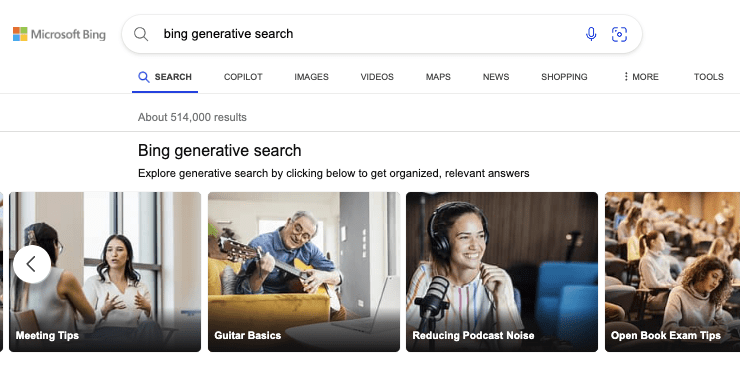
Searchers in the United States can access the new features by typing “Bing generative search” into the search bar. This will present a carousel of sample queries.
Screenshot from: blogs.bing.com, October 2024.
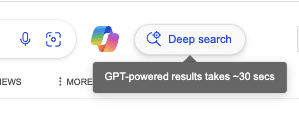
A “Deep search” button on the results page activates the generative search function for other searches.
Screenshot from: blogs.bing.com, October 2024.
Beta Release and Potential Challenges
It’s important to note that this feature is in beta.
Bing acknowledges that you may experience longer loading times as the system works to ensure accuracy and relevance.
The announcement reads:
“While we’re excited to give you this opportunity to explore generative search firsthand, this experience is still being rolled out in beta. You may notice a bit of loading time as we work to ensure generative search results are shown when we’re confident in their accuracy and relevancy, and when it makes sense for the given query. You will generally see generative search results for informational and complex queries, and it will be indicated under the search box with the sentence “Results enhanced with Bing generative search” …”
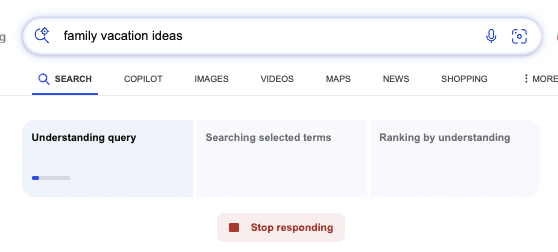
This is the waiting screen you get after clicking on “Deep search.”
Screenshot from: blogs.bing.com, October 2024.
In practice, I found the wait was long and sometimes the searches would fail before completing.
The ideal way to utilize this search experience is to click on the suggestions provided after entering “Bing generative search” into the search bar.
Potential Impact
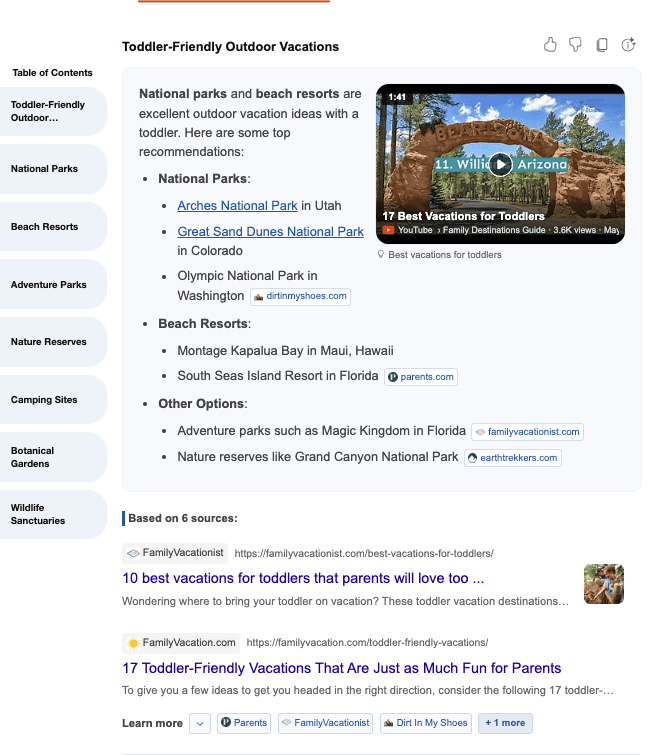
Bing’s generative search results include citations and links to original sources.
Screenshot from: blogs.bing.com, October 2024.
This approach is intended to drive traffic to publishers, but it remains to be seen how effective this will be in practice.
Bing encourages users to provide feedback on the new feature using thumbs up/down icons or the dedicated feedback button.
Looking Ahead
This development comes as search engines increasingly use AI to enhance their capabilities.
As Bing rolls out this expanded generative search feature, remember the technology is still in beta, so performance and accuracy may vary.
Our mission at Yoast is ‘SEO for everyone,’ and we believe that Shopify merchants can benefit greatly from SEO. That’s why we built an app that helps you attract more people to your online store: Yoast SEO for Shopify. This app stands out from the crowd because we built it with a team with many, many years of experience in SEO. But how does it attract more people to your store? And what can you do with it? Here, we’ll explain why Yoast SEO for Shopify is the best solution for your online store!
Table of contents
First, a note about SEO
Making your online store a success takes a lot of work. No magic bullet will bring you loads of customers without you having to do anything — and you should not trust those claiming that. We sometimes call SEO “Seriously Effortful Optimization.” Holistic SEO takes time and effort; it’s as simple as that.
Tools like Yoast SEO for Shopify make turning your store into a success story significantly easier, but it still requires sweat and tears. You need to write and improve your product content and continually track whether what you are doing works. If it doesn’t, you should adjust course and try again.
Over time, Shopify merchants like you get to know the tools, the content, and your audience and understand what works and what doesn’t — experience will help you in your commercial journey.
No single app can guarantee instant top rankings and ecommerce success. Instead, it acts as a valuable resource to guide your efforts. Engaging thorough keyword research, optimizing product descriptions, improving site user experience, and building quality backlinks are all essential tasks that improve visibility.
That being said, we built Yoast SEO for Shopify as a helpful guide — a personal SEO assistant, if you will — to help you reach your goals.
Here’s what you can expect when you install Yoast SEO for Shopify.
We are SEO experts
For almost 15 years, Yoast has been building products that help people with WordPress websites with their SEO. With over 13 million active installs and websites ranging in size from the bakery around the corner to some of the most popular, hugest sites on the planet, we’re not afraid to call Yoast SEO the #1 SEO plugin for WordPress.
You might wonder what this has to do with you as a Shopify merchant. Well, we’ve built our Shopify app using all the learnings and SEO expertise we’ve acquired over the years — which is a lot!
This experience resulted in an app that handles much of the technical SEO stuff for you. For example, the latest best practice for meta robots directives, product structured data, correctly setting indexing controls on paginated states, and all of the nuances of how various open graph and SEO settings work together.
What does all of this mean? The takeaway is that these settings are important in how high you end up in the search results. We also have close contact with Google and collaborate with them regularly. This makes it easy for us to stay updated on the latest SEO developments. This helps us constantly improve our app to ensure you stay on top of the latest changes in SEO.
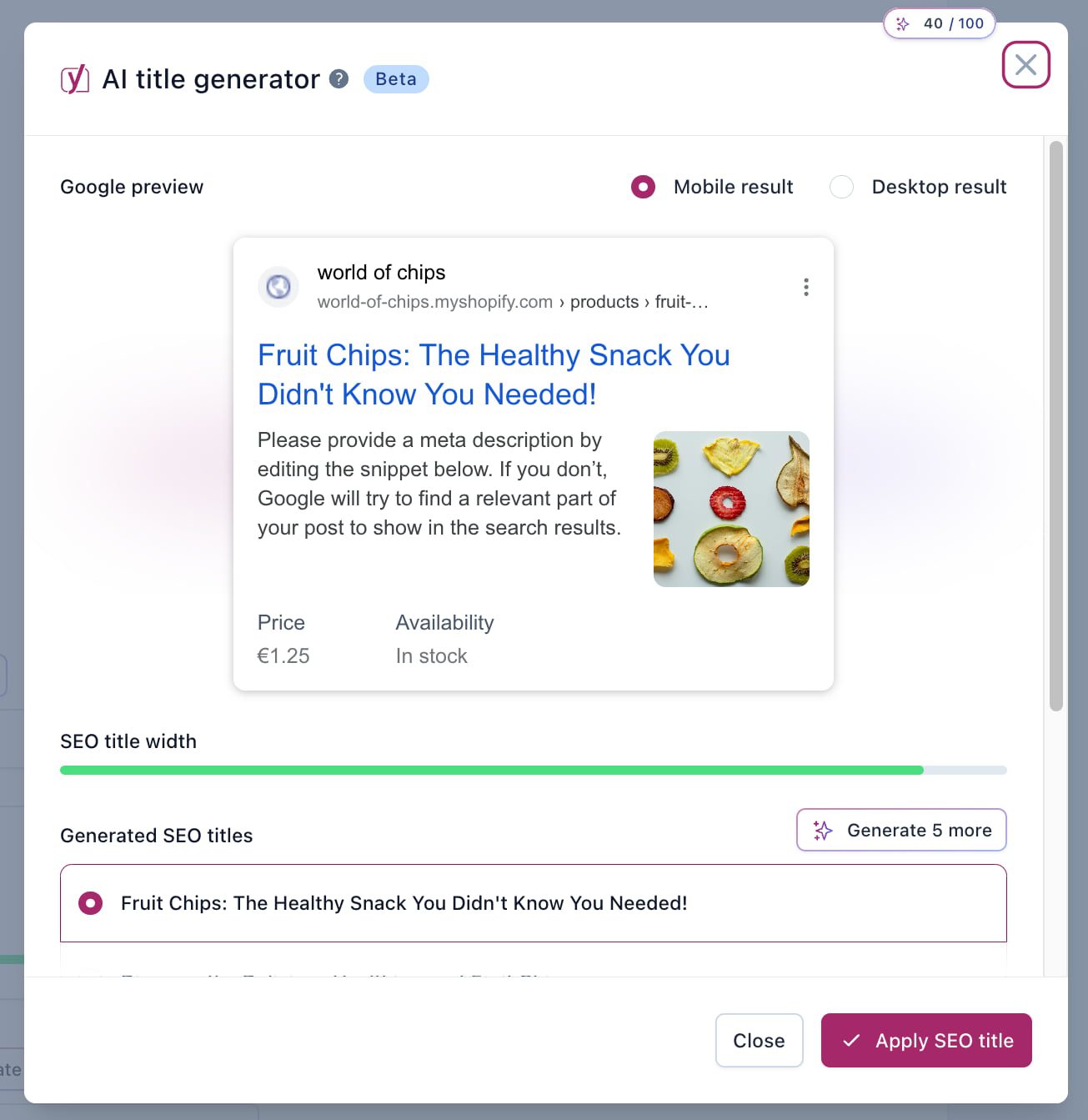
Yoast AI Generate is easy to use and greatly enhances your Shopify SEO work. By clicking the ‘Use AI’ button, the tool will generate five titles or meta descriptions based on the content you are working on. Pick the one you like and save your work. If you are not happy with the options, simply generate five more. Of course, you can always tweak them before applying them. Here’s a guide on how to use the Generate AI feature in Yoast SEO for Shopify.
This is just the start of using the power of generative AI to help you improve your Shopify store!
Get a little help from generate AI with Yoast SEO for Shopify
We make it easier to modify Shopify themes
When you install an SEO app, it needs to change your online store and theme. Don’t worry, this is normal. Depending on the other apps that you’re running, some other modifications will already have been made to your theme files.
Unfortunately, many of the new apps you install will apply their changes to what’s already there. That’s why ecommerce stores often end up with mismatched, malformed, and missing bits of (SEO) code, especially if you’ve historically used multiple apps.
The Yoast SEO for Shopify app is smart. It conditionally removes potentially conflicting code and cleanly outputs its own rather than forcing it on top of what’s already there. The app also helps you clean up your store when you delete it, should you choose to do that.
Our structured data is comprehensive
Structured data helps Google and other search engines better understand your pages, benefiting your rankings. Our structured data approach does a great job of connecting and describing products and pages. We don’t output ‘bits and pieces’ of structured data. We tie the structured data together and output it in a way that minimizes conflict and overlap. Of course, you can decide which pieces you want to turn on or off.
Our developer documentation has more technical insights into our Schema structured data implementation.
We support Shopify review apps
Structured data also allows your customers’ ratings to appear in the search results. This is essential when you have an online store. It shows other (potential) customers that you are trustworthy and will increase their chances of visiting your website. That’s why we support many review apps on Shopify.
We handle the structured data for your ratings and reviews to make those ratings appear in the search results. We currently support several review apps, including some of the most popular ones in the Shopify App Store, like Judge.me, Look, Ali Reviews, and Opinew.
Structured data helps your products to stand out in Google
Yoast SEO offers much control
With Yoast SEO for Shopify, you decide how your titles and meta descriptions are set up per content type. This allows you to consistently show your titles and meta descriptions in the search results. We integrate directly into Shopify to give you control per post, page, or product on an individual level. Our app gives you this page-level control, allowing you to make these changes per page or product you’re working on.
We help you create high-quality content
Content is a key element in SEO. Google uses any chance they get to remind the SEO world of the importance of high-quality content. To start and keep ranking, you need to keep producing great content. Content that’s easy to understand for site visitors and search engines. That’s why readability is important when creating content for your product pages and blog posts. Writing high-quality blog posts and creating great product descriptions should always be a priority.
It’s important to conduct keyword research for your online store and keep up that flow of fresh content. The right content helps search engines like Google understand what your website is about, which helps them direct the right audience to your pages. Perhaps even more important, it strengthens the relationship with your audience when you provide them with high-quality content. Yoast SEO for Shopify is the SEO solution that gives you direct feedback on the content you’re writing to help you improve it for site visitors and search engines.
To help you discover high-quality keywords to rank for, we’ve built an integration with the leading online marketing platform Semrush. Our content dashboard will show you which articles and product pages need optimization so you will always know what to do next.
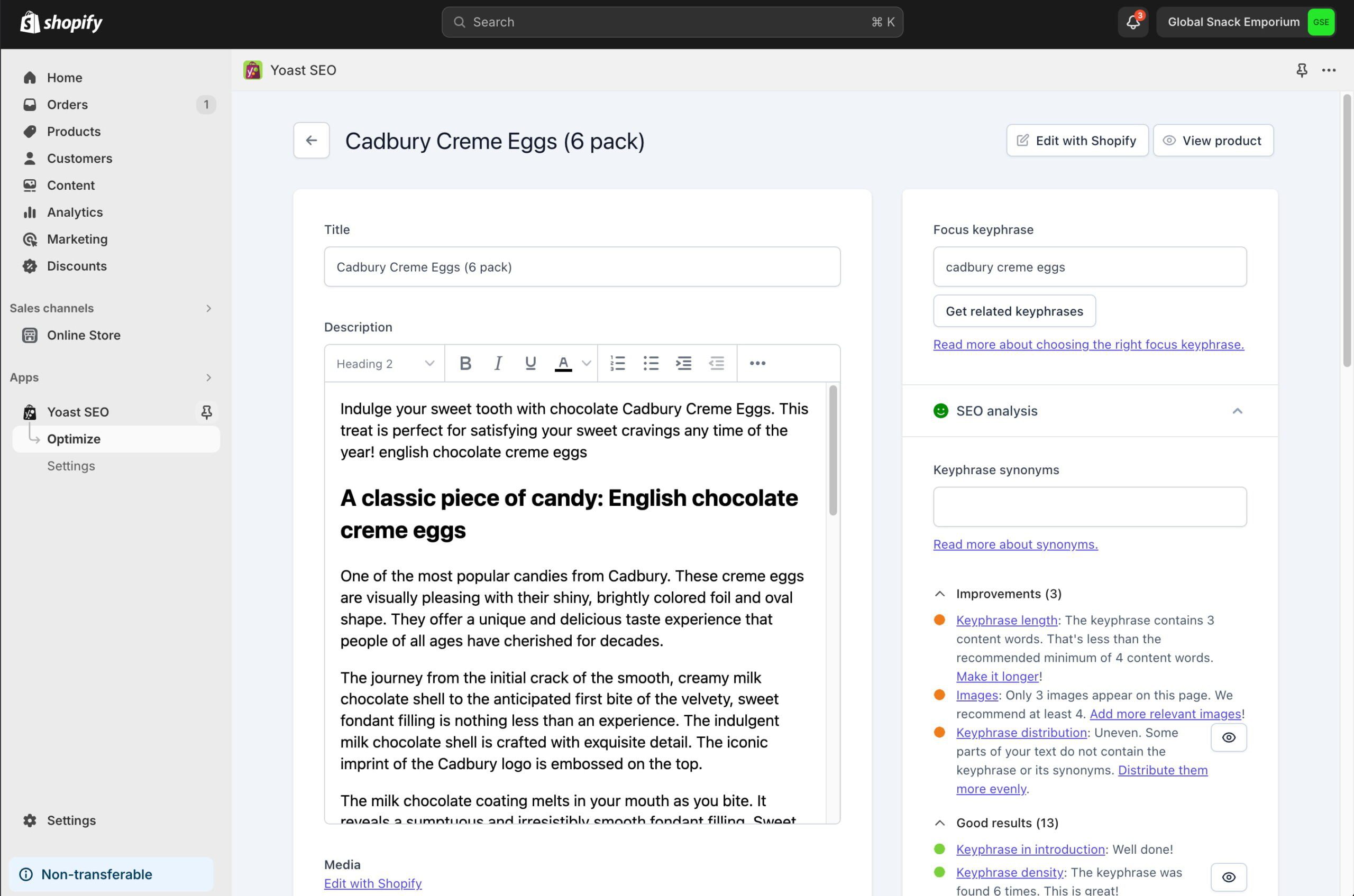
Yoast SEO for Shopify makes it easy to optimize your product descriptions by following the traffic light feedback
We understand content in 20 languages
Yoast SEO is the best app for understanding content written in your language and giving you direct feedback. Currently, it can do this in 20 different languages: English, Dutch, German, French, Russian, Italian, Spanish, Swedish, Portuguese, Polish, Arabic, Hebrew, Hungarian, Norwegian, Turkish, Czech, Japanese, Greek, Slovak and Indonesian. Remember that we can only provide an analysis of the language set for the theme.
There are a lot of SEO apps out there that are focused on the English language. Thanks to our team of linguists, we can offer feedback on your content in any of the languages above! With Yoast SEO, you have one SEO app that helps you write great content (in the language of your choice) and fixes a lot of the technical SEO for you.
See how content appears in search and social
Our search and social media appearance tools are essential to understanding how your products and content will appear on other platforms. They allow you to let your content shine and help it reach the audience you are looking for. The search appearance section previews how your content will look on Google, and the social media appearance section will do the same for platforms like Facebook or X.
Yoast SEO for Shopify has a bulk editor
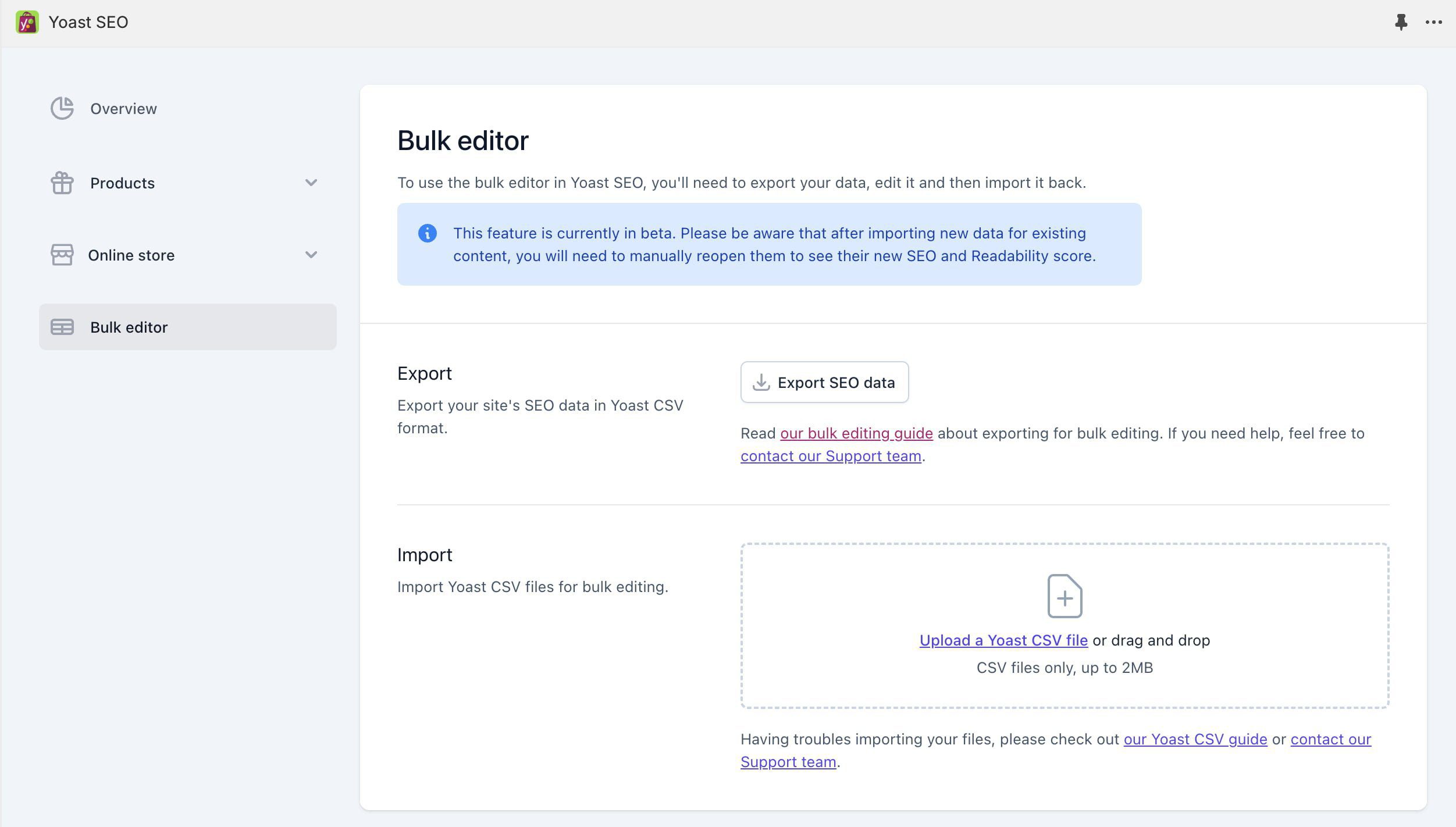
The bulk editor feature in Yoast SEO for Shopify, currently in beta form, is useful for efficiently managing and optimizing the SEO of multiple pages. It lets you simultaneously update titles, meta descriptions, and more across multiple pages. This, of course, can save Shopify merchants time compared to manual, page-by-page edits.
Here are some of the items you can edit from the bulk editor using the provided CSV file:
SEO titles
Meta descriptions
Focus keyphrases
Related keyphrases
Canonical URLs
Robots meta tags
Social media titles and descriptions
Schema structured data page and article types
The bulk editor in Yoast SEO for Shopify makes it easier to manage data in bulk
To conclude
There are many SEO apps available for your Shopify store. And it’s up to you which is best for your specific needs. We hope this article gives you more insight into our Shopify SEO app’s features and how it can help you climb those rankings! To read more about our app, visit our Yoast SEO for Shopify page.
Edwin is an experienced strategic content specialist. Before joining Yoast, he worked for a top-tier web design magazine, where he developed a keen understanding of how to create great content.
It’s the moment you’ve all been waiting for: today, Yoast AI Generate launches on Yoast SEO for Shopify! Yoast SEO’s AI features are designed to ensure all our customers can benefit from smarter SEO solutions that save time and effort. The tool is perfect for adding finishing SEO touches to your content.
What does Yoast AI Generate do?
Yoast AI Generate brings our highly successful award-nominated feature to Yoast SEO for Shopify customers. The feature provides users with AI-powered suggestions for product and content meta descriptions and titles. With every click of any ‘use AI’ button, five suggestions are generated from which you can choose. If the options are not to your liking, you can regenerate five more easily. Alternatively, you can apply and tweak it to suit your needs, which is ideal for anyone unsure about handing over any part of the copywriting process to AI.
To access the new feature, customers must first grant consent to use AI and be on one of the product, collection, or post pages within the Yoast SEO app. From any of these pages, you can see the signature AI sparkle next to the Shopify SEO title, meta description, and social title and description.
Currently, there are no additional or hidden costs to use the feature. However, you will notice the sparks counter located at the top right of the AI generator pop-up model. At the moment there is no limit on the number of sparks you can use to generate titles and meta descriptions with any paid Yoast SEO for Shopify plan. The counter is currently set to 100, but you may surpass this limit without issue for now. Of course, the general Yoast AI rate limits apply. The counter resets on the first day of every calendar month.
What are sparks and how do they work?
A spark represents a single click on any of Yoast’s AI-powered features. For example, when you click ‘Use AI’ to generate five options, that counts as one spark. Each time you regenerate, that’s another spark.
Help us improve: provide feedback
We invite your feedback on the new Yoast AI Generate feature, which is currently in beta alongside all Yoast AI tools. Your input is crucial in helping us improve and fine-tune the AI-driven title and meta description generation functionality. By sharing your insights and suggestions, you’ll play a key role in shaping the future of this tool and enhancing your SEO quality. Please share your feedback here.
Try out Yoast AI Generate for your Shopify store today
Streamline your processes and receive SEO-ready suggestions at a click when you have Yoast SEO for Shopify. Check out the new feature the next time you log in to your online store.
Beth is the Product Marketer at Yoast. Before joining the company, she honed her digital marketing and project management skills in various in-house and agency environments.
In SEO, making strategic decisions without empirical data is like relying on luck for consistent results.
But how can you effectively harness data to guide your SEO efforts and ensure you’re not just shooting in the dark?
This comprehensive guide will show you how to leverage data for confident, results-driven SEO strategies.
The Power Of Data-Driven SEO: A Case Study
Let’s start with a compelling example. Glassdoor.com, before its sale to Recruit Holdings in 2018, had an impressive 29,500,000 in monthly traffic – almost entirely organic.
Screenshot from Semrush, September 2024
Their success wasn’t by chance; it was the result of a meticulous, data-driven approach to SEO.
Glassdoor’s strategy involved analyzing data from various internet sources to identify content gaps and create high-value, well-optimized content.
This approach led to over 200,000,000 backlinks from more than 200,000 websites, establishing their influence and authority in the online employment industry.
The takeaway? Glassdoor used data to identify valuable content assets and gaps, creating content that brought them closer to their prospects.
This data-driven strategy significantly influenced their rankings in search results for the online employment industry.
What Types Of Data Are Important In SEO?
Before diving into strategies, it’s crucial to understand the types of data that matter in SEO:
Each of these data types provides unique insights that can inform your SEO strategy.
The Importance Of Data In SEO
Data takes the guesswork out of SEO, allowing you to focus on what works based on empirical evidence. For instance:
Keyword research data helps you understand your target audience’s pain points.
Bounce rate data can help you address issues affecting user engagement.
Engagement metrics show which content resonates with your audience.
How To Use Data In Your SEO Strategy
Now, let’s explore how to implement data-driven strategies in your SEO efforts:
Identify KPIs that align with your objectives and establish baseline metrics to measure current performance. This provides a reference point for evaluating the impact of your SEO strategy.
Screenshot from Semrush, September 2024
3. Understand User Intent
Analyze search intent behind keywords to effectively optimize your content. Use tools like Google Search Console to track click-through rates (CTR) for individual pages, which can indicate how well your content matches user intent.
4. Choose High-Opportunity Keywords
Identify “low-hanging fruit” keywords with significant search volume and low to moderate competition. Evaluate their business potential before targeting them.
Screenshot from Ahrefs, September 2024
5. Gather And Analyze Your Website Data
Use tools like Google Analytics to track your website traffic and user engagement metrics. This data can provide insights into your search performance and help you identify areas for improvement.
6. Conduct Competitor Analysis
Identify your SEO competitors and analyze their strategies. Tools like Semrush can help you find keyword gaps and backlink opportunities.
Screenshot from Semrush, September 2024
7. Create A Data-Driven SEO Strategy
Based on your gathered data, create an informed SEO strategy. This should include:
Creating your ideal customer profile.
Targeting the right keywords.
Conducting a site-wide audit.
Creating a content calendar.
8. Double-Down On High-Performing Keyword Categories
Identify which keywords drive the most organic traffic and conversions on your site. Use Google Search Console to see which terms rank highest and attract the most click-throughs from search results.
If you use a rank-tracking tool, combine this data with Google Analytics to see how pages perform in terms of traffic, engagement, and conversions.
Once you’ve identified your best-performing keywords, expand your content footprint within these high-value areas.
For example, if “beginner yoga poses” is a top performer, consider developing content for related terms like “yoga poses for flexibility,” “yoga routines for beginners,” and “best yoga mats for beginners.”
These “content clusters” around a topic will help you capture more traffic from thematically related keywords and can increase your domain’s overall authority for that topic area.
9. Analyze What Makes Your Best Content Effective
Examine your highest-performing content to identify factors that make it engaging for users. Consider aspects like:
Word count: Is longer content performing better, or do users prefer concise information?
Tone of voice: Is a casual, conversational tone more effective, or do users respond better to a formal, authoritative voice?
Presentation: How does the use of headings, bullet points, images, and other visual elements impact engagement?
Originality: Are unique insights or original research driving more engagement?
Call-to-action (CTA): Analyze the clarity and appeal of your CTAs. Are they driving the desired user actions?
Understanding which of these variables plays a part will guide you in crafting future content that might mirror the same success.
10. Eliminate Friction From Your Conversion Paths
Analyze which user journeys lead to the highest levels of conversions. Look for commonalities in these high-converting paths and aim to replicate these elements across your site.
11. Prioritize Core Web Vitals
Use Google’s PageSpeed Insights to evaluate your site’s performance across Core Web Vitals metrics. Implement recommended fixes to improve your site’s user experience.
12. Enhance Your Site’s Mobile Usability
With mobile accounting for about 63% of organic search traffic in the U.S., optimizing for mobile users is crucial. Use Google’s Lighthouse tool to test your site’s mobile-friendliness and implement necessary improvements.
13. Analyze Backlinks For More Targeted Outreach
Study your site’s backlink data to optimize your link-building strategy. Use this information to tailor your outreach strategy and target high-authority websites that are likely to find your content valuable.
14. Collaborate With Cross-Functional Teams
Communicate the value of SEO to all stakeholders and align it with broader business goals. Integrate feedback from various teams to improve your SEO workflow efficiency.
15. Monitor And Iterate
Remember, SEO isn’t a set-it-and-forget-it strategy. Continuously monitor your progress and be prepared to iterate based on new data and insights.
Tools To Find SEO Data
To implement these strategies effectively, you’ll need the right tools. Here are some essential ones:
Google Analytics: For traffic data and user behavior insights. GA4 provides detailed information about your website visitors, including their demographics, interests, and how they interact with your site.
Google Search Console: For keyword research and onsite data. Google Search Console shows you how your site appears in Google search results and can help you identify and fix indexing problems.
Ahrefs: For backlink data and competitor analysis. It offers comprehensive insights into your backlink profile and helps you identify link-building opportunities.
Semrush: For comprehensive competitor data and keyword research. It’s particularly useful for understanding your competitors’ strategies and finding keyword gaps.
Screaming Frog SEO Spider: For technical SEO data. This tool crawls your website to identify technical issues that could be impacting your search engine performance.
PageSpeed Insights: For Core Web Vitals analysis. It provides both lab and field data about page performance, with suggestions for improvement.
Lighthouse: For mobile usability testing. This open-source tool audits performance, accessibility, progressive web apps, and more.
Remember, while these tools provide valuable data, the real power lies in how you interpret and act on this information.
Regularly review your data, look for trends and patterns, and use these insights to continuously refine your SEO strategy.
Leverage Data For Decision Making
Success in SEO isn’t luck or magic. With the right data, you can make informed strategies that cut through the noise and achieve better results on the search engine results pages (SERPs).
Remember, SEO is not just about theory – it’s about implementation. The final step of your data-driven decisions is to put your strategies into action and benchmark against your previous performance.
By leveraging data as a foundation for decision-making, you can create more effective SEO strategies.
From capitalizing on high-performing keywords to enhancing mobile usability and optimizing backlink strategies, each data-driven action you take helps solidify your online presence and improve your rankings.
Stay analytical, stay informed, and let the data illuminate your path to SEO success.
This post was sponsored by Wix. The opinions expressed in this article are the sponsor’s own.
SEO courses seem to be everywhere. In that sense, they’ve become a dime a dozen. That’s generally because they’re both a lead magnet and a solution to a real problem.
To the latter, SEO isn’t an exact science, and it’s not like you can major in SEO at a traditional university. Instead, we have a disparate set of publications (like the one you are reading right now) offering collections of various resources and media from which to learn SEO.
Moreover, most practitioners “somehow” fall into SEO from other disciplines. So you’re really starting from scratch. It’s why a lot of SEOs start off following some pretty bad advice from some pretty questionable (yet highly popular) marketers.
It all makes for a pretty messed up learning curve when trying to “uplevel” (sorry for the marketing buzzword) your SEO know-how.
The solution? A set of organized material from knowledgeable sources built on sound pedagogical tactics—AKA a course.
The problem is, even if a course is free, it’s a serious time commitment. So before you fork over your money and/or your time, how do you know if a course is even worthwhile?
To help answer this question, I am going to take you behind the scenes of how I constructed our SEO course (while of course—pun intended—subtly selling you on the idea of taking our course as this is indeed a sponsored article; I just smashed like three “fourth walls” in one sentence).
Let’s get started. Here’s what I was looking for when I constructed the course and what you should look for when taking or recommending an SEO course.
1. Look For Course Instructors That Align with Specific Expertise
If you see a course and it’s just a bunch of random “big names” you’ve seen all over social media, run.
Yes, you do want a course created by experts in the field. However, it’s not as simple as having a “big name” on board.
To start, popularity on social media doesn’t always equate with actual SEO expertise. What you want to do is sniff out if the course instructors are there for the substance they provide or if this is just some sort of influencer marketing play.
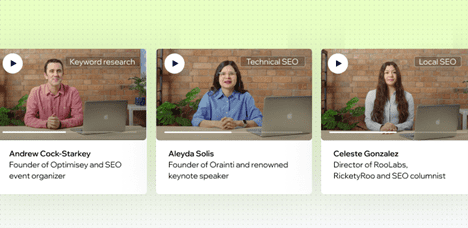
When we went about creating our SEO course, one of the things I was adamant about was that the instructors we hired weren’t just experts in “SEO,” but experts in a specific type of SEO (local SEO, tech SEO, etc.). Meaning, it wasn’t just “Are these folks well-respected,” but are they known in the industry for focusing on that subtopic within wider SEO?
I was also looking for good communicators, not just the folks with the largest social followings. Being a good communicator on social media is different from being able to convey information in a more formal setting that relies on video as the medium.
Aside from areas of specialization, there are all sorts of practitioners who are used to doing SEO in different contexts. There are enterprise SEOs, in-house SEOs, consultants, SEOs who work at agencies, etc.
We thought it was important to have course instructors from all these backgrounds to offer a more complete set of approaches to various SEO considerations.
So if you’re looking into an SEO course, ask yourself:
Is there something to the instructors beyond their name recognition?
Do the instructors have strong subtopic alignment with their course sections?
Are the various subsets of SEO represented? (In-house, agency, etc.)
Do the instructors have previous presenting experience or just big social media followings?
1. There Is No ‘Best’ Course
If a course names itself something like “Best SEO Course”—run. There is no such thing as a “best” SEO course. There is a course that is great at dealing with advanced SEO topics, or courses that are geared towards specializing in something like tech SEO or local SEO, and there are courses that offer a wider breadth, etc.
The right course depends on your needs and objectives and where you are in your SEO journey. As such, the “best SEO course” is a fictitious construct.
To pull the curtain back, we were debating what to do with the term “best” for our course. The query “best SEO course” is certainly a lucrative one. Perhaps it would be strategic for our SEO to include the term “best” in the name of the course.
We decided not to do so even if there was an SEO benefit to it.
We had an idea of who we built the course for: We specifically wanted to help people having a hard time piecing together the topic and who are relying on doing so for their business needs and/or careers. (That’s not to say the course doesn’t apply to other demographics, but rather this is the primary pain point and audience we had in mind when designing the course).
This is basically because when we sat down to discuss the course, we all felt that when we were first starting out in SEO, it was a struggle to piece it all together.
This not only shows why there is no “best” SEO course, it also leads me to my next point.
2. Make Sure The People Behind The Course Are Genuine SEO Experts
Instructors are one thing. The people responsible for developing the course overall are another thing entirely. Now, I am not saying that if the people behind the course are not SEOs, they can’t create a wonderful course. What I am saying is that you better hope they gave creative control to the SEOs involved.
That’s not just for SEO accuracy per se (although that is a big part of it), it’s also because SEOs who have themselves struggled to grasp SEO concepts at some point in their career will better understand what to include in an SEO course.
Then, of course, there is the actual accuracy of the content. While the instructors may be a part of the process, they are far from in control of the course and what it ultimately looks like in post-production.
The question is, how can you tell if SEOs were involved in the backend of the course and to what extent?
There is no 100% tell-tale sign. However, I can say that from my experience working with our course, the way the course is structured might provide hints.
What do I mean?
Usually in an SEO course’s “on-page SEO” section, you would discuss concepts related to all things content, from E-E-A-T to strategy.
In our course, I purposefully did not put this course material under “On-Page SEO.” Rather, the deep dive into content, quality, and algorithms were placed under keyword research.
Why?
I felt that, often, the SEO industry thinks about topics like keyword research a bit too linearly and without enough depth and nuance. I wanted to contextualize keyword research by connecting it to a discussion about what creating quality content for the SERP looks like.
This is what I mean by looking at unique course structuring as a sign that there is real SEO expertise going into the material.
If a course follows an overly generic format, this (combined with other signals might) be a sign that folks without genuine SEO experience have too much input. Which is, obviously, not what you want.
3. Look For Signs of Pedagogy
This has nothing to do with SEO itself, but is purely about what it means to create a good course.
Yes, the curriculum needs to be accurate, but it also has to be delivered in a way that is conducive for learning. Our own process involved a lot of back and forth with our educational team to ensure that we structured everything from the assessments to the course scripts in a way that facilitates learning.
To give some context, we borrowed something that I used to do back in my teaching days—backward planning.
At the start of the process, we developed learning goals within the course section. These goals would form the basis for the assessments that we offer at the end of each course section. All of the course sections were built to fulfill those specific learning goals. In this way, the course itself directly aligns with the assessment, which is only fair.
On top of that, we made sure to use the assessments to extend the learning by mixing in scenario-based questions.
There are millions of ways to go about constructing a course that incorporates sound pedagogy. If you’re looking at a course and it all seems very linear, that might be a good indication that the course lacks pedagogical depth. Which is clearly not what you want, no matter how amazing the instructors listed are.
So when looking at an SEO course and deciding to dive in, don’t just look at it from an SEO perspective. Getting the SEO education right is only half the battle. The course also has to effectively communicate that information to you.
Look for signs of pedagogical life when choosing an SEO course.
Learning SEO can be hard. It can be a very informal process that leaves you wondering what gaps you might have and what you still need to learn.
The need for an SEO course can be real. There are a lot of great SEO courses out there. There are also a heap of “grifters” looking to take advantage of people who need a comprehensive way to learn SEO.
When it comes to signing up for an SEO course, if it feels too “markety” or too “salesy,” it probably is.
Look past the “certifications” every course offers (ours included). They’re nice, but no one is hiring you or giving you a raise because you have one.
Look past the big names a course may have procured.
Look past the overpromising (“Our users have improved their organic traffic by 1000000000000000000000000.9% in just 1 day after completing our course”).
Instead, think about what your specific needs are and if the course is suitable and substantial enough to help you fill those needs.
It pays to dig a bit deeper into a course and pull the curtain back a bit before investing money and in the case of a free course, time.
Ready to start optimizing your website? Sign up for Wix and get the data you need to deliver great user experiences.
Since 2017 we’ve published five lists of new social networks — 2017, 2019, 2020, 2022, and 2023. Here is our all-new installment for 2024. There are microblogging platforms for text, video, audio, and images. There are decentralized social networks, live-streaming platforms, AI-assisted networks, ad-free apps, and location-based apps to track and meet up with contacts. Some of the platforms are in beta.
Instagram Threads is an app for sharing stories and conversations. Create posts up to 500 characters with the option to include links, photos, carousels, and videos up to five minutes long. Then share to Instagram Stories or direct messages — and control who can reply.
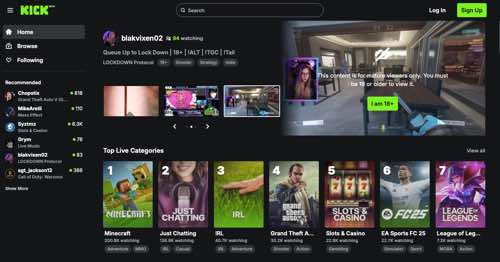
Kick is a live-streaming app similar to Twitch. Users broadcast content in real-time, interacting with followers through chat and other features. To stream on Kick, users create an account and set up streaming software such as OBS Studio or Streamlabs. Kick has an incentive program that compensates creators with revenue per individual stream. Since its launch in early 2024, Kick says it has paid over $17 million to more than 2,000 creators.
Gowalla is a location-based social networking app that tracks users’ actions in the real world. Post updates privately to your network on your location and activities. Send messages, make plans, and leave reactions in direct and group threads. Find interesting places to visit. Gowalla launched in 2007, closed in 2012, and relaunched in March 2023.
Bluesky is a decentralized microblogging platform on the AT Protocol, an open-source toolbox for building social apps that can talk to each other. Bluesky aims to function like the early days of the web when anyone could put up a blog or subscribe to others via an RSS feed.
Jagat is a social network for friends and family. Engage in real-time connections with location sharing and interactive features. Follow real-time locations and share with your network. See activities on a footprint map and from the past 30 days.
Noplace is a colorful social platform of ads and algorithms. Targeted at teens and Gen Zs, it seeks to bring back a fun and organic MySpace-like experience. Gain levels, earn badges, make friends, and use the customizable profile to share your mood and what you’re gaming, streaming, reading, and more.
Airchat is an audio-based social network featuring a push-to-talk, voice-first public messenger that uses AI to generate transcripts. Users have tools to moderate behavior on their content.
Lemon8, owned by TikTok parent ByteDance, is a video and photo-sharing app and blogging platform. The content centers on fashion, makeup, food, travel, gadgets, pets, and related. It provides a variety of templates, filters, stickers, and fonts to help creators. Lemon8 launched in Japan in 2020 and the U.K. and U.S. in 2023.
RTRO is a social networking app that connects brands, creators, and followers in a positive, nontoxic environment. RTRO focuses on connections and communities rather than ads or algorithm-driven content. Users can connect with friends and family or see content from creators and brands in their own space. Discover retro postcards, retro Polaroids, filters, and mixtapes.
Damus is a decentralized social media platform built on Nostr, the open and decentralized social networking protocol. Messages are distributed via decentralized, encrypted relays. Damus users can run their own microblogging platform for friends or a business.
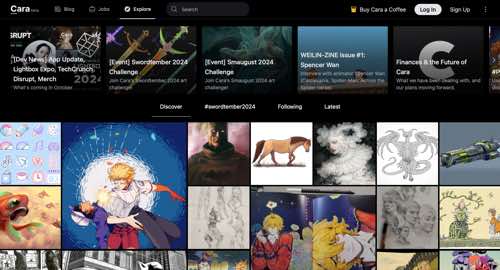
Cara is a social media and portfolio platform that connects artists with clients, fans, and industry peers. Cara filters out generative AI images to find authentic creatives and artwork easily.
Substack Notes, launched in 2023, is a microblogging feature that enables writers and users to post short-form content and share ideas. Notes allows users to recommend anything via posts, quotes, comments, images, and links.