ChatGPT is experiencing a noticeable outage that is apparently reaching a critical point where it’s become highly noticeable. The current outage is a part of a series of outages that began on August 26th, becoming progressively serious with time.
Timeline Of ChatGPT Outage
August has seen numerous ChatGPT incidents, more than in July but so far the equaling the entire month of June. Some of the the incidents documented in July were related to the new GPT-4o language model.
In comparison, August has experienced elevated error rates, reaching a peak on August 28th where the amount of errors, Bad Gateway errors, were enough to cause a large blip on the Downdetector website.
Most of the reported problems involved ChatGPT and the website, while 4% of reported outages were on the ChatGPT app.
OpenAI Incident Reports
The official OpenAI status page has a notation indicating severe outage levels.
Elevated error rates for ChatGPT A fix has been implemented and we are monitoring the results. Aug 28, 08:19 PDT
Elevated error rates for gpt-4o-mini-2024-07-18 fine-tuned models This issue has now been resolved. Thank you for your patience. Aug 27, 12:27 – 14:14 PDT
Increased conversation latency in ChatGPT Today, between 12:51AM – 12:51PM PT, conversations on ChatGPT experienced increased latency. This issue is now resolved. Aug 26, 20:27 – 20:27 PD
A fix has apparently been deployed. If the outage is still ongoing for you then it may be something that has to propagate through datacenters or some other issue, perhaps related to the cloud gateway.
For lead gen marketers, we know it’s not just about generating leads; it’s about attracting the right leads – those that are most likely to convert into valuable customers.
Value-based bidding is a strategic approach that allows businesses to focus on optimizing campaigns for conversions that truly matter.
We’ve seen value-based bidding work for online sales and brick-and-mortar businesses as well, but here we’re going to focus on using it for driving higher quality leads.
This is the first of five articles I’ll be sharing weekly to delve in deeper and build on each episode of our new video series on value-based bidding for lead generation.
As you’ll see in this first video below, each is short enough to take in over a quick coffee break.
We’ll start from the beginning and cover what it is and whether value-based bidding could be the right strategy to elevate your lead generation efforts in Google Ads.
The Power Of Quality Leads
Not every customer brings the same value to your business. High-quality leads are more likely to engage with your brand, convert into paying customers, and contribute to long-term business growth.
Value-based bidding is particularly beneficial for businesses that typically need to nurture relationships with customers between an initial online conversion and a final sale.
By focusing on quality leads, you can streamline your sales funnel, improve conversion rates, and ultimately boost your bottom line.
So how can you do that with value-based bidding?
Bidding To Value
Value-based bidding allows you to prioritize specific value goals that align with your business goals.
These goals could encompass sales, revenue, profit margins, or even the lifetime value of a customer.
With this strategy, Google’s AI uses billions of combinations of signals along with your first party data to identify conversions that are most likely to deliver on your defined value objectives.
It then optimizes bids to focus your ad spend on reaching those higher value customers.
The Basic Mechanics Of Value-Based Bidding
Value-based bidding offers two primary pathways to optimize your campaigns by bringing values into Smart Bidding:
VALUE-BASED BIDDING
Maximize conversion value with a target ROAS Drive as much conversion value at a particular ROI.
Maximize conversion value (no ROAS target specified) Get as much value within a set budget.
Maximize conversion value: If you’re working with a fixed budget, this option focuses on extracting the maximum lead conversion value from your campaign within the constraints of your budget.
Set a ROAS (Return on Ad Spend) target: This option enables you to optimize for conversion value at a specific target ROAS to help ensure your ad spend generates a desired level of return. When you set a ROAS target, the system will optimize to find as much value as possible on average at your target. There are data thresholds to using target ROAS which we will cover later in this series, but this is the preferred strategy when you want to achieve specific ROAS goals and be able to respond dynamically to shifts in demand. Target ROAS is available for single campaigns or a portfolio strategy applied to multiple campaigns.
Value-based bidding will maximize the conversion value based on budget constraints and ROAS targets where applicable, so higher value customers will be prioritized over volume alone.
Keep this in mind when comparing target CPA performance, which optimizes for conversion volume irrespective of value.
While the emphasis will be on attracting high-value customers, it’s important to note that you might still see some medium to low-value customers depending on the dynamics of the ad auction.
When using ROAS targets, the higher your target, the fewer auctions your ads are likely to enter. In other words, ROAS targets are your lever to make your ads more or less likely to enter the auction.
Is Value-Based Bidding The Right Fit For Your Business?
Value-based bidding has seen success across a spectrum of industries, but whether it’s the right fit for you depends on your specific business needs and capabilities.
Before embracing this strategy, you’ll need to address these key questions:
Can You Assign Meaningful Values To Your Conversion Actions?
You are likely already differentiating your customers’ value in some facet, formally or informally.
You’ll need to set a concrete value to each conversion, whether through static proxy values like lead scores or dynamic economic values such as total profit. (We’ll cover proxy values more in the third article in this series.)
Do You Need To Strike A Balance Between Volume And Value Goals?
Bidding to value means your campaigns likely will not generate the same volume of conversions as they would using Maximize conversions with an optional target CPA bid strategy. This strategy is designed to return a higher total value of conversions. Bid simulators can help you to understand this tradeoff.
If you want to maintain a certain level of traffic, use the Smart Bidding bid simulator to help you gauge the optimal ROAS target that will yield your desired volume of leads while maintaining a focus on quality.
Lowering your target ROAS will increase your reach, and raising your target ROAS will decrease reach while seeking out higher value conversions.
Are You Able To Measure And Connect Your Value Data To Google Ads?
Access to accurate and comprehensive value data is a must for implementing value-based bidding effectively. To start, this means having proper site tagging to track conversions.
Feeding the right first-party data values into Google Ads is key to training the system to identify and differentiate predicted customer value for each auction.
If your value objective is sales value, for example, you’ll need to be able to measure and connect that data back to your Google Ads account. We’ll cover how to do that later in this series.
Reaping The Rewards Of Value-Based Bidding
The initial setup of value-based bidding typically requires some effort up front, but don’t let that intimidate you.
You can start with a more basic set up and adopt more sophisticated approaches that have more technical requirements, such as optimizing for margin or lifetime values for example, later if you wish.
Value-based Smart Bidding gives the system the flexibility to set each bid based on the predicted value of the conversion and target higher value conversions. Over time, it learns which users are more likely to be higher value and more profitable, then bids accordingly.
Bidding to find the most valuable customers can deliver incremental revenue uplift and profitability. Businesses that have found success with this strategy report a marked improvement in lead quality.
On average, advertisers that switch their bid strategy from a target CPA to target ROAS can see 14% more conversion value at a similar return on ad spend.1
Beyond The Basics
While we’ve covered the foundational aspects of value-based bidding, we’re just getting started.
In the upcoming articles in this series, we’ll dive deeper into this strategy, including how to identify and leverage the right data and values for your business, and how to share your value information with Google Ads.
By aligning your campaigns with the conversions that truly matter most to your business objectives, you can optimize your ad spend, maximize your return on investment, and achieve sustainable business growth.
Up next week, we’ll talk about figuring out the right data and values.
Google’s Martin Splitt answered a question about whether internal nofollow links and noindex meta robots directives send the wrong signal to Google that the website is low quality.
Nofollow Link Attribute
The nofollow link attribute came about as a standard created by Google, Yahoo and Microsoft that publishers can use to signal that a link can’t be trusted (such as links in user generated content) or for paid links. The idea is that the links can’t be trusted or used for ranking purposes or for whatever reason.
SEOs discovered that PageRank didn’t flow through links that had the nofollow attribute so naturally the self-identified “white hat” SEOs tried gaming Google by adding nofollow links to their privacy and about us pages in order to funnel the maximum amount of PageRank to the pages that mattered. This practice was called PageRank Sculpting and it shows that adding nofollows to internal links is longtime practice and that it’s never been a problem before.
For the record, PageRank sculpting doesn’t work because, in a highly simplified explanation, Google essentially counts the amount of links on a page, including links with nofollows and divides the amount of PageRank that flows as if all the links counted. That’s how it was explained many years ago and that may have changed over the years, we don’t really know.
Noindex Robots Meta tag
The noindex robots meta tag is a directive that crawlers like Googlebot are required to obey. It allows a publisher a way to block crawling at the page level.
There is nothing about the noindex value of the meta element that indicates whether the page is untrustworthy or anything like that. It’s just a way to control crawlers.
Google’s Martin Splitt narrated the question:
“Can a lot of internal links with nofollow tags or many pages with noindex tags signal to Google that the site has many low-quality pages?”
Martin answered:
“No, it doesn’t signal low-quality content to us, just that you have links you’re not willing to be associated with. That might have many reasons – you’re not sure where the link goes, because it is user-generated content (in which case consider using rel=ugc instead of rel=nofollow) or you don’t know what the site you’re linking to is going to do in a couple of years or so, so you mark them as rel=nofollow.”
Nofollow Is Not A Quality Signal
Martin confirmed that there is no signal indicating a value judgement about “quality” that’s associated with the use of a nofollow link attribute or the noindex robots meta tag. Using them on internal links or for preventing crawling is fine and have no effect on Google site quality judgements.
Listen to the podcast question and answer at the 1:17 minute mark:
In an ideal world, Google would visit each location with a GBP to ensure that the business is real and meets all guidelines.
But that is not possible.
One of the ways Google can verify a business is through video verification. Video verification is the next best thing to visiting a business.
It’s almost like a “digital in-person” check-in on the business.
The video allows Google to actually see the company and more details about the business.
Google’s video verification method tries to authenticate and confirm legitimate businesses and (hopefully) weed out spammy and fake listings that could inundate the Local Pack, Local Finder, and Google Maps and confuse or hurt consumers.
Why Video Verification?
With video verification, Google is trying to ensure that the GBPs set up are legitimate businesses meeting Google’s guidelines.
With the video verification process, Google is trying to get the following information:
Existence: Is this a genuine/real business? Does it exist?
Geographic location: Is the business located where the Business Profile says it is located? (It isn’t easy to film a video of a bookstore in New York City and pretend that it’s a bookstore in London.)
User integrity: Is this an authentic company? Is it a real merchant? Google is trying to determine if someone is attempting to commit fraud.
Affiliation: Is this merchant actually associated with the business? Do they have the authority to represent the business?
When businesses submit video evidence that proves and shows these things, Google operators can review the video to determine if the evidence presented is strong enough to verify that the business is located where it says it is, performs the work it claims it does, and more.
To go through the video verification process, you’ll need a mobile device with a camera.
If you get this verification option, it’s important that you understand the rationale for the video verification.
You should understand what needs to be included in the video so that the Google operator reviewing it is convinced that your company exists and does what it says it does. The operator must also be convinced that the person taking the video is associated with the business.
They will also want to verify that the geographical location matches the location of the business as listed in its GBP.
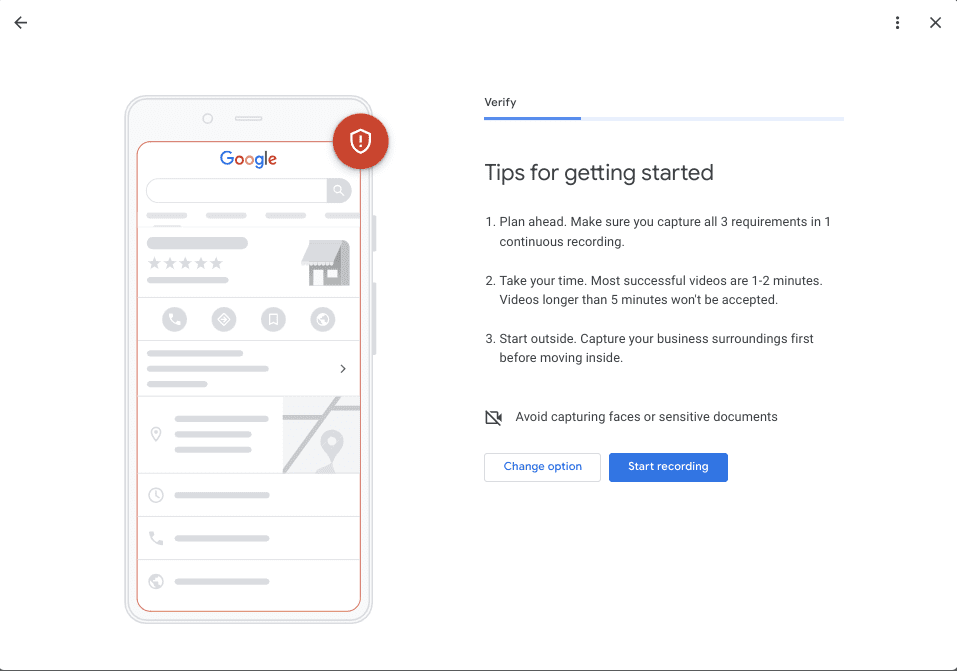
It’s also important to follow the on-screen instructions and plan everything out before you start recording the video. Since the video must be done in one continuous shot, planning ahead is crucial!
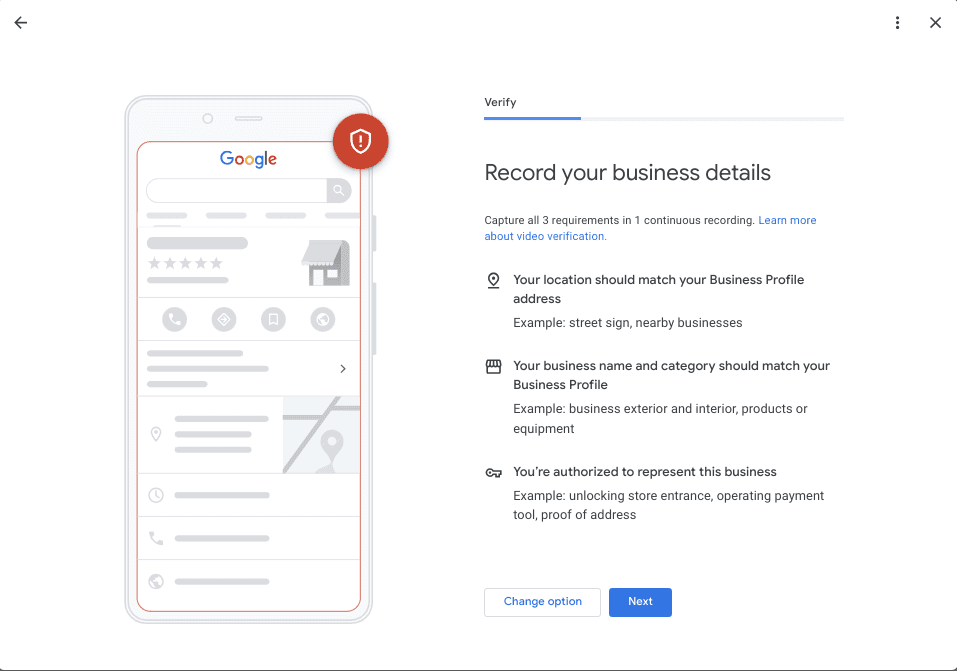
In the video verification process, Google asks the business owner (or someone with authority to represent the business) to create a short, continuous video that provides evidence that the business is an actual, legitimate business.
The video should be short (approximately two minutes) and to the point.
Each video is manually reviewed by a Google employee and is meant to simulate an in-person visit to the business.
Google doesn’t ask you to share anything sensitive – like people’s faces or documents that contain confidential information.
These videos are kept private and are only used for verification purposes.
Don’t worry; It will never be published and can be deleted anytime.
Screenshot by author, June 2024
Planning Your Video For Business Profile Video Verification
Before you shoot your video, you should plan out what you will show in the video, who will be in it, and who will record it.
Next, you’ll want to ensure you cover the items necessary to convince Google that your business is legitimate.
Here are the types of things you want to be sure to show in your video.
Keep in mind that these items do not have to be shown in any particular order – they just must be shown in the video to prove that your business is real. Google does want you to show the outside first and then go inside the building, however.
Screenshot by author, June 2024
Show That Your Business Exists
For this part of the video, you need to show proof that your business exists, where it is located geographically, and other items that prove it’s a legitimate business.
It’s important to show the exterior of your business first and then go into the interior of your company’s building in the video.
If you’re a storefront business, you must show the outside of the building, as well as the permanent signage on the exterior and any signage/branding inside the building.
Also include the location, relevant street signs, and other nearby businesses, so Google can get an idea of where you’re geographically located.
Don’t show unmarked roads or land – that will not help Google establish your location.
Showing your outdoor signage is a must if you have a storefront location (i.e., a storefront location is when local customers visit your place of business, you have permanent signage, and you must have employees staffed at the business location during stated business hours.)
Permanent signage is a requirement for storefront businesses. Vinyl banners or other temporary signs do not count as permanent signage.
If you do not have permanent signage, you do not qualify as a storefront.
Pan your video next door and across the street to show the businesses nearby so Google can double-check with Google Maps and Streetview to ensure that your business is located where you claim it is.
Image from author, August 2022
It’s also vital to walk into your building and show the inside of your company so Google sees that it’s a legitimate business – and not just empty rooms.
Any time you can show your company’s branding on the walls – like in the lobby or entryway – it’s great to show those types of things in the video.
If you work in an office building with multiple floors and many businesses, be sure to show the office building’s business directory pointing out your company’s listing and suite number.
If you have any professional tools that you use, marketing materials, or company branding, be sure to show those in the video as well.
If you’re a Service Area Business (SAB), you will need to show any tools of the trade that you use to perform your work for clients in the video.
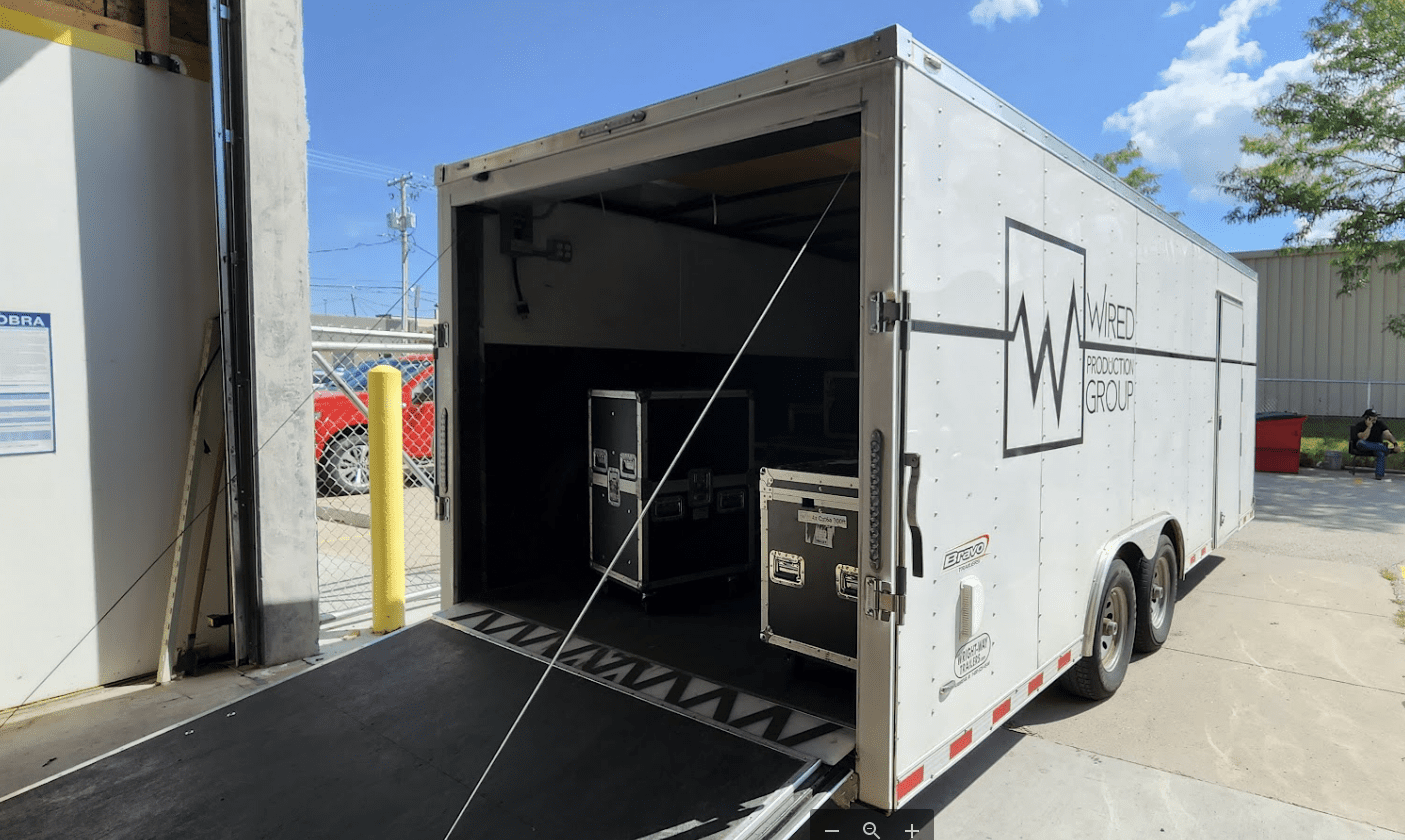
For instance, if you are a solar company, you should show the solar panels you install, any installation equipment you use, branded trucks, ladders, any heavy equipment you use, tools of the trade that you have stored, etc.
Are you a lawn care company? Show all your lawnmowing equipment, trimmers, leaf blowers, etc. (The average Joe at home won’t have 10 commercial lawnmowers, for instance – but you do!)
It’s also vital to show your service vehicles with the branding on them. (A video showing a plain white van will not be acceptable.)
So, ensure that your service vehicles are branded with your company name and logo and are seen clearly in the video.
Show Geographic Location
Google wants to know that your business is located where your GBP says it is located. The Google operator needs to be convinced that the company in the video is in the same geographical location as in Google Maps.
If you’re a storefront business, you can show street signs near your business, pan over, and show adjacent companies near your company. However, showing Google a vacant lot where your business should be will not instill confidence that you are a legitimate business.
Image by author, August 2022
If you operate your SAB out of your home, show the street signs, your home with your street number on it, your mailbox, and any other things that prove your address.
Show User Integrity: Prove You’re A Real Business
One way to prove you have a real business is by showing items in the video that only a real business like yours would have.
For example, showing a generic software application on your computer screen will not convince Google that you’re a legitimate business.
Image by author, August 2022
If your company uses specific software to operate your business, then showing that software on your computer screen and your audio/video setup in the video would help prove to Google that you are legit. For example:
You’re an accountant and you use professional accounting software.
You’re a veterinarian and you use software specifically developed for vets’ offices.
You’re a digital marketer or design firm that creates videos or podcasts for clients using a specialized tool.
If you’re a Service Area Business, showing your work van with equipment in the back of the truck in the video is very helpful for the Google operator as they review your video to determine the legitimacy of your company.
Affiliation: Is The Merchant Real?
For this part of the video, you need to prove that the company is real and that the merchant is actually affiliated with the company and has the authority to represent the business.
That’s why it’s so important that the person in the video is either the owner or manager.
If you have a storefront business, in the video, you need to show that you have access to employee-only locations or sections of the business.
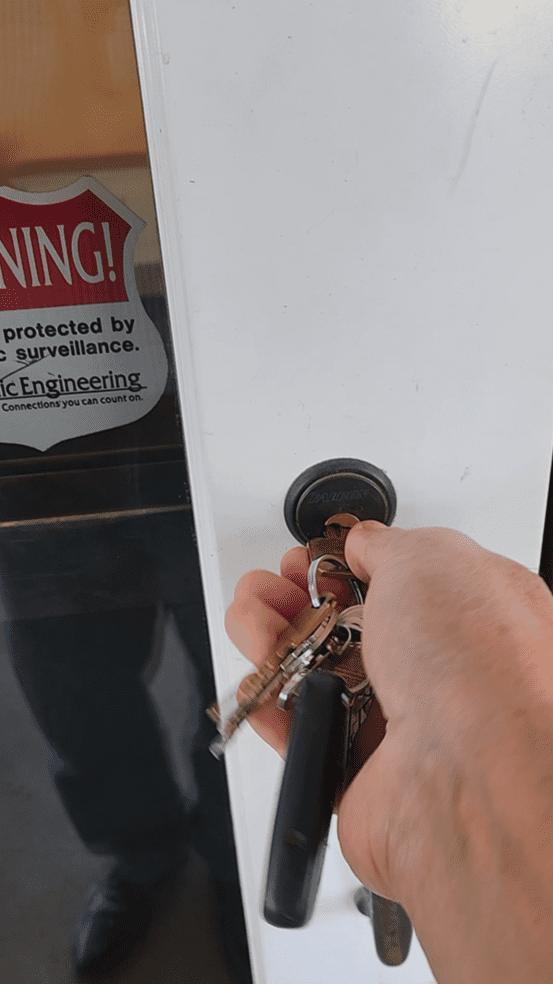
For instance, show you opening the store/business using a key, operating the cash register, using the POS system, going into an area of the business where customers or the general public aren’t allowed, etc.
This part of the video aims to show that the person is either the owner or an authorized person who has authority over the location.
You also want to go to places in your business where the general public is not allowed.
For instance, if you own a restaurant, customers are not allowed to be behind the counter near the cash register or take out food. Showing this in the video is a great proof of management.
If you have a business license, liquor license, or any other official/legal document hanging on the wall, zoom in on it. This is especially important if the document shows your business name and address as shown on your Google Business Profile. (Ideally, everything should match!)
If you operate a Service Area Business, you will need to show access to any industry-specific software, open up your branded vehicle and show the equipment or tools you use to perform the jobs you do.
Image by author, August 2022
You can also show close-ups of any business licenses, Secretary of State documents, LLC or incorporation docs, or any other official documents that prove your company’s name and address.
Just zoom in on the documents so Google can see them. Again, the business name and address must match what’s on your Google Business Profile.
Note: If you get the video verification option and are not ready to do the video at that moment, no worries! You can complete the verification step when you’re able to – like in a day or so after you’ve had time to plan out what you’ll show in the video.
Completing The Video Verification Process
When you’re taking the video, it’s okay to put these items in whichever order makes sense for your particular situation – just make sure you cover all of the necessary requirements.
Remember, the video must be one continuous video. It cannot be recorded somewhere else and then uploaded.
The video must be created using the Google Business Profile video verification process.
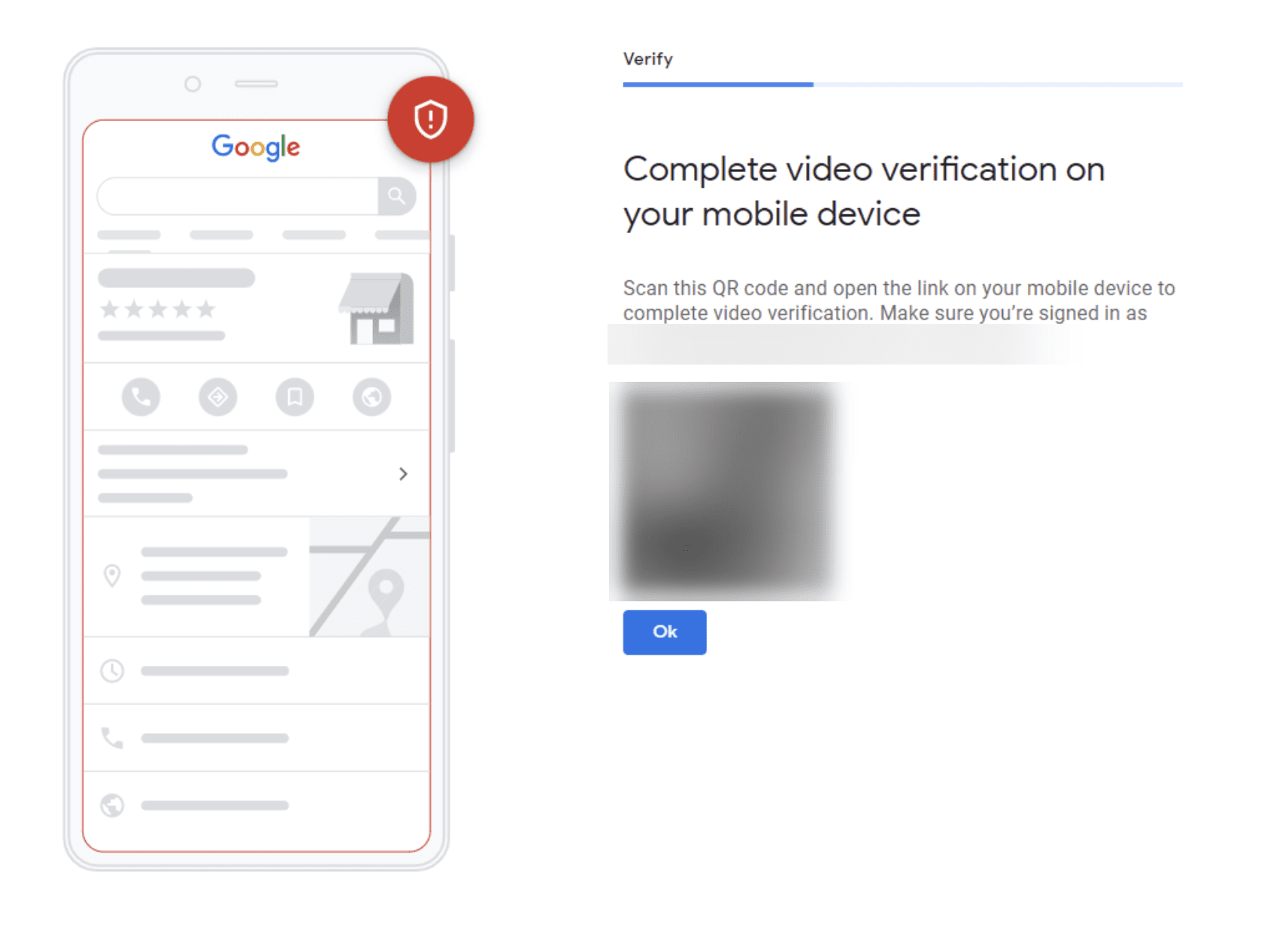
If you started creating your Google Business Profile on a desktop computer, when you get to the video verification step, you will see a QR code that you can scan with your mobile device.
This allows you to continue the video verification process on your mobile device. Just make sure you’re signed in with your Google Business Profile email address on your mobile device.
Screenshot from Google Business Profile, July 2022
When you’re ready to start recording your video, tap Start Recording.
Screenshot from Google Business Profile, July 2022
And then, follow the steps to record your video.
After you have recorded the video, tap Stop Recording. The merchant can then choose to finish onboarding on a desktop or your mobile device. (Finishing on your mobile device is probably the simplest choice.)
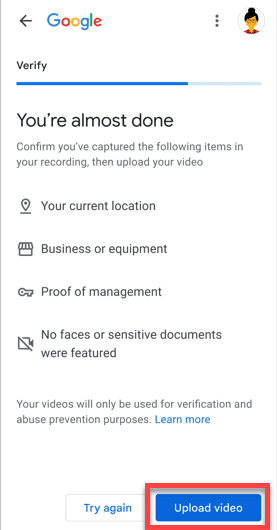
Click the “Upload Video” button.
Since the video is all created in the app, you don’t have to worry about how large the video file size is. (Whew!)
Then click Done.
After you submit your video, it can take up to five days for the Google Business Profile support team to review your video. Do not delete the video until it’s been reviewed and you’ve received the notification that your Business Profile has been verified.
If, for some reason, the video verification method didn’t work, you will see the “Get Verified” button in your Google Business Profile. You will then need to re-do your video. Try to provide more proof in your video.
Once you’re done with your video, you can delete the video if you want to.
At the top right, click More (the three dots) Advanced settings > Video uploads > Delete videos.
Then you’re done! You’re now able to continue optimizing your Google Business Profile and engage with your potential customers!
Help Videos
Google has created some help videos that walk you through the video verification process. These videos are meant to assist you in learning what’s needed in video verification.
It’s worth watching these videos before you start your video verification:
How To Get Video Verification Support
What do you do if you’re still having problems with video verification? If you need help with your video verification you need to go through the verification status tool. Here’s the process for getting Google Business Profile Support using the verification status tool.
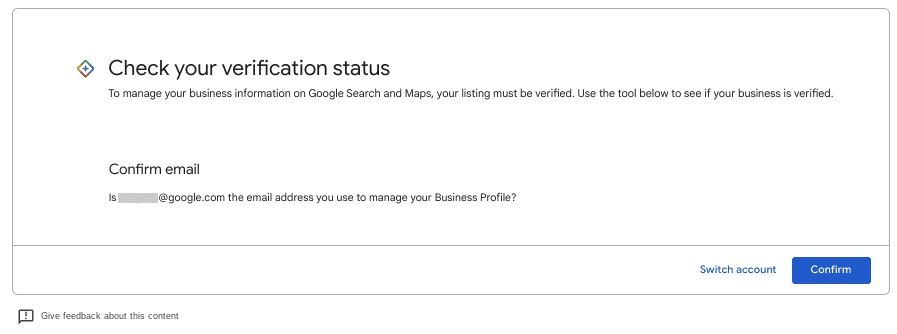
You will be asked to verify that the email address you’re using is the correct one. Make sure you’re logged into the correct email address that is attached to the Google Business Profile you’re trying to verify.
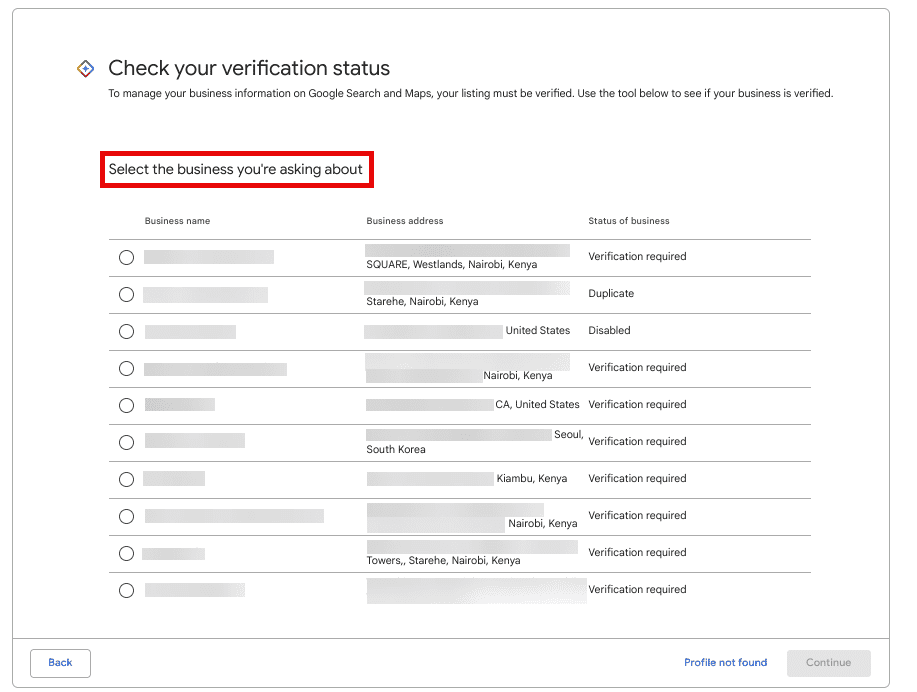
Next, select the Business Profile that you’re having issues with.
Screenshot by author, June 2024
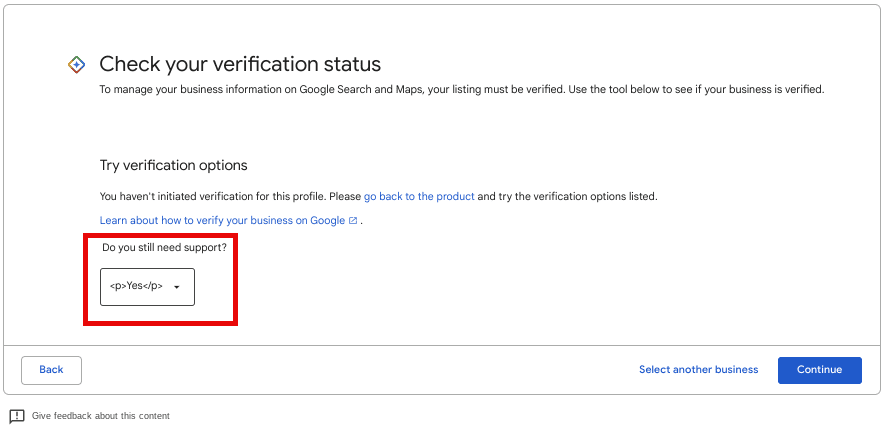
Depending on your status, you may be sent back to the Google Business Profile dashboard, but if you go back to the Verification Status tool you will see the option to contact support. Choose Yes and click Continue.
Screenshot by author, June 2024
Then click on the “Get in touch with our support team” link.
Screenshot by author, June 2024
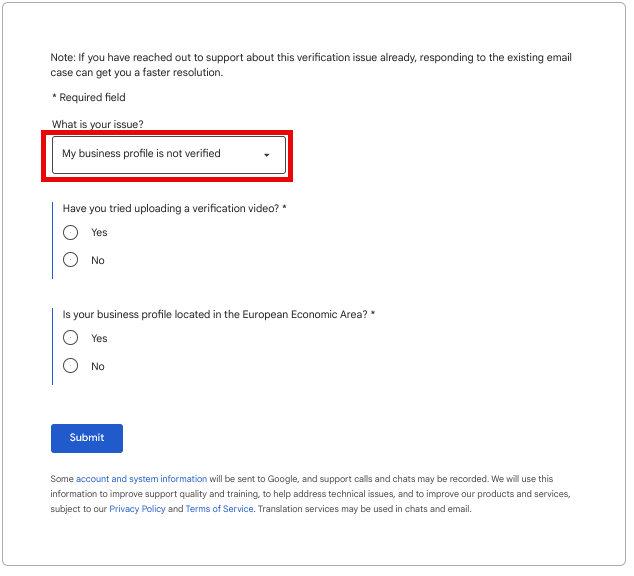
In the “What is your issue?” section, choose “My business profile is not verified.”
Make sure you select “Yes” next to the radio button that asks if you have tried uploading a verification video. (Note: choosing “Yes” is very important!)
Screenshot by author, June 2024
Then, continue to fill out the rest of the form completely. You’ll be asked to upload proof that you have a legitimate business. Be sure to upload this information.
It’s very important that you provide Google with all the necessary information about your business when you complete this form.
Video Verification: A Better Way
Even though video verification may seem more cumbersome, it’s a much better way for Google to see whether or not a business is real – or not.
This will hopefully cut down on the spam profiles we see on Google.
What are your thoughts on Google Business Profile Video Verification?
Google’s John Mueller answered a question the question of how long it takes for SEO to work and what it means if rankings don’t change after a year. Sometimes best practices doesn’t work and John Mueller explains why this sometimes is the case.
What Is SEO?
There is no single definition of SEO. What constitutes good SEO is subjective and highly dependent on where one learned about SEO.
Some believe that SEO is adding keywords into content and building links.
Others don’t really bother with links and are more concerned with building content.
Some are highly focused on technical aspects like site performance metrics and structured data.
In some corners of the SEO community, there are those who passionately believe that SEO doesn’t matter because Google prioritizes ads, big brands, YouTube videos, more ads, and then leaves the crumbs of what’s left for small businesses.
So when someone asks why their SEO isn’t working, the answer can be a toss-up, and if ten SEOs agree, there’s a chance they haven’t identified the problem—they’ve only agreed on the most obvious reason. This was the situation John Mueller encountered when asked why a site wasn’t ranking despite following SEO best practices.
Hard To Answer Without Specifics
John Mueller narrated the question:
“I changed my website a year ago and did a lot of work on SEO. Should this be affecting my website’s traffic by now?”
It’s a hard question to answer when you don’t have the specifics of the webpage in front of you. So Mueller answered in a fairly general manner that ends with him recommending he ask someone else for advice in Google’s help forums.
The first part of Mueller’s response acknowledges the difficulty of answering the question.
He responded:
“It’s tricky to say much here. I don’t know what specifically you did to work on SEO, and I don’t know if that would have resulted in significant changes.”
Why SEO Doesn’t Work
Mueller’s right. Maybe the website has a great layout, fast page speed performance, spot on structured data and a logical site architecture that optimizes internal linking.
What could go wrong with a properly SEO’d website, right?
Well, the content could be incomplete.
The content could be too comprehensive.
The content might be unfocused, lacking a clear comprehension of the topic.
The content might be too focused on keywords and not focused enough on users.
The content might not match the topic suggested by the keywords in the title and the headings.
Maybe the content is aiming too high, trying to rank for a highly competitive search phrase.
No amount of SEO is going to save a website with the above listed problems… and that’s just a sample of what can go wrong.
Mueller addressed this shortcoming of SEO in situations where it has zero effect.
He continued his answer:
“There are many best practices which have minimal effect on the day-to-day performance of a website. For example, having a clean page structure helps search engines to better understand the content on a page, but it might not necessarily result in immediate search ranking or traffic changes.”
Ranking Criteria Is Different Across Topics
Another factor that Mueller touches on is that what’s important for SEO varies according to the topic. Some topics require fresh content, some content requires establishing signals of trustworthiness and authoritativeness, maybe even signals that communicate user brand preference and popularity, signals that indicate that users expect to see a specific brand for certain queries.
There could be a geographic component that prioritizes local signals. It could be an intent thing where a user just wants to read what a person wrote in a forum.
This may be what Mueller is talking about when he says that the best elements of SEO vary across websites.
He answered:
“The most effective elements of SEO will vary across websites, it takes a lot of experience to go from a long checklist of possible items to a short prioritized list of critical items.”
Experience Is Important
The last factor Mueller discussed is the role of experience in making one a better SEO. Here’s an example: I thought I was pretty good at creating content that ranks and then I wrote a couple thousand articles for Search Engine Journal and it opened up a whole new conception of content creation, I discovered levels of understanding that could only come from writing about a couple thousand articles.
Mentorship, is an option that can cut down the amount of time it takes to learn, but experience is still important.
John Mueller recommended experience as an important factor for understanding SEO.
He wrote:
“Your experience here will grow over time as you practice.
I recommend getting input from others, and practicing by helping with challenges that others post in help forums. Good luck!”
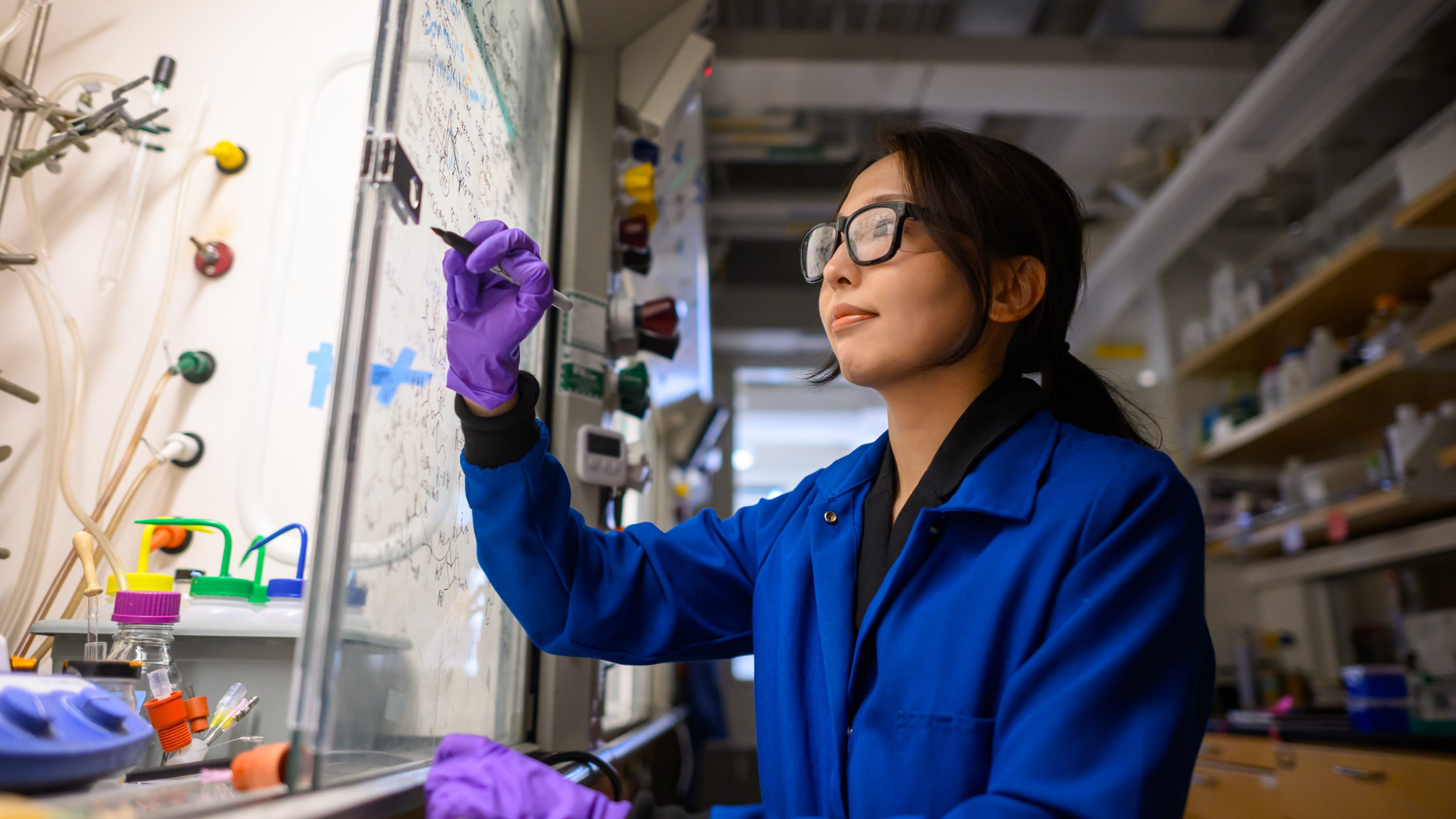
One Tuesday morning this past January, So Young Lee walked into a lab on the fourth floor of Building 18 and discovered that her equipment had exploded. It was a minor explosion—thankfully, no one was hurt—but the chemical she had painstakingly made had splattered all over the walls, the ceiling, and the broken shards of the glass tube that once contained it.
This incident would cost her time and precious product—and she didn’t have the time to lose. Lee, a fourth-year PhD student in chemical biology, was partway through a three-week, 11-step process to synthesize a chemical she helped design: azido-(Z,Z)-farnesyl phosphoryl-ß-D-mannose, or AzFPM for short.
Meant to help combat the tuberculosis bacterium, which kills more people each year than any other pathogen, AzFPM is the first molecule to target a specific carbohydrate in the bacterium’s cell wall that helps it evade the immune system. The molecule is designed to sneak inside tuberculosis, potentially offering scientists and pharmaceutical companies a new tool for studying the pathogen at a time when it is steadily gaining antibacterial resistance.
But making AzFPM isn’t easy. Producing just a few milligrams takes weeks of patiently heating, purifying, and combining chemicals at just the right ratios and timing. So when Lee saw that a vacuum suction machine with a hairline crack had sent her invention flying, she put on PPE, stood on a stool, and began mopping up every last drop with a paper towel.
“I’ve wiped the floor before,” she jokes, “but I’ve never wiped the ceiling.”
After giving what she’d managed to salvage a good wash with methanol, two rounds of filtering, and a purification for good measure, she moved on to the next step, using just half the product she would have had sans explosion.
For Lee, designing molecules is a logical extension of her creative side. Growing up in South Korea, she was doing calligraphy at age 10 and choreographing K-pop dances at age 15. In her early 20s, she began oil painting, designing intricate nail art, and baking cakes and macarons for her friends.
She first became intrigued with the idea of creating molecules while attending the selective Seoul Science High School. A teacher told her class about synthetic organic chemistry, a field focused on designing novel, complex compounds, and Lee was hooked. “He was just talking about the beauty of designing molecules and ways to synthesize them,” she says. “That really caught my attention.”
This new interest led Lee across the world, to Stanford University. There she spent her undergrad years balancing difficult coursework and long hours synthesizing analogues of HIV drugs in an organic chemistry lab with waking up at 4:30 a.m. to film dance videos with her school’s K-pop group (a hobby through which she would meet her husband). In her sparse spare time, she learned new languages, becoming proficient in Italian and Mandarin on top of being fluent in Korean and English.
“I like to think of [organic chemistry] as a language,” Lee says. If you rely on memorization, “you know all the words and grammar, seemingly, but you can’t speak the language.” In other words, though she knows a vocabulary of chemicals and the “grammar” of how they react, it still took her time and practice to put everything together to form new molecules.
In 2020, when she came to MIT for graduate school, Lee spent a virtual lab rotation with Laura Kiessling ’83, a chemist who helped pioneer the field of chemical biology. Unlike biochemistry, which is the study of the chemistry behind biological systems, chemical biology involves applying chemical tools to probe and manipulate biological systems, Lee explains.
When Lee came to MIT for graduate school in 2020, her creative approach to chemistry caught Professor Laura Kiessling’s attention.
GRETCHEN ERTL
Chemistry department students and advisors rank each other in a matching process to determine which labs students join. Lee was thrilled to match into Kiessling’s lab, her top choice. Beyond being drawn to the creative possibilities of the field, she was also excited to be part of a lab made up mostly of women and people of color.
When Kiessling recalls the matchmaking process, she says that Lee had an impressive synthetic chemistry background as well as an interest in working on biological systems. More than that, Kiessling was looking for what she calls “open-minded people willing to try crazy things.”
In her lab, everyone studies glycans—chains of sugar molecules that coat the outside of all living cells. Glycans are one of the main research subjects for scientists studying Mycobacterium tuberculosis, the tuberculosis-causing pathogen, which lives in a quarter of the global population. Its thick, glycan-filled cell wall dampens the body’s usual immune response, allowing the bacterium to go undetected. As a result, people can live years without knowing they’re infected—until tuberculosis launches a devastating attack on the body. The disease causes as many as 1.5 million deaths per year.
Today, most patients are given a “cocktail” of drugs targeting different aspects of the bacterium. But it’s becoming increasingly resistant to existing antibiotics, and designing new drugs is a public health priority. Lee’s work targeting M. tuberculosis’s distinct cell wall could be one key avenue to finding an effective treatment.
When Lee sets to work producing her molecule, she moves around the lab swiftly and decisively—pouring liquids into giant beakers, pulling out a flame torch to evaporate excess moisture that threatens her reactions, and taking measurements with an assortment of the lab’s precisely calibrated instruments. She is following steps that she devised three years ago, when she started trying to figure out how to alter an existing tuberculosis-targeting chemical so that it could breach cell walls like a Trojan horse and reveal details about the sugars within. M. tuberculosis absorbs different kinds of sugars for different purposes. Lee wanted to zero in specifically on mannose-containing glycans, which the bacterium uses to build its cell wall. If Lee could see how it incorporates those glycans into its structure, that could help researchers develop new drugs that disrupt the building process and thus kill the cell. But Lee needed to hit a sweet spot when designing her molecule. It had to be complex enough to fool the tuberculosis bacterium into incorporating it just as it would incorporate mannose-containing glycans, yet simple enough to be made repeatedly in the lab. If the synthetic glycan were too generic, tuberculosis would use it for multiple functions, making it impossible to target the cell-wall-building process she’s studying.
Designing the synthetic route to producing the molecule took a year of troubleshooting—what Lee calls “part of the art.” After much trial and error, she figured out how to optimize the synthesis, running multiple stages at once since some take minutes and others last days. Lee estimates that she’s done the full synthesis around 30 times.
The final tuberculosis-targeting chemical, AzFPM, consists of synthetic sugars mimicking mannose-containing glycans. It’s so close in structure to these glycans that the bacterium incorporates it into the cell wall without noticing.
Lee works with model organisms that are much less dangerous than M. tuberculosis, including M. smegmatis, which is genetically similar to the real pathogen, as well as C. glutamicum, a rod-shaped bacterium that helps with visualization. Though she found success with her C. glutamicum model, she relied on a colleague in the lab who is specifically trained to work with biosafety hazards for testing it in M. tuberculosis.
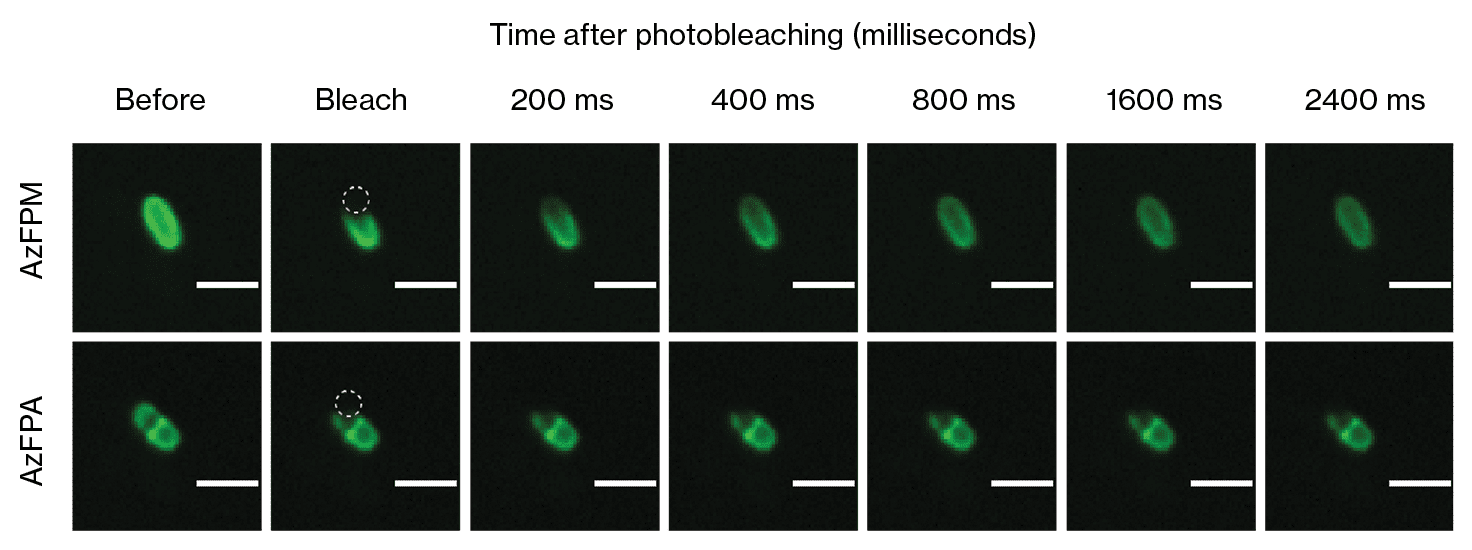
To know if the molecule worked, Lee and her colleague had to track how M. tuberculosis used AzFPM. The molecule has a chemical handle, upon which Lee used a process called click chemistry (which won its inventors a Nobel Prize in 2022) to attach other molecules that fluoresce under certain lights. When she saw that the bacteria treated with her molecule glowed more than the nontreated bacteria, she knew that her molecule had successfully made its way into the cell wall.
Lee and colleagues used chemical probes labeling specific sugars to show that different parts of the cell wall of C. glutamicum (a tuberculosis model) have distinct physiological properties. Here mannose-based sugars labeled with AzFPM are diffused; arabinose-based sugars labeled with AzFPA aren’t.
COURTESY OF SO YOUNG LEE
Lee and her collaborators are the first to track and photograph mannose-containing glycans in the tuberculosis cell wall. It’s a meaningful achievement: Visualizing how the bacterium uses such glycans might lead to new drugs that target and, ideally, dismantle those mechanisms, harming the pathogen and helping the patient.
Visualizing specific glycans in the tuberculosis cell wall has historically been difficult because, while amino acids and proteins have unique chemical structures, those of all sugars are nearly identical. Bacteria use more than 600 different kinds of sugars, and many differ not in their composition but in the 3D orientation of their atoms.
“The molecules that she made and the way that she came up with the routes are really elegant,” says Kiessling, adding that existing antibiotics do not target mannose-containing glycans: “They’re hard molecules to make.”
As a synthetic chemist, Lee says, her job isn’t just to study what her new molecule reveals; it’s also to make enough of it for others to use in biological studies (at least one other MIT lab is already interested). Since publishing her results last year in the Journal of the American Chemical Society, Lee has focused on scaling up production from about 5 milligrams to 50—a 20th the weight of a dollar bill—in each synthesis cycle.
“Synthesis fails constantly,” says Leah Pauline Weisburn, Lee’s former roommate and an MIT graduate student in theoretical chemistry. “It’s a lot of trial and error, and you just have to be resilient.”
Resilience is a common thread for Lee, who’s had to conduct some of her hardest syntheses while recovering from surgery following a hiking injury last year. It was also a theme in her work as MIT’s Women+ in Chemistry mentorship and outreach chair, a position she took on in addition to mentoring students from underrepresented backgrounds in science as part of the MIT Summer Research Program in 2022 and 2023.
GRETCHEN ERTL
Much of Lee’s passion for mentoring comes from her own challenging experiences. Early in college, she joined a lab where she felt she got inadequate guidance and support, which limited her ability to learn and ask questions. Worse, she didn’t realize there were people in the lab she could turn to for help. Eventually, she worked up the courage to switch labs and found a new community with guiding figures who had created an environment where she could not only learn but thrive. Now, Lee encourages her mentees to lean on departmental resources, other students in the lab, and her.
“I try to find that balance between holding their hand but also letting them grow as an independent researcher,” she says. She has found that sharing her own experiences builds trust and camaraderie between herself and her mentees.
When giving talks to K–12 girls about chemistry, Lee makes sure to share her passion for art as well as science. She also emphasizes that “people that look like you and like the things that you do can also be scientists.”
Her attitude has impressed Kiessling, who recalls an organic chemistry retreat where Lee mentioned her love of nail art when asked to share a fun personal fact. “A few years ago, people wouldn’t want to admit that they cared about their appearance, much less their nails,” says Kiessling, who points out that organic chemistry is a historically male-dominated field. To her, Lee’s pride in her hobbies doesn’t just reveal her artistic side but also signals a shift toward more inclusivity in chemistry—a shift that she says strengthens the science being done.
Today, Lee is looking ahead to her dissertation. While she’s not sure whether she’ll land in academia, the pharmaceutical industry, or biotechnology after MIT, she knows her creativity will lead her in a direction where she can continue to grow.
“There’s an art to organic chemistry,” she says, “and that’s why I still do it.”
MIT people often find their greatest moments of inspiration in each other’s company. And two big, beautiful additions to West Campus now underway will open up new spaces for connection, collaboration, rigorous exploration, and joyful play.
Stretching along Mass. Ave. and Vassar Street, the familiar brick face of the historic Metropolitan Storage Warehouse may evoke a medieval castle. But inside, an intriguing redesign is transforming this former warren of storage spaces into an open, light-filled new home for the School of Architecture and Planning and the MIT Morningside Academy for Design.
The Met Warehouse will give faculty in SA+P an environment for teaching and research that matches their professional and creative excellence. And the building itself is a kind of pedagogical tool, as it celebrates the intersections of the historic brick structure and the fresh design ideas that animate it now. With its large, welcoming communal spaces, including an auditorium and a gallery, the “Met” is sure to become a new center of gravity and energy on campus.
And a new building will soon open its doors to support MIT’s flourishing music community. With Kresge Auditorium as its next-door neighbor, the building situates the experiences of making and enjoying music right at the heart of campus. Its optimized acoustical design and sound-insulating walls will be a gift to MIT’s conservatory-level musicians and talented beginners alike. And its beautiful performance hall will draw music-loving audiences from across campus and surrounding communities, exerting its own gravitational pull.
The two new buildings—a renovated warehouse from 1895 and a brand-new structure—will invite our hands-on community to do more of what we love: designing and building, making and playing. They will offer new opportunities for everything from experimenting with 3D printing to learning how to restore landmark buildings to planning resilient cities; from classical orchestra to avant-garde jazz to Senegalese drumming.
And they will help us infuse the lessons and logic of music and design across other disciplines too, expanding our thinking and practice in ways that will vastly improve our potential to solve society’s toughest problems.
Transformative projects like these boost our community’s creativity, ingenuity, and resilience. As we reshape the campus, we inspire our community to reshape the world.
In 1976, Tom Scholz ’69, SM ’70, was a 29-year-old product design engineer working at Polaroid on audio electronics and tape-recording technology, with 11 patents under his belt. But few colleagues knew what Scholz did after hours, why he often came in late, or why he was, in his own words, “a horrible employee.”
For five years, Scholz had been painstakingly crafting music and lyrics, and perfecting phenomenally complex sound production, in the makeshift basement recording studio at his apartment in Watertown, Massachusetts—playing all his own instruments and mixing them on an analog 12-track recorder until they sounded as natural as a band that had played together for years. He got a friend, local musician Brad Delp, to record the lead vocals, mixing that in too. After finally picking up a contract with CBS’s Epic Records, he recruited some more friends from the Boston music scene to be the “faces” for an album with the working title Boston. When it came time to choose a name for the band, someone at the studio suggested using the same one. Having grown up in Toledo tuning in to Boston’s WBZ radio at night to hear British rock bands, Scholz readily agreed.
Tom Scholz went from high school class president to jumpsuit-wearing rock star
headlining at venues like Boston’s Music Hall. When he was an engineer at Polaroid,
his father told him there was no future in music.
His band’s first album went multiplatinum.
COURTESY OF TOM SCHOLZ
“Honestly, I thought the recording I made in 1976 was going to be forgotten by the beginning of 1977,” he says. He was just hoping to get the song on the radio so he could get gigs in local clubs with a song people recognized. “I actually didn’t realize there was anything serious happening with my album until I was working in my back room [at Polaroid]—I had a secret back room, sort of like a boiler room, in the bowels of the building in Tech Square—and somebody comes running and says, ‘Hey! Your song’s playing in the drafting department!’” he recalls. He raced off to hear it but only caught the tail end. And that kept happening until finally, several months after “More Than a Feeling” hit the Top 10, he heard it all the way through on the radio.Still, Scholz didn’t quit his day job until Boston became a national arena headliner.
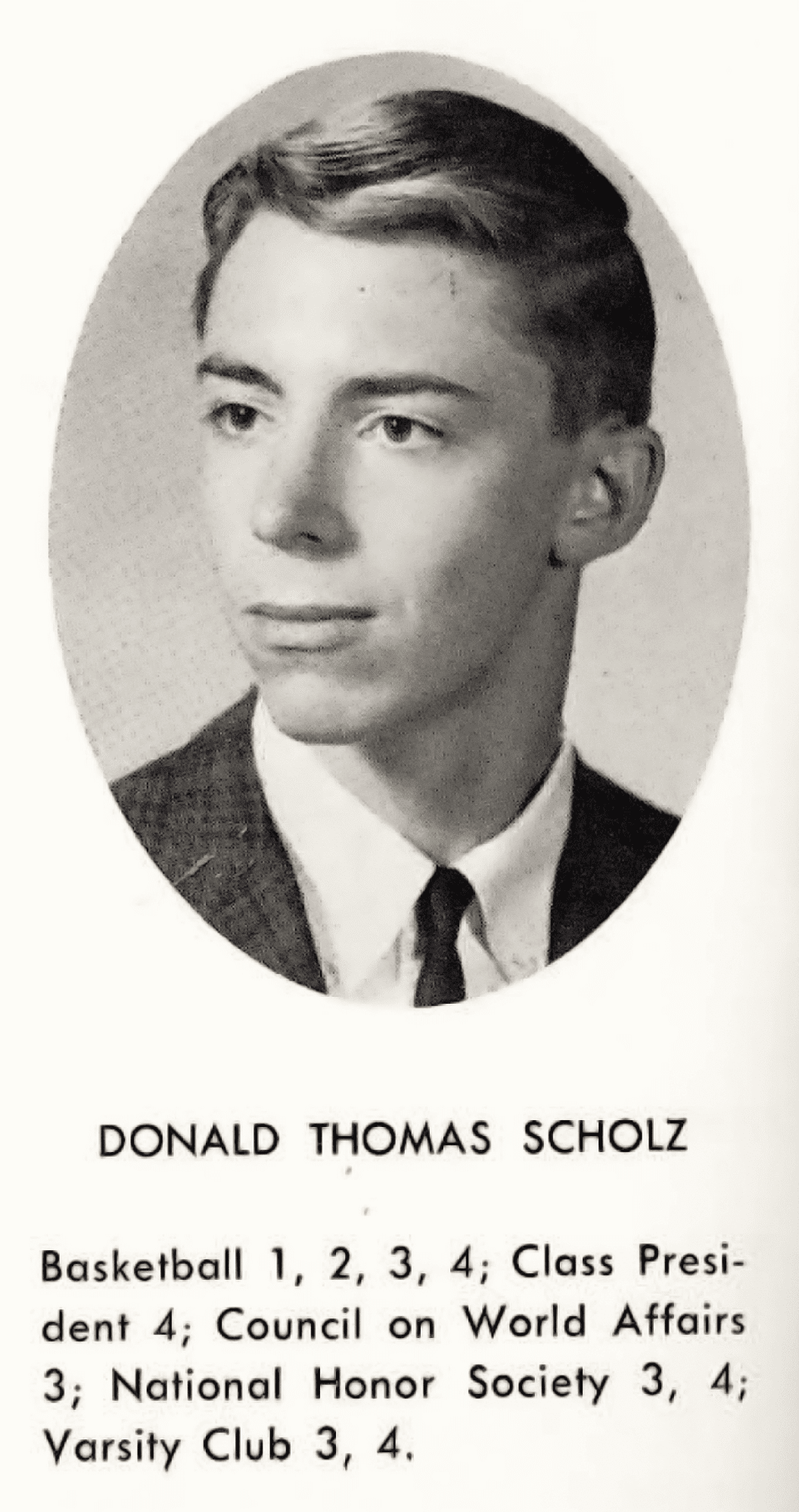
Donald Thomas Scholz, a teenage fan of model airplanes, junker cars, basketball, and classical music, matriculated at MIT in 1965 to study mechanical engineering. Competition was brutal, he understood: “When I showed up for my freshman orientation, they sat us all in a large assembly area and put up a chart showing everyone’s SAT scores … I thought, ‘Now I’m in trouble.’” Scholz was so sure he’d flunk out that by the end of his first semester he’d already applied to transfer—but then he discovered he’d gotten a 4.8 average and decided to stay. In fact, he performed so well that MIT offered him a scholarship for a one-year master’s in mechanical engineering. His thesis project—a pair of simple A-frame hoists that made it possible to assemble prefabricated homes without a crane—led to his first patent, in 1972.
“The things I was exposed to at MIT were the basis for absolutely everything,” he says. “I use things I learned at MIT in the engineering department every day of my life—numerous times, every day.” MIT’s encouragement of blue-sky thinking would also stick with him. “It made me a little less fearful about looking like a fool when I tried new things because some of them aren’t gonna work,” he says. “I learned how to learn when I went to MIT, and I tried not to stop.”
Scholz didn’t pick up a guitar until he was 21, after getting hooked on bands like the Kinks and the Yardbirds. He dove into learning to play and soon became fascinated by what analog processors and amplifiers could do to the sound. As an MIT junior, he used an electric piano to compose an instrumental piece that eventually became the song “Foreplay” on Boston’s debut album. At the time, he was living in a fourth-floor Allston apartment: “I had had enough [understanding] of dynamics and so forth to understand how sound can transfer through a wood floor. The three nurses that lived below us were extremely patient with me because I usually wrote between 12 and two in the morning, and every time I pounded on those keys they felt it through the ceiling—and never complained. I think they felt sorry for me because I had to go to MIT.”
“Somehow I had to make those two things coexist—you know, being a positive influence and making some awesome music that people would think was kick-ass rock and roll.”
In the six years between his master’s and the release of Boston, Scholz built and deployed increasingly complex homebrew gadgets to create the otherworldly music he heard in his head. His favorite musical device was what he named the “hyperspace pedal.” “You can play a note with vibrato forever,” is how he describes its effect. “You can make a chord go up and down by several octaves. More importantly, you can make sounds that NASA would be scared of from a rocket ship. And I used that to my heart’s delight recording all of the Boston albums.”
At Polaroid, Scholz’s primary responsibility was creating audio tape for the Polavision instant video system. Although that ended up being sold without audio, his work was instrumental in helping him develop the musical devices that gave Boston its singular sound. During that period, Scholz says, Polaroid “was almost like an extension of MIT—it had the same sort of mindset,” which gave him the freedom to build and experiment. Nearly all his Polaroid patents involved audio recording and reproduction.
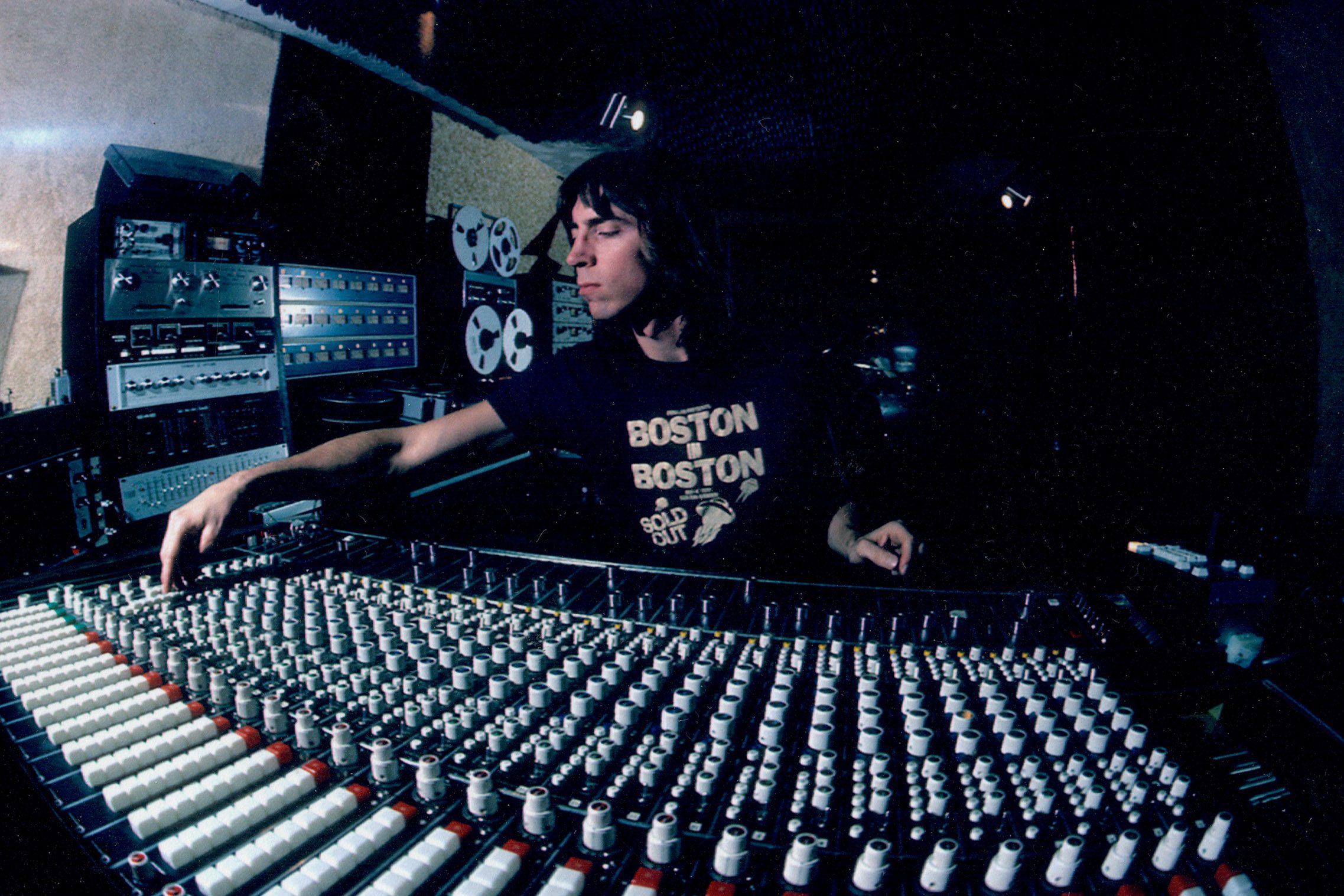
In 1977, Scholz repaired the 16×4 channel studio mixer he’d used to lay down all the instrument tracks for Boston’s debut album. A year later, he mixed their second album on an Auditronics 501 26×4 console.
Scholz’s nights were for producing music. As a neophyte but increasingly adept guitarist, he began renting time at expensive recording studios. When recording between midnight and 8:00 a.m. above a bar an hour’s drive from home became untenable, Scholz decided to build his “really awful but workable” basement studio in Watertown (where, at 6 foot 5, he had to duck to avoid hitting his head on the way down). “Without saying too much to the landlord … I built a couple of temporary walls, and used an awful lot of carpeting and sound-absorbing materials that I could scrounge up,” he remembers. “Because this was done on, of course, an extremely low budget. And I managed to keep the noise level down enough that I could record.”
That volume control took some of his MIT-nurtured ingenuity. Scholz had to record his multilayered guitar tracks “at very high amplifier output” to get the sound he wanted. “A hundred watts through the speakers that worked with that amp were just incredibly loud—not something you could use in the basement of a house, not even in a house, because people down the street and in the neighborhood would be complaining about it. I had to find a way to decrease the output of the amp without changing the sound appreciably.” To this end, two of his personal patents—for “Constant Volume Distortion Control” and the physical unit in which the distortion control was housed—became the basis for what he called the Power Soak attenuator, the first product sold by his company, Scholz Research & Design.
Executives at Epic Records were not enthusiastic about marketing a record that had been produced and recorded in a basement. Scholz and his “just another band out of Boston” flew to LA to record the vocals. Then Scholz went home to Watertown and, at the Epic producer’s request, re-recorded most of the album—“in exactly the same place as the demo they didn’t want to use, with exactly the same equipment, as close as I could to the original performance,” he says. “And that’s what they decided was great, and ready to be released.” Boston went on to become one of the best-selling debut albums of all time.
Boston last toured in 2017 and has sold more than 31 million records worldwide. Today, Scholz’s home studio lies fallow—not for lack of inspiration, but because it remains resolutely analog, and “unfortunately there’s almost no one left locally who can maintain or repair analog studio equipment.”
Tom Scholz demonstrates his favorite audio invention, the hyperspace pedal.
But he is still busy and engaged. He and his wife, Kim, operate the DTS Charitable Foundation, which he founded in 1987 to promote a “vegetarian lifestyle, and prevention of cruelty and suffering to animals both nonhuman and human” (he has been a vegetarian for decades). Knee injuries sidelined him from basketball a few years ago, but he does freestyle figure skating and plays “extreme croquet,” which is typically played on challenging terrain without the usual out-of-bounds rules. He has a pilot’s license, and one of his current passions is designing high-performance radio-controlled airplanes. “I love it,” he says. He is mourning the loss of the “scary-fast red delta-wing airplane” that he built in 1972, flew for 52 years, and considers his favorite invention: “Unfortunately, it had an in-flight breakup earlier this year and was destroyed. I was quite crushed by that. So was the airplane, by the way.”
Scholz says he and Kim have slowly turned their house into a workshop and lab. “There is no ‘house,’” he says. “When we have someone coming over for dinner, we actually have to clear out space to have a table that we can all sit at together.” (A proclivity for making things runs in the family; his son, Jeremy Scholz ’05, majored in mechanical engineering at MIT.) Scholz does interviews in “what used to be the electronics area for troubleshooting and fixing all this stuff in my studio,” he says. “It’s become a drafting area and a radio-controlled-aircraft fabrication/assembly area, and I have a small shop in what was the furnace room.”
He still hopes to get his studio back up and running, “because I am still writing music, believe it or not, in what’s left of my brain,” he says. “And it’s very frustrating not to be able to go in and make the recording of what I hear.”
Scholz marvels that classical composers could hear everything in their heads. “You listen to Vivaldi or Bach, and you think, ‘How did he know that those violins were going to work together when they all came together at the same time?’ He could only play one,” he says. “Whereas I always had to record things, listen to them together, and then go back and … ‘Well, that was the wrong bass line! I’ll try a different one,’ and so on.”
He initially came up with this method of layering different recordings together to please himself. “When I first started doing this, I was a kid in my 20s—well, late 20s—and I was just trying to put some music down that I thought sounded good. I actually didn’t believe that anyone else would think it sounded great,” he says. When it took off commercially, he felt compelled to become a positive role model as well. “Somehow I had to make those two things coexist—you know, being a positive influence and making some awesome music that people would think was kick-ass rock and roll.”
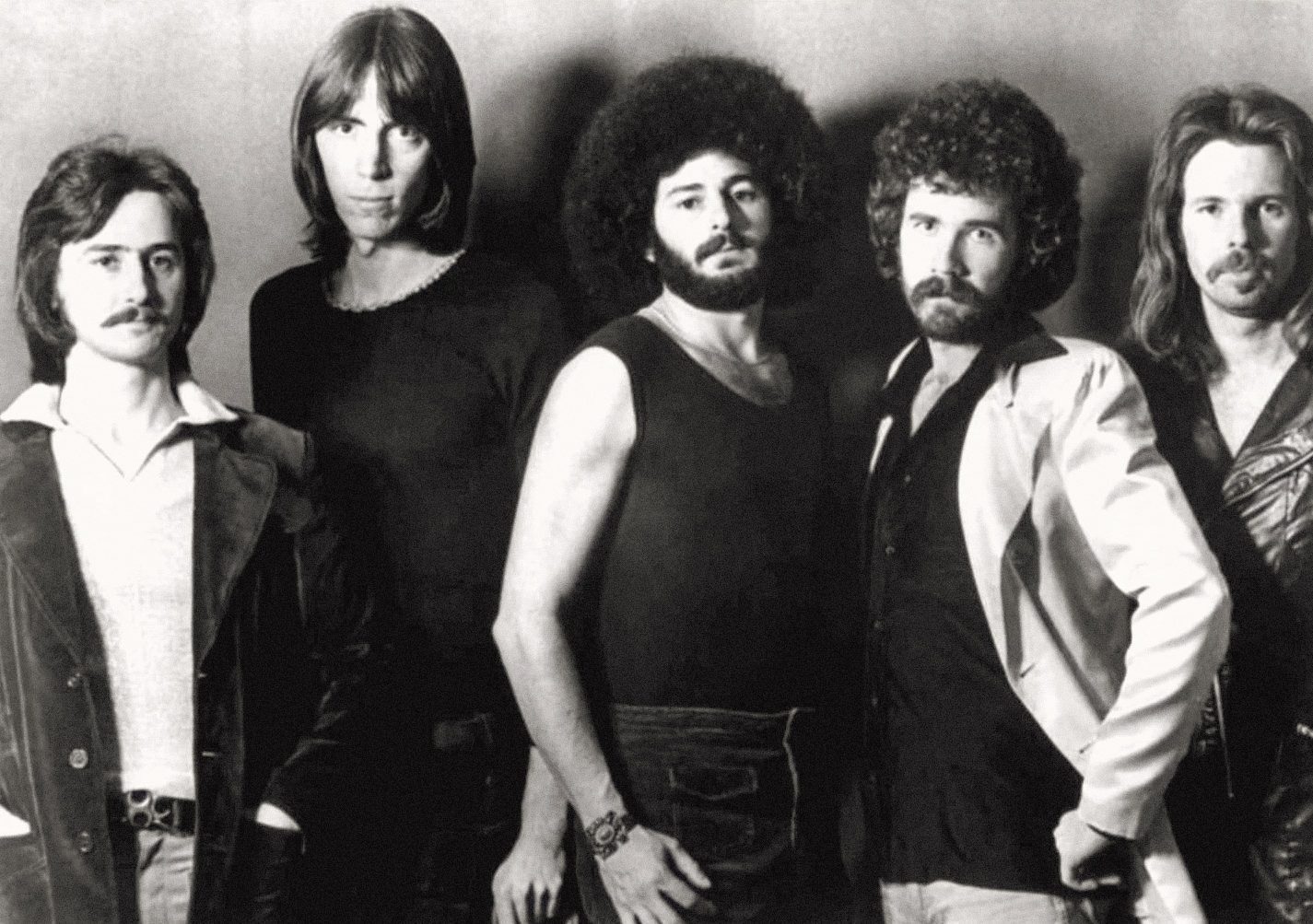
Boston circa 1976 (left to right): Fran Sheehan, Tom Scholz, Sib Hashian, Brad Delp, and Barry Goudreau
GETTY IMAGES
“After the first album, I was suddenly placed in a position where I was a figure that people were going to emulate. Kids listened to this music,” he says. “I felt this enormous weight, that everything that I did and everything that I said and anything I put on an album was going to have a possible effect on someone.”
While other rockers were cultivating wild personas, he focused on the connection between self-improvement, higher education, and Boston’s music and tried “to encourage people to do things that I thought were a good step for mankind,” he says. “So when someone 50 years later comes and says, ‘Oh, this song really helped me get through,’ it means the world to me.”
Scholz has always been true to himself and to his music, even in the days when he was being rejected by one record label after another. “Having failed miserably,” he says, “I thought, ‘You know what? I’m going to make one more demo, and it’s going to be just exactly the way I see it, and the way I want to hear it, and I’m going to play every single part.’ And that worked, oddly enough. It’s been a wild ride.”
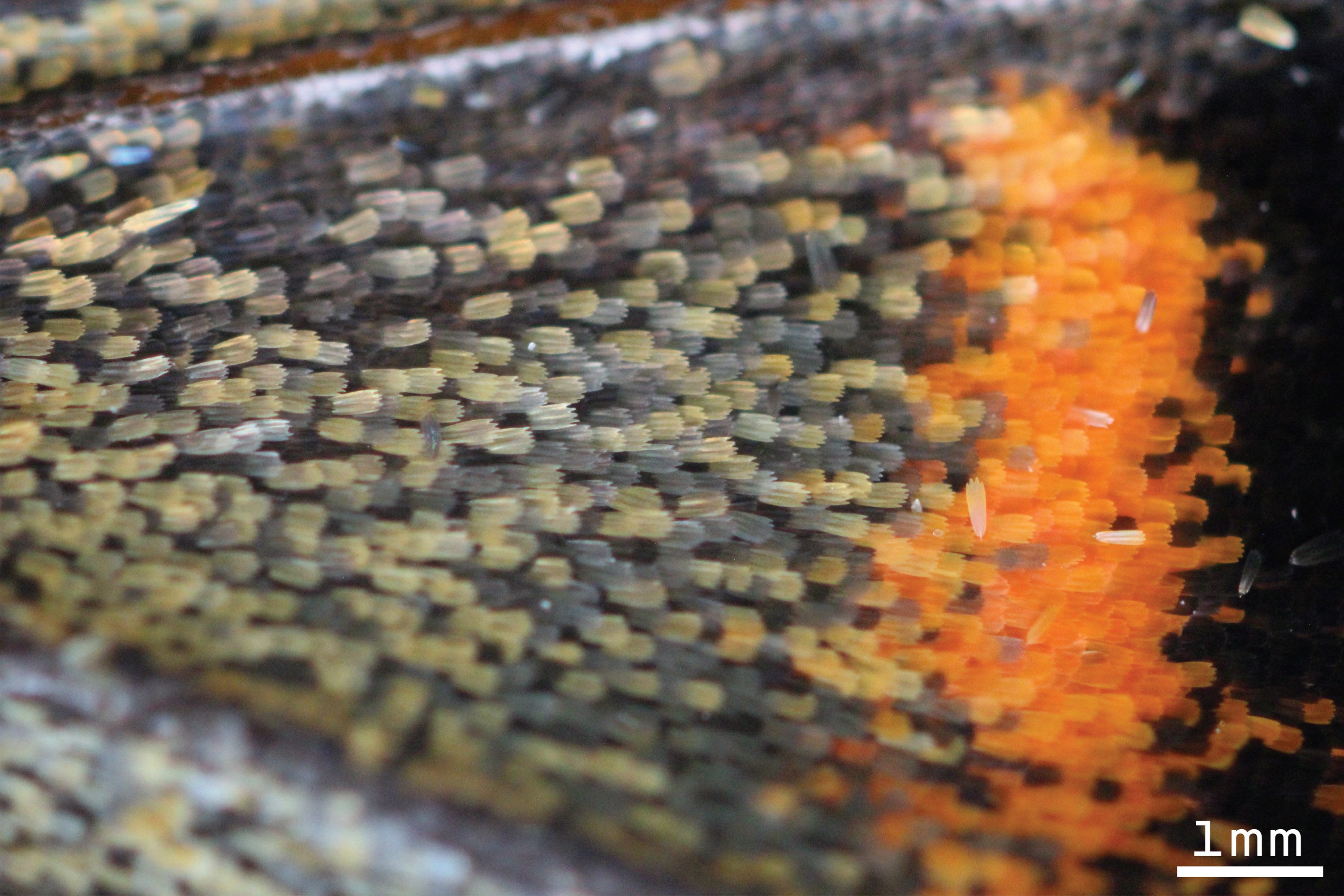
A butterfly’s wing is covered in hundreds of thousands of tiny scales, like miniature shingles on a paper-thin roof. A single scale is as small as a speck of dust yet surprisingly complex, with a corrugated surface that helps wick away water, manage heat, and reflect light to give a butterfly its signature shimmer.
MIT researchers have now captured the moments when an individual scale begins to develop this ridged pattern. The researchers used advanced imaging techniques to observe the microscopic features on a developing wing as a painted lady butterfly emerged in its chrysalis.
An optical micrograph shows the scales on the wings of an adult painted lady.
COURTESY OF THE RESEARCHERS
Using a special microscopic technique to peer through an opening they created in the chrysalis itself, the team continuously imaged individual scales as they grew out from the wing’s membrane during a crucial time window in the butterfly’s development. These images reveal for the first time how a scale’s initially smooth surface begins to wrinkle to form microscopic, parallel undulations like the ridges in corduroy. The ripple-like structures eventually grow into more finely patterned ridges, which make many functions of the adult wing scales possible.
The transition to a corrugated surface is likely a result of “buckling”—a mechanical process by which a material bows in on itself as it is subjected to compressive forces or constrained within a confined space. In this case, as they confirmed with the help of a theoretical model describing the general mechanics of buckling, actin bundles—long filaments that run under a growing membrane and support the scale as it takes shape—pin the membrane in place like ropes around an inflating hot-air balloon.
“Buckling is an instability, something that we usually don’t want to happen as engineers,” says Mathias Kolle, an associate professor of mechanical engineering and coauthor of a study on the work. “But in this context, the organism uses buckling to initiate the growth of these intricate, functional structures.”
The team is working to visualize more stages of butterfly wing growth that could inspire advanced functional materials in the future.
“These materials would exhibit tailored optical, thermal, chemical, and mechanical properties for textiles, building surfaces, vehicles—really, for generally any surface that needs to exhibit characteristics that depend on its micro- and nanoscale structure,” Kolle says.
“We want to learn from nature, not only how these materials function, but also how they’re formed,” says Anthony McDougal, SM ’15, PhD ’22, an MIT postdoc and another coauthor. “If you want to, for instance, make a wrinkled surface, which is useful for a variety of applications, this gives you two really easy knobs to tune to tailor how those surfaces are wrinkled. You could either change the spacing of where that material is pinned, or you could change the amount of material that you grow between the pinned sections. And we saw that the butterfly is using both of these strategies.”
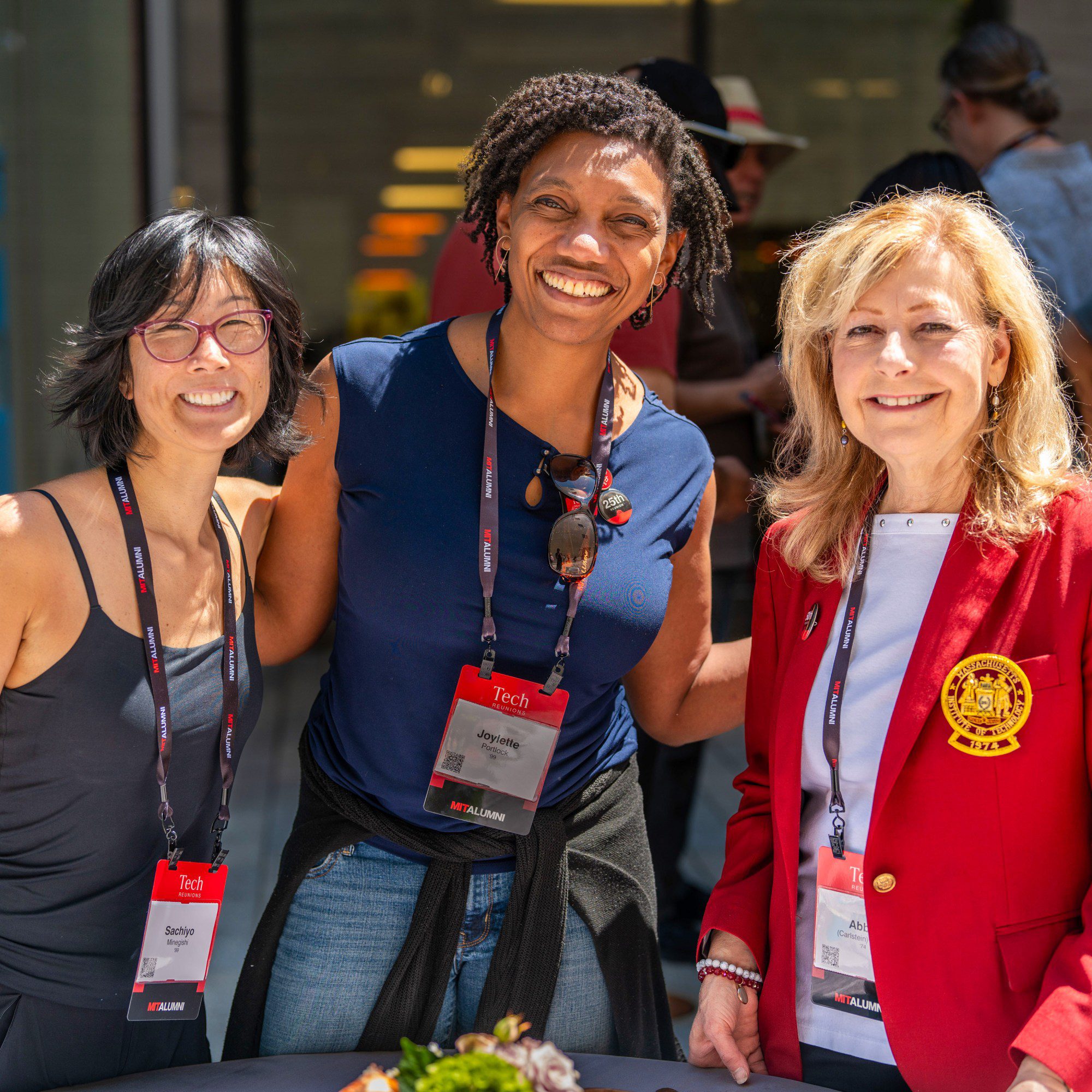
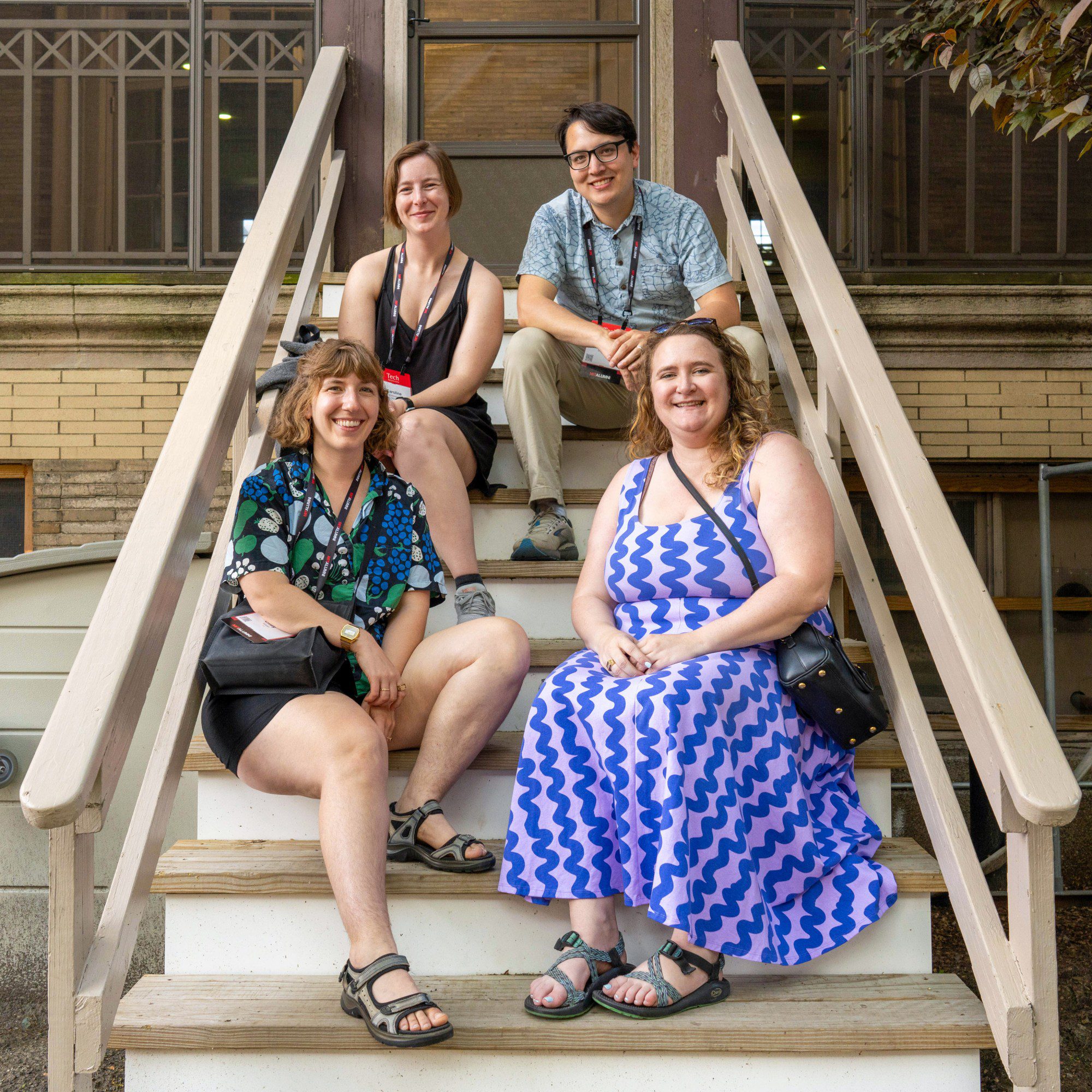
Take a beautiful spring weekend, add brass rats and Tim the Beaver swag, mix in technology talks and outdoor activities, fuse it all together with a lot of socializing, and what do you get? MIT Tech Reunions, which this year drew more than 3,300 alumni, family, and friends to campus.
Events got under way when the 50th-reunion Class of 1974 led the traditional procession into Killian Court for the OneMIT Commencement Ceremony. Sporting their signature red jackets, class members embraced the rain to help welcome 3,666 graduates into the community of nearly 149,000 alumni worldwide.
The 2023-’24 Alumni Association president, R. Robert Wickham ’93, SM ’95, served as chief marshal for this year’s commencement exercises. He was followed into Killian Court by President Sally Kornbluth and OneMIT Commencement speaker Noubar Afeyan, PhD ’87.
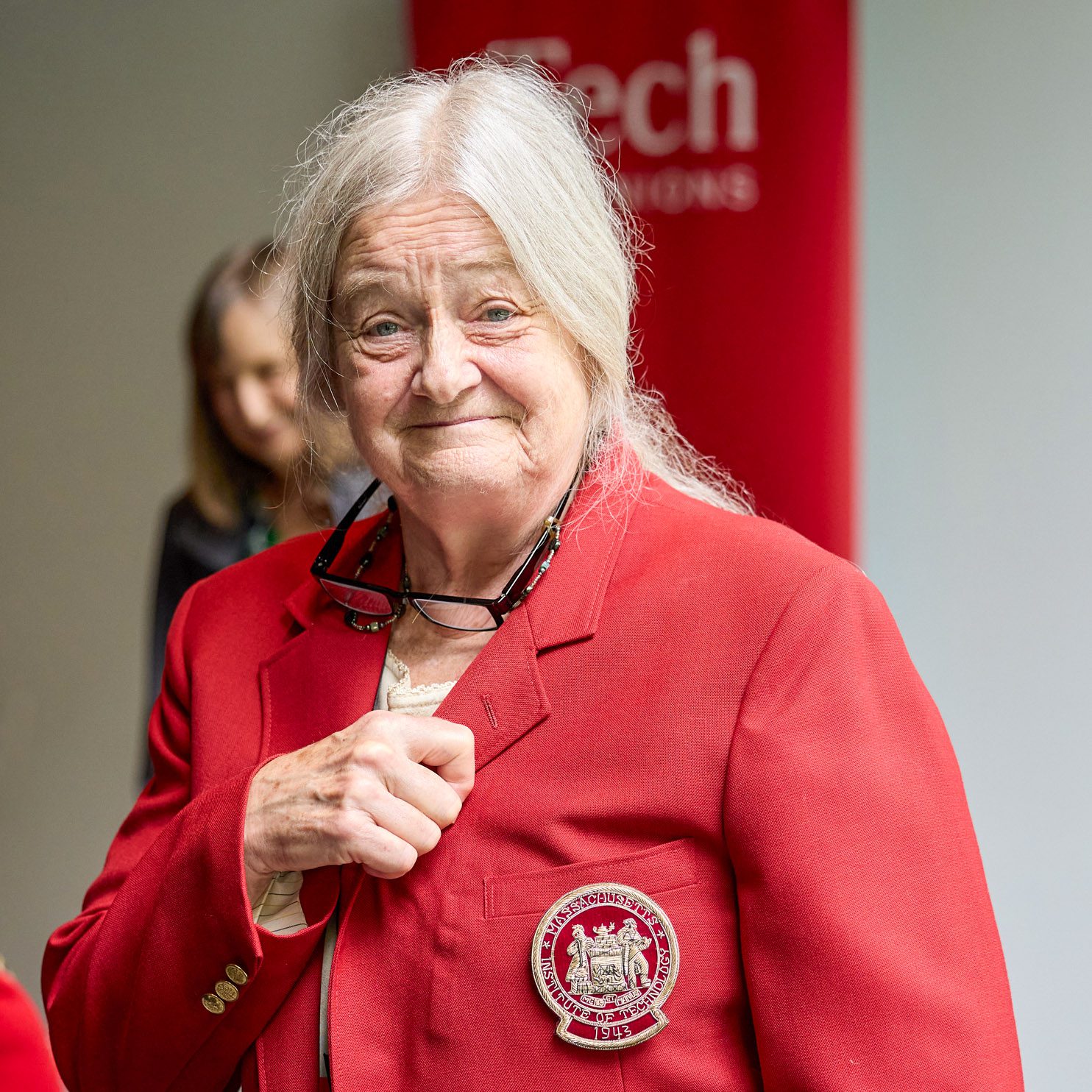
Judy Fallows ’74, ’76, one of the nearly 200 alums in their 50th reunion
year, proudly displayed the alumni patch given to her by her father, an alumnus from the Class of 1943.
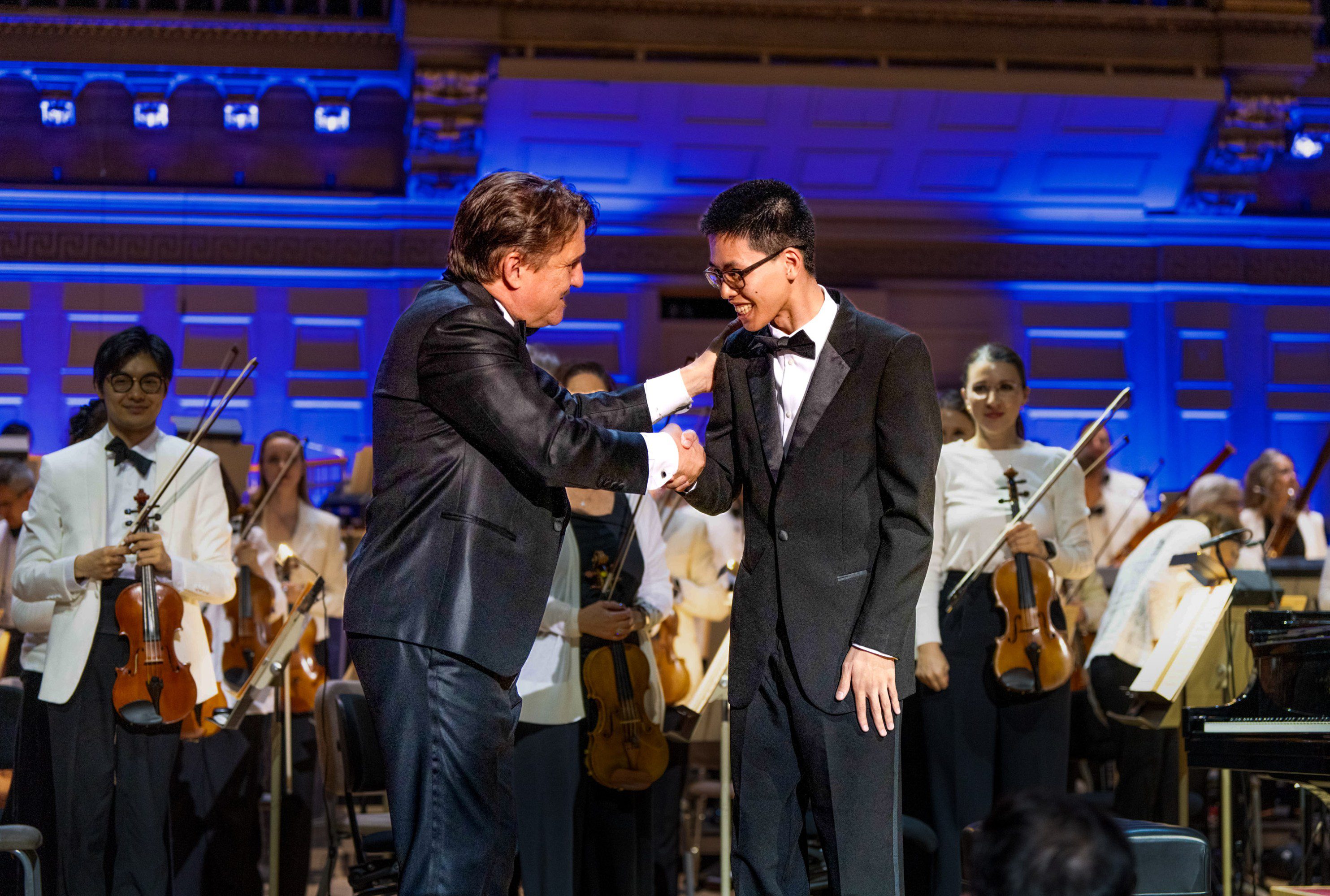
Tech Night at Pops featured Holden Mui ’25, a double major in math and music, as soloist. He is pictured above with Boston Pops conductor Keith Lockhart.
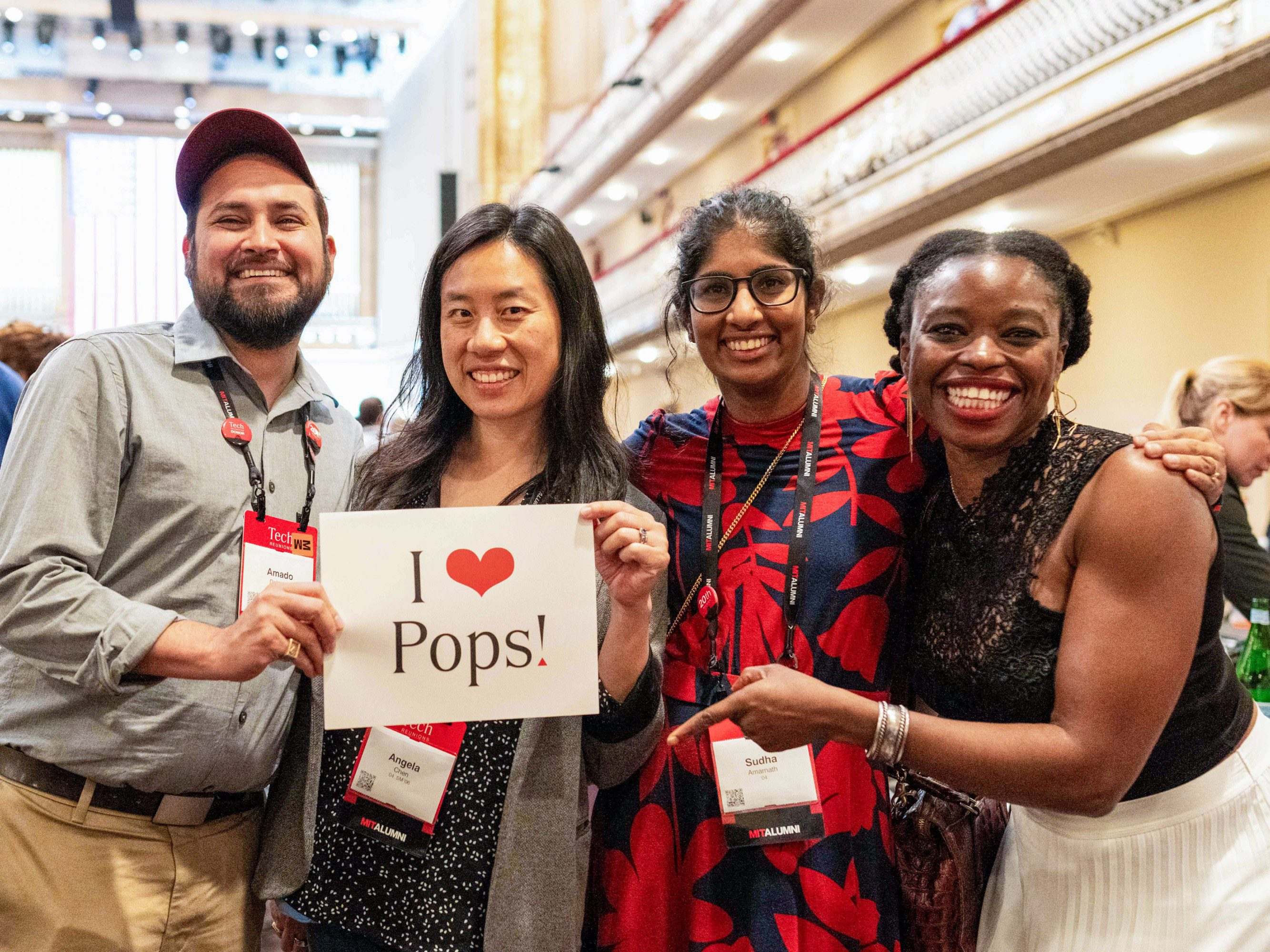
Ray Larson ’49, from the 75th-reunion class, waved to fellow alums who filled Boston Symphony Hall for the 126th Tech Night at Pops.
The celebration continued throughout the weekend at events such as an ice cream social, the Recent Grad Bash, class dinners, and the Baker House 75th reunion.
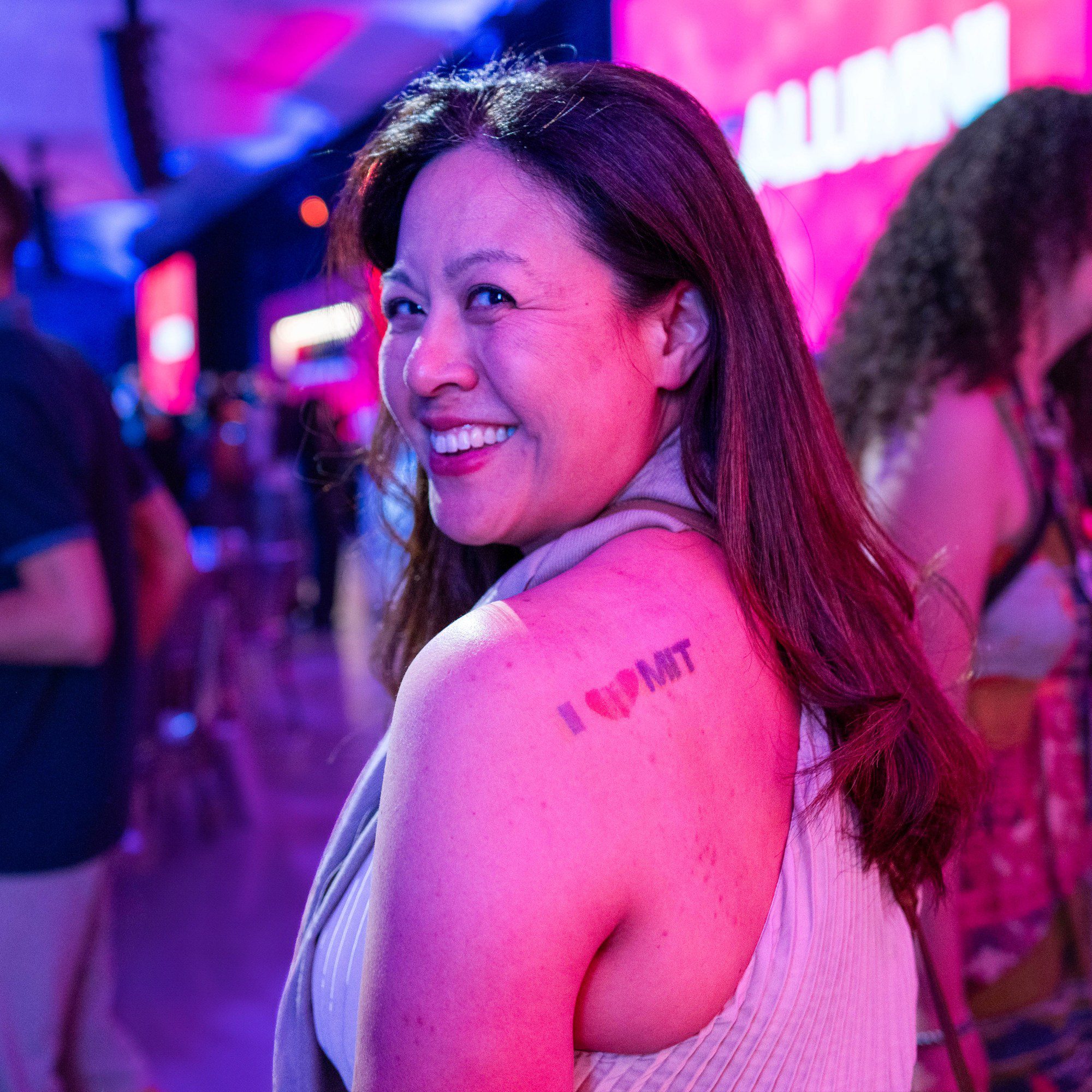
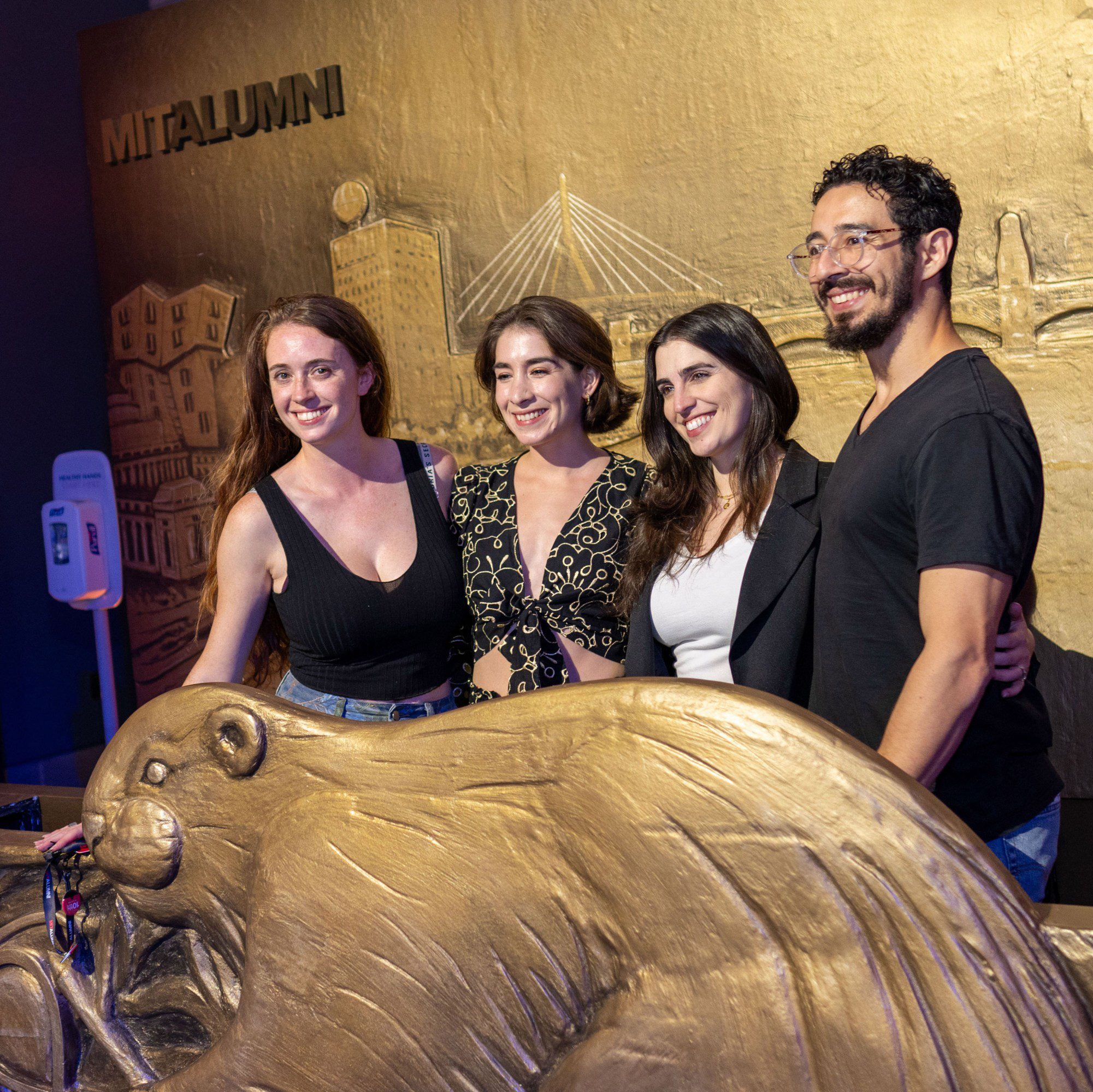
At Saturday’s Toast to Tech, alums enjoyed temporary tattoos, a live band, a brass rat photo booth, cotton candy, and more.
Members of the Class of 1984 capped off the weekend on the water, participating in the traditional Reunion Row.
The long weekend, May 30–June 2, featured nearly 120 events, ranging from lab tours to ice cream socials to the ever-popular Tech Night at Pops, Technology Day, and Toast to Tech.