Interaction To Next Paint (INP): Everything You Need To Know via @sejournal, @BrianHarnish

The SEO field has no shortage of acronyms.

From SEO to FID to INP – these are some of the more common ones you will run into when it comes to page speed.

There’s a new metric in the mix: INP, which stands for Interaction to Next Paint. It refers to how the page responds to specific user interactions and is measured by Google Chrome’s lab data and field data.

What, Exactly, Is Interaction To Next Paint?

Interaction to Next Paint, or INP, is a new Core Web Vitals metric designed to represent the overall interaction delay of a page throughout the user journey.

For example, when you click the Add to Cart button on a product page, it measures how long it takes for the button’s visual state to update, such as changing the color of the button on click.

If you have heavy scripts running that take a long time to complete, they may cause the page to freeze temporarily, negatively impacting the INP metric.

Here is the example video illustrating how it looks in real life:

Notice how the first button responds visually instantly, whereas it takes a couple of seconds for the second button to update its visual state.

How Is INP Different From FID?

The main difference between INP and First Input Delay, or FID, is that FID considers only the first interaction on the page. It measures the input delay metric only and doesn’t consider how long it takes for the browser to respond to the interaction.

In contrast, INP considers all page interactions and measures the time browsers need to process them. INP, however, takes into account the following types of interactions:

  • Any mouse click of an interactive element.
  • Any tap of an interactive element on any device that includes a touchscreen.
  • The press of a key on a physical or onscreen keyboard.

What Is A Good INP Value?

According to Google, a good INP value is around 200 milliseconds or less. It has the following thresholds:

Threshold Value Description
200 Good responsiveness.
Above 200 milliseconds and up to 500 milliseconds Moderate and needs improvement.
Above 500 milliseconds Poor responsiveness.

Google also notes that INP is still experimental and that the guidance it recommends regarding this metric is likely to change.

How Is INP Measured?

Google measures INP from Chrome browsers anonymously from a sample of the single longest interactions that happen when a user visits the page.

Each interaction has a few phases: presentation time, processing time, and input delay. The callback of associated events contains the total time involved for all three phases to execute.

If a page has fewer than 50 total interactions, INP considers the interaction with the absolute worst delay; if it has over 50 interactions, it ignores the longest interactions per 50 interactions.

When the user leaves the page, these measurements are then sent to the Chrome User Experience Report called CrUX, which aggregates the performance data to provide insights into real-world user experiences, known as field data.

What Are The Common Reasons Causing High INPs?

Understanding the underlying causes of high INPs is crucial for optimizing your website’s performance. Here are the common causes:

  • Long tasks that can block the main thread, delaying user interactions.
  • Synchronous event listeners on click events, as we saw in the example video above.
  • Changes to the DOM cause multiple reflows and repaints, which usually happens when the DOM size is too large ( > 1,500 HTML elements).

How To Troubleshoot INP Issues?

First, read our guide on how to measure CWV metrics and try the troubleshooting techniques offered there. But if that still doesn’t help you find what interactions cause high INP, this is where the “Performance” report of the Chrome (or, better, Canary) browser can help.

  • Go to the webpage you want to analyze.
  • Open DevTools of your Canary browser, which doesn’t have browser extensions (usually by pressing F12 or Ctrl+Shift+I).
  • Switch to the Performance tab.
  • Disable cache from the Network tab.
  • Choose mobile emulator.
  • Click the Record button and interact with the page elements as you normally would.
  • Stop the recording once you’ve captured the interaction you’re interested in.

Throttle the CPU by 4x using the “slowdown” dropdown to simulate average mobile devices and choose a 4G network, which is used in 90% of mobile devices when users are outdoors. If you don’t change this setting, you will run your simulation using your PC’s powerful CPU, which is not equivalent to mobile devices.

It is a highly important nuance since Google uses field data gathered from real users’ devices. You may not face INP issues with a powerful device – that is a tricky point that makes it hard to debug INP. By choosing these settings, you bring your emulator state as close as possible to the real device’s state.

Here is a video guide that shows the whole process. I highly recommend you try this as you read the article to gain experience.

What we have spotted in the video is that long tasks cause interaction to take longer and a list of JavaScript files that are responsible for those tasks.

If you expand the Interactions section, you can see a detailed breakdown of the long task associated with that interaction, and clicking on those script URLs will open JavaScript code lines that are responsible for the delay, which you can use to optimize your code.

A total of 321 ms long interaction consists of:

  • Input delay: 207 ms.
  • Processing duration: 102 ms.
  • Presentation delay: 12 ms.

Below in the main thread timeline, you’ll see a long red bar representing the total duration of the long task.

Underneath the long red taskbar, you can see a yellow bar labeled “Evaluate Script,” indicating that the long task was primarily caused by JavaScript execution.

In the first screenshot time distance between (point 1) and (point 2) is a delay caused by a red long task because of script evaluation.

What Is Script Evaluation?

Script evaluation is a necessary step for JavaScript execution. During this crucial stage, the browser executes the code line by line, which includes assigning values to variables, defining functions, and registering event listeners.

Users might interact with a partially rendered page while JavaScript files are still being loaded, parsed, compiled, and evaluated.

When a user interacts with an element (clicks, taps, etc.) and the browser is in the stage of evaluating a script that contains an event listener attached to the interaction, it may delay the interaction until the script evaluation is complete.

This ensures that the event listener is properly registered and can respond to the interaction.

In the screenshot (point 2), the 207 ms delay likely occurred because the browser was still evaluating the script that contained the event listener for the click.

This is where Total Blocking Time (TBT) comes in, which measures the total amount of time that long tasks (longer than 50 ms) block the main thread until the page becomes interactive.

If that time is long and users interact with the website as soon as the page renders, the browser may not be able to respond promptly to the user interaction.

It is not a part of CWV metrics but often correlates with high INPs. So, in order to optimize for the INP metric, you should aim to lower your TBT.

What Are Common JavaScripts That Cause High TBT?

Analytics scripts – such as Google Analytics 4, tracking pixels, google re-captcha, or AdSense ads – usually cause high script evaluation time, thus contributing to TBT.
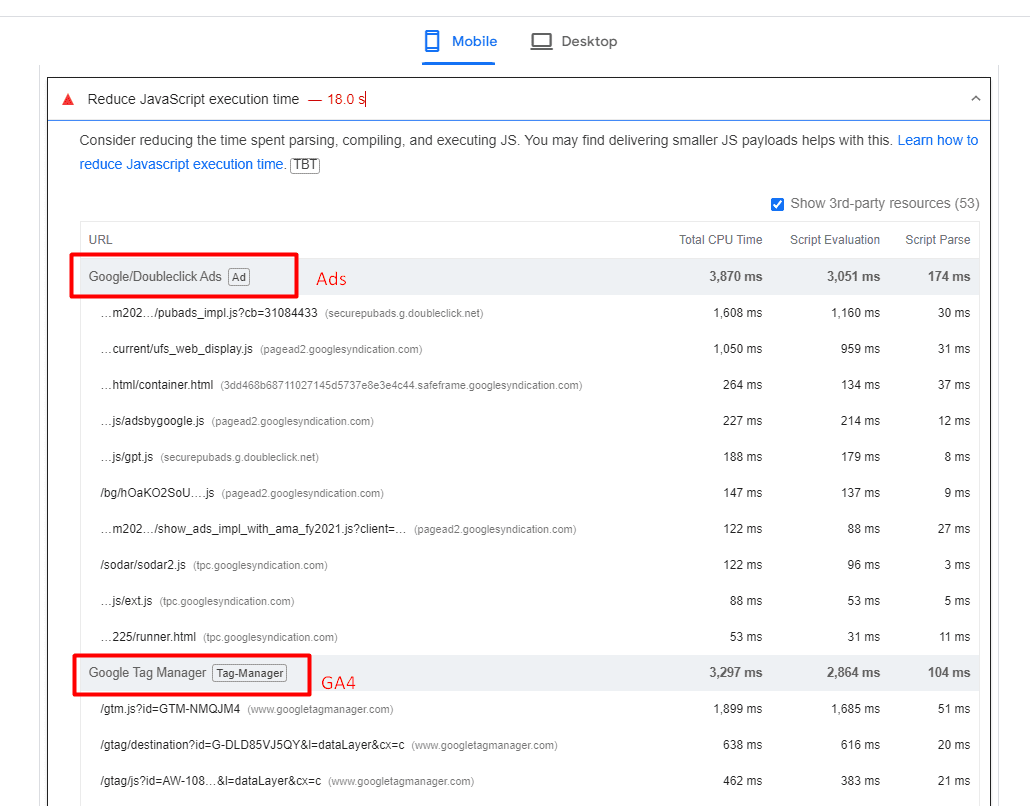
Example of website where ads and analytics scripts cause high javascript execution time.An example of a website where ads and analytics scripts cause high JavaScript execution time.

One strategy you may want to implement to reduce TBT is to delay the loading of non-essential scripts until after the initial page content has finished loading.

Another important point is that when delaying scripts, it’s essential to prioritize them based on their impact on user experience. Critical scripts (e.g., those essential for key interactions) should be loaded earlier than less critical ones.

Improving Your INP Is Not A Silver Bullet

It’s important to note that improving your INP is not a silver bullet that guarantees instant SEO success.

Instead, it is one item among many that may need to be completed as part of a batch of quality changes that can help make a difference in your overall SEO performance.

These include optimizing your content, building high-quality backlinks, enhancing meta tags and descriptions, using structured data, improving site architecture, addressing any crawl errors, and many others.

More resources:


Featured Image: BestForBest/Shutterstock

A short history of AI, and what it is (and isn’t)

This story originally appeared in The Algorithm, our weekly newsletter on AI. To get stories like this in your inbox first, sign up here.

It’s the simplest questions that are often the hardest to answer. That applies to AI, too. Even though it’s a technology being sold as a solution to the world’s problems, nobody seems to know what it really is. It’s a label that’s been slapped on technologies ranging from self-driving cars to facial recognition, chatbots to fancy Excel. But in general, when we talk about AI, we talk about technologies that make computers do things we think need intelligence when done by people. 

For months, my colleague Will Douglas Heaven has been on a quest to go deeper to understand why everybody seems to disagree on exactly what AI is, why nobody even knows, and why you’re right to care about it. He’s been talking to some of the biggest thinkers in the field, asking them, simply: What is AI? It’s a great piece that looks at the past and present of AI to see where it is going next. You can read it here

Here’s a taste of what to expect: 

Artificial intelligence almost wasn’t called “artificial intelligence” at all. The computer scientist John McCarthy is credited with coming up with the term in 1955 when writing a funding application for a summer research program at Dartmouth College in New Hampshire. But more than one of McCarthy’s colleagues hated it. “The word ‘artificial’ makes you think there’s something kind of phony about this,” said one. Others preferred the terms “automata studies,” “complex information processing,” “engineering psychology,” “applied epistemology,” “neural cybernetics,”  “non-numerical computing,” “neuraldynamics,” “advanced automatic programming,” and “hypothetical automata.” Not quite as cool and sexy as AI.

AI has several zealous fandoms. AI has acolytes, with a faith-like belief in the technology’s current power and inevitable future improvement. The buzzy popular narrative is shaped by a pantheon of big-name players, from Big Tech marketers in chief like Sundar Pichai and Satya Nadella to edgelords of industry like Elon Musk and Sam Altman to celebrity computer scientists like Geoffrey Hinton. As AI hype has ballooned, a vocal anti-hype lobby has risen in opposition, ready to smack down its ambitious, often wild claims. As a result, it can feel as if different camps are talking past one another, not always in good faith.

This sometimes seemingly ridiculous debate has huge consequences that affect us all. AI has a lot of big egos and vast sums of money at stake. But more than that, these disputes matter when industry leaders and opinionated scientists are summoned by heads of state and lawmakers to explain what this technology is and what it can do (and how scared we should be). They matter when this technology is being built into software we use every day, from search engines to word-processing apps to assistants on your phone. AI is not going away. But if we don’t know what we’re being sold, who’s the dupe?

For example, meet the TESCREALists. A clunky acronym (pronounced “tes-cree-all”) replaces an even clunkier list of labels: transhumanism, extropianism, singularitarianism, cosmism, rationalism, effective altruism, and longtermism. It was coined by Timnit Gebru, who founded the Distributed AI Research Institute and was Google’s former ethical AI co-lead, and Émile Torres, a philosopher and historian at Case Western Reserve University. Some anticipate human immortality; others predict humanity’s colonization of the stars. The common tenet is that an all-powerful technology is not only within reach but inevitable. TESCREALists believe that artificial general intelligence, or AGI, could not only fix the world’s problems but level up humanity. Gebru and Torres link several of these worldviews—with their common focus on “improving” humanity—to the racist eugenics movements of the 20th century.

Is AI math or magic? Either way, people have strong, almost religious beliefs in one or the other. “It’s offensive to some people to suggest that human intelligence could be re-created through these kinds of mechanisms,” Ellie Pavlick, who studies neural networks at Brown University, told Will. “People have strong-held beliefs about this issue—it almost feels religious. On the other hand, there’s people who have a little bit of a God complex. So it’s also offensive to them to suggest that they just can’t do it.”

Will’s piece really is the definitive look at this whole debate. No spoilers—there are no simple answers, but lots of fascinating characters and viewpoints. I’d recommend you read the whole thing here—and see if you can make your mind up about what AI really is.


Now read the rest of The Algorithm

Deeper Learning

AI can make you more creative—but it has limits

Generative AI models have made it simpler and quicker to produce everything from text passages and images to video clips and audio tracks. But while AI’s output can certainly seem creative, do these models actually boost human creativity?  

A new study looked at how people used OpenAI’s large language model GPT-4 to write short stories. The model was helpful—but only to an extent. The researchers found that while AI improved the output of less creative writers, it made little difference to the quality of the stories produced by writers who were already creative. The stories in which AI had played a part were also more similar to each other than those dreamed up entirely by humans. Read more from Rhiannon Williams.

Bits and Bytes

Robot-packed meals are coming to the frozen-food aisle
Found everywhere from airplanes to grocery stores, prepared meals are usually packed by hand. AI-powered robotics is changing that. (MIT Technology Review

AI is poised to automate today’s most mundane manual warehouse task
Pallets are everywhere, but training robots to stack them with goods takes forever. Fixing that could be a tangible win for commercial AI-powered robots. (MIT Technology Review)

The Chinese government is going all-in on autonomous vehicles
The government is finally allowing Tesla to bring its Full Self-Driving feature to China. New government permits let companies test driverless cars on the road and allow cities to build smart road infrastructure that will tell these cars where to go. (MIT Technology Review

The US and its allies took down a Russian AI bot farm on X
The US seized control of a sophisticated Russian operation that used AI to push propaganda through nearly a thousand covert accounts on the social network X. Western intelligence agencies traced the propaganda mill to an officer of the Russian FSB intelligence force and to a former senior editor at state-controlled publication RT, formerly called Russia Today. (The Washington Post)

AI investors are starting to wonder: Is this just a bubble?
After a massive investment in the language-model boom, the biggest beneficiary is Nvidia, which designs and sells the best chips for training and running modern AI models. Investors are now starting to ask what LLMs are actually going to be used for, and when they will start making them money. (New York magazine

Goldman Sachs thinks AI is overhyped, wildly expensive, and unreliable
Meanwhile, the major investment bank published a research paper about the economic viability of generative AI. It notes that there is “little to show for” the huge amount of spending on generative AI infrastructure and questions “whether this large spend will ever pay off in terms of AI benefits and returns.” (404 Media

The UK politician accused of being AI is actually a real person
A hilarious story about how Mark Matlock, a candidate for the far-right Reform UK party, was accused of being a fake candidate created with AI after he didn’t show up to campaign events. Matlock has assured the press he is a real person, and he wasn’t around because he had pneumonia. (The Verge

Google, Amazon and the problem with Big Tech’s climate claims

MIT Technology Review Explains: Let our writers untangle the complex, messy world of technology to help you understand what’s coming next. You can read more from the series here.

Last week, Amazon trumpeted that it had purchased enough clean electricity to cover the energy demands of all the offices, data centers, grocery stores, and warehouses across its global operations, seven years ahead of its sustainability target. 

That news closely followed Google’s acknowledgment that the soaring energy demands of its AI operations helped ratchet up its corporate emissions by 13% last year—and that it had backed away from claims that it was already carbon neutral.

If you were to take the announcements at face value, you’d be forgiven for believing that Google is stumbling while Amazon is speeding ahead in the race to clean up climate pollution. 

But while both companies are coming up short in their own ways, Google’s approach to driving down greenhouse-gas emissions is now arguably more defensible. 

In fact, there’s a growing consensus that how a company gets to net zero is more important than how fast it does so. And a new school of thought is emerging that moves beyond the net-zero model of corporate climate action, arguing that companies should focus on achieving broader climate impacts rather than trying to balance out every ton of carbon dioxide they emit. 

But to understand why, let’s first examine how the two tech giants’ approaches stack up, and where company climate strategies often go wrong.

Perverse incentives

The core problem is that the costs and complexity of net-zero emissions plans, which require companies to cut or cancel out every ton of climate pollution across their supply chains, can create perverse incentives. Corporate sustainability officers often end up pursuing the quickest, cheapest ways of cleaning up a company’s pollution on paper, rather than the most reliable ways of reducing its emissions in the real world. 

That may mean buying inexpensive carbon credits to offset ongoing pollution from their direct operations or that of their suppliers, rather than undertaking the tougher task of slashing those emissions at the source. Those programs can involve paying other parties to plant trees, restore coastal ecosystems, or alter agriculture practices in ways that purport to reduce emissions or pull carbon dioxide out of the air. The snag is, numerous studies and investigative stories have shown that such efforts often overstate the climate benefits, sometimes wildly.  

Net-zero goals can also compel companies to buy what are known as renewable energy credits (RECs), which ostensibly support additional generation of renewable electricity but raise similar concerns that the climate gains are overstated.

The argument for RECs is that companies often can’t purchase a pure stream of clean electricity to power their operations, since grid operators rely on a mix of natural gas, coal, solar, wind, and other sources. But if those businesses provide money or an indication of demand that spurs developers to build new renewables projects and generate more clean electricity than they would have otherwise, the companies can then claim this cancels out ongoing pollution from the electricity they use.

Experts, however, are less and less convinced of the value of RECs at this stage.

The claim that clean-energy projects wouldn’t have been built without that added support is increasingly unconvincing in a world where those facilities can easily compete in the marketplace on their own, Emily Grubert, an associate professor at Notre Dame, previously told me. And if a company’s purchase of such credits doesn’t bring about changes that reduce the emissions in the atmosphere, it can’t balance out the company’s ongoing pollution. 

‘Creative accounting’

For its part, Amazon is relying on both carbon credits and RECs. 

In its sustainability report, the company says that it reached its clean-electricity targets and drove down emissions by improving energy efficiency, buying more carbon-free power, building renewables projects at its facilities, and supporting such projects around the world. It did this in part by “purchasing additional environmental attributes (such as renewable energy credits) to signal our support for renewable energy in the grids where we operate, in line with the expected generation of the projects we have contracted.”

But there’s yet another issue that can arise when a company pays for clean power that it’s not directly consuming, whether through RECs or through power purchase agreements made before a project is built: Merely paying for renewable electricity generation that occurred at some point, somewhere in the world, isn’t the same as procuring the amount of electricity that the company consumed in the specific places and times that it did so. As you may have heard, the sun stops shining and the wind stops blowing, even as Amazon workers and operations keep grinding around the world and around the clock. 

Paying a solar-farm operator some additional money for producing electricity it was already going to generate in the middle of the day doesn’t in any meaningful way reverse the emissions that an Amazon fulfillment center or server farm produces by, say, drawing electricity from a natural-gas power plant two states away in the middle of the night. 

“The reality on the ground is that its data centers are driving up demand for fossil fuels,” argued a report last week from Amazon Employees for Climate Justice, a group of workers that has been pushing the company to take more aggressive action on climate change. 

The organization said that a significant share of Amazon’s RECs aren’t driving development of new projects. It also stressed that those payments and projects often aren’t generating electricity in the same areas and at the same times that Amazon is consuming power.

The employee group estimates that 78% of Amazon’s US energy comes from nonrenewable sources and accuses the company of using “creative accounting” to claim it’s reached its clean-electricity goals.

To its credit, Amazon is investing billions of dollars in renewables, electrifying its fleet of delivery vehicles, and otherwise making real strides in reducing its waste and emissions. In addition, it’s lobbying US legislators to make it easier to permit electric transmission projects, funding more reliable forms of carbon removal, and working to diversify its mix of electricity sources. The company also insists it’s being careful and selective about the types of carbon offsets it supports, investing only in “additional, quantifiable, real, permanent, and socially beneficial” projects.

“Amazon is focused on making the grid cleaner and more reliable for everyone,” the company said in response to an inquiry from MIT Technology Review. “An emissions-first approach is the fastest, most cost-effective and scalable way to leverage corporate clean-energy procurement to help decarbonize global power grids. This includes procuring renewable energy in locations and countries that still rely heavily on fossil fuels to power their grids, and where energy projects can have the biggest impact on carbon reduction.”

The company has adopted what’s known as a “carbon matching” approach (which it lays out further here), stressing that it wants to be sure the emissions reduced through its investments in renewables equal or exceed the emissions it continues to produce. 

But a recent study led by Princeton researchers found that carbon matching had a “minimal impact” on long-term power system emissions, because it rarely helps get projects built or clean energy generated where those things wouldn’t have happened anyway.

“It’s an offsetting scheme at its core,” Wilson Ricks, an author of the study and an energy systems researcher at Princeton, said of the method, without commenting on Amazon specifically. 

(Meta, Salesforce, and General Motors have also embraced this model, the study notes.)

The problem in asserting that a company is effectively running entirely on clean electricity, when it’s not doing so directly and may not be doing so completely, is that it takes off any pressure to finish the job for real. 

Backing off claims of carbon neutrality

Google has made its own questionable climate claims over the years as well, and it faces growing challenges as the energy it uses for artificial intelligence soars. 

But it is striving to address its power consumption in arguably more defensible ways and now appears to be taking some notable course-correcting steps, according to its recent sustainability report

Google says that it’s no longer buying carbon credits that purport to prevent emissions. With this change, it has also backed away from the claim that it had already achieved carbon neutrality across its operations years ago.

“We’re no longer procuring carbon avoidance credits year-over-year to compensate for our annual operational emissions,” the company told MIT Technology Review in a statement. “We’re instead focusing on accelerating an array of carbon solutions and partnerships that will help us work toward our net-zero goal, while simultaneously helping develop broader solutions to mitigate climate change.”

Notably, that includes funding the development of more expensive but possibly more reliable ways of pulling greenhouse gas out of the atmosphere through direct air capture machines or other methods. The company pledged $200 million to Frontier, an effort to pay in advance for one billion tons of carbon dioxide that startups will eventually draw down and store. 

Those commitments may not allow the company to make any assertions about its own emissions today, and some of the early-stage approaches it funds might not work at all. But the hope is that these sorts of investments could help stand up a carbon removal industry, which studies find may be essential for keeping warming in check over the coming decades. 

Clean power around the clock

In addition, for several years now Google has worked to purchase or otherwise support generation of clean power in the areas where it operates and across every hour that it consumes electricity—an increasingly popular approach known as 24/7 carbon-free energy.

The idea is that this will stimulate greater development of what grid operators increasingly need: forms of carbon-free energy that can run at all hours of the day (commonly called “firm generation”), matching up with the actual hour-by-hour energy demands of corporations. That can include geothermal plants, nuclear reactors, hydroelectric plants, and more.

More than 150 organizations and governments have now signed the 24/7 Carbon-Free Energy Compact, a pledge to ensure that clean-electricity purchases match up hourly with their consumption. Those include Google, Microsoft, SAP, and Rivian.

The Princeton study notes that hourly matching is more expensive than other approaches but finds that it drives “significant reductions in system-level CO2 emissions” while “incentivizing advanced clean firm generation and long-duration storage technologies that would not otherwise see market uptake.”

In Google’s case, pursuing 24/7 matching has steered the company to support more renewables projects in the areas where it operates and to invest in more energy storage projects. It has also entered into purchase agreements with power plants that can deliver carbon-free electricity around the clock. These include several deals with Fervo Energy, an enhanced-geothermal startup.

The company says its goal is to achieve net-zero emissions across its supply chains by 2030, with all its electricity use synced up, hour by hour, with clean sources across every grid it operates on.

Energy-hungry AI

Which brings us back to the growing problem of AI energy consumption.

Jonathan Koomey, an independent researcher studying the energy demands of computing, argues that the hue and cry over rising electricity use for AI is overblown. He notes that AI accounts for only a sliver of overall energy consumption from information technology, which produces about 1.4% of global emissions.

But major data center companies like Google, Amazon, and others will need to make significant changes to ensure that they stay ahead of rising AI-driven energy use while keeping on track with their climate goals.

They will have to improve overall energy efficiency, procure more clean energy, and use their clout as major employers to push utilities to increase carbon-free generation in the areas where they operate, he says. But the clear focus must be on directly cutting corporate climate pollution, not mucking around with RECs and offsets.

“Reduce your emissions; that’s it,” Koomey says. “We need actual, real, meaningful emissions reductions, not trading around credits that have, at best, an ambiguous effect.”

Google says it’s already making progress on its AI footprint, while stressing that it’s leveraging artificial intelligence to find ways to drive down climate pollution across sectors. Those include efforts like Tapestry, a project within the company’s X “moonshot factory” to create more efficient and reliable electricity grids, as well as a Google Research collaboration to determine airline flight paths that produce fewer heat-trapping cirrus clouds

“AI holds immense promise to drive climate action,” the company said in its report.

The contribution model

The contrasting approaches of Google and Amazon call to mind an instructive hypothetical that a team of carbon market researchers sketched out in a paper this January. They noted that one company could do the hard, expensive work of directly eliminating nearly every ton of its emissions, while another could simply buy cheap offsets to purportedly address all of its own. In that case the first company would have done more actual good for the climate, but only the latter would be able to say it had reached its net-zero target.

Given these challenges and the perverse incentives driving companies toward cheap offsets, the authors have begun arguing for a different approach, known as the “contribution model.”

Like Koomey and others, they stress that companies should dedicate most of their money and energy to directly cutting their emissions as much as possible. But they assert that companies should adopt a new way of dealing with what’s left over (either because that remaining pollution is occurring outside their direct operations or because there are not yet affordable, emissions-free alternatives).

Instead of trying to cancel out every ongoing ton of emissions, a company might pick a percentage of its revenue or set a defensible carbon price on those tons, and then dedicate all that money toward achieving the maximum climate benefit the money can buy, says Libby Blanchard, a research scholar at the University of Cambridge. (She coauthored the paper on the contribution model with Barbara Haya of the University of California, Berkeley, and Bill Anderegg at the University of Utah.)

That could mean funding well-managed forestry projects that help trap carbon dioxide, protect biodiversity, and improve air and water quality. It could mean supporting research and development on the technologies still needed to slow global warming and efforts to scale them up, as Google seems to be doing. Or it could even mean lobbying for stricter climate laws, since few things can drive change as quickly as public policy. 

But the key difference is that the company won’t be able to claim that those actions canceled out every ton of remaining emissions—only that it took real, responsible steps to “contribute” to addressing the problem of climate change. 

The hope is that this approach frees companies to focus on the quality of the projects it funds, not the quantity of cheap offsets it buys, Blanchard says.

It could “replace this race to the bottom with a race to the top,” she says.

As with any approach put before profit-motivated companies that employ ranks of savvy accountants and attorneys, there will surely be ways to abuse this method in the absence of appropriate safeguards and oversight.

And plenty of companies may refuse to adopt it, since they won’t be able to claim they’ve achieved net-zero emissions, which has become the de facto standard for corporate climate action.

But Blanchard says there’s one obvious incentive for them to move away from that goal.

“There’s way less risk that they’ll be sued or accused of greenwashing,” she says.

Five ways to make music streaming better for the climate

This story first appeared in China Report, MIT Technology Review’s newsletter about technology in China. Sign up to receive it in your inbox every Tuesday.

This week, we are taking a short break from China and turning to its neighbor South Korea instead. As K-pop sweeps the world and accumulates a massive, devout fan base, these fans have been turning their power into action. Today, I published a story about Kpop4planet, a group of volunteers who are using K-pop’s influence to hold large corporations accountable for their carbon footprints.

One of the most interesting (and also successful) campaigns Kpop4planet has organized shines a light on the carbon footprint of music streaming. Aware that K-pop fans stream significantly more than average (sometimes over five hours a day!) to support their favorite artists, the group successfully campaigned to get Korea’s largest domestic streaming platform to pledge to use 100% renewable energy by 2030.

I have to admit, before working on this story, it didn’t really cross my mind that streaming music could be so polluting. Streaming an album more than 27 times uses more energy than it takes to produce a CD, according to researchers, but it’s surprisingly hard to draw a conclusive answer on whether streaming is more polluting than CDs or records overall. What we do know is that since the carbon emissions associated with streaming are produced in faraway data centers and through invisible data transmissions, the problem is harder to pin down.

During my reporting, I talked to several experts about how to correctly understand the climate impact of music streaming, and one thing became clear: It all comes down to how we stream—the content, the device, the length, etc. They also recommended a bunch of things that any music streaming user can do to leave a smaller carbon footprint.

So here are the things you can do if you are a heavy music streamer:

1. Use small devices instead of big TVs. 

A major part of streaming’s carbon footprint comes from the device that’s used to play the music or video. And some are much more power hungry than others. A 50-inch LED TV consumes 100 times more electricity than a smartphone when used for streaming, according to the International Energy Agency. It also consumes more electricity if the screen stays on, displaying videos or lyrics, rather than just playing the audio. So using a smartphone to stream cuts energy consumption to a minimum.

2. Wait longer to buy a new phone. 

Yes, smartphones are designed to be pretty energy-efficient to use, but manufacturing them is another story. “In the life-cycle analysis of a phone, 85% to 90% of its lifetime energy occurs in its production,” says Laura Marks, a professor in media art and philosophy at Simon Fraser University. The manufacturing process usually involves fossil fuels, plastics, and minerals that could pollute the environment.

“So if I were to make a couple of recommendations, one of them would be to keep your devices for as long as possible, because that’s a huge, huge component of streaming that’s often overlooked,” she says.

3. Return to digital downloads, and only use streaming in selected situations.

While few people still download music files today, experts have agreed that one of the most climate-friendly ways to listen to music is to keep a digital file of your favorite song and return to it repeatedly. 

We also need to change our mindset about treating streaming as the only way to listen to music, says Joe Steinhardt, an assistant professor in the music industry program at Drexel University. “The first and the easiest [suggestion] is to think about streaming music like Styrofoam plates or plastic forks. It doesn’t mean I never use those; it’s just that I don’t eat every meal off of them,” he says. If you are listening to a large variety of music, maybe streaming is the best choice; if you are listening to a few songs repeatedly, go for a digital download or even an old-fashioned CD.

4. Push for streaming platforms to do their part.

Climate action is not just about individual responsibility—it also means pushing corporations to do better. Just as Kpop4planet chased after Melon, Korea’s largest domestic music streaming service, you can also hold your favorite music streaming service accountable. 

A big part of that is figuring out where the platforms’ data centers are, as these can account for a third to a half of streaming’s carbon footprint, according to Marks. These gigantic facilities draw significant amounts of electricity. If they can switch to using renewable energy, that will be much more meaningful than any action one individual can take. It’s also important not to fall for empty promises, and to seek specific plans on where and how they plan to source renewable energy.

5. Cherish music and resist overconsumption.

Many experts mention the Jevons paradox, which states that increasing the efficiency with which a resource is used can lead to more total consumption. In the case of streaming, this means that even if the technology can become more energy-efficient on a per-song basis, the business model and the sheer convenience often encourage users to listen to more and more songs without considering the climate consequences.

To resist that mindset, Marks suggests, we should cherish listening to music more. “Instead of streaming all day, it could mean really enjoying the performance of a song—just listening to it a couple of times and then talking with your friends about it,” she says.

My conclusion? It’s never too late to become aware of the climate impact of music streaming and think about what we can do to make it even just a little greener. 

What’s your relationship with music streaming? Tell me more about it at zeyi@technologyreview.com.


Now read the rest of China Report

Catch up with China

1. CATL, the world’s largest EV battery maker, is flush with cash. But China’s strict control of capital means it has to seek external investment to build up its supply chain outside the country. (Financial Times $)

2. China is asking the World Trade Organization to settle its dispute with the US about EV tariffs. (Reuters $)

3. US-China trade conflicts are spreading to the mattress market, where US retailers say the domestic market is being flooded by Chinese products. (Wall Street Journal $)

4. A new movie in China used AI face-swapping technology to make Jackie Chan look decades younger. Critics hated it. (South China Morning Post $)

5. The failed assassination attempt at a Trump rally not only boosted support for the former president but also caused the price of a Chinese stock to soar—all because the name of the company sounds like “Trump Wins Big” in Chinese. (Bloomberg $)

6. China denies it’s building a naval base in Cambodia. Satellite images show that it is. (New York Times $)

7. Claw-machine arcades are cropping up in Hong Kong—but it’s a result of the failing retail market and low demand for commercial property. (Nikkei Asia $)

Lost in translation

Morowali, a remote, agricultural community in Indonesia, has been transformed into a hub for heavy industry by the entrance of a Chinese company, according to the Chinese magazine Sanlian Lifeweek. Tsingshan Holding Group, a Chinese steel and nickel company, was instrumental in investing in and setting up the Indonesia Morowali Industrial Park (IMIP), where a rich local reserve of nickel ore is converted into high-purity nickel sulfate that’s essential for electric vehicle batteries. 

IMIP has created at least 100,000 jobs and contributed significantly to Indonesia’s economy, but it has also led to environmental and health challenges for local communities. Concerns about air and water pollution, garbage disposal, and worker safety have intensified following an explosion in 2023 that killed eight Chinese workers and 13 Indonesian workers. Now, local workers are organizing to sit down with management and push for changes in worker welfare.

One more thing

If you want a guaranteed sighting of a UFO, come to Shenzhen. Last week, a Chinese company tested an electric helicopter that looks just like a UFO. Flying at a low height and able to land on water, the vehicle is designed for transporting tourists and displaying ads in the future.

What’s next for SpaceX’s Falcon 9

MIT Technology Review’s What’s Next series looks across industries, trends, and technologies to give you a first look at the future. You can read the rest of them here.

SpaceX’s Falcon 9 is one of the world’s safest, most productive rockets. But now it’s been grounded: A rare engine malfunction on July 11 prompted the US Federal Aviation Administration to initiate an investigation and halt all Falcon 9 flights until further notice. The incident has exposed the risks of the US aerospace industry’s heavy reliance on the rocket. 

“The aerospace industry is very dependent on the Falcon 9,” says Jonathan McDowell, an astrophysicist at the Harvard-Smithsonian Center for Astrophysics who issues regular reports on space launches. He says the Falcon 9 and the closely related Falcon Heavy represented 83% of US launches in 2023. “There’s a lot of traffic that’s going to be backed up waiting for it to return to flight,” he adds.

During a SpaceX livestream, ice could be seen accumulating on the Falcon 9’s engine following its launch from California’s Vandenberg Space Force Base en route to releasing 20 Starlink satellites. According to SpaceX, this buildup of ice caused a liquid oxygen leak. Then part of the engine failed, and the rocket dropped several satellites into a lower orbit than intended, one in which they could readily fall back into Earth’s atmosphere. 

By July 12, an FAA press statement was circulating on X. The federal agency said it was aware of the malfunction and would require an investigation. “A return to flight is based on the FAA determining that any system, process, or procedure related to the mishap does not affect public safety,” said the statement.

SpaceX says it will cooperate with the investigation. “SpaceX will perform a full investigation in coordination with the FAA, determine root cause, and make corrective actions to ensure the success of future missions,” says a statement on the company’s website. Details about what the investigation will entail and how long it might take are unknown. In the meantime, SpaceX has requested to keep flying the Falcon 9 while the investigation takes place. “The FAA is reviewing the request and will be guided by safety at every step of the process,” said the agency in a statement. 

Nominal failure

The Falcon 9 has an unusually clean safety record. It’s been launched more than 300 times since its maiden voyage in 2010 and has rarely failed. In 2020, the rocket was the first to launch under NASA’s Commercial Crew Program, which was designed to build the US’s commercial capacity for taking people, including astronauts, into orbit. 

According to MIT aerospace engineer Paulo Lozano, part of the Falcon 9’s success is due to advances in rocket engines. Exactly how SpaceX incorporates these new technologies is unclear, and Lozano notes that SpaceX is quite secretive about the manufacturing process. But it is known that SpaceX uses additive manufacturing to build some engine components. This makes it possible to create parts with complex geometries (for example, hollow—and thus lighter-weight—turbine blades) that enhance performance. And, according to Lozano, artificial intelligence has made diagnosing engine health faster and more accurate. Parts of the rocket are also reusable, which keeps costs low.  

With such a successful track record, the Falcon 9 malfunction might seem surprising. But, Lozano says, anomalies are to be expected when it comes to rocket engines. That’s because they operate in harsh environments where they’re subjected to extreme temperatures and pressures. This makes it difficult for engineers to manufacture a rocket as reliable as a commercial airplane.

“These engines produce more power than small cities, and they work in stressful conditions,” says Lozano. “It’s very hard to contain them.” 

What exactly went wrong last week remains a mystery. Still, experts agree the event can’t be brushed off. “‘Oh, it was a fluke’ is not, in the modern space industry, an acceptable answer,” says McDowell. What he finds most surprising is that the malfunction didn’t occur in one of the reusable parts of the rocket (like the booster), but instead in a part known as the second stage, which SpaceX switches out each time the rocket launches. 

Stalled schedules

It remains unclear when the Falcon 9 will fly again. Several upcoming missions will likely be postponed, including the billionaire tech entrepreneur Jacob Isaacman’s Polaris Dawn, which would have been the first all-private mission to include a space walk. It’s possible NASA’s SpaceX Crew-9 mission to the International Space Station (ISS), planned for mid-August 2024, will also be delayed. 

Uncrewed missions will be affected too. One that stands out is the Europa Clipper mission, which is intended to explore Jupiter’s icy moon and assess its habitability. According to McDowell, the mission, which is planned for October 2024, will likely be delayed by the Falcon 9 grounding. That’s because there is a narrow time frame within which the satellite can be launched. (The mission is facing a technological hangup unrelated to the Falcon 9 that could also push back its launch.) 

The incident reveals a need for the US to explore alternatives to the Falcon 9. McDowell says the United Launch Alliance’s Atlas V rocket, accompanied by Boeing’s Starliner capsule, used to be the next best option for US-based crewed ISS missions. But the Atlas V is being phased out. It will be replaced by the ULA’s Vulcan Centaur, a partially reusable rocket that has made only one test flight so far. Plus, the Starliner capsule has serious issues that have left two NASA astronauts stuck at the ISS, potentially until August. 

Blue Origin’s reusable New Glenn rocket could be a competitor, but it hasn’t flown yet. The aerospace company says it hopes to launch the rocket before 2025. Blue Origin’s other reusable rocket, New Shepard, is not capable of flying into orbit. 

The Falcon 9 malfunction makes these projects all the more essential. “Even the Falcon 9 can have problems,” says McDowell. “It’s important to have multiple routes of access to space.” 

Companies need to stop taking the easy way out on climate goals

This article is from The Spark, MIT Technology Review’s weekly climate newsletter. To receive it in your inbox every Wednesday, sign up here.

Corporate climate claims can be confusing—and sometimes entirely unintuitive. 

Tech giants Amazon and Google both recently released news about their efforts to clean up their climate impact. Both were a mixed bag, but one bit of news in particular made me prick up my ears. Google’s emissions have gone up, and the company stopped claiming to be “net zero” (we’ll dig into this term more in a moment). Sounds bad, right? But in fact, one might argue that Google’s apparent backslide might actually represent progress for climate action

My colleague James Temple dug into this news, along with the recent Amazon announcement, for a story this week. Let’s take a sneak peek at what he found and untangle why corporate climate efforts can be so tricky to wrap your head around. 

To make sense of these recent announcements, the most important phrase to understand is “net-zero emissions.” 

Companies produce greenhouse-gas emissions by making products, transporting them around, or just using electricity. Some corporate leaders may want to reduce those emissions so they can be a smaller part of the climate-change problem (or brag about their progress). Net-zero emissions refers to the point at which the emissions a company produces are canceled out by those it eliminates. But very different paths can all lead to that point. 

One way to get rid of emissions is to take actions to reduce them in your operations. Imagine, for example, Amazon replacing its delivery trucks with EVs or building solar panels on warehouses. 

This sort of direct action tends to be hard and expensive, and it’s probably impossible for any company to totally wipe out all its emissions right now, given that so much of our economy still relies on fossil fuels. So to reach net zero, many companies choose to disappear their emissions with math instead. 

A company might buy carbon credits or renewable-energy credits, essentially paying someone to make up for its own climate impact. That might mean giving a nonprofit money to plant some trees, which suck up and store carbon, or funneling funds to developers and claiming that more renewables projects will get built as a result. 

Not all credits are all bad—but often, carbon offsets and renewable-energy credits reflect big claims with little to back them up. And if companies are going after a net-zero label for their business, they may be incentivized to buy cheap credits, even if they don’t actually deliver on claims. 

As James puts it in his story, “Corporate sustainability officers often end up pursuing the quickest, cheapest ways of cleaning up a company’s pollution on paper, rather than the most reliable ways of reducing its emissions in the real world.”

This sort of issue is why I tend to be suspicious of companies that claim to have already achieved net-zero emissions or 100% renewable energy. Cleaning up emissions is hard, and if you’ve already claimed victory, I’d say the odds are good that you’re taking an easy way out. 

Which brings us to Google’s news. Google has claimed that its operations have operated with net-zero emissions since 2007. Now it’s not claiming that anymore—not really because it suddenly decided to take huge steps back in how it operates, but because it’s stopped buying carbon offsets on a massive scale. Instead, it’s focusing on investing in other ways to tackle emissions.

So what’s the next step for big companies looking to have a material impact on climate action? James has us covered again: In a 2022 story, he laid out six potential ways to rethink corporate climate goals. 

Instead of buying up credits, companies can instead put that money toward investing in permanent carbon removal. Developing more reliable methods of pulling climate pollution out of the atmosphere and locking it away might be more expensive, but investing in those efforts will help the market mature and support companies that need commitments. 

Companies can also contribute money to research and development for areas that are difficult to decarbonize—think aviation, shipping, steel, and cement. Those sectors touch basically every industry, so helping them make progress could be a worthy use of dollars. 

If there’s one takeaway in this tangle of news, I’d say that we could all ask more questions and dig a little deeper into claims from big corporations. Remember, if something sounds too good to be true, it probably is.  


Now read the rest of The Spark

Related reading

Read more about Big Tech climate action, including why Amazon’s renewable-energy claims might be more complicated than they appear at first glance, in James’s latest story.

And here’s his piece on six ways that we can rethink net-zero climate plans. 

For more on how the climate “solution” of carbon offsets might be adding millions of tons of carbon dioxide into the atmosphere, read this 2021 deep dive.  

KPOP4PLANET

Another thing

A small group of K-pop fans is working to clean up music streaming. Streaming can consume a lot of computing power, and all that energy used in data centers supporting it can mean big-time emissions.

A group called Kpop4planet put pressure on a streaming service to commit to using 100% renewables for its data centers by 2030. And the fans’ organizing paid off, because the service agreed. 

Read more about the power of K-pop fans in this latest story from my colleague Zeyi Yang

Keeping up with climate  

It’s been mixed news this year so far for the EV market in the US. Overall sales are up, but some automakers are seeing deliveries stall. Also notable: Tesla has historically dominated, but it just dropped below 50% of the market for the first time. (Inside Climate News)

New materials that help tackle humidity could make air-conditioning a lot more efficient. Several companies are trying to bring machines based on these desiccant materials to the market. (Wired)

→ I wrote last year about how these moisture-sucking materials could help us beat the heat. (MIT Technology Review)

Electric vehicles are associated with lower emissions over their lifetimes than gas-powered cars, but they don’t start out that way, largely because of the climate cost of building their batteries. This calculator estimates how far you need to drive for EVs to break even with gas vehicles. (PNAS)

Nuclear startup Commonwealth Fusion Systems is selling its high-tech magnets now. The company is still working toward flipping on its fusion reactor. (TechCrunch)

The near-term future of EVs might include gas tanks, since some automakers are building electric vehicles that include gas-powered generators. The difference between these and plug-in hybrids is subtle, but basically these would have simpler guts inside. They could help bring more drivers onto team electric. (Heatmap News)

San Francisco launched a new ferry that runs entirely on hydrogen fuel cells. It’s the first such commercial passenger ferry in the world. One challenge could be securing a reliable source of low-emissions hydrogen. (Canary Media)

File this under weird effects of climate change: Melting ice sheets are making days longer. Ice loss in Greenland and Antarctica makes the Earth wider, slowing the planet’s rotation. It’s only on the scale of about a millisecond per century, but it could be enough to throw off precise timekeeping. (The Guardian)

Rules around tax credits for hydrogen fuel were proposed to ensure that the money went to projects that help the climate. Now those rules seem to be in trouble. (Heatmap News)

The Download: Falcon 9’s future, and Big Tech’s climate goals

This is today’s edition of The Download, our weekday newsletter that provides a daily dose of what’s going on in the world of technology.

What’s next for SpaceX’s Falcon 9

SpaceX’s Falcon 9 is one of the world’s safest, most productive rockets. But a rare engine malfunction on July 11 prompted the US Federal Aviation Administration to initiate an investigation and ground all Falcon 9 flights until further notice. The incident has exposed the risks of the US aerospace industry’s heavy reliance on the rocket.

The Falcon 9 has an unusually clean safety record. It’s been launched more than 300 times since its maiden voyage in 2010 and has rarely failed. But while its malfunction might seem surprising, anomalies are to be expected when it comes to rocket engines.

What exactly went wrong last week remains a mystery. Still, experts agree the event can’t be brushed off. Read the full story.

—Sarah Ward

Companies need to stop taking the easy way out on climate goals

Corporate climate claims can be confusing—and sometimes entirely unintuitive. 

Tech giants Amazon and Google both recently released news about their efforts to clean up their climate impact. Both were a mixed bag, but one bit of news in particular stood out: Google’s emissions have gone up, and the company stopped claiming to be “net zero.” 

Sounds bad, right? But in fact, one might argue that Google’s apparent backslide might actually represent progress for climate action. Read our story to learn why.

—Casey Crownhart

This story is from The Spark, our weekly newsletter covering all the latest developments in climate and energy tech. Sign up to receive it in your inbox every Wednesday.

The must-reads

I’ve combed the internet to find you today’s most fun/important/scary/fascinating stories about technology.

1 Meta won’t release multimodal AI models in Europe
It’s blaming the “unpredictable nature” of the European regulatory environment. (Axios)
+ The AI Act is done. Here’s what will (and won’t) change. (MIT Technology Review)

2 Spain is dependent on an algorithm to combat gender violence
Hundreds of women who were assessed by the software have since been killed by their current or former partners. (NYT $)

3 Russia and China are stirring online dissent in the wake of Trump’s shooting
State media sites seized the opportunity to blame the Democrats for the violence. (WP $)
+ X’s AI bot Grok is failing to report the attempted assassination accurately. (WSJ $)

4 This drug extended the lifespan of lab mice by close to 25%
The animals were stronger, healthier, and developed fewer cancers, too. (BBC)
+ These scientists are working to extend the life span of pet dogs—and their owners. (MIT Technology Review)

5 Synthetic speech firm ElevenLabs wants to detect deepfakes
A new partnership with detection company Reality Defender could help it do just that. (Bloomberg $)
+ Australia’s police union is pushing for a portal to report deepfakes. (The Guardian)

6 NASA is abandoning its mission to search for water on the moon
The much-delayed Viper program is too expensive, it’s concluded. (Bloomberg $)
+ Future space food could be made from astronaut breath. (MIT Technology Review)

7 A mobile forensics firm can’t unlock many modern iPhones
In fact, its success hinges on iPhones running software that’s almost five years old. (404 Media)

8 Space-based solar power is looking increasingly viable
It could be a 24/7 source of clean power in the future. (Wired $)
+ The race to get next-generation solar technology on the market. (MIT Technology Review)

9 Antarctica is the perfect place to look for alien life
Which is even more reason to protect it from melting. (The Atlantic $)
+ Climate change is making our days longer, too. (Vox)

10 Are you auramaxxing?
Predictably, this intense form of manifesting is big on TikTok. (NY Mag $)

Quote of the day

“The Blue Wall of tech is crumbling before our very eyes.”

—Ryan Selkis, CEO of crypto research firm Messari, remarks on how the traditionally left-leaning tech industry is changing its alliances to the Republicans ahead of November’s Presidential election, Vox reports.

The big story

After 25 years of hype, embryonic stem cells are still waiting for their moment​

August 2023

In 1998, researchers isolated powerful stem cells from human embryos. It was a breakthrough, since these cells are the starting point for human bodies and have the capacity to turn into any other type of cell—heart cells, neurons, you name it.

National Geographic would later summarize the incredible promise: “the dream is to launch a medical revolution in which ailing organs and tissues might be repaired” with living replacements. It was the dawn of a new era. A holy grail. Pick your favorite cliché—they all got airtime.

Yet today, more than two decades later, there are no treatments on the market based on these cells. Not one. Our biotech editor Antonio Regalado set out to investigate why, and when that might change. Here’s what he discovered.

We can still have nice things

A place for comfort, fun and distraction to brighten up your day. (Got any ideas? Drop me a line or tweet ’em at me.)

+ A video game about potatoes? Perfection. 🥔
+ These sunflower slides are pretty amazing.
+ The Therizinosaurus was a mysterious mix of giraffe, sloth, and wolverine, and it roamed the earth for millions of years.
+ A minimal effort, no-bake lemon cheesecake is the ideal end to a summer’s meal.

Building supply chain resilience with AI

If the last five years have taught businesses with complex supply chains anything, it is that resilience is crucial. In the first three months of the covid-19 pandemic, for example, supply-chain leader Amazon grew its business 44%. Its investments in supply chain resilience allowed it to deliver when its competitors could not, says Sanjeev Maddila, worldwide head of supply chain solutions at Amazon Web Services (AWS), increasing its market share and driving profits up 220%. A resilient supply chain ensures that a company can meet its customers’ needs despite inevitable disruption.

Today, businesses of all sizes must deliver to their customers against a backdrop of supply chain disruptions, with technological changes, shifting labor pools, geopolitics, and climate change adding new complexity and risk at a global scale. To succeed, they need to build resilient supply chains: fully digital operations that prioritize customers and their needs while establishing a fast, reliable, and sustainable delivery network.

The Canadian fertilizer company Nutrien, for example, operates two dozen manufacturing and processing facilities spread across the globe and nearly 2,000 retail stores in the Americas and Australia. To collect underutilized data from its industrial operations, and gain greater visibility into its supply chain, the company relies on a combination of cloud technology and artificial intelligence/machine learning (AI/ML) capabilities.

“A digital supply chain connects us from grower to manufacturer, providing visibility throughout the value chain,” says Adam Lorenz, senior director for strategic fleet and indirect procurement at Nutrien. This visibility is critical when it comes to navigating the company’s supply chain challenges, which include seasonal demands, weather dependencies, manufacturing capabilities, and product availability. The company requires real-time visibility into its fleets, for example, to identify the location of assets, see where products are moving, and determine inventory requirements.

Currently, Nutrien can locate a fertilizer or nutrient tank in a grower’s field and determine what Nutrien products are in it. By achieving that “real-time visibility” into a tank’s location and a customer’s immediate needs, Lorenz says the company “can forecast where assets are from a fill-level perspective and plan accordingly.” In turn, Nutrien can respond immediately to emerging customer needs, increasing company revenue while enhancing customer satisfaction, improving inventory management, and optimizing supply chain operations.

“For us, it’s about starting with data creation and then adding a layer of AI on top to really drive recommendations,” says Lorenz. In addition to improving product visibility and asset utilization, Lorenz says that Nutrien plans to add AI capabilities to its collaboration platforms that will make it easier for less-tech-savvy customers to take advantage of self-service capabilities and automation that accelerates processes and improves compliance with complex policies.

To meet and exceed customer expectations with differentiated service, speed, and reliability, all companies need to similarly modernize their supply chain operations. The key to doing so—and to increasing organizational resilience and sustainability—will be applying AI/ML to their extensive operational data in the cloud.

Resilience as a business differentiator

Like Nutrien, a wide variety of organizations from across industries are discovering the competitive advantages of modernizing their supply chains. A pharmaceutical company that aggregates its supply chain data for greater end-to-end visibility, for example, can provide better product tracking for critically ill customers. A retail startup undergoing meteoric growth can host its workloads in the cloud to support sudden upticks in demand while minimizing operating costs. And a transportation company can achieve inbound supply chain savings by evaluating the total distance its fleet travels to reduce mileage costs and CO2 emissions.

Download the full report.

This content was produced by Insights, the custom content arm of MIT Technology Review. It was not written by MIT Technology Review’s editorial staff.

New Ecommerce Tools: July 18, 2024

Every week we publish a list of new products from companies offering services to ecommerce and omnichannel merchants. This installment includes updates on AI-powered shopping assistants, crowdfunding, social commerce, big data, livestream shopping, subscriptions, app development, and cross-border payments.

Got an ecommerce product release? Email releases@practicalecommerce.com.

New Tools for Merchants: July 18, 2024

eBay launches cash advance services for sellers. eBay is launching Business Cash Advance, a financing product provided by Liberis, a global embedded finance platform. According to eBay, Business Cash Advance offers eligible U.S. eBay sellers up to $1 million in working capital in as little as 24 hours. The program features flexible payment schedules that scale with the seller’s sales cycle. There is no minimum payment and no early payment penalty.

Home page of Liberis

Liberis

Amazon’s AI-powered shopping assistant Rufus available to all U.S. customers. Amazon’s generative AI-powered conversational shopping assistant, Rufus, is now available to all U.S. customers in the Amazon Shopping app. Rufus is designed to help customers save time and make informed purchase decisions by answering questions on various shopping needs and products. Customers can ask Rufus for product details, recommendations, and comparisons as well as access product updates and shopping history.

Etsy introduces Creativity Standards for sellers. Etsy has reorganized its policies into new Creativity Standards, which underscore the specific work that a seller does for each item in the marketplace. An item on listing pages is now labeled as one of the following: Made by ShopName, Made by ShopName, Handpicked by ShopName, or Designed by ShopName. Etsy is also adding more options to the listing form for sharing details about processes, materials, and tools.

Crowdfunding platform Indiegogo launches marketplace IndieShop and new features. Indiegogo, a crowdfunding platform, has launched IndieShop, a curated ecommerce marketplace offering crowdfunded products. IndieShop launched in beta in May and currently features more than 40 products. Beyond IndieShop, the platform added new features, including prelaunch reservations, pay-over-time financing, cart volume discounts, cross-platform campaign importing, and gifting. Indiegogo also plans to launch an in-store retail partnership to feature crowdfunded projects.

Home page of IndieShop

IndieShop

TikTok Shop U.K. starts £1 Million Club to grow brands and SMBs. TikTok Shop U.K. has launched £1 Million Club, a plan to help new merchants hit £1M in revenue through incentives and support at no extra cost. According to TikTok, The £1Million Club brings benefits to new merchants: up to 90 days of 0% commission-free sales, free storage and fulfillment through Fulfilled by TikTok, and seller support priority service. TikTok Shop will also provide dedicated promotion support for merchants.

Behavioral modeling platform Synerise raises $8.5 million for growth. Synerise, a provider of AI-driven behavioral modeling and big data solutions, has announced a $8.5 million investment from Vtex, a composable commerce platform, and angel investors as part of its Series B+ funding round. Synerise provides advanced AI and big data technology solutions to over 150 markets across ecommerce, retail, banking, and other industries. This strategic investment will bolster Synerise’s expansion into new markets and reinforce its position in behavioral AI.

Ecommpay adds a recurring PayPal payments feature. Ecommpay, an ecommerce payments platform, has added a feature that allows merchants to collect recurring PayPal payments from customers alongside subscription card payments and direct debits that they have been using to date. Merchants can handle all subscriptions from their PayPal dashboard with full control and visibility over billing cycles, amounts, and customer information. They can also make changes, track payment history, and handle cancellations.

Home page of Ecommpay

Ecommpay

Wix releases new features for app developers. Wix, a website builder, has announced new features to help developers build applications more efficiently. The Wix Design System includes reusable components and Figma kits. The Wix Patterns library allows for rapid development of admin screens. Developers can (i) jumpstart app development from pre-designed templates tailored to different use cases, (ii) extend functionalities, enabling feature-rich plugins that integrate into Wix’s business apps, and (iii) get 100% revenue share in the first year.

Flipkart adds new recharge and bill payment categories (PDF ). Flipkart, an India-based ecommerce marketplace, has launched five new recharge and bill payment categories, including Fastag, DTH recharges, landline, broadband, and mobile postpaid bill payments on its app. These are in addition to the existing electricity and mobile prepaid recharge options. Flipkart has partnered with BillDesk, an India-based payment service, to help integrate the new services with the Bharat Bill Payments System, developed by the National Payments Corporation of India.

Yuno and Openpay partner on digital payments in Mexico. Yuno, a payments orchestration platform, had partnered with Openpay, BBVA Group’s digital payments company, to boost online transactions in Mexico. The collaboration aims to create synergies within the local payment ecosystem. Yuno’s platform provides access to more than 300 payment methods, as well as one-click checkout, smart routing, and anti-fraud tools through a single interface. Openpay simplifies online sales for merchants by card, bank transfer, cash, or loyalty points via a single integration.

HSN partners with Impact.com to launch creator platform. HSN, a platform for livestream shopping via online and TV channels, is launching a creator platform with Impact.com, an affiliate management site. Through the new HSNfluencer platform powered by Impact.com’s technology, HSN can recruit, engage, manage, and analyze creator partners through a customized experience. Within the platform, influencers and content creators can collaborate with HSN and use curated product collections to inspire content stories and generate affiliate product links for their posts.

Home page of Impact.com

Impact.com

Google Clarifies H1-H6 Headings For SEO via @sejournal, @martinibuster

Google’s Gary Illyes answered a question about the SEO value of hierarchically ordering heading elements (H1, H2, etc.). His answer offered an insight into the actual value of heading elements for digital marketing.

Heading Elements

In simple terms, HTML Elements are the building blocks of a web page and they all have their place much like the foundation and a roof of a home have their places in the overall structure.

Heading elements communicate the topic and subtopics of a web page and are literally a list of topics when a page is viewed just by their headings.

The World Wide Web Consortium (W3C), which defines HTML, describes headings like this:

“HTML defines six levels of headings. A heading element implies all the font changes, paragraph breaks before and after, and any white space necessary to render the heading. The heading elements are H1, H2, H3, H4, H5, and H6 with H1 being the highest (or most important) level and H6 the least.

Headers play a related role to lists in structuring documents, and it is common to number headers or to include a graphic that acts like a bullet in lists.”

Strictly speaking, it is absolutely correct to order headings according to their hierarchical structure.

What Google Says About Headings

The person asking the question commented that the SEO Starter Guide recommends using heading elements in “semantic” order for people who use screen readers (devices that translate text into spoken words) but that otherwise it’s not important for Google. The person asking the question wanted to know if the SEO Starter Guide was out of date because an SEO tool had a different recommendation.

Gary narrated the submitted question:

“I recently read on the SEO starter guide that “Having headings in semantic order is fantastic for screen readers, but from Google Search perspective, it doesn’t matter if you’re using them out of order.”

Is this correct because an SEO tool told me otherwise.”

It’s a good question because it makes sense to use heading elements in a way that shows the hierarchical importance of different sections of a web page, right?

Here’s Gary’s response:

“We update our documentation quite frequently to ensure that it’s always up to date. In fact the SEO starter guide was refreshed just a couple months back to ensure it’s still relevant, so what you read in the guide is as accurate as it can get.

Also, just because a non-Google tool tells you something is good or bad, that doesn’t make it relevant for Google; it may still be a good idea, just not necessarily relevant to Google.”

Is It Relevant For Google?

The official HTML standards are flexible about the use of headings.

Here’s what the standards say here:

“A heading element briefly describes the topic of the section it introduces. Heading information may be used by user agents, for example, to construct a table of contents for a document automatically.”

And here:

“The heading elements are H1, H2, H3, H4, H5, and H6 with H1 being the highest (or most important) level and H6 the least.”

The official HTML5 specifications for headings state that the hierarchical ordering is implied but that in both cases the headings communicate the start of a new section within a web page. Also, while the official standards encourage “nesting” headings for subtopics but that’s a “strong” encouragement and not a rigid rule.

“The first element of heading content in an element of sectioning content represents the heading for that section. Subsequent headings of equal or higher rank start new (implied) sections, headings of lower rank start implied subsections that are part of the previous one. In both cases, the element represents the heading of the implied section.

Sections may contain headings of any rank, but authors are strongly encouraged to either use only h1 elements, or to use elements of the appropriate rank for the section’s nesting level.”

That last part of the official standards is quite explicit that users are “encouraged” to only use H1 elements, which might sound crazy to some people, but that’s the reality. Still, that’s just an encouragement, not a rigid rule.

It’s only in the official HTML standards for heading elements in the context of accessibility that the recommendations are more rigid about using heading elements with a hierarchical structure (important to least important).

So as you can see, Google’s usage of heading elements appear to be in line with the official standards because the standards allow for deviation, except for accessibility reasons.

The SEO tool is correct that the proper use of heading elements is to put them into hierarchical order. But the tool is incorrect in saying that it’s better for SEO.

This means that H1 is the most important heading for screen readers but it’s not the most important for Google. When I was doing SEO in 2001, the H1 was the most important heading element. But that hasn’t been the case for decades.

For some reason, some SEO tools (and SEOs) still believe that H1 is the most important heading for Google. But that’s simply not correct.

Listen to the SEO Office Hours Podcast at the 13:17 minute mark:

Featured Image by Shutterstock/AlenD