seo enhancements
What is Search Experience Optimization (SXO)?

Today, you have to think beyond simply ranking high on search engines. Users want more than just a simple website visit. Your visitors and customers are looking for an engaging experience. Search Experience Optimization (SXO) can help provide this. This merges SEO with user-centric design to help you attract visitors and keep them engaged. The goal, of course, is to convert them into loyal customers. We’ll explain the topic, how it differs from SEO, and why you could use it in your strategy.

SEO, SXO, OSO?

You might think, “Another acronym? SEOs sure love their acronyms!”. Of course, you are correct — we even wrote about another interesting acronym just last week: OSO (Organic Search Optimization). SXO, however, is one you’ll want to remember. It focuses on merging search engine visibility and user experience.

What is Search Experience Optimization?

Search Experience Optimization (SXO) enhances SEO with user experience design. One of SEO’s main goals is to improve your site’s visibility in the SERPs. SXO, however, goes a step further to ensure visitors have a positive experience that meets their needs and helps them reach their goals.

While modern-day SEO inches ever closer to SXO, it initially emerged as a natural evolution from SEO. It understands that ranking high in Google is just the first step. The challenge lies in keeping visitors and turning them into customers. Combining SEO techniques with UX best practices, SXO creates websites that are easy to find and enjoyable to use.

SXO is about optimizing for both humans and search engines. It takes the entire user journey into account. It sets a path from when someone types a query into a search engine to where they complete an action on your site. This holistic SEO approach gets your website traffic. Once there, you’ll provide a fantastic experience that engages and converts.

The main components of SXO

Search Experience Optimization merges traditional SEO with UX. Combining these components helps create a site that is both search engine-friendly and user-friendly.

SEO basics

SEO is the foundation of SXO. You’ll still do the same stuff, like conducting keyword research to identify the terms your target audience is searching for. Once you have these keywords, you should use them in your content like you are used to. On-page SEO helps search engines understand your site properly. As a result, it can correctly index your content, which helps improve your search rankings.

User experience

User experience is at the heart of SXO. The goal is to keep visitors engaged. For this, you must prioritize ease of navigation, build an intuitive design, focus on accessibility, and make your content readable with great typography. You’ll build a well-structured website with clear menus, hierarchy, and navigation to help users find what they need quickly. An appealing design with high-quality visuals can make your site more engaging. And, of course, there’s also a bigger focus on conversion optimization.

Engagement metrics

To offer a great experience, you need to monitor user behavior. Engagement metrics provide valuable insights into how users interact with your site. For instance, a high bounce rate might indicate that people can’t find what they need. On the other hand, a longer average time on page might suggest that they engage with your content. Analyzing these metrics finds many things to improve and gives you data-driven decisions to enhance the UX.

Content quality

As we know, content quality is essential in both SEO and UX. Your content should be helpful and relevant to your audience’s needs. Use clear and concise language. Aim for excellent readability. High-quality content helps with search engine rankings, keeps users engaged, and encourages them to explore your site.

How SXO differs from SEO

Search Experience Optimization is SEO with an extra focus on user experience. SEO aims to increase visibility in the SERPs and attract organic traffic by optimizing content and technical aspects. SXO, on the other hand, aims to attract visitors and retain and convert them. While SEO brings users to your site, SXO helps them have a great experience once they arrive.

Technical vs. holistic approach

While content forms a big part of SEO, it is often more technical, focusing on structured data, meta tags, backlinks, and site speed. These elements help improve your rankings. SXO has a more holistic approach and combines this with user-centric design principles. It aims to improve the overall user journey, from the initial search query to the final conversion. It focuses on ease of navigation, usability, and content relevance.

Metric differences

Measuring success in SEO and SXO has quite some overlap, while SEO metrics are a bit more search engine-centric. They include rankings, organic traffic, and click-through rates (CTR). These metrics tell you how well your site is performing in search results. SXO metrics are also more user-centric. They include engagement metrics and conversion rates. These metrics provide insights into how users interact with your site and how effectively it meets their needs.

An example of SEO vs. SXO

Let’s look at a short example that hopefully makes the differences even more insightful:

SEO approach

An e-commerce website that sells running shoes focuses on optimizing for high-quality keywords. They begin by conducting extensive keyword research to identify popular search terms like “buy running shoes,” “best running shoes,” and “affordable running shoes.” Once they have identified these keywords, they optimize their product pages by incorporating these in the content. Additionally, they ensure that images are optimized with relevant alt text.

To enhance their technical SEO, they improve site speed and mobile-friendliness, both of which are crucial for better search engine rankings. They also create an XML sitemap and submit it to search engines to improve site indexing. The content creation strategy involves publishing blog posts and articles targeting specific keywords, such as “Top Running Shoes for Marathon Training” and “How to Choose the Right Running Shoes.” To further boost their SEO efforts, they build backlinks by contacting fitness blogs, influencers, and online publications, increasing their authority.

SXO approach

In addition to the above SEO tactics, the e-commerce website also focuses on the user experience to better meet user intent. They start by analyzing search queries to understand the underlying intent, such as whether users are looking for buying guides, reviews, or specific product features. With these insights, they create comprehensive buying guides that explain how to choose running shoes based on different factors like foot type, running style, and terrain. They also offer interactive tools like quizzes to help users determine the best shoe for their needs.

The website has a clean, intuitive layout that ensures easy navigation. This way, users find what they’re looking for quickly. Clear, prominent calls-to-action (CTAs) like “Shop Now,” “Learn More,” and “Take the Quiz” guide users through the purchase process. To increase engagement and build trust, they incorporate user reviews and ratings on product pages, videos, and 360-degree views of the products to give users a better understanding of the shoes.

Personalization plays a key role in their SXO strategy. They use data from previous interactions to personalize recommendations, showing users products that match their preferences and past behavior. For conversion optimization, they streamline the checkout process to reduce friction, offering multiple payment options and guest checkout. Additionally, they implement retargeting strategies, such as email reminders for abandoned carts, to encourage users to complete their purchases.

Uniting SXO and SEO

The online store integrates SEO and SXO approaches. This attracts a high volume of visitors through search engines and provides a superior user experience. Combined, this leads to higher engagement, increased user satisfaction, and better conversion rates.

For instance, a user searching for “best running shoes for flat feet” might land on a detailed guide that explains what features to look for, showcases top-rated products, and offers an interactive quiz. This comprehensive approach answers their query and guides them toward purchasing, enhancing both the SEO and the user experience.

What is Search Experience Optimization?

Search Experience Optimization combines SEO and user experience. With SXO, you don’t just aim to attract visitors through improved search engine rankings; you want them to have a great experience. This experience should be so good that it encourages them to stay, explore, and convert.

If you want to integrate SXO into your strategy, you need a holistic approach. This focus on experience and rankings builds a great online presence, ultimately driving long-term success.

Coming up next!

Google’s John Mueller On How To Verify An SEO Agency’s Work via @sejournal, @MattGSouthern

In a recent session of Google’s SEO office-hours Q&A, the Search Relations team addressed a common concern among business owners: how to determine if an SEO agency is actively optimizing your website.

The Business Owner’s Question

The discussion was prompted by a business owner who asked:

“If I have an agency that is managing our organic SEO on a monthly basis, how can I tell if anyone has been actively optimizing? I have a suspicion that the agency has not been optimized out of site for years.”

Google’s Response

In response, John Mueller, a Search Relations team member, shared his experience collaborating with an agency on Google’s Search Central content.

Key Points from Mueller’s Advice

  1. Regular Meetings: Hold frequent discussions with the SEO agency to review their work.
  2. Progress Reports: Request reports that detail the site’s progress over time.
  3. Future Planning: Discussing upcoming work helps ensure the agency addresses your needs.
  4. Client Education: Clients should have a basic understanding of SEO work to better evaluate the agency’s efforts.

While acknowledging that increased engagement requires additional time from both parties, Mueller believes it’s worth the effort.

This allows you to check if the SEO agency is meeting your needs. However, he notes that you need to have some trust in your relationship with the agency.

Resources For SEO Education

To assist businesses in managing their SEO efforts, Mueller pointed to two valuable resources:

  1. Google’s guide on hiring an SEO provides insights into the selection process.
  2. The SEO starter guide offers a foundational understanding of SEO principles.

Mueller’s Full Response

“This is a great question. When we worked with an SEO agency for some of the Search Central content, we had regular meetings to discuss the work that they did, to look at reports about the site’s progress, and to discuss any upcoming work. This did require a bit more time, both from them and from us, but I found it very insightful. I think it helps to lightly understand the kind of work that an agency would do, so that you can confirm that they’re doing what you expect them to do, and even then there’s a component of trust involved. We have a page about hiring an SEO which has some insights, and there’s our SEO starter guide, which can explain a bit more. And also, perhaps some folks from the SEO industry can comment on how they’d help a client understand how they’re spending their time.”

Previous Discussions On SEO Hiring

This advice from Mueller echoes a similar discussion he initiated last year, where he sought recommendations on what businesses should look for when hiring SEO consultants.

The conversation among industry experts highlighted key factors such as experience, customization, transparency, and adherence to ethical practices.

For more insights on choosing the right SEO professional, refer to our previous coverage of that discussion.

When To Seek Professional SEO Help

For businesses unsure about when to seek professional SEO help, here’s an article that outlines five critical situations that warrant hiring an SEO expert.

These include when Google isn’t indexing your site, during site migrations or redesigns, when organic traffic drops significantly, to reverse manual actions, and when current SEO strategies aren’t yielding results.

This information complements Mueller’s advice by helping businesses recognize when professional intervention is necessary.


Featured Image: YouTube.com/GoogleSearchCentral

What SEO Should Know About Brand Marketing With Mordy Oberstein via @sejournal, @theshelleywalsh

For the SEO industry, the Google documents leak offered an important view behind the scenes. Although the leak was not a blueprint of how the algorithm worked, there was considerable confirmation that SEO professionals were right about many elements of the algorithm.

From all the analysis and discussion following the leak, the one insight that got my attention was how important the brand is.

Rand Fishkin, who broke the leak, said this:

“Brand matters more than anything else … If there was one universal piece of advice I had for marketers seeking to broadly improve their organic search rankings and traffic, it would be: “Build a notable, popular, well-recognized brand in your space, outside of Google search.”

Mike King echoed this statement with the following observation:

“All these potential demotions can inform a strategy, but it boils down to making stellar content with strong user experience and building a brand, if we’re being honest.”

Mordy Oberstein, who is an advocate for building a brand online, posted on X (Twitter):

“I am SO happy that the SEO conversation has shifted to thinking about “brand.”

It’s not the first time that “brand” has been mentioned in SEO. We began to talk about this around 2012 after the impact of Panda and Penguin when it first became apparent that Google’s aim was to put more emphasis on brand.

Compounding this is the introduction of AI, which has accelerated the importance of taking a more holistic approach to online marketing with less reliance on Google SERPs.

When I spoke to Pedro Dias, he said, “We need to focus more than ever on building our own communities with users aligned to our brands.”

As someone who had 15 years of offline experience in marketing, design, and business before moving into SEO, I have always said that having this wide knowledge allows me to take a holistic view of SEO. So, I welcome the mindset shift towards building a brand online.

As part of his X/Twitter post, Mordy also said:

“I am SO happy that the SEO conversation has shifted to thinking about “brand” (a lot of which is the direct result of @randfish’s & @iPullRank’s great advice following the “Google leaks”).

As someone who has straddled the brand marketing and SEO world for the better part of 10 years – branding is A LOT harder than many SEOs would think and will be a HUGE adjustment for many SEOs.”

Following his X/Twitter post, I reached out to Mordy Oberstein, Head of SEO Brand at Wix, to have a conversation about branding and SEO.

What Do SEO Pros Need To Know About ‘Brand’ To Make The Mindset Shift?

I asked Mordy, “In your opinion, what does brand and building a brand mean, and can SEO pros make this mindset shift?”

Mordy responded, “Brand building basically means creating a connection between one entity and another entity, meaning the company and the audience.

It’s two people meeting, and that convergence is the building of a brand. It’s very much a relationship. And I think that’s what makes it hard for SEOs. It’s a different way of thinking; it’s not linear, and there aren’t always metrics that you can measure it by.

I’m not saying you don’t use data, or you don’t have data, but it’s harder to measure to tell a full story.

You’re trying to pick up on latent signals. A lot of the conversation is unconscious.

It’s all about the micro things that compound. So, you have to think about everything you do, every signal, to ensure that it is aligned with the brand.

For example, a website writes about ‘what is a tax return.’ However, if I’m a professional accountant and I see this on your blog, I might think this isn’t relevant to me because you’re sending me a signal that you’re very basic. I don’t need to know what a tax return is; I have a master’s degree in accounting.

The latent signals that you’re sending can be very subtle, but this is where it is a mindset shift for SEO.”

I recalled a recent conversation with Pedro Dias in which he stressed it was important to put your users front and center and create content that is relevant to them. Targeting high-volume keywords is not going to connect with your audience. Instead, think about what is going to engage, interest, and entertain them.

I went on to say that for some time, the discussion online has been about SEO pros shifting away from the keyword-first approach. However, the consequences of moving away from a focus on traffic and clicks will mean we are likely to experience a temporary decline in performance.

How Does An SEO Professional Sell This To Stakeholders – How Do They Measure Success?

I asked Mordy, “How do you justify this approach to stakeholders – how do they measure success?”

Mordy replied, “I think selling SEO will become harder over time. But, if you don’t consider the brand aspect, then you could be missing the point of what is happening. It’s not about accepting lower volumes of traffic; it’s that traffic will be more targeted.

You might see less traffic right now, but the idea is to gain a digital presence and create digital momentum that will result in more qualified traffic in the long term.”

Mordy went on to say, “It’s going to be a habit to break out of, just like when you have to go on a diet for a long-term health gain.

The ecosystem will change, and it will force change to our approach. SEOs may not have paid attention to the Google leak documents, but I think they will pay attention as the entire ecosystem shifts – they won’t have a choice.

I also think C-level will send a message that they don’t care about overall traffic numbers, but do care about whether a user appreciates what they are producing and that the brand is differentiated in some way.”

How Might The Industry Segment And What Will Be The Important Roles?

I interjected to make the point that it does look a lot like SEO is finally making that shift across marketing.

Technical SEO will always be important, and paid/programmatic will remain important because it is directly attributable.

For the rest of SEO, I anticipate it merges across brand, SEO, and content into a hybrid strategy role that will straddle those disciplines.

What we thought of as “traditional SEO” will fall away, and SEO will become absorbed into marketing.

In response, Mordy agreed and thought that SEO traffic is part of a wider scope or part of a wider paradigm, and it will sit under brand and communications.

An SEO pro that functions as part of the wider marketing and thinks about how we are driving revenue, how we are driving growth, what kind of growth we are driving, and using SEO as a vehicle to that.

The final point I raised was about social media and whether that would become a more combined facet of SEO and overall online marketing.

Mordy likened Google to a moth attracted to the biggest digital light.

He said, “Social media is a huge vehicle for building momentum and the required digital presence.

For example, the more active I am on social media, the more organic branded searches I gain through Google Search. I can see the correlation between that.

I don’t think that Google is ignoring branded searches, and it makes a semantic connection.”

SEO Will Shift To Include Brand And Marketing

The conversation I had with Mordy raised an interesting perspective that SEO will have to make significant shifts to a brand and marketing mindset.

The full impact of AI on Google SERPs and how the industry might change is yet to be realized. But, I strongly recommend that anyone in SEO consider how they can start to take a brand-first approach to their strategy and the content they create.

I suggest building and measuring relationships with audiences based on how they connect with your brand and moving away from any strategy based on chasing high-volume keywords.

Think about what the user will do once you get the click – that is where the real value lies.

Get ahead of the changes that are coming.

Thank you to Mordy Oberstein for offering his opinion and being my guest on IMHO.

More resources:


Featured Image: 3rdtimeluckystudio/Shutterstock

SEO in the Martech Stack: How Tech Decisions Can Impact SEO via @sejournal, @TaylorDanRW

Organizations typically are a mixture of orientations that impact all aspects of the business from operations, finance, and marketing and sales functions.

This also means it can influence the marketing technology stack, and subsequently, these decisions can impact the performance of marketing channels, including SEO.

When organizations determine the technologies they want to use to build their stack, there are several different objectives and criteria that stakeholders look to satisfy.

Regardless of a stakeholder’s objectives, the overall objective is for the Martech stack to significantly contribute to the success and performance of the business, either directly or indirectly.

This happens directly through acting as a vehicle to drive customer acquisition and conversion or indirectly as a mechanism to improve operational performances.

What Is A Martech Stack?

A marketing technology stack (Martech stack) is the collective noun for an organization group of software, hardware, and tools purchased (or utilized) by the business to monitor and improve marketing performance, monitor and enable sales activities, and improve other business functions such as speed of order fulfillment through to errorless payment gateways.

Typical Martech stacks are compromised of software and technology designed to achieve different tasks and objectives such as:

  • Data analytics tools (warehousing, visualization)
  • CRMs
  • Teamwork and project management tools (JIRA, Trello)
  • Payment gateways & order fulfillment/dispatch

Anecdotally most Martech decisions are led by engineering and infrastructure teams, but influenced by marketing, sales, community, and C-level.

So why is this important to SEO?

A lot of these decisions impact SEO, or potential SEO performance, so it is important that given the opportunity to contribute to these discussions, we do. We must ask the right questions and put forward the right arguments to make the case for, and make the business aware of, the potential impact on SEO performance.

CMOs (and organizations) typically engage with SEOs to achieve one or more of the following objectives:

  • To improve organic search visibility for business-relevant non-branded queries at various stages of the decision funnel.
  • To improve the stability and visibility of desired messaging for branded queries.
  • To work with other departments within the business and improve the user experience and conversion rate of the website for all web traffic.

Not all of the Martech stack will impact SEO performance, and not all arguments are worth having.

If an organization utilizes Salesforce CRM and the tooling is firmly established, moving to Salesforce Commerce Cloud or Experience Cloud as a website platform isn’t likely going to be a decision you will be able to influence – but is one you need to be aware to ensure things like the SEO migration and out-of-the-gate strategy are geared for success.

When Can Martech Decisions Impact SEO?

So how can the Martech stack impact SEO?

Let’s take a look at some common situations in which the business might make Martech decisions that could impact SEO either positively or negatively.

Integrations With Sales CRMs & CRM Led Decision-Making

Sales-oriented organizations tend to base a large number of their technology decision-making around improving sales enablement.

As a result, you see website technologies closely tied to sales CRMs, such as Salesforce and Hubspot.

While both of these are good platforms, websites designed with too much of the influence coming from the sales orientation are often designed to try and funnel a user to completing a sales action, such as downloading a marketing asset, completing a contact form, or requesting a demo as soon as possible.

This direct funnel approach to page templates, and content, doesn’t always create the best environment for organic search. Whilst the pages are hyperfocused on user conversion, they don’t always hold the value proposition and messaging that search engines are looking to rank for all queries.

The conflict you find here with heavy sales orientation is that the client will want these conversion pages to rank for all the high search volume queries, regardless of the funnel stage.

Being able to influence and highlight the need for content and a user experience that caters for and helps satisfy the different reasons as to why a user visits your website (not only just to get in touch) is vital to long-term organic success.

C-Level Led Platform Decisions

In an ideal world, CMOs and CTOs work together to identify and fill gaps in the Martech stack, prioritizing customer-centric technologies that act as enablers to marketing, sales, and operations functions.

Most CMOs/CTOs have their preferred suite of tools and platforms, and they build their playbooks that they take when they move roles, and some of these plays have stack dependencies.

Another time this can happen is when an organization gets a new CMO or Marketing Director, and at their previous company, they’ve used another platform or technology.

In the SaaS space, I see this happen a lot with new CMOs and CTOs wanting to champion a form of headless or React/Nuxt website build in place of the incumbent technology, and similarly, in ecommerce I see this happen a lot when a CMO or CTO inherits a stack they’re not familiar with, and will prefer familiarly regardless of how the existing platform is performing.

Depending on the size of the organization these changes vary in terms of overall disruption. For example, moving from a performant established Salesforce Commerce Cloud build to a Shopify build will bring with it changes in CRM, order management, and development team (who will need to get used to the business), but from an SEO perspective, a forced change in URL structures and other dynamic onsite elements, as Shopify doesn’t have Einstein or Lightning.

As well as highlighting the change variables that will impact SEO performance – and their associated short and long-term risks – this is also an opportunity to utilize SEO data to inform the new site build architecture and use data (to try to ensure) the new stack meets the needs of marketing teams and your audience.

Adopting Technologies For Competitive Advantage

There is also the drive for businesses to continuously identify and adopt emerging technologies to find a competitive advantage over their competition. A 2019 Gartner study found that 68% of CTOs actively invest in emerging technologies to gain a competitive edge.

Outside of personal preference, CMOs/CTOs also decide to make these changes for product, financial, and operational reasons.

Where this is the case, whilst the marketing (and SEO) variables are heavily considered, there is generally an overriding attitude that marketing is the most adaptable and innovative stakeholder in this mix.

Technologies For UX & Legal Compliance

Many website page load and speed issues are caused by third-party tools and software, and these are typically tools for user experience monitoring and AB testing.

Organizations may deploy these technologies in ways that slow down site loading times, negatively affect user experience, and potentially violate data privacy regulations.

From experience, a lot of issues with these tools will be picked up early into an SEO partnership through a baseline technical overview, and once resolved the problem is solved.

But when the business is looking to introduce these tools, SEOs must be consulted as part of the implementation and deployment process.

Outside of UX and AB testing tools, issues can also be caused by the implementation of cookie consent banners and other accessibility tools. With the European Accessibility Act coming into force in 2025, we’re likely going to see these sorts of issues on the rise as organizations adopt third-party accessibility tools.

As these tools often introduce and load scripts, outside of degrading page load speeds, in some instances, the implementations can cause the to close prematurely or create infinite internal linking traps.

Educating stakeholders on best practices for integrating these tools is crucial to maintaining optimal website performance and adhering to consent requirements.

How SEO Can Influence Martech Decisions

While SEO is just one marketing channel, it could be argued its success is the most influenced by the technology decisions that a business makes.

Acknowledging that the stack significantly impacts SEO, a large number of decisions are still made independently of the SEO (and marketing) teams.

Mostly all businesses take elements of each different orientation to be successful, and this means maximizing customer experience. SEO can provide key data that offers insights into the user journey and how users interact and discover the website.

Arming CMOs and CTOs with the foresight and knowledge that these decisions could negatively impact the performance of what could be their biggest traffic-driving channel.

More resources: 


Featured Image: Gorodenkoff/Shutterstock

Transforming the energy industry through disruptive innovation

In the rhythm of our fast-paced lives, most of us don’t stop to think about where electricity comes from or or how it powers homes, industries, and the technologies that connect people around the world. As populations and economies grow, energy demands are set to increase by 50% by 2050–challenging century-old energy systems to adapt with innovative and agile solutions. This comes at a time when climate change is making its presence felt more than ever; 2023 marked the warmest year since records began in 1850, crossing the 1.5 degrees global warming threshold. 

Nadège Petit of Schneider Electric confronts this challenge head-on, saying, “We have no choice but to change the way we produce, distribute, and consume energy, and do it sustainably to tackle both the energy and climate crises.” She explains further that digital technologies are key to navigating this path, and Schneider Electric’s AI-enabled IoT solutions can empower customers to take control of their energy use, enhancing efficiency and resiliency.

Petit acknowledges the complexity of crafting and implementing robust sustainability strategies. She highlights the importance of taking an incremental stepwise approach, and adopting open standards, to drive near-term impact while laying the foundation for long-term decarbonization goals. 

Because the energy landscape is evolving rapidly, it’s critical to not just keep pace but to anticipate and shape the future. Much like actively managing health through food and fitness regimes, energy habits need to be monitored as well. This can transform passive consumers to become energy prosumers–those that produce, consume, and manage energy. Petit’s vision is one where “buildings and homes generate their own energy from renewable sources, use what’s needed, and feed the excess back to the grid.”  

To catalyze this transformation, Petit underscores the power of collaboration and innovation. For example, Schneider Electric’s SE Ventures invests in startups to provide new perspectives and capabilities to accelerate sustainable energy solutions. 

“It’s all about striking a balance to ensure that our relationship with startups are mutually beneficial, knowing when to provide guidance and resources when they need it, but also when to step back and allow them to thrive independently,” says Petit. 

This episode of Business Lab is produced in partnership with Schneider Electric. 

Full transcript 

Laurel Ruma: From MIT Technology Review, I’m Laurel Ruma, and this is Business Lab, the show that helps business leaders make sense of new technologies coming out of the lab and into the marketplace. 

Our topic today is disruptive innovation in the energy industry and beyond. We use energy every day. It powers our homes, buildings, economies, and lifestyles, but where it came from or how our use affects the global energy ecosystem is changing, and our energy ecosystem needs to change with it.

 My guest is Nadège Petit, the chief innovation officer at Schneider Electric. 

This podcast is produced in partnership with Schneider Electric. 

Welcome, Nadège. 

Nadège Petit: Hi, everyone. Thank you for having me today. 

Laurel: Well, we’re glad you’re here. 

Let’s start off with a simple question to build that context around our conversation. What is Schneider Electric’s mission? And as the chief innovation officer leading its Innovation at the Edge team, what are some examples of what the team is working on right now? 

Nadège: Let me set up this scene a little bit here. In recent years, our world has been shaped by a series of significant disruptions. The pandemic has driven a sharp increase in the demand of digital tools and technologies, with a projected 6x growth in the number of IoT devices between 2020 and 2030, and a 140x growth in IP traffic between 2020 and 2040. 

Simultaneously, there has been a parallel acceleration in energy demands. Electrical consumption has been increasing by 5,000 terawatt hours every 10 years over the past two decades. This is set to double in the next 10 years and then quadruple by 2040 This is amplified by the most severe energy crisis that we are facing now since the 1970s. Over 80% of carbon emissions are coming from energy, so electrifying the world and decarbonizing [the] energy sector is a must. We cannot overlook the climate crisis while meeting these energy demands. In 2023, the global average temperature was the warmest on record since 1850, surpassing the 1.5 degrees global warming limit. So, we have no choice but to change the way we produce, distribute, and consume energy, and do it sustainably to tackle both the energy and climate crises. This gives us a rare opportunity to reimagine and create a clean energy future we want. 

Schneider Electric as an energy management and digital automation company, aims to be the digital partner for sustainability and efficiency for our customers. With end-to-end experience in the energy sector, we are uniquely positioned to help customers digitize, electrify, and deploy sustainable technologies to help them progress toward net-zero. 

As for my role, we know that innovation is pivotal to drive the energy transition. The Innovation at the Edge team leads the way in discovering, developing, and delivering disruptive technologies that will define a more digital, electric, and sustainable energy landscape. We function today as an innovation engine, bridging internal and external innovation, to introduce new solutions, services and businesses to the market. Ultimately, we are crafting the future businesses for Schneider Electric in this sector. And to do this, we nourish a culture that recognizes and celebrates innovation. We welcome new ideas, consider new perspectives inside and outside the organization, and seek out unusual combinations that can kindle revolutionary ideas. We like to think of ourselves as explorers and forces of change, looking for and solving new customer problems. So curiosity and daring to disrupt are in our DNA. And this is the true spirit of Innovation at the Edge at Schneider Electric. 

Laurel: And it’s clear that urgency certainly comes out, especially for enterprises. Because they’re trying to build strong sustainability strategies to not just reach those environmental, social, and governance, or ESG, goals and targets; but also to improve resiliency and efficiency. What’s the role of digital technologies when we think about this all together in enabling a more sustainable future? 

Nadège: We see a sustainable future, and our goal is to enable the shift to an all-electric and all-digital world. That kind of transition isn’t possible without digital technology. We see digital as a key enabler of sustainability and decarbonization. The technology is already available now, it’s a matter of acceleration and adoption of it. And all of us, we have a role to play here. 

At Schneider Electric, we have built a suite of solutions that enable customers to accelerate their sustainability journey. Our flagship suite of IoT-enabled solution infrastructure empowers customers to monitor energy, carbon, and resource usage; and enabling them to implement strategies for efficiency, optimization, and resiliency. We have seen remarkable success stories of clients leveraging our digital EcoStruxure solution in buildings, utilities, data centers, hospitality, healthcare, and more, all over the place. If I were to take one example, I can take the example of PG&E customer, a leading California utility that everybody knows; they are using our EcoStruxure distributed energy resources management system, we call it DERMS, to manage grid reliability more effectively, which is crucial in the face of extreme weather events impacting the grid and consumers.

Schneider has also built an extensive ecosystem of partners because we do need to do it at scale together to accelerate digital transformation for customers. We also invest in cutting-edge technologies that make need-based collaboration and co-innovation possible. It’s all about working together towards one common goal. Ultimately the companies that embrace digital transformation will be the ones that will thrive on disruption. 

Laurel: It’s clear that building a strong sustainability strategy and then following through on the implementation does take time, but addressing climate change requires immediate action. How does your team at Schneider Electric as a whole work to balance those long-term commitments and act with urgency in the short term? It sounds like that internal and external innovation opportunity really could play a role here. 

Nadège: Absolutely. You’re absolutely right. We already have many of the technologies that will take us to net-zero. For example, 70% of CO2 emissions can be removed with existing technologies. By deploying electrification and digital solutions, we can get to our net-zero goals much faster. We know it’s a gradual process and as you already discussed previously, we do need to accelerate the adoption of it. By taking an incremental stepwise approach, we can drive near-term impact while laying the foundation for long-term decarbonization goals. 

Building on the same example of PG&E, which I referenced earlier; through our collaboration, piece by piece progressively, we are building the backbone of a sustainable, digitized, and reliable energy future in California with the deployment of EcoStruxure DERMS. As grid reliability and flexibility become more important, DERMS enable us to keep pace with 21st-century grid demands as they evolve. 

Another critical component of moving fast is embracing open systems and platforms, creating an interoperable ecosystem. By adopting open standards, you empower a wide range of experts to collaborate together, including startups, large organizations, senior decision-makers, and those on the ground. This future-proof investment ensures flexible and scalable solutions, that avoids expensive upgrades in the future and obsolescence. That is why at Innovation at the Edge we’re creating a win-win partnership to push market adoption of the innovative technology available today, but laying the foundation of an even more innovative tomorrow. Innovation at the Edge today provides the space to nurture those ideas, collaborate together, iterate, learn, and grow at pace. 

Laurel: What’s your strategy for investing in, and then adopting those disruptive technologies and business models, especially when you’re trying to build that kind of innovation for tomorrow? 

Nadège: I strongly believe innovation is a key driver of the energy transition. It’s very hard to create the right conditions for consistent innovation, as we discuss short-term and long-term. I want to quote again the famous book from Clayton Christenson, The Innovator’s Dilemma, about how big organizations can get so good at what they are already doing that they struggle to adapt as the market changes. And we are in this dilemma. So we do need to stay ahead. Leaders need to grasp disruptive technology, put customers first, foster innovation, and tackle emerging challenges head on. The phrase “that’s no longer how we do it,” really resonates with me as I look at the role of innovation in the energy space. 

At Schneider, innovation is more than just a buzzword. It’s our strategy for navigating the energy transition. We are investing in truly new and disruptive ideas, tech, and business models, taking the risk and the challenge. We complement our current offering constantly, and we include the new prosumer business that we’re building, and this is pivotal to accelerate the energy transition. We foster open innovation through investment and incubation of cutting-edge technology in energy management, electrical mobility, industrial automation, cybersecurity, artificial intelligence, sustainability, and other topics that will help to go through this innovation. I also can quote some joint ventures that we are creating with partners like GreenStruxure or AlphaStruxure. Those are offering energy-as-a-service solutions, so a new business model enabling organizations to leverage existing technology to achieve decarbonization at scale. As an example, GreenStruxure is helping Bimbo Bakeries move closer to net-zero with micro-grid system at six of their locations. This will provide 20% of Bimbo Bakeries’ USA energy usage and save an estimate of 1,700 tons of CO2 emission per year. 

Laurel: Yeah, that’s certainly remarkable. Following up on that, how does Schneider Electric define prosumer and how does that audience actually fit into Schneider Electric’s strategy when you’re trying to develop these new models? 

Nadège: Prosumer is my favorite word. Let’s redefine it again. Everybody’s speaking of prosumer, but what is prosumer? Prosumer refers to consumers that are actively involved in energy management; producing and consuming their own energy using technologies like solar panels, EV chargers, EV batteries, and EV storage. This is all digitally enabled. So everybody now, the customers, industrial customers, want to understand their energy. So becoming a prosumer comes with perks like lower energy bills. Fantastic, right? Increase independence, clean energy use, and potential compensation from utility providers. It’s beneficial to all of us; it’s beneficial to our planet, it’s beneficial to the decarbonization of the world. Imagine a future where buildings and homes generate their own energy from renewable sources, use what’s needed, and feed the excess back to the grid. This is a fantastic opportunity, and the interest in this is massive. 

To give you some figures; in 2019 we saw 100 gigawatts of new solar PV capacities deployed globally, and by last year this number had nearly quadrupled. So transformation is happening now. Electric vehicles, as an example, their sales have been soaring too, with a projected 14 million sales by 2023, six times the 2019 number. These technologies are already making a dent in emissions and the energy crisis. 

However, the journey to become a prosumer is complex. It’s all about scale and adoption, and it involves challenges with asset integration, grid modernization, regulatory compliance. So we are all part of this ecosystem, and it takes a lot of leadership to make it happen. So at Innovation at the Edge, we’re creating an ecosystem of solutions to streamline the prosumer journey from education and management to purchasing, installation, management, and maintenance of these new distributed resources. What we are doing, we are bringing together internal innovations that we already have in-house at Schneider Electric, like micro-grid, EV charging solutions, battery storage, and more with external innovation from portfolio companies. I can quote companies like Qmerit, EnergySage, EV Connect, Uplight, and AutoGrid, and we deliver end-to-end solutions from grid to prosumer. 

I want to insist one more time, it’s very important to accelerate and to be part of this accelerated adoption. These efforts are not just about strengthening our business, they’re about simplifying the energy ecosystem and moving the industry toward greater sustainability. It’s a collaborative journey that’s shaping the future of energy, and I’m very excited about this. 

Laurel: Focusing on that kind of urgency, innovation in large companies can be hampered by bureaucracy and go slow. What are some best practices for innovation without all of those delays? 

Nadège: Schneider Electric, we are not strangers to innovation, specifically in the energy management and industrial automation space. But to really push the envelope, we look beyond our walls for fresh ideas and expertise. And this is where SE Ventures comes in. It’s our one-billion-euro venture capital fund, from which we make bold bets and bring disruptive ideas to life by supporting and investing in startups that complement our current offering and explore future business. So based in Silicon Valley, but with a global reach, SE Ventures leverages our market knowledge and customer proximity to drive near-term value and commercial relationships with our businesses, customers, and partners. 

We also focus on partnership and incubation. So through partnerships with startups, we accelerate time to market. We accelerate the R&D roadmap and explore new products, new markets with startups. When it comes to incubation, we seek out game-changing ideas and entrepreneurs. We are providing mentorship, resources, and market insight at every stage of their journey. As an example, we also invested in funds like E14, the fund that started out at MIT Media Lab, to gain early insight into disruptive trends and technology. It’s very important to be early-stage here. 

So SE Ventures has successfully today developed multiple unicorns in our portfolio. We’re working with several other high-growth companies, targeted to become future unicorns in key strategic areas. That is totally consistent with Schneider’s mission. 

It’s all about striking a balance to ensure that our relationship with startups are mutually beneficial, knowing when to provide guidance and resources when they need it, but also when to step back and allow them to thrive independently. 

Laurel: With that future lens on, what kind of trends or developments in the energy industry are you seeing, and how are you preparing for them? Are you getting a lot of that kind of excitement from those startups and venture fund ideas? 

Nadège: Yeah, absolutely. There are multiple strengths. You need to listen to startups, to innovators, to people coming up with bold ideas. I want to highlight a couple of those. The energy industry is set to see major shifts. We know it, and we want to be part of it. We discussed prosumers. Prosumer is something very important. A lot of people now understand their body, doing exercises, monitoring it; tomorrow, people will all monitor their energy. Those are prosumers. We believe that prosumers, that’s individuals and businesses, they’re central to the energy transition. And this is a key focal point for us. 

Another trend that we also discuss is digital and also AI. AI has the potential to be transformative as we build the new energy landscape. One example is AI-powered virtual power plants, or what we call VPP, that can optimize a large portfolio of distributed energy resources to ensure greater grid resiliency. Increasingly, AI can be at the heart of the modern electrical grid. So at Schneider Electric, we are watching those trends very carefully. We are listening to the external world, to our customers, and we are showing that we are positioning our solution and global hubs to best serve the needs of our customers. 

Laurel: Lastly, as a woman in a leadership position, could you tell us how you’ve navigated your career so far, and how others in the industry can create a more diverse and inclusive environment within their companies and teams? 

Nadège: An inclusive environment starts with us as leaders. Establishing a culture where we value differences, different opinions, believe in equal opportunity for everyone, and foster a sense of belonging, is something very important in this environment. It’s also important for organizations to create commitments around diversity, equity, and inclusion, and communicate them publicly so it drives accountability, and report on the progress and how we make it happen. 

I was truly fortunate to have started and grown my career at a company like Schneider Electric where I was surrounded by people who empowered me to be my best self. This is something that should drive all women to be the best of herself. It wasn’t always easy. I have learned how important it is to have a voice and to be bold, to speak up for what you are passionate about, and to use that passion to drive impact. These are values I also work to instill in my own teenage daughters, and I’m thrilled to see them finding their own passion within STEM. So the next generation is the driving force in shaping a more sustainable world, and it’s crucial that we focus on leaving the planet a better and more equal place where they can thrive. 

Laurel: Words to the wise. Thank you so much Nadege for joining us today on the Business Lab. 

Nadège: Thank you. 

Laurel: That was Nadège Petit, the chief innovation officer at Schneider Electric, who I spoke with from Cambridge, Massachusetts, the home of MIT and MIT Technology Review. 

That’s it for this episode of Business Lab. I’m your host, Laurel Ruma. I’m the global director of Insights, the custom publishing division of MIT Technology Review. We were founded in 1899 at the Massachusetts Institute of Technology, and you can find us in print, on the web, and at events each year around the world. For more information about us and the show, please check out our website at technologyreview.com. 

This show is available wherever you get your podcasts. If you enjoyed this episode, we hope you’ll take a moment to rate and review us. Business Lab is a production of MIT Technology Review. This episode was produced by Giro Studios. Thanks for listening. 

This content was produced by Insights, the custom content arm of MIT Technology Review. It was not written by MIT Technology Review’s editorial staff.

Charts: Outlook of Gen Zs and Millennials 2024

Roughly 30% of Gen Zs and Millennials believe the economic situation in their countries will improve over the next year.

That’s according to Deloitte’s “2024 Gen Z and Millennial Survey” (PDF), published in May. Deloitte surveyed 14,468 Gen Zs (teenagers to late 20s) and 8,373 Millennials (late 20s to mid-40s) across 44 countries to explore their attitudes about work and the world around them.

While the data shows just over 30% believe their overall national economy will improve, many more believe their personal financial situation will get better.

In addition, per the survey results, Gen Zs and Millennials are willing to take action on environmental issues.

Moreover, according to the data, frequent generative AI users across both cohorts are likely to think the technology will improve their work/life balance and positively impact their work.

Top Books for Cross-border Success

Doing business in just one country and language almost certainly leaves money on the table. Yet operating internationally adds challenges and complexities. Here are 11 books — six just published — that help succeed across borders.

Top Books for Cross-border Success

American Idioms for Marketing: Engage and Persuade with Colorful Expressions Used in the USA by Liz Chroman and Richard Koret

Cover of American Idioms for Marketing

American Idioms for Marketing

Filled with colorful illustrations, this book aims to help non-native English speakers remember common marketing-related idioms such as “bird’s-eye view,” “find your niche,” and “flying under the radar” in a fun way. The authors are Liz Chroman, an English language teacher, and international marketing and communications expert Richard Koret.

How the World Ran Out of Everything: Inside the Global Supply Chain by Peter S. Goodman

Cover of How to World Ran Out of Everything

How to World Ran Out of Everything

New York Times economic journalist Peter S. Goodman explores how the pandemic exposed the complexity and vulnerability of the global supply chain and how to improve it.

Mastering Market Entry: USA: The European’s Guide to Making It Big in America by Manny Schoenhuber

Cover of Mastering Market Entry: USA

Mastering Market Entry: USA

This book offers a playbook for European business owners to break into the U.S. market. Schoenhuber is an attorney who represents European companies and investors in the U.S. and facilitates collaboration.

Spiderweb Capitalism: How Global Elites Exploit Frontier Markets by Kimberly Kay Hoang

Cover of Spiderweb Capitalism

Spiderweb Capitalism

University of Chicago professor Kimberly Kay Hoang reports on her groundbreaking behind-the-scenes investigation into the shadowy world of offshore finance and shell corporations.

Change Your Perspective: Communication Pitfalls in International Business by Irek Zyzanski et al.

Cover of Change Your Perspective

Change Your Perspective

Explains how to avoid stereotypes, improve cultural intelligence, and work smoothly with international teams.

The Language of Global Marketing by Wendy MacKenzie Pease

Cover of Language of Global Marketing

Language of Global Marketing

Pease aims to help businesses expanding into new markets optimize their content and communications with global inbound marketing and quality translation.

Confessions of an Economic Hit Man, Third Edition by John Perkins

Cover of Confessions of an Economic Hit Man

Confessions of an Economic Hit Man

This expanded version of John Perkins’s New York Times bestseller exposes how the U.S. and China use development loans to trap less-wealthy countries in a corrupt system. The first edition was translated into more than 30 languages.

A Business Guide to International Trade & Investment  by Devyini E. Bailey

Cover of Business Guide to International Trade

Business Guide to International Trade

Published last year, Bailey’s book is a comprehensive guide to international trade operations and management, focusing mainly on import and export logistics.

Transforming the Global Supply Chain: Cyber Warfare, Technology, and Politics by Dennis Unkovic

Cover of Transforming the Global Supply Chain

Transforming the Global Supply Chain

Unkovic argues that the underlying causes of supply chain problems are not the pandemic but the increasing presence of cyber threats, the powerful impact of 3-D printing and robotics, and the new ways countries seek to protect their domestic economies from foreign competition.

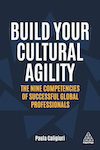
Build Your Cultural Agility: The Nine Competencies of Successful Global Professionals by Paula Caligiuri

Cover of Build Your Cultural Agility

Build Your Cultural Agility

Caligiuri combines theory and practical advice for building cultural flexibility, an essential skill for global managers in any industry who want to be successful in international careers or managing global teams. One reviewer described this book as “a treasure chest of ideas.”

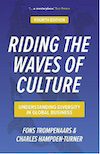
Riding the Waves of Culture: Understanding Diversity in Global Business, Fourth Edition by Charles Hampden-Turner and Fons Trompenaars

Cover of Riding the Waves of Culture

Riding the Waves of Culture

This 2020 update of an international classic provides an in-depth look at cultural differences, change management, and more. The authors are prominent thinkers on globalization.

Research Confirms Google AIO Keyword Trends via @sejournal, @martinibuster

New research by enterprise search marketing company BrightEdge reveals dramatic changes to sites surfaced through Google’s AI Overviews search feature and though it maintains search market share, the data shows that AI search engine Perplexity is gaining ground at a remarkable pace.

Rapid & Dramatic Changes In AIO Triggers

The words that trigger AI Overviews are changing at an incredibly rapid pace. Some keyword trends in June may already changed in July.

AI Overviews were triggered 50% more times for keywords with the word “best” in them. But Google may have reversed that behavior because those phrases, when applied to products, don’t appear to be triggering AIOs in July.

Other AIO triggers for June 2024:

  • “What Is” keywords increased by 20% more times
  • “How to” queries increased by 15%
  • Queries with the phrase “”symptoms of” increased by about 12%
  • Queries with the word “treatment” increased by 10%

A spokesperson from BrightEdge responded to my questions about ecommerce search queries:

“AI’s prevalence in ecommerce is indeed increasing, with a nearly 20% rise in ecommerce keywords showing AI overviews since the beginning of July, and a dramatic 62.6% increase compared to the last week of June. Alongside this growth, we’re seeing a significant 66.67% uptick in product searches that contain both pros and cons from the AI overview. This dual trend indicates not only more prevalent use of AI in ecommerce search results but also more comprehensive and useful information being provided to consumers through features like the pros/cons modules.”

Google Search And AI Trends

BrightEdge used its proprietary BrightEdge Generative Parser™ (BGP) tool to identify key trends in search that may influence digital marketing for the rest of 2024. BGP is a tool that collects massive amounts of search trend data and turns it into actionable insights.

Their research estimates that each percentage point of search market share represents $1.2 billion, which means that gains as small as single digits are still incredibly valuable.

Jim Yu, founder and executive chairman of BrightEdge noted:

“There is no doubt that Google’s dominance remains strong, and what it does in AI matters to every business and marketer across the planet.

At the same time, new players are laying new foundations as we enter an AI-led multi-search universe. AI is in a constant state of progress, so the most important thing marketers can do now is leverage the precision of insights to monitor, prepare for changes, and adapt accordingly.

Google continues to be the most dominant source of search traffic, driving approximately 92% organic search referrals. A remarkable data point from the research is that AI competitors in all forms have not yet made a significant impact as a source of traffic, completely deflating speculation that AI competitors will cut into Google’s search traffic.

Massive Decrease In Reddit & Quora Referrals

Back in May 2024 Google Of interest to search marketers is that Google has followed through in reducing the amount of user generated content (UGC) surfaced through its AI Overviews search feature. UGC is responsible for many of the outrageously bad responses that generated negative press. BrightEdge’s research shows that referrals to Reddit and Quora from AI Overviews declined to “near zero” in the month of June.

Citations to Quora from AI Overviews are reported to have decreased by 99.69%. Reddit fared marginally etter in June with an 85.71% decrease

BrightEdge’s report noted:

“Google is prioritizing established, expert content over user discussions and forums.”

Bing, Perplexity And Chatbot Impact

Market share for Bing continues to increase but only by fractions of a percentage point, growing from 4.2% to 4.5%. But as they say, it’s better to be moving forward than standing still.

Perplexity on the other hand is growing at a monthly rate of 31%. Percentages however can be misleading because 31% of a relatively small number is still a relatively small number. Most publishers aren’t talking about all the traffic they’re getting from Perplexity so they still have a way to go. Nevertheless, a monthly growth rate of 31% is movement in the right direction.

Traffic from Chatbots aren’t really a thing, so this comparison should be put into that perspective. Sending referral traffic to websites isn’t really what chatbots like Claude and ChatGPT are about (at this point in time). The data shows that both Claude and ChatGPT are not sending much traffic.

OpenAI however is hiding referrals from the websites that it’s sending traffic to which makes it difficult to track it. Therefore a full understanding of the impact of LLM traffic, because ChatGPT uses a rel=noreferrer HTML attribute which hides all traffic originating from ChatGPT to websites. The use of the rel=noreferrer link attribute is not unusual though because it’s an industry standard for privacy and security.

BrightEdge’s analysis looks at this from a long term perspective and anticipates that referral traffic from LLMs will become more prevalent and at some point will become a significant consideration for marketers.

This is the conclusion reached by BrightEdge:

“The overall number of referrals from LLMs is small and expected to have little industry impact at this time. However, if this incremental growth continues, BrightEdge predicts it will influence where people search online and how brands approach optimizing for different engines.”

Before the iPhone existed, many scoffed at the idea of the Internet on mobile devices. So BrightEdge’s conclusions about what to expect from LLMs are not unreasonable.

AIO trends have already changed in July, pointing to the importance of having fresh data for adapting to fast changing AIO keyword trends.  BrightEdge delivers real-time data updated on a daily basis so that marketers can make better informed decisions.

Understand AI Overview Trends:

Ten Observations On AI Overviews For June 2024

Featured Image by Shutterstock/Krakenimages.com

WordPress 6.6: The 6 highlights in this release!

WordPress 6.6 is here and it comes with a suite of new features and improvements. Features that will give you more control over the look of your website, peace of mind when auto-updating plugins, and introduce you to some improved workflows. Here’s a sneak peek into the key highlights of this release.

Page previews in the site editor

The site editor now comes with a visual overview of your pages, also allowing you to preview a page before clicking edit. It creates a very natural workflow and makes working from the site editor easier. Make sure to check it out. You can find the editor under Appearance in the side menu of your WordPress dashboard.

Screenshot of the page overview in the site editor

More control over design

As they’ve done for the past couple of releases, the WordPress team has once again added loads of features that allow WordPress users more freedom in web design. WordPress 6.6 allows for more color palettes and font sets within one theme, making it easier for users to customize their website without compromising overall design and consistency. This feature, although aimed at theme developers, benefits everyone using a block theme.

But this release also comes with the ability to easily set negative margins for blocks, add background images to be used site-wide, section-specific styling, box shadows for our featured images and more.

Override your synced patterns

Are you familiar with synced patterns in WordPress? A synced pattern can be described as a few blocks, grouped together, to be used in different places on a website. To give an example, the image below shows a standard synced pattern that comes with a WordPress theme and it consists of a heading, paragraph, button and image.

WordPress 6.6: example of synced pattern
An example of a synced pattern in WordPress

You can add this pattern to different pages for consistency (and it can save you loads of time). The new feature in WordPress 6.6 now adds the ability to do an ‘override’ of this pattern that allows you to tweak the pattern where needed. You can edit headings, paragraphs, buttons and images blocks to customize the pattern per instance while continuing to use the overall pattern for consistency. Simply go to your synced pattern, click edit, select the block you want to change and go to Advanced in settings to find the override feature.

WordPress 6.6: override function in synced patterns
The override feature while editing a synced pattern

Keep your plugins up to date

A really cool feature in WordPress 6.6 is the optional rollback for your automatically updated plugins. The idea is that you can set your plugins to auto-update without having to worry about any unexpected negative impact. This new feature makes it possible to restore your plugin to the previous version if anything goes wrong. This allows you to keep your plugins updated and improve your security. While also making sure your website keeps working and behaving as it should.

What’s new in the block editor?

This latest release comes with a new publish flow in the sidebar of your post or page. It shows the featured image at the top and shows all the other page settings in a list. You can simply click the setting you want to edit and it will give you a pop-up as shown in the screenshot below. It might take you a few seconds (or clicks) to figure out where everything has moved. But it looks very clean and makes everything feel very unified.

WordPress 6.6: new publish flow
Publish flow in WordPress 6.6

Another small and nifty feature I’d like to highlight is the shortcut that you can now use to group blocks together. Select the blocks of your choice and use Ctrl + G on Windows or ⌘ + G on MacOS.

Performance and accessibility

What’s a WordPress release without any performance and accessibility enhancements? Of course, WordPress 6.6 comes with a bunch of them. Performance updates such as a 40% reduction in template loading time in the editor, removing unnecessary WP_Theme_JSON calls and getting rid of lazy loading post embeds. The accessibility improvements have been mainly focused on interaction with blocks and patterns and the data views component that powers the new site editing. Read all about this and more in the WordPress 6.6 release notes.

Read more: WordPress 6.5: The features you want to know about »

Coming up next!

SEO For Higher Education: Best Practices For Academic Institutions via @sejournal, @AdamHeitzman

The competition for student enrollment has never been stronger.

Many colleges struggle to stand out online and attract new students. Without a strong SEO strategy, your school remains hidden, and potential students won’t find you.

This includes details about admission processes, available programs, extracurricular activities, and other tiny details that attract the typical student.

A solid SEO strategy helps you appear in search results, increases brand recognition, boosts credibility among parents and students, and ultimately increases enrollment.

Here’s how you can implement it:

Critical Components Of An Effective SEO Strategy

Understanding Your Target Audience

Identify audience segments, such as prospective students, current students, faculty, staff, alumni, and visitors. Rank them by importance based on the institution’s goals. For example, prospective students could be the highest priority.

Understanding these audiences, their needs, and search habits will help you create content and SEO strategies to reach them effectively.

However, with over 17 million high schoolers and 16 million undergraduates in the U.S. (data from 2021), who are your target audiences?

Here’s how to know them:

  • Use surveys among current students to understand their motivations and concerns. For example, use a simple poll on the school website asking, “What are the top three factors you consider when choosing a university?” or “Why did you choose us?”

Their answers can give insights into why your institution was a top choice, and you can include these details while writing landing pages, program pages, or student experience pages.

This makes it easy to lead every page with a promise that matters to your target audience.

  • Analyze website analytics to determine your traffic sources and most popular pages. Traffic sources reveal the demographics engaging with your website and how they are led to it. Analyzing the most popular pages also shows the content that resonates with your target audience.

Merging this analysis helps you create content that targets your audience and meets their search intent.

There are four types of search intent (commercial, transactional, informational, and navigational). For colleges and universities, the most common intents tend to be informational, commercial, and transactional.

Analyzing search intent helps you target keywords that reflect what searchers are looking for. Here’s what that looks like:

  • Informational keywords, such as “best universities in the US,” “top engineering schools,” or “best liberal arts colleges” are common queries for general information. These keywords indicate that searchers are looking for options.
  • Commercial keywords, e.g., “online MBA programs,” “online master’s in data science,” and “nursing programs with scholarships,” are common queries for specific programs. These indicate that searchers want to know about schools offering these programs (and also learn about what sets each institution apart). This is where you create dedicated landing pages for each program explaining why your school should be at the top of students’ minds in their decision-making phase.
  • Transactional keywords, e.g., “application deadlines,” “tuition fees,” or “campus dates,” show intent to do something. These users are closer to making a decision, and they want information on their exact query. These keywords are usually preceded by a branded search (e.g., “UCLA application deadline”).

Creating content that engages your target audience is essential. When your content matches their search intent, it sends positive signals to Google.

This can improve your rankings and increase traffic. Keyword research plays a key role in this process, ensuring your content meets the needs and search habits of your audience.

Read more: How People Search: Understanding User Intent

Keyword Research And Analysis

Keyword research means finding the words students use when they search online. These terms can help your website show up in searches.

Tips to get started:

  • Brainstorm seed keywords: Make a list of words related to your school and programs. For example: “computer science,” “business administration,” “online MBA in marketing,” “online courses,” “coastal university,” and “urban campus.”
  • Use advanced keyword tools: Tools like Semrush and Ahrefs offer detailed insights into search volume, competition, keyword difficulty, and trends. Use these tools to discover keyword opportunities that your competitors might be missing.
  • Identify long-tail keywords: These longer phrases, like “scholarships for international students studying cyber security,” have lower search volumes but higher conversion rates. They attract users who are further along in their decision-making process.
  • Analyze competitor keywords: Use tools to spy on competitors’ keywords and find gaps in their content. Target these gaps to improve your visibility and attract more traffic.
  • Consider seasonal trends: Use tools to analyze search trends throughout the year. Optimize your landing pages for terms like “summer courses” or “fall application deadlines” during relevant periods.

Read more: Keyword Research: An In-Depth Beginner’s Guide

On-Page Optimization

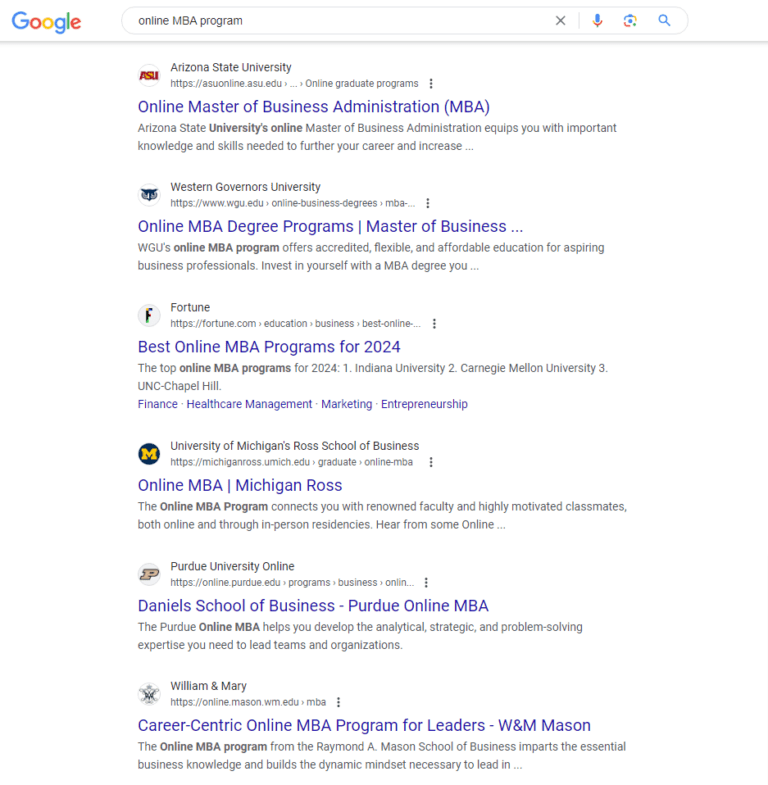
On-page optimization is where you include relevant keywords in your content to improve visibility on search engine results pages (SERPs). Use your primary keyword in:

Google search results for [online MBA program]Screenshot from search for [online MBA program], June 2024
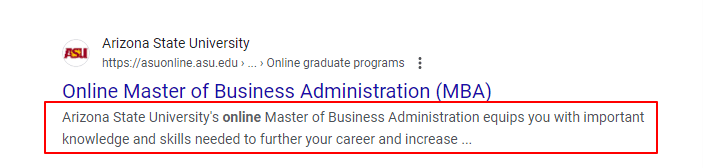
  • Meta Description: It’s a summary of your content located under your title page in search results. You can use it to entice users to click your link by incorporating relevant keywords that provide context to the webpage. See ASU’s copy here:
Arizone state university on SERPScreenshot from search for [online MBA program], June 2024
  • Headers: Headers structure your content and make it easier to read. Use keywords in your main header (H1) and subheaders (H2, H3, etc.) to signal to search engines what your page is about.
  • Body of your content: Incorporate keywords naturally throughout the page. You can also use variations of your keyword – long-term or semantic topics – to avoid repetition and keyword stuffing.

Read more: 12 Essential On-Page SEO Factors You Need To Know

Technical SEO Considerations

The goal of every search engine is to provide relevant content to searchers, and good technical SEO makes your website easier to find and use. Focus on these areas:

  • Page Speed: Your website should load in one to three seconds. A slow site can frustrate users and impact your rankings.
    • Choose reliable hosting: Ensure your hosting can handle your website’s traffic.
    • Compress images and files: Use tools like TinyPNG or ShortPixel to reduce file sizes without losing quality.
    • Enable browser caching: This helps returning visitors load your site faster.
  • Mobile Optimization: Use a responsive design that adjusts to different screen sizes. Test your site on various devices to ensure it works well everywhere.
  • Schema Markup: Add structured data to your website’s HTML. Schema markup, or structured data, allows search engines to understand your institution and its offerings better. It’s a form of code you can add to your website’s HTML that uses a specific vocabulary to label and describe different elements of your content.

Schema Markup is important because it enables search engines to display rich snippets in search results.

These enhanced listings can include star ratings, images, event dates, and other relevant details to make your institution’s results more visually appealing and informative. Here’s an example from Rutgers Business School:

Google search results for [rutgers university]Screenshot from search for [rutgers university], June 2024

You can see details about addresses, tuition fees, campus type, and other helpful links without directly engaging the website.

Research shows that structured data increases click-through rates by presenting users with context-rich information in search results. This captures user attention and builds trust even before they visit the site, which in turn increases organic traffic.

Read more: The Complete Technical SEO Audit Workbook

Implementing Local SEO For Campuses

If your school has multiple campuses, local SEO is important.

  • Create location pages: Make a separate page for each campus with details like address, contact information, and unique programs.
  • Optimize for local keywords: Use keywords that include your city or neighborhood, like “best colleges in downtown Chicago.”
  • Claim your Google Business Profile: Make sure each campus has a Google Business Profile listing with up-to-date information.

Read more: How To Create A Winning Local SEO Content Strategy

Leveraging Video Content

Video content can engage students better than text alone.

  • Create informative videos: Make videos about campus tours, student testimonials, and program highlights.
  • Optimize video titles and descriptions: Use keywords in your video titles and descriptions to help them show up in search results.
  • Embed videos on your website: This can keep visitors on your site longer and improve engagement.

Read more: 10 YouTube Marketing Strategies & Tips (With Examples)

Optimizing Site Structure And Navigation

A well-structured website helps both users and search engines.

  • Simple navigation: Keep your menu simple and easy to use.
  • Clear hierarchy: Organize your pages logically, with main categories and subcategories.
  • Internal linking: Link-related pages to each other to help users find more information and search engines understand your site better.

Read more: Why Google Recommends Hierarchical Site Structure For SEO

Conclusion

Improving your school’s SEO is a long-term investment.

However, you can start today by creating content that targets students to amplify your brand and increase credibility. This will help increase visibility, attract more students, and build your school’s online reputation.

Whether you’re a new or established institution, good SEO practices can help you reach your goals.

More resources:


Featured Image: Prostock-studio/Shutterstock