The Download: autocorrect’s surprising origins, and how to pre-bunk electoral misinformation

This is today’s edition of The Download, our weekday newsletter that provides a daily dose of what’s going on in the world of technology.

How the quest to type Chinese on a QWERTY keyboard created autocomplete

—This is an excerpt from The Chinese Computer: A Global History of the Information Age by Thomas S. Mullaney, published on May 28 by The MIT Press. It has been lightly edited.

When a young Chinese man sat down at his QWERTY keyboard in 2013 and rattled off an enigmatic string of letters and numbers, his forty-four keystrokes marked the first steps in a process known as “input” or shuru.

Shuru is the act of getting Chinese characters to appear on a computer monitor or other digital device using a QWERTY keyboard or trackpad.

The young man, Huang Zhenyu, was one of around 60 contestants in the 2013 National Chinese Characters Typing Competition. His keyboard did not permit him to enter these characters directly, however, and so he entered the quasi-gibberish string of letters and numbers instead: ymiw2klt4pwyy1wdy6…

But Zhenyu’s prizewinning performance wasn’t solely noteworthy for his impressive typing speed—one of the fastest ever recorded. It was also premised on the same kind of “additional steps” as the first Chinese computer in history that led to the discovery of autocompletion. Read the rest of the excerpt here.

If you’re interested in tech in China, why not check out some of our China reporter Zeyi Yang’s recent reporting (and subscribe to his weekly newsletter China Report!)

+ GPT-4o’s Chinese token-training data is polluted by spam and porn websites. The problem, which is likely due to inadequate data cleaning, could lead to hallucinations, poor performance, and misuse. Read the full story.

+ Why Hong Kong is targeting Western Big Tech companies in its ban of a popular protest song.

+ Deepfakes of your dead loved ones are a booming Chinese business. People are seeking help from AI-generated avatars to process their grief after a family member passes away. Read the full story.

The must-reads

I’ve combed the internet to find you today’s most fun/important/scary/fascinating stories about technology.

1 Election officials want to pre-bunk harmful online campaigns
It’s a bid to prevent political hoaxes from ever getting off the ground. (WP $)
+ Fake news verification tools are failing in India. (Rest of World)
+ Three technology trends shaping 2024’s elections. (MIT Technology Review)

2 OpenAI has started training the successor to GPT-4
Just weeks after it revealed an updated version, GPT-4o. (NYT $)
+ OpenAI’s new GPT-4o lets people interact using voice or video in the same model. (MIT Technology Review)

3 China is bolstering its national semiconductor fund
To the tune of $48 billion. (WSJ $)
+ It’s the third round of the country’s native chip funding program. (FT $)
+ What’s next in chips. (MIT Technology Review)

4 Nuclear plants are extremely expensive to build
The US needs to learn how to cut costs without cutting corners. (The Atlantic $)
+ How to reopen a nuclear power plant. (MIT Technology Review)

5 Laser systems could be the best line of defense against military drones
The Pentagon is investing in BlueHalo’s AI-powered laser technology. (Insider $)
+ The US military is also pumping money into Palmer Luckey’s Anduril. (Wired $)
+ Inside the messy ethics of making war with machines. (MIT Technology Review)

6 Klarna’s marketing campaigns are the product of generative AI
The fintech firm claims the technology will save it $10 million a year. (Reuters)

7 The US has an EV charging problem
Would-be car buyers are still nervous about investing in EVs. (Wired $)
+ Micro-EVs could offer one solution. (Ars Technica)
+ Toyota has unveiled new engines compatible with alternative fuels. (Reuters)

8 Good luck betting on anything that’s not sports in the US
The outcome of a major election, for example. (Vox)
+ How mobile money supercharged Kenya’s sports betting addiction. (MIT Technology Review)

9 Perfectionist parents are Facetuning their children
It goes without saying: don’t do this. (NY Mag $)

10 Why a movie version of The Sims never got off the ground
The beloved video game would make for a seriously weird cinema spectacle. (The Guardian)

Quote of the day

“Once materialism starts spreading, it can have a bad influence on teenagers.”

—Chinese state media Beijing News explains why China has started cracking down on luxurious influencers known for their ostentatious displays of wealth, the Financial Times reports.

The big story

Recapturing early internet whimsy with HTML

December 2023

Websites weren’t always slick digital experiences. 

There was a time when surfing the web involved opening tabs that played music against your will and sifting through walls of text on a colored background. In the 2000s, before Squarespace and social media, websites were manifestations of individuality—built from scratch using HTML, by users who had some knowledge of code. 

Scattered across the web are communities of programmers working to revive this seemingly outdated approach. And the movement is anything but a superficial appeal to retro aesthetics—it’s about celebrating the human touch in digital experiences. Read the full story

—Tiffany Ng

We can still have nice things

A place for comfort, fun and distraction to brighten up your day. (Got any ideas? Drop me a line or tweet ’em at me.)

+ Enjoy this potted history of why we say okay, and where it came from.
+ There is something very funny about Elton John calling The Lion King’s Timon and Pumbaa “the rat and the pig.”
+ The best of British press photography is always worth a peruse.
+ I had no idea that Sisqo’s Thong Song used an Eleanor Rigby sample.

Who’s Responsible for Web Accessibility?

You might assume ecommerce platforms such as Shopify provide accessible websites. But that’s only partly correct.

Many moving parts impact web accessibility. Examples are the core platform, themes, add-ons, plugins, custom code, and even content creators and editors. A website meets accessibility compliance guidelines by addressing all of those parts.

Accessibility Components

Core platform. The default accessibility of most ecommerce platforms is fairly good. No platform is without some accessibility weaknesses, but most are working to mitigate them.

Sometimes mitigation involves offering alternatives. For instance, some Shopify checkout pages have accessibility barriers, but merchants can simply choose an another version.

Themes. Ecommerce merchants often deploy a theme for styling (colors, fonts) and functionalities beyond the core. That process can introduce accessibility hurdles and thus requires diligence on how the themes are set up, developed, or changed.

Common hurdles involve not meeting minimum guidelines for color contrast, font sizes, and distance between clickable components (especially on mobile). Some themes add forms —  newsletter sign-up, contact us — with missing labels.

Add-ons and plugins. Almost every ecommerce site includes customizations to the core platform through add-ons, plugins, or custom code. Those, too, can cause accessibility obstacles.

Automated checkers such as Web Accessibility Evaluation Tools can help, but they’re not failsafe, especially for customizations. For instance, an add-on or plugin for currency conversions may lack sufficient color contrast that’s detected only by manually clicking and viewing. Keyboard navigation is another common barrier requiring human tests.

Creators and editors. The most common website accessibility barriers are improper image alt text and HTML headings — both originating from creators and editors.

Alt text can be missing, redundant, or simply unhelpful. Alt text for product images requires special attention, including descriptions of visible features not part of the on-page text.

HTML headings need proper nesting. A page has one and only one H1. An H3 appears under an H2 or another H3. An H4 is only below an H3 or another H4. And so on. A heading’s font size doesn’t matter, but the order is essential for communicating the structure to visually impaired users and to Google.

(Yes, accessibility components — image alt texts and HTML headings — can improve search engine rankings!)

Training the content team on proper image alt text, HTML headings, and more is a good start toward better accessibility.

Who’s Responsible?

Site owners are ultimately responsible for accessibility, not the core platform, customizations, developers, or employees. Hence ensure all parties know you require work to meet WCAG 2.2 AA guidelines. Get that in writing. Then test it.

It’s always more cost-effective to work on accessibility proactively and continually, not forced by a lawsuit into instant sitewide remediation. But the bigger issue is revenue. A site with barriers for shoppers with disabilities is losing sales.

12 Tools for Generating Hashtags

Hashtags attach to social media content to enhance discoverability and promote engagement. Hashtag generators can help identify the best options for each post or topic, manage campaigns, and measure results.

Here is a list of hashtag generators to grow your reach on social media. The tools are primarily intended for Instagram but apply to TikTok, Facebook, Pinterest, and more. Nearly all of these generators are free, though most have premium plans or are part of larger social media management platforms.

Tools to Generate Hashtags

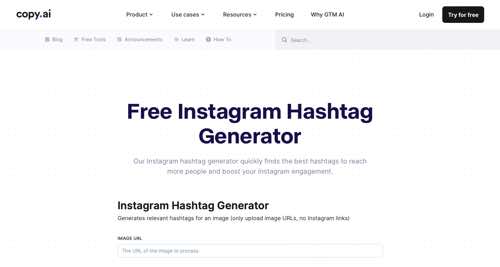
CopyAI offers a hashtag generator and a suite of free generative copywriting tools, including generators for captions, marketing emails, product descriptions, outlines, and content ideas. The hashtag generator analyzes a photo and captions to suggest relevant options for your target audience, considering the niche, keywords, and competitors. Generate up to 50 hashtags at a time. Pricing: Free. Premium plans start at $36 per month.

Web page of Copy.ai's Instagram Hashtag Generator

Copy.ai’s Instagram Hashtag Generator

Flick is a social media marketing platform with tools for copywriting, scheduling, and analytics. Plan posts on Instagram (and Facebook, TikTok, and LinkedIn) with a drag-and-drop calendar. Then preview your feed and access the best hashtags. Use the hashtag search (in 40 languages) to get 40 suggestions for every query. Filter using key hashtag metrics. Pricing: Free trial for seven days. Paid plans start at £11 per month (roughly $14).

All Hashtag contains multiple campaign tools. Use the hashtag generator to obtain top, random, and live options. See which hashtags are the most popular. Use the tools to create, count, and analyze hashtags for your marketing strategy. Pricing: Free.

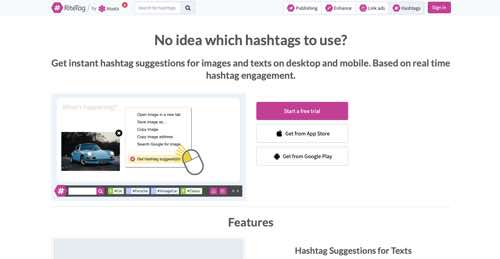
RiteTag generates hashtags instantly from text and photos. Get hashtags for recent posts from any Instagram account or, with the Toolkit app, hashtags for text and images to use anywhere. Research and save your hashtags as updatable sets. Integrates with all Instagram desktop tools, including the Facebook Creator Studio. Pricing: Plans start at $49 per year.

Home page of RiteTag

RiteTag

Tailwind is a marketing platform for Instagram and Pinterest with a suite of tools for post creation, scheduling, and analysis. With the hashtag generator, identify hashtags for your caption with color-coded tag options, calibrating your hashtag choices for optimal results. Tailwind offers browser extensions and mobile apps. Pricing: Free. Premium plans start at $14.99 per month.

Influencer Marketing Hub provides free hashtag generators for Instagram posts or TikTok videos as well as other free tools to manage social media. Paste a post link into the Instagram hashtag generator and copy the relevant hashtags. Pricing: Free.

Display Purposes is a marketing tool that scans your Instagram profile to suggest content. Identify and analyze the most effective hashtags with competition score and potential reach metrics. Ensure your hashtags are safe with the banned hashtag checker. Monitor hashtag performance over time. Use Collections to save and curate hashtag research results and access your lists whenever needed. Pricing: Freemium for seven days. Plans start at $6 per month.

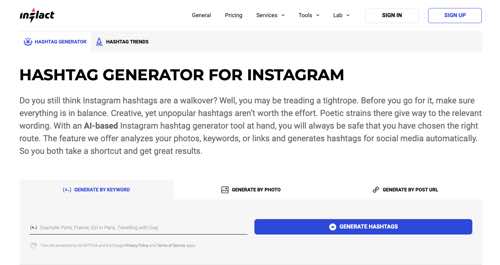
Inflact offers a free AI-based Instagram hashtag generator that analyzes photos, keywords, or links and then generates hashtags. Enter keywords, upload a photo, or paste the post link. The finder tool sorts hashtags by difficulty and popularity. Save results as templates and copy them directly into posts. Pricing: Free. Premium plans start at $54 per month.

Web page of Inflact's Hashtag Generator for Instagram

Inflact’s Hashtag Generator for Instagram

Sistrix has a hashtag generator and a suite of free generative content and performance testing tools, including page speed and SEO analysis. Per Sistrix, the hashtag tool is based on 15 billion combinations, contains data on more than 7.7 million options, and is updated regularly. Run up to 25 queries a day before having to register. Pricing: Free.

TagsFinder is a free hashtag tool. Enter keywords and generate top and related hashtags as well as combinations. Find up to 30 hashtags per keyword selection. Get the most-used local hashtags in your city or region. Pricing: Free.

Toolzu has a hashtag generator for Instagram, TikTok, and other social channels with filters for categories, trending, and high-convertible, showing the difficulty and volume of related content. Pricing: Freemium for seven days. Plans start at $9 per month.

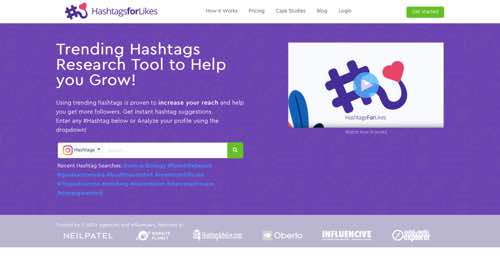
HashtagsForLikes has an easy-to-use hashtag generator. To start, enter a hashtag or analyze your profile. The premium service provides access to the top trending hashtags, live analytics, scoring, management features, performance reports, and more. With its curate feature, create test groups and save hashtag sets. Pricing: Free. Premium plans start at $59 per month.

Home page of HashtagsForLikes

HashtagsForLikes

Google Data Leak Clarification via @sejournal, @martinibuster

Over the United States holidays some posts were shared about an alleged leak of Google ranking-related data. The first posts about the leaks focused on “confirming” beliefs that were long-held by Rand Fishkin but not much attention was focused on the context of the information and what it really means.

Context Matters: Document AI Warehouse

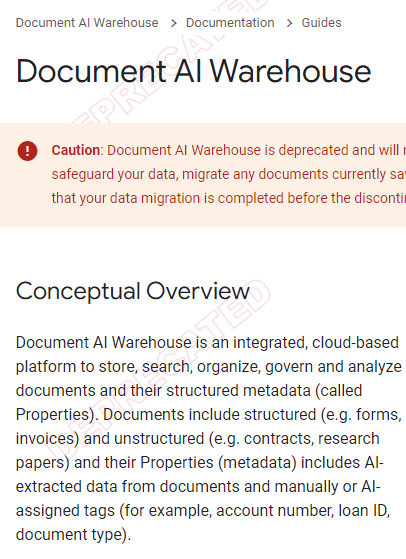
The leaked document shares relation to a public Google Cloud platform called Document AI Warehouse which is used for analyzing, organizing, searching, and storing data. This public documentation is titled Document AI Warehouse overview. A post on Facebook shares that the “leaked” data is the “internal version” of the publicly visible Document AI Warehouse documentation. That’s the context of this data.

Screenshot: Document AI Warehouse

Screenshot

@DavidGQuaid tweeted:

“I think its clear its an external facing API for building a document warehouse as the name suggests”

That seems to throw cold water on the idea that the “leaked” data represents internal Google Search information.

As far we know at this time, the “leaked data” shares a similarity to what’s in the public Document AI Warehouse page.

Leak Of Internal Search Data?

The original post on SparkToro does not say that the data originates from Google Search. It says that the person who sent the data to Rand Fishkin is the one who made that claim.

One of the things I admire about Rand Fishkin is that he is meticulously precise in his writing, especially when it comes to caveats. Rand precisely notes that it’s the person who provided the data who makes the claim that the data originates from Google Search. There is no proof, only a claim.

He writes:

“I received an email from a person claiming to have access to a massive leak of API documentation from inside Google’s Search division.”

Fishkin himself does not affirm that the data was confirmed by ex-Googlers to have originated from Google Search. He writes that the person who emailed the data made that claim.

“The email further claimed that these leaked documents were confirmed as authentic by ex-Google employees, and that those ex-employees and others had shared additional, private information about Google’s search operations.”

Fishkin writes about a subsequent video meeting where the the leaker revealed that his contact with ex-Googlers was in the context of meeting them at a search industry event. Again, we’ll have to take the leakers word for it about the ex-Googlers and that what they said was after carefully reviewing the data and not an informal comment.

Fishkin writes that he contacted three ex-Googlers about it. What’s notable is that those ex-Googlers did not explicitly confirm that the data is internal to Google Search. They only confirmed that the data looks like it resembles internal Google information, not that it originated from Google Search.

Fishkin writes what the ex-Googlers told him:

  • “I didn’t have access to this code when I worked there. But this certainly looks legit.”
  • “It has all the hallmarks of an internal Google API.”
  • “It’s a Java-based API. And someone spent a lot of time adhering to Google’s own internal standards for documentation and naming.”
  • “I’d need more time to be sure, but this matches internal documentation I’m familiar with.”
  • “Nothing I saw in a brief review suggests this is anything but legit.”

Saying something originates from Google Search and saying that it originates from Google are two different things.

Keep An Open Mind

It’s important to keep an open mind about the data because there is a lot about it that is unconfirmed. For example, it is not known if this is an internal Search Team document. Because of that it is probably not a good idea to take anything from this data as actionable SEO advice.

Also, it’s not advisable to analyze the data to specifically confirm long-held beliefs. That’s how one becomes ensnared in Confirmation Bias.

A definition of Confirmation Bias:

“Confirmation bias is the tendency to search for, interpret, favor, and recall information in a way that confirms or supports one’s prior beliefs or values.”

Confirmation Bias will lead to a person deny things that are empirically true. For example, there is the decades-old idea that Google automatically keeps a new site from ranking, a theory called the Sandbox. People every day report that their new sites and new pages nearly immediately rank in the top ten of Google search.

But if you are a hardened believer in the Sandbox then actual observable experience like that will be waved away, no matter how many people observe the opposite experience.

Brenda Malone, Freelance Senior SEO Technical Strategist and Web Developer (LinkedIn profile), messaged me about claims about the Sandbox:

“I personally know, from actual experience, that the Sandbox theory is wrong. I just indexed in two days a personal blog with two posts. There is no way a little two post site should have been indexed according to the the Sandbox theory.”

The takeaway here is that if the documentation turns out to originate from Google Search, the incorrect way to analyze the data is to go hunting for confirmation of long-held beliefs.

What Is The Google Data Leak About?

There are five things to consider about the leaked data:

  1. The context of the leaked information is unknown. Is it Google Search related? Is it for other purposes?
  2. The purpose of the data. Was the information used for actual search results? Or was it used for data management or manipulation internally?
  3. Ex-Googlers did not confirm that the data is specific to Google Search. They only confirmed that it appears to come from Google.
  4. Keep an open mind. If you go hunting for vindication of long-held beliefs, guess what? You will find them, everywhere. This is called confirmation bias.
  5. Evidence suggests that data is related to an external-facing API for building a document warehouse.

What Others Say About “Leaked” Documents

Ryan Jones, someone who not only has deep SEO experience but has a formidable understanding of computer science shared some reasonable observations about the so-called data leak.

Ryan tweeted:

“We don’t know if this is for production or for testing. My guess is it’s mostly for testing potential changes.

We don’t know what’s used for web or for other verticals. Some things might only be used for a Google home or news etc.

We don’t know what’s an input to a ML algo and what’s used to train against. My guess is clicks aren’t a direct input but used to train a model how to predict clickability. (Outside of trending boosts)

I’m also guessing that some of these fields only apply to training data sets and not all sites.

Am I saying Google didn’t lie? Not at all. But let’s examine this leak objectionably and not with any preconceived bias.”

@DavidGQuaid tweeted:

“We also don’t know if this is for Google search or Google cloud document retrieval

APIs seem pick & choose – that’s not how I expect the algorithm to be run – what if an engineer wants to skip all those quality checks – this looks like I want to build a content warehouse app for my enterprise knowledge base”

Is The “Leaked” Data Related To Google Search?

At this point in time there is no hard evidence that this “leaked” data is actually from Google Search. There is an overwhelming amount of ambiguity about what the purpose of the data is. Notable is that there are hints that this data is just “an external facing API for building a document warehouse as the name suggests” and not related in any way to how websites are ranked in Google Search.

The conclusion that this data did not originate from Google Search is not definitive at this time but it’s the direction that the wind of evidence appears to be blowing.

Featured Image by Shutterstock/Jaaak

Google Search Leak: Conflicting Signals, Unanswered Questions via @sejournal, @MattGSouthern

An apparent leak of Google Search API documentation has sparked intense debate within the SEO community, with some claiming it proves Google’s dishonesty and others urging caution in interpreting the information.

As the industry grapples with the allegations, a balanced examination of Google’s statements and the perspectives of SEO experts is crucial to understanding the whole picture.

Leaked Documents Vs. Google’s Public Statements

Over the years, Google has consistently maintained that specific ranking signals, such as click data and user engagement metrics, aren’t used directly in its search algorithms.

In public statements and interviews, Google representatives have emphasized the importance of relevance, quality, and user experience while denying the use of specific metrics like click-through rates or bounce rates as ranking-related factors.

However, the leaked API documentation appears to contradict these statements.

It contains references to features like “goodClicks,” “badClicks,” “lastLongestClicks,” impressions, and unicorn clicks, tied to systems called Navboost and Glue, which Google VP Pandu Nayak confirmed in DOJ testimony are parts of Google’s ranking systems.

The documentation also alleges that Google calculates several metrics using Chrome browser data on individual pages and entire domains, suggesting the full clickstream of Chrome users is being leveraged to influence search rankings.

This contradicts past Google statements that Chrome data isn’t used for organic searches.

The Leak’s Origins & Authenticity

Erfan Azimi, CEO of digital marketing agency EA Eagle Digital, alleges he obtained the documents and shared them with Rand Fishkin and Mike King.

Azimi claims to have spoken with ex-Google Search employees who confirmed the authenticity of the information but declined to go on record due to the situation’s sensitivity.

While the leak’s origins remain somewhat ambiguous, several ex-Googlers who reviewed the documents have stated they appear legitimate.

Fishkin states:

“A critical next step in the process was verifying the authenticity of the API Content Warehouse documents. So, I reached out to some ex-Googler friends, shared the leaked docs, and asked for their thoughts.”

Three ex-Googlers responded, with one stating, “It has all the hallmarks of an internal Google API.”

However, without direct confirmation from Google, the authenticity of the leaked information is still debatable. Google has not yet publicly commented on the leak.

It’s important to note that, according to Fishkin’s article, none of the ex-Googlers confirmed that the leaked data was from Google Search. Only that it appears to have originated from within Google.

Industry Perspectives & Analysis

Many in the SEO community have long suspected that Google’s public statements don’t tell the whole story. The leaked API documentation has only fueled these suspicions.

Fishkin and King argue that if the information is accurate, it could have significant implications for SEO strategies and website search optimization.

Key takeaways from their analysis include:

  • Navboost and the use of clicks, CTR, long vs. Short clicks, and user data from Chrome appear to be among Google’s most powerful ranking signals.
  • Google employs safelists for sensitive topics like COVID-19, elections, and travel to control what sites appear.
  • Google uses Quality Rater feedback and ratings in its ranking systems, not just as a training set.
  • Click data influences how Google weights links for ranking purposes.
  • Classic ranking factors like PageRank and anchor text are losing influence compared to more user-centric signals.
  • Building a brand and generating search demand is more critical than ever for SEO success.

However, just because something is mentioned in API documentation doesn’t mean it’s being used to rank search results.

Other industry experts urge caution when interpreting the leaked documents.

They point out that Google may use the information for testing purposes or apply it only to specific search verticals rather than use it as active ranking signals.

There are also open questions about how much weight these signals carry compared to other ranking factors. The leak doesn’t provide the full context or algorithm details.

Unanswered Questions & Future Implications

As the SEO community continues to analyze the leaked documents, many questions still need to be answered.

Without official confirmation from Google, the authenticity and context of the information are still a matter of debate.

Key open questions include:

  • How much of this documented data is actively used to rank search results?
  • What is the relative weighting and importance of these signals compared to other ranking factors?
  • How have Google’s systems and use of this data evolved?
  • Will Google change its public messaging and be more transparent about using behavioral data?

As the debate surrounding the leak continues, it’s wise to approach the information with a balanced, objective mindset.

Unquestioningly accepting the leak as gospel truth or completely dismissing it are both shortsighted reactions. The reality likely lies somewhere in between.

Potential Implications For SEO Strategies and Website Optimization

It would be highly inadvisable to act on information shared from this supposed ‘leak’ without confirming whether it’s an actual Google search document.

Further, even if the content originates from search, the information is a year old and could have changed. Any insights derived from the leaked documentation should not be considered actionable now.

With that in mind, while the full implications remain unknown, here’s what we can glean from the leaked information.

1. Emphasis On User Engagement Metrics

If click data and user engagement metrics are direct ranking factors, as the leaked documents suggest, it could place greater emphasis on optimizing for these metrics.

This means crafting compelling titles and meta descriptions to increase click-through rates, ensuring fast page loads and intuitive navigation to reduce bounces, and strategically linking to keep users engaged on your site.

Driving traffic through other channels like social media and email can also help generate positive engagement signals.

However, it’s important to note that optimizing for user engagement shouldn’t come at the expense of creating reader-focused content. Gaming engagement metrics are unlikely to be a sustainable, long-term strategy.

Google has consistently emphasized the importance of quality and relevance in its public statements, and based on the leaked information, this will likely remain a key focus. Engagement optimization should support and enhance quality content, not replace it.

2. Potential Changes To Link-Building Strategies

The leaked documents contain information about how Google treats different types of links and their impact on search rankings.

This includes details about the use of anchor text, the classification of links into different quality tiers based on traffic to the linking page, and the potential for links to be ignored or demoted based on various spam factors.

If this information is accurate, it could influence how SEO professionals approach link building and the types of links they prioritize.

Links that drive real click-throughs may carry more weight than links on rarely visited pages.

The fundamentals of good link building still apply—create link-worthy content, build genuine relationships, and seek natural, editorially placed links that drive qualified referral traffic.

The leaked information doesn’t change this core approach but offers some additional nuance to be aware of.

3. Increased Focus On Brand Building and Driving Search Demand

The leaked documents suggest that Google uses brand-related signals and offline popularity as ranking factors. This could include metrics like brand mentions, searches for the brand name, and overall brand authority.

As a result, SEO strategies may emphasize building brand awareness and authority through both online and offline channels.

Tactics could include:

  • Securing brand mentions and links from authoritative media sources.
  • Investing in traditional PR, advertising, and sponsorships to increase brand awareness.
  • Encouraging branded searches through other marketing channels.
  • Optimizing for higher search volumes for your brand vs. unbranded keywords.
  • Building engaged social media communities around your brand.
  • Establishing thought leadership through original research, data, and industry contributions.

The idea is to make your brand synonymous with your niche and build an audience that seeks you out directly. The more people search for and engage with your brand, the stronger those brand signals may become in Google’s systems.

4. Adaptation To Vertical-Specific Ranking Factors

Some leaked information suggests that Google may use different ranking factors or algorithms for specific search verticals, such as news, local search, travel, or e-commerce.

If this is the case, SEO strategies may need to adapt to each vertical’s unique ranking signals and user intents.

For example, local search optimization may focus more heavily on factors like Google My Business listings, local reviews, and location-specific content.

Travel SEO could emphasize collecting reviews, optimizing images, and directly providing booking/pricing information on your site.

News SEO requires focusing on timely, newsworthy content and optimized article structure.

While the core principles of search optimization still apply, understanding your particular vertical’s nuances, based on the leaked information and real-world testing, can give you a competitive advantage.

The leaks suggest a vertical-specific approach to SEO could give you an advantage.

Conclusion

The Google API documentation leak has created a vigorous discussion about Google’s ranking systems.

As the SEO community continues to analyze and debate the leaked information, it’s important to remember a few key things:

  1. The information isn’t fully verified and lacks context. Drawing definitive conclusions at this stage is premature.
  2. Google’s ranking algorithms are complex and constantly evolving. Even if entirely accurate, this leak only represents a snapshot in time.
  3. The fundamentals of good SEO – creating high-quality, relevant, user-centric content and promoting it effectively – still apply regardless of the specific ranking factors at play.
  4. Real-world testing and results should always precede theorizing based on incomplete information.

What To Do Next

As an SEO professional, the best course of action is to stay informed about the leak.

Because details about the document remain unknown, it’s not a good idea to consider any takeaways actionable.

Most importantly, remember that chasing algorithms is a losing battle.

The only winning strategy in SEO is to make your website the best result for your message and audience. That’s Google’s endgame, and that’s where your focus should be, regardless of what any particular leaked document suggests.

Google To Shut Down Business Profile Chat Feature via @sejournal, @MattGSouthern

Google has announced that it will discontinue the chat feature in Google Business Profiles.

The wind-down process will start on July 15, and the functionality will complete on July 31.

The news was emailed to businesses, acknowledging the potential difficulty of the decision and emphasizing Google’s commitment to remaining a helpful partner in business management.

Google’s email to businesses reads:

“We are reaching out to share that we will be winding down Google’s chat feature in Google Business Profile on July 31, 2024. We acknowledge this may be difficult news – as we continually improve our tools, we occasionally have to make difficult decisions which may impact the businesses and partners we work with. It’s important to us that Google remains a helpful partner as you manage your business and we remain committed to this mission.

Google will stop creating new conversations after July 15, and chat functionality will fully end on July 31. Please note, customers will still be able to find and contact your business via Google Search and Maps – and learn more information about you from your website links, business description, photos, and anything else you share on your Business Profile.”

Impact On Businesses & Customers

Starting July 15, customers can no longer initiate new chat conversations with businesses through Google.

Customers currently engaged in chat conversations will receive notifications informing them of the upcoming phase-out of the chat feature.

However, customers will still be able to locate and contact businesses using Google Search and Maps and access information through website links, business descriptions, photos, and other elements shared on Business Profiles.

Google’s Decision To Discontinue Business Chat

Google says the decision to wind down the chat feature is part of ongoing efforts to streamline its offerings.

To assist businesses in the transition, Google has provided guidance on the next steps:

  1. Chat History Download: Businesses that wish to retain a record of their past Business Profile chats can download their chat history of customer conversations using Google Takeout.
  2. Alternative Chat Solutions: Google suggests that businesses invite customers to alternative chat solutions to continue conversations seamlessly.

Background & Context

Google Business Profile, formerly known as Google My Business, is a free tool for businesses to manage their online presence across Google, including Search and Maps. The chat feature enabled customers to communicate directly with companies through their Business Profiles.

While the chat functionality will no longer be available, Google remains committed to providing a platform for companies to manage their online presence and connect with customers.


Featured Image: Vladimka production/Shutterstock

Google, Bing & Amazon’s 2024 Shopping Ad Changes & How To Navigate Them

Inventory has always played a significant role in the way you sell on Amazon.

Running out of inventory can impact your organic ranking and can impact your advertising strategy.

Besides the potential loss of sales, poor inventory control also impacts the amount of inventory Amazon will allow you to send into the Fulfillment by Amazon (FBA) program.

Keep reading to learn more about:

  • How your Inventory Performance Index (IPI) score impacts your available storage volume.
  • What the IPI is, and how it’s calculated.
  • Recommended actions for improving your IPI score.
  • Tips for Amazon sellers who are new to Seller Central.

Amazon Limiting Sellers Storage Based On Storage Utilization

Amazon controls your storage capacity limits based on storage utilization and your sales history: 

Total Capacity Limit

This limits the amount of inventory you can restock to Amazon’s FBA warehouses in one shipment and the overall maximum number of units you can store at Amazon.

Accounts that have been active for less than 39 weeks are not subject to these restrictions.

It is important to note that this is only true for those accounts on the Professional Seller Plan.  Those with individual Seller Plans are limited to 15 cubic feet per month.

This limits the maximum cubic feet of storage space you have at Amazon. These limits are reviewed and adjusted monthly.

Any changes you can expect for your storage capacity for the following month will be announced on the third Monday of the month.

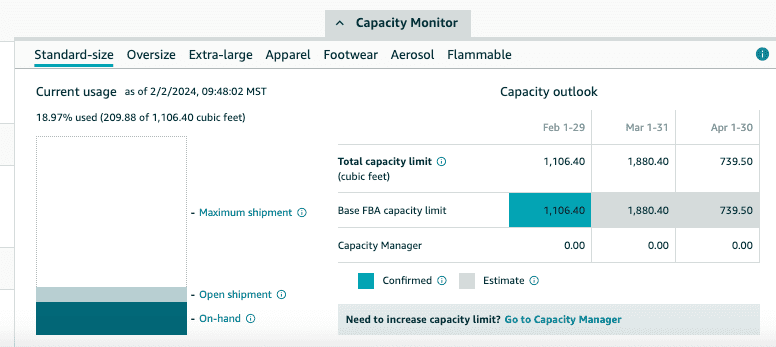
Included in your storage usage are the inventory currently stored at Amazon, inventory en route to Amazon, and any shipments that have been prepared but not yet sent to Amazon.

Screenshot of storage capacity monitor on Amazon Seller Central. Screenshot from Amazon Seller Central, February 2024

The Storage Volume is highly impacted by your IPI (Inventory Performance Index).

We will further discuss how your IPI is calculated later in this article.

IPIScreenshot from Amazon Seller Central, February 2024

Sellers who fall below the minimum criteria can have their storage limited. Operating with such limited storage can significantly undermine your sales forecasts.

We will outline the steps you can take to ensure you have sufficient storage for your high-demand season, maximizing your sales on Seller Central.

We’ll also review what you can do if you fall below Amazon’s set criteria.

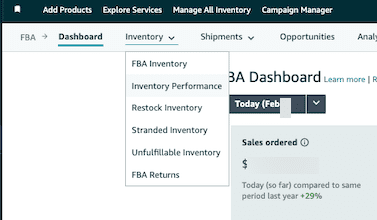
You can find your limit by going to Seller Central, selecting Inventory, navigating to the Inventory Dashboard, and then selecting Inventory Performance under the dropdown for Inventory.

Screenshot of how to navigate to find your storage capacity on Amazon. Screenshot from Amazon, February 2024

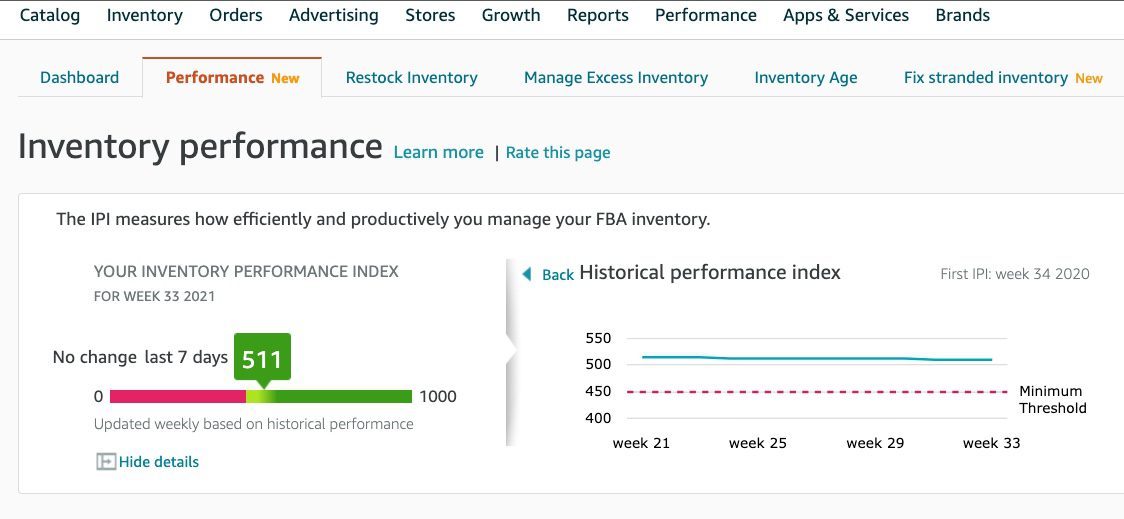
Your IPI score will be near the top of the page.

To reach your storage capacity, scroll to the bottom of the page and click on the small gray box labeled Capacity Monitor.

Success on Amazon Means You Have To Manage Your Inventory Levels Proactively

Amazon says that it considers the following criteria for your storage levels:

  • IPI Score and Sales Performance: Higher storage capacities are granted to accounts that consistently achieve a high IPI score.
  • Storage Utilization: In determining storage limits, Amazon considers your current inventory, inbound inventory, and shipments that are prepared but not yet dispatched.
  • Sales Volume: Amazon will also look at sales volume over time.

Improving Your IPI

If you have a low IPI score, know it will take time to improve your score.

IPI is a rolling average. It can take anywhere from 2 to 12 weeks to increase your score on Amazon, so planning ahead of time is essential.

This means if your IPI is below the 400 Amazon requires, you need to start taking aggressive action today.

This article will outline how to avoid having detrimental storage limits, how it happens, and what to do when you’re already below the threshold.

For those interested in Restock Limits, we’ll explore this topic in more detail later in the guide.

What Is The IPI (Inventory Performance Index), And Does It Affect Me?

The IPI will only affect those using Seller Central and FBA warehouses.

It does not affect those using Vendor Central, Kindle Direct Platform, or those selling on Seller Central by Merchant Fulfilling or utilizing Seller Fulfilled Prime for their items.

Inventory Performance Index (IPI)

The Inventory Performance Index (IPI) manages how well you control and manage your inventory at Amazon.

This metric is a 12-week rolling average. It looks at several components over three months.

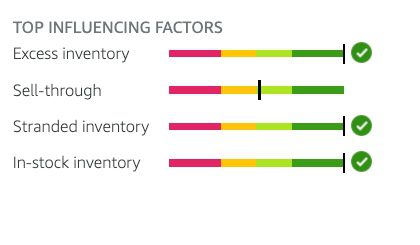
Four components make up the Inventory Performance Index (IPI):

Excess Inventory

This is the most important metric as it measures where your profitability may take a hit due to storage fees and holding costs for slow-moving FBA inventory.

Excess Inventory percentages help sellers plan when to restock more or remove inventory from FBA.

An item is considered to have excess inventory when it has over 90 days of supply based on the forecasted demand. 

Sell Through Rate

This metric is just how it sounds. The formula that Amazon uses to calculate Sell Through rates is:

(Units Shipped In the Last 90 Days)/(Average Units on Hand Over the Last 90 days)

Stranded Inventory

This provides information on products that aren’t selling due to listing issues.

This occurs when your listing doesn’t meet Amazon guidelines.

In these instances, your products become stranded and unable to move while still incurring FBA storage fees.

In-Stock Inventory

Amazon looks at the percentage of time your products have been in stock during the past 30 days, with additional weight given to items that have sold more units over the past 60 days.

If you maintain a high in-stock inventory, it will result in fewer lost sales.

Four components of the Inventory Performance Index.Screenshot from author, February 2024

It is important to highlight that these components are not weighted equally.

Excess Inventory

Excess Inventory and Sell-Through Rate are the parameters that have the most significant impact on IPI, while Stranded Inventory and Restock Rates can play a minor role in the overall score.

This means you will get more movement focusing solely on the first two components rather than spreading your efforts equally across all four elements.

During the height of the pandemic, Amazon changed the minimum IPI to 500. IT has since reduced the minimum IPI back to 400.

However, Amazon can increase or decrease the minimum IPI desired score at any point in time.

For this reason, we advise our clients to aim for a total IPI of 600.

Your minimum goal should be achieving at least 50 points over the current IPI requirement.

Some product mixes make maintaining a high IPI easier than others. For example, if you are a small brand with many products that move consistently, your IPI will generally tend to be higher.

If you are a seller with a large product mix that changes often, it is the most challenging to manage.

Combatting Capacity Limits

If you’re currently experiencing a capacity limit, Amazon can increase your capacity limit for a specific period of time by submitting a request subject to Amazon’s approval.

It is important to remember that if the storage limit increase request gets approved, your account is subject to paying a “reservation fee” for each cubic foot of capacity requested, and it will get charged at the end of the specified period.

Such fee is subject to a credit depending on your sales achieved during the period (performance credits are earned at $0.15 for every dollar of sales you generate using the additional capacity.)

Another alternative is to continue selling items via merchant fulfillment or using other third-party sellers to move your inventory or send small shipments of your fastest, most profitable inventory to Amazon.

Further down in this article, we will highlight what you can do when your inventory performance is low, you are facing potential inventory limits, or if you’re new to Amazon.

Why Would Amazon Do This?

It seems like it would be counterintuitive for a company that is so focused on having as many products on its platform as possible to limit the amount of inventory you could sell.

However, as more sellers joined the platform and with rising FBA and Prime offers, overcrowding at the warehouses started to become a larger problem for Amazon.

Amazon sellers were attracted to FBA because of the low cost of storage rates. Sellers were using the FBA program as a cheap way to warehouse large amounts of inventory.

At first, Amazon tried to increase storage fees. Adding long-term storage fees dramatically increased the storage cost for merchandise aged over six months.

However, even with those changes, Amazon couldn’t curve the overcrowding and demand in its FBA warehouses.

As a result, it started to introduce storage limits in 2019.

From Amazon’s perspective, it wants to ensure customers have favorable shopping experiences and quickly get the products they want.

This means ensuring that the products most likely to sell are available.

Amazon looks at how you have managed inventory in the past and whether customers are purchasing your products to determine how much space is allocated to you.

The better Amazon feels you are at managing your space at Amazon’s FBA warehouses, the more storage space you will be allowed.

What If My IPI Is Below The Current Threshold?

If your IPI is currently below the threshold or within 50 points of the lowest threshold, these are the actions we recommend.

The first step is to check the current threshold. As of the writing of this article, the current threshold for IPI is 400.

However, here’s the direct link to the policy so you can find the current threshold, as Amazon can change this at any time. You can find the current required IPI in Seller Support under the heading FBA Inventory Storage Limits (login required).

You can review your current IPI score in Seller Central by going to Inventory, Inventory Planning, and then clicking on your IPI score.

IPI score in Seller Central.Screenshot from Amazon Seller Central, February 2024

Even with aggressive tactics, changing the IPI significantly can take 2 to 12 weeks.

Recommended Actions To Improve Inventory Performance Index (IPI)

Excess Inventory – Dump Slow Moving Items

Excess inventory is generally one of the top two reasons your IPI score could be low, since it is the most heavily weighted metric.

The first step to addressing excess inventory is to pull back inventory you don’t expect to sell.

Focus on stock-keeping units (SKUs) that have gone out of fashion or merchandise experiencing a significant demand drop, like seasonal products.

If you don’t expect it to sell within three months, you should pull back the inventory to sell on a different channel by creating a removal order.

You can also start to use the Multi-Channel Fulfillment (MCF) to fulfill your website orders from your Amazon stock.

Sometimes, it makes more sense to discount and/or advertise products to help them sell faster to remove them from your inventory rather than call back inventory from Amazon.

Optimizing a listing that is not moving can also help increase the sell-through rate.

A quick note on having Amazon destroy products – sometimes, the company will liquidate that product instead of destroying it.

If inventory control is an essential factor for your brand, we recommend pulling back the inventory even though it costs more.

While Amazon is great at logistics and moving items through its process, it isn’t great at returning items to sellers.

Often, items arrive damaged or mixed SKUs in multiple boxes, clogging up receiving departments.

If possible, we want to ensure that we’re proactively taking action to avoid pulling back inventory and risk inventory being damaged or unavailable to be sold for a long time.

Sell-Through Rate – Send Fast-Moving Items

Amazon looks at this to identify whether the items you’re selling are things customers want to purchase.

The way that we improve the sell-through rate is to send in small shipments of items that will sell out very quickly.

If you’re currently using LTL or FTL, we recommend that you move to small parcel shipments during this process so that you can send more frequent shipments without going out of stock for long periods.

As you’re restocking items, you want to prioritize those that will move quickly, sending small quantities of items that will sell out as soon as they arrive or shortly after.

This allows your overall sell-through rate to increase dramatically and significantly impact your overall IPI.

It is vital that no matter how fast you think a product will move through, as you send these products in, you’re testing small batches to make sure that things will sell at the pace you anticipate.

Stranded Inventory

Inventory that’s being held in FBA warehouses and not available for sale affects your overall IPI.

Fixing stranded inventory can make a slight difference; however, if you need to move your IPI significantly, this component of the overall metric will only make a slight difference.

It would be best to address stranded inventory weekly or bi-weekly, depending on your general sell-through rate.

In-Stock Inventory

This is probably the most frustrating metric of the IPI because, basically, Amazon is telling you that you can’t restock items because they’re not selling fast enough.

At the same time, it’s trying to encourage you to ensure you stay in stock.

We have found that this metric is very lightly weighted, and you’re better off focusing on the two key metrics of excess inventory and sell-through rate.

There has been some debate about whether deleting previous SKUs can increase this; however, we have not seen that this significantly impacts the total IPI.

General IPI Notes

As you’re working to increase your overall IPI, it is important to remember that it can take several weeks to increase.

The IPI is an average calculated over 12 weeks.

You must give the IPI enough time to move before determining whether your actions are making a difference.

It can be tempting to check your IPI often. However, your IPI score is only recalculated once a week.

If you need to raise your IPI quickly or by a significant amount, you may need to take overly aggressive actions in pruning your inventory and pumping fast-moving items through your account to increase your score to the required amount.

You might have to also bid for a capacity increase.

You should only do this if you have the data to support being able to sell through that higher quantity of items so you do not incur extra charges.

Additional Options To Combat Low IPI and Storage Capacity Issues

Sometimes, this means utilizing third-party sellers to ensure that inventory can be available to customers with a Prime offer.

Some of the brands we work with have focused on selling their fastest-moving SKUs while they improve their overall IPI score and capacity limits.

Then, they utilized third-party sellers to carry their slower-moving items while they worked on increasing their averages.

We have several reliable third-party resellers we refer our clients to if it’s ever an issue.

This means that those accounts saw a faster increase in storage capacity as they were sending in inventory that was selling at a much faster rate and restocking regularly.

If you don’t want to utilize third-party sellers, the alternative is to increase your total number of merchant-fulfilled offerings.

Remember that Merchant Fulfilled offerings generally don’t compete well against FBA offers, so watch your competition to determine feasibility.

While many brands avoid third-party sellers because it may reduce control over their brand, in this instance, it can be an excellent tool to ensure that you don’t lose potential market share to other competing product lines.

Another step you can take is to allocate your FBA warehouse space to items with the highest margin and smallest dimensional size, as they are highly profitable and sell quickly.

Leaving items with lower profitability or moving slower through Merchant Fulfilled (MF).

Tips For New Amazon Sellers

If you’re a new seller coming to Amazon or moving from Vendor Central to Seller Central, start by sending small quantities at first.

You have a grace window of 39 weeks when opening your account.

However, you want to ensure you send in small amounts of inventory. A few cases per product can help you identify the overall sell-through rate.

There is no minimum for sending inventory into Amazon FBA. So, it is possible to test as little as one unit at a time to test products on Amazon.

Sending in small shipments does increase your overall shipping cost and can reduce profitability in the short term.

However, when you’re first investigating the platform, sending in smaller quantities can help you better understand your product’s demand and help avoid additional fees that can be required to call inventory back or pay for storage fees.

Once you have a better idea of your sell-through rate, you can start to increase the total sizes of your inventory.

It is a delicate balance to have enough inventory so that you don’t run out of stock but also that you don’t have excess inventory.

While, in general, you want to aggressively avoid stockouts, the impact of a low IPI score should take priority.

Monitoring Inventory Matters

To succeed on the platform, you must take an active role in your Amazon inventory management.

In prior years, simply avoiding restocks was enough.

However, these new requirements require a greater focus on monitoring your sell-through rate and storage utilization on Amazon.

Prepare now to support your Amazon marketing and sales goals for the coming holiday season.

More Resources:


Featured Image: Piscine26/Shutterstock

Using the focus keyphrase for product pages in Yoast SEO

SEO is crucial for any online store. One key aspect that Yoast SEO needs to help you improve the SEO of your product pages is a focus keyphrase. This guide will help you find and fill in the proper focus keyphrase using Yoast SEO.

Understanding the focus keyphrase

The focus keyphrase is the main keyword or phrase that you want your product page to rank for in search engine results. It represents the core topic of your product pages. Usually, this is what you expect potential customers to type into search engines when looking for products similar to yours.

Adding the focus keyphrase in Yoast SEO

Why is the focus keyphrase important?

The focus keyphrase helps search engines understand the subject of your product page. When search engines crawl your product pages, they look for word patterns to determine what your page is about. By optimizing your product page around a specific keyphrase, you make it easier for search engines to index and rank your products accurately. As a result, your customers can find your products in the search results.

Filling in a focus keyphrase in Yoast SEO helps you optimize your product pages based on provided feedback. This might improve your product page’s search engine ranking. Higher rankings mean more visibility, leading to increased organic traffic and, ultimately, more sales. A well-chosen focus keyphrase ensures that your product page is relevant to what users are searching for.

Yoast SEO algorithms

Yoast SEO, Yoast WooCommerce SEO, and Yoast SEO for Shopify use algorithms to analyze your product pages based on the focus keyphrase you fill in. It checks if the descriptions you wrote for your products correctly use these keywords. This includes examining the keyphrase’s presence in the title, meta description, URL, headings, body content, and more. The tool gives feedback and suggestions to improve your ecommerce SEO.

Benefits of using a focus keyphrase in Yoast SEO

Using focus keyword phrases in Yoast SEO is essential, as it has many benefits, such as getting more targeted traffic. Optimizing for a specific product keyword attracts visitors specifically looking for your offer, increasing the likelihood of conversion.

A well-researched focus keyphrase can give you an edge over competitors who may not optimize their pages as effectively. Tracking the performance of your focus keyphrases helps you measure the effectiveness of your ecommerce SEO strategy. Based on performance data, you can refine and adjust your keyphrases.

An example: “Organic aloe vera gel”

Suppose you are selling “Organic aloe vera gel.” Your focus keyphrase might be “Organic aloe vera gel.” This keyphrase should be used consistently across your product title, meta description, URL, headings, and body content to ensure search engines understand the page’s relevance to users searching for organic aloe vera gel.

Understanding and using the focus keyphrase for product descriptions can enhance your online store’s SEO. As a result, your products will be more discoverable to potential customers.

How to determine the focus keyphrase for your products

Finding the right focus keyphrase involves understanding your product, keyword research, and analyzing its effectiveness. Here’s a step-by-step approach:

Step 1: Identify the product’s main features and benefits

Start by listing the primary features and benefits of your product. This will help you understand what makes your product unique and appealing.

Example:

  • Product: Organic aloe vera gel
  • Features: Organic, soothing, hydrating
  • Benefits: Soothes irritation, hydrates skin, suitable for sensitive skin

Step 2: Brainstorm potential keywords

Think of keywords and phrases a customer might use to find your product. Include broad terms as well as more specific, long-tail keywords. Head keywords are general descriptions of your product, while long-tail keywords are more specific and often less competitive.

Example:

  • Head keywords:
    • “Aloe vera gel”
    • “Skincare gel”
  • Long-tail keywords:
    • “Organic aloe vera gel”
    • “Natural aloe vera gel”
    • “Aloe vera gel for sensitive skin”
    • “Soothing aloe vera gel”

Step 3: Use keyword research tools

You can use keyword research tools to analyze the potential keywords you brainstormed. These tools can provide insights into search volume, competition, and related keywords. There are many tools out there, and you might have already picked a favorite. Popular tools are Semrush, Ahrefs, Ubersuggest, and Moz, but you can even ask ChatGPT to help you find good product keywords.

Step 4: Analyze and select the best keyphrase

Once you have everything, you can select the best one. Choose a keyphrase that is highly relevant to your product, has a good search volume, the proper search intent, and is not overly competitive. Also, ensure the keyphrase aligns with your customers’ language and terminology.

The main focus keyphrase is the primary keyword you want your product page to rank for. It is the central topic of your content and should be used consistently across various SEO elements. For example, for the product “Organic aloe vera gel,” the main focus keyphrase could simply be “Organic aloe vera gel.”

Related keyphrases are secondary keywords closely related to the main focus keyword. They help broaden the scope of your content and capture additional search queries that your main keyword might miss. Related keyphrases add context and relevance, making your product content more comprehensive and improving your chances of ranking for multiple related terms.

For example, for the main focus keyword, “Organic aloe vera gel,” related keyword phrases could be “Natural aloe vera gel,” “Aloe vera gel for sensitive skin,” or “Hydrating organic aloe vera gel.”

Keyphrase synonyms in Yoast SEO

Keyphrase synonyms are alternative words or phrases with the same or similar meaning as your main focus keyword. Diversifying the language used on your page helps you cover a broader range of search queries, enhances the natural flow of your product descriptions, and avoids keyword stuffing.

For instance, aloe vera moisturizer could be an alternative to the main keyword, aloe vera gel. You could use this to enhance your product descriptions and use more words to rank for:

“Our organic aloe vera gel is perfect for those seeking a natural skincare solution. This natural aloe vera gel hydrates and soothes your skin, acting as an effective aloe vera moisturizer. This soothing aloe gel is ideal for sensitive skin and provides instant relief from irritation.”

Search engines use semantics to understand the context and intent behind queries. Using related keyphrases and synonyms helps search engines better understand your product descriptions and match them to relevant queries.

Additional tips for selecting a focus keyphrase

Of course, you can do more to choose a good focus keyphrase for the products in your ecommerce store.

  • Consider user intent: Consider what the user is looking for when searching for your keyphrase. Ensure your keyphrase aligns with their intent.
  • Look at competitors: Analyze your competitors’ keyphrases. This can give you insights into what is working in your industry.
  • Use variations: Include synonyms and related terms in your content to cover a broader range of search queries.

Using branded keywords

If you want to rank products by their brand and model, the approach is slightly different but follows the same principles. When optimizing for branded products, start by identifying the brand and model names, as these are often the terms customers use in their searches.

Use keyword research tools to analyze these branded terms for search volume and competition. Look at how competitors are ranking and the specific keywords they are targeting. Consider long-tail variations, including the brand and model, such as “Nike Pegasus 39 Shield women’s weatherized road running shoes”. These long-tail keywords are often less competitive and more specific, attracting highly targeted traffic.

By combining the brand name with descriptive terms, you can create a comprehensive list of focus keyphrases that will help your product pages rank higher in search results and meet the search intent of potential customers.

An example project

Here’s an expanded example of how to find and implement focus keyphrases and related keyphrases for an “Organic aloe vera gel” product using Yoast SEO:

Example: Organic aloe vera gel

Main focus keyphrase Related keyphrases
Organic aloe vera gel Natural aloe vera gel
Aloe vera gel for sensitive skin
Soothing aloe vera gel
Hydrating aloe vera gel

Step-by-step implementation in Yoast SEO

  1. Enter focus keyphrase in the respective Yoast SEO field

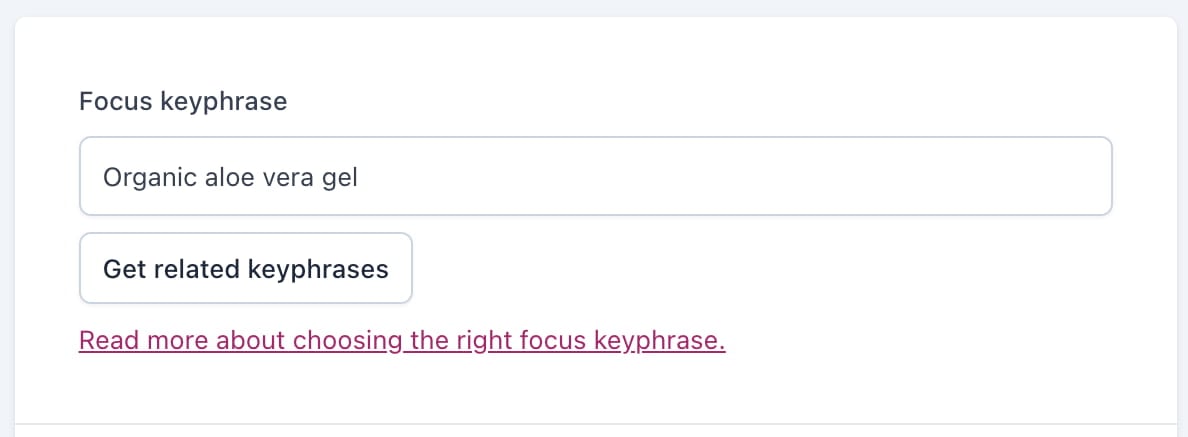
    Enter the main focus keyphrase “Organic aloe vera gel” in the focus keyphrase field in Yoast SEO.

  2. Enter the related keyphrases

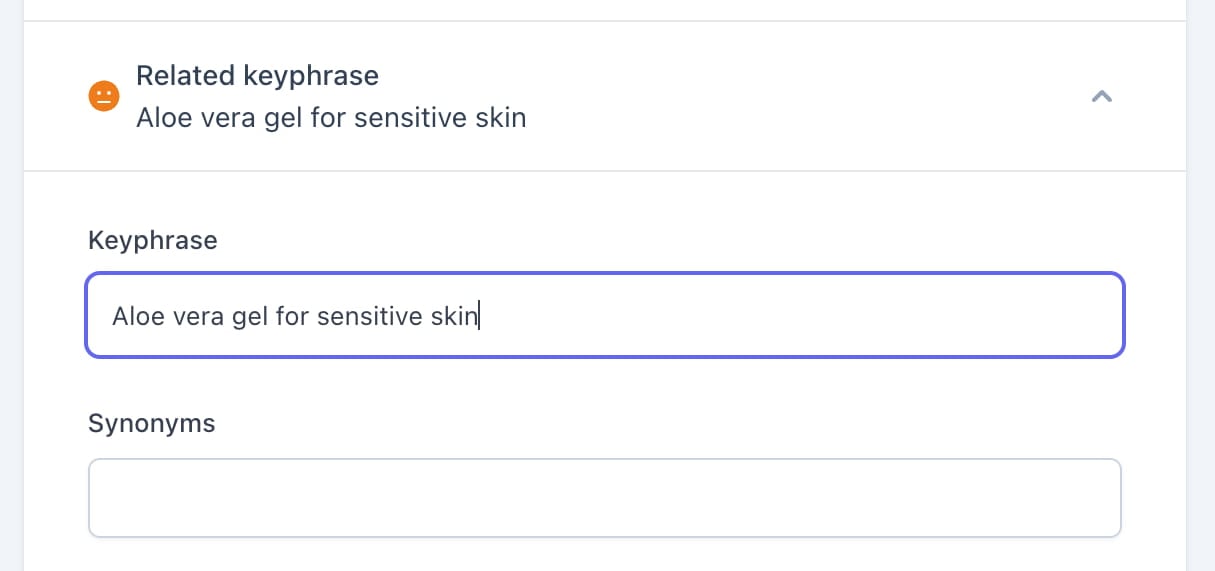
    If applicable, enter the related keyphrases in their respective fields.enter the related keyphrase in yoast seo shopify

  3. Title tag: Use the main focus keyphrase in the product title

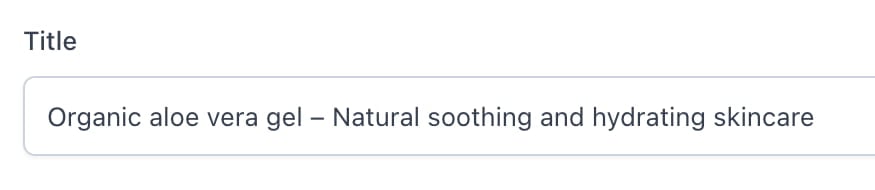
    Example: “Organic aloe vera gel – Natural soothing and hydrating skincare”

  4. Meta description: Craft a meta description including the main focus and related keyphrases

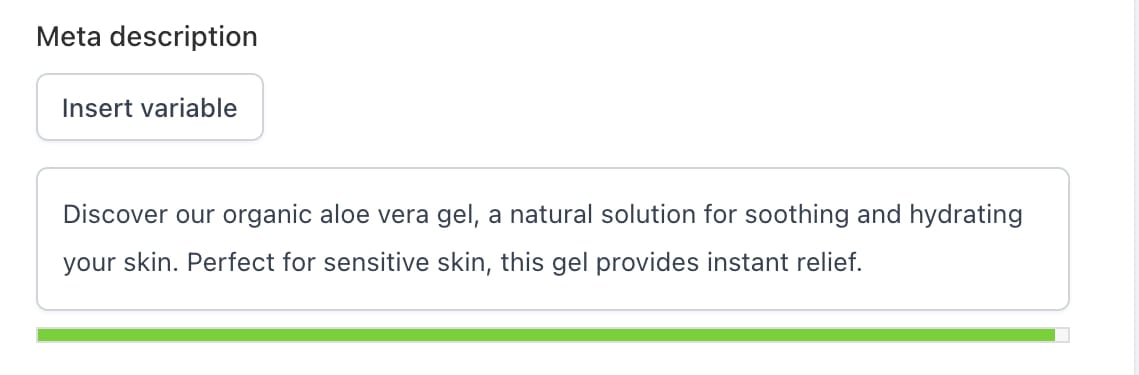
    Example: “Discover our organic aloe vera gel, a natural solution for soothing and hydrating your skin. Perfect for sensitive skin, this gel provides instant relief and hydration”editing the meta description in yoast seo for shopify

  5. URL slug: Ensure the URL slug contains the main focus keyphrase

    Example: yourstore.com/products/organic-aloe-vera-gel/

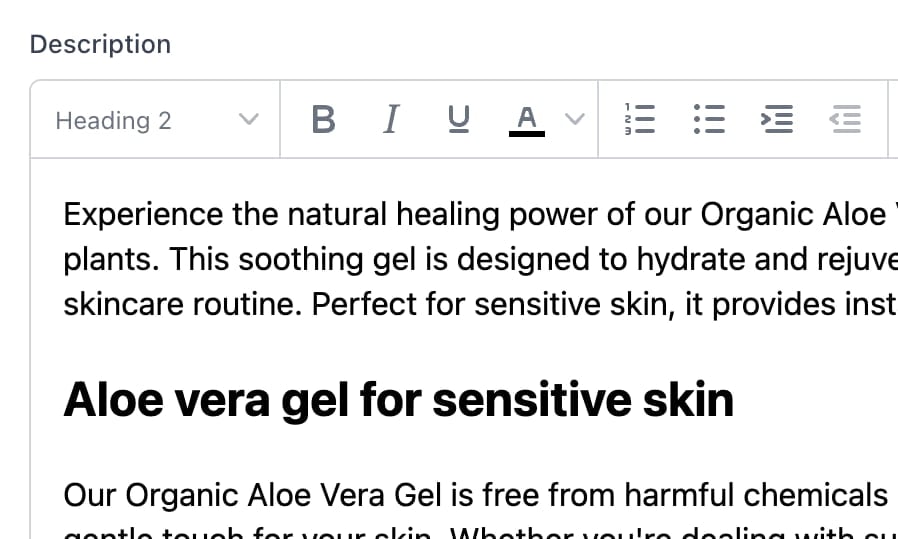
  6. Headings: Include the main focus keyphrase in the H1 and the others in subsequent headers

    For example, the H1 would be “Organic aloe vera gel,” the H2’s “Natural aloe vera gel benefits,” “Soothing aloe vera gel for sensitive skin,” and “Hydrating aloe vera gel for daily use”adding related keyhrases to headings in yoast seo shopify

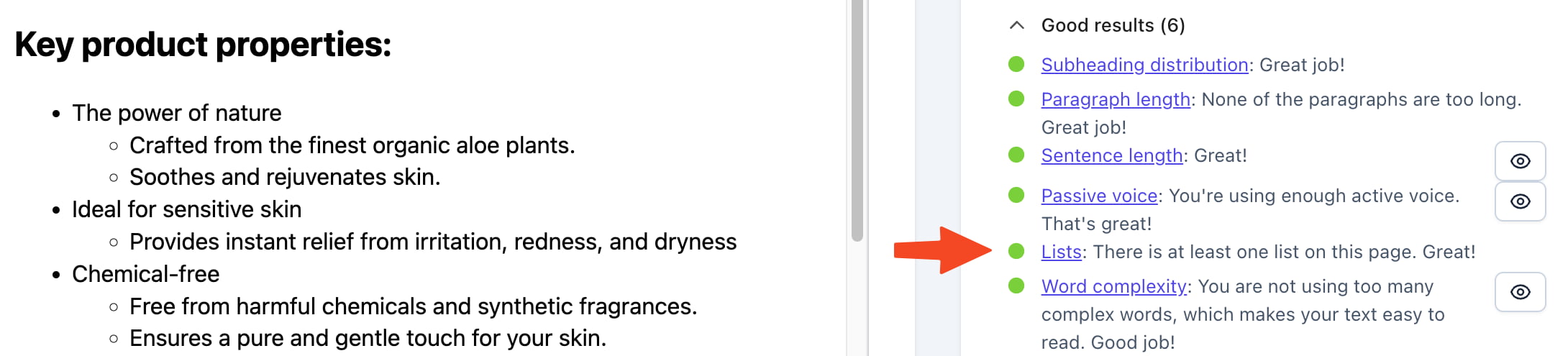
  7. Body content: Use keyphrases naturally in the product description + lists

    Example, although this is too short based on our advice: “Our organic aloe vera gel is crafted from the finest organic aloe plants, ensuring a soothing and hydrating experience for your skin. This gel provides natural relief from irritation and dryness and is ideal for sensitive skin. Use our natural aloe vera gel daily to keep your skin hydrated and healthy. The soothing properties of this gel make it perfect for calming red or irritated skin, while its hydrating effects ensure your skin stays moisturized all day long.” Don’t forget to add lists!

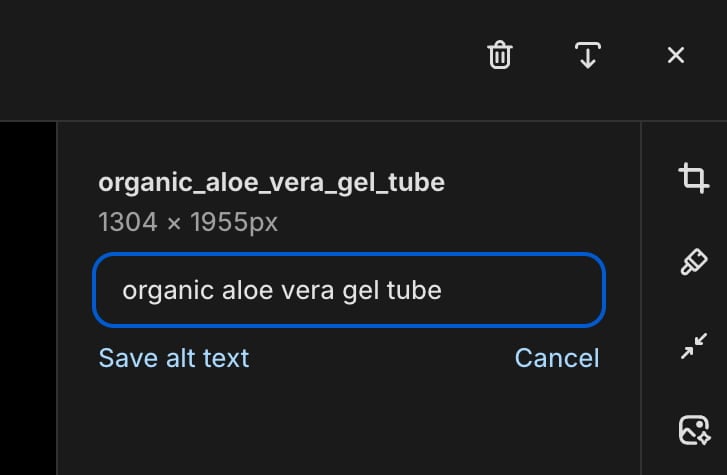
  8. Image alt text: Use the keyphrases to describe the product images

    For example: “Organic aloe vera gel bottle,” but try to make it descriptive about what’s in the image

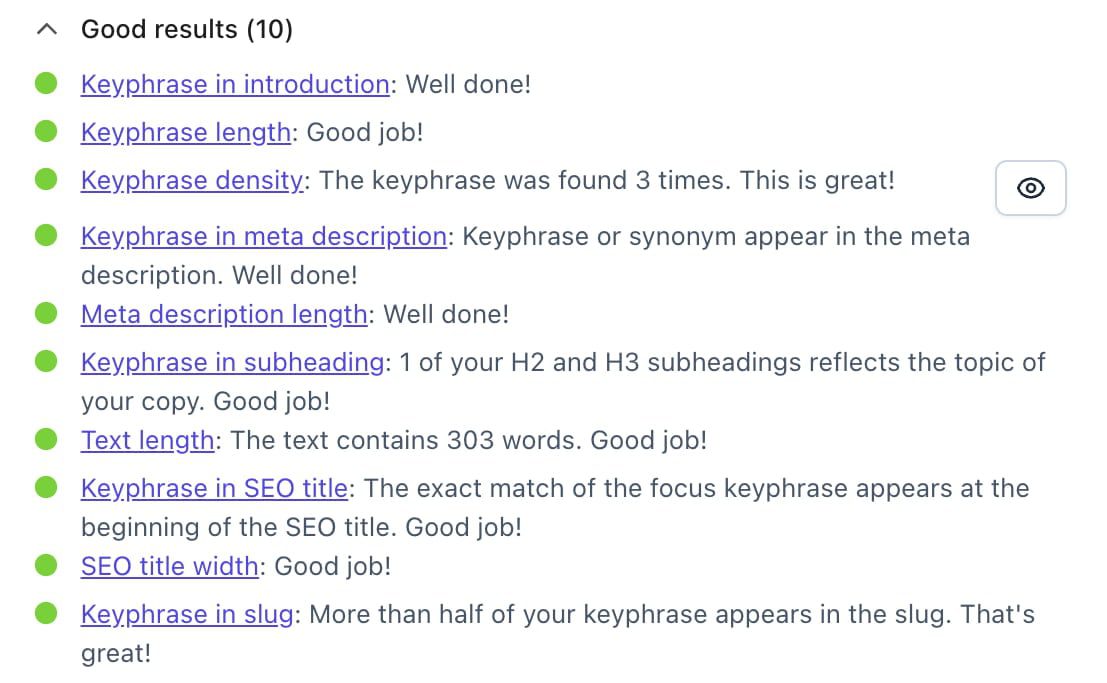
  9. See whether Yoast SEO finds your keyphrases

    Ensure Yoast SEO checks for the keyphrase in the title, meta description, URL, headings, and body content.

  10. Check the feedback from Yoast SEO

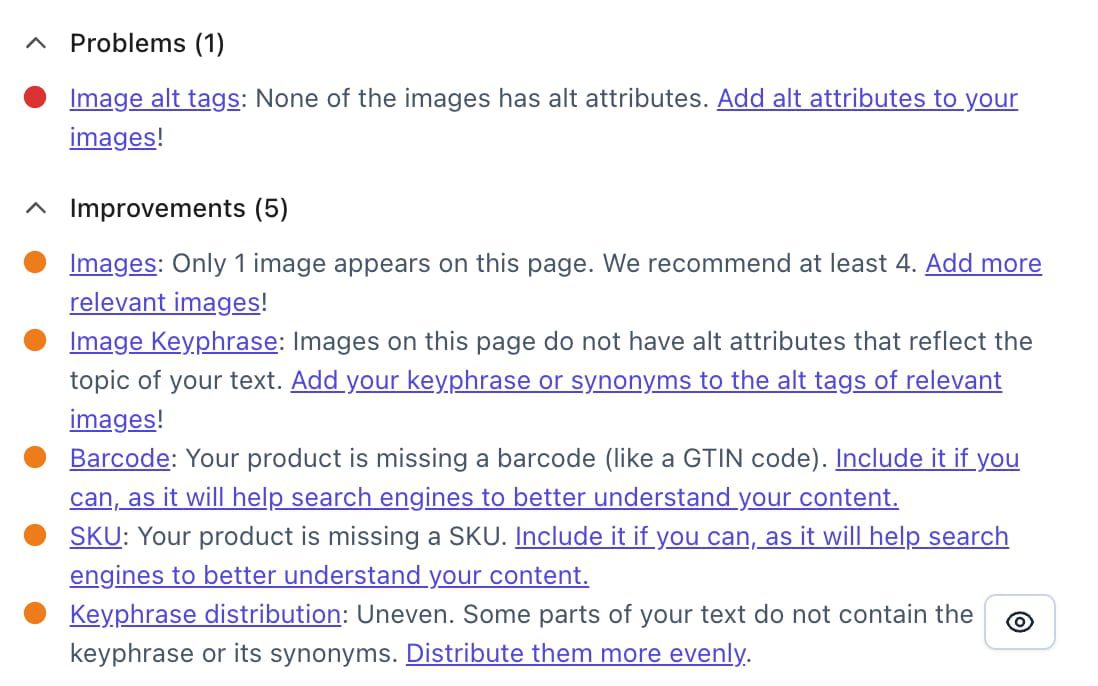
    Review the feedback provided by the plugin and make any necessary adjustments to improve the SEO score. Remember that the SEO analysis shows all you can do to improve your product’s findability in the search results. On the other hand, the readability analysis helps you make the product content as understandable as possible, which is good for search engines and users.more feedback yoast seo for shopify

How to use focus keyphrases in Yoast SEO

By following these steps and effectively using the main focus keyword and related keyword phrases, you can optimize your product page for better search engine visibility and attract more targeted traffic to your online store.

Coming up next!

The Traffic Impact Of AI Overviews via @sejournal, @Kevin_Indig

Boost your skills with Growth Memo’s weekly expert insights. Subscribe for free!

Two weeks after Google rolled out AI Overviews (AIOs), we can analyze early data to gauge the impact on organic traffic.

I wanted to understand the impact and implications of AIOs, especially after many reports of misinformation and sometimes harmful recommendations from Google’s AI answers.

I found that AIOs can hurt organic traffic, especially when queries indicate that users want quick answers. However, there might be a chance that some AIOs deliver more traffic to cited sites.

When AIOs Show Up

I used ZipTie to crawl the search results for 1,675 queries in the health vertical on May 22 to understand how, when, and maybe why Google shows AIOs.

I mixed ZipTie’s data with Search Console and Ahrefs to understand the implications for organic traffic, the influence of backlinks, and estimated domain traffic.

42% Of Queries Show AIOs

AIOs showed up 42% of the time (704/1,675 queries), which is much more than the 16% found in ecommerce by ZipTie or the 15% found by SEO Clarity.

The higher rate makes sense since Google announced to show AIOs for complex queries, which are more likely to occur in health than ecommerce.

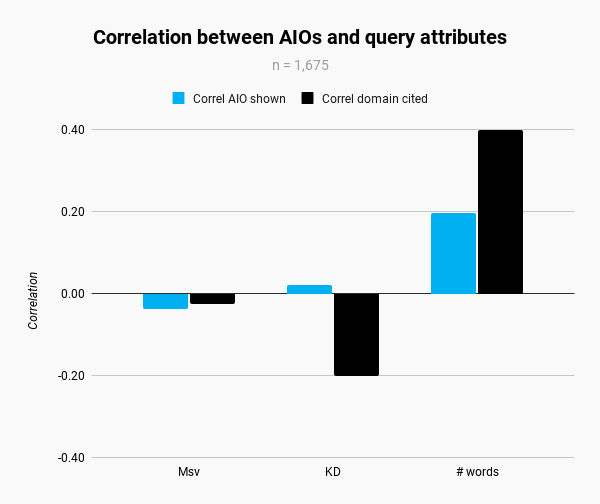
I found a weak relationship with the number of words, indicating that longer queries are more likely to trigger AIOs. Yet, I’m surprised to find so many AIOs in a sensitive space like health, where wrong information is so much more risky.

Bar graph titled Image Credit: Kevin Indig

There seems to be no relationship between keyword difficulty or search volume, even though the domain I have GSC access to is more likely to be cited for low-difficulty queries.

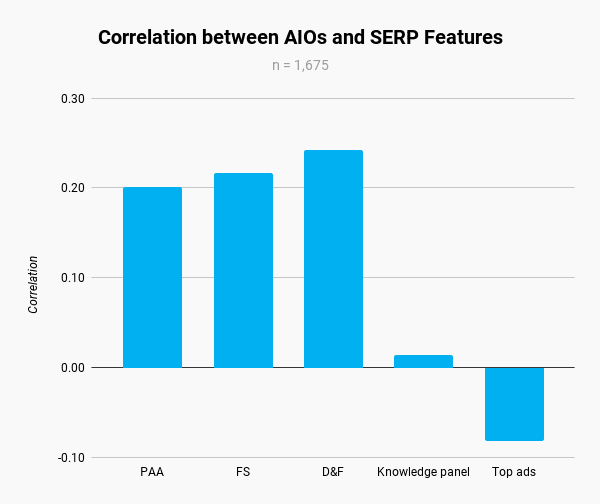
AIOs are more likely to show up alongside People Also Ask (PAA), Featured Snippets (FS), and Discussions & Forums modules (D&F), which makes sense since those SERP features indicate informational searches.

Knowledge Panels and Top Ads showed no correlation, but also showed up less often than other SERP features.

Bar graph displaying the correlation between AI-driven AIOs and SERP features.Image Credit: Kevin Indig

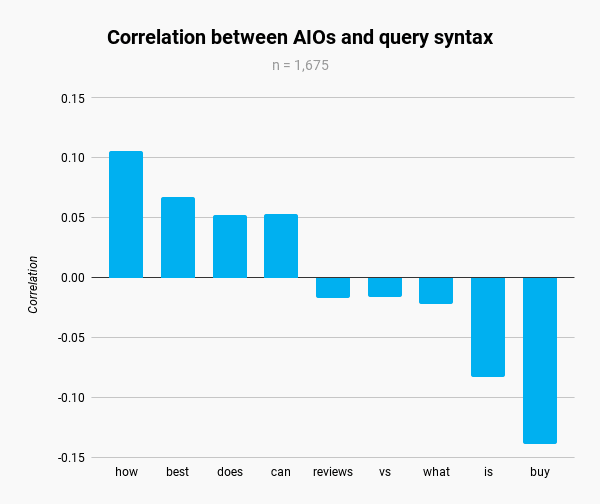
Though correlations are weak, the data indicates that AIOs are more likely to appear for queries related to questions and comparisons.

Bar chart showing correlation between AIOs and query syntax for terms.Image Credit: Kevin Indig

Who Shows Up In AIOs

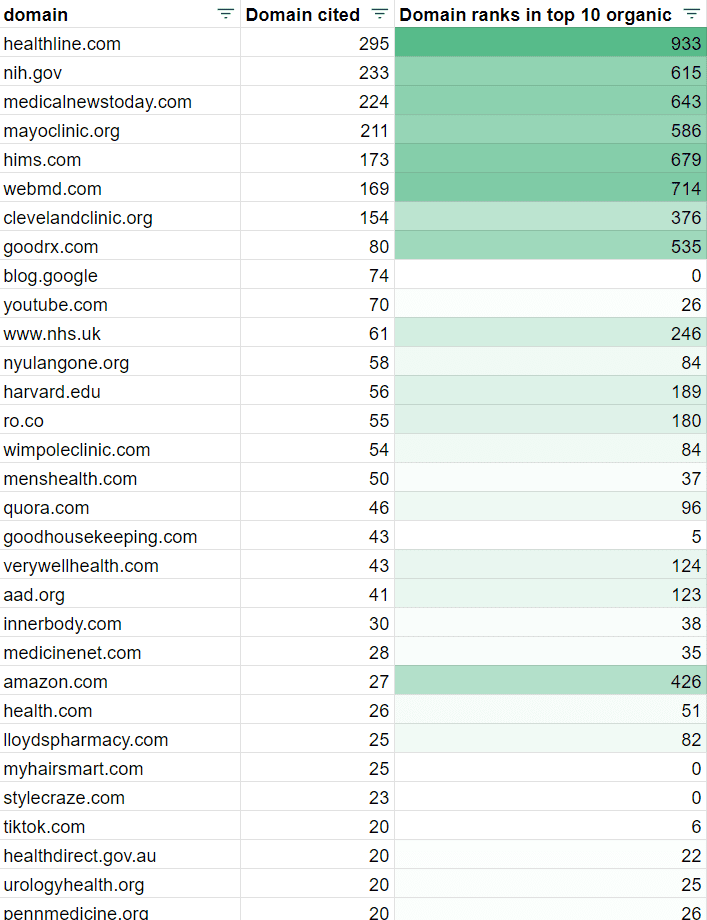
The 704 AIOs in the dataset cited 4,493 sites, which is an average of 6.3 links per AIO.

I found a very strong correlation (0.917) between sites that show up in the top 10 organic results and sites cited in AIOs for the 1,675 keywords.

Surprisingly, Reddit (No. 92 on the list) and Quora (No. 17) barely contributed to citations.

A table showing various domains, the number of times each domain is cited, and their rankings in the top 10 organic search results.Image Credit: Kevin Indig

I found no strong relationships between domains that get a lot of AIO citations and their organic traffic, backlinks (referring domains), or ranking keywords.

Sites that rank well for keywords are more likely to be cited in AIOs, but it’s still unclear when Google decides to cite a site that doesn’t rank well for a keyword.

Traffic Impact Of AIOs

The most important question is how AIOs impact organic traffic of cited and uncited URLs.

To get to the ground of things, I compared organic clicks from Search Console for a domain across 1,675 non-branded keywords (US) in the week of May 7 with the week of May 14.

After excluding low-traffic keywords, 560 AIOs showed up for 1,344 keywords, of which the target domain was cited 171 times with 461 different URLs.

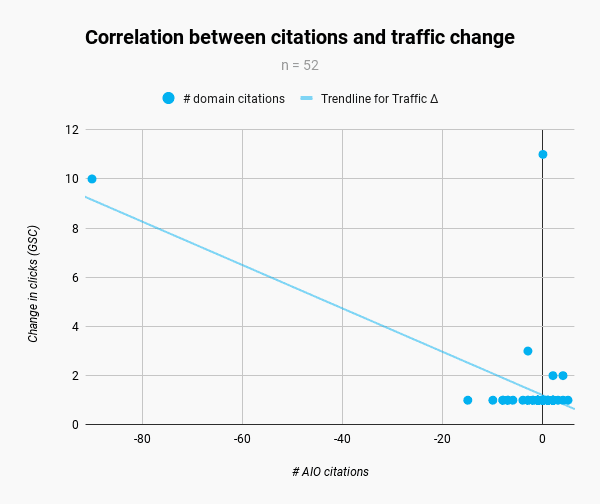
To make sure rank changes don’t influence the results, I excluded keywords with a higher rank change than 0.9 and lower than -0.9, after which 52/521 URLs remained.

I found a strong negative correlation of -0.61 between cited URLs and traffic change, indicating that AIO citations send fewer clicks to cited URLs. In this case, the domain received -8.9% fewer clicks when cited in AIOs.

Scatter plot showing the correlation between AI citations and traffic impact. Image Credit: Kevin Indig

However, results can vary by user intent. Most URLs that lost clicks, most likely due to AIOs, targeted questions like “how to get viagra without prescription.”

AIOs seem comparable to Featured Snippets, which can send more or fewer clicks based on whether the keyword is shallow or complex.

Also, note that a big chunk of the traffic losses was caused by a few URLs. Correlating the data without outlier URLs actually resulted in a slightly positive correlation of 0.1, indicating that there might be a chance that some AIOs send more traffic to URLs based on whether users want more information.

When AIOs show up, and a site isn’t cited, I found an average loss of -2.8% organic traffic, indicating that users might still click organic results. But to really make sure, we have to measure the impact on organic clicks for the same keywords. Take this result with a grain of salt.

Caveats

  • AIOs can change, and it’s not clear how often. There does not seem to be a normal change rate over time, but it seems Google has pulled back a lot of AIOs. I wasn’t able to recreate most AIOs five days after the initial crawl. Google might have pulled back due to the numerous reports of misleading and sometimes harmful answers.
  • 1,675 queries are a good start, but we need 100 times as many to make more robust statements.
  • We also need a lot more traffic data than n=1.

Canary In The Coal Mine

In aggregate, strong SEO performance seems the best way to appear in AI Overviews, even though Google will also cite URLs that don’t perform well. We still don’t know enough about the content features that make it more likely to be cited in AIOs.

Broadly speaking, AI overviews have a bigger impact than “just” Google Search. They’re the first AI feature that significantly changes the cash cow of one of the most valuable companies in the world.

AI has been undergoing a massive hype cycle since the launch of ChatGPT3 in November 2022. Lately, we’ve been asking ourselves more and more how big the actual incremental value of AI is.

AIOs are the canary in the coal mine. They could prove the value of AI in products or even pop the AI bubble we’re in.


X (Twitter) of Bartosz Góralewicz

AI Overviews: Measuring the Impact on SEO


Featured Image: Paulo Bobita/Search Engine Journal

New WordPress Plugin Solves Site Navigation Problem via @sejournal, @martinibuster

Joost de Valk, the creator of Yoast SEO plugin, has created a new (and free) plugin for solving a site architecture problem that can silently diminish a website’s ability to rank.

Site Architecture

Site architecture is an important SEO factor because a well-organized website with clear navigation helps users quickly get to the content and products they’re looking for. Along the way it also helps Google find the most important pages and rank them.

The normal and common sense way to organize a website is by topic categories. While some newbie-SEOs believe that organizing a site by topic is an SEO strategy, it’s really just plain old common sense. Organizing a site by topic categories organizes a site in a way that makes it easy to drill-down and find specific things.

Tags: Contextual Site Navigation

Another way to organize a website is through contextual navigation. Contextual navigation is a way to offer a site visitor links to more webpages that are relevant to the webpage and to their interests in the moment. The way to provide a contextual link is through the concept of Tags. Tags are strongly relevant links to content that site visitors may find interesting.

For example, if someone is on a webpage about a new song by a pop star they may in that moment may be interested in reading more articles about that singer. A publisher can create a tag which links to a page that collects every article about that specific pop singer. Ordinarily it doesn’t make sense to create an entire category for hundreds of musical artists because that would defeat the purpose of a hierarchical site navigation (which is to make it easy to find content).

Tags solve the problem of making it easy to navigate to more content that one site visitor is specifically interested in at that moment. It’s contextually relevant navigation.

Too Many Good Things Isn’t Always Good

Creating a long-range plan for organizing a website can be undone by time as a website grows and trends wane. An artist that was trending several years ago may have dropped out of favor (as they often do) and people lose interest. But those tags remain, linking to content that isn’t important anymore, defeating the purpose of internal site navigation, which is to link to the most important content.

Joost de Valk researched a (very small) sample of WordPress sites and discovered that about two thirds of the websites contained overlapping tags, multiple tags linking to the same content while also generating thin content pages, which are webpages with little value.

A blog post sharing his findings noted:

“Tags are not used correctly in WordPress. Approximately two-thirds of WordPress websites using tags are using (way) too many tags. This has significant consequences for a site’s chances in the search engines – especially if the site is large. WordPress websites use too many tags, often forget to display them on their site, and the tag pages do not contain any unique content.”

The sample size was small and a reasonable argument can be made that his findings aren’t representative of most WordPress sites. But the fact remains that websites can be burdened by overlapping and outdated tags.

Here are the three main tag navigation problems that Joost identified:

1. Too Many Tags
He found that some publishers add a tag to an article with the expectation that they will add more articles to that tags when those articles are written which in many cases doesn’t happen, resulting in tags that link to just a few articles, sometimes only to one article.

2. Some Themes Are Missing The Tag Functionality
The next issue happens when websites upgrade to a new theme (or a new version of a theme) that doesn’t have the tag functionality. This creates orphaned tag pages, pages that site visitors can’t reach because the links to those tag pages are missing. But because those pages still exist the search engines will find them through the autogenerated XML sitemaps.

3. Tag Pages Can Become Thin Content
The third issue is that many publishers don’t take the time to add meaningful content to tag pages, they’re just pages of links with article excerpts that are also reproduced on category pages.

Use Fewer Tags

This is where Joost de Valk’s new WordPress plugin comes in handy. What it does is to automatically remove tags that aren’t linking to enough pages, which helps to normalize internal linking. This new plugin is called, The Fewer Tags WordPress Plugin. There’s a free version and a paid Pro version.

The free version of the plugin works automatically to remove all tag pages that contain less than ten posts, which can be adjusted to remove pages with five posts or less.

Added functionality of the Pro version allows greater control over tag management so that a publisher can merge tag pages, automatically create redirects or send a 404 Page Not Found server response.

These are the list of benefits for the Pro version:

  • “Merge & delete unneeded tag pages quickly & easily.
  • Creates redirects for removed tag pages on the fly, in your SEO plugin of choice.
  • Includes an online course in which Joost explains what you should do!
  • Fix a site’s tag issues long-term!
  • Uninstall the plugin when you’re done!”

Where To Download Fewer Tags Plugin

The free version of the plugin can be downloaded here:

Fewer Tags Free By Joost de Valk

Read more about the Pro version here.

Featured Image by Shutterstock/Simple Line