SerpApi Challenges Google’s Right To Sue Over SERP Scraping via @sejournal, @MattGSouthern

SerpApi filed a motion to dismiss Google’s federal lawsuit, two months after Google sued the company under the DMCA for allegedly bypassing its SearchGuard anti-scraping system.

The filing goes beyond disputing the technical allegations. SerpApi is challenging whether Google has the legal right to bring the case at all.

The Standing Question

SerpApi’s core argument is that the DMCA protects copyright owners, not companies that display others’ content.

Google’s complaint cited licensed images in Knowledge Panels, merchant-supplied photos in Shopping results, and third-party content in Maps as examples of copyrighted material SerpApi allegedly scraped.

SerpApi CEO Julien Khaleghy wrote that the content in Google’s search results belongs to publishers, authors, and creators, not to Google.

Khaleghy writes:

“Google is a website operator. It is not the copyright holder of the information it surfaces.”

Khaleghy argued that only a copyright holder can authorize access controls under the DMCA. Google, he wrote, is trying to assert those rights without the knowledge or consent of the creators whose work is at issue.

In the 31-page motion, SerpApi invokes the Supreme Court’s 2014 ruling in Lexmark International, Inc. v. Static Control Components, Inc., which established that a plaintiff must show injuries within the “zone of interests” the law was designed to protect. SerpApi argues Google’s alleged injuries, including infrastructure costs and lost ad revenue from automated queries, don’t fall within what the DMCA was built to address.

The Circumvention Question

SerpApi also disputes whether bypassing SearchGuard counts as circumvention under the DMCA.

Google alleged in December that SerpApi solved JavaScript challenges, used rotating IP addresses, and mimicked human browser behavior to get past SearchGuard.

Khaleghy wrote that the DMCA defines “to circumvent a technological measure,” in part, as “to descramble a scrambled work, to decrypt an encrypted work, or otherwise to avoid, bypass, remove, deactivate, or impair a technological measure,” and argued SerpApi does none of those things.

Khaleghy writes:

“We access publicly visible web pages, the same ones accessible to any browser. We do not break encryption. We do not disable authentication systems.”

The motion states Google “does not allege unscrambling or decryption of any work, or the impairment, deactivation, or removal of any access system.” SerpApi calls SearchGuard a bot-management tool, not a copyright access control.

Why This Matters

The outcome could reach beyond SerpApi. Google’s DMCA theory, if accepted, would let any platform displaying licensed third-party content use the statute to block automated access to publicly visible pages.

When we covered Google’s original filing in December, I noted the central question was whether SearchGuard qualifies as a DMCA-protected access control. SerpApi’s motion now adds a layer underneath that. Even if SearchGuard qualifies, SerpApi argues Google isn’t the right party to enforce it.

In a separate case decided on December 15, 2025, U.S. District Judge Sidney Stein dismissed Ziff Davis’s DMCA Section 1201(a) anti-circumvention claim tied to robots.txt against OpenAI, holding Ziff Davis failed to plausibly allege that robots.txt is a technological measure that effectively controls access, or that OpenAI circumvented it.

Google’s SearchGuard is more technically complex than a robots.txt directive, but both cases test whether the DMCA can be used to restrict automated access to publicly available content.

Looking Ahead

The hearing on SerpApi’s motion is scheduled for May 19, 2026. Google will file its opposition before then.

SerpApi also filed a motion to dismiss in a separate lawsuit brought by Reddit in October, which named SerpApi alongside Perplexity, Oxylabs, and AWMProxy. Both cases raise questions about using DMCA anti-circumvention claims to challenge bot evasion and automated access to pages that are viewable in a normal browser.


Featured Image: CrizzyStudio/Shutterstock

4 Sites That Recovered From Google’s December 2025 Core Update – What They Changed via @sejournal, @marie_haynes

The December 2025 core update had a significant impact on a large number of sites. Each of the sites below that have done well are either long term clients, past clients or sites that I have done a site review for. While we can never say with certainty what changed as the result of a change to Google’s core algorithms and systems, I’ll share some observations on what I think helped these sites improve.

1. Trust Matters Immensely

This first client, a medical eCommerce site, reached out to me in mid 2024 and we started on a long term engagement. A few days into our relationship they were strongly negatively impacted by the August 2024 core update. It was devastating.

When you are impacted by a core update, in most cases, you remain suppressed until another core update happens. It usually takes several core updates. And given that these only happen a few times a year, this site remained suppressed for quite some time.

We worked on a lot of things:

  • Improving blog post quality so it was not “commodity content”.
  • Improving page load time.
  • Optimizing images.
  • Improving FAQ content on product pages to help answer customer questions.
  • Creating helpful guides.
  • Improving product descriptions to better answer questions their customers have.
  • Adding more information about the E-E-A-T of authors.
  • Adding more authors with medical E-E-A-T.
  • Getting more reviews from satisfied customers.

While I think that all of the above helped contribute to a better assessment of quality for this site, I actually think that what helped the most had very little to do with SEO, but rather, was the result of the business working hard to truly improve upon customer service.

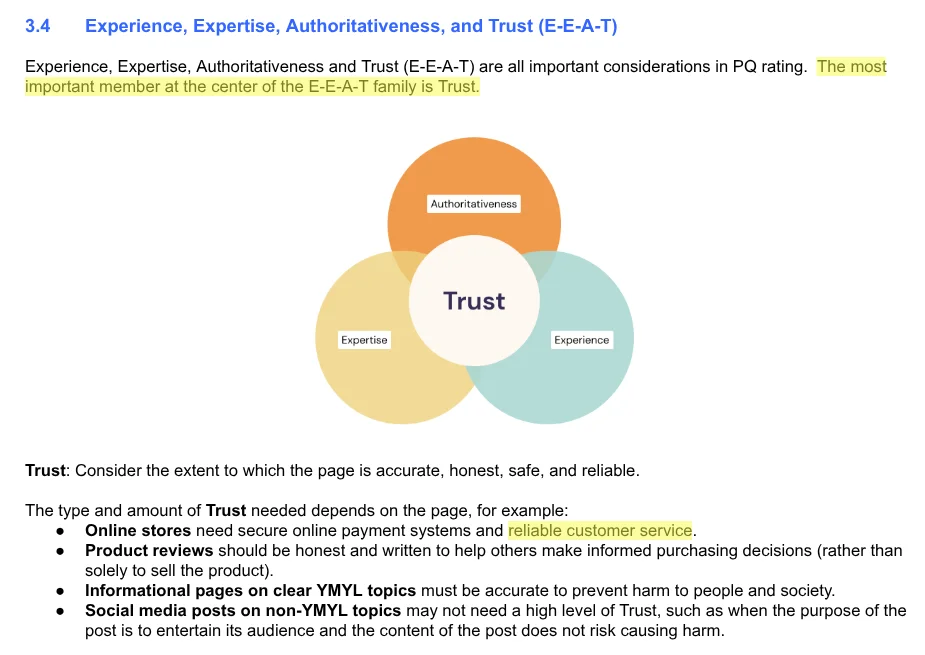
Core updates are tightly connected to E-E-A-T. Google says that trust is the most important aspect of E-E-A-T. The quality rater guidelines, which serve as guidance to help Google’s quality raters who help train their AI systems to improve in producing high quality search algorithms, mention “trust” 191 times.

For online stores, the raters are told that reliable customer service is vitally important.

Image Credit: Marie Haynes

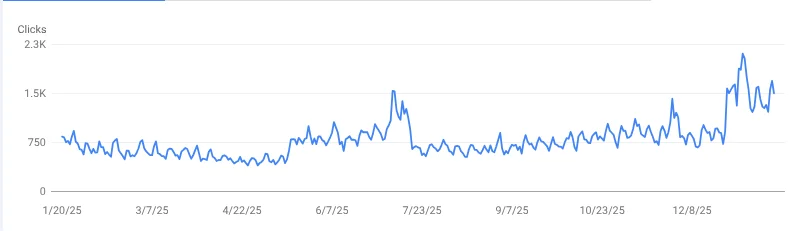
A few bad reviews aren’t likely to tank your rankings, but this business had previously had significant logistical problems with shipping. They had been working hard to rectify these. Yet, if I asked AI Mode to tell me about the reputation of this company compared to their competitors, it would always tell me that there were serious concerns.

Here’s an interesting prompt you can use in AI Mode:

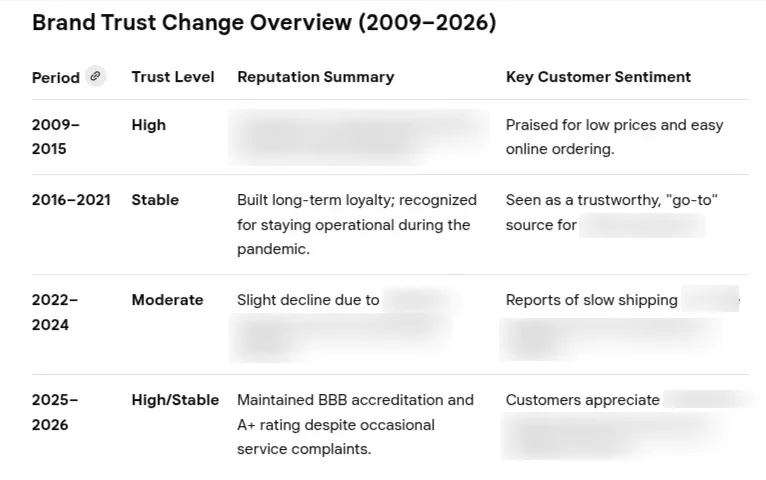
Make a chart showing the perceived trust in [url or brand] over time.

You can see that finally in 2025 the overall trust in this brand improved.

Image Credit: Marie Haynes

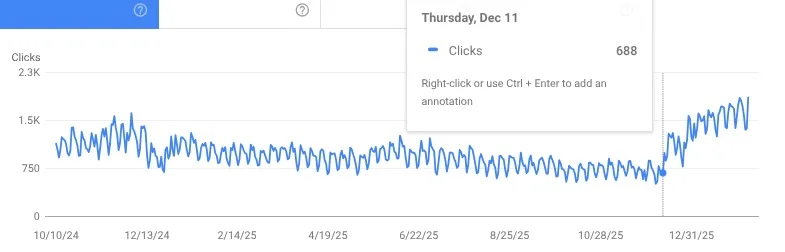
My suspicion is that these trust issues were the main driver in their core update suppression. I can’t say whether it was the improvement in customer trust that made a difference, the improvements in quality we made, or perhaps both. But these results were so good to see.

Image Credit: Marie Haynes

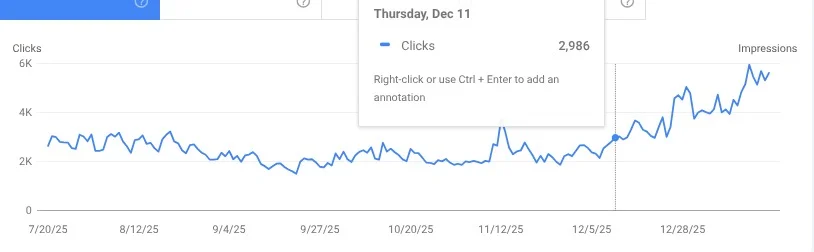
They continue to improve. Google recommends them more often in Popular Products carousels, ranks them more highly for many important terms and more importantly, drives far more sales for them now.

2. Original Content Takes A Lot Of Work

The next site is another site that was impacted by a core update.

This site is an affiliate site that writes about a large ticket product. They have a lot of competition from some big players in their industry. When I reviewed their site, one thing was obvious to me. While they had a lot of content, most of it offered essentially the same value as everyone else. This was frustrating considering they actually did purchase and review these products. What they were writing about was mostly a collection of known facts on these products rather than their personal experience. And what was experiential was buried in massive walls of text that were difficult for readers to navigate.

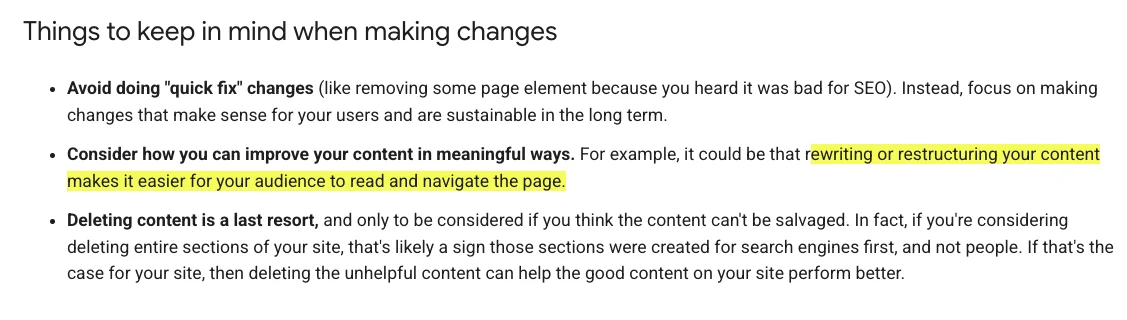
Google’s guidance on core updates recommends that if you were impacted, you should consider rewriting or restructuring your content to make it easier for your audience to read and navigate the page.

Image Credit: Marie Haynes

This site put an incredible amount of work into improving their content quality:

  • They purchased the products they reviewed and took detailed photos of everything they discussed. And videos. Really helpful videos.
  • The blog posts were written by an expert in their field. This already was the case, but we worked on making it more clear what their expertise was and why it was helpful.
  • We brainstormed with AI to help us come up with ideas for adding helpful unique information that was borne from their experience and not likely to be found on other sites.
  • We used Microsoft Clarity to identify aspects on pages that were frustrating users and worked to improve them.
  • We added interactive quizzes to help readers and drive engagement.
  • We worked on improving freshness for every important post, ensuring they were up to date with the latest information.
  • We worked to really get in the shoes of a searcher and understand what they wanted to see. We made sure that this information was easy to find even if a reader was skimming.
  • We broke up large walls of text into chunks with good headings that were easy to skim and navigate.
  • We noindexed pages that were talking on YMYL topics for which they lacked expertise.
  • We worked on improving core web vitals. (Note: I don’t think this is a huge ranking factor, but in this case the largest contentful paint was taking forever and likely frustrated users.)

Once again, it took many months of tireless work before improvements were seen! Rankings improved to the first page for many important keywords and some moved from page 4 to position #1-3.

Image Credit: Marie Haynes

3. Work To Improve User Experience

This next site was not a long term client, but rather, a site review I did for an eCommerce site in an YMYL niche. The SEO working on this site applied many of my recommendations and made some other smart changes as well including:

  • Improving site navigation and hierarchy.
  • Improved UX. They have a nicer, more modern font. The site looks more professional.
  • Improved customer checkout flow which improved checkout abandonment rates.
  • Improved their About Us page to add more information to demonstrate the brand’s experience and history. Note: I don’t think this matters immensely to Google’s algorithms as most of their assessment of trust is made from off-site signals, but it may help users feel more comfortable with engaging.
  • Produced content around some topics that were gaining public attention. This did help to truly earn some new links and mentions from authoritative sources.

After making these changes, the site was able to procure a knowledge panel for brand searches. And, search traffic is climbing.

Image Credit: Marie Haynes

4. First Hand Experience Can Really Help

This next site is another one that I did a site review for. It is a city guide that monetizes through affiliate links and sponsors. For every page I looked at I came to the same conclusion: There was nothing on this page that couldn’t be covered by an AI Overview. Almost every piece of information was essentially paraphrased from somewhere else on the web.

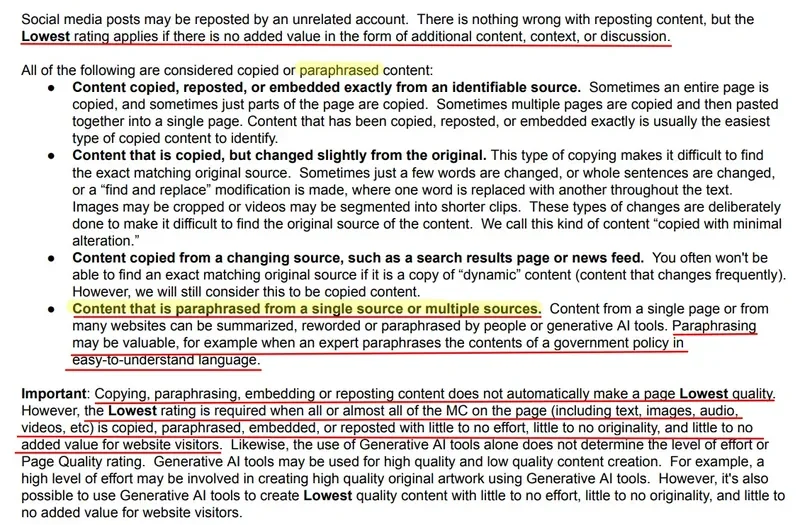
The most recent update to the rater guidelines increased the use of the word “paraphrased” from 3 mentions to 25. I think this applies to a lot of sites!

Image Credit: Marie Haynes

and

Image Credit: Marie Haynes

and also,

Image Credit: Marie Haynes

Yet, when I spoke with the site owner she shared to me that they had on-site writers who were truly writing from their experience.

While I don’t know specifically what changes this site owner has made, I looked at several pages that had seen nice improvements in conjunction with the core update and noticed the following improvements:

  • They’ve added video to some posts – filmed by their team.
  • There’s original photography from their team – not taken from elsewhere on the web. Not every photo is original, but quite a few of them are.
  • Added information to help readers make their decision, like “This place is best for…” or, “Must try dishes include…”
  • They wrote about their actual experiences. Rather than just sharing what dishes were available at a restaurant, they share which ones they tried and how they felt they stood out compared to other restaurants.
  • They’ve worked to keep content updated and fresh.

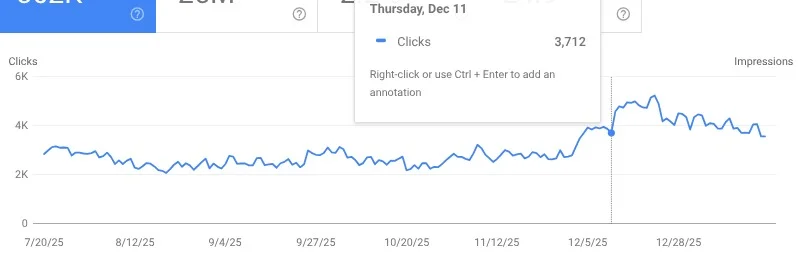
This site saw some nice improvements. However, they still have ground to gain as they previously were doing much better in the days before the helpful content updates.

Image Credit: Marie Haynes

Some Thoughts For Sites That Have Not Done Well

The December 2025 core update had a devastating negative impact on many sites. If you were impacted, your answer is unlikely to lie in technical SEO fixes, disavowing links or building new links. Google’s ranking systems are a collection of AI systems that work together with one goal in mind – to present searchers with pages that they are likely to find helpful. Many components of the ranking systems are deep learning systems which means that they improve on these recommendations over time.

I’d recommend the following for you:

1. Consider Whether The Brand Has Trust Issues

You can try the AI Mode prompt I used above. A few bad reviews is not going to cause you a core update suppression. But, a prolonged history of repeated customer service frustrations, fraud or anything else that significantly impacts your reputation can seriously impact your ability to rank. This is especially true if you are writing on YMYL topics.

2. Look At How Your Content Is Structured

It is a helpful exercise to look at which pages Google’s algorithms are ranking for your queries. If they don’t seem to make sense to you, look at how quickly they get people to the answer they are trying to find. I have found that often sites that are impacted make their readers scroll through a lot of fluff or ads to get to the important bits. Improve your headings – not for search engines, but for readers who are skimming. Put the important parts at the top. Or, if that’s not feasible, make it really easy for people to find the “main content”.

Here’s a good exercise – Open up the rater guidelines. These are guidelines for human raters who help Google understand if the AI systems are producing good, helpful rankings. CTRL-F for “main content” and see what you can learn.

3. Really Ask Yourself Whether Your Content Is Mostly “Commodity Content”

Commodity content is information that is widely available in many places on the web. There was a time when a business could thrive by writing pages that aggregate known information on a topic. Now that Google has AI Overviews and AI Mode, this type of page is much less valuable. You will still see some pages cited in AI Overviews that essentially parrot what is already in the AIO. Usually these are authoritative sites which are helpful for readers who want to see information from an authority rather than an AI answer.

Liz Reid from Google said these interesting words in an interview with the WSJ:

“What people click on in AI Overviews is content that is richer and deeper. That surface level AI generated content, people don’t want that, because if they click on that they don’t actually learn that much more than they previously got. They don’t trust the result any more across the web. So what we see with AI Overviews is that we sort of surface these sites and get fewer, what we call bounced clicks. A bounced click is like, you click on this site and you’re like, “Ah, I didn’t want that” and you go back. And so AI Overviews give some content and then we get to surface sort of deeper, richer content, and we’ll look to continue to do that over time so that we really do get that creator content and not AI generated.”

Here is a good exercise to try on some of the pages that have declined with the core update. Give your url or copy your page’s content into your favourite LLM and use this prompt:

“What are 10 concepts that are discussed in this page? For each concept tell me whether this topic has been widely written about online. Does this content I am sharing with you add anything truly uniquely interesting and original to the body of knowledge that already exists? Your goal here is to be brutally honest and not just flatter me. I want to know if this page is likely to be considered commodity content or whether it truly is content that is richer and deeper than other pages available on the web.”

You can follow this up with this prompt:

“Give me 10 ideas that I can use to truly create content that goes deeper on these topics? How can I draw from my real world experience to produce this kind of content?”

Concluding Thoughts

I’ve been studying Google updates for a long time – since the early days of Panda and Penguin updates. I built a business on helping sites recover following Google update hits. However, over the years I have found it is increasingly more difficult for a site that is impacted by a Google update to recover. This is why today, although I do still love doing site reviews to give you ideas for improving, I generally decline doing work with sites that have been strongly impacted by Google updates. While recovery is possible, it generally takes a year or more of hard work and even then, recovery is not guaranteed as Google’s algorithms and people’s preferences are continually changing.

The sites that saw nice recovery with this Google update were sites that worked on things like:

  • Truly improving the world’s perception of their customer service.
  • Creating original and insightful content that was substantially better than other pages that exist.
  • Using their own imagery and videos in many cases.
  • Working hard to improve user experience.

If you missed it I recently published this video that talks about what we learned about the role of user satisfaction signals in Google’s algorithms. Traditional ranking factors create an initial pool of results. AI systems rerank them, working to predict what the searcher will find most helpful. And the quality raters as well as live users in live user tests help fine-tune these systems.

And here are some more blog posts that you may find helpful:

Ultimately, Google’s systems work to reward content that users are likely to find satisfying. Your goal is to be the most helpful result there is!

More Resources:


Read Marie’s newsletter AI News You Can Use, subscribe now.


Featured Image: Jack_the_sparow/Shutterstock

Agentic Commerce Optimization: A Technical Guide To Prepare For Google’s UCP via @sejournal, @alexmoss

In January, I wrote about the birth of agentic commerce through both Agentic Commerce Protocol (ACP) and Universal Commerce Protocol (UCP), and how this could impact us all as consumers, business owners, and SEOs. As we still sit on waitlists for both, this doesn’t mean that we can’t prepare for it.

UCP fixes a real-life problem for many, minimizing the fragmented commerce journey. Instead of building separate integrations for every agent platform as we have been mostly doing in the past, you can now [theoretically] integrate once and will integrate seamlessly with other tools and platforms.

But note here that, as opposed to ACP which focuses more so on the checkout → fulfillment → payment journey, UCP goes beyond this with six capabilities covering the entire commerce lifecycle.

This, of course, will impact an SEO’s ambit. As we shift from optimizing for clicks to optimizing for selection, we also need to ensure that it’s you/your client that is selected through data integrity, product signals, and AI-readable commerce capabilities. Structured data has always served an important role for the internet as a whole and will continue to be the driving force on how you can serve agents, crawlers, and humans in the best way possible.

I allude to a possible new acronym “ACO” – Agentic Commerce Optimization – and the following could be considered the closest we can get to guidelines on how we undertake it.

UCP Isn’t Coming, It’s Here

UCP was only announced in January, but there’s already confirmation that its capabilities are rolling out. On Feb. 11, 2026, Vidhya Srinivasan (VP/GM of Advertising & Commerce at Google) announced that Wayfair and Etsy now use UCP so that you can purchase directly within AI Mode, and was observed the next day by Brodie Clark.

UCP’s Six Layered Capabilities

On the day UCP was released, Google explained its methodology.

From this, I defined six core capabilities:

  1. Product Discovery – how agents find and surface your inventory during research.
  2. Cart Management – multi-item baskets, dynamic pricing, complex basket rules.
  3. Identity Linking – OAuth 2.0 authorization for personalized experiences and loyalty.
  4. Checkout – session creation, tax calculation, payment handling.
  5. Order Management – webhook-based lifecycle and logistical updates.
  6. Vertical Capabilities – extensible modules for specialized use cases like travel booking windows or subscription schedules.

UCP’s schema authoring guide shows how capabilities are defined through versioned JSON schemas, which act as the foundation of the protocol. When it comes to considering this as an SEO, properties such as offers, aggregateRating, and shippingDetails aren’t just for surfacing rich snippets, etc., for product discovery, they’re now what agents query during the entire process.

Schema Is, And Will Continue To Be, Essential

UCP’s technical specification uses its own JSON schema-based vocabulary. Whilst it doesn’t build on schema.org directly, it remains critical in the broader ecosystem. As Pascal Fleury Fleury said at Google Search Central Live in December, “schema is the glue that binds all these ontologies together”. UCP handles the transaction; schema.org helps agents decide who to transact with.

Ensure you’re on top of and populate product schema as much as you can. It may seem like SEO 101. Regardless, audit all of this now to ensure you’re not missing anything when UCP really rolls out.

This includes checks on:

  • Product schema (with complete coverage): All core fields: name, description, SKU, GTIN, brand, related images, and offers.
  • Offers must include: Price, priceCurrency, availability, URL, seller. Add aggregateRating and review to ensure you have positive third-party perspective.
  • Ensure all product variants output correctly.
  • Include shippingDetails with delivery estimates.
  • Organization and Brand: Assists with “Merchant of Record” verification. If you’re not an Organization, then fallback to Person.
  • Designated FAQPage: Ensure you have an FAQpage as these can be incorporated alongside product-level FAQs and used as part of its decision-making.

Prepare Your Merchant Center Feed

UCP will utilize your existing Merchant Center feed as the discovery layer. This means that beyond the normal on-site schema you provide, Merchant Center itself requires more details that you can populate within its platform.

  • Return policies (required to be a Merchant of Record): Complete all return costs, return windows, and policy links. These will be used not just within the checkout and transactional areas, but again a consideration for selection at all. Advanced accounts need policies at each sub-account level.
  • Customer support information: Not only would initial information be offered to the customer, but there may be ways in which entry-level customer support queries can be completely managed, thus increasing customer satisfaction while minimizing customer support agent capacity.
  • Agentic checkout eligibility: Add the native_commerce attribute to your feed, as products are only eligible here if this is set up.
  • Product identifiers: Each product must have an ID, and correlate to the product ID when using the checkout API.
  • Product consumer warnings: Any product warning should assert the consumer_notice attribute.

Google recommends that this be done through a supplemental data source in Merchant Center rather than modifying your primary feed, which would prevent incorrect formatting or other invalidation.

Lastly, double-check if the products you’re selling aren’t included within its product restrictions list, as there are several that, if you do offer those things, you should consider how to manage alongside the abilities of UCP.

Optimizing Conversational Commerce Attributes

Within the UCP blog post announcement, Srinivasan introduced a way for more clarity with conversational commerce attributes:

“…we’re announcing dozens of new data attributes in Merchant Center designed for easy discovery in the conversational commerce era, on surfaces like AI Mode, Gemini and Business Agent. These new attributes complement retailers’ existing data feeds and go beyond traditional keywords to include things like answers to common product questions, compatible accessories or substitutes.”

These provide further clarity (and therefore minimize hallucinations) during the discovery process in order to be selected or ruled out.

Not only would this incorporate product and brand-related FAQs, but take this a step further to also consider:

  • Compatibility: Potential up-sell opportunities.
  • Substitution: An opportunity for dealing with out-of-stock items.
  • Related products: Great for cross-sell opportunities.

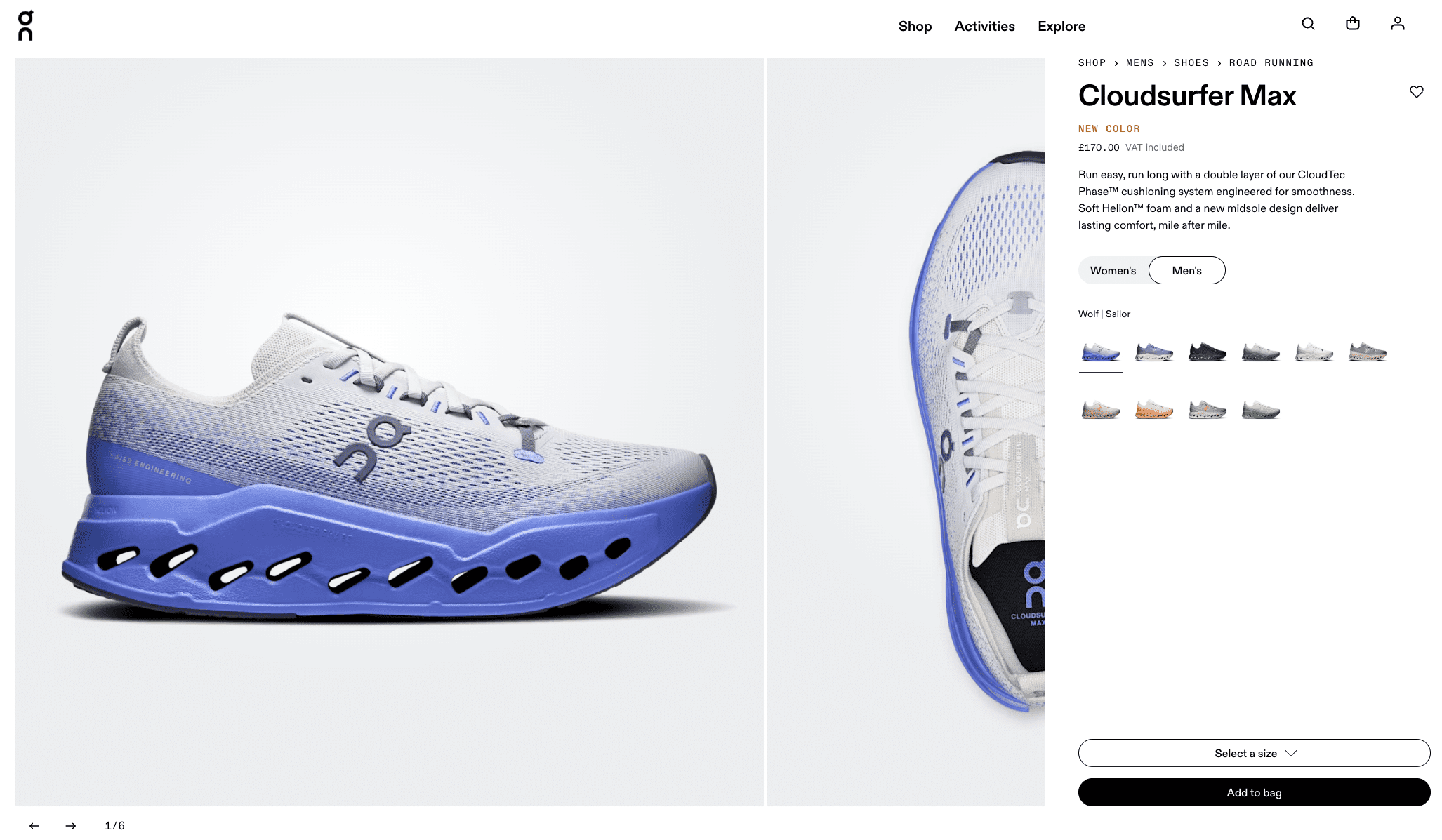
Furthermore, this can be used to become even more specific, moving beyond basic attributes to agent-parseable details. Now, if a product is “purple” on a basic level, “dark purple” or even something unobvious, such as “Wolf” (real example below), may be more appropriate for finer detail while still falling under “purple.” The same can be considered for sizes, materials (or a mixture of materials), etc.

Multi-Modal Fan-Out Selection

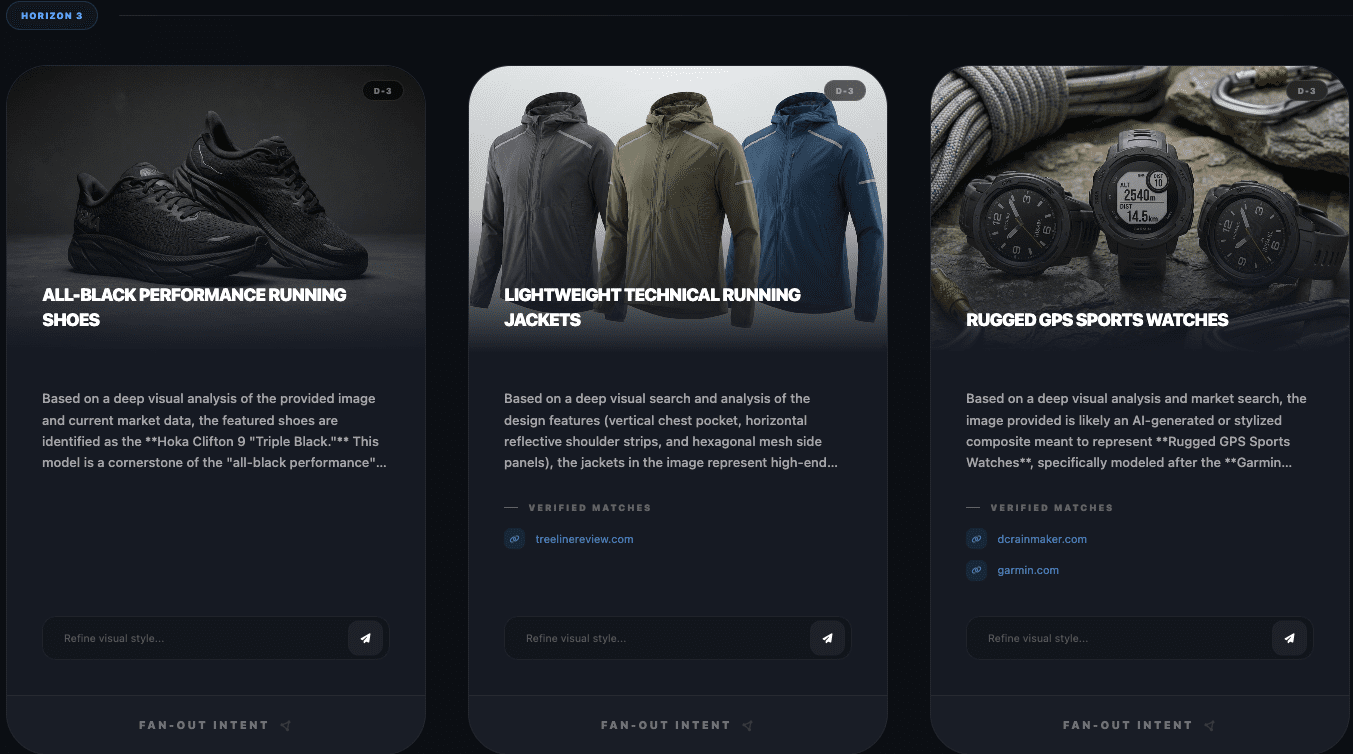
When executed well, optimizing for conversational commerce attributes will increase the possibility of selection within fan-out query results. When considering some of these attributes, it is worth looking at tools, such as WordLift’s Visual Fan-Out simulator, which illustrates how a single image decomposes into multiple search intents, revealing which attributes agents may prioritize when performing query fan-out. But how would this look?

As an example, I used one product image and browsed downward three horizons. Using On’s Cloudsurfer Max as an example (used with permission):

Cloudsurfer Max in the colour “Wolf”
Image credit: On

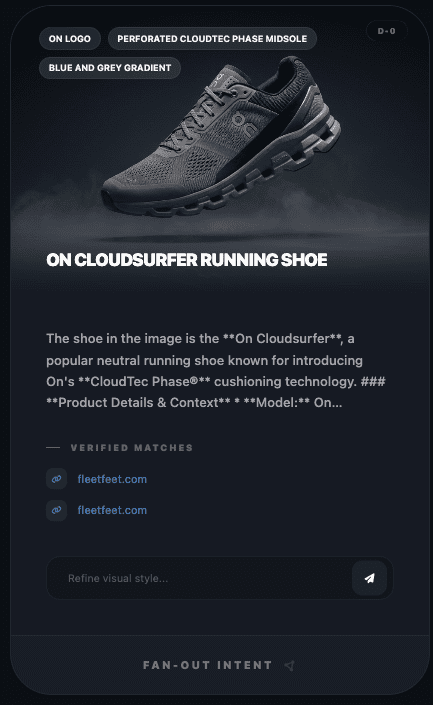
Using just one product image, this is what is presented on the surface:

Screenshot from WordLift’s Visual Fan-Out simulator, February 2026

It immediately noticed that the product was On, and specifically from the Cloudsurfer range. Great start! Now let’s see what it sees over the horizon:

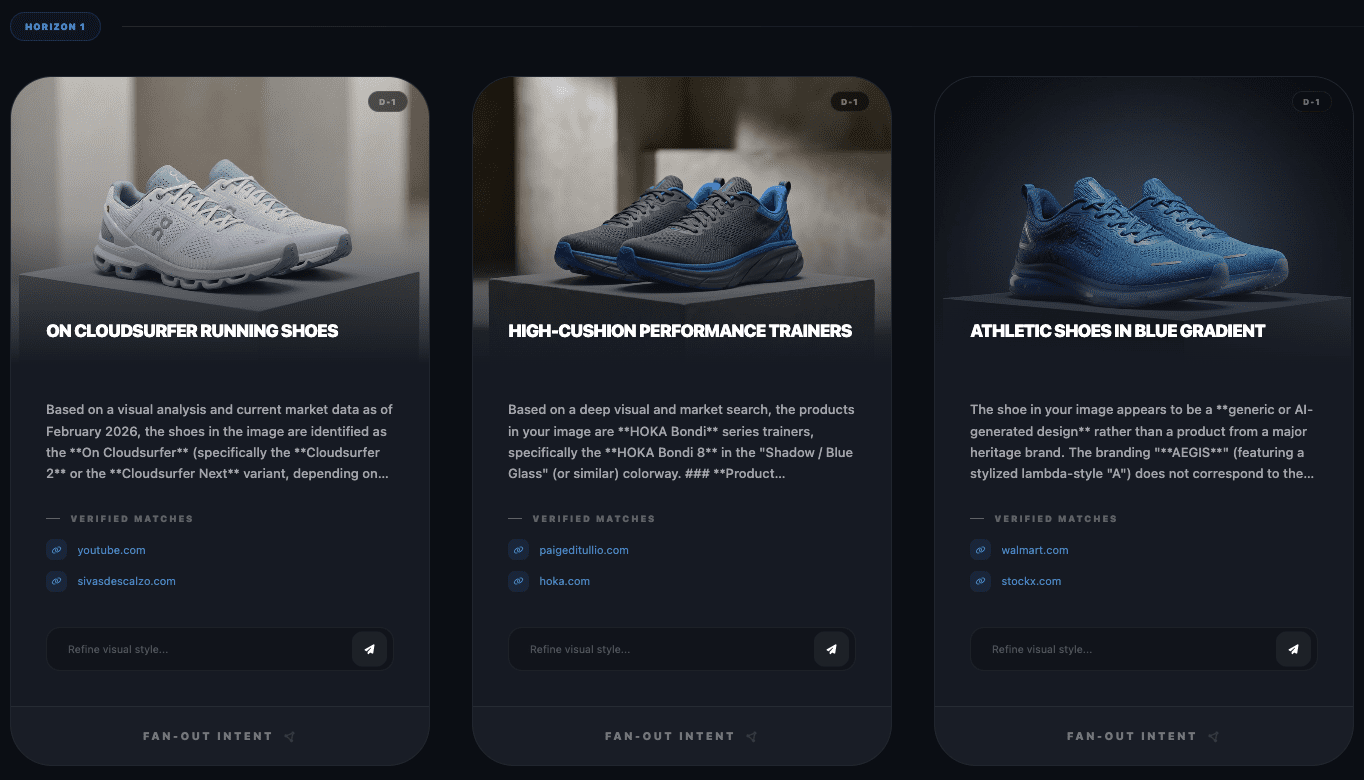
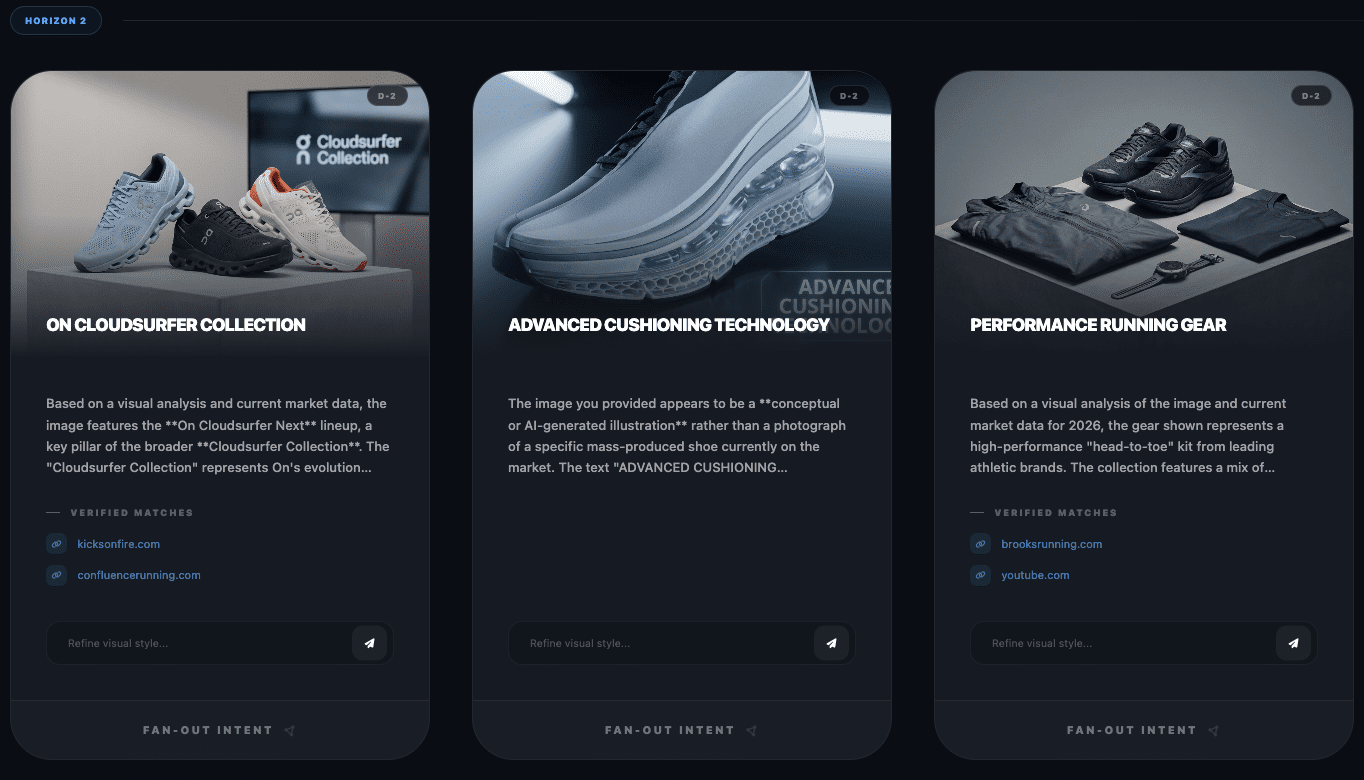
Screenshot from WordLift’s Visual Fan-Out simulator, February 2026

Here, you can draw inspiration or direction on how best to place yourself for potential and likely fan-out queries. With this example, I found it interesting that Horizon 2 mentions performance running gear as a large category, then when performing fan-out on that showed the related products around gear in general. This shows how wide LLMs consider selection and how you can present attributes to attract selection.

UCP’s Roadmap Is Expanding Into Multi-Verticals

UCP is already planning to go beyond one single purchase but expands beyond retail into travel, services, and other verticals. Its roadmap details several priorities over the coming year, including:

  • Multi‑item carts and complex baskets: Moving beyond single‑item checkout to native multi‑item carts, bundling, promotions, tax/shipping logic, and more realistic fulfillment handling.
  • Loyalty and account linking: Standardized loyalty program management and account linking so agents can apply points, member pricing, and benefits across merchants.
  • Post‑purchase support: Support for order tracking, returns, and customer‑service handoff so agents can manage customer support post-sale.
  • Personalization signals: Richer signals for cross‑sell/upsell, wishlists, history, and context‑based recommendations.
  • New verticals: Expansion beyond retail into travel, services, digital goods, and food/restaurant use cases via extensions to the protocol.

Each of the points above is worth further reading and consideration if this is something your brand may offer. Furthermore, its plans to expand beyond retail into travel, services, digital goods, and hospitality mean that, if you’re working within any of these verticals, you need to be even more prepared to ensure eligibility.

Social Proof And Third-Party Perspective

Regardless of how well you may optimize on-site to prepare for UCP, all this data integrity still needs to be validated by trusted third-party sources.

Third-party platforms, such as Trustpilot and G2, appear to be frequently cited and trusted among most of the LLMs, so I’d still advise that you continue to collect those positive brand and product reviews in order to satisfy consensus, resulting in more opportunities to be selected during product discovery.

TL;DR – Prepare Now

If you own or manage any form of ecommerce site, now is the time to ensure you’re preparing for UCP’s rollout as soon as possible. It’s only a matter of time, and with AI Mode spreading into default experiences, getting ahead of the rollout is essential.

  1. Join the UCP waitlist.
  2. Prepare Merchant Center: return policies, native_commerce attribute.
  3. Ensure your developers research and understand the UCP documentation.
  4. Populate conversational attributes: question-answers, compatibility, substitutes.
  5. Audit and improve any schema where applicable.

This is moving faster than most previous commerce shifts, and brands that wait for full rollout signals will already be behind. This isn’t a short-term LLM gimmick but is part of the largest change in the ecommerce space.

More Resources:


Featured Image: Roman Samborskyi/Shutterstock

SEO Fundamental: Google Explains Why It May Not Use A Sitemap via @sejournal, @martinibuster

Google’s John Mueller answered a question about why a Search Console was providing a sitemap fetch error even though server logs show that GoogleBot successfully fetched it.

The question was asked on Reddit. The person who started the discussion listed a comprehensive list of technical checks that they did to confirm that the sitemap returns a 200 response code, uses a valid XML structure, indexing is allowed and so on.

The sitemap is technically valid in every way but Google Search Console keeps displaying an error message about it.

The Redditor explained:

“I’m encountering very tricky issue with sitemap submission immediately resulted `Couldn’t fetch` status and `Sitemap could not be read` error in the detail view. But i have tried everything I can to ensure the sitemap is accessible and also in server logs, can confirm that GoogleBot traffic successfully retrieved sitemap with 200 success code and it is a validated sitemap with URL – loc and lastmod tags.

…The configuration was initially setup and sitemap submitted in Dec 2025 and for many months, there’s no updates to sitemap crawl status – multiple submissions throughout the time all result the same immediate failure. Small # of pages were submitted manually and all were successfully crawled, but none of the rest URLs listed in sitemap.xml were crawled.”

Google’s John Mueller answered the question, implying that the error message is triggered by an issue related to the content.

Mueller responded:

“One part of sitemaps is that Google has to be keen on indexing more content from the site. If Google’s not convinced that there’s new & important content to index, it won’t use the sitemap.”

While Mueller did not use the phrase “site quality,” site quality is implied because he says that Google has to be “keen on indexing more content from the site” that is “new and important.”

That implies two things, that maybe the site doesn’t produce much new content and that the content might not be important. The part about content being important is a very broad description that can mean a lot of things and not all of those reasons necessarily mean that the content is low quality.

Sometimes the ranked sites are missing an important form of content or a structure that makes it easier for users to understand a topic or come to a decision. It could be an image, it could be a step by step, it could be a video, it could be a lot of things but not necessarily all of them. When in doubt, think like a site visitor and try to imagine what would be the most helpful for them. Or it could  be that the content is trivial because it’s thin or not unique. Mueller was broad but I think circling back to what makes a site visitor happy is the way to identify ways to improve content.

Featured Image by Shutterstock/Asier Romero

Email Marketing Awaits True AI

Artificial intelligence has not yet fulfilled its email marketing potential, at least not without human help.

There is a maturation gap between the AI-powered email that marketers can imagine and the campaigns they can actually create. Filling this gap could be a significant opportunity.

Email Endures

Email marketing should seemingly be obsolete. The first “email,” after all, occurred in October 1971, nearly 55 years ago.

Surely, social media platforms, text messaging, and various applications such as WhatsApp and Discord could have supplanted it. And let’s not forget the grim industry concerns when Gmail introduced the “Promotions” tab in 2013. Today, AI inbox summaries are the latest marketing threat.

Nonetheless, for many ecommerce businesses, email continues to produce a disproportionate share of revenue. The channel remains durable not because it is novel, but because it is owned, measurable, and tightly connected to shopper behavior.

Female in front of a laptop engaging with email

The potential of AI-driven email marketing lies in targeting each shopper individually.

Relevant

As an example, self-described email marketing nerd Chase Dimond recently posted on X his ecommerce email marketing recommendations.

Diamond’s “7 Types of Emails Every Ecom Store Should Send” and “4 Must-Send Ecommerce Emails” describe traditional, pre-AI tactics.

His recommendations imply that core campaigns — abandoned cart reminders, urgency-driven promotions, referral requests, content-led engagement sequences — still convert. The underlying psychology of timing, relevance, and motivation has not suddenly expired.

Audience of One

This apparent status quo, however, does not mean that email marketing cannot evolve. We expect artificial intelligence to be disruptive.

To this end, AI’s greatest potential:

  • Enables segmentation at the audience-of-one level,
  • Delivers the right offer to the right person at the exact moment it will convert,
  • Achieves precise, individualized relevance.

True AI means every subscriber becomes a segment of one, combining behavioral signals, predictive intent, contextual timing, and offer economics. The result is an individualized experience optimized for conversion.

I see four requirements for this sort of AI-powered email.

  • Predictive personalization. The AI automation must evaluate a shopper’s evolving propensity to purchase specific products or respond to particular offers. Where rule-based segments might separate “high value customers” from “lapsed buyers,” a predictive model determines when a specific individual is ready to buy, and what offer is most persuasive.
  • Contextual timing. Pre-AI workflows fire fixed triggers based on cart or browse abandonments. AI should identify not only the event but the best moment for conversion.
  • Offer optimization. Rather than blasting a single discount or incentive to every subscriber, an AI system can adjust its amount or type. Shopper A responds to free shipping, while shopper B requires a small bonus.
  • Scalable to individual behavior. In theory, AI could generate thousands or millions of unique message variations tailored to individual behavior and propensity. It could orchestrate dynamic sequence choices, conditional messaging paths, and offer decisions — all without human interaction.

An audience of one redefines email marketing.

The Gap

Unfortunately that vision is not achievable today. AI is currently more of an email marketing assistant than a personalized engine.

Certainly it can streamline campaign variations, generating, for example, multiple subject lines and tests. Many email platforms now include native support for real-time behavioral scoring, predictive intent, individualized offers, and send-time optimization.

Yet the gulf between possibility and practical tooling is why many marketers say “AI isn’t there yet.” The potential remains high, but the infrastructure is still emerging.

In the meantime, creative email marketers can experiment with audience-of-one approximations by stitching together existing technologies, such as:

  • Workflow automation tools knit disparate systems that function autonomously once created. Providers include Zapier, Make, and n8n.
  • Recommenders. Platforms such as Recombee and Luigi’s Box can drive product and offer recommendations. These too can sync with workflow automations.

Until platforms close the gap, experimentation and integration are likely to shape competitive advantage, enabling some ecommerce email marketers to approximate individualized messaging well before such capabilities become standard features.

Measles cases are rising. Other vaccine-preventable infections could be next.

There’s a measles outbreak happening close to where I live. Since the start of this year, 34 cases have been confirmed in Enfield, a northern borough of London. Most of those affected are children under the age of 11. One in five have needed hospital treatment.

It’s another worrying development for an incredibly contagious and potentially fatal disease. Since October last year, 962 cases of measles have been confirmed in South Carolina. Large outbreaks (with more than 50 confirmed cases) are underway in four US states. Smaller outbreaks are being reported in another 12 states.

The vast majority of these cases have been children who were not fully vaccinated. Vaccine hesitancy is thought to be a significant reason children are missing out on important vaccines—the World Health Organization described it as one of the 10 leading threats to global health in 2019. And if we’re seeing more measles cases now, we might expect to soon see more cases of other vaccine-preventable infections, including some that can cause liver cancer or meningitis.

Some people will always argue that measles is not a big deal—that infections used to be common, and most people survived them and did just fine. It is true that in most cases kids do recover well from the virus. But not always.

Measles symptoms tend to start with a fever and a runny nose. The telltale rash comes later. In some cases, severe complications develop. They can include pneumonia, blindness, and inflammation of the brain. Some people won’t develop complications until years later. In rare cases, the disease can be fatal.

Before the measles vaccine was introduced, in 1963, measles epidemics occurred every two to three years, according to the WHO. Back then, around 2.6 million people died from measles every year. Since it was introduced, the measles vaccine is thought to have prevented almost 59 million deaths.

But vaccination rates have been lagging, says Anne Zink, an emergency medicine physician and clinical fellow at the Yale School of Public Health. “We’ve seen a slow decline in people who are willing to get vaccinated against measles for some time,” she says. “As we get more and more people who are at risk because they’re unvaccinated, the higher the chances that the disease can then spread and take off.”

Vaccination rates need to be at 95% to prevent measles outbreaks. But rates are well below that level in some regions. Across South Carolina, the proportion of kindergartners who received both doses of the MMR vaccine, which protects against measles as well as mumps and rubella, has dropped steadily over the last five years, from 94% in 2020-2021 to 91% in 2024-2025. Some schools in the state have coverage rates as low as 20%, state epidemiologist Linda Bell told reporters last month.

Vaccination rates are low in London, too. Fewer than 70% of children have received both doses of their MMR by the time they turn five, according to the UK Health Security Agency. In some boroughs, vaccination rates are as low as 58%. So perhaps it’s not surprising we’re seeing outbreaks.

The UK is one of six countries to have lost their measles elimination status last month, along with Spain, Austria, Armenia, Azerbaijan, and Uzbekistan. Canada lost its elimination status last year.

The highly contagious measles could be a bellwether for other vaccine-preventable diseases. Zink is already seeing signs. She points to a case of polio that paralyzed a man in New York in 2022. That happened when rates of polio vaccination were low, she says. “Polio is a great example of … a disease that is primarily asymptomatic, and most people don’t have any symptoms whatsoever, but for the people who do get symptoms, it can be life-threatening.”

Then there’s mumps—another disease the MMR vaccine protects against. It’s another one of those infections that can be symptom-free and harmless in some, especially children, but nasty for others. It can cause a painful swelling of the testes, and other complications include brain swelling and deafness. (From my personal experience of being hospitalized with mumps, I can attest that even “mild” infections are pretty horrible.)

Mumps is less contagious than measles, so we might expect a delay between an uptick in measles cases and the spread of mumps, says Zink. But she says that she’s more concerned about hepatitis B.

“It lives on surfaces for a long period of time, and if you’re not vaccinated against it and you’re exposed to it as a kid, you’re at a really high risk of developing liver cancer and death,” she says.

Zink was formerly chief medical officer of Alaska, a state that in the 1970s had the world’s highest rate of childhood liver cancer caused by hepatitis B. Screening and universal newborn vaccination programs eliminated the virus’s spread.

Public health experts worry that the current US administration’s position on vaccines may contribute to the decline in vaccine uptake. Last month the US Centers for Disease Control and Prevention approved changes to childhood vaccination recommendations. The agency no longer recommends the hepatitis B vaccine for all newborns. The chair of the CDC’s vaccine advisory panel has also questioned broad vaccine recommendations for polio.

Even vitamin injections are being refused by parents, says Zink. A shot of vitamin K at birth can help prevent severe bleeding in some babies. But recent research suggests that parents of 5% of newborns are refusing it (up from 2.9% in 2017).

“I can’t tell you how many of my pediatric [doctor] friends have told me about having to care for a kiddo in the ICU with … bleeding into their brain because the kid didn’t get vitamin K at birth,” says Zink. “And that can kill kids, [or have] lifelong, devastating, stroke-like symptoms.”

All this paints a pretty bleak picture for children’s health. But things can change. Vaccination can still offer protection to plenty of people at risk of infection. South Carolina’s Department of Public Health is offering free MMR vaccinations to residents at mobile clinics.

“It’s easy to think ‘It’s not going to be me,’” says Zink. “Seeing kiddos who don’t have the agency to make decisions [about vaccination] being so sick from vaccine-preventable diseases, to me, is one of the most challenging things of practicing medicine.”

This article first appeared in The Checkup, MIT Technology Review’s weekly biotech newsletter. To receive it in your inbox every Thursday, and read articles like this first, sign up here.

Job titles of the future: Breast biomechanic

Twenty years ago, Joanna Wakefield-Scurr was having persistent pain in her breasts. Her doctor couldn’t diagnose the cause but said a good, supportive bra could help. A professor of biomechanics, Wakefield-Scurr thought she could do a little research and find a science-backed option. Two decades later, she’s still looking. Wakefield-Scurr now leads an 18-person team at the Research Group in Breast Health at the University of Portsmouth in the UK. Their research shows that the most effective high-impact-sports bras have underwires, padded cups, adjustable underbands and shoulder straps, and hook-and-eye closures. These bras reduce breast movement by up to 74% when compared with wearing no bra. But movement might not be the only metric that matters.

A biological rarity

Few anatomical structures hang outside of the body unsupported by cartilage, muscle, or bone—meaning there wasn’t much historical research to build on. Wakefield-Scurr’s lab was the first to find that when women run, the motion of the torso causes breasts to move in a three-dimensional pattern—swinging side to side and up and down—as well as moving forward and backward. In an hour of slow jogging, boobs can bounce approximately 10,000 times.

A sports necessity

Wearing a bra that’s too tight can limit breathing. Wearing one that’s too loose can create back, shoulder, and neck pain. Pain can also be caused by the lag between torso and breast movement, which causes what is scientifically known as “breast slap.”

The lab’s research has also found that the physical discomfort of bad bras, combined with the embarrassment of flopping around, is the one of the biggest barriers to exercise for women and that if women have a good sports bra, they’re more willing to go for a run.

An open question

Some bras function by deliberately compressing breasts. Others encapsulate and support each individual breast. But scientists still don’t know whether it’s more biomechanically important to reduce the breasts’ motion entirely, to reduce the speed at which they move, or to reduce breast slap. Will women constantly be forced to choose between the comfort of a stretchier bra and the support of a more restrictive one?

Wakefield-Scurr is excited about new materials she’s tested that tighten or stretch depending on how you move. She’s working with fabric manufacturers and clothing companies to try out their wares.

As more women take up high-impact sports, the need to understand what makes a good bra grows. Wakefield-Scurr says her lab can’t keep up with demand. Their cups runneth over.

Sara Harrison is a freelance journalist who writes about science, technology, and health.

Community service

The bird is a beautiful silver-gray, and as she dies twitching in the lasernet I’m grateful for two things: First, that she didn’t make a sound. Second, that this will be the very last time. 

They’re called corpse doves—because the darkest part of their gray plumage surrounds the lighter part, giving the impression that skeleton faces are peeking out from behind trash cans and bushes—and their crime is having the ability to carry diseases that would be compatible with humans. I open my hand, triggering the display from my imprinted handheld, and record an image to verify the elimination. A ding from my palm lets me know I’ve reached my quota for the day and, with that, the year.

I’m tempted to give this one a send-off, a real burial with holy words and some flowers, but then I hear a pack of streetrats hooting beside me. My city-issued vest is reflective and nanopainted so it projects a slight glow. I don’t know if it’s to keep us safe like they say, or if it’s just that so many of us are ex-cons working court-ordered labor, and civilians want to be able to keep an eye on us. Either way, everyone treats us like we’re invisible—everyone except children.

I switch the lasernet on the bird from electrocute to incinerate and watch as what already looked like a corpse becomes ashes.

“Hey, executioner!” says a girl.

“Executioner” is not my official title. The branch of city government we work for is called the Department of Mercy, and we’re only ever called technicians. But that doesn’t matter to the child, who can’t be more than eight but has the authority of a judge as she holds up a finger to point me out to her friends.

bird talon

HENRY HORENSTEIN

“Guys, look!” she says, then turns her attention to me. “You hunting something big?”

I shake my head, slowly packing up my things.

“Something small?” she asks. Then her eyes darken. “You’re not a cat killer, are you?”

“No,” I say quickly. “I do horseflies.”

I don’t know why I lied, but as the suspicion leaves her face and a smile returns, I’m glad I did.

“You should come down by the docks. We’ve got flies! Make your quota in a day.”

The girl tosses her hair, making the tinfoil charms she’s wrapped around her braids tinkle like wind chimes. 

“It’s my last day. But if I get flies again for next year, I’ll swing by.”

Another lie, because we both know the city would never send anyone to the docks for flies. Flies are killed because they are a nuisance, which means people only care about clearing them out of suburbs and financial districts. They’d only send a tech down to the docks to kill something that put the city proper at risk through disease, or by using up more resources than they wanted to spare.

LeeLee is expecting me home to sit through the reassignments with her and it’s already late, so I hand out a couple of the combination warming and light sticks I get for winter to the pack of children with nowhere to go. As I walk away, the children are laughing so loud it sounds like screaming. They toss the sticks in the air like signal flares, small bright cries for help that no one will see.


LeeLee’s anxiety takes the form of caretaking, and as soon as I’ve stepped through the door I can smell bread warming and soup on the stove. I take off my muffling boots. Another day, I’d leave them on and sneak up on her just to be irritating, and she’d turn and threaten me with whatever kitchen utensil was at hand. But she’ll be extra nervous today, so I remove the shoes that let me catch nervous birds, and step hard on my way in.

Sometimes it seems impossible that I can spend a year killing every fragile and defenseless thing I’ve encountered but still take such care with Lee. But I tell myself that the killing isn’t me—it’s just my sentence, and what I do when I have a choice is the only thing that really says anything about me. For the first six months and 400 birds, I believed it.

LeeLee flicks on a smile that lasts a whole three seconds when she sees me, then clouds over again.

“Soup’s too thin. There wasn’t enough powder for a real broth.”

“I like thin soup,” I say.

“Not like this. It doesn’t even cover up the taste of the water.”

“I like the taste of the water,” I say, which breaks her out of her spiraling enough to roll her eyes.

I put my hands on her shoulder to stop her fussing. 

“The soup is going to be fine,” I say. “So will the reassignment.”

I’m not much taller than she is, but when we met in juvie she hadn’t hit her last growth spurt yet, so she still tilts her head back to look me in the eyes. “What if it’s not?”

“It will—”

“What if you get whatever assignment Jordan got?”

There it is. Because two of us didn’t leave juvie together to start community service—three of us did. But Jordan didn’t last three weeks into his assignment before he turned his implements inward.

I notice she doesn’t say What if  I get what Jordan got? Because LeeLee is more afraid of being left alone than of having to kill something innocent.

“We don’t know what his assignment was,” I say.

It’s true, but we do know it was bad. Two weeks into our first stretch, a drug meant to sterilize the city’s feral cat population accidentally had the opposite effect. Everyone was pulled off their assigned duty for three days to murder litters of new kittens instead. It nearly broke me and Lee, but Jordan seemed almost grateful.

“Besides, we don’t know if his assignment had anything to do with … what he did. You’re borrowing trouble. Worry in”—I check my palm—“an hour, when you actually know there’s something to worry about.”

You’d think it would hover over us too insistently to be ignored, but after we sit down and talk about our day I’m at ease, basking in the warmth of her storytelling and the bread that’s more beige than gray today. When the notification comes in, I am well and truly happy, and I can only hope it isn’t for the last time.

We both stiffen when we hear the alert. She looks at me, and I give her a smile and a nod, and then we look down. In the time between hearing the notification and checking it, I imagine all kinds of horrors that could be in my assignment slot. I imagine a picture of kittens, reason enough for the girl I met earlier to condemn me. For a moment, just a flash, I imagine looking down and seeing my own face as my target, or LeeLee’s.

But when I finally see the file, the relief that comes over me softens my spine. It’s a plant. Faceless, and bloodless. 

I look up, and LeeLee’s eyes are dark as she leans forward, studying my face, looking for whatever crack she failed to see in Jordan. I force myself to smile wide for her.

“It’s a plant. I got a plant, Lee.”

She reaches forward and squeezes my hands. Hers are shaking.

“What did you get?” I ask.

She waves away my question. “I got rats. I can handle it. I was just worried about you.”

I spend the rest of the night unbelievably happy. For the next year, I get to kill a thing that does not scream.


“You get all that?” the man behind the desk asks, and I nod even though I didn’t.

I’ve traded in my boots and lasernet for a hazmat suit and a handheld mister with two different solutions. The man had been talking to me about how to use the solutions, but I can’t process verbal information very well. The whole reason I was sent to the correctional facility as a teen was that too many teachers mistook my processing delays for behavioral infractions. I’m planning to read the manual on my own time before I start in a few hours, but when I pick up the mister and look down the barrel, the equipment guy freaks out.

“They were supposed to add sulfur to this batch, but they didn’t. So you won’t smell it. It won’t make you cough or your eyes water. It’ll just be lights out. Good night. You got me?”

“Did you not hear me? Don’t even look at that thing without your mask on.” He takes a breath, calmer now that I’ve lowered my hands. “Look, the first solution—it’s fine. It’s keyed to the plant itself and just opens its cells up for whatever solution we put on it. You could drink the stuff. But that second? The orange vial? Don’t even put it in the mister without your mask on. It dissipates quickly, so you’re good once you’re done spraying, but not a second before.”

He looks around, then leans in. “They were supposed to add sulfur to this batch, but they didn’t. So you won’t smell it. It won’t make you cough or your eyes water. It’ll just be lights out. Good night. You got me?”

I nod again as I grab the mask I hadn’t noticed before. This time when I thank him, I mean it.


It takes me an hour to find the first plant, and when I do it’s beautiful. Lush pink on the inside and dark green on the outside, it looks hearty and primitive. Almost Jurassic. I can see why it’s only in the sewers now: it would be too easy to spot and destroy aboveground in the sea of concrete.

After putting on my mask, I activate the mister and then stand back as it sprays the plant with poison. Nothing happens. I remember the prepping solution and switch the cartridges to coat it in that first. The next time I try the poison, the plant wilts instantly, browning and shrinking like a tire deflating. I was wrong. Plants this size don’t die silently. It makes a wheezing sound, a deep sigh. By the third time I’ve heard it, I swear I can make out the word Please.

sprout

HENRY HORENSTEIN

When I get home, LeeLee’s locked herself in the bathroom, which doesn’t surprise me. I heard that they moved to acid for rats, and the smell of a corpse dissolving is impossible to get used to and even harder to get out of your hair. I eat dinner, read, change for bed, and she’s still in the bathroom. I brush my teeth in the kitchen.


The next morning, I have to take a transport to the plant’s habitat on the other end of the city, so I spend the time looking through the file that came with the assignment. Under “Characteristics,” some city government scientist has written, “Large, dark. Resource-intensive. Stubborn.”

I stare at the last word. Its own sentence, tacked on like an afterthought. Stubborn. The same word that was written in my file when I got sent from school to the facility where I met LeeLee and Jordan. Large, dark, stubborn, and condemned. I’ve never been called resource-intensive. But I have been called a waste.

And maybe that’s why I do it.

When I get to my last plant of the day, I don’t reach for the mister. This one is small, young, the green still neon-bright and the teeth at the edges still soft. I pick it up, careful with its roots, and carry it home. I find a discarded water container along the way and place it inside. When I get home I knock on LeeLee’s door. She doesn’t answer, so I leave the plant on the floor as an offering. They aren’t proper flowers, but they smell nice and earthy. It might keep the residual odor from melted organs, fur, and bones from taking over her room.


“Killing things is a dumb job,” says the girl.

After a week of hearing the death cries of its cousins, I was moved to use some of my allowance to buy cheap fertilizer and growth serum for my plant. The girl and her friends, fewer than before, were panhandling at the megastore across the way. She ran over, braids jingling, as soon as she saw me. I thought she’d leave once I gave her more glowsticks for her friends, but she stayed in step and kept following me.

“It’s not a dumb job,” I say, even though it is. 

“What’s the point?”

I shift my bag to point at the bottom of my vest. Beneath “Mercy Dept.” the department’s slogan is written in cursive: Killing to Save! 

“See?”

She sees the text but doesn’t register it, and I have to remind myself that even getting kicked out of school is a privilege. The city had decided to stop wasting educational resources on me. They’d never even tried with her or the other streetrats.

“It just means we kill to help.”

“That doesn’t make sense.”

Suddenly, all I can think about is Jordan. “Maybe they don’t mind.”

“What?”

I think of the plants. Maybe they hadn’t been pleading. Maybe they’d been sighing with relief. I think of the birds that eventually stopped running away.

“Maybe they’re tired. The city’s right, and their existence isn’t compatible with the world we made. And that’s our fault for being stupid and cruel, but it makes their lives so hard. We’ve made it so they can only live half a life. Maybe the least we can do is finish the job.”

It’s a terrible thing to say—even worse to a kid.

Her eyes go hard. “What are you killing now, executioner?”

The question surprises me. “Sewer plants. Why?”

“I don’t believe you.”

I’d wanted her to leave me alone, but when she runs away I feel suddenly empty.


I have an issue at work when I can’t find my poison vial. I tell them it rolled away in the sewer and I couldn’t catch it in time, because I don’t want to tell them I was unobservant enough to let a street kid steal from me. After a stern warning and a mountain of forms, they issue a new vial and don’t add to my service time.

Pulling overtime to make up for the day I didn’t have my poison means it’s days before I get to fertilize my houseplant. LeeLee’s door is open, so I bring in the fertilizer and serum. She’s put the plant on her windowsill, but it prefers indirect sunlight, so I move it to the shelf next to her boxes of knickknacks and trinkets. I add the fertilizer to its soil and am about to spray it with the growth serum when I get an idea. I get the mister from my kit and set it up to spray the prepping solution on the little plant to prime it. I open the window and put on my mask, just in case, but I’m sure the man was telling the truth when he called the first liquid harmless. After its cells are open, I spray it with my store-bought growth serum.

I’m halfway through making dinner when I hear the crash and run into LeeLee’s room.

“Shit!”

The plant has grown huge, turning adult instantly, and its new weight has taken down LeeLee’s shelf. Dainty keepsake boxes are shattered on our concrete floor.

I bend to my knees quickly, so focused on fixing my mistake that I don’t register the oddness of the items I’m picking up—jacks, kids’ toys, a bow—until my fingers touch something small and shimmering. It’s a scrap of silver, still rounded in the shape of the braids it was taken from.

I got rats. I can handle it.

I’d forgotten the city has more than one kind.


I’m waiting up when Lee gets home. I don’t make her tell me. I just grab her kit and rummage through it. Where my kit has a hazmat suit, hers has a stealth mesh to render her invisible. Where I keep my mister, she has a gun loaded with vials too large for rats. I have a mini-vac to suck up excess plant matter to prevent seeds from sprouting. She has zip ties.

By the time I’m done, she’s already cracking under the weight of everything she tried to protect me from. Within moments she’s sobbing on the floor. I carry her to her bed and get in beside her. I try not to listen too closely as she recounts every horrible moment, but I’m listening at the end, when she tells me she can’t do it anymore. When she confesses that she’s the one who stole my poison, and has only been waiting to take it because she didn’t have the stomach to do to me what Jordan did to us.

I tell her how we’ll make playgrounds of dead data centers and use hoses to fill the holes where skyscrapers were, and kids will play Marco Polo swimming over a CEO’s sunken office.

I leave her for just a moment, but by the time I lie back in bed beside her I’ve figured it out.

I tell her that she won’t have to take her shift tomorrow. I tell her I’m going to go around the city with my mister and my growth serum. That I’ll move plants from sewers to the yards around City Hall and every public space and the support pylons of important people’s companies, and then spray them so they become huge. The city will freak. I tell her it will be like the kittens, but this time we’ll all be pulled off our assignments to kill plants. And maybe the serum will work too well. Maybe the city was right to fear these plants, and they will grow and grow and eat our concrete while the roots crack our foundations and cut our electricity and everything will crumble. And the people with something to lose might suffer, but the rest of us will just laugh at the perfection of rubble. I tell her how we’ll make playgrounds of dead data centers and use hoses to fill the holes where skyscrapers were, and kids will play Marco Polo swimming over a CEO’s sunken office. 

She asks if I’ll put any at our old detention center.

I tell her, Hundreds.

I talk long enough that her eyes close, and loud enough that neither of us can hear the sound of my mister blowing. The man who gave it to me was right. Even without the mask, it doesn’t smell like sulfur. It doesn’t smell like anything. 


Micaiah Johnson’s debut novel, The Space Between Worlds, a Sunday Times bestseller and New York Times Editors’ Choice pick, was named one of the best books of 2020 and one of the best science fiction books of the last decade by NPR. Her first horror novel, The Unhaunting, is due out in fall 2026.

The Download: Microsoft’s online reality check, and the worrying rise in measles cases

This is today’s edition of The Download, our weekday newsletter that provides a daily dose of what’s going on in the world of technology.

Microsoft has a new plan to prove what’s real and what’s AI online

AI-enabled deception now permeates our online lives. There are the high-profile cases you may easily spot. Other times, it slips quietly into social media feeds and racks up views.

It is into this mess that Microsoft has put forward a blueprint, shared with MIT Technology Review, for how to prove what’s real online.

An AI safety research team at the company recently evaluated how methods for documenting digital manipulation are faring against today’s most worrying AI developments, like interactive deepfakes and widely accessible hyperrealistic models. It then recommended technical standards that can be adopted by AI companies and social media platforms. Read the full story.

—James O’Donnell

Community service: a short story

In the not-too-distant future, civilians are enlisted to kill perceived threats to human life. In this short fiction story from the latest edition of our print magazine, writer Micaiah Johnson imagines the emotional toll that could take on ordinary people. Read the full story and if you haven’t already, subscribe now to get the next edition of the magazine.

Measles cases are rising. Other vaccine-preventable infections could be next.

There’s a measles outbreak happening close to where I live. Since the start of this year, 34 cases have been confirmed in Enfield, a northern borough of London.

It’s another worrying development for an incredibly contagious and potentially fatal disease. Since October last year, 962 cases of measles have been confirmed in South Carolina. Large outbreaks (with more than 50 confirmed cases) are underway in four US states. Smaller outbreaks are being reported in another 12 states.

The vast majority of these cases have been children who were not fully vaccinated. Vaccine hesitancy is thought to be a significant reason children are missing out on important vaccines. And if we’re seeing more measles cases now, we might expect to soon see more cases of other vaccine-preventable infections, including some that can cause liver cancer or meningitis. Read the full story.

—Jessica Hamzelou

This article first appeared in The Checkup, MIT Technology Review’s weekly biotech newsletter. To receive it in your inbox every Thursday, and read articles like this first, sign up here.

The must-reads

I’ve combed the internet to find you today’s most fun/important/scary/fascinating stories about technology.

1 The US Environmental Protection Agency is being sued
Health and environmental non-profits have accused it of abandoning its mission to protect the public. (The Guardian)

2 Amazon’s cloud unit has suffered two outages linked to its AI tools
In one instance, its Kiro AI coding tool decided to delete and recreate part of a system. (FT $)
+ Amazon keeps a close eye on how its workers use AI daily. (The Information $)+ Security-conscious tech firms are restricting workers’ use of OpenClaw. (Wired $)

3 AI is making it easier to steal tech trade secrets
It’s also making those secrets more lucrative. (WSJ $)
+ Two former Googlers have been charged with illegally taking trade secrets. (Bloomberg $)

4 What a fake viral ICE tip-off line tells us about America
One call came from a teacher reporting the parents of a kindergarten student. (WP $)
+ The agency’s software could speed up deportations. (Economist $)
+ How an ICE detention actually unfolds. (New Yorker $)
+ An internet personality is dividing those resisting on the streets of Minneapolis. (The Verge)

5 The number of malicious apps submitted to Google’s app store is falling
Which Google attributes to its improved AI defences. (TechCrunch)
+ Beware the rise of the vibe coded music app. (The Verge)

6 “Digital blackface” is on the rise
Generative AI tools steeped in racial stereotypes are being co-opted by users who are not Black themselves.(The Guardian)
+ OpenAI is huge in India. Its models are steeped in caste bias. (MIT Technology Review)

7 Grok exposed a porn performer’s legal name and birthdate
Without even being explicitly asked for the information. (404 Media)

8 India is embracing deepfakes of dead loved ones
But we don’t know how these kinds of clips could affect the long-term grieving process. (Rest of World)
+ China has a flourishing market for deepfakes that clone the dead. (MIT Technology Review)

9 Longevity-linked products are big business
We might spend up to $8 trillion annually on them by 2030. But do they work? (The Atlantic $)
+ Meet the Vitalists: the hardcore longevity enthusiasts who believe death is “wrong.” (MIT Technology Review)

10 An AI film won’t be shown in cinemas after all
Following a major public backlash after AMC Theatres announced its intention to screen a short AI movie called Thanksgiving Day. (Hollywood Reporter)
+ Screen time is the villain in the trailer for the latest Toy Story installation. (Insider $)
+ How do AI models generate videos? (MIT Technology Review)

Quote of the day

“Nobody but Big Oil profits from Trump trashing climate science and making cars and trucks guzzle and pollute more.”

—David Pettit, an attorney at the Center for Biological Diversity, explains why the Center is suing the US Environmental Protection Agency over its decision to repeal a crucial climate ruling, Ars Technica reports.

One more thing

What happened to the microfinance organization Kiva?

Since it was founded in 2005, the San Francisco-based nonprofit Kiva has helped everyday people make microloans to borrowers around the world. It connects lenders in richer communities to fund all sorts of entrepreneurs, from bakers in Mexico to farmers in Albania. Its overarching aim is helping poor people help themselves.

But back in August 2021, Kiva lenders started to notice that information that felt essential in deciding who to lend to was suddenly harder to find. Now, lenders are worried that the organization now seems more focused on how to make money than how to create change. Read the full story.

—Mara Kardas-Nelson

We can still have nice things

A place for comfort, fun and distraction to brighten up your day. (Got any ideas? Drop me a line or skeet ’em at me.)

+ Is there a greater remix than this? I’m not convinced.
+ These photos of Scotland showcase just how beautiful it—and its wildlife—is.
+ It’s time to roll the dice and see where you end up—this random website generator is fun.
+ I’m a bit scared of the “smiling fossil” that’s just been discovered on Holy Island.

Exclusive eBook: The great Al hype correction of 2025

2025 was a year of reckoning, including how the heads of the top AI companies made promises they couldn’t keep. In this exclusive subscriber-only eBook, you’ll learn more about why we may need to readjust our expectations.

This story is part of the Hype Correction package.

by Will Douglas Heaven December 15, 2025

Table of Contents:

  • LLMs are not everything
  • AI is not a quick fix to all your problems
  • Are we in a bubble? (If so, what kind of bubble?)
  • ChatGPT was not the beginning, and it won’t be the end

Related Stories:

Access all subscriber-only eBooks: