Becoming An SEO Consultant: Skills, Career Outlook & Tips For Success via @sejournal, @HelenPollitt1

An SEO consultant is a specialist in search engine optimization who works outside of typical contracted employment.

For instance, they may be freelancers who work with their own clients or within an existing team but not as employees.

They might be responsible for a variety of tasks from pitching and closing to contract negotiations, as well as SEO.

And while there are some advantages to having a varie

What are the primary tasks of an SEO consultant?

An SEO consultant is responsible for a variety of tasks. These include optimizing websites to enhance their visibility in search engines, managing budgets, and negotiating contracts. Consultants may work independently with their own clients or integrate with existing teams for specific projects. Beyond SEO, they handle client relationships, propose and close deals, and ensure legal and financial compliance.

What are the pros and cons of working as a freelance SEO consultant?

Working as a freelance SEO consultant has both advantages and disadvantages. On the pro side, consultants enjoy flexibility in choosing the projects and clients they work with and have the freedom to set their own fees. However, the drawbacks include financial instability, managing all business-related expenses, and the need for effective self-marketing. Consultants must also handle all legal and financial obligations on their own.

Which essential skills are necessary for becoming a successful SEO consultant?

A successful SEO consultant must possess several key skills beyond SEO expertise:

  • Time Management: Balancing multiple projects and administrative tasks.
  • Budget Management: Handling unforeseen costs and ensuring profitable operations.
  • Pitching and Closing: Marketing oneself effectively to win new clients.
  • Contract Negotiations: Navigating contracts with potential clients and agreeing on terms.
  • Stakeholder Management: Managing relationships with clients and other professionals smoothly.

ty of tasks and the freedom to take on only the projects you want, SEO consulting also has its drawbacks.

This column will help you understand what to expect before choosing a career as an SEO consultant.

Are SEO Consultants Employed Or Freelance?

In the U.K., the answer gets slightly more complicated. The term “SEO consultant” can also describe the job title of an employed SEO that doesn’t really denote seniority or management responsibilities.

Like “SEO specialist” or “SEO advisor.”

This might also be how freelancers with side hustles and full-time jobs describe themselves.

It does, however, also mean an independent contractor like in the U.S.

Projects vs. Multiple Clients

An SEO consultant might choose to work with their own clients and the only person working on their SEO.

They might also choose to take contracts that embed them within an existing team, like joining as additional support to an enterprise SEO team.

Running Your Own Business

The key difference between a career as an SEO consultant and any other type of SEO job is that you will be running your own business.

As an independent contractor, you manage your contracts, pitching, and financial/tax obligations.

Essential Skills

What essential skills do you need to be a successful SEO consultant beyond being a good SEO professional?

Below is an overview of the basic skills for thriving as an independent SEO contractor, other than on-page, technical, and off-site SEO.

Budget Management

You may be used to managing a budget in your employed role to make sure clients’ hours were filled or checking profit and loss for your department.

However, additional, unforeseen costs can crop up when working as a freelancer.

That means you need to be able to manage a budget quickly, or there won’t be enough money left over at the end of each month for you to take home a wage.

There may be ad-hoc costs, such as initial legal advice, and ongoing costs like retaining an accountant.

Any marketing collateral, the cost of hosting and developing a website, those fancy tools we all love to use. You will entirely pay for them.

Without the deep pockets of an agency or brand behind you, all your business expenses will come from the money you have managed to earn as a consultant.

Time Management

Although any job requires a degree of time management, being an SEO consultant means spinning many plates at once.

There is also a lack of structure, support, and resources with an employed role.

Due to this, time management is an ever more important skill.

There will be immoveable business deadlines like legal and financial requirements and calls with stakeholders that other team members can’t cover in your absence.

Getting your invoices out on time could be most important for your longevity as a consultant.

The amount of admin that you need to find time for will increase. You will need to sort through receipts and update budgeting software.

You will need to submit financial details to make your own payroll. Then there are the emails and meetings.

No matter how many you had as an employed SEO, expect a lot as a consultant.

To be successful, you will need to be very adept at planning your time.

Pitching And Closing

From marketing your skills to pitching and closing a new client, you will need to be able to manage the entire cycle of winning new work.

There won’t be a business development team supporting you, so you may need to brush up on your persuasive skills.

Although you are an SEO by trade, I can tell you from first-hand experience that few of your business leads will come through your website even if you rank first for “SEO consultant” in your area.

You will also need to become an expert at marketing yourself in other ways.
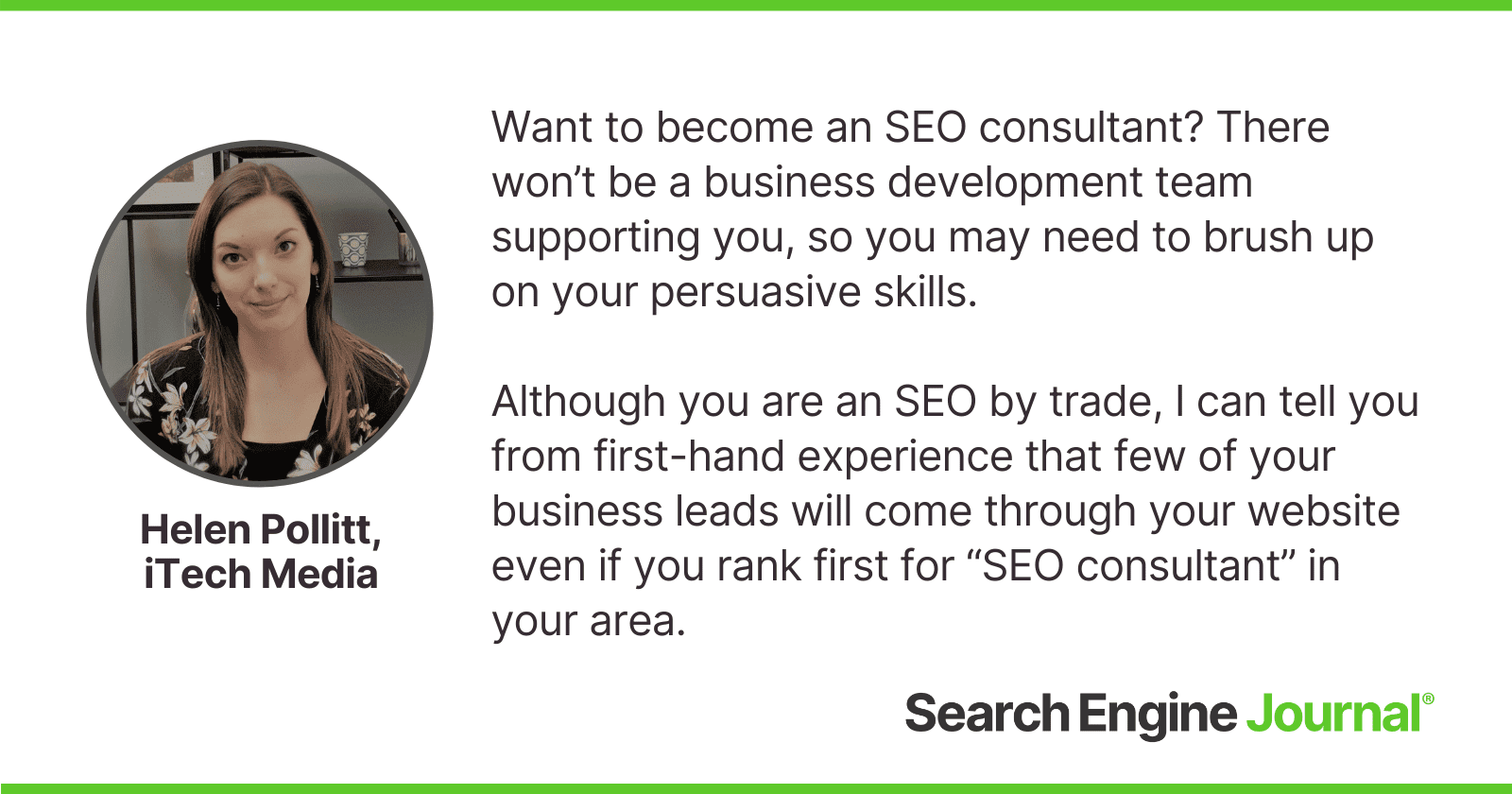
Helen Pollitt shares tips for becoming an SEO consultant.

That means picking up potential client leads through social media, events, and word of mouth.

Not only will you need to source potential client leads, but you will also need to effectively convert them. That means working on pitch decks, negotiating fees, and securing sign-off.

Contract Negotiations

Although you may have a standard contract template, expect prospective clients to go through it with a fine-tooth comb.

This might also extend to your pricing proposal and service level agreement.

A part of being an SEO contractor is the need to be able to negotiate contracts.

There may be an expectation of a certain level of compromise, especially if you want to work with smaller businesses with limited budgets.

When looking long-term at the next six to 12 months of your proposed contract, you will need to be able to predict how those compromises might affect your profit and quality of life.

A client may want you to work your proposed hours for less money, which brings down your average rate.

They might also expect you to respond to emails outside of your proposed working hours.

Although it might seem tempting to agree to these altered terms to secure the revenue, but long-term, it might not be beneficial for the growth of your business.

Understanding Of Financial And Legal Responsibilities

Being an SEO consultant means being your own boss, owning your own business, and the excitement and freedom it brings.

However, it also means being solely responsible for ensuring you are in full legal compliance.

This means understanding which business laws apply to you in your state or country, but also, if you have clients elsewhere in the world, understanding how their laws affect you.

For instance, the GDPR (General Data Protection Regulations) in Europe governs personal data control.

Even if you are not based in Europe, you may be subject to these rules if your clients are.

How you store information about your clients will need to comply with these regulations.

Being a consultant means no one is above you to take on this responsibility.

It’s all yours. You may be able to afford advice from lawyers or accountants to help you make informed decisions, but the ramifications are all on you if they advise you poorly.

Stakeholder Management

Another essential skill is good stakeholder management.

This includes communicating deadlines, chasing for invoice payments, and ensuring client expectations align.

When you are a consultant, your stakeholders aren’t just your clients.

They are your accountants, lawyers, suppliers, and other consultants you’re partnering with.

In a larger business, these stakeholders tend to communicate with various team members; the finance department, the CEO, the marketing team, and the account managers.

As a freelancer, you are the only point of contact.

The needs of a client versus your accountant’s needs are very different, but will both need prioritizing.

Learning to manage a wider range of stakeholders than you’re used to will greatly improve your success as an SEO consultant.

Fitting In With Teams Quickly

You will not be afforded a long onboarding period as an SEO consultant.

You will have to show value to your clients from day one. This can be a tricky skill to develop.

There will be an expectation that you can drive return on investment straight away, although you will need to learn their processes, procedures, product, and industry.

It is not just about understanding the business; you need to get on reasonably well with your new colleagues.

When working closely with other members of your client’s team, what they think of your work ethic and personality may well impact the length and recurrence of your contract.

Demonstrating ROI

When you join a new company as an employee, you will likely have a probation period – a few weeks to months where the company assesses your fit and competency.

If done well, it will be a time when you can work with your manager to fill any gaps in your knowledge and develop a training plan to make sure you are off to a great start in the company.

As a freelance SEO, you won’t get this.

Instead, you may have a break clause in your contract or simply the option for a client to cancel their recurring monthly contract if they don’t like your work.

A skill you will need to develop early on as an SEO consultant is demonstrating the return on investment of working with you.

This means understanding exactly what you are expected to deliver and making sure it is reasonable.

From there, you will need to report back on your success against these objectives.

Resilience

PsychologyToday defines resilience as “the psychological quality that allows some people to be knocked down by life’s adversities and come back at least as strong as before” and is a skill to cultivate.

Being a consultant can be galling.

One month you might have so much work to do that you wonder when sleep will be an option.

Others, you’re nervously staring at your emails, willing a proposal acceptance to come through.

Stability in the flow of work you win can be slow to build.

Then, overnight, a global pandemic can cause it all to dry up. One thing you tend to be short on as a contract SEO is certainty.

A vital skill for an SEO consultant is resilience.

Getting back up when a client unexpectedly ends their contract or there is a conflict with a competitor, is challenging.

Even when everything is going well, there will be the ever-present need to chase invoices that are 60 days overdue.

It can sometimes feel like an uphill battle.

Personal Branding

There is an element of an SEO consultant not only selling their services but also selling the dream of working with them personally.

As a consultant, you will be in a similar position to going for a job interview each time you pitch for work. Your client will need to believe that you are the best candidate for the job.

This may start well in advance of a pitch meeting.

The ideal for many consultants is that they become so well respected in the industry that word of mouth generates leads for them.

Rather than spending a lot of time and energy on marketing, they have clients approaching them.

Some of the most successful SEO consultants have chosen an industry and become experts.

By doing so, they can choose who they work with and charge fees that reflect the value they bring.

If you are looking to become an SEO consultant, it can help to understand your local market, the needs of the businesses who may work with you, and what you can do to be most attractive to them.

This might mean finding a niche and sticking to it for your market. It might mean going after smaller businesses that need the full range of SEO support.

Whatever you want to achieve as a consultant, you will need to be good at presenting your knowledge, skills, and value beyond the initial meeting with a prospect.

Salary Expectations

You may have a pretty good idea of what salaries look like in your country and region, but what about rates for SEO contractors?

Recently, Search Engine Journal conducted a salary survey looking at data points from the SEO industry.

The findings for freelance professionals were particularly interesting.

Search Engine Journal found that SEO freelance consultants earned less than $34,000 per annum on average.

The survey respondents who identified themselves as freelancers overwhelmingly had fewer than two years of experience. This will have heavily skewed their earnings.

With this in mind, take the average reported salary of an SEO consultant with a pinch of salt.

Yours may well be higher depending on location, years of experience, and specialisms.

In the U.K., Glassdoor reports that an SEO freelancer can make £31,540 per year (approximately $41,000).

What you choose to charge per project or per hour will greatly impact how much you take home each year.

You also need to consider how many hours you want to work each week. Together this will help you to identify how much you may be able to earn in a year if your client load is full.

Additional Costs

It is important to remember that you will also need to deduct the costs of running your business from your net earnings.

This may include items from networking group membership to tax and insurance.

Helpful Certifications And Experience

One of the great things about getting into a career in SEO is that there are very low barriers to entry.

There is no university degree you must have or governing body you are expected to be a part of.

On the flip side, there is little for prospective clients to use to measure how good an SEO you are.

Because of this lack of regulation in the industry, there are no standard certificates or qualifications to prove your competency.

Instead, you may need to demonstrate your expertise to prospective clients in other ways.
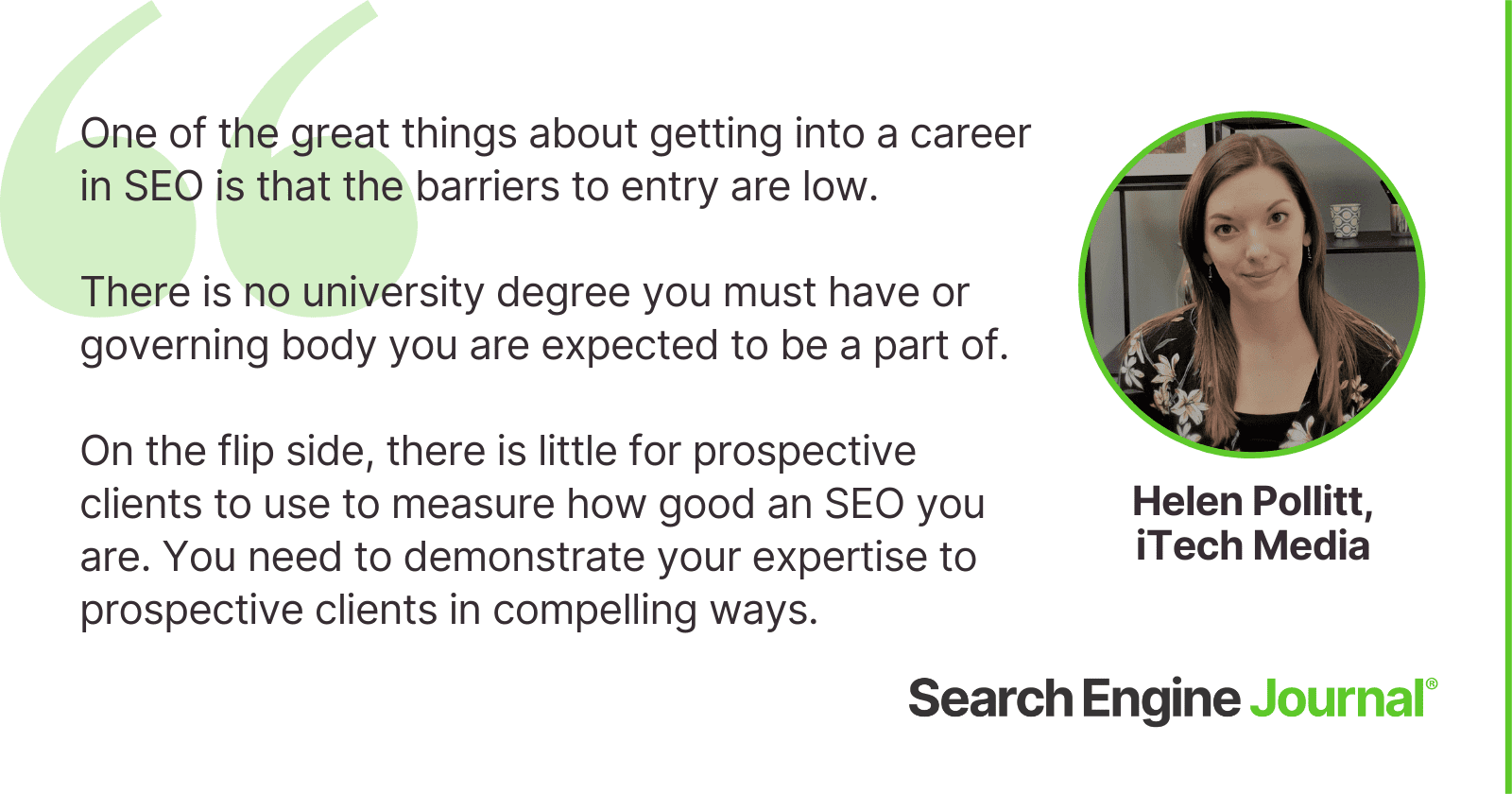
Helen Pollitt on selling yourself as an SEO consultant.

Demonstrable Experience

Your most obvious way to denote that you are an expert in your field is by showing your experience.

Unfortunately, many clients may equate experience with years in the industry. This isn’t always the case.

Experience With Specific Projects

A consultant may have carried out 20 website migrations during their three years in the industry because they worked at an SEO agency.

Another contractor may have only carried out one during their five years in the industry because they worked in-house for one brand.

A client looking for SEO support for their upcoming website migration might look more favorably at a consultant who has worked for five years in the industry.

They may wrongly believe more years of experience equals better performance.

If you are looking to pitch for a website migration project, as an SEO consultant, you will need to be able to show your specific experience with the facets of SEO the project will rely upon.

Industry-Specific Experience

Another aspect of your experience you will need to showcase is the industries you have worked in.

For some clients, knowing that their consultant understands their market, consumers and products will be paramount.

If you have worked across various industries, highlight them in your marketing and pitching material.

If you have worked within a limited range of verticals, you can speak more about the depth of experience.

You may benefit from showing that you have a wealth of knowledge about those particular industries that would make your learning curve with a new client quick and minimal.

Enough Experience

If you have been around the SEO industry for a while, you will likely have come across forums and threads where inexperienced SEO specialists have landed their first client and are now asking veterans how to do SEO.

This is not a situation that you will benefit from being in.

If you manage to land a client whose SEO needs are greater than you can meet, it will likely cause stress on both sides.

As a consultant, you will need to learn to identify the scope of a potential project quickly and decide if you have sufficient knowledge and experience to manage it.

Awards

As mentioned, no governing body oversees SEO practice, which can validate a consultant’s ability to carry out SEO.

However, there are many award shows and programs that serve in some way as a proxy for this.

The validity of awards is a hotly debated topic in SEO circles.

However, winning one does show that you have been independently judged as carrying out work to a high and impactful standard.

Case Studies

Giving examples of previous work in the form of case studies can help prospective clients to feel confident in your abilities.

It can sometimes be tricky to get sign-off from previous clients to use their data, so you may need to obfuscate it slightly.

Make sure you have permission to share any details, especially if it is from work you did before you became a consultant!

Recommendations And References

Just like you might need to provide for a newly employed role, having referees available to prospective clients can help them to understand what it will be like working with you.

Having a couple of current or previous clients happy to provide references can benefit a consultant.

Platforms like LinkedIn also allow you to request and receive recommendations that can go a long way to instilling trust in your work.

Additionally, although not as impartial, written recommendations on your own website may help convert prospective clients.

Certifications

Although there is no commonly accepted SEO qualification, several tools, agencies, and organizations offer certification in search.

Choosing to undertake their training and examination to receive a certification might seem redundant if you have been in the industry for many years, but it can help prove that your knowledge is current and your understanding reaches a standard.

Additionally, certifications in adjacent areas like analytics, data science, and programming can all help to demonstrate your particular skill set.

Consider certifications in specific SEO and analytics-focused tools.

These can show clients you can use their tool-stack without additional training.

Who Hires SEO Consultants And Why?

There are many types of organizations that would contract SEO consultants. It may be their only SEO resource or to complement an existing team or roster of freelancers.

Small Businesses

Small businesses that can’t afford their own internal resource will often reach out to SEO consultants.

SEO consultants often have lower overheads than agencies and may be cheaper to work with. This can be an appealing alternative to cash-strapped organizations.

Rounding Out A Team

Brands with an existing SEO team may use contractors to bolster their resources or fill a specific skill gap.

For instance, a brand looking to appear in Google Discovery for the first time may want outside advice on how best to do that if their internal team has no experience with it.

Filling A Temporary Gap

There may be a need to increase resources during busier seasons or to cover an extended leave of existing employees.

If an employee leaves the organization, a consultant might fill the gap while hiring a replacement.

Whitelabel

Some agencies may not have SEO provisions but want to partner with a consultant to offer that service to existing clients.

They may also want to test the water of how adding SEO to their services will work before hiring an employee to cover it.

Consultants can offer support without the cost of hiring, training, and employee benefits.

Assisting Agencies

Similar to brands that require temporary help in busier seasons, agencies might require an additional person in their team to bridge employee leave, skills gaps or to consult on specific industry projects.

Agencies can often offer repeat work for consultants for this reason.

Support With Hiring

A very niche project you might find yourself available to do as an SEO consultant is that of hiring support.

So rather than filling a skills gap yourself, you may be a consultant on the hiring of employed SEO professionals.

For organizations with no, or very junior, SEO teams, it can be difficult for the hiring manager to know enough about SEO to make a wise decision.

Consultants can bring their expertise to the recruitment process.

They might also recommend a job description, review CVs, and even conduct interviews.

Setting Up A Department

Along with helping with recruitment, SEO contractors might also help create a department from scratch.

This can be the case when a team is needed, but hiring talent at a senior level is proving difficult or too slow.

The SEO contractor might help create the department and potentially lead it until a permanent senior hire.

Considerations For Becoming An SEO Consultant

Ultimately, there is a lot to consider when moving from employed to contract work. It can be an exciting and liberating move, but it also risks.

No Boss

When you become an SEO consultant, you will trade the structure of a corporate world for the freedom of being independent.

That includes no longer having a manager.

Pros:

  • You are the boss! You get to make decisions that previously would be gatekept by your employer or more senior team members. Now, you are free to make those decisions yourself.
  • There is no one to disagree with your decisions or to say “no” to them. If you think something is worth trying, you do not need to get sign-off from a superior.

Cons:

  • You now have lots of bosses. It’s been said that moving to freelance means going from one boss to every client and stakeholder, essentially being your boss. They can still say no to you. You have more freedom to walk away from the project, but ultimately, you will need to concede sometimes if you want to earn money.

Legal And Financial Implications

You will need to follow laws, taxes to pay, and additional costs to being a consultant that you will need to be aware of.

All of this may affect your finances.

Pros:

  • Any money you make is for you to decide what to do with. The harder and smarter you work, the more you can be rewarded financially. No paying for your boss’s Tesla!
  • You have the freedom to be generous with your money. Your business can offer discounts for charities and free training for schools.

Cons:

  • All legal and financial obligations fall to you. The cost of non-compliance can be high both financially and on your time.
  • Getting the right advice can be costly. You may need to use the services of accountants, tax advisors, and lawyers.

Pick And Choose Projects

SEO consultants have much greater freedom to decide who they want to work with and on what projects.

Pros:

  • As an SEO consultant, there is more freedom to choose who you want to work with and what projects you want to work on. If you don’t enjoy a particular client set-up or disagree with the industry they are in, you can turn down the offer to pitch. This isn’t usually the case when you are working agency-side, for instance, where you might be expected to work with whichever client you are assigned.

Cons:

  • Being rigid in choosing who you work with and what you work on might be more challenging if you struggle to find clients. When employed in-house, you can choose the industry and the company set-up that suits you. In some agencies, you may be allowed to turn down work in certain industries you disagree with. Picking and choosing your projects as a consultant could mean not bringing in enough revenue on occasions.
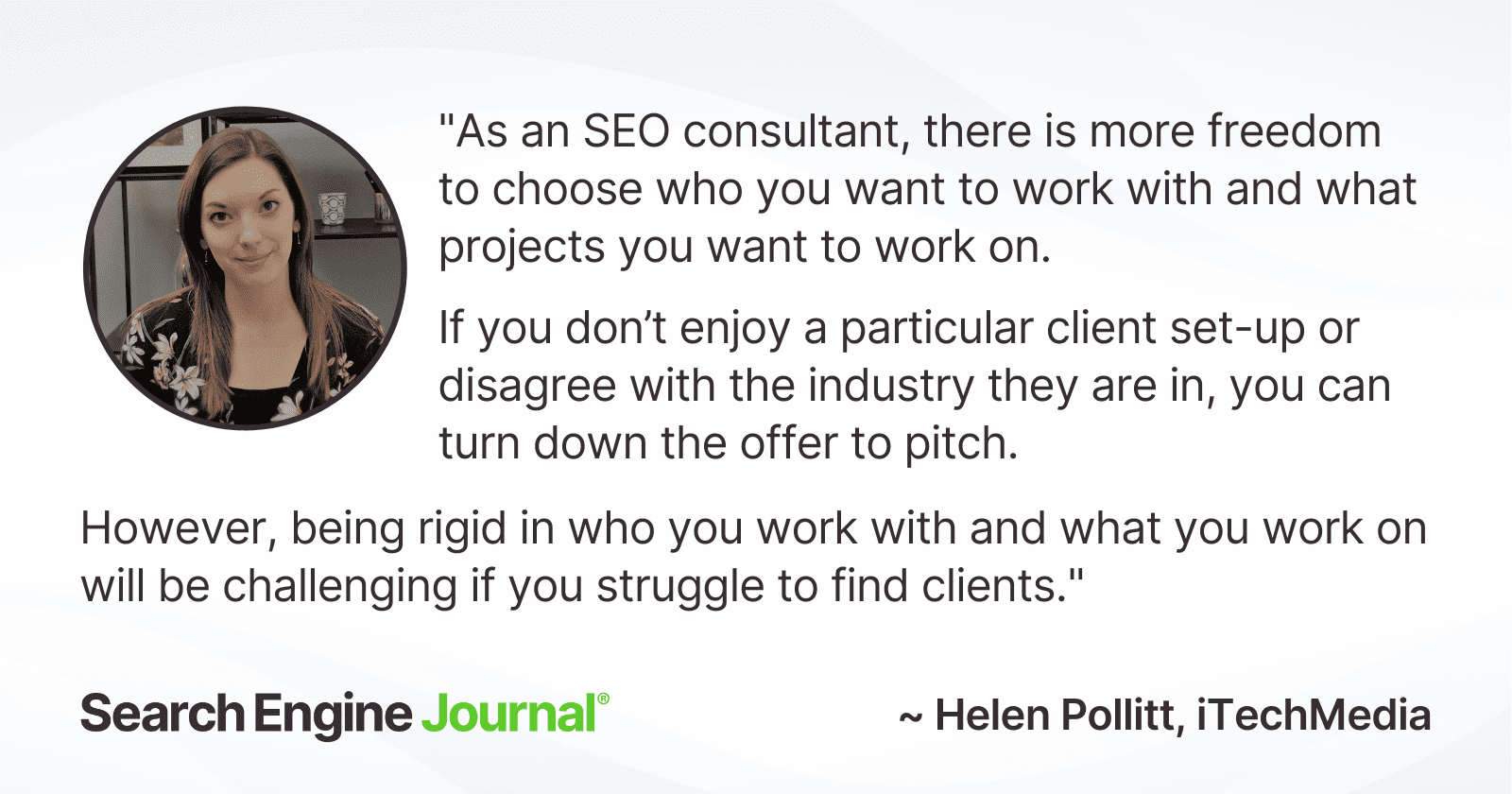
Helen Pollitt on the freedom and drawbacks of being an independent SEO consultant.

Pitch For Work

You will have to develop your own business pipeline, including generating leads and ultimately converting them. This will likely mean pitching and contract negotiation.

Pros:

  • You won’t be in the situation again where someone has sold “the moon on a stick” and expects you to deliver it. You will be fully aware of your time, resources, and ability limitations and can pitch for work that fits that.
  • There should be greater freedom to showcase your abilities and demonstrate how you can help a prospective client.

Cons:

  • Not everyone enjoys the pitching process. It can be nerve-wracking and distracts from SEO execution’s day job. It’s not for everyone.
  • It can take time to put together winning proposals. They are necessary to keep work coming in but have to balance with the time requirements for actually completing client work.

Set Your Own Fee

Although dictated mainly by the type of client you want to work with and the market you are operating in, you will get to decide how much you charge.

Pros:

  • There may be greater autonomy to decide how much you want to charge for your work. You can essentially set your own salary as long as you can win the work to support it.
  • You can choose exactly how many hours and what work you are willing to do for that fee.

Cons:

  • It’s hard to get the pricing right. You may be tempted to charge what your last agency did for your time, but in reality, SEO consultants may struggle to charge high fees when they first set out unless they have good case studies and examples to back up the quality of their work.
  • Figuring out what to charge and what type of client you will need to sustain can be a bit of trial and error. Some leads may think you are over-priced; others may have been willing to pay more if asked for it.

Benefits

Depending on where you are working, the difference in employment rights for the employed and what you are entitled to as an independent contractor might be vastly different.

Beyond the legal rights you may be granted as an employed SEO, there are also likely additional benefits offered by your employer.

Pros:

  • You have greater freedom to choose the benefits that best fit your lifestyle. You can choose a medical insurance plan that works for your health needs. You can decide if the positives of having a company car outweigh the tax implications of one.

Cons:

  • You will not be automatically entitled to statutory holiday, sick leave, or other benefits afforded by your government to employed workers.
  • Maintaining the standard of living that you had as an employed SEO might be difficult once you go freelance. If you relied on your company’s great dental plan or loved the training budget, becoming a consultant might take some adjustment.

You Only Get Paid If You Issue Invoices

There are no “pros” for this one.

It’s essentially one of the most challenging aspects of being an SEO consultant.

If you can’t work for some reason, such as illness or holiday, you will not be able to bill for work. If you don’t bill for work, then you won’t get paid.

Unlike employment which may still pay you if you can’t work, that will not be something you get as a freelance SEO consultant.

If you can’t send out invoices, or worse, you do, but they don’t get paid, you may struggle to make your own payroll.

Conclusions

SEO consultants’ day-to-day working lives may look very similar to employed SEO experts in terms of work.

However, there are often additional complexities beyond SEO activity that can make it a scary prospect for some.

Taking the plunge into the freelance SEO world can be liberating, however. There is greater freedom in choosing what you want to do and when.

Some choose to dip their toe in consultancy work on the side of their regular job (if allowed by their employer).

This can help with the learning curve of running a business while in the safety of employment.

You may have no intention of leaving employment, but it is always good to keep an eye on the market. You may not want to be an SEO consultant yourself but need to hire one.

More resources:


Featured Image: PureSolution/Shutterstock

FAQ

What are the primary tasks of an SEO consultant?

An SEO consultant is responsible for a variety of tasks. These include optimizing websites to enhance their visibility in search engines, managing budgets, and negotiating contracts. Consultants may work independently with their own clients or integrate with existing teams for specific projects. Beyond SEO, they handle client relationships, propose and close deals, and ensure legal and financial compliance.

What are the pros and cons of working as a freelance SEO consultant?

Working as a freelance SEO consultant has both advantages and disadvantages. On the pro side, consultants enjoy flexibility in choosing the projects and clients they work with and have the freedom to set their own fees. However, the drawbacks include financial instability, managing all business-related expenses, and the need for effective self-marketing. Consultants must also handle all legal and financial obligations on their own.

Which essential skills are necessary for becoming a successful SEO consultant?

A successful SEO consultant must possess several key skills beyond SEO expertise:

  • Time Management: Balancing multiple projects and administrative tasks.
  • Budget Management: Handling unforeseen costs and ensuring profitable operations.
  • Pitching and Closing: Marketing oneself effectively to win new clients.
  • Contract Negotiations: Navigating contracts with potential clients and agreeing on terms.
  • Stakeholder Management: Managing relationships with clients and other professionals smoothly.

What Is Conversion Rate & How Do You Calculate It? via @sejournal, @coreydmorris

Conversion rate is one of the most common metrics used by marketers, sales folks, and business professionals.

It is discussed often and taken on the surface as an important metric or key performance indicator (KPI) for most businesses.

However, it can also be misapplied, misunderstood, or improperly established for use as a key metric.

It is important to revisit conversions, conversion rates, and the use of the metric periodically.

It is even more important for any new initiative to have the metric well defined and understood before positioning it as a key KPI.

In this guide, I’m going to dive deeply into what conversion rate is, how to calculate it, why that’s important, and ways to improve it.

What Is Conversion Rate?

Google provides one of the more concise definitions of conversion rate:

“Conversion rates are calculated by simply taking the number of conversions and dividing that by the number of total ad interactions that can be tracked to a conversion during the same time period.”

Now, let’s get into what it all means.

Conversions

Unlike some business and marketing metrics, understanding conversion rates require some self-definition.

It starts with defining what a conversion is – which can mean different things for varying types of brands and organizations.

You can have more than one type of conversion. As a goal, you can have it factored into a marketing funnel or customer journey. Or, it could be a firm financial metric your business hinges on.

Step one is to clearly define what a conversion is for you.

One of the most common definitions I see relates to someone becoming a lead for a business that is focused on driving leads via its website.

Another applies to ecommerce businesses, where the conversion is the completed sale transaction.

Other common definitions include certain engagement metrics for businesses that rely on ad revenue generated by page views.

Secondary types of conversions get into events, engagement, and other things like email signups that help support funnels, customer journeys, and overall sales processes.

Conversion Rate

Conversion rate is a %.

In high-level terms, it tells you the % of how many people came to your site who took the conversion goal action you defined.

Some sources provide benchmarks for specific industries or areas to help you understand a good conversion rate and offer some objectivity.

I’m not telling you to copy your competitors, but I think if you want to value conversion rate, you need internal and external research to validate where you stand and where you want to be.

Match this up with your persona research, target audiences, marketing funnels, and customer journeys.

You likely know what you want your site visitors and audience to do.

How many of them do you want to do it? How big is the universe of your target audience? What is realistic regarding the number of total visitors you think you can get?

Find answers to these questions along with mapping out your conversion goals and conversion rate goals.

How Do You Calculate Conversion Rate?

Conversion Rate Formula

The formula to calculate the conversion rate is straightforward:

Conversions / Visits* = Conversion Rate

*I have to include an asterisk, though, as some definitions might not be as straightforward.

You could also call these “clicks” or “sessions” or look at them more granularly.

My definition here can be adapted based on the language and definitions used by your analytics platform and your other KPIs.

An example in calculating conversion rate for my site (a marketing agency providing services to clients) with the inputs and calculation:

  • August 2022 website visits: 1,122.
  • August 2022 contact form submissions (my conversions): 61.
  • 61 conversions/1,122 visits = 5.4% conversion rate.

Getting It Right

Again, conversions are custom-defined by you.

It can be a common conversion goal like a lead form submission, something more secondary, or something more obscure.

That part can be somewhat custom or variable for you as well.

You can look at it as clicks to a website from a specific channel or ad campaign.

You can get really granular with the segmentation of your data, source and channel filtering, and even with the definitions themselves.

That becomes especially variable or custom if you’re tracking specific actions that lead up to a conversion goal and how granular you want to be with it.

Make sure the definition of what you’re counting as a conversion and what you’re counting as the total audience (clicks, visits, or some other “total” metric) is mapped out in a meaningful way.

Why Do I Need To Be Able To Calculate Conversion Rate?

First, where do you measure and track conversion rate? You can use Google Analytics, other analytics suites, or any data you must manually calculate.

Google Analytics

If you’re relying on Google Analytics (GA), you’ll want to ensure you have your “Goals” set up properly and test them. Conversions are reported based on the goals you configure.

Out of the box, Google has no context as to what a conversion is for you and no ability to calculate a conversion rate off of it.

If you use GA, dive into conversion goal configuration and testing to ensure things are in a good place before you trust the metrics you see (if you inherited the setup) or move forward with any measurement and improvement plan.

And, speaking of mapping out – tracking and measurement are critical.

You want to ensure that your tech stack and tools can help you properly track visits, conversions, and the overall conversion rate in alignment with your definitions and goals.

Getting this right is critical, whether it is Google Analytics or third-party reporting tools.

Segmentation & Filtering

Plus, you’re able to then segment at the levels you want to with examples, including:

  • By conversion type (if you have more than one).
  • All website traffic.
  • By source or channel.
  • By pages/actions/events in the session.
  • By campaign or initiative.

There are many more segments and ways to filter and slice up conversions and conversion rate reporting.

You want to be able to calculate the conversion rate and get into the details with segments of traffic and your audience to help understand where you can improve.

What Is a Good Conversion Rate?

Calculating conversion rates and having the data is one thing; using it to make improvements is where the real work starts.

Improving Conversion Rates

You can look for improvement in two broad areas, and I strongly recommend evaluating both.

One is sources of traffic and the influences that drive visitors to your site.

That includes advertising, referrals, and any awareness activities and campaigns you have that generate traffic.

The other area consists of what influences the traffic that has already arrived at the site – things like UX/UI evaluation, review of messaging, calls to action, and ways that users navigate through and engage with the site.

Improvement in this arena is often called Conversion Rate Optimization or CRO.

Traffic Sources Optimization

In the case of the traffic you’re sending to the site, you can look at targeting, ad creative, and keywords you’re organically ranking for – the ways that ad targeting and creative provide the first impression or directly funnel traffic into the site.

There are a variety of optimization and refinement tactics to shift your focus to higher quality traffic and aim to increase conversion rate by getting more qualified visitors from external sources that you influence.

Beware, though, that you need to have a good idea of your customer journey and not knock out traffic that is awareness focused or at the top of the funnel (e.g., traffic tied to thought leadership).

Increasing the conversion rate is important, but make sure you segment well enough to not inadvertently stop targeting the top of the funnel, awareness-level visitors, and sources.

Conversion Rate Optimization

Now, onto looking inward at the traffic you already have.

This is where most people start digging into CRO tactics. Web analytics can help you see where people exit, bounce, and stop short of getting to your conversion actions.

Beyond that, great heat mapping and CRO tools will give you insights into UX and UI issues and how people truly engage with your site versus how you intended in your design.

By focusing on CRO and putting a strategy into place, you can evaluate everything from site speed to content, messaging, and UI.

I strongly encourage you to do so.

Conclusion

Conversion rate continues to be a valuable marketing metric.

Understanding it, defining it for your organization, measuring it, and improving it are all important.

Whether you have a small business or enterprise-level website, you likely care about specific conversion goals.

In short – for conversions and conversion rate – understand, define, measure, and improve it.

Yes, we all want more traffic. And maybe a static conversion rate is fine if you add more traffic.

However, wouldn’t you like more traffic and a higher conversion rate?

It is possible to have both, and crucial to understanding what levers to pull to influence it.

More resources: 


Featured Image: eamesBot/Shutterstock

FAQ

What is the significance of conversion rate in online marketing?

Conversion rate is a crucial metric for assessing the effectiveness of online marketing strategies. It represents the percentage of visitors who complete a desired action, such as making a purchase or signing up for a newsletter. Understanding this rate helps businesses evaluate the success of their marketing efforts and identify areas for improvement. Accurate measurement and analysis of conversion rates can lead to better targeting of marketing campaigns, improved user experiences, and increased return on investment (ROI).

What are some effective strategies for improving conversion rates?

Improving conversion rates involves optimizing both the sources of traffic and the user experience on your site. Key strategies include:

  • Refining ad targeting and creative to attract more qualified traffic.
  • Enhancing site usability and navigation to make it easier for visitors to complete desired actions.
  • Testing and updating calls to action (CTAs) to ensure they are compelling and clear.
  • Employing A/B testing to compare different versions of landing pages and identify the most effective design and messaging.
  • Using analytics and heat mapping tools to gain insights into user behavior and address any barriers to conversion.

Why is it important to periodically revisit and redefine conversion metrics?

Periodically revisiting and redefining conversion metrics is essential to ensure they remain aligned with evolving business objectives and market conditions. As your business grows and changes, the definitions of conversions and the goals associated with them may need adjustments. Regularly updating these metrics helps maintain their relevance and ensures that your marketing strategies continue to drive meaningful results. This practice also allows for the incorporation of new insights and technologies, keeping your approach current and effective.

What’s The Ideal Blog Post Length For SEO? via @sejournal, @searchmastergen

Whether there’s an ideal blog post length for SEO has been the subject of debate for as long as search engines have been on the web.

If I may borrow a phrase from Google itself, the answer to that question is “it depends.”

The two main variables to consider when deciding how long your posts should be are:

  • Subject matter.
  • Searcher intent.

The ideal length of a blog post on how to take the perfect selfie is going to be different from the ideal length of a post on the invention of the digital camera.

Why? For starters, one subject demands more information than the other in order to provide a complete answer.

Say what you will about the intricacies of selfie-taking, there’s simply more to cover when talking about the invention of the technology that makes selfies possible.

Secondly, searcher intent is a major factor to consider in the length of a blog post. Do they want to read a short or long article?

It’s likely the person who wants to learn about the history of digital photography is looking to consume a more substantial article than the person looking for selfie tips.

Despite the fact that global attention spans are narrowing, long-form content still performs exceptionally well in search.

However, short content is more than capable of ranking alongside longer content in search results. One isn’t necessarily better than the other.

There are literally hundreds of factors that go into ranking search results.

Is article length one of them? If so, what is the ideal word count?

Let’s look at what the statistics say.

Statistics Don’t Lie

Stats offer a pretty good starting point, but we all know they can sometimes also be manipulated.

So, let’s get something clear from the get-go: regardless of length, there is always going to be good content and there is always going to be bad content.

Studies examining hundreds or thousands of pages of content, like the one mentioned above, are probably not examining which content is really good, which is really bad, which is mediocre, and so on.

It’s analyzing article length and how that may affect how good or bad that content ends up being based on simple practicality.

It’s probably true that shorter content is easier and faster for people to read; I’m not going to dispute that.

But does that one-word answer satisfy the question/query a user is looking for? Sure, some questions can be answered in as little as one word, but that’s not usually quality content.

That’s a one-word answer with no explanation or sourcing, and Google (usually) knows that’s not enough to distinguish a piece of content as high-quality, educational, and resourceful.

Of course, there are one-word answers that would be deemed useful and could score the featured snippet in Google, also called Position Zero.

Plus, good content comes in many forms; it’s compelling and often easier to digest because of sourcing, rich media, and sensible structure/formatting.

Google wants substance, evidence, and facts from authority entities on whatever the topic may be. Turns out, longer content typically has these elements baked into it.

That’s a big reason why long-form content ranks better in organic search than short content.

According to a HubSpot study from 2021, the ideal blog post length for SEO should be 2,100-2,400 words.

That’s a lot longer than the 200- or 500-word blog posts most writers or webmasters think is ideal.

Depending on the query, the search results on Page 1 may not be flooded with blog-style content, but the content that is going to be deemed resourceful by users — and Google — certainly may include well-constructed, thoughtful blogging content that satisfies a search query.

And that should be your goal as you begin planning content ideas and article structure for your website’s blog and other written on-site content.

What Does Google Say About Blog Post Length?

Google stands firm that word count is not a ranking factor.

There’s an entire episode of SEO Mythbusting dedicated to the topic of 0n-page content.

Google’s Martin Splitt confirms the number of words on a page is not taken into consideration when ranking search results.

What he means by that is Google does not total up the number of words on a page and use that number as an indication of quality.

A page with 1,000 words is not automatically seen as higher quality than a page with 500 words because it has twice as much content, for example.

That messaging is consistent whenever Googlers are asked about word count, which is a topic that comes up quite often.

Here’s Google’s John Mueller getting asked about it on Twitter. He states:

“Word count is not indicative of quality. Some pages have a lot of words that say nothing. Some pages have very few words that are very important & relevant to queries. You know your content best (hopefully) and can decide whether it needs the details.”

It’s important you don’t read that statement and think you can publish the bare minimum amount of content because Google doesn’t care how many words are on a page.

The number on its own means nothing to Google. However, Google’s algorithm is designed to satisfy user intent, and the intent of the search may call for a longer article over a shorter one.

What you should take away from Google’s position on blog post length is to focus on satisfying searchers. If a short post satisfies the query, then there’s no need to extend the length in hopes of pleasing Google.

Quality Over Quantity: Don’t Focus On Article Length

Too many people put too much emphasis on the average word length for articles and the misunderstood importance of having more than a certain number of words on each page to rank well.

Sure, it’s important to have some substance (and length) to the piece, but it’s not worth publishing a 2,500-word redundant review of a movie talking about the main character’s bad hair and foul language four different ways throughout the entirety of the content.

Surely the movie offered other elements and scenes that make the movie good or bad. Talk about them. Expand on real situations with reactions and in-depth explanations.

That’s what people are looking for when they search for information about a movie. “Was the movie good?”; “Why was it good or bad?”; and “Should I watch it?” are the real questions. The best movie reviews answer all three of those questions and don’t make it hard to figure out.

Give users what they want regardless of how many words it takes to say it. If it feels like you’re writing uninteresting copy for the sake of inflating the word count, know that your readers can feel it as well.

Moreover, Google is capable of recognizing content that contributes little to no added value to the web. That means longer posts can actually hold your site back in search if they don’t say anything useful.

Choose Your Target Audience: People, Personas, And Keywords

Like all good web content, you need to have a goal — a target.

You need to study your target audience. Who’s going to search for and consume your content?

You also need to consider that person’s level of intent as well; are they looking for basic discovery information, or are they trying to buy something right now in as few clicks as possible? Your content will reflect that person and their different stages of user intent.

Ideally, good content is mapped out before it is even created. It should connect the goals of your website/business and the content you are publishing with the goals of the users looking for it.

If you’ve done your audience research and still aren’t sure how long your posts should be, you can get a better idea by looking at the content they’re already consuming.

Search for keywords you want to target and examine the content that shows up on the first page. The length of those blog posts is a good source of insight into what it takes to answer those queries.

Content should satisfy a user’s search query. Thus, content should satisfy the user.

And, most importantly, there may very well be similar content on a website that satisfies various stages of user intent for one specific topic. That isn’t an accident.

Don’t Just Focus On Written Page Copy

Quality content goes beyond just written words. The best content connects thorough research and respectable writing with a user’s interest (their search query).

Even a great video should be accompanied by well-written text that explains the video, it’s concept and goals, and any other resources that may improve the content to better help the user.

That’s our ultimate goal as content strategists: offer the best information, in the most appropriate format, on the right platform.

For some topics, a blog post may not even be the best way to communicate the information to searchers. A detailed tutorial, for example, might be more suited for a video demonstration.

Content like an interview with an industry expert may be more preferable to consume in audio format than in plain text.

Sometimes the written word is the best way to communicate information. But other topics are more suited to visual, requiring photos or video. Sometimes, audio files will be the best type of rich media.

When you use visual or audio content, be sure to accompany it with written content that can connect the dots and make sense of everything on the page, as well as help users find your content.

That’s not only a good practice for readers, it’s necessary for Google as well. Word count is irrelevant, at least some written content is required to provide context to photos, videos, and audio shows.

Summary

Your content can take many forms, and it can be discovered and consumed in numerous ways.

It shouldn’t be your goal to write 2,500 words on a blog post because that seems like the “perfect length” to rank well in organic search.

If you’re worried about hitting an ideal blog post length for SEO, then you’re missing the point entirely.

Your goal should be to supply the best, most useful (and optimized) version of the content for your target audience that matches their intent.

Your audience will appreciate it – and your website analytics will reflect that.

More resources:


Featured image: fizkes/Shutterstock

FAQ

Does the length of a blog post affect its SEO performance?

The length of a blog post can affect its SEO performance, but it’s not the sole factor. Quality content that meets user intent is more important. Longer content tends to include more detailed information, which can help satisfy user queries better, leading to higher rankings. However, short content can also rank well if it effectively answers the searcher’s question. Focus on the substance and quality of your content rather than just the word count.

What factors should be considered when determining the length of a blog post?

When determining the length of a blog post, consider the subject matter and searcher intent. Some topics naturally require more detail than others. For instance, a post about the history of digital cameras may need more words than a post about taking the perfect selfie. Additionally, consider what the searcher is looking to achieve; are they seeking a quick answer or an in-depth exploration?

How can I create content that ranks well in search results?

To create content that ranks well, focus on providing value and meeting user intent. Conduct thorough audience research to understand what your target readers are looking for. Use appropriate keywords and ensure that your content is well-structured, including sourcing, rich media, and logical formatting. Combine written content with other formats like videos, audio, or images if they help to better explain your topic. Quality and relevance should be prioritized over simply aiming for a specific word count.

11 Classic Examples Of Exceptional Jingle & Slogan Writing via @sejournal, @searchmastergen

The best copywriting makes an emotional connection that leaves your audience craving more.

How can you make this sort of memorable impression on your target audience?

The slogans and jingles used by major brands are designed to stick in the audience’s mind.

That way, months or even years later, you may catch yourself humming a tune from a commercial or reciting a catchy slogan.

In this article, you’ll find 11 examples of the most popular slogans and jingles in advertising and learn the copywriting tricks that make them so compelling.

11. Motel 6: “We’ll Leave The Light On For You.”

This Motel 6 slogan was born in the best way: as an ad-libbed line-turned-instant success – and a perfect representation of the motel brand and its values.

Created off the cuff by NPR personality Tom Bodett, this slogan was an optimal way to convey the hotel chain’s welcoming spirit, affordable prices, and general availability.

A slogan that has lasted more than 30 years with no signs of stopping, it clearly stands for what Motel 6 is trying to communicate.

And it’s working.

If it isn’t broke, don’t fix it.

10. Maybelline: “Maybe She’s Born With It. Maybe It’s Maybelline.”

Used since 1991, the slogan was the anchor for “the number one cosmetics company in America” and its advertising.

It made it until 2016, when it was replaced by the brand’s new “Make it Happen” tagline. But not before it was voted “most recognizable” over the last 150 years by Marketing Week in 2013.

9. Red Bull: “Red Bull Gives You Wings.”

Red Bull has been a revolutionary product creating a revolutionary experience since the Austrian company’s inception in 1987.

And what better way to do that than with a slogan like “Red Bull gives you wings” for an energy drink that was going to change your day, and ultimately your life?

The only problem was, Red Bull wasn’t offering much more than the average cup of coffee in terms of a jolt (via caffeine). And the U.S. District Court of the Southern District of New York decided that the slogan was misleading customers.

The extra pep in your step – or “wings” as Red Bull called them in its marketing – was deemed ambiguous and Red Bull paid out a $13 million settlement.

8. Skittles: “Taste The Rainbow.”

Remarkably, even decades after it was created, the slogan for Skittles, “Taste the rainbow” has done plenty right.

What began in 1963 under the name “Glees,” Skittles have become the most popular non-chocolate candy in America with its iconic slogan.

Sure, being a tasty candy helps.

But the brand’s marketing has found a way to keep the same slogan throughout multiple generations, all while effectively communicating with its audience in a way that has kept us listening, watching, and even laughing.

The slogan has helped convey an enticing image for its product and its relationship with the “rainbow” reference, a connection it will likely always – at least for the general future – be associated with.

And for good reason.

7. McDonald’s: “I’m Lovin’ It.”

Another jingle that was communicated – at least in the beginning – by a famous personality was McDonald’s long-running slogan of “I’m lovin’ it,” which got assistance from Justin Timberlake in 2003 when it launched.

The fast-food company’s campaign was anchored around the J.T. song by the same name, which became one of Timberlake’s full-length songs on his album at the time.

McDonald’s spent $1.37 billion in advertising in 2003 when the campaign launched, which led to an 11% increase in sales that year ($17.1 billion).

So, yeah, you could say it worked.

6. Marines: “The Few. The Proud. The Marines.”

Used since 1977, “The Few. The Proud. The Marines.” has remained one of the Marines’ primary recruiting slogans, but it hasn’t been the only one.

Other, similar slogans were used (i.e., “If everybody could get in the Marines, it wouldn’t be the Marines”) but none have lasted as long as “The Few. The Proud.”

Each supplemental slogan has served a distinct purpose to the Marines recruiting missions in terms of needs of the military branch throughout different generations, according to the Marine Times.

“The Few. The Proud.” was nearly dropped in 2016 after the organization explored other possibilities but made a proud return to the Marines’ marketing strategy after a short hiatus in 2017.

“‘The Few. The Proud.” does a great job distinguishing (the Marines) from the other branches (of military) and making us prestigious to recruits, but it doesn’t say anything about what we do or why we exist,” said Lt. Col. John Caldwell, a spokesman for Marine Corps Recruiting Command, to the Marine Corps Times in 2016.

5. Army: “Be All You Can Be.”

While the Army has since stopped using its “Be all you can be” slogan, its impact cannot and has not been ignored.

And it still resonates today.

The slogan was used by the land warfare service branch from 1980 through 2001 and was eventually replaced by several new attempts to effectively reach its target audience.

First came “An Army of one,” which ran from 2001 to 2006 but didn’t show the same success as “Be all you can be.”

That was eventually replaced by the short salute “Army strong” in 2006, which was successful, but did not carry the same type of message as “Be all you can be,” according to Sergeant Major of the Army Daniel Dailey.

“‘Be All You Can Be’ was a national identity to the Army … it is still today,” Dailey said. “I can say ‘Be All You Can Be’ and people just – it was the national identity to the Army.”

That’s a slogan that’s certainly implanted in many of us who grew up around that 21-year stretch of “Be all you can be” messaging. I know I’m one of them.

4. Burger King: “Have It Your Way.”

The fast-food chain’s most successful slogan to date, “Have it your way” was a revolutionary call-to-action for Burger King’s customers to order what they want, how they want it.

It’s easily Burger King’s most well-known slogan in a battle that was devoted to catching up to McDonald’s while also fending off other chain challengers. The slogan helped (the best it could).

BK ditched the phrase in 2014 and has since replaced it with several new slogans, including the “Be your way” slogan and, most recently, “Feel your way” slogan, both obvious plays on the original jingle.

3. GEICO: “15 Minutes Could Save You 15% or More on Car Insurance.”

GEICO spends more than a billion dollars a year to tell potential customers they could save money if they use it as their insurance company.

It was the top brand advertiser on YouTube in 2019, and it shows.

We all know the slogan – and the humorous commercials that often accompany it.

It’s simple, concise, and communicated across a multitude of mediums: switch to GEICO and you’ll save money.

It’s also (mostly) true, according to a study by Forbes.

Catchy, easy-to-remember, and, most of all, legitimate in its claim – the GEICO recipe for success has helped build one of the most noticeable brands in America.

It also helps to have deep pockets, A.K.A. budget.

2. Farmer’s Insurance: “We Know A Thing Or Two Because We’ve Seen A Thing Or Two.”

Another insurance company making big noise in a clouded insurance market is Farmer’s.

Competing among some of the most notable advertisements in rotation (see: Geico, State Farm, All State), Farmer’s nails this slogan that is based on real-life facts and statistics and also relays a message of confidence and trust to its customers.

Built around the idea that Farmer’s has dealt with some seemingly unbelievable insurance claims – and properly taken care of those involved and covered by Farmer’s – the car insurance company-turned multi-line, multi-company insurer and financial services group even has Unbelievable Claims section on its website to back up its claim.

It’s tough to contend with high spenders like GEICO, but at least when Farmer’s does it, it drives home a strong and meaningful (and true!) slogan that can help put customers at ease.

1. Nike: “Just Do It.”

The power of the best slogan of the several decades comes from not just its longevity, but its overall impact, not just on the fitness and footwear industries, but in powerful and meaningful walks of life.

That it would also help shift the industry when Nike needed it most makes it that much better, too.

Aiming to gain market share from other brands like Reebok, advertising executive Dan Wieden created the game-changing slogan on Nike’s behalf from two unusual places in 1988, further adding to the longstanding tagline’s lore.

“It was about the ultimate statement of intention,” Liz Dolan, former chief marketing officer at Nike, told The Washington Post. “It had to be personal.”

And it was and continues to be.

Just as momentous as its support to helping Nike grow into the worldwide powerhouse it is today is the ability it has had to adapt and continue to still inspire to this day.

From Colin Kaepernick and his stance against social injustices to women’s equality and admiration, to being a large part of some of the gutsiest performances by athletes across the world, Nike’s message has consistently motivated humans to be faster, stronger, and better.

“Just do it” has only grown in intensity and effectiveness as Nike continues to utilize the message and the underlying drive-home point in all of its overarching messaging.

It’s evolved into a cultural rally cry for standing up for what’s right, fighting your hardest, and making a real impact that isn’t limited to the field, court, or rink.

Nike will continue to use the infamous tagline for many more years to come, and it will likely keep winning by doing so and shifting with the times.

Slogan Writing Tips and Resources

Ready to write a catchy slogan for your brand?

Here are some resources that will help you sharpen your writing skills.

Incorporate your brand’s main keyword phrase like Geico or name like Maybelline to ensure your audience remembers the most important part of your message.

Conclusion

If you instantly recognized or had music come to mind when seeing one of these examples, congratulations.

It just proves that slogans and jingles have the kind of staying power you want in your advertising and marketing.

More resources:


Featured Image: Shutterstock/Yuliia D

FAQ

How have slogans contributed to brand success over time?

Slogans contribute to brand success by creating a strong, recognizable identity that easily sticks in the consumer’s mind. For instance, GEICO’s “15 minutes could save you 15% or more on car insurance” clearly communicates the value proposition, helping to differentiate the brand in a competitive market. Similarly, McDonald’s “I’m Lovin’ It” encapsulates the positive experience associated with the brand, reinforcing customer loyalty and driving sales. Long-lasting slogans like these become synonymous with the brand, continually attracting and retaining customers.

####

Why is consistency important in brand slogans?

Consistency in brand slogans is crucial as it reinforces the brand message and builds a strong, cohesive identity over time. This predictability helps consumers associate specific values, emotions, and expectations with the brand. For example, Skittles’ “Taste the Rainbow” has remained effective across generations, maintaining its appeal through consistent use. Consistent slogans also help streamline marketing efforts and boost brand recall, as familiar phrases are ingrained in the audience’s memory, leading to enhanced brand loyalty and consumer trust.

####

Can a brand change its slogan without affecting its identity?

A brand can change its slogan, but it must do so carefully to maintain its identity. If done correctly, a new slogan can refresh the brand image while preserving its core values. For example, when Maybelline shifted from “Maybe She’s Born With It. Maybe It’s May

SEM Vs. SEO: What’s The Difference? via @sejournal, @searchmastergen

CSS. HTTP. URL. HTML.

It’s possible the only field that uses more acronyms and initializations than web marketing is the military.

The military uses them to save time.

Sometimes, it seems like our industry only uses them to confuse newcomers.

And it’s not uncommon for even experienced professionals to mix them up.

Some of the most common mistakes happen when it comes to the similar and related, but distinctly different concepts of search engine optimization (SEO) and search engine marketing (SEM).

Once upon a time, in the halcyon days of the early internet (that is, circa 2001), SEO referred to a part of SEM.

But, as the language and nuance of web marketing shifted, search engine marketing came to refer to a specific type of digital marketing. So, what’s the difference?

Sometimes also referred to as organic (SEO) and inorganic (SEM) search, both are focused on using Google (and to a lesser extent other search engines) to drive traffic to a specific website.

From a high-level view (and don’t worry, we’ll dive into the details a bit later), SEO is the process of improving your website to generate traffic, while SEM is using paid methods to show up in searches.

Don’t feel bad if you’ve mixed these terms up. It happens all the time.

To help you avoid any embarrassing mishaps when speaking with other digital marketers, we’ve compiled this handy guide to give you an overview of these concepts.

Confused? Don’t be, all will be made clear in the end. Now let’s get started.

PPC, Another Variable In The Mix

As we get started, just to make everything even more confusing, let’s add one more initialization into the mix: PPC or pay-per-click.

Okay, that one isn’t really fair because PPC is just another term for SEM – or at least, a part of it.

PPC is most likely a term that evolved through the Wild West days of early search engine strategies when different people used different terms to refer to the same thing.

Eventually, pay-per-click and search engine marketing came to mean the same thing: paid digital marketing advertisements on search platforms.

Pay-per-click, regardless if it’s called PPC, CPC (that is cost-per-click), paid search, or search ads are referring to paid search marketing, typically through search engines like Google and Bing.

Other terms and tactics used in digital marketing initiatives – especially those tied to search marketing tactics (both paid and organic) – may not be so simple and clearly defined, though.

What’s The Difference Between SEO & SEM/PPC?

We know SEO is search engine optimization.

Marketers aren’t optimizing search engines, however. We’re optimizing content and websites for search engines (and humans, too), so they can better understand, access, and direct searchers to our website.

Again, initialism doesn’t always make sense. So, naturally, this is a bit illogical.

Just like other things in life that don’t always add up, there are some acronyms that will never make sense either.

Like Humvee, which doesn’t stand for any words that start with U or E in them. (It actually stands for High Mobility Multipurpose Wheeled Vehicle, and was spawned from the original acronym, HMMWV.)

We’ve also determined that PPC marketing is (at least now) the same as or a very large part of SEM. Here’s where they overlap:

  • Both are paid initiatives.
  • Both need a budget.
  • Both make search engines like Google and other advertising platforms a lot of money.

But, while Wikipedia defines SEM as “a form of internet marketing that involves the promotion of websites by increasing their visibility in search engine results pages (SERPs) primarily through paid advertising,” it’s not so quick to call them the same exact thing.

In fact, pay-per-click marketing has its own Wikipedia page separate from search engine marketing (despite there being plenty of discrepancies and confusion throughout the page).

The bottom line is this:

SEO is not a component of SEM.

And, while PPC is typically the largest and most demanding component of SEM, both PPC and SEM are paid initiatives that offer real-time data, ROI, and protected data that can only be accessed by advertisers on certain platforms.

Why It Matters

Consistency is the main reason it’s important to clarify these terms.

Too many novice marketers, or marketers who aren’t specialists in maximizing value through search, have adopted these industry definitions and crossed them, combined them, confused them, or used them in a way that only further diluted their true meaning.

And even well-seasoned marketers who simply didn’t agree with or possibly even completely understand the terms themselves help contribute to the turning tide, as well.

Conferences have set up entire segments of their educational offering around the SEM naming convention when referring to strictly paid marketing efforts, but those efforts aren’t strictly done through search engines.

SEM, at least from this perspective, includes PPC ads on search engines but also on third-party platforms like Amazon and YouTube, as well as industry-focused platforms like Houzz, Thumbtack, or Yelp. It also includes display ads and remarketing efforts.

And, as the opportunity to advertise on social media continues to grow, it is usually used to refer to paid advertising on those networks, too.

Here at Search Engine Journal, we’re doing our part. Keeping the definitions and their usage consistent is going to be the best way to keep the information organized in a way that makes sense for marketers.

It also helps us, as marketers, convey our thoughts and ideas to clients and stakeholders, peers, or a friend who is curious about just what exactly it is we do for a living.

But, you should never assume someone else knows what you’re referring to when you use these terms.

Be concise and explain exactly what you’re talking about and make sure everyone agrees on term definitions.

Before we move on, let’s recap:

  • SEO is the organic effort that goes into marketing through search engines.
  • SEM and PPC are paid initiatives through search and other platforms.

Now that we have that out of the way, let’s move on.

Should I Use SEO Or SEM?

Now that you hopefully have a grasp on the differences between SEO and SEM, you’re undoubtedly asking yourself a question: Which one should I be using?

Ideally, both.

But if you don’t have the bandwidth and can only choose one, here are some things to consider:

What Are Your Goals?

If you want to drive traffic quickly, whether to promote a sale, try out a new offer or just give your website more exposure, SEM is the choice for you.

SEO, on the other hand, is a marathon, not a sprint. It takes more time to show results but is good for long-term growth and compounding value.

What Is Your Budget?

Obviously, SEM campaigns are going to cost you money. After all, there’s a reason it’s called pay-per-click.

If your budgets are tight or you have low product margins, it may not make sense to run SEM.

SEO, on the other hand, is more of a time investment than a financial one. And, you can probably enlist people already on your payroll like writers, IT personnel, and marketers to help.

How Is Your Site Currently Performing?

If your website already ranks highly for your keywords, your SEO needs will be primarily driven by changes to the Google algorithm and competition.

In this situation, SEM is a great augmentation. Conversely, if you’re not getting a lot of organic traffic, you probably need to get your SEO in order before you start spending money on paid ads.

How Much Data Do You Have Or Need About Visitors?

SEM lets you capture a lot more visitor data than organic search.

You can run your PPC campaigns through dashboards like Google Analytics, where you can see clicks, impressions, CTR, sessions, conversions, etc.

You can then use this data to track trends and attract new customers.

How Is Your Online Reputation?

SEO is a great way to control the narrative around your brand.

Using the same techniques you use to climb to the top of search rankings, you can control the way your organization is seen online.

In one famous (albeit unsuccessful) example, UC-Davis paid a consulting firm $175,000 to scrub the internet of negative postings.

Of course, if you can swing it, you should combine SEO and SEM as complementary search strategies.

This way, you can use the data you gather from your PPC campaigns to refine your SEO campaigns. This will give you a better idea of exactly what your audience is looking for when they click your links, so you can customize your content to it.

Combining both practices also lets you create remarketing campaigns.

If your SEO work is driving visitors, but you’re not seeing the conversions you want, you can use SEM to actively reach out to those targets and bring them back to your website.

Pairing SEO and SEM can also allow you to completely dominate search engine results pages (SERPs).

If you have the top ranking on the first page of results, plus paid listings on the same page, you’ve just claimed a lot of real estate.

The downside of this, however, is that your paid listings may cannibalize your organic traffic, which costs you unnecessary money.

Conclusion

Hopefully, by this point, we’ve successfully impressed on you the difference between SEO and SEM. But just in case it wasn’t clear, here it is once more for the people in the back:

SEO is using non-paid tactics to drive traffic to your website organically. It’s a slower process (usually three to six months) but can pay long-term dividends.

SEM, including PPC, is the use of paid search platforms to drive targeted traffic to your website. It requires a budget but can drive results very quickly.

Too many people either see these as the same thing or as completely separate initiatives and miss out on the benefits of using them together.

To get the best results, both should be a part of your digital marketing strategy.

They each have different strengths and weaknesses, but when properly united, can give you a real competitive advantage.

More Resources:


Featured Image: Krakenimages.com/Shutterstock

FAQ

When should a business prioritize SEM over SEO?

Businesses should prioritize SEM when they need quick results, such as promoting a sale or testing a new offer. SEM is also ideal if the business has a product with a limited-time offer or requires rapid visibility for critical events. Essentially, if the objective is immediate traffic and short-term goals, SEM, including PPC campaigns, should be considered the primary strategy, provided there is an appropriate budget in place.

How do SEO and SEM complement each other?

SEO and SEM complement each other by addressing both short-term and long-term marketing goals. SEO helps build a foundation for sustained organic traffic over time, while SEM provides immediate visibility and traffic through paid ads. Combine data from SEM campaigns to refine your SEO efforts, ensuring that content aligns with what your audience seeks. When used together, these strategies can occupy more search engine real estate, increasing both paid and organic reach.

What factors should influence the choice between SEO and SEM?

Your choice between SEO and SEM should consider several factors:

  • Goals: If you aim for quick visibility, opt for SEM. For long-term growth, focus on SEO.
  • Budget: SEM involves ongoing costs for ad placements, while SEO requires time investment, with potential internal resources.
  • Current website performance: If your site already ranks well organically, SEM can augment your traffic further. Conversely, if organic traffic is low, prioritize SEO.
  • Data needs: SEM provides detailed insights through platforms like Google Analytics, which can be advantageous for in-depth analysis and strategy adjustments.

Ultimately, assess these factors to determine the best approach for your marketing strategy.

Google Ads Restricts Brand Names & Logos From AI Image Generation via @sejournal, @MattGSouthern

Google has provided details about the capabilities and limitations of its AI image generation tools for Google Ads.

The clarification came after search marketer Darcy Burk expressed excitement about the potential for AI to create product images.

This prompted Google’s Ads Liaison, Ginny Marvin, to outline some key restrictions.

Branded Content Off-Limits

Marvin confirmed that while Google’s AI tools can generate generic product images, they are designed to avoid creating visuals that depict branded items or logos.

Marvin stated:

“The tool will generate product images, but it won’t generate product images that include brand names or logos.”

She provided an illustrative example:

“So, for example, you could ask it to generate images of ‘a dog in a pet stroller in a park,’ but if you asked it to generate images of ‘a dog in a pet stroller in a park with a Doggo logo,’ you’ll get an error notification to remove mentions of brands and branded items from your description.”

Guidelines Outlined

Marvin points to Google’s support documentation for more details on using the AI image generation and editing capabilities.

When attempting to generate branded product images, users will likely receive an error message instructing them to remove any branded terms from their prompts.

Google’s support page notes:

“Generative AI tools in Google Ads are designed to automatically limit the creation of certain content.”

It lists “Faces, children, or specific individuals” and “Branded items and logos” as examples of restricted subject matter.

Restricted Verticals

Google’s documentation also addresses concerns around safety and responsible AI development.

Generated images include digital watermarking to identify their AI-generated nature and deter misuse.

Sensitive advertising verticals like politics and pharmaceuticals are also restricted from automatically receiving AI-generated image suggestions.

“As this technology evolves, we’re continuously evaluating and improving our approach to safety,” Google states.

Why SEJ Cares

As generative AI capabilities expand across the advertising ecosystem, clear guidelines from Google help provide guardrails to mitigate potential risks while allowing advertisers to experiment.

Understanding current limitations, such as restrictions around branded visuals, is critical for marketers looking to incorporate AI image generation into their workflows.

How This Can Help You

For advertisers, Google’s AI image generation tools can produce large volumes of high-quality generic product and lifestyle images at scale.

By following the outlined guidelines around avoiding branded references, you can generate a variety of visual assets suited for ecommerce product listings, display ads, social media marketing and more.

This can streamline traditionally time-consuming processes like product photoshoots while maintaining brand safety.


FAQ

How does Google Ads’ AI image generation tool handle branded content?

Google’s AI image generation tool can create generic product images but is designed to exclude any branded items or logos.

If a user tries to generate an image with specific brands or logos, the system will trigger an error notification directing them to remove those references before proceeding.

  • The tool generates generic product images
  • It excludes brand names and logos
  • Users receive error notifications guiding them to correct prompts

What kind of content is restricted when using Google Ads’ AI image generation tools?

Several types of content are restricted when using the AI image generation tools in Google Ads.

Restrictions include creating images featuring faces, children, specific individuals, branded items, and logos.

Sensitive verticals like politics and pharmaceuticals are also barred from receiving AI-generated image suggestions.

How does the restriction on branded content benefit marketers using Google’s AI tools?

By focusing on generating only generic product images, advertisers can utilize the tool for a variety of applications, such as ecommerce product listings, display ads, and social media marketing, without risking any legal issues related to brand misuse.


Featured Image: DANIEL CONSTANTE/Shutterstock

Google AI Overviews = Theft? Court Ruling Sets Precedent via @sejournal, @MattGSouthern

Google’s bold new vision for the future of online search, powered by AI technology, is fuelling an industrywide backlash over fears it could damage the internet’s open ecosystem.

At the center of the controversy are Google’s newly launched “AI Overviews,” which are generated summaries that aim to directly answer search queries by pulling in information from across the web.

AI overviews appear prominently at the top of results pages, potentially limiting users’ need to click through to publishers’ websites.

The move sparked legal action in France, where publishers filed cases accusing Google of violating intellectual property rights by ingesting their content to train AI models without permission.

A group of French publishers won an early court battle in April 2024. A judge ordered Google to negotiate fair compensation for repurposing snippets of their content.

Publishers in the US are raising similar objections as Google’s new AI search overviews threaten to siphon traffic away from sources. They argue that Google unfairly profits from others’ content.

The debate highlights the need for updated frameworks governing the use of online data in the age of AI.

Concerns From Publishers

According to industry watchers, the implications of AI overviews could impact millions of independent creators who depend on Google Search referral traffic.

Frank Pine, executive editor at MediaNews Group, tells The Washington Post:

“If journalists did that to each other, we’d call that plagiarism.”

Pine’s company, which publishes the Denver Post and Boston Herald, is among those suing OpenAI for allegedly scraping copyrighted articles to train their language models.

Google’s revenue model has long been predicated on driving traffic to other websites and monetizing that flow through paid advertising channels.

AI overviews threaten to shift that revenue model.

Kimber Matherne, who runs a food blog, is quoted in the post article stating:

“[Google’s] goal is to make it as easy as possible for people to find the information they want. But if you cut out the people who are the lifeblood of creating that information, then that’s a disservice to the world.”

According to the Post’s report, Raptive, an ad services firm, estimates the changes could result in $2 billion in lost revenue for online creators.

They also believe some websites could lose two-thirds of their search traffic.

Raptive CEO Michael Sanchez tells The Post:

“What was already not a level playing field could tip its way to where the open internet starts to become in danger of surviving.”

Concerns From Industry Professionals

Google’s AI overviews are understandably raising concerns among industry professionals, as expressed through numerous tweets criticizing the move.

Matt Gibbs questioned how Google developed the knowledge base for its AI, bluntly stating, “They ripped it off publishers who did the actual work to create the knowledge. Google are a bunch of thieves.”

In her tweet, Kristine Schachinger echoed similar sentiments, referring to Google’s AI answers as “a complete digital theft engine which will prevent sites getting clicks at all.”

Gareth Boyd retweeted a quote from the Washington Post article highlighting the struggles of blogger Jake Boly, whose site recently saw a 96% drop in Google traffic.

Boyd said, “The precedent being set by OpenAI and Google is scary…” and that “more people should be equally angry” at both companies for the “open theft of content.”

In his tweet, Avram Piltch directly accused Google of theft, stating, “the data used to train their AI came from the very publishers that allowed Google to crawl them and are now going to be harmed. This is theft, plain and simple. And it’s a threat to the future of the web.”

Lily Ray made a similar claim about Google: “Using all the content they took from the sites that made Google. With little to no attribution or traffic.”

Legal Gray Area

The controversy taps into broader debates around intellectual property and fair use, as AI systems are trained on unprecedented scales of data scraped across the internet.

Google argues its models only ingest publicly available web data and that publishers previously benefited from search traffic.

Publishers implicitly consent to their content being indexed by search engines unless they opt out.

However, laws weren’t conceived with training AI models in mind.

What’s The Path Forward?

This debate highlights the need for new rules around how AI uses online data.

The way forward is unclear, but the stakes are high.

Some suggest revenue sharing or licensing fees when publisher content is used to train AI models. Others propose an opt-in system that gives website owners more control over how their content is used for AI training.

The French rulings suggest that the courts may step in without explicit guidelines and good-faith negotiations.

The web has always relied on a balance between search engines and content creators. If that balance is disrupted without new safeguards, it could undermine the exchange of information that makes the internet so valuable.


Featured Image: Veroniksha/Shutterstock

As Chatbots And AI Search Engines Converge: Key Strategies For SEO

A lot is happening in the world of search right now, and for many, keeping pace with these changes can be overwhelming.

The rise of chatbots and AI assistants – like ChatGPT and its new model GPT-4o, along with Google’s rollout of AI Overviews and Search Generative Experience (SGE) – is blurring the lines between chatbots and search engines.

New AI-first entrants, such as Perplexity and You.com, also fragment the search space.

While this causes some confusion and necessitates that marketers pivot and optimize for multiple types of “engines,” it also presents a whole new array of opportunities for SEO pros to optimize for both traditional and AI-driven search engines in a new multisearch universe.

This evolution raises a broader question – perhaps for another day – about redefining what we call SEO to encompass terms like Artificial Intelligence Optimization (AIO) and Generative Engine Optimization (GEO).

Currently, every naming convention seems subject to change, which is something to consider as I write this article.

Either way, this evolution opens up tremendous opportunities for disruption in the overall search landscape.

What Is A Chatbot Or AI Assistant?

chatbot definitionScreenshot from Wikipedia, May 2024

At the most basic level, chatbots use natural language processing (NLP) and large language models (LLMs) that are trained to extract data from online information, sources, and specific datasets. They then classify and fine-tune text and visual outputs based on a user’s prompt or question.

Chatbots are often used within specific applications or platforms, such as customer service websites, messaging apps, or ecommerce sites. They are designed to address specific queries or tasks within these defined contexts.

Right now, we see many crossovers between LLM-based chatbots and search engines. Rapid developments in these areas can cause confusion.

In this article, we’ll focus on the development of AI models in chatbots and their relation to search, with an inferred reference between chatbots and AI assistants.

The Evolution Of Chatbots And AI Models

Since ChatGPT emerged in November 2022, we’ve seen a significant boom in chatbots and AI assistants. Now, generative AI allows users to interact directly with AI and engage in human-like conversations to ask questions and complete various tasks.

For example, these AI tools can assist with SEO tasks, create content, compose emails, write essays, and even handle coding and programming tasks.

As they evolve, chatbots become multimodal (MMLLMs), improving capabilities beyond text to include images, audio, and more.

LLMs and LLMMsImage from 2024 AI Index Report from Stanford University, May 2024

For those interested in digging deeper into these models, the 2024 AI Index Report from Stanford University is a great resource for SEJ readers.

While many chatbots and AI models serve similar purposes, they also have distinct applications and use cases, such as content creation, image generation, and voice recognition.

Here are a few examples with some interesting differentiators and points:

  • ChatGPT: Conversational AI for research, ideation, text, image content, and more.
  • Google Gemini and Gemma: Uses Google’s LLM to connect and find sources within Google.
  • Microsoft Bing: Uses ChatGPT for conversational web search in Bing.
  • Anthropic Claude: Various AI models for content generation, images, and coding.
  • Stability AI: Suite of models and AI assistants for text, image, audio, and coding.
  • Meta Llama3: Utilizes Facebook’s social graph, its own Llama 3 model, and real-time data from Google.
  • Microsoft’s Copilot: AI assistant for business creativity and productivity apps.
  • Amazon LLM and Codewhisperer: Enhances customer and employer experiences.
  • Perplexity AI: Provides quick answers, sources of information, and citations.

Perplexity AI (which I will touch on later in this article) acts more like a search engine than many other chatbots and AI assistants.

Beyond their primary use cases, many companies are making their models available to a wider audience and broader ecosystems, allowing users to customize their own AI assistants.

For example, Amazon’s Bedrock enables AWS customers to use Anthropic and other LLMs, including Amazon’s own model, to create custom AI agents. Companies like Lonely Planet, Coda, and United Airlines are already using it.

On May 13, OpenAI launched its new flagship model, GPT-4. This model is a combination of AI technologies, bringing together what OpenAI calls “text, vision, and audio.” It also opens up access to its application programming interface (API), allowing developers to build their own applications.

All of this convergence has a lot of people wondering.

What’s The Difference Between Chatbots And Search Engines?

The first thing to note is that both chatbots and search engines are designed to provide information.

Search engines and some chatbot models share many similarities, which means their definitions can blur, and the relationships between them converge and collide.

However, at the moment (but it is changing), there is still a distinct difference between the two:

Search Engines

  • Search engines are better for exploring a wide range of topics.
  • They provide diverse perspectives from multiple sources.

Chatbots

  • Chatbots are better for quick answers, task completion, and personalized interactions.
  • They enhance the efficiency of the average searcher, making them much more effective at finding information.
Search engines vs chatbotsImage from author, May 2024

As more overlays and overlaps occur, the definitions of what constitutes a chatbot, an AI assistant, and a search engine may need to be redefined.

How Chatbots And Search Engines Work Together

Conversational search is a key area where search engines increasingly integrate chatbot features to provide a more interactive search experience.

You can ask questions in natural language, and the search engine may respond with direct answers or engage in a dialogue to refine your query.

Chatbots and AI assistants often utilize search engine technology to access information from the web, enhancing their ability to provide accurate and comprehensive answers.

This integration allows chatbots to go beyond their programmed knowledge base and tap into a broader range of information.

Here are a few examples:

  • Google: Integrates its own chatbot features into its search engine through SGE, providing direct answers and engaging in conversational search for some queries.
  • Bing: Incorporates a chatbot called “Bing Chat” that uses ChatGPT, conversational AI, and search technology to answer questions and provide information.
  • YouChat: A search engine that provides conversational responses to queries and allows for follow-up questions.
  • Meta: Utilizes its social graph and Google’s real-time data in its chatbot/AI assistant.
  • Perplexity AI: A chatbot that functions like a search engine, focusing on informational sources, sites, and citations.

These examples illustrate how the lines between chatbots and search engines are blurring. Thousands more instances show this convergence, highlighting the evolving landscape of digital search and AI.

How “Traditional” Search Engines Are Evolving As AI-First Entrants Arrive

The rise of generative AI and chatbots has caused significant upheaval in the traditional search space.

Traditional search engines are evolving into “answer engines.” This transformation is driven by the need to provide users with direct, conversational responses rather than just a list of links.

The line between chatbot engines and AI-led search engines is becoming increasingly blurred.

While AI in search is not a new concept, the introduction of generative AI and chatbots has necessitated a seismic shift in how search engines operate. For the first time, users can interact with AI in a conversational way, prompting giants like Google and Microsoft to adapt.

On May 14 at Google IO, Google announced the roll-out of AI Overviews as it integrates AI features into its search engine. It is also making upgrades to SGE.

The ultimate goal is to enhance its ability to provide direct answers and engage in conversational search. This evolution signifies Google’s commitment to maintaining its leadership in the search space by leveraging AI to meet user expectations.

In a recent interview on Wired Magazine titled It’s the End of Google Search As We Know It, Google Head of Search, Liz Reid, was clear that:

“AI Overviews like this won’t show up for every search result, even if the feature is now becoming more prevalent.”

As my co-founder, Jim Yu, states in the same article:

“The paradigm of search for the last 20 years has been that the search engine pulls a lot of information and gives you the links. Now the search engine does all the searches for you and summarizes the results and gives you a formative opinion.”

Beyond Google, we are seeing a rise in new, AI-driven search engines like Perplexity, You.com, and Brave, which act more like traditional search engines by providing informational sources, sites, and citations.

These platforms leverage generative AI to deliver comprehensive answers and facilitate follow-up questions, challenging the dominance of established players.

Meta is also entering the fray by utilizing its social graph and real-time data from Google in its AI assistant, further contributing to the convergence of search and AI technologies.

At the same time, according to Digiday, TikTok is starting to reward what it calls “search value.”

Going forward, it’s important to remember that people have diverse needs, and we turn to different platforms for specific purposes.

Just as we go to Amazon for products, Yelp for restaurant suggestions, and YouTube for videos, the rise of AI will only amplify this trend. Each search engine will find its niche, leveraging its strengths to cater to particular user requirements.

ChatGPT is an intriguing case that stands out not for its research capabilities but for its prowess in content creation. While it excels in crafting high-quality content, its research functionalities fall short.

Effective research relies on real-time data, which platforms like ChatGPT currently lack. As we move forward, we expect to see search engines specialize even further, each excelling in specific areas based on its unique strengths and features.

What Does It All Mean For Marketers?

This fast-moving landscape and the convergence of search and AI presents both challenges and opportunities for marketers.

Optimizing for one engine is no longer sufficient; it’s essential to target multiple platforms – each with unique users, demographics, and intents.

Here’s how marketers can adapt and thrive in this dynamic environment.

Optimizing For Different Platforms

Google

  • Strength: Dominates the traditional search space with a vast user base and comprehensive data sources.
  • Tip: Focus on core technical SEO, including schema markup and mobile optimization. Google’s Search Generative Experience means direct answers are becoming more prevalent, so structured data and high-quality content are vital.

Perplexity AI

  • Strength: Provides detailed citations and emphasizes source material, driving referral traffic back to original sites.
  • Tip: Ensure your content is authoritative and well-cited. Being a reliable source will increase the likelihood of your site being referenced, which can drive traffic and enhance brand trust.

ChatGPT

  • Strength: Excels in conversational AI, making it suitable for quick answers and personalized interactions.
  • Tip: Create engaging, concise content that answers common questions directly. Utilize conversational language in your SEO strategy to match the style of ChatGPT interactions.

Key Strategies For Marketers

From optimizing technical SEO to harnessing the power of semantic understanding and creativity, these strategies provide a roadmap for success in the era of AI-driven search.

Core Technical SEO

Basics like site speed, mobile-friendliness, and proper schema markup remain crucial. Ensuring your site is technically sound helps all search engines index and rank your content effectively.

Semantic Understanding

Search engines and conversational AI are increasingly focused on semantic search. Optimize for natural language queries and long-tail keywords to match user intent more accurately.

Content And Creativity

High-quality, creative content is more important than ever. Unique, valuable content that engages users will stand out in both traditional and AI-driven search results.

Expanded Role Of SEO

SEO now encompasses content creation, branding, public relations, and AIO. Marketers who can adapt to these roles will be more successful in the evolving search landscape.

Be The Source That Gets Cited

Ensure your content is authoritative and well-researched. Being a primary source will increase the likelihood of citations that drive traffic and enhance credibility.

Get Predictive

Anticipate follow-up questions and provide comprehensive answers. This will not only improve user experience but also increase the chances of your content being highlighted in AI-driven search results.

Brand Authority

Focus on areas where your brand excels. AI search engines prioritize authoritative sources, so build and maintain your reputation in key areas to stay competitive.

The Best Content That Provides The Best Experience Wins

Ultimately, the quality of your content will determine your success. Invest in creating the best possible user experience, from engaging visuals to informative text.

Key Takeaways

Today, search encompasses a dual purpose: It can serve as a standalone assistant-based application or integrate into search engines for AI-led conversational experiences.

This fusion presents marketers with a unique opportunity to elevate their brands by creating accurate and authoritative content that positions them as trusted sources in their respective fields.

Ranking on the first page and being recognized as the go-to source cited by AI engines is no less important than 10 or 20 years ago but is exponentially more difficult.

The good news is that whether it’s Google’s AI engine or newcomers like Perplexity, brands that establish themselves as authorities in their niche stand to benefit immensely.

Marketers need to embrace creativity and collaboration across omnichannel teams. Ensure that your website is visible and accessible to all types of engines, whether traditional or AI-driven.

I’d like to leave you with a few questions to consider as you find your way forward in this complex environment. Pardon the pun, but no one has all the right answers yet.

  • Are chatbots morphing into search engines?
  • How do social platforms differentiate as younger generations look to them as search engines?
  • How would you define a search engine?
  • Who will win the race for user loyalty – traditional search engines infused with AI or new entrants built on generative AI from the beginning?
  • How would you redefine your role as an SEO – are you AI first?

While you consider that, stay proactive and adaptable and position yourself and your company to leverage the diversity and complexity of the search ecosystem to your advantage. In a world of ChatGPT, chatbots, and AI in search, you’re not optimizing for one channel, such as Google or Bing.

Successful optimization in this multifaceted landscape calls for a holistic approach. It’s not about keyword rankings or click-through rates; it’s about unraveling the intricacies of each platform and adjusting your strategies accordingly.

This means optimizing your content for conversational search, tapping into the capabilities of AI to tailor user experiences, and seamlessly integrating across different channels and devices.

Leverage the strengths of each platform to amplify your message by use case and engage with your audience on a deeper level, and you’ll ultimately drive more meaningful results for your business.

More resources: 


Featured Image: Memory Stockphoto/Shutterstock

Building Brand Authenticity Through Community via @sejournal, @navahf

One of a brand’s greatest gifts is its ability to communicate with its prospects and customers through social communities.

These goldmines of customer sentiment and potential product or service positioning can provide every brand with a wealth of information.

However, cultivating those communities and building the authenticity to engage with your customers takes time and effort.

This post will not tell you, “Here’s exactly how to do it,” because every brand will have a different voice that it needs to leverage as well as different needs for its community.

However, we will explore a framework you can leverage for your brand so that your conversations with customers and prospects are meaningful.

Here are the main areas we will discuss in this article:

  • Value and tone – how to determine which ones are right for you.
  • Translating your message across channels and carrying your customers with you.
  • Owning whether engagement should be paid or organic.

A final note before we dive in: this is not going to be a criticism or praise of any one particular channel. We intend to keep this as agnostic as possible, acknowledging that some brands will be more aligned with some channels than others.

This can be related to creative bandwidth, i.e., how much time you have to post and engage with a channel. It could also be related to whether you have the means to create video. There are a number of different criteria.

Just know that whatever you decide to engage with, you do need to be consistent.

Value & Tone

A brand’s values come down to who it is at its core. Some brands lean toward transparency and sharing all of the ins and outs of how they function. This can include what it’s doing with its team and what the product/service roadmap looks like.

Others will focus far more on doing well by doing good, highlighting customer engagement in the community versus just what they are working on themselves.

There is no right or wrong answer to this. You need to make sure that you know what your brand’s beating heart is and how the message you’re sending ties back to that.

Coming up with your values is not something you should undertake lightly. Additionally, your team needs to agree on and comply with them.

If giving in the community is a core value, your team members shouldn’t be caught posting things that make light of others’ suffering.

Conversely, if part of your values relate to certain tech advancements, calling out those tech advancements in a negative light could be counterproductive.

This doesn’t mean that you can’t change your opinion and have reasons why your opinion shifts, but consistent communication is needed to reinforce the new value position.

New Semrush graphicImage from Semrush, April 2024

One example is Semrush. Semrush used to have a different brand aesthetic, and there were questions about how to pronounce its brand name.

The company settled the debate once and for all with a very clear-cut statement. In doing so, it actually ruffled a few feathers because the community didn’t like being told they were wrong.

On the other hand, Semrush ensured that its branding would be consistent moving forward. This was particularly useful as it prepared for its IPO.

burger kind tweetScreenshot from Twitter, April 2024

Burger King ran an ill-fated X (Twitter) campaign saying women belong in the kitchen.

Now, most of us would know it’s common sense that this could only have ended badly. However, the campaign intended to highlight the shortage of female chefs leading kitchen brigades and earning top dollar compared to their male counterparts.

The brand redeemed itself somewhat instead of representing a true failure because it acknowledged the mistake and then provided detailed information about what it had been trying to do.

So, while Burger King did fall down publicly as a brand, it paved the way for more attention to be shown to the cause.

Thank you to Purna Virji for highlighting this one and lots of other great examples in her book, “High Impact Marketing.” You can read chapter one of her book here.

Both of these cases provide a useful framework to consider how you want your values and tone to come across to your customers:

  • Are you comfortable poking fun at your customers and yourselves, or do you feel the need to be serious?
  • How quickly can you respond to customer sentiment shifts, and how much can you let that influence your risk tolerance and risk aversion?
  • How much should you be tied to public events versus how often should you create events based on industry, product, or service innovations?

The answers to all of these questions will help you build a framework that you can then take to each channel.

You are prepared to build a community, but these communities will need moderation, so you should only engage in a channel that you are prepared for.

Staff will go through each major channel in a moment, but it is important to know that no matter how many you choose, successes tend to go unnoticed. Failures tend to be remembered indefinitely, and the greatest failure is not owning your brand.

So, even if you aren’t prepared to engage with a channel, you should still at least claim your profile.

Translating Messages Across Channels

When people talk about social media, they are typically referring to Facebook, Instagram, Reddit, TikTok, LinkedIn, X (Twitter), Snapchat, Pinterest, and Quora.

However, how you actually engage with each of these channels or any additional ones that pop up, including login-based communities like Discord, Slack, and Tumblr, will all depend on how well-equipped your team is to engage with the pace of each channel.

We’re going to break down each channel based on its pace, general tone, and creative flexibility.

When engaging with these communities, it’s important to note that you should claim your profile across all channels but only be active where you intend to be consistent and know your customers and prospects are or could be enticed to engage.

Facebook

  • Tone: Generally casual and personal, but can vary depending on the content shared.
  • Pace: Moderate pace, with a mix of real-time updates and more evergreen content. Brands typically post 1-2 times per day to maintain visibility in the algorithm.
  • Creative Flexibility: Offers various content formats like text posts, images, videos, live streams, and Stories. Moderation includes adherence to community standards, which restricts certain types of content.
  • Community Management Tools: Provides features like Groups, Pages, and messaging for community management. Also offers insights and analytics for Page owners.

Instagram

  • Tone: Visual and aesthetic-focused, often aspirational or inspirational.
  • Pace: Fast-paced, with a focus on real-time updates and Stories. Brands typically post at least once per day to maintain visibility.
  • Creative Flexibility: This category primarily includes visual content (photos and videos), with features like filters, stickers, and editing tools for creative expression. Moderation includes content guidelines and community standards enforcement.
  • Community Management Tools: Offers business profiles, analytics, and messaging for community management. Also, features like hashtags and tagging help in content discovery.

LinkedIn

  • Tone: While mostly professional and formal, geared towards career development and networking, there is an appetite for B2B humor/memes.
  • Pace: The pace is generally slower, with more thoughtful and curated content. Brands typically post 2-5 times per week to maintain visibility. However, individuals post daily to maintain their presence in the feed.
  • Creative Flexibility: Primarily text-based posts, articles, and professional updates, with multimedia options.  Moderation includes professional standards and restrictions on promotional content.
  • Community Management Tools: Provides tools for personal and business profiles, including messaging, groups, and analytics. Also offers job postings and networking features.

TikTok:

  • Tone: Fun, entertaining, and often light-hearted or humorous.
  • Pace: Very fast-paced, with short-form videos designed for quick consumption. Brands typically post multiple times per day to maintain visibility.
  • Creative Flexibility: This is highly flexible, with a focus on short videos augmented with effects, filters, and music. Moderation includes enforcing community guidelines and restricting certain content types.
  • Community Management Tools: Offers features like Duets, reactions, comments, and hashtags for engagement. Also provides analytics for creators.

X (Twitter)

  • Tone: Conversational, often informal, and concise due to character limit.
  • Pace: Fast-paced, with real-time updates and trending topics. Brands typically post multiple times per day to maintain visibility.
  • Creative Flexibility: Limited by character count but supports text, images, videos, and GIFs. Moderation includes adherence to Twitter rules and restrictions on sensitive content.
  • Community Management Tools: Features like retweets, replies, hashtags, and lists facilitate engagement and community building. Analytics and Twitter chats are also useful for community management.

Reddit

  • Tone: Diverse, depending on the subreddit, but generally informal and community-driven.
  • Pace: This can vary, but it is often a mix of real-time discussions and slower-paced threads. Brands typically engage regularly but avoid spamming to maintain credibility.
  • Creative Flexibility: Supports various content types including text, images, links, and videos. Moderation includes subreddit-specific rules, enforced by moderators.
  • Community Management Tools: Moderation tools like banning, removing posts, and community guidelines enforcement. Subreddit creation and management, along with voting and commenting systems, are essential for community engagement.

Quora

  • Tone: Informative and knowledge-focused, with an emphasis on sharing expertise.
  • Pace: Generally slower-paced, with longer-form questions and answers. Brands typically engage by answering relevant questions and participating in discussions.
  • Creative Flexibility: Primarily text-based, with options for including images and links. Image size: Varies based on Quora’s formatting. Moderation includes adherence to Quora’s policies and guidelines.
  • Community Management Tools: Moderation tools for questions, answers, and comments. Features like following topics, upvoting, and following users facilitate community interaction.

Discord

  • Tone: Varied depending on the server, but often casual and conversational.
  • Pace: Can range from slow-paced discussions to real-time chats and events. Brands typically maintain active presence but avoid overwhelming channels.
  • Creative Flexibility: Supports text, voice, and video communication, along with customizable server settings and bots for additional functionality. Moderation includes server-specific rules enforced by administrators.
  • Community Management Tools: Extensive moderation tools for roles, channels, permissions, and content moderation. Features like voice channels, emojis, and reaction roles enhance community engagement.

Slack

  • Tone: Professional and work-focused, though it can be casual within specific channels or teams.
  • Pace: Typically moderate-paced, with real-time communication within teams. Brands typically engage regularly but avoid excessive messaging to maintain productivity.
  • Creative Flexibility: Primarily text-based, with options for file sharing, integrations, and custom emoji. Moderation includes adherence to team guidelines and restrictions on off-topic discussions.
  • Community Management Tools: Offers channel management, user roles, message deletion, and integrations with various apps and services for productivity and collaboration.

With each channel’s baseline explored, we can now talk about translating messages across each.

As a general rule of thumb, text-based creative will translate fairly well across each, provided that you count for the character and or word count. Where it gets a little bit tougher is when you begin layering in visual content.

This is tough on two counts.

First, there’s pressure to create visual content because visual content tends to do better on social channels. However, there’s also a difference in tone and formatting between the visual channels. For example, you can’t always just recut a video you made for LinkedIn to be a TikTok video.

While length is a factor, so are tone and subject matter expertise. While the ideas might be the same, you may need to repackage them for each channel.

Additionally, from a community standpoint, there are different algorithmic rules that go into each platform. So, if you have a community that’s a little bit looser on language/sensitive topics, you may struggle to translate that community to channels with stricter guidelines.

An excellent example of this is that Facebook Groups tend to have stringent community rules based on bots identifying and removing posts.

Conversely, on platforms like Slack or Discord (i.e., private servers with a login), what’s allowed is up to the server controller’s discretion. So, if you know that your community will need that flexibility, you may decide to go for the password-gated community versus a more open group, such as LinkedIn or Facebook.

Different communities have different algorithms for how content reaches users, so if you care that the content reaches your people specifically, you may need to tell them to check the group regularly.

You may also need to tell them to identify that your Group or your Page is of special interest to them so that they receive all updates from you as opposed to only getting it filtered through their feed. For example, when someone posts on LinkedIn, they can tell the system whether they want to see more or less from a particular person or group. This is true on Facebook as well.

If people consistently say that they don’t want to hear from your Group, even if you have engaged members, you may struggle to have your content reach them organically without them coming to your community page.

Paid Versus Organic

When it comes to being real with your audience, you’ve got to think about how you talk to them – whether you’re paying for it or not. The key to being genuine lies in how you interact with the folks who support your brand.

No matter how you promote yourself, it’s no accident that paid ads and sponsored content often let people leave comments and reactions. If you see lots of people engaging with a paid post, that’s a sign you should also share some regular stuff. And if you respond to comments, you can reach even more people than you paid for – but there’s a catch.

Paying to show up where people haven’t asked for you can sometimes annoy them instead of making them like you more.

For instance, imagine a brand keeps running ads on YouTube about something new, but it doesn’t limit how often you see them. Then, the brand brings up the same thing in its online groups. Instead of getting a positive response, it might end up getting yelled at for being annoying because people are already tired of hearing about it.

The trick is listening to what your customers say while explaining how things work. For example, if you want to prevent your current customers from seeing your ads, you have to meet certain audience size requirements (1,000 for search-first platforms and 100 for social-first platforms).

If you can’t, it’s important to let them know it’s not intentional – it’s just how the system works.

Now, about being genuine: Some say paid ads aren’t as real as regular posts. But the truth is that many social platforms make a lot of money from boosting regular posts, so there’s no shame in doing the same to reach more people.

The key is to know which posts are worth boosting and why. If a post looks okay on its own but doesn’t quite fit your brand’s style for ads, maybe hold off.

And if a post is already doing great without any help, putting a “sponsored” tag on it might make people trust it less. So, thinking about how your audience feels about ads is essential.

Finding the right balance between paid and regular content means keeping it real with your audience and respecting their preferences. It’s all about building trust and making sure your brand stays true to itself.

Final Takeaways

Building authenticity is all about consistency and being useful to your people in the way that they want to be helped using a channel. Just because your competitors are is meaningless.

If your customers aren’t there and if you’re not able to engage with them in a way that lets you help them, the best way to confirm whether to be on a channel or not and whether to foster a community there or not is all down to how much can you be you while engaging with your customers?

More resources: 


Featured Image: FabrikaSimf/Shutterstock

Optimizing the supply chain with a data lakehouse

When a commercial ship travels from the port of Ras Tanura in Saudi Arabia to Tokyo Bay, it’s not only carrying cargo; it’s also transporting millions of data points across a wide array of partners and complex technology systems.

Consider, for example, Maersk. The global shipping container and logistics company has more than 100,000 employees, offices in 120 countries, and operates about 800 container ships that can each hold 18,000 tractor-trailer containers. From manufacture to delivery, the items within these containers carry hundreds or thousands of data points, highlighting the amount of supply chain data organizations manage on a daily basis.

Until recently, access to the bulk of an organizations’ supply chain data has been limited to specialists, distributed across myriad data systems. Constrained by traditional data warehouse limitations, maintaining the data requires considerable engineering effort; heavy oversight, and substantial financial commitment. Today, a huge amount of data—generated by an increasingly digital supply chain—languishes in data lakes without ever being made available to the business.

A 2023 Boston Consulting Group survey notes that 56% of managers say although investment in modernizing data architectures continues, managing data operating costs remains a major pain point. The consultancy also expects data deluge issues are likely to worsen as the volume of data generated grows at a rate of 21% from 2021 to 2024, to 149 zettabytes globally.

“Data is everywhere,” says Mark Sear, director of AI, data, and integration at Maersk. “Just consider the life of a product and what goes into transporting a computer mouse from China to the United Kingdom. You have to work out how you get it from the factory to the port, the port to the next port, the port to the warehouse, and the warehouse to the consumer. There are vast amounts of data points throughout that journey.”

Sear says organizations that manage to integrate these rich sets of data are poised to reap valuable business benefits. “Every single data point is an opportunity for improvement—to improve profitability, knowledge, our ability to price correctly, our ability to staff correctly, and to satisfy the customer,” he says.

Organizations like Maersk are increasingly turning to a data lakehouse architecture. By combining the cost-effective scale of a data lake with the capability and performance of a data warehouse, a data lakehouse promises to help companies unify disparate supply chain data and provide a larger group of users with access to data, including structured, semi-structured, and unstructured data. Building analytics on top of the lakehouse not only allows this new architectural approach to advance supply chain efficiency with better performance and governance, but it can also support easy and immediate data analysis and help reduce operational costs.

This content was produced by Insights, the custom content arm of MIT Technology Review. It was not written by MIT Technology Review’s editorial staff.