Steel scaffolds our world, undergirding buildings and machines. It also presents a major challenge for climate change, since steel production largely relies on polluting fossil fuels. The automotive industry could be a key player in turning things around.
Steel production is currently responsible for about 7% of global greenhouse gas emissions. There’s a growing array of technologies that can produce steel with dramatically lower emissions—though some are still in development, and they often come with a higher price tag. The auto industry could be a fertile early market for these technologies, both because it’s a major player in the industry and because switching to more expensive materials would only bump costs up for new vehicles by less than 1%, according to a new report.
Finding economical ways to produce the materials we rely on while also cutting emissions is a major challenge for the industrial sector. Vehicle manufacturers embracing greener steel could provide a blueprint for how to bring more climate-friendly materials to the market without driving customers away.
Since automakers use a lot of steel, they have an opportunity to lead the charge to decarbonize the industry, says Peter Slowik, an analyst leading research on passenger vehicles in the US for the International Council on Clean Transportation.
About 12% of global steel production goes to the auto industry, and in some regions, the percentage is significantly higher—about 60% of all primary (non-recycled) steel produced in the US goes to vehicle manufacturing. That non-recycled steel comes with higher emissions than the recycled version, so making a swap to greener steel in the automotive industry, which mostly uses non-recycled material, would have an outsized impact.
Making steel today generally requires steelmakers to heat raw materials to high temperatures, using fossil fuels like coal to drive the chemical reactions that transform iron ore into steel. But there’s a growing array of ways to make steel with lower emissions, including efforts to add carbon capture technology to new and existing plants and implement new technologies that rely on electricity instead of fossil fuels.
One leading contender for producing low-emissions steel is a process called direct reduction, where chemical reactions can be powered by hydrogen fuel instead of coal. If that hydrogen is produced with renewable or other low-carbon energy sources, it could allow steel production with up to 95% lower emissions.
Steel is responsible for a major chunk of the climate impacts of manufacturing a vehicle—so swapping in green steel could cut the emissions associated with building a car by 27%, according to the ICCT report.
And the materials wouldn’t dramatically inflate costs, either. “Generally, we’re finding that it wouldn’t add too much to the cost of the vehicle,” Slowik says.
H2 Green Steel is currently building what could become the world’s largest low-emissions steel factory, with a capacity of 2.5 million metric tons of steel by 2026. The company has said its product will cost 20% to 30% more than conventional steel. That would add roughly $100 to $200 more to a vehicle’s cost of materials, totaling less than 1% of the average vehicle.
In another recent report examining steel in vehicle manufacturing in Europe, experts put the additional cost at just €105, or about $115, for a vehicle made entirely with steel produced using a hydrogen-powered process in 2030. And even that slight cost bump could disappear in the future as production volumes increase and costs come down.
“The relatively high value of cars, especially of premium brands, also means they can absorb the short-term green premium of greener steel,” Alex Keynes, cars policy manager at the European Federation for Transport and Environment, said in an email.
The same principle might hold for some other common products made with steel. One estimate from Hannah Ritchie, a data scientist and deputy editor at Our World In Data, put the added cost for using green steel in a house at less than 1% of its purchase price.
There’s a complicated web of actors in construction though, from architects to builders to contractors, which could make purchasing more expensive materials that come with a climate benefit a more complex proposition. And bigger projects that require more steel could face much larger price increases that make green steel unaffordable in those contexts, at least for now.
Automakers committing to purchasing green steel from steelmakers could help ensure they’re able to grow quickly, and some companies have already secured such commitments. As of January 2024, H2 Green Steel had binding agreements in place for more than 40% of its steel production in the initial years of its new plant.
However, there are still challenges facing the industry, including questions about the future cost and availability of green hydrogen, Keynes says. Policy measures, from subsidies to encourage the fuel’s production to regulations, could be crucial to getting greener steel into our vehicles and beyond.
This story is from The Algorithm, our weekly newsletter on AI. To get it in your inbox first, sign up here.
When the generative AI boom started with ChatGPT in late 2022, we were sold a vision of superintelligent AI tools that know everything, can replace the boring bits of work, and supercharge productivity and economic gains.
Two years on, most of those productivity gains haven’t materialized. And we’ve seen something peculiar and slightly unexpected happen: People have started forming relationships with AI systems. We talk to them, say please and thank you, and have started to invite AIs into our lives as friends, lovers, mentors, therapists, and teachers.
We’re seeing a giant, real-world experiment unfold, and it’s still uncertain what impact these AI companions will have either on us individually or on society as a whole, argue Robert Mahari, a joint JD-PhD candidate at the MIT Media Lab and Harvard Law School, and Pat Pataranutaporn, a researcher at the MIT Media Lab. They say we need to prepare for “addictive intelligence”, or AI companions that have dark patterns built into them to get us hooked. You can read their piece here. They look at how smart regulation can help us prevent some of the risks associated with AI chatbots that get deep inside our heads.
The idea that we’ll form bonds with AI companions is no longer just hypothetical. Chatbots with even more emotive voices, such as OpenAI’s GPT-4o, are likely to reel us in even deeper. During safety testing, OpenAI observed that users would use language that indicated they had formed connections with AI models, such as “This is our last day together.” The company itself admits that emotional reliance is one risk that might be heightened by its new voice-enabled chatbot.
There’s already evidence that we’re connecting on a deeper level with AI even when it’s just confined to text exchanges. Mahari was part of a group of researchers that analyzed a million ChatGPT interaction logs and found that the second most popular use of AI was sexual role-playing. Aside from that, the overwhelmingly most popular use case for the chatbot was creative composition. People also liked to use it for brainstorming and planning, asking for explanations and general information about stuff.
These sorts of creative and fun tasks are excellent ways to use AI chatbots. AI language models work by predicting the next likely word in a sentence. They are confident liars and often present falsehoods as facts, make stuff up, or hallucinate. This matters less when making stuff up is kind of the entire point. In June, my colleague Rhiannon Williams wrote about how comedians found AI language models to be useful for generating a first “vomit draft” of their material; they then add their own human ingenuity to make it funny.
But these use cases aren’t necessarily productive in the financial sense. I’m pretty sure smutbots weren’t what investors had in mind when they poured billions of dollars into AI companies, and, combined with the fact we still don’t have a killer app for AI,it’s no wonder that Wall Street is feeling a lot less bullish about it recently.
The use cases that would be “productive,” and have thus been the most hyped, have seen less success in AI adoption. Hallucination starts to become a problem in some of these use cases, such as code generation, news and online searches, where it matters a lot to get things right. Some of the most embarrassing failures of chatbots have happened when people have started trusting AI chatbots too much, or considered them sources of factual information. Earlier this year, for example, Google’s AI overview feature, which summarizes online search results, suggested that people eat rocks and add glue on pizza.
And that’s the problem with AI hype. It sets our expectations way too high, and leaves us disappointed and disillusioned when the quite literally incredible promises don’t happen. It also tricks us into thinking AI is a technology that is even mature enough to bring about instant changes. In reality, it might be years until we see its true benefit.
Now read the rest of The Algorithm
Deeper Learning
AI “godfather” Yoshua Bengio has joined a UK project to prevent AI catastrophes
Yoshua Bengio, a Turing Award winner who is considered one of the godfathers of modern AI, is throwing his weight behind a project funded by the UK government to embed safety mechanisms into AI systems. The project, called Safeguarded AI, aims to build an AI system that can check whether other AI systems deployed in critical areas are safe. Bengio is joining the program as scientific director and will provide critical input and advice.
What are they trying to do: Safeguarded AI’s goal is to build AI systems that can offer quantitative guarantees, such as risk scores, about their effect on the real world. The project aims to build AI safety mechanisms by combining scientific world models, which are essentially simulations of the world, with mathematical proofs. These proofs would include explanations of the AI’s work, and humans would be tasked with verifying whether the AI model’s safety checks are correct. Read more from me here.
Bits and Bytes
Google DeepMind trained a robot to beat humans at table tennis
Researchers managed to get a robot wielding a 3D-printed paddle to win 13 of 29 games against human opponents of varying abilities in full games of competitive table tennis. The research represents a small step toward creating robots that can perform useful tasks skillfully and safely in real environments like homes and warehouses, which is a long-standing goal of the robotics community. (MIT Technology Review)
Are we in an AI bubble? Here’s why it’s complex.
There’s been a lot of debate recently, and even some alarm, about whether AI is ever going to live up to its potential, especially thanks to tech stocks’ recent nosedive. This nuanced piece explains why although the sector faces significant challenges, it’s far too soon to write off AI’s transformative potential. (Platformer)
How Microsoft spread its bets beyond OpenAI
Microsoft and OpenAI have one of the most successful partnerships in AI. But following OpenAI’s boardroom drama last year, the tech giant and its CEO, Satya Nadella, have been working on a strategy that will make Microsoft more independent of Sam Altman’s startup. Microsoft has diversified its investments and partnerships in generative AI, built its own smaller, cheaper models, and hired aggressively to develop its consumer AI efforts. (Financial Times)
Humane’s daily returns are outpacing sales
Oof. The extremely hyped AI pin, which was billed as a wearable AI assistant, seems to have flopped. Between May and August, more Humane AI Pins were returned than purchased. Infuriatingly, the company has no way to reuse the returned pins, so they become e-waste.(The Verge)
This article is from The Spark, MIT Technology Review’s weekly climate newsletter. To receive it in your inbox every Wednesday, sign up here.
When I get home in the evening on a sweltering summer day, the first thing I do is beeline to my window air-conditioning units and crank them up.
People across the city, county, and even the state are probably doing the same thing. And like me, they might also be firing up the TV and an air fryer to start on dinner. This simple routine may not register in your mind as anything special, but it sure does register on the electrical grid.
These early evening hours in the summer are usually the time with the highest electricity demand. And a huge chunk of that power is going into cooling systems that keep us safe and comfortable. This is such a significant challenge for utilities and grid operators that some companies are trying to bring new cooling technologies to the market that can store up energy during other times to use during peak hours, as I covered in my latest story.
Let’s dig into why that daily maximum is a crucial data point to consider as we plan to keep the lights (and AC) on while cleaning up our energy system.
In some places where air-conditioning is common, like parts of the US, space cooling can represent more than 70% of peak residential electrical demand on hot days, according to data from the International Energy Agency. It’s no wonder that utilities sometimes send out notices begging customers to turn down their AC during heat waves.
All that demand can add up—just look at data from the California Independent System Operator (CAISO), which oversees operation of electricity generation and transmission in the state. Take, for example, Monday, August 5. The minimum amount of power demand, at around four in the morning, was roughly 25,000 megawatts. The peak, at about six in the evening, was 42,000 megawatts. There’s a lot behind that huge difference between early morning and the evening peak, but a huge chunk of it comes down to air conditioners.
These summer evenings often represent the highest loads the grid sees all year long, since cooling systems like my window air conditioners are such energy hogs. Winter days usually see less variation, and typically there are small peaks in both the morning and evening that can be attributed to heating systems. (See more about how this varies around the US in this piece from the Energy Information Agency.)
From a climate perspective, this early evening peak in the summer is inconveniently timed, since it hits right around when solar power is ramping down for the day. It’s an example of one of the perennial challenges of some renewable electricity sources: they might be available, but they’re not always available at the right times.
Grid operators often don’t have the luxury of choosing how they meet demand—they take what they can get, even if that means turning on fossil-fuel power plants to keep the lights on. So-called peaker plants are usually the ones tapped to meet the highest demand, and they’re typically more expensive and also less efficient than other power plants.
Batteries are starting to come to the rescue, as I covered in this newsletter a few months ago. On April 16, CAISO data showed that energy storage systems were the single biggest power source on the grid starting just after 7 p.m. local time. But batteries are far from being able to solve peak demand—with higher summer grid loads, natural-gas plants are cranked up much higher in August than they were in April, so fossil fuels are powering summer evening routines in California.
We still need a whole lot more energy storage on the grid, and other sources of low-emissions electricity like geothermal, hydropower, and nuclear to help in these high-demand hours. But there’s also a growing interest in cooling systems that can act as their own batteries.
A growing number of technologies do just this—the goal is to charge up the systems using electricity during times when demand is low, or when renewables are readily available. Then they can provide cooling during these peak-demand hours without adding stress to the grid. Check out my full story for more on how they work, and how far along they are.
As the planet warms and more people install AC, we might be pushing the limits of what the grid can handle. Even if generation capacity isn’t stretched thin, extreme heat and high loads can threaten transmission equipment.
While asking people to bump up their thermostat can be a short-term fix on the hottest days, having technologies that allow us to be more flexible in how and when we use energy could be key to staying safe and comfortable even as the summer nights keep getting hotter.
Now read the rest of The Spark
Related reading
Air-conditioning is something of an antihero for climate action, since it helps us adapt to a warming world but also contributes to that warming with sky-high energy demand, as I wrote about in a newsletter last year.
Batteries could be key to meeting peak electricity demand—and they’re starting to make a dent, as I covered earlier this year.
Another thing
A growing number of companies in China want to power fleets of bikes not with batteries, but with hydrogen. But reception has been mixed, with riders reporting trouble with range. Read more in the latest story from my colleague Zeyi Yang.
Part of the reason for the growing interest in hydrogen is concern over the safety of lithium-ion batteries. New York is trying to make e-bikes safer by deploying battery-swapping stations in the city. For all you need to know about the program, check out my May story on the topic.
Keeping up with climate
A major renewable-energy company unveiled a first-of-its-kind robot to help install solar panels. The company claims Maximo can install panels twice as fast as humans, at half the cost. (New York Times)
The European Union got more electricity from solar and wind than fossil fuels in the first half of 2024. Reforms in permitting and Russia’s invasion of Ukraine are two factors pushing the rise of renewables. (Canary Media)
Stepping into the shade can make the temperature feel dozens of degrees cooler. Cities need to look beyond trees for shade. (The Atlantic)
Check out these interactive charts detailing how each US state gets its electricity, and how it’s changed in the last two decades. Some surprises for me included South Carolina and Iowa. (New York Times)
Electric-vehicle sales in Germany are continuing their slide, dropping by 37%. The ongoing slump comes after the country ended incentives last year that supported EVs. (Bloomberg)
Wildfire smoke can have negative health effects. Protect yourself by staying indoors on days when air quality is poor, wearing a mask, and—especially—avoiding outdoor exercise. (Wired)
→ I spoke about a new study that will follow survivors of last year’s Maui fire to track their health outcomes, along with other science news of the week, on the latest episode of Science Friday. (Science Friday)
A new bill snaking its way through the US Congress could make it easier to build renewable-energy projects—and some fossil-fuel projects too. Here’s why a growing cadre of energy experts is on board with these permitting reforms despite concessions for oil and gas. (Heatmap)
Kamala Harris tapped Tim Walz as her pick for vice president. The Minnesota governor brings some climate experience to the ticket, including a law that requires utilities to reach 100% renewable energy by 2040. (Grist)
This article first appeared in The Checkup, MIT Technology Review’s weekly biotech newsletter. To receive it in your inbox every Thursday, and read articles like this first, sign up here.
What does a thought look like? We can think about thoughts resulting from shared signals between some of the billions of neurons in our brains. Various chemicals are involved, but it really comes down to electrical activity. We can measure that activity and watch it back.
Earlier this week, I caught up with Ben Rapoport, the cofounder and chief science officer of Precision Neuroscience, a company doing just that. It is developing brain-computer interfaces that Rapoport hopes will one day help paralyzed people control computers and, as he puts it, “have a desk job.”
Rapoport and his colleagues have developed thin, flexible electrode arrays that can be slipped under the skull through a tiny incision. Once inside, they can sit on a person’s brain, collecting signals from neurons buzzing away beneath. So far, 17 people have had these electrodes placed onto their brains. And Rapoport has been able to capture how their brains form thoughts. He even has videos. (Keep reading to see one for yourself, below.)
Brain electrodes have been around for a while and are often used to treat disorders such as Parkinson’s disease and some severe cases of epilepsy. Those devices tend to involve sticking electrodes deep inside the brain to access regions involved in those disorders.
Brain-machine interfaces are newer. In the last couple of decades, neuroscientists and engineers have made significant progress in developing technologies that allow them to listen in on brain activity and use brain data to allow people to control computers and prosthetic limbs by thought alone.
The technology isn’t commonplace yet, and early versions could only be used in a lab setting. Scientists like Rapoport are working on new devices that are more effective, less invasive, and more practical. He and his colleagues have developed a miniature device that fits 1,024 tiny electrodes onto a sliver of ribbon-like film that’s just 20 microns thick—around a third of the width of a human eyelash.
The vast majority of these electrodes are designed to pick up brain activity. The device itself is designed to be powered by a rechargeable battery implanted under the skin in the chest, like a pacemaker. And from there, data could be transmitted wirelessly to a computer outside the body.
Unlike other needle-like electrodes that penetrate brain tissue, Rapoport says his electrode array “doesn’t damage the brain at all.” Instead of being inserted into brain tissue, the electrode arrays are arranged on a thin, flexible film, fed through a slit in the skull, and placed on the surface of the brain.
From there, they can record what the brain is doing when the person thinks. In one case, Rapoport’s team inserted their electrode array into the skull of a man who was undergoing brain surgery to treat a disease. He was kept awake during his operation so that surgeons could make sure they weren’t damaging any vital regions of his brain. And all the while, the electrodes were picking up the electrical signals from his neurons.
This is what the activity looked like:
“This is basically the brain thinking,” says Rapoport. “You’re seeing the physical manifestation of thought.”
In this video, which I’ve converted to a GIF, you can see the pattern of electrical activity in the man’s brain as he recites numbers. Each dot represents the voltage sensed by an electrode on the array on the man’s brain, over a region involved in speech. The reds and oranges represent higher voltages, while the blues and purples represent lower ones. The video has been slowed down 20-fold, because “thoughts happen faster than the eye can see,” says Rapoport.
This approach allows neuroscientists to visualize what happens in the brain when we speak—and when we plan to speak. “We can decode his intention to say a word even before he says it,” says Rapoport. That’s important—scientists hope technologies will interpret these kinds of planning signals to help some individuals communicate.
For the time being, Rapoport and his colleagues are only testing their electrodes in volunteers who are already scheduled to have brain surgery. The electrodes are implanted, tested, and removed during a planned operation. The company announced in May that the team had broken a record for the greatest number of electrodes placed on a human brain at any one time—a whopping 4,096.
Rapoport hopes the US Food and Drug Administration will approve his device in the coming months. “That will unlock … what we hope will be a new standard of care,” he says.
Now read the rest of The Checkup
Read more from MIT Technology Review’s archive
Precision Neuroscience is one of a handful of companies leading the search for a new brain-computer interface. Cassandra Willyard covered the key players in a recent edition of the Checkup.
Brain implants can do more than treat disease or aid communication. They can change a person’s sense of self. This was the case for Rita Leggett, who was devastated when her implant was removed against her will. I explored whether experiences like these should be considered a breach of human rights in a piece published last year.
Ian Burkhart, who was paralyzed as a result of a diving accident, received a brain implant when he was 24 years old. Burkhart learned to use the implant to control a robotic arm and even play Guitar Hero. But funding issues and an infection meant the implant had to be removed. “When I first had my spinal cord injury, everyone said: ‘You’re never going to be able to move anything from your shoulders down again,’” Burkhart told me last year. “I was able to restore that function, and then lose it again. That was really tough.”
Do you share DNA with Ludwig van Beethoven, or perhaps a Viking? Tests can reveal genetic links, but they are not always clear, and the connections are not always meaningful or informative. (Nature)
This week marks 79 years since the United States dropped atomic bombs on Hiroshima and Nagasaki. Survivors share their stories of what it’s like to live with the trauma, stigma, and survivor’s guilt caused by the bombs—and why weapons like these must never be used again. (New York Times)
At least 19 Olympic athletes have tested positive for covid-19 in the past two weeks. The rules allow them to compete regardless. (Scientific American)
Honey contains a treasure trove of biological information, including details about the plants that supplied the pollen and the animals and insects in the environment. It can even tell you something about the bees’ “micro-bee-ota.” (New Scientist)
Do you fancy your chances of beating a robot at a game of table tennis? Google DeepMind has trained a robot to play the game at the equivalent of amateur-level competitive performance, the company has announced. It claims it’s the first time a robot has been taught to play a sport with humans at a human level.
Researchers managed to get a robotic arm wielding a 3D-printed paddle to win 13 of 29 games against human opponents of varying abilities in full games of competitive table tennis. The research was published in an Arxiv paper.
The system is far from perfect. Although the table tennis bot was able to beat all beginner-level human opponents it faced and 55% of those playing at amateur level, it lost all the games against advanced players. Still, it’s an impressive advance.
“Even a few months back, we projected that realistically the robot may not be able to win against people it had not played before. The system certainly exceeded our expectations,” says Pannag Sanketi, a senior staff software engineer at Google DeepMind who led the project. “The way the robot outmaneuvered even strong opponents was mind blowing.”
And the research is not just all fun and games. In fact, it represents a step towards creating robots that can perform useful tasks skillfully and safely in real environments like homes and warehouses, which is a long-standing goal of the robotics community. Google DeepMind’s approach to training machines is applicable to many other areas of the field, says Lerrel Pinto, a computer science researcher at New York University who did not work on the project.
“I’m a big fan of seeing robot systems actually working with and around real humans, and this is a fantastic example of this,” he says. “It may not be a strong player, but the raw ingredients are there to keep improving and eventually get there.”
To become a proficient table tennis player, humans require excellent hand-eye coordination, the ability to move rapidly and make quick decisions reacting to their opponent—all of which are significant challenges for robots. Google DeepMind’s researchers used a two-part approach to train the system to mimic these abilities: they used computer simulations to train the system to master its hitting skills; then fine tuned it using real-world data, which allows it to improve over time.
The researchers compiled a dataset of table tennis ball states, including data on position, spin, and speed. The system drew from this library in a simulated environment designed to accurately reflect the physics of table tennis matches to learn skills such as returning a serve, hitting a forehand topspin, or backhand shot. As the robot’s limitations meant it could not serve the ball, the real-world games were modified to accommodate this.
During its matches against humans, the robot collects data on its performance to help refine its skills. It tracks the ball’s position using data captured by a pair of cameras, and follows its human opponent’s playing style through a motion capture system that uses LEDs on its opponent’s paddle. The ball data is fed back into the simulation for training, creating a continuous feedback loop.
This feedback allows the robot to test out new skills to try and beat its opponent—meaning it can adjust its tactics and behavior just like a human would. This means it becomes progressively better both throughout a given match, and over time the more games it plays.
The system struggled to hit the ball when it was hit either very fast, beyond its field of vision (more than six feet above the table), or very low, because of a protocol that instructs it to avoid collisions that could damage its paddle. Spinning balls proved a challenge because it lacked the capacity to directly measure spin—a limitation that advanced players were quick to take advantage of.
Training a robot for all eventualities in a simulated environment is a real challenge, says Chris Walti, founder of robotics company Mytra and previously head of Tesla’s robotics team, who was not involved in the project.
“It’s very, very difficult to actually simulate the real world because there’s so many variables, like a gust of wind, or even dust [on the table]” he says. “Unless you have very realistic simulations, a robot’s performance is going to be capped.”
Google DeepMind believes these limitations could be addressed in a number of ways, including by developing predictive AI models designed to anticipate the ball’s trajectory, and introducing better collision-detection algorithms.
Crucially, the human players enjoyed their matches against the robotic arm. Even the advanced competitors who were able to beat it said they’d found the experience fun and engaging, and said they felt it had potential as a dynamic practice partner to help them hone their skills.
“I would definitely love to have it as a training partner, someone to play some matches from time to time,” one of the study participants said.
Yoshua Bengio, a Turing Award winner who is considered one of the “godfathers” of modern AI, is throwing his weight behind a project funded by the UK government to embed safety mechanisms into AI systems.
The project, called Safeguarded AI, aims to build an AI system that can check whether other AI systems deployed in critical areas are safe. Bengio is joining the program as scientific director and will provide critical input and scientific advice. The project, which will receive £59 million over the next four years, is being funded by the UK’s Advanced Research and Invention Agency (ARIA), which was launched in January last year to invest in potentially transformational scientific research.
Safeguarded AI’s goal is to build AI systems that can offer quantitative guarantees, such as a risk score, about their effect on the real world, says David “davidad” Dalrymple, the program director for Safeguarded AI at ARIA. The idea is to supplement human testing with mathematical analysis of new systems’ potential for harm.
The project aims to build AI safety mechanisms by combining scientific world models, which are essentially simulations of the world, with mathematical proofs. These proofs would include explanations of the AI’s work, and humans would be tasked with verifying whether the AI model’s safety checks are correct.
Bengio says he wants to help ensure that future AI systems cannot cause serious harm.
“We’re currently racing toward a fog behind which might be a precipice,” he says. “We don’t know how far the precipice is, or if there even is one, so it might be years, decades, and we don’t know how serious it could be … We need to build up the tools to clear that fog and make sure we don’t cross into a precipice if there is one.”
Science and technology companies don’t have a way to give mathematical guarantees that AI systems are going to behave as programmed, he adds. This unreliability, he says, could lead to catastrophic outcomes.
Dalrymple and Bengio argue that current techniques to mitigate the risk of advanced AI systems—such as red-teaming, where people probe AI systems for flaws—have serious limitations and can’t be relied on to ensure that critical systems don’t go off-piste.
Instead, they hope the program will provide new ways to secure AI systems that rely less on human efforts and more on mathematical certainty. The vision is to build a “gatekeeper” AI, which is tasked with understanding and reducing the safety risks of other AI agents. This gatekeeper would ensure that AI agents functioning in high-stakes sectors, such as transport or energy systems, operate as we want them to. The idea is to collaborate with companies early on to understand how AI safety mechanisms could be useful for different sectors, says Dalrymple.
The complexity of advanced systems means we have no choice but to use AI to safeguard AI, argues Bengio. “That’s the only way, because at some point these AIs are just too complicated. Even the ones that we have now, we can’t really break down their answers into human, understandable sequences of reasoning steps,” he says.
The next step—actually building models that can check other AI systems—is also where Safeguarded AI and ARIA hope to change the status quo of the AI industry.
ARIA is also offering funding to people or organizations in high-risk sectors such as transport, telecommunications, supply chains, and medical research to help them build applications that might benefit from AI safety mechanisms. ARIA is offering applicants a total of £5.4 million in the first year, and another £8.2 million in another year. The deadline for applications is October 2.
The agency is also casting a wide net for people who might be interested in building Safeguarded AI’s safety mechanism through a nonprofit organization. ARIA is eyeing up to £18 million to set this organization up and will be accepting funding applications early next year.
The program is looking for proposals to start a nonprofit with a diverse board that encompasses lots of different sectors in order to do this work in a reliable, trustworthy way, Dalrymple says. This is similar to what OpenAI was initially set up to do before changing its strategy to be more product- and profit-oriented.
The organization’s board will not just be responsible for holding the CEO accountable; it will even weigh in on decisions about whether to undertake certain research projects, and whether to release particular papers and APIs, he adds.
The Safeguarded AI project is part of the UK’s mission to position itself as a pioneer in AI safety. In November 2023, the country hosted the very first AI Safety Summit, which gathered world leaders and technologists to discuss how to build the technology in a safe way.
While the funding program has a preference for UK-based applicants, ARIA is looking for global talent that might be interested in coming to the UK, says Dalrymple. ARIA also has an intellectual-property mechanism for funding for-profit companies abroad, which allows royalties to return back to the country.
Bengio says he was drawn to the project to promote international collaboration on AI safety. He chairs the International Scientific Report on the safety of advanced AI, which involves 30 countries as well as the EU and UN. A vocal advocate for AI safety, he has been part of an influential lobby warning that superintelligent AI poses an existential risk.
“We need to bring the discussion of how we are going to address the risks of AI to a global, larger set of actors,” says Bengio. “This program is bringing us closer to this.”
Several million people were listening in February when Joe Rogan falsely declared that “party drugs” were an “important factor in AIDS.” His guest on TheJoe Rogan Experience, the former evolutionary biology professor turned contrarian podcaster Bret Weinstein, agreed with him: The “evidence” that AIDS is not caused by HIV is, he said, “surprisingly compelling.”
During the show, Rogan also asserted that AZT, the earliest drug used in the treatment of AIDS, killed people “quicker” than the disease itself—another claim that’s been widely repeated even though it is just as untrue.
Speaking to the biggest podcast audience in the world, the two men were promoting dangerous and false ideas—ideas that were in fact debunked and thoroughly disproved decades ago.
But it wasn’t just them. A few months later, the New York Jets quarterback Aaron Rodgers, four-time winner of the NFL’s MVP award, alleged that Anthony Fauci, who led the National Institute of Allergy and Infectious Diseases for 38 years, had orchestrated the government’s response to the AIDS crisis for personal gain and to promote AZT, which Rodgers also depicted as “killing people.” Though he was speaking to a much smaller audience, on a podcast hosted by a jujitsu fighter turned conspiracy theorist, a clip of the interview was re-shared on X, where it’s been viewed more than 13 million times.
Rodgers was repeating claims that appear in The Real Anthony Fauci, a 2021 book by Robert F. Kennedy Jr.—a work that has renewed relevance as the anti-vaccine activist makes a long-shot but far-from-inconsequential run for the White House. The book, which depicts the elderly immunologist as a Machiavellian figure who used both the AIDS and covid pandemics for his own ends, has reportedly sold 1.3 million copies across all formats.
But it already has. These comments and others like them add up to a small but unmistakable resurgence in AIDS denialism—a false collection of theories arguing either that HIV doesn’t cause AIDS or that there’s no such thing as HIV at all.
The ideas here were initially promoted by a cadre of scientists from unrelated fields, as well as many science-adjacent figures and self-proclaimed investigative journalists, back in the 1980s and ’90s. But as more and more evidence stacked up against them, and as more people with HIV and AIDS started living longer lives thanks to effective new treatments, their claims largely fell out of favor.
At least until the coronavirus arrived.
The covid-19 pandemic brought together people with a mistrust of institutions to rally and march against masks and vaccines.
SPENCER PLATT/GETTY IMAGES
Following the pandemic, a renewed suspicion of public health figures and agencies is giving new life to ideas that had long ago been pushed to the margins. And the impact is far from confined to the dark corners of the web. Arguments spreading rapidly online are reaching millions of people—and, in turn, potentially putting individual patients at risk. The fear is that AIDS denialism could once again spread in the way that covid denialism has: that people will politicize the illness, call its most effective and evidence-based treatments into question, and encourage extremist politicians to adopt these views as the basis for policy. And if it continues to build, this movement could threaten the bedrock knowledge about germs and viruses that underpin the foundation of modern health care and disease prevention, creating dangerous confusion among the public at a deeply inopportune time.
Before they promoted bunk information on HIV and AIDS, Rogan, Kennedy, and Rodgers were spreading fringe theories about the coronavirus’s origins, as well as loudly questioning basic public health measures like vaccines, social distancing, and masks. All three men have also boosted the false idea that ivermectin, an antiparasitic drug, is a treatment or preventative for covid that is being kept from the American public for sinister reasons at the behest of Big Pharma.
“The AIDS denialists have come from the covid denialists,” says Tara Smith, an infectious-disease epidemiologist and a professor at Kent State University’s College of Public Health, who tracks conspiratorial narratives about illness and public health. She saw them emerging first in social media groups driven by covid skepticism, with people asking, as she puts it, “If covid doesn’t exist, what else have we been lied to about?”
“Unlike HIV, covid impacted everybody, and the policy decisions that were made around covid impacted everybody.”
The covid pandemic was a particularly fertile ground for such suspicion, Kalichman notes, because “unlike HIV, covid impacted everybody, and the policy decisions that were made around covid impacted everybody.”
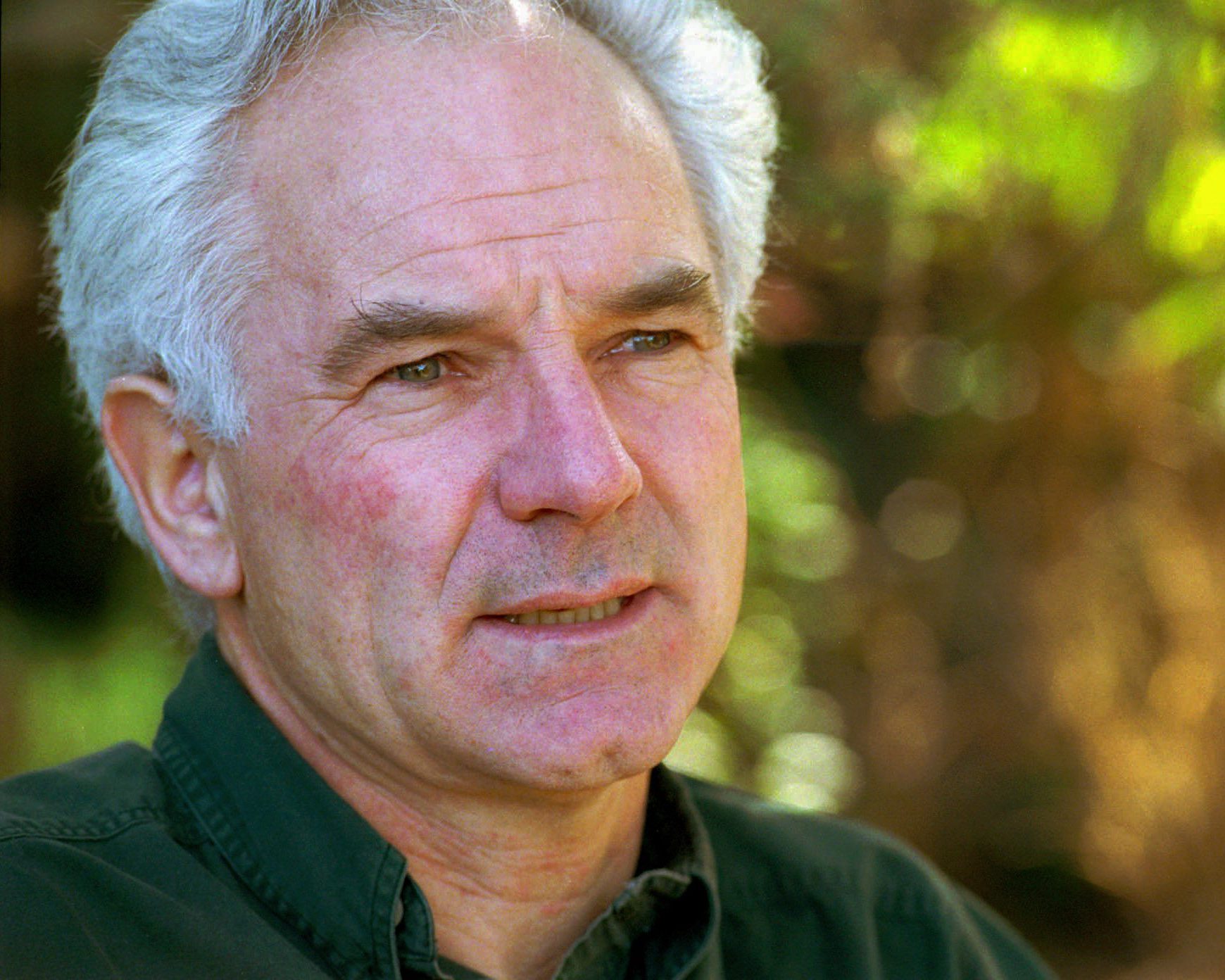
“The covid phenomenon—not the pandemic but the phenomenon around it—created this opportunity for AIDS denialists to reemerge,” he adds. Denialists like Peter Duesberg, the now-infamous Berkeley biologist who first promoted the idea that AIDS is caused by pharmaceuticals or recreational drugs, and Celia Farber and Rebecca V. Culshaw, an independent journalist and researcher, respectively, who have both written critically about what they see as the “official” narrative of HIV/AIDS. (Farber tells MIT Technology Review that she uses the term “AIDS dissent” rather than “denialism”: “‘Denialism’ is a religious and vituperative word.” )
In addition to the renewed skepticism toward public health institutions, the reanimated AIDS denialist movement is being supercharged by technological tools that didn’t exist the first time around: platforms with gigantic reach like X, Substack, Amazon, and Spotify, as well as newer ones that don’t have specific moderation policies around medical misinformation, like Rumble, Gab, and Telegram.
Spotify, for one, has largely declined to curb or moderate Rogan in any meaningful way, while also paying him an eye-watering amount of money; the company inked a $250 million renewal deal with him in February, just weeks before he and Weinstein made their false remarks about AIDS. Amazon, meanwhile, is currently offering Duesberg’s long-out-of-print 1996 book Inventing AIDS for free with a trial of its Audible program, and three of Culshaw’s books are available for free with either an Audible or Kindle Unlimited trial. Farber, meanwhile, has a Substack with more than 28,000 followers.
Now 87 years old and no longer actively speaking publicly, Peter Duesberg’s decades-old theories about AIDS are finding new life online.
AP PHOTO/SUSAN RAGAN
(Spotify, Substack, Rumble, and Telegram did not respond to requests for comment, while Meta and Amazon confirmed receipt of a request for comment but did not answer questions, and X’s press office provided only an auto-response. An email to Gab’s press address was returned as undeliverable.)
While this wave of AIDS denialism doesn’t currently have the reach and influence that the movement had in the past, it still has potentially serious consequences for patients as well as the general public. If these ideas gain enough traction, particularly among elected officials, they could endanger funding for AIDS research and treatments. Public health researchers are still haunted by the period in the 1990s and early 2000s when AIDS denial became official policy in South Africa; one analysis estimates that between just 2000 and 2005, more than 300,000 people died prematurely as a result of the country’s bad public health policies. On an individual level, there could also be devastating results if people with HIV are discouraged from seeking treatment or from trying to prevent the virus’s spread by taking medication or using condoms; a 2010 study has shown that a belief in denialist rhetoric among people with HIV is associated with medication refusal and poor health outcomes, including increased incidence of hospitalization, HIV-related symptoms, and detectable viral loads.
Above all, the revival of this particular slice of medical misinformation is another troubling sign for the ways that tech platforms can deepen distrust in our public health system. The same tech-savvy denialist playbook is already being deployed in the wider “health freedom” space to create confusion and suspicion around other serious diseases, like measles, and to challenge more foundational claims about the science of viruses—that is, to posit that viruses don’t exist at all, or are harmless and can’t cause illness. (A Gab account solely dedicated to the idea that all viruses are hoaxes has more than 3,000 followers.)
As Smith puts it, “We are not in a good place regarding [trust in] all of our public health institutions right now.”
Capitalizing on confusion
One reason AIDS and covid denialists have been able to build similar and interlocking movements that inveigh against government science is that the early days of the two viruses were markedly similar: full of confusion, mystery, and skepticism.
In 1981, James Curran served on a task force investigating the first five known cases of what was then a novel disease. “There were a lot of theories about what caused it,” says Curran, an epidemiologist who is now a dean emeritus at Emory University’s Rollins School of Public Health and previously spent 25 years working at the US Centers for Disease Control and Prevention, serving ultimately as the assistant surgeon general. He and his colleagues had all previously studied sexually transmitted infections that affected gay men and people who injected drugs. With that context, the researchers saw the early patterns of the disease as “indicative of a likely sexually transmissible agent.”
Not everyone agreed, Curran says: “Other people saw poppers or other drugs or accumulation of semen or environmental factors. Some of these things came from the backgrounds that people had, or they came from the simple denial that it could possibly be a new virus.”
The first wave of contrarian ideas about AIDS, then, was less true “denialism” and more the understandable confusion and differences of opinion that can emerge around a new disease. Yet as time went on, “the death rates were increasing dramatically,” says Lindsay Zafir, a distinguished lecturer in anthropology and interdisciplinary programs at the City College of New York who wrote her dissertation on the emergence and evolution of AIDS denialism. “Some people started to wonder whether scientists actually knew what they were doing.”
This led to the emergence of a wider round of more deliberate AIDS disinformation, which was picked up by mainstream publications. In the late 1980s, Spin magazine printed a series of stories that platformed denialist ideas and figures, including interviews with Duesberg, who’d already gained attention for his arguments that AIDS was caused by pharmaceutical drugs and not by HIV. The magazine also published pieces by Farber, a journalist who has described herself becoming progressively more sympathetic to the AIDS denialist cause after interviewing Duesberg. In 1991, theLos Angeles Timespublished a piece that asked whether Duesberg was “a hero or a heretic” for his “controversial” arguments about AIDS.
The tides began to turn only in 1995, when the first generation of antiretroviral therapies emerged to treat AIDS and deaths finally, mercifully, began to drop across the United States.
“Mbeki famously said, Your scientist says this, mine says that—which scientist is right? When that confusion exists, that’s the real vulnerability.”
Still, the denialist movement continued to grow, with next-generation leaders who were, like Duesberg and Farber, publicity savvy and (perhaps unsurprisingly) quick adopters of the earliest versions of the internet. This notably included Christine Maggiore, who was HIV-positive herself and who founded the group Alive & Well AIDS Alternatives. Long before social media, she and her peers used the internet to foster community, offering links on their websites to hotlines and in-person meetings.
Kent State’s Smith and Steven P. Novella, now a clinical neurologist and associate professor at Yale, wrote a paper in 2007 about how the internet had become a powerful force for AIDS denialism. It was “a fertile and unrefereed medium” for denialist ideas and one of just a few common tools to make counterarguments in the face of the widespread scientific agreement on AIDS that dominated medical literature.
Around this time, Farber wrote another big piece, this time in Harper’s,on the so-called AIDS dissidents, which in turn generated a firestorm of criticism and corrections and revived the debate for a new era of readers.
“It’s hard to quantify how much influence those types of people had,” Smith says. She points out that Maggiore was even promoted by Nate Mendel of the Foo Fighters. “It’s hard to know how many people followed her advice,” Smith emphasizes. “But certainly a lot of people heard it.”
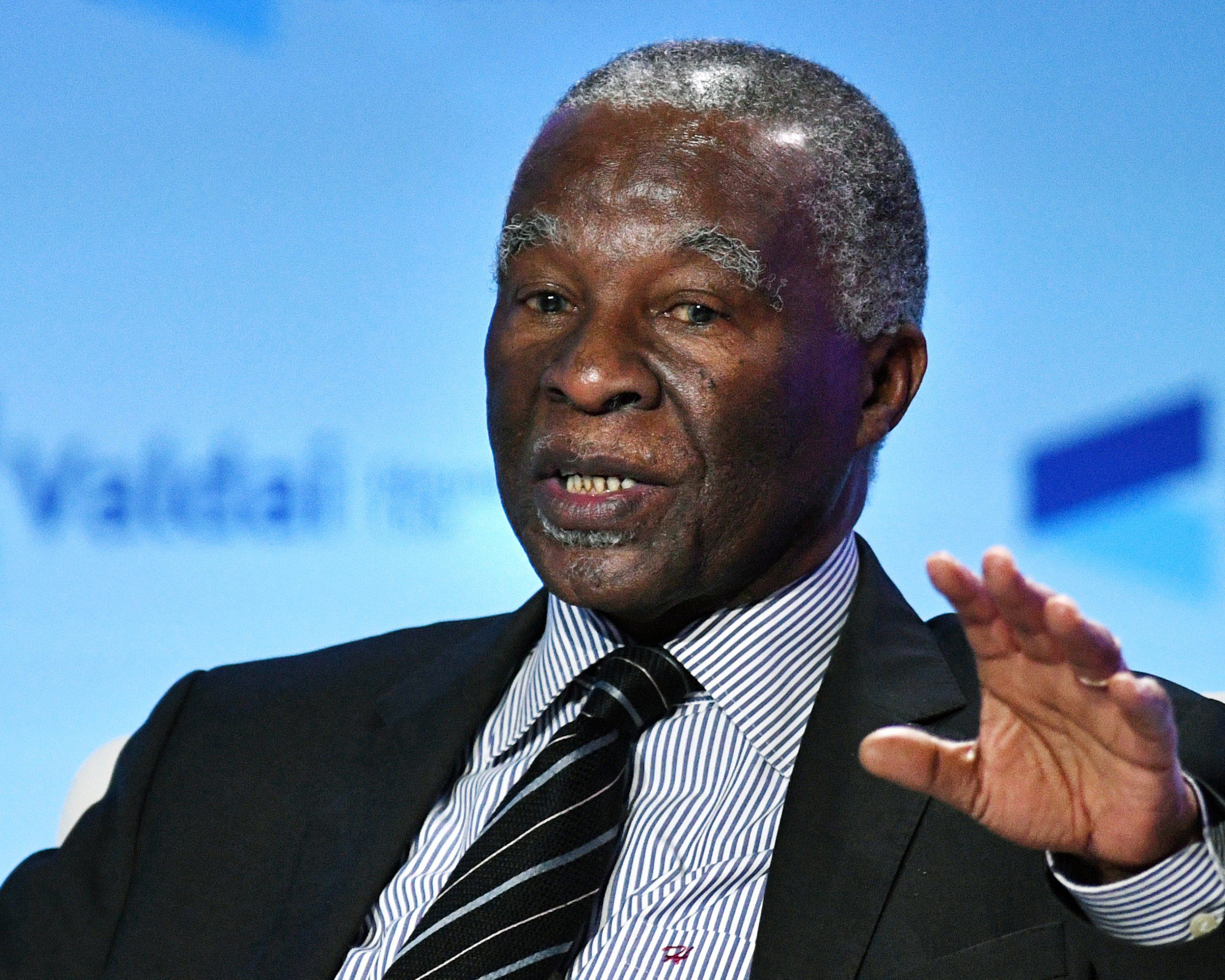
Former South African president Thabo Mbeki enacted AIDS denialism as part of his public policy, denying patients in the country access to antiretroviral drugs.
MAKSIM BLINOV/SPUTNIK VIA AP IMAGES
In a devastating turn, one of those people was Thabo Mbeki, who became the second democratically elected president of South Africa in 1999. Mbeki was skeptical of antiretrovirals to treat AIDS, and as the Lancet points out, both Mbeki and his health minister promoted the work of Western AIDS skeptics. In the summer of 2000, Mbeki hosted a presidential advisory panel that included denialists like Duesberg; Farber tells MIT Technology Review that she was also present. Just a few weeks later, the South African president met privately with Maggiore.
Curran, the former CDC official, visited South Africa during this era and remembers how officials “said they would throw doctors in jail” if they provided AZT to pregnant women.
“Mbeki famously said, Your scientist says this, mine says that—which scientist is right?” Kalichman says. “When that confusion exists, that’s the real vulnerability.”
Mbeki left office in 2008. And while AIDS denialism didn’t exactly disappear by the 2010s, it did largely recede into relative obscurity, beaten back by clear evidence that antiretroviral drugs were working.
There were also meticulous fact-based campaigns from groups like AIDSTruth, which was founded following Farber’s 2006 Harper’s article. This group gained traction online, systematically debunking arguments from denialists on a bare-bones website and using hyperlinks to guide people quickly to science-based material on each point—a somewhat novel approach at the time.
By 2015, the decline of denialism was so complete that AIDSTruth stopped active work, believing that its mission was complete. The group wrote, “We have long since reached the point where we—the people who have in one way or another been involved in running this website—believe that AIDS denialism died as an effective political force.”
Of course, it didn’t take too long to see the work was far from complete.
Growing the “beehive”
Kalichman, from the University of Connecticut, has compared the world of AIDS denial to a “beehive”: It looks like a chaotic mix of people pursuing bad science and debunked ideas for their own particular ends. But if you look closer, what appears to be a swarm is actually “very well organized.” The modern, post-covid variety is no different.
The new wave of denialists often don’t count their theories on AIDS as their sole pseudoscientific interest; rather, it’s part of a whole bouquet of bad ideas.
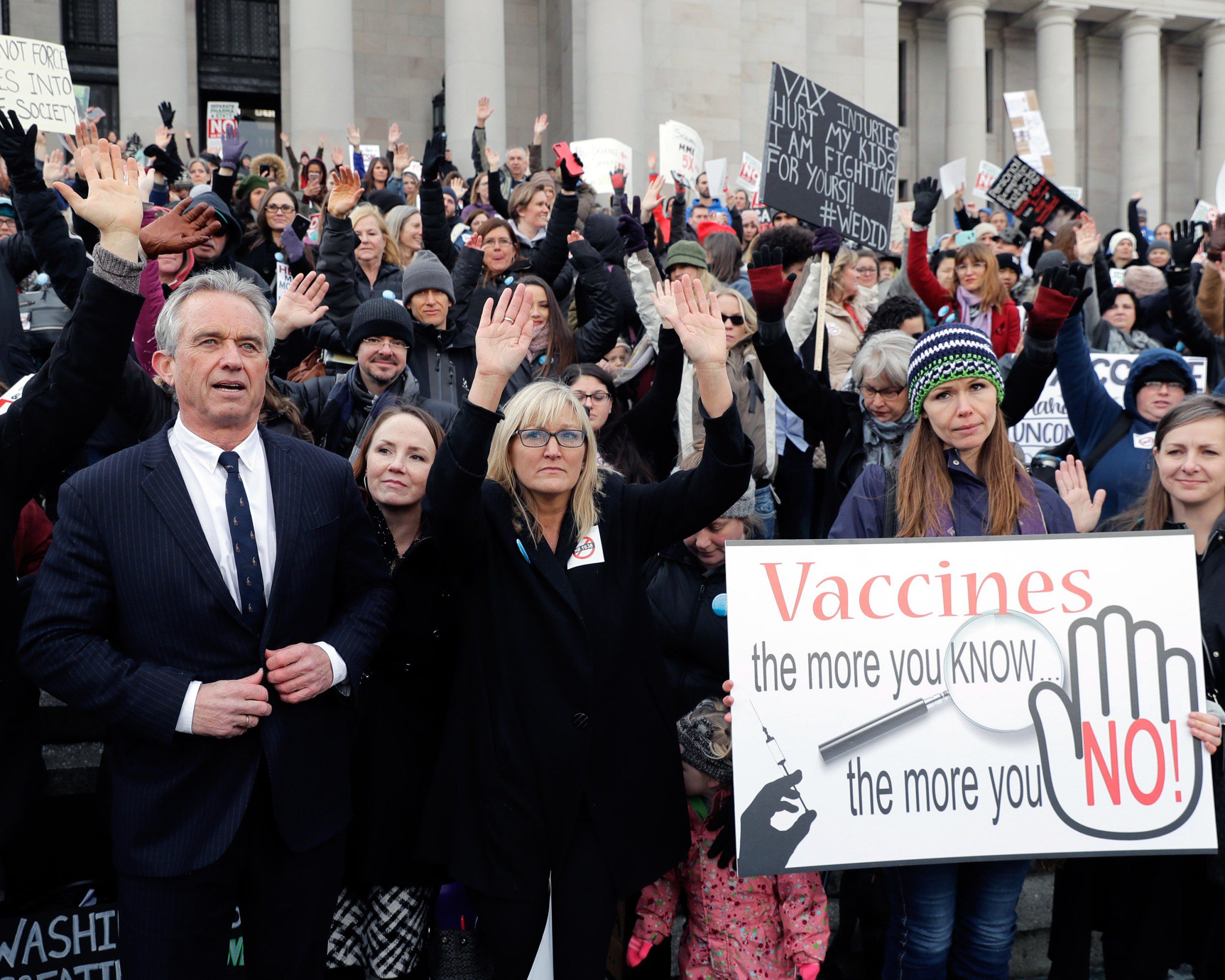
Robert F. Kennedy Jr. has been vocal in his support of anti-vaccine causes long before his current bid for president.
AP PHOTO/TED S. WARREN
These individuals seem to have arrived at revisionist and denialist ideas through a broad-based skepticism of public health, a rejection of what they see as Big Pharma’s meddling, and a particular, visceral disgust toward Fauci. Kennedy, specifically, attributes almost superhuman powers to Fauci, claiming in one 2022 tweet—referencing the Mafia code of silence—that he “purchased omertà among virologists globally with a total of $37 billion in annual payoffs in research grants.” The tweet has been liked more than 26,000 times.
Kennedy’s book “changed everything,” Celia Farber says. “I answered his questions … and was included and quoted in the book. This led to a chance for me to once again be a professional writer, on Substack.”
The new guard has also been comfortable reviving the oldest debunked ideas. Both Rogan and Kennedy, for instance, have claimed that poppers could be the cause of AIDS. “A hundred percent of the people who died in the first thousand [with] AIDS were people who were addicted to poppers, which are known to cause Kaposi sarcoma in rats,” Kennedy told an audience in a speech whose date isn’t clear; a video of the remarks has recently been circulating widely. “And they were people who were part of a gay lifestyle where they were burning the candle at both ends.” (Kennedy’s presidential campaign did not respond to a request for comment.)
Some have even given fresh life to the old guard. Duesberg is now 87 and is no longer active in the public sphere (and his wife told MIT Technology Review that his health did not allow him to sit for an interview or answer questions via email). But the basic shape of his arguments—obfuscating the causes of AIDS, the treatments, and the nature of the disease itself—continue to live on. Rogan actually hosted Duesberg on his podcast in 2012, a decision that generated relatively few headlines at the time—likely because Rogan hadn’t yet become so popular and America’s crisis of disinformation and medical distrust was less pronounced. Rogan and Weinstein praised Duesberg in their recent conversation, asserting that he’d been “demonized” for his arguments aboutAZT. (Weinstein did not respond to a request for comment.Several attempts to reach Spotify through multiple channels did not get responses. Attempts to reach Rogan through Spotify and one of his producers also did not receive responses.)
Before Rodgers spoke falsely about AIDS and AZT, he and the Green Bay Packers were fined for conduct in violation of the NFL’s covid policies.
SARAH STIER/GETTY IMAGES
The support seems to largely go both ways. Culshaw has written that even critical stories about Rodgers are helpful to the cause: “The more hit pieces are published, the more the average citizen—especially the average post-covid citizen—will become curious and begin to look into the issue. And once you’ve looked into it far enough, you cannot unsee what you’ve seen.”
Culshaw and Farber have also been empowered by the new ability to command their own megaphones online. Farber, for instance, is now primarily active on Substack, with a newsletter that is a mix of HIV/AIDS content and general conspiracy theorizing. Her current work refers to HIV/AIDS as a “PSY OP” (caps hers); she presents herself as a soldier in a long war against government propaganda, one in which covid is the latest salvo.
Farber says she sees her arguments gaining ground. “What’s happening now is that the general public are learning about the buried history,” she writes to MIT Technology Review. “People are very interested in the HIV ‘thing’ these days, to my eternal astonishment,” she adds, writing that Kennedy’s book “changed everything.” She says, “I answered his questions about HIV war history and was included and quoted in the book. This led to a chance for me to once again be a professional writer, on Substack.”
Culshaw (who now uses the name Culshaw Smith) strikes a similar tone, though she is a less prominent figure. A mathematician and self-styled HIV researcher, she published her first book in 2007; it claimed to use mathematical evidence to prove that HIV doesn’t cause AIDS.
In 2023 she published another AIDS denial book, this one with Skyhorse, a press that traffics heavily in conspiracy theories and pseudoscience, and which published Kennedy’s book on Fauci. She gained some level of notoriety when the book was distributed by publishing giant Simon & Schuster, leading to protests outside its headquarters from theLGBT rights advocacy groups GLAAD and ACT UP NY. Though Simon & Schuster appears to continue to distribute the book, that pushback has provided the basis for her new act: life after “cancellation.” She produced a short memoir last year that describes the furor—a history Culshaw presents as a dramatic moment in the suppression of AIDS truth. This is one of the books now available for free on Amazon through a Kindle Unlimited trial. (Simon & Schuster did not respond to a request for comment. Culshaw did not respond to a request for comment sent through Substack.)
The argument that she’s been “canceled” by the scientific establishment holds tremendous sway with disease denialists online, who are always eager to seize on cases where they perceive the government to be repressing and censoring “alternative” views. In May, Chronicles, an online right-wing magazine, approvingly tied together Rodgers with the broader web of AIDS denialists, including Culshaw, Duesberg, and others—holding them up as heroic figures who’d been unfairly dismissed as “conspiracy theorists” and who’d done well to challenge medical expertise that the magazine denigrated as “white coat supremacy.” (A request for comment for Rodgers through a representative did not receive a response.)
Platforming denial
AIDS denialism and revisionism are resurging in the midst of bitter ongoing arguments over what kinds of things should be allowed to exist on online platforms. Spotify, for instance, has clear rules that prohibit “asserting that AIDS, COVID-19, cancer or other serious life threatening diseases are a hoax or not real,” and specific rules against “dangerous and deceptive content” that are both thoughtful and clearly articulated. Yet Rogan’s program seems to be exempt from these rules or manages to skirt them; after all, he and Weinstein did not suggest that AIDS isn’t real, per se, but instead promoted debunked ideas about its cause.
While Amazon and Meta have misinformation policies of some kind, they clearly do not prevent AIDS denial books from being sold or denialist arguments from being shared. (Amazon also has content guidelines for books that ban obvious things like hate speech, pornography, or the promotion of terrorism, but they do not specifically mention medical misinformation.)
The difficulty of policing false or unproven health information across all these different platforms, in all the forms it can take, is immense. In 2019, for instance, Facebook allowed misleading ads from personal injury lawyers claiming that PrEP, or pre-exposure prophylaxis drugs, can cause bone and kidney damage; it took action only after a sustained outcry from LGBT groups.
“It’s one of those things that either plants seeds of doubt or encourages those to grow if they’re already there.”
In a sign of how entrenched some of these things can be, there’s a YouTube channel originally called Rethinking AIDS—now known as Question Everything—that has been active for 14 years, sharing interviews with denialists. The channel has 16,000 subscribers, and its most popular videos have upwards of half a million views. Another page, devoted to a conspiratorial documentary about AIDS, has been active since 2009, and its most popular video has nearly 300,000 views. (A YouTube spokesperson tells MIT Technology Review it has “developed our approach to medical misinformation over many years, in close alignment with health authorities around the world” and that it prominently features “content and information from high-quality health sources … in search results and recommendations related to HIV/AIDS.”)
Meanwhile, on platforms like the Elon Musk–owned X, formerly known as Twitter, there is little moderation happening at all. The company removed its ban on covid misinformation in 2022, to almost immediate effect: misinformation and propaganda of all kinds has flourished, including HIV/AIDS denial. One widely circulated video depicts the late biochemist Kary Mullis talking about the moment he first “really questioned” the predominant HIV narrative.
Complementing these more established spaces are newer, more niche platforms like Rumble and Telegram, which don’t have any moderation policies to address medical misinformation and proudly tout a commitment to free speech that means they do very little about any kind of misinformation at all, no matter how noxious.
Joe Rogan’s podcast, with an audience of 14.5 million just on Spotify, has hosted a number of guests expressing anti-vaccine sentiments.
PHOTO ILLUSTRATION BY CINDY ORD/GETTY IMAGES
Telegram, which is one of the most popular messaging apps in Russia, does have a general “verified information” policy. The statement of this policy links to a post by its CEO, Pavel Durov, that says “spreading the truth will always be a more efficient strategy than engaging in censorship.” Discussions of HIV among Telegram’s current and most active misinformation peddlers often compare it to covid, characterizing both as “manufactured” viruses. One widely shared post by the anti-vaccine activist Sherri Tenpenny claims that covid-19 was created by “splicing” HIV into a coronavirus to “inflict maximum harm,” a bizarre lie that’s also meant to strengthen the unproven idea that covid was created in a lab. Telegram is also a fertile ground for sharing phony HIV cures; one group with 43,000 followers has promoted an oil that it claims is used in Nigeria.
When YouTube began to crack down on medical misinformation during the height of the pandemic, conservative and conspiratorial content creators went to Rumble instead. The company claims it saw a 106% revenue increase last year and now has an average of 67 million monthly active users. A clip of Rogan talking about Duesberg’s AIDS-related claims has racked up 30,000 views in the last two years, and an interview with Farber by Joseph Mercola, a major player in the natural-health and anti-vaccine worlds, has gotten more than 300,000 views since it was posted there earlier this year.
The concern with these kinds of falsehoods, Smith says, is always that patient populations, communities at high risk for HIV, or populations with real histories of medical mistreatment, like Black and Native people, “think there might be a grain of truth and start to doubt if they need to be tested or continue treatment or things like that.” She adds, “It’s one of those things that either plants seeds of doubt or encourages those to grow if they’re already there.”
But it’s far more concerning when people like Rogan, who have a massive reach, take up the cause. “They just have such a huge platform, and those stories are scary and they spread,” Smith says. “Once they do that, it’s so hard for scientists to fight that.”
The offline impact
For all the work AIDS denialists are doing to try to grow their numbers, Kalichman remains hopeful that they’re unlikely to make significant inroads. The most profound reason, he believes, is that many people now know someone living with HIV—a friend, a family member, a celebrity. As a result, many more people are directly familiar with how life-altering current HIV treatments have been.
“This isn’t the ’90s,” he says. “People are taking one pill once a day and living really healthy lives. If a person with HIV smokes, they’re much more likely to die of a smoking-related illness [than HIV] if their HIV Is being treated.”
Even the much stranger and more esoteric “terrain theory” seems to be making a modest comeback in alternative online spaces; the idea is that germs don’t cause illness in a healthy person whose “terrain” is sound thanks to vitamins, exercise, and sunlight.
Yet the risk doesn’t necessarily hang solely on how many people buy into the false information—but who does. Among people who have been studying AIDS denialism for decades, the biggest concern is ultimately that someone in public office will take notice and begin formally acting on those ideas. If that happens, Curran, the former assistant surgeon general, worries it could jeopardize funding for PEPFAR (the United States President’s Emergency Plan for AIDS Relief), the enormously successful public health program that has supported HIV testing, prevention, and treatment in lower-resource countries since the George W. Bush administration.
The current political environment further exacerbates the risk: Donald Trump has said that if he is elected again, he will cut federal funding to schools with mask or vaccine mandates, and Florida’s surgeon general, Joseph Ladapo, allowed parents to continue sending unvaccinated kids to school in the midst of a measles outbreak.
All it takes, Kalichman says, is for “someone who’s sitting in a policymaker’s chair in a state health department” to take AIDS denial arguments seriously. “A lot of damage can be done.” (He expresses relief, however, that Trump and his wing of the Republican Party have not yet taken up the particular cause of AIDS denialists: “Thank goodness.”)
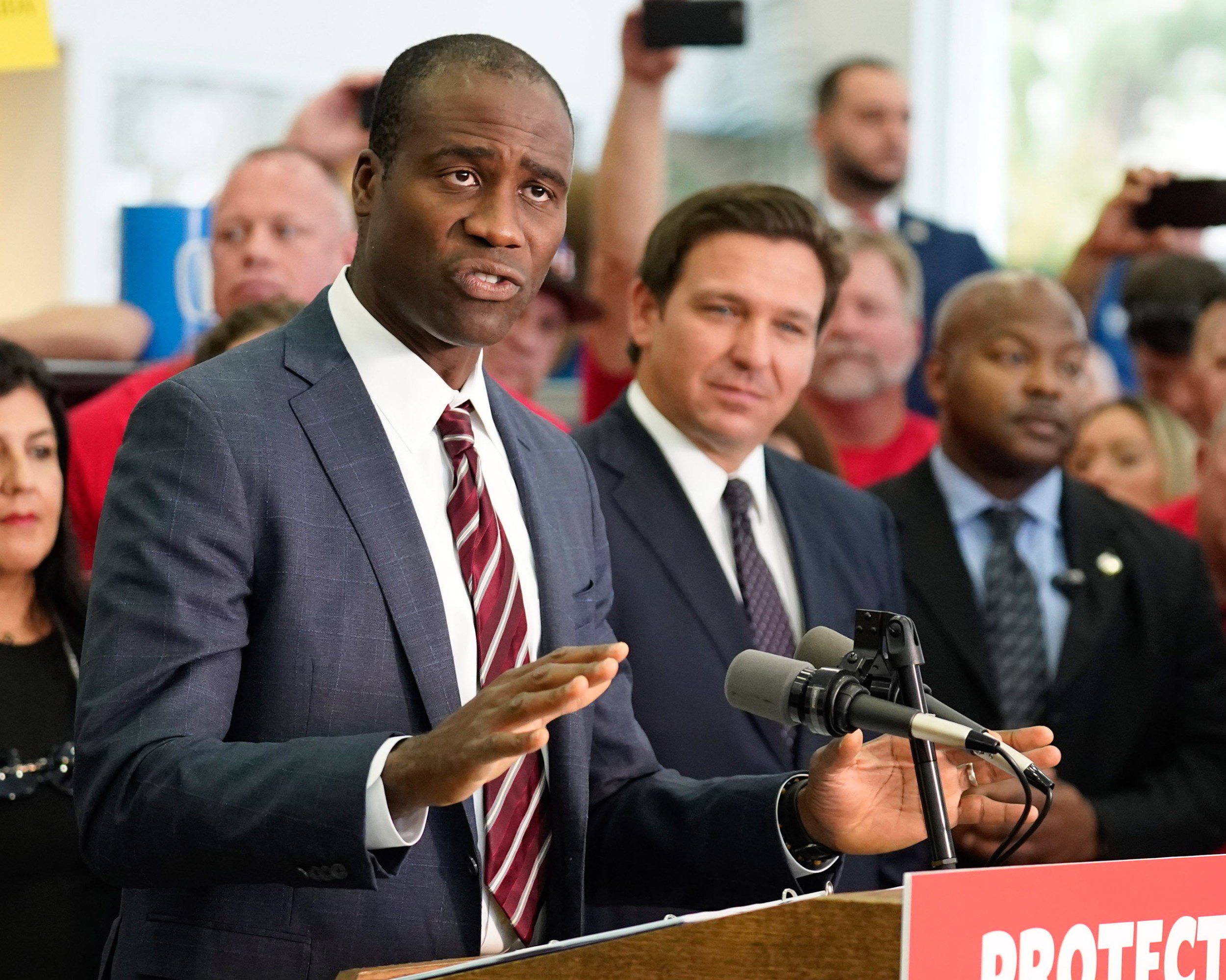
Florida Surgeon General Joseph Ladapo’s letter to parents during a measles outbreak ran counter to the CDC’s recommended guidelines.
AP PHOTO/CHRIS O’MEARA
Then there is the fact that the same kind of denialist campaign is already being deployed with other diseases. Christiane Northrup, a former ob-gyn and a significant figure in natural health and related conspiratorial thinking, has recently been on Telegram sharing an old lie that a German court ruled the measles virus “does not exist.” (Northrup did not respond to a request for comment.)
On its own, if it were just bunk HIV theories recirculating, “I wouldn’t be as worried about it,” Smith says. “But in this broader anti-covid, anti-vaccine, and everything about germ theory being denied—that’s what worries me.”
By trying to effectively decouple cause and effect—claiming that HIV doesn’t cause AIDS, that measles isn’t caused by a virus and is instead a vitamin deficiency or caused by the MMR (measles, mumps, and rubella) vaccine itself—these movements discourage people from treating or trying to prevent serious and contagious illnesses. They try to sow doubt about the very nature of viruses themselves, a global gesture toward doubt, distrust, and minimization of serious diseases. Even the much stranger and more esoteric “terrain theory” seems to be making a modest comeback in alternative online spaces; the idea is that germs don’t cause illness in a healthy person whose “terrain” is sound thanks to vitamins, exercise, and sunlight.
These kinds of false claims, Smith points out, are resurging at a particularly inopportune time, when the public health world is already trying to prepare for the next pandemic. “We’re out of the emergency mode of the covid pandemic and trying to repair some of the damage to public health,” she says, “and thinking about another one.”
Curran also has a larger, more existential concern when he considers the lessons of the AIDS and covid pandemics: “The problem is, if you bad-mouth Fauci and his successors so much, the next epidemic people come around and they say, ‘Why should we trust these people?’ And the question is, who do we trust?
“When bird flu gets out of cows and goes to humans, are we going to go to Joe Rogan for the answers?”
This story first appeared in China Report, MIT Technology Review’s newsletter about technology in China. Sign up to receive it in your inbox every Tuesday.
There’s a decent chance you’ve heard of hydrogen-powered vehicles but never seen one. Over 18,000 are in the US, almost exclusively in California. On the outside they look just like traditional vehicles, but they are powered by electricity generated from a hydrogen fuel cell, making them far cleaner and greener.
So when I learned that in parts of China, companies are putting hydrogen-powered bikes on the road for anyone to ride, it was a real “the future is here” moment for me. I looked deeper into it and wrote a story.
These bikes have water-bottle-sized hydrogen tanks, which can make them easier than regular bikes to ride, though the tanks have to be swapped out every 40 miles. But they haven’t exactly been getting rave reviews. One rider in Shanghai told me the speed boost from hydrogen felt lacking, and the user experience was hurt by hardware and software design flaws. Many people on social media agree with him.
Youon, one of the largest players in China’s bike-sharing industry, has thrown its support behind hydrogen energy. It has put thousands of hydrogen-powered bikes in major cities like Beijing and Shanghai, in the hopes of kick-starting a trend.
But for clean energy experts, it’s a head-scratcher as to why these hydrogen bikes are being promoted in the first place: Hydrogen bikes are less efficient than ordinary e-bikes, and they won’t make much economic sense in the long run.
It’s not just one company taking this path. The collective appetite for hydrogen bikes has been much bigger than I expected. By my own counting, Youon has half a dozen competitors in the hydrogen bike field, and several cities have embraced the idea. While the future of hydrogen-powered shared bikes is uncertain, their proliferation represents a much larger trend happening in China: exploring how hydrogen can be used in transportation.
It’s no secret that China has already become a world leader in producing affordable and capable electric vehicles, but the Chinese government and companies aren’t stopping there. A significant number of local policies have been set up in recent years to subsidize the production of hydrogen vehicles, waive toll fees for them, and build more refuel stations for hydrogen. Now China has about 21,000 hydrogen vehicles on the road and more than 400 refuel stations.
It’s worth having a reality check about China’s push for hydrogen: While using hydrogen as a fuel for vehicles comes with no carbon emissions, that’s not the case for actually producing hydrogen. In China, the vast majority comes from fossil fuels, which cost much less than producing hydrogen with water and renewable energy. (To learn the difference between “gray,” “blue,” and “green” hydrogen, read this piece by my colleague Casey Crownhart.)
The sad truth is that China will rely on coal and natural gas for making hydrogen for a while. The fact that hydrogen is a byproduct of processing coal explains why many cities in China with abundant coal resources are also at the frontier of the hydrogen industry. For them, the economic argument for hydrogen can trump the environmental costs, and as a result, even though hydrogen vehicles create a pathway for the transportation system to further decarbonize in the future, they are doing very little to address climate change now.
The same issue applies to electric vehicles in China: Yes, electricity is cleaner than gas as a car fuel, but the majority of electricity in China still comes from fossil fuels, so how much cleaner is it really?
But hydrogen vehicle companies need to answer an additional question: If China is already pretty good at making batteries for EVs, why should it bother spending any time or resources on hydrogen vehicles?
For now, the Chinese companies have come up with one good answer, and it’s not bikes. It’s heavy trucks.
“Hydrogen passenger vehicles are kind of a dead end here … I think for fleet vehicles, trucking, long-distance cargo, hydrogen is competitive with long-range electric vehicles. Maybe it’s a toss-up?” says David Fishman, a senior manager at the Lantau Group, an energy consulting firm.
If you think about it, cargo trucks bump up against some of EVs’ biggest limitations today: They need to go ultra-long distances while being refueled quickly to save time. Meanwhile, the limitations of hydrogen vehicles, like the lack of refuel stations and the higher production costs, make them much more suitable for commercial fleets than for individual car buyers.
As a result, Chinese hydrogen trucking companies are feeling confident, says Fishman. If hydrogen really becomes a next-generation mainstream fuel, it will probably start with trucks in China.
Do you think hydrogen or lithium batteries are the future of clean transportation? Let me know your pick at zeyi@technologyreview.com.
Now read the rest of China Report
Catch up with China
1. In China, private companies are responsible for verifying peoples’ identities on social media. Now the government is trying to take back that control by introducing a new “national internet ID” system, a move that became instantly controversial. (New York Times $)
2. Record-high temperatures in southern China are pushing the grid to its limit. On August 2, the power demand of Shanghai was more than the entire capacity of the Philippines. (Bloomberg $)
3. Honor, a smartphone maker once owned by Huawei, is getting ready to go public. Documents show that the local government of Shenzhen has given it “unusually” large support, including a dedicated city hall team with a “no matter left overnight” policy. (Reuters $)
4. App developers in China can circumvent Apple’s high fees by charging users through Tencent’s and ByteDance’s super apps. Apple now wants to close that loophole. (Bloomberg $)
5. The Biden administration is planning to ban the use of Chinese software in US autonomous vehicles. (Reuters $)
6. The new R-rated Disney movie Deadpool & Wolverine had to take out references to cocaine and homosexuality and replace “vibrator” with “massage gun” to pass China’s censors. (Wall Street Journal $)
7. A university in Beijing has started offering the country’s first bachelor’s degree in “marriage services and management.” It will teach everything from matchmaking to divorce counseling. (CNBC)
Lost in translation
Cheap knockoff phones defined made-in-China gadgets in the 2000s, but they disappeared after domestic brands like Xiaomi brought their prices down significantly. Now, these knockoffs are making a comeback in livestream shopping channels, according to the Chinese publication IT Times.
On Douyin and Kuaishou, cheap domestic 5G phones that look like Apple or Huawei products are trying to attract low-income consumers with promises of high-end specs and dirt-cheap prices as low as 298 yuan (a little over $40). Once consumers receive these phones, they usually realize that the claims about the specs are misleading, and the companies making the phones don’t even have proper business registrations. While stricter regulations in China and abundant domestic competition have pushed knockoff phones out of brick-and-mortar stores, they seem to thrive in the less-regulated online markets.
One more thing
Readers of China Report, hi! This is Zeyi. It’s been almost two years since I sent out the first edition of this newsletter, and sadly this will be my last, as I’m leaving MIT Technology Review.
Stay tuned, as MIT Technology Review will bring back China Report shortly. Meanwhile, I hope you will enjoy our other newsletters, or this incredibly petty response by Pizza Hut Hong Kong to the win over Italy for an Olympics fencing gold. And yes, I’m all for pineapples on pizza.
HK won a fencing gold over Italy & the Italian olympic committee submitted an official complaint claiming that the judges (from Taiwan & S Korea) were biased because of geographical closeness. In response, Pizza Hut HK is offering free pineapple on pizza until 6pm tomorrow lmaoo pic.twitter.com/DhEfYtL8je
This story originally appeared in The Algorithm, our weekly newsletter on AI. To get stories like this in your inbox first, sign up here.
It’s the Taylor Swifts of the world that are going to save us. In January, nude deepfakes of Taylor Swift went viral on X, which caused public outrage. Nonconsensual explicit deepfakes are one of the most common and severe types of harm posed by AI. The generative AI boom of the past few years has only made the problem worse, and we’ve seen high-profile cases of children and female politicians being abused with these technologies.
Though terrible, Swift’s deepfakes did perhaps more than anything else to raise awareness about the risks and seem to have galvanized tech companies and lawmakers to do something.
“The screw has been turned,” says Henry Ajder, a generative AI expert who has studied deepfakes for nearly a decade. We are at an inflection point where the pressure from lawmakers and awareness among consumers is so great that tech companies can’t ignore the problem anymore, he says.
First, the good news. Last week Google said it is taking steps to keep explicit deepfakes from appearing in search results. The tech giant is making it easier for victims to request that nonconsensual fake explicit imagery be removed. It will also filter all explicit results on similar searches and remove duplicate images. This will prevent the images from popping back up in the future. Google is also downranking search results that lead to explicit fake content. When someone searches for deepfakes and includes someone’s name in the search, Google will aim to surface high-quality, non-explicit content, such as relevant news articles.
This is a positive move, says Ajder. Google’s changes remove a huge amount of visibility for nonconsensual, pornographic deepfake content. “That means that people are going to have to work a lot harder to find it if they want to access it,” he says.
In January, I wrote about three ways we can fight nonconsensual explicit deepfakes. These included regulation; watermarks, which would help us detect whether something is AI-generated; and protective shields, which make it harder for attackers to use our images.
Eight months on, watermarks and protective shields remain experimental and unreliable, but the good news is that regulation has caught up a little bit. For example, the UK has banned both creation and distribution of nonconsensual explicit deepfakes. This decision led a popular site that distributes this kind of content, Mr DeepFakes, to block access to UK users, says Ajder.
The EU’s AI Act is now officially in force and could usher in some important changes around transparency. The law requires deepfake creators to clearly disclose that the material was created by AI. And in late July, the US Senate passed the Defiance Act, which gives victims a way to seek civil remedies for sexually explicit deepfakes. (This legislation still needs to clear many hurdles in the House to become law.)
But a lot more needs to be done. Google can clearly identify which websites are getting traffic and tries to remove deepfake sites from the top of search results, but it could go further. “Why aren’t they treating this like child pornography websites and just removing them entirely from searches where possible?” Ajder says. He also found it a weird omission that Google’s announcement didn’t mention deepfake videos, only images.
Looking back at my story about combating deepfakes with the benefit of hindsight, I can see that I should have included more things companies can do. Google’s changes to search are an important first step. But app stores are still full of apps that allow users to create nude deepfakes, and payment facilitators and providers still provide the infrastructure for people to use these apps.
Ajder calls for us to radically reframe the way we think about nonconsensual deepfakes and pressure companies to make changes that make it harder to create or access such content.
“This stuff should be seen and treated online in the same way that we think about child pornography—something which is reflexively disgusting, awful, and outrageous,” he says. “That requires all of the platforms … to take action.”
Now read the rest of The Algorithm
Deeper Learning
End-of-life decisions are difficult and distressing. Could AI help?
A few months ago, a woman in her mid-50s—let’s call her Sophie—experienced a hemorrhagic stroke, which left her with significant brain damage. Where should her medical care go from there? This difficult question was left, as it usually is in these kinds of situations, to Sophie’s family members, but they couldn’t agree. The situation was distressing for everyone involved, including Sophie’s doctors.
Enter AI: End-of-life decisions can be extremely upsetting for surrogates tasked with making calls on behalf of another person, says David Wendler, a bioethicist at the US National Institutes of Health. Wendler and his colleagues are working on something that could make things easier: an artificial-intelligence-based tool that can help surrogates predict what patients themselves would want. Read more from Jessica Hamzelou here.
Bits and Bytes
OpenAI has released a new ChatGPT bot that you can talk to The new chatbot represents OpenAI’s push into a new generation of AI-powered voice assistants in the vein of Siri and Alexa, but with far more capabilities to enable more natural, fluent conversations. (MIT Technology Review)
Meta has scrapped celebrity AI chatbots after they fell flat with users Less than a year after announcing it was rolling out AI chatbots based on celebrities such as Paris Hilton, the company is scrapping the feature. Turns out nobody wanted to chat with a random AI celebrity after all! Instead, Meta is rolling out a new feature called AI Studio, which allows creators to make AI avatars of themselves that can chat with fans. (The Information)
OpenAI has a watermarking tool to catch students cheating with ChatGPT but won’t release it The tool can detect text written by artificial intelligence with 99.9% certainty, but the company hasn’t launched it for fear it might put people off from using its AI products. (The Wall Street Journal)
The AI Act has entered into force At last! Companies now need to start complying with one of the world’s first sweeping AI laws, which aims to curb the worst harms. It will usher in much-needed changes to how AI is built and used in the European Union and beyond. I wrote about what will change with this new law, and what won’t, in March. (The European Commission)
How TikTok bots and AI have powered a resurgence in UK far-right violence Following the tragic stabbing of three girls in the UK, the country has seen a surge of far-right riots and vandalism. The rioters have created AI-generated images that incite hatred and spread harmful stereotypes. Far-right groups have also used AI music generators to create songs with xenophobic content. These have spread like wildfire online thanks to powerful recommendation algorithms. (The Guardian)
As temperatures climb on hot days, many of us are quick to crank up our fans or air conditioners. These cooling systems can be a major stress on electrical grids, which has inspired some inventors to create versions that can store energy as well as use it.
Cooling represents 20% of global electricity demand in buildings, a share that’s expected to rise as the planet warms and more of the world turns to cooling technology. During peak demand hours, air conditioners can account for over half the total demand on the grid in some parts of the world today.
New cooling technologies that incorporate energy storage could help by charging themselves when renewable electricity is available and demand is low, and still providing cooling services when the grid is stressed.
“We say, take the problem, and turn it into a solution,” says Yaron Ben Nun, founder and chief technology officer of Nostromo Energy.
One of Nostromo Energy’s systems, which it calls an IceBrick, is basically a massive ice cube tray. It cools down a solution made of water and glycol that’s used to freeze individual capsules filled with water. One IceBrick can be made up of thousands of these containers, which each hold about a half-gallon, or roughly two liters, of water.
Insulation keeps the capsules frozen until it’s time to use them to help cool down a building. Then the ice is used to drop the temperature of the water-glycol mixture, which in turn cools down the water that circulates in the building’s chilling system. The whole thing is designed to work as an add-on with existing equipment, Ben Nun says.
Nostromo installed its first system in the US in 2023, at the Beverly Hilton hotel in Los Angeles. It has a capacity of 1.4 megawatt-hours, and it also serves the neighboring Waldorf Astoria. The installation contains 40,000 capsules, amounting to about 150,000 pounds of ice. It usually charges up for 10 to 12 hours, starting at night and finishing around midday. That leaves it ready to discharge its cooling power between the late afternoon and evening, when demand on the grid is high and solar power is dropping off as the sun sets.
Using the IceBrick increases the total electricity needed for cooling, as some energy is lost to inefficiency during the cycle. But the goal is to decrease the energy demand during peak hours, which can cut costs for building owners, Ben Nun says. The company is in the process of securing roughly $300 million in funding, in part from the US Department of Energy’s Loan Programs Office, to fully finance 200 of these systems in California, he adds.
Nostromo’s IceBrick is made of individual capsules that freeze and thaw to store energy.
NOSTROMO
While building owners can benefit immediately from these individual energy storage solutions, the real potential to help the grid comes when systems are linked together, Ben Nun says.
When the grid is extremely stressed, utility companies are sometimes forced to shut off electricity supply to some areas, leaving people there without power when they need it most. Technologies that can adjust to meet the grid’s needs could help reduce reliance on these rolling blackouts.
This kind of approach isn’t new—many commercial units have large tanks that hold chilled water or another cooling fluid that can drop the temperature in a building at a moment’s notice. But Nostromo’s technology can store more energy with much less material, because it uses the freezing and melting process rather than just cooling down a liquid, Ben Nun says.
Startup Blue Frontier has differentiated itself in this space by building cooling systems that use desiccants. These materials can suck up moisture—like the little packets of silica beads that often come with new shoes and bags. But instead of those beads, the company is using a concentrated salt solution.
Blue Frontier’s cooling units pass a stream of air over a thin layer of the desiccant, which pulls moisture out of the air. That dry air is then used in an evaporative cooling process (similar to the way sweat cools your skin).
Desiccant cooling systems can be more efficient than the traditional vapor compression air conditioners on the market today, says Daniel Betts, founder and CEO of Blue Frontier. But the system also benefits from the ability to charge up during certain times and deliver cooling at other times.
The key to the energy storage aspect of desiccant cooling is the recharging: Like sponges, desiccants can only soak up a limited amount of water before they need to be wrung out. Blue Frontier does this by causing some water in the salt solution to evaporate, typically with a heat pump, to make it more concentrated. The recharging system can run constantly, or in bursts that can be timed to match periods when electricity is cheap or when more renewable power is available.
The benefit of these energy storage technologies is that they don’t require people turn their cooling systems down or off to help relieve stress on the grid, Betts says.
Blue Frontier is testing several systems with customers today and hopes to manufacture larger quantities soon. And while commercial buildings are getting the first installations, Betts says he’s interested in bringing the technology to homes and other buildings too.
One challenge facing the companies working on these incoming technologies is finding a way to store large amounts of energy effectively without adding too much cost, says Ankit Kalanki, a principal in the carbon-free buildings program at the Rocky Mountain Institute, a nonprofit energy think tank. Cooling technologies like air conditioners are already expensive, so future solutions will have to be priced competitively to make it in the market. But given the world’s growing cooling demand, there’s still a significant opportunity for new technologies to help meet those needs, he adds.
Just rethinking air conditioning won’t be enough to meet the massive increase in energy demand for cooling, which could triple between now and 2050. To both do that and cut emissions, we’ll still need significantly more renewable energy capacity as well as gigantic battery installations on the grid. But adding flexibility into air-conditioning systems could help cut the investment needed to get to a zero-carbon grid.
Cooling systems can help us cope with our warming climate, Ben Nun says, but there’s a problem with the current options: “You’ll cool yourself, but you keep on warming the globe.”