It’s game night,and I’m crossing my fingers, hoping for a hurricane.
I roll the die and it clatters across the board, tumbling to a stop to reveal a tiny icon of a tree stump. Bad news: I just triggered deforestation in the Amazon. That seals it. I failed to stop climate change—at least this board-game representation of it.
The urgent need to address climate change might seem like unlikely fodder for a fun evening. But a growing number of games are attempting to take on the topic, including a version of the bestseller Catan released this summer.
As a climate reporter, I was curious about whether games could, even abstractly, represent the challenge of the climate crisis. Perhaps more crucially, could they possibly be any fun?
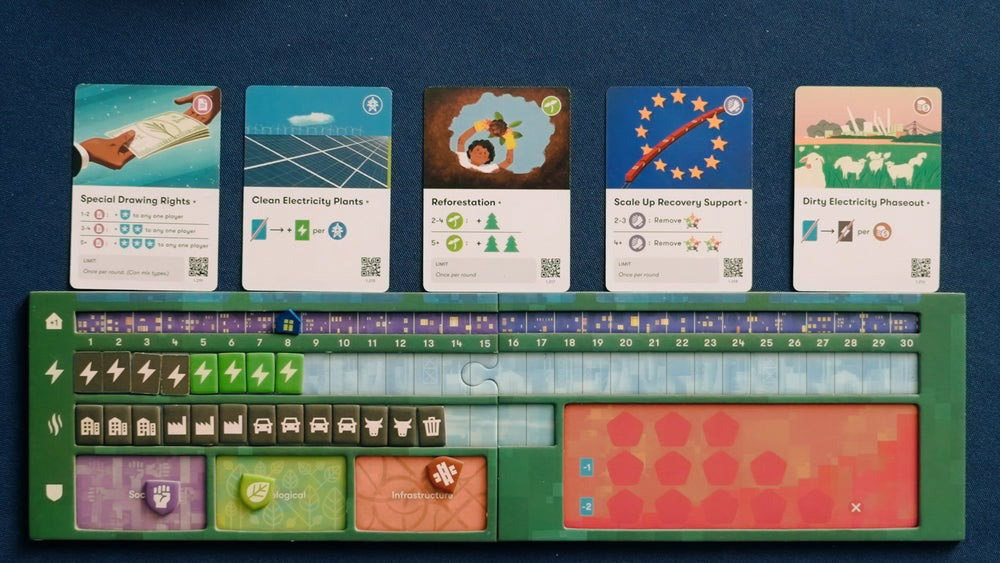
My investigation started with Daybreak, a board game released in late 2023 by a team that includes the creator of Pandemic (infectious disease—another famously light topic for a game). Daybreak is a cooperative game where players work together to cut emissions and survive disasters. The group either wins or loses as a whole.
When I opened the box, it was immediately clear that this wouldn’t be for the faint of heart. There are hundreds of tiny cardboard and wooden pieces, three different card decks, and a surprisingly thick rule book. Setting it up, learning the rules, and playing for the first time took over two hours.
Daybreak, a cooperative board game about stopping climate change.
COURTESY OF CMYK
Daybreak is full of details, and I was struck by how many of them it gets right. Not only are there cards representing everything from walkable cities to methane removal, but each features a QR code players can use to learn more.
In each turn, players deploy technologies or enact policies to cut climate pollution. Just as in real life, emissions have negative effects. Winning requires slashing emissions to net zero (the point where whatever’s emitted can be soaked up by forests, oceans, or direct air capture). But there are multiple ways for the whole group to lose, including letting the global average temperature increase by 2 °C or simply running out of turns.
In an embarrassing turn of events for someone who spends most of her waking hours thinking about climate change, nearly every round of Daybreak I played ended in failure. Adding insult to injury, I’m not entirely sure that I was having fun. Sure, the abstract puzzle was engaging and challenging, and after a loss, I’d be checking the clock, seeing if there was time to play again. But once all the pieces were back in the box, I went to bed obsessing about heat waves and fossil-fuel disinformation. The game was perhaps representing climate change a little bit too well.
I wondered if a new edition of a classic would fare better. Catan, formerly Settlers of Catan, and its related games have sold over 45 million copies worldwide since the original’s release in 1995. The game’s object is to build roads and settlements, setting up a civilization.
In late 2023, Catan Studios announced that it would be releasing a version of its game called New Energies, focused on climate change. The new edition, out this summer, preserves the same central premise as the original. But this time, players will also construct power plants, generating energy with either fossil fuels or renewables. Fossil fuels are cheaper and allow for quicker expansion, but they lead to pollution, which can harm players’ societies and even end the game early.
Before I got my hands on the game, I spoke with one of its creators, Benjamin Teuber, who developed the game with his late father, Klaus Teuber, the mastermind behind the original Catan.
To Teuber, climate change is a more natural fit for a game than one might expect. “We believe that a good game is always around a dilemma,” he told me. The key is to simplify the problem sufficiently, a challenge that took the team dozens of iterations while developing New Energies. But he also thinks there’s a need to be at least somewhat encouraging. “While we have a severe topic, or maybe even especially because we have a severe topic, you can’t scare off the people by making them just have a shitty evening,” Teuber says.
In New Energies, the first to gain 10 points wins, regardless of how polluting that player’s individual energy supply is. But if players collectively build too many fossil-fuel plants and pollution gets too high, the game ends early, in which case whoever has done the most work to clean up their own energy supply is named the winner.
That’s what happened the first time I tested out the game. While I had been lagging in points, I ended up taking the win, because I had built more renewable power plants than my competitors.
This relatively rosy ending had me conflicted. On one hand, I was delighted, even if it felt like a consolation prize.
But I found myself fretting over the messages that New Energies will send to players. A simple game that crowns a winner may be more playable, but it doesn’t represent how complicated the climate crisis is, or how urgently we need to address it.
I’m glad climate change has a spot on my game shelf, and I hope these and other games find their audiences and get people thinking about the issues. But I’ll understand the impulse to reach for other options when game night rolls around, because I can’t help but dwell on the fact that in the real world, we won’t get to reset the pieces and try again.
The outbreak of avian influenza on US dairy farms has started to make milk seem a lot less wholesome. Milk that’s raw, or unpasteurized, can actually infect mice that drink it, and a few dairy workers have already caught the bug.
The FDA says that commercial milk is safe because it is pasteurized, killing the germs. Even so, it’s enough to make a person ponder a life beyond milk—say, taking your coffee black or maybe drinking oat milk.
But for those of us who can’t do without the real thing, it turns out some genetic engineers are working on ways to keep the milk and get rid of the cows instead. They’re doing it by engineering yeasts and plants with bovine genes so they make the key proteins responsible for milk’s color, satisfying taste, and nutritional punch.
The proteins they’re copying are casein, a floppy polymer that’s the most abundant protein in milk and is what makes pizza cheese stretch, and whey, a nutritious combo of essential amino acids that’s often used in energy powders.
It’s part of a larger trend of replacing animals with ingredients grown in labs, steel vessels, or plant crops. Think of the Impossible burger, the veggie patty made mouthwatering with the addition of heme, a component of blood that’s produced in the roots of genetically modified soybeans.
One of the milk innovators is Remilk, an Israeli startup founded in 2019, which has engineered yeast so it will produce beta-lactoglobulin (the main component of whey). Company cofounder Ori Cohavi says a single biotech factory of bubbling yeast vats feeding on sugar could in theory “replace 50,000 to 100,000 cows.”
Remilk has been making trial batches and is testing ways to formulate the protein with plant oils and sugar to make spreadable cheese, ice cream, and milk drinks. So yes, we’re talking “processed” food—one partner is a local Coca-Cola bottler, and advising the company are former executives of Nestlé, Danone, and PepsiCo.
But regular milk isn’t exactly so natural either. At milking time, animals stand inside elaborate robots, and it looks for all the world as if they’re being abducted by aliens. “The notion of a cow standing in some nice green scenery is very far from how we get our milk,” says Cohavi. And there are environmental effects: cattle burp methane, a potent greenhouse gas, and a lactating cow needs to drink around 40 gallons of water a day.
“There are hundreds of millions of dairy cows on the planet producing greenhouse waste, using a lot of water and land,” says Cohavi. “It can’t be the best way to produce food.”
For biotech ventures trying to displace milk, the big challenge will be keeping their own costs of production low enough to compete with cows. Dairies get government protections and subsidies, and they don’t only make milk. Dairy cows are eventually turned into gelatin, McDonald’s burgers, and the leather seats of your Range Rover. Not much goes to waste.
At Alpine Bio, a biotech company in San Francisco (also known as Nobell Foods), researchers have engineered soybeans to produce casein. While not yet cleared for sale, the beans are already being grown on USDA-sanctioned test plots in the Midwest, says Alpine’s CEO, Magi Richani.
Richani chose soybeans because they’re already a major commodity and the cheapest source of protein around. “We are working with farmers who are already growing soybeans for animal feed,” she says. “And we are saying, ‘Hey, you can grow this to feed humans.’ If you want to compete with a commodity system, you have to have a commodity crop.”
Alpine intends to crush the beans, extract the protein, and—much like Remilk—sell the ingredient to larger food companies.
Everyone agrees that cow’s milk will be difficult to displace. It holds a special place in the human psyche, and we owe civilization itself, in part, to domesticated animals. In fact, they’ve left their mark in our genes, with many of us carrying DNA mutations that make cow’s milk easier to digest.
But that’s why it might be time for the next technological step, says Richani. “We raise 60 billion animals for food every year, and that is insane. We took it too far, and we need options,” she says. “We need options that are better for the environment, that overcome the use of antibiotics, and that overcome the disease risk.”
It’s not clear yet whether the bird flu outbreak on dairy farms is a big danger to humans. But making milk without cows would definitely cut the risk that an animal virus will cause a new pandemic. As Richani says: “Soybeans don’t transmit diseases to humans.”
Now read the rest of The Checkup
Read more from MIT Technology Review’s archive
Hungry for more from the frontiers of fromage? In the Build issue of our print magazine, Andrew Rosenblum tasted a yummy brie made only from plants. Harder to swallow was the claim by developer Climax Foods that its cheese was designed using artificial intelligence.
The idea of using yeast to create food ingredients, chemicals, and even fuel via fermentation is one of the dreams of synthetic biology. But it’s not easy. In 2021, we raised questions about high-flying startup Ginkgo Bioworks. This week its stock hit an all-time low of $0.49 per share as the company struggles to make … well, anything.
This spring, I traveled to Florida to watch attempts to create life in a totally new way: using a synthetic embryo made in a lab. The action involved cattle at the animal science department of the University of Florida, Gainesville.
From around the web
How many human bird flu cases are there? No one knows, because there’s barely any testing. Scientists warn we’re flying blind as US dairy farms struggle with an outbreak. (NBC)
Moderna, one of the companies behind the covid-19 shots, is seeing early success with a cancer vaccine. It uses the same basic technology: gene messages packed into nanoparticles. (Nature)
It’s the covid-19 theory that won’t go away. This week the New York Times published an op-ed arguing that the virus was the result of a lab accident. We previously profiled the author, Alina Chan, who is a scientist with the Broad Institute. (NYTimes)
Sales of potent weight loss drugs, like Ozempic, are booming. But it’s not just humans who are overweight. Now the pet care industry is dreaming of treating chubby cats and dogs, too. (Bloomberg)
A London-based nonprofit is poised to become one of the world’s largest financial backers of solar geoengineering research. And it’s just one of a growing number of foundations eager to support scientists exploring whether the world could ease climate change by reflecting away more sunlight.
Quadrature Climate Foundation, established in 2019 and funded through the proceeds of the investment fund Quadrature Capital, plans to provide $40 million for work in this field over the next three years, Greg De Temmerman, the organization’s chief science officer, told MIT Technology Review.
That’s a big number for this subject—double what all foundations and wealthy individuals provided from 2008 through 2018 and roughly on par with what the US government has offered to date.
“We think we can have a very strong impact in accelerating research, making sure it’s happening, and trying to unlock some public money at some point,” De Temmerman says.
Other nonprofits are set to provide tens of millions of dollars’ worth of additional grants to solar geoengineering research or related government advocacy work in the coming months and years. The uptick in funding will offer scientists in the controversial field far more support than they’ve enjoyed in the past and allow them to pursue a wider array of lab work, modeling, and potentially even outdoor experiments that could improve our understanding of the benefits and risks of such interventions.
“It just feels like a new world, really different from last year,” says David Keith, a prominent geoengineering researcher and founding faculty director of the Climate Systems Engineering Initiative at the University of Chicago.
Other nonprofits that have recently disclosed funding for solar geoengineering research or government advocacy, or announced plans to provide it, include the Simons Foundation, the Environmental Defense Fund, and the Bernard and Anne Spitzer Charitable Trust.
In addition, Meta’s former chief technology officer, Mike Schroepfer, told MIT Technology Review he is spinning out a new nonprofit, Outlier Projects. He says it will provide funding to solar geoengineering research as well as to work on ocean-based carbon removal and efforts to stabilize rapidly melting glaciers.
Outlier has already issued grants for the first category to the Environmental Defense Fund, Keith’s program at the University of Chicago, and two groups working to support research and engagement on the subject in the poorer, hotter parts of the world: the Degrees Initiative and the Alliance for Just Deliberation on Solar Geoengineering.
Researchers say that the rising dangers of climate change, the lack of progress on cutting emissions, and the relatively small amount of government research funding to date are fueling the growing support for the field.
“A lot of people are recognizing the obvious,” says Douglas MacMartin, a senior research associate in mechanical and aerospace engineering at Cornell, who focuses on geoengineering. “We’re not in a good position with regard to mitigation—and we haven’t spent enough money on research to be able to support good, wise decisions on solar geoengineering.”
Scientists are exploring a variety of potential methods of reflecting away more sunlight, including injecting certain particles into the stratosphere to mimic the cooling effect of volcanic eruptions, spraying salt toward marine clouds to make them brighter, or sprinkling fine dust-like material into the sky to break up heat-trapping cirrus clouds.
Critics contend that neither nonprofits nor scientists should support studying any of these methods, arguing that raising the possibility of such interventions eases pressure to cut emissions and creates a “slippery slope” toward deploying the technology. Even some who support more research fear that funding it through private sources, particularly from wealthy individuals who made their fortunes in tech and finance, may allow studies to move forward without appropriate oversight and taint public perceptions of the field.
The sense that we’re “putting the climate system in the care of people who have disrupted the media and information ecosystems, or disrupted finance, in the past” could undermine public trust in a scientific realm that many already find unsettling, says Holly Buck, an assistant professor at the University of Buffalo and author of After Geoengineering.
‘Unlocking solutions’
One of Quadrature’s first solar geoengineering grants went to the University of Washington’s Marine Cloud Brightening Program. In early April, that research group made headlines for beginning, and then being forced to halt, small-scale outdoor experiments on a decommissioned aircraft carrier sitting off the coast of Alameda, California. The effort entailed spraying a mist of small sea salt particles into the air.
Quadrature was also one of the donors to a $20.5 million fund for the Washington, DC, nonprofit SilverLining, which was announced in early May. The group pools and distributes grants to solar geoengineering researchers around the world and has pushed for greater government support and funding for the field. The new fund will support that policy advocacy work as well as efforts to “promote equitable participation by all countries,” Kelly Wanser, executive director of SilverLining, said in an email.
She added that it’s crucial to accelerate solar geoengineering research because of the rising dangers of climate change, including the risk of passing “catastrophic tipping points.”
“Current climate projections may even underestimate risks, particularly to vulnerable populations, highlighting the urgent need to improve risk prediction and expand response strategies,” she wrote.
Quadrature has also issued grants for related work to Colorado State University, the University of Exeter, and the Geoengineering Model Intercomparison Project, an effort to run the same set of modeling experiments across an array of climate models.
The foundation intends to direct its solar geoengineering funding to advance efforts in two main areas: academic research that could improve understanding of various approaches, and work to develop global oversight structures “to enable decision-making on [solar radiation modification] that is transparent, equitable, and science based.”
“We want to empower people to actually make informed decisions at some point,” De Temmerman says, stressing the particular importance of ensuring that people in the Global South are actively involved in such determinations.
He says that Quadrature is not advocating for specific outcomes, taking no position on whether or not to ultimately use such tools. It also won’t support for-profit startups.
In an emailed response to questions, he stressed that the funding for solar geoengineering is a tiny part of the foundation’s overall mission, representing just 5% of its $930 million portfolio. The lion’s share has gone to accelerate efforts to cut greenhouse-gas pollution, remove it from the atmosphere, and help vulnerable communities “respond and adapt to climate change to minimize harm.”
Billionaires Greg Skinner and Suneil Setiya founded both the Quadrature investment fund as well as the foundation. The nonprofit’s stated mission is unlocking solutions to the climate crisis, which it describes as “the most urgent challenge of our time.” But the group, which has 26 employees, has faced recent criticism for its benefactors’ stakes in oil and gas companies. Last summer, the Guardianreported that Quadrature Capital held tens of millions of dollars in investments in dozens of fossil-fuel companies, including ConocoPhillips and Cheniere Energy.
In response to a question about the potential for privately funded foundations to steer research findings in self-interested ways, or to create the perception that the results might be so influenced, De Temmerman stated: “We are completely transparent in our funding, ensuring it is used solely for public benefit and not for private gain.”
More foundations, more funds
To be sure, a number of wealthy individuals and foundations have been providing funds for years to solar geoengineering research or policy work, or groups that collect funds to do so.
A 2021 paper highlighted contributions from a number of wealthy individuals, with a high concentration from the tech sector, including Microsoft cofounder Bill Gates, Facebook cofounder Dustin Moskovitz, Facebook alum and venture capitalist Matt Cohler, former Google executive (and extreme skydiver) Alan Eustace, and tech and climate solutions investors Chris and Crystal Sacca. It noted a number of nonprofits providing grants to the field as well, including the Hewlett Foundation, the Alfred P. Sloan Foundation, and the Blue Marble Fund.
But despite the backing of those high-net-worth individuals, the dollar figures have been low. From 2008 through 2018, total private funding only reached about $20 million, while government funding just topped $30 million.
The spending pace is now picking up, though, as new players move in.
The Simons Foundation previously announced it would provide $50 million to solar geoengineering research over a five-year period. The New York–based nonprofit invited researchers to apply for grants of up to $500,000, adding that it “strongly” encouraged scientists in the Global South to do so.
The organization is mostly supporting modeling and lab studies. It said it would not fund social science work or field experiments that would release particles into the environment. Proposals for such experiments have sparked heavy public criticism in the past.
Simons recently announced a handful of initial awards to researchers at Harvard, Princeton, ETH Zurich, the Indian Institute of Tropical Meteorology, the US National Center for Atmospheric Research, and elsewhere.
“For global warming, we will need as many tools in the toolbox as possible,” says David Spergel, president of the Simons Foundation.
“This was an area where there was a lot of basic science to do, and a lot of things we didn’t understand,” he adds. “So we wanted to fund the basic science.”
In January, the Environmental Defense Fund hosted a meeting at its San Francisco headquarters to discuss the guardrails that should guide research on solar geoengineering, as first reported by Politico. EDF had already provided some support to the Solar Radiation Management Governance Initiative, a partnership with the Royal Society and other groups set up to “ensure that any geoengineering research that goes ahead—inside or outside the laboratory—is conducted in a manner that is responsible, transparent, and environmentally sound.” (It later evolved into the Degrees Initiative.)
But EDF has now moved beyond that work and is “in the planning stages of starting a research and policy initiative on [solar radiation modification],” said Lisa Dilling, associate chief scientist at the environmental nonprofit, in an email. That program will include regranting, which means raising funds from other groups or individuals and distributing them to selected recipients, and advocating for more public funding, she says.
Outlier also provided a grant to a new nonprofit, Reflective. This organization is developing a road map to prioritize research needs and pooling philanthropic funding to accelerate work in the most urgent areas, says its founder, Dakota Gruener.
Gruener was previously the executive director of ID2020, a nonprofit alliance that develops digital identification systems. Cornell’s MacMartin is a scientific advisor to the new nonprofit and will serve as the chair of the scientific advisory board.
In February, the UK’s Natural Environment Research Council announced a £10.5 million, five-year research program. In addition, the UK’s Advanced Research and Invention Agency has said it’s exploring and soliciting input for a research program in climate and weather engineering.
Funding has not been allocated as yet, but the agency’s programs typically provide around £50 million.
‘When, not if’
More funding is generally welcome news for researchers who hope to learn more about the potential of solar geoengineering. Many argue that it’s crucial to study the subject because the technology may offer ways to reduce death and suffering, and prevent the loss of species and the collapse of ecosystems. Some also stress it’s crucial to learn what impact these interventions might have and how these tools could be appropriately regulated, because nations may be tempted to implement them unilaterally in the face of extreme climate crises.
It’s likely a question of “when, not if,” and we should “act and research accordingly,” says Gernot Wagner, a climate economist at Columbia Business School, who was previously the executive director of Harvard’s Solar Geoengineering Research Program. “In many ways the time has come to take solar geoengineering much more seriously.”
In 2021, a National Academies report recommended that the US government create a solar geoengineering research program, equipped with $100 million to $200 million in funding over five years.
But there are differences between coordinated government-funded research programs, which have established oversight bodies to consider the merit, ethics, and appropriate transparency of proposed research, and a number of nonprofits with different missions providing funding to the teams they choose.
To the degree that they create oversight processes that don’t meet the same standards, it could affect the type of science that’s done, the level of public notice provided, and the pressures that researchers feel to deliver certain results, says Duncan McLaren, a climate intervention fellow at the University of California, Los Angeles.
“You’re not going to be too keen on producing something that seems contrary to what you thought the grant maker was looking for,” he says, adding later: “Poorly governed research could easily give overly optimistic answers about what [solar geoengineering] could do, and what its side effects may or may not be.”
Whatever the motivations of individual donors, Buck fears that the concentration of money coming from high tech and finance could also create optics issues, undermining faith in research and researchers and possibly slowing progress in the field.
“A lot of this is going to backfire because it’s going to appear to people as Silicon Valley tech charging in and breaking things,” she says.
Cloud controversy
Some of the concerns about privately funded work in this area are already being tested.
By most accounts, the Alameda experiment in marine cloud brightening that Quadrature backed was an innocuous basic-science project, which would not have actually altered clouds. But the team stirred up controversy by moving ahead without wide public notice.
City officials quickly halted the experiments, and earlier this month the city council voted unanimously to shut the project down.
Alameda mayor Marilyn Ezzy Ashcraft has complained that city staffers received only vague notice about the project up front. They were then inundated with calls from residents who had heard about it in the media and were concerned about the health implications, she said, according to CBS News.
In response to a question about the criticism, SilverLining’s Wanser said in an email: “We worked with the lease-holder, the USS Hornet, on the process for notifying the city of Alameda. The city staff then engaged experts to independently evaluate the health and environmental safety of the … studies, who found that they did not pose any environmental or health risks to the community.”
Wanser, who is a principal of the Marine Cloud Brightening Program, stressed they’ve also received offers of support from local residents and businesses.
“We think that the availability of data and information on the nature of the studies, and its evaluation by local officials, was valuable in helping people consider it in an informed way for themselves,” she added.
Some observers were also concerned that the research team said it selected its own six-member board to review the proposed project. That differs from a common practice with publicly funded scientific experiments, which often include a double-blind review process, in which neither the researchers nor the reviewers know each other’s names. The concern with breaking from that approach is that scientists could select outside researchers who they believe are likely to greenlight their proposals, and the reviewers may feel pressure to provide more favorable feedback than they might offer anonymously.
Wanser stressed that the team picked “distinguished researchers in the specialized field.”
“There are different approaches for different programs, and in this case, the levels of expertise and transparency were important features,” she added. “They have not received any criticism of the design of the studies themselves, which speaks to their robustness and their value.”
‘Transparent and responsible’
Solar geoengineering researchers often say that they too would prefer public funding, all things being equal. But they stress that those sources are still limited and it’s important to move the field forward in the meantime, so long as there are appropriate standards in place.
“As long as there’s clear transparency about funding sources, [and] there’s no direct influence on the research by the donors, I don’t precisely see what the problem is,” MacMartin says.
Several nonprofits emerging or moving into this space said that they are working to create responsible oversight structures and rules.
Gruener says that Reflective won’t accept anonymous donations or contributions from people whose wealth comes mostly from fossil fuels. She adds that all donors will be disclosed, that they won’t have any say over the scientific direction of the organization or its chosen research teams, and that they can’t sit on the organization’s board.
“We think transparency is the only way to build trust, and we’re trying to ensure that our governance structure, our processes, and the outcomes of our research are all public, understandable, and readily available,” she says.
In a statement, Outlier said it’s also in favor of more publicly supported work: “It’s essential for governments to become the leading funders and coordinators of research in these areas.” It added that it’s supporting groups working to accelerate “government leadership” on the subject, including through its grant to EDF.
Quadrature’s De Temmerman stresses the importance of public research programs as well, noting that the nonprofit hopes to catalyze much more such funding through its support for government advocacy work.
“We are here to push at the beginning and then at some point just let some other forms of capital actually come,” he says.
At its Worldwide Developer Conference on Monday, Apple for the first time unveiled its vision for supercharging its product lineup with artificial intelligence. The key feature, which will run across virtually all of its product line, is Apple Intelligence, a suite of AI-based capabilities that promises to deliver personalized AI services while keeping sensitive data secure. It represents Apple’s largest leap forward in using our private data to help AI do tasks for us. To make the case it can do this without sacrificing privacy, the company says it has built a new way to handle sensitive data in the cloud.
Apple says its privacy-focused system will first attempt to fulfill AI tasks locally on the device itself. If any data is exchanged with cloud services, it will be encrypted and then deleted afterward. The company also says the process, which it calls Private Cloud Compute, will be subject to verification by independent security researchers.
The pitch offers an implicit contrast with the likes of Alphabet, Amazon, or Meta, which collect and store enormous amounts of personal data. Apple says any personal data passed on to the cloud will be used only for the AI task at hand and will not be retained or accessible to the company, even for debugging or quality control, after the model completes the request.
Simply put, Apple is saying people can trust it to analyze incredibly sensitive data—photos, messages, and emails that contain intimate details of our lives—and deliver automated services based on what it finds there, without actually storing the data online or making any of it vulnerable.
It showed a few examples of how this will work in upcoming versions of iOS. Instead of scrolling through your messages for that podcast your friend sent you, for example, you could simply ask Siri to find and play it for you. Craig Federighi, Apple’s senior vice president of software engineering, walked through another scenario: an email comes in pushing back a work meeting, but his daughter is appearing in a play that night. His phone can now find the PDF with information about the performance, predict the local traffic, and let him know if he’ll make it on time. These capabilities will extend beyond apps made by Apple, allowing developers to tap into Apple’s AI too.
Because the company profits more from hardware and services than from ads, Apple has less incentive than some other companies to collect personal online data, allowing it to position the iPhone as the most private device. Even so, Apple has previously found itself in the crosshairs of privacy advocates. Security flaws led to leaks of explicit photos from iCloud in 2014. In 2019, contractors were found to be listening to intimate Siri recordings for quality control. Disputes about how Apple handles data requests from law enforcement are ongoing.
The first line of defense against privacy breaches, according to Apple, is to avoid cloud computing for AI tasks whenever possible. “The cornerstone of the personal intelligence system is on-device processing,” Federighi says, meaning that many of the AI models will run on iPhones and Macs rather than in the cloud. “It’s aware of your personal data without collecting your personal data.”
That presents some technical obstacles. Two years into the AI boom, pinging models for even simple tasks still requires enormous amounts of computing power. Accomplishing that with the chips used in phones and laptops is difficult, which is why only the smallest of Google’s AI models can be run on the company’s phones, and everything else is done via the cloud. Apple says its ability to handle AI computations on-device is due to years of research into chip design, leading to the M1 chips it began rolling out in 2020.
Yet even Apple’s most advanced chips can’t handle the full spectrum of tasks the company promises to carry out with AI. If you ask Siri to do something complicated, it may need to pass that request, along with your data, to models that are available only on Apple’s servers. This step, security experts say, introduces a host of vulnerabilities that may expose your information to outside bad actors, or at least to Apple itself.
“I always warn people that as soon as your data goes off your device, it becomes much more vulnerable,” says Albert Fox Cahn, executive director of the Surveillance Technology Oversight Project and practitioner in residence at NYU Law School’s Information Law Institute.
Apple claims to have mitigated this risk with its new Private Cloud Computer system. “For the first time ever, Private Cloud Compute extends the industry-leading security and privacy of Apple devices into the cloud,” Apple security experts wrote in their announcement, stating that personal data “isn’t accessible to anyone other than the user—not even to Apple.” How does it work?
Historically, Apple has encouraged people to opt in to end-to-end encryption (the same type of technology used in messaging apps like Signal) to secure sensitive iCloud data. But that doesn’t work for AI. Unlike messaging apps, where a company like WhatsApp does not need to see the contents of your messages in order to deliver them to your friends, Apple’s AI models need unencrypted access to the underlying data to generate responses. This is where Apple’s privacy process kicks in. First, Apple says, data will be used only for the task at hand. Second, this process will be verified by independent researchers.
Needless to say, the architecture of this system is complicated, but you can imagine it as an encryption protocol. If your phone determines it needs the help of a larger AI model, it will package a request containing the prompt it’s using and the specific model, and then put a lock on that request. Only the specific AI model to be used will have the proper key.
When asked by MIT Technology Review whether users will be notified when a certain request is sent to cloud-based AI models instead of being handled on-device, an Apple spokesperson said there will be transparency to users but that further details aren’t available.
Dawn Song, co-Director of UC Berkeley Center on Responsible Decentralized Intelligence and an expert in private computing, says Apple’s new developments are encouraging. “The list of goals that they announced is well thought out,” she says. “Of course there will be some challenges in meeting those goals.”
Cahn says that to judge from what Apple has disclosed so far, the system seems much more privacy-protective than other AI products out there today. That said, the common refrain in his space is “Trust but verify.” In other words, we won’t know how secure these systems keep our data until independent researchers can verify its claims, as Apple promises they will, and the company responds to their findings.
“Opening yourself up to independent review by researchers is a great step,” he says. “But that doesn’t determine how you’re going to respond when researchers tell you things you don’t want to hear.” Apple did not respond to questions from MIT Technology Review about how the company will evaluate feedback from researchers.
The privacy-AI bargain
Apple is not the only company betting that many of us will grant AI models mostly unfettered access to our private data if it means they could automate tedious tasks. OpenAI’s Sam Altman described his dream AI tool to MIT Technology Review as one “that knows absolutely everything about my whole life, every email, every conversation I’ve ever had.” At its own developer conference in May, Google announced Project Astra, an ambitious project to build a “universal AI agent that is helpful in everyday life.”
It’s a bargain that will force many of us to consider for the first time what role, if any, we want AI models to play in how we interact with our data and devices. When ChatGPT first came on the scene, that wasn’t a question we needed to ask. It was simply a text generator that could write us a birthday card or a poem, and the questions it raised—like where its training data came from or what biases it perpetuated—didn’t feel quite as personal.
Now, less than two years later, Big Tech is making billion-dollar bets that we trust the safety of these systems enough to fork over our private information. It’s not yet clear if we know enough to make that call, or how able we are to opt out even if we’d like to. “I do worry that we’re going to see this AI arms race pushing ever more of our data into other people’s hands,” Cahn says.
Apple will soon release beta versions of its Apple Intelligence features, starting this fall with the iPhone 15 and the new macOS Sequoia, which can be run on Macs and iPads with M1 chips or newer. Says Apple CEO Tim Cook, “We think Apple intelligence is going to be indispensable.”
The first time Teodor Grantcharov sat down to watch himself perform surgery, he wanted to throw the VHS tape out the window.
“My perception was that my performance was spectacular,” Grantcharov says, and then pauses—“until the moment I saw the video.” Reflecting on this operation from 25 years ago, he remembers the roughness of his dissection, the wrong instruments used, the inefficiencies that transformed a 30-minute operation into a 90-minute one. “I didn’t want anyone to see it.”
This reaction wasn’t exactly unique. The operating room has long been defined by its hush-hush nature—what happens in the OR stays in the OR—because surgeons are notoriously bad at acknowledging their own mistakes. Grantcharov jokes that when you ask “Who are the top three surgeons in the world?” a typical surgeon “always has a challenge identifying who the other two are.”
But after the initial humiliation over watching himself work, Grantcharov started to see the value in recording his operations. “There are so many small details that normally take years and years of practice to realize—that some surgeons never get to that point,” he says. “Suddenly, I could see all these insights and opportunities overnight.”
There was a big problem, though: it was the ’90s, and spending hours playing back grainy VHS recordings wasn’t a realistic quality improvement strategy. It would have been nearly impossible to determine how often his relatively mundane slipups happened at scale—not to mention more serious medical errors like those that kill some 22,000 Americans each year. Many of these errors happen on the operating table, from leaving surgical sponges inside patients’ bodies to performing the wrong procedure altogether.
While the patient safety movement has pushed for uniform checklists and other manual fail-safes to prevent such mistakes, Grantcharov believes that “as long as the only barrier between success and failure is a human, there will be errors.” Improving safety and surgical efficiency became something of a personal obsession. He wanted to make it challenging to make mistakes, and he thought developing the right system to create and analyze recordings could be the key.
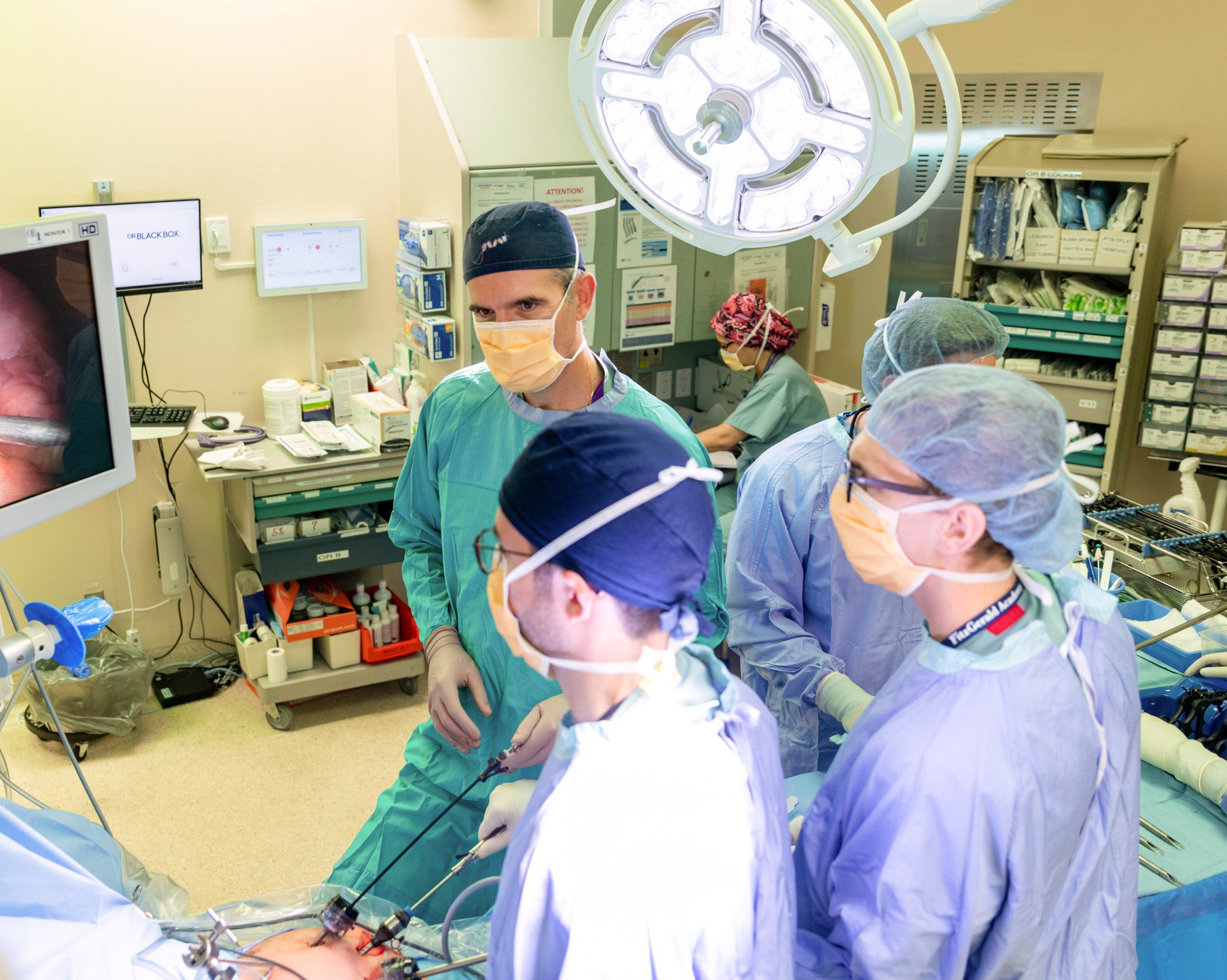
It’s taken many years, but Grantcharov, now a professor of surgery at Stanford, believes he’s finally developed the technology to make this dream possible: the operating room equivalent of an airplane’s black box. It records everything in the OR via panoramic cameras, microphones, and anesthesia monitors before using artificial intelligence to help surgeons make sense of the data.
Grantcharov’s company, Surgical Safety Technologies, is not the only one deploying AI to analyze surgeries. Many medical device companies are already in the space—including Medtronic with its Touch Surgery platform, Johnson & Johnson with C-SATS, and Intuitive Surgical with Case Insights.
But most of these are focused solely on what’s happening inside patients’ bodies, capturing intraoperative video alone. Grantcharov wants to capture the OR as a whole, from the number of times the door is opened to how many non-case-related conversations occur during an operation. “People have simplified surgery to technical skills only,” he says. “You need to study the OR environment holistically.”
Teodor Grantcharov in a procedure that is being recorded by Surgical Safety Technologies’ AI-powered black-box system.
COURTESY OF SURGICAL SAFETY TECHNOLOGIES
Success, however, isn’t as simple as just having the right technology. The idea of recording everything presents a slew of tricky questions around privacy and could raise the threat of disciplinary action and legal exposure. Because of these concerns, some surgeons have refused to operate when the black boxes are in place, and some of the systems have even been sabotaged. Aside from those problems, some hospitals don’t know what to do with all this new data or how to avoid drowning in a deluge of statistics.
Grantcharov nevertheless predicts that his system can do for the OR what black boxes did for aviation. In 1970, the industry was plagued by 6.5 fatal accidents for every million flights; today, that’s down to less than 0.5. “The aviation industry made the transition from reactive to proactive thanks to data,” he says—“from safe to ultra-safe.”
Grantcharov’s black boxes are now deployed at almost 40 institutions in the US, Canada, and Western Europe, from Mount Sinai to Duke to the Mayo Clinic. But are hospitals on the cusp of a new era of safety—or creating an environment of confusion and paranoia?
Shaking off the secrecy
The operating room is probably the most measured place in the hospital but also one of the most poorly captured. From team performance to instrument handling, there is “crazy big data that we’re not even recording,” says Alexander Langerman, an ethicist and head and neck surgeon at Vanderbilt University Medical Center. “Instead, we have post hoc recollection by a surgeon.”
Indeed, when things go wrong, surgeons are supposed to review the case at the hospital’s weekly morbidity and mortality conferences, but these errors are notoriously underreported. And even when surgeons enter the required notes into patients’ electronic medical records, “it’s undoubtedly—and I mean this in the least malicious way possible—dictated toward their best interests,” says Langerman. “It makes them look good.”
The operating room wasn’t always so secretive.
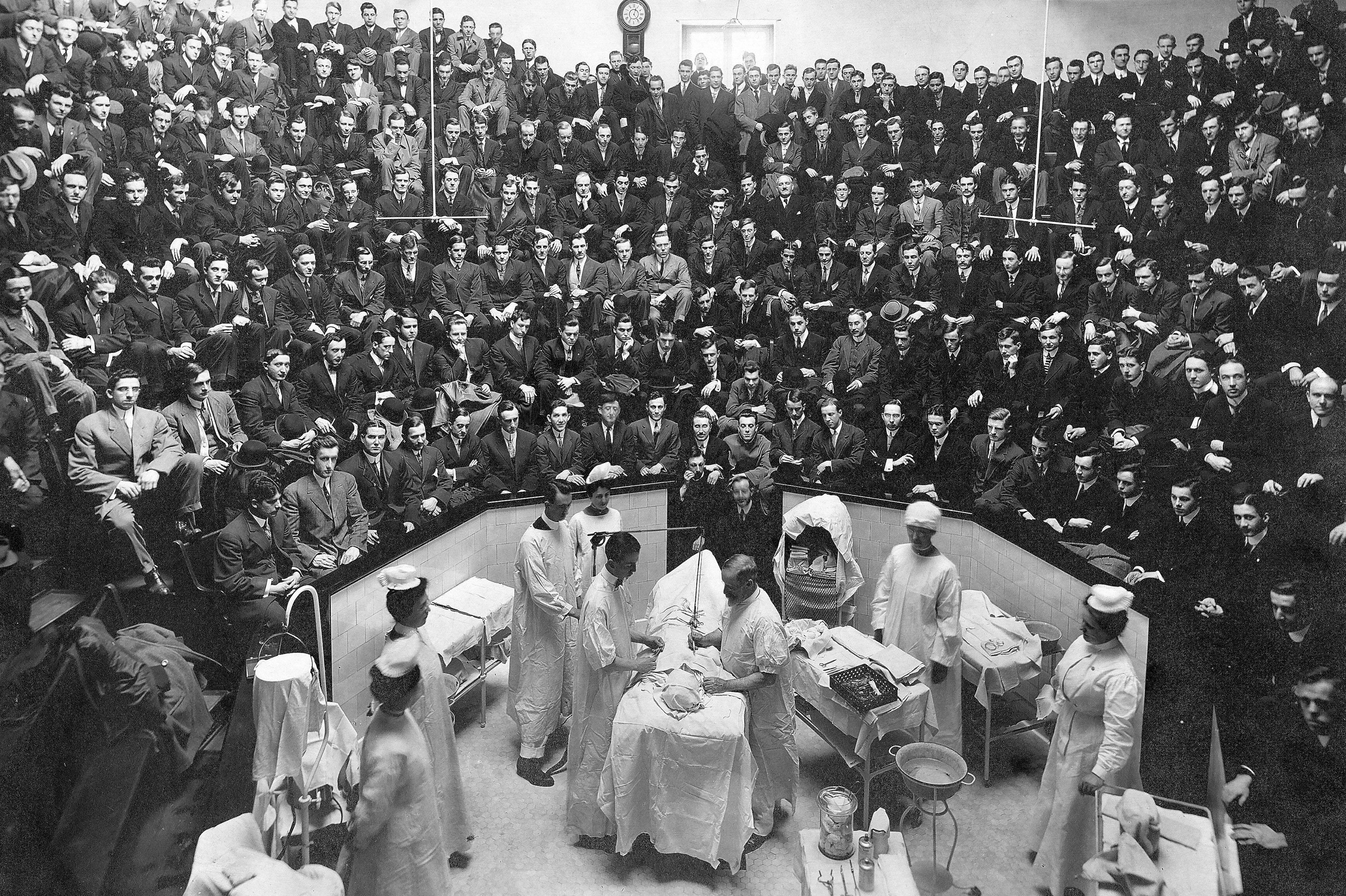
In the 19th century, operations often took place in large amphitheaters—they were public spectacles with a general price of admission. “Every seat even of the top gallery was occupied,” recounted the abdominal surgeon Lawson Tait about an operation in the 1860s. “There were probably seven or eight hundred spectators.”
However, around the 1900s, operating rooms became increasingly smaller and less accessible to the public—and its germs. “Immediately, there was a feeling that something was missing, that the public surveillance was missing. You couldn’t know what happened in the smaller rooms,” says Thomas Schlich, a historian of medicine at McGill University.
And it was nearly impossible to go back. In the 1910s a Boston surgeon, Ernest Codman, suggested a form of surveillance known as the end-result system, documenting every operation (including failures, problems, and errors) and tracking patient outcomes. Massachusetts General Hospital didn’t accept it, says Schlich, and Codman resigned in frustration.
Students watch a surgery performed at the former Philadelphia General Hospital around the turn of the century.
PUBLIC DOMAIN VIA WIKIPEDIA
Such opacity was part of a larger shift toward medicine’s professionalization in the 20th century, characterized by technological advancements, the decline of generalists, and the bureaucratization of health-care institutions. All of this put distance between patients and their physicians. Around the same time, and particularly from the 1960s onward, the medical field began to see a rise in malpractice lawsuits—at least partially driven by patients trying to find answers when things went wrong.
This battle over transparency could theoretically be addressed by surgical recordings. But Grantcharov realized very quickly that the only way to get surgeons to use the black box was to make them feel protected. To that end, he has designed the system to record the action but hide the identity of both patients and staff, even deleting all recordings within 30 days. His idea is that no individual should be punished for making a mistake. “We want to know what happened, and how we can build a system that makes it difficult for this to happen,” Grantcharov says. Errors don’t occur because “the surgeon wakes up in the morning and thinks, ‘I’m gonna make some catastrophic event happen,’” he adds. “This is a system issue.”
AI that sees everything
Grantcharov’s OR black box is not actually a box at all, but a tablet, one or two ceiling microphones, and up to four wall-mounted dome cameras that can reportedly analyze more than half a million data points per day per OR. “In three days, we go through the entire Netflix catalogue in terms of video processing,” he says.
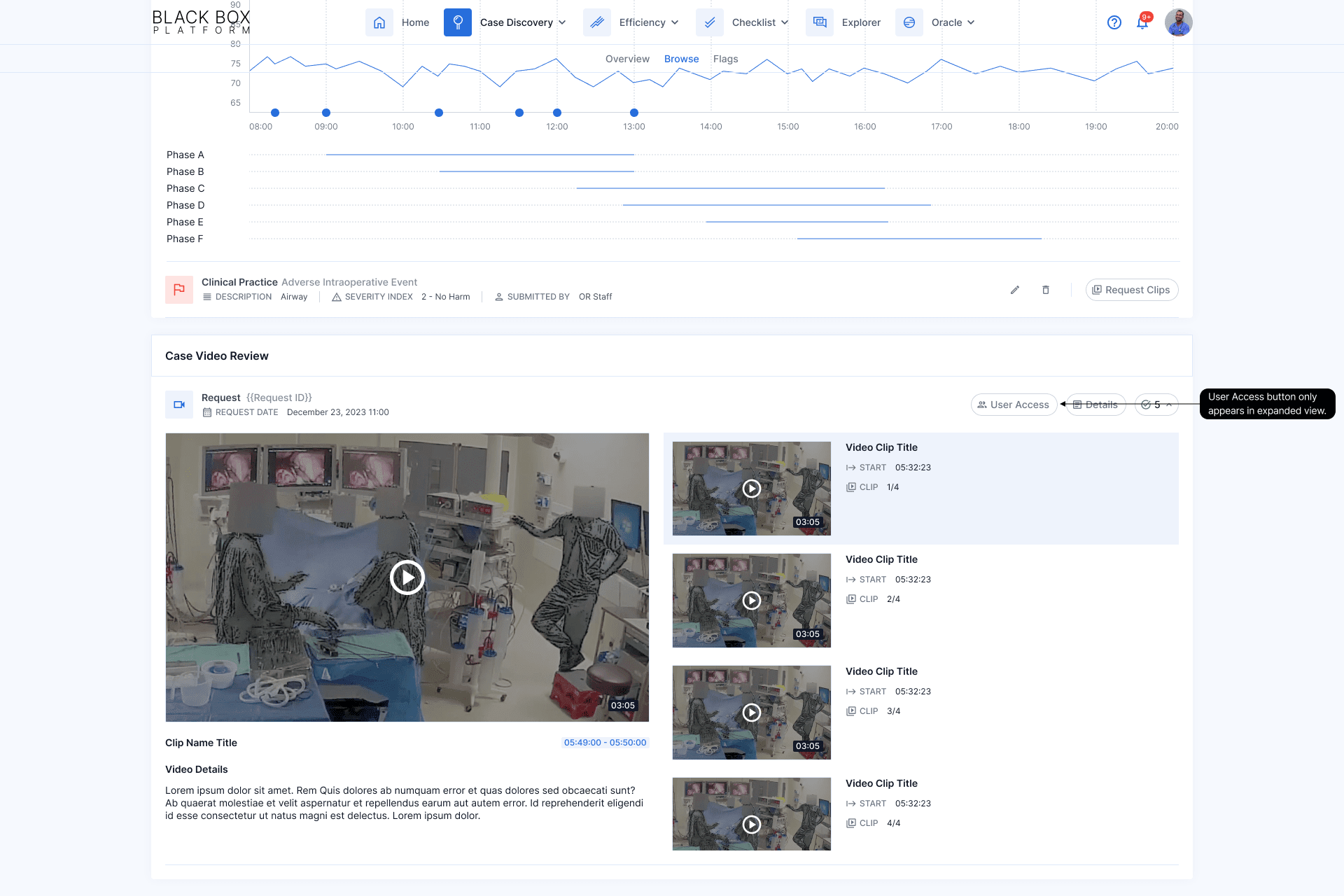
The black-box platform utilizes a handful of computer vision models and ultimately spits out a series of short video clips and a dashboard of statistics—like how much blood was lost, which instruments were used, and how many auditory disruptions occurred. The system also identifies and breaks out key segments of the procedure (dissection, resection, and closure) so that instead of having to watch a whole three- or four-hour recording, surgeons can jump to the part of the operation where, for instance, there was major bleeding or a surgical stapler misfired.
Critically, each person in the recording is rendered anonymous; an algorithm distorts people’s voices and blurs out their faces, transforming them into shadowy, noir-like figures. “For something like this, privacy and confidentiality are critical,” says Grantcharov, who claims the anonymization process is irreversible. “Even though you know what happened, you can’t really use it against an individual.”
Another AI model works to evaluate performance. For now, this is done primarily by measuring compliance with the surgical safety checklist—a questionnaire that is supposed to be verbally ticked off during every type of surgical operation. (This checklist has long been associated with reductions in both surgical infections and overall mortality.) Grantcharov’s team is currently working to train more complex algorithms to detect errors during laparoscopic surgery, such as using excessive instrument force, holding the instruments in the wrong way, or failing to maintain a clear view of the surgical area. However, assessing these performance metrics has proved more difficult than measuring checklist compliance. “There are some things that are quantifiable, and some things require judgment,” Grantcharov says.
Each model has taken up to six months to train, through a labor-intensive process relying on a team of 12 analysts in Toronto, where the company was started. While many general AI models can be trained by a gig worker who labels everyday items (like, say, chairs), the surgical models need data annotated by people who know what they’re seeing—either surgeons, in specialized cases, or other labelers who have been properly trained. They have reviewed hundreds, sometimes thousands, of hours of OR videos and manually noted which liquid is blood, for instance, or which tool is a scalpel. Over time, the model can “learn” to identify bleeding or particular instruments on its own, says Peter Grantcharov, Surgical Safety Technologies’ vice president of engineering, who is Teodor Grantcharov’s son.
For the upcoming laparoscopic surgery model, surgeon annotators have also started to label whether certain maneuvers were correct or mistaken, as defined by the Generic Error Rating Tool—a standardized way to measure technical errors.
While most algorithms operate near perfectly on their own, Peter Grantcharov explains that the OR black box is still not fully autonomous. For example, it’s difficult to capture audio through ceiling mikes and thus get a reliable transcript to document whether every element of the surgical safety checklist was completed; he estimates that this algorithm has a 15% error rate. So before the output from each procedure is finalized, one of the Toronto analysts manually verifies adherence to the questionnaire. “It will require a human in the loop,” Peter Grantcharov says, but he gauges that the AI model has made the process of confirming checklist compliance 80% to 90% more efficient. He also emphasizes that the models are constantly being improved.
In all, the OR black box can cost about $100,000 to install, and analytics expenses run $25,000 annually, according to Janet Donovan, an OR nurse who shared with MIT Technology Review an estimate given to staff at Brigham and Women’s Faulkner Hospital in Massachusetts. (Peter Grantcharov declined to comment on these numbers, writing in an email: “We don’t share specific pricing; however, we can say that it’s based on the product mix and the total number of rooms, with inherent volume-based discounting built into our pricing models.”)
“Big brother is watching”
Long Island Jewish Medical Center in New York, part of the Northwell Health system, was the first hospital to pilot OR black boxes, back in February 2019. The rollout was far from seamless, though not necessarily because of the tech.
“In the colorectal room, the cameras were sabotaged,” recalls Northwell’s chair of urology, Louis Kavoussi—they were turned around and deliberately unplugged. In his own OR, the staff fell silent while working, worried they’d say the wrong thing. “Unless you’re taking a golf or tennis lesson, you don’t want someone staring there watching everything you do,” says Kavoussi, who has since joined the scientific advisory board for Surgical Safety Technologies.
Grantcharov’s promises about not using the system to punish individuals have offered little comfort to some OR staff. When two black boxes were installed at Faulkner Hospital in November 2023, they threw the department of surgery into crisis. “Everybody was pretty freaked out about it,” says one surgical tech who asked not to be identified by name since she wasn’t authorized to speak publicly. “We were being watched, and we felt like if we did something wrong, our jobs were going to be on the line.”
It wasn’t that she was doing anything illegal or spewing hate speech; she just wanted to joke with her friends, complain about the boss, and be herself without the fear of administrators peeking over her shoulder. “You’re very aware that you’re being watched; it’s not subtle at all,” she says. The early days were particularly challenging, with surgeons refusing to work in the black-box-equipped rooms and OR staff boycotting those operations: “It was definitely a fight every morning.”
“In the colorectal room, the cameras were sabotaged,” recalls Louis Kavoussi. “Unless you’re taking a golf or tennis lesson, you don’t want someone staring there watching everything you do.”
At some level, the identity protections are only half measures. Before 30-day-old recordings are automatically deleted, Grantcharov acknowledges, hospital administrators can still see the OR number, the time of operation, and the patient’s medical record number, so even if OR personnel are technically de-identified, they aren’t truly anonymous. The result is a sense that “Big Brother is watching,” says Christopher Mantyh, vice chair of clinical operations at Duke University Hospital, which has black boxes in seven ORs. He will draw on aggregate data to talk generally about quality improvement at departmental meetings, but when specific issues arise, like breaks in sterility or a cluster of infections, he will look to the recordings and “go to the surgeons directly.”
In many ways, that’s what worries Donovan, the Faulkner Hospital nurse. She’s not convinced the hospital will protect staff members’ identities and is worried that these recordings will be used against them—whether through internal disciplinary actions or in a patient’s malpractice suit. In February 2023, she and almost 60 others sent a letter to the hospital’s chief of surgery objecting to the black box. She’s since filed a grievance with the state, with arbitration proceedings scheduled for October.
The legal concerns in particular loom large because, already, over 75% of surgeons report having been sued at least once, according to a 2021 survey by Medscape, an online resource hub for health-care professionals. To the layperson, any surgical video “looks like a horror show,” says Vanderbilt’s Langerman. “Some plaintiff’s attorney is going to get ahold of this, and then some jury is going to see a whole bunch of blood, and then they’re not going to know what they’re seeing.” That prospect turns every recording into a potential legal battle.
From a purely logistical perspective, however, the 30-day deletion policy will likely insulate these recordings from malpractice lawsuits, according to Teneille Brown, a law professor at the University of Utah. She notes that within that time frame, it would be nearly impossible for a patient to find legal representation, go through the requisite conflict-of-interest checks, and then file a discovery request for the black-box data. While deleting data to bypass the judicial system could provoke criticism, Brown sees the wisdom of Surgical Safety Technologies’ approach. “If I were their lawyer, I would tell them to just have a policy of deleting it because then they’re deleting the good and the bad,” she says. “What it does is orient the focus to say, ‘This is not about a public-facing audience. The audience for these videos is completely internal.’”
A data deluge
When it comes to improving quality, there are “the problem-first people, and then there are the data-first people,” says Justin Dimick, chair of the department of surgery at the University of Michigan. The latter, he says, push “massive data collection” without first identifying “a question of ‘What am I trying to fix?’” He says that’s why he currently has no plans to use the OR black boxes in his hospital.
Mount Sinai’s chief of general surgery, Celia Divino, echoes this sentiment, emphasizing that too much data can be paralyzing. “How do you interpret it? What do you do with it?” she asks. “This is always a disease.”
At Northwell, even Kavoussi admits that five years of data from OR black boxes hasn’t been used to change much, if anything. He says that hospital leadership is finally beginning to think about how to use the recordings, but a hard question remains: OR black boxes can collect boatloads of data, but what does it matter if nobody knows what to do with it?
Grantcharov acknowledges that the information can be overwhelming. “In the early days, we let the hospitals figure out how to use the data,” he says. “That led to a big variation in how the data was operationalized. Some hospitals did amazing things; others underutilized it.” Now the company has a dedicated “customer success” team to help hospitals make sense of the data, and it offers a consulting-type service to work through surgical errors. But ultimately, even the most practical insights are meaningless without buy-in from hospital leadership, Grantcharov suggests.
Getting that buy-in has proved difficult in some centers, at least partly because there haven’t yet been any large, peer-reviewed studies showing how OR black boxes actually help to reduce patient complications and save lives. “If there’s some evidence that a comprehensive data collection system—like a black box—is useful, then we’ll do it,” says Dimick. “But I haven’t seen that evidence yet.”
A screenshot of the analytics produced by the black box.
COURTESY OF SURGICAL SAFETY TECHNOLOGIES
The best hard data thus far is from a 2022 study published in the Annals of Surgery, in which Grantcharov and his team used OR black boxes to show that the surgical checklist had not been followed in a fifth of operations, likely contributing to excess infections. He also says that an upcoming study, scheduled to be published this fall, will show that the OR black box led to an improvement in checklist compliance and reduced ICU stays, reoperations, hospital readmissions, and mortality.
On a smaller scale, Grantcharov insists that he has built a steady stream of evidence showing the power of his platform. For example, he says, it’s revealed that auditory disruptions—doors opening, machine alarms and personal pagers going off—happen every minute in gynecology ORs, that a median 20 intraoperative errors are made in each laparoscopic surgery case, and that surgeons are great at situational awareness and leadership while nurses excel at task management.
Meanwhile, some hospitals have reported small improvements based on black-box data. Duke’s Mantyh says he’s used the data to check how often antibiotics are given on time. Duke and other hospitals also report turning to this data to help decrease the amount of time ORs sit empty between cases. By flagging when “idle” times are unexpectedly long and having the Toronto analysts review recordings to explain why, they’ve turned up issues ranging from inefficient communication to excessive time spent bringing in new equipment.
That can make a bigger difference than one might think, explains Ra’gan Laventon, clinical director of perioperative services at Texas’s Memorial Hermann Sugar Land Hospital: “We have multiple patients who are depending on us to get to their care today. And so the more time that’s added in some of these operational efficiencies, the more impactful it is to the patient.”
The real world
At Northwell, where some of the cameras were initially sabotaged, it took a couple of weeks for Kavoussi’s urology team to get used to the black boxes, and about six months for his colorectal colleagues. Much of the solution came down to one-on-one conversations in which Kavoussi explained how the data was automatically de-identified and deleted.
During his operations, Kavoussi would also try to defuse the tension, telling the OR black box “Good morning, Toronto,” or jokingly asking, “How’s the weather up there?” In the end, “since nothing bad has happened, it has become part of the normal flow,” he says.
The reality is that no surgeon wants to be an average operator, “but statistically, we’re mostly average surgeons, and that’s okay,” says Vanderbilt’s Langerman. “I’d hate to be a below-average surgeon, but if I was, I’d really want to know about it.” Like athletes watching game film to prepare for their next match, surgeons might one day review their recordings, assessing their mistakes and thinking about the best ways to avoid them—but only if they feel safe enough to do so.
“Until we know where the guardrails are around this, there’s such a risk—an uncertain risk—that no one’s gonna let anyone turn on the camera,” Langerman says. “We live in a real world, not a perfect world.”
Simar Bajaj is an award-winning science journalist and 2024 Marshall Scholar. He has previously written for the Washington Post, Time magazine, the Guardian, NPR, and the Atlantic, as well as the New England Journal of Medicine, Nature Medicine, and The Lancet. He won Science Story of the Year from the Foreign Press Association in 2022 and the top prize for excellence in science communications from the National Academies of Science, Engineering, and Medicine in 2023. Follow him on X at @SimarSBajaj.
On Tuesday, the FDA asked a panel of experts to weigh in on whether the evidence shows that MDMA, also known as ecstasy, is a safe and efficacious treatment for PTSD. The answer was a resounding no. Just two out of 11 panel members agreed that MDMA-assisted therapy is effective. And only one panel member thought the benefits of the therapy outweighed the risks.
The outcome came as a surprise to many, given that trial results have been positive. And it is also a blow for advocates who have been working to bring psychedelic therapy into mainstream medicine for more than two decades. This isn’t the final decision on MDMA. The FDA has until August 11 to make that ruling. But while the agency is under no obligation to follow the recommendations of its advisory committees, it rarely breaks with their decisions.
Today on The Checkup, let’s unpack the advisory committee’s vote and talk about what it means for the approval of other recreational drugs as therapies.
One of the main stumbling blocks for the committee was the design of the two efficacy studies that have been completed. Trial participants weren’t supposed to know whether they were in the treatment group, but the effects of MDMA make it pretty easy to tell whether you’ve been given a hefty dose, and most correctly guessed which group they had landed in.
In 2021, MIT Technology Review’s Charlotte Jee interviewed an MDMA trial participant named Nathan McGee. “Almost as soon as I said I didn’t think I’d taken it, it kicked in. I mean, I knew,” he told her. “I remember going to the bathroom and looking in the mirror, and seeing my pupils looking like saucers. I was like, ‘Wow, okay.’”
The Multidisciplinary Association for Psychedelic Studies, better known as MAPS, has been working with the FDA to develop MDMA as a treatment since 2001. When the organization met with the FDA in 2016 to hash out the details of its phase III trials, studies to test whether a treatment works, agency officials suggested that MAPS use an active compound for the control group to help mask whether participants had received the drug. But MAPS pushed back, and the trial forged ahead with a placebo.
No surprise, then, that about 90% of those assigned to the MDMA group and 75% of those assigned to the placebo group accurately identified which arm of the study they had landed in. And it wasn’t just participants. Therapists treating the participants also likely knew whether those under their supervision had been given the drug. It’s called “functional unblinding,” and the issue came up at the committee meeting again and again. Here’s why it’s a problem: If a participant strongly believes that MDMA will help their PTSD and they know they’ve received MDMA, this expectation bias could amplify the treatment effect. This is especially a problem when the outcome is based on subjective measures like how a person feels rather than, say, laboratory data.
Another sticking point was the therapy component of the treatment. Lykos Therapeutics (the for-profit spinoff of MAPS) asked the FDA to approve MDMA-assisted therapy: that’s MDMA administered in concert with psychotherapy. Therapists oversaw participants during the three MDMA sessions. But participants also received three therapy sessions before getting the drug, and three therapy sessions afterwards to help them process their experience.
Because the two treatments were administered together, there was no good way to tell how much of the effect was due to MDMA and how much was due to the therapy. What’s more, “the content or approach of these integrated sessions was not standardized in the treatment manuals and was mainly left up to the individual therapist,” said David Millis, a clinical reviewer for the FDA, at the committee meeting.
Several committee members also raised safety concerns. They worried that MDMA’s effects might make people more suggestible and vulnerable to abuse, and they brought up allegations of ethics violations outlined in a recent report from the Institute for Clinical and Economic Review.
Because of these issues and others, most committee members felt compelled to vote against MDMA-assisted therapy. “I felt that the large positive effect was denuded by the significant confounders,” said committee member Maryann Amirshahi, a professor of emergency medicine at Georgetown University School of Medicine, after the vote. “Although I do believe that there was a signal, it just needs to be better studied.”
Whether this decision will be a setback for the entire field remains to be seen. “To make it crystal clear: It isn’t MDMA itself that was rejected per se, but the specific, poor data set provided by Lykos Therapeutics; in my opinion, there is still a strong chance that MDMA, with a properly conducted clinical Phase 3 trial program that addresses those concerns of the FDA advisory committee, will get approved.” wrote Christian Angermayer, founder of ATAI Therapeutics, a company that is also working to develop MDMA as a therapy.
If the FDA denies approval of MDMA therapy, Lykos or another company could conduct additional studies and reapply. Many of the committee members said they believed MDMA does hold promise, but that the studies conducted thus far were inadequate to demonstrate the drug’s safety and efficacy.
Psilocybin is likely to be the next psychedelic therapy considered by the FDA, and in some ways, it might have an easier path to approval. The idea behind MDMA is that it alleviates PTSD by helping facilitate psychotherapy. The therapy is a crucial component of the treatment, which is problematic because the FDA regulates drugs, not psychotherapy. With psilocybin, a therapist is present, but the drug appears to do the heavy lifting. “We are not offering therapy; we are offering psychological support that’s designed for the patient’s safety and well-being,” says Kabir Nath, CEO of Compass Pathways, the company working to bring psilocybin to market. “What we actually find during a six- to eight-hour session is most of it is silent. There’s actually no interaction.”
That could make the approval process more straightforward. “The difficult thing … is that we don’t regulate psychotherapy, and also we don’t really have any say in the design or the implementation of the particular therapy that is going to be used,” said Tiffany Farchione, director of the FDA’s division of psychiatry, at the committee meeting. “This is something unprecedented, so we certainly want to get as many opinions and as much input as we can.”
Sally Adee dives deep into the messy history of electric medicine and what the future might hold for research into electric therapies. “Instead of focusing only on the nervous system—the highway that carries electrical messages between the brain and the body—a growing number of researchers are finding clever ways to electrically manipulate cells elsewhere in the body, such as skin and kidney cells, more directly than ever before,” she writes.
MDMA does seem to have helped some individuals. Nathan McGee, who took the drug as part of a clinical trial, told Charlotte Jee that he “understands what joy is now.”
Researchers are working to design virtual-reality programs that recreate the trippy experience of taking psychedelics. Hana Kiros has the story.
– Finland is poised to become the first country to start administering bird flu vaccine—albeit to a very limited subset of people, including poultry and mink farmers, vets, and scientists who study the virus (Stat)
– What are the most pressing questions about bird flu? They revolve around what’s happening in cows, what’s happening in farm workers, and what’s happening to the virus. (Stat)
– A man in Mexico has died of H5N2, a strain of bird flu that has never before been reported in humans. (CNN)
Biodegradable, squishy sensors injected into the brain hold promise for detecting changes following a head injury or cancer treatment. (Nature)
A synthetic version of a hallucinogenic toad toxin could be a promising treatment for mental-health disorders. (Undark)
MIT Technology Review’s What’s Next series looks across industries, trends, and technologies to give you a first look at the future. You can read the rest of them here.
MDMA, sometimes called Molly or ecstasy, has been banned in the United States for more than three decades. Now this potent mind-altering drug is poised to become a badly needed therapy for PTSD.
On June 4, the Food and Drug Administration’s advisory committee will meet to discuss the risks and benefits of MDMA therapy. If the committee votes in favor of the drug, it could be approved to treat PTSD this summer. The approval would represent a momentous achievement for proponents of mind-altering drugs, who have been working toward this goal for decades. And it could help pave the way for FDA approval of other illicit drugs like psilocybin. But the details surrounding how these compounds will make the transition from illicit substances to legitimate therapies are still foggy.
Here’s what to know ahead of the upcoming hearing.
What’s the argument for legitimizing MDMA?
Studies suggest the compound can help treat mental-health disorders like PTSD and depression. Lykos, the company that has been developing MDMA as a therapy, looked at efficacy in two clinical trials that included about 200 people with PTSD. Researchers randomly assigned participants to receive psychotherapy with or without MDMA. The group that received MDMA-assisted therapy had a greater reduction in PTSD symptoms. They were also more likely to respond to treatment, to meet the criteria for PTSD remission, and to lose their diagnosis of PTSD.
But some experts question the validity of the results. With substances like MDMA, study participants almost always know whether they’ve received the drug or a placebo. That can skew the results, especially when the participants and therapists strongly believe a drug is going to help. The Institute for Clinical and Economic Review (ICER), a nonprofit research organization that evaluates the clinical and economic value of drugs, recently rated the evidence for MDMA-assisted therapy as “insufficient.”
In briefing documents published ahead of the June 4 meeting, FDA officials write that the question of approving MDMA “presents a number of complex review issues.”
The ICER report also referenced allegations of misconduct and ethical violations. Lykos (formerly the Multidisciplinary Association for Psychedelic Studies Public Benefit Corporation) acknowledges that ethical violations occurred in one particularly high-profile case. But in a rebuttal to the ICER report, more than 70 researchers involved in the trials wrote that “a number of assertions in the ICER report represent hearsay, and should be weighted accordingly.” Lykos did not respond to an interview request.
At the meeting on the 4th, the FDA has asked experts to discuss whether Lykos has demonstrated that MDMA is effective, whether the drug’s effect lasts, and what role psychotherapy plays. The committee will also discuss safety, including the drug’s potential for abuse and the risk posed by the impairment MDMA causes.
What’s stopping people from using this therapy?
MDMA is illegal. In 1985, the Drug Enforcement Agency grew concerned about growing street use of the drug and added it to its list of Schedule 1 substances—those with a high abuse potential and no accepted medical use.
MDMA boosts the brain’s production of feel-good neurotransmitters, causing a burst of euphoria and good will toward others. But the drug can also cause high blood pressure, memory problems, anxiety, irritability, and confusion. And repeated use can cause lasting changes in the brain.
If the FDA approves MDMA therapy, when will people be able to access it?
That has yet to be determined. It could take months for the DEA to reclassify the drug. After that, it’s up to individual states.
Lykos applied for approval of MDMA-assisted therapy, not just the compound itself. In the clinical trials, MDMA administration happened in the presence of licensed therapists, who then helped patients process their emotions during therapy sessions that lasted for hours.
But regulating therapy isn’t part of the FDA’s purview. The FDA approves drugs; it doesn’t oversee how they’re administered. “The agency has been clear with us,” says Kabir Nath, CEO of Compass Pathways, the company working to bring psilocybin to market. “They don’t want to regulate psychotherapy, because they see that as the practice of medicine, and that’s not their job.”
However, for drugs that carry a risk of serious side effects, the FDA can add a risk evaluation and mitigation strategy to its approval. For MDMA that might include mandating that the health-care professionals who administer the medication have certain certifications or specialized training, or requiring that the drug be dispensed only in licensed facilities.
For example, Spravato, a nasal spray approved in 2019 for depression that works much like ketamine, is available only at a limited number of health-care facilities and must be taken under the observation of a health-care provider. Having safeguards in place for MDMA makes sense, at least at the outset, says Matt Lamkin, an associate professor at the University of Tulsa College of Law who has been following the field closely.: “Given the history, I think it would only take a couple of high-profile bad incidents to potentially set things back.”
What mind-altering drug is next in line for FDA approval?
Psilocybin, a.k.a. the active ingredient in magic mushrooms. This summer Compass Pathways will release the first results from one of its phase 3 trials of psilocybin to treat depression. Results from the other trial will come in the middle of 2025, which—if all goes well—puts the company on track to file for approval in the fall or winter of next year. With the FDA review and the DEA rescheduling, “it’s still kind of two to three years out,” Nath says.
Some states are moving ahead without formal approval. Oregon voters made psilocybin legal in 2020, and the drug is now accessible there at about 20 licensed centers for supervised use. “It’s an adult use program that has a therapeutic element,” says Ismail Ali, director of policy and advocacy at the Multidisciplinary Association for Psychedelic Studies (MAPS).
Colorado voted to legalize psilocybin and some other plant-based psychedelics in 2022, and the state is now working to develop a framework to guide the licensing of facilitators to administer these drugs for therapeutic purposes. More states could follow.
So would FDA approval of these compounds open the door to legal recreational use of psychedelics?
Maybe. The DEA can still prosecute physicians if they’re prescribing drugs outside of their medically accepted uses. But Lamkin does see the lines between recreational use and medical use getting blurry. “What we’re seeing is that the therapeutic uses have recreational side effects and the recreation has therapeutic side effects,” he says. “I’m interested to see how long they can keep the genie in the bottle.”
What’s the status of MDMA therapies elsewhere in the world?
Last summer, Australia became the first country to approve MDMA and psilocybin as medicines to treat psychiatric disorders, but the therapies are not yet widely available. The first clinic opened just a few months ago. The US is poised to become the second country if the FDA greenlights Lykos’s application. Health Canada told the CBC it is watching the FDA’s review of MDMA “with interest.” Europe is lagging a bit behind, but there are some signs of movement. In April, the European Medicines Agency convened a workshop to bring together a variety of stakeholders to discuss a regulatory framework for psychedelics.
This story originally appeared in The Algorithm, our weekly newsletter on AI. To get stories like this in your inbox first, sign up here.
Greetings from Switzerland! I’ve just come back from Geneva, which last week hosted the UN’s AI for Good Summit, organized by the International Telecommunication Union. The summit’s big focus was how AI can be used to meet the UN’s Sustainable Development Goals, such as eradicating poverty and hunger, achieving gender equality, promoting clean energy and climate action and so on.
The conference featured lots of robots (including one that dispenses wine), but what I liked most of all was how it managed to convene people working in AI from around the globe, featuring speakers from China, the Middle East, and Africa too, such as Pelonomi Moiloa, the CEO of Lelapa AI, a startup building AI for African languages. AI can be very US-centric and male dominated, and any effort to make the conversation more global and diverse is laudable.
But honestly, I didn’t leave the conference feeling confident AI was going to play a meaningful role in advancing any of the UN goals. In fact, the most interesting speeches were about how AI is doing the opposite. Sage Lenier, a climate activist, talked about how we must not let AI accelerate environmental destruction. Tristan Harris, the cofounder of the Center for Humane Technology, gave a compelling talk connecting the dots between our addiction to social media, the tech sector’s financial incentives, and our failure to learn from previous tech booms. And there are still deeply ingrained gender biases in tech, Mia Shah-Dand, the founder of Women in AI Ethics, reminded us.
So while the conference itself was about using AI for “good,” I would have liked to see more talk about how increased transparency, accountability, and inclusion could make AI itself good from development to deployment.
We now know that generating one image with generative AI uses as much energy as charging a smartphone. I would have liked more honest conversations about how to make the technology more sustainable itself in order to meet climate goals. And it felt jarring to hear discussions about how AI can be used to help reduce inequalities when we know that so many of the AI systems we use are built on the backs of human content moderators in the Global South who sift through traumatizing content while being paid peanuts.
Making the case for the “tremendous benefit” of AI was OpenAI’s CEO Sam Altman, the star speaker of the summit. Altman was interviewed remotely by Nicholas Thompson, the CEO of the Atlantic, which has incidentally just announced a deal for OpenAI to share its content to train new AI models. OpenAI is the company that instigated the current AI boom, and it would have been a great opportunity to ask him about all these issues. Instead, the two had a relatively vague, high-level discussion about safety, leaving the audience none the wiser about what exactly OpenAI is doing to make their systems safer. It seemed they were simply supposed to take Altman’s word for it.
Altman’s talk came a week or so after Helen Toner, a researcher at the Georgetown Center for Security and Emerging Technology and a former OpenAI board member, said in an interview that the board found out about the launch of ChatGPT through Twitter, and that Altman had on multiple occasions given the board inaccurate information about the company’s formal safety processes. She has also argued that it is a bad idea to let AI firms govern themselves, because the immense profit incentives will always win. (Altman said he “disagree[s] with her recollection of events.”)
When Thompson asked Altman what the first good thing to come out of generative AI will be, Altman mentioned productivity, citing examples such as software developers who can use AI tools to do their work much faster. “We’ll see different industries become much more productive than they used to be because they can use these tools. And that will have a positive impact on everything,” he said. I think the jury is still out on that one.
Now read the rest of The Algorithm
Deeper Learning
Why Google’s AI Overviews gets things wrong
Google’s new feature, called AI Overviews, provides brief, AI-generated summaries highlighting key information and links on top of search results. Unfortunately, within days of AI Overviews’ release in the US, users were sharing examples of responses that were strange at best. It suggested that users add glue to pizza or eat at least one small rock a day.
MIT Technology Review explains: In order to understand why AI-powered search engines get things wrong, we need to look at how they work. The models that power them simply predict the next word (or token) in a sequence, which makes them appear fluent but also leaves them prone to making things up. They have no ground truth to rely on, but instead choose each word purely on the basis of a statistical calculation. Worst of all? There’s probably no way to fix things. That’s why you shouldn’t trust AI search engines. Read more from Rhiannon Williams here.
Bits and Bytes
OpenAI’s latest blunder shows the challenges facing Chinese AI models OpenAI’s GPT-4o data set is polluted by Chinese spam websites. But this problem is indicative of a much wider issue for those building Chinese AI services: finding the high-quality data sets they need to be trained on is tricky, because of the way China’s internet functions. (MIT Technology Review)
Five ways criminals are using AI Artificial intelligence has brought a big boost in productivity—to the criminal underworld. Generative AI has made phishing, scamming, and doxxing easier than ever. (MIT Technology Review)
OpenAI found Russian and Chinese groups using its tech for propaganda campaigns OpenAI said that it caught, and removed, groups from Russia, China, Iran, and Israel that were using its technology to try to influence political discourse around the world. But this is likely just the tip of the iceberg when it comes to how AI is being used to affect this year’s record-breaking number of elections. (The Washington Post)
Inside Anthropic, the AI company betting that safety can be a winning strategy The AI lab Anthropic, creator of the Claude model, was started by former OpenAI employees who resigned over “trust issues.” This profile is an interesting peek inside one of OpenAI’s competitors, showing how the ideology behind AI safety and effective altruism is guiding business decisions. (Time)
AI-directed drones could help find lost hikers faster Drones are already used for search and rescue, but planning their search paths is more art than science. AI could change that. (MIT Technology Review)
On a table in his lab at the University of Pennsylvania, physicist Sam Dillavou has connected an array of breadboards via a web of brightly colored wires. The setup looks like a DIY home electronics project—and not a particularly elegant one. But this unassuming assembly, which contains 32 variable resistors, can learn to sort data like a machine-learning model.
While its current capability is rudimentary, the hope is that the prototype will offer a low-power alternative to the energy-guzzling graphical processing unit (GPU) chips widely used in machine learning.
“Each resistor is simple and kind of meaningless on its own,” says Dillavou. “But when you put them in a network, you can train them to do a variety of things.”
Sam Dillavou’s laboratory at the University of Pennsylvania is using circuits composed of resistors to perform simple machine learning classification tasks.
FELICE MACERA
A task the circuit has performed: classifying flowers by properties such as petal length and width. When given these flower measurements, the circuit could sort them into three species of iris. This kind of activity is known as a “linear” classification problem, because when the iris information is plotted on a graph, the data can be cleanly divided into the correct categories using straight lines. In practice, the researchers represented the flower measurements as voltages, which they fed as input into the circuit. The circuit then produced an output voltage, which corresponded to one of the three species.
This is a fundamentally different way of encoding data from the approach used in GPUs, which represent information as binary 1s and 0s. In this circuit, information can take on a maximum or minimum voltage or anything in between. The circuit classified 120 irises with 95% accuracy.
Now the team has managed to make the circuit perform a more complex problem. In a preprint currently under review, the researchers have shown that it can perform a logic operation known as XOR, in which the circuit takes in two binary numbers and determines whether the inputs are the same. This is a “nonlinear” classification task, says Dillavou, and “nonlinearities are the secret sauce behind all machine learning.”
Their demonstrations are a walk in the park for the devices you use every day. But that’s not the point: Dillavou and his colleagues built this circuit as an exploratory effort to find better computing designs. The computing industry faces an existential challenge as it strives to deliver ever more powerful machines. Between 2012 and 2018, the computing power required for cutting-edge AI models increased 300,000-fold. Now, training a large language model takes the same amount of energy as the annual consumption of more than a hundred US homes. Dillavou hopes that his design offers an alternative, more energy-efficient approach to building faster AI.
Training in pairs
To perform its various tasks correctly, the circuitry requires training, just like contemporary machine-learning models that run on conventional computing chips. ChatGPT, for example, learned to generate human-sounding text after being shown many instances of real human text; the circuit learned to predict which measurements corresponded to which type of iris after being shown flower measurements labeled with their species.
Training the device involves using a second, identical circuit to “instruct” the first device. Both circuits start with the same resistance values for each of their 32 variable resistors. Dillavou feeds both circuits the same inputs—a voltage corresponding to, say, petal width—and adjusts the output voltage of the second circuit to correspond to the correct species. The first circuit receives feedback from that second circuit, and both circuits adjust their resistances so they converge on the same values. The cycle starts again with a new input, until the circuits have settled on a set of resistance levels that produce the correct output for the training examples. In essence, the team trains the device via a method known as supervised learning, where an AI model learns from labeled data to predict the labels for new examples.
It can help, Dillavou says, to think of the electric current in the circuit as water flowing through a network of pipes. The equations governing fluid flow are analogous to those governing electron flow and voltage. Voltage corresponds to fluid pressure, while electrical resistance corresponds to the pipe diameter. During training, the different “pipes” in the network adjust their diameter in various parts of the network in order to achieve the desired output pressure. In fact, early on, the team considered building the circuit out of water pipes rather than electronics.
For Dillavou, one fascinating aspect of the circuit is what he calls its “emergent learning.” In a human, “every neuron is doing its own thing,” he says. “And then as an emergent phenomenon, you learn. You have behaviors. You ride a bike.” It’s similar in the circuit. Each resistor adjusts itself according to a simple rule, but collectively they “find” the answer to a more complicated question without any explicit instructions.
A potential energy advantage
Dillavou’s prototype qualifies as a type of analog computer—one that encodes information along a continuum of values instead of the discrete 1s and 0s used in digital circuitry. The first computers were analog, but their digital counterparts superseded them after engineers developed fabrication techniques to squeeze more transistors onto digital chips to boost their speed. Still, experts have long known that as they increase in computational power, analog computers offer better energy efficiency than digital computers, says Aatmesh Shrivastava, an electrical engineer at Northeastern University. “The power efficiency benefits are not up for debate,” he says. However, he adds, analog signals are much noisier than digital ones, which make them ill suited for any computing tasks that require high precision.
In practice, Dillavou’s circuit hasn’t yet surpassed digital chips in energy efficiency. His team estimates that their design uses about 5 to 20 picojoules per resistor to generate a single output, where each resistor represents a single parameter in a neural network. Dillavou says this is about a tenth as efficient as state-of-the-art AI chips. But he says that the promise of the analog approach lies in scaling the circuit up, to increase its number of resistors and thus its computing power.
He explains the potential energy savings this way: Digital chips like GPUs expend energy per operation, so making a chip that can perform more operations per second just means a chip that uses more energy per second. In contrast, the energy usage of his analog computer is based on how long it is on. Should they make their computer twice as fast, it would also become twice as energy efficient.
Dillavou’s circuit is also a type of neuromorphic computer, meaning one inspired by the brain. Like other neuromorphic schemes, the researchers’ circuitry doesn’t operate according to top-down instruction the way a conventional computer does. Instead, the resistors adjust their values in response to external feedback in a bottom-up approach, similar to how neurons respond to stimuli. In addition, the device does not have a dedicated component for memory. This could offer another energy efficiency advantage, since a conventional computer expends a significant amount of energy shuttling data between processor and memory.
While researchers have already built a variety of neuromorphic machines based on different materials and designs, the most technologically mature designs are built on semiconducting chips. One example is Intel’s neuromorphic computer Loihi 2, to which the company began providing access for government, academic, and industry researchers in 2021. DeepSouth, a chip-based neuromorphic machine at Western Sydney University that is designed to be able to simulate the synapses of the human brain at scale, is scheduled to come online this year.
The machine-learning industry has shown interest in chip-based neuromorphic computing as well, with a San Francisco–based startup called Rain Neuromorphics raising $25 million in February. However, researchers still haven’t found a commercial application where neuromorphic computing definitively demonstrates an advantage over conventional computers. In the meantime, researchers like Dillavou’s team are putting forth new schemes to push the field forward. A few people in industry have expressed interest in his circuit. “People are most interested in the energy efficiency angle,” says Dillavou.
But their design is still a prototype, with its energy savings unconfirmed. For their demonstrations, the team kept the circuit on breadboards because it’s “the easiest to work with and the quickest to change things,” says Dillavou, but the format suffers from all sorts of inefficiencies. They are testing their device on printed circuit boards to improve its energy efficiency, and they plan to scale up the design so it can perform more complicated tasks. It remains to be seen whether their clever idea can take hold out of the lab.
This story first appeared in China Report, MIT Technology Review’s newsletter about technology in China. Sign up to receive it in your inbox every Tuesday.
Have you ever thought about the miraculous fact that despite the myriad differences between languages, virtually everyone uses the same QWERTY keyboards? Many languages have more or fewer than 26 letters in their alphabet—or no “alphabet” at all, like Chinese, which has tens of thousands of characters. Yet somehow everyone uses the same keyboard to communicate.
Last week, MIT Technology Review published an excerpt from a new book, The Chinese Computer, which talks about how this problem was solved in China. After generations of work to sort Chinese characters, modify computer parts, and create keyboard apps that automatically predict the next character, it is finally possible for any Chinese speaker to use a QWERTY keyboard.
But the book doesn’t stop there. It ends with a bigger question about what this all means: Why is it necessary for speakers of non-Latin languages to adapt modern technologies for their uses, and what do their efforts contribute to computing technologies?
I talked to the book’s author, Tom Mullaney, a professor of history at Stanford University. We ended up geeking out over keyboards, computers, the English-centric design that underlies everything about computing, and even how keyboards affect emerging technologies like virtual reality. Here are some of his most fascinating answers, lightly edited for clarity and brevity.
Mullaney’s book covers many experiments across multiple decades that ultimately made typing Chinese possible and efficient on a QWERTY keyboard, but a similar process has played out all around the world. Many countries with non-Latin languages had to work out how they could use a Western computer to input and process their own languages.
Mullaney: In the Chinese case—but also in Japanese, Korean, and many other non-Western writing systems—this wasn’t done for fun. It was done out of brute necessity because the dominant model of keyboard-based computing, born and raised in the English-speaking world, is not compatible with Chinese. It doesn’t work because the keyboard doesn’t have the necessary real estate. And the question became: I have a few dozen keys but 100,000 characters. How do I map one onto the other?
Simply put, half of the population on Earth uses the QWERTY keyboard in ways the QWERTY keyboard was never intended to be used, creating a radically different way of interacting with computers.
The root of all of these problems is that computers were designed with English as the default language. So the way English works is just the way computers work today.
M: Every writing system on the planet throughout history is modular, meaning it’s built out of smaller pieces. But computing carefully, brilliantly, and understandably worked on one very specific kind of modularity: modularity as it functions in English.
And then everybody else had to fit themselves into that modularity. Arabic letters connect, so you have to fix [the computer for it]; In South Asian scripts, the combination of a consonant and a vowel changes the shape of the letter overall—that’s not how modularity works in English.
The English modularity is so fundamental in computing that non-Latin speakers are still grappling with the impacts today despite decades of hard work to change things.
Mullaney shared a complaint that Arabic speakers made in 2022 about Adobe InDesign, the most popular publishing design software. As recently as two years ago, pasting a string of Arabic text into the software could cause the text to become messed up, misplacing its diacritic marks, which are crucial for indicating phonetic features of the text. It turns out you need to install a Middle East version of the software and apply some deliberate workarounds to avoid the problem.
M: Latin alphabetic dominance is still alive and well; it has not been overthrown. And there’s a troubling question as to whether it can ever be overthrown. Some turn was made, some path taken that advantaged certain writing systems at a deep structural level and disadvantaged others.
That deeply rooted English-centric design is why mainstream input methods never deviate too far from the keyboards that we all know and love/hate. In the English-speaking world, there have been numerous attempts to reimagine the way text input works. Technologies such as the T9 phone keyboard or the Palm Pilot handwriting alphabet briefly achieved some adoption. But they never stick for long because most developers snap back to QWERTY keyboards at the first opportunity.
M: T9 was born in the context of disability technology and was incorporated into the first mobile phones because button real estate was a major problem (prior to the BlackBerry reintroducing the QWERTY keyboard). It was a necessity; [developers] actually needed to think in a different way. But give me enough space, give me 12 inches by 14 inches, and I’ll default to a QWERTY keyboard.
Every 10 years or so, some Western tech company or inventor announces: “Everybody! I have finally figured out a more advanced way of inputting English at much higher speeds than the QWERTY keyboard.” And time and time again there is zero market appetite.
Will the QWERTY keyboard stick around forever? After this conversation, I’m secretly hoping it won’t. Maybe it’s time for a change. With new technologies like VR headsets, and other gadgets on the horizon, there may come a time when QWERTY keyboards are not the first preference, and non-Latin languages may finally have a chance in shaping the new norm of human-computer interactions.
M: It’s funny, because now as you go into augmented and virtual reality, Silicon Valley companies are like, “How do we overcome the interface problem?” Because you can shrink everything except the QWERTY keyboard. And what Western engineers fail to understand is that it’s not a tech problem—it’s a technological cultural problem. And they just don’t get it. They think that if they just invent the tech, it is going to take off. And thus far, it never has.
If I were a software or hardware developer, I would be hanging out in online role-playing games, just in the chat feature; I would be watching people use their TV remote controls to find the title of the film they’re looking for; I would look at how Roblox players chat with each other. It’s going to come from some arena outside the mainstream, because the mainstream is dominated by QWERTY.
What are other signs of the dominance of English in modern computing? I’d love to hear about the geeky details you’ve noticed. Send them to zeyi@technologyreview.com.
Now read the rest of China Report
Catch up with China
1. Today marks the 35th anniversary of the student protests and subsequent massacre in Tiananmen Square in Beijing.
For decades, Hong Kong was the hub for Tiananmen memorial events. That’s no longer the case, due to Beijing’s growing control over the city’s politics after the 2019 protests. (New Yorker $)
To preserve the legacy of the student protesters at Tiananmen, it’s also important to address ethical questions about how American universities and law enforcement have been treating college protesters this year. (The Nation)
2. A Chinese company that makes laser sensors was labeled by the US government as a security concern. A few months later, it discreetly rebranded as a Michigan-registered company called “American Lidar.” (Wall Street Journal $)
3. It’s a tough time to be a celebrity in China. An influencer dubbed “China’s Kim Kardashian” for his extravagant displays of wealth has just been banned by multiple social media platforms after the internet regulator announced an effort to clear out “ostentatious personas.” (Financial Times $)
Meanwhile, Taiwanese celebrities who also have large followings in China are increasingly finding themselves caught in political crossfires. (CNN)
4. Cases of Chinese students being rejected entry into the US reveals divisions within the Biden administration. Customs agents, who work for the Department of Homeland Security, have canceled an increasing number of student visas that had already been approved by the State Department. (Bloomberg $)
5. Palau, a small Pacific island nation that’s one of the few countries in the world that recognizes Taiwan as a sovereign country, says it is under cyberattack by China. (New York Times $)
6. After being the first space mission to collect samples from the moon’s far side, China’s Chang’e-6 lunar probe has begun its journey back to Earth. (BBC)
7. The Chinese government just set up the third and largest phase of its semiconductor investment fund to prop up its domestic chip industry. This one’s worth $47.5 billion. (Bloomberg $)
The Chinese generative AI community has been stirred up by the first discovery of a Western large language model plagiarizing a Chinese one, according to the Chinese publication PingWest.
Last week, two undergraduate computer science students at Stanford University released an open-source model called Llama 3-V that they claimed is more powerful than LLMs made by OpenAI and Google, while costing less. But Chinese AI researchers soon found out that Llama 3-V had copied the structure, configuration files, and code from MiniCPM-Llama3-V 2.5, another open-source LLM developed by China’s Tsinghua University and ModelBest Inc, a Chinese startup.
What proved the plagiarism was the fact that the Chinese team secretly trained the model on a collection of Chinese writings on bamboo slips from 2000 years ago, and no other LLMs can recognize the Chinese characters in this ancient writing style accurately. But Llama 3-V could recognize these characters as well as MiniCPM, while making the exact same mistakes as the Chinese model. The students who released Llama 3-V have removed the model and apologized to the Chinese team, but the incident is seen as proof of the rapidly improving capabilities of homegrown LLMs by the Chinese AI community.
One more thing
Hand-crafted squishy toys (or pressure balls) in the shape of cute animals or desserts have become the latest viral products on Chinese social media. Made in small quantities and sold in limited batches, some of them go for up to $200 per toy on secondhand marketplaces. I mean, they are cute for sure, but I’m afraid the idea of spending $200 on a pressure ball only increases my anxiety.