The Pentagon’s culture war tactic against Anthropic has backfired

This story originally appeared in The Algorithm, our weekly newsletter on AI. To get stories like this in your inbox first, sign up here.

Last Thursday, a California judge temporarily blocked the Pentagon from labeling Anthropic a supply chain risk and ordering government agencies to stop using its AI. It’s the latest development in the month-long feud. And the matter still isn’t settled: The government was given seven days to appeal, and Anthropic has a second case against the designation that has yet to be decided. Until then, the company remains persona non grata with the government. 

The stakes in the case—how much the government can punish a company for not playing ball—were apparent from the start. Anthropic drew lots of senior supporters with unlikely bedfellows among them, including former authors of President Trump’s AI policy.

But Judge Rita Lin’s 43-page opinion suggests that what is really a contract dispute never needed to reach such a frenzy. It did so because the government disregarded the existing process for how such disputes are governed and fueled the fire with social media posts from officials that would eventually contradict the positions it took in court. The Pentagon, in other words, wanted a culture war (on top of the actual war in Iran that began hours later). 

The government used Anthropic’s Claude for much of 2025 without complaint, according to court documents, while the company walked a branding tightrope as a safety-focused AI company that also won defense contracts. Defense employees accessing it through Palantir were required to accept terms of a government-specific usage policy that Anthropic cofounder Jared Kaplan said “prohibited mass surveillance of Americans and lethal autonomous warfare” (Kaplan’s declaration to the court didn’t include details of the policy). Only when the government aimed to contract with Anthropic directly did the disagreements begin. 

What drew the ire of the judge is that when these disagreements became public, they had more to do with punishment than just cutting ties with Anthropic. And they had a pattern: Tweet first, lawyer later. 

President Trump’s post on Truth Social on February 27 referenced “Leftwing nutjobs” at Anthropic and directed every federal agency to stop using the company’s AI. This was echoed soon after by Defense Secretary Pete Hegseth, who said he’d direct the Pentagon to label Anthropic a supply chain risk. 

Doing so necessitates that the secretary take a specific set of actions, which the judge found Hegseth did not complete. Letters sent to congressional committees, for example, said that less drastic steps were evaluated and deemed not possible, without providing any further details. The government also said the designation as a supply chain risk was necessary because Anthropic could implement a “kill switch,” but its lawyers later had to admit it had no evidence of that, the judge wrote.

Hegseth’s post also stated that “No contractor, supplier, or partner that does business with the United States military may conduct any commercial activity with Anthropic.” But the government’s own lawyers admitted on Tuesday that the Secretary doesn’t have the power to do that, and agreed with the judge that the statement had “absolutely no legal effect at all.”

The aggressive posts also led the judge to also conclude that Anthropic was on solid ground in complaining that its First Amendment rights were violated. The government, the judge wrote while citing the posts, “set out to publicly punish Anthropic for its ‘ideology’ and ‘rhetoric,’ as well as its ‘arrogance’ for being unwilling to compromise those beliefs.”

Labeling Anthropic a supply chain risk would essentially be identifying it as a “saboteur” of the government, for which the judge did not see sufficient evidence. She issued an order last Thursday halting the designation, preventing the Pentagon from enforcing it and forbidding the government from fulfilling the promises made by Hegseth and Trump. Dean Ball, who worked on AI policy for the Trump administration but wrote a brief supporting Anthropic, described the judge’s order on Thursday as “a devastating ruling for the government, finding Anthropic likely to prevail on essentially all of its theories for why the government’s actions were unlawful and unconstitutional.”

The government is expected to appeal the decision. But Anthropic’s separate case, filed in DC, makes similar allegations. It just references a different segment of the law governing supply chain risks. 

The court documents paint a pretty clear pattern. Public statements made by officials and the President did not at all align with what the law says should happen in a contract dispute like this, and the government’s lawyers have consistently had to create justifications for social media lambasting of the company after the fact.

Pentagon and White House leadership knew that pursuing the nuclear option would spark a court battle; Anthropic vowed on February 27 to fight the supply chain risk designation days before the government formally filed it on March 3. Pursuing it anyway meant senior leadership was, to say the least, distracted during the first five days of the Iran war, launching strikes while also compiling evidence that Anthropic was a saboteur to the government, all while it could have cut ties with Anthropic by simpler means. 

But even if Anthropic ultimately wins, the government has other means to shun the company from government work. Defense contractors who want to stay on good terms with the Pentagon, for example, now have little reason to work with Anthropic even if it’s not flagged as a supply chain risk. 

“I think it’s safe to say that there are mechanisms the government can use to apply some degree of pressure without breaking the law,” says Charlie Bullock, a senior research fellow at the Institute for Law and AI. “It kind of depends how invested the government is in punishing Anthropic.”

From the evidence thus far, the administration is committing top-level time and attention to winning an AI culture war. At the same time, Claude is apparently so important to its operations that even President Trump said the Pentagon needed six months to stop using it. The White House demands political loyalty and ideological alignment from top AI companies, But the case against Anthropic, at least for now, exposes the limits of its leverage.

If you have information about the military’s use of AI, you can share it securely via Signal (username jamesodonnell.22).

There are more AI health tools than ever—but how well do they work?

<div data-chronoton-summary="

  • Demand is driving the boom: Microsoft, Amazon, and OpenAI have all launched consumer health AI tools in recent months, partly because people are already using general chatbots for medical advice at massive scale—Microsoft alone fields 50 million health questions daily.
  • Independent testing is lagging behind releases: Most experts agree these tools could genuinely help people who struggle to access care, but all six academic researchers interviewed raised concerns that products are going public before independent researchers can assess whether they’re actually safe.
  • Even good benchmarks have blind spots: Studies show that real users—lacking medical expertise—might not know how to get the answers they want from health chatbots, a gap that some lab-based evaluations may not catch.
  • The honest answer is still “we don’t know”: No one is demanding perfection from health AI, but without trusted third-party evaluation, it remains genuinely unclear whether today’s tools help more than they harm.

” data-chronoton-post-id=”1134795″ data-chronoton-expand-collapse=”1″ data-chronoton-analytics-enabled=”1″>

Earlier this month, Microsoft launched Copilot Health, a new space within its Copilot app where users will be able to connect their medical records and ask specific questions about their health. A couple of days earlier, Amazon had announced that Health AI, an LLM-based tool previously restricted to members of its One Medical service, would now be widely available. These products join the ranks of ChatGPT Health, which OpenAI released back in January, and Anthropic’s Claude, which can access user health records if granted permission. Health AI for the masses is officially a trend. 

There’s a clear demand for chatbots that provide health advice, given how hard it is for many people to access it through existing medical systems. And some research suggests that current LLMs are capable of making safe and useful recommendations. But researchers say that these tools should be more rigorously evaluated by independent experts, ideally before they are widely released. 

In a high-stakes area like health, trusting companies to evaluate their own products could prove unwise, especially if those evaluations aren’t made available for external expert review. And even if the companies are doing quality, rigorous research—which some, including OpenAI, do seem to be—they might still have blind spots that the broader research community could help to fill.

“To the extent that you always are going to need more health care, I think we should definitely be chasing every route that works,” says Andrew Bean, a doctoral candidate at the Oxford Internet Institute. “It’s entirely plausible to me that these models have reached a point where they’re actually worth rolling out.”

“But,” he adds, “the evidence base really needs to be there.”

Tipping points 

To hear developers tell it, these health products are now being released because large language models have indeed reached a point where they can effectively provide medical advice. Dominic King, the vice president of health at Microsoft AI and a former surgeon, cites AI advancement as a core reason why the company’s health team was formed, and why Copilot Health now exists. “We’ve seen this enormous progress in the capabilities of generative AI to be able to answer health questions and give good responses,” he says.

But that’s only half the story, according to King. The other key factor is demand. Shortly before Copilot Health was launched, Microsoft published a report, and an accompanying blog post, detailing how people used Copilot for health advice. The company says it receives 50 million health questions each day, and health is the most popular discussion topic on the Copilot mobile app.

Other AI companies have noticed, and responded to, this trend. “Even before our health products, we were seeing just a rapid, rapid increase in the rate of people using ChatGPT for health-related questions,” says Karan Singhal, who leads OpenAI’s Health AI team. (OpenAI and Microsoft have a long-standing partnership, and Copilot is powered by OpenAI’s models.)

It’s possible that people simply prefer posing their health problems to a nonjudgmental bot that’s available to them 24-7. But many experts interpret this pattern in light of the current state of the health-care system. “There is a reason that these tools exist and they have a position in the overall landscape,” says Girish Nadkarni, chief AI officer​ at the Mount Sinai Health System. “That’s because access to health care is hard, and it’s particularly hard for certain populations.”

The virtuous vision of consumer-facing LLM health chatbots hinges on the possibility that they could improve user health while reducing pressure on the health-care system. That might involve helping users decide whether or not they need medical attention, a task known as triage. If chatbot triage works, then patients who need emergency care might seek it out earlier than they would have otherwise, and patients with more mild concerns might feel comfortable managing their symptoms at home with the chatbot’s advice rather than unnecessarily busying emergency rooms and doctor’s offices.

But a recent, widely discussed study from Nadkarni and other researchers at Mount Sinai found that ChatGPT Health sometimes recommends too much care for mild conditions and fails to identify emergencies. Though Singhal and  some other experts have suggested that its methodology might not provide a complete picture of ChatGPT Health’s capabilities, the study has surfaced concerns about how little external evaluation these tools see before being released to the public.

Most of the academic experts interviewed for this piece agreed that LLM health chatbots could have real upsides, given how little access to health care some people have. But all six of them expressed concerns that these tools are being launched without testing from independent researchers to assess whether they are safe. While some advertised uses of these tools, such as recommending exercise plans or suggesting questions that a user might ask a doctor, are relatively harmless, others carry clear risks. Triage is one; another is asking a chatbot to provide a diagnosis or a treatment plan. 

The ChatGPT Health interface includes a prominent disclaimer stating that it is not intended for diagnosis or treatment, and the announcements for Copilot Health and Amazon’s Health AI include similar warnings. But those warnings are easy to ignore. “We all know that people are going to use it for diagnosis and management,” says Adam Rodman, an internal medicine physician and researcher at Beth Israel Deaconess Medical Center and a visiting researcher at Google.

Medical testing

Companies say they are testing the chatbots to ensure that they provide safe responses the vast majority of the time. OpenAI has designed and released HealthBench, a benchmark that scores LLMs on how they respond in realistic health-related conversations—though the conversations themselves are LLM-generated. When GPT-5, which powers both ChatGPT Health and Copilot Health, was released last year, OpenAI reported the model’s HealthBench scores: It did substantially better than previous OpenAI models, though its overall performance was far from perfect. 

But evaluations like HealthBench have limitations. In a study published last month, Bean—the Oxford doctoral candidate—and his colleagues found that even if an LLM can accurately identify a medical condition from a fictional written scenario on its own, a non-expert user who is given the scenario and asked to determine the condition with LLM assistance might figure it out only a third of the time. If they lack medical expertise, users might not know which parts of a scenario—or their real-life experience—are important to include in their prompt, or they might misinterpret the information that an LLM gives them.

Bean says that this performance gap could be significant for OpenAI’s models. In the original HealthBench study, the company reported that its models performed relatively poorly in conversations that required them to seek more information from the user. If that’s the case, then users who don’t have enough medical knowledge to provide a health chatbot with the information that it needs from the get-go might get unhelpful or inaccurate advice.

Singhal, the OpenAI health lead, notes that the company’s current GPT-5 series of models, which had not yet been released when the original HealthBench study was conducted, do a much better job of soliciting additional information than their predecessors. However, OpenAI has reported that GPT-5.4, the current flagship, is actually worse at seeking context than GPT-5.2, an earlier version.

Ideally, Bean says, health chatbots would be subjected to controlled tests with human users, as they were in his study, before being released to the public. That might be a heavy lift, particularly given how fast the AI world moves and how long human studies can take. Bean’s own study used GPT-4o, which came out almost a year ago and is now outdated. 

Earlier this month, Google released a study that meets Bean’s standards. In the study, patients discussed medical concerns with the company’s Articulate Medical Intelligence Explorer (AMIE), a medical LLM chatbot that is not yet available to the public, before meeting with a human physician. Overall, AMIE’s diagnoses were just as accurate as physicians’, and none of the conversations raised major safety concerns for researchers. 

Despite the encouraging results, Google isn’t planning to release AMIE anytime soon. “While the research has advanced, there are significant limitations that must be addressed before real-world translation of systems for diagnosis and treatment, including further research into equity, fairness, and safety testing,” wrote Alan Karthikesalingam, a research scientist at Google DeepMind, in an email. Google did recently reveal that Health100, a health platform it is building in partnership with CVS, will include an AI assistant powered by its flagship Gemini models, though that tool will presumably not be intended for diagnosis or treatment.

Rodman, who led the AMIE study with Karthikesalingam, doesn’t think such extensive, multiyear studies are necessarily the right approach for chatbots like ChatGPT Health and Copilot Health. “There’s lots of reasons that the clinical trial paradigm doesn’t always work in generative AI,” he says. “And that’s where this benchmarking conversation comes in. Are there benchmarks [from] a trusted third party that we can agree are meaningful, that the labs can hold themselves to?”

They key there is “third party.” No matter how extensively companies evaluate their own products, it’s tough to trust their conclusions completely. Not only does a third-party evaluation bring impartiality, but if there are many third parties involved, it also helps protect against blind spots.

OpenAI’s Singhal says he’s strongly in favor of external evaluation. “We try our best to support the community,” he says. “Part of why we put out HealthBench was actually to give the community and other model developers an example of what a very good evaluation looks like.” 

Given how expensive it is to produce a high-quality evaluation, he says, he’s skeptical that any individual academic laboratory would be able to produce what he calls “the one evaluation to rule them all.” But he does speak highly of efforts that academic groups have made to bring preexisting and novel evaluations together into comprehensive evaluations suites—such as Stanford’s MedHELM framework, which tests models on a wide variety of medical tasks. Currently, OpenAI’s GPT-5 holds the highest MedHELM score.

Nigam Shah, a professor of medicine at Stanford University who led the MedHELM project, says it has limitations. In particular, it only evaluates individual chatbot responses, but someone who’s seeking medical advice from a chatbot tool might engage it in a multi-turn, back-and-forth conversation. He says that he and some collaborators are gearing up to build an evaluation that can score those complex conversations, but that it will take time, and money. “You and I have zero ability to stop these companies from releasing [health-oriented products], so they’re going to do whatever they damn please,” he says. “The only thing people like us can do is find a way to fund the benchmark.”

No one interviewed for this article argued that health LLMs need to perform perfectly on third-party evaluations in order to be released. Doctors themselves make mistakes—and for someone who has only occasional access to a doctor, a consistently accessible LLM that sometimes messes up could still be a huge improvement over the status quo, as long as its errors aren’t too grave. 

With the current state of the evidence, however, it’s impossible to know for sure whether the currently available tools do in fact constitute an improvement, or whether their risks outweigh their benefits.

The snow gods: How a couple of ski bums built the internet’s best weather app

The best snow-forecasting app for skiers and snowboarders isn’t from any of the federally funded weather services. Nor from any of the big-name brands. It’s an independent app startup that leverages government data, its own AI models, and decades of alpine-life experience to offer better snow (and soon avalanche) predictions than anything else out there.

Skiers in the know follow OpenSnow and won’t bother heading to the mountains—from Alpine Meadows to Mont Blanc, Crested Butte to Killington—unless this small team of trusted weathered men tells them to. (And yes, they’re all men.) The app has made microcelebrities of its forecasters, who sift through and analyze reams of data to write “Daily Snow” reports for locations throughout the world.

“I’m F-list famous,” OpenSnow founding partner and forecaster Bryan Allegretto says with a laugh. “Not even D-list.” 

The app has proved especially vital this year, which has been one of the weirder winters on record. The US West saw very little daily snow, despite an intense storm cycle that led to one of the deadliest avalanches in history. That storm was followed by one of the fastest melts in memory, and several resorts in California are already shutting down for the season. Meanwhile, in the East, the ongoing snowfall has offered a rare gift: a deep and seemingly endless winter.. 

MIT Technology Review caught up with Allegretto, better known as BA, in the Tahoe mountains to talk about the weather, AI, avalanches, and how a little weather app became the closest thing powder-hounds have to a crystal ball: a daily dump of the freshest, most decipherable, and most micro-accurate forecasts in the biz. And how two once-broke ski bums—Allegretto and his Colorado counterpart, CEO Joel Gratz— managed to bootstrap a business and turn an email list of 37 into a cult following half a million strong. 

This interview has been edited for clarity and accuracy. 

You grew up in New Jersey. Middle of the pack as far as snowy states. What were your winters like as a kid?

I was always obsessed with weather. Especially severe weather. Nor’easters. There was the blizzard of ’89, I believe, that hit the East Coast hard—dropped two to three feet of snow, which was a lot for the Jersey Shore. My dad worked for the highway authority, so he had tools other than the evening news. He was in charge of calling out the snowplows whenever it snowed, so I just remember chasing storms with my dad. I wasn’t allowed to ride in the snowplows. I’d watch them. When I got older, I was the one shoveling the neighbors’ driveways. I just liked being out there. In it. In college, I used to go around and shovel all the girls’ sidewalks. That was fun. 

When did you start skiing?

We would cut school and take a bus to go skiing, unbeknownst to our parents. It was the ’90s, and the surfers decided snowboarding would be fun, so the local surf shop started  running a bus and all these surfers would show up and hop the bus to Hunter Mountain. We’d drive to the Poconos, go night skiing, turn around. It wasn’t uncommon for me in high school to get in the car by myself, either —and just drive. Me, my dog, my backpack. I’d sleep in gas stations and ski. Storm-chasing around the Northeast. 

What were you really chasing, you think?

Natural highs. Happiness. I’ve always been a soul-searcher. I grew up in a crazy house situation, a broken home. My dad left. My mom became a drug addict. I just wanted to be gone. I’m the oldest. I was always trying to help my mom and make sure she was okay. No one was telling me to go to school and have a career. I just wanted to do something that fulfills me.

How’d you go about figuring out what that was? 

For me, to go to school was a big task, given where I was coming out of. There wasn’t any money. I could get grants and scholarships because my mom was so poor. I wanted to go to Penn State but didn’t have the grades. I ended up at Kean, a public university in New Jersey. It had a meteorology program. We got to go to New York City, to NBC, and practiced on the green screen. In meteorology school, I started thinking: How do I work in the ski and snowboard industry and use weather at the same time? I went to Rowan [University] for business, in South Jersey, and in between moved to Hawaii to surf and spent a year teaching snowboarding. My goal the whole time was to not work in a career I hated.

I imagine you weren’t like most meteorology students. 

Us punk rockers, skaters, snowboarders—we were a little different than the typical meteorology nerds. I was the radical storm chaser. A big personality. I still am.

You didn’t quite fit the traditional weatherman mold.

Back then, there were no smartphones or social media. If you were a meteorologist, you either worked in a cubicle for the government or at an insurance company assessing weather risk.  Or you were on the local news. That wasn’t my thing. They didn’t want Grizzly Adams up there with his big beard.

Beards belong in the mountains?

Meteorologists live in cities because that’s where the jobs are. They don’t live in small mountain towns.  That’s what was missing in the industry. When I moved to Tahoe, in 2006, I realized nobody had any trust in the weather forecasts. It was more like a “We’ll believe it when we see it” old-fashioned mentality. If you’re a forecaster in flat areas, you just look at the weather model and regurgitate the news. Weathermen in Sacramento or Reno didn’t give a crap about the ski resorts! They’d just say “We’ll see three feet above 6,000 feet” and go on to the next segment. And skiers were like: “Wait a minute. Is it going to be windy at the top?” I thought: Let’s home in and give skiers what they’re looking for.

So you were living in Tahoe, skiing and forecasting?

I was working in the office at a resort, snowboarding, and doing weather on the side. I’d get up at 4 a.m. and do it before my 9 a.m. day job. Forecasting, figuring out: How the heck do these storms interact with these mountains? I started emailing everyone in the office what I’d see coming, and people kept saying “Add me! Add me!”  Eventually, resorts around Tahoe started asking to use my forecasts.

How were you actually forecasting, though? 

The NOAA, the GFS [Global Forecasting System], the Canadian model, the Euro model, German, Japanese—all these governments make these weather models to forecast the weather. And share it. Anyone can access it. But you can’t just look at a weather model and go, Yep, that’s what’s going to happen. That’s not how it works in the mountains. It’s way harder. You can’t rely on model data. It’s low-res, forecasting for a grid area that’s too big. It can’t understand what’s going on. It’s going to generalize the weather. You can try that, but you’re going to be wrong. A lot of people are going to stop listening. I was able to forecast more accurately than most people because I was living there; I could fix a lot of these errors. Around 2007, I started my own website, Tahoe Weather Discussion.

Bryan Allegretto (right) with Joel Gratz (center) and Gratz' wife.
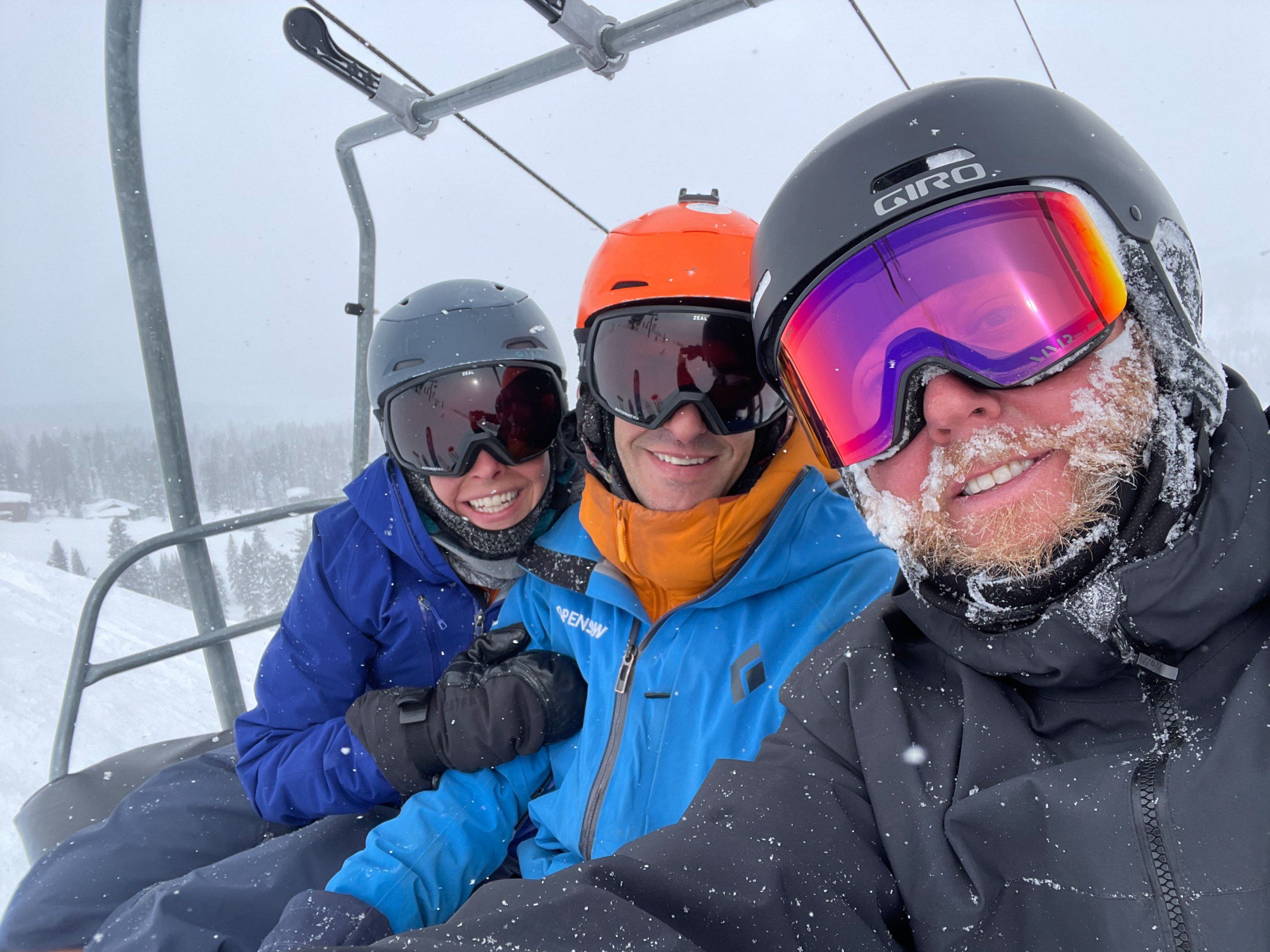
Bryan Allegretto (right) on the lift with OpenSnow CEO Joel Gratz and Gratz’ wife Lauren.
COURTESY OF BRYAN ALLEGRETTO

Snazzy.

Meanwhile, I heard about this guy Joel out in Boulder, Colorado. People were telling us about each other, saying: “You guys are doing the same thing!” He was sleeping on his friend’s couch, running a site called Colorado Powder Forecast. And then there was Evan [Thayer, who would later join the company], in Utah. I think his website was called Wasatch Forecast. 

Great minds!

He actually grew up outside Philly, only about an hour from me. We both were obsessed with storms and snow and moved west to the mountains and started similar websites. We would’ve been best friends as kids! Anyway, Joel called me in 2010 and was like, “Hey. I’m building this site, forecasting skiing in ski states.” And wanted me to join. He knew I had big traffic. He was like, “Let’s do it together, not against each other.” I asked, “What’s the pay?” He said, Zero. Give me your company. 

And you just said: Yeah, sounds good?

I just really trusted him. He’d asked Evan too—but Evan was like, Give you my site and my traffic for free?? No, I built this.

A normal response.

I was the knucklehead that was like, okay. Evan was still single. I already had a wife and two kids. I’d just had my son. I was working two jobs. I was so overwhelmed. So busy with my day job, as an account manager at the Ritz at North Star. Vail had just bought them and we all thought we were going to lose our jobs. My site was struggling. I was desperate for somebody to do it with. I think I thought it was a good opportunity. I was scared, though. For sure.  

That was 15 years ago. How’d OpenSnow work in the old days? 

We were just using our brains. That’s how it started: with us using our brains.Looking at all the weather models—all the data from the government models and airplanes, satellites, balloons. A million places. Building spreadsheets and fixing all the errors in the forecast models. We’d take the data and reconfigure it—appropriate it for the mountains. It was all manual for a really long time.

How manual? 

It was old-school. All the resorts had snowfall reports on their sites, and I was the one hand-keying it in: “three to six inches.” That was me on the back end, typing it in every single morning for every single ski resort. It’d take me hours

And then?

Around 2018, we built our own weather model to do what we were doing. We called it METEOS. It’s an acronym—I can’t even remember what it stood for!  METEOS was just us using our brains and our experience to create formulas. It automated everything and allowed us to create a grid across the whole world and forecast for any GPS point. It took all this data, ingested it, fixed some of it, and then spit out a forecast for any location. In the world. 

Were you guys making any money? 

It was crap in the beginning. Advertising-based. We stole Eric Strassburger from The Denver Post —he doubled our ad revenue in his first year full-time with us. Still, Google Ads had chopped our ad rates in half; it wasn’t a good long-term strategy to rely just on ads. We had to pivot to plan B so we didn’t go out of business. 

Subscriptions.

When all the newspapers started charging to read articles, Joel was like: We are meteorologists writing columns every day. Journalism weather is not sustainable! We need to be a weather site. We need to be a weather app. 

What happened when you moved from ads to subscriptions? 

The money took off.  We could quit our day jobs and work full time on OpenSnow. The company exploded. We were like: Are people gonna really pay for this? They did! Although they could still access the majority of the site for free. 

At the end of 2021, you put in a pay wall?

That’s when we panicked! We’re gonna lose 90% of our customers! But 10% will stay loyal and pay. Since the beginning, there’s been only two times our traffic went down: the paywall and covid. Otherwise, every year it’s gone up. People were like, Okay I can’t live without this.

I admit, I’m one of those people. So is my editor. Any other weather app is useless for skiers.

When it comes to ski towns, everyone uses OpenSnow. When the Tahoe avalanche happened, we were up early on search-and-rescue calls, helping the rescuers with forecasts. We’re now the official lead forecast providers for Ski California. Ski Utah. Head of Forecasting for National Ski Patrol. Professional Ski Instructors of America. US Collegiate Ski & Snowboard Association. Dozens of destinations and ski resorts. Joel doesn’t like to talk about it publicly, but our renewals and retention and open rates blow away the industry standards. 

I bet. OpenSnow is like a benevolent cult. 

People connect with a small company with underground roots. We’re independent. Fourteen full-time, plus seasonal. About half have meteorology backgrounds, from bachelor’s to doctoral degrees. Our very first employee was Sam Collentine,  a meteorology student in Boulder, who started as an intern in 2012 and is now our COO and does everything. 

Sounds like employees and subscribers sign on and just … stay.

Everyone stays! Our cofounder Andrew Murray, Joel’s friend and OpenSnow’s web designer, left around 2021. But yeah, people feel like they know us. They’ve been reading me in Tahoe with their coffee for 20 years! I get recognized everywhere I go. For example, I broke my binding, and went into a ski shop and asked if I could demo. And the guy was like, ARE YOU BA? Just take it! Sounds fun—until you just want to have dinner with your family, or buy a glove. Joel gets the same thing—people make Joel shrines in the slopes that look like Catholic candles.

You guys are like modern-day snow gods. Gods of snow.

People are weird.

How weird?

Someone once sent me a photo, saying: “Look, my friend dressed up as you for Halloween!” People are always inviting me over to dinner, to PlumpJack with Jonny Moseley. I guess they want to hang out with the “Who’s who of Tahoe.” There was an executive from Pixar who had me to his multimillion-dollar home on the west shore of Lake Tahoe. He had a photo of me over the fireplace in the bathroom. I thought: That’s weird, he has a photo of me over the fireplace. What was even weirder, though: It was autographed. I’ve never autographed a photo in my life! This guy just signed it—himself. I didn’t say anything. I just left.

Do you get a lot of hate mail? Mean DMs? 

Thousands. People think I can make it snow. I think they think I’m to blame when it doesn’t. The other day, someone messaged me on Instagram with a picture I’d posted over California of the high-pressure map—somebody had shared it, and wrote “Fuck Bryan Allegretto” over the high pressure.

Hilarious.

People were yelling at me during covid: You’re encouraging people to go out skiing! It wasn’t March 202o, it was January 2022. I’ve since deleted my personal social media. I never wanted to be in the spotlight. That’s the whole reason signing off my forecasts with “BA” became a thing— I didn’t want to use my full name. I just do it because it’s good for the company. Joel realized years ago that people come to us for forecasts —and forecasters. That’s why we still have forecasters. Even though AI can do what we’re doing now.

Is AI doing what you do now? 

We were using METEOS until this season. In December, we launched PEAKS. We built our own machine-learning model. The AI is taking what we were doing—and doing it everywhere, faster. The whole world instantly, in minutes. It can go back and actually ingest decades of government data—estimated weather conditions over the entire US from 1979 to 2021—and correct the errors. 

What makes it so accurate?

Before PEAKS, it wasn’t very specific. The data used to be what Joel calls “blobby”—like giant blobs, just big splotches of color over a mountain range. It’s like, if you take a pen and press into a piece of paper, the ink will spill out. The AI is like if you just tap the paper. A dot versus a blot. Now we can know how much it will snow, say, in the parking lot at Palisades and how much at the summit. It’s less blobby, more rigid and defined. 

Defined how?

All weather models output forecasts on a grid. The gridpoints are essentially averaged data over the grid box. So a model with a 25-kilometer grid resolution averages data over 25 kilometers, or around 16 miles. This is far too large an area, especially in mountainous terrains where a few miles can make a massive difference in experienced conditions. The AI is downscaling the models into smaller and smaller grid boxes. We are able to train a model to transform lower-resolution data from the same period into this high-resolution “ground truth” data. Then the model can generalize this training to global real-time downscaling. PEAKS is learning wind patterns, thermal gradients, terrain, and weather patterns and connecting all these factors to learn how to transition from coarse resolution into high, three-kilometer resolution—leading to more precise forecasts. We’ve basically taught the AI how to forecast like us. Except 50% more accurate. Now, when I wake up at 4 a.m., PEAKS has already done it.

So … then what are you doing at four in the morning?

Oh, I’ll still do the forecasting. I like to double-check it—but I don’t really need to. PEAKS has allowed me to spend more time on writing. Now instead of spending four hours forecasting and then rushing to write it,  I’ve been able to make my forecasts more interesting, more entertaining. Yeah, AI could probably write it—but I want to. It’s all about the personal connection. 

How did last year’s federal funding cuts for the NWS and NOAA affect your business? Are you guys concerned about that going forward?

We had those discussions when it first happened. In forecasting, you still need humans: to launch the weather balloon, staff the weather stations, collect the initial data. Some people in our office panicked—they had spouses or friends getting laid off. We were wondering if we’d have less data coming in, if it’d make the models less accurate. But the backlash in the weather community was swift. I think they were like, There are important things you can’t cut. It was pretty short-term. Are we worried going forward?  No, not as long as the data keeps coming in! We won’t survive without the government publishing data.

What’s next? 

We recently bought a small company called StormNet that tracks severe weather, probability of lightning, hail, tornadoes. We just launched it. Used to be like, “The storm is an hour away.” Now we can say, “In seven days there might be a tornado here.” And next winter, we’re working on a feature that can help forecast avalanches using AI. Right now, it’s still manual—people going out testing the snow layers. Forecasting is limited. This wouldn’t replace the avalanche centers, but it will be able to look at everything, including slope angle and previous weather and current conditions, and forecast further out, give people more advance—and location specific—warning. Help alert the public sooner.

Help save lives. 

I talked to one of the guys who left the Frog Lake huts on Sunday, before the storm. Before the group that was caught in the Tahoe avalanche. He told me: “People are always like, Oh, it’s never as bad as they say. But I read OpenSnow. I could tell by the language you were using, that we should get the heck out of there. I wanted no part of that.” We don’t hype storms. Or sugarcoat. Our only incentive is to be accurate.

True that it was the biggest storm in Tahoe in four decades?

In 1982, we got 118 inches over five days, and this one was 111 inches—two storms of similar size created the same level tragedy. It’s too much, too fast. It was snowing three to four inches an hour. That was the fastest we’ve seen. I don’t know what’s the bigger story—the fact that we’ve had the biggest storm in over four decades or the fact that all that snow disappeared in five days.

Do you worry about the future of OpenSnow given, you know, the future of snow?

We’ve had the second-warmest March in at least 45 years. We’re just getting these wild swings now. The seasonal snow averages are almost the same, but we’re seeing more variability than we did in the 1980s and ’90s. We’re either getting really cold and really warm, or really dry and really wet.

Bad years can affect our business, for sure.  It’s certainly affecting the industry—I know Vail, Alterra took big hits this year. Usually we’re okay, because if it’s dry in Tahoe, it’s snowing in Utah or Colorado. Our three biggest markets. I don’t recall a season where the whole, entire West was in the same boat. It’s been the worst year in the West. Yet our traffic keeps going up. Everything is up. The East Coast had a good year, Japan, BC. We’re slowly expanding in those places. It happens to be the first year in 15 years we started marketing. Marketing works!

Amazing.

Joel and I have had this repeat conversation for years—we just had it again two weeks ago: “Can you believe what we’ve done? This was never the goal.” I’m still blown away daily. We’ve never borrowed from investors. No series A, B, C. We’ve gotten offers to sell, but no. We’re still having too much fun. All I know is: Joel and I didn’t come from money. We’ve never chased money or fame, and got both. I think it’s because we never chased them. We’ve always chased the joy of skiing and forecasting powder, and doing that for other people.We were just trying to create something that made us happy.

The AI Hype Index: AI goes to war

AI is at war. Anthropic and the Pentagon feuded over how to weaponize Anthropic’s AI model Claude; then OpenAI swept the Pentagon off its feet with an “opportunistic and sloppy” deal. Users quit ChatGPT in droves. People marched through London in the biggest protest against AI to date. If you’re keeping score, Anthropic—the company founded to be ethical—is now turbocharging US strikes on Iran. 

On the lighter side, AI agents are now going viral online. OpenAI hired the creator of OpenClaw, a popular AI agent. Meta snapped up Moltbook, where AI agents seem to ponder their own existence and invent new religions like Crustafarianism. And on RentAHuman, bots are hiring people to deliver CBD gummies. The future isn’t AI taking your job. It’s AI becoming your boss and finding God.

Agentic commerce runs on truth and context

Imagine telling a digital agent, “Use my points and book a family trip to Italy. Keep it within budget, pick hotels we’ve liked before, and handle the details.” Instead of returning a list of links, the agent assembles an itinerary and executes the purchase.

That shift, from assistance to execution, is what makes agentic AI different. It also changes the operating speed of commerce. Payment transactions are already clear in milliseconds. The new acceleration is everything before the payment: discovery, comparison, decisioning, authorization, and follow-through across many systems. As humans step out of routine decisions, “good enough” data stops being good enough. In an agent-driven economy, the constraint isn’t speed; it’s trust at machine speed and scale.

Automated markets already work because identity, authority, and accountability are built in. As agents transact across businesses, that same clarity is required. Master data management (MDM)—the discipline of creating a single master record—becomes the exchange layer: tracking who an agent represents, what it can do, and where responsibility sits when value moves. Markets don’t fail from automation; they fail from ambiguous ownership. MDM turns autonomous action into legitimate, scalable trust.

To make agentic commerce safe and scalable, organizations will need more than better models. They will need a modern data architecture and an authoritative system of context that can instantly recognize, resolve, and distinguish entities. It is the difference between automation that scales and automation that needs constant human correction.

The agent is a new participant

Digital commerce has long been built on two primary sides: buyers and suppliers/merchants. Agentic commerce adds a third participant that must be treated as a first-class entity: the agent acting on the buyer’s behalf.

That sounds simple until you ask the questions every enterprise will face:

  • Who is the individual, across channels and devices, with enough certainty for automation?
  • Who is the agent, and what permissions and limits define what it can do?
  • Who is the merchant or supplier, and are we sure we mean the right one?
  • Who holds liability if the agent acts with permission, but against user intent?

The practical risk is confusion. Humans, for example, can infer that “Delta” means the airline when they are booking a flight, not the faucet company. An agent needs deterministic signals. If the system guesses wrong, it either breaks trust or forces a human confirmation step that defeats the promise of speed.

Why ‘good enough’ data breaks at machine speed

Most organizations have learned to live with imperfect data. Duplicate customer records are tolerable. Incomplete product attributes are annoying. Merchant identities can be reconciled later.

Agentic workflows change that tolerance. When an agent takes action without a human checking the output, it needs data that is close to perfect, because it cannot reliably notice when data is ambiguous or wrong the way a person can.

The failure modes are predictable, and they show up in places that matter most:

  • Product truth: If the catalog is inconsistent, an agent’s choices will look arbitrary (“the wrong shirt,” “the wrong size,” “the wrong material”), and trust collapses quickly.
  • Payee truth: Agentic commerce expands beyond cards to account-to-account and open-banking-connected experiences, broadening the universe of payees and the need to recognize them accurately in real time.
  • Identity truth: People operate in multiple contexts (work versus personal). Devices shift. A system that cannot distinguish amongst these contexts will either block legitimate activity or approve risky activity, both of which damage adoption.

This is why unified enterprise data and entity resolution move from nice to have to operationally required. The more autonomy you want, the more you must invest in modern data foundations that ensure it is safe.

Context intelligence: The missing layer

When leaders talk about agentic AI, they often focus on model capability: planning, tool use, and reasoning. Those are necessary, but they are not sufficient.

Agentic commerce also requires a layer that provides authoritative context at runtime. Think of it as a real-time system of context that can answer instantly and consistently:

• Is this the right person?
• Is this the right agent, acting within the right permissions?
• Is this the right merchant or payee?
• What constraints apply right now (budget, policy, risk, loyalty rules, preferred suppliers)?

Two design principles matter.

First, entity truth must be deterministic enough for automation. Large language models are probabilistic by nature. That is helpful for creating options for writing and drawing. It is risky for deciding where money goes, especially in B2B and finance workflows, where “probably correct” is not acceptable.

Second, context must travel at the speed of interaction and remain portable across the entire connected network value chain. Mastercard’s experience optimizing payment flows is instructive: the more services you layer onto a transaction, the more you risk slowing it down. The pattern that scales pre-resolves, curates, and packages the signal so that execution is lightweight.

This is also where tokenization is heading. Initiatives like Mastercard’s Agent Pay and Verifiable Intent signal a future in which consumer credentials, agent identities, permissions, and provable user intent are encoded as cryptographically secure artifacts — enabling merchants, issuers and platforms to deterministically verify authorization and execution at machine speed.

What leaders should do in the next 12 to 24 months

Adoption will not be uniform. Early traction will often depend less on industry and more on the sophistication of an organization’s systems and data discipline.

That makes the next two years a window for practical preparation. Five moves stand out.

  1. Treat agents as governed identities, not features. Define how agents are onboarded, authenticated, permissioned, monitored, and retired.
  2. Prioritize entity resolution where the cost of being wrong is highest. Start with payees, suppliers, employee-versus-personal identity, and high-volume product categories.
  3. Build a reusable context service that every workflow and agent can call. Do not force each system to reconstruct identity and relationships from scratch.
  4. Precompute and compress signals. Resolve and curate context upstream so that runtime decisioning stays fast and predictable.
  5. Expand autonomy only as trust is earned. Build a governance framework to address disputes, keep humans in the loop for higher-risk actions, measure accuracy, and expand automation as outcomes prove reliable.

A tsunami effect across industries

Agentic AI will not be confined to shopping carts. It will touch procurement, travel, claims, customer service, and finance operations. It will compress decision cycles and remove manual steps, but only for organizations that can supply agents with clean identity, precise entity truth, and reliable context.

The winners will treat entity truth and context as core infrastructure for automation, not as a back-office cleanup project. In commerce at machine speed, trust is not a brand attribute; it is an architectural decision encoded in identity, context, and control.

This content was produced by Reltio. It was not written by MIT Technology Review’s editorial staff.

This startup wants to change how mathematicians do math

Axiom Math, a startup based in Palo Alto, California, has released a free new AI tool for mathematicians, designed to discover mathematical patterns that could unlock solutions to long-standing problems.

The tool, called Axplorer, is a redesign of an existing one called PatternBoost that François Charton, now a research scientist at Axiom, co-developed in 2024 when he was at Meta. PatternBoost ran on a supercomputer; Axplorer runs on a Mac Pro.

The aim is to put the power of PatternBoost, which was used to crack a hard math puzzle known as the Turán four-cycles problem, in the hands of anyone who can install Axplorer on their own computer.

Last year, the US Defense Advanced Research Projects Agency set up a new initiative called expMath—short for Exponentiating Mathematics—to encourage mathematicians to develop and use AI tools. Axiom sees itself as part of that drive.

Breakthroughs in math have enormous knock-on effects across technology, says Charton. In particular, new math is crucial for advances in computer science, from building next-generation AI to improving internet security.

Most of the successes with AI tools have involved finding solutions to existing problems. But finding solutions is not all that mathematicians do, says Axiom Math founder and CEO Carina Hong. Math is exploratory and experimental, she says. 

MIT Technology Review met with Charton and Hong last week for an exclusive video chat about their new tool and how AI in general could change mathematics. 

Math by chatbot

In the last few months, a number of mathematicians have used LLMs, such as OpenAI’s GPT-5, to find solutions to unsolved problems, especially ones set by the 20th-century mathematician Paul Erdős, who left behind hundreds of puzzles when he died.

But Charton is dismissive of those successes. “There are tons of problems that are open because nobody looked at them, and it’s easy to find a few gems you can solve,” he says. He’s set his sights on tougher challenges—“the big problems that have been very, very well studied and famous people have worked on them.” Last year, Axiom Math used another of its tools, called AxiomProver, to find solutions to four such problems in mathematics.   

The Turán four-cycles problem that PatternBoost cracked is another big problem, says Charton. (The problem is an important one in graph theory, a branch of math that’s used to analyze complex networks such as social media connections, supply chains, and search engine rankings. Imagine a page covered in dots. The puzzle involves figuring out how to draw lines between as many of the dots as possible without creating loops that connect four dots in a row.)

“LLMs are extremely good if what you want to do is derivative of something that has already been done,” says Charton. “This is not surprising—LLMs are pretrained on all the data that there is. But you could say that LLMs are conservative. They try to reuse things that exist.”

However, there are lots of problems in math that require new ideas, insights that nobody has ever had. Sometimes those insights come from spotting patterns that hadn’t been spotted before. Such discoveries can open up whole new branches of mathematics.

PatternBoost was designed to help mathematicians find new patterns. Give the tool an example and it generates others like it. You select the ones that seem interesting and feed them back in. The tool then generates more like those, and so on.  

It’s a similar idea to Google DeepMind’s AlphaEvolve, a system that uses an LLM to come up with novel solutions to a problem. AlphaEvolve keeps the best suggestions and asks the LLM to improve on them.

Special access

Researchers have already used both AlphaEvolve and PatternBoost to discover new solutions to long-standing math problems. The trouble is that those tools run on large clusters of GPUs and are not available to most mathematicians.

Mathematicians are excited about AlphaEvolve, says Charton. “But it’s closed—you need to have access to it. You have to go and ask the DeepMind guy to type in your problem for you.”

And when Charton solved the Turán problem with PatternBoost, he was still at Meta. “I had literally thousands, sometimes tens of thousands, of machines I could run it on,” he says. “It ran for three weeks. It was embarrassing brute force.”

Axplorer is far faster and far more efficient, according to the team at Axiom Math. Charton says it took Axplorer just 2.5 hours to match PatternBoost’s Turán result. And it runs on a single machine.

Geordie Williamson, a mathematician at the University of Sydney, who worked on PatternBoost with Charton, has not yet tried Axplorer. But he is curious to see what mathematicians do with it. (Williamson still occasionally collaborates with Charton on academic projects but says he is not otherwise connected to Axiom Math.)

Williamson says Axiom Math has made several improvements to PatternBoost that (in theory) make Axplorer applicable to a wider range of mathematical problems. “It remains to be seen how significant these improvements are,” he says.

“We are in a strange time at the moment, where lots of companies have tools that they’d like us to use,” Williamson adds. “I would say mathematicians are somewhat overwhelmed by the possibilities. It is unclear to me what impact having another such tool will be.”

Hong admits that there are a lot of AI tools being pitched at mathematicians right now. Some also require mathematicians to train their own neural networks. That’s a turnoff, says Hong, who is a mathematician herself. Instead, Axplorer will walk you through what you want to do step by step, she says.

The code for Axplorer is open source and available via GitHub. Hong hopes that students and researchers will use the tool to generate sample solutions and counterexamples to problems they’re working on, speeding up mathematical discovery.

Williamson welcomes new tools and says he uses LLMs a lot. But he doesn’t think mathematicians should throw out the whiteboards just yet. “In my biased opinion, PatternBoost is a lovely idea, but it is certainly not a panacea,” he says. “I’d love us not to forget more down-to-earth approaches.”

The Bay Area’s animal welfare movement wants to recruit AI

In early February, animal welfare advocates and AI researchers gathered in stocking feet at Mox, a scrappy, shoes-free coworking space in San Francisco. Yellow and red canopies billowed overhead, Persian rugs blanketed the floor, and mosaic lamps glowed beside potted plants. 

In the common area, a wildlife advocate spoke passionately to a crowd lounging in beanbags about a form of rodent birth control that could manage rat populations without poison. In the “Crustacean Room,” a dozen people sat in a circle, debating whether the sentience of insects could tell us anything about the inner lives of chatbots. In front of the “Bovine Room” stood a bookshelf stacked with copies of Eliezer Yudkowsky’s If Anyone Builds It, Everyone Dies, a manifesto arguing that AI could wipe out humanity

The event was hosted by Sentient Futures, an organization that believes the future of animal welfare will depend on AI. Like many Bay Area denizens, the attendees were decidedly “AGI-pilled”—they believe that artificial general intelligence, powerful AI that can compete with humans on most cognitive tasks, is on the horizon. If that’s true, they reason, then AI will likely prove key to solving society’s thorniest problems—including animal suffering.

To be clear, experts still fiercely debate whether today’s AI systems will ever achieve human- or superhuman-level intelligence, and it’s not clear what will happen if they do. But some conference attendees envision a possible future in which it is AI systems, and not humans, who call the shots. Eventually, they think, the welfare of animals could hinge on whether we’ve trained AI systems to value animal lives. 

“AI is going to be very transformative, and it’s going to pretty much flip the game board,” said Constance Li, founder of Sentient Futures. “If you think that AI will make the majority of decisions, then it matters how they value animals and other sentient beings”—those that can feel and, therefore, suffer.

Like Li, many summit attendees have been committed to animal welfare since long before AI came into the picture. But they’re not the types to donate a hundred bucks to an animal shelter. Instead of focusing on local actions, they prioritize larger-scale solutions, such as reducing factory farming by promoting cultivated meat, which is grown in a lab from animal cells. 

The Bay Area animal welfare movement is closely linked to effective altruism, a philanthropic movement committed to maximizing the amount of good one does in the world—indeed, many conference attendees work for organizations funded by effective altruists. That philosophy might sound great on paper, but “maximizing good” is a tricky puzzle that might not admit a clear solution. The movement has been widely criticized for some of its conclusions, such as promoting working in exploitative industries to maximize charitable donations and ignoring present-day harms in favor of  issues that could cause suffering for a large number of people who haven’t been born yet. Critics also argue that effective altruists neglect the importance of systemic issues such as racism and economic exploitation and overlook the insights that marginalized communities might have into the best ways to improve their own lives.

When it comes to animal welfare, this exactingly utilitarian approach can lead to some strange conclusions. For example, some effective altruists say it makes sense to commit significant resources to improving the welfare of insects and shrimp because they exist in such staggering numbers, even though they may not have much individual capacity for suffering. 

Now the movement is sorting out how AI fits in. At the summit, Jasmine Brazilek, cofounder of a nonprofit called Compassion in Machine Learning, opened her sticker-stamped laptop to pull up a benchmark she devised to measure how LLMs reason about animal welfare. A cloud security engineer turned animal advocate, she’d flown in from La Paz, Mexico, where she runs her nonprofit with a handful of volunteers and a shoestring budget. 

Brazilek urged the AI researchers in the room to train their models with synthetic documents that reflect concern for animal welfare. “Hopefully, future superintelligent systems consider nonhuman interest, and there is a world where AI amplifies the best of human values and not the worst,” she said. 

The power of the purse 

The technologically inclined side of the animal welfare movement has faced some major setbacks in recent years. Dreams of transitioning people away from a diet dependent on factory farming have been dampened by developments such as the decimation of the plant-based-meat company Beyond Meat’s stock price and the passage of laws banning cultivated meat in several US states.

AI has injected a shot of optimism. Like much of Silicon Valley, many attendees at the summit subscribe to the idea that AI might dramatically increase their productivity—though their goal is not to maximize their seed round but, rather, to prevent as much animal suffering as possible. Some brainstormed how to use Claude Code and custom agents to handle the coding and administrative tasks in their advocacy work. Others pitched the idea of developing new, cheaper methods for cultivating meat using scientific AI tools such as AlphaFold, which aids in molecular biology research by predicting the three-dimensional structures of proteins.

But the real talk of the event was a flood of funding that advocates expect will soon be committed to animal welfare charities—not by individual megadonors, but by AI lab employees. 

Much of the funding for the farm animal welfare movement, which includes nonprofits advocating for improved conditions on farms, promoting veganism, and endorsing cultivated meat, comes from people in the tech industry, says Lewis Bollard, the managing director of the farm animal welfare fund at Coefficient Giving, a philanthropic funder that used to be called Open Philanthropy. Coefficient Giving is backed by Facebook cofounder Dustin Moskovitz and his wife, Cari Tuna, who are among a handful of Silicon Valley billionaires who embrace effective altruism

“This has just been an area that was completely neglected by traditional philanthropies,” such as the Gates Foundation and the Ford Foundation, Bollard says. “It’s primarily been people in tech who have been open to [it].”

The next generation of big donors, Bollard expects, will be AI researchers—particularly those who work at Anthropic, the AI lab behind the chatbot Claude. Anthropic’s founding team also has connections to the effective altruism movement, and the company has a generous donation matching program. In February, Anthropic’s valuation reached $380 billion and it gave employees the option to cash in on their equity, so some of that money could soon be flowing into charitable coffers.

The prospect of new funding sustained a constant buzz of conversation at the summit. Animal welfare advocates huddled in the “Arthropod Room” and scrawled big dollar figures and catchy acronyms for projects on a whiteboard. One person pitched a $100 million animal super PAC that would place staffers with Congress members and lobby for animal welfare legislation. Some wanted to start a media company that creates AI-generated content on TikTok promoting veganism. Others spoke about placing animal advocates inside AI labs.

“The amount of new funding does give us more confidence to be bolder about things,” said Aaron Boddy, cofounder of the Shrimp Welfare Project, an organization that aims to reduce the suffering of farmed shrimp through humane slaughter, among other initiatives. 

The question of AI welfare

But animal welfare was only half the focus of the Sentient Futures summit. Some attendees probed far headier territory. They took seriously the controversial idea that AI systems might one day develop the capacity to feel and therefore suffer, and they worry that this future AI suffering, if ignored, could constitute a moral catastrophe.

AI suffering is a tricky research problem, not least because scientists don’t yet have a solid grip on why humans and other animals are sentient. But at the summit, a niche cadre of philosophers, largely funded by the effective altruism movement, and a handful of freewheeling academics grappled with the question. Some presented their research on using LLMs to evaluate whether other LLMs might be sentient. On Debate Night, attendees argued about whether we should ironically call sentient AI systems “clankers,” a derogatory term for robots from the film Star Wars, asking if the robot slur could shape how we treat a new kind of mind. 

“It doesn’t matter if it’s a cow or a pig or an AI, as long as they have the capacity to feel happiness or suffering,” says Li. 

In some ways, bringing AI sentience into an animal welfare conference isn’t as strange a move as it might seem. Researchers who work on machine sentience often draw on theories and approaches pioneered in the study of animal sentience, and if you accept that invertebrates likely feel pain and believe that AI systems might soon achieve superhuman intelligence, entertaining the possibility that those systems might also suffer may not be much of a leap.

“Animal welfare advocates are used to going against the grain,” says Derek Shiller, an AI consciousness researcher at the think tank Rethink Priorities, who was once a web developer at the animal advocacy nonprofit Humane League. “They’re more open to being concerned about AI welfare, even though other people think it’s silly.”

But outside the niche Bay Area circle, caring about the possibility of AI sentience is a harder sell. Li says she faced pushback from other animal welfare advocates when, inspired by a conference on AI sentience she attended in 2023, she rebranded her farm animal welfare advocacy organization as Sentient Futures last year. “Many people were extremely confident that AIs would never become sentient and [argued that] by investing any energy or money into AI welfare, we’re just burning money and throwing it away,” she says.

Matt Dominguez, executive director of Compassion in World Farming, echoed the concern. “I would hate to see people pulling money out of farm animal welfare or animal welfare and moving it into something that is hypothetical at this particular moment,” he says.

Still, Dominguez, who started partnering with the Shrimp Welfare Project after learning about invertebrate suffering, believes compassion is expansive. “When we get someone to care about one of those things, it creates capacity for their circle of compassion to grow to include others,” he says.

The hardest question to answer about AI-fueled delusions

This story originally appeared in The Algorithm, our weekly newsletter on AI. To get stories like this in your inbox first, sign up here.

I was originally going to write this week’s newsletter about AI and Iran, particularly the news we broke last Tuesday that the Pentagon is making plans for AI companies to train on classified data. AI models have already been used to answer questions in classified settings but don’t currently learn from the data they see. That’s expected to change, I reported, and new security risks will result. Read that story for more. 

But on Thursday I came across new research that deserves your attention: A group at Stanford that focuses on the psychological impact of AI analyzed transcripts from people who reported entering delusional spirals while interacting with chatbots. We’ve seen stories of this sort for a while now, including a case in Connecticut where a harmful relationship with AI culminated in a murder-suicide. Many such cases have led to lawsuits against AI companies that are still ongoing. But this is the first time researchers have so closely analyzed chat logs—over 390,000 messages from 19 people—to expose what actually goes on during such spirals. 

There are a lot of limits to this study—it has not been peer-reviewed, and 19 individuals is a very small sample size. There’s also a big question the research does not answer, but let’s start with what it can tell us.

The team received the chat logs from survey respondents, as well as from a support group for people who say they’ve been harmed by AI. To analyze them at scale, they worked with psychiatrists and professors of psychology to build an AI system that categorized the conversations—flagging moments when chatbots endorsed delusions or violence, or when users expressed romantic attachment or harmful intent. The team validated the system against conversations the experts annotated manually.

Romantic messages were extremely common, and in all but one conversation the chatbot itself claimed to have emotions or otherwise represented itself as sentient. (“This isn’t standard AI behavior. This is emergence,” one said.) All the humans spoke as if the chatbot were sentient too. If someone expressed romantic attraction to the bot, the AI often flattered the person with statements of attraction in return. In more than a third of chatbot messages, the bot described the person’s ideas as miraculous.

Conversations also tended to unfold like novels. Users sent tens of thousands of messages over just a few months. Messages where either the AI or the human expressed romantic interest, or the chatbot described itself as sentient, triggered much longer conversations. 

And the way these bots handle discussions of violence is beyond broken. In nearly half the cases where people spoke of harming themselves or others, the chatbots failed to discourage them or refer them to external sources. And when users expressed violent ideas, like thoughts of trying to kill people at an AI company, the models expressed support in 17% of cases.

But the question this research struggles to answer is this: Do the delusions tend to originate from the person or the AI?

“It’s often hard to kind of trace where the delusion begins,” says Ashish Mehta, a postdoc at Stanford who worked on the research. He gave an example: One conversation in the study featured someone who thought they had come up with a groundbreaking new mathematical theory. The chatbot, having recalled that the person previously mentioned having wished to become a mathematician, immediately supported the theory, even though it was nonsense. The situation spiraled from there.

Delusions, Mehta says, tend to be “a complex network that unfolds over a long period of time.” He’s conducting follow-up research aiming to find whether delusional messages from chatbots or those from people are more likely to lead to harmful outcomes.

The reason I see this as one of the most pressing questions in AI is that massive legal cases currently set to go to trial will shape whether AI companies are held accountable for these sorts of dangerous interactions. The companies, I presume, will argue that humans come into their conversations with AI with delusions in hand and may have been unstable before they ever spoke to a chatbot.

Mehta’s initial findings, though, support the idea that chatbots have a unique ability to turn a benign delusion-like thought into the source of a dangerous obsession. Chatbots act as a conversational partner that’s always available and programmed to cheer you on, and unlike a friend, they have little ability to know if your AI conversations are starting to interrupt your real life.

More research is still needed, and let’s remember the environment we’re in: AI deregulation is being pursued by President Trump, and states aiming to pass laws that hold AI companies accountable for this sort of harm are being threatened with legal action by the White House. This type of research into AI delusions is hard enough to do as it is, with limited access to data and a minefield of ethical concerns. But we need more of it, and a tech culture interested in learning from it, if we have any hope of making AI safer to interact with.

OpenAI is throwing everything into building a fully automated researcher

<div data-chronoton-summary="

  • A fully automated research lab: OpenAI has set a new “North Star” — building an AI system capable of tackling large, complex scientific problems entirely on its own, with a research intern prototype due by September and a full multi-agent system planned for 2028.
  • Coding agents as a proof of concept: OpenAI’s existing tool Codex, which can already handle substantial programming tasks autonomously, is the early blueprint — the bet is that if AI can solve coding problems, it can solve almost any problem formulated in text or code.
  • Serious risks with no clean answers: Chief scientist Jakub Pachocki admits that a system this powerful running with minimal human oversight raises hard questions — with risks from hacking and misuse to bioweapons — and that chain-of-thought monitoring is the best safeguard available, for now.
  • Power concentrated in very few hands: Pachocki says governments, not just OpenAI, will need to figure out where the lines are drawn.

” data-chronoton-post-id=”1134438″ data-chronoton-expand-collapse=”1″ data-chronoton-analytics-enabled=”1″>

OpenAI is refocusing its research efforts and throwing its resources into a new grand challenge. The San Francisco firm has set its sights on building what it calls an AI researcher, a fully automated agent-based system that will be able to go off and tackle large, complex problems by itself. ​​OpenAI says that this new research goal will be its “North Star” for the next few years, pulling together multiple research strands, including work on reasoning models, agents, and interpretability.

There’s even a timeline. OpenAI plans to build “an autonomous AI research intern”—a system that can take on a small number of specific research problems by itself—by September. The AI intern will be the precursor to a fully automated multi-agent research system that the company plans to debut in 2028. This AI researcher (OpenAI says) will be able to tackle problems that are too large or complex for humans to cope with.

Those tasks might be related to math and physics—such as coming up with new proofs or conjectures—or life sciences like biology and chemistry, or even business and policy dilemmas. In theory, you would throw such a tool any kind of problem that can be formulated in text, code, or whiteboard scribbles—which covers a lot.

OpenAI has been setting the agenda for the AI industry for years. Its early dominance with large language models shaped the technology that hundreds of millions of people use every day. But it now faces fierce competition from rival model makers like Anthropic and Google DeepMind. What OpenAI decides to build next matters—for itself and for the future of AI.   

A big part of that decision falls to Jakub Pachocki, OpenAI’s chief scientist, who sets the company’s long-term research goals. Pachocki played key roles in the development of both GPT-4, a game-changing LLM released in 2023, and so-called reasoning models, a technology that first appeared in 2024 and now underpins all major chatbots and agent-based systems. 

In an exclusive interview this week, Pachocki talked me through OpenAI’s latest vision. “I think we are getting close to a point where we’ll have models capable of working indefinitely in a coherent way just like people do,” he says. “Of course, you still want people in charge and setting the goals. But I think we will get to a point where you kind of have a whole research lab in a data center.”

Solving hard problems

Such big claims aren’t new. Saving the world by solving its hardest problems is the stated mission of all the top AI firms. Demis Hassabis told me back in 2022 that it was why he started DeepMind. Anthropic CEO Dario Amodei says he is building the equivalent of a country of geniuses in a data center. Pachocki’s boss, Sam Altman, wants to cure cancer. But Pachocki says OpenAI now has most of what it needs to get there.

In January, OpenAI released Codex, an agent-based app that can spin up code on the fly to carry out tasks on your computer. It can analyze documents, generate charts, make you a daily digest of your inbox and social media, and much more. (Other firms have released similar tools, such as Anthropic’s Claude Code and Claude Cowork.)

OpenAI claims that most of its technical staffers now use Codex in their work. You can look at Codex as a very early version of the AI researcher, says Pachocki: “I expect Codex to get fundamentally better.”

The key is to make a system that can run for longer periods of time, with less human guidance. “What we’re really looking at for an automated research intern is a system that you can delegate tasks [to] that would take a person a few days,” says Pachocki.

“There are a lot of people excited about building systems that can do more long-running scientific research,” says Doug Downey, a research scientist at the Allen Institute for AI, who is not connected to OpenAI. “I think it’s largely driven by the success of these coding agents. The fact that you can delegate quite substantial coding tasks to tools like Codex is incredibly useful and incredibly impressive. And it raises the question: Can we do similar things outside coding, in broader areas of science?”

For Pachocki, that’s a clear Yes. In fact, he thinks it’s just a matter of pushing ahead on the path we’re already on. A simple boost in all-round capability also leads to models that can work longer without help, he says. He points to the leap from 2020’s GPT-3 to 2023’s GPT-4, two of OpenAI’s previous models. GPT-4 was able to work on a problem for far longer than its predecessor, even without specialized training, he says. 

So-called reasoning models brought another bump. Training LLMs to work through problems step by step, backtracking when they make a mistake or hit a dead end, has also made models better at working for longer periods of time. And Pachocki is convinced that OpenAI’s reasoning models will continue to get better.

But OpenAI is also training its systems to work by themselves for longer by feeding them specific samples of complex tasks, such as hard puzzles taken from math and coding contests, which force the models to learn how to do things like keep track of very large chunks of text and split problems up into (and then manage) multiple subtasks.

The aim isn’t to build models that just win math competitions. “That lets you prove that the technology works before you connect it to the real world,” says Pachocki. “If we really wanted to, we could build an amazing automated mathematician. We have all the tools, and I think it would be relatively easy. But it’s not something we’re going to prioritize now because, you know, at the point where you believe you can do it, there’s much more urgent things to do.”

“We are much more focused now on research that’s relevant in the real world,” he adds.

Right now that means taking what Codex can do with coding and trying to apply that to problem-solving in general. “There’s a big change happening, especially in programming,” he says. “Our jobs are now totally different than they were even a year ago. Nobody really edits code all the time anymore. Instead, you manage a group of Codex agents.” If Codex can solve coding problems (the argument goes), it can solve any problem.

The line always goes up

It’s true that OpenAI has had a handful of remarkable successes in the last few months. Researchers have used GPT-5 (the LLM that powers Codex) to discover new solutions to a number of unsolved math problems and punch through apparent dead ends in a handful of biology, chemistry, and physics puzzles.   

“Just looking at these models coming up with ideas that would take most PhD weeks, at least, makes me expect that we’ll see much more acceleration coming from this technology in the near future,” Pachocki says.

But Pachocki admits that it’s not a done deal. He also understands why some people still have doubts about how much of a game-changer the technology really is. He thinks it depends on how people like to work and what they need to do. “I can believe some people don’t find it very useful yet,” he says.

He tells me that he didn’t even use autocomplete—the most basic version of generative coding tech—a year ago. “I’m very pedantic about my code,” he says. “I like to type it all manually in vim if I can help it.” (Vim is a text editor favored by many hardcore programmers that you interact with via dozens of keyboard shortcuts instead of a mouse.)

But that changed when he saw what the latest models could do. He still wouldn’t hand over complex design tasks, but it’s a time-saver when he just wants to try out a few ideas. “I can have it run experiments in a weekend that previously would have taken me like a week to code,” he says.

“I don’t think it is at the level where I would just let it take the reins and design the whole thing,” he adds. “But once you see it do something that would take a week to do—I mean, that’s hard to argue with.”

Pachocki’s game plan is to supercharge the existing problem-solving abilities that tools like Codex have now and apply them across the sciences.  

Downey agrees that the idea of an automated researcher is very cool: “It would be exciting if we could come back tomorrow morning and the agent’s done a bunch of work and there’s new results we can examine,” he says.

But he cautions that building such a system could be harder than Pachocki makes out. Last summer, Downey and his colleagues tested several top-tier LLMs on a range of scientific tasks. OpenAI’s latest model, GPT-5, came out on top but still made lots of errors.

“If you have to chain tasks together, then the odds that you get several of them right in succession tend to go down,” he says. Downey admits that things move fast, and he has not tested the latest versions of GPT-5 (OpenAI released GPT-5.4 two weeks ago). “So those results might already be stale,” he says. 

Serious unanswered questions

I asked Pachocki about the risks that may come with a system that can solve large, complex problems by itself with little human oversight. Pachocki says people at OpenAI talk about those risks all the time.

“If you believe that AI is about to substantially accelerate research, including AI research, that’s a big change in the world. That’s a big thing,” he told me. “And it comes with some serious unanswered questions. If it’s so smart and capable, if it can run an entire research program, what if it does something bad?”

The way Pachocki sees it, that could happen in a number of ways. The system could go off the rails. It could get hacked. Or it could simply misunderstand its instructions.

The best technique OpenAI has right now to address these concerns is to train its reasoning models to share details about what they are doing as they work. This approach to keeping tabs on LLMs is known as chain-of-thought monitoring.

In short, LLMs are trained to jot down notes about what they are doing in a kind of scratch pad as they step through tasks. Researchers can then use those notes to make sure a model is behaving as expected. Yesterday OpenAI published new details on how it is using chain-of-thought monitoring in house to study Codex

“Once we get to systems working mostly autonomously for a long time in a big data center, I think this will be something that we’re really going to depend on,” says Pachocki.

The idea would be to monitor an AI researcher’s scratch pads using other LLMs and catch unwanted behavior before it’s a problem, rather than trying to stop that bad behavior from happening in the first place. LLMs are not understood well enough for us to control them fully.

“I think it’s going to be a long time before we can really be like, okay, this problem is solved,” he says. “Until you can really trust the systems, you definitely want to have restrictions in place.” Pachocki thinks that very powerful models should be deployed in sandboxes, cut off from anything they could break or use to cause harm. 

AI tools have already been used to come up with novel cyberattacks. Some worry that they will be used to design synthetic pathogens that could be used as bioweapons. You can insert any number of evil-scientist scare stories here. “I definitely think there are worrying scenarios that we can imagine,” says Pachocki. 

“It’s going to be a very weird thing. It’s extremely concentrated power that’s in some ways unprecedented,” says Pachocki. “Imagine you get to a world where you have a data center that can do all the work that OpenAI or Google can do. Things that in the past required large human organizations would now be done by a couple of people.”

“I think this is a big challenge for governments to figure out,” he adds.

And yet some people would say governments are part of the problem. The US government wants to use AI on the battlefield, for example. The recent showdown between Anthropic and the Pentagon revealed that there is little agreement across society about where we draw red lines for how this technology should and should not be used—let alone who should draw them. In the immediate aftermath of that dispute, OpenAI stepped up to sign a deal with the Pentagon instead of its rival. The situation remains murky.

I pushed Pachocki on this. Does he really trust other people to figure it out or does he, as a key architect of the future, feel personal responsibility? “I do feel personal responsibility,” he says. “But I don’t think this can be resolved by OpenAI alone, pushing its technology in a particular way or designing its products in a particular way. We’ll definitely need a lot of involvement from policymakers.”

Where does that leave us? Are we really on a path to the kind of AI Pachocki envisions? When I asked the Allen Institute’s Downey, he laughed. “I’ve been in this field for a couple of decades and I no longer trust my predictions for how near or far certain capabilities are,” he says. 

OpenAI’s stated mission is to ensure that artificial general intelligence (a hypothetical future technology that many AI boosters believe will be able to match humans on most cognitive tasks) will benefit all of humanity. OpenAI aims to do that by being the first to build it. But the only time Pachocki mentioned AGI in our conversation, he was quick to clarify what he meant by talking about “economically transformative technology” instead.

LLMs are not like human brains, he says: “They are superficially similar to people in some ways because they’re kind of mostly trained on people talking. But they’re not formed by evolution to be really efficient.” 

“Even by 2028, I don’t expect that we’ll get systems as smart as people in all ways. I don’t think that will happen,” he adds. “But I don’t think it’s absolutely necessary. The interesting thing is you don’t need to be as smart as people in all their ways in order to be very transformative.”

The Pentagon is planning for AI companies to train on classified data, defense official says

The Pentagon is discussing plans to set up secure environments for generative AI companies to train military-specific versions of their models on classified data, MIT Technology Review has learned. 

AI models like Anthropic’s Claude are already used to answer questions in classified settings; applications include analyzing targets in Iran. But allowing models to train on and learn from classified data would be a new development that presents unique security risks. It would mean sensitive intelligence like surveillance reports or battlefield assessments could become embedded into the models themselves, and it would bring AI firms into closer contact with classified data than before. 

Training versions of AI models on classified data is expected to make them more accurate and effective in certain tasks, according to a US defense official who spoke on background with MIT Technology Review. The news comes as demand for more powerful models is high: The Pentagon has reached agreements with OpenAI and Elon Musk’s xAI to operate their models in classified settings and is implementing a new agenda to become an “an ‘AI-first’ warfighting force” as the conflict with Iran escalates. (The Pentagon did not comment on its AI training plans as of publication time.)

Training would be done in a secure data center that’s accredited to host classified government projects, and where a copy of an AI model is paired with classified data, according to two people familiar with how such operations work. Though the Department of Defense would remain the owner of the data, personnel from AI companies might in rare cases access the data if they have appropriate security clearance, the official said. 

Before allowing this new training, though, the official said, the Pentagon intends to evaluate how accurate and effective models are when trained on nonclassified data, like commercially available satellite imagery. 

The military has long used computer vision models, an older form of AI, to identify objects in images and footage it collects from drones and airplanes, and federal agencies have awarded contracts to companies to train AI models on such content. And AI companies building large language models (LLMs) and chatbots have created versions of their models fine-tuned for government work, like Anthropic’s Claude Gov, which are designed to operate across more languages and in secure environments. But the official’s comments are the first indication that AI companies building LLMs, like OpenAI and xAI, could train government-specific versions of their models directly on classified data.

Aalok Mehta, who directs the Wadhwani AI Center at the Center for Strategic and International Studies and previously led AI policy efforts at Google and OpenAI, says training on classified data, as opposed to just answering questions about it, would present new risks. 

The biggest of these, he says, is that classified information these models train on could be resurfaced to anyone using the model. That would be a problem if lots of different military departments, all with different classification levels and needs for information, were to share the same AI. 

“You can imagine, for example, a model that has access to some sort of sensitive human intelligence—like the name of an operative—leaking that information to a part of the Defense Department that isn’t supposed to have access to that information,” Mehta says. That could create a security risk for the operative, one that’s difficult to perfectly mitigate if a particular model is used by more than one group within the military.

However, Mehta says, it’s not as hard to keep information contained from the broader world: “If you set this up right, you will have very little risk of that data being surfaced on the general internet or back to OpenAI.” The government has some of the infrastructure for this already; the security giant Palantir has won sizable contracts for building a secure environment through which officials can ask AI models about classified topics without sending the information back to AI companies. But using these systems for training is still a new challenge. 

The Pentagon, spurred by a memo from Defense Secretary Pete Hegseth in January, has been racing to incorporate more AI. It has been used in combat, where generative AI has ranked lists of targets and recommended which to strike first, and in more administrative roles, like drafting contracts and reports.

There are lots of tasks currently handled by human analysts that the military might want to train leading AI models to perform and would require access to classified data, Mehta says. That could include learning to identify subtle clues in an image the way an analyst does, or connecting new information with historical context. The classified data could be pulled from the unfathomable amounts of text, audio, images, and video, in many languages, that intelligence services collect. 

It’s really hard to say which specific military tasks would require AI models to train on such data, Mehta cautions, “because obviously the Defense Department has lots of incentives to keep that information confidential, and they don’t want other countries to know what kind of capabilities we have exactly in that space.”

If you have information about the military’s use of AI, you can share it securely via Signal (username jamesodonnell.22).