Googler’s Tip About Favicons Can Make A Big Difference via @sejournal, @martinibuster

Google’s John Mueller responded to a LinkedIn post about the visual impact of favicons in search results, sharing a tip that isn’t officially documented but could improve their visibility.

Favicons

Favicons are small icons that represent a website’s brand that are displayed in browser tabs, bookmarks, browser history and in search engine results pages (SERPs). They improve brand recognition, draws attention to itself and makes it easier to identify a brand when it’s in the search results.

Discussion On LinkedIn

A post in LinkedIn by Mark Williams-Cook (LinkedIn profile) highlighted the value of a good favicon in the search results, speculating that they might make a difference in search results interactions.

A discussion followed in which others observed the value of a favicon that draws attention to itself in the search results and that an eye-catching favicon is useful for SearchGPT.

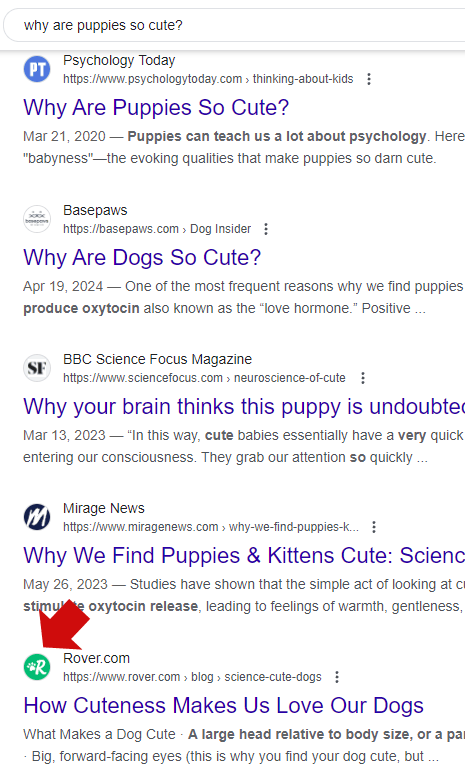
The following screenshot shows how some favicons blend into the search results while two of them stand out, especially the one with the bold color scheme.

Screenshot Of Favicons In The SERPs

A distinctive favicon won’t help a site rank better but as can be seen above it can help the page stand out in the search results.

A Good Tip For Favicons

John Mueller’s observation about favicons mentions something really obvious but is also not mentioned in any of the official documentation about favicons. Mueller simply said that it’s not a bad idea if the favicon looks attractive when cropped into a circle.

This is what Mueller said:

“Round-croppable favicons, for those who like technical SEO.”

Designing a favicon that looks attractive when cropped into a circle something that is obvious in retrospect but easily overlooked. Considering a favicon by how well it appears cropped in a circle suggests the usefulness of testing a favicon to see what it looks like when cropped into a circle or even designing a favicon that is already in a circle so that it fills the entire available space when it’s displayed in the search results (or anywhere else).

None of Google’s documentation on favicons mentions that they are cropped into a circle nor does Google advise that it might be a good idea to design them in a round configuration.

This tip is a small and seemingly obvious one but it can make a big difference.

Read the LinkedIn discussion here:

I imagine custom favicons make an actual difference with SERP interaction…

Read Google’s Favicon documentation

Define a favicon to show in search results

Landing page guidelines – Favicons

Visual Elements gallery of Google Search – Attribution

Featured Image by Shutterstock/Cast Of Thousands

WordPress Insiders Discuss WordPress Stagnation via @sejournal, @martinibuster

A recent webinar featuring WordPress executives from Automattic and Elementor, along with developers and Joost de Valk, discussed the stagnation in WordPress growth, exploring the causes and potential solutions.

Stagnation Was The Webinar Topic

The webinar, “Is WordPress’ Market share Declining? And What Should Product Businesses Do About it?” was a frank discussion about what can be done to increase the market share of new users that are choosing a web publishing platform.

Yet something that came up is that there are some areas that WordPress is doing exceptionally well so it’s not all doom and gloom. As will be seen later on, the fact that the WordPress core isn’t progressing in terms of specific technological adoption isn’t necessarily a sign that WordPress is falling behind, it’s actually a feature.

Yet there is a stagnation as mentioned at the 17:07 minute mark:

“…Basically you’re saying it’s not necessarily declining, but it’s not increasing and the energy is lagging. “

The response to the above statement acknowledged that while there are areas of growth like in the education and government sectors, the rest was “up for grabs.”

Joost de Valk spoke directly and unambiguously acknowledged the stagnation at the 18:09 minute mark:

“I agree with Noel. I think it’s stagnant.”

That said, Joost also saw opportunities with ecommerce, with the performance of WooCommerce. WooCommerce, by the way, outperformed WordPress as a whole with a 6.80% year over year growth rate, so there’s a good reason that Joost was optimistic of the ecommerce sector.

A general sense that WordPress was entering a stall however was not in dispute, as shown in remarks at the 31:45 minute mark:

“… the WordPress product market share is not decreasing, but it is stagnating…”

Facing Reality Is Productive

Humans have two ways to deal with a problem:

  1. Acknowledge the problem and seek solutions
  2. Pretend it’s not there and proceed as if everything is okay

WordPress is a publishing platform that’s loved around the world and has literally created countless jobs, careers, powered online commerce as well as helped establish new industries in developing applications that extend WordPress.

Many people have a stake in WordPress’ continued survival so any talk about WordPress entering a stall and descent phase like an airplane that reached the maximum altitude is frightening and some people would prefer to shout it down to make it go away.

But facts cannot be brushed aside and that’s what this podcast tried to do. Everyone in the discussion has a stake in the continued growth of WordPress and their goal was not malign WordPress but discuss the current situation, identify what it is and try to reach an understanding of ways to solve the problem.

The live webinar featured:

  • Miriam Schwab, Elementor’s Head of WP Relations
  • Rich Tabor, Automattic Product Manager
  • Joost de Valk, founder of Yoast SEO
  • Co-hosts Matt Cromwell and Amber Hinds, both members of the WordPress developer community moderated the discussion.

WordPress Market Share Stagnation

The webinar acknowledged that WordPress market share, the percentage of websites online that use WordPress, was stagnating. Stagnation is a state at which something is neither moving forward nor backwards, it is simply stuck at an in between point. And that’s what was openly acknowledged and the main point of the discussion was understanding the reasons why and what could be done about it.

Statistics gathered by the HTTPArchive and published on Joost de Valk’s blog show that WordPress experienced a year over year growth of 1.85%, having spent the year growing and contracting its market share. For example, over the latest month over month period the market share dropped by -0.28%.

Crowing about the WordPress 1.85% growth rate as evidence that everything is fine is to ignore that a large percentage of new businesses and websites coming online are increasingly going to other platforms, with year over year growth rates of other platforms outpacing the rate of growth of WordPress.

Out of the top 10 Content Management Systems, only six experienced year over year (YoY) growth.

CMS YoY Growth

  1. Webflow: 25.00%
  2. Shopify: 15.61%
  3. Wix: 10.71%
  4. Squarespace: 9.04%
  5. Duda: 8.89%
  6. WordPress: 1.85%

Why Stagnation Is A Problem

An important point made in the webinar is that stagnation can have a negative trickle-down effect on the business ecosystem by reducing growth opportunities and customer acquisition. If fewer of the new businesses coming online are opting in for WordPress are clients that will never come looking for a theme, plugin, development or SEO service.

It was noted at the 4:18 minute mark by Joost de Valk:

“…when you’re investing and when you’re building a product in the WordPress space, the market share or whether WordPress is growing or not has a deep impact on how easy it is to well to get people to, to buy the software that you want to sell them.”

Perception Of Innovation

One of the potential reasons for the struggle to achieve significant growth is the perception of a lack of innovation, pointed out at the 16:51 minute mark that there’s still no integration with popular technologies like Next JS, an open-source web development platform that is optimized for fast rollout of scalable and search-friendly websites.

It was observed at the 16:51 minute mark:

“…and still today we have no integration with next JS or anything like that…”

Someone else agreed but also expressed at the 41:52 minute mark, that the lack of innovation in the WordPress core can also be seen as a deliberate effort to make WordPress extensible so that if users find a gap a developer can step in and make a plugin to make WordPress be whatever users and developers want it to be.

“It’s not trying to be everything for everyone because it’s extensible. So if WordPress has a… let’s say a weakness for a particular segment or could be doing better in some way. Then you can come along and develop a plug in for it and that is one of the beautiful things about WordPress.”

Is Improved Marketing A Solution

One of the things that was identified as an area of improvement is marketing. They didn’t say it would solve all problems. It was simply noted that competitors are actively advertising and promoting but WordPress is by comparison not really proactively there. I think to extend that idea, which wasn’t expressed in the webinar, is to consider that if WordPress isn’t out there putting out a positive marketing message then the only thing consumers might be exposed to is the daily news of another vulnerability.

Someone commented in the 16:21 minute mark:

“I’m missing the excitement of WordPress and I’m not feeling that in the market. …I think a lot of that is around the product marketing and how we repackage WordPress for certain verticals because this one-size-fits-all means that in every single vertical we’re being displaced by campaigns that have paid or, you know, have received a a certain amount of funding and can go after us, right?”

This idea of marketing being a shortcoming of WordPress was raised earlier in the webinar at the 18:27 minute mark where it was acknowledged that growth was in some respects driven by the WordPress ecosystem with associated products like Elementor driving the growth in adoption of WordPress by new businesses.

They said:

“…the only logical conclusion is that the fact that marketing of WordPress itself is has actually always been a pain point, is now starting to actually hurt us.”

Future Of WordPress

This webinar is important because it features the voices of people who are actively involved at every level of WordPress, from development, marketing, accessibility, WordPress security, to plugin development. These are insiders with a deep interest in the continued evolution of WordPress as a viable platform for getting online.

The fact that they’re talking about the stagnation of WordPress should be of concern to everybody and that they are talking about solutions shows that the WordPress community is not in denial but is directly confronting situations, which is how a thriving ecosystem should be responding.

Watch the webinar:

Is WordPress’ Market share Declining? And What Should Product Businesses Do About it?

Featured Image by Shutterstock/Krakenimages.com

Vulnerabilities in Two ThemeForest WordPress Themes, 500k+ Sold via @sejournal, @martinibuster

A vulnerability advisory was issued about two WordPress themes found on ThemeForest that could allow a hacker to delete arbitrary files and inject malicious scripts into a website.

Two WordPress Themes Sold On ThemeForest

The two WordPress themes with vulnerabilities are sold on ThemeForest and together they have over a half million sales.

The two themes are:

  • Betheme theme for WordPress (306,362 sales)
  • The Enfold – Responsive Multi-Purpose Theme for WordPress (260,607 sales)

Betheme Theme for WordPress Vulnerability

Wordfence issued an advisory that The Betheme theme contained a PHP Object Injection vulnerability that was rated as a high threat.

Wordfence was discreet in their description of the vulnerability and offered no details of the specific flaw. However, in the context of a WordPress theme, a PHP Object Injection vulnerability usually arises when a user input is not properly filtered (sanitized) for unwanted uploads and inputs.

This is how Wordfence described it:

“The Betheme theme for WordPress is vulnerable to PHP Object Injection in all versions up to, and including, 27.5.6 via deserialization of untrusted input of the ‘mfn-page-items’ post meta value. This makes it possible for authenticated attackers, with contributor-level access and above, to inject a PHP Object. No known POP chain is present in the vulnerable plugin.

If a POP chain is present via an additional plugin or theme installed on the target system, it could allow the attacker to delete arbitrary files, retrieve sensitive data, or execute code.”

Has Betheme Theme Been Patched?

Betheme Theme for WordPress has received a patch on August 30, 2024. But Wordfence’s advisory isn’t acknowledging it. It’s possible that the advisory needs to be updated, not sure. Nevertheless, it’s recommended that users of the Enfold theme consider updating their theme to the newest version, which is Version 27.5.7.1.

The Enfold – Responsive Multi-Purpose Theme for WordPress

The Enfold Responsive Multi-Purpose WordPress theme contains a different flaw and was given a lower severity rating of 6.4. That said, the publisher of the theme has not issued a fix for the vulnerability.

A Stored Cross-Site Scripting (XSS) was discovered in the WordPress theme from a flaw originating in a failure to sanitize inputs.

Wordfence describes the vulnerability:

“The Enfold – Responsive Multi-Purpose Theme theme for WordPress is vulnerable to Stored Cross-Site Scripting via the ‘wrapper_class’ and ‘class’ parameters in all versions up to, and including, 6.0.3 due to insufficient input sanitization and output escaping. This makes it possible for authenticated attackers, with Contributor-level access and above, to inject arbitrary web scripts in pages that will execute whenever a user accesses an injected page.”

Enfold Vulnerability Has Not Been Patched

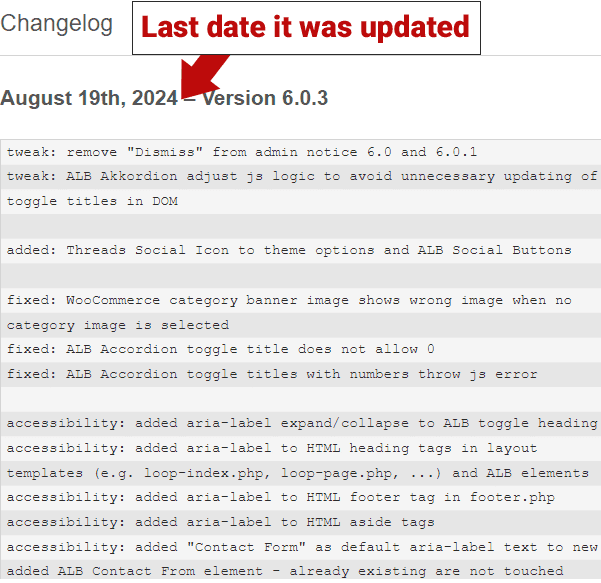
The Enfold – Responsive Multi-Purpose Theme for WordPress has not been patched as of this writing and remains vulnerable. The changelog documenting the updates to the theme shows that it was last updated in August 19, 2024.

Screenshot Of Enfold WordPress Theme’s Changelog

The Enfold – Responsive Multi-Purpose Theme for WordPress has not been patched as of this writing and remains vulnerable.

Wordfence’s advisory warned:

“No known patch available. Please review the vulnerability’s details in depth and employ mitigations based on your organization’s risk tolerance. It may be best to uninstall the affected software and find a replacement.”

Read the advisories:

Betheme <= 27.5.6 – Authenticated (Contributor+) PHP Object Injection

Enfold <= 6.0.3 – Authenticated (Contributor+) Stored Cross-Site Scripting via wrapper_class and class Parameters

Google’s New Support For AVIF Images May Boost SEO via @sejournal, @martinibuster

Google announced that images in the AVIF file format will now be eligible to be shown in Google Search and Google Images, including all platforms that surface Google Search data. AVIF will dramatically lower image sizes and improve Core Web Vitals scores, particularly Largest Contentful Paint.

How AVIF Can Improve SEO

Getting pages crawled and indexed are the first step of effective SEO. Anything that lowers file size and speeds up web page rendering will help search crawlers get to the content faster and improve the amount of pages crawled.

Google’s crawl budget documentation recommends increasing the speeds of page loading and rendering as a way to avoid receiving “Hostload exceeded” warnings.

It also says that faster loading times enables Googlebot to crawl more pages:

Improve your site’s crawl efficiency

Increase your page loading speed
Google’s crawling is limited by bandwidth, time, and availability of Googlebot instances. If your server responds to requests quicker, we might be able to crawl more pages on your site.

What Is AVIF?

AVIF (AVI Image File Format) is a next generation open source image file format that combines the best of JPEG, PNG, and GIF image file formats but in a more compressed format for smaller image files (by 50% for JPEG format). AVIF supports transparency like PNG and photographic images like JPEG does but does but with a higher level of dynamic range, deeper blacks, and better compression (meaning smaller file sizes). AVIF even supports animation like GIF does.

Is AVIF Supported?

AVIF is currently supported by Chrome, Edge, Firefox, Opera, and Safari browsers. Not all content management systems support AVIF. However, both WordPress and Joomla support AVIF. In terms of CDN, Cloudflare also already supports AVIF.

I couldn’t at this time ascertain whether Bing supports AVIF files and will update this article once I find out.

Current website usage of AVIF stands at 0.2% but now that it’s available to surfaced in Google Search, expect that percentage to grow. AVIF images will probably become a standard image format because of its high compression will help sites perform far better than they currently do with JPEG and PNG formats. https://w3techs.com/technologies/overview/image_format

AVIF Images Are Automatically Indexable By Google

According to Google’s announcement there is nothing special that needs to be done to make AVIF image files indexable.

“Over the recent years, AVIF has become one of the most commonly used image formats on the web. We’re happy to announce that AVIF is now a supported file type in Google Search, for Google Images as well as any place that uses images in Google Search. You don’t need to do anything special to have your AVIF files indexed by Google.”

Read Google’s announcement:

Supporting AVIF in Google Search

Featured Image by Shutterstock/Cast Of Thousands

CMOs Called Out For Reliance On AI Content For SEO via @sejournal, @martinibuster

Eli Schwartz, Author of Product-Led SEO, started a discussion on LinkedIn about there being too many CMOs (Chief Marketing Officers) who believe that AI written content is an SEO strategy. He predicted that there will be reckoning on the way after their strategies end in failure.

This is what Eli had to say:

“Too many CMOs think that AI-written content is an SEO strategy that will replace actual SEO.

This mistake is going to lead to an explosion in demand for SEO strategists to help them fix their traffic when they find out they might have been wrong.”

Everyone in the discussion, which received 54 comments, strongly agreed with Eli, except for one guy.

What Is Google’s Policy On AI Generated Content?

Google’s policy hasn’t changed although they did update their guidance and spam policies on March 5, 2024 at the same time as the rollout of the March 2024 Core Algorithm Update. Many publishers who used AI to create content subsequently reported losing rankings.

Yet it’s not said that using AI is enough to merit poor rankings, it’s content that is created for ranking purposes.

Google wrote these guidelines specifically for autogenerated content, including AI generated content (Wayback machine copy dated March 6, 2024)

“Our long-standing spam policy has been that use of automation, including generative AI, is spam if the primary purpose is manipulating ranking in Search results. The updated policy is in the same spirit of our previous policy and based on the same principle. It’s been expanded to account for more sophisticated scaled content creation methods where it isn’t always clear whether low quality content was created purely through automation.

Our new policy is meant to help people focus more clearly on the idea that producing content at scale is abusive if done for the purpose of manipulating search rankings and that this applies whether automation or humans are involved.”

Many in Eli’s discussion were in agreement that reliance on AI by some organizations may come to haunt them, except for that one guy in the discussion

Read the discussion on LinkedIn:

Too many CMOs think that AI-written content is an SEO strategy that will replace actual SEO

Featured Image by Shutterstock/Cast Of Thousands

Google Debunks Outbound Links For SEO via @sejournal, @martinibuster

Google’s John Mueller debunked the common recommendation that it’s good to link out to other websites for SEO and ranking benefits.

Canonical SEO

The word canonical (in the context of facts and rules) means ideas and beliefs that are commonly accepted as true and correct. SEO has a number of canonical beliefs that data back decades. Some of the canonical SEO practices used to be true but lost their relevance after Google evolved. Other canonical practices are purely speculative beliefs based on “common sense reasoning” but not on anything real like a research paper, patent or a statement by a Googler.

Origins Of Outbound Link SEO

One such speculative canonical belief is the SEO practice of adding three outgoing links to every article. The reason for that belief probably comes from things Google said in a different context and also from how SEOs responded to Google’s link spam algorithms.

Speaking from memory, it was announced in 2005 at Pubcon New Orleans that Google was using statistical analysis to identify spammy linking patterns. SEOs responded by creating links that “looked normal” which meant to link out to a paid link but surround it with links to “authority sites” like .edu and .gov pages. At this point SEOs were linking out in order to make their paid outbound links “look normal.”

Again speaking from memory, there was a trend where SEOs didn’t want to link to other sites because they wanted to “hoard” PageRank and circulate it only to their own pages. The idea was that linking to other sites would “waste” that PageRank and make their sites weaker because there was less PageRank circulating to through their internal links. Googlers responded by saying that it’s good to link out. SEOs responded by saying that it’s good for SEO to link out. Which entirely misses the context in which Googlers said it was good to link out.

Decades later SEOs are telling each other that linking out is good for SEO but none of them knows why it’s good for SEO. They just tell each other that because the practice of linking out has become a canonical belief, something that everyone agrees is true and accurate.

I lived through all these changes and know where those beliefs came from. They came from a combination of statements that Googlers have made and were repeated over the years but the context was forgotten so that all that’s left is “it’s good to link out” and that’s what people believe.

John Mueller Debunks Outbound Link Myth

Someone on LinkedIn asked for what the specific amount of links were best for SEO. They wanted clarification on what the exact amount of outbound links were for SEO.

This is the question that was asked:

“I have a question. It’s a common practice among SEOs to believe that adding a total of 2-5 internal links and around 1-3 external links in a 1000-word blog post is beneficial. They also think that adding more links could be harmful to their site, while adding fewer links might not provide much value.

Could you please clarify whether the quantity of links really matters?”

Google’s John Mueller answered:

“Nobody at Google counts the links or the words on your blog posts, and even if they did, I’d still recommend writing for your audience.
I don’t know your audience, but I have yet to run across *anyone* who counts the words before reading a piece of content.”

What Is The Right Answer?

Mueller recommends writing for the audience. The underlying idea there is that if you know what the audience wants then you know what to give them.

What the audience wants has nothing to do with the number of “entities” you add to your content or how many outbound links you have on the page. If that’s your approach to SEO then you may want to evaluate how much of what’s published is for search engines and how much of it is for users because creating content for search engines have always been the likeliest way to produce content that doesn’t catch on and ranks.

I’m not being a Google apologist either, this is the pragmatic approach for beating competitors by understanding what works. For example, years before the Reviews algorithm came out I consulted for clients who had review websites and I told them that they needed to add more original images, more hands-on reviews, more metrics and comparisons. So a couple years later when the Reviews update guidelines came out it all made sense because I knew from my own personal experience ranking my own review websites that this was the best approach.

So the right answer for most SEO questions is most often found by reframing the question around the people the content is created for. When it comes to outbound links the question shouldn’t be “how many outbound links is best for SEO?” the question should be “do these outbound links fit the context of what the web page and what a reader would want?”

A good context for adding an outbound link is when something is quoted or cited. For example, if the content mentions scientific research or what someone else said, then that research or the page page documenting what was said should be linked to. That’s what users would want, right?

Read the question and answer on LinkedIn.

Featured Image by Shutterstock/Cast Of Thousands

Yelp Sues Google Over Local Search Dominance via @sejournal, @MattGSouthern

Yelp has filed an antitrust lawsuit against Google in federal court in San Francisco.

The suit alleges that Google has illegally leveraged its monopoly in general search to dominate the local search and local search advertising markets, harming competition and consumer choice.

Key Allegations

Yelp’s complaint accuses Google of engaging in anticompetitive conduct, including:

  • Self-preferencing its own “inferior” local search product over competitors
  • Driving traffic and revenue away from rivals like Yelp
  • Making it harder for competitors to achieve scale
  • Increasing costs for rivals
  • Limiting consumer choice to grow its market power

The company claims Google’s local listings are “on average, shorter, more prone to error, less subject to quality control, and less likely to be useful to consumers” compared to Yelp and other specialized providers.

The lawsuit seeks injunctive relief, monetary damages, and a declaratory judgment that Google’s conduct violates antitrust laws.

Background & Context

This legal action escalates Yelp’s fight against Google’s practices in local search, which extends over a decade.

It follows a recent ruling by Judge Amit Mehta, which found that Google illegally maintained its monopoly in general search. Yelp believes the decision provides a foundation for its case.

Key points from Judge Mehta’s ruling include:

  • Google was found to be a monopolist that abused its dominant position.
  • The company’s paid default agreements with device makers and browsers foreclosed about 50% of the search market from rivals.
  • Google’s conduct had anticompetitive effects, including reducing incentives for competitors to innovate.

Aaron Schur, Yelp’s General Counsel, says in a statement provided to Search Engine Journal:

“Judge Amit Mehta’s recent ruling in the government’s antitrust case against Google, finding Google illegally maintained its monopoly in general search, is a watershed moment in antitrust law, and provides a strong foundation for Yelp’s case against Google.”

Potential Remedies

While specific remedies will be shaped by the discovery process, Yelp has pointed to the “Focus on the User” plan as one potential solution.

This proposal suggests modifying Google’s search algorithm to surface the best content from across the internet, rather than favoring Google’s own properties.

Looking Ahead

This lawsuit represents the latest chapter in the debate over Google’s search market dominance.

Google hasn’t responded to the lawsuit. The company has previously defended its practices as beneficial to users and argued that it faces genuine competition in local search.


Featured Image: MacroEcon/Shutterstock