Google May Have To Share Search Data With Rivals via @sejournal, @MattGSouthern

The European Commission has sent preliminary findings to Google proposing measures to share search data with rival search engines, including AI chatbots that qualify as online search engines under the DMA, across the EU and EEA.

Under the proposal, Google must share four categories of anonymized data on fair, reasonable, and non-discriminatory (FRAND) terms.

The categories are ranking, query, click, and view data. The Commission says the aim is to allow third-party search engines to “optimise their search services and contest Google Search’s position.”

The measures are not yet binding. A public consultation is open until May, and a final decision is due by July 27.

What’s In The Proposal

The Commission’s proposed measures cover six areas:

  • Eligibility criteria for data beneficiaries, including AI chatbots with search capabilities
  • The extent of search data that Google is required to share
  • Methods and intervals for sharing data
  • Anonymization standards for personal data
  • Guidelines for determining FRAND pricing
  • Procedures for how beneficiaries access the data

The data will be available to eligible third parties operating search engines in the EEA, including AI chatbot providers that qualify as such.

This is Article 6(11) proceeding following the Commission’s opening on January 27. A separate Article 6(7) proceeding addresses Android interoperability for third-party AI. Both aim to turn broad DMA obligations into specific, enforceable rules.

AI Chatbots Are Eligible

Eligibility criteria for qualifying AI chatbots are what change the picture for AI search visibility.

Under the proposal, AI chatbots meeting the DMA’s definition of online search engines could access Google’s anonymized search data. Qualified AI search products might use this data to improve their retrieval and ranking systems.

The proposed measures specify data sharing methods, frequency, access, and pricing, with technical details to be finalized.

Google Is Pushing Back

Google opposed the proposal in a statement provided to multiple outlets. Clare Kelly, Senior Competition Counsel at Google, said in a statement to Engadget:

“Hundreds of millions of Europeans trust Google with their most sensitive searches — including private questions about their health, family, and finances — and the Commission’s proposal would force us to hand this data over to third parties, with dangerously ineffective privacy protections. We will continue to vigorously defend against this overreach, which far exceeds the DMA’s original mandate and jeopardizes people’s privacy and security.”

Google also told The Register the investigation appears to be driven “at least in part by OpenAI,” which it claims is “seeking to take advantage of the DMA to harvest data from Google in ways not anticipated by the drafters of the DMA.”

The company is fighting on several DMA fronts. Brussels sent preliminary findings in 2025 on a separate Article 6(5) self-preferencing case. In February, Google began testing search result changes in the EU to address that proceeding.

Why This Matters

The measures are preliminary and, if adopted, applicable only in the EEA. Anonymization and pricing details remain open through the May consultation.

The longer-term issue is whether AI chatbot eligibility survives the final decision in July.

If the EU proposal is adopted with eligibility for AI chatbots, eligible products serving EU/EEA users could access anonymized signals from Google Search.

The proposal doesn’t give AI chatbots access to Google’s index but instead allows access to data similar to what Alphabet uses to optimize its search services, which differs from current AI search data sources.

Looking Ahead

The public consultation closes on May 1, and the Commission will assess the feedback before making a final, binding decision by July 27, which will apply to Google.

These proceedings do not constitute a non-compliance finding, but separate DMA enforcement can impose fines up to 10% of global turnover. The next milestone for AI visibility practitioners is the consultation outcome.

If the Commission maintains eligibility for AI chatbots, the focus shifts to how quickly data-sharing arrangements enable AI tools to compete for citation visibility.


Featured Image: Samuel Boivin/Shutterstock

Google Lists Best Practices For Read More Deep Links via @sejournal, @MattGSouthern

Google updated its snippet documentation today with a new section on “Read more” deep links in Search results. The section outlines three best practices for increasing the likelihood that a page appears with these deep links.

What A Read More Deep Link Is

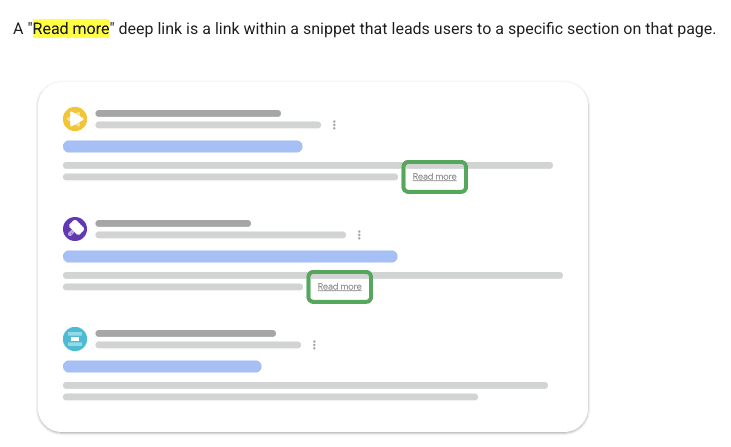
Google defines the feature as “a link within a snippet that leads users to a specific section on that page.”

The examples in the documentation show the link appearing inside the snippet area of a standard Search result.

Screenshot from: developers.google.com/search/docs/appearance/snippet, April 2026.

The Three Best Practices

Google lists three best practices that can increase the likelihood of these links appearing.

First, content must be immediately visible to a human on page load. Content hidden behind expandable sections or tabbed interfaces can reduce that likelihood, per Google’s guidance.

Second, avoid using JavaScript to control the user’s scroll position on page load. One example Google gives is forcing the user’s scroll to the top of the page.

Third, if the page uses history API calls or window.location.hash modifications on page load, keep the hash fragment in the URL. Removing it breaks deep linking behavior.

More Context

Read more deep links are one type of anchor URL that appears in Search Console performance reports. John Mueller previously addressed those hashtag URLs, confirming that they come from Google and link to page sections.

Before today’s addition, the documentation was last revised in 2024. That change clarified page content, not the meta description, as the primary source of search snippets.

Why This Matters

For websites, the new guidance outlines what can increase the likelihood that a Read more deep link will appear.

Pages using accordion UI patterns, tabbed content, or forced-scroll JavaScript may reduce that likelihood. Teams working with single-page applications should ensure that hash fragments remain in URLs during page loads.

Looking Ahead

This is a documentation clarification, not a new SERP feature. Read more deep links have appeared in Search for some time. What’s new is the written guidance on how to increase that likelihood.

Developers working on JavaScript-heavy sites should test how their pages handle scroll position and hash fragments on initial load. Today’s update provides clearer signals on what can reduce the likelihood of a “Read more” link appearing.


Featured Image: Blossom Stock Studio/Shutterstock

68 Million AI Crawler Visits Show What Drives AI Search Visibility via @sejournal, @martinibuster

A new analysis of 858,457 sites hosted on the Duda platform shows how AI crawlers are interacting with websites at scale. The data offers a clearer view of how crawling activity is growing and what SEOs and businesses should do to increase traffic from AI search.

AI Crawling Has Already Reached Scale

AI crawling is growing quickly, with more requests tied to real-time answers and most of that activity coming from a single provider. The data creates a pattern that shows which sites are being crawled and more importantly, why.

Year-Over-Year Growth In LLM Referrals

LLM referral traffic has increased sharply over the past year, with multiple platforms showing meaningful gains from very different starting points.

AI Referral Traffic Patterns

  • Total LLM referrals: 93,484 to 161,469 (+72.7%)
  • ChatGPT: 81,652 to 136,095 (+66.7%)
  • Claude: 106 to 2,488 (23x growth)
  • Copilot: 22 to 9,560 (from near-zero)
  • Perplexity: 11,533 to 13,157 (+14.1%)

Growth is not happening evenly, but across the board, referral traffic from AI systems is increasing. That makes AI-generated discovery a growing source of traffic, not a marginal one.

Crawlers Are Increasingly Fetching Content To Ground Answers

AI crawlers are no longer used primarily for indexing, with most activity now tied to retrieving content in real time to generate answers for users.

Most crawling is now happening in response to user queries rather than for building an index, which changes how content is accessed and used.

  • User Fetch (real-time answers): 56.9% of all crawler activity, driven almost entirely by ChatGPT
  • Training (model learning): 28.8%, split across GPTBot and other model crawlers
  • Discovery (content indexing): 14.3%, distributed across multiple systems
  • ChatGPT User Fetch volume: ~39.8 million visits

The trends are largely driven by ChatGPT, which is responsible for nearly all real-time retrieval activity. That means the move toward answer-based crawling is not evenly distributed, but concentrated in one platform shaping how content is accessed. This trend may change with Google’s new Google-Agent crawler.

Market Concentration In AI Crawling

AI crawler activity is heavily concentrated, with OpenAI responsible for the vast majority of requests, reflecting its position as the primary tool users rely on to find and retrieve information.

  • OpenAI: 55.8 million visits (81.0%)
  • Anthropic (Claude): 11.5 million (16.6%)
  • Perplexity: 1.3 million (1.8%)
  • Google (Gemini): 380,000 (0.6%)

Most AI crawling activity comes from OpenAI, which aligns with ChatGPT’s role as a primary tool for finding and retrieving information. Claude follows at a much smaller share, suggesting a different usage pattern, while the rest of the market accounts for a minimal portion of crawler activity.

Scale And What That Actually Means

AI crawling is already operating across a large portion of the web, reaching hundreds of thousands of sites and generating tens of millions of requests in a single month.

More than half of all sites in the dataset received at least one AI crawler visit, showing that this activity is not limited to a small subset of websites.

  • Total sites analyzed: 858,457
  • Sites with at least one AI crawler visit: 506,910 (59%)
  • Total AI crawler visits (Feb 2026): 68.9 million

AI crawling is not isolated to high-profile or heavily trafficked sites. It is already widespread, with consistent activity across a majority of the web.

The Relationship Between Crawling and Real Traffic

Sites that allow AI systems to crawl them consistently show stronger engagement across multiple metrics.

What the data actually shows is:

  1. Sites that allow AI crawling receive significantly more human traffic
  2. Higher-traffic sites are more likely to be crawled

Sites that allow crawling by AI systems receive significantly more human traffic, averaging 527.7 sessions compared to 164.9 for sites that are not crawled. This does not establish causation, but it shows a clear alignment between sites that attract human visitors and how often AI systems revisit them.

  • Average human traffic (AI-crawled vs not): 527.7 vs 164.9 (3.2x higher)
  • Average form completions: 4.17 vs 1.57 (2.7x higher)
  • Averageclick-to-call: 8.62 vs 3.46 (2.5x higher)
  • Sites with 10K+ sessions: 90.5% crawl rate

AI systems are not discovering weak or inactive sites and lifting them up. They are returning to sites that already attract human visitors. For marketers, that shifts the focus away from trying to “get crawled” and toward building real audience demand, since visibility in AI systems appears to follow it.

What Correlates With More Crawling

The research compared sites that include specific third-party integrations, structured features, and content depth with those that do not and found which ones mattered most for AI crawler activity and referrals.

Across the dataset, 59% of sites received at least one AI crawler visit in February 2026. Sites that are crawled more often tend to combine three types of signals: external integrations, structured business data, and content depth.

1. External Integrations

These integrations connect the site to external systems that validate and distribute business information.

  • Yext integration: 97.1% crawl rate vs ~58% without (+38.9pp)
  • Reviews integrations: 89.8% crawl rate vs 58.8% without, 376.9 average crawler visits

Sites that are connected to external data and review systems are crawled more often and more frequently, indicating that AI systems rely on these integrations as signals that a business is real, verifiable, and worth revisiting.

2. Structured Site Features And Business Data

These are built into the site and help AI systems understand and verify business identity.

  • Google Business Profile sync: 92.8% crawl rate vs 58.9% without, 415.6 average crawler visits
  • Local schema: 72.3% vs 55.2% (+17.1pp), 22.3% adoption
  • Dynamic pages: 69.4% vs 58.2% (+11.2pp)
  • Ecommerce: 54.2% vs 59.2% (-5.0pp)

Sites that clearly define their business identity and structure their information in a machine-readable way are crawled more often, showing that AI systems favor sites they can easily interpret, verify, and extract information from.

3. Content Depth (Volume Of Usable Data)

Sites with more content provide more opportunities for AI systems to retrieve, reference, and reuse information in responses.

  • Sites with 50+ blog posts: 1,373.7 average crawler visits vs 41.6 with no blog (~33x higher)

Sites with more content are crawled far more often, indicating that AI systems may return to sources that offer a larger supply of usable information to draw from when generating answers.

Local Business Schema Completeness = More Crawling

This part of the research focuses specifically on local business schema, comparing how the completeness of schema implementation for communicating business details relates to AI crawler activity. The fields measured include business name, phone number, address, hours, and social profiles.

  • No local schema fields: 55.2% crawl rate
  • 10–11 completed schema fields: 82% crawl rate
  • Sites with more complete local schema show a 26.8 percentage point higher crawl rate (82% vs 55.2%)

Sites that provide more complete local business information in structured form are crawled more often and receive more crawler visits. As more of these fields are filled in, both crawl rate and crawl frequency increase.

The data shows that clearly defined local business data makes a site easier for AI systems to identify, verify, and subsequently revisit, all the prerequisites for receiving traffic from AI search.

Takeaways

AI crawling is a parallel method for content discovery and the research shows clear patterns for sites that are visited by crawlers most often.

  • AI crawling operates alongside traditional search, changing how content is accessed and reused
  • Sites with structured local signals, deeper content, and more complete schema are crawled more often
  • Multiple reinforcing signals appear together on the same sites, not in isolation
  • The data shows direction, not causation, but the patterns are consistent

The data shows that sites that make it easy for AI crawlers to index and revisit the them tend to perform better. Interestingly, sites that present clear, structured, and verifiable information, while continuing to build real audience demand, are more likely to be revisited by AI systems and benefit from traffic generated through AI search.

Read the research: Duda study finds AI-optimized websites drive 320% more traffic to local businesses

Featured Image by Shutterstock/Preaapluem

AI Adoption Outpaced The PC & Internet: Dive Into The Stanford Report Data via @sejournal, @MattGSouthern

Stanford’s Human-Centered Artificial Intelligence Institute published its 2026 AI Index Report. The report runs over 400 pages across nine chapters covering technical performance, investment, workforce effects, and public sentiment.

The number getting the most attention is that Generative AI reached 53% adoption among the global population within three years of ChatGPT’s launch. That’s faster than either the personal computer or the internet reached comparable levels.

For anyone working in search, the report contains data that connects directly to the changes you’ve been navigating all year.

What The Report Found

This is the ninth annual AI Index, and it covers a lot of ground. A few findings matter most for the search industry.

In terms of capability, frontier models now exceed human performance on PhD-level science questions and in competitive mathematics. AI agents handling real-world tasks improved from a 20% success rate in 2025 to 77% today. Coding benchmarks that models struggled with a year ago are now nearly solved.

On investment, global corporate AI investment hit $581 billion in 2025, up 130% from the prior year. US private AI investment reached $285 billion. More than 90% of frontier models now come from private companies, not academic labs.

Regarding workforce effects, employment among software developers aged 22 to 25 has dropped by nearly 20% since 2024. A similar pattern appeared in customer service and other roles with higher AI exposure.

Transparency is declining. The Foundation Model Transparency Index fell from 58 to 40. The most capable models now disclose the least about their training data, parameters, and methods. Of the 95 most notable models launched last year, 80 were released without their training code.

The Adoption Number Everyone Is Citing

Understanding the 53% figure, what it includes, and what it doesn’t, matters for how you interpret it.

The comparison to PCs and the internet is based on research by the St. Louis Fed, Vanderbilt, and Harvard Kennedy School. The team compared adoption rates by years since each technology’s first mass-market product. The IBM PC launched in 1981. Commercial internet traffic opened in 1995. ChatGPT launched in November 2022.

At comparable points after launch, generative AI adoption runs well ahead of both earlier technologies.

But the comparison isn’t apples-to-apples, and the researchers said so themselves. Harvard’s David Deming pointed out that AI is built on top of PCs and the internet. People already had the hardware and the connectivity. Nobody needed to buy new equipment or wait for connectivity to reach their area. AI adoption rode on decades of prior technology investment.

Adoption numbers also vary depending on who’s counting and how. The Stanford report puts US adoption at 28%, ranking the country 24th globally. The St. Louis Fed’s own tracker puts US adoption at 54% as of August 2025. Same country, nearly double the rate, measured differently. The Fed team even revised its earlier estimate upward from 39% to 44% after changing the order of its survey questions.

“Adoption” also doesn’t distinguish intensity. Someone who signed up for a free ChatGPT account and tried it once counts the same as someone who uses it eight hours a day. The Stanford report notes that most users access free or near-free tiers. That’s a different picture than the one the headline number implies.

None of this means the adoption data is wrong. Generative AI is spreading faster than comparable technologies did at the same stage. But the speed of adoption alone doesn’t tell you how deeply it’s embedded in workflows or how much it’s changing search behavior specifically.

The Jagged Frontier

The report’s most useful concept for search professionals might be its “jagged frontier” of AI capability.

The same models that win gold at the International Mathematical Olympiad read analog clocks correctly only 50% of the time. IEEE Spectrum reported that Claude Opus 4.6 scores at the top of Humanity’s Last Exam while reading clocks at just 8.9% accuracy. Models that ace PhD-level science questions still struggle with video understanding and multi-step planning.

Ray Perrault, co-director of the AI Index steering committee, told IEEE Spectrum that benchmarks don’t map cleanly to real-world results. Knowing a model scores 75% on a legal reasoning benchmark “tells us little about how well it would fit in a law practice’s activities,” he said.

Search professionals have seen similar unevenness in AI search products. Ahrefs research showed that AI Mode and AI Overviews cite different URLs for the same queries, with only 13% overlap. Google’s Robby Stein acknowledged that the system pulls AI Overviews back when people don’t engage with them. Those signals suggest AI search performance is uneven across contexts, even if Google hasn’t fully explained where those differences are most pronounced.

Stanford’s data suggest that strong benchmark performance doesn’t guarantee reliable results across all tasks or query types. Whether that unevenness improves with future models is an open question the report doesn’t answer.

What’s Happening To Transparency

What the report says about transparency connects directly to search.

The Foundation Model Transparency Index dropped from 58 to 40 in a single year. The most capable models score lowest. Google, Anthropic, and OpenAI have all stopped disclosing dataset sizes and training duration for their latest models. 80 of the 95 most notable models launched in 2025 shipped without training code.

TechCrunch noted a disconnect between expert optimism about AI and public anxiety about it. The US reported the lowest trust in its government’s ability to regulate AI among the countries surveyed, at 31%.

For context on the index itself, a drop from 58 to 40 could indicate that companies are becoming more secretive. It could also reflect that the index penalizes closed-source models by design, and the most capable models happen to be closed-source. Both explanations can be true at the same time.

What matters for practitioners is the implication. The models powering AI Overviews, AI Mode, and ChatGPT Search are getting more capable and less explainable simultaneously. You’re optimizing for systems where the companies building them are sharing less about how they work, not more.

The report’s acknowledgments disclose that Stanford HAI receives financial support from Google, OpenAI, and others, and that the report was produced with assistance from ChatGPT and Claude.

The Entry-Level Question

Employment among software developers aged 22 to 25 dropped nearly 20% since 2024, according to the report. Older developers’ headcounts grew over the same period. A similar pattern appeared in customer service roles.

At first glance, that looks like AI replacing entry-level work. But the report included a caveat that complicates that conclusion. Unemployment is rising across many occupations, and workers least exposed to AI have seen it rise more than those most exposed.

That doesn’t rule out AI as a factor. It means the 20% decline could reflect AI displacement, broader hiring slowdowns, companies restructuring their entry-level hiring, or all three at once. The report presents correlation, not causation.

For search and content teams, the signal is directional even if the cause is mixed. The Stanford data is consistent with what the Tufts AI Jobs Risk Index showed earlier this year. Roles that involve assembling information from existing sources face more pressure than roles that require judgment, experience, and original analysis.

Why This Matters For Search Professionals

Even with its caveats, the adoption speed explains the pace of what you’ve been seeing.

Google expanded AI Overviews to 1.5 billion monthly users by Q1 2025. AI Mode reached 75 million daily active users by Q3 2025, then went global. Google expanded Search Live to 200+ countries. Personal Intelligence rolled out to free US users this year.

The adoption curve helps explain why Google has been expanding AI search features at this pace. It doesn’t tell us how much of that usage is happening inside search rather than standalone AI tools.

The “jagged frontier” means you can’t make blanket assumptions about AI search quality across query categories. A query type that returns accurate AI Overviews today might hallucinate with slight variations. Monitoring needs to happen at the query level, not the category level. Search Console doesn’t currently separate AI Overview or AI Mode performance from traditional search metrics, which makes this harder.

The decline in transparency affects how well you can understand why your content appears or doesn’t appear in AI-generated answers. When Google shares less about the models powering its search features, the feedback loop between what you publish and what gets surfaced becomes harder to read.

Shelley Walsh spoke at SEJ Live and referenced Grant Simmons, “golden knowledge” is content built on original data, firsthand experience, and depth that AI summaries can’t replicate from training data. The Stanford report’s data on adoption speed and model limitations support that position. The models are fast and widely used, but they’re uneven. Content that fills the gaps where AI is unreliable has a structural advantage.

What The Report Doesn’t Tell Us

The Stanford report doesn’t break out search-specific adoption data. We don’t know what percentage of that 53% uses AI via search specifically, rather than via ChatGPT, Gemini, or other standalone tools.

Google’s AI search usage numbers are limited. The company reported that AI Overviews reached 1.5 billion monthly users in Q1 2025, and AI Mode reached 75 million daily active users in Q3 2025. Updated figures should be included in the next earnings call.

The report also can’t tell us whether the jagged frontier problem is improving or worsening in search applications. The benchmark data shows models improving overall, but the clock-reading example shows that improvement isn’t uniform. Whether AI Overviews and AI Mode are getting more reliable for the specific queries that matter to your business requires your own monitoring, not aggregate benchmark data.

Looking Ahead

The Stanford report lands one week after Google’s March core update completed. Alphabet’s next earnings call will likely include updated AI search usage numbers.

The adoption data doesn’t predict what search will look like by year-end. But it does confirm that AI-first behavior isn’t speculative anymore. The question is whether Google’s AI search products will get reliable enough to match the pace of adoption.

Read More Resources:


Featured Image: n_a vector/Shutterstock

ChatGPT Often Retrieves But Rarely Cites Reddit Pages, Data Shows via @sejournal, @MattGSouthern

An Ahrefs analysis of 1.4 million ChatGPT prompts found that pages from a dedicated Reddit source were rarely cited in ChatGPT responses, even though they were often retrieved.

Ahrefs highlights this pattern in a new report.

What The Report Looked At

Ahrefs examined 1.4 million ChatGPT 5.2 prompts, tracking which pages were retrieved and later cited in the final response. About half of the retrieved pages were cited overall.

The citation rate varied by source, with pages from general web searches cited most frequently. In contrast, pages from a Reddit source, described by Ahrefs, were cited only 1.93% of the time. This highlights the Reddit gap: while the Reddit source was often retrieved, it rarely appeared as a visible citation.

The Reddit Finding

Of all the pages retrieved but not cited in Ahrefs’ dataset, 67.8% originated from the specific Reddit source Ahrefs identified.

Ahrefs writes that ChatGPT “is using Reddit extensively to understand topics, gauge consensus, and build context—but it almost never gives Reddit the credit.”

One point to clarify is that Reddit pages can still be cited by ChatGPT when they appear in standard web search results. The 1.93% figure refers to what Ahrefs calls a separate Reddit source, distinct from general web searches. In May 2024, OpenAI and Reddit announced a data partnership granting OpenAI access to Reddit’s data.

What Does Help A Page Get Cited

Ahrefs examined how closely page titles and URLs aligned with the specific sub-questions generated by ChatGPT during the search process. To do this, Ahrefs used open-source tools to compute similarity scores, approximating ChatGPT’s internal matching process. Pages with higher scores for matching those sub-questions were cited more frequently in the dataset.

When ChatGPT Search responds to a prompt, it often breaks the prompt down into several narrower queries and searches for pages related to each. In Ahrefs’ data, titles and URLs matching these narrower queries had a stronger correlation with citations than pages that only broadly matched the original prompt. URL structure also played a role. Pages with clear, descriptive URL slugs were cited about 89.78% of the time they appeared in search results, compared to 81.11% for pages with less descriptive URLs. This aligns with SE Ranking’s analysis, which found that ChatGPT tends to favor URLs describing broader topics over those focused on a single keyword.

Why This Matters

Ahrefs data indicates that Reddit’s impact on answer development differs from what businesses might anticipate. It appears Reddit can shape answers indirectly without being explicitly cited. This kind of influence is still important, but is more about the upstream effect rather than direct citation acknowledgment.

For clear citation credit, Ahrefs’ data shows the best indicator is whether your page titles and URLs align with the specific sub-queries that ChatGPT Search produces from a prompt. Simply matching the broad keyword doesn’t suffice.

Looking Ahead

The study evaluates ChatGPT 5.2 on desktop in February 2025. Since then, OpenAI has launched several model updates, such as the GPT-5.3 Instant transition, which Resoneo links to a 20% decrease in the number of cited domains per ChatGPT response. It’s uncertain whether the Reddit gap and title-matching patterns observed by Ahrefs still apply to these newer models.


Featured Image: Koshiro K/Shutterstock

Search Ad Growth Slows As Social & Video Gain Faster via @sejournal, @MattGSouthern

Search advertising is one of the largest digital ad categories, but its growth is slowing as social media and video post faster gains, according to IAB’s annual report, conducted by PwC.

What The Data Shows

In 2025, digital advertising revenue reached $294 billion, reflecting a 13% increase from the previous year. The report uses self-reported revenue data from companies selling advertising online. PwC says it does not audit the information or provide assurance.

Search advertising, including AI search, generated $114 billion, making it one of the largest segments in the report, though IAB’s category definitions overlap.

Search saw an 11% growth year-over-year, slower than the 15% in 2024. Social media experienced stronger growth, with ad revenue totaling $117 billion, a 32% rise or $29 billion increase. The IAB attributed this to the creator economy, enhanced commerce integration, and improved targeting and measurement.

Digital video grew by 25%, reaching $78 billion, faster than the 19% growth in the previous year, indicating more ad spending attracted by video. Commerce media hit $63 billion, up 18%, while programmatic advertising increased by 20% to $162 billion.

In its 2026 outlook, IAB said creator advertising reached $37 billion in 2025, with projections of $44 billion in 2026, noting a move from campaign-based influencer marketing to continuous creator programs.

A note on the data: categories like social, search, video, display, and commerce media overlap in the $294 billion total, so a single ad, such as a social video ad, could be counted in multiple categories.

Why This Matters

The slowdown in search growth warrants attention alongside other recent indicators. Google’s Q4 2025 earnings reported a 17% increase in Search revenue, but this reflects just a single quarter for one company.

In contrast, the IAB data covers the entire year across a broad industry dataset, with growth rates falling from 15% to 11%, indicating the overall category is expanding more slowly than the competing channels vying for the same budgets. This doesn’t imply search is shrinking; it still generated $114 billion in revenue, even though social and video ads grew at a faster pace. Commerce media, at $63 billion, now accounts for over 20% of total digital ad revenue.

Looking Ahead

IAB will host a webinar on April 21 at 1 p.m. ET with experts from IAB, PwC, and Madison & Wall to discuss the findings.

Google’s Patent On Autonomous Search Results via @sejournal, @martinibuster

The United States Patent Office recently published Google’s continuation on a patent for a search system that detects when there is no satisfactory answer for a query and waits to automatically deliver the answer when it becomes available.

Search And AI Assistant

The patent, published in February 2026, is a continuation of an older patent, with the main changes being to apply this patent within the context of an AI assistant. The invention describes solving the problem of answering a question when no actual answer is available at the time a user makes the query. What it does is waits until there’s a satisfactory answer, at which point it circles back to the user with the answer, without them having to ask again.

The patent is titled, Autonomously providing search results post-facto, including in assistant context. Although the patent mentions quality thresholds, those thresholds are defined in the sense of whether the answer meets the user’s needs.

The patent describes six scenarios that would trigger the invention:

  1. When no search results meet defined quality or authoritative-answer criteria.
  2. When results exist but fail to provide a definitive or authoritative answer that satisfies those criteria.
  3. When no results meet quality criteria because the information is not yet available.
  4. When a query seeks a specific answer and no result satisfies the required criteria.
  5. When a resource later satisfies the defined criteria after previously lacking required information.
  6. When a previously available resource is refined or updated so that it now meets the criteria.

Useful And Complete Answers

Google’s patent says that the invention is a solution for times when there is no useful or complete answers because the information does not yet exist or is not good enough, forcing users to keep searching repeatedly.

The system checks if results meet:

  • A quality standard
  • Authoritativeness standard
  • Or a completeness standard.

If the current answers don’t meet those standards, the system will store the query and monitor for new or updated information. Once it becomes available it will send the results to the user later without them searching again.

Follow-Up Questions Are Not Necessary

What is novel about the invention is that it enables follow-up delivery of results after the original query without requiring a new follow-up questions. It also surfaces search results proactively in notifications or assistant conversations.

At a later time, when new or updated information becomes available that satisfies the criteria, the system proactively delivers that information to the user. This delivery can occur through notifications, within an unrelated interaction, or during a later conversation with an automated assistant.

The system may also optionally notify the user that no good results are currently available and ask if they want to be informed when better results appear.

What this system does is it transforms search from a one-time, user-initiated action into a persistent, ongoing process where the system continues working in the background and updates the user when meaningful information becomes available.

Cross-Device Continuity

An interesting feature of this invention is that it can reach out to the user across multiple devices.

Here is where it’s outlined:

[0012] In some implementations, the query is received on an additional computing device that is in addition to the computing device for which the content is provided for presentation to the user.”

This capabiilty is highlighed again in section [0067]:

“For example, the content may be provided for presentation to the user via the same computing device the user utilized to submit the query and/or via a separate computing device.”

It can also go cross-device as a visual and/or audible output across devices and in the form of an automated assistant, and can present the information when the user is interacting with the automated assistant in a different context, describing an “ecosystem” of devices.

Lastly, the patent explains that the information can be surfaced when the user is interfacing with the automated assistant in a completely different context:

[0040]”…the content may be provided for presentation to the user via the same computing device the user utilized to submit the query and/or via a separate computing device. The content may be provided for presentation in various forms. For example, the content may be provided as a visual and/or audible push notification on a mobile computing device of the user, and may be surfaced independent of the user again submitting the query and/or another query.

Also, for example, the content may be presented as visual and/or audible output of an automated assistant during a dialog session between the user and the automated assistant, where the dialog session is unrelated to the query and/or another query seeking similar information.”

Takeaways

The patent (Autonomously providing search results post-facto, including in assistant context) is in line with Google’s vision of tasked-based agentic search, where AI assistants help users accomplish things. This patent could be applied to an AI agent that is asked for tickets to an event when the tickets aren’t yet available. Or it could be applied to making restaurant reservations when the reservations when the dates open up. Both of those scenarios are related to task-based agentic search (TBAS)

Here are seven takeaways:

  1. The system stores data associated with the user about unresolved queries, allowing it to track unanswered information needs over time rather than treating each search as a one-off event.
  2. It delivers results within future interactions, including unrelated assistant conversations, not just through standalone notifications.
  3. The notifications can happen across an ecosystem of devices.
  4. A lack of results is defined by failing to meet quality criteria, which can be the absence of information, the answer not being available yet, or the answer is not available from authoritative sources.
  5. The system focuses on queries that seek specific answers, rather than general informational searches.
  6. It supports cross-device continuity, enabling a query on one device to be fulfilled later on another.
  7. The design reduces repeated searches by eliminating the need for users to check back, then autonomously circling back when the information is available.

Featured Image by Shutterstock/uyabdami

Google Is Replacing Dynamic Search Ads With AI Max via @sejournal, @brookeosmundson

Google just announced the deprecation of Dynamic Search Ads (DSA) and is officially moving its legacy capabilities into AI Max.

Starting in September, eligible campaigns using Dynamic Search Ads (DSA), automatically created assets (ACA), and campaign-level broad match settings will automatically upgrade to AI Max.

While advertisers have speculated about this change for months, the update is now official.

If you’re running Dynamic Search Ads, automatically created assets (ACA), and/or campaign-level broad match settings, keep reading to understand how your campaigns will be affected.

DSA Features Migrating Into AI Max

Beginning in September, advertisers will no longer be able to create new DSA campaigns through Google Ads, Google Ads Editor, or the Google Ads API. Existing eligible campaigns will be migrated automatically.

Google positions AI Max as the next generation of DSA.

Historically, DSA helped advertisers capture additional search demand beyond their keyword lists by using website content to generate headlines and choose landing pages. That made it useful for large sites, inventory-heavy businesses, and advertisers looking for broader query coverage.

AI Max keeps that concept but adds more signals and controls.

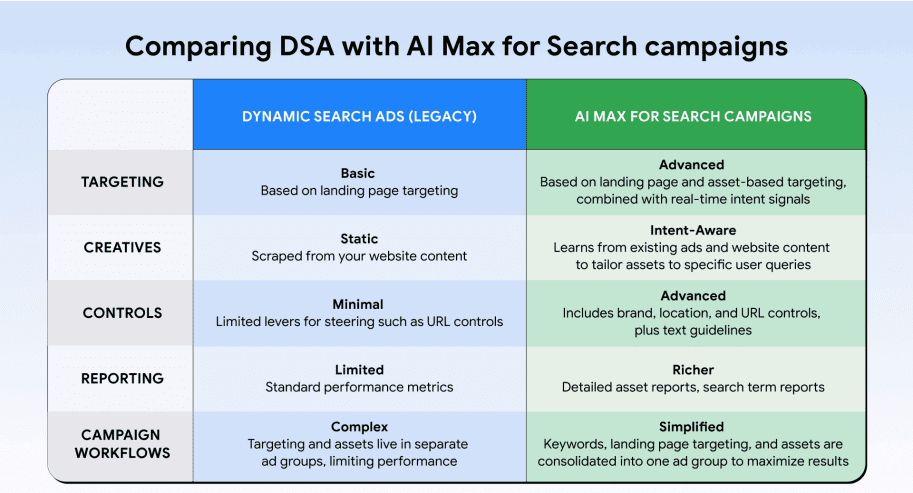
According to Google, AI Max combines advertiser assets, landing page content, and broader intent signals to help match ads to more relevant queries. It also adds controls such as:

  • Brand controls
  • Location controls
  • Text guidelines
  • Search term matching
  • Text customization
  • Final URL expansion
Image credit: Google, April 2026

Google says campaigns using the full AI Max feature suite see an average of 7% more conversions or conversion value at a similar CPA or ROAS compared with using search term matching alone.

Google is also splitting the transition into two phases.

Phase 1: Voluntary Upgrades

Google announced that upgrade tools for existing DSA users are rolling out this week.

DSA advertisers will receive tools to move historical settings and data into new standard ad groups. ACA and campaign-level broad match users may see in-platform prompts to upgrade to AI Max.

Phase 2: Automatic Upgrades

Starting in September, remaining eligible campaigns with legacy settings will be upgraded automatically.

Google says all eligible upgrades are expected to finish by the end of September.

It’s important to note how legacy settings will be automatically migrated over to AI Max settings:

  • DSA users will have all three AI Max features enabled by default (search term matching, text customization, final URL expansion)
  • ACA users will have two AI Max features enabled by default (search term matching and text customization)
  • Campaign-level broad match users will have just search term matching enabled by default

What Advertisers Can Do To Prepare For The AI Max Transition

If you still rely on Dynamic Search Ads, now is the time to review where those campaigns sit in your account and how much value they drive.

Some advertisers use DSA as a core growth lever. Others use it as a low-maintenance catch-all for incremental growth. Your next steps may differ depending on that role.

#1. Review Your DSA Performance Now

Before the automatic upgrades begin, pull recent performance data for your DSA campaigns.

Look at conversions, assisted conversions, search terms, landing pages, and efficiency metrics. That baseline will help you judge whether performance changes after migration are positive, neutral, or negative.

#2. Upgrade On Your Timeline Before Automatic Upgrades

Google is encouraging advertisers to move early, and there is a practical reason for that.

A voluntary upgrade gives you more control over settings, structure, and testing than waiting for an automatic migration.

If DSA is important to your business, it makes sense to evaluate the upgrade before September.

#3. Test AI Max Impact

Google recommends using one-click experiments because they give advertisers a cleaner way to compare performance before making a full rollout decision. While I haven’t tried this yet, I will be testing it myself in the coming months.

Even if AI Max improves results on average, averages do not guarantee results in every account. Lead generation, e-commerce, local services, and B2B advertisers may all see different outcomes.

Run controlled tests where possible and compare against your existing baseline.

#4. Lean Into Additional Controls

Many advertisers asked for more steering options in search automation, and Google has listened to our feedback. AI Max includes more controls than legacy DSA.

Spend time understanding brand settings, location controls, and text guidance. Those inputs may matter as much as the automation itself.

#5. Watch Search Match and Landing Page Quality

Once you’ve migrated your DSAs to AI Max, watch closely for the search terms your campaigns are now matching with. How does it compare to past DSA performance?

You’ll also want to pay attention to the landing pages used (if final URL expansion is turned 0n), lead quality, and conversion paths.

Looking Ahead

Dynamic Search Ads have helped advertisers scale beyond their current keyword lists for years. Now, Google is folding that capability into its broader AI Max framework.

The clearest next step is to review where DSA is still active in your account and decide whether to migrate on your own timeline or wait for the automatic upgrade.

The real focus should be protecting performance during the transition and understanding where AI Max improves results, or where it needs tighter management control.