Silos don’t cut it anymore. User journeys are too complex for you to view and track channels separately.
To improve your campaign performance, you need a holistic view of your marketing activities and how they intertwine. This is especially true for organic and paid search strategies.
You need to be front and center with your ideal customers at multiple touchpoints, including active interactions and passive awareness. An ideal marketing strategy has paid and organic campaigns working in tandem, and it’s becoming harder to succeed without doing both.
If you’re looking to drive quality growth in your own campaigns, iQuanti can help.
Join us live on July 24 as we delve into this intricate relationship between organic and paid search channels. You’ll get actionable insights for measuring success to maximize their combined potential.
You’ll gain a comprehensive, data-driven understanding of how to measure, analyze, and optimize holistic search marketing efforts, ensuring sustainable growth and superior ROI for your business.
You’ll walk away with:
Integrated Metrics and KPIs: Learn how to define and track key metrics to capture the performance of your organic and paid search campaigns, so you can make informed strategic decisions that work.
Attribution Models: You’ll see firsthand how strong attribution models are crucial to understanding your customers’ journeys, allowing you to identify influential touchpoints and allocate budget effectively for maximum ROI.
Optimization Strategies: You’ve gathered data from your campaigns…now what? Take the data and leverage it to further optimize your paid and organic search campaigns, increasing conversions along the way.
Shaubhik Ray, Senior Director of Digital Analytics Solutions at iQuanti is an expert at crafting holistic search strategies to reach more of your ideal audiences at relevant stages in their journeys. Now, he’s ready to share his insights with you.
You’ll walk away equipped with the knowledge and tools necessary to execute a combined organic and paid strategy that improves the performance of each channel. You’ll gain data-driven insights on how to align a combined strategy with business goals and lead your organization to success.
Sign up now and prepare to maximize the potential of combining your organic and paid campaigns.
At the end of the presentation, you’ll get a chance to ask Shaubhik your burning questions in our live Q&A, so be sure to attend.
And if you can’t make it that day, register here and we’ll send you a recording following the webinar.
Inventory has always played a significant role in the way you sell on Amazon.
Running out of inventory can impact your organic ranking and can impact your advertising strategy.
Besides the potential loss of sales, poor inventory control also impacts the amount of inventory Amazon will allow you to send into the Fulfillment by Amazon (FBA) program.
Keep reading to learn more about:
How your Inventory Performance Index (IPI) score impacts your available storage volume.
What the IPI is, and how it’s calculated.
Recommended actions for improving your IPI score.
Tips for Amazon sellers who are new to Seller Central.
Amazon Limiting Sellers Storage Based On Storage Utilization
Amazon controls your storage capacity limits based on storage utilization and your sales history:
Total Capacity Limit
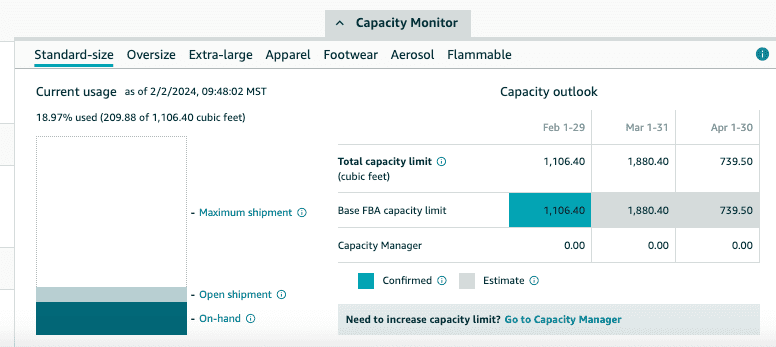
This limits the amount of inventory you can restock to Amazon’s FBA warehouses in one shipment and the overall maximum number of units you can store at Amazon.
Accounts that have been active for less than 39 weeks are not subject to these restrictions.
It is important to note that this is only true for those accounts on the Professional Seller Plan. Those with individual Seller Plans are limited to 15 cubic feet per month.
Any changes you can expect for your storage capacity for the following month will be announced on the third Monday of the month.
Included in your storage usage are the inventory currently stored at Amazon, inventory en route to Amazon, and any shipments that have been prepared but not yet sent to Amazon.
Screenshot from Amazon Seller Central, February 2024
The Storage Volume is highly impacted by your IPI (Inventory Performance Index).
We will further discuss how your IPI is calculated later in this article.
Screenshot from Amazon Seller Central, February 2024
Sellers who fall below the minimum criteria can have their storage limited. Operating with such limited storage can significantly undermine your sales forecasts.
We will outline the steps you can take to ensure you have sufficient storage for your high-demand season, maximizing your sales on Seller Central.
We’ll also review what you can do if you fall below Amazon’s set criteria.
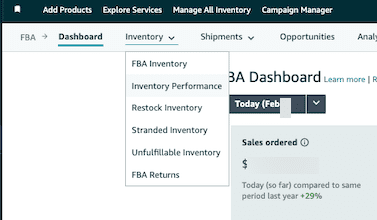
You can find your limit by going to Seller Central, selecting Inventory, navigating to the Inventory Dashboard, and then selecting Inventory Performance under the dropdown for Inventory.
Screenshot from Amazon, February 2024
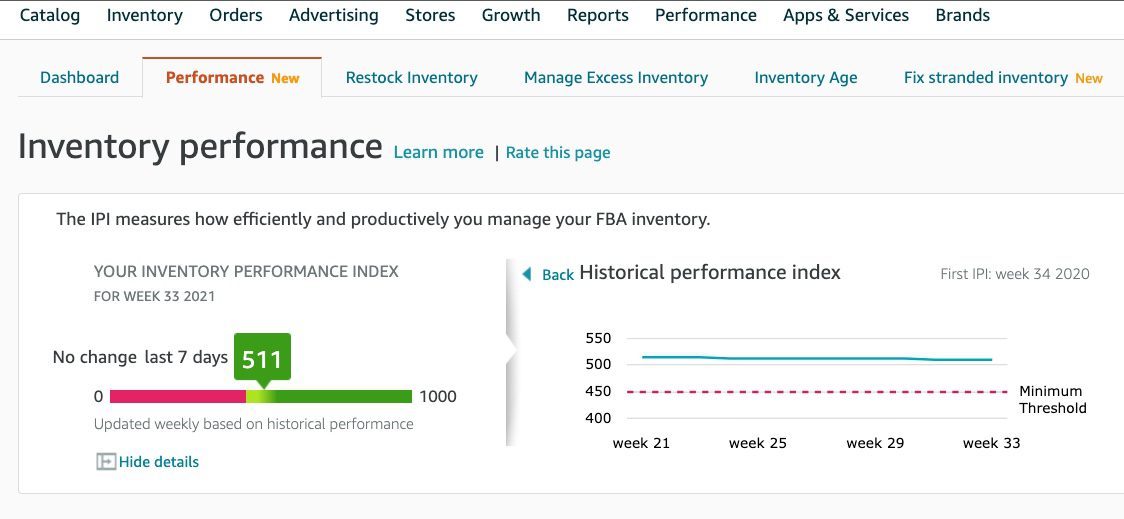
Your IPI score will be near the top of the page.
To reach your storage capacity, scroll to the bottom of the page and click on the small gray box labeled Capacity Monitor.
Success on Amazon Means You Have To Manage Your Inventory Levels Proactively
Amazon says that it considers the following criteria for your storage levels:
IPI Score and Sales Performance: Higher storage capacities are granted to accounts that consistently achieve a high IPI score.
Storage Utilization: In determining storage limits, Amazon considers your current inventory, inbound inventory, and shipments that are prepared but not yet dispatched.
Sales Volume: Amazon will also look at sales volume over time.
Improving Your IPI
If you have a low IPI score, know it will take time to improve your score.
IPI is a rolling average. It can take anywhere from 2 to 12 weeks to increase your score on Amazon, so planning ahead of time is essential.
This means if your IPI is below the 400 Amazon requires, you need to start taking aggressive action today.
This article will outline how to avoid having detrimental storage limits, how it happens, and what to do when you’re already below the threshold.
For those interested in Restock Limits, we’ll explore this topic in more detail later in the guide.
What Is The IPI (Inventory Performance Index), And Does It Affect Me?
The IPI will only affect those using Seller Central and FBA warehouses.
It does not affect those using Vendor Central, Kindle Direct Platform, or those selling on Seller Central by Merchant Fulfilling or utilizing Seller Fulfilled Prime for their items.
Inventory Performance Index (IPI)
The Inventory Performance Index (IPI) manages how well you control and manage your inventory at Amazon.
This metric is a 12-week rolling average. It looks at several components over three months.
This is the most important metric as it measures where your profitability may take a hit due to storage fees and holding costs for slow-moving FBA inventory.
Excess Inventory percentages help sellers plan when to restock more or remove inventory from FBA.
An item is considered to have excess inventory when it has over 90 days of supply based on the forecasted demand.
Sell Through Rate
This metric is just how it sounds. The formula that Amazon uses to calculate Sell Through rates is:
(Units Shipped In the Last 90 Days)/(Average Units on Hand Over the Last 90 days)
Stranded Inventory
This provides information on products that aren’t selling due to listing issues.
This occurs when your listing doesn’t meet Amazon guidelines.
In these instances, your products become stranded and unable to move while still incurring FBA storage fees.
In-Stock Inventory
Amazon looks at the percentage of time your products have been in stock during the past 30 days, with additional weight given to items that have sold more units over the past 60 days.
If you maintain a high in-stock inventory, it will result in fewer lost sales.
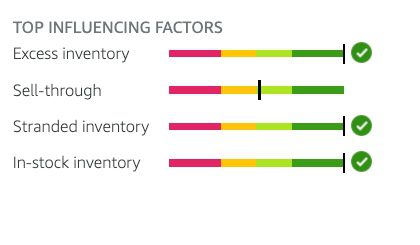
Screenshot from author, February 2024
It is important to highlight that these components are not weighted equally.
Excess Inventory
Excess Inventory and Sell-Through Rate are the parameters that have the most significant impact on IPI, while Stranded Inventory and Restock Rates can play a minor role in the overall score.
This means you will get more movement focusing solely on the first two components rather than spreading your efforts equally across all four elements.
During the height of the pandemic, Amazon changed the minimum IPI to 500. IT has since reduced the minimum IPI back to 400.
However, Amazon can increase or decrease the minimum IPI desired score at any point in time.
For this reason, we advise our clients to aim for a total IPI of 600.
Your minimum goal should be achieving at least 50 points over the current IPI requirement.
Some product mixes make maintaining a high IPI easier than others. For example, if you are a small brand with many products that move consistently, your IPI will generally tend to be higher.
If you are a seller with a large product mix that changes often, it is the most challenging to manage.
Combatting Capacity Limits
If you’re currently experiencing a capacity limit, Amazon can increase your capacity limit for a specific period of time by submitting a request subject to Amazon’s approval.
It is important to remember that if the storage limit increase request gets approved, your account is subject to paying a “reservation fee” for each cubic foot of capacity requested, and it will get charged at the end of the specified period.
Such fee is subject to a credit depending on your sales achieved during the period (performance credits are earned at $0.15 for every dollar of sales you generate using the additional capacity.)
Another alternative is to continue selling items via merchant fulfillment or using other third-party sellers to move your inventory or send small shipments of your fastest, most profitable inventory to Amazon.
Further down in this article, we will highlight what you can do when your inventory performance is low, you are facing potential inventory limits, or if you’re new to Amazon.
Why Would Amazon Do This?
It seems like it would be counterintuitive for a company that is so focused on having as many products on its platform as possible to limit the amount of inventory you could sell.
However, as more sellers joined the platform and with rising FBA and Prime offers, overcrowding at the warehouses started to become a larger problem for Amazon.
Amazon sellers were attracted to FBA because of the low cost of storage rates. Sellers were using the FBA program as a cheap way to warehouse large amounts of inventory.
At first, Amazon tried to increase storage fees. Adding long-term storage fees dramatically increased the storage cost for merchandise aged over six months.
However, even with those changes, Amazon couldn’t curve the overcrowding and demand in its FBA warehouses.
As a result, it started to introduce storage limits in 2019.
From Amazon’s perspective, it wants to ensure customers have favorable shopping experiences and quickly get the products they want.
This means ensuring that the products most likely to sell are available.
Amazon looks at how you have managed inventory in the past and whether customers are purchasing your products to determine how much space is allocated to you.
The better Amazon feels you are at managing your space at Amazon’s FBA warehouses, the more storage space you will be allowed.
What If My IPI Is Below The Current Threshold?
If your IPI is currently below the threshold or within 50 points of the lowest threshold, these are the actions we recommend.
The first step is to check the current threshold. As of the writing of this article, the current threshold for IPI is 400.
However, here’s the direct link to the policy so you can find the current threshold, as Amazon can change this at any time. You can find the current required IPI in Seller Support under the heading FBA Inventory Storage Limits (login required).
You can review your current IPI score in Seller Central by going to Inventory, Inventory Planning, and then clicking on your IPI score.
Screenshot from Amazon Seller Central, February 2024
Even with aggressive tactics, changing the IPI significantly can take 2 to 12 weeks.
Recommended Actions To Improve Inventory Performance Index (IPI)
Excess Inventory – Dump Slow Moving Items
Excess inventory is generally one of the top two reasons your IPI score could be low, since it is the most heavily weighted metric.
The first step to addressing excess inventory is to pull back inventory you don’t expect to sell.
Focus on stock-keeping units (SKUs) that have gone out of fashion or merchandise experiencing a significant demand drop, like seasonal products.
If you don’t expect it to sell within three months, you should pull back the inventory to sell on a different channel by creating a removal order.
You can also start to use the Multi-Channel Fulfillment (MCF) to fulfill your website orders from your Amazon stock.
Sometimes, it makes more sense to discount and/or advertise products to help them sell faster to remove them from your inventory rather than call back inventory from Amazon.
Optimizing a listingthat is not moving can also help increase the sell-through rate.
A quick note on having Amazon destroy products – sometimes, the company will liquidate that product instead of destroying it.
If inventory control is an essential factor for your brand, we recommend pulling back the inventory even though it costs more.
While Amazon is great at logistics and moving items through its process, it isn’t great at returning items to sellers.
Often, items arrive damaged or mixed SKUs in multiple boxes, clogging up receiving departments.
If possible, we want to ensure that we’re proactively taking action to avoid pulling back inventory and risk inventory being damaged or unavailable to be sold for a long time.
Sell-Through Rate – Send Fast-Moving Items
Amazon looks at this to identify whether the items you’re selling are things customers want to purchase.
The way that we improve the sell-through rate is to send in small shipments of items that will sell out very quickly.
If you’re currently using LTL or FTL, we recommend that you move to small parcel shipments during this process so that you can send more frequent shipments without going out of stock for long periods.
As you’re restocking items, you want to prioritize those that will move quickly, sending small quantities of items that will sell out as soon as they arrive or shortly after.
This allows your overall sell-through rate to increase dramatically and significantly impact your overall IPI.
It is vital that no matter how fast you think a product will move through, as you send these products in, you’re testing small batches to make sure that things will sell at the pace you anticipate.
Stranded Inventory
Inventory that’s being held in FBA warehouses and not available for sale affects your overall IPI.
Fixing stranded inventory can make a slight difference; however, if you need to move your IPI significantly, this component of the overall metric will only make a slight difference.
It would be best to address stranded inventory weekly or bi-weekly, depending on your general sell-through rate.
In-Stock Inventory
This is probably the most frustrating metric of the IPI because, basically, Amazon is telling you that you can’t restock items because they’re not selling fast enough.
At the same time, it’s trying to encourage you to ensure you stay in stock.
We have found that this metric is very lightly weighted, and you’re better off focusing on the two key metrics of excess inventory and sell-through rate.
There has been some debate about whether deleting previous SKUs can increase this; however, we have not seen that this significantly impacts the total IPI.
General IPI Notes
As you’re working to increase your overall IPI, it is important to remember that it can take several weeks to increase.
The IPI is an average calculated over 12 weeks.
You must give the IPI enough time to move before determining whether your actions are making a difference.
It can be tempting to check your IPI often. However, your IPI score is only recalculated once a week.
If you need to raise your IPI quickly or by a significant amount, you may need to take overly aggressive actions in pruning your inventory and pumping fast-moving items through your account to increase your score to the required amount.
You might have to also bid for a capacity increase.
You should only do this if you have the data to support being able to sell through that higher quantity of items so you do not incur extra charges.
Additional Options To Combat Low IPI and Storage Capacity Issues
Sometimes, this means utilizing third-party sellers to ensure that inventory can be available to customers with a Prime offer.
Some of the brands we work with have focused on selling their fastest-moving SKUs while they improve their overall IPI score and capacity limits.
Then, they utilized third-party sellers to carry their slower-moving items while they worked on increasing their averages.
We have several reliable third-party resellers we refer our clients to if it’s ever an issue.
This means that those accounts saw a faster increase in storage capacity as they were sending in inventory that was selling at a much faster rate and restocking regularly.
If you don’t want to utilize third-party sellers, the alternative is to increase your total number of merchant-fulfilled offerings.
Remember that Merchant Fulfilled offerings generally don’t compete well against FBA offers, so watch your competition to determine feasibility.
While many brands avoid third-party sellers because it may reduce control over their brand, in this instance, it can be an excellent tool to ensure that you don’t lose potential market share to other competing product lines.
Another step you can take is to allocate your FBA warehouse space to items with the highest margin and smallest dimensional size, as they are highly profitable and sell quickly.
Leaving items with lower profitability or moving slower through Merchant Fulfilled (MF).
Tips For New Amazon Sellers
If you’re a new seller coming to Amazon or moving from Vendor Central to Seller Central, start by sending small quantities at first.
You have a grace window of 39 weeks when opening your account.
However, you want to ensure you send in small amounts of inventory. A few cases per product can help you identify the overall sell-through rate.
There is no minimum for sending inventory into Amazon FBA. So, it is possible to test as little as one unit at a time to test products on Amazon.
Sending in small shipments does increase your overall shipping cost and can reduce profitability in the short term.
However, when you’re first investigating the platform, sending in smaller quantities can help you better understand your product’s demand and help avoid additional fees that can be required to call inventory back or pay for storage fees.
Once you have a better idea of your sell-through rate, you can start to increase the total sizes of your inventory.
It is a delicate balance to have enough inventory so that you don’t run out of stock but also that you don’t have excess inventory.
While, in general, you want to aggressively avoid stockouts, the impact of a low IPI score should take priority.
Monitoring Inventory Matters
To succeed on the platform, you must take an active role in your Amazon inventory management.
In prior years, simply avoiding restocks was enough.
However, these new requirements require a greater focus on monitoring your sell-through rate and storage utilization on Amazon.
Prepare now to support your Amazon marketing and sales goals for the coming holiday season.
2. AI Can Help You Save Time On Manually Reviewing Calls
Listening to and analyzing phone calls manually can be time-consuming and inefficient for agencies.
However, it’s an important part of understanding the customer experience and sales team performance.
With AI-powered call analysis tools, you get quality, keyword-tagged transcriptions with near-human-level accuracy.
Not only can this technology help you save over 50% of the time spent listening to phone calls, but it can also help you deliver actionable recommendations to clients and drive better results.
Conversation Intelligence, for instance, is trained on over 1.1M hours of voice data and enables real-time analysis for instantaneous results.
This advanced tool provides opportunities for you to improve your strategy through the following granular insights:
Spotting disparities in the industry-specific lingo your sales team uses, compared to the lingo your prospects are using to describe their business challenges and goals.
Identifying trends or gaps in your service offerings based on what your prospects are asking for.
Identifying frequently asked questions and other important topics to address through content marketing.
Setting goals for lead qualification — not just the quantity of leads generated for your business.
Conversational AI is perfectly suited to summarize the content of long conversations – however, the call summaries still require a human to read them and determine the main takeaways.
But if you work in a bustling small business, it’s unlikely you’d have the bandwidth for tasks such as call transcription, summaries, keyword spotting, or trend analysis.
Rather than displacing human labor, conversational AI is assisting businesses in taking on tasks that may have been overlooked and leveraging data that would otherwise remain untapped.
3. AI Can Help You Lower Cost Per Lead / Save Money On Tools & Ad Spend
Ever wonder why certain campaigns take off while others fall flat? It’s all in the data!
Even failed campaigns can offer invaluable insights into your client’s audience and messaging.
But if you can’t spot the underperformers quickly enough, you risk wasting your ad budget on ineffective tactics.
The quicker you can identify what’s working and what’s not, the quicker you can pivot and adjust your marketing strategy.
Make a bigger impact in less time: AI-powered technology creates a force multiplier within your agency, allowing you to make more of an impact with the same level of inputs you’re already using.
Unlock actionable insights from call data: AI is revolutionizing the way companies leverage call data by enabling them to gain insights at scale. As a result, businesses can increase their ROI and deliver greater value to their clients by analyzing hundreds of calls efficiently.
Foster alignment with data-driven strategies: By analyzing customer conversations with AI, businesses can align their marketing strategy with data-driven recommendations, enhancing overall coherence. Additionally, the ability to create triggers based on specific phrases enables automated analysis and reporting, further streamlining the alignment process.
Drive effectiveness with rapid insights: Leveraging Conversation Intelligence enables agencies to deliver better insights faster, increase conversion rates, refine keyword strategies, and develop robust reporting capabilities.
4. AI Can Help You Improve Overall Agency Efficiency
Are you spending too much valuable time on tasks that produce minimal results?
Many agencies find themselves bogged down by routine, administrative tasks that don’t contribute much to their bottom line.
But with AI automation, agencies can streamline their operations and redirect their energy towards more strategic endeavors.
From email scheduling and social media posting to data entry and report generation, AI can handle a wide array of tasks with precision and efficiency – giving you time to focus on high-impact activities that drive growth and deliver tangible results.
Ways Your Business Can Benefit From Automation
Automatically transcribe your calls to boost close rates: See how your team is handling difficult objections and ensure that they’re delivering your businessʼ value proposition in an effective manner.
Score calls based on quality and opportunity: Take the time-consuming work out of scoring your calls and determine which campaigns drive the best calls to your business.
Classify calls by your set criteria: Qualify, score, tag, or assign a value to the leads that meet your criteria, automatically.
Automatically redact sensitive information: Protect your customers by removing billing or personal information. Keep your data safe and secure through complete HIPAA compliance.
Monitor your teamsʼ performance: Use Conversation Intelligence as a valuable sales training tool to ensure your team doesn’t miss any key messaging marks.
Know your customersʼ needs: Identify conversation trends in your phone calls and stay privy to evolving customer needs.
Improve your digital marketing strategy: Use AI-powered insights to inform your digital marketing strategy and boost your online presence.
By automating mundane tasks, agencies can optimize workflows, increase productivity, and improve efficiency across the board.
Looking for 5 – 7? Download The Full Guide
Rather than fearing AI, the future belongs to those who embrace it.
By strategically combining human creativity with artificial intelligence, you can unlock capabilities that transcend what either could achieve alone.
Want to discover even more ways to level up your agency with AI?
When I first got into search marketing (back in 2005), there used to be a Tumblr feed dedicated to poorly set up campaigns that clearly did not have quality assurance (aka QA) checks done.
Dynamic keyword insertion and general broad match were the two fastest ways to end up on that page and one of the quickest ways to ruin your day (possibly even your job or career).
Now, nearly 20 years later, platforms have evolved (or devolved depending on the platform and unit), and the need for proper pre- and post-launch QAs has never been more important.
But with that being said, some operations are still learning the hard way what they did and didn’t remember to check. This goes beyond basic paid search and onto all paid media (search, shopping, PMax, YouTube/video, GDN, and even social and programmatic platforms).
This often leads to competition finding those mistakes (it is a mistake if you don’t QA) and exploiting it for their own gain.
Full transparency: I do it as well. If I find a brand or another agency making a mistake in their work and can exploit it, I absolutely will.
Yes, in the land of digital marketing, especially when it comes to taking down the competition (not as practical to execute, but if possible, so valuable to you), I will wake up and choose violence. Nearly 20 years in digital marketing will do that to a person (especially if six months of the year they have to watch the NY Jets blow it again).
Everyone makes mistakes sometimes in digital marketing, even me. The key is to make sure the person responsible for running the ad campaign knows what is happening, from pre-launch to the live campaign itself.
Let’s delve into some mistakes that have been found, explain how they could’ve been prevented through a standard ongoing QA process, and what you should do in the future to CYA (if you don’t know that acronym, go look it up on Bing).
Some Notable Mistakes
Author Disclaimer: There are literally oodles of different mistakes going on all around us. I will only note the small and large ones I’ve witnessed. For some legal reasons, some brands that were the self-induced victims of these mistakes will be anonymized.
In 2011, I was working for a major holding company ad agency, running media for a credit card company that was trying to sponsor a holiday they created that transpired just after Thanksgiving that encouraged shopping at local, non-large businesses (you can guess who).
My team was short-staffed; Reps for a major search engine with a major video platform (considered the second-largest search engine in the country) offered to assist my team with the video part by running it for us.
We gladly obliged for the help and gave them our targeted keyword and category list for the campaign, and then we gave them the negative keyword and category list. The reps told us they would run it for us, QA it for us, and give us the results.
This was a mistake on our part.
The campaign ran for two weeks, spending around $100,000. But when we got the results from the reps, they were terrible. The video had an incredibly low view rate, a higher-than-normal cost per view, and almost no clicks to the website (we knew it wouldn’t get many, but to get less than 100 from 5+ million impressions was odd).
We got our hands on the data and the settings (it was operated in an account we didn’t initially have access to) and discovered the category target list was missing, the keyword targets had been used as the negative keyword list, and worse, the excluded categories and negative keywords had been used as the targets.
Let’s just say the keywords we pulled from Urban Dictionary around intimacy triggered a concerningly high volume of impressions on a variety of non-brand-safe content.
The rep of that major search engine was informed of the faux pas, and they admitted a minimal prelaunch QA had been done, but not thoroughly – and a post-launch QA was never done.
This resulted in a $150,000 credit (keep in mind we only spent $100,000) back to the credit card company. We never saw or heard from that sales rep again.
In 2019, my agency won some new business for a conglomerate of sports nutrition brands. During the kick-off with the brand, they showed us their YouTube data, which was incredibly impressive in terms of non-skippable video.
We’re talking 45+ second videos, with a view rate exceeding 75% (the industry benchmark was 35%) when they reached the 30-second mark and a cost per view (CPV) of less than $0.04.
They informed us that despite the great metrics, there was little to no evidence of direct or down-funnel sales, and they considered the effort a complete failure. Something didn’t make sense, and they asked me to audit the prior agency’s work.
What I found was concerning.
This brand ran video ads featuring incredibly muscular people wearing next to nothing exercising like they were training for the Hunger Games. The campaign spent around $500,000 over a six-month period.
Upon digging in, I realized there was no content targeting, no age targeting, and absolutely nothing in exclusions.
After writing up an analysis that took an estimated 120 hours to complete, it was determined that 60% of ad spend for these scantily clad adults drinking pre-workout and protein shakes had been shown on children’s content, such as Blues Clues, Coco Melon, Blippi, and any parent’s holy nightmare: Caillou.
The view rate and cost per view were so impressive but generated no sales because the majority of the impressions and views were being served to children ages two to seven.
The prior agency had failed to do a full pre-launch QA, post-launch QA, or even check the data during the flight. This was all taken into consideration, and the brand took the prior agency to court to recover six months of agency fees and media spend (this was settled out of court in the mid-six-figure range).
Screenshot from author, April 2024
Don’t show your workout ads to kids!
Also, if you’re doing retargeting of any sort, know where it shows and has negatives!
Image from The San Diego Union-Tribune, April 2024
Remarketing is great when you’re prepared for it. A more recent scenario I ran into (in 2024) is a brand I have never worked with, but after finding the same mistake three times in six weeks, it is time to call it out.
I’m sorry, Darden Foods digital team. I enjoy the breadsticks at Olive Garden, but this is a simple fix that you still haven’t done.
Recently, on a trip home from skiing, my wife saw a sign for Olive Garden and insisted we pull in for lunch, as she hadn’t been to one in 15 years.
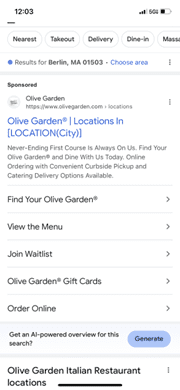
We pulled in, ate, and wondered if there was one near our home for future visits. I pulled out my phone at the table (yes, quite rude, but justified), and searched for [Olive Garden Locations], and got this:
Screenshot of search for [Olive Garden], Google, February 2024
Here again, six weeks later. I mean, come on.
Screenshot of search for [Olive Garden], Google, March 2024
Here, we have a dynamic location insertion put into a search ad (which is normally a great thing to have when set up correctly).
But during the setup, instead of using {}, they used [].
Therefore, it cannot trigger the location; it only triggers [Location(City)], delivering the consumer a poor user experience and not indicating whether or not a location is nearby.
I repeated this search multiple times over six weeks to realize the advertiser never discovered it. I suspect this was uploaded through a bulk sheet, as a manual insertion into the UI, or even the editor has an obvious callout if it is implemented correctly.
Easily Overlooked Future Mistakes
A very common mistake that can be prevented pre-launch but can easily be caught post-launch is one that has been around essentially since the beginning of the industry and lives in both Google Adwords and Bing Ads (it’ll be a cold day in hell before I ever call them Google Ads and Microsoft) and even in Facebook/Instagram (refusing to call it Meta): default settings.
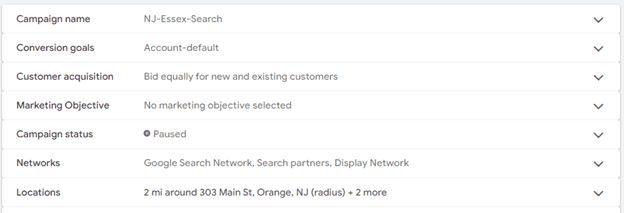
When you first create search campaigns in Google and Bing, some settings are automatically presented to you in a certain way, and you, as an advertiser, must proactively change them (any seasoned search marketer knows this, so this issue is more common with SMBs).
These default search settings include but are not limited to:
Auto-Apply recommendations on (Google and Bing specific).
Dynamic extensions on (Google and Bing specific).
Advantage+ on (Facebook/Instagram specific).
Display Network/Audience Network on (Google and Facebook/Instagram specific, Bing did away with the ability to opt out of their network a couple of years ago).
Search Partner/Search Syndication Networks (Google and Bing specific).
Mobile app placement (Google Display Network specific).
Broad match keywords (Google and Bing specific when you add keywords without a specified match type).
Screenshot from author, April 2024
Google is gonna Google to make that bread off those not paying attention.
And that is just the tip of the iceberg. Just because you don’t have the ideal or approved assets to put in these places doesn’t mean you won’t be accruing traffic and spend here.
Unless you plan to have them enabled, they need to be changed.
Needless to say, in each of these scenarios, pre-, post, and ongoing QA efforts can prevent some of these catastrophes from happening.
I should note that efforts tied to Performance Max, demand generation, and Advantage+ are a bit harder to QA.
But not QAing them is like telling Jenn Shah of RHOSLC that you trust her customer CRM lists are safe and legitimate.
QA To Save the Day
Now that the fear of digital marketing God is in you, let’s calm you down and discuss how not to have a terrible day with the CMO who has seen your ads live.
This will give them and you more confidence and prevent a conversation more painful than the time I put my head in a snowblower (per editor’s request, a photo of that is not included).
There are 3 phases of a QA plan: pre-launch, post-launch, and ongoing (spoiler, the third phase is ongoing, in perpetuity, but is just part pf your basic optimization strategy).
Pre-launch: A standardized checklist that you go through for all settings to make sure elements are set before launch. Includes targeting, exclusions, budgeting, assets, etc.
Post-launch: This is very similar to the pre-launch list, but it includes analysis of initial data to look for anything out of place, such as queries you map to, sites you trigger on, networks, disapproved assets, etc. This should be done somewhere between 24 and 72 hours of launch, after accruing data
Ongoing: This ties directly to your ongoing optimization but is next to it. Think of it as an ongoing post-launch checklist that is repeated at intervals of once a month. This isn’t a formal optimization document or analysis but an ongoing settings check.
The Takeaway
If you’ve read my articles before, you recognize that this isn’t the first time I’ve written about something like this.
However, I’ve witnessed operations/individuals not follow QA protocols, even the most basic ones. Once a mistake is noticed internally and not rectified, it can go up the chain fast and can be as bad as losing one’s job.
But if the general public catches a mistake and calls you out on it, well, an apology press conference and campaign can cost the operation tens of thousands of dollars.
A simple ongoing checklist for the life of the campaign will save you a lot of pain and suffering later. It is part of any solid optimization strategy, so it’s not like you aren’t already doing it.
If you need inspiration on what one should look like, feel free to reach out to me, and I can get you in the right direction.
Paid media’s main job is to increase visibility and drive traffic for your brand.
And as digital marketing evolves, so, too, will your strategy.
In the current state of paid, the main overarching theme is, you guessed it, AI and machine learning.
As paid media platforms get smarter and constantly find ways to infuse AI into campaign workflows and optimizations, marketers must find a way to keep up with the platforms.
The other side of the coin is maintaining user privacy all the while trying to use AI effectively.
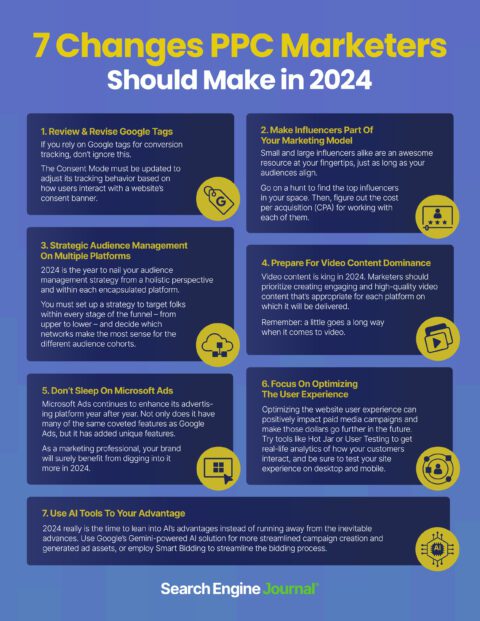
So what major changes should you make to your paid media marketing strategy in 2024?
Here are seven changes you should incorporate without a second thought.
In January 2024, Google made an update to its Consent Mode for its Google tags, which will, for now, affect any marketers who run ads targeted to users in the European Economic Area (EEA).
This update requires marketers to take action by March 2024 in order to keep using ad personalization and remarketing features in Google Ads.
Simply speaking, the Consent Mode will need to be updated to adjust its tracking behavior based on how a user interacts with a website’s consent banner.
The two new parameters introduced to Consent Mode are:
ad_user_data: This controls whether user data can be sent to Google for advertising purposes.
ad_personalization: This controls whether personalized advertising (remarketing) can be enabled for the user.
As privacy measures continue to become stricter in the United States, it would not be surprising if this becomes required for US advertisers in the somewhat near future.
Keep in mind that in 2024, we’ll have to get comfortable being uncomfortable with imperfect data because of privacy regulations.
2. Make Influencers Part Of Your Marketing Model
Small and large influencers alike are an awesome resource at your fingertips, just as long as your audiences align.
Even brands with a few thousand followers can utilize influencer marketing to make a big difference and gain traction in the market.
Go on a hunt to find the top influencers in your space. Then, figure out the cost per acquisition (CPA) for working with each of them (because you have to court influencers, especially the bigger ones).
From there, you can create a win-win partnership that gets you more leads while the influencer earns income.
Pro Tip: You can use influencer marketing tools to help you in your journey to integrate core influencers into your business model. Some of the most popular include AspireIQ, BuzzSumo, Upfluence, and NeoReach. Whichever you choose, make sure the influencers you find are big enough to provide real value to your brand — and that you’re paying a CPA that makes sense for your budget and overall goals.
3. Strategic Audience Management On Multiple Platforms
2024 is the year to nail your audience management strategy, both from a holistic perspective and within each encapsulated platform.
That means before building your audiences, you need to understand at a high level who your target customer is.
Further, identify what platforms those types of user-profiles spend their time on.
Once you’ve identified your ideal target customer, then it’s time for the first step in this process:
Building audiences.
From there, you must set up a strategy to target folks within every stage of the funnel – from upper to lower – and decide which networks make the most sense for the different audience cohorts.
Perhaps the most crucial part of this process is analyzing and refreshing your audiences as the year goes on.
You should definitely plan on retargeting and testing new audiences throughout the year.
If you fail to incorporate this part, you run the risk of targeting the wrong sector of people, ultimately throwing money down the proverbial drain.
However, if you retarget and refresh your approach, you’re bound to find a dynamic audience that correlates with your vision.
In the end, audience management alone can be worth its weight in gold.
4. Prepare For Video Content Dominance
You’ve likely heard this phrase before in marketing: content is king.
With a slight tweak for 2024, the new hot phrase should be: video content is king.
Not only is video taking over social platforms like TikTok, Instagram, and Snapchat, but it’s also asserting its dominance in YouTube Ads. YouTube Shorts, the platform’s short-form video offering, is booming.
With this new form of video comes a new ad format: vertical video ads.
Not only should marketers focus on video marketing in general – 2024 is the year to get more sophisticated with video strategy.
Marketers should prioritize creating engaging and high-quality video content that’s appropriate for each platform on which it will be delivered.
If the thought of creating video content for multiple platforms scares you, just remember that a little goes a long way.
Start by creating evergreen content about your brand and test those with different lengths.
These can be used and recycled on multiple platforms and can be used for organic and paid video content simultaneously.
Just remember to create a variety so that your users don’t see the same message or content on the same platforms, which can reduce the effectiveness of video marketing.
5. Don’t Sleep On Microsoft Ads
Microsoft Ads continues to enhance its advertising platform year after year.
Not only does it have many of the same coveted features as Google Ads, but it has added features that are unique to the platform.
As a marketing professional, your brand will surely benefit from digging into it more in 2024.
Some of the most notable updates Microsoft Ads launched in the last twelve months include:
Video and CTV ads: Microsoft unveiled these new ad types on its platform in September of 2023. Advertisers can choose from online video ads or connected TV ads that are non-skippable while a user is streaming content. This gives advertisers big and small a leg up on what once used to be a very complicated process of buying TV ads.
Three new generative AI solutions: Also announced in September 2023, Microsoft came out with three new AI features to help grow and scale. These include Compare & Decide ads, ads for Chat API, and Copilot campaign creation.
Data-driven attribution reporting: Gone are the days of last-click measurement! Microsoft Ads enhanced its UET tagging solution and implemented data-driven attributing modeling. It uses machine learning to calculate the actual contributions of each ad interaction.
While Microsoft still holds a lower share of the available search engines, just remember that you’re leaving a whole slew of potential customers behind by not considering this underestimated ad platform.
6. Focus On Optimizing The User Experience
Between a mix of shorter human attention spans and limited marketing budgets, every interaction and website experience counts.
If you find that your pre-sale metrics are favorable – such as high engagement or high CTR – but never result in a sale, you likely don’t have an ad problem. You have a user experience problem.
In 2024, consumers expect more from brands, especially if they’re spending their hard-earned money with that company.
Ask yourself, when was the last time you sat down and went through your website’s checkout process through the lens of a customer?
If you’re not sure where to start on optimizing your website experience for users, here are some ideas to get you started:
Use tools like Hot Jar or User Testing to get real-life analytics of how your customers are interacting and what their pain points are.
Review the website landscape on desktop and mobile. While this may be a no-brainer, many websites still forget to optimize for mobile!
Make sure that any relevant call-to-actions (CTAs) are above the fold – yes, on mobile, too!
Check your site speed.
These are items that should continuously be monitored and not a “set and forget,” which unfortunately happens quite a bit.
Optimizing the website user experience can have a positive impact on those paid media campaigns and can make those dollars go further in the future.
7. Use AI Tools To Your Advantage
Let’s face it: Machine learning and AI aren’t going anywhere.
For marketing leaders, 2024 really is the time to lean into its advantages instead of running away from the inevitable advances.
It’s not a question of whether to use AI or not. It’s a matter of how to use AI to your advantage.
While companies are tightening their budgets and scaling back staff, PPC marketers are constantly being asked to do more with less.
This is where AI comes in.
In fact, using AI can strengthen your ROI for paid media campaigns of all kinds (whatever channel you prefer).
Just make sure you don’t sacrifice your brand’s personality for a little efficiency.
One way you can do this is with Google’s generated AI assets (currently in beta). Using its Gemini-powered AI solution, the tool allows for more streamlined campaign creation and generated ad assets, including images, headlines, and descriptions for ads, and more.
Additionally, you’re likely already using one of Google’s Smart Bidding strategies to automate the bidding process.
With a combination of creativity and machine learning, your ads have the potential to go farther than ever before.
Your 2024 Plan Should Not Be Static
If the past year(s) have taught us anything in marketing, it’s to be fluid.
In some cases, tactics that used to be tried and true are now more volatile than ever.
Take advantage of advances in AI to boost your strategic advantage, and keep in mind platforms that you’ve typically shied away from – the time may come to incorporate them into your 2024 strategy.
What changes are you most excited to try this year?
More resources:
Featured Image: Sutthiphong Chandaeng/Shutterstock
The IAB releases its “2024 Digital Video Ad Spend & Strategy Report” ahead of this year’s NewFronts, which kicks off on Monday, April 29.
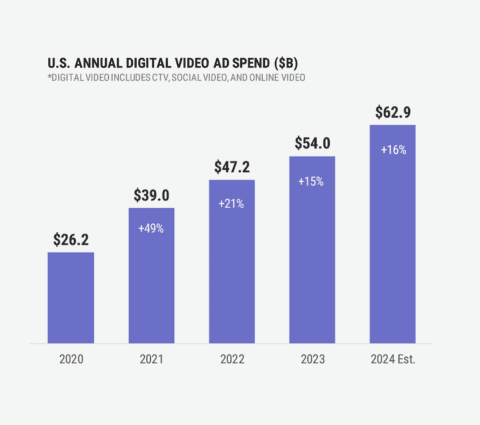
Covering Connected TV (CTV), social video, and online video (OLV), the report says overall spending on digital video advertising in the U.S. is projected to grow 16% in 2024 – nearly 80% faster than ad spending on total media.
In the U.S., digital video ad revenues are expected to reach $63 billion in 2024, according to the IAB.
Image from IAB, April 2024
That’s virtually guaranteed to give brand marketers and media buyers an extra excuse to get out of their offices and take a first look at the latest cutting-edge digital video content and marketplace innovation that will be unveiled at IAB NewFronts.
The entire event spans four days and three dozen events at different locations in New York City.
I expect in part why the IAB releases its report on the Thursday before the 2024 IAB NewFronts next week. It’s a strategy I’ve used to get more interest in upcoming events.
However, I also suspect that many early adopters of digital video advertising have already registered for or requested a pass to some of the networking events, meals, content previews, and sponsor activations.
So, anyone trying to squeeze into “the room where it happens” at the last minute may find it harder to score an in-person attendance invitation.
Digital Video Ad Spend Has 52% US Market Share
In the last four years, the share of ad spend has shifted by nearly 20 percentage points from linear TV to digital video, which is now 52% of the total market share in the U.S.
So, if you’re only just learning about this video advertising trend now, how can you catch up with it?
To create the report, the IAB partnered with Guideline, which leveraged ad billing data as well as data from an IAB-commissioned Advertiser Perceptions quantitative survey of TV/digital video spend decision-makers and other market estimates.
Part 2 of the report, which will be released on July 15 during the IAB Media Center’s Video Leadership Summit, will dive deeper to provide insights into strategies driving activation and measurement.
Social Video And CTV Projected To See Double-Digit Ad Spend Growth
By reading Part 1 of the report, you’ll learn that social video is on track toward its second year of 20% year-over-year (YoY) growth and is projected to rise to $23.4 billion.
The report adds that CTV exceeded $20 billion for the first time in 2023 and is expected to grow by 12% to $22.7 billion in 2024 – 32% faster than total media overall.
While dollars flowing into CTV primarily come from reallocations – particularly from linear TV and other traditional media – 31% of revenues come from the overall expansion of advertising budgets.
Chris Bruderle, the VP of Industry Insights & Content Strategy at IAB, said in a press release:
“Among the largest ad spenders, CTV (69%) and social video (70%) are considered ‘must buys’ because of their ability to deliver both scale for branding at the top of the funnel and performance outcomes at the bottom of the funnel.”
Knowing these numbers will help you catch up, but if you want to get ahead, then you should also analyze the latest video advertising trends.
Even though this article was published in August 2023, it indicates that social video and CTV aren’t the only trends your company or clients should focus on in 2024.
You’ll get ahead of the curve if you set aside some budget to test YouTube Shopping, which lets eligible content creators promote products from your brand or their own stores across YouTube.
CPG And Retail Will Be The Fastest Growing Categories Of Digital Video In 2024
For the first time, this year’s report includes category-level ad spending projections.
The consumer packaged goods (CPG) and retail categories are both expected to post double-digital ad spend growth YoY – at 20% and 30%, respectively – while generating the largest total ad spend.
The report says CPG brands are leveraging CTV’s increased scale, ability to connect with consumers directly, and streaming companies’ partnerships with retail media networks.
Auto, financial, restaurants, B2B, travel, and wellness are also up more than 20%, though from smaller bases. In fact, the IAB projects most categories will see double-digit growth in 2024 vs. 2023.
David Cohen, the CEO of IAB, said in a press release:
“Advertisers go where consumers are, and today that means digital video.”
He added:
“The challenge ahead is this: in a crowded landscape, who can deliver the best viewing experience, with the best content choices and the most innovative advertising options? That competition is ultimately good for consumers and good for the industry.”
Again, knowing this will help those behind catch up.
The article was published in September 2023, but that’s when YouTube first introduced AI Insights to spark video ideas, Dream Screen for AI-generated backgrounds, and YouTube Create, a new app for creators.
Even though it was published earlier this month, I’ll bet that YouTube creators are already using this new shopping tool to boost their ecommerce monetization.
This relatively new development should help your company or clients to leapfrog their competitors. That should help you add some strategic insights after your colleagues discuss what they saw and heard at the 2024 IAB NewFronts.
To Keep Ahead, Cover All The Events At IAB
Let me share one last bit of tactical advice. I can’t be in “the room where it happens” next week. I’ll be home in Greater Boston. But I’ve arranged to be in “the Zoom where it happens” and you should be, too.
To get virtual access to the presentations, all you need to do is log in to your IAB account prior to viewing.
Advertising agency executives, media buyers, and brand marketers are all welcome to register for the 2024 IAB NewFronts for free. Just click Register for your complimentary pass.
However, there will be about three dozen in-person and virtual events. Nobody can attend all of them, and you will need a team to cover all the events.
Assign different people to attend or watch different events and get together at the end of the week to compare notes.
This is an event not to be missed. It’s where you can discover all the video advertising opportunities and threats facing your company or clients in the foreseeable future.
Google’s latest attempt to meet privacy concerns and regulations (IP proxies) is causing a bit of a stir.
Thanks to Anu Adegbola’s investigative research, initial plans were uncovered. Now that we’ve had a bit to process, we’re going to dive into:
What are Google proposing to do (per their GitHub)?
Who will it impact?
What can you do to prepare?
Before we dive too deep into the weeds, it’s important to define all the pieces in play:
Internet Protocol (IP) Addresses: A unique number assigned to devices connected to the internet. These are how you’re able to access information on the internet and act as a “calling card.”
Click Fraud Protection: Tools designed to block malicious IP addresses (bots) from engaging with ads/sites. They are able to identify and block the root IP address that’s causing the issue.
Location Targeting: A PPC strategy that allows you to serve ads to a user who is in, regularly visits, or shows interest in a given location.
Exclusions: The act of telling an ad platform you do not want traffic from a place, audience bucket, website placement, or people who use specified words in their queries (negatives).
A final note: This is in active development, and Google has not yet made firm statements about how it will be applied.
Expect this post to be updated around/after Google Marketing Live when we anticipate the search giant will make more concrete announcements about it.
What Is Google Proposing To Do?
Google is proposing to use two proxies to mask IP addresses.
This means an IP address would make the call to a site for information (including Google search), and the IP will be converted to a randomly assigned different IP.
That randomly assigned unique IP will then be converted to a third IP address. In this way, the user will be able to access all the site information. However, their personal IP address will be masked.
In action, the flow would go something like this:
I search for [things to do in Iceland] using my real IP to access Google’s search results in my Chrome browser.
My IP connects with Google’s systems and will be converted to a proxy IP. This proxy IP will be the IP that actually makes the request.
Google will serve me a beautiful search engine result page (SERP) full of videos, images, and links (paid/organic) for me to get ideas.
I click on the link to Frost and Fire (our favorite hotel in Iceland, where we went on our honeymoon).
My proxy IP engages with Frost and Fire’s DNS and is converted to a second proxy. This means that Frost and Fire will only receive the tracking information for the second proxy.
I view the site and choose to consent to tracking or not (regardless – my actual IP is still hidden as of this reporting).
Google proposes using cohorts to help with the geo element, focusing on countries with some state/sub-country targeting.
However, it also acknowledges it cannot be 100% accurate. Currently, the threshold to be considered for a cohort is 1 million unique web cookies across a two-week period.
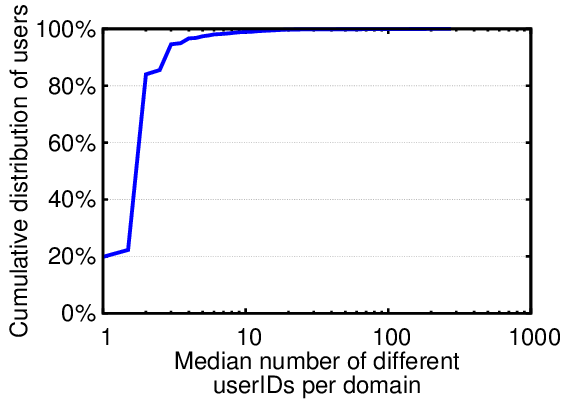
To put this in context, HubSpot found that only 31% of sites get more than 50,000 unique visitors per month. A 2018 study from Research Gate found that domains only have 10 cookies (median).
Screenshot from researchgate.net, April 2024
There is a real possibility that Google will need to merge interests/location cohorts to meet the minimum. There is no word yet on whether exclusions will be impacted by the location targeting.
Who Will It Impact?
In theory, this is a huge gain for privacy because you can access all internet properties without any company knowing who or where you are.
On the other hand, if brands aren’t sure who you are, they might serve you entirely irrelevant ads or need reminders about your preferences.
Location Targeting
One of the reasons people are concerned about this is the location targeting issue (and lack of transparency).
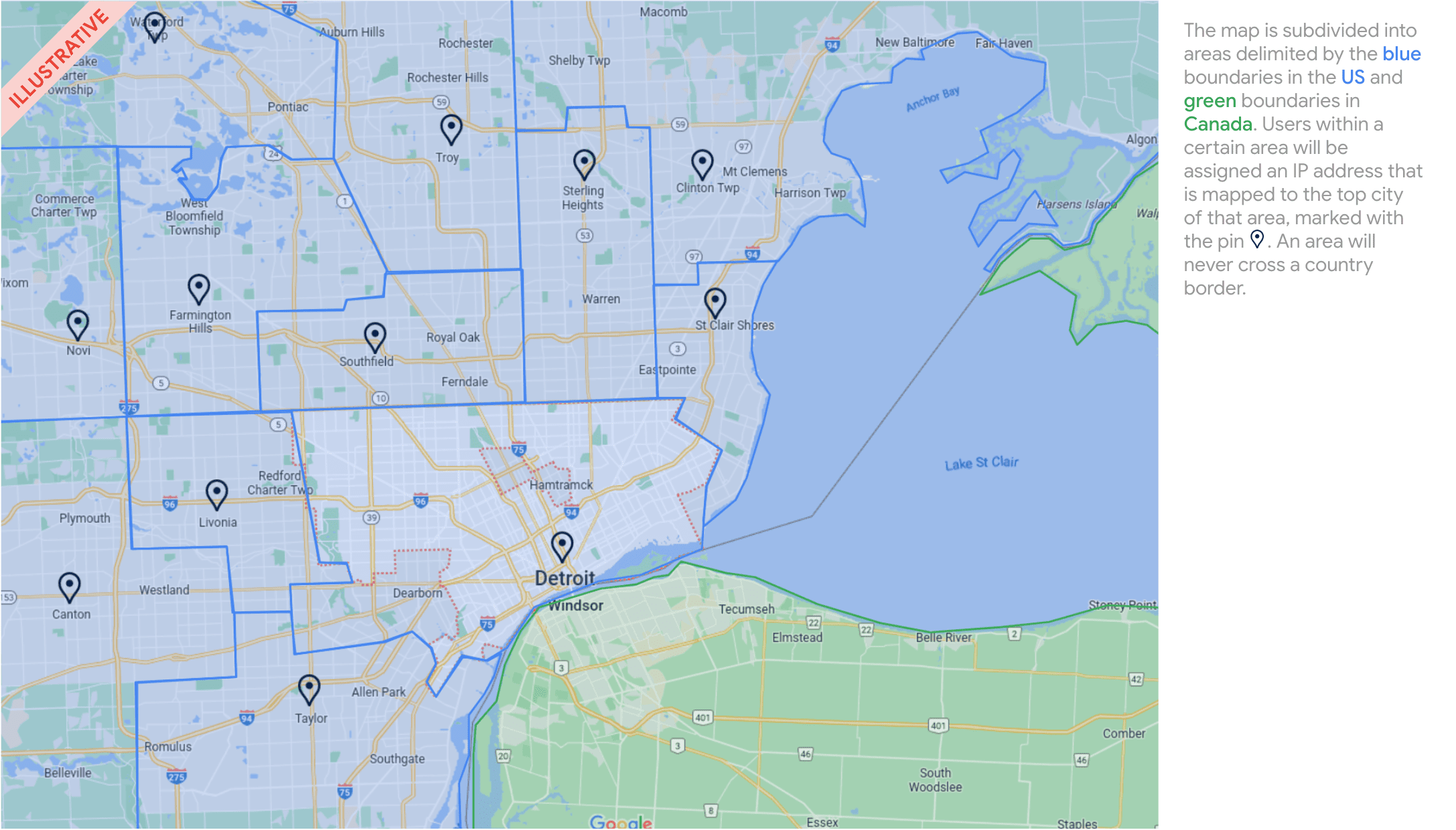
Screenshot from author, April 2024
As you can see, these proposed location cohorts are much bigger than conventional location targeting. Brands that are used to targeting some cities or designated market areas (DMAs) because they’re more profitable than others might need to target states.
This is especially critical in low-search volume industries and low-population areas of the world.
For example, Boston (a fairly major city) has ~651,000 people. While many in the Boston area live in the surrounding cities or commute from out of state, some businesses might want to target Boston specifically.
With this new rule, it is very possible that targeting Boston (the city) won’t be possible anymore – even with it being a college town with high internet usage.
On the other hand, the whole state of Rhode Island has just over 1 million people. While many businesses are subjectively close together, people in Rhode Island tend not to want to go more than 15 minutes by car.
Additionally, almost 30% of Rhode Island has no internet. This means that many users in Rhode Island would likely be absorbed into other states’ cohorts, or would be lumped together in a single statewide target.
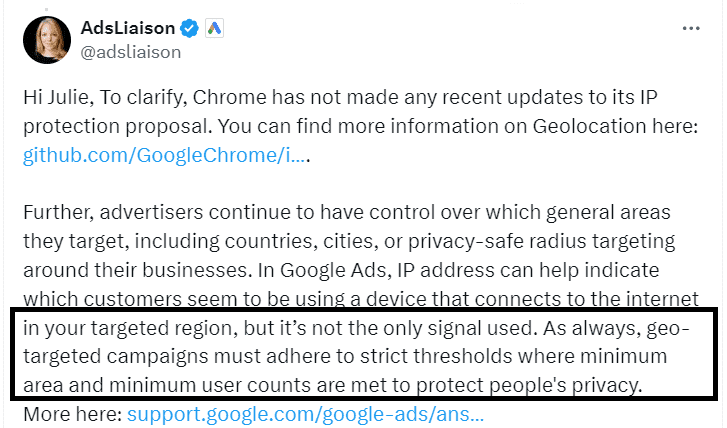
Ginny Marvin, product liaison at Google, confirmed the location thresholds aren’t new.
Screenshot from X (Twitter), April 2024
Click Fraud
The other major consideration is click fraud technology. For years, brands have gratefully availed themselves of click fraud services to block malicious IP addresses.
If the original IP address is obscured from both Google and the end site, it will be really hard to truly protect against those bots.
The destination origin doesn’t see the client’s original IP address.
Google can’t see the origin that clients interact with.
No single proxy can see the origins that clients interact with and the clients’ original IP address.
IP addresses of the proxies cannot be used as stable identifiers.
We are using a list-based approach, and only domains on the list in a third-party context will be impacted. More information below.
I expect click fraud tech will need to adapt to a modeled workflow.
Whether they choose to block IPs predictively based on the listing mechanic or use other signals remains to be seen.
However, as it stands now, Google would be removing the ability for sites to protect against malicious bots, which impacts paid and organic.
User Experience
It’s worth acknowledging its impact on the user experience and what people will give up in the name of privacy.
As it stands now, ad platforms do their best to serve relevant ads to relevant users. If brands aren’t able to understand who their users are (existing customers included), it will be impossible to avoid serving ads to existing customers.
The saving grace is that this is opt-in and requires users to log in. While some may opt-in because they enjoy the idea of perfect privacy, I would be very surprised if users maintained the setting.
Here’s why:
People like ease of life. Having to reconfirm information and remind a brand about their preferences gets old quickly. I’m not saying people won’t find the positives outweigh the negatives, but I expect folks to get a rude surprise if they opt for perfect privacy.
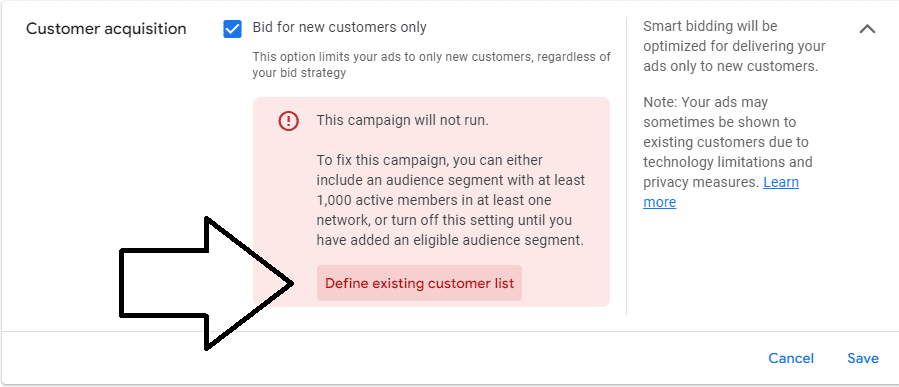
Getting ads from a brand you already do business with is a source of constant frustration for many today. It will only get worse if brands lose the ability to protect their existing customers. Google’s customer match and Performance Max verbiage include a clause that they might not be able to fully protect users due to technology.
Screenshot from author, April 2024
What Can You Do To Prepare?
The biggest thing is getting your exclusions ready. As of now, there is nothing in any of the documentation around exclusions being impacted.
Google exclusions allow you to exclude people in a specified location, or who show interest in a specified location. You have always been able to exclude locations within a target location. Until this goes away, this is the easiest way to make sure you’re setting your budgets up for success.
However, keep an eye on your status column. I expect a lot of “Eligible: Misconfigured” as Google and advertisers figure out how surgical they can be with exclusions.
Another really important step is to communicate with your customers about this change. An informed user is an empathetic user.
You can get ahead of many friction moments by owning that this is a potential technical limitation on your ability to sequester existing customers from marketing efforts.
Read the full GitHub documentation and give feedback. Google needs to understand how this will impact us and whether it will achieve the desired results (balancing privacy with utility).
Do some research on your main markets and their internet usage. Tools like BroadbandSearch.net are great for giving you a sense of how likely you are to be put in a focused or muddled cohort.
Final Thoughts
I don’t think this is a bad thing until it’s implemented and we see what functionality makes it into the final version.
Am I nervous about the location targeting piece (especially for niche industries and smaller population areas)? Absolutely.
Do I think all my Google Ads (and other ad networks running on Chrome) are going to implode? No.
At the end of the day, we still have our creative, and a lot of effort has been invested in modeling technology.
We just need to get better at convincing our customers to consent to data sharing and trust in modeling.
Whether you are new to paid media or reevaluating your efforts, it’s critical to review your performance and best practices for your overall PPC marketing program, accounts, and campaigns.
Revisiting your paid media plan is an opportunity to ensure your strategy aligns with your current goals.
Reviewing best practices for pay-per-click is also a great way to keep up with trends and improve performance with newly released ad technologies.
As you review, you’ll find new strategies and features to incorporate into your paid search program, too.
Here are 10 PPC best practices to help you adjust and plan for the months ahead.
1. Goals
When planning, it is best practice to define goals for the overall marketing program, ad platforms, and at the campaign level.
Defining primary and secondary goals guides the entire PPC program. For example, your primary conversion may be to generate leads from your ads.
You’ll also want to look at secondary goals, such as brand awareness that is higher in the sales funnel and can drive interest to ultimately get the sales lead-in.
2. Budget Review & Optimization
Some advertisers get stuck in a rut and forget to review and reevaluate the distribution of their paid media budgets.
To best utilize budgets, consider the following:
Reconcile your planned vs. spend for each account or campaign on a regular basis. Depending on the budget size, monthly, quarterly, or semiannually will work as long as you can hit budget numbers.
Determine if there are any campaigns that should be eliminated at this time to free up the budget for other campaigns.
Is there additional traffic available to capture and grow results for successful campaigns? The ad platforms often include a tool that will provide an estimated daily budget with clicks and costs. This is just an estimate to show more click potential if you are interested.
If other paid media channels perform mediocrely, does it make sense to shift those budgets to another?
For the overall paid search and paid social budget, can your company invest more in the positive campaign results?
3. Consider New Ad Platforms
If you can shift or increase your budgets, why not test out a new ad platform? Knowing your audience and where they spend time online will help inform your decision when choosing ad platforms.
Go beyond your comfort zone in Google, Microsoft, and Meta Ads.
Here are a few other advertising platforms to consider testing:
LinkedIn: Most appropriate for professional and business targeting. LinkedIn audiences can also be reached through Microsoft Ads.
TikTok: Younger Gen Z audience (16 to 24), video.
Pinterest: Products, services, and consumer goods with a female-focused target.
Snapchat: Younger demographic (13 to 35), video ads, app installs, filters, lenses.
Recently, trends in search and social ad platforms have presented opportunities to connect with prospects more precisely, creatively, and effectively.
Don’t overlook newer targeting and campaign types you may not have tried yet.
Video: Incorporating video into your PPC accounts takes some planning for the goals, ad creative, targeting, and ad types. There is a lot of opportunity here as you can simply include video in responsive display ads or get in-depth in YouTube targeting.
Performance Max: This automated campaign type serves across all of Google’s ad inventory. Microsoft Ads recently released PMAX so you can plan for consistency in campaign types across platforms. Do you want to allocate budget to PMax campaigns? Learn more about how PMax compares to search.
While exploring new features, check out some hidden PPC features you probably don’t know about.
5. Revisit Keywords
The role of keywords has evolved over the past several years with match types being less precise and loosening up to consider searcher intent.
For example, [exact match] keywords previously would literally match with the exact keyword search query. Now, ads can be triggered by search queries with the same meaning or intent.
A great planning exercise is to lay out keyword groups and evaluate if they are still accurately representing your brand and product/service.
Review search term queries triggering ads to discover trends and behavior you may not have considered. It’s possible this has impacted performance and conversions over time.
Critical to your strategy:
Review the current keyword rules and determine if this may impact your account in terms of close variants or shifts in traffic volume.
Brush up on how keywords work in each platform because the differences really matter!
Review search term reports more frequently for irrelevant keywords that may pop up from match type changes. Incorporate these into match type changes or negative keywords lists as appropriate.
6. Revisit Your Audiences
Review the audiences you selected in the past, especially given so many campaign types that are intent-driven.
Automated features that expand your audience could be helpful, but keep an eye out for performance metrics and behavior on-site post-click.
Remember, an audience is simply a list of users who are grouped together by interests or behavior online.
Therefore, there are unlimited ways to mix and match those audiences and target per the sales funnel.
In-market and custom intent: Searches and online behavior signaling buying cues.
Remarketing: Advertisers website visitors, interactions with ads, and video/ YouTube.
Note: This varies per the campaign type and seems to be updated frequently, so make this a regular check-point in your campaign management for all platforms.
7. Organize Data Sources
You will likely be running campaigns on different platforms with combinations of search, display, video, etc.
Looking back at your goals, what is the important data, and which platforms will you use to review and report? Can you get the majority of data in one analytics platform to compare and share?
Millions of companies use Google Analytics, which is a good option for centralized viewing of advertising performance, website behavior, and conversions.
8. Reevaluate How You Report
Have you been using the same performance report for years?
It’s time to reevaluate your essential PPC key metrics and replace or add that data to your reports.
There are two great resources to kick off this exercise:
Your objectives in reevaluating the reporting are:
Are we still using this data? Is it still relevant?
Is the data we are viewing actionable?
What new metrics should we consider adding we haven’t thought about?
How often do we need to see this data?
Do the stakeholders receiving the report understand what they are looking at (aka data visualization)?
Adding new data should be purposeful, actionable, and helpful in making decisions for the marketing plan. It’s also helpful to decide what type of data is good to see as “deep dives” as needed.
9. Consider Using Scripts
The current ad platforms have plenty of AI recommendations and automated rules, and there is no shortage of third-party tools that can help with optimizations.
Scripts is another method for advertisers with large accounts or some scripting skills to automate report generation and repetitive tasks in their Google Ads accounts.
Luckily, you don’t need a Ph.D. in computer science — there are plenty of resources online with free or templated scripts.
10. Seek Collaboration
Another effective planning tactic is to seek out friendly resources and second opinions.
Much of the skill and science of PPC management is unique to the individual or agency, so there is no shortage of ideas to share between you.
You can visit the Paid Search Association, a resource for paid ad managers worldwide, to make new connections and find industry events.
Preparing For Paid Media Success
Strategies should be based on clear and measurable business goals. Then, you can evaluate the current status of your campaigns based on those new targets.
Your paid media strategy should also be built with an eye for both past performance and future opportunities. Look backward and reevaluate your existing assumptions and systems while investigating new platforms, topics, audiences, and technologies.
Also, stay current with trends and keep learning. Check out ebooks, social media experts, and industry publications for resources and motivational tips.
Generative AI is already making a significant impact on advertising, creating pressure on advertisers to reassess their strategies and explore alternative ways to reach target audiences.
One prominent debate within this space centers around the effectiveness of human copywriting versus AI-generated ad copy.
Both sides claim the crown for crafting compelling messaging that drives clicks and conversions. However, the question remains: What truly resonates with audiences in the digital age?
The Click-Through Conundrum: A Deeper Dive Into The AI Debate
They reveal which messages entice users to engage with the advertised product or service and at what cost.
Our recent study at Hop Skip Media delves deeper into these metrics to shed light on the power of human copywriting in advertising.
Methodology: Decoding The Data With Carefully Defined Parameters
For our study, we utilized Copy AI, a popular AI-powered copy-generation platform. We chose Copy AI due to its widespread use and positive user reviews within the advertising industry.
The ad’s target audience was business owners and marketing managers looking for pay-per-click advertising services. The focus product/service advertised was our services at Hop Skip Media.
We designed a controlled test with one responsive search ad (RSA) sample size per copywriter (human and AI). This format allowed for a comprehensive content comparison across various headlines and descriptions.
Each ad contained 15 headlines and four descriptions, following the best practices for the RSA structure recommended by Google Ads. The ads were then placed on Google search via Google Ads for a duration of eight weeks. We allocated a total budget of $500*.
* We acknowledge that these two factors were limitations in our study and have plans to redo this study in 2024 with a larger budget and longer timeline.
Results: Human Copywriting Beats AI-Generated Ads – Exploring The Numbers In Detail
The results clearly show that human-written ads significantly outperformed AI-generated ones. Let’s delve deeper into the key metrics:
Metric
AI-Generated Ads
Human-Written Ads
Clicks
26
65
Impressions
713
1,306
CTR
3.65%
4.98%
Average CPC
$6.05
$4.85
The human-written ads achieved 45.41% more impressions and 60% more clicks, resulting in a significantly higher CTR of 1.33%.
This suggests that the human-written ad copy resonated more effectively with the target audience, prompting them to engage with the ad at a higher rate.
Furthermore, the human-written ads boasted a lower average cost per click, indicating potentially greater efficiency in acquiring clicks.
These findings highlight the human copywriters’ effectiveness in crafting compelling ad copy that drives clicks and potentially leads to conversions.
Analysis: Why Humans Outperform AI – Unpacking The Reasons Behind The Results
Several factors likely contribute to the observed differences in performance between human-written and AI-generated copy:
They can tap into cultural nuances and tailor messaging to resonate on multiple levels, creating a deeper connection with potential customers.
While continuously evolving, AI still struggles with this level of nuanced understanding.
2. The Power Of Creativity And Emotional Appeal
Humans possess greater creativity and can craft messages that evoke emotional responses, humor, or a sense of urgency – all of which can significantly improve ad effectiveness.
AI, while adept at generating various text formats, often struggles with the subtle nuances of language and cultural references that resonate with audiences on an emotional level.
This can lead to generic ad copy lacking the emotional appeal necessary for click-throughs.
3. Training Data Quality And The Evolving Landscape Of AI
The effectiveness of AI-generated content hinges largely on the quality of the training data it is fed.
Limited data or biases within the data can lead to subpar outputs that miss the mark. Additionally, the capabilities of AI tools themselves are still evolving.
While advancements are promising, there’s room for improvement in their ability to replicate human copywriters’ creativity and emotional intelligence.
By providing them with high-quality training data, in-depth information about the target audience and product/service, and careful human review and editing, they can offer valuable support to human copywriters.
We should also point out that Google’s Gemini (formerly Bard) and other large language models (LLMs) pointing to Google’s platform data were not available at the time of the study, which could be a limiter to Copy AI’s performance with this experiment.
4. The Importance Of Context And Adaptability
Humans excel at adapting their messaging to specific contexts and platforms.
They can tailor ad copy for different demographics and online behavior patterns, and even adjust based on real-time campaign performance data.
While AI is improving in its ability to adapt, it still struggles to replicate the level of flexibility and context awareness that human copywriters possess.
Optimizing The AI Advantage: Tips For Success And Responsible Use
While our study highlights the limitations of AI in crafting truly impactful ad copy, these tools still offer benefits when used strategically as long as you take the following into account to get the most out of them:
1. High-Quality Training Data
Ensure Copy AI or the AI tool of your choice is trained on a comprehensive and diverse dataset of high-quality ad copy relevant to your industry and target audience.
This will feed the AI with the necessary information to generate more relevant and impactful outputs.
2. Detailed Audience And Product/Service Information
Provide the AI tool with as much specific information as possible about your target audience, product/service, and marketing objectives. The more information you provide, the better the AI can tailor its suggestions to your specific needs.
3. Careful Review And Manual Editing
Never rely solely on AI-generated copy. Always review the outputs critically, edit for clarity and emotional appeal, and ensure alignment with your brand voice and messaging.
While Google recently introduced generative AI for Performance Max campaigns in the United States, it’s important to note that the rollout is currently limited and will reach other countries later in 2024.
Google rolls out features with a phased approach, allowing them to gather data and refine the feature before making it broadly available.
Also, it’s important to be mindful that Google will likely prioritize and showcase the content it generates through AI during the initial rollout.
This could potentially impact the initial performance data you see for your campaigns, as Google’s AI-generated content might receive more prominent placement compared to the content you’ve manually created.
Because of this, monitoring campaign performance over time is crucial, allowing Google’s AI to learn and adapt while observing how your own manually created content performs.
Ethical Considerations: A Note of Responsibility In The Age Of AI-Generated Content
As with any technology, ethical considerations are paramount when utilizing AI-generated ad copy. Using this technology responsibly is crucial to ensure:
Additionally, be transparent with consumers about using AI in your ad creation process if applicable.
2. Avoiding Deception And Manipulation
AI-generated content should never be used to deceive or manipulate consumers. The MIT Technology Review discovered that users are 3% less likely to spot false information in an AI-generated tweet than humans.
Although the credibility gap is small, it is concerning as that gap is likely to grow significantly. Ensure the messaging is clear and truthful and avoids any misleading claims.
Conclusion: The Human Touch Endures – A Look Toward The Future Of Advertising
Though narrow, this study clarifies the broader value of human copywriters in advertising.
Their ability to understand audiences on a deeper level, craft emotionally engaging narratives, and adapt to specific contexts remain unmatched by AI.
While AI continues evolving and offers valuable support when used strategically, the human touch will likely remain crucial in crafting ad copy that carries cultural and sensory nuance, leading to better interactions.
As the field progresses, further research and exploration will be key to understanding how AI can best complement and enhance human creativity in advertising.
Additionally, responsible and ethical use of AI-generated content should remain a top priority as this technology continues to play a growing role in advertising.