“Co-citations” in academia refer to a single research document that cites two or more sources. Yet web pages contain co-citations, too. Search engine optimizers have long suspected that Google relies on co-citations to identify similar sites.
We see evidence of co-citations on Google’s entity-based search results, such as lists of vendors and service providers.
Co-Citation and AI
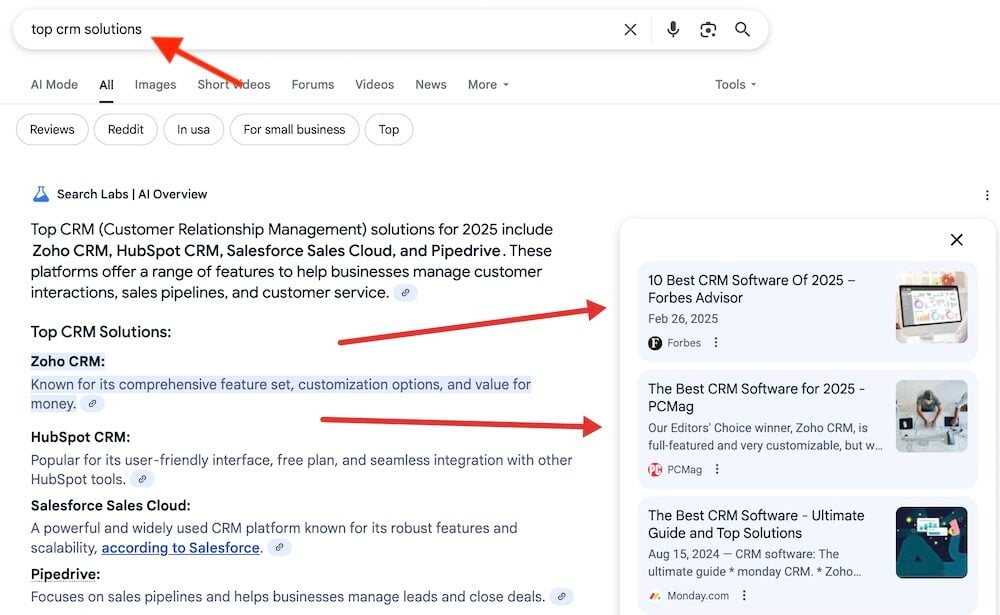
With the launch of AI answers, co-citation is critical because all AI platforms — AI Mode, ChatGPT, Gemini, others — heavily on lists for brand and product recommendations. For the search “best CRM solutions,” for example, AI Overviews cite five sources. All are lists.
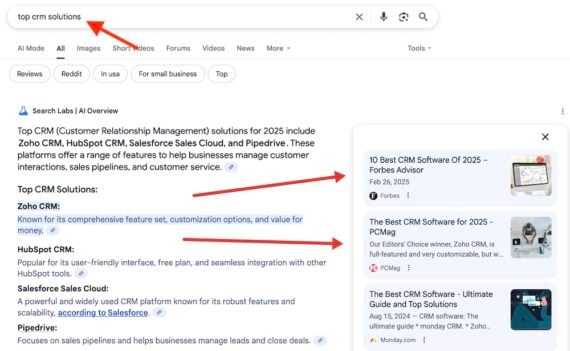
AI platforms rely on external lists for brand and product recommendations, such as this example of “top CRM solutions” in Google’s AI Overviews.
The sources do not have to link to their recommendations for large language models to cite them. Hence for AI optimization, co-occurrences (i.e., unlinked mentions) are as important as co-citations (e.g., linked mentions).
The less your brand appears on external websites, the lower its visibility in AI answers (and search). And the brands most commonly listed alongside yours — linked or not — define its relevance and visibility.
Search engines and LLMs may source different sites. Gauge your site’s visibility by finding, say, 20 listicles that reference your competitors. Check:
Organic search results,
Sources in AI Mode and AI Overviews,
References in ChatGPT.
Many of these may overlap. But examining 20 lists will reveal your business’s relative visibility.
Several tools can help identify co-citation opportunities.
InTheMix.ai
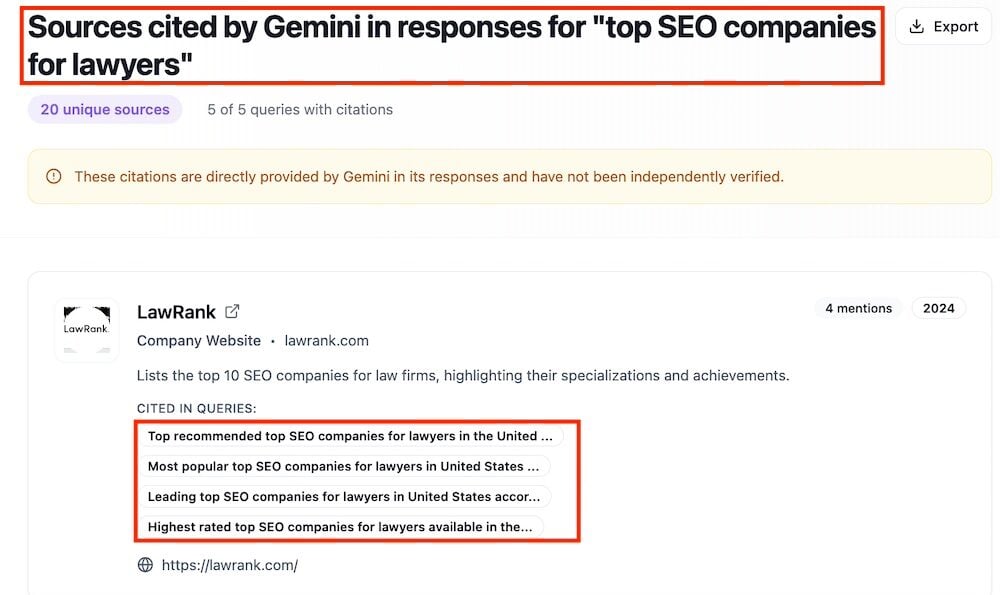
InTheMix.ai runs related prompts in Gemini based on an initial user-generated query, analyzes the answers, and lists the sources in them. The tool, which is free, displays the number of answers for each URL (to identify the most popular).
InTheMix.ai runs prompts in Gemini and displays the number of answers for each source.
Otterly.ai
Otterly.ai is a premium tool (with a free trial) that pulls citations for any prompt from Google’s AI Overviews, ChatGPT, and Perplexity. It also provides weekly tracking of those citations to discover opportunities.
Otterly.ai pulls citations for any prompt from Google’s AI Overviews, ChatGPT, and Perplexity.
Reddit
Reddit, a top-cited source in Google and ChatGPT, is handy for researching citations of your business or competitors to know which subreddits mention your brand and competitors in the same threads.
AI Brand Rank displays citations on multiple platforms, including Reddit, shown here for mentions of “Udemy.”
Gauge Visibility
Access top platforms to compare mentions of your business or product with those of competitors. This will provide insight into your brand’s visibility in AI training data.
Google announced a new multi-vector retrieval algorithm called MUVERA that speeds up retrieval and ranking, and improves accuracy. The algorithm can be used for search, recommender systems (like YouTube), and for natural language processing (NLP).
Although the announcement did not explicitly say that it is being used in search, the research paper makes it clear that MUVERA enables efficient multi-vector retrieval at web scale, particularly by making it compatible with existing infrastructure (via MIPS) and reducing latency and memory footprint.
Vector Embedding In Search
Vector embedding is a multidimensional representation of the relationships between words, topics and phrases. It enables machines to understand similarity through patterns such as words that appear within the same context or phrases that mean the same things. Words and phrases that are related occupy spaces that are closer to each other.
The words “King Lear” will be close to the phrase “Shakespeare tragedy.”
The words “A Midsummer Night’s Dream” will occupy a space close to “Shakespeare comedy.”
Both “King Lear” and “A Midsummer Night’s Dream” will be located in a space close to Shakespeare.
The distances between words, phrases and concepts (technically a mathematical similarity measure) define how closely related each one is to the other. These patterns enable a machine to infer similarities between them.
MUVERA Solves Inherent Problem Of Multi-Vector Embeddings
The MUVERA research paper states that neural embeddings have been a feature of information retrieval for ten years and cites the ColBERT multi-vector model research paper from 2020 as a breakthrough but that says that it suffers from a bottleneck that makes it less than ideal.
“Recently, beginning with the landmark ColBERT paper, multi-vector models, which produce a set of embedding per data point, have achieved markedly superior performance for IR tasks. Unfortunately, using these models for IR is computationally expensive due to the increased complexity of multi-vector retrieval and scoring.”
Google’s announcement of MUVERA echoes those downsides:
“… recent advances, particularly the introduction of multi-vector models like ColBERT, have demonstrated significantly improved performance in IR tasks. While this multi-vector approach boosts accuracy and enables retrieving more relevant documents, it introduces substantial computational challenges. In particular, the increased number of embeddings and the complexity of multi-vector similarity scoring make retrieval significantly more expensive.”
Could Be A Successor To Google’s RankEmbed Technology?
The United States Department of Justice (DOJ) antitrust lawsuit resulted in testimony that revealed that one of the signals used to create the search engine results pages (SERPs) is called RankEmbed, which was described like this:
“RankEmbed is a dual encoder model that embeds both query and document into embedding space. Embedding space considers semantic properties of query and document in addition to other signals. Retrieval and ranking are then a dot product (distance measure in the embedding space)… Extremely fast; high quality on common queries but can perform poorly for tail queries…”
MUVERA is a technical advancement that addresses the performance and scaling limitations of multi-vector systems, which themselves are a step beyond dual-encoder models (like RankEmbed), providing greater semantic depth and handling of tail query performance.
The breakthrough is a technique called Fixed Dimensional Encoding (FDE), which divides the embedding space into sections and combines the vectors that fall into each section to create a single, fixed-length vector, making it faster to search than comparing multiple vectors. This allows multi-vector models to be used efficiently at scale, improving retrieval speed without sacrificing the accuracy that comes from richer semantic representation.
According to the announcement:
“Unlike single-vector embeddings, multi-vector models represent each data point with a set of embeddings, and leverage more sophisticated similarity functions that can capture richer relationships between datapoints.
While this multi-vector approach boosts accuracy and enables retrieving more relevant documents, it introduces substantial computational challenges. In particular, the increased number of embeddings and the complexity of multi-vector similarity scoring make retrieval significantly more expensive.
In ‘MUVERA: Multi-Vector Retrieval via Fixed Dimensional Encodings’, we introduce a novel multi-vector retrieval algorithm designed to bridge the efficiency gap between single- and multi-vector retrieval.
…This new approach allows us to leverage the highly-optimized MIPS algorithms to retrieve an initial set of candidates that can then be re-ranked with the exact multi-vector similarity, thereby enabling efficient multi-vector retrieval without sacrificing accuracy.”
Multi-vector models can provide more accurate answers than dual-encoder models but this accuracy comes at the cost of intensive compute demands. MUVERA solves the complexity issues of multi-vector models, thereby creating a way to achieve greater accuracy of multi-vector approaches without the the high computing demands.
What Does This Mean For SEO?
MUVERA shows how modern search ranking increasingly depends on similarity judgments rather than old-fashioned keyword signals that SEO tools and SEOs are often focused on. SEOs and publishers may wish to shift their attention from exact phrase matching toward aligning with the overall context and intent of the query. For example, when someone searches for “corduroy jackets men’s medium,” a system using MUVERA-like retrieval is more likely to rank pages that actually offer those products, not pages that simply mention “corduroy jackets” and include the word “medium” in an attempt to match the query.
The travel and tourism industry thrives on inspiration, discovery, and experience. While increasingly being challenged by social media and friend & family referrals, the first point of discovery for many travelers is still a search engine.
For operators in this competitive sector, ranging from boutique hotels and niche tour providers to vacation rental property owners and managers, as well as local attractions, a commanding online presence isn’t just beneficial – it’s fundamental to survival and growth.
This is where Local SEO emerges as a critical driver, connecting businesses with high-intent travelers actively seeking their next destination or experience.
As the search journey includes more AI-driven results, a sophisticated and adaptive Local SEO strategy is crucial.
This guide will navigate the essentials of Local SEO tailored for travel and tourism, incorporating strategies to thrive in the era of Google’s AI Overviews and other AI search platforms.
We’ll explore established best practices and new frontiers to help you enhance visibility, attract qualified leads, and convert searches into bookings.
Why Local SEO Is Non-Negotiable For Your Travel Business
Today’s travelers are digital nomads even before they pack their bags. They meticulously research, compare, and seek out authentic local experiences, with search engines as their primary guide.
A staggering 87% of consumers used Google to evaluate local businesses in 2022, according to BrightLocal, and this trend is particularly pronounced in the travel sector.
A robust Local SEO strategy ensures your offerings are prominent when potential customers conduct geographically specific searches. Consider these compelling reasons:
Hyper-Targeted Visibility
Local SEO puts your business in front of users searching for “boutique hotels in downtown Austin” or “eco-tours near me,” connecting you with an audience demonstrating clear local intent.
Increased Organic Traffic & Direct Bookings
Higher visibility in local search translates to more qualified traffic to your website, reducing reliance on commission-heavy Online Travel Agencies (OTAs).
Enhanced Credibility And Trust
Businesses appearing in top local search results, especially those with strong reviews, are perceived as more trustworthy. Indeed, according to Expedia group, studies show that 95% of travelers read reviews before booking
Competitive Edge
In a crowded marketplace, a sophisticated Local SEO strategy will differentiate your unique local offerings from larger, and perhaps less localized competitors.
Cost-Effectiveness
Compared to paid advertising, organic Local SEO can deliver a higher return on investment (ROI) over the long term by building sustainable visibility.
Building A Future-Proof Local SEO Strategy For Travel
To maximize visibility and capture the attention of modern travelers, operators must build their SEO strategy on several key pillars:
An Optimized Google Business Profile (GBP)
For businesses with a physical presence or those catering to broader service areas, a Google Business Profile is arguably the most potent Local SEO tool currently available.
It’s often the first interaction a potential customer has with a brand online, as Google Maps appears at the top of most local searches.
Here are the key GBP best practices you need to implement to leverage this important channel.
NAP Optimization: Claim and thoroughly complete your GBP listing. Ensure the accuracy of your business Name, Address (or service area), Phone number (NAP), website, hours, and a compelling, keyword-rich description.
Precise Categorization: Select the most accurate primary and secondary categories truly reflecting your business’s services, e.g., “Boutique Hotel,” “Adventure Tour Operator,” “Vacation Rental Agency.”
Service Area Definition: For businesses without a fixed customer-facing location (like tour operators) or those serving a broader region, accurately define your service areas. Google advises that this shouldn’t exceed a 2-hour drive from your base. If you serve an area beyond this 2-hour range, you will need to find ways to convince Google via reviews from customers located in the broader area, local partnerships, or perhaps establishing an actual satellite location.
Visual Storytelling: Invest in and share professional, high-resolution photos and videos of your business, properties, tours, amenities, local ambiance, guest experiences, team, etc.
Active Engagement via GBP Posts: Regularly use GBP posts to share updates, special offers, upcoming events, new blog content, and local insights. This signals to Google that your business is active and engaged in your community.
Review Management: Ask for and monitor customer reviews on GBP. Respond promptly and professionally to all reviews. This not only impacts rankings, but can also heavily influence booking decisions – 76% of consumers would update their negative review to a neutral or positive if a company acknowledged and fixed the complaint. Larger organizations with review volume across multiple locations will want to consider centralized and automated review management solutions such as BirdEye or BrightLocal.
Proactive Q&A Management: Monitor and answer questions in the GBP Q&A section to provide valuable information and manage customer perceptions.
Maintain A High-Performance, Locally Optimized Website
Your website is your digital flagship, where inspiration meets transaction.
Websites remain a core focus for all businesses because they are still the place where primary product and service content is housed, as well as for travel businesses where bookings begin, even if they are ultimately completed off-site.
Several components are involved in optimizing a site for local search.
Strategic Keyword Research
Identify terms your target audience uses at each stage of the travel planning funnel, and particularly those used during the Engage and Booking stages.
Focus on location-specific queries (“luxury safari tours Kenya”), property types (“beachfront villas Maui”), and unique selling propositions (“pet-friendly cabins in the Blue Ridge Mountains”).
On-Page Optimization
Craft unique, keyword-rich Title tags, hierarchical heading structures, and internal/external links for every key bottom-of-the-funnel page.
Review keyword rank, search volume, organic search traffic, and conversion data to determine the primary pages to focus on.
Larger organizations will want to take a broader, scalable approach with page templates, but will still hone attention and focus on key locations where some level of authority and visibility has already been established, upon which momentum can be built.
These pages should include unique localized content (particularly if services or products differ by location), local team information, testimonials, contact details, and embedded Google Maps.
Image & Video Optimization
Use descriptive filenames and alt text for all visuals, incorporating relevant keywords and location data, where applicable.
Optimize image file sizes for fast loading (the WebP format is recommended) without compromising quality. This is admittedly a challenge for many in the travel space as images and video can make or break a property, tour, or experience listing.
Mobile-Friendly Design
With a significant portion of travel searches and bookings occurring on mobile (mobile devices made up 70.5% of global online travel traffic in 2024), a responsive, fast-loading website is critical.
Furthermore, site speed is a recognized ranking factor, for which tools like Google PageSpeed Insights and Core Web Vitals are available to gauge and diagnose potential bottlenecks.
Schema helps search engines (and AI models) understand your content contextually.
Relevant, comprehensive structured data will improve your content’s eligibility for rich snippets and AI Overviews in Google, which are showing up in organic search results with increasing regularity across travel and all industries.
User Experience (UX) And Accessibility
A seamless UX with intuitive navigation, clear calls-to-action, and an easy booking process directly impacts conversion rates.
Building Authority With Off-Page SEO And Reputation Management
Off-page signals from relevant local and/or industry-specific sources significantly influence your local ranking and perceived trustworthiness.
Brand mentions, whether linked or not, are being recognized as an important factor in AI Search visibility.
Businesses looking to boost their local visibility need to consider their broad web presence, in addition to the content they control on their website and GBP.
NAP Consistency & Local Citations: Ensure your Name, Address, and Phone number (NAP) are identical across all online directories (e.g., Yelp, TripAdvisor, local tourism sites). Inconsistent NAP can harm rankings. Larger operators with multiple locations will want to consider implementing a centralized Listings Management tool like SOCi or Yext.
Strategic Link Building: Earn and obtain high-quality backlinks from relevant local organizations (tourism boards, chambers of commerce), travel blogs, local press, and complementary businesses.
Local Partnerships & Community Engagement: Collaborate with nearby businesses (restaurants, activity providers, event organizers) for cross-promotion and local link opportunities. Sponsoring and/or physically participating in local events can also help build visibility and relevant local links.
Local Influencer Collaboration: Partner with local travel and lifestyle influencers to tap into their engaged audiences with relevant content and messaging, thereby gaining authentic, local endorsements. These types of collaborations generally take time to establish and build trust, but can reap significant benefits by tapping into a loyal, local customer base.
Content Marketing: The Engine Of Local SEO And AI Visibility
Audience-Centric Content Strategy: Understand your ideal traveler and their journey. Create content that inspires, informs, and facilitates booking.
Hyperlocal & Unique Storytelling: Develop blog posts, guides, videos, and itineraries highlighting your unique offerings and deep knowledge of the local area. Focus on what makes your experience or destination special, sharing authentic stories and insider tips.
Answer Questions Directly: Create content, including dedicated FAQ sections, and directly answer common traveler queries. Incorporate a Question and Answer schema to clearly call out this content for search and LLM crawlers. This is vital for appearing in Google’s AI Overviews and being useful to other AI chatbots.
Diverse Content Formats: Utilize blog articles, high-resolution photo galleries, engaging videos (destination spotlights, property tours, guest testimonials), interactive maps, and downloadable guides. Short-form video is highly effective on social media.
Content Promotion: Share your content strategically via GBP, social media, email marketing, and local partnerships to maximize its reach and opportunity to be shared further.
Thriving In The Era Of AI Overviews And AI Search
We can’t have an SEO conversation today, Local or otherwise, without considering the impact of AI on search.
Google’s AI Overviews and other AI tools like Perplexity and ChatGPT are changing how users find information.
In a recent Whitespark study, it was determined that AI Overviews are appearing for a significant 68% of local business-type searches.
To optimize for this new paradigm at a local level, there are a few things to consider, some of which you’ll note are in line with the SEO recommendations made above:
Prioritize E-E-A-T (Experience, Expertise, Authoritativeness, Trustworthiness): AI models, especially Google’s, are designed to prioritize information from sources that demonstrate the four qualities of E-E-A-T. Ensure your content is accurate, well-researched, or proprietary, written by experts (or showcases expertise), and your website projects credibility.
Create Comprehensive, Factual, and Well-Structured Content: AI loves well-organized information. Use clear headings, bullet points, and ensure your content thoroughly covers a topic, directly answering common questions. This makes it easier for AI to parse and use your information for generating and displaying summaries.
Optimize for Conversational & Question-Based Queries: Think about how users ask questions about your business, products, or services verbally or in natural language. Structure content around these queries (e.g., “What are the best family-friendly hotels in Orlando with a water park?”).
Reinforce Entity Recognition: Ensure clear and consistent information about your business (your “entity”) across the web – your name, what you do, where you’re located, and unique offerings.
Structured Data Matters Even More: As mentioned, schema markup helps search engines and AI Large Language Models (LLMs) understand the specifics of your content (business, products, etc), thereby improving its ability to be accurately represented in AI-generated results.
Ensure Broad Web Presence and Citations: AI models like Perplexity cite their sources. Being mentioned and linked to from other authoritative travel sites, blogs, and news outlets can increase your chances of being referenced.
Monitor Your Appearance in AI Search: While direct tracking in AI Overviews and other AI search platforms is still in development, consider leveraging new third-party tools and conducting manual checks to determine if and how your business or content is appearing in AI-generated responses for relevant queries.
Track, Analyze, And Adapt
Any worthwhile and effective Local SEO effort is backed by data.
Use Google Analytics, Google Search Console, and other SEO tools to monitor key metrics, including organic traffic, keyword rankings (especially local), Google Business Profile insights (views, clicks, calls, direction requests), conversion rates, and referral traffic from local sources.
This data will be key to helping you continually refine your strategy as modern SEO (and now GEO or AEO) is a moving target.
The Future Is Local And AI-Enhanced
Local SEO is no longer a niche tactic, but a foundational element of a successful digital marketing strategy for any travel and tourism operator.
By focusing on providing genuine value to travelers, creating exceptional local experiences, and meticulously optimizing your online presence across all relevant platforms, you can attract more customers.
As AI continues to reshape search, the emphasis on high quality, authoritative, and clearly structured content, along with a broad-based, brand-forward web presence, becomes even more important.
Embrace the principles and tactics here, stay agile, and you’ll be well-positioned to navigate the evolving digital landscape and welcome more guests through your virtual and physical doors.
Google is testing a new feature that allows you to customize the Top Stories section in search results by selecting preferred news sources.
Currently available through Search Labs in the U.S. and India, the experiment gives people more influence over which publishers appear in their news-related queries.
How It Works
Those who opt into the experiment will see a new starred icon in the Top Stories carousel. Tapping it opens a menu where you can choose preferred publications.
Articles from selected sources will be more likely to appear in Top Stories when relevant. These entries will be marked with a star icon next to the site name, but they won’t replace Google’s algorithmic selections entirely.
Google may also display a secondary “From your sources” carousel beneath the main Top Stories section.
A Broader Shift Toward Personalization
The Preferred Sources feature builds on Google’s existing personalization tools, including the ability to highlight content users have frequently visited or show updates since their last search.
A “Try without personalization” option remains available at the bottom of search results, maintaining transparency and user control.
What This Means
For publishers, this change could offer increased visibility, especially for those with loyal audiences who choose them as preferred sources.
However, smaller or newer outlets may struggle to compete with established brands if user selections skew toward familiar names.
The experiment highlights the growing importance of brand recognition, direct audience relationships, and consistent content freshness.
Looking Ahead
This initiative is part of Google’s effort to balance algorithmic discovery with user-driven customization.
While it’s still an experiment, the move suggests Google is exploring ways to give users more say in how information surfaces, without fully abandoning its ranking systems.
If rolled out more broadly, the Preferred Sources feature could reshape strategies for publishers and marketers seeking consistent visibility in Google Search.
Google’s transformation into an AI-driven search platform represents more than just a technological advancement. It’s a fundamental shift in how the search giant views itself as a company and the value it provides to users.
Cindy Krum has spoken at several events this year about her theory that Google might merge AI Overviews, Discover, and international results to build the next-gen search engine.
The overview of Cindy’s thoughts is that Google is not only internationalizing its platform, but is also converging AI Overview, Google Discover, and AI Mode into a unified, hyper-personalized search experience.
This evolution aligns with Google’s broader push toward understanding search as “journeys” rather than static queries, underlined by MUM.
My theory is that the move into heavily personalized search journeys builds on the past 20 years that Google has been striving to be a personal assistant. AI has made that possible.
Cindy is the founder of MobileMoxie and is described as being “years ahead of the pack.” I spoke to her about the implications for SEO and what part of this shift to AI-organized search and journeys SEO professionals are underestimating right now.
You can watch the full interview with Cindy on IMHO below, or continue reading the article summary.
Predictive, Conversational, And Personalized
Cindy believes that, currently, there is a bigger shift than what some SEO professionals have been talking about: A fundamental shift in the way Google sees itself as a company and the way that it sees the value that it provides.
The real shift was in 2018, just after Google launched mobile-first indexing, when Google began organizing search results around entities. It said it wanted to be more predictive, more conversational, and more personalized.
According to Cindy, Google’s current AI initiatives aren’t new developments but rather the culmination of a strategy.
“Everything they’ve been doing since 2018 has been feeding this goal of getting us into this AI search reality,” she explains.
The AI Overviews, Google Discover expansion, and AI Mode we see today are direct results of this seven-year journey.
The Hidden Strategy Behind Google’s International Push
One of the most overlooked aspects of Google’s current transformation is its renewed attempt to consolidate international domains.
Google previously tried to eliminate country-specific versions (CCTLDs) before mobile-first indexing but had to roll back the initiative. Now, it is trying again, and the timing is significant.
“If you separate everything by country and language, you’re limiting your learning pipeline. You have smaller, fragmented datasets.” Cindy explains.
When you consolidate and abstract at the entity level, you can disambiguate meaning and link keywords to entity ideas across all languages. That speeds up the learning process.
Google can then apply what it learns in one language to another; we’re already seeing this with AI Overviews.
When it can’t find the right answer in a local language, it translates English content because it knows the English answer is probably also correct in other languages. This saves time and money on crawling, indexing, and ranking.
AI Mode Isn’t The Product. You Are
I asked Cindy if she thought Google might try to monetize AI Mode, but she believes Google’s strategy is more sophisticated.
“We can’t forget how Google makes money, it’s ads,” Cindy emphasizes. The real value lies in building comprehensive user profiles that enable precision ad targeting.
Google’s goal is to present ads only to users likely to convert, making its advertising platform more attractive to businesses while creating a seamless experience for users.
“They’re not monetizing AI Mode directly. They’re using it to collect data that allows them to monetize ads more effectively.”
This strategy extends to Performance Max campaigns on the paid search side, where Google controls optimization based on metrics it doesn’t trust advertisers to manage effectively.
Discovery Is Moving To TikTok, Reddit & Social
Despite Google’s technological advances, some users are losing trust in the quality of search results.
However, the solution isn’t abandoning Google but rather understanding how different platforms serve different purposes in the modern search ecosystem.
Cindy’s opinion is that Google is no longer the place where discovery happens.
Users increasingly conduct research across multiple platforms. TikTok for discovery, Reddit for authentic opinions, and eventually Google for final purchase decisions.
This multi-platform journey reflects a more sophisticated approach to information gathering and decision-making.
Cindy stresses the need to understand real branding, not just SEO branding or digital PR.
“To be able to influence the narrative in any kind of AI search result, you have to be actively influencing all those things,” she notes. “SEOs for years have been so focused on their website to the detriment of every other branding opportunity out there.”
Understanding Search Journeys
For SEO professionals looking to optimize for journeys rather than just keywords, Cindy recommends studying Google’s own navigation suggestions.
When performing searches, Google often displays additional navigation layers that reveal its understanding of user intent and likely next steps.
“This is where Google is kind of showing their cards and saying these are the queries that we expect you’re going to narrow down this query,” she explains.
By mapping these suggested pathways, SEO professionals can identify where their content fits into the user journey and where Google needs education about additional aspects of that journey.
If She Were Starting Today? TikTok
I asked Cindy if she were starting from the beginning now, what she would do and where she would invest, her immediate answer was TikTok.
She explains, “It’s where young audiences are, the algorithm promotes discovery, and content is repurposed across all other platforms. Importantly, it’s not just a fad; businesses are being built and scaled directly on TikTok.”
And while influencer saturation is real, Cindy sees TikTok as a smart, scrappy way to build awareness with a small budget and scale fast.
Preparing For The Future
The shift toward AI-organized search results and journey-based optimization requires a fundamental rethinking of digital marketing approaches.
Success in this new era of AI search demands understanding the complete customer journey, from initial discovery through final purchase, and ensuring brand presence at every touchpoint.
This includes active participation in the broader digital conversation about your industry, products, and services.
The future of search isn’t just about ranking higher; it’s about being present wherever your audience might encounter your brand throughout their decision-making journey.
“The future of search is understanding the entire journey, not just the keyword or the query.”
Thank you to Cindy Krum for offering her insights and being my guest on IMHO.
More Resources:
Featured Image: Shelley Walsh/Search Engine Journal
But why is it really that revolutionary? And how does it impact the way we approach search strategy going forward? You might already be “optimizing” for it and not even be aware!
That’s what we’re digging into today.
Plus: I’ve built an intent classifier tool for premium subscribers to help you group prompts and questions by user intent in seconds – coming later this week (still need to iron out a few kinks).
In this issue, we’ll cover:
What query fan-out is.
How it powers AI Mode, Deep Search, and conversational search.
Why optimizing for “one query, one answer” is no longer enough.
Tactical ways to align your content ecosystem with fan-out behavior.
Let’s get into it.
Image Credit: Kevin Indig
What Is Query Fan-Out And Why Are You Hearing So Much About It Right Now?
Query fan-out is how Google’s AI Mode takes a single search and expands it into many related questions behind the scenes.
It can pull in a wider range of content that might answer more of your true intent, not just your exact words.
You’re hearing about it now because Google’s new AI Overviews and “AI Mode” rely on this process, which could change what content shows up in “search” results.
Query fan-out isn’t just another marketing buzzword. It’s how AI Mode works.
It’s crucial to start understanding this concept because it’s very likely that AI Mode will become the default search experience over the next few years. (I expect it will be once Google figures out how to monetize it appropriately.)
This is why I think AI Mode could become the search standard:
On the Lex Fridman podcast, Sundar Pichai said AI Mode will slowly creep more into the main search experience:
Lex Fridman: “Do you see a trajectory in the possible future where AI Mode completely replaces the 10 blue links plus AI Overview?”
Sundar Pichai: “Our current plan is AI Mode is going to be there as a separate tab for people who really want to experience that, but it’s not yet at the level there, our main search pages. But as features work, we will keep migrating it to the main page, and so you can view it as a continuum.”
He also said that pointing at the web is a main design principle:
Lex Fridman: “And the idea that AI mode will still take you to the web to human-created web?”
Sundar Pichai: “Yes, that’s going to be a core design principle for us.”
However, if AI Overviews are any indication, you shouldn’t expect much traffic to come through AI Mode results. CTR losses can top 50%.
And according to Semrush and Ahrefs, ~15% of queries show AI Overviews.
But the actual number is likely much higher, since we’re not accounting for the ultra-long-tail, conversational-style prompts that searchers are using more and more.
Even though AI Mode covers only a bit over 1% of queries right now – as mentioned in The New Normal – it’s likely going to be the natural extension of every AI Overview.
Understanding Query Fan-Out To Better Optimize Your Content Just Makes Sense
Important note here: I don’t want to pretend that I know how to “optimize” for query fan-out.
And query fan-out is a concept, not a practice or tactic for optimization.
With that in mind, understanding how query fan-out works is important because people are using longer prompts to conversationally search.
And therefore, in conversational search, a single prompt covers many user intents.
Deep Search performs tens to hundreds of searches to compile a report. I’ve tried prompts for purchase decisions. When I asked for “the best hybrid family car with 7 seats in the price range of $50,000 to $80,000”, Deep Research browsed through 41 search results and reasoned its way through the content. […]
The report took 10 minutes to put together but probably saved a human hours of research and at least 41 clicks. Clicks that could’ve gone to Google ads.
In my search for a hybrid family car, the Deep Search function understood multiple search journeys, multiple intents, and synthesized what would have been multiple pages of classic SEO results into one piece of content.
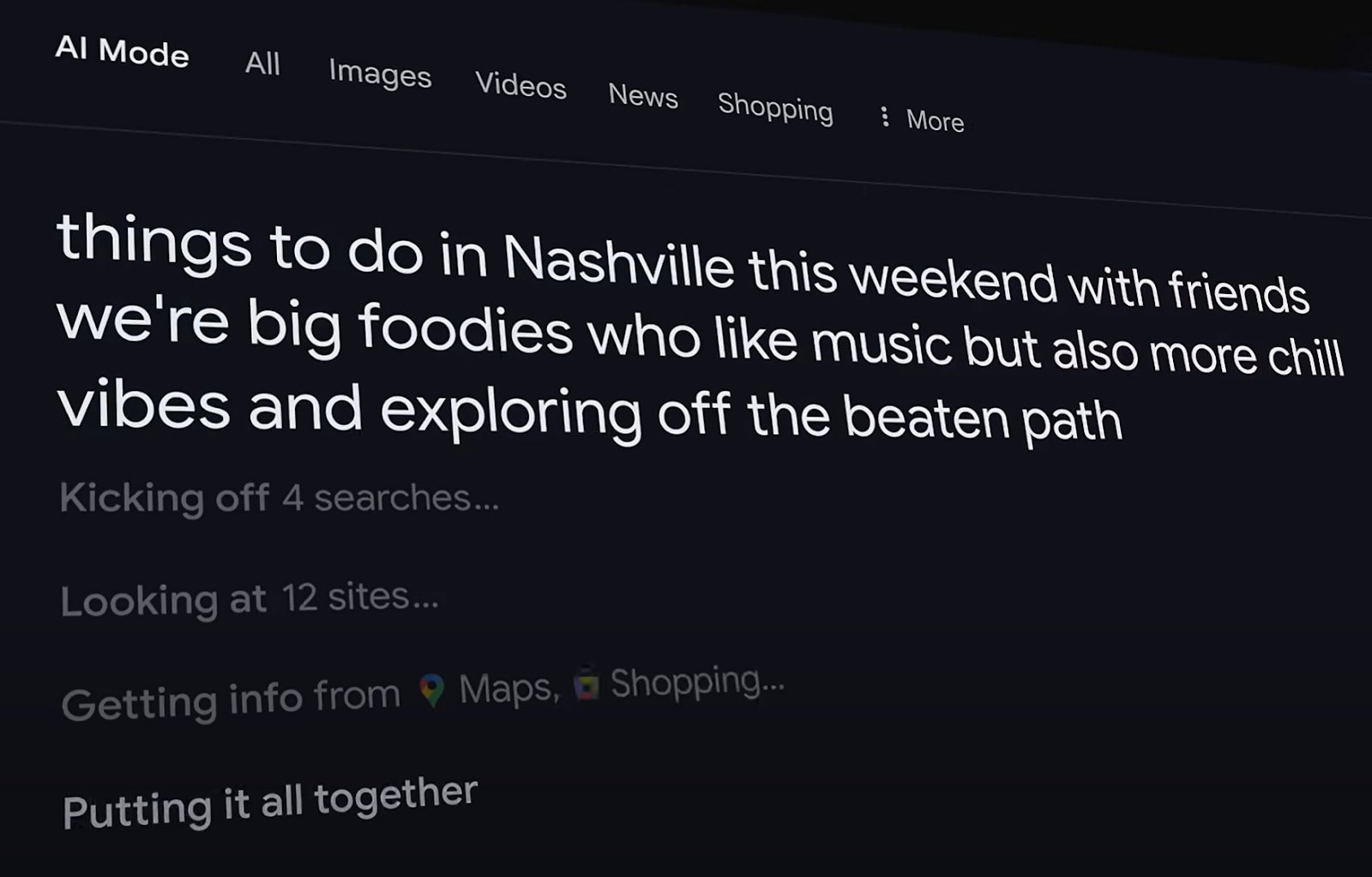
And check out this example from Google’s own marketing material:
Image Credit: Kevin Indig
This Deep Search kicked off four searches, but I’ve seen examples of 30 and more.
This is exactly why understanding query fan-out is important.
AI-based conversational search is no longer matching a single query to a single result.
It’s fanning out into dozens of related searches, intents, and content types to synthesize an answer that bypasses traditional SEO pathways entirely.
In classic Search, Google returns one ranked list for a query. In AI Mode, Gemini explodes your prompt into a swarm of sub-queries – each aimed at a different facet of what you might really care about. Example: “Best sneakers for walking” turns into best sneakers for men, walking shoes for trails, shoes for humid weather, sock-liner durability in walking shoes, and so on.
Those sub-queries fire simultaneously into the live web index, the Knowledge Graph, Shopping graph, Maps, YouTube, etc. The system is basically running a distributed computing job on your behalf.
Instead of treating a web page as one big answer, AI Mode lifts the most relevant passages, tables, or images from each source. Think “needle-picking” rather than “stack-ranking.” So, rather than a search engine saying “this whole page is the best match,” it’s more like “this sentence from site A, that chart from site B, and this paragraph from site C” are the most relevant parts.
Google keeps a running “session memory” – a user embedding distilled from your past searches, location, and preferences. That vector nudges which sub-queries get generated and how answers are framed.
If the first batch doesn’t fill every gap, the model loops and issues more granular sub-queries, pulls new passages, and stitches them into the draft until coverage looks complete. All this in a few seconds.
Finally, Gemini fuses everything into one answer and matches it to citations. Deep Search (“AI Mode on steroids”) can run hundreds of these sub-queries and spit out a fully cited report in minutes.
Keep in mind, entities are the backbone of how Google understands and expands meaning. And they’re central to how query fan out works.
Take a query like “how to reduce anxiety naturally.” Google doesn’t just match this phrase to pages with that exact wording.
Instead, it identifies entities like “anxiety,” “natural remedies,” “sleep,” “exercise,” and “diet.”
From there, query fan-out kicks in and might generate related sub-queries, refining based on prior searches of the user:
“Does magnesium help with anxiety?”
“Breathing techniques for stress”
“Best herbal teas for calming nerves”
“How sleep affects anxiety levels”
These aren’t just keyword rewrites. They’re semantically and contextually related ideas built from known entities and their relationships.
So, if your content doesn’t go beyond the primary query to cover supporting entity relationships, you risk being invisible in the new AI-driven SERP.
Entity coverage is what enables your content to show up across that full semantic spread.
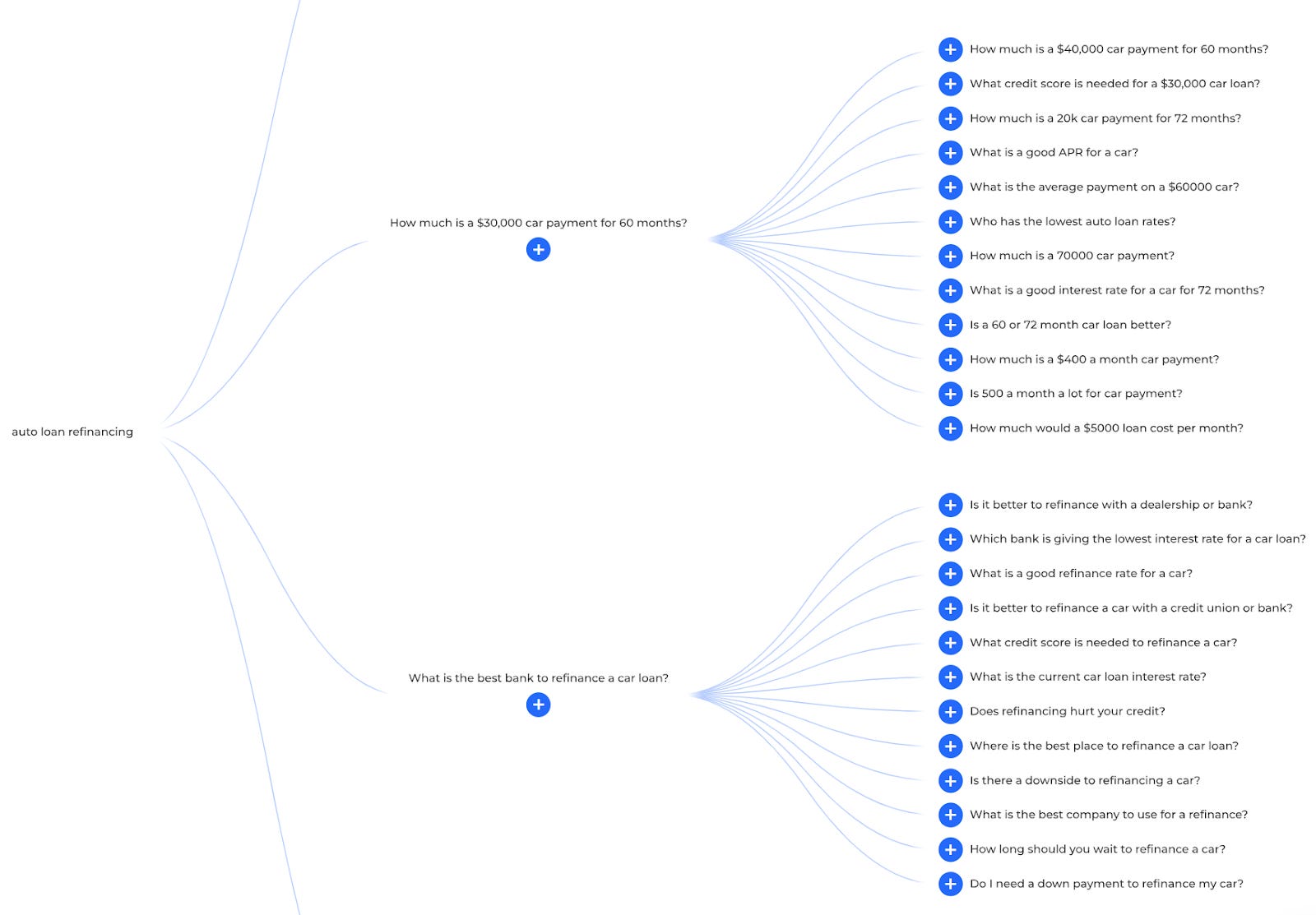
Here’s a good way to visualize this is the relationship between questions, topics, and entity expansion (from alsoasked.com):
Image Credit: Kevin Indig
If this all reminds you strongly of the concept of user intent, your instincts are well-tuned.
Even though query fan-out sounds cool and looks innovative, there is little difference to how we should already be targeting topics instead of keywords via entity-rich content. (And we all should’ve been doing this for a while now.)
Interjection from Amanda here: I’d argue that this kind of process (or a similar one) has been going on behind the scenes in classic SEO results for a while … although, unfortunately, I don’t have concrete proof. Just strong pattern recognition from spending way too much time in the SERPs testing things out. 😆
Back in 2018-2019, I noticed this pattern happening often with in-depth, entity-rich content pieces ranking – and performing well – for multiple related intents in search. The more entity-rich a content piece was, and the more the content tackled the “next natural need” of the searcher, the more engagement + dwell time increased while also concluding the search journey…
And the more the content did those things, the more the content was visible to our target audience in classic rankings … and the longer it held that visibility or ranking despite algorithm changes or competitor content updates.
Implementable SEO Moves Related To Query Fan-Out Mechanics
When you keep query fan-out in mind, there are a few practical steps you can take to shape your content and optimization work more effectively.
But before you give it a scan, I need to reiterate what was mentioned earlier: I’m not going to claim I have a clear-cut way to “optimize” for Google’s AI Mode query fan-out process – it’s just too new.
Instead, this list will help you optimize your content ecosystem to fully address the multifaceted needs behind your target user’s search goal.
Because optimizing for conversational search starts with one simple shift: addressing searcher needs from multiple angles and making sure they can find those multiple angles across your site … not just one query at a time.
1. Passage-first authoring.
Write in 40-60-word blocks, each answering one micro-question.
Lead with the answer, then detail – mirrors how AI selects snippets.
2. Semantically-rich headings.
Avoid generic headings and subheadings (“Overview”). Embed entities and modifiers the AI may spin into sub-queries (e.g., “Battery life of EV SUVs in winter”).
3. Outbound credibility hooks.
Cite peer-reviewed, governmental, or high-authority sources; Google’s LLM favors passages that have citations and sources for grounding claims.
4. Clustered architecture.
Build hub pages that summarize and deep-link to spokes. Fan-out often surfaces mixed-depth URLs; tight clusters raise the odds that a sibling page is chosen.
5. Contextual jump links (“fraggles” or “anchor links”).
For long-form, use internal jump links within body copy, not just in the TOC. These help LLMs and search bots zero in on the most relevant entities, sections, and micro-answers across the page. They also improve UX. (Credit to Cindy Krum’s “fraggles” concept.)
6. Freshness pings.
Update time-sensitive stats often. Even a minor line edit plus a new date encourages recrawl and qualifies the page for “live web” sub-queries.
How To Optimize For Intent Coverage – A Key Component Of Query Fan-Out
Google’s AI Mode and the query fan-out process mirror how humans think – breaking a question into parts and piecing together the best information to solve a need.
People don’t search in a silo – when they search, they’re searching from a perspective, a history, and with emotions and multiple questions/concerns attached.
But as an industry, we have long focused on single queries, intents, or topic clusters to guide our optimization. Sure, this is useful, but it’s a narrow lens.
And it overlooks the bigger picture: Optimizing your content ecosystem to fully address the broader, multi-faceted needs behind a person’s goal.
We know Google’s AI Mode draws from:
Related queries.
Related user intents.
Related and connected entities.
Reformatting/rephrasing of the prompt.
Comparison.
Personalization: Search history, emails, etc.
So, here’s my step-by-step (unproven) concept:
Prompts are questions.
But just covering questions is not enough, we need to create content for their underlying user intent.
If we can classify a large number of questions around a topic, we can increase our chances of being visible when AI Mode fans out.
Here’s a step-by-step guide:
Collect questions for a topic from:
Customer interviews (the best source, in my experience).
Group your collection of questions by user intents.
Match each intent to a piece of content or specific passage on your site.
Use search tools and test actual conversations with LLMs to see who ranks at the top for the intent.
Compare your content/passage against the top-referred content pieces.
Ensure your content is entity-rich and includes those sweet, sweet information gainz.
Not only do paid subscribers get more content, more data, and more insights, but they also get the intent classifier tool I built to help save you some time on this work I’ve listed out above (coming to premium subscribers later this week).
If you’ve been doing SEO pre-AI-search era, it’s likely you’ve already been doing some version of this work.
The key thing to remember is to group questions and queries by intent – and optimize for intents across your core topics.
Think through what would’ve been a “search journey” or “content journey” for your user in classic search, and recognize that’s now happening all at once in one chat session.
The biggest mindset shift you’ll likely need to make is thinking about queries as prompts vs. searches.
And those prompts? They’re inputted by users in a variety of ways or semantic structures. That’s why an understanding of entities plays a key part.
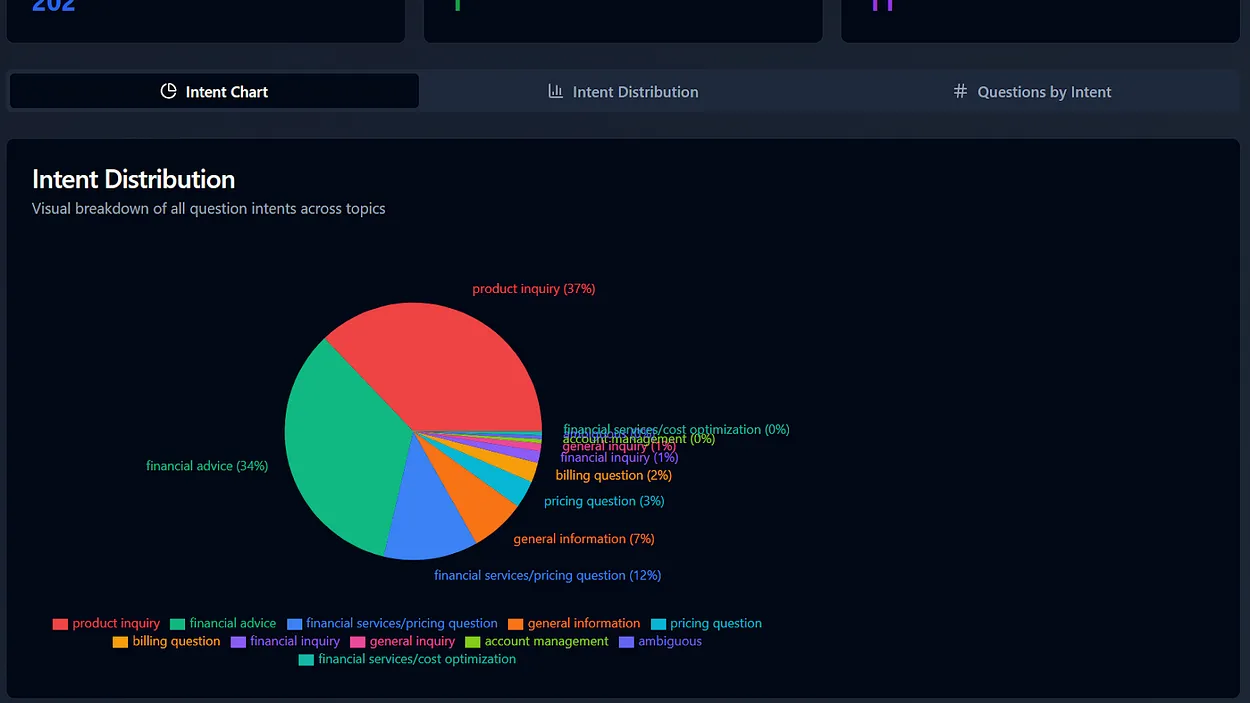
But before you jump, I need to emphasize a core factor to creating content with query fan-out in mind: Make sure you do the work to take your collected questions that you plan on targeting and group them by intent.
This is a crucial first step.
To help you do that, I’ve created an intent classifier tool that premium subscribers will get in their inbox later this week. It’s simple to use, and you can drop your collected list of questions to group by intent in a matter of minutes.
Featured Image: Paulo Bobita/Search Engine Journal
This post was sponsored by InMotion Hosting. The opinions expressed in this article are the sponsor’s own.
We’ve all felt it, that sinking feeling in your stomach when your site starts crawling instead of sprinting.
Page speed reports start flashing red. Search Console is flooding your inbox with errors.
You know it’s time for better hosting, but here’s the thing: moving a large website without tanking your SEO is like trying to change tires while your car is still moving.
We’ve seen too many migrations go sideways, which is why we put together this guide.
Let’s walk through a migration plan that works. One that’ll future-proof your site without disrupting your rankings or overburdening your team.
Step 1: Set Your Performance Goals & Audit Your Environment
Establish Performance Benchmarks
Before you touch a single line of code, you need benchmarks. Think of these as your “before” pictures in a website makeover.
If you skip this step, you’ll regret it later. How will you know if your migration was successful if you don’t know where you started?
Gather your current page speed numbers, uptime percentages, and server response times. These will serve as proof that the migration was worth it.
Document Current Site Architecture
Next, let’s identify what’s working for your site and what’s holding it back. Keep a detailed record of your current setup, including your content management system (CMS), plugins, traffic patterns, and peak periods.
Large sites often have unusual, hidden connections that only reveal themselves at the worst possible moments during migrations. Trust us, documenting this now prevents those 2 AM panic attacks later.
Define Your Website Migration Goals
Let’s get specific about what success looks like. Saying “we want the site to be faster” is like saying “we want more leads.” It sounds great, but how do you measure it?
Aim for concrete targets, such as:
Load times under 2 seconds on key pages (we like to focus on product pages first).
99.99% uptime guarantees (because every minute of downtime is money down the drain).
Server response times under 200ms.
30% better crawl efficiency (so Google sees your content updates).
We recommend running tests with Google Lighthouse and GTmetrix at different times of day. You’d be surprised how performance can vary between your morning coffee and afternoon slump.
Your top money-making pages deserve special attention during migration, so keep tabs on those.
Step 2: Choose The Right Hosting Fit
Not all hosting options can handle the big leagues.
We’ve seen too many migrations fail because someone picked a hosting plan better suited for a personal blog than an enterprise website.
Match Your Needs To Solutions
Let’s break down what we’ve found works best.
Managed VPS is excellent for medium-sized sites. If you’re receiving 100,000 to 500,000 monthly visitors, this might be your sweet spot. You’ll have the control you need without the overkill.
Dedicated servers are what we recommend for the major players. If you’re handling millions of visitors or running complex applications, this is for you.
What we appreciate about dedicated resources is that they eliminate the “noisy neighbor” problem, where someone else’s traffic spike can tank your performance. Enterprise sites on dedicated servers load 40-60% faster and rarely experience those resource-related outages.
WordPress-optimized hosting is ideal if you’re running WordPress. These environments come pre-tuned with built-in caching and auto-updates. Why reinvent the wheel, right?
Understand The Must-Have Features Checklist
Let’s talk about what your web hosting will need for SEO success.
NVMe SSDs are non-negotiable these days. They’re about six times faster than regular storage for database work, and you’ll feel the difference immediately.
A good CDN is essential if you want visitors from different regions to have the same snappy experience. Server-level caching makes a huge difference, as it reduces processing work and speeds up repeat visits and search crawls.
Image created by InMotion Hosting, June 2025
Staging environments aren’t optional for big migrations. They’re your safety net. Keep in mind that emergency fixes can cost significantly more than setting up staging beforehand.
And please ensure you have 24/7 migration support from actual humans. Not chatbots, real engineers who answer the phone when things go sideways at midnight.
Key Considerations for Growth
Think about where your site is headed, not just where it is now.
Are you launching in new markets? Planning a big PR push? Your hosting should handle growth without making you migrate again six months later.
One thing that often gets overlooked: redirect limits. Many platforms cap at 50,000-100,000 redirects, which sounds like a lot until you’re migrating a massive product catalog.
Step 3: Prep for Migration – The Critical Steps
Preparation separates smooth migrations from disasters. This phase makes or breaks your project.
Build Your Backup Strategy
First things first: backups, backups, backups. We’re talking complete copies of both files and databases.
Don’t dump everything into one giant folder labeled “Site Stuff.” Organizing backups by date and type. Include the entire file system, database exports, configuration files, SSL certificates, and everything else.
Here’s a common mistake we often see: not testing the restore process before migration day. A backup you can’t restore is wasted server space. Always conduct a test restore on a separate server to ensure everything works as expected.
Set Up the New Environment and Test in Staging
Your new hosting environment should closely mirror your production environment. Match PHP versions, database settings, security rules, everything. This isn’t the time to upgrade seven different things at once (we’ve seen that mistake before).
Run thorough pre-launch tests on staging. Check site speed on different page types. Pull out your phone and verify that the mobile display works.
Use Google’s testing tools to confirm that your structured data remains intact. The goal is no surprises on launch day.
Map Out DNS Cutover and Minimize TTL for a Quick Switch
DNS strategy might sound boring, but it can make or break your downtime window.
Here’s what works: reduce your TTL to at least 300 seconds (5 minutes) about 48 hours before migration. This makes DNS changes propagate quickly when you flip the switch.
Have all your DNS records prepared in advance: A records, CNAMEs for subdomains, MX records for email, and TXT records for verification. Keep a checklist and highlight the mission-critical ones that would cause panic if forgotten.
Freeze Non-Essential Site Updates Before Migration
This might be controversial, but we’re advocates for freezing all content and development changes for at least 48 hours before migration.
The last thing you need is someone publishing a new blog post right as you’re moving servers.
You can use this freeze time for team education. It’s a perfect moment to run workshops on technical SEO or explain how site speed affects rankings. Turn downtime into learning time.
Step 4: Go-Live Without the Guesswork
Migration day! This is where all your planning pays off, or where you realize what you forgot.
Launch Timing Is Everything
Choose your timing carefully. You should aim for when traffic is typically lowest.
For global sites, consider the “follow-the-sun” approach. This means migrating region by region during their lowest traffic hours. While it takes longer, it dramatically reduces risk.
Coordinate Your Teams
Clear communication is everything. Everyone should know exactly what they’re doing and when.
Define clear go/no-go decision points. Who makes the call if something looks off? What’s the threshold for rolling back vs. pushing through?
Having these conversations before you’re in the middle of a migration saves a ton of stress.
Live Performance Monitoring
Once you flip the switch, monitoring becomes your best friend. Here are the key items to monitor:
Watch site speed across different page types and locations.
Set up email alerts for crawl errors in Search Console.
Monitor 404 error rates and redirect performance.
Sudden spikes in 404 errors or drops in speed need immediate attention. They’re usually signs that something didn’t migrate correctly.
The faster you catch these issues, the less impact they’ll have on your rankings.
Post-Migration Validation
After launch, run through a systematic checklist:
Test redirect chains (we recommend Screaming Frog for this).
Make sure internal links work.
Verify your analytics tracking (you’d be surprised how often this breaks).
Check conversion tracking.
Validate SSL certificates.
Watch server logs for crawl issues.
One step people often forget: resubmitting your sitemap in Search Console as soon as possible. This helps Google discover your new setup faster.
Even with a perfect migration, most large sites take 3-6 months for complete re-indexing, so patience is key.
Step 5: Optimize, Tune, and Report: How To Increase Wins
The migration itself is just the beginning. Post-migration tuning is where the magic happens.
Fine-Tune Your Configuration
Now that you’re observing real traffic patterns, you can optimize your setup.
Start by enhancing caching rules based on actual user behavior. Adjust compression settings, and optimize those database queries that seemed fine during testing but are sluggish in production.
Handling redirects at the server level, rather than through plugins or CMS settings, is faster and reduces server load.
Automate Performance Monitoring
Set up alerts for issues before they become problems. We recommend monitoring:
Page speed drops by over 10%.
Uptime drops.
Changes in crawl rates.
Spikes in server resource usage.
Organic traffic drops by over 20%.
Automation saves you from constantly checking dashboards, allowing you to focus on improvements instead of firefighting.
Analyze for SEO Efficiency
Server logs tell you a lot about how well your migration went from an SEO perspective. Look for fewer crawl errors, faster Googlebot response times, and better crawl budget usage.
Improvements in crawl efficiency mean Google can discover and index your new content much faster.
Measure and Report Success
Compare your post-migration performance to those baseline metrics you wisely collected.
When showing results to executives, connect each improvement to business outcomes. For example:
“Faster pages reduced our bounce rate by 15%, which means more people are staying on the site.”
“Better uptime means we’re not losing sales during peak hours.”
“Improved crawl efficiency means our new products get indexed faster.”
Pro tip: Build easy-to-read dashboards that executives can access at any time. This helps build confidence and alleviate concerns.
Ready to Execute Your High-Performance Migration?
You don’t need more proof that hosting matters. Every slow page load and server hiccup already demonstrates it. What you need is a plan that safeguards your SEO investment while achieving tangible improvements.
This guide provides you with that playbook. You now know how to benchmark, choose the right solutions, and optimize for success.
This approach can be applied to sites of all sizes, ranging from emerging e-commerce stores to large enterprise platforms. The key lies in preparation and partnering with the right support team.
If you’re ready to take action, consider collaborating with a hosting provider that understands the complexities of large-scale migrations. Look for a team that manages substantial redirect volumes and builds infrastructure specifically for high-traffic websites. Your future rankings will thank you!
Large language models such as ChatGPT generate answers to prompts by querying massive, publicly available training data. The queries address the initial prompt plus additional info likely relevant to users’ needs and then consolidate the findings into a single, comprehensive response.
The additional queries extend beyond the literal text of the prompt. Hence Google coined the term “fan-out queries” earlier this year to describe the tactic.
Knowing the fan-out queries associated with an initial prompt helps publishers understand the platform’s interpretations and priorities.
Two new tools reveal those queries in ChatGPT. These tools work only for ChatGPT’s web searches and only in Google Chrome.
The SEO Pub
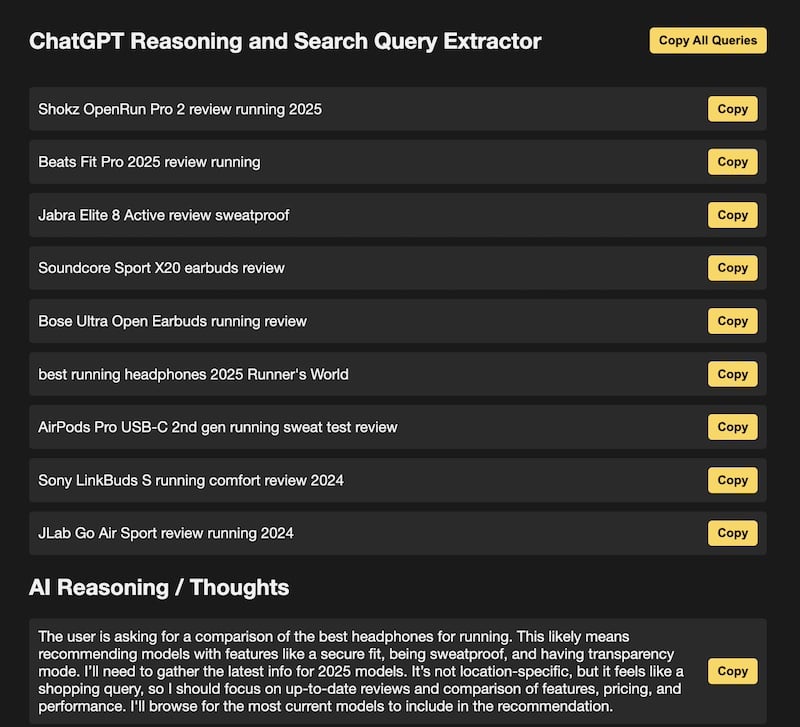
The SEO Pub is a newsletter and community from Mike Friedman, a search engine optimizer and owner of Clicked Consulting. His “ChatGPT Search Reasoning and Query Extractor” is a free Chrome bookmarklet to access the platform’s fan-out web queries and reasoning when compiling an answer.
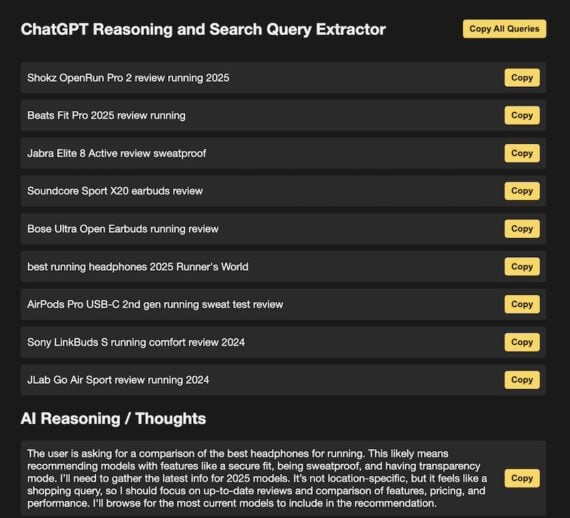
For example, for a prompt of “best headphones for running,” ChatGPT’s fan-out searches, per the bookmarklet, were:
“Shokz OpenRun Pro 2 review running 2025”
“Beats Fit Pro 2025 review running”
“Jabra Elite 8 Active review sweatproof”
“Soundcore Sport X20 earbuds review”
“Bose Ultra Open Earbuds running review”
“best running headphones 2025 Runner’s World”
“AirPods Pro USB-C 2nd gen running sweat test review”
“Sony LinkBuds S running comfort review 2024”
“JLab Go Air Sport review running 2024.”
And ChatGPT’s reasoning was enlightening, especially for content marketers and product developers:
The user is asking for a comparison of the best headphones for running. This likely means recommending models with features like a secure fit, being sweatproof, and having a transparency mode. I’ll need to gather the latest info for 2025 models. It’s not location-specific, but it feels like a shopping query, so I should focus on up-to-date reviews and comparison of features, pricing, and performance. I’ll browse for the most current models to include in the recommendation.
The bookmarklet enables users to view and export the searches and reasoning on an easy-to-read page.
Users can view and export ChatGPT’s fan-out searches and reasoning. Click image to enlarge.
To install the bookmarklet,
Create a new bookmark in Chrome.
Assign a name such as “ChatGPT Extractor” or similar
Replace the URL field with the code on the SEO Pub page
Go to ChatGPT and perform a search that triggers a web search
Once you have results, click the bookmarklet. It will open a new tab showing ChatGPT’s searches and reasoning.
Fan-out Helper
Another free tool, a Chrome extension called “ChatGPT Search Fan-out Helper,” saves ChatGPT’s fan-out queries and sources, providing the URLs, titles, and descriptions.
Jill Whalen, a true SEO pioneer, recently passed away. Although she has been retired for over ten years, her influence continues in the marketing-first SEO practices she advocated that are gradually gaining ground thirty years after she first championed that approach to ranking websites.
Contributions To SEO
As part of the first wave of SEO, her contribution to search marketing was to prove that a marketing-first approach was sustainable as a long-term strategy. While that style of SEO is described as white hat, that term has lost meaning as many of the SEOs with the biggest and whitest hats tended to be algorithm chasers jumping from strategy to strategy, something Whalen was not.
Many of the second-wave SEOs from my generation focused on testing the limits of search engine algorithms and reading research papers to better understand how search engines worked. Whalen remained steadily focused on creating the kind of content search engines were trying to rank and used responsible link building to promote it, which turned out to be a winning strategy.
Screenshot Of Jill Whalen On SEO Pioneers Show
Left to right: Jill Whalen, Shelley Walsh
Her approach may have felt old-fashioned to some in the industry at the time, but she recently observed in an interview on Shelley Walsh’s SEO Pioneers show that she felt vindicated after Google’s Panda and Penguin algorithms, which rocked the search marketing industry but left her clients’ top-ranked websites untouched. Indeed, the entire SEO industry is coming around to Jill’s approach to SEO.
Whalen retired in 2013 and turned her attention to subjects that mattered to her, but her influence has always been felt through the thousands of SEOs who learned from her and who continue to pass those traditions on.
How Jill Whalen Influenced Top SEOs
Christine Churchill
Christine Churchill (LinkedIn profile), a leading search marketer, explains how she met Jill Whalen and how she influenced her life and career.
“Wow, this loss really stings! I first met Jill at a speakers’ gathering that I almost skipped because I was dreading feeling out of place. I told myself to just go for five minutes, and when I walked in, I spotted Jill right away – the only other woman there. She flashed me a warm smile, and I found my way over to the bar where she was sitting. I was so nervous, but I was completely taken aback when she mentioned she had seen me speak at an earlier conference and actually knew who I was!
We ended up chatting until the bar closed, and from that night on, we bonded instantly. Jill had this incredible gift of helping us believe in ourselves and encouraging us to shine. Because of her, I also met amazing people like Debra Mastaler, Scottie Claibourne, Karon Thackston, Kim Krause Berg and so many more kindred spirits. We all became friendly faces in the crowd, supporting each other in countless ways.
Jill truly changed my life, and I got to travel the world alongside her! Even when she retired and we didn’t see each other as much, I always knew that if I needed a friend, she’d be just a call away.
I still remember that one conference (I think it was in Pennsylvania) where we met this fascinating guy who talked to ghosts. We ended up staying at the bar yet again, discussing spirits and the signs our departed loved ones send us. It feels like Jill is with all of us now, saying goodbye and cheering us on to keep blooming.
Thank you, Jill, for your incredible friendship and support. I’ll cherish my memories of you forever!”
Debra Mastaler
My good friend Debra Mastaler (LinkedIn profile) was one of Whalen’s early collaborators, handling link building. Debra shares how Jill was instrumental in shaping her career in SEO:
“I’ve been involved with the SEO industry since 1999, I started by owning a directory of organic food and clothing. When I started to rank well for a large number of money terms, business owners advertising in my directory asked if I could I help them “optimize” their sites. I had no clue what that meant so I started looking around for information and met Jill.
Jill took the time to explain what I was doing was called link building and how important it was. One thing led to another and she hired me to do all her link work and got me on the speaking circuit. About a year later, I felt confident enough to work on my own and I launched Alliance-Link.
Over the years, we traveled together, went to conferences, ran an SEO forum, published content together, shared family vacations and spoke almost every day. We drifted after she left the SEO industry but her mark on my life has never faded.”
Left to right: Debra Mastaler, Christine Churchill, Jill Whalen
Michael Bonfils
Multilingual International SEO Michael Bonfils (LinkedIn profile), also an SEO pioneer himself, nce before SEO described who she was and how she influenced him.
“Twenty five years ago while attending one of the first SES (Search Engine Strategies) conferences in San Francisco, I noticed this incredibly enthusiastic lady who was leading a roundtable discussion about content. There were three things that struck me that I never forget.
First, she was one of the few women in a sea of nerdy dudes but as nerdy as she was, she fit perfectly in with everyone else.
Second, she was nervous about speaking, she didn’t say it, but I can see it. I could feel it. It made me happy to know that I wasn’t alone and it was that nervousness that drew me to be one of the first few that sat around her roundtable.
Third, she explained the power of content in SEO better than anyone else. While everyone was focused on tricking the search engines, she was focused on feeding the search engines exactly what they wanted (I was working for a search engine at the time, so this was important for me to hear.)
From the beginning of her career, I’ve had so much respect for Jill that her and I over the decades would often talk about the good old days when everyone and everything in SEO was so uncertain. When she retired, I told her how bummed I was and then I of course accused her of faking it.
I am really going to miss Jill and just broken hearted to learn of her passing. She was truly a legend.”
Duane Forrester
Duane Forrester (LinkedIn profile, formerly of Bing) described how Jill Whalen helped him understand how to explain complex ideas in ways that were understandable to a wide audience.
“Yeah, safe to say that Jill influenced my sense of direction. I mean, I knew it was about working for/with the algorithms, but there had to be a balance. Not just in terms of the work, but how we explained it. Jill helped set me, personally, on a path of trying to explain the complex in ways that everyday business people could understand and adapt to.
Jill was adept at looking through the complex and finding ways forward that not only worked, but were approachable by a wide variety of people with various skills and skill levels. She had a sharp mind and managed to recall volumes of relevant information seemingly effortlessly.
It was always a highlight of any conference to cross paths with Jill. We lost a treasure and I, and I’m sure many, will miss her.”
Bill Hartzer
Bill Hartzer (LinkedIn profile), one of the sharpest technical SEOs I know, remembered her as a centering voice, one who brought balance back to SEO.
He shared:
“She definitely was an influence, as she was more the “voice of reason” so to speak, when I was always trying to test the limits, test that “fine line” between white hat SEO and gray hat SEO.
She consistently advocated for doing SEO “the right way,” which is with integrity, transparency, and a focus on long-term value. Her work through High Rankings became a trusted symbol of ethical search marketing, long before it became the norm.”
Brett Tabke
Brett Tabke (LinkedIn profile), one of the leading founders of modern SEO, remembered her as a positive influence.
“She was always so nice. Had a smile on her face 90% of the time you were with her. I can’t remember a time when she didn’t appear happy to be with her friends. Even when she was presenting, she always made you feel good about what we were doing.”
Watch The SEO Pioneers Interview With Jill Whalen
Featured Image/Screenshot from SEO Pioneers interview