What is anchor text, and how can you improve your link texts?

Anchor text, which is also known as link text, is the visible, clickable text of a hyperlink. It usually appears in a different color and is often underlined. Good anchor text tells readers what to expect when they click and gives search engines valuable context about the linked page. Getting your anchor text right helps users navigate your content more easily, improves your internal link structure, and provides search engines with clues about your page relationships, which can positively influence your SEO. 

Table of contents

Key takeaways

  • Anchor text enhances user navigation and provides context for search engines, improving SEO outcomes.
  • Good anchor text clearly describes the linked content and avoids misleading or over-optimized phrases.
  • Different types of anchor text exist, each with specific use cases; mix them for variety and clarity.
  • Yoast SEO offers tools to analyze competing links and improve anchor text for better search engine ranking.
  • To enhance anchor text, ensure it matches the linked content, flows naturally, and clearly signals clickable links.

What does an anchor text look like? 

Anchor text is the part of a link that describes the linked page. It guides both readers and search engines toward relevant information. For example, if we link to our post about keyword research tools, the phrase “keyword research tools” is the anchor text. 

In HTML, it looks like this: 

keyword research tools

The first part is the URL, while the second, the visible text, is the anchor text. Ideally, the words you choose should naturally describe the content on the linked page. 

Links are vital for SEO. They show how your pages connect and help search engines understand your site structure. The anchor text in those links provides extra context. 

When Google crawls your site, it uses link text as a clue to what each linked page is about. If multiple links all use the same focus keyphrase, Google might not know which page should rank highest for that topic, leading to competition between your own pages. 

That’s why thoughtful, descriptive anchor text matters. It helps search engines interpret your site and helps readers decide whether a link is worth clicking. Over-optimized or misleading link text can confuse both. 

Tip: Avoid using your main focus keyphrase in multiple anchor texts within one post, as it can create competing links. Your linking should always feel natural and avoid over-optimization. 

An example of internal links with good anchor texts

Different kinds of anchor text 

Anchor text applies to both internal and external links. External sites can link to your content in various ways, and each type sends a different signal to search engines: 

  • Branded links: Use your brand name as anchor text (e.g., Yoast
  • Naked URLs: Just your site address (e.g., https://yoast.com
  • Site name: Written as Yoast.com 
  • Article or page title: Matches the title exactly (e.g., What is anchor text?
  • Exact-match keywords: The exact keyphrase of your target page 
  • Partial-match keywords: A variation that fits naturally in a sentence 
  • Related keywords: Phrases closely connected to your topic 
  • Generic links: Words like click here or read more — best avoided! 

Ideally, mix your link text types, prioritizing readability and context over repetition. 

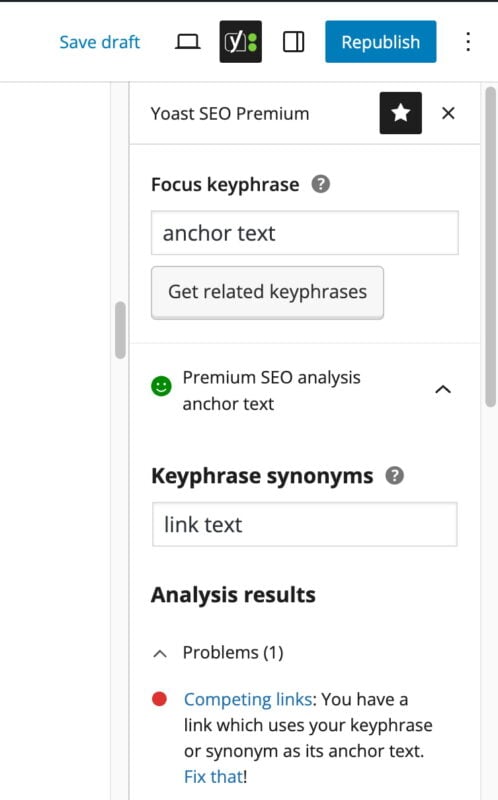
Yoast SEO for WordPress and Yoast SEO for Shopify include a competing links check. This tool analyzes your anchor texts to help you avoid competing links. 

If Yoast SEO detects that one of your links contains your focus keyphrase or a synonym of it, then Premium users get a warning. The reason? You don’t want multiple pages trying to rank for the same phrase. 

For example, say your focus keyphrase is potato chips. If you link to another page using that exact phrase, Yoast SEO will flag it as a competing link. You’ll see a notification in your SEO analysis, so you can adjust it before publishing. If you have Yoast SEO Premium or Yoast SEO for Shopify, the check will also look for the synonyms of your keyphrase.

The competing links check in Yoast SEO helps you improve your linking

How to improve your anchor link texts 

If Yoast SEO alerts you about competing links, or if you simply want to improve the quality of your link text, here are some best practices to follow. 

1. Create a natural flow 

Your writing should feel effortless. If a link feels awkward or forced into a sentence, it probably doesn’t belong there. Always prioritize readability, as a smooth flow improves both engagement and SEO. For more advice on writing content that feels natural while still ranking well, read our SEO copywriting guide

2. Match the link text to the linked content

Readers should immediately understand what to expect when they click on a link. For example, a link that says meta description should lead to a post explaining what a meta description is and how to optimize it. Clear, logical linking builds trust and helps users navigate your content with ease. 

3. Don’t trick your readers 

Never mislead readers with inaccurate or confusing link text. If your link text says, “potato chips,” it shouldn’t lead to a page about cars. Consistent and honest linking keeps readers engaged and signals quality to search engines. 

4. Make it clear that the link is clickable 

Use visual cues such as color contrast or underlining, so it’s easy to tell when text is a link. This not only improves usability but also helps people using assistive technology to navigate your content. To see more on writing accessible, well-structured posts, visit our blogging guide. 

5. Bonus tip: put your entire keyphrase in quotes 

When using long tail keyphrases, you might see a warning about links that include parts of your focus keyphrase. To avoid this, put your full keyphrase in quotes, for example, “learning how to knit.” This tells Yoast SEO to look for the entire phrase rather than matching individual words. 

If you’d like to learn more about writing effective link text and improving your content for SEO, take our SEO copywriting course, which is included with Yoast SEO Premium. 

Go Premium and get free access to our SEO courses!

Learn how to write great content for SEO and unlock lots of features with Yoast SEO Premium:

Internal links are one of the most effective SEO tools you can use. The Yoast SEO internal linking suggestions tool helps you find and add relevant links throughout your content. 

But internal links work best when you write good anchor text for them. Each link should serve a clear purpose and guide readers naturally to related topics. Avoid adding unnecessary or irrelevant links just for the sake of having more connections. 

Thoughtful internal linking improves the user experience and helps search engines understand your site’s structure, which is essential for strong SEO performance. 

This is anchor text 

Anchor text remains a small but powerful element of SEO. It helps users decide whether to click, gives search engines valuable context, and supports a logical site structure. 

Keep your anchor text relevant, natural, and transparent and avoid manipulative or over-optimized linking practices. Search engines are now smarter than ever at spotting unnatural links, especially in the era of AI and semantic understanding. 

So stay genuine, link with intent, and use Yoast SEO to guide you along the way. 

Read more: SEO basics: What is a permalink? »

17 Data Reports That Every SEO Should Be Tracking in 2026 via @sejournal, @MattGSouthern

SEO and marketing are driven by the choices that you make, and those choices should be guided by clear, trustworthy data.

Having a range of sources that you track on a regular basis helps you to stay informed and to speak with authority in meetings with C-suite and clients.

Enable your strategies with real-world insights and answer questions such as, Should paid search budgets go up or down? Which international markets are worth expanding into? And how is traffic shifting towards social platforms or retail media networks? 

The following is a list of some well-known and some lesser-known reports that you should make yourself familiar with to always have qualified answers to your choices.

Financial & Markets Data

These high-level reports provide the map of the digital economy. They show where advertising dollars are flowing, where they are pooling, and where they might flow next.

They give you the “big picture” context for your own budget decisions, allowing you to speak the language of finance and justify your strategy with market-wide data.

IAB/PwC Internet Advertising Revenue Report

Cadence: Annual
Typical release: April
Access: Free, no registration required
Link

Why It Matters:

This report answers the question: Is the digital ad market still growing? For over 25 years, the IAB has been the definitive source for U.S. internet advertising revenue. Its historical data charted the shifts from dial-up to broadband, and then from desktop to mobile. Today, it’s charting the next great reallocation of capital. When your CFO wants authoritative numbers on the industry’s health, this is the gold standard.

The report surveys companies representing over 86% of U.S. internet ad revenue, meaning its figures are based on actual, verified spending. The format breakdowns show how much capital is flowing from established channels like traditional search into high-growth areas like social video, connected TV, and retail media.

Methodology & Limitations:

U.S.-only data; reflects reported revenue from participating companies, which may be delayed by one quarter compared to actual spending; excludes international markets and smaller ad networks below the survey threshold.

MAGNA Global Ad Forecast

Cadence: Biannual
Typical release: June & December
Access: Free summary; full datasets for IPG Mediabrands clients
Link

Why It Matters:

If the IAB report is a photograph of last year, MAGNA’s forecast is a detailed blueprint of the next 18 months. It helps you anticipate whether paid search costs (CPCs) are likely to spike based on an influx of advertiser demand. Their analysis is global, allowing you to see which regions are heating up and which are cooling down.

Their retail media breakouts are useful for making the case to invest in product feed optimization and marketplace SEO. For example, if MAGNA forecasts a 20% surge in retail media while projecting only 5% growth in search, it’s a signal that commercial intent is migrating.

The twice-yearly cadence is its secret weapon. The December update gives you fresh data for annual planning, while the June update allows for mid-year course corrections, making your strategy more agile.

Methodology & Limitations:

The forecast model relies on historical patterns, economic indicators, and advertiser surveys. It is subject to revision due to macroeconomic changes. Coverage varies globally, with the most robust data in North America and Europe, while forecasts for the China market carry higher uncertainty.

Global Entertainment & Media Outlook (PwC)

Cadence: Annual
Typical release: July
Access: Paid subscription; free overview and highlights
Link

Why It Matters:

This is your five-year planning guide, the ultimate tool for long-term strategic thinking.

While other reports focus on the next year, PwC projects revenue and user growth across 53 countries and 15+ media segments five years ahead. This macro view can help build a business case for large, multi-year investments.

Are you considering a major push into podcasting or developing a streaming video channel? This report’s audio and video forecasts can help you size the market and project a realistic timeline for ROI. Its search advertising forecasts by region can help you de-risk international expansion by prioritizing countries with high-growth projections.

The methodology takes into account regulatory changes, technology adoption curves, and demographic shifts. It can help you build strategies that are resilient to short-term fluctuations because they’re aligned with long-term trends.

Methodology & Limitations:

Full access is paid and limits how broadly information can be shared. Keep in mind, forecasts about the next five years are naturally uncertain and get updated every year. Also, these projections assume that regulatory environments stay stable, but changes can always happen.

Company Earnings Reports

While market reports offer an overview of the economy, the quarterly earnings from key companies reveal the reality of the platforms that are integral to the industry.

Financial data exposes the strategic priorities and weaknesses of search platforms, which can offer insights into where they might make significant changes.

Alphabet Quarterly Earnings

Cadence: Quarterly (fiscal year ends December 31)
Typical release: Q1 (late Apr), Q2 (late Jul), Q3 (late Oct), Q4 (late Jan/early Feb)
Access: Free
Link

Why It Matters:

This is the single most important quarterly report for anyone in search.

The key metric is revenue for the “Google Search & other” segment; its growth rate tells you if the core business is healthy, plateauing, or declining. Compare this to the growth rate of “YouTube ads” to see where user attention and ad dollars are shifting.

A secondary indicator to watch is “Google Cloud” revenue. As it grows, expect more integrations between Google’s enterprise tools and its core search products.

Pay close attention to Traffic Acquisition Costs (TAC), which includes the billions Google pays partners like Apple and Samsung to be the default search engine. If TAC is growing faster than Search revenue, it’s a major red flag that Google is paying more for traffic that is becoming less profitable.

In the current environment, the most critical part of the report is the management commentary and the analyst Q&A. Look for specific language about AI Overviews’ impact on query volume, user satisfaction, and any hint of revenue cannibalization.

Methodology & Limitations:

The “Google Search & other” bundles search with Maps, Gmail, and other properties, which prevents isolated analysis of search revenue. AI Overviews metrics are disclosed selectively and not on a comprehensive quarterly basis. Geographic revenue breakdowns are limited to broad regions.

Microsoft Quarterly Earnings

Cadence: Quarterly (fiscal year ends June 30)
Typical release: Q1 (Oct), Q2 (Jan), Q3 (Apr), Q4 (Jul)
Access: Free
Link

Why It Matters:

Microsoft’s report provides a direct scorecard for Bing’s performance via its “search and news advertising revenue” figures. This tells you whether the search engine is gaining or losing ground. Their integration of OpenAI’s models into Bing has made this a number to watch.

However, the bigger story often lies in their Intelligent Cloud and Productivity segments. Pay attention to commentary on the growth of Microsoft 365 Copilot and enterprise search features within Teams and SharePoint. This reveals how millions of professionals are finding information and getting answers without opening a traditional web browser.

Methodology & Limitations:

Search revenue is only reported as a percentage growth, not in actual dollar amounts, which makes market share calculations more complex. Details about enterprise search usage metrics are rarely shared openly. Geographic breakdowns are also limited. To estimate Bing’s market share, we need to infer from revenue growth compared to traffic data.

Amazon Quarterly Results

Cadence: Quarterly
Typical release: Q1 (late Apr), Q2 (late Jul), Q3 (late Oct), Q4 (late Jan/early Feb)
Access: Free
Link

Why It Matters:

This report tells you how much commercial search is shifting from Google to Amazon.

For years, Amazon’s advertising business has grown faster than its renowned AWS cloud unit. That’s an indicator of where brands are investing to capture customers at the point of purchase. The year-over-year ad revenue growth rate can help with justifying investment in Amazon SEO and enhanced content.

Look beyond the ad revenue to their commentary on logistics. When they discuss the expansion of their same-day delivery network, they are talking about widening their competitive moat against all other ecommerce and search players. A Prime member who can get a product in four hours has little incentive to start their product search on Google.

Also, look for the percentage of units sold by third-party sellers (typically 60-62%) to quantify the scale of the opportunity for brands on their marketplace.

Methodology & Limitations:

Advertising revenue is not separated by format (such as sponsored products, display, or video), and there is no disclosure of revenue by product category. International advertising revenue breakdowns are limited, and delivery network metrics are provided only selectively.

Apple Quarterly Results

Cadence: Quarterly
Typical release: Q1 (late Jan/early Feb), Q2 (late Apr/early May), Q3 (late Jul/early Aug), Q4 (late Oct/early Nov)
Access: Free
Link

Why It Matters:

Apple’s report is a barometer for the health of the mobile ecosystem and the impact of privacy. The key number is “Services” revenue, which includes the App Store, Apple Pay, and their burgeoning advertising business. When this number accelerates, expect more aggressive App Store features and search ads that can siphon traffic and clicks away from the mobile web.

Apple’s management commentary on privacy can have meaningful consequences for the digital marketing industry. Look for any hints about upcoming privacy features that could further limit tracking and attribution in search. Prior announcements around features like App Tracking Transparency on earnings calls gave marketers several months to prepare for the attribution shifts.

Snap Quarterly Results

Cadence: Quarterly
Typical release: Q1 (late Apr), Q2 (late Jul), Q3 (late Oct), Q4 (late Jan/early Feb)
Access: Free
Link

Why It Matters:

Snap’s daily active user growth and engagement patterns tell you where Gen Z discovers information. When DAU growth accelerates in markets where your organic search traffic is flat, younger audiences may not be using traditional search in those regions.

Snap reports specific metrics on AR lens usage. These metrics show you how users interact with visual and augmented reality content, previewing how visual search might evolve.

Methodology & Limitations:

Geographic breakdowns are limited to broad regions. Engagement metrics emphasize time spent rather than search or discovery behavior specifically. Revenue per user varies significantly by region, making it difficult to draw global conclusions. The data mainly reflects Gen Z behavior, not wider demographics.

Pinterest Quarterly Results

Cadence: Quarterly
Typical release: Q1 (late Apr/early May), Q2 (late Jul/early Aug), Q3 (late Oct/early Nov), Q4 (late Jan/early Feb)
Access: Free
Link

Why It Matters:

Pinterest’s monthly active user (MAU) growth shows you which markets embrace visual discovery. Their MAU growth rates by region reveal geographic patterns in visual search adoption, often previewing trends that influence how people search everywhere.

Their average revenue per user by region indicates where visual commerce drives revenue compared to just browsing, helping you decide whether Pinterest optimization deserves resources for your business.

Methodology & Limitations:

MAU counts only authenticated users, excluding logged-out traffic. ARPU includes all revenue types, not just search or discovery-related income. There is limited disclosure regarding search query volume or conversion behavior.

Internet Usage & Infrastructure

While earnings reports reveal the financial outcomes, they are lagging indicators of a more fundamental resource: human attention.

The following reports measure the underlying user behavior that drives these financial results, offering insight into audience attention and interaction.

Digital 2025 – Global Overview (We Are Social & Meltwater)

Cadence: Annual
Typical release: February
Access: Free with registration
Link

Why It Matters:

This report settles internal debates about platform usage with definitive, global data. It provides country-by-country breakdowns of everything from social media penetration and time spent on platforms to the most-visited websites and most-used search queries. It’s a reality check against media hype.

The platform adoption curves reveal which social networks are gaining momentum and which are stagnating. The data on time spent in social apps versus time on the “open web” is worth watching, as it provides some explanation for why website engagement metrics may be declining.

Methodology & Limitations:

Data is compiled from a variety of sources that use different methods. Some countries have smaller sample sizes, and certain metrics come from self-reported surveys. Generally, developed markets enjoy higher data quality compared to emerging markets. Additionally, how platform usage is defined can differ depending on the source.

Measuring Digital Development (ITU)

Cadence: Annual
Typical release: November
Access: Free
Link

Why It Matters:

The ITU, a specialized agency of the United Nations, provides the data for sizing total addressable markets for international SEO.

Its connectivity metrics show which countries have the infrastructure to support video-heavy or interactive content strategies, versus emerging markets where mobile-first, lightweight content is still essential.

The most actionable metric for spotting future growth is “broadband affordability.” History shows that when the cost of a basic internet plan in a developing country drops below the 2% threshold of its average monthly income, that market is poised for growth.

Methodology & Limitations:

Government-reported data quality differs across countries, with some nations providing infrequent or incomplete reports. Affordability calculations rely on national averages that might not account for regional differences. Additionally, infrastructure metrics often lag behind actual deployment by one to two years.

Global Internet Phenomena

Cadence: Annual
Typical release: March-April
Access: Free with registration
Link

Why It Matters:

This report helps you understand what people are actually doing online by tracking which applications consume the most internet bandwidth. Its findings are often staggering. In nearly every market analyzed, video streaming is the number one consumer of bandwidth, often accounting for over 50-60% of all traffic.

This provides proof that optimizing for video is no longer a niche strategy; it’s the main way people consume information and entertainment. The application rankings show whether YouTube or TikTok is the dominant force in your target markets, revealing which platform deserves the lion’s share of your video optimization priority.

This data provides the “why” behind other trends, such as the explosive growth of YouTube’s ad revenue seen in Alphabet’s earnings.

Methodology & Limitations:

Based on ISP-level traffic data from Sandvine’s partner networks, coverage varies by region, with the strongest data in North America and Europe. Mobile and fixed broadband breakdowns are not always comparable. The data excludes encrypted traffic that can’t be categorized. Sampling includes large ISPs but does not cover the entire market.

Privacy & Policy

Knowing where your audience is operating is only part of the challenge; understanding the rules of engagement is equally important. As privacy regulations and policies evolve, they set new guidelines for digital marketing, fundamentally altering how we target and measure audiences.

Data Privacy Benchmark Study (Cisco)

Cadence: Annual
Typical release: January
Access: Free with registration
Link

Why It Matters:

This report helps turn the idea of privacy into business results that everyone can understand. It highlights how good privacy practices can positively influence sales, customer loyalty, and brand reputation.

Whenever you’re making a case for investing in responsible data handling or privacy-focused technologies, this report offers valuable ROI insights. It reveals how many consumers might turn away from a brand if privacy isn’t clear, giving you strong support to promote user-friendly policies that also boost profits.

Methodology & Limitations:

The survey methodology relies on self-reported data.  Respondents mainly come from large enterprises. The geographic focus is on developed markets. ROI figures are based on correlation rather than establishing causation. Privacy maturity levels are self-assessed by respondents rather than independently verified.

Ads Safety Report (Google)

Cadence: Annual
Typical release: March
Access: Free
Link

Why It Matters:

Google’s enforcement data provides a glimpse into what may soon impact organic search results. Often, policies first appear in Google Ads before making their way into search quality guidelines. Violations by publishers show which types of sites might get banned from AdSense, sometimes acting as a warning sign for future manual actions in organic search.

When enforcement becomes more active in fields like crypto, healthcare, or financial services, it usually indicates that stricter E-E-A-T standards are on their way for organic results. Google’s actions to block ads due to misrepresentation or coordinated deceptive behavior are sometimes followed by similar issues in organic results.

Methodology & Limitations:

Google-reported data shows enforcement priorities, not industry violation rates. Detection methods, thresholds, and policies lack transparency and are not fully disclosed. Enforcement patterns are unclear, with no independent verification of metrics.

Media Use & Trust

Digital News Report (Reuters Institute)

Cadence: Annual
Typical release: June
Access: Free
Link

Why It Matters:

The Reuters Institute report explores how content discovery differs across countries and demographics. The analysis of over 40 nations details the ways people find information, whether directly, through search, social media, or aggregators.

A key insight is the concept of “side-door” traffic, referring to visitors who arrive via social feeds, mobile alerts, or aggregator apps, rather than visiting a homepage or using traditional search. In most developed nations, this type of traffic now makes up the majority, even for leading publishers.

This highlights the need for a distributed content strategy, emphasizing that your brand and expertise should be discoverable in many channels beyond Google.

Methodology & Limitations:

Survey-based methodology with ~2,000 online respondents per country, excluding offline or low-connectivity users, and overrepresents developed markets. Self-reported news habits may differ from actual behaviors, and the definition of “news” varies by culture and person.

Edelman Trust Barometer

Cadence: Annual
Typical release: January
Access: Free
Link

Why It Matters:

In today’s world of AI-generated content and widespread misinformation, trust is more important than ever. Edelman has been tracking public trust in four key institutions – Business, Government, Media, and NGOs – for over 20 years. Their findings offer a helpful guide for establishing your content’s authority.

When the data shows that “Business” is trusted more than “Media” in a particular country, it suggests that thought leadership from your company’s own qualified experts can be more believable and relatable than just quoting traditional news outlets.

The differences across generations and regions are especially useful to understand. They reveal which types of authority signals and credentials matter most for different audiences, giving you a clear, data-driven way to build E-E-A-T.

Methodology & Limitations:

Survey sample favors educated, high-income populations in most countries, with 1,000-1,500 respondents per nation. Trust is a self-reported perception, not behavioral; country choice focuses on larger economies. Trust in institutions may not reflect trust in brands or sources.

Digital Media Trends (Deloitte Insights)

Cadence: Annual
Typical release: April
Access: Free executive summary
Link

Why It Matters:

Deloitte monitors streaming service adoption, content consumption trends, and attention fragmentation, all of which influence your content strategy. Their research on subscription usage and churn rates shows how users distribute their entertainment budgets.

Their insights into ad-supported versus subscription preferences indicate which business models resonate with different demographics and content types. Data on cord-cutting and cord-never behaviors illustrate how various generations consume media.

Their analysis of social media patterns reveals declining platform popularity, providing early signals to diversify channels.

Methodology & Limitations:

This U.S.-focused study mainly involves higher-income digital adopters, with streaming behavior centered on entertainment, which may not reflect overall information habits. The sample size of 2,000-3,000 limits detailed demographics, and trends may lag six to 12 months behind mainstream adoption.

How To Use These Reports

Use this set of reports to connect market trends and signals with your search and content decisions.

Start with quarterly earnings and ad forecasts to calibrate budgets after core updates or seasonal swings. When planning campaigns, check platform adoption and discovery trends to decide where your audience is shifting and how they’re finding information.

For content format choices, compare attention and creative studies with what’s working in Search, YouTube, and short-form video to guide what you produce next.

Review earnings and forecasts each quarter when you set goals. Scan broader landscape studies when you refresh your annual plan. When something changes fast, cross-check at least two independent sources before you move resources. Look for consistency in your data and don’t act on one-off spikes.

Looking Ahead

The best SEO and marketing strategies are built on more than instinct; they’re grounded in data that stands up to scrutiny. By making these reports part of your regular reading cycle, you have a basis to make solid decisions that you can justify.

Each dataset offers a different lens that allows you to see both the macro trends shaping the industry and the micro signals to guide your next move.

The marketers who know where to find the right data and information are the ones who can be strategic and not reactionary.

More Resources:


Featured Image: Roman Samborskyi/Shutterstock

3 LinkedIn Strategies To Turn Your Founder’s Voice Into A Pipeline Driver via @sejournal, @purnavirji

Your founder’s voice is your startup’s most valuable – and often most underleveraged – asset. I see this so often with startup leaders. They either avoid posting on LinkedIn (my employer) entirely or default to product features and sales pitches.

That results in the all-too-familiar rotation of hot takes, motivational quotes, and business updates that rarely spark real engagement.

There’s a difference between broadcasting and building relationships. The leaders who build true influence understand that. They build connection, trust, awareness, and pipeline by sharing lessons, stories, and insights that only they can offer. And build consistent formats for sharing their expertise to make it stick.

But should a founder’s way-too-packed schedule also include content creation? Let me help you answer that by asking you another question: When I mention Melanie Perkins, Rand Fishkin, and Marc Benioff, which companies come to mind?

You likely thought Canva, SparkToro, and Salesforce, right? That connection between founder and company is strategic. And a real growth driver.

This shift toward founder-led growth has caught the attention of major companies. PayPal’s job opening for Head of CEO content went viral on LinkedIn. Since then, Virio recently posted a Head of Content role paying $500,000 to $1.5 million annually. OpenAI posted a Content Strategist role paying $310,000 to $393,000 annually. Perplexity posted roles for Content Managers at $130,000 to $170,000 a year. These are strategic investments in executive voice as a growth lever.

According to LinkedIn’s new Founder-Led Sales and Marketing Playbook (which I co-authored), startups whose founders post consistently see 33% more leads, up to 3.7x higher deal sizes when prospects follow executives, and 22% faster deal velocity when buyers feel they “know” the founder.

So, how do time-pressed founders create content that drives revenue? Here are three strategies to turn your founder voice into trust, pipeline, and tangible revenue:

1. Lead With Perspective, Not Product

Most founder content reads like a brochure: “We help X do Y!”. While it’s tempting to go straight for the sale, people tend to scroll right past sales pitches. The less you talk about your product, the more people want to buy it.

As Gal Aga, CEO of Aligned, explains in the playbook:

“First, [people] listen to you, they feel like they’re deeply connected, they love the ideas you put out, they trust you, and then they have to check out what you do”.

People buy from people they trust, and the fastest way to build trust is through storytelling. Scott Albro, founder of Goldie, recommends three powerful story types that build trust.

  • Customer Priority Stories position you as someone who understands the market rather than someone selling to it. Instead of “Our AI optimizes workflows,” try “Today, I met with seven independent pizza shop owners in Brooklyn. Their top issue? Managing order flow during peak hours, usually from 6 to 9 p.m…” You’re demonstrating market insight, not making a sales pitch.
  • Transformational Shift Stories help people navigate change. “Right now, most pizza shop owners are upgrading their POS to better time pickups and deliveries. In the future, there’s an opportunity for AI to predict orders before they even arrive…” You’re painting a picture of industry evolution without positioning your product as the solution.
  • Personal Journey Stories build credibility through vulnerability. “After college, I opened a pizza shop. I managed everything with paper and pen. I didn’t know the first thing about restaurants or technology, but I knew I wanted to make great pizza and support pizza makers…”

Don’t shy away from sharing mistakes or moments of vulnerability – these are often the posts that create an emotional connection and make the founder memorable.

2. Turn Your Daily Interactions Into Content Gold

Your calendar is a content buffet. Every customer call, demo, and “aha” moment is a story waiting to be told. The challenge is to spot the content hiding in your day-to-day interactions.

As Alec Paul, founder of SalesBrand, puts it:

“Treat your life like content. Be more like a journalist. You’re talking to customers every day. You’re the most connected to the pains that you’re solving. No one should know this stuff more than you”.

Try this: After each customer call, ask yourself three questions:

  • What surprised me? (That’s your contrarian take.)
  • What bothered me? (That’s your polarizing hook.)
  • What lesson would save others pain? (That’s your high-resonance post.)

Now transform these insights into specific content formats that resonate.

  • Op-Eds let you take a stance based on what you’re seeing. “We almost didn’t launch our analytics feature because early users said it was too complex. Here’s the data that changed our minds.” You’re sharing your decision-making process, not just the final decision.
  • Behind-The-Scenes Features reveal the “why” behind major choices. “I promoted the wrong person. Here’s what happened and how we recovered.” This builds trust through transparency rather than perfection.
  • Customer Interviews: Turn a direct customer quote into a hook. Example: “‘Your product is too expensive.’ What they really meant was…”  You’re addressing common concerns while demonstrating market understanding.

Don’t wait for inspiration. Build a habit of jotting down insights as they happen. Over time, you’ll have a content bank that’s uniquely yours—no one else can replicate it.

3. Pack A Punch With Each Post

Now that you’re spotting stories, let’s make sure they land. Which also leads me to the section on questions I get the most often as a LinkedIn employee: What content and creative tends to work the best on the platform? Here’s what I advise for founder-led growth and executive thought leadership:

Start With Hooks That Stop Scrollers

Your hook is your headline. If it doesn’t make someone pause, the rest doesn’t matter. Gal Aga rewrites posts that don’t get traction in the first 15-30 minutes – his benchmark is one to two likes per minute.

Most people post what’s obvious. Obvious is forgettable; specific is magnetic. Instead of “AI is changing everything,” try “AI is exposing measurement vulnerabilities that always existed.” The second version creates curiosity about what those vulnerabilities might be.

Embrace Depth Over Brevity

LinkedIn data shows posts between 400-800 words generate nearly three times more engagement than those under 50 words.

As Gal notes:

“Short ‘influencer style’ ideas are nice. But for me, the real impact comes from giving people deep advice. Something they can present at a sales kick-off, a playbook, a strategy, a research breakdown, etc.”

Don’t be afraid to go deep if you’re solving real problems. Your audience will thank you for it.

Use Video To Scale Credibility

Video is the fastest-growing language of trust in B2B.

Rand Fishkin, who was early to video in B2B, explains:

“When I first started experimenting with video as a B2B content format back in 2007, I noticed a strange thing: the number of viewers was far lower than our usual blog readers, but the level of engagement, memory, and brand association was WAY higher.”

LinkedIn’s data supports this approach:

  • Video creation is growing 2x faster than any other format.
  • 98% of Fortune 500 CEOs who use social media choose LinkedIn as their primary platform.
  • 63% of B2B buyers say video content helps inform their buying decisions.

Rand’s advice is to not overthink it.

“My full video creation process is incredibly easy, and takes me less time than writing a blog post – as little as 10 minutes to film, upload, and publish a two- to five-minute piece.”

Find Your “Prolific Zone”

This is the narrow band between “obvious” and “outrageous” where your content is authentic, polarizing, and painfully relevant.

Two approaches to try:

  • Challenge conventional wisdom: “Always be closing is dead. Here’s how we 3x’d revenue by firing our SDR team.”
  • Share taboo truths: “Why we let 80% of customers churn…on purpose.”

Track the pushback. If <10% of comments are negative>30%, you’ve gone too far. Somewhere in the middle means you’re onto something.

Work With The Algorithm

Drive the engagement you want by putting the “social” back in social media.

  • Tag people thoughtfully.
  • Ask meaningful questions to boost engagement.
  • Reply to comments, especially in the first few hours.
  • Post 3x a week, ideally between 8 a.m. and 10 a.m. in your audience’s time zone (generally speaking).

Before You Hit Publish, Use The Punch Test

  • Does this make someone feel something? (Emotion).
  • Does this make someone think differently? (Insight).
  • Does this make someone want to respond or share? (Action).

If the answer is yes to at least two, you’re good to go.

The Compound Effect Of Consistency

LinkedIn’s data tells a clear story: Startups whose directors post at least nine times a year see 3x more engagement and 4x more new followers than those who post only once. Trust is built over time, and a high-impact founder brand takes months to grow.

Sendoso saw an 11% higher win rate when prospects were exposed to LinkedIn posts from Director+ executives, and 120% higher closed-won deal sizes when prospects followed Director+ executives on LinkedIn.

These are clear signals. When Gal Aga says, “If 20%+ of your pipeline mentions your content, you’ve won,” he’s talking about attribution you can measure.

Your Move

The market doesn’t need another polished corporate account. It needs real humans solving real problems. That’s you. Every founder has a story – the ones who tell it well build companies, and movements.

Your competitors are either avoiding this entirely or outsourcing their voice to expensive content teams. That creates an opening. While they’re hiring $500,000 content strategists, you can build authentic influence by sharing what only you know.

Start with one post this week. Share a lesson from your last customer call. Take a stance on an industry trend you disagree with. Show the human side of a business decision.

Your expertise is already there. Your audience is waiting. The founders who act now will own the narrative tomorrow.

All data, quotes, and examples cited above without a source link are taken from the “Founder-Led Sales and Marketing Never Ends” playbook.

More Resources:


Featured Image: Master1305/Shutterstock

Mullenweg Talks About Commercially Motivating WordPress Companies via @sejournal, @martinibuster

At the recent WordCamp Canada, WordPress co-founder Matt Mullenweg answered a question about how individuals and agencies could support the WordPress ecosystem against “bad actors” who don’t share the same community values. The question gave Mullenweg the opportunity to portray himself as the victim of a court that’s muzzling his free speech and to encourage the WordPress community to vote with their pocketbooks.

Question About Protecting WordPress Against Bad Actors

The person asking the question had two things on their mind:

1. How can individuals and agencies help protect WordPress’s community values from exploitative or profit-driven actors?

2. Should there be a formal certification system to identify and promote ethical contributors and agencies within the ecosystem?

The question asked reinforced that the WordPress community is divided into two sides, with those who stand with Mullenweg in his dispute with WP Engine and those on the other side who disapprove of the drama.

This is the question that was asked:

“WordPress has always thrived because of its open, community-driven ethos, but as the ecosystem grows, we’re seeing more like large, profit-driven players who don’t necessarily share the values. How can individual contributors and agencies like ours actively help protect WordPress and uphold the values and ethics that have sustained it from bad actors and people who might try to exploit the community.

And do you see room for something more formal, like a certification for individuals and agencies that define what being a good actor is to help educate clients and even the market to help kind of protect in a more proactive way from those sorts of bad actors?”

The question paints assumes a polarization in the WordPress community, with the exploitative profit-seeking bad actors on one side and the ethical WordPress supporters on the other.

No Bad Actors

Matt Mullenweg began his answer by stating that he’s not one to call anyone a bad actor.

He answered:

“So first, I’ll say, I don’t want to say that there’s bad actors. I think there might be bad actions sometimes and just temporarily bad actors who hopefully will be good in the future. So, you know, every saint has a past, every sinner has a future. So I never want to define like any company or any person is like permanently good or bad. Let’s talk about actions. “

Is This You?

It was a strange way to begin his answer because he used the phrase “bad actors” in his at last years WordCamp USA that called out WP Engine:

“I think that we also just need to call out bad actors. And you got to, the only way to fight a bully is to fight them back. If you just allow them to run rampant on the playground, they’re just going to keep terrorizing everyone.”

He followed that speech with a blog post where he went further and called WP Engine a “cancer to WordPress.”

You can hear it at the 33:48 minute mark of the recording from last year’s WordCamp

Motivating Good Behavior

Mullenweg continued his answer by discussing ways to motivate companies to give back to the WordPress community while also enforcing the GPL and protecting the WordPress trademark. Lastly, he encouraged the WordPress community to vote with their wallets by spending money on companies that that are defined as “good” and giving less to businesses who are presumably defined as a bad actors.

He continued:

“So second, I think with these actions, we can start to create incentive systems. And it’s part of what we’re doing with Five for the Future, which is basically saying you contribute back, which also implies that you’re not violating the GPL or something like that.

So we’ve got the hard stuff, like if you violate the GPL, you’re gonna get a letter, violate the trademark, that is more of a legal thing, but also the gentle stuff, like how can we encourage a good behavior by giving people higher rankings in the directory or in the showcase, for example, then finally, I’ll just say vote with your wallet.”

At this point he continued with the topic of motivating companies to do the right thing and drifted off into talking about WP Engine without actually naming WP Engine.

Mullenweg continued:

“So each one of you here has the ability to strongly influence these companies. By the way, if they’re commercially motivated, great. Let’s commercially motivate them to do the right thing by giving more business to the good companies and less business to the other companies.

This has actually been happening a lot the past year. I think I can say this. There’s a site called WordPressEngineTracker.com, which is currently tracking a number of sites that have left a certain host. It’s about to crash 100,000, about to cross 100,000, that have switched to other hosts, and over 74,000 have gone offline since September of last year.

We actually used to make all this data public. It was all the whole list was on there. They got a court order, so that way the data could be fact-checked by press or other people. There was actually a court order that made us take that down. So again, trying to muzzle free speech and transparency. But we’re allowed to keep that site up, so check it out while you can.”

Mullenweg’s comments frame spending choices as a form of moral expression within the WordPress ecosystem. By urging the community to “commercially motivate” companies, he encourages consumer spending as a way of enforcing ethical accountability, implicitly targeting WP Engine and unnamed others that fall short.

He positioned himself as the victim whose free speech is muzzled, but the court order simply required him and Automattic to stop sharing a spreadsheet of WP Engine’s customers. He also framed the whole dispute as one about ethics and morals, invoking the religious imagery of sinners and saints. WordPress is both a business and a community, but it’s not a religion. So it’s somewhat odd that those connections were made in the context of contributing money or time back into WordPress, which is a cultural obligation but not a legal (or religious) one.

Watch the Q & A here:

Reshoring Is Supply Chain Flexibility

Putting aside supplier selection and tariffs, returning select manufacturing to one’s own country could benefit a business and the broader domestic economy.

Reshoring is neither nationalist nor nostalgic. It is pragmatic. After decades of chasing the lowest overseas bids, many merchants are discovering the advantages of producing goods closer to home.

Walmart

Even Walmart is emphasizing U.S.-based manufacturing.

At its 12th annual Open Call event this month, Walmart invited more than 500 entrepreneurs to pitch products made, grown, or assembled in the United States. The initiative supports the company’s $350 billion, 10-year commitment to domestic sourcing.

The opportunity to sell to Walmart is like winning the lottery for many small and mid-sized manufacturers.

Walmart U.S. CEO John Furner noted during a CNBC forum last week that “investing in U.S. manufacturing and U.S. operations, sure, it’s great for business, but it’s also great for employment. It’s great for jobs. It’s great for the country, and it helps us with our supply chain being flexible and dynamic.”

Furner cited new projects such as a beef-processing facility in Olathe, Kansas, expected to create about 600 jobs, and a partnership with USAntibiotics to restore local drug production.

Walmart’s approach couples economic nationalism with supply-chain flexibility — reshoring when it strengthens resilience, yet continuing to source globally for products better produced elsewhere.

Tariffs and the Cost Equation

It’s impossible to discuss American manufacturing without acknowledging tariffs.

Walmart executives have repeatedly said that tariffs increase costs for both retailers and consumers, even as the company works to offset tariffs through scale and sourcing diversification.

Ecommerce consultant Jon Elder, who advises brands selling on Amazon and Walmart, describes the effect as “mixed.”

“Tariffs have caused multiple things to happen in the ecommerce space. I have seen a high number of brands shift production away from China to places like Vietnam and the U.S. while others have stocked up,” Elder explained.

“The brands that have stayed with China…have renegotiated with their factories, done historic bulk buys, and slightly raised prices,” said Elder, adding that “the competition is fierce on [the Amazon and Walmart marketplaces] so simply raising prices hasn’t been an option.”

Elder’s observation complements Furner’s remarks on adapting tactically rather than ideologically. Tariffs may be government tools, but in practice, they are supply-chain variables, prompting merchants to reconsider where and how they make their goods.

Reshoring

Moving production to the U.S. leads directly to reshoring — returning manufacturing to domestic soil.

Recent wins for American producers — including Nucor (steel), Cleveland-Cliffs Inc. (metals), Whirlpool Corporation (appliances), and Vaughan-Bassett Furniture Company (home goods) — illustrate renewed industrial investment.

Meanwhile, Furner’s framing aligns with this momentum. Domestic manufacturing is not merely patriotic; it is also a practical investment in speed, quality, and demand.

Short lead time. Proximity can shorten shipping windows. Faster turnaround reduces capital tied up in inventory and improves cash flow.

Better quality control. Working with domestic manufacturers simplifies quality control and communication. Problems are resolved in days and require no overseas offices or third-party inspectors.

Shopper demand. “Made in the U.S.A.” remains a meaningful label for many American shoppers. It signals reliability and accountability. Domestic origin can enhance storytelling, strengthen brand authenticity, and justify a modest premium.

Balance, not Retreat

Reshoring is about balance, not retreating from global commerce.

The most sustainable strategy likely pairs domestic production for critical or fast-moving goods with global sourcing for bulk or specialized categories.

Walmart’s mix of U.S. investment and international flexibility illustrates the point. Ecommerce SMBs could follow the example and turn reshoring from a buzzword into a competitive advantage grounded in control, quality, and customer trust.

From slop to Sotheby’s? AI art enters a new phase

In this era of AI slop, the idea that generative AI tools like Midjourney and Runway could be used to make art can seem absurd: What possible artistic value is there to be found in the likes of Shrimp Jesus and Ballerina Cappuccina? But amid all the muck, there are people using AI tools with real consideration and intent. Some of them are finding notable success as AI artists: They are gaining huge online followings, selling their work at auction, and even having it exhibited in galleries and museums. 

“Sometimes you need a camera, sometimes AI, and sometimes paint or pencil or any other medium,” says Jacob Adler, a musician and composer who won the top prize at the generative video company Runway’s third annual AI Film Festival for his work Total Pixel Space. “It’s just one tool that is added to the creator’s toolbox.” 

One of the most conspicuous features of generative AI tools is their accessibility. With no training and in very little time, you can create an image of whatever you can imagine in whatever style you desire. That’s a key reason AI art has attracted so much criticism: It’s now trivially easy to clog sites like Instagram and TikTok with vapid nonsense, and companies can generate images and video themselves instead of hiring trained artists.

Henry Dauber created these visuals for a bitcoin NFT titled The Order of Satoshi, which sold at Sotheby’s for $24,000.
Henry Daubrez created these visuals for a bitcoin NFT titled The Order of Satoshi, which sold at Sotheby’s for $24,000.
COURTESY OF THE ARTIST

Henry Daubrez, an artist and designer who created the AI-generated visuals for a bitcoin NFT that sold for $24,000 at Sotheby’s and is now Google’s first filmmaker in residence, sees that accessibility as one of generative AI’s most positive attributes. People who had long since given up on creative expression, or who simply never had the time to master a medium, are now creating and sharing art, he says. 

But that doesn’t mean the first AI-generated masterpiece could come from just anyone. “I don’t think [generative AI] is going to create an entire generation of geniuses,” says Daubrez, who has described himself as an “AI-assisted artist.” Prompting tools like DALL-E and Midjourney might not require technical finesse, but getting those tools to create something interesting, and then evaluating whether the results are any good, takes both imagination and artistic sensibility, he says: “I think we’re getting into a new generation which is going to be driven by taste.” 

Kira Xonorika’s Trickster is the first piece to use generative AI in the Denver Art Museum’s permanent collection.
COURTESY OF THE ARTIST

Even for artists who do have experience with other media, AI can be more than just a shortcut. Beth Frey, a trained fine artist who shares her AI art on an Instagram account with over 100,000 followers, was drawn to early generative AI tools because of the uncanniness of their creations—she relished the deformed hands and haunting depictions of eating. Over time, the models’ errors have been ironed out, which is part of the reason she hasn’t posted an AI-generated piece on Instagram in over a year. “The better it gets, the less interesting it is for me,” she says. “You have to work harder to get the glitch now.”

ai-generated tomato head character vomits spaghetti onto its lap as it sits on a sofa
Beth Frey’s Instagram account @sentientmuppetfactory features uncanny AI creations.
COURTESY OF THE ARTIST

Making art with AI can require relinquishing control—to the companies that update the tools, and to the tools themselves. For Kira Xonorika, a self-described “AI-collaborative artist” whose short film Trickster is the first generative AI piece in the Denver Art Museum’s permanent collection, that lack of control is part of the appeal. “[What] I really like about AI is the element of unpredictability,” says Xonorika, whose work explores themes such as indigeneity and nonhuman intelligence. “If you’re open to that, it really enhances and expands ideas that you might have.”

But the idea of AI as a co-creator—or even simply as an artistic medium—is still a long way from widespread acceptance. To many people, “AI art” and “AI slop” remain synonymous. And so, as grateful as Daubrez is for the recognition he has received so far, he’s found that pioneering a new form of art in the face of such strong opposition is an emotional mixed bag. “As long as it’s not really accepted that AI is just a tool like any other tool and people will do whatever they want with it—and some of it might be great, some might not be—it’s still going to be sweet [and] sour,” he says.

This startup thinks slime mold can help us design better cities

It is a yellow blob with no brain, yet some researchers believe a curious organism known as slime mold could help us build more resilient cities.

Humans have been building cities for 6,000 years, but slime mold has been around for 600 million. The team behind a new startup called Mireta wants to translate the organism’s biological superpowers into algorithms that might help improve transit times, alleviate congestion, and minimize climate-related disruptions in cities worldwide.

Mireta’s algorithm mimics how slime mold efficiently distributes resources through branching networks. The startup’s founders think this approach could help connect subway stations, design bike lanes, or optimize factory assembly lines. They claim its software can factor in flood zones, traffic patterns, budget constraints, and more.

“It’s very rational to think that some [natural] systems or organisms have actually come up with clever solutions to problems we share,” says Raphael Kay, Mireta’s cofounder and head of design, who has a background in architecture and mechanical engineering and is currently a PhD candidate in materials science and mechanical engineering at Harvard University.

As urbanization continues—about 60% of the global population will live in metropolises by 2030—cities must provide critical services while facing population growth, aging infrastructure, and extreme weather caused by climate change. Kay, who has also studied how microscopic sea creatures could help researchers design zero-energy buildings, believes nature’s time-tested solutions may offer a path toward more adaptive urban systems.

Officially known as Physarum polycephalum, slime mold is neither plant, animal, nor fungus but a single-­celled organism older than dinosaurs. When searching for food, it extends tentacle-like projections in multiple directions simultaneously. It then doubles down on the most efficient paths that lead to food while abandoning less productive routes. This process creates optimized networks that balance efficiency with resilience—a sought-after quality in transportation and infrastructure systems.

The organism’s ability to find the shortest path between multiple points while maintaining backup connections has made it a favorite among researchers studying network design. Most famously, in 2010 researchers at Hokkaido University reported results from an experiment in which they dumped a blob of slime mold onto a detailed map of Tokyo’s railway system, marking major stations with oat flakes. At first the brainless organism engulfed the entire map. Days later, it had pruned itself back, leaving behind only the most efficient pathways. The result closely mirrored Tokyo’s actual rail network.

Since then, researchers worldwide have used slime mold to solve mazes and even map the dark matter holding the universe together. Experts across Mexico, Great Britain, and the Iberian peninsula have tasked the organism with redesigning their roadways—though few of these experiments have translated into real-world upgrades.

Historically, researchers working with the organism would print a physical map and add slime mold onto it. But Kay believes that Mireta’s approach, which replicates slime mold’s pathway-building without requiring actual organisms, could help solve more complex problems. Slime mold is visible to the naked eye, so Kay’s team studied how the blobs behave in the lab, focusing on the key behaviors that make these organisms so good at creating efficient networks. Then they translated these behaviors into a set of rules that became an algorithm.

Some experts aren’t convinced. According to Geoff Boeing, an associate professor at the University of Southern California’s Department of Urban Planning and Spatial Analysis, such algorithms don’t address “the messy realities of entering a room with a group of stakeholders and co-visioning a future for their community.” Modern urban planning problems, he says, aren’t solely technical issues: “It’s not that we don’t know how to make infrastructure networks efficient, resilient, connected—it’s that it’s politically challenging to do so.”

Michael Batty, a professor emeritus at University College London’s Centre for Advanced Spatial Analysis, finds the concept more promising. “There is certainly potential for exploration,” he says, noting that humans have long drawn parallels between biological systems and cities. For decades now, designers have looked to nature for ideas—think ventilation systems inspired by termite mounds or bullet trains modeled after the kingfisher’s beak

Like Boeing, Batty worries that such algorithms could reinforce top-down planning when most cities grow from the bottom up. But for Kay, the algorithm’s beauty lies in how it mimics bottom-up biological growth—like the way slime mold starts from multiple points and connects organically rather than following predetermined paths. 

Since launching earlier this year, Mireta, which is based in Cambridge, Massachusetts, has worked on about five projects. And slime mold is just the beginning. The team is also looking at algorithms inspired by ants, which leave chemical trails that strengthen with use and have their own decentralized solutions for network optimization. “Biology has solved just about every network problem you can imagine,” says Kay.

Elissaveta M. Brandon is an independent journalist interested in how design, culture, and technology shape the way we live.

The Download: the rehabilitation of AI art, and the scary truth about antimicrobial resistance

This is today’s edition of The Download, our weekday newsletter that provides a daily dose of what’s going on in the world of technology.

From slop to Sotheby’s? AI art enters a new phase

In this era of AI slop, the idea that generative AI tools like Midjourney and Runway could be used to make art can seem absurd.
 

But amid all the muck, there are people using AI tools with real consideration and intent. Some of them are finding notable success as AI artists: They are gaining huge online followings, selling their work at auction, and even having it exhibited in galleries and museums. Read the full story.

—Grace Huckins

This story is from our forthcoming print issue, which is all about the body. If you haven’t already, subscribe now to receive future issues once they land. Plus, you’ll also receive a free digital report on nuclear power.

Take our quiz: How much do you know about antimicrobial resistance?

This week we had some terrifying news from the World Health Organization: Antibiotics are failing us. A growing number of bacterial infections aren’t responding to these medicines—including common ones that affect the blood, gut, and urinary tract. Get infected with one of these bugs, and there’s a fair chance antibiotics won’t help.

You’ve probably heard about antimicrobial resistance before, but how much do you know about it? Here’s our attempt to put the “fun” in “fundamental threat to modern medicine.” Test your knowledge here!

—Jessica Hamzelou

This article appeared in The Checkup, MIT Technology Review’s weekly biotech newsletter. To receive it in your inbox every Thursday, sign up here.

2025 climate tech companies to watch: Envision Energy and its “smart” wind turbines

Envision Energy, one of China’s biggest wind turbine makers, has expanded into batteries, green hydrogen, and industrial parks designed to run heavy industry on clean power.

With flagship projects in Inner Mongolia and new ventures planned abroad, the company is testing whether renewables can decarbonize sectors that electricity alone can’t reach. Read the full story.

Envision Energy is one of our 10 climate tech companies to watch—our annual list of some of the most promising climate tech firms on the planet. Check out the rest of the list here.

The must-reads

I’ve combed the internet to find you today’s most fun/important/scary/fascinating stories about technology.

1 ICE is beefing up its surveillance capabilities 
It’s recently bought iris-scanning technology, spyware and location tracking software. (WP $)
+ Viral ICE videos are shaping how Americans feel about the agency. (Vox)
+ Protestors in Chicago are fighting back after mass arrests in the city. (New Yorker $)

2 OpenAI has stopped people from generating videos of MLK Jr
After some people used Sora to create “disrespectful depictions” of the civil rights activist. (TechCrunch)
+ It’s not the first time AI’s depiction of public figures has been criticized. (The Information $)

3 A teenager is suing the owners of “nudifying” app ClothOff
A classmate used an image of the New Jersey student to generate fake nudes. (WSJ $)
+ Meet the 15-year-old deepfake victim pushing Congress into action. (MIT Technology Review)

4 Amazon’s Ring camera arm is signing deals with law enforcement
It’s working with Flock Safety and Axon to share footage with criminal investigations. (CNBC)
+ A division of ICE has used Flock’s AI-powered surveillance network. (404 Media)
+ How Amazon Ring uses domestic violence to market doorbell cameras. (MIT Technology Review)

5 Plug-in hybrids pollute almost as much as diesel cars
A new report has found that pollution levels are well above official estimates. (The Guardian)
+ What to expect if you’re expecting a plug-in hybrid. (MIT Technology Review)

6 South Korea is prohibiting its citizens from travelling to Cambodia
It says hundreds of its nationals have been kidnapped and forced into scam complexes. (FT $)
+ Inside a romance scam compound—and how people get tricked into being there. (MIT Technology Review)

7 What it’s like to be trans online in 2025
The internet once helped trans people to connect—now it’s being weaponized against them. (The Verge)

8 Generative AI will make you the star of ads
Companies have to make returns on all that AI investment somehow. (NY Mag $)

9 San Francisco’s AI companies are pushing up housing prices
Rents are rising in a city already renowned for a staggeringly high cost of living. (NYT $)

10 Samsung is making a tri-folding phone
But attendees at the event it’s being shown off at won’t be allowed to touch it. (Bloomberg $)

Quote of the day

“Grandma will be thrown off the Internet because Junior illegally downloaded a few songs on a visit.”

—US broadband provider Cox Communications details a potential scenario in a legal case filed by major record labels, which have accused Cox of failing to disconnect people who are illegally downloading music, Ars Technica reports. 

One more thing

An AI startup made a hyperrealistic deepfake of me that’s so good it’s scary

Until now, AI-generated videos of people have tended to have some stiffness, glitchiness, or other unnatural elements that make them pretty easy to differentiate from reality.

For the past several years, AI video startup Synthesia has produced these kinds of AI-generated avatars. But back in April 2024, it launched a new generation, its first to take advantage of the latest advancements in generative AI, and they are more realistic and expressive than anything we’ve seen before. 

We tested it out by making an AI clone of Melissa Heikkilä, our former senior AI reporter. Read the full story and check out the synthetic version of Melissa.

We can still have nice things

A place for comfort, fun and distraction to brighten up your day. (Got any ideas? Drop me a line or skeet ’em at me.)

+ As support winds down for Windows 10 this week, did you know its blue Windows icon desktop image was taken from a real photograph? Take a look behind the scenes.
+ Rest in power Ace Frehley, Kiss cofounder and undisputed guitar hero.
+ A week spent eating along France’s 385-mile food trail? Yes please.
+ As we get into the Halloween spirit, dare you tour America’s spookiest cities?

Alibaba.com Exec on Suppliers, Tariffs, IP

Few companies have done more for global prosperity than Alibaba.com. Launched famously in China by Jack Ma, a former school teacher, in 1999, the company now connects 200,000 suppliers with millions of retail merchants. Suppliers grow, retailers diversify, and consumers have more choice for less money.

Yet the B2B giant is not perfect. Language differences, intellectual property theft, and quality control can upend a supplier-buyer relationship.

Rah Mahtani is Alibaba.com’s head of commercial strategy in the U.S. In our recent conversation, I asked him about those challenges, tariffs, and more.

Our entire audio is embedded below. The transcript is edited for length and clarity.

Eric Bandholz: Tell us who you are and what you do.

Rah Mahtani: I oversee commercial strategy in the U.S. for Alibaba.com, the world’s largest B2B marketplace for small business owners. With over 200,000 suppliers and 200 million products, the sheer scale can be overwhelming at first.

The platform’s foundation is search and discovery. When sourcing, start by typing in the product you need. To vet manufacturers, check their tenure on Alibaba. Four or more years is a good sign. Seek ratings of 4.5 stars or higher, and ensure the on-time delivery rate exceeds 95%.

Confirm they can customize products, and they hold relevant credentials, such as organic certifications for natural goods. Authentic suppliers typically display these clearly.

Finally, review factory photos to confirm they’re true manufacturers, trading companies, or resellers. Alibaba verifies many suppliers through third-party checks — confirming the legitimacy of their business registration, facilities, and certifications — helping buyers connect with credible partners.

Bandholz: How should merchants communicate with overseas suppliers and build strong relationships?

Mahtani: Most Chinese manufacturers have English-speaking sales teams skilled in working with international buyers. Still, Alibaba.com includes built-in translation tools — even live video captions that translate in real time — making cross-language communication smooth.

ChatGPT translations are also effective. I often use them to chat with Mandarin-speaking colleagues, and they consistently say the translations are accurate and natural.

Don’t reach out to a potential supplier without first thoroughly understanding your product. For instance, when sourcing silverware, knowing the metals, finishes, and durability options enables clear and efficient communication.

Next, approach negotiations with respect. Both parties have margins to maintain, so avoid pushing for unrealistically low minimum order quantities that could strain the supplier. Set clear expectations upfront, including timelines, shipping methods, and delivery requirements. For beginners, a Delivered Duty Paid option simplifies logistics, while experienced buyers may work with freight forwarders.

Suppliers expect negotiation — there’s usually flexibility in pricing and order minimums — but transparency and fairness build trust.

Bandholz: What are the primary locations of manufacturers?

Mahtani: Key manufacturing hubs are China, Vietnam, Mexico, Bangladesh, Pakistan, and Thailand — each excelling in specific product categories. Alibaba.com works to digitize these suppliers, helping them develop global sales skills and connect with international buyers.

One advantage of Chinese manufacturers is their ability to accommodate smaller order quantities, ideal for testing new products or limited runs. Others, such as in Mexico and Vietnam, are improving but still catching up in this area.

Nearly half of Alibaba’s global buyers are U.S.-based, but only a small percentage of manufacturers. To meet growing demand for faster shipping, many international manufacturers now warehouse goods in the U.S.

On Alibaba’s home page, users can search by products and manufacturers, and filter by country.

Bandholz: How have tariffs affected Alibaba and its customers?

Mahtani: Tariffs create uncertainty, so our priority is to provide quick solutions to adapt, such as relocating manufacturing facilities or assistance in calculating ever-changing duties.

After the tariff announcements in May, a trend emerged on TikTok with factories claiming to manufacture for major brands. Using our data and agreements, we clarified that legitimate factories wouldn’t disclose their customers. We highlighted Alibaba.com as a reliable source.

Tariffs sparked a massive surge in interest in global sourcing, propelling Alibaba to become the number one shopping app in the U.S. on Apple’s App Store. Experienced buyers also saw opportunities, ramping up sourcing for seasonal products such as holiday decor.

During the 90-day tariff pause, manufacturers and buyers collaborated to produce and import products before higher duties applied.

Bandholz: On Alibaba, it seems a single manufacturer may operate under different names.

Mahtani: Yes, some factories use multiple names. Alibaba manages this with a large category team that meets suppliers daily, verifies certifications, and ensures compliance. AI tools also check for duplicates, inaccuracies, intellectual property issues, and inauthentic listings.

For high-volume or experienced merchant buyers, our Request for Quotation tool is ideal. Input all product requirements — materials, features, finishes, even zipper types — and send the request to multiple manufacturers simultaneously. RFQs streamline sourcing, enabling buyers to compare credentials, verify manufacturer authenticity, and make informed decisions.

Bandholz: How can brands protect their designs from being copied when sourcing products from China?

Mahtani: Copying is a genuine concern. Alibaba has strengthened IP protection through a dedicated team, AI tools, and legal oversight. Merchants can report infringements or submit proof of their own patents and trademarks, allowing the team to act on their behalf. Human review complements AI monitoring, with staff manually checking listings daily.

Brands should document all communications with suppliers — through chat, email, WhatsApp — and keep screenshots. Written records are informal contracts in arbitration if disputes arise, although we recommend formal agreements, especially for molds, patents, or proprietary designs.

Try to keep all communications on the Alibaba platform; off-platform communication is acceptable if documented. However, process all payments through Alibaba.com to ensure transparency. Direct wire transfers bypass platform protections and remove recourse.

Clear documentation, formal agreements, and platform payments are key to protecting intellectual property.

Bandholz: How do merchant buyers ensure product quality matches their samples?

Mahtani: We strongly recommend third-party inspectors, either from our approved list or one you choose independently. Additionally, maintain quality checks throughout production.

For example, monitor the gemstones in fine jewelry and confirm their polish or finish. For any product, request frequent photos or videos via WhatsApp, conduct video check-ins, and document quality at multiple stages. Regular oversight ensures the final product meets the original sample and reduces surprises upon delivery.

Bandholz: How can listeners check out Alibaba and connect with you?

Mahtani: Our site is Alibaba.com. We’re active on Instagram and TikTok. I’m on LinkedIn.

Study Shows 2-5 Weekly TikToks Deliver Biggest View Increase via @sejournal, @MattGSouthern

Buffer’s analysis of 11.4 million TikTok posts from over 150,000 accounts reveals that posting 2-5 times per week delivers the steepest per-post view increase.

The study challenges the usual recommendation to post multiple times daily by demonstrating that the benefits decrease after the initial increase in posting frequency.

Data scientist Julian Winternheimer employed fixed-effects regression to examine how posting frequency affects metrics. His analysis, spanning the past year, measured views per post at various weekly posting rates.

What The Data Shows

Posting 2-5 times per week yields 17% more views per post compared to posting once weekly. Moving to 6-10 posts brings 29% gains, while 11+ posts per week shows 34% increases.

The steepest climb happens between one post and 2-5 posts per week. Doubling from 5 to 10 weekly posts adds just 12 percentage points, showing diminishing returns on per-post performance.

Buffer’s fixed-effects model compares each account to itself over time rather than across accounts. This removes variables like follower count and brand strength that would otherwise skew results.

Median Performance Stays Flat

Median views per post hover around 500 regardless of posting frequency. At one post per week, median views reach 489. At 11+ posts weekly, median views drop slightly to 459.

The top 10% of posts tell a different story. At one post weekly, the 90th percentile hits 3,722 views.

That number jumps to 6,983 views for accounts posting 2-5 times, 10,092 views at 6-10 posts, and 14,401 views at 11+ posts per week.

Buffer labels this “Viral Potential” (p90/median ratio). Accounts posting 11+ times weekly see their top posts perform 31.4 times better than their median post, compared to just 7.6 times for once-weekly posters.

Why This Matters

If you manage TikTok content, this data suggests 2-5 posts per week offers the most efficient starting cadence.

Posting more frequently increases your chances of a viral outlier rather than improving typical post performance.

Winternheimer explains:

“Posting more helps — but mostly because it increases your chances of getting lucky. TikTok is heavy-tailed. You only need one post to pop off. Posting more just increases your odds.”

More posts raise the ceiling for your best-performing content without raising the floor for average posts.

Buffer notes the study draws from accounts connected to its platform, which may skew toward small and medium businesses.

Looking Ahead

Winternheimer offers the following advice:

“If we wanted to provide a blanket recommendation that applies to most people, I’d recommend starting with 2-5 posts per week on TikTok. However, if you have more posts to share, you’ll give yourself a better chance at having a breakout post.”

Remember that platform dynamics can change rapidly. What was true over the past year might shift as TikTok updates its algorithm.