Putting aside supplier selection and tariffs, returning select manufacturing to one’s own country could benefit a business and the broader domestic economy.
Reshoring is neither nationalist nor nostalgic. It is pragmatic. After decades of chasing the lowest overseas bids, many merchants are discovering the advantages of producing goods closer to home.
Walmart
Even Walmart is emphasizing U.S.-based manufacturing.
At its 12th annual Open Call event this month, Walmart invited more than 500 entrepreneurs to pitch products made, grown, or assembled in the United States. The initiative supports the company’s $350 billion, 10-year commitment to domestic sourcing.
The opportunity to sell to Walmart is like winning the lottery for many small and mid-sized manufacturers.
Walmart U.S. CEO John Furner noted during a CNBC forum last week that “investing in U.S. manufacturing and U.S. operations, sure, it’s great for business, but it’s also great for employment. It’s great for jobs. It’s great for the country, and it helps us with our supply chain being flexible and dynamic.”
Furner cited new projects such as a beef-processing facility in Olathe, Kansas, expected to create about 600 jobs, and a partnership with USAntibiotics to restore local drug production.
Walmart’s approach couples economic nationalism with supply-chain flexibility — reshoring when it strengthens resilience, yet continuing to source globally for products better produced elsewhere.
Tariffs and the Cost Equation
It’s impossible to discuss American manufacturing without acknowledging tariffs.
Walmart executives have repeatedly said that tariffs increase costs for both retailers and consumers, even as the company works to offset tariffs through scale and sourcing diversification.
Ecommerce consultant Jon Elder, who advises brands selling on Amazon and Walmart, describes the effect as “mixed.”
“Tariffs have caused multiple things to happen in the ecommerce space. I have seen a high number of brands shift production away from China to places like Vietnam and the U.S. while others have stocked up,” Elder explained.
“The brands that have stayed with China…have renegotiated with their factories, done historic bulk buys, and slightly raised prices,” said Elder, adding that “the competition is fierce on [the Amazon and Walmart marketplaces] so simply raising prices hasn’t been an option.”
Elder’s observation complements Furner’s remarks on adapting tactically rather than ideologically. Tariffs may be government tools, but in practice, they are supply-chain variables, prompting merchants to reconsider where and how they make their goods.
Reshoring
Moving production to the U.S. leads directly to reshoring — returning manufacturing to domestic soil.
Recent wins for American producers — including Nucor (steel), Cleveland-Cliffs Inc. (metals), Whirlpool Corporation (appliances), and Vaughan-Bassett Furniture Company (home goods) — illustrate renewed industrial investment.
Meanwhile, Furner’s framing aligns with this momentum. Domestic manufacturing is not merely patriotic; it is also a practical investment in speed, quality, and demand.
Short lead time. Proximity can shorten shipping windows. Faster turnaround reduces capital tied up in inventory and improves cash flow.
Better quality control. Working with domestic manufacturers simplifies quality control and communication. Problems are resolved in days and require no overseas offices or third-party inspectors.
Shopper demand. “Made in the U.S.A.” remains a meaningful label for many American shoppers. It signals reliability and accountability. Domestic origin can enhance storytelling, strengthen brand authenticity, and justify a modest premium.
Balance, not Retreat
Reshoring is about balance, not retreating from global commerce.
The most sustainable strategy likely pairs domestic production for critical or fast-moving goods with global sourcing for bulk or specialized categories.
Walmart’s mix of U.S. investment and international flexibility illustrates the point. Ecommerce SMBs could follow the example and turn reshoring from a buzzword into a competitive advantage grounded in control, quality, and customer trust.
In this era of AI slop, the idea that generative AI tools like Midjourney and Runway could be used to make art can seem absurd: What possible artistic value is there to be found in the likes of Shrimp Jesus and Ballerina Cappuccina? But amid all the muck, there are people using AI tools with real consideration and intent. Some of them are finding notable success as AI artists: They are gaining huge online followings, selling their work at auction, and even having it exhibited in galleries and museums.
“Sometimes you need a camera, sometimes AI, and sometimes paint or pencil or any other medium,” says Jacob Adler, a musician and composer who won the top prize at the generative video company Runway’s third annual AI Film Festival for his work Total Pixel Space. “It’s just one tool that is added to the creator’s toolbox.”
One of the most conspicuous features of generative AI tools is their accessibility. With no training and in very little time, you can create an image of whatever you can imagine in whatever style you desire. That’s a key reason AI art has attracted so much criticism: It’s now trivially easy to clog sites like Instagram and TikTok with vapid nonsense, and companies can generate images and video themselves instead of hiring trained artists.
Henry Daubrez created these visuals for a bitcoin NFT titled The Order of Satoshi, which sold at Sotheby’s for $24,000.
COURTESY OF THE ARTIST
Henry Daubrez, an artist and designer who created the AI-generated visuals for a bitcoin NFT that sold for $24,000 at Sotheby’s and is now Google’s first filmmaker in residence, sees that accessibility as one of generative AI’s most positive attributes. People who had long since given up on creative expression, or who simply never had the time to master a medium, are now creating and sharing art, he says.
But that doesn’t mean the first AI-generated masterpiece could come from just anyone. “I don’t think [generative AI] is going to create an entire generation of geniuses,” says Daubrez, who has described himself as an “AI-assisted artist.” Prompting tools like DALL-E and Midjourney might not require technical finesse, but getting those tools to create something interesting, and then evaluating whether the results are any good, takes both imagination and artistic sensibility, he says: “I think we’re getting into a new generation which is going to be driven by taste.”
Kira Xonorika’s Trickster is the first piece to use generative AI in the Denver Art Museum’s permanent collection.
COURTESY OF THE ARTIST
Even for artists who do have experience with other media, AI can be more than just a shortcut. Beth Frey, a trained fine artist who shares her AI art on an Instagram account with over 100,000 followers, was drawn to early generative AI tools because of the uncanniness of their creations—she relished the deformed hands and haunting depictions of eating. Over time, the models’ errors have been ironed out, which is part of the reason she hasn’t posted an AI-generated piece on Instagram in over a year. “The better it gets, the less interesting it is for me,” she says. “You have to work harder to get the glitch now.”
Beth Frey’s Instagram account @sentientmuppetfactory features uncanny AI creations.
COURTESY OF THE ARTIST
Making art with AI can require relinquishing control—to the companies that update the tools, and to the tools themselves. For Kira Xonorika, a self-described “AI-collaborative artist” whose short film Trickster is the first generative AI piece in the Denver Art Museum’s permanent collection, that lack of control is part of the appeal. “[What] I really like about AI is the element of unpredictability,” says Xonorika, whose work explores themes such as indigeneity and nonhuman intelligence. “If you’re open to that, it really enhances and expands ideas that you might have.”
But the idea of AI as a co-creator—or even simply as an artistic medium—is still a long way from widespread acceptance. To many people, “AI art” and “AI slop” remain synonymous. And so, as grateful as Daubrez is for the recognition he has received so far, he’s found that pioneering a new form of art in the face of such strong opposition is an emotional mixed bag. “As long as it’s not really accepted that AI is just a tool like any other tool and people will do whatever they want with it—and some of it might be great, some might not be—it’s still going to be sweet [and] sour,” he says.
It is a yellow blob with no brain, yet some researchers believe a curious organism known as slime mold could help us build more resilient cities.
Humans have been building cities for 6,000 years, but slime mold has been around for 600 million. The team behind a new startup called Mireta wants to translate the organism’s biological superpowers into algorithms that might help improve transit times, alleviate congestion, and minimize climate-related disruptions in cities worldwide.
Mireta’s algorithm mimics how slime mold efficiently distributes resources through branching networks. The startup’s founders think this approach could help connect subway stations, design bike lanes, or optimize factory assembly lines. They claim its software can factor in flood zones, traffic patterns, budget constraints, and more.
“It’s very rational to think that some [natural] systems or organisms have actually come up with clever solutions to problems we share,” says Raphael Kay, Mireta’s cofounder and head of design, who has a background in architecture and mechanical engineering and is currently a PhD candidate in materials science and mechanical engineering at Harvard University.
As urbanization continues—about 60% of the global population will live in metropolises by 2030—cities must provide critical services while facing population growth, aging infrastructure, and extreme weather caused by climate change. Kay, who has also studied how microscopic sea creatures could help researchers design zero-energy buildings, believes nature’s time-tested solutions may offer a path toward more adaptive urban systems.
Officially known as Physarum polycephalum, slime mold is neither plant, animal, nor fungus but a single-celled organism older than dinosaurs. When searching for food, it extends tentacle-like projections in multiple directions simultaneously. It then doubles down on the most efficient paths that lead to food while abandoning less productive routes. This process creates optimized networks that balance efficiency with resilience—a sought-after quality in transportation and infrastructure systems.
The organism’s ability to find the shortest path between multiple points while maintaining backup connections has made it a favorite among researchers studying network design. Most famously, in 2010 researchers at Hokkaido University reported results from an experiment in which they dumped a blob of slime mold onto a detailed map of Tokyo’s railway system, marking major stations with oat flakes. At first the brainless organism engulfed the entire map. Days later, it had pruned itself back, leaving behind only the most efficient pathways. The result closely mirrored Tokyo’s actual rail network.
Since then, researchers worldwide have used slime mold to solve mazes and even map the dark matter holding the universe together. Experts across Mexico, Great Britain, and the Iberian peninsula have tasked the organism with redesigning their roadways—though few of these experiments have translated into real-world upgrades.
Historically, researchers working with the organism would print a physical map and add slime mold onto it. But Kay believes that Mireta’s approach, which replicates slime mold’s pathway-building without requiring actual organisms, could help solve more complex problems. Slime mold is visible to the naked eye, so Kay’s team studied how the blobs behave in the lab, focusing on the key behaviors that make these organisms so good at creating efficient networks. Then they translated these behaviors into a set of rules that became an algorithm.
Some experts aren’t convinced. According to Geoff Boeing, an associate professor at the University of Southern California’s Department of Urban Planning and Spatial Analysis, such algorithms don’t address “the messy realities of entering a room with a group of stakeholders and co-visioning a future for their community.” Modern urban planning problems, he says, aren’t solely technical issues: “It’s not that we don’t know how to make infrastructure networks efficient, resilient, connected—it’s that it’s politically challenging to do so.”
Michael Batty, a professor emeritus at University College London’s Centre for Advanced Spatial Analysis, finds the concept more promising. “There is certainly potential for exploration,” he says, noting that humans have long drawn parallels between biological systems and cities. For decades now, designers have looked to nature for ideas—think ventilation systems inspired by termite mounds or bullet trains modeled after the kingfisher’s beak.
Like Boeing, Batty worries that such algorithms could reinforce top-down planning when most cities grow from the bottom up. But for Kay, the algorithm’s beauty lies in how it mimics bottom-up biological growth—like the way slime mold starts from multiple points and connects organically rather than following predetermined paths.
Since launching earlier this year, Mireta, which is based in Cambridge, Massachusetts, has worked on about five projects. And slime mold is just the beginning. The team is also looking at algorithms inspired by ants, which leave chemical trails that strengthen with use and have their own decentralized solutions for network optimization. “Biology has solved just about every network problem you can imagine,” says Kay.
Elissaveta M. Brandon is an independent journalist interested in how design, culture, and technology shape the way we live.
This is today’s edition of The Download, our weekday newsletter that provides a daily dose of what’s going on in the world of technology.
From slop to Sotheby’s? AI art enters a new phase
In this era of AI slop, the idea that generative AI tools like Midjourney and Runway could be used to make art can seem absurd.
But amid all the muck, there are people using AI tools with real consideration and intent. Some of them are finding notable success as AI artists: They are gaining huge online followings, selling their work at auction, and even having it exhibited in galleries and museums. Read the full story.
—Grace Huckins
This story is from our forthcoming print issue, which is all about the body. If you haven’t already, subscribe now to receive future issues once they land. Plus, you’ll also receive a free digital report on nuclear power.
Take our quiz: How much do you know about antimicrobial resistance?
This week we had some terrifying news from the World Health Organization: Antibiotics are failing us. A growing number of bacterial infections aren’t responding to these medicines—including common ones that affect the blood, gut, and urinary tract. Get infected with one of these bugs, and there’s a fair chance antibiotics won’t help.
You’ve probably heard about antimicrobial resistance before, but how much do you know about it? Here’s our attempt to put the “fun” in “fundamental threat to modern medicine.” Test your knowledge here!
—Jessica Hamzelou
This article appeared in The Checkup, MIT Technology Review’s weekly biotech newsletter. To receive it in your inbox every Thursday, sign up here.
2025 climate tech companies to watch: Envision Energy and its “smart” wind turbines
Envision Energy, one of China’s biggest wind turbine makers, has expanded into batteries, green hydrogen, and industrial parks designed to run heavy industry on clean power.
With flagship projects in Inner Mongolia and new ventures planned abroad, the company is testing whether renewables can decarbonize sectors that electricity alone can’t reach. Read the full story.
Envision Energy is one of our 10 climate tech companies to watch—our annual list of some of the most promising climate tech firms on the planet. Check out the rest of the list here.
The must-reads
I’ve combed the internet to find you today’s most fun/important/scary/fascinating stories about technology.
1 ICE is beefing up its surveillance capabilities It’s recently bought iris-scanning technology, spyware and location tracking software. (WP $) + Viral ICE videos are shaping how Americans feel about the agency. (Vox) + Protestors in Chicago are fighting back after mass arrests in the city. (New Yorker $)
2 OpenAI has stopped people from generating videos of MLK Jr After some people used Sora to create “disrespectful depictions” of the civil rights activist. (TechCrunch) + It’s not the first time AI’s depiction of public figures has been criticized. (The Information $)
3 A teenager is suing the owners of “nudifying” app ClothOff A classmate used an image of the New Jersey student to generate fake nudes. (WSJ $) + Meet the 15-year-old deepfake victim pushing Congress into action. (MIT Technology Review)
4 Amazon’s Ring camera arm is signing deals with law enforcement It’s working with Flock Safety and Axon to share footage with criminal investigations. (CNBC) + A division of ICE has used Flock’s AI-powered surveillance network. (404 Media) + How Amazon Ring uses domestic violence to market doorbell cameras. (MIT Technology Review)
5 Plug-in hybrids pollute almost as much as diesel cars A new report has found that pollution levels are well above official estimates. (The Guardian) + What to expect if you’re expecting a plug-in hybrid. (MIT Technology Review)
6 South Korea is prohibiting its citizens from travelling to Cambodia It says hundreds of its nationals have been kidnapped and forced into scam complexes. (FT $) + Inside a romance scam compound—and how people get tricked into being there. (MIT Technology Review)
7 What it’s like to be trans online in 2025 The internet once helped trans people to connect—now it’s being weaponized against them. (The Verge)
8 Generative AI will make you the star of ads Companies have to make returns on all that AI investment somehow. (NY Mag $)
9 San Francisco’s AI companies are pushing up housing prices Rents are rising in a city already renowned for a staggeringly high cost of living. (NYT $)
10 Samsung is making a tri-folding phone But attendees at the event it’s being shown off at won’t be allowed to touch it. (Bloomberg $)
Quote of the day
“Grandma will be thrown off the Internet because Junior illegally downloaded a few songs on a visit.”
—US broadband provider Cox Communications details a potential scenario in a legal case filed by major record labels, which have accused Cox of failing to disconnect people who are illegally downloading music, Ars Technica reports.
One more thing
An AI startup made a hyperrealistic deepfake of me that’s so good it’s scary
Until now, AI-generated videos of people have tended to have some stiffness, glitchiness, or other unnatural elements that make them pretty easy to differentiate from reality.
For the past several years, AI video startup Synthesia has produced these kinds of AI-generated avatars. But back in April 2024, it launched a new generation, its first to take advantage of the latest advancements in generative AI, and they are more realistic and expressive than anything we’ve seen before.
A place for comfort, fun and distraction to brighten up your day. (Got any ideas? Drop me a line or skeet ’em at me.)
+ As support winds down for Windows 10 this week, did you know its blue Windows icon desktop image was taken from a real photograph? Take a look behind the scenes. + Rest in power Ace Frehley, Kiss cofounder and undisputed guitar hero. + A week spent eating along France’s 385-mile food trail? Yes please. + As we get into the Halloween spirit, dare you tour America’s spookiest cities?
Few companies have done more for global prosperity than Alibaba.com. Launched famously in China by Jack Ma, a former school teacher, in 1999, the company now connects 200,000 suppliers with millions of retail merchants. Suppliers grow, retailers diversify, and consumers have more choice for less money.
Yet the B2B giant is not perfect. Language differences, intellectual property theft, and quality control can upend a supplier-buyer relationship.
Rah Mahtani is Alibaba.com’s head of commercial strategy in the U.S. In our recent conversation, I asked him about those challenges, tariffs, and more.
Our entire audio is embedded below. The transcript is edited for length and clarity.
Eric Bandholz: Tell us who you are and what you do.
Rah Mahtani: I oversee commercial strategy in the U.S. for Alibaba.com, the world’s largest B2B marketplace for small business owners. With over 200,000 suppliers and 200 million products, the sheer scale can be overwhelming at first.
The platform’s foundation is search and discovery. When sourcing, start by typing in the product you need. To vet manufacturers, check their tenure on Alibaba. Four or more years is a good sign. Seek ratings of 4.5 stars or higher, and ensure the on-time delivery rate exceeds 95%.
Confirm they can customize products, and they hold relevant credentials, such as organic certifications for natural goods. Authentic suppliers typically display these clearly.
Finally, review factory photos to confirm they’re true manufacturers, trading companies, or resellers. Alibaba verifies many suppliers through third-party checks — confirming the legitimacy of their business registration, facilities, and certifications — helping buyers connect with credible partners.
Bandholz: How should merchants communicate with overseas suppliers and build strong relationships?
Mahtani: Most Chinese manufacturers have English-speaking sales teams skilled in working with international buyers. Still, Alibaba.com includes built-in translation tools — even live video captions that translate in real time — making cross-language communication smooth.
ChatGPT translations are also effective. I often use them to chat with Mandarin-speaking colleagues, and they consistently say the translations are accurate and natural.
Don’t reach out to a potential supplier without first thoroughly understanding your product. For instance, when sourcing silverware, knowing the metals, finishes, and durability options enables clear and efficient communication.
Next, approach negotiations with respect. Both parties have margins to maintain, so avoid pushing for unrealistically low minimum order quantities that could strain the supplier. Set clear expectations upfront, including timelines, shipping methods, and delivery requirements. For beginners, a Delivered Duty Paid option simplifies logistics, while experienced buyers may work with freight forwarders.
Suppliers expect negotiation — there’s usually flexibility in pricing and order minimums — but transparency and fairness build trust.
Bandholz: What are the primary locations of manufacturers?
Mahtani: Key manufacturing hubs are China, Vietnam, Mexico, Bangladesh, Pakistan, and Thailand — each excelling in specific product categories. Alibaba.com works to digitize these suppliers, helping them develop global sales skills and connect with international buyers.
One advantage of Chinese manufacturers is their ability to accommodate smaller order quantities, ideal for testing new products or limited runs. Others, such as in Mexico and Vietnam, are improving but still catching up in this area.
Nearly half of Alibaba’s global buyers are U.S.-based, but only a small percentage of manufacturers. To meet growing demand for faster shipping, many international manufacturers now warehouse goods in the U.S.
On Alibaba’s home page, users can search by products and manufacturers, and filter by country.
Bandholz: How have tariffs affected Alibaba and its customers?
Mahtani: Tariffs create uncertainty, so our priority is to provide quick solutions to adapt, such as relocating manufacturing facilities or assistance in calculating ever-changing duties.
After the tariff announcements in May, a trend emerged on TikTok with factories claiming to manufacture for major brands. Using our data and agreements, we clarified that legitimate factories wouldn’t disclose their customers. We highlighted Alibaba.com as a reliable source.
Tariffs sparked a massive surge in interest in global sourcing, propelling Alibaba to become the number one shopping app in the U.S. on Apple’s App Store. Experienced buyers also saw opportunities, ramping up sourcing for seasonal products such as holiday decor.
During the 90-day tariff pause, manufacturers and buyers collaborated to produce and import products before higher duties applied.
Bandholz: On Alibaba, it seems a single manufacturer may operate under different names.
Mahtani: Yes, some factories use multiple names. Alibaba manages this with a large category team that meets suppliers daily, verifies certifications, and ensures compliance. AI tools also check for duplicates, inaccuracies, intellectual property issues, and inauthentic listings.
For high-volume or experienced merchant buyers, our Request for Quotation tool is ideal. Input all product requirements — materials, features, finishes, even zipper types — and send the request to multiple manufacturers simultaneously. RFQs streamline sourcing, enabling buyers to compare credentials, verify manufacturer authenticity, and make informed decisions.
Bandholz: How can brands protect their designs from being copied when sourcing products from China?
Mahtani: Copying is a genuine concern. Alibaba has strengthened IP protection through a dedicated team, AI tools, and legal oversight. Merchants can report infringements or submit proof of their own patents and trademarks, allowing the team to act on their behalf. Human review complements AI monitoring, with staff manually checking listings daily.
Brands should document all communications with suppliers — through chat, email, WhatsApp — and keep screenshots. Written records are informal contracts in arbitration if disputes arise, although we recommend formal agreements, especially for molds, patents, or proprietary designs.
Try to keep all communications on the Alibaba platform; off-platform communication is acceptable if documented. However, process all payments through Alibaba.com to ensure transparency. Direct wire transfers bypass platform protections and remove recourse.
Clear documentation, formal agreements, and platform payments are key to protecting intellectual property.
Bandholz: How do merchant buyers ensure product quality matches their samples?
Mahtani: We strongly recommend third-party inspectors, either from our approved list or one you choose independently. Additionally, maintain quality checks throughout production.
For example, monitor the gemstones in fine jewelry and confirm their polish or finish. For any product, request frequent photos or videos via WhatsApp, conduct video check-ins, and document quality at multiple stages. Regular oversight ensures the final product meets the original sample and reduces surprises upon delivery.
Bandholz: How can listeners check out Alibaba and connect with you?
Buffer’s analysis of 11.4 million TikTok posts from over 150,000 accounts reveals that posting 2-5 times per week delivers the steepest per-post view increase.
The study challenges the usual recommendation to post multiple times daily by demonstrating that the benefits decrease after the initial increase in posting frequency.
Data scientist Julian Winternheimer employed fixed-effects regression to examine how posting frequency affects metrics. His analysis, spanning the past year, measured views per post at various weekly posting rates.
What The Data Shows
Posting 2-5 times per week yields 17% more views per post compared to posting once weekly. Moving to 6-10 posts brings 29% gains, while 11+ posts per week shows 34% increases.
The steepest climb happens between one post and 2-5 posts per week. Doubling from 5 to 10 weekly posts adds just 12 percentage points, showing diminishing returns on per-post performance.
Buffer’s fixed-effects model compares each account to itself over time rather than across accounts. This removes variables like follower count and brand strength that would otherwise skew results.
Median Performance Stays Flat
Median views per post hover around 500 regardless of posting frequency. At one post per week, median views reach 489. At 11+ posts weekly, median views drop slightly to 459.
The top 10% of posts tell a different story. At one post weekly, the 90th percentile hits 3,722 views.
That number jumps to 6,983 views for accounts posting 2-5 times, 10,092 views at 6-10 posts, and 14,401 views at 11+ posts per week.
Buffer labels this “Viral Potential” (p90/median ratio). Accounts posting 11+ times weekly see their top posts perform 31.4 times better than their median post, compared to just 7.6 times for once-weekly posters.
Why This Matters
If you manage TikTok content, this data suggests 2-5 posts per week offers the most efficient starting cadence.
Posting more frequently increases your chances of a viral outlier rather than improving typical post performance.
“Posting more helps — but mostly because it increases your chances of getting lucky. TikTok is heavy-tailed. You only need one post to pop off. Posting more just increases your odds.”
More posts raise the ceiling for your best-performing content without raising the floor for average posts.
Buffer notes the study draws from accounts connected to its platform, which may skew toward small and medium businesses.
Looking Ahead
Winternheimer offers the following advice:
“If we wanted to provide a blanket recommendation that applies to most people, I’d recommend starting with 2-5 posts per week on TikTok. However, if you have more posts to share, you’ll give yourself a better chance at having a breakout post.”
Remember that platform dynamics can change rapidly. What was true over the past year might shift as TikTok updates its algorithm.
Google’s Liz Reid, Vice President of Search, recently said that AI Overviews shows what kind of content makes people click through to visit a site. She also said that Google expanded the concept of spam to include content that does not bring the creator’s perspective and depth.
People’s Preferences Drives What Search Shows
Liz Reid affirmed that user behavior tells them what kinds of content people want to see, like short-form videos and so on. That behavior causes Google to want to show that to them and that the system itself will begin to learn and adjust to the kinds of content (forums, text, video, etc.) that they prefer.
She said:
“…we do have to respond to who users want to hear from, right? Like, we are in the business of both giving them high quality information, but information that they seek out. And so we have over time adjusted our ranking to surface more of this content in response to what we’ve heard from users.
…You see it from users, right? Like we do everything from user research to we run an experiment. And so you take feedback from what you hear, from research about what users want, you then test it out, and then you see how users actually act. And then based on how users act, the system then starts to learn and adjust as well.”
The important insight is that user preferences play an active role in shaping what appears in AI search results. Google’s ranking systems are designed to respond not just to quality but to the types of content users seek out and engage with. This means that shifts in user behavior related to content preferences directly influence what is surfaced. The system continuously adapts based on real-world feedback. The takeaway here is that SEOs and creators should actively gauge what kind of content users are engaging with and be ready to pivot in response to changes.
The conversation is building up toward where Reid says exactly what kinds of content engages users, based on the feedback they get through user behavior.
AI-Generated Is Not Always Spam
Liz next affirms that AI-generated content where she essentially confirms that the bar they’re using to decide what’s high and low quality is agnostic to whether the content is created by a human or an AI.
She said:
“Now, AI generated content doesn’t necessarily equal spam.
But oftentimes when people are referring to it, they’re referring to the spam version of it, right? Or the phrase AI slop, right? This content that feels extremely low value across, okay? And we really want to make an effort that that doesn’t surface.”
Her point is pretty clear that all content is judged by the same standard. So if content is judged to be low quality, it’s judged based on the merits of the content, not by the origin.
People Click On Rich Content
At this point in the interview Reid stops talking about low quality content and turns to discussing the kind of content that makes people click through to a website. She said that user behavior tells them that users don’t want superficial content and that the click patterns shows that more people click through to content that has depth, expresses a unique perspective that does not mirror what everyone else is saying and that these kinds of content engages users. This is the kind of content that gets clicks on AI search.
Reid explained:
“But what we see is people want content from that human perspective. They want that sense of like, what’s the unique thing you bring to it, okay? And actually what we see on what people click on, on AI Overviews, is content that is richer and deeper, okay?
That surface-level AI generated content, people don’t want that because if they click on that, they don’t actually learn that much more than they previously got. They don’t trust the result anymore.
So what we see with AI Overviews is that we surface these sites and get fewer what we call bounce clicks. A bounce click is like you click on your site, Yeah, I didn’t want that, and you go back.
AI Overviews gives some content, and then we get to surface deeper, richer content, and we’ll look to continue to do that over time so that we really do get that creator content and not the AI generated.”
Reid’s comments indicate that click patterns indicate content offering a distinct perspective or insight derived from experience performs better than low-effort content. This indicates that there is intention within AI Overviews to not amplify generic output and to uprank content that demonstrates a firm knowledge of the topic.
Google’s Ranking Weights
Here’s an interesting part that explains what gets up-ranked and down-ranked, expressed in a way I’ve not seen before. Reid said that they’ve extended the concept of spam to also include content that repeats what’s already well known. She also said that they are giving more ranking weight to content that brings a unique perspective or expertise to the content.
Here Reid explains the downranking:
“Now, it is hard work, but we spend a lot of time and we have a lot of expertise built on this such that we’ve been able to take the spam rate of what actually shows up, down.
And as well as we’ve sort of expanded beyond this concept of spam to sort of low-value content, right? This content that doesn’t add very much, kind of tells you what everybody else knows, it doesn’t bring it…”
And this is the part where she says Google is giving more ranking weight to content that contains expertise:
“…and tried to up-weight more and more content specifically from someone who really went in and brought their perspective or brought their expertise, put real time and craft into the work.”
Takeaways
How To Get More Upranked On AI Overviews
1. Create “Richer and Deeper” Content
Reid said, “people want content from that human perspective. They want that sense of like, what’s the unique thing you bring to it, okay? And actually what we see on what people click on, on AI Overviews, is content that is richer and deeper, okay?”
Takeaway: Publish content that shows original thought, unique insights, and depth rather than echoing what’s already widely said. In my opinion, using software that analyzes the content that’s already ranking or using a skyscraper/10x content strategy is setting yourself up for doing exactly the opposite of what Liz Reid is recommending. A creator will never express a unique insight by echoing what a competitor has already done.
2. Reflect Human Perspective
Reid said, “people want content from that human perspective. They want that sense of like, what’s the unique thing you bring to it.”
Takeaway: Incorporate your own analysis, experiences, or firsthand understanding so that the content is authentic and expresses expertise.
3. Demonstrate Expertise and Craft
Reid shared that Google is trying “to up-weight more and more content specifically from someone who really went in and brought their perspective or brought their expertise, put real time and craft into the work.”
Takeaway: Effort, originality, and subject-matter knowledge are the qualities that Google is up-weighting to perform better within AI Overviews.
Reid draws a clear distinction between content that repeats what is already widely known and content that adds unique value through perspective or expertise. Google treats superficial content like spam and lowers the weights of the rankings to reduce its visibility, while actively “upweighting” content that demonstrates effort and insight, what she termed as the craft. Craft means skill and expertise, mastery of something. The message here is that originality and actual expertise are important for ranking well, particularly in AI Overviews and I would think the same applies for AI Mode.
Watch the interview from about the 18 minute mark:
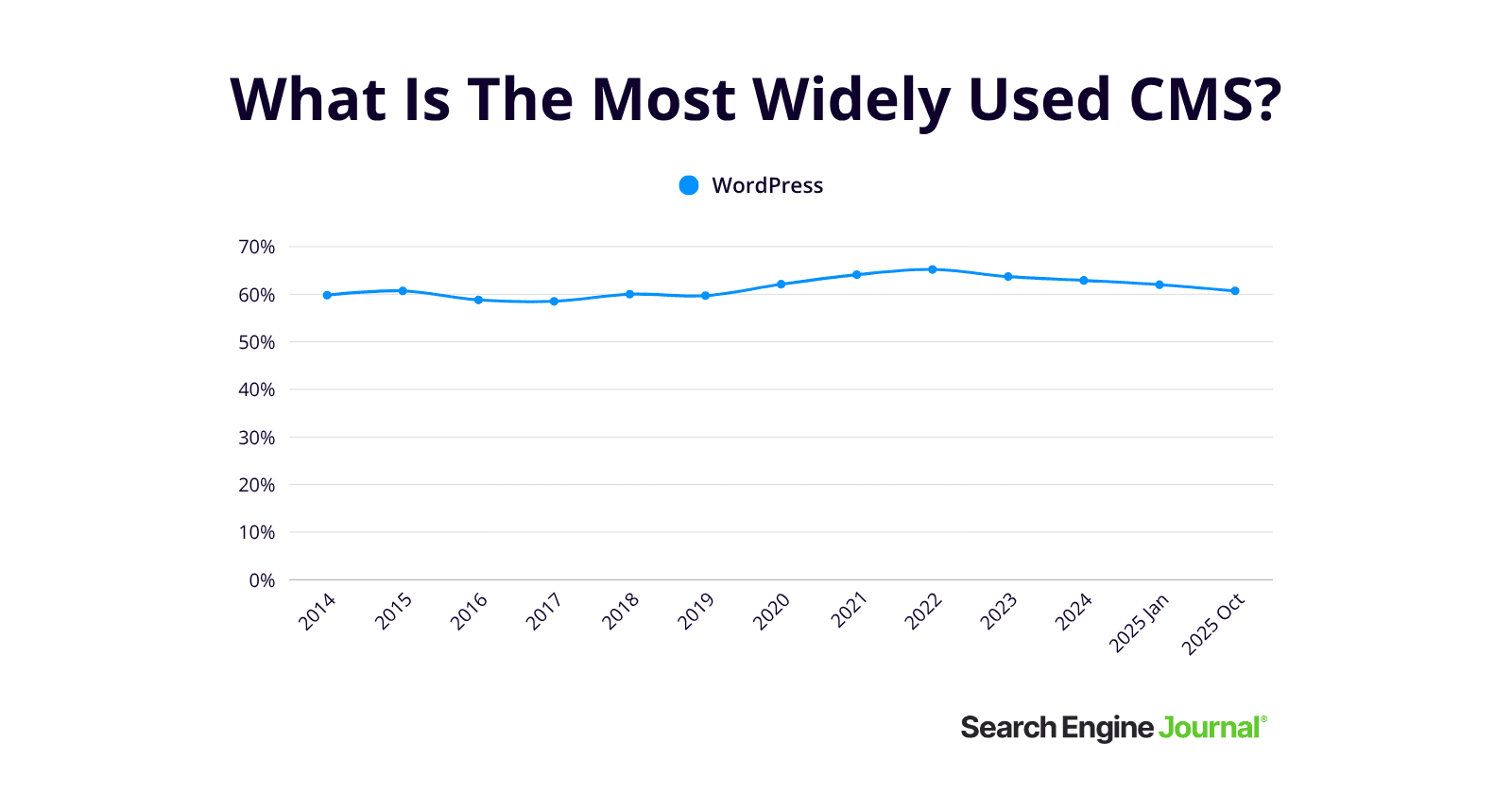
WordPress remains the dominant force in content management systems, powering 43.3% of websites surveyed and holding a 60.7% share among sites using a CMS, according to W3Techs (October 2025). That is still a commanding lead, but it marks a sustained decline from its peak of 65.2% in 2022 and is back to the same level as 2018, prior to the pandemic boom.
For executives and technical teams, this shift signals more than a market statistic.
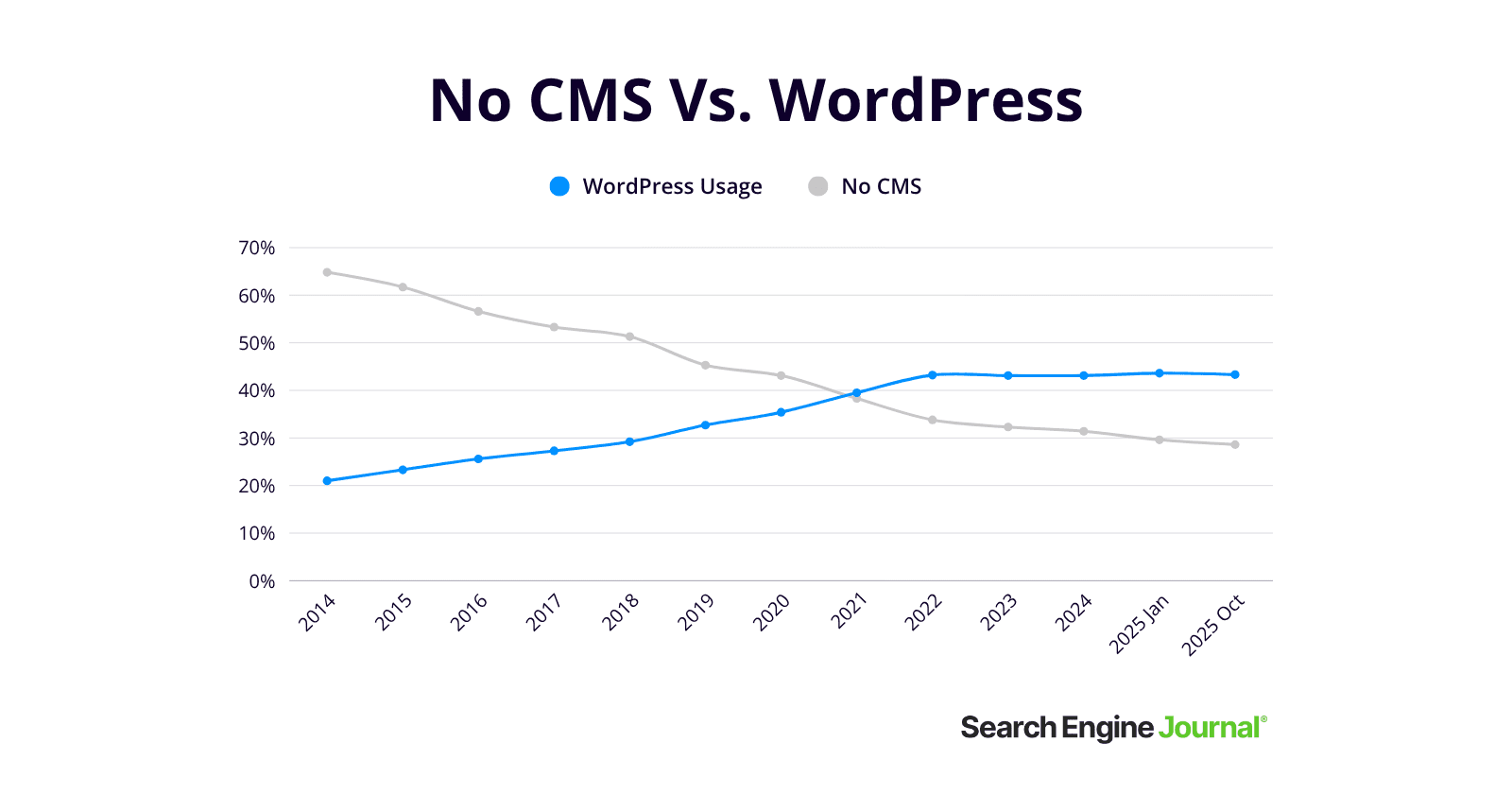
As WordPress shows its first significant slide in two decades, SaaS competitors like Shopify, Wix, and Squarespace are steadily gaining ground, offering businesses simpler, managed solutions with lower technical overhead. At the same time, the share of websites running without any CMS has dropped to 28.6%, which continues the broader industry trend toward structured platforms and hosted builders.
It means that choosing the right CMS today is less about preference and more about a strategic decision, with measurable impact on site performance, security, costs, and scalability.
This report breaks down the current CMS landscape, compares the top platforms, and outlines how the latest shifts influence platform strategy and technical execution.
How Large Is The CMS Market?
According to W3Techs, 71.4% of websites have a CMS, and Netcraft reports over 281 million domains.
From this, we can assume that the current market size for content management systems has risen to over 200 million websites.
Top 10 CMS By Market Share (Globally), October 2025
CMS (as of October 2025)
Launched
Type
Market Share
Usage
No CMS
28.6%
1
WordPress
2003
Open source
60.7%
43.3%
2
Shopify
2006
SaaS
6.8%
4.8%
3
Wix
2006
SaaS
5.7%
4.1%
4
Squarespace
2004
SaaS
3.4%
2.4%
5
Joomla
2005
Open source
2.0%
1.4%
6
Webflow
2013
SaaS
1.2%
0.9%
7
Drupal
2001
Open source
1.1%
0.8%
8
Tilda
2014
SaaS
1.1%
0.8%
9
Adobe Systems
2013
Open source
1.0%
0.7%
10
Duda
2008
SaaS
1.0%
0.7%
Data from W3Techs, October 2025. (WooCommerce and Elementor are not listed in the table above as they’re WordPress plugins and not standalone CMS platforms.)
*Graphs are separated due to the dominance of the WordPress market share.
WordPress
WordPress remains the most widely used CMS, a position it has held since its launch in 2003. Its usage across all websites grew by 105% from 2014 to 2022, cementing its role as the default platform for much of the web.
But its long-standing growth curve is now in a downturn; we’re seeing a market share decline of nearly seven percentage points in the last three years. It’s a trend that could continue as easier-to-use platforms gain ground and some users report frustrations with plugin compatibility, core updates, and security management.
From an SEO and business perspective, this means that Shopify offers executives a CMS option designed to support both performance and long-term growth.
Wix
Wix has made one of the more noticeable gains this year, now powering 4.1% of websites surveyed. The platform’s steady climb reflects broader market traction among small businesses. Case in point: A Reddit business owner notes its convenient and user-friendly features.
For executives, the takeaway is clear: Wix is positioning itself beyond a lightweight website builder that consistently invests in branding and platform capabilities, making it a viable contender for mid-market adoption.
Squarespace
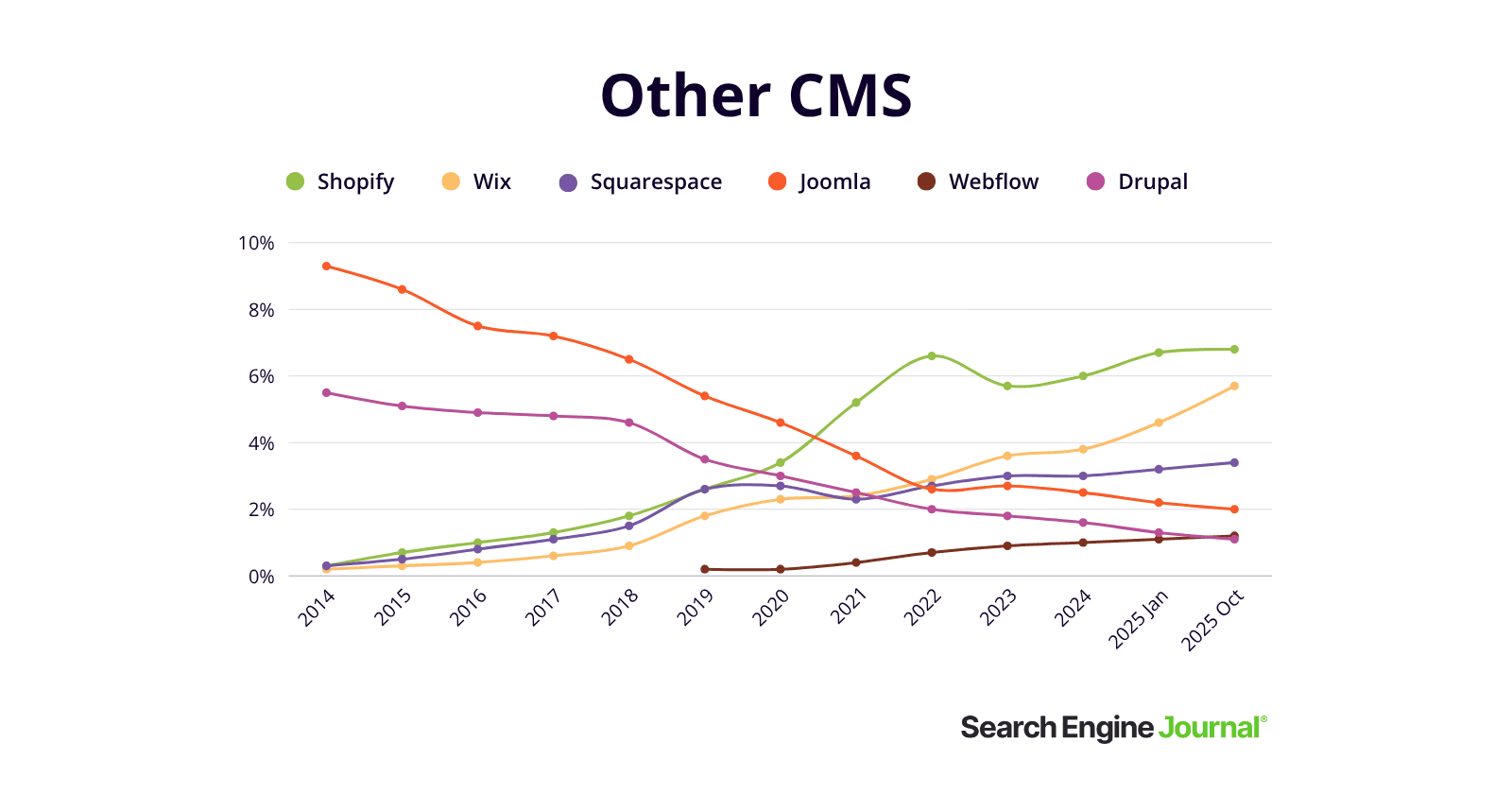
Squarespace has shown steady growth over the past decade, with its CMS market share growing from 0.3% in 2014 to 3.4% today, with 2.4% of websites surveyed now using the platform.
Its growth could be attributed to the increasing demand for low-maintenance, design-forward platforms.
Joomla and Drupal were among the top 3 until 2021, and since then, they have seen a steady decline in market share, now accounting for only 2.0% and 1.1%, respectively. This shift likely reflects a broader trend where more user-friendly, SaaS-based platforms capture the attention of small businesses and non-technical users.
At the same time, Webflow has emerged as a contender, climbing to 1.2% of the CMS market share. Its growth reflects demand for design-led platforms that allow businesses to streamline development without heavy technical dependencies, with professionals noting speed as a real differentiator.
No CMS
Between 2024 and October 2025, websites operating without a CMS dropped by 2.8 percentage points, continuing a trend away from custom-coded solutions. During the same period, websites using WordPress grew by just less than 1%.
The decline in “no CMS” websites signals an ongoing trend toward more structured, manageable platforms for site creation.
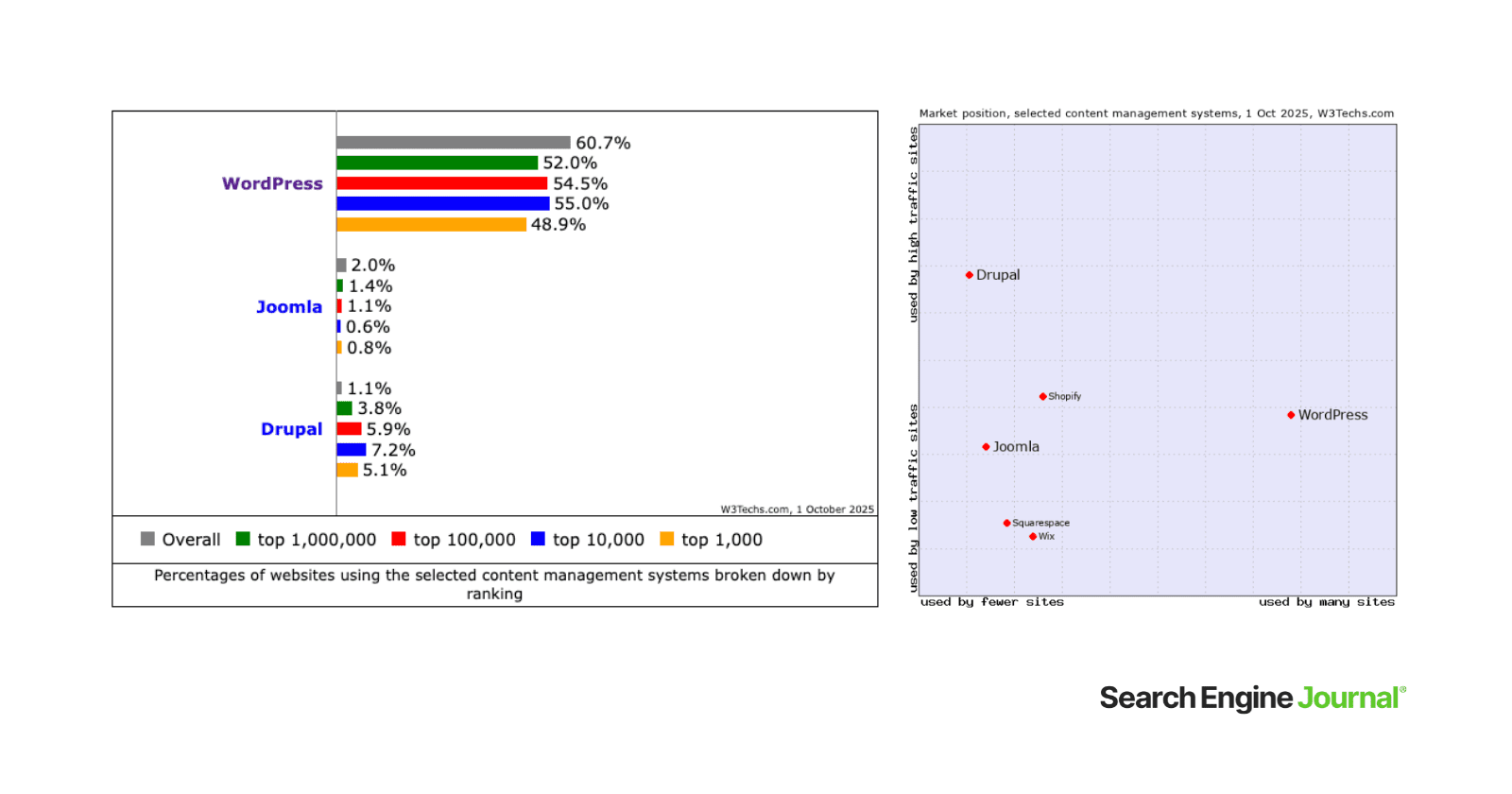
WordPress Vs. Joomla Vs. Drupal Market Share
Screenshot from W3Techs, October 2025
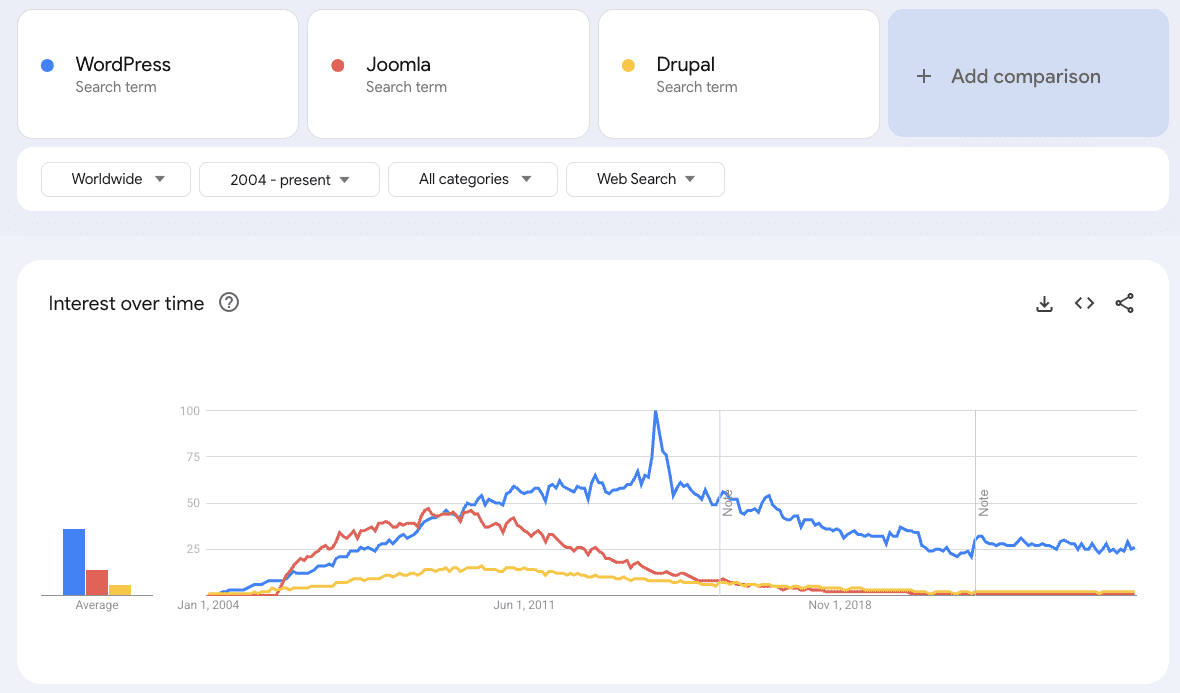
Since 2024, Joomla has decreased its market share by 20%, while Drupal has declined by 31%. Together, they once held almost 15% of the CMS market share in 2014 – now that figure sits at just over 3%.
They’ve slipped from the No. 2 and No. 3 spots to No. 5 and No. 6, overtaken by faster-growing platforms like Wix and Squarespace in 2022.
Joomla, in particular, had strong momentum early on – briefly surpassed WordPress in search interest until around 2008, according to Google Trends – but it hasn’t kept pace with modern platform demands.
Screenshot from Google Trends, October 2025
Why did these popular content management systems decline so much?
It’s most likely due to the strength of third-party support for WordPress with plugins and themes, making it much more accessible.
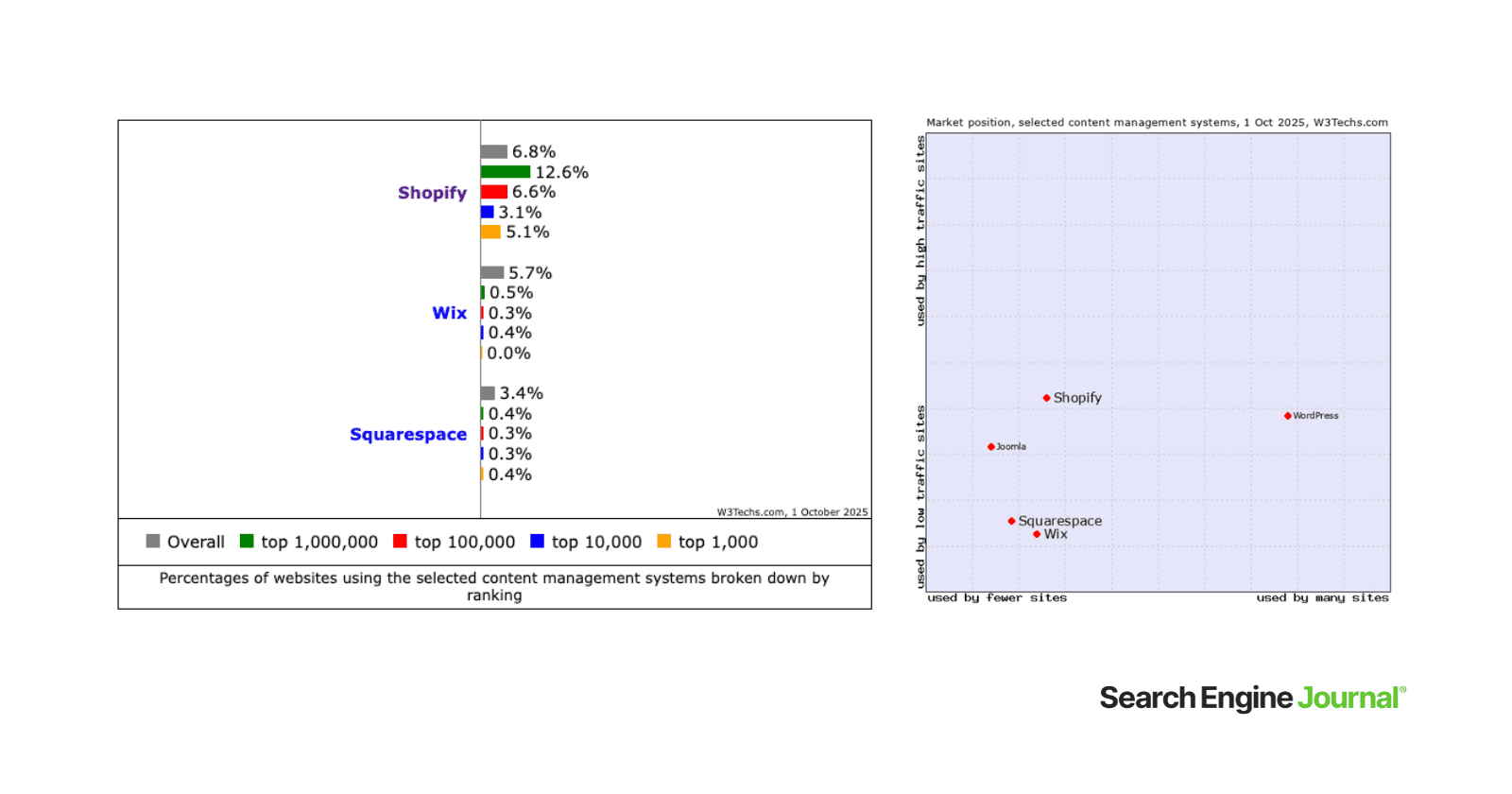
The growth of website builders, such as Wix and Squarespace, indicates that small businesses want a more straightforward managed solution, and they have started to nibble on market share from the bottom.
Website Builders Market Share: Wix Vs. Squarespace
If we look at the website builders, their growth is a strong indication of where the market might go in the future.
SaaS web builders such as Wix and Squarespace don’t require coding knowledge and offer a hosted website that makes it more accessible for a small business to get a web presence quickly. No need to arrange a hosting solution, install a website, and set up your own email. A web builder neatly does all this for you.
WordPress is not known as a complicated platform to use, but it does require some coding knowledge and an understanding of how websites are built. On the other hand, a website builder is a much easier route to market, without the need to understand what is happening in the back end.
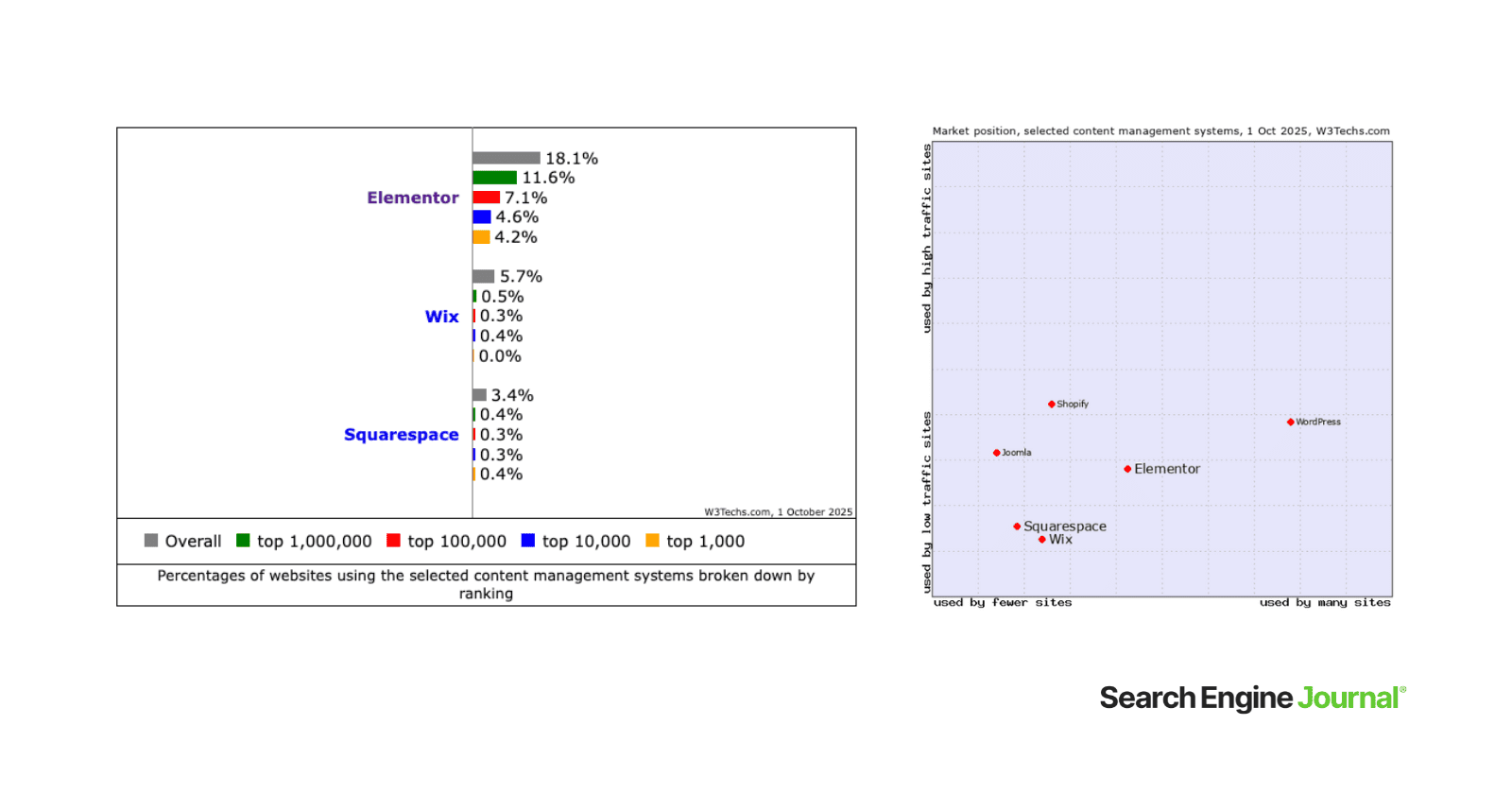
Elementor is the most widely used WordPress page builder, installed on 18.1% of all websites with a known CMS and 12.9% of all sites surveyed (not shown below) – more than Wix and Squarespace combined – though it functions as a plugin within WordPress, not a standalone CMS.
Screenshot from W3Techs, October 2025
While not a CMS on its own, it’s a major player in shaping how WordPress is used. However, because it’s a third-party plugin and not a CMS, it isn’t listed in the top 10 CMS above.
If we compare the volume of traffic to the number of CMS, we can see that WordPress is in the golden section, up and to the right, clearly favored by sites with more traffic.
Based on usage among higher-ranked domains, Joomla fits into a niche of fewer installs but more high-traffic sites, indicating that more professional sites are using it.
Squarespace and Wix are to the left and down, highlighting that they are installed on fewer sites with less traffic. It strongly indicates that they are used more by small websites and small businesses.
Elementor bridges the gap between the two and has the weight of the WordPress market share, but is used by sites with less traffic. This means the appetite is growing for drag-and-drop, plug-and-play solutions that make having a web presence accessible for anyone. This is the space to watch.
Ecommerce CMS Market Share: WooCommerce Vs. Shopify
Screenshot from W3Techs, October 2025
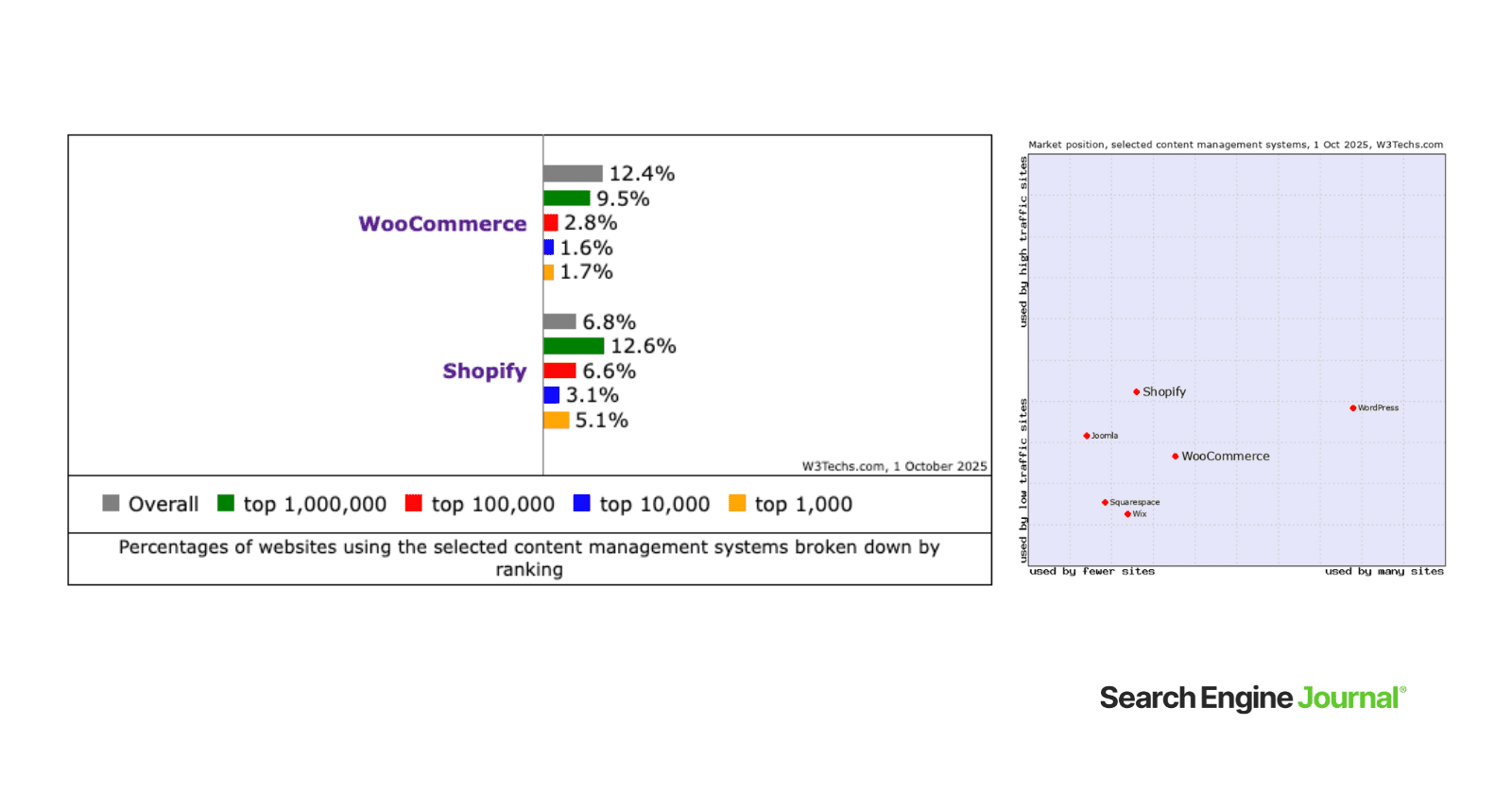
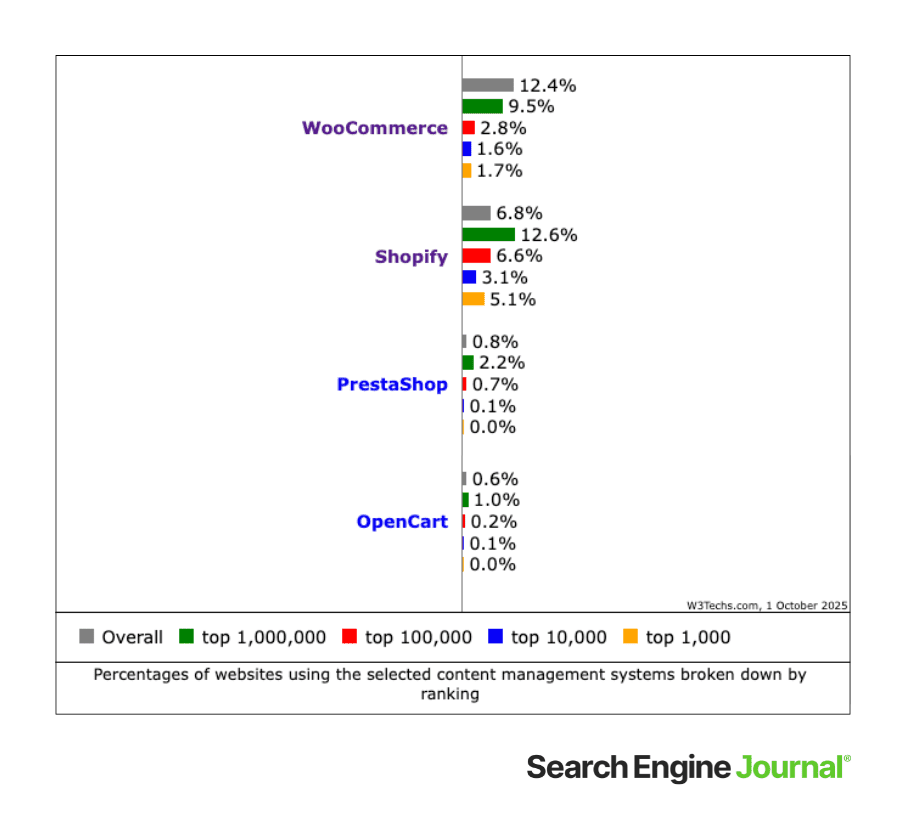
WooCommerce has a market share of 12.4%, while Shopify has 6.8%.
The ecommerce CMS space echoes a pattern similar to that of website builders. WooCommerce powers 8.9% of all existing websites, making it the most widely adopted ecommerce plugin by far. It doesn’t appear in W3Techs’ top CMS list because it is a WordPress plugin, but it’s a key factor in WordPress’s enduring popularity.
Looking at the distribution, we can see a clear pattern emerge. In comparison to other ecommerce CMS platforms, WooCommerce is dominant.
It has more market share than its competitors combined: Shopify (6.8%) + PrestaShop (0.8%) + OpenCart (0.6%) = 8.2% market share.
Screenshot from W3Techs, October 2025
Smaller sites might favor WooCommerce, but it has the WordPress platform’s weight for market access and, therefore, more installs, much like Elementor.
Shopify surged during the pandemic, with market share growing by 52.9% from 2020 to 2021 and then 26.9% from 2021 to 2022, outpacing every other platform. After a dip in 2023, it recovered in 2024 and has since leveled off, holding steady at 6.8% this year.
Why Does CMS Market Share Matter For SEO And Business Strategy?
As the market fragments, these shifts affect everything from site architecture, plugin availability, and technical SEO flexibility.
WordPress continues to lead, but its gradual decline marks a turning point. SaaS competitors such as Shopify, Wix, and Squarespace are steadily gaining traction, offering streamlined platforms that appeal to most businesses.
If more SMBs are switching to website builders, understanding the limitations and intricacies of these platforms for SEO could be a competitive advantage. CMS adoption determines how efficiently teams can build, secure, and optimize sites at scale.
Shopify now runs on 4.8% of all websites surveyed (not just sites with a CMS). With its increasing market share, specializing in Shopify SEO could be a strategic move for an SEO professional.
Wix and Squarespace are growing, too. As more small businesses adopt these platforms, getting fluent in their ecosystems could set you apart in a crowded market.
The reality is that WordPress remains the largest and most competitive ecosystem, but the growth curve has shifted toward challengers. This means one thing for business leaders and SEO professionals: an opportunity to diversify expertise.
Understanding the strengths and limitations of various CMS platforms can inform strategic decisions and align with evolving market demands.
More Resources:
All data collected from W3Techs, October 2025, unless otherwise indicated. See the W3techs methodology page for where the data is gathered from.
Featured Image: Paulo Bobita/Search Engine Journal
Online communities have infiltrated the internet, appearing at the top of search engine results pages (SERPs) for most queries. They play an integral role in shaping brand perception, purchasing decisions, and search visibility.
Reddit now sees more than 110.4 million daily users and 416.4 million weekly active users. Quora, on the other hand, also receives an impressive amount of traffic, with over 400 million active users flocking to the website monthly. Undoubtedly, online communities present an impressive opportunity, yet many marketing leaders have yet to capitalize on it.
This substantial shift towards interest in participating in online communities presents both an opportunity and a risk. Positive benefits a brand can receive from building authority in online communities include enhancing SEO performance, improving share of voice, and delivering real market intelligence. But participation without a solid strategy in place can backfire, damaging reputation in spaces where skepticism runs high and negative sentiment spreads like wildfire.
This article explores why it’s essential to build authority in Reddit and Quora, the brands that got it right (and wrong), and how to operationalize community authority as part of a broader marketing and SEO strategy.
Reddit Marketing Strategy: Building Authority In The Hardest Community
Reddit is one of the most difficult places for marketers to master. It’s a forum where trust is increasingly difficult to earn, and if a brand is perceived as disingenuous or inauthentic, it can be downvoted into obscurity quickly. Reddit community members are quick to express their thoughts about anything and everything, especially when it comes to brands that overtly try to advertise there.
Communities (which are known as “subreddits”) are moderated by members, not brands, and those members are quick to identify anything that sounds too promotional or tone-deaf. They also have the power to ban members entirely from participating in the subreddit. It may sound daunting to engage a Reddit audience; however, the brands that do earn credibility reap the rewards that extend well beyond the platform.
Case Study: Spotify’s AMA Success
Spotify is a prime example of how to master Reddit’s Ask Me Anything (AMA) discussion format. Spotify employees frequently leverage AMA to solicit feedback from users to improve its technology or to address tough technical questions, rather than hard sell playlists or subscriptions.
The result? Thousands of upvotes and long-tail SEO value that still lives on today in popular subreddit communities. Spotify openly invited users to engage directly with the team behind its recommendation engine, and users have a lot to say.
Spotify doesn’t have its marketers join the AMA conversation, but rather engineers who play an active role in how Spotify’s technology works. In turn, Spotify was able to build trust with an audience that might otherwise dismiss a “brand presence” as self-serving, as the SERPs for continued visibility.
For example, a Spotify engineering manager recently asked for users’ input on Spotify’s Lossless feature. The Reddit thread received 1,500 upvotes, four awards, and 451 comments, highlighting the power of engaging with a motivated and receptive community.
Case Study: Woody Harrelson’s AMA Failure
Unfortunately, AMA doesn’t always go according to plan. Perhaps one of the most infamous examples of an AMA gone wrong is with actor Woody Harrelson’s in 2012, which was a prime example of what happens when marketers ignore Reddit’s norms.
Harrelson promoted his film instead of answering questions, which caused a negative chain reaction. The actor received myriad downvotes, ridicule, and lasting negative press. To this day, this specific AMA is often referenced as a cautionary tale of when advertising goes awry.
Reddit and Quora, once fringe discussion boards, are now rife with chatter that is actively shaping brand perception, purchasing decisions, and trust. Reddit’s massive potential can no longer be ignored for the following reasons:
SEO Value
According to recent research, the “Discussions & Forums” SERP feature appeared in 7,085 out of the 10,000 studied product-review searches, which equates to about three-quarters (70-75%+) of the time.
Consumers are actively seeking validation before committing to a purchase, and surfacing at the top of the SERPs is a great way to build trust and authority with searchers.
Marketing Funnel
Shoppers are overwhelmed with a plethora of choices. Any time they seek a product or service, there are myriad vendors to vet.
Reddit’s own research states that Reddit is the No. 1 platform where people go to explore possible solutions to their needs, making it a powerful tool for discovering products. Additionally, 71% of people who discovered a brand online or off went to Reddit to conduct their research. 74% of people agree that Reddit assists them in making faster purchase decisions.
Trust Building
Research reveals that over three-quarters (77%) of consumers are willing to spend their money to support an authentic brand over one that’s not. Additionally, Reddit recently reported that 88% of social media users turn to Reddit for purchase decisions, and 76% believe Reddit posts are more honest and truthful than those on other social platforms.
With more users trusting Reddit over other platforms, the opportunity is to empower subject matter experts, engineers, executives, and other powerful voices within their organization to share original insights, host AMAs, and engage authentically with Reddit community members.
Quora Marketing Strategy: Long-Tail Authority That Compounds
Quora is an entirely different online community that requires its own distinct strategy. Reddit thrives on thoughtful debate, engaging discussion, and subcultural context, whereas Quora looks for depth, expertise, and intellect.
Quora’s algorithm looks for long-form content and authoritative answers that provide substantial context, cite credible resources, and solve the reader’s challenge succinctly. For example, an in-depth, 1,000-word response that reveals relevant and helpful information will typically outperform a low-effort, dull response.
Like Reddit, Quora also has unique SEO advantages. Thought-provoking, highly regarded content has staying power in the SERPs. Investing in Quora can offer online visibility across numerous platforms, helping boost brand recognition and build long-lasting search equity. Additionally, given the shift in how businesses are appearing in the SERPs with the rise of AI, research from Semrush found that Quora is the most commonly cited website in Google AI Overviews.
Case Study: Staggering Success For CodingNinjas
Quora users don’t want to feel as though they’re shouting into a void. They crave connection, conversation, and relevant responses to their inquiries. CodingNinjas does just that, using Quora in a highly strategic way. After noticing early leads originating from Quora, the team continued to invest in answering questions related to their services and competitors. The result? Within a year, Quora became their No. 1 source of qualified leads, driving consistent organic traffic and improved search engine visibility.
Success came with testing the length of answers as well as aligning with keywords, which helped CodingNinjas determine which content resonated best with their target audience. They found writing content that addressed the final stages of customer awareness, such as solution and product-focused questions, performed best and produced the highest conversions.
CodingNinja’s success highlights how strategic participation in Quora can help boost search visibility and strengthen domain authority through authentic, value-driven writing. Just like Reddit, the better your responses, the better your chance of succeeding in building authority on Quora.
Case Study: Outsourcing Gone Wrong
Outsourcing is a tactic to avoid when engaging with Quora and Reddit community members. Companies that delegate Reddit or Quora participation to third parties often lose brand tone and voice in their responses (see the Woody Harrelson example above). The result is templated, generic responses that often violate community rules and can even lead to bans. Reddit and Quora users actively look for credible, well-cited answers that those who are unfamiliar with your industry and brand may not be able to provide.
Companies that outsource Quora participation often receive unhelpful, keyword-stuffed answers that don’t match brand content standards. In turn, this content can be flagged for low quality and remain unseen by Quora users because of this. Many times, consumers can see through the intent and effort behind these posts and will downvote the content. In some instances, it may result in account suspension, wasting time and money, while also harming credibility.
Why You Should Prioritize Quora
While Reddit is well-known for sparking heated debates and quick responses, Quora rewards depth, expertise, and length. With hundreds of millions of visitors frequenting Quora, the opportunity is to convert these motivated searchers into customers. Here are a few reasons why brands should prioritize Quora:
Search Visibility
Unlike posting on social platforms like Instagram and Facebook, Quora content has the potential to deliver value for lengthy periods of time. As aforementioned, Google’s AI Overviews tend to pull authoritative and quality Quora responses, placing content front and center at the moment searchers are looking for relevant content.
A single, in-depth answer can get eyes on it for years in the SERPs, attracting high-intent searchers long after publication, extending the content’s mileage and funneling a continual stream of new visitors. Quora acts as an evergreen asset, making it a compounding investment that can pay off well beyond its initial posting and a strong potential revenue resource. In comparison, paid ads or sponsored social posts may drive impressions but disappear quickly, offering little lasting equity.
Executive Visibility
For executives looking to boost their digital presence and share their wealth of expertise, Quora is one of the strongest methods for engaging curious consumers.
For CMOs, there’s a clear incentive to position themselves and other leadership team members as authoritative voices on an influential platform. When a CMO, product lead, or engineer answers a strategic question like “What is the future of AI in marketing technology?”, your answer holds weight and doesn’t just position your brand as a thought leader; it also enhances the individual’s personal credibility and positions them as an expert voice on the topic.
The dual benefit – strengthening your company’s reach and authority as well as your thought leaders – makes Quora a powerful and investment-worthy channel for marketing to focus on.
Longevity
A single thought-provoking answer on Quora can consistently attract high-intent readers who are seeking a trustworthy resource to solve their challenge. Alternatively, a sponsored LinkedIn post may receive ample attention but disappear from people’s feeds and minds almost immediately after reading.
Content Pipeline
A high-performing Quora answer may be repurposed into longer form content to get the most mileage, such as a blog post, social media carousel, ebook, and more, helping fuel your content pipeline with high-performing insights. Longer-form content tends to perform better on Quora (1,000+ word answers), so it’s important to focus not only on the quality of your answer but also the length.
How To Make Authority In Online Communities Your Next Competitive Advantage
Given the influx of answers available online for any query, visibility is no longer the determinant of success. Visibility without trust doesn’t retain customers. In online communities, where skepticism is abundant and trust is fleeting and fickle, authority is what ultimately wins.
The lesson is apparent: Online communities can’t be treated as marginal and shouldn’t be forgotten. They must be treated with the same fervor and effort as other more traditional marketing strategies, such as email and pay-per-click advertising. Authority is a strategic asset, one that influences consumers early on in their journeys with your business. Building solid trust extends the lifetime of your customers and turns them into brand advocates.
Authority in online communities is one of the best ways to build trust in an increasingly skeptical consumer purchasing landscape and can:
Position your brand as a trusted authority in places where consumers are actively seeking advice and reassurance.
The brands that will conquer online communities in the future aren’t chasing volume; they’re seeking authentic relationships and building trust in a highly scrutinized marketplace.
As AI-generated content and recommendations continue to infiltrate the SERPs and, in turn, grow consumer distrust, the brands that build their authority in online communities today will be the ones who own the conversations in the future.
Your content has 15 seconds. That’s it. In those precious moments, your reader’s brain makes a critical decision: scan or abandon. The statistics are sobering. Users read only 20-28% of webpage content, spending an average of 15 seconds on a page before deciding whether to stay or leave. Yet many content creators still write as if their audience will consume every carefully crafted sentence from start to finish.
The reality? Your readers aren’t reading; they are scanning, which is why scannable content becomes important. This isn’t a failure of modern attention spans or a sign that people don’t value quality content. It’s neuroscience in action. The human brain has evolved sophisticated pattern recognition systems that help us quickly identify relevant information while filtering out the noise. And do you know what the most potent triggers for this system are? The humble bullet point.
When readers encounter well-structured bullet points in your blog piece, their brains release small hits of dopamine, the same neurotransmitter associated with completing tasks and achieving goals. This is a biological reward system that makes scannable content easier to process and pleasurable to consume.
Understanding the cognitive psychology behind how people process information isn’t just academic curiosity. It’s also the key to creating content that converts, engages, and serves your audience’s actual reading behaviors. Tools like Yoast’s AI Summarize feature recognize this reality, helping content creators quickly identify and restructure their essential points into the scannable formats readers crave.
Key takeaways
Readers scan content in 15 seconds, favoring scannable formats like bullet points for quick comprehension.
Research shows that effective scannable content enhances cognitive processing and engages readers better.
Key factors like motivation, task type, and focus determine how deeply someone will read your content.
Mobile usage has reshaped reading habits, increasing demand for short, structured, and scannable content.
To create scannable content, writers should respect cognitive patterns and optimize content structure with clear visuals.
The scanning habits of our brain
The myth of linear reading
If you believe your readers start at the top of your content and methodically work their way through each paragraph, you’re operating under a dangerous misconception. Eye-tracking research from the Nielsen Norman Group reveals that people don’t read online content, they scan it in predictable patterns.
F-shape scanning pattern: It is one of the most common reading patterns, where readers scan horizontally across the top, make a second horizontal scan partway down, then scan vertically down the left side.
Layer cake pattern: This includes scanning headings and subheadings.
Spotted pattern: Jumping to specific words or phrases that catch attention.
F-shape reading pattern of the brain
This isn’t laziness, it’s cognitive efficiency at its best. Our brains are wired to seek the path of least resistance when processing information. In a world where we’re bombarded with more content than we could ever consume, scanning helps us quickly identify what deserves our full attention.
Cognitive load theory explains why this happens. Our working memory can only hold about 5 to 9 pieces of information at once. When content is presented in dense paragraphs, our brains work harder to extract meaning, creating mental fatigue that leads to abandonment.
Factors that determine reading depth
Not all scanning is created equal. Four key factors determine whether someone will scan briefly or dive deeper into your content:
Level of motivation: When readers desperately need specific information, like troubleshooting a technical problem, they’ll invest more cognitive resources in careful reading. But for general browsing, they’ll skim for signals of value.
Type of task: Fact-finding missions (like researching product features) create different reading behaviors than exploratory browsing. Task-oriented readers scan for specific data points, while browsers scan for interesting concepts.
Level of focus: A reader juggling multiple browser tabs while checking their phone will scan differently than someone in a quiet environment dedicated to learning. Multitasking reduces the cognitive resources available for deep processing.
Personal characteristics: Some people are naturally deep readers who prefer narrative content, while others are chronic scanners who gravitate toward lists and summaries. Age, education, and cultural background all influence these preferences.
The impact of mobile evolution on content consumption
Smartphone usage hasn’t just changed where we consume content, it’s rewired how we process information. The average smartphone user checks their device 96 times daily, creating a constant state of partial attention that makes scanning the dominant reading mode.
Mobile screens compress information into narrow columns, overwhelming traditional paragraph structures. This physical constraint has trained our brains to prefer “thumb-friendly” content architecture: short paragraphs, frequent subheadings, and plenty of white space.
The impact transcends mobile devices. Desktop readers now expect the same scannable formats they’ve grown accustomed to on their phones. Content that doesn’t accommodate these evolved reading behaviors feels dated and inaccessible.
The psychology behind bullet points
Understanding why bullet points work so effectively requires a quick look at how your brain processes information. When you encounter a wall of text, your mind has to work overtime to extract the key points, organize the information, and remember what matters. Bullet points do this heavy lifting for you, turning complex information into digestible chunks that your brain can process with minimal effort.
1. The mental burden relief of cognitive load reduction
Bullet points aren’t just visually appealing, but also easy to scan. They’re cognitive performance enhancers. When information is presented in bullet format, our working memory can process it more efficiently because each point operates as a discrete unit.
Research in cognitive psychology shows that structured information reduces the mental effort required for comprehension. This creates what researchers call “cognitive ease”, a state where information feels more trustworthy and credible simply because it’s easier to process.
The famous 7±2 rule (also known as Miller’s Law) explains why bullet points work so well. Our working memory can comfortably hold 5-9 items at once. Well-crafted bullet lists respect this limitation by chunking information into digestible pieces that our brains can easily manipulate and remember.
When content flows smoothly through our mental processing systems, we unconsciously associate that ease with quality and authority. This is why bullet points improve comprehension and credibility.
2. Pattern recognition and predictability
Human brains are pattern-recognition machines, constantly seeking familiar structures that help us predict what will happen next. Bullet points, through their predictable format, provide precisely this kind of psychological comfort.
Visual hierarchy serves as a roadmap for our attention. When readers see a bullet list, they instantly understand the structure: each point will present a discrete piece of information, all points are roughly equivalent in importance, and the data can be consumed in any order.
Gestalt principles explain why this works so well. Our brains use proximity (related items grouped), similarity (consistent formatting signals related content), and continuation (visual flow guides attention) to organize information efficiently. Bullet points leverage all three principles simultaneously.
This predictability reduces cognitive anxiety. Readers don’t need to invest mental energy figuring out how information is organized, they can focus entirely on processing the content.
3. The psychology of completion
Perhaps the most fascinating aspect of bullet point psychology is how it triggers our brain’s reward system. Each bullet point creates a micro-task that can be “completed” simply by reading. This completion triggers a small dopamine release; the same neurotransmitter associated with crossing items off a to-do list.
The Zeigarnik effect demonstrates why this matters. Our brains create psychological tension around incomplete tasks, making them more memorable than completed ones. Bullet points cleverly exploit this by creating multiple small completion opportunities within a single piece of content.
This neurological reward system explains why people find lists inherently satisfying. We’re not just consuming information; we’re experiencing a series of small accomplishments that make reading feel productive and rewarding.
4. Visual breathing room
White space isn’t space; it’s cognitive breathing room. Dense paragraphs create visual clutter that triggers stress responses in our brains, making content feel overwhelming before we even begin reading.
Bullet points introduce strategic white space that gives our visual processing system room to operate. This breathing room prevents cognitive overload and makes content more approachable and manageable.
Eye movement research shows that readers’ gaze patterns follow predictable paths through well-spaced content. White space guides attention naturally, creating a visual rhythm that supports comprehension rather than fighting against it.
The science of information processing
Working memory and executive function
Working memory is the temporary storage system where we manipulate information while processing it. Unlike long-term memory, which has virtually unlimited capacity, working memory can only handle a few items simultaneously.
Bullet points support working memory by presenting information in pre-chunked units. Instead of extracting key points from dense paragraphs, a task that requires executive function resources, readers can directly process the distilled information.
Research comparing narrative versus expository text comprehension shows structured formats consistently outperform traditional paragraphs for information retention and comprehension speed. The brain’s executive functions can focus on understanding content rather than organizing it.
This is particularly important for complex or technical information. When cognitive resources are allocated efficiently, readers can engage with more sophisticated concepts without experiencing mental fatigue.
The discrete thought advantage
Each bullet point functions as a self-contained information unit, allowing for what cognitive scientists call “discrete processing.” Unlike paragraphs, where ideas build upon each other sequentially, bullet points can be processed independently.
This creates a “mental reset” opportunity between points. Readers can fully process one concept before moving to the next, preventing cognitive overload when multiple ideas compete for working memory space.
The difference is like comparing building a tower (paragraphs) versus collecting individual blocks (bullet points). Building requires awareness of the entire structure, while collecting allows focus on each piece.
Speed vs. comprehension
Critics often argue that scannable content sacrifices depth for speed, but research suggests a more nuanced reality. Studies show that bullet formats can improve comprehension for certain types of information while dramatically increasing processing speed.
The key matches the format of the content type. Bullet points excel for factual information, feature lists, and step-by-step processes. They’re less effective for narrative content, complex arguments, and emotional storytelling.
In research studies, retention rates for structured information consistently outperform unstructured text. The sweet spot appears to be content that balances scanning speed with information density, exactly what effective bullet points achieve.
This is where AI-powered tools like Yoast’s AI Summarize feature become invaluable. They can analyze dense content and identify the key points that would benefit from bullet formatting, helping writers optimize speed and comprehension without sacrificing essential nuances.
Instantly highlight your core insights with AI Summarize, in Yoast SEO Premium. Generate editable summaries in seconds.
The hierarchy of scannable elements
The content ecosystem
Bullet points are not isolated components; they’re part of a broader ecosystem of scannable elements that work together to create user-friendly content. An effective scannable design incorporates multiple layers of visual hierarchy.
Headings and subheadings serve as navigation anchors, allowing readers to identify relevant sections quickly. They’re the highway signs of content, helping people find their destination without reading every word.
Numbers and statistics act as attention magnets, drawing the eye with their specificity and authority. Our brains are wired to notice numerical information, making stats powerful tools for engagement.
Bold text and formatting provide visual cues that guide attention to key concepts. Strategic emphasis helps readers identify the most important information without overwhelming the overall design.
White space ties everything together, preventing visual overcrowding and giving each element room to breathe. The silence between notes makes music coherent.
Choosing from Lists and other formats
Different content types call for different scannable formats. Understanding when to use each format prevents the monotony of bullet point overuse while optimizing for specific communication goals.
Bullet points: They excel for features, benefits, and key takeaways where order doesn’t matter. They’re perfect for highlighting multiple advantages or listing unranked options.
Numbered lists: These lists work best for processes, rankings, and sequential information. They provide clear progression and help readers track their position within the content.
Tables: Ideal for comparisons and data-heavy content. They allow readers to scan vertically and horizontally, facilitating quick comparisons across multiple variables.
Paragraphs: An essential storytelling instrument, context-building, and complex arguments requiring narrative development. The key is using them strategically rather than defaulting to them automatically.
The mobile-first psychology
Mobile usage hasn’t just changed screen sizes, it’s fundamentally altered how we consume content. Thumb-scrolling creates different engagement patterns than mouse-based navigation, favoring content that works with natural thumb movements.
The “thumb-friendly” hierarchy prioritizes easily tappable elements and accommodates one-handed usage. This means shorter sections, more frequent headings, and content designed for vertical scrolling rather than horizontal scanning.
Responsive design psychology goes beyond technical implementation. It requires understanding how reading behaviors change across devices and optimizing content structure for each context.
Implementing psychology-driven content
Knowing the science behind scannable content is one thing—putting it into practice is another. The good news? You don’t need a psychology degree to create content that respects how your readers’ brains work. With a few strategic adjustments to your writing process, you can transform dense, intimidating content into clear, engaging material that people actually read and act on. Here’s how to make the psychology work for you.
The content creator’s checklist
Pre-writing considerations: Analyze your audience’s attention constraints and reading context. Are they researching solutions under pressure, browsing casually, or seeking deep understanding? This determines your optimal scannable structure.
During writing: Identify natural breaking points during writing where concepts shift or new ideas emerge. These transition moments are perfect for bullet points, subheadings, or formatting changes supporting scanning behaviors.
Post-writing optimization: Simulate scanning behavior by reading only headings, first sentences, and formatted elements. Does the content still make sense and provide value? If not, restructure to serve better scanning readers.
Tools and techniques
Readability analyzers: They provide objective metrics for content accessibility, but understanding their psychological basis helps interpret results more meaningfully. High readability scores often correlate with scannable structure.
Heat mapping tools: One of the most potent tools for revealing reader attention patterns, showing where scannable elements succeed or fail. This data helps optimize formatting for real usage rather than theoretical best practices.
User testing methodologies: A one of the kind testing methods that is used for content structures and can also include card sorting exercises, first impression tests, and task-based evaluations. They reveal how well your formatting serves actual reader goals.
Respecting your reader’s brain
Understanding the psychology of scannable content isn’t about manipulating readers, but about respecting how their brains process information. Everyone wins when we create content that works with cognitive patterns rather than against them.
Readers get information they can consume efficiently without sacrificing comprehension. Content creators build trust and engagement by serving their audience’s genuine needs rather than forcing outdated consumption models.
The competitive advantage goes to those recognizing that effective content serves the reader’s brain, not the creator’s ego. Attention is the scarcest resource, so content that respects cognitive limitations while delivering genuine value will consistently outperform material that ignores psychological realities.
Ready to implement these insights with Yoast SEO? Start by auditing your existing content through a psychological lens. Look for opportunities to break up dense paragraphs, add scannable elements, and create the visual breathing room that modern readers crave. Your audience’s brains and content performance will thank you.
Make every post easier to read, scan, and share. Use AI Summarize to create key takeaways and boost engagement.
Aman Soni
Yoast has been synonymous with the word digital marketing since the beginning of everything SEO. It has been an ever-present, like an omnipotent, all-knowing SEO plugin, the first one I ever used. Now, I am delighted and also in awe that I work for the very brand which I so revered! I work, read, write, swim, hike and make things happen.