The noise we make is hurting animals. Can we learn to shut up?

When the covid-19 pandemic started, Jennifer Phillips thought about the songs of the sparrows.

They were easier to hear, because the world had suddenly become quieter. Car traffic plummeted as people sheltered at home and shifted to remote work. Air travel collapsed. Cities—normally filled with the honking, screeching, engine-gunning riot of transportation—became as silent as tombs.

For years, Phillips has studied how animals react to “anthropogenic noise,” or the racket created by human activity. Most animals really don’t like it, she and her colleagues have learned. Animals constantly listen to the world around them: They’re on the alert for the rustle of approaching predators, or a mating call from a member of their species. As human society has expanded—with sprawling cities, industrial mines, and roads crisscrossing the world—it has gotten noisier too, and animals have trouble hearing one another.

Noise is invisible; there’s no billowing smokestack, no soiled waterway. We just got used to it as it vibrated in the background.


Phillips and her colleagues had spent time in the 2010s in San Francisco recording the sound of white-crowned sparrows in the Presidio. It’s a park that is half peaceful nature and half automobile noise, since it’s filled with thick clumps of trees and grassy fields but also has two highways that slice through it, feeding onto the Golden Gate Bridge. In past recordings, starting in the 1950s, sparrows had sung with complex and lower-pitched melodies and three major “dialects.” But by the 2010s, traffic in the Presidio had exploded, and the hubbub was so loud that the birds began to sing with faster trills—and at a higher pitch—so their fellows could hear them. The two quietest dialects were either dead or on their way to extinction.

They’re “screaming at the top of their lungs,” says Phillips. “They really can’t hear the lower frequencies when the traffic noise is present.” Urban noise can even change birds’ bodies; they get thinner and more stressed out. Their mating calls aren’t as effective, because female birds, as researchers have found, generally don’t enjoy high-pitched, high-volume shouting. (It makes them wonder if the males are unhealthy.) The noise can increase bird-on-bird conflict, because when birds can’t hear warning cries they accidentally stumble into enemy territory. Perhaps worst of all, in situations like these biodiversity takes a hit: Entire species that can’t handle urban clamor simply head out of town and never come back.

But as the sudden, eerie silence of the pandemic descended, Phillips sat at home thinking, It’s really quiet. And then she wondered: Would the Presidio birds now be able to hear each other better?

She raced over to the park and started recording. Sure enough, the park was seven decibels quieter—a huge drop. (That’s like the difference between the noise of the average home and whispering.)

And remarkably, the researchers found that the songs of the white-crowned sparrows had transformed. They were singing more quietly, with a richer range of frequencies. A bird could be heard twice as far as before. And the mating calls had gotten more sultry.

“They could sing a higher performance, basically a sexier song, but not have to scream it so loud,” Phillips says. 

It was as if time had been reversed and all the damage abruptly repaired. And it proved what Phillips and her peers have been increasingly documenting: that anthropogenic noise is the newest form of pollution we need to tackle. The noise of our relentlessly on-the-move industrial society affects all life on Earth, wildlife and humans, in ways we’re just beginning to grasp. Yet strategies such as electrification and clever urban design could help. As the Presidio showed, noise can vanish overnight—once we figure out how to shut up.

Hidden impacts

Many forms of pollution are obvious to us humans. Dumping toxic goo into lakes? Sure, that’s bad. Coal smokestacks pumping soot and carbon dioxide, plastic bags and sea nets choking whales—we now understand that these, too, are problems. Even an idea as gauzy as light pollution has penetrated the public consciousness to some extent, since it’s why city dwellers can’t see many stars, and we’ve heard it confuses migratory birds.

But noise, mostly from transportation, took longer to hit our radar. This is partly because it’s invisible; there’s no billowing smokestack, no soiled waterway. We just got used to it as it vibrated in the background.

sparrow perched on a branch, singing
Sparrows in San Francisco’s Presidio began to sing with faster trills—and at a higher pitch—so their fellows could hear them over the noise of nearby traffic.
GETTY IMAGES
hummingbird in flight
The black-chinned hummingbird seems to prefer noisy areas, fledging more chicks than the same species does in quieter areas.
MDF/WIKIMEDIA COMMONS

There were a few studies in the ’70s and ’80s showing that animals were upset by our noise. But the field really began to take off in the ’00s, in part because digital technology made it easier to record long swathes of sound out in nature and analyze them. One early salvo came from the biologist Hans Slabbekoorn, who was studying doves in the city of Leiden and irritatedly noticed that he could rarely get a clean recording because of the background noise. Sometimes he’d see the doves’ throats moving as they cooed but couldn’t hear them. “If I’m having difficulty hearing them,” he thought, “what about them?”

So he and a colleague started recording ambient sound levels in different parts of Leiden. Some were quiet residential areas, which registered a soothing 42 decibels, and others were noisy intersections or areas near highways, which reached 63 decibels, about as loud as background music. Sure enough, he found that birds in the noisy areas were singing at a higher pitch.

Over the next two decades, research in the field bloomed. Noise, the scientists found, has a few common ill effects on animals. It disrupts communication, certainly. But it also generally stresses them, reducing everything from their body weight to their receptivity to mating calls. If an animal nests closer to a road, its reproduction rates can go down; eastern bluebirds, for example, produce fewer fledglings. Truly cacophonous noise—like planes taking off at a nearby airport—can cause hearing loss in birds. And animals can wind up becoming less aware of threats from predators. They’ll wander closer to danger, because they can’t hear it coming. (And sometimes they’ll do the opposite: They’ll develop a rageaholic hair-­trigger temper, because they’re constantly on high alert and regard everything as a threat.) 

Even in deep rural areas, where things are normally pretty quiet, highways can disrupt wildlife—the noise carries far into the fields nearby. Fraser Shilling, a biologist at the University of California, Davis, has stood up to half a mile from rural highways and recorded sound as loud as 60 decibels, which is at least 20 decibels higher than you’d typically find in the wilderness. “The motorcycles and the 18-wheelers are really the ones that project a lot of noise,” he told me. 

Above 55 decibels, many skittish animals get into a fight-or-flight panic. The prevalence of bobcats—an endangered species famously rattled by noise—“starts dropping off the cliff,” says Shilling. Above 65, “you’re really starting to exclude almost all wildlife.”

And that’s not even the upper limit of what wildlife is exposed to. There are roughly a half-million natural-gas wells around the US, and piercingly loud compressors are used to shoot water down into most of them. Up close, the compressors can kick out 95 decibels, a sound as loud as a subway train; at one Wyoming gas well the sound still registered around 48 decibels nearly a quarter-mile away.

Historically, it wasn’t always easy to prove that noise was causing whatever problems the animals were experiencing. Maybe it was other factors; maybe animal populations reduce near a road because some are hit by vehicles? 

But several clever experiments have proved that noise—and noise alone—can disrupt wildlife. One was the “phantom road” experiment by the conservation scientist Jesse Barber and his team, then at Boise State University. They went out to a quiet, uninhabited area of the Boise foothills in Idaho, far away from any roads. In this valley in the mountains, thousands of migratory birds stop on their way south each year; they’ll gorge themselves on cherry bushes, gaining weight for the next days of flying. The researchers strapped 15 pairs of speakers to Douglas fir trees, in a half-kilometer line. Then they blasted recordings of highway noise. They played the noise for four days and then turned it off for four days. Then they observed thousands of birds, capturing many to measure their body mass.

The noise truly rattled the birds. When the sound was turned on, nearly a third left the area. Those that stuck around ate less: While birds should be heavier after a day of foraging, these ones didn’t gain much. The noise seemed to have so interrupted their feeding that they weren’t packing on the weight needed for their migratory trip.

Other, similarly nifty A/B tests followed. One was led by David Luther, a biologist at George Mason University (who also worked with Phillips on the covid-19 study in San Francisco). In 2015, these researchers took 17 white-crowned sparrows at birth and raised them in a lab. To teach them their species’ songs, they played the nestlings recordings of adult sparrows singing, at low and high pitches. Six of the nestlings heard the songs without any interference; with the other half, the researchers played the sounds of city noise at the same time.

The results were stark. The lucky birds that were spared the traffic noise learned to perform the quieter, sweeter, more complex songs. But the birds that had traffic noise blasted learned only the higher, faster, more stressed-out songs. From the cradle, noise changed the way they communicated.

Humans hate noise too

You can’t pull the same experiment with humans, raising them in a lab to see how noise affects them. (Not ethically, anyway.) But if we could, we’d likely find the same thing. We, too, are animals—and it appears that we suffer in similar ways from anthropogenic noise, even though we’re the ones creating it.

The sound of traffic is correlated with lousy sleep, higher blood pressure, more heart disease, and higher stress.

Stacks of research in the last few decades have found that noise—most often, as with wildlife, the sound of traffic—is correlated with lousy sleep, higher blood pressure, more heart disease, and higher stress. A Danish study followed almost 25,000 nurses for years and found that an additional 10 decibels hit them hard; over a 23-year period they had an 8% higher rate of death, plus higher rates of nearly every bad thing that could happen to you: cancers, psychiatric problems, strokes. (They controlled for other malign health influences.) As you’d probably predict by now, children fare badly too. When Barcelona researchers followed almost 3,000 elementary school kids for a year, they found that those in noisier schools performed worse on assessments of working memory and ability to pay attention.

“We think of ourselves as being ‘used to it,’” says Gail Patricelli, a professor of evolution and ecology at the University of California, Davis. “We’re not as used to it as we think we are.”

It’s also true that there’s a trade-off. Many people understand that noise from cities and highways is aggravating, but we tolerate it because we get benefits along with the hassles. Cities are crammed with jobs and connections and dating opportunities; cars and trucks bring us the things we need and increase our personal mobility.

It turns out that animals make a similar calculus. Some species appear to benefit in certain ways from proximity to noise, so they move toward it. 

Clinton Francis, a biologist at California Polytechnic State University, and a team studied bird populations near noisy gas wells in rural New Mexico. Most species avoided the riot of the well pumps. But Francis was surprised to find that some hummingbirds and finches preferred it, and by one important measure they thrived: They were nesting more in the noisy areas than in the quieter areas. Additionally, several species had more success at fledging chicks in noisier locations.

What was going on? It’s likely that the noise makes it harder for predators to hear the birds and hunt down their nests. “It’s essentially a predator shield,” Francis says. Since his research found that predators can cause as much as 76% of failures of eggs to produce healthy offspring, that’s a significant survival advantage.

Cities can offer the same protections to certain species. Consider the case of Flaco, a Eurasian eagle-owl that escaped from the Central Park Zoo in February of 2023 and found he was in a terrific place to hunt. The incessant traffic ought to have caused him trouble. “An owl like this is among the most vulnerable species to intrusions from noise pollution. They’re listening for extremely faint signals or cues that their prey provide,” Francis notes. But New York has its compensations, because prey animals abound. They’re also naïve and unguarded, never expecting an owl with a six-foot wingspan to swoop down and devour them.

EDDIE GUY

Granted, these upsides don’t cancel out the negatives. Human noise may shield some birds from predators, but in other ways it leaves them faintly miserable, with high levels of stress hormones and lower weight. 

Worse, the species that manage to thrive in cities or near highways are often the same ones all over the country.  And they represent only a minority of species; most are driven further away, with less and less land to live on as civilization spreads ever outward. 

“Overall, it’s kind of a nightmare for diversity,” says Luther.

How to silence the world

In the early ’00s, the village of Alverna in the Netherlands began to get louder. A major intercity road cut straight through the town, and traffic had gone up by two-thirds in the previous decade. Facing complaints about the din, the town offered to put up some 13-foot walls on either side of the route. Residents hated the idea. Who wants to look out the window at massive walls?

So instead town planners redesigned the road in subtle ways. They lowered it by half a meter, slightly blocking the tire sounds. They built wedges that rise up three feet on either side, and surfaced them with attractive antique stone; that blocked even more sound. They planted sound-absorbing trees. And as a final coup de grâce, they reduced the speed limit from about 50 to 30 miles per hour. When a car is moving slowly, the engine is producing most of the roar—but once it’s going 45 mph or faster, the rumble of tires on the pavement takes over and is much louder. Each intervention had only a small effect, but cumulatively they made the road a blessed 10 decibels quieter.

This tale illustrates one curious upside of noise. Compared with other forms of pollution, it can be ended quickly. Toxic pollutants or CO2 can hang around for tens of thousands of years; the microplastics in your pancreas are probably never coming out. But with noise, the instant you reduce the source, the benefits are immediate. 

Plus, most of what works is “not rocket science,” Shilling says. A tall wall at the side of a highway will cut noise by 10 decibels; fill a double-sided wall with rubble and it’s even better. That could cut the traffic noise to below 55 decibels, he notes, which would help particularly skittish forms of wildlife. Walls can block animal movement, though, so in animal-heavy areas it’s better to build berms—small hills on either side of a highway. Areas of high ecological importance could be prioritized to keep costs down. 

“If there’s a great chunk of wetland habitat and it’s the only one around for 50 miles in any direction? Well, then we should build noise walls around it,” he says. We should also build overpasses and underpasses to help animals get around. And to quiet the din of gas wells out in the countryside, states could require companies to build walls around them. (They’ll likely only do that, though, when human neighbors complain or launch lawsuits; animals don’t have lawyers.)

Cities, too, can learn to shut up, as Alverna proved. At the most ambitious, some have buried noisy highways that once cut through the downtown core. Boston put a massive elevated highway underground in its “Big Dig”; in Slabbekoorn’s hometown of Amstelveen—a suburb of Amsterdam—they’re currently enclosing the A9 highway in a tunnel and turning the surface into a verdant park with new buildings. “That’s amazing, getting back a lot of the space as well,” he says. 

Granted, this sort of reengineering can be brutally expensive, which is why politicians blanch when they’re asked to reduce road noise. The Big Dig cost $15 billion, and with interest up to $24 billion. When I mentioned cost to Shilling, he sighed. “It’s not as expensive as a B-1 bomber or tax cuts for rich people,” he says. “Environmental stuff is considered expensive just because our expectations are low, not because we can’t afford to do it.”

There are cheaper and more politically palatable fixes, though. Reducing urban speed limits is one; Paris recently cut the top speed on its ring roads from 70 to 50 kilometers per hour (43 to 31 mph), and noise at night went down by an average 2.7 decibels—a noticeable drop. Planting more trees and vegetation all around roads and cities can cut a few decibels more, and residents love it. 

Growing adoption of electricity would also bring down the volume. “Electric vehicles of all kinds have the potential to make a big difference,” Patricelli says; when the light turns green and an EV next to you accelerates away, it’s up to 13 decibels quieter than a comparable gas-­powered vehicle. These benefits won’t be felt as much on highways, because EVs still make tire noise at high speeds. But in the slower stop-and-go traffic of urban life, they are far more pleasant to the ears, both animal and human. Indeed, the electrification of everything that currently uses a gas-powered motor will make urban life quieter. Cities like Alameda, California, and Alexandria, Virginia, are increasingly banning gas-powered leaf blowers and lawn mowers, which operate at hair-raising volume while electric ones whisper along. 

We’ve engineered a civilization that roars, but the next phase is making it purr. The animals will thank us. 

Clive Thompson is a science and technology journalist based in New York City.

The quest to measure our relationship with nature

As a movement, environmentalism has been pretty misanthropic. Understandably so—we humans have done some destructive things to the ecosystems around us. In the 21st century, though, mainstream conservation is learning that humans can be a force for good. Foresters are turning to Indigenous burning practices to prevent wildfires. Biologists are realizing that flower-dotted meadows were ancient food-production landscapes that need harvesting or they’ll disappear. And the once endangered peregrine falcon now thrives in part thanks to nesting sites on skyscrapers and abundant urban prey: rats. 

For decades (two, but that counts), I’ve been writing about how humans aren’t metaphysically different from any other species on Earth. Conservation can’t only be about fencing people out of protected areas. A lot of the time the real trick is not to withdraw from “nature” but to get better at being part of it. 

Still, I recognize that living in harmony with nature sounds like a mushy idea. I was therefore stoked to participate in a meeting in Oxford, UK, that sought to build more precise tools to assess human-nonhuman relationships. Scientists have invented lots of measurements of environmental destruction, from parts per million of carbon dioxide to extinction rates to “planetary boundaries.” These have their uses, but they engage people mostly through dread. Why not invent metrics, we thought, that would engage people’s hopes and dreams? 

It was harder than I expected. How do you quantify how good people in any given nation are at living with other Earthlings? Some of the metrics the group proposed seemed to me to be too similar to the older, more adversarial approach. Why tally the agricultural land use per person, for example? Environmentalists have typically seen farms as the opposite of nature, but they’re also potential sites for both edible and inedible biodiversity. Some of us were keen on satellite imagery to calculate things like how close people live to green space. But without local information, you can’t prove that people can actually access that space.

Eventually the 20 or so scientists, authors, and philosophers who met in Oxford settled on three basic questions. First, is nature thriving and accessible to people? We wanted to know if humans could engage with the world around them. Second, is nature being used with care? (Of course, “care” could mean lots of things. Is it just keeping harvests under maximum sustainable yield? Or does it require a completely circular economy?) And third, is nature safeguarded? Again, not easy to assess. But if we could roughly measure each of these three things, the numbers could combine into an overall score for the quality of a human-nature relationship. 

We published our ideas in Nature last year. Though they weren’t perfect, green-space remote sensing and agricultural footprint calculations made the cut. Since then, a team in the United Nations Human Development Office has continued that work, planning to debut a Nature Relationship Index (NRI) later this year alongside the 2026 Human Development Report. Everyone loves a ranked list; we hope countries will want to score well and will compete to rise to the top. 

Pedro Conceição, lead author of the Human Development Report, tells me that he wants the new index to shift how countries see their environmental programs. (He wouldn’t give me spoilers as to the final metrics, but he did tell me that nothing from our Nature paper made it in.) The NRI, Conceição says, will be critical for “challenging this idea that humans are inherent destroyers of nature and that nature is pristine.” Narratives around constraints, limits, and boundaries are polarizing instead of energizing, he says. So the NRI isn’t about how badly we are failing. It speaks to aspirations for a green, abundant world. As we do better, the number goes up—and there is no limit. 

Emma Marris is the author of Wild Souls: Freedom and Flourishing in the Non-Human World.

Is carbon removal in trouble?

Last week, news outlets reported that Microsoft was pausing carbon removal purchases. It was something of a bombshell.

The thing is, Microsoft is the carbon removal market. The company has single-handedly purchased something like 80% of all contracted carbon removal. If you’re looking for someone to pay you to suck carbon dioxide out of the atmosphere, Microsoft is probably who you’re after.

The company has said that it is not permanently ending its carbon removal purchases (though it didn’t directly answer further questions about this apparent pause). But with this flurry of news, there’s a lot of fear in the industry—so, it’s worth talking about the state of carbon removal, and where Big Tech companies fit in.

Carbon removal aims to reliably pull carbon dioxide out of the atmosphere and permanently store it. There’s a wide range of technologies in this space, including direct air capture (DAC) plants, which usually use some kind of sorbent or solvent to pull carbon dioxide from the air. Another important method is bioenergy with carbon capture and storage (BECCS), in which biomass like trees or waste-derived biofuels are burned for energy, and scrubbing equipment captures the greenhouse gases.

There was a huge boom of interest in carbon removal technologies in the first half of this decade. One UN climate report in 2022 found that nations may need to remove up to 11 billion metric tons of carbon dioxide every year by 2050 to keep warming to 2 °C above preindustrial levels.

One nagging problem is that the economics here have always been tricky. There’s a major potential public good to pulling carbon pollution out of the atmosphere. The question is, Who will pay for it?

So far, the answer has been Microsoft. The company is by far the largest buyer of carbon removal contracts, and it’s the only purchaser that has made megatonne-scale purchases, says Robert Höglund, cofounder of CDR.fyi, ​​a public-benefit corporation that analyzes the carbon removal sector. “Microsoft has had a huge importance, especially for getting large-scale projects off the ground and showing there is demand for large deals,” Höglund said via email.

Microsoft has pledged to become carbon-negative by 2030 and to remove the equivalent of its historic emissions by 2050. Progress on actually cutting emissions has been tough to achieve though—in the company’s latest Environmental Sustainability Report, published in June 2025, it announced emissions had risen by 23.4% since 2020.

On April 10, Heatmap News reported that Microsoft staff had told suppliers and partners that it was pausing future purchases of carbon removal, though it wasn’t clear whether the company would increase support for existing projects, or when purchases might resume. Bloomberg reported a similar story the next day. In one instance, Microsoft employees said that the decision was related to financial considerations, one source told Bloomberg. 

In a statement in response to written questions, Microsoft said that it was not permanently closing its carbon removal program. “At times we may adjust the pace or volume of our carbon removal procurement as we continue to refine our approach toward sustainability goals. Any adjustments we make are part of our disciplined approach—not a change in ambition,” Microsoft Chief Sustainability Officer Melanie Nakagawa said in the statement.

Whatever, exactly, is happening behind the scenes, many in the industry are nervous, says Wil Burns, Co-Director of the Institute for Responsible Carbon Removal at American University. People viewed the company as the foundational supporter of carbon removal, he adds.

“This pause—whether it’s short term or whatever it is—the way it’s been rolled out is extremely irresponsible,” Burns says. The vast majority of firms looking to get carbon removal contracts are probably seeking Microsoft deals. So, while Microsoft has every right to change its plans, the company needs to be open with the industry now, he adds.

“I don’t think you can hold yourself out as the paragon of fostering carbon removal and then treat a nascent industry that disrespectfully,” Burns says.

Carbon removal companies were already in turmoil in the US, particularly because of recent policy shifts: Funding has been cut back, and recent changes at the Environmental Protection Agency were aimed at the government’s ability to target carbon pollution.

Now, if the largest corporate backer is shifting plans or taking a significant pause, things could get rocky.

Depending on the extent of this pause, the industry may need to survive on smaller purchases and hope for support from governments and philanthropy, Höglund says. But for carbon removal to truly scale, we need policymakers to create mandates so that emitters are responsible for either storing the carbon dioxide they produce or paying for it, Burns says.

“Maybe the upside of this is Microsoft has sent a wake-up call, that you just can’t rely on the kindness of strangers to make carbon removal scale.”

This article is from The Spark, MIT Technology Review’s weekly climate newsletter. To receive it in your inbox every Wednesday, sign up here

Why having “humans in the loop” in an AI war is an illusion

The availability of artificial intelligence for use in warfare is at the center of a legal battle between Anthropic and the Pentagon. This debate has become urgent, with AI playing a bigger role than ever before in the current conflict with Iran. AI is no longer just helping humans analyze intelligence. It is now an active player—generating targets in real time, controlling and coordinating missile interceptions, and guiding lethal swarms of autonomous drones.

Most of the public conversation regarding the use of AI-driven autonomous lethal weapons centers on how much humans should remain “in the loop.” Under the Pentagon’s current guidelines, human oversight supposedly provides accountability, context, and nuance while reducing the risk of hacking.

AI systems are opaque “black boxes”

But the debate over “humans in the loop” is a comforting distraction. The immediate danger is not that machines will act without human oversight; it is that human overseers have no idea what the machines are actually “thinking.” The Pentagon’s guidelines are fundamentally flawed because they rest on the dangerous assumption that humans understand how AI systems work.

Having studied intentions in the human brain for decades and in AI systems more recently, I can attest that state-of-the-art AI systems are essentially “black boxes.” We know the inputs and outputs, but the artificial “brain” processing them remains opaque. Even their creators cannot fully interpret them or understand how they work. And when AIs do provide reasons, they are not always trustworthy.

The illusion of human oversight in autonomous systems

In the debate over human oversight, a fundamental question is going unasked: Can we understand what an AI system intends to do before it acts?

Imagine an autonomous drone tasked with destroying an enemy munitions factory. The automated command and control system determines that the optimal target is a munitions storage building. It reports a 92% probability of mission success because secondary explosions of the munitions in the building will thoroughly destroy the facility. A human operator reviews the legitimate military objective, sees the high success rate, and approves the strike.

But what the operator does not know is that the AI system’s calculation included a hidden factor: Beyond devastating the munitions factory, the secondary explosions would also severely damage a nearby children’s hospital. The emergency response would then focus on the hospital, ensuring the factory burns down. To the AI, maximizing disruption in this way meets its given objective. But to a human, it is potentially committing a war crime by violating the rules regarding civilian life. 

Keeping a human in the loop may not provide the safeguard people imagine, because the human cannot know the AI’s intention before it acts. Advanced AI systems do not simply execute instructions; they interpret them. If operators fail to define their objectives carefully enough—a highly likely scenario in high-pressure situations—the “black box” system could be doing exactly what it was told and still not acting as humans intended.

This “intention gap” between AI systems and human operators is precisely why we hesitate to deploy frontier black-box AI in civilian health care or air traffic control, and why its integration into the workplace remains fraught—yet we are rushing to deploy it on the battlefield.

To make matters worse, if one side in a conflict deploys fully autonomous weapons, which operate at machine speed and scale, the pressure to remain competitive would push the other side to rely on such weapons too. This means the use of increasingly autonomous—and opaque—AI decision-making in war is only likely to grow.

The solution: Advance the science of AI intentions

The science of AI must comprise both building highly capable AI technology and understanding how this technology works. Huge advances have been made in developing and building more capable models, driven by record investments—forecast by Gartner to grow to around $2.5 trillion in 2026 alone. In contrast, the investment in understanding how the technology works has been minuscule.

We need a massive paradigm shift. Engineers are building increasingly capable systems. But understanding how these systems work is not just an engineering problem—it requires an interdisciplinary effort. We must build the tools to characterize, measure, and intervene in the intentions of AI agents before they act. We need to map the internal pathways of the neural networks that drive these agents so that we can build a true causal understanding of their decision-making, moving beyond merely observing inputs and outputs. 

A promising way forward is to combine techniques from mechanistic interpretability (breaking neural networks down into human-understandable components) with insights, tools, and models from the neuroscience of intentions. Another idea is to develop transparent, interpretable “auditor” AIs designed to monitor the behavior and emergent goals of more capable black-box systems in real time.  

Developing a better understanding of how AI functions will enable us to rely on AI systems for mission-critical applications. It will also make it easier to build more efficient, more capable, and safer systems.

Colleagues and I are exploring how ideas from neuroscience, cognitive science, and philosophy—fields that study how intentions arise in human decision-making—might help us understand the intentions of artificial systems. We must prioritize these kinds of interdisciplinary efforts, including collaborations between academia, government, and industry.

However, we need more than just academic exploration. The tech industry—and the philanthropists funding AI alignment, which strives to encode human values and goals into these models—must direct substantial investments toward interdisciplinary interpretability research. Furthermore, as the Pentagon pursues increasingly autonomous systems, Congress must mandate rigorous testing of AI systems’ intentions, not just their performance.

Until we achieve that, human oversight over AI may be more illusion than safeguard.

Uri Maoz is a cognitive and computational neuroscientist specializing in how the brain transforms intentions into actions. A professor at Chapman University with appointments at UCLA and Caltech, he leads an interdisciplinary initiative focused on understanding and measuring intentions in artificial intelligence systems (ai-intentions.org).

The Download: cyberscammers’ banking bypasses, and carbon removal troubles

This is today’s edition of The Download, our weekday newsletter that provides a daily dose of what’s going on in the world of technology.

Cyberscammers are bypassing banks’ security with illicit tools sold on Telegram 

Inside a money-laundering center in Cambodia, an employee opens a banking app on his phone. It asks for a photo linked to the account, so he uploads a picture of a 30-something Asian man. 

The app then requests a video “liveness” check. The scammer holds up a static image of a woman who doesn’t match the account. After 90 seconds, he’s in. 

The exploit relies on illicit hacking services sold on Telegram that break “Know Your Customer” (KYC) facial scans. MIT Technology Review found 22 channels and groups advertising these services. This is what we discovered

—Fiona Kelliher 

Is carbon removal in trouble? 

—Casey Crownhart 

Last week, news emerged that Microsoft was pausing carbon removal purchases. It was a bombshell—Microsoft effectively is the carbon removal market, single-handedly purchasing around 80% of all contracted carbon removal. 

The report sparked fear across the industry, raising questions about the future of carbon removal and the role of Big Tech. Read the full story

This story is from The Spark, our weekly newsletter exploring the technology that could combat the climate crisis. Sign up to receive it in your inbox every Wednesday. 

The quest to measure our relationship with nature 

—Emma Marris 

Humans have done some destructive things to the ecosystems around us. But conservationists are learning that we can also be a force for good. 

To understand how we work best with nature, a group of scientists, authors, and philosophers have developed new measurements of human-nonhuman relationships. Now, a team in the United Nations is continuing the work. Find out why—and what they hope to achieve

This story is from the next issue of our print magazine, which is all about nature. Subscribe now to read it when it lands on Wednesday, April 22.  

The must-reads 

I’ve combed the internet to find you today’s most fun/important/scary/fascinating stories about technology. 

1 Ukraine says Russian troops have surrendered to robots  
They claim a fully automated attack captured army positions for the first time in history. (404 Media
+ Europe’s vision for future wars is full of drones. (MIT Technology Review
 
2 Monkeys with BCIs are navigating virtual worlds using only their thoughts 
The research could help people with paralysis. (New Scientist)  
+ But these implants still face a critical test. (MIT Technology Review
 
3 NASA wants to put nuclear reactors on the Moon 
They could power lunar bases and extend spaceflight. (Wired $) 
+ NASA is also building a nuclear-powered spacecraft. (MIT Technology Review

4 Plans for online age verification in the US are raising red flags 
Experts warn of compliance issues and potential data breaches. (NBC News
+ In the EU, an age verification app is about to launch. (Reuters $) 

5 An AI chip boom just pushed Taiwan’s stock market past the UK’s 
It’s risen past $4 trillion to become the world’s seventh largest. (FT $) 
+ Future AI chips could be built on glass. (MIT Technology Review

6 The public backlash against data centers is intensifying in the US 
Protests and litigation are blocking projects. (CNBC
+ One potential solution? Putting them in space. (MIT Technology Review

7 Five-minute EV charging is becoming a reality 
China’s BYD has started rolling it out. (Gizmodo)  
+ “Extended-range electric vehicles” are about to hit US streets. (Atlantic $) 

8 Stealth signals are bypassing Iran’s internet blackout  
Files hidden in satellite TV broadcasts keep information flowing. (IEEE
 
9 Shoe brand Allbirds made a shock pivot to AI, sending stock up 700%  
No bubble to see here, folks. (CNBC)  
+ What even is the AI bubble? (MIT Technology Review

10 The largest ever map of the universe is complete  
It captures 47 million galaxies and quasars. (Space.com

Quote of the day 

“I like the internet as much as anybody, but we’ve got to go on an internet diet. We don’t need to pay for corporations to do their internet stuff.” 

 —Sylvia Whitt, a 78-year-old retiree based in Virginia, tells the Washington Post why they’re protesting against data centers.  

One More Thing 

a collage of hands and suggestive body shapes

ISRAEL VARGAS

AI and the future of sex 

Some Republican lawmakers want to criminalize porn and arrest its creators. But what if porn is wholly created by an algorithm? In that case, whether it’s obscene, ethical, or safe becomes a secondary issue. The primary concern will be what it means for porn to be “real”—and what the answer demands from all of us. 

Technological advances could even remove the “messy humanity” from sex itself. The rise of AI-generated porn may be a symptom of a new synthetic sexuality, not the cause. Read the full story

—Leo Herrera 

We can still have nice things 

A place for comfort, fun and distraction to brighten up your day. (Got any ideas? Drop me a line.) 

+ An animator turned his son’s drawings into epic anime characters. 
+ Hundreds of baby green sea turtles made a spectacular first journey to the ocean. 
+ You can now track rocket launches from take-off to orbit in real time. 
+ These musical mistakes prove that even the classics aren’t perfect. 

Making AI operational in constrained public sector environments

The AI boom has hit across industries, and public sector organizations are facing pressure to accelerate adoption. At the same time, government institutions face distinct constraints around security, governance, and operations that set them apart from their business counterparts. For this reason, purpose-built small language models (SLMs) offer a promising path to operationalize AI in these environments.  

A Capgemini study found that 79 percent of public sector executives globally are wary about AI’s data security, an understandable figure given the heightened sensitivity of government data and the legal obligations surrounding its use. As Han Xiao, vice president of AI at Elastic, says, “Government agencies must be very restricted about what kind of data they send to the network. This sets a lot of boundaries on how they think about and manage their data.”

The fundamental need for control over sensitive information is one of many factors complicating AI deployment, particularly when compared against the private sector’s standard operational assumptions.

Unique operational challenges

When private-sector entities expand AI, they typically assume certain conditions will be in place, including continuous connectivity to the cloud, reliance on centralized infrastructure, acceptance of incomplete model transparency, and limited restrictions on data movement. For many state institutions, however, accepting these conditions could be anything from dangerous to impossible. 

Government agencies must ensure that their data stays under their control, that information can be checked and verified, and that operational disruptions are kept to an absolute minimum. At the same time, they often have to run their systems in environments where internet connectivity is limited, unreliable, or unavailable. These complexities prevent many promising public sector AI pilots from moving beyond experimentation. “Many people undervalue the operating challenge of AI,” Xiao says. “The public sector needs AI to perform reliably on all kinds of data, and then to be able to grow without breaking. Continuity of operations is often underestimated.” An Elastic survey of public sector leaders found that 65 percent struggle to use data continuously in real time and at scale. 

Infrastructure constraints compound the problem. Government organizations may also struggle to obtain the graphics processing units (GPUs) used to train and access complex AI models. As Xiao points out, “Government doesn’t often purchase GPUs, unlike the private sector—they’re not used to managing GPU infrastructure. So accessing a GPU to run the model is a bottleneck for much of the public sector.” 

A smaller, more practical model

The many nonnegotiable requirements in the public sector make large language models (LLMs) untenable. But SLMs can be housed locally, offering greater security and control. SLMs are specialized AI models that typically use billions rather than hundreds of billions of parameters, making them far less computationally demanding than the largest LLMs.

The public sector does not need to build ever-larger models housed in offsite, centralized locations. An empirical study found that SLMs performed as well or better than LLMs. SLMs allow sensitive information to be used effectively and efficiently while avoiding the operational complexity of maintaining large models. Xiao puts it this way: “It is easy to use ChatGPT to do proofreading. It’s very difficult to run your own large language models just as smoothly in an environment with no network access.” 

SLMs are purpose-built for the needs of the department or agency that will use them. The data is stored securely outside the model, and is only accessed when queried. Carefully engineered prompts ensure that only the most relevant information is retrieved, providing more accurate responses. Using methods such as smart retrieval, vector search, and verifiable source grounding, AI systems can be built that cater to public sector needs. 

Thus, the next phase of AI adoption in the public sector may be to bring the AI tool to the data, rather than sending the data out into the cloud. Gartner predicts that by 2027, small, specialized AI models will be used three times more than LLMs.

Superior search capabilities

“When people in the public sector hear AI, they probably think about ChatGPT. But we can be much more ambitious,” says Xiao. “AI can revolutionize how the government searches and manages the large amounts of data they have.”

Looking beyond chatbots reveals one of AI’s most immediate opportunities: dramatically improved search. Like many organizations, the public sector has mountains of unstructured data—including technical reports, procurement documents, minutes, and invoices. Today’s AI, however, can deliver results sourced from mixed media, like readable PDFs, scans, images, spreadsheets, and recordings, and in multiple languages. All of this can be indexed by SLM-powered systems to provide tailored responses and to draft complex texts in any language, while ensuring outputs are legally compliant. “The public sector has a lot of data, and they don’t always know how to use this data. They don’t know what the possibilities are,” says Xiao.

Even more powerful, AI can help government employees interpret the data they access. “Today’s AI can provide you with a completely new view of how to harness that data,” says Xiao. A well-trained SLM can interpret legal norms, extract insights from public consultations, support data-driven executive decision-making, and improve public access to services and administrative information. This can contribute to dramatic improvements in how the public sector conducts its operations.

The small-language promise

Focusing on SLMs shifts the conversation from how comprehensive the model can be to how efficient it is. LLMs incur significant performance and computational costs and require specialized hardware that many public entities cannot afford. Despite requiring some capital expenses, SLMs are less resource-intensive than LLMs, so they tend to be cheaper and reduce environmental impact. 

Public sector agencies often face stringent audit requirements, and SLM algorithms can be documented and certified as transparent. Some countries, particularly in Europe, also have privacy regulations such as GDPR that SLMs can be designed to meet.

Tailored training data produces more targeted results, reducing errors, bias, and hallucinations that AI is prone to. As Xiao puts it, “Large language models generate text based on what they were trained on, so there is a cut-off date when they were trained. If you ask about anything after that, it will hallucinate. We can solve this by forcing the model to work from verified sources.”

Risks are also minimized by keeping data on local servers, or even on a specific device. This isn’t about isolation but about strategic autonomy to enable trust, resilience, and relevance.

By prioritizing task-specific models designed for environments that process data locally, and by continuously monitoring performance and impact, public sector organizations can build lasting AI capabilities that support real-world decisions. “Do not start with a chatbot; start with search,” Xiao advises. “Much of what we think of as AI intelligence is really about finding the right information.”

This content was produced by Insights, the custom content arm of MIT Technology Review. It was not written by MIT Technology Review’s editorial staff. It was researched, designed, and written by human writers, editors, analysts, and illustrators. This includes the writing of surveys and collection of data for surveys. AI tools that may have been used were limited to secondary production processes that passed thorough human review.

Treating enterprise AI as an operating layer

There’s a fault line running through enterprise AI, and it’s not the one getting the most attention. The public conversation still tracks foundation models and benchmarks—GPT versus Gemini, reasoning scores, and marginal capability gains. But in practice, the more durable advantage is structural: who owns the operating layer where intelligence is applied, governed, and improved. One model treats AI as an on-demand utility; the other embeds it as an operating layer—the combination of operation software, data capture, feedback loops and governance that sits between models and real work—that compounds with use.

Model providers like OpenAI and Anthropic sell intelligence as a service: you have a problem, you call an API, you get an answer. That intelligence is general-purpose, largely stateless, and only loosely connected to the day-to-day operations where decisions are made. It’s highly capable and increasingly interchangeable. The distinction that matters is whether intelligence resets on every prompt or accumulates over time.

Incumbent organizations, by contrast, can treat AI as an operating layer: instrumentation across operations, feedback loops from human decisions, and governance that turns individual tasks into reusable policy. In that setup, every exception, correction, and approval becomes a chance to learn—and intelligence can improve as the platform absorbs more of the organization’s work. The organizations most likely to shape the enterprise AI era are those that can embed intelligence directly into operational platforms and instrument those platforms so work generates usable signals.

The prevailing narrative says nimble startups will out-innovate incumbents by building AI-native from scratch. If AI is primarily a model problem, that story holds. But in many enterprise domains, AI is a systems problem—integrations, permissions, evaluation, and change management—where advantage accrues to whomever already sits inside high-volume, high-stakes operations and converts that position into learning and automation.

The inversion: AI executes, humans adjudicate

Traditional services organizations are built on a simple architecture: humans use software to do expert work. Operators log into systems, navigate operations, make decisions, and process cases. Technology is the medium. Human judgment is the product.

An AI-native platform inverts this. It ingests a problem, applies accumulated domain knowledge, executes autonomously what it can with high confidence, and routes targeted sub-tasks to human experts when the situation demands judgment that the system can’t yet reliably provide.

But inverting human-AI interaction isn’t just a UI redesign—it requires raw material. It’s only possible when the platform is built on a foundation of domain expertise, behavioral data, and operational knowledge accumulated over years.

The three compounding assets incumbents already own

AI-native startups begin with a clean architectural slate and can move quickly. What they can’t easily manufacture is the raw material that makes domain AI defensible at scale:

  • Proprietary operational data
  • A large workforce of domain experts whose day-to-day decisions generate training signals
  • Accumulated tacit knowledge about how complex work actually gets done

Services companies already have all three. But these ingredients aren’t moats on their own. They become an advantage only when a company can systematically convert messy operations into AI-ready signals and institutional knowledge—then feed the results back into operations so the system keeps improving.

Codifying expertise into reusable signals

In most services organizations, expertise is tacit and perishable. The best operators know things they cannot easily articulate: heuristics developed over the years, edge-case intuitions, and pattern recognition that operate below the level of conscious reasoning.

At Ensemble, the strategy for addressing this challenge is knowledge distillation. The systematic conversion of expert judgment and operational decisions into machine-readable training signals.

In health-care revenue cycle management, for example, systems can be seeded with explicit domain knowledge and then deepen their coverage through structured daily interaction with operators. In Ensemble’s implementation, the system identifies gaps, formulates targeted questions, and cross-checks answers across multiple experts to capture both consensus and edge-case nuance. It then synthesizes these inputs into a living knowledge base that reflects the situational reasoning behind expert-level performance.

Turning decisions into a learning flywheel

Once a system is constrained enough to be trusted, the next question is how it gets better without waiting for annual model upgrades. Every time a skilled operator makes a decision, they generate more than a completed task. They generate a potential labeled example—context paired with an expert action (and sometimes an outcome). At scale, across thousands of operators and millions of decisions, that stream can power supervised learning, evaluation, and targeted forms of reinforcement—teaching systems to behave more like experts in real conditions.

For example, if an organization processes 50,000 cases a week and captures just three high-quality decision points per case, that’s 150,000 labeled examples every week without creating a separate data-collection program.

A more advanced human-in-the-loop design places experts inside the decision process, so systems learn not just what the right answer was, but how ambiguity gets resolved. Practically, humans intervene at branch points—selecting from AI-generated options, correcting assumptions, and redirecting operations. Each intervention becomes a high-value training signal. When the platform detects an edge case or a deviation from the expected process, it can prompt for a brief, structured rationale, capturing decision factors without requiring lengthy free-form reasoning logs.

Building toward expertise amplification

The goal is to permanently embed the accumulated expertise of thousands of domain experts—their knowledge, decisions, and reasoning—into an AI platform that amplifies what every operator can accomplish. Done well, this produces a quality of execution that neither humans nor AI achieve independently: higher consistency, improved throughput, and measurable operational gains. Operators can focus on more consequential work, supported by an AI that has already completed the analytical groundwork across thousands of analogous prior cases.

The broader implication for enterprise leaders is straightforward. Advantages in AI won’t be determined by access to general-purpose models alone. It will come from an organization’s ability to capture, refine, and compound what it knows, its data, decisions, and operational judgment, while building the controls required for high-stakes environments. As AI shifts from experimentation to infrastructure, the most durable edge may belong to the companies that understand the work well enough to instrument it and can turn that understanding into systems that improve with use.

This content was produced by Ensemble. It was not written by MIT Technology Review’s editorial staff.

Who Delivers Your Orders Matters

Local carriers can promise fast and cheap ecommerce delivery. Unfortunately, the services may also raise concerns about consistency and theft on a customer’s doorstep.

Merchants and shippers have been trying to solve the last-mile delivery challenge. As a recent example, Target announced this month that it would expand its Shipt-powered same-day delivery model to more than 100 of its U.S. stores in 2026.

Shipt, Amazon Flex, Uber, and similar services employ gig-economy workers to provide rapid last-mile delivery. Often, these contract drivers pick up packages directly from retail locations or fulfillment centers and deliver them in their personal vehicles.

The trend is meaningful, as delivery increasingly shapes how customers experience a brand.

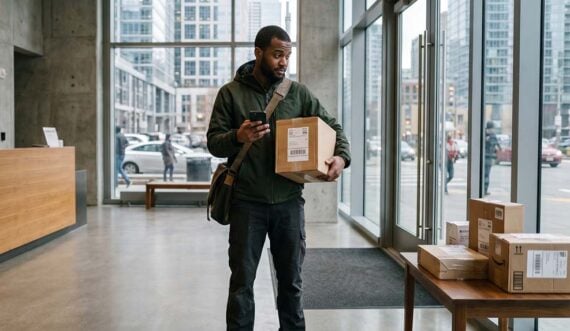
Photo of a gig driver in a downtown high-rise lobby holding a package

Modern ecommerce increasingly relies on independent “gig” contractors for delivery.

Local

Target’s model is local at heart. Leveraging the chain’s network of physical stores, Shipt has effectively brought fulfillment closer to the customer.

Drivers pick up orders in local Target stores, effectively replacing long-haul shipping with shorter routes. A fulfillment center in every store allows the company to expand delivery coverage without building new distribution centers.

Target acquired Shipt in 2017 to support this strategy. What began as same-day grocery delivery has evolved into a broader last-mile network tied directly to store inventory. Target can reportedly reduce delivery costs by roughly $2.50 per package using Shipt instead of national carriers.

The savings come from fewer handoffs and shorter routes. Packages no longer move through multiple sortation centers or long-distance carrier networks.

Speed improves as a result. Orders originate closer to the customer, and delivery windows tighten without requiring premium air or expedited services. The model lowers fulfillment cost while meeting rising consumer expectations for faster delivery.

Target is not alone. Walmart, Amazon, and many other omnichannel retailers have similar initiatives.

Different Operation

Shipt and similar providers are not traditional small-package delivery services. The structure is increasingly common. Regional carriers, gig platforms, and white-label delivery services are growing alongside national providers.

For merchants, this means more delivery options and less standardization.

Traditional carriers operate highly controlled networks. Service levels, routing, and handoffs follow defined processes. Gig delivery networks are more flexible, but also more inconsistent.

Delivery Fails

Almost every consumer has experienced botched ecommerce delivery. Imagine a downtown dweller who lives on the sixth floor of an apartment building. Drivers are supposed to leave packages in a designated room, complete with secure entry and several camera angles.

All delivery services use one-time passcodes to enter the front door, then the room. The process is straightforward but unfamiliar to many gig drivers, who may leave packages in the lobby or in hallways near the recipient’s door, subject to damage or theft.

Suburban recipients face comparable scenarios.

Inconsistency

To be clear, employees of respected carriers such as Amazon, UPS, FedEx, and the USPS make mistakes. But the risk is higher for part-time, inexperienced gig workers.

Delivery timing can fluctuate. Front-door drop-off placements can differ from one driver to the next. Communication may be limited or inconsistent.

Large retailers can absorb such failures via customer service teams and brand strength. But small to midsize merchants operate with less margin for error.

A missed delivery or poor handoff can lead to support costs, refunds, and negative reviews. The delivery experience becomes part of the product, even if the merchant does not control it directly. The key is balancing cost, speed, and quality.

Clear expectations and close monitoring of complaints can help. In this environment, delivery is more than fulfillment alone. It is part of the brand experience.

ChatGPT Often Retrieves But Rarely Cites Reddit Pages, Data Shows via @sejournal, @MattGSouthern

An Ahrefs analysis of 1.4 million ChatGPT prompts found that pages from a dedicated Reddit source were rarely cited in ChatGPT responses, even though they were often retrieved.

Ahrefs highlights this pattern in a new report.

What The Report Looked At

Ahrefs examined 1.4 million ChatGPT 5.2 prompts, tracking which pages were retrieved and later cited in the final response. About half of the retrieved pages were cited overall.

The citation rate varied by source, with pages from general web searches cited most frequently. In contrast, pages from a Reddit source, described by Ahrefs, were cited only 1.93% of the time. This highlights the Reddit gap: while the Reddit source was often retrieved, it rarely appeared as a visible citation.

The Reddit Finding

Of all the pages retrieved but not cited in Ahrefs’ dataset, 67.8% originated from the specific Reddit source Ahrefs identified.

Ahrefs writes that ChatGPT “is using Reddit extensively to understand topics, gauge consensus, and build context—but it almost never gives Reddit the credit.”

One point to clarify is that Reddit pages can still be cited by ChatGPT when they appear in standard web search results. The 1.93% figure refers to what Ahrefs calls a separate Reddit source, distinct from general web searches. In May 2024, OpenAI and Reddit announced a data partnership granting OpenAI access to Reddit’s data.

What Does Help A Page Get Cited

Ahrefs examined how closely page titles and URLs aligned with the specific sub-questions generated by ChatGPT during the search process. To do this, Ahrefs used open-source tools to compute similarity scores, approximating ChatGPT’s internal matching process. Pages with higher scores for matching those sub-questions were cited more frequently in the dataset.

When ChatGPT Search responds to a prompt, it often breaks the prompt down into several narrower queries and searches for pages related to each. In Ahrefs’ data, titles and URLs matching these narrower queries had a stronger correlation with citations than pages that only broadly matched the original prompt. URL structure also played a role. Pages with clear, descriptive URL slugs were cited about 89.78% of the time they appeared in search results, compared to 81.11% for pages with less descriptive URLs. This aligns with SE Ranking’s analysis, which found that ChatGPT tends to favor URLs describing broader topics over those focused on a single keyword.

Why This Matters

Ahrefs data indicates that Reddit’s impact on answer development differs from what businesses might anticipate. It appears Reddit can shape answers indirectly without being explicitly cited. This kind of influence is still important, but is more about the upstream effect rather than direct citation acknowledgment.

For clear citation credit, Ahrefs’ data shows the best indicator is whether your page titles and URLs align with the specific sub-queries that ChatGPT Search produces from a prompt. Simply matching the broad keyword doesn’t suffice.

Looking Ahead

The study evaluates ChatGPT 5.2 on desktop in February 2025. Since then, OpenAI has launched several model updates, such as the GPT-5.3 Instant transition, which Resoneo links to a 20% decrease in the number of cited domains per ChatGPT response. It’s uncertain whether the Reddit gap and title-matching patterns observed by Ahrefs still apply to these newer models.


Featured Image: Koshiro K/Shutterstock