Multimodal Search Is Reshaping The Funnel For SEOs And Marketers via @sejournal, @TaylorDanRW

For years, marketers built their strategies around a clear and visible funnel: awareness, consideration, conversion.

It worked well in a web where behaviors were traceable, people clicked links, visited pages, signed up, bought a product, or bounced.

We were able to track almost all of it, and we had attribution models that helped show return on investment (ROI) to specific channels (with varying degrees of accuracy and certainty).

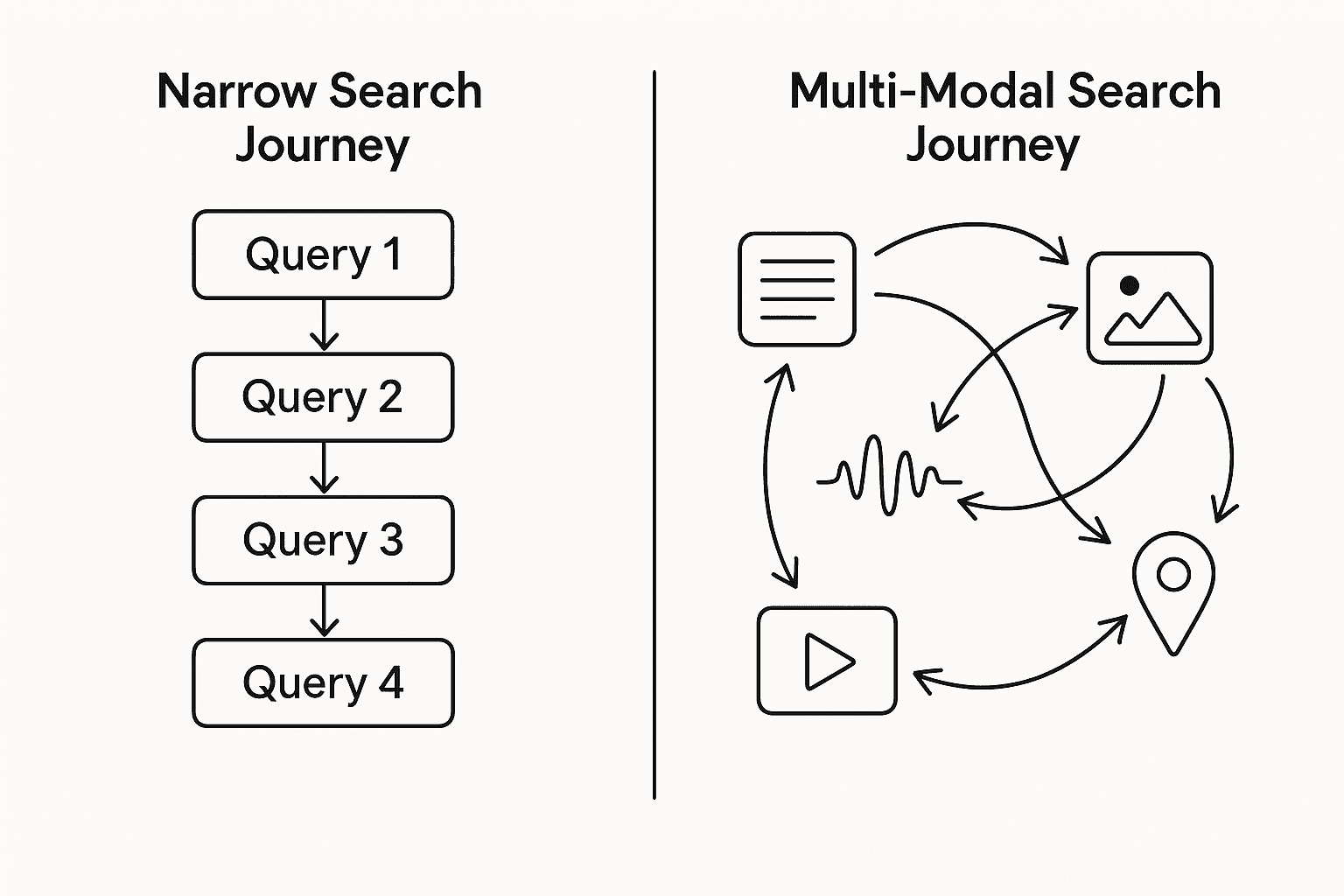
The journey hasn’t disappeared, but it’s harder to detect, and it has become a lot more convoluted.

People are still moving through a decision-making process; they’re just doing it across fragmented platforms, using tools that don’t always leave clear signals behind.

Whether it’s asking ChatGPT, browsing Reddit, scrolling through TikTok, or speaking to a voice assistant, user behavior is fluid, multimodal, and largely invisible to traditional analytics.

We can no longer assume that a user’s next step will be a trackable one.

They might ask an AI model for a summary. They might compare products across 10 different surfaces before ever visiting your site.

They might never fill out a form, but forward the website to a colleague, and they’ll fill out the form as a single session, tracked as “Direct,” having never been on your site before.

That doesn’t mean the funnel is gone; it’s just become almost untrackable.

What The Funnel Actually Is

The traditional marketing funnel breaks down the customer journey into three core stages:

  • Top of Funnel (TOFU): Awareness-level content that introduces your brand or product to a broad audience. Think blog posts, social media content, or explainer videos.
  • Middle of Funnel (MOFU): Consideration-level content that helps users evaluate options. This includes comparison guides, product demos, and email nurturing sequences.
  • Bottom of Funnel (BOFU): Conversion-level content aimed at driving action, like purchase pages, pricing breakdowns, or testimonials.

Marketers used to map content to each of these stages, creating clear pathways for users to follow from curiosity to conversion.

That model still applies, but how users move between these stages is now anything but linear.

What Multimodal Search Really Means

Multimodal search isn’t just about the difference between typing a query, speaking it out loud, or snapping a photo.

It’s about the way users fluidly engage across different platforms and media types to explore, evaluate, and decide.

A single purchase journey might involve:

  • Googling a general topic.
  • Watching explainer videos on TikTok or YouTube.
  • Reading niche discussions on Reddit.
  • Browsing listings on Amazon.
  • Comparing reviews on third-party blogs.
  • Asking follow-up questions to an AI assistant.

Even Amazon itself is leaning into AI-led search with Rufus, its generative shopping assistant. This is multimodal search.

Image from author, August 2025

Google is layering AI Overviews and AI Mode into its core search experience, offering summarized insights and altering the sequence of discovery.

Users no longer click 10 blue links. They skim summaries, compare sources at a glance, and dive deeper only if curiosity is triggered and a user acts on it.

Multi-modal means multi-platform, multi-surface, and multi-behavior.

It requires us to plan for nonlinear journeys, where influence happens in places we don’t control, and impact happens without attribution.

This shift demands a change in how we create and distribute content:

  • We must think beyond a single persona or journey and instead design for overlapping intent signals.
  • We must publish in formats that match user behavior across channels: text, video, audio, structured data, and conversational prompts.
  • We must recognize that old attribution models, based on last click or visible touchpoints, no longer reflect reality.

If we design content around one channel, one format, or one assumed path, we’re missing the majority of how people actually search, explore, and decide.

The challenge now is to understand user intent without seeing every step. To stay present in invisible paths. To meet people in the middle of journeys we can’t fully track.

The funnel still matters. But, reaching people inside it requires a different mindset, one that’s built for anticipation, not just observation and end goal metrics.

Multimodal As The Gateway For The Next Generation

For the next generation of internet users, multimodal isn’t just a feature; it’s the foundation.

Gen Z is growing up with tools that let them search the world visually, conversationally, and socially.

They don’t see these modes as alternatives to traditional search; they see them as default behaviors.

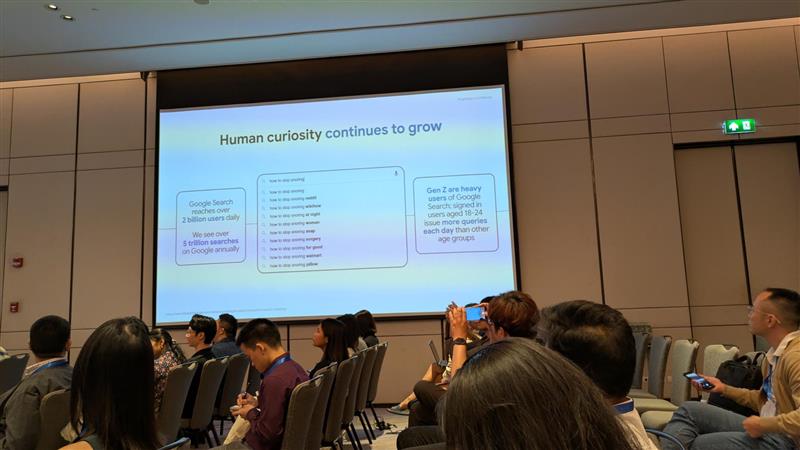
Google’s data reflects this shift. Gen Z (18-24 year olds) is currently the fastest-growing demographic using Google Search.

And among that cohort, 1 in 10 searches now begin with a visual interaction, and using tools like Google Lens or Circle to Search.

Image from author, August 2025

Instead of typing a query, users highlight parts of an image, scan real-world objects, or interact directly with on-screen content.

This visual-first, intent-rich behavior is a window into how the next generation navigates information. It blends curiosity with immediacy – and it bypasses traditional keyword-driven journeys entirely.

Marketers need to understand this shift not as a niche use case, but as a sign of things to come.

If we’re not building content and experiences that match these native behaviors, we risk being invisible in the very spaces where influence now begins.

What This Means For SEOs And Marketers

Speak To The Whole Persona

Personas and audience segmentation still matter, maybe more than ever, but we can’t speak to people at just one stage or in one format.

Mental availability now has to be a core part of any digital marketing strategy.

It’s not about being everywhere for everyone, but about being present across enough moments and modes that your brand is part of the conversation when decisions are being made.

The old way of choosing a format, identifying a single funnel stage, and publishing content to fit is no longer enough.

We need to create for complexity. That means producing content that reaches both the 1% and the 99% of your target persona, ranging from niche, problem-aware research queries to broad, ambient brand mentions in trending content.

Think Beyond The Visible Funnel

Every digital touchpoint is a chance to build familiarity and relevance.

And in a landscape where visibility is often obscured, casting a wider, more thoughtful net across intent types, platforms, and formats is how you maximize your odds of being chosen, even if you never see the full journey play out.

Rethink Distribution And Domain Dependence

Content distribution now plays a critical role in both SEO and broader brand strategy.

We want our messaging to be present wherever users are searching, reading, watching, or asking questions. That means treating our website as one, but not the only, SEO and AI optimization asset.

In my opinion, content and SEO strategies that focus only on the owned domain are limiting their effectiveness.

Search engines and AI models are increasingly drawing context, citations, and understanding from a wide range of sources across the open web.

If your brand only shows up on your own site, you reduce your discoverability, authority, and influence.

To compete in the AI-shaped web, marketers need to distribute content intentionally across partner sites, third-party platforms, social channels, structured formats, and multimedia content ecosystems.

Visibility is earned across surfaces, not confined to a single domain.

More Resources:


Featured Image: DETHAL/Shutterstock

Ex-Microsoft SEO Pioneer On Why AI’s Biggest Threat To SEO Isn’t What You Think via @sejournal, @theshelleywalsh

While industry professionals have debates over nomenclature of SEO, GEO, or AEO, and if ChatGPT or Google’s AI Overviews will replace traditional search, a more fundamental shift is happening that could disrupt the entire industry business model.

To get a better understanding of this, I spoke to the 25-year veteran and SEO pioneer Duane Forrester to discuss some of his recent articles about the shift from traditional SEO and the impact on how SEO roles are changing and adapting.

Duane previously worked at Microsoft as a senior program manager of SEO, where he helped to launch Bing Webmaster Tools and bring Schema.org to life. He has a deep understanding of how search engines work and has now turned his attention to adapting to the realities of AI-powered search and digital discovery.

His belief is that the real disruption isn’t AI replacing search engines; it’s the rise of AI agents. These “Agentic AI” systems will empower individuals to work like small agencies, and the jobs that thrive will be those that can effectively manage an AI team.

The Rise Of Agentic AI: Virtual Team Members

In Duane’s recent article “SEO’s Existential Threat is AI, but Not in the Way You Think,” he said it’s the rise of AI agents and retrieval-based systems that are already transforming how people interact with information, quietly eroding SEO’s return on investment. So, I asked him how agents and not SERPs are the future.

Duane explained:

“The most significant development isn’t AI replacing search engines; it’s the emergence of Agentic AI systems that can be given tasks and execute them autonomously … This is really a personal thing and I’ve been following this since I worked at Microsoft. I did some early work with Cortana with that program and training it for language recognition.”

Within six months, Duane predicts professionals will routinely instruct AI agents to perform work while they focus on higher-value activities. This is going to have the impact where individuals can behave much more like a small agency.

“If I can create a process and the process is largely executed by agents, then the 100% of my time that I can devote can be reapportioned to human-in-the-loop analysis.

This is going to be the way for us to create virtual players on our team and to do specific tasks to enable us to define the most valuable use of our time, whatever it happens to be. That valuable use of time for some people may be closing their next client. It may simply be the sales cycle. For other people who, maybe, lack knowledge and experience, it may actually be executing on what you promised the client.”

However, Dunae thinks that developing people management skills will be critical to success:

“If you step into the world of Agentic AI and you’re going down that path, you better have people management skills because you’re going to need them. That’s the skill set that will prove most valuable to managing Agentic AI work. You have to think of them not necessarily as humans, but as systems that need guidance.”

The Job Transformation: Writers As AI Instructors

I then asked Duane about his latest article, where he wrote about which SEO jobs AI will reshape and which might disappear.

He responded that the most dramatic changes will impact content creators, but not in the way many expect.

Duanes thinks that traditional writing roles face automation, but professionals who adapt will become more valuable than ever.

“If your full-time job is sitting down writing, that’s in jeopardy,” Duane acknowledges.

“The new model transforms writers from creators to instructors, managing multiple AI agents across different clients simultaneously. Instead of spending hours researching and writing, professionals can brief a dozen agents in minutes and focus on editing, refining tone, and ensuring accuracy.”

“You can tell a dozen agents for a dozen clients to all start and you can get them all started in less than two minutes and then in about 10 minutes have all of the output that you now will go in and edit one by one.”

Paradoxically, he thinks the role most in demand will be quality experienced writers, but only those who learn how to embrace and integrate AI to be efficient and effectively manage an AI team of writers.

By becoming a “human in the loop” editor who can guide AI output, an experienced writer can add value in ways machines can’t by refining tone, ensuring factual accuracy, and aligning copy with brand voice and client needs.

“I recently wrote about a Microsoft survey that showed the overlay of how AI can do a job versus humans doing that same job … their point was, if you’re in these jobs, you kind of want to figure out how to pivot to something different.”

Strategic Roles Remain Safe

The jobs that are vulnerable to AI are those with a repetitive nature that can be done by an AI faster, easier, and cheaper than a human.

While these execution-focused roles face disruption, strategic positions like CMOs remain relatively protected. These roles survive because they require experience-based decision-making that AI cannot replicate.

“It’s going to be harder to replace that level of experience because the system doesn’t have the experience,” Duane emphasizes.

The distinction isn’t about seniority but about the nature of the work. Repetitive tasks get automated first, while roles requiring strategic thinking, relationship building, and complex problem-solving remain human-dominated.

CMOs are considered “safe” not because they are senior, but because they are thinking in terms of strategy. They succeed by analyzing consumer behavior, identifying monetization opportunities, and aligning products with customer problems, capabilities that demand human insight and industry knowledge.

“They’re watching consumer behavior, and they’re trying to tease out from the consumer behavior: How do we make money from that? How do we align our product to solve a customer’s problem? And then that generates more sales. That’s the job of the CMO.

And then everything else under it, which is building and maintaining the team, running all the groups, and making sure everything is on track. It’s going to be harder to replace that level of experience because the system doesn’t have the experience.”

Preparing For The Future

Success in these evolving times requires immediate action on hiring and training. Companies must update job descriptions today to reflect skills needed in two to three years, or develop comprehensive training programs for existing staff.

“The people you’re hiring today, in theory, should still be with you in a couple of years. And if they are still with you in a couple of years and you don’t hire these new skills today, well then, you better have a training plan to get them there.”

I compared the current transformation with the early days of SEO, when pioneers navigated uncharted territory. Today’s professionals face a similar challenge of adapting to work alongside AI systems or risking obsolescence.

The future belongs to those who can embrace AI as a productivity multiplier rather than a replacement threat. Those who learn to instruct, guide, and optimize AI agents will find themselves more valuable than ever, while those who resist change may find themselves left behind.

“This isn’t just about surviving disruption,” Duane concluded. “It’s about positioning yourself to benefit from it.”

Watch the full video interview with Duane Forrester below.

Duane is currently writing about the shift from traditional SEO to vector-driven retrieval and AI-generated answers at Duane Forrester Decodes and featured here at Search Engine Journal.

Thank you to Duane for offering his insights and being my guest on IMHO.

More Resources: 


Featured Image: Shelley Walsh/Search Engine Journal

Google Explains Why They Need To Control Their Ranking Signals via @sejournal, @martinibuster

Google’s Gary Illyes answered a question about why Google doesn’t use social sharing as a ranking factor, explaining that it’s about the inability to control certain kinds of external signals.

Kenichi Suzuki Interview With Gary Illyes

Kenichi Suzuki (LinkedIn profile), of Faber Company (LinkedIn profile), is a respected Japanese search marketing expert who has at least 25 years of experience in digital marketing. I last saw him speak at a Pubcon session a few years back, where he shared his findings on qualities inherent to sites that Google Discover tended to show.

Suzuki published an interview with Gary Illyes, where he asked a number of questions about SEO, including this one about SEO, social media, and Google ranking factors.

Gary Illyes is an Analyst at Google (LinkedIn profile) who has a history of giving straightforward answers that dispel SEO myths and sometimes startle, like the time recently when he said that links play less of a role in ranking than most SEOs tend to believe. Gary used to be a part of the web publishing community before working at Google, and he was even a member of the WebmasterWorld forums under the nickname Methode. So I think Gary knows what it’s like to be a part of the SEO community and how important good information is, and that’s reflected in the quality of answers he provides.

Are Social Media Shares Or Views Google Ranking Factors?

The question about social media and ranking factors was asked by Rio Ichikawa (LinkedIn profile), also of Faber Company. She asked Gary whether social media views and shares were ranking signals.

Gary’s answer was straightforward and with zero ambiguity. He said no. The interesting part of his answer was the explanation of why Google doesn’t use them and will never use them as a ranking factor.

Ichikawa asked the following question:

“All right then. The next question. So this is about the SEO and social media. Is the number of the views and shares on social media …used as one of the ranking signals for SEO or in general?”

Gary answered:

“For this we have basically a very old, very canned response and something that we learned or it’s based on something that we learned over the years, or particularly one incident around 2014.

The answer is no. And for the future is also likely no.

And that’s because we need to be able to control our own signals. And if we are looking at external signals, so for example, a social network’s signals, that’s not in our control.

So basically if someone on that social network decides to inflate the number, we don’t know if that inflation was legit or not, and we have no way knowing that.”

Easily Gamed Signals Are Unreliable For SEO

External signals that Google can’t control but can be influenced by an SEO are untrustworthy. Googlers have expressed similar opinions about other things that are easily manipulated and therefore unreliable as ranking signals.

Some SEOs might say, “If that’s true, then what about structured data? Those are under the control of SEOs, but Google uses them.”

Yes, Google uses structured data, but not as a ranking factor; they just make websites eligible for rich results. Additionally, stuffing structured data with content that’s not visible on the web page is a violation of Google’s guidelines and can lead to a manual action.

A recent example is the LLMs.txt protocol proposal, which is essentially dead in the water precisely because it is unreliable, in addition to being superfluous. Google’s John Mueller has said that the LLMs.txt protocol is unreliable because it could easily be misused to show highly optimized content for ranking purposes, and that it is analogous to the keywords meta tag, which was used by SEOs for every keyword they wanted their web pages to rank for.

Mueller said:

“To me, it’s comparable to the keywords meta tag – this is what a site-owner claims their site is about … (Is the site really like that? well, you can check it. At that point, why not just check the site directly?)”

The content within an LLMs.txt and associated files are completely in control of SEOs and web publishers, which makes them unreliable.

Another example is the author byline. Many SEOs promoted author bylines as a way to show “authority” and influence Google’s understanding of Expertise, Experience, Authoritativeness, and Trustworthiness. Some SEOs, predictably, invented fake LinkedIn profiles to link from their fake author bios in the belief that author bylines were a ranking signal. The irony is that the ease of abusing author bylines should have been reason enough for the average SEO to dismiss them as a ranking-related signal.

In my opinion, the key statement in Gary’s answer is this:

“…we need to be able to control our own signals.”

I think that the SEO community, moving forward, really needs to rethink some of the unconfirmed “ranking signals” they believe in, like brand mentions, and just move on to doing things that actually make a difference, like promoting websites and creating experiences that users love.

Watch the question and answer at about the ten minute mark:

Featured Image by Shutterstock/pathdoc

This quantum radar could image buried objects

Physicists have created a new type of radar that could help improve underground imaging, using a cloud of atoms in a glass cell to detect reflected radio waves. The radar is a type of quantum sensor, an emerging technology that uses the quantum-mechanical properties of objects as measurement devices. It’s still a prototype, but its intended use is to image buried objects in situations such as constructing underground utilities, drilling wells for natural gas, and excavating archaeological sites.

Like conventional radar, the device sends out radio waves, which reflect off nearby objects. Measuring the time it takes the reflected waves to return makes it possible to determine where an object is. In conventional radar, the reflected waves are detected using a large antenna, among other receiver components. But in this new device, the reflected waves are registered by detecting the interactions between the returning waves and the atom cloud.

The current incarnation of the radar is still bulky, as the researchers have kept it connected to components on an optical table for ease of testing. But they think their quantum radar could be significantly smaller than conventional designs. “Instead of having this sizable metal structure to receive the signal, we now can use this small glass cell of atoms that can be about a centimeter in size,” says Matthew Simons, a physicist at the National Institute of Standards and Technology (NIST), who was a member of the research team. NIST also worked with the defense contractor RTX to develop the radar.  

The glass cell that serves as the radar’s quantum component is full of cesium atoms kept at room temperature. The researchers use lasers to get each individual cesium atom to swell to nearly the size of a bacterium, about 10,000 times bigger than the usual size. Atoms in this bloated condition are called Rydberg atoms. 

When incoming radio waves hit Rydberg atoms, they disturb the distribution of electrons around their nuclei. Researchers can detect the disturbance by shining lasers on the atoms, causing them to emit light; when the atoms are interacting with a radio wave, the color of their emitted light changes. Monitoring the color of this light thus makes it possible to use the atoms as a radio receiver. Rydberg atoms are sensitive to a wide range of radio frequencies without needing to change the physical setup, says Michał Parniak, a physicist at the University of Warsaw in Poland, who was not involved in the work. This means a single compact radar device could potentially work at the multiple frequency bands required for different applications.

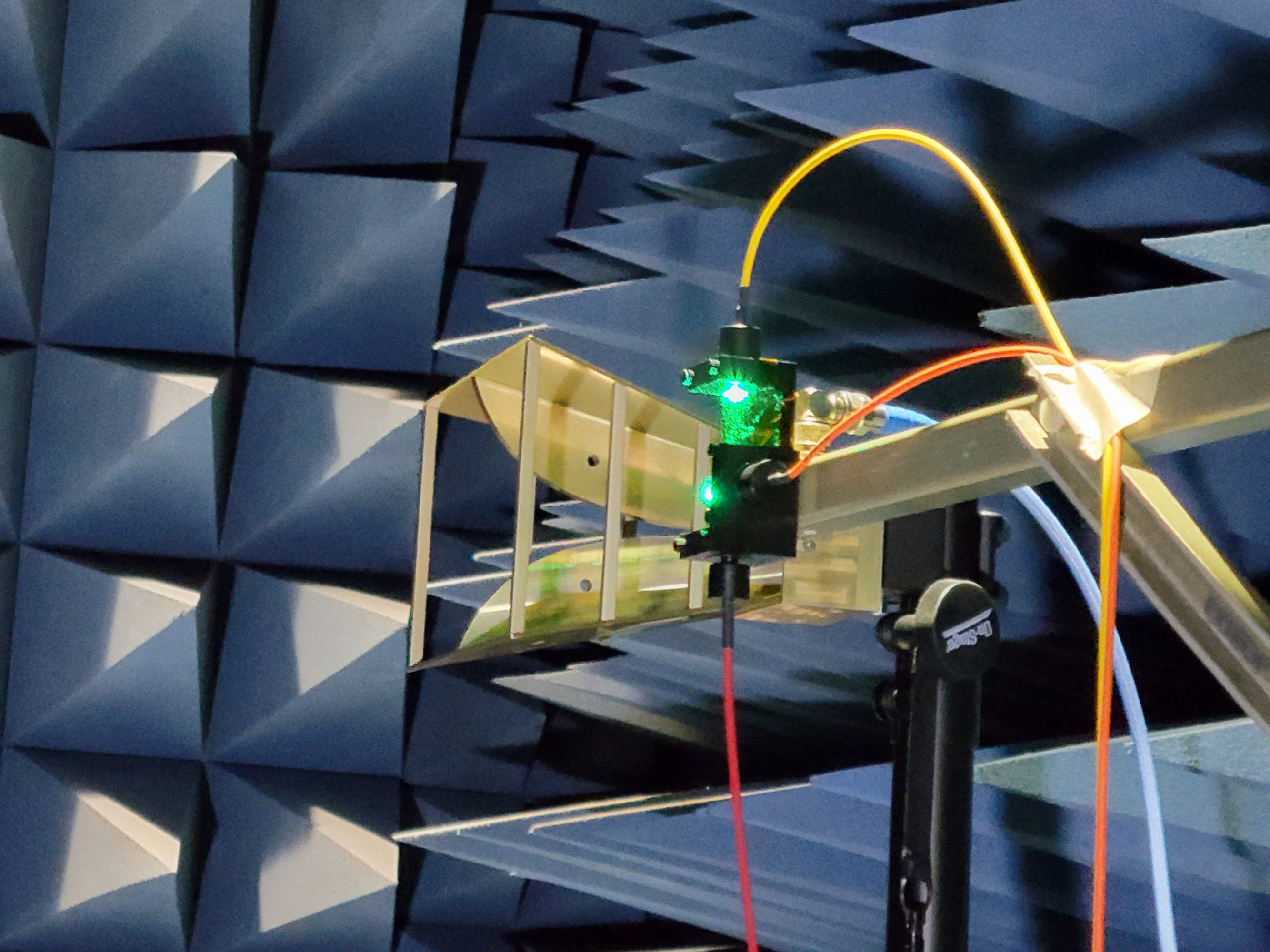
Simons’s team tested the radar by placing it in a specially designed room with foam spikes on the floor, ceiling, and walls like stalactites and stalagmites. The spikes absorb, rather than reflect, nearly all the radio waves that hit them. This simulates the effect of a large open space, allowing the group to test the radar’s imaging capability without unwanted reflections off walls. 

radar setup in a room lined by dampening foam

MATT SIMONS, NIST

The researchers placed a radio wave transmitter in the room, along with their Rydberg atom receiver, which was hooked up to an optical table outside the room. They aimed radio waves at a copper plate about the size of a sheet of paper, some pipes, and a steel rod in the room, each placed up to five meters away. The radar allowed them to locate the objects to within 4.7 centimeters. The team posted a paper on the research to the arXiv preprint server in late June.

The work moves quantum radar closer to a commercial product. “This is really about putting elements together in a nice way,” says Parniak. While other researchers have previously demonstrated how Rydberg atoms can work as radio wave detectors, he says, this group has integrated the receiver with the rest of the device more sleekly than before. 

Other researchers have explored the use of Rydberg atoms for other radar applications. For example, Parniak’s team recently developed a Rydberg atom sensor for measuring radio frequencies to troubleshoot chips used in car radar. Researchers are also exploring whether radar using Rydberg-atom receivers could be used for measuring soil moisture.

This device is just one example of a quantum sensor, a type of technology that incorporates quantum components into conventional tools. For example, the US government has developed gyroscopes that use the wave properties of atoms for sensing rotation, which is useful for navigation. Researchers have also created quantum sensors using impurities in diamond to measure magnetic fields in, for example, biomedical applications.

One advantage of quantum sensors is the inherent consistency of their core components. Each cesium atom in their device is identical. In addition, the radio receiver relies on the fundamental structure of these atoms, which never changes. Properties of the atoms “can be linked directly to fundamental constants,” says Simons. For this reason, quantum sensors should require less calibration than their non-quantum counterparts. 

Governments worldwide have invested billions of dollars to develop quantum sensors and quantum computers, which share similar components. For example, researchers have built quantum computers using Rydberg atoms as qubits, the equivalent to bits in a conventional computer. Thus, advances in quantum sensing can potentially translate into advances into quantum computing, and vice versa. Parniak has recently adapted an error-correction technique from quantum computing to improve a Rydberg-atom-based sensor. 

Researchers still need to continue developing quantum radar before it can be made commercially viable. In the future, they need to work on improving the device’s sensitivity to fainter signals, which could involve improving the coatings for the glass cell. “We don’t see this replacing all radar applications,” says Simons. Instead, he thinks it will be useful for particular scenarios that require a compact device.

What you may have missed about GPT-5

Before OpenAI released GPT-5 last Thursday, CEO Sam Altman said its capabilities made him feel “useless relative to the AI.” He said working on it carries a weight he imagines the developers of the atom bomb must have felt.

As tech giants converge on models that do more or less the same thing, OpenAI’s new offering was supposed to give a glimpse of AI’s newest frontier. It was meant to mark a leap toward the “artificial general intelligence” that tech’s evangelists have promised will transform humanity for the better. 

Against those expectations, the model has mostly underwhelmed. 

People have highlighted glaring mistakes in GPT-5’s responses, countering Altman’s claim made at the launch that it works like “a legitimate PhD-level expert in anything any area you need on demand.” Early testers have also found issues with OpenAI’s promise that GPT-5 automatically works out what type of AI model is best suited for your question—a reasoning model for more complicated queries, or a faster model for simpler ones. Altman seems to have conceded that this feature is flawed and takes away user control. However there is good news too: the model seems to have eased the problem of ChatGPT sucking up to users, with GPT-5 less likely to shower them with over the top compliments.

Overall, as my colleague Grace Huckins pointed out, the new release represents more of a product update—providing slicker and prettier ways of conversing with ChatGPT—than a breakthrough that reshapes what is possible in AI. 

But there’s one other thing to take from all this. For a while, AI companies didn’t make much effort to suggest how their models might be used. Instead, the plan was to simply build the smartest model possible—a brain of sorts—and trust that it would be good at lots of things. Writing poetry would come as naturally as organic chemistry. Getting there would be accomplished by bigger models, better training techniques, and technical breakthroughs. 

That has been changing: The play now is to push existing models into more places by hyping up specific applications. Companies have been more aggressive in their promises that their AI models can replace human coders, for example (even if the early evidence suggests otherwise). A possible explanation for this pivot is that tech giants simply have not made the breakthroughs they’ve expected. We might be stuck with only marginal improvements in large language models’ capabilities for the time being. That leaves AI companies with one option: Work with what you’ve got.

The starkest example of this in the launch of GPT-5 is how much OpenAI is encouraging people to use it for health advice, one of AI’s most fraught arenas. 

In the beginning, OpenAI mostly didn’t play ball with medical questions. If you tried to ask ChatGPT about your health, it gave lots of disclaimers warning you that it was not a doctor, and for some questions, it would refuse to give a response at all. But as I recently reported, those disclaimers began disappearing as OpenAI released new models. Its models will now not only interpret x-rays and mammograms for you but ask follow-up questions leading toward a diagnosis.

In May, OpenAI signaled it would try to tackle medical questions head on. It announced HealthBench, a way to evaluate how good AI systems are at handling health topics as measured against the opinions of physicians. In July, it published a study it participated in, reporting that a cohort of doctors in Kenya made fewer diagnostic mistakes when they were helped by an AI model. 

With the launch of GPT-5, OpenAI has begun explicitly telling people to use its models for health advice. At the launch event, Altman welcomed on stage Felipe Millon, an OpenAI employee, and his wife, Carolina Millon, who had recently been diagnosed with multiple forms of cancer. Carolina spoke about asking ChatGPT for help with her diagnoses, saying that she had uploaded copies of her biopsy results to ChatGPT to translate medical jargon and asked the AI for help making decisions about things like whether or not to pursue radiation. The trio called it an empowering example of shrinking the knowledge gap between doctors and patients.

With this change in approach, OpenAI is wading into dangerous waters. 

For one, it’s using evidence that doctors can benefit from AI as a clinical tool, as in the Kenya study, to suggest that people without any medical background should ask the AI model for advice about their own health. The problem is that lots of people might ask for this advice without ever running it by a doctor (and are less likely to do so now that the chatbot rarely prompts them to).

Indeed, two days before the launch of GPT-5, the Annals of Internal Medicine published a paper about a man who stopped eating salt and began ingesting dangerous amounts of bromide following a conversation with ChatGPT. He developed bromide poisoning—which largely disappeared in the US after the Food and Drug Administration began curbing the use of bromide in over-the-counter medications in the 1970s—and then nearly died, spending weeks in the hospital. 

So what’s the point of all this? Essentially, it’s about accountability. When AI companies move from promising general intelligence to offering humanlike helpfulness in a specific field like health care, it raises a second, yet unanswered question about what will happen when mistakes are made. As things stand, there’s little indication tech companies will be made liable for the harm caused.

“When doctors give you harmful medical advice due to error or prejudicial bias, you can sue them for malpractice and get recompense,” says Damien Williams, an assistant professor of data science and philosophy at the University of North Carolina Charlotte. 

“When ChatGPT gives you harmful medical advice because it’s been trained on prejudicial data, or because ‘hallucinations’ are inherent in the operations of the system, what’s your recourse?”

This story originally appeared in The Algorithm, our weekly newsletter on AI. To get stories like this in your inbox first, sign up here.

Why Trump’s “golden dome” missile defense idea is another ripped straight from the movies

In 1940, a fresh-faced Ronald Reagan starred as US Secret Service agent Brass Bancroft in Murder in the Air, an action film centered on a fictional “superweapon” that could stop enemy aircraft midflight. A mock newspaper in the movie hails it as the “greatest peace argument ever invented.” The experimental weapon is “the exclusive property of Uncle Sam,” Reagan’s character declares.

More than 40 years later, this cinematic vision—an American superweapon capable of neutralizing assaults and ushering in global peace—became a real-life centerpiece of Reagan’s presidency. Some have suggested that Reagan’s Strategic Defense Initiative (SDI), a quixotic plan for a space-based missile shield, may have been partly inspired by his silver-screen past; indeed, the concept was so fantastical it’s now better known by its Hollywood-referencing nickname, “Star Wars.”

In January 2024, Donald Trump revived the space-shield dream at a primary campaign rally in Laconia, New Hampshire, using the Star Wars nickname that Reagan hated. It didn’t work in the 1980s, Trump said, because the technology wasn’t there. But times have changed. 

Whether in Golden Age Hollywood or Trump’s impromptu dramatizations, the dream of a missile shield is animated by its sheer cinematic allure.

“I’ve seen so many things. I’ve seen shots that you wouldn’t even believe,” Trump said. He acted out a scene of missile defense experts triangulating the path of an incoming weapon. “Ding, ding, ding, ding,” he said, as he mimed typing on a keyboard. “Missile launch? Psshing!!” He raised his hand to indicate the rising missile, then let it fall to signal the successful interception: “Boom.” 

Trump has often expressed admiration for Israel’s Iron Dome, an air defense system that can intercept short-range rockets and artillery over the small nation and that is funded in part by the United States. At the rally, he pledged to “build an Iron Dome over our country, a state-of-the-art missile defense shield made in the USA … a lot of it right here in New Hampshire, actually.” 

Within a week of his inauguration, President Trump began working toward this promise by issuing an executive order to develop “The Iron Dome for America,” which was rebranded the “Golden Dome” a month later. The eruption of a revived conflict between Israel and Iran in June—including Trump’s decision to strike Iran’s nuclear facilities—has only strengthened the case for an American version of the Iron Dome in the eyes of the administration.

CHIP SOMODEVILLA/GETTY IMAGES

The Golden Dome has often been compared to SDI for its futuristic sheen, its aggressive form of protection, and its reflection of the belief that an impenetrable shield is the cheat code to global peace. Both efforts demonstrate the performative power of spectacle in defense policy, especially when wielded by deft showmen like Reagan and Trump. Whether in Golden Age Hollywood or Trump’s impromptu dramatizations, the dream of a missile shield is animated by its sheer cinematic allure, often rendered in deceptively simple concept art depicting a society made immune to catastrophic strikes. 

But in the complicated security landscape confronting the world today, is spectacle the same as safety?

“Missile defense is an area where facts and fiction blend,” says Anette Stimmer, a lecturer in international relations at the University of St Andrews who has researched SDI. “A lot is up to interpretation by all the actors involved.”


Trump’s view is simple: Space is as much a warfighting domain as land, air, and ocean, and therefore the US must assert its dominance there with advanced technologies. This position inspired the creation of the US Space Force in his first term, and Trump has now redoubled his efforts with the ongoing development of the Golden Dome.  

General Michael Guetlein, who Trump has appointed to lead the Golden Dome project, argued that America’s foes, including China and Russia, have forced the nation’s hand by continually pushing limits in their own weapons programs. “While we have been focused on peace overseas, our adversaries have been quickly modernizing their nuclear forces, building out ballistic missiles capable of hosting multiple warheads; building out hypersonic missiles capable of attacking the United States within an hour and traveling at 6,000 miles an hour; building cruise missiles that can navigate around our radar and our defenses; and building submarines that can sneak up on our shores; and, worse yet, building space weapons,” Guetlein said in May.

“It is time that we change that equation and start doubling down on the protection of the homeland,” he said. “Golden Dome is a bold and aggressive approach to hurry up and protect the homeland from our adversaries. We owe it to our children and our children’s children to protect them and afford them a quality of life that we have all grown up enjoying.”

With that vision in mind, Trump’s executive order outlines a host of goals for missile defense, some of which support bipartisan priorities like protecting supply chains and upgrading sensor arrays. The specific architecture of the Golden Dome is still being hammered out, but the initial executive order envisions a multi-tiered system of new sensors and interceptors—on the ground, in the air, and in space—that would work together to counter the threat of attacks from ballistic, hypersonic, and cruise missiles. The system would be coordinated in part by artificial-intelligence models trained for real-time threat detection and response. 

The technology that links the Golden Dome directly to SDI hinges on one key bullet point in the order that demands the “development and deployment of proliferated space-based interceptors capable of boost-phase intercept.” This language revives Reagan’s dream of deploying hundreds of missile interceptors in orbit to target missiles in the boost phase right after liftoff, a window of just a few minutes when the projectiles are slower and still near the attacker’s territory.

Space weapons are an attractive option for targeting the boost phase because interceptors need to be close enough to the launching missile to hit it. If a nation fired off long-range missiles from deep in its territory, the nearest ground- or air-based interceptors could be thousands of miles from the launch site. Space interceptors, in contrast, would be just a few hundred miles overhead of the ascending missiles, allowing for a much faster reaction time. But though the dream of boost-phase interception dates back decades, these maneuvers have never been operationally demonstrated from ground, air, or space.

“It’s a really hard problem that hasn’t been solved,” says Laura Grego, senior scientist and research director at the Union of Concerned Scientists’ global security program.

The US is currently protected by the Ground-Based Midcourse Defense (GMD), which consists of 44 interceptor missiles split between bases in Alaska and California, along with a network of early-­warning sensors on the ground, at sea, and in orbit. Tests suggest that the GMD would have about a 50% success rate at intercepting missiles.

Initiated by President Bill Clinton in the late ’90s and accelerated by President George W. Bush in the 2000s, the GMD is intended mainly to defend against rogue states like North Korea, which has nuclear weapons and intercontinental ballistic missiles (ICBMs) capable of reaching the US. A secondary focus is Iran, which does not currently have a nuclear weapon or ICBMs. Still, the GMD is built to anticipate a possible future where it develops those capabilities. 

The GMD is not designed to protect the US from the sort of large-scale and coordinated missile attacks that Russia and China could lob across the world. The Bush administration instead favored a focus on strategic deterrence with these peer nations, an approach that the Obama and Biden administrations continued. In addition to the GMD, the Pentagon and its international partners maintain regional defense systems to counter threats in conflict hot spots or attacks on critical infrastructure. All these networks are designed to intercept missiles during their midcourse cruise phase, as they hurtle through the sky or space, or during their terminal or reentry phase, as they approach their targets. The GMD has cost upward of $63 billion since it was initiated, and the US spends about an additional $20 billion to $30 billion annually on its array of other missile defense systems. 

In May, Trump was presented with several design options for the Golden Dome and selected a plan with a price tag of $175 billion and a schedule for full deployment by the end of his term. The One Big Beautiful Bill, signed into law on July 4, approved an initial $24.4 billion in funding for it. Space technologies and launch access have become much more affordable since the 1980s, but many analysts still think the projected cost and timeline are not realistic. The Congressional Budget Office, a nonpartisan federal agency, projected that the cost of the space-based interceptors could total from $161 billion to $542 billion over the course of 20 years. The wide range can be explained by the current lack of specifics on those orbital interceptors’ design and number.

Reintroducing the idea of space-based interceptors is “probably the most controversial piece of Golden Dome,” says Leonor Tomero, who served as deputy assistant secretary of defense for nuclear and missile defense policy in the Biden administration. 

“There are a lot of improvements that we can and should make on missile defense,” she continues. “There’s a lot of capability gaps I think we do need to address. My concern is the focus on reviving Star Wars and SDI. It’s got very significant policy implications, strategic stability implications, in addition to cost implications and technology feasibility challenges.” 

Indeed. Regardless of whether the Golden Dome materializes, the program is already raising geopolitical anxieties reminiscent of the Cold War era. Back then, the US had one main adversary: the Soviet Union. Now, it confronts a roiling multipolarity of established and nascent nuclear powers. Many of them have expressed dismay over the about-face on American missile defense strategy, which was previously predicated on arms reduction and deterrence.

“Here we are, despite years of saying we are not going to do this—that it is technically out of reach, economically unsustainable, and strategically unwise,” Grego says. “Overnight, we’re like, ‘No, actually, we’re doing it.’” 

The fact that we “blew up that logic” will “have a big impact on whether or not the program actually succeeds in creating the vision that it lays out,” she adds.

Russian and Chinese officials called the Golden Dome “deeply destabilizing in nature” in a joint statement in May, and North Korea’s foreign ministry warned it could “turn outer space into a potential nuclear war field.”  

Reagan, by all accounts, believed that SDI would be the ultimate tool of peace for all nations, and he even offered to share the technology with the Soviet leader, Mikhail Gorbachev. Trump, in contrast, sees Golden Dome as part of his “America First” brand. He has lamented that past American leaders supported the development of other missile defense projects abroad while neglecting to build similar security measures for their own country. The Golden Dome is both an expression of Trump’s belief that the world is leeching off America and a bargaining chip in negotiations toward a new power balance; Canada could be covered by the shield for free, he has said—in exchange for becoming the 51st state.

Trump has argued that America has been both demographically diluted by unchecked immigration and financially depleted by freeloading allied nations—undermining its security on both internal and external fronts. His first term’s marquee promise to build a wall on the southern US border, paid for by Mexico, aimed to address the former problem. That administration did build more physical barriers along the border (though US taxpayers, not Mexico, footed the bill). But just as important, the wall emerged as a symbolic shorthand for tougher immigration control. 

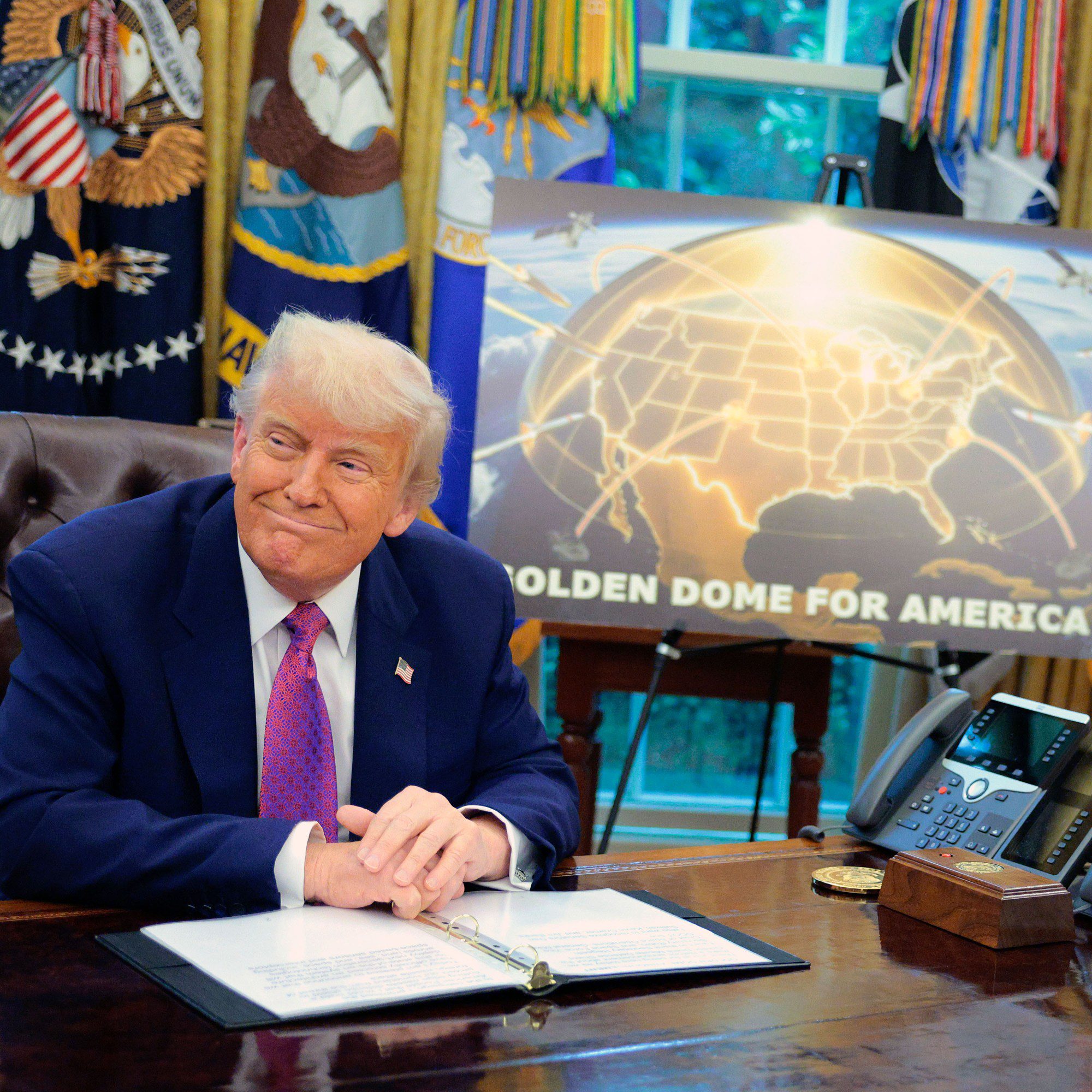
The Golden Dome is the second-term amplification of that promise, a wall that expands the concept of the “border” to the entire American airspace. Trump has projected an image of his envisioned space missile shield as a literal dome that could ward off coordinated attacks, including boost-phase interceptors from space and cruise- and terminal-phase interception by ground and air assets. When he announced the selected plan from the Resolute Desk in May, he sat in front of a mockup that depicted a barrage of incoming missiles being thwarted by the nationwide shield, depicted with a golden glow.

The Golden Dome’s orbital interceptors are supposedly there to target the early boost phase of missiles on or near the launch site, not over the United States. But the image of a besieged America, repelling enemy fire from the heavens, provides the visual and cinematic idea of both threat and security that Trump hopes to impress on the public.  

“This administration, and MAGA world, thinks about itself as being victimized by immigrants, government waste, leftist professors, and so on,” says Edward Tabor Linenthal, a historian who examined public narratives about SDI in his 1989 book Symbolic Defense: The Cultural Significance of the Strategic Defense Initiative. “It’s not much of a jump to be victimized by too many nations getting nuclear weapons.” 


Even in our era of entrenched political polarization, there is support across party lines for upgrading and optimizing America’s missile defense systems. No long-range missile has ever struck US soil, but an attack would be disastrous for the nation and the world. 

“We’ve come a long way in terms of missile defense,” says Tomero. “There has been a lot of bipartisan consensus on increasing regional missile defense, working with our allies, and making sure that the missile defense interceptors we have work.”

outline of the United States inside a corked glass bottle with scorpions

SHOUT

Trump has challenged that consensus with his reversion to the dream of a space shield. He is correct that SDI failed to materialize in part because its envisioned technologies were out of reach, from a financial and engineering standpoint, in the 1980s. But the controversy that erupted around SDI—and that tarnished it with the derisive name “Star Wars”—stemmed just as much from its potential geopolitical disruptiveness as from its fantastical techno-optimism. 

“This idea of a missile shield, also back when Reagan proposed it, has a huge popular appeal, because who wouldn’t want to be able to defend your country from nuclear weapons? It is a universal dream,” says Stimmer. “It requires a bit more digging in and understanding to see that actually, this vision depends a lot on technological feasibility and on how others perceive it.” 

Reagan maintained a steadfast conviction that this shield of space-based interceptors would render nuclear weapons “impotent and obsolete,” ushering in “world peace,” as he said in his March 1983 speech announcing SDI. The doctrine of mutually assured destruction could be replaced by mutually assured survival, he argued.

Amid nuclear tensions, J. Robert Oppenheimer compared the US and the Soviet Union to “two scorpions in a bottle.” Now there are many more scorpions.

But Gorbachev saw the space-based shield as an offensive weapon, since it would give the US a first-strike advantage. The imbalance, he warned, could spark a weapons race in space, a domain that had been spared from overt military conflicts. As a result, the initiative would only destabilize the world order and interrupt the progress of arms control and nuclear de-proliferation efforts. 

Reagan’s insistence on SDI as the only route to world peace may have blocked opportunities to advance that goal through more practical and cost-effective avenues, such as diplomacy and arms control. At the 1986 Reykjavik Summit, Reagan and Gorbachev came very close to an arms control agreement that might have eliminated all ballistic missiles and nuclear weapons. The sticking point was Reagan’s refusal to give up SDI. 

“It is not the Strategic Defense Initiative; it’s a strategic defense ideology,” says Linenthal. He mentions the famous metaphor used by J. Robert Oppenheimer, a central figure of the Manhattan Project, who compared the United States and the Soviet Union to “two scorpions in a bottle.” Either scorpion could kill the other, but only at the probable cost of its own life. 

Reagan felt a “tremendously powerful impetus” to escape Oppenheimer’s metaphor, Linenthal noted: “It was a new kind of deliverance that would resolve it all. Of course, now there are many more scorpions, so it has to be a bigger bottle.”

A true believer, Reagan never abandoned SDI in spite of cost overruns and public backlash. President Bill Clinton redirected the program in 1993 by shifting gears from global to regional missile defense, a focus that remained fairly consistent for decades—until Trump took center stage. Now, the Golden Dome has flipped that logic on its head, risking a possible escalation of military tensions in outer space.

Tomero describes a “nightmare scenario” in which adversaries attack the Golden Dome’s space infrastructure, leaving the orbital environment filled with debris that renders the defense system, among countless other space assets, inoperable. 

“Having a one-sided capability that is very threatening to our adversaries is obviously going to create very dangerous stability issues,” she says. It could “lead to inadvertent escalation and miscalculation and, I think, lower the threshold to conflict and nuclear war.” 


As president, Trump has channeled the boardroom antics that once resuscitated his celebrity status on The Apprentice. But armed adversaries, long wary of America’s position on missile defense, don’t have the luxury of wondering whether it’s all real or just more stagecraft. 

“What makes Trump so difficult to read for others is his unpredictability,” Stimmer says. “This, just by itself, destabilizes things, because no one knows what he’ll actually do.”

Trump has described the Golden Dome as nearly impenetrable by missile attacks, evoking a clear symbolic return to an American golden age where we can all feel safe again.

“All of them will be knocked out of the air,” as “the success rate is very close to 100%,” he said at the project’s official launch in May. “We will truly be completing the job that President Reagan started 40 years ago, forever ending the missile threat to the American homeland.”

Becky Ferreira is a science reporter based in upstate New York, and author of First Contact, a book about the search for alien life, which will be published in September. 

The Download: Trump’s golden dome, and fueling AI with nuclear power

This is today’s edition of The Download, our weekday newsletter that provides a daily dose of what’s going on in the world of technology.

Why Trump’s “golden dome” missile defense idea is another ripped straight from the movies

Within a week of his inauguration, President Trump issued an executive order to develop “The Iron Dome for America” (rebranded the “Golden Dome” a month later.) The eruption of a revived conflict between Israel and Iran in June has only strengthened the case for an American version of the Iron Dome in the eyes of the administration.

Trump has often expressed admiration for Israel’s Iron Dome, an air defense system that can intercept short-range rockets and artillery over the small nation and that is funded in part by the United States.

But in the complicated security landscape confronting the world today, is spectacle the same as safety? Read the full story.

—Becky Ferreira

This story is from our forthcoming print issue, which is all about security. If you haven’t already, subscribe now to receive future issues once they land.

MIT Technology Review Narrated: Can nuclear power really fuel the rise of AI?

In the AI arms race, all the major players say they want to go nuclear.

Over the past year, the likes of Meta, Amazon, Microsoft, and Google have sent out a flurry of announcements related to nuclear energy. Some are about agreements to purchase power from existing plants, while others are about investments looking to boost unproven advanced technologies.

These somewhat unlikely partnerships could be a win for both the nuclear power industry and large tech companies. But there’s one glaring potential roadblock: timing.

This is our latest story to be turned into a MIT Technology Review Narrated podcast, which we’re publishing each week on Spotify and Apple Podcasts. Just navigate to MIT Technology Review Narrated on either platform, and follow us to get all our new content as it’s released.

The must-reads

I’ve combed the internet to find you today’s most fun/important/scary/fascinating stories about technology.

1 OpenAI has restored GPT-4o as the default for paying users
And Sam Altman has promised “plenty of notice” if other changes are made. (VentureBeat)
+ The GPT-5 rollout has been plagued with issues. (WSJ $)

2 Perplexity has offered to buy Chrome for $34.5 billion
That’s way more money than Perplexity itself is worth. (WSJ $)
+ The company is definitely shooting its shot. (TechCrunch)
+ However, none of the deals it floats generally come to fruition. (The Information $)

3 A US appeals court has permitted DOGE to access sensitive citizen data
It rejected unions’ attempt to block it on privacy grounds. (WP $)
+ DOGE’s tech takeover threatens the safety and stability of our critical data. (MIT Technology Review)

4 US military officials are preparing to launch security satellites into space
After over a decade in highly secretive development and testing. (Ars Technica)

5 Scientists want to test a carbon removal project in the Gulf of Maine
To see whether the ocean can be engineered to absorb more carbon. (Undark)
+ Seaweed farming for carbon dioxide capture would take up too much of the ocean. (MIT Technology Review)

6 UK traffic to porn sites has plummeted
Ever since the country introduced age-checking measures. (FT $)

7 AI eroded doctors’ ability to spot cancer
Their ability to spot tumors fell by around 20% within just a few months of adopting it. (Bloomberg $)
+ And their skills degraded pretty quickly—within months. (Time $)
+ Why it’s so hard to use AI to diagnose cancer. (MIT Technology Review)

8 The UK is asking residents to delete emails during a drought 📧
In a bid to save water used to cool data centers. (404 Media)
+ Needless to say, there are far easier ways to save water. (The Verge)
+ The data center boom in the desert. (MIT Technology Review)

9 Hair loss may be becoming a thing of the past 👨🏼‍🦲
What’s next for Jeff Bezos? (NY Mag $)

10 Your old electronics could contain a tiny hidden doodle
A passionate group of collectors are trying to seek out the chip etchings. (NYT $)

Quote of the day

“It’s so sad to hear users say, ‘Please can I have it back? I’ve never had anyone in my life be supportive of me. I never had a parent tell me I was doing a good job.’”

—Sam Altman explains why some users have requested the company return ChatGPT to its previous more sycophantic ways, Insider reports.

One more thing

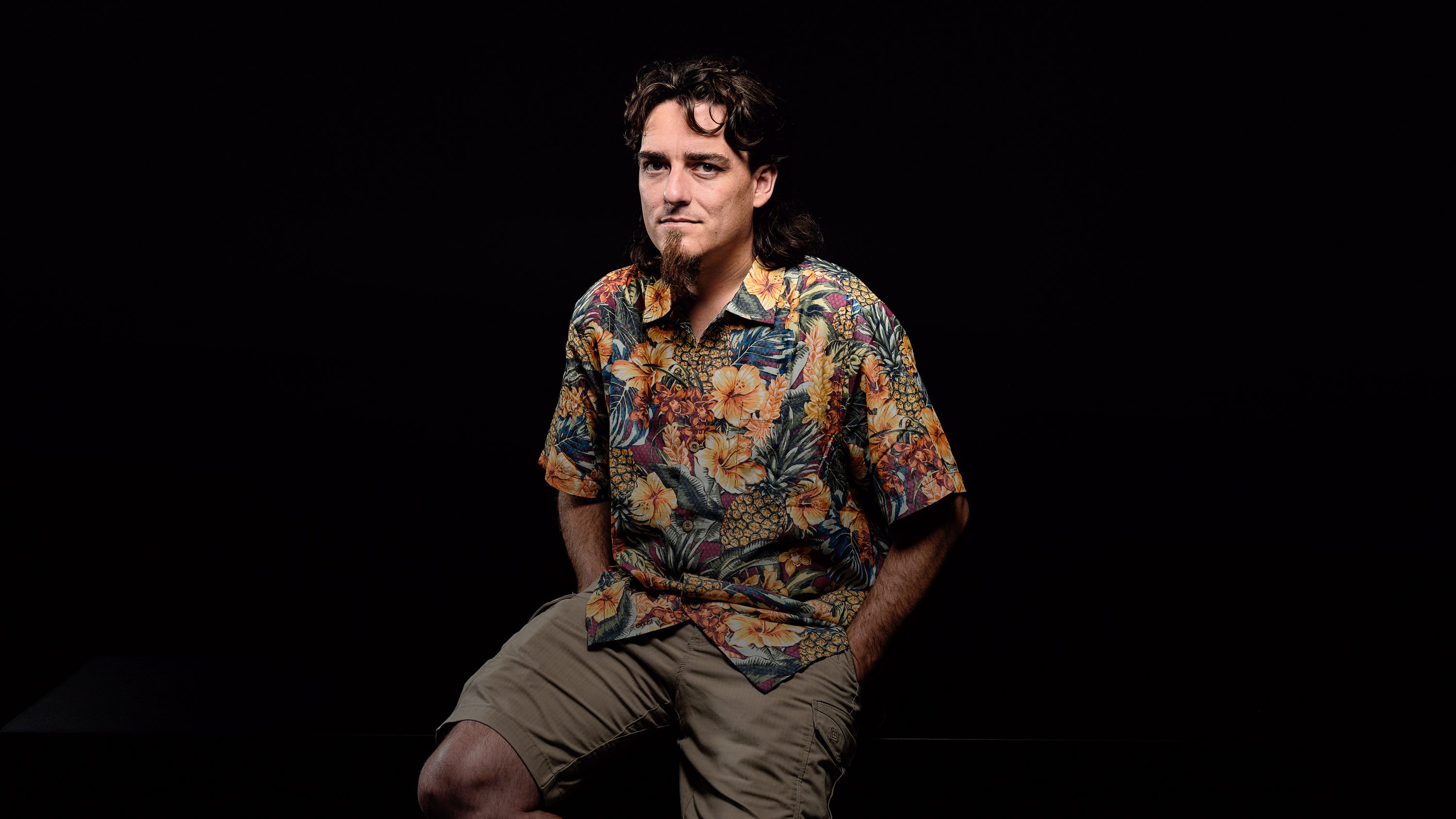
Palmer Luckey on the Pentagon’s future of mixed reality

Palmer Luckey has, in some ways, come full circle.

His first experience with virtual-reality headsets was as a teenage lab technician at a defense research center in Southern California, studying their potential to curb PTSD symptoms in veterans. He then built Oculus, sold it to Facebook for $2 billion, left Facebook after a highly public ousting, and founded Anduril, which focuses on drones, cruise missiles, and other AI-enhanced technologies for the US Department of Defense. The company is now valued at $14 billion.

Now Luckey is redirecting his energy again, to headsets for the military. He spoke to MIT Technology Review about his plans. Read the full interview.

—James O’Donnell

We can still have nice things

A place for comfort, fun and distraction to brighten up your day. (Got any ideas? Drop me a line or skeet ’em at me.)

+ Take a look at these ancient sites that might, just might, have been built by aliens 👽
+ What to take to a BBQ if you fancy emulating the cooking greats.
+ This fun site swaps the captions on different comics.
+ Bring back the drumulator, I say.

The road to artificial general intelligence

Artificial intelligence models that can discover drugs and write code still fail at puzzles a lay person can master in minutes. This phenomenon sits at the heart of the challenge of artificial general intelligence (AGI). Can today’s AI revolution produce models that rival or surpass human intelligence across all domains? If so, what underlying enablers—whether hardware, software, or the orchestration of both—would be needed to power them?

Dario Amodei, co-founder of Anthropic, predicts some form of “powerful AI” could come as early as 2026, with properties that include Nobel Prize-level domain intelligence; the ability to switch between interfaces like text, audio, and the physical world; and the autonomy to reason toward goals, rather than responding to questions and prompts as they do now. Sam Altman, chief executive of OpenAI, believes AGI-like properties are already “coming into view,” unlocking a societal transformation on par with electricity and the internet. He credits progress to continuous gains in training, data, and compute, along with falling costs, and a socioeconomic value that is
super-exponential.

Optimism is not confined to founders. Aggregate forecasts give at least a 50% chance of AI systems achieving several AGI milestones by 2028. The chance of unaided machines outperforming humans in every possible task is estimated at 10% by 2027, and 50% by 2047, according to one expert survey. Time horizons shorten with each breakthrough, from 50 years at the time of GPT-3’s launch to five years by the end of 2024. “Large language and reasoning models are transforming nearly every industry,” says Ian Bratt, vice president of machine learning technology and fellow at Arm.

Download the full report.

This content was produced by Insights, the custom content arm of MIT Technology Review. It was not written by MIT Technology Review’s editorial staff.

This content was researched, designed, and written entirely by human writers, editors, analysts, and illustrators. This includes the writing of surveys and collection of data for surveys. AI tools that may have been used were limited to secondary production processes that passed thorough human review.

New Ecommerce Tools: August 13, 2025

This week’s rundown of new products and services from vendors to ecommerce merchants includes tools for automation, personalized marketing, localized payments, AI-powered search, logistics, agentic commerce, generative AI, and omnichannel distribution.

Got an ecommerce product release? Email releases@practicalecommerce.com.

New Tools for Merchants

Wunderkind marketing platform launches on Shopify. Wunderkind, a performance marketing platform, has launched on the Shopify App Store. The app gives Shopify brands the ability to connect with Wunderkind’s Autonomous Marketing platform to unlock personalized, omnichannel marketing. Merchants gain access to Wunderkind’s suite of capabilities, including a proprietary identity network to recognize anonymous visitors, hyper-personalized omnichannel messaging, and real-time performance insights and optimization tools to enhance decision-making.

Home page of Wunderkind

Wunderkind

ShipBob announces De Minimis Defense Program. ShipBob, a global supply chain and fulfillment platform for SMB and mid-market omnichannel merchants, has announced its De Minimis Defense Program to help businesses impacted by President Trump’s executive order suspending duty-free de minimis for all countries. This suspension starts at or after 12:01 a.m. Eastern Daylight Time on August 29, 2025. To complement its De Minimis Defense Program, ShipBob’s network now includes multiple Foreign-Trade Zone warehouses

Fredhopper launches app for AI-powered product discovery on Shopify. Crownpeak, a digital experience management tool, has launched the Fredhopper Product Discovery Shopify App, enabling enterprise-grade AI search, personalized recommendations, and visual merchandising. Built for scaling brands with extensive catalogs and complex storefronts, the app extends product discovery capabilities to the Shopify platform. Features include AI-powered search, intelligent visual merchandising, localization compatible with Shopify Markets and region-specific catalogs, and native data sync. To launch Fredhooper, Crownpeak collaborated with Underwaterpistol, a Shopify Plus agency.

DCL Logistics launches SelectShip, an AI-powered shipping engine. DCL Logistics, a fulfillment provider, has launched SelectShip, a shipping engine to automate parcel decisions, reduce unforeseen delivery costs, and leverage real-time shipping market data. The AI-powered system automates shipping decisions in real time, optimizing for speed, cost, and reliability for each order, according to DCL Logistics, which states SelectShip requires no new tools, dashboards, or configuration from the customer.

Home page of DCL Losistics

DCL Logistics

Click Labs expands logistics footprint with acquisition of Evermile. Click Labs, a provider of logistics and on-demand delivery software, has acquired Evermile, a London and Tel Aviv-based retail operations platform for small and medium-sized enterprises. The deal marks Click Labs’ expansion into retail operations. Evermile will continue to operate as a standalone brand in the near term, while its technology integrates into Click Labs’ products, including JungleWorks, Tookan, Yelo, and Hippo.

Forter launches identity monitoring for agentic commerce. Forter, an identity and fraud-prevention tool for digital commerce, has announced capabilities to trust AI agents from discovery through payment, including browsing activity referred from AI agents, chatbots, and other tools, and advanced models to distinguish different types of agents. Future platform releases are set to include multiple agents for automating policies and building insights, per Forter.

Klarna payment platform is now available via Stripe for WooCommerce. Klarna, the buy-now pay-later platform, has expanded its ecommerce footprint with its Stripe for WooCommerce integration. Klarna’s payment methods are now available to WooCommerce stores using the Stripe plugin, with no additional setup required from merchants.

Graas raises $9 million to launch an autonomous agent platform for ecommerce automation. Graas, an AI-native data and automation company for ecommerce, has raised $9 million in a round led by Tin Men Capital. Graas will use the funds to accelerate the rollout of Agent Foundry, a proprietary environment for developing autonomous agents for commerce challenges, such as customer acquisition costs, pricing optimization, and inventory management. According to Graas, Agent Foundry enables agents to analyze real-time performance and execute decisions across channels, SKUs, and campaigns.

Home page of Graas

Graas

MetaFyAI launches commerce-focused generative AI suite. MetaFyAI has announced the release of its Generative AI Commerce Suite, a set of intelligent tools that enable retailers, direct-to-consumer brands, and marketplace sellers to automate operations, deliver personalized shopping experiences, and drive measurable revenue growth. MetaFyAI states its tool is trained on ecommerce data, giving it insight into industry nuances, consumer behavior, and platform-specific requirements, such as generating product descriptions and real-time dynamic pricing.

Cavallo expands SalesPad ecommerce capabilities for omnichannel distribution. Cavallo, a developer of distribution software, has integrated its SalesPad management platform with Shopify, WooCommerce, and Adobe Commerce. SalesPad supports sales-order export functionality, enabling orders placed through offline channels to be pushed from SalesPad back to the ecommerce storefront. This gives end customers visibility into their full order history, including fulfillment progress, tracking updates, invoicing, and cancellations, directly from the online portal, according to Cavallo.

Shopline and Quay Acceleration partner to scale omnichannel brands globally. Shopline, an ecommerce platform, has partnered with Quay Acceleration, a startup tool, to launch a three-month program for omnichannel retail brands ready to scale across markets, platforms, and storefronts. Built for early and growth-stage companies operating online, in-store, and via social, the accelerator blends infrastructure, mentorship, and retail strategy to help founders grow across borders and sales channels. The fall program will include 40 retail founders in fashion, beauty, home, and consumer goods, per Shopline.

dLocal launches SmartPix for Pix payments in Brazil. dLocal, a cross-border payment platform for emerging markets, has launched SmartPix, a tool enabling merchants in Brazil to process tokenized Pix payments, including recurring and on-demand charges, without requiring customers to authorize each transaction manually. With SmartPix, merchants can securely store customers’ Pix credentials, similar to card-on-file, and initiate charges in real time. Pix is the instant payment platform managed by the Central Bank of Brazil.

Home page of dLocal

dLocal

Google Gemini Adds Personalization From Past Chats via @sejournal, @MattGSouthern

Google is rolling out updates to the Gemini app that personalize responses using past conversations and add new privacy controls, including a Temporary Chat mode.

The changes start today and will expand over the coming weeks.

What’s New

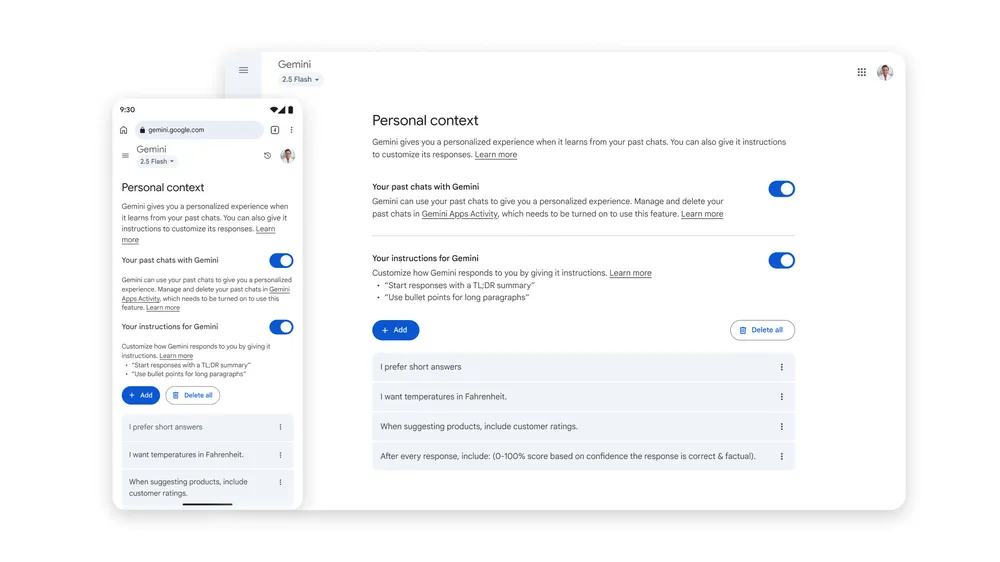
Personalization From Past Chats

Gemini now references earlier chats to recall details and preferences, making responses feel like collaborating with a partner who’s already familiar with the context.

The update aligns with Google’s I/O vision for an assistant that learns and understand the user.

Screenshot from: blog.google/products/gemini/temporary-chats-privacy-controls/, August 2025.

The setting is on by default and can be turned off in SettingsPersonal contextYour past chats with Gemini.

Temporary Chats

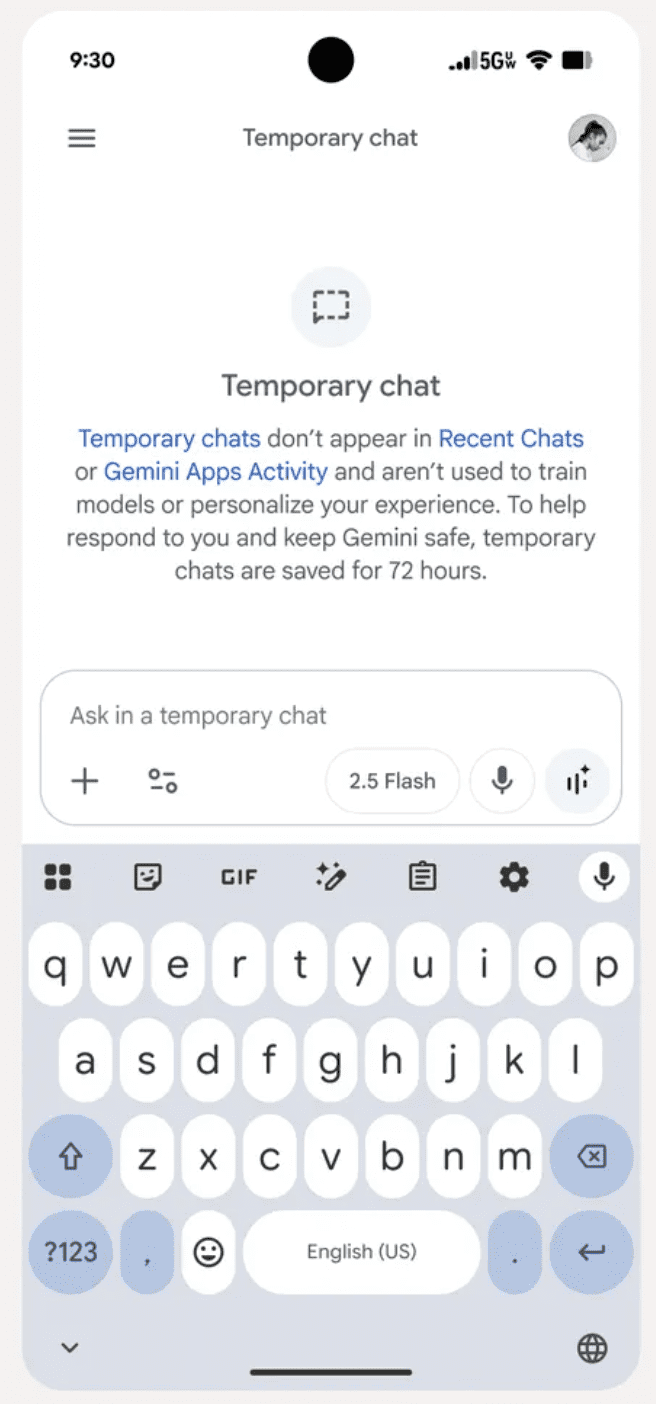
For conversations that shouldn’t influence future responses, Google is adding Temporary Chat.

As Google describes it:

“There may be times when you want to have a quick conversation with the Gemini app without it influencing future chats.”

Temporary chats don’t appear in recent chats, aren’t used to personalize or train models, and are kept for up to 72 hours.

Screenshot from: blog.google/products/gemini/temporary-chats-privacy-controls/, August 2025.

Rollout starts today and will reach all users over the coming weeks.

Updated Privacy Controls

Google will rename the “Gemini Apps Activity” setting to “Keep Activity” in the coming weeks.

When this setting is on, a sample of future uploads, such as files and photos, may be used to help improve Google services.

If your Gemini Apps Activity setting is currently off, Keep Activity will remain off. You can also turn the setting off at any time or use Temporary Chats.

Why This Matters

Personalized responses can reduce repetitive context-setting once Gemini understands your typical topics and goals.

For teams working across clients and categories, Temporary Chats help keep sensitive brainstorming separate from your main context, avoiding cross-pollination of preferences.

Both features include controls that meet privacy requirements for client-sensitive workflows.

Availability

The personalization setting begins rolling out today on Gemini 2.5 Pro in select countries, with expansion to 2.5 Flash and more regions in the coming weeks.


Featured Image: radithyaraf/Shutterstock