AI tools are changing how people discover your website, and not always in the way you’d want.
They might surface old blog posts, low-priority pages, or content that no longer reflects your brand. That can confuse users, damage trust, and dilute your expertise.
That’s where llms.txt comes in. And now, you can personalize it.
Choose what AI sees
The llms.txt file points large language models to the content on your site that deserves attention. With the latest update, you’re in control:
Manual mode: Pick the exact posts or pages you want to include.
Automatic mode: Let Yoast handle it by prioritizing cornerstone content and sticky posts, updated for you weekly.
Easy toggle: Turn the feature on or off anytime. No coding, uploads, or extra tools.
Why this matters
AI is already influencing how people experience your site and brands through summaries, answers, and search results.
If it highlights the wrong content, it can:
Misrepresent your business
Confuse your audience
Undermine your credibility
This update gives you more control over how your site is understood by large language models now and as AI-driven search continues to evolve.
Built for the future of SEO
Fully integrated in Yoast SEO and Yoast SEO Premium
No third-party plugins needed
Designed specifically for AI visibility, not just general SEO
You’ll find all llms.txt settings in the Site Features panel. Just flip the switch and choose the setup that works best for you.
When I first started working in marketing, Yoast SEO was the first plugin I used. Today, I work with the tool that I depended on the most. I’m Carl Henry, my background is in SaaS growth marketing with a focus on content. I like basketball, padel, painting, and gaming.
Just two years ago, Lorraine He, now a 24-year-old law student, was told to avoid using AI for her assignments. At the time, to get around a national block on ChatGPT, students had to buy a mirror-site version from a secondhand marketplace. Its use was common, but it was at best tolerated and more often frowned upon. Now, her professors no longer warn students against using AI. Instead, they’re encouraged to use it—as long as they follow best practices.
She is far from alone. Just like those in the West, Chinese universities are going through a quiet revolution. According to a recent survey by the Mycos Institute, a Chinese higher-education research group, the use of generative AI on campus has become nearly universal. The same survey reports that just 1% of university faculty and students in China reported never using AI tools in their studies or work. Nearly 60% said they used them frequently—either multiple times a day or several times a week.
However, there’s a crucial difference. While many educators in the West see AI as a threat they have to manage, more Chinese classrooms are treating it as a skill to be mastered. In fact, as the Chinese-developed model DeepSeek gains in popularity globally, people increasingly see it as a source of national pride. Theconversation in Chinese universities has gradually shifted from worrying about the implications for academic integrity to encouraging literacy, productivity, and staying ahead.
The cultural divide is even more apparent in public sentiment. A report on global AI attitudes from Stanford University’s Institute for Human-Centered Artificial Intelligence (HAI) found that China leads the world in enthusiasm. About 80% of Chinese respondents said they were “excited” about new AI services—compared with just 35% in the US and 38% in the UK.
“This attitude isn’t surprising,” says Fang Kecheng, a professor in communications at the Chinese University of Hong Kong. “There’s a long tradition in China of believing in technology as a driver of national progress, tracing back to the 1980s, when Deng Xiaoping was already saying that science and technology are primary productive forces.”
From taboo to toolkit
Liu Bingyu, one of He’s professors at the China University of Political Science and Law, says AI can act as “instructor, brainstorm partner, secretary, and devil’s advocate.” She added a full session on AI guidelines to her lecture series this year, after the university encouraged “responsible and confident” use of AI.
Liu recommends that students use generative AI to write literature reviews, draft abstracts, generate charts, and organize thoughts. She’s created slides that lay out detailed examples of good and bad prompts, along with one core principle: AI can’t replace human judgment. “Only high-quality input and smart prompting can lead to good results,” she says.
“The ability to interact with machines is one of the most important skills in today’s world,” Liu told her class. “And instead of having students do it privately, we should talk about it out in the open.”
This reflects a growing trend across the country. MIT Technology Review reviewed the AI strategies of 46 top Chinese universities and found that almost all of them have added interdisciplinary AI general‑education classes, AI related degree programs and AI literacy modules in the past year. Tsinghua, for example, is establishing a new undergraduate general education college to train students in AI plus another traditional discipline, like biology, healthcare, science, or humanities.
Major institutions like Remin, Nanjing, and Fudan Universities have rolled out general-access AI courses and degree programs that are open to all students, not reserved for computer science majors like the traditional machine-learning classes. At Zhejiang University, an introductory AI class will become mandatory for undergraduates starting in 2024.
Lin Shangxin, principal of Renmin University of China recently told local media that AI was an “unprecedented opportunity” for humanities and social sciences. “Intead of a challenge, I believe AI would empower humanities studies,” Lin said told The Paper.
The collective action echoes a central government push. In April 2025, the Ministry of Education released new national guidelines calling for sweeping “AI+ education” reforms, aimed at cultivating critical thinking, digital fluency, and real‐world skills at all education levels. Earlier this year, the Beijing municipal government mandated AI education across all schools in the city—from universities to K–12.
Fang believes that more formal AI literacy education will help bridge an emerging divide between students. “There’s a big gap in digital literacy,” he says. “Some students are fluent in AI tools. Others are lost.”
Building the AI university
In the absence of Western tools like ChatGPT and Claude, many Chinese universities have begun deploying local versions of DeepSeek on campus servers to support students. Many top universities have deployed their own locally hosted versions of Deepseek. These campus-specific AI systems–often referred to as the “full-blood version” of Deepseek—offer longer context windows, unlimited dialogue rounds and broader functionality than public-facing free versions.
This mirrors a broader trend in the West, where companies like OpenAI and Anthropic are rolling out campus-wide education tiers—OpenAI recently offered free ChatGPT Plus to all U.S. and Canadian college students, while Anthropic launched Claude for Education with partners like Northeastern and LSE. But in China, the initiative is typically university-led rather than driven by the companies themselves.
The goal, according to Zhejiang University, is to offer students full access to AI tools so they can stay up to date with the fast-changing technology. Students can use their ID to access the models for free.
Yanyan Li and Meifang Zhuo, two researchers at Warwick University who have studied students’ use of AI at universities in the UK, believe that AI literacy education has become crucial to students’ success.
With their colleague Gunisha Aggarwal, they conducted focus groups including college students from different backgrounds and levels to find out how AI is used in academic studies. They found that students’ knowledge of how to use AI comes mainly from personal exploration. “While most students understand that AI output is not always trustworthy, we observed a lot of anxiety on how to use it right,” says Li.
“The goal shouldn’t be preventing students from using AI but guiding them to harness it for effective learning and higher-order thinking,” says Zhuo.
That lesson has come slowly. A student at Central China Normal University in Wuhan told MIT Technology Review that just a year ago, most of his classmates paid for mirror websites of ChatGPT, using VPNs or semi-legal online marketplaces to access Western models. “Now, everyone just uses DeepSeek and Doubao,” he said. “It’s cheaper, it works in Chinese, and no one’s worried about getting flagged anymore.”
Still, even with increased institutional support, many students feel anxious about whether they’re using AI correctly—or ethically. The use of AI detection tools has created an informal gray economy, where students pay hundreds of yuan to freelancers promising to “AI-detection-proof” their writing, according to a Rest of Worldreport. Three students told MIT Technology Review that this environment has created confusion, stress, and increased anxiety. Across the board, they said they appreciate it when their professor offers clear policies and practical advice, not just warnings.
He, the law student in Beijing, recently joined a career development group to learn more AI skills to prepare for the job market. To many like her, understanding how to use AI better is not just a studying hack but a necessary skill in China’s fragile job market. Eighty percent of job openings available to fresh graduates listed AI-related skills as a plus in 2025, according to a report by the Chinese media outlet YiCai. In a slowed-down economy and a competitive job market, many students see AI as a lifeline.
“We need to rethink what is considered ‘original work’ in the age of AI” says Zhuo, “and universities are a crucial site of that conversation”.
This is today’s edition of The Download, our weekday newsletter that provides a daily dose of what’s going on in the world of technology.
Chinese universities want students to use more AI, not less
Just two years ago, students in China were told to avoid using AI for their assignments. At the time, to get around a national block on ChatGPT, students had to buy a mirror-site version from a secondhand marketplace. Its use was common, but it was at best tolerated and more often frowned upon. Now, professors no longer warn students against using AI. Instead, they’re encouraged to use it—as long as they follow best practices.
Just like those in the West, Chinese universities are going through a quiet revolution. The use of generative AI on campus has become nearly universal. However, there’s a crucial difference. While many educators in the West see AI as a threat they have to manage, more Chinese classrooms are treating it as a skill to be mastered.Read the full story.
—Caiwei Chen
If you’re interested in reading more about how AI is affecting education, check out:
+ AI giants like OpenAI and Anthropic say their technologies can help students learn—not just cheat. But real-world use suggests otherwise. Read the full story.
+ The narrative around cheating students doesn’t tell the whole story. Meet the teachers who think generative AI could actually make learning better. Read the full story.
+ This AI system makes human tutors better at teaching children math. Called Tutor CoPilot, it demonstrates how AI could enhance, rather than replace, educators’ work. Read the full story.
Why it’s so hard to make welfare AI fair
There are plenty of stories about AI that’s caused harm when deployed in sensitive situations, and in many of those cases, the systems were developed without much concern to what it meant to be fair or how to implement fairness.
But the city of Amsterdam did spend a lot of time and money to try to create ethical AI—in fact, it followed every recommendation in the responsible AI playbook. But when it deployed it in the real world, it still couldn’t remove biases. So why did Amsterdam fail? And more importantly: Can this ever be done right?
Join our editor Amanda Silverman, investigative reporter Eileen Guo and Gabriel Geiger, an investigative reporter from Lighthouse Reports, for a subscriber-only Roundtables conversation at 1pm ET on Wednesday July 30 to explore if algorithms can ever be fair. Register here!
The must-reads
I’ve combed the internet to find you today’s most fun/important/scary/fascinating stories about technology.
1 The US has frozen tech export restrictions to China Donald Trump is attempting to thrash out a favorable deal with Beijing. (FT $)
2 Microsoft’s early cybersecurity alert system may have tipped off hackers It’s investigating whether the program inadvertently leaked flaws in its SharePoint service. (Bloomberg $) + But how did the hackers know how to exploit them? (The Register)
3 This may be the last time humans beat AI at math The world’s brightest teenagers are still outwitting AI models—but for how long? (WSJ $) + What’s next for AI and math. (MIT Technology Review)
4 Google is putting a vibe coding app through its paces Opal is the company’s answer to the likes of Cursor and Lovable. (TechCrunch) + What is vibe coding, exactly? (MIT Technology Review)
5 What the future of satellite-on-satellite warfare may look like America is preparing for combat in low-Earth orbit. (Economist $)
6 San Francisco is becoming a proper tech hub once again The city is finally revitalizing post-pandemic. (WP $)
7 A women’s dating safety app database has been exposed And the womens’ data shared to 4Chan. (404 Media) + More than 72,000 images were stolen in the breach. (Reuters) + Interest in the app has skyrocketed in the past week. (NYT $)
8 Optimists are using AI to manifest their dream lives For when your Pinterest vision board is no longer cutting it. (NYT $)
9 A new kind of aerogel could help make saltwater drinkable And, unlike previous aerogels, it works on a scale large enough to matter. (Ars Technica)
10 How AI is changing video games Experts are bracing themselves for a complete industry takeover. (NYT $) + How generative AI could reinvent what it means to play. (MIT Technology Review)
Quote of the day
“Let’s face it, you can’t have the Chinese have an app on 100 million American phones, that is just not okay.”
—Howard Lutnick, the US secretary of commerce, explains why he thinks TikTok must be sold to an American owner, Reuters reports.
One more thing
Is the digital dollar dead?
In 2020, digital currencies were one of the hottest topics in town. China was well on its way to launching its own central bank digital currency, or CBDC, and many other countries launched CBDC research projects, including the US.
How things change. Years later, the digital dollar—even though it doesn’t exist—has become political red meat, as some politicians label it a dystopian tool for surveillance. And late last year, the Boston Fed quietly stopped working on its CBDC project. So is the dream of the digital dollar dead? Read the full story.
—Mike Orcutt
We can still have nice things
A place for comfort, fun and distraction to brighten up your day. (Got any ideas? Drop me a line or skeet ’em at me.)
Unlike top search engines, ChatGPT does not maintain an index of global websites. It has relied instead on Bing’s index and search for training and sources. However, recent third-party tests suggest ChatGPT has switched to Google for that purpose.
An ex-Googler and web developer in India, Abhishek Iyer, summarized his test on X. He invented a meaningless word with a definition, placed them on a page that was neither linked internally nor externally, and submitted the page to Google through Search Console.
He then prompted ChatGPT to define the term. The response was “verbatim” from his web page. He searched for the same word on Bing, DuckDuckGo, and Yandex. None returned results.
Another test, by Aleyda Solís, a search engine consultant, produced similar results. But it also revealed that ChatGPT utilized Google’s search snippet to fetch information.
In a response to a Solís prompt, ChatGPT stated it used “a cached snippet via web search” to fetch the information, indicating that ChatGPT may have direct access to Google’s cache.
In short, ChatGPT appears to utilize Google’s index to find information and sources.
What does it mean for visibility in ChatGPT?
ChatGPT has apparently switched from using Bing’s search index to Google’s.
Google’s Index
Both tests reveal ChatGPT’s reliance on Google’s index, like Google’s own Gemini and AI Mode. Hence being indexed by Google is a key step for visibility in generative AI platforms.
Yet Google is now aggressively removing pages from its index. It’s essential to monitor the indexation status of your important pages. “Crawled but not indexed” statuses in Search Console are more frequent. There’s little chance unindexed pages will surface in genAI responses.
If you are experiencing indexing glitches:
Know when to ignore them. All sites have unindexed pages. There’s often no problem to solve. It could be near-duplicate pages, old or outdated pages, or pages generated by internal search or filtering. Unless it’s an important product or landing page, “crawled but not indexed” is likely temporary.
Improve internal linking. A site’s navigation structure is the first step to better indexation. AI-powered tools can help, but overall, tactics such as “Related products,” “Related categories or subcategories,” and product-bundling pages elevate deeper pages.
Produce unique content. Repeated content can prevent a page from being indexed. It often occurs on sites with extensive products and manufacturer-provided descriptions. Third-party tools can create unique descriptions. Merchants can also follow Amazon’s example and include unique summaries and takeaways on product pages for additional informative content.
Beyond Indexing
Indexation by Google is fundamental, but a strategy for visibility in AI answers is much more. I’ve seen no evidence that organic rankings impact answers in ChatGPT or Gemini. Higher organic rankings do not improve visibility.
GenAI algorithms rely on different signals than search engines, preferring pages that answer questions clearly and succinctly.
Thus ensure your pages:
Provide straightforward answers to frequent questions,
Have content easily crawled and accessed with JavaScript disabled — AI crawlers cannot render JavaScript.
New research from Microsoft reveals that marketing and sales professionals are among the most affected by generative AI, based on an analysis of 200,000 real workplace conversations with Bing Copilot.
The research examined nine months of anonymized data from January to September 2024, offering a large-scale look at how professionals use AI in their daily tasks.
AI’s Role In Marketing & Sales Work
Microsoft calculated an “AI applicability score” to measure how often AI is used to complete or assist with job-related tasks and how effectively it performs those tasks.
Sales representatives received one of the highest scores (0.46), followed closely by customer service representatives (0.44), writers and authors (0.45), and other marketing roles like:
Technical Writers (0.38)
Public Relations Specialists (0.36)
Advertising Sales Agents (0.36)
Market Research Analysts (0.35)
Overall, “Sales and Related” occupations ranked highest in AI impact across all major job categories, followed by computing and administrative roles.
As Microsoft researchers note:
“The current capabilities of generative AI align most strongly with knowledge work and communication occupations.”
Tasks Where AI Performs Well
The study found AI is particularly effective at:
Gathering information
Writing and editing content
Communicating information to others
Supporting ongoing learning in a specific field
These tasks often show high success and satisfaction rates among users.
However, the study also uncovered that in 40% of conversations, the AI performed tasks different from what the user initially requested. For example, when someone asks for help with research, the AI might instead explain research methods rather than deliver information.
This reflects AI’s role as more of a helper than a replacement. As the researchers put it:
“The AI often acts in a service role to the human as a coach, advisor, or teacher.”
Areas Where Human Strength Excels
Some marketing tasks still show resistance to AI. These include:
Visual design and creative work
Strategic data analysis
Roles that require physical presence or in-person interaction, such as event marketing or client-based sales
These activities consistently scored lower for AI satisfaction and task completion.
Education, Wages & Job Security
The study found a weak correlation between AI impact and wages. The correlation coefficient was 0.07, indicating that AI is reshaping tasks across income levels, not just automating low-paying jobs.
For roles requiring a Bachelor’s degree, the average AI applicability score was slightly higher (0.27), compared to 0.19 for jobs with lower education requirements. This suggests knowledge work may see more AI involvement, but not necessarily replacement.
The researchers caution against assuming automation leads to job loss:
“This would be a mistake, as our data do not include the downstream business impacts of new technology, which are very hard to predict and often counterintuitive.”
What You Can Do
The data supports a clear takeaway: AI is here to stay, but it’s not taking over every aspect of marketing work.
Digital anthropologist Giles Crouch, quoted in coverage of the study, said:
“The conversation has gone from this fear of massive job loss to: How can we get real benefit from these tools? How will it make our work better?”
There are a few ways marketing professionals can adapt, such as:
Sharpening skills in areas where AI falls short, such as visual creativity and strategic interpretation
Using AI as a productivity booster for content creation and information gathering
Positioning themselves as AI collaborators rather than competitors
Looking Ahead
AI is reshaping marketing by changing how work gets done, not by eliminating roles.
As with past technological changes, those who adapt and integrate these tools into their workflow may find themselves better positioned for long-term success.
The full report includes a detailed breakdown of occupations and task types across the U.S. workforce.
In a recent Search Off the Record podcast, Google’s Search Relations team cautioned developers against using CSS for all website images.
While CSS background images can enhance visual design, they’re invisible to Google Image Search. This could lead to missed opportunities in image indexing and search visibility.
Here’s what Google’s Search Advocates advise.
The CSS Image Problem
During the episode, John Mueller shared a recurring issue:
“I had someone ping me I think last week or a week before on social media: “It looks like my developer has decided to use CSS for all of the images because they believe it’s better.” Does this work?”
According to the Google team, this approach stems from a misunderstanding of how search engines interpret images.
When visuals are added via CSS background properties instead of standard HTML image tags, they may not appear in the page’s DOM, and therefore can’t be indexed.
As Martin Splitt explained:
“If you have a content image, if the image is part of the content… you want an img, an image tag or a picture tag that actually has the actual image as part of the DOM because you want us to see like ah so this page has this image that is not just decoration. It is part of the content and then image search can pick it up.”
Content vs. Decoration
The difference between a content image and a decorative image is whether it adds meaning or is purely cosmetic.
Decorative images, such as patterned backgrounds, atmospheric effects, or animations, can be safely implemented using CSS.
When the image conveys meaning or is referenced in the content, CSS is a poor fit.
Splitt offered the following example:
“If I have a blog post about this specific landscape and I want to like tell people like look at this amazing panoramic view of the landscape here and then it’s a background image… the problem is the content specifically references this image, but it doesn’t have the image as part of the content.”
In such cases, placing the image in HTML using the img or picture tag ensures it’s understood as part of the page’s content and eligible for indexing in Google Image Search.
What Makes CSS Images Invisible?
Splitt explained why this happens:
“For a user looking at the browser, what are you talking about, Martin? The image is right there. But if you look at the DOM, it absolutely isn’t there. It is just a CSS thing that has been loaded to style the page.”
Because Google parses the DOM to determine content structure, images styled purely through CSS are often overlooked, especially if they aren’t included as actual HTML elements.
This distinction reflects a broader web development principle.
Splitt adds:
“There is ideally a separation between the way the site looks and what the content is.”
What About Stock Photos?
The team addressed the use of stock photos, which are sometimes added for visual appeal rather than original content.
Splitt says:
“The meaning is still like this image is not mine. It’s a stock image that we bought or licensed but it is still part of the content,” the team noted.
While these images may not rank highly due to duplication, implementing them in HTML still helps ensure proper indexing and improves accessibility.
Why This Matters
The team highlighted several examples where improper implementation could reduce visibility:
Real estate listings: Home photos used as background images won’t show up in relevant image search queries.
News articles: Charts or infographics added via CSS can’t be indexed, weakening discoverability.
E-commerce sites: Product images embedded in background styles may not appear in shopping-related searches.
What To Do Next
Google’s comments indicate that you should follow these best practices:
Use HTML (img or picture) tags for any image that conveys content or is referenced on the page.
Reserve CSS backgrounds for decorative visuals that don’t carry meaning.
If users might expect to find an image via search, it should be in the HTML.
Proper implementation helps not only with SEO, but also with accessibility tools and screen readers.
Looking Ahead
Publishers should be mindful of how images are implemented.
While CSS is a powerful tool for design, using it to deliver content-related images may conflict with best practices for indexing, accessibility, and long-term SEO strategy.
Generative AI-driven search isn’t a trend; it’s the new baseline. Tools like Gemini and ChatGPT have already replaced traditional queries for millions of users.
Your audience doesn’t just search anymore: They ask. They expect answers. And those answers are being assembled, ranked, and cited by AI systems that don’t care about title tags or keyword placement. They care about trust, structure, and retrievability.
Most SEO training programs haven’t caught up. They’re still built around tactics designed for a ranking algorithm, not a generative model. The gap isn’t closing; it’s widening.
And this isn’t speculation. Research from multiple firms now shows that conversational AI is becoming a dominant discovery interface.
Microsoft, Google, Meta, OpenAI, and Amazon are all restructuring their product ecosystems around AI-powered answers, not just ranked links.
The tipping point has already passed. If your training still revolves around keyword targeting and domain authority, you’re falling behind, and not gradually, but right now.
The uncomfortable reality is that many marketers are now trained in a playbook from the early 2010s, while the engines have moved on to an entirely different game.
At this point, are we even optimizing for “search engines” anymore – or have they become “discovery assistants” or “search assistants” built to curate, cite, and synthesize?
How SEO Fell Behind (Historical Context)
Traditional SEO has always adapted, from Google’s Panda and Penguin algorithms, which prioritized content quality and penalized low-quality links, to Hummingbird’s semantic understanding of user intent.
But today’s generative search landscape is an entirely new paradigm. Google Gemini, ChatGPT, and other conversational interfaces don’t simply rank pages; they synthesize answers from the most retrievable chunks of content available.
This is not a gradual shift. This is the biggest leap in SEO’s history, and most training programs haven’t caught up yet.
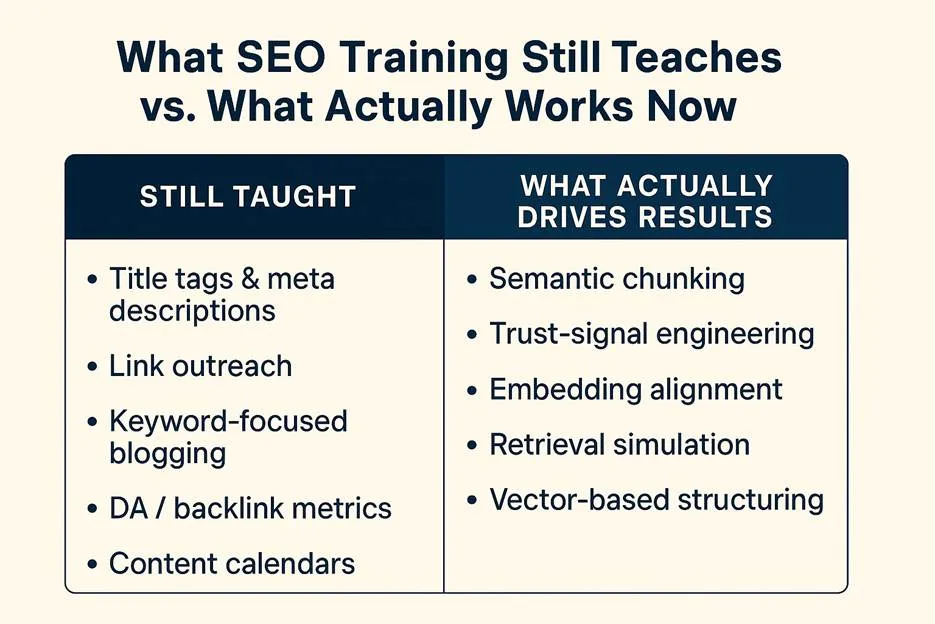
The Old Curriculum: What We’re Still Teaching (And Shouldn’t Be)
Traditional SEO curriculums typically emphasize:
Title Tags & Meta Descriptions: Despite Google rewriting around 60-75% of these (source: Zyppy SEO study), these remain foundational to most SEO training programs.
Link Outreach & Link Building: Still focused on quantity and domain authority, even though AI-driven search systems focus more on contextual relevance and content (and author) trustworthiness.
Keyword-Focused Blogging & Content Calendars: Rigid editorial calendars and keyword-driven articles are becoming obsolete in an AI-driven search era.
Technical SEO: While still useful for traditional search engines, modern AI-based systems care far less about the technical structure of a webpage, and more about the accessibility of the content, and how it displays entities and relationships.
Example:
Take a common assignment from SEO training programs: “Write a blog post targeting the keyword ‘best hiking boots for 2025’.”
You’re taught to select a primary keyword, structure your headers around related phrases, and write a long-form post designed to rank in traditional SERPs.
That approach might still work for Google’s blue links, but in a generative AI context, it fails.
Ask Gemini or ChatGPT the same query, and your content likely won’t appear. Not because it’s low quality, but because it wasn’t structured to be retrieved.
It lacks semantic chunking, embedding alignment, and explicit trust signals.
The AI systems are selecting content blocks they can understand, rank by relevance, and cite. If your article is built to match human scan patterns instead of machine retrieval cues, it’s simply invisible.
Image credit: Duane Forrester
The New SEO Work: What Actually Drives Results Now
Real SEO today revolves around structured, retrievable, semantically rich content:
1. Semantic Chunking
Creating content structured into clearly defined, self-contained chunks optimized for large language models (LLMs).
2. Vector Modeling & Embeddings
Placing content into semantic clusters inside vector databases, ensuring each piece of content is closely aligned with user intent and query vectors.
3. Trust, Signal Engineering
Implementing structured citations, schema markup, clear attribution, and credibility signals that AI-driven models trust enough to cite explicitly.
4. Retrieval Simulation & Prediction
Using tools such as RankBee, SERPRecon, and Waikay.io to actively simulate how your content surfaces within AI-driven answers.
5. RRF Tuning & Model Optimization
Fine-tuning content performance across generative models like Perplexity, Gemini, ChatGPT, ensuring maximum retrievability in various conversational contexts.
6. Zero-Click Optimization
Optimizing content not just for clicks but to be featured directly in generative AI responses.
Backlinko’s guide on LLM Seeding introduces a practical framework for getting cited by large language models like ChatGPT and Gemini.
It emphasizes creating chunkable, trustworthy content designed to be surfaced in AI-generated answers – marking a fundamental shift from optimizing for rankings to optimizing for retrieval.
Consider leading brands engaging with AI-first discovery themes:
Zapier has published educational content on vector embeddings and how they underpin tools like ChatGPT and semantic search (source). While that article doesn’t detail their internal SEO strategies, it shows how marketing teams can start unpacking the concepts that underpin retrieval-based visibility. → Correction: An earlier version of this article suggested Zapier had implemented semantic chunking and retrieval optimization. That was an editing error on my part: there’s no public evidence to support that claim.
Shopify, meanwhile, uses its Shopify Magic tool to generate SEO-optimized product descriptions at scale, integrating generative workflows into day-to-day content ops (source). → Takeaway: Shopify ties generative tooling directly to scalable, structured content designed for discovery.
These examples don’t suggest perfect alignment – but they point to how modern teams are beginning to integrate AI thinking into real workflows. That’s the shift: from content creation to content retrieval architecture.
Why The Disconnect Exists (And Persists)
1. Educational Inertia
Updating curriculums is expensive, difficult, and risky for educators.
Many course creators and educational institutions are overwhelmed or ill-equipped to rapidly pivot their syllabi toward advanced semantic optimization and vector embeddings.
2. Hiring Practices & Organizational Habits
Job ads often still emphasize outdated skills, perpetuating the inertia by attracting talent trained in legacy SEO methods rather than future-oriented techniques.
3. Legacy Toolsets
Major SEO platforms like Moz, Semrush, and Ahrefs continue to emphasize metrics like domain authority, keyword volumes, and traditional backlink counts, reinforcing outdated optimization practices.
The Fix: An Outcome-Driven SEO Training Model
To address these problems, SEO training must now shift toward measurable KPIs, clear roles, and task-based learning:
New KPI, Driven Framework:
Embedding retrieval rate (AI-driven visibility).
GenAI attribution percentage (citations in AI outputs).
Vector presence and semantic alignment.
Trust-signal effectiveness (schema and structured data).
Re-ranking lift via Retrieval Rank Fusion (RRF).
New Roles And Responsibilities:
Digital GEOlogist: Optimizes content placement and semantic structure for retrieval. (I know, the title is a joke, but you get the point.)
Cheditor (Chunk Editor): Optimizes chunks of content specifically for LLM consumption and retrievability. If you’re an Editor, you need to be a Cheditor.
Task-Based SEO Education:
Simulate retrieval via ChatGPT/Perplexity prompt engineering.
Perform semantic embedding audits to measure content similarity against successful retrieval outputs.
Conduct regular A/B tests on chunk structures and semantic signals, evaluating real-world retrievability.
How To Take Charge: You Are The Resource Now
The reality is stark but empowering: No one’s coming to save your career. Not your company, which may move slowly, nor traditional schools, nor third-party platforms with outdated content.
You won’t find this in a course catalog. If your company hasn’t caught up (and most haven’t), it’s on you to take the lead.
Here’s a practical roadmap to start building your own AI-SEO expertise from the ground up:
Month 1: Build Your Foundation
Complete foundational AI courses:
Share key learnings internally.
Month 2: Tactical Skill, Building
Complete practical SEO, specific courses:
Start sharing actionable tips via Slack or internal newsletters.
Month 3: Community And Collaboration
Organize “Lunch & Learns” or internal SEO Labs, focused on semantic chunking, embeddings, trust, signal engineering.
Engage actively in external communities (Discord groups, LinkedIn SEO groups, online forums like Moz Q&A) to deepen your knowledge.
Month 4: Institutionalize Your Expertise
Formally propose and launch an internal “AI-SEO Center of Excellence.”
Run practical retrieval simulations, document results, and showcase tangible improvements to secure ongoing investment and visibility internally.
Turning Learning Into Leadership
Once you’ve built momentum with personal upskilling, don’t stop at silent improvement. Make your learning visible, and valuable, by creating change around you:
Host SEO-AI Micro Sessions: Run short, focused sessions (15-20 minutes) on topics like semantic chunking, retrieval testing, or schema design. Keep them informal, repeatable, and useful.
Run Retrieval Audits: Pick three to five high-priority URLs and test them in ChatGPT, Gemini, or Perplexity. Which content blocks surface? What gets ignored? Share your findings openly.
Build a Knowledge Hub: Use Notion, Google Docs, or Confluence to create a centralized space for SEO-AI strategies, test results, tools, and templates.
Create a Weekly AI Digest: Curate key updates from the field – citations appearing in generative answers, new tools, useful prompts – and circulate them internally.
Recruit Allies: Invite collaborators to contribute retrieval tests, co-host sessions, or flag examples of your content appearing in AI answers. Leadership scales faster with support.
This is how you shift from learner to leader. You’re no longer just upskilling, you’re operationalizing AI search inside your company.
You Are the Catalyst, Take Action Now
The roles of traditional SEO specialists will shift (or fade?), replaced by experts fluent in semantic optimization and retrievability.
Become the person who educates your company because you educated yourself first.
Your role isn’t just to keep up, it’s to lead. The responsibility, and the opportunity, sit with you right now.
Don’t wait for your company to catch up or for course platforms to get current. Take action. The new discovery systems are already here, and the people who learn to work with them will define the next era of visibility.
If you teach SEO, rewrite your courses around these new KPIs and roles.
If you hire SEO talent, demand modern optimization skills: semantic embeddings knowledge, chunk structuring experience, retrieval simulation approaches.
If you practice SEO, proactively shift your efforts toward retrieval testing, embedding audits, and semantic optimization immediately.
SEO isn’t dying, it’s evolving.
And you have an opportunity, right now, to be at the forefront of this evolution.
You’ve heard the predictions: AI will replace SEO, generative search will eliminate organic traffic, and marketers should start updating their resumes.
With 73% of marketing teams using generative AI, it’s easy to assume we’re witnessing SEO’s funeral.
Here’s what’s actually happening: AI isn’t replacing SEO. It’s expanding SEO into new territories with bigger opportunities.
While Google’s AI Overviews and tools like ChatGPT are changing how people find information, they’re also creating new ways for your content to get discovered, cited, and trusted by millions of searchers.
The game isn’t ending. You just need to learn the new rules.
How AI Search Actually Works (And Where Your Content Fits)
Generative search doesn’t eliminate the need for quality content; it amplifies it.
When someone asks ChatGPT about email marketing or searches with Google’s AI features, these systems scan thousands of webpages to synthesize comprehensive answers.
Your content isn’t competing for traditional rankings anymore. You’re competing to become the authoritative source that AI systems pull from when generating responses.
The Citation Game
Here’s what most marketers miss: AI systems still cite their sources.
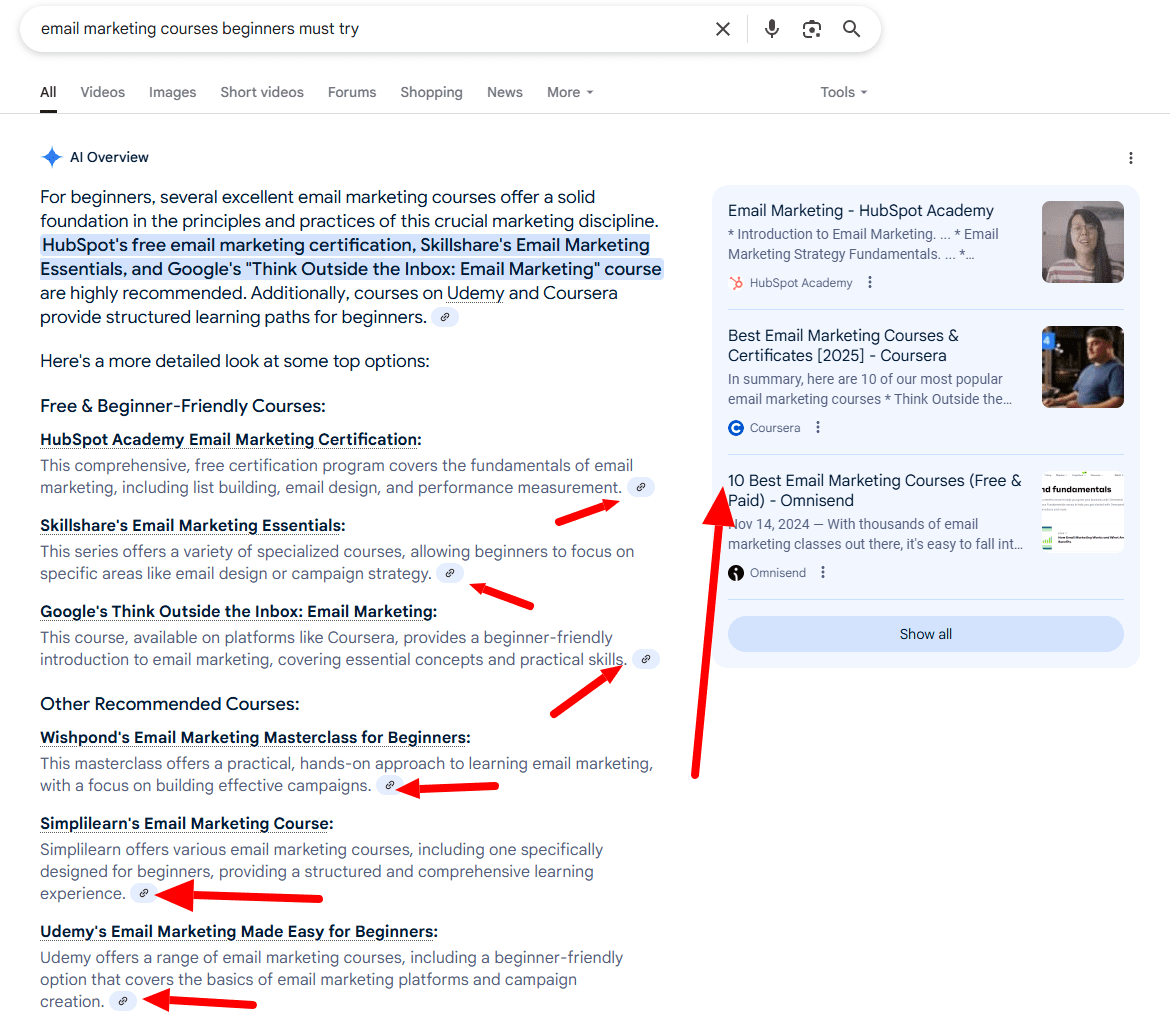
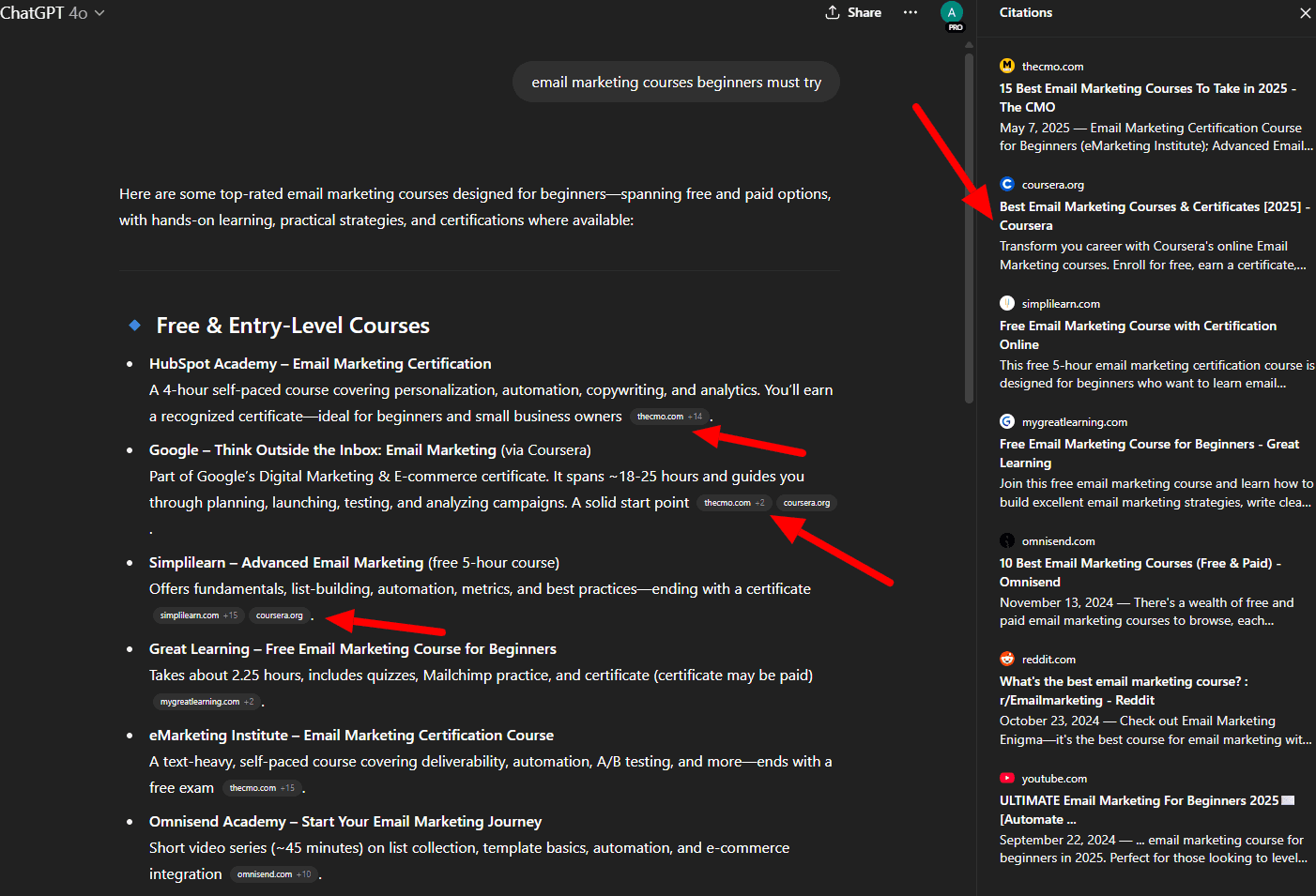
Google’s AI Overviews include links to referenced websites, and ChatGPT and Perplexity provide source citations.
Getting featured as a cited source can drive more qualified traffic than a traditional No. 1 ranking because users already know your content contributed to the answer they received.
Google AIO Citation Example:
Screenshot from search for [email marketing courses beginners must try], Google, July 2025
ChatGPT Citation Example:
Screenshot from ChatGPT, July 2025
What AI systems look for in sources:
Factual accuracy and reliability (they cross-reference information).
Update older content with recent statistics and insights.
Structure information in clear, scannable sections.
From Rankings To Retrieval
Traditional SEO targeted specific keyword rankings. AI search introduces “retrieval” – your content gets pulled into responses for queries you never directly optimized for.
Your comprehensive project management guide might get cited when someone asks, “How can I keep my remote team organized without micromanaging?” even though you never targeted that exact phrase.
Optimizing for retrieval requires a different mindset than traditional keyword targeting.
Create content that covers topics from multiple angles rather than focusing on single keyword phrases.
Structure your articles around the actual questions your audience asks, using headings that mirror real user queries.
Build comprehensive topic clusters that demonstrate your expertise across related subjects, showing AI systems that you’re a reliable source for broad topic coverage.
The SEO Fundamentals That Still Matter (With New Twists)
AI systems are far less forgiving than Google’s crawlers.
While Google’s bots can render JavaScript, handle errors gracefully, and work around technical issues, most AI agents simply fetch raw HTML and move on.
If they find an empty page, wrong HTTP status, or tangled markup, they won’t see your content at all.
This makes technical SEO non-negotiable for AI visibility. Server-side rendering becomes absolutely critical since AI agents won’t execute JavaScript or wait for client-side rendering.
Your content must be immediately visible in raw HTML.
Clean, semantic markup with valid HTML and proper heading hierarchy helps AI systems parse content accurately, while efficient delivery ensures AI agents don’t abandon slow or bloated sites.
AI bot requirements:
Allow AI crawlers (GPTBot, ClaudeBot, PerplexityBot, etc.) through robots.txt.
Whitelist AI bot IP ranges rather than blocking with firewalls.
Ensure critical content loads without JavaScript dependencies.
Avoid “noindex” and “nosnippet” tags on valuable content.
Optimize server response times for efficient content retrieval.
It could direct AI models to your best content during inference.
Place this plain text file at your domain root using proper markdown structure, including only your highest-value, well-structured content that answers specific questions.
Content Strategy For AI Citations
Your content strategy needs a fundamental shift. Instead of writing for search engine rankings, you’re creating content that feeds AI knowledge bases.
The key to successful retrieval optimization means leading with clear, definitive answers to specific questions.
When addressing common queries like [how long do SEO results take?], start immediately with “SEO results typically appear within three to six months for new websites.”
Break complex topics into digestible, extractable sections that include comprehensive explanations with supporting context.
AI systems favor content that provides complete answers rather than surface-level information, so include relevant data and statistics that can be easily identified and cited.
AI systems don’t retrieve entire pages; they break content into passages or “chunks” and extract the most relevant segments.
This means each section of your content should work as a standalone snippet that’s independently understandable.
Keep one focused idea per section, staying tightly concentrated on single concepts.
Use structured HTML with clear H2 and H3 subheadings for every subtopic, making passages semantically tight and self-contained.
Start each section with direct, concise sentences that immediately address the core point.
Building topical authority requires understanding how Google’s AI uses “query fan-out” techniques.
Complex queries get automatically broken into multiple related subqueries and executed in parallel, rewarding sites with both topical breadth and depth.
Create comprehensive pillar pages that summarize main topics with strategic links to deeper cluster content.
Develop cluster pages targeting specific facets of your expertise, then cross-link between related cluster pages to establish semantic relationships.
Cover diverse angles and intents to increase your content’s surface area for AI retrieval across multiple query variations.
Working With AI Systems, Not Against Them
The most successful marketers are learning to optimize for AI inclusion rather than fighting against machine-generated answers.
Optimizing For AI Summaries
Structure your content so AI systems can’t ignore it by leading with clear answers and using scannable formatting.
Include concrete data and statistics that make content citation-worthy, and implement schema markup like FAQ, how-to, and article schemas to help AI understand your content structure.
Key formatting elements that AI systems prefer:
Bullet points and numbered lists for easy parsing.
Clear subheadings that mirror actual user questions.
Natural language Q&A format throughout the content.
Building citation-worthy authority requires meeting higher trust and clarity standards than basic content inclusion.
AI systems prioritize content perceived as factually accurate, up-to-date, and authoritative. Include specific, verifiable claims with source citations that link to studies and expert sources.
Refresh key content regularly with timestamps to signal updated information, and consider publishing original research, surveys, or industry studies that journalists and bloggers reference.
AI search systems increasingly retrieve and synthesize content beyond text, including images, charts, tables, and videos. This creates opportunities for more engaging, scannable answers.
Ensure images and videos are crawlable by avoiding JavaScript-only rendering, and use descriptive alt text that includes topic context for all images.
Add explanatory captions directly below or beside visual elements, and use proper HTML markup like
and
instead of images of tables to support AI bot parsing.
Monitor Your AI Presence
Traditional rank tracking won’t show your full search visibility anymore. You need to track how AI platforms reference your content across different systems.
Set up Google Alerts for your brand and key topics you cover to catch when AI systems cite your content in their responses.
Regularly check Perplexity AI, ChatGPT, and Google’s AI Overviews for appearances of your content, and screenshot these citations since they’re becoming your new success metrics.
Don’t just monitor your brand presence. Track how competitors appear in AI summaries to understand what type of content AI engines prefer.
This competitive intelligence helps you adjust your strategy based on what’s actually getting cited.
Pay attention to the context around your citations, too, since AI engines sometimes present information differently than you intended, providing valuable feedback for refining how you present information in future content.
The Future Of SEO Is Bigger, Not Smaller
SEO isn’t shrinking. It’s expanding into a multi-platform opportunity. Your content can now appear in traditional search results, AI Overviews, chatbot responses, and voice search answers.
Skills That Matter Most
The SEOs thriving in this new landscape are developing expertise in data analysis to understand how different AI systems crawl and categorize content.
Multi-platform optimization has become essential, requiring the ability to write for Google, ChatGPT, Perplexity, and emerging AI tools simultaneously.
Advanced technical skills around implementing schema markup that actually helps AI understanding are increasingly valuable, along with content strategy integration that aligns SEO with broader content marketing and brand positioning efforts.
As AI makes search more complex, companies need expert guidance to navigate multiple platforms and opportunities.
The brands trying to handle this evolution internally often get left behind while their competitors appear across every AI-powered search experience.
SEO leaders today aren’t just optimizing websites; they’re building strategies that work across traditional and generative search platforms, tracking brand mentions in AI search, and ensuring their companies stay visible as search continues evolving.
Your Next Steps
The shift to AI-powered search isn’t a threat; it’s a call to expand your reach.
Start by auditing your current content for AI citation potential, asking whether it answers specific questions clearly and directly.
Create topic clusters that demonstrate deep expertise in your field.
Monitor AI platforms for mentions of your brand and competitors.
Update older content with fresh data and improved structure for AI retrieval.
The brands dominating tomorrow’s search landscape are adapting now.
Your SEO skills aren’t becoming obsolete; they’re becoming more valuable as companies need experts who can navigate both traditional rankings and AI-generated responses.
The game hasn’t ended. It just got more interesting.
When Google first announced the existence of Performance Max back in 2020, to say I was skeptical of this ad unit would’ve been an understatement.
When it rolled out to everyone in 2021, I described my thoughts about it as “loud, angry, and distrusting”.
In my defense, look at it from a 2021 Jon perspective: Google gave you an ad unit that would opt you into areas you may not want to be in (Display, Partner Network, YouTube), which you couldn’t opt out of.
You also couldn’t target one network; if you didn’t add a YouTube video, it would make its own. There were no exclusions; there were no negatives. There was negligible reporting.
Additionally, it would show in all the ad placements you were already in, and potentially, cannibalize them. There was limited control over the budget.
All you knew was that you would give Google your money and hope it did right by you.
On top of it all, it was described as a supplementary function, but if you wanted to use Local Search Ads or Smart Shopping, you were forced to do this.
This was then followed by Google representatives recommending that we stop running Shopping campaigns because “PMax will handle it” (which contradicted the original descriptions).
Needless to say, I wasn’t thrilled about it. Then, when Bing (because I refuse to call them Microsoft Ads) announced it was going to be rolling out PMax back in 2024, I almost lost it.
My loyal, consistent, trustworthy little buddy, Bing, was going down the evil rabbit hole of non-transparent advertising, and I was angry. That was all then (I know that was just over a year ago, but give me credit).
Fast forward to June 2025 Jon, (maybe it is the early summer heat in New England), I am no longer that belligerently angry at PMax for existing (still angry about a lot of other things, though).
Now, for different reasons, I am afraid to say it: I am a Performance Max loyalist. Not just in Google, either, but also in Bing – I love the PMax function in both of them.
Why Was I Anti-PMax?
A little bit of background: I’ve been in the digital space for over 20 years. I’ve seen the evolution of search platforms many times over. Some changes were good. Several were terrible (a la “Enhanced Campaigns” or mandatory “MSAN”).
So, needless to say, I am a firm believer of: “If it ain’t broke, don’t fix it.” But, PMax was a fix for something that wasn’t broken (at least, at the time, I believed it).
More importantly, this ad unit went against a lot of Google’s claims of “trust and transparency.” This ad unit provided, at the time, almost no transparency whatsoever, so it sure didn’t give us a reason to trust it.
A little awkward (Screenshot from Google Transparency Center, July 2025)
This was essentially having the fox watch the hen house.
What if I didn’t want to trigger for a specific search? What if I didn’t have video assets and I couldn’t let Google create them? What do you mean I can’t get a full placement report of where my ad was showing?
Not to mention, initial data and results yielded little to no noticeable growth in a positive direction. But, there was a lot of burning cash somewhere.
But that was just Google. When Bing rolled out its PMax, the Audience Network had just become mandatory for search. The search syndication network was producing garbage, there was no video ad unit, and the documentation on the Bing PMax capability was negligible and hidden (shout out to Milton for helping me find it).
Why was this so hard to find?! (Screenshot from Microsoft Advertising, July 2025)
Why should anyone have been in a pro-PMax mindset at all?
And if you scroll through the old X (Twitter) hashtag of #PPCCHAT (which by the way is the best global paid search community there is), you will realize that few – if any – were, in fact, pro-PMax.
What Changed My Mind About Google?
I should first clarify that I now heavily use Performance Max. It is a necessity (think a necessary evil) in most direct response/performance-driven paid media initiatives.
I maintain several reservations about it. However, other reservations have eroded away over time.
When I first tested out Performance Max, it was a test effort for a consumer packaged goods (CPG) ecommerce company and a couple of quick service restaurant (QSR) brands.
For CPG, we were testing it as a supplement to shopping, and we were honestly ignorant of what it was doing.
For the QSR brands, we tested it out as an alternative to local search campaigns, as those were being “sunsetted” by Google.
If we wanted to continue our digital marketing push to hundreds of brick-and-mortar locations on maps, then our only option was to do PMax (net-net, we were forced to).
In both cases, the initial results were “dog water” (a phrase my 10-year-old son keeps using when describing the Jets’ season).
Why were they bad? There are multiple reasons, including but not limited to: lack of education, probably a poor setup on our part, multiple technical flaws on it via Google, and what seemed like a rush to market/incomplete system.
The CPG ecommerce brand abandoned the effort within a few months (at my recommendation, I should note). But the QSR brands – that was different. We started seeing the data.
For both brands, we had been using local search, YouTube, Search, Discovery (may it rest in peace), and every now and then, GDN – all for different needs.
So, getting them to work together for a single function made sense on paper, but was a novel concept to us.
The QSR brands were optimizing for conversions (we had six types), but one of the six types was more valuable than the others (Store Visits).
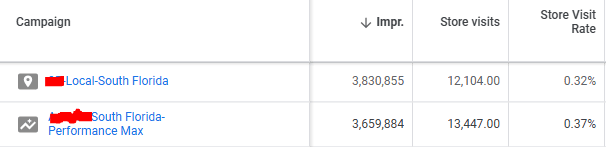
Once we moved to a conversion value strategy on PMax, we were off to the races. More so, we started seeing deliveries that exceeded prior deliveries in regular search or local search.
I miss local search (Screenshot from author, July 2025)
This shift in performance forced me to accept that I could compromise my lack of transparency for strong performance.
Something that was eating at me, though, was the impact on search.
For those who remember, briefly, PMax search was only on mobile. Then, it expanded to all devices. We did a study to prove it was cannibalizing regular search.
But ultimately, the study made me realize something: I may not be in control of the target and the function, but if the performance was there, my argument against it was going to have to diminish as quickly and quietly as Google Glass.
Ok, Then Why Did You Change Your Mind About Bing PMax?
My perception of Bing PMax changed for a different reason than Google’s.
So, entering into Bing PMax was going to have to be done either by force or because I heard a rumor.
Needless to say, I got backed into a corner that forced my hand on it (twice), and the first instance happened to coincide with a rumor.
First, note this: I am adamantly against the forced usage of the Bing audience network (MSAN) in search, and not being able to opt out of it, completely infuriates me.
Now, cue the rumor: I had been informed by a former Bing employee that if I wanted greater control of the audience network, I needed to go one of two routes:
Run audience network-specific ads, or
Run PMax ads.
I elected the PMax route (which, by the way, the rumor about that part was not, in fact, accurate).
I went this route because, at the same time, I had a health insurance brand that was crushing it in efficiency in Bing search, but we couldn’t really scale it anymore.
But, we had a test budget earmarked for direct response/performance tactics, and time was running out to use it (or I would lose it).
So, I threw out the idea of trying PMax in Bing. It had been negligibly attempted within the agency in various verticals with underwhelming performance.
We said, “Why not, let’s give it the old college try and prove that this was not going to work for us,” and we tested it against search.
Well … needless to say, I was wrong. It was beating out search. The only thing it couldn’t do – that Google could – was drive click-to-call leads.
Then What Happened?
A number of things:
I somehow got selected to sit on a focus group panel for PMax with Google, and selfishly directed as much feedback as possible to bring on basics that should’ve been around since Day one (search query insight, demographic control, product distribution, keyword targets, negatives, etc.) Note: As of press time, some of this actually came to fruition, but I can almost guarantee I had little to no impact in making it happen.
I worked with some brands that were Down For Testing (or “DTF”), and said, “This isn’t going away like Broad Match Modified did, so we need test it out, if you let me do it, I’ll buy you a sandwich, we’ll plan it out as zero return, and celebrate if it works out.”
I tested out different scenarios: target return on ad spend (tROAS), target cost-per-acquisition (tCPA), max conversions, max value, with a Google Business Profile (GBP), without a product feed, etc. – all to see what the right approach would be.
Ecommerce brands we went and tested as a supplement to shopping ads, and scenarios where it replaced shopping ads.
I repeated scenarios where I could in Bing.
Bing for ecommerce quickly became a rising star for me in PMax.
If you’re willing to wait for the longer ramp-up period, it pays off.
Most importantly, I stopped fighting PMax adoption. I decided that I could learn to work with less transparency if the returns came back as legitimate.
There Is, However, Some Stuff That Still Really Gets To Me
Don’t take this come around thought train as total acceptance. There are still several things that grind my gears, and tips I recommend for dealing with them:
In Google, the moment you get access to the channel report, pore over it in detail. It cannibalizes Search and Shopping, which could mean you need to up your game on other entities, or even reallocate funds as needed.
If you have the GBP connected, the distribution of spend on Maps is obscene. It makes me long for the days of local search ads, and when this happens, it comes at the expense of search distribution.
Even with the Google Channel Distribution reports, the actual detailed reporting is pretty terrible. Bing doesn’t even have a channel report.
If you thought you could use PMax as a way to get into Gmail ad units, think again. Less than 10% of the clients I work with who have PMax and channel reporting have actually shown in Gmail. If you want that placement, go to Demand Gen.
Upload a video. Whatever you do (for the love of all that is sane), don’t let Google create a video for you. I’ve seen them; you definitely do not want them.
Not-So Pro-Tips For The World Of PMax
Like my therapist wife says: You need to be comfortable with being uncomfortable, and PMax definitely makes you uncomfortable.
Have a video ready to go. Don’t let Google make it. Shoot it with your cellphone if you need to.
Do not launch without using search themes. You don’t have a lot of controls, but that is one to definitely use.
Bing actually has a good search query report, and Google has recently started rolling out a comprehensive search query report. Both are helpful to understand where you’re mapping, and now with Google, you can use it to expand negative keywords.
Brand exclusion is a go-to for avoiding competitor bidding.
The audience signals are key for thriving. Build them a niche, but view it more as a look-alike audience than a pure target.
Use every extension under the sun, because why not?
In Bing, not all placements are pretty, and you can actually exclude certain placements by creative there. Utilize it.
The Takeaway
Performance Max, whether it is on Google or Bing, is an ad unit that makes you feel somewhat powerless, but honestly, that isn’t a bad thing.
There are a few verticals/scenarios where PMax isn’t usable (specifically, if it is “remarketing only” audiences or legal compliance restrictions).
You will likely be comfortable with the results, but uncomfortable with the method. You aren’t alone; this is a continuously evolving ad unit.
While you’re at it, especially in Google, don’t sleep on Demand Gen; it’s basically a PMax “lite.”