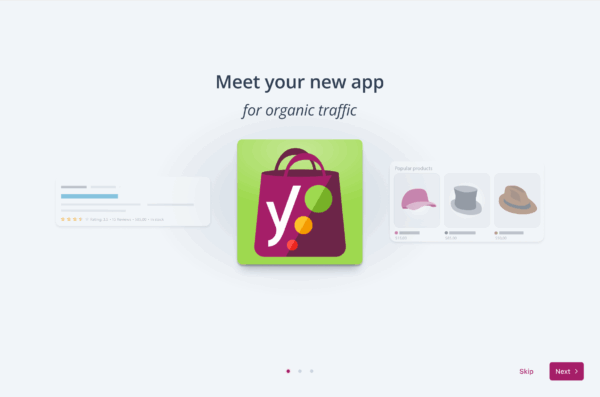
Today we’ve launched a redesigned onboarding experience for Yoast SEO for Shopify, built to guide, support, and empower every user from the moment they install. Customer-centric marketers and designers know, first impressions matter, and thoughtful onboarding is the first step to long-term success.
A new onboarding, designed with care
We’ve simplified the setup process, removed unnecessary steps, and introduced a guided, narrative-style welcome experience that makes it easier to get started and harder to get stuck.
Whether you’re new to SEO or scaling a large store, our goal is the same: help you feel confident from the first click.
“We wanted users to land in the onboarding flow and immediately understand two things: how the app can help them improve their Shopify store’s SEO, and what steps to take first to see results.” Tom Ottjes, UX Designer at Yoast
Behind the scenes: Service design in action
This onboarding redesign isn’t just a UI refresh, it’s the result of a service design approach that included:
Journey mapping based on real user behavior
Cross-functional collaboration across UX, development, support and marketing using service blueprints
Strategic improvements to both front-end and back-end processes
Want to learn how a single blueprint helped align our teams and reshape the onboarding experience?
We’re already working on the next phase of improvements designed to improve our customers’ experience, including smarter in-app guidance and contextual feature onboarding.
Thanks to everyone who shared feedback along the way. Keep it coming, we’re listening, learning, and building better together.
Beth is Product Marketing Manager at Yoast. Before joining the company, she honed her digital marketing and project management skills in various in-house and agency environments.
First impressions stick, especially in UX. When we saw that new users of our Yoast SEO for Shopify app were skipping key steps or dropping off early, we knew our onboarding wasn’t working. Using journey mapping and service blueprints, we redesigned the experience to be faster, clearer, and more supportive from the start. Here’s how small, well-timed changes made a big difference.
Table of contents
Launching an improved onboarding experience
We recently launched a redesigned onboarding experience to help Shopify merchants set up for success. Behind that update is a bigger story: how thoughtful UX decisions, team-wide alignment, and service design methods reshaped the user experience. And we mean that in the broadest sense, from discovery to giving users the feeling that the app is working for them and helping them succeed.
In this interview, we spoke with our UX designer, Tom Ottjes, who led the project to unpack that process. His answers will offer a closer look at the problems we needed to solve, the tools he used to communicate across teams, and the omnichannel changes that made the biggest difference.
Before you start reading, here’s a quick animation showing the various parts of the service blueprint we worked on. Of course, there’s much more, but we cannot show you everything.
From patterns to priorities
Before redesigning a single screen, the team needed a way to understand and communicate what wasn’t working. They needed to uncover what had to change to fix the experience for people in a way that also helped us achieve our company goals. That’s where service design tools, particularly customer journey maps and service blueprints, came in.
Customer journey mapping helped visualize what users were experiencing from discovery through installation and first use. It highlights not only the steps customers take but also where they become confused, hesitant, or drop off. Based on support conversations, surveys, and analytics, the journey map revealed several issues. One of those issues was a lack of early guidance, which led to missed configuration steps, among other things.
Before we moved on to action, we wanted to define success by determining KPIs. This is an essential step. It will help shape the direction of the service and experience you will be designing. Instead of viewing onboarding as just a UI problem, the service blueprint mapped every user action alongside the systems, processes, and people behind them. This included content, customer support, notifications, and working within Shopify’s own platform constraints.
Because it connects what’s visible to the user with what happens behind the scenes, a service blueprint became central to the project. It gave every team, from UX to development, support, and marketing, a shared reference point. By mapping each phase as its own blueprint, the team could prioritize quick wins while keeping an eye on a longer-term onboarding vision.
It turned a complex, cross-functional issue into something everyone could contribute to. The blueprint helped make improvements easier to design, build, and test in smaller, clearer parts.
A real example: Turning uncertainty into reassurance for larger stores
One of the more surprising and important insights from our service blueprinting process was about scale. We discovered that while the app felt fast and responsive for smaller Shopify stores, larger ones had a very different experience. For shops with tens of thousands of products and pages, the initial processing and indexing step could take anywhere from several minutes to a few hours.
The problem? We weren’t telling users that. Small stores would see their data reflected almost instantly. Large stores would land on a blank dashboard, with no indication that the system was still working in the background. From the user’s perspective, it looked like nothing was happening.
We addressed this with a series of small but intentional changes. First, we introduced a proper loading state with messaging acknowledging what was happening. Then, we added an email field to that screen, giving users the option to be notified when setup was complete. When they enter their email, they receive a confirmation message once everything is ready.
It’s a small detail, but one that shifts how the experience feels. Instead of confusion or doubt, users now get feedback, a sense of transparency, and a way to re-engage later. And for us, it’s a concrete example of why aligning the front-end and back-end through service design actually matters.
Meet the designer
Meet the UX designer: Tom Ottjes
This interview is with Tom Ottjes, one of Yoast’s UX designers. He led the onboarding redesign for our Shopify app and was co-responsible for designing the Yoast AI features. With several years of experience working across product and marketing, his approach centers on translating user behavior into actionable design. Much of his work focuses on simplifying complex flows, improving user guidance, and helping teams understand the customer journey.
Tom, what problem were you seeing that made this project a priority?
With our Yoast SEO for Shopify app, we strive to deliver real, tangible value to our users. That starts with understanding their experience from the moment they install the app. Through a combination of user surveys, interviews, support request analysis, and product analytics, we began to see clear patterns emerge.
There were three main friction points we kept hearing and seeing:
A lack of guidance: Many users simply didn’t know how to use the app effectively. They installed it but weren’t sure what to do next to optimize their store.
Unclear value delivery: We noticed that crucial steps, like completing the ‘Site representation’ settings, which unlock immediate SEO benefits, were often skipped. That told us users weren’t seeing the connection between setup actions and real results.
Hesitation to engage with the free trial: Users were wary of testing the app, unsure of what the trial included or whether it was truly risk-free.
All of these insights pointed to one thing: the onboarding experience wasn’t doing its job. It wasn’t guiding, reassuring, or demonstrating value early enough. We visualized all these issues in a detailed customer journey map, helping us to zoom out and see broader patterns. We found different user types, where they dropped off, and what confused them. That map became a key alignment tool and helped us frame the onboarding redesign as a top-priority project.
What would success look like for you from the user’s perspective?
From the user’s point of view, success meant feeling confident and supported from the very first interaction with our app. We wanted users to land in the onboarding flow and immediately understand two things: how the app can help them improve their Shopify store’s SEO, and what steps to take first to see results.
That meant offering a smoother, more intuitive experience. An experience that clearly communicated value upfront, provided improved guidance around initial setup steps, and highlighted key features. It should also assure users that trying the app was safe and worthwhile.
First, we wanted to help users quickly understand the full value of the app. In addition, we wanted users to complete key onboarding actions such as filling out their ‘Site representation’ settings and exploring core features relevant to their store. Emotionally, we aimed for a sense of clarity, trust, and motivation to continue.
Ultimately, if a user could say, ‘I know exactly what this app does, what I need to do, and I can already see it working for me,’ then we knew we were on the right track.
The new onboarding helps introduce the app and guides the user through the set up
Can you explain your service design process and how it helped the teams?
After mapping the current onboarding journey and identifying the key pain points, we knew we didn’t just need a better UI. We needed a more holistic service experience. That’s where service blueprinting came in.
We started by defining clear KPIs to measure the impact of our changes, such as completion rates for critical onboarding steps, time to value, and feature discovery. These metrics gave us a shared definition of success and helped shape the direction of the user experience.
Then we used the service blueprinting method to reimagine onboarding as a complete service. A service blueprint maps the relationships between people, processes, and touchpoints tied to a customer journey. It helped us visualize both what the user sees and everything happening behind the scenes to support that experience, from content strategy to customer support workflows to engineering requirements.
This systems-level view was essential in aligning multiple teams, like UX, development, marketing, and support. Everyone could see how their work connected to the user’s experience and where coordination was needed. It also helped us identify internal gaps, inefficiencies, or dependencies early, so we could design around them.
To move quickly and deliver value incrementally, we broke the optimized onboarding journey into phases, prioritizing what would have the most immediate impact for users. That approach lets us ship improvements faster while staying grounded in a long-term vision for the onboarding experience.
We approached the whole effort using a service design mindset. We zoomed out to understand the system users interact with, not just the screens they see. Service blueprinting helped us take what users were experiencing (empathy and insight), identify internal blockers, and structure releases around clear hypotheses. It wasn’t just about delivering onboarding, but about improving the service behind it.
How are you tracking whether it’s helping users get started faster?
From the start, we knew that redesigning onboarding wasn’t just about launching something new. We wanted to prove it made a difference. So, we defined clear KPIs to measure the impact of our changes. To make this measurable, we built the tracking infrastructure needed to monitor user behavior at each step.
But we didn’t stop at numbers. We also incorporated qualitative customer listening tools, things like in-app feedback, support conversations, and interviews. As we wanted to understand how users feel as they move through onboarding.
Are there still improvements to make?
Absolutely, because onboarding is never truly ‘finished.’ It’s an evolving experience, and we see it as a continuous opportunity to better support our users.
The next phase of our optimized onboarding journey will focus on deepening the guidance we provide, helping users go beyond setup and start making more meaningful improvements to their store. We’re looking at how we can better surface insights, suggest next steps based on context, and empower users to unlock even more value with confidence.
While I can’t share all the details just yet, I can say this: we’re not stopping at getting users through the door. We’re focused on helping them thrive once they’re inside.
Good things are coming. As always, we’re listening closely to our users to make sure what we build truly meets their needs.
Pro tips for getting started with service blueprinting
Thinking of using service blueprinting in your own work? Here are a few things that helped us:
Start with a real journey: Mapping is most useful when it’s grounded in actual user behavior. Use support data, interviews, and analytics to anchor the blueprint in real problems.
Define what “success” means upfront: Before mapping, align your team on what outcomes you’re working toward (e.g., faster time to value, fewer drop-offs).
Map front-end + back-end: Don’t just track what users see. Include internal systems, support workflows, engineering dependencies, and anything that influences the experience.
Keep roles visible: Show which team is responsible for which process. It keeps conversations focused and collaboration smoother.
Don’t overcomplicate: A blueprint doesn’t need to be a polished artifact. Start simple. The value is in getting teams aligned, not in how it looks.
Blueprinting doesn’t replace good UX research or design, but it’s a powerful way to connect them to the broader experience. If you’re working on anything cross-functional, it’s absolutely worth trying.
A shared understanding drives real change
This project wasn’t just about shipping a new flow. We wanted to design with a clear, shared understanding of our users and the processes that support them.
Our service blueprint turned out to be a great tool to align teams around a single goal: helping users quickly see the value of the Yoast SEO for Shopify app. Along the way, we uncovered friction, mapped dependencies, and built toward something more consistent, supportive, and effective.
Thoughtful onboarding is the start of everything that follows. By making those early minutes feel clear, calm, and grounded in real outcomes, we’ve not only improved setup times and reached our KPIs but also changed how we work, design, and listen together.
The work continues, focusing on feature onboarding, improved guidance, and even future WordPress experiences. Together, we’ll apply these lessons from now on. We’ll design by putting users first, build teamwork on transparency, and create experiences that guide, not just onboard.
Edwin is an experienced strategic content specialist. Before joining Yoast, he worked for a top-tier web design magazine, where he developed a keen understanding of how to create great content.
If you’ve been affected by AI Overviews, traffic drops, or feel uncertain about SEO’s future, then this episode is for you.
Search Engine Journal’s Editor-in-Chief Katie Morton sits down with growth advisor and author of “Growth Memo,” Kevin Indig, to unpack the results of his latest AI Overviews study.
In this 35-minute episode, they discuss how it impacts search, SEO, and brand marketing in 2025.
Editor’s note: The following transcript has been edited lightly for clarity, brevity, and adherence to our editorial guidelines.
What AI Overviews Mean For Search, SEO & Brand Trust
Katie Morton: Hi, everybody. It is I, Katie Morton. I’m the editor-in-chief of Search Engine Journal, and today I’m sitting down with Kevin Indig, who is a growth advisor to fast-growing tech companies and the author of “Growth Memo,” a fantastic newsletter.
We syndicate it here on Search Engine Journal, but sign up for it directly, too, because he has content exclusive to subscribers. It’s filled with smart insights every marketer needs to know.
Kevin, thanks for making the time today. The study was analyzed in March-April 2025 and published in May. We’ve had time to reflect, and today we’ll unpack the key takeaways.
We’ll start with the nuts and bolts of the study’s background, so listeners understand the context, and then go beyond the data to explore how marketers and companies, especially those frustrated by Google, AI Overviews, or traffic drops, can respond.
So, Kevin, can you summarize the study and share the main takeaways?
Kevin Indig: Thanks for having me on, Katie. It’s great to be here with you.
What The AI Overview Study Really Reveals
Kevin: The study came from a desire to deeply understand, from a qualitative perspective, how everyday users interact with AI Overviews.
In 2024, everyone was eyeing AI Overviews with curiosity, but traffic impact wasn’t significant yet. Then, at the start of 2025, everything changed. It became a “holy cow” moment – this was real and serious.
We asked 70 participants in the U.S., across different age groups, to solve eight tasks that covered dominant user intents: Finding a tax accountant, researching medical questions, shopping, etc.
We intentionally included queries that showed AI Overviews but didn’t tell participants to interact with them – we wanted unbiased behavior.
So, in a nutshell, the three most poignant results are:
1. Classic Organic Results Still Carry Weight
First of all – and this is no surprise – clicks are really rare when people see AI Overviews. That’s gotten through to everyone by now.
And yet, at the same time, classic organic results still have the majority of impact on people’s completion of user journeys.
Let me untangle that for a second: What we found is that people get their final answer – the final piece of information they were set out to get – 80% of the time from classic organic results. Not from AI Overviews, so that was encouraging.
2. High-Quality Clicks Happen In High-Trust Moments
Clicks are going down, but people still click. And each of those clicks has much, much higher quality than, say, in 2024 or before.
Because those clicks are to verify whether the results are accurate, to get human input from platforms like Reddit or YouTube, and to increase confidence in whether what the AI is saying is true.
And for us, that means it’s critical to be present in these high-trust, high-risk moments. I can unpack that a little more…
3. Audience Age Shapes AI Engagement
The third result I found very interesting is that there really is an age difference here. [Younger users] are much more receptive to AI answers. They’re much more active on Reddit and YouTube. Whereas people of a higher age will often just skip the AI answers because they don’t trust them.
You want to know who you’re talking to, who your target audience is. Ideally, what the age group is of your ICP or your target audience, and then make SEO decisions accordingly.
Why Branding Matters More Than Ever
Katie: Thank you for that. What I’d love to talk about next is branding.
I feel like big brands are a little safer with recent developments. If you already have recognition, you’re in a better spot. But if you’re a tiny brand with no recognition, you’re really behind the eight ball.
For the uninitiated or the uninformed, [you might wonder], why is that important? It’s about trust.
When someone sees your brand in an AI Overview, recognition boosts trust. If they click on an AI Overview or scroll to find organic results, they’re more likely to trust and click a name they know. A strong brand increases your chances.
Mordy uses the example of Nike, which was once ubiquitous, but has lost some relevance. Younger generations aren’t as loyal or aware of the swoosh anymore.
So, for big brands, maintaining confidence and trust is critical. For small or new brands, or brands that never had strong recognition, can they still gain traction?
Kevin: You can get traction … but it’s really challenging.
One challenge is that multiple teams need to work together: product, innovation, marketing, support, supply chain. SEO doesn’t control all these variables. It’s always been a discipline of recommendations, relying on others to act.
So, you always were relying on other teams, and that has 10x’d now with AI. Because, as you said, brand, brand perception, and sentiment are so critical to how you appear in search results or answers.
And it goes back to so many different touch points with a brand, not just the logo that people see or the advertising, but also the product that they use, retention, all that kind of stuff.
SEOs need to show other departments where issues lie, using click-through rates, brand search volume, and engagement metrics as signals. They must communicate the story and rally other teams.
But that often runs into cost concerns. Asking for a new call center to improve support has big budget implications, and quantifying ROI is tough.
So, SEOs must push beyond the Google channel and influence company strategy. It’s incredibly difficult to influence.
Katie: Absolutely. And speaking of SEO being declared “dead,” I’ve heard that every few years in my 20 years in the industry, but this is the first time I’ve felt a credible threat.
SEO will never truly die. It’s discovery, and discovery is always needed, but it’s definitely changing. It used to be the most cost-effective marketing channel. Now, ROI is less certain, and budgets are contracting.
But there’s a silver lining. A lot of low-quality, general content meant just to drive mass page views is getting weeded out.
For example, we used to rank for “What is E-E-A-T?” and get tons of unqualified traffic. With AI Overviews answering those general queries now, traffic is down, but the remaining traffic is far more qualified. That’s better for conversions.
It’s hard for publishers who relied on brute-force clicks. But for us, shifting away from programmatic and toward advertisers aligned with our audience, like SaaS, has worked. The industry is changing massively.
So, what do you think is next for SEO and marketing?
The New Role Of SEO In A Changing Landscape
Kevin: You hit it on the head. SEO is contracting; budgets are down, leadership confidence is down, and when people leave, their roles often aren’t replaced. SEO has died and reinvented itself many times.
I see that we’re using a lot of SEO also for AI visibility optimization. I do expect that to change, but however you flip it, we are in a transition period. And the problem with transition periods is that they’re hard to navigate. You lose orientation, and it’s painful.
Once you settle at a new baseline, you just run around a little headless, and you try to find your way. And then slowly, things kind of start to settle back in.
And so I’m very confident that whatever we’re going to call this, we’re going to settle into a new baseline. It might take a while. This is not going to stop in the next six months – probably not twelve months. But it’s hard to predict when.
Based on how quickly models improve and how quickly humans adapt to them, that will decide the pace of this transition.
However, there are also many opportunities in transitions. You can reinvent yourself. And that’s where, as SEOs, we might lose the SEO budget, but maybe we gain some brand budget, which has been much, much bigger in the past.
You see companies spending millions of dollars for multi-year contracts for a tiny logo that sits somewhere on a Formula 1 car. These things happen all the time.
There’s a big opportunity for SEO to detach from that unwanted profiling as a performance channel – detach ourselves from being a performance channel, and become much more of a brand channel, influence channel, presence channel – whatever you want to call it.
New metrics. New levers. Deeply rooted in SEO. And effective and powerful, but kind of in a new design, right? Like SEO 2.0. Whatever you want to call it.
And I do agree with you. I also see people who’ve been in the game for a long time stepping out. Totally get that. I see young people losing a bit of confidence.
But I will also say that I would like (but wouldn’t admit) that there’s a little part of me that’s kind of excited for all this change.
Because it’s an opportunity to kind of reshuffle the cards, find out new stuff, maybe find some secrets, and kind of reverse engineer what’s going on.
When you look at the last just 10 days where multiple people and companies found new ways to reverse engineer what queries Gemini uses and ChatGPT uses, I’m like, man, it’s awesome to see how adamant the industry works on developing the new playbook, dissecting how these mechanics work and LLMs work, and finding new ways.
So, I have high confidence, and I also have a lot of empathy for all the pain and the kind of problems that this industry is going through. But again, I see us coming out the other side at some point in like a new design – and with a lot of impact.
Katie Morton: I love it. I agree with the empathy as well. Because everyone in marketing, it seems, has lost their mind a little bit over the past year or two with these shifts in traffic.
But that Wild Wild West environment is also really exciting because there are going to be all of these developments.
And if people are calm and they persevere and they do the work to figure these things out, either for themselves or to watch what those researchers are finding, people will be okay, right?
Kevin: We always are. Sorry to cut you off there, but there’s a really important point to make here that I didn’t make – and that is: It’s not just search that’s changing.
SEO is at the forefront of AI. At the absolute forefront. Because it’s about words, and it’s about search, and search is kind of the biggest interface between AI and humans right now.
So it’s not just search that’s changing. Marketing is completely changing. And like, all of our lives are completely changing.
Sure, this will take years to trickle through, maybe not even to the degree we’ve thought of it, but it’s pretty clear that AI is at least as revolutionary as the internet. Maybe even the most revolutionary invention that humanity has made so far.
So let’s not forget: Everything is changing. It’s not just us SEOs. It’s all the channels. It’s marketing as a whole.
Modes and levers are disappearing, and new ones are coming up. We’re feeling it deeply in SEO, as being kind of the front line of AI. But make no mistake, this will trickle through to all the paid channels, product, everything.
Everybody is in a state of shock right now, trying to figure out what the new branches are to hold on to and then build on top of. Marketing as we know it is over. LLMs are transforming how they reach us.
Katie: This affects every channel. At SEJ, we’ve collapsed editorial and marketing into one integrated team. It used to be SEO and editorial here, marketing over there, and no one really talked. That doesn’t work anymore.
Now, everything is more cohesive and focused on the ICP and conversion. It’s better for customers and for teams.
Kevin: 100%. I talk to all my clients about this. SEO and paid search should’ve always been connected, but they were siloed, same with product, email, social, etc.
I mean, look: Realistically and ideally, SEO and paid (or paid search) have always been connected at the hip. But I’ll tell you, at least across almost all the companies that I’ve worked with, they were siloed.
The same exists with all these other teams, like product marketing or social media, conversion, and email – all that kind of stuff.
Now’s the time to rip off the band-aid. There can be small teams of maybe an SEO, an editor, an email person, a social person, and maybe a very technical person who can quickly prototype new apps, programs, or tools.
The biggest challenge now is internal red tape. AI is a speed catalyst, but companies’ old workflows slow them down. Big organizations are stuck.
I’m urging clients to form these multi-disciplinary units under one manager, one roof, one mission.
Reaching People Everywhere Requires A Bold Shift To Other Platforms
Katie: Awesome. One last point: other platforms. For too long, people relied too heavily on Google. Diversifying traffic sources – ads, social, newsletters – is now essential. Holistic marketing is the future. What are you seeing [that is] working right now?
Generally speaking, where do people live these days? Where are humans hanging out, and where do we find them? What are the success metrics that you’re seeing?
Kevin: The short answer is: Everywhere.
Katie: Good luck, everyone. Okay, good night. That’s the show!
Kevin: No, but the reality is, everywhere. There’s this interesting paradox. I need to coin this term somehow, but this interesting paradox that basically all the social networks are growing. And new ones are popping up, right? TikTok – I mean, it’s not that new anymore, but it’s still growing. Reddit is becoming much more of a household name now.
And so you ask yourself, what gives? Sure, linear TV’s down, okay. But how is this possible? And the reality is: People are online all the time – speaking for a friend – and they use a lot of platforms at the same time.
So, the best teams, or the companies that are making a big impact, they have this surround sound effect that they’re creating, where they’re present in a lot of places. They engage authentically, say, on Reddit.
When good companies engage on Reddit, it doesn’t feel like marketing. It’s not marketing, really. It’s much more like trying to be helpful, more like customer support or success.
That’s why these people are generally very well-suited to interact on Reddit. They truly add value. They’re truly part of the conversation.
Brands are repurposing their content in a very thoughtful and high-fidelity way, where maybe they create a blog article, turn it into a video, turn it into clips, which then turn into questions they answer on Reddit. There is this kind of everywhere strategy. AI really helps with that.
And I will also say it’s typically not companies that are getting stuck at the quantification-of-impact question. The reality is that steering an organization or a company toward that multi-channel effect – or that surround sound effect – takes a swing.
It takes a leader to say, “Okay, we’re going to spend some money and take six months, and we’re going to invest in Reddit and YouTube, and we’re going to wait for the results to come in. We’re not going to sit there every day refreshing the dashboard asking, ‘How many sales have we generated yet?’”
It takes a bit of a swing. And so it’s defining for this era, for this transition period, where it’s much harder to project and forecast where you’re going to land with some of these things.
It takes judgment and taste and a certain degree of risk-taking to invest in these channels and functions, and being comfortable, or at least okay, with waiting for some of the results to come in and being able to measure them later.
I’m not saying you should wait a year or two. But give it two quarters, maybe three quarters, and experiment with some of these channels.
So, that’s where people are – people are everywhere. It’s not enough to just have one shot at one platform. You need to be kind of everywhere.
And repurposing can help. Using AI with some of these things helps. But at the end of the day, you need to take a swing.
Katie: Very wise, Kevin. One of those things that I found highly annoying is that you can run these experiments, and you’re going to wait for your results, and then before your experiment is even done, everything’s changed again.
Kevin: Exactly. Predictable methods are gone. You take swings, and some won’t connect because conditions change. The best leaders, the best teams – a lot of times, they take a lot of swings.
Because some of those swings will hit full force, and it’s kind of a skill to build.
Katie: Yeah, I couldn’t agree more. We’ve implemented monthly experiments at SEJ. Every department runs one. It could be layout, content type … constant iteration. I tell the team: soft knees. Be ready to shift. There’s no “set it and forget it” anymore.
Kevin: Yes, yes. On point. Allow people to fail. Another good skill is being able to take meaningful risks. I’m not saying bet the farm, but as a leader, if you want to encourage your people to take risks, let them.
Again, that doesn’t mean to blindly shoot in all directions. You want to have some thought behind that, some judgment. You want to be critical. But there has to be a point at which you let go.
Katie: That is a really perfect point. We tie experiments to north-star metrics. For us, one is newsletter subscriptions, so most of our experiments support that. We’ve seen great success, not always in raw traffic, but in conversions and revenue.
Kevin: Amazing. Congratulations on that.
Katie: Thank you. All right, Kevin, any parting remarks before we head out?
Kevin: I’m hearing a lot of very concerned SEOs. Concerned about “How do I tell this story?” or “How do I manage my boss or leadership in this time where traffic is down?”
I want to send out some courage. This is one of the biggest shifts I’ve lived through in my life. I would bet it’s probably the same for most, if not all, of the audience.
So, this is maybe the time to make some changes and have some grace about finding a new playbook.
I’m seeing a lot of SEOs very scared about this. I get the initial fear. But again, this is such a substantial, fundamental change. It’s okay for things to look different. It’s okay for you not to have the answer right now. Be honest with leadership. Push back if needed.
Katie: Focus on new metrics, not just UVs or PVs, but ones that connect to business goals. That’s where the story of success will be told.
Kevin: Exactly.
Katie: Thanks again, Kevin. Where can people find you?
Kevin:growthmemo.com, or just search for “Growth Memo.” That’s my main hub.
Katie: Awesome. We’re at searchenginejournal.com. See you next time!
Kevin: Thanks for having me.
More Resources:
Featured Image: Paulo Bobita/Search Engine Journal
In this week’s Ask An SEO, a marketing manager asks which SEO skills are most valuable to look for in candidates today, especially with AI in the mix:
“I’m a marketing manager who’s been tasked with hiring our first in-house SEO specialist.
With AI tools becoming more prevalent, what skills should I prioritize when interviewing candidates in 2025? Are traditional SEO skills still as valuable, or should I focus more on candidates who can work alongside AI tools?”
This is a great question, and one I imagine a lot of hiring managers in the marketing industry are asking themselves.
For years, we’ve been looking for SEO professionals with skills that will help our websites thrive in Google, Bing, and Yandex. But, what skill set is needed for the emerging markets of ChatGPT, Perplexity AI, and Claude?
And what about keyword research, content creation, and technical audits? Are they still useful activities for SEO professionals to carry out manually when there are so many AI tools purporting to be able to do this for you now?
What Traditional SEO Skills Are Still Needed
We often think of skills within traditional SEO fitting roughly into three categories: technical, content, and authority-building. Are these still needed in the era of large language model (LLM) platforms and tools?
If the bots can’t access the pages you want to have ranked, can’t read the content on them, or find the page to be unfriendly for users, you will struggle in the traditional search engine results pages (SERPs).
Technical SEO skills will continue to be important to online visibility in the new era of organic discovery.
An excellent SEO will be someone who can utilize AI tooling to automate and speed up the checks they are already performing. The really valuable technical SEO skills will still be analyzing, prioritizing, and communicating the issues when they are discovered.
Good technical SEOs have been looking at ways to automate their processes using Python and Structured Query Language (SQL) for a while now.
AI is enabling them to do this quicker, and for those who are newer to those languages, to automate their processes more easily.
Hire SEO specialists who are excited to use AI tools to enhance their work, not replace it entirely.
You will still need SEO pros to be creative in problem-solving and working within the confines of your organization’s technology, resources, and capabilities.
AI-written content has been a hot topic for a couple of years now. Can AI replace human writers? Should you hire with content creation and marketing skills in mind, or can you leave that purely to AI now?
I would suggest that any SEO hire you make needs to understand how to craft engaging copy that clearly defines the brand and meets the needs of users at each stage of the buying journey.
This hasn’t changed much from when SEO pros brief writers and graphic designers in content creation. We still need SEO specialists to understand how to request engaging content, whether that be through AI or human creators.
The ability to define what will be engaging content through research (whether keywords or prompts) and how users engage with it (whether on the brand site or within the LLM’s answer) is still critical.
Previously, there was an evolution in SEO from regarding authority building as getting backlinks by whatever means necessary, to acquiring links through engaging and relevant content.
For optimization in LLMs, the desire is more to cement a brand’s positioning and sentiment through mentions on other authoritative websites.
The skill set needed to acquire authoritative links through digital PR will not be that different from what’s needed to acquire mentions.
In fact, good digital PRs have recognized for a while now that brand mentions are valuable in their own right.
There is a need to understand the publisher who is being targeted, what they write about, when best to contact them, and how. This could well be automated to a good degree by AI.
However, the really excellent PRs build up relationships with their contacts, so they are front-of-mind when a story is breaking. This is something AI will struggle to replace.
When hiring for the digital PR side of SEO, look at their relationship-building skills in particular.
AI has (thankfully!) taken much of the pressure off SEO professionals to be efficient mathematicians, proficient in Excel formulae, or, at least, having a good percentage calculator tool bookmarked.
Summarizing increases and decreases in key performance indicators (KPIs) is something AI can handle. It can highlight correlations between metrics and identify likely causes. AI can also summarize this all into a compelling report.
But, it still needs a human to determine if its recommendations are valid and a viable course of action.
A good SEO will be someone who can utilize the AI tools to draw conclusions and highlight issues, while retaining strategic oversight.
Strategy
That leads on to strategic skills. Good SEO pros will be able to utilize AI tooling for processes while drawing on their own deep contextual understanding and common-sense reasoning.
Hire SEO professionals who are adept at considering the moral and ethical implications of marketing and who can adapt to novel situations.
AI tooling will not be able to build trust with senior stakeholders. It will not be able to inspire and influence them. It definitely will not be able to manage egos and emotions like a good SEO has to.
Skills That Help In Emerging Markets
Beyond the skills that we’ve long been looking to hire for in SEO, it’s important to find people who are able to thrive in a burgeoning environment.
Great SEO pros have been cultivating these skills throughout their careers. Bad SEO professionals have scraped by on second-hand knowledge and following templated procedures.
Experimental Approach
Make sure they have the ability to experiment and apply their learnings.
We’re entering a new phase of SEO where what worked before might not work again. There are no experts in GEO yet; we’re all having to learn as we go along.
Make sure your candidates are willing to learn from trial and error.
Understanding Of How To Work With Uncertainty
The days of following an audit template are both long-gone and a way off. We can’t just apply what we know from SEO directly to GEO.
We need to learn what works in those new platforms. That means good SEO pros are going to have to be comfortable with the uncertainty in their industry again.
Seasoned SEO professionals will remember back to this during their formative years in the industry, but newer SEO specialists will need to break free of the “this is what works for SEO” mentality and be OK with adapting on the fly more.
Ability To Problem Solve And Investigate
This means they will really need to be keen problem-solvers. SEO, at its root, has always been about problem-solving.
With the suite of AI tooling growing, the temptation to delegate critical thinking to a machine will be great.
However, SEO pros will still need to be able to take a step back, consider all the context and angles, and work toward a solution given the resources and constraints they face.
This means that they cannot rely solely on AI to help them.
You need someone who can work alongside AI tools as well as having traditional SEO skills.
The experience and qualities of a seasoned SEO professional will still be extremely useful in the emerging world of LLMs and AI tooling.
It would be a risk to your organic performance if you hire solely based on whether the candidate can utilize AI tools well.
However, you do want to make sure the SEO pro is using all of the advantages that AI can bring. They need to be able to adapt to new technology and processes.
How To Interview For SEO Skills That Complement AI Solutions
The curiosity about new technology. The desire to experiment and adapt. Having an open mind to change. These are all attributes of good SEO professionals that are more important now than ever before.
When considering whether an SEO professional is a likely good fit for your role, find out their approach to new situations.
See how they have adapted in the past to changes in SEO that needed a change of tactics.
Ask them how they have diagnosed and responded to algorithm updates, or expanded their skill sets to include social media search engines.
Summary
In essence, the need for traditional SEO skills is not diminishing. However, great SEO professionals will be those who can adapt their skill set to work in GEO, as well as make the best use of new AI tooling available to them.
Alongside that, problem-solving, experimentation, and a keen strategic approach are what to look for in your next SEO hire.
More Resources:
Featured Image: Paulo Bobita/Search Engine Journal
Credible rumors are circulating that OpenAI is developing a browser. However, the timing of the anonymous tip is curious, because Perplexity coincidentally announced they are releasing a browser named Comet.
It’s a longstanding tradition in Silicon Valley for competitors to try to overshadow competitor announcements with competing announcements of their own, and the timing of OpenAI’s anonymous rumor seems more than coincidental. For example, OpenAI leaked rumors of their own competing search engine on the exact same date that Google officially announced Gemini 1.5, on February 15, 2024. It’s a thing.
“OpenAI is close to releasing an AI-powered web browser that will challenge Alphabet’s (GOOGL.O), opens new tab market-dominating Google Chrome, three people familiar with the matter told Reuters.
The browser is slated to launch in the coming weeks, three of the people said, and aims to use artificial intelligence to fundamentally change how consumers browse the web. It will give OpenAI more direct access to a cornerstone of Google’s success: user data.”
Perplexity Comet
According to TechCrunch, Perplexity’s Comet browser comes with its Perplexity AI search engine as the default. The browser includes an AI agent called Comet Assistant that can help with everyday tasks like summarizing emails and navigating the web. Comet will be released first to its $200/month subscribers and to a list of VIPs invited to try it out.
There’s something old-school about Google, Perplexity, and OpenAI battling it out for browser dominance, a technological space that continues to have relevance to users and perhaps the one constant of the Internet, which is that and pop-ups.
The average SEO strategy begins and ends with keyword research, with keyword volume as the deciding factor in what topics will be written about. It’s an outdated approach that fails to resonate with users and no longer reflects how modern search engines evaluate content. Content that delivers a meaningful experience across the factors that matter most to users earns trust, signals quality, and attracts links, shares, and higher rankings.
User Behavior Has Always Been A Part Of Search Ranking
User signals play a central role in Google’s ranking algorithms and the recent antitrust lawsuit against Google revealed how important these are.
One of the exhibits in the recent DOJ antitrust trial against Google featured a confidential presentation called Ranking For Research where Google noted that user behavior signals are noisy and that it takes a lot of data in order to see the patterns.
“The association between observed user behavior and search result quality is tenuous. We need lots of traffic to draw conclusions, and individual examples are difficult to interpret.”
Another Google document stated that user interaction signals are important to search rankings (PDF):
“…not one system, but a great many within ranking are built on logs. This isn’t just traditional systems, like the one I showed you earlier, but also the most cutting-edge machine learning systems, many of which we’ve announced externally– RankBrain, RankEmbed, and DeepRank.”
Google has used many kinds of user behavior signals for ranking purposes:
The Google Navboost patent ranks pages based on user interaction signals.
Google’s Trust Rank patent describes an algorithm that relies on user trust signals to identify trustworthy sites and then identifies sites that are linked from those user-trusted websites.
Google’s Branded Search patent describes an algorithm that uses navigational queries as implied links for ranking purposes.
PageRank is commonly thought of as just a link algorithm but it’s actually a way to leverage user signals in the form of the links they publish on websites. It’s also a model of user behavior because the linked nature of the web can be used to indicate which sites a user is likely to visit.
“PageRank can be thought of as a model of user behavior.”
Do Keywords Matter Anymore?
Yes, keyword still matter. But it’s been a long time since exact match keywords were a major factor that determined which sites are ranked. Look at virtually any search result and you’ll see that many top ranked sites do not contain an exact match for the keywords in a search query.
Content strategies that rely on keyword-based hubs or silos should be given a second look. Those kinds of strategies originated in the earliest days of search engines when adding exact match keywords into titles and headings was a sure way to be ranked. That’s no longer the case, so why are SEOs still stuck with keyword-based strategies that map keywords to a hub and spoke content strategy.
Logical site structure is a part of a quality user interface and makes it easy to find content. Focus on that and interlink in ways that make sense to users.
Try thinking in terms of topics that users are interested in and see how far that takes you.
Write With The Purpose To Be Understood
I’m going to share an advanced concept about writing that helps sentences, paragraphs and entire web pages reach an audience more effectively.
Cognitive Load
There is a scientific concept called cognitive load. In the context of reading, cognitive load is the amount of mental effort used to process information.
For example, sentences with confusing instructions or jargon can take extra effort to process. When the load exceeds a certain threshold, the person’s ability to understand or learn from what they’re reading suffers.
Cognitive Dissonance
I have my own theory that’s similar to cognitive load that I call cognitive dissonance. It’s not something scientific that I read, it’s just my own theory.
Dissonance means a lack of harmony, when sounds clash. Poor writing can be dissonant due to the choice of words that are abstract (lack a clear meaning or have multiple meanings) , using jargon, or simply using words that aren’t commonly understood.
Another source of dissonance is writing a paragraph that rambles rather than builds up to an idea.
Cognitive dissonance causes a reader to lose track of what they’re reading and consequently engage less with the content.
Here’s the same sequence of paragraphs you just read, with an explanation of their purpose:
1. Define the idea: I explain that I have a personal theory
I have my own theory that’s similar to cognitive load that I call cognitive dissonance. It’s not something scientific that I read, it’s just my own theory.
2. Explain my idea with a definition and metaphors
Dissonance means a lack of harmony, when sounds clash…
3. Apply the metaphor to writing:
Poor writing can be dissonant due to the choice of words…
4. Expand the definition to paragraph structure
Another source of dissonance is writing a paragraph that rambles rather than builds up to an idea.
5. The big idea I was building up to: What it all means
Cognitive dissonance causes a reader to lose track of what they’re reading and consequently engage less with the content.
SEOs like to talk about hooks and other little tricks to writing, but good writing is not about tricking the user. It’s about clear communication. It doesn’t always come out right the first time the words spill onto the page. Sometimes it helps to step away and come back to it for the errors in sentence and paragraph structure to become visible.
Crafting Content Around the User Experience
Publishers who build sites around keywords face an uphill struggle obtaining links, and since links remain an important ranking factor, it makes sense that the SEO strategy works together with obtaining links. This is where user experience marketing shines.
Nobody links to a keyword-based site because the keywords make them feel good about the site. Keyword-based sites feel sterile because they are optimized for keywords, not people. That approach also results in a made-for-search-engine website structure. Nothing screams “made for search engines” like sitewide title tags with keywords ripped from Google’s People Also Asked keyword lists.
What I would suggest is to acquaint yourself with who you’re writing for by speaking to people who are interested in your topic, joining some Facebook groups, checking out popular forums, listening to podcasts about the topic, watching YouTube videos about your topic, and reading the comment sections of those videos. This will not only give you an idea of what people are talking about, it will show you how they’re talking about it and quite possibly give you ideas for your business, whether that’s selling things online or writing about a topic
Users Share Experiences, Not Links
Perhaps the best kind of link is the kind created because of a positive experience (learning, usefulness, fun). Scientific research has discovered that experiences motivate sharing and that positive experiences are shared the most.
Insight: Those aren’t just links that people are sharing. Links from one website to another website or even on social media, are the expression of the experiences people had with a website. Cultivate positive experiences and people will begin linking and sharing your website.
Insight: Devoting time to the user experience is a pragmatic approach to promoting a website because inspiring site visitors with emotional resonance, a feeling, is a sure way to encourage more sales, more links, and more traffic. And that’s why we optimize, right? To make more money.
Make Visitors Want To Return
Make your content (even if they’re products) easily viewable from the top of the fold
Make your content easy to scan (with headings)
Offer related articles at key points where visitors tend to become disinterested
Encourage messaging opt-ins
Post-Transaction Experience
Successful entrepreneur Justin Sanger pointed out that everyone knows about the sales funnel, but less well known is the funnel that opens up after the sale. He calls this upside-down funnel the Post-Transaction Funnel. The Post-Transaction Funnel represents all the things you can do to send a signal back to the search engines that site visitors had a good experience at your website. This activity includes:
Encouraging social sharing
Cultivating good reviews
Encouraging word of mouth referrals
Cultivating relationships with non-competitors in your space
I believe it is a good practice to consider the post-transaction funnel because those are the kinds of activities that tend to cultivate more sales. Post-transaction marketing is something to consider outside of the Classic SEO box.
1. User-behavior signals are used within Google’s various algorithms and machine learning systems as evidence of page quality and trust.
2. Logically considered, visitor-friendly sentence, paragraph, page, and site architecture that makes it easy to understand information supports strong quality signals.
3. Content that uses clear, jargon-free sentences and paragraphs that build logically enables readers to process information effortlessly and helps build a better user experience.
4. Content planned around user experience rather than exact-match keywords makes pages feel more human-centered and less like they were made for search engines, which contributes to greater trust.
5. Positive emotional experiences that motivate natural sharing and backlinks act as strong indicators of authority and trust.
6. Page design that includes above-the-fold visibility, scannable headings, related-article prompts, and opt-ins helps keep visitors engaged, active, and returning, reinforcing external content quality signals.
7. Post-transaction funnel actions, such as encouraging reviews, social sharing, and word-of-mouth referrals, feed satisfaction signals back to search engines and strengthen trustworthiness.
It is important to recognize that the foundation of a successful website is the user experience. Even a successful PPC landing page is crafted with the principle of a quality end-to-end user experience, from the layout and ease of data delivery to convenience.
User experience marketing is about moving beyond simple keyword phrase optimization, with a content strategy built on understanding what that content means to the user. Is it important? Is it entertaining? Does it rock, and does it roll?
Relevance is still king, but the definition of relevance is now focused on the user, not your keywords.
The “Big, Beautiful Bill” that President Donald Trump signed into law on July 4 was chock full of controversial policies—Medicaid work requirements, increased funding for ICE, and an end to tax credits for clean energy and vehicles, to name just a few. But one highly contested provision was missing. Just days earlier, during a late-night voting session, the Senate had killed the bill’s 10-year moratorium on state-level AI regulation.
“We really dodged a bullet,” says Scott Wiener, a California state senator and the author of SB 1047, a bill that would have made companies liable for harms caused by large AI models. It was vetoed by Governor Gavin Newsom last year, but Wiener is now working to pass SB 53, which establishes whistleblower protections for employees of AI companies. Had the federal AI regulation moratorium passed, he says, that bill likely would have been dead.
The moratorium could also have killed laws that have already been adopted around the country, including a Colorado law that targets algorithmic discrimination, laws in Utah and California aimed at making AI-generated content more identifiable, and other legislation focused on preserving data privacy and keeping children safe online. Proponents of the moratorium, such OpenAI and Senator Ted Cruz, have said that a “patchwork” of state-level regulations would place an undue burden on technology companies and stymie innovation. Federal regulation, they argue, is a better approach—but there is currently no federal AI regulation in place.
Wiener and other state lawmakers can now get back to work writing and passing AI policy, at least for the time being—with the tailwind of a major moral victory at their backs. The movement to defeat the moratorium was impressively bipartisan: 40 state attorneys general signed a letter to Congress opposing the measure, as did a group of over 250 Republican and Democratic state lawmakers. And while congressional Democrats were united against the moratorium, the final nail in its coffin was hammered in by Senator Marsha Blackburn of Tennessee, a Tea Party conservative and Trump ally who backed out of a compromise with Cruz at the eleventh hour.
The moratorium fight may have signaled a bigger political shift. “In the last few months, we’ve seen a much broader and more diverse coalition form in support of AI regulation generally,” says Amba Kak, co–executive director of the AI Now Institute. After years of relative inaction, politicians are getting concerned about the risks of unregulated artificial intelligence.
Granted, there’s an argument to be made that the moratorium’s defeat was highly contingent. Blackburn appears to have been motivated almost entirely by concerns about children’s online safety and the rights of country musicians to control their own likenesses; state lawmakers, meanwhile, were affronted by the federal government’s attempt to defang legislation that they had already passed.
And even though powerful technology firms such as Andreessen Horowitz and OpenAI reportedly lobbied in favor of the moratorium, continuing to push for it might not have been worth it to the Trump administration and its allies—at least not at the expense of tax breaks and entitlement cuts. Baobao Zhang, an associate professor of political science at Syracuse University, says that the administration may have been willing to give up on the moratorium in order to push through the rest of the bill by its self-imposed Independence Day deadline.
Andreessen Horowitz did not respond to a request for comment. OpenAI noted that the company was opposed to a state-by-state approach to AI regulation but did not respond to specific questions regarding the moratorium’s defeat.
It’s almost certainly the case that the moratorium’s breadth, as well as its decade-long duration, helped opponents marshall a diverse coalition to their side. But that breadth isn’t incidental—it’s related to the very nature of AI. Blackburn, who represents country musicians in Nashville, and Wiener, who represents software developers in San Francisco, have a shared interest in AI regulation precisely because such a powerful and general-purpose tool has the potential to affect so many people’s well-being and livelihood. “There are real anxieties that are touching people of all classes,” Kak says. “It’s creating solidarities that maybe didn’t exist before.”
Faced with outspoken advocates, concerned constituents, and the constant buzz of AI discourse, politicians from both sides of the aisle are starting to argue for taking AI extremely seriously. One of the most prominent anti-moratorium voices was Marjorie Taylor Greene, who voted for the version of the bill containing the moratorium before admitting that she hadn’t read it thoroughly and committing to opposing the moratorium moving forward. “We have no idea what AI will be capable of in the next 10 years,” she posted last month.
And two weeks ago, Pete Buttigieg, President Biden’s transportation secretary, published a Substack post entitled “We Are Still Underreacting on AI.” “The terms of what it is like to be a human are about to change in ways that rival the transformations of the Enlightenment or the Industrial Revolution, only much more quickly,” he wrote.
Wiener has noticed a shift among his peers. “More and more policymakers understand that we can’t just ignore this,” he says. But awareness is several steps short of effective legislation, and regulation opponents aren’t giving up the fight. The Trump administration is reportedly working on a slate of executive actions aimed at making more energy available for AI training and deployment, and Cruz says he is planning to introduce his own anti-regulation bill.
Meanwhile, proponents of regulation will need to figure out how to channel the broad opposition to the moratorium into support for specific policies. It won’t be a simple task. “It’s easy for all of us to agree on what we don’t want,” Kak says. “The harder question is: What is it that we do want?”
In a wide-ranging Roundtables conversation for MIT Technology Review subscribers, AI journalist and author Karen Hao spoke about her new book, Empire of AI: Dreams and Nightmares in Sam Altman’s OpenAI. She talked with executive editor Niall Firth about how she first covered the company in 2020 while on staff at MIT Technology Review, and they discussed how the AI industry now functions like an empire and what ethically-made AI looks like.
Read the transcript of the conversation, which has been lightly edited and condensed, below. Subscribers can watch the on-demand recording of the event here.
Niall Firth: Hello, everyone, and welcome to this special edition of Roundtables. These are our subscriber-only events where you get to listen in to conversations between editors and reporters. Now, I’m delighted to say we’ve got an absolute cracker of an event today. I’m very happy to have our prodigal daughter, Karen Hao, a fabulous AI journalist, here with us to talk about her new book. Hello, Karen, how are you doing?
Karen Hao: Good. Thank you so much for having me back, Niall.
Niall Firth: Lovely to have you. So I’m sure you all know Karen and that’s why you’re here. But to give you a quick, quick synopsis, Karen has a degree in mechanical engineering from MIT. She was MIT Technology Review’s senior editor for AI and has won countless awards, been cited in Congress, written for the Wall Street Journal and The Atlantic, and set up a series at the Pulitzer Center to teach journalists how to cover AI.
But most important of all, she’s here to discuss her new book, which I’ve got a copy of here, Empire of AI. The UK version is subtitled “Inside the reckless race for total domination,” and the US one, I believe, is “Dreams and nightmares in Sam Altman’s OpenAI.”
It’s been an absolute sensation, a New York Times chart topper. An incredible feat of reporting—like 300 interviews, including 90 with people inside OpenAI. And it’s a brilliant look at not just OpenAI’s rise, and the character of Sam Altman, which is very interesting in its own right, but also a really astute look at what kind of AI we’re building and who holds the keys.
Karen, the core of the book, the rise and rise of OpenAI, was one of your first big features at MIT Technology Review. It’s a brilliant story that lifted the lid for the first time on what was going on at OpenAI … and they really hated it, right?
Karen Hao: Yes, and first of all, thank you to everyone for being here. It’s always great to be home. I do still consider MIT Tech Review to be my journalistic home, and that story was—I only did it because Niall assigned it after I said, “Hey, it seems like OpenAI is kind of an interesting thing,” and he was like, you should profile them. And I had never written a profile about a company before, and I didn’t think that I would have it in me, and Niall believed that I would be able to do it. So it really didn’t happen other than because of you.
I went into the piece with an open mind about—let me understand what OpenAI is. Let me take what they say at face value. They were founded as a nonprofit. They have this mission to ensure artificial general intelligence benefits all of humanity. What do they mean by that? How are they trying to achieve that ultimately? How are they striking this balance between mission-driven AI development and the need to raise money and capital?
And through the course of embedding within the company for three days, and then interviewing dozens of people outside the company or around the company … I came to realize that there was a fundamental disconnect between what they were publicly espousing and accumulating a lot of goodwill from and how they were operating. And that is what I ended up focusing my profile on, and that is why they were not very pleased.
Niall Firth: And how have you seen OpenAI change even since you did the profile? That sort of misalignment feels like it’s got messier and more confusing in the years since.
Karen Hao: Absolutely. I mean, it’s kind of remarkable that OpenAI, you could argue that they are now one of the most capitalistic corporations in Silicon Valley. They just raised $40 billion, in the largest-ever private fundraising round in tech industry history. They’re valued at $300 billion. And yet they still say that they are first and foremost a nonprofit.
I think this really gets to the heart of how much OpenAI has tried to position and reposition itself throughout its decade-long history, to ultimately play into the narratives that they think are going to do best with the public and with policymakers, in spite of what they might actually be doing in terms of developing their technologies and commercializing them.
Niall Firth: You cite Sam Altman saying, you know, the race for AGI is what motivated a lot of this, and I’ll come back to that a bit before the end. But he talks about it as like the Manhattan Project for AI. You cite him quoting Oppenheimer (of course, you know, there’s no self-aggrandizing there): “Technology happens because it’s possible,” he says in the book.
And it feels to me like this is one of the themes of the book: the idea that technology doesn’t just happen because it comes along. It comes because of choices that people make. It’s not an inevitability that things are the way they are and that people are who they are. What they think is important—that influences the direction of travel. So what does this mean, in practice, if that’s the case?
Karen Hao: With OpenAI in particular, they made a very key decision early on in their history that led to all of the AI technologies that we see dominating the marketplace and dominating headlines today. And that was a decision to try and advance AI progress through scaling the existing techniques that were available to them. At the time when OpenAI started, at the end of 2015, and then, when they made that decision, in roughly around 2017, this was a very unpopular perspective within the broader AI research field.
There were kind of two competing ideas about how to advance AI progress, or rather a spectrum of ideas, bookended by two extremes. One extreme being, we have all the techniques we need, and we should just aggressively scale. And the other one being that we don’t actually have the techniques we need. We need to continue innovating and doing fundamental AI research to get more breakthroughs. And largely the field assumed that this side of the spectrum [focusing on fundamental AI research] was the most likely approach for getting advancements, but OpenAI was anomalously committed to the other extreme—this idea that we can just take neural networks and pump ever more data, and train on ever larger supercomputers, larger than have ever been built in history.
The reason why they made that decision was because they were competing against Google, which had a dominant monopoly on AI talent. And OpenAI knew that they didn’t necessarily have the ability to beat Google simply by trying to get research breakthroughs. That’s a very hard path. When you’re doing fundamental research, you never really know when the breakthrough might appear. It’s not a very linear line of progress, but scaling is sort of linear. As long as you just pump more data and more compute, you can get gains. And so they thought, we can just do this faster than anyone else. And that’s the way that we’re going to leap ahead of Google. And it particularly aligned with Sam Altman’s skillset, as well, because he is a once-in-a-generation fundraising talent, and when you’re going for scale to advance AI models, the primary bottleneck is capital.
And so it was kind of a great fit for what he had to offer, which is, he knows how to accumulate capital, and he knows how to accumulate it very quickly. So that is ultimately how you can see that technology is a product of human choices and human perspectives. And they’re the specific skills and strengths that that team had at the time for how they wanted to move forward.
Niall Firth: And to be fair, I mean, it works, right? It was amazing, fabulous. You know the breakthroughs that happened, GPT-2 to GPT-3, just from scale and data and compute, kind of were mind-blowing really, as we look back on it now.
Karen Hao: Yeah, it is remarkable how much it did work, because there was a lot of skepticism about the idea that scale could lead to the kind of technical progress that we’ve seen. But one of my biggest critiques of this particular approach is that there’s also an extraordinary amount of costs that come with this particular pathway to getting more advancements. And there are many different pathways to advancing AI, so we could have actually gotten all of these benefits, and moving forward, we could continue to get more benefits from AI, without actually engaging in a hugely consumptive, hugely costly approach to its development.
Niall Firth: Yeah, so in terms of consumptive, that’s something we’ve touched on here quite recently at MIT Technology Review, like the energy costs of AI. The data center costs are absolutely extraordinary, right? Like the data behind it is incredible. And it’s only gonna get worse in the next few years if we continue down this path, right?
Karen Hao: Yeah … so first of all, everyone should read the series that Tech Review put out, if you haven’t already, on the energy question, because it really does break down everything from what is the energy consumption of the smallest unit of interacting with these models, all the way up until the highest level.
The number that I have seen a lot, and that I’ve been repeating, is there was a McKinsey report that was looking at if we continue to just look at the pace at which data centers and supercomputers are being built and scaled, in the next five years, we would have to add two to six times the amount of energy consumed by California onto the grid. And most of that will have to be serviced by fossil fuels, because these data centers and supercomputers have to run 24/7, so we cannot rely solely on renewable energy. We do not have enough nuclear power capacity to power these colossal pieces of infrastructure. And so we’re already accelerating the climate crisis.
And we’re also accelerating a public-health crisis, the pumping of thousands of tons of air pollutants into the air from coal plants that are having their lives extended and methane gas turbines that are being built in service of powering these data centers. And in addition to that, there’s also an acceleration of the freshwater crisis, because these pieces of infrastructure have to be cooled with freshwater resources. It has to be fresh water, because if it’s any other type of water, it corrodes the equipment, it leads to bacterial growth.
And Bloomberg recently had a story that showed that two-thirds of these data centers are actually going into water-scarce areas, into places where the communities already do not have enough fresh water at their disposal. So that is one dimension of many that I refer to when I say, the extraordinary costs of this particular pathway for AI development.
Niall Firth: So in terms of costs and the extractive process of making AI, I wanted to give you the chance to talk about the other theme of the book, apart from just OpenAI’s explosion. It’s the colonial way of looking at the way AI is made: the empire. I’m saying this obviously because we’re here, but this is an idea that came out of reporting you started at MIT Technology Review and then continued into the book. Tell us about how this framing helps us understand how AI is made now.
Karen Hao: Yeah, so this was a framing that I started thinking a lot about when I was working on the AI Colonialism series for Tech Review. It was a series of stories that looked at the way that, pre-ChatGPT, the commercialization of AI and its deployment into the world was already leading to entrenchment of historical inequities into the present day.
And one example was a story that was about how facial recognition companies were swarming into South Africa to try and harvest more data from South Africa during a time when they were getting criticized for the fact that their technologies did not accurately recognize black faces. And the deployment of those facial recognition technologies into South Africa, into the streets of Johannesburg, was leading to what South African scholars were calling a recreation of a digital apartheid—the controlling of black bodies, movement of black people.
And this idea really haunted me for a really long time. Through my reporting in that series, there were so many examples that I kept hitting upon of this thesis, that the AI industry was perpetuating. It felt like it was becoming this neocolonial force. And then, when ChatGPT came out, it became clear that this was just accelerating.
When you accelerate the scale of these technologies, and you start training them on the entirety of the Internet, and you start using these supercomputers that are the size of dozens—if not hundreds—of football fields. Then you really start talking about an extraordinary global level of extraction and exploitation that is happening to produce these technologies. And then the historical power imbalances become even more obvious.
And so there are four parallels that I draw in my book between what I have now termed empires of AI versus empires of old. The first one is that empires lay claim to resources that are not their own. So these companies are scraping all this data that is not their own, taking all the intellectual property that is not their own.
The second is that empires exploit a lot of labor. So we see them moving to countries in the Global South or other economically vulnerable communities to contract workers to do some of the worst work in the development pipeline for producing these technologies—and also producing technologies that then inherently are labor-automating and engage in labor exploitation in and of themselves.
And the third feature is that the empires monopolize knowledge production. So, in the last 10 years, we’ve seen the AI industry monopolize more and more of the AI researchers in the world. So AI researchers are no longer contributing to open science, working in universities or independent institutions, and the effect on the research is what you would imagine would happen if most of the climate scientists in the world were being bankrolled by oil and gas companies. You would not be getting a clear picture, and we are not getting a clear picture, of the limitations of these technologies, or if there are better ways to develop these technologies.
And the fourth and final feature is that empires always engage in this aggressive race rhetoric, where there are good empires and evil empires. And they, the good empire, have to be strong enough to beat back the evil empire, and that is why they should have unfettered license to consume all of these resources and exploit all of this labor. And if the evil empire gets the technology first, humanity goes to hell. But if the good empire gets the technology first, they’ll civilize the world, and humanity gets to go to heaven. So on many different levels, like the empire theme, I felt like it was the most comprehensive way to name exactly how these companies operate, and exactly what their impacts are on the world.
Niall Firth: Yeah, brilliant. I mean, you talk about the evil empire. What happens if the evil empire gets it first? And what I mentioned at the top is AGI. For me, it’s almost like the extra character in the book all the way through. It’s sort of looming over everything, like the ghost at the feast, sort of saying like, this is the thing that motivates everything at OpenAI. This is the thing we’ve got to get to before anyone else gets to it.
There’s a bit in the book about how they’re talking internally at OpenAI, like, we’ve got to make sure that AGI is in US hands where it’s safe versus like anywhere else. And some of the international staff are openly like—that’s kind of a weird way to frame it, isn’t it? Why is the US version of AGI better than others?
So tell us a bit about how it drives what they do. And AGI isn’t an inevitable fact that’s just happening anyway, is it? It’s not even a thing yet.
Karen Hao: There’s not even consensus around whether or not it’s even possible or what it even is. There was recently a New York Times story by Cade Metz that was citing a survey of long-standing AI researchers in the field, and 75% of them still think that we don’t have the techniques yet for reaching AGI, whatever that means. And the most classic definition or understanding of what AGI is, is being able to fully recreate human intelligence in software. But the problem is, we also don’t have scientific consensus around what human intelligence is. And so one of the aspects that I talk about a lot in the book is that, when there is a vacuum of shared meaning around this term, and what it would look like, when would we have arrived at it? What capabilities should we be evaluating these systems on to determine that we’ve gotten there? It can basically just be whatever OpenAI wants.
So it’s kind of just this ever-present goalpost that keeps shifting, depending on where the company wants to go. You know, they have a full range, a variety of different definitions that they’ve used throughout the years. In fact, they even have a joke internally: If you ask 13 OpenAI researchers what AGI is, you’ll get 15 definitions. So they are kind of self-aware that this is not really a real term and it doesn’t really have that much meaning.
But it does serve this purpose of creating a kind of quasi-religious fervor around what they’re doing, where people think that they have to keep driving towards this horizon, and that one day when they get there, it’s going to have a civilizationally transformative impact. And therefore, what else should you be working on in your life, but this? And who else should be working on it, but you?
And so it is their justification not just for continuing to push and scale and consume all these resources—because none of that consumption, none of that harm matters anymore if you end up hitting this destination. But they also use it as a way to develop their technologies in a very deeply anti-democratic way, where they say, we are the only people that have the expertise, that have the right to carefully control the development of this technology and usher it into the world. And we cannot let anyone else participate because it’s just too powerful of a technology.
Niall Firth: You talk about the factions, particularly the religious framing. AGI has been around as a concept for a while—it was very niche, very kind of nerdy fun, really, to talk about—to suddenly become extremely mainstream. And they have the boomers versus doomers dichotomy. Where are you on that spectrum?
Karen Hao: So the boomers are people who think that AGI is going to bring us to utopia, and the doomers think AGI is going to devastate all of humanity. And to me these are actually two sides of the same coin. They both believe that AGI is possible, and it’s imminent, and it’s going to change everything.
And I am not on this spectrum. I’m in a third space, which is the AI accountability space, which is rooted in the observation that these companies have accumulated an extraordinary amount of power, both economic and political power, to go back to the empire analogy.
Ultimately, the thing that we need to do in order to not return to an age of empire and erode a lot of democratic norms is to hold these companies accountable with all the tools at our disposal, and to recognize all the harms that they are already perpetuating through a misguided approach to AI development.
Niall Firth: I’ve got a couple of questions from readers. I’m gonna try to pull them together a little bit because Abbas asks, what would post-imperial AI look like? And there was a question from Liam basically along the same lines. How do you make a more ethical version of AI that is not within this framework?
Karen Hao: We sort of already touched a little bit upon this idea. But there are so many different ways to develop AI. There are myriads of techniques throughout the history of AI development, which is decades long. There have been various shifts in the winds of which techniques ultimately rise and fall. And it isn’t based solely on the scientific or technical merit of any particular technique. Oftentimes certain techniques become more popular because of business reasons or because of the funder’s ideologies. And that’s sort of what we’re seeing today with the complete indexing of AI development on large-scale AI model development.
And ultimately, these large-scale models … We talked about how it’s a remarkable technical leap, but in terms of social progress or economic progress, the benefits of these models have been kind of middling. And the way that I see us shifting to AI models that are going to be A) more beneficial and B) not so imperial is to refocus on task-specific AI systems that are tackling well-scoped challenges that inherently lend themselves to the strengths of AI systems that are inherently computational optimization problems.
So I’m talking about things like using AI to integrate more renewable energy into the grid. This is something that we definitely need. We need to more quickly accelerate our electrification of the grid, and one of the challenges of using more renewable energy is the unpredictability of it. And this is a key strength of AI technologies, being able to have predictive capabilities and optimization capabilities where you can match the energy generation of different renewables with the energy demands of different people that are drawing from the grid.
Niall Firth: Quite a few people have been asking, in the chat, different versions of the same question. If you were an early-career AI scientist, or if you were involved in AI, what can you do yourself to bring about a more ethical version of AI? Do you have any power left, or is it too late?
Karen Hao: No, I don’t think it’s too late at all. I mean, as I’ve been talking with a lot of people just in the lay public, one of the biggest challenges that they have is they don’t have any alternatives for AI. They want the benefits of AI, but they also do not want to participate in a supply chain that is really harmful. And so the first question is, always, is there an alternative? Which tools do I shift to? And unfortunately, there just aren’t that many alternatives right now.
And so the first thing that I would say to early-career AI researchers and entrepreneurs is to build those alternatives, because there are plenty of people that are actually really excited about the possibility of switching to more ethical alternatives. And one of the analogies I often use is that we kind of need to do with the AI industry what happened with the fashion industry. There was also a lot of environmental exploitation, labor exploitation in the fashion industry, and there was enough consumer demand that it created new markets for ethical and sustainably sourced fashion. And so we kind of need to see just more options occupying that space.
Niall Firth: Do you feel optimistic about the future? Or where do you sit? You know, things aren’t great as you spell them out now. Where’s the hope for us?
Karen Hao: I am. I’m super optimistic. Part of the reason why I’m optimistic is because you know, a few years ago, when I started writing about AI at Tech Review, I remember people would say, wow, that’s a really niche beat. Do you have enough to write about?
And now, I mean, everyone is talking about AI, and I think that’s the first step to actually getting to a better place with AI development. The amount of public awareness and attention and scrutiny that is now going into how we develop these technologies, how we use these technologies, is really, really important. Like, we need to be having this public debate and that in and of itself is a significant step change from what we had before.
But the next step, and part of the reason why I wrote this book, is we need to convert the awareness into action, and people should take an active role. Every single person should feel that they have an active role in shaping the future of AI development, if you think about all of the different ways that you interface with the AI development supply chain and deployment supply chain—like you give your data or withhold your data.
There are probably data centers that are being built around you right now. If you’re a parent, there’s some kind of AI policy being crafted at [your kid’s] school. There’s some kind of AI policy being crafted at your workplace. These are all what I consider sites of democratic contestation, where you can use those opportunities to assert your voice about how you want AI to be developed and deployed. If you do not want these companies to use certain kinds of data, push back when they just take the data.
I closed all of my personal social media accounts because I just did not like the fact that they were scraping my personal photos to train their generative AI models. I’ve seen parents and students and teachers start forming committees within schools to talk about what their AI policy should be and to draft it collectively as a community. Same with businesses. They’re doing the same thing. If we all kind of step up to play that active role, I am super optimistic that we’ll get to a better place.
Niall Firth: Mark, in the chat, mentions the Māori story from New Zealand towards the end of your book, and that’s an example of sort of community-led AI in action, isn’t it?
Karen Hao: Yeah. There was a community in New Zealand that really wanted to help revitalize the Māori language by building a speech recognition tool that could recognize Māori, and therefore be able to transcribe a rich repository of archival audio of their ancestors speaking Māori. And the first thing that they did when engaging in that project was they asked the community, do you want this AI tool?
Niall Firth: Imagine that.
Karen Hao: I know! It’s such a radical concept, this idea of consent at every stage. But they first asked that; the community wholeheartedly said yes. They then engaged in a public education campaign to explain to people, okay, what does it take to develop an AI tool? Well, we are going to need data. We’re going to need audio transcription pairs to train this AI model. So then they ran a public contest in which they were able to get dozens, if not hundreds, of people in their community to donate data to this project. And then they made sure that when they developed the model, they actively explained to the community at every step how their data was being used, how it would be stored, how it would continue to be protected. And any other project that would use the data has to get permission and consent from the community first.
And so it was a completely democratic process, for whether they wanted the tool, how to develop the tool, and how the tool should continue to be used, and how their data should continue to be used over time.
Niall Firth: Great. I know we’ve gone a bit over time. I’ve got two more things I’m going to ask you, basically putting together lots of questions people have asked in the chat about your view on what role regulations should play. What are your thoughts on that?
Karen Hao: Yeah, I mean, in an ideal world where we actually had a functioning government, regulation should absolutely play a huge role. And it shouldn’t just be thinking about once an AI model is built, how to regulate that. But still thinking about the full supply chain of AI development, regulating the data and what’s allowed to be trained in these models, regulating the land use. And what pieces of land are allowed to build data centers? How much energy and water are the data centers allowed to consume? And also regulating the transparency. We don’t know what data is in these training data sets, and we don’t know the environmental costs of training these models. We don’t know how much water these data centers consume and that is all information that these companies actively withhold to prevent democratic processes from happening. So if there were one major intervention that regulators could have, it should be to dramatically increase the amount of transparency along the supply chain.
Niall Firth: Okay, great. So just to bring it back around to OpenAI and Sam Altman to finish with. He famously sent an email around, didn’t he? After your original Tech Review story, saying this is not great. We don’t like this. And he didn’t want to speak to you for your book, either, did he?
Karen Hao: No, he did not.
Niall Firth: No. But imagine Sam Altman is in the chat here. He’s subscribed to Technology Review and is watching this Roundtables because he wants to know what you’re saying about him. If you could talk to him directly, what would you like to ask him?
Karen Hao: What degree of harm do you need to see in order to realize that you should take a different path?
Niall Firth: Nice, blunt, to the point. All right, Karen, thank you so much for your time.
Karen Hao: Thank you so much, everyone.
MIT Technology Review Roundtables is a subscriber-only online event series where experts discuss the latest developments and what’s next in emerging technologies. Sign up to get notified about upcoming sessions.
This is today’s edition of The Download, our weekday newsletter that provides a daily dose of what’s going on in the world of technology.
Inside OpenAI’s empire: A conversation with Karen Hao
In a wide-ranging Roundtables conversation for MIT Technology Review subscribers, journalist and author Karen Hao recently spoke about her new book, Empire of AI: Dreams and Nightmares in Sam Altman’s OpenAI.
She talked with executive editor Niall Firth about how she first covered the company in 2020 while on staff at MIT Technology Review. They discussed how the AI industry now functions like an empire and went on to examine what ethically-made AI looks like.
MIT Technology Review Narrated: How did life begin?
How life begins is one of the biggest and hardest questions in science. All we know is that something happened on Earth more than 3.5 billion years ago, and it may well have occurred on many other worlds in the universe as well. Could AI help us to unpick the mysteries around the origins of life and detect signs of it on other worlds?
This is our latest story to be turned into a MIT Technology Review Narrated podcast, which we’re publishing each week on Spotify and Apple Podcasts. Just navigate to MIT Technology Review Narrated on either platform, and follow us to get all our new content as it’s released.
The must-reads
I’ve combed the internet to find you today’s most fun/important/scary/fascinating stories about technology.
1 xAI’s Grok went on an anti-Semitic rant Days after Elon Musk said new updates would lessen its reliance on mainstream media. (WP $) + The chatbot started to call itself ‘MechaHitler.’ (WSJ $) + What Grok’s neo-Nazi turn tells us about xAI. (The Atlantic $)
2 Musk loyalists are fighting to keep DOGE running As officials seek to diminish the department’s role. (WSJ $) + DOGE’s tech takeover threatens the safety and stability of our critical data. (MIT Technology Review)
3 An imposter used AI to successfully impersonate Marco Rubio They were able to send voice and text messages to fellow politicians. (WP $) + It’s not the first time Rubio has been targeted like this. (FT $)
4 Terrorist groups are using AI to recruit and plan Counter-terror agencies are struggling to keep up. (The Guardian)
5 How the crypto faithful won over the President The industry’s successful Trump courtship sparked a lobbying bonanza. (NYT $)
6 Wanted: 115,000 Nvidia chips for China’s data centers But the US doesn’t seem to know how many restricted chips are already in the country. (Bloomberg $)
7 For startups, protecting companies from AI threats isn’t big business Smaller firms are only making modest gains—for now. (The Information $) + Cyberattacks by AI agents are coming. (MIT Technology Review)
8 Inside Zimbabwe’s dangerous EV lithium mines Many residents worry that China is exploiting them. (Rest of World) + How one mine could unlock billions in EV subsidies. (MIT Technology Review)
9 ‘The Milk Guy’ is delivering raw dairy around NYC Mmm, delicious listeria, salmonella, and E. coli. (NY Mag $) + RFK Jr barred Democrats from being vaccine advisors. (Ars Technica) + The Department of Health and Human Services is searching for two new vaccines against deadly viruses. (Undark)
10 Take a look at these beautiful star clusters Courtesy of the Hubble Space Telescope and the James Webb Space Telescope. (Ars Technica) + See the stunning first images from the Vera C. Rubin Observatory. (MIT Technology Review)
Quote of the day
“People are going to die.”
—Clement Nkubizi, the country director for the nonprofit Action Against Hunger in South Sudan, tells Wired that their food stock is running critically low in the wake of USAID cuts.
One more thing
The world is moving closer to a new cold war fought with authoritarian tech
Despite President Biden’s assurances that the US is not seeking a new cold war, one is brewing between the world’s autocracies and democracies—and technology is fueling it.
Authoritarian states are following China’s lead and are trending toward more digital rights abuses by increasing the mass digital surveillance of citizens, censorship, and controls on individual expression.
And while democracies also use massive amounts of surveillance technology, it’s the tech trade relationships between authoritarian countries that’s enabling the rise of digitally enabled social control. Read the full story.
—Tate Ryan-Mosley
We can still have nice things
A place for comfort, fun and distraction to brighten up your day. (Got any ideas? Drop me a line or skeet ’em at me.)
+ The UK is deep in the grip of Oasis-mania right now. + Take a look back over the legacy of iconic Indian director and actor Guru Dutt. + These are the best foods to help keep you hydrated in this heat. + Artificial flowers are cool now? Hmm