The Download: how AI can improve a city, and inside OpenAI’s empire

This is today’s edition of The Download, our weekday newsletter that provides a daily dose of what’s going on in the world of technology.

How AI can help make cities work better

In recent decades, cities have become increasingly adept at amassing all sorts of data. But that data can have limited impact when government officials are unable to communicate, let alone analyze or put to use, all the information they have access to.

This dynamic has always bothered Sarah Williams, a professor of urban planning and technology at MIT. Shortly after joining MIT in 2012, Williams created the Civic Data Design Lab to bridge that divide. Over the years, she and her colleagues have made urban planning data more vivid and accessible through human stories and striking graphics. Read the full story.

—Ben Schneider

This story is from the next print edition of MIT Technology Review, which explores power—who has it, and who wants it. It’s set to go live on Wednesday June 25, so subscribe & save 25% to read it and get a copy of the issue when it lands!

Inside OpenAI’s empire with Karen Hao

AI journalist Karen Hao’s newly released book, Empire of AI: Dreams and Nightmares in Sam Altman’s OpenAI, tells the story of OpenAI’s rise to power and its far-reaching impact all over the world.

Hao, a former MIT Technology Review senior editor, will join our executive editor Niall Firth in an intimate subscriber-exclusive Roundtable conversation exploring the AI arms race, what it means for all of us, and where it’s headed. Register here to join us at 9am ET on Monday June 30th June.

Special giveaway: Attendees will have the chance to receive a free copy of Hao’s book. See registration form for details.

The must-reads

I’ve combed the internet to find you today’s most fun/important/scary/fascinating stories about technology.

1 The White House is sharing tasteless deportation memes
Its digital strategy revolves around boosting policies for cheap laughs. (WP $)
+ Trump’s immigration raids are a rapid escalation of his deportation tactics. (Vox)
+ The administration is revelling in the outraged reaction to its actions. (The Atlantic $)
+ But New Yorkers are fighting back. (New Yorker $)

2 New York is asking companies to disclose when AI contributes to layoffs
It’s the first official step towards measuring AI’s impact on the labor market. (Bloomberg $)
+ People are worried that AI will take everyone’s jobs. We’ve been here before. (MIT Technology Review)

3 Regeneron isn’t buying 23andMe after all
A non-profit controlled by its cofounder has made a higher bid. (WSJ $)
+ Anne Wojcicki says she has the backing of a Fortune 500 company. (FT $)
+ How to… delete your 23andMe data. (MIT Technology Review)

4 RFK Jr has filled the CDC’s vaccine committee with allies
Robert Malone, one of the appointees, has encouraged the public to embrace the term anti-vax. (The Atlantic $)
+ Here’s what food and drug regulation might look like under the Trump administration. (MIT Technology Review)

5 Americans are commissioning animal torture videos
The US government has revealed details of residents accused of paying people in Indonesia to abuse helpless monkeys. (Ars Technica)

6 China has conducted its first brain implant clinical trial
Making it only the second country to do so, after the US. (Bloomberg $)
+ Brain-computer interfaces face a critical test. (MIT Technology Review)

7 The US Navy wants your startup
It’s more open to partnerships than ever before, apparently. (TechCrunch)
+ China is stockpiling intercontinental ballistic missiles. (Insider $)
+ Generative AI is learning to spy for the US military. (MIT Technology Review)

8 The UK is working on a chemotherapy-free approach to treating leukaemia
Combining two targeted drugs appears to perform better. (The Guardian)

9 Brace yourself for AI sponcon
Just when you thought product placement couldn’t get any worse. (The Verge)

10 Zines are staging a comeback
Creatives are turning their backs on social media in favor of good old-fashioned booklets. (Wired $)

Quote of the day

“Being a highly “online” person is a very embarrassing thing and should be relegated to basement losers.”

—Derek Guy, aka The Menswear Guy on X, explains to Wired why he thinks a significant proportion of the Republican coalition need to step away from their keyboards.

One more thing

Bright LEDs could spell the end of dark skies

Scientists have known for years that light pollution is growing and can harm both humans and wildlife. In people, increased exposure to light at night disrupts sleep cycles and has been linked to cancer and cardiovascular disease, while wildlife suffers from interruption to their reproductive patterns, and increased danger.

Astronomers, policymakers, and lighting professionals are all working to find ways to reduce light pollution. Many of them advocate installing light-emitting diodes, or LEDs, in outdoor fixtures such as city streetlights, mainly for their ability to direct light to a targeted area.

But the high initial investment and durability of modern LEDs mean cities need to get the transition right the first time or potentially face decades of consequences. Read the full story.

—Shel Evergreen

We can still have nice things

A place for comfort, fun and distraction to brighten up your day. (Got any ideas? Drop me a line or skeet ’em at me.)

+ As commencement speeches go, Steve Jobs’ is definitely one of the best.
+ I love this iconic Homer moment recreated in Lego.
+ The remains of a beautiful Byzantine tomb complex has been uncovered between Aleppo and Damascus.
+ I want to believe: check out this short, bizarre history of alien abductions in America 👽

Answer Engine Optimization, Explained

Answer engine optimization is not new. Google has answered queries directly in search results since 2014 when it launched featured snippets, and a year later with “People also ask.”

Now, with the rise of ChatGPT, Gemini, Claude, Perplexity, and other generative AI platforms, optimizing content to appear as sources or citations is crucial.

Here’s how.

Research questions

Start with understanding the questions of your target audience.

  • Monitor dialogue and feedback. Keep an eye on Reddit and similar social sites for discussions of your products and company. Track direct customer support queries. Whatever shoppers share on social media and with internal support is likely what they ask on search engines and genAI.

Journeys, not keywords

Don’t try to answer all the questions you’ve identified. Respond instead to specific problems.

Gemini can reveal questions tailored to clear-cut needs. Upload a CSV keyword file and prompt:

List questions that people searching for these keywords may find helpful.

For example, I uploaded a list of keywords for vacationing in Fort Myers, Florida. Gemini suggested highly relevant questions of likely travelers to that locale currently.

  • What is the current status of hurricane rebuilds in Fort Myers Beach?
  • How many restaurants, shops, and attractions have reopened?
  • What areas are best for tourists?
  • What construction projects, if any, might affect my stay?

Those could be the exact questions of would-be vacationers.

Answer clearly, concisely

Generative AI platforms source clear, well-structured (“chunked”) answers from Q&A formats. To optimize your on-page content:

  • Ask a question
  • Immediately follow with a sentence-long answer that’s clear, factual, and easy to understand.

Create separate Q&A sections (or takeaways and conclusions) that help both humans and AI bots.

Multiple studies and experiments have shown that large language models respond to Q&A formats. A recent study intentionally provided contradictory answers to a single question. The LLM selected the correct answer (on a relevant website) when it immediately followed the query.

Use FAQ Schema

AI platforms rely heavily on structured data markup, such as from Schema.org, which helps understand web pages and their content. Free online tools can generate FAQPage schema.

Google Adds AI Mode Traffic To Search Console Reports via @sejournal, @MattGSouthern

Google has updated its Search Console documentation, confirming it includes AI Mode data in Performance reports.

This is a change to note when reviewing your metrics, as it may impact traffic reporting patterns.

Understanding AI Mode and What’s Changed

AI Mode is Google’s interactive AI-powered search experience, which builds on AI Overviews to provide more detailed responses.

The feature breaks questions into smaller topics and searches for each one at the same time. This “query fan out” technique, as Google calls it, lets people explore topics more deeply.

The key change in Google’s documents is that AI Mode data counts toward the totals in Search Console.

Per the updated changelog:

“Data from AI Mode is now counting towards the totals in the Search Console Performance report.”

How AI Mode Metrics Work

The documentation explains how AI Mode measures different actions:

  • Click: When someone clicks a link to an external page in AI Mode, it counts as a click in Search Console.
  • Impression: Standard impression rules apply. This means users must see or potentially see a link to your site.
  • Position: Position calculations in AI Mode work the same way as regular Google Search results pages. Carousel and image blocks within AI Mode use standard position rules for those elements.

When users ask follow-up questions within AI Mode, they start new queries. The documentation notes:

“All impression, position, and click data in the new response are counted as coming from this new user query.”

Google Says Best Practices Remain Unchanged

Google’s documentation says:

“The best practices for SEO remain relevant for AI features in Google Search.”

There are no extra technical requirements beyond standard Google Search rules.

Google’s documentation clarifies:

“You don’t need to create new machine-readable files, AI text files, or markup to appear in these features. There’s also no special schema.org structured data that you need to add.”

Website owners can control the appearance of their content’s AI features using existing tools, such as nosnippet, data-nosnippet, max-snippet, or noindex controls.

Looking Ahead

With AI Mode data now included in Search Console reports, you may notice changes in traffic patterns and metrics. The data appears within the “Web” search type in the Performance report, mixed with other search traffic.

The documentation notes that clicks from search results pages with AI features tend to be “higher quality.” Users are “more likely to spend more time on the site.”

However, without dedicated tabs for traffic from Google’s AI features, it’s impossible to verify those claims.


Featured Image: Roman Samborskyi/Shutterstock

How To Weed Out Less Qualified Audiences From Your PPC Campaigns via @sejournal, @jonkagan

To my fellow marketers, I first wrote this title in the summer of 2020, back when I thought, “Wow, surely things couldn’t get worse.” Needless to say, I was wrong.

Here’s the actual quote I started with last time:

“If you’re reading this, then it is early July, you’ve made it this far in the game of ‘Let’s See What Else Can Happen in 2020’.”

We have largely left the world of all-day Netflix and sourdough, and moved on to more pressing things like understanding the impact of tariffs on a brand’s willingness to run digital, and wondering how, five years later, my NY Jets are still so terrible.

With those changes has come a shifting dynamic in search, once called “PPC” (I have always disliked that term), more recently referred to as search engine marketing (SEM) and paid search, which is now simply “paid media.”

With this shift in ad types, ad placements, and management comes a shift in how we target audiences for our ads.

Why? Ad technologies change, ad units change, and thus, targeting changes. Not to mention, a shift in “what is demand?” affects more people than those who are actually qualified to see your ads.

Didn't See Economy Searches overtaking COVID-19I didn’t see economy-driven searches overtaking COVID-19 in my future (Screenshot from Google Trends, June 2025)

And once again, there are caveats:

Consumer sentiment is in flux as the economy rocks back and forth from concerning to good.

Google’s look-alike audiences (similar audiences) sunsetted (except for Demand Generation).

Audience targeting can easily be mixed up with various forms of AI targeting (i.e., Meta Advantage+).

Cookie deprecation started and then stopped, but first-party and modeled audience data became worth as much as gold.

The concept of the keyword match type (or even the keyword itself) is continuing to erode away.

Who Is Worthy To See Your Ads?

Not everyone who views your ad is truly qualified. Whether it is in-market, demographic, geographic, behavioral, etc., not everyone should see your ad.

To put it bluntly (and I am trying my best not to sound rude), some individuals are not worth spending ad dollars on for a specific ad.

For high price point items:

IncomeIncome often correlates with CVR based on category (Image from author, June 2025)

For more age-specific items:

AgeAge is often a deciding factor as well (Image from author, June 2025)

With times being as uncertain as they are, brands must tighten their purse strings and become more selective in their prospecting efforts to help the bottom line.

One would think that this concept, focusing ads on a particular audience, would always be the case, but the reality is, mid to larger brands will still often do the “spray and pray” approach, with just small audience adjustments.

Why?

Tighter audiences help with return on investment and efficiency, but they can wreak havoc on volume and total revenue when done too excessively.

This leaves the advertiser with a decision to make: What is the best approach?

  • Improve ROI but at a lower return volume, and then open up the floodgates later with a looser audience target.
  • Keep a looser audience and focus on return volume to build a better audience profile, and then tighten during your peak season to improve profitability.
  • A hybrid, where you lean toward return volume, cast a wider net – the ROI won’t be amazing, but you won’t go bankrupt, all by controlling somewhat focused audiences, and scaling bid strategy controls.

The most important (and first) step: Identify who your ideal customer is.

Important disclaimer: Identify who your ideal customer is/has been, not who you think it is going to be/should be.

Be sure to pore over your analytics and conversion data to decipher this. Otherwise, any future steps are pointless.

ProfileLearn exactly who your converter is (Image from author, June 2025)

Previously, to weed out the less qualified and still feed the top of the funnel and prospect, you would need to lean heavily into audience exclusion and audience targeting. That is still true, to a degree, and more specifically in the case of paid search.

However, for more modern concepts, such as Performance Max, Demand Generation, LinkedIn, or Meta, we are leaning more toward the target, as the exclusion may not be as readily or easily available for use.

Audience targeting vs. exclusion: Yes, they are similar, but different. Here’s a quick refresher:

Targeting Vs. Excluding

Targeting: The direct targeting of a specific group of consumers who fall within a certain characteristic(s), enabling everyone who meets it to see the ad.

For example: “I am selling a luxury car with a high price point, so I am only showing the ad to those whose household income is in the top 10%.”

Note: This is still valid in most scenarios. However, certain platforms and verticals do have limitations or restrictions.

Excluding: Indirectly targeting an audience by minimizing the ad units’ reach, based on consumers’ characteristics, by intentionally preventing ads from showing to those individuals.

For example: “I am excluding homeowners, so they are not served my apartment rental ads.”

Not doing one or both is as good for you as trusting a truthful outcome from Theranos.

How does one use these targets and exclusions to tighten one’s belt?

Audience Targeting

This is not rocket science, and more importantly, it doesn’t need to be applied account-wide, just high (sometimes mid) funnel initiatives.

Particularly in search, the more specific the query (often mid- to long-tail searches), the higher the qualification, the higher the likelihood of conversion.

But those are often few and far between (terrible for prospecting in terms of feeding the top of the funnel).

So, audience targeting becomes a necessity for high-volume search keywords. Otherwise, you’re spending your already limited budget on everyone (not ideal).

We break audience targeting into two types: actualized behavior and user traits.

The most common form (and easiest to use) of actualized behavior is retargeting.

Cart abandoners are the lowest-hanging fruit. It is a simple setup and deployment (I am a huge advocate of it via Google Analytics 4):

Building the AudienceAs much as I dislike GA4 UI vs. GA UA, they make audience creation fairly simple. (Image from author, June 2025)

But keep in mind: If you’re still getting those queries off a top-of-funnel query (generic, short-tail), then the qualification is already lower to start off with.

Frequently, we separate out retargeting past shoppers, retargeting site/cart abandoners, and prospecting (brand new visitors) from one another. Thus, controlling spend, creative, and user experience for each category.

At the same time, these lists can be used as exclusionary, ensuring there is no overlap, and a consumer receives an experience they were not intended for, which works well for prospecting audiences.

When thinking about user traits, these can be tied to platform-predicted behavior (i.e., affinity or in-market), or even self-identified characteristics (i.e., age, gender, income, etc.).

User traits are great at isolating targeting to your most qualified/relevant audience.

For example, anyone can eat at one of my fast-casual restaurant locations across the major cities of Connecticut.

But suppose I want to maximize the cost-per-customer efficiency for the “kids eat free” special. In that case, I will target parents of children under 12, not in the top 25% of the Herfindahl-Hirschman Index (HHI), but who have some disposable income, who enjoy eating, and are within a five-mile radius of one of our locations.

Meta AudienceMake the audience that meets your typical customer (Image from author, June 2025)

But a nice little function these days is that Google and Meta are learning from current activity to help build out in-market audiences on a rolling basis.

It is great for all of Meta, PMax, YouTube, Demand Gen, etc.

Google finally being helpful without a sales repGoogle is finally being helpful without a sales rep (Image from author, June 2025)

Using these tools, we have taken a step to prequalify the audience we’re prospecting. If they don’t convert at first (but do engage with the page), at least they’re pulled into our remarketing lists as a higher degree of qualification for later.

Net-net: These consumers are deemed worthy of seeing our ads.

Audience Exclusion

To put it bluntly, exclusion is a vastly underrated, yet wildly glorified version of a search negative keyword list.

But rather than saying we don’t want to show if someone searches for XYZ, we say, we don’t want to show for you.

When we apply exclusions in any channel, we are saying, “I am open to anyone seeing my ads, provided they aren’t [fill in the blank].”

I know it sounds harsh, but it is highly effective and important.

Remember, not everyone is right for your brand, but they may still try and find a way to see the ads.

Exclusions can be simple, such as geography or time of day, or they can be much more specific.

One of the key times I see this needed is for YouTube and Google Display Network (GDN).

You want to capture a wide audience, but you know not everyone is right.

I should note, though, that certain verticals (those falling under Housing, Employment, and Credit or HEC policies in Google and anti-discriminatory policies in Meta) limit what can be excluded.

In addition, the rapidly growing share of wallet ad unit, Performance Max, in both Google and Bing (I still refuse to call it Microsoft), you cannot exclude audiences (yet), but you can exclude keywords (Google only beta) and brands.

Some day...Some day… (Image from author, June 2025)
It is a glorified negative keywordIt is a glorified negative keyword (Image from author, June 2025)

Takeaway

You’ll get fewer visitors, but a more qualified audience. You also maintain control of who you’re spending ad dollars on.

We are in the early stages of exiting the world of keywords and focusing on the audience. At the same time, platforms continue to reduce control and transparency of who/what/when/why/how your ad is served. That hurts your wallet and your bottom line.

When you can’t use first-party audiences, learn your typical customer’s profile, and build audiences for it.

By ensuring you target the right audience and exclude the wrong ones, you can make sure your operation continues to thrive another day.

More Resources:


Featured Image: ICONMAN66/Shutterstock

10 Key Hurdles That CMOs Must Overcome In 2025 And Beyond via @sejournal, @gregjarboe

Right now, CMOs are navigating a fast-moving environment, marked by economic pressures, new technologies, and shifting consumer expectations.

The pressure to demonstrate impact while adapting to new platforms, regulations, and expectations has never been greater.

For marketing leaders, this means constantly adjusting strategies to stay competitive and relevant.

To prepare for the marketing equivalent of the Olympic high hurdles, the article below outlines the 10 key hurdles that CMOs must overcome in 2025 and beyond.

1. Demonstrating Return On Marketing Investment (ROMI) Amidst Economic Uncertainty

Economic volatility and tighter marketing budgets are forcing CMOs to do more with less.

Although most are asked to show the return on investment of marketing expenditures, the right metric to use is return on marketing investment (ROMI).

While both are measures of profitability, ROI measures money that is “tied up” in plants and inventories (which are capital expenditures or CAPEX), while ROMI measures money spent on marketing in the current quarter (which are operational expenditures or OPEX).

The formula for calculating ROMI is:

(Incremental Revenue from Marketing × Contribution Margin – Marketing Spend) / Marketing Spend = ROMI

For example, Amazon reportedly paid MrBeast $100 million to produce the first season of his reality show “Beast Games.”

MrBeast says he’s lost “tens of millions” producing the show. But how does Amazon’s CMO, Julia White, calculate the ROMI for “Beast Games,” which launched in November 2024?

Let’s say the estimated lifetime value of an Amazon Prime member is around $2,000, and a scientific wild-ass guess (SWAG) for the paid membership program’s contribution margin is about 12.5%.

So, “Beast Games” needs to generate roughly $2 billion in incremental revenue for Amazon Prime to get a ROMI of 1.5.

Here’s how to calculate that:

[$2 billion × 12.5% – $100 million] / $100 million = 1.5

That means “Beast Games” needs to generate a million new Amazon Prime members for the paid membership program to get $1.50 in profit for every $1.00 it spends on MrBeast.

2. Adapting To Google’s AI Overviews And Other SERP Features

CMOs should read Kevin Indig’s article, “The First-Ever UX Study Of Google’s AI Overviews: The Data We’ve All Been Waiting For,” which paints the most significant new picture of how people use Google that I’ve seen since Gord Hotchkiss, the former CEO of Enquiro, produced his first search engine user eye tracking study back in 2007.

Indig’s groundbreaking usability study, which was conducted with Eric van Buskirk and his team, analyzed how 70 users interact with Google’s AI Overviews (AIOs), involving nearly 400 AIO encounters. The findings reveal that AIOs significantly reduce outbound clicks: desktop click-through rates (CTR) can fall by two-thirds, and mobile CTR by almost half.

Most users (70%) only read the top third of an AIO, with a median scroll depth of 30%. Trust in AIOs correlates with scroll depth. Younger mobile users (25-34) are more likely to accept AIOs as final answers (50% of queries).

Brand authority is now the primary decision filter, followed by relevance.

When users do click out after viewing an AIO, about a third of that traffic goes to community forums like Reddit and videos on YouTube.

The study concludes that search is shifting from a “click economy” to a “visibility economy,” where being cited high in an AIO is crucial, as users treat AIOs like quickly scanned fact sheets.

CMOs should also watch the IMHO interview with Indig that Search Engine Journal’s Shelley Walsh recorded about his research.

3. Meeting Evolving Customer Expectations Across Their Omnichannel Journeys

CMOs also face the challenge of addressing changing customer interests throughout their multichannel journeys.

To overcome this high hurdle, a recent SparkToro article said that true audience research needs to go beyond basic demographics or keywords.

This requires delving into what genuinely interests consumers, the specific language they use, their motivations, and potential barriers to action.

Understanding where they spend their time online and which information sources they trust is also crucial.

For example, Jeff Baker and his partners created Beach Commute, a startup aimed at the “location-independent” community.

Their primary challenge was identifying the correct terminology and phrases used by professionals seeking a location-independent lifestyle, since their target audience is still developing and lacks standardized language.

This made it difficult to connect with potential users through traditional keyword research, since search terms were varied and intent was often unclear.

For example, “work and travel” often led to individuals seeking work-exchange programs rather than career-focused remote work.

Beach Commute used SparkToro to gain deeper insights into consumer behavior and search intent.

By comparing potential homepage keyword targets like “become a digital nomad” and “make money while traveling,” SparkToro revealed distinct audience motivations.

The “digital nomad” audience was more interested in aspirational travel and advice, aligning better with Beach Commute’s offerings.

In contrast, the “money and travel” group focused on entrepreneurial “hacks.” This data allowed Beach Commute to refine its keyword strategy and effectively target the right audience.

4. Balancing Artificial Intelligence (AI) And Human Creativity

CMOs are also tasked with strategically integrating AI to enhance marketing effectiveness, drive efficiency, and enable hyper-personalization. But how do their teams balance AI capabilities with human creativity?

For over a quarter-century, the PODS container has served as a mobile advertisement across American streets, acting as a constant reminder of the brand.

In a recent initiative, Tombras, the creative agency for PODS, collaborated with Google Gemini to transform one of its containers into the “World’s Smartest Billboard.”

This innovative billboard was designed to be aware of its surroundings, capable of identifying its precise location, the current time, prevailing traffic conditions, weather patterns, and even subway delays.

Leveraging this data, the smart billboard could generate and display highly specific and relevant messages for each neighborhood it was in, all in real-time.

As part of an ambitious demonstration, the team undertook the challenge of taking this intelligent billboard to every single neighborhood in New York City within a tight 29-hour timeframe.

This feat, considered humanly impossible, was achieved through the combined efforts of human creativity and AI.

The creative team worked closely with Google Gemini to ensure the AI could replicate the company’s distinct tone and content style on a massive scale.

This collaboration resulted in the creation and instant display of over 6,000 hyper-local, real-time ads on the PODS container.

The project highlights the remarkable outcomes that can be achieved when creative professionals, advanced multimodal AI, and a moving company join forces.

5. Aligning Marketing Strategies With Overall Business Objectives

CMOs are increasingly expected to drive business growth, necessitating a close alignment of marketing strategies with overall company goals like revenue generation and market expansion.

It requires CMOs to demonstrate marketing’s financial contribution and, as Avinash Kaushik advises, refine their use of dashboards and scorecards.

In an Occam’s Razor article, Kaushik highlights that CMOs often track non-essential metrics, leading to data overload.

To counter this, he proposes categorizing data into key performance indicators (KPIs), diagnostic metrics, and influencing variables. This framework helps focus senior leadership on critical business impacts, particularly profits, while allowing teams to manage tactical optimizations separately.

This strategic approach to data aims to clarify what truly matters for achieving business objectives, distinguishing between strategic measures and in-flight tactical adjustments.

Despite its apparent simplicity, Kaushik notes that many marketing teams struggle with this differentiation, prompting him to outline distinct characteristics for each category across eleven factors.

For example, Hilton and Dentsu Americas collaborated on the “For The Stay” campaign, using video as a central element of their marketing efforts.

A key question they sought to answer, according to Hilton’s Rebecca Panico, was how to effectively tailor creative content to specific audiences.

By doing so, they achieved substantial growth in brand awareness, customer consideration, purchase intent, and booking conversions, demonstrating the effectiveness of their strategy in a changing travel market.

6. Effective Content Creation, Scaling, And Differentiation

In an increasingly crowded digital space, producing high-quality, engaging, and differentiated content consistently is a major hurdle, especially with limited resources.

With the rise of AI-generated content, the emphasis on authentic, human-crafted storytelling and unique brand messaging becomes even more critical to stand out.

To surmount this hurdle, CMOs should start by reading AI & Creators: The future of Tech and Creativity, which provides an in-depth exploration of the current and future effects of generative AI on creator businesses.

To support this, YouTube conducted its largest global survey to date, examining how creators around the world are integrating Gen AI into their work.

Then, CMOs should read  Your Brandcast 2025 recap: Culture, creators, and commerce.

At the event, YouTube celebrated its 20th anniversary, highlighting its evolution as a dominant media platform and “the new TV.”

Brandcast 2025 also emphasized the growing impact of creators on culture and commerce, noting that 81% of U.S. viewers use creator content for product discovery, and YouTube ads deliver a 4.5X higher return on ad spend than other streaming TV.

YouTube also unveiled new advertising innovations for Connected TV (CTV). These include Cultural Moments Sponsorships for major events, and “Peak Points” powered by Google AI to place ads during peak audience engagement.

Additionally, new immersive Masthead ads and Shoppable CTV features aim to drive awareness and action directly from the living room, connecting creators, fans, and brands across all viewing experiences.

7. Building And Maintaining Brand Trust And Authenticity

In today’s climate of consumer skepticism and the prevalence of cancel culture, maintaining brand trust and authenticity has become increasingly difficult.

CMOs must ensure that brand messaging remains consistent, transparent, and aligned with a company’s core values and behaviors.

For example, Kantar’s May 2025 Monthly Trends Report says transparency, particularly around data usage, can offer a competitive edge in a world marked by extreme disruption and uncertainty.

This volatile environment is not entirely new. For years, critiques of globalized commerce and culture have been gaining momentum from both ends of the political spectrum: the left condemns cultural imperialism, while right-wing populism has grown since the Great Recession.

These long-standing tensions have intensified recently, with inflation, COVID-19, climate change, and war disrupting the marketplace. Tariff threats have added further strain, placing American brands under heightened scrutiny.

Historically, brands functioned within a relatively stable ecosystem of supply chains, digital media, and retail consolidation, largely removed from political turmoil.

Today, however, they find themselves entangled in it, struggling to preserve brand equity and market share.

Kantar research highlights a rise in anti-American sentiment due to tariffs, yet paradoxically shows American brands are stronger and more valuable than ever.

Despite this resilience, future stability is uncertain. The challenge for brands is not merely survival but sustained growth, which is becoming increasingly rare.

To thrive, CMOs must resist the temptation to retreat under pressure and instead focus on consistently adding consumer value – offering more reasons to engage, not fewer.

8. Navigating Data Privacy And Governance In A Post-Cookie World

With the decline of third-party cookies and the strengthening of data privacy regulations like GDPR and CCPA, CMOs face the critical challenge of ethically managing customer data.

This involves prioritizing the collection of first-party and zero-party data, ensuring transparency in data usage, and investing in secure platforms to build and maintain customer trust.

How do CMOs overcome this high hurdle while outrunning their competitors? They should start by reading  Google Analytics Adds New Features For Privacy-Era Tracking.

Google has updated Google Analytics to improve data accuracy and help marketers identify issues faster, adapting to evolving privacy rules.

Key enhancements include “Aggregate Identifiers” to prevent misattribution of paid traffic when Google Click Identifiers (GCLID) are unavailable, and “Smart Fallback Methods” using UTM tags as a backup.

CMOs should then read, “Where Are The Missing Data Holes In GA4 That Brands Need?

This article highlights that Google Analytics 4 (GA4) data, while useful, often misses crucial information about initial user acquisition, like how users first discover a brand.

SEO professionals should use audience research and surveys to understand these “missing bullet holes” and verify their GA4 interpretations.

9. Attracting, Retaining, And Upskilling Marketing Talent

The shift to hybrid work environments and the rapid evolution of marketing technologies necessitate innovative approaches to talent management.

CMOs face the challenge of attracting, retaining, and developing top marketing talent with the right skills, particularly in areas like AI, data analytics, and digital transformation.

Fostering a formidable team culture and providing continuous learning opportunities are the keys to avoiding tripping over this hurdle.

But CMOs should also read “I’m a LinkedIn Executive. I See the Bottom Rung of the Career Ladder Breaking.

According to Aneesh Raman, the chief economic opportunity officer at LinkedIn, AI increasingly threatens entry-level jobs, traditionally crucial for young workers to gain experience.

This mirrors past manufacturing declines, now impacting office roles in tech, law, and customer service, where AI automates basic tasks.

Data shows rising unemployment for recent graduates, with Gen Z being particularly pessimistic about their futures.

While AI will also create new jobs, and executives still value fresh perspectives, the loss of entry-level positions can significantly hinder early career development and exacerbate inequality.

To address this, the essay proposes reimagining entry-level work. This includes training workers in AI-relevant skills and redesigning jobs to offer higher-level tasks, leveraging AI as a tool for growth and adaptability rather than mere automation.

10. Fostering Cross-Functional Collaboration

Finally, marketing can no longer operate in a silo. Effective CMOs must champion cross-functional collaboration to ensure cohesive strategies and a unified customer experience.

This may be the hardest obstacle to overcome because it requires CMOs to unlearn what they have learned about the marketing department organization.

The most common organizational structure for marketing departments is called “functional” – because it puts distinct functions into different departments. But this creates dysfunctional silos with limited flexibility to adapt quickly or effectively to changes in market demand.

What’s the alternative? CMOs can organize their marketing teams by market segments, target audiences, or groups of people with specific interests, intents, and demographics.

This customer-centric organizational structure ensures that all their marketing teams are focused on putting customer needs and interests first in every interaction with the brand.

It also improves the likelihood that each team will understand their customers’ needs, concerns, and desires, and tailor marketing efforts to deliver value and exceptional experiences.

Now, I realize that most marketers mistakenly believe “reorgs” are bad, but reorganizations are infinitely less terrible than “layoffs.”

I also realize that most agencies dread “reorgs” because these often trigger “agency reviews.” But agencies should focus on delivering value, rather than simply providing services, to stand out and achieve long-term success.

This means moving beyond traditional service models and offering solutions that directly address client business needs and lead to measurable results.

Summary

To successfully navigate these 10 key hurdles, CMOs must become master jugglers, balancing technology with creativity, short-term performance with long-term brand building, and data-driven insights with authentic customer connections.

By addressing these critical hurdles, from adapting to AI-powered search to building consumer trust in a privacy-first world, marketing leaders can future-proof their organizations and drive meaningful growth.

Marketing is more complex than ever, but there is plenty of opportunity if you can move quickly, think strategically, and lead cross-functional teams with clarity and purpose.

More Resources:


Featured Image: Elnur/Shutterstock

OpenAI Rolls Out Update To ChatGPT Search via @sejournal, @martinibuster

OpenAI quietly updated ChatGPT search to improve search query understanding, provide more comprehensive answers, and better handle longer dialogs.

What Changed In ChatGPT Search?

OpenAI noted multiple improvements but they didn’t provide details about what actually changed. The OpenAI changelogs only noted changes in two areas:

Improved quality

Improved search capability and instruction following

The changelog explains:

“Improved quality

Smarter responses that are more intelligent, are better at understanding what you’re asking, and provide more comprehensive answers.

Handles longer conversational contexts, allowing better intelligence in longer conversations.

Improved search capability and instruction following

More robust ability to follow instructions, especially in longer conversations, significantly reducing repetitive responses.

Capability to run multiple searches automatically for complex or difficult questions.

Search the web using an image you’ve uploaded.”

The changelog also notes that ChatGPT search may take longer and that “chain of thought” reasoning text might show up unexpectedly.

Featured Image by Shutterstock/M21Perfect

Recipe Intent Keywords Are Triggering Google AI Overviews via @sejournal, @martinibuster

Keywords that contain recipe intent are triggering Google AI Overviews; however, keyword phrases that expressly ask for recipes are triggering the normal recipe rich results. SEOs on social media are reporting that recipe-related queries are triggering AI Overviews, so it may very well be that these are now officially rolled out.

Tom Critchlow (LinkedIn profile) posted about it on LinkedIn. He wasn’t the only one spotting it, there are scattered posts in private Facebook SEO groups that are discussing these as well.

According to Critchlow’s post on LinkedIn:

“Starting to see AI Overviews show up for recipe queries and…. I think these are pretty good? Validates my hypothesis that each link will come with a reason to click it…. Recommendations over rankings…”

Is AI Overviews Showing Up For Recipe Queries?

At this time, for me, AI Overviews is not showing up for recipe queries that use the word “recipe” on either desktop or mobile devices. Queries that use the keyword “recipe” or “recipes” still show the regular recipe rich results regardless of device used.

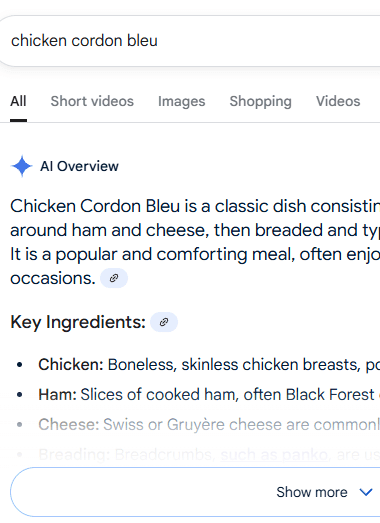
However, queries that have a recipe intent but don’t contain the “recipe” keyword variants do trigger recipe queries.

Recipe Intent Screenshot

Image shows the keyword phrase

Keyword phrases that contain the word “recipe” trigger the normal recipe rich results.

Recipe Keyword Phrase

Image shows keyword phrase

Keyword phrases that are about recipes but aren’t specifically requesting a recipe tend to trigger AI Overviews. So it’s not really showing AI Overviews for recipe queries, just for queries that are about food and have a latent recipe intent.

Not Showing Up In Mobile Search

The keyword phrases that trigger recipe AI Overviews on desktop do not appear to trigger them on mobile devices. For example, the query Cordon Bleu triggers AIO on the desktop but won’t trigger it on a mobile device.

Keyword Phrase On Mobile Device

Image showing that the keyword phrase

The keyword phrase Tom Critchlow shared (healthy dinner ideas) that triggered an AI Overviews on desktop fails to do the same thing on a mobile device.

Mobile Device Results For Query: Healthy Dinner Ideas

Screenshot shows a normal

So it could be that recipe intent queries have rolled out to desktop users but not yet to mobile devices.

Reduced Traffic To Recipe Bloggers

Recipe bloggers may begin to see reduced levels of traffic from desktop devices. This trend may accelerate as more people begin to rely on chatbots like ChatGPT and Claude for recipes.

ChatGPT Shows Recipes For Recipe Queries

Screenshot shows a query for

Chatbots are trained to output plausible responses so users may not be able to tell the difference between an authentic recipe and an authentic-sounding recipe. Speaking from personal experience using chatbots for recipes, I find them to be unreliable sources for authentic recipes but that’s probably something that the average home cook won’t notice because the synthetic recipes generally satisfy expectations.

Featured Image by Shutterstock/New Africa

5 Content Marketing Ideas for July 2025

While Independence Day rightly takes priority, July offers opportunities for content marketers, including picnicking, showcasing American-made products, and planning for the back-to-school season.

Content marketing is creating, publishing, and promoting content to attract, engage, and retain customers. It’s foundational for search engine optimization and social media marketing.

A challenge, however, is coming up with fresh topics. What follows are five content marketing ideas for July 2025.

National Picnic Month

Photo of four adults picnicing beneath a tree

Picnics offer lots of content marketing options.

In the United States, July is National Picnic Month, an opportunity for marketers to provide helpful, informative, and entertaining posts, videos, or podcasts.

The picnicking theme offers content options for outfitters, kitchen supply shops, specialty grocers, apparel brands, and even home decor shops.

Helpful picnic content could include how-to guides, recipes, or checklists. Here are a few examples.

Made in the USA Day

Screenshot of Pyrex bowls on a table

Classic Pyrex bowls are an example of American-made products.

Made in the USA Day highlights American-made products.

Held on July 2 each year, the occasion appeals to a sense of patriotism and shopping, making it a good topic for ecommerce content marketers.

Online sellers can profile domestic suppliers, focusing on quality, sustainability, and national economic benefits.

Here are a few examples.

  • Kitchen supply stores can feature Pyrex, made primarily in Pennsylvania, or Lodge Cast Iron cookware from Tennessee.
  • An online toy store could feature Wilson footballs or Green Toys, both made in the U.S.
  • A shoe shop might publish a story about Bates shoes or New Balance 587 running shoes — both American-manufactured.

For inspiration, check out a couple of articles about American-made brands.

National Simplicity Day

Photo of Henry David Thoreau

American philosopher Henry David Thoreau espoused simple living.

Held on July 12, 2025, National Simplicity Day honors the simple, uncluttered lifestyle espoused in Henry David Thoreau’s transcendentalist philosophy.

Thoreau, who wrote “Walden” and “Civil Disobedience,” famously moved into a cabin near Walden Pond, Massachusetts, in July 1845.

National Simplicity Day will likely appeal to modern minimalists and environmental advocates. It could help merchants selling organizational products, zero-waste or otherwise sustainable items, and natural health and beauty supplies.

Simplicity Day content might include listicles such as “5 Ways to Simplify Your Wardrobe (and Life)” or features such as “This [Product] Does One Thing, and It Does It Perfectly.”

Back-to-School Planning

Back-to-school shopping in the U.S. starts in July.

According to the National Retail Federation, approximately 55% of back-to-school and college shoppers start purchasing by the middle of July.

The typical American household spent more than $800 on back-to-school items in 2024, totaling $38 billion, per the NRF.

Online and omnichannel merchants seeking a bit of that business could publish articles, videos, or podcasts that answer questions or solve problems.

Here are some examples.

  • Planning guides: “The Parent’s Back-to-School Checklist for 2025.”
  • Product roundups: “8 Stylish and Functional Backpacks for Every Grade.”
  • Tips and tools: “How to Save Time (and Sanity) with Smart School Prep.”
  • Teacher-focused: “What Educators Are Buying Before August.”

National Tequila Day

Photo of two shot glasses containing tequilla.

Tequila is a well-known Mexican spirit and a good content topic for July 2025.

Celebrated on July 24, 2025, National Tequila Day honors Mexico’s iconic national spirit.

Tequila begins its life in the fields of Jalisco, Mexico, and a few surrounding regions, as agave. Producers harvest the plant and strip away the spiky leaves to reveal the piña, or heart, and then slow-cook it to convert complex carbohydrates into fermentable sugars.

Once tender, the piñas are crushed or shredded to extract the sweet juice, known as aguamiel, which then ferments with selected yeasts, transforming sugars into alcohol over several days before being distilled.

Content marketers could publish content describing the process of making tequila or explaining the relationship between tequila and mezcal, a similar agave-based alcoholic beverage.

Marketers could also focus on simply drinking tequila and having fun. Here are a few example titles.

  • Barware or kitchen supply retailer: “The 5 Tequila Glasses Every Home Bar Needs.”
  • Home decor store: “Throw the Perfect Summer Party with Tacos, Tequila, and Table Settings.”
  • Apparel boutique: “Your National Tequila Day Style Guide.”
Here’s what food and drug regulation might look like under the Trump administration

Earlier this week, two new leaders of the US Food and Drug Administration published a list of priorities for the agency. Both Marty Makary and Vinay Prasad are controversial figures in the science community. They were generally highly respected academics until the covid pandemic, when their contrarian opinions on masking, vaccines, and lockdowns turned many of their colleagues off them.

Given all this, along with recent mass firings of FDA employees, lots of people were pretty anxious to see what this list might include—and what we might expect the future of food and drug regulation in the US to look like. So let’s dive into the pair’s plans for new investigations, speedy approvals, and the “unleashing” of AI.

First, a bit of background. Makary, the current FDA commissioner, is a surgeon and was a professor of health policy at the Johns Hopkins School of Public Health. He initially voiced support for stay-at-home orders during the pandemic but later changed his mind. In February 2021, he incorrectly predicted that the US would “have herd immunity by April.” He has also been very critical of the FDA, writing in 2021 that its then leadership acted like “a crusty librarian” and that drug approvals were “erratic.”

Prasad, an oncologist, hematologist, and health researcher, was named director of the FDA’s Center for Biologics Evaluation and Research last month. He has long been a proponent of rigorous evidence-based medicine. When I interviewed him back in 2019, he told me that cancer drugs are often approved on the basis of weak evidence, and that they can end up being ineffective or even harmful. He has written a book arguing that drug regulators need to raise the bar of evidence for drug approvals. He was widely respected by his peers.

Things changed during the pandemic. Prasad made a series of contrarian comments; he claimed that the covid virus “was likely a lab leak” despite the fact that the vast majority of scientists believe that the virus jumped to humans from animals in a market. He railed against Anthony Fauci, and advised readers of his blog to “break all home Covid tests.” In 2023, he authored a post titled “Do not report Covid cases to schools & do not test yourself if you feel ill.” He has even drawn parallels between the US covid response and fascism in Nazi Germany. Suffice to say he’s lost the support of many of his fellow academics.

Makary and Prasad published their “priorities for a new FDA” in the Journal of the American Medical Association on Tuesday. (Funnily enough, JAMA is one of the journals that their boss, Robert F. Kennedy Jr., described as “corrupt” just a couple of weeks ago—one that he said he’d ban government scientists from publishing in. Lol.)

Let’s go through a few of the points the pair make in their piece. They open by declaring that the US medical system has been “a 50 year failure.” It’s true that the US spends a lot more on health care than other wealthy countries do, and yet has a lower life expectancy. And around 25 million Americans don’t have health insurance.

“In some ways, it is absolutely a failure,” says Christopher Robertson, a professor of health law at Boston University. “On the other hand, it’s the envy of the world [because] it’s very good at delivering high-end care.” Either way, the reasons for failures in health care are not really the scope of the FDA, which has a focus on ensuring the safety and efficacy of food and medicines.

Makary and Prasad then state that they want the FDA to “examine the role of ultraprocessed foods” as well as additives and environmental toxins, suggesting that all these may be involved in chronic diseases. This is a favorite talking point of RFK Jr., who has made similar promises about investigating a possible connection.

But this would also go beyond the current established purview of the FDA, says Robertson. There isn’t a clear, agreed-upon definition of “ultraprocessed food,” for a start, so it’s hard to predict what exactly would be included in any investigation. And as things stand, “the FDA’s role is primarily binary: They either allow or reject products,” adds Robertson. The agency doesn’t really give dietary advice.

Perhaps that could change. At his confirmation hearing, Makary told senators he planned to evaluate school lunches, seed oils, and food dyes. “Maybe three years from now the FDA will change and have much more of a food focus,” says Robertson.

The pair also write that they want to speed up the process of approving new drugs, which can currently take more than 10 years. Their suggestions include allowing drug developers to submit final paperwork early, while testing is still underway, and getting rid of “recipes” that strictly limit what manufacturers can put in infant formula.

Here’s where things get a little more controversial. Most new drugs fail. They might look very promising in cells in a dish, or even in animals. They might look safe enough in a small phase I study in humans. But after that, large-scale human studies reveal plenty of drugs to be either ineffective, unsafe, or both.

Speeding up the drug approval process might mean some of these failures aren’t noticed until a drug is already being sold and prescribed. Even preparing paperwork ahead of time might result in a huge waste of time and money for both drug developers and the FDA if that drug later fails its final round of testing, says Robertson.

And as for infant formula recipes, they are in place for a reason: because we know they’re safe. Loosening that requirement might allow for more innovation. It could lead to the development of better recipes. But, as Robertson points out, innovation is a double-edged sword. “Some innovation saves lives; some innovation kills people,” he says.

Along the same lines, the pair also advocate for reducing the number of clinical trials required for the FDA to approve a drug. Instead of two “pivotal” clinical trials, drugmakers might only need to complete one, they suggest.

This is also controversial. A drug might look promising in one clinical trial and fail in another. That was the case for aducanamab (Aduhelm), the Alzheimer’s drug that was approved by the FDA in 2021 despite the concerns of several senior officials. (Biogen, the company that developed the drug, abandoned it in 2024, and it was later withdrawn from the market.)

At any rate, the FDA has already implemented several pathways for “expedited approval.” The Accelerated Approval Program fast-tracks the process for drugs that treat serious conditions or fulfill an unmet need. (Side note: This approval pathway relies on the very kind of weak evidence that Prasad has campaigned against.)

The Fast Track Program serves a similar purpose. As does the Breakthrough Therapy designation. Some health researchers are worried that programs like these, along with other factors, are responsible for a gradual lowering of the bar of evidence for new drugs in the US. Calling for an acceleration of cures, as the authors do, isn’t really anything new.

Makary and Prasad also list artificial intelligence as a priority—specifically, generative AI. They write that “on May 8, 2025, the agency implemented the first AI-assisted scientific review pilot using the latest generative AI technology.” It’s not clear exactly which technology was used, or how. But this priority didn’t surprise Rachel Sachs, a professor of health law at Washington University in St. Louis.

“Both this administration and the previous administration were very interested in the use of AI technologies,” she says. She points out that as of last year, the FDA had already approved over a thousand medical devices that make use of AI and machine learning. And the agency has also been considering how it might use the technologies in its review process, she adds: “It’s not a new idea.”

There’s another sticking point. Writing a list of priorities in JAMA is one thing. Implementing them amid hugely disruptive and damaging cuts underway across federal health and science agencies is quite another.

Makary and Prasad have both made claims to the effect that they support “gold standard” science and have built their careers on extolling the virtues of evidence-based medicine. But it’s hard to square this position with the actions of the administration, including the huge budget cuts made to the National Institutes of Health, restrictions on government-funded research, and mass layoffs across multiple government health agencies, including the FDA. “It’s almost as if the two sides are talking past each other,” says Sachs.

As a result, it’s impossible to predict exactly what’s going to happen. We’ll have to wait to see how this all pans out.

This article first appeared in The Checkup, MIT Technology Review’s weekly biotech newsletter. To receive it in your inbox every Thursday, and read articles like this first, sign up here.

Tech billionaires are making a risky bet with humanity’s future

“The best way to predict the future is to invent it,” the famed computer scientist Alan Kay once said. Uttered more out of exasperation than as inspiration, his remark has nevertheless attained gospel-like status among Silicon Valley entrepreneurs, in particular a handful of tech billionaires who fancy themselves the chief architects of humanity’s future. 

Sam Altman, Jeff Bezos, Elon Musk, and others may have slightly different goals and ambitions in the near term, but their grand visions for the next decade and beyond are remarkably similar. Framed less as technological objectives and more as existential imperatives, they include aligning AI with the interests of humanity; creating an artificial superintelligence that will solve all the world’s most pressing problems; merging with that superintelligence to achieve immortality (or something close to it); establishing a permanent, self-­sustaining colony on Mars; and, ultimately, spreading out across the cosmos.

While there’s a sprawling patchwork of ideas and philosophies powering these visions, three features play a central role, says Adam Becker, a science writer and astrophysicist: an unshakable certainty that technology can solve any problem, a belief in the necessity of perpetual growth, and a quasi-religious obsession with transcending our physical and biological limits. In his timely new book, More Everything Forever: AI Overlords, Space Empires, and Silicon Valley’s Crusade to Control the Fate of Humanity, Becker calls this triumvirate of beliefs the “ideology of technological salvation” and warns that tech titans are using it to steer humanity in a dangerous direction. 

“In most of these isms you’ll find the idea of escape and transcendence, as well as the promise of an amazing future, full of unimaginable wonders—so long as we don’t get in the way of technological progress.”

“The credence that tech billionaires give to these specific science-fictional futures validates their pursuit of more—to portray the growth of their businesses as a moral imperative, to reduce the complex problems of the world to simple questions of technology, [and] to justify nearly any action they might want to take,” he writes. Becker argues that the only way to break free of these visions is to see them for what they are: a convenient excuse to continue destroying the environment, skirt regulations, amass more power and control, and dismiss the very real problems of today to focus on the imagined ones of tomorrow. 

A lot of critics, academics, and journalists have tried to define or distill the Silicon Valley ethos over the years. There was the “Californian Ideology” in the mid-’90s, the “Move fast and break things” era of the early 2000s, and more recently the Libertarianism for me, feudalism for thee  or “techno-­authoritarian” views. How do you see the “ideology of technological salvation” fitting in? 

I’d say it’s very much of a piece with those earlier attempts to describe the Silicon Valley mindset. I mean, you can draw a pretty straight line from Max More’s principles of transhumanism in the ’90s to the Californian Ideology [a mashup of countercultural, libertarian, and neoliberal values] and through to what I call the ideology of technological salvation. The fact is, many of the ideas that define or animate Silicon Valley thinking have never been much of a ­mystery—libertarianism, an antipathy toward the government and regulation, the boundless faith in technology, the obsession with optimization. 

What can be difficult is to parse where all these ideas come from and how they fit together—or if they fit together at all. I came up with the ideology of technological salvation as a way to name and give shape to a group of interrelated concepts and philosophies that can seem sprawling and ill-defined at first, but that actually sit at the center of a worldview shared by venture capitalists, executives, and other thought leaders in the tech industry. 

Readers will likely be familiar with the tech billionaires featured in your book and at least some of their ambitions. I’m guessing they’ll be less familiar with the various “isms” that you argue have influenced or guided their thinking. Effective altruism, rationalism, long­termism, extropianism, effective accelerationism, futurism, singularitarianism, ­transhumanism—there are a lot of them. Is there something that they all share? 

They’re definitely connected. In a sense, you could say they’re all versions or instantiations of the ideology of technological salvation, but there are also some very deep historical connections between the people in these groups and their aims and beliefs. The Extropians in the late ’80s believed in self-­transformation through technology and freedom from limitations of any kind—ideas that Ray Kurzweil eventually helped popularize and legitimize for a larger audience with the Singularity

In most of these isms you’ll find the idea of escape and transcendence, as well as the promise of an amazing future, full of unimaginable wonders—so long as we don’t get in the way of technological progress. I should say that AI researcher Timnit Gebru and philosopher Émile Torres have also done a lot of great work linking these ideologies to one another and showing how they all have ties to racism, misogyny, and eugenics.

You argue that the Singularity is the purest expression of the ideology of technological salvation. How so?

Well, for one thing, it’s just this very simple, straightforward idea—the Singularity is coming and will occur when we merge our brains with the cloud and expand our intelligence a millionfold. This will then deepen our awareness and consciousness and everything will be amazing. In many ways, it’s a fantastical vision of a perfect technological utopia. We’re all going to live as long as we want in an eternal paradise, watched over by machines of loving grace, and everything will just get exponentially better forever. The end.

The other isms I talk about in the book have a little more … heft isn’t the right word—they just have more stuff going on. There’s more to them, right? The rationalists and the effective altruists and the longtermists—they think that something like a singularity will happen, or could happen, but that there’s this really big danger between where we are now and that potential event. We have to address the fact that an all-powerful AI might destroy humanity—the so-called alignment problem—before any singularity can happen. 

Then you’ve got the effective accelerationists, who are more like Kurzweil, but they’ve got more of a tech-bro spin on things. They’ve taken some of the older transhumanist ideas from the Singularity and updated them for startup culture. Marc Andreessen’s “Techno-Optimist Manifesto” [from 2023] is a good example. You could argue that all of these other philosophies that have gained purchase in Silicon Valley are just twists on Kurzweil’s Singularity, each one building on top of the core ideas of transcendence, techno­-optimism, and exponential growth. 

Early on in the book you take aim at that idea of exponential growthspecifically, Kurzweil’s “Law of Accelerating Returns.” Could you explain what that is and why you think it’s flawed?

Kurzweil thinks there’s this immutable “Law of Accelerating Returns” at work in the affairs of the universe, especially when it comes to technology. It’s the idea that technological progress isn’t linear but exponential. Advancements in one technology fuel even more rapid advancements in the future, which in turn lead to greater complexity and greater technological power, and on and on. This is just a mistake. Kurzweil uses the Law of Accelerating Returns to explain why the Singularity is inevitable, but to be clear, he’s far from the only one who believes in this so-called law.

“I really believe that when you get as rich as some of these guys are, you can just do things that seem like thinking and no one is really going to correct you or tell you things you don’t want to hear.”

My sense is that it’s an idea that comes from staring at Moore’s Law for too long. Moore’s Law is of course the famous prediction that the number of transistors on a chip will double roughly every two years, with a minimal increase in cost. Now, that has in fact happened for the last 50 years or so, but not because of some fundamental law in the universe. It’s because the tech industry made a choice and some very sizable investments to make it happen. Moore’s Law was ultimately this really interesting observation or projection of a historical trend, but even Gordon Moore [who first articulated it] knew that it wouldn’t and couldn’t last forever. In fact, some think it’s already over

These ideologies take inspiration from some pretty unsavory characters. Transhumanism, you say, was first popularized by the eugenicist Julian Huxley in a speech in 1951. Marc Andreessen’s “Techno-Optimist Manifesto” name-checks the noted fascist Filippo Tommaso Marinetti and his futurist manifesto. Did you get the sense while researching the book that the tech titans who champion these ideas understand their dangerous origins?

You’re assuming in the framing of that question that there’s any rigorous thought going on here at all. As I say in the book, Andreessen’s manifesto runs almost entirely on vibes, not logic. I think someone may have told him about the futurist manifesto at some point, and he just sort of liked the general vibe, which is why he paraphrases a part of it. Maybe he learned something about Marinetti and forgot it. Maybe he didn’t care. 

I really believe that when you get as rich as some of these guys are, you can just do things that seem like thinking and no one is really going to correct you or tell you things you don’t want to hear. For many of these billionaires, the vibes of fascism, authoritarianism, and colonialism are attractive because they’re fundamentally about creating a fantasy of control. 

You argue that these visions of the future are being used to hasten environmental destruction, increase authoritarianism, and exacerbate inequalities. You also admit that they appeal to lots of people who aren’t billionaires. Why do you think that is? 

I think a lot of us are also attracted to these ideas for the same reasons the tech billionaires are—they offer this fantasy of knowing what the future holds, of transcending death, and a sense that someone or something out there is in control. It’s hard to overstate how comforting a simple, coherent narrative can be in an increasingly complex and fast-moving world. This is of course what religion offers for many of us, and I don’t think it’s an accident that a sizable number of people in the rationalist and effective altruist communities are actually ex-evangelicals.

More than any one specific technology, it seems like the most consequential thing these billionaires have invented is a sense of inevitability—that their visions for the future are somehow predestined. How does one fight against that?

It’s a difficult question. For me, the answer was to write this book. I guess I’d also say this: Silicon Valley enjoyed well over a decade with little to no pushback on anything. That’s definitely a big part of how we ended up in this mess. There was no regulation, very little critical coverage in the press, and a lot of self-mythologizing going on. Things have started to change, especially as the social and environmental damage that tech companies and industry leaders have helped facilitate has become more clear. That understanding is an essential part of deflating the power of these tech billionaires and breaking free of their visions. When we understand that these dreams of the future are actually nightmares for the rest of us, I think you’ll see that sense
of inevitability vanish pretty fast. 

This interview was edited for length and clarity.

Bryan Gardiner is a writer based in Oakland, California.