This is today’s edition of The Download, our weekday newsletter that provides a daily dose of what’s going on in the world of technology.
Crypto billionaire Brian Armstrong is ready to invest in CRISPR baby tech
Brian Armstrong, the billionaire CEO of the cryptocurrency exchange Coinbase, says he’s ready to fund a US startup focused on gene-editing human embryos. If he goes forward, it would be the first major commercial investment in one of medicine’s most fraught ideas.
In a post on X June 2, Armstrong announced he was looking for gene-editing scientists and bioinformatics specialists to form a founding team for an “embryo editing” effort targeting an unmet medical need, such as a genetic disease.
Over $1 billion in federal funding got slashed for this polluting industry
The clean cement industry might be facing the end of the road, before it ever really got rolling.
Last week, the US Department of Energy announced that it was canceling $3.7 billion in funding for 24 projects related to energy and industry. That included nearly $1.3 billion for cement-related projects.
Cement is a massive climate problem, accounting for roughly 7% of global greenhouse-gas emissions. What’s more, it’s a difficult industry to clean up, with huge traditional players and expensive equipment and infrastructure to replace. This funding was supposed to help address those difficulties, by supporting projects on the cusp of commercialization. Now companies will need to fill in the gap left by these cancellations, and it’s a big one. Read the full story.
—Casey Crownhart
This article is from The Spark, MIT Technology Review’s weekly climate newsletter. To receive it in your inbox every Wednesday, sign up here.
MIT Technology Review Narrated: How DeepSeek became a fortune teller for China’s youth
AI-powered BaZi analysis has become the new oracle for a disillusioned generation seeking answers.
This is our latest story to be turned into a MIT Technology Review Narrated podcast, which we’re publishing each week on Spotify and Apple Podcasts. Just navigate to MIT Technology Review Narrated on either platform, and follow us to get all our new content as it’s released.
The must-reads
I’ve combed the internet to find you today’s most fun/important/scary/fascinating stories about technology.
1 Reddit is suing Anthropic Reddit claims the AI company kept accessing its site after claiming it had stopped. (WSJ $) + Reddit says AI companies should not scrape the web without limitations. (NYT $) + It claims that other AI giants have played by its rules. (NBC News)
2 Inside the rise and rise of deepfake scams The best way to protect yourself is to back up and think who (or what) you’re trusting. (Wired $) + An AI startup made a hyperrealistic deepfake of me that’s so good it’s scary. (MIT Technology Review)
3 A lawsuit accuses DOGE of exploiting “error-riden” data to fire workers It claims the department knew its records were inaccurate, but used them to fire 10,000 employees anyway.(Ars Technica) + Unlike Elon Musk, Russ Vought knows the federal government inside out. (NY Mag $) + The first wave of DOGE staffers are becoming full-time government workers. (Wired $) + DOGE’s tech takeover threatens the safety and stability of our critical data. (MIT Technology Review)
4 Can we make AI behave how we want it to? Looking all the way back to Asimov’s Laws can offer us some clues. (New Yorker $)
5 Abuse is rife in Taiwan’s semiconductor factories Workers were threatened with deportation and regular 16-hour shifts. (Rest of World) + The Trump administration is renegotiating chip grants, apparently. (Reuters)
6 Amazon wants to use humanoid robots to deliver packages It’s planning to test its bipedal machines’ ability to tackle an obstacle course.(The Information $) + Why the humanoid workforce is running late. (MIT Technology Review)
7 We don’t know how to archive the digital age properly Historians worry that they may lose access to intimate materials. (The Atlantic $) + The race to save our online lives from a digital dark age. (MIT Technology Review)
8 Here’s how major AI helpers tackled a rigorous reading test Bearing in mind, they all still hallucinated. (WP $)
9 Christians really love AI slop A major Christian media company is using new tools to spread the word. (404 Media) + AI-generated garbage will make ads creepier and worse. (Bloomberg $) + It’s also warping media metrics beyond recognition. (Digiday)
10 What we can learn from potty-mouthed robots A lot of people swear. Why shouldn’t robots, too? (IEEE Spectrum)
Quote of the day
“Anthropic bills itself as the white knight of the AI industry. It is anything but.”
—Reddit takes aim at Anthropic in a legal filing against the AI company, the Verge reports.
One more thing
Maybe you will be able to live past 122
How long can humans live? This is a good time to ask the question. The longevity scene is having a moment, and research suggests that we might be able to push human life spans further, potentially even reversing some signs of aging.
Researchers can’t even agree on what the exact mechanisms of aging are and which they should be targeting. Debates continue to rage over how long it’s possible for humans to live—and whether there is a limit at all.
But it looks likely that something will be developed in the coming decades that will help us live longer, in better health. Read the full story.
—Jessica Hamzelou
We can still have nice things
A place for comfort, fun and distraction to brighten up your day. (Got any ideas? Drop me a line or skeet ’em at me.)
+ There’s something so uplifting about this user-generated collection of videos of parks. + I could get on board with living in a cabin in the woods if it was this one. + You should probably let go of that grudge you’re holding onto. + Looking for some seasonal recipe inspo? Look no further.
Last year, China saw a boom in foundation models, the do-everything large language models that underpin the AI revolution. This year, the focus has shifted to AI agents—systems that are less about responding to users’ queries and more about autonomously accomplishing things for them.
There are now a host of Chinese startups building these general-purpose digital tools, which can answer emails, browse the internet to plan vacations, and even design an interactive website. Many of these have emerged in just the last two months, following in the footsteps of Manus—a general AI agent that sparked weeks of social media frenzy for invite codes after its limited-release launch in early March.
These emerging AI agents aren’t large language models themselves. Instead, they’re built on top of them, using a workflow-based structure designed to get things done. A lot of these systems also introduce a different way of interacting with AI. Rather than just chatting back and forth with users, they are optimized for managing and executing multistep tasks—booking flights, managing schedules, conducting research—by using external tools and remembering instructions.
China could take the lead on building these kinds of agents. The country’s tightly integrated app ecosystems, rapid product cycles, and digitally fluent user base could provide a favorable environment for embedding AI into daily life.
For now, its leading AI agent startups are focusing their attention on the global market, because the best Western models don’t operate inside China’s firewalls. But that could change soon: Tech giants like ByteDance and Tencent are preparing their own AI agents that could bake automation directly into their native super-apps, pulling data from their vast ecosystem of programs that dominate many aspects of daily life in the country.
As the race to define what a useful AI agent looks like unfolds, a mix of ambitious startups and entrenched tech giants are now testing how these tools might actually work in practice—and for whom.
Set the standard
It’s been a whirlwind few months for Manus, which was developed by the Wuhan-based startup Butterfly Effect. The company raised $75 million in a funding round led by the US venture capital firm Benchmark, took the product on an ambitious global roadshow, and hired dozens of new employees.
Even before registration opened to the public in May, Manus had become a reference point for what a broad, consumer‑oriented AI agent should accomplish. Rather than handling narrow chores for businesses, this “general” agent is designed to be able to help with everyday tasks like trip planning, stock comparison, or your kid’s school project.
Unlike previous AI agents, Manus uses a browser-based sandbox that lets users supervise the agent like an intern, watching in real time as it scrolls through web pages, reads articles, or codes actions. It also proactively asks clarifying questions, supports long-term memory that would serve as context for future tasks.
“Manus represents a promising product experience for AI agents,” says Ang Li, cofounder and CEO of Simular, a startup based in Palo Alto, California, that’s building computer use agents, AI agents that control a virtual computer. “I believe Chinese startups have a huge advantage when it comes to designing consumer products, thanks to cutthroat domestic competition that leads to fast execution and greater attention to product details.”
In the case of Manus, the competition is moving fast. Two of the most buzzy follow‑ups, Genspark and Flowith, for example, are already boasting benchmark scores that match or edge past Manus’s.
Genspark, led by former Baidu executives Eric Jing and Kay Zhu, links many small “super agents” through what it calls multi‑component prompting. The agent can switch among several large language models, accepts both images and text, and carries out tasks from making slide decks to placing phone calls. Whereas Manus relies heavily on Browser Use, a popular open-source product that lets agents operate a web browser in a virtual window like a human, Genspark directly integrates with a wide array of tools and APIs. Launched in April, the company says that it already has over 5 million users and over $36 million in yearly revenue.
Flowith, the work of a young team that first grabbed public attention in April 2025 at a developer event hosted by the popular social media app Xiaohongshu, takes a different tack. Marketed as an “infinite agent,” it opens on a blank canvas where each question becomes a node on a branching map. Users can backtrack, take new branches, and store results in personal or sharable “knowledge gardens”—a design that feels more like project management software (think Notion) than a typical chat interface. Every inquiry or task builds its own mind-map-like graph, encouraging a more nonlinear and creative interaction with AI. Flowith’s core agent, NEO, runs in the cloud and can perform scheduled tasks like sending emails and compiling files. The founders want the app to be a “knowledge marketbase”, and aims to tap into the social aspect of AI with the aspiration of becoming “the OnlyFans of AI knowledge creators”.
What they also share with Manus is the global ambition. Both Genspark and Flowith have stated that their primary focus is the international market.
A global address
Startups like Manus, Genspark, and Flowith—though founded by Chinese entrepreneurs—could blend seamlessly into the global tech scene and compete effectively abroad. Founders, investors, and analysts that MIT Technology Review has spoken to believe Chinese companies are moving fast, executing well, and quickly coming up with new products.
Money reinforces the pull to launch overseas. Customers there pay more, and there are plenty to go around. “You can price in USD, and with the exchange rate that’s a sevenfold multiplier,” Manus cofounder Xiao Hong quipped on a podcast. “Even if we’re only operating at 10% power because of cultural differences overseas, we’ll still make more than in China.”
But creating the same functionality in China is a challenge. Major US AI companies including OpenAI and Anthropic have opted out of mainland China because of geopolitical risks and challenges with regulatory compliance. Their absence initially created a black market as users resorted to VPNs and third-party mirrors to access tools like ChatGPT and Claude. That vacuum has since been filled by a new wave of Chinese chatbots—DeepSeek, Doubao, Kimi—but the appetite for foreign models hasn’t gone away.
Manus, for example, uses Anthropic’s Claude Sonnet—widely considered the top model for agentic tasks. Manus cofounder Zhang Tao has repeatedly praised Claude’s ability to juggle tools, remember contexts, and hold multi‑round conversations—all crucial for turning chatty software into an effective executive assistant.
But the company’s use of Sonnet has made its agent functionally unusable inside China without a VPN. If you open Manus from a mainland IP address, you’ll see a notice explaining that the team is “working on integrating Qwen’s model,” a special local version that is built on top of Alibaba’s open-source model.
An engineer overseeing ByteDance’s work on developing an agent, who spoke to MIT Technology Review anonymously to avoid sanction, said that the absence of Claude Sonnet models “limits everything we do in China.” DeepSeek’s open models, he added, still hallucinate too often and lack training on real‑world workflows. Developers we spoke with rank Alibaba’s Qwen series as the best domestic alternative, yet most say that switching to Qwen knocks performance down a notch.
Jiaxin Pei, a postdoctoral researcher at Stanford’s Institute for Human‑Centered AI, thinks that gap will close: “Building agentic capabilities in base LLMs has become a key focus for many LLM builders, and once people realize the value of this, it will only be a matter of time.”
For now, Manus is doubling down on audiences it can already serve. In a written response, the company said its “primary focus is overseas expansion,” noting that new offices in San Francisco, Singapore, and Tokyo have opened in the past month.
A super‑app approach
Although the concept of AI agents is still relatively new, the consumer-facing AI app market in China is already crowded with major tech players. DeepSeek remains the most widely used, while ByteDance’s Doubao and Moonshot’s Kimi have also become household names. However, most of these apps are still optimized for chat and entertainment rather than task execution. This gap in the local market has pushed China’s big tech firms to roll out their own user-facing agents, though early versions remain uneven in quality and rough around the edges.
ByteDance is testing Coze Space, an AI agent based on its own Doubao model family that lets users toggle between “plan” and “execute” modes, so they can either directly guide the agent’s actions or step back and watch it work autonomously. It connects up to 14 popular apps, including GitHub, Notion, and the company’s own Lark office suite. Early reviews say the tool can feel clunky and has a high failure rate, but it clearly aims to match what Manus offers.
Meanwhile, Zhipu AI has released a free agent called AutoGLM Rumination, built on its proprietary ChatGLM models. Shanghai‑based Minimax has launched Minimax Agent. Both products look almost identical to Manus and demo basic tasks such as building a simple website, planning a trip, making a small Flash game, or running quick data analysis.
Despite the limited usability of most general AI agents launched within China, big companies have plans to change that. During a May 15 earnings call, Tencent president Liu Zhiping teased an agent that would weave automation directly into China’s most ubiquitous app, WeChat.
Considered the original super-app, WeChat already handles messaging, mobile payments, news, and millions of mini‑programs that act like embedded apps. These programs give Tencent, its developer, access to data from millions of services that pervade everyday life in China, an advantage most competitors can only envy.
Historically, China’s consumer internet has splintered into competing walled gardens—share a Taobao link in WeChat and it resolves as plaintext, not a preview card. Unlike the more interoperable Western internet, China’s tech giants have long resisted integration with one another, choosing to wage platform war at the expense of a seamless user experience.
But the use of mini‑programs has given WeChat unprecedented reach across services that once resisted interoperability, from gym bookings to grocery orders. An agent able to roam that ecosystem could bypass the integration headaches dogging independent startups.
Alibaba, the e-commerce giant behind the Qwen model series, has been a front-runner in China’s AI race but has been slower to release consumer-facing products. Even though Qwen was the most downloaded open-source model on Hugging Face in 2024, it didn’t power a dedicated chatbot app until early 2025. In March, Alibaba rebranded its cloud storage and search app Quark into an all-in-one AI search tool. By June, Quark had introduced DeepResearch—a new mode that marks its most agent-like effort to date.
ByteDance and Alibaba did not reply to MIT Technology Review’s request for comments.
“Historically, Chinese tech products tend to pursue the all-in-one, super-app approach, and the latest Chinese AI agents reflect just that,” says Li of Simular, who previously worked at Google DeepMind on AI-enabled work automation. “In contrast, AI agents in the US are more focused on serving specific verticals.”
Pei, the researcher at Stanford, says that existing tech giants could have a huge advantage in bringing the vision of general AI agents to life—especially those with built-in integration across services. “The customer-facing AI agent market is still very early, with tons of problems like authentication and liability,” he says. “But companies that already operate across a wide range of services have a natural advantage in deploying agents at scale.”
This week’s rundown of new products from companies offering services to ecommerce merchants includes rollouts for local payments, headless commerce, ad platforms, Bitcoin, B2B commerce, retail media solutions, and parcel delivery robots.
Got an ecommerce product release? Email releases@practicalecommerce.com.
New Tools for Merchants
Ppro, a local payments platform, launches subscriptions. Local payments provider Ppro has announced the launch of Subscriptions for Local Payments, enabling merchants to accelerate development through optimized local strategies. Businesses can (i) access local payment methods such as Twint and Bancontact with native recurring functionality, (ii) deploy subscription flows with dedicated features to cut down on free trial abuse, (iii) reduce payment declines, (iv) allow flexible billing, and (v) leverage Ppro-signature enhancements.
Ppro
Fast Simon integrates with Shopify Hydrogen 2.Fast Simon, a provider of AI shopping optimization, has announced its integration with Hydrogen 2, Shopify’s headless commerce framework. The integration brings server-side rendering capabilities to Fast Simon’s AI-driven merchandising, search, and personalization suite for Shopify merchants. Fast Simon states that its integration enables merchants to capitalize on Hydrogen 2’s infrastructure, ensuring that search and merchandising components render server-side, boosting crawlability, improving time-to-first-byte, and maintaining rich content without sacrificing visibility for search engines.
Pacvue integrates with TikTok Shop and Shop Ads.Pacvue, a commerce acceleration platform, has announced its integration with TikTok Shop and TikTok Shop Ads. Brands and agencies can now manage TikTok Shop operations and advertising through Pacvue’s platform, offering a unified view of performance across channels. The integration enables brands and sellers of all sizes to manage their shoppable social campaign strategies, tap into new audiences, and optimize performance, according to Pacvue.
Amazon Ads launches Sponsored Ads and Stores in Ireland. Eligible sellers and vendors on Ireland’s Amazon.ie can now leverage Sponsored Products, Sponsored Brands, Sponsored Brand Video, and Brand Stores. Sponsored Products ads help promote individual listings. Sponsored Brands ads let sellers include multiple products, along with a brand logo and custom headline. A Store allows sellers to showcase bestsellers and collections, publish videos, or tell a brand story, all at no cost.
Amazon Ads
WordPress.org launches AI team.WordPress.org has announced the formation of a dedicated team focused on accelerating and coordinating AI projects across the WordPress ecosystem. The AI team will coordinate efforts to explore AI-powered features, publish and maintain a public roadmap of AI initiatives and canonical plugins, and collaborate closely with Core, Design, Accessibility, and other grooups to ensure strong integration and shared standards. The initial team has contributors from Automattic, 10up (web development), and Google.
Visa launches pay-by-bank platform in the U.K.Visa has launched Visa A2A, a pay-by-bank platform, in the U.K. The offering introduces enhanced consumer protections for account-to-account transfers. According to Visa, A2A provides a seamless experience for users by integrating payment management into banking apps. For businesses, A2A delivers enhanced benefits through real-time settlement via “Pay.UK” (a faster payment system), improved cash flow visibility, and enriched transaction data. Merchants also receive alerts when customers modify payment permissions.
Block to roll out Bitcoin payments on Square.Block, formerly Square, is launching Bitcoin payments on the Square point-of-sale app, enabling merchants to accept Bitcoin payments directly through their Square hardware for near-instantaneous, low-cost transactions. Square says the rollout will begin in the second half of 2025 and reach all eligible Square sellers in 2026. Square’s new Bitcoin for Businesses offering will build upon its Bitcoin Conversions feature, which automatically converts a portion of daily sales into Bitcoin.
Square
Visa deploys new AI-enabled products for the APAC region.Visa has announced a suite of AI tools in the Asia-Pacific region, providing regional partners, platforms, fintechs, banks, and merchants with a simple way to connect to the Visa network and deliver secure payment experiences. The Visa Intelligent Commerce initiative integrates APIs and a commercial partner program, allowing engineers to deploy Visa’s AI commerce capabilities at scale. Additionally, Visa is exploring partnerships with Ant International (a fintech company), Grab (a “super app”), and Tencent (the owner of WeChat) for AI-enabled checkout optimization.
Zaelab launches Portul in Europe to simplify B2B commerce on Shopify.Zaelab, a provider of digital B2B tools, has announced the European launch of Portul, a B2B app for Shopify. According to Zaelab, Portul will simplify the requirements of enterprise B2B commerce and assist organizations in modernizing selling experiences. Portul’s features include advanced account management, KPI tracking, efficient reordering workflows, account-based quoting scenarios, integration with ERP systems, and specialized solutions for search, product configuration, visualization, and content management.
Pairzon launches retail media tool to maximize first-party data.Pairzon, an AI-powered marketing intelligence platform, has launched its retail media tool to help retailers leverage first-party data. Pairzon accesses in-store and online transactional data to generate predictive audience segments in real-time. It then uses those segments across Meta, Google, TikTok, and other platforms to deliver performance at scale while maintaining data privacy. Pairzon says retailers can securely share personalized audiences with brands across in-store and online channels through precise shopper targeting.
Veho and Rivr partner on ecommerce delivery through AI-powered robots.Veho, a parcel delivery platform, and Rivr, a physical AI and robotics provider, have launched an initiative to improve the ecommerce delivery experience and efficiency through the use of parcel delivery robots. The robots will enable humans to deliver more parcels, faster, with less physical strain, while maintaining the superior delivery experience. The deployment begins in Austin, Texas, with plans to expand to additional markets later this year.
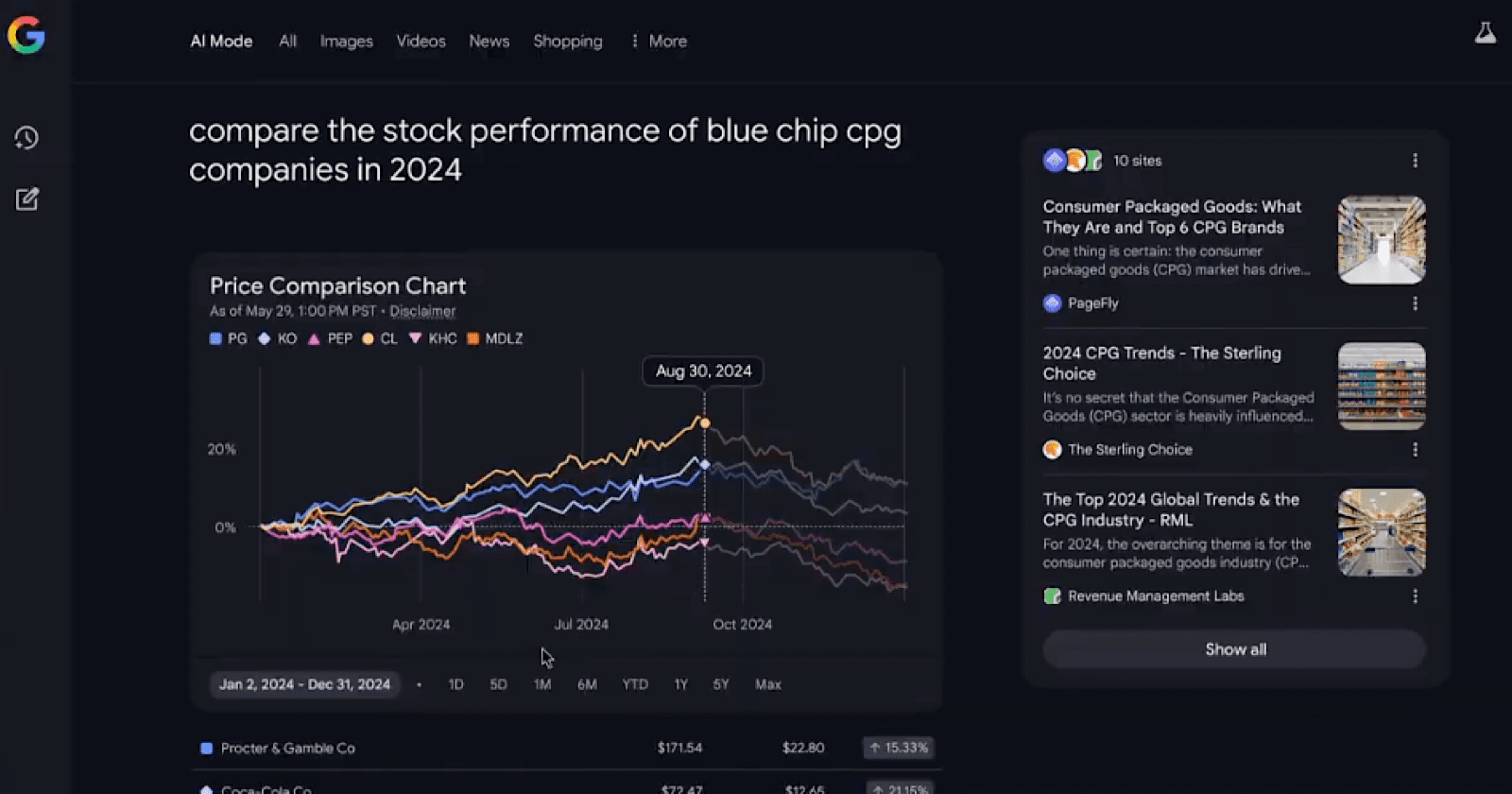
Google has started rolling out interactive charts in AI Mode through Labs.
You can now ask complex financial questions and get both visual charts and detailed explanations.
The system builds these responses specifically for each user’s question.
Visual Analytics Come AI Mode
Soufi Esmaeilzadeh, Director of Product Management for Search at Google, explained that you can ask questions like “compare the stock performance of blue chip CPG companies in 2024” and get automated research with visual charts.
Google does the research work automatically. It looks up individual companies and their stock prices without requiring you to perform manual searches.
You can ask follow-up questions like “did any of these companies pay back dividends?” and AI Mode will understand what you’re looking for.
Technical Details
Google uses Gemini’s advanced reasoning and multimodal capabilities to power this feature.
The system analyzes what users are requesting, pulls both current and historical financial data, and determines the most effective way to present the information.
Implications For Publishers
Financial websites that typically receive traffic from comparison content should closely monitor their analytics. Google now provides direct visual answers to complex financial questions.
Searchers might click through to external sites less often for basic comparison data. But this also creates opportunities. Publishers that offer deeper analysis or expert commentary may find new ways to add value beyond basic data visualization.
Availability & Access
The data visualization feature is currently available through AI Mode in Labs. This means it’s still experimental. Google hasn’t announced plans for wider rollout or expansion to other types of data beyond financial information.
Users who want to try it out can access it through Google’s Labs program. Labs typically tests experimental search features before rolling them out more widely.
Looking Ahead
The trend toward comprehensive, visual responses continues Google’s strategy of becoming the go-to source for information rather than just a gateway to other websites.
While currently limited to financial data, the technology could expand to other data-heavy industries.
The feature remains experimental, but it offers a glimpse into how AI-powered search may evolve.
WordPress interviewed a member of the newly formed WordPress AI Team who shared how AI can be integrated into WordPress, outlining a future in which the platform supports AI agents and content consumption while enabling new kinds of functionality. To achieve this, the team is focusing on developer tools that allow third-party developers and services to connect AI systems to WordPress without embedding generative features directly into core.
The interview was with James LaPage, the AI engineering lead at Automattic and one of the leaders of the newly announced WordPress AI Team.
Timing Of AI Team Announcement
Many competitors, from private closed systems like Wix, Duda, and Shopify to open-source platforms like Drupal CMS, have various AI integrations built in. Third-party WordPress plugins such as Yoast, Rank Math, and Elementor also feature AI integration. WordPress hosts including Bluehost, 10Web, and Automattic’s commercial WordPress.com platform offer AI-powered site builder functionality. A case could be made that WordPress is late to the AI party.
James LaPage of the WordPress AI Team argues that a cautious approach was necessary due to the fast rate of changes within AI. This makes sense given that Agentic AI (AI agents that research the web on behalf of humans), is just beginning to gain adoption.
LaPage explains these realities early in the interview:
” I’ve wanted an AI team for a long time. I think right now actually was the perfect time to launch it because the …generative AI boom and the technology running and powering that boom is actually like pretty recent, and it’s changing so rapidly and only recently have we seen a lot of centralization around, for example, how these models work, how they consume information, how you interact with them, how you connect them to software.
So we’ve come to a point right now where a project like WordPress, which is massive and humongous and incredibly important on the web, is able to begin actually exploring this type of stuff because it isn’t changing from under our feet in the way that it was a year ago or two years ago.
And a good way to point that out is there was a Make WordPress post about AI two years ago that Ann published, and a lot of us had commented on it and it was really like, Yeah, this is awesome.
And as you read through those comments, you can kind of see everybody being excited but not really knowing where to push that excitement and point and say do this or do this or do this and we finally get to the point now where this team can say this is what we want to be doing and there can be real understanding of why we’re doing that and prior art in terms of how things actually work.”
WordPress As A Fully AI-Accessible System
LaPage was asked what an AI-friendly WordPress might look like in three years. He share a vision of WordPress as a foundational framework for AI agents, like a platform where tools, content, and interactivity are natively exposed to be dynamically interacted with and consumed.
He explained:
“I think if WordPress is able to become something that we can use AI to consume information from and build functionality for, that is a lovely spot and position it can be in. And it’s already almost in that spot. And if we can make it more accessible to AI, then I think that we are able to maintain its position on the open web as this place that you express yourself digitally.
…What I would love to see is WordPress be this platform where people continue to digitally express themselves. And I think that expression becomes more important in this era where more and more stuff will be consumed by chatbots and you’ll be speaking with AI and you’ll be doing all these different things.
Having the ability to express yourself and also be able to express yourself in ways where you couldn’t before because you couldn’t develop this crazy idea that you have in your head, or you have a crazy idea in your head, you don’t even know how to do it… Like, that type of stuff I would love to enable through the work that we do on this AI team.
So maintaining the position of yes, it’s really important to have this digital presence on the Internet. It’s very important not to subscribe only to these walled gardens, like the social media platforms and the AI chatbots, but instead have this lovely blossoming of expression on the web as WordPress enabled in its beginnings as well.
Like, this was something that it was very difficult to publish your thoughts and then it wasn’t. Let’s do it again. But let’s do it with AI.”
Technical Description Of Future Of AI Innovation With WordPress
James LaPage went into a description of what MCP Model Context Protocol is and the role it plays with how AI can interact with and transform WordPress into like a framework for being able to accomplish a wider range of things on the web.
“So MCP is model context protocol. This is an open protocol and standard. So it’s important to focus on that. It’s a standard. It’s not a technology package that’s built in Python that you go and install. You can build things around this standard and what the standard does is define how software can expose functionality to AI, in the simplest definition.
So you have the ability to define tools which are ways that you expose, hey, you can do this or you can read this on my piece of software. You can look at the piece of software as WordPress and then you also have the method of providing those tools to the client, which is something like Claude or Cursor or another AI agent for example, that can then read those tools and use them however they want, and it’s up to the folks building the actual systems to implement the protocol properly and to build the actual agents and the tools and everything that comes with it through MCP.
So when you look at how we enable AI within WordPress and outside of WordPress, we’ve had similar needs at Automatic …and other folks in the industry have had needs to define how AI speaks to specifically in WordPress different plugins and different functionality within the core software and the Feature API is the answer to exposed features of WordPress and features of plugins in a WordPress specific way to AI.
And this is intended to almost be something that goes into WordPress core, allows plug-in developers to expose this functionality to AI within WordPress in this unified way, similar to how I explained MCP. But do it in the WordPress way allows you to plug into the capabilities and the permission callbacks and the REST API aliases and all of these different WordPress-focused things, which means you’re not reinventing the wheel on WordPress, you’re simply exposing functionality in this unified way, which then it’s up to a developer to say well, now I have this list of functionality, list of things I can do with WordPress resources, I can read with WordPress, let’s build an agent or let’s build a media generation playground or let’s build a single shot, single click button that generates a whole bunch of stuff and use that features API to do so.
And when you think about how WordPress can speak with software outside of itself and almost become that framework for the functionality that plugins bring in, the data that the database stores and custom post types and posts, then you kind of start infusing the ideas behind Feature API and MCP.”
You Can Become Involved
Something that many WordPress users might not be aware of is that every user and interested party can contribute to WordPress to help shape it to be what they need it to be. Even a user who doesn’t know how to program can still influence WordPress by expressing their opinions to WordPress.
LaPage invited the wider WordPress community to get involved with providing feedback to the AI Team.
He said:
“Immediately, the way to get involved is through the make.wordpress.org/AI blog. There are several posts popping out. The most recent one as we’re recording being the hallway hangout. This probably best way to be plugged in is through the Core AI Slack, in the Make WordPress Slack. Both of those things are linked throughout the make.wordpress.org/AI site and the news announcements and everything else, so that’s how you can get involved right now in terms of contributing into the future.
A big focus of the group is to get to a very solid road map with explicit instructions and directions on how you can contribute that are likely going to be several projects that work together that we build and maintain. There’s likely going to be many other focuses around AI that we want to address, and we’re going to try to make it as clear as possible as to how you can get involved and how you can actually go and help make WordPress what it needs to be in in this AI era.
So right now, join the the core AI Slack, check out the blog posts and join the hallway hang out on Monday to really get in on the ground floor.”
Watch the WordPress interview with James LaPage here:
Google has shared new details about how it designed and built AI Mode.
In a blog post, the company reveals the user research, design challenges, and testing that shaped its advanced AI search experience.
These insights may help you understand how Google creates AI-powered search tools. The details show Google’s shift from traditional keyword searches to natural language conversations.
User Behavior Drove AI Mode Creation
Google built AI Mode in response to the ways people were using AI Overviews.
Google’s research showed a disconnect between what searchers wanted and what was available.
Claudia Smith, UX Research Director at Google, explains:
“People saw the value in AI Overviews, but they didn’t know when they’d appear. They wanted them to be more predictable.”
The research also found people started asking longer questions. Traditional search wasn’t built to handle these types of queries well.
This shift in search behavior led to a question that drove AI Mode’s creation, explains Product Management Director Soufi Esmaeilzadeh:
“How do you reimagine a Search gen AI experience? What would that look like?”
AI “Power Users” Guided Development Process
Google’s UX research team identified the most important use cases as: exploratory advice, how-to guides, and local shopping assistance.
This insight helped the team understand what people wanted from AI-powered search.
Esmaeilzadeh explained the difference:
“Instead of relying on keywords, you can now pose complex questions in plain language, mirroring how you’d naturally express yourself.”
According to Esmaeilzadeh, early feedback suggests that the team’s approach was successful:
“They appreciate us not just finding information, but actively helping them organize and understand it in a highly consumable way, with help from our most intelligent AI models.”
Industry Concerns Around AI Mode
While Google presents an optimistic development story, industry experts are raising valid concerns.
John Shehata, founder of NewzDash, reports that sites are already “losing anywhere from 25 to 32% of all their traffic because of the new AI Overviews.” For news publishers, health queries show 26% AI Overview penetration.
Mordy Oberstein, founder of Unify Brand Marketing, analyzed Google’s I/O demonstration and found the examples weren’t as complex as presented. He shows how Google combined readily available information rather than showcasing advanced AI reasoning.
Google’s claims about improved user engagement have not been verified. During a recent press session, Google executives claimed AI search delivers “more qualified clicks” but admitted they have “no data to share” on these quality improvements.
Further, Google’s reporting systems don’t differentiate between clicks from traditional search, AI overviews, and AI mode. This makes independent verification impossible.
Shehata believes that the fundamental relationship between search and publishers is changing:
“The original model was Google: ‘Hey, we will show one or two lines from your article, and then we will give you back the traffic. You can monetize it over there.’ This agreement is broken now.”
What This Means
For SEO professionals and content marketers, Google’s insights reveal important changes ahead.
The shift from keyword targeting to conversational queries means content strategies need to focus on directly answering user questions rather than optimizing for specific terms.
The focus on exploratory advice, how-to content, and local help shows these content types may become more important in AI Mode results.
Shehata recommends that publishers focus on content with “deep analysis of a situation or an event” rather than commodity news that’s “available on hundreds and thousands of sites.”
He also notes a shift in success metrics: “Visibility, not traffic, is the new metric” because “in the new world, we will get less traffic.”
Looking Ahead
Esmaeilzadeh said significant work continues:
“We’re proud of the progress we’ve made, but we know there’s still a lot of work to do, and this user-centric approach will help us get there.”
Google confirmed that more AI Mode features shown at I/O 2025 will roll out in the coming weeks and months. This suggests the interface will keep evolving based on user feedback and usage patterns.
Below, I’ve got an update on my marketplace SEO issue – and this edition is more robust, taking into account learnings from the UX study of AIOs as well as the latest shifts in the search landscape.
(Shifts that, I’d argue, have a disproportionate impact on online marketplaces.)
I’ll cover:
What marketplace SEO is and why it’s different.
The top 3 things marketplace SEO practitioners need to keep in mind about AI + LLMs.
How to do marketplace SEO from a product growth approach.
An incredible real-world example from Tripadvisor (they’re killing it over there).
Plus, premium subscribers will get my five-phase framework to ensure you’re approaching marketplace SEO from an overall product growth perspective … and my top considerations for marketplaces to stay ahead of competitors and LLMs. (That’s all at the end of this issue. You can subscribe to get full access here.)
Also, a quick thanks to Amanda Johnson, who partnered with me to bring this marketplace SEO issue into 2025.
Boost your skills with Growth Memo’s weekly expert insights. Subscribe for free!
In my opinion, there are two major types of SEO: product-led and marketing-led.
Marketplace SEO (as I call it) is a product-led SEO function of your organization. Without it, companies like Tripadvisor, Zillow, Meta, or Glassdoor wouldn’t be where they are today.
The key lessons about marketplaces from my time at G2 and my work with Nextdoor, Bounce, and others: Good SEO is the result of product growth, not just website optimization.
It’s a different way to think about and execute SEO because marketplaces have massive scale advantages over other types of businesses.
But AI threatens this moat.
And this is mission critical: 80% of new users coming from SEO is not uncommon for marketplaces. Yes, even in the current SEO landscape.
In fact, I called this out in March 2025 in CheggMate – that information sites, especially marketplaces, are being disproportionately affected in search by AIOs and LLMs.
Why understanding marketplace SEO matters: Most sites on the web are not marketplaces. The approach to marketplace SEO is very different from non-marketplace sites. Applying the wrong approach severely limits the impact on company growth.
If you’re running a marketplace site (which I also sometimes call an SEO aggregator), your goal is to become a trusted source that retrieval layers (RAG), AI Overviews, and chatbots pull from directly.
This requires opening your site to AI crawlers, baking in rich schema, exposing structured APIs or data feeds for RAG pipelines, and continually fueling fresh, authoritative UGC.
Meanwhile, AI tools are churning out optimized titles, descriptions, and rich snippets across millions of pages faster than any human team could.
Essentially, marketplace SEO has evolved into a true product-growth partnership, where UX, community incentives, and AI visibility all work together to keep up visibility with our audiences.
Let’s talk about how to do that.
But first, we have to get on the same page about what marketplace SEO entails (because you know how our industry likes to throw around new buzzphrases every day).
What Is Marketplace SEO?
Marketplace SEO is the practice of optimizing a site based on its inventory (supply) so that potential buyers (demand) land directly on your marketplace when they’re about to make a decision, like a software purchase, booking a flight, scheduling a medical appointment, etc.
Marketplaces often rely on user-generated reviews and commentary (plus the right technical signals) to build trust and relevance.
Think of marketplace SEO as the art – and science – of making two-sided platforms (like G2, Tripadvisor, ZocDoc, or Nextdoor) impossible to miss.
Their unique advantage comes from having a large number of pages on their site across a few different templates, which leads to multiplier effects for internal linking, testing, and target audience size.
Marketplaces orchestrate thousands (even millions) of user-generated listings, reviews, and seller storefronts so that search engines point back to the service you provide: connecting consumers to solutions they need.
In short, marketplace SEO is about optimizing the entire ecosystem – beyond the homepage or blog – to turbocharge discoverability for every seller, every listing, every time.
Is Marketplace SEO Product-Led SEO?
They definitely share DNA, but marketplace SEO stands on its own.
Like product-led SEO, we embed optimization into the product experience itself, using user actions (reviews, ratings, uploads) as our content engine.
But on a marketplace site, we also juggle multi-vendor dynamics, inventory churn, and network effects that a standalone SaaS app doesn’t face.
At G2, for example, we saw real SEO gains from optimizing the review submission process (by encouraging longer reviews to create more content), which wouldn’t necessarily fall into product-led SEO.
So yes, it’s product-led in spirit because we grow through the product and improvements to the marketplace, but it demands marketplace-specific plays to keep the flywheel spinning.
With marketplace SEO, you’re playing in the same sandbox as product-led SEO, but perhaps with a few extra toys.
Marketplace SEO Is Inherently Different Than Other SEO Programs – And It Deserves A Deeper Understanding Of The Impact Of AI
If the overwhelming majority of new users heading to marketplaces are coming from organic search, understanding the differences between regular old SEO and marketplace SEO is absolutely crucial.
Marketplaces have a low per-user revenue: Low ARPU, or Average Revenue Per User, often makes advertising or outbound sales too expensive for buyer/seller marketplaces.
Scaling visibility looks different for marketplaces by industry: Retail marketplaces can scale on advertising but lean on SEO to diversify growth channels and make marketing spend sustainable.
The majority of marketplaces are UGC-based: In the era of AI-generated consensus content, UGC-based marketplaces have an edge, especially ones with high trust signals that cull out fake user content and reviews.
In addition to these core differences, marketplaces are aggregators. (You can read more about my thoughts on SEO integrators vs. aggregators here.)
What does that mean exactly?
Aggregators “collect and group” the supply side of a market and offer it to the demand side through a streamlined user experience.
They are often either retail marketplaces or connect buyers with sellers in a market:
G2 connects software buyers with sellers.
Uber Eats connects hungry people with restaurants (and drivers).
Amazon connects buyers with third-party retailers.
What sets marketplace aggregators apart from integrators is content generation: New content is generated either by users or products, but not by the company itself.
Aggregators and integrators scale SEO differently: Aggregator SEO is closer to product-led growth (PLG), while Integrator SEO is closer to marketing.
When thinking about marketplace SEO, most marketers jump straight into solving technical SEO problems, like title/content/internal link optimization.
While doing those things is not wrong (I mean, they’ve got to be done), focusing only on these practices will limit the scale of SEO impact you can have.
Marketplaces And LLMs: Here’s What Marketplace SEO Practitioners Need To Keep In Mind About AI
To earn that sweet, sweet organic visibility, you must think about architecting your marketplace like an AI-friendly product. This isn’t something you can skip.
To compete in an AI-first world, your platform must be:
Fast: Aim for sub-200 ms load times (suggested by Google1) for both pages and APIs so AI crawlers (like GPTBot or Bingbot) don’t drop you and real users stick around.
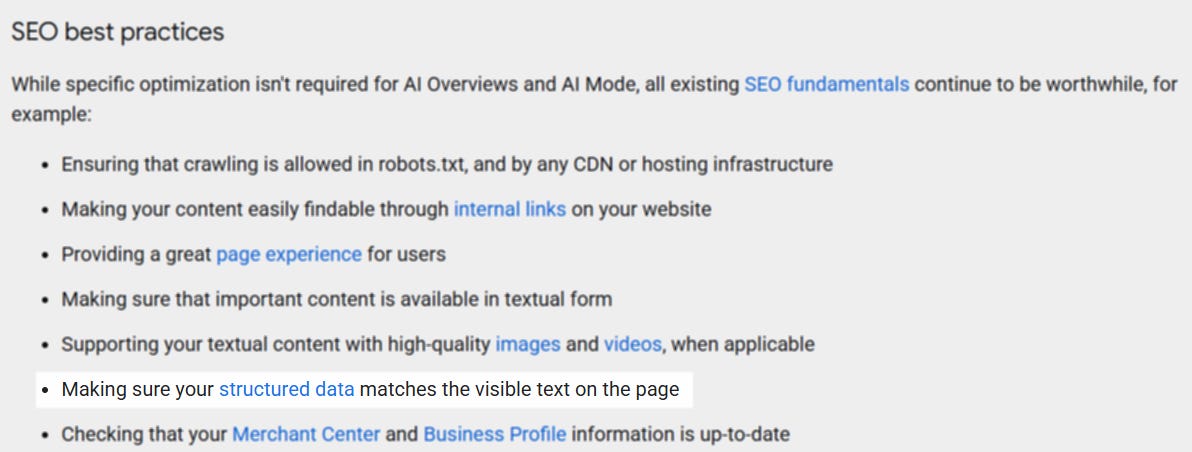
Structured: Make sure to use comprehensive schema markup for Products, Reviews, FAQs, and Organizations. Use clear heading hierarchies and semantic HTML so retrieval-augmented generation (RAG) layers can pull precise Q&A snippets and data points. Quick callout here: There are differing opinions on whether schema markup and proper hierarchies impact LLM visibility or not. Google advises it in their AI “Features” guidance2, but it’s controversial whether or not it’s helpful for other answer engines. My take? If your competitors are using it robustly, and they have better LLM or Google visibility than you do, you likely need to use it, too.
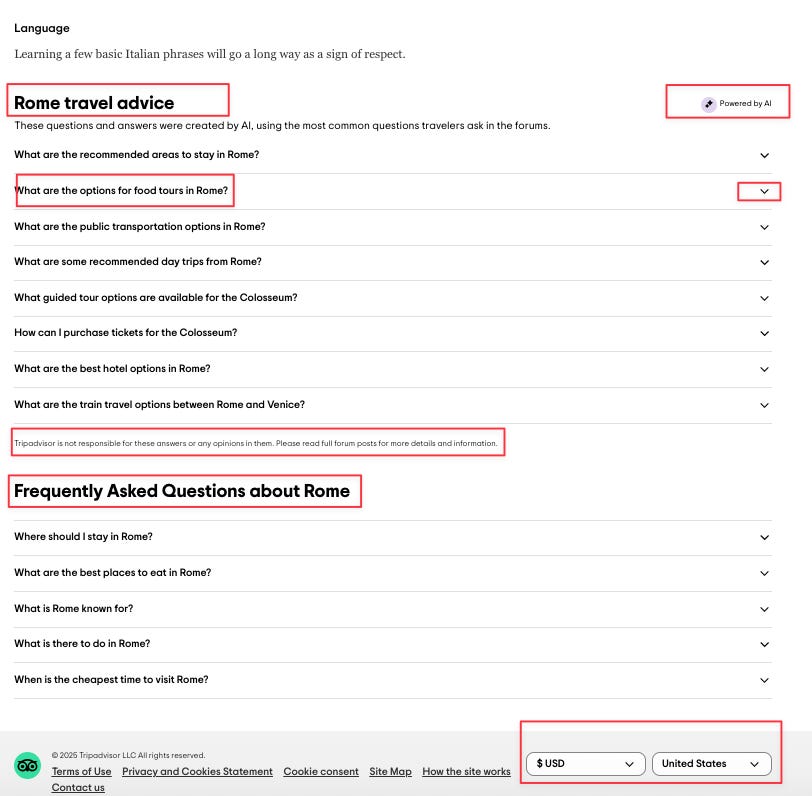
Intent-rich: Frame each listing page as a mini conversational answer – implement bullet-list specs, FAQ accordions, and “compare-to” tables so LLMs find exactly what they need in one query. (I’ve got a great Tripadvisor example of this below.)
Google’s SEO best practices for “AI Features” (Image Credit: Kevin Indig)
For marketplaces, SEO is product design.
When you treat search as a core feature – designing facets, filters, and dynamic landing pages around user intent – you’re not just optimizing for discovery, you’re crafting the entire search experience.
Finally, what happens after the click is just as critical as earning it:
Can users refine results with intuitive facets and AI-powered autocomplete?
Do your review widgets, “similar listings,” and “ask a question” prompts keep people moving through your funnel?
Are your core flows – signup, review creation, checkout – so frictionless that AI-agent driven traffic could convert as reliably as human traffic?
The Growth Memo’s UX study of AIOs confirmed that the “second-click” or “validation click” is more important than ever … if you’re fortunate enough to get that organic click, your UX and brand trust signals have to be on point.
If you bake streamlined post-click moments into your roadmap, you can turn that initial brand visibility into real engagement and trust.
Amanda jumping in here and getting all meta with a first-person note: We cannot stress enough how important the on-page experience after that earned organic click truly is. I can’t even begin to count how many times I’ve left a marketplace because of the UX hurdles or poor site search functions, only to go back to Google, ChatGPT, or just go directly to seller websites and circumvent marketplaces as a whole – despite my strong desire to compare options and read reviews outside of the actual seller’s platform.
To scale marketplace SEO successfully, you need to optimize across the whole range of product growth: website, product, and network effects.
Think of marketplace SEO as a product-wide system, not a simple checklist or set of tactics.
Here’s why: Marketplace SEO lives and dies with the volume and quality of pages. As a result, SEO pros need to become product managers and work on offering incentives and reducing friction across the user journey. Think funnel optimization, but broader.
Example: At G2, we went deep into the review creation process to understand where we need to remove or add friction to get the right balance between not only more reviews, but better ones.
But: Be careful with scaling pages too aggressively and falling below Google’s line for “quality.” As I explain in SEOzempic, too many low-quality pages can be more harmful than helpful.
Here’s what you need to consider to run your marketplace SEO program from a product growth approach:
Optimize The Website
This is a no-brainer but still deserves mention here. Optimizing the website for organic search and LLM visibility is, of course, an essential part of marketplace SEO.
But the most important areas of optimization for marketplaces are:
Indexing and crawl management.
Internal linking.
Titles & rich snippets.
Robust schema markup.
Core Web Vitals.
On-page content.
Key pieces of information.
Listing optimization.
Visual and interactive elements like maps and UGC videos.
New page types.
Each of these areas provides enough depth to fill roadmaps for years.
The key to winning is doing the basics incredibly well and building an experimentation engine that surfaces new wins and levers.
Amanda jumping in here again: If possible, don’t skip video. Yes, even if UGC videos require an internal quality control program/review in place. Underestimating the power of organic and even low-fi videos showcasing the product or user’s final decision (i.e., to go on a trip to Rome or sign up for new software based on a core feature) can earn you visibility in AIOs and LLMs. A recent client of mine earned a significant video-embed AIO mention with very clear brand visibility for a core targeted query … all with a short, simple video explaining the concept and how their product helped. It was easy to do. You bet we’ll be running tests to see if we can accomplish that on repeat.
Let’s look at this Tripadvisor example below, where every element is intentional and tested.
The site didn’t start like that, but it evolved over time. TripAdvisor has SEO deeply ingrained in its DNA. You can rest assured that every element is there for a reason.
And the interface has been updated and improved with the incorporation of AI, to include:
An AI assistant that discreetly follows the user (without interrupting) at the top of the page.
AI-assisted, community-guided itineraries.
A more robust travel guide section with tips and FAQs.
The product experience for marketplaces spans the sign-up, content creation, and admin experience (sometimes more).
It’s vital for SEO to be involved in product optimizations and improvements because it directly impacts the number and quality of pages.
Strategic questions SEO pros should ask themselves:
What (incentives) and who (user profile) drives new content? It’s critical for marketplaces to find out why users create content or buy products.
Where do users get stuck when creating new content? Where is it too easy? Too little friction decreases content quality; too much inhibits content volume. Get the balance right.
What are the core growth loops in the business? Every company has inputs and outputs that perpetuate the business forward. Inputs are things you can do to incentivize or control user behavior. (For example, offering a free month when bringing a friend.) Outputs are things that happen as a result of controlled inputs, which in themselves can drive growth. (For example, the friend you brought now also brings a friend.)
What entities need their own page type? Marketplaces often organize around key entities – places, companies, brands, or people – because entity-focused templates help LLMs and search engines understand your site structure. That said, not every template must be built around an entity; some pages serve functional or task-oriented purposes without centering on a single entity.
What optimization surfaces are available? Examples: Google’s new AI Mode, AIOs, SERP snippets, LLM citations, your core landing pages, your site’s sign-up funnel.
How can the company build a continuous testing engine? After optimizing for the basics, most wins come from experiments. Test, observe, and record outcomes, especially where Google’s AIOs, AI Mode, and LLMs are concerned. (Pro-tip: Review the LLM’s reasoning behind the outputs where your brand has visibility.)
What metrics are critical? Monitoring the right metrics that reflect the user journey (and core growth loops) defines your focus. Keep in mind: Impressions and branded search are metrics you should be paying attention to more than ever before.
Amanda jumping in here one more time: Please, I beg of you on behalf of all strategists everywhere – allow your SEO and content strategists the room and resources to test … and even fail. Above, Kevin calls out the need to build a continuous testing engine, and if you want to push forward in building organic visibility and authority in this new era of search, whether you’re a marketplace or an integrator site that’s a direct seller, testing is crucial. Teams that test (albeit wisely), fail, learn, and grow are going to be the ones who come out ahead during this chaotic season in search.
Develop Network Effects
Marketplaces are able to develop powerful network effects that accelerate growth and defend themselves from challengers.
Network effects = competitive advantages that grow with the company. Network effects get better over time (like production cost) and become your organization’s edge.
They can become protective moats, but only when they’re successful and mature.
Examples of network effects can include factors like:
Brand: recognition and visibility.
Economies of scale: doing things more efficiently than your competitors.
Switching cost: increasing opportunity cost of switching to a competitor.
Deep tech: proprietary technology that solves specific problems.
Systems of intelligence: data, monitoring systems, and understanding of customers and the market.
SEO Integrators don’t have access to the same network effects that SEO Aggregators (like marketplaces) do. Economies of scale are an example of this.
It would be absurd to say SEO needs to own network effects – it’s a company effort.
But SEO, as the largest user acquisition channel for marketplaces, needs to be aware and work toward building network effects.
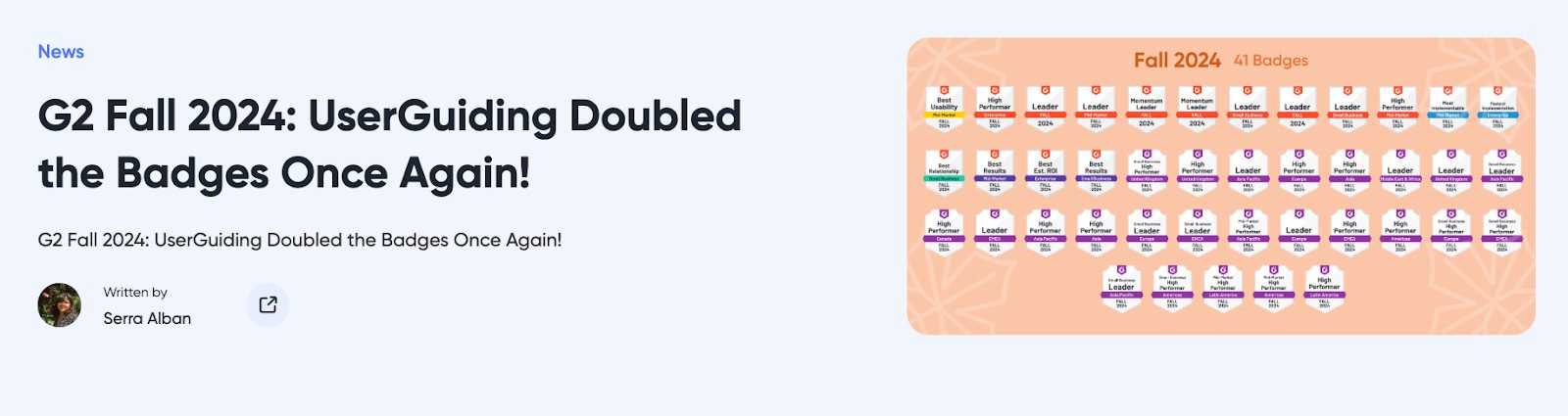
G2, for example, has developed such a prominent reputation that the G2 badge is a sign of credibility for software buyers.
That, of course, wasn’t the case when G2 (crowd) started. It developed over time and with sustained quality.
As a result, companies pay to add the badge to their sites and drive new reviews, which adds to the overall value of the marketplace.
In this example, UserGuiding not only adds them to their site in the footer, but also publishes a piece of content each year, noting their annual badge increase.3
Image Credit: Kevin Indig
Overall, the product growth approach to marketplace SEO has experimentation and funnel analysis that leads to continuous improvement at its core – that’s not what you would typically expect in classic SEO plays.
A lot is changing – and at rapid speeds – due to LLM search. This affects aggregator sites that rely on marketplace SEO practices to stay visible.
Here are a few considerations to help you stay ahead and grounded in future thinking.
1. Plan content quality for both LLMs and actual humans:
What parts of your site would an LLM flag as thin, redundant, or low-trust?
What parts of your site do humans bypass altogether?
Audit low-value boilerplates (e.g., duplicate category intros) and enrich with real user insights or data visualizations.
2. Study human usage patterns:
Which pages or features have high bounce rates or low engagement?
Why do people find these features, pages, or modules unengaging?
If users skip them, AI likely will too-identify and rework those weak spots into stronger, intent-aligned experiences.
3. Scrutinize your marketplace’s internal search:
Is your in-app search engine smarter than Google or an LLM at understanding your inventory? (If not, this is a big problem.)
Invest in embeddings-based search, synonym maps, and AI-driven recommendations so buyers find what they need faster.
4. Work toward visibility resilience, no matter what happens in search:
If organic SEO disappeared tomorrow, what parts of your marketplace would still attract qualified traffic?
What do you need to do today to mitigate reliance on classic or outdated SEO tactics and results?
Look to direct channels – email, social communities, partnerships – and fortify them so you’re not over-reliant on any single source.
5. Diversify your marketing channels if you haven’t already:
Explore app integrations and in-product suggestions to capture audiences where they already live.
Experiment with live-commerce, social-commerce, and brand collaborations to fill gaps beyond search.
Google Marketing Live 2025 was a whirlwind of announcements, with over 30 new product updates and features unveiled, most of them powered by AI.
The event highlighted Google’s commitment to transforming advertising through AI across four key pillars: Search, Creativity, Measurement, and Agentic Capabilities.
Here’s a breakdown of the major announcements and how marketers can take advantage of these updates in 2025.
Search Updates
Most of the Search updates were centered around numerous AI capabilities, which isn’t surprising.
Updates to Search included:
Ads in AI Overviews now on Desktop. Ads are now live in AI Overviews for desktop users in the U.S. These ads show in the scrollable AI-generated summary box and aim to match high-intent queries with tailored results.
AI Mode in Google Search. This is a separate conversational search experience, powered by Gemini. Ads will soon appear contextually within longer conversations, such as when a user is narrowing down a decision. This is still in testing, but advertisers should expect rollout later this year.
AI Max for Search Campaigns. While technically announced a few weeks before GML, there were more updates shared. It’s a suite of features including creative and targeting enhancements to optimize your existing Search campaigns.
Clearer Ad Labeling in AI Surfaces. As ads become more integrated into exploratory formats, Google is refining how they’re labeled to maintain transparency.
Smart Bidding Exploration. A new toggle setting in Google Ads for Search campaigns that allow you to capture additional conversions that you may not have been eligible for due to existing bidding restrictions. It provides a more flexible ROAS target.
These updates signal that traditional keyword-first search strategies won’t cut it anymore.
If you’re not feeding the right creative and conversion signals into your campaigns, you’ll be left out of this AI-first discovery layer.
Performance Max Updates
There were some very welcome updates announced for the Performance Max campaign type that are worth noting for advertisers.
Channel-level performance. This is one of the most requested features for Performance Max, and now it’s here. Advertisers will have access to what channels their ads are serving on, as well as better search term and ad asset reporting.
Search terms reporting. Another top-requested feature, advertisers will have the same level of search term reporting for Search and Shopping placements in their Performance Max campaigns.
Exclusion of interacted users. In order to better reach net new users, advertisers will be able to exclude people who are searching for your brand, or have interacted with a YouTube video, website, or app – all with one click. It’s important to note that this feature isn’t available yet, and will be rolling out later this year.
Creative Updates
To meet the growing demand for dynamic and engaging content, Google introduced tools that simplify and scale creative asset production.
Updates were announced across Display, Video, and Demand Gen inventory.
Demand Gen Maps inventory. While technically not a creative update, this falls within visual updates. Advertisers using Demand Gen campaigns will be able to reach users who are searching for businesses and locations using Promoted Pins. The goal is to drive in-store traffic and sales.
New Creator Partnerships central hub. In a huge move towards social influence, Google announced a new hub to work with creators directly in the Google Ads interface. Advertisers can use this to integrate creator-influencer content into their ad strategy.
Insights Finder. Advertisers can find the top trending creators for a specific topic, category, or industry to help narrow down their potential partnerships in the YouTube Creator community.
YouTube Shoppable Masthead. Available on the mobile Masthead placement, you can now make your ad placement shoppable to drive website traffic and conversions.
Shoppable CTV. This feature will be available for Demand Gen and Performance Max campaigns, where users can engage with products directly on their TV screen.
New video ads across Google surfaces. Video ads are coming to Search, Image Search, and Google Shopping placements within Performance Max campaigns.
Reformat and extend video assets. This will use generative AI to take your existing assets and extend them to all available asset ratios.
New Peak Points ad format. This new ad format is powered by Gemini, and will integrate your ads within YouTube videos at precisely timed moments.
Accelerated checkout for Demand Gen campaigns. You will now be able to redirect YouTube shoppers directly to your checkout or cart from your ad.
Asset Studio in Google Ads. This is a one-stop studio for advertisers to create high-quality assets and variations. You can even generate images and videos using your products to create lifestyle imagery. This will be available in Google Ads and Merchant Center.
Brand profile updates. What used to only be managed through Google Business Profile can also be managed through Merchant Center.
A/B Testing in Merchant Center. You’ll be able to review content suggestions, A/B test opportunities, promotion recommendations, and more.
Content hub in Merchant Center. It takes video from your social channels and website to provide AI-powered video recommendations for product campaigns.
AI tools in Product Studio. This will help create brand images and videos, allowing you to save and/or publish assets across Google in one click.
The bulk of the updates from Google Marketing Live were surrounded by creative updates, which indicates where Google is putting its best foot forward in terms of differentiating its ad platform from others.
Measurement Updates
Google’s new measurement tools offer more granular insights and facilitate data-driven decision-making.
Incrementality test thresholds lowered. Available to test within the Google Ads UI starting at $5,000 per test instead of the previous $100,000 threshold.
Attributed brand searches. This feature will help quantify the number of users who searched for your brand after seeing a video ad.
Meridian Scenario Planner. Helps model future campaign budgets and forecasts to better allocate spend.
Manage cross-channel budgets in Google Analytics. You’ll now be able to analyze performance, adjust spend, and optimize cross-channel budgets directly in Google Analytics.
Data Manager updates. This uses your first-party data sources to understand your data strength and how to better optimize campaigns as a result. Includes sources like BigQuery, HubSpot, Oracle, Salesforce, Shopify, and more.
Web and App integrations in Google Ads. Unified web and app conversion tracking can help optimize customer journeys.
tROAS bidding for iOS App campaigns. A new bidding type available to iOS instead of just bidding on Installs, helping make your campaigns more profitable in the long run. It will now include event-level data to improve iOS optimization and reporting.
Agentic Capabilities
Google is introducing agentic tools that act on behalf of advertisers, automating routine tasks and providing strategic recommendations.
Marketing Advisor. This is an agent built within Chrome to help solve problems, including voice interaction. Its main goal is to help with instant task completion and business advice.
Google Ads Expert. This is aimed to help streamline campaign creation, along with speedy performance improvements, providing and applying specific recommendations based on your existing campaign and business data. Google mentioned it would also proactively identify and fix problems before they impact your ads.
Google Analytics Expert. Get strategic advice and recommendations based on your Google Analytics data. Currently, this is in limited beta.
These updates are aimed at providing more streamlined support to Google advertisers, as they’ve gotten feedback about a lack of Google-supplied support over the past few years.
How Marketers Can Start Testing These Updates
With so many updates announced, jumping in without a plan is a good way to burn budget. Here’s how you can strategically get ahead of the rollout:
1. Phase Your Adoption
Not every tool will be immediately available, or available in all markets.
Start with what you can control: Asset Studio, Merchant Center profile updates, Google Analytics 4 attribution enhancements, etc.
2. Set Up Controlled Tests
If you’re not ready to go all-in on new features, set up campaign experiments or geo splits when testing new Smart Bidding Exploration or incrementality tools.
Watch how performance shifts before scaling further or adding new features to test.
3. Audit Your Current Creative
Make sure your images, headlines, and videos meet Google’s quality guidelines. That foundation matters before layering AI enhancements.
Remember, your AI-powered creative will only be as good as the inputs you’re giving the system!
4. Document What You Change
This is a must for all advertisers. Whether testing creative variations or letting the agentic assistant make tweaks, log what was modified. It’s the only way to evaluate impact.
5. Involve Your Team(s) Early
Help your designers, analysts, and media managers understand what’s changing. Many of these updates will shift how each department works.
Which Features Stand Out The Most?
While Google Marketing Live introduced a huge set of new features, certain updates stand out for their potential to significantly benefit smaller advertisers.
In my opinion, these updates are the ones worth paying attention to, especially for SMBs.
Smart Bidding Exploration
Smart Bidding Exploration is a significant enhancement to Google’s automated bidding strategies.
This feature allows campaigns to tap into a broader range of search queries by using machine learning to analyze various signals and predict conversion likelihoods.
It adjusts bids in real-time, enabling advertisers to reach users during their research and consideration phases, even before they enter the traditional sales funnel.
For smaller advertisers with limited budgets, Smart Bidding Exploration offers a way to discover untapped traffic sources without overhauling existing keyword strategies.
By leveraging AI to identify high-performing queries, businesses can expand their reach and drive more conversions efficiently.
Incrementality Testing
Google has reduced the minimum spend requirement for incrementality testing from $100,000 to just $5,000.
This change democratizes access to advanced measurement tools, allowing smaller advertisers to assess the true impact of their campaigns on brand perception and customer behavior.
Previously, only large advertisers could afford to run incrementality tests. Now, smaller businesses can gain valuable insights into how their advertising efforts influence customer actions, enabling more informed decision-making and optimized marketing strategies.
Enhanced Video Asset Tools
Google’s new video asset tools, including the Asset Studio and AI-powered features like image-to-video transformation and outpainting, simplify the creation of engaging video content.
These tools allow advertisers to generate high-quality videos from existing images and expand visuals beyond their original frames, making it easier to produce content suitable for various platforms.
Video content is increasingly important in digital marketing, but producing it can be resource-intensive. These new tools lower the barrier to entry, enabling smaller advertisers to create compelling videos without the need for extensive resources or expertise.
A/B Testing In Merchant Center
Google has introduced A/B testing capabilities within Merchant Center, allowing advertisers to test different product titles, images, and descriptions directly in the platform.
This feature enables businesses to identify the most effective content variations to enhance engagement and conversion rates.
For ecommerce businesses, especially smaller ones, optimizing product listings can significantly impact performance.
This new testing feature provides a straightforward way to experiment and refine listings based on real user data, leading to better outcomes with minimal effort.
What Comes Next For Marketers
Google Marketing Live 2025 wasn’t just about showcasing new features. It was a signal that the way we plan, build, and measure campaigns is shifting yet again.
Marketers who test early, stay curious, and apply these tools with intention will be in the best position to benefit.
That doesn’t mean blindly adopting every new update. It means understanding where automation can help, where oversight is still critical, and where your strategy needs to evolve.
The biggest gains won’t come from the tools themselves, but from how you choose to use them.
More Resources:
Featured Image: Brooke Osmundson/Search Engine Journal
One thing that rarely gets enough attention in SEO is how user behavior, trends, and sentiment toward a brand shape performance.
It doesn’t just apply to traffic from new queries. It also affects how many people choose to click on your brand in search results.
When something shifts outside of SEO, like a wave of negative press, seasonal change, or a shift in consumer preferences, it can lead to more or fewer branded searches.
It can also bring new associations with your brand, such as a rise in negative reviews or more online mentions that carry a clear tone. These can be early signs that something is changing. Often, the change hasn’t shown up anywhere else yet.
This is why SEO can act like a canary in the coal mine. It can surface early warning signs before customer satisfaction scores drop or sales start to slide.
Organic search data can reveal early cracks in brand trust, preference, or product satisfaction.
Search Reflects Real-Time Thinking
Search is one of the few places where people show exactly what they are thinking. They do it without filters, without needing to contact anyone, and without revealing who they are.
This makes it very different from leaving a review or speaking to a customer service team.
Search gives users a way to explore concerns, check claims, or validate ideas in private. That makes SEO data more private and potentially more honest than surveys or social media.
When people begin to doubt your brand, consider alternatives, or worry about price or quality, those feelings often show up in search before they show up anywhere else.
If people are asking whether your brand is legitimate or if your deliveries arrive on time, these are not throwaway questions. They are signs that something might be going wrong. These moments often come before complaints appear in reviews or support tickets.
Search behavior is usually the first place to spot a shift in public opinion. SEO data updates all the time, which means you get a live read on how your brand is landing with users. You can spot changes even if your rankings or revenue haven’t moved yet.
This is even more important now that people use AI and LLM tools more often. These models can show outdated or negative content that still lingers online. This affects how your brand appears across a wider landscape than just Google Search.
Signals That Point To Brand Trouble
SEO has often been judged on traffic and rankings, but not all signals are about performance. Some are predictive. They show up in how users frame queries, stack questions, and explore comparisons.
These behaviors reflect how they move through the search journey to find what they need.
Here are a few signs that can point to growing brand problems:
Drop In Branded Search Volume
If fewer people are searching for your brand name over time, it might mean you’re losing relevance or being overtaken by competitors.
Sometimes, it’s just seasonal. Sometimes, it’s the result of a big push from a rival. Either way, it’s worth a closer look and worth talking about across teams.
Growth In Negative Sentiment Keywords
Search engines have long been aware of sentiment. You can see this in how Google highlights review terms like “refund,” “problem,” or “delivery issue.”
If more users are typing these words alongside your brand, it can suggest rising frustration. Often, this happens before customer service sees a spike or before review scores drop.
Users asking whether your brand is trustworthy or if it’s a scam are not always doing so out of curiosity. Sometimes, they are actively trying to avoid making a mistake.
These moments are decision points, and they can cause people to switch to a competitor who has fewer trust issues in search.
Falling CTR On Branded Results
If your branded listings are getting fewer clicks and you haven’t changed your paid strategy, something might be off.
It could be that negative news, poor reviews, or competitor ads are winning attention. It could also mean users know your brand but are now choosing to avoid it.
New “People Also Ask” Questions
Google’s “People Also Ask” feature reacts to the wider search landscape. If questions like “Is this brand legit?” or “Does this product work?” start appearing next to your listings, it’s a reflection of growing uncertainty.
These shifts often point to new concerns that haven’t yet reached your team.
Standard Dashboards Don’t Show This
Most brands use a familiar mix of tools to track performance. These usually include sales numbers, social mentions, customer service logs, and net promoter scores. These are helpful, but they only show what’s already happened.
SEO data is different. It captures what users are wondering right now. It reflects unfiltered curiosity or concern. People don’t always leave feedback, but they often search when something feels wrong. That’s what makes search such a powerful signal.
Even the best social listening tools only rely on what users are willing to share in public. Search data shows what users are trying to understand privately. This gives you an early edge.
When SEO Is Seen Only As Performance
If you treat SEO as only a rankings or traffic tool, you miss a wider opportunity. That approach is becoming less useful in modern search, especially with the rise of AI. Search is evolving, and so is how users engage with it.
Organic search can show the small cracks in perception long before those cracks grow into bigger problems.
This layer is often ignored because it doesn’t sit neatly in a performance dashboard, but it can be one of the most valuable tools for protecting a brand’s reputation.
Build The Feedback Loop
Spotting the signals is only the first step. To get real value, you need a way to feed this information back to the right teams.
In most companies, SEO insights stay with the marketing or content teams, but PR should be looped in so they can act fast or use the data to shape their response.
Customer support should know what users are searching for so they can update scripts or prepare for new types of complaints.
Product teams can look at whether confusing searches are tied to real product issues. Brand and customer experience teams can adjust messaging on high-impact pages.
Final Thoughts
SEO isn’t just about growth. It’s a lens into what your audience is thinking and feeling. When used properly, it can surface early signs of trouble before they appear in sales, reviews, or tickets.
Brands that treat SEO as a signal, not just a channel, can spot problems early, act faster, and protect what matters most.
Google has published guidelines on what to do if your rankings are affected after being incorrectly flagged by Google’s SafeSearch filter. The new documentation offers three actions to take to resolve the issues.
The new documentation provides guidance on three steps to take:
How to check if Google’s Safe Search is filtering out a website.
Guide to how to fix common mistakes
Troubleshooting steps
SafeSearch Filtering
Google’s SafeSearch is a filtering system that removes explicit content from the search results. But there may be times when it fails and mistakenly removes the wrong content.
These are Google’s official steps for verifying if a site is being filtered:
“Confirm that SafeSearch is set to Off.
Search for a term where you can find that page in search results.
Set SafeSearch to Filter. If you don’t see your page in the results anymore, it is likely being affected by SafeSearch filtering on this query.”
To check if the entire site is being filtered by SafeSearch, Google recommends doing a site: search for your domain, then set the SafeSearch setting to “Filter” and if the site doesn’t appear in a site: search that means that Google is filtering out the entire website.
If mistakes were found and fixed it takes Google at least two to three months for the algorithmic classifiers to clear the site. Only after three months have passed does Google recommend requesting a manual review.
Read Google’s guidance on recovering a site from incorrect flagging: