“I completely lost my website due to financial disputes with the hosting company. I have no backup and the only thing I have left is a domain.
I am currently preparing a new website with the previous content and theme. Can I use the previous domain or not? What is your suggestion?”
This is a difficult, but not uncommon, issue to face. You invested time, money, and resources in creating your website. To lose it is highly frustrating.
From an SEO perspective, it might feel like all is lost – the topical authority, the backlinks, your high-performing content.
But don’t worry, it’s not! I’m going to take you through a few steps to recover as much of your website and previous rankings as possible.
I see no issue with reusing your old domain address for the recovered site. That is, as long as no other site was hosted on it while yours was down.
If you owned the domain name throughout this time, you should be fine to restore your site at that address.
In fact, I would highly recommend it to ensure you recapture as much of your old site’s authority as you can.
Recovering Your Assets
The first step is to recover as much of your existing website as you can. You might not have a backup of your site, but thankfully, the internet does!
Content
I would start by going to the Wayback Machine. This is essentially a non-profit archive of the internet.
It claims to have saved over 928 billion webpages. There is a high chance that some of those will be yours!
You can search for your website domain and scroll back through time to when screenshots of your pages were taken. That should enable you to copy and paste some, if not all, of the copy that was on your site.
I would also suggest having a look at your analytics program to identify what your top-visited content was. This should be what you look to recover or recreate first.
Authority
The good news with still having your website domain is that you will still have the opportunity to recover backlinks that were pointing to your pages.
It’s important to host your content on the same URLs as it previously was. This means that if you still have links pointing to your site from external sources, they will continue to work when you set the URL live again.
If you are unable to recreate the exact URL for some reason, make sure to implement a 301 redirect from the old URL to the new one to retain the value of those links.
Reclaim Old Backlinks
If your site went down during the hosting dispute, your webpages were likely to return a 404 or other non-200 status code.
This could mean that external publications chose to change their links from pointing to your page to another so as to still enable their visitors to reach usable content.
This doesn’t mean that those links are gone forever. Evaluate which links were lost during the domain issues using a backlink analytics tool, and begin reaching out to those publications to inform them that your content is back.
It may be that they choose to link to your content again over the newer content they found.
Link Building To Help Crawling
External links aren’t just helpful for signaling relevancy and authority; they can also help to encourage the search bots to crawl the content they link to.
If your site has been offline for a while, it’s possible that the bots have reduced their frequency of crawling. New backlinks could indicate that the website is worth crawling more frequently again.
Technical
There is more to restoring your website to its former glory than just recovering the old content, of course.
A large part of what makes a website well-optimized for search engines and humans alike is its technical foundation.
Same Architecture
Where possible, try to recreate the website’s architecture.
I’ve already mentioned trying to re-use the old URLs, but also consider how and where they linked to each other.
Use the same menu structure and anchor text. This will help reinforce the relevance of the pages to each other and demonstrate that the site is the same as it was before.
Submit To Be Crawled
Once you’ve got your website back to how it was, you will want to let the search engines know to crawl it again.
Aside from encouraging crawling by getting new backlinks, as already mentioned, you can submit a request in Google Search Console and Bing Webmaster Tools for their bots to recrawl individual pages. Note that you may need to verify ownership of the domain in Google Search Console and Bing Webmaster Tools again.
Choose some of your more important pages so that they get crawled and back into the indexes as soon as possible.
XML Sitemaps
You should also make sure you have set up XML sitemaps again for the pages that you have recovered.
Submit these to the search consoles to further inform the Google and Bing bots of your pages’ existence, so they can crawl them and see that they are live again.
Take Note Of Any Issues Found
As the search engines begin to recrawl the site, take note of any issues Google and Bing report on through their search consoles.
There may be new issues that have crept in during the rebuild of your website that weren’t there before.
Improve
You can use this as an opportunity to evaluate what was working with your website and what wasn’t.
The temptation might be to recover and rebuild the site to reflect its former state. However, you might find that you can actually improve it instead.
What Were You Ranking For
As you review your old content’s performance, take a look at whether it ranked well before it was lost.
It may be that, instead of recovering it and uploading it exactly as it was before, you can use this as an opportunity to improve its relevancy to the search phrases users would use to land on it.
Review competitors’ content that has been flourishing while yours has been lost. Take note of what the top-ranking content contains that your recovered content doesn’t.
What’s Changed In The Industry
If your website has been down for a while during this hosting dispute, then the industry may have moved on.
Start to look for gaps in the content that your site used to address and what users are looking for now.
Are there new trends, products, or services that are becoming popular in your industry that you have not covered with your site previously?
Protect
The most important step once you have recovered and improved your site is to reduce the risk of losing it in the future.
You will hopefully never have an issue with your hosting again, but other issues can occur that can cause your website to go offline.
Backups
First of all, take backups of your new site. Many content management systems make it easy to do this, but if yours doesn’t, or if you’ve built it yourself, consider what you can save offline.
Save Your Content
Take copies of all the written content on your site. Make sure that you save it somewhere that isn’t directly linked to your website in case you run into issues again.
Don’t forget to save copies of the images you use, especially if they are unique to your website.
Save Your Meta
Take copies of each page’s search engine optimization.
For example, download the page title and description alongside your main body content.
Mark up the headers and save the image descriptions, and keep the filenames as you used on the site. This will speed up the recovery of your site in the future.
Save Your Schema Markup
Don’t forget to take copies of any bespoke code you used. This includes schema markup. This could save you a lot of time in the future, especially if you write your own schema rather than using plugins.
This can also help if you end up migrating from one CMS to another that doesn’t use the same schema modules.
Resuming Your Optimization Efforts
It is horrifying to think that the website you have spent so much time on is gone for good. Thankfully, it’s probably not.
It’s worth consider that there may be legal recourse available to you to aid in the recovery of your website.
Make sure to check your hosting terms of service thoroughly, as they may give avenues you can explore to regain control of your content.
It may not be as simple as asking your hosting provider for support if you are already in a legal dispute with them, but there may be some legal options available to you.
In the future, it is important to consider the trustworthiness and levels of support provided by your hosting provider.
Look up reviews of potential hosting services before committing to them to make sure you don’t end up going through a similar struggle again.
Losing access to your website can be costly in terms of money and time, and a highly stressful situation. But, follow the steps above and you should get back to working on your website.
More Resources:
Featured Image: Paulo Bobita/Search Engine Journal
Trying to regain lost visibility in AI-powered search results?
As AI Overviews and answer engines continue to reshape how search works, organic visibility can disappear overnight. If your traffic has taken a hit, you may need a more complete strategy to recover and grow.
Search is no longer limited to paid or organic results. Success now comes from owning the full search engine results pages (SERPs), including local listings and AI-driven experiences.
On May 27, 2025, at 12pm ET, you will learn: ✅ How to gain total SERP visibility across paid, organic and local search ✅ How to use Gen AI to improve content and capture intent ✅ How to turn an integrated search strategy into measurable business results
This session is led by Bhavin Prashad, Associate Vice President of Digital Media, and Dan Lauer, SEO Strategist at DAC. They will walk you through the TotalSERP strategy and show how it can help you rebuild what Google’s algorithm and AI may have taken away.
What makes this session different
The TotalSERP strategy aligns your paid, organic, and local efforts into one consistent plan. It is designed to help you capture customers at every stage of their search journey.
Let’s help you take back control of your visibility and drive results across every part of the search experience.
If you cannot attend live, go ahead and register. We will send you the full recording after the event.
Police and federal agencies have found a controversial new way to skirt the growing patchwork of laws that curb how they use facial recognition: an AI model that can track people using attributes like body size, gender, hair color and style, clothing, and accessories.
The tool, called Track and built by the video analytics company Veritone, is used by 400 customers, including state and local police departments and universities all over the US. It is also expanding federally: US attorneys at the Department of Justice began using Track for criminal investigations last August. Veritone’s broader suite of AI tools, which includes bona fide facial recognition, is also used by the Department of Homeland Security—which houses immigration agencies—and the Department of Defense, according to the company.
“The whole vision behind Track in the first place,” says Veritone CEO Ryan Steelberg, was “if we’re not allowed to track people’s faces, how do we assist in trying to potentially identify criminals or malicious behavior or activity?” In addition to tracking individuals where facial recognition isn’t legally allowed, Steelberg says, it allows for tracking when faces are obscured or not visible.
The product has drawn criticism from the American Civil Liberties Union, which—after learning of the tool through MIT Technology Review—said it was the first instance they’d seen of a nonbiometric tracking system used at scale in the US.They warned that it raises many of the same privacy concerns as facial recognition but also introduces new ones at a time when the Trump administration is pushing federal agencies to ramp up monitoring of protesters, immigrants, and students.
Veritone gave us a demonstration of Track in which it analyzed people in footage from different environments, ranging from the January 6 riots to subway stations. You can use it to find people by specifying body size, gender, hair color and style, shoes, clothing, and various accessories. The tool can then assemble timelines, tracking a person across different locations and video feeds. It can be accessed through Amazon and Microsoft cloud platforms.
VERITONE; MIT TECHNOLOGY REVIEW (CAPTIONS)
In an interview, Steelberg said that the number of attributes Track uses to identify people will continue to grow. When asked if Track differentiates on the basis of skin tone, a company spokesperson said it’s one of the attributes the algorithm uses to tell people apart but that the software does not currently allow users to search for people by skin color. Track currently operates only on recorded video, but Steelberg claims the company is less than a year from being able to run it on live video feeds.
Agencies using Track can add footage from police body cameras, drones, public videos on YouTube, or so-called citizen upload footage (from Ring cameras or cell phones, for example) in response to police requests.
“We like to call this our Jason Bourne app,” Steelberg says. He expects the technology to come under scrutiny in court cases but says, “I hope we’re exonerating people as much as we’re helping police find the bad guys.” The public sector currently accounts for only 6% of Veritone’s business (most of its clients are media and entertainment companies), but the company says that’s its fastest-growing market, with clients in places including California, Washington, Colorado, New Jersey, and Illinois.
That rapid expansion has started to cause alarm in certain quarters. Jay Stanley, a senior policy analyst at the ACLU, wrote in 2019 that artificial intelligence would someday expedite the tedious task of combing through surveillance footage, enabling automated analysis regardless of whether a crime has occurred. Since then, lots of police-tech companies have been building video analytics systems that can, for example, detect when a person enters a certain area. However, Stanley says, Track is the first product he’s seen make broad tracking of particular people technologically feasible at scale.
“This is a potentially authoritarian technology,” he says. “One that gives great powers to the police and the government that will make it easier for them, no doubt, to solve certain crimes, but will also make it easier for them to overuse this technology, and to potentially abuse it.”
Chances of such abusive surveillance, Stanley says, are particularly high right now in the federal agencies where Veritone has customers. The Department of Homeland Security said last month that it will monitor the social media activities of immigrants and use evidence it finds there to deny visas and green cards, and Immigrations and Customs Enforcement has detained activists following pro-Palestinian statements or appearances at protests.
In an interview, Jon Gacek, general manager of Veritone’s public-sector business, said that Track is a “culling tool” meant to speed up the task of identifying important parts of videos, not a general surveillance tool. Veritone did not specify which groups within the Department of Homeland Security or other federal agencies use Track. The Departments of Defense, Justice, and Homeland Security did not respond to requests for comment.
For police departments, the tool dramatically expands the amount of video that can be used in investigations. Whereas facial recognition requires footage in which faces are clearly visible, Track doesn’t have that limitation. Nathan Wessler, an attorney for the ACLU, says this means police might comb through videos they had no interest in before.
“It creates a categorically new scale and nature of privacy invasion and potential for abuse that was literally not possible any time before in human history,” Wessler says. “You’re now talking about not speeding up what a cop could do, but creating a capability that no cop ever had before.”
Track’s expansion comes as laws limiting the use of facial recognition have spread, sparked by wrongful arrests in which officers have been overly confident in the judgments of algorithms. Numerous studies have shown that such algorithms are less accurate with nonwhite faces. Laws in Montana and Maine sharply limit when police can use it—it’s not allowed in real time with live video—while San Francisco and Oakland, California have near-complete bans on facial recognition. Track provides an alternative.
Though such laws often reference “biometric data,” Wessler says this phrase is far from clearly defined. It generally refers to immutable characteristics like faces, gait and fingerprints rather than things that change, like clothing. But certain attributes, such as body size, blur this distinction.
Consider also, Wessler says, someone in winter who frequently wears the same boots, coat, and backpack. “Their profile is going to be the same day after day,” Wessler says. “The potential to track somebody over time based on how they’re moving across a whole bunch of different saved video feeds is pretty equivalent to face recognition.”
In other words, Track might provide a way of following someone that raises many of the same concerns as facial recognition, but isn’t subject to laws restricting use of facial recognition because it does not technically involve biometric data. Steelberg said there are several ongoing cases that include video evidence from Track, but that he couldn’t name the cases or comment further. So for now, it’s unclear whether it’s being adopted in jurisdictions where facial recognition is banned.
This is today’s edition of The Download, our weekday newsletter that provides a daily dose of what’s going on in the world of technology.
How a new type of AI is helping police skirt facial recognition bans
Police and federal agencies have found a controversial new way to skirt the growing patchwork of laws that curb how they use facial recognition: an AI model that can track people based on attributes like body size, gender, hair color and style, clothing, and accessories.
The tool, called Track and built by the video analytics company Veritone, is used by 400 customers, including state and local police departments and universities all over the US. It is also expanding federally.
The product has drawn criticism from the American Civil Liberties Union, which—after learning of the tool through MIT Technology Review—said it was the first instance they’d seen of a nonbiometric tracking system used at scale in the US. Read the full story.
—James O’Donnell
If you’re interested in reading more about facial recognition and police tech, check out:
+ How the largest gathering of US police chiefs is talking about AI. Officers training in virtual reality, cities surveilled by webs of sensors, and AI-generated police reports are all a sign of what’s to come. Read the full story.
+ Clear, the company that has helped millions of people cut security lines, wants to give you a frictionless future—in exchange for your face. Read the full story.
+ Why the movement to limit face recognition tech might finally get a win. Read the full story.
+ Uber’s facial recognition is locking Indian drivers out of their accounts— and some people are finding their accounts permanently blocked. Read the full story.
The must-reads
I’ve combed the internet to find you today’s most fun/important/scary/fascinating stories about technology.
1 The US and China have struck a deal to slash tariffs For the next 90 days, at least. (Politico) + But America’s 30% tariffs are still extremely high. (FT $) + China has agreed to cut its levies from 125% to 10%. (CNN)
2 OpenAI is negotiating a future IPO with Microsoft While still preserving Microsoft’s access to the startup’s AI models. (FT $) + Meanwhile, Microsoft is constantly racing to stay ahead of hackers. (Bloomberg $)
3 DOGE cuts leave US workers at increasing risk of developing silicosis The lung disease is deadly—and preventable. (The Atlantic $) + Can AI help DOGE slash government budgets? It’s complex. (MIT Technology Review)
4 Scammers are posing as lawyers on TikTok to trick undocumented migrants Immigration scams have skyrocketed since Trump took office. (WP $) + An extensive sextortion network on TikTok is targeting American kids. (The Guardian) + AI-powered fraud is everywhere right now. (Wired $)
5 Weather balloons are being phased out in favor of AI tools Severe budget cuts mean that fewer balloon flights are being scheduled. (Semafor) + Trump’s tariffs will deliver a big blow to climate tech. (MIT Technology Review)
6 Amazon Web Service depends on this mysterious chip startup Annapurna, the company behind Amazon’s cloud success, is vital to its future. (WSJ $)
7 Inside the quest to create the perfect solid-state battery Massachusetts start-up Factorial wants to overhaul EVs’ image. (NYT $) + But tariffs are bad news for batteries. (MIT Technology Review)
8 A colossal data center in North Dakota is sitting empty It’s struggling to find a major tech customer to lease it. (The Information $) + China built hundreds of AI data centers to catch the AI boom. Now many stand unused. (MIT Technology Review)
9 Housewives make up Vietnam’s latest wave of gig workers They’re storing goods in their fridges while they’re at home to cut costs. (Rest of World)
10 Professional writers love Substack They’re using the medium to experiment with exciting new styles. (New Yorker $) + Niche newsletters are big business these days. (NYT $)
Quote of the day
“It feels a bit like a prisoner seeing their triple life sentence reduced to a single one.”
—Katja Bego, a senior research fellow at Chatham House, comments on the agreement between the US and China to cut tariffs from 145% to 30% in a post on Bluesky.
One more thing
The $100 billion bet that a postindustrial US city can reinvent itself as a high-tech hub
On a day in late April, a small drilling rig sits at the edge of the scrubby overgrown fields of Syracuse, New York, taking soil samples. It’s the first sign of construction on what could become the largest semiconductor manufacturing facility in the United States.
The CHIPS and Science Act was widely viewed by industry leaders and politicians as a way to secure supply chains, and make the United States competitive again in semiconductor chip manufacturing.
Now Syracuse is becoming an economic test of whether, over the next several decades, aggressive government policies—and the massive corporate investments they spur—can both boost the country’s manufacturing prowess and revitalize neglected parts of the country. Read the full story.
—David Rotman
We can still have nice things
A place for comfort, fun and distraction to brighten up your day. (Got any ideas? Drop me a line or skeet ’em at me.)
+ Stuck on which PC game to play? This list of the 100 best is a great place to start. + Mari Salonen is the undisputed queen of pom poms. + I like the look of this Swedish princess cake. + Check out all the filming locations in the new Netflix show The Four Seasons—from Puerto Rico to Mount Peter.
Google instructs its human quality raters to apply “EEAT” when evaluating a page on search results. “Experience, Expertise, Authoritativeness, Trustworthiness” are quality indicators, per Google.
Google cites EEAT in its documentation, prompting many search engine marketers to advertise “EEAT optimization” services. Unfortunately, I’ve seen tactics that fabricate EEAT with fake authors, bios, and experience.
Moreover, many marketers claim better EEAT can overcome losses from Google’s “helpful content” ranking algorithm. Yet Google has offered no such recovery method.
Humans, not Algorithms
The rise of “EEAT optimization” services has reached the search giant. In the January 2025 update to its quality guidelines (PDF), Google instructs raters to detect fake authors, fake profile pictures, and fake expertise via:
A webpage or website with “fake” owner or content creator profiles. For example, AI generated content with made up “author” profiles (AI generated images or deceptive creator descriptions) in order to make it appear that the content is written by people.
Factually inaccurate and deceptive information about creator expertise. For example, an author or creator profile inaccurately claims to have credentials or expertise (e.g., the content creator claims falsely to be a medical professional) to make the content appear more trustworthy than it is.
The update — I added the bold words — confirms Google recognizes the problem of fake EEAT credentials and encourages raters to be on the lookout.
EEAT is for human evaluators. It’s not a direct algorithmic ranking factor. Beware of services that promise otherwise.
Instead, ensure your EEAT components are prominent and thorough. Most businesses overlook the opportunity and fail to disclose one or more of the following:
Founder(s) name, experience, education, awards, and achievements.
Collaborating companies (entities), such as key customers and vendors.
Citations and links in blog posts and marketing materials.
Links to the business’s social media profiles (containing key company details)
Genuine reviews or verifiable testimonials
Detailed contact info (mail, physical, and email addresses; phone number), not solely a generic contact form.
Include structured data markup (such as Organization schema) to help search engines and AI platforms access the above details.
Trust and authority are commonsense qualities of any reputable business, not just those looking for organic search visibility. Nonetheless, demonstrate to search engines, genAI platforms, and humans by:
Hiring or collaborating with knowledgeable writers and experts.
Investing in authority-driven content, such as research and surveys.
Keeping social media profiles active and engaging.
In short, EEAT may not directly improve organic search rankings. But fabricating the components will likely cause long-term harm. Consumers buy from authentic and honest businesses. Those qualities drive engagement and conversions.
New research shows that Google’s AI Overviews often link to Google, contributing to the walled garden effect that encourages users to stay longer on Google’s site.
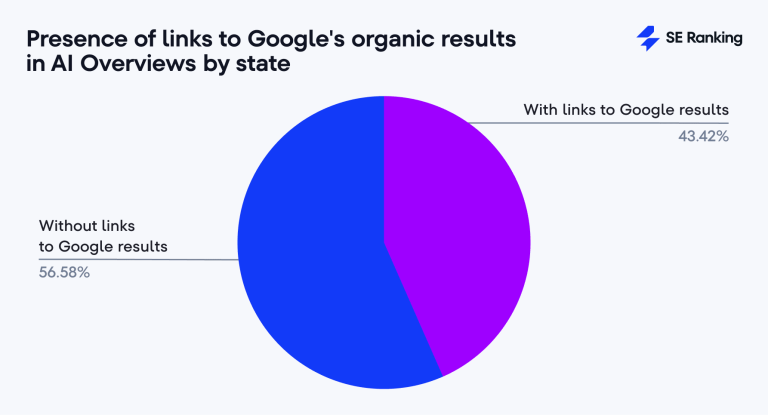
A study by SE Ranking examined Google’s AI Overviews in five U.S. states. It found that 43% of these AI answers contain links redirecting users to Google’s search results. Each answer typically includes 4-6 links to Google.
This aligns with recent data indicating that Google users make 10 clicks before visiting other websites. These patterns suggest that Google is working to keep users within its ecosystem for longer periods.
Google Citing Itself in AI Answers
The SE Ranking study analyzed 100,013 keywords across five states: Colorado, Texas, California, New York, and Washington, D.C.
It tracked how Google’s AI summaries function in different regions. Although locations showed slight variance, the study found that Google.com is the most-cited website in AI Overviews.
Google appears in about 44% of all AI answers, significantly ahead of the next most-cited sources, YouTube, Reddit, Quora, and Wikipedia, appearing in about 13%.
The research states:
“Based on the data combined from all five states (141,507 total AI Overview appearances), our data analysis shows that 43.42% (61,437 times) of AI Overview responses contain links to Google organic results, while 56.58% of responses do not.”
Image Credit: SE Ranking
Building on the Walled Garden Trend
These findings complement a recent analysis from Momentic, which found that Google’s “pages per visit” has reached 10, indicating users spend significantly more clicks on Google before visiting other sites.
Overall, this research reveals Google is creating a more self-contained search experience:
AI Overviews appear in approximately 30% of all searches
Nearly half of these AI answers link back to Google itself
Users now make 10 clicks within Google before leaving
Longer, more specific queries trigger AI Overviews more frequently
Google still drives substantial traffic outward; 175.5 million visits in March, according to Momentic.
However, it’s less effective at sending users away than ChatGPT. Google produces just 0.6 external visits per user, while ChatGPT generates 1.4 visits per user.
More Key Stats from the Study
The SE Ranking research uncovered several additional findings:
AI Overviews almost always appear alongside other SERP features (99.25% of the time), most commonly with People Also Ask boxes (98.5%)
The typical AI Overview consists of about 1,766 characters (roughly 254 words) and cites an average of 13.3 sources
Medium-difficult keywords (21-40 on the difficulty scale) most frequently trigger AI Overviews (33.4%), whereas highly competitive terms (81-100) rarely generate them (just 3.7%)
Keywords with CPC values between $2-$5 produce the highest rate of AI Overviews (32%), while expensive keywords ($10+) yield them the least (17.3%)
Fashion and Beauty has the lowest AI Overview appearance rate (just 1.4%), followed by E-Commerce (2.1%) and News/Politics (3.8%)
The longer an AI Overview’s answer, the more sources it cites. Responses under 600 characters cite about five sources, while those over 6,600 characters cite around 28 sources.
These statistics further emphasize how Google’s AI Overviews are reshaping search behavior.
This data stresses the need to optimize for multiple traffic sources while remaining visible within Google’s results pages.
The United States Copyright Office released a pre-publication version of a report on the use of copyrighted materials for training generative AI, outlining a legal and factual case that identifies copyright risks at every stage of generative AI development.
The report was created in response to public and congressional concern about the use of copyrighted content, including pirated versions, by AI systems without first obtaining permission. While the Copyright Office doesn’t make legal rulings, the reports it creates offer legal and technical guidance that can influence legislation and court decisions.
The report offers four reasons AI technology companies should be concerned:
The report states that many acts of data acquisition, the process of creating datasets from copyrighted work, and training could “constitute prima facie infringement.”
It challenges the common industry defense that training models does not involve “copying,” noting that the process of creating datasets involves the creation of multiple copies, and that improvements in model weights can also contain copies of those works. The report cites reports of instances where AI reproduces copyrighted works, either word for word or “near identical” copies.
It states that the training process implicates the right of reproduction, one of the exclusive rights granted to emphasizes that memorization and regurgitation of copyrighted content by models may constitute infringement, even if unintended.
Transformative use, where it adds a new meaning to an original work, is an important consideration in fair use analysis. The report acknowledges that “some uses of copyrighted works in AI training are likely to be transformative,” but it “disagrees” with the argument that AI training is transformative simply because it resembles “human learning,” such as when a person reads a book and learns from it.
Copyright Implications At Every Stage of AI Development
Perhaps the most damning part of the report is where it says that there may be copyright issues at every stage of the AI development and lists each stage of development and what may be wrong with it.
“A. Data Collection and Curation
The steps required to produce a training dataset containing copyrighted works clearly implicate the right of reproduction…
B. Training
The training process also implicates the right of reproduction. First, the speed and scale of training requires developers to download the dataset and copy it to high-performance storage prior to training.96 Second, during training, works or substantial portions of works are temporarily reproduced as they are “shown” to the model in batches.
Those copies may persist long enough to infringe the right of reproduction,160 depending on the model at issue and the specific hardware and software implementations used by developers.
Third, the training process—providing training examples, measuring the model’s performance against expected outputs, and iteratively updating weights to improve performance—may result in model weights that contain copies of works in the training data. If so, then subsequent copying of the model weights, even by parties not involved in the training process, could also constitute prima facie infringement.
C. RAG
RAG also involves the reproduction of copyrighted works.110 Typically, RAG works in one of two ways. In one, the AI developer copies material into a retrieval database, and the generative AI system can later access that database to retrieve relevant material and supply it to the model along with the user’s prompt.111 In the other, the system retrieves material from an external source (for example, a search engine or a specific website).181 Both methods involve making reproductions, including when the system copies retrieved content at generation time to augment its response.
D. Outputs
Generative AI models sometimes output material that replicates or closely resembles copyrighted works. Users have demonstrated that generative AI can produce near exact replicas of still images from movies,112 copyrightable characters,113 or text from news stories.114 Such outputs likely infringe the reproduction right and, to the extent they adapt the originals, the right to prepare derivative works.”
The report finds infringement risks at every stage of generative AI development, and while its findings are not legally binding, they could be used to create legislation and serve as guidance for courts.
Takeaways
AI Training And Copyright Infringement: The report argues that both data acquisition and model training can involve unauthorized copying, possibly constituting “prima facie infringement.”
Rejection Of Industry Defenses: The Copyright Office disputes common AI industry claims that training does not involve copying and that AI training is analogous to human learning.
Fair Use And Transformative Use: The report disagrees with the broad application of transformative use as a defense, especially when based on comparisons to human cognition.
Concern About All Stages Of AI Development: Copyright concerns are identified at every stage of AI development, from data collection, training, retrieval-augmented generation (RAG), and model outputs.
Memorization and Model Weights: The Office warns that AI models may retain copyrighted content in weights, meaning even use or distribution of those weights could be infringing.
Output Reproduction and Derivative Works: The ability of AI to generate near-identical outputs (e.g., movie stills, characters, or articles) raises concerns about violations of both reproduction and derivative work rights.
RAG-Specific Infringement Risk: Both methods of RAG, copying content into a database or retrieving from external sources, are described as involving potentially infringing reproductions.
The U.S. Copyright Office report describes multiple ways that generative AI development may infringe copyright law, challenging the legality of using copyrighted data without permission at every technical stage, from dataset creation to model outputs. It rejects the use of the analogy of human learning as a defense and the industry’s broad application of fair use. Although the report doesn’t have the same force as a judicial finding, the report can be used as guidance for lawmakers and courts.
A recent exchange between SEO professional Neil McCarthy and Google Search Advocate John Mueller has highlighted how Google treats hreflang tags.
McCarthy observed pages intended for Belgian French users (fr-be) appearing in France. Mueller clarified that hreflang is a suggestion, not a guarantee.
Here’s what this interaction shows us about hreflang, canonical tags, and international SEO.
French-Belgian Pages in French Search Results
McCarthy noticed that pages tagged for French-Belgian audiences were appearing in searches conducted from France.
In a screenshot shared on Bluesky, Google stated the result:
Contains the search terms
Is in French
“Seems coherent with this search, even if it usually appears in searches outside of France”
McCarthy asked whether Google was ignoring his hreflang instructions.
“hreflang doesn’t guarantee indexing, so it can also just be that not all variations are indexed. And, if they are the same (eg fr-fr, fr-be), it’s common that one is chosen as canonical (they’re the same).”
In a follow-up, he added:
“I suspect this is a ‘same language’ case where our systems just try to simplify things for sites. Often hreflang will still swap out the URL, but reporting will be on the canonical URL.”
Key Takeaways
Hreflang is a Hint, Not a Command
Google uses hreflang as a suggestion for which regional URL to display. It doesn’t require that each version be indexed or shown separately.
Canonical Tags Can Override Variations
Google may select one as the canonical URL when two pages are nearly identical. That URL then receives all the indexing and reporting.
“Same Language” Simplification
If two pages share the same language, Google’s systems may group them. Even if hreflang presents the correct variant to users, metrics often consolidate into the canonical version.
What This Means for International SEO Teams
Add unique elements to each regional page. The more distinct the content, the less likely Google is to group it under one canonical URL.
In Google Search Console, verify which URL is shown as canonical. Don’t assume that hreflang tags alone will generate separate performance data.
Use VPNs or location-based testing tools to search from various countries. Ensure Google displays the correct pages for the intended audience.
Review Google’s official documentation on hreflang, sitemaps, and HTTP headers. Remember that hreflang signals are hints that work best alongside a solid site structure.
Next Steps for Marketers
International SEO can be complex, but clear strategies help:
Audit Your hreflang Setup: Check tag syntax, XML sitemaps, and HTTP header configurations.
Review Page Similarity: Ensure each language-region version serves a unique user need.
Monitor Continuously: Set up alerts for unexpected traffic patterns or drops in regional performance.
SEO teams can set realistic goals and fine-tune their international strategies by understanding hreflang’s limits and Google’s approach to canonical tags. Regular testing, precise localization, and vigilant monitoring will keep regional campaigns on track.
Every day, marketing teams face a crucial decision: Should they rely on Google’s built-in AI tools or invest in custom solutions for specific ad campaign tasks?
I’ve watched this debate play out countless times with clients.
Google continues adding more AI features for tasks like ad copy generation, headline creation, image generation, and product feed optimization.
Meanwhile, specialized tools and custom solutions are thriving, and no real breakthrough for Google AI can be seen.
Recent research supports this tension.
Gherheș et al. (2025) found that while AI-generated content can outperform human-created alternatives in certain contexts, the quality varies significantly depending on implementation and purpose.
Their study revealed that over 50% of users preferred AI-generated informative content over sensationalized approaches, suggesting that how AI is deployed matters more than the technology itself.
But which approach actually delivers better results? And at what cost?
As Pavlik (2024) notes in his analysis of AI in journalism, tools like ChatGPT don’t simply replace human creativity but rather present opportunities for “improving the quality and effectiveness” of creative work when properly integrated into existing workflows.
A recent study by Ameet Khabra compared the performance of human-written versus AI-generated ad copy in Google Ads campaigns.
Over an eight-week period with a $500 budget, human-crafted ads significantly outperformed AI-created content from Copy AI, achieving 60% more clicks, a 1.33% higher click-through rate, and a lower cost per click ($4.85 vs. $6.05).
Researchers attributed human copywriters’ superior performance to their ability to understand audience emotions, employ creativity and emotional appeal, adapt to specific contexts, and leverage cultural nuances that AI still struggles to replicate.
While acknowledging AI’s evolving capabilities and potential value as a supplementary tool, the study emphasizes the enduring importance of human creativity in crafting compelling advertising messages that drive engagement and conversions.
Regardless of these mixed research findings, one thing is certain: AI is increasingly embedded in creative processes across marketing, and its integration is inevitable.
The question isn’t whether AI will play a role in advertising creation, but rather how marketers can best leverage these tools to enhance their campaigns.
As AI capabilities evolve rapidly, today’s limitations may be tomorrow’s strengths. With this inevitability in mind, marketers need practical guidance on navigating the current landscape of available solutions.
This article compares Google Ads integrated AI tools against third-party and custom solutions for creative and optimization tasks specifically.
AI-Generated Ad Copy
Google AI Automatically Created Assets
Google’s AI text generator aims to streamline the ad creation process by converting basic product descriptions into campaign-ready assets.
The platform encourages advertisers to input unique selling propositions and key product features to generate contextually relevant ad copy.
Upon testing this tool with a simulated video game business specializing in refurbished PlayStation 5 consoles and games, the performance fell notably short of expectations.
The output quality was inconsistent, but more concerning were the significant compliance issues observed.
In one particularly problematic instance, the system generated the phrase “Welcome to the Amazon® Website” as suggested ad text, presenting a clear trademark infringement risk and potential legal exposure for advertisers.
Such critical errors highlight a fundamental limitation in Google’s native AI solution: While offering workflow convenience, it demonstrates inadequate safeguards for brand compliance and legal protection.
The system also produced contextually inappropriate messaging, such as “PlayStation 5 Problems Solved,” which misaligned with sales-oriented campaign objectives by suggesting repair services or technical support rather than product offerings.
Without careful human review, these problems make the tool risky to use, especially for businesses in competitive markets where mistaken identity or inaccurate representations could lead to serious legal issues and damage to your reputation.
Image from author, April 2025
When generating longer headlines, there were much fewer results.
Only three ad suggestions appeared, one of which included free shipping information for orders over $50, which was a hallucination, as this information was never disclosed in the prompt or the landing page.
Image from author, April 2025
Creating descriptions was even worse, as there was only one ad suggestion and not even a good one from a copywriting perspective.
Image from author, April 2025
After trying with different prompts, I was able to get at least five new descriptions out of Google AI.
Still, the results were quite disappointing. The ad copy contained hallucinations like the “free shipping over 100 USD,” as well as the business name “Example Video Games,” instead of using the business name of the account or extracting it from the landing page or URL.
Overall, underwhelming results, considering Google is one of the biggest companies on earth and owns the biggest online advertising platform.
Image from author, April 2025
Third-Party Ad Copy Creation
While Google’s AI text generator struggles with brand accuracy and contextual relevance, several general-purpose AI models offer more sophisticated ad copy creation capabilities that balance automation with quality control.
Leading general AI assistants like Claude, ChatGPT, and Gemini represent compelling alternatives for marketers seeking higher-quality ad copy generation.
Unlike Google’s more constrained system, these platforms offer greater flexibility in handling nuanced prompting and brand-specific requirements.
Image by author, April 2025
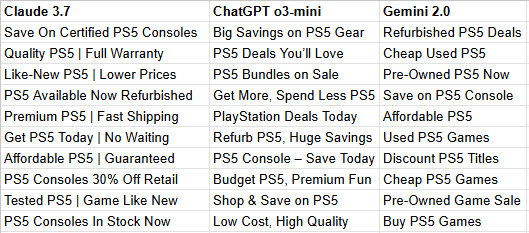
In testing with our video game business scenario, we prompted each model to create headlines for refurbished PlayStation 5 consoles.
The results demonstrated significant advantages over Google’s native offering:
Claude 3.7 produced premium-positioned headlines like “Save On Certified PS5 Consoles,” “Quality PS5 | Full Warranty,” and “Premium PS5 | Fast Shipping” that emphasize both value and quality assurance. Claude’s headlines maintained strong brand positioning while highlighting availability (“PS5 Consoles In Stock Now”) and price advantages (“PS5 Consoles 30% Off Retail”) without sacrificing perceived value.
ChatGPT (o3-mini) focused more on emotional appeal and deal framing with options such as “PS5 Deals You’ll Love,” “Get More, Spend Less PS5,” and “Budget PS5, Premium Fun.” ChatGPT’s approach effectively balanced affordability messaging with aspirational elements, potentially appealing to both value-conscious and experience-focused consumers.
Gemini 2.0 took a more direct value-oriented approach with straightforward headlines like “Refurbished PS5 Deals,” “Cheap Used PS5,” and “Discount PS5 Titles.” While less nuanced in positioning, Gemini’s headlines clearly communicate the core offering and may perform well for price-sensitive segments or direct response campaigns.
All three models demonstrated superior context awareness compared to Google’s native tool, with each showcasing different strategic approaches to headline creation.
They successfully avoided the hallucinations and brand confusion issues observed in Google’s Ad tool, while providing greater headline variety tailored to different marketing objectives.
The key advantage these general AI assistants offer is their adaptability and more refined understanding of marketing language.
By providing detailed prompting with brand guidelines, target audience information, and specific messaging requirements, marketers can achieve significantly better results than with Google’s more limited integrated tool.
For businesses where ad copy directly impacts conversion rates, leveraging these more sophisticated AI options can yield higher-quality creative assets that better represent brand positioning and speak more effectively to customer needs.
Despite Gemini’s relevant headline ideas, it struggled to adhere to the 30-character limit for some prompts on Google Ads headlines – a surprising limitation given that Gemini is Google’s own AI model and would be expected to understand Google Ads guidelines inherently – while Claude and ChatGPT consistently produced properly sized headlines without major additional editing or truncation.
Image Generation
Google AI Image Generation
Image generation is another area where AI can really shine and reduce the workload.
Images are a core asset in ecommerce, not only used for product images, but also for category pages, shop banners, display ads, and more.
For our virtual video game business, I tried to create some images matching our PlayStation 5 asset group. The results were interesting to say.
The first created image looks very similar to an Xbox. Specifically, an Xbox One S or an Xbox Series S, which is the latest model.
Now, there are no logos or trademarks seen, and the form factor is a little off.
AI-generated image by author, April 2025
Even more interesting, depending on the exact prompt, Google AI shows an error message related to branded items and content restrictions.
Image from author, April 2025
Another image created looks a little more like a PlayStation, but not as described and advertised as a PlayStation 5, but rather an older PlayStation 4 model.
Again, the content restrictions are most likely responsible for the results.
AI-generated image by author, April 2025
While the image results are somewhat disappointing for those branded items, it is understandable that Google AI follows content restrictions and brand guidelines to avoid any legal issues, as the PlayStation is a trademark of Sony, and the Xbox is a trademark of Microsoft.
It’s interesting to see that Google AI tries to work around this limitation and still creates an image, but in that specific case, the image is more or less useless, as there is little value in showcasing a non-existent video game console.
A question here would be why the content restrictions and guidelines did not apply to text creation when the text asset “Welcome to the Amazon® Website” was created.
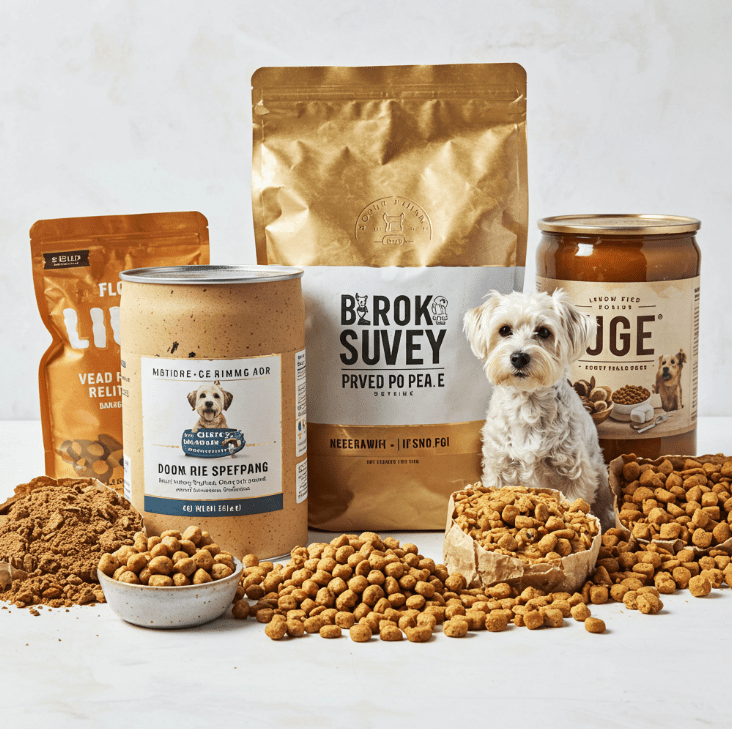
To check the image creation quality, I tried a different approach for non-branded items in the dog food category.
The image is good at first glance since multiple products are shown with a dog in the picture, supporting the category, but some things are off.
The text in the image is still a mess for Google AI. Plus, the proportions are wrong. The dog is way too small, considering the cans of dog food displayed, which are small items.
AI-generated image by author, April 2025
Better than video game consoles, but still not good enough to rely solely on Google AI without any backup or alternative.
Third-Party Image Generation
ChatGPT
Using the same prompts to create images, ChatGPT delivers amazing results compared to the Google Ads integrated image creator.
Visually, it was able to recreate a PlayStation video game console with a gaming controller.
ChatGPT even got details right, except the brand logo, which might be due to some brand protection measures.
AI-generated image by author, April 2025
Also, the latest Xbox model was created with in-depth details.
This time, even the Xbox logo was created, maybe because ChatGPT and Microsoft have made a trademark deal of some sort? Or trademark restrictions have some loopholes.
AI-generated image by author, April 2025
At last, the creation of the dog food image was also a success.
The prompt included the brand to be named “Doug’s Best Dog Food,” which was perfectly written on the product, along with a nicely placed bowl full of pellets in front of a golden retriever.
In comparison, Google AI was able to create a decent image, but upon closer look, issues with displaying words were apparent, which ChatGPT could handle perfectly.
AI-generated image by author, April 2025
Qwen
Qwen is an image generation tool based on Deepseek, which is a Chinese-based AI developer.
AI-generated image by author, April 2025
The image from Qwen clearly had an “AI” look compared to the ChatGPT or Google AI image.
However, it got the brand name “Doug’s Best Dog Food” right. With some improvements, Qwen can produce decent images, if you are okay with having a digital image look.
Google AI was able to create a more real-life looking image, with the downside of not being able to display the brand name correctly.
Video Creation Tool
Google Ads Video Creation Tool
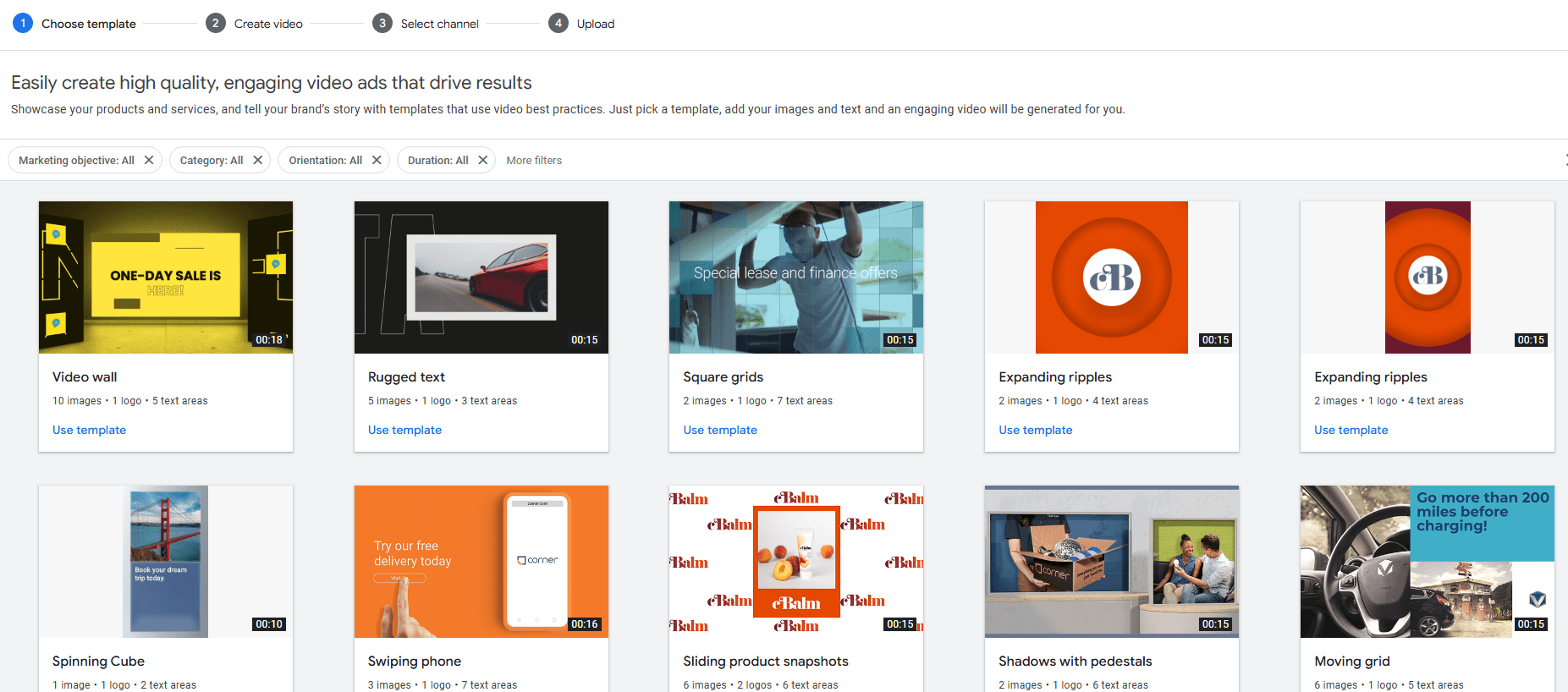
Google’s built-in video creation tool aims to make video advertising accessible to marketers without production resources.
The tool covers multiple marketing objectives – from brand awareness and consideration to direct sales and app promotion – accommodating various business categories, including apps, products, and services.
It offers flexibility with vertical, square, and horizontal formats in lengths ranging from quick six-second spots to 15-second and longer videos.
However, the tool’s output quality reveals its limitations.
Most videos are essentially slideshows, stitching together static images, logos, and text overlays rather than fluid video content.
While this approach democratizes video ad creation, the results often lack the polish and engagement power of properly produced video content.
For many marketers, this represents the fundamental tradeoff of Google’s native tools: accessibility and integration vs. creative limitations that might impact performance.
Image from author, April 2025
At best, marketers get a nice-looking slideshow; speaking of a serious advertising video would be too much.
The better templates are mostly for app-related videos, where at least some kind of animation is included with a finger doing some phone touch gestures.
Overall, the native video creation tool serves as a backup for marketers who need a video immediately and don’t have any tools on hand.
In any other case, it’s best to postpone video creation and start with a more decent tool.
Third-Party Video Creation
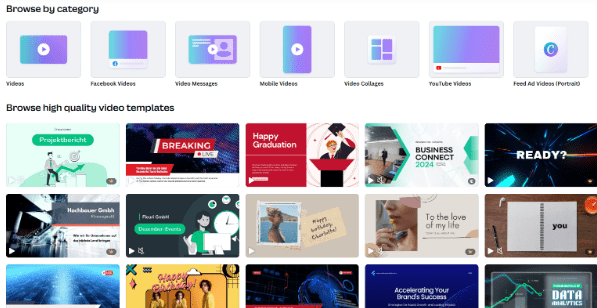
Canva Video Creation
Screenshot from Canva, April 2025
Canva makes much better videos than Google Ads’ built-in tools with almost the same effort.
Google mostly creates basic slideshows, but Canva gives you thousands of professional templates, animations, and stock videos to use in your marketing.
The simple drag-and-drop design lets you make engaging videos with smooth transitions and text effects that keep viewers engaged.
Unlike Google’s static slideshows, Canva creates flowing video content that looks professionally made.
If you spend just a few more minutes using Canva instead of Google’s tool, your videos will look much more professional and likely perform better with your audience.
Qwen
Alibaba’s Qwen is a strong competitor to Google Ads’ basic video tools, giving marketers better videos without needing special skills.
While Google just makes simple slideshows, Qwen uses AI to turn your images and text into dynamic videos with smooth movements and professional transitions.
The tool is great at automatically creating cohesive visual stories even from minimal input, adding motion to still images in ways that look professional.
What stands out is how Qwen creates animations that actually match your product type and brand style, avoiding the one-size-fits-all look of Google’s templates.
Though not as well-known as Canva in the West, Qwen’s AI approach produces polished videos that look intentionally designed rather than template-made, making it a great choice for marketers who want better videos than what Google offers.
Image by author, April 2025
Image by author, April 2025
For the example of a dog food brand, Qwen delivered exceptional results.
With the first prompt, Qwen created a five-second clip of golden retrievers playing around and going to a human hand to eat dog food from the hand.
Not only did the video look pretty close to real life compared to the Qwen image generation “AI look,” but Qwen also did this as a free tool. No cost involved.
If you compare this to the Google video creation, which is basically a PowerPoint presentation, Qwen makes a really good performance.
Sora
Another great video tool is Sora from OpenAI.
Since Sora is included in the $20 Premium membership, you can generate videos at almost no cost, though with some limitations on video quality and length.
Still, there are a few tools out there that can generate decent AI video output for that cost.
Product Image Improvements
Product Studio
The Product Studio for Merchant Center Next is a beta image optimization tool within the Merchant Center, also accessible via the Google App within Shopify.
It allows for creating product images in various scenes, as well as removing backgrounds and increasing image quality.
Image from author, April 2025
Image from author, April 2025
These are two tries to display a gaming controller in a scene.
Although the quality of the product image has remained reasonably good, the scenes are barely usable.
The image processing prompt was “Showcase this controller in a living room, in front of a TV with neon lighting.”
In practice, the desired scene was not even remotely depicted. The controller in front of notebooks or pens is out of place; the second attempt resulted in three black backgrounds and a fiery background.
Free Alternatives To Google’s Product Studio
Unlike Google’s Product Studio, which struggles with accurate scene generation as shown in the gaming controller example, several free tools offer more reliable image optimization capabilities.
Canva’s free tier includes a background removal tool that produces clean cutouts with remarkable accuracy.
While scene creation is more limited in the free version, you can still place products on various pre-designed backgrounds or use their extensive template library to create more contextually appropriate product displays than what you experienced with Google’s tool.
To remove backgrounds, use remove.bg, which is a specialized tool that focuses exclusively on background removal with impressive results, even for complex products like your gaming controller.
The free version has size limitations but delivers professional-quality cutouts that can then be placed into scenes using other tools.
For everything more complex, GIMP is a free and capable tool. This open-source image editor provides robust capabilities for both background removal and scene composition.
Though it has a steeper learning curve, GIMP offers precise control over image quality enhancement and realistic product placement.
Final Thoughts
Google’s native AI tools, while conveniently integrated into their advertising platform, consistently underperform compared to third-party alternatives.
The evidence is clear and concerning. Google’s AI ad copy generator produced legally problematic content with brand infringement risks and hallucinated product details.
Its image generation produced visually inaccurate representations. The video creation tool delivered little more than basic slideshows rather than engaging video content.
Meanwhile, third-party solutions or Google’s own Gemini model used externally demonstrated superior capabilities across all creative functions:
General-purpose AI assistants like Claude and ChatGPT produced more compelling, accurate, and compliant ad copy.
Specialized tools like Canva, Remove.bg, and Photopea offered vastly superior image manipulation options.
Video creation platforms like Canva and Qwen delivered professional-quality animation and transitions impossible with Google’s basic tools.
This performance gap reveals the fundamental tradeoff marketers face: convenience of integration vs. creative quality and performance.
Google’s in-platform AI tools provide workflow efficiency but at the significant cost of creative limitations, brand safety concerns, and potential legal exposure.
For marketers serious about campaign performance, the path forward is clear: Leverage external AI solutions for creative development, then import these higher-quality assets into Google’s advertising platform.
This hybrid approach maintains the advantage of Google’s targeting and delivery mechanisms while avoiding the substantial limitations of their creative AI tools.
As AI continues to evolve in marketing, successful advertisers will be those who strategically select the right tools for each specific function rather than defaulting to in-platform options for convenience alone.
The evidence suggests that, for now, the marketing advantage lies decidedly with those willing to look beyond Google’s native AI for their creative development needs.