GoDaddy launched a new partner program called GoDaddy Agency that matches web developers with leads for small to mid-sized businesses (SMBs). It provides digital agencies with tools, services, and support to help them grow what they offer their customers.
The new program is available to U.S. based freelancers and web development agencies. GoDaddy offers the following benefits:
Client leads Partners are paired with SMBs based on expertise and business goals. GoDaddy delivers high-intent business referrals from GoDaddy’s own Web Design Services enquiries.
Commission revenue opportunities Partners can earn up to 20% commission for each new client purchases.
Access to premium WordPress tools
Co-branded marketing Top-performing partners benefit from more exposure from joint marketing campaigns.
Dedicated Support Every agency is assigned an Agency Success Manager who can help them navigate ways to benefit more from the program.
Joseph Palumbo, Go-to-Market and Agency Programs Director at GoDaddy explained:
“The GoDaddy Agency Program is all about helping agencies grow. We give partners the tools, support, and referrals they need to take on more clients and bigger projects—without adding more stress to their day. It’s like having a team behind your team.”
For WordPress Developers And More
I asked GoDaddy if this program exclusively for WordPress developers. They answered:
“GoDaddy has a wide variety of products to help make any business successful. So, this isn’t just about WordPress. We have plenty of website solutions, like Managed WordPress, Websites + Marketing or VPS for application development. Additionally, we have other services like email through Office 365, SSL certificates and more.”
Advantage Of Migrating Customers To GoDaddy
I asked GoDaddy what advantages can a developer at another host receive by bringing all of their clients over to GoDaddy?
They answered:
“First, our extensive product portfolio and diverse hosting selection allows agencies to house all and any projects at GoDaddy, allowing them to simplify their operations and giving them the opportunity to manage their business from a single dashboard and leverage a deep connection with a digital partner that understands their challenges and opportunities.
On top of that, there’s the growth potential. Every day, we get calls from customers who want websites that are too complex for us to design and build. So, we have created a system that instead of directing those customers elsewhere, we can connect with Web agencies that are better suited to handle their requests.
If a digital agency becomes a serious partner and the work they do meets our standards, and they have great customer service , etc. we can help make connections that are mutually beneficial to our customers and our partners.”
Regarding my question about WordPress tools offered to agency partners, a spokesperson answered:
“We have a wide variety of AI tools to help them get their jobs done faster. From website design via AI to product descriptions and social posts. Beyond our AI tools, agency partners that use WordPress can work directly with our WordPress Premium Support team. This is a team of WordPress experts and developers who can assist with anything WordPress-related whether hosted at GoDaddy or somewhere else.”
Takeaways
When was the last time your hosting provider gave you a business lead? The Agency partner program is an innovative ecosystem that supports agencies and freelancers who partner with GoDaddy, a win-win for everyone involved.
It makes sense for a web host to share business leads from customers who are actively in the market for web development work with partner agencies and freelancers who could use those leads. It’s a win-win for the web host and the agency partners, an opportunity that’s worth looking into.
GoDaddy’s new Agency Program connects U.S.-based web developers, freelancers and agencies with high-intent leads from small-to-mid-sized businesses while offering commissions, tools, and support to help agencies grow their client base and streamline operations. The program is a unique ecosystem that enables developers to consolidate hosting, leverage WordPress and AI tools, and benefit from co-marketing and personalized support.
Client Acquisition via Referrals: GoDaddy matches agency partners with high-intent SMB leads generated from its own service inquiries.
Revenue Opportunities: Agencies can earn up to 20% commission on client purchases made through the program.
Consolidated Hosting and Tools: Agencies can manage multiple client types using GoDaddy’s product ecosystem, including WordPress, VPS, and Websites + Marketing.
Premium WordPress and AI Support: Partners gain access to a dedicated WordPress Premium Support team and AI-powered productivity tools (e.g., design, content generation).
Co-Branded Marketing Exposure: High-performing partners receive increased visibility through joint campaigns with GoDaddy.
Dedicated Success Management: Each partner is assigned an Agency Success Manager for personalized guidance and program optimization.
Incentive for Migration from Other Hosts: GoDaddy offers a centralized platform offering simplicity, scale, and client acquisition opportunities for agencies switching from other providers.
Google’s John Mueller answered a question about internal site navigation where an SEO was concerned about diluting the ability to rank for a keyword phrase by using the same anchor text in four sitewide sections across an entire website.
Link In Four Navigational Areas
The person asking the question had a client that had four navigational areas with links across the entire site. One of the links is repeated across each of the four navigational areas, using the exact same anchor text. The concern is that using that phrase multiple times across the entire site might cause it to appear overused.
Roots of Why SEOs Worry About Anchor Text Overuse
There’s a longtime concern in the SEO industry about overusing anchor text. The original reason for this concern, the root of it, is because overusing internal anchor text could be seen as communicating the intent to manipulate the search engines. This concern arose in 2005 because of Google’s announced use of statistical analysis which can identify unnatural linking patterns.
Over the years that concern has evolved to worrying about “diluting” the impact of anchor text, which has no foundation in anything Google said although Google is on record as saying that they’re dampening sitewide links.
Google has in the past made it known that it divides a page into its constituent parts such as the header section (where the logo is), the sitewide navigation, sidebars, main content, in-content navigation, advertising and footers.
We know that Google has been doing this since at least 2004 (a Googler confirmed it to me at a search event) and most definitely around 2006-ish when Google was dampening the effect of external sitewide links and internal sitewide links so that the links only counted as one link, and not with the full power of 2,000 or whatever number of links.
Back in the day people were selling sitewide links at a premium because they were said to harness the entire PageRank power of the site. So Google announced that those links would be dampened for internal links and Google began recognizing paid links and blocking the PageRank from transferring.
We could see the power of the sitewide links through Google’s browser toolbar that contained a PageRank meter so when the change happened we were able to confirm that effect in the toolbar and in rankings.
That’s why sitewide links are no longer an SEO thing anymore. It’s has nothing to do with dilution.
Sitewide Links And Dilution 2025
Today we find an SEO who’s worrying about a sitewide anchor text link being “diluted.”
So, if we already know that Google recognizes sidebars, menus and footers and separates them out from the main content and we know that Google doesn’t count a sitewide link as a multiple but rather counts it as if it only existed on one page, then we already know the answer to that person’s question, which is that no, it’s not going to be a big deal because it’s a navigational sitewide link, which is not meaningful other than to tell Google that it’s an important page for the site.
A sitewide navigational link is important but it’s not the same as a contextual link from within content. A contextual link has meaning, it’s meaningful, because it says something about the page being linked to. One is not better than the other, they’re just different kinds of links.
This is the question that the SEO asked:
Hey @johnmu.com a client has 4 navs. A Main Menu, Footer Links, Sidebar Quicklinks & a Related Pages Mini-Nav in posts. Not for SEO but they have quadrupled the internal link profile to a key page on a single anchor.
Any risk that we’re diluting the ability to rank that keyword with “overuse”?
Someone else answered the question with a link to a Search Engine Journal article that was about a site that contains links to every page of the entire site, which is a different situation entirely. That’s a type of site architecture from the old days called a flat site architecture. It was created by SEOs for the purpose of spreading PageRank across to all pages of the site to help all them rank.
Google’s John Mueller responded with a comment about that flat site structure and an answer to the query posed by the SEO:
“I think (it’s been years) that was more about a site that links from all pages to all pages, where you lose context of how pages sit within the site. I don’t think that’s your situation. Having 4 identical links on a page to another page seems fine & common to me, I wouldn’t worry about that.”
Lots Of Duplication
The SEO responded that the duplicated content along the sidebars were HTML and not “navigation” and that they were concerned that this introduced a lot of duplication.
He wrote:
“Its 4 duplicated navs on every page of the site, semantically the side bar and related pages are not navs, they’re html, list structured links so lots of duplication IMO”
I think that Mueller’s answer still applies. It doesn’t matter if they are semantically side bars and related pages. What’s important is that they are not the main content, which is what Google is focused on.
Google’s Martin Splitt went into detail about this four years ago where he talked about the Centerpiece Annotation.
Martin talks about how they identify related content links and other stuff that’s not the main content:
“And then there’s this other thing here, which seems to be like links to related products but it’s not really part of the centerpiece. It’s not really main content here. This seems to be additional stuff.
And then there’s like a bunch of boilerplate or, “Hey, we figured out that the menu looks pretty much the same on all these pages and lists.”
So the answer for the SEO is that it doesn’t matter if those links are in a sidebar or menu navigation or related links. Google identifies it as not the main content and for the purposes of analyzing the web page, sets that aside. Google doesn’t care if stuff is popping up all over the site, it’s not main content.
In this article, we’ll show you how to rank in AIO SERPs by creating embeddings for your content and how to realign your content for maximum visibility by using AIO tools built by search engineers.
The 3 Key Features Of AI Overviews That Can Make Or Break Your Rankings
Let’s start with the basic building blocks of a Google AI Overviews (AIO) response:
What Are Embeddings?
Embeddings are high-dimensional numerical representations of text. They allow AI systems to understand the meaning of words, phrases, or even entire pages, beyond just the words themselves.
Rather than matching exact terms, embeddings turn language into vectors, or arrays of numbers, that capture the semantic relationships between concepts.
For example, “car,” “vehicle,” and “automobile” are different words, but their embeddings will be close in vector space because they mean similar things.
Large language models (LLMs) like ChatGPT or Google Gemini use embeddings to “understand” language; they don’t just see words, they see patterns of meaning.
Image created by MarketBrew.ai, April 2025
Why Do Embeddings Matter For SEO?
Understanding how Large Language Models (LLMs) interpret content is key to winning in AI-driven search results, especially with Google’s AI Overviews.
Search engines have shifted from simple keyword matching to deeper semantic understanding. Now, they rank content based on contextual relevance, topic clusters, and semantic similarity to user intent, not just isolated words.
Image created by MarketBrew.ai, April 2025
Embeddings power this evolution.
They enable search engines to group, compare, and rank content with a level of precision that traditional methods (like TF-IDF,keyword density, or Entity SEO) can’t match.
By learning how embeddings work, SEOs gain tools to align their content with how search engines actually think, opening the door to better rankings in semantic search.
API Key: Once logged in, you’ll need to generate an API key to access OpenAI’s services. You can find this in your account settings under the API section.
Step 2: Install The OpenAI Python Client To Simplify This Step For SEO Pros
OpenAI provides a Python client that simplifies the process of interacting with their API. To install it, run the following command in your terminal or command prompt:
pip install openai
Step 3: Authenticate With Your API Key
Before making requests, you need to authenticate using your API key. Here’s how you can set it up in your Python script:
At the time of this article’s creation, OpenAI’s text-embedding-3-small is considered one of the most advanced embedding models. It is highly efficient for a wide range of text processing tasks.
Step 5: Create Embeddings For Your Content
To generate embeddings for text:
response = openai.Embedding.create(

model="text-embedding-3-small",

input="This is an example sentence."

)

embeddings = response['data'][0]['embedding']

print(embeddings)
The result is a list of numbers representing the semantic meaning of your input in high-dimensional space.
Step 6: Storing Embeddings
Store embeddings in a database for future use; tools like Pinecone or PostgreSQL with pgvector are great options.
Step 7: Handling Large Text Inputs
For large content, break it down into paragraphs or sections and generate embeddings for each chunk.
Use similarly sized chunks for better cosine similarity calculations. To represent an entire document, you can average the embeddings for each chunk.
💡Pro Tip: Use Market Brew’s free AI Overviews Visualizer. The search engineer team at Market Brew has created this visualizer to help you understand exactly how embeddings, the fourth generation of text classifiers, are used by search engines.
Semantics: Comparing Embeddings With Cosine Similarity
This is essential for comparing the semantic similarity between two pieces of text.
Image created by MarketBrew.ai, April 2025
Typical search engine comparisons include:
Keywords with paragraphs,
Groups of paragraphs with other paragraphs, and
Groups of keywords with groups of paragraphs.
Next, search engines cluster these embeddings.
How Search Engines Cluster Embeddings
Search engines can organize content based on clusters of embeddings.
In the video below, we are going to illustrate why and how you can use embedding clusters, using Market Brew’s free AI Overviews Visualizer, to fix content alignment issues that may be preventing you from appearing in Google’s AI Overviews or even their regular search results!
Embedding clusters, or “semantic clouds”, form one of the most powerful ranking tools for search engineers today.
Semantic clouds are topic clusters in thousands of dimensions. The illustration above shows a 3D representation to simplify understanding.
Topic clusters are to entities as semantic clouds are to embeddings. Think of a semantic cloud as a topic cluster on steroids.
Search engineers use this like they do topic clusters.
When your content falls outside the top semantic cloud – what the AI deems most relevant – it is ignored, demoted, or excluded from AI Overviews (and even regular search results) entirely.
No matter how well-written or optimized your page might be in the traditional sense, it won’t surface if it doesn’t align with the right semantic cluster that the finely tuned AI system is seeking.
By using the AI Overviews Visualizer, you can finally see whether your content aligns with the dominant semantic cloud for a given query. If it doesn’t, the tool provides a realignment strategy to help you bridge that gap.
In a world where AI decides what gets shown, this level of visibility isn’t just helpful. It’s essential.
Free AI Overviews Visualizer: How To Fix Content Alignment
Step 1: Use The Visualizer
Input your URL into this AI Overviews Visualizer tool to see how search engines view your content using embeddings. The Cluster Analysis tab will display embedding clusters for your page and indicate whether your content aligns with the correct cluster.
Screenshot from MarketBrew.ai, April 2025
Step 2: Read The Realignment Strategy
The tool provides a realignment strategy if needed. This provides a clear roadmap for adjusting your content to better align with the AI’s interpretation of relevance.
Example: If your page is semantically distant from the top embedding cluster, the realignment strategy will suggest changes, such as reworking your content or shifting focus.
Screenshot from MarketBrew.ai, April 2025
Screenshot from MarketBrew.ai, April 2025
Step 3: Test New Changes
Use the “Test New Content” feature to check how well your content now fits the AIO’s top embedding cluster. Iterative testing and refinement are recommended as AI Overviews evolve.
Screenshot by MarketBrew.ai, April 2025
See Your Content Like A Search Engine & Tune It Like A Pro
You’ve just seen under the hood of modern SEO – embeddings, clusters, and AI Overviews. These aren’t abstract theories. They’re the same core systems that Google uses to determine what ranks.
Think of it like getting access to the Porsche service manual, not just the owner’s guide. Suddenly, you can stop guessing which tweaks matter and start making adjustments that actually move the needle.
At Market Brew, we’ve spent over two decades modeling these algorithms. Tools like the free AI Overviews Visualizer give you that mechanic’s-eye view of how search engines interpret your content.
And for teams that want to go further, a paid license unlocks Ranking Blueprints to help track and prioritize which AIO-based metrics most affect your rankings – like cosine similarity and top embedding clusters.
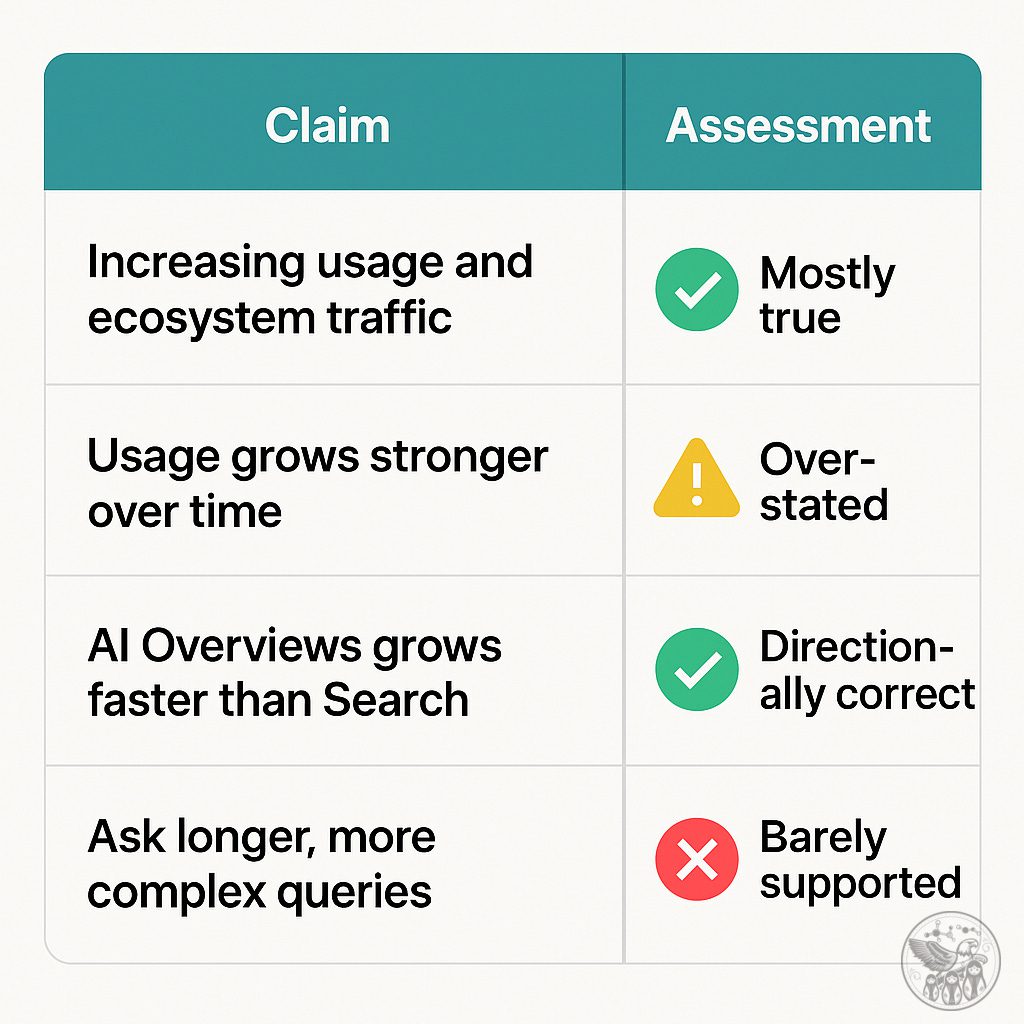
Google claims AI Overviews are revolutionizing search behavior.
But the data tells a different story.
Since launching AI Overviews in 2024, Google CEO Sundar Pichai has repeatedly claimed they’re transforming search behavior:
People are using it to Search in entirely new ways, and asking new types of questions, longer and more complex queries… and getting back the best the web has to offer.1
Image Credit: Kevin Indig
The narrative has been consistent across earnings calls and interviews:
“We have been able to grow traffic to the ecosystem.”2
“Growth actually increases over time as people learn to adapt to that new behavior.”3
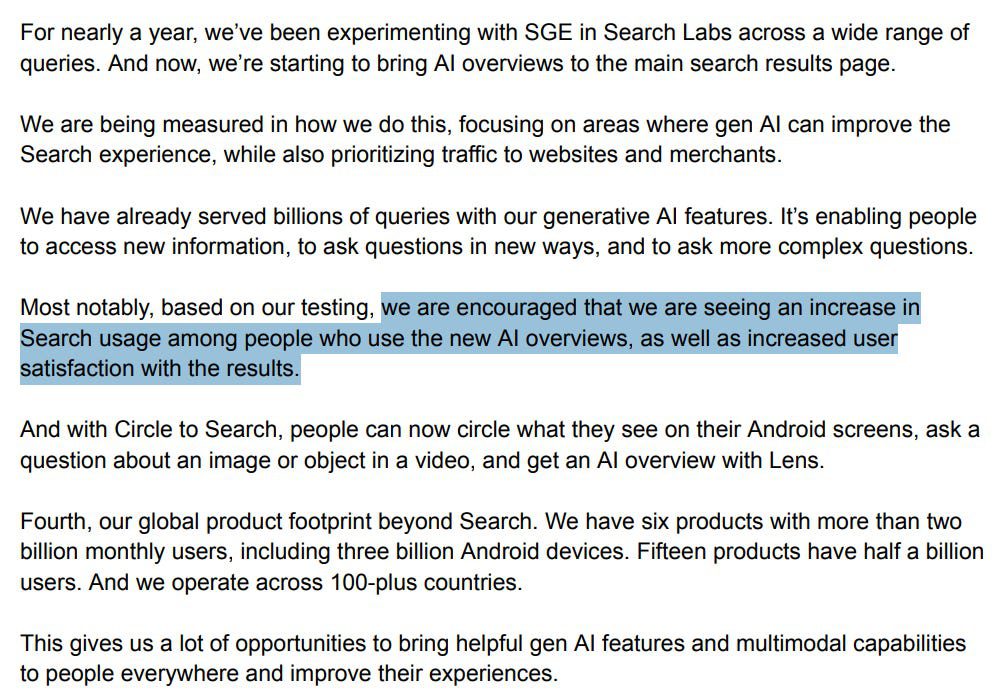
“Based on our testing, we are encouraged that we are seeing an increase in search usage among people who use the new AI overviews as well as increased user satisfaction with the results.” (Source)
Yet, Google has never backed these claims with actual data.
So, I partnered with Similarweb to analyze over 5 billion search queries across multiple markets.
There’s too much good data in this analysis not to share. So today, you’re getting part one of a two-part series. Here’s what we’ll cover across both parts:
Part 1: How AI Overviews affect user behavior on Google.
Part 2: How AI Overviews impact traffic and engagement on websites.
Image Credit: Lyna ™
Boost your skills with Growth Memo’s weekly expert insights. Subscribe for free!
The stand-out result?
Google’s claims are partially true but significantly oversimplified.
My analysis with Similarweb shows:
People visit Google more frequently (+9%) but spend less time per visit.
Query length has barely changed.
And – most importantly for SEO pros and marketers – the data reveals critical insights about how to adapt to this new search paradigm.
Image Credit: Kevin Indig
About The Data
The data set includes:
Over 5 billion search queries and 20 million websites.4
Average time on site, searches per session, and visits per user on Google.com – both in total and comparing the UK, U.S., and Germany.
A comparison of keywords with and without AI Overviews that analyze searches per session, average time spent on Google, and zero-click share.
Page views and time spent on Google.com for keywords showing AI Overviews vs. keywords without AI Overviews.
Average query length for the UK, U.S., and Germany.
In this overall claim, the phrase “Search usage” isn’t very well defined.
Is it more searches, more engagement with SERP features, or longer sessions?
Unfortunately, I wasn’t able to pinpoint the exact definition of search usage. It’s Google’s own wording, and so it might be intentionally vague. (Have your own thoughts on this? Let me know!)
Whether there has actually been an overall increase in Search usage because of AI Overviews is more complex, depending on several factors. And the analysis below shows clear patterns we can learn from.
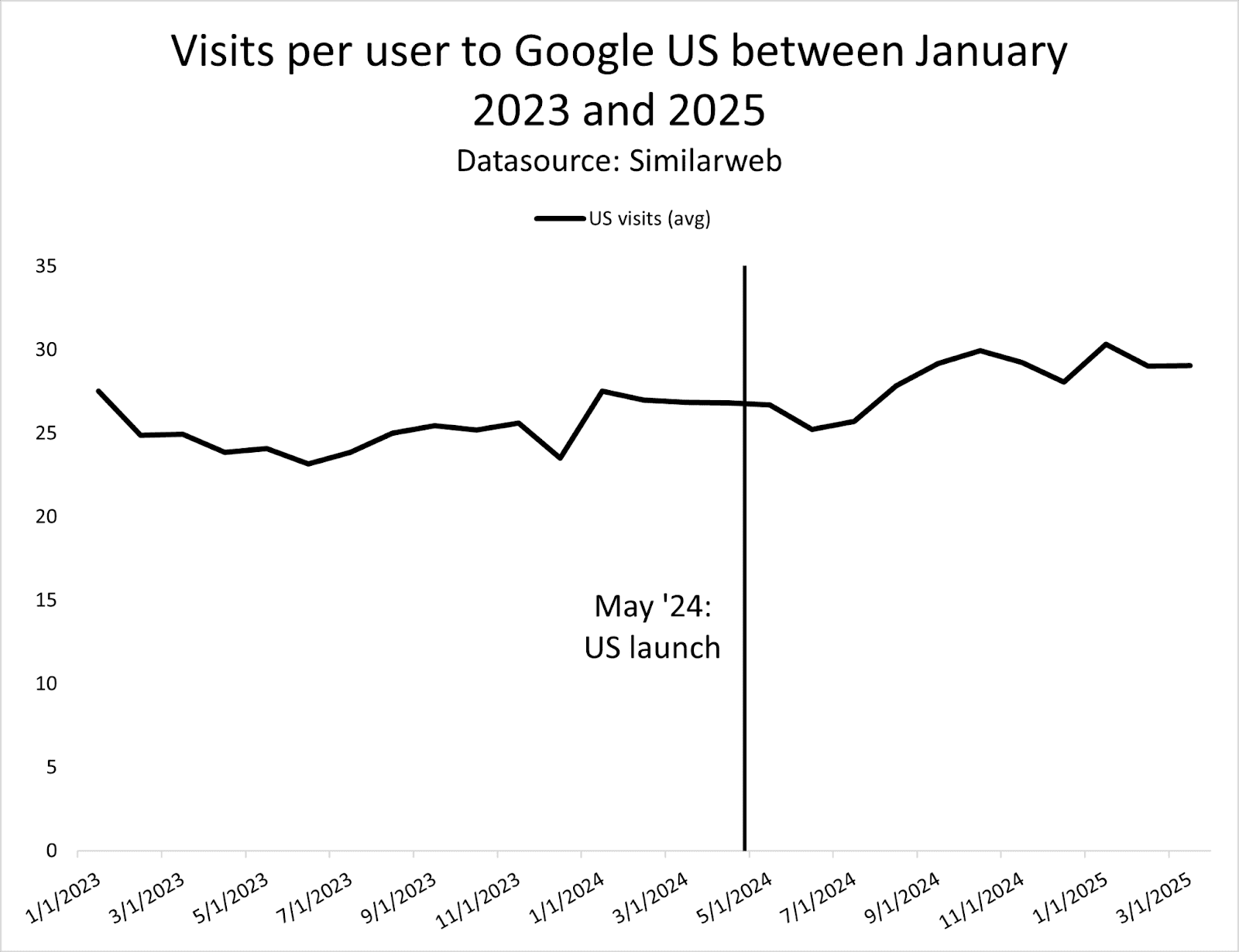
For the U.S. market specifically, the data confirms that the claim “We are seeing an increase in Search usage among people who use the new AI Overviews” is directionally correct.
Here’s how we know it’s correct: Google visits rose +9% after the May 24 rollout (from 26.9% to 29.1%).
The initial drop could be explained by the PR disaster from the first two weeks. (Remember those strange results that mentioned smoking when pregnant or glue on your pizza?)
While U.S. visits to Google grew modestly from 2023 to mid-2024, a clearer upward trend began around August 2024.
Image Credit: Kevin Indig
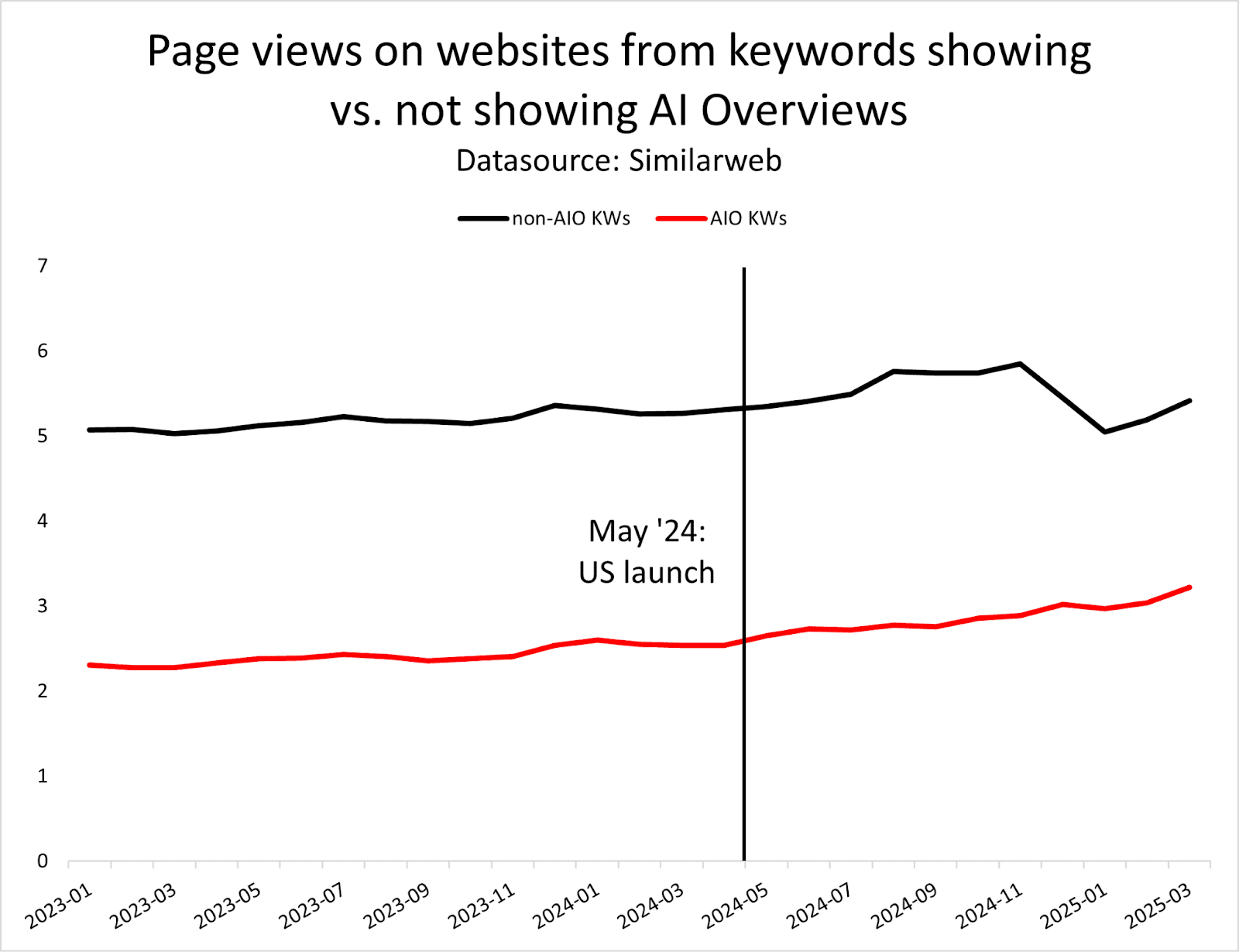
When we look at the two comparative keyword sets – remember, one set in this study shows AIOs and one doesn’t – we can see that page views on websites from AIO keywords have increased by 22% since the U.S. launch. (Shown by the red line below).
I know we all want to talk about the effect of AIOs on organic clicks, but we’ll get there. I’ll come back to the fact that non-AIO queries drive more page views in Part 2.
However, the “Page views on websites” chart for U.S. searches below reveals two critical insights:
Websites are receiving more views from AIO keyword searches over time, but
Non-AIO queries drive about twice as many page views (shown by the black line).
This suggests AI Overviews may be increasing engagement for specific query types while having a limited impact on overall traffic patterns.
Image Credit: Kevin Indig
Next, let’s take a look at the US, UK, and Germany markets compared.
Although Google has claimed “We are seeing an increase in Search usage among people who use the new AI Overviews,” in general, the SimilarWeb data shows a more nuanced story.
Here’s how we know the claim is only partially correct, depending on the market:
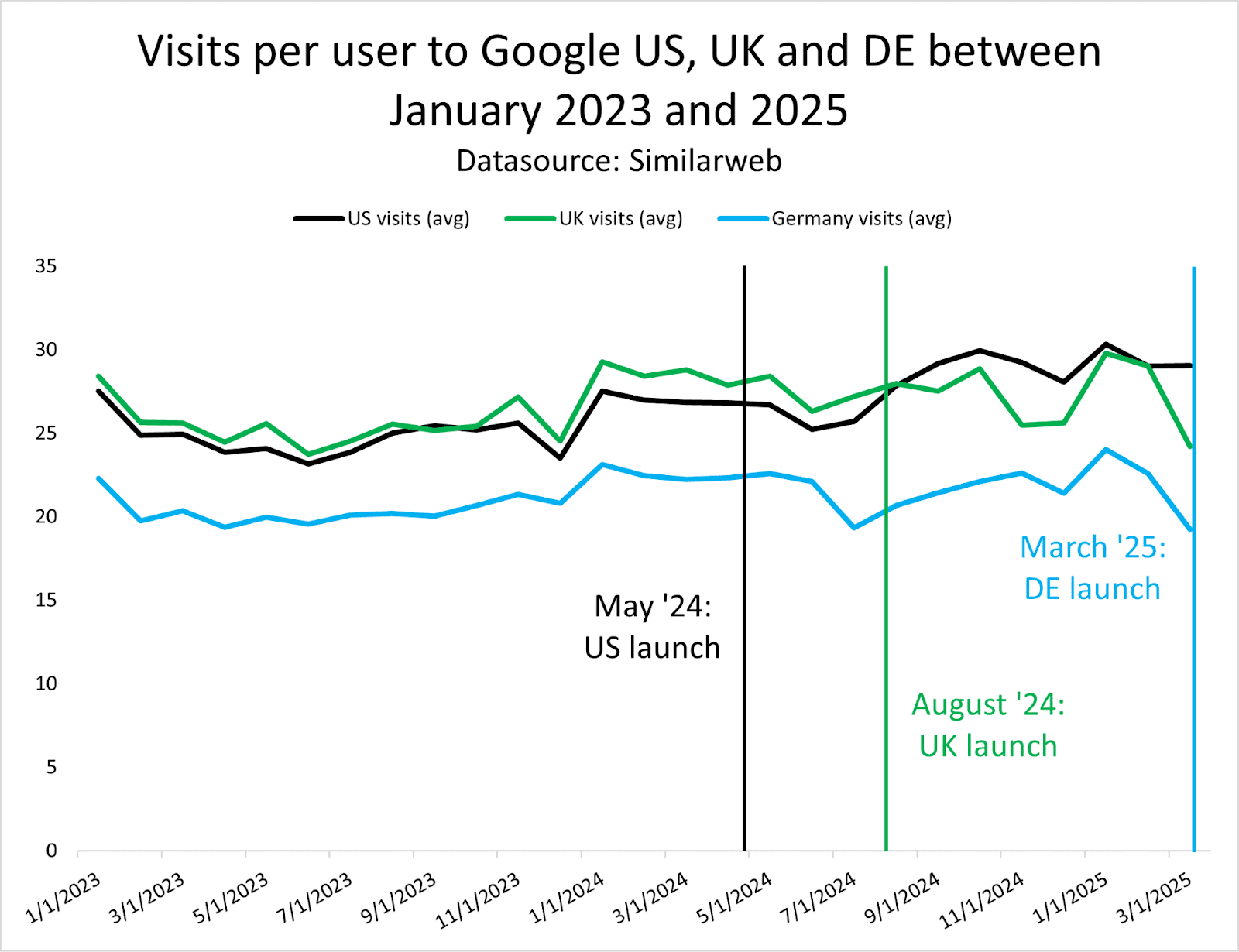
The growth of U.S. visits to Google is proportionally higher than in Germany (chart below), which is our control market because AIOs didn’t roll out there until March 2025.
Image Credit: Kevin Indig
However, in the UK, where AI Overviews rolled out in August 2024, visits are trending flat to down after the rollout (shown via the green line above).
In fact, there was more engagement growth from 2023 to 2024 (before the AIO roll-out).
Ultimately, I consider Google’s claim incorrect for other markets outside the US:More SERP interaction does not translate into longer on-Google sessions.
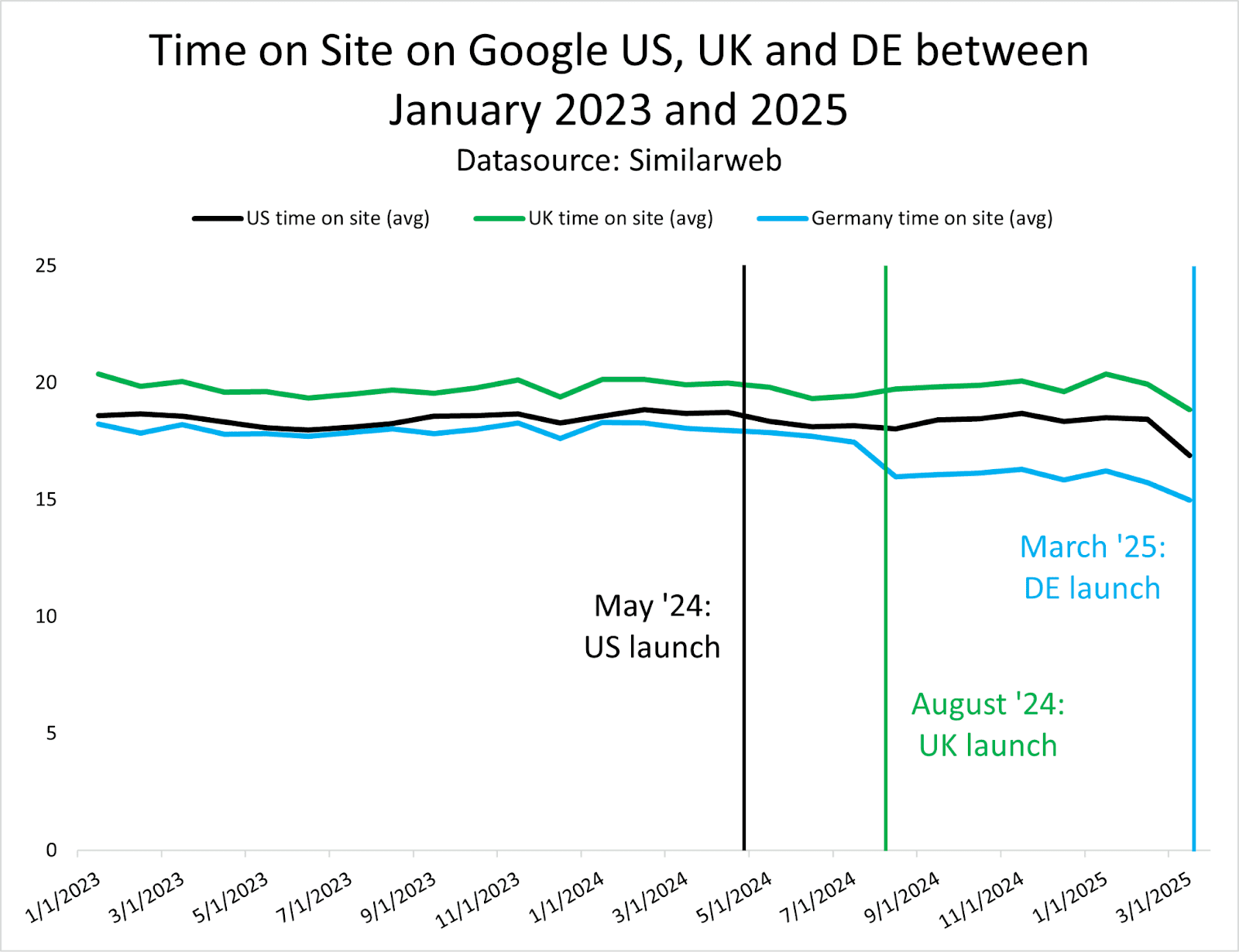
In the chart below, we can see that time-on-site for Google.com in both the US and UK has been either flat or declining.
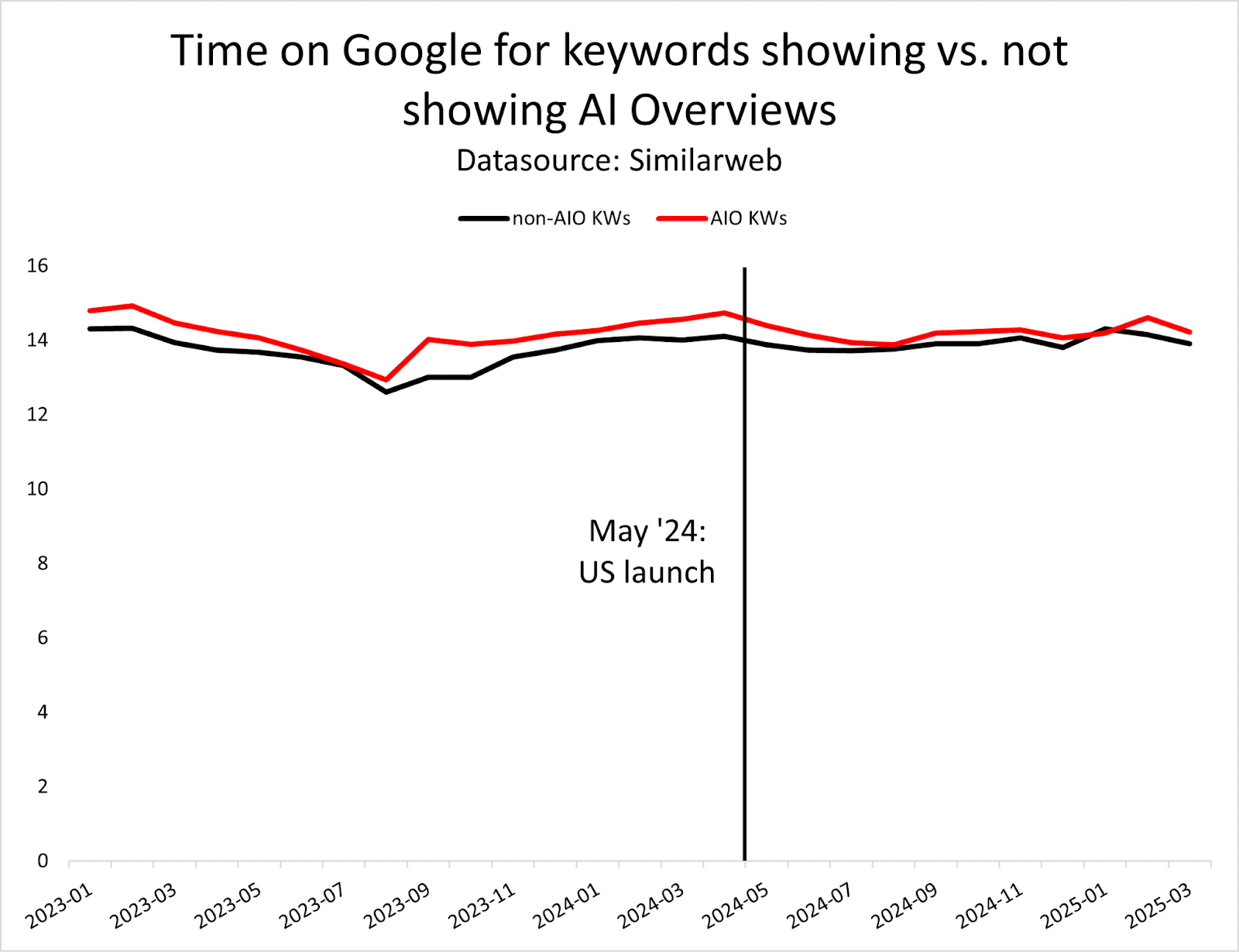
We see the same trend when we compare AIO-showing with non-AIO-showing queries in the chart below.
Time on Google for AIO queries falls by -1%.
While this isn’t a huge dip, it certainly isn’t an “increase in Search usage.”
Image Credit: Kevin Indig
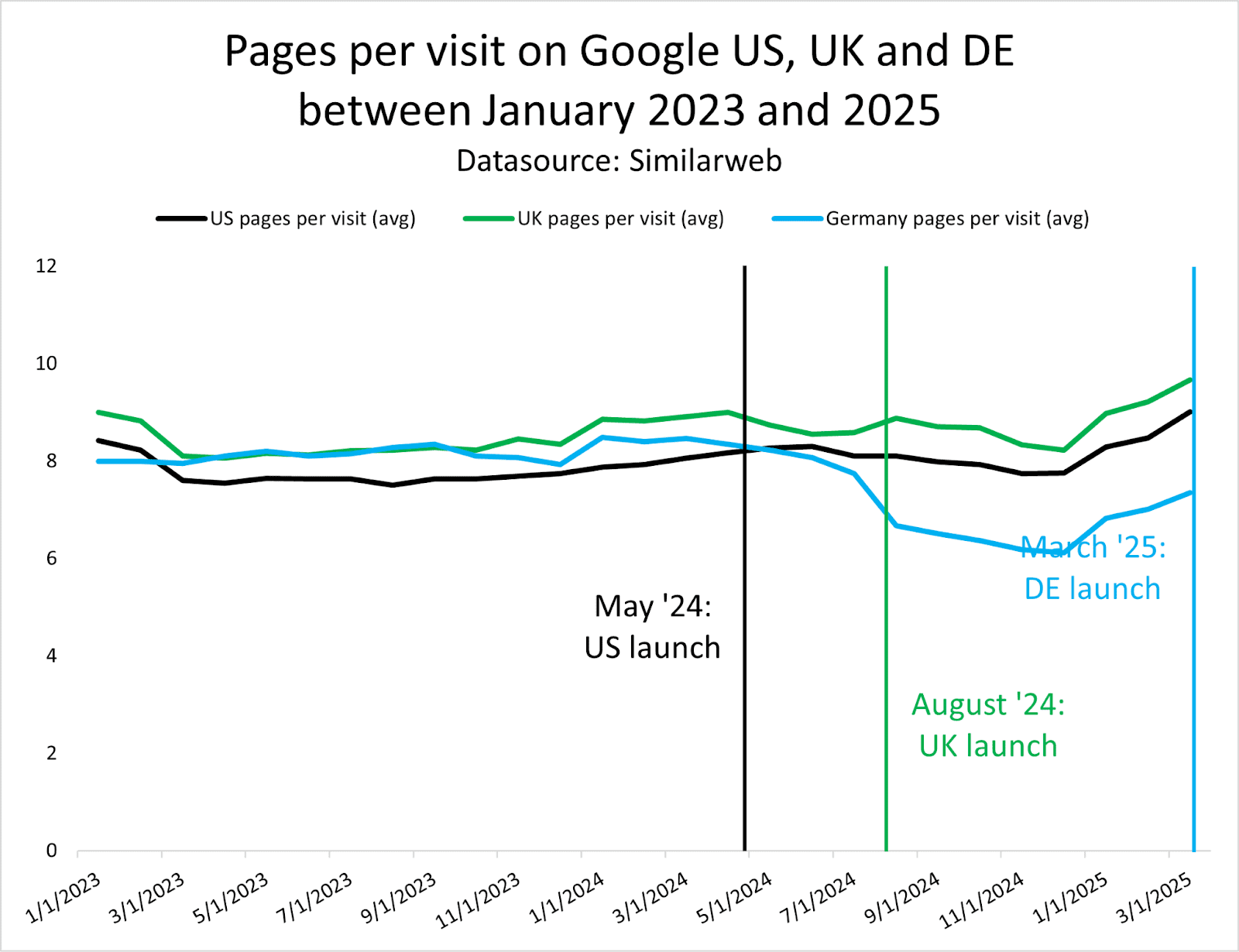
Notably, you’ll see in the chart below that pages-per-visit on Google.com declined across the board in 2024 after rolling out AIOs, but then they start recovering and growing again in 2025.
This chart shows a clear dip in pages-per-visit immediately following the May 2024 AIO launch, suggesting users needed fewer results pages when AI Overviews answered their queries directly.
The subsequent recovery in 2025 indicates either user adaptation or Google adjustments to how AIOs function within the search experience.
Image Credit: Kevin Indig
But what about this sudden uplift in 2025?
It happens in our controlled market, Germany, as well. So, it’s not due to AIOs.
How do we know this? Pop back up to that Time on Site graph above that shows all three markets. And you’ll see that Germany’s time on site shows a decline after the AIO launch.
While I’m not sure what drives this trend, I do wonder how less time on Google impacts its bottom line.
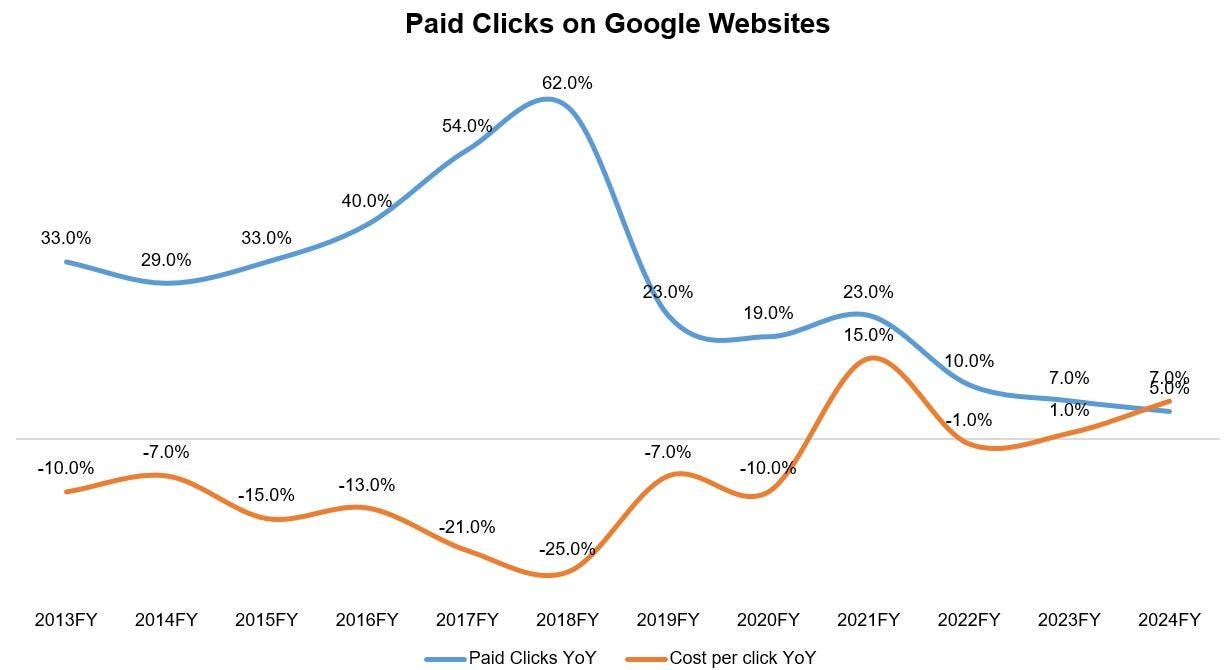
MBI published a very interesting deep dive on Alphabet with a chart that indicates that AI Overviews do not monetize as well as claimed.
Instead, a rise in cost per click seems to drive Alphabet’s outstanding earnings.
To be fair, that trend started in 2018, so it’s not clear how much AIOs have accelerated it.
Chart from MBI’s latest deep dive on Alphabet (Image Credit: Kevin Indig)
We are seeing an increase in Search usage among people who use the new AI Overviews.
Based on the data, this claim has layers of truth and omission.
Google visits did increase post-AIO launch (+9%), and AIO keyword pageviews rose impressively (+22%).
However, the full picture reveals important nuances that we need to take into account:
UK visits remained flat after the AIO rollout, despite U.S. gains.
Time-on-site metrics are flat or declining across markets.
Pages-per-visit initially dropped after AIOs launched.
The data suggests users are visiting Google more frequently but spending less time per visit, likely because AI Overviews provide faster answers without deeper exploration.
This pattern aligns with a “resolve and leave” user behavior, rather than increased engagement with Google itself.
While it might be technically true that “Search usage” increased by some metrics, the claim obscures how AIOs are fundamentally changing search interaction patterns at the cost of web traffic.
When we look at the data closely, this claim doesn’t hold true.
Here’s how we know it’s incorrect:
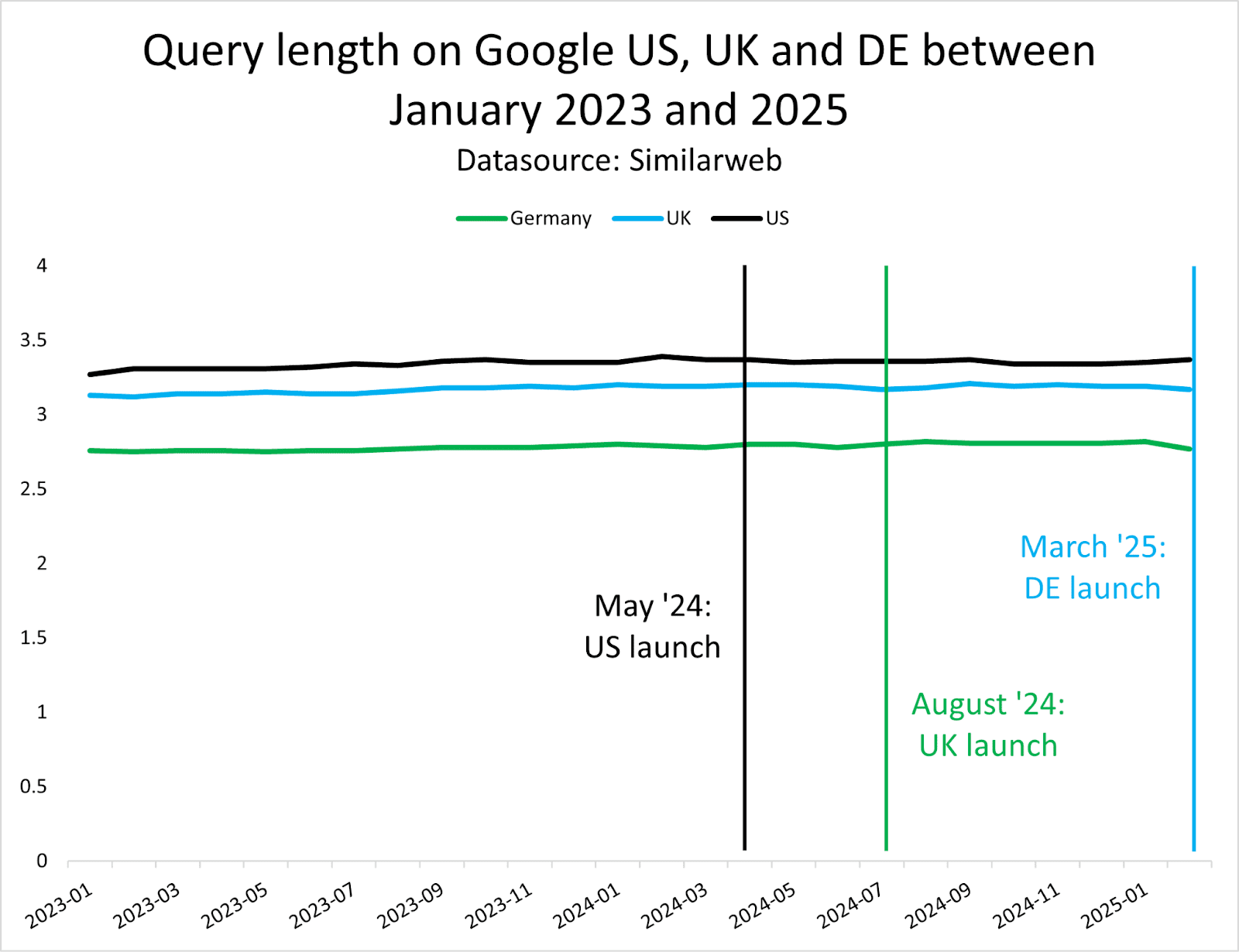
The growth in query length is tiny – certainly not a step-change to “entirely new ways.”
We’re talking about a very gradual increase of 3.27 to 3.37 average words per query in the U.S. over the course of two years.
Sure, that’s only 3% – and maybe at the scale of Google, that has a huge impact.
But this is no step change.
Image Credit: Kevin Indig
The difference in query length between May 2024 and February 2025 is only +0.6%.
In the UK, query length decreased by -0.3% after AI Overviews launched from 3.18 words in August 2024 to 3.17 words in February 2025.
In Germany, query length increased a bit (+0.4%) before the AI Overviews launch.
Verdict: This Claim Is Overstated And Incorrect
While Google reports “People are using it to search…longer and more complex queries,” a closer look shows otherwise.
The data shows only minimal changes in query length in the US, with the UK seeing a decrease after AIOs rolled out.
The data simply doesn’t support the narrative that AI Overviews are driving users to construct “longer and more complex queries” in any meaningful way.
When we examine the data closely, a clear pattern emerges:
Google’s claims about how AI Overviews are fundamentally changing how we search are largely overstated.
Yes, users visit Google more frequently, but they’re spending less time per visit and not crafting significantly longer or more complex queries.
This suggests AI Overviews are creating a “quick answer” behavior pattern rather than deeper engagement with search.
The modest increases in visits are counterbalanced by decreases in time-on-site and pages-per-visit.
And the minimal change in query length across all markets – regardless of whether AI Overviews have launched – indicates that any evolution in search behavior is happening independently of AI features.
These findings matter because they challenge the narrative that AI Overviews represent a revolutionary enhancement to search.
Instead, they’re changing user interaction patterns in ways that Google hasn’t fully acknowledged.
Keep in mind that I’m working with third-party data, which can always be skewed or partial. I don’t think it’s wrong, but we always need to keep the limitations of the data in mind.
Optimize for the new “visit more, stay less” pattern: Users are more frequently turning to Google, but they’re spending less time seeking answers. Your content strategy should focus on both being accurately represented in AI Overviews and providing deeper value that encourages clicks when the overview isn’t sufficient.
Focus on engagement quality: The pattern suggests users are more selective about clicking through, making the quality of experience more important than ever when they do reach your site.
Factor in regional differences: The significant variations between U.S. and UK behavior after AI Overview launches suggest regional testing is essential – what works in one market may not transfer directly to others.
In Part 2, we’ll explore the even more critical question: What happens to the broader web ecosystem when users get their answers directly on Google rather than clicking through to websites?
The answer will reveal whether Google’s claims about “growing traffic to the ecosystem” hold up to scrutiny.
We’re celebrating 15 years of Yoast, and we can’t celebrate without offering some SEO insights. So, here are 15 SEO essentials to focus on in this year and beyond. Whether you are a beginner or an SEO expert, these tips will help you focus on what’s important right now.
In collaboration with our Principal SEO, Alex Moss
Table of contents
Artificial intelligence is making every part of SEO faster and more efficient, from keyword research to real-time performance tracking. Tools like Semrush and Ahrefs help you plan content quickly and uncover opportunities you might have missed. These platforms use data in new ways to help you improve your strategy based on live trends and competitor changes. Use tools like ChatGPT or Gemini for research, inspiration, coding, and data analysis.
Thanks to AI tools, you can automate time-consuming tasks like technical audits, site crawls, and content analysis. The time you win by doing that helps your team focus on the bigger picture, from setting the strategy, building authority, and creating content that connects with audiences and brings something new to the world.
We’re celebrating 15 years of Yoast this year and have all kinds of nice stuff planned. Of course, we’re also offering a deal on our SEO products. Use coupon code yoast15_gift4you at the checkout for a 15% discount!
In 2025, Google shows more quick answers than ever. You’ll see AI overviews, featured snippets, knowledge panels, People Also Ask boxes, and more. To be featured in those places, your content has to be high-quality and unique, above all, unique – regurgitating what’s already out there won’t cut it. But, it also has to be easy to read and scan. Don’t forget to use lists, highlighted snippets, and concise definitions at the top of your articles.
Keyword research helps you to find the questions your audience is asking. Write clear answers to those questions, making them as concise as possible. Use tools like AlsoAsked to find opportunities to rank even when a user doesn’t click through to your site.
3. Invest in video content
Video dominates search results and offers a good way to diversify traffic sources. The growth of a platform like TikTok shows that many people prefer consuming video content. Create videos that answer questions, demonstrate your products, or explain complex topics. Optimize the videos to make them easy to find, and don’t forget to add a transcript and timestamps to help with indexing and user experience.
Depending on your video strategy, hosting them on YouTube and embedding them on your site can boost engagement and dwell time. YouTube is the second-largest search engine in the world, and building a solid presence there can reach a massive audience.
4. Improve e-commerce SEO
SEO for your products is not just about rankings, but also about conversion. Your product titles and descriptions should naturally include your most important keywords while also sounding persuasive. Don’t forget your category pages! Proper optimization helps customers find what they need. At the same time, you are building a strong internal linking structure.
Structured data is essential for e-commerce stores because it can trigger rich results, highlighting reviews, pricing, and stock status. When done well, these show up nicely in Google, boosting your visibility. Rich snippets make your SERP listings more trustworthy and clickable. Do everything you can to get more traffic and, eventually, more sales. Our Yoast SEO for Shopify app can help your business succeed.
5. Prioritize local SEO
If your business is locally oriented, local SEO should be at the top of your strategy. Keep your Google Business profile updated with opening hours, services, and nice photos. Post regularly about special offers, events, or published blog posts to show you are active and encourage engagement.
Build citations in trusted local directories and get high-quality local backlinks. You should publish high-quality, localized content or case studies from regional customers. This signals that you are active in a geographic area, which could help local search visibility — Yoast Local SEO helps you do this.
6. Improve user experience (UX)
UX and SEO are deeply connected; we all know that. If people can’t use your site, they won’t stick around. Focus on a clean layout with plenty of whitespace and add clear call-to-actions for the user to click on. Make your site load quickly and test it regularly on mobile devices.
Heatmaps, scroll maps, and user recordings made with tools like Hotjar can show where people get stuck on your site. Friction could occur with long loading times, confusing menus, missing CTAs, or other similar issues. Solving these can help reduce bounce rates, increase engagement and conversion.
7. Participate in SEO communities
Joining SEO communities isn’t just about asking for help when facing issues; it’s about much more. Platforms like LinkedIn, X, Reddit, Facebook groups, or SEO forums sometimes offer insights and advice you can’t get anywhere else. Sharing wins, failures, and experiments helps you stay connected to the SEO community and lets you build a name for yourself.
These platforms often surface research, news about Google core updates and warnings about issues some time before becoming common knowledge. News might be shared just early enough for you to take advantage of it before your competitor does. Building relationships can help you get business opportunities, collaborations, or friendships.
8. Optimize for AI discovery
AI tools and chatbots are trained on information from the web, so it’s important to understand how your content is surfaced by large language models (LLMs). These systems, like ChatGPT and Google Gemini, reshape how users uncover information. The results are often served without a way to click to your site. If your brand is not visible in these generated answers, you could be missing out in a growing share of visibility.
Research your topics and content to see how the system responds to your queries and if your content appears in the answers. Audit your content to see if you structured it so LLMs can understand it. Use clear language, be factual, build your topical authority, and use easy-to-understand layouts. Most of all, be sure that the crawlers of the AI services can reach your site without issues.
9. Focus on content pruning
Sometimes, ranking higher isn’t about adding more content to your site; it’s often about cleaning up what you have. Content pruning means removing, merging, or updating poorly performing content. Ancient blog posts that no longer get any traffic, outdated product pages, and thin articles with no value may impact your site’s overall performance.
Start with a content audit using Semrush, Screaming Frog, or Ahrefs. Find pages with limited traffic, few backlinks, and poor engagement. You can update these posts if you have enough insights to add. If they’re no longer relevant, merge them into a single, more authoritative page. If nothing works, delete and redirect. Keep your site lean and focused to improve the overall quality and authority, which also helps you fix keyword cannibalization.
10. Implement structured data markup
Part of SEO is making your site easy for crawlers and search engines to understand. Structured data markup is one of the best ways to tell Google what your pages are about. With the correct schema items, you can highlight things like product prices, event dates, business locations, recipes, and more.
Plugins like Yoast SEO make this process much easier. Start with your most important pages and products, select the proper schema, and fill in the details needed. Once you have the basics done, you can expand it to more complex structured data if needed.
11. Keep focusing on mobile
If you’ve been living under a rock, you might have missed that today’s world is all about mobile. We’ve been spending more and more hours glued to our mobile phones. So, having a perfect mobile site is no longer an option. Make sure that it adapts to all screen sizes, that the buttons work, and that no nasty pop-ups overlay the screen.
Test your site often in various browsers on Apple and Android devices. See if it offers a great user experience. If not, fix it. Fixing even small accessibility issues or loading performance can greatly impact user satisfaction.
12. Create helpful, people-first content
Google is no longer just rewarding keyword-optimized pages, but genuinely helpful, people-first content. Your articles should satisfy user intent by providing clear, trustworthy and actionable information. Instead of writing the same things everyone has already done, create unique content that informs, solves problems, and adds value for your readers.
When thinking about your content, ask yourself the questions that Google recommends: “After reading your content, will someone leave feeling they’ve learned enough about a topic to help achieve their goal?” and “Does your content clearly demonstrate first-hand expertise and depth of knowledge?” If your content doesn’t do any of these things, you might need to rethink it. Focus on things you know well, avoid clickbait and write for your readers, not search engines.
13. Optimize for Core Web Vitals
Core Web Vitals gives you a sense of your site’s health, especially with speed, responsiveness, and visual stability. They measure three main things: Largest Contentful Paint (LCP), which looks at loading performance. The second is Interaction to Next Paint (INP), which shows how quickly your site responds to user actions. The third one is Cumulative Layout Shift (CLS), which checks for unexpected layout shifts when your page loads. Google uses these metrics to determine whether your site gives a good user experience.
You can monitor your Core Web Vitals in Google PageSpeed Insights, Search Console, or Lighthouse. Improvements you can often make include optimizing images, using faster hosting, reducing reliance on JavaScript, and setting proper dimensions for media. Test your site often to see if your improvements improve the user experience.
14. Diversify content formats
Not everyone wants to read a 2000-word blog post. Some people enjoy graphics, videos, or podcasts. You can quickly repurpose your content in various formats, instead of starting over every time.
Doing so makes your site more interesting for readers and search engines alike. Adding helpful videos to articles or offering downloadable checklists or research reports makes your content more appealing.
15. Always stay updated
In SEO, change is a constant. There are algorithm updates, new AI features emerge, and best practices change. It’s a lot, so staying up to date with the news is essential. Follow reliable sources like Search Engine Land, Search Engine Roundtable, the Yoast SEO newsletter, or our monthly SEO update to get the needed insights.
Plan some time every week to read up on SEO news. Join the conversation whenever you feel like it. Use the new insights to improve your strategies. Sticking to last year’s strategy will not cut it if your competitors are faster to adapt!
15 SEO tips for 15 years of Yoast
Here’s to 15 years of Yoast and 15 more years of helping the world rank better. Whether you’re launching your first site or revamping your SEO strategy for the AI age, it doesn’t matter — we’ll help you succeed.
Which SEO tip do you swear by in 2025? Please share it with us on our social media platforms (X, LinkedIn, Reddit, Instagram), or in the comments below.
Edwin is an experienced strategic content specialist. Before joining Yoast, he worked for a top-tier web design magazine, where he developed a keen understanding of how to create great content.
In this edition of Ask An SEO, a marketing leader reaches out with a question:
My company put pressure on me to deliver results of more traffic to our product pages.
How can I try to convince the CMO that we should invest more in brand building that will most likely reduce traffic?
There’s so much to chew on with this question. Before I get into the thick of it, I want to challenge the premise: “brand building that will most likely reduce traffic.”
It’s something I hear from clients often enough. It’s a premise I hear from SEOs all the time. While it may be true in this specific case, I would like to say something regardless.
At the same time, brand hasn’t been the forte of the search marketing industry. As a result, there’s a lot being said that, when put under scrutiny, doesn’t hold up.
I’d take a lot of the brand strategy you’re hearing from the SEO industry with a grain of salt.
Just because you target an audience doesn’t mean you lose wider reach. It can happen – and very often it should happen – but does it not have to happen?
You can speak to a core audience very deeply while not losing the attention of your secondary audience. Streaming platforms do this all the time.
Apple TV has an identity around great sci-fi content, but it also speaks to a wider audience as it throws some solid comedies into the mix (at least in my opinion).
Both of these “identities” work because there is a common thread: Apple puts out higher-quality content than other platforms.
So, will you lose traffic by focusing on brand? You probably should, but that’s only because I’ve been around the proverbial SEO block a few times.
It is, however, entirely possible to do things like pivot to a new audience while retaining the old one.
Losing audience as a result of building the brand is 100% not an inherent outcome. If anything, in the long term, it’s the total opposite. Brand building is all about connecting with more audiences over time.
Let’s move on to your question and work with the premise that you will lose traffic by increasing content and audience targeting.
I’m not even going to go into the obvious point and glaring absurdity of not wanting to have a more specific focus and more refined audience targeting in favor of “traffic.”
So, we’re going to work with two premises:
You will lose traffic by focusing on brand.
Not getting that “traffic” is “bad” somehow.
How do you sell this to the CMO?
For The Conceptual CMO
I’m going to start at a very conceptual level that will probably not speak to your CMO, but is very important for you to understand when you make your pitch.
The web is not the web you think it is. The web was a place where Wired could write about coffee mugs and rank them because everything was on an equal footing.
It was one giant “web” that was unified, where anyone could rank for anything so long as the content was halfway decent.
That web doesn’t exist anymore.
There is no “internet.” There is the internet that talks about home goods. There is the internet that deals with technology products. There is the internet that takes up sports.
On this internet, Wired isn’t relevant for coffee mugs. That’s not its sphere of influence. The web is no longer one giant unified void that algorithms sift through to pick up whatever site on whatever topics.
Think of the internet as independent spheres that sometimes move and overlap with other orbits but are generally self-contained.
If you’re selling this bowl of goods to a CMO, I would pitch it as you’re getting ahead of the curve. You’re getting ahead of the traffic loss that has already hit so many sites and is going to hit yours eventually.
I would sell this as “being able to perform as the landscape shifts.” You have to function in alignment with the ecosystem. There’s no way around it.
If you don’t, it will all hit the fan. It’s only a question of “when.” Usually, brands will wait until it’s already too late.
Not operating within the confines of the ecosystem is like trying to row a boat on an ice skating rink using a tennis racket.
For The Pragmatic CMO
The conceptual construct I just defined above will not speak to most CMOs.
While it’s extremely likely that you, the VP of marketing, head of growth, marketing manager, etc., understand this point, most CMOs are not in touch with the ecosystem enough to be swayed by this argument.
For most CMOs, I would start with the competition. Show similar sites that have undergone traffic losses because they haven’t changed with the tides.
If you’re a HubSpot competitor, showcase all the traffic HubSpot lost. And then, translate that into all the dollars spent in time and resources trying to capture traffic, as if it were 2015.
Image from author, April 2025
Honing your audience makes it less expensive to run marketing campaigns and assets.
Don’t pay to speak to everyone. Pay to speak to the right ones.
If your marketing strategy is aimed at casting a wide net, you will inevitably either pay for content production that isn’t of value or simply pay for pure visibility that isn’t worth the value.
You can also do the opposite. You can show competitors who have gotten ahead of the curve. That usually lights a fire under most CMOs. Seeing that the competition is getting “ahead” in whatever way is very uncomfortable for the C-level staff.
If you can show that your strategy is already being implemented by competitors, squeeze. And frame it. Frame it well: “Our competitors are starting to speak more directly to our ultimate target audience, and you can see that here, here, and here.” That will have an impact that they won’t ignore.
You have to try to concretize this as much as possible.
The problem with brand, as Alli Berry once put it to me, is that it’s the silent killer. I have witnessed this firsthand on more than one occasion with clients.
You don’t realize it’s the decline of brand efficacy until you have a real problem on your hands.
What happens is, time and time again, the decline of brand efficacy first manifests itself in whatever performance channel.
Suddenly, your social media performance or organic search performance is on the decline.
The immediate knee-jerk reaction brands have (especially as you move up the ladder) is to fix the channel.
These are the meetings where you are told to change things up and fix performance. You know, the meetings where you leave with your head shaking since it’s clear no one knows what they’re talking about.
The reason this happens is that the issue isn’t the channel. There’s nothing wrong with the social or SEO strategy per se. Rather, there’s a huge gap in the brand strategy, and it’s starting to have an impact.
The “suddenness” of a performance problem can be an external shift (a change in consumer behavior, for example) – and that definitely can and does happen.
However, from my experience, the usual culprit is the loss of brand traction.
Often, a product hits the market at the right time, in the right way, in the right place. The stars align and the brand takes off.
At a certain point, the brand hits what I tell my clients is a “maturity inflection point.” The brand can no longer ride the momentum of its product or service the same way, and brand efficacy (and marketing potency) ebbs away.
By the time this happens, most brands have a strong client base, etc., so they never look internally. Instead, they focus on the specific performance problems. Thus, the brand becomes the silent killer.
Your job is not to let this happen to you. If you’re managing a marketing team at whatever level, your job is to nip this problem in the bud.
Now, if your CMO is more reflective and so forth, then the argument I gave earlier might work.
This is not the norm, so you need to concretize the argument.
Whether it be, as I mentioned, through the competitor angle or whatever, you have to gain some perspective and then translate that perspective into practicality.
Roll With Your CMO
My last piece of advice is to know your audience. CMOs are often bold and brash (likely because they feel they have to be), so speak that language. Come with a plan that has a bit of edge and flair to it.
If that’s not your CMO, don’t. If they are more analytical by nature, show the data.
It’s just a matter of knowing your audience and what language they speak. You have to roll with where your CMO and company overall are at. Otherwise, you might have the greatest plan, but it won’t land.
More Resources:
Featured Image: Paulo Bobita/Search Engine Journal
Google updated their Google News crawler documentation to correct an error that implied that publisher crawler preferences addressed to Googlebot-News influenced the News tab in Google search.
Google News Tab
The Google News tab is a category of search that is displayed near the top of the search results pages (SERPs). The news tab filter displays search results from news publishers. Content that’s shown in the news tab generally comes from sites that eligible to be displayed in Google News and must meet Google’s news content policies.
What Changed:
Google’s changelog noted that the user agent description was in error to say that publisher preferences influenced what’s shown in the Google News tab.
They explained:
“The description for how crawling preferences addressed to Googlebot-News mistakenly stated that they’d affect the News tab on Google, which is not the case.”
The entire section mentioning the News tab in Google Search was removed from this sentence:
“Crawling preferences addressed to the Googlebot-News user agent affect all surfaces of Google News (for example, the News tab in Google Search and the Google News app).”
The corrected version now reads:
“Crawling preferences addressed to the Googlebot-News user agent affect the Google News product, including news.google.com and the Google News app.”
Read the updated Googlebot-News user agent documentation here:
Since the video was posted earlier this month, millions of TikTok users have watched as a young Chinese man in a blue T-shirt sits beside a traditional tea set and speaks directly to the camera in accented English: “Let’s expose luxury’s biggest secret.”
He stands and lifts what looks like an Hermès Birkin bag, one of the world’s most exclusive and expensive handbags, before gesturing toward the shelves filled with more bags behind him. “You recognize them: Hermès, Louis Vuitton, Prada, Gucci—all crafted in our workshops.”
“But brands erase ‘Made in China’ from the tags,” he continues. “Same leather from their tanneries, same hardware from their suppliers, same threads they call luxury. Master artisans they never credit. We earn pennies; they make millions. That is unfair—to us, to you, to anyone who values honesty.”
He ends by urging viewers to buy directly from his factory.
Video “exposés” like this—where a sales agent breaks down the material cost of luxury goods, from handbags to perfumes to appliances—are everywhere on TikTok right now.
Some videos claim, for example, that a pair of Lululemon leggings costs just $4 to make. Others show the scale and precision of Chinese manufacturing: Creators walk through spotless factory floors, passing automated assembly lines and teams of workers at clean, orderly stations. Some factories identify themselves as suppliers—or former suppliers—for brands like Dyson, Under Armour, and Victoria’s Secret.
Whether or not their claims are true, these videos and their virality speak to a new, serious push by Chinese manufacturers to connect directly with American consumers. Even with tariffs, many of the products pitched in the videos would still be significantly cheaper than buying from the name brands. (MIT Technology Review did not verify the claims made in the videos about where products are produced and how much the manufacturing costs; Lululemon, Hermès, Kering (the owner of Gucci), and LVMH (the owner of Louis Vuitton) did not reply to requests for comment.)
Fueled by fears of losing international business and frustration over Trump-era tariffs, factories are turning their production lines into content studios to market themselves—filming leather workshops and sewing lines, offering warehouse tours. What began as the work of a few frustrated sourcing agents has morphed into a full-blown genre that’s part protest, part marketing plan, part survival strategy.
It’s “a collective search for a workaround” to the tariffs, says Ivy Yang, an e-commerce expert and founder of the New York–based consulting firm Wavelet Strategy. “Smaller platforms and sourcing agents are jumping in, offering ‘direct from factory’ content on social media as an alternative supply route.”
Cutting out the middleman
The Chinese creators sharing insights into sourcing materials and manufacturing techniques often offer direct purchasing options that effectively bypass traditional retail channels.
The companies that sell directly to consumers include DHgate, a Chinese B2B e-commerce platform, which users commonly refer to as “the gate” or “the yellow app.” In the US Apple app store, the app jumped from #302 on April 8 to #2 overall in mid-April, just behind ChatGPT. On April 15, it was the most downloaded app in the country. As of April 18, DHgate sat at the top of Apple’s shopping charts in 98 countries.
After buying on DHgate, users enthusiastically return to TikTok to share their new purchases; one user jokingly bragged, “Ordered my bag from my Chinese plug.”
DHGate told MIT Technology Review that the social media attention has resulted in a surge in transactions on the platform, with categories like home goods, electronics, outdoor gear, and pet supplies seeing the most popularity. During the week of April 12 to 19, home appliances saw a 962% increase in sales, while security tech jumped 601%.
TikTok is indeed not a vanity project for these manufacturers but a survival strategy in an increasingly competitive environment.
Chinese factories have long sold to overseas markets, but when domestic economic growth started to slow in the past decade, manufacturers increasingly turned to major B2B platforms like Alibaba to connect with buyers abroad without relying on middlemen. In the past few years, however, the cost of gaining visibility to foreign buyers on major platforms like Amazon and Alibaba has skyrocketed.
“It has become a crowded, saturated space, and it could cost 30,000 to 40,000 RMB [$210,000 to $290,000] a year just to get your factory to show up on the first page in search results,” says Logan Wang, an e-commerce manager at Shendeng Consulting, who advises Chinese manufacturers on overseas operations.
The landscape only got more fraught as traditional manufacturing sectors struggled with oversupply and post-covid stagnation. In 2024, China’s apparel exports to the US grew by less than 1%, while the average unit price of those goods dropped by 7.6%—a sign that competition is fiercer and profit margins are shrinking.
Add the new tariffs to this mix and Chinese manufacturers are increasingly motivated to find creative ways to reach buyers.
Linda Luo, a manager at a Guangzhou-based apparel factory, says that in the wake of the latest round of sanctions, her factory has paused US shipments, which previously accounted for around 30% of their sales. Now, storage rooms are filling up with products that have no clear destination.
“Many nearby factories are like us,” Luo says, “holding out to see how these tariffs develop, hoping the situation will resolve itself.” Motivated by the success of peers who’ve gone viral, Luo says, her team is now actively reaching out to TikTok-famous sourcing agents, hoping to forge direct connections with new buyers.
But it’s not just economic conditions pushing the viral videos; there’s also a feeling that Chinese work and craftsmanship are being disrespected. In a Fox News interview on April 3, for instance, Vice President JD Vance made a comment denigrating the “Chinese peasants” who make products for Americans. The remark drew sharp criticism from Chinese officials and from Chinese people across the internet, who viewed it as insulting.
“Chinese manufacturers have done the dirtiest, most arduous work for Western brands since the 1980s—often with razor-thin margins,” says Wang. “And yet they’re constantly stigmatized, pushed around, and caught in the crossfire of geopolitics. Hearing President Trump frame the past few decades as China taking advantage of the US—that’s a narrative that doesn’t sit right with anyone working in this industry.”
Factory as spectacle
Beyond rage and anxiety, Chinese factories have been inspired by the past viral success of manufacturing content on TikTok, according to Tianyu Fang, a technology and democracy fellow at the think tank New America who studies Chinese technology and globalization. Since 2020, factory videos showing assembly lines producing everyday items like wigs, dolls, and gloves have amassed millions of views. In comments, viewers describe these looping production videos as “soothing” and “mesmerizing.”
By 2022, factories themselves recognized their work floors as content gold mines. But Alice Gu, who works at a Shenzhen-based digital marketing company and helps factories build their TikTok presence, has seen client inquiries triple over the past year, with many now featuring English-speaking staff as on-camera personalities.
As Fang explains, “These videos resonate with young people in the West on TikTok because manufacturing is so removed from their daily experience. They offer rare glimpses into advanced manufacturing while satisfying genuine curiosity.”
He adds: “Seeing Chinese factory workers address Western audiences directly feels almost subversive.”
The cultural gap between creators and audiences has become an asset rather than a liability, generating authentic moments that resonate with users who are hyper-online.
One creator, Tony, toggles between American accents while promoting light boxes; he has gained over 1.2 million Instagram followers as the face of LC Sign, a Guangzhou electrical signage company. The “alumununu lady,” a saleswoman with a distinctive accent promoting capsule homes by Etong, turned “Hello, boss” into a catchphrase adopted by countless factory videos. In 2024, Dong Hua Jin Long, an industrial glycine manufacturer, went viral for machine-translated promotional videos boasting unmatched production quality. TikTok users found humor in the niche company’s efforts to connect with potential customers, making it a widely circulated meme.
“These videos appeal largely because they’re so wonderfully out of context,” Fang says. “The popularity of these sourcing videos reflects a desire to understand previously hidden parts of the global economy and find alternatives to mainstream political narratives.”
Despite the trend, experts including Yang and Fang don’t believe large numbers of average American consumers will shift to buying directly from factories, as the process involves too many logistical hurdles. There’s also been plenty of news coveragewarning that you may not end up getting an all-but-equal-to-Hermès bag without the brand label.
Yaling Jiang, writer of the newsletterFollowing the Yuan, explains that buying through factory back channels is a common practice in China: “It’s an open secret that many local factories produce for prestigious brands, and people often buy through side channels to get similar-quality products at a fraction of the price.” However, Jiang suggests that these arrangements rely on a complex supply and distribution system—and warns that some TikTok sourcing agents may be falsely claiming connections to well-known companies.
On top of all this, these direct-to-consumer videos may not even be available much longer. Yang warns that a lot of the content treads dangerously close to copyright infringement. “This will quickly become an IP minefield for platforms like TikTok and Instagram,” she says. “If the trend continues to grow, rights holders will push back—and platform governance will need to catch up fast.”
MIT Technology Review found that many of the original viral videos promoting knockoff products have already been removed from TikTok. DHgate did not respond to a request for comment regarding whether it facilitates the sale of counterfeit products.
Nevertheless, many Chinese factories will almost certainly continue to build out their own R&D teams—and not just to weather the current moment. “Every factory owner’s dream is to have their own brand,” Wang says. “After decades of making products designed elsewhere, Chinese manufacturers are ready to create, not just produce.”
This is today’s edition of The Download, our weekday newsletter that provides a daily dose of what’s going on in the world of technology.
Why Chinese manufacturers are going viral on TikTok
Since the video was posted earlier this month, millions of TikTok users have watched as a young Chinese man in a blue T-shirt sits beside a traditional tea set and speaks directly to the camera in accented English: “Let’s expose luxury’s biggest secret.”
He stands and lifts what looks like an Hermès Birkin bag, one of the world’s most exclusive and expensive handbags, before gesturing toward the shelves filled with more bags behind him. “You recognize them: Hermès, Louis Vuitton, Prada, Gucci—all crafted in our workshops.” He ends by urging viewers to buy directly from his factory.
Video “exposés” like this—where a sales agent breaks down the material cost of luxury goods, from handbags to perfumes to appliances—are everywhere on TikTok right now. And whether or not their claims are true, these videos and their virality speak to a new, serious push by Chinese manufacturers to connect directly with American consumers. Read the full story.
—Caiwei Chen
How AI is interacting with our creative human processes
The rapid proliferation of AI in our lives introduces new challenges around authorship, authenticity, and ethics in work and art. But it also offers a particularly human problem in narrative: How can we make sense of these machines, not just use them?
Three new books examine what we gain and lose when we let machines create, and pose the question: how do the words we choose and stories we tell about technology affect the role we allow it to take on (or even take over) in our creative lives? Read the full story.
I’ve combed the internet to find you today’s most fun/important/scary/fascinating stories about technology.
1 Inside the powerful Signal chat shaping America Marc Andreessen’s Chatham House group unites figures across Silicon Valley, politics and journalism. (Semafor) + Many in tech may come to regret their investment in Trump. (Vox)
2 RFK Jr’s autism study has got scientists worried They fear it’ll give credence to unproven theories. (Axios) + His claims that autism is caused by environmental toxins are not backed by science. (PBS) + Experts say lack of support is the biggest challenge facing autistic people. (The Guardian)
3 Only Google can run Chrome properly That’s what the browser’s general manager told the judge presiding over its antitrust trial. (Bloomberg $) + Companies are still expressing interest in buying it, though. (The Verge)
4 Meta’s chatbots will hold explicit conversations with minors Including chatbots voiced by celebrities, including wrestler-turned-actor John Cena. (WSJ $) + An AI companion site is hosting sexually charged conversations with underage celebrity bots. (MIT Technology Review)
5 Here’s why it would be so difficult to build an iPhone in the US It’s not just about the cost of labor. (FT $) + His steep tariffs mean this Christmas will be an even more expensive affair. (Wired $) + Sweeping tariffs could threaten the US manufacturing rebound. (MIT Technology Review)
6 Mexico’s drug cartels have become influencers Their posts are some of the only insights we have into their activities. (The Atlantic $) + The mothers of Mexico’s missing use social media to search for mass graves. (MIT Technology Review)
7 People with autism are using AI to navigate everyday situations But experts warn that chatbots’ responses should be treated with caution. (WP $)
8 Clean energy is still making progress Despite those political and economic headwinds. (Vox) + Europe is committed to looking beyond fossil fuels. (Politico) + 4 technologies that could power the future of energy. (MIT Technology Review)
9 What rats can teach us about hunger We’re getting closer to understanding what makes us start and stop eating. (NYT $) + We’ve never understood how hunger works. That might be about to change. (MIT Technology Review)
10 It’s no wonder Trump loves AI slop He’s been pushing a surreal, gaudy vision of the world for years.(New Yorker $) + AI slop infiltrated almost every corner of the internet last year. (MIT Technology Review)
Quote of the day
“You know the best thing about these things is that nothing leaks…but it looks like that’s changed a little.”
—A longtime attendee of the secretive intimate networking events favored by tech, media and finance bigwigs spills the beans to The Information.
One more thing
AI hype is built on high test scores. Those tests are flawed.
In the past few years, multiple researchers claim to have shown that large language models can pass cognitive tests designed for humans, from working through problems step by step, to guessing what other people are thinking.
These kinds of results are feeding a hype machine predicting that these machines will soon come for white-collar jobs. But there’s a problem: There’s little agreement on what those results really mean. Read the full story.
—William Douglas Heaven
We can still have nice things
A place for comfort, fun and distraction to brighten up your day. (Got any ideas? Drop me a line or skeet ’em at me.)
+ The Magic Circle has readmitted a female magician who was expelled 30 years ago after she revealed she’d disguised herself as a man to gain access to the formerly male-only society. + These National Parks are stunningly beautiful. + The Fear of Flying Subreddit is one of the last pure places remaining on the internet. + Why Gen Z is so obsessed with iced coffee.